Tag: mononucleosis

  • Torchia on the Ups, Downs and All He’s Learned Since His First USST Nomination

    Torchia on the Ups, Downs and All He’s Learned Since His First USST Nomination

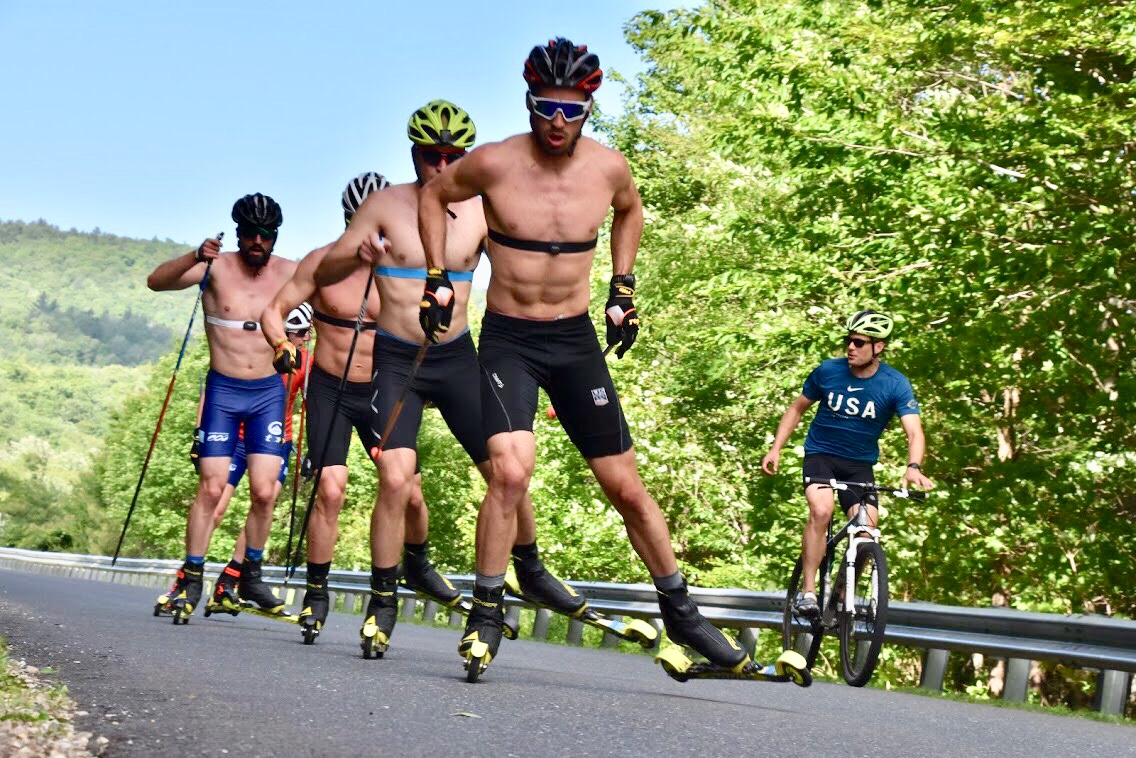
    Ian Torchia (front) leading L3 intervals with the Stratton Mountain School (SMS) team in June. (Photo: Pat O’Brien)

    Two summers ago, with just five miles left of the Marquette Trails Fest 30-mile mountain bike race, all Ian Torchia could hear in his head was the voice of Krystof Kopal, his Northern Michigan University (NMU) teammate, snidely saying, “You drop out again?”

    Fifteen minutes earlier, Torchia had careened into a tree. After dusting himself off, he remounted his bike, but not before noticing his left wrist was badly injured.

    For a moment, Torchia considered pulling out of the race. Thoughts of Kopal, however, kept his feet on the pedals. A few months earlier, Kopal had given Torchia ceaseless verbal flak for dropping out of the 2016 Spring Series 50-kilometer ski race due to cramping. 

    “[Kopal] was playing in my head … so I finished the last five miles with a broken wrist,” Torchia, now 22, recalled on the phone this summer, noting that it wasn’t until after he had finished the race that he found out it was broken.
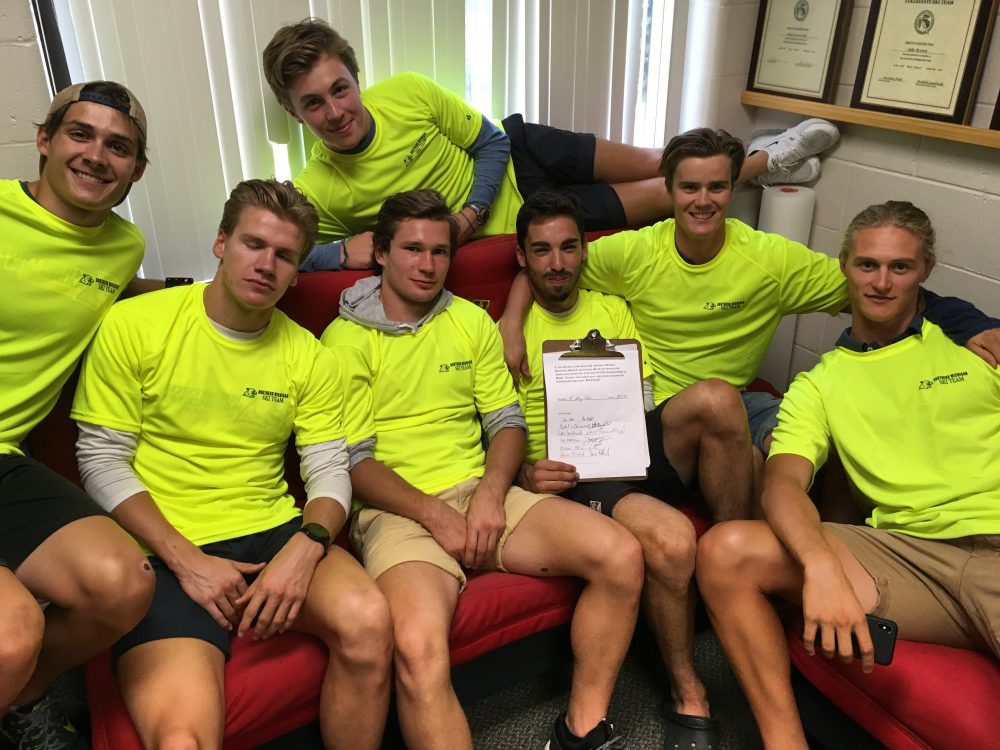
    The NMU men’s ski team with Ian Torchia (third from r) in late August. According to Torchia, the paper he’s holding is a contract. “If we win [the] team NCAA title [this winter], they get to tattoo my gluteus maximus,” Torchia wrote. (Photo: Andy Keller)
    Shortly after, Torchia had his wrist examined by doctor and was told he would need to have surgery. The procedure — scaphoid fixed via percutaneous fixation–left Torchia in a cast. 

    About a month before his crash, Torchia had been nominated to the U.S. Ski Team (USST) D-team and invited to two national-team training camps that summer. Torchia had intended to attend both camps, regardless of whether his wrist was healed or not.

    Fourteen days after his accident, Torchia departed Marquette, Michigan, his “home” since he began attending NMU in 2014, and headed for Eagle Glacier, Alaska, the location of the first USST camp.

    On the glacier, he skied with either one pole or none at all. When he returned to Marquette, the pattern continued for another two months. It wasn’t until the end of August that he had his cast removed. 

    “I kept training super hard with the broken wrist,” Torchia said.

    All that training led Torchia to what he recalled as being “in pretty good shape” leading up to November. Then things started to go south. Fast. Right around Thanksgiving, Torchia was exhausted and experiencing severe night sweats.

    buy inhalers

    “If you type in ‘mono’ on Google and look at the symptoms, I probably had seven out of the eight,” he said. “But I at the time was thinking ‘It’s just a bad virus. It will pass.’ ”

    The symptoms continued. Torchia’s girlfriend suggested he get tested for mononucleosis. He didn’t. 

    “I didn’t want to believe her,” Torchia said. 

    Soon enough he had to. In mid-December, hypothermia forced him to drop out of a race. At 2017 U.S. Cross Country Championships in Midway, Utah, he felt sluggish and “off” during training, so he visited a walk-in clinic in Park City. The doctor tested for mono, and the results came back positive. 

    “The doctor was kind of nonchalant about it,” Torchia said. “He came in and was like, ‘Oh yeah, you’ve got mono, but nordic skiing isn’t a contact sport so you should be good to go and ski at nationals. I was like, ‘Oh, sweet…that’s not how it works.’ ”

    Following the diagnosis, Torchia decided to skip nationals and return to his hometown of Rochester, Minnesota, for the holidays. He stopped exercising for a month before gradually returning to training.

    “A lot of different skiers messaged me saying, ‘On this return, you need to take it really easy,’ ” Torchia said. (One of those skiers included Tad Elliott, who caught the Epstein-Barr virus in 2014 and went on to win a national title in 2016).

    Torchia took their advice, as well as that of his NMU head coach, Sten Fjeldheim, who has helped other athletes diagnosed with mono safely return to training. The two worked out a meticulous day-by-day plan for Torchia’s return. Torchia redshirted the 2017 college season, but by March, he was back on skis.

    “I wasn’t really thinking about what other people thought,” Torchia said when asked if he was worried whether others were questioning his USST nomination during that time.

    “I was thinking more about the next steps,” he continued. “Like the day to day, ‘Oh, my morning heart rates are going down,’ or ‘This next weekend I can start running again.’ … I think before [mono], I was riding really high on skiing, and it was … a big, big part of my life. Getting mono kind of let me take a step back and realize, OK, there are other things [besides skiing].”
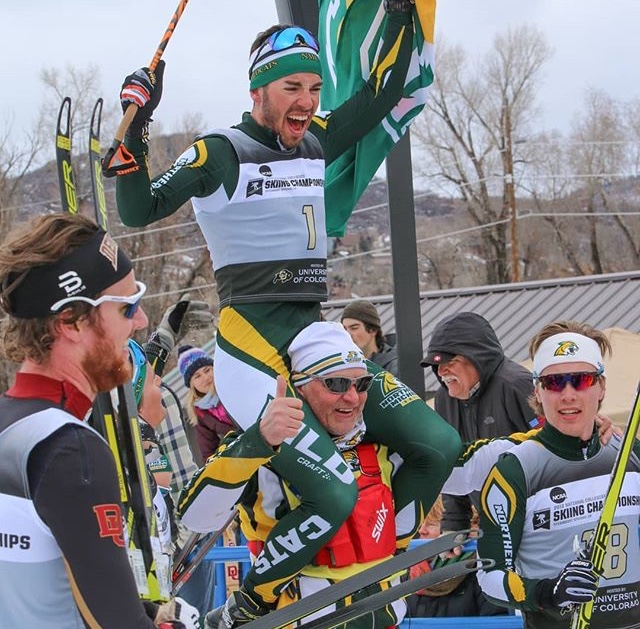
    Ian Torchia (1) on the shoulders of Northern Michigan University Head Coach Sten Fjeldheim after he won the men’s 20-kilometer freestyle race at 2018 NCAA Skiing Championships in Steamboat Springs, Colorado. (Courtesy photo)

    Mono not only gave Torchia a little perspective, but also an extension on his time to compete in college. By redshirting in 2017, Torchia retained eligibility to compete in 2018 (as a junior) and 2019 (as a senior). In his fifth year at NMU, he is currently working toward a master’s degree in exercise science.

    This past March, he won the 20 k freestyle at NCAA Skiing Championships to become NMU’s seventh NCAA champion in program history. In the other race at 2018 NCAA’s, the 10 k classic, he placed fifth for All-American status. Earlier last winter, Torchia qualified for and competed at U23 World Championships in Goms, Switzerland.

    “I try to look at the positives that mono brought,” Torchia said. “That first season of being on the USST brings a lot of pressure and inadvertently getting mono kind of lessened that. Afterward, when I got renominated to the team [last spring], I was like, ‘OK, they’ve given me this second chance, so I need to take it.’ ”

    Torchia was renominated to the D-team for 2017/2018 and again this past spring for the 2018/2019 season. After his third-straight nomination, he approached his summer with revitalized vigor. For the first time since enrolling at NMU, he decided to spend some time training outside of Marquette, largely as a result of a wedding invitation from his USST teammate, Erik Bjornsen. In July, Bjornsen and Marine Dusser were married in Villard-de-Lans, France.
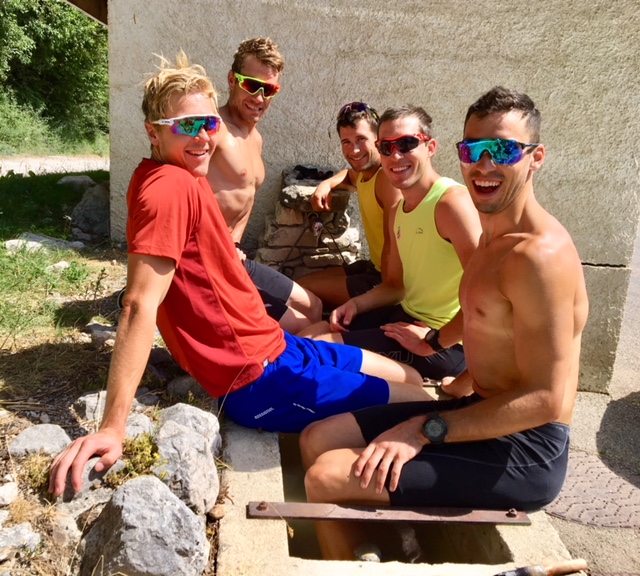
    Right to left: Ian Torchia, Paddy Caldwell, Adrien Backscheider, Simi Hamilton, and Erik Bjornsen during a post-interval cool down in Villard-de-Lans, France. (Courtesy photo)

    “After getting Erik and Marine’s ‘save the date’, I knew there was no way I was missing the wedding,” Torchia explained.

    After the wedding in early July, Torchia remained in France for the USST men’s training camp. The camp lasted 10 days and featured what Torchia described as “hard rollerski intervals and epic mountain runs.”

    He was accompanied by three teammates, Bjornsen, Simi Hamilton and Paddy Caldwell, and their coach Chris Grover. French national-team member Adrien Backscheider joined the group for interval sessions.

    Following the camp, Torchia had made arrangements to stay in Europe for another two and a half weeks, which was partially prompted by his Norwegian teammates at NMU. Over the years, many had encouraged him to travel to Norway and compete in the famed Lysebotn Opp, an uphill rollerski race in Norway’s Blink ski festival.

    Before heading to Sandnes, Norway, for Blink, Torchia made two stops. First, Oslo, where he stayed with his former NMU teammates Fredrik Schwencke, a native of the city, and Kristen Bourne, an American citizen currently training with the Lyn Ski Club in Olso.

    “Pretty lucky to have so many great friends and teammates that put me up throughout the trip,” Torchia wrote in an email.

    Torchia spent a week in Oslo before traveling to Kragerø, where he visited his current NMU teammate Mathias Aas-Rolid. A native of Redalen, Norway, Rolid has a cabin in Kragerø that he opened up to Torchia for “a pre-Blink training camp”.
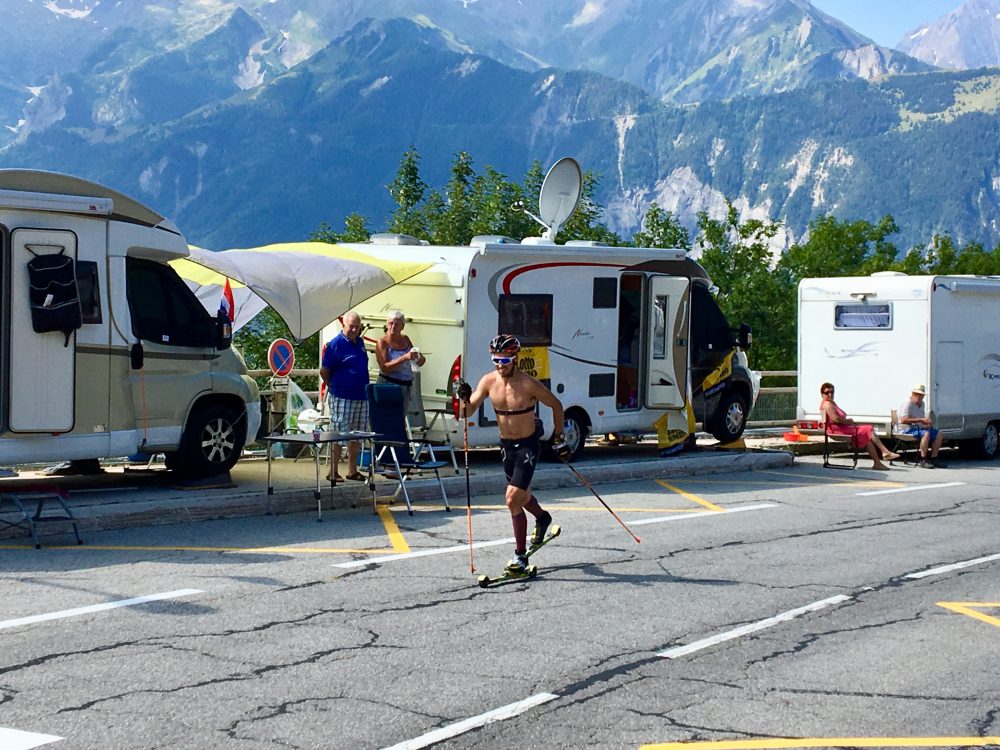
    Ian Torchia rollerskiing up Alpe d’Huez, two days before the Tour de France on July 17, 2018. (Photo: Chris Grover)

    Following Kragerø, Torchia headed to Sandnes for the Blink races. Canadians Evan Palmer-Charrette, Scott Hill and Bob Thomson had rented an Airbnb in Sandnes for the weekend, and keeping with his summer nomadic style, Torchia crashed on their couch during the festival.

    tetracycline buy online, betnovate

    tetracycline buy online, betnovate

    He competed in the 60 k distance race as well as the Lysebotn Opp. The 60 k was what Torchia referred to as “an add-on to the main focus of Lysebotn.

    “For the 60, I made a big blunder by not bringing a water pack and counting on getting feeds along the race course,” he recalled. “Turns out trying to get a feed from a stationary volunteer at 20+ mph is not very effective.” 

    Without feeds, Torchia explained that he “bonked” halfway through the 60 k and ended up finishing 55th. The result left him ready to “turn it around” for the 7.5 k Lysebotn Opp the next day. He managered to position himself well early on in the race’s mass start and within the first kilometer, found himself with the likes of Russia’s Sergey Ustiugov and Finland’s Iivo Niskanen.

    “After the 1 k tunnel, I passed Ustuigov and Niskanen and probably got a little too excited and blew my load about 2 k from the finish,” Torchia wrote of his Lysebotn start. “ ‘Twas a long 2 k in from there and almost managed to catch Harvey but just missed the auto qualifying for the mass start (top-10) by about 15 seconds. I’ve never done a rollerski race, period, so competing in Norway in the strongest field they’ve ever had was a hell of a way to start.”

    Torchia placed 13th, just over 2 minutes behind the winner (and 2018 Olympic skiathlon gold medalist) Simen Hegstad Krüger of Norway and 15 seconds behind Canada’s Alex Harvey, who placed 10th.

    Torchia’s summer adventure ended after Blink, and he flew back to the U.S. on Aug. 6.

    “Getting to do intervals with Adrien Backscheider, [South Korean/Norwegian skier] Magnus Kim, and then race with a World Cup field at Blink served me a big piece of humble pie but was a good indicator that the summer progress[ed] well,” Torchia wrote.

    Torchia is now back in Marquette, focused on school and skiing. Beyond college races, Torchia is targeting 2019 U.S. nationals in Craftsbury, Vermont, 2019 World Championships in Seefeld, Austria, and 2019 World Cup Finals in Québec City.

    “It’s been some ups and downs and definitely a learning experience,” Torchia said of the years since he was first nominated to the USST. “But it’s made me stronger in the process.”
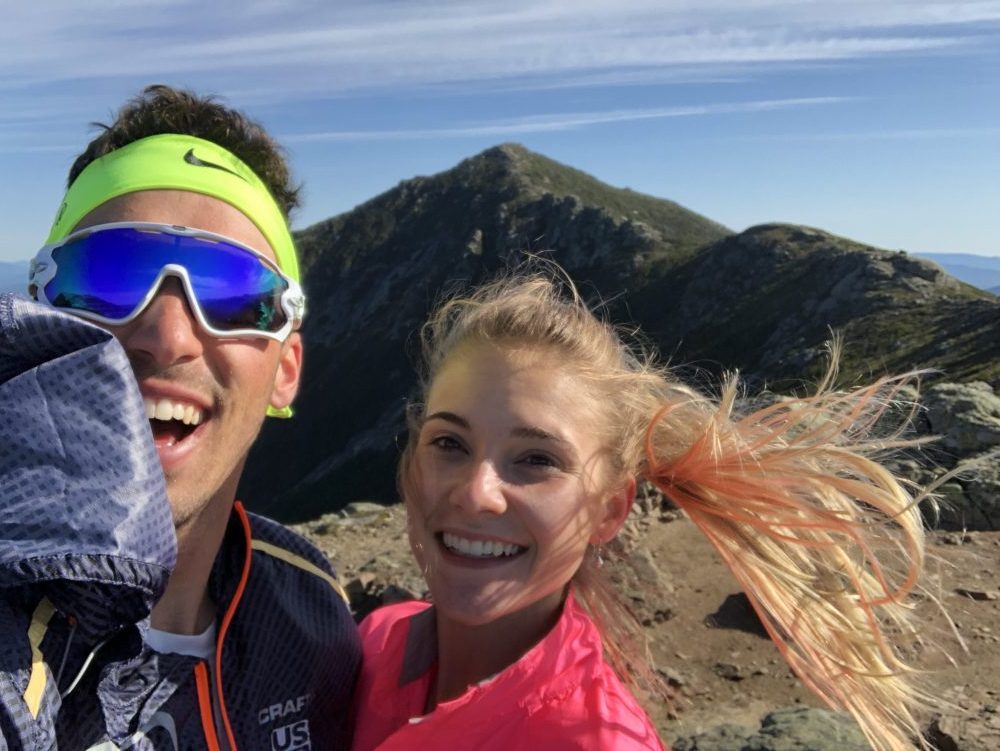
    Ian Torchia (l) with girlfriend, Kameron Burmeister, hiking in Franconia Notch, N.H., during an East Coast road trip they took in June. (Courtesy photo)
  • Kristen Bourne on Recovering from Mono and Making NCAAs

    Kristen Bourne on Recovering from Mono and Making NCAAs

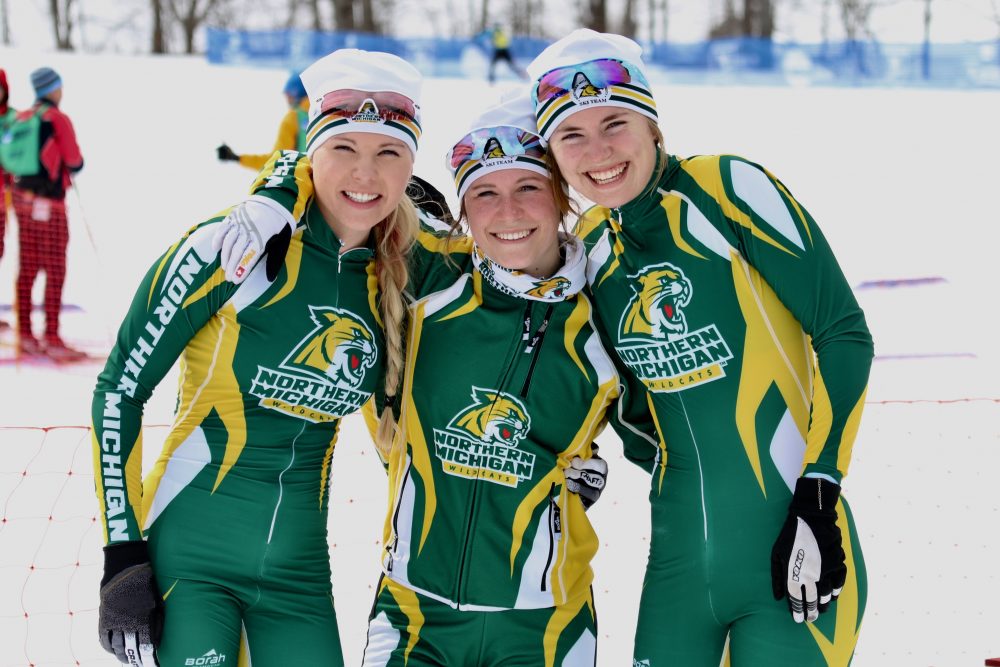
    Northern Michigan University’s Kristen Bourne (c) after the 5-kilometer classic race at the 2017 NCAAs in Jackson, New Hampshire. (Photo: Jackie Schneider)

    Two-and-half months into her summer training last year, Kristen Bourne woke up in a cold sweat. Her temperature read higher than normal and no amount of lozenges could soothe her sore throat. The Northern Michigan University (NMU) skier went to a doctor and received antibiotics to treat what was thought to be strep throat.

    But two weeks later, Bourne still didn’t feel like herself, and she wanted to know why.

    Behind her were 215 logged hours of summer training in Marquette, Mich., a 6 1/2 hour drive from her hometown of Lake Elmo near Stillwater, Minn.

    Ahead of her was a promising junior season at NMU, with plans to attend the university’s sports-science graduate program in the winter of 2018. She had redshirted the year before and gained an extra year of development under NMU Head Nordic Coach Sten Fjeldheim, as well as an extension on her National Collegiate Athletic Association (NCAA) eligibility.

    The investment she had put in her season was nothing to scoff at; neither was her uncharacteristic exhaustion at practice. After finishing one session in late August feeling especially spent, Bourne returned to the doctor, and this time, was able to pinpoint the issue.  

    “I went to the doctor that day and they did a mono test,” Bourne explained on the phone.

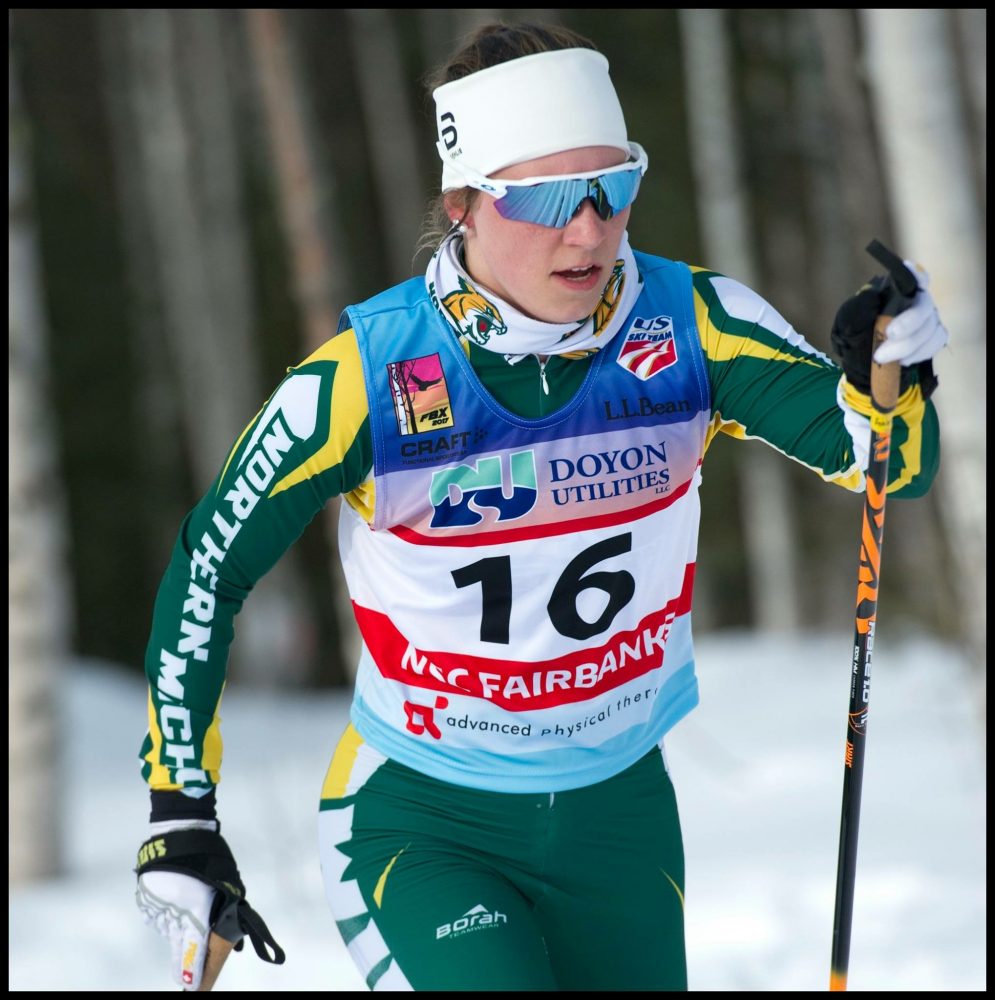
    NMU junior Kristen Bourne racing to 19th in the 15 k skiathlon at the 2017 U.S. SuperTour Finals on March 27 in Fairbanks, Alaska. (Photo: Lance Parrish, Fairbanks)

    The results tested positive. With fall training just around the corner, and a sudden uncertainty about where she was headed, Bourne began to worry. What did this mean for her season? Was there any way out? Were all those hours of work and training for nothing?

    “I was so bummed,” Bourne, who turns 22 later this month, said. “It was the best I had felt training; when you put in all this work and then realize that you’re not going to do anything and for that long, it’s really concerning.”

    The mononucleosis put her out of training for two months, from the beginning of September until the end of October. These months are not dispensable as they often incorporate a new cycle of intensity sessions, hours and gym time.

    But for Bourne, it was the beginning of a learning process and careful track back to top form, thanks in part to Fjeldheim and his connection to the NMU sports-science department.

    The First: Fielding Mono with Fjeldheim

    What exactly is mono? How does it affect athletes? How might it affect athletes as they return to training?

    These were some of the questions Fjeldheim had when he encountered his first case of mono among his student athletes. While coaching NMU’s cross-country running team, one of his top runners came down with the illness at the end of the summer. (Fjeldheim coached for the NMU running program for more than 20 years, and now solely coaches nordic).

    With the cross-country running season only lasting about eight weeks, there was limited time before some of the more important scoring races, like regionals, appeared next on the calendar.

    Fjeldheim wasn’t deterred. He approached Dr. Phil Watts, NMU’s sports-science program coordinator and professor. Sitting in Watts’s office — a room Fjeldheim had visited when he was a Wildcat — the two discussed the costs and benefits of de-training to the body and ultimately developed a way to help the runner make a full recovery.

    “We laid out a plan with the team doctor on how to bring her back,” Fjeldheim said. “I think she got [mono] in early August and then by early November we ran our regionals and she got third. That’s after running only one other running race before the regionals. I think she ran a running race at the end of October and then second week in November, she’s third in our regionals.”

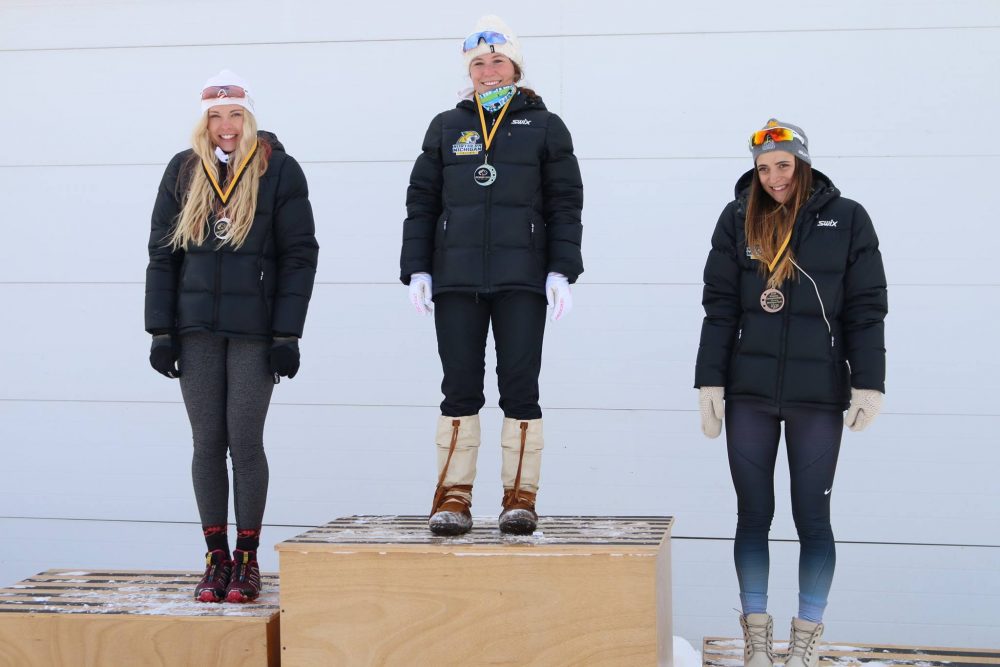
    NMU’s Kristen Bourne (c) topped the podium at the 2017 CCSA Distance Championships in early February in Houghton, Mich. (Photo: Jackie Schneider)

    After that, Fjeldheim worked with a few other athletes who came down with mono early in their season yet went on to become All-American athletes. Though Bourne would not earn this accolade, she came close.

    By the end of her season, Bourne won both races at the Central Collegiate Ski Association (CSSA) Distance Championships and also qualified for NCAA Skiing Championships. There in Jackson, N.H., she finished 17th in the 5 k classic and was the top NMU woman in the 15 k freestyle mass start two days later, placing 13th and within two seconds of All-American status (top 10).

    All after having mono. How?

    Bourne’s comeback was not without meticulous and methodical planning. Her return to training was slow and her situation was unique: not only did her coach, Fjeldheim, have experience working with athletes who had mono and successfully returned to racing, but Bourne was also the type of athlete who made the return more amenable.  

    Over the course of an entire summer, Bourne routinely checked her heart rate each morning, before getting out of bed. She wrote it down and kept track of fluctuations and differences. Every day.

    When she was diagnosed with mono, knowing her base heart rate was crucial. After two months off and having her spleen examined to ensure it was no longer enlarged, she started exercising again. Each week entailed meetings with coaches and every day, she assessed her resting heart rate and how far off it was from her previous one.

    “We used the morning heart rate as a guide,” Fjeldheim explained. “Once her morning heart rates were back to normal, within say two or three beats of what her base morning heart rate had been for months and possibly years, then we just started with getting back into moving again.”

    He emphasized that this came after making sure Bourne’s spleen was a normal size. Then she safely began training again while agreeing to listen to what her body was telling her via her heartbeat and lactate tests. And she had to keep it to a minimum.

    “When I started working out, it was 15-minute jogs,” Bourne said. “Then every week, I’d sit down with my coaches and re-evaluate how I felt, how that week went. Every two weeks I was doing some lactate tests to monitor my heart-rate zones … then every week adding a little bit if I was ready. Come November, I started actually doing more systematic training instead of just doing low distance.”

    Fjeldheim also monitored Bourne’s sleep patterns to make sure there weren’t disruptions and whether she was gaining or losing weight.

    If any of the numbers were off, she rested.

    “You don’t mess with mono,” Bourne emphasized. “If you don’t feel good, you do nothing. You can’t try and push it out of your system it just doesn’t work that way.”

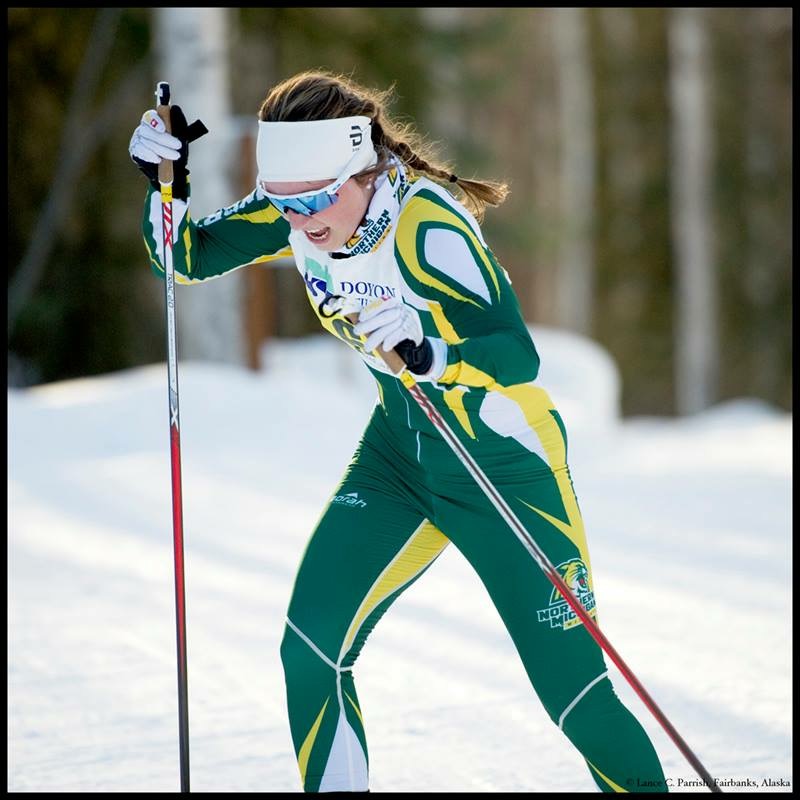
    NMU junior Kristen Bourne racing the freestyle leg of the mixed relay at the 2017 U.S. Distance Nationals in late March in Fairbanks, Alaska. (Photo: Lance Parrish, Fairbanks)

    This perhaps was the hardest part. While Bourne rested in bed, her teammates were out training. When Bourne finally began training an hour and a half again, her teammates were out doing three. She missed out on more than three months of interval training. And when she did reincorporate hard efforts, she didn’t always feel good.

    “Mentally, it’s really tough,” Bourne said. “I just had to trust what my coaches said and trust myself and keep my fingers crossed and hope that my season would work out. We figured that I wouldn’t start doing well until February because I didn’t actually start doing intervals until the end of November. … I have to give so much credit to my coaches reassuring me all the time and my teammates being so supportive about it, being like, Kristen if anyone can do it, you can do it.”

    Rather than get caught up in what training she couldn’t do, Fjeldheim advised Bourne to focus on what she could do, like improving her technique. 

    “As I told her, hey you know, you’re going to come back from this. It’s not cancer, it’s not debilitating, you didn’t find out you’ve got some rare disease,” he said. “You have mono and we’re going to figure out a plan. You got to have a plan and then they got to buy into it.”

    The experience gave Bourne not only some of her best collegiate results, but also a new edge on her training. She plans to ski for NMU next winter and is considering continuing to race competitively after she graduates.

    “A lot can happen in a year and I can’t set any expectations for myself right now,” Bourne wrote in an email. “We’ll just have to wait and see!”

    ***

    Author’s note: This article is not intended to be a guide on how to train through mono, but rather track one athlete’s recovery from illness.

  • Domracheva to Skip Entire 2016 Biathlon Season Due to Mononucleosis

    Domracheva to Skip Entire 2016 Biathlon Season Due to Mononucleosis

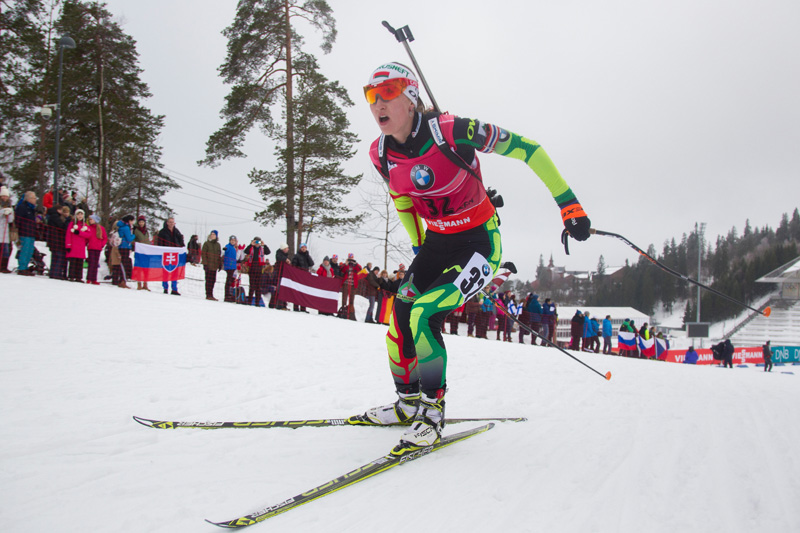
    Darya Domracheva of Belarus en route to a victory in the sprint in Oslo, Norway, one of her nine wins last season. The 2014-2015 World Cup Total Score winner will not compete in 2016. (Photo: Fischer/Nordicfocus.com)
    Darya Domracheva of Belarus en route to a victory in the sprint in Oslo, Norway, one of her nine wins last season. The 2014-2015 World Cup Total Score winner will not compete in 2016. (Photo: Fischer/Nordicfocus.com)

    Darya Domracheva of Belarus announced about a month ago that she had mononucleosis, a viral disease that leaves sufferers with severe fatigue. After struggling to cope and recover, things are not going well and Domracheva has decided to skip the entire 2015-2016 biathlon season.

    You can, of course, push it and and still act this winter, but after consulting with experts and listening to them, I came to the conclusion that a more sensible solution would be skipping the season,” she wrote in a post on sport.tut.by.I’m sure it would do me good, will restore strength and get me motivated for the next year.”

    Domracheva won the World Cup Total Score last season; previously she had placed second in the 2012 and 2013 seasons and third in the 2014 season, where she also won three individual gold medals at the Olympic Games.

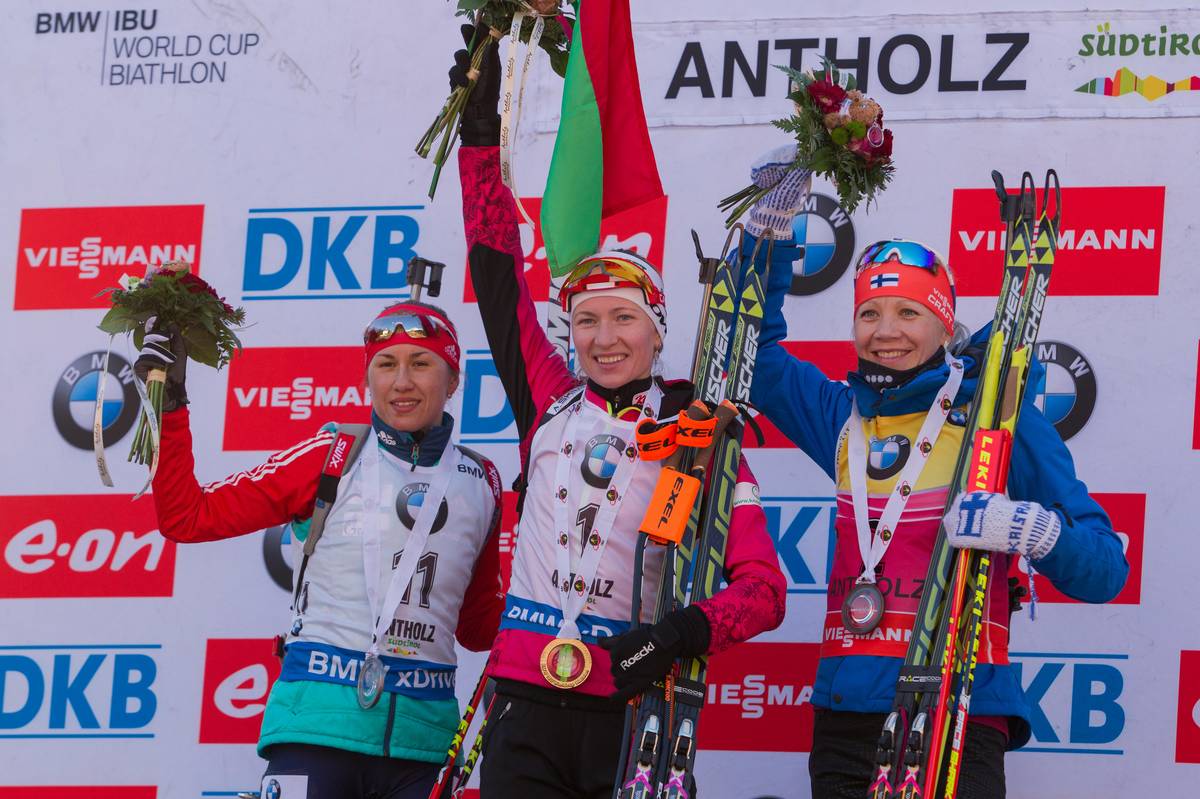
    Darya Domracheva (Belarus, center) won the 10 k pursuit in Antholz, Italy, by a landslide over Daria Virolaynen (Russia, left) and Kaisa Makarainen (Finland, right). (Photo: Fischer/NordicFocus)
    Darya Domracheva (Belarus, center) won the 10 k pursuit in Antholz, Italy, by a landslide over Daria Virolaynen (Russia, left) and Kaisa Makarainen (Finland, right). (Photo: Fischer/NordicFocus)

    She wrote that by the end of the 2015 season, she was exhausted, and considered stepping back to either take a year off or compete less frequently on the World Cup. But after a rest she regained her enthusiasm for training and the next season. Her body “wasn’t fooled,” though, and mono was a signal that she should rest.

    Next month, on doctor’s advice, I will start in a very calm and gentle way,” she wrote.Next I will gradually begin a basic training course, based on well-being and performance analysis. In the winter I plan to do detailed testing and selection of my skis for next season, and this year I’m getting a great opportunity to do so... To diversify and make the work more interesting, I plan to have a custom training plan for me to exercise, and to work out with experts from other sports. In general, I am considering the year for as a kind of reboot for myself.”

    A number of biathletes have come down with mono in the last several seasons, with varying effects. Martin Fourcade, the Total Score winner on the men’s side, had a bout of mono last season, but it didn’t seem to harm his season; the biggest thing he had to give up was a desire to race in the FIS Cross-Country World Cup which began before the biathlon season.

    A few seasons before, Canada’s Jean Philippe Le Guellec struggled with mono too, and said that it did significantly affect his performance.

    Domracheva is undeniably the biggest star in women’s biathlon at the moment, and her loss will be felt greatly. Organizers of the 2016 World Championships in Oslo, Norway, are already lamenting her absence.

    It is clear this will make interest [in the competitions] smaller, particularly in Belarus,” NRK commentator Ola Lunde said.It’s incredibly sorry for the sport. Meanwhile, the Norwegians are rid of an important and tough competitor, so there are greater chances for medals at the World Championships in Oslo.”

    Biathlon will face an environment similar to cross-country skiing next season, where last year’s dominating star Marit Bjørgen is taking the season off to have her first child.

    In biathlon’s case, the most likely heir to Domracheva’s throne is Kaisa Makarainen of Finland; she finished second to Domracheva in the Total Score in 2015, and the pair were head and shoulders above the rest of the field. Makarainen also won the Total Score in 2011 and 2014.

    But there are plenty of other women nipping at her heels, who won at least one World Cup race last season. That includes Valj Semerenko of Ukraine; Veronika Vitkova and Gabriela Soukalova of the Czech Republic; Tiril Eckhoff and Fanne Welle-Strand Horn of Norway; Marie Dorin Habert of France; Laura Dahlmeier of Germany; and Ekaterina Yurlova of Russia.

    In other words, despite race organizers’ fears, there’s unlikely to be a lack of excitement on the World Cup.

  • Morgan Smyth – Back on Track

    Morgan Smyth (APU) won the silver medal in the women's 10K classic at US Senior Nationals Wednesday.

    In 2009, it seemed like the Vermont native was headed for the stars. Morgan Smyth qualified for the 2009 World Championships in Liberec (CZE), she was the national distance champion in the 5K, she won the team sprint at nationals with Liz Stephen, she was on the US Ski Team.

    But the summer of 2009 marked the start of trouble and derailed her Olympic dreams.

    First, Smyth had surgery to relieve compartment syndrome in August. That didn’t concern her too much, as most recover fairly quickly from that. Then, once the season got started and she entered the West Yellowstone races in November, she realized that her cold was something else. She found out she had come down with mononucleosis. For the second time.

    “They say you can only get mono once in your life. That’s not true,” Smyth said, explaining that she was sick for quite a while before she realized it was mono – again. Despite this bout being a milder case than her first encounter with the disease, Smyth knew that mono is not something that goes away overnight.

    “I was pretty bummed out, it being an Olympic year and all,” Smyth admitted.

    “Many skiers had their eyes set on the Olympics. It was definitely a goal for me,” she said. “It’s not the same to watch it from a couch when you want to be out there racing it.”

    Morgan Smyth won the 2009 national title in the 5K classic (Photo: Lance Parrish)

    Back at it, one step at a time

    Having learned from previous mistakes, Smyth knew that recovering from mono takes time and patience.

    “Last time, I tried to race all the way through. I took a few weeks off, tried to race and realized that just wasn’t the reality,” she recalled. “It’s not like you wake up one morning, open your eyes and just feel amazing. It’s a slow process.”

    At the end of last season, Smyth got back on her skis and then gradually started to enter some races just for fun and to reconnect with her friends.

    “It wasn’t until late in the winter, mid-February, that I was on skis and teaching lessons with the elementary school kids. It was fun to be a part of the ski community again, even at a different level. I can definitely remember being one of those kids. I just love to play on skis,” she said. Then she moved into racing.

    “I raced a little at the end of the season, just for fun. I just love ski racing and most of my friends are in ski racing, so racing was an opportunity to see everyone,” Smyth explained, adding that she also went to nationals in Maine to connect with APU head coach Erik Flora.

    “I wanted to talk with Erik Flora about possibly joining APU, and I liked it a lot. So Memorial Day weekend I packed up my car and headed for Alaska,” Smyth said.

    As it turned out, APU was the perfect match for Smyth.

    “I absolutely love APU. Erik Flora is a great coach, and the atmosphere in the team is really good. We train together almost every day of the week,” Smyth said.

    Looking for tough teams

    Smyth’s strategy for improvement is to challenge herself.

    “I’ve always tried to be on teams whose skiers are kicking my butt. I figured if you are in a race with them, you should train with them. That’s how you get as good as them,” Smyth explained.

    “When I was younger, Stratton Mountain School was that team, then for college NMU seemed to be it. And turns out it has been super fun as well,” said Smyth, who proceeded to go all the way and was named to the US Ski Team for the last two years of her college career at NMU and the following two seasons.

    Winning: a team experience

    To Smyth, being a part of a team is an important part of the winning equation, and the team environment plays a major role in overall success.

    “When you’ve been training together in rain and wind and been super tired, it brings everyone together,” she said, explaining that while cross-country skiing is an individual sport, the team experiences connect.

    “You see your teammates succeed and it makes you happy, you’ve been through the same training, you know what they’ve done. If you have a crappy race, you can still have a good day when they do well.”

    APU women – a tight-knit team. L-R Morgan Smyth, Brooks, Katie Ronsse, and Sadie Bjornsen. Photo, flyingpointroad.com

    Nationals is just gravy

    When Smyth got sick last season and couldn’t race, being away from the sport and the community she was so involved in definitely took a toll on her. On the other hand, Smyth also took away some valuable lessons from the season that didn’t happen. She learned to never take anything for granted in health or racing.

    “Just being here and feeling good and being fit is awesome. I just came to nationals to ski my best and enjoy it,” Smyth said, noting that this is her first time going into the championships on cruise control and that it feels refreshing in some ways.

    “I honestly didn’t have super-specific goals for nationals compared to the past. I’m far down on the USSA points list, and the only team to qualify for here is the World Championships. So with that reality, I just want to ski as hard as I can,” she said.

    As for the rest of the season, Smyth is equally laid back.

    “I don’t have a plan. I take it one race section at a time,” she said, adding that she knows she’ll join the APU team for the SuperTour in Lake Placid, and hopes to go to Sun Valley for the spring series. “I’m just going to try to race fast. What happens happens.”