From the FasterSkier archive — posts syndicated from athletes’ and coaches’ own blogs between 2004 and 2012, kept online as published. Current coverage is at fasterskier.com.
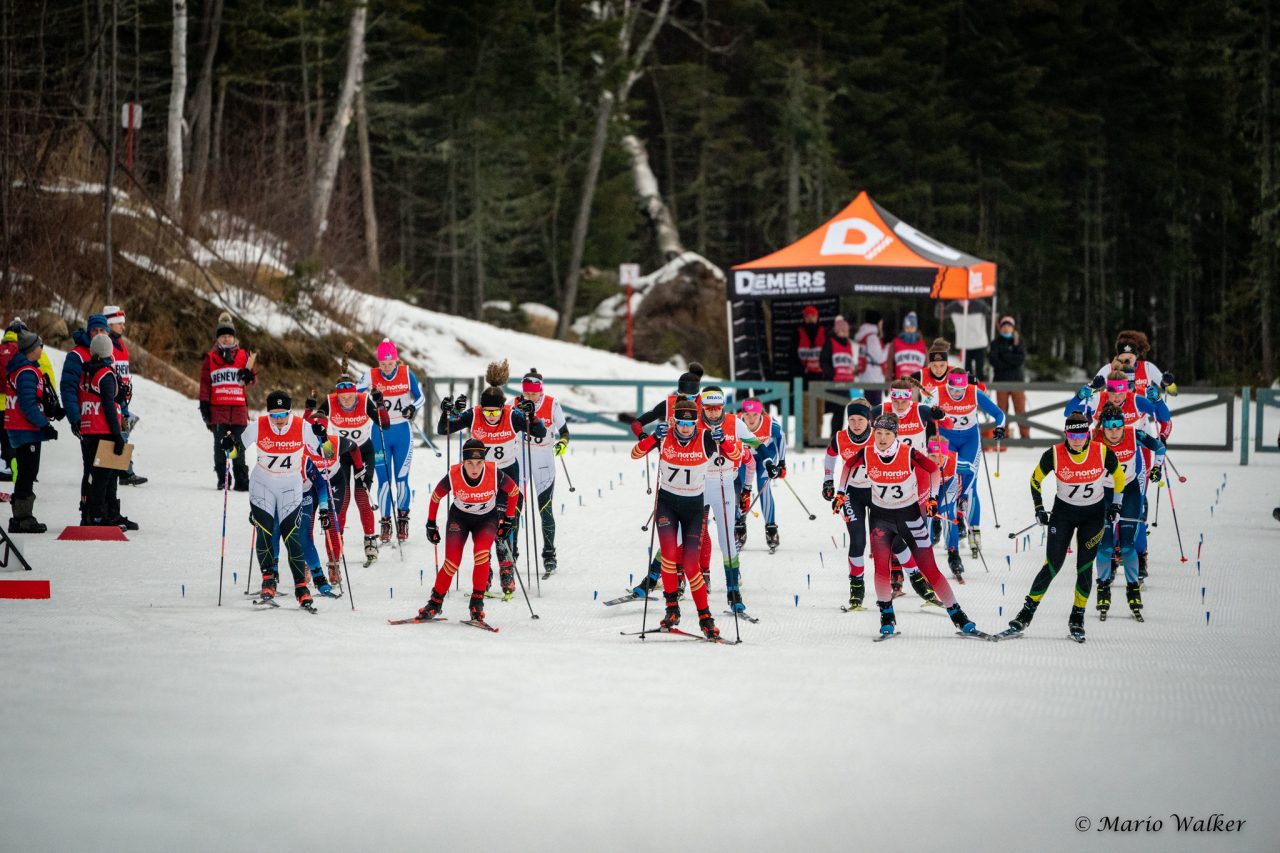
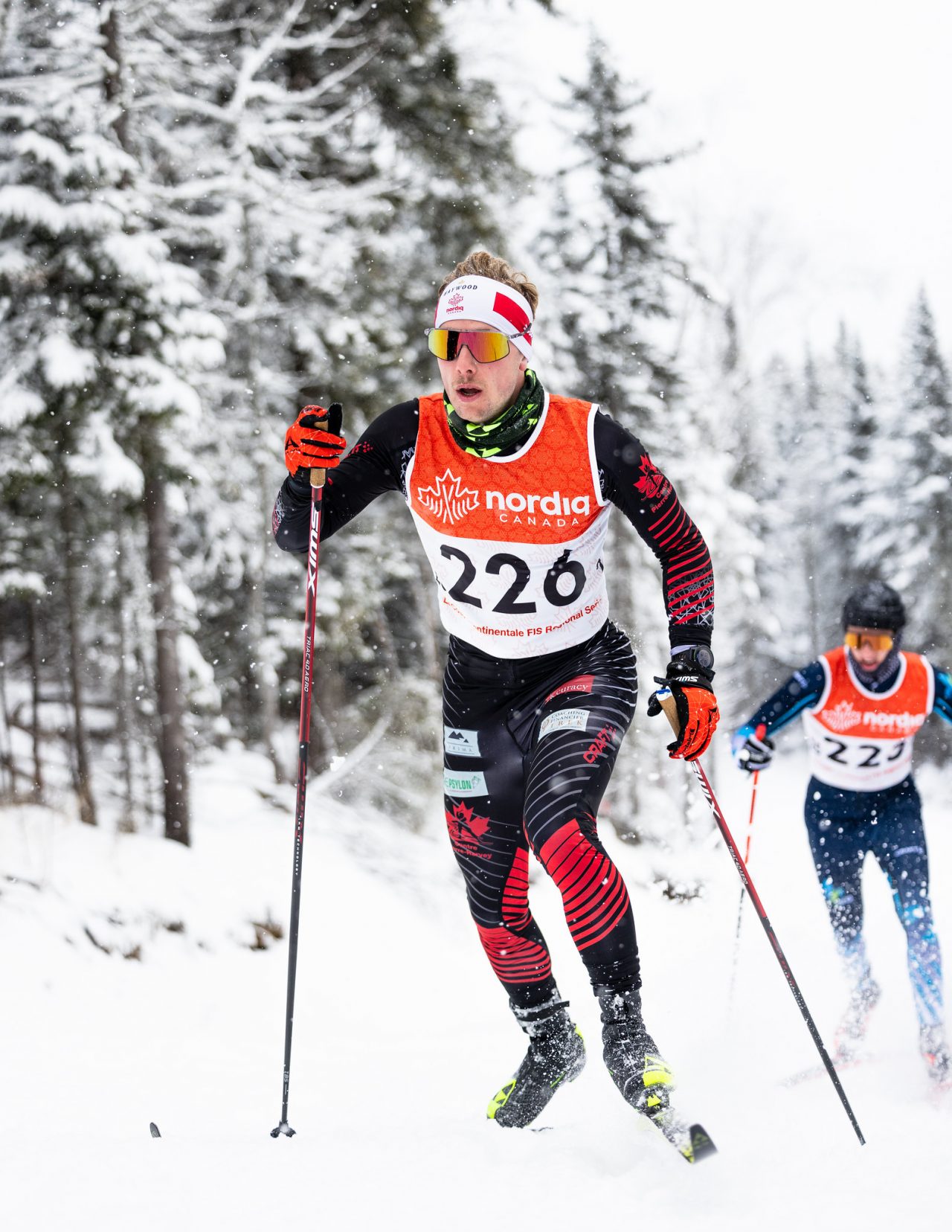
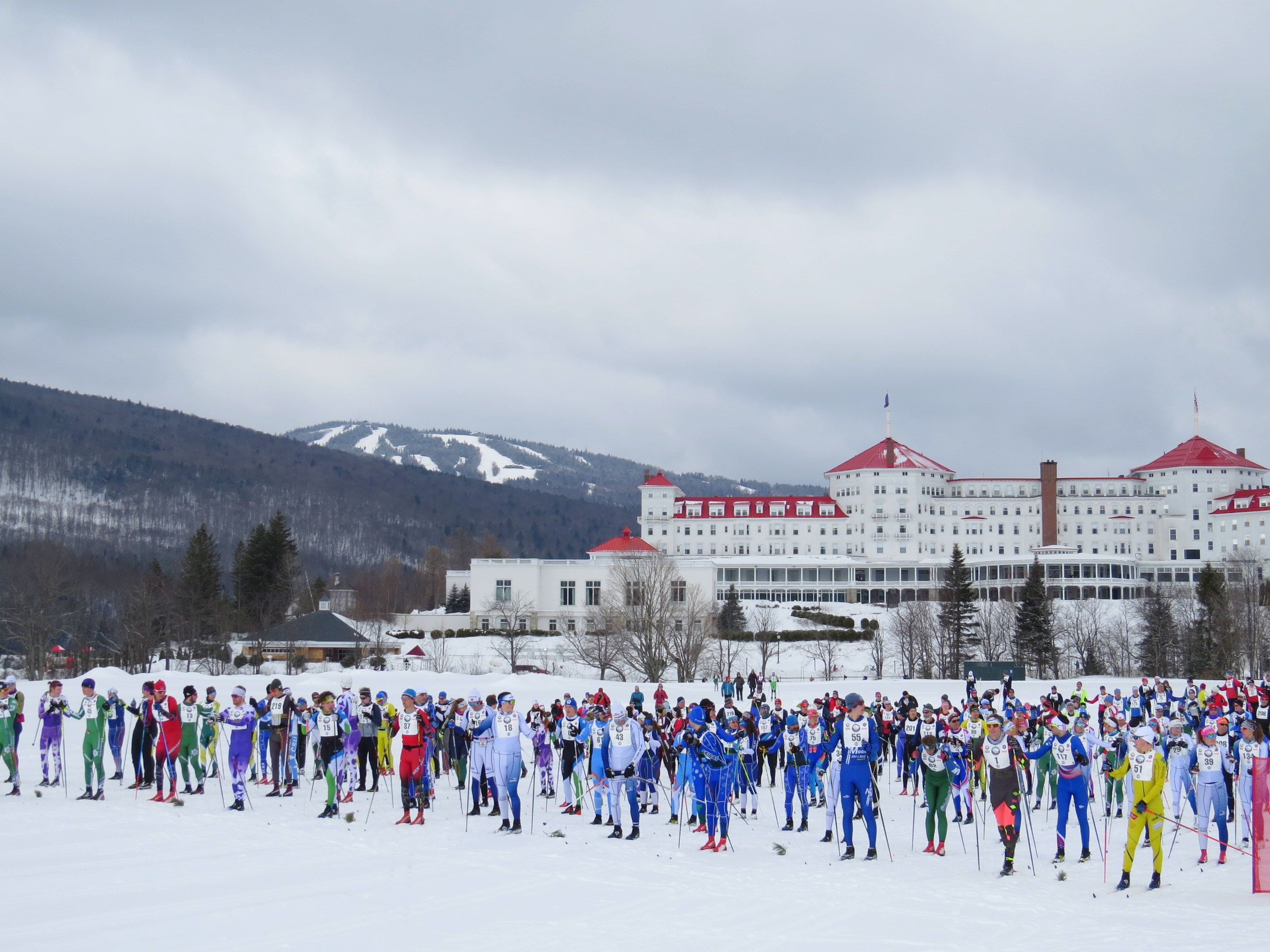
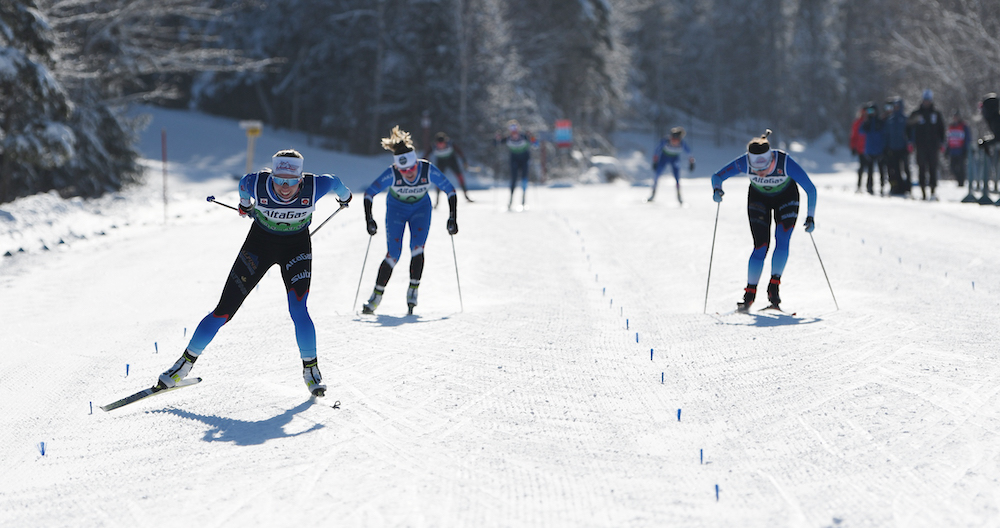
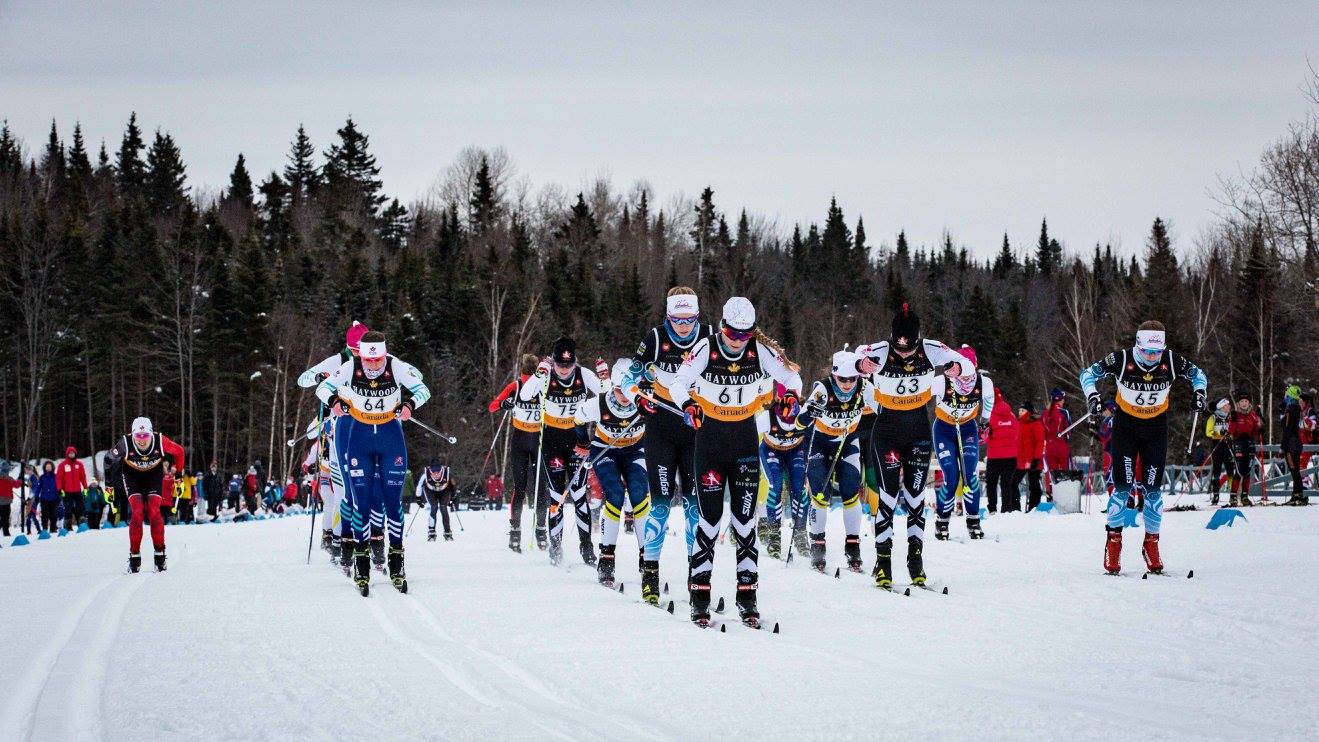
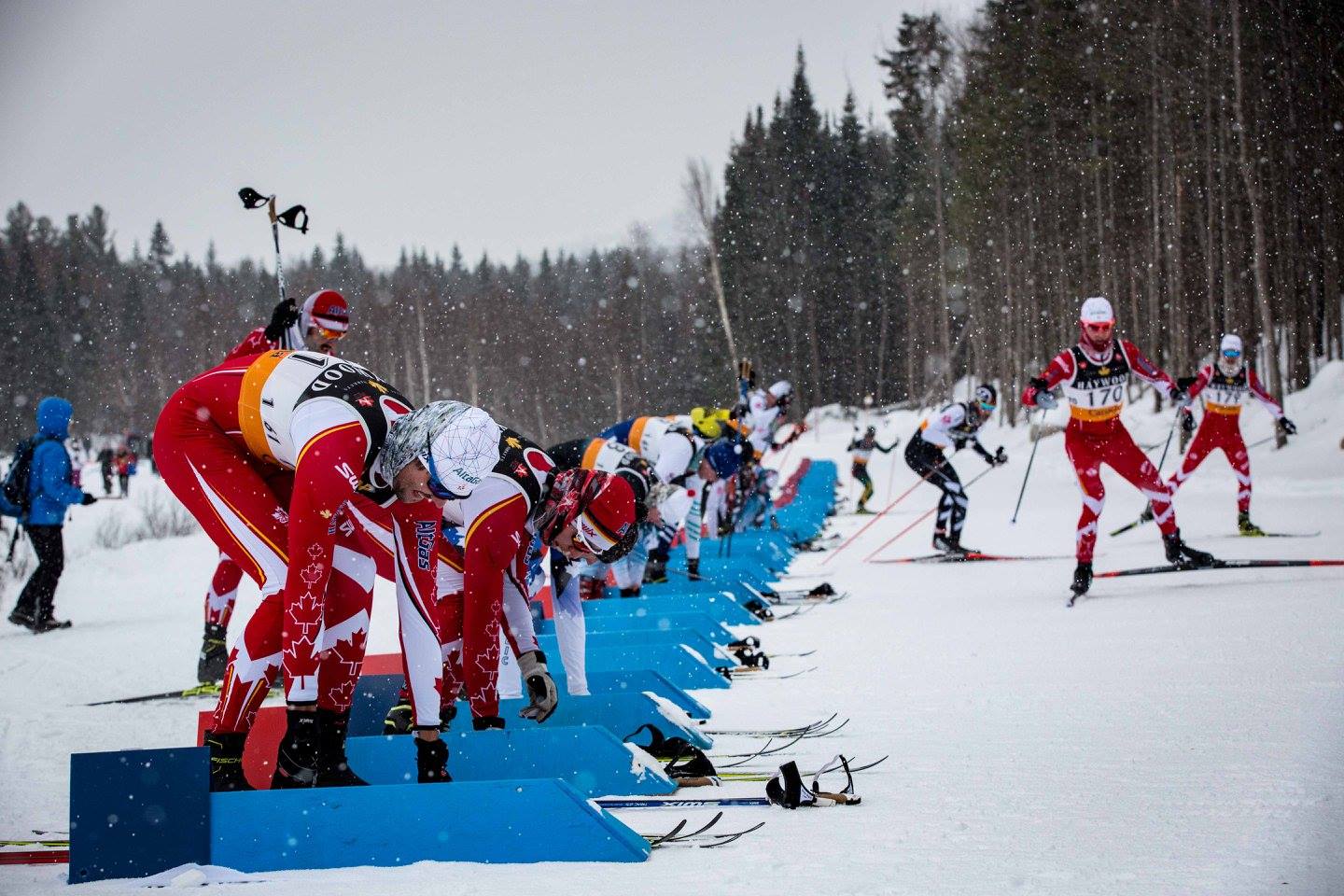
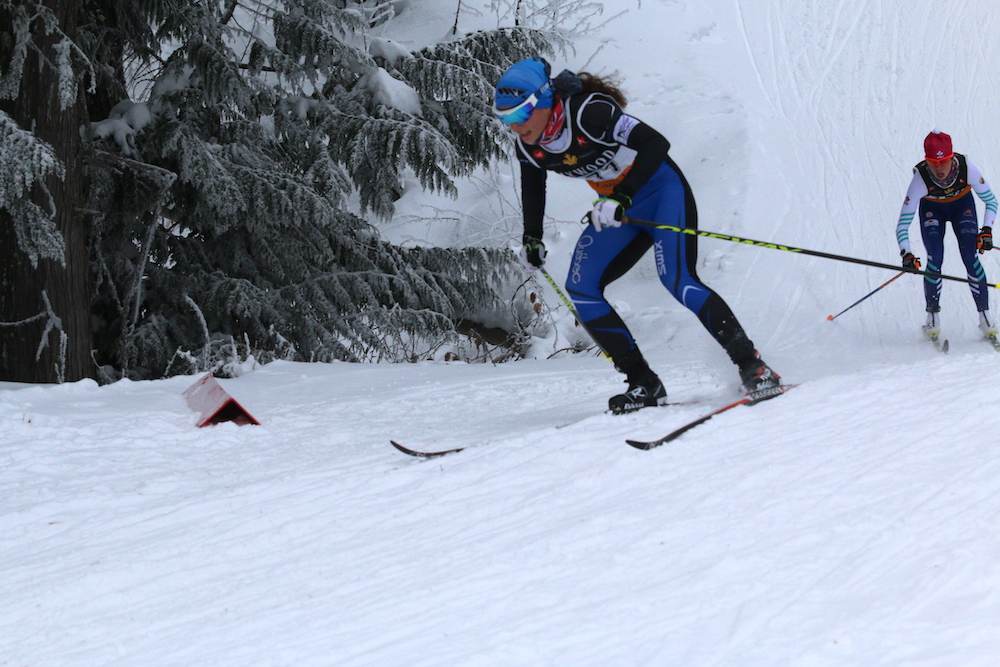
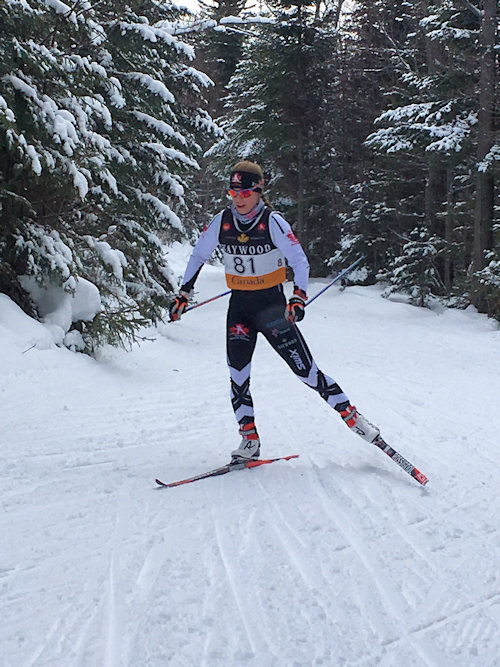
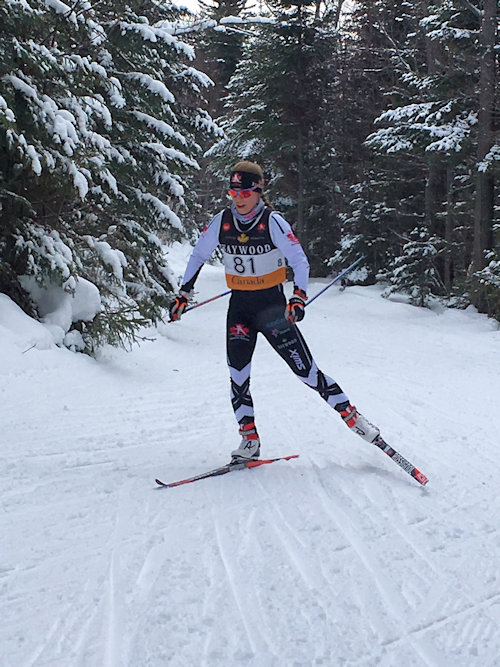
The women start at Mont Sainte Anne. This is the first mass start 20km for most of the field. (Photo: Mario Walker)
Mont Sainte Anne (MSA) held the final pre-Christmas races in Canada over the weekend, with a 20km freestyle mass start Friday, freestyle sprints on Saturday, and 10km individual start classic on Sunday.
Fresh snow, steep hills, and temperatures comfortably below freezing greeted 400+ racers at a continental cup hosted by Skibec, Centre National d’Entraïnemente Pierre Harvey (CNEPH) , and Club Nordique MSA.
MSA is a popular racing destination, as Nakkertok’s Bronwyn Williams explained: “I love racing at MSA because the trails are amazingly challenging! For some other race courses you need to work hard to bury yourself but at MSA the courses go out of their way to destroy you and if you’re not careful they will. That’s what makes it so fun though because you are not just racing your competitors, but you are also trying to survive the courses.”
Friday
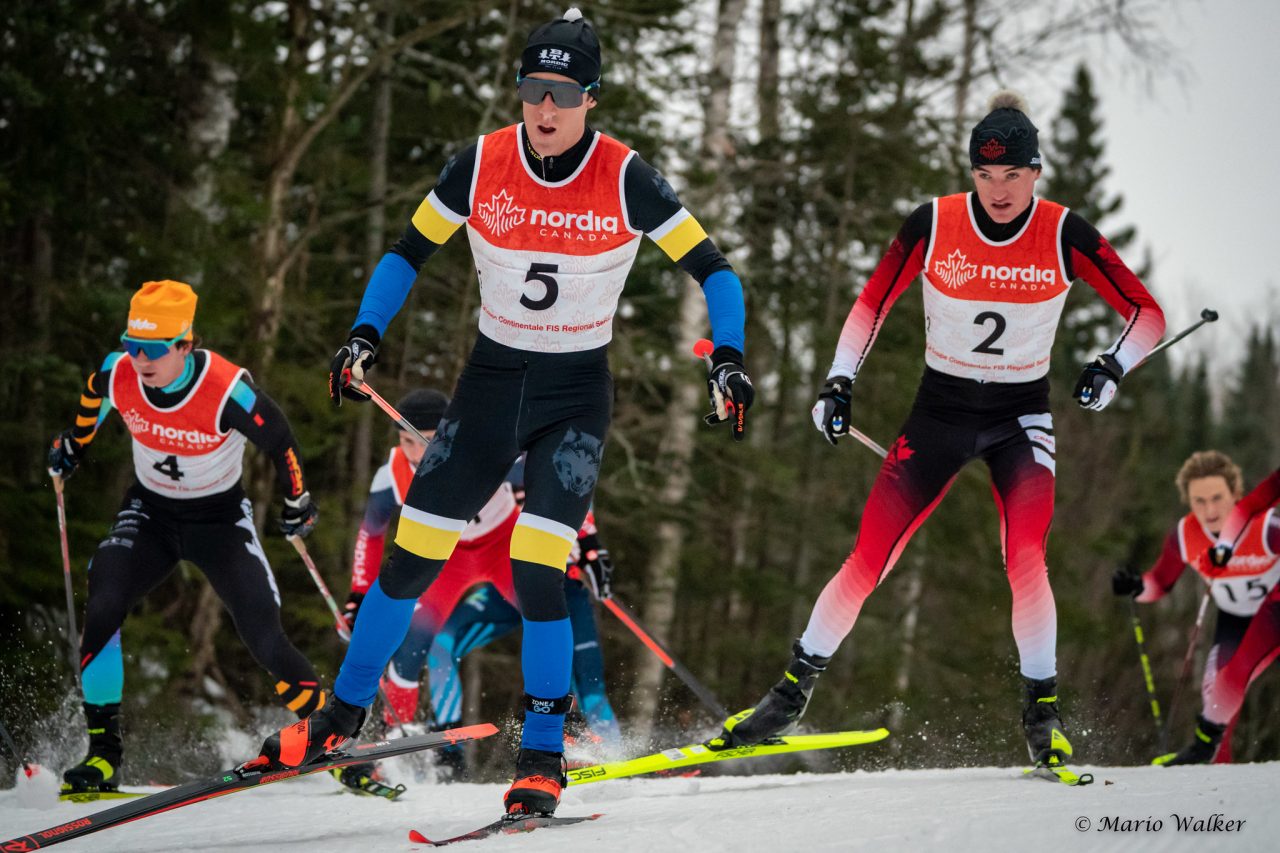
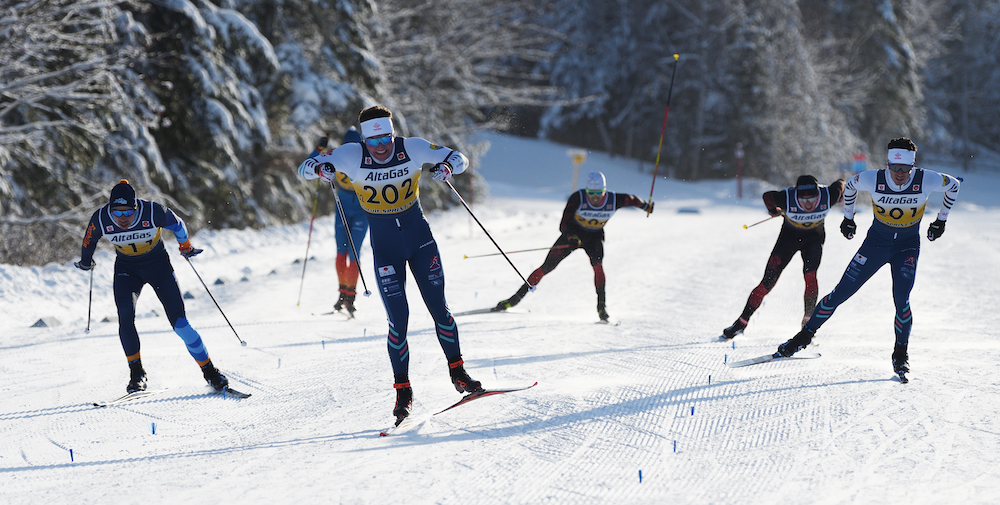
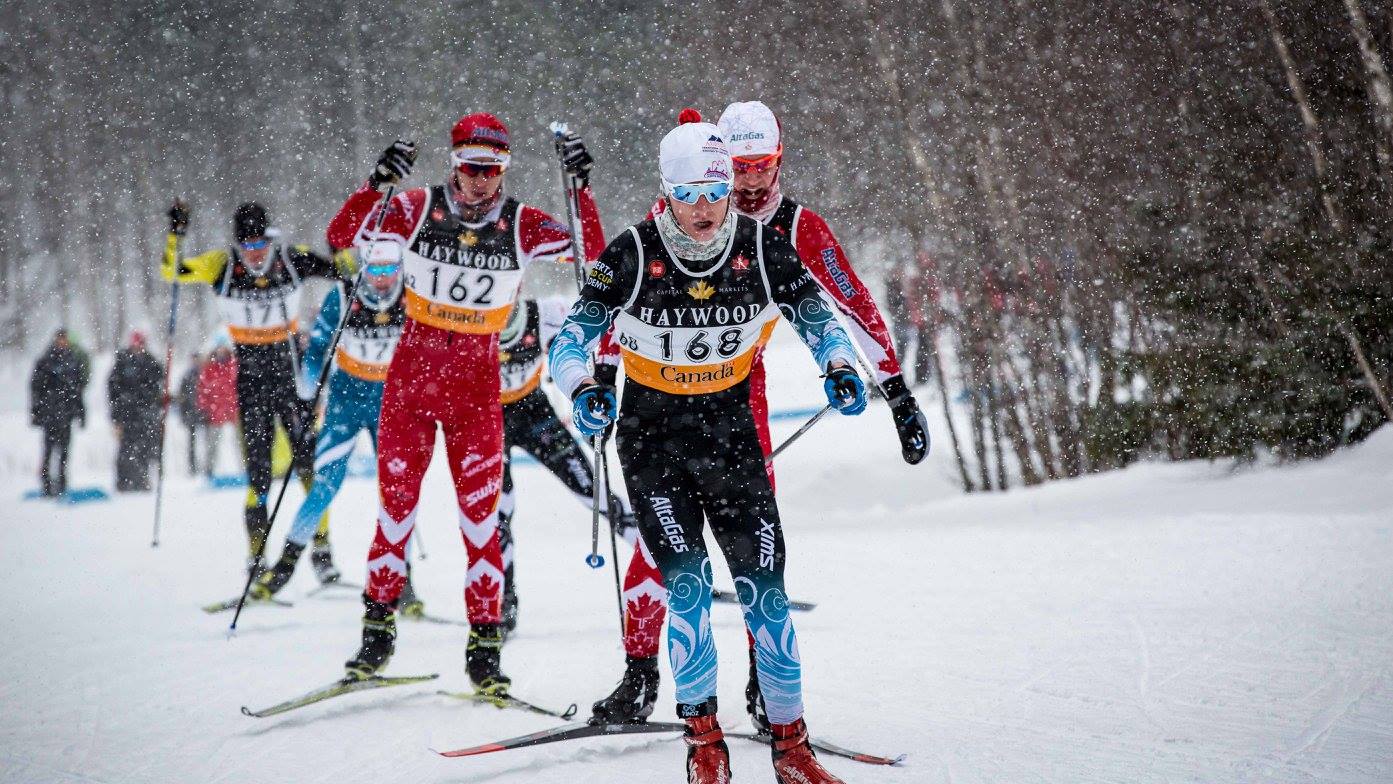
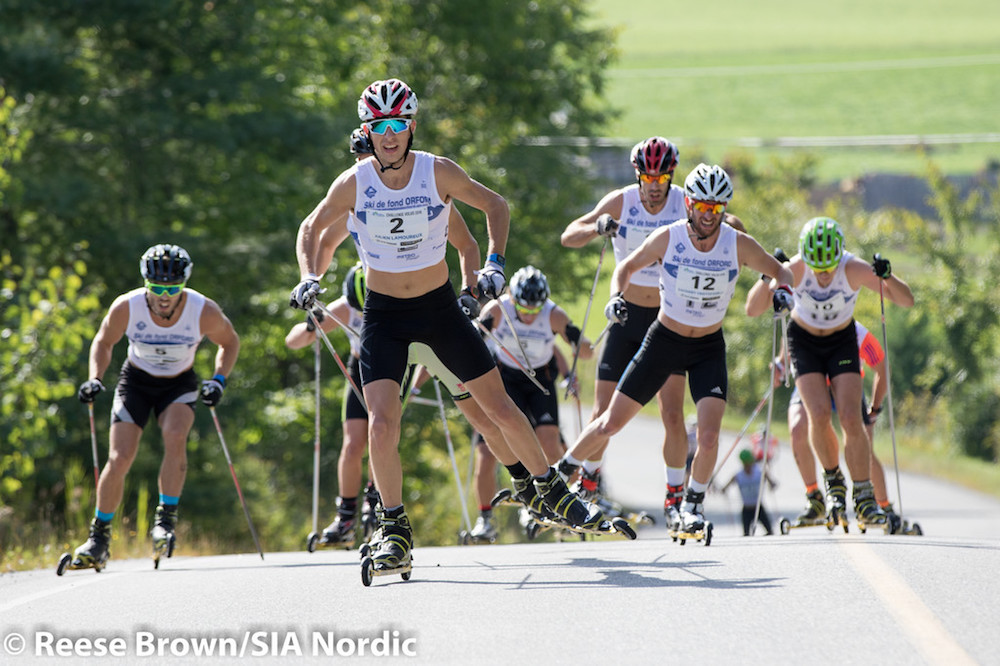
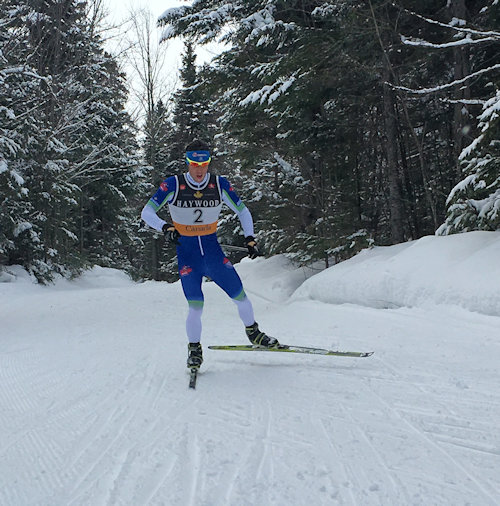
Winner Sasha Masson (#2) skiing patiently in the lead pack. (Photo: Mario Walker)
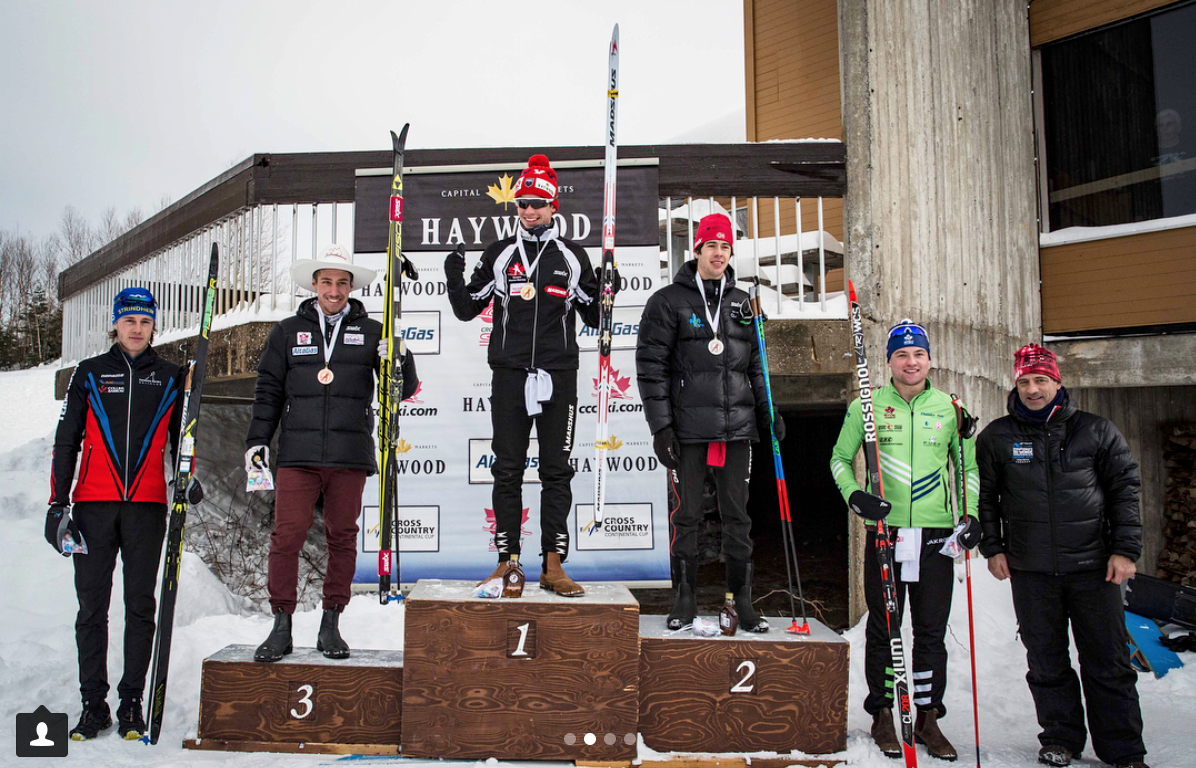
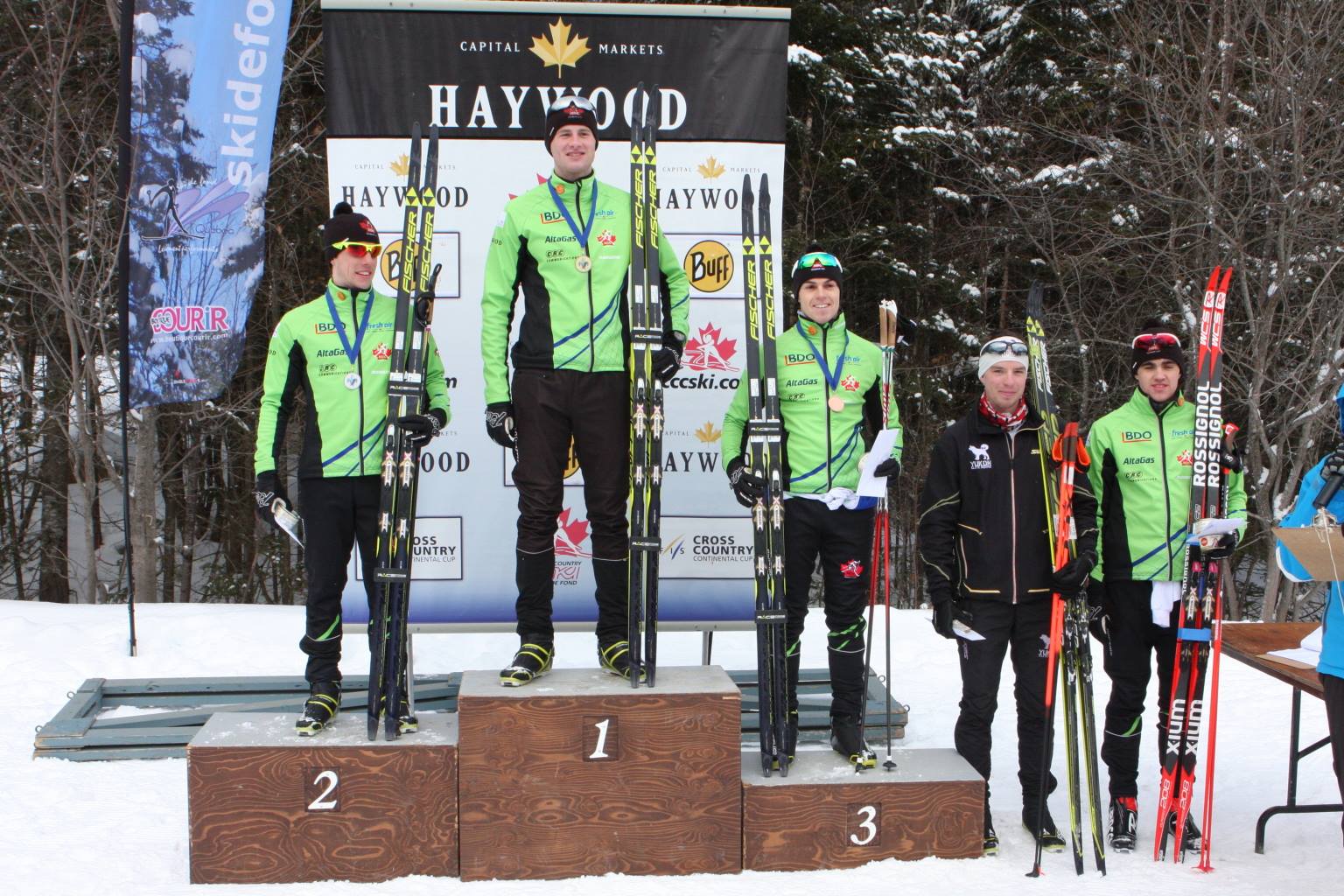
Sasha Masson (CNEPH) kicked off the weekend with a win in the 20km skate, finishing in 47:44.9, 6.2 seconds clear of four skiers: Orford’s Léo Grandbois, Montériski’s Alexandre Bourque and Xavier Lefebvre, and Big Thunder’s Conor McGovern.
“It was a good day overall,” Masson wrote to FasterSkier. “I played it safe and skied with the pack for a bit, then used my legs to work my skis on the flats and the downhills. Today, pushing over the top and in the downs was essential and allowed me to win.”
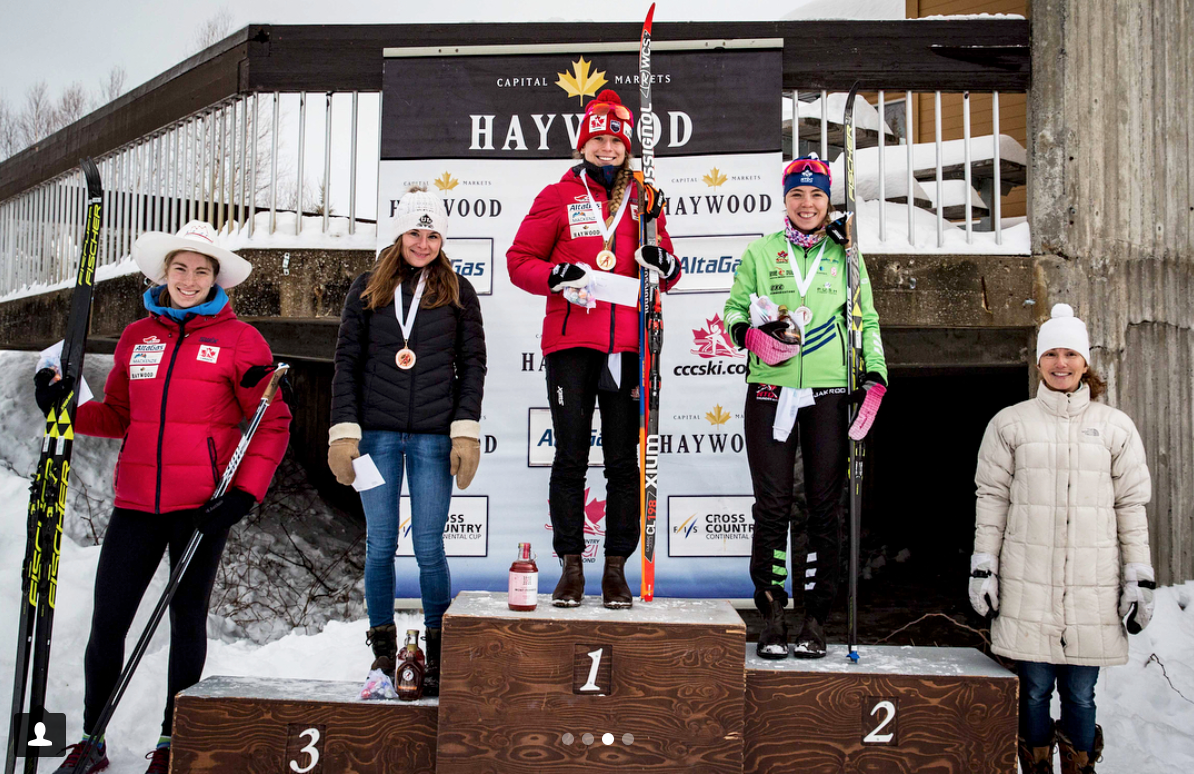
For the women, it was the U20 show with Kanata’s Helen McCulligh winning in 59:08.5, followed by MSA’s Ophélie Grandmont at 8.9 seconds and Whitehorse product Constance Lapointe at 9.8 back.
“It was a very fast day out on the course,” McCulligh told Nordiq Canada. “It was my first ever time racing a 20km, so I didn’t know what to expect going in.”
As in Davos two days later, the new distance caused some learning moments and a change from ‘normal’ tactics.
“We had a really big group of girls, a big pack stuck together for a long time.”
Saturday
Mats Halvorsen chasing hard in the semi-final. (Photo: Raphaël Payo)
Saturday brought a 1.1km skate sprint and a deeper field with the addition of many student athletes.
Chelsea’s U20, Ry Prior, now training with the Alberta World Cup Academy, won the Open men’s final in 2:20.53, ahead of CNEPH teammates Felix-Olivier Moreau at 1.58 back and Guillaume Pelchat at 3.25 seconds.
Chelsea’s U18, Tory Audet, continued her domination, skiing away from the group in each heat on her way to win in 2:35.94, 10.13 seconds ahead of Nakkertok’s Bronwyn Williams. Katherine Mason was third for Nakkertok, 12.54 behind.
Audet went with a straightforward tactical plan: “I didn’t think much about tactics,” she said. “I just tried to ski the course as fast and efficiently as possible due to the fact that it was a very short course.”
A very short course at MSA? There was a course change announced at 7:30am race day.
“The course ended up basically being a short 1km loop that had one really big uphill followed by a downhill and a loop of the stadium,” Williams explained in an email. “It was a wind tunnel through the end of the stadium and the snow wasn’t really fast because it was snowing. I found out pretty quickly that if I got out in front at the beginning, skied controlled until the middle of the big hill and then accelerated over the top of the hill and into the downhill that no one would be able to draft off me on the downhill and through the windy stadium. This tactic really helped secure my spot in the A final.”
Sunday
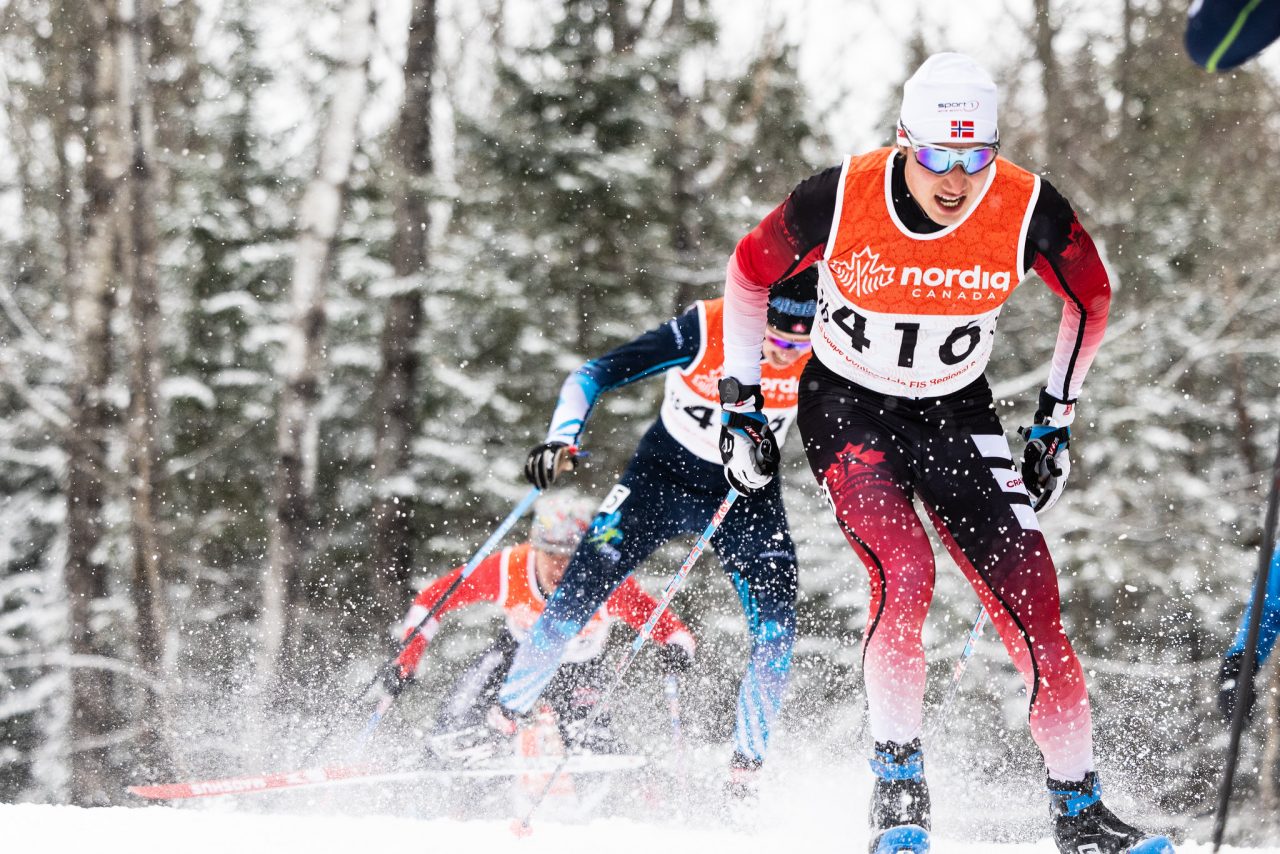
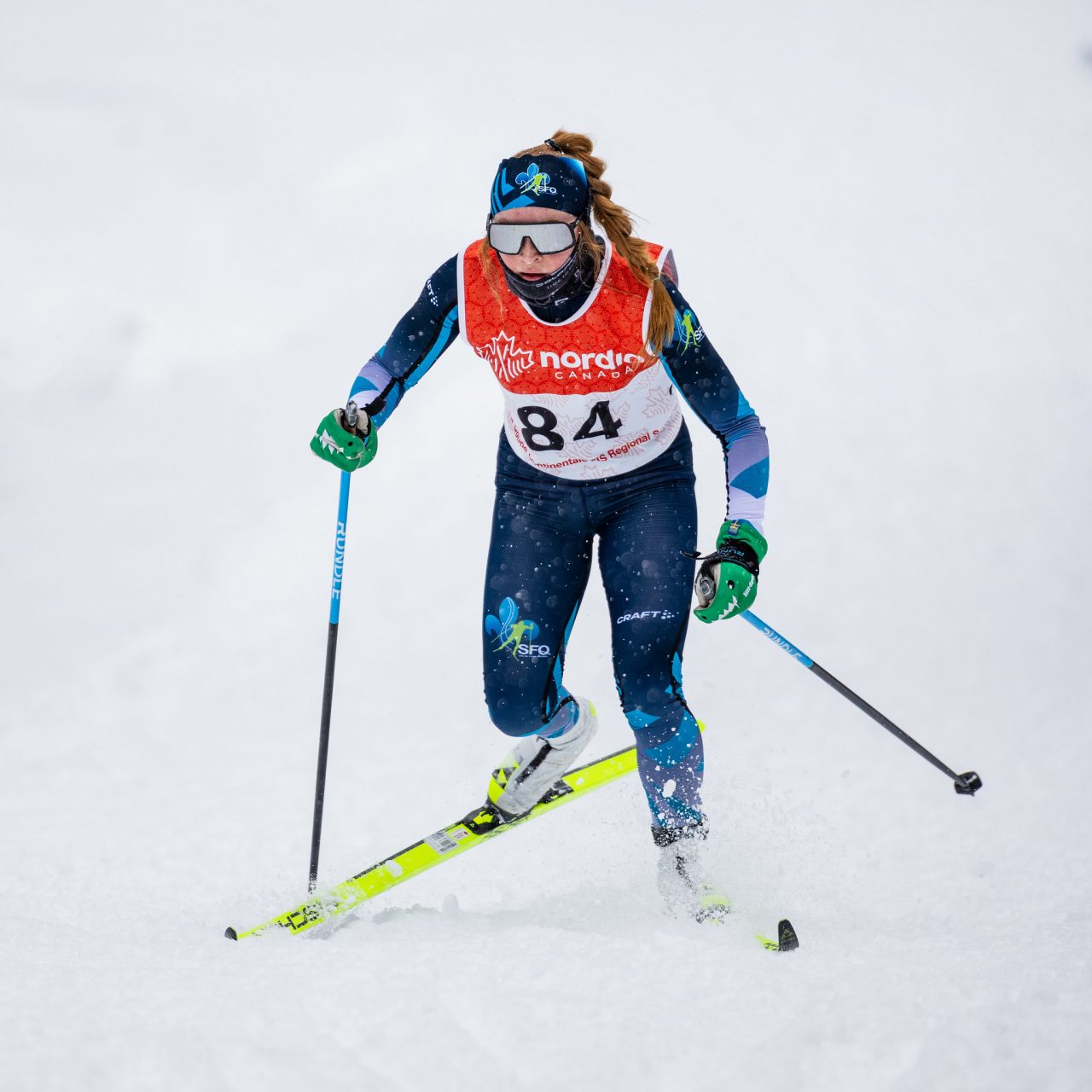
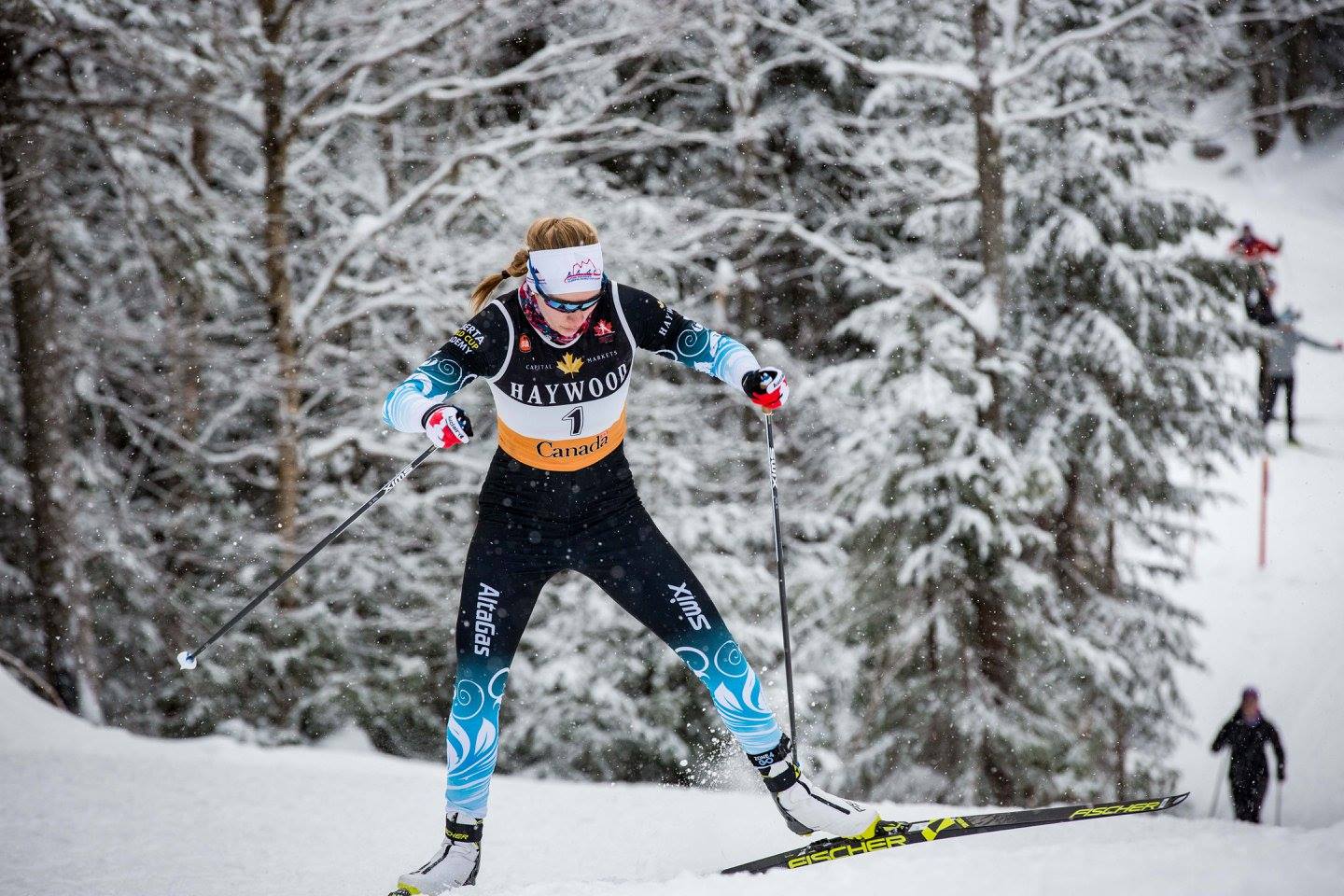
Tory Audet pushing to a snowy win in the 10km. (Photo: Raphaël Payo)
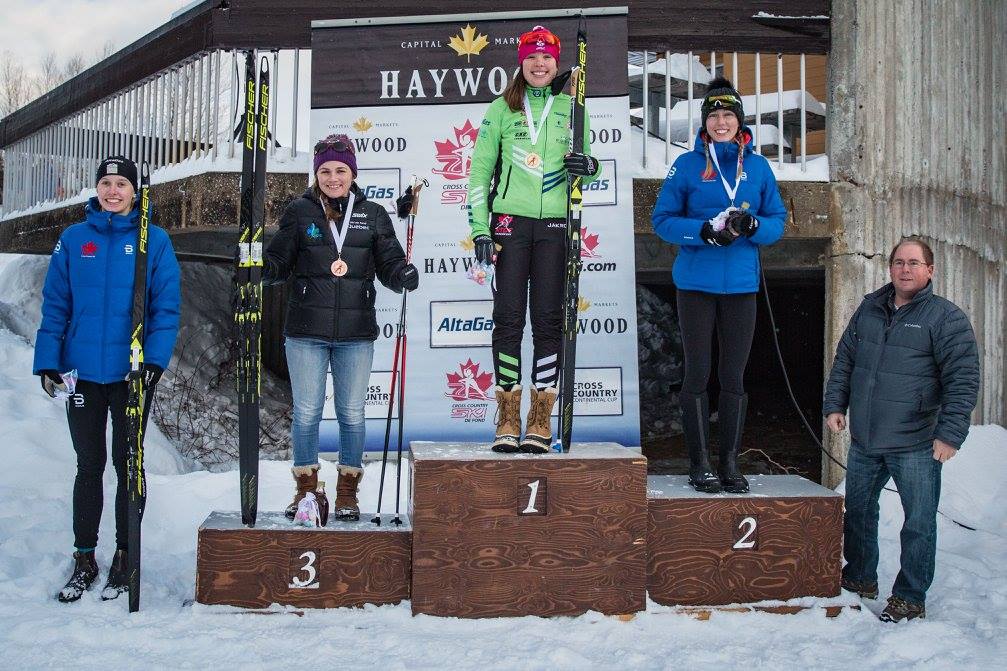
The 10km classic brought more fresh snow but the same women’s winner. Audet won in 36:15.9, ahead of Williams in second again at 25.6 back. Lappe’s Hannah Shields was third at 1:37.0.
“The 10km classic race yesterday was definitely one of the hardest races I’ve done,” Audet wrote to FasterSkier. “The course had some epic climbs and with the fresh snow we got, there weren’t any tracks going up any of the hills making it very difficult. I felt good, I think I paced my race very well, and my skis were awesome!”
Williams, one of three athletes older than U23 to reach the podium this weekend, was not expecting to repeat her 10km victory from the previous weekend.
“The race was two times a crazy challenging 5km course that had huge hills and finished with about 1km of flat double pole…the bane of my existence. Tory Audet, my friend and an incredible athlete, started 30 seconds behind me, so I decided my goal was to see how long I could stay ahead of her.”
The strategy worked to the end, with Williams finishing with 4.4 seconds to spare.
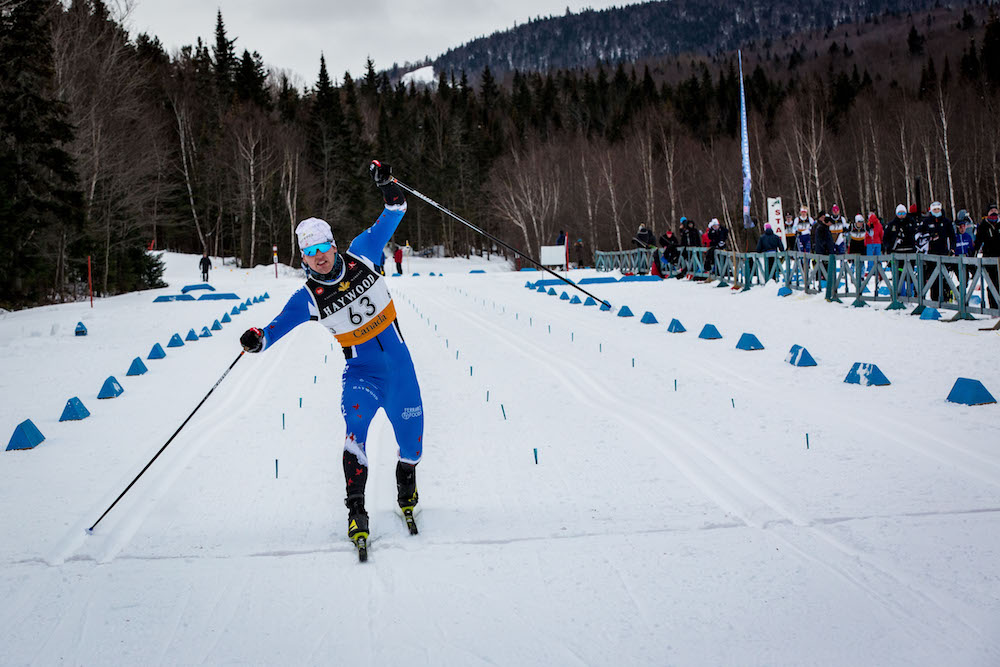
Felix-Oliver Moreau on the trail to victory. (Photo: Raphaël Payo)
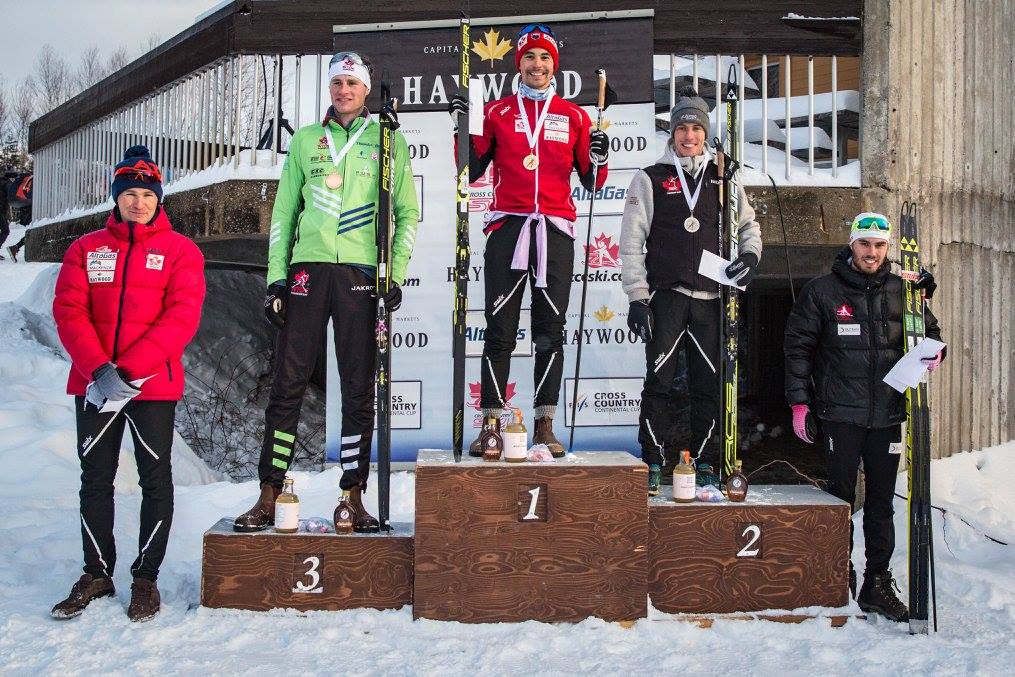
For the men, Moreau moved up a step on the podium, winning in 32:13.1. Orford’s Nicolas Beaulieu was second, 4.6 behind to improve on his 6th in the sprint. CNEPH’s Mats Halvorsen was third at 12.7 back.
This brings Canadian ski racing to a holiday pause, with lots of positives to look back on: all the Canadians who raced World Cup period 1 have at least one top 30 result, first-year senior Liliane Gagnon earned her first World Cup weekend in Davos, eight days of FIS racing happened at three Canadian venues, the Para National team collected a suitcase worth of World Cup medals, and Nordiq Canada has signed on with Abuse-Free Sport, a significant upgrade from the previous SafeSport program.
For true skiing connoisseurs, cross-country skiing is where it is at. Downhill skiing might be a little more glamorous, more flashy, and make for the best GoPro videos, but nothing can beat the glorious joy and aerobic challenge of cross-country skiing.
A far cry from the gravity-assisted ease of downhill skiing, your first attempt at strapping on cross-country skis might leave you baffled at the physics-defying skills required. But with a little perseverance (and a lot of perspiration) you’ll soon get into your stride, and suddenly a whole world of undiscovered trails and glorious, snow-covered treks (not to mention some of the best panoramic views in the world) will open up before you.
If the idea of trying a different form of skiing this winter appeals, or you are looking for a new challenge, check out the top 10 cross country ski resorts in North America and discover this awesome sport for yourself.
Devil’s Thumb Ranch Resort & Spa
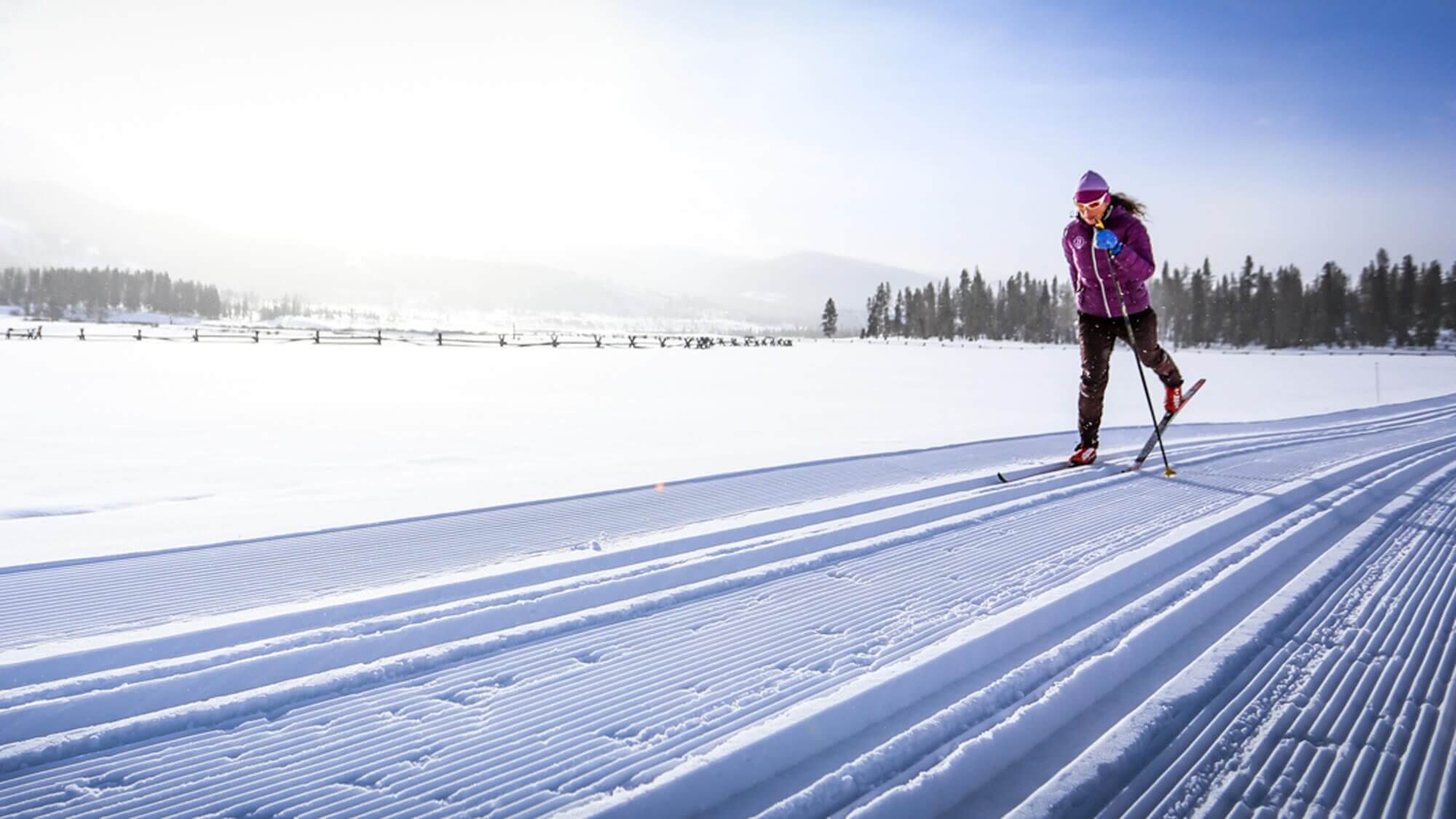
Colorado boasts a significant number of the best cross-country skiing resorts in the US, and Devil’s Thumb Ranch Resort and Spa sits right on top of the pile.
The resort boasts over forty miles of glorious routes right through the Rocky Mountains, while the ranch and spa ensure that after a tough day of trekking you can rest and relax to your heart’s content, with hot tubs and fantastic dining options to seal the deal.
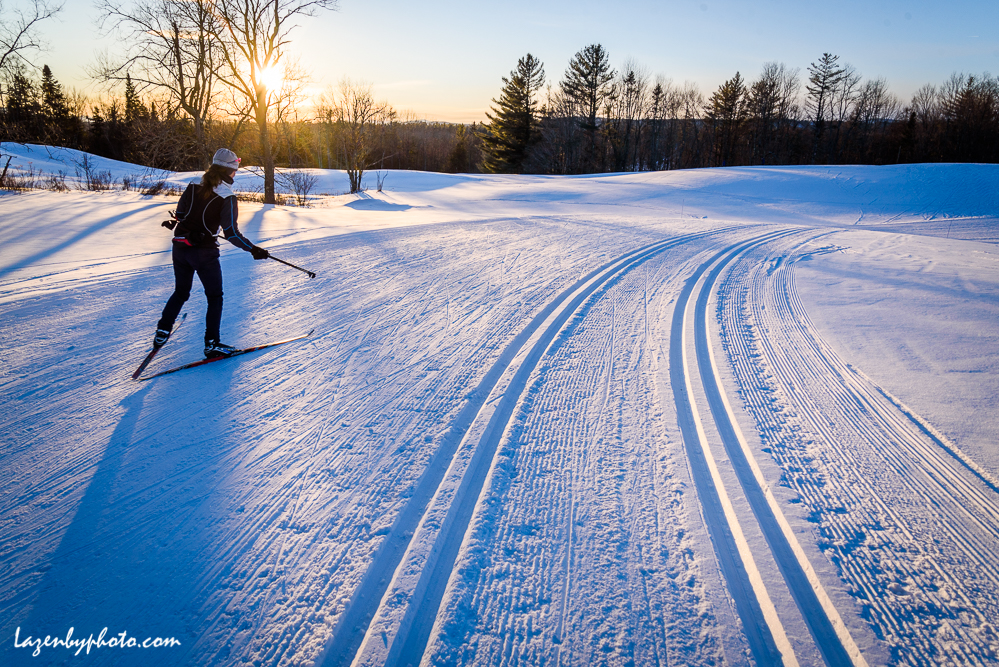
As the sun set, it was so cold that the battery in my camera froze into a non-working lump during this late afternoon masters’ training session at Craftsbury Outdoor Center last January. But the masters kept skating in the cold, squeaky snow and I was able to get this image before the battery went dead. (Photo John Lazenby)
Craftsbury Outdoor Center
With over 50 miles of magnificent trails through field and forest by the shores of Big Hosmer Pond in Vermont, Craftsbury Outdoor Center is a pretty special place for cross-country skiers. Home to the largest ski marathon on the East Coast, Craftsbury is a non-profit organization dedicated to promoting cross-country skiing, and has a wonderful focus on sustainability and environmentalism which adds to the lovely atmosphere. Lodging here is a great option, with luxury options and lakeside cottages available, as well as saunas and a fitness room available.
Mont-Sainte-Anne
Just a short drive from Quebec, Mont-Sainte-Anne Cross Country Ski Center is one of the best spots in Canada to get off-piste (literally) and try your hand at cross-country skiing. With over 110 miles of trails (and a 100 mile network for skating stride) it is one of the biggest cross-country ski resorts on the continent. Set amongst the gorgeous landscape of the Laurentia Forest, every trail is a picturesque ride from shelter to shelter, cabin to cabin, and gorgeous viewpoint to gorgeous viewpoint.
A trailside photo from 2015 SuperCamp at Sovereign Lake/Silver Star (Courtesy photo)
Silver Star Mountain Resort
Just across the US/Canada border, Silver Star Mountain Resort is a genuine cross-country skiing treat. Over 35 miles of trails (and access to the extra 30 miles at Sovereign Lake Nordic Center), there’s always a new stretch of snow to discover, and it’s a great place to dip your toe into the exciting world of cross country skiing.
For the best casino bonuses in Canada click here for a full review.
Sun Mountain Lodge
Washington State boasts some of the most outstanding scenery in North America, which makes it the perfect setting for a cross-country skiing resort. As a result, Sun Mountain Lodge is one of the best places around to try Nordic skiing, and offers an outstanding network of trails with diverse terrain, as well as great facilities to match.
Lone Mountain Ranch
Over 50 miles of Big Sky trails make up Lone Mountain Ranch, which is almost always in the conversation when it comes to discussing the best cross-country skiing resorts in the United States. A fantastic all-rounder, the resort offers trails for every level, from newbies just starting out to grizzled veterans. With a backdrop of deep pine forest and rugged mountain peaks, it is the perfect spot to get to grips with Nordic skiing.
November skiing at Snow Mountain Ranch in Granby, Colo. For the first time this year, a five-day camp was held for masters. (Courtesy photo)
Snow Mountain Ranch
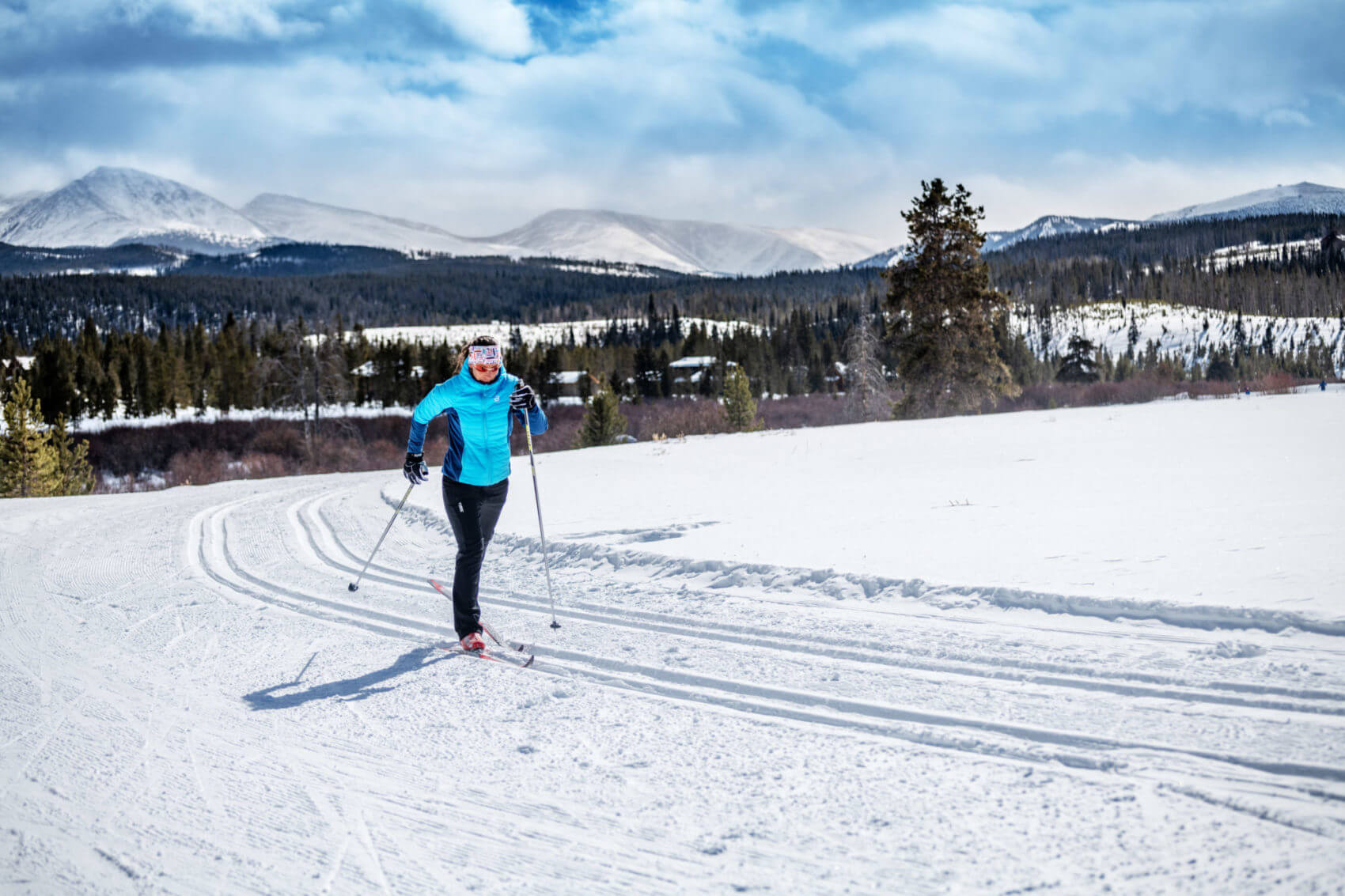
Another awesome spot in Colorado about 85 miles west of Boulder, Snow Mountain Ranch boasts 75 miles of excellent cross-country trails through picturesque woods and along pretty mountain riverbanks. One of the best parts of Snow Mountain is the abundance of wildlife here – there’s a decent chance you’ll be sharing the trails with moose or elk!
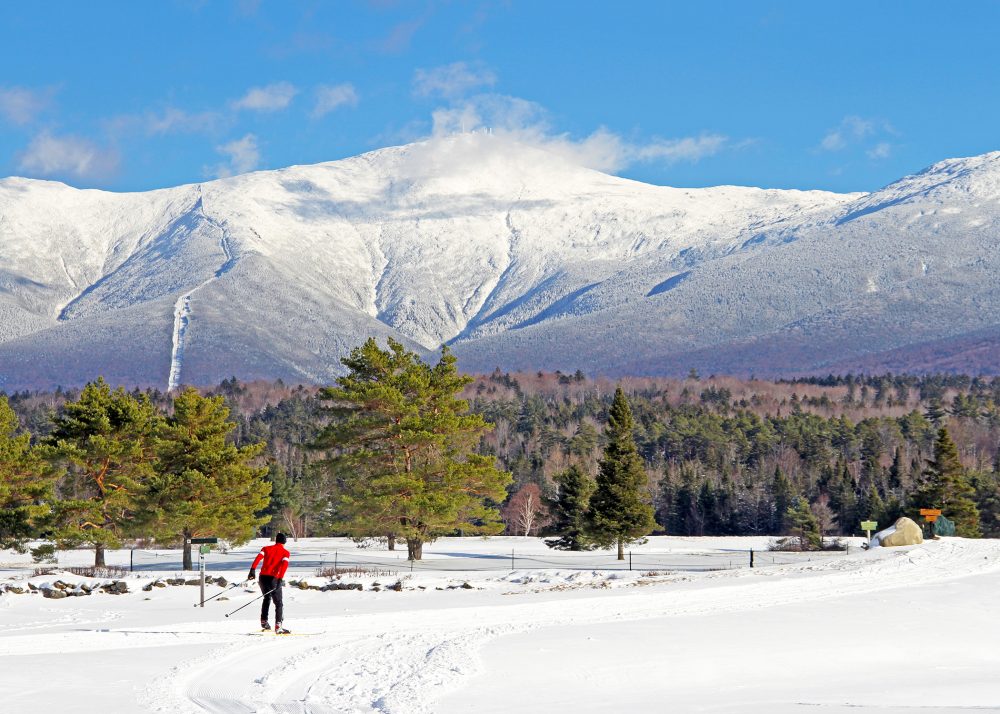
Bretton Woods with the Presidentials as a backdrop. (Photo: Bretton Woods Nordic)
With around 62 miles of trails that wind their way through the White Mountain National Forest, this is one of the most beautiful Nordic skiing destinations around.
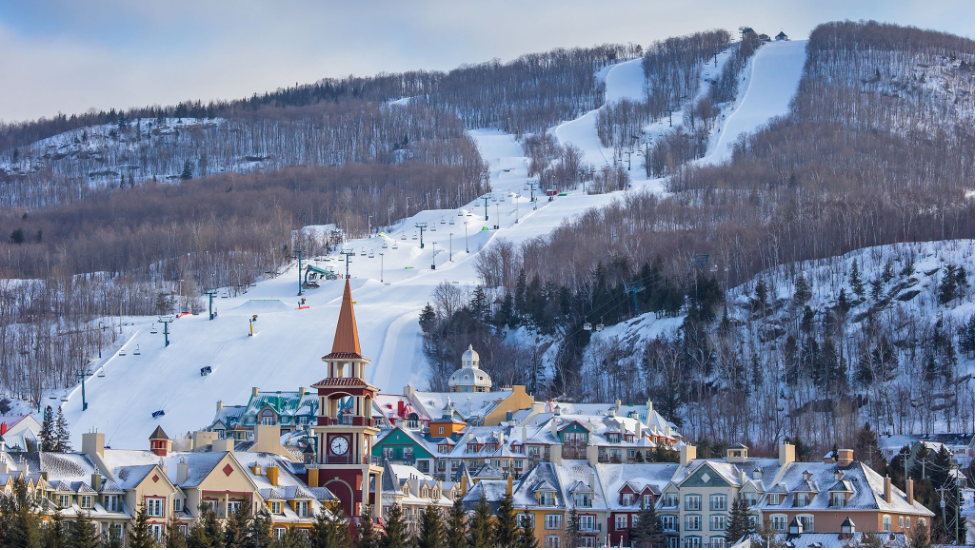
Mont Tremblant
Set in the heart of the Laurentians, Mont Tremblant is another fantastic cross-country skiing option in Quebec, just northeast of Montreal. The resort is year-round, although the ski routes are usually only available in the winter season. One of the best features of Mont Tremblant is that the cross-country ski trails all connect up with other trails in neighboring towns, making multi-day treks a real possibility.
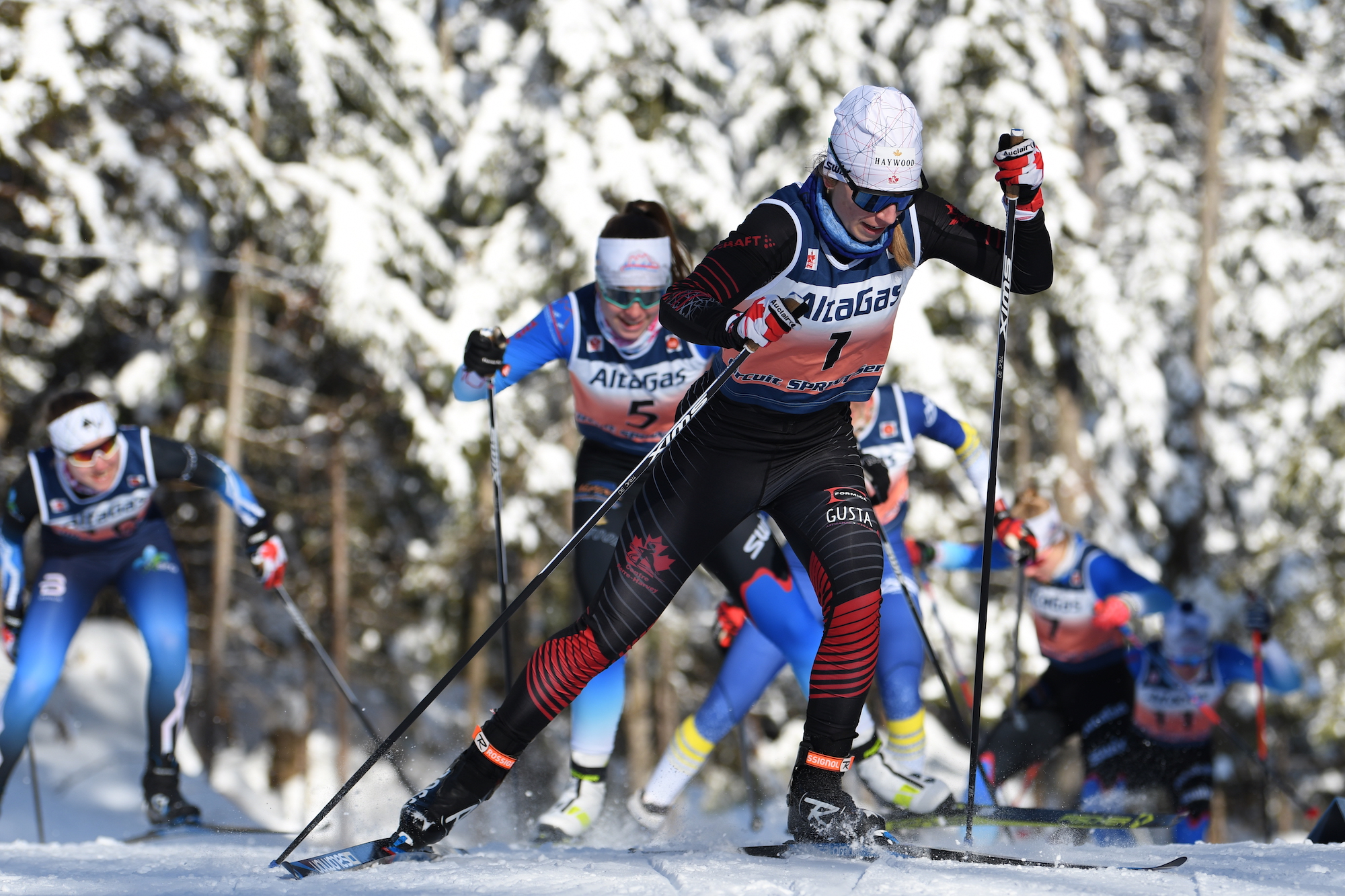
New England’s Fabian Stocek (1) follows Rocky Mountain’s Jack Hill (6) in the U20 men’s 15 k freestyle mass start at Trapp Family Lodge in Stowe, Vt. Stocek went on to win the Junior Nationals race by 7.5 seconds.
Trapp Family Lodge
Claiming to be the first cross-country ski resort in the US, the Trapp Family Lodge is one of the most elegant and sophisticated Nordic skiing destinations you are likely to find. The trails are beautiful, of course, but the icing on the cake is the delightfully Austrian-inspired setting of the lodge itself, which makes a wonderful place to wind down after a tough day skiing!
Cendrine Browne leads her semifinal at MSA Trials. (Photo: Doug Stephen)
In Canadian domestic ski racing, it doesn’t get much bigger than this. Mont Sainte-Anne (MSA) is hosting the NorAm weekend that also serves as U23/U20 World Championships qualification and has special significance in selection for World Cup starts.
Any skier who hasn’t already qualified for World Cup period 4 has had this event as a major focus for the season. The only certain paths to National Team selection for next season start with top 30 results on either the World Cup or U20 World Championships. Most of these paths start at MSA Trials.
For U20 and U23 selection, the top finisher in each of the three races is guaranteed one of the 18 to 20 places on the trip to Oberwiesenthal, Germany, with a pre-camp in Norway.
And finally, the weekend is a NorAm, which means COC leader points are on the line.
On Thursday, the action started with free technique sprints on a short but difficult course. Men, women, and U20’s all skied the same distance. Nordiq Canada’s Jeff Ellis continued the tradition of winner’s interviews, FasterSkier has the unedited videos below.
Elizabeth Elliott in charge of the U20 final. (Photo: Doug Stephen)
CNEPH’s Cendrine Browne won the qualifier in 3:04.79 before winning three heats to dominate on her home trails, finishing the final in 3:01.37. Browne’s teammate Laura Leclair was second, 0.53 seconds back, for the top U23 finish ahead of Emily Nishikawa at 0.76 seconds. The presence of distance specialists Browne and Nishikawa on the podium is evidence of the sprint course’s difficulty.
For the U20 women, AWCA’s Elizabeth Elliott qualified 4th overall and swept the heats to win the final in 3:06.85. Her teammate Benita Peiffer was second, 1.66 back, narrowly ahead of Black Jack’s Molly Miller at 1.81 seconds.
For the men, NTDC Thunder Bay’s Graham Ritchie recovered well from his time in Europe to win in 2:35.69 after qualifying second, grabbing the top U23 finish along the way. Team ULLR’s Jess Cockney continued to redefine the word ‘retired’ in second place, 0.52 back. TBay’s Pierre Grall-Johnson who converted on his latest qualification win with his first open category podium, was third at 0.76 seconds.
Graham Ritchie taking advantage of the downhill finish for the win. (Photo: Doug Stephen)
The U20 men provided no surprises, with the favourites front and centre in the final. Black Jack and Harvard’s Rémi Drolet dominated the day, sweeping through to the final to win by 2.57 seconds in 2:34.75. ULLR’s Xavier McKeever was second after qualifying 29th overall for 5th U20, with teammate Tom Stephen taking bronze a further 1.09 back.
Speculating on selections using the criteria documents always comes with a risk of error. That said, Leclair, Ritchie, Elliott, and Drolet should definitely be eligible for Obwiersenthal. Peiffer and McKeever should be selected as the 5th U20 athletes.
Photographer Doug Stephen has a gallery for the Sprints and Official Training. Athletes are welcome to download and use full resolution images if they give credit to ‘Doug Stephen’ or @vr45photography.
Rémi Drolet leads Xavier McKeever, Kai Meekis, and Tom Stephen in the U20 final. (Photo: Doug Stephen)
FasterSkier’s 2018 Canadian Breakthrough Skiers of the Year are Zina Kocher (l) and Collin Cameron. (Photos: Mario Walker & Scott Grant/Canadian Paralympic Committee)
With the 2017/2018 season officially in the rearview, FasterSkier is excited to unveil its annual award winners for this past winter. Votes stem from the FS staff, scattered across the U.S., Canada, and Europe, and while not scientific, they are intended to reflect a broader sense of the season in review. This set of honors goes to Canadian athletes in any disciplines who had a major breakthrough at some level of competition.
Four years ago, Collin Cameron didn’t really know what cross-country skiing was. At least, he didn’t know that it was a sport he could do.
“I did not even know paranordic was a thing, to be honest!” the Canadian wrote in an email last week. “At that time I was just starting to play sledge hockey provincially for our local team here in Sudbury, just for fun.”
But he since found a local group to try Para-Nordic, and was then recruited onto the Canadian Para-Nordic National Ski Team.
Canada’s Colin Cameron racing to bronze in the men’s 7.5 k sitting biathlon sprint at the 2018 Paralympic Games in PyeongChang, South Korea. (Photo: Scott Grant/Canadian Paralympic Committee)
In March, he became a multiple Paralympic medalist when he won bronze in both the 7.5 k and 15 k sitting biathlon competitions.
At the end of the Games, he picked up another bronze in the open relay, where he teamed up with Brian McKeever. In a four-leg relay, they were one of only two teams to enter with just two athletes, and each raced two different relay legs.
“Being a part of the open relay team with Brian, and his guides Graham [Nishikawa] and Russell [Kennedy], was something really special and I will never forget it,” Cameron wrote. “Getting my third Paralympic medal with those guys was pretty cool… just being a part of this amazing and successful team of athletes, techs, and coaches has to a favourite moment. Getting to see my teammate and travel roommate Mark Arendz finally earn his first gold medal was really, really awesome!”
Although he is fairly new to Para-Nordic sport, Cameron’s success wasn’t completely unanticipated. Last season, he won a World Cup race on the same terrain in PyeongChang.
“Going into the Games, I had one major goal of winning the sprint race I won at the test event the year before,” Cameron explained. “I had to settle for 4th, only 0.7 seconds off the podium. Aside from that single race, my other goal was to finish in the top 10 in all races I entered.”
As any athlete will tell you, an Olympic or Paralympic medal is a much different animal than getting on the podium at a World Cup race. And Cameron found that to be true, too, when he returned home to Canada.
“It’s been quite overwhelming to be honest,” he wrote. “I didn’t expect anything like the receptions I’ve received, and it’s really inspiring to see the way the community in both my hometowns have followed mine and the team’s success at the Games. I definitely could not have done this without the huge and overwhelming support from everyone here.”
His next goal is 2019 World Championships, which will be held in Prince George, British Columbia.
“I am very fortunate to be able to work with some of the best technical skiers and coaches in the world, that have greatly aided in the whole transition of making myself an endurance athlete…that being said there is still lots of work to do!”
Zina Kocher, Foothills Nordic
Yeah, Zina Kocher is 35. Yeah, she’s a three-time Olympian. But she did something brave this year.
The former biathlete, who had retired in 2016, decided to become a cross-country skier and try to make a fourth Canadian Olympic team. She had been thinking about giving it a go, and discussing with longtime coach Richard Boruta.
Zina Kocher racing at Olympic Trials at Mont Sainte Anne. (Photo: Mario Walker/NorAm MSA 2018 Facebook)
In some ways, things didn’t work out. She went to Olympic Trials in Mont Sainte-Anne, Quebec, knowing that it was a long shot — the race formats were heavily skewed towards classic, something that Kocher hadn’t done competitively for years, even though she has long been one of the fastest skate skiers in the country.
She didn’t make the Olympics. And it might have ended there, but it didn’t.
“After the selection races, I felt settled, ready to go back to ‘retirement’ or back to my previous next phase and other life goals and stop following, let’s say, a set training plan,” Kocher wrote in an email last week “But then I thought it would be fun to race the NorAm in Red Deer [Alberta], since that’s where I’m from and where I started xc skiing many many years ago! I hadn’t raced there since I was in high school. And then I thought oh Nipika loppet, never done that, why not. And then decided last minute to go to Gatineau Loppet when my friend Kamila (my past coach Richard Boruta’s widow) said she was going and I should come.”
So, a season that had started with one goal — make the Olympics — went on.
At that point, Kocher was leading the NorAm series, and found out that as a result she had an automatic spot to race on the World Cup for the last competitions of the season: the Holmenkollen 30 k freestyle mass start in Oslo, Norway, and World Cup Finals in Falun, Sweden.
“Well, the Holmenkollen is legendary and an awesome opportunity,” she wrote.
Kocher had raced there many times before, as a biathlete. Doing so as a skier was a new experience.
“We had tons of fans cheering us on, pushing us up those big climbs!” she wrote. “I didn’t feel like I was in the best race shape that day, but I gave what I had for a 5 k pace that lasts for a torturous 30 k … and my body went into some sort of shock post race, but that’s another story.”
Despite that, she was the top finisher among the other different Continental Cup leaders.
And then, on to Falun, where she had to do a classic World Cup race because it was part of a mini tour.
“One big thing I went though [this season] was facing a fear of being last,” she wrote. “That sounds a bit crazy to say, but I think it’s probably an honest statement for many athletes. No one wants to come last, but someone does! Printed in ink, on a computer screen, it’s there for all to see! … I was terrified of doing a 10 k mass start classic in Falun, and I knew I would probably be last from the start. I was. In the end, it wasn’t so terrifying and I made it to the finish line. Having accomplished it, felt pretty darn good even though it was a bit of a solo 10 k. The fans and coach Babs [Ivan Babikov] were incredible cheerleaders!”
Now, it’s back to retirement for Kocher. One of her top memories from the season was that Gatineau Loppet.
“After some contemplation today, I think my favourite moment was doing the 50 k Gatineau Loppet,” she wrote. “Not because I won (great too of course), but because it was a great atmosphere, and it was cool to do a race point-to-point and with a mass… and because I was with Kamila and her friend Lukas. Lukas was actually racing on Richard’s old skis, doing his first ski loppet (he raced both days). Kamila didn’t think she’d be able to do any racing this winter, so it was wonderful to see her do what she loves again, and she even won the overall (both days – skate & classic 50). It was a bit of an emotional weekend. And felt like a great Richard tribute weekend.”
Honorable Mention: Russell Kennedy, Team R.A.D. & Canadian Para-Nordic Skiing (guide)
Kennedy accomplished a rare feat this season by competing at both the 2018 Olympics and Paralympics.
“I’ve been on my own schedule this year because the Team R.A.D. is mostly younger athletes and … I have to do my own thing because I’m going for the Olympics,” Kennedy, last season’s overall NorAm winner, said at the beginning of the season. “So it actually works better for me to be training with Brian [McKeever] because he has similar goals as me.”
Canada’s Brian McKeever (r) and Russell Kennedy receiving their gold medals from the men’s visually impaired classic sprint at the 2018 Paralympic Games in PyeongChang, South Korea. (Photo: Scott Grant/Canadian Paralympic Committee)
As the NorAm winner, Kennedy started the season on the brutally competitive first period circuit of the FIS Cross Country World Cup. There, he had a top finish of 48th place in a skate sprint in Davos, Switzerland. It was only his second stint of European World Cups, after competing in Drammen and Oslo last winter.
Kennedy returned to Canada and secured his Olympic spot by winning the sprint qualifier at Mont Sainte Anne and placing second in the sprint final. Two weeks later, he picked up two second-place finishes in NorAms in Red Deer.
From there it was to the Olympics, where the 27 year old helped the Canadian relay team to ninth place, and as an individual finished 49th in the 50 k and 54th in the sprint.
Then it was the Paralympics, which had long been part of the season plan. Kennedy was one of two guides for visually-impaired skier Brian McKeever, and as such picked up a collection of Paralympic gold medals (along with Graham Nishikawa, McKeever’s other guide). It was the third straight Paralympics where McKeever went undefeated – he now has 13 gold medals.
“These sprint races are miserable,” McKeever said after crossing the line with Kennedy for gold in the sprint, according to a team press release. “They are so hard. The young guys are fast, and have natural snap. There is so much stress in sprint racing, and it goes all day long. I’m much more comfortable with the longer distances, but it was a great day for us. Russell carried the load for us today, and just thrilled we were able to cross the line first.”
“It is hard to describe the mental states I went though the past couple months,” Kennedy recently wrote on his blog. “From being told that I didn’t make the team to making the Olympic team, feeling like I was getting sick then coming back to some of the better races of my life… There were days I woke up and wondered if it was worth it and if the hard work would pay off or if I was just blowing money on something that I didnt have in me… When I fell in love with training though I knew I was doing the right thing. So fall in love with the process dreamers, when you do you will have all good days!”
Honorable Mention: Natalie Wilkie, Canadian Para-Nordic Skiing
Natalie Wilkie is just 17 years old, but she’s a Paralympic gold medalist.
In the final individual competition of the 2018 Paralympics, Wilkie topped the results sheet in the 7.5 k standing classic race – leading her teammate Emily Young onto the podium in the process. Wilkie was the gold medalist by just 1.6 seconds in an extremely exciting competition.
Canada’s Natalie Wilkie (r) finishing third, just 0.1 seconds behind Norway’s Vilde Nilsen (l) in second, for her first Paralympic medal in the women’s 1.5 k standing classic sprint in PyeongChang, South Korea. (Photo: Scott Grant/Canadian Paralympic Committee)
“This is crazy awesome,” Wilkie said in a press release after the race. “I didn’t think this would happen at all. I’m only 17 and this is my first Paralympics… The difference today was double poling. I just kept telling myself to pretend I was elbowing my older brother.”
She has even inspired older members of the team, too, including 27-year-old Young, who was just a tenth of a second away from silver in that race.
“What would Natalie do?” she said in the same press release. “I just kept saying ‘What would Natalie be doing.’”
Earlier in the Games, Wilkie had won bronze in the sprint. And to close things out, she helped the Canadian mixed relay team – with Young, Chris Klebl, and Mark Arendz – to silver, the first relay medal the country had ever won at the Paralympics.
“What Mark, Chris and the girls did in that first relay was awesome,” McKeever, who teamed up with Cameron for a second relay medal later that same day, said in a press release.
New amateur cross-country skiing event in March 2018
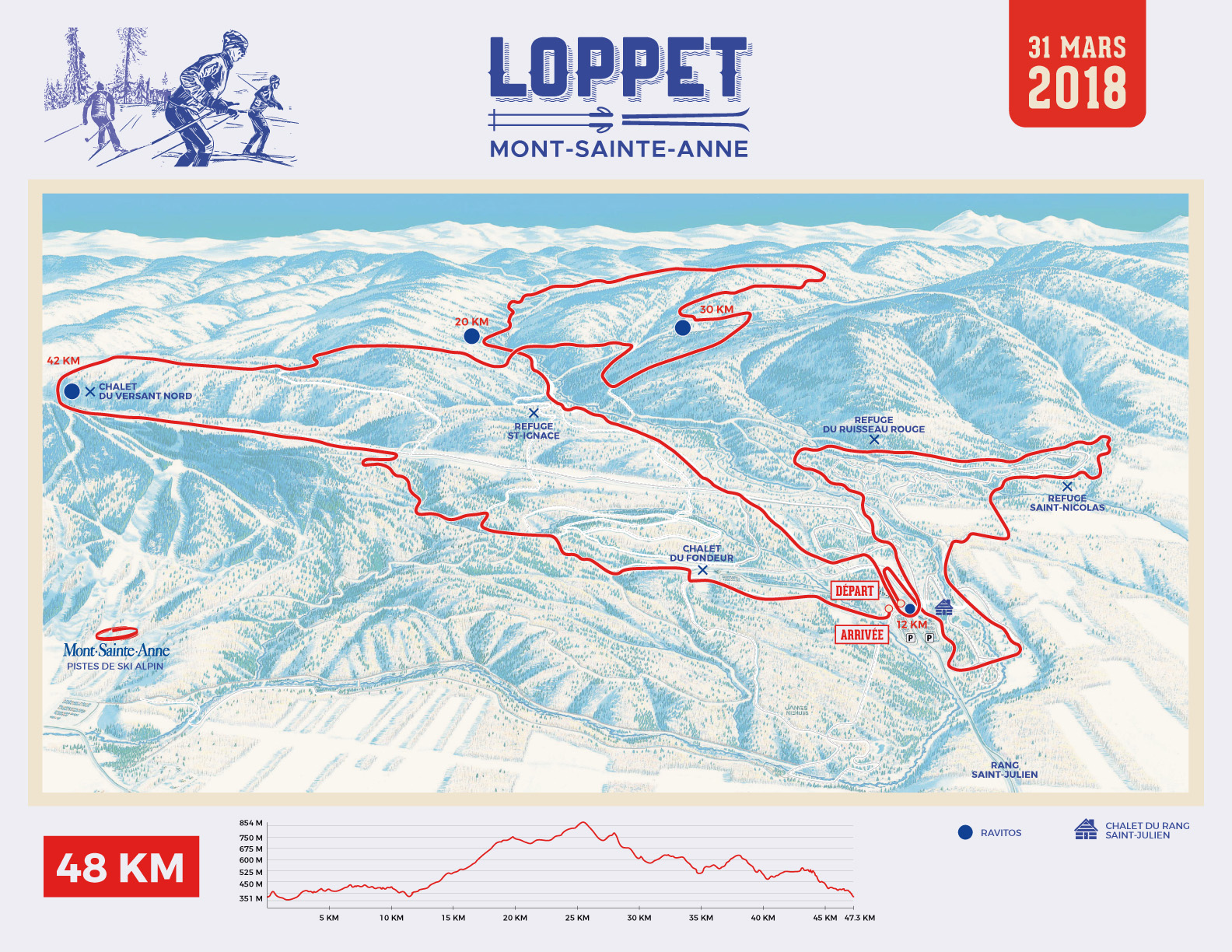
QUEBEC CITY (Wednesday, February 28, 2018) – Cross-country skiing enthusiasts now have a new event to look forward to with the inaugural Mont-Sainte-Anne Loppet coming up on Saturday, March 31. With 48K and 25K freestyle distance races, 10K classic and freestyle distances and a 1.5K loop for young skiers, nearly 500 novices, intermediates and experts cross-country skiers are expected to take to the trails at Mont-Sainte-Anne. This new addition to the Quebec City cross-country calendar will be not only a sporting challenge, but also a fun way for skiers to wrap up the season.
“We want the Mont-Sainte-Anne Loppet to become an annual fixture, and most of all, we want cross-country skiers to have a blast and wrap up the season in style with this celebration of spring,” said Patrice Drouin, president of event producer Gestev on behalf of Quebec Winter Events Corporation. “We were inspired by the Vasaloppet in Sweden, which now attracts more than 15,000 skiers. We see great potential to grow this new event event bigger and better in the future!”
Starting and finishing at the Rang Saint-Julien Lodge in Saint-Férréol-les-Neiges, the 48K and 25K courses are a unique opportunity for skiers to explore the Mont-Sainte-Anne backcountry and discover areas not usually open to the public!
“We’re excited to be hosting a new event like this at Mont-Sainte-Anne and shining the spotlight on Canada’s biggest cross-country skiing centre. We hope the Loppet will not only attract elite skiers, but also inspire and draw newbies to this fantastic sport,” said Maxime Cretin, the new vice-president and general manager at Mont-Sainte-Anne.
The mayor of Saint-Férréol-les-Neiges, Parise Cormier, is also thrilled to be rolling out the red carpet for this new event. “It’s an honour for our town and the entire Côte-de-Beaupré region to celebrate the end of the season with an event that shines the spotlight on the newly renovated cross-country facilities at Mont-Sainte-Anne,” she said. “We’re proud to be involved in such a high-profile happening and are sure it will be a huge benefit for the community.”
Alex Harvey first to register
Saint-Férréeol-les-Neiges native and locals’ favourite at the Olympics in PyeongChang, Alex Harvey was the first to sign up for the 48K distance at the Mont-Sainte-Anne Loppet this March 31, not just to ski on home snow again but also to rub shoulders with participants—and maybe even give them a few pro tips! “Skiing the trails right in my backyard after the Olympics is a dream come true,” said Alex Harvey. “I’ll officially be on vacation after a big season, but I’m stoked to be skiing at home again and baing a part of the inaugural edition of this event, which I hope turns into a regular happening and keeps growing bigger and better. Cross-country development here in Quebec is something that’s very important to me and I’m thrilled to see Gestev and Quebec Winter Events Corporation taking the initiative to get such an awesome amateur event off the ground.”
More information and registration details available at www.loppetmsa.com.
About Quebec Winter Events Corporation
The mission of Quebec Winter Events Corporation (QWEC) is to promote winter sports on home snow through international events including the Sprint Quebec FIS Cross-Country World Cup, Ski Tour Canada and the Cross-Country World Cup Finals, as well as the FIS Freestyle Ski and Snowboard World Cups at the annual Jamboree festival. In addition to attracting the world’s top winter sport athletes, QWEC works hard to support the development of amateur sport through each of its events.
Cendrine Browne (CNEPH/Canadian National U25 Team) celebrates her 11.9-second win in the women’s 15 k skiathlon on Jan. 8 at Mont Sainte-Anne NorAm Trials in Quebec. (Photo: Mario Walker/NorAm MSA 2018 Facebook)
Since March of last year, Cendrine Browne has been waiting and trying, with all her might, for another top 30. She achieved it twice last season, placing 26th in the World Championships 30-kilometer mass start and 35th in the World Cup 10 k skate in Ulricehamn, Sweden (30th with Olympic-style scoring, which counts the top-four athletes for each nation in a given race).
To meet Cross Country Canada’s (CCC) alternate qualifying criteria for the 2018 Olympics, Browne, who turned 24 this past September, needed one more top 30 at the World Cup with the same type of scoring.
She had four weekends to give it her all in late November and December.
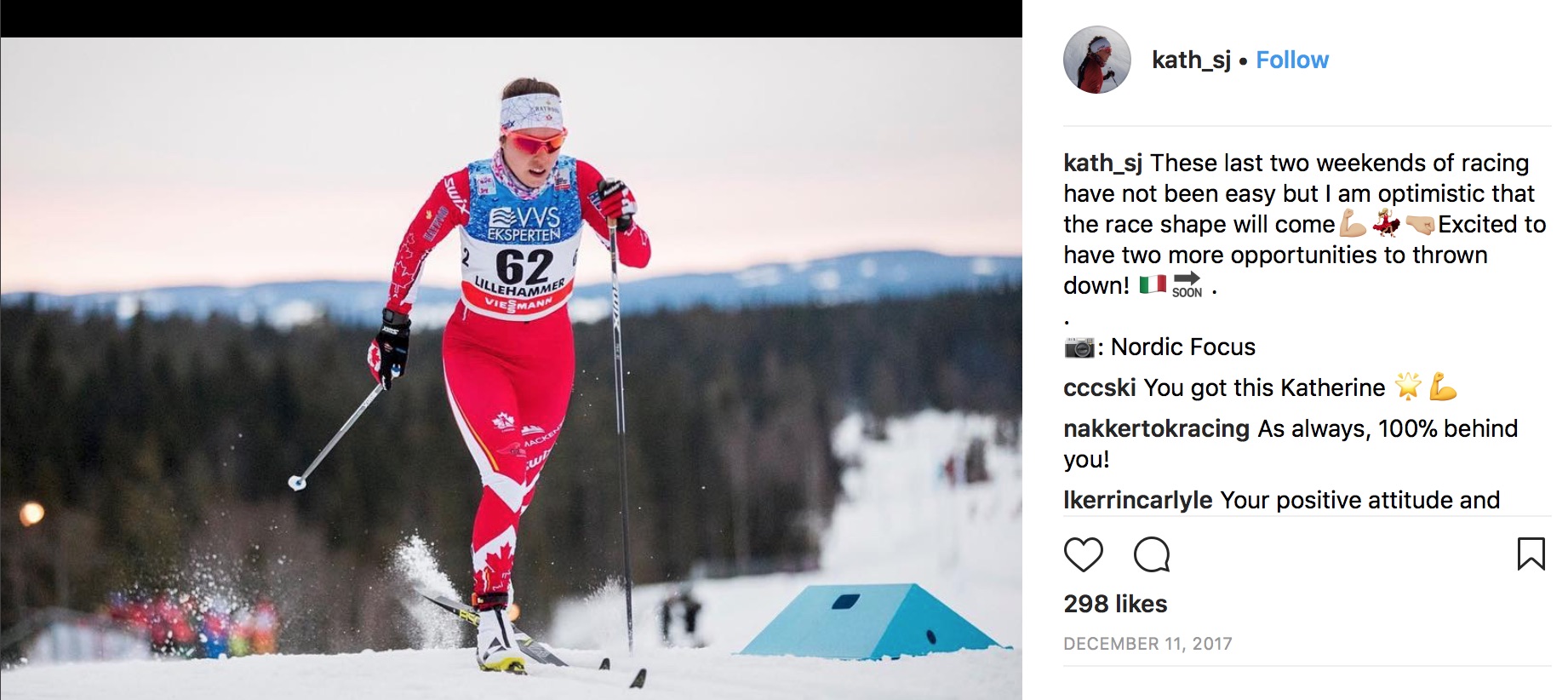
Browne, of the Canadian National U25 Team and Centre National d’Entraînement Pierre Harvey (CNEPH), a.k.a. Pierre-Harvey National Training Centre, finished the 2017/2018 season-opening World Cup mini tour in 72nd overall with the 62nd-ranked pursuit time in Kuusamo, Finland.
“That was my first [weekend of racing] so it was tough,” Browne recalled on the phone in early January. “But the last race of the mini tour went much better. I started to have good race feelings so I knew I was going in the right direction. The next weekend was Lillehammer [Norway] and I performed pretty well there in the skiathlon.”
She finished 45th to lead two Canadian women finishers. With Olympic-style scoring, she was 31st.
“To qualify for the Olympics I had to do a top 30 so 31st was a little frustrating, but I knew I was able to do a top 30,” Browne said. “I knew I could do a real top 30, not only a four per nation top 30. But I only had four weekends to do a top 30 and I was down to two.”
Cendrine Browne racing in the World Cup 10 k freestyle on Dec. 10 in Davos, Switzerland. She placed 45th for the second World Cup distance race in a row. (Photo: Reese Brown / U.S. Ski & Snowboard)
In Davos, Switzerland, she tied her season best of 45th in the 10-kilometer freestyle and led four Canadian women, but she was still outside the top 30 with Olympic scoring. Her result at altitude (about 1,560 meters above sea level) was promising, she said, but still not quite there in terms of what she needed.
One weekend later, it all came down to two races in Toblach, Italy. There, she finished 55th in the 10 k skate and 66th in the 10 k classic pursuit.
“Maybe I had put some pressure on myself, but I felt pressure from my federation and pressure to do that top 30, and I don’t work very well with pressure,” she said. “So unfortunately when we went to Toblach, I didn’t perform at all. I was so stressed out that I didn’t even have fun racing, and I just felt awful the whole skate race. I cried a lot.”
With Period 1 of the World Cup behind her and Christmas break on the horizon, she told herself it wasn’t over yet. But she was still disappointed.
“I was supposed to stay [in Europe] for Christmas … I was so focused on Plan A that I didn’t even think about Plan B,” she said.
On the bright side, “Plan B” involved races in her home province of Quebec at Mont Sainte-Anne (MSA), where she trains with CNEPH. And she got to spent time with her family and boyfriend in her hometown of St-Jérôme, about 50 kilometers northwest of Montreal, as well as reset mentally for NorAm Olympic trials starting Jan. 5.
“I was so focused on Plan A that I didn’t even think about Plan B.” — Cendrine Browne, Canadian National U25 Team and Pierre-Harvey National Training Centre, on qualifying for the Olympics
“I was really really stressed out the week before the first race [at trials] and I was feeling the pressure again, and I really didn’t want to react the the same way as I did in Toblach so I went to see my sports psychologist,” Browne said. “She explained some stuff to me, like instead of thinking that the pressure is bad and instead of trying to run away from it, she said I have to try to accept it, and if I accept it, it would help me to go faster.”
With that in mind, Browne tried to keep everything in perspective. Then, she came out at full steam for the classic sprint on Jan. 5, the first day of MSA NorAm trials.
“I think it really worked well because I managed to sleep better the night before the race, and the morning of the race I was feeling like myself again,” she said. “I was skiing and just loving the glide as I usually do when I’m having a good day. I was smiling … and I felt free and I felt like myself. I feel like when I’m stressed out, I’m not having fun any more and that day I was having fun again.”
A self-described freestyle distance specialist, she placed second in the classic-sprint qualifier then fourth overall in the final. As the top-performing woman between the qualifier and final, excluding fellow national-team member Dahria Beatty (who had previously met Canada’s alternate qualifying criteria for the Olympics), Browne effectively secured one of Canada’s coveted quota spots at the 2018 Olympics in PyeongChang, South Korea.
While that wasn’t a done deal until a few weeks later, when CCC named its 11-athlete Olympic team, that result put Browne in the best place any Canadian Olympic hopeful would want to be.
“I can’t say I’m qualified yet because it’s kind of complicated,” Browne said on Jan. 7. “… We can only say, like Daria, Emily [Nishikawa] and I, that we have reached an Olympic criteria and that we’re in good position to go to the Olympics.”
Beatty and Emily Nishikawa, members of Canada’s World Cup Team, met CCC’s “Alternate Qualifying Criteria A” (three top-30 results) last season. According to CCC’s Olympic selection criteria, one female sprinter and one female distance skier would be selected to the Olympic team based on trials. So Browne effectively secured the female sprint spot, and as the rest of the week at MSA played out, she ended up being the top distance skier at trials as well.
On Jan. 8, Browne won the women’s 15 k skiathlon on Day 2 of the trials. Two days later, she won the 10 k classic interval start as well. In the event that the trials sprint leader was the top distance skier as well, as was Browne, the criteria was written so that the second-ranked distance skier in those two distance races would be selected.
That spot went to Anne-Marie Comeau, Browne’s former teammate. The two trained together at CNEPH three years ago, before Comeau left skiing due to an injury and concentrated on running. At last month’s trials, Comeau placed second in the skiathlon, about 12 seconds behind Browne, and third in the 10 k classic, about a minute and 5 seconds back. Browne won the classic individual start by 39 seconds over Katherine Stewart-Jones, who had previously placed fifth in the skiathlon.
“I know she has a huge VO2 max,” Browne said of Comeau, a student at the Université Laval. “She has a huge cardio and these courses were perfect for her, so I knew she could do well, but I’m really surprised that she could actually be on the Olympic team, just because she wasn’t sure she wanted to ski anymore, so that’s really a big surprise for everybody. She trained for running for two years almost, and we didn’t think she would be such a big comeback.”
(Browne is also enrolled at Laval, where she takes classes toward a bachelor’s degree in sports intervention in the fall, as well as HEC Montréal, a university business school where Browne is pursuing a certificate in administration during the summer and winter terms. “It’s important to prepare my post-career now,” she said during another interview this summer.)
While both Browne and Comeau were named to the Olympic team on Jan. 29, along with Beatty and Nishikawa on the women’s side, Browne said her results at trials gave her confidence moving forward.
“I was surprised because classic sprints usually are not my best race at all,” she said of her result in the classic-sprint qualifier to start the trials. “But I think I’m in good shape right now and that’s why I managed to do so well. Also the sprint course is really hard here, it’s like a World Cup course, so it’s made for distance skiers, I would say. Pure sprinters get tired on that course, it’s so hard. So I think it was a good course for me.”
Going into the races at MSA, Browne had been on the NorAm podium 12 times since 2013. Two of those races were sprints (both in 2015).
“I’m definitely more of a distance skate skier, without a doubt,” she said.
Four Races, Four Big Results
The MSA classic sprint marked Browne’s first time skiing heats since last year’s U.S. nationals in Utah, where she qualified fifth in the classic sprint and went on to finish 22nd after being eliminated in the quarterfinals.
On Jan. 5, she clocked the second-fastest qualifying time on MSA’s 1.2 k course, 3.13 seconds behind Beatty, who won the qualifier in 3:41.55. Olivia Bouffard-Nesbitt, of Rocky Mountain Racers (RMR), qualified third (+8.08) and Maya MacIsaac-Jones (Canadian U25 Team/RMR) qualified fourth (+8.49). Taking Beatty out of the equation, that meant Browne needed to place fourth or better in the final to lock up that women’s sprint spot. According to the CCC sprint selection process, a given athlete’s result in the qualifier and final were scored equally (one point per place, lowest points win). So Browne had 2 points after qualifying and MacIsaac-Jones had 4. In the final, MacIsaac-Jones placed second to Beatty and Browne finished fourth, bringing both of their point totals to 6. The tiebreaker, according to the criteria, was the top qualifying result, which Browne had.
Asked about home-course advantage on the trails she’s skied on for the last six years with CNEPH, Browne said the sprint course was brand new and specifically designed for the 2018 trials.
“I hadn’t tried those yet, but they’re great. They’re really hard,” she said.
In the heats, she made a point to lead early in her quarterfinal and semifinal in order to set the pace.
“The course was so hard that you couldn’t start too fast, so I went in front of everybody and didn’t go too fast on the first uphill,” Browne recalled. “My race really started at the top of the first huge pitch, and at the top of that big uphill, that’s when I started to go faster and that’s where I created a little gap.”
She won both her quarterfinal and semifinal to advance with ease to the heats, 1.5 seconds ahead of Annika Hicks, of the Alberta World Cup Academy (AWCA) in the quarter and 2.81 seconds ahead of Hicks again in the semifinal.
NTDC Thunder Bay’s Katherine Stewart-Jones (l) and CNEPH’s Cendrine Browne, both the Canadian U25 Team, after the NorAm Trials classic sprint on Jan. 5 at Mont Sainte-Anne, Quebec. (Photo: Mario Walker/NorAm MSA 2018)
In the final, Browne found herself behind Beatty (also of AWCA) and Stewart-Jones, of the Canadian U25 Team and National Team Development Centre (NTDC) Thunder Bay, at the top of the last major climb. They jumped in the tracks on either side of her, and Browne found herself without a track for the downhill.
Beatty crossed the finish line first once more (after winning both her quarterfinal and semifinal as well), finishing in 3:45.02, while MacIsaac-Jones followed 0.64 seconds later in second place. Stewart-Jones was 1.2 seconds back in third, and Browne 4.5 seconds behind in fourth. Hicks placed fifth (+10.21) and Andrea Dupont (RMR) rounded out the women’s final in sixth (+12.18).
Going into the final, Browne wasn’t aware she needed to finish fourth or better.
“I don’t really like thinking about criteria before I go into a race so I had no idea what I had just done,” she recalled. “A friend [Alexis Turgeon] told me when I crossed the finish line, he said, ’I think you got that Olympic spot!’ I was like, ‘What?’ and then the rumors started to spread and then my coaches told me it was true, I had made it. It was pretty great.”
One of those coaches was her coach, Louis Bouchard, head coach at CNEPH, also a Canadian World Cup coach and Alex Harvey’s personal coach, who attended the classic sprint at NorAm trials then left for Europe on Sunday.
“He said he was almost as stressed out as I was and he didn’t sleep before the first race,” Browne said. “It’s a relief for him as well.”
As for the distance races at trials, Browne said she had been targeting both.
“I really didn’t expect to qualify in a sprint race,” she said on Jan. 7. “I was hoping to win those [distance] races and do a spectacular criteria, so I still want to do really well in those races. I don’t want to think about the result because I only want to think about what I can control, which is my movements and how I ski, but I want to have great feelings during this race and ski really well.”
Cendrine Browne (61) leading the women’s 15 k skiathlon on Jan. 8 at Mont Sainte-Anne NorAm Trials in Quebec. She went on to take the win by 11.9 seconds over Anne-Marie Comeau (Université Laval). (Photo: Mario Walker/NorAm MSA 2018 Facebook)
On Monday, Jan. 8, she went on to win the 15 k skiathlon by almost 12 seconds after leaving the pack toward the end of the first 7.5 k classic leg.
“My goal was to start really hard and try to break away right at the start,” Browne recalled.
But she wasn’t able to shake skiers such as Beatty, MacIsaac-Jones, Comeau, or Stewart-Jones as quickly as she’d hoped. She built a small gap on the others around 6 k, but Comeau caught her before the transition to skate and Browne fell on the final climb before the exchange.
“I fell right before the downhill so I lost my gap,” Browne recalled. “And then we headed towards the ski exchange and I had some trouble with my binding and I couldn’t clip it on. It didn’t work, so I lost like another five seconds there. Anne-Marie was at the ski exchange before [me], and it took me like 2.5 k to catch up to her.”
After catching Comeau about a third of the way into the skate leg, Browne said she took the lead in an effort to drop Comeau over the next 2.5 k.
“I thought I could gap her, but I couldn’t,” Browne said. “And so on the last 2.5 k, I thought about my tactic. I saw how she skied, and I saw where I could pass her, so I stayed behind her and waited for the last big uphill, and I passed here there. … I knew I had faster skis and I knew I’m better on sections that need more power.”
With about a kilometer to go, Browne skied away to an 11.9-second victory. The next day, she raced to second in the freestyle sprint (a NorAm race but not an Olympic trials event) after qualifying in third.
She hadn’t planned on racing that second sprint of trials (and her third race in five days), but her coach, Bouchard, encouraged her to use it as intensity training before the Olympics.
“At first I wasn’t supposed to do that sprint, but … I had to race as much as I could before leaving [for Europe],” she said. “After the qualifier, I asked Louie, ‘I’m feeling really tired. Should I race in the heats?’ and he said, ‘Yeah, you should.’ … I didn’t know how it would turn out, but it turned out pretty well.”
The next day, she woke up for her fourth race of the week, the 10 k classic, not feeling as fatigued as she had on some of the previous days.
“Of course, I was tired, but I was telling myself everybody’s really tired,” Browne recalled. “My goal was to push as hard as I could during the whole race because I had to prepare as well as I could for the Olympics.”
Cendrine Browne racing to first in the women’s 10 k classic on Jan. 10 at Mont Sainte-Anne NorAm Trials in Quebec. (Photo: Mario Walker/NorAm MSA 2018 Facebook)
Despite being one of the last starters in that race, she said she wasn’t quite sure where she stood during it, so she simply pushed as hard as she could.
“It was like, I don’t wanna be second … and then it turned out that I had a really big gap,” she said. “I felt so good during that race. You don’t feel that good that often in races during the year, so I think I’m in really good shape leading towards the Olympics so that’s really exciting and it’s great news.”
Before leaving Quebec for a mid-January training camp in Livigno, Italy, Browne summarized her trials performance.
“I really wanted to show that I deserved my spot,” she said. “I qualified in a sprint race, but I really wanted to show that I was that I was good in distance racing, too, because I am a distance racer. … I guess you could say I qualified in all the events, but I just wanted to show Cross Country Canada that I that I deserved my spot and I really wanted to be safe. I think that’s what kept me going.”
And while qualifying domestically was her last resort to get to her first Olympics, Browne said it all worked out in the end.
“‘Actually I’m kind of happy I was in Mont Sainte-Anne; it gave me confidence that I really deserve my place and it was really nice to ski at home, well, kind of at home,” she said. “My boyfriend was there, my family was there, and lots of friends and everybody was cheering … it was really fun. Great atmosphere and the races were really well-organized.”
“You don’t feel that good that often in races during the year, so I think I’m in really good shape leading towards the Olympics so that’s really exciting…” — Browne
Browne and the rest of the Canadian World Cup team returned to World Cup racing Jan. 27-28 in Seefeld, Austria. There, she placed 54th in the freestyle sprint then 37th in the 10 k freestyle mass start. She was the second Canadian in the 10 k, after Nishikawa in 35th, and with Olympic-style scoring, Browne would’ve been 33rd.
“I think us three girls did really well today, considering we are just coming back from a training camp,” Browne said after the mass start, referring to Nishikawa, herself, and Beatty, who placed 45th. “So it’s really looking good for the Olympics.”
Path to PyeongChang
Last summer, Browne worked to rehab back tension and knee tendonitis. Those injuries only set her back about two weeks in July, she said, and she attended all training camps, including the Canadian women’s team camp in New Zealand in late July and early August.
“I did a total of 60 hours of training in just under three weeks and realized that despite my small injuries my shape was intact; I was as much in my place as before among these girls,” Browne said in August.
As of early January, she said she was injury free.
With more than 40 World Cup starts currently behind her, Browne said she’s reached a new level with her racing. Last year was about understanding “the importance of self-confidence,” she said last summer, “but also that the most important thing is to have fun.
“It’s easy to forget when you’re at the top level,” she continued. “When I was stressed before the start of a race, I would ask myself, ‘Why are you doing this?’ Because I like it.”
Initially, it was lining up against the best skiers in the world that intimidated her.
“In the beginning, you reach the highest level, you face the best in the world. It’s intimidating being new to the field, but I’ve learned to master this stress throughout the season,” she said. “At the end, I felt in my place.”
— François Léger Dionne, Andrea Potyondy-Smith and Gabby Naranja contributed
Canadian national-team member Cendrine Browne (r) hanging with her teammates Katherine Stewart-Jones (l) and Dahria Beatty at a training camp in Tremblant, Quebec, in May. (Photo: Dahria Beatty) La membre de l’équipe nationale canadienne Cendrine Browne (D) en compagnie de ses coéquipières Katherine Stewart-Jones (G) et Dahria Beatty lors d’un camp d’entraînement à Tremblant, Québec, en mai. (Photo: Dahria Beatty)
Canada’s Philippe Boucher (CNEPH) racing to 22nd in the men’s 20 k skiathlon at 2017 Junior World Championships at Soldier Hollow in Midway, Utah. (Photo: FlyingPointRoad.com)
In an effort to showcase the North Americans who competed at last week’s International Ski Federation (FIS) 2018 Nordic Junior/U23 World Championships in Goms, Switzerland, we asked those qualifying athletes several questions about themselves — actually, we had them fill in the blanks. Here we have 20-year-old Philippe Boucher, of the Centre National d’Entraînement Pierre-Harvey (CNEPH), who represented Canada at his first U23 Worlds (after previously competing at three Junior Worlds).
Last week in Goms, Boucher placed 42nd in the freestyle sprint and 45th in the 15 k classic.
***
“My full name is Philippe Boucher, but you can call me Phil.
I was born and raised in Lévis, Québec, and I learned to ski at Club de ski La Balada in Lévis.
I spent the time between Mont Sainte-Anne trials and Junior/U23 Worlds alpine skiing in beautiful powder snow at MSA. I rested three days at home. I left Quebec on Jan. 14 en route to Praz de Lys, France, for a training camp with the Canadian ski team.
The funnest workout training camp I did in the last training year to prepare for this was a 3-week training camp this fall on the Dachstein glacier in Austria with Alexis Dumas, my teammate on the CNEPH. We’ve been on the World Junior/U23 Championship trip for four years together; he’s one of my best friend and training buddy.
This is my second time in Switzerland and fourth time racing internationally, and so far it’s been good.
One difference I’ve noticed between Switzerland and Canada is the salami is awesome.
Skiing and racing in the Alps is fun and challenging. The weather can change quickly. I like when it’s unpredictable. Usually racing at altitude is OK for me because I’m based in MSA at sea level, but I’ve been training and racing a lot at altitude these past 4 years. I still need some time to adapt, but when I’m adapted it usually goes well for me. There are one (Mont-Sainte-Anne) mountains around where I live.
One of the things I’m most excited about for Junior/U23 Worlds in Goms is to compare my level of racing with the best in the world and to eat the good food at the hotel. No cooking is the best.
One race I’m especially targeting there is the 30 k skiathlon.
I really hope I can chat/make friends with someone from France and try to speak with their accent and expressions.
My favorite thing at the breakfast where we are staying is chocolate croissants.
Fondue is delicious. And the chocolate is miam !!
If I had a totally free day here and didn’t have to worry about race fitness or training, I’d spend it backcountry skiing in the Swiss Alps.
The best way to follow me on social media is on Instagram @p_boucher97.”
The third NorAm of the season in Mont Sainte-Anne (MSA), Québec, was also a Canadian selection event for next month’s Olympics in PyeongChang, South Korea, as well as Junior and U23 World Championships, which start later this month in Goms, Switzerland.
The original schedule of racing from Saturday, Jan. 6, to Tuesday, Jan. 9, with a backup race day on Wednesday had to be modified when Saturday and Sunday were colder than International Ski Federation (FIS) safety rules allow.
Cendrine Browne (CNEPH/Canadian National U25 Team) celebrates her decisive win in the women’s 15 k skiathlon on Jan. 8 at Mont Sainte-Anne NorAm Trials in Quebec. (Photo: Mario Walker/NorAm MSA 2018 Facebook)
The classic sprint was moved to Friday, Jan. 5, for the open categories only. The skiathlon was moved to Monday, the freestyle sprint moved to Tuesday, and the classic interval start races rescheduled for Wednesday.
The senior men’s races saw a new winner each day, while Cendrine Browne of the Pierre-Harvey National Training Centre (CNEPH) and Canadian National U25 Team won both women’s distance races (the 15 k skiathlon and 10 k classic) and placed second in the skate sprint. She also finished fourth in the classic sprint (and second in the classic-sprint qualifier) to essentially earn one of the remaining spots on the Canadian Olympic team.
Another CNEPH skier, Antoine Cyr was a big winner in the junior division, winning three out of four races.
While you’ve already heard about the news (and did you catch these Junior/U23 Worlds team announcements?), below you’ll find athlete quotes from each race day.
***
Classic Sprints
The most probable spot remaining on the Canadian Olympic team was reserved for the top female sprinter at trials in the same discipline that will be contested in PyeongChang: the classic sprint. Browne, who had spent the first month and a half of the season in Europe on the World Cup and considers herself much more of a distance skier, qualified second and finished fourth in the A-final to earn that spot.
World Cup team member Dahria Beatty, also of the Alberta World Cup Academy (AWCA), who had previously met qualifying criteria for PyeongChang, won both the qualifier and all of her heats. National team member Julien Locke (Canadian U25 Team/Black Jack) edged out Russell Kennedy (Team R.A.D.) for the A-final win, but Kennedy won the tiebreaker for an additional quota spot at the Olympics, if Canada gets it.
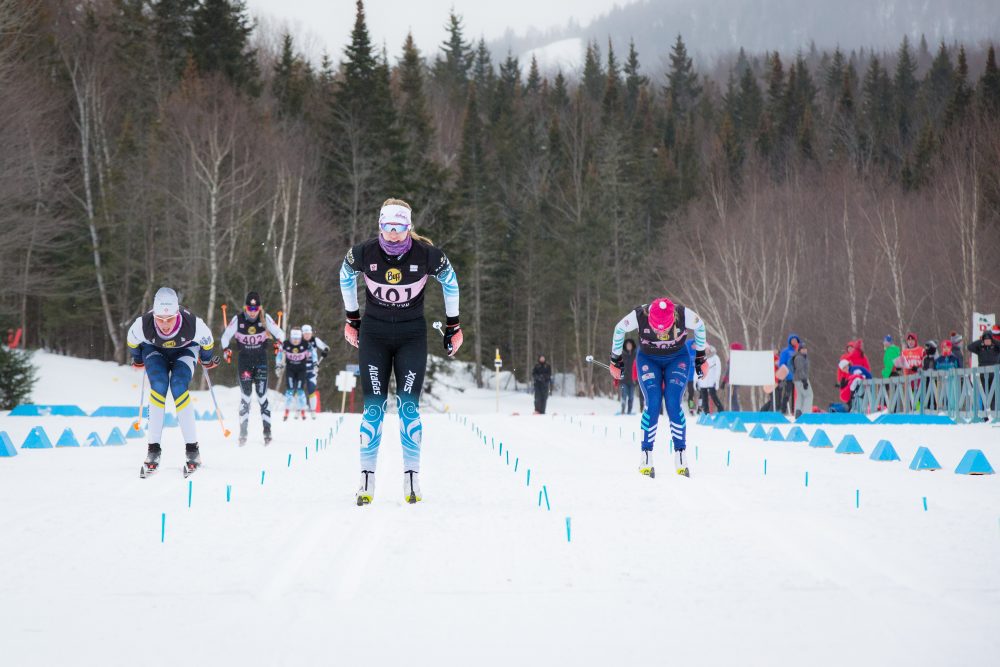
Dahria Beatty (401) of the AWCA/Canadian U25 Team en route to a win in one of her heats in the women’s classic sprint on Jan. 5 at Mont Sainte-Anna NorAm Trials in Quebec. (Photo: Mario Walker/NorAm MSA 2018 Facebook)
“It felt quite cold today with the wind and humidity but I believe it was only -14c. The course was in good condition.”
— Beatty (1st), on the conditions
“When I was doing my intervals on the course the day before the race I felt rushed and bogged down on the herringbone and steep striding sections. I made sure to really focus on how I was going to ski each section technically. On this course that allowed me to be relaxed in my qualifier and ski faster than if I was rushing. I am pleased that I was able to stick to my plan and the heats went well. I led my quarter and semi and then in the final I put myself in a comfortable position off the start and attacked on the climb and led the second half of the race”
— Beatty on strategy
“I didn’t have as much confidence in my fitness and I put a lot of pressure on myself to try to execute the perfect race. The snow was faster out of the track so that is where I tried to ski. I was out of the track and picked up a technique infraction around one of the final corners in my quarter final. I’m very disappointed in myself.”
— Olivia Bouffard-Nesbitt (Rocky Mountain Racers/Canadian National Team), about her first race in 11 months after an injury ended her 2016/2017 season early. She skied a strong semifinal to qualify for the A-final, but was disqualified for a technique infraction in her quarterfinal
Julien Locke (National U25 Team/Black Jack) qualifying second in the men’s classic sprint on Jan. 5 at Mont Sainte-Anna NorAm Trials in Quebec. (Photo: Mario Walker/NorAm MSA 2018 Facebook)
“I was quite relaxed coming into these trials. There was obviously a lot on the time, but at the end of the day, it’s just a ski race like any other. I knew that I had been racing well and was confident that I was in strong form. I was aware that both the qualifier and heats were up for consideration and was ready to fight hard in both.”
— Locke (1st in the A-final, 2nd in the qualifier), on his mental approach
“The track was in excellent condition yesterday. After having done a race-prep intensity Wednesday evening in slow, soft, heavily-falling snow, the track felt considerably easier on race day. The atmosphere on the course was fantastic. Lots of excitement and a wall of sound at the start and up the 2nd climb.”
— Locke
“I played the 1/4 final conservatively, following the Andy and Scott around the course before coming through on the final straight. I decided to be more offensive in the semi and started at a strong pace and skied from the front. With all of the twists in the 2nd half, I wanted to be out of trouble. It took a while to get the body feeling good but by the time the final came around, I knew that I was feeling strong. I pushed the pace from the start and attacked the course to the end. It was great to have the track to myself to just put my head down and ski fast.”
— Locke on his tactics
Russell Kennedy (Team R.A.D.) qualifying first in the men’s classic sprint on Jan. 5 at Mont Sainte-Anna NorAm Trials in Quebec. (Photo: Mario Walker/NorAm MSA 2018 Facebook)
“I have had good fitness this year so I used the first two heats to try some strategies knowing Julian has a really good end kick. That being said the whole final could have taken a win so I just wanted to make sure I was near the front so I could take a podium since I knew that would be my best chance.”
— Kennedy (1st in qualifying, 2nd in A-final)
“To be honest I don’t like reading criteria so I didn’t really realize how important it was. I was more interested in racing to my best ability and coming up with a course strategy with my coach Alain [Parent]!”
— Kennedy, on his mental approach
“Happy with my result. I was on crutches the day before and didn’t think I would be able to start so pretty happy with the outcome.”
— Evan Palmer-Charrette (NTDC Thunder Bay; 4th in the A-final)
***
Skiathlon
Canadian World Cup Team members Knute Johnsgaard (170) and Jess Cockney (179, behind) leaving the ski exchange halfway through the men’s 30 k skiathlon on Jan. 8 at Mont Sainte-Anna NorAm Trials in Quebec. (Photo: Mario Walker/NorAm MSA 2018 Facebook)
“It felt really good to take the win today. Even though I’ve met criteria for the Olympics I know people were starting to question my deserving of the spot, and rightfully so. I think I was letting that get to me until today when I finally just raced one for Knute and not to prove anything to anyone else.”
— Knute Johnsgaard (Canadian World Cup team; 1st) on winning the mental game
“We had a solid group of 5 or 6 guys right through most of the race and of that group I was pretty confident I could take it if it came down to a sprint.”
— Johnsgaard
Jack Carlyle (AWCA) leading Knute Johnsgaard (directly behind) and Graham Nishikawa (162) during the men’s 30 k skiathlon on Jan. 8 at Mont Sainte-Anne NorAm Trials in Quebec. (Photo: Mario Walker/NorAm MSA 2018 Facebook)
“I am very excited about the race today, this is my first time getting a senior podium on the NorAm and that means a lot to me. I tried to just sit in the group and stay relaxed on the classic portion, and for the skate I wanted to stay near the front of the group.”
— Gareth Williams (Telemark Nordic/National U25 Team; 3rd)
“I am really happy with how my race went today! Throughout the classic portion, all the racers stayed pretty close together. I kept my place near the front of the pack, taking advantage of the draft of the skiers in front of me to save energy. On the last uphill before the downhill finish I managed to pull away from the girl I was skiing with and from there it was just a sprint to the finish! Since we don’t have many opportunities to race Skiathlons in Canada I was happy I had the chance to race this one!”
— Natalie Hynes (Whitehorse Ski Club), who won junior women’s 10 k skiathlon to earn trip to Junior Worlds
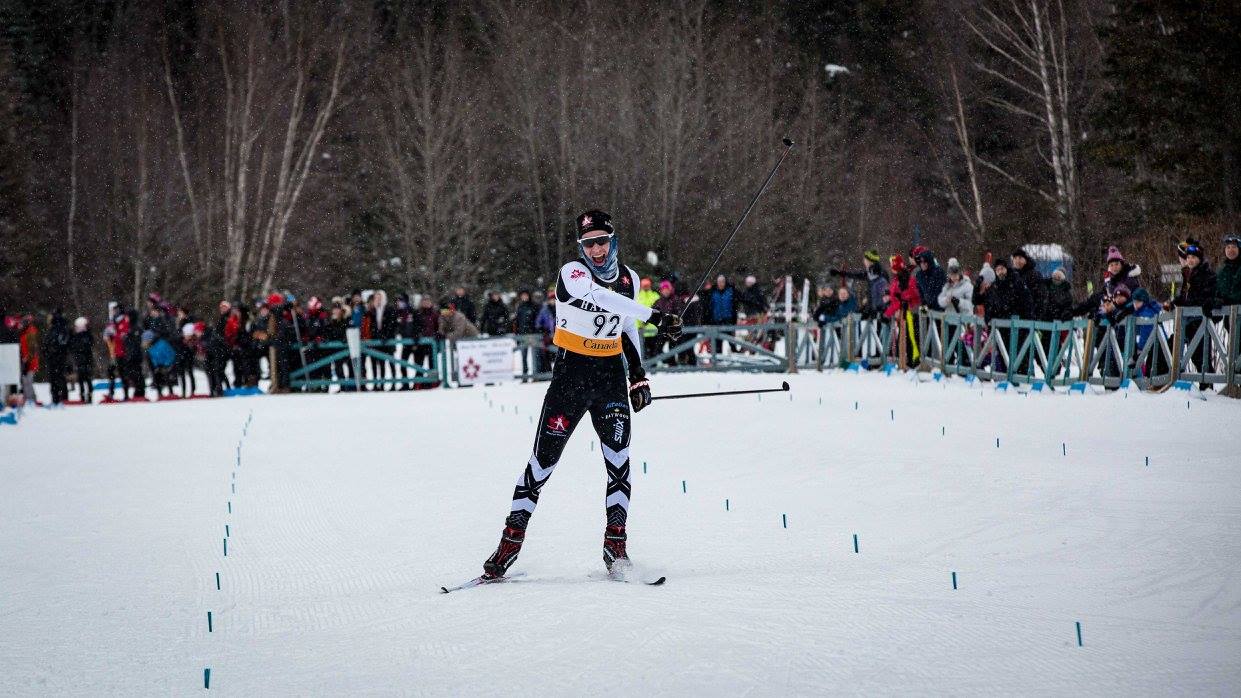
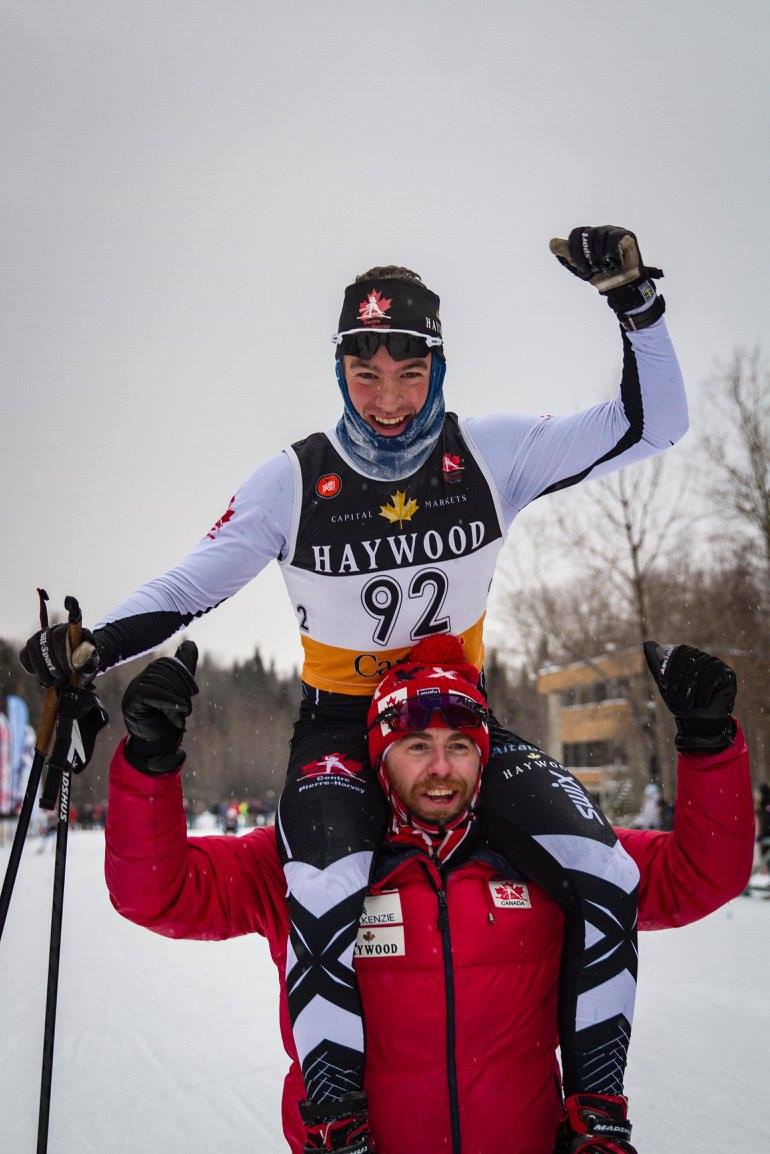
Antoine Cyr (92) celebrates his first NorAm win in the junior men’s 20 k skiathlon on Jan. 8 at Mont Sainte-Anne NorAm Trials in Quebec. (Photo: Mario Walker/NorAm MSA 2018 Facebook)
“I found myself alone with about 30 sec lead on the chasing pack. After the exchange, I paced the 10 km well and was able to keep a strong lead. When I crossed the finish line I was guaranteed a spot for Europe !! I jumped in my mom and my sister arm (they came down all the way from Gatineau to see me) I was so happy and then I celebrated with the rest of the team.”
— Antoine Cyr (CNEPH), on earning a Junior Worlds spot with his first NorAm junior win
***
Freestyle Sprints
Dahria Beatty (AWCA/National U25 Team) racing to fourth in the women’s skate sprint qualifier on Jan. 9 at Mont Sainte-Anne NorAm Trials in Quebec. She went on to win the A-final for her second-straight NorAm sprint win. (Photo: Mario Walker/NorAm MSA 2018 Facebook)
“In today’s final, Maya [MacIsaac-Jones] started fast and Zina [Kocher] really attacked the climbs. I tried to make sure I was always sitting in 2nd or 3rd behind those two until the second last climb where I pushed the flat section at the top to go into the twisting downhill behind Zina. I was able to overtake Zina on the last little bump before turning back into the stadium, allowing me to take the best line into the finish.”
— Beatty (1st), on tactics
“I felt soooooo tired!!! After the quali, I was wondering if I should do the heats. But as discussed with my coach Louis [Bouchard], my preparation for OWG has started and this sprint was a part of it.”
— Browne (2nd), on feeling the pain on Day 3
“The final was rough, I got pushed and cornered but that’s part of the game in sprints! The tactic was to give everything I had left. I thought that maybe I would finish last of my heat because my legs were so heavy! But it turned out that I still had some energy left because I passed Maya and Zina in the last 150 meters to finish 2nd!”
— Browne
Zina Kocher (Foothills Nordic) in the women’s skate sprint on Jan. 9 at Mont Sainte-Anne NorAm Trials in Quebec. She finished third in the A-final. (Photo: Mario Walker/NorAm MSA 2018 Facebook)
“In the final though I wanted to be in 2nd or 3rd for the final downhill because the draft was so important. But it didn’t work out that way. I ended up first and so I just kept going as hard as I could, & then was passed on the downhill by Daria. So I just tried to get into her draft and hold on. I lost it a bit though in the turnaround & mini downhill to the straightaway finish line & Cendrine was in my draft and had a bit more to give than I did in the last stretch to the line.”
— Zina Kocher (Foothills Nordic; 3rd), on the tactics that got her to the podium
“Hannah Mehain led us off the start and there was some jostling for position between myself, Catherine [Reed-Métayer] and Hannah. It’s a good course to be out in front, or at least in the top two, so with Hannah making a big effort to lead the start I tucked in behind. I knew I had excellent skis thanks to our amazing support team so was confident that I would be able to make a move on the downhill and push over the small hill into the finish straight!”
“I’m happy with the heat skiing again today but I’m still needing to find the top level for the qualification. I’m confident I can get to the right speed but it hasn’t been totally there yet this year.”
— Jess Cockney (Canadian World Cup team; 1st)
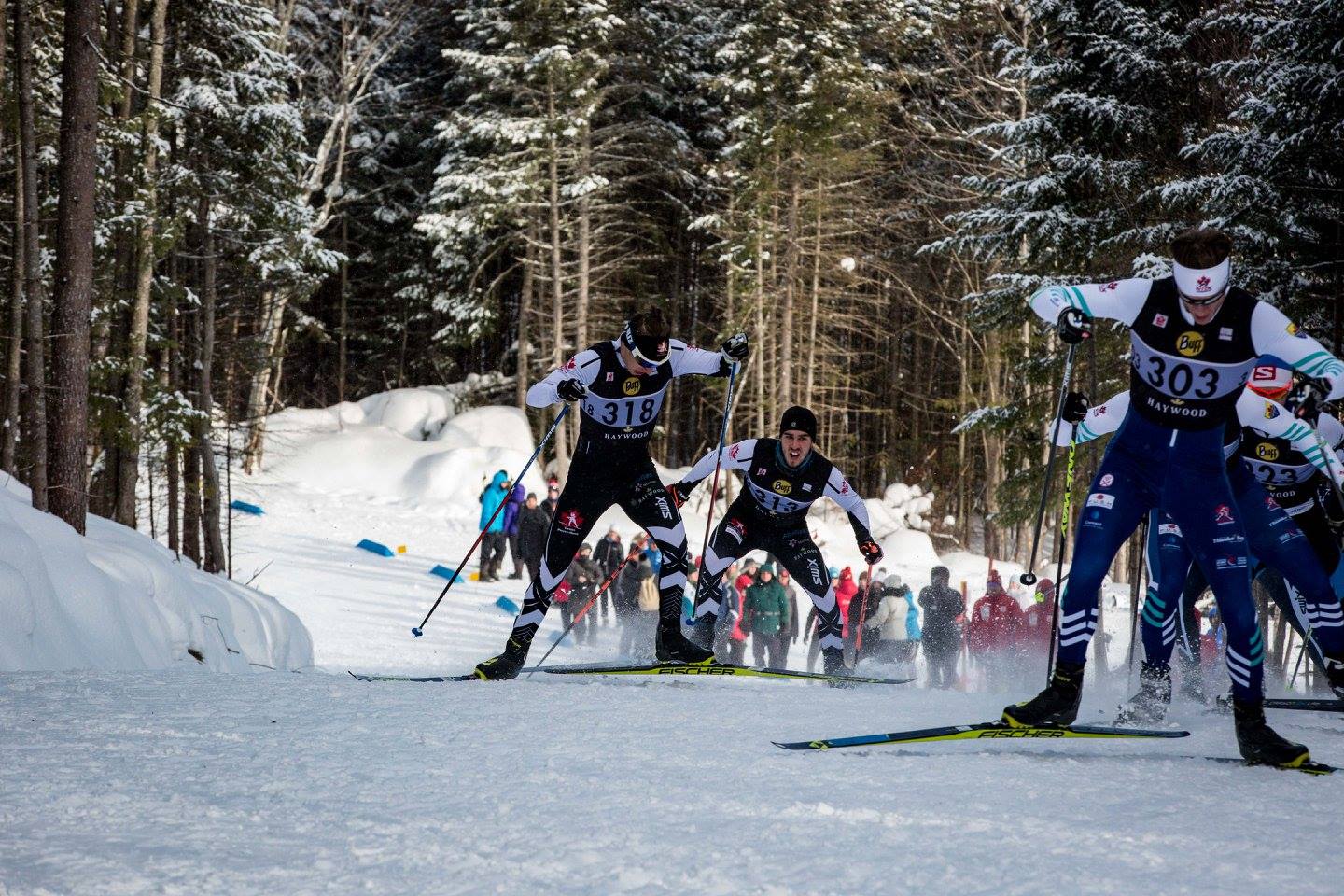
Bob Thompson (303) leading his skate-sprint quarterfinal, ahead of Alexis Dumas (318) and Philippe Boucher (313) and others, on Jan. 9 at Mont Sainte-Anne NorAm Trials in Quebec. (Photo: Mario Walker/NorAm MSA 2018 Facebook)
“Olivier [Hamel] was strong today and led out both my Quarter and Semi-finals to some really quick heat times. In the final there were a couple crashes that worked in my favour so I was able to claim second spot on the podium despite running out of gas well before the finish line.”
— Andy Shields (Lappe Nordic; 2nd), on the heats
“The group stayed mostly together through the first two climbs with the main push happening on the long second climb. Knute had an unfortunate crash at the bottom of that hill and [Ricardo Izquierdo-Bernier] had a crash on the last downhill. I was then in third behind Andy with Jess in front and just a bit too far back to challenge Andy for second.”
— Bob Thompson (NTDC Thunder Bay; 3rd) on the A-final
***
Classic Interval Starts
Ricardo Izquierdo-Bernier (CNEPH) racing to first in the men’s 15 k classic on Jan. 10 at Mont Sainte-Anna NorAm Trials in Quebec. (Photo: Mario Walker/NorAm MSA 2018 Facebook)
“This morning I was pretty motivated after my fall in the final of the sprint yesterday. I started fast knowing the course well [having] trained on it the last weeks. This help me very much to pace myself! The second half I just tried to keep my pace to the finish.”
— Ricardo Izquierdo-Bernier (CNEPH; 1st), on using local knowledge to get his first senior win at NorAms and a trip to U23’s
“Just rushing to airport. Happy with my week overall in MSA. Shape is good. Skis were good. Will keep improving into Korea for Paralympics.”
— Graham Nishikawa (Canadian Para-Nordic Team; 3rd)
“What a weekend! I felt great and I know I will feel even better during the Olympics. My preparation is on point! I did not think that I would perform so well in the two sprints, that was a surprise for me!”
— Browne (1st)
Katherine Stewart-Jones (NTDC Thunder Bay/Canadian U25 Team) racing to second in the women’s 10 k classic on Jan. 10 at Mont Sainte-Anna NorAm Trials in Quebec. (Photo: Mario Walker/NorAm MSA 2018 Facebook)
“There was a lot on the line today and I left it all out there.”
— Katherine Stewart-Jones (NTDC Thunder Bay/U25 Team), after her second place earned her a trip to U23’s, and the possibility of PyeongChang
“What really did it for me in this race was the last double pole section about 1 km before the finish. I knew I needed to make up a couple of seconds so I double poled as quickly and as hard as I could using the circular double pole technique that my older sister Heather taught me.”
— Mehain (1st junior woman), who ensured a trip to Junior Worlds
“I felt no stress going into the race and I just wanted a fun race. It was sunny and super nice weather. so I decided to go as hard as I can for as long as I can and see what would happen. After 2 km I had a split and I was leading by 25 second.”
— Antoine Cyr (CNEPH; 1st junior man), on feeling relaxed on the way to his third win in three days
***
Did Not Start
On Friday, there were five DNS in the heats and another seven in the qualifier. The number of DNS rose by the day.
“I’m battling a cold and a calf injury I sustained on Thursday before the classic sprint in crash/pile up. I actually started [the skiathlon Monday] but shortly into it realized despite trying to tell myself it I was good to go it was the wrong decision to start given how my body is doing. As for the other 22 athletes, there certainly is a bug going around here. As well some people decided to rest given the change in schedule.”
— Palmer-Charrette
Olivia Bouffard-Nesbitt (Rocky Mountain Racers) racing to ninth in the women’s 10 k classic on Jan. 10 at Mont Sainte-Anne NorAm Trials in Quebec. (Photo: Mario Walker/NorAm MSA 2018 Facebook)
“There have been so many DNS’ this week! I think for everyone it has been partly strategic and partly due to health. These are trials races for everyone so a lot of people are trying to give themselves the best chance possible in their strongest event. Especially with everyone getting sick or feeling like they are getting sick or trying to fight through sickness, skipping a race meant one more day of recovery to prepare for the rest of the week. In my case, my body was not recovering from the sprint effort on Friday and I was also fighting off some action in my sinuses. I didn’t feel well enough race to Monday.”
— Bouffard-Nesbitt
“It’s a really tough set of races here which is probably why you’re seeing so many folks DNS. Starting three days straight of racing with the 30km yesterday saps the body in a big way. Our heats ended late in the afternoon today so there’s not as much time for recovery going into tomorrow’s 15km classic. All I can do is get the recovery wheels spinning in preparation for tomorrow’s 15km classic.”
— Shields
“I’m really happy with my classic sprint. I was feeling really good. Unfortunately that race was really exhausting because it was a super cold day, I’ve been fighting a cold since Sunday night which is tough considering how important this weekend was. Monday was rough, I was not feeling very good. I decided to take Tuesday off to rest and recover for today which paid off in the end.”
— Stewart-Jones
***
What Happens Next
“I was disappointed with how my season started and was struggling to find my race form during WC period 1, so I came home for Christmas to regroup and build up towards the Olympics in February. … I head back over to Europe Jan 15th for our Olympic prep camp and the Seefeld World Cup.”
— Beatty
Anne-Marie Comeau (Université Laval) racing to third in the women’s 10 k classic on Jan. 10 at Mont Sainte-Anne NorAm Trials in Quebec. With the best results after Cendrine Browne in the two distance races at trials, she is the next pick for the Olympic team. (Photo: Mario Walker/NorAm MSA 2018 Facebook)
“This week has been a huge disappointment for me but I’m still so eager to get more training in me and get to a point where I can deliver performances I know I’m capable of.”
— Bouffard-Nesbitt
“It’s hard to judge World Cup level racing until you’ve been there and seen how competitive it is for yourself. Some of the races in December where it looks like I’m getting crushed, I might have actually won a Noram, its a completely other world of competition over there. Nevertheless I think my shape is coming around for the games.”
— Johnsgaard
“This has guaranteed me a spot for U23 Worlds, but the following days are still important to ensure I can start in more than just the Skiathlon. Some of the stress has been released today but it will still be full charge into the next two days!”
— Williams
“The preparation for Pyeongchang is is coming along and seeing speed in the heats is encouraging and the 15km classic [on Wednesday] will be great training for my next block back in Canmore too.”
— Cockney (who changed his mind the next morning and skipped the classic day)
“On the DNS front. I didn’t race today so I could rest up as I am leaving for Dresden this afternoon for all the period 2 world cups. The trip is now, myself, Julien Locke, Dominique Moncion Groulx and Antoine [Briand]. Antoine was added after Russell [Kennedy] had to pull out due to sickness since the weekend. After Dresden we will have one day stop in Ramsau, then Slovenia, and then I will be in seefeld for a few days before the rest of the team arrives from Livigno.”
— Thompson on competing at this weekend’s Dresden World Cup
“I will be representing Canada from this Sunday all the way till 25 of February racing in Europe. A dream come true for me !! I can’t really believe it yet.”
— Cyr
Antoine Cyr (92) celebrates his first NorAm win in the junior men’s 20 k skiathlon on Jan. 8 at Mont Sainte-Anne NorAm Trials in Quebec. (Photo: Mario Walker/NorAm MSA 2018 Facebook)
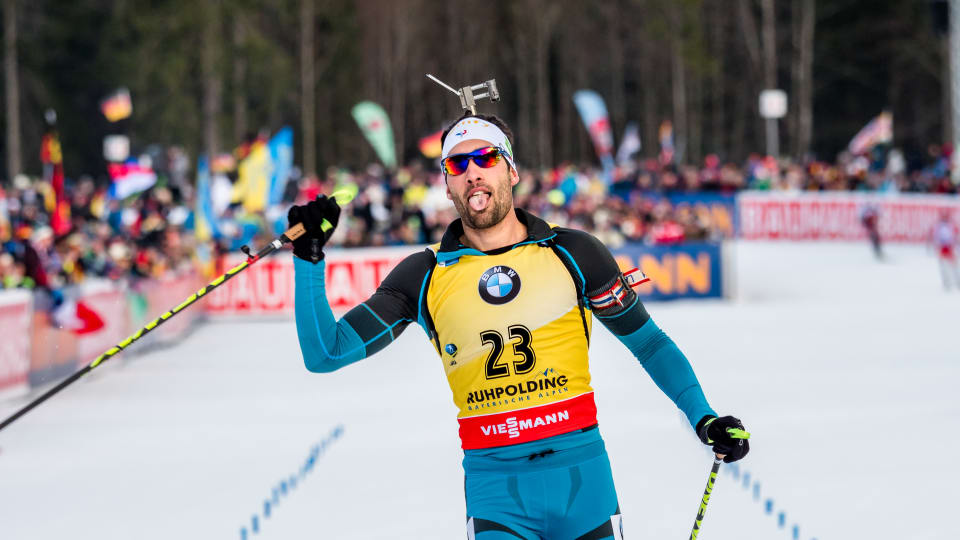
France’s Martin Fourcade after winning the men’s 20 k individual at the IBU World Cup in Ruhpolding, Germany, by more than a minute on Wednesday. (Photo: IBU/Biathlonworld)
IBU World Cup (Ruhpolding, Germany): Men’s 20 k individual
For France’s Martin Fourcade, the difference between a miss on the last shooting stage of the men’s 20-kilometer individual International Biathlon Union (IBU) World Cup on Wednesday versus perfect shooting wouldn’t have ultimately changed his result in Ruhpolding.
Despite the one-minute penalty, which was tagged onto his total time after his lone miss of the day, Fourcade still won by a minute. The Czech Republic’s Ondřej Moravec, who started 2 1/2 minutes ahead of him in bib 18 (while Fourcade wore bib 23), had successfully cleaned every stage, shooting 20-for-20, and initially crossed the finish line first — about a minute and 23 seconds ahead of former race leader Simon Eder of Austria.
But Moravec’s moment in first was fleeting as Fourcade burst into the stadium, not yet letting off the gas, seconds after Moravec finished. Fourcade took the win in 44:27.9, 1:01 ahead of Moravec in second. To indicate how fast Fourcade’s last loop was, it’s worth noting that he was 30 seconds ahead of Moravec with 4 k to go. On that final 4 k loop, he doubled his time ahead of second place.
Fourcade’s win came four days after his last race in Oberhof, Germany, the 12.5 k pursuit, which he also won.
“We are in a biathlon routine now,” he said, according to an IBU press release. “It was hard to find strong motivation with not much recovery or training this week. … Today I wanted to beat my record of podiums in a row. Today was my 14th [individual podium, including last season] in a row and I am really proud of this. I am very happy with my competition as well. Ruhpolding is place that I really love and I am happy that I continued my success here.”
Norway’s Johannes Thingnes Bø achieved his eighth-straight podium in third, 1:06.3 behind Fourcade with a single miss on the last stage as well (0+0+0+1).
“I heard the speaker, so I knew Martin had missed,” recalled Bø, who started behind Fourcade in bib 29. “I knew if I could shoot clean, there was a small chance I could beat him. I tried and missed. That was my tactic: to go for the win, not save the podium.”
He left the range for the last time 48.3 seconds back from Fourcade in first.
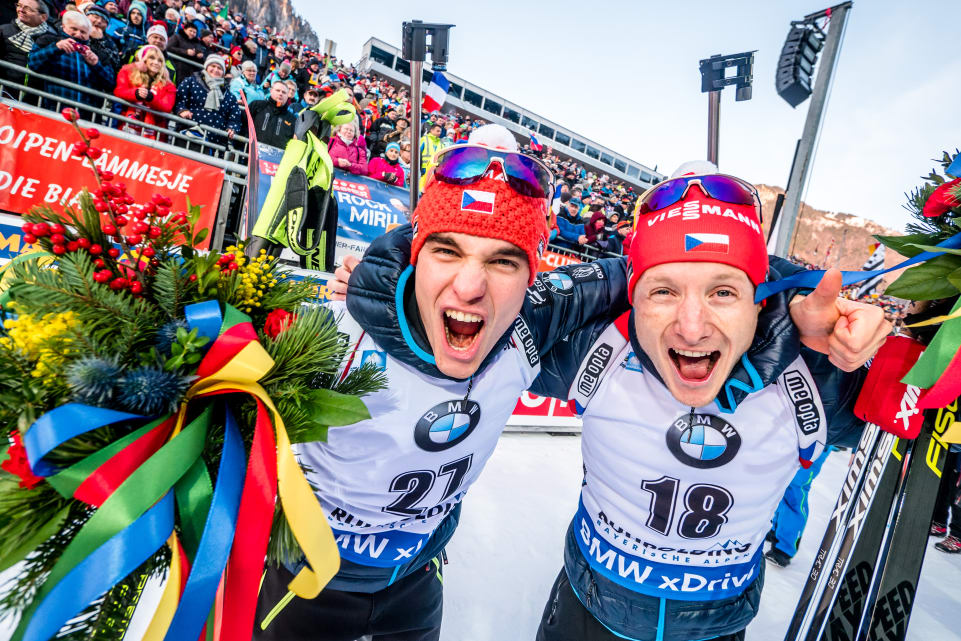
Michal Krcmar (l) and Ondřej Moravec (r) after reaching the flower ceremony in fifth and second, respectively, on Wednesday at the IBU World Cup in Ruhpolding, Germany. (Photo: IBU/Biathlonworld)
Germany’s Roman Rees shot clean and placed fourth (+1:19.1) for his first-career World Cup top 10, and the Czech Republic had two in the top five with Michal Krcmar in fifth (+1:36.6) for his best result of this season.
For Moravec, second place marked his season best as well, after finishing outside the top 10 in previous races this season.
“This podium is really important for me,” he told the IBU. “My first trimester was really bad; my shape was not good especially for the shooting. I also missed a lot of the summer training so did not have the best preparation … I am very please at how I was able to focus and have success in this race.”
Austria’s Dominik Landertinger followed in sixth (+2:21.9) with one penalty and Eder ended up seventh (+2:23.8) with one miss as well.
While the one-minute penalty per miss did not faze Fourcade, it led several North Americans to drop out of top-20 contention, particularly Tim Burke (US Biathlon), who had been in 16th after cleaning the third shooting stage. Burke had cleaned his first stage then missed one on the first standing, but was back in the top 20 with a clean third stage. On the final standing, he missed his first two shots, causing him to look up for a moment to refocus. He cleaned the last three, but still ended up with two additional minutes of penalties that put him 36th at the finish, 4:35.0 out of first (0+1+0+2).
Sean Doherty (US Biathlon) racing to 31st to lead his team in the men’s 20 k individual on Wednesday at the IBU World Cup in Ruhpolding, Germany. (Photo: US Biathlon/NordicFocus)
Sean Doherty led the U.S. men in 31st after missing two targets between the first prone and first standing stages. Ranked 76th after the second stage, he recovered to 53rd after a clean third stage and then 32nd after hitting all five targets on his last stage (1+1+0+0). With two penalties, Doherty finished the race 4:13.6 back in 31st.
“I am happy with the race today,” Doherty said, according to a US Biathlon press release. “I left some room for improvement on the range. It was a big step in the right direction from last week. We had very fast conditions on the course today and our waxing staff did a great job as usual.”
All three U.S. starters finished in the top 40, with Lowell Bailey in 37th (+4:36.4) with three misses (0+2+0+1).
Biathlon Canada was led by Christian Gow in 34th (+4:30.7), for his career-best in a 20 k individual race. After starting in bib 2, he cleaned his first and third stages to put himself in 32nd with one stage to go, within 28 seconds of the top 20. But a miss on his last standing put Gow in 39th leaving the range for the last time, and he ended up 34th at the finish (0+1+0+1).
“My shooting was just OK today,” Gow wrote in an email. “I would have liked to hit one more for sure and then I would have been completely satisfied with the race. I felt more nervous than normal in the range, and my two misses were a direct result of being a bit hesitant on the shooting mat.
“I am pretty happy with today overall,” he added. “I think this is the best skiing I’ve had in an Individual race and my best placing as well. I do wish I could have one or two shots back, but overall I am happy.”
Also for Canada, his older brother Scott Gow finished 55th (+5:13.2) with three penalties (0+1+1+1), Brendan Green placed 78th (+6:53.7) with four misses (1+0+2+1), and Macx Davies was 91st (+8:02.4) with five penalties (1+1+3+0), out of 107 finishers.
The Gow brothers and Green raced Sunday in the men’s 4 x 7.5 k in Oberhof, where they placed 10th.
“Honestly, I have been feeling pretty tired after the 3 days of racing in a row last weekend,” Christian wrote. “Our travel wasn’t too bad, but it still didn’t feel like much of a rest day.”
The Ruhpolding World Cup continues Thursday with the women’s 15 k individual (starting at 8:30 a.m. EST on the Olympic Channel). Another men’s 4 x 7.5 k relay will follow on Friday, then the women’s 4 x 6 k relay on Saturday, and the men’s and women’s mass starts on Sunday.
The women’s 10 k classic podium on Wednesday at the NorAm trials in Mont Sainte-Anne, Quebec, with Cendrine Browne (1) in first, Katherine Stewart-Jones (2) in second, and Anne-Marie Comeau (3) in third. Dahria Beatty (l) placed fourth. (Photo: Cross Country Canada/Instagram)
The NorAm trials at Mont Sainte-Anne (MSA), Québec, concluded Wednesday with the 10- and 15-kilometer classic interval starts. On the line were NorAm points, U23 and World Championships invitations, and for the women, what may well be the last Olympic spot on the Canadian team.
The action started with the men’s 15 k classic, which Ricardo Izquierdo-Bernier of the Pierre-Harvey National Training Centre (CNEPH) won in 39.07.8 minutes to punch his ticket to U23 World Championships later this month in Goms, Switzerland. He won the race ahead of Scott Hill of Barrie Cross Country (BXC) in second, who skied a fast final lap to come within 6.9 seconds of first.
Canadian Para-Nordic teammates Graham Nishikawa and Brian McKeever finished third (+30.0) and fourth (+37.4), respectively, with Nishikawa as McKeever’s guide in Paralympic events having the edge in the interval-start race the two skied on their own (Nishikawa started 64th and McKeever 55th).
According to Nishikawa, the two have been entering NorAm events that fit into their preparation for the PyeongChang Paralympics. Nishikawa wrote a quick email on his way to the airport on Wednesday.
“Happy with my week overall in MSA. Shape is good. Skis were good. Will keep improving into Korea for Paralympics,” he wrote after his second distance podium of the week.
In the women’s 10 k classic, Cendrine Browne (Canadian National U25 Team/CNEPH) continued her strong showing at trials with her second victory and fourth top-four result, taking the win in 29:47.0.
Katherine Stewart-Jones, of the U25 Team and National Team Development Centre (NTDC) Thunder Bay, and Anne-Marie Comeau (Université Laval) were virtually tied for second after the first lap, but Stewart-Jones held the speed to take second, 39.2 seconds behind Browne and 24.3 seconds ahead of Comeau in third.
About 16 seconds later, Maya MacIsaac-Jones, of the U25 Team and Rocky Mountain Racers (RMR), finished fourth (+1:21.0) ahead of Dahria Beatty, of the Canadian World Cup Team and Alberta World Cup Academy, in fifth (+1:26.6).
The selection criteria are complex, but a quick calculation suggests that Comeau, who placed second to Browne in Monday’s skiathlon, gets the provisional women’s distance spot for the PyeongChang Olympics (since Browne already established herself as the sprint leader), and Stewart-Jones, who was fifth in the skiathlon, gets the U23 Worlds berth. Stay tuned for updates and official selections.
The junior men’s 10 k classic podium on Wednesday at the NorAm trials in Mont Sainte-Anne, Quebec, with Antoine Cyr (c) in first, Félix Longpré (2) in second and Étienne Hébert (3) in third. (Photo: Cross Country Canada/Instagram)
CNEPH’s Antoine Cyr took his third win of the week in the junior men’s 10 k, finishing in 25:57.3, well ahead of local Félix Longpré (MSA) in second (+48.2) and Étienne Hébert (AWCA) in third (+55.6).
In the junior women’s 5 k, Hannah Mehain (Sovereign Lake Nordic/National Junior Team) took the win in 15:22.7, just 2.7 seconds ahead of skiathlon winner Natalie Hynes (Whitehorse Ski Club/National Junior Team) and 15.0 seconds ahead of Tuesday’s skate sprint winner Annika Richardson (NTDC Thunder Bay/National Junior Team) in third.
The senior men’s NorAm skate sprint podium, with Jess Cockney (c) in first, Andy Shields (2) in second and Bob Thompson (3) in third, along with Olivier Hamel in fifth, Knute Johnsgaard in sixth and Ricardo Izquierdo-Bernier in sixth in Mont Sainte-Anne, Quebec. (Photo: Mario Walker/NorAm MSA 2018)
The Mont Sainte-Anne (MSA) NorAm weekend continued Tuesday with freestyle sprints, which counted toward Junior and U23 World Championships team selection only.
In the women’s 1.3-kilometer sprint, Dahria Beatty, of the Canadian World Cup Team and Alberta World Cup Academy (AWCA), won every heat to take her second win of the MSA NorAm, after winning Friday’s classic sprint. According to a timing error, in which the clock was started well before athletes left the start, the A-final was more than a minute slower than the fastest heat of the day (the second semifinal, which Cendrine Browne won in 3:34.33, ahead of Zina Kocher in second). Beatty won the final with a time listed as 4:39.44.
“Most definitely we did not ski that much slower, if it was slower,” Kocher wrote in an email after the race. “My legs were on fire & we were all fighting to give it everything!”
Monday’s skiathlon winner, Browne, of the national U25 Team and Pierre-Harvey National Training Centre (CNEPH), took second overall, 0.52 seconds back, and Kocher (Foothills Nordic) rallied for her first podium of the week in third (+2.44). The day’s fastest qualifier, Maya MacIsaac-Jones, of the U25 Team and Rocky Mountain Racers (RMR) finished the day in fourth (+2.93), Laura Leclair (CNEPH) followed in fifth (+4.78), and Sophie Carrier-Laforte (Skinouk) finished sixth (+30.43).
The junior women’s NorAm podium in Mont Sainte-Anne, Quebec, on Tuesday, with Annika Richardson (c) in first, Elizabeth Elliott (2) in second, and Catherine Reed-Métayer (3) in third. (Photo: Mario Walker/NorAm MSA 2018)
Annika Richardson, of the Canadian national junior team and National Team Development Centre (NTDC) Thunder Bay, won the junior women’s sprint in 3:42.10, ensuring a return to Junior World Championships this year. Elizabeth Elliott (Revelstoke Nordic) finished 3.27 second back in second, and junior qualification winner Catherine Reed-Métayer (Skibec/National Junior Team) reached the podium in third, 4.9 seconds back.
In the men’s 1.35 k skate sprint, World Cup Team member Jess Cockney won the A-final by a commanding 3.5 seconds in 2:56.39, ahead of Andy Shields (Lappe Nordic) in second. Bob Thompson (NTDC Thunder Bay) continued his consistent season in third place (+4.1). Olivier Hamel (CNEPH) followed in fourth (+8.93), Monday’s skiathlon winner Knute Johnsgaard (World Cup Team) finished fifth (+14.9), and Ricardo Izquierdo-Bernier (CNEPH) placed sixth (+35.77).
Johnsgaard won the qualifying round in 2:57.37, just 0.01 seconds ahead of Hamel in second. Thompson was 2.46 seconds back in third.
In the junior men’s A-final, Antoine Cyr (CNEPH) took his second consecutive win, finishing first in 3:03.81. Graham Ritchie (NTDC Thunder Bay) placed second (+1.2) and Étienne Hébert (AWCA) third (+1.99).
The Hanneman brothers after Friday’s skate sprint at 2018 U.S. Cross Country Championships in Anchorage, where they live and train with Alaska Pacific University. Reese Hanneman (l) won the men’s final and younger brother Logan (r) won the men’s qualifying round.
U.S. Cross Country Championships (Anchorage, Alaska): Freestyle sprints
Caitlin Patterson racked up her second-straight national title at this year’s 2018 U.S. Cross Country Championships and Reese Hanneman topped the men’s freestyle sprint final on Friday at Kincaid Park in Anchorage, Alaska.
In the first of two sprints at 2018 U.S. nationals, Patterson, the Craftsbury Green Racing Project (CGRP) skier who won the women’s 10-kilometer freestyle on Wednesday, posted a 3.56-second win in the women’s 1.5 k freestyle sprint final on Friday.
After qualifying 12th, 5.76 seconds back from Anne Hart of the Stratton Mountain School (SMS) Elite Team, who won the qualifier in 3:22.10, Patterson won both her quarterfinal and semifinal, both times ahead of University of Denver (DU) junior Jasmi Joensuu in second.
The two advanced to the final, where Patterson reached the finish line first once more in 3:20.93, about 3 1/2 seconds ahead of Joensuu in second and 4.19 seconds ahead of Petra Hyncicova, a senior at the University of Colorado Boulder, in third. Craftsbury had two in the final with Kaitlynn Miller placing fourth (+4.35). U20 skier Hannah Halvorsen of Alaska Pacific University (APU) and the U.S. Ski Team (USST) finished fifth (+7.66), and Kelsey Phinney of the Sun Valley Ski Education Foundation (SVSEF) placed sixth (+9.78).
Hart won her quarterfinal then placed third in the first semifinal, behind Miller, who won that heat, and Hyncicova in second, to miss advancing to the final. Hart had won the qualifier by 1.78 seconds over Joensuu in second.
In the men’s 1.6 k skate sprint, Logan Hanneman (APU) won the qualifier in 3:07.4. Kevin Bolger (SVSEF) qualified in second (+0.48), and older brother Reese Hanneman (APU) was third (+1.13).
In the quarterfinals, Reese won his heat by 0.19 seconds ahead of his teammate Tyler Kornfield, and Logan finished second, 0.42 seconds behind U18 skier Gus Schumacher (Alaska Winter Stars), as the winner of the first quarterfinal. Bolger won the fourth quarterfinal.
Reese raced to another win in the second semifinal, 0.17 seconds ahead of Bolger in second. APU’s Eric Packer won the first semi, 1.66 seconds clear of Zak Ketterson of Northern Michigan University (NMU) in second. Logan finished fifth in that semifinal, 4.48 seconds out of first, trailing Dakota Blackhorse-von Jess (Bend Endurance Academy) in third and Schumacher in fourth.
In the final, which included three APU athletes out of six total, Reese nipped Bolger by just eight-hundredths of a second for the win in 3:11.33. APU had two on the podium with Kornfield in third (+0.88). Ketterson finished fourth (+1.92), Packer was fifth (+2.34), and DU sophomore Eivind Romberg Kvaale was sixth (+14.08).
U.S. nationals racing continues Sunday with the 20/30 k classic mass starts.
The men’s classic sprint podium at 2018 Canadian NorAm Trials on Friday at Mont Sainte-Anne, Quebec, with Julien Locke (second from r) in first, Russell Kennedy (r) in second, Bob Thompson (c) in third, Evan Palmer-Charrette (second from l) in fourth, and Dominique Moncion-Groulx (l) in fifth. (Photo: Canmore Nordic Ski Club/Instagram)
Canada’s NorAm Olympic trials opened Friday at Mont Sainte-Anne in Beaupré, Quebec, with Dahria Beatty (Canadian World Cup Team/Alberta World Cup Academy) winning the women’s 1.35-kilometer classic sprint and Julien Locke (Canadian U25 Team/Black Jack) topping the men’s 1.35 k classic sprint final. While Beatty has already secured her spot at the 2018 Olympics in PyeongChang, South Korea, Locke has not — but the win didn’t ensure he’ll be selected to the team. In a tiebreaker, it looks like he is second on the men’s sprint list at trials to Russell Kennedy, of Canmore Nordic/Team R.A.D.
Based on its published nomination procedures for the 2018 Olympic Games, Cross Country Canada (CCC) will consider both qualifying and final results in its “sprint selection ranking process”. In the men’s qualifying round on Friday, Kennedy qualified first (in 3:02.81 minutes) and Locke followed in second (3.06 seconds back). Kennedy later placed second to Locke in the men’s final. Effectively, that meant they were tied, should CCC select another male sprinter to its Olympic team. But the tiebreaker is the qualifying round, which Kennedy won.
To reach the final, Kennedy placed second in his quarterfinal, behind Ricardo Izquierdo-Bernier of the Pierre-Harvey National Training Centre (CNEPH), and Locke was second in his quarterfinal as well, behind Andy Shields of Lappe Nordic. All four automatically advanced to the semifinals, where Kennedy posted a 1.12-second win over Bob Thompson, of the National Team Development Centre (NTDC) Thunder Bay, and Locke edged Jess Cockney (of the Canadian World Cup Team, who prequalified for PyeongChang) by 0.34 seconds.
In the final, Locke notched a 1.17-second win over Kennedy, crossing the line first in 3:04.16. Thompson took third (+2.49), Evan Palmer-Charrette (NTDC Thunder Bay) was fourth (+5.74), Dominique Moncion-Groulx (AWCA) was fifth (+7.2) and Cockney sixth (+55.97). Len Valjas, who is recovering from a shoulder injury and is prequalified for PyeongChang, won the men’s B-final for seventh overall.
In the women’s race, Beatty qualified first in 3:41.55, then won both her quarterfinal and semifinal before topping the final as well in 3:45.02, 0.64 seconds ahead of Maya MacIsaac-Jones (U25 Team/Rocky Mountain Racers) in second. Katherine Stewart-Jones (U25 Team/NTDC Thunder Bay) finished third (+1.2) in the final, Cendrine Browne (U25 Team/CNEPH) was fourth (+4.58), Annika Hicks (AWCA) fifth (+10.21), and Andrea Dupont (RMR) sixth (+12.18).
Browne posted the second-fastest qualifying time, 3.13 seconds back from Beatty. Olivia Bouffard-Nesbitt (RMR) qualified third (+8.08), but was disqualified in her quarterfinal. MacIsaac-Jones qualified fourth (+8.49), putting her total points for the day — based on CCC’s selection ranking — at 6. Browne scored 6 points as well (for qualifying second then finishing fourth overall), but with the better qualifier, Browne is expected to be deemed the winner of that Olympic sprint spot. Laura Leclair (CNEPH) qualified fifth (+10.57), and Stewart-Jones ranked fifth (+13.8) in the qualifying round.
NTDC Thunder Bay’s Katherine Stewart-Jones (l) and CNEPH’s Cendrine Browne, both the Canadian U25 Team, after the NorAm Trials classic sprint at Mont Sainte-Anne, Quebec. (Photo: Mario Walker/NorAm MSA 2018 Facebook)
Browne won her quarterfinal by 1.5 seconds over Hicks, and the two met again in the semifinal, which Browne also won, this time by 2.81 seconds over Hicks. MacIsaac-Jones posted a 0.25-second quarterfinal win over Dupont, then finished second in her semifinal, 0.22 seconds behind Beatty.
Fresh off racing Period 1 of the World Cup, Browne, 24, is best known as a distance skier, but she’s been on the NorAm sprint podium before. She last won a sprint qualifier and finished second overall at two years ago at the Canmore NorAm in December 2015.
In an email, CCC High Performance Director Thomas Holland confirmed Browne and Kennedy were the sprint-selection winners next in line for Olympic quota spots.
“Cendrine has officially been named the winner of the Olympic sprint selection event.
The only catch is that Cross Country Canada’s official selection cannot be announced until FIS (the international ski federation) announces its final quota re-allocation at the end of January.
The most recent version of the FIS quotas, dated yesterday morning (Friday) allocates only eight quotas for Canada. IN THEORY, that quota could be lowered further still, in which case certain named athletes could be left out.
Which is why Cendrine will have to wait until late January to shout her news from the rooftops!
Her victory in the sprint selection is doubly important as it puts her in the Number 3 spot on the women’s team, behind Dahria Beatty and Emily Nishikawa, according to Amendment #2 of Cross Country Canada’s Olympic selection criteria.
If the FIS quota were to be lowered to 7, for example, it would be the women’s distance winner who would lose out.”
The NorAm trials for Olympics as well as Junior and U23 World Championships resume Monday with skiathlons, followed by skate sprints on Tuesday. Sunday’s 10/15 k classic individual starts were postponed to Wednesday.
Tim Burke shooting clean in standing for his second-straight stage en route to a fourth-place finish in the men’s 10 k sprint on Friday at the IBU World Cup in Oberhof, Germany. (Screenshot: ARD broadcast)
In his first race of the new year, Tim Burke raced to fourth — his best result in four years — in the men’s 10-kilometer sprint at the International Biathlon Union (IBU) World Cup in Oberhof, Germany.
The 35-year-old American started 22nd out of 103 and shot clean to cross the finish line in third, 20.1 seconds behind France’s Martin Fourcade, who also shot clean and finished in 25:03.3 minutes — a time that would hold up against the entire field as the fastest and give the Frenchman his second win of the season.
Fourcade had bumped early race leader Norway’s Johannes Thingnes Bø to second, after Bø missed two targets on his initial prone stage then cleaned standing (2+0), but skied the fastest overall course time to reach the podium. Burke’s time was 9.9 short of Bø’s.
Ultimately, Norway’s Emil Hegle Svendsen as the 58th starter bumped Bø to third and Burke off the podium, finishing second, 8.1 seconds behind Fourcade, also with clean shooting.
Canada was led by Scott Gow in 32nd (+1:48.7), who had a single standing penalty (0+1), and his brother Christian Gow finished 36th (+1:50.3) with one standing miss as well (0+1). Brendan Green was 57th (+2:30.4) with three penalties (1+2), and in his first European World Cup race, Carsen Campbell finished finished 94th (+4:05.3) with two misses (2+0).
The U.S. started two men on Friday, with Sean Doherty finishing 84th (+3:24.4) with four penalties (3+1).
The Oberhof IBU World Cup continues Saturday with the men’s and women’s pursuits.
Canada’s Cendrine Browne finished 26th in the women’s 30-kilometer freestyle mass start at the 2017 Nordic World Championships in Lahti, Finland. She will be racing later this week more or less on her home turf at Mont Sainte Anne, Quebec, to try to secure her spot on the Canadian Olympic Team. (Photo: John Lazenby/Lazenbyphoto.com)
But in fact, that might be too many. Cross Country Canada (CCC) learned that they currently stand to receive a quota of nine team members (men and women combined) for PyeongChang, based on Canada’s recent international results. That is two quota spots less than at the similar time before the 2014 Olympics in Sochi, Russia.
The quota is likely to increase, as some of the teams given the largest roster possibilities will probably not use all of their roster space. If that happens, the free quota spots will be redistributed, although just how many additional spots Canada will receive depends completely on the actions of other teams.
Regardless, the current small roster size means that qualification will shake out differently than the national team had thought it would, CCC High Performance Director Thomas Holland said in a recent phone interview.
Canada’s Alex Harvey celebrates his victory in the men’s freestyle sprint at World Cup Finals in Quebec City. “I mean, it’s all about the Games and you know Alex is a big contender. We’re putting everything behind him, and making sure he’s got what he needs to get the job done in PyeongChang,” said Cross Country Canada High Performance Director Tom Holland.
“We based our criteria on what we had in Sochi,” Holland said of designing CCC’s selection process. “In Sochi, we had 11 [athletes initially], and with the reallocation we ended up with 13, so we kind of used that [to develop] the criteria. I guess our results aren’t where we would like them to be [this year] so we have nine, less than we expected.”
As a result, a revision of the Olympic qualification criteria has specified who is guaranteed a spot, which types of athletes will be picked at trials, and which athletes will be added later if Canada benefits from quota reallocation.
Specifically, Harvey, Valjas, Kershaw, Johnsgaard, and Cockney are definitely going, as they have met the “Primary Qualifying Criteria” by dint of a third-place World Cup relay or, in Cockney’s case, two 10th-place finishes in sprints, or in Harvey’s case, a whole lot of different top results.
The next priority is to field a four-woman team, so Nishikawa and Beatty are in, as the only two women to have achieved “Alternative Qualifying Criteria A” of three top-30 results. The trials will determine who will join them. The new amendment specifies that one female sprinter and one female distance skier will be selected.
That brings the team size to nine. If an additional quota spot materializes, Killick will get the call; he met “Alternative Qualifying Criteria A,” the only Canadian man to do so aside from those who met the primary criteria.
Should even more quota spots arrive, they would go to, in order, a male sprinter and a female distance skier. CCC has said for months that team size would be capped at 12 no matter how many quota spots are allocated to the team.
Race Formats and Qualification Scoring
The Olympic selection races will be held this Friday through next Tuesday, Jan. 9, in Mont Sainte-Anne, Quebec, as part of major competitions with NorAm points on the line and selections being made for Junior and U23 World Championships teams being done at the same time.
Among those racing at the trials will be Knute Johnsgaard, even though he is already qualified for the Olympics. (Photo: Fischer/Nordic Focus)
Some of the athletes already qualified for the Games will also be there competing as a tune-up: only one athlete, Harvey, is currently competing in the Tour de Ski, with Kershaw having intended to but falling sick after the first stage. Killick and Nishikawa are racing in Continental Cup races in Europe.
For the rest of the hopefuls, classic sprints will be contested on Friday, Jan. 5; 10/15 k classic interval starts on Sunday, Jan. 7; and 15/30 k skiathlons on Tuesday, Jan. 9.
(There will be an additional skate sprint on Monday, Jan. 8, but it will not figure into Olympic qualification. And a forecast of cold weather for Sunday means that more modifications still may come, although the organizing committee is sticking to the planned distance races on Sunday for now.)
While the distance interval-start race at the Olympics will be skating, Holland said that it would be a classic competition at the upcoming trials for several reasons, the main one being a time constraint that prevented the staging of every possible kind of race.
Former biathlete Zina Kocher likes skate distance more than classic sprints, and the selection race schedule might not work in the current NorAm leader’s favor. (Photo: Peggy Hung)
“We have a couple things going on at the same time,” he explained. “We have probably 18 athletes who will qualify for the World Juniors/U23 teams. We couldn’t get that [series] in any earlier, so we have about four days to do all the races… there is classic racing at the Olympics in the relay, in the 30k, that kind of thing, so that was the best scenario we could come up with.”
That is definitely a blow to skate-specialist athletes looking for an Olympic berth – in particular Zina Kocher, a former biathlete who currently leads the NorAm series (more on that later). But Holland says there hasn’t been much pushback on the classic-heavy schedule.
“I think they have known, and accepted it,” he said. “You have to ski both techniques at the Games, if you want to maximize the the number of races [an athlete can do]… It’s not ideal, but I guess, you know, we get to look at the skate race in the skiathlon.”
Sprint and distance ranking lists will be kept separately for men and women, although the distance list for men is something of a moot point as there are no additional male distance skiers set to be added to the team.
In each case, the list will be made up of only the athletes who have not met qualification criteria in that discipline – so, for example, Johnsgaard, who has met the distance but not the sprint qualification criteria, can be scored on the sprint list, while Cockney, who has met the sprint but not the distance qualification criteria, could be scored on the distance list.
“[If Johnsgaard qualified] for the sprint spot… the outcome would be that we would have four sprinters (Harvey, Valjas, Cockney, Johnsgaard) and the sprint quota would be full at four athletes,” Holland wrote in an email. “We would move onto a distance athlete as per the ranking in Amendment #2.”
That said, once at the Olympics, any team member could start any race regardless of whether they qualified via sprint or distance results.
“Once the athletes are at the Games it is the purview of the coaches and High Performance Director as to who starts in which races – there are no limitations; we will try to fill start positions,” Holland wrote. “Meeting the nomination procedures/criteria is another matter. Qualifying in a distance or relay event should not give an athlete the automatic right to take a sprint quota spot at the Games.”
For the female sprinter and the potential additional male sprinter to be selected in Mont Sainte-Anne, the requirement is clearly to “win” the classic sprint on Jan. 6, or at least be the top athlete who wasn’t already qualified for PyeongChang.
Sophie Carrier-Laforte charging the downhill on her way to third place in the NorAm women’s 5 k classic in Rossland, B.C. Carrier-Laforte has also had excellent sprint results so far this NorAm season. (Photo: Mark Richards)
But winning is a bit complicated: with only one spot up for grabs, CCC wants to consider both qualifying speed and final placement at the end of the heats. Thus, a combined score will be made, with 50 percent of points coming from qualifier position and 50 percent of points from final position. For each, one point will be given to the winner, two to the second-place finisher, three to the third-place finisher, etc. The athlete with the lowest combined point score from the day “wins”.
For female distance skiers, both the 10 k classic interval start and the 15 k skiathlon will be scored. If they are won by the same athlete, then it is clear that this woman will be named to the Olympic team. If two different women win the two races, then the woman with the better result in the race she didn’t win will be picked.
And if the same athlete tops both the sprint and distance list, then they will be given the designated sprint spot, and the second-ranked distance skier will also be selected for the team.
An “alternate” sprinter and “alternate” distance skier for both men and women will be named, who will go to the Games only if one of the qualified athletes becomes sick or injured and can’t compete.
Canada has a scary preview of that at the moment, as Valjas – who stood on the World Cup podium several times last season – returned to Canada in December to deal with injury issues.
Canada’s Len Valjas racing to second in the men’s classic sprint qualifier at the World Cup in PyeongChang, South Korea, last season. Values left the World Cup Period I early this year to deal with a neck injury, and will be racing at the selection races as part of his return to competition. (Photo: Fischer/Nordic Focus)
“He injured his shoulder, but it’s an injury that he had last year at the World Championships and it goes much deeper. It really felt like a shoulder injury, but until he came back this time and had an MRI, spent more time with doctors, we really got to the root of the cause,” Holland said. “It’s something that’s going to be there and has to be managed now. At least he knows what it is, and with therapy he can keep it under control. We’re just playing it safe at this point.”
He anticipates that Valjas will be back in more than enough time for PyeongChang.
“Now that we know what it is and that he knows how to treat it, with the exercises he has to do on an ongoing basis, and just the right therapy on an ongoing basis, he should be fine,” Holland said. “He’s pretty confident.”
Who To Watch For
Depending on quota reallocation, it’s not clear that any more men will be added to the Canadian Olympic team. From that perspective, some attention will be on who wins the men’s sprint – with Julien Locke and Bob Thompson perhaps the favorites to earn it if that quota spot opens up.
Julien Locke finished 36th in the skate sprint in Davos, Switzerland, tying his second-best World Cup result ever. (Photo: Reese Brown / U.S. Ski & Snowboard)
And for both men and women, it’s also an opportunity to see how the athletes who returned from World Cup Period 1 with somewhat disappointing results compete, as Holland expects their race fitness to be improving. Beatty, Cockney, Valjas, and Johnsgaard are all registered for the races, as are Locke and Russell Kennedy, who raced Period 1 via a Frozen Thunder sprint win and NorAm leader status, respectively. Finally, there’s Brian McKeever racing, who is always a possibility of shaking up the podium as he prepares for the PyeongChang Paralympics.
But in the selection races, most of the attention will be on the women.
Returning from the World Cup are Cendrine Browne, who was two-thirds of the way to her “Alternative Qualifying Criteria A” selection but never notched her third top-30, and Katherine Stewart-Jones. Browne finished 45th in both the 15 k skiathlon in Lillehammer, Norway, and the 10 k skate in Davos, Switzerland, in December.
“I think she didn’t race to her potential in December for whatever reason, but I expect her to come around here in Mont Sainte-Anne and be off to the Olympics,” Holland said of Browne.
Then there is fellow 2017 World Championships team member Stewart-Jones, who suffered a concussion in mid-September and had to miss more than a month of training. She jumped back onto the World Cup in Lillehammer and had a top finish of 55th in the Davos sprint.
Katherine Stewart-Jones has tried to continuously improve her results since rehabbing from a concussion. (Photo: Reese Brown / U.S. Ski & Snowboard)
“With the concussion she had — sometimes you have to make a decision,” Holland said of her return to racing. “Maybe it was too soon for the World Cup, but you know, [she had a] good training season, and there are more races. I expect her to come around. She has goals for the Olympics, but she’s still a U23 so she has some goals/objectives there as well. We’ll see what she does at the trials.”
Then there is Kocher, who has rarely competed against the previous two. A several-time Olympian for Biathlon Canada and previous World Cup podium finisher in biathlon, she also won the 5k skate at Canadian Ski Nationals last season and finished second to Nishikawa in the 30 k skate. She was the Canadian champion in the same event in 2013, where she finished behind Switzerland’s Bettina Gruber in the race.
Kocher is the current NorAm leader, but that has come on the strength of her skating: the top Canadian (in eighth) in the 10 k skate at the Sovereign Lakes NorAm, third in the skate sprint in Rossland, second in the overall minitour after a strong skate pursuit. But in the 5 k classic at the Rossland NorAm, she finished just 12th. A major question is whether he 20 k skiathlon gives her enough room to make up for her classic skiing, and whether she can do well enough in the 10 k classic compared to, say, Stewart-Jones, to earn a nod.
Second place in the NorAm standings belongs to Andrea Dupont, who finished second, and the top Canadian, in the Rossland skate sprint. She also won the qualifier there, which is an important skill given the sprint scoring system at Olympic trials.
First-year senior Maya MacIsaac-Jones (r) with her Rocky Mountain Racers teammate Andrea Dupont, currently second in the NorAm standings, after the two placed first and second in the NorAm freestyle sprint at Sovereign Lake. MacIsaac-Jones won for her first NorAm victory. (Photo: Gerry Furseth)
Annika Hicks was the first Canadian in the classic race in Rossland, and finished third overall in the minitour. She has had a strong start to the season and is currently third in the NorAm rankings, just a few points behind Dupont.
Sophie Carrier-Laforte, Frédérique Vézina, Maya MacIsaac-Jones, Laura Leclair, Anne-Marie Comeau, Alannah MacLean, and juniors Hannah Mehain and Lisle Compton also have top-five Canadian finishes from individual NorAm races.
“Maya MacIsaac-Jones, she’s had a rough time with injuries over the last year, but she might surprise us at trials, in sprinting,” Holland said.
Another racer who has had a tough time with injuries: 2015 World Championships team member Olivia Bouffard-Nesbitt, who hasn’t competed since sustaining a serious neck injury in February. But she’s on the start list for the trials races.
In the joint NorAm/SuperTour weekend in Sovereign Lake, Carrier-Laforte was the only Canadian to make the sprint final, surrounded by five Americans, after having qualified fourth (again the top Canadian); Dupont was the only other Canadian to finish in the top 10. The pair, along with MacIsaac-Jones, are perhaps the favorites to go up against Stewart-Jones in the classic sprint.
Canada’s Katherine Stewart-Jones racing to 79th in the women’s 10 k freestyle on Dec. 10 at the World Cup in Davos, Switzerland. The day before, she placed 55th in the freestyle sprint. (Photo: Reese Brown / U.S. Ski & Snowboard)
In a split second, Katherine Stewart-Jones was flying over her handlebars and headed face-first for the road. She had been biking to her local gym in Thunder Bay, Ontario, on Sept. 19 when her bike’s front tire rammed into an irregular rise in the road and sent her off her bike seat and toward the unforgiving pavement below.
A person driving by witnessed Stewart-Jones catapult off her bike and stopped immediately to check if she was all right. Though the 22-year-old Quebec native had been wearing a helmet, her face had take the brunt of the impact, leaving her with two swollen lips and one very sore tooth. The passerby who had witnessed the fall stopped, loaded Stewart-Jones’s bike in the back of the car and ferried her the rest of her way to the gym.
Canadian National U25 Team member Katherine Stewart-Jones racing in a classic-sprint quarterfinal at 2017 U23 World Championships at Soldier Hollow near Midway, Utah. She placed 24th overall on the day. (Photo: flyingpointroad.com)
When Stewart-Jones arrived at Thrive Strength and Wellness that day, Josh McGeown, who works as a strength instructor at Thrive, has a master’s of science in kinesiology and specializes in athlete injury and rehabilitation, took one look at her and informed her there would be no workout for her that day. In the gym’s office, McGeown immediately ran a few preliminary tests to decipher if Stewart-Jones had a concussion, though he also indicated it was, in all likelihood, too early to tell. She would have to wait for more symptoms to arise.
After McGeown’s prognosis, Stewart-Jones, a member of both the Canadian National U25 Team and National Team Development Center (NTDC) Thunder Bay, called the NTDC team’s doctor to arrange an appointment. She got in the same day as the accident, and a few more tests were run. Once again, however, she was told nothing could be confirmed until more signs of a concussion showed up. By the next morning, they did.
“I slept like 12 hours that night or something, not normal,” Stewart-Jones said on the phone in late November.
The morning following her accident, Stewart-Jones flew home to Chelsea, Quebec. She had been planning to return home to help with a Fast and Female event taking place in Ottawa, 10 kilometers south of her hometown. After the event, her plan was to fly to Park City, Utah, to join her fellow Canadian national-team members at a dryland altitude training camp.
But recurring headaches and the inability to do anything but sleep changed all that.
“I was sleeping like crazy,” Stewart-Jones said. “My eyes would get really tired. I had a lot of sensitivity to light and sounds, just being around people was like, ‘Whoa.’ ”
“I also ended up having some issues with my tooth,” Stewart-Jones explained. “We weren’t sure at first if it was injured, but it ended up changing colors, like turning purple. So I ended up having to get a root canal.”
Besides a tooth that necessitated endodontic treatment, Stewart-Jones’s accident also left her with no energy to train, despite wanting to do so. For close to a month, she rested, unable to train or complete any of the online psychology courses she was taking at Lakehead University. Even reading screens bothered both her eyes and her head.
Katherine Stewart-Jones of the Canadian National U25 Team (fourth from l, white socks) with guest training partners Jessie Diggins of the U.S. Ski Team (far left) and Caitlin Gregg of Team Gregg (back row, second from r) prior to hiking, “The Giant” this summer. (Photo: Katherine Stewart-Jones)
For Stewart-Jones, the hardest part of coping with the injury was transitioning from full-time training to barely moving.
This sentiment surfaced in Stewart-Jones’s blog post following the accident, where she reflected, “I think we can all agree that cross-country skiing is one of the hardest sports in the world. I have been training for skiing for as long as I can remember, but these past six weeks have been the toughest of my career and I have barely lifted a finger.”
“When you’re used to doing so much and then not being able to do much at all was just frustrating and then also just kind of depressing,” Stewart-Jones later told FasterSkier. “I spent a lot of time feeling almost sad and really sorry for myself.”
Couch-ridden in Chelsea, while her teammates and the rest of the cross-country world continued to train, Stewart-Jones was faced with the question any athlete who has put endless amounts of time into a season and suffers an injury dreads: was it all for nothing?
“I definitely had that thought of, is my season over?” she said. “Kind of that panicked moment where it’s like this is an Olympic year and I want to qualify for the Olympics and I kind of felt like maybe my dream is crushed.”
But that was one question she wasn’t going to wait around to find out. She began a proactive approach to recovery, which included logging her symptoms and journaling, guided meditation, and staying in contact with therapists, chiropractors, acupuncturists, and teammates (read more about the five steps she took on her blog).
Katherine Stewart-Jones (far right) of the Canadian U25 Team with several of her women’s team training partners during a summer training session in New Zealand. (Courtesy photo)
She remained in contact with McGeown, who’s master’s research project at Lakehead addressed how to help athletes safely return to sport post-concussion. The two emailed and texted regularly while Stewart-Jones was at home in Chelsea, with McGeown offering advice and suggestions on how to cope with the mental and physical side affects from both a professional and personal standpoint.
A former rugby player, downhill skier and contact-sports enthusiast, McGeown himself has suffered more than 15 concussions during his athletic career. On the phone with FasterSkier, he recalled his own undergrad experience when the solution for the concussed was to “sit in a dark room and hope you get better.”
“At that point in time, there was no advice from doctors or physios,” said McGeown, who will start working toward a doctorate at New Zealand’s Auckland University of Technology this year. “It was, if you have any symptoms at rest, don’t exercise. For up to a year, don’t workout, don’t go for runs, don’t lift weights, don’t play sports. Essentially don’t do anything you like to do.”
However, recent research done by McGeown and acclaimed medical sources, such as the Journal of the American Medical Association, have changed that belief. While all rest and no play was formerly viewed as the most appropriate way to recover from a concussion, recent studies show the opposite. Exercise appears to be the preferred method of rehabbing a concussed individual, though the intensity, duration and type still vary case by case and remain in question.
“They release new guidelines every four years,” McGeown explained. “The 2012 guidelines say rest; do nothing. The 2016 guidelines say exercise-based rehab is going to be the new cornerstone for concussion rehab. They’re not saying how often, how intense, how do you get them started, for how long, etc. What the research needs to figure out still is all those variables. What is the best case scenario or is it completely individualized?”
In the case of Stewart-Jones, slow and steady was the start. At home in Chelsea, she began exercising once she had a full 24-hour period of no symptoms. Following the 24-hour period, she completed ten minutes of exercise (in her case, walking on the treadmill) at a heart rate of 115.
If, after completing the workout, no new symptoms arose or worsened, she would either increase her time or her heart rate the following day, but not by much. If her symptoms worsened or new ones arose, she returned to the exercise she had been doing the previous day — no exceptions and no matter how badly she wanted to train more.
“Everybody wants to be tough. Everybody wants to fight through it and push through it,” McGeown said. “But what I try to get people to conceptualize is, if it’s your ankle or knee or shoulder, go for it. Tough it out, because when you’re fifty or sixty and that knee is really bothering you, they’ll just replace it with a new one.
“Whereas there’s no second chances with our brain,” McGeown continued. “We’re seeing that with football players and hockey players. There are extreme consequences and if we don’t take it seriously, it’s a big deal.”
Even with that weighing in the back of her mind, Stewart-Jones still found it difficult to not rush back into training too quickly.
“I found that one of the most difficult parts of recovery was knowing when I was feeling good enough to start training again,” Stewart Jones wrote in her blog. “I found it easy to convince myself that I was feeling normal when I wasn’t. Maybe it was because I was just too eager to get back to training or maybe it was because I truly couldn’t remember how it felt to be my normal self. The bottom line is, you know yourself best, so be honest with yourself, and the recovery will be much quicker.”
Katherine Stewart-Jones (Canadian U25 Team/NTDC Thunder Bay) during a summer training session in New Zealand. (Courtesy photo)
When she returned to Thunder Bay a few weeks after her accident, she began working with McGeown in person, continuing her work on the treadmill until she had reached the point where she was exercising at a threshold pace, something similar to a steady state.
After that, McGeown began a second phase of the recovery, adding higher intensity workouts to her training regimen. She would complete 30-second long speed bursts of mountain climbers, ski erging and box jumps followed by a check-in with McGeown. If all went well, she continued. After about ten sessions like this, Stewart-Jones was cleared by McGeown to return to normal training.
In late November, a little less than eight weeks after she suffered her concussion, Stewart-Jones was back on skis, logging a 17-hour training week and feeling “100 percent.”
“Initially I was supposed to leave on Nov. 11th to meet the team in Finland and race the Ruka [Triple],” Stewart-Jones, last year’s NorAm (Canada’s Continental Cup) winner, said of her plans to start her season on the World Cup for Period 1. “I was feeling fine, I didn’t have any symptoms and I could train fine, but I felt like I wasn’t going to be ready enough to race then. And I wanted to put a couple weeks of big volume in just to feel like I gained my fitness back, so [my coach Timo Puiras and I] made the decision to stay longer.”
“Katherine’s summer training went very well,” Puiras, head coach of the NTDC, wrote in an email. “Our IST (Integrated Support Team) was excellent in getting Katherine back to normal training as quickly as possible.”
“It was definitely a lot after taking a good six weeks off for an injury,” Stewart-Jones told FasterSkier after the Davos 10 k freestyle on Dec. 10. “I’ve had a good month of training, but it was more volume focused, just because I wanted to gain back that fitness and so I didn’t do a lot of intensity so I was kind of expecting it to be rough. But having the NorAm leader’s spot, it wasn’t something I was ever going to turn down.
“I think for distance racing I still have that extra gear to build,” she added. “Right now I feel like my technique has come a long way, but I don’t feel like I’m actually racing, and I think that’s just going to come with more intensity and more racing.”
When asked if Stewart-Jones might be at a higher risk for concussion while competing on the World Cup now, McGeown explained it would be difficult to say without know her particular history with concussions.
“Once you’ve had multiple concussions, it’s easier to get the next one, the symptoms are worse, and recovery takes you longer,” McGeown said. “But typically if someone’s at a high risk for reinjury, it’s going to be if they return to sport within that first week to two weeks after the initial injury. It is certainly possible it could happen again, but it could happen to anyone at anytime.
“That she’s at a high risk, I would say no. She’s at the same risk as any other skier competing against her,” McGeown added. “The only way that a concussion is going to truly limit someone is if they let it.”
— Chelsea Little and Alex Kochon contributed
Katherine Stewart-Jones’s Instagram post after two weekends of World Cup racing last month in Lillehammer, Norway, and Davos, Switzerland. She also raced two distance races in Toblach, Italy, where she finished 77th in a 10 k freestyle and 70th (68th for time of day) in a 10 k classic pursuit on Dec. 16-17. (Photo: Instagram/@kath_sj)
Alex Harvey (4) climbing in the classic leg of the Olympic 30 k skiathlon in 2014, where he placed 18th. Harvey and four other men have met Primary Qualification Criteria for the 2018 Olympics.
As athletes enter their final preparations for the Olympic season, some Canadian cross-country skiers have a pretty good idea that they’ll be heading to PyeongChang, South Korea, in February to compete.
That’s because they have already achieved nomination objectives that will put them on the final ranking list from which the team will be picked. If more than 12 athletes – the maximum team size – meet criteria, then a second selection process will proceed to pick only the top-ranked athletes.
“If you had too many people, you’ve got to rank them on their best results and the team could be full,” Cross Country Canada High Performance Director Tom Holland said in an interview. “But that’s not likely to happen.”
In other words: six men and two women can feel pretty safe that they are heading to PyeongChang.
Other details of the Olympic team selection process are still unpublished. The location, dates, and formats of the final Olympic Trials races are being discussed, but have not been finalized. Those competitions will be used to bring the roster up to 11 or 12 athletes – with a minimum of four athletes of each gender – if that isn’t accomplished on the World Cup.
“We have to do an amendment to this criteria for final qualifying in Canada, which will be in January,” Holland said. “That piece isn’t complete yet. That’s something I have to send out to the committee and work those details through… With the men we’ve almost met the max, and we could probably only take one more. Whereas with the women, we’ll probably taking at least five, [so] there’s at least three more spots for women.”
Who’s (Most Likely) In
Several athletes have already met the “Primary Qualifying Criteria”. That group is headlined by Alex Harvey, who won his first individual World Championships gold medal last season in the 50 k in Lahti, Finland.
There are several ways to meet the primary criteria, all at World Cup or World Championships races. All consider, for scoring, only the first four finishers from each country – for example, removing the fifth (or higher) Norwegian athlete on the results list and moving everyone else up accordingly. For purposes of brevity, this will be called “Olympic-style scoring” for the rest of this piece.
The men’s freestyle team sprint podium on Sunday, Jan. 15 in Toblach, Italy, with Canada’s Alex Harvey and Len Valjas (c) in first, Sweden’s Oskar Svensson and Karl-Johan Westberg in second (l), and Italy’s Federico Pellegrino and Dietmar Noeckler in third (r). (Photo: Fischer/Nordic Focus)
With that scoring metric, sprinters must achieve one top-6 result or two top-16 results to make the list. In distance races, athletes with one top-12 or two top-16 results, or two results with FIS points under 10, make the list. Members of a podium relay or team sprint effort will all make the list. And, in a special nod to the disciplines which will be contested at the Olympics, an athlete with a top-16 distance result and a top-16 classic sprint result will make the list.
Harvey meets most of those requirements individually. Thanks to Canada’s third-place relay in Ulricehamn, Sweden, Devon Kershaw, Knute Johnsgaard, and Len Valjas join him on the nomination list.
Of the group of four, Valjas is the only athlete other than Harvey who has also met the individual standards and would have qualified without the relay result (or a team sprint win with Harvey in Toblach, Italy), thanks to sprint results of 13th in Lillehammer, Norway; 14th in Davos, Switzerland; 16th in Val Mustair, Switzerland; 10th in Falun, Sweden; and fourth in PyeongChang, South Korea.
Jesse Cockney has also met the individual nomination standards by finishing 10th in World Cup sprints in both PyeongChang, South Korea, and Quebec City, Canada.
“So there’s [five] athletes that have met those criteria,” Holland said. “And then we move onto what’s called an ‘Alternate Qualifying Criteria A.’ In this criteria, they have to be three times in the top 30.”
Alternate A, or Next On The List
A number of athletes have met this next set of criteria.
Dahria Beatty finished 25th in the sprint in Davos, 26th in the 10 k mass start in La Clusaz, France, and 29th in the sprint in Otepaa, Estonia.
Dahria Beatty is currently atop the women’s Olympic qualification list with three top-30 World Cup results last season. (Photo: Fischer/Nordic Focus)
Graeme Killick finished 21st in the 30 k skate in Davos. He also had a few near-top-30’s which, with Olympic-style scoring, turn into top-30’s: 33rd in the 10 k mass start in Val Mustair, 32nd in the 15 k mass start in Val di Fiemme, Italy, and 32nd again in the same event in Quebec City.
And Emily Nishikawa did it with finishes of 39th in the Lillhammer 10 k, 34th in Davos, and 37th in the Quebec City mass start, all of which are top-30’s with Olympic-style scoring.
For these athletes, selection is not guaranteed. If more skiers meet the “Primary Qualifying Criteria” in December and January World Cups, they would get preference and those who only met “Alternate Qualifying Criteria” would get bumped down.
Holland doesn’t envision that happening, though.
“There’s nobody that skied at that level,” he said of the possibility that an athlete not already mentioned would pop a top-six or top-16 World Cup result in December. “If you haven’t done it once last year, it’s going to be hard to do it… But it’s not impossible.”
There are several athletes who are on their way to meeting the “Alternate Qualifying Criteria A,” leaving open the possibility that the list of athletes meeting those requirements would be long enough that it would have to be winnowed down by ranking athletes according to their best results.
Cendrine Browne finished 26th in the World Championships mass start 30 k. She also placed 35th in the 10 k skate in Ulricehamn, a result which turns into a top-30 with Olympic-style scoring.
Julien Locke placed 20th in the sprint in Quebec City, and Bob Thompson placed 30th.
(Thompson also placed 31st in PyeongChang, South Korea, a result which would be top-30 with Olympic-style scoring; several other Canadian athletes also finished in the top 30 that weekend. But their results won’t count towards Olympic qualification due to a depth-of-field calculation explained in a separate article.)
So the list of athletes meeting “Alternate Qualifying Criteria A” could grow.
“We have men that have top-30 World Cup sprints, so they could do it,” Holland said. “But I don’t expect on the women’s side [other than Browne] — we don’t have anybody that’s done any, so [for them] it’s going to be hard to do it three times.”
Access to Points Races
A fair number of athletes will have opportunities to work on qualifying criteria this winter, as Canada is planning to send a full team to Period I.
Graeme Killick used the Tour de Ski to hit Olympic qualification criteria. (Photo: Fischer/NordicFocus)
“We don’t want to take more than 12 [athletes],” Holland said. “That’s seems to be the magic number for us, because we know we can support that. So we are going to take at least four women and seven or eight men.”
That’s the biggest chance athletes will get to avoid a nerve-wracking trip to Olympic Trials. While the selection document states that the qualifying period goes through January 21, in reality all of the World Cup-based qualifying will be done by Christmas.
That is because the Canadian team only takes a small squad to the Tour de Ski, the first set of World Cups after Christmas. The selection criteria for 2017-2018 national team trips has not yet been posted on the CCC website, but in the 2016-2017 season, athletes had to achieve one top-12, two top-20s, or three top-30s in Period I in order to head to the Tour de Ski.
In other words, anyone objectively qualifying for the Tour de Ski will have met some Olympic nomination criteria already.
There is a way to reach the Tour without those top results – according to the criteria, athletes could be added to the team by discretion if they had scored World Cup points. In other words, for athletes with one or two top-30 finishes, it is up to coaching staff whether they would be brought along or not.
Killick competed in the Tour de Ski last season through this mechanism – he had a lone top-30 result in Period I. Then he collected two more Olympic-style scoring top-30’s at the Tour de Ski.
Those were the results that allowed Killick to meet the Olympic nomination criteria through “Alternative Qualifying Criteria A”, but this year, athletes in a similar position might not be so lucky.
First of all, the Olympic Trials races are likely to be scheduled at roughly the same time – “around January 6th to 10th,” Holland said. So athletes would have to choose whether to risk a trip to the Tour de Ski, versus closing things out at Olympic Trials.
And secondly, the Tour vs. Olympic Trials decision may not even be a choice. Holland indicated that if an athlete were close to qualifying but had not yet met the Tour de Ski standard – which could be very possible since last year’s Tour de Ski criteria specified World Cup points, not the adjusted, four-athletes-per-country scoring of the Olympic selection – they would not be offered the chance to finish things off in Europe.
“We’re not going to take a whole pile of people to the Tour de Ski to try to qualify,” Holland said. “It’s better to do it in Canada head to head.”
And so, although the selection document states that qualifying can be done through January 21st, Holland did not seem to consider the Tour de Ski or post-Tour World Cups in Dresden, Germany, and Planica, Slovenia, when discussing how athletes can qualify.
“By the 10th [of January] you want to have your team picked,” he said. “You want to have your logistics, ideally you want that whole team to go to the Seefeld World Cup [January 27-28], and move to PyeongChang and get them in their training mode for the Games.”
The Rest of the Process
That means that for at least a few woman and perhaps one or two men, it will come down to the Trials races that Holland says will be held at Mont Sainte Anne.
“We’re probably only looking for one man,” Holland said of the number of athletes that would be selected from those races. “We’ve had men who have scored World Cup points in sprint but not distance so odds are we’ll be looking for a sprinter. On the women’s side, it depends what happens on the World Cup. Cendrine Browne two out of three [top-30’s] so she could make that criteria in December. So on the women’s side it’s a little more open. I think we’re looking for both sprint and distance athletes, and if Cendrine makes it in December we’d only be looking at two women.”
After that, selected athletes will refocus and begin preparing for their Olympic experience.
“After the Tour de Ski, we’re going to skip the next two World Cup weekends,” Holland said of the team’s top athletes. “Then they’ll be training at altitude, probably in Livigno for the most part, and then they’ll go to the World Cup in Seefeld [Austria] with the whole Olympic team. The ones that come from Canada might just come over prior to Seefeld and spend some time in Davos [Switzerland], or something like that.”
Canada’s Alexis Dumas (CNEPH) racing in the men’s classic sprint qualifier at 2017 U23 World Championships, where he placed 42nd at Soldier Hollow in Midway, Utah, on Jan. 31. (Photo: FlyingPointRoad.com)
In an effort to showcase the North Americans competing at this week’s International Ski Federation (FIS) 2017 USANA Nordic Junior World Championships and U23 Cross Country World Championships at Soldier Hollow in Midway, Utah, we asked those qualifying athletes several questions about themselves — actually, we had them fill in the blanks. Here we have 21-year-old Alexis Dumas, of the Centre National d’Entraînement Pierre-Harvey (CNEPH) a.k.a. Pierre-Harvey National Training Centre, who’s representing Canada at his second U23 Worlds.
On Thursday of this week, Dumas placed 38th in the men’s 15 k freestyle (tying his best result at U23s), and on Tuesday, he was 42nd in the classic sprint. He’s listed as a starter for Saturday’s 30 k skiathlon.
***
“My full name is Alexis Dumas, but you can call me Dumas. I was born in Quebec, raised in Quebec, and one thing you should know about my hometown is we speak French, and yes, we are still part of Canada.
I started cross-country skiing when I was three, thanks to my parents. I currently train in Quebec (Mont Sainte-Anne) with CNEPH[Centre National d’Entraînement Pierre-Harvey].
If I’m not skiing, you might find me in my bed. If I had to pick a favorite book, it would be any book with pictures and not too much text.
Canada’s Alexis Dumas (CNEPH) racing to 38th in the men’s 15 k freestyle at 2017 U23 World Championships at Soldier Hollow in Midway, Utah. (Photo: FlyingPointRoad.com)
One of the things I’m most excited about for U23/Junior Worlds at Soldier Hollow is that my parents will be there to cheer. One race I’m especially targeting there is both distance races.
The best advice anyone ever gave me about skiing or racing was the best way to climb a hill is to go straight up.
One of the best race memories I have is winning my first big race when I was junior at nationals in Mont Sainte-Anne.
If I could meet one World Cup skier, it would be Simon Lapointe. He is so handsome.
If I don’t end up being a professional skier, I’ll probably be a mechanical engineer trying to find a way to make ski poles even lighter.
I’m missing zero days of school to be here, and my professors are probably thinking, ‘Anyway, it’s an online class. He would be weird to show up at university.’ “
Canada’s Frédérique Vézina (CNEPH) training at Sovereign Lake near Vernon, B.C., last December. (Courtesy photo)
In an effort to showcase the North Americans competing at this week’s International Ski Federation (FIS) 2017 USANA Nordic Junior World Championships and U23 Cross Country World Championships at Soldier Hollow in Midway, Utah, we asked those qualifying athletes several questions about themselves — actually, we had them fill in the blanks. Here we have 22-year-old Frédérique Vézina, of the the Centre National d’Entraînement Pierre-Harvey (CNEPH), a.k.a. Pierre-Harvey National Training Centre, who’s representing Canada at her second U23 Worlds.
“My full name is Frédérique Vézina, but you can call me Fred or mom. I was born in Québec, raised in Saint-Ferréol-Les-Neiges, and one thing you should know about my hometown is yes, we do get a lot of snow in the winter time! As Saint-Ferréol-Les-Neiges might not sound familiar to you, it’s the city in which Mont-Sainte-Anne is.
Canada’s Frédérique Vézina racing to 39th in the women’s 10 k classic at 2016 U23 World Championships in Rasnov, Romania. (Courtesy photo)
I started cross-country skiing when I was two, thanks to my parents who decided to spend my energy overflow in the best way possible.
I currently train in Saint-Ferréol-Les-Neiges (or Mont-Sainte-Anne) with CNEPH.
If I’m not skiing, you might find me cooking and dancing in the kitchen, or studying in my robe, or volunteering for Nunavik’s cross country ski clubs!
If I had to pick a favorite book, it would be… I seriously don’t know, but my last reads were: Chris Hadfield’s ‘An Astronaut’s Guide to Life on Earth’, ‘Born to Run’, ‘Les 4 Accords Toltèques’, and ‘Un Avion Sans Elle’.
One of the things I’m most excited about for U23/Junior Worlds at Soldier Hollow is having my brother and my parents fly over to cheer for me. One race I’m especially targeting there is the skiathlon.
The best advice anyone ever gave me about skiing or racing was to race against the course.
One of the best race memories I have is my first win at Midget NorAms. I did not expect anything. The race was 3.5km long (it felt long at that time) and was held on a farm so the spectators could see most of it from the highest point of the course except for that one 400 meters in the woods. After the mass start, we were a group of 15 girls tight together. Then came the time when we went into the woods. I surprised myself by coming out of it first. I remember my parents surprised and cheering so happily seeing me up front. I kept pushing hard, doing my thing and concentrating on skiing well even though I was pretty excited inside. I finally crossed the finish line in first place! The hugs from my brother, family, friends and coaches at the finish made me realize what just happened. At that particular moment I knew I was going to be a skier for the years to come.
If I could meet one World Cup skier, it would be Marit Bjorgen.
If I don’t end up being a professional skier, I’ll probably be a doctor.
I’m missing 21 days of school to be here, and my professors are probably thinking, ‘How is she even able to do both at the same time?’ I even had a colleague in class asking what program I switched to. Well surprise, I’m still in your program, I’m just not going to school very often!
CNEPH’s Julien Lamoureux (2) leading a rollerski race in September 2016 in Sainte-Catherine-de-Hatley, Quebec. (Photo: Reese Brown/SIA Nordic)
In an effort to showcase the North Americans competing at next week’s International Ski Federation (FIS) 2017 USANA Nordic Junior World Championships and U23 Cross Country World Championships at Soldier Hollow in Midway, Utah, we asked those qualifying athletes several questions about themselves — actually, we had them fill in the blanks. Here we have 22-year-old Julien Lamoureux, of the Centre National d’Entraînement Pierre-Harvey (CNEPH), a.k.a. the Pierre-Harvey National Training Centre, who’s representing Canada at his first U23 Worlds.
***
Julien Lamoureux (CNEPH) skiing at Forêt Montmorency in November 2016. (Photo: Olivier Hamel)
“My full name is Julien but you can call me Julbo.
I was born and raised in Sainte-Julie, and one thing you should know about my hometown is it won the happiest city in Quebec award few years in a row.
I started cross-country skiing when I was three, thanks to my parents. I currently train in Mont Sainte-Anne with CNEPH.
If I’m not skiing, you might find me in my room or baking cookies. If I had to pick a favorite book, it would be ‘Les Montcorbier’.
One of the things I’m most excited about for U23/Junior Worlds at Soldier Hollow is getting international experience. One race I’m especially targeting there is the skiathlon.
The best advice anyone ever gave me about skiing or racing was to keep going no matter what. One of the best race memories I have is doing the last kilometer of the final race at trials in Park City knowing It was almost certain I made the team.
If I could meet one World Cup skier, it would be Petter Northug.
If I don’t end up being a professional skier, I’ll probably be something I don’t know yet.
I’m missing 19 days of school to be here, and my professors are probably thinking, ‘Where the hell is he? He’s never in class.‘
Cendrine Browne, of the Pierre-Harvey National Training Centre and Canada’s national U23 development team, leading the women’s 10 k freestyle pursuit on Jan. 31 at the Mont Sainte-Anne trails in Quebec. She went on to win by nearly 1 1/2 minutes to take the NorAm leader’s bib. (Photo: CCC)
(Note: This article has been updated to include comments from Andy Shields on his pursuit win.)
The NorAm series continued last weekend with a two-day pursuit in Mont Sainte-Anne, Quebec. While this format hasn’t been used at this level in Canada for three years, the Ski Tour Canada in early March will have two pursuit days.
Cendrine Browne, of the national U23 development team and Pierre-Harvey National Training Centre (CNEPH), won Saturday’s 5-kilometre classic individual start in 14:37.3 to lead a U23 and CNEPH podium sweep. Sophie Carrier-Laforte finished 7.2 seconds back in second, followed by Frédérique Vézina at 30 seconds behind the winner in third.
Browne was the only European B-Tour skier to race this weekend after arriving back from Nove Mesto, Czech Republic (where she represented Canada on the World Cup), five days earlier on Monday, Jan. 25.
“I chose to race because I would have done intensity anyways on Saturday,” Browne wrote in an email. The convenience of racing on her home trails at Mont Sainte-Anne (M.S.A.) added to the appeal.
“I wasn’t sure if I would do Sunday’s race, but I’m in good shape so I’ll do it,” Browne wrote on Saturday. “The Noram points are also interesting if I win.”
Browne did win Sunday’s 10 k freestyle pursuit. With Carrier-Laforte not starting, she started 30 seconds ahead of Vézina and expanded her lead to 1:29.1 with the fastest time of the day in 27:51.3. Browne was ranked fifth going into the weekend and, with the top three in the overall NorAm standings absent, her convincing victory on Sunday will give her the leader’s bib for next weekend.
Vézina started second, with three other racers within 10 seconds of her. While she was happy with Saturday’s classic podium, noting “5km has never been my strong suit,” she was frustrated with her pursuit, in which she placed fifth, 2:29.1 behind Browne. “My skis were so slow that the girls passed me in the first downhill like I was stopped,” Vézina wrote in an email.
Olivia Bouffard-Nesbitt, of Canada’sU23+ Development Team, started sixth and pulled away from Annika Hicks (Canmore), who started fourth, to take second. Crossing the line nearly a minute and a half (1:29.1) after Browne, Bouffard-Nesbitt held off Hicks by 5.9 seconds for the second spot on the podium. Hicks placed third (+1:35).
“I initially wanted to work with someone to try and make time on the leader,” Bouffard-Nesbitt wrote in an email. “After gauging the willingness of the skiers around me to chase Cendrine, I decided that instead I would try to race tactically for second place. I shared the lead with Annika for most of the race as we distanced ourselves from 4th and 5th.”
Also on her hometown trails, Marie Corriveau (CNEPH) improved one place to finish fourth (+2:25.1), 4 seconds ahead of Vézina to repeat as top junior woman on Day 2 at M.S.A.
Thunder Bay National Development Centre swept the podium (top three) in the men’s 10 k classic on Jan. 30 with Bob Thompson in first, Andy Shields in second and Michael Somppi in third. Colin Abbott of the Yukon Elite Squad placed fourth (second from r) and a fourth NDC skier, Evan Palmer-Charrette (r) was fifth. (Photo: Skibec Nordique/Facebook)
NDC Thunder Bay All the Way
On the men’s side, Bob Thompson of the Thunder Bay National Development Centre (NDC) took his first NorAm distance win on Saturday, finishing the 10 k classic individual start in 26:12.2, just 0.3 seconds faster than teammate Andy Shields. Michael Somppi completed the Thunder Bay podium sweep, 14.5 seconds behind Thompson in third.
“[It] feels very good to get my first Distance NorAm win and share the podium with my teammates,” Thompson wrote in an email. “I enjoyed the course: it was challenging with some quick climbs and some longer more gradual climbing sections that you really had to focus to keep your speed up on.”
“The race today was good,” Shields wrote on Saturday. “I felt like I was in shape which is a feeling I’ve been missing up to this point. I could push hard and not pay the price in heavy limbs.”
Shields noted that he and Thompson would start the pursuit together, giving them the opportunity to work cohesively to stay ahead of Somppi, a strong skate skier.
However, on Sunday in the men’s 15 k freestyle pursuit, Somppi quickly caught the two frontrunners.
“Today, tactics were pretty simple,” Somppi wrote in an email. “I went out fast, caught Andy and Bob early. I put myself in a position to contend for the win, but I did not have the energy to make it happen.”
Somppi faded to fourth, posting the seventh-fastest time on the day. Thompson also struggled, eventually outsprinting a group of six to finish ninth.
“Bob led out the first km then I went to the front,” Shields explained in an email after Sunday’s race. “I figured the pace needed to be quite high to maintain the gap to the rest of the field so when I started to lead I picked up the pace. By 2km in I could hear Bob behind me dropping off the pace. I didn’t know at the time but Somppi caught us just as I was pulling away. I skied a nerve-racking 13km out front for the rest of the race with Somppi within 15 seconds of me for most of it. It was pretty stressful, but it ended up being the winning strategy.”
Andy Shields (NDC Thunder Bay) racing to a 45-second win with the fastest time of the day after starting second in the men’s 15 k freestyle pursuit at the NorAm at Mont Sainte-Anne in Quebec on Jan. 31. (Photo: CCC)
Shields held strong and skied uncontested to the win in 37:09.3, the fastest time of the day and 45 seconds ahead of second and third.
After starting the pursuit fifth and seventh, respectively, Evan Palmer-Charette (NDC Thunder Bay) and Brian McKeever, of the Para Nordic World Cup Team, separated themselves from the second chase group to fight for the podium. Palmer-Charette beat McKeever by the slimmest of margins to take second, 45 seconds behind Shields, while McKeever placed third with the same time. Somppi finish 11.1 seconds later in fourth.
McKeever could have been at the International Paralympic Committee (IPC) World Cup in Pyeongchang, South Korea, but according to Cross Country Canada, he opted to try for a Ski Tour Canada selection.
Somppi was disappointed with his energy and his fourth place.
“The trails were super and I enjoyed the skiing here,” he wrote. “I would prefer to be training right now and avoiding racing, however I have to qualify for the Tour and I believe I did enough to stay in contention this weekend.”
Canadian Para-Nordic World Cup skier Brian McKeever (l) and Thunder Bay’s Evan Palmer-Charette (r) in a photo finish for second at the men’s 15 k freestyle pursuit on Jan. 31 at the Mont Sainte-Anne NorAm in Quebec. Palmer-Charette had the edge and McKeever placed third. (Photo: CCC/NDC Thunder Bay Twitter)
***
The NorAm now moves to Gatineau in western Quebec, starting with sprint racing on Friday. Jess Cockney is back from Europe for his first North American races of the season. Of more than 780 registered racers, the only notable absentee is Andrea Dupont, who is slated to race for Canada on the World Cup in Drammen, Norway, this Wednesday as the NorAm leader.
First-year senior Frédérique Vézina, 20, of the Pierre-Harvey National Training Centre, training in Quebec.
This ‘Pros of Tomorrow’ series, brought to you by the generous support of Fischer Sports, aims to highlight some of the most notable up-and-coming athletes around the world, which may or may not be Fischer-sponsored skiers. If you have an idea for a top-notch skier you’d like to read more about, please email info@fasterskier.com with the subject line: ‘Pros of Tomorrow’. We’re also looking for stories about intriguing juniors, collegiate skiers, or lesser-known athletes; please email us with names — subject line: ‘From the Pack’.
***
Frédérique Vézina of the Pierre-Harvey Training Centre during a NorAm classic race.
While the famous father-and-son duo Pierre and Alex Harvey is at the very heart of cross-country skiing in the province of Quebec, another family name has become increasingly part of Quebec’s nordic culture: Vézina.
Former Canadian Ski Team member Jocelyn Vézina was one of Canada’s strongest skiers in the ’80s, alongside teammates Pierre Harvey and Yves Bilodeau (now Canada’s head wax technician). His 20-year-old daughter, Frédérique Vézina, a first-year senior, is rising fast on the Canadian nordic ski scene.
Just like Alex Harvey, she grew up at the foot of the Mont-Sainte-Anne ski slopes — 200 meters precisely. Eager to race and expend her energy, she joined MSA Nordic Ski Club. Competing in both cross-country skiing and kayak at the time, she chose to give up the latter in her mid-teens.
“The ski lifestyle was more appealing to me. I liked the fact that it involved so much diversity,” Vézina said last month on the phone from her home in Saint-Ferréol-Les-Neiges. “In the summer, I’ll run, cycle, even do triathlons, which all prepare me well for skiing.”
And while her background in kayak boosted her upper-body strength in skiing, she said that now she struggles to keep up on the water with her former teammates.
Last year’s racing season was “long but rewarding,” the former junior national-team member said. Her consistency at the Canadian Juniors — she placed third, second and won the last race —- enabled her to make the trip to Val di Fiemme, Italy, for the 2014 FIS Junior World Ski Championships.
With wax setbacks, she placed 30th in the skiathlon, but found success a week later in a FIS race in Ramsau, Austria.
“Last season, I spent two months away from home, competing in Europe,” she said. “We had bad skis in Italy, but Austria was a big hit for me! I made it to the podium [in second place] in the 7.5 k skate race, which was really unexpected.”
She loves distance races, especially the skiathlon, said sprinting isn’t her strongest suit.
“I think I have much more slow-twitch muscle fibres. I’m built on my father’s slim frame,” she said.
This summer, she worked on her weaknesses, focusing on speed and devoting more time to anaerobic training. She stayed mainly at home, training with the Pierre-Harvey Training Centre (Centre National d’Entraînement Pierre Harvey, or CNEPH) team, then in October, joined other members of the Canadian national team in Park City, Utah, for an altitude camp.
This season, she hopes to qualify for the U23 World Ski Championships in Almaty, Kazakhstan. So far, she’s posted two top-30 results at the U.S. SuperTour in Bozeman, Mont., where she was 23rd in the 10 k classic and 29th in the classic sprint, and two top 20’s (13th and 18th) in the 7.5 and 10 k classic races at the NorAm opener Dec. 13-14 in Rossland, British Columbia. She did not race at the most recent NorAm Dec. 19-20 at Sovereign Lake, B.C.
“I’m aiming for a top 20 in Kazakhstan,” she said. “I just received a bunch of skis to try out. I hope that the only thing stopping me from good results will be myself, not my skis!”
Asked whether she dreams of representing Canada at the Olympics one day, she hesitates for a moment.
“I’m not one to dream too much. Of course I would like to race at the Olympics, but if I do, I want to do well, not just participate. If anything, I dream of becoming the next Beckie Scott!” she said. “She didn’t benefit from all the programs available to today’s young athletes, yet did really well and became a role model for us. If she could do it, why can’t I?”
Vézina recently completed her CEGEP (Collège d’Enseignement Général et Professionnel) and has considered pursuing a career in sports medicine.
First-year senior Frédérique Vézina, 20, of the Pierre-Harvey National Training Centre, training in Quebec.
Si la dynastie Harvey trône au coeur du ski de fond québécois, et fait résonner sa mémoire depuis les exploits de Pierre jusqu’aux succès récents d’Alex, une autre famille scintille depuis quelques décennies sur les terres du Mont Sainte-Anne: les Vézina.
Jocelyn Vézina fut membre de l’équipe canadienne aux côtés de Pierre Harvey et d’Yves Bilodeau (actuellement technicien en chef de l’équipe canadienne de ski de fond) dans les années 80. Sa fille, Frédérique, âgée de vingt ans, fait déjà honneur à son nom.
Frédérique Vézina of the Pierre-Harvey Training Centre during a NorAm race.
Tout comme Alex Harvey, elle grandit à quelques 200 mètres des sentiers de ski de fond du Mont Sainte-Anne. Habitée d’une énergie débordante, elle décida de joindre promptement la troupe de ski du Club Nordique MSA. Ce choix l’empêcha toutefois de poursuivre les courses et l’entraînement en kayak.
«Le ski offre une grande diversité et un mode de vie qui m’attiraient davantage», confie Vézina lors d’une conversation téléphonique depuis la maison familiale à Saint-Ferréol-Les-Neiges. «Lorsque l’été arrive, je peux pratiquer différents sports, comme la course à pied, le vélo et même le triathlon. Ce sont toutes d’excellentes façons de me préparer pour la saison de ski de fond.»
Malgré son retrait des courses de kayak à seize ans, elle tire encore aujourd’hui les bienfaits de ce sport centré sur le développement de la force musculaire au niveau du haut du corps. «Je suis relativement plus forte en ski grâce à mes années d’entraînement en kayak. Mais je suis incapable de suivre mes anciennes coéquipières sur l’eau aujourd’hui!».
Actuellement membre de l’équipe canadienne junior de ski de fond, Vézina jette un regard ambivalent sur sa saison dernière. Une saison «longue, mais tout de même satisfaisante», admet-elle. Sa régularité – avec une troisième puis une deuxième place, et une victoire en clôture des Championnats canadiens juniors- lui permit de participer aux Championnats du Monde Junior FIS 2014 à Val di Fiemme, en Italie.
En prise avec des problèmes de fartage, elle glissa à la trentième position lors du skiathlon. Ses déboires en sol italien furent vite oubliés une semaine plus tard à Ramsau, en Autriche, lors d’une course continentale FIS.
«La saison dernière, je suis restée deux mois complets en Europe, loin de chez moi. J’ai eu mon lot de difficultés en Italie, avec des skis lents. Je me suis rattrapée en montant sur le podium [sur la deuxième marche] à Ramsau, dans l’épreuve du 7.5 km style libre. J’étais tellement surprise!»
Elle affectionne particulièrement les épreuves de distance, notamment le skiathlon. Sa «bête noire» demeure les sprints. «Je crois bien avoir plus de fibres à contraction lente. Je suis taillée dans le frame de mon père!»
En guise de préparation estivale en vue de la prochaine saison, Vézina a concentré ses efforts sur la vitesse et sur l’entraînement en anaérobie. Elle en est à sa cinquième saison au Centre National d’Entraînement Pierre Harvey (CNEPH). Un camp d’entraînement en altitude a brisé la monotonie en octobre dernier, alors qu’elle a retrouvé l’équipe canadienne à Park City, au Utah.
Cette année, Vézina a les Championnats du Monde U23 à Almaty, au Kazakhstan, en point de mire. Elle vise une position parmi les vingt premières.
Interrogée sur son rêve de représenter le Canada aux Jeux Olympiques dans un avenir rapproché, la principale intéressée hésite un moment.
«Je ne suis pas vraiment du genre à rêver. Bien sûr que j’aimerais participer aux JO, mais pas à n’importe quel prix. Si j’y vais, je ne veux pas tenir le rôle de figurante, je veux performer. En fait, je rêve plutôt d’être la prochaine Beckie Scott. Malgré le manque de programmes d’aide aux athlètes à son époque, elle est devenue une skieuse exceptionnelle et une femme exemplaire. Si elle y est parvenue, pourquoi ne pourrais-je pas en faire autant?»
Vézina a récemment terminé ses études collégiales et aimerais entreprendre des études en médecine sportive.