From the FasterSkier archive — posts syndicated from athletes’ and coaches’ own blogs between 2004 and 2012, kept online as published. Current coverage is at fasterskier.com.

Tag: Montana State University

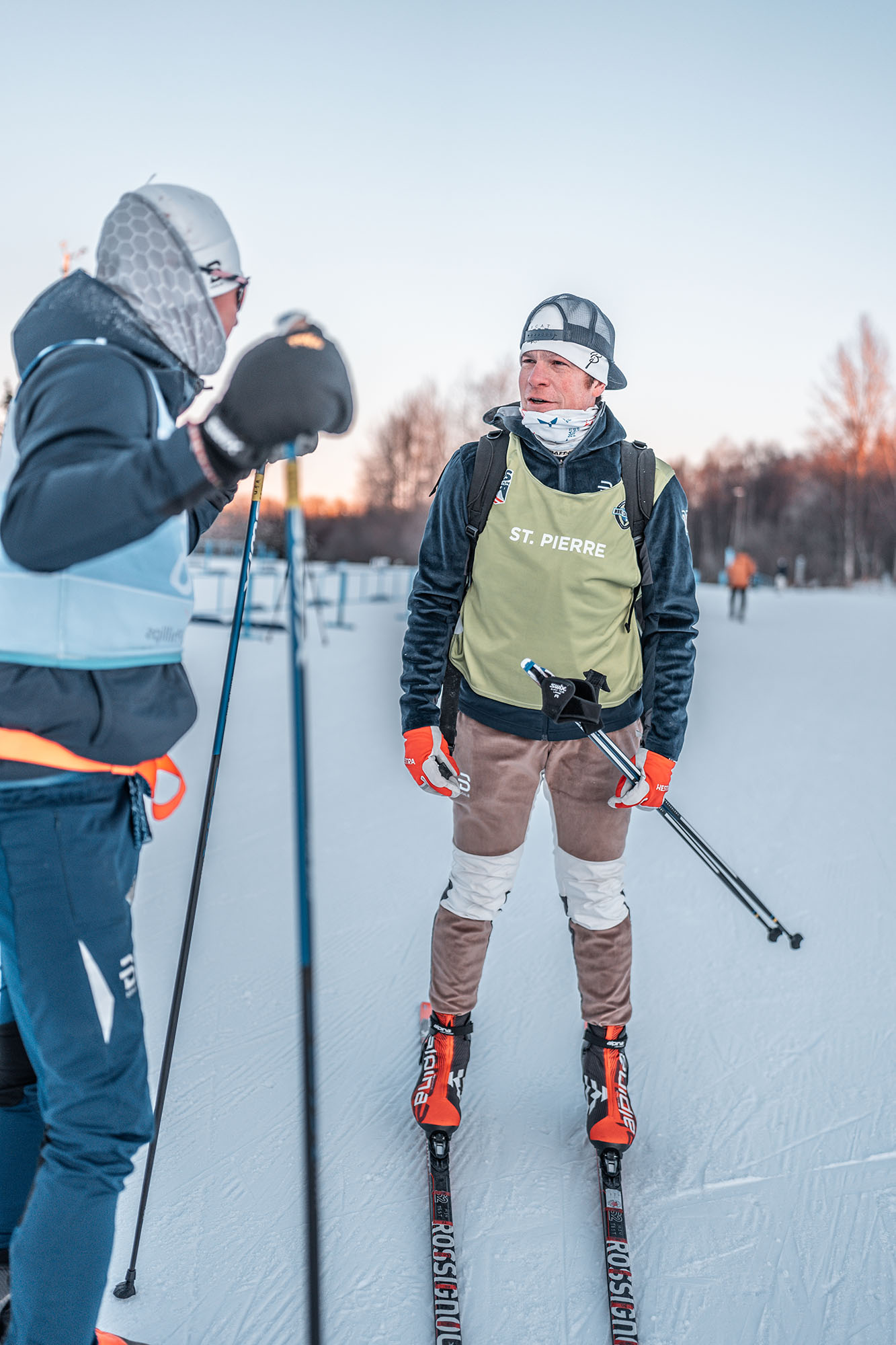
  • The Spice in the Soup: How Adam St. Pierre Thinks You Should Train

    The Spice in the Soup: How Adam St. Pierre Thinks You Should Train

    This article was made possible through the generous support of our voluntary subscribers. If you value coverage like this, please support FasterSkier with a voluntary subscription.

    Part two of a two-part series. Read part one here.

    A parent once cornered Adam St. Pierre to complain that he was letting the kids play games. St. Pierre had ten-year-olds on skis running sharks and minnows, shrieking and chasing each other across the snow, and the parent was not paying club dues for that. “I want coaching and training,” the parent told him. “This is…” and you can fill in the disappointment.

    St. Pierre thinks sharks and minnows on skis is one of the most effective training tools there is. He was lucky, he says, to have a parent board that backed him up in those rare confrontations, because he had no intention of stopping. Kids who are laughing are kids who come back, and kids who come back are the only kids who ever get good.

    That belief sits at the center of a coach who, on paper, should be the last person preaching simplicity. St. Pierre has a master’s in exercise science, a background running lactate and VO2 tests on athletes, and a relationship with a Montana State physiology lab that has done extensive work with U.S. Biathlon on both the metabolic and biomechanical sides. He reads the research. He can talk ratios and thresholds for as long as you’ll let him. And his most strongly held convictions keep coming out disarmingly plain. Go easy most of the time. Be consistent. Make it fun enough that people stick around. The science, in his hands, mostly ends up confirming things your grandmother could have told you.
    Consistency over the big block

    Start with periodization, the idea that a training year should be built in escalating blocks toward a peak. St. Pierre is skeptical of the old-school version of it, and his reasons are specific. A lot of that model, he points out, traces back to weightlifting research, some of it from an era when the subjects were quietly using anabolic steroids, which is not a foundation you want under your training plan. The rest tends to come from single-event sports. “In the marathon world or the Ironman world, you’ve got one event,” he said. “You just need to be good for that one event, like on August 2nd or whatever.” Skiing is not that. A ski racer has to be good across a whole season, weekend after weekend, from November into March.

    He points to a meta-analysis, published fairly recently, that looked at the day-to-day training of today’s top Norwegians. The finding was not a secret block of magic. “It really is consistency,” he said. “They’re not doing a big August and a big October. They do big weeks and recovery, and it’s just a very consistent progression.”

    The metaphor he keeps coming back to is one he borrows from Marius Bakken, the former Norwegian runner he half-jokingly calls a father of the Norwegian method. Intensity, in this telling, is not the meal. It is the seasoning. “The base of the soup is your endurance training,” St. Pierre said, “and then you add in a little bit of zip here and there. But if you put in too much zip, the soup is not going to be very good.” Roughly 90 percent of the work, whether on foot, on roller skis, on snow, or on a bike, is easy volume. The intensity is the spice, and Americans, he thinks, are forever dumping in too much.

    Only what’s livable

    There is also a question underneath all of this that the textbooks tend to skip, which is whether any of it is actually livable. St. Pierre still remembers sitting in a USA Triathlon coaching course, listening to a periodization lecture, and asking what he thought was the obvious question. What about a working person who cannot train 24 hours a week but could manage 16? What do you do with them? The answer from the front of the room was that they should take a vacation day and get the training in. “That’s not it,” he said. “That doesn’t work.” His approach is the reverse. Figure out what someone can actually do, how many hours are genuinely available, and then fill those hours with the best workouts possible.

    At MSU that math is dictated by a school calendar, and he has stopped fighting it. His athletes train before 10 a.m. so they can make a 10 o’clock class, and again in the afternoon, with nothing scheduled after 4 or 4:30. That produces a seven-day rhythm rather than the ten-day cycles some coaches prefer. Tuesday is intensity, usually threshold or VO2 work. Wednesday is a double of easy distance, with a few technique drills thrown in at the start to get the neurons firing before the athletes head out. Thursday morning is pure speed. Saturday brings intensity again, often paired with the long distance day. You cannot send skiers out for a two-hour roller ski on a Wednesday morning if they have class at ten, so you don’t. “There’s lots of ways to make a great soup,” he said, and it is not worth inducing a pile of needless stress to chase a perfect one.

    Two tests without a lab

    For readers without a lab down the hall, two of St. Pierre’s tools travel well. The first he calls a VT1 run, VT1 being the top of the easy zone, the hardest you can go while staying genuinely aerobic. Once a week, on flat ground, his athletes run 20 to 30 minutes at that effort and note the relationship between pace and heart rate. Flat terrain because it is the most reproducible. The point is twofold. It tracks fitness: if you run nine-minute miles at 150 beats in early summer and eight-minute miles at 150 by August, you have improved. And it works as an early-warning system. “One of the first signs of overreaching is a change in that heart rate to workload ratio,” he said. If the pace slows at the same heart rate, and it is not 105 degrees out and you are not dehydrated, it is probably time to rest. The signal can run the other way too. An athlete who normally sees 180 during intervals but suddenly cannot push the heart rate above 160 is, in his words, showing a pretty golden sign. Take some rest.

    The second tool he lifted from cycling: a five-minute maximal effort, a long recovery of maybe half an hour with some refueling, then a 20-minute maximal effort. The ratio between the two tells you whether an athlete leans anaerobic and sprint-oriented or aerobic and distance-oriented, no lab required. He built a version of it into his athletes’ training plans. He is quick to add the caveat that governs all of this, in the field or in the lab. Heat, dehydration, and altitude bend every number, and even a lab lactate value shifts with hydration. “No one metric is the god metric,” he said. “You’ve always got to have that context.”
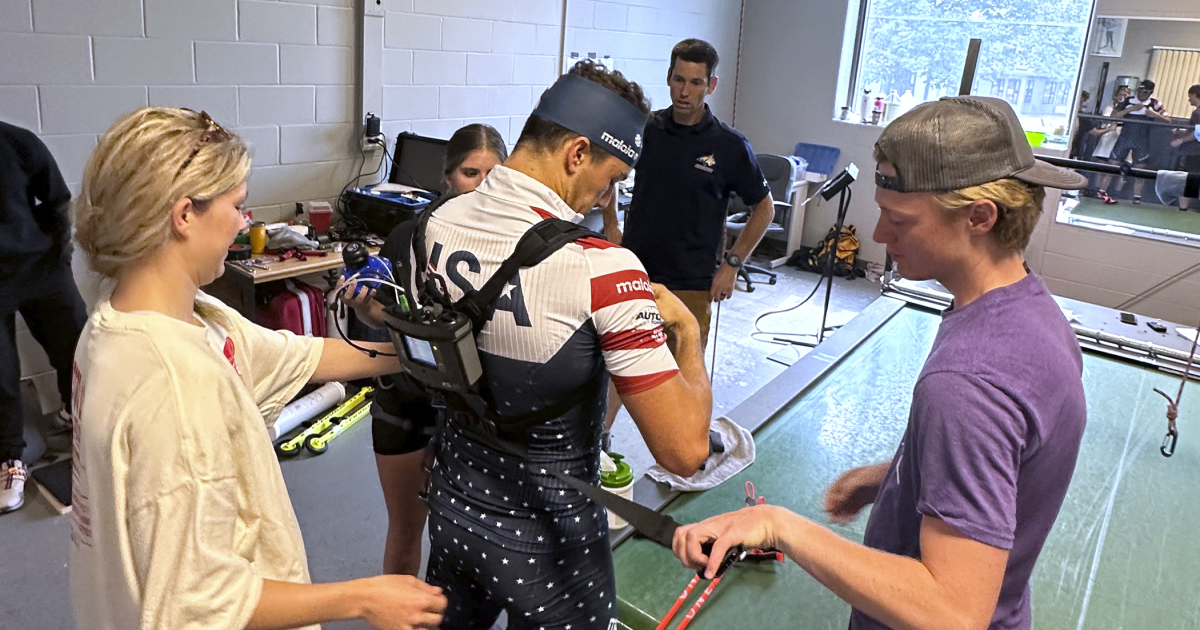
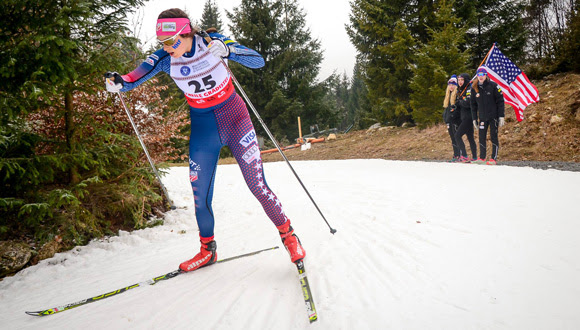
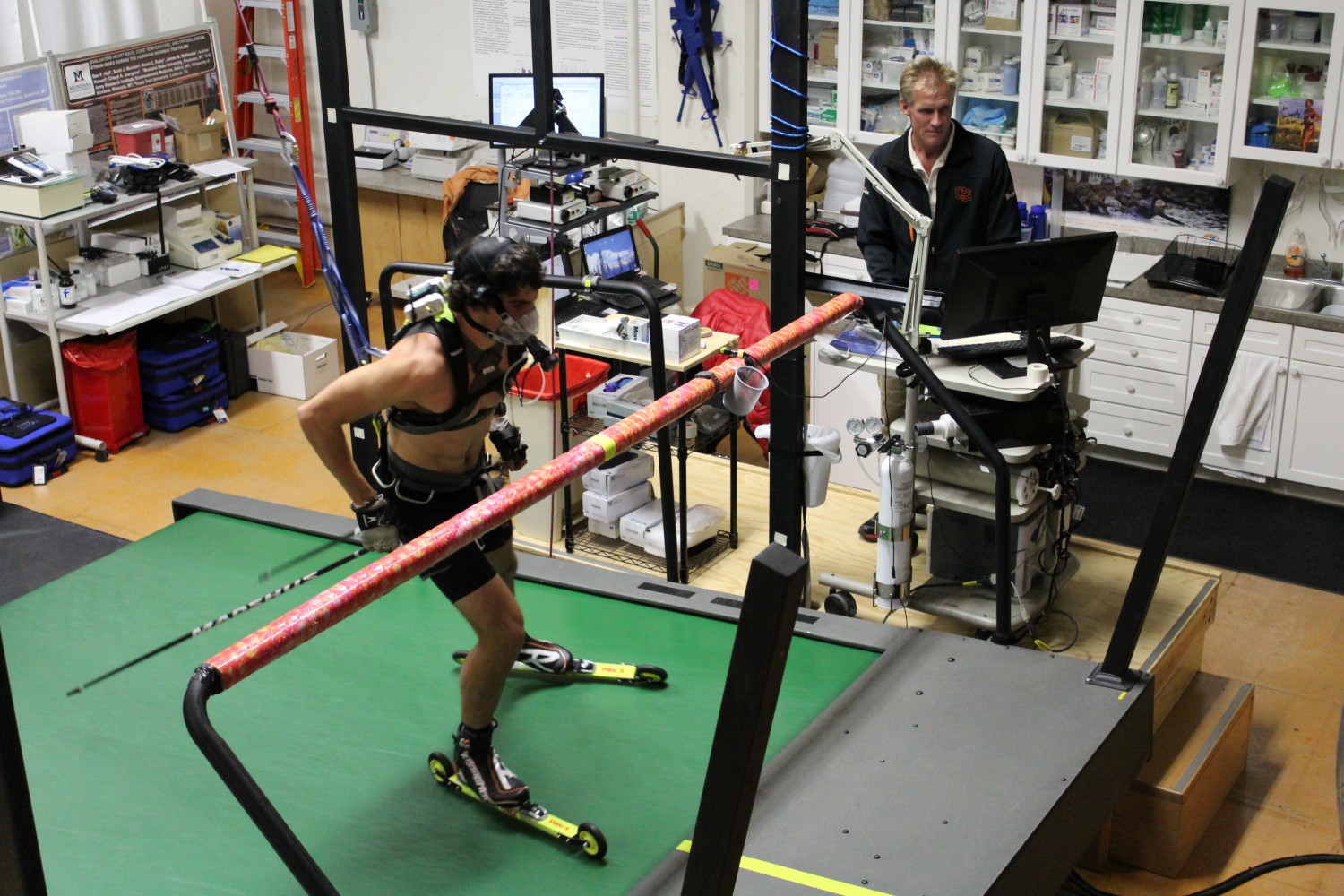
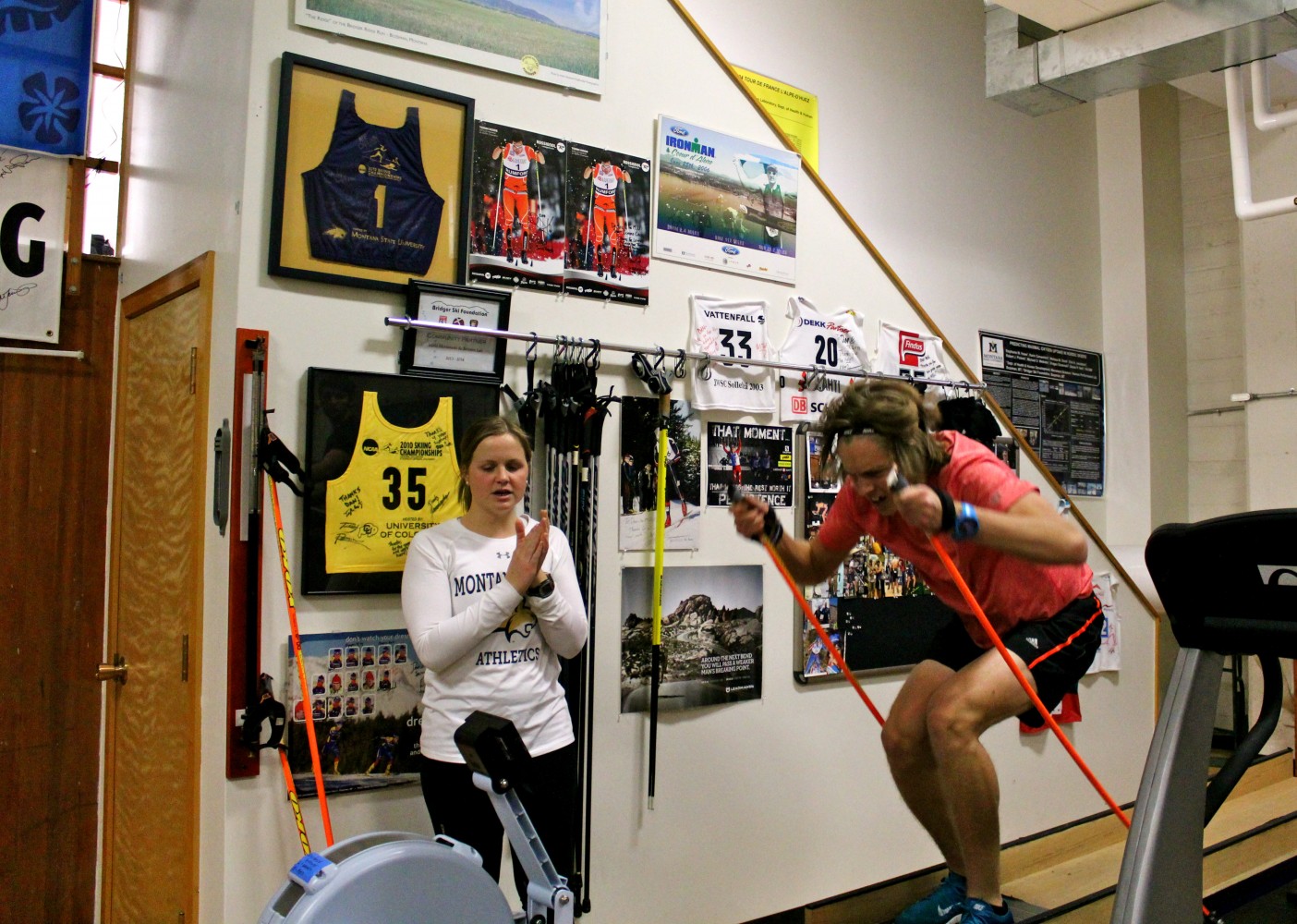
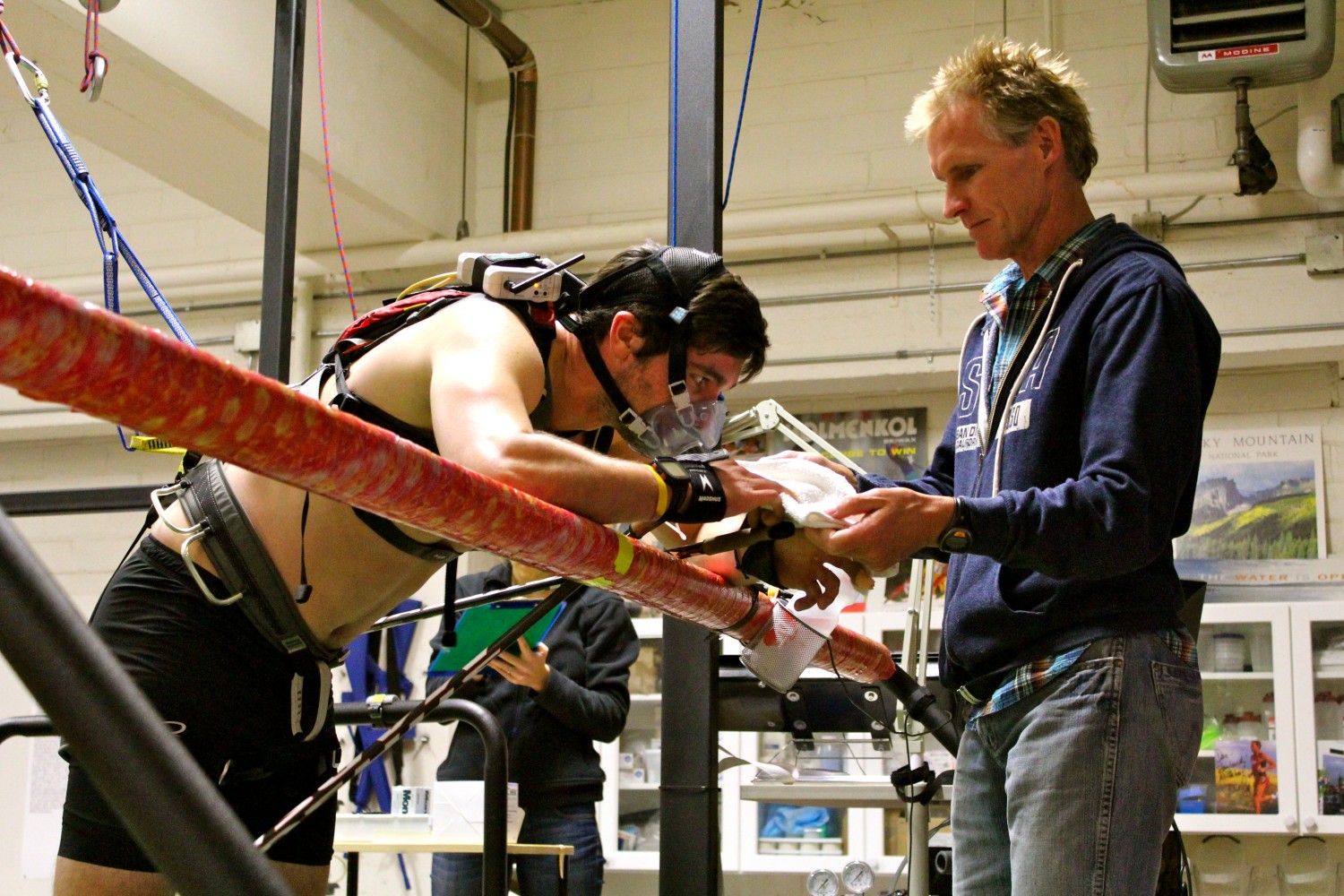
    Montana State students conduct physiologic and biomechanical assessments for U.S. Biathlon. (Photo: Montana State University)

    Building complete skiers

    The individualization matters more now because the college game is about to change. Sprinting is coming to the NCAA Championships, a change St. Pierre cares about personally, because he wrote the proposal years ago and watched it slowly work its way toward reality. In anticipation, he is nudging the team’s intensity mix, keeping most of the hard work at threshold but adding more VO2 and anaerobic speed than a pure distance program would. One test the MSU lab ran compares an athlete’s VO2 at threshold to their VO2 max. A skier sitting well above the roughly 90 percent that is typical probably skews distance and might gain from more VO2 work to lift the ceiling. A skier down in the low numbers might benefit from more threshold. Even so, his priority is all-around development. The sprinters still do threshold. The distance skiers still do speed. He wants complete skiers, partly because a race does not always let an athlete choose its terms. If a distance race comes down to a mass sprint, a distance skier who cannot find another gear finishes 20th.

    The place where St. Pierre thinks American skiing has a real and underrated advantage is strength. He knows the reputation, that Norwegians do not lift, and allows it may be true of many of them. He also knows that the Norwegians who have come through his own program found the strength work novel. As part of a university, MSU has a strength coach, Benito, a former mountain bike racer at UVM and one of the rare ones who understands endurance sport, and the two of them build a program meant to complement the skiing rather than pull against it. St. Pierre credits it for keeping his team generally healthy, and he pushes back on the notion that skiers only need core and pull-ups. “If you can produce power with your legs,” he said, “that’s necessary.”

    He connects strength to a broader idea about movement economy, and here he reaches, carefully, for the Nike Oregon Project. Setting aside the doping and the scandal that eventually swallowed that program, he finds one lesson from it genuinely useful. Its coach had noticed American distance runners getting outkicked, so the group attacked the last 400 meters with sprint work, max strength, and plyometrics. The athletes did improve their finishing kick. They also got faster over the first 9,600 meters of a 10k. Better economy, it turned out, does not just help you sprint. It lets you hold a faster pace all day.
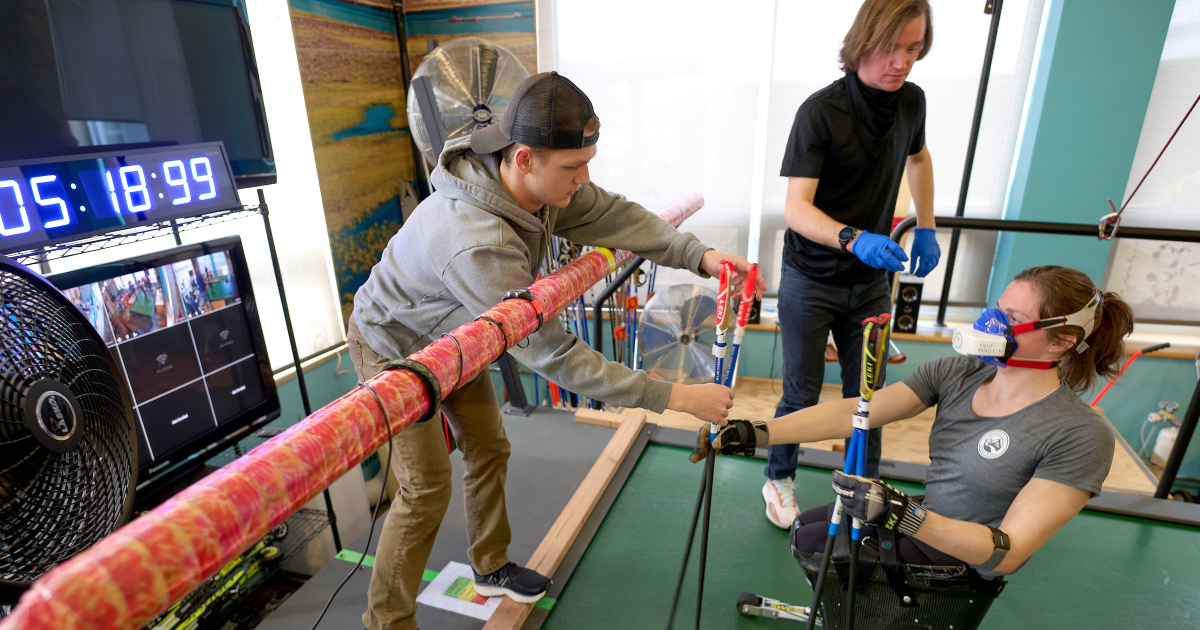
    Montana State biomechanics students provide testing for para Nordic athletes. (Photo: Montana State University)

    The long game

    If that all sounds relentlessly optimized, it is worth returning to the sharks and minnows, because the fun is not a break from the method. It is the method. His college team plays ultimate on skis, using a ball instead of a frisbee to remove the throwing barrier, usually after a track workout, and they lobby to play more. For the youngest kids, he has long argued that the travel race is not really about the race. A ten-year-old drives across the state to ski a 1k, and the actual point is the hotel pool, the snowbanks, the hide-and-seek, the exhaustion on day two that horrifies the parents. “This is why kids get into ski racing,” he said. “It’s not the ski race. It’s hanging out with your friends in the hotel room.” Those bonds are what turn a ten-year-old into a fifteen-year-old who wants to go do a long mountain run with the same crew, and a fifteen-year-old who stays in the sport into an adult who never leaves it.

    Which is finally how St. Pierre defines success, and it is not a medal count. He worries a little about the sport’s fixation on the Nations Cup, because doing well in it requires a lot of athletes racing a full season well, and he is not sure the American pipeline has that base yet. He points to Jessie Diggins as the rare skier who reached the level where she could show up week in and week out and land in the top five every time. Whether that season-long consistency cost her an Olympic medal or two is, he admits, a whole separate and unanswerable question. Finding metrics for development beyond international results is genuinely hard, which is part of why he has soft-started a PhD. The idea is to pull two decades of national points lists and track individual athletes year over year. Are American skiers actually getting better as they age, or do they wash out? The kid who was brilliant at 18 and gone by 22 is memorable, he notes, but memorable is not the same as typical. “Is that the rule or the exception? I think that’s the exception,” he said. “I’d like to have some data to back up my opinion.” The numbers are public. He just needs the time.

    His personal definition is quieter. He wants his athletes to develop far enough that the door to international racing is open if they want to walk through it, and he wants the ones who don’t to keep loving skiing anyway, as coaches, as parents raising their own little skiers, or simply as people who stay active and outdoors for the rest of their lives. He tries to live it as a father, chasing his own two kids up mountains in the summer and out onto snow in the winter. “There’s so much outside of skiing,” he said, “that makes skiing great.”


    Help Support Our Coverage!

    If you value the thoughtful work and access FasterSkier provides, please consider becoming a Voluntary Subscriber. Your support directly fuels our work to cover the people, places, and moments that make our sport special.

    Join the FasterSkier community!
     

  • The Only Kid He Beat Hit a Tree: How Adam St. Pierre Backed Into a Life in Skiing

    The Only Kid He Beat Hit a Tree: How Adam St. Pierre Backed Into a Life in Skiing

    This article was made possible through the generous support of our voluntary subscribers. If you value coverage like this, please support FasterSkier with a voluntary subscription.

    Part one of a two-part series.

    Adam Coaching at US Nationals in Alaska. (Photo: Tobias Albrigtsen)

    Adam St. Pierre finished second to last in the first cross-country ski race of his life. The one skier he beat had crashed into a tree.

    He was a sophomore at Fall Mountain Regional High School, a rural school in Charlestown, New Hampshire, and he tells the story with the flat delivery of a man who has told it before and enjoys it every time. “Charlestown doesn’t really have a claim to fame,” he said. Forty-five minutes due south of Hanover, close enough to know Dartmouth was up the road, far enough that the world of club skiing might as well have been on another continent. He had never heard of it. What he knew was soccer, basketball, and track, in roughly that order, and he had no intention of adding a fourth sport that involved falling down in the cold.

    Then his freshman year fell apart. He hurt his knee playing soccer. He slogged through a basketball season he had come to hate. And in the spring, his track coach, who happened to also coach the ski team, made him an offer that sounded reasonable at the time. Come out for skiing next winter, the coach said. It will get you in better shape for soccer and track.

    So he showed up. That first race was a classic race, and he had only ever skated. He survived it, barely, ahead of the kid who met the tree, and somewhere in the weeks after, the thing that has kept a lot of people in this sport quietly got its hooks into him.

    Fall Mountain was not a fancy place, and that turns out to be central to the story. It was a working rural school with a barn, animal husbandry classes, agricultural mechanics, a metal shop, and forestry classes that maintained the trails and tapped the maple trees where the team ran and skied. The ski coach was the metal shop teacher. When the program needed grooming, the metal shop and ag-mechanics kids bought an old PistonBully and kept it running themselves. St. Pierre came up through a program held together by shop-class ingenuity and a snowbank at the edge of the football field, and he has never once been snobbish about it.

    “I have a high respect for high school skiing, because it is an entry point,” he said. “Otherwise I wouldn’t have found the sport.”


    A team that needed a fifth man

    He nearly didn’t find the next part either. Right before he graduated, his coach, Larry Sayers, told him that Colby College’s ski team wasn’t very good and that St. Pierre could probably walk on. He filed it away and didn’t think much of it. He had his sights on soccer and track. But once he got to Colby and started running into the skiers at various events around campus, something clicked, and it had nothing to do with the skiing.

    “These are the kind of people I like,” he remembered thinking.

    The timing was almost comically good. The coach, then Tracey Theyerl, now Tracey Cote, was 29 and in her second year running the team. She had just cut most of the upperclassmen, which left her with four men and an opening. St. Pierre walked on as the fifth. His introduction to roller skiing came shortly after, when Cote put him on a pair of classic roller skis and sent him out for a time trial. “I survived,” he said. From that point on, he was in, and again, the pull was the people as much as the training.

    Adam St. Pierre (left) and former Bowdoin skier and BNJRT coach Sam Shaheen at the start of the 2019 American Birke. (Photo: courtesy Adam St. Pierre)

    From the lab to the wax room

    He majored in physics at Colby and minored in biochemistry, and when he graduated, he had no clear idea what came next. He looked at teaching jobs. Nothing landed. Then a skier friend from high school told him about a graduate program at the University of New Hampshire where, as St. Pierre understood it, they paid you to study exercise. That sounded like a good deal. He enrolled in a master’s program in kinesiology and exercise science, working under a UNH physiologist whose research centered on hydration and thirst. His thesis was, in his words, pretty brutal to run: sensations of thirst in dehydrated subjects in cold versus ambient environments. “A little bit of everything when it comes to making people uncomfortable,” he said.

    It was during those UNH years that the sport handed him his first coaching job, and it did so in the roundabout, relational way that his whole career seems to follow. He had started dating a Bowdoin College skier while he was at Colby. She was a year behind him, still racing, and he was driving up to Brunswick most weekends to see her. Her coach was Marty Hall.

    Anyone who knows North American skiing knows the name, yet St. Pierre’s version of a Marty Hall story is smaller and more human, and it starts with the legend sizing up the kid who kept turning up in his wax room.

    “I need an assistant coach,” St. Pierre remembers Hall telling him, and he does a passable Marty voice when he gets there. “And you’re up here every weekend anyway. You want the job?”

    He took it. He thinks he was paid around 1,500 dollars total, which covered the gas. He coached under Hall for two years, and it confirmed something he had already begun to suspect: he wanted to spend his life doing this.

    Adam and his family out for a ski.

    Building from the bottom in Boulder

    When his wife got into law school at the University of Colorado, the two of them moved to Boulder, and St. Pierre walked into the next accident of his career. He had been hired to be the head coach of the Boulder Nordic Junior Racing Team, replacing Eric Pepper. Then Pepper decided to stay. Rather than lose St. Pierre, the club invented a role for him and made him its first development coach, responsible for the youngest kids, the u14s and u12s, or as they were then called, the j3s and j4s. Many of them were the little siblings of the older racers. His whole job was to grow the program from the bottom.

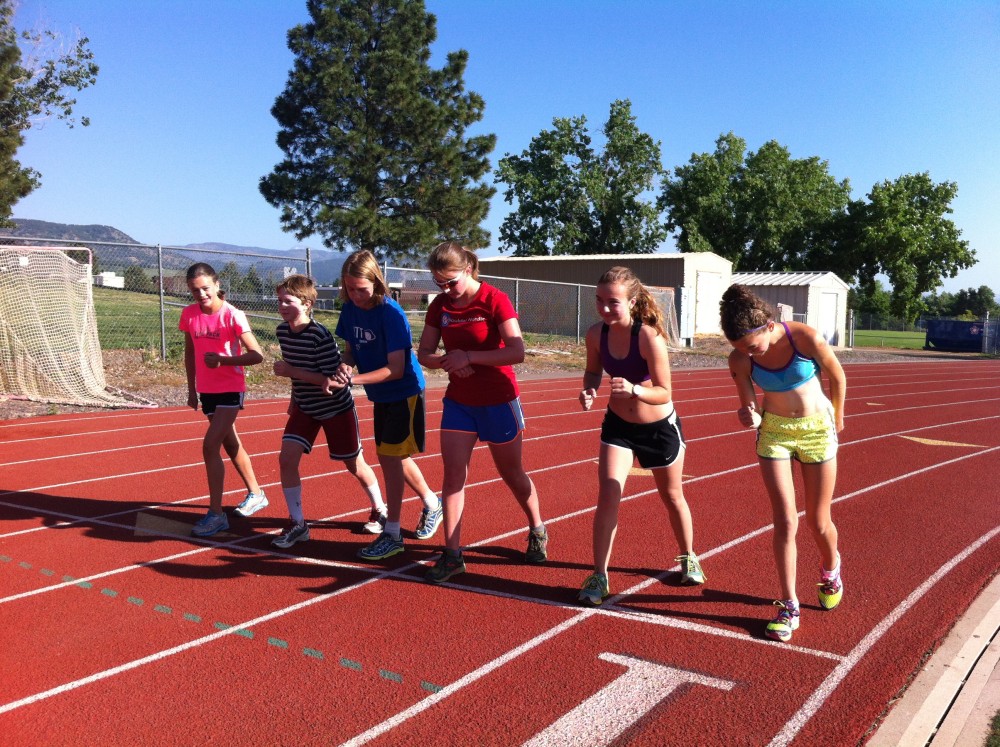
    Boulder Nordic Junior Racing Team athletes prepare for the start of a 3,000 kilometer running time trial on the track in 2013. (Photo: Adam St. Pierre)

    He did. When Pepper eventually moved on and St. Pierre took over as head coach and program director, he watched the club climb from 15 or 20 kids to nearly 70 at its peak, in a place he is quick to say is a genuinely hard town to be a skier. There is no snow in Boulder itself. You drive for it, and it is expensive, and the parents who commit anyway earn their real respect.

    One of those little kids was Lauren Jortberg. St. Pierre started working with her when she was six or seven, and he coached her through high school. She was, by his telling, agonizingly consistent at exactly the wrong number: four straight Junior National Championships and 11th place in what felt like every race. “All she wanted was that top 10,” he said. She had setbacks. She stuck it out.

    Years earlier, in his first season of coaching in Boulder, St. Pierre had said out loud that one of his goals was to someday coach a kid who would reach the Olympics. This past February, Jortberg made the U.S. team for the Milano-Cortina Games and qualified for the quarterfinals of the Olympic sprint, the culmination of a long and interrupted road that ran through back surgery, ankle surgery, and a lost senior season at Dartmouth. St. Pierre is careful not to claim more than his share.

    “I can’t take responsibility for much,” he said, and then, a beat later, “Goosebumps. Proud of her.”

    Boulder was where the rest of his professional life took shape, too. He worked at the Boulder Center for Sports Medicine as a clinical physiologist, running lactate thresholds and VO2 max tests and metabolic evaluations, and working alongside physical therapists on running biomechanics, teaching and reteaching people how to run without breaking. He got into ultrarunning and knocked off a number of 100-mile races, mostly for the pleasure of being out in the mountains all day. Around 2016 or 2017, he left the Boulder Nordic team and hung out his own shingle as an online coach. The flexibility made sense with two young kids and a wife commuting to Denver. But he missed the in-person part, the standing-in-the-snow part, more than he expected to.

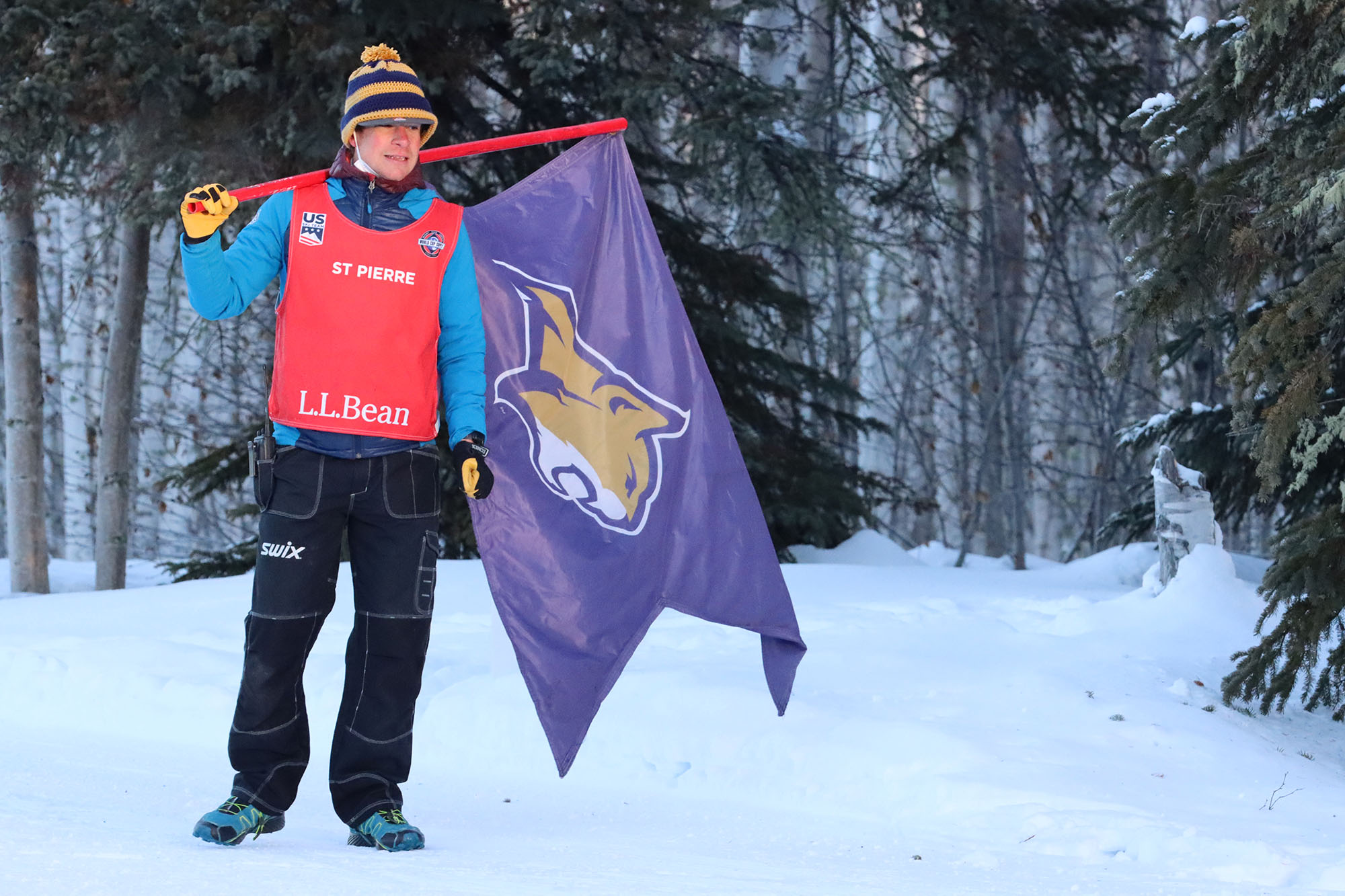
    Adam repping the MSU team flag in Houghton, Michigan. (Photo: Tobias Albrigtsen)

    The job he had been aiming at

    He had known for a long time where he wanted to end up. College coaching had been the goal since around 2009. The appeal was simple: at the junior level, a coach spends a lot of energy convincing kids they might want to be ski racers, keeping every other door open in case they choose running or mountain biking instead. At the college level, the athletes have already decided. “They’ve decided they are cross-country ski racers,” he said. “I wanted to coach ski racers.”

    The Montana State job had come open once before, in 2015, and he had applied and been the runner-up. When it opened again during the strange fall of 2020, he jumped. He was hired that November and moved to Bozeman alone that winter while his wife and kids finished out the year in Boulder, riding out the online-school chaos he credits her with surviving. The family joined him the following June. Bozeman had been near the top of the short list of places they wanted to live anyway, a real ski town with snow in town, Crosscut 20 minutes up the road, and Bridger Bowl close enough to grab powder runs before cross-country skiing in the afternoon.

    Which is to say, the kid who finished second to last, who backed into the sport to get in shape for soccer, who took a coaching job largely because he was already driving to Brunswick every weekend, ended up exactly where he had been quietly aiming for a decade. The path was accidental in its particulars and not accidental at all in its direction. He kept following the people, and the people kept turning out to be skiers.

    What he does with those skiers once he has them, and why he thinks so much of American training gets the easy days wrong, is its own story. That is part two.


    Help Support Our Coverage!

    If you value the thoughtful work and access FasterSkier provides, please consider becoming a Voluntary Subscriber. Your support directly fuels our work to cover the people, places, and moments that make our sport special.

    Join the FasterSkier community!


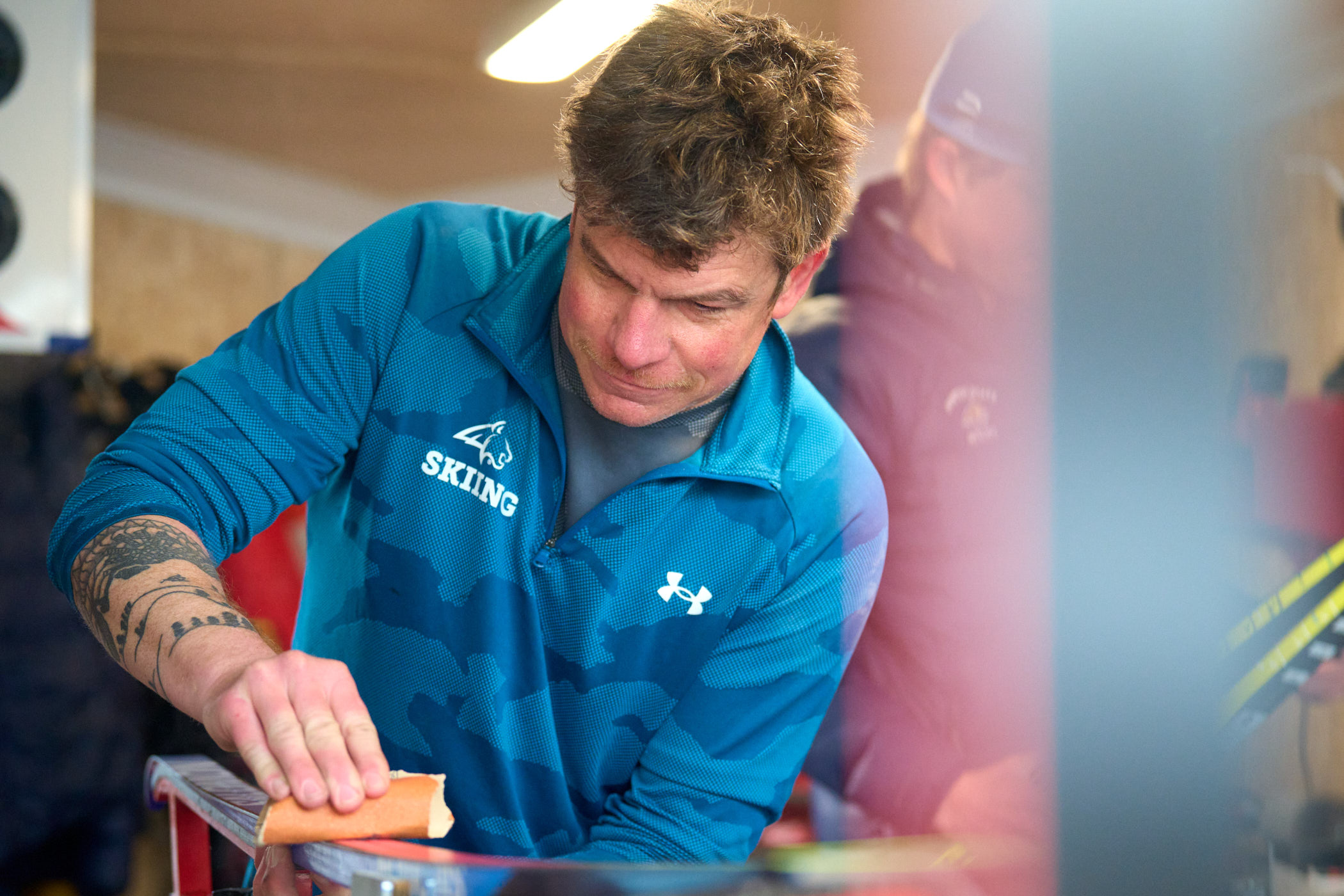
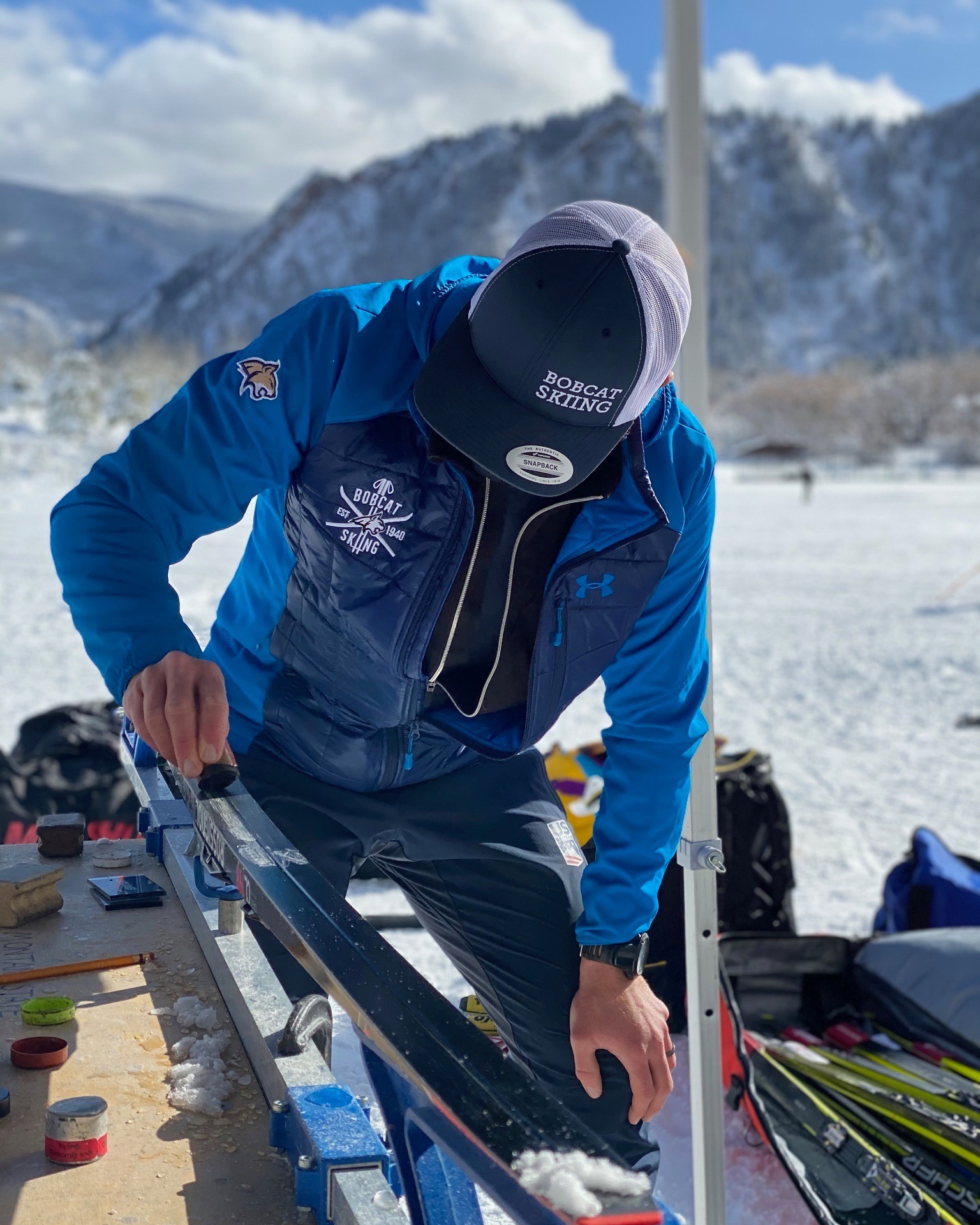
    Adam preparing skis for the Montana State University Nordic ski team at the RMISA Championships in 2026 in Heber City, Utah. (Photo: Colter Peterson)
  • U.S. Nationals, Day 3: Kramer thrills Anchorage crowd with first Alaskan win at Kincaid Park

    U.S. Nationals, Day 3: Kramer thrills Anchorage crowd with first Alaskan win at Kincaid Park

    Kendall Kramer, racing Sunday at U.S. Nationals at Kincaid Park, is a multi-sport athlete at University of Alaska Fairbanks. She competes in both cross-country running and skiing. (Nathaniel Herz/FasterSkier)

    ANCHORAGE — Alaskans like to think of their home state as the center of American cross-country skiing.

    Minnesotans might quibble. But consider the more than 200 volunteers who turned out to help host the U.S. National Championships in Anchorage this week, and the dozens of local athletes who signed up to race.

    There was just one problem: Through five of six of the championship events, athletes from Norway, Sweden, Colorado and Idaho had denied the Alaska crowd the pleasure of seeing one of their own cross the finish line first. (An Alaska man, Luke Jager, had technically claimed a U.S. championship Saturday, but crossed the finish line second to a Norwegian, who was ineligible to claim the title.)

    Sunday’s 20-kilometer, classic-technique women’s race was the Alaskans’ last chance. 

    And Kendall Kramer came to the rescue.

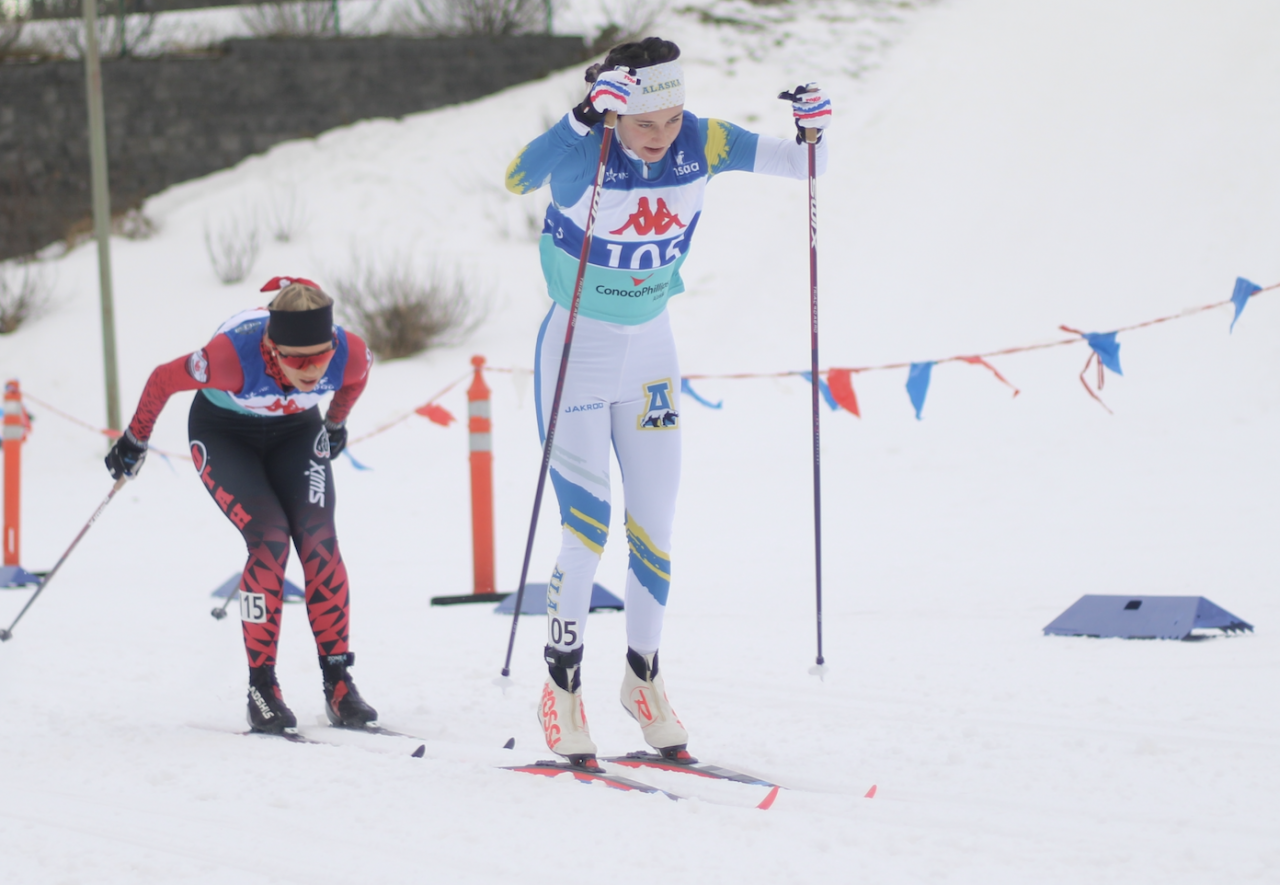
    The 22-year-old Fairbanks native won her first-ever national championship fashion in stirring fashion, breaking away from the pack early in the race with one other athlete and slipping away in the final meters before the finish.

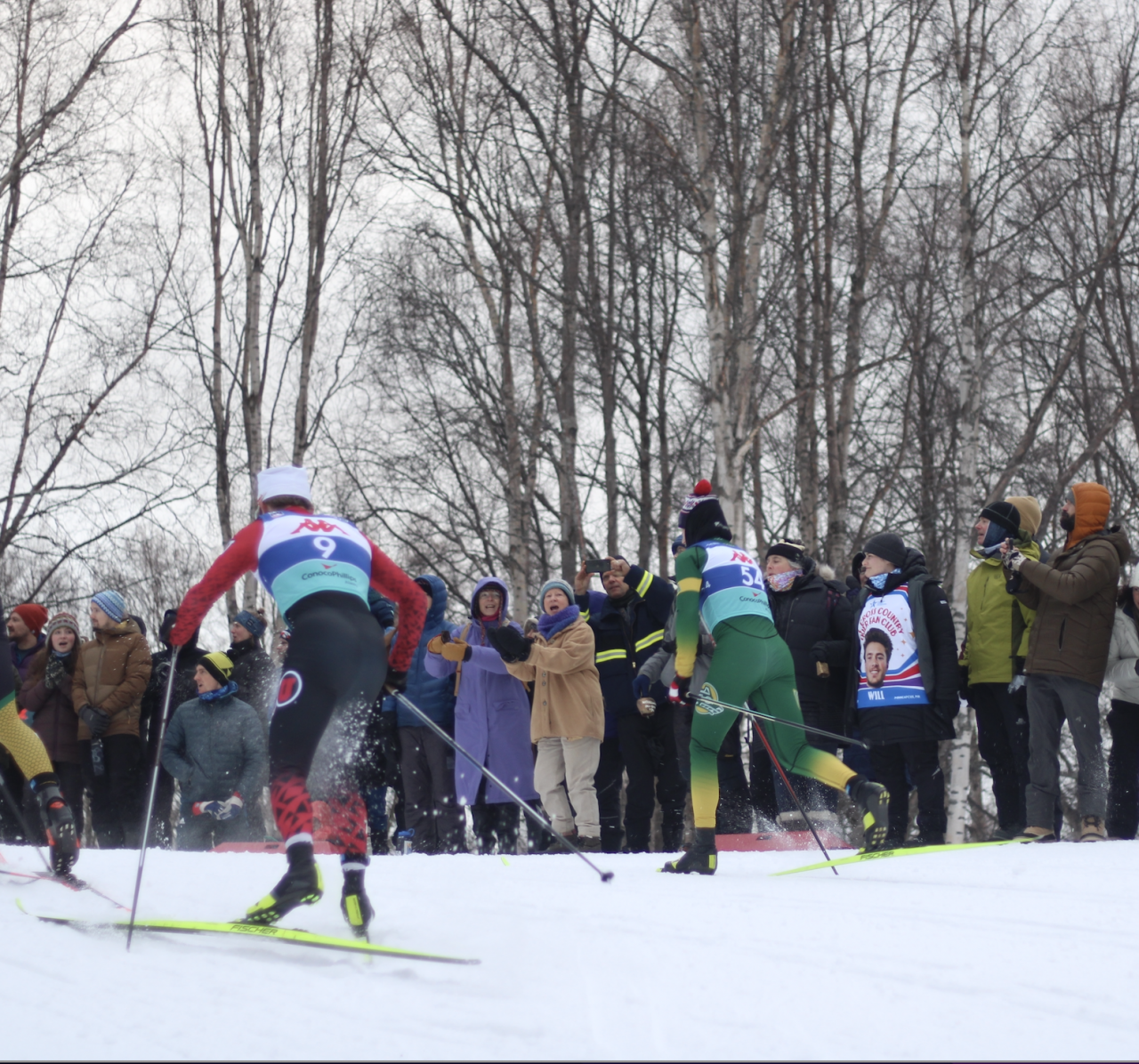
    The crowd on one of the major hills cheers on U.S. Nationals competitors in Sunday’s men’s race. (Nathaniel Herz/FasterSkier)

    “You can feel it in the energy,” said Kikkan Randall, the Olympic gold medalist who heads the Nordic Ski Association of Anchorage, which is co-hosting the event. “We have so many great volunteers out here, we really push to get spectators out here. And so when you see an Alaskan deliver, it’s just that sense of pride.”

    Kramer’s final margin of victory was 2.4 seconds over Erica Laven, a Swedish skier competing for the University of Utah. The rest of the women’s pack crossed the finish line a minute-and-a-half later, led by Lauren Jortberg, who races for a Quebec club team.

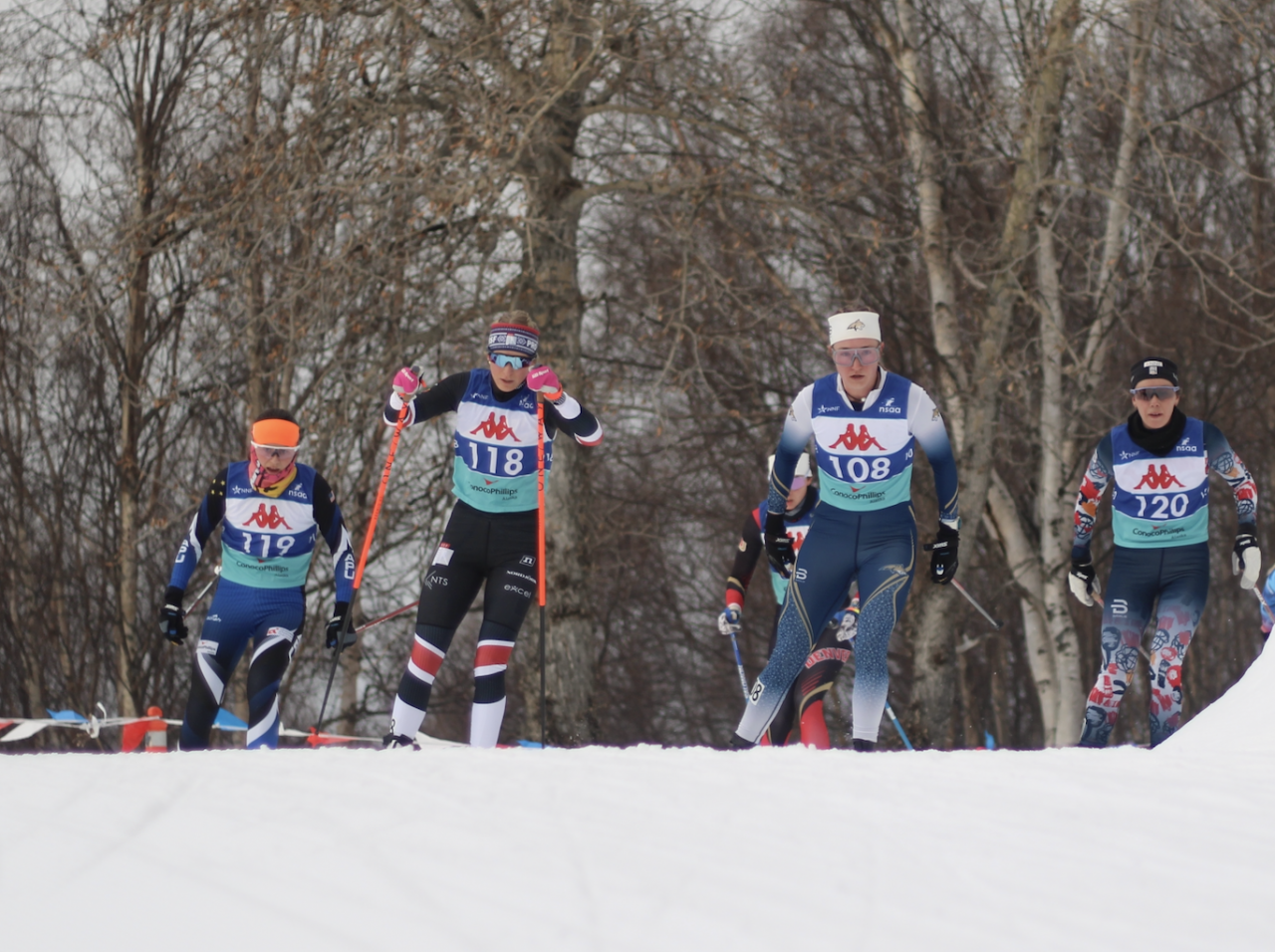
    The women’s chase pack crests a hill in Sunday’s distance race. From left, Alaska Pacific University’s Renae Anderson, Bridger Ski Foundation Pro Team’s Erin Bianco, Montana State University’s Kate Oldham and CNEPH’s Lauren Jortberg. (Nathaniel Herz/FasterSkier)

    Montana State University’s Kate Oldham was just behind Jortberg and rounded out the U.S. championship podium; Laven was ineligible due to her Swedish citizenship.

    Kramer has been a standout since her years at West Valley High School in Fairbanks, where she won more than a dozen state titles between skiing, cross-country running and track and field. She was first named to the U.S. Ski Team while a junior in high school, then decided to stay in her home city for college, where she’s competed in both cross-country skiing and running.

    She won a medal at the Youth Olympic Games in Switzerland in 2020, and has an array of junior national championships to her name. But two second places — including one Thursday to Oldham — were as close as Kramer had come to winning a U.S. title.

    From the start of Sunday’s event, Kramer left little doubt about who would stand on the top of the American podium when she and Laven broke away from the pack on the first of four five-kilometer laps. The two skied the rest of the race together, with Kramer — who trains with Anchorage’s Alaska Pacific University club team during the summer — boosted by an energetic home crowd.

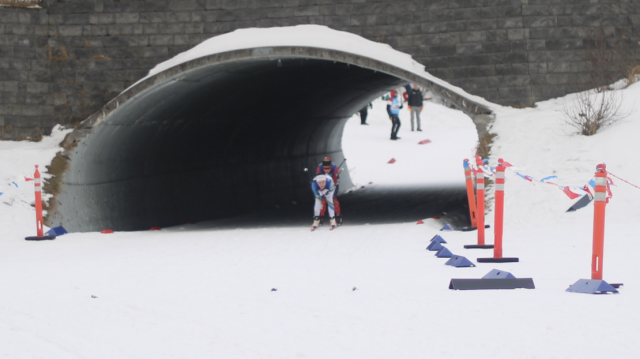
    Kendall Kramer leads Erica Laven through the tunnel into the stadium at Kincaid Park. (Nathaniel Herz/FasterSkier)

    “I really felt that — I was like, ‘This must be someone from here,’” Laven said, referring to Kramer. “Because it was a lot of people cheering for her.”

    Among the fans at Kincaid were Kramer’s mother, Susan Schwartz, along with her grandmother, an aunt and innumerable teammates. Schwartz, who was working as a volunteer at the start line, described the race between Laven and her daughter as a “nail-biter.”

    “They just kept on getting faster and faster and faster,” Schwartz said. “It was amazing to watch.”

    Early on, Kramer said she realized that even if she lost the race to Laven, she’d still claim the U.S. title. But, she added, she didn’t necessarily want to settle for that. Laven was skiing stronger on uphills, but if Kramer could keep up in those segments, she said, she could “totally relax in the double pole.”

    “She was expending a lot of energy on those. And I knew I had energy by the end,” Kramer said.

    The closer Kramer got to the finish line, she said, the more confident she felt about her shot at winning the race outright. And on the home stretch, she pulled away.

    Kramer elevates in her double pole to lead Laven toward the finish. (Nathaniel Herz/FasterSkier)

    “She was really strong in the double pole today,” Laven said. “I really had to push hard.”

    Kramer crossed the line without celebrating. But her mother, Schwartz, “could tell she was just thrilled” — particularly after Kramer finished a close second in Thursday’s race.

    “I could tell she wanted it bad,” Schwartz said. “She was not going to let it get away from her today — that’s kind of the feeling I got watching her race.”

    Kramer is in her last year competing for University of Alaska Fairbanks and expects to race professionally next season. 

    She said she doesn’t want to miss this spring’s collegiate championships. But she grimaced when a reporter pointed out that the event conflicts with the World Ski Championships in Norway, where finishes at the past week’s races in Anchorage are likely to inform which U.S. athletes are chosen for the team.

    “I’m super grateful if I do get the spot, because I know how hard people work for it and how bad people want it,” she said. “But we’ll see.”

    Full results.

  • MSU Seeks Head Nordic Coach

    MSU Seeks Head Nordic Coach

    Montana State University is looking to hire a new Head Nordic Coach for their NCAA Division-I Ski Team.  Bobcat Skiing is one of the longest standing ski teams in the country with a history of All-Americans, National Champions and excellent team results.  Join the Montana State University’s Athletics Department. A dynamic working environment for persons seeking a student-centered learning environment distinguished by innovation and discovery. Bozeman and the Gallatin Valley offer outstanding ski training and competition venues and a committed ski community.
    Description:Responsible for overseeing Montana State University’s Nordic Ski program in Bozeman, Montana. Responsibilities include: student-athlete welfare, academic integrity, public relations, sport-specific fund raising, rules compliance, and planning and implementation of practices and competition. The Head Nordic Ski Coach reports directly to the Sr. Associate Athletic Director.
    Head Nordic Coach job posting, you can apply directly on the page, just click the button at the top “Apply for this Job.”
  • Several RMISA Schools Currently Without an Active Nordic Coach

    Several RMISA Schools Currently Without an Active Nordic Coach

    Matthew Perry Johnson, shown here in an earlier position with Alaska Winter Stars, began working as the new head coach for the Montana State University Ski Team in August 2015. (Photo: Montana State University)

    Multiple schools in the Rocky Mountain Intercollegiate Ski Association are experiencing flux with their nordic coaching staff going into the 2020/2021 ski season, according to representatives from each school. The schools in question are the University of Alaska Anchorage, University of Utah, and Montana State University, all of which have well-established nordic programs that placed highly at last year’s NCAA Championships. Neither Anchorage nor Montana State currently has anyone filling this position. Utah has two nordic coaches on staff, but they are both subject to furloughs of unknown length due to budget shortfalls.

    University of Alaska Anchorage, or UAA, has multiple problems for the future: The Board of Regents is meeting today and tomorrow to vote on a proposal from the chancellor and athletic director to cut both the men’s and women’s ski teams after this academic year. But it appears to have a more immediate problem for the present: The school does not officially have anyone currently coaching the nordic team.

    The current roster page for the UAA ski team lists Marine Dusser Bjornsen as the assistant nordic coach, and Adam Verrier as the volunteer assistant coach. But Verrier is just that – while an enthusiastic volunteer assistant, he is not employed by UAA directly. And Dusser Bjornsen is no longer listed in the online directory for UAA employees, which does list both Head Ski Coach Sparky Anderson and Assistant Alpine Ski Coach Anna Berecz.

    Marine Dusser was named RMISA Nordic Coach of the Year in her first year leading the UAA Seawolves. (Photo: Adam Verrier)

    Trond Flagstad was announced as the new UAA head nordic coach in May 2019, and was set to “begin his duties on August 18th,” 2019. What appears to be his official UAA bio page is still available online (albeit at a site not hosted by UAA). Nonetheless, Flagstad does not seem to have publicly coached at UAA during the 2019/2020 ski season or academic year. He is not listed as a current UAA employee in the online directory.

    “Our nordic ski position is currently vacant and we are working through the hiring process,” a UAA media relations representative wrote to FasterSkier on Thursday.

    There is no ski coaching position currently listed on the UAA jobs site.

    At the University of Utah, meanwhile, Athletic Director Mark Harlan announced last week that the school would furlough every employee in its athletic department, for periods ranging from 1 to 8 weeks. The news was widely reported by, among others, the Deseret News, Sports Illustrated, and local TV station KUTV.

    In a September 5 tweet, Harlan wrote, “All staff and coaches will furlough a minimum of 1 week to a maximum of 8 weeks.Head coaches, myself and cabinet will furlough for 2 weeks. We are fully operational as we stagger the schedule through Jan 1.  Sharing this sacrifice as a team allows us to emerge stronger than ever.”

    Following the decision of the Pac-12 conference to postpone all fall sports – in particular, the main revenue sport of football – Harlan told the Deseret News in August that the decision could lead to the school losing $50 to $60 million in income against an annual budget of $91 million.

    “Everyone in the athletic department is furloughed anywhere from 1-8 weeks,” wrote Utah media relations representative Joseph Feldman to FasterSkier on Thursday. “The priority on when those furloughs are happening is to make sure the student-athletes are still operating as normally as they can and still have all of the resources they need. The rest of the department will be fully functional as the furloughs are staggered until January 1.”

    Utah media relations representative Paul Kirk did not directly answer specific questions about when Director of Skiing Fredrik Landstedt and Head Nordic Coach Miles Havlick will be or have been furloughed, or for how long the two men will be or have been furloughed. Kirk wrote to FasterSkier on Saturday, “We are unable to share specifics about when any staff member or coach is on furlough, but when an individual is on furlough his or her email out of office reply may reflect that.”

    It appears from Harlan’s tweet and Feldman’s statement that both Landstedt and Havlick have been or will be furloughed for some period of between 1 to 8 weeks, at some point between last week and January 1, 2021. If either or both of them is treated as a “head coach” under Harlan’s standards, then his furlough is or will be for 2 weeks.

    On Sunday, through a spokesman, Landstedt stated, “The ski coaches are staggering their furloughs during the fall, and one or more coaches will be working at all times during this period. The University of Utah Ski team has been practicing with coaches present since the second week of school.”

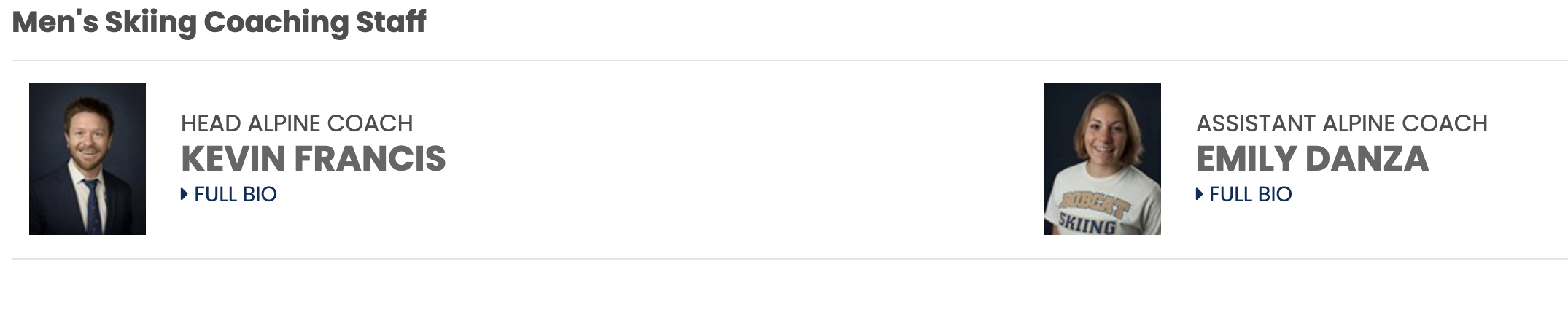
    Counting alpine coaches and student assistant coaches, Utah has a healthy six coaches currently listed on its roster. 400 miles to the north, however, Montana State University only has two people listed as ski coaching staff: Kevin Francis, the head alpine coach, and Emily Danza, assistant alpine coach. (The “staff” section for the women’s skiing roster looks the same.)

    Screenshot of MSU coaching staff page as of Sept. 9, 2020.

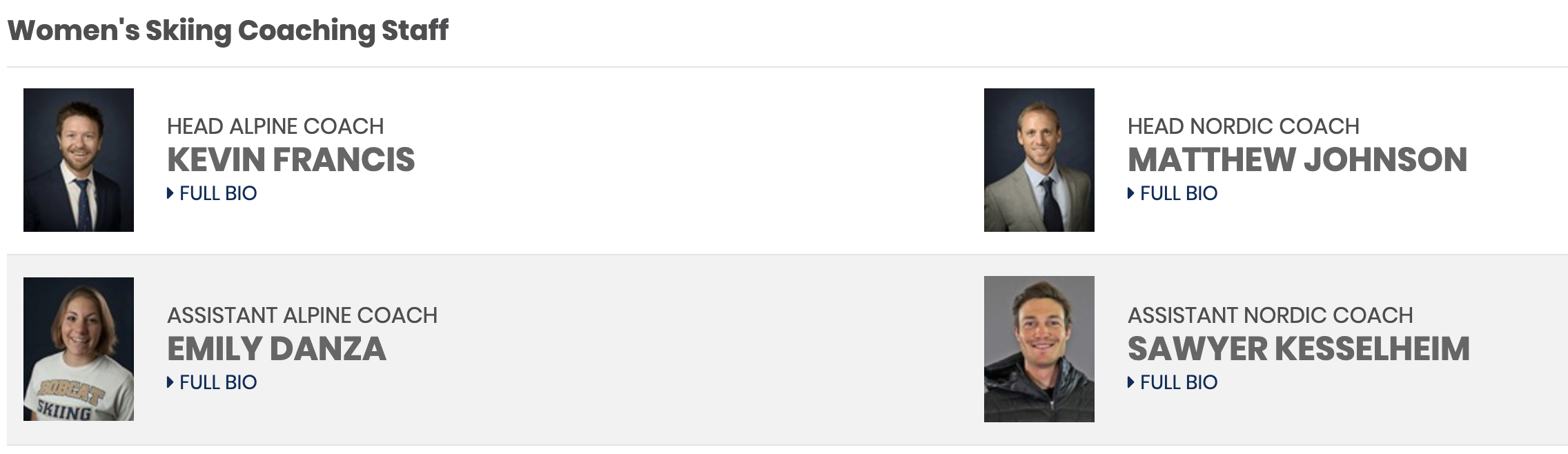
    But earlier this summer (on June 22, the last date the ski roster page was archived by the Wayback Machine), the staff section looked like this:

    Screenshot of MSU coaching staff page, as archived at the Internet Archive: Wayback Machine on June 22, 2020.

    That’s Matthew Johnson and Sawyer Kesselheim, both recently associated with the MSU nordic team but no longer there.

    The Montana State athletic department confirmed in a Thursday email to FasterSkier that both men had moved on: “We received a letter of resignation from Matt Johnson last week. Montana State is currently working with its HR Department to search for a new head coach. Sawyer Kesselheim was not planning on returning this season.”

    There is no ski coaching position currently listed on the MSU jobs site.

    As of Thursday morning, Johnson was still listed as the head nordic coach in the MSU online directory:

    Screenshot of MSU faculty and staff directory on Sept. 10, 2020.

    He also still lists his current job as MSU head nordic coach on Facebook and LinkedIn.

    Attempts to contact Johnson on Wednesday and Thursday for comment were not immediately successful.

    Montana State placed seventh at this year’s NCAA Championships. UAA was sixth, and Utah was first. Of the six RMISA schools that scored points in the nordic race at this year’s NCAA Championships – UAA, University of Alaska Fairbanks, Colorado, Denver, MSU, and Utah – fully half of them are without an active nordic ski coach at this point in the season. It further appears that Denver (second at this year’s NCAAs), which last season employed Rogan Brown as an assistant nordic coach, only has head nordic coach Toni Roponen at present, with no assistant coach for the nordic team.

    This story has been updated with additional information about the timing and nature of furloughs at the University of Utah.

  • Bernie Nelson Leads the U.S. Development Team into a New Era

    Bernie Nelson Leads the U.S. Development Team into a New Era

    Bernie Nelson was recently named the U.S. Ski Team’s newest D-Team coach. (Photo: courtesy Bernie Nelson)

    There are days skiing here in Bend, Ore. when the privilege of sliding on groomed trails becomes ho-hum. Maybe you’re not feeling the energy buzz. Maybe the technique is breaking down. First world problems. But we stress about them anyhow.

    Those are the days when it’s a sight to see Bernie Nelson gliding along. She gobbles up the meters as she presents a holy grail of vertically stacked imagery. Hip, knee, and ankle perfectly aligned. Then there’s her power which makes this skier feel perfectly humbled. She is a model of biomechanical efficiency to emulate. As she passes by, this much is clear: she is simply a profoundly better technical skier than most.  

    At twenty-eight-years-old Nelson began her tenure as the U.S. Ski Team’s Development Coach on May 1.  

    “She was our top pick,” U.S. Ski Team Head Coach Chris Grover said over the phone. “She was the best combination of the skill sets that we were looking for. She was the best combination of personality, experience, knowledge, approachability, coaching ability.”

    On the periphery of the sport, Nelson may not have been the obvious candidate. For those immersed in Junior Worlds and U23 wax cabins and trailside coaching sessions, the native of Truckee, Calif., was a lock.  

    “So this was somebody who had had some limited experience with the elite team athletes, a lot of experience with the next group down, the developing athletes,” Grover said. “What we really tried to do also in this hire was take into as much consideration as we could the wants and desires of our primary stakeholders and that was the D-Team athletes themselves. We had several of those athletes that were actually part of the discussion and they were really excited by the idea of actually working with Bernie in particular and that was an important part of the discussion.”

    Nelson worked with several USST skiers as a guest coach during last season’s Bend Camp and also developed relationships with developing athletes during her international stints as a coach.

    buy celebrex online


    She began coaching cross-country ski athletes while matriculated as a sophomore at Montana State University (MSU). In a span of eight months beginning February of her Freshman year, Nelson underwent surgery twice for Compartment Syndrome. Grethe-Lise Hagensen, Nelson’s head coach at MSU, recognized her talent as a teacher and asked if she would assist with coaching.   

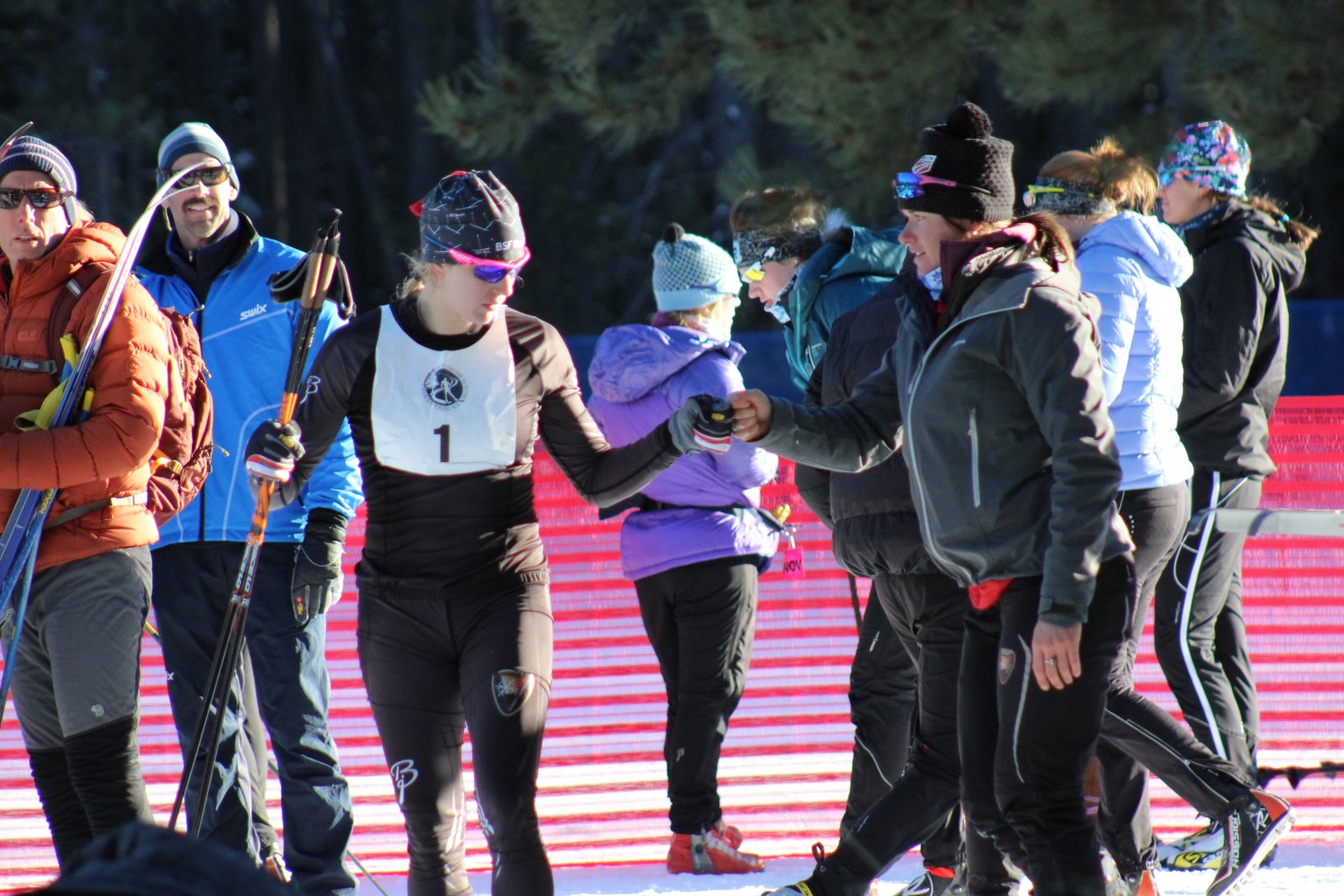
    BSF elite athlete Jennie Bender (l) and head coach Bernie Nelson fist bump before the start of the 2015 women’s SuperTour sprint A-final in West Yellowstone. Bender went on to place first overall.

    “That is how I started,” Nelson said. “I helped Grethe facilitate workouts and just really worked under her wing and with Chad Anderson who was also coaching. It was the three of us and then Grethe took a sabbatical for a year. Chad was the head coach and I was the assistant coach and that is when I really fell in love with the process because it was a whole training year that I was helping Chad and was responsible for what I would call my first team.”

    Hagensen, now a coach in Tromsø, Norway recalls Nelson as beyond her young adult years. “Naturally, she was a teacher and a coach — Bernie is a quick one, she is smart and fast,” Hagensen said during a phone call. “She was just calm and young but old. She was wise. Sometimes the age doesn’t really matter, she was mature for her age.”

    Nelson, at the time, balanced what few could have pulled off: coaching age-group peers, some of whom had been her teammate at MSU.

    “She obviously gained respect from her peers,” Hagensen said. “She was a friend and a coach, but it worked. They looked at her as an equal. She holds her own. They discover rather quickly that she has skills and that she is qualified. Because she is comfortable when she is knowledgeable, then you appear strong, and that is something people sense. Bernie is not going to bend or be insecure – she is the opposite.”

    After coaching at MSU, Nelson went on to become the Elite Team coach at the Bridger Ski Foundation before moving to Oregon and coaching at the Bend Endurance Academy. (Nelson had been a nursing student when she accepted the USST coaching position.) It was during these years Nelson had the opportunity to wax tech and coach internationally. She was exposed to a range of age groups from U14s to senior athletes. She began to understand that she was drawn most to the U20 and U23 niche. An age when an athlete often begins to learn more about methodology and becomes a more independent learner.   

    “I really started coaching U23s when I was a U23 myself,” said Nelson. “I was pretty young. For me, I think it is a really pivotal time in an athlete’s life when they start to take more ownership in their training. They are more curious as to why, they are more curious about the process. Why am I doing this training? How does it affect my body? How do I feel after rest? They are really starting to clue in and they are really starting to take ownership for their hours and their sessions. That for me is such an empowering time to be an athlete. I find a lot of joy of being a part of that process. Helping them clue into their own potential and helping them maximize it.”

    What Nelson speaks of is a gradual release of responsibility: a pathway of guided, collaborative, and then independent training. The U20 and U23 athletes on the U.S. Ski Team (USST) all come with their own coaches and clubs. It is a time when the athlete gets advice from both their club coach and the USST coaching staff while providing their own input.

    Nelson said she welcomes the collaboration with club coaches and college coaches who are guiding some of the D-Team athletes.

    buy zanaflex online


    “From a coaching perspective, just like we are trying to get the athlete to see the power of the team, there are also opportunities for coaches to come together and collaborate,” Nelson said. “I think that is why it is so powerful for me, or why I am so personally passionate about it —  coaching this age group and this level I can continually get exposed to new ideas and I am always learning from other coaches. … You go on these U23 and World Junior trips and it is different people coming from different clubs to be coaches and to be wax staff and we are all working together. You have to be flexible and cohesive to achieve a group goal and get to the same endpoint.”

    Bernie Nelson and Red dog, on a trail run in Bend, Ore. (Photo: courtesy Bernie Nelson)

    Nelson moves into a role vacated a year ago by Bryan Fish who became the Cross-Country Sport Manager for US Ski & Snowboard, while Gus Kaeding who was a part-time D-team coach last season moves into a full-time position with the organization’s sports science department.

    It remains a time of promise for developing skiers in the U.S. With numerous top-10 performances and a smattering of medals at World Juniors, the foundation for Nelson’s development work is solid. She’ll have the opportunity to coach vets like Hannah Halvorsen and Gus Schumacher as well as new athletes that include Novie McCabe and Kendall Kramer.

    Nine skiers total comprise the 2019-2020 development team. All of them met objective criteria for their USST nomination. The D-Team athletes come with their own aspirations and hurdles to clear. Nelson said she sees herself as a resource to assist skiers in achieving their personal goals.

    “That is a huge part of my job, how can I be a resource to these guys? How can I help enhance their experience so they can achieve these goals and move into and take the next step whatever the next step might be for them at this moment?” said Nelson “Some of them are younger. Some of them are a little older. So the next step for some might be the A and the B-Team and the next step for others might be you know, top-five at World Juniors or top-10. The stair stepping developmental process. I am just another perspective for them.”

    Asked about any nerves she might bring to the job knowing the nation’s cross-country skiing microscope has become more fixated on high-achieving young athletes as they have garnered success at World Juniors, Nelson simply chuckled.

    “To be honest, let’s put it this way, I think this is why I was a better coach than I was an athlete,” said Nelson. “As an athlete, I would get, I mean terrible pre-race anxiety. And as a coach, I am able to break it up into smaller chunks.”

    Nelson has said in the past that putting on a race bib gives skiers “superhero powers … it’s like a cape”. It’s now Nelson’s time to instill some wisdom, provide some technique cues, and to help D-Team athletes harness those superhero powers.

  • Dunklee and Nordgren Secure Day 2 Wins at USBA Team Trials in SoHo

    Dunklee and Nordgren Secure Day 2 Wins at USBA Team Trials in SoHo

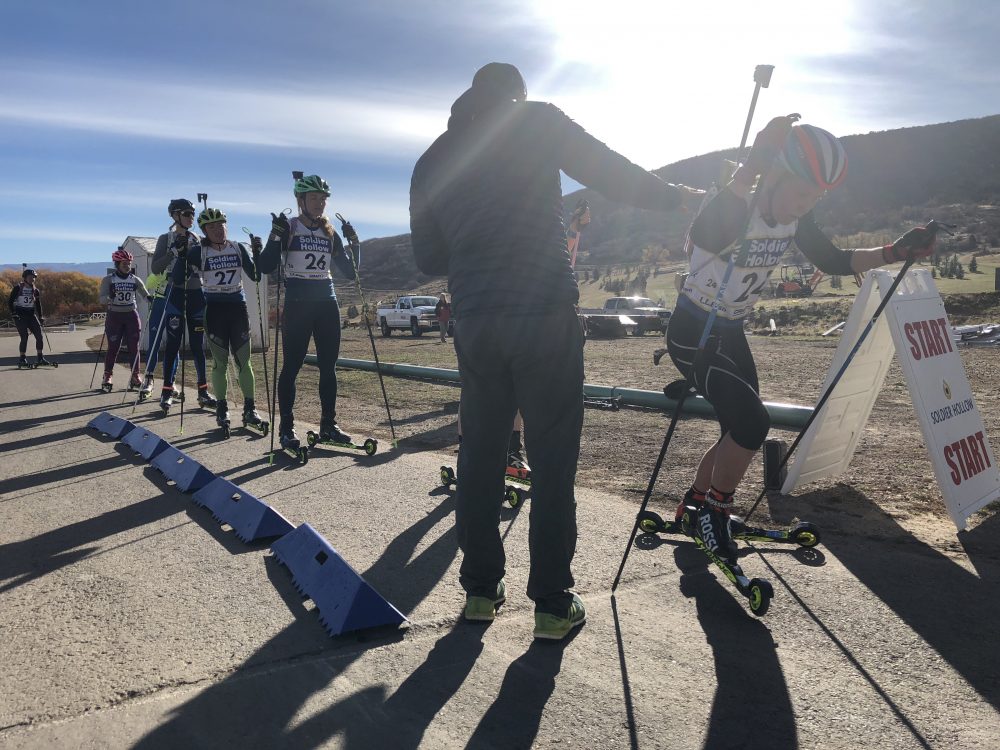
    Kelsey Dickinson (24) gets on course for the women’s 7.5-kilometer biathlon sprint for USBA SoHo trials on Tuesday, Oct. 30. Emily Dreissigacker (26) and Hallie Grossman (27) look on. (Photo US Biathlon)

    Athletes competing in the US Biathlon team trial competitions at Soldier Hollow (SoHo) in Midway, Utah, returned to the venue on Wednesday for a second roller ski sprint race. Trials had kicked off on Tuesday with a men’s and women’s sprint.

    On Wednesday, 12 biathletes competed in the senior women’s 7.5-kilometer sprint, with veteran Susan Dunklee once again coming out on top. Dunklee completed the course in a time of 22:23, after missing two shots, one prone and one standing.

    The next closest competitor to Dunklee was Johanna Talihärm, who tied Dunklee’s shooting score and finished 55 seconds back from the winning time for second place. Talihärm is originally from Estonia and is currently a senior at Montana State University.

    Rounding out the podium was Craftsbury Green Racing Project and former Bates College skier, Hallie Grossman in third. Grossman cleaned her prone stage and missed one standing shot, finishing 1:12 seconds back from Dunklee.

    Emily Dreissigacker, who had placed third in yesterday’s sprint, finished in fifth (+1:49) on Wednesday after two missed prone shots and one missed standing. Clare Egan, another top three finisher in Tuesday’s race, placed sixth (+2:01) in Wednesday’s sprint with 2 missed prone shots and 3 missed standing. In fourth (+1:32) on Wednesday was Deedra Irwin of Wisconsin Biathlon.

    In the men’s 10 k sprint, Leif Nordgren claimed first in a time of 26:21 after one missed prone shot and one missed standing. Finishing 12 seconds behind Nordgren was Sean Doherty in second. Doherty missed two prone and cleaned standing. Rounding out Wednesday’s top three was Jake Brown, who cleaned standing and missed one prone shot, finishing two seconds out of second place and 14 seconds back from the winner.

    A junior men’s and junior women’s sprint was held, with Lexie Madigan (Sugar Bowl Academy) taking the women’s win in a time of 16:46 and Eli Neilsen (MSU/Methow Valley Ski Club) claiming the men’s in a time of 19:25.

    Athletes have a rest day on Thursday before returning to the venue on Friday for a mass start.

    Day 2 Sprint Results

  • NENSA Coach of the Year, Alsobrook on Bowdoin’s Upward Path

    NENSA Coach of the Year, Alsobrook on Bowdoin’s Upward Path

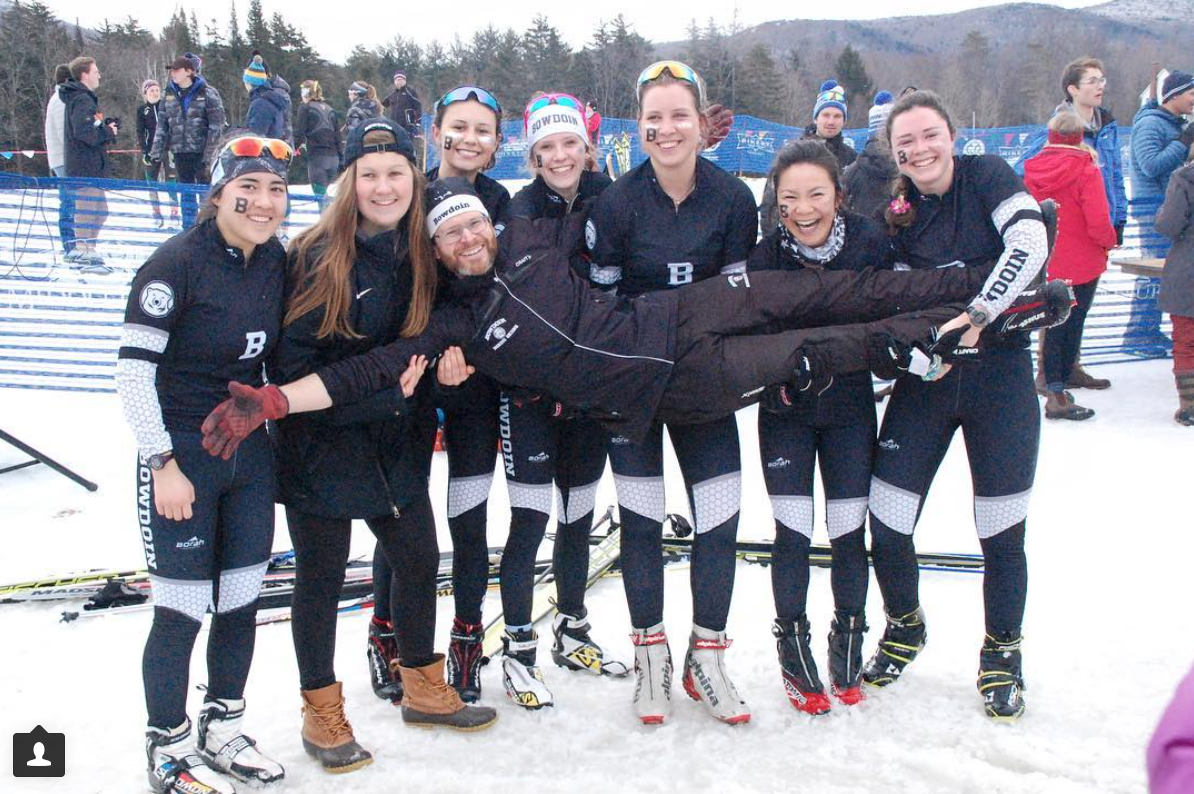
    Bowdoin nordic skiers with head coach Nathan Alsobrook. In July, Alsobrook was recognized as NENSA’s 2018 Coach of the Year. (Photo: @bowdoinskiing/Instagram)

    Building on one of its most successful seasons yet, the Bowdoin College nordic ski team, out of Brunswick, Maine, recently jumped back into training under the guidance of head coach Nathan Alsobrook. Last winter, three skiers qualified for NCAA Skiing Championships, one alumna qualified for the U.S. Olympic team (Kaitlynn Miller, class of 2014), and one visually impaired skier Jake Adicoff (’18) earned a silver medal at the Paralympics. It was a season that Alsobrook names as a highlight of his coaching career.  

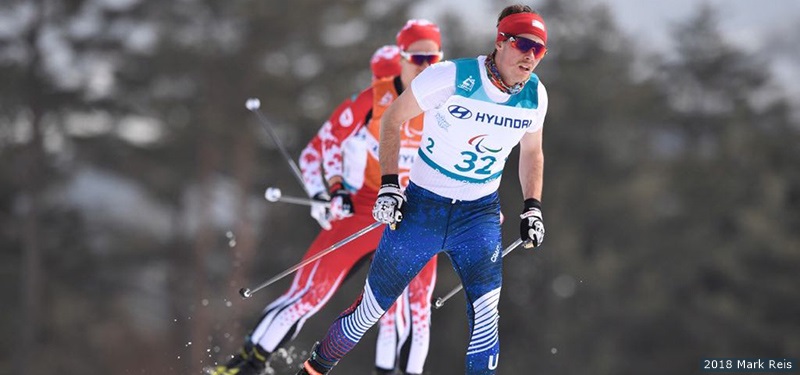
    American Jake Adicoff leads Canada’s Graham Nishikawa and Brian McKeever in the men’s visually impaired 20 k freestyle at the Paralympic Winter Games in PyeongChang, South Korea. Adicoff earned silver (behind McKeever) in the men’s visually impaired 10 k classic in PyeongChang. (Photo: US Paralympics/Mark Reis)

    “The most fun thing about has just been to see the very slow but steady progress that the program has been able to make over the past several years,” Alsobrook said in a phone interview last month. “It’s been very fun and exciting.”

    To top it off, Alsobrook was recognized by the New England Nordic Ski Association (NENSA) as 2018 Coach of the Year in recognition of his team’s steady progress and his contributions to the growth of cross-country skiing in New England. 

    “Over the past years, Nathan has been active in NENSA Programming, including serving as a coach at Eastern Regional Camps, chairing the Coaches Education Committee and running L100 Technique clinics for the state of Maine,” a NENSA press release stated. “Through his dedication to these programs he has made the Bowdoin Nordic Team a visible and attractive institution for skiers to continue their careers.”

    Current Bowdoin Nordic Ski Team Head Coach Nathan Alsobrook (r) with Marty Hall, who coached at Bowdoin for eight years and was inducted into the U.S. Ski & Snowboard Hall of Fame this past spring. (Photo: Bowdoin Nordic)

    A Bowdoin graduate (’97) himself, Alsobrook returned as head coach in 2007, taking the place of former U.S. and Canadian national team coach Marty Hall, to whom he attributes planting the seeds for Bowdoin’s current development. 

    “He was really responsible for taking Bowdoin out of where it had been,” Alsobrook said of Hall’s eight years with the team. “We really weren’t functioning at a super high level before Marty came in. He was able to really push for the college to bring more resources to the sport and just sort of professionalize the whole program. He essentially created this really great foundation for me to springboard off of.” 

    Before Bowdoin, Alsobrook coached at Whitman College, Montana State University (MSU), Colby College, and the Pocatello XC Ski Foundation, and earned a master’s in exercise physiology from MSU in 2005.

    While it didn’t happen overnight, over the years, the Bowdoin Polar Bears have trended upward in the Eastern Intercollegiate Skiing Association (EISA) nordic rankings.

    “We had individuals pop great races, and we had these flashes of brilliance that more was possible, but it took so many years for us to become competitive as a team. It was not until 2013 that we sent a skier to NCAA’s during my tenure,” Alsobrook explained. “We would have little successes here and there, a great relay performance or a single race where we would finish very competitively, but we never really put it together for consistent week after week Carnival team performances. It was really only last year that that finally happened, where all of a sudden for the combined men’s and women’s nordic events we would find ourselves finishing in the top half of the league.”

    Every weekend on the Carnival circuit last winter, either Bowdoin’s men’s or women’s team placed in the top six. And it saw three skiers — more than ever before — qualify for NCAA’s in Steamboat Springs, Colorado: Gabrielle Vandendries, Renae Anderson and Elliot Ketchel.

    celebrex online, buy voltarol online

    Outside of the results, Alsobrook said he enjoys the culture of the student body at Bowdoin and feels that it contributes to the dedication and work ethic of his athletes.

    “There is this really great sense of balance here at Bowdoin, and we really try to compliment that in our program,” he said. “It’s such a fun mix of these very academically focused and engaged students. … They just love learning, they love being in this environment and challenging themselves, and then they’re just so ready to get out and train hard.

    “I think we do a pretty nice job here at Bowdoin of making this a very collaborative experience, the learning experience and certainly the athletic experience,” he continued. “And it’s just such a natural fit for when you’re trying to create this very team-centered program like I’m trying to do here, that that culture is already in place at the college. I mean, people really want to do well here, in whatever they’re doing, and they’re going to work really hard to do it, and yet they’re trying to help everyone else do the same. That’s something I really appreciate … any competition is directed toward making everyone better.”

    His coaching philosophy aims to capitalize on this dedication to personal success, while also reflecting the sense of balance achieved at the school.

    ponstel online, buy ventolin online

    “I can’t remember who started saying this, but it’s something we started saying around our team:  ‘Happy people ski faster,’ and that is really at the heart of what we are trying to do,” he said. “I know that my skiers are going to get more out of themselves on the race course if they feel very fulfilled with their Bowdoin experience as a whole.”

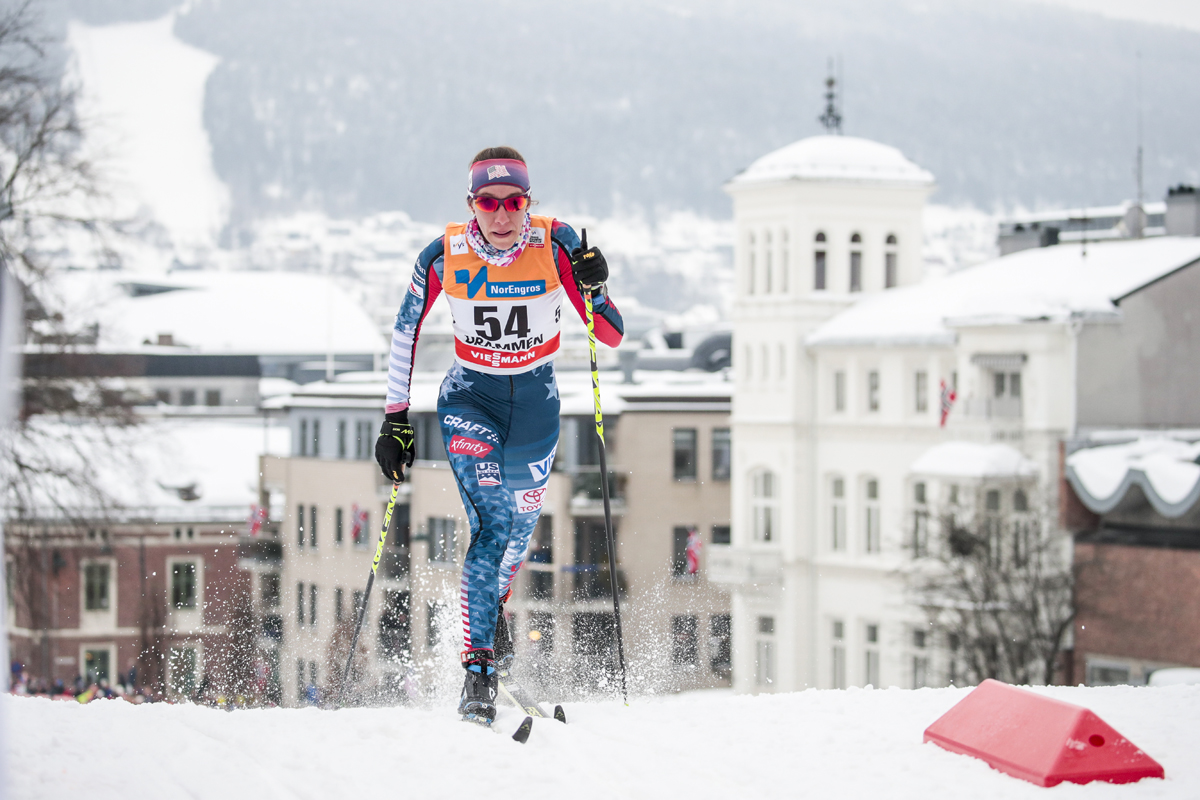
    Bowdoin alumna Kaitlynn Miller racing to 53rd in the World Cup classic sprint qualifier last March in Drammen, Norway. (Photo: Fischer/NordicFocus)

    According to Alsobrook, this culture and balance served Kaitlynn Miller, who now skis for the Craftsbury Green Racing Project, well in her time at the school. He described Miller as “very studious, very thoughtful … and yet very focused when it came time to train.”

    Miller ended last season as the overall SuperTour leader and has earned World Cup starts in November and December as a result.

    “It was really nice to have someone that embodied what we are trying to do in our program,” he continued. “For someone who is such a high-level athlete, she is just extremely humble, very kind and thoughtful, very team-centered. It was really fun to coach an elite athlete who was such a team-centered, selfless person … It’s been a real pleasure to watch her take off.”

    As for the upcoming season, Alsobrook will continue to focus on the continued growth of his team.

    “With my athletes, we’re all about the process,” he said. “Having said that, of course, I have outcome goals, essentially I want to see the team keep moving forward. We’ve never won the Maine State Championship, for example … so we’re really excited to go after that this year. We’ve come close a few times, and maybe this will be our year,” he said.

    Another goal will be to continue to place highly at EISA Carnivals and to develop a strong championship team. Last year, its two female athletes at NCAA’s — Vandendries and Anderson — posted top-30 finishes in Steamboat.

    “Certainly bringing back a good contingency of skiers to NCAA’s again is a big goal,” he said. “We had a number of times where our [team] finishes [in EISA competitions] were fourth, fifth, sixth pretty consistently throughout the season, and that’s a pretty good place to be in a league as competitive as EISA. I do not want to stay there and keep cranking out those finishes, I want to keep getting better. … I mean, hey, we did fourth last year, why not try for third this year? They’re just great things for us to keep fighting for while at the same time we stay firmly grounded on the process.”

    https://www.instagram.com/p/BfmMefUjgzr/?utm_source=ig_web_button_share_sheet&igshid=1j8m5zoxtjds5

  • Heather and Brooke Mooney on Where Skiing Led Them and What’s Next

    Heather and Brooke Mooney on Where Skiing Led Them and What’s Next

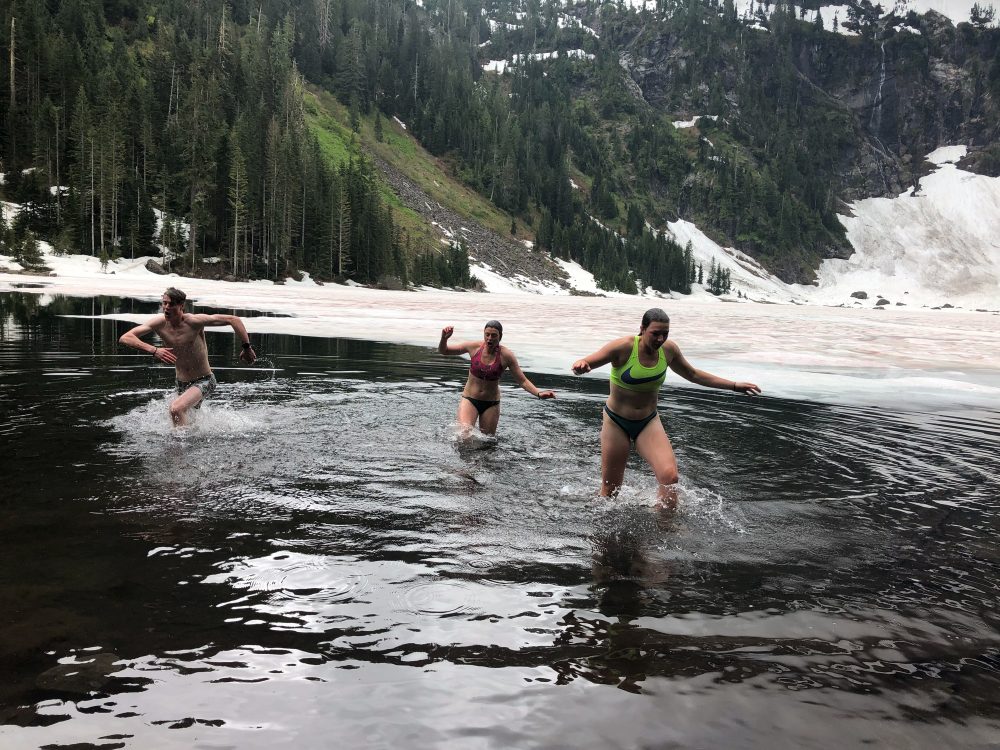
    Mooney siblings (from left to right) Scott, Heather and Brooke after jumping into Lake 22 just outside of Seattle, following Brooke’s graduation from Washington University in June. “With two siblings peer pressure works wonders, not going to be the wimpy one who doesn’t jump in!” Heather wrote. (Courtesy photo)

    Perhaps you have heard of them. Or at least seen them. At 6 feet and 6 feet 2 inches tall, respectively, the Mooney sisters, Heather and Brooke, are hard to miss. But their height is not the only reason the two women stand out.

    The sisterly pair also share a talent for the sports they pursue. At one point, for both of them, that sport was skiing. And at one point, for both of them, it was not.

    Having grown up in Peru, Vermont, where the Green Mountain range serves as the town’s backdrop and skiing is the norm, the two were certainly primed with the ideal environment for becoming interested in nordic.

    “Our school bus had a ski rack on the side of it because we would ski at recess,” Heather recalled during an in-person interview this month in Bozeman, Montana. “In southern Vermont, that is what everyone did.”

    “That” meant skiing. Their mother had picked it up as an adult and also worked as a promotion manager for a skiing magazine. Their father was the headmaster at Vermont Academy, providing the the family access to a plethora of trails directly from their residential backdoor.

    Both parents were also active outdoor enthusiasts, encouraging Heather, Brooke and eventually their younger brother Scott, to partake in anything that got them moving: swimming, hiking, soccer, tennis. (It didn’t hurt the family’s sporting M.O. that their father had been Yale’s soccer goalie as an undergrad.)

    By the time she was a freshman, Heather had enrolled at the Stratton Mountain School ski academy. Three years later, her sister Brooke had as well. (Heather and Brooke are two years apart, but Heather skipped first grade).

    Heather Mooney racing to 42nd in the women’s 10 k freestyle at the 2016 U23 World Championships in Rasnov, Romania. (Photo: FIS)

    They became well-known names on the eastern ski circuit. They also found national and international success while still U18s. Heather qualified for Junior Nationals four times, Junior Worlds twice and U23 Worlds in 2016. By her junior year in high school, Brooke had qualified for three Junior Nationals.

    As J2 skiers, both Mooney girls received coaching from Pepa Miloucheva, the head ski coach at the Craftsbury Outdoor Center. With a background in sculling, as well as ski orienteering, Miloucheva had her eyes on Heather and Brooke, who showed the potential to qualify for Junior Nationals in rowing as well. Both girls were invited to a youth rowing camp held at the Outdoor Center.

    “The director told me I needed a snorkel,” Heather reminisced with a laugh. “But Brooke was very good.”

    ***

    During an early season training session at the University of Washington (UW) this past year, Brooke sat down for testing on a rowing ergometer. She pulled for the alloted test time, one minute, and stopped. Her sustained pace was 615 watts.

    National team coaches could not recall any other woman surpassing 600 watts, The Seattle Times reported.

    “You don’t have to know rowing to see her strength,” UW head rowing coach Yasmin Farooq told the Times. “Watch her and you think, holy smokes, this woman has some serious power.”

    Unofficially, Brooke holds the watts record for an American woman on the rowing machine. Officially, she was named the Pac-12 Women’s Rowing Athlete of the Year in May and is now living in Princeton, New Jersey, one month removed from UW. She’s also a national-team recruit.

    Her invite to join USRowing came in December, and following her graduation from UW in June, Brooke headed back east. In Princeton, she is training with U.S. rowing veterans like Meghan Musnicki and Elle Logan — both multiple Olympic gold medalists — with the hope of working toward a spot on the 2020 Olympic team (selection won’t take place until 2019).

    “I kind of figured I would be pretty crazy to turn down this opportunity, whether it leads to greater results or not, I had to try it,” Brooke told FasterSkier on the phone.

    The seeds of opportunity were planted in the initial rowing camp Brooke attended in Craftsbury. She spent her senior year at Vermont Academy, where she took up rowing as her newfound, full-time passion.

    “I knew I wasn’t going to want to keep on skiing through college, so I figured I might as well try rowing,” Brooke said.

    She filled out a few higher-education recruiting questionnaires and received a response from UW.  As one of the top rowing schools in the country, UW had her attention. Throughout her four undergraduate years, Brooke developed into one of the country’s top college rowers, even with a slight scare before her senior season.

    ***

    When Brooke first started getting headaches in the summer of 2016, the doctors told her she was dehydrated. At a sculling camp in Craftsbury post-doc visit, her headaches continued. Most of the time, they got progressively worse throughout the day.

    Brooke Mooney, who was recently recruited to the U.S. women’s national rowing team, during a sculling camp in Craftsbury, Vt. in 2016. (Photo: Craftsbury Outdoor Center)

    “I would be able to get up in the morning and work out a little bit, but if I didn’t work out before 9 o’clock, I couldn’t workout,” Brooke recalled. “I would just lay on my bed in so much pain.”

    With dehydration as her diagnosis, she did what she could to work out. Sometimes the headaches would lapse, but most often they would not.

    “I started the school year in and out of headaches. I talked to the team doc and went to the headache clinic,” Brooke said.

    It wasn’t until April, almost a year after her headaches began, that Brooke was given an MRI. The results: she had a cyst in her optic chiasm. The mass was pushing on her optic nerve and needed to be removed, or else it could expand and cause permanent damage to her vision, even blindness.

    Her eye doctor allowed her to finish the race season (for rowing, championship racing occurs in the spring) before removing the cyst. Following her surgery in June 2017, Brooke was not allowed to train or work out for eight weeks the summer before her senior year at UW.

    “I was so worried,” Brooke said, particularly when she found out that her team would be racing the famed Head of the Charles Regatta that fall.

    “I wanted to race that more than anything and I panicked that I was going to miss my opportunity because of the surgery,” she said. “But then I ended up making it … every once in awhile, a good break is really beneficial.”

    ***

    If you peruse Heather’s blog, one post from April 2017 blares the title “On Burnout and Bye for Now.” This was her informal farewell to cross-country skiing.

    The post itself came two years after she graduated from Middlebury College, a time when skiing held great promise for Heather. She had capped off her senior year with seven collegiate wins and had also qualified for the 2012 Youth Olympic Games as a college sophomore.

    Following graduation, Heather signed on with the Craftsbury Green Racing Project (CGRP), but later found things weren’t aligning the way she had hoped they would. Particularly, she felt she was not performing to her expectations, given the amount of support she had (according to Heather, CGRP covers most of their athletes’ expenses for food, housing and travel.)

    “I thought I was done for good,” Heather, now 24, continued. “Pepa [Miloucheva] was the one who encouraged me not to look at it that way.”

    Even with Miloucheva encouraging her not to give up completely, Heather forfeited skiing, and even gave up physical activity for a bit.

    “In the beginning of the summer when I quit, I was like, ‘I’m not exercising, I’m not being an athlete, I’m just doing whatever what I want — I can be happy without skiing,” Heather said. “Very quickly I realized that I need exercise to be happy.”

    That summer in Truckee, California, Heather landed a coaching gig that gave her the opportunity to travel to Australia. By the fall, she decided to move to Bozeman, with plans to gain residency at Montana State University and enroll in its architecture graduate program.

    In Bozeman, she reconnected with Austin Caldwell, a longtime friend from Vermont and the current head coach of the Bridger Ski Foundation Elite team. The two went for a few early fall skis together and Heather soon found herself attending Caldwell’s agility practices, then interval sessions. When the winter hit, Heather even jumped into some races, but only as many as she chose.

    In all, she competed in about a dozen SuperTour races, finishing last season ranked 36th overall on the circuit. Heather also raced to 14th in the 50-kilometer American Birkebeiner skate race in February.

    “It was really refreshing to step out of expectation,” Heather said. “I feel like we all get into such definitions of like how we should be in the sport. I realize [now] there are so many different ways to engage with it. Likely that’s how we many of us will reach our potential, is by engaging in a way that works for you as a person.”

    After a break, Heather is currently planning to defer from MSU and focus once more on skiing.

    “It’s been exciting for me slowly lose that anxiety of how I should be performing and how I wanted to perform,” Heather said. “I look at how can I work with myself, versus trying to fit myself into the pro-athlete mold.”

  • Summer Training In… Tallinn and Otepää with Johanna Talihärm

    Summer Training In… Tallinn and Otepää with Johanna Talihärm

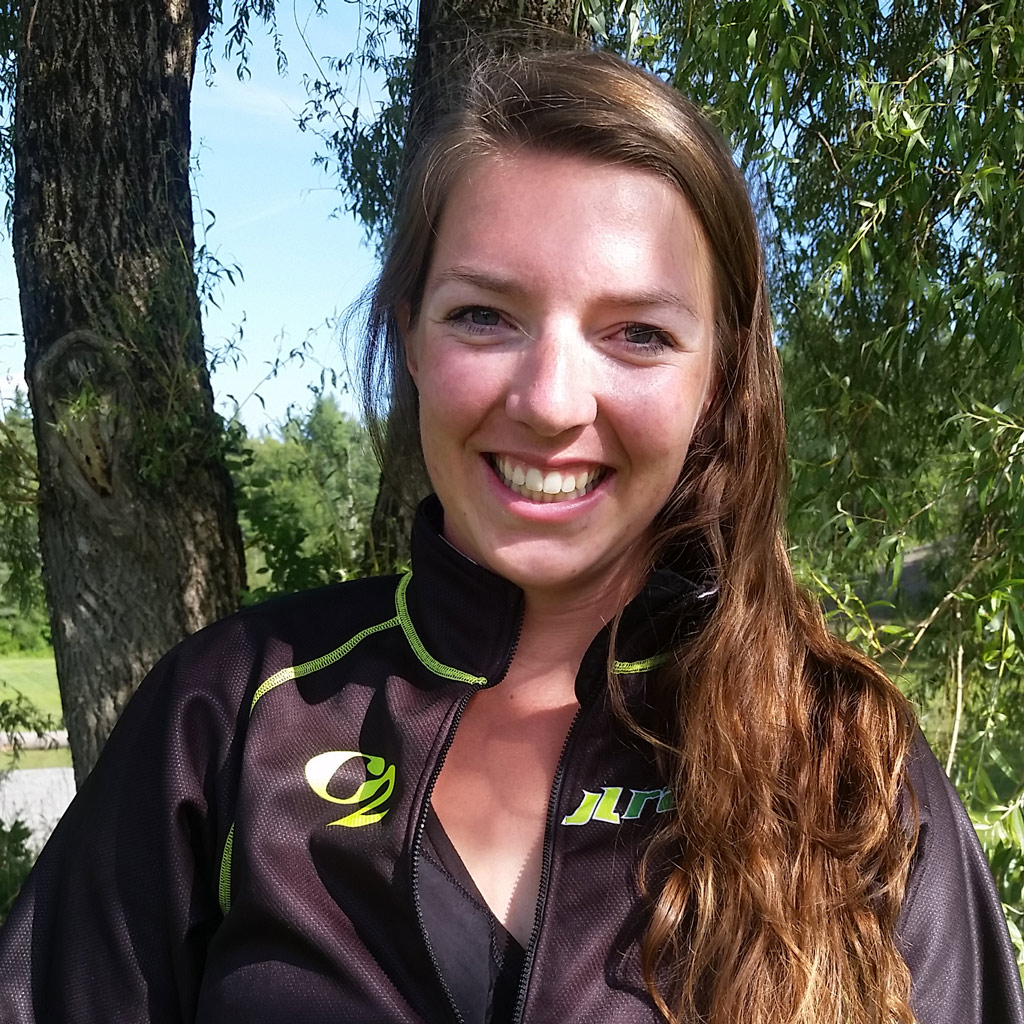
    Montana State University skier and Estonian national-team biathlete Johanna Talihärm running outside of Tallinn. (Courtesy photo)

    After spending last summer training in the U.S. with the Craftsbury Outdoor Center’s U23/collegiate summer training group, this year Johanna Talihärm decided to go home to Estonia.

    The FIS Cross-County World Cup swings by Otepää periodically (as does the Continental Cup circuit and biathlon’s IBU Cup series), but Talihärm is originally from Tallinn, Estonia’s capital and a World Heritage Site. That’s the atmosphere she moved back to for the summer — which she said had both pros and cons.

    “It is easier at home, because of no extra travel and friends and family nearby,” Talihärm, who turns 24 later this month, wrote in an email. “Other than that I would say Craftsbury was perfect. There’s an amazing and super strong group of girls to train with, biathlon and nordic girls and guys training together, an awesome nature-preserving environment and just a beautiful place.”

    https://www.instagram.com/p/BUcroSMDjTt/

    The Montana State University (MSU) skier finished seventh in the 15-kilometer freestyle at NCAA Skiing Championships in March, improving on her previous best finish of 13th. She and Annika Miller were the team’s only nordic All-Americans this year.

    Johanna Talihärm training on the shooting range in Otepää, Estonia. (Photo: Detlef Eckert/Courtesy of Johanna Talihärm)

    A few weeks earlier, Talihärm had been at IBU World Championships in Hochfilzen, Austria, representing Estonia on biathlon’s biggest stage. She placed 57th in the 15 k individual, a result about which she said at the time, “it was all right.” Talihärm, Estonia’s top finisher at those Championships, is planning to go to the 2018 Olympics.

    Over the summer, she’s focusing on aspects of training that can help both her biathlon career and her college skiing.

    “I would say that my general goal is to get stronger and ski faster, and all the training I do benefits both, my biathlon and college racing,” she said. “Shooting has given me a lot of mental strength and an ability to concentrate that benefits skiing, too.”

    Over email, Talihärm explained what summer training is like in Estonia.

    FasterSkier: Where are you based this summer? Is this the same area you grew up in, or is your training base away from your family home?

    Johanna Talihärm: I live in Tallinn, the capital of Estonia, which is in the north, but spend a lot of time training three hours away in Otepää which has a world class training center with two shooting ranges and good rollerksiing opportunities. Also as Estonia is very flat, Otepää has some hills to train on, to switch it up from completely flat Tallinn.

    FS: Do you have a team that you are training with, or are most of your training sessions alone? Are there a lot of other athletes and teams using the same area/facilities?

    JT: I train with the biathlon national team, but most of them are located in Otepää. I train mostly alone when I’m at home.

    More work on the shooting range. (Courtesy photo)

    A lot of teams come to Otepää for their summer training. The Russian ski team is there with almost all teams (juniors, men, women, para, local club teams and even some youth groups), Ukrainian women’s biathlon team was there last week, also [Slovenian World Champion] Jakov Fak, some Russian biathletes are coming (for example Anton Shipulin), Kazakhstan has been there in the past, and also Estonian nordic skiers and athletes from neighboring countries like Latvia, Lithuania and Finland.

    FS: When you are planning your summer training and thinking of what you need to work on for the upcoming season, how do you coordinate between your various coaches about how to design training?

    JT: I follow my national team plan when I’m in a training camp with them, MSU training when in school, and I fill up the time in between myself to make it all work. I have to credit the coaching education I got from my sports high school and coaches seminars by Estonian federations for the ability to make educated choices about my training.

    FS: What’s the hardest workout you have done so far this summer?

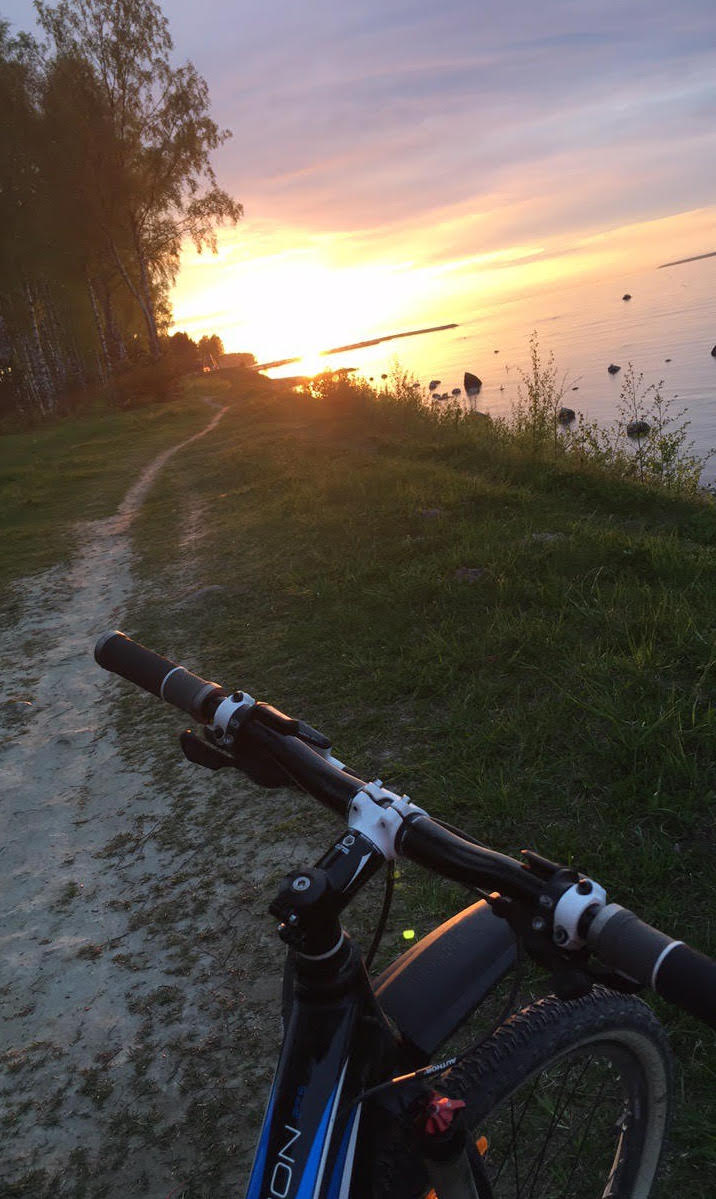
    A photo from an evening bike ride along the coast in Tallinn. (Courtesy photo)

    JT: Probably a long lonely run in the rain at home. Not the hardest physically, but definitely mentally.

    FS: Are there any absolute favorite places to run or bike or rollerski? Where are you always excited to do a workout?

    JT: I’m always excited to work out in a new place. I love exploring new trails in my hometown Tallinn, especially the ones right by the coast. I’ve been there so often that I never expect to find anything new, so the joy is even bigger when that happens.

    FS: Maybe related, is your area set up best for some parts of training? Are there excellent hills for intervals, or great places to do long workouts without being repetitive, or what do you think is the best aspect training-wise?

    JT: I think my hometown is not the best place to train for skiing in the long term, but it has amazing long paved loops ideal for rollerskiing.

    FS: What do you do when you are not training? Do you need to have a job?

    JT: I have an internship in Tallinn this summer.

    FS: How was your spring — did you get to do a good start to training while you finished up school?

    JT: I was pretty wiped out by the load from school, training, racing and travel, so I took a little extra time to recover. I was careful with the intensity at first, but in general I don’t think it will make a big difference in the long run.

    FS: What is the best part of Estonian summer, aside from training?

    JT: Being able to see everyone, not having to do all my tasks at home in one or two weeks, no packing nor long travel, various bodies of water to swim in, familiar food and warm and long summer days.

    Talihärm taking a swim in the lake next to the shooting range in Otepää. (Courtesy photo)
  • An Open Letter About Depression in Competition

    An Open Letter About Depression in Competition

    Paul Everett racing at 2015 IBU Junior World Championships near Minsk, Belarus. (Photo: Jake Ellingson)
    Paul Everett (l) racing at 2015 IBU Junior World Championships near Minsk, Belarus. (Photo: Jake Ellingson)

    If you follow U.S. skiing closely, you’ve probably heard of Paul Everett. After three years on US Biathlon’s development team, Everett, 20, is currently a Montana State University sophomore and member of the Bridger Ski Foundation in Bozeman, Mont. He is studying exercise science and psychology, and wrote the following letter for an assignment. It’s about depression and anxiety in athletes, “more specifically ski racing about what it is like for those competing with these disorders and ways in which athletes and coaches can help with these mental conditions,” Everett wrote in an email to FasterSkier. “I offer this letter … to spread awareness or help other skiers with similar struggles.”

    ***

    Dedicating one’s life to a sport can fittingly be described as near insanity. As complete insanity is defined as doing the same thing over and over again expecting different results, an athlete’s job description nearly meets that criteria, but with at least showing the smallest increments of improvement each time. To compete at the highest of levels in any sport, an athlete needs this narrow, single-sighted vision of reaching their optimal best, and doing only that which will help them achieve this goal. For some this mindset comes easily, but for others like myself, this near insanity that is required of athletes may not always coexist with their own mentality. Much of my life I have suffered from depression and anxiety. Each time this struggle rises, I have always gone to skiing as a way to cope with this mental disorder. While skiing has done tremendous improvements on my mentality towards life and understanding of what it takes for me to be happy with myself, the competitive side of ski racing can take an emotional toll on anyone, especially those suffering this condition.

    For a disorder that affects millions of people, including many athletes, its severity is not always recognized for the damage it can do. Living with depression, energy and motivation seem to drain at even the smallest of obstacles. While thoughts are occupied on unrealistic concerns or perspectives, much of what once brought joy now fades to empty routines. The ability to see the positives of accomplishments is replaced with highlighting the faults within them. It is this voice within the head demanding one’s self to quit, but never itself going away. Though exhausting, these symptoms are not what stop me from racing. While I can quiet this voice much of the time through skiing, it is only when I am faced with expectations of success in racing that my anxiety strengthens these destructive tendencies.

    As a product of depression, you let yourself down countless times by not reaching the impossible standards you set yourself up to attempt. That pain may numb after a while, but the additional anxiety from letting down others cheering you on is what becomes unbearable. Competing with the heavy weights of depression and anxiety on your shoulders can become a crippling task. Trapped within your own head without a filter, negative thoughts become a constant stream for days leading up to a race. Self-esteem is lowered with every comparison of your vulnerabilities to another athlete’s strengths, and when time does finally come to leave it all out there, your only wish during the entirety of the course is to just be on the other side of that finish line. No matter the outcome, be it standing on the podium or the last page of the results, the anxiety always takes its toll.

    Depression and anxiety are a tradeoff pair, both taking turns quieting the other, but also taking turns gaining control of your life. As anxiety acts as a distraction from depression, it is one that only heightens the inevitable fall of the melancholy to come. Being physically and mentally exhausted after a weekend of racing is the perfect time for depression to surface. You need a break like anyone after a hard effort, but this break when left alone makes you susceptible to that retuning voice in your head. Now without the distraction of skiing or the energy to combat it, the voice can take ahold of your thoughts, dragging you once more to your lowest point and letting you surface only when the next race comes for anxiety to take its turn.

    As the years have passed with this disorder, I have learned new ways to help deal with this voice and the thoughts that come with it. While the voice may always be there, distractions and acceptance seem to be what aid me the most. Finding anything productive to do in order to keep my mind from wandering to these thoughts is the most efficient way I am able see positive changes in my mood. This is a disorder that thrives on isolation. To have the company of others I closely regard not only distracts myself, but brings an uplifting environment that can carry with me long after. While this companionship may not always be offered when I need it, finding acceptance is another tool used to great degrees of success. Anxiety is a product from fearing the future’s unknown. By doing what I need to at this moment to ensure the best future for myself and accepting the things I cannot change, there should be no reason for my fear to take ahold of me. Of course more easily said than done, these ideas are things I am still working out for myself today, and hope anyone reading this as well can gain from.

    “Anxiety is a product from fearing the future’s unknown. By doing what I need to at this moment to ensure the best future for myself and accepting the things I cannot change, there should be no reason for my fear to take ahold of me.”

    Depression is not something that will be relieved permanently from my life. That negative voice will always be there, but there are things I can do to quiet it. This letter is not only written for my own benefit, but for any athletes or coaches of athletes who share this burden with me. I have seen positive improvements from my own life by sharing my feelings with family, therapists and coaches. It is not something that should be hidden from others. As like any disorder, one needs support if it is to be managed properly. To the athletes, please shed light of your feelings to your family and coaches, so they can do their own part as well to help. Seek a therapist before you think you even need to. There are therapists out there that can do unbelievable work. It is something that can never be done too soon, and could possibly save your life. To the coaches, if you see your athlete show any signs of abnormal moods or behavior, it is your obligation to talk with them in an appropriate manner in order to know what the best choice is for their health. An athlete’s wellbeing takes priority over any race, and if that means taking time away from skiing in order to address changes that need to be made, so be it.

    I have come out the other side of dark times brought on by this disorder, with a great amount of work still to come. Although I cannot completely prevent others from the reality that is depression, I do have the ability to spread awareness and provide tools to those and their supporters who need it most. There is no reason for you to fight this on your own. Skiing has never only been about competing, but more importantly about having fun, and it’s hard to be sad with a smile on your face.

    Former US Biathlon development skier Paul Everett (Methow Valley Biathlon) racing in December 2014.
    Former US Biathlon development skier Paul Everett (Methow Valley Biathlon) racing in December 2014.
  • Casey Smith Says Goodbye to Biathlon and Hello, Again, to the West

    Casey Smith Says Goodbye to Biathlon and Hello, Again, to the West

    Casey Smith (Maine Winter Sports Center/U.S. Biathlon "B" Team) on his way to placing second in a NorAm mass start in Canmore, Alberta, in December 2014. (Photo: Jake Ellingson)
    Casey Smith (Maine Winter Sports Center/U.S. Biathlon B-team) on his way to placing second in a NorAm mass start in Canmore, Alberta, in December 2014. (Photo: Jake Ellingson)

    Casey Smith has endured a few things that would cause any athlete to question whether to continue with their professional career.

    In February 2015, the Washington biathlete crashed hard while training in Canmore, Alberta, before the International Biathlon Union (IBU) Cup races to be held a few days later. He was knocked unconscious, broke ribs, a shoulder blade, and bones surrounding his vertebrae, and punctured a lung.

    While recovering from those devastating injuries, he learned in April 2015 that he had been cut from U.S. Biathlon’s B-team, and also that Maine Winter Sports Center (MWSC), where he had been based, was no longer funding senior elite athletes.

    But Smith – using the physical and mental endurance he had cultivated in biathlon – persevered, joining the Craftsbury Green Racing Project (CGRP) in Vermont and returning to international competition in the 2015/2016 season.

    “It definitely [felt sweet],” he said of a few good races last season. “It was really cool to be able to – I got back to the same level I was at before. In Europe this year I didn’t have quite as good results as the year before, but also the first week I got food poisoning really bad. That took a pretty big toll on me, and didn’t have anything to do with the crash.”

    Come spring, the 24 year old decided to call it quits with his biathlon career and return to Bozeman, Mont., to finish a degree at Montana State University. He had enrolled after high school before transitioning to being a full-time athlete.

    His decision was unrelated to the ordeals of the year before. It came down to something much simpler: joy.

    “The whole year of the training season and racing season, I wasn’t feeling as motivated,” he explained on the phone from his home in Washington’s Methow Valley. “I said that I wanted to do this as long as I was having fun, but it was turning into more of a job kind of thing. It was getting to the point where it wasn’t as much fun anymore. So I thought it was time to move on.”

    Casey Smith (USA) en route to 37th place in the junior men's individual at World Junior Championships in Obertilliach, Austria, in 2013. He had his career-best finish of 23rd place in the pursuit there. (Photo: US Biathlon/NordicFocus.com)
    Casey Smith (USA) en route to 37th place in the junior men’s individual at 2013 World Junior Championships in Obertilliach, Austria. He had his career-best finish of 23rd place in the pursuit there. (Photo: US Biathlon/NordicFocus.com)

    Smith was a top junior for the U.S. before and during his first stint in Bozeman. He had top-30 finishes at World Youth and Junior Championships in 2011 and 2013, as well as two apiece at Open European Championships in the junior races in 2012 and the senior races in 2014.

    He then spent two years with the MWSC – including the successful 2014 season, which launched him onto the national B-team – and one in Craftsbury.

    “It was great having other guys to train with,” he said of his time in Vermont. “I really hadn’t had too much of that, at least when I was in Maine. So that was really nice, and I really enjoyed working with Pepa [Miloucheva]. It helped me with my ski technique a lot, for sure.”

    Looking back, he said having the chance to travel the world was one of the best things the sport had offered him.

    “The last several years we would always go to Canmore over Thanksgiving, and so I could build relationships with people there,” he said. “Then when you land in Europe at competitions you run into them again, and I was able to make friends from all around. That was pretty cool.”

    There were results highlights from this season, too.

    “At [U.S. National Championships], it was really cool that all the national team was there [after the World Cup finished],” he reminisced. “It made it real races. In the sprint I had a pretty good race, and right in the mix. Also in Canmore at the trials it was a little bumpy the first few, but the last race I was finally able to pull it together and have a really good race.”

    After the injuries sustained the year before, Smith had attacked training and racing with a new direction, and it worked.

    “It was a traumatic experience, but I felt like I was able to bounce back from it miraculously quickly,” he said. “It almost helped me a little bit because I was so much more focused on being perfect on my physical therapy and being super diligent every single day. So I had to be really focused in general.”

    Pepa Miloucheva skates behind CGRP biathlete Casey Smith while at a training camp at La Forêt Montmorency in Quebec. (Photo: Caitlin Patterson)
    Casey Smith leads Craftsbury Green Racing Project Head Coach Pepa Miloucheva at a training camp at La Forêt Montmorency, Quebec, in November 2015. (Photo: Caitlin Patterson)

    And yet, he became aware that he wasn’t as fired up to keep it up for years. He decided that he would return to Bozeman for the fall semester. Smith initially told himself that he would return home to Washington and mull over whether to continue to compete while he finished his degree, or to call it quits on biathlon altogether.

    The latter won out, and now he’s fully invested in school and his future outside of sport.

    “I’m going to be in the animal science program,” he explained. “My plan is that my family has a small sheep farm here in Washington, and I’d like to come back and grow that bigger… and live in the Methow and have that lifestyle.”

    Most of the friends he started school with at Montana State years ago have graduated, but that didn’t concern Smith.

    “I feel like now I’m going to school because I want to learn, and before I was there because I wanted to do biathlon and train and there was other people doing that there, and by the way I was going to school on the side,” he said. “Now I’m going there because I really want to go to school.”

    Until the fall semester begins, he’s helping his family and uncle out on their farms and doing odd jobs in the Methow Valley.

    He may help with biathlon in the Bozeman region, and will definitely help his mother, Betsy Devin-Smith, who is the head coach of the Methow Valley Nordic Ski Education Foundation’s biathlon team.

    “I’m sort of stuck helping her with that, like it or not,” he joked.

    Of the life transition, Smith said that everything was feeling good so far.

    “I don’t really miss it now,” he said of biathlon. “The opportunity to ski as often, maybe I’ll miss. I’m sure I’ll still ski a lot, but not every day for hours.”

    Casey Smith on the podium at a Czech Cup biathlon race in 2014. (Photo courtesy of Casey Smith)
    Casey Smith (right) on the podium at a Czech Cup biathlon race in 2014. (Courtesy photo)
  • Fifty-Mile Trail Run Champion, Malcolm on Her ‘Sustainable Hobby’

    Fifty-Mile Trail Run Champion, Malcolm on Her ‘Sustainable Hobby’

    Corrine Malcolm (center) raises one hand in victory as she crosses the finish line in first for the Cayuga Trails 50 mile race in Ithaca New York this past May. (Photo: corrinemalcolm.com)
    Corrine Malcolm celebrates her win at the Cayuga Trails 50 in May in Ithaca, N.Y. (Photo: Corrinemalcolm.com)

    With more than 9,000 feet of elevation gain and an estimated minimum of six to eight hours on course, the Cayuga Trails 50 (a trail running race in Ithaca, N.Y.), leaves many racers questioning the location of their quads and searching for an IV by the finish line. Racers scramble up gorges and single track trails, careen down stone staircases and slosh through creeks as part of the out-and-back 50-mile lollipop loop. For many, the constant change of scenery is welcome break from the monotony of nonstop running.

    Elite and experienced trail runners are particularly drawn to the ultra event. After its inaugural race in 2013, it served the next three years as the USA Track and Field (USATF) 50-mile trail championship race. Entrants thereby earned the opportunity to qualify for international competitions if their results warranted.

    While many of the top names on the 2016 start list were repeats from previous years, Corrine Malcolm wasn’t one of them. Malcolm, best known as a former member of the US Biathlon women’s team, had only competed in one other trail race longer than 50 k.

    Corrine Malcolm finishing one of eight creek crossings during the Cayuga Trails 50 mile race, which she won in a time of 8:18. (Photo: corrinemalcolm.com)
    Corrine Malcolm crossing one of eight creeks during the Cayuga Trails 50, a 50-mile trail run she won in 8 hours, 18 minutes. (Photo: corrinemalcolm.com)

    This April on her 26th birthday, she completed the Gorge Waterfalls 100k in Columbia River Gorge, Ore. As she put it in a blog post, in the Cayuga Trails 50, she was “a little fish” in a big pond.

    “I knew that I could survive the distance after running Gorge 100 k,” Malcolm said in a phone interview. “I feel like ultra running is really similar to nordic skiing in that it really rewards the people who are willing to suffer … It’s going to hurt because you’re running for a long time and so if you’re willing to accept the fact that it’s going to be painful and not be surprised by that, you’re going to be rewarded in your effort. So I knew that even though I was inexperienced competitor, I’m really good at suffering.”

    Malcolm did more than just survive and suffer, she succeeded in pulling away from the field and crossed the finish line in first. She completed the 50 miler in 8 hours, 18 minutes, which stood as the second-fastest female time ever recorded in that race. Along with prize money and post-race pie, she also earned a spot on the USATF team trip to the 2016 Trail World Championships in October in Geres, Portugal. Malcolm indicated that this year, USATF will cover most athlete travel and accommodation expenses for Trail World Championships.

    “Because I won the national title, I was given some extra funding from USA Track and Field to make the trip feasible … which is cool as a poor graduate student,” Malcolm explained. “I definitely plan to go [to the Trail World Championships]. Biathlon was fun because we got to travel and I haven’t gotten to travel for a race in a really long time. Some I’m totally looking forward to making the big flight across to Euro-land.”

    Though Malcolm is a relatively new name to look out for in trail-running competitions (Ed. note: Trail Runner magazine featured her in 2012), she’s a longtime competitor. She ski raced for Montana State University for two years before leaving school to train full-time with Maine Winter Sports Center and focus entirely on biathlon. She qualified for Junior World Championships and European World Championships in 2011 — racing to a sixth at European World Championships — and later that spring, she was nominated to the US Biathlon senior women’s team. She raced for the national team from 2011-2013, but after two years, Malcolm felt the pressure to perform and her performances weren’t lining up.

    “That’s how I felt on the national team, even though the coaches were wonderful and my teammates were wonderful, I felt like I was in a fishbowl,” she said.

    In her ‘about‘ page of her blog, Malcolm described feeling “fast tracked” upon moving to the Olympic Training Center in Lake Placid, N.Y.

    “Unfortunately it was easy to forget how much younger I was [than my teammates], the coaches forgot, I forgot, and eventually it took it’s toll on my health,” she wrote. “I was part of a select group that the 2014 Olympic team would be chosen from, but I was ultimately too sick to compete.”

    “I had to perform,” she recalled in the phone interview. “I had to keep up and the finish line just kept moving further and further away. And I don’t feel like that now with running. My level of stress is so much lower.”

    Running became Malcolm’s new competitive outlet. She began working with David Roche, a coach, lawyer, Trail Runner columnist, and member of the Nike Trail Elite Team. After skiing for so many years, Malcolm found the switch to having a weekly mileage quota versus hours almost easy, despite also currently working on her master’s degree in biomedical physiology and kinesiology at the Simon Fraser University in Vancouver, British Columbia. She indicated she may even find time to return to coaching–she spent this past winter coaching the Bridger Biathlon Club in Bozeman, Mont.–potentially with a biathlon club in Whistler, Bristish Colombia.

    “I had to keep up and the finish line just kept moving further and further away. And I don’t feel like that now with running.” — Corrine Malcolm on her transition from biathlon to ultra trail running

    “Being a runner is really sweet because you don’t have to train 20 plus hours a week,” Malcolm said. “And as a graduate student–not that that’s like super time consuming, I’m probably not the best graduate student in that regard, mostly I just read journal articles until my eyes bleed. Then I go for a run and it’s great–I only have to run like 7-15 hours a week..so the time commitment [for running] is really manageable with a job or with school, just because the time commitment isn’t nearly as big for me as it was when I was skiing.”

    Being a former skier also helped Malcolm transition to full-time trail running. Though she says she’s had a few “imbalances” she’s had to work on–her right side tends to be tighter than her left–she’s remained injury free, thanks to ski-structured strength, off days and recovery workouts.

    “Compared to the trail runners that come from road running, I feel like I can take a hit a little bit more,” she said. “I still do strength a couple times a week — very skier-ish strength. I feel like that protects me in someway from developing an overuse injury. … I think from ski training, I think I’m also really good at eating. I remember going to junior REG camps with Garrott Kuzzy and he’d pull out birthday cake on our long runs. I mean, I did that in northern Maine, too, I’d bring pecan pie on long training runs. So I’m really good at just putting down food consistently.”

    Corrine Malcolm sending it during the Chuckanut 50 kmin Bellingham Vancouver. (Photo:
    Corrine Malcolm sending it during the Chuckanut 50k in Bellingham, Vancouver. (Photo: corrinemalcolm.com)

    During her ultra races, Malcolm generally consumes a packet of gel every 30 minutes and 32 ounces of water every hour. Most of her weekly miles have been in the 40 to 60 range, although she put in an 85-mile week and a 104-mile week in April. The biggest change for Malcolm wasn’t dietary or mileage or hours a week, it was pace.

    “Like 9:30-10:00 minute miles are the nordic skier’s jam,” she said. “You know, like 10:00 miles all day long … I’ve had to get used to running my workouts quite a bit quicker than that. Just because my legs were like, whoa, we can run 7:00 minute miles really efficiently? This is crazy.”

    Malcolm’s training plan was effective. With her second ultra run behind her, her first ultra win and plenty of trail trekking in store, Malcolm sees running as her new “sustainable hobby.” A sport she finds not only success, but happiness in doing.

    “My coach told me the day before [the Cayuga Trails 50], ‘OK, my goal for you is to be the Steph Curry of smiles,’ ” Malcolm explained. “Like that was our goal going into the race was just to smile more than anyone out there, be so happy at every aid station that they insist on giving you caffeine-free gels. So when you have that kind of attitude, you work really hard on being happy the whole time and you don’t think about how bad your quads hurt.”

  • Changing Times and NCAA’s: (Part II) Women, Men and the Distance Debate

    Linn Eriksen of Denver University captures the women's 15 k classic mass start title race at the 2016 NCAA Skiing Championships in Steamboat Springs, Colo. (Photo: Jamie Schwaberow/NCAA Photos)
    Linn Eriksen of the University of Denver celebrates her win in the women’s 15 k classic mass start at the 2016 NCAA Skiing Championships in Steamboat Springs, Colo. (Photo: Jamie Schwaberow/NCAA Photos)

    In March, FasterSkier recently published an article (Part I) on college ski racing in the U.S. and what a change to National Collegiate Athletic Association (NCAA) Championships might require in regards to adding a sprint race. In the second part of the series, we explore why men’s and women’s race distances are different at the collegiate and World Cup level and whether this constitutes a need for change.

    ***

    Men | Women. Women | Men. Scanning the athletics webpage for an American institution of higher education that boasts a varsity sports team becomes a sail down the Casiquiare canal, with gender bifurcation an obligatory outcome. 

    Resting under the canopy of NCAA sports, however, nordic skiing presents itself as somewhat of an anomaly. Shared race days. Shared coaches. Shared course site. Shared team. At the surface level, gender in collegiate nordic skiing is almost arbitrary.

    Olivia Amber (r) of Colby College and teammate Amy Bianco celebrate their top twenty finishes in the women's 15 k classic mass start at the 2016 NCAA Skiing Championships in Steamboat Springs, Colo. (Photo: Colby.edu)
    Olivia Amber (r) of Colby College and teammate Amy Bianco celebrate their top-20 finishes in the women’s 15 k classic mass start at the 2016 NCAA Skiing Championships in Steamboat Springs, Colo. (Photo: Colby.edu)

    Yet, closer inspection reveals one particular area in collegiate cross country skiing where the genders differ: Race distance. In most individual nordic events at the college level, the course length of women’s and men’s races are not the same. The trend is a 5-kilometer deficit for women’s race events in comparison to men’s events.

    For Molly Peters, the head nordic coach at Saint Michael’s College and former NCAA All-American in nordic skiing for Middlebury College, this is a problem.

    “We’re sending a message to all the young women who have a goal to ski in college,” Peters said in a phone interview. “I just can’t imagine that they feel like their equal as people or athletes when they look and they see, ‘Oh, look every single race I’m going to be skiing 5-kilometers less.’ How are men every going to look at women equally and how are women ever going to look at themselves as being equal if you’re always skiing 5-kilometers less?”

    With that in mind, Peters promised herself to reshape the sport.

    “It had to be my mission in life to get it changed,” Peters said. “I feel like my best bet to get it changed is to change the NCAA Championships because everyone bases all their racing off of what the NCAA does. Every EISA [Eastern Intercollegiate Ski Association] Carnival is basically not equal because they follow whatever the NCAA does. It all trickles down.”

    The Trickle Effect: One Theory on Why Race Distances Differ

    A single change can create countless more. When Title IX was passed in 1972, a change was instituted in the treatment of both genders by federally funded college institutions. Within the realm of campus athletics, the alteration brought about numerous others, including an increase in the number of women participating in college sports, the scope of sports available to women and men (in certain instances, harmfully so), and perceptions of women who choose to ‘play.’

    Recent Middlebury College returnee, Annie Pokorny, points out that this sort of ‘trickle down’ change should not be looked at lightly.

    “When women entered sport, some rules were tweaked to account for physiological differences, but also to support the idea that athletics could be harmful to women, (particularly their reproductive systems,” Pokorny wrote in an email.

    Pokorny is completing her undergraduate senior thesis on feminist philosophy and the philosophy of sport. While she admits she is not an expert, her studies and experience in nordic skiing quantify her knowledge on the subject.

    Pokorny explained that myths surrounding the female body and exercise in the 20th century, caused men “to adjust sport to make it safer and more “womanly”), which turned into a conceptual connection between women and the need to protect them.”

    “That conception turned into tradition, one that still thrives today in the form of shortened distances for female endurance athletes,” Pokorny added.

    The women's top ten for the women's 5 k freestyle race at the 2016 NCAA Skiing Championships in Steamboat Springs, Colo. (Matt Johnson/MSU Courtesy Photo)
    The top 10 in the women’s 5 k freestyle race at the 2016 NCAA Skiing Championships in Steamboat Springs, Colo. (Photo: Matt Johnson/MSU)

    For Pokorny and Peters, these types of traditions were made to be broken.

    “The best things that have ever happened are from people changing tradition,” Peters said. “My purpose is to get the NCAA Championships changed to be the same distance for men and women because that will trickle down to the smaller races.”

    But implementing change in the NCAA Championship event and NCAA skiing is no easy task.

    “NCAA skiing is comprised of a wide variety of institutions: Division I, II and III; private and public; and large and small,” Dave Stewart, head nordic coach at the University of Denver, wrote in an email. “Any choices about race format, distances, etc. must take into consideration the perspectives of this diverse group and, ideally, the decisions should be made with the goal of broadening participation at the NCAA level and increasing competition.”

    If Stewart is right, the question becomes: Would making race distances equal between men and women broaden participation and increase competition?

    A Second Theory & the Distance Debate: Should Men Race Shorter or Women Race Farther?

    When it comes to long distance endurance events, some research argues women fare better than men.

    “Women can race just as long as men,” Montana State University (MSU) incoming senior Anika Miller said on the phone. “If [the NCAA] wanted us to do a 50 k in college, sure we could do it, but it wouldn’t make any sense athletically.”

    Montana State University's Anika Miller (l) with nordic head coach, Matt Johnson after Miller took the title in the women's 5 k freestyle race at the 2016 NCAA Skiing Championships in Steamboat Springs, Colo. (Courtesy Photo)
    Montana State University’s Anika Miller (l) with head coach Matt Johnson after Miller took won the women’s 5 k freestyle at the 2016 NCAA Skiing Championships in Steamboat Springs, Colo. (Courtesy photo)

    Miller — a native of McCall, Idaho, and this year’s NCAA champion in the 5 k  freestyle — doesn’t doubt the ability of women to race the same distance as men.

    What she questions is whether it’s necessary for women to do so.

    “It’s kind of a hard conversation to have as a female athlete because you don’t want to say that women are inferior,” Miller said. “My opinion on it is that the race distances are good as they are as far as women doing a shorter distance than the men. Because time wise … for the 15 k versus the 20 k at least, sometimes the guys only race it five minutes different than the women, which isn’t really that large of a margin, [meaning] effort wise, it’s more equal.”

    The point Miller makes is that women and men are currently racing equal. Equal amounts of time on course, at least in the 15 k and 20 k events (*see men’s and women’s course times).

    Oscar Friedman, coming off his senior season at Dartmouth where he was a captain of the men’s nordic team, also argued that close to equal amounts of time on course is more important than equal course distances between men and women.

    “The point of having those different race distances was to make the men’s and women’s races equally competitive,” Friedman said on the phone. “That being said, if women are internalizing it, then that’s a bigger issue. If there’s a push from within the sport, women should be the ones deciding the race distances.”

    The push from women within the sport varies, but much revolves around whether women race longer or men race shorter distances. Kelsey Phinney, coming of her senior season and also a captain at Middlebury, admitted that originally the idea of equal distances didn’t appeal to her because she assumed women would be required to race farther.

    **Check out more Championship archives and race results
    **For more Championship archives and race results, click here

    “I think the misconception has been that equal distances meant that women had to race longer,” Phinney on the phone. “But it doesn’t mean that women have to go 10 k and 20 k it could mean that men go 5 k and 15 k. Or that the races range from sprints to 30 k.”

    Rachel Hampton, an incoming senior at Harvard University, advocated that while women are capable of racing men’s distances, men would benefit from racing shorter lengths.

    “There’s a feminist side of me that wants to say that girls can do anything boys can do and there’s no theological reason why we shouldn’t be able to race the same distance as them,” Hampton said on the phone.

    “I will say I sometimes feel bad for the guys because it seems like they only race long races. I think if we added sprinting and a few 5 k races for the guys and did a wider range of distances, that would be better for them. And I think if the men were on that plan, the women could then get on the same distance plan.”

    However, when men competing in college were asked if they would be willing to race the same length as women, responses were often shaped by race distances at other levels of nordic competition.

    “Shortening the men’s distances would be a huge disservice because as I see it, the goal of NCAA skiing is to make American skiers as competitive as possible on the World Cup,” Friedman said. “I would be completely against shortening the men’s races. But if women want to make the call and race longer, they should fully be able to do that.”

    For a few women, however, simply adjusting the women’s race lengths to match those of the men sends a certain message: Women have to be like men to be equal.

    “I think the message it sends depends a lot on whether you shorten the distance of men or you increase the distance that women have to race,” Bates College ’16 grad and skier Britta Clark said on the phone. “Trying to increase the distance that we race in the name of equality, but at the same time really just saying that equality is women doing what men do, I don’t think it’s necessarily speaking to the issue.”

    Clark’s point is supported by Dartmouth College Women’s Head Nordic coach and Director of Skiing Cami Thompson-Graves, also a member of the NCAA Men’s and Women’s Skiing Rules Committee, chair of the USSA Cross Country Committee, and most recently, a member of the International Ski Federation (FIS) Ladies’ Cross Country Committee.

    “I don’t feel the need for women to do men’s distances,” Thompson-Graves said on the phone. “Why don’t we just do women’s distances? Why can’t we just be different … I’m a big believer in being proud to be a woman, and not a little man.”

    Harvard's Rachel Hampton leads Dartmouth skier during the 2016 Colby Carnival. Hampton went on to compete at the NCAA Skiing Championships in Steamboat Springs, Colo. (Photo: flyingpointroad/Harvard Facebook)
    Harvard’s Rachel Hampton leads a Dartmouth skier during the 2016 Colby Carnival. Hampton went on to compete at the NCAA Skiing Championships in Steamboat Springs, Colo. (Photo: FlyingPointRoad.com/Harvard Facebook)

    Increasing women’s distances strikes some as a forfeiture of female identity for one that is male. Which is one reason Peters more strongly advocates for decreasing men’s distances to be the same length as women’s.

    “In skiing, I think the men should come down,” Peters said. “The 20 k is really irrelevant, even at the international level. I see nothing wrong with the 5 k, I think men should do 5 k. Five k is super exciting and can be a great race. I think it should be 5 k, 10 k, 15 k, and then add in the relays and sprints.”

    However, a men’s 5 k race doesn’t appear on numerous nordic race calendars — national or international — either. 

    “I don’t think at the national or international level men race 5 k so maybe that’s a distance skill set that would only be applicable to college skiing in the U.S.,” Raleigh Goessling, coming of his senior season at the University of New Hampshire, said on the phone. “If the race distances were changed, I feel like the distances that are contested at other levels of the sport and other formats should also play into it.”

    The Window Between U.S. College Racing and the World Cup

    At the international level, women and men rarely race the same distance. FIS course lengths — like the NCAA — are designed around the gender of the athletes competing.

    FIS Cross-Country Committee Chair and Norwegian Olympian Vegard Ulvang indicated that similar to college racing in the U.S., FIS race distances have been different for decades. One potential reason for these differences aligns with Porkorny’s findings. According to Ulvang, how female athletes were viewed in endurance sports when they started ski racing influenced the original length of women’s race courses. 

    “The history behind the differences comes from the time where the nations believed that women were weaker — [with the] first female race in 1952,” Ulvang wrote in an email to FasterSkier. “Today we of course know better. Female athletes are better prepared for longer distances than men, so principally the distances should be equal.”

    Principality does not always equal response. Ulvang indicated that even if the race distances should principally be equal, one major driving force for the committee to keep women’s race distances shorter than men’s rests on the race experience for spectators.

    “The argument has been that the time gap between the 20 best women is bigger than that of the men,” Ulvang wrote. “Longer distances would create a ‘worse TV product’ — with one racer skiing alone [during the race].”

    T.V. time does not strike Peters as an excuse for NCAA Championships and U.S. college cross-country ski schedules to follow the same format as the World Cup. 

    The men's 20 k classic race at the 2016 NCAA Skiing Championships in Steamboat Springs, Colo. (Photo: Jamie Schwaberow/NCAA)
    The men’s 20 k classic mass start at the 2016 NCAA Skiing Championships in Steamboat Springs, Colo. (Photo: Jamie Schwaberow/NCAA)

    “A lot of people will say well, look at what they do at the Olympics, and look at what they do at the World Cup — it’s vastly different,” Peters said. “The women do so much less. But that doesn’t make it right. That’s a reason why NCAA follows it and EISA follows it, but that doesn’t make it right.”

    Stewart, who has helped the Denver Pioneers achieve five NCAA Championship titles, supports the idea that NCAA skiing in the U.S. could act as a catalyst for change.

    “As long as FIS schedules longer races for men than for women in international championships, there will be some resistance to equal distances at other levels, but I see no reason why the NCAA should not be a trendsetter and work to turn the tide on this,” Stewart wrote in an email.

    He supports equal distances in cross-country skiing, seeing it as a statement that should be sport-wide, not just within NCAA nordic skiing.

    “Equal distances for men and women should be implemented in our sport, both at the NCAA and international levels,” Stewart wrote. “We have had equal distances in the sports of swimming and track and field at the international and collegiate levels for many years. Equal distances would reinforce gender equity and would send the right message about our sport.”

    Yet, when it comes to World Cup race lengths versus those contested at the NCAA, some argue the Championship event is already sending a message to other levels of cross country competition.

    “I actually think that NCAA’s, where the women race 15 k and the men race 20 k, is much more equal than on the World Cup when the women race 15 k and the men race 30 k,” Rosie Brennan, Dartmouth grad and current U.S. Ski Team (USST) member, said on the phone.

    Brennan is not opposed to a more balanced race length distribution between men and women. Her concern with changing race distances at the World Cup and NCAA collegiate level is ensuring that the racers’ performance and perspective are taken into account. 

    “I think it would be nice if they tried to make the [race distances] a little closer,” Brennan said. “I also think the reason the distances were different in the first place was the idea that the time the race takes should be fairly equivalent, so the effort is the same. If the time differences [between men and women] are getting to be much greater, to the point that the races are no longer requiring the same amount of effort, then I think it’s worth proposing some sort of a change and [is] something to re-visit over time.”

    Brennan’s suggestion to visit the race experience for athletes doesn’t go unsupported. Men’s and women’s race distance differences have been discussed at the collegiate and World Cup level. But the actual number of times the topic has been statistically ‘re-visited’ remains a bit blurry.

    Regarding conversations within the college circuit, Peters indicates that implementing changes to men’s and women’s race distances has been thrown around for some time.

    “Patty Ross, who coaches at Middlebury, she’s been fighting it for 25 to 30 years and she’s had no success,” Peters said.

    Ross could not be reached for comment.

    Within the FIS Cross Country Committee, Ulvang indicated that the turn of the millennium was when most conversations regarding the different course lengths at the World Cup level of racing began.

    “[The] question has been discussed in the FIS committee a few times the last 15 years,” Ulvang wrote.

    Beyond that, four-time Olympian, USST member, Fast and Female USA President, FIS athlete rep, and now a new mother Kikkan Randall revealed that World Cup athletes have also had at least one opportunity to make their opinion about equal distances known.

    Kikkan Randall leading Fast and Female in Bend, Or. as part of the Annual Bend training camp in May. (Photo: Matt Whitcomb)
    Fast and Female USA President Kikkan Randall leading a Fast and Female session two years ago in Bend, Ore. (Photo: Matt Whitcomb)

    “It’s an interesting topic that actually comes up quite often on the World Cup,” Randall said. “As the athlete rep to FIS, I do a survey at the end of each season and couple years ago, as part of the survey, I sent out that question [of equal distances].”

    The responses Randall received found most women on the World Cup circuit — at least a few years ago — did not want to race the same distances as men.

    “The majority of women actually said that they were not interested in racing the same distances as the men,” she said. “I’m considering putting that same question on the survey again this year because the comment was brought up a couple times this spring.”

    And how might women racing on the World Cup respond to shortening men’s distances to make the lengths equal? The question has not been posed, but Randall may incorporate it into her next athlete poll.

    “That would be another interesting take on the same question,” Randall said. “This year on the World Cup I feel like the distances were reduced a little bit with so many tour [multi-stage] events, so again it’d be an interesting time to poll the athletes and see how they feel.”

    Conclusion: Connecting Part I and Part II

    As long as there is snow around, colleges with nordic programs in the U.S. will continue to attract a cohort of cross-country skiers looking to compete, while simultaneously continuing their education. For many, choosing college over a club team is not the end of a cross-country skier’s long term career. It is also the potential beginning.

    “The way our country is, you’re always going to have athletes choosing to go to college after high school no matter what path they’re on,” Brennan said. “So I think the more that that can be facilitated, the better it is. I mean there are a lot of good club programs that offer alternatives for people who choose that, but I think the NCAA can provide a route as well.”

    Some individuals also see the NCAA as an opportunity for Americans to attend college in the U.S. and potentially compete against athletes from other countries.

    “As a venue for athletes to develop into international level skiers, [the NCAA circuit] is a great place because there are really high-level skiers from all over the world in the small microcosm of NCAA skiing,” Chad Salmela, outgoing nordic coach of the College of St. Scholastica, said on the phone. 

    With an assured influx of athletes choosing skiing and school — and the opportunity for some to race international athletes at ‘home’ — many don’t deny the difficulty of disconnecting U.S. collegiate racing and higher levels of nordic competition.

    “From a purely objective standpoint, I would say that a junior athlete who chooses to skip college (at least until they are completely done with their racing career, whenever that may be) and pursue ski racing full-time starting at age 18, is much better set up to ski faster on the World Cup level later in their career,” current USST member and former Middlebury skier Simi Hamilton wrote in an email. 

    “However, because of the small numbers of junior skiers we have in our country (relative to all the other skiing powerhouse nations), college is a great way to keep kids engaged and in touch with racing during a period of their lives when they may have decided they want to do something completely different,” he added.

    Yet, if NCAA racing is to preserve itself as one potential path for athletes looking to make professional steps in the sport, college and World Cup racers alike agree that conversations about change — be those for adding sprinting or making race distances equal between men and women — need to continue. 

    “I think incorporating sprints at the NCAA is definitely worth talking about and pushing forward because that’s at least one-third of the races we do [on the World Cup], if not more,” Brennan said. “I think trying to stay current is a valuable thing.”

    Ida Sargent, a Dartmouth grad and current USST member, agreed that sprinting deserves spotlight attention in present-day skiing.

    “I can obviously only speak for the women’s distances but I liked how there was a short and a longer distance race,” Sargent wrote in an email regarding NCAA race distances. “I think a more important change would be adding in more sprint races. We race a sprint almost every weekend on the World Cup and when I was in college we would have one a year at the most.”

    With one more year of college racing left at MSU, Miller also pushed adding more sprint races to the college race circuit to foster cross country skiers’ development.

    “I think it’s unfortunate that we don’t have sprinting,” she said. “Because that’s such a great development tool.”

    Though Miller and Sargent are at odds with Pokorny’s press for equal distances, all three do seem to agree that changing customs can create better opportunities and a better outlook for cross-country skiers.

  • In Steamboat, a Denver Kind of Day as DU Wins NCAA Championships

    In Steamboat, a Denver Kind of Day as DU Wins NCAA Championships

    The University of Denver celebrates its victory during NCAA Division I Men's and Women's Skiing Championships at Howelsen Hill in Steamboat Springs, Colo. (Photo: Jamie Schwaberow/NCAA via DenverPioneers.com)
    The University of Denver celebrates its victory during NCAA Division I Men’s and Women’s Skiing Championships at Howelsen Hill in Steamboat Springs, Colo. (Photo: Jamie Schwaberow/NCAA via DenverPioneers.com)

    After the University of Denver (DU) alpine team pulled the Pioneers into the lead on Friday, surpassing Montana State University (MSU) by 15.5 points with one day remaining in the NCAA Skiing Championships, the DU nordic team took that lead and ran with it on Saturday for Denver’s 23rd national skiing title.

    DU won the four-day 2016 championships with 567.5 points, 76 more than the University of Colorado-Boulder in second and 82.5 ahead of University of Utah in third. Colorado (CU) hosted the championships at Howelsen Hill in Steamboat Springs, Colo., with two days of alpine racing interspersed with two days of nordic.

    “Alpine set us up with a lead that we were able to build on, so this was a balanced team win with both alpine and nordic adding almost the same points to the team total,” Denver Head Nordic Coach Dave Stewart said, according to a DU press release. “Alpine has had a dominant season and it was very special to put it all together this week at NCAA’s.”

    The men’s 20-kilometer and women’s 15 k classic mass starts ended the championships on Saturday, with CU sophomore Mads Strøm winning his second NCAA title in as many races at this year’s championships (and third overall in the last three years).

    Denver sophomore Linn Eriksen skied away from the 39-woman pack to win in 54:37.6 minutes, 19.9 seconds ahead of Kati Roivas of the University of New Mexico (UNM). Ane Johnsen (CU) placed third (+21.2) to round out the podium, while Denver had three in the top 12 with Aja Starkey in sixth (+42.9) and Taeler McCrerey in 12th (+1:10.0).

    In the men’s race, Strøm edged Denver’s Moritz Madlener by 1.7 seconds at the finish, winning the 20 k in 49:41.9 and thus becoming the third CU athlete in history (and sixth skier) to win at least three individual NCAA titles, according to a CU press release. Another 17 seconds back, Niklas Persson (Utah) placed third (+18.7). For Madlener, it was his second podium in as many races after placing third in Thursday’s 10 k freestyle.

    “I really had to focus – I’m happy that I had that rest yesterday,” Strøm said of Friday’s off day for nordic. “A lot of things happen when you win a race. A lot of people want to talk to you. I just had to recover a little bit and try to find some good skis again and just have a smart tactic. I just like to stay behind people, let them do the work and finish strong.”

    The 24-year-old Norwegian explained he switched up his strategy when his teammate Petter Reistad chose to double pole.

    “He didn’t use any kicks, so he had to go hard from the start and just try to ski away from people,” Strøm said. “That really helped me out because other teams had to chase him and I could slip in behind and just ski with them until they eventually caught him. I could just stay in a pack and just save as much energy as possible. My skis were really good and on the last lap I saw there were pretty much only three guys left. I knew all of us were pretty good sprinters so I just tried to tire them out a bit all the way to the top.”

    Mads Strøm racing to the first of his two consecutive wins at 2016 NCAA Skiing Championships: Thursday's 10 k freestyle in Steamboat Springs, Colo. Strøm won the men's 20 k classic mass start on Saturday by 1.7 seconds. (Photo: CUBuffs.com)
    Mads Strøm racing to the first of his two consecutive wins at 2016 NCAA Skiing Championships: Thursday’s 10 k freestyle in Steamboat Springs, Colo. Strøm won the men’s 20 k classic mass start on Saturday by 1.7 seconds. (Photo: CUBuffs.com)

    Coming into the final descent, Strøm told himself that second wouldn’t cut it.

    “I said, ‘OK, I’m going to sacrifice everything. Either I go down or I’m just going to gap,’ and I gapped.  I looked back, and I said, ‘OK, just sprint from here. Just go for it,’ ” he said.

    Reistad placed ninth (+1:35.4) as a freshman and the second CU Buff in the top 10. In the women’s race, Colorado had two skiers in the top five, with Johnsen in third and Jesse Knori in fifth (+36.2).

    Contributing to the team win, Denver had three men in the top 13 with Dag Frode Trolleboe in 10th (+1:42.3) and Lars Hannah in 13th (+2:21.3).

    Aside from winning the overall, Denver also had 15 All-Americans, the most of any team this year, according to an NCAA press release. On Saturday, Eriksen and Madlener were named to the women’s and men’s classical first teams, respectively, while Starkey and Trolleboe earned second-team honors.

    “I am so incredibly proud of the young men and women on our team,” Stewart said. “They came into this championship knowing that it would take nothing less than their best to win a title for DU, and they did just that. The conditions were challenging today with rising temperatures through the morning, but everyone brought such composure and focus to the race that I believe the tough conditions worked in our favor.

    “Moritz and Linn have led the team all year and they did it again today,” he added. “Moritz just missed his first individual national title in a close sprint finish, but his two podium performances this week were huge for the team. Linn skied a masterful race, leading from start to finish, breaking away on the last lap to ski to a solo win. Aja had the race of her life in sixth and Dag Frode had his two best races of the season when the team needed him.”

    Stewart added that the championships came during exam week, requiring every member of the team to take their final exams in advance.

    “These guys are truly model student-athletes and it is my pleasure to be able to coach them,” he said. “We are thrilled to be bringing our 23rd national title back to DU! To end the championship with two exceptional nordic performances, with both men and women winning the team score, was the best ending to the five championships wins I have been a part of over the last 10 years. This one tops them all!  To have all six of our nordic athletes earn All-American honors is just incredible. I’m speechless.”
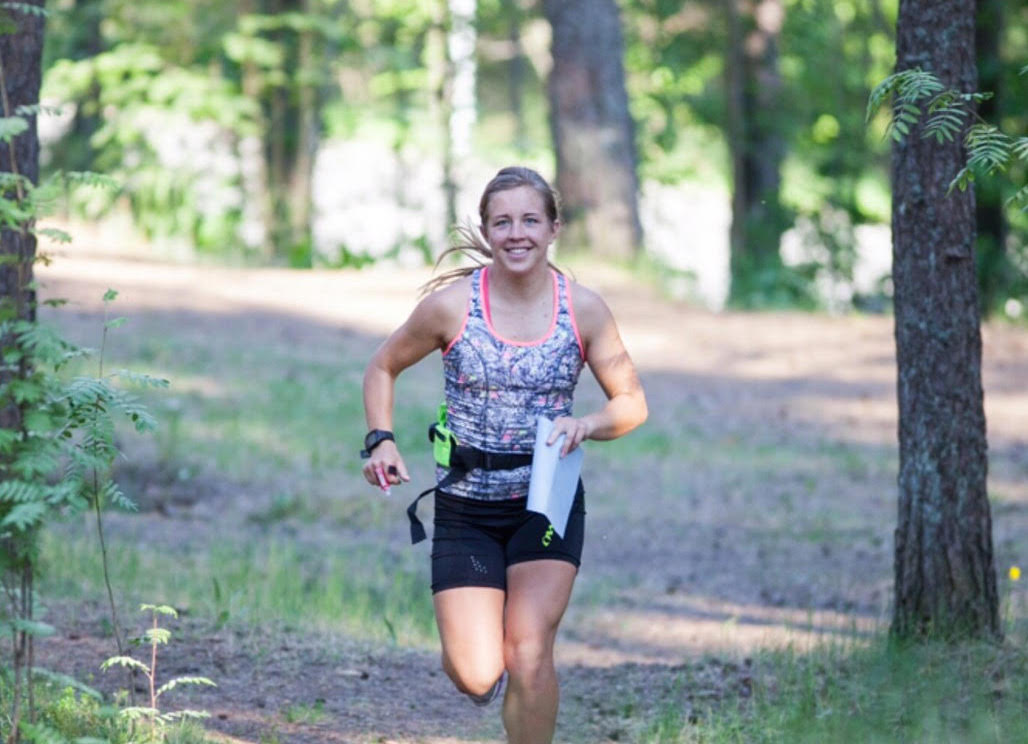
    Results: Men’s 20 k | Women’s 15 k

    Top 10 men (20 k classic mass start)

    1. Mads Strøm (CU) 49:41.9
    2. Moritz Madlener (DU) +1.7
    3. Niklas Persson (UU) +18.7
    4. Ian Torchia (NMU) +40.2
    5. Adam Martin (NMU) +57.8
    6. Eli Hoenig (Williams) +1:01.3
    7. Kevin Bolger (UU) +1:05.5
    8. Jack Hegman (UVM) +1:07.6
    9. Petter Reistad (CU) +1:35.4
    10. Dag Frode Trolleboe (DU) +1:42.3

    Top 10 women (15 k classic mass start)

    1. Linn Eriksen (DU) 54:37.6
    2. Kati Roivas (UNM) +19.9
    3. Ane Johnsen (CU) +21.2
    4. Veronika Mayerhofer (UU) +28.4
    5. Jesse Knori (CU) +36.2
    6. Aja Starkey (DU) +42.9
    7. Nichole Bathe (UAF) +44.5
    8. Emilie Cedervaern (UNM) +44.9
    9. Olivia Amber (Colby) +53.1
    10. Eva Severrus (UNM) +1:02.2

    Thursday, March 10 

    Men’s Freestyle First Team

    1. Mads Stroem, CU

    2. Ian Torchia, NMU

    3. Moritz Madlener, DU

    4. Adam Martin, NMU

    5. Sawyer Kesselheim, MSU

    Second Team

    6. Petter Reistad, CU

    7  Nick Hendrickson, UU

    8. Lars Hannah, DU

    9. Jake Brown, NMU

    10. Jack Hegman, UVM

    Women’s Freestyle First Team

    1. Anika Miller, MSU

    2. Petra Hyncicova, CU

    3. Sloan Storey, UU

    4. Cambria McDermott, MSU

    5. Emilie Cedervaern, UNM

    Second Team

    6. Natalia Müller, UU

    7. Taeler McCrerey, DU

    8. Linn Eriksen, DU

    9. Ane Johnsen, CU

    10. Mary Kate Cirelli, UVM


    Saturday, March 12

    Men’s Classical First Team

    1. Mads Strøm, CU

    2. Moritz Madlener, DU

    3. Niklas Persson, UU

    4. Ian Torchia, NMU

    5. Adam Martin, NMU

    Second Team

    6. Eli Hoenig, WIL

    7. Kevin Bolger, UU

    8. Jack Hegman, UVM

    9. Petter Reistad, CU

    10. Dag Frode Trolleboe, DU

    Women’s Classical First Team

    1. Linn Eriksen, DU

    2. Kati Roivas, UNM

    3. Ane Johnsen, CU

    4. Veronika Mayerhofer, UU

    5. Jesse Knori, CU

    Second Team

    6. Aja Starkey, DU

    7. Nichole Bathe, UAF

    8. Emilie Cedervaern, UNM

    9. Olivia Amber, COL

    10. Eva Severrus, UNM

  • Rorabaugh Strides to Sun Valley Sprint Win, Holds Off Craftsbury’s Miller and Patterson

    Rorabaugh Strides to Sun Valley Sprint Win, Holds Off Craftsbury’s Miller and Patterson

    Skiers power onto the course at the start of the final. (From L to R: Veronika Mayerhofer, Becca Rorabaugh, Chelsea Holmes, Caitlin Patterson, Kaitlynn Miller)
    Racers power onto the course at the start of the women’s SuperTour classic sprint final on Saturday in Sun Valley, Idaho. From left to right: Hannah Halvorsen, Veronika Mayerhofer, Becca Rorabaugh, Chelsea Holmes, Caitlin Patterson, and Kaitlynn Miller.

    SUN VALLEY, Idaho — The opening day of the second SuperTour on the season brought a welcome change from last weekend: warmer weather. After enduring start delays and colder temperatures in West Yellowstone, Mont., racers enjoyed relative warmth and sunshine while sprinting in an open field at the Trail Creek venue in Sun Valley.

    The 1.3-kilometer course set up for the classic sprint was ready to go thanks to the work of many coaches and volunteers throughout the week. Though the course started and finished in a flat stadium, it featured two climbs, a small one out of the start, and a larger one that reached the high point before dropping into the stadium. Both climbs represented an opportunity for the athletes to show off their striding ability.

    This was something that the women’s race winner, Becca Rorabaugh of Alaska Pacific University (APU), was able to take full advantage of.

    “I just love big striding and I knew that was going to be a sweet spot for me,” she said in a post-race interview. “I was really looking forward to that second hill.”

    After placing sixth in the qualifier, Rorabaugh skied to a win in her quarterfinal before being narrowly bested by Kaitlynn Miller of the Craftsbury Green Racing Project (CGRP) in their semifinal. However, Rorabaugh, 26, was able to carry more energy into the final, where she won in 3:38.46, almost exactly one second ahead of Miller and 1.3 seconds ahead of Caitlin Patterson, also of the CGRP.

    “I was slowly getting my motor going throughout the day and it turned out that I was able to last perfectly through the final,” Rorabaugh said. “It was just taking me a while to get going. I felt like I was really on it in time for the last heat, so it just worked out.”

    Caitlin Patterson tries to get the upper hand on CU's Christina Rolandsen and Petra Hyncicova in the quarterfinals (From L to R: Christina Rolandsen, Petra Hyncicova, Caitlin Patterson)
    Caitlin Patterson (in green) racing head-to-head with CU’s Christina Rolandsen (l) and Petra Hyncicova (center, in white) in their SuperTour classic-sprint quarterfinal in Sun Valley, Idaho.

    Miller, meanwhile, skied strong throughout the day, but was unable to stay with Rorabaugh in the final. The 24-year-old CGRP skier won the qualifier in 3:35.73 before dominating her quarterfinal, winning it by over six seconds.

    Her strategy of setting a fast pace from the start worked well in her semifinal, too, as she was able to edge Rorabaugh to the line. While Miller didn’t have quite enough energy in the final to stay ahead of the day’s winner, she had just enough to claim the second spot on the podium.

    “[It felt] really good. The conditions are great, our skis were working really well, and it’s just a beautiful day,” Miller said after the final.

    Miller’s teammate, Patterson was also pleased with how the day went, both for her and her teammates. It started with Craftsbury biathlete Clare Egan notching a career-best 16th in the IBU World Cup sprint in Östersund, Sweden, and Patterson said their team built upon that. She finished second in the qualifier and kept that speed throughout the rounds, winning her quarterfinal and semifinal before placing third in the final.

    The women's Sun Valley Super Tour 1.3 k classic sprint podium. (From L to R: Hannah Halvorsen, Chelsea Holmes, Caitlin Patterson, Becca Rorabaugh, Kaitlynn Miller, Veronika Mayerhofer)
    The women’s Sun Valley Super Tour 1.3 k classic sprint podium: (from l to r) Junior Hannah Halvorsen in sixth, Chelsea Holmes in fifth, Caitlin Patterson in third, Becca Rorabaugh in first, Kaitlynn Miller in second, and Veronika Mayerhofer in fourth.

    “We just went for it, especially Kait. I don’t know if you saw her quarterfinal and semifinal, she just took off with it!” Patterson explained. “I felt like I had to fight a little more, but I think all around, a good day for both of us.”

    Interestingly, none of the top three women in Saturday’s sprint placed in the top 10 in the skate sprint a week ago in West Yellowstone. Having another week to acclimate certainly helped the women from lower elevations, but the simple fact that this week’s sprint was classic made a big difference, too. Rorabaugh said she enjoys the striding while Miller feels classic skiing at altitude is just a bit easier than skating at some 5,750 feet above sea level.

    The trio hopes to build upon their success in the sprint during Sunday’s 10 k classic. For Rorabaugh, a 10 k might just be the perfect race for where she is at right now.

    “I’m looking forward to it because I feel like I have pretty good distance fitness. If it took me a whole day to get going today, odds are a 10 k could go alright,” she said.

    As for the second- and third-place finishers, they said they were both feeling confident heading into Sunday.

    “Watch out for us,” Patterson said of her team in Sun Valley. “All four, in green, watch out. We will be there.”

    In fourth, Veronika Mayerhofer of the University of Utah, who won her quarterfinal and placed third in the semi, finished 3.76 seconds after Rorabaugh and 2.46 seconds off the podium. Just 0.25 seconds back, Chelsea Holmes (APU) placed fifth in the final, 4 seconds after Rorabaugh. Last week in West Yellowstone, Holmes placed fourth in the skate sprint, and last weekend’s sprint runner-up 17-year-old Hannah Halvorsen (Sugar Bowl Academy) reached the final again and placed sixth (+19.19).

    ***

    Olivia Ekblad of Montana State University crests the second hill before dropping back into the stadium.
    Olivia Ekblad of Montana State University crests the second hill before dropping back into the stadium.

    In the junior women’s heats, meanwhile, a pair of Montana State University (MSU) skiers took first and second. Freshman Olivia Ekblad from Winthrop, Wash., won with sophomore Gretchen Burkholder from Steamboat Springs, Colo., following close behind in second. Rounding out the podium in the junior heats was Sun Valley’s own Annika Landis.

    These spots were good enough for ninth, 10th and 11th junior women overall, as eight others qualified for the open heats. Halvorsen led those top juniors, finishing sixth in the overall standings. Still, the duo from MSU feels the sprint was a great way to start off their season.

    “We have a really good group of girls at MSU to train with so its fun,” Ekblad explained. “Awesome coaches too. We’re definitely going to throw down this year, it’s going to be fun.”

    Results

  • Best of Both Worlds: MSU Measures VO2max and Upper Body at the Same Time (with Video)

    Best of Both Worlds: MSU Measures VO2max and Upper Body at the Same Time (with Video)

    https://www.youtube.com/watch?v=Vkpm-L8GFtY&feature=youtu.be

    With the recent release of VO2max data by the Norwegian Olympic and Paralympic Committee and Confederation of Sports, FasterSkier decided to explore similar research taking place in the U.S.

    ***

    BOZEMAN, Mont. — Liz Stephen. Kris Freeman. Wendy Wagner. Torin Koos. The list of nordic skiers goes on. The list, though daunting to many, is simply a part of the project for Dr. Dan Heil.

    Currently a professor and program leader of Health and Human Performance at Montana State University (MSU), Dr. Heil has been conducting research on VO2max for 25 years.

    “My first research project as a Masters graduate student in Exercise Physiology evaluated changes in VO2max. That project was in 1990,” Heil wrote in an email.

    Since then, Heil’s research spans from better hydration practices to energy expenditure predictions to determinants in race performance for junior and college skiers. Within the last five years, however, much of Heil’s research on nordic skiers has held a different perspective, one that’s 8-feet wide and 10-feet long. 

    Bridger Ski Foundation Akeo Maifeld Carucci,  during a V02max rollerski treadmill test at Montana State University's Movement Science/Human Performance Lab, this week in November.
    MSU professor and program leader of Health and Human Performance, Dr. Heil (r) controls treadmill speed and incline during a recent rollerski V02max test for BSF elite athlete Akeo Maifeld-Carucci.

    Given its dimensions alone, the new rollerski treadmill at the MSU Movement Science/Human Performance Lab (MSL) in Bozeman outmatches the lab’s previous VO2max research equipment.

    Beyond increased size, the new treadmill — which the department received in 2010 by as a gift from a university dean — also reaches speeds of up to 25 miles per hour and inclines that range from a -10 to a +40 percent grade. Only five other treadmills of similar caliber are known to exist in the U.S. today. However, the oversized treadmill is not the only piece of equipment that makes Heil’s research unique. 

    “We call it an upper-body power ergometer … [it] was designed about ten years ago with a former grad student of mine, [Bowdoin College Nordic head coach] Nathan Alsobrook,” Heil said during an interview inside MSU’s performance lab.

    Essentially a rowing-machine-gone-double-pole, the aim of the invention, according to Heil, is double-pole simulation.

    “The neat characteristic about this is that it integrates ski poles into the double-poling motion … Unless you have access to this lab and this ergometer, you don’t get upper-body power measures,” he explained.

    But why bother with upper body power measures? In a predominantly endurance-driven sport, like nordic skiing, shouldn’t the emphasis be on an athlete’s VO2max?

    “A high VO2max is never a disadvantage — Ever!” Heil wrote in the email. “With that said, however, there is only a relatively small window of improvement that each athlete can expect to gain with appropriate training. So the best strategy for training is to make sure that an athlete has optimal opportunity to realize their full V02max potential with training (which can take several years).”

    In other words, an athlete’s VO2max, has the potential to change, but only to the extent that physiology and genetics allow.

    Where does that leave cross-country skiers who want to continue to improve race performance past their peak VO2max?

    According to Heil, power generation.

    “What elite [nordic] athletes have been doing over the past decade or so, is a very intense focus on developing muscular strength and power to add on top of the decade or more of aerobic base they’ve already got,” Heil said.

    Unlike many endurance sports, cross-country skiing draws upon muscular strength, balance and coordination, as well as aerobic fitness.

    For example, though elite distance runners and nordic skiers are often categorized as similar endurance athletes, Heil’s observations provide a notable distinction.

    “One of the big differences between these two groups is that virtually all elite distance runners seem to have incredibly high VO2max values and tend to be similar in body size and shape,” he wrote. “Nordic skiers, in contrast, seem to be more varied in body size and shape and not have as consistently high VO2max values. Having a high VO2max is always going to be a benefit to an endurance athlete, but I think Nordic skiing has evolved to a point where advanced upper body strength and power are almost equally important to success.” 

    Heil’s current research with MSU graduate student and nordic skier, Lina Hultin of Örebro, Sweden, examines the relationship of race performance to rollerski treadmill VO2max  and upper body power from a Concept2 SkiErg versus the MSL ergometer.

    “Usually at least once, if not twice, and sometimes three times a year, we have the [MSU and Bridger Ski Foundation nordic] athletes come in and do a rollerskiing VO2max test that includes lactate threshold,” Heil said.

    Using the numbers from these tests, Heil and Hulton will later look at correlations between the athletes’ test results and SuperTour race performances.

    “Upper-body power is a good cumulative measure of the strength and power training, as well as the specific aerobic training, the rollerskiing, that the [athletes] have been doing, all in a very concise measure,” Heil said. “VO2max and the lactate threshold can be a little bit more in flux with how someone feels or if are they’re on the edge of getting sick. If [an athlete is] interested in being able to track their training progress, maybe all they need to be able to track is changes in upper-body power, not VO2max.”

    “I think Nordic skiing has evolved to a point where advanced upper body strength and power are almost equally important to success.” — Dr. Dan Heil, professor and program leader of Health and Human Performance at Montana State University

    In the interest of time, upper-body strength might be the way to go when tracking performance and training progress in the future. However, in the interest of science and skiing, V02max and threshold remain dear to the heart.

    “From a coaching standpoint, we use the threshold data more than the VO2max data when were planning training,” said MSU Nordic Head Coach Matt Johnson.“They can use their threshold data to tailor individual workouts when doing intervals.”

    Professor Heil (r) hands BSF elite athlete Nicholas Michaud a towel after Michaud finished his first V02max test on rollerskis.
    Dr. Heil (r) hands BSF elite athlete Nicholas Michaud a towel after  his rollerski V02max test in MSU’s Movement Science/Human Performance Lab.

    BSF elite athlete Jennie Bender also pointed out that the rollerski treadmill “is a great way to work on technique and really pay attention to your body mechanics because it’s such a controlled environment,” she said. “It’s kind of like skiing in the dark or running in the dark. You’re more focused on what your body is doing and you don’t have to watch out for any obstructions.”

    Yes, thankfully — for the athletes at least — Heil has not developed virtual potholes for his tests … yet.

    What Heil has launched is the continual promise of questions and thought about nordic athletes and sport.

  • Wednesday Workout: Uphill Double-Pole, Specific Strength with MSU (with Video)

    Wednesday Workout: Uphill Double-Pole, Specific Strength with MSU (with Video)


    Montana State University (MSU) Nordic Head Coach Matt Johnson before an uphill double-pole strength session in late October at Triple Tree Ranch in Bozeman, Mont.
    Montana State University (MSU) Nordic Head Coach Matt Johnson before an uphill double-pole strength session in late October at Triple Tree Ranch in Bozeman, Mont.

    For this week’s workout, FS tagged along during an uphill double-pole session with the Montana State University nordic team on Oct. 27. Reporter Gabby Naranja did a few sets on bike, which she found equally fun and thrilling.

    ***

    BOZEMAN, Mont. — The one workout no skier should sacrifice? Specific strength. At least, according to Matthew Johnson, head coach of the Montana State University (MSU) nordic team.

    “We try to do a specific arm strength workout once a week,” said Johnson, who joined the MSU Bobcats in June after the resignation of former head coach Kristina Trygstad-Saari.

    The importance of a double pole, specific-strength workout, Johnson explained, goes beyond just grinding your arms to a pulp in order to climb up a hill. These workouts are about “figuring out how to use the technique and the strength that you’re finding in the gym and applying it to your poling motions out here in varying types of terrain,” he said during an MSU training session last week.

    Of course, that in no way negates the noodle-arm effect brought on by most double pole, strength-specific workouts.

    “Sometimes it is about getting a consistent steep grade and working it, making your arms tired and then just being able to hold it [while] keeping your technique together and keeping your core strength together,” he said.

    As a cross-country skier, arm strength is just part of the game.

    “Rollerskis are great imitations of skis, but they’re not perfect,” Johnson said. “[Therefore] a lot of our classic skiing is going to be arm specific, strength specific, because that’s a really important thing with actual skiing.”

    For MSU skiers at least, the arms do not go neglected.

    “We want to develop a team that trains together and races together,” Johnson said. “We also want to see an upward result trend for every athlete right through [U.S. SuperTour] Spring Series [in March]. Since our college season doesn’t start until the 10th of January or so, we’re really pushing the fitness aspect of this all the way through November into December.”

    According to Johnson, it’s workouts like this that will lead to better ski performances, particularly with the college race schedule in mind.

    “It’s really easy to waste time rollerskiing,” he said. “[When] you do a double pole or a ski session you’re doing the same motion thousands of times. Every single time you practice that motion you’re either making yourself better at it or you’re ingraining bad habits. Like they say in music, practice makes permanent, so we try to practice good permanence.”

    Especially for a college athlete with limited time to ski, “practicing good permanence” is important.

    MSU assistant coach Anja Gruber (l) with MSU skier Maria Gesior during an uphill double-pole workout.
    MSU assistant coach Anja Gruber (l) with MSU skier Maria Gesior during an uphill double-pole workout.

    “College skiing is so incredibly hard sometimes because there’s a huge time constraint with school and social life,” explained Anja Gruber, former University of Vermont (UVM) college ski racer, two-time NCAA champion, UVM business-school valedictorian, and current assistant coach for the MSU nordic team. “I don’t think anybody could get through college racing on their own. It’s really important to be part of a team with good energy.”

    And despite a recent high turnover of coaches, the MSU nordic team maintains an upbeat outlook.  Super-senior Sawyer Kesselheim of Bozeman, Mont., indicated that he would like to see MSU men’s nordic “consistently have three guys place in the top ten at races.”  When asked about Johnson, Kesselheim spoke favorably of the new coach.

    “I really like Matt,” he said. “He’s super focused, organized, and professional. He has good workout plans and keeps the workouts exciting.”

    This enthusiasm extends into MSU’s newer team members as well. “It’s been great having Matt coach us,” said freshman Sarah McCandless from Jackson Hole, Wyo. “He’s got great positive energy.”

    Whether or not Johnson’s athletes actually have fun during these workouts, the benefits are undeniable.

    “We’re dealing with a group of athletes who are here to work hard,” Johnson said. “It’s a big responsibility being on a team at a school like this and as they expect a lot of us, we expect a lot of them. There are a lot of moving parts, so you have to be creative, flexible, and on top of things, motivated.”

    The Workout

    Warmup: 25-30 minutes easy Level 1 skiing double pole and double-pole kick

    The Set: 2-4 times double pole up a 3 k hill. Johnson suggests “finding something with some rest so you can recover and feel the difference between the different [transitions].”

    Purpose: To figure out how to apply gym strength to double pole motions in varying types of terrain

    Goal: Rather than speed, focus on maintaining correct double pole body position throughout the hill while in a fatigued state

    Cool Down: 25-30 minutes easy Level 1 skiing

  • New Craftsbury Biathlon Coach

    Craftsbury

    (Press Release)

    This November marks a year since Miro Segrt came to the Craftsbury Outdoor Center from Serbia to serve as our Biathlon coach. In early November, Miro will be leaving Craftsbury to move on to his next adventure.

    Miro farewellMiro brought seven years of biathlon coaching in Serbia to Craftsbury. His extensive competitive shooting experience brought a shooter’s perspective to the program, helping juniors in learning proper position, breathing, focus– and always emphasizing safety. He also improved the organization and care of our biathlon equipment. We thank Miro for his many contributions to our program and we wish him well in what he takes on next!

    Sam-Dougherty-AnnouncementAs we lose Miro, we will be gaining Sam Dougherty as our new biathlon coach. Sam began his skiing and biathlon career in Alaska, attended Montana State University, and most recently held the position of Coaching Intern with the US National Biathlon Team in Lake Placid. Sam competed as a member of the US Junior Biathlon team, and raced with the Division I Nordic team at MSU. He has experience coaching biathlon at all levels, from youth to Masters, and from beginners to the National team. FasterSkier recently did a story on Sam’s intern experience (article here).

    We look forward to welcoming Sam to Craftsbury in early November!

  • Johnson Takes Over as Head Coach at MSU after Trygstad-Saari Resigns

    Johnson Takes Over as Head Coach at MSU after Trygstad-Saari Resigns

    Matthew Perry Johnson was hired as the new head coach for the Montana State University Ski Team. He will begin his position in August. (Photo: Montana State University)
    Matthew Perry Johnson was hired as the new head coach for the Montana State University Ski Team. He will begin his position in August. (Photo: Evan Hagen)

    It has been a tumultuous two years for the coaching staff of the Montana State University cross country ski team. The past two springs have seen complete shifts in staffing — long-time head coach Grethe-Lise Hagensen’s contract was not renewed in 2014 and her replacement, Kristina Trygstad-Saari, resigned from her position at the team’s helm earlier this year. The Bozeman, Mont. university recently announced that former Middlebury College racer and Alaska Winter Stars coach Matthew Perry Johnson will be the newest head coach for the Bobcats starting in August.

    In Trygstad-Saari’s first year as a coach the MSU Ski Team finished seventh at the 2015 NCAA Championships in Lake Placid, and the nordic team garnered two All-Ammerican honors. Despite the success, Trygstad-Saari decided to leave the position to explore paths unrelated to skiing. The 30-year-old has been in the ski community as a racer and coach since a her days as a junior with the Bridger Ski Foundation, and explained that she needed a change. “I’ve spent a lot of years moving around in the ski world, both racing and coaching, and I haven’t always been 100 percent sure that it’s where I should be,” Trygstad-Saari wrote in an email, adding that the decision to leave was incredibly difficult.

    Trygstad-Saari said her experience with the MSU team was highly positive, and that a highlight of the season was in Lake Placid where skiers Cambria McDermott and Forrest Mahlen notched fourth and fifth place finishes, respectively. The lone year as head coach didn’t come without challenges, however, as Trygstad-Saari worked to balance athlete’s training and travel, in addition to the coaching transition.

    Cambria McDermott, fourth place and top American finisher in the 2015 NCAA Championship 5 k, high fives Montana State University Head Coach Kristina Trygstad-Saari.
    Cambria McDermott, fourth place and top American finisher in the 2015 NCAA Championship 5 k, high fives Montana State University Head Coach Kristina Trygstad-Saari.

    “The year was challenging, and I had a lot to balance and learn,” she wrote. “Some of our athletes got pretty tired later in the season, and I think I could have done some things differently with training and travel planning. However, I was generally satisfied and think the team responded well to the changes.”

    With her departure from the team, the single-season coach is ready for what the future holds. Trygstad-Saari is currently in Vermont finishing up her master’s degree at the Middlebury College Breadloaf School of English. “Hopefully I can explore some options that will put [the degree] to use!,” she wrote. “As of now, the future is wide open, and I look forward to some new adventures.”

    A large pool of candidates applied to replace Trygstad-Saari, but in the end it was Johnson who got the job. The new head coach grew up skiing with Alaska Winter Stars in Anchorage and raced for Middlebury College in the years following. After graduating he began assistant coaching at Burke Mountain Academy. He left three years later to become the program/director and head coach of the Utah Nordic Alliance, and in 2014 he returned to his roots and coached with Alaska Winter Stars.

    MSU Athletic Director Peter Fields said in a press release that he was pleased with Johnson’s hire. “Matt possesses a strong background in program and student-athlete development,” Fields said. “He has also worked on both coasts as well as the Rocky Mountain region, and is well respected. Matt sees the big picture and is very motivated to continue the level of excellence the Bobcat ski program has established.”

    Johnson applied for the open position at MSU because of the potential he saw in the program. While it was difficult for the Alaska native to leave his current athletes, he said the high-level juniors he has coached over the years inspired him to make the progression to collegiate coaching.

    “Bozeman is such a great environment for ski training year round and the potential I see in the MSU Nordic Program is massive, so in that sense applying for this position specifically was an obvious choice,” Johnson wrote in an email. “The more difficult aspect of the decision was deciding whether to move on from coaching juniors, which I’ve made the focus of my career so far… The way those kids motivate me to work as hard as I can for them definitely pushed me towards pursuing the position with MSU to work with an entire team at that level.”

    In the coming year, Johnson hopes inspire the team and its individuals to greater success. As for the future, however, he has big hopes for his team including an NCAA title. “I would like to help establish this team as a place where athletes who are serious about their skiing as well as academics know they will have every opportunity to improve and grow,” Johnson wrote. “I think this team can win NCAA titles and produce athletes who are ready for World Cup competition after graduation.”

    To get there, Johnson will have to overcome the challenges associated with being a new coach on a well-established team, especially given the fact he will be the third head coach in two years for many of the older athletes. “Any time there is coaching turnover there are challenges to overcome,” he wrote. “It’s a situation I’ve dealt with from an athlete’s and coach’s perspective so I know that as long as everyone feels comfortable communicating openly, there’s nothing we can’t overcome with relative ease.”

    Although Trygstad-Saari is leaving, she is excited to see what Johnson will do with her former team. “He’s had a wide-range of coaching experience and has the passion and motivation to help drive the program,” she wrote. “He also has the skills to excel in the position beyond the ski trails; he will be a tremendous asset to the Bozeman nordic community. I think the team is in a great place, but I’m confident that Matt will bring even more to MSU and continue this trajectory.”

    Johnson will start at MSU in August and said that he has yet to come to a final decision regarding an assistant coach.