From the FasterSkier archive — posts syndicated from athletes’ and coaches’ own blogs between 2004 and 2012, kept online as published. Current coverage is at fasterskier.com.
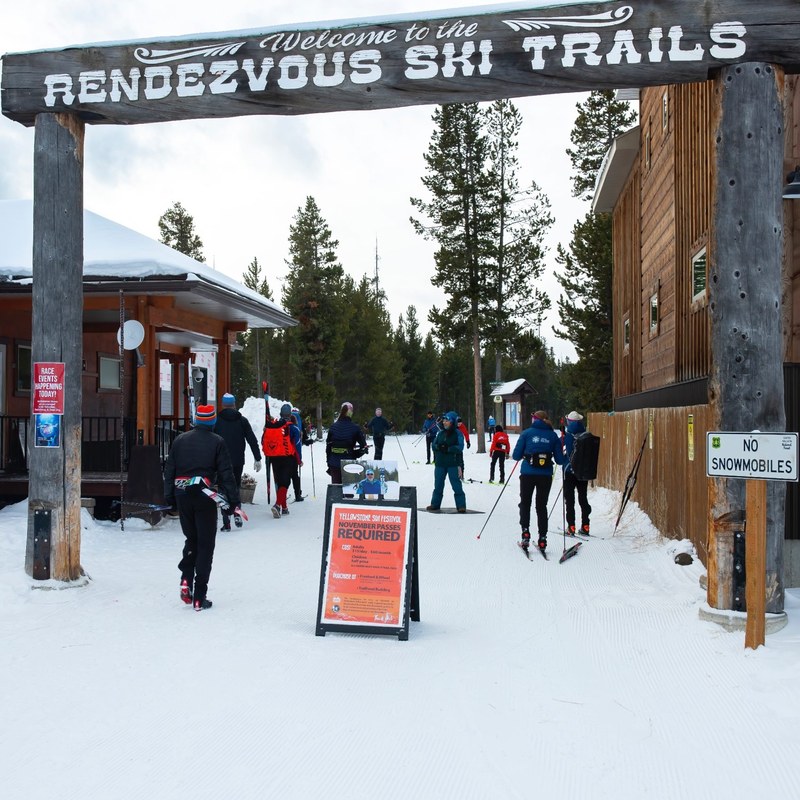
Skiers head under the arch at the Rendezvous Ski Trails, where a November pass is required for festival week. (Courtesy photo)
Hello, XC skiers!
Excitement is building in West Yellowstone after our first snow. It won’t be long before we’re back out on the trails, enjoying the fresh air, great skiing and the start of another season. Now is the time to make your plans for the 2026 Yellowstone Ski Festival, Nov. 21 through 28 on the Rendezvous Ski Trails.
Our trail crew has been working hard to get the trails ready, and we look forward to welcoming everyone back to regular grooming and miles of outstanding skiing. From first tracks in the morning to an easy ski with friends in the afternoon, there’s nothing better than getting out on the snow and enjoying everything West Yellowstone has to offer.
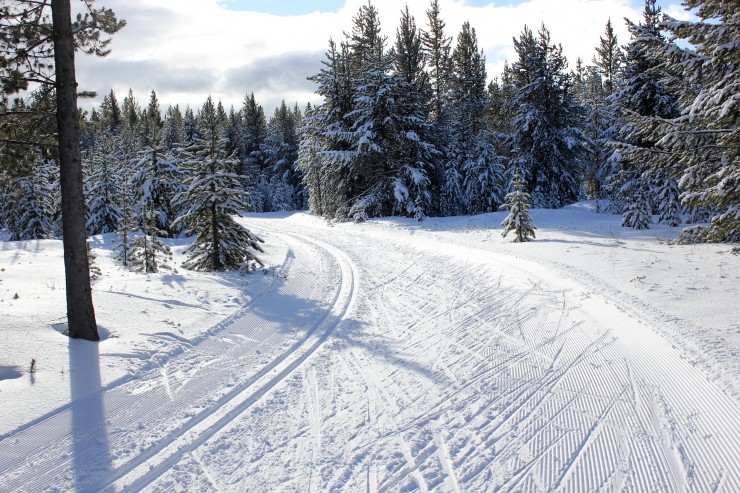
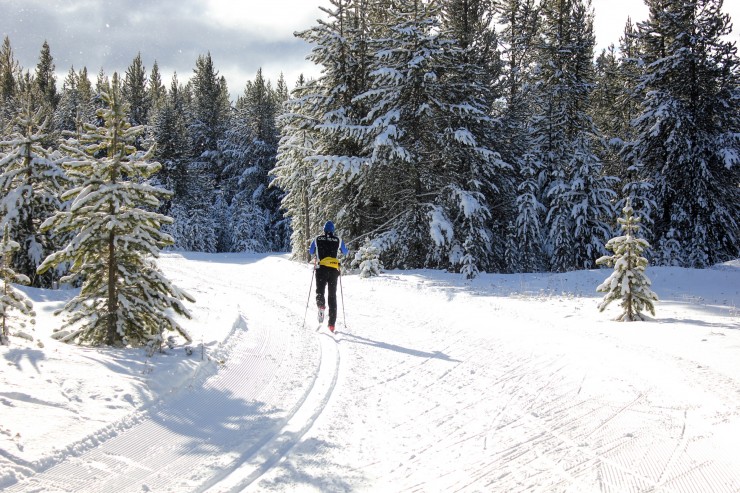
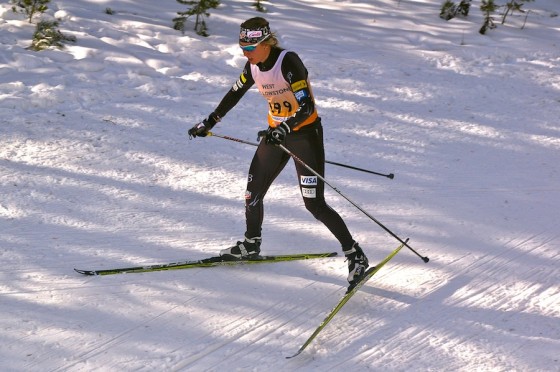
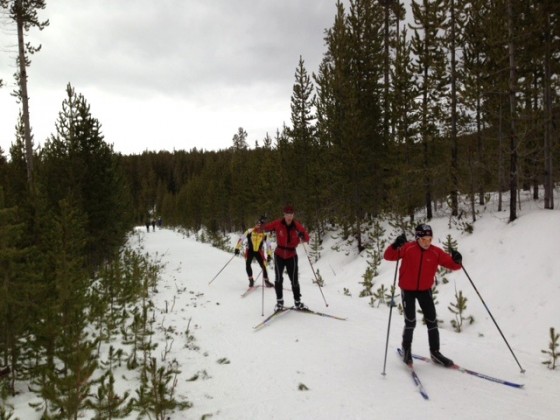
A skier strides through fresh classic tracks on the Rendezvous Ski Trails during the 2014 festival. (Photo: Lander Karath)
Eight Days on Early Snow
Thanksgiving week in West Yellowstone has belonged to skiers for a long time. Competitive athletes, first-timers and whole families come from all over to get on snow while most of the country is still waiting for winter. There is skiing every day of the festival, clinics for every level, biathlon on the range and a race to close out the week.
The tradition reaches back to 1979, when the U.S. Ski Team began bringing coaches to West Yellowstone each November to train them. FasterSkier told that story last fall in a look inside the festival and its clinics, and it is worth a read before you come.
A November trail pass is required for all of November and during the festival, and it is good through Nov. 30. From Dec. 1 through March 31, season and day passes are sold by the U.S. Forest Service at the Hebgen Lake Ranger Station, at Freeheel and Wheel, and at the Rendezvous Trailhead.
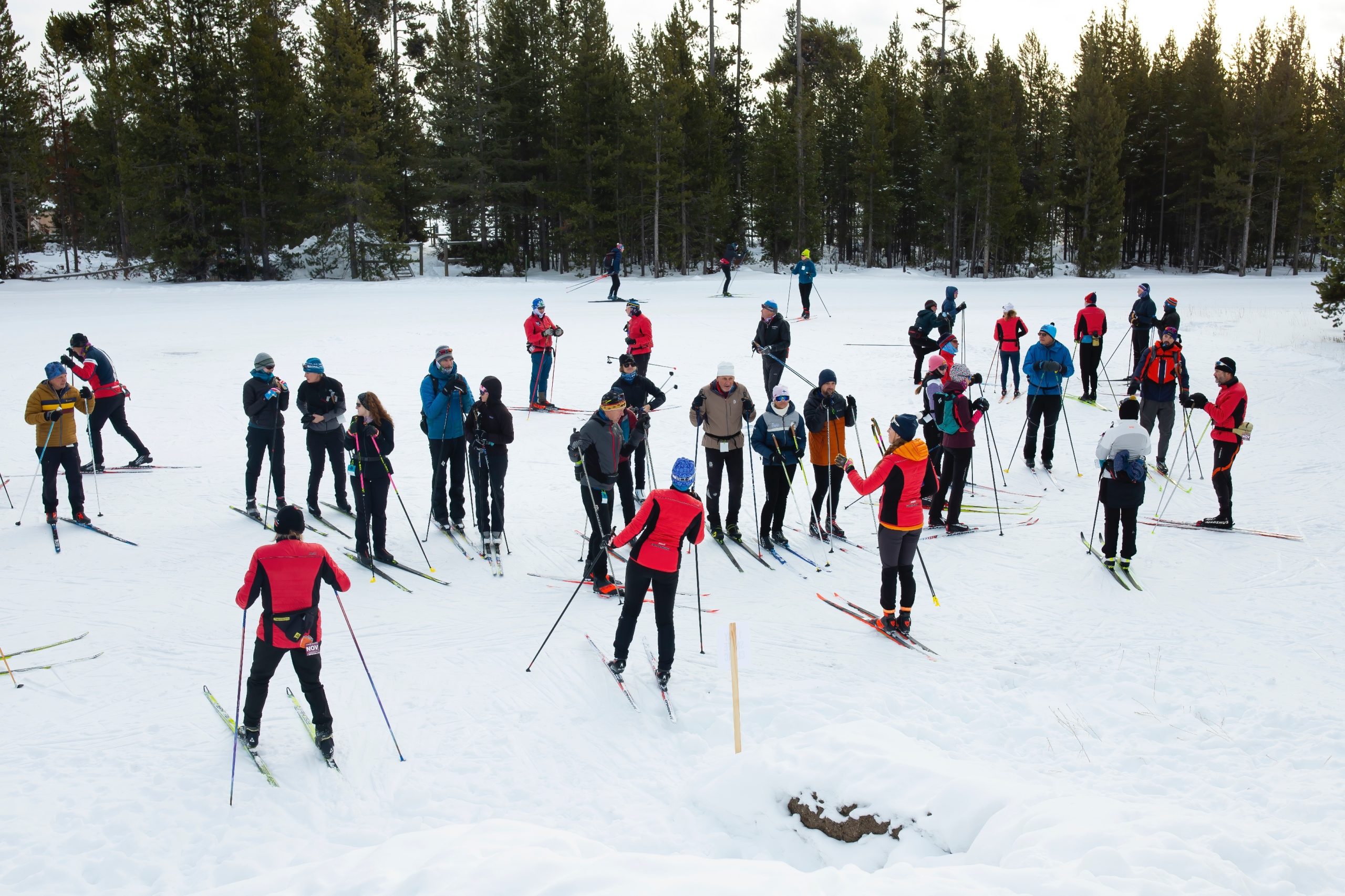
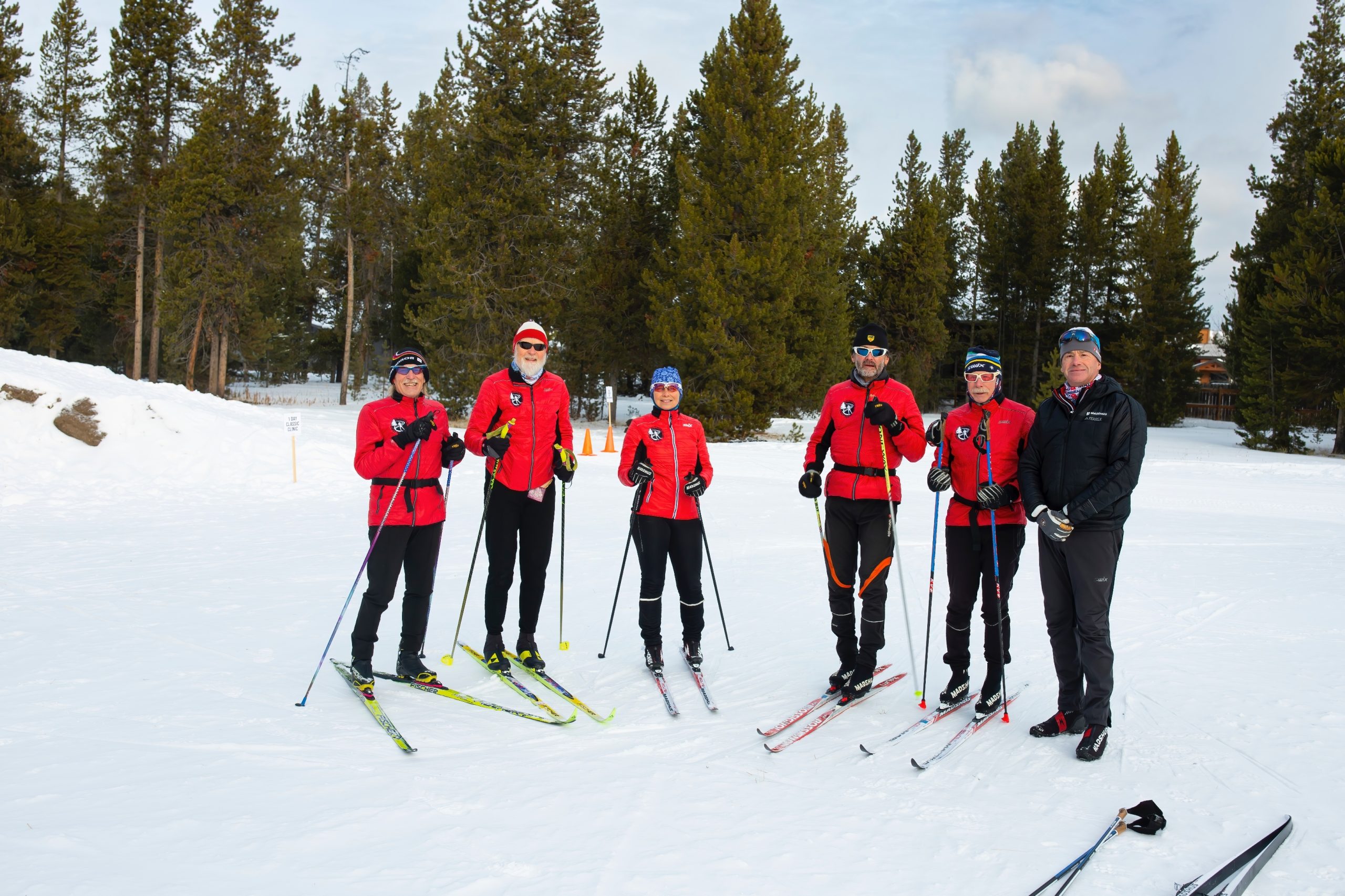
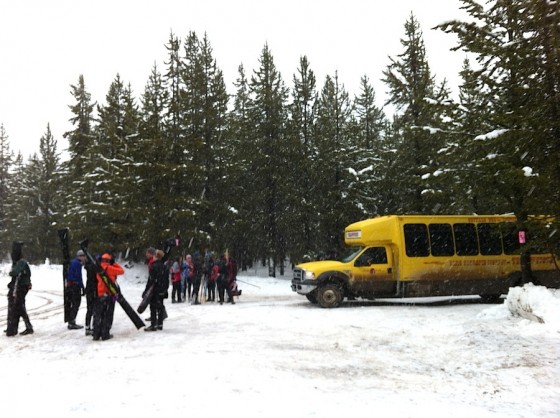
Clinic skiers sort into ability groups with coaches in red jackets at the Rendezvous Ski Trails. (Courtesy photo)
Clinics With Top Coaches
Looking to improve your skiing this season? Our clinics feature top coaches who can help you build skills, clean up your technique and get even more enjoyment out of your time on skis.
Jack Hart will be leading this year’s coaching staff. We place every skier in a group of similar ability, six to eight skiers per coach, and the coaches rotate through the groups each half day so you hear more than one voice over the week. Advanced groups also work on speed, endurance, strength, agility and race tactics.
The three-day Skate and Classic XC Fundamentals for Performance and the two-day Skate and Classic Tune Up both begin Tuesday, Nov. 24, with classic in the morning and skate in the afternoon. One-day technique clinics follow later in the week: skate on Thursday, Nov. 26 or Saturday, Nov. 28, and classic on Friday, Nov. 27.
Don’t wait to sign up. Any clinic with fewer than six skiers registered by Nov. 19 will be canceled. Find clinic details here and register here.
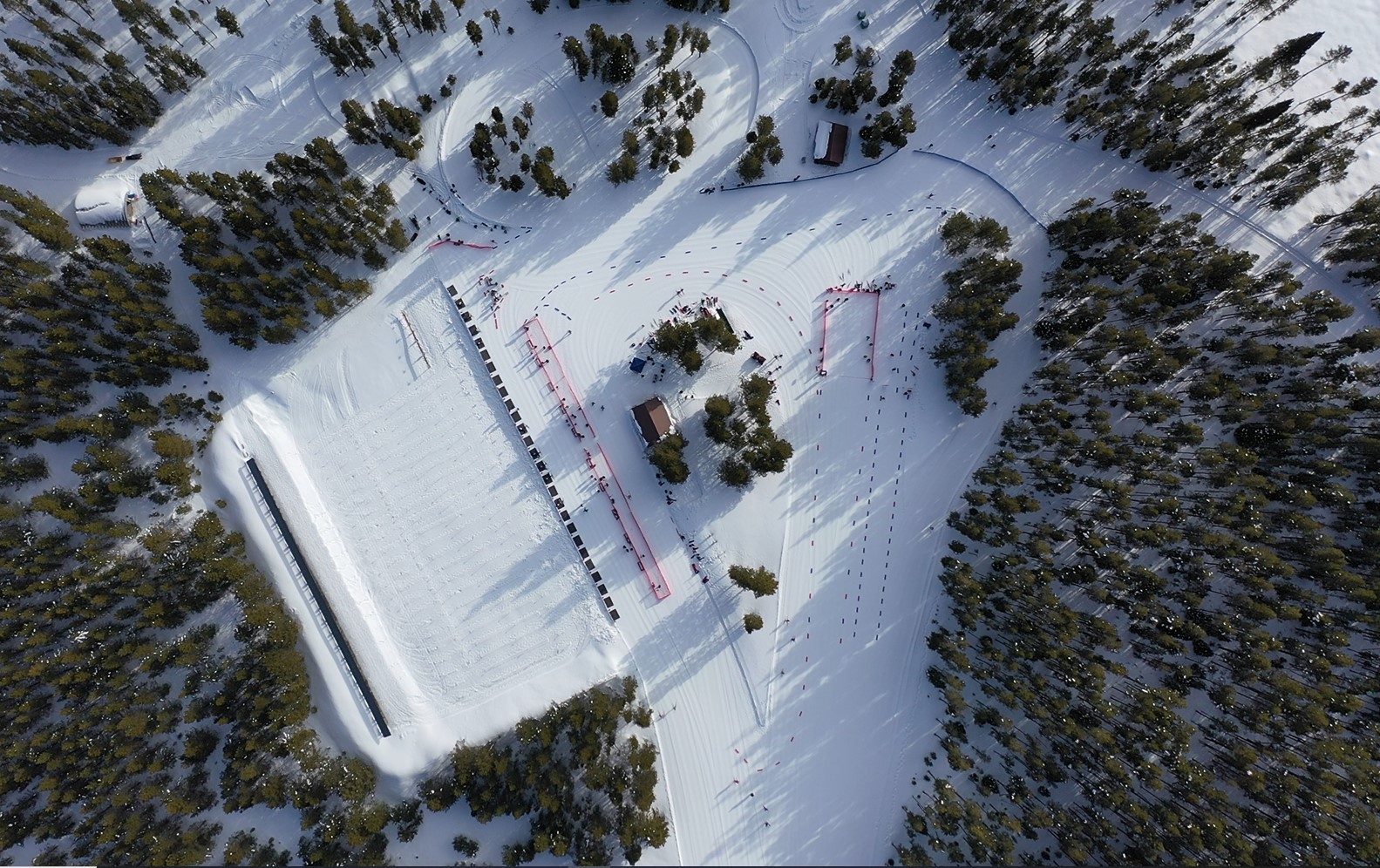
The stadium and biathlon range at the Rendezvous Ski Trails, seen from above. (Photo: WYSEF)
Biathlon, a Race and Après-Ski
Biathlon newcomers get a proper start. A Try-It clinic on Tuesday runs two sessions of up to 50 skiers each, and anyone planning to race the novice biathlon for the first time needs to attend it. The biathlon sprint and novice races follow on Wednesday, Nov. 25, at the stadium and range.
Friday afternoon brings après-ski at the Rendezvous Trailhead. On Saturday, Nov. 28, the week wraps up with a fun 5 km and 10 km freestyle mass start, open to all ages and abilities and capped at 200 skiers. Watch for race registration to open in the coming weeks.
Wax clinics, a mindful movement class and an evening speaker round out the week. Everything depends on snow: low snow means modified courses, and no snow means races and clinics are canceled, with clinic fees refunded less a small administrative fee. The full festival schedule is online and will be updated as November gets closer.
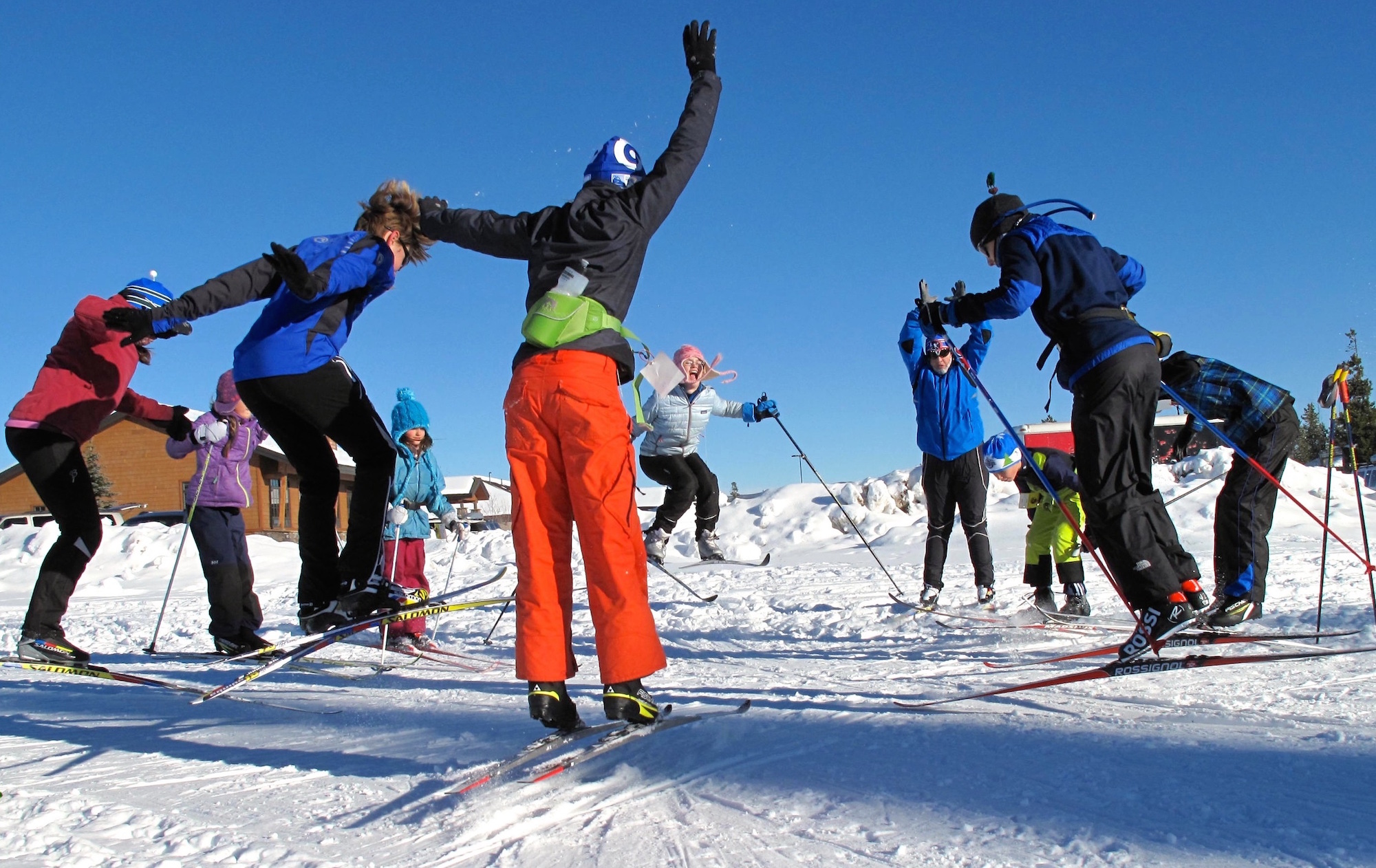
Young skiers warm up together in the sun at the Rendezvous Ski Trails. (Photo: WYSEF)
Places to Stay and Visit
When booking your stay, please consider our festival sponsors. They support our ski community, and we appreciate your support of their businesses.
While you’re in town, stop by Freeheel and Wheel for the latest ski gear, great coffee and a chance to catch up with fellow skiers before heading out on the trails.
If the snow is slow to arrive, there are still great ways to get outside: roller ski or bike the road into Yellowstone National Park, or head out on the nine miles of paved Shortline Trail. Destination Yellowstone has more on what to do around town.
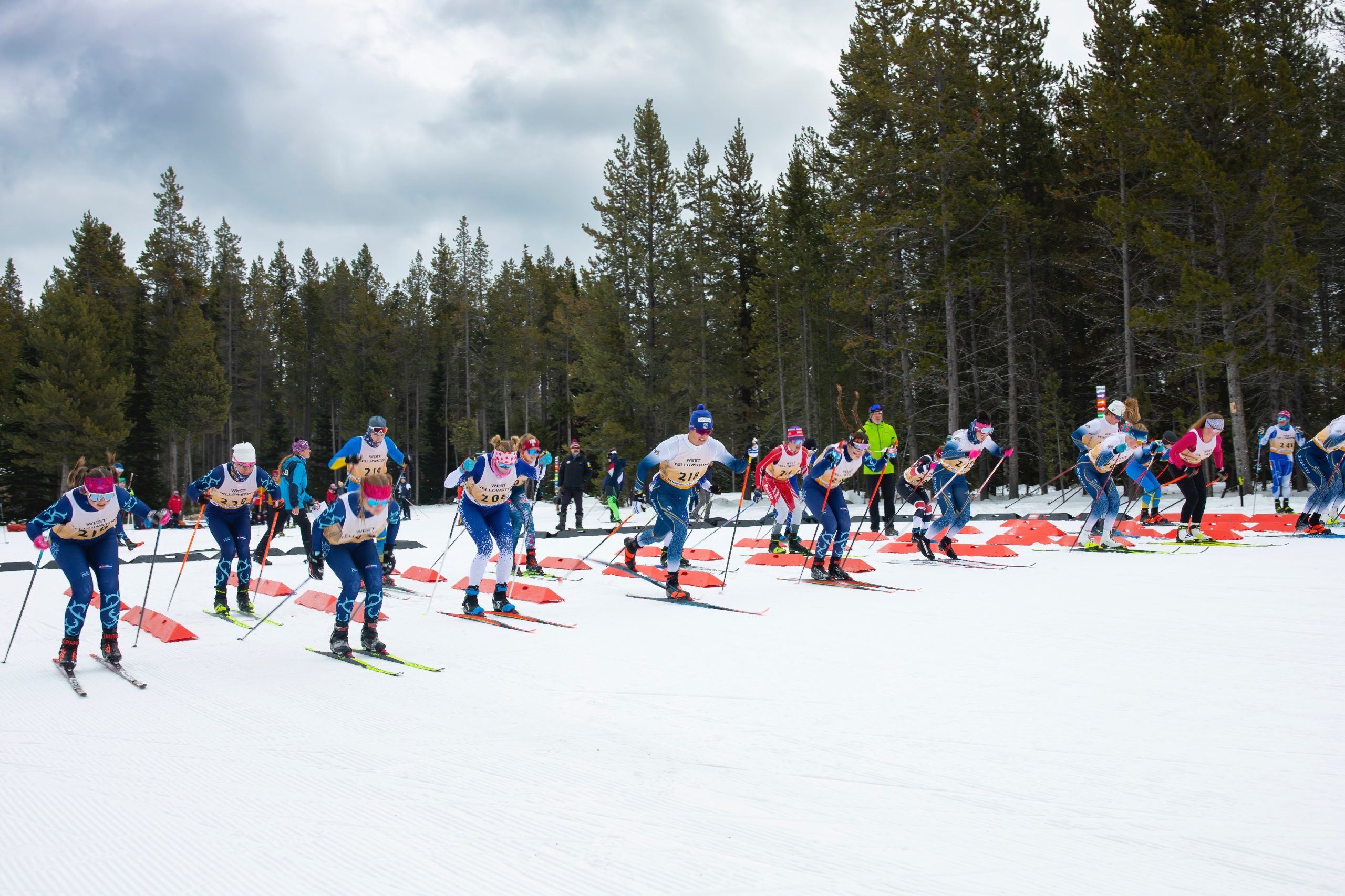
Racers push off the start in the stadium at the Rendezvous Ski Trails. (Courtesy photo)
Back in March for the Rendezvous
The season in West Yellowstone ends the way it starts, with a crowd on the trails. The Yellowstone Rendezvous Race, part of the American Ski Marathon Series, brings more than 600 skiers to town and is set for Saturday, March 6, 2027. Registration opens in November.
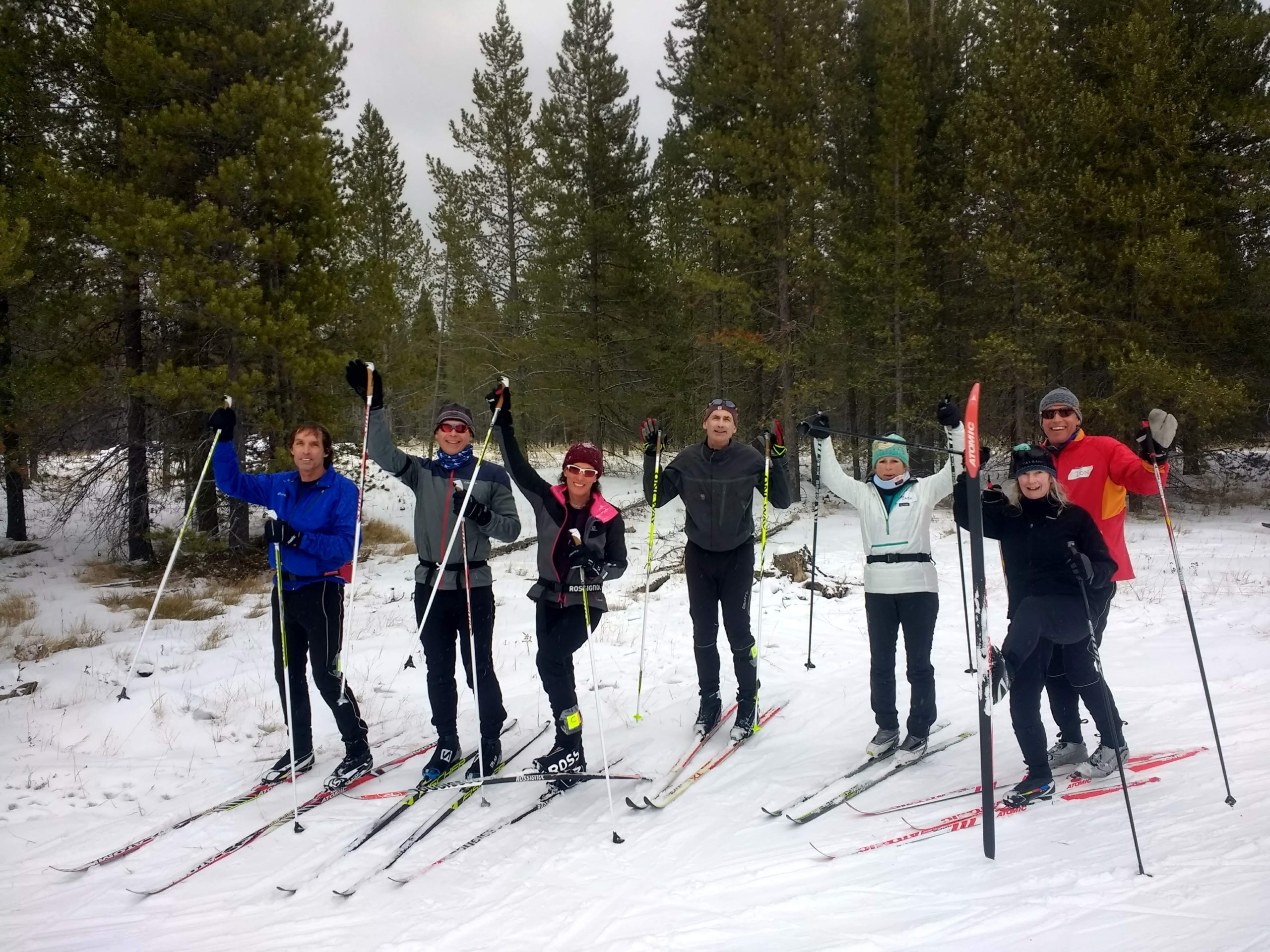
Festival skiers raise their poles on the Rendezvous Ski Trails during Thanksgiving week in 2018. (Courtesy photo)
See You on the Trails
The Yellowstone Ski Festival is a great way to kick off winter, catch up with old friends, meet new ones and get some real Nordic skiing in before December. Whether you’re joining a clinic, taking first tracks on fresh corduroy or just heading out for a relaxing ski, we can’t wait to see you. Start planning your trip, book your room and get ready for another great season in West Yellowstone.
For the latest festival information, visit skirunbikemt.com. Follow @RendezvousSkiTrails on Facebook and @Rendezvousskitrails1 on Instagram for updates and trail news.
Think snow, get excited, and we’ll see you in November!
The Yellowstone Ski Festival Committee
Clinic coaches line up on skis at the Rendezvous Ski Trails. (Courtesy photo)
When the first real snow falls in West Yellowstone, everything changes. The sound of car tires gives way to the swish of skis; coffee shops fill with cold hands and red cheeks; and this small Montana town of 1,100 becomes the epicenter of cross-country skiing in North America.
A Small Town With a Big Nordic Heart
Each Thanksgiving week, thousands of skiers descend on West Yellowstone for the Yellowstone Fall Ski Festival—an event that blends early-season training, clinics, races, and old-fashioned camaraderie. The teaching arm of the festival, officially called the Yellowstone Fall Ski Clinic, has become legendary in its own right.
“The festival has always been about community,” says Jack Hart, who is the co-director with Todd Eastman, and has been part of the event for more than three decades. “We’re a small town, but for this week, we become the center of the Nordic world. It’s a celebration of skiing in its purest form.”
Bridger Ski Foundation out for a first ski in West Yellowstone back in 2015. (Photo: Courtesy Bernie Nelson)
From Coaching Coaches to Coaching Everyone
The roots of the festival trace back to 1979, when the U.S. Ski Team established a coaching development program in West Yellowstone. Hart remembers it well.
“Before it became an official, commercial event,” he explains, “the U.S. Ski Team brought in coaches. They said, ‘We have a coaching program. We want to develop people like yourself who want to take their level higher. Come to West Yellowstone in November and we’ll train you to be a U.S. Ski Team coach.’ That’s really how this whole event started.”
As more coaches came west, the program began to evolve. “Torbjorn Karlsen, Drew Barney, and Dick Hunt—those are the three names that co-founded the event,” Hart says. “They realized we could turn this into something commercial and teach more people how to ski. We’ve got early snow, we’ve got the trails—why not invite everyone?”
By the early 1990s, that idea had taken hold. The first snow of the season, combined with West Yellowstone’s unique geography, made it a magnet for teams and individuals alike. “At its peak about twelve years ago,” Hart says, “we had over 5,000 day passes sold during the week. That’s how many people were here. These days we’ll sell 2,500 to 3,000 if we get a lot of snow—but it’s still the biggest kickoff to winter anywhere.”
Building Better Skiers — and a Stronger Community
The Yellowstone Fall Ski Clinic runs alongside the festival under the same umbrella. It offers structured instruction for everyone from teenagers to masters racers, with one-, two-, three-, and five-day options beginning the Tuesday before Thanksgiving.
“We take kids down to high school age,” Hart says. “We’ll have around one hundred people in actual instruction this year, and then another couple thousand here training with their own coaches—high-school programs, club teams, that sort of thing.”
The diversity of ability levels is part of the event’s charm. “We have literally people who have not been on skis before,” Hart says, “and we also have the five-day, full-time training type of skier. The idea is to enhance, improve, and enjoy skiing in this environment—with this community.”
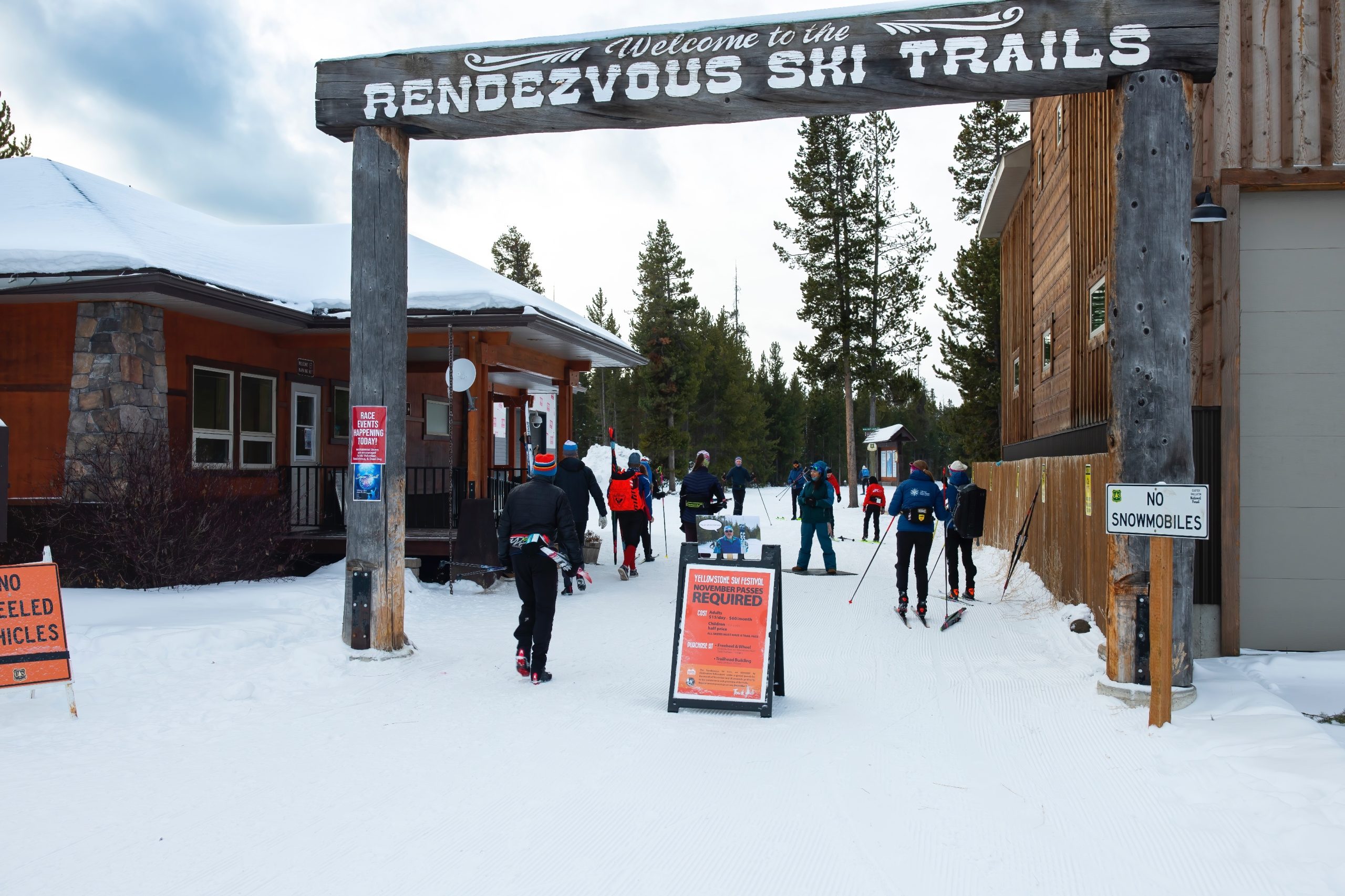
The entrance to the Rendezvous Trail System in West Yellowstone, Montana. (Photo: Courtesey Photo)
Each clinic begins with a quick on-snow evaluation. “We ask for a self-assessment on the registration form, but that can be different from where people really are,” Hart laughs. “The first fifteen or twenty minutes on snow, we do an evaluation and adjust the groups right there. We want everyone with others of similar ability so they can maximize their time and get more enjoyment out of it.”
The formula works. The Rendezvous Trail System becomes a living classroom—groups working on technique, coaches calling out cues, laughter echoing through the lodgepole pines. “The idea,” Hart says simply, “is to enjoy, to improve, and to learn—and obviously have a bunch of fun while you’re doing it.”
Philosophy in Motion: Teaching, Balance, and Joy
Behind the logistics of the clinic—the sign-ups, scheduling, and staffing—stands Eastman, whose background in both coaching and teaching shapes how the clinics operate.
“My contention,” he says, “is that all the coaches needed to do more ski teaching, and all the teachers needed to learn about coaching. The sweet spot is the combination of the two.”
That balance defines the Yellowstone approach. Eastman and Hart have assembled a team of approximately a dozen instructors who rotate throughout the week, exposing participants to a range of learning styles. “We’re not following PSIA or USSA scripts,” Eastman explains. “Most of our instructors have been skiing forever and teaching for years. It’s a mix of styles and personalities.”
The offerings reflect this flexibility: a five-day skate and classic clinic, a three-day version, two-day tune-ups, and popular one-day technique intensives for both skate and classic skiing. “The one-day stuff fills up really well,” Eastman says. “It’s at the end of the week—Thursday through Saturday—so people already in town can still jump in.”
Last year’s clinics drew 82 participants, supported by a staff of 12 instructors, a healthy ratio that ensures personalized attention. “Our ideal number is around a hundred,” Eastman notes. “We want everyone to leave feeling like they were seen and supported.”
Just as important as the structure, however, is the tone. “This isn’t about grinding or chasing a podium,” Eastman says. “We’re careful not to overwhelm people, especially early in the season. A lot of folks haven’t been on the snow yet. We want to be delicate with feedback, help them rediscover how it feels to glide again.”
That sentiment pervades the entire week. “Everybody at some point has a sensation—they go, ‘What was that? That felt good. I want more of that,” he says. “You may not find it for years, but it’s that moment that keeps you coming back.”
Eastman laughs at the sport’s reputation for being physically demanding. “Cross-country skiing gets this bad rap: ‘Oh, it’s the hardest cardiovascular sport in the world.’ Yeah, gee, that’s exactly what I want to sign up for on my vacation! We want people to see the joy in it—the beauty, the community, the stress relief, the meditation in motion. It’s the best way to deal with winter.”
The sense of inclusivity is central. “We have everyone from high schoolers to eighty-year-olds,” he says. “And if someone needs more challenge or less, we just move them. Our job is to make sure every skier finds their place.”
For Eastman, success is simple. “When a hundred people swear they’re going to tell all their friends how much fun they had—that’s when we know we did it right.”
Free Heel and Wheel: The Beating Heart of the Festival
For many participants, the festival’s unofficial headquarters is Free Heel and Wheel, the beloved ski and bike shop owned by Jack’s wife, Kelly Hart, and Melissa Alder.
“Every kid hangs out there,” Hart says. “They have hot chocolate, buy a new ski hat, talk skiing—it’s where everything happens. That little store is kind of the center of communication because people have been going there for thirty years.”
Part café, part gear shop, and part social hub, Free Heel and Wheel embodies the spirit of West Yellowstone. During festival week, it hosts evening events, wax clinics, and impromptu meetups that stretch late into the night.
“It’s just part of the experience,” Hart says. “Besides the Holiday Inn, which is where everything is based, it’s the other center of the place. A lot of the kids meet there, sit at the coffee bar, talk skiing, and talk about whatever teenagers talk about.”
The shop is also the birthplace of one of West Yellowstone’s most famous legends—the “snow-dance” story. Years ago, when November warmth threatened to derail the event, the Free Heel and Wheel crew improvised. “They all got on bikes in bikinis, with skis on the back, and rode around town,” Hart laughs. “They lit the skis on fire as part of the dance, and that night we got nine inches of snow. It’s one of those legends that’s become part of the lore around here.”
Lots of Après-ski fun to be had. (Photo: Courtesy Photo)
Exploring Beyond the Trails
While the festival’s focus is skiing, Hart emphasizes that West Yellowstone offers plenty beyond the tracks.
“If you were that customer saying, ‘Jack, what else can I do? I’m only skiing three days, but I’m here for five,’ there’s a lot,” he says. “The clinic has speakers and films—wax clinics, athlete talks, people like John Bauer speaking about his career and the park.”
Just outside town lies the west entrance to Yellowstone National Park, which remains open to non-motorized travel in late November. “You can either tour in, or, depending on conditions, you can skate on the groomed road,” Hart says. “It’s a big tradition for a lot of higher-end athletes to ski all the way to Old Faithful. That’s 30 miles in and 30 miles out. We call it the 100 K day.”
In the 1980s, before skate skiing, that tradition was even tougher. “We used to classic ski into Old Faithful and back on Thanksgiving Day,” Hart remembers. “You could eat like crazy that night—you were starving.”
“Our restaurants stay open for this event,” Hart notes. “The bars are open. The town comes alive. If you’re coming all the way to West Yellowstone, skiing our trails and seeing Yellowstone National Park in its winter beauty should hold your interest for at least three or four days.”
A Safe Adventure
Early-season skiing in bear country sometimes raises eyebrows among first-time visitors, but Hart reassures them that precautions are simple and effective.
“We always recommend traveling with bear spray,” he says. “Most bears are in hibernation by then, but it’s not unusual this time of year to see one that’s not. Ski in a group, carry bear spray—Free Heel and Wheel rents it, and the Chamber has them too—and follow park guidelines. We’ve never had an incident with an animal on the Rendezvous Trail system in 34 years.”
Snow, Weather, and the “Snow Dance” Factor
Reliable early snow has always been West Yellowstone’s calling card, but Hart admits that every year brings a little suspense. “We’ve had snow and we’ve been skiing on the plateau already,” he said in early November, “but it’s been wet—low 40s and even rain up to 7,000 feet. The good news is it’s supposed to snow today, tomorrow, Sunday, and part of Monday. Temperatures are dropping to the teens at night, and starting the week before camp, it’s supposed to snow steadily.”
If conditions in town fall short, organizers simply shift to the South Plateau Road, about six miles outside town, which reliably holds snow. “We’ve always been able to adjust,” Hart says. “If we don’t get snow until Wednesday, fine—we’ll ski Wednesday or go up on Tuesday. The key is being flexible. And if all else fails, we might call on the Free Heel and Wheel girls for another snow dance.”
Aerial view of the stadium and biathlon range at the Rendezvous Ski Trails in West Yellowstone. (Photo: WYSEF courtesy photo)
Try Something New—Free Biathlon
One of the most distinctive parts of the week is the chance to try biathlon—no experience required.
“The biathlon events we have during the week are free,” Hart says. “If you’ve never shot a gun, it doesn’t matter. Some of our highest participation numbers come from the ‘never-ever’ biathlon event. You spend half a day being taught how to shoot, and then that afternoon there’s a race for all those people who’ve never raced before.”
The facility is first-rate: a 26-station range that includes a Paralympic setup. “You can feel what it’s like to actually do a biathlon race,” Hart says proudly. “It’s one of the nicest ranges in the western United States.”
Thanksgiving, Nordic-Style
Thanksgiving is the centerpiece of the week—a mix of tradition, family, and fitness.
“Thirty years ago, you couldn’t even get a turkey in town,” Hart recalls. “Now we have two grocery stores that carry everything, from turkeys to cranberries. We’ve got six hotels open, and you can make your own dinner if you rent a VRBO. There’s plenty of food available.”
The scene on the trails that morning captures what the festival has become: families pulling children in pulks, elite athletes finishing intervals, and clusters of friends laughing as snow falls softly around them. “Thanksgiving Day is a big tradition for a lot of people,” Hart says. “They come out with their family, ski for an hour, have a big Thanksgiving dinner, ski Friday and Saturday, and head home Sunday. You’ll watch races, watch biathlon, see some of the best people in the world on snow—it’s a great time to be here.”
The West Yellowstone Ski Festival and Clinics is a gathering place for our community to celebrate the start of the new season. (Photo: Courtesy Photo)
The Spirit of the Festival
For Hart, who has worked at this event for the last 30 years, the reward is seeing the joy it brings. “We’re proud of what we’ve built,” he says. “It’s a massive effort for a small community, but when you see 3,000 people skiing, smiling, and reconnecting after a long summer—that’s everything.”
As the first flakes settle over town and the hum of wax being corked onto skis fills the air, West Yellowstone once again takes its place as the spiritual home of early-season Nordic skiing.
Amidst the pines and geysers, every November offers a fresh reminder: the ski season doesn’t begin with a race—it begins with a community.
At the World Championships last winter, a slushy, rutted corner near the finish line became a proving ground for precision and poise. The turn was taking down skiers all week — an icy edge here, a soft patch there — the kind of technical trap that can shake even the most seasoned racers.
On the U.S. team’s final course preview, Jessie Diggins, Julia Kern, Rosie Brennan, and newcomer Kate Oldham took turns testing different lines. It was part of their customary pre-race ritual — playful, low-stakes, but essential.
“And you know,” Kern recalls, “when we do race prep, we make sure anyone who wants can join. I think those moments are really cool. Like this year, Kate [Oldham] at World Champs — we did race prep together, Jessie, her, and I, and maybe Rosie too. We were practicing that final corner because it was so slushy and tricky, and Kate ended up being the best one out of all of us in that corner.”
Kate Oldham (USA) during the Individual Sprint at the FIS Cross-Country Ski Championships in Trondheim (NOR) last season. (Photo: Modica/NordicFocus)
It was a small moment, but it spoke volumes — the rookie demonstrating to her mentors not through bravado but through calm instinct and feel. For Oldham, it was proof that she belonged.
“Pre-race days are really fun,” she says. “It’s a time to try stuff out in a low-stakes way. You don’t necessarily want to be experimenting once the heats start, so we’ll trade off who goes in front and see how different approaches work. That corner was taking people down left and right — and none of them were Americans, so that was cool.”
For the team, it was just one corner on one course. For Oldham, it was the quiet confirmation that her precision and poise could stand alongside the best in the world — that she could carve her own line through the sport.
From Carbondale to the World
Oldham, who was recently named to the U.S. Ski Team, grew up in Carbondale, Colorado. In this mountain town, Nordic skiing runs through the community as naturally as snowmelt through the Roaring Fork Valley. “My parents just introduced me to it as a little kid,” she recalls. “We played sharks and minnows on skis.” She skied with the Aspen Valley Ski Club (AVSC) development team, more for fun than ambition—until a trip to West Yellowstone changed everything.
Her dad was helping the high-school team with meals, and Kate got to tag along. “I thought they were the coolest kids ever,” she laughs. “I got a little taste of what it was like to train more seriously—but in a really low-stress way. I could ski when I wanted to, hang out with my dad when I didn’t. I just started liking it more and more.”
By freshman year, she had joined AVSC’s National Comp Team, with coach August Teague guiding her progression. “He had a big hand in shaping my love for training and the structure that cross-country skiing brings to your life,” she says. “I love being able to map things out and plan.”
Teague’s wife, Kara LaPoint, became another key influence. “She’s a pro triathlete and just a really badass person,” Oldham says. “We love training together when I’m home.” From the AVSC coaches to her parents to the national-team staff she works with now, Oldham has always been surrounded by people who bring joy and perspective to the grind of elite sport. “The whole community fuels my fire,” she says.
Oldham recharging back home with good friend Kara LaPoint. (Photo: Courtesy Photo)
The College Shift
Oldham began her college career at Middlebury but transferred to Montana State after two semesters, drawn by the environment and energy of Bozeman. She completed a degree in environmental studies with a minor in sustainability. “I absolutely loved MSU,” she says. “Being in Bozeman just fit me.”
The NCAA circuit gave her a crash course in balancing intensity and independence. “It’s extremely competitive now—good skiers in every region,” she says. “You’re racing against Scandinavians, Europeans, all kinds of strong athletes. It’s a great way to get better.”
Equally valuable was learning to juggle priorities. “That balance between school, life, and skiing teaches you communication and time management,” she says. “It’s the same skill set you need later, navigating different coaches and support staff.”
Oldham’s affection for the Bobcats remains strong. “I’m still really close with the team. Sometimes I’ll text my old coach, Sam Benzing—’Hey, do you remember what we were doing at this time last year?‘ They’re always willing to help, and I’m super grateful for that.”
Oldham celebrates making First Team All-American at the 2024 NCAA Championship. (Photo: Courtesy Photo)
A Pro’s Life in Bozeman
When she graduated, Oldham decided to stay in Bozeman and train with Andy Newell and the Bridger Ski Foundation. “Andy’s a great mix of laid-back and professional,“she says. “He’s flexible with what I want to do but still really on top of things.”
Without classes or side jobs, Oldham has ramped up her training—but carefully. “We’ve been cognizant not to make big changes when what I’ve been doing has been working,“she says. “There’s already a lot of change in an Olympic year. I wanted to keep what I could the same.”
Her days follow a rhythm familiar to many full-time athletes: morning training, lunch, laptop chores, a second session, and quiet evenings. “I like to have a routine, but I also adjust based on life,“she says. “That’s a good skill, especially once you’re on the World Cup. Travel, fatigue, sickness—you have to be adaptable.”
This summer included a mix of Bozeman training and U.S. Ski Team camps. “It’s nice to get new perspectives, new venues, and then come home for family time,“she says. “I love riding my bike, hanging out with my family—just that balance.”
Oldham’s focus on recovery is equally pragmatic. “A lot of my body care happens in the gym—PT and strength work. Tschana [Schiller], our strength coach, does a great job keeping us balanced and mostly injury-free,“she says. “Then it’s good food, good sleep, and time to unwind. It’s simple, but it adds up.”
Oldham and BSF teammate Emma Albrecht. (Photo: Courtesy Photo)
Lessons from the Veterans
One of the most significant changes this past year was joining a national team full of skiers she grew up watching on TV. “It’s wild,“she admits. “They’re all so different in great ways. Seeing them up close, you realize—they’re real pros. It’s their job. But they’re also incredibly humble and welcoming.”
She has learned as much from how Diggins, Kern, and Brennan think about training as from what they do. “They all pay close attention to what they need on a given day,“Oldham says. “At a camp, they might all have slightly different plans. Not because they’re doing something special, but because they know what works for them. They balance that with the team sessions so everyone gets what they need.”
It’s a lesson she wishes she’d known earlier. “Even though it’s scary sometimes, it’s okay to be confident in yourself and your plan,“she says. “Doing what you need is a huge asset. Trusting yourself can be hard, but it’s worth it.”
That self-trust carries into her goals for the season. “Obviously, I’d love to make the Olympic team,“she says. “That would be an incredible experience. But I’d also be really happy with some top-30s on the World Cup.”
After spending time with Kate, it quickly becomes apparent that she is cooler than most of us. (Photo: Courtesy Photo)
More importantly, she wants to manage the grind. “I learned a lot last year, and I’m still figuring out what I need to stay happy and motivated through a long season of travel,“she says. “That’s a big process goal—dialing in what works for me.”
She’s also been working on how she handles the inevitable rough patches. “My tendency can be to isolate when something goes wrong,“she says. “But I’m learning to use my support team. There are people who want to help, and when I let them in, they always have a great perspective. Sometimes it’s just someone saying, ‘What did you learn today?‘That can shift the whole mindset.”
Looking Ahead
Oldham envisions a long career—but only if she keeps loving it. “I want to love skiing forever,“she says. “As long as my body’s healthy and I’m enjoying it, I’ll keep going. But not at the expense of that joy.”
Her advice to the younger version of herself, and to the next generation coming up through AVSC, is simple. “Don’t count yourself out,“she says. “So much can happen in a race that you don’t expect. Sticking with it is the only way to find out. Enjoy it, and pay attention to the relationships you build along the way—they’re what you take with you.”
Kate and her father, Nelson, out on a hike. (Photo: Courtesy Photo)
The Roots That Keep Her Grounded
When she’s not training or racing, Oldham gravitates back to Carbondale, where her family’s restaurant—Dos Gringos Burritos—is about to turn twenty-five. She’s been part of it since before she can remember. “I’ve been around it my whole life,“she says. “It’s a pretty important staple in our town, and my parents are huge role models for me.”
Working at the restaurant keeps her connected to real life. “The service industry teaches you a lot,“she says. “Everyone should do it once—how to deal with people, how to work hard behind the scenes. It grounds you.”
Her go-to order? “The summer salad wrap,“she says instantly. “But after twenty-three years of hanging around the place, you have to keep it fresh.”
Outside the restaurant, she finds calm in the same things that shaped her childhood: horses, bikes, and the Colorado mountains. “I grew up around horses and hope to return to that life after skiing,“she says. “Being outside, cooking, baking—it’s all part of keeping balance.”
That balance, she’s learning, is the fundamental foundation of confidence. It’s not just about speed through a corner or times on a results sheet—it’s about knowing where you came from and who you are when the racing stops.
Oldham loves getting outside, especially on horses. (Photo: Courtesy Photo)
Love Stories Like This? Help Keep Them Coming.
Feature interviews like this one take time, access, and care to produce. If you value thoughtful storytelling and independent ski journalism, please consider becoming a Voluntary Subscriber. Your support directly fuels the work we do to cover the people, places, and moments that make our sport special.
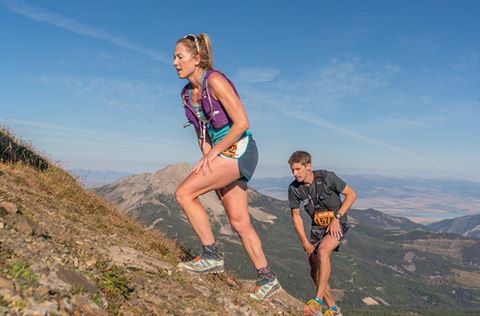
Erika Flowers post The Rut, and fresh off the 50 k win. (Photo: The Rut Mountain Runs Facebook)
Just shy of thirty-years-old, Bozeman’s Erika Flowers stills revs her aerobic engine up and over the big hills. The news that she had won the 50-kilometer The Rut mountain running race at Big Sky Resort outside Bozeman, Montana was a surprise to some — primarily to Flowers herself.
She pulled away from full-time ski training last winter, but the 9,951 feet of climbing during The Rut proved she’s a multi-sport talent.
Even with her reduced training last year and a step away from her Vermont based SMS T2 training group, Flowers impressed on the ski tracks. She placed fourth in the first 2019 Super Tour set of races: a 1.3 k skate sprint and 10 k skate in West Yellowstone. At U.S. Senior Nationals she was sixth in the 20 k mass start skate. Issues with fitness as she transitions to a more balanced work-sport life appear to be a non-issue.
We interviewed Flowers on September 12th. The interview has been lightly edited for clarity.
FasterSkier: Tell us a bit about the transition from full-time skier.
Erika Flowers: Last year Andy [Newell] and I moved to Bozeman and honestly I did not have a clear plan of what I was going to be doing. We both were ready for a shift and I was at a point, at least with skiing, where I wasn’t as competitive as I needed to be at my age to be eligible for the types of races and competitions that I wanted to be racing in. So I knew that I had to do something a little bit different. And there is also a huge part of me, I love skiing and I wish I could do it at a high level forever, that has interests outside of skiing. I was interested in getting some different experiences and professional experiences in particular.
I had looked around Bozeman and ended up getting hired by this firm called Profitable Ideas Exchange, which is international in scope but based in Bozeman. It has been around for about 20 years, but in the past maybe five or six years, it has grown quite a lot. We work on behalf of large professional service firms.
Essentially, we build out executive round tables of the people a client would be most interested in getting to know and eventually doing business with. And we have round table discussions with these groups while placing our client at the center of this conversation to help them develop relationships.
FS: Was there a risk taking this job or did you know it would be a solid fit? It sounds like a lot of interpersonal interactions in this type of position.
EF: When I was looking for different opportunities around Bozeman, I made a spreadsheet of potential areas I would want to work and at that point, I was like ‘if I don’t find something I really want to do, I can always keep skiing.’ I think what drew me here was the level of interpersonal interaction. So I think what I enjoy the most about this role is that I get to connect with people.
I tend to be a relatively social person and I enjoy networking with people, and that is where I was generally looking and that is the part of the job I enjoy the most.
FS: What have you been most surprised by when it comes to your new career?
EF: I think one thing that is interesting, and I think this is true for a lot of skiers that have that competitive side of them, I got put on the sales team here after a few weeks. The way that sales are framed, at least at my company, is that it is all about just making new friends. Our sales cycle is very long. So a lot of it is getting to know people and finding what is important to them and also figuring out how we can benefit them. And it is an area that I never thought I would enjoy doing. Sales can be a kind of dirty word for a lot of people, but I have really enjoyed it and getting to know people. And it is a challenge kind of like racing — you are testing yourself against others.
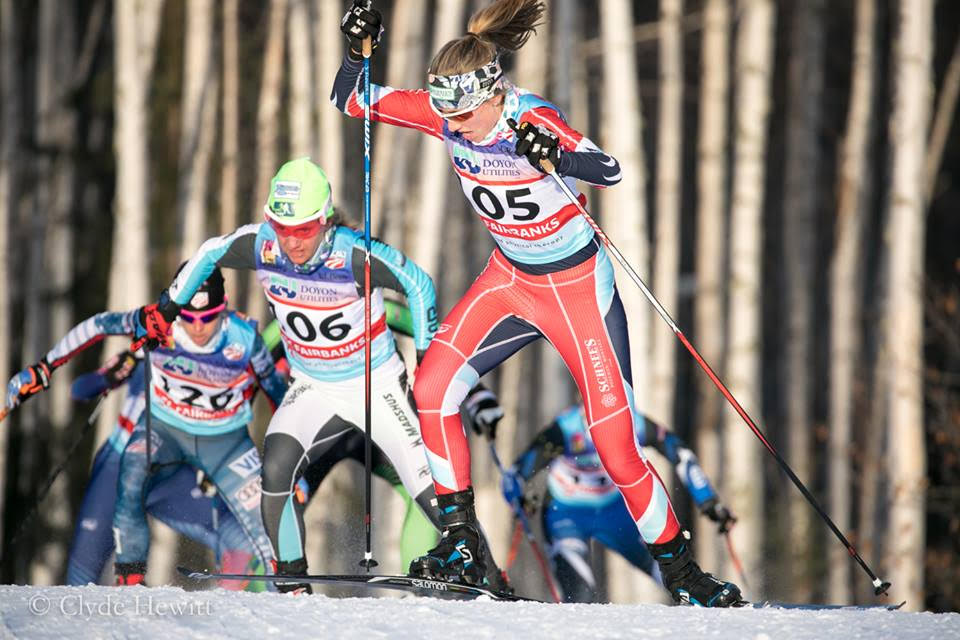
Erika Flowers (in red) racing at 2017 SuperTour Finals in Fairbanks, Alaska, where she posted a best result of third in the skate sprint. In the last six years, Flowers has reached the SuperTour podium 16 times and finished the 2017/2018 season fourth overall. (Photo: Clyde Hewitt)
FS: You clearly are in running shape. Will you be ski racing this winter?
EF: The short answer is yeah. Last year I wasn’t sure I was going to. Anybody who has been a full-time racer and you have decided to change — that is hard. Last year I left skiing really loving it still but recognizing that my results were not what they needed to be to keep doing it full time. So, I waded into a couple of races at the beginning of the year to see how they went. And obviously, I still do plenty of rollerskiing and training and I enjoy staying fit, and those races last year went pretty well.
This year I am going to do some of the longer races like the Birkie and the Boulder Mountain Tour. And then, I think I am going to jump into some of those first SuperTours. Last year I remember deciding to race them the day before. This year I will plan ahead a bit better and make some reservations in advance. I plan to do the first two SuperTours and see how those go. And my barometer for success these days is this: ‘is this still fun for you?’ If it is still fun, I will plan to do some other ones.
I’m not sure if I am going to Houghton for Senior Nationals. But I will be going to the Canmore and Sun Valley SuperTours.
FS: OK, the latest and greatest – your win at The Rut. Were you surprised by that performance?
EF: Yes, 100 percent. I had never run that far before. I knew there were some other quick and more experienced people in the race. I had done the Bridger Ridge Run last year in Bozeman and that was really tough for me. I went into the Ridge Run like ‘yes this could be my thing.’ I left that day like ‘clearly this is not my thing.’
I think this year, at least for The Rut, my plan going in was to have fun. My sister and I had trained together and we were both simply hoping to get it under our belts. I had no expectations and certainly not a podium. Beforehand someone asked what my 1-2-3 goals were. I said something like, ‘my best day ever goal was top-five or something and under seven hours.’ Having never done something like that, I had no idea how to set expectations for what was possible.
Erika Flowers during The Rut 50 k . (Photo: The Rut Mountain Runs Facebook)
FS: What was your strategy having never raced something like that?
EF: I started out pretty conservatively. Last year when I had done the Ridge Run, and really suffered, I had gone out a little hot. Andy said to just go out like you are going for a long run.
I did that. I simply figured I was in 20th or something. And then coming through the second aid station, my buddies told me I was in fifth place and third was not too far away. That was already way beyond what I expected.
FS: You must have caught some more runners out there.
EF: I then caught fourth, and then going up and over the headwaters, I was with a group of guys, and they were saying third place is just three or four minutes ahead of you. And I didn’t expect to catch them. The downhills are my forte and I knew there was a big downhill coming up and I was moving well that day and feeling good. I was able to catch third place on the downhill and then second. And then heading up Lone Peak, the biggest climb on the course, the first place runner was Kristina Trygstad-Sarri. She is really a phenomenal mountain runner. But she was running towards me as she had hurt her foot and pulled out.
Shortly thereafter I began descending off of Lone Peak at 20 miles in. Andy was near the bottom and he was nervous to tell me I was in first, but he was pretty funny. He said ‘you are doing great, just keep doing what you are doing. you are in first, but don’t change what you are doing, just keep chugging along.’
From then on I just kept moving and moving relatively quickly.
Glacier Nordic Club in Whitefish, Montana, is hiring a Head Coach for its Glacier Nordic Ski Team competition and recreation team for U16 & U18’s. Glacier Nordic has a 35-year history of youth programing and grooming in our community. Our mission is to promote and inspire a love of cross-country skiing. We have a robust infrastructure with over 200 youth in our programs, as well as a growing masters clinic program and groom courses both in town and at the local ski mountain (15 minutes from town). We compete in the Intermountain Division of USSA.
The head coach is responsible for overseeing the competition and recreation team, providing leadership, organization and guidance. The coach plans and implements training plans and learning objectives in accordance with USSA guidelines and the Glacier Nordic Club mission. The job is a part-time salaried position from October 15 through March 15 with potential for hourly work mid-June to mid-August. Please visit Comp/Rec Team Head Coach for a complete job description and information on applying.
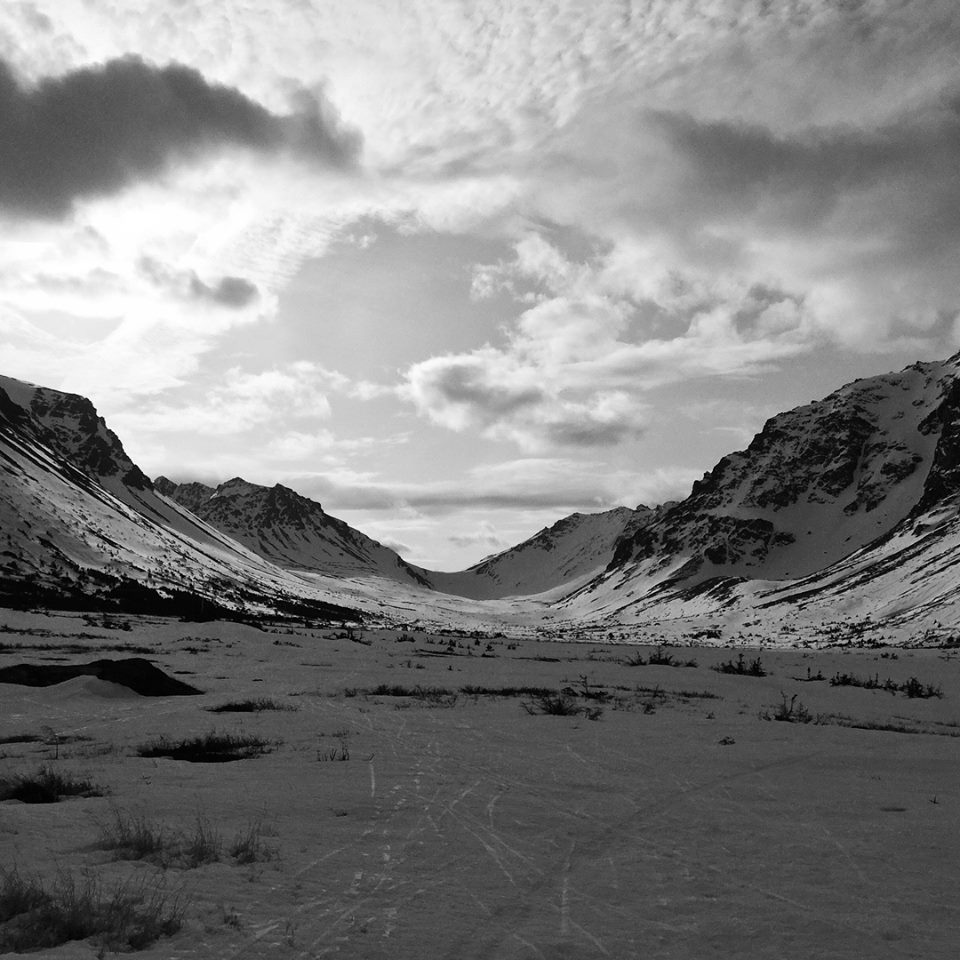
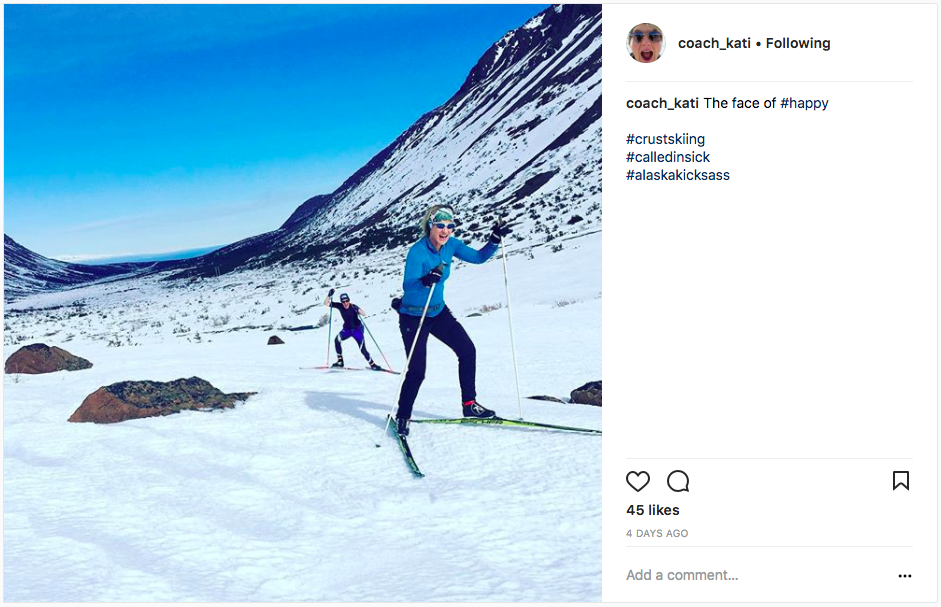
Crust skiing on April 17 in Chugach State Park, at the edge of town above Anchorage, Alaska. (Photo: Gavin Kentch)
This article has been updated with additional information on pro skiers who volunteered with Skiku, and additional pictures from Montana and New York.
* * *
It’s the last week of April. Skier New Year, May 1, looms next Tuesday. It’s roughly six months till the presumptive first race of the 2018/2019 season, seven till the first World Cup weekend. Whether you’re a pro or an amateur, whether you’re targeting your first World Championships or your first Birkie elite wave, now is the time to start thinking about setting goals and writing training plans.
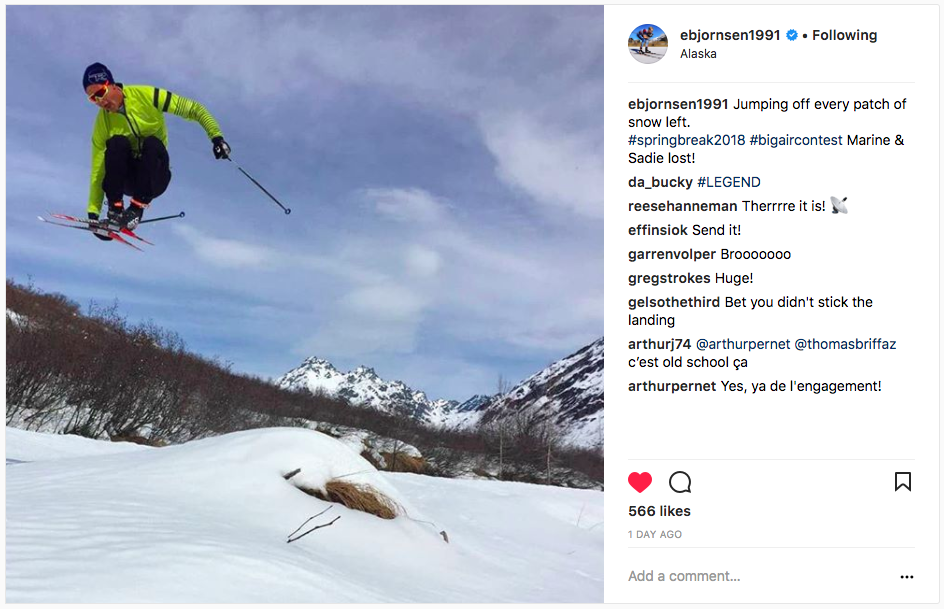
For a certain subset of athlete, those spring training plans still involve skiing. On snow. In some cases, really good snow, in surprisingly wintry weather.
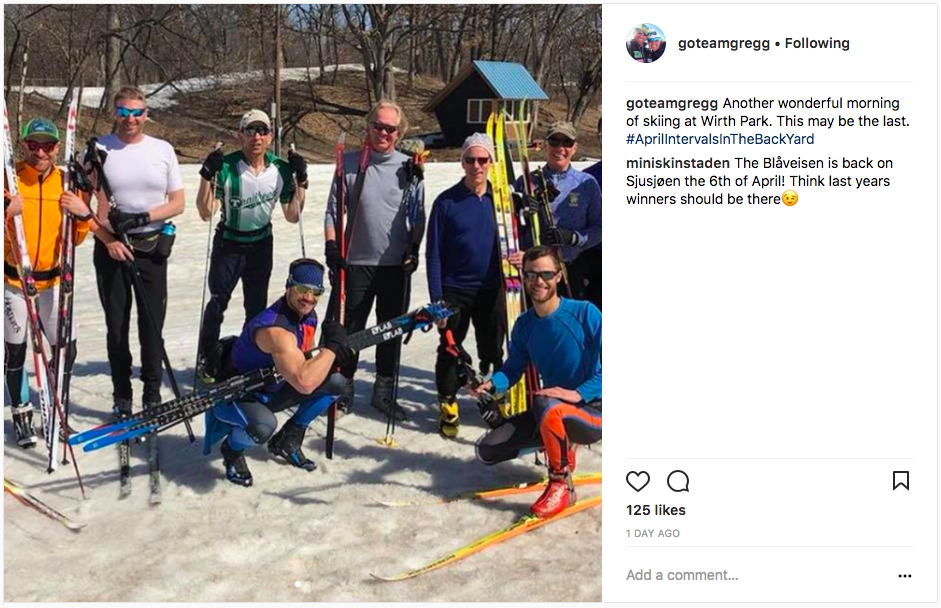
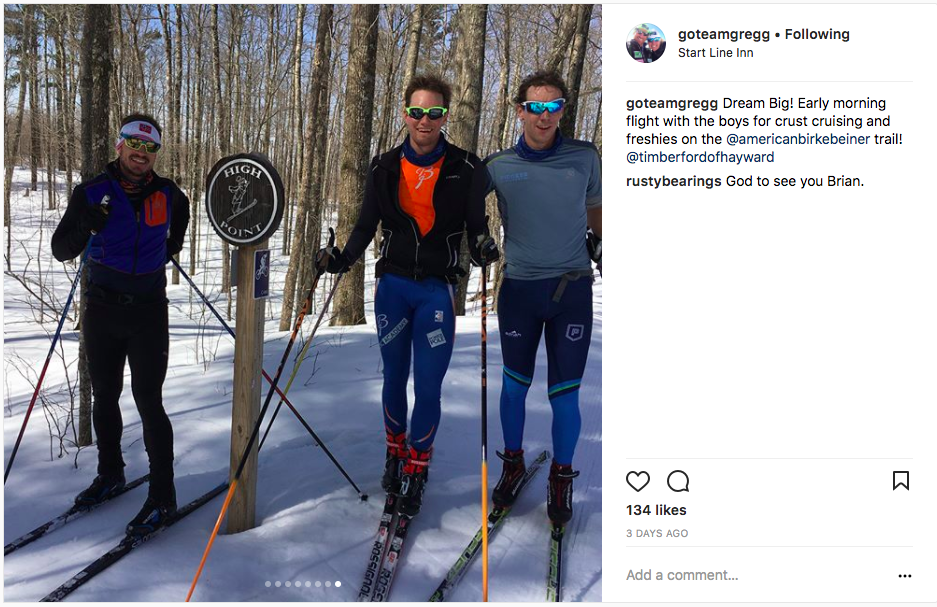
In honor of the last week of the offseason, please join FasterSkier as we channel our inner Us Weekly and flit through an extremely unscientific social-media roundup of those athletes who are still on snow, arranged in very approximate order of most to least surprising to be skiing at this time of year. (Actually, it’s only the Midwest and Vermont where it seems somewhat surprising to still have skiable snow in late April; no offense is intended to anywhere on the list after that.)
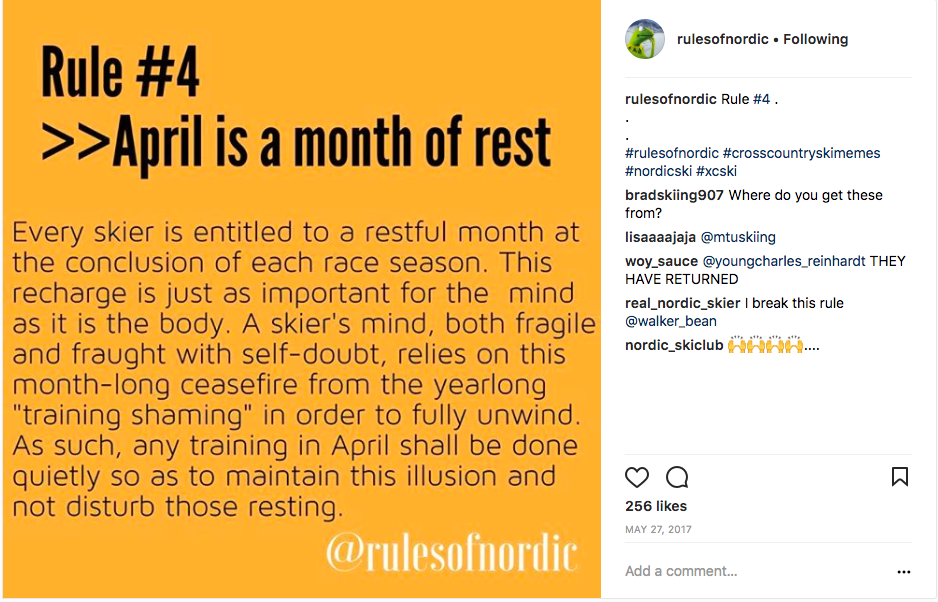
And before we begin, a quick note on methodology: This social media roundup is by definition limited to those athletes who are not only currently out in the snow, but who are also posting about it on social media. This second criterion threatens to bring your average recovery-month athlete into conflict with what has been codified as Rule of Nordic No. 4, “April is a month of rest.”
So, caveat lector: Just because your favorite skier has been taking a well-deserved break from finding and curating Instagram-worthy content for your enjoyment, this doesn’t mean that they’ve been sitting on their butt since Spring Series. They just might not want to tell you what they’ve been up to, and/or they wish to avoid damaging the fragile psyches of their colleagues.
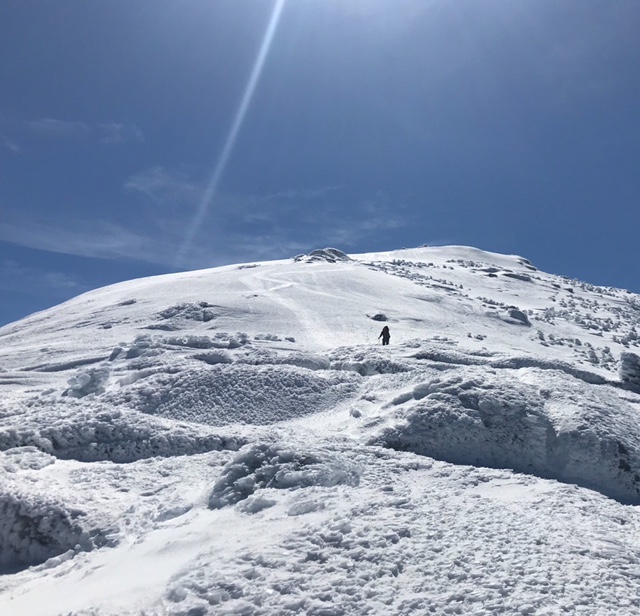
Skiing on New York’s highest peak? Check. David Hochschartner of the North Country School in Lake Placid sent us this photo of backcountry shredding on Mount Marcy, the highest point in the state at 5,343 feet above sea level.
“Monday skiing from bottom to the summit of Mount Marcy in New York,” Hochschartner wrote in an email to FasterSkier on Wednesday. “Over 3500′ vertical … backcountry skiing does not break rule #4 because it isn’t training, it’s just fun!”
Backcountry skiing near the top of Mount Marcy in New York’s High Peaks region on Monday, April 23. (Photo: Tim Ely)
The mid-April Midwest blizzard was notable, to be sure. But was it historic? Yes, says Ari Ofsevit, who now lives in Boston but was formerly the source behind Twin Cities XC Commentary and who remains the one-man operation behind the indispensable BirkieGuide.com.
Here’s Ofsevit with some historical meteorological perspective:
Basically, the current weather in the Twin Cities is pretty unprecedented. The only other similar year was 1975, when there was at least 3″ of snow on the ground in MSP for 11 days in April (this year had 12), but that year it was an old, melting base that mostly fell in late January. This year will set the following records:
* Most days with at least 3″ of snow on the ground in April (skiable snow): 12
* Most snow in April: 26.1″
If the current forecast to hit the 70s this weekend holds, it won’t wind up the coldest April on record, but will likely be in the top three. But it’s a good combination of cold and snow, which hasn’t been seen to this degree before.
The average year has the snow depth dipping below 3″ around March 1, so it’s an extra month and a half of winter.
Vermont
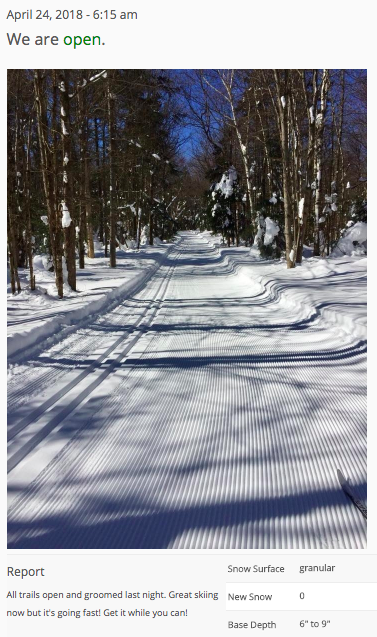
There’s a lot of snow at Prospect Mountain in Woodford, Vermont, too. (“Getting 80″ in a week in March didn’t hurt,” Ofsevit notes.) Here’s a stunning screenshot from the conditions report for Tuesday, April 24 (just offscreen is the current temperature, 69°):
Dartmouth skier Adam Glueck skied 50 k there on Sunday, describing conditions as “50+ F and transformed.”
Montana
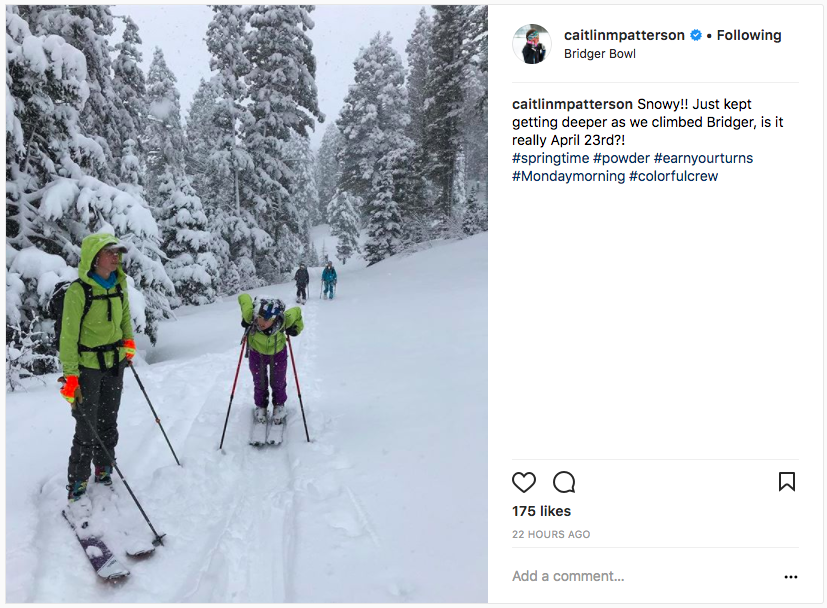
Effective Tuesday morning, they were still grooming some nordic trails at Crosscut Mountain Sports Center (formerly Bohart Ranch). Pictures of nordic skiing there are hard to come by right now, so here’s a screenshot from Caitlin Patterson’s Instagram page showing backcountry skiing at adjoining Bridger Bowl on April 23 in fresh powder:
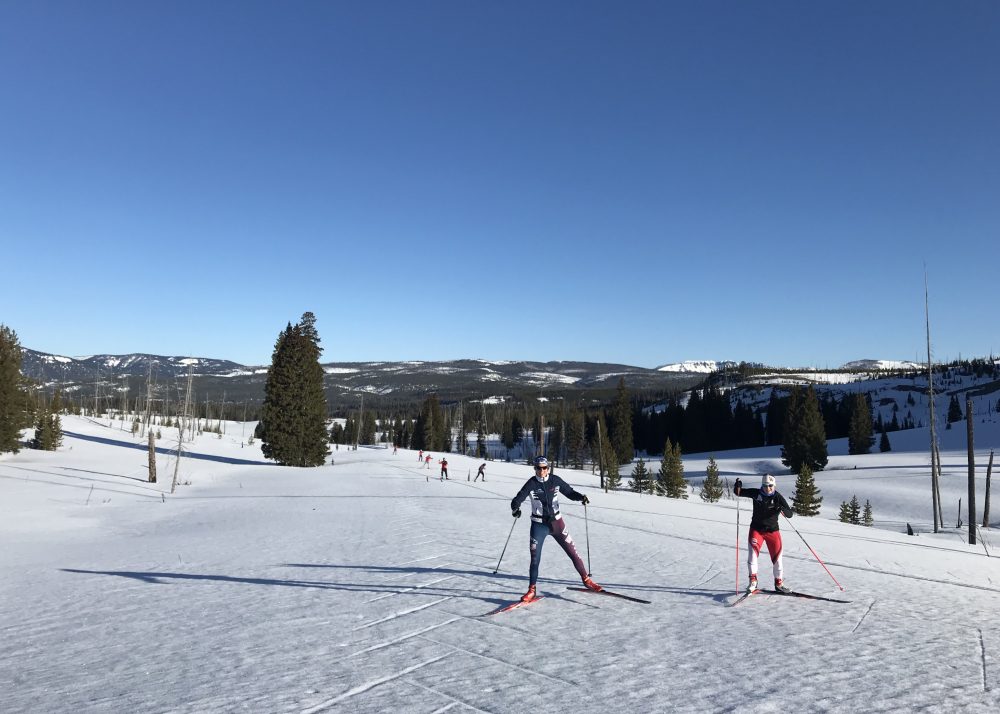
And from two days before that, here’s some prime crust skiing at Fawn Pass on Saturday:
Crust skiing at Fawn Pass, outside West Yellowstone, Montana, April 21, 2018. (Photo: Caitlin Patterson)
Canada
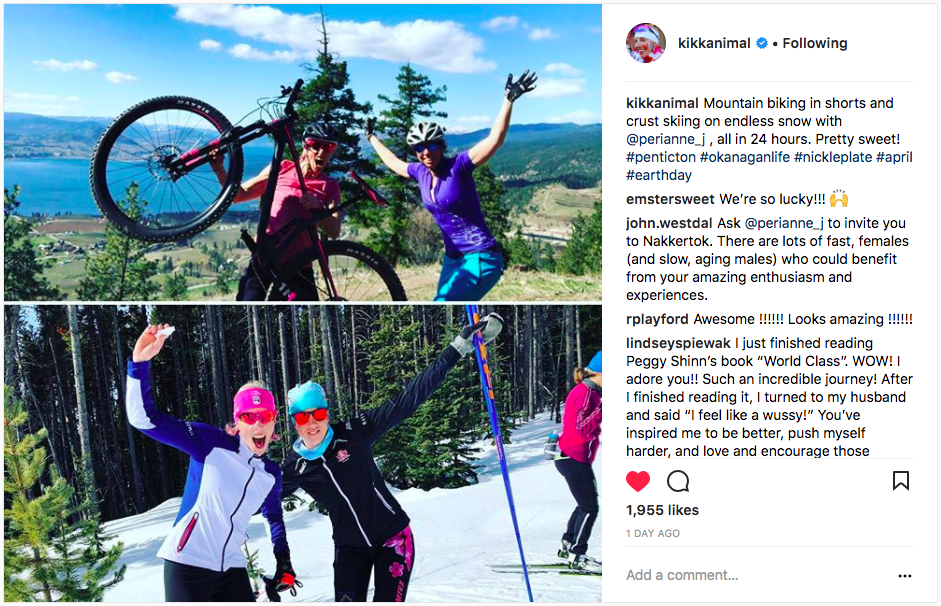
Recently retired American skier Kikkan Randall doesn’t seem to be suffering from her move to Penctiton, B.C., judging from Sunday’s shot of crust skiing with former Canadian World Cup racer Perianne Jones:
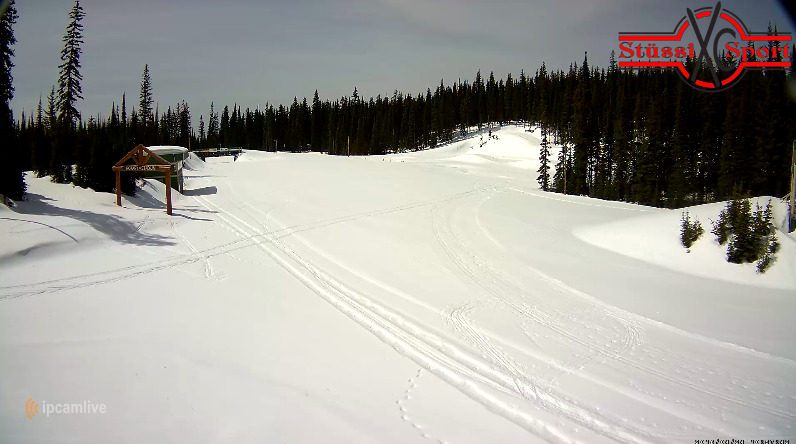
And 100 kilometers to the north, Sovereign Lake Nordic Centre isn’t lacking for snow, either. Here’s a screenshot from the webcam as of Tuesday morning, showing impeccable coverage:
That’s a base of 256 centimeters, or over eight feet (!) in American, according to a current conditions report. Sovereign Lake is closed to official skiing at present, but reopens from May 10-13 for its Spring Fling Ski Camp.
Oregon
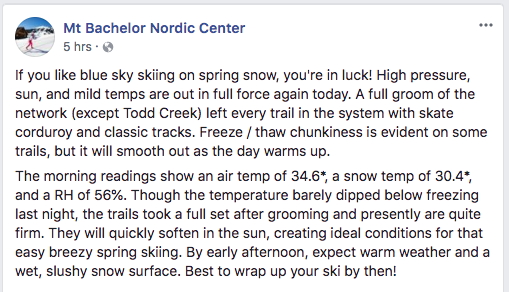
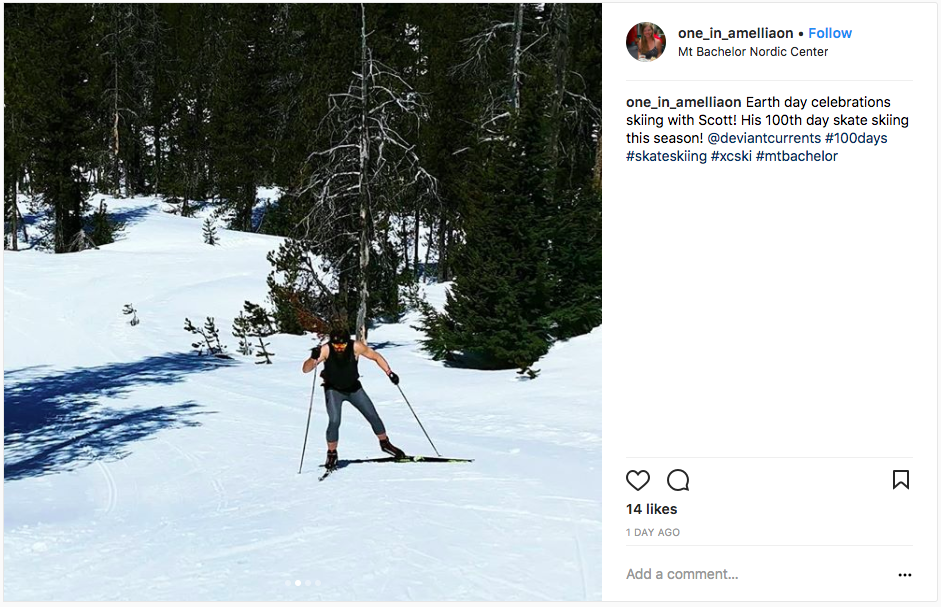
Mt. Bachelor currently has a base of 85″ at 6,300 feet near the base of the alpine area, which is somehow less than Sovereign Lake but still, you know, more than seven feet of snow. Here’s the nordic grooming report from Tuesday morning:
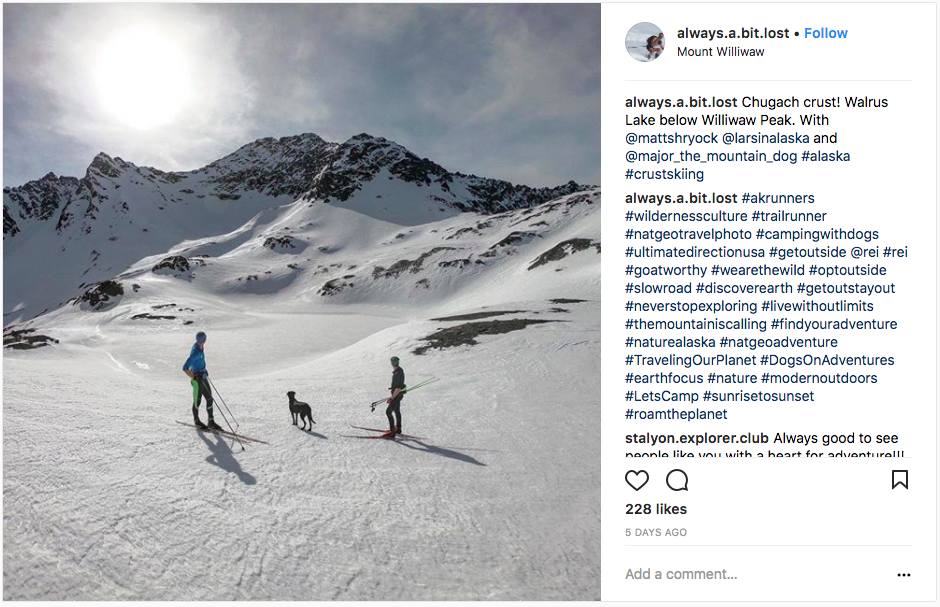
There’s still a lot of snow in Alaska right now. Maybe not at sea-level Anchorage, which is staggering toward spring with a series of high-30s, mid-40s raw and windy days culminating in snow squalls Tuesday evening – Kincaid is down to the dregs of a snowmaking loop by this point, and formal grooming there ended last weekend – but pretty much everywhere else. This reporter found fresh snowfall and blowing spindrift at 2,200′ at the edge of town Monday morning, and most places higher than that are still snow-covered. There is over five feet of snow at Hatcher Pass, and temperatures there remained below freezing even as it rained at sea level on Tuesday. The Mat-Su Ski Club should presumably once more be grooming through mid-May with ease.
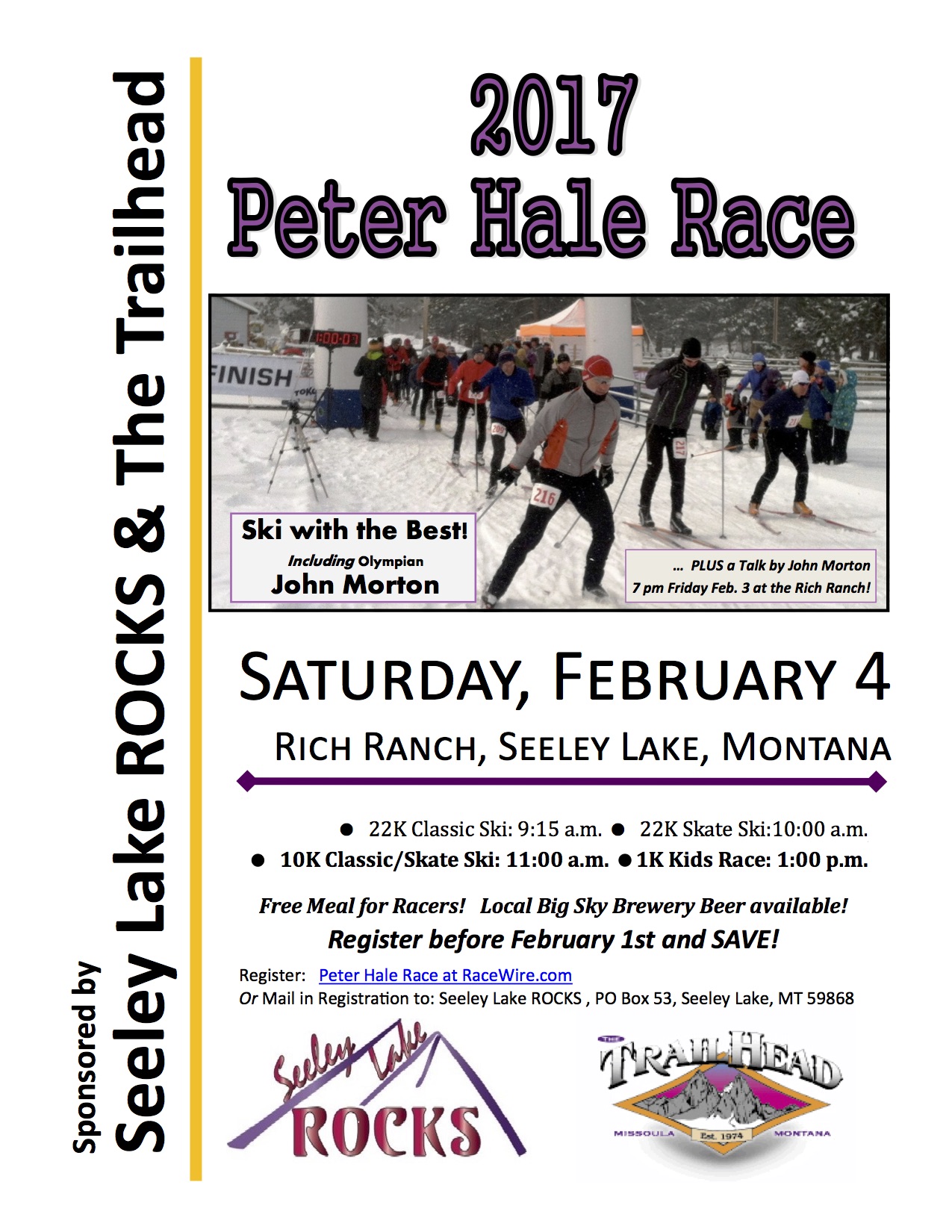
Seeley Lake ROCKS is pleased to announce that John Morton, former Olympic Nordic Skier, will participate in the Peter Hale Memorial Race to be held on Saturday, February 4, 2017, in Seeley Lake, MT. Morton is very familiar with Seeley’s ski trails. He knows the existing Seeley Creek Nordic Trails system well, and worked on the proposed Fawn Creek trail system that is bringing such excitement to the regional ski community. “We are looking forward to John’s participation in the race,” stated Noah Brautigam, Race Director. Morton’s involvement is expected to attract other notable skiers to the race, and the Seeley Lake Regional Outdoor Center for Kinetic Sports [ROCKS] is excited to expand the excellence and availability of the local Nordic experience.
ROCKS is expanding the 2017 Peter Hale event by adding an inspiration talk given by Hall of Fame Olympic Biathlete John Morton. Morton will share his extensive knowledge and stores about Nordic skiing at the 7pm, Friday, Feb. 3rd event at the Rich Ranch. An Amazon book reviewer notes “John Morton is a great coach and story teller, and …[he] delivers on so many levels. Morty gives advice about physical preparation, equipment and mental preparation, all laced together with great stories and anecdotes. I still bring this book out to read the stories when I need a little motivation.” The event targets young skiers, but is open to all ages.
The Peter Hale Race includes the traditional and challenging 22 km race, as well as a mellower 10 km race. Both races are open to classic and skate skiers. There will be a tent near the finish line with snacks, hot chili, and beer. The race day finishes with a 1 km fun race for children.
Why is it called the “Peter Hale Race?” Peter was a dearly beloved figure in the American Nordic Ski community. He also has strong Seeley Lake connections. His passion for skiing and for young people was critical to the early development of the Seeley Lake Elementary Ski Program. Peter helped ROCKS with the initial challenge of outfitting the fourth grade class with skis, and introducing them to a wonderful life-time sport. The program has expanded to the entire elementary school, and is a daily reminder of one man’s involvement and legacy that continues today.
Former Olympic skier John Morton regards Peter Hale as a good friend and is verbal with his recognition and high respect. “Skiing the Peter Hale Race is a fitting tribute,” say Morton as he looks forward to skiing in the namesake race to honor his late friend.
John Morton has an amazing history as an Olympic skier, coach, trail designer, and author. He started skiing where he grew up in Walpole, NH. Initially he participated in four events (slalom, downhill, jumping, and cross country) at Tilton School in Tilton, NH. Later he skied at Middlebury College, and excelled in cross country skiing. “Morton was an outstanding collegiate skier for Middlebury College, sweeping all the Eastern Carnival races in 1966. He was named to the US Cross Country Ski Team in 1968, and the US Biathlon team in 1969. He remained on the US Biathlon team from 1969 through the 1976 season (with the exception of a tour of duty in Vietnam in 1971, earning the Bronze Star). In that span of time, he represented the US at the [1972] Sapporo and [1976] Innsbruck Olympics as an athlete. From 1976 through 2002 Morty served as an assistant coach and team Leader for the US Team, including at 5 more Olympic events.” [US Biathlon News] Morton was inducted into the US Biathlon Hall of Fame in 2009. “John has modeled the spirit of the Olympic movement for generations of athletes over his 30 years of involvement with the US Biathlon Team, and set a standard for humility, integrity, and success,” says Larry Pugh, the 2009 Chairman of United States Biathlon.
His teaching and coaching career started in 1974 as a high school English teach, running coach, and ski coach in Anchorage, Alaska. He became head men’s skiing coach at Dartmouth College, Hanover, NH in 1978. He coached eleven years at Dartmouth. Then, in 1989 he began writing and designing trails. He wrote “Don’t Look Back,” about training and cross country ski racing. A reviewer at Amazon Books notes “John Morton is a great coach and story teller, and this book delivers on so many levels. Morty gives advice about physical preparation, equipment and mental preparation, all laced together with great stories and anecdotes. I still bring this book out to read the stories when I need a little motivation.”
In 1989, Morton initially focused on designing cross country ski trails. But, he soon found that fun, high quality trails were attractive to mountain bikers, runners, horseback riders, and others. His company, Morton Trails, has designed over 100 trails in the US, and around the world. These trail encourage healthy lifestyles, and increase surrounding property values. See details at MortonTrails.com.
Morton became an international biathlon referee with the International Biathlon Union in 2004. He is also a certified course homologation inspector for the FIS (International Ski federation).
Finally, Morton is an accomplished writer. He wrote “Don’t Look Back” (comprehensive guide to cross country skiing) in 1992, and a novel “Medal of Honor.” He is a frequent commentator on Vermont Public Radio, and has written over two-dozen magazine articles.
In short, we are thrilled to have John Morton joining us for the Peter Hale event, and speaking at the 7pm, Friday, Feb. 3rd inspirational event.
Seeley Lake Regional Outdoor Center for Kinetic Sports (ROCKS) is a 501c(3) non-profit located in Seeley Lake, MT, whose mission is to promote healthy children, strong families and vibrant communities through outdoor recreation. ROCKS working with regional organizations has been instrumental in equipping the Seeley Lake Elementary School students with skis, providing a warming hut at the Seeley Creek Trails and is currently developing a plan for a new Nordic ski area in Seeley Lake.
Seeley Lake Race February 4, 2017 in Seeley Lake, Montana. (Photo Credit: Jim McLean)
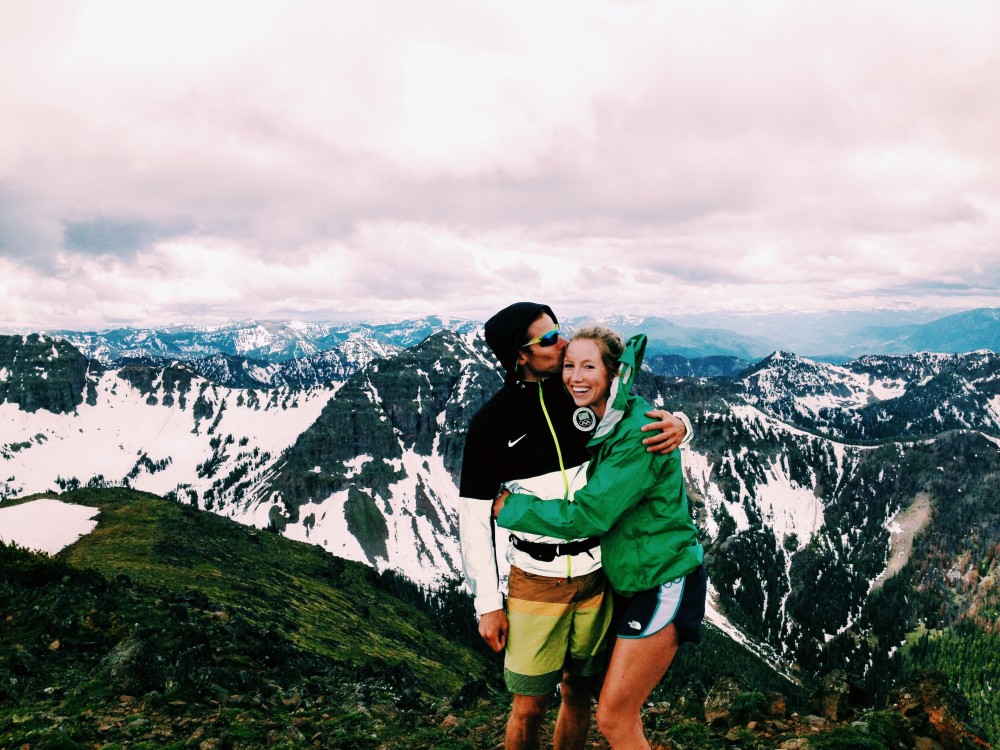
Andy Newell (l) and Erika Flowers at the top of Mount Blackmore in Bozeman, Mont., in June 2014. (Photo: Anya Bean)
On the first Friday of the month, while finishing up work on her computer, Erika Flowers felt her phone vibrate from an incoming text. The opened message asked her to check on the grill in the backyard of her apartment in Stratton Village, Vt. The sender was her boyfriend of four years, Stratton Mountain School (SMS) T2 teammate and current U.S. Ski Team (USST) member, Andy Newell.
Flowers walked outside, not noticing the grey-blue thunderclouds beginning to form above the not-so-distant Green Mountain peaks. The 26 year old’s mind was preoccupied — the busy workweek she’d had, the quickly approaching arrival of her younger sister for Independence Day weekend, the upcoming departure of her boyfriend to Norway for a training camp, her own training.
As her thoughts continued to turn, Flowers stepped up to the grill and lifted the lid, expecting to see the soft red and orange glow of burning coals. To her surprise, however, she was not greeted by the smoldering smokey sight and smell of ember-ed charcoals. What she found was another message, this time one on a blue painted rock. In a familiar script, the rock read, “You’re cordially invited to cocktails at Gale Meadows Pond — bring an umbrella, it will be an adventure…”
***
Sitting in the stern of a red, canoe-type fishing boat he bought about two weeks ago, Newell remains unsure of how much longer he will continue to ski race. A three-time Olympian, World Cup regular and a USST veteran for the past 12 years, his ski career ultimatum is to roll with the punches. Regardless of what the 32 year old decides within the next few years, one thing is certain: whatever decisions he makes will forever be alongside those of Flowers.
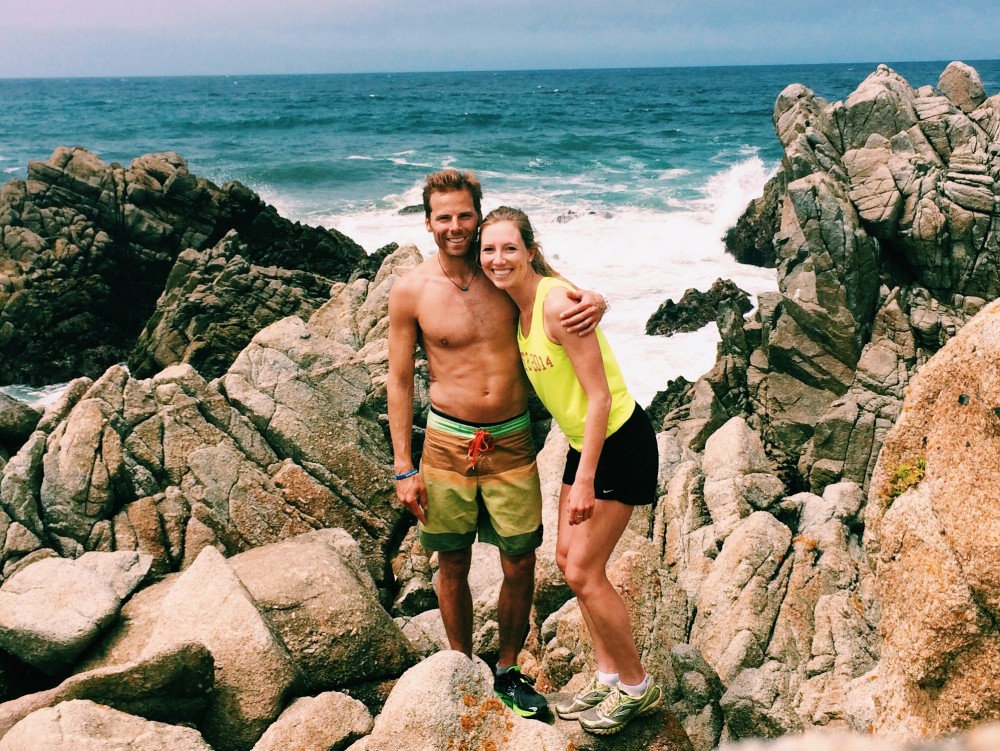
Andy Newell and Erika Flowers posing in front of the Restless Sea at Pebble Beach near Monterey, Calif., April 2015. (Courtesy photo)
“I think that was one of the reasons, at least I wanted to [get married] now and not wait a few years … is that so much can happen in professional athletics and Erika and I wanted to enjoy each other’s company before we have to grow up and get serious,” Newell, a Shaftsbury, Vt., native said on the phone while in Norway. “It’s kind of fun to be married and connected with the person that you love and not have to worry about having to be grown up. We’re both enjoying the fact that we’ll just keep ski racing, having fun, and taking things as they come.”
***
Rounding the final stretch of the path that circumvents Gale Meadows Pond — a trail she and Newell have trekked numerous times for fishing trips — Flowers was greeted by the sight of her boyfriend, Newell, fishing rod at the ready, reclining in the back of his new boat. During the twenty-five minute walk to him, she had uncovered quite a few more blue painted rocks — each with the symbols “E + A” and various other images: music notes, mountains, the word Montana (Flowers’s hometown being Bozeman, Mont.).
With the unveiling of each rock and as each step down the trail brough her closer to her destination point, Flowers admitted that her suspicions gradually began to arise.
“At first, I was like, ‘Oh, what a cute way to get me out of the house,’” Flowers said on the phone while in Vermont. “Had no idea what was going on, zero idea … then I started to notice that each rock had different things painted on it … all these things that we had done together, that we enjoyed doing together. So then I was like, ‘Hmmm, this seems like a lot of effort for just a date.’ That was like the first time that it [a wedding proposal] crossed my mind.”
***
It was not whether the answer would be yes or no. It was not whether he had chosen the right one to ask. It was the weather. That was what weighed on Newell’s mind the most as he waited for Flowers climb into the prow of his fishing boat.
“I was a little bit nervous because it was about to thunderstorm really badly and I was trying to make it a surprise,” Newell reflected. “So I was more nervous about the weather and her not making it to the lake on time, than her saying yes or no … I just didn’t want to ask her casually. I wanted to do something a little more fun than that.”
***
As a junior waiting in line to get her poster signed by a professional World Cup ski racer, Flowers never would have guessed that the black sharpie signature she was about to receive was the name of her future fiancé. To her the photograph she held of Newell hucking himself backwards over a ski jump was simply that of a renegade nordie.
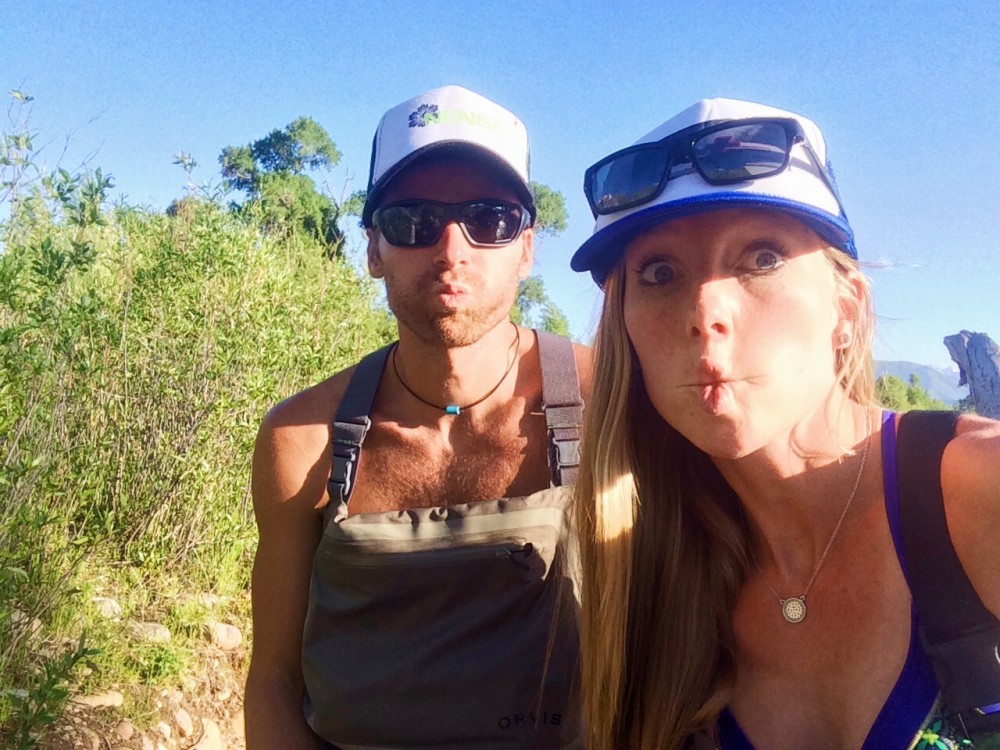
Erika Flowers (r) and Andy Newell make like fish during a fishing trip at Provo River, near Park City, Utah, in May 2015. (Courtesy Photo)
“I think my first impression from him from afar was ‘Oh he’s just this badass skier dude,” Flowers reminisced. “Technically, the first time I met him when I was like a junior skier and he was signing my poster. But he doesn’t remember that.”
Perhaps to Flowers’s surprise, the interaction was one Newell never forgot.
“We actually met for the first time at this training camp up in Lake Placid that she had been invited to come train with REG or something like that,” Newell said. “But we didn’t really hang out until Erika was out of college [in 2012] and we started training together at Stratton. Then we started hanging out together everyday.”
***
From fishing trips to surfing tips to hiking trips and Taylor Swift, Flowers and Newell have seen it all. And they have seen it all together.
“Whether we’re going surfing in Costa Rica or fishing in Montana, Erika has a nice adventure side that compliments my craziness a little bit,” Newell said. “She makes me a much better person when I’m around her. I think we both make each other better people. So I knew that she was the one once I realized that.”
Flowers indicated that for her, what seals the deal is the care Newell demonstrates for her and all those he knows.
“From the little things that he does, like singing me songs about peanut butter toast in the morning to being there [when I] broke my elbow or when I missed a Taylor Swift concert,” Flowers said. “He’s just the most caring, thoughtful person I’ve ever met.”
As a junior waiting in line to get her poster signed by a professional World Cup ski racer, Flowers never would have guessed that the black sharpie signature she was about to receive was the name of her future fiancé.
The support the two show each other — even amidst frustrations — also makes their relationship strong.
“Him trying to teach me how to surf almost every spring,” Flowers said. “It’s one those things that’s extremely frustrating, but also so fun at the same time. He tries so hard to help and I get so angry, but he’s very patient which I appreciate.”
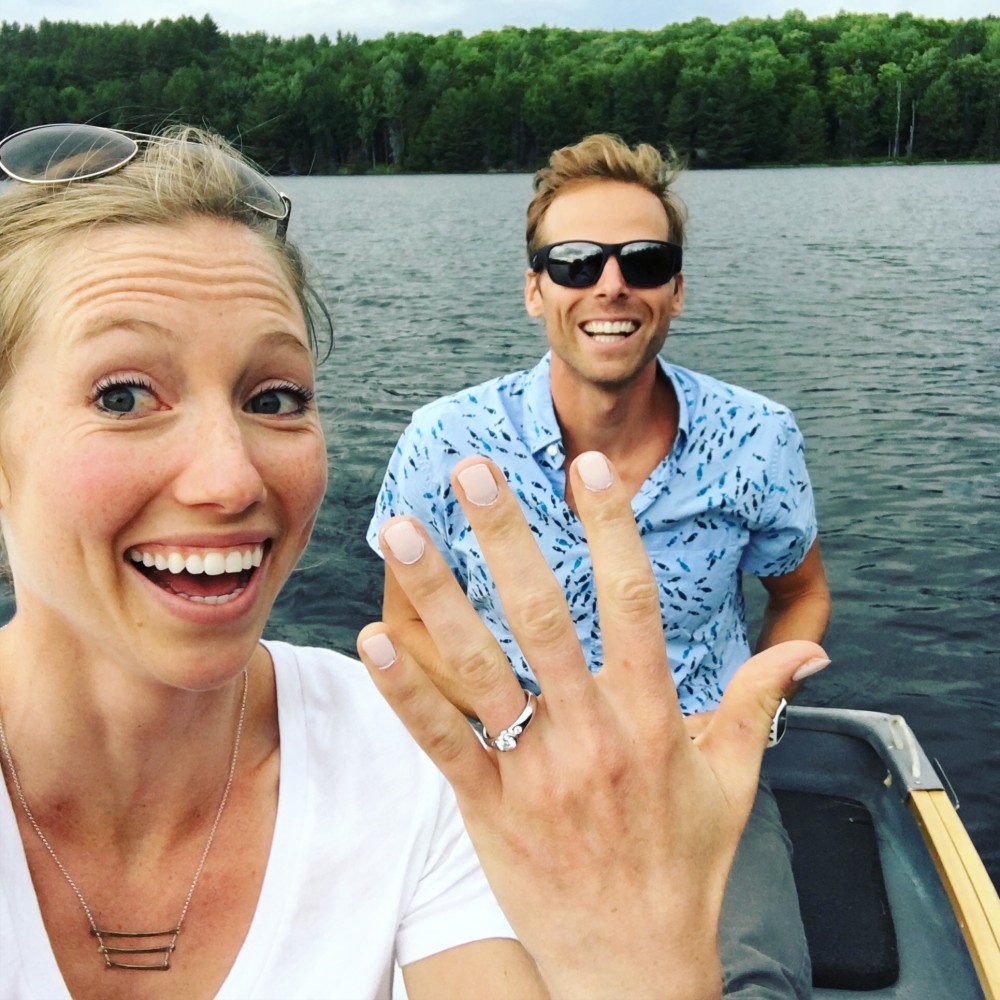
Erika Flowers (l) and Andy Newell flashing smiles on Friday, July 1, while out fishing on Gale Meadows Pond on the date of their engagement. (Courtesy photo)
“And then him trying to learn how to fish has been entertaining,” Flowers added. “He tries so hard to be a Montana fisherman and he’s so bad at it. But I love it and he keeps trying … it is the one thing I can do that he’s not better than me at, so I’m holding onto it.”
***
Floating across the mirror-like top of Gale Meadows Pond, Newell and Flowers discuss a broad range of topics: plans for the summer, their futures in skiing, adventures they have had — like climbing Blackmore in Bozeman, Mont. with Flower’s newlywed parents –and their ones yet to come.
“If I could ski forever I would, but the reality is you someday have to make money and if you’re not feeling like you’re improving or getting better, then it maybe becomes less fun,” Flowers said of life as a professional cross-country skier. “That was when he said one of the sweetest things, [which] was, ‘But I know that no matter what we do next, or what happens within the next few years, whether skiing goes well, or terribly or what have you, I know that I want to be with you through all that and onto the next thing.
“Then eventually he got to the point where he was like, ‘I love you so much and I love adventuring with you and I want to be able to go on adventures with you for the rest of our lives,’ ” she added. “Then he pulled the ring out and asked me if I would marry him … He crushed it.’ ”
Drifting back to the shore as two less fish in the sea, the couple’s next steps now revolve around bridal bouquets, questions over cake flavor and color schemes, and finally, where to post mark their wedding invitation returns.
“I’m quite sure [the wedding] will be out in Bozeman,,” Newell said. “Sometime next summer or fall. We haven’t planned too much, but I’m sure it will be Bozeman and it will be a good time.”
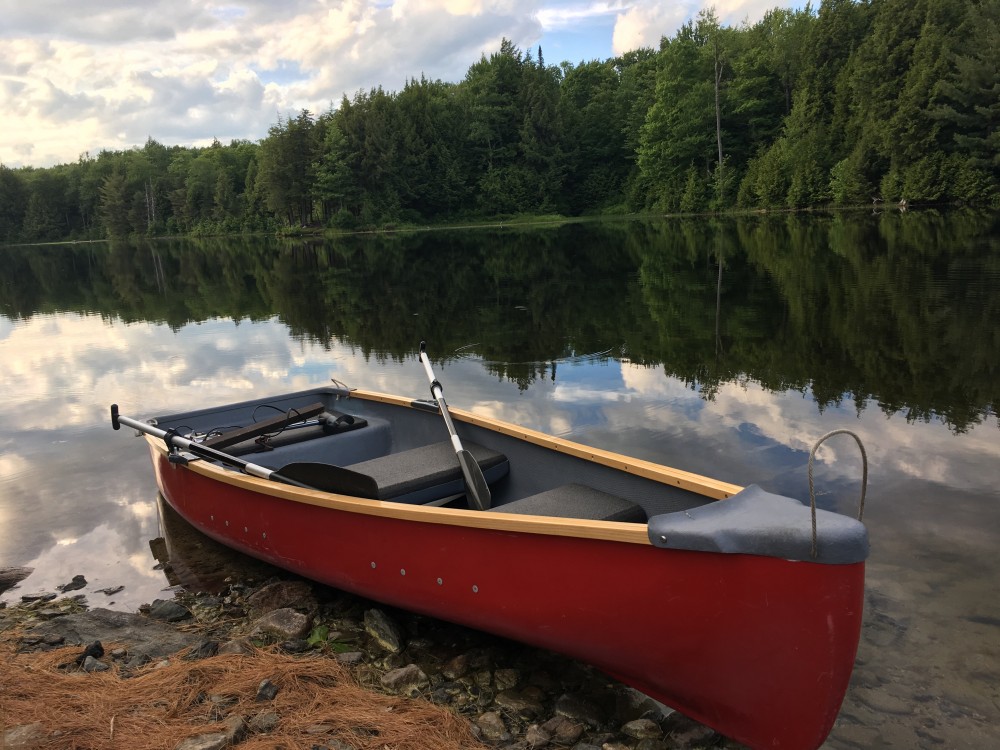
Andy Newell’s new fishing boat and the site of the proposal. (Courtesy Photo)
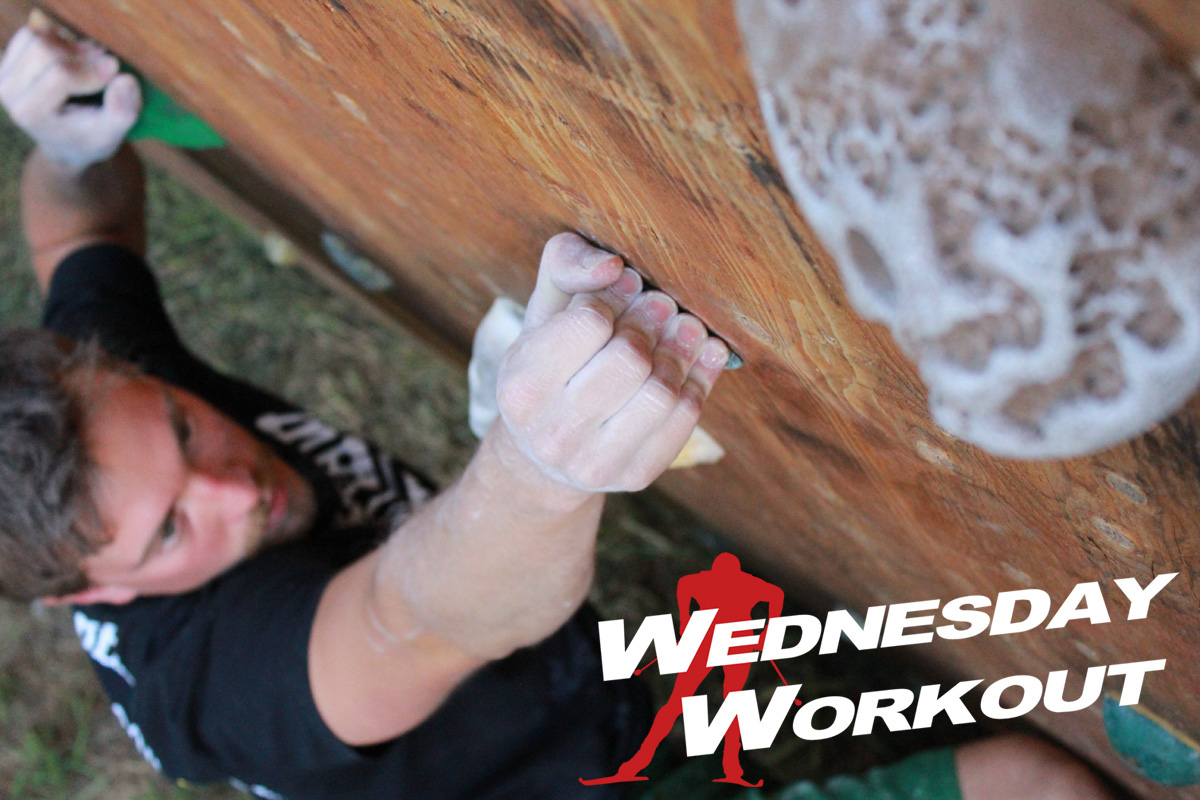
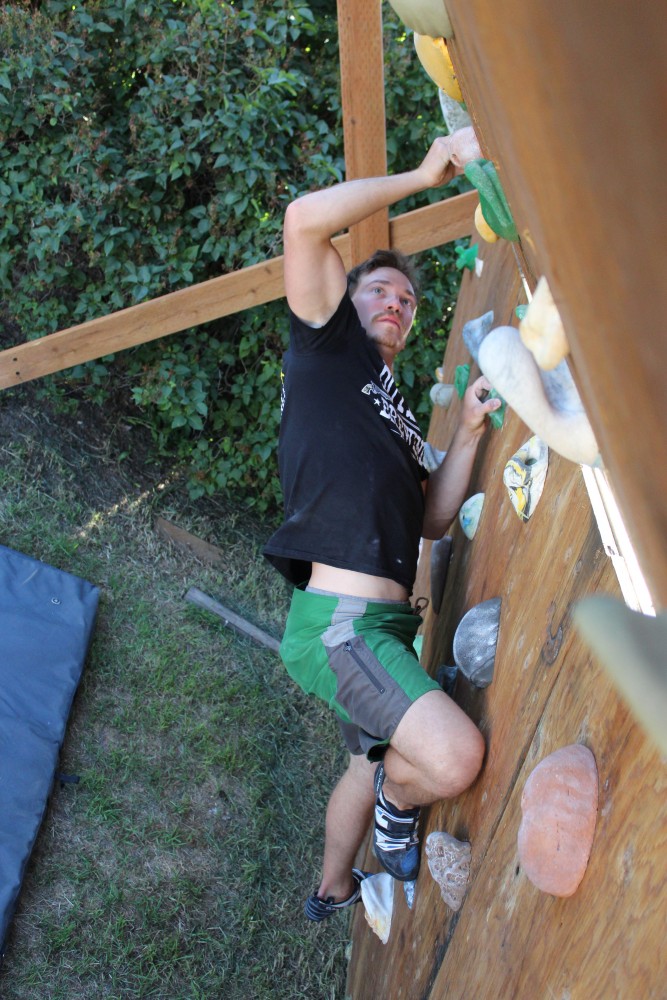
Jason Brenden focuses on his next hold during a climb on his backyard climbing wall in Bozeman, Mont.
For this week’s Wednesday Workout, FasterSkier provides a firsthand account of backyard climbing, what an endurance climbing workout entails and how to build your own backyard climbing wall.
***
BOZEMAN, Mont. — A cloud of white chalk dust mushrooms from my housemate’s hands as he claps them together. The woven orange and black chalk bag he had been holding a few seconds ago now sits in the grass, next to a pair of worn-out Chaco sandals and a faded black hoodie. A quick glance at my wrist watch shows the time to be 7:20 p.m. However, with the summer solstice and a cool evening breeze on our side, there’s still plenty of daylight left for photographs and climbers’ pull-ups.
Jason Brenden traverses his backyard climbing wall in Bozeman, Mont.
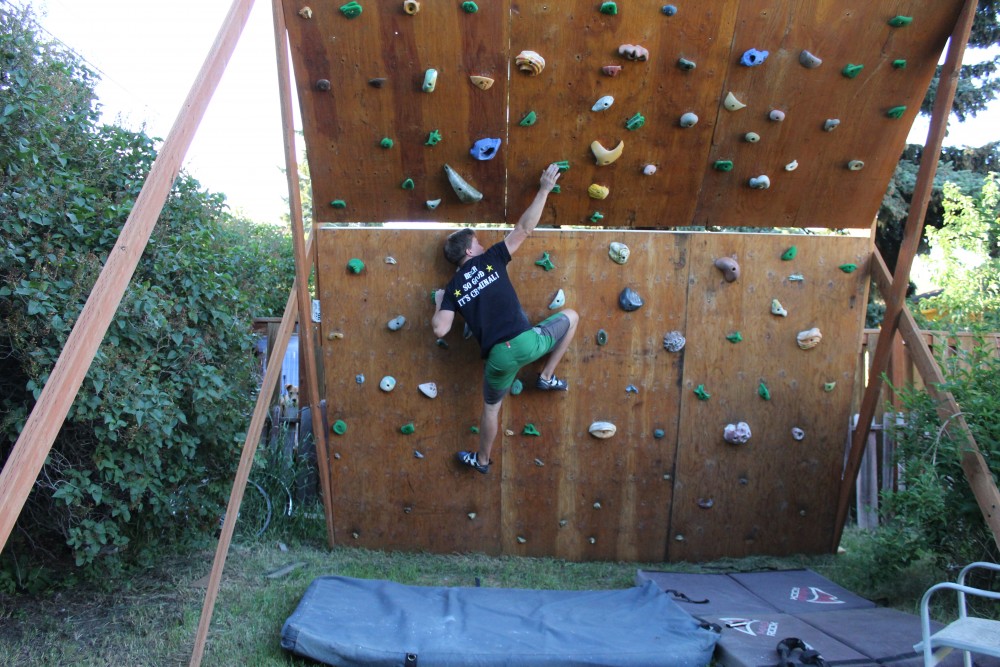
I focus my camera lens on his right hand gripping a particularly small hold as I perch atop a homemade climbing wall erected in our backyard a little over three months ago. My housemate, Jason Brenden, originally from Grand Rapids, Minn., made it with a friend, and I decide Jason is certainly not the nordic-type.
He is not about to start writing down what he does for workouts during the week. He does not wear spandex, nor is he about to go for a four-hour weekend run in the mountains — I’ve witnessed him slip out the front door for a jog before, only to find him re-enter 15 minutes later.
He’s a longtime climber and a brand-new nordic skier, taking up the latter recreationally last winter.
Camera still in hand, I make my way down the back of the climbing wall. I walk around to the front and plop down next to Jason on one of the two crash pads resting beneath the wall’s overhang. He slips off his blue-and-black climbing shoes, leans back and something like the scent of sour onions and old socks settles between us. I consider telling him we could postpone the talk until after he showers, but change my mind. I can wait it out.
He begins telling me about a major climbing trip he is putting money aside to take one day. His favorite place to climb turns out to be Squamish, British Columbia.
“I spent a month there two years ago,” Jason, 25, says. “Outside climbing is definitely different than inside in terms of footwork and technique. There are a lot of little holds on the rock you can use that aren’t in the gym.”
As we continue to chat, he throws around terms like “jug”, “traverse”, and “lock-off” and I’m not afraid to admit I have no idea what any of them mean. Listening to him, I know that he and many skiers may never see eye-to-eye regarding some aspects of training. There are many training tenets on which he and I will also never find level ground.
Yet, facing him cross-legged on the crash pad, I can see a trace of fire in his eyes and feel the heat in his tone when he talks about climbing; his frustrations with outsiders to the sport who question climber lingo (nordic translation: ever try to explain L1, L2, L3, L4, L5 target training zones to an outsider?)
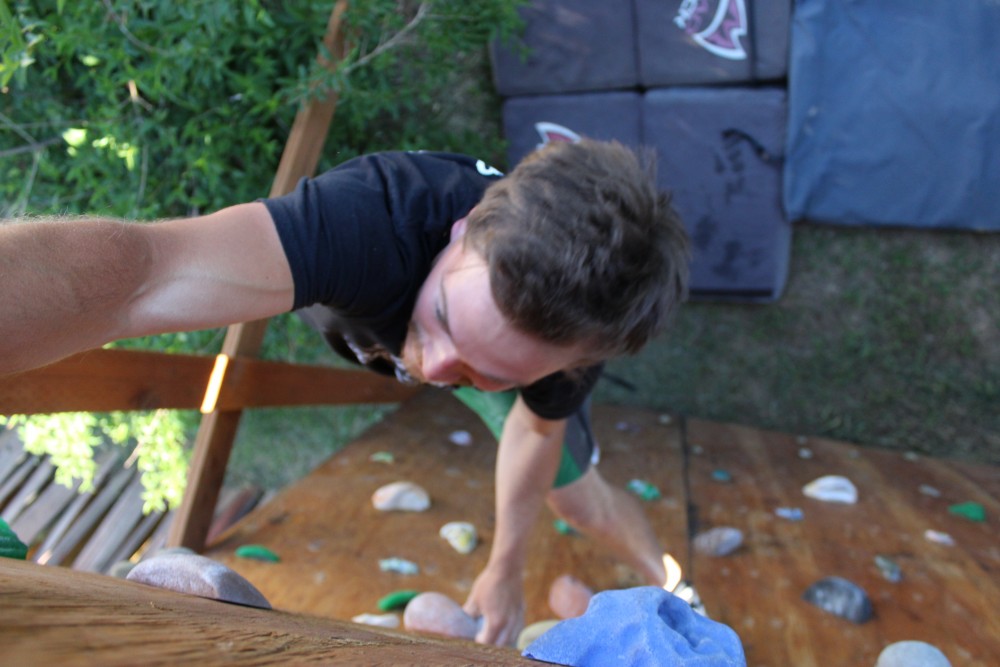
Jason Brenden nears the top of his backyard climbing wall in Bozeman, Mont.
Even if Jason takes his kale alongside a tall glass of ale (he’s a brewer at Outlaw Brewing in Bozeman) — whether he’s in-season or off — there is one characteristic he espouses similar to cross-country skiers: passion for a sport and its community. In the case of Jason, that sport is climbing.
Like many skiers, Jason spends a lot of time watching video — the ones he watches just happen to be of people scaling rock instead of snow-covered trails. Like many skiers, Jason enjoys conversing with people who understand the sports’ jargon and draw. Like many skiers, he also appreciates the way sport creates a way to be social, to connect with neighbors, friends and new faces.
“The best thing about having a wall in your backyard is inviting all your friends over to drink, barbeque, and climb,” he said. “That’s the real reason you build a climbing wall in your backyard. Not so much for training.”
The Workout
Purpose: Build endurance
Warmup: 15-20 minutes of traversing (climbing up and down) the biggest holds, with occasional rests
5 minute rest prior to circuit
Circuit: 2-3 x 30 minutes of continuous climbing
Jason says you may rest on large holds, but not to let your feet touch the ground
8 minutes rest between each 3- minute climbing segment
Equipment: climbing shoes, chalk, and crash pads
Jason also suggests having “a spotter so you don’t break your ankle.”
Jason Brenden demonstrating a left-hand lock-out on his backyard climbing wall in Bozeman, Mont.
How to Build Your Own Wall (Jason’s guide):
Supplies: Plywood, 2 x 4 lumber, T-nuts, holds (average $5-$20 per hold)
Step 1: Frame out the back similar to putting up a wall in a house (We ran our 2 x 4’s horizontally instead of vertically in the back)
Step 2: Screw plywood sheeting into the 2 x 4’s
Step 3: Drill holes in the plywood (this is where your T-nuts and holds will go)
Step 4: Screw your holds on using the T-nuts
Step 5: If you want a second level, you got to get some heavy duty lumber, bolts, and get creative!
Jason’s Building Tip:
“You can set holds to train certain moves,” Brenden said. “For example, if you want to work on left-handed lock-offs [using tendon strength to support weight on a handhold without tiring muscles too much], you would set holds so you have to pull your left hand toward your chest while you reach with your right hand to a far away hold. The idea with that is you’re practicing moving really slowly, training those muscles to lock your body off and make a controlled move.”
In the spring of 2015, ROCKS will file an application for a Special Use Permit with the United States Forest Service (USFS) to build a new Seeley Lake nordic-ski venue, which is “intentionally being designed to international race-ready specs, fully homologated, with both the skier and spectator in mind,” according to ROCKS President Chris Lorentz.
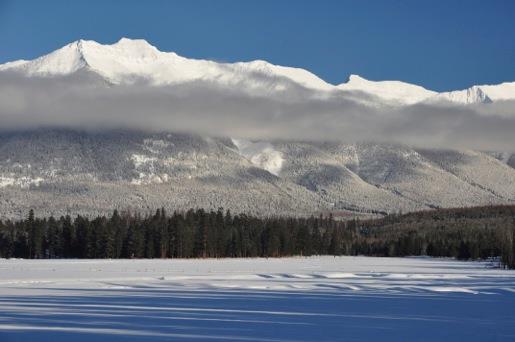
Swan Range forms the backdrop for the Seeley Lake ski trails. (Photo: Seeley Lake Nordic)
Lorentz said the Forest Service will review the permit application, perform an environmental analysis (including a mandatory 90 day public input period) and provide a decision by October 1, 2016.
“We believe the (process) will result in a positive decision notice,” Lorenz said.
ROCKS hired John Morton, owner of Morton Trails, to provide both a feasibility study (2011) and course design (2012) for the new Seeley Lake venue. According to a report issued by Morton Trails to the USFS, Morton states that efforts have “resulted in a workable concept for what offers to be a nationally, and even internationally, recognized cross country skiing venue … suitable for hosting Continental Cup races such as US Junior Olympics, US Nationals, North American races [i.e. Super Tour], as well as regional races where participants can be awarded FIS points for international ranking.”
Morton’s design would meet specifications for D-category homologation, making Seeley Lake one of six venues certified to this level in the United States. A D-certification allows a venue to host all events, including mass-start freestyle races. The only event requiring a designation beyond a D category is the skiathlon, which requires two separate courses (used concurrently). Soldier Hollow in Midway, Utah, is the only course in the US which currently has this designation.
To provide Seeley Lake with an advantage in bidding for major events and training camps, and to keep the door open for a possible World Cup event bid, Morton designed the course to “comply to a World Cup standard – which will make this venue truly representative of courses hosting the most elite competitions.” The most recent FIS Homologation Manual would have allowed for certification with a 25-meter climb; however, Morton chose to exceed this standard and comply with the World Cup’s 30-meter requirement.
In January, Seeley Lake hosted its 8th annual biathlon, with 115 racers participating in three events. (Photo: Seeley Lake Nordic)
Morton’s design includes a 15-point biathlon range and identifies a location for a 30-point range (meeting the IBU World Cup requirements) that could be installed with some additional construction. The course design for the five-kilometer loop is “spectator friendly” allowing spectators to view competitors five to seven total times, or 10 to 14 times for a 10 k race.
While USFS permit approval, new venue construction, and hosting of events at the new venue are years in the future, Seeley Lake, is not waiting for course completion to continue taking steps forward. Recent ROCKS activities have clearly energized the town which has a long standing nordic ski racing tradition.
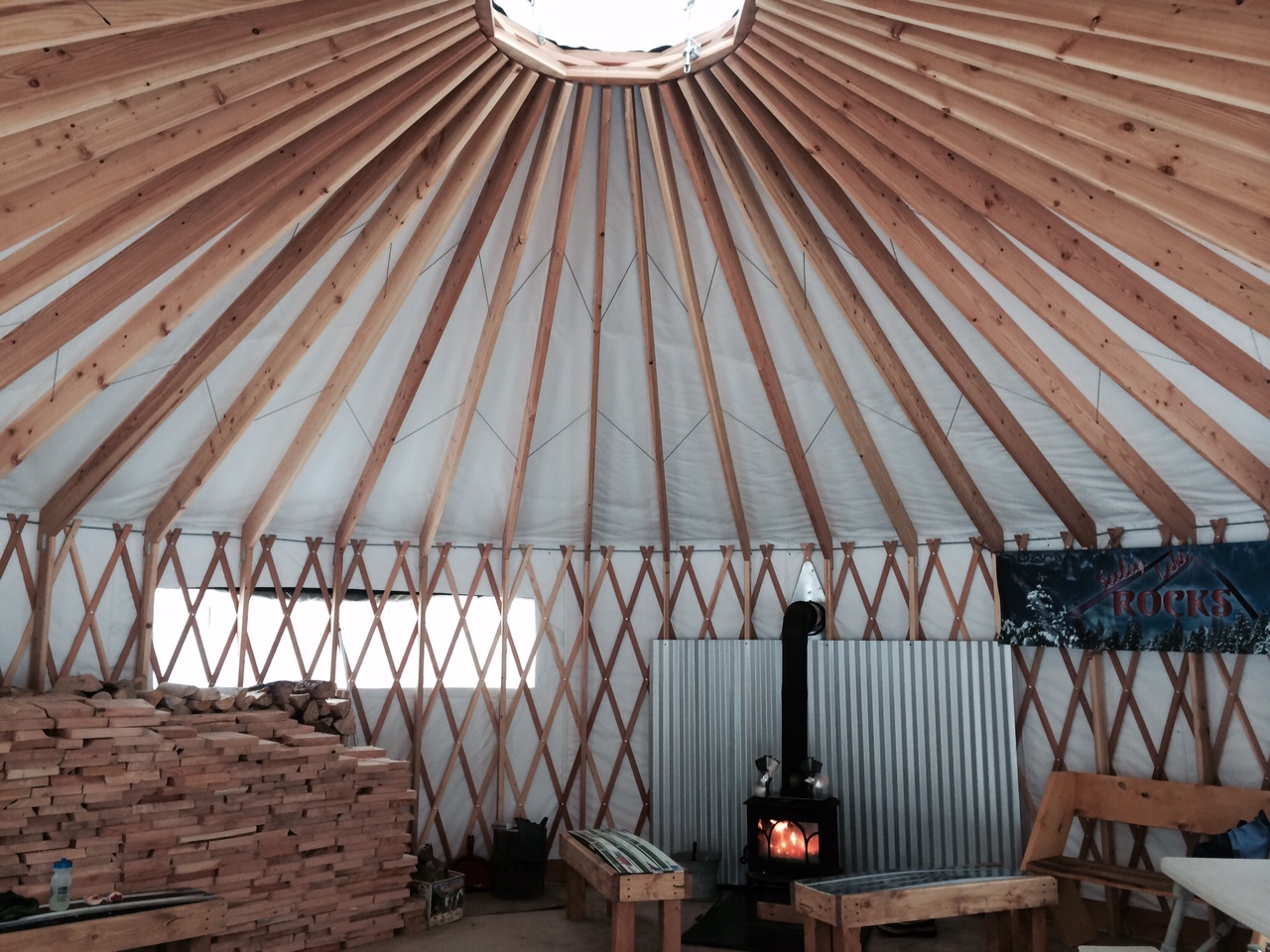
The town’s existing nordic ski trails at Seeley Creek have seen an upsurge in use following the installation of a new yurt (installed by Seeley Lake ROCKS) at the trailhead.
“The yurt is way more popular than we expected,” Lynn Carey of the Seeley Lake Nordic Ski Club said. “Our metal ranger now takes in more money than any other ranger in the state.”
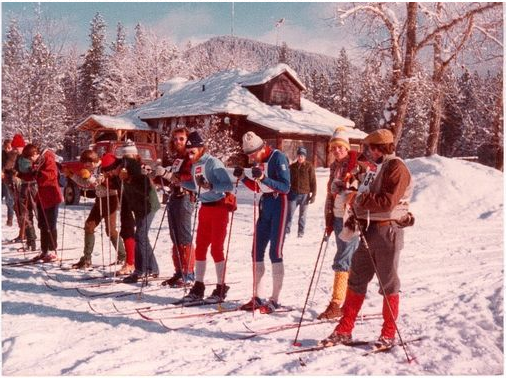
Seeley Lake, Montana, has a long history of ski racing. This is a photo of the start 1983 OSCR race. (Courtesy Seeley Lake Pathfinder)
ROCKS founder Karen Pratt notes, “The idea is that you need a culture shift to bring in an elite race [to Seeley Lake] and get enough interest in town to support it. An international race is a lot of work!”
The ROCKS plan seems to be working.
“There has already been a big culture shift in Seeley,” Pratt said. The Seeley school system started a ski program where any student above the 3rd grade can access free skis, transportation and ski instruction. Twenty students have caught the ski bug and joined the school’s newly formed nordic ski racing team.
According to Pratt, many local parents are learning to ski as a result of the new youth programs. She is convinced that the increased activity is improving community health. “It’s not a good thing when the people in Seeley don’t get out of the house in the winter,” she said.
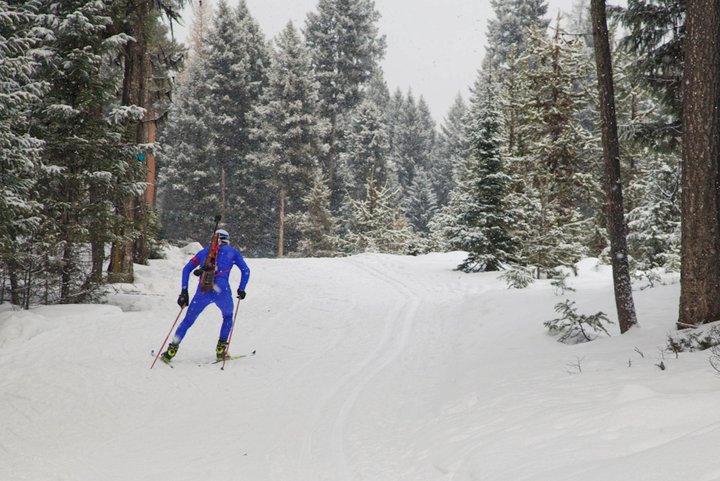
Seeley Lake’s existing ski trails at Seeley Creek. (Photo: Mark Vosburgh)
Grooming the 23-kilometer Seeley Creek trail system is now conducted daily, and several trails that had been abandoned or rarely groomed have been re-opened. The rolling trail system, designed by Olympian Jon Elliott, is seeing a resurgence in use and the trails are receiving rave reviews from regional skiers. The eighth-annual Seeley Lake biathlon had 115 entrants this year, nearly double last year’s count, according to race director Cheri Thompson.
Once the new trails at Fawn Creek are open, ROCKS organizers hope that overnight visits and resulting economic benefits to Seeley Lake will increase with skiers spending two days in the Seeley Lake area in order to ski both trail networks.
Pratt credits generous donations from the late Peter Hale and his estate for supporting the Seeley Lake ski program with skis, waxing supplies and equipment. Hale’s connection to Seeley and his passion for skiing is in part responsible for at least one concrete example of increased economic activity sought by ROCKS.
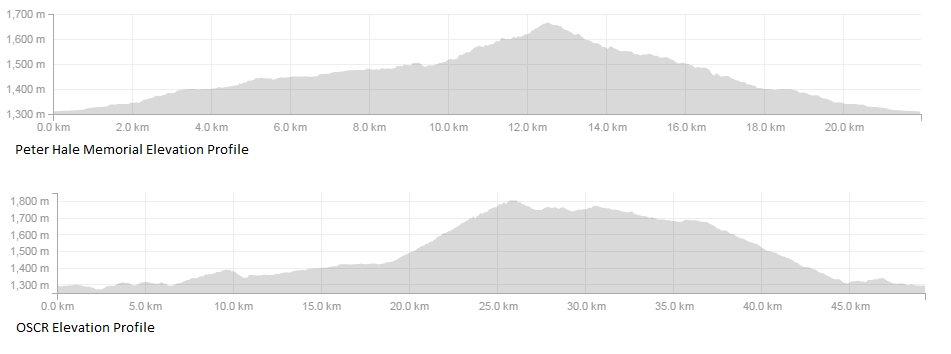
Elevation profiles for Seeley Lake’s signature nordic ski races, the Peter Hale Memorial and OSCR.
In 2012, Mike and Cathy Kahnle opened Seeley’s first bike-and-ski shop, Rocky Mountain Adventure Gear. Describing how he came to a decision to start the business, Mike said, “ROCKS was happening … Peter Hale contacted me prior to putting this business together and just filled my ear… It was pretty evident his love for skiing was overwhelming.
“Peter basically talked me into running Madshus skis in a shop that didn’t exist,” he continued. “You couldn’t have a conversation with him without feeling better about yourself and life in general.”
A passionate endurance athlete, Kahnle was also attracted to Seeley by its reputation for challenging endurance events like the Over Seeley’s Creeks and Ridges (OSCR, pronounced “Oscar”) 50 k ski race.
Describing the race, Kahnle said, “No matter what level athlete you are, you are going to have the opportunity to push yourself to find the limits of what you’ve got.” Referring to the nearly 800 meters of elevation gain in OSCR, he added, “If you want an easy race, go somewhere flat because we are not going to have it for you here.”
Carey, OSCR race director since 1991, agreed: “OSCR [founded in 1981] is a damn-tough race. It always has been, and we are proud of it … really it’s an adventure more than a race.”
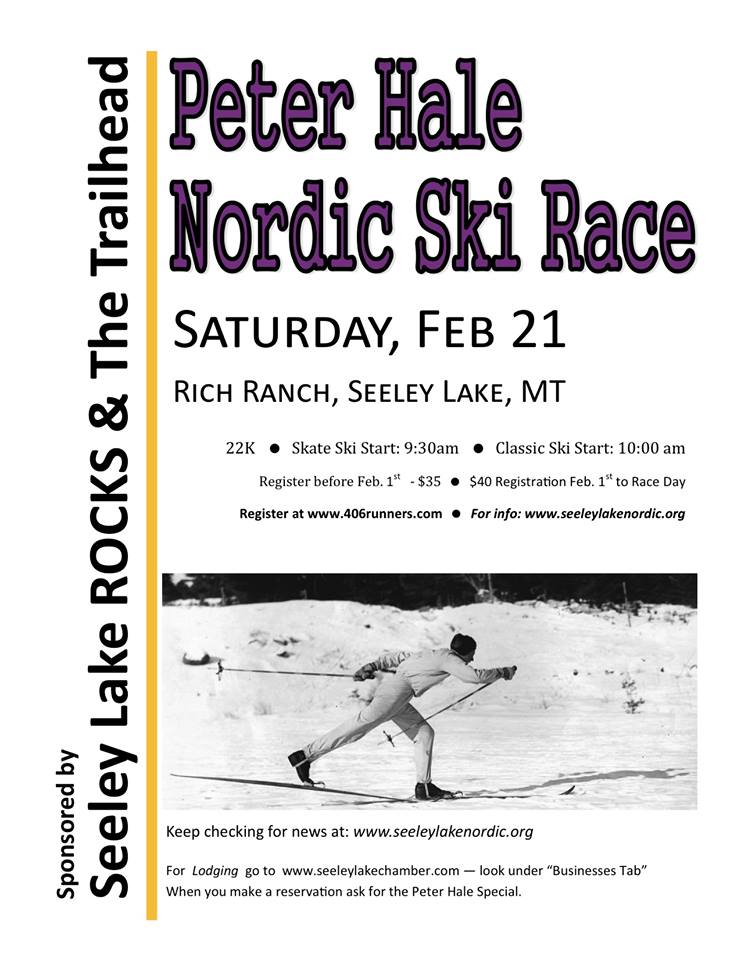
The second Peter Hale Nordic Ski Race will be held Saturday, Feb. 21, in Seeley Lake, Mont.
ROCKS will hold the Second Annual Peter Hale Memorial 22 k Ski Race on February 21, 2015. With an elevation gain of nearly 400 meters, the race is not easy. In honor of Hale’s love of classic skiing, both classic and freestyle races are offered. Inaugural race feedback (in spite of frigid temperatures) was positive with about half of the participants choosing the classic event. Pratt anticipates that the race entry will need to be capped after this year’s event due to capacity limitation of the venue.
With momentum building in Seeley Lake, the ROCKS vision for a national and international caliber ski venue is moving forward. “The focus is on the new course right now because it has to be,” Pratt said.
While not everyone in Seeley Lake is optimistic about the outcome of the ROCKS effort, Pratt stated, “If we did have a venue that brought in a week’s worth of high-end racers, it would mean us [in Seeley Lake] having a larger number of people who would have a larger vision about what is possible.”
WEST YELLOWSTONE, Mont. — The trails were bustling in West Yellowstone, Mont., on Monday, as skiers from across the country gathered on the Rendezvous Ski Trails for the 2014 Yellowstone Ski Festival.
While ample snow is never a given in West Yellowstone, the festival has had no problem with coverage this fall. With intermittent snow showers throughout November and a heavy snowfall this past Saturday, skiers have shelved their rock skis and set our to explore the 35 k of the Rendezvous trails.
As in past years, the festival will conclude with the SuperTour season opener at the end of the week. The best skiers of the domestic circuit will race for a chance at various starting positions ranging from the 2015 Junior/U23 World Championships to the 2015 Nordic World Championships. To prove their mettle, skiers will compete in Friday’s freestyle sprint and Saturday’s classic interval start.
FasterSkier will join the throngs of skiers taking advantage of the extra-blue conditions as the festival continues. Take a look at a small collection of photos from our morning ski below.
Early season skiing at the 2014 West Yellowstone Ski Festival as pictured on Nov. 24. (Photo: Lander Karath)
Friday November 28 USSA SuperTour Freestyle Sprint 9:00am start
$35.00 per skier through 5pm, Thursday, November 20. Multiple race discounts available.
Late Registration:
$45.00 per skier from 5pm, Thursday, November 20 until 12 NOON Wednesday, November 26- Online Only. No paper registrations for late entries.
Online registration available HERE with a small fee. Checks payable to West Yellowstone Chamber, USSA waiver required.
This race is open to ALL skiers. Competitive racers have the chance to earn points and citizen racers can test their skills against the sport’s top athletes.
1.3K course, Men and Women. Freestyle technique.
9 AM Qualifiers. 15 second intervals with 5 minute break between mens and womens races. Top 30 men and women senior/master proceed to quarterfinals; top 12 junior female and male racers proceed to “A” and “B” finals.
11 AM Rounds (5 minutes between starts)
Women Quarter Finals (5 heats of 6 racers; top 2 + lucky loser proceed to semi-finals)
Men Quarter Finals (5 heats of 6 racers; top 2 + lucky loser proceed to semi-finals)
Women Semi Finals (2 heats of 6 racers)
Men Semi Finals (2 heats of 6 racers)
Women “A” Finals
Men “A” Finals
Junior Women “B” and “A” Finals
Junior Men “B” and “A” Finals
Prize money will be awarded to the top six men and women in accordance with USSA SuperTour guidelines. Medals will be awarded to the top three athletes in each class.
Details of the sprint race will be covered at the 1st coaches’ meeting, 5:30 PM Wednesday, November 26 at Race Headquarters (Chamber of Commerce Visitors Center)
Saturday November 29 USSA SuperTour Freestyle Race. 10:00am start
$35.00 per skier through 5pm, Thursday, November 20. Multiple race discounts available.
Late Registration:
$45.00 per skier from 5pm, Thursday, November 20 until 12 NOON Wednesday, November 26- Online Only. No paper registrations for late entries.
Online registration available HERE with a small fee. Checks payable to West Yellowstone Chamber, USSA waiver required.
Men 15k, Women 10k, regardless of age.
30 second intervals.
Details of the race will be covered at the 2nd coaches’ meeting, 5:30 PM Friday, November 28 at Race Headquarters (Chamber of Commerce Visitors Center)
Prize money will be awarded to the top 6 men and women in accordance with USSA SuperTour Guidelines. Medals will be awarded to the top three men and women in each class.
Multiple Race Discount:
$60 for both races (through 5pm, Thursday, November 20)
From 5pm Thursday, November 20 until 12 NOON Wednesday, November 26 – Online Only
Late fee $10 per race. (Example: $45.00 per skier (one race) or $80.00 per skier (2 races)). No paper registrations for late entries. Online registration available with a small fee. Checks payable to West Yellowstone Chamber of Commerce, USSA waiver required.
Organizing Committee:
Yellowstone Ski Festival Director: Moira Dow, info@yellowstoneskifestival.com
Chief of Competition: Travis Hansen, travisdhansen@me.com
Chief of Stadium: David Robinson, david@lavacreekadventures.com
Chief of Grooming: Doug Edgerton
Chief of Range: Marc Sheppard, altiusguns@earthlink.net
Race Secretary: Magen Crowley, macnmt@gmail.com
Technical Delegate:TBD
Asst Technical Delegate:TBD
USSA Nordic Program Manager: Joey Caterinichio, jcaterinichio@ussa.org
Volunteer Coordinator: Mindy Morris, contact directly if you are interested in helping at the races. Mail4minz@gmail.com
Racers MUST be present at the Awards Ceremony on Saturday night and have a current FIS standing to be eligible for prize money. Unclaimed prize money will be used for grooming and maintenance on the Rendezvous Ski Trails and to support the West Yellowstone Nordic Ski Team. Any racer earning $600 or more in prize money must fill out a 1099 tax form before receiving payment.
Collegiate Athletes
In all sports except tennis, a student-athlete or prospective student-athlete may accept prize money as long as the amount of the prize is less than or equal to his or her expenses for participating in the competition, such as meals or lodging. The prize money may not pay for expenses of parents or coaches.
Change of Venue: In the event that there is not enough snow on the Rendezvous Ski Trails to hold the races, the event will be moved to the secondary race location on the South Plateau. The decision to move the venue will by made by the Jury no later than Tuesday, November 25 at noon. The race formats will be 1.5K Freestyle Sprint Prologue for Friday, November 28 and 9K Freestyle Distance for Saturday, November 29. Both races will be point to point. More information will be provided online and at the coaches’ meetings if there is a change in venue.
Cancellation: If the SuperTour Races are cancelled by the Jury on Wednesday, November 26, 2014 at noon (for Sprint) and/or Friday, November 28, 2014 at noon (for Freestyle Distance races) due to lack of snow or other natural cause, a partial refund will be issued once non-refundable expenses are calculated. If races are held and a racer does not compete, no refund will be issued.
The Rendezvous Ski Trails will remain open to trail pass holders during all races. Courses will be marked and accessible only to race personnel, registered athletes, and coaches during the event.
Registration closes on Tuesday November 25 at 4PM for all biathlon races.
Sprint Race
Format: This event will be organized following standard IBU rules for the Sprint Race. The Start will be individual at 30 sec intervals.
Distance: 10km for Men/Junior Men and 7.5km for Women/Junior Women/Youth Men & Women.
Awards Schedule: Prizes provided by Altius Handcrafted Firearms will be awarded to the top 3 in each category.
Novice Race
This event is open to all interested skiers*. No previous biathlon or shooting experience is necessary. A safety clinic will be held just prior to the start of the race.
*All new biathletes are required to participate in the FREE “Try Biathlon” clinic at the range on Tuesday Nov. 25 from 10:30am to noon.
Novice Race is also for any experienced Biathletes with their own rifles, but who do not plan to carry their rifles.
Distance: 4km for all categories. (3 laps of the ORANGE loop). Map will be posted at stadium area.
Awards Schedule: Prizes provided by Altius Handcrafted Firearms will be awarded to the top 3 Men and Women.
Biathlon Race Schedule
Monday, November 24
10:00AM-2:00PM Race Secretary available at Race HQ (Chamber visitor center) to assist with late online registration, answer race questions, and confirm registration.
Tuesday, November 25
10:30AM-12Noon “Try It” Biathlon Demonstration. All novice biathletes must attend in order to participate in Wednesday’s race. (Rendezvous Ski Trails Biathlon Range)
3:00PM-5:00PM Race Secretary available at Race HQ (Chamber visitor center) to assist with late online Biathlon registration, answer race questions, and confirm registration.
4:00 PM Registration closes for ALL BIATHLON RACES
4:30 PM Biathlon Coaches Meeting at Race Headquarters (Chamber of Commerce Visitors Center)
Wednesday, November 26
9:00-10:00 AM Biathlon Zero and bib pick-up for biathlon sprint and novice race
10:00 AM Biathlon Sprint Start, Biathlon Cabin/Rendezvous Trails
*Biathlon Sprint Awards immediately following race, Biathlon Cabin/Rendezvous Trails
11:00 AM Novice Biathlon Clinic & Start, Biathlon Cabin/Rendezvous Trails
Details of the race can be confirmed with Marc Sheppard at Altius Handcrafted Firearms,406-646-9222, altiusguns@earthlink.net
NNF/WYSEF Masters Race
Saturday November 29, 12:00PM Start Time (approximate)
Open to all skiers – 5k Freestyle
15 second intervals
$15.00 per skier through 5pm, Friday, November 28
Online registration available with a small fee. Checks payable to WYSEF, WYSEF waiver required
Details of the race will be covered at the Friday 5:30 PM coaches meeting at Race Headquarters (Chamber Visitor Center)
WYSEF Juniors Race
Saturday November 29, 1:00PM Start Time (approximate)
U20 & under – 5k Freestyle
15 second intervals
$15.00 per skier through 5pm, Friday, November 28
Online registration available with a small fee. Checks payable to WYSEF, WYSEF waiver required
Details of the race will be covered at the Friday 5:30 PM coaches meeting at Race Headquarters (Chamber Visitor Center)
The Juniors Race is the brainchild of timing contractor, Ernie Page. He noticed the Yellowstone Ski Festival was the perfect venue for an early race for Juniors also and he was willing to professionally time an extra race for the kids. Ernie’s Race is intended to follow the SuperTour race allowing Junior racers a chance to ski on a SuperTour course and pick up valuable race experience. This event is low-keyed and open to age classes U20 and younger.
Winners of all races will be announced immediately after the race and medals will be presented at the Awards Ceremony on Saturday night.
Elite nordic racers and Olympic hopefuls train on rollerskis during the offseason to prepare for their transition to snow. Are they right for us mortals who are recreational skiers or occasional citizen racers? Last year, this author decided to find out.
Oh the places you’ll see (i.e. Glacier National Park in Montana)
What are they?
Rollerskis are basically skis with wheels that are designed to simulate classic and skate styles of nordic skiing. They are mounted with ski bindings and so you “roll” in your regular ski boots.
Most have aluminum shafts but I bought a pair of skate skis made of wood from a company called Woodski. My skis had a trial period of 30 days which was good, because I really wasn’t sure if they would work out for me.
What about poles?
Regular ski poles are fine but you’ll need to buy some hardened steel ski tips ($15) without a basket and install them. I bought a spare set of carbon fiber poles for $65 that I reserve for dryland training. You’ll also need a diamond file to keep your tips sharp so they “stick” in the pavement.
Woodski President Peter Breu was very helpful in answering my questions and setting me up with gear. He has some great videos on his website about how to file ski tips etc.
This was my main concern. Could I find enough places to ski? This has taken some creativity and exploration but I’ve discovered that while smoother pavement is better, my skis can handle a bit roughness and bits of small gravel. I’ve skied in subdivisions, on frontage roads, paved country roads, paved forest roads, bike paths and just recently, the Going to the Sun Road in Glacier National Park.
I look for low traffic areas (the Going-to-The-Sun Road in Glacier National Park was closed to cars when I went), and I wear bright yellow shirt or jackets. I’ve been treated really well by cars and I’m sure the high visibility clothes are the key.
How do you stop?
My skis came with a simple break [sic brake] system that vastly expands the places I’m willing to ski. It takes practice to learn how to use them and learn their limits.
What’s the final verdict?
I love these things! Its amazing how well they simulate skiing on snow. I’ve had some blissful days “skiing” in beautiful locations this summer and fall. I have no doubt I’ll be WAY ahead of the curve come ski season.
Any caveats?
Oh yeah. Falling on pavement REALLY hurts. I still have memories of painful fall when I but borrowed a friend’s skisfew years ago.
There is a learning curve. I’ve XC skied for years and it took me about a month of roller skiing to feel comfortable. I started very slowly with full knee, elbow pads, helmet and gloves on flat terrain and built gradually.
World-class athletes have had career ending injuries and a friend of mine suffered a broken wrist on them. Roller skis deserve respect!
Final word.
I’ve found rollerskis to be a great ski training tool, which I expected. There’s really no better way to train up all those balance stabilizer, arm, back, core and leg muscles you use when nordic skiing.
A view of the Gallatin Range north of the Rendezvous Ski Trails in West Yellowstone, Mont. Hundreds of skiers took trails on Tuesday during the annual Yellowstone Ski Festival.
WEST YELLOWSTONE, Mont. – West Yellowstone is one of those places steeped in history, blessed with snow, and encouraging of all-comers. Come to think of it, there’s not many places in the world like it, which is why U.S. Ski Team coaches like Marty Hall deemed it a perfect fit for their annual Fall Camp starting in 1978.
On Tuesday night, Thor Godar, self-proclaimed keeper of the gates at the Rendezvous trailhead and a historian at the Yellowstone Historic Center, spoke to festival-goers about the history of skiing in West Yellowstone. Several parts of his presentation are woven into the following facts about West Yellowstone – by the numbers.
-66: Lowest recorded temperature (Fahrenheit) in West Yellowstone, on Feb. 9, 1933.
-53: A pretty darn cold low (Fahrenheit) recorded three years ago.
-16: Temperature (F) last Friday.
3: Inches of snow Yellowstone Ski Festival organizers had to work with as a base last November on the South Plateau – one of the lowest on record.
8: The length of the cross-country skis (in feet) locals used to trek around town (and miles away for food and supplies) more than a century ago.
10: Inches of snow in town on Tuesday, Nov. 26, with about 3 ½ feet at higher elevations.
15-16: Inches of new snow at higher elevations on the Rendezvous Ski Trails, thanks to a storm last week.
Windy Ridge Loop, a regional favorite at the Rendezvous Ski Trails, is open, which is somewhat rare for November.
25: Percent chance that Windy Ridge Loop is open during the Yellowstone Ski Festival. It opened on Monday.
32: The previous typical high temperature during winter in West Yellowstone. Back in the day, it rarely got above freezing, Godar explained. Occasionally, warm “Chinook” winds push daytime temps into the 40s, according to National Park Travel.
35: Years since the first Fall Camp, which started in 1978 with then-U.S. Ski Team coach Marty Hall and skiers like Bill Koch, Dan Simoneau and Tim Caldwell. Koch didn’t come too many years after because of exercise-induced asthma, which worsened with altitude.
35-plus: Kilometers open at the Rendezvous Ski Trails – basically all of it.
100: Estimated population of West Yellowstone when it was founded in 1908. By 1910, it was up to 140.
171: Inches of snow fall annually, on average, in West Yellowstone. Nearby ski resorts like Grand Targhee in Alta, Wyo., receive more (around 500 inches per year), but West usually keeps most of theirs. The secret? “Ferociously low temperatures,” Godar said.
400-500: Estimated skiers on the Rendezvous Ski Trails on Tuesday, four days before the season-opening U.S. SuperTour race there (with a freestyle sprint on Friday and 10/15 k freestyle race on Saturday).
600-650: Competitive racers at the Yellowstone Ski Festival last year. This year, participation is expected to reach new highs.
1271: Population of West Yellowstone in 2010.
1807: Part of the Lewis and Clark Expedition, John Colter, becomes the first-known white man to explore Yellowstone National Park (before it was officially established). Native Americans had Colter beat by about 13,000 years, and trappers, including French Canadians, also set foot inside the park before him.
1862: Skiers start to explore the park. Uncle Billy Hofer was perhaps the first to circumnavigate the park on skis in 1979. He later became a scout for the U.S. Army when it came to Yellowstone to discourage poachers.
1872: Yellowstone National Park established, spanning 2,219,789 acres across Wyoming, Montana, and Idaho. Approximately 96 percent of the park is in Wyoming, 3 percent in Montana, and 1 percent in Idaho.
1887: Park opened to winter travel, thanks to Lieutenant Schwatka, who didn’t exactly succeed in his expedition to do so. He and his scouts were severely overdressed and packed way too many supplies. Swatka got sick before entering the park and called it quits at a nearby hotel, but his crew pressed on – including Frank Haines, who dubbed himself the official park photographer.
Bison in winter (circa 2006) in West Yellowstone, Mont. Before 1894, their population was down to 25. (Photo: Wikimedia Commons)
1886: Congress decides to stop poaching (elk, bison, etc.) in the park and stations the U.S. Army there. With troops from Arizona, most of the men weren’t too keen on winter, and enforcement lacked as a result. Scouts from the area ended up showing them the ropes and together they build snow cabins around the park. These men, stationed there by the thousands, became the forerunners of the National Park Service. They skied 15 to 20 miles per day and were in darn good shape, Godar said.
1894: Since there was no law against poaching, the bison population went as low as 25 in West Yellowstone, no thanks to a notorious poacher named Howell. The army eventually caught and imprisoned him, but couldn’t convict Howell of any criminal wrongdoing. That prompted Congress to pass the Lacey Act of 1894 to end poaching in West Yellowstone.
1908: The town of West Yellowstone founded, thanks to the Union Pacific Railroad’s extension of the Oregon Short Line to the west gate of the park. According to Godar, the town started as a tourist trap (with the park as the main attraction) and still is.
Lewis & Clark Exploration’s Yellowstone “Wonderland 1904” flier. (Photo: NPS.gov)
Without any roads, the railroad was the only means of mechanical transportation in and out of West Yellowstone, and was closed November through March (many transporting tourists June-September). That left West in complete isolation during the winter, and skiing was the best way to get around. Skiers first came to the area to deliver products and goods, including mail and food, like they did in nearby mining towns, including Cooke City.
Knowing the railroad was coming, Yellowstone park employee and a local bartender Sam Eagle bought a piece of commercial space next to the railroad’s right of way. Today it remains in the family trust as Eagle’s Store, near the Freeheel & Wheel ski and bike shop – a local favorite (est. in 1996).
Eagle and his wife, Ida, had 10 kids: nine boys, the youngest of which went on to ski for Montana State College’s first-sanctioned team: Walter Eagle. Wally became the first paid ski coach at Gallatin County High School, instructed at the former Lionhead alpine area near West Yellowstone, and was on the board for Bridger Bowl in Bozeman, Mont., according to The Bozeman Daily Chronicle. Part of the U.S. Freestyle Moguls Team, Olympian Heather McPhie is a great-granddaughter of Sam and Ida Eagle.
1935: First plowed streets in West Yellowstone.
1941: With fears of World War II looming, the U.S. Army considers starting first ski division in Yellowstone. Trumpeter swans were nearing extinction at the time in nearby Island Park (the poachers again), and one Congressman exclaimed that they couldn’t bring the military to such a delicate region. Instead, they established a base in Colorado, which became the 10th Mountain Division.
1948: Lionhead, West Yellowstone’s first ski hill, established, but “wildly unsuccessful,” according to Godar. Despite plowed town roads, the dirt routes that led to West were too harrowing to drive in the winter.
1971: High-school ski teams start coming to West for preseason skiing, with camps that started as early as September on the South Plateau.
1978: U.S. Nordic Ski Team comes to town for the first of many Fall Camps, and the Rendezvous Ski Trails, founded by Neal and Grace Swanson, become a go-to destination.
1980: First Ski Rendezvous Race (50 k classic), which reached an all-time high with 900 skiers seven years ago. Next year’s Yellowstone Rendezvous Race (with distances of 2 k, 5 k, 10 k, 25 k classic, 25 k and 50 k) is set for March 8, 2014.
1984: Rendezvous groomer Doug Edgerton starts his own company, Yellowstone Track Systems, which distributes grooming equipment worldwide. Edgerton worked many high-profile events since, including several Olympics like the 2002 Winter Games in Salt Lake City, where he was chief of course preparation. “In my opinion, [he’s] the best groomer in the world,” Godar said.
2002: Many of the world’s best biathletes come to West Yellowstone to train for the Olympics. According to Godar, they racked up 18 medals that year.
3,000-3,500: Anticipated total participants in this year’s YSF, a near-record, up from around 2,000 last year, Godar said.
6,663: Elevation of West Yellowstone. The Rendezvous Ski Trails are about 6,800 feet above sea level (2,000 meters), and the South Plateau just outside the park is about 1,000 feet higher.
There is snow in the air and on the ground in West Yellowstone, and now is a great time to check out the ski clinic options over Thanksgiving week at the Yellowstone Ski Festival. Great coaches, video technique review, and more. Whether you are an avid recreationalist, racer, or new to the sport, the goal is to make you a better skier. The YSF clinics provide a solid understanding of technique, and give you tools to gain efficiency and strength throughout your ski season. The YSF Nordic ski clinics started at the Rendezvous Ski Trails in West Yellowstone in the mid-1980s, and over the years the clinics have assembled a strong coaching staff of cross-country ski professionals, which includes retired world-class skiers, coaches and professional instructors.
The Clinics are designed to develop and solidify good ski technique while getting great base training. An experienced and highly qualified group of coaches are passionate about skiing and coaching others to improve their skiing. Whether you are new to skiing or an experienced master ski racer, there is something for everyone. Choose from 1-day to multiday clinics, beginners to race-focused. For more information and to register, go to http://www.yellowstoneskifestival.com/clinics-options-cost/
Again, this year the Yellowstone Ski Festival and Lone Mountain Ranch have partnered to offer two full days of ski-specific kids clinics. Grades K-2nd and 3rd-6th will have morning and afternoon sessions on Friday, Nov. 29 and Saturday, Nov. 30. Having fun on snow is what these clinics are all about. Kids will learn the fundamentals of cross-country skiing balance and technique, and those with skiing experience will learn tips to ski more efficiently. Parents can take this time to hit the trails while the little ones participate in half day or full day classes. Classic and skate options available to 3rd-6th graders; K-2nd is classic only. Equipment is available to rent.
Evening events and seminars take place at the Holiday Inn of West Yellowstone, the official sponsor of Yellowstone Ski Festival. To find out about their special skier rates, Thanksgiving Dinner Buffet, and other great deals, please call (406) 646-7365.
Cross-country skiing starts in West Yellowstone and first tracks for skiers 13 and younger are half price during the Yellowstone Ski Festival. Think Snow and make plans now to attend the 2013 Yellowstone Ski Festival. For more information, visit www.yellowstoneskifestival.com.
There are just over two weeks until the cannon fires for the 34th annual Yellowstone Rendezvous Race, on March 2, 2013. Make plans now to participate in this historic race, and experience some of the best skiing the world has to offer in West Yellowstone, Montana. Race organizers are already busy marking the course and making final preparations for the event. If you have been to West Yellowstone at any time this season, you’ll know that the Rendezvous Ski Trails are in outstanding shape!
The Yellowstone Rendezvous Race is part of the American Ski Marathon Series and is a cornerstone of cross-country skiing in West Yellowstone. Once again, this year the race is proud to have Yellowstone National Park Lodges as its corporate sponsor. There are six different race divisions offered for skiers of all ages. Marathoners can enter the 50 kilometer freestyle race, which consists of two laps around the perimeter of the Rendezvous Ski Trail system. Racers can enter the 25 kilometer classic or freestyle events, and the 10 kilometer race is a great choice for those preferring a shorter distance. The 5k and 2k races are geared for kids… bring the whole family!
Camaraderie at the start line follows racers along the entire course. To support racers in the 25 or 50k division, costumed volunteers staff feed stations along the trails and the theme this year is “Dr. Seuss”. Look for the Cat in the Hat, Sam I Am or even the Lorax! Bragging rights are on the line, as racers get to vote for their favorite feed station and the winners gloat for the rest of the year.
For most, crossing the finish line is the goal… but the fastest skiers will be rewarded with medals and cash prizes at the awards ceremony on Saturday evening. All racers are invited to treat themselves to the complimentary desert bar at the Holiday Inn after the race.
The Yellowstone Rendezvous Race is a fun, festive event in a unique location. As the name implies, West Yellowstone sits at the western entrance to Yellowstone National Park, which is open to over-snow vehicles until March 15, 2013. Inside the park, local snow coach companies offer ski tours around Old Faithful, Firehole Drive, Gibbon Falls, and many other spectacular spots. Alternatively, a short drive will find many trailheads for those interested in a light backcountry tour of Yellowstone National Park or the Gallatin National Forest.
Visitors are encouraged to extend their stay and truly enjoy a winter wonderland that is unlike any other place. Whether it is skiing or sight-seeing, West Yellowstone is the home base for winter fun. There is no other place in the world where you can spend one day racing or skiing on 35 kilometers of professionally groomed trails and the next day see bison grazing next to hot springs or bald eagles soaring past geysers.
There is still time to sign up for the Yellowstone Rendezvous Race.
Matt Liebsch (Borton Volvo XC United) leaving it all on the course in the SuperTour 9 k freestyle in West Yellowstone. He won by 5.5 seconds over Matt Gelso (SVSEF).
WEST YELLOWSTONE, Mont. — Weeks of altitude training clearly paid off for Matt Liebsch (Borton Volvo XC United) in the first race of the year. The pride of the Midwest won the SuperTour 9 k freestyle on Friday morning on a fast but challenging point-to-point course looking like he had gas left in the tank. Matt Gelso (Sun Valley Ski Education Foundation) followed him by 5.5 seconds and Mike Sinnott (SVSEF) came through 8.4 seconds back for bronze.
“I felt like I just raced really well. It was a fun day,” Liebsch said.
It was one of those races that left athletes alone with nothing but the pain of 7,000 feet to keep them company. If you’d forgotten what race pace felt like in the months since March, you were reminded in full force on Friday. The corduroy was crisp and the course winding; most skiers coming up the final hill of the Whisky Trail looked pretty blown out from 20-odd minutes of gradual to steep climbing.
A few, however, — Liebsch, Gelso and Sinnott among them — kept their pacing under control and skied impressively strong V2s into the final chute. Prior to starting, Liebsch’s plan had been to get out quickly, then conserve, and have something left for the end.
“The first two kilometers were pretty fast and flat, so I wanted to ski that really big and eat up some seconds there and then take it easy on that first little climb,” Liebsch said. “Then cruise, notch it back for that middle climbing section and then, off the top, really hammer until the final climb.”
As the first starter in the A-seed, splits were essentially meaningless to Liebsch when he was able to hear them.
“I really didn’t listen for anything, I was just kind of in the zone,” he said. “I just went as hard as I could.”
The race was a major focal point of Liebsch’s season. His goals include returning to the international circuit and qualifying for the Canmore World Cup in December, and if he has a comparably strong result next weekend in Bozeman, he’ll be going.
“I already have lodging and a flight booked up there,” he said. “It’s not to be like, ‘I’m going to make it,’ but it’s on my list of things to make. I figured the only way I wasn’t going to go was if I’d gotten sick out here.”
How’s he feeling after Friday’s result? “I’m excited,” Liebsch said.
Not far behind him, Gelso had similarly high expectations for the first race of the year.
“I was expecting to be up there in the top five — I didn’t want to be fourth, that’s for sure,” Gelso said. “I thought if I was able to get my race gear going then I definitely should be up there.”
Which is just what he did. On brand new skis, Gelso thought he had the “right tempo and right technique,” to put together a good first result. The race was over before he knew it, as Friday’s cooler temperatures made the snow faster than it had been all week.
“I heard people say so many times today that they thought there was one more hill… People were coming up the last hill thinking there was one more pitch, and then: oops, this is it. Then it was: go really hard into the finish,” Gelso said.
Sun Valley time trialed the course on Tuesday, and Sinnott said he, too was surprised to find himself at the end so quickly.
“I still thought I had another hill; I just didn’t have it well memorized,” he said. Still, Sinnott felt strong and fit, and thought the race went well.
“Any kind of podium is a good start,” he said. “[World Cup] qualifying is going to be tight and every race matters, so I’m happy to have a good start to the year.”
SVSEF coach Colin Rogers said his athletes were right where he thought they should be, as his whole team is aiming for Canada.
“I always have high expectations for my team because they’re all good athletes, so I’m psyched they could have good efforts today,” Rogers said. “My whole team for sure has high expectations for trying to make the teams [in Canada]. All you can do is race as fast as you can, but I think everybody’s in a pretty good place.”
The top three put a sizeable gap on the rest of the field. Erik Bjornsen (Alaska Pacific University/U.S. Ski Team) skied to a fourth-place finish (+32.0) and felt his performance was a “pretty good” start to the season.
“I didn’t push it quite hard enough in the middle; I guess I was trying to stay relaxed and the finish came before I was ready,” Bjornsen said.
On the uniquely challenging terrain he wanted to get out in a comfortable V2. “It’s altitude so I can’t do what I normally do when I’m racing and punch it over the tops. I have to stay consistent and get in a rhythm; do what feels comfortable,” he said.
Less than a second behind Bjornsen, University of Denver skier Andrew Dougherty posted the top collegiate result in fifth (+32.8).
Fourth through tenth place finished a close 7.5 seconds within each other. Brian Gregg (Central Cross Country) took sixth overall (+33.1) and was satisfied with his race given that he was sick earlier this week.
“Matt [Liebsch] started right ahead of me and he was way up, so it was kind of hard to tell what was going on,” Gregg said. “I’ve always liked climbing, but there’s a fair amount of V2 up here if you’re skiing strong. Liebsch V2ed the whole thing; I had to bust out some V1.”
SuperTour racing will resume on Saturday with a point-to-point sprint prologue on the Plateau. (The race won’t count for World Cup qualifying).
Rosie Brennan (APU) posting the fastest time in the West Yellowstone SuperTour 9 k individual start on Friday at the South Plateau near West Yellowstone, Mont.
WEST YELLOWSTONE, Mont. – The distance course on the South Plateau wasn’t too bad if you didn’t think about it too much. The 9-kilometer freestyle race – the first of the 2012/2013 U.S. SuperTour series – netted a slight elevation gain of about 300 feet from start to finish. A course profile indicated that the terrain was rolling. No problem.
Try racing it.
The individual start began around 7,260 feet above sea level, which is enough to make breathing difficult for lower-altitude dwellers. After gradual downhill out of the start – a teaser for what was to come – racers endured several kilometers of working hills with little rest and a grand finale at the final multi-tiered climb.
If anything was going to test one’s fitness in the first race of the season, this was it.
Rosie Brennan (APU) on her way to winning the West Yellowstone SuperTour 9 k freestyle individual start Friday on the South Plateau. (Photo: Swix Sport)
The eventual winner, Rosie Brennan of Alaska Pacific University, didn’t feel that great right off the bat – and she’s originally from altitude in Park City, Utah.
“When you race at altitude, within the first k, I feel like as bad as I do the whole race,” she said after winning in 24:36.3, beating runner-up Chelsea Holmes (Sun Valley Ski Education Foundation) by 5.3 seconds. “It’s figuring out how to deal with the taste of blood in your mouth for 9 k or whatever. It’s sort of part of racing at altitude, but I really like it.”
She laughed. That was the kind of grit it took to win Friday’s race on a course that was the same for both men and women. Many said they felt similarly on the final hill, arguably the toughest one of all: horrible.
“I think I V2ed everything but the last steep hill,” Brennan said. “I sort of struggled up that thing, but I made it.”
A staple on APU’s female squad with the likes of U.S. Ski Team members Kikkan Randall and Sadie Bjornsen, the 24-year-old earned some more attention with Friday’s performance. It was her first SuperTour win in nearly half a decade of racing at that level. She had made the podium several times before, but this confirmed her offseason training paid off.
Skating isn’t usually her forte, Brennan said. Flats aren’t great for her, either. The course was certainly rolling, but unforgiving if you let off the gas. One could lose time quick, but burn out even faster.
Brennan thought about all the work she had put into her skate technique and concentrated on making every movement count along the flats.
“I guess I must’ve figured something out this summer so it’s really great,” she said.
While her Anchorage-based team tapered its training for the West Yellowstone SuperTour, which includes a freestyle sprint prologue on Saturday, Brennan hadn’t expected to be in top form.
“We haven’t tried to peak or anything for these races so I still feel like I have race fitness to gain so I’m really encouraged by doing well today,” she said of taking one gigantic step forward toward securing a Canadian World Cup start next month.
Qualifiers for the Québec City skate sprints and Alberta World Cup (which includes a freestyle sprint, skiathlon and classic distance race) will be decided following next week’s SuperTour races in Bozeman, Mont.
Brennan’s not counting herself out of an opportunity to make the World Cup sprints as well.
“I was a really good sprinter when I was a junior and then I had a lot of injuries and lost some of my fast twitch,” she said after having knee surgery in 2010. “It’s something that I’ve been working on trying to get back.”
Chelsea Holmes (SVSEF) after passing Heidi Halvorsen (GMVS) on the last hill of the West Yellowstone SuperTour 9 k.
Not far behind Brennan, Holmes was excited to race in Montana after missing last year’s SuperTour opener to an injury of her own. About three weeks before the 2011 races, she broke her thumb and was in a cast until mid-December.
On Friday, she was raring to go. Training at altitude throughout the summer between Sun Valley, Idaho, and Canmore, Alberta, where she joined some Canadian Ski Team workouts, Holmes anticipated how racing at even higher elevations would feel. So when her breathing redlined and overpowered the splits people were giving her, she didn’t freak.
“My breathing was just about loud enough to cover anything I could hear,” Holmes said with a laugh. “I had an idea [what place I was in], but you can never really tell until you finish.”
Second at this point in the race season was great, she said. After starting 1 ½ minutes behind Brennan, Holmes gauged how she was doing off her.
“It was just a fight the whole way,” Holmes said. “I kept hearing that Rosie was kind of just in front of me. I just couldn’t get her, but I mean, she had a killer day.”
Caitlin Patterson (CGRP) cresting the final hill before ultimately finishing third.
Less than a second behind Holmes, Caitlin Patterson of the Craftsbury Green Racing Project took third (+6.2). Like Holmes, Patterson wasn’t sure the course necessarily suited her. Both were hill climbers, but the mostly V2 race on the plateau didn’t include many of the hills they usually thrive on.
“For a while I was thinking I felt like I started too hard, but that might just be the altitude feeling to some extent,” Patterson said.
Throughout the race, she tried to catch Holmes, who started 30 seconds in front of her. Patterson frequently lost sight of her on the varied and twisting terrain, but didn’t give up.
“She’s a really good skier at altitude and uphill terrain so I knew she would be a good one to chase down,” Patterson said.
By the last climb, however, Patterson said she was nearly done for. From her conversations with competitors and teammates after the race, she discovered everyone suffered there. Luckily, she heard some motivating final splits that pulled her through.
“I knew it was a big hill at the end and I wanted to ski fast as possible, but its amazing how it twists and turns at the top and doesn’t crest,” she said. “Even when you get to the top it’s not even a steep downhill on the other side. It was all I could do to free-skate and not tuck.”
Sadie Bjornsen (APU/USST) skating to fourth-place finish at West Yellowstone SuperTour 9 k.
Also holding steady through the suffer-fest, Bjornsen finished fourth (+23.3) in her first race after a summer hindered by back and foot injuries. Sophie Caldwell (Stratton Mountain School T2 Team) was fourth, 52.7 seconds behind Brennan, Kate Fitzgerald (APU) was sixth, and one of the race favorites, Caitlin Gregg (Central Cross Country), was seventh.
Several A-seeded skiers said they used Greg as a measuring stick. One of the smoothest skaters on the circuit, she started right in front of Brennan.
“I knew when I was catching her that I was having a good race,” Brennan said.
From Gregg’s point of view, the race “hurt like hell,” she said, considering she hadn’t raced or done any sort of time trial since March.
“But I think it did for everybody. It’s at high altitude and a lot of uphill and the first race of the season so it’s just a recipe for pain out there, which felt really good for me,” she said. “This was a definitely good race for me to blow the cobwebs out and remember what that next level, that next gear, feels like.”
While she felt good about her team, sponsor and outside support, Gregg said she simply needs to log some more hard efforts.
“Obviously it’s always great to win the race, but I think the trajectory I want to head in is right on,” she said.
Extras
— Bjornsen is coming off some lingering injuries, and while the tendonitis isn’t completely gone in her foot, she’s happy to have started the race season strong after a walking warmup.
“This year will be a lot about racing myself into shape, so today was a great day to feel the burn and gain some fitness,” she wrote on Skype. “I had the goal of holding my technique together throughout the course, and remembering how to ski at altitude. I felt like I was able to keep pushing even when it felt bad, so it was nice to finally feel like an athlete and a racer again today. So all in all, I am stoked.
“I am also super happy for Rosie. I have been living with her this summer watching her train, and I know she is going to be doing nothing but turning heads this winter. It will be fun!”
Bjornsen knew how well she was doing based on splits from Gregg, who started right behind her.
“I just kept listening for how quickly people were cheering for her after me,” she wrote. “At one point I think she nearly caught me … so that was my split system.”
Asked how her foot felt Friday after the race, she explained that it was an ache and pain that fortunately took a backseat to the burning in her legs and lungs while racing.
“I didn’t feel it once in the race, and it actually doesn’t feel too bad now,” she wrote. While Bjornsen will skip Saturday’s prologue to rest her foot, she’s looking forward to the rest of the season – especially the middle.
“I want to be racing in the World Cups, but these first months are training,” she explained.
— Considering that 10 k skate races aren’t exactly her specialty, Caldwell was pleased with how she fared Friday. The sprint lover had hoped for a top 10.
“I really had no idea where I’d stack up because really the only girls I’ve skied against are the girls on my [Stratton] team,” Caldwell said. “I went to those U.S. Ski Team camps, but those girls weren’t here, either.”
To keep herself in the running, she tried not to go above Level 3 before the last hill. She paced herself pretty well, running in fifth or sixth early and as high as third mid-race, but she worried about blowing up before the end. She thought back to the classic intervals her team had done nearly a week ago on that same climb, and later remembered they didn’t reach the top.
“I kind of forgot once you get around that corner you’re only halfway up,” Caldwell said. “But once you get so close to the finish, you get an adrenaline rush and that pumps you to the finish.”
WEST YELLOWSTONE, Mont. — Doug Edgerton is the man, literally, in West Yellowstone. A resident since 1971, he’s been the town’s primary nordic groomer for nearly as long, getting his starts as grooming snowmobile trails in the ’70s then towing bed springs and a track setter up on South Plateau for then-U.S. Ski Team coach Marty Hall and his crew for the first time in 1978.
Doug Edgerton, Yellowstone Ski Festival chief of grooming, founder/owner of Yellowstone Track Systems, Inc.
Thirty-four years later, Edgerton, 62, has worked several Olympics and is widely considered a go-to guy when it comes to grooming. Technology has changed and the number of people seeking early cross-country skiing in November has grown significantly from the first fall training camp in West Yellowstone. In 1984, Edgerton started his own grooming-equipment business, Yellowstone Track Systems, and remains the man in charge to this day.
He’s the head and only groomer at Rendezvous Ski Trails, which occupies most of his nights in the winter, and works around the clock for nearly three weeks leading up to the annual Yellowstone Ski Festival (YSF) each November. This year, low snow forced organizers to move the SuperTour opening races from Rendezvous to South Plateau, exactly where skiing got going in West Yellowstone.
While the trails and roads up on the plateau, at elevations between 7,000 and 8,000 feet, are mostly used by snowmobiles after December, they’re also a dependable backup for skiers in November. Has West Yellowstone changed much then?
“Oh yeah,” Edgerton said. “The whole world has changed.”
This year’s lack of snow is nothing anyone can control, and it’s similar to what YSF organizers experienced in 2008 when they had to move the SuperTour races to South Plateau for the first time.
West Yellowstone chief groomer Doug Edgerton sits in his PistenBully with summer tracks while talking to Steve Hoovler, assistant director of the Yellowstone Ski Festival, after grooming South Plateau early Nov. 22.
The difference this year is the amount of snow up on there, about 1,000 feet higher than town. With about a 3-inch base on Wednesday morning, it wasn’t much and about the least Edgerton had ever seen. Then again, Thanksgiving fell earlier this year, moving the festival up to mid-November.
At 3:45 a.m. Edgerton waited in his illuminated PistenBully Edge, one he recently bought used from Mount Baker in Washington, as a FasterSkier reporter hopped in. From there, he drove the 14-foot-wide snowcat several miles up an access road to the plateau and proceeded to groom the 14-foot-wide snowmobile routes: first the Whiskey Trail, then South Plateau.
Check out FasterSkier’s firsthand experience of the nearly four-hour trip as Edgerton prepped the trails for hundreds of skiers to use throughout the rest of the week (see video above). For an idea of where they went, and where people are skiing, refer to the map below.
Map of South Plateau trails, including 5-mile Whiskey Trail (where Friday’s point-to-point SuperTour distance race will be held) and the South Plateau road/trail to Black Bear Cutoff near the Idaho border.
Skiers near the end of the 9 k Whiskey Trail on the South Plateau Nov. 21 in West Yellowstone, Mont.
WEST YELLOWSTONE, Mont. – Last week, Yellowstone Ski Festival organizers took a very realistic look at the cards Mother Nature would likely deal them. Most forecasts predicted an undependable amount of snow in the days leading up to the first SuperTour races of the season, which were supposed to take place at the Rendezvous Ski Trails in town.
They could’ve opted to wait and see while doing a nervous snow dance in the meantime, but instead made a contingency plan. Skiing on the South Plateau was always an option, one frequently used by skiers at the start of each season. At elevations between 7,000 and 8,000 feet, the snow tended to stick around longer up there than in West Yellowstone, which sits 6,666 feet above sea level.
The problem was getting people up to there. The access road from town, which belongs to the US Forest Service and lies just outside West Yellowstone National Park, is a hairy one. Not usually plowed, it opens for snowmobile traffic Dec. 1, but anyone who wants to drive six and a half miles to the South Plateau Trail (a snowmobile trail) can do so at their own risk.
Skiers wait to board a shuttle down from the South Plateau near West Yellowstone, Mont., on Nov. 20.
If people want to get on snow sooner, they can pull off the single-lane dirt road around mile 4 at the lower gate, the start of the Whiskey Trail. But they need to park far enough on the side for others (including 32- and 14-passenger vans) to pass through.
Festival organizers imagined how this could all play out with thousands of skiers flocking to the plateau on Thanksgiving week. Not handled properly, it could be a mess.
“We’re still putting a plan into place,” assistant director Steve Hoovler said Tuesday, the second day organizers provided a complementary shuttle service from town to the upper parking lot at the South Plateau trailhead.
It was the first time they implemented such a transport plan, offered Monday through Wednesday from 8 a.m. to 4 p.m. with a more limited schedule tentatively planned for Friday and Saturday. Hoovler said they rounded up three donated shuttles to run continuously as a practical means of getting up the road safely.
Four years ago, race organizers had a similar situation when low-snow conditions moved the International Ski Federation (FIS) sanctioned races to the South Plateau, which skirts the western edge of West Yellowstone National Park and the Idaho border. But they didn’t offer shuttles back then.
“That was something we were not expecting to have to deal with,” Hoovler said. “The main reason we’re having a shuttle is we had some large teams from back East that came and brought a large number of kids in big buses and there was no way to get those kids up, and [essentially] they were stuck in town.”
Once festival organizers got the go-ahead from the forest service to open the plateau to traffic, they had to hire an independent contractor to plow and sand the roads. They also had to figure out schedule for uphill and downhill traffic to eliminate any two-way scenarios, and finally, devise a plan to get busloads of skiers – mostly juniors – up there safely.
But there was another added element: while they could limit traffic to one way, with shuttles leaving every hour and other vehicles following them up and down, organizers couldn’t prevent others from using what was essentially a public road.
Theoretically, anyone could drive up to hunt elk or big game this time of year. Snowmobilers in Idaho could cross over from the backside while using a nearly 400-mile trail system, which includes the South Plateau and Whiskey trails.
Race organizers couldn’t prevent snowmobilers from doing so, but they could put up signs warning them of the cross-county skiers ahead. Fortunately from the West Yellowstone side, snowmobile rentals didn’t start until December.
Last time organizers had to move the races higher in 2008, Hoovler said they didn’t have much control over the road. That was the first time anything of that magnitude had been held on the plateau, with a hefty amount of skiers and spectators coming out for elite racing and recreational skiing.
“We definitely have that advantage this time; we’ve been up there so we have an idea of where we can go and what we can work with,” Hoovler said. “In 2008 we were reacting to everything, and this time we can plan a little bit more.”
Still, the logistics required some trial and error. On Monday, some independent drivers parked in impassable spots alongside the road. The first shuttles didn’t start on time, which delayed the schedule for the rest of the day.
Each one-way trip to the upper parking lot takes about 30 minutes, leaving skiers with nearly an hour to ski between shuttles. There was no lodge or place to keep warm or dry with wet snow falling at times, and on Monday, organizers brought in port-o-potties.
According to Hoovler, Tuesday went much smoother. The vans took off on time and most people were able to catch a ride down if they correctly timed the shuttle schedule. At certain peak times, like noon, there were too many skiers than seats available and some people had to wait an hour for the next ride.
“We’ve definitely had some hurdles,” he said. “It’s a tight space so we’re trying to get as many people up there skiing and turned around as we can. We’re running into hiccups now and there; everyone’s having to make concessions. It was certainly a learning curve for everybody.”
At the bottom, local celebrity Tom Barr, who works for the forest service and has checked trail passes at Rendezvous for years, switched roles to direct traffic and provide information. Four volunteers were stationed along the road to help drivers park in designated spots, and local caterers donated lunches to keep the three shuttle drivers nourished during their seven roundtrips each day.
In all, the shuttles would log about 820 miles in three days, which the festival had to budget additionally for to pay for fuel. Organizers intended to shuttle people Friday and Saturday for the races, with a schedule pending a meeting on Wednesday afternoon.
While the shuttles won’t run Thursday on Thanksgiving, Hoovler said the road will be open to traffic. As advised by the festival’s publicized travel restrictions, four-by-four and studded tires, even chains, are strongly recommended.
“The road is in good shape, but it’s slick and narrow in places where the parking is tight,” Hoovler said. “There’s not much room to maneuver and we’ve had a lot of two-wheel drive vehicles get stuck in that situation.”
That said, people have been driving up there since the ’70s and been an important part of the early season skiing in West Yellowstone ever since.
“Even on a normal year where we’ve would’ve been skiing up there,” Hoovler said. “The big difference between is there’s typically a lot more snow up there than in town. … It’s a low-snow year for the plateau.”