From the FasterSkier archive — posts syndicated from athletes’ and coaches’ own blogs between 2004 and 2012, kept online as published. Current coverage is at fasterskier.com.
Canada’s Étienne Hébert (13) racing in the quarterfinals of the men’s classic sprint at 2017 Junior World Championships on Jan. 30 at Soldier Hollow in Midway, Utah. He finished fourth in the heat for 17th overall. (Photo: FlyingPointRoad.com)
In an effort to showcase the North Americans competing at this past week’s International Ski Federation (FIS) 2017 USANA Nordic Junior World Championships and U23 Cross Country World Championships at Soldier Hollow in Midway, Utah, we asked those qualifying athletes several questions about themselves — actually, we had them fill in the blanks. Here we have 18-year-old Étienne Hébert, of the Montériski Ski Club, representing Canada at his first Junior Worlds.
“My full name is Étienne Hébert, but you can call me Étienne. I was born in Longueuil, Quebec, raised in Varennes [also just outside Montreal], and one thing you should know about my hometown is that there’s not a lot of snow. Winter is pretty much from the end of December to the beginning of March.
I started cross-country skiing when I was four, thanks to my parents.
I currently train in Saint-Bruno, Quebec, with Montériski Ski Club.
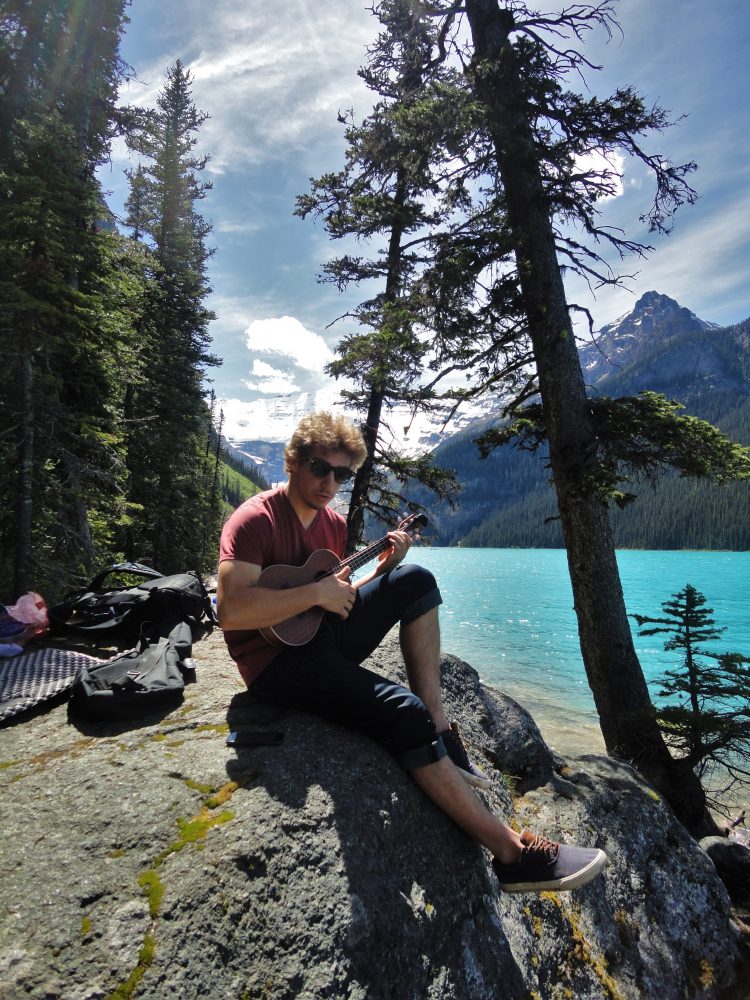
Étienne Hébert relaxing with his ukulele at Lake Louise near Canmore, Alberta, where he spent two months training with the Alberta World Cup Academy last summer. (Courtesy photo)
If I’m not skiing, you might find me at school, watching Netflix, or playing a little bit of ukulele.
If I had to pick a favorite book, it would be ‘The Pillars of the Earth’ by Ken Follet.
One of the things I’m most excited about for Junior Worlds at Soldier Hollow is getting some more international racing experience and trying to keep up with the best juniors in the world.
One race I’m especially targeting there is the classic sprint.
The best advice anyone ever gave me about skiing or racing was to keep my focus during races and think before doing a stupid move.
One of the best race memories I have is winning the 15 k classic at the Canadian Championships in 2016. What a great moment!
If I could meet one World Cup skier, it would be Andrew Musgrave.
If I don’t end up being a professional skier, I’ll hopefully do something I like, probably in the field of communication.
I’m missing 14 days of school to be here, and my teachers are probably not even thinking about it. I’ll have to work hard to catch up when I come back!
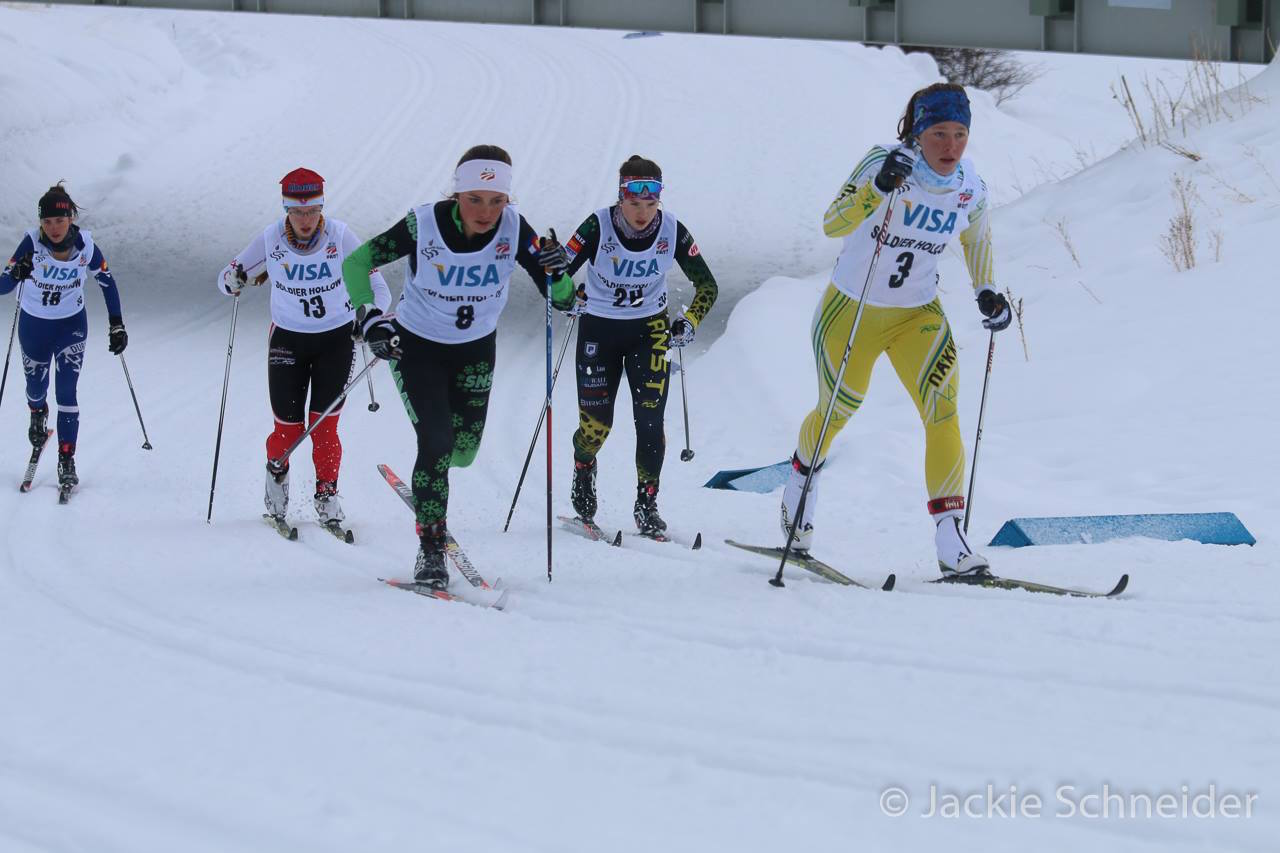
Nakkertok’s Claire Grall-Johnson (3) leading a junior classic sprint quarterfinal at 2017 U.S. nationals earlier this month at Soldier Hollow in Midway, Utah. (Photo: Jackie Schneider)
In an effort to showcase the North Americans competing at this week’s International Ski Federation (FIS) 2017 USANA Nordic Junior World Championships and U23 Cross Country World Championships at Soldier Hollow in Midway, Utah, we asked those qualifying athletes several questions about themselves — actually, we had them fill in the blanks. Here we have 19-year-old Claire Grall-Johnson, of the Nakkertok Junior Development Team, who’s representing Canada at her first Junior Worlds.
***
“My full name is Claire Grall-Johnson but you can call me Clairebear. I was born in Montreal, Quebec, raised in Ottawa, Ontario, and one thing you should know about my hometown is everyone is pretty bilingual and if ever you’re there you should hit up a sweet doughnut shop called ‘SuzyQ’.
I started cross-country skiing when I was four, thanks to my parents (who had to drag my brother and I out the door). I currently train in Ottawa with the Nakkertok Junior Development Team.
If I’m not skiing, you might find me working on some homework or hopefully eating something delicious. If I had to pick a favourite book, it would be ‘Harry Potter’ (duh) or ‘All the Light We Cannot See’ by Anthony Doerr.
One of the things I’m most excited about for Junior Worlds at Soldier Hollow is that it’s a beautiful venue with some tough courses. One race I’m especially targeting there is the classic sprint.
The best advice anyone ever gave me about skiing or racing was to appreciate the lifestyle I get to live as a student-athlete. One of the best race memories I have is the final day at Canadian Nationals in Whistler in 2013 when all the girls on our team had a super good day.
If I could meet one World Cup skier, it would be Krista Pärmäkoski.
If I don’t end up being a professional skier, I’ll probably be up to something science related.
I’m missing around 20 days of school to be here, and my teachers are probably thinking, ‘Good luck catching up!‘
Beckie Scott with the gold medal she was awarded at a ceremony in Vancouver in June 2004. A former Canadian cross-country skier, Scott finished third in the 5 k pursuit at the 2002 Olympics but was awarded gold two years later when the two women ahead of her were disqualified for using performance-enhancing drugs. (Photo: Cross Country Canada)
Below is a transcript of a speech Beckie Scott gave Thursday at the World Anti-Doping Agency (WADA) Executive Board meeting Montreal. A Canadian Olympic gold medalist cross-country skier and chair of WADA’s Athlete Committee, Scott urged the agency to use its influence to “to expand and strengthen the investigations and stand up for the protection of clean, legitimate athletes in sport” and “use that influence with respect to Rio and Games beyond that.”
***
“In what I would call an extraordinary measure and unlike all the meetings prior, there was only one significant outcome presented. It was an open letter renewing the call to expand the investigation into Russian doping. Following the release of the report of the Independent Commission of Russian Athletics last fall, we also took that opportunity to publicly announce our support for the whistleblowers Vitaly and Yuliya Stepanov. This was posted to the WADA website and can still be found there.
You may remember that we originally put this call out in November of last year almost immediately following the report and [there were deep implications] in the utter, complete implausibility of this system [Russia’s doping system] being in place to service only track and field athletes. That the curtain had been pulled back to reveal such corruption and widespread prolific abuse of the rules and laws of sport and nothing was done, was almost incomprehensible to the athlete community.
Indeed, the path of action and follow-up combined with the growing sentiment among the athlete community that there were leaders in sport who just wanted this to go away, led to a barrage of letters and communications to us from athletes around the world asking us — as the voice and representatives of clean athletes — to do more, to ask for more and to please stand up for the rights and protection of clean athletes. We have received communication from athletes from all sports around the world, including the FIS [International Ski Federation], the IBU [International Biathlon Union] , the IBSF [International Bobsleigh & Skeleton Federation], the USOCAC, the German NOCAC, the Canadian NOCAC, and the British NOCAC, as well as swimmers from Zimbabwe, Australia, curling — I could go on, but I will stop there because all I really want to do is highlight the fact that nationality and sport do not seem to be a significant factor in this movement, as the emotional and growing call from athletes for leaders of sport to expand and strengthen the investigations and stand up for the protection of clean, legitimate athletes in sport…
And so, we persist. We continue to ask that more is done and we maintain that position that the protection of clean athletes and fair sport is at the heart and forefront of all decisions.
In that light, we have four proposals. They are as follows:
There have to be sanctions for the very serious infraction of non-compliance. This is a task we propose is undertaken by the current CRC [Compliance Review Committee] and we wish that the format is developed with suggestions and a policy is adopted as soon as possible.
We propose that WADA should have the autonomy and authority to impose immediate sanctions and penalties, in the case of extraordinary revelations and and circumstances, such as Russia. For athletes to have to wait six months or longer to know what is going on as due process as unfold and decisions are made, is too long.
We fully acknowledge and we fully understand that WADA does not have jurisdiction over the Olympic Games. WADA does have, however, influence. And the clean athletes of the world propose that we use that influence with respect to Rio and Games beyond that, athletes strongly feel that if there cannot be a guarantee that athletes there are professionally clean and not involved in doping activity, then they should not be there.
Finally, with respect to whistleblowers, we must develop and institute a method to ensure the safety and the confidence, and the care of whistleblowers. They must be encouraged and they must be taken care of. This is imperative.
So the clean athletes of the world demand that more is done. They demand that investigations are initiated and carried out. That athletes, officials, organizations, and even countries are sanctioned accordingly and in a timely manner. The whole anti-doping system requires athlete buy in. It requires athletes to believe it is working. It requires athletes to believe that winning without doping is possible. If we do nothing, if we don’t investigate, lead investigations and not just follow up on television programs, if we don’t sanction, then we lose not only the athletes’ belief in the system, but we lose the belief that winning clean is possible.”
Norway’s 24-year-old Emil Iversen after winning his third-career World Cup race, and first distance race, at the second stage of the Ski Tour Canada on Wednesday: the 17.5 k classic mass start. (Photo:Flyingpointroad.com/NNF)
(Note: This article has been updated to include details about a crash involving Norway’s Martin Johnsrud Sundby early in the men’s classic mass start.)
Certainly it’s too soon for Norway’s Emil Iversen to tell his elders to move over. One of those elders is Norwegian teammate Martin Johnsrud Sundby, current overall World Cup leader. The other, Petter Northug Jr. is … Northug.
But at the second stage of the Ski Tour Canada (STC) on Wednesday, a 17.5-kilometer classic mass start in Montreal, Quebec, Norway’s 24-year old Iversen, strided, herringboned, and double poled to the win.
Exactly 45:05.4 minutes after the start, Iversen crossed the wind-swept finish line first, 5.3 seconds ahead of Northug. The overall leader of the STC and winner of Tuesday’s sprint, Russian Sergey Ustiugov, placed third (+14.5).
The start of the men’s 17.5 k classic mass start on the second day of the Ski Tour Canada in Montreal, Quebec. (Photo: Flyingpointroad.com/NNF)
At 23 years old, it was Ustiugov who first showed his fearlessness. Establishing a tempo and drive that 3.5 k in showed he was going to be the pace-setter — Ustiugov went on to dictate the pace for most of the race.
But at that 3.5 k mark it still could have been a number of skiers’ race to control. Strung out behind Ustiugov in a line were Norwegians Iversen, Sundby, Northug, Finn Hågen Krogh, Canada’s Alex Harvey, Norway’s Ola Vigen Hattestad, and Kazakhstan’s classic specialist, Alexey Poltoranin.
It must have been something subtle. Maybe an extra effort herringboning up the steep, sugary hills, or double poling with his burly core, but only a kilometer later, Ustiugov played for keeps. Only Iversen and Northug could hang on.
Sundby later told reporters that he had crashed early on an icy and curving descent.
“I went on my face,” he told NRK, according to a translation.
Slowly but surely, a gap back to Sundby grew. And as the moisture on Sundby’s beard began to freeze, so did his chances of bridging up to the leaders. At the 4.6 k mark, Sundby was 13 seconds behind.
“I lost a lot of time and then it was [over],” he said. “I’m not sure what to say. We are trying to showcase our sport, but today I am unsure what we were doing. Was it cross-country…?
“It was unusual conditions,” he added. “Fortunately, it was the same for all.”
As the moisture on Sundby’s beard began to freeze, so did his chances of bridging up to the leaders.
By 12.5 k, Sundby chasing in fourth was 18.2 seconds behind the trio of Ustiugov, Iversen and Northug. It remained a long day of trying to play catch up for Sundby, who toiled in no man’s land, chasing solo for the remainder of the race. Sundby finished fourth, 39.8 seconds behind the upstart Iversen.
It’s Northug’s signature tactic to let others set the pace until he marks the race with an exclamation point across the line. But Wednesday, Iversen, having grown up watching Northug’s bait-and-switch prowess over the years, left nothing for chance. With 1.5 k to go, Iversen began to stretch the rubberband back to Northug inch by inch. He had a 3.6-second lead on Northug, but even that small margin never vanished.
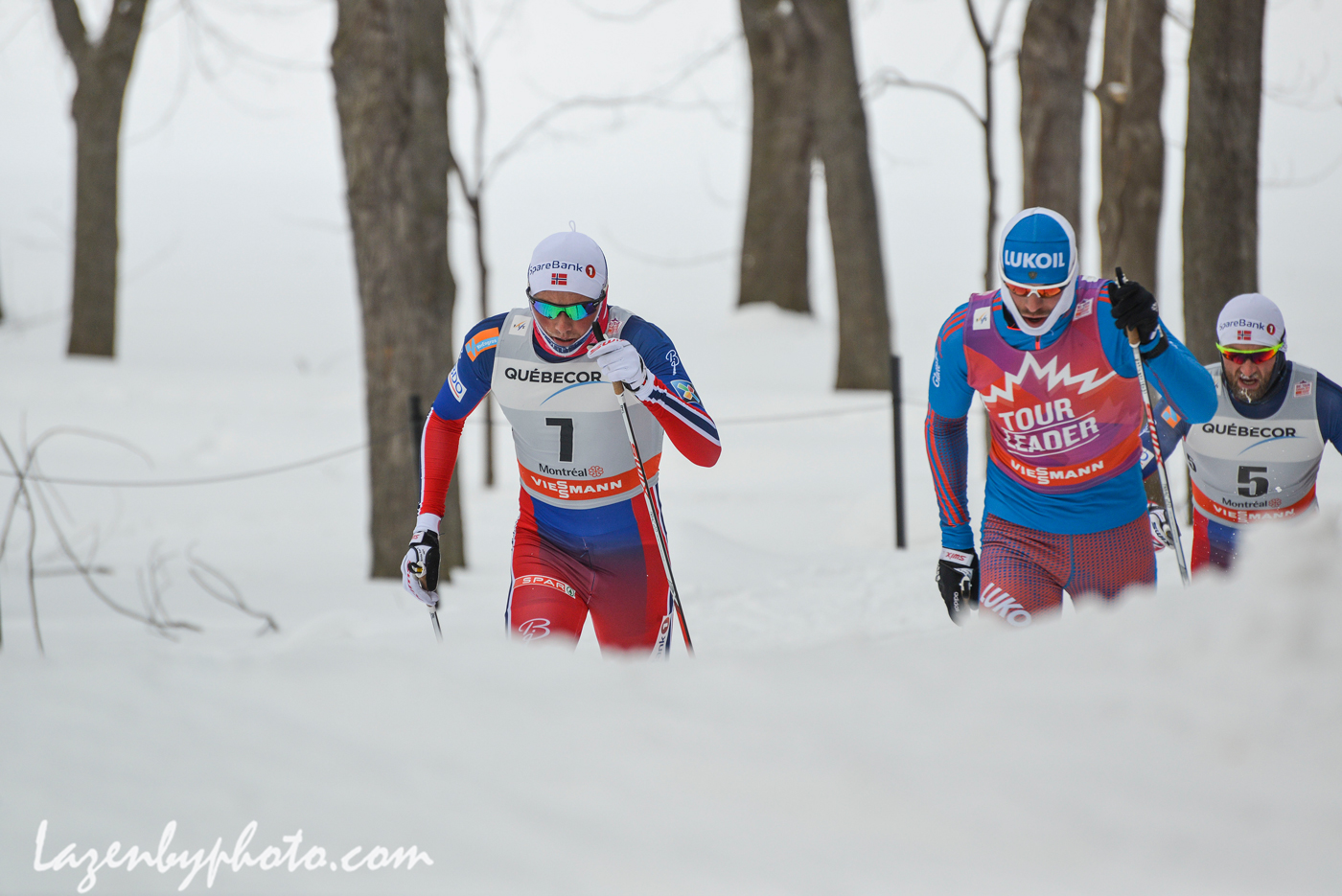
Norway’s Emil Iversen (l) and Russia’s Sergey Ustiugov (red leader’s bib) lead the men’s 17.5 k classic mass start at the second stage of the Ski Tour Canada in Montreal, Quebec, while Norway’s Petter Northug trails in third. Iversen went on to win, Northug placed second and Ustiugov took third. (Photo: John Lazenby/Lazenbyphoto.com)
When Iversen made his decisive move, he simply upped the pace and never looked back.
“In the fourth lap I saw Ustiugov was little bit tired,” Iversen said in the post-race press conference. “I decided to try and went for it 100 percent. I hoped I could get a gap and gain some seconds. My goal before the Ski Tour Canada was to have a good start. I’m sitting in second place. Now I have to take stage by stage and we see what happens.”
With his win on Wednesday, Iversen took his first ever distance World Cup victory and the third of his career. Iversen’s other two World Cup victories, both of which were sprints, also came this season.
Northug spoke about the trio out front and pushing an unrelenting pace.
“The plan was to stay in front of the field,” Northug said during the press conference. “After one lap it was only three or four guys in the lead. The pace was very high. We had to fight hard against the wind and snow. Ustiugov did a lot of work in the lead. He was the strongest today. We can thank him for the high speed.”
Ustiugov also acknowledged that he had taxed himself with the workload.
“It was a very tough race,” Ustiugov said at the press conference, through a translator. “I knew the guys behind me were fresher than me as I did all the work in the front, but I am satisfied with third place and be in the lead of the Ski Tour.”
With two consecutive podiums in as many stages so far, Ustiugov remains in first in the Tour standings, 6.1 seconds ahead of Iversen in second. Northug is third, 11 seconds back, and Sundby is nearly 1:40 minutes out of first in fourth overall.
Harvey in the Hunt
After two days of racing, both of which took place in his home province of Quebec, Harvey ranks sixth overall, 1:58.3 out of first, after placing ninth in Wednesday’s mass start (+1:16.4).
While racing the five laps of Montreal’s 3.5 k loop, Harvey appeared to be one of the few who could match the front runners’ pace. At 5.5 k, the Canadian skied in sixth, 14.5 seconds back.
Canadian World Cup Team member Alex Harvey (10) racing to ninth at the second stage of the Ski Tour Canada, the 17.5 k classic mass start in Montreal, Quebec. (Photo: flyingpointroad.com/NNF)
Again and again, it seemed Harvey would cover the breakaway. In an in-person interview afterward, Harvey said those efforts were exhasting.
“It was a drop in my energy.” Harvey said. “I tried closing the gap with the first three, but I exploded in trying to do so. I fought for the podium but the three guys at the front were out of reach. Ustiugov was really strong the first two laps. I paid at the end for my efforts.”
Harvey did ski wisely. He was close enough to the front to fight for the two mid-race time bonuses. Harvey took an 8-second time bonus at 4.6 k and a 2-second time bonus at 11.6 k.
Thinking more of the long-term than a one off race performance, Harvey said he is staying true to his STC plan.
“My fitness level is good and stable, which is important because you can’t win the Tour in one day, but you can lose it in one day,” he said. “The goal is to not loose the Tour on any day.”
The second best North American result came from fellow Canadian World Cup Team member Devon Kershaw, who began the day near the back of the pack in bib 50. Kershaw moved forward incrementally and by 5 k was skiing in 22nd place. He eventually skied across the finish in 17th (+1:38.9).
“It was a challenging day,” Kershaw said afterward. “Really soft snow, different conditions.”
Despite the less-than-ideal fresh snow and blustery wind, Kershaw appreciated the opportunity to ski in a city some of his family calls home.
“To race in front of friends and family here on the Island of Montreal is a pretty neat feeling,” he said. “It’s just so nice to have the home crowd behind you. My aunt and uncle live here, my mom and my brother live here as well. So I have a lot of family in the city. I heard their voices. It was pretty neat.”
In the points, and moving up on a day with tricky snow and biting wind, Kershaw remained positive.
“Seventeenth isn’t something we are going to be lighting fireworks off, calling everybody that I know,” he said. “But at the same time it’s a step in the right direction. I was pretty disappointed after yesterday so its better.”
Kershaw placed 50th on Tuesday’s freestyle sprint and now sits 17th overall.
A third Canadian World Cup Team skier in the points was Ivan Babikov in 29th (+2:32.1). Unlike Harvey, who started the day in bib 10 (meaning he had a good starting position heading into the courses steeply pitched and punchy climbs), Babikov wore bib 78. As a result, Babikov started near the rear in the field of 85 skiers.
When the day’s sinuous track kicked up on lap one, skiers had to herringbone some of the soft headwalls.
“There was actually a few places, mostly the first and second lap was the worst,” Babikov said on the phone after the race. “The course was just really interesting. I’ve never see something like that before.”
Babikov described quick downhills that pitched up into mandatory herringbone sections. Those sections created bottlenecks since the herringboning forced skiers to keep their skis wide.
“Oh yeah, like people crashing and tangling up all over the place,” Babikov said of the scene. “It also was really soft for the skis, so it created really like barely any track on the uphill where you could have strided … It was just a mess, broken poles, people falling down.”
Babikov explained that maybe the first five, 10 or 15 skiers could ski cleanly through, but not the main pack. On his first lap, Babikov said he felt like he waited thirty seconds for the mess of skiers to clear before pushing ahead.
When he finally did push ahead, he pushed hard. Of his jump from 78th to 29th place at the finish, Babikov said skiing conservatively wasn’t part of the plan.
“You have to take a risk today,” Babikov said. “Like, at times to pass people on the downhills. My body felt pretty good. I tried to pass people whenever I could.”
All that passing moved Babikov up in the overall standings. He now sits 33rd overall.
Canadian Head Coach Justin Wadsworth was pleased with the day’s result.
“It was actually a pretty solid day for us, three guys in the top 30, Alex in ninth, Devon in 17th and Ivan 29,” he said.
Wadsworth also spoke about the benefits of World Cup racing for a future generation of Canadian skiers.
“Today was an experience…,” he said. “For the younger athletes, it was a real eye opener. It was very hard conditions, with the wind and the snow and the course. I think our younger athletes, also arriving just last night … usually you get some time on the course ahead of time and there’s a ski warmup area and a testing area, and none of that happens here. Boom, you show up and you get ready to race on a race course your’ve never raced on at the highest level.”
Also for Canada, Graeme Killick (CNST) placed 50th, Kevin Sandau (Alberta World Cup Academy) was 53rd, Len Valjas (CNST) 63rd, Patrick Stewart-Jones (AWCA) 64th, Jess Cockney (CNST) 66th, Michael Somppi (NDC Thunder Bay) 68th, Knute Johnsgaard (AWCA/CNST) 69th, Bob Thompson (NDC Thunder Bay) 73rd, Russell Kennedy (Canmore Nordic) 74th, Andy Shields (NDC Thunder Bay) 76th, and Simon LaPointe (Skinouk) 82nd.
Bjornsen leads the U.S.
Erik Bjornsen (Alaska Pacific University/U.S. Ski Team) was the top American in 31st, just 0.4 seconds outside the top 30 and 2:37.3 behind the winner. In a post-race phone call, Bjornsen said he is feeling good after two STC stages.
Erik Bjornsen (USA) on his way to 31st place in the men’s 17.5 k classic mass start at Stage 2 of the Ski Tour Canada in Montreal, Quebec.. (Photo: Flyingpointroad.com/NNF)
“Coming into today I knew that I have been feeling pretty good lately, so I was hoping for a good result,” he said.
Bjornsen also noted the difficult herringboning and the likelihood for bottlenecks to develop.
“It went out at a pretty hot pace just knowing things were going to get strung out having such a narrow course like that,” Bjornsen said. “But I felt like I went out all right. I struggled a bit with the herringboning and felt strong on the double pole. I was not happy with being so close to the top-thirty. Definitely hoping for a little more in the next few stages.”
The STC is the second World Cup Tour for Bjornsen.
“In the last Tour I was right outside the top 40,” Bjornsen said. “It’s my goal this time to be closer to the thirties, but I think if I finish in the top 30 I would be very happy with my overall result. We will see how it goes, there is definitely a couple of good races for me coming up. If I could pop into the top 20 in one race that would be absolutely awesome.”
U.S. head coach Chris Grover discussed how the front-end racers escaped from the main group so quickly. Bottlenecks were a recurring theme.
“It was a pretty narrow course overall,” Grover said on the phone. “And in particular, the big longer herringbone hill was really only about one skier width … The packs got super strung out because the nature of the course but also because of the tough conditions. Once people got away from those that were trying to herringbone in the soft stuff, they really got away.”
Grover said those rough-an- tumble patches took a toll on both the U.S. men and women.
“We had a lot of broken equipment today,” he explained. “Just amongst our team, Ida Sargent broke a ski in a crash tangle-up right away. Brian Gregg broke a ski by having a binding rip off a ski. So it was definitely a challenging day.”
American Matt Liebsch (Gear West) waits for his good friend and training partner Brian Gregg (Team Gregg) to finish the men’s 17.5 k classic mass start at Stage 2 of the Ski Tour Canada in Montreal, Quebec. Gregg crashed and his binding ripped off his ski. (Photo: Flyingpointroad.com/NNF)
Gregg ultimately finished 81st.
“I had one pretty solid crash out there, which was certainly very frustrating but that’s part of racing,” Gregg said after.
Noah Hoffman (Ski & Snowboard Club Vail/USST) placed 42nd. He reiterated the tough course.
“It’s a really challenging course,” Hoffman said. “We were just standing still on the first lap, so often. It was so narrow, there’s so much herringbone. It was a challenge from way back off of yesterday’s finish.”
Also for the U.S., Scott Patterson (APU) finished 55th, Simi Hamilton (SMST2/USST) was 58th, Eric Packer (APU) 67th, Reese Hanneman (APU) 70th, Andy Newell (SMST2/USST) 71st, Dakota Blackhorse-von Jess (Bend Endurance Academy) 77th, Matt Liebsch (Gear West) 79th, Tad Elliott (SSCV) 80th, and Gregg (Team Gregg) 81st.
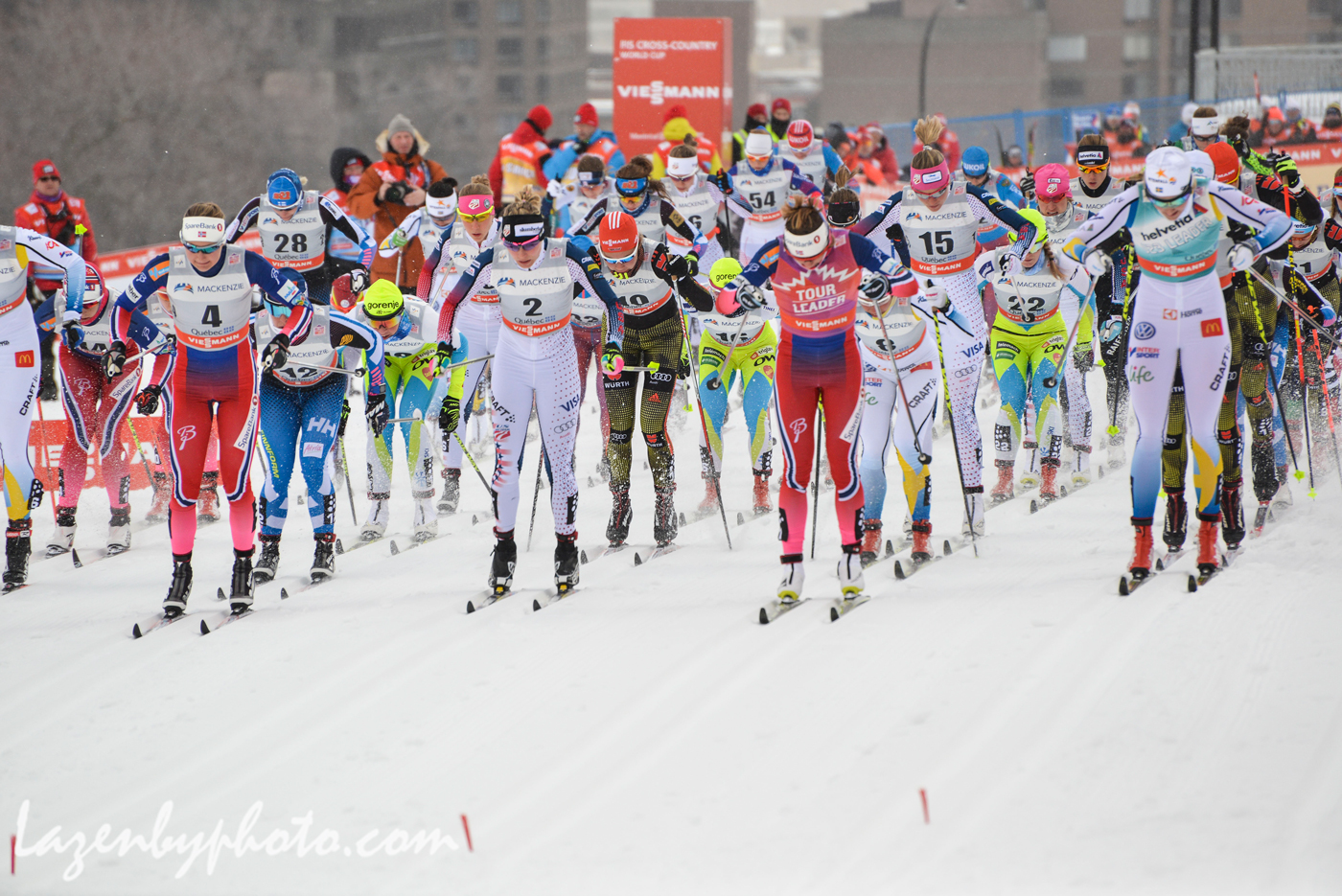
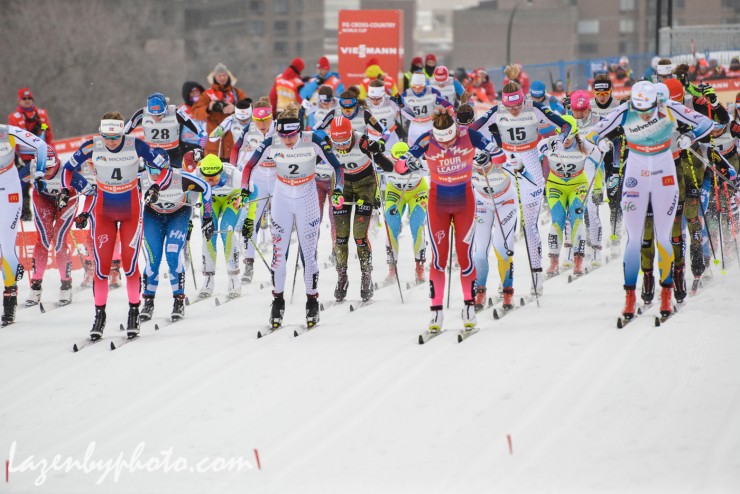
The start of the women’s 10.5 k classic mass start at Stage 2 of the Ski Tour Canada on Wednesday in Montreal, Quebec, with (from left to right, front row) Norway’s Ingvild Flugstad Østberg (4), American Jessie Diggins (2), Norway’s Maiken Caspersen Falla (red leader’s bib), and Sweden’s Stina Nilsson leading the pack out. (Photo: John Lazenby/Lazenbyphoto.com)
If any World Cup athletes forgot that cross-country skiing is a winter sport, they received a stark reminder on Wednesday in Montreal, Quebec, for the second day of the Ski Tour Canada.
While this season has been characterized by ribbons of manmade snow across a brown landscape and unseasonably warm temperatures, the plunge back to frigid conditions and fresh snow during the classic mass start at Stage 2 of the Tour brought back the balaclavas.
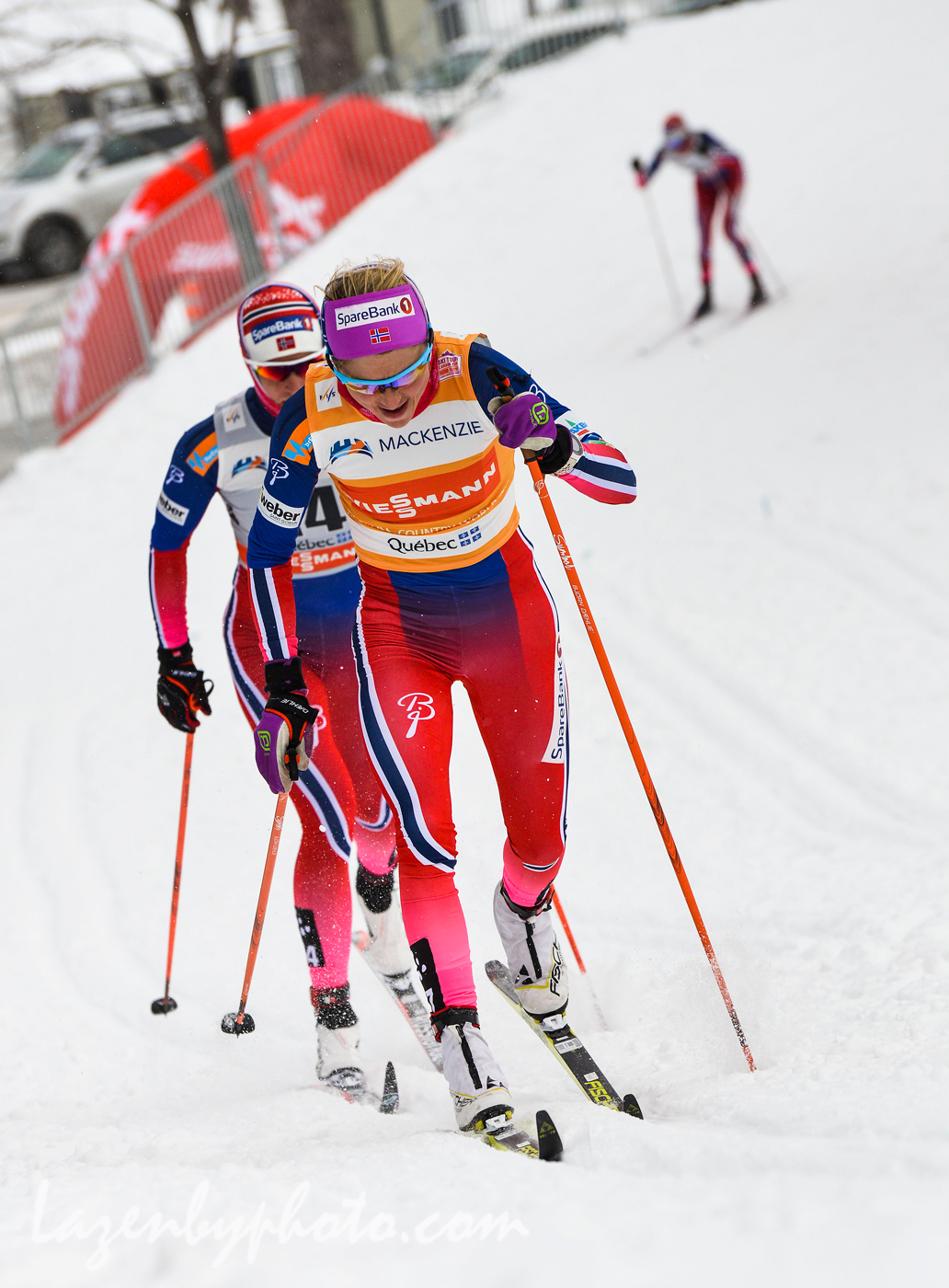
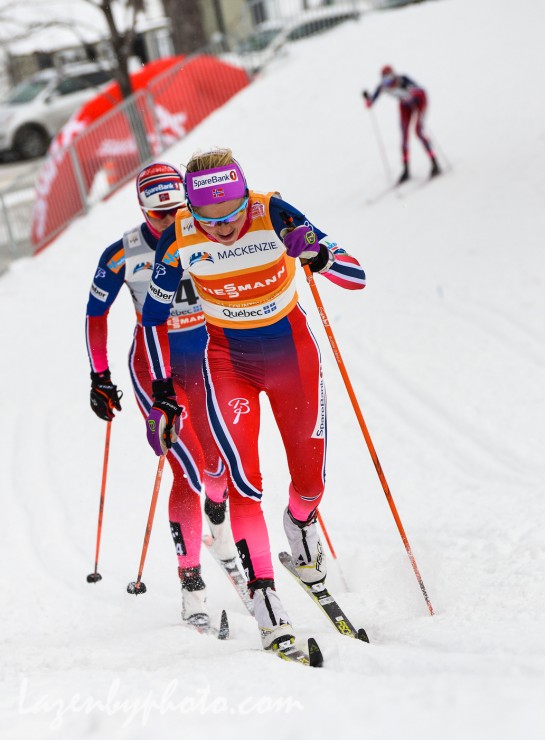
Therese Johaug leads fellow Norwegian Astrid Uhrenholdt Jacobsen early in the women’s 10.5 k classic mass start while another Norwegian, Heidi Weng chases in third. (Photo: John Lazenby/Lazenbyphoto.com)
At race time, temperatures hovered around 16 degrees Fahrenheit, but a brutal 20 to 30 mile-per-hour winds made it downright frigid. In addition to the wind, a steady snowfall made for a soft course in the unique race venue at Parc du Mont-Royal. Dating back to 1879, it is the oldest skiing site in Canada located in the midst Quebec’s largest city of Montreal.
The course was windy and narrow with several areas likely to cause bottlenecks in a mass start event with a large (72-woman) field. This factor made start position and staying out of trouble big factors in staying in the hunt.
Racers were issued bib numbers based on their overall Tour standings from Tuesday’s sprint, giving Diggins a front-row start while overall World Cup leader Therese Johaug started four rows back in bib 27 — a spot she is not accustomed to.
Johaug’s start position spared the field the relentless pace she usually pushes from the gun. At the 1 kilometer mark, the field remained bunched on the narrow course with Sweden’s Charlotte Kalla and Norwegians Heidi Weng and Maiken Caspersen Falla leading the charge. Americans Jessie Diggins and Sadie Bjornsen asserted themselves near the front, maintaining position in the top 10.
“I was a little bit nervous before the start today because my start position was not where I was used to,” Johaug said in a post-race press conference. “It was really tough in the beginning there because there was so many girls and it was crazy behind there so I have to focus on myself and take it step by step.”
Within two kilometers, Johaug had found her niche at the front as the field began to string out. But Norwegian teammates Astrid Uhrenholdt Jacobsen and Weng were not going to let her go without a fight as they attempted to match Johaug’s pace. By the 3.5 k checkpoint, Jacobsen and Johaug had established a 20-second gap on the field while Weng dangled eight seconds behind the two.
However, Johaug’s pace was relentless and Jacobsen soon conceded to reconvene with Weng by the 5.5 k mark, 27 seconds behind Johaug. Despite being dropped by Johaug, the pair maintained a 30-second gap on the rest of the field. Meanwhile, a chase group of 15, including Diggins and Bjornsen, fought for the only skied-in tracks as the snow accumulated.
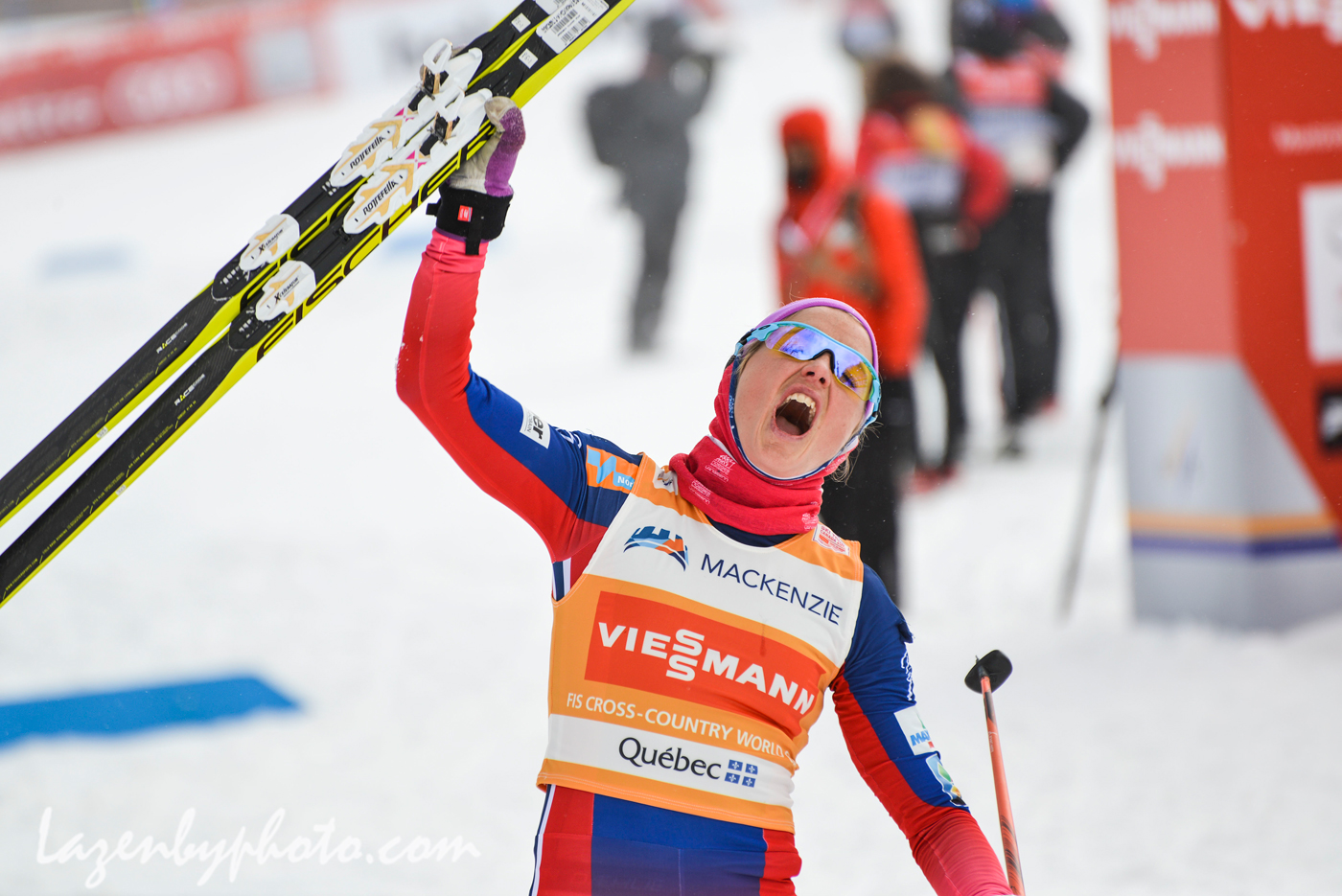
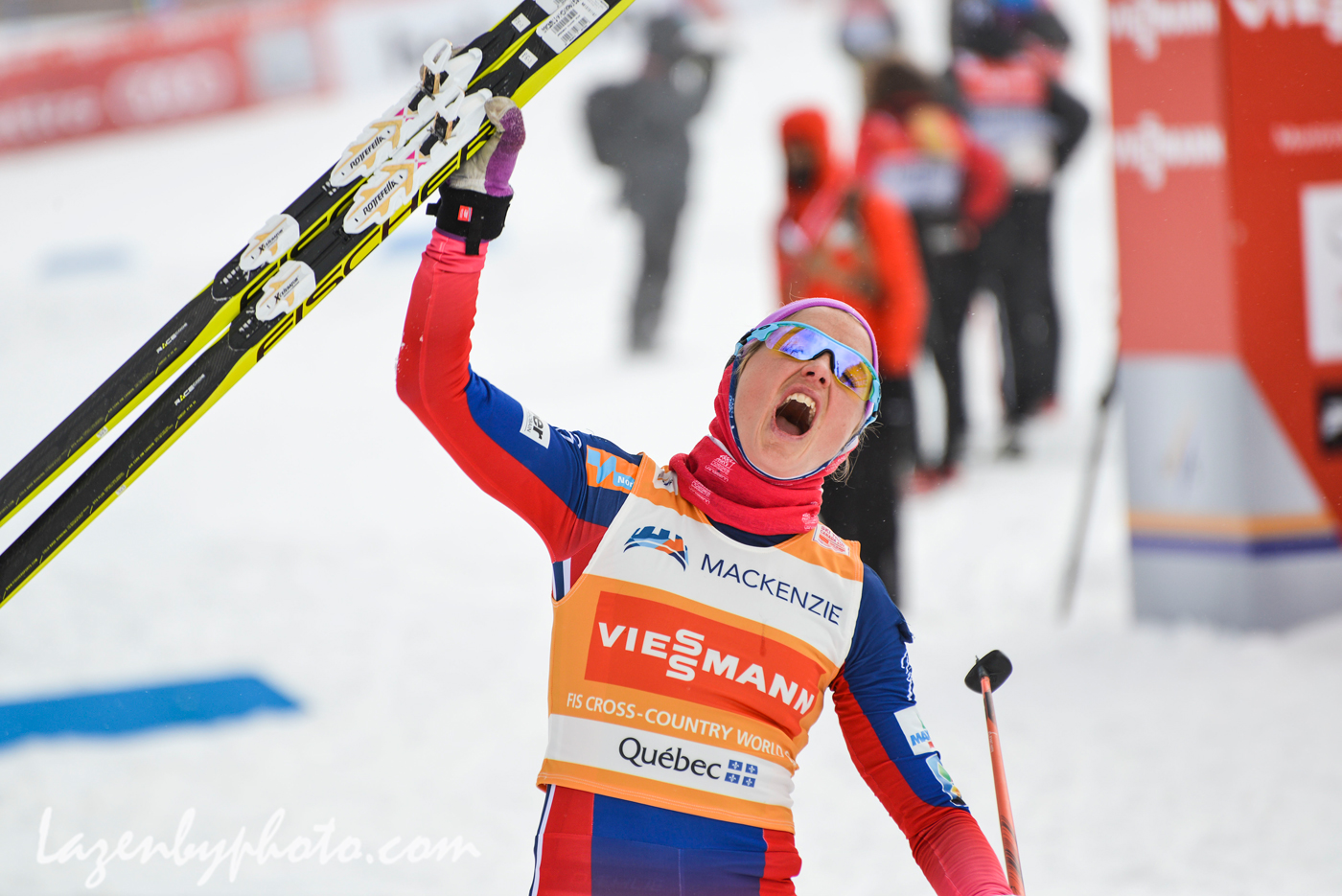
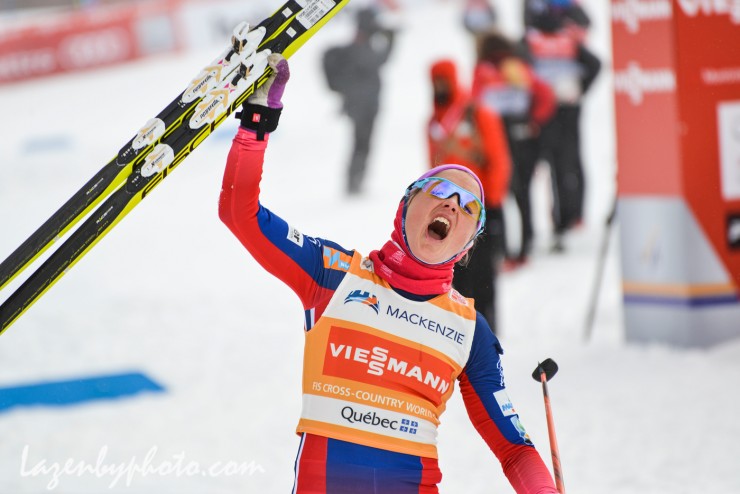
Norway’s Therese Johaug celebrates her one-minute victory in the women’s 10.5 k classic mass start at Stage 2 of the Ski Tour Canada. The win put her first in the Tour standings, 26.8 seconds ahead of teammate Heidi Weng. (Photo: John Lazenby/Lazenbyphoto.com)
Johaug showed no mercy during the second half of the three-lap race as she continued to extend her lead. She posted a time of 30:05.6 over 10.5 k to win by a full minute over Weng. In the final kilometers, Weng distanced herself from Jacobsen to secure second, 1:00.3 behind Johaug and 9.5 seconds ahead of Jacobsen in third.
“When I [decided to] go, I hoped that me and Astrid can take some seconds to Therese, but Astrid was very tired,” Weng recalled in the press conference. “I thought that, ‘OK I can go and maybe she hang on,’ but I got some seconds.”
Still, after finishing a minute behind Johaug, Weng trails her by 26 seconds in the Tour standings — a big gap to overcome with four of the six remaining stages being distance races.
“I was very good yesterday,” Weng said of the sprint, where she placed fourth. “But when you lose one minute and Therese gets all of the bonus seconds … I must be better in the distance and train more.”
Johaug’s dominant win puts her in the overall lead in the Tour, back in bib 1. She holds a 26.8 second lead over Weng and 1:10.8 over Jacobsen in third heading into Friday’s freestyle sprint in Quebec City.
“I’m really happy that I did not think that I should be in front in just 200 meters, but I used the first kilometer to go up in front,” Johaug said. “My skis today were so good and the shape is also really good at the moment. I can just push the whole way and I know that I must also push all the way because I need all the seconds I can get in front of the Tour.”
Finishing 30 to 40 seconds after Jacobsen, the remainder of the top-10 positions were determined in a congested push to the finish with Falla taking advantage of her sprinting prowess to secure fourth, 1:42 behind Johaug and 32.2 seconds off the podium. Just 0.8 seconds behind Falla, Poland’s Justyna Kowalczyk placed fifth and Norway’s Ingvild Flugstad Østberg finished another 0.2 seconds back in sixth.
Double poling toward the finish near the back of the five-woman chase pack, Diggins essentially ran out of room without any place to move around the racers ahead of her, as the group double poled in side-by-side rows to the finish. She finished eighth (+1:43.5), two-hundredths of a second behind Finland’s Kerttu Niskanen in seventh and just 1.5 seconds behind Falla.
The U.S. Ski Team’s leading women in Wednesday’s 10.5 k classic mass start, Jessie Diggins (front) and Sadie Bjornsen (behind) on their way to placing eighth and 16th, respectively, in the second stage of the Ski Tour Canada. (Photo: Flyingpointroad.com/NNF)
Diggins’ finish put her fifth in the overall Tour after claiming third in the freestyle sprint on Tuesday. She sits just 9.5 seconds behind Falla in fourth and 1:23.7 behind Johaug in the overall standings.
“That was a very different race than we have had in a long time,” said Diggins in an in-person interview after Wednesday’s race. “The wind gusts were incredible. It became pretty tactical because really only one of the tracks was skied in so if you found yourself outside of it you were working twice as hard. So that in itself was a bit part of the race.”
Eighth place stood as her second-best classic result in a World Cup since finishing fifth in last month’s 5 k classic in Falun, Sweden.
“I was really pleased with it,” Diggins said of Wednesday’s race. “A couple years ago I never could have done that on a day like today with super-tricky kick. It took finesse on those gradual uphills to try make your skis work. It was hard out there for everyone but I think I had great skis.”
Despite holding position in the top 10 for the first two of three laps, Bjornsen lost contact with the larger chase group to finish 16th (+2:04.2).
“The first couple of laps were good, and then I started sort of stressing and slipping a lot and fell back a ways,” Bjornsen said afterward. “But I was definitely happy with how it felt the first couple laps.”
Americans Liz Stephen and Rosie Brennan also scored World Cup points in the top 30, placing 22nd (+2:44.3) and 28th (+3:05.8), respectively.
“It was good, a decent place to be, I think, at this point of the Tour,” Brennan said after tying her season best (she placed 28th in a World Cup 10 k freestyle in January in Nove Mesto, Czech Republic). “The Tour is long; it’s about every day, not one day, but I am always psyched to be in the points.”
Poland’s Justyna Kowalczyk (r) leads two Norwegians, Ingvild Flugstad Østberg and Maiken Caspersen Falla, and Americans Jessie Diggins (third from left) and Sadie Bjornsen (l) during a blustery 10.5 k classic mass start at Stage 2 of the Ski Tour Canada in Montreal, Quebec. (Photo: Flyingpointroad.com/NNF)
For racers starting farther back in the field, the mass start on the narrow course posed a significant challenge to navigate.
“Because we knew there were going to be some bottlenecks, we talked to all the women about trying to get a pretty fast start and move up a few places to get in front of some of the bottlenecks,” U.S. Ski Team Head Coach Chris Grover explained in a post-race phone interview.
In theory, it was a great strategy, but certainly easier said than done. One of the woman most successful at pulling this off was Stephen, who started in bib 59 and successfully navigated the chaos of the mass start to move into the top 25 in the first half of the race. Over the last few kilometer, she picked off a few more places to finish 22nd.
“I was lucky to avoid all the crashes that happened in the first lap,” Stephen said in a phone interview. “The start was crazy and the course was really fun once it was more spread out, but it was a really tough course to have a mass start on because of the steep ups and downs and narrow track with the snowy conditions. I am happy with my race today as I was feeling strong the whole time and was able to push my head and my body.”
Also competing for the U.S. was Chelsea Holmes (APU) 38th, Kaitlynn Miller (CGRP) 39th, Ida Sargent (CGRP/USST) 40th, Sophie Caldwell (SMST2/USST) 42nd, Caitlin Gregg (Team Gregg/USST) 47th, Jennie Bender (BSF) 51st, Katherine Ogden (SMS/USST) 59th, and Annie Hart (SMST2) 61st.
While many of the U.S. women were able to stay out of trouble, there were a number of crashes on the congested course. Both Sargent and Hart fell victim to race-altering crashes.
Sargent broke a ski after crashing into Sweden’s Hanna Falk, who fell in front of her. But she was able to finish the race after quickly receiving a new ski from a coach and went on to finish 40th.
“Ida was really bummed because she saw this as an opportunity to have a really good classic distance race,” Grover said. “It is ironic because Falk is who crashed in front of her yesterday in the sprint. She did a great job of clawing back place by place.”
Hart’s race was also thwarted when she became tangled in a pileup at the start.
“It was pretty crazy, about 500 meters in there was a gigantic pileup that I had the liberty of being on the bottom of,” Hart said in an in-person interview. “I’ve never quite been underneath ten girls. That felt a little bit frustrating, but after that I just tried not to panic and just tried to pick people off. So, it was an experience.“
Emily Nishikawa of the Canadian Senior Development Team was also involved in the same crash, but recovered to lead the Canadian women in 45th place (+4:39.7).
“I fell off the trail, I had my skis tangled up in the fence and I hit the fence pretty hard,” Nishikawa said afterward. “I was the very last person leaving that corner so I had to make up a lot of ground, but I think after that I skied well.”
Canadian coach Justin Wadsworth commended Nishikawa’s recovery following the incident.
“She probably lost about 45 seconds or a minute just trying to get onto the trail again,” he said. “I was trying to even help her and it was a real mess. I think she skied a very good race, especially regaining her composure.”
She was followed by Canadians Cendrine Browne (CNEPH/CNST) 48th, Katherine Stewart-Jones (NDC Thunder Bay) 52nd, Olivia Bouffard-Nesbitt (CNST) 53rd, Andrea Dupont (RMR) 57th, Annika Hicks (Canmore Nordic) 60th, Jennifer Jackson (NDC Thunder Bay) 63rd, Alannah MacLean (NDC Thunder Bay) 64th, Dahria Beatty (AWCA/CNST) 65th, Maya Macisaac-Jones (RMR) 67th, Sophie Carrier-Laforte (CNEPH) 68th, and Marie Corriveau (CNEPH/National Junior Team) 72nd.
With a large, young contingent of Canadians racing, the Tour is the unique opportunity to race on the highest level in their home country.
“I think today was an experience for the best racers in the world, who have been racing many years on the World Cup,” Wadsworth said.”So for the younger athletes, it was a real eye opener. It was very hard conditions, with the wind and the snow and the course. Most of them seem to have pretty good attitudes about it, so hopefully they get some good learning out of it.”
— Gerry Furseth, François Léger Dionne, Jason Albert, Harald Zimmer, and Alex Kochon contributed
Therese Johaug celebrates her decisive victory in the second stage of the Ski Tour Canada, the 10.5 k classic mass start on Wednesday in Montreal, Quebec. (Photo: Flyingpointroad.com/NNF)
The second day of the Ski Tour Canada got underway in Montreal, Quebec, with the women’s 10.5-kilometer classic mass start. Norway’s Therese Johaug won by a minute, the Norwegian women occupied the top four, and American Jessie Diggins raced to eighth. Check back for a full report and more.
The start of the women’s 10.5 k classic mass start at Stage 2 of the Ski Tour Canada on Wednesday in Montreal, Quebec, with (from left to right, front row) Norway’s Ingvild Flugstad Østberg (4), American Jessie Diggins (2), Norway’s Maiken Caspersen Falla (red leader’s bib), and Sweden’s Stina Nilsson leading the pack out. (Photo: John Lazenby/Lazenbyphoto.com)
Therese Johaug leads fellow Norwegian Astrid Uhrenholdt Jacobsen early in the women’s 10.5 k classic mass start while another Norwegian, Heidi Weng chases in third. (Photo: John Lazenby/Lazenbyphoto.com)
Norway’s Therese Johaug celebrates her one-minute victory in the women’s 10.5 k classic mass start at Stage 2 of the Ski Tour Canada. The win put her first in the Tour standings, 26.8 seconds ahead of teammate Heidi Weng. (Photo: John Lazenby/Lazenbyphoto.com)
Norway’s Heidi Weng (2nd place), Therese Johaug (1st place) and Astrid Uhrenholdt Jacobsen (3rd place) sweep the podium in Montreal. (photo: John Lazenby/Lazenbyphoto.com)
Americans Andy Newell and Dakota Blackhorse-von Jess during official training on Monday, one day before the start of the 2016 Ski Tour Canada in Gatineau, Quebec. (Photo: John Lazenby/Lazenbyphoto.com)
(Note: This article has been updated to reflect the adjusted distances for the men’s and women’s classic mass starts in Montreal on Wednesday, March 2.)
The U.S. Ski Team is ready. And we’re sure the Canadians are bursting at the seams. Are you? Over the last week, World Cup cross-country ski racers from about 25 nations descended on Ottawa, Ontario, and the Gatineau just across the river in western Quebec in anticipation of the first of eight stages at the Ski Tour Canada, which doubles as World Cup finals.
Races start Tuesday with the men’s and women’s 1.7-kilometer freestyle sprints in Gatineau, with the elimination rounds starting at 1:45 Eastern time, and continue Wednesday about 200 kilometers east in Montreal, Quebec, with the first distance races of the Tour: the women’s 10.5 k and men’s 17.5 k classic mass starts.
With temperatures up around freezing on Monday afternoon, the Gatineau sprint course both softened and transformed under the sun. It cooled down considerably overnight, with temperatures around -17 degrees Celsius (1 Fahrenheit) and a forecast high of -10 (14 Fahrenheit) with high winds expected.
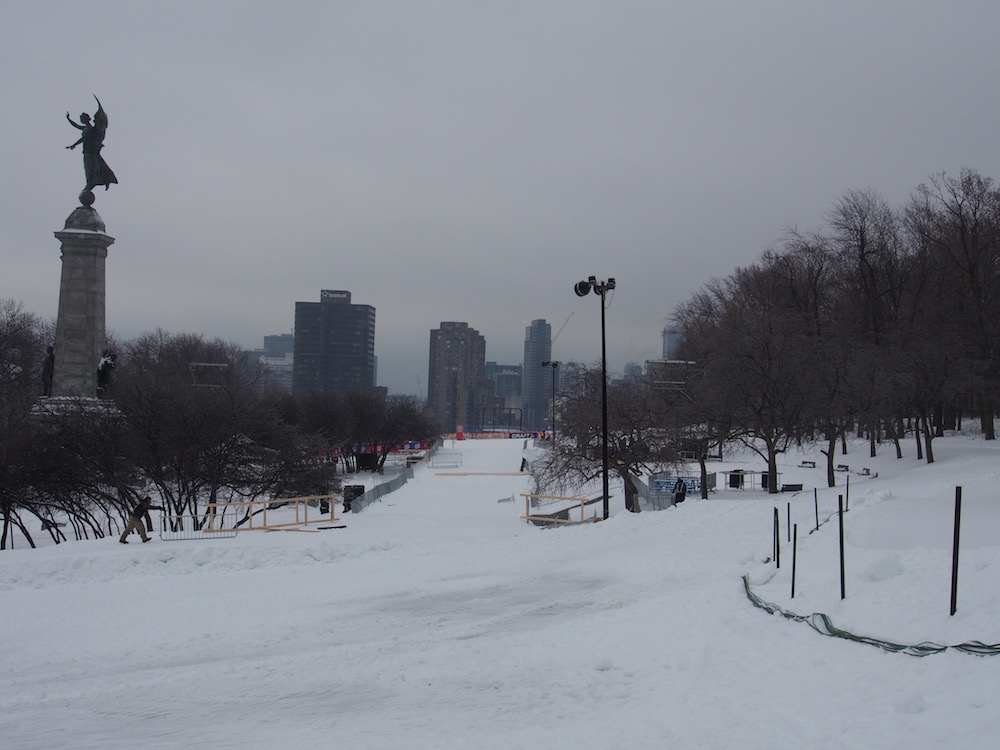
Looking down the finishing stretch at the World Cup course in Montreal, as seen Monday two days before the races there on Wednesday. (Photo: Francois Leger Dionne)
A blizzard is also on the way, with snowfall anticipated in Montreal starting between 4 and 5 p.m. on Tuesday. Accumulation could be around 25-30 centimeters (10-12 inches) of snow Tuesday night and into Wednesday: race day in Montreal.
There, the 3.5 k course has been altered slightly from its original plan due to “technical challenges related to the water supply service,” which would have made snowmaking difficult atop Mount Royal, a large hill just west of downtown Montreal, organizers explained in press release earlier this month. The course was moved from the top to the bottom, near the George-Étienne Cartier Monument, “a location that is easily accessible to the public,” the release stated.
Snow conditions on Monday were “rock hard” and icy, according to one FasterSkier reporter, due to freezing rain Monday morning.
Like Gatineau, Montreal’s high temperatures were around freezing on Monday and forecast to be -10 Celsius on Tuesday and Wednesday.
Here is a collection of photos and quotes from the days leading up to the Tour, as well as a complete schedule below.
A sunny day for the final day of official training before the start of the 2016 Ski Tour Canada in Gatineau, Quebec. (Photo: John Lazenby/Lazenbyphoto.com)
A little wax testing on Gatineau’s 1.7 k sprint course, with the start/finish area visible at the upper right. (Photo: John Lazenby/lazenbyphoto.com)
Petter Northug (Norway) during official training on Monday in Gatineau, Quebec. (Photo: John Lazenby/Lazenbyphoto.com)
FasterSkier: “Is this your first time in Ottawa?”
Simi Hamilton: “It is! I’ve been up to Quebec quite a few times and obviously Canmore a whole bunch, but first time to Ottawa and it’s awesome. Really cool. The skiing up here is amazing. I was telling the crowd earlier, it’s probably the best skiing we’ve had all winter, on natural snow and just hundreds of k’s of trails out here. So it’s really cool.”
–Interview by Alex Slobodan
The German World Cup team during official training in Gatineau, Quebec. (Photo: John Lazenby/Lazenbyphoto.com)
Alex Harvey (Canadian World Cup Team) surrounded by media on Monday, one day before the start of the Ski Tour Canada in Gatineau, Quebec. (Photo: John Lazenby/Lazenbyphoto.com)
Patrick Stewart-Jones representing Canada during Monday’s press conference, the day before the Ski Tour Canada’s first stage in Gatineau, Quebec. (Photo: John Lazenby/Lazenbyphoto.com)
Jessie Diggins speaking on behalf of the U.S. team during Monday’s press conference, the day before the Ski Tour Canada’s first stage in Gatineau, Quebec. (Photo: John Lazenby/Lazenbyphoto.com)
Maurice Manificat during Monday’s press conference, the day before the Ski Tour Canada’s first stage in Gatineau, Quebec. (Photo: John Lazenby/Lazenbyphoto.com)
Stina Nilsson during Monday’s press conference, the day before the Ski Tour Canada’s first stage in Gatineau, Quebec. (Photo: John Lazenby/Lazenbyphoto.com)
Federico Pellegrino during Monday’s press conference, the day before the Ski Tour Canada’s first stage in Gatineau, Quebec. (Photo: John Lazenby/Lazenbyphoto.com)
(Photo: John Lazenby/Lazenbyphoto.com)
FasterSkier: “Have you ever been to Ottawa before?”
Francesco de Fabiani: “No, it is the first time I come in Canada and in America in general. I am surprised … Canada is a very nice place for cross-country skiing.”
FS: “What are your goals for the Tour?”
FDF: “Well, I hope to stay in the top 10 in the final ranking, but I know that it will be difficult with the free sprint. I don’t know how is the track in Montreal, the 20 k. And classic is my favourite technique, but if it is not so hard and someone can go with only double poling, I think that they will be difficult to stay with.”
FasterSkier: “What are your goals for the Tour?”
Erik Bjornsen: “I’ve had some pretty good races the last couple of weeks on the World Cup so I am hoping to keep that momentum going and score some points and just ski strong all the way through.”
A Russian athlete signs the toque of a local child at the Nakkertok ski trails in Cantley, Quebec, last weekend. (Photo: Doug Ranahan)
Nakkertok head coach Kieran Jones on the impact of a local World Cup: “Having the World Cup arrive in the Ottawa/Gatineau area is a great chance for our athletes to see what the strongest in the world look like. In North America you barely get to see the best cross country skiers on TV, much less in person, so the myth and legend grows to the point where they can seem inhuman. Having Northug, Kalla, and Caspersen Falla skiing around at Nakkertok really brings home the reality of the sport to the kids and young adults, and shows them that these fast skiers are still people, and are totally approachable, and people you can aspire to. The buzz that having the world in your city and club generates is great for the sport, and great for the club.”
Norway’s Maiken Caspersen Falla (in pink) skis by a young local skier at the Nakkertok ski trails on Saturday in Cantley, Quebec. (Photo: Doug Ranahan)
Norway’s Maiken Caspersen Falla training on Saturday at the Nakkertok trails in Cantley, Quebec. (Photo: Doug Ranahan)
Two Nakkertok juniors, Pat Paradine (in yellow) and Hugh Graham (left, in blue and black), chase Russian World Cup skiers on Saturday during training at the Nakkertok trails in Cantley, Quebec. (Photo: Doug Ranahan)
Nakkertok’s Hugh Graham (l) and Pat Paradine double pole behind two Russian World Cup skiers (not shown) at the Nakkertok trails in Cantley, Quebec, the weekend before the Ski Tour Canada stage in Gatineau, Quebec. (Photo: Doug Ranahan)
Nakkertok’s Alex Slobodian chases a Norwegian on the Nakkertok trails in Cantley, Quebec. (Photo: Doug Ranahan)
FasterSkier: “Have you been to Ottawa before?” Markus Cranmer, former German junior coach, now a Russian coach for Alexander Legkov’s training group: “No. It’s the first time for me to be here. Very nice, very nice for skiing and very nice tracks here. I’m really surprised! … Not too far from the city and so it’s very nice.”
“I’m looking forward to the entire experience and not putting too much weight into any single race,” Jackson wrote in an email. “Every race as my next best opportunity, in a Tour format you can’t write off any race because every day matters if you want to get to the next one. I am a more partial to the sprints though.
“Racing for Canada on home soil is pretty darn cool, but being able to represent my training centre (NDC Thunder Bay), province (Ontario), and club (Team Hardwood), is even more inspiring because they are the ones who have fostered my development as a skier to a level where I can be part of Team Canada.”
All races are expected to be broadcast on NBC Sports Live Extra (accessible to U.S. subscribers via cable or satellite), and all times are Eastern Standard Time.
Tuesday, March 1: Gatineau
(Not part of broadcast: Women’s qualifier at 11:15 a.m.: start list | Men’s qualifier at noon: start list)
1:45 p.m. – Men’s and women’s freestyle sprint heats
Wednesday, March 2: Montreal
12:00 p.m. – Women’s 13 k classic mass start
2:30 p.m. – Men’s 20 k classic mass start
Friday, March 4: Quebec City
3:30 p.m. – Men’s and women’s freestyle sprint
Saturday, March 5: Quebec City
3:00 p.m. – Women’s 10 k freestyle pursuit
4:00 p.m. – Men’s 15 k freestyle pursuit
Tuesday, March 8: Canmore
3:00 p.m. – Men’s and women’s classic sprint
Wednesday, March 9: Canmore
12:00 p.m. – Women’s 15 k skiathlon
2:30 p.m. – Men’s 30 k skiathlon
Friday, March 11: Canmore
11:45 a.m. – Women’s 10 k freestyle interval start
3:00 p.m. – Men’s 15 k freestyle interval start
Saturday, March 12: Canmore
3:00 p.m. – Women’s 10 k classic pursuit
4:00 p.m. – Men’s 15 k classic pursuit
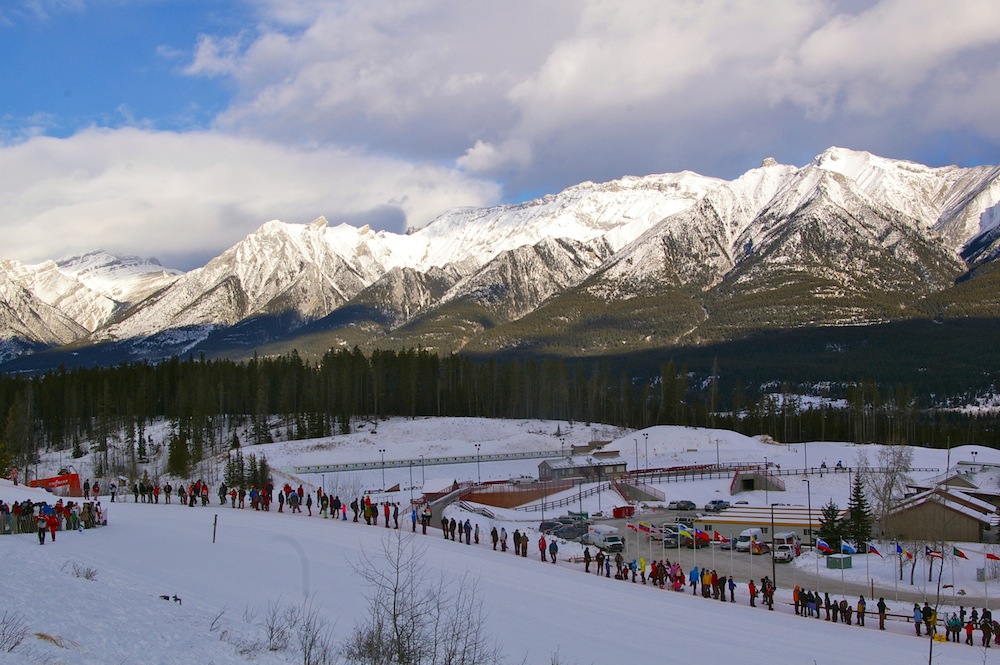
The view from a high point at the Canmore Nordic Centre during the 2012 Alberta World Cup. The venue will serve as one of five stops on the new Ski Tour Canada in 2016.
When Ski Tour Canada 2016 was announced as the finale to the 2015/2016 cross country World Cup season last year, North American fans were excited at the prospect of the first race of its kind taking place this side of the pond. At the recent 2015 FIS Calendar Committee meeting in Varna, Bulgaria the Tour’s dates and races were confirmed giving fans a better idea of what to expect come spring of 2016. Starting with a freestyle sprint in Gatineau, Quebec and concluding with 10 and 15 k classic pursuits in Canmore, Alberta the eight-stage Tour will take place over the course of the first 12 days of March.
Ski Tour Canada 2016 at a glance:
Gatineau, March 1: Freestyle Sprint
Montréal, March 2: 13/22 k Classic Mass Start
Québec City, March 4: Freestyle Sprint
Québec City, March 5: 10/15 km Freestyle Pursuit
Canmore, March 8: Classic Sprint
Canmore, March 9: 15/30 km Skiathlon
Lake Louise, March 11: 10/20 km Freestyle Individual Start
Canmore, March 12: 10/15km Classic Pursuit
Early on in the planning process, Ski Tour Canada (originally billed as Tour du Canada) was set to take place in mid-February. However, the prospect of hosting the tour on North American soil in the middle of the season was too complex, and the event was moved to the end of the season.
According to a press release by Cross Country Canada, the next step for tour will be a list from FIS technical and marketing officials to examine and approve each venue’s stadium and courses. “The next major milestone includes a visit in August by the FIS technical staff and marketing representatives to approve tracks and stadium layouts used on each stage of the tour,” Dave Dyer, director of events at Cross Country Canada, said in the press release. “With under a year to go before the Tour gets underway, we’re really excited about the project and can’t wait for the 2015-2016 season to start!”
The organizing committee behind Ski Tour Canada recently unveiled a website for the event along with a new logo. Check out the tour’s first promotional video, featuring retired skier and Olympic gold medalist Chandra Crawford, below.
This week’s workout comes from FasterSkier contributor François Léger Dionne, who raced for 15 years at provincial and national competitions in Quebec. After obtaining a Bachelor of Law at the University of Montreal, he’s currently enrolled in a full-time program at the Montreal College of Osteotheraphy. This past weekend, he placed 60th out of more than 1,000 competitors in the Mount Washington Road Race (a 7.6-mile hill climb up the highest peak east of the Mississippi River).
***
Summer is the best season to add plenty of variety to your training before the upcoming and more ski-oriented fall. Back in my racing days, I used to do this workout every week in Mont Royal, Montreal’s most popular playground for endurance athletes. In preparation for the infamous Mt-Washington auto road race (which took place on June 21st), I actually incorporated this specific ski workout as a general fitness test to assess my energy and recovery levels.
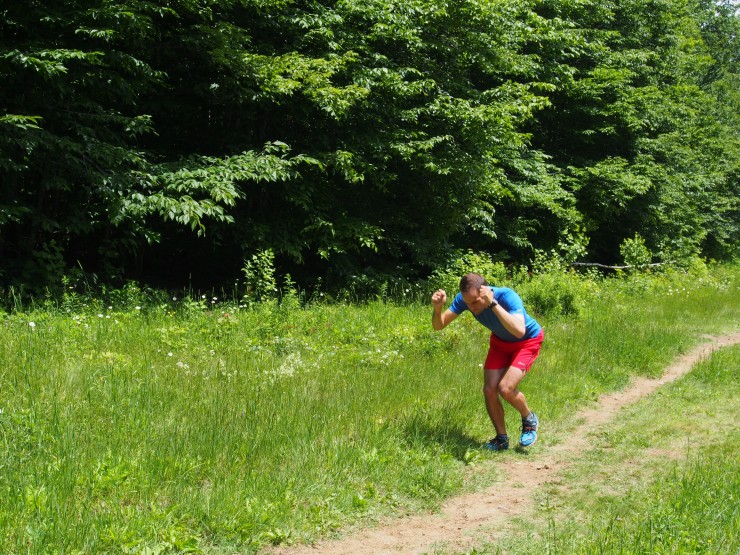
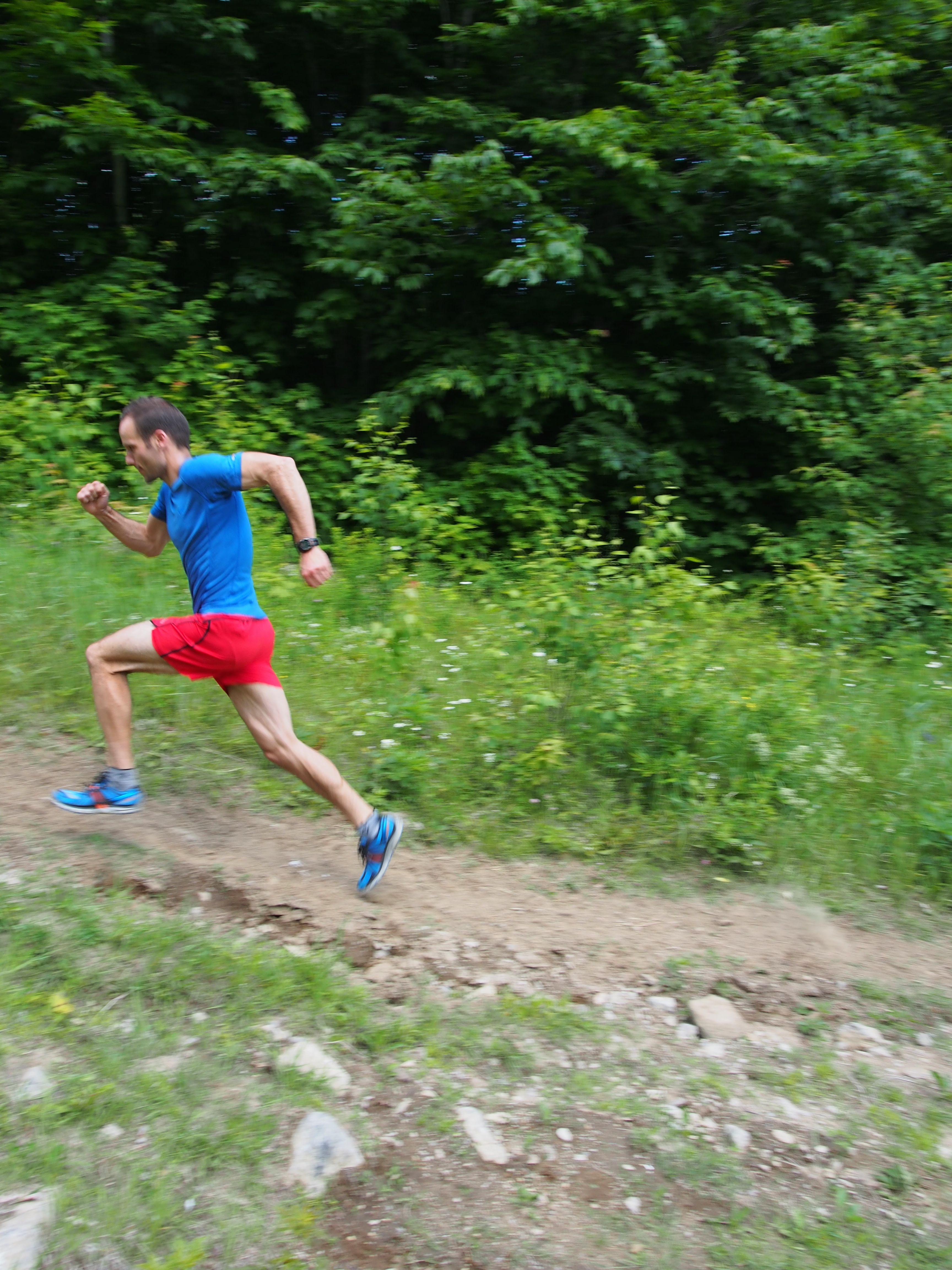
Short, full-out sprints up a hill require technique, balance, and muscle control, all while developing strength and fitness.
Part I: Explosive power, balance and short sprints
Find a 200-meter slope, not too steep (around 6-8%, max 10%) and large enough for you to jump energetically from side to side in a V2 (or one-skate) motion.
The first part of this workout consists of short repeats, each of which is divided in two sections. First, a dynamic phase that requires technique, balance and muscle control, while the second is a full-out sprint.
Start with 20 (10 on each leg) V2 jumps. The goal is to concentrate on technique, power and balance. You want to build the most energy possible on the impulse, so make sure to really bend your knees, while trying to keep your upper body in a straight line as much as possible. Use your arms (in a V2 fashion) to generate the most explosive one-skate hop. The landing requires keeping your balance and stabilizing your core and leg muscles. Take time to land properly before taking off again. Don’t rush it, speed is of no importance here.
After completing 20 V2 jumps, sprint at full capacity for 20 seconds. One set should take about a minute. Jog or walk back down, but don’t stop in between each rep. It’s important to teach you body to recover actively and quickly.
Part II: L3 intervals up stairs
After completing around 10 repeats, recover slowly for 10 minutes. At this point, with the accumulation of lactic acid, your legs will probably feel a bit like jello.
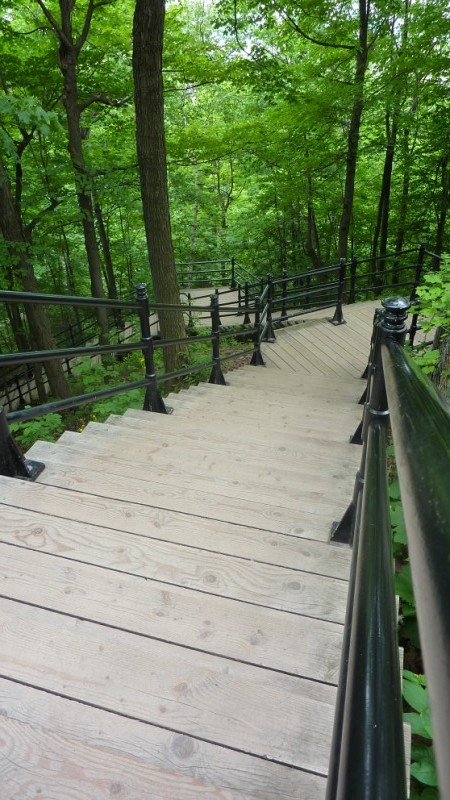
The second part of the workout, although involving stairs, is thus less taxing muscle-wise. Montreal overflows with long sets of stairs, and Mont Royal — with one set of 260 stairs — makes no exception! Try to focus again on technique, and avoid simply running up the stairs. Ski walk (with no poles) two steps at once, with full leg extension and straight upper body, hands tucked in behind your back. Aim for 5 reps of one minute.
The basic workout:
20 minutes of easy running
8-12 x 1 minute repeats (20 explosive V2 jumps + 20 sec. sprint) with 1.5 minute of active recovery between each rep.
10 minutes of very low active recovery
4-6 x 1 minute L3 or threshold intervals up stairs with 2 minutes of active recovery between each interval
15 minutes cool-down
Total time: About 1 1/2 hours
Mont Royal’s 260 stairs are a great place to work on technique and L3/threshold intervals.
Notes:
When my energy levels are high, I like spicing up this workout by incorporating sets of 15-20 push-ups/dips every two reps.
This workout can be done alone, but is more fun for groups. Be careful not to lose concentration when doing the V2 jumps with teammates, as each has a different stride and pace. Have the younger ones start ahead of the stronger athletes for close sprint finishes. A coach can even dictate the V2 hops pacing for everyone.
I prefer doing this workout without poles, but feel free to try them out (especially if you can’t find stairs).
The view from a higher point at the Canmore Nordic Centre during the 2012 Alberta World Cup. The Centre will serve as venue for the fifth, sixth, and eighth stages of the newly slated Tour du Canada in 2016.
Canada will be hosting a late-season World Cup tour in 2016. An exciting development for North-American skiing, the proposal cleared yet another hurdle at the International Ski Federation (FIS) 2014 Congress last week in Barcelona, Spain, after receiving a set program.
The Tour du Canada will feature eight stages starting March 1, 2016 and continuing until March 12.
Commencing with a city sprint in downtown Gatineau, Quebec, the tour will then travel to Montreal and Quebec City. Competitors will then either take a train or chartered flight to Alberta, where they will compete in the final four stages, which will take place at the Canmore Nordic Centre and Lake Louise.
“It’s an ambitious plan,” said Chris Grover, chairman of the FIS Committee for World and Continental Cups (as well as the U.S. Ski Team head coach) on the phone last Friday. “They are trying to create something special, which was the request of FIS – to find something special in a non-World Championship and non-Olympic year to draw viewership back to cross country in the second half of the season. The Canadians have really stepped up to the plate.”
Skiers navigate ‘the ledge’ on the backstretch of the 2012 World Cup course in Quebec City. The Canadian city will serve as the third and fourth stops of the Tour du Canada in 2016.
The newly slated Tour du Canada was previously scheduled for February, but was moved to the end of the season to accommodate athletes’ travel schedules and maximize participation in the tour.
“It’s going to challenge athletes and it’s going to challenge teams, and that’s why ideally we would need to have it at the end of the season,” Grover said. “At the best we get the absolute greatest participation and I think it’d be an incredible way to finish the season.”
The move to the end of the season does, however, pose a conflict in regards to scheduling. With the placement of the Canadian tour in March, traditional spring venues such as Lahti, Drammen, Oslo, Falun, and Stockholm will need to be rescheduled.
While it may be easy for cross country to make the calendar change in 2016, coordinating with the remaining nordic disciplines is where the true challenge lies.
“It’s not as easy as saying, ‘cross-country would like to do this’,” Grover explained. “It really requires coordination between all of the nordic disciplines. The changes would be really positive for our schedule going forward, are not necessarily easy for the other disciplines to make, especially when they are traditionally blocked out those Scandinavian venues for March.”
Despite the disruption to the traditional calendar, Grover said that he didn’t witness any opposition to the proposal during his time at the congress. In fact, he said the tour’s move to March had the possibility to ensure that other World Cups are also highly attended. If the tour had been held in February, athletes returning to Europe from may have skipped some World Cups.
While the changes to the rest of the schedule are still being finalized, the reorganization will aid in the creation of the 2016/2017 season because the international-racing circuit needs to visit South Korea for a pre-Olympic World Cup.
“It’s very hard to put something like a stop in South Korea into a schedule that is primarily focused on races in Europe, especially on a year that includes the World Championships,” he added. “So ideally something like that would go at the end of the year, but then we run into the same scheduling conflicts.”
The Tour du Canada, in addition to the 2015/2016 and 2016/2017 World Cup calendars, will be revisited by FIS in the coming months to finalize logistics.