From the FasterSkier archive — posts syndicated from athletes’ and coaches’ own blogs between 2004 and 2012, kept online as published. Current coverage is at fasterskier.com.

Tag: Morgan Arritola

  • Wednesday Workout: Using Poles on the Ups with Caitlin Patterson

    Wednesday Workout: Using Poles on the Ups with Caitlin Patterson

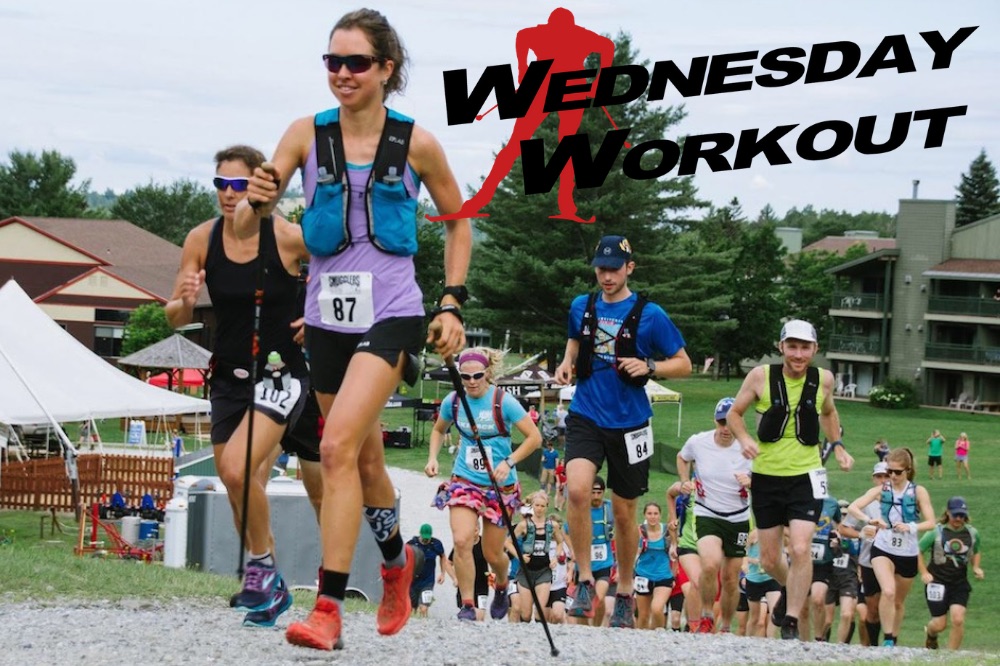
    Caitlin Patterson (front) racing the 25 k Smugglers’ Mountain Race in Jeffersonville, Vermont, in August. (Photo: Pennie Rand)

    This week’s workout comes from Caitlin Patterson, a Craftsbury Green Racing Project (CGRP) skier and 2018 Winter Olympian. We asked the 28-year-old Patterson, an accomplished mountain runner as well, about training and racing with poles while hiking or running. When and what type of terrain does she typically use them for, and what kind of workout would she recommend with poles? 

    ***

    It may come as no surprise that many of Caitlin Patterson’s dryland workouts incorporate poles. Even with a nomination to the 2017 USA Track and Field Mountain Running World Championships Team, Patterson’s mentality remains, “I am skier and I train to be a skier.”

    With skiing as her primary sport (she competed at the 2018 Winter Olympics in South Korea), Patterson has also found herself as a top contender in domestic mountain running races.
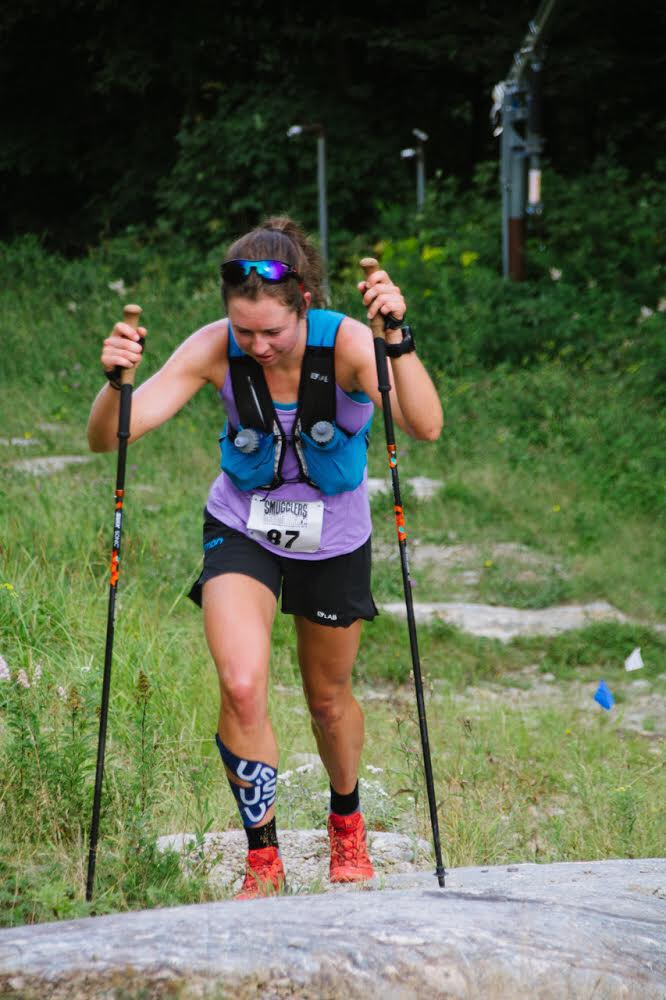
    Caitlin Patterson racing the 25 k Smugglers’ Mountain Race in Vermont in August. (Photo: Pennie Rand)

    This summer, she raced in California’s 2018 Broken Arrow Skyrace series. In the Vertical Kilometer (VK) 5-kilometer race, with 3,100 feet of elevation gain, Patterson placed third among women, behind 2010 Olympic skier Morgan Arritola in first and professional ultra runner Hillary Allen in second. Patterson also raced the Broken Arrow 26 k and finished second to Daniella Moreno, of the U.S. Distance Mountain Running Team.

    Born in McCall, Idaho, and later raised in Anchorage, Alaska, Patterson acknowledges that much of her success in both mountain running and skiing stems from knowing when and how to put her poles to good use. (In both Broken Arrow Skyraces, she was permitted and opted to use poles.)

    When to put poles to use?

    The straightforward answer to this question is on the ups. During distance workouts, Patterson rarely takes the time to pole plant while descending downhill. Her reason is that doing so may actually inhibit her turnover, slowing the pace and her momentum.

    “I find that when you try to pole on a downhill, you often brake or brace more,” she explained. “So I put them away or hold them in my hands on a downhill.”

    Once she reaches a climb, regardless of grade, she puts her poles and arms to work.

    “From the most gradual uphill to the steeper uphill for a distance workout, I’ll use them,” she said.

    When it comes to intervals on foot, Patterson almost always usespoles. Much of this is due to the training philosophy of her coach at Craftsbury, Pepa Miloucheva.

    “In all my years here on the team, I haven’t ever done just pure running intervals,” said Patterson, now in her sixth year with CGRP. “That’s sort of more related to Pepa. She just doesn’t really care for them. She really cares more for running with poles or rollerski intervals.”

    Beyond the type of workout (distance or interval), Patterson also looks at the workout’s expected elevation gain and terrain when she decides whether or not to use poles.

    A workout with “sustained climbs”, such as a long run to the top of a mountain peak, warrants using poles for Patterson. She added that it “also depends on the footing or the microscale of the terrain/type of trail that you’re on.”

    Trails with large, chunky rocks may not be conducive to proper pole planting. The same goes for terrain with surfaces that make poling more work and climbing less efficient. Patterson explained that her younger brother, Scott Patterson, a member of the U.S. Ski Team, has yet to use poles in a mountain running race.

    “I was trying really hard to convince Scott to use [poles] for the Rut, a [mountain running] race in Montana,” she said. “He decided not to use them because, with that race, it is so rocky up high. You can’t plant poles on pure slabs of rock.”

    So what’s the most optimal poling workout? Long-distance or interval? Technique-oriented or threshold?
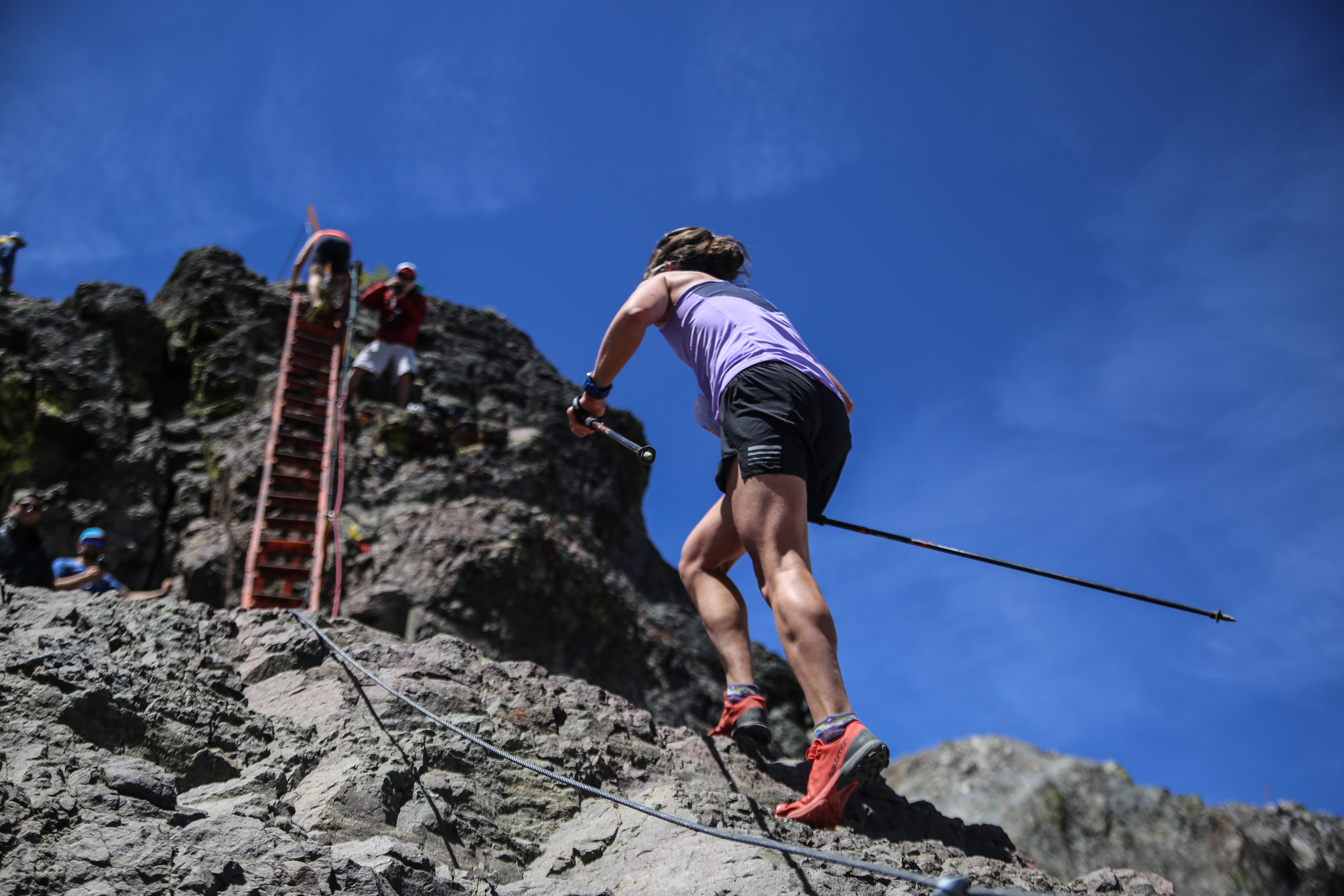
    Caitlin Patterson racing at the Broken Arrow Skyrace in California. (Photo: Martina Valmassoi/Salomon)

    Incorporating poles into workouts can come in a multitude of varieties, but Patterson’s favorite comes in the form of racing.

    “What I would recommend is to go find a local mountain race, double check that you can use poles for it, and race,” she said.

    She recommended a race distance between 10 to 25 k with plenty of elevation gain.

    One of the biggest reasons she favors poles in mountain running races is for experimental purposes. Races offer the opportunity to test how using poles might give an advantage over not using poles.

    buy ventolin inhaler online

    “In these races I’ve done in the past few years, when I was able to use my poles, particularly as a woman racing with the men, I’ll be like, ‘OK, I’m running along on the flats and darn that guy is running faster than me, so I pick up my poles and I just run along and then I’m keeping up,” Patterson explained. “Then I get to a steep spot and I’m like, ‘Huh, I think I’ll start using my poles now,’ and once I use them, I pass the guy next to me or something.’”

    Mountain running races don’t always find Patterson with poles in hand. Using poles on gradual terrain may end up slowing down one’s tempo, she explained, causing the racing to slow down.

    “I’ve found that poles are most useful when you can use them on really steep stuff to save your legs,” she said.

    “No matter what you’re doing with the poles, keep your core strong and your arms strong,” Patterson said of her number-one recommendation for skiers looking to do the workout.

    “I’m thinking more about more overall body efficiency than skiing technique,” she continued. “No matter what technique you do you should always keep your core strong and keep your arms strong and going parallel with your motion.”

    Caitlin Patterson (front) leads CGRP teammates Kaitlynn Miller and Akeo Maifeld-Carrucci while running with poles in Craftsbury, Vt. (Courtesy photo)

    The Workout:

    Type: Mountain Running Race with Poles

    Terrain: Preferably mountain slope with continuous uphill or mountain running race course

    Warm up: Easy 20-minute jog with two to three leg speeds

    Race: 10-26 k threshold effort
    Pole during the climbs and focus on keeping core tight

    Cool down: 15-20 minutes

  • Wednesday Workout: Make Your Own Agony Hill

    Wednesday Workout: Make Your Own Agony Hill

    Peter Wolter, of the Sun Valley Ski Education Foundation, racing to the fastest time up Agony Hill during the 2017 Western Regional Elite Group (REG) time trial in Salt Lake City, Utah. (Photo: Matt Whitcomb)

    When it comes to U.S. Regional Elite Group (REG) training camps, there are a few running themes that remain consistent across the country and from year to year. In the East, West and Alaska, participants in the U.S. Ski Team’s development program are tested with an uphill run, agility course and a roughly half-mile double pole, all of which are timed and done individually.

    Western REG coaches Mike Elliott and Bill Hokanson explained how the run is done at Agony Hill, adjacent to the University of Utah in Salt Lake City. The “hill”, on the 6,348-foot Mount Van Cott, has been an REG staple since 2006, according to Elliott, a three-time Olympian and former U.S. Ski Team (USST) member. It has been used since the 1990s by the USST, the University of Utah Ski Team, Wasatch Ski Academy, The Utah Nordic Alliance, Park City Nordic Ski Club, and Soldier Hollow Nordic Ski Club, Elliott wrote in an email.

    The Agony Hill course records set more than a decade ago still stand, which Hokanson explained was partially due to trail construction since.

    “We’re not 100% convinced the modern course is exactly equivalent to the historical one,” wrote Hokanson, head coach of the Wasatch Nordic Ski Academy in Park City and Salt Lake City.

    For instance, Morgan Arritola set the junior women’s record of 16:55 minutes up the 1.7-kilometer climb in 2004. The rest of the course records were set before that by John Aalberg (12:46), Nancy Fiddler (15:46) and Rob Whitney (reportedly under 14:00) for senior men, senior women and junior men, respectively.

    “Variations in the Agony Hill TT course over the past 3 – 4 decades may in part account for the difficulty contemporary athletes have faced in trying to set new records,” Hokanson wrote.  “However the records are held by 4 of the toughest, fittest, most talented athletes of all time, which may fully account for the tenacity of their record efforts.”

    Here’s how you can replicate the Agony Hill time trial in your own backyard:

    “Agony Hill can be developed anywhere and it does not have to be all uphill,” wrote Elliott, now executive director of Rocky Mountain Nordic in Durango, Colo. “My coach, Dolph Kuss, used a course on the edge of Durango when I was in college a Fort Lewis college in 1965 & 1966.  It was a loop next to the local cemetery.  The area is still called test tracks.”

    Elliott recommends a climb lasting 12 to 15 minutes for athletes 18 and older. He also suggested starting athletes individually (via interval starts).

    “It can be all out for one lap or Level 3 below threshold intervals,” Elliott added. “Try and have around the same time each time.  It can be a 15-minute run to see how far you can go.  Like Agony Hill, it can be all uphill.”

    He explained that these kind of time trials measure fitness, pacing and rate of improvement over time, and recommended doing this workout once every other week or once every three weeks.

    The Workout: Agony Hill uphill time trial

    1. Warmup: Light running and stretching for 30-40 minutes

    2. Uphill Run: Interval-start recommended

    • Option 1: One time, all-out effort: see how far up the hill/mountain you can go
    • Option 2: Level 3 intervals: aim for consistent times

    3. Cool down

    Agony Hill specifics:

    • Where: Mount Van Cott, east of the University of Utah in Salt Lake City
    • Course map
    • Course length: 1.7 kilometers
    • Peak Elevation:  6,348 feet
    • Vertical climb: 367 meters
    • Unofficial course records:
      • Senior men: John Aalberg (12:46)
      • Senior women: Nancy Fiddler (15:46)
      • Junior Men: Rob Whitney (reportedly under 14:00)
        • 2nd fastest junior male: Glen Randall (14:34)
      • Junior Women: Morgan Arritola (16:55)
    • This year’s winners:
      • Peter Wolter (Sun Valley Ski Education Foundation): 15:40
      • Novie McCabe (Methow Valley Nordic Ski Club): 17:29
  • ‘Why Not Go Again?’ Patterson Makes Mt. Marathon His Own One Year Later

    ‘Why Not Go Again?’ Patterson Makes Mt. Marathon His Own One Year Later

    U.S. Ski Team B-team member and Alaska Pacific University skier Scott Patterson scaling his way to the top of Mt. Marathon in Seward, Alaska on July 4, 2017. (Photo: Rob Whitney)

    As with other epic modern-day adventure race series, the fabled origin of Seward, Alaska’s annual Mount Marathon — held every July 4 — began with beer and a bet: who among us can run from the streets of downtown to the top of the 3,022-foot mountain crowding Seward’s skyline, then back to the bottom the fastest? What about within the hour?

    While the footrace race has evolved massively since the port town’s pioneer miners took on the challenge, clambering up its craggy course in woolen pants and workman’s boots nearly 90 years ago, it holds no less prestige for the millennial athletes or spectators who partake nowadays. To many Last Frontier residents, it is their Olympics. An estimated 30,000 outsiders annually inundate the town’s (population 2,500) sidewalks just to watch the event.

    “It’s Mount Marathon. It’s Alaska. It’s my Fourth of July,” Allie Ostrander, the 2017 women’s overall race winner and a Soldotna, Alask. native, told Alaska Dispatch News reporter (and former FasterSkier editor) Nat Herz after the competition. “Fourth of July feels empty without Mount Marathon.”

    Scott Patterson on his way to winning the 2017 Mt. Marathon running race on July 4 in Seward, Alaska. (Photo: Holly Brooks)

    Despite the obvious risks associated with careening down a mountain at top speed, stories of close encounters with kidney failure, brain-damaging falls, and disappearance deterred a few from re-entering this year’s version of the event.

    The upcoming 2018 PyeongChang Winter Olympics was reason enough for the current Mt. Marathon course-record holder and last year’s overall male champion, David Norris, to watch from the sidelines. His Alaska Pacific University (APU) teammate, Scott Patterson, who also recently earned a U.S. Ski Team (USST) nomination, however, did not.

    “It’s a big deal up here. I just figured why not go again?” Patterson, an Anchorage native, explained on the phone.

    In his debut Mt. Marathon race, Patterson had twisted his ankle and ultimately finished fourth last year. This year, as he weighed out his risk in racing, he arrived at a far less insidious calculation.

    “There’s definitely always a risk, that downhill is tricky,” Patterson said. “But I think looking at the competition beforehand, I knew that I could probably have a pretty good lead at the top and stake the downhill at my own speed; not really have to duke it out with someone down the hill.”

    With that, Patterson entered the 2017 event aiming for the win, but not the record. Norris was not on the start list, nor Kilian Jornet, the 2015 record holder and a professional ski mountaineer and ultramarathon  runner, not to mention Patterson had recently returned from the men’s USST training camp in Park City, Utah, which ran from June 26-July 5. Patterson departed the camp early to return for the race. 

    “Everyone was saying going into it that it was my race to lose,” the 25-year-old Patterson said. “The other guys who could really challenge me on the uphills this year skipped it, so it was kind of just me just out there on my own.”

    Patterson completed the 5-kilometer race in a time of 44:30 for the win, just over three minutes off the course record. The closest male finishers behind Patterson were Erik Johnson in second place just under a minute back (+0:52), and Kenneth Brewer in third, a little over two minutes behind (+2:23). Patterson’s first-place finish at Mt. Marathon is nothing unheard of among cross-country skiers. A number of other nordic athletes have been crowned the overall champion, including current USST A-team member Kikkan Randall, former USST athlete and Olympian Holly Brooks, APU nordic coach Eric Strabel, and Norris.  

    Morgan Arritola scaling her way to the top of Mt. Marathon in Seward, Alaska on July 4, 2017. (Photo: Rob Whitney)

    The runner-up in this year’s women’s event, Morgan Arritola, was also a member of the 2010 Vancouver nordic Olympic squad and skied competitively for over six years before she made the switch to mountain running in 2012. In her debut Mt. Marathon race, Arritola, 31, finished second in a time of 51:09, a minute and fifty seconds behind the 20-year-old Ostrander, who won in 49:19.

    While Arritola did preview the course once, she also indicated that she didn’t hold a whole lot over herself in terms of expectations and outcome going into race. Ultimately her goal coming into her first Mt. Marathon event was to “take it all in.” In discussions with her former teammates and champions, Randall and Brooks, the advice remained fairly simple: enjoy the atmosphere.

    “I didn’t really pre-race research. That’s not really my style,” Arritola, of Ketchum, Idaho, wrote in an email to FasterSkier. “Everyone has their own way of handling racing and I tend not to overthink.

    “I would love to come back next year,” she continued. “If there was a race-specific goal it would be to know the route I’m taking better. I asked for directions a few times 🙂 and be more confident on the downhill. I haven’t raced that kind of downhill and I just never got into a good rhythm.”

    While Arritola has three U.S. Mountain Running Championship titles to her name and a World Mountain Running bronze medal, mountain running is not where she is indelibly focused. She is currently going back to school for a degree in respiratory therapy and working various jobs to help fund her racing, such as The Rut 50 k in Big Sky, Mont., which she is registered to race in September.

    “I’m not running full time like with skiing,” Arritola wrote. “I am in my last year of school and running just keeps me sane. I don’t overthink it, I do what I want with it, and I enjoy it.”

    Finishing behind Arritola to round out the women’s top three was mother of three and three-time Mt. Marathon champion, Christy Marvin, in third place with a time of 52:22.

    In the junior race division of the event — in which racers run approximately halfway up the mountain before turning around for the descent — APU’s Luke Jager won the boys’ race in a time of 29:09, marking Jager’s second junior title in a row. Jager was followed by Gavin Block in second in a time of 29:32 and Ali Papillon in third in a time of 30 flat. The junior girls title went to Molly Gellert (Alaska Winter Stars) in a time of 32:53, also for the second year in a row. Behind Gellert in second was Ruby Lindquist finishing in a time of 33:55. Kendall Kramer (FXC) came in third, finishing in a time of 35:06 for the girls race.

    Results

  • Climb to the Castle Archive: Top Results from the Last 10 Years

    Climb to the Castle Archive: Top Results from the Last 10 Years

    Liz Stephen celebrates her win and new course record at the 2014 Climb to the Castle. Stephen clocked her fastest time and fifth win at Whiteface Mountain despite a strong headwind and exhaustion at the end of the U.S. Ski Team's training camp in Lake Placid, N.Y.
    Liz Stephen celebrating her win and new course record at the 2014 Climb to the Castle. Stephen has the most women’s wins in 10 years of the Climb, winning five of those races, and also holds the women’s course record.

    For the last decade, the Climb to the Castle has been a fall staple in northeastern New York. It’s been a circled on the calendars of the U.S. Ski Team and US Biathlon national team almost every year since its inception and attracts 75 to 100 no-joke skiers to Wilmington (near Lake Placid, N.Y.) each year.

    Following the 10th annual rollerski race up Whiteface Mountain’s toll road, a five-mile grind with an average 8 percent grade, we thought it would be worth looking at course records and some of the climb’s legendary winners.

    ***

    Most wins: Liz Stephen (5), Duncan Douglas (3)

    Course records: Duncan Douglas (34:56.6) 2007, Liz Stephen (41:50) 2014

    ***

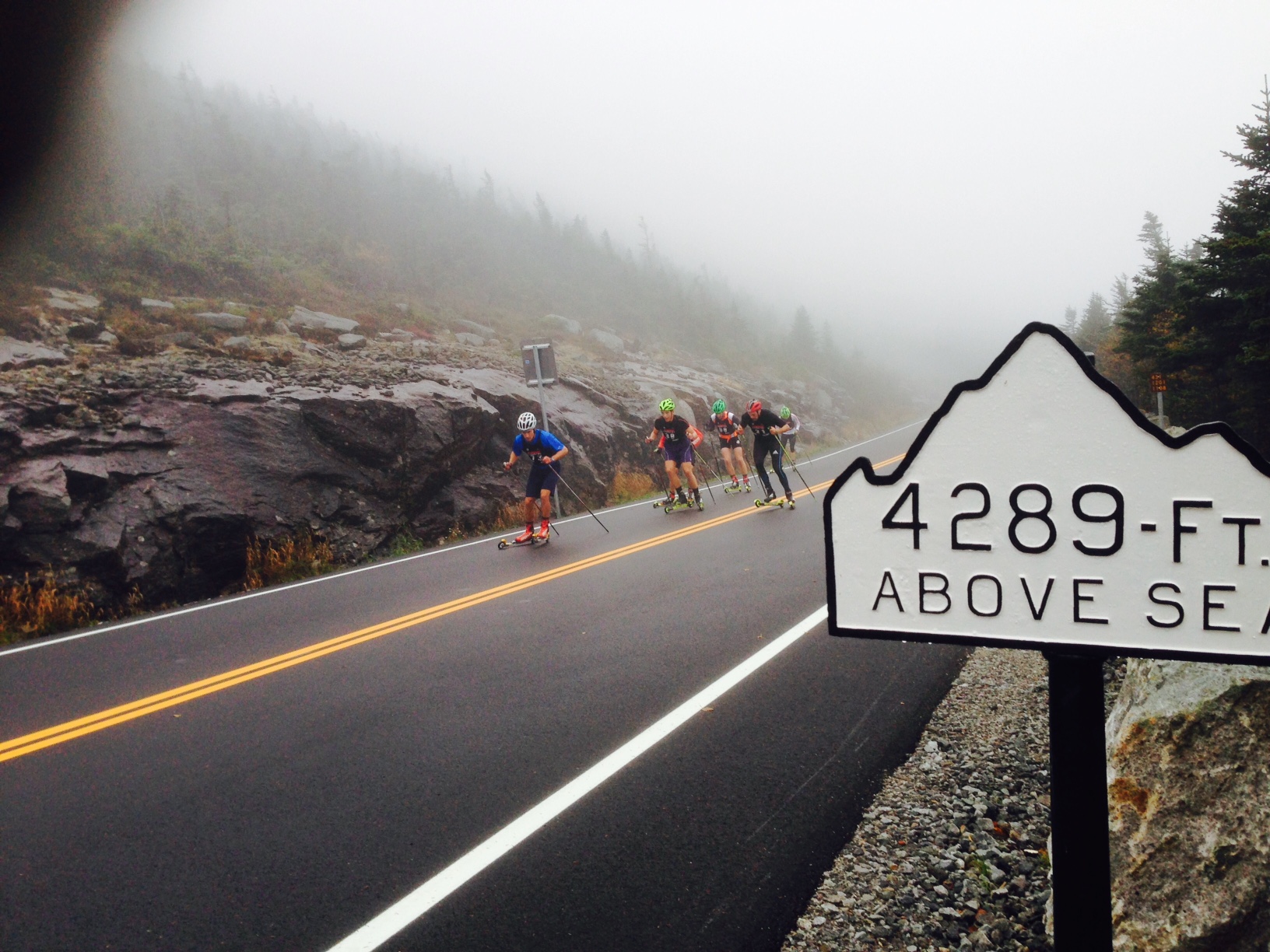
    Paddy Caldwell (black shirt, yellow helmet) of the U.S. Ski Team D-team and SMST2 Team chases Rogan Brown (l) around mile four of five in  Sunday’s Climb to the Castle up Whiteface Mountain in Wilmington, N.Y. Caldwell won the race, followed by biathletes Russell Currier and Tim Burke in second and third, respectively. Brown (SVSEF) placed fourth and Kyle Bratrud (CXC) was fifth. (Photo: Tim Cowan)
    Paddy Caldwell (black shirt, yellow helmet) of the U.S. Ski Team D-team and SMST2 Team chases Rogan Brown (l) around mile four at the 2015 Climb to the Castle. Caldwell won the race, followed by biathletes Russell Currier and Tim Burke in second and third, respectively. Brown (SVSEF) placed fourth and Kyle Bratrud (CXC) was fifth. (Photo: Tim Cowan)

    2007:

    Date: Oct. 13

    Notes: sunny/cold; 25 degrees F

    Men’s top 3:

    1. Duncan Douglas (34:56.6)
    2. Kris Freeman (37:09.1)
    3. Noah Hoffman (38:38.9)

    Women’s top 3:

    1. Liz Stephen (47:22.9)
    2. Morgan Arritola (47:48.8)
    3. Dorcas Wonsavage (49:12.7)

    Complete results


    2008:

    Date: Oct. 6

    Notes: *Shortened course; athletes did not reach summit because of snow.

    Men:

    1. Duncan Douglas (32:26.44*)
    2. Kris Freeman (34:22.90*)
    3. Noah Hoffman (36:56.87*)

    Women:

    1. Caitlin Compton (45:19.91*)
    2. Morgan Arritola (45:27.89*)
    3. Liz Stephen (45:52.83*)

    Results: Men | Women

    Video


    2009: 

    Date: Oct. 7

    Men:

    1. Taylor Fletcher (39:11.54)
    2. Nick Hendrickson (39:25.40)
    3. Kris Freeman (39:49.97)

    Women:

    1. Morgan Arritola (50:54.85)
    2. Liz Stephen (51:09.57)
    3. Ida Sargent (51:23.85)

    Results: Men | Women

    Report | Video


    2010: 

    Date: Oct. 8

    Notes: Clear weather

    Men:

    1. Kris Freeman (38:37)
    2. Noah Hoffman (39:16)
    3. Ben Sim (40:32)

    Women:

    1. Laura Spector (46:58)
    2. Morgan Arritola (48:02)
    3. Liz Stephen (48:43)

    Results: Men | Women

    Women’s report | Men’s video


    2011:

    Date: Sept. 17

    Men:

    1. Kris Freeman (36:18)
    2. Tim Burke (36:29)
    3. Noah Hoffman (37:03)

    Women:

    1. Liz Stephen (44:50)
    2. Ida Sargent (46:14)
    3. Tara Geraghty-Moats (47:43)

    Results: Men | Women

    Womens’ report | Men’s report | Video | Photos


    2012: 

    Date: Sept. 15

    Men:

    1. Tad Elliott (39:28)
    2. Pat O’Brien (39:38)
    3. Julian Dorais (39:46)

    Women:

    1. Liz Stephen (43:33)
    2. Jessie Diggins (48:38)
    3. Ida Sargent (48:55)

    Results: Men | Women

    Women’s report | Men’s report | Notes & Quotes


    2013:

    Date: Sept. 15

    Men:

    1. Tim Burke (37:13)
    2. Simi Hamilton (39:59)
    3. Karl Nygren (40:04)

    Women:

    1. Liz Stephen (42:04)
    2. Caitlin Gregg (45:21)
    3. Ida Sargent (47:19)

    Results: Men | Women

    Report


    2014:

    Date: Sept. 6

    Men:

    1. Tim Burke (38:19)
    2. Russell Currier (39:02)
    3. Welly Ramsey (40:01)

    Women:

    1. Liz Stephen (41:50)
    2. Caitlin Gregg (45:25)
    3. Katharine Ogden (48:12)

    Results: Men | Women

    Report


    2015: 

    Date: Sept. 20

    Men:

    1. Patrick Caldwell (37:05.2)
    2. Russell Currier (37:10.2)
    3. Tim Burke (37:16.7)

    Women:

    1. Mary Rose (45:15.1)
    2. Annelies Cook (45:47.1)
    3. Hannah Dreissigacker (47:21.0)

    Results: Men | Women

    Report


    2016:

    Date: Sept. 18

    Men:

    1. Duncan Douglas (37:15.6)
    2. Russell Currier (37:23.9)
    3. Paul Schommer (40:18.2)

    Women:

    1. Hannah Rieders (55:03.1)
    2. Anna Lehmann (55:18.8)
    3. Madeline Rieders (56:26.4)

    Results: Men | Women

    Report

  • Arritola Steps Away from Skiing, Leaves Gold Team

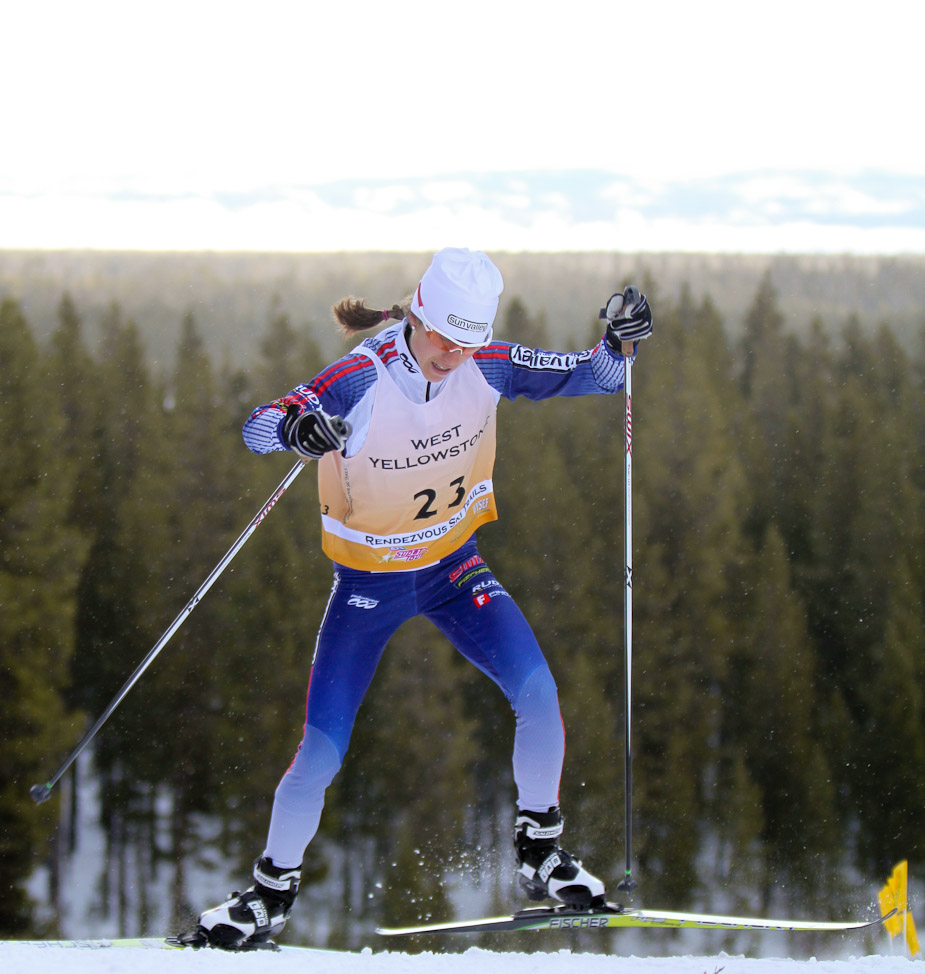
    Morgan Arritola, formerly of the Sun Valley Ski Education Foundation Gold Team, skates to a 15 k SuperTour victory in West Yellowstone, Mont., on Nov. 25, 2011. After more than 10 years with the team, the 2010 Olympian is hanging up her skis to pursue other interests.

    Inside the Sun Valley Ski Education Foundation center on Tuesday, Morgan Arritola made her usual rounds, visiting longtime friends and coaches and introducing them to her new addition – a puppy.

    A staple of the team for nearly a decade, the 25-year-old Olympian affectionately known as “Mo” wasn’t stopping in for training plans. She hadn’t just finished a workout and she wasn’t preparing to start one, either.

    Arritola was on a lunch break from her new full-time job at Scott Sports, her running-shoe sponsor. Still based in Ketchum, Idaho, she started there as a receptionist about a week earlier, and looking ahead to the summer, that was where she planned to spend the most time.

    After three seasons on the U.S. Ski Team, Arritola declined a fourth term two years ago. Last year, she notched two national titles and a world championship – in trail running – and after being featured in the Trail edition of Runners World’s last month, she said even that wasn’t going to be her priority.

    Arritola was essentially retiring from skiing and would likely step back from running to pursue other professional interests.

    “I’m not really focusing on any one particular thing or training for it,” she said on the phone while fielding incoming calls at work. “Life’s just taking a new turn, so that’s how that goes.”

    Running was something she jumped into, much like her early approach to skiing. After moving from Salem, Ore., to Sun Valley, Idaho, in high school, Arritola put on her first pair of nordic skis as a junior. Four or five weeks later, she won a race.

    From then on, Arritola’s nordic success was history. In addition to making two Junior World Championships, she notched several silver medals at U.S. Nationals, placed 11th in Switzerland’s Engadin Ski Marathon, and tallied two top-40 finishes at the 2010 Olympics.

    Last June, Arritola won the USATF Trail Half-Marathon National Championship in Bend, Ore., and went on to dominate the Xterra Trail Run nationals in Ogden, Utah, in September. That victory brought her to Hawaii for the Xterra Trail Running World Championship, which she won by nearly four minutes in December.

    Arritola (third from right) and former USST teammate Liz Stephen (second from left) atop the podium at the 2011 Xterra Trail Run National Championship at Snowbasin Resort in Ogden, Utah, on Sept. 25. Arritola won the 21 k event by roughly two minutes ahead of Steven in second. Photo courtesy of Liz Stephen.
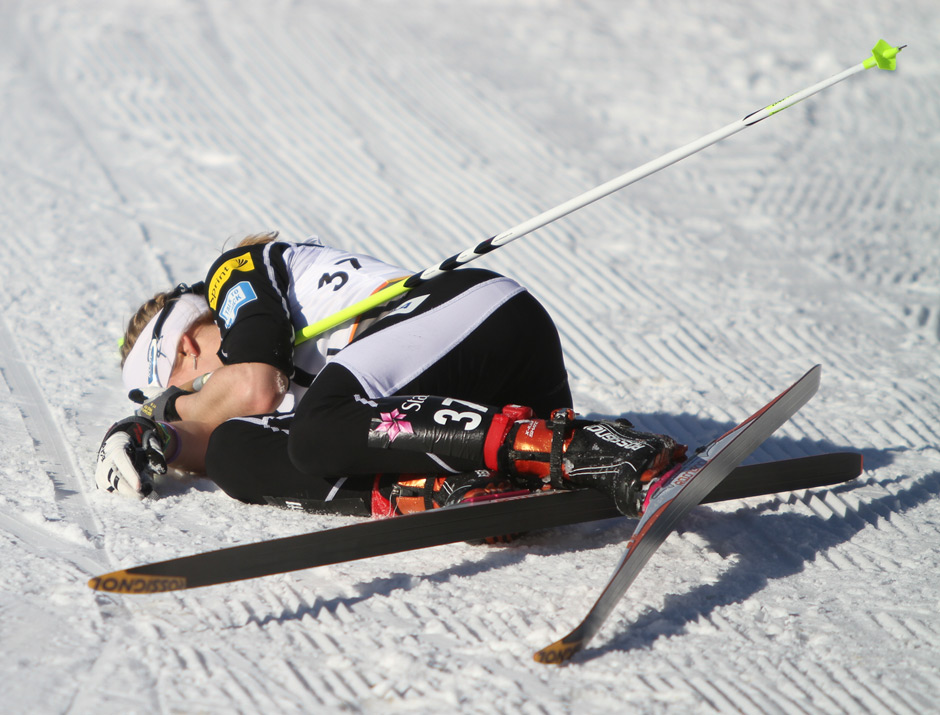
    Known for her humbleness, Arritola downplayed her expectations and performance in the race.

    “It was really cool,” she said. “I didn’t really know what to expect, but I learned that I’m not very good at running in the heat. I thought I was going to die. It was really hot.”

    Her ski coach from the start, Sun Valley’s nordic program director Rick Kapala watched Arritola develop into a founding member of his Gold Team and an icon in Sun Valley circles. When she walked into the program’s main building, heads turned, he said.

    “She walks into the hut and kids are like, ‘That’s Morgan Arritola!’ ” Kapala said. “We live in a relatively small community here so she’s been highly visible as a very successful cross-country skier … and maybe the most successful and recognized athlete in our community in the last 10 years. She’s accomplished a lot.”

    Years of competitive racing can take its toll, even on a 20-something still in the height of his or her athletic career. A few weeks ago, Arritola said she decided to leave the Gold Team.

    “I’ll probably do some races here and there throughout the winter, [but] I’m not going to ski anymore,” Arritola said. “I’m working and I’m going to run.”

    Kapala said the news wasn’t unexpected.

    “We entered last year always knowing that it was going to be, to some extent, an evaluation period,” he said, echoing his statement to the Idaho Mountain Express nearly two years ago when Arritola turned down a U.S. Ski Team spot.

    At the time, Arritola said she wasn’t entirely satisfied with her performance at the Vancouver Olympics, where she was 34th in the 10 k freestyle race and 38th in the 15 k pursuit. In November 2011, she was also dabbling in endurance running and taking online courses through Montana State University.

    “On one hand, she showed herself and everybody else that she still can race really fast,” Kapala said. “But I also think that she’s somebody that, when she undertakes something, is 100 percent in. … Her choices have to be probably seen through the prism of ‘I know what it takes to be the best in the world, and can I do that, and do I want to do that?’ ”

    Following her trail-running world championship last December, Arritola came down with appendicitis and needed surgery. She missed U.S. Nationals in Rumford, Maine, and spent the first few weeks of January recovering. Back at full strength after a smooth healing process, Arritola said she was working to pay her medical bills.

    Despite winning some prize money at trail running nationals ($1,000) and worlds ($2,000), Arritola said being a two-sport athlete in skiing and running wasn’t bringing in the big bucks. That’s why she wasn’t going to concentrate on running, either.

    “I don’t consider myself a runner; I just go out and do races when I can,” she said. “I’m just ready for some different things in life I guess right now. That’s just what I’ve got to do and I like to work so that’s not a problem. It’s a lot of things, but kind of where I’m at right now.”

    A talented runner who often crushes local competitions, Kapala affirmed that foot races were never her focus.

    “She sees running as sort of an extracurricular recreational pursuit even though she’s really fast,” he said. “I think what she is looking for is probably just a little bit of freedom to chart some new paths in her life.”

    While she planned to do some running races this summer, starting with the Teva Mountain Games in June, Arritola said she wouldn’t be specifically training for any and didn’t plan to pursue trail running as a career.

    “I think it would involve going back to the lifestyle of skiing, which is pretty selfish,” she said. “I’ve done it for a lot of years and I’m just ready for something different. We’ll see what happens this year with running and everything and then, who knows?”

    Following a smattering of NorAm, SuperTour and Alpen Cup races last season, Arritola hung up her skis in late March after placing 18th in one of the first races at SuperTour Finals in Craftsbury, Vt. – the 3 k skate.

    “I did one race and then kind of decided that I was not into skiing and needed to not be there,” she said. “I left.”

    Back in Ketchum, Arritola was looking ahead. She spent the previous weekend with her mother, driving 20 hours to and from Washington to pick up a Swiss mountain dog. They named the puppy Eiger and Arritola planned to hike with the little guy, who was expected to grow to between 120 and 140 pounds.

    In the meantime, she was interested following other interests and potentially continuing her education. If she decided to go back to school, Arritola said she would probably study science or biology – maybe physical therapy or veterinary sciences if she had the time. Born and raised in the West, she was also open to moving.

    Kapala said he would do everything he could to keep her involved in Sun Valley’s development program.

    “I’m going to try to figure out how to get her out there skiing with our kids as much as her schedule allows,” he said. “For us, it’s been nothing but great, and the impact she’s had goes far beyond that she’s won some ski races and participated at World Championships and Olympics and scored World Cup points and all that stuff.

    “She shows to kids what’s capable if you show up and train hard and have the kind of attitude that Morgan has had, which is ‘I’m going to train really hard, I’m going to work really hard,” Kapala added.

    One of her teammates at Sun Valley, Simi Hamilton of the U.S. Ski Team wrote in an email that it was hard to see Arritola leave skiing, but he looked forward to running and climbing with her in the offseason.

    “I’m extremely excited to see Morgan pursue some of her other interests in life,” Hamilton wrote. “She is such a talented, diverse, and mature athlete and person. She is a great friend and I will for sure miss having her around.”

  • Arritola Takes Owl Creek Chase Title

    Arritola Takes Owl Creek Chase Title

    Morgan Arritola (SVSEF), victorious at the Owl Creek Chase. Photo: Susan Jackson.

    ASPEN, Colo. — Morgan Arritola (SVSEF) was officially back to full form on Sunday at the Owl Creek Chase. After appendicitis forced her to skip U.S. Nationals and subsequent SuperTours, she won the 21 k point-to-point mass start freestyle by nearly four minutes over Lenka Palanova (BNJRT). Chelsea Holmes (SVSEF) finished third (+4:48.6).

    “This was my kind of course: hard, uphill,” said Arritola. “I just went out as hard as I could—that’s kind of how I race—and it worked out today.”

    After taking about three weeks to ramp her training back up after surgery, Arritola returned to racing last weekend at the Boulder Mountain Tour in Sun Valley, Idaho, where she finished a close second to Rebecca Dussault.

    Nothing held her back at in Aspen, where the race started on the Snowmass Club Golf Course and headed east towards the nordic center at the Aspen Valley Ski and Snowboard Club. Many of her competitors had done the classic races the day before, but Arritola was skiing fresh.

    The women's leaders shorting after the start.

    The sky remained cloudy throughout the women’s traverse over long and hilly terrain, across the Tiehack Bridge, and down a partial slope at Buttermilk. With only 5 k to go as they reached the Aspen trails, the sky opened up and heavy flakes began to fall.

    Arritola didn’t let it bother her.

    “At that point you’re just tired…whatever’s happening is happening,” she said. A comfortable four-minute lead certainly minimized the effects of a burst of snow on the outcome of the race, but made the tail end of an hour of hard skiing no more pleasant.

    Arritola pulled from the front most of the way, and for the first few kilometers a group of five skiers stayed close on her tail. But the chase pack eventually dwindled to two: Palanova and Holmes.

    “I was faster on the uphills, [Holmes] was way faster on the downhills, so it was back and forth,” said Palanova.

    The former CU standout, now Boulder Nordic Junior Race Team coach, had skied the course once before in college, and knew what she was in for.

    “It’s hard—not an easy course,” said Palanova.

    The top three finishers: (from L to R) Holmes, Arritola and Palanova. Photo: Susan Jackson.

    Palanova passed Holmes for good as they approached the nordic center to head into the final 5 k. Holmes had managed to put a big gap on Palanova on the descent across the Buttermilk trail, but caught back up and managed to maintain the lead.

    Palanova thought the squall that started for the final minutes of the race slowed her skis, but wasn’t impossible.

    “I think we finished early enough that it wasn’t too bad,” she said.

    Like Arritola, she enjoyed the course’s varied terrain.

    “It’s really cool—not that I would look around much [during the race],” she said.

    “Even if you’re tired you have downhills to rest.”

    The field was spread out for the final kilometers. Holmes finished 50.4 seconds behind Palanova, and Alexa Turzian (SVSEF) took fourth 1:49.5 behind Holmes. Tammy Jacques was fifth (+6:58.0) and Rosie Brennan (APU) crossed the line in sixth (+7:12.9).

    Last year, the Owl Creek Chase also served as a collegiate race, but on Sunday most RMISA collegiate skiers were in Anchorage, Alaska for the Seawolf Invitational. As a result, the fields were noticeably smaller, but the skiers who made the trip were clearly happy to have the chance to ski on such good snow.

    Women’s results.

    The women's Owl Creek Chase podium. 1. Arritola 2. Palanova 3. Holmes 4. Turzian 5. Jacques 6. Brennan
  • Sunshine and Squalls: Yellowstone SuperTour Distance Skate Videos

    With the weather changing drastically throughout the morning today’s West Yellowstone SuperTour was quite a spectacle.  The ladies skied 10km, the men competed for 15km and the FasterSkier crew tried to keep up at several different locations on the course.

    Ladies’ 10km Skate:


    Men’s 15km Skate:


    Contributing camerawork by Audrey Mangan.

  • Arritola Nabs SuperTour 10 k Freestyle; Diggins Holds Leader Bib with Second

    Arritola Nabs SuperTour 10 k Freestyle; Diggins Holds Leader Bib with Second

    Morgan Arritola (SVSEF) cresting Telemark Hill on her way to the top of the podium.
    Morgan Arritola (SVSEF) cresting Telemark Hill on her way to the top of the podium.

    In her first time racing the SuperTour opener in a number of years, Morgan Arritola (Sun Valley Ski Education Foundation) seemed to feel right at home in West Yellowstone, MT, taking victory on Thursday in the women’s 10 k freestyle by 14.7 seconds over runner-up Jessie Diggins (Central Cross Country) and Caitlin Gregg (CXC, +27.9).

    “It was tough,” said Arritola after finishing. “[I planned] to go out and ski as well and controlled as I could, and make every motion count.”

    In a two-lap, individual-start event, hearing and responding to splits can play a significant psychological role in an athlete’s race. Arritola said she heard at one point on the course that she was down to Gregg by a few seconds, and “I focused on all I could do.”

    She clearly put the hammer down, as she made up significant ground in the last quarter of the race. “She must have skied a heck of a second lap,” said Gregg, who started 90 seconds behind Arritola.

    Jessie Diggins (CXC/USST) holds onto the SuperTour leader bib going into Friday's 5 k classic.

    The top six in both the men’s and women’s races on Thursday came away prize money, and the winners went home with $750.

    On an unforgiving course with plenty of transitions and few opportunities for recovery, many skiers said their plan was to ski controlled and conservatively enough to have something left at the end. Perhaps due to pre-race jitters, some were able to stick to their strategy better than others.

    “I definitely took the first half pretty fast and the second lap I could taste blood in the back of my throat,” said Diggins. “The wheels started to come off quite a bit, but I kind of got a second wind.”

    Despite training to peak later in the season for World Cups after U.S. Nationals, the fact that Diggins has already been on the podium three times in West Yellowstone indicates that she’s in fine form. Many of her competitors are going all-out in these early season races in the fight for SuperTour leadership and World Cup start rights.

    “[Now] is kind of like, get your race legs back,” said Diggins of her approach to this point in her winter. “I’m still working on how to pace longer races. I’m not so far out of high school, where we just did 5 k’s. This is good for me; it is a good learning experience every time.”

    A spectator can never truly get inside a skier’s head, which is where the majority of racing goes on in an individual-start event. From athletes’ remarks after the finish, however, the focal point of such a race becomes the course—skiing it efficiently and crossing the line at the exact moment of sheer exhaustion.

    Caitlin Gregg (CXC) just before the big hill.

    “I’ve definitely raced too hot here before [before]…at this altitude and blown up,” said Gregg. “I knew I had some speed in there, it was more a matter of reeling it in and not letting it go too soon. That said, three-quarters of the way through I found myself saying, ‘OK, now it’s time to go.’”

    Alexa Turzian of the University of Colorado, who finished 32 seconds behind Gregg in fourth, thought that the course required agility as well as endurance.

    “There were a lot of corners on the course, so it was about working them. It’s not just about stamina,” she said.

    Turzian surprised even herself with her fourth-place finish, +59.9 back from Arritola. As a collegiate athlete, Turzian said she’s been sleep deprived managing schoolwork recently, and before looking at the results would have thought she’d landed in the top-10. She knew she was in the running for a top result out on the course, but didn’t want to get too excited at the risk of getting sloppy with her form.

    “When I get excited like that I…forget about technique,” said Turzian, who is not unused to hearing good split reads on the course. “I had to calm myself down and ski effectively…I usually make gains in the end anyway, and have better splits in the second lap.”

    Alexa Turzian (CU).

    Thursday’s 10 k required competitors to have their aerobic engines running strong, and acclimation to 6,000 + feet certainly didn’t hurt either. Arritola, Turzian, and fifth-place finisher Nicole DeYong (SVSEF) all live and train at higher altitudes for the majority of the year. That said, DeYong said she definitely “felt the lungs burning at the end.”

    The women gear up for a 5 k classic individual start on Friday at 10:00 am. For her recovery, Gregg said she planned to “pound some chocolate milk, cool down with teammates…and get fired up for tomorrow.”

    Full Results

    Topher Sabot contributed reporting.

  • Holmes Tops Hill Climb Competition in Sun Valley

    About halfway up Sun Valley’s Bald Mountain, Chelsea Holmes strained to see the top. Without much luck, she put her head down and poles forward, reciting a familiar mantra to push her to the finish.

    Chelsea Holmes racing at Sun Valley, Idaho, last season.

    “Just keep swimming, just keep swimming,” a little fish sang out in her head.

    In her first time racing Idaho’s Baldy Hill Climb on Saturday, the 24-year-old Holmes wasn’t hallucinating. She actually felt pretty good scaling 3,140 vertical feet on the 1.86-mile course; she just needed a snippet from Disney’s “Finding Nemo” to help her through.

    Holmes, who joined the Sun Valley Ski Education Foundation (SVSEF) this summer, was the first female to reach the 9,150-foot summit in 42:46, about 2 ½ minutes ahead of the second woman.

    While she said it wasn’t one of the course’s fastest times (former U.S. Ski Team member and 2011 national trail run champion Morgan Arritola won it in 39:50 last year), she was happy with her performance.

    “It’s fun and it’s not,” Holmes said. “I haven’t done a race effort in a while and you get to the top and you’re like, ‘Oh, what’s that feeling?’ ”

    The pain soon fades, at which point every finisher relishes in reaching the top, she said.

    “It’s just a fun atmosphere; it’s not super intense at all,” she said of the race, with fewer than 100 runners. Hikers and mountain bikers competed in separate categories.

    On the men’s side, Holmes’ former teammate with Far West Nordic in Truckee, Calif., Matt Gelso was second to seven-time champion Michael Tobin, who won in 37:08. Gelso finished 45 seconds later, beating Baldy’s five-time winner, Miles Fink-Debray, by more than two minutes.

    While Holmes approached the race as a tough training run, she also heeded others’ advice. Arritola, an SVSEF athlete who won the Xterra Trail Run National Championship on Sunday, told her to use poles.

    Initially hesitant – Holmes had only used poles for bounding – she asked around.

    “Not to mention, it makes it sound a little more intimidating that everyone uses poles,” Holmes said. “But it makes a difference. … Some of it’s slick in spots.”

    While the alpine trail run wasn’t her first (she did the Squaw Valley Hill Climb several times), it was at least three times as longer than her typical jaunts. In three years at Truckee, where she trained and eventually began coaching, Holmes had a go-to uphill that lasted 15 minutes. Besides a recent running time trial in Sun Valley, the Baldy Hill Climb was her first race of the summer.

    After spending part of August at home in Alaska following an SVSEF camp there, Holmes moved to Sun Valley, Idaho, in early September. There, she continued to her ski-specific training and measured her progress on the Olympic development team after mostly working out alone.

    “I spent more time rollerskiing, which actually isn’t that bad once you get in the swing of things,” she said of her summer plan. “There was more direction in my day-to-day training.”

    She added that her training was somewhat open with suggested workouts and time frames. That gave her room to breath and assess how she felt, she said.

    Looking forward, Holmes said she would miss Truckee, her first real home after leaving Alaska. She said her training with Far West and coaching at the Sugar Bowl Academy helped her grow after college, both technique- and goal-wise.

    Last year, she soared to two victories at the 2011 Canadian Nationals – in the 30 k and 5 k freestyle races – and was third in the USSA Super Tour Final freestyle hill climb.

    “I’m definitely excited about the winter,” Holmes said. “I’m curious to see where I’m at … I know I probably won’t make a jump like I did this past year, but I don’t know, it’ll just be interesting to see.”

    ***

    For results from the 2011 Baldy Hill Climb, click here.

  • Arritola and Stephen Top Podium at Xterra Trail Run Nationals

    Arritola and Stephen Top Podium at Xterra Trail Run Nationals

    Liz Stephen (second from left) and Morgan Arritola (fourth from left) atop the podium on Sunday. Photo courtesy of Liz Stephen.

    Morgan Arritola and Liz Stephen showed the running world what being a cross country skier is all about on Sunday by claiming the top two spots at the Xterra Trail Run National Championship at Snowbasin Resort, Utah. Arritola won the women’s overall division by almost two minutes, finishing the 21 k course in 1:29:09. Stephen, in her third appearance at the race, clocked in at 1:30:54, nearly two more minutes ahead of former US Mountain Running Team member Rachael Cuellar.

    “It was a really hard course that really challenged everyone,” said Arritola, who also won the USATF Half Marathon Trail Championships this past June in Bend, OR. The Snowbasin race started at the site of the alpine races at the 2002 Olympics and went up. With over 2,000 feet of climbing at an altitude of around 7,000 feet, ‘challenging’ is an understatement.

    Arritola’s time put her in an impressive ninth place overall. Max King, who was crowned World Mountain Running champion earlier this month, won the men’s race in 1:17:59.

    Also competing on Sunday was Evelyn Dong, who finished seventh in the women’s field in 1:36:12. University of Utah standout Zoe Roy won the women’s 10 k in 46:22.

    In addition to climbing, the course featured quite a bit of technical, single-track downhills. “There’s a lot to be learned on how to run technical downhills,” said Stephen. “It was really taxing on your muscles, but it was super fun.”

    This year was the first time Xterra touted the race as a national championship. Stephen said she didn’t realize there was prize money to be won—$1000 for first, $600 for second—until the night before the race.

    “It felt very different this year,” said Stephen, who has twice won the race in previous years. “There were a lot more participants; they really made a big deal out of it.”

    In the past, the trail run took a backseat to the more publicized off road triathlon usually held on the same day, but with higher stakes involved for the footrace this year, the triathlon was moved to the day before. Seven-time Tour de France champion Lance Armstrong drew a crowd for the triathlon on Saturday, and finished fifth. A few triathletes jumped in both races—Lesley Paterson was second in the triathlon and fourth in the trail run the next day.

    Arritola said she didn’t know what to expect going in, having never run the course before and knowing there were impressive runners toeing the line.

    “I didn’t have an immediate race strategy, as you never know how other people will run, or [what] their strengths and weaknesses are,” she said. But she quickly found that she had the advantage on the uphills. “I realized that the steep hills were where I could make a gap, but I paid for it a the end of the race. The last few miles killed me.”

    In addition to the cash prize, the overall winner of the men’s and women’s trail races each won a plane ticket to Hawaii and a chance to compete in the Xterra World Trail Run Championships in Oahu on December 4.

    The former U.S. Ski Team member has been training with the Sun Valley Ski Education Foundation (SVSEF) over the summer, and will be travelling and racing with them this winter. If she decides to go to Hawaii on December 4, she will miss the Bozeman SuperTour the same weekend. Arritola can use her ticket at any time, and said she isn’t sure at this point if she’ll use it to go to Worlds.

    Results from the 21 k are here.

    Results from the 10 k are here.

  • From Athlete to Coach, Rodgers to Lead Sun Valley ODT

    Colin Rodgers (SVSEF) – Racing to fourth place at the 2011 Lake Placid SuperTour

    Colin Rodgers, a longtime member of the Sun Valley Ski Education Foundation (SVSEF) Olympic Development Team (ODT), has been named its head coach. He is taking over for Travis Jones, who stepped down this spring after three years on the job.

    “I am very fortunate for this opportunity,” Rodgers told FasterSkier in an interview. “I am going to be able to work with some great athletes that I already know really well.”

    A native of Vermont and a graduate of Middlebury College, Rodgers replaces Jones, who was looking for less time on the road and more time with his family.

    “I decided it was time, both for my sake and my kids sake and also for the sake of the athletes on the team,” Jones told FasterSkier in an interview earlier this spring.

    “They need somebody who can be psyched and ready to travel with them that much every winter, and who can really make the team their number one priority.”

    Jones cited the nearly 120 days on the road scheduled for the 2012 season, and a desire to spend more time with his young family as the primary reason for leaving the ODT.

    Rodgers made his mark on the elite ski scene as a sprinter. He had his best season in 2009, winning the SuperTour sprint title on the strength of two victories and two second place finishes.

    He also started five World Cup races that season, including three European events. His Olympic hopes were dashed by injury and he missed the second half of the 2010 season, but came back strong in 2011.

    Coaching has not been a major focus as a potential career for Rodgers, however.

    “I have always like spreading the enthusiasm I have for ski racing to other people. I have always been passionate about skiing since I was very young, but I never said to myself that I would be a coach – this year or down the line. It is something that justhappened.”

    He described the opportunity as “too good to pass up,” and sees the biggest shift in the transition from athlete to coach as an altering of focus.

    “It is about taking a step back about thinking about what I need for myself to succeed as an athlete to thinking about each individual on the team and their needs to reach their potential,” Rodgers said.

    Despite his new role, Rodgers did tell FasterSkier that he may have a few opportunities to pull on a bib over the course of the season.

    The elite ODT is the top level of the robust SVSEF pipeline. Last year’s team consisted of, among others, US Ski Team athletes Simi Hamilton and Morgan Arritola, SuperTour Sprint Champion Mike Sinnott, and collegiate standout Reid Pletcher.

    Rodgers does not see the quick transition from teammate to coach as an issue, noting that coaching is always a challenge, but one he is looking forward to.

    He sees his relationships with the ODT members as a plus, telling FasterSkier that “I think this is…a good opportunity for me because I know them so well as athletes. I have a good idea of what they need to take the next step.”

    Recognized as one of the top senior-level race teams in the country, the ODT will see a number of other changes in addition to the switch at the top.

    Eventual champion Nicole DeYong (152) leads second place finisher Kristina Trygstad-Saari (151) in the 2010 Owl Creek Chase (Photo: Hunter Mooneyham/Sundance Images)

    In an interview this spring, SVSEF Cross Country Program Director Rick Kapala told FasterSkier that a search was on for a full-time service technician to work the five-month competition season.

    Rodgers confirmed that this was still the case, but indicated that the position might not be filled.

    “We are hoping to have someone else help us out, but if we don’t, we have Chris Mallory, who is a huge asset. Between he and myself we can make it work,” Rodgers said.

    Mallory, however, coaches the SVSEF Comp Team – the program for high school aged athletes – a role that he will continue, limiting his availability for the ODT. According to Kapala, SVSEF hired a technician, Cory Wubbels for several projects last season, and he recognizes a need for a season-long staff member.

    “One of the things we think we probably did to Travis unfortunately is that we burned him out a little bit,” Kapala told FasterSkier. “He was on the road oftentimes alone with the ODT guys, carrying the huge load of both coaching those athletes as well as having to do ski service. And we gotta change that.”

    But Rodgers points out that it isn’t always easy finding the right person for the job.

    On the athlete front, there is also some turnover. Nicole Deyong will no longer be competing as a member of the ODT.

    “She won’t be somebody who will be exclusively chasing ski racing a whole lot longer here,” Kapala said, adding “I think the world of her. She is super-legit in every way. If we can keep her around in any capacity that would be great.”

    Holmes racing the 5km classic in West Yellowstone

    Chelsea Holmes, who posted excellent results while skiing for the Far West Farm Team and coaching with Sugar Bowl Academy joins the squad. She spent the spring in California working with coach Jeff Schloss according to Kapala, who sees the benefit of athletes maintaining relationships with multiple coaches.

    “Whatever she can get from our team and whatever she gets from Jeff, we want her to have the best of both relationships,” Kapala said.

    Holmes’ impressive 2011 campaign included two victories at the Canadian National Championships and a tenth place in the overall US SuperTour standings.

    While Holmes is the only brand new face on the team, veterans Morgan Arritola and Alexa Turzian will both have a bigger presence.

    Turzian will spend the summer training in Sun Valley before completing her studies at the University of Colorado in the fall and traveling with the ODT in the winter.

    Arritola, like Turzian, a native of the Sun Valley area, declined a position on the US Ski Team B-Team. Arritola spent four years with the US Ski team, including two on the A squad.

    With possible plans to pursue her education, Arritola may not be based out of Sun Valley for the entire year, but she will be racing with the team.

    Another returning ODT member, Katie Bono should be back at full strength after missing significant time in 2011 with mono.

    In addition to Holmes, Arritola, Turzian and Bono, the 2012 roster consists of Simi Hamilton Matt Gelso, Mikey Sinnott and Reid Pletcher, who is in the process of recovering from a climbing accident.

  • Preview: With Several Athletes Knocking on the Door, USST Faces Usual Dilemma for 2012

    The U.S. Cross-Country Ski Team (USST) for the 2011-2012 season is expected to be announced in a few hours, according to John Farra, the program’s director.

    The nominations haven’t been made public yet, but in making them, Farra and Chris Grover, the USST head coach, have faced a familiar dilemma: add a number of athletes to the squad, and dilute an always-tight budget, or preserve the higher levels of support that come with a smaller team size.

    “When we add people, we’ve got to slice up the pie more ways, and that’s the hard thing,” said Grover, in an interview in Sun Valley, ID, earlier this month. “Do you want to support a few athletes at a decent level? Or do you want to support a lot more athletes, at a pretty low level. We’ve got to figure that out.”

    A half-dozen athletes made cases to be named to next year’s team with their skiing during the 2011 season, including Jessie Diggins, Tad Elliott, Skyler Davis, Ida Sargent, Sadie Bjornsen, and Kate Fitzgerald.

    Grover declined to discuss individual nominations. But he did say that he was looking to add a few skiers to the team.

    For the 2010-2011 season, seven athletes made the cut: Kris Freeman, Andy Newell, Kikkan Randall, Liz Stephen, Morgan Arritola, Simi Hamilton, and Noah Hoffman.

    Of those seven, only Arritola is likely to lose her spot, after her second consecutive sub-par season. The rest will almost certainly stay.

    In 2011, those first five athletes on the list were all members of the USST A-team, which competes on the World Cup; if they’re re-nominated, they should maintain their positions. And according to Grover, those A-team skiers receive the lion’s share of the funding.

    “For the very best athletes, who potentially have a chance to win a medal in Sochi, our directive is to support them, and to get them there,” he said. “And that means taking care of everything, 100 percent. So, once we have that done, we’re slicing the pie pretty thin, for a lot of other people.”

    Last season, with just Hamilton and Hoffman on the B-team, the two were also able to enjoy a relatively high level of support from the USST, with the squad paying the costs for at least some of their trips to camps.

    Whether they’ll maintain that funding depends, in part, on the number of new athletes that join them on the team. And in Idaho, Grover did say that he was considering, preliminarily, roughly a dozen names.

    Diggins, who raced for CXC last year, is all but a lock to be named to the 2012 squad. She placed seventh in one of her races at the World Junior Championships, and won her first national title in Rumford in the skate sprint, in January.

    Perhaps most importantly, Diggins turned heads with a series of excellent races at the World Championships in Oslo, Norway. She cracked the top-30 in both individual starts, placing 25th in the skate sprint and 28th in the 15km pursuit. She was the youngest skier to start the pursuit, and the youngest to crack the top-30 in the sprint.

    At just 19 years old, Diggins fits the profile of a potential US Ski Team member perfectly—young, with legitimate international results that project out favorably. In a phone call Wednesday, she declined to confirm that she had been named to the USST, but she was observed in Sun Valley meeting with the team’s staff.

    After Diggins, the waters muddy a bit. While the depth of the U.S. talent pool has increased dramatically in recent years, there are only a handful of athletes who have shown promise internationally, and are still short in the tooth.

    At the top of the list are Bjornsen (APU), Sargent (CGRP), and Elliott (CXC).

    Last December, Sargent would have been considered a front-runner for a spot. Strong results in races in Muonio, Finland, in November, coupled with a 33rd in the subsequent Kuusamo World Cup classic sprint, proved that the speed she demonstrated at the end of the 2010 season was no fluke.

    But Sargent suffered an injury as a passenger in a car accident in early December, and never fully recovered. She worked her way back slowly, and did earn a berth on the World Championship team. However, it was apparent that she was missing her top gear.

    Last spring, she was the only U.S. woman with any hope of challenging Randall in a sprint, but she was not at that level as the 2011 season came to a close.

    Sargent is not out of the running for a spot on the team by any means, but the lack of stellar results over the last four months will make her a tougher choice. She could not be reached for comment on Wednesday.

    Bjornsen, on the other hand, stepped up her game from the start of the season, and just kept turning in impressive result after impressive result, culminating with two top-30s at World Championships.

    With Randall crashing out in the quarters, the 21-year-old native of Washington took over the mantle of fastest American woman at in the freestyle sprint in Oslo, finishing 24th.

    She followed that up with a 29th in the 10km classic, and an extended stay in the leader’s chair at the finish.

    Domestically, Bjornsen claimed her first national title, winning the 10k classic in Rumford, Maine.

    Good results at the U-23 World Championships, and in several other European races, put Bjornsen in a good spot to earn a berth on the USST. While there are a host of other factors, based on performance, Bjornsen likely ranks ahead of Sargent right now; she could not be reached for comment on Wednesday, either.

    The final obvious contender is also the only male athlete on the short list. Elliott turned heads in 2010 when he placed second to Ivan Babikov in the U.S. National Championship 50 k, a performance that was good for the national title—as Babikov is Canadian.

    Elliott also took second in the 2010 American Birkebeiner. A significantly better skater, he continued to impress when he won the 15 k freestyle SuperTour in West Yellowstone this fall.

    The big knock on Elliott, however, is that he has yet to have a truly standout international result. He has had solid, yet unspectacular performances at the U-23 Championships over the past two years, while a 15th in a domestic European race, just prior to this year’s World Championships, was arguably his best overseas result.

    A standout international-caliber mountain biker, Elliot’s recent shift towards an exclusive focus on skiing could be the deciding factor for the U.S. squad. And at the SuperTour Finals in Sun Valley, he confirmed that he was in talks with the USST.

    Just approaching his 23rd birthday, there is still time for Elliott to progress to the highest level. And with the U.S. team still looking for the heir apparent to Kris Freeman, there aren’t many better choices on the distance side.

    While the preceding four athletes are clearly the front-runners, several other skiers are likely being considered.

    The 19-year-old Davis (SMS) has quickly risen through the ranks of the best sprinters on the domestic circuit. He finished third in the classic sprint at the 2011 U.S. National Championships, and followed up with an eighth at the SuperTour Finals in the same event.

    But Davis has yet to break out internationally. He contested a number of European domestic races this season, with some good finishes, but his results were hardly Diggins-esque.

    In an e-mail on Wednesday, Davis declined to discuss his future with the USST.

    Back to the women, Fitzgerald impressed all season, winning one of the early SuperTours in West Yellowstone, and taking two second places later in the season, in Lake Placid.

    She is currently ranked ahead of both Bjornsen and Sargent on the USSA ranking list, and is sixth overall, just behind Stephen. But points rarely play into team selection decisions, and Fitzgerald has minimal international racing experience.

    Her first significant overseas trip came in the latter part of the 2011 season. She skied well in Austrian and Slovenian domestic-level races, but she is still a step behind the other women in the running.

    As for the rest of the U.S. domestic field? There are clearly some big names missing from this list, but that’s because older athletes, even those international success, are unlikely to be considered—no matter how fast they race within this country’s borders.

    Regardless of who gets tapped for the squad, Grover said that the USST would leave its doors open to elite skiers who aren’t nominated.

    “Even for athletes that we end up not being able to name, we’re for sure going to invite a lot of people to our camps, even if we can’t pay for it,” he said. “If they want to come, and they want to train alongside the other national team athletes…we’re going to be sending out some invitations, for sure.”


  • Randall Tops Gritty Graefnings in a Duel in the Sun

    Randall Tops Gritty Graefnings in a Duel in the Sun

    Kikkan Randall (USST) leading the women's 30 k in Sun Valley on Sunday.

    In the U.S. National Championship in the 30 k last year, Kikkan Randall (USST) somehow pulled off a win in northern Maine just 72 hours removed from racing in Europe.

    This year, with a full week to recover from World Cup Finals, at least Randall’s biological clock was set to the right time. But Sunday’s classic race presented its own challenges: the Alaskan had to overcome a brutal course, the strength-sapping effects of altitude, and, most importantly, some tenacious skiing from Maria Graefnings, a 25-year-old Swede racing for the University of Utah.

    Maria Graefnings (Utah) coming to the line.

    For an hour and a half, Graefnings stuck to Randall like superglue, gritting her teeth and grinding her way along the flats and up the course’s two big climbs. She finally let Randall go as the two women crested the final uphill—but not before draining the Alaskan of all her energy save one last shred.

    “Everything was just starting to cramp and go, and so I knew that I just needed to keep the tempo going,” Randall said. “That’s all I focused on—I couldn’t tell what was going on behind me. I just was so happy to get over the top of that hill, and drop into a tuck.”

    Over the top, Randall opened a gap of ten seconds, which held to the line, allowing her to claim her 16th national title, on a picturesque day in Sun Valley. Graefnings held on for second place, while 19-year-old Jessie Digging (CXC) was third, in her first-ever 30 k.

    Last season, Randall won five national championships, thanks to a clean sweep of four races in her hometown of Anchorage in January, followed by her win in Maine in March.

    But this year, she had to miss the U.S. Championships in the middle of the season, when she opted to race in the Tour de Ski instead. Sunday’s race was her lone opportunity to add to her collection.

    “I had one shot this year,” she said.

    With Randall just back from a strong finish to her European racing season, it was clear even before the 30 k started that there wouldn’t be many women in Sun Valley who could ski with her. It didn’t take long to find out who, as a split occurred after just one lap, seven kilometers in, that left six women in the lead: Randall, Graefnings, Diggins, Morgan Arritola (USST), Holly Brooks (APU), and Sadie Bjornsen.

    The split was a sharp contrast to Saturday’s men’s 50 k, in which a pack of nearly 30 stayed together for more than half the distance. Alaska Pacific University (APU) had sent out a couple of rabbits in the 50 k to try to push the pace early, but

    Morgan Arritola (USST) leading the women's pack early in the race.

    that wasn’t necessary on Sunday, with Graefnings and Arritola applying some pressure.

    “The women—they race a little different style. They’re their own rabbits,” said Erik Flora, the APU head coach.

    Arritola has had a tough year, but she was skiing on her home trails, in front of a smattering of boisterous Sun Valley fans. The terrain favored her, too, with the seven-kilometer loop tackling two robust climbs, and she spent much of the first two laps at the front, looking peppy.

    “No one else was going to lead, and I didn’t really want the pack hanging together,” she said.

    Randall never gave Arritola much of a leash—she was on her teammate’s tails, with both women looking focused, but not under much stress. Behind, the other four women appeared to be working a little harder.

    For just about everyone, the big hill above the stadium was the breaking point. The climb is long, with three different pitches, and the steepness just shy of forcing the women to revert to herringbone. With a bright sun shining from clear skies, the temperature was warming quickly, and some of the women began losing kick in the long race—which didn’t help on a course that Graefnings called the hardest she’d ever skied.

    Bjornsen fell off the pace on the big climb on the second lap, and so did Brooks and Diggins, on the next one.

    Arritola had also lost contact with the leaders on the third lap—she said that didn’t have access to her top gear.

    Arritola leading Randall on one of the smaller climbs.

    “I feel like I can go level three, and that’s it. So that’s what I did today—that’s as hard as I could go,” she said.

    By the time the women headed out for their last loop, only Randall and Graefnings were left. Diggins was the closest, at 10 seconds behind, trying to regain contact, but she never did.

    Afterwards, Graefnings said that she was thrilled just to have the opportunity to ski with Randall and the other top women. Her goal, she said, was to stick with them for “as long as I possibly can.”

    The lead group of women on the far part of the course.

    That ended up being a long time, because Graefnings, having just won an NCAA title earlier this month, is fit. She also knows how to race at altitude, since she’s in school in Salt Lake City.

    And, according to Abi Holt, the Utah assistant coach, Graefnings is also “pretty tough.”

    “We know that—we’ve watched her have some really good battles out there on the college circuit,” Holt said.

    For the entire last lap, Graefnings followed Randall, grimacing and holding on for dear life. She never once took the lead, Randall said, but the Alaskan kept on pushing, mindful of Diggins and the others behind.

    “I just hoped [Graefnings] didn’t have anything left in the end,” Randall said.

    The two were still together as they came towards the big hill on their last lap, with Randall visibly fatigued for the first time, and slipping a little. Graefnings didn’t look much better, but the battle was still enough to put Flora on edge, as he watched the pair start ascending.

    “We couldn’t see them from the [feed station]…and they disappeared into the woods for four minutes,” he said. “We’re sitting there going, ‘okay, how’s it going to go?’ You have a little bit of confidence with Kikkan’s sprint abilities, but at the end of 30 k, that can be a whole different deal.”

    Jessie Diggins (CXC) towards the end of the race.

    But Graefnings said that she was plain old too tired to keep up on the hill, and in the end, Randall didn’t even have to sprint, coming over the top and into the line with 10 seconds of space.

    Diggins was another 18 seconds back to claim third place, having managed to hold off Arritola over the last lap.

    “She’s tough—she’s a tough little thing,” Arritola said. “She held me off. I was trying.”

    After her win on Sunday, Randall seems primed to repeat her performance in northern Maine last winter, in which she took the victory in the 30 k, then went on to sweep all three races in the SuperTour Finals the following week. But that won’t stop the rest of the women from trying.

    “She’s the obvious favorite,” Brooks said. “But I think on any day, someone could have a great day. And if they have a great day when she has a bad day, I don’t think she’s unbeatable. She’s the best skier here by far, for sure—my money would be on her to win every single race here—but I think there’s a chance someone could get her.”

    Link to live results.

  • Preview: U.S. 30 K Championship Randall’s to Lose

    Kikkan Randall (R) and Holly Brooks racing in the women's 30 k skate in the World Championships in Oslo earlier this month.

    The 38 women that aren’t wearing bib one in today’s U.S. National Championship in the 30 k classic have a tough task ahead of them: figuring out a way to beat Kikkan Randall.

    The 28-year-old Alaskan is in the midst of the best season of her life, having collected four sprint podiums, two wins, and a career-best 11th place in a distance race.

    She’ll be the favorite in Sunday’s 30 k in Sun Valley, and with her combination of speed and fitness, she can probably win any way she wants to—either by breaking away or out-sprinting a pack.

    While the race is Randall’s to lose, there are plenty of other women with enough horsepower to make her work, and even to win. Namely, there are four of Randall’s own teammates from the Alaska Pacific University club team, two of whom—Sadie Bjornsen and Holly Brooks—just returned from competing at the 2011 World Ski Championships in Oslo.

    The others, Morgan Smyth and Kate Fitzgerald, didn’t make the cut, but their racing in the early season was almost as strong.

    Then, there’s the U.S. Ski Team’s Morgan Arritola, who’s on her home course in Sun Valley, and excels in long races and on tough terrain, which the course has in spades.

    After a string of strong performances in Oslo, it would also be unwise to count out 19-year-old Jessie Diggins, who’s racing for CXC. And Maria Graefnings, a Swede who is skiing for the University of Utah, just won an NCAA title in Vermont earlier this month.

    From north of the border, there’s Brittany Webster, a Canadian who has been inconsistent, but close to world-class at her best. She’s strong in classic, and just won a national title at the Canadian championships two weeks ago.

    Chelsea Holmes (Sugar Bowl Academy) also skied well at Canadian nationals, grabbing a win—though not a title, as an American—of her own in the 30 k freestyle. She has been strong all year, but told FasterSkier on Friday that she prefers skating over classic, and didn’t seem too confident about her chances.

    “I’m glad it’s a mass start, especially because it’s classic for me—hopefully I can hang in there for a while,” she said. “That’s kind of my goal, I guess.”

    Liz Stephen (USST) would likely be one of Randall’s biggest rivals, but she’s not starting—according to the U.S. Ski Team’s head coach, Chris Grover, Stephen has been suffering from foot problems.

    Racing gets underway at 9 a.m. MST/11 a.m. EST.

    We’ll have live updates during the race on our Continental Cup blog, and on @FasterSkier on Twitter—and, of course, a full report afterwards.

    Link to start list.

  • Stephen’s 16th-Place Finish Leads Four Americans Into Top 25

    Stephen’s 16th-Place Finish Leads Four Americans Into Top 25

    Liz Stephen (USA) on her way to 16th place.

    The American women have had highs and lows at World Championships in Oslo this week, packing three finishers in the top 30 in both of the first two races but also watching Kikkan Randall’s medal hopes in the sprint evaporate in a crash. And while the U.S. made the final in the team sprint and placed ninth in the relay, neither of those performances were quite as good as some were hoping for.

    On Saturday, they had one more chance to prove that their team could deliver the results they had dreamed of on this, the biggest stage skiing has to offer. With tens of thousands of fans cheering them on, Randall, Holly Brooks, Morgan Arritola, and Liz Stephen set out in the 30 k skate.

    Stephen in particular had high hopes, saying that she knew the course “fit” her strengths.

    She wasn’t wrong: Stephen led the U.S. with a 16th-place finish, and all four women made it into the top 25. While Randall is one of the best sprinters in the world and Stephen and Arritola have had strong performances in the last few years, it was the best collection of results by a full four-member squad in recent memory, especially in distance racing.

    Stephen left it all out there today.

    And for Stephen, the result came despite getting a slow start. On the first climb, she was far behind her other teammates.

    “I had as usual not a great start,” Stephen said. “So I spent a lot of time just catching up. But… this morning I kind of assumed I would have a slow start, and that I was just going to chase right off the bat and make sure that I got on a pack that I wanted to be on. If you lose it in the beginning, it’s really hard to catch it later. I figured that I’d rather blow up halfway through and have not such a good result, but have a really good effort. I’m either going to hold on, or I’m going to blow up. I don’t want to do in between today.”

    Luckily for Stephen, despite skiing hard for the first five kilometers and snaking her way though the crowded field, she did not “blow up”. After making up ground early on, she hung tight, and even passed a fading Aino-Kaisa Saarinen of Finland, who medaled earlier this week. It wasn’t until the last few kilometers that she appeared to tire.

    “It worked out for me today,” she said. “There were moments that were pretty difficult. But it was good.”

    At the finish, her result was one spot better than the 17th-place finish she notched at the same event in Liberec in 2009.

    “I’m really happy with it,” she said. “I skied as best I could today, and in terms of U.S. results it was a really solid day as well, so I think we’re all pretty pleased.”

    The American trio of Kikkan Randall (18th place), Morgan Arritola (21st place) and Holly Brooks (25th place) worked together for much of the race.

    While Stephen left her American teammates behind, they finished only a few spots lower than her on the results sheet after working together for much of the race.

    “We were coming for you,” Randall joked to Stephen at the finish.

    The three women were hoping to catch Stephen, but all they could do was close down the gap slightly over the last few kilometers as Stephen tired.

    “Liz made a smart move to go when she did,” she explained. “We got a little bit comfortable in the pack we were in.”

    Brooks agreed.

    “At some point the pace felt really comfortable out there and at times even slow,” she said. “I think sometimes you get settled in your pack, and you look way ahead of you and you can’t see anyone, there’s sometimes less incentive to really push the pace, because you’re kind of thinking about your tactic against the people you’re skiing with.”

    Nevertheless, the women seemed happy to have raced together.

    “That was cool,” Randall said. “It was great because we all had kind of stronger parts, Morgan would take the lead on the uphill and set a really good tempo, and then Holly and I would switch on the flats a little bit, so it was just really fun. I was really looking forward to racing with those guys because I know they are really strong in this type of event, so it was great to be able to do some teamwork out there.”

    After 20 kilometers of skiing together, the group finally began to break up when Brooks didn’t realize that the other girls were changing skis.

    “At 21 k I was leading through the stadium and the other girls stopped to switch skis and I didn’t,” she said. “Then they caught me and they just flew by me on the downhill and I had no chance. I went from skiing with the pack to just not being able to keep up at all. So that was a little tactical mistake on my part.”

    Over the next nine kilometers, Brooks lost thirty seconds to her teammates, and ended up crossing the line in 25th.

    “I’ve been pretty darn consistent at this Championships,” she said of the result. “I was 25th, then 27th, and then 25th. Not quite my goal, I had a goal of the top 20 today… I’m not ecstatic, but I’m not upset either.”

    Kikkan Randall and Morgan Arritola.

    Randall and Arritola skied together for a bit longer, but at the end, Randall skied away from her teammate. The sprint star finished 18th, while her younger teammate was twelve seconds behind in 21st. Randall’s strong finish came in spite of her cramping quads, which see said were often a challenge in longer races; in the mixed zone, she was drinking a Fanta soda to try to send sugar to her muscles.

    “Kikkan got me at the end,” Arritola said of the last kilometers of their race. “I kind of figured that would happen.”

    Arritola might have had the most frustrating week of any of the women besides Randall. She had entered only one race, the 15 k pursuit, where she finished 43rd. She had been very clearly upset at her performance in the pursuit.

    Today, while she didn’t turn in the performance of a lifetime, she was more pleased with her result.

    “Today was a little better for sure,” she said. “My body’s just a little off. That kind of happens. But it doesn’t get much better than this for skiing, the fans are incredible and the day is beautiful, so, yeah. I did all I could.”

    Regardless of their feelings about their individual performances, the women were unanimously psyched about their work as a team.

    “To have four girls in the top 25 at Holmenkollen I think is really solid,” Brooks said.

    Randall agreed.

    “It’s super cool because it means we can continue to push each other,” she said. “It’s an exciting time to be in U.S. skiing, especially for the women, we’ve taken a back seat to the men for so long. The door has been opened to show what we can do.”

    Now that they quartet has finished competing, they are planning on soaking up the Holmenkollen atmosphere.

    “I’m planning on reallllllly living it up in the camp areas out there tomorrow,” Stephen said.

    Kikkan Randall and Holly Brooks.
  • Three in Top-30 Again for US Women

    Three in Top-30 Again for US Women

    The US women continued a solid start to the 2011 World Championships, placing three skiers in the top-30 for the second consecutive race in the women’s 15km pursuit.

    With an almost impenetrable fog blanketing the Holmenkollen ski stadium, spectators traded ears for eyes – the roar of the crowd alerting those just 100 meters down the track that the racers were coming.

    The pea soup certainly did not slow race winner Marit Bjoergen (NOR), who bested Justyna Kowalczyk (POL) and teammate Therese Johaug (NOR) in a tough battle on the challenging Oslo courses.

    Stephen on the skate leg.

    And it didn’t seem to have much effect on the American races either. Liz Stephen led the way in 24th, just under three minutes behind Bjoergen. The last 100 meters could have gone a bit better – “I need to work on my sprinting abilities because I think four girls went past me on the homestretch,” she told FasterSkier – but overall Stephen was pleased with her race right out of the gate.

    “Probably the best Mass Start start I have had all season,” she said. A stronger skater, skiing well in the classic portion is key to a successful race and good kick is a necessity.

    “When I don’t have kick in classic skiing I am way off. I had great skis so I was able to focus on skiing as fast as I could classic, and holding on and keep touch with the group.”

    Stephen came through the transition to skate in 31st, and immediately began moving up. Her freestyle leg clocked in as 18th fastest on the day.

    “I thought it was a really good day for me overall,” Stephen said, “especially starting off the Championships like that.”

    The low visibility did not put a damper on the spirit. “The crowds are super amazing,” Stephen said. “They don’t care if you are Norwegian, Slovenian, or American or whatever. They are just out there to have fun.”

    Stephen described the courses as “really fun,” and “so hard.” In addition to the big climbs, she said, there are plenty of flats and transitions.

    Eighteen seconds after Stephen finished, teammate Holly Brooks powered out of the fog and across the line in 25th.

    Brooks (farthest from camera) battles traffic coming into the stadium.

    “It was great. It was super fun out there,” Brooks said after the race. She skied a consistent race, with the 25th best classic time and 26th fastest in the skate. She bounced back from a tough race a week ago in Drammen in the World Cup 10km classic.

    “Last weekend was a little rough. I hadn’t raced in a month and 10k classic isn’t necessarily my strength. I just needed to get in gear and I did,” Brooks said.

    With Jessie Diggins starting fast, and ending up 28th, the US had three women skiing in close proximity most of the race.

    “We had a bunch of Americans skiing together…and we all just kept fighting,” said a happy Brooks.

    Like Stephen, Brooks had excellent skis, noting that many of the women skiing near her had to herringbone some of the steeper hills while she could stay in the track and stride. “And then they were pretty fast on the downhill,” she added.

    While she was pleased with her performance, Brooks feels like she has more to give.

    “I had a really solid race, maybe not my best – I feel like I might have more in me,” she said.

    Brooks knew she was having a good one early on when the race looped back onto the big climb on Thursday’s sprint course and she saw bib #6 up ahead. “I was skiing right behind Arianna Follis and I was like ‘whoa!’”

    US Ski Team Head Coach Chris Grover had no complaints on his team’s skiing, telling FasterSkier in an interview “I think we all came away from it feeling pretty good.”

    Diggins

    Diggins, still a junior, started the race hard – maybe a little too hard, but was able to recover and score her second top-30 in two World Championship races.

    “We have to be careful with her,” Grover joked. “She might think it is too easy at this level.”

    Diggins was mixing it up in the main pack on the first 2.5km classic loop. When she came back around to start the climbs for the second time, she was still in contact but appeared to be pressing hard, efficient classic technique lost for the moment

    By the time she came back to the stadium nearly five kilometers later she had dropped some time, but managed to minimize the damage heading into the skate.

    “She regrouped pretty decently,” Grover said, putting down the 31st best skate time to go with 29th in the classic.

    “She felt like she had a bad race because she didn’t pace it very well since,” Grover said of the 19-year-old from Afton, Minnesota. “From the perspective of the staff we were totally psyched that she got in there, threw down and gave it everything she had, and just skied at that level with those ladies.”

    The final US starter of the day, Morgan Arritola, was unable to keep pace with her teammates, struggling to a 43rd place finish.

    “It wasn’t a good day,” Arritola said, holding back tears. “I did all I could, and it is just how it went.”

    “She just had a bad day,” said Grover. Arritola will now regroup and focus on the 30km skate next week.

    According to Grover, the start spots for the remaining World Championship races will not be assigned until the day before in most cases.

    “We will see how people are withstanding the racing schedule, who is coming on, who is getting a little tired out – that sort of thing,” Grover said.

    Grover pointed to a larger team size as being a good thing. “One thing that is really nice about having a team of seven and seven [seven men and seven women] is that we have choices,” adding that one of the biggest perks is feeling “confident about being able to put together better relay teams.”

    Two starters have been finalized for the women’s 10k classic on Monday – Kikkan Randall and Sadie Bjornsen will both get the nod.

    When asked about the 10k, Stephen responded, “I would like to [race], but we want to put in the best girls for the day and maybe that is me and maybe it is not. Hopefully I will have a leg in the relay maybe, and definitely the 30k.”

    Brooks is also hoping for a relay spot, but said if she wasn’t chosen, she hopes to start the 10k “even though it is not my best.”

    She added “I want to save something in the tank for the 30k because I am really looking forward to that.”

    Nat Herz contributed reporting

  • Americans Struggle in Drammen; Bjornsen a Bright Spot

    Americans Struggle in Drammen; Bjornsen a Bright Spot

    Liz Stephen racing in Drammen, Norway, on Saturday.

    At least there’s another week until Oslo.

    That was the take-away for the Americans after Saturday’s 10 k classic race in Drammen, where the top U.S. women struggled on a tough course, in a stacked field of Norwegians.

    In her World Cup debut, Sadie Bjornsen (USA) led the way in 52nd, 3:19 behind the winner, Marit Bjoergen (NOR). But none of the other American women came within three-and-a-half minutes of Bjoergen’s time, leaving them with a long week until the distance races get underway at the 2011 World Championships in Oslo.

    “I’m not going to think about it too much,” said Liz Stephen (USA), who was 56th. “It’s easy to read into it. But you know, bodies are funny.”

    To be fair, the best North American distance skier, Kikkan Randall, is resting for Sunday’s skate sprint, and didn’t start on Saturday. And the other women were not helped by the addition of a dozen Norwegians to that country’s usual quota, thanks to what’s called the Nation’s Group. (Countries hosting a World Cup race are allowed to enter athletes above and beyond their normal numbers.)

    Nineteen Norwegian starters took to the Konnerud trails on Saturday, and the country put eight in the top 30.

    The American troubles couldn’t be pinned on one single thing: Stephen said she felt merely “okay” in her first World Cup since December; her teammate Morgan Arritola couldn’t get a new pair of skis to kick, according to U.S. Ski Team Head Coach Chris Grover; and Holly Brooks (USA), in 60th, said that she struggled her second time up the course’s main, “brutal” climb.

    But shining through the sea of red Norwegian spandex, there were still a few bright spots.

    Sadie Bjornsen (USA) was the top North American finisher on Saturday, in 51st.

    In her first-ever World Cup, Bjornsen’s performance was foremost among them—and her result came despite missing her start by nearly 10 seconds.

    At the gate, Bjornsen stood watching the start clock, waiting for the indicator light to change from red to green. It never did.

    “It just kept being red,” Bjornsen said.

    Finally, she asked the starter if she was allowed to go. She was, and she did—but not before she’d lost eight or nine seconds, which likely cost her five places.

    Still, Bjornsen said she otherwise felt “awesome.” She was buoyed by a boisterous crowd, which recognized her last name as a Norwegian one.

    “They were getting so excited,” she said.

    Bjornsen wasn’t bothered by the noise, though—she said that it was so loud that it drowned out the voice inside her own head.

    She wasn’t the only one to compliment the Norwegian fans, either—nearly all the American women mentioned them after the race.

    “They knew my name,” said Ida Sargent (USA), who was 59th. “I think a lot of people had a start list.”

    The numbers in Drammen, though—estimated at 15,000 for the women’s race—were only a warm-up for World Championships, where events are expected to draw as many as 100,000 spectators. And if the event served as a preview for what the bleachers will look like in Oslo, the same can be said for what will be seen from the athletes on the courses there.

    In the mean time, though, those who struggled on Saturday will have to refocus. For Stephen and Arritola, especially, that will be tough, since they won’t get another shot at racing in Sunday’s skate sprint.

    “For sure, a bad race kind of hangs with you all week, so it’s hard to shake that,” Grover said. “Hopefully, it just kind of inspires them to come out charging in a week.”

    It helps, Grover added, that many of the American women had strong races in domestic Norwegian races in Beitostolen last weekend. And, he said, the 10 k classic has never been a strong discipline for his team, either.

    “It’s just a hard event for us,” he said.

    Two years ago, at tune-up races in Italy just before the 2009 World Championships in the Czech Republic, the

    Canada's Chandra Crawford joked that she used Saturday's distance race as last-minute training for the 2011 World Championships next week.

    Americans also struggled—before Stephen and Arritola turned in career bests soon after.

    “I think I had the worst 10 k classic of my life a week out, and then had the best race of my life the next week,” Stephen said. “What do you do?”

    Crawford Jumps in Distance Race

    The Canadians didn’t fare much better than their counterparts from south of the border: Dasha Gaiazova was the country’s top finisher in 61st, just over four minutes out.

    “Just another world over here,” said Brooke Gosling (CAN), who was the last finisher of the 68 women.

    Perianne Jones (CAN) was 66th, while her teammate Chandra Crawford also competed, finishing two places higher.

    For Crawford, not known for her slow-twitch prowess, it was the first time contesting a distance race the day before a sprint—which she joked was “a last minute push to get in shape.”

    Seriously, though, Crawford said that the additional racing would help her in Oslo next week. And the three days between the World Cup sprint on Sunday and the championships sprint on Thursday should be enough for her to recover, she added.

    Link to full results (PDF).

  • Another Good Day for US in Beitostolen, Two on the Podium

    The three day Beitostolen FIS race series in Norway concluded with a frigid race, featuring delayed start times and shortened distances. But this did not stop American skiers from continuing to turn in strong performances on the track.

    The races were originally scheduled as 15/30km freestyle events, but with predicted highs in the low single digits, the always cold-wary Norwegians opted to cut the distance to 10/15km.

    The US women packed the top of the result sheet with Morgan Arritola, Jessie Diggins and Liz Stephen placing second through fourth respectively, behind Norwegian World Cup veteran Astrid Uhrenholdt Jacobsen.

    Arritola completed the two five kilometer laps 37.7 seconds back. Diggins finished + 1:09.8 with Stephen another 2.6 seconds behind.

    “I was really happy with my race,” Diggins wrote in an email to FasterSkier. “I was a little tired for sure, it being the third consecutive day of racing…By the end of the race I was hurting, and my legs were pretty dead, but it was definitely worth it.”

    While the field did not feature many established Norwegian stars, Jacobsen is certainly a good benchmark. Still just 24, she placed 10th in the 2011 Tour de Ski, and has bounced back from two sub-par seasons. In 2008, she skied to second in the overall World Cup standings.

    “Standing on the podium in Norway was definitely something I’m going to remember,” Diggins said. “Mostly because I used to look up to the Norwegians as gods, and thought that I’d never, ever be as fast as them. But I’m realizing that we train pretty much the same, and on any given day the US athletes stand a good chance of beating them!”

    Diggins improved on her 15th place in the 5km classic race, and has now been racing in Europe for a month.

    Arritola also appears to be rounding into form, improving with each race in Beitostolen. As a comparison, a similar deficit to Jacobsen (by percent back) would have placed the Sun Valley skier in 23rd in an early season World Cup 10km freestyle.

    Diggins and Stephen would have ranked 45th in that event. This is a rough comparison at best, but does provide a point of reference.

    In the men’s race, Tad Elliott, as the lone American starter, skied to 13th, one minute behind winner Thomas Vestbo.

    The field did not feature any of the top Norwegians, but the top-20 was littered with World Cup experience.

    Vestbo, however, has only one World Cup start to his name, and he did not complete that event. But he is coming off a fourth place finish at the U23 World Championships in Estonia.

    Elliott entered the race inspired by the performances oh his female counterparts, and he told FasterSkier that knowing the women had excellent skis helped him relax.

    “I felt great yesterday…I had some good confidence, and was able to ski relaxed and smooth knowing everything was dialed in,” Elliott said.

    Neither Diggins nor Elliott was bothered by the cold, both citing familiarity with the conditions due to their home climates – Minnestoa for Diggins, and Colorado for Elliott.

    “The cold didn’t really bother me – I’m from Minnesota, so I’m used to racing at the very edge of the legal limit,” Diggins said.

    Both racers have used their long European sojourn to good effect, noting that one of the most important skills is learning to deal with the travel and recovery required.

    Despite noting the depth and competitiveness of the fields, Elliott said, “Racing seems to be racing, just learning how to manage Europe and more racers is all that is different than the US.”

    The two CXC athletes are now looking ahead to Worlds. Elliott says he is feeling in good form and hopes to have his best races of the season in Oslo, and both are feeling confident after some fast skiing in Norway.

    In other Anglophone results, Brit Andrew Musgrave placed 15th in Sunday’s freestyle race, 21 seconds behind Elliott, while Australia’s Ben Sim, who has spent the season working on his jumping while switching to Nordic Combined, temporarily rejoined the cross-country circuit, and placed 25th, just under two minutes off the winning pace.

    Sim will race cross-country events in Oslo.

    No Canadian skiers participated, and the team continues to train in Lillehamar.

    Beitostolen Men’s 15km Freestyle Results (PDF)

    Beitostolen Women’s 10km Freestyle Results (PDF)

  • Bjornsen Leads US in Beito Classic, Crawford Paces Canadians

    Europe seems to suit Sadie Bjornsen just fine. Nearly a month into her first long-term overseas tour, Bjornsen is skiing fast and appears to be getting faster. She led a contingent of a US World Championship skiers in the 5km classic FIS race in Beitostolen, Norway, placing 8th overall.

    The race was won by former overall World Cup runner-up and current Norwegian World Championship team member, Astrid Jacobsen. The veteran posted a time of 15:02, 19.8 seconds ahead of runners up Martine Ek Hagen and Ragnhild Haga who tied for second.

    Bjornsen was 16 seconds off the podium and 37.9 seconds in back of Jacobsen.

    “I love 5k classic, so I went out there with a good amount of confidence and just skied a strong race,” Bjornsen wrote in an email to FasterSkier. She had Jacobsen starting 45 seconds behind, and entered the race with the goal of holding of the Norwegian.

    “I just charged from the start and didn’t ever look back,” Bjornsen said. “I had the feeling I was having a good race…it was my goal to hold her [Jacobsen] off, and if I couldn’t, I was going to stick on her like glue!”

    US Ski Team athlete Morgan Arritola placed 12th, +48 seconds, with Jessie Diggins in 15th, another 1.3 seconds down. Liz Stephen skied to 28th and Ida Sargent in 35th rounded out the US field.

    Sprinter Chandra Crawford paced the Canadian team, finishing 18th, 51 seconds in back of Jacobsen, a solid performance for a skier who prefers both short distances and the freestyle technique.

    Her teammate, Brooke Gosling, skied to a 99th place finish. One hundred and ninety-six skiers completed the race, and quite a few more opted not to start.

    Temperatures were quite cold at the start, and the race was delayed 30 minutes. Bjornsen said that it ended up not being “too bad,” and that the day just required some extra layers.

    Hamilton Leads Men

    In the men’s 10km classic event, Simi Hamilton set the mark for the North Americans, placing 19th, 1:20 behind winner Ronny Fredrik Asnnes (NOR).

    A day after sending two men to the A-Final, the Americans started just two athletes, and had significantly less success. Tad Elliott also raced, placing 74th, +2:32.5. Elliott just missed out on the sprint heats yesterday, but was unable to take appreciable revenge.

    Junior Skyler Davis continued to gain valuable experience, placing 227th out of 486 starters.

    Canadians Ivan Babikov and Len Valjas finished 29th and 30th respectively, separated by just half a second.

    Devon Kershaw did not start for Canada, while Andy Newell, Torin Koos, and Noah Hoffman sat out for the US.

    Kershaw never traveled to Beitostolen from Lillehamar, where the Canadian team has been training.

    After a tough travel day on Wednesday, Kershaw opted not to take any chances with World Championships jsut around the corner.

    “I didn’t really eat anything Wednesday and Thursday (for those two days my total food intake was: 3 pieces of white bread and a pretzel) and was (obviously) having some stomach issues,” Kershaw wrote in an email to FasterSkier.

    “I am feeling better today (no more stomach issues), and my appetite is slowly coming back so I don’t think it will be a big deal for next weekend and beyond,” Kershaw said.

    After Friday’s sprint, Newell told FasterSkier that he might not start the 10k if the weather was too cold, but despite “chilly” temperatures, the American sprint star told FasterSkier that it was “really nice outside.”

    Newell cited a poor night of sleep due to an allergic reaction as the reason for skipping the event.

    Koos dislocated his shoulder in the A-final of the sprint, and was not expected to race today following the injury.

    Hoffman was listed on the start list, but the decision was made some time ago for the young American to remain in Sjusjoen to train over this weekend.

    For all the North American athletes, with the exception of Davis, these races are serving as tune-up events for next weekend’s World Cup events and the World Championships immediately following.

    Temperatures are supposed to be even colder on Sunday for the scheduled for 15/30km freestyle, and there is a chance the event will be canceled.

    “The Norwegians are very smart about not racing when its too cold,” Bjornsen said, “so I can see postponing happening, if not canceling.”

    Overnight lows are predicted to be -5F with temperatures just getting above 0F by race time.

    Women’s Beitostolen 5km Classic (PDF)

    Men’s Beitostolen 10km Classic (PDF)

  • Fischer Skis Announces Athletes Named to the 2011 World Championship Team

    Fischer Skis Announces Athletes Named to the 2011 World Championship Team

    Kris Freeman. USST and Fischer skis.

    AUBURN, N.H. — Fischer Skis announced today that seven of the fourteen athletes selected to the 2011 U.S. Cross Country World Championship team choose to compete on Fischer Skis. The seven Fischer skiers competing in Oslo, Norway, at the famed Holmenkollen venue will be led by Kikkan Randall, the 2009 World Championship Silver Medalist. Randall, who just scored her second World Cup victory last week in the freestyle sprint in Liberec, Czech Republic, is joined by U.S. Ski Team veterans and long-time Fischer Ski athletes Andy Newell and Kris Freeman. All three are medal contenders in their respective events at the championships which start on February 24, 2011, and end on March 6.

    Joining Kikkan, Andy and Kris are fellow professional Fischer Ski athletes Morgan Arritola, Simi Hamilton, Lars Flora

    and Sadie Bjornsen. Morgan, Simi and Lars all have major international championship experience. Sadie will compete for the first time in a World Championship event at a senior level. This blend of veteran experience and leadership combined with younger, up-and-coming talent is an ideal mix for the 2011 U.S. World Championship team.

    “We are very excited for the Fischer athletes chosen to race in Oslo,” said Chris Hall, Nordic racing director, Fischer Skis U.S. “Fischer takes great pride in supporting these athletes who put in many hundreds of hours in training each year pursuing their dreams and goals of international success.”

    The seven Fischer athletes competing on the 2011 U.S. World Championship team include the following.

    Men

    Andy Newell, Shaftsbury, VT, Stratton Mountain School

    Kris Freeman, Andover, NH, Andover Outing Club

    Lars Flora, Anchorage, AK, Alaska Pacific University

    Simi Hamilton, Aspen, CO, Sun Valley Ski Education Foundation

    Women

    Kikkan Randall, Anchorage, AK, Alaska Pacific University

    Morgan Arritola, Fairfield, ID, Sun Valley Ski Education Foundation

    Sadie Bjornsen, Methow, WA, Alaska Pacific University

    2011 FIS Nordic World Ski Championships Cross Country Schedule taking place at Holmenkollen Ski Stadium, Oslo, Norway:

    Thursday, Feb. 24, Men’s and Women’s Freestyle Sprint

    Saturday, Feb. 26, Women’s 15km Pursuit

    Sunday, Feb. 27, Men’s 30km Pursuit

    Monday, Feb. 28, Women’s 10km Classic

    Tuesday, Mar. 1, Men’s 15km Classic

    Wednesday, Mar. 2, Men’s and Women’s Team Classic Sprint

    Thursday, Mar. 3, Women’s 4x5km Relay

    Friday, Mar. 4, Men’s 4x10km Relay

    Saturday, Mar. 5, Women’s 30km Freestyle

    Sunday, Mar. 6, Men’s 50km Freestyle