From the FasterSkier archive — posts syndicated from athletes’ and coaches’ own blogs between 2004 and 2012, kept online as published. Current coverage is at fasterskier.com.
In this episode of Nordic Nation, we speak all things trail design with John Morton. Based in Vermont, and global in perspective, Morton provides insights into the literal ups and downs of trail design and how full-blown nordic centers and small scale trails can bring a modern vibe to an old-school sport. He runs Morton Trails locally but has a global reach with projects based in China.
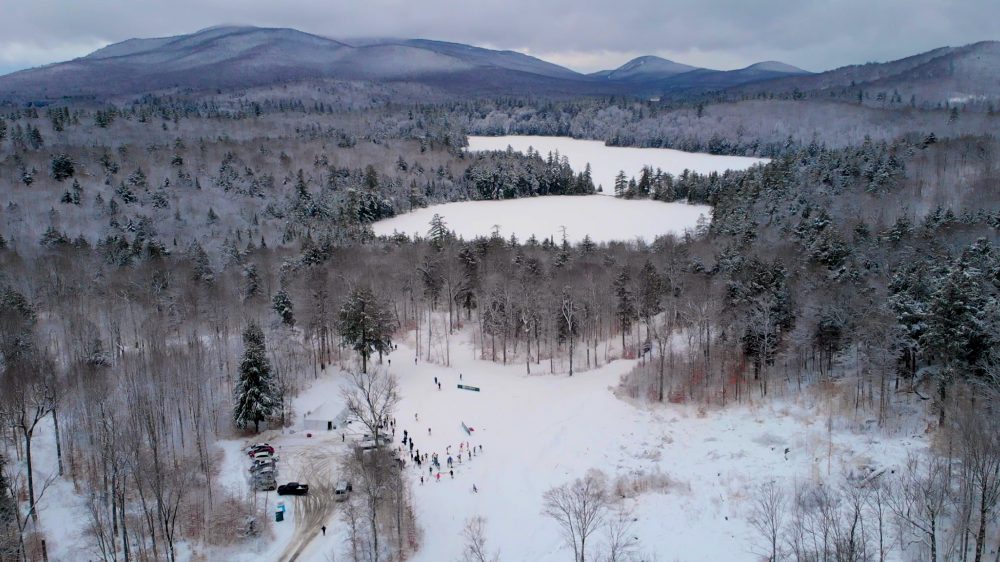
A vision for a nordic sport future – an aerial shot of a portion of Paul Smith’s campus.
Morton’s ski resume is lengthy. And true to form, Morton stuck to trail design during our conversation. He failed to mention he is a two-time Olympic biathlete, served a tour of duty in South Vietnam, coached collegiate skiing, and remains an all-around ski enthusiast. This is really just the tip of the iceberg.
A vision for an on-campus nordic sport future – an aerial shot of a portion of Paul Smith’s campus. (Photo: Courtesy PSC)
Running a small liberal arts college is big business. Stress over enrollment. Stress over capital improvements. Stress over staying relevant.
Paul Smith’s College in Paul Smiths, New York is a relative newcomer on the East Coast college scene; founded in 1946 and currently enrolling 745 students. One particular aspect Paul Smith’s makes it stand out – a massive 14,200 acre campus in the foothills of the Adirondack high peaks region. This is perhaps the school’s most unique asset. School administrators see their landholdings as one path to running a more sustainable higher ed business. The broad acreage of the campus is part of the school’s strategy to build infrastructure to attract potential students. In this instance, we are not talking about Paul Smith’s breaking ground on a shiny new student center with amenities like a five star hotel.
Paul Smith’s enterprising strategy to attract future student athletes includes building world class cross-country ski trails and a biathlon range. John F. Morgan, sports initiatives director at the college, shot straight when discussing the motivation for the school’s trail building initiative. “We are not doing this for public relations, we are doing this to entice student athletes to come to campus,” he said over the phone.
The school contracted with the storied Morton Trails to help vision the project and engineer the trails. Morton Trails came on board in October 2018, to begin the process of walking the campus grounds and marking a potential layout.
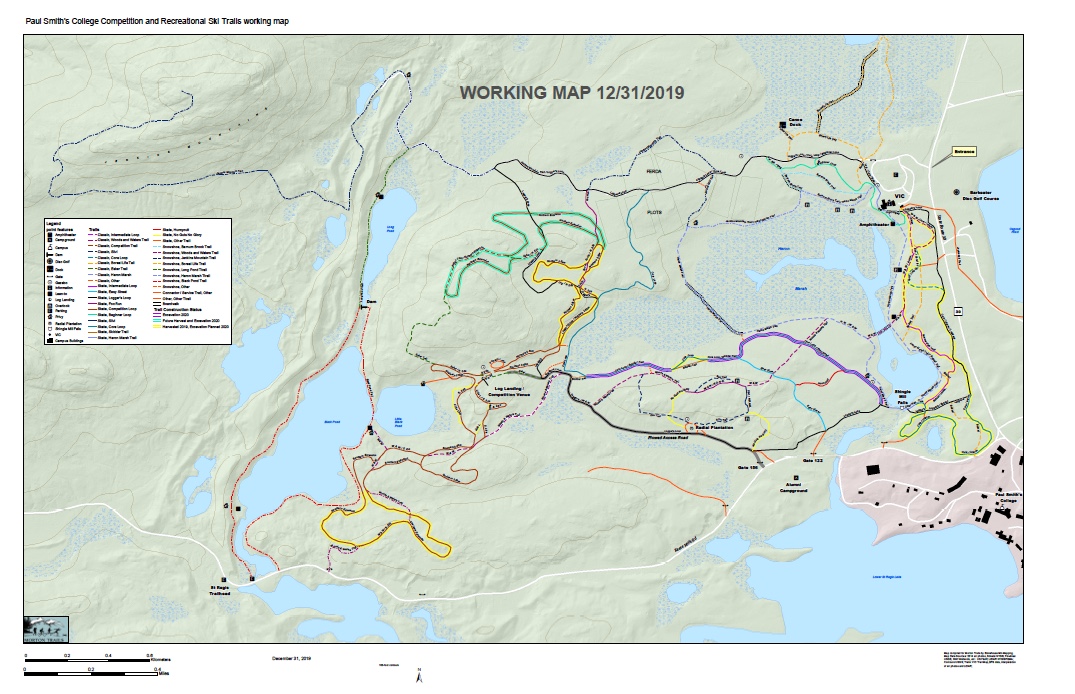
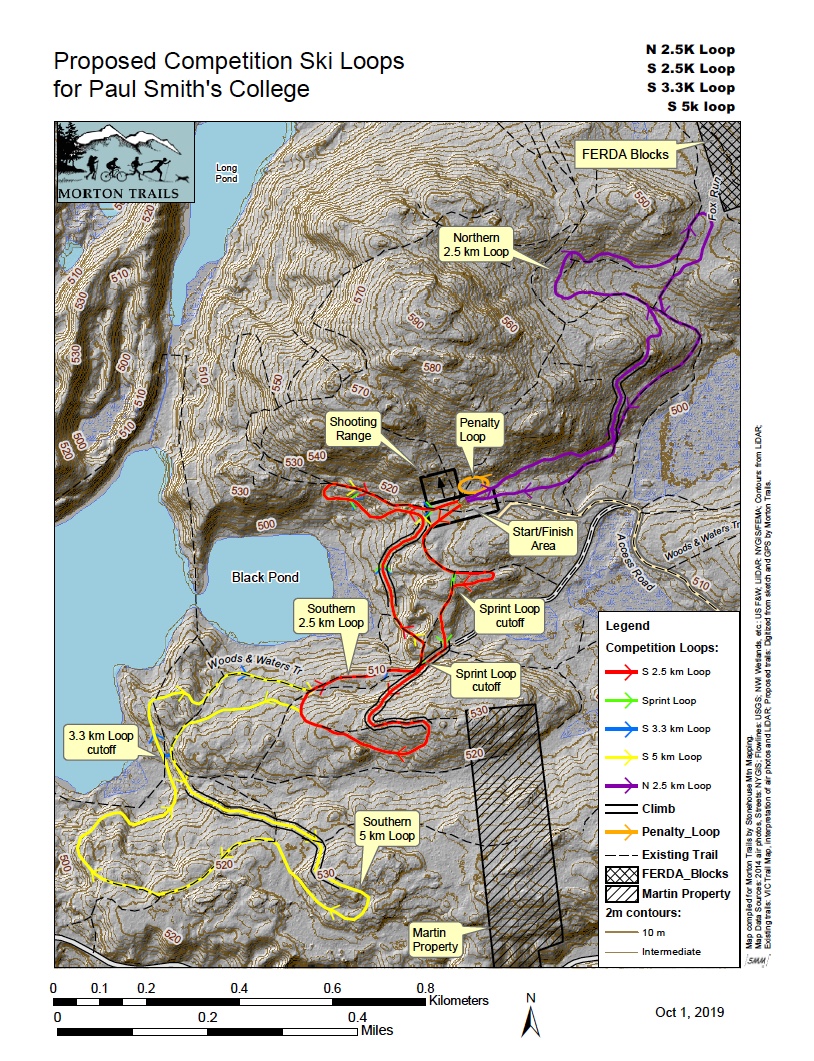
Link to Map PDFProposed Competition Ski Loops at Paul Smith’s.
Morgan explained the campus, situated 25 miles from Lake Placid, sits in the Adirondack snow belt; the terrain is positioned to receive adequate snow pack. The college also boasts a 25 mile pre-existing trail system. In 2010, the college took over what is called the VIC, which functions as an outdoor center and is open to the public. The new project involving Morton Trails is geared towards creating modern International Ski Federation (FIS) homologated trails.
Since the inception of the project, 2.5 miles of trail have been completed. According to Morgan, another 3.5 miles of crafted trails are slated for construction in the next year. Plans for a biathlon range are moving forward as well. And for those seeking dryland training opportunities, Paul Smith’s budgeted for the construction of a modest paved rollerski loop.
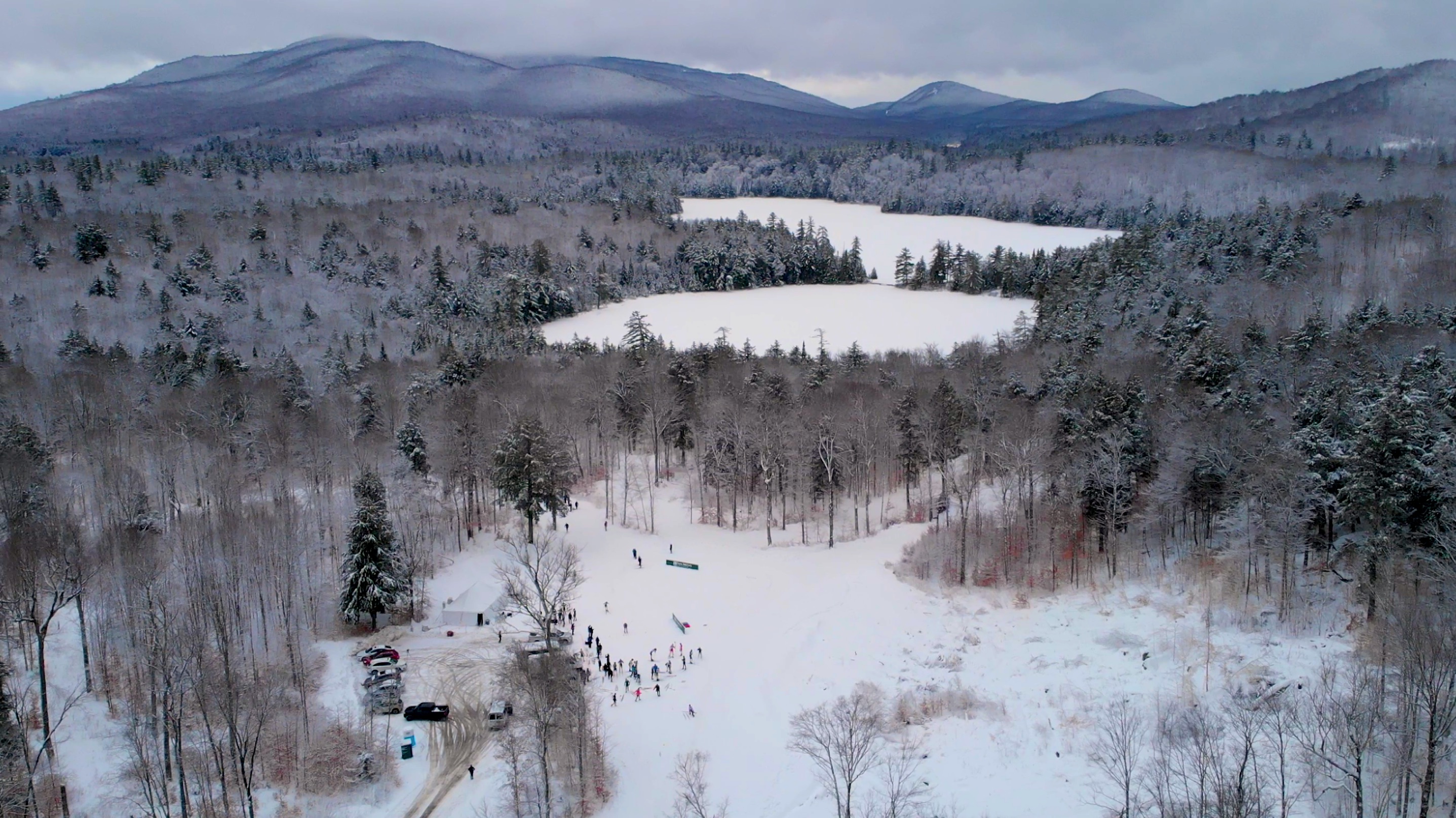
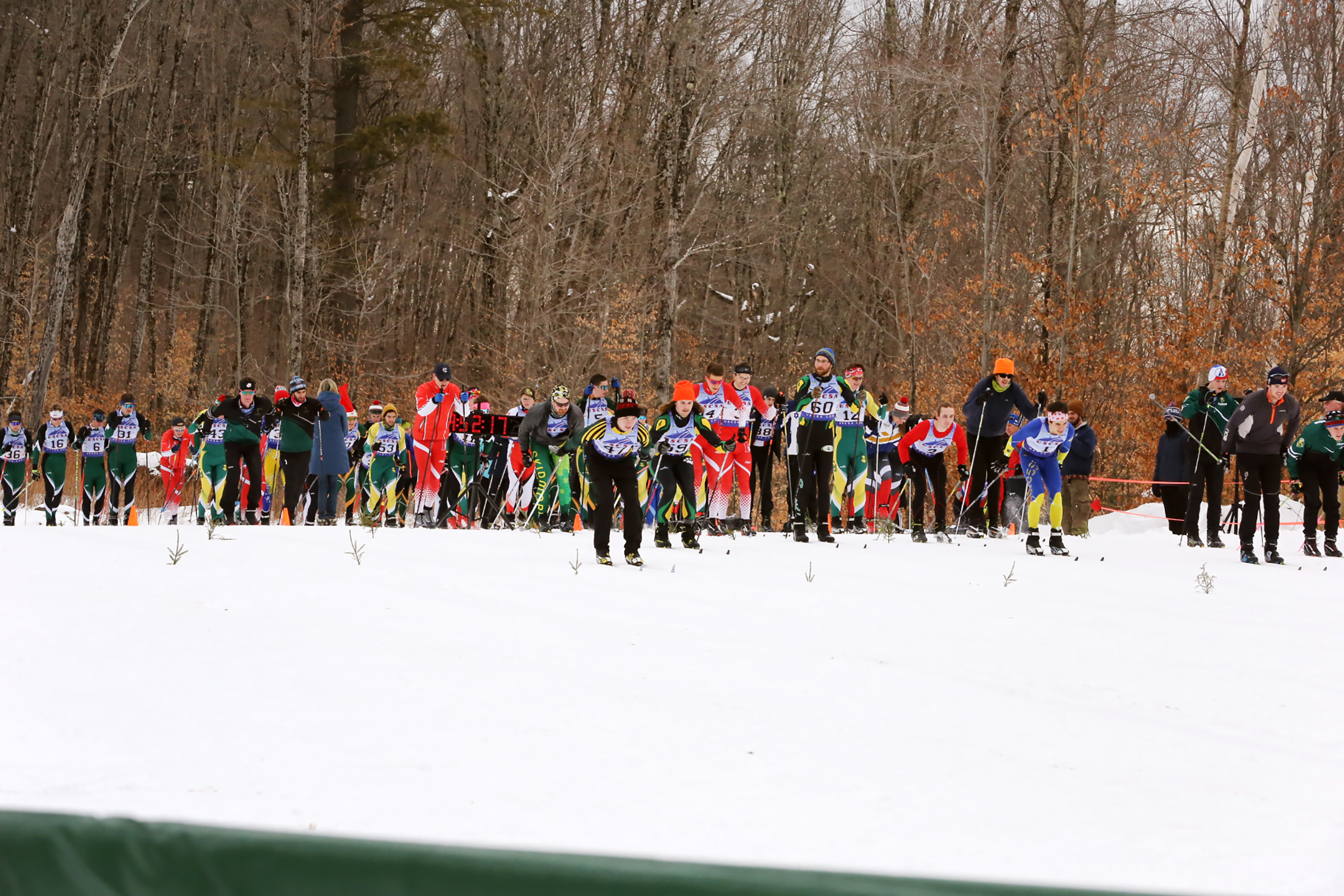
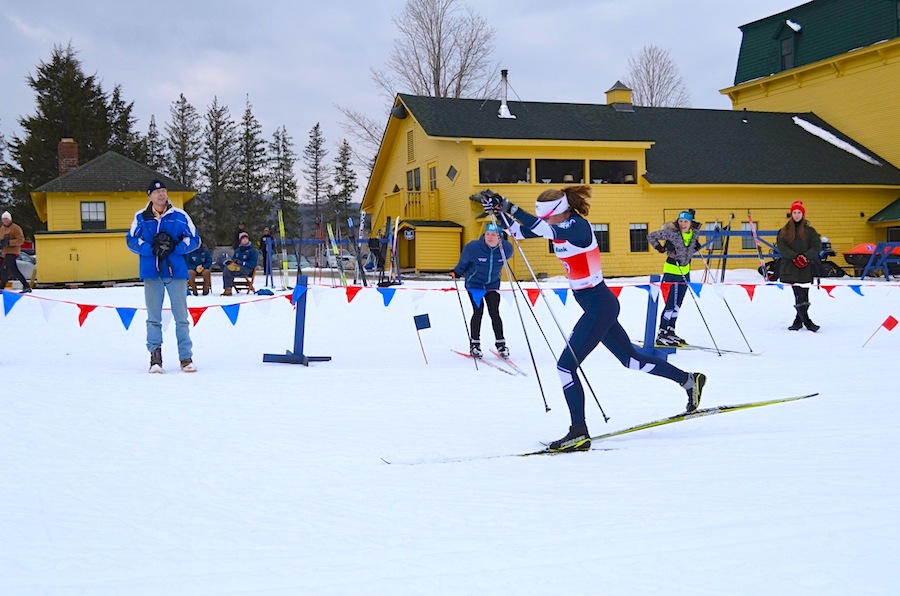
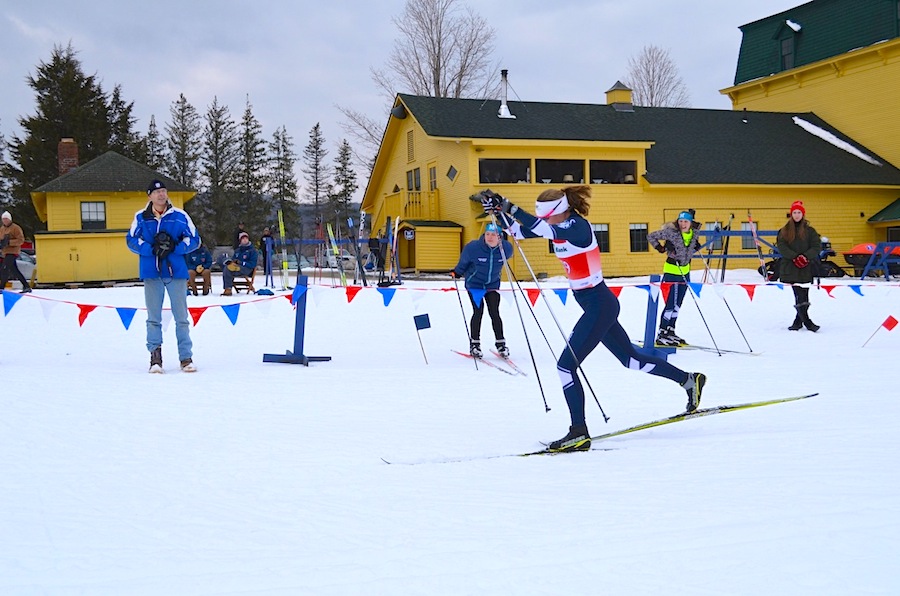
The start of the 2020 PSC Bobcat Invitational. (Photo: Pat Hendrick)
On January 6, Paul Smith’s christened their race worthy ski trails with the PSC Bobcat Invitational. One hundred and ten athletes from 11 colleges competed. According to Morgan, those students racing at Paul Smith’s were the type of clients the college hopes to attract. Morgan understands the risk involved with investing in nordic sport, yet he asserts the college’s outlook is longterm.
“We are doing this, yes,” Morgan said. “Do I have a guarantee that that many people are going to enroll? No. I was standing next to the college president when she dropped the flag on a ceremony for the venue during the race — I looked at her and I said, ‘these are our clients, maybe not these kids, but the kids that follow them.’”
Morgan also said four “grants” will be offered to USA Nordic and four to U.S. Biathlon student-athletes, respectively. “Grant”, it was explained, refers to full room and board, including tuition for a four year degree.
Part of the motivation for investing in the nordic sport facilities are the upcoming 2023 Winter World University Games in neighboring Lake Placid. Morgan envisions some of the grant recipients competing in those events. But Morgan acknowledged that the precise road map leading to a college degree from Paul Smith’s for an elite athlete will be a work in progress. Course work may involve early fall on-campus classes that transitions to online work for those traveling for competitions.
“That is what we are going to try and experiment with,” Morgan said. “Do we have the exact model of how to do it? No. But what we are doing is creating this sport and education culture where USA Nordic recognizes it, and U.S. Biathlon recognizes it. They send these kids in, and we assist them in finding a way to get them an accelerated education — one where they are on campus and they get a chance to experience college campus life and and they are not taking on-line courses when they are 30 or going back to college.”
On the tails of a season North American skiers might still be smiling about, it could be hard to think about how climate change might negatively impact our small sport. It is convenient to have selective memory and recall a phenomenal crust ski on the Lost Man Loop off of Independence Pass in Colorado on June 10th of this year, rather than remembering running the same loop when it was almost completely dry on July 1st of 2018. It is convenient to forget the patchy snow conditions at my local ski area, Spring Gulch, that made February of 2018 look more like April. Or to forget that 2017 was the year without the Birkie. Maybe that is just me.
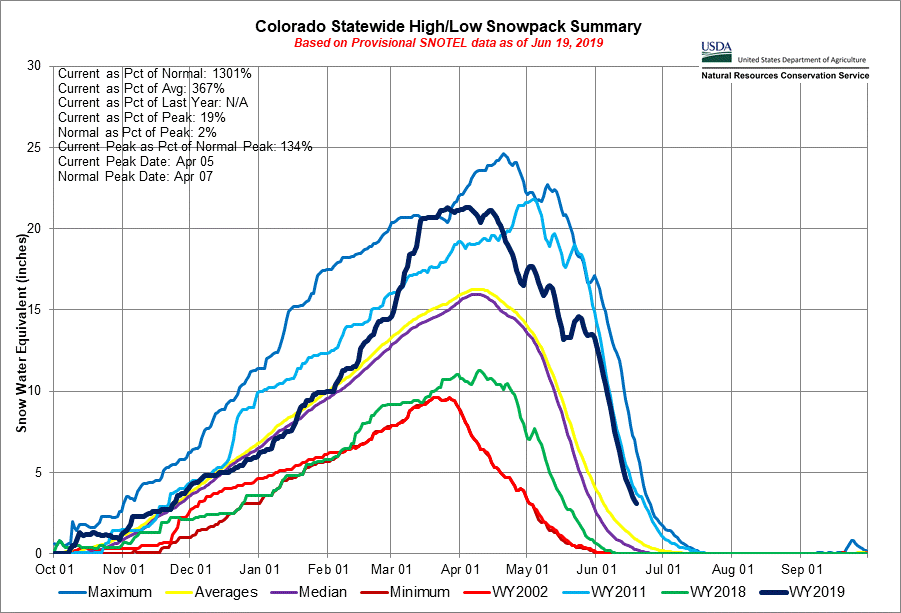
A graph of Colorado snowpack during high and low years provided by the Natural Resources Conservation Service.
By the numbers, in February of 2019, 38.7% of the continental United States was covered with snow. In contrast, in February of 2018, only 28.6% was covered. In February of 2012, a year of destructive wildfires akin to 2018, the coverage was only 22.9%. The overall season this year was well above average for snowfall in Colorado; last season was substantially below average. In case you also experience a selective memory and are unable to recall how the snowpack in these years affected your local trails, consider the disparity between snow coverage graphs of the Continental U.S. in February of 2019 versus February of 2012.
A graph of the snow coverage in the Continental U.S. amidst a very low snow year on February 1st of 2012 provided by the national weather service. (Click to enlarge)A graph of the snow coverage in the Continental U.S. on February 1st of 2019 provided by the national weather service.
According to a 2012 study, only about 55% of alpine ski areas in the Northeast will be able to maintain a 100-day season through 2030, thereby affecting the financial viability of the resort. Presumably, this impact will be amplified for cross country ski areas, which tend to be at lower elevations without as prevalent access to snowmaking. In reaction to these changes, ski centers nationwide have already begun making modifications to their trail systems.
To learn about trail modifications that are within financial reach of a cross country ski area, FasterSkier spoke with John Morton, a trail designer based in Thetford, VT whose resume of trail projects extends to premier nordic ski destinations nationwide and competitive venues. The conversation focused on what Morton considers “simple improvements”, rather than more intensive actions, such as harvesting or making snow.
John Morton’s trail design business, Morton Trails, is located in Thetford, VT. (Courtesy Photo)
Morton’s resume in nordic sport is as long or longer than the list of trail projects he has worked on. Morton competed in biathlon during the 1972 and 1976 Olympics, coached the US Biathlon Team in 1980, then acted as Biathlon team leader for the subsequent three Olympic Games. He was inducted into the U.S. Biathlon Hall of Fame in 2009. Morton has been Chief of Course at the World Cup and US National Championships for Biathlon at Soldier Hollow and has worked as a technical delegate or referee at several other high-level competitions. He was also the head coach at Dartmouth College in the ’80s.
It was from his time at Dartmouth that Morton became interested in trail building, leading to the eventual start of his company, Morton Trails. He had been hired onto the Dartmouth program by another well-known name in the field, Al Merrill. Merrill, who Morton described as being “knowledgeable in all facets of nordic skiing”, had been a mentor for him during his years as a coach. Merill contacted Morton while working on one of his noteworthy trail design projects at Giants Ridge in Biwabik, Minnesota because the venue was intended for both cross country and biathlon. Merrill consulted Morton with questions about the latter and later reached out again to help revise the Dartmouth ski system at Oak Hill.
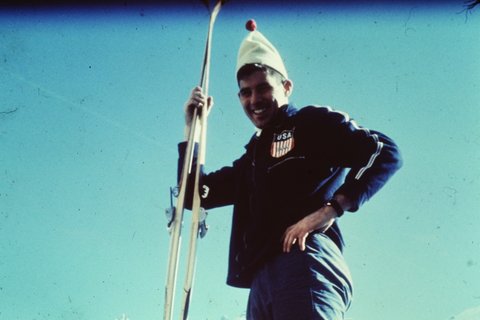
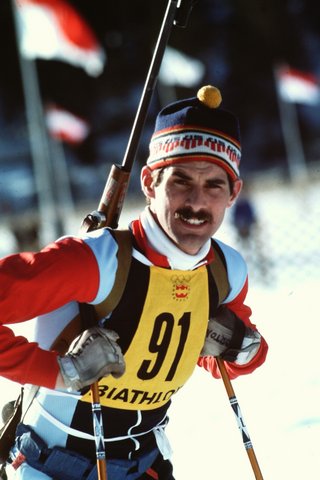
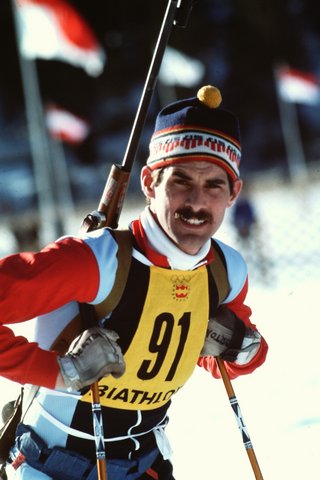
John Morton at the 1976 Winter Olympics in Innsbruck, Austria (Courtesy photo)
“I learned a lot, and I realized that some of the decisions he was making in terms of where the trail would go and how it was configured were the same decisions I would have made if I were working by myself,” said Morton in a call. “So I felt confident that having skied a lot and raced and coached in a lot of different locations, I had developed a certain sense of how good trails should feel and conversely what you want to try to avoid in terms of enjoyable cross country ski trails.”
Morton began to notice the effect that a poor winter had on training opportunities during his time as a coach, which is when he began honing his knack for identifying and pursuing optimal terrain.
“The pattern seemed to be that there we would have several years where it was really difficult conditions, and we might get a good snow storm, but it would end with rain,” he recalled. “So what looked like it was going to be a promising snow cover, ended up being slush or worse, was just washed away by the rain. So you ended up being very skillful in trying to find places, little pockets of high elevation or in the shadow of a hill or a mountain where it might drop more snow than it did even relatively close by. We ended up finding a lot of those places where for some pretty subtle reasons, it ended up just getting more snow and often times retained it better.”
While the impacts of climate change have become more pronounced, Morton does not see the decline he feared in nordic ski venues.
“I was definitely concerned about this little niche [of cross country skiing] and if climate change was really going to impact that negatively, are there going to be a lot of these nordic centers that basically are no longer able to function?” he asked rhetorically. “But what has been interesting is that a lot of the facilities have made the choice to do whatever it takes to continue to provide good skiing for their customers. Sometimes it’s modest improvements, sometimes it’s really biting the bullet and raising money and looking at snowmaking.“
He added that the sense of urgency to react to the unpredictability of winter has kept him busy as a trail designer, rather than put him out of business.
Morton has presented at trail conferences and consults on the topic of adapting to climate change and maintaining or creating trail systems that mitigate snow loss and allow optimal ski conditions during suboptimal winters. Many ski areas recognize a need for improvements, but are not interested in or do not have the budgetary resources to consider snowmaking – a capital cost he estimates between $150 and $250 thousand per kilometer for a pipe and hydrant system. This upfront investment does not include operating cost. A single kilometer of trail also requires approximately 270,000 gallons of water to cover with a one foot base of snow. For these ski areas, he suggests a hierarchy of relatively low-cost interventions that may make a large impact.
“A lot of these suggestions are quite obvious,” he said. “But they are often things that are overlooked and even with places that are really knowledgeable and have a really skilled staff, you sometimes notice that these simple things could help the quality of the skiing.”
As the majority of ski trails are through treed terrain, the first intervention he suggests is to limb branches to open the canopy above the trail allowing more snow to collect on the trail itself, rather than on the trees. He recommends using a telescoping pole saw, preferably machine powered, to make it easier to cut higher above ground level.
Trimming brush and limbing branches that interfere with snow accumulating on the trail is John Morton’s recommendation as a first step to improving trails. Photo used in Morton’s presentations at trail conferences, taken from “Cross Country Ski Trail Manual” and Elliott and Associates.
“Just by walking on the surface of the trail, you can reach up 16 to 20 feet [with the pole saw] and limb off all of the overhanging branches, because in the wintertime, those branches hold snow, and the snow doesn’t always reach the trail. So I’d say that is number one and probably the simplest.”
The next step is to further widen the trail if possible, which furthers the trails ability to collect falling snow.
“A lot of original early traditional cross country ski trails are quite narrow,” he said. “Back in the days where it was just classic and if they were groomed at all they were groomed with a snow machine. Nowadays, if you want to have skating and classic skiing, you need a trail that is probably at least 12 feet wide and ideally more like 16 feet wide.”
He added that this width needs to be substantially greater if the area plans to be a premier competition venue, as FIS homologation standards require 9 meters (~30 ft) of width on uphills for a freestyle course and 6 meters for a classic only course.
“Step number three would be carefully looking at the surface of the trail itself,” he continued. “A lot of trails, especially trails that don’t get a lot of use in the summer, they may have rocks and roots and places where erosion has negatively impact the surface of the trail. So any efforts that the owner or the management of the facility could take to smooth out the surface of the trail would allow grooming on less snow.
“That probably also involves improving the drainage,” he added. “It might mean putting in more culverts. Often times, if a trail is older and has been used for quite a while, you’ll find that there are places that are eroded. Along the edge of the trail, there might be a fairly significant ditch. So if you take an excavator or a bobcat or something like that and mellow out those ditches so they are more like a swale, then that effectively becomes part of the ski trail rather than an obstacle along the side of the course.”
He also explained that wood chips, hay, or other organic material could be used to improve the surface of the trail.
While these improvements are “simple”, they do require manpower and potentially some expense, but Morton pointed out that many ski areas are able to recruit volunteers to help get much of it done. The more costly alternative to this would be to hire a landscaping crew to do the work or a logging contractor, depending on the work that needed to be done. While the latter could certainly be costly, he added that in some cases, if the trail system is located in a wood lot with quality and valuable timber, the cost of logging might be completely offset by allowing the company to selectively thin the surrounding forest.
If a volunteer or work crew member was proficient in operating large machines, Morton highly recommends considering renting an excavator.
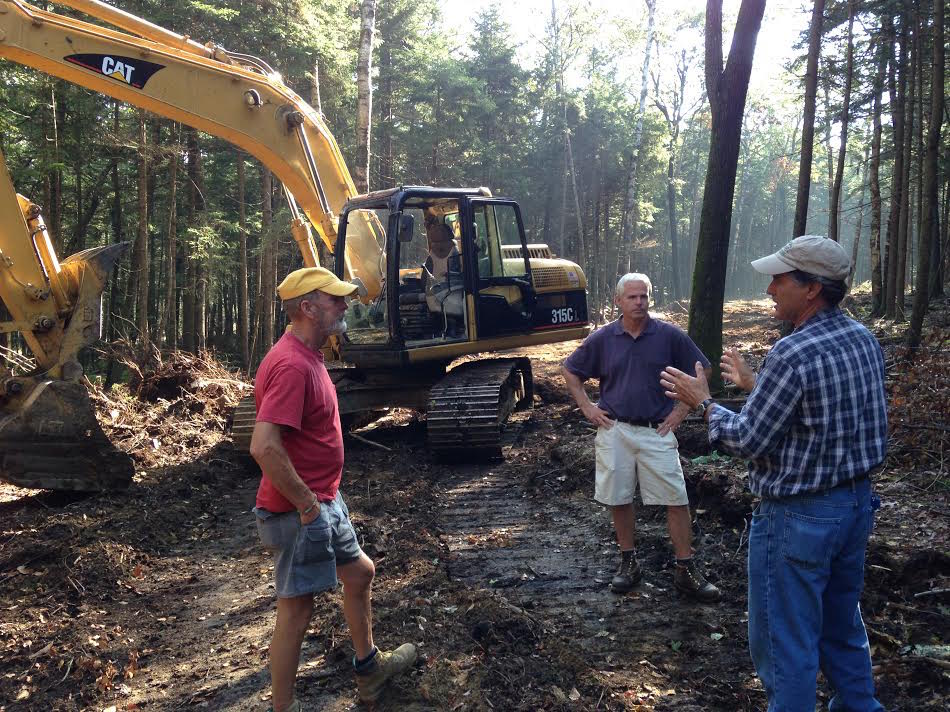
Owning their own excavator helped the Dublin School keep its construction costs down. (From left to right: excavator operator Bob Miles, project manager Andy Hungerford, and trail designer John Morton. (Photo: Brad Bates/Dublin School)
“Excavators are extremely versatile and efficient machines,” he said. “These days, most trails, even trails intended for World Cups or very high-level competitions, they’re almost all built exclusively with excavators now.”
It may cost $150 per hour to rent and operate, but with a skilled operator, he can attest that a large amount of work can be completed within a week at a total cost of approximately $6000.
In regions that are not treed, another relatively low-cost option to consider is snow fencing or planting coniferous trees along the trail in the direction of the prevailing winds. As the wind passes through the fence or the branches of the trees, it slows down, dropping any snow it is carrying on the leeward side of the fence, ideally along or on the trail. Not only does this help to accumulate snow that can be groomed in, but it also prevents large drifts from occurring, which can be difficult to break up with smaller grooming equipment. It also may prevent newly fallen snow from blowing off of the trail before it can adhere to the layer below or be rolled in.
If a trail system is not able to maintain sufficient snow coverage of its trails using these methods, they might consider implementing more intensive measures, such as harvesting and spreading snow from a nearby site that might be a pocket of better accumulation. Some areas may need to consider rerouting the network in north facing or higher elevation terrain. Before cutting new trails, Morton cautions against choosing what might seem to be the easiest path.
“You can look around and the number of different nordic ski facilities, you can trace them back to the founder or the originator, and very often that person went out with a chainsaw and started cutting,” said Morton. “And oftentimes, it involved the path of least resistance. They’ve got a power line and they realized that if they just made a cut of half a mile or so, they could go out the power line, cross over, and come back on an old logging road, and then in effect, they’ve got a loop. But that type of evolution and path of least resistance rarely makes for the best skiing.
“And it’s relatively convenient and relatively inexpensive,” he continued. “But power lines and logging roads are not always designed with recreation in mind. So my recommendation is that an intention to extend the trail system, try to think of the big picture and say, ‘How will this fit in with the overall network? Are there some trails that we really should abandon because they’re no longer useful or suitable? What are the functions or the extensions of the extensions or the additions?’”
This reflection process might include considerations of whether a beginner trail is needed, which would limit the extension from areas that have large climbs or descents. But if the area is looking to cater to the training and competition opportunities for developing athletes, extending into the more technical terrain might be favorable.
He also suggested making trails directional both for the sake of skier safety and enjoyment.
“I’m a big advocate of one-way traffic,” he stated. “You can get more people on the trail without them realizing how crowded it might be if it is one-way traffic. And you can design a descent to be fun and safe and technical, but that climb would not be enjoyable if taken in reverse.”
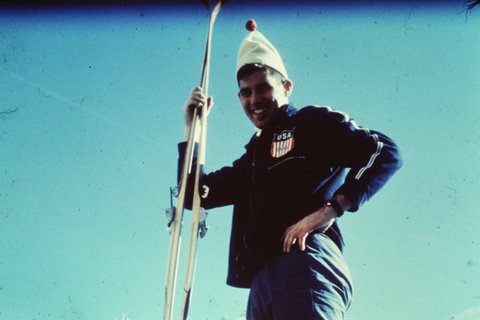
John Morton at the 1976 Winter Olympics in Innsbruck, Austria (Courtesy photo)
The following was submitted to FasterSkier by John Morton, a former U.S. biathlete and two-time Olympian (1972 and 1976) who has attended 10 Winter Olympics as “either an athlete, a coach, the Biathlon Team Leader, Chief of Course or, more recently as a spectator,” according to his bio (at end of article). Today, Morton, 71, lives in Thetford, Vermont, and works in trail design.
***
I’ve had the remarkable good fortune of attending 10 Winter Olympic Games. I was a member of the U.S. Biathlon Team in 1972 at Sapporo and again in ’76 at Innsbruck (where, following a workout, a few of U.S. ski-shooters wandered over to the adjacent cross-country stadium and watched Bill Koch win his monumental silver medal in the men’s 30 km). I was an assistant coach for the U.S. biathletes at the 1980 Games in Lake Placid, where late in the schedule, I accepted a complementary ticket to a hockey game, not even knowing which teams were playing. It turned out to be the USA’s remarkable victory over the Soviet Union, probably the most inspiring sporting event I’ll ever witness. I served as Team Leader for the U.S. biathletes at Calgary in ‘88, Albertville in ‘92 and Lillehammer in ‘94. Then, in 2002, I was the Chief of Course for the biathlon events during the Salt Lake City Olympics, a volunteer position that was every bit as stressful as competing back in ’72 and ‘76.
At the most recent three Winter Games, Vancouver, Sochi and PyeongChang, my wife and I have enjoyed the relative luxury of attending as spectators, cheering on America’s cross-country skiers and biathletes. As the jet lag from out trip home from South Korea begins to wear off, I can’t help thinking about the dramatic changes these two sports have experienced over the past 46 years. It seems to me that many of these changes can be traced to three factors: innovations by the athletes, technological improvements and the influence of television.
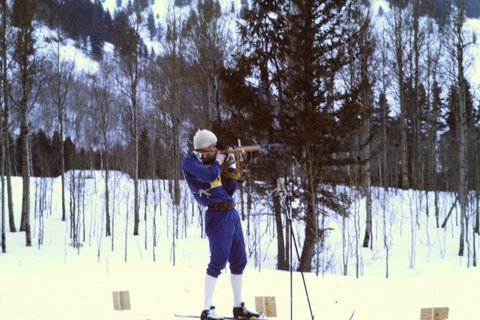
John Morton at 1972 biathlon Olympic trials in Jackson, Wyoming. (Courtesy photo)
Back in ’72 we were on wooden skis, kick-waxed the entire length. There were two biathlon events, the 20 km individual and the 4 x 7.5 km relay. We shot large-caliber rifles on a 150-meter range using paper targets for the 20 km and glass disks for the relay. It was impossible to determine the winner of the 20 km until all the paper targets had been carefully inspected, sometimes hours after the conclusion of the event. A typical biathlon course consisted of three, independent, 4 km loops, with cutoffs for the relay. Women didn’t compete in biathlon at the Olympics until Albertville in 1992.
Men’s cross-country has been part of the Winter Olympics since the beginning in 1924 at Chamonix, France, when there was a 15 km event as well as the legendary 50 km. The first cross-country event for women was a 10 km, which debuted in 1952. In those days, Nordic race courses consisted of roughly one-third climbing, one-third descent and one-third relatively flat terrain. Well into the 1960s, courses were prepared by soldiers boot-packing or snowshoeing the course, followed by skiers stomping in the parallel tracks through the forests and fields. Competitors typically started at one-minute intervals, disappeared into the woods, only to reappear exhausted, often hours later, covered with frost and mucus. The men’s 50 km cross-country event at the 1932 Winter Olympics in Lakes Placid consisted of a 25 km loop skied twice, and was won by Finland’s Veli Saarinen in 4 hours, 28 minutes.
In my view, the first significant change came at the 1974 Nordic World Championships when Sweden’s Thomas Magnusson won the men’s 30 km on Kneissl synthetic skis. Fiberglass and metal had replaced wooden Alpine skis years earlier, but the faster, plastic bases wouldn’t hold Nordic kick wax. But in wet, heavy, painfully, slow snow, Magnusson took a chance on the fiberglass Austrian skis and dominated the race. The headline in the Oslo paper the next day read something like, “Magnusson wins gold, Norwegian ski industry in peril.”
The next major breakthrough occurred at the 1976 Innsbruck Olympics two years later. Marty Hall, head coach of the U.S. Cross-Country Team recruited Rob Kiesel from Alpine skiing as his assistant. Together they determined that it was possible to wax the tips and tails of the new fiberglass skis for speed with Alpine wax, restricting the much slower cross-country kick wax to a short segment under the athlete’s foot. This made the skis of the Americans faster than those of their European rivals and certainly contributed to Bill Koch’s memorable silver medal in the 30 km, America’s first, and only Olympic medal in Nordic skiing until Kikkan Randall and Jessie Diggins struck gold in PyeongChang.
Following the success of the Innsbruck Olympics, expectations were high for U.S. Nordic skiers at the 1980 Olympics in Lake Placid. With a theoretical “home court advantage,” Bill Koch’s 13th in the men’s 50 km and Lyle Nelson’s 19th in the biathlon 10 km sprint fell short of the results which the public had been led to expect.
Discouraged, Koch elected to ski the international ski marathon circuit the following year rather than the Nordic World Cup. There, on trails groomed wide by Alpine-area Sno-Cats for thousands of citizen racers, he observed elite competitors pulling away from the throng by putting one ski in the set track and pushing off, skating-style with the other. He quickly mastered this marathon-skate technique and began to experiment by skating with both skis. When he returned to the World Cup circuit a year later, he threw the Nordic world into turmoil by abandoning the relatively slow kick wax altogether and skating entire courses on skis waxed purely for speed. The result of Koch’s persistence and innovation was a cumulative World Cup victory for the season, America’s first in cross-country skiing.
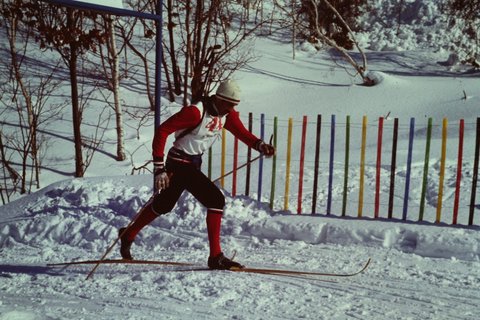
U.S. biathlete John Morton racing at the 1972 Winter Olympics in Sapporo, Japan. (Courtesy photo)
When the dust (or more accurately, snow) finally settled, Nordic skiing had two disciplines, classic (the traditional kicking and gliding) and freestyle (skating). Because biathlon was already complicated enough with skiing and shooting, they decided to go with skating as their designated technique, as did Nordic Combined. In a type of mutual re-enforcement cycle, the use of large, Sno-Cat-type grooming machines on cross-country trails, which originally made the evolution of the skating technique possible, became a requirement once skating was accepted as a part of the sport.
Enter television. The first Winter Olympics to be televised were the 1956 Games in Cortina, Italy, and it quickly became apparent how powerful the new medium could be. Figure skating, ice hockey and ski jumping immediately gained popularity, largely because they were relatively easy to cover. Alpine skiing, bobsled and Nordic skiing lagged behind because they were more difficult and expensive to film. The sports favored by TV prospered, enjoying increased funding from sponsors and a wave of young Olympic hopefuls. Meanwhile, those sports that were less telegenic scrambled to make their events more appealing to the camera. Nordic skiing and biathlon added mass-start and pursuit format events, making it easy for spectators to see who was winning. In terms of spectator interest, biathlon had the advantage of the shooting range. With the adoption of the modern, knock-down targets and television cameras’ abilities to zoom in on an athlete’s targets as he/she is shooting, the popularity of the sport took off. In recent years, biathlon has become the most-watched winter sport in Europe with World Cup events rivaling the popularity of Monday Night Football in America.
In cross-country, one of the unintended consequences of the skating revolution was a focus on upper-body strength, which in turn, led some athletes to abandon kick wax in classic events and double pole the entire course, especially in the shorter, sprint races. This led the FIS (the international governing body for skiing) to require tougher courses with more challenging climbs.
Finland’s Iivo Niskanen after winning the men’s 50 k classic mass start at the 2018 Winter Olympics in PyeongChang, South Korea. (Photo: FlyingPointRoad)
As a result, what we saw in PyeongChang for both cross-country and biathlon, were trails 30-feet wide, capable of accommodating three skaters, side by side (without obstructing each other), with steeper climbs and faster, more challenging descents. Aside from the spacious start/finish stadiums, the traditional one-third of relatively flat terrain has disappeared. There was also an effort to loop the trails back within sight of the spectators so that they saw more than just the start and finish of the events. For example, the men’s 50km, perhaps the most iconic of the cross-country events, was conducted on two, 4.16 km loops which brought the competitors through the stadium, in front of the cheering crowd a dozen times. The men’s 50 km classic in PyeongChang was won by Finland’s Iivo Niskanen in a time of 2 hours, 8 minutes (less than half the time it took for his countryman to complete the same distance in 1932 at Lake Placid).
Perhaps the most dramatic change, was the scheduling of many of the Nordic skiing events at night (which allowed them to be televised live in Europe and the eastern U.S. at a reasonable hour). In addition to the expense of lighting and minimizing the number of TV camera platforms, another motivation for shorter ski loops is the growing need, thanks to climate change, to cover the entire trail with machine-made snow. Early in the winter the biathlon and cross-country courses were blanketed with a deep layer of machine-made snow, enough to survive warm temperatures and thaws well beyond the Olympic schedule in February.
While there have been advancements and technological improvements in other Winter Olympic sports, I can think of none more dramatic than what we’ve experienced in Nordic skiing. From a single biathlon event held at the 1960 Squaw Valley Games, there were 10 biathlon competitions on the schedule in PyeongChang. With the advent of the skating technique, fiberglass skis and fluorocarbon waxes, times for cross-country events have been cut in half in less than a generation. Thanks to machine-made snow, the 2022 Winter Olympic Games will be hosted by Beijing, China, a city previously not known for winter sports. And through the development of LED lighting and high-definition television, the excitement of Nordic skiing events can be broadcast live, in prime time, to homes around the world.
*****
John Morton has participated in ten Winter Olympic Games as either an athlete, a coach, the Biathlon Team Leader, Chief of Course or, more recently as a spectator. He has published two books and numerous articles dealing with Nordic skiing.
After 11 years as Head Coach of Men’s Skiing at Dartmouth College, he founded Morton Trails, and has spent the past 28 years designing more than 220 recreational trails and competition venues across the country. He currently has projects underway in a dozen U.S. states as well as two projects in China. More information regarding his trail design work can be found at www.mortontrails.com. He lives with his wife Kay, at the end of a dirt road in Thetford, VT, surrounded by trails.
In the spring of 2015, ROCKS will file an application for a Special Use Permit with the United States Forest Service (USFS) to build a new Seeley Lake nordic-ski venue, which is “intentionally being designed to international race-ready specs, fully homologated, with both the skier and spectator in mind,” according to ROCKS President Chris Lorentz.
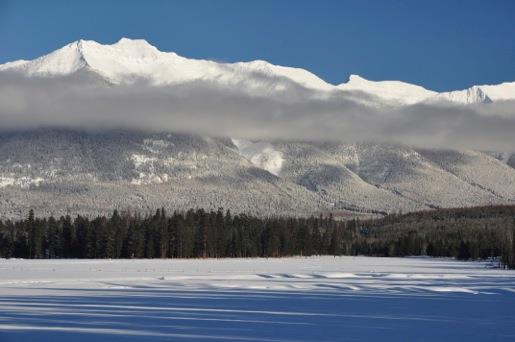
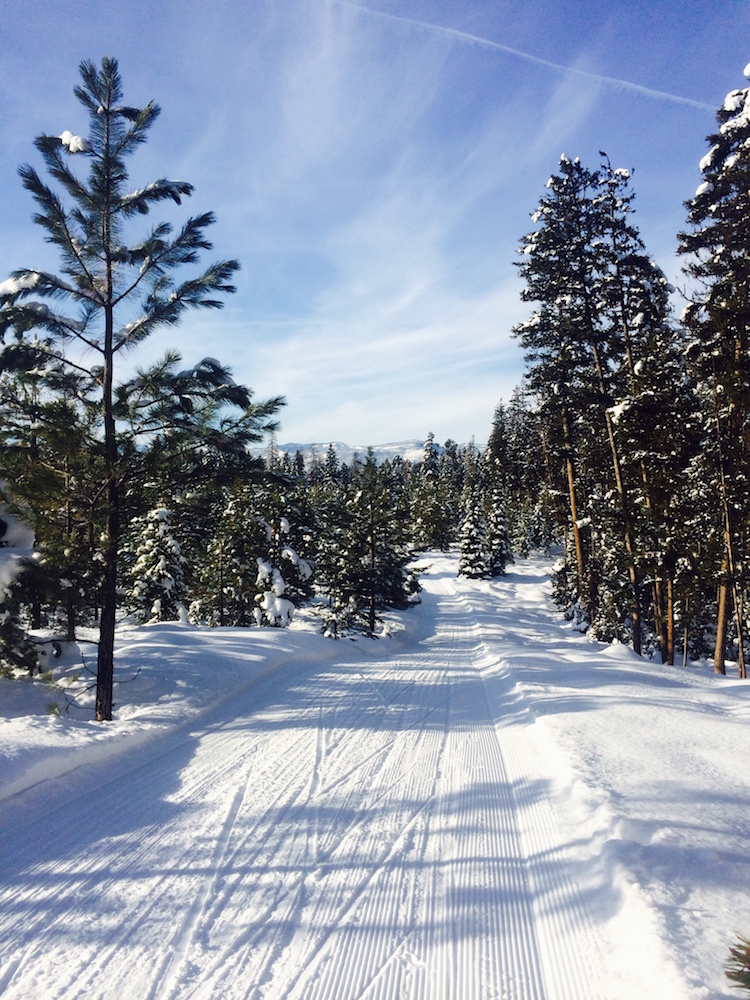
Swan Range forms the backdrop for the Seeley Lake ski trails. (Photo: Seeley Lake Nordic)
Lorentz said the Forest Service will review the permit application, perform an environmental analysis (including a mandatory 90 day public input period) and provide a decision by October 1, 2016.
“We believe the (process) will result in a positive decision notice,” Lorenz said.
ROCKS hired John Morton, owner of Morton Trails, to provide both a feasibility study (2011) and course design (2012) for the new Seeley Lake venue. According to a report issued by Morton Trails to the USFS, Morton states that efforts have “resulted in a workable concept for what offers to be a nationally, and even internationally, recognized cross country skiing venue … suitable for hosting Continental Cup races such as US Junior Olympics, US Nationals, North American races [i.e. Super Tour], as well as regional races where participants can be awarded FIS points for international ranking.”
Morton’s design would meet specifications for D-category homologation, making Seeley Lake one of six venues certified to this level in the United States. A D-certification allows a venue to host all events, including mass-start freestyle races. The only event requiring a designation beyond a D category is the skiathlon, which requires two separate courses (used concurrently). Soldier Hollow in Midway, Utah, is the only course in the US which currently has this designation.
To provide Seeley Lake with an advantage in bidding for major events and training camps, and to keep the door open for a possible World Cup event bid, Morton designed the course to “comply to a World Cup standard – which will make this venue truly representative of courses hosting the most elite competitions.” The most recent FIS Homologation Manual would have allowed for certification with a 25-meter climb; however, Morton chose to exceed this standard and comply with the World Cup’s 30-meter requirement.
In January, Seeley Lake hosted its 8th annual biathlon, with 115 racers participating in three events. (Photo: Seeley Lake Nordic)
Morton’s design includes a 15-point biathlon range and identifies a location for a 30-point range (meeting the IBU World Cup requirements) that could be installed with some additional construction. The course design for the five-kilometer loop is “spectator friendly” allowing spectators to view competitors five to seven total times, or 10 to 14 times for a 10 k race.
While USFS permit approval, new venue construction, and hosting of events at the new venue are years in the future, Seeley Lake, is not waiting for course completion to continue taking steps forward. Recent ROCKS activities have clearly energized the town which has a long standing nordic ski racing tradition.
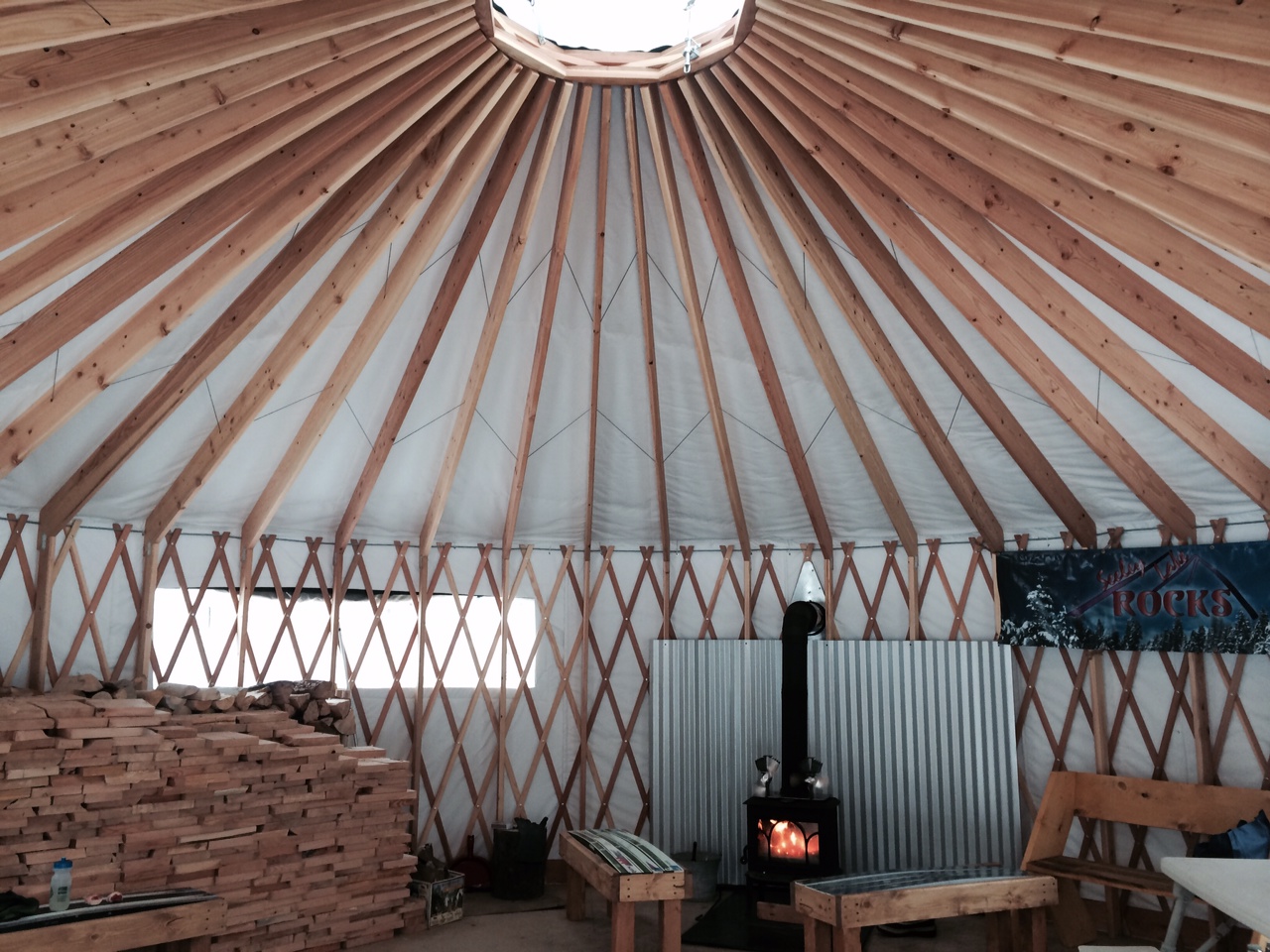
The town’s existing nordic ski trails at Seeley Creek have seen an upsurge in use following the installation of a new yurt (installed by Seeley Lake ROCKS) at the trailhead.
“The yurt is way more popular than we expected,” Lynn Carey of the Seeley Lake Nordic Ski Club said. “Our metal ranger now takes in more money than any other ranger in the state.”
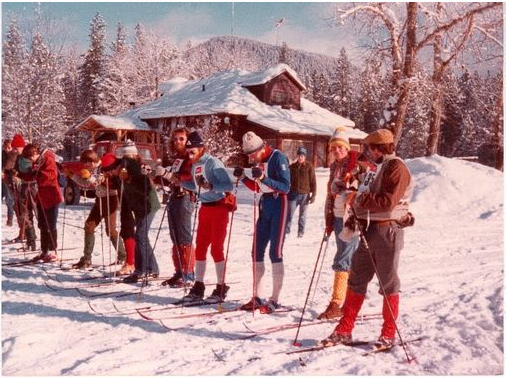
Seeley Lake, Montana, has a long history of ski racing. This is a photo of the start 1983 OSCR race. (Courtesy Seeley Lake Pathfinder)
ROCKS founder Karen Pratt notes, “The idea is that you need a culture shift to bring in an elite race [to Seeley Lake] and get enough interest in town to support it. An international race is a lot of work!”
The ROCKS plan seems to be working.
“There has already been a big culture shift in Seeley,” Pratt said. The Seeley school system started a ski program where any student above the 3rd grade can access free skis, transportation and ski instruction. Twenty students have caught the ski bug and joined the school’s newly formed nordic ski racing team.
According to Pratt, many local parents are learning to ski as a result of the new youth programs. She is convinced that the increased activity is improving community health. “It’s not a good thing when the people in Seeley don’t get out of the house in the winter,” she said.
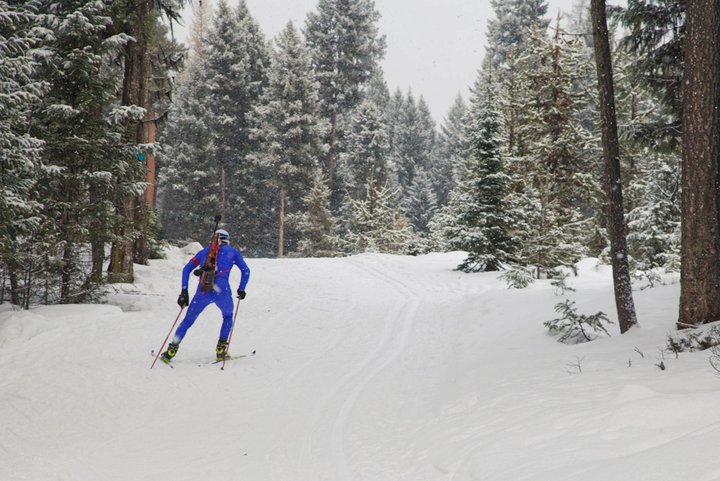
Seeley Lake’s existing ski trails at Seeley Creek. (Photo: Mark Vosburgh)
Grooming the 23-kilometer Seeley Creek trail system is now conducted daily, and several trails that had been abandoned or rarely groomed have been re-opened. The rolling trail system, designed by Olympian Jon Elliott, is seeing a resurgence in use and the trails are receiving rave reviews from regional skiers. The eighth-annual Seeley Lake biathlon had 115 entrants this year, nearly double last year’s count, according to race director Cheri Thompson.
Once the new trails at Fawn Creek are open, ROCKS organizers hope that overnight visits and resulting economic benefits to Seeley Lake will increase with skiers spending two days in the Seeley Lake area in order to ski both trail networks.
Pratt credits generous donations from the late Peter Hale and his estate for supporting the Seeley Lake ski program with skis, waxing supplies and equipment. Hale’s connection to Seeley and his passion for skiing is in part responsible for at least one concrete example of increased economic activity sought by ROCKS.
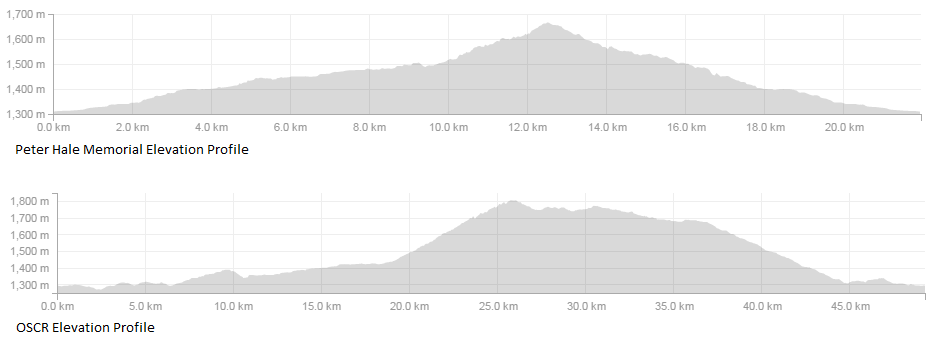
Elevation profiles for Seeley Lake’s signature nordic ski races, the Peter Hale Memorial and OSCR.
In 2012, Mike and Cathy Kahnle opened Seeley’s first bike-and-ski shop, Rocky Mountain Adventure Gear. Describing how he came to a decision to start the business, Mike said, “ROCKS was happening … Peter Hale contacted me prior to putting this business together and just filled my ear… It was pretty evident his love for skiing was overwhelming.
“Peter basically talked me into running Madshus skis in a shop that didn’t exist,” he continued. “You couldn’t have a conversation with him without feeling better about yourself and life in general.”
A passionate endurance athlete, Kahnle was also attracted to Seeley by its reputation for challenging endurance events like the Over Seeley’s Creeks and Ridges (OSCR, pronounced “Oscar”) 50 k ski race.
Describing the race, Kahnle said, “No matter what level athlete you are, you are going to have the opportunity to push yourself to find the limits of what you’ve got.” Referring to the nearly 800 meters of elevation gain in OSCR, he added, “If you want an easy race, go somewhere flat because we are not going to have it for you here.”
Carey, OSCR race director since 1991, agreed: “OSCR [founded in 1981] is a damn-tough race. It always has been, and we are proud of it … really it’s an adventure more than a race.”
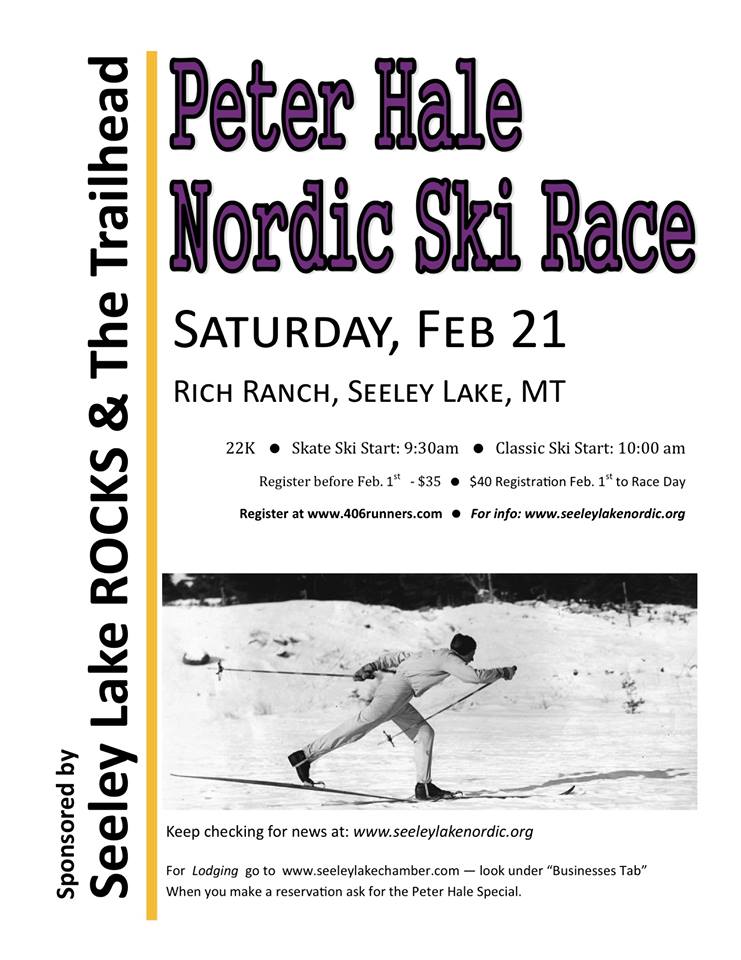
The second Peter Hale Nordic Ski Race will be held Saturday, Feb. 21, in Seeley Lake, Mont.
ROCKS will hold the Second Annual Peter Hale Memorial 22 k Ski Race on February 21, 2015. With an elevation gain of nearly 400 meters, the race is not easy. In honor of Hale’s love of classic skiing, both classic and freestyle races are offered. Inaugural race feedback (in spite of frigid temperatures) was positive with about half of the participants choosing the classic event. Pratt anticipates that the race entry will need to be capped after this year’s event due to capacity limitation of the venue.
With momentum building in Seeley Lake, the ROCKS vision for a national and international caliber ski venue is moving forward. “The focus is on the new course right now because it has to be,” Pratt said.
While not everyone in Seeley Lake is optimistic about the outcome of the ROCKS effort, Pratt stated, “If we did have a venue that brought in a week’s worth of high-end racers, it would mean us [in Seeley Lake] having a larger number of people who would have a larger vision about what is possible.”
Racers in action at Middlebury Carnival in mid-February at Rikert Nordic Center in Ripton, Vt. (Photo: Stella Holt)
RIPTON, Vt. – Nestled in the Green Mountain National Forest 12 miles up the hill from Middlebury, Vt., the Carroll and Jane Rikert Ski Touring Center lies behind an array of cheery colored yellow buildings that comprise Middlebury College’s Bread Loaf campus.
A moderately sized sign directs nordic-skiing seekers inward, off Route 125 and toward a large barn – also yellow. Around the corner, one can find a recently remodeled rental shop and warming space with couches, cubbies and a woodstove.
Outside, a large field is the gateway to some 50 kilometers of cross-country trails.
With winding tracks through dense forests, Rikert’s a place people have grown attached to over decades. They love it for its character – humble, quaint – something recreational skiers might seek but doesn’t make a whole lot of an impression on racers.
That’s where the challenge arose.
In 2001, Rikert last hosted the NCAA Skiing Championships on its tried-and-tested trails. A community treasure, the traditional 7.5 k course wasn’t exactly suited to mass starts and some people weren’t thrilled with how the event played out there. Trails were too narrow and not hard enough, they complained.
When Andrew Gardner became Middlebury’s nordic head coach in 2006, those same problems still existed.
“We always had sort of issues around our mass start,” he recalled. “Somebody would get pushed into a stream. … It would be crazy narrow. People would be butting up against each other, and it was tricky.”
It was also part of the reason why Rikert didn’t get awarded NCAAs two years ago. Middlebury submitted a bid for 2011 championships, but they went to the University of Vermont at Trapp Family Lodge in Stowe.
“There were concerns about the trails and whether we were in a place to hold those races,” Gardner said. “When we didn’t get the 2011 championships, it went back to what was the story? Why didn’t we get this? Cross-country infrastructure was a big part of it.”
Rikert needed a facelift – something efficient and tasteful without ruining its integrity. The general manager of Middlebury’s Snow Bowl alpine area and Rikert as its nordic counterpart, Peter Mackey got the ball rolling, reaching out to Middlebury alum John Morton, a former Olympic biathlete, coach and chief of course at the 2002 Salt Lake City Olympics at Soldier Hollow.
A trail designer for his own company, Morton Trails, with more than 20 years of experience, Morton returned to the place he spent four years training at in college. Exploring Rikert’s trails on foot, the 1968 NCAA runner-up remembered the two Middlebury Carnivals he won there. Like so many of its loyal customers, he had ties to the area. At the same time, he knew it needed to change to keep up with the times.
In 2010, when Rikert was awarded the 2013 NCAA Championships, the college hired Mike Hussey as a full-time, year-round director. Previously a sales manager for the Massachusetts-based HKD snowmaking manufacturer, Hussey came onto the scene with a wealth of ideas. Seeing through the trail reconfiguration Middlebury was already working on was one of them.
First things first, Rikert needed a homologated system to meet the International Ski Federation’s requirements for width and climb level. Nobody wanted to make Rikert a highway, but the trails had to be widened and retooled to ascend tougher terrain.
Homologation
One of the initial challenges was making a 5-kilometer course that achieved these standards without putting the average skier into panic mode.
“We went back and fourth with how much A-climb was needed,” Hussey explained, referring to the largest required incline that must have a grade between 9 and 18 percent.
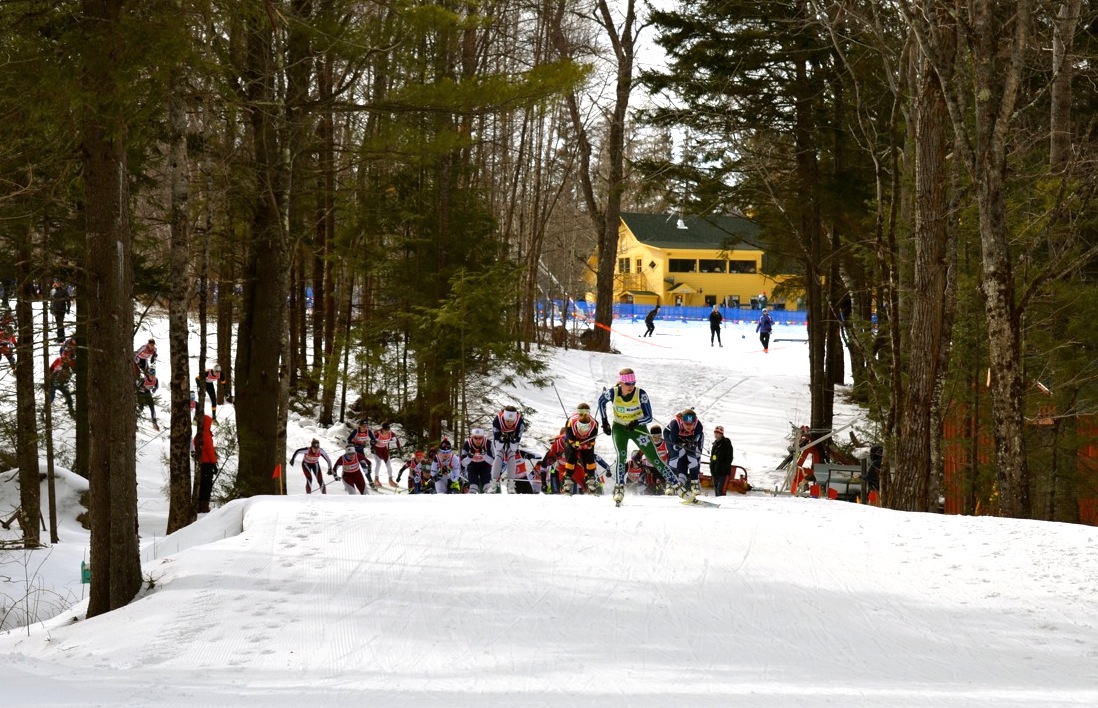
The women’s freestyle mass start at the Middlebury Carnival from Feb. 15-16 heads out on the new Tormondsen Family Race Course at Rikert Nordic Center in Ripton, Vt. (Photo: Stella Holt)
“Andrew was pushing for more, John Morton was pushing for less, I was somewhere in between,” he said. “Realistically, the course gets used as a homologated race course about one percent of the year. The rest of the year, the general public is using it to ski on.”
Hussey wanted something that would work for both users, a hill that would be significant for a college racer but also something everyday skiers could ascend, taking a few breaks or a cutoff trail along the way.
“I think we really came up with a pretty darn good solution to the whole thing,” Hussey said.
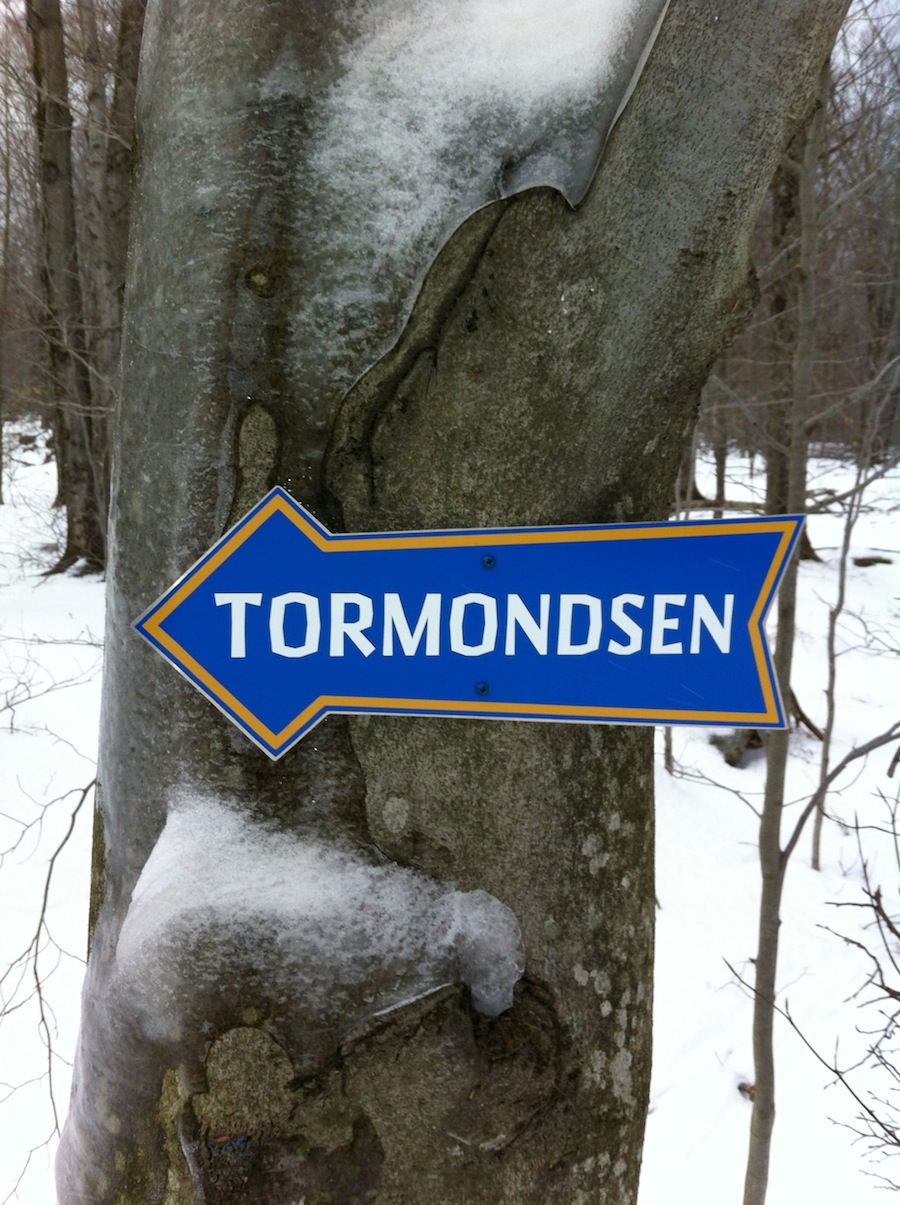
That was the running theme to the entire project, from breaking ground in the fall of 2011 on what is now the homologated Tormondsen Family Race Course (click for map), with banked turns and what Hussey called a “screaming-fast downhill.” Finalized in early February, it also involved installing an integrated snowmaking system around the entire 5 k loop.
“[Hussey] understood a few things; he understood the homologation and how that was basically changing the playing field,” said David Lindahl, a principal at Morton Trails who contributed to the upgrades.
The process of changing a trail system is hardly ever easy, he explained. Venues have history and nostalgic ties. He and Morton started by asking Hussey what was possible, through permitting in the Green Mountains to property constraints, etc.
“It’s a big puzzle,” Lindahl said. “Sort of the base line is: how do we create a really good 5 k course? Then, what else can you do from that? Well you can make 2 ½ k courses. So we’re always kind of thinking of different options, but from that core, let’s make sure there’s a really good 5 k, because that’s a standard that you need to have.”
New signage on the 5 k Tormondsen Family Race Course at Rikert Nordic Center in Ripton, Vt.
By the time last winter rolled around, the 5 k course was complete with two 2 ½ k loops connecting in the field where the start, finish and spectators would be. After first seeking a D-homologation to hold freestyle mass starts, Morton and Lindahl came up with an E-homologation option as well for hosting skiathlons (half-classic, half-freestyle pursuits). According to Hussey, they’re one of two nordic areas in the country that are certified to hold such races (Soldier Hollow is the other one).
“Turns out if you do it right and you put all the pieces together and you put two 2 ½ k’s together then you have an E-category,” Lindahl said. “One of the courses only has to be at a C-level and the other one has to be a D-level. Typically, what we’ve done is the D-level for both of them. Those courses worked out well; they were independent [and] both came back into the stadium area.”
That made having a ski race with an equipment exchange, or transition, possible. It also draws crowds.
“A big piece of what we do is spectator interest,” Lindahl said. “How can we create something that is going to bring people back to the start finish area so that friends and spectators will be as involved as the coaches and athletes are?”
Based in Thetford, Vt., Morton Trails is the company that designed 15 k of trails at Colby College’s Quarry Road Trails in Waterville, Maine. Morton and Lindahl are behind the new 7.5 k course at Trapps, the expansion of an existing trail at the Jackson Ski Touring Center in New Hampshire and ongoing projects with Vermont’s Jay Peak and the Sugarloaf Outdoor Center in Carabasset Valley, Maine, to name a few.
“The Middlebury site is blessed with a wonderful big field, ideal for all types of start/finish configurations, and great for spectators,” Morton wrote in an email. “A challenge was getting from that field out to the required hills and back within 2.5 kilometers to give the spectators a second view of the athletes midway through the loop. The second 2.5 k loop also had to access the required climbs and return to the stadium within in the 5 k distance target.”
Ideally, the two loops would be close enough to share the proposed snowmaking piping system, an idea Hussey brought to the table.
“Another objective was to make use of as much of the existing trail network as possible, and thus minimize the need for new trail construction,” Morton explained. “Finally, there was a desire to have the racing trail independent from some of the other popular trails at Rikert so that during event days, recreational skiers are still able to enjoy loops not closed for racing.”
The end result: Rikert is one of two places in the country that are FIS certified for skiathlons, which could bolster its potential for international races down the road, Hussey said.
“We’ve put at least a million and a half bucks into this place in the last three years, which is akin in the nordic industry to Jay Peak putting 300 million into the alpine area,” he said.
“That is a huge investment … and yes, it’s a great event center, we’ve got homologated race trail, we’ve got snowmaking on that, but over and above that I’m very passionate about the fact that our region, what some people term the Addison [County] Alps, you’ve got Blueberry Hill 10 k by trail, you’ve got Rikert, we’ve got the Snow Bowl, we’ve got an amazing array of inns and hotels and restaurants and theater and art and hockey games at night. There’s all these things to do for folks to come in from out of town and enjoy the area.
“That to me is another piece of it that goes beyond NCAAs and national championships,” he added. “I’d love to hold a World Cup here. There are a lot of parts to make that happen. That’s the kind of facility that I believe we have.”
Snowmaking
As Gardner put it, three big changes at Rikert in the last few years have raised it to a new level. “Getting Mike hired so there was a full-time, year-round director, getting the trail built, and having snowmaking,” he said.
Rikert Nordic Center Director Mike Hussey (r) overseeing the Middlebury Carnival in mid-February. (Photo: Stella Holt)
Without Hussey, the snowmaking aspect – which cost upwards of $850,000 dollars – might not have been possible, Gardner said. Because of the confidence John Tormondsen, a Middlebury alum and first-team All-American nordic skier now on the college’s board of trustees, had in Hussey, he and his family donated a significant amount toward the total cost. Now in its initial months of operation, Rikert has the most snowmaking coverage of any nordic center in the Northeast.
“It’s the largest system of its type in North America, the most-extensive piping system,” Hussey said.
“I think Middlebury had the vision that we want to really put ourselves on the map,” Lindahl said. “The snowmaking thing, we weren’t the ones that suggested that, but obviously they went for it.”
Most importantly for college teams, it promised snow for NCAAs, which start Thursday with nordic races and continue through Saturday. Three weekends ago at the Middlebury Carnival, Rikert held its first collegiate races on the course. Although its been completed for more than a year, natural snow wasn’t abundant enough to cover it last year. The installation of the snowmaking system with 20 snow guns began late last fall, and water-withdrawal permits weren’t in place until early February.
As a result, Hussey and his crew have been pumping out the manmade stuff as much as possible in the last month. At 250 gallons per minute, they can potentially cover the 5 k loop in 200 hours. But they’re only allowed 90 gallons of inflow based on state regulations, which Hussey said was “very understandable” given their proximity to protected lands.
A look at the trails and new snowmaking system in mid-February at Middlebury College’s Rikert Nordic Center in Ripton, Vt.
“Our holding pond is not that large and we get maybe 16 hours of operating time [from that],” Hussey said. “After that, it takes a day or more to recharge. So when we get windows of opportunity to make snow, it’s sort of herky-jerky because we can run for 16 hours, then we stop, and then we gotta start up again. So it’s not a consistent flow and efficient use of the good hours. Phase two of the operation is to add a larger holding pond if we can.
“It’s been a little spotty early on as part of that permitting piece was challenging,” he added. “I think we’re through it now and all systems go.”
As for the NCAA outlook, Hussey wrote in an email that “projected temperatures are to be in the mid to high 30’s during the day and below freezing at night. We will be able to do a good job with the grooming under those circumstances.”
Asked what they learned from the Carnival races, he wrote, “We learned (confirmed) that this is a technical course and requires strategy as well as stamina. There are hard climbs and fast twisting downhills, all of which makes for good racing.”
“The course itself has definitely changed and the trail quality has improved a lot, especially the grooming quality,” said Hilary Rich, a senior on Middlebury’s nordic team. “Mike puts a lot of effort into [grooming] and it definitely shows.”
“It’ll suit the people who like to grind it out; there’s not much rest,” junior Austin Cobb said. “It feels less like the middle of the woods now. It seems like it’s a legitimate place to ski … It’s the real deal.”
I know, it’s been a long winter and even Nordic diehards are ready for some sunshine, song birds and green grass. But I can’t help one look back at the recent, remarkable ski season. The snow may have been late in arriving here in New England, but when it came, we were buried. Locations to the south and over near the Atlantic coast, which typically have decent skiing only a couple of weeks each winter, were grooming trails for months in old fashioned, deep powder conditions.
Partly due to coincidence, my winter was “bookended” by two biathlon events, which make for some interesting comparisons. The first was the Biathlon World Cup in early February, at the Nordic Heritage Center in Presque Isle, ME. Since the January storms went well south of Aroostook County, the dedicated volunteers who hosted the event worked hard to cover the race course with man-made snow. By the time the European teams arrived, Mother Nature made a modest contribution as well so at least it looked like winter across the potato fields and into the forests of northern Maine.
World Cup Biathlon Races at the Nordic Heritage Center, Presque Isle, Maine, February 6, 2011. Photo: Andrew Moores.
Following the example of World Cup sites in Germany and Scandinavia, Presque Isle and Fort Kent a week later, scheduled community festivals around the biathlon races. There were the colorful opening ceremonies , dog sled demonstrations, sleigh rides, art exhibits, quilt shows, a hypnotist, a wide assortment of musical groups, and of course, fireworks. At the competition venue it was possible to watch the athletes practicing their marksmanship on the shooting range, while coaches and waxing technicians repeatedly rode skis through speed traps to determine the fastest wax.
Race days were a kaleidoscope of activity, color and sound. Upbeat music filled the stadium when the announcers weren’t alerting the spectators to developments during the race. Busloads of school children in colorful hats cheered for foreign athletes whose home countries they had studied. A jumbo television screen showed fans at the shooting range what was going on out on the ski course. The competitions were a blur of some of the World’s fastest Nordic skiers as well as some very exciting shoot outs on the range where several athletes arrived together and the most poised, accurate shooter left with a clean target while the others, perhaps rattled by the pressure, missed targets and circled the penalty loop.
The spectators were hoping to see an American on the podium, which wasn’t to be at this World Cup, but most of us came away encouraged by the grit of the U.S. athletes, whom we watched compete. In this intensely competitive sport where a millimeter on a target can mean the difference between a medal and the third page of the results, the American team is steadily gaining ground on the Europeans.
Late in March, I had the opportunity to travel to southern California to help at another biathlon race. Four years ago, Dr. Mike Karch, an orthopedic surgeon who has served as the physician for the U.S. Nordic Combined Team, organized an invitational biathlon event in his community of Mammoth Lakes. Mammoth Mountain, founded decades ago by Alpine skiing pioneer, Dave McCoy, is also noted for its mind-boggling snow pack. Just over the mountains, to the east of Yosemite, it is not unusual for Mammoth to have 20’ of snow on the ground in March! This year was especially bountiful, even by local standards, and several of the cabins at the Tamarack Lodge were accessed only by tunnels which had been carved deep into the drifts.
In the four years that Mike has hosted his biathlon event, it has grown to involve more than 200 competitors. There is a novice, youth category where the youngsters shoot laser rifles on an abbreviated range (to promote initial success in hitting the targets). This year, several members of the Wounded Warriors of the Eastern Sierra (a program devoted to helping disabled combat veterans rediscover the joy of sport) participated to the thunderous encouragement of the assembled spectators and other racers.
As frequently is the case in the Sierras, a blizzard blew in on Saturday, forcing a revision from biathlon races to cross country skiing events. Although the howling wind and thick snow made seeing the targets impossible, dozens of competitors skied through the storm, and will no doubt be talking about their experience for years. Sunday broke clear and brilliant. As if skiing fast and hitting the targets were not enough of a challenge, the course was located at 9,000’ above sea level. Dozens of more biathletes, from first time shooters to former Olympians, racing in waves of 20, experienced, first hand just how difficult it is to hit those targets, especially shooting with a high pulse in a gusty wind.
Vancouver Olympic Team members Winn Roberts and Lanny Barnes took top honors in the men’s and women’s elite events, edging out fellow national team members, Raleigh Goessling and Susan Dunklee. Additional favorites with the boisterous crowd of spectators included 1980 Olympic biathlon alumnus and longtime Farwest junior coach, Glen Jobe, frequent summer biathlon champion, Mark Shepard, and 1972 Olympic contender, Pat Armstrong. The enthusiastic fans also cheered loudly for the several medical professionals who were no doubt cajoled into participating by the charismatic Dr. Karch. One woman, obviously new to the sport, smiled philosophically as none of her targets fell, “Why does that damn penalty loop have to be right in front of the crowd, it’s so embarrassing!” I tried to reassure her that she would have plenty of company on the loop due to the altitude and the gusty winds.
The Crowd Favorite at the Mammoth Lakes Biathlon, March 2011. Photo: Jim Barnes.
It was a terrific event, especially considering the remarkable diversity of experience and ability represented by the participants. Thanks in large part to an energetic, local “Pied Piper,” winter biathlon is developing an enthusiastic following in the mountains of California. It’s safe to say that coast to coast, biathlon has arrived in the USA.
John Morton was a member of two Winter Olympic Biathlon teams before coaching the Dartmouth College ski team for 11 years. He is the founder of Morton Trails, www.mortontrails.com, a trail design consulting firm which, over the past two decades has conducted more than 130 projects across the nation, ranging from simple recreational loops for private landowners to internationally homologated competition venues for world caliber events.
Sylvan Ellefson (Bates College) and Walt Shepard (Bowdoin College) competing in EISA competition at the UVM Carnival in 2009. Photo: Ilke Van Genechten
For the sixth time, in the nearly 60 year history of the NCAA Skiing Championship, the University of Vermont will host the four day competition to determine the nation’s top individual skiers as well as the country’s best collegiate ski team.
Since the first NCAA Skiing Championship, held in 1954, the competition program has changed to reflect the evolution of the sport. Early collegiate championships featured downhill and slalom from the Alpine disciplines as well as an individual 15 kilometer cross country race and ski jumping to represent the Nordic disciplines. During the first two decades, in addition to recognizing the individual winners in each of the disciplines, a skimeister was named, who achieved the highest point total in all four events. Through 1976, Alpine Combined and Nordic Combined Champions were also named based on the best combined results of the two Alpine, and two Nordic events.
Following a couple of tragic accidents, the downhill was replaced by a giant slalom event in 1976. In a controversial decision, the NCAA skiing committee dropped jumping from the program in 1981 and replaced it with a cross country relay. In 1983, skiing became one of the first collegiate sports to combine the results of both men’s and women’s teams into one, overall championship. In 1989, international acceptance of the skating technique in cross country led to the replacement of the relay with a second individual event, permitting one cross country race in the traditional, classic technique and the other in the skating or freestyle technique.
Historically, the NCAA Skiing Championship has alternated between eastern and western sites. There was a time when western Alpine skiers dreaded racing at eastern venues like Stowe, VT, Lake Placid, NY or Sugarloaf, ME because they were apt to encounter icy conditions uncommon in the west. Conversely, eastern Alpine skiers knew that a late starting number at Steamboat Springs, CO, Bridger Bowl, MT or Park City, UT meant skiing through knee-deep ruts on the slalom course.
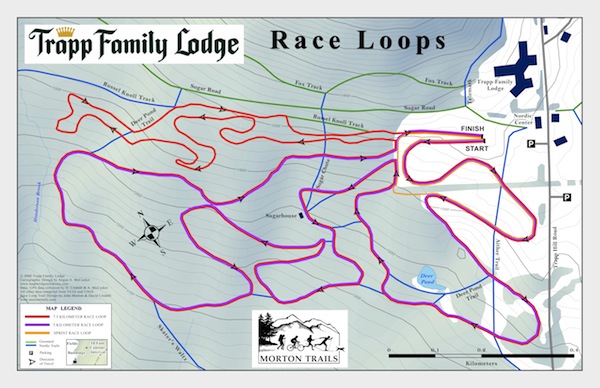
Trapps Race Map
In the Nordic events, the geographical issue is altitude. Since the ability of the body to transport Oxygen to the muscles is a significant issue in endurance events, athletes who live and train at altitude have a distinct advantage over those who live and train at sea level. Not surprisingly, when the NCAA’s are in the Rocky Mountains, the skiers from eastern schools tend to have a tough time, when the races are in the east, altitude is not a deciding factor.
Another unique aspect of the NCAA Skiing Championship is the wide variety of schools that participate, from huge, Division I, state universities with many thousands of undergraduates, to small, Division III, private colleges with relative modest athletic programs. In the past, some of the major university programs with the luxury of athletic scholarships, have recruited virtually their entire ski teams from Scandinavia and Central Europe. As a result, the overall team award has been dominated through the years by three schools: Denver University which has won the championship 21 times, the University of Colorado, overall champions 16 times, and the University of Utah, NCAA skiing champions 10 times. This domination occurred in spite of the fact that during the past half century, 66 colleges and universities have participated in the event.
In contrast, some of the smaller schools attend the championship with no possibility of winning the team trophy, but with individual skiers capable of earning recognition in specific events. While the team trophy has been won by only seven different schools during its 57 year history (University of Vermont, Dartmouth, Wyoming and New Mexico are the other team champions), 25 institutions have provided individual champions. While the battle for the overall team trophy, in all likelihood, will be among the three or four usual contenders, there is the potential for plenty of surprises in the individual standings.
At least some of the excitement around this year’s NCAA Championship focuses on the competition venues. Skiers at Stowe’s Spruce Peak are enjoying the results of a recently completed, multi-million dollar renovation. Both the slalom and the G.S. will be held on the Mainstreet trail, one of the best Alpine ski slopes for spectators anywhere.
Trapps Family Lodge, Stowe, VT. Photo: Donna Counts
The Nordic events at Trapp Family Lodge will be conducted on the recently completed racing loop, one of only a handful in the United States that are certified for international competition by the FIS (International Ski Federation). In addition to meeting all the technical standards of a World Cup course, the new racing trail at Trapp’s was designed to be spectator friendly, bringing the athletes back within sight of the start/finish area multiple times during an event. Both Johannes Von Trapp and his son, Sam, have remarked that an added benefit of the new race course is its independence from the highly popular recreational ski trails. Although Trapp’s has hosted major cross country events in the past, including several NCAA competitions, for the first time racers will not encounter recreational skiers on the course and guests at the lodge will not find the trails that they love closed for a competition.
If you are not yet convinced to take in some of the NCAA skiing action in Stowe, consider this: through the years, literally dozens of NCAA skiers have gone on to compete in the Winter Olympic Games. The list comprises a “who’s who” of American skiing, including Colorado’s Buddy Werner, Bill Marolt, and Jimmy Heuga, Utah’s Marv Melville, Luke Bodensteiner and John Aalberg, as well as Denver’s Rick Chaffee and Dennis McCoy. You may even see Olympic medalists like Vermont’s Beth Heiden, who made the switch from a bronze medal speed skating performance in the Lake Placid Winter Games, to winning the NCAA cross country skiing event in 1983, or Dartmouth’s Chiharu Igaya who represented Japan in 1952, ‘56 and ’60, winning silver in the slalom at Cortina.
Blessed with abundant snow cover, mid-winter temperatures early in March and two recently renovated world-class venues, the 2011 NCAA Skiing Championship , hosted by the University of Vermont at Spruce Peak and Trapp Family Lodge in Stowe promises to be an exciting event, worthy of its impressive half century tradition.
The von Trapp family.
John Morton finished second in the 1968 NCAA cross country event, and coached the Dartmouth Men’s Ski Team at 11 Championships from 1978-1989. As the founder of Morton Trails, he has designed more than 130 recreational trails and competition venues from Maine to Alaska. He and his business colleague, former Dartmouth skier, David Lindahl, Ph.D., designed and homologated the race course at Trapp Family Lodge. Contact them at www.mortontrails.com.
Seeley Lake, MT – Olympian and Nordic ski trail designer John Morton of Morton Trails was recently in Seeley Lake to assess the potential of Seeley Lake’s Nordic trails. Morton Trails teamed with local firm CTA Architects and Engineers and was selected through a competitive bidding process to perform a Nordic events and training center feasibility study for Seeley Lake. The team was selected by Seeley Lake’s Nordic Challenge Steering Committee, a group representing various interests in the community. The committee was very pleased with the Morton/CTA proposal and is excited to have the team on board.
The Nordic Challenge Steering Committee hosted introductions and a local tour of Nordic ski facilities for the project team. The principals of the company John Morton and David Lindahl (a former competitive masters cross country racer with a Ph.D. in economic geography) spent three days in the area evaluating the Seeley Lake ski trails, learning about the community and gathering economic data. Team member Jeff Crouch with CTA of Missoula was also in Seeley Lake for the tour. Mr. Crouch has played a significant role in developing sport events in the region.
The Nordic ski community has already proven its ability to host very successful winter events including the Annual Over Seeley Creeks and Ridges (OSCR) cross country ski race and the Seeley Lake Biathlon. These events take place on an acclaimed Nordic trails system built and maintained through thousands of hours of community support. A portion of these trails are also incorporated in the Annual Race to the Sky sled dog event, a qualifier for the Iditarod.
The feasibility study will both assess Seeley Lake’s ability to attract skiers and analyze the related benefits of a Nordic center on the local economy. The idea for the project arose from the reported success of similar rural communities in Maine and Washington, now supported by similar Nordic ski centers. The feasibility study will supply economic, market, technical, financial, and management analysis specific to Seeley Lake.
Morton remarks, “The Seeley Lake Nordic trails have a great start toward a course that could attract national attention. National and international race venues can be built within very small areas.” For instance, the Vancouver Olympic trails for Nordic skiing (10 km) and the Biathlon trail (5 km) were constructed within one square kilometer of hillside offering tremendous on-site spectator access, as well as spectacular television coverage. “The Seeley Creek Nordic Trails area is already large enough for the additional work required for an outstanding race venue,” Morton continued. “The Seeley Creek Trails are exceptional, having been originally designed by ex-Olympian Jon Elliott.” The Feasibility Study will be completed and presented to the Nordic Challenge Steering Committee this spring.
The project concept developed out of a need to create year round economic stability for the Seeley Lake community and is supported by a group of representatives from the Missoula Area Economic Development Corporation, the Bitter Root Economic Development District, Inc., Missoula County Rural Initiatives, and the State Department of Commerce. For more information on the Seeley Lake Nordic trail project, contact Marcy Allen, Bitter Root Economic Development District Executive Director.
More than a decade ago, Maine’s governor, Angus King commissioned an economic study which determined that New England’s largest state was actually two distinct, economic regions: the affluent southeastern coast, and the struggling, northern forests. Through the years, Aroostook County had been dealt a hat trick of economic setbacks: first, the emergence of Idaho as the nation’s premier source of potatoes, second, Quebec’s ability to process timber products more economically than Maine, and more recently, the Defense Department’s decision to close Loring Air Force Base in Limestone, eliminating thousands of civilian jobs.
Moose Crossing Potato Fields
What Aroostook County continued to have in abundance, however, was long, cold winters, an abundance of snow, and residents who valued hard work. Andy Shepard, formerly a winter sports manager for L.L. Bean, and Max Cobb, the driving force behind the U.S. Biathlon team, recognized the potential of northern Maine and approached the Libra Foundation of Portland with a plan to “reestablish Nordic skiing as a lifestyle to stimulate the local economy and inspire the youth of northern Maine.”
Eleven years later, during the first two weeks of February, Presque Isle and Fort Kent will host the International Biathlon Union’s World Cups #7 and #8, welcoming athletes, coaches, journalists and fans from 30 nations to “The Crown of Maine.” Presque Isle, with a population of just under 10,000, and Fort Kent with 2,000 residents, are bracing for as many as 35,000 spectators during the 10 days of biathlon competitions and related festivities. The sport has become hugely popular throughout Europe and the events in northern Maine will be televised live to an estimated 120 million viewers across the pond. For several days in early February, devoted biathlon fans from northern Norway to the heel of the Italian boot will be glued to their televisions as their favorite athletes ski and shoot in the wilds of northern Maine. That constitutes far more fans, by the way, than a typical Monday Night Football audience here in the States!
Fort Kent Crowd 2004 World Cup. Photo: Dennis Welsh.
Adding to the excitement for American spectators will be the participation of a promising U.S. Team. Last season, Tim Burke of Paul Smiths, NY led the World Cup standings prior to the Olympic break, the first time any American biathlete had achieved that distinction. Both Lowell Bailey of Lake Placid and Laura Spector of Lenox, MA have earned top 30 finishes in prior World Cup events this season. Other U.S. Team members, who have lived and trained in northern Maine may enjoy a “home court advantage” which could translate into impressive results.
Ft Kent, 2004 World Cup Racing. Photo: Dennis Welsh.
Creating competition facilities in northern Maine capable of hosting world caliber events was a team effort requiring a diverse set of skills. A Nordic race venue in Fort Kent made sense because there was a well established, community ski club, desirable terrain not far from town, and a cadre of volunteers with experience hosting major, winter events. Although the base lodge of the Lone Pine Alpine ski hill was a logical focal point for all ski club activities, the only suitable location for a biathlon shooting range was in a natural bowl beyond the top of the ski lift, thus requiring a new start/finish area, warming lodge and racing trail network at the top of the hill. With funding from the Libra Foundation, the community of Fort Kent pitched in and within months was ready to host biathlon events. Their first Biathlon World Cup event in 2004 received rave reviews from international athletes, IBU officials and the hundreds of spectators who attended.
Tim Burke’s First World Cup at Ft. Kent in 2004. Photo: Dennis Welsh
A different challenge faced what would become the Nordic Heritage Center on the Presque Isle/Fort Fairfield town line. Much of northern Aroostook County consists of gently rolling potato fields. A successful competition venue must be relatively close to the population concentration; in northern Maine that means Presque Isle and Caribou. Only one significant, undeveloped ridge in the area fit the requirements, but it was carved into nearly a dozen, private parcels. The Nordic Heritage Center would never have been possible without the determination and negotiating skill Brian Hamel, a Presque Isle community activist who saw the potential of the project and secured the rights to all the necessary land.
A decade ago, Andy Shepard, Max Cobb and others envisioned the reestablishment of Nordic skiing in northern Maine as a boost to the regional economy and an inspiration to the local youth. During the ten days of the IBU World Cup biathlon events in early February, an estimated 15 million dollars will circulate through the communities of Aroostook County, with the continued commitment and support of the Libra Foundation. In addition, several American athletes who make their home in The County, including a few who were born there, now represent the Maine Winter Sports Center and the USA in competitions across the country and throughout the world. In just over a decade, Max and Andy’s vision for reestablishing skiing in northern Maine has become reality.
Over 5,000 kids in 72 communities across Maine Are Nordic Skiing Because of the Maine Winter Sports Center.
Author credit: John Morton is the founder of Morton Trails (www.mortontrails.com), a trail design consulting firm which has been collaborating on recreational and competitive trails throughout the country for the past 20 years. Morton designed the World Cup racing trails in Presque Isle and Fort Kent as well as more than half a dozen other community trails in Aroostook County,ME.
Kincaid Park in Anchorage recently received its homologation certificates. Photo, Rob Whitney
What do a GPS, a retired airline pilot, and a Norwegian guru named Hermod Bjorkestol have in common?
All are key components of a plan to bring many of the U.S.’s biggest venues in line with International Ski Federation (FIS) standards.
At its annual meetings in Turkey in early June, FIS made it clear to American officials that a longstanding exception would be revoked: starting in the winter of 2011-2012, all races held in the U.S. that are sanctioned and scored by the Federation will have to take place on certified trails—“homologated courses,” in official parlance.
Since all U.S. SuperTour and national championship events are scored using FIS points, any venue that plans to host a high-caliber race next winter will have to have its courses inspected and certified. And even if a ski area wants to hold scored races this year, FIS is asking that they have a plan to have their trails homologated by 2011-2012, according to U.S. Ski and Snowboard Association (USSA) Nordic Director John Farra.
Only six ski areas in the country currently have FIS certification, few of which are traditional SuperTour venues, and the U.S. Ski and Snowboard Association (USSA) is spearheading a new effort to bring more trail networks up to speed. What does that entail, exactly? FasterSkier spoke with a handful of experts to find out what this homologation thing is all about. And no, it doesn’t have anything to do with milk.
What the Heck is Homologation?
If you really want to know every last detail about the homologation process, you can download and read the fifth edition of the FIS Cross-Country Homologation Manual, a 69-page document that contains terms like “partial height differential,” specific guidelines for creating “undulating terrain,” and an alphabet stew of abbreviations and acronyms.
The Trapp Family Lodge in Stowe, Vermont is another venue that was recently homologated.
For the rest of the country, there’s Bob Gross, a retired airline pilot and avid marathon skier who represents USSA on the FIS subcommittee for rules and controls.
Gross got involved in the technical side of skiing in the lead-up to the 2002 Olympics in Salt Lake City, and he now is qualified as a homologation inspector—an official responsible for ensuring that courses meet FIS’s specifications. Along with Farra, Gross will coordinate the homologations of the nation’s major courses.
In a phone conversation, Gross explained the rationale behind the rules requiring homologation. Because all FIS-sanctioned races award ranking points to finishers—which in turn can determine seeding and start positions in big international races—it’s important for the Federation to maintain consistent standards for courses across different nations.
Then, there are also more basic logistical issues, like maintaining adequate trail width so that skiers aren’t stepping all over each other, or ensuring that the stadium is well laid-out. Safety is a concern, too—downhills can’t send skiers plunging into trees or ditches—and even details like spectator access are also considered.
The process sounds complicated, but Gross says it’s not—it boils down to ensuring that courses are “adequate to run, safe and fair.”
“It’s trying to get the courses so that they are standard…throughout the world. So that a skier who skis on a course here will have a course which is similar to [one] that’s being skied in New Zealand or Japan or Europe,” Gross said. “That is the basic philosophy.”
Getting Homologated
According to Gross, the homologation process will unfold differently depending on the status of each venue. If you’re starting from scratch in the woods in your backyard, homologation will obviously be a more arduous process than if you run an established ski area with pre-existing, elite-level trails.
Regardless of the amount of work that needs to be done at a given venue, the finished product must meet specific FIS standards outlined in the homologation manual—the most important of which concern the course layout.
If there are trails at a venue that are already close to meeting FIS’s requirements, the certification process can begin promptly. Whenever possible, course designers and venue managers will homologate existing trails rather than constructing new ones, since work like logging and excavating trails can be pricey. At Kincaid Park in Anchorage, which recently had its trails re-homologated, workers got especially creative: they used leftover fill from nearby roadwork to make sure that the steepness of one of their uphills met FIS standards.
But if a ski area does not have a suitable course to start with, they may have to bring in a trail designer to help lay one out.
According to John Morton, who along with David Lindahl operates the trail design firm Morton Trails, the backbone of a homologated course is its climbs.
“The climbs are the very first thing that we look for,” he said. “Then it’s kind of piecing all these other pieces together.”
FIS’s demands for the uphills are specific. A homologated 5 k, Morton said, must have two major, or “A” climbs, each 30 meters from the low point to the high point—and technically, neither should come in the first or last kilometer of the course. The gradient must average around six percent.
The profile for the Trapp Family Lodge homologated 5 k course. The yellow bars are the major or "A" climbs, and the orange bars are the smaller, "B" climbs. Graphic courtesy of Morton Trails.
Morton and Lindahl use a variety of tools to help them measure the uphills and other elements, including highly-sensitive GPS units, computer software like Google Earth, and an instrument called a clinometer, which is used to measure slope.
Once the major climbs are locked in, there are other aspects of the course design that must be incorporated, like several smaller “B” uphills, downhills, and stadium layout.
When the courses are close to meeting FIS standards, venue managers are then responsible for producing a sheaf of data and maps on all of the trails’ key characteristics, like distance, width, and elevation changes. How extensive? Morton and Lindahl have been known to create as many as 600 data points, while at Kincaid Park in Anchorage, their information filled a four-inch binder.
The data is submitted to one of the few FIS homologation inspectors in the U.S.—Gross is one, as are Lindahl and Morton—who enter it into a special computer program that summarizes the course.
Then, the inspector will make at least one in-person visit (paid for by the venue), to walk the course. This allows them to verify all the data, get a feel for the trails, and make judgments about key characteristics.
“There’s a lot of art involved in homologating a course.” Gross said. “If you look at a hill, for instance, there could be a break somewhere…where it leveled off or even dropped a little distance. Depending on how the homologation inspector feels that would ski, it could be two B-hills or one A-hill. That’s where the art enters in, and that’s why you have to go out and look at the course, so that you can make a judgment.”
If the inspector deems that more work needs to be done before a course meets FIS standards, they may even have to pay another visit before the process can proceed further.
However, there is a decent amount of flexibility in the rules, Gross said, especially for trails that are only being certified for domestic events. (World Cup courses must meet more stringent standards.) For example, if one of a course’s two A climbs isn’t quite tall enough, designers could pump up the other one to make up the difference. And according to Farra, city sprints and uphill climbs are exempt from FIS rules altogether.
When the inspector deems that the courses are up to snuff, the data is forwarded to FIS, where it eventually makes its way before Hermod Bjorkestol. Bjorkestol, the famed course designer and main editor of the homologation manual, has the final say on every application.
Courses are homologated at specific distances, and for specific race formats—trails certified for skate sprints have to be much wider than those that are used for individual-start classic races, for example. USSA is requesting that SuperTour venues homologate a sprint course, a 2.5 k loop, and a 5 k loop.
All told, the process could move as quickly as a month, if courses are already close to meeting FIS’s requirements. The more work that needs to be done to bring the trails in line, the longer it will take—especially if ski areas run into problems with procedural issues, like permits for logging.
In Anchorage, Kincaid Park made its upgrades slowly, starting with trail work 2006 and 2007, and didn’t finish collecting its data until 2008, according to Matt Pauli, who worked on the homologation process there. The actual FIS certification was issued in 2009.
The Big Picture
While the technical details of homologation would make even the most avid ski fan’s eyes glaze over, that’s not the point, according to Morton and Lindahl. Instead, they said, FIS’s goals are simple: to make sure that courses ski well.
“The whole point of homologation is to embody some of these things that go into…a good course,” Morton said. “Anybody who has done design knows, ‘now it’s time for a good climb.’”
One issue that arises is whether a push towards homologation might cost trails their character, by turning them all into superhighways—and Gross acknowledged that “something, I guess, is going to get lost.”
Regardless, Gross said, the U.S. has little choice, due to new race formats like mass starts and sprinting, which have been instituted by FIS to drive up spectator interest.
Skiers during a mass start race at Kincaid Park. Photo, James Brady.
“You can’t run a mass start on a narrow track,” he said. “Is that a good thing? That’s a value judgment I’m not making.”
Another issue is the financial cost. Gross wouldn’t estimate the price of a typical homologation effort, given the wide range of work that might be necessary. But he did say that the more a venue or club can rely on its members and volunteers for help, equipment, and expertise, the lower the price tag would be.
Since World Cup and other high-level races are always held on homologated courses, Gross went on, bringing America’s trails up to FIS standards will only make the country’s athletes more competitive. Farra, the USSA nordic director, echoed that argument in a press release announcing the homologation effort, pointing out that while Norway has over 40 certified venues, the U.S. has just six.
Dylan Watts, an Alaska Pacific University coach who wrote an article about the homologation process for the 2010 U.S. Nationals publication, also agreed.
“If we intend to compete with the world in FIS events such as the Olympics, World Cup, U-23 [World Championships]…we need to be racing domestically on courses that are also that style,” Watts wrote in an e-mail. “You get good at what you do. If you ski on a golf course, you get good at golf course skiing. If you ski on a logging road at 8,000 feet, you get good at that. If you ski on FIS homologated-style trails, you get good at that. That is why the homologation effort is important.”


 In this episode of Nordic Nation, we speak all things trail design with John Morton. Based in Vermont, and global in perspective, Morton provides insights into the literal ups and downs of trail design and how full-blown nordic centers and small scale trails can bring a modern vibe to an old-school sport. He runs Morton Trails locally but has a global reach with projects based in China.