On July 2, the World Anti-Doping Agency (WADA) sent out a press release updating the public about its investigation into systemic Russian doping.
Early this year, WADA received the Moscow Lab’s Laboratory Information Management System (LIMS) data. WADA also received the lab’s raw data.
“The raw data are the result of sample analysis and indicate whether a substance or metabolite was detected,” WADA stated. “In an anti-doping case, raw data provide the most compelling evidence and are superior in that regard to LIMS data.”
In late April, a WADA team also retrieved over two thousand samples from the lab which were then brought to an accredited anti-doping lab outside of Russia.
WADA claimed it is targeting 298 athletes as a result of analyzing “the most suspicious data.” The information from 43 athletes has already been sent to the appropriate International Federations (IF). The International Federations are charged with assessing the evidence and bringing appropriate Anti-doping Rules Violation (ADRVs) cases forward.
“In cases where an IF chooses not to act, WADA will review and discuss the facts with the IF,” wrote WADA. “WADA reserves the right to bring cases forward to the Court of Arbitration for Sport (CAS), as appropriate, and will also monitor the decisions rendered by the respective IFs and CAS to adjust its strategy.”
In the press release, WADA raised the issue that the LIMS data turned over by the Moscow lab and the LIMS data provided by the whistleblower back in 2017 may have discrepancies.
WADA stated that it continues to make progress but will work on “examining some differences identified between the LIMS database provided by a whistleblower in October 2017 and the version WADA I&I removed from the laboratory in January 2019, and any impact that these may have on bringing cases forward.”
At issue is WADA’s access to the Moscow Lab’s Laboratory Information Management System (LIMS) data. Early reports by WADA had cited progress towards successfully meeting the Dec. 31 deadline. The Friday press release states Russia halted the data extraction due to an assertion that WADA’s equipment was not certified under Russian law.
WADA claims Russian authorities had not cited any issues with the equipment in question when the two parties met in Moscow to discuss lab and data access in late November. Full unhindered access to the lab, LIMS information, and any other underlying data are conditions for RUSADA to remain a compliant anti-doping entity.
Despite the lack of full access to the LIMS, WADA stated it will continue to honor the Dec. 31 deadline. With nine days remaining until Dec. 31, WADA representatives will proceed with writing and and submitting a report about its Moscow findings to WADA’s Compliance Review Committee (CRC) to be delivered in mid-January.
If the Dec. 31 conditions are left unmet, RUSADA is at risk of once again becoming a non-compliant anti-doping agency.
On November 28, the World Anti-Doping Agency (WADA) issued a press release stating three of it’s representatives had met in Moscow with Russian officials to discuss the next steps regarding the Russian anti-doping agency’s (RUSADA) conditional reinstatement.
When WADA’s Executive Committee (EC) voted in September to bring RUSADA back into its fold as complaint, it set forth specific unfulfilled conditions for RUSADA to meet if the agency were to remain in good standing. The most pressing unmet conditions are for WADA to gain unfettered access to the Moscow lab, acquire the lab’s Information Management System (LIMS) and any “underlying” data. RUSADA must meet these conditions by December 31st.
The WADA delegation began working out the details to bring a “full technical mission” to Moscow to fulfill the end-of-year deadline.
“We had open and productive meetings with the Russian public authorities, including with Sports Minister Pavel Kolobkov, and we are preparing for the full technical team to gain access to the Moscow Laboratory and the data before the end of 2018 in line with the strict conditions that WADA’s Executive Committee set for RUSADA’s reinstatement, ” WADA’s Senior Director of Science and International Partnerships, Dr. Olivier Rabin is quoted as saying in the press release. “Progress is being made but some points still need to be ironed out before we can proceed with the technical visit.”
WADA stated the two parties continue to negotiate, but have several remaining sticking points related to the technical mission’s Moscow based work.
Also on November 28, the Associated Press (AP) published a story claiming RUSADA head Yuri Ganus has begun to reform the maligned agency. The AP cites RUSADA’s willingness to show up at far-flung athletic competitions –the article mentions a track meet in Siberia– as an example of its new reach and commitment to clean sport.
“The most important thing is how we react to it, and we need to react with the highest level of principle and consistency,” Ganus said about implementing change in Russia according to the Washington Post story. “It’s not about proving to someone, but about showing our society and athletes, especially those just starting out, that doping is not acceptable.”
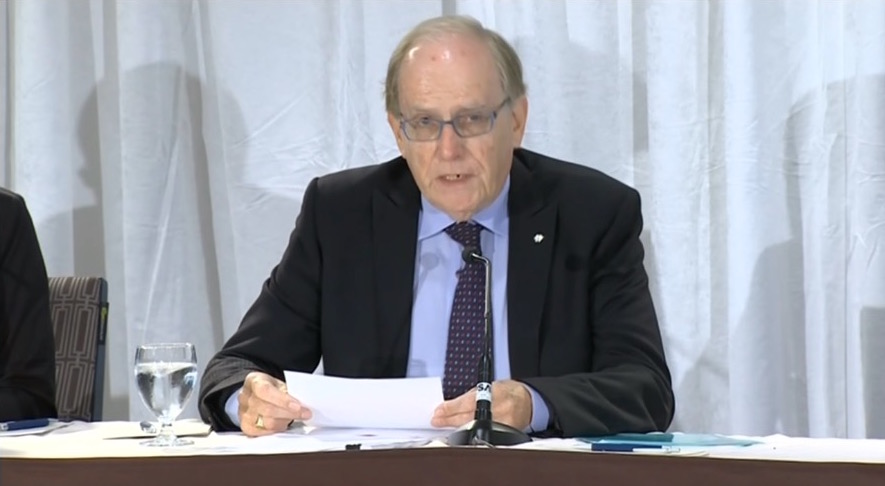
Richard McLaren speaking at a news conference on Monday in Toronto regarding his WADA-commissioned report on state-sponsored doping in Russia.
In a press conference in Toronto on Monday, the long-awaited McLaren report confirmed allegations of state-sponsored doping in Russia.
The World Anti-Doping Agency (WADA) gave Professor Richard McLaren, a Canadian lawyer, a mandate to investigate claims about doping during the Sochi Games in 2014. The report, however, made claims that the system to protect dopers was in place from late 2011 until August 2015.
This confirmed statements by whistleblowers, including Vitaly Stepanov to German broadcaster ARD and Grigoriy Rodchenkov to The New York Times. When the initial allegations were made, they were strenuously denied by Russian officials including those named and identified in the McLaren report as having helmed the doping cover-up.
In terms of the report’s basics, here’s what McLaren concludes.
Two labs responsible for anti-doping testing were investigated: the Moscow laboratory and the Sochi laboratory, its “satellite” facility for the 2014 Olympics. Both labs, according to the McLaren Report, were guided by the Ministry of Sport to ensure positive tests were removed and replaced by clean samples. The Ministry of Sport did not act alone. According to McLaren’s findings, it was aided in the cover-up by the Russia’s state security service (FSB).
McLaren described two similar, but distinct, efforts to protect doped Russian athletes. The Moscow laboratory was responsible for ensuring clean samples for both summer and winter Olympic sports. Based near the highest powers of government, “The Moscow Laboratory was the final failsafe protective shield in the State directed doping regime,” the report stated.
McLaren called this lab’s deceptive process the “disappearing positive methodology”. Positive tests were labeled “Save” or “Quarantine”. The “Saved” samples were swapped for clean ones, whereas the “Quarantine” samples were reported as failed drug tests.
The Sochi laboratory helped protect Russian athletes from popping a positive specifically during the 2014 Sochi Olympics. The FSB, Russian Ministry of Sport, and the Moscow laboratory all assisted with planning and executing the sample swapping methodology used during the Games. The Sochi methodology was more complex — tamper-proof bottles were manipulated.
Since their introduction at the 2000 Olympics in Sydney, it was assumed that the bottles could never be opened without showing a mark. But McLaren explained that they had been — small scratches on the bottles remained as proof of manipulation, but the marks were not visible to the naked eye. This confirmed a major allegation by Rodchenkov, which had been met with some skepticism by those who assumed that the bottles were indeed tamper-proof.
Small scratches on the bottles remained as proof of manipulation, but the marks were not visible to the naked eye.
Other claims of Rodchenkov were not fully proven, although also not disproven. Rodchenkov, the former head of the Moscow laboratory, had said that there was a list of pre-approved athletes whose samples would be protected. He named Russian cross-country skier Alexander Legkov as one of them.
McLaren, however, did not mention athletes by name. But he did confirm that there was a “pre-selected” group of Russian athletes that benefitted from the Sochi lab’s clandestine work.
With all of his findings, McLaren made clear he used the threshold of “beyond a reasonable doubt,” when writing the report and substantiating any claims.
According to page 41 of the report, since 2011, Russian winter sports athletes were implicated in the “disappearing positive methodology”: 10 positive tests were rendered clean in biathlon with 13 in “skiing”, although this was not broken down into disciplines such as alpine or cross-country. It should be noted that Russia qualified a small team of alpine skiing athletes for the Sochi Games.
The WADA Executive Board called on all international federations whose athletes were included in the report to take investigative action. So far, neither the International Ski Federation (FIS) nor the International Biathlon Union (IBU) have made official statements.
“The findings of the report show a shocking and unprecedented attack on the integrity of sport and on the Olympic Games,” International Olympic Committee (IOC) President Thomas Bach said in a press release. “Therefore, the IOC will not hesitate to take the toughest sanctions available against any individual or organisation implicated.”
International Paralympic Committee (IPC) released a reactionary statement on Monday, quoting its president, Sir Philip Craven: “The IPC will now analyse the report’s findings in detail to evaluate what impact they have on the Paralympic Movement and Para Sport,” he said. “After an initial review of the report, we note the 35 ‘disappearing’ positive samples from Paralympic sport between 2012 and 2015 and have sent a letter to WADA and the report’s author Richard McClaren seeking further information on these samples. We have also requested urgent clarification from both parties to better establish how the findings implicate the Sochi 2014 Paralympic Winter Games and Russian Para athletes as the report defines the Sochi Games as the XXII Olympic Winter Games…”
The U.S. Olympic Committee (USOC) also weighed in: “The McClaren Report confirms what we have stated previously: the current anti-doping system is broken and urgently requires the attention of everyone interested in protecting clean athletes,” USOC CEO Scott Blackmun said in a press release. “We look forward to working with the IOC, WADA and the entire Olympic family to address the flaws in the current system so that a uniform approach to anti-doping can be implemented and enforced around the world. In the meantime, we are focused on preparing Team USA to compete at the upcoming Rio Games and will rely on the IOC, WADA and the international federations to impose sanctions that are appropriate in relation to the magnitude of these offenses, and that give clean athletes some measure of comfort that they will be competing on a level playing field in Rio.”