From the FasterSkier archive — posts syndicated from athletes’ and coaches’ own blogs between 2004 and 2012, kept online as published. Current coverage is at fasterskier.com.
This coverage is made possible through the generous support of Marty and Kathy Hall and A Hall Mark of Excellence Award. To learn more about A Hall Mark of Excellence Award, or to learn how you can support FasterSkier’s coverage, please contact info@fasterskier.com.
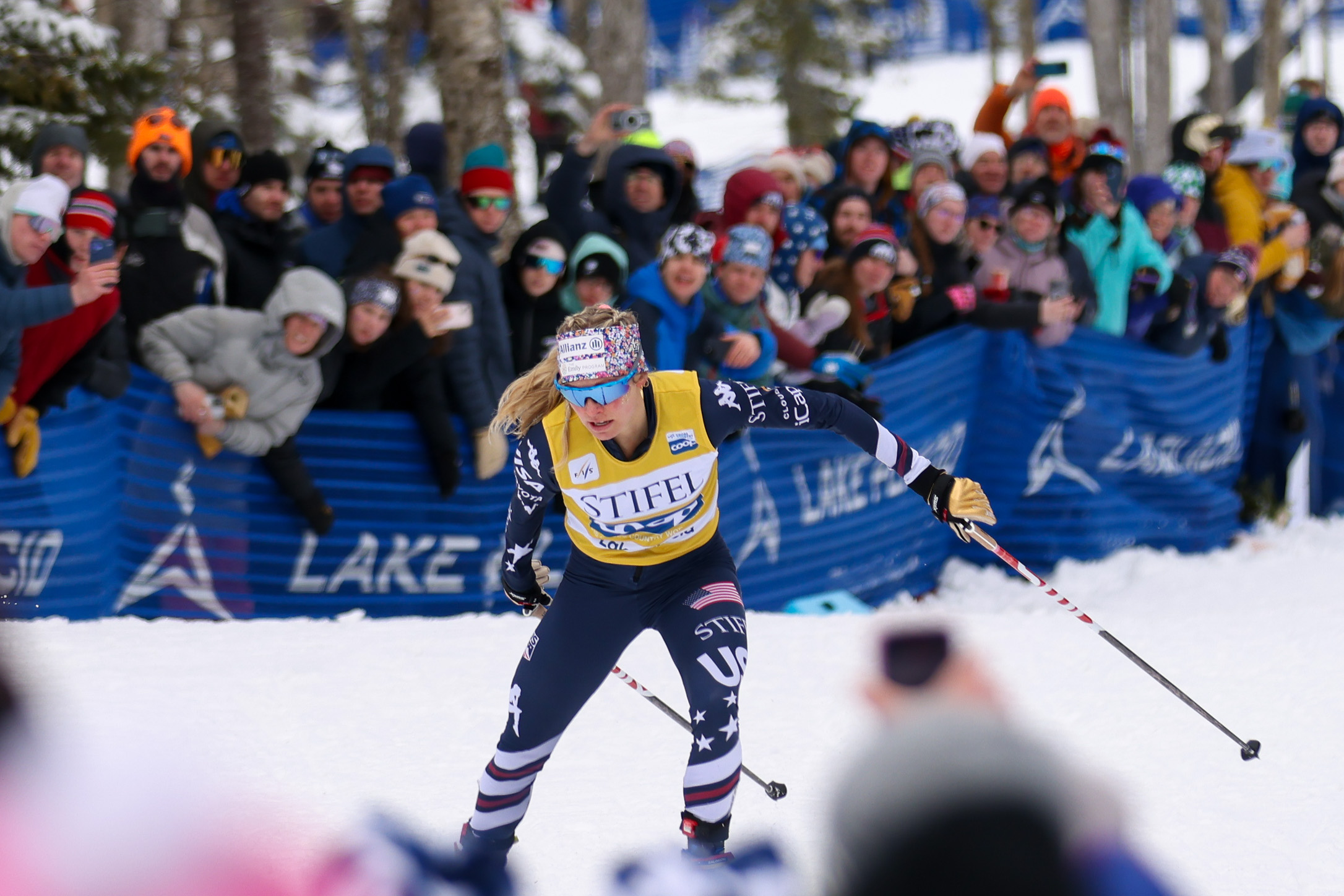
Jessie Diggins during the quarterfinals of the Freestyle Sprint on Saturday in Lake Placid, New York, USA. (Photo: Voisin / FasterSkier)
Lake Placid, N.Y. — The French coaches had questions. Two days before racing began at Mount Van Hoevenberg, they were standing in Saranac Lake — 55 degrees, windy, woods in every direction — wondering who exactly was going to show up to watch cross-country skiing in the middle of the Adirondacks.
By Saturday, an estimated — rumored to be fair — 14,000 people had answered.
Today, as Jessie Diggins lines up for the 20-kilometer mass start freestyle, the final race of her career, this corner of upstate New York will try to top itself one more time.
Screaming fans, chainsaws, flags, signs, and glitter all over the course in Lake Placid, New York, USA. (Photo: Voisin / FasterSkier)
A Weekend That Kept Building
The first sign that Lake Placid was going to be different came Friday, and it wasn’t entirely smooth. With an initial estimate of 10,000 fans on Friday, the transportation system to and from Van Hoevenberg buckled under the demand. Some fans waited over two hours to get to the venue.
US Head Coach, Matt Whitcomb, after the races yesterday in Lake Placid was really happy because the standout performance was not one of his athletes, but instead the North American ski community that showed up in droves and created an electric atmosphere. (Photo: Voisin / FasterSkier)
“Only Holmenkollen and Minneapolis”
U.S. Ski Team head coach Matt Whitcomb has been on the World Cup circuit for years. He said the only events throughout his career that have ever rivaled the atmosphere here this weekend in Lake Placid are the Holmenkollen in Oslo — the sport’s grand prix if you will — and Minneapolis two years ago.
That’s the company Lake Placid is keeping. And for those who were in Minneapolis, the comparison lands. Diggins said earlier this week that Minneapolis was the most special day of her career.
“It was the most I’ve ever cried,” she said at Wednesday’s press conference. “I got to race in front of some of my grandparents who haven’t been able to travel overseas. They got to see me race for the very first time in a World Cup. And having so many friends and family and getting to share the thing that I love doing with them — that is the most incredible thing ever.”
She paused, then added: “I think this weekend’s probably going to join that.”
College skiers from all over the Northeast came in force to the trailside in Lake Placid, New York, for the races this weekend. (Photo: Voisin / FasterSkier)
The Scene on the Ground
What the numbers don’t capture is the texture. Young kids running around the venue in their NNF fan bibs — the ones with athletes’ faces printed on them — clutching Sharpies, hoping to meet their heroes. Fans who drove and flew from Vermont, from Alaska, from Minnesota, who planned vacations around this weekend months ago. The school buses that became part of the story, ferrying the faithful up the mountain road when the original plan couldn’t hold.
This is what U.S. cross-country skiing looks like when it gets the stage. Not a packed NFL stadium or a sellout basketball arena — but thousands of people standing in the woods, screaming themselves hoarse for athletes from every country, because they love this sport and they know how rare these weekends are.
The fans — especial the college skiers — made it sound like the race was happening in Davos, Switzerland with the chainsaws out on course. (Photo: Voisin / FasterSkier)
One More Race
Diggins has spent this weekend doing exactly what she said she would — being present, soaking it in, putting on a show. She clinched the Crystal Globe on Friday. She raced the sprint on Saturday. And now there’s one more.
At Wednesday’s press conference, she talked about the way her mindset around suffering has evolved — how she’s learned to see the pain cave not as something to dread but as confirmation that she’s doing what she came to do.
“This is what 100 percent feels like,” she said. “And sometimes this is what it looks like, and it’s some ugly scene, but that’s okay. It just has to be all heart and all effort, and that’s what I have to give in that moment.”
She also made one thing clear about the team she’s leaving behind: “The team is going to be just fine without me. And I feel like that’s how I know I did my job.”
Then, with a smile: “I’m excited to be a fan on the other side of the fence and get to cheer for them.”
Today, in just ten minutes, Jessie Diggins will clip into her bindings for the last time as a World Cup racer. The 20-kilometer Mass Start Freestyle.
And based on everything this weekend has shown us, “no one” will be watching.
Love Stories Like This? Help Keep Them Coming.
Feature stories like this one take time, access, and care to produce. If you value thoughtful storytelling and independent ski journalism, please consider becoming a Voluntary Subscriber. Your support directly fuels the work we do to cover the people, places, and moments that make our sport special.
This coverage is made possible through the generous support of Marty and Kathy Hall and A Hall Mark of Excellence Award. To learn more about A Hall Mark of Excellence Award, or to learn how you can support FasterSkier’s coverage, please contact info@fasterskier.com.
Jessie Diggins answering questions at the press conference before the World Cup in Lake Placid, New York. (Photo: Voisin/FasterSkier)
Lake Placid, N.Y. — The eve of the World Cup finals at Mount Van Hoevenberg brought press conferences, sound checks that went sideways, and three American skiers who couldn’t stop making each other smile.
Jessie Diggins, Ben Ogden, and Gus Schumacher sat side by side Wednesday afternoon — the same trio that has turned the 2025-26 season into something U.S. cross-country skiing has never seen before. Between them: Olympic medals, historic podiums, a 50-year drought shattered, and one very good birthday cake.
But with three races left and Diggins’s retirement looming, the mood wasn’t heavy. It was loose, funny, and deeply human — exactly the way this team tends to do things.
“Probably Glitter”
Asked to define her legacy heading into her final World Cup weekend, Diggins did what Diggins does: she went somewhere unexpected.
“I think I define my legacy honestly, completely outside race results,” she said. “I am more proud of the things I have done off the course. I think my legacy is going to be in my advocacy and the way that I have spoken about mental health and eating disorders specifically, and the way I’ve tried to make really hard conversations less hard for people to have.”
She pointed to her work with Protect Our Winters and Share Winter, to the energy she’s poured into the team’s culture over the years. And then she landed the dismount.
“And probably glitter. I think there’s a lot more glitter in ski races now, and that’s always a great thing — as long as it’s biodegradable.”
Diggins has spent the season saying goodbye in pieces — a little cry leaving training camp in Bend, quiet moments at each World Cup stop. She knows what’s probably coming Sunday.
“I suspect it’s probably going to hit like a dump truck on Sunday, and there’s probably going to be a lot of tears.”
But she’s ready. And what she’s ready for is maybe the most Jessie Diggins thing of all: she sees ski racing as performance art, and she wants her final show to leave people wanting to go run up a mountain or sign their family up for ski lessons.
“I realized that I can do that moving forward, but just with my story and with my words, and I don’t have to push my body so hard, but I can still leave people inspired and motivated.”
In the meantime, she’s looking forward to being able to wash her clothes when they’re dirty, cook whatever she wants, and bake cookies on the weekend instead of training and racing all day.
Ben Ogden answering questions at the press conference before the World Cup in Lake Placid, New York. (Photo: Voisin/FasterSkier)
“Your Life Is Not Going to Be the Same”
Ben Ogden grew up in Landgrove, Vermont. American skiing legend Bill Koch lived close by in Peru, Vermont. Same zip code, as Ogden puts it — “not so different.”
Fifty years separated Koch’s 1976 Olympic medal from Ogden’s silver this season, and when Ogden finally got on the phone with his neighbor and mentor after breaking the drought, Koch didn’t mince words.
“Bill just sort of said, ‘Hey, congratulations, and your life is not going to be the same from this point forward.’ And that was kind of crazy to hear.”
Ogden hopes to see Koch at the races this weekend. And racing at Van Hoevenberg carries its own weight for him — not just because of Koch, but because of his father, who was deeply embedded in the New England ski racing community.
“I think it’s really hard for me to come race in the U.S. and look around and not just, like, constantly think about him, because this was his scene,” Ogden said, his voice softening. “He would have been in such paradise on the side of the trail here in Lake Placid. And I’ll be thinking about him a lot this weekend, for sure.”
This is technically Ogden’s first home World Cup — he was sick for Minneapolis — and it’s hitting him right. He grew up racing the NYSEF Festival series at Lake Placid, bringing crews of Vermont kids over for slushy late-season races.
“It’s not my home, but it feels like it.”
Gus Schumacher answering questions at the press conference before the World Cup in Lake Placid, New York. (Photo: Voisin/FasterSkier)
Aspirations, Not Goals
Gus Schumacher has been doing some linguistic rebranding.
“I’ve been calling them aspirations for a few years now,” he said of his season targets, “because I feel like the pressure of goals was kind of weird for me.”
The distinction matters to Schumacher. He sets plenty of small goals — the daily, tactical kind — but the big ones, like winning an Olympic medal or finishing in the top 10 of the overall World Cup standings, he holds more loosely. They’re aspirations: things he wants, things he’ll chase, but things he won’t let crush him if they don’t happen.
“Those are things I want to do, but if they don’t happen, it won’t be because I didn’t try.”
He accomplished the Olympic medal. He entered this final weekend ranked sixth in the world, with a top-10 finish still in play. And he’s approaching Lake Placid the same way he approached Minneapolis, where he won his first World Cup in front of a hometown crowd: just be happy to be racing, and feed off the energy.
“Already today, it was really cool to have people cheering us on in the race prep, which doesn’t really happen much on the World Cup ever.”
Schumacher also dropped maybe the best origin story of the press conference: the formative moment that lit a fire under his career was Luke Jaeger beating him at an Anchorage cup race.
“That kind of put a fire under my belly to really start training, because I didn’t want him beating me anymore.”
The Knitting Club, the Water Pump, and the Greenhouse
The press conference’s best stretch might have been when someone asked the athletes how they decompress.
Schumacher keeps it clean: headphones, 10 to 20 deep breaths — four seconds in, eight seconds out. Standard operating procedure.
Ogden? He knits. And he’s not shy about it.
“After races, I’ve been doing a lot of knitting and stuff like that. Helps me just relax really quick.” After the season, it’s bigger projects: car work. “You can feel like you’re the king of the world after a couple medals, but go and try and replace a water pump on a Forerunner, and that’ll make you feel completely incompetent.”
Diggins revealed there was a full-on knitting club on the team this winter. Her own reset button is simpler: she calls her husband.
“He’s my absolute center of my world. The race could have been amazing, and it could have been also completely horrible. And we’re just talking about what I want to do with the garden, and how I want to start a greenhouse. And he’s like, ‘Uh huh, yeah, sure, I’ll support you in that.’”
One More Thing
Almost as a throwaway, Ogden mentioned that Andy Newell — “the original Nordic ski backflip guy” — is in Lake Placid this weekend. And Ogden himself has had a backflip dialed since he was 17.
“I’m hoping on Sunday we can kick up a little ski jump. I’m looking to take another one Sunday afternoon. So stay tuned.”
Three races to go. A retirement to honor. A culture to celebrate. And maybe a backflip.
It’s going to be a weekend.
Love Stories Like This? Help Keep Them Coming.
Feature stories like this one take time, access, and care to produce. If you value thoughtful storytelling and independent ski journalism, please consider becoming a Voluntary Subscriber. Your support directly fuels the work we do to cover the people, places, and moments that make our sport special.
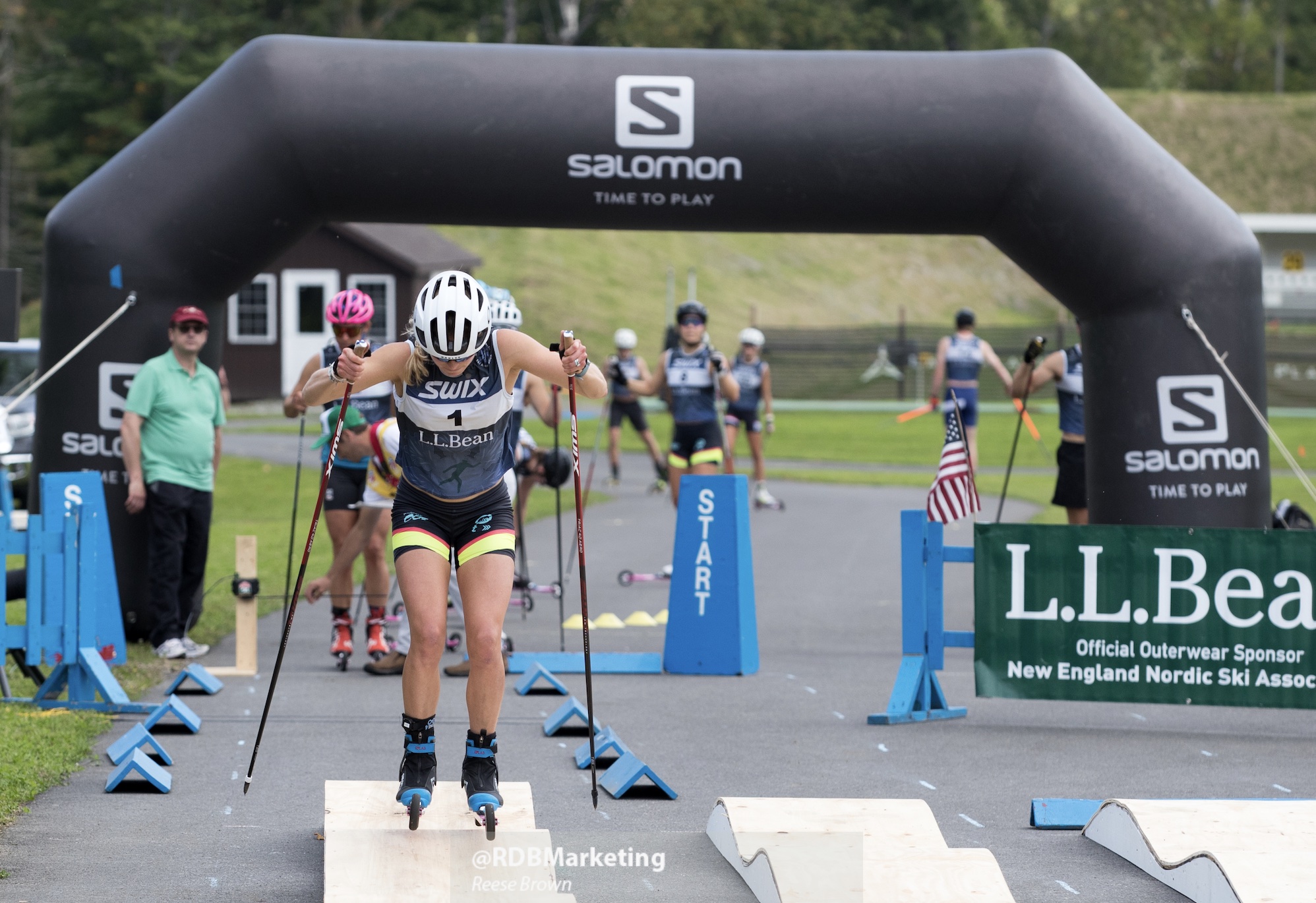
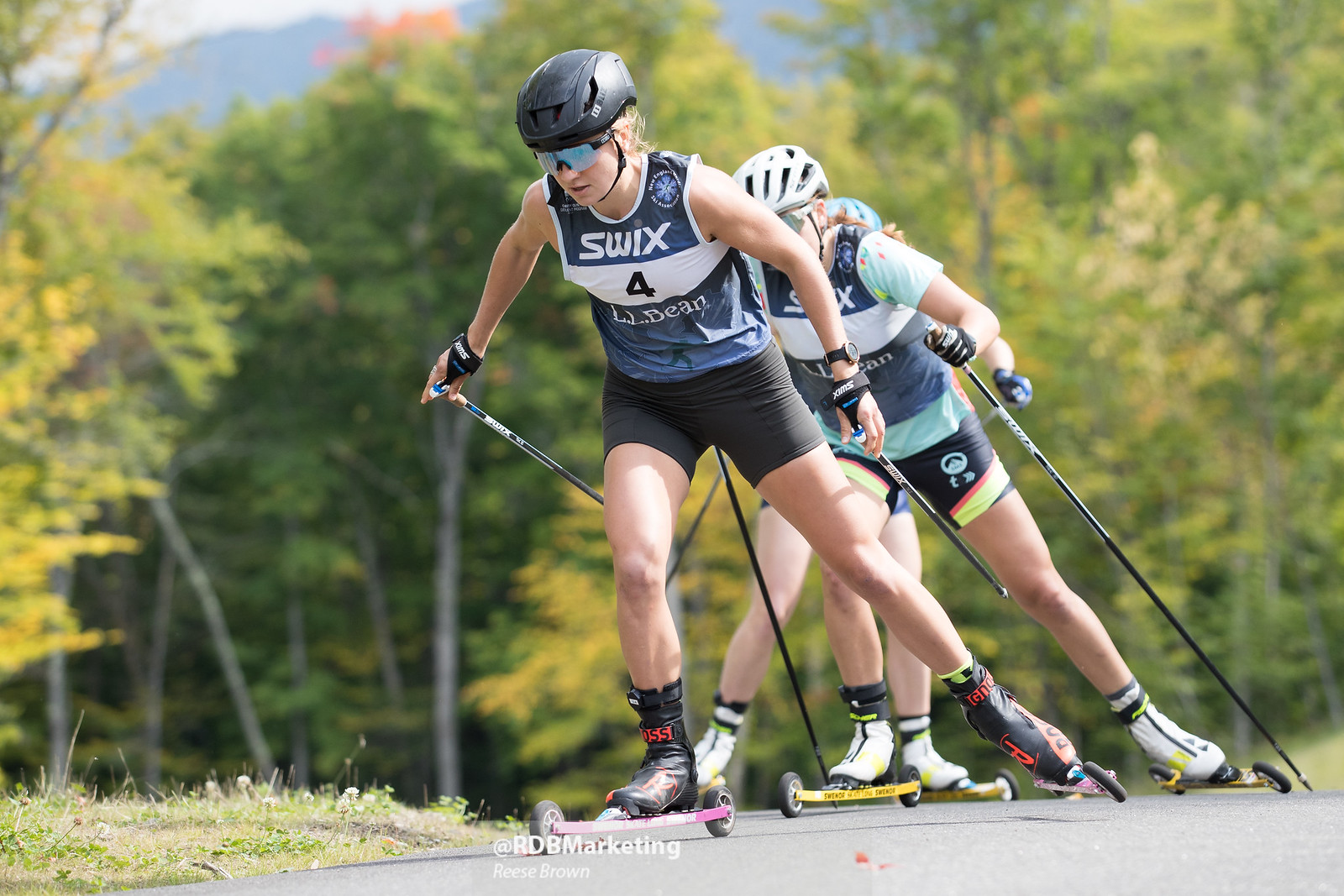
Over the bumps, Jessie Diggins heads out for her qualifier during the Keys to the Castle rollerski race in Lake Placid, NY. (Photo: Reese Brown / RDB Marketing)
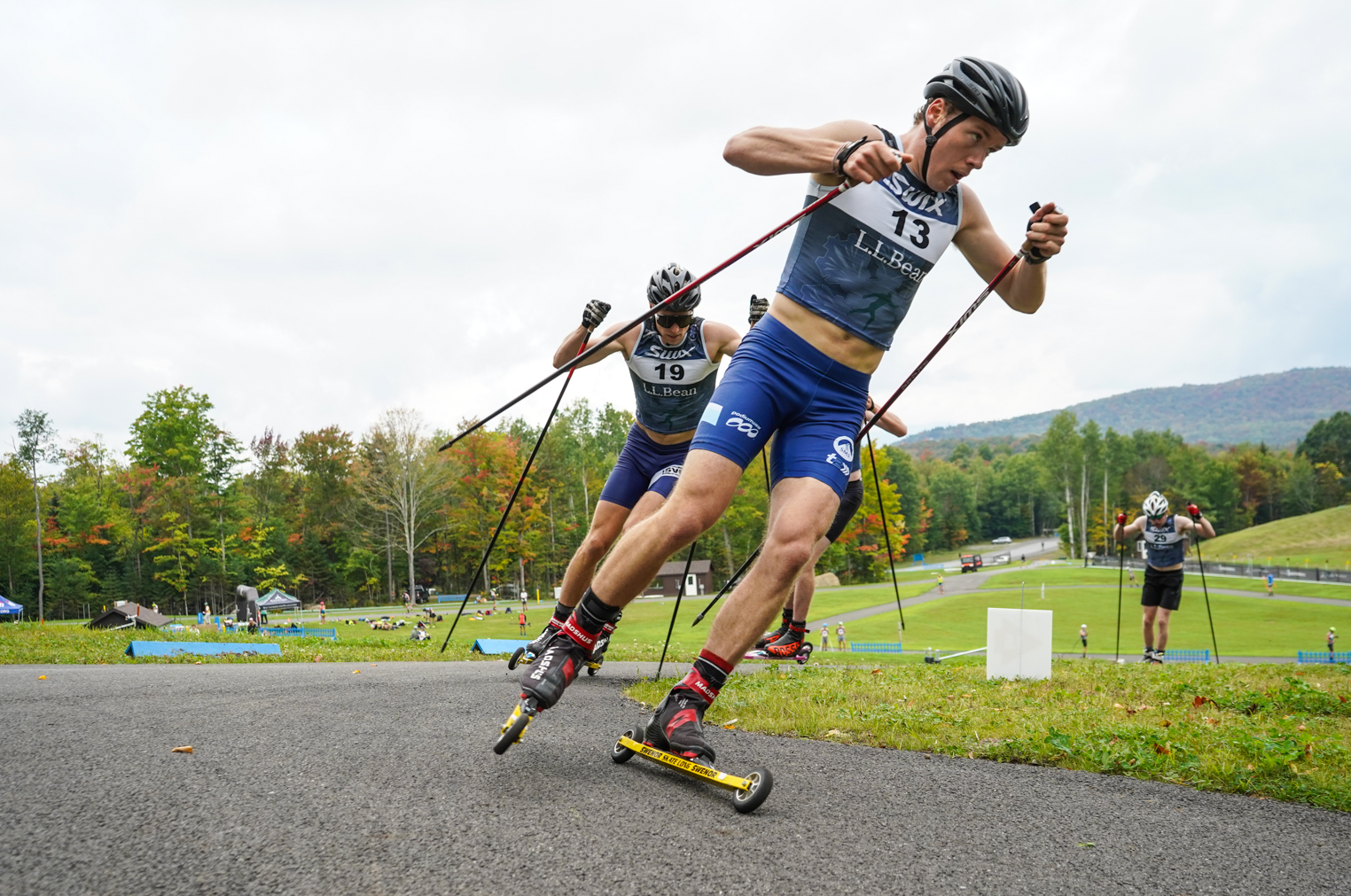
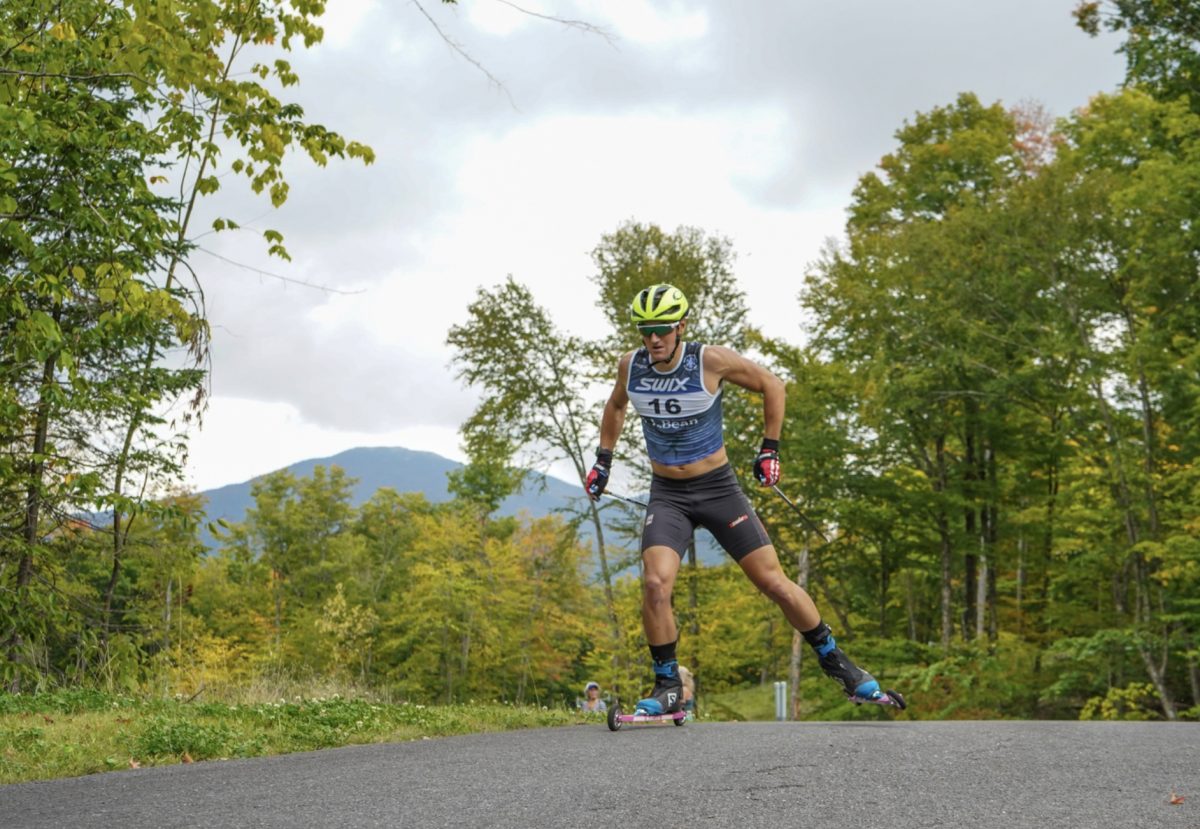
As summer turned to fall, skiers from the Stratton Mountain School T2 team (SMS T2), the Sun Valley Gold Team (SVSEF), and the Bridger Ski Foundation Pro Team (BSF) met in Lake Placid, NY for a collaborative training camp, capped off with two stages of rollerski racing. The weekend featured a freestyle sprint event — The Keys to the Castle — on the rollerski track at Mt Van Hoevenberg, followed by a distance stage dubbed the Free Fall Rollerski Race in Jericho, VT. These events are perhaps the climax of NENSA’s summer rollerski series, which has helped feed the energy and momentum of the cross country ski community throughout the Northeast.
“Lake Placid and Jericho were fantastic events and the beginning of the vision becoming a reality,” NENSA competitive programs director Justin Beckwith shared in an email. “They also highlight the amazing partnerships we have with clubs, venues and sponsors. We have four more roller races this fall including Climb to the Castle this weekend, which is paired with our Eastern Coaches Symposium — back in the Empire State. The really exciting part is we hope to carry the enthusiasm from rollerski into our Popular Race calendar, which will be released in the coming month.”
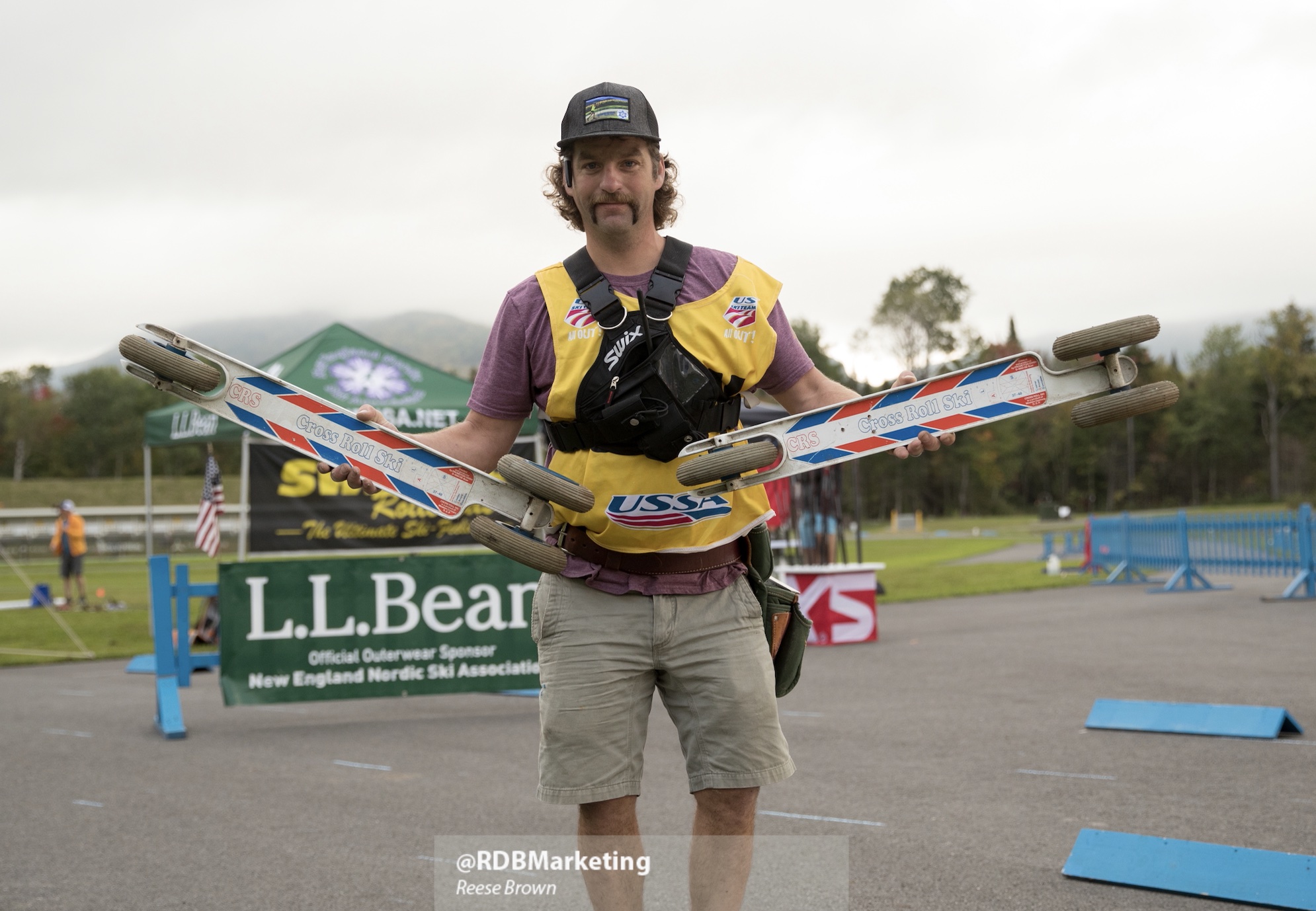
The man behind the wheels: NENSA competitive programs director Justin Beckwith. (Photo: Reese Brown / RDB Marketing)
After a year with minimal opportunity for cross-club collaboration, the events provided not only a solid training stimulus, but also invigorated the teams as they prepare for the upcoming season. It left U.S. Ski Team head coach Matt Whitcomb scheming about the opportunity to grow the events in the years to come.
“Pulling off a stage-style roller ski race weekend, with over 100 competitors on two different roller-ski tracks, reminds me of summer racing in Norway and Sweden,” wrote Whitcomb in an email. “NENSA has upped its game. Think of the potential, too; we could do four stages, using four different tracks, and all within 1-2 hrs in VT and NY. Start in Craftsbury, move on to Jericho, and then to each of Lake Placid’s tracks. Everyone camps together at each location, and it’s just a giant summer ski party.”
The facilities at Mt Van Hoevenberg, home to the 1980 Olympics and an Olympic & Paralympic Training Center, have been undergoing extensive renovations and improvements, including the building of the new four-kilometer rollerski track which was finished this past August. (You can take a tour of the track via YouTube courtesy of Paul Schommer/Biathlon Uncharted.)
“If I win the lottery, I’m putting in more roller-ski tracks in the U.S.,” said Whitcomb. “It’s a game-changer to not have to worry about cars. Also, the best way to replicate the demands of a ski course is to ski on a ski course.”
Bill Harmeyer (SMS T2) makes his way through the heats during the Keys to the Castle rollerski sprint. Harmeyer finished 4th overall on the day. (Photo: Matt Whitcomb)
Mt Van Hoevenberg has also improved their snow making operations, allowing for 5k of groomed skiing with 3-4 days of blowing snow in cold weather. Whitcomb explained the value this provides to American cross country skiing.
“This was our second time utilizing New York’s investment in its facilities at Mount Van Hoevenberg. I’d be surprised if we’re not racing World Cups here in the future. A lot of work by ORDA has resulted in a world class roller-ski track and new race trails. What excites me is the chance for easterners to have early November skiing in years when the weather cooperates. Their snow-making capacity is impressive.”
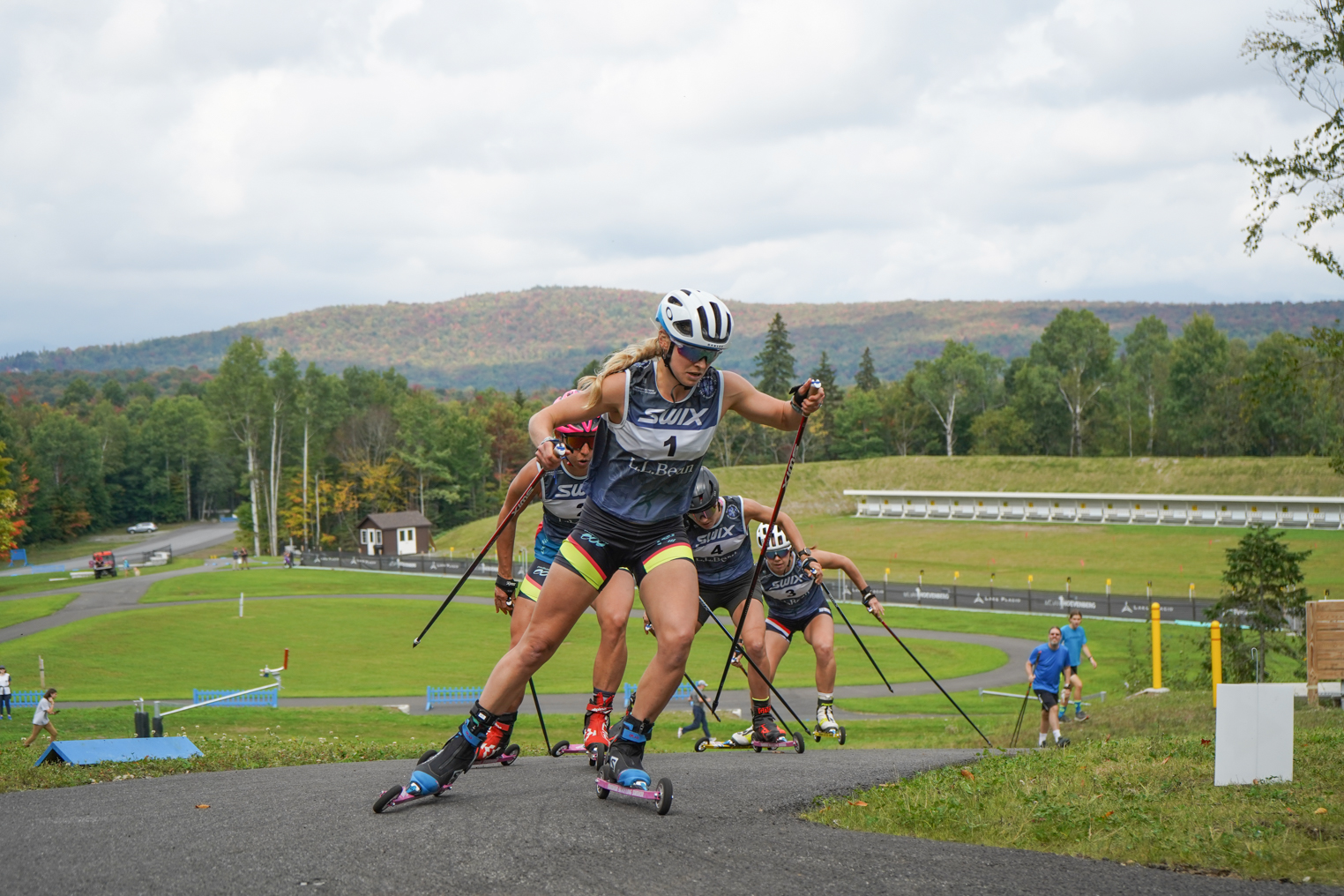
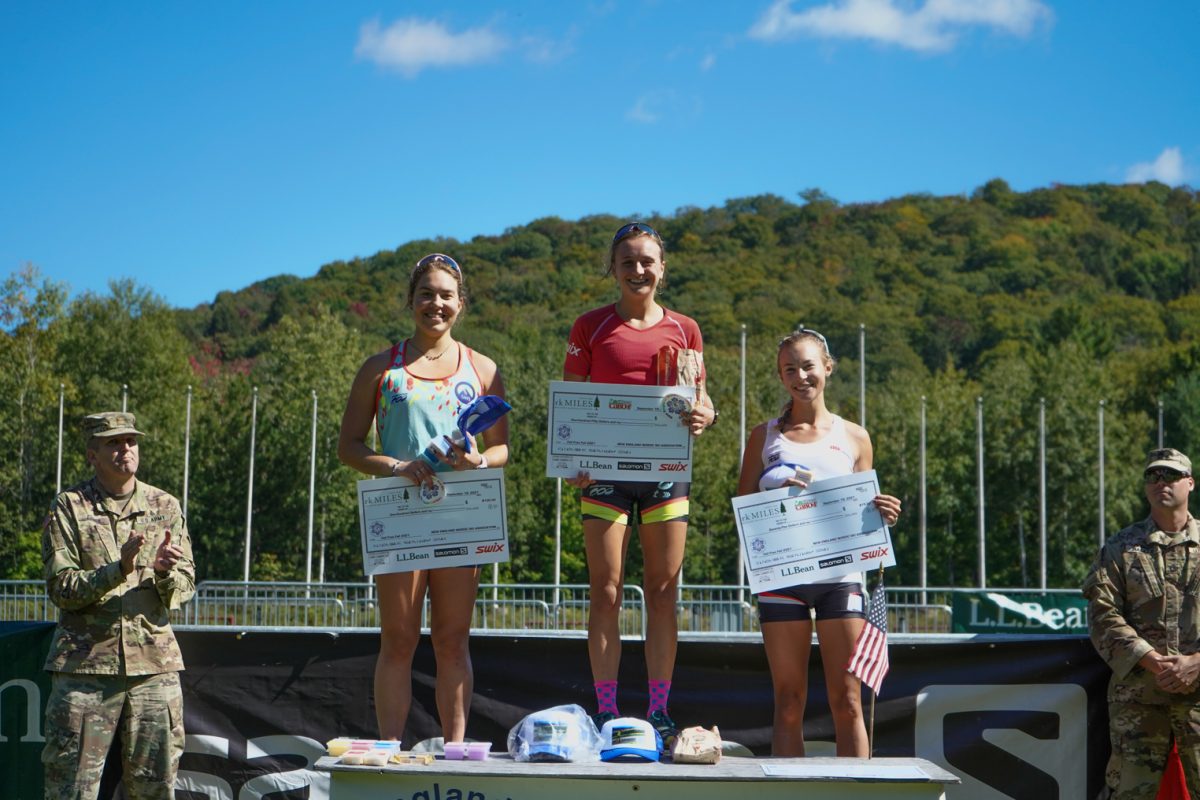
With the added twist of a rolling ramp at the start, racers skied their way through the qualifier and rounds. In the women’s field, Jessie Diggins (SMS T2/USST) won the qualifier, cruising onward to snag the top spot on the podium, followed by teammates Julia Kern (SMS T2/USST) in second and Alayna Sonnesyn (SMS T2) in third.
Jessie Diggins (SMS T2/USST) over the climb during the final round of the Keys to the Castle sprint. (Photo: Matt Whitcomb)
“This is the time of year where the intensity in training starts to ramp up and it’s always awesome to have the chance to test out your race day preparation,” wrote Diggins after the race. “Things like the timing of pre-race meals to warmups and what you do in between sprint heats to stay activated but not get tired — this was a perfect chance to tune in to those little details at the race in Lake Placid!”
Diggins only competed in the sprint stage of the weekend, bowing out before the teams headed to Vermont.
“I’m super grateful to the organizers and hosts as it was an amazing new roller ski track and venue, and it was very cool to have so many teams and athletes there, from junior skiers to professional teams. The track was challenging and honestly just like a world cup sprint course, in terms of length, challenge and technical aspects. It was fun to fire up the engines and see what I still need to be working on in our final prep phase before the season begins!”
Jessie Diggins stomps the qualifier, continuing through the rounds to win the overall at the Keys to the Castle. (Photo: Reese Brown / RDB Marketing)
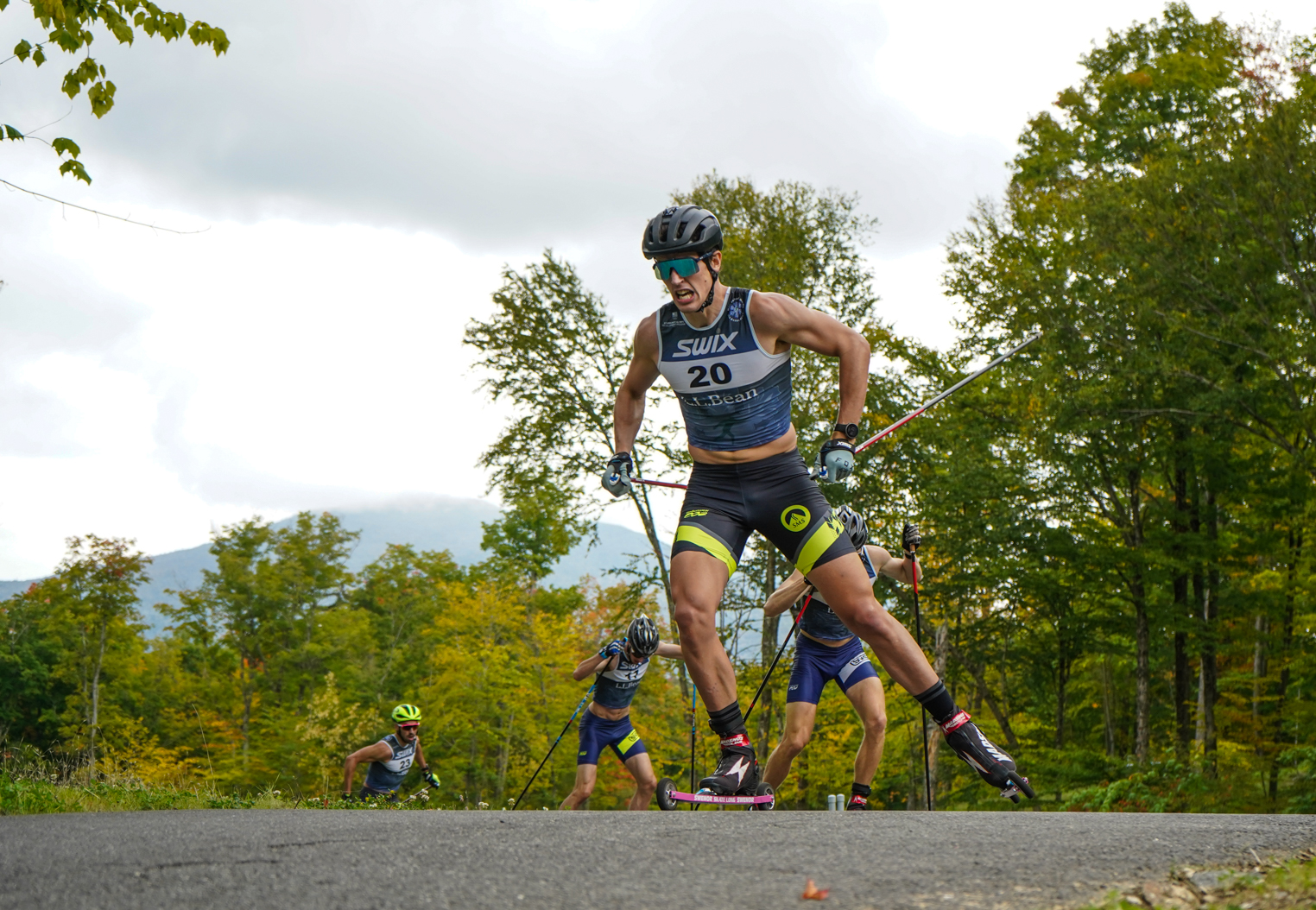
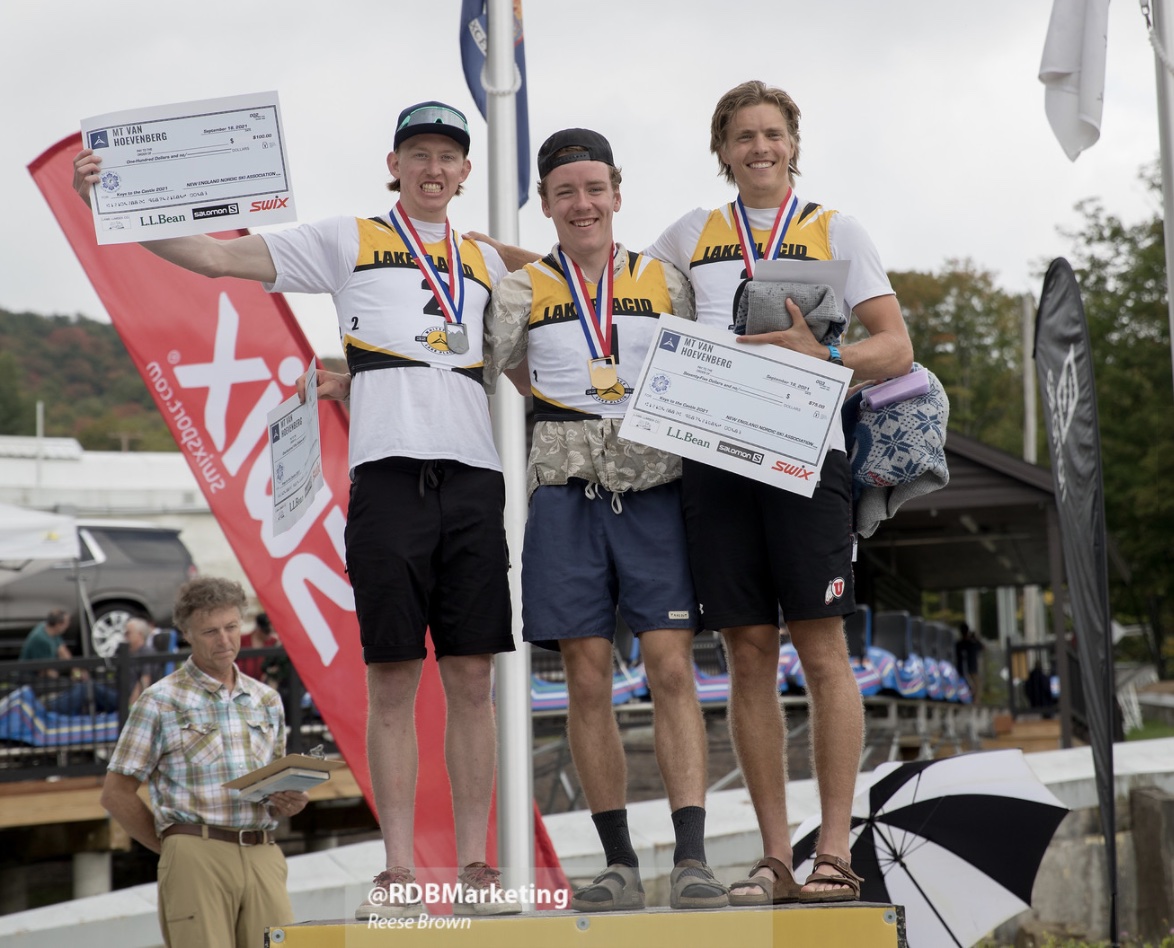
On the men’s side, Ben Ogden (SMS T2) also doubled up on the qualifier-final victories. He was followed by Peter Holmes (SVSEF) in second, and Logan Diekmann (BSF) in third.
“This weekend’s rollerski race was like a breath of fresh air for me and I think most of the competitors,” wrote Ogden in an email. “As fun as constant training, time trials and quarantining was, ski racing is all about racing. Getting together with such a talented group and pushing each other on such a beautiful New England weekend seemed almost too good to be true. Having the BSF Pro Team, Sun Valley gold team, and SMS T2 team, all on sight made it a crazy stacked fall time trial, which was such a treat after a year of so many small group time trials.
“This weekend was especially cool for me because It bridged the gap between all the ski worlds, something that has certainly not happened in a long time. Many of the college skiers were there, the SMS t2 team (who I ski with in the summers) was there, even a few fellow US ski team athletes and coaches were there. It’s rare that all these groups get together so that was a lot of fun.”
Putting on a clinic, Ben Ogden powers through the Keys to the Castle, winning both the qualifier and the overall. (Photo: Matt Whitcomb)
While racing in Vermont was not possible for much of the ‘20/21 season, Ogden, now 21-years-old, had a solid first run of international World Cup racing. On form when the stakes were highest, he qualified in 11th in the classic sprint at the World Championships in Oberstdorf, Germany and finished 17th. He was also the third fastest qualifier in the same event at U23 World Championships in Voukatti, Finland, where he finished 11th overall.
Ogden provided insight into his current status with training, and how the races provided him with insight into how his body is responding.
“I had a big period of training ending in these races and in true fall rollerski race style I didn’t change up much of my training for the races. I just thought of them as hard workouts with a bunch of friends who I don’t ski with all too often. I was really pleased to find some good speed through the entire skate sprint day. The course was really fast and tons of fun on rollerskis, so it was awesome to ski all three heats on Saturday…
“I’m really excited to get this winter underway. Feeling good about summer training in Stratton and the beginning of fall training at Groovy. (‘Groovy UV’ = University of Vermont, where Ogden is beginning his third year.) Lots of work to be done!! I think it’s going to be a fun year.”
The men’s podium of the Keys to the Castle rollerski sprint in Lake Placid. Ben Ogden (SMS T2) was the top qualifier and overall winner ahead of Peter Holmes (SVSEF) and Logan Diekmann (BSF Pro). (Photo: Reese Brown/RDB Marketing)
Heading east to the Camp Ethan Allen Training Site, men and women in the open division raced a 15k skate while juniors completed 5k.
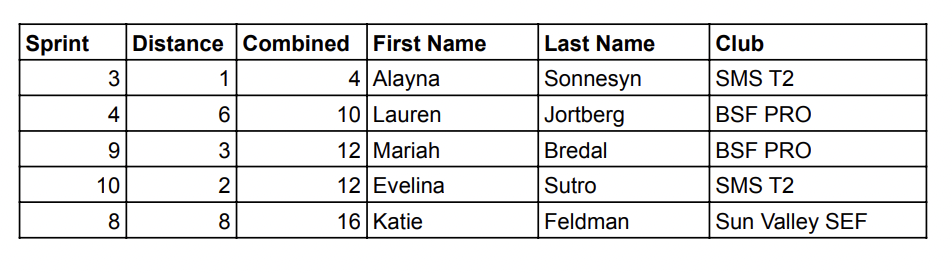
For the men, Johnny Hagenbuch (SVSEF) stopped the clock at 32:00.9 with the fastest time of the day. He was pursued by Ben Ogen in second (+1:07.3), with Ian Torchia (SMS T2) on his tails in third (+1:07.6) with a tight finish.
“It was an awesome way to cap off a productive training camp!” wrote Hagenbuch after his race. “Being from altitude in Sun Valley, the main goal for the camp was to capitalize on some great venues for intensity training in and around Lake Placid. We had a bunch of really good sessions on rollerskis and foot, and it was awesome to collaborate with Andy Newell’s BSF Pro Team crew on a number of those quality workouts.”
20-year-old Hagenbuch was born and raised in Ketchum, ID. After taking a gap year following high school graduation, Hagenbuch will be attending Dartmouth College in the fall. He explained that his time spent in the east surrounding these events left him eager for what is to come in the years ahead.
“The new venues in Lake Placid at the Mount Van Hoevenberg were incredibly well-designed, and I really look forward to checking out the ski trails in the winter as opposed to bounding. The rollerski track is a really great resource, and NENSA did a fantastic job of hosting that event. There was a surprisingly robust field for a rollerski race in Upstate NY, and it was cool to see how much energy there is for skiing and rollerskiing in the East. I actually had never previously spent any substantive period of time in New England – winter or summer, so it was great to experience orientation at Dartmouth the week before the camp as well. My perception of the East has completely changed; it’s very different from the West, but I love it!”
Johnny Hagenbuch powers through his qualifying round during the Keys to the Castle rollerski sprint in Lake Placid, NY. (Photo: Matt Whitcomb)
Breaking down the combined stages that led Hagenbuch to a third place finish in the overall standings, he explained his approach to the weekend including how it fits within his overall summer training plan.
“The sprint went pretty well for me, especially considering that I historically and currently have not self-identified as the most talented sprinter. At this point in the season, it was a fun, low-stakes way to throw down with a great group of guys. Ben Ogden is fun to watch. The distance day in Jericho was much more my wheelhouse, as distance skate races are typically my best format. The 5km rollerski track on the National Guard base in Jericho was a treat to experience. I haven’t skied on Craftsbury’s rollerski track, but the Jericho rollerski track could easily be the best in the nation. Given that I’m still training at a relatively large volume, I wasn’t really expecting to feel particularly good or race anywhere near to my best form, but it was still a pretty good effort.
“One of my goals for the past couple of seasons has been to get stronger and ski more powerfully, and it was cool to see some of that effort pay off in Jericho. I felt that I was skiing much more powerfully in general, and I don’t think I lost much on the uphills – despite having gained 25 pounds in the last year. It was an encouraging result in the end, and I’m excited for the next couple of months of training before the season kicks off in earnest in West Yellowstone. I’ll be pretty consistently alternating between being at home for two weeks and away training or racing for two weeks until January, which’ll be a nice way to break it up (and will make time fly)!”
The women’s podium of the Free Fall distance race in Jericho, VT. Alayna Sonnesyn (SMS T2) took the win ahead of teammate Lina Sutro, with Mariah Bredal (BSF Pro) in third. (Photo: Matt Whitcomb)
On the women’s side, Alayna Sonnesyn took the win on the second day in a time of 37:55.3, sealing the overall victory for the combined events. Her SMS T2 teammate Lina Sutro rolled through in second (+49.3) with BSF Pro Team member Mariah Bredal in third (+2:33.6).
“In Lake Placid, it was really cool to ski on the new roller ski track,” wrote Sonnesyn in an email after the events. “I had heard stories about a pretty twisty and technical track but to finally have the opportunity to ski on a course similar to a World Cup level race was pretty sweet. Not to mention the new facilities at Mt. Van Hoevenberg are unbelievable! It was really fun to get into a sprint simulation with all of the other elite ski teams that were there and it felt almost like a SuperTour. That being said, it’s still September so although I brought a competitive spirit to the races, I still approached them as a workout. It was great to practice going super hard in the qualifier and then play around with tactics in the heats, but it was all in good fun too. With a pretty sketchy corner coming out of the last downhill, the women agreed this race wasn’t worth losing skin over. All in all, a great day!”
Alayna Sonnesyn leads her heat during the Keys to the Castle rollerski sprint in Lake Placid, NY. (Photo: Reese Brown / RDB Marketing)
“The following day in Jericho I was definitely feeling a little tired from the sprints the day before, but that was great practice for wintertime when we frequently race back to back,” Sonnesyn continued. “Also, during my time at UVM we skied at Jericho almost every week so it felt good to be back on a track that I knew so well and felt like home. Adding to that, it was great to see the UVM ski team and other junior/college racers attending this event. It had been a while since I had been at an event with so many New England skiers and I felt like everyone was just really happy to be there. Again, I was finding the balance in this race to approach it as a workout while still taking advantage of the opportunity to practice race warm ups, tactics, fueling, pacing, etc.”
Sonnesyn also concluded with insight into her overall feelings at this point in the season.
“I’m feeling really good and lucky to have these races to test things out. I gained a lot of takeaways on little things I can work on in the next few months, but also built some confidence behind what we have already been doing all summer. I’m excited to potentially compete in a few more NENSA races this fall and get ready for snow to fall!”
The women’s final of the Keys to the Castle rollerski sprint in Lake Placid, NY. From left to right, Lauren Jortberg (BSF Pro), Julia Kern (SMS T2/USST), Jessie Diggins (SMS T2/USST), Alayna Sonnesyn (SMS T2). (Photo: Reese Brown RDB Marketing)
New infrastrucutre and ongoing renovations at the Mt. Van Hoevenberg winter sports complex (Photo: ORDA/Whiteface Lake Placid)
In March 2018, the International University Sports Federation (FISU) awarded the 2023 Universiade, or World University Games, to Lake Placid. New York Governor Andrew Cuomo’s pledge of financial support helped seal the deal. That event will bring approximately 2500 athletes and support staff to compete in cross-country and alpine skiing, ski jumping, hockey, speed skating, figure skating, and other events. Lake Placid last hosted the Universiade in 1972.
Asked when they got involved in the bidding process for the Universiade, ORDA President and CEO Mike Pratt wrote in an email, “ORDA was included in the process to host the [World University Games] from the onset. The biggest limitation to hosting the event was regional. As it was determined that these limitations could be overcome, the process to secure the games progressed.”
Improvements to Mount Van Hoevenberg will include a new lodge, an eight million gallon snowmaking reservoir, and a traditional snowmaking system covering five kilometers of trail, augmenting what is already known as the Snow Factory. Four kilometers of new trails will be developed and paved to accommodate rollerskiing in the summer. A new start house is in the works for Van Ho’s sliding track.
After the 1980 Winter Olympics, the state of New York founded ORDA to manage the various Olympic venues. In addition to Mount Van Hoevenberg, and the Olympic Jumping Complex, ORDA manages Whiteface Mountain, the Olympic Center (site of hockey events), the Olympic Speed Skating Oval, and the Olympic Training Center. In 1984, ORDA assumed management of the Gore alpine mountain in the southern Adirondacks; and in 2011, took over the Belleayre alpine center in the Catskills, which had been managed by the New York Department of Environmental Conservation.
Mount Van Hoevenberg’s new lodge will house 30,000 square feet over three stories. The lodge will be used by the sliding athletes and hikers and is scheduled for a 2021 completion date. New trailheads to the popular Cascade and Porter mountains will start from the lodge area in an effort to ease overcrowding at existing trailheads during summer hiking season. To promote non-winter visitations, a mountain coaster will be developed to leverage the area for summer visitors.
The total costs for upgrading Mount Van Hoevenberg were originally estimated to be $40-$50 million. However, in a June issue of the Adirondack Daily Enterprise, Pratt revised the redevelopment estimate to “upward of $60 million.” The cost of the new lodge alone is estimated to be approximately $32 million. Asked about the cost increases by FasterSkier, Pratt responded “The project scope grew to include additional components that could have been separate projects. We are managing our budget as efficiently as possible.”
While ORDA will install a traditional snowmaking system, Pratt said that it would keep and continue to maintain the Snow Factory. At the time of writing, none of the existing ski trails are expected to be closed during construction. However, Pratt wrote, “We are obviously going to experience some inconveniences with the construction continuing through the winter. We are prepared to operate differently and need the guests to understand that the facility is changing and some things will be different.”
Lake Placid ski jumps receiving an overhaul. (Photo: ORDA/Whiteface Lake Placid)
According to the Adirondack Daily Enterprise, the biathlon range will be relocated and enlarged to accommodate World Cup cross-country and biathlon events. Pratt wrote that the new range would be adjacent to the new lodge.
At the ski jumps, frost rails (that cool the ski ramp surface) will be installed on both the 90-meter and 120-meter to ensure a consistent gliding surface. ORDA also plans to re-grade the landing hill, but the current sole bid of $12 million for this work was more than double what ORDA had anticipated. At present, re-grading the hill is tabled, and ORDA will solicit new bids for the following year. Despite the re-grading issue, the ski jumps will be usable this winter. In addition, the Olympic Jumping Center will see the landing hill regraded to modern standards.
Of interest to dedicated World Cup fans, Pratt expressed that bidding on and hosting a World Cup cross-country event remains a possibility. “We are always considering what events are appropriate to host and feel confident that the new trails will be desired by the athletes and their governing bodies,” he wrote.
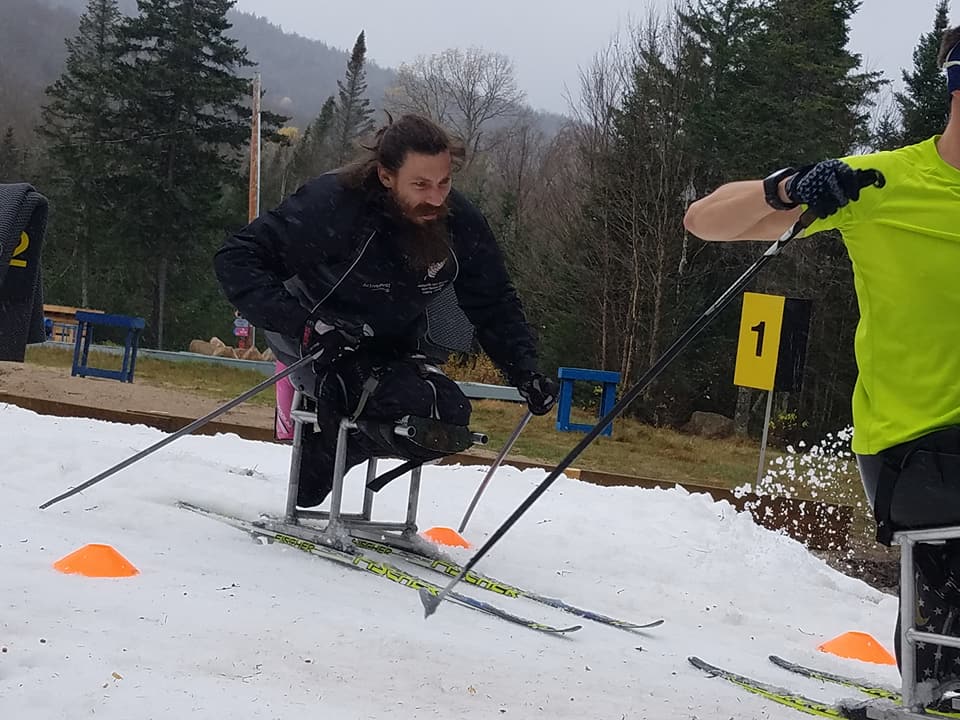
A look at Mount Van Hoevenberg’s freshly groomed, machine-made trail in late October during a U.S. Paralympics Nordic Program camp in Lake Placid, N.Y. (Photo: BethAnn Chamberlain)
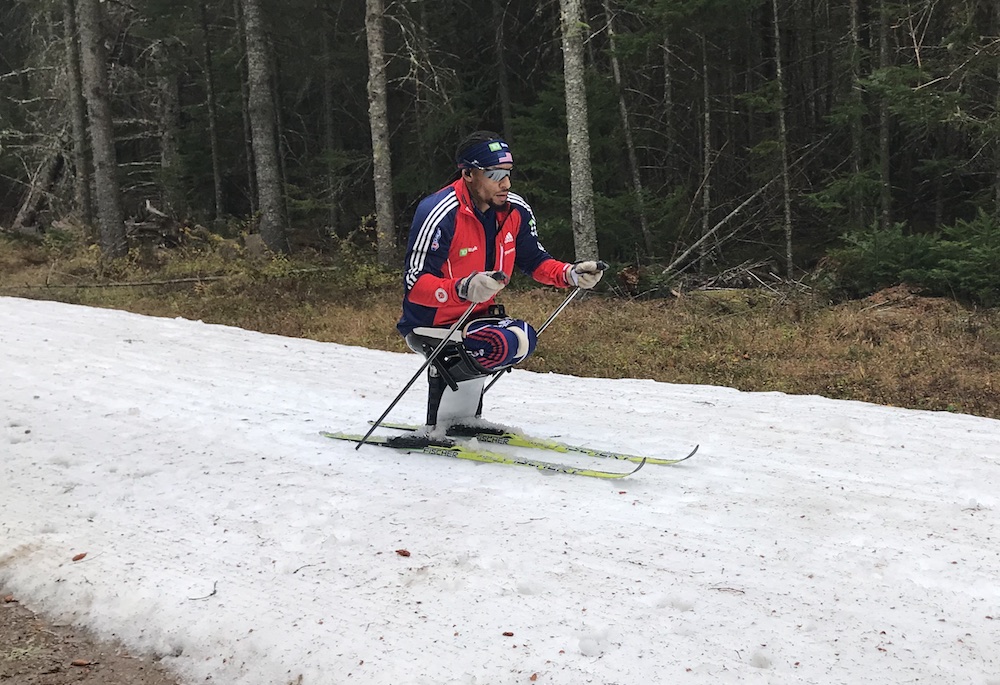
It’s that time of year when everyone’s raring to get on snow. Let’s say you’re lucky enough to find some — even just a few hundred meters — like the U.S. Paralympics Nordic team did late last month at a training camp at Mount Van Hoevenberg in Lake Placid, N.Y.
Seven athletes — a combination of high-performance and development skiers — spent a week at Van Ho from Oct. 23-29 for the nordic center’s earliest opening yet on machine-made snow. Starting Oct. 1, the area’s SnowFactory blew enough snow for a 480-meter loop wide enough for two-way skiing. And it did so despite daytime temperatures hovering around 70 degrees Fahrenheit.
U.S. Paralympics Nordic’s 2017 Lake Placid camp attendees:
High-performance athletes:
– Jeremy Wagner
– Eric Fraizer
– Bryan Price
Development athletes:
– Julius Schram
– Chris Rassmusen
– Dave Nicholes
– William Ward
On top of that, Van Ho organizers constructed a two-point, 10-meter Para biathlon range, which was connected to the loop and gave the team’s biathletes a place to practice shooting.
But on Day 2 of camp, the rains came, putting a sizable dent in the skiable terrain. While Van Ho was rebuilding its loop for the end of the week, the Para skiers switched gears to dryland training, shooting and rollerskiing/mountain boarding at the venue’s full-size biathlon range and rollerskiing the paved loop at Lake Placid’s Olympic Jumping Complex — the latter of which is known for its challenging terrain.
“This was a first for us and proved to be a great training site for all of our sit skiers,” BethAnn Chamberlain, the US Biathlon Paralympics development coach who led the camp, explained in an email, referring to the jumping-complex trails. “Late in the week, despite the continued warm temperatures, the Mt Van Hoevenberg crew was able to put together a short strip of snow for us again, including giving us access to our Biathlon range area.”
What did they do to make the most of their on-snow time? Chamberlain shared an agility workout for “even the smallest stretch of snow.”
The Workout: Early season agility
What you need: At least 200 meters of snow, cones, and if possible, a corner on the track (cones can substitute if no corner is available)
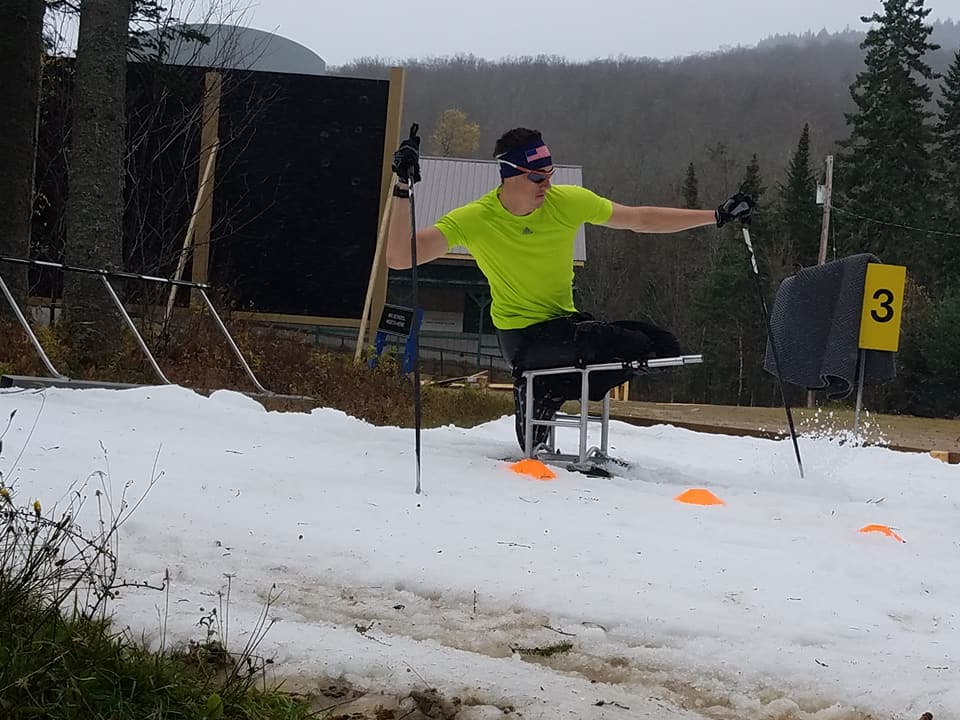
U.S. Paralympics Nordic high-performance athlete Bryan Price (Casper Mountain Biathlon Club) rounds a corner during an agility workout at a U.S. Paralympics on-snow camp in late October at Mount Van Hoevenberg in Lake Placid, N.Y. (Photo: Mt. Van Hoevenberg/Facebook)
What you should know: “The basic premise of this workout is to have the athletes ski corners and around cones at different speeds and by taking different lines, and doing so on their own as well as in groups,” Chamberlain explained. “This not only helps the skiers develop a better feel for how their sit ski responds to their movements around corners, but also opens up the idea of the near infinite approaches and techniques to get around a corner or to maneuver around other skiers on course. (It only take a few minutes of skiing in a sit ski to truly appreciate how difficult it is to maneuver and stay upright, and do so with speed in a sit ski. I highly recommend everyone, adaptive and non-adaptive skiers to give it a try.) This is a speed workout disguised as an agility workout.”
Setup: Using cones, construct two slalom courses for the athletes to race through, head to head.
Warmup: 20 minutes of easy skiing
The workout: (45 minutes to 1 hour total)
First, ski course at an easy speed and work up to a sprint speed.
Then, start the “races”, with two athletes racing at a given time, competing against each other on the parallel courses.
Throughout the session, change it up. “You can continue to run ‘races’ in this manner, change the position of the cones, to create different corners to practice on,” Chamberlain wrote. “You can then move onto 180-degree turns, long sweeping turns in both directions and every other kind of other turn you can think of. Athletes will ski these corners on their own as well as in groups or pairs at easy speeds to start and ramping up to race speed.”
“A continued change in the position of cones creates changes the turn they have to make and keeps the athletes engaged and challenged to practice different lines and approaches through out the workout,” she added. “Run these drills along with additional variations such as shuttle run ‘races’ & slalom style turn relays for 45 minutes to an hour.”
Cool down: 20-30 minutes Level 1 skiing.
“We had a great week of training in Lake Placid,” Chamberlain noted. “The folks at ORDA [New York State’s Olympic Regional Development Authority] and Mt Van Hoevenberg were amazing and worked very hard making snow for us, which we were able to use for skiing and for Biathlon training.”
Jeremy Wagner (in black) chases Bryan Price, his U.S. Paralympics Nordic and fellow 2014 Paralympian, during an agility workout at a team training camp in late October at Mount Van Hoevenberg in Lake Placid, N.Y. (Photo: Mt. Van Hoevenberg/Facebook)
Kris Cheney Seymour, the nordic program and events manager at Mt. Van Ho and ORDA, which owns the venue, explained in an email that while the week was reminiscent of 2017 Junior Nationals (which were also forced to relocate to the jump-complex trails), it was certainly worth it.
“Hosting the U.S. Paralympic on-snow fall camp is a wonderful opportunity and provided a timeline that pushed boundaries to do something that is normally outside the realm of possibility,” Seymour wrote in an email. “The effort to pull this off was more about effective planning and management of the process. Of course the dedication of our staff to pull off all pieces was considerable, but everyone had a pieces and executed it well.
“We started with 480-meter-long stretch of snow, 2 feet deep and 16 feet wide,” he explained. “The SnowFactory snow was very durable to skier traffic. In the middle of the week we had a significant rain storm with high winds that compromised the loop and we had to rebuild for the end of the week. … It was a small flashback to the weather we dealt with last year at Junior Nationals.”
The nordic center is currently stockpiling snow from the SnowFactory in order to open to the public. Over the course of the winter, Van Ho has a stated goal of being open 150 days with skiable snow; last year, it was open 139 days thanks to the SnowFactory (as opposed to 39 days the year before without it).
“We have a SnowFactory because of unpredictable winter weather,” Seymour wrote. “… Without the SnowFactory this past season we would have lost the stadium and connector trails just under 40% of the days we were open. Our season would have been closer to 85 days if we only had natural snow. … As pioneers with the SnowFactory in North America we are still learning from the machine and perfecting our warm weather snow management. TechnoAlpin has been helpful in sharing how others have used the SnowFactory around the planet, but to some extent, all locations have their own challenges.”
U.S. Paralympics high-performance athlete Eric Frazier training in late October on machine-made snow at Mount Van Hoevenberg in Lake Placid, N.Y. (Photo: BethAnn Chamberlain)
The stadium at Mount Van Hoevenberg as seen on April 1, no joke, thanks to the TechnoAlpin Snow Factory. (All photos: Peter Minde)
When it came to investing in snowmaking, New York State’s Olympic Regional Development Authority (ORDA) went with the go-big mentality, leasing a TechnoAlpin Snow Factory for the Mount Van Hoevenberg nordic center and using the technology throughout the 2016/2017 winter season.
Following the previous 2015/2016 season, in which Mt. Van Hoevenberg, “Van Ho” for short, was open 37 days, according to ORDA’s annual report, the authority acquired and installed a self-contained snowmaking system at Van Ho, the 1980 Winter Olympic venue in Lake Placid, N.Y.
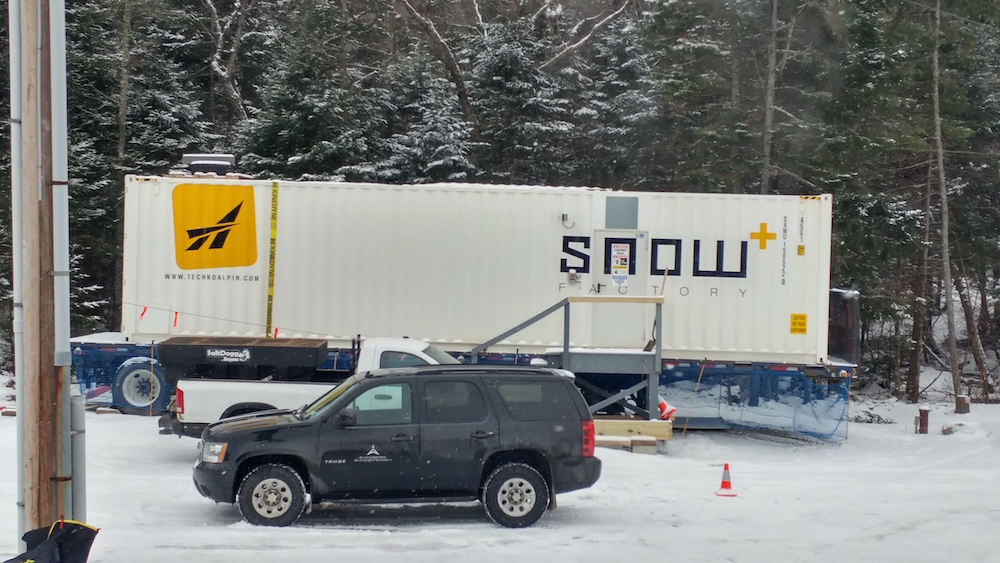
The Snow Factory at its current home at the Mount Van Hoevenberg nordic center in Lake Placid, N.Y. (Photo: Peter Minde)
The Snow Factory was put in place, just behind the cross-country lodge, just before Thanksgiving.
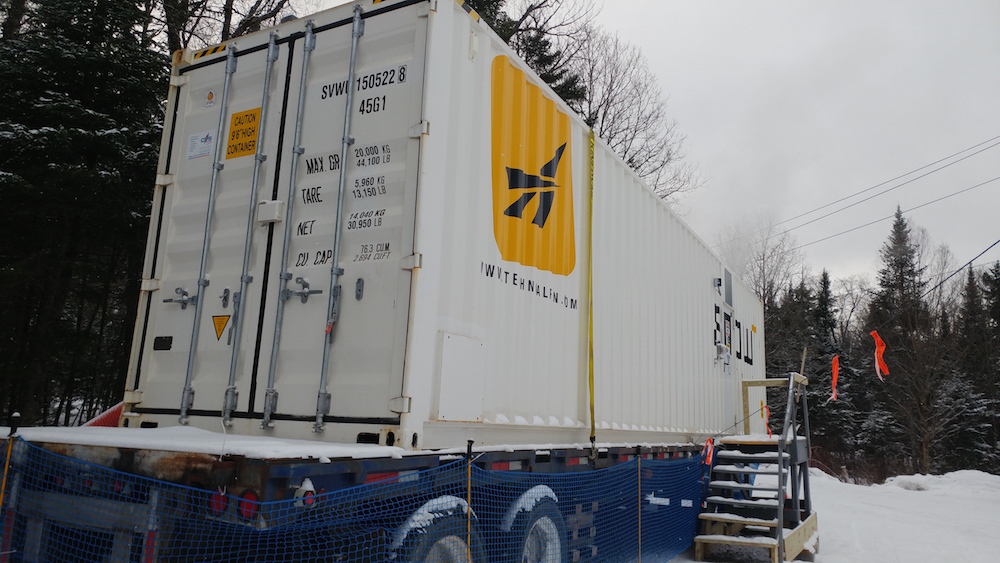
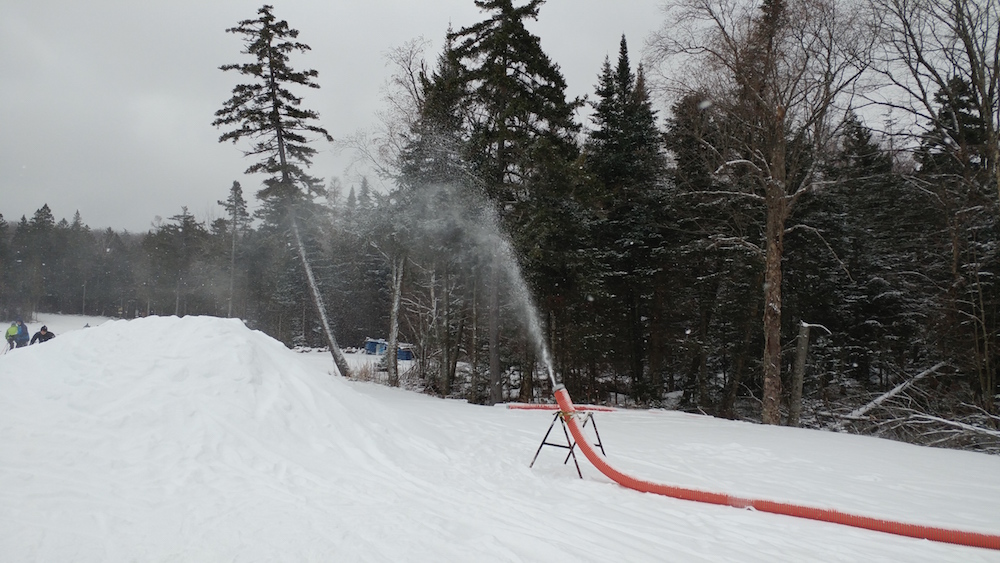
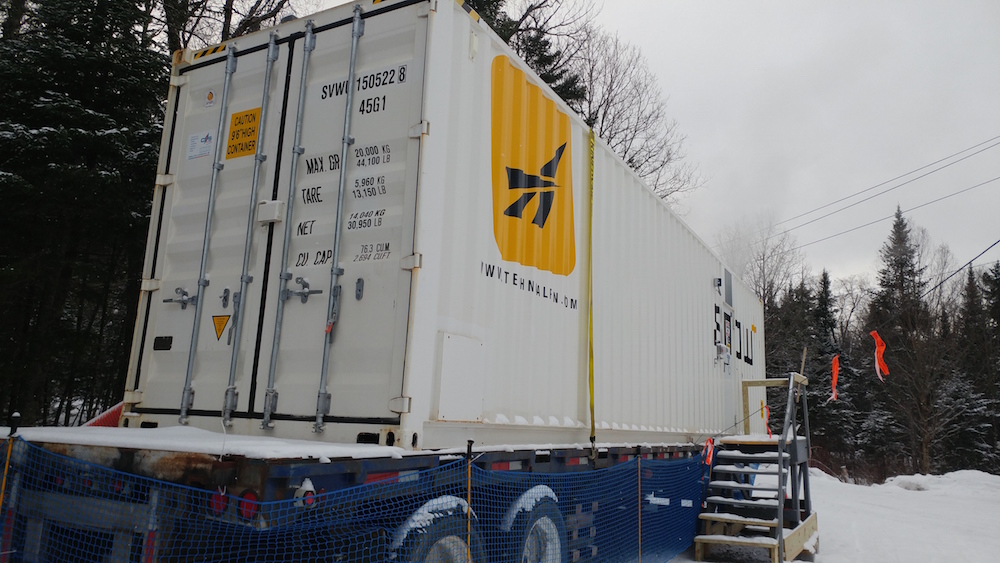
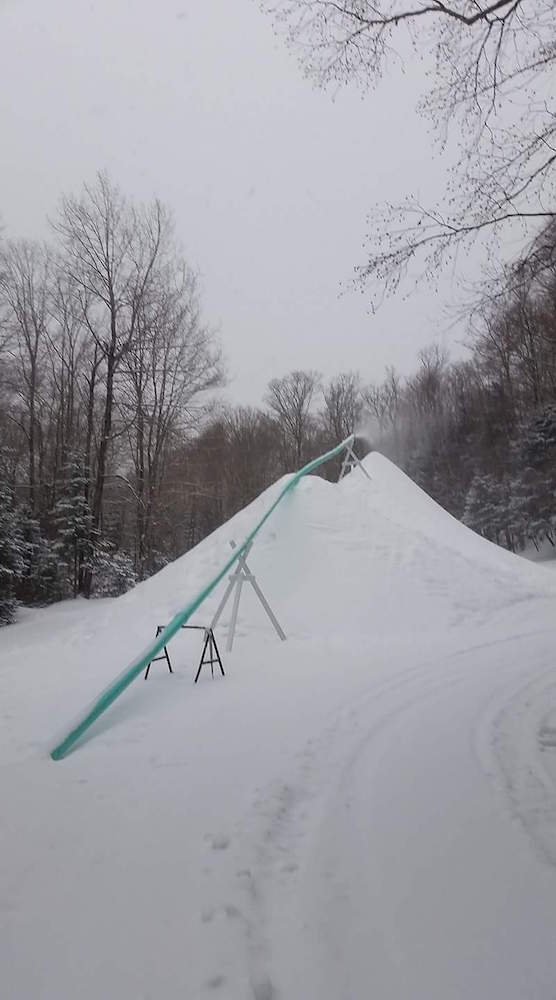
This machine isn’t your grandfather’s snowmaking setup, where snow guns are positioned strategically along trails. Mounted on a flatbed trailer, a 40-foot ocean shipping container holds compressors and ice-making equipment. A blower sends crystals through a segmented orange hose up to 600 feet in length.
The Snow Factory hasn’t budged from its original position near a parking lot, yet the snow it has produced has been spread throughout the stadium and on trails up to 1.5 k away from its starting point.
According to Robin Smith, TechnoAlpin’s Colorado-based business manager, the Snow Factory has been in production for the last four years, but its technology isn’t brand new. IDE, an Israeli company that specializes in water desalination, developed a warm-weather snowmaking unit with different technology than the Snow Factory uses.
Smith explained that the Snow Factory at Van Ho is the only one in the U.S. and one of only 19 in the world. The best part? The Snow Factory will make snow in temperatures up to 80 degrees Fahrenheit.
Blowing snow into the stadium, made by the Snow Factory, at Mt. Van Hoevenberg in late December. (Photo: Peter Minde)
Both Whiteface and Gore mountains, two of the alpine ski resorts that ORDA manages, use TechnoAlpin snow guns.
“Probably a year ago, we began a conversation with the success they [TechnoAlpin] were having in northern California with the machine that we ended up leasing,” explained Kris Cheney Seymour, Mt. Van Hoevenberg’s manager. “ORDA has its full attention and interest in the future of nordic sports at Mount Van Hoevenberg.”
When Seymour first spoke with FasterSkier on the phone in late January, the nordic center was dealing with changeable weather.
“Lake Placid has had a fairly light snow year and a fair amount of very heavy rain,” Seymour explained. “Traditionally, the stadium gets blasted in poor weather. This winter, we would have had a similar winter to what we had last year: no snow, ice conditions in the stadium. We’ve pretty much been open all but one day since Thanksgiving. The reason is the Snow Factory.”
Without the Snow Factory, Van Ho wouldn’t have been able to host St. Lawrence University’s Winter Carnival, Junior National qualifier races and other events, he said.
ORDA acquired the Snow Factory from TechnoAlpin after an alpine resort in California used it for a year. Arriving by truck the day before Thanksgiving, it took five days to haul from California at a cost of $7,000 dollars. According to ORDA’s Communication Director Jon Lundin, ORDA is leasing the Snow Factory for one year for $90,000 dollars.
In an email, Lundin explained that if ORDA decides to purchase the Snow Factory, it will pay a total of $500,000 dollars: $410,000 plus the amount already paid this season.
“We’ll make the decision later this spring as to whether or not we purchase the Snow Factory,” he wrote. “We’ll look at how it performed and how the cross-country venue benefited from its use.”
The Snow Factory in place at the Mt. Van Hoevenberg nordic center in Lake Placid, N.Y. (Photo: Peter Minde)
So how does this thing work?
Inside the shipping container are three icemakers, refrigeration equipment, a cooling tower, and a blowing system. The blowers move snow through a segmented orange hose. One can add segments to blow snow up to 600 feet away from the Factory.
“Other [traditional] snowmaking systems require a temperature and humidity component,” Reese Brown, executive director of the Cross Country Ski Areas Association, said on the phone. “Generally, 22 to 27 degrees and below is good snowmaking weather. The Snow Factory doesn’t require any conditions to make snow, because snow is generated inside the container and then spit out the hose. With the others, snow is made when it hits air temperature.”
“Snow is created within the shipping container,” Seymour said. “You can effectively make snow with 100-percent efficiency up to 60 degrees Fahrenheit. You’ll have diminished productivity, but you can make snow up to 80 degrees.”
Running on electricity, the Snow Factory draws from the ski lodge’s well, using 11 gallons of water a minute. The icemakers can be optimized for various climates. Seymour pointed out that northern California has a much drier climate than Lake Placid.
Dumping snow onto the trails at Mount Van Hoevenberg this winter. (Photo: Mt. Van Hoevenberg/Facebook)
Leading up to U.S. Junior Nationals, held in Lake Placid from March 3-11, FasterSkier asked Seymour about the Factory’s capability to cover a 5-kilometer loop if the ground was bare. With snow already on the ground, Seymour reframed the question.
“It works differently than a traditional snow system, and you need to use it and plan for it in a different way,” he said. “The Snow Factory makes a known quantity of snow: two tons per hour. Depending on what our needs are for snow coverage and where we want to go with it, we need to work backwards and give ourselves enough time to blow that amount of snow.”
While the Factory is mounted on a trailer, the trailer hasn’t moved from its home behind the lodge. The primary locations for its manmade snow have been the stadium, the Innerloopen 3.3 k homologated ski loop, and the beginner trails close to the lodge.
Days before Junior Nationals, ORDA decided to move the weeklong event to the 2.5 k loop at the Olympic Jumping Complex, also known as the MacKenzie Intervale Ski Jumping Complex, closer to downtown Lake Placid.
“Six weeks out, we were aware that the long-term forecast had two almost weeklong periods that we were going to have very warm weather,” Seymour said in a follow-up interview after Junior Nationals (JNs).
Leading up to the championships, the Factory had been cranking almost around the clock. Seymour estimated that once a week, ORDA would shut it down for maintenance. Otherwise, it ran 24/7.
A large pile of snow produced by the Snow Factory this winter at Mt. Van Hoevenberg in Lake Placid, N.Y. (Photo: Bob Maswick)
The stadium was covered a mix of natural and manmade crystals, 2 1/2 feet deep. The next focus was the sprint loop and the 3.3 k loop.
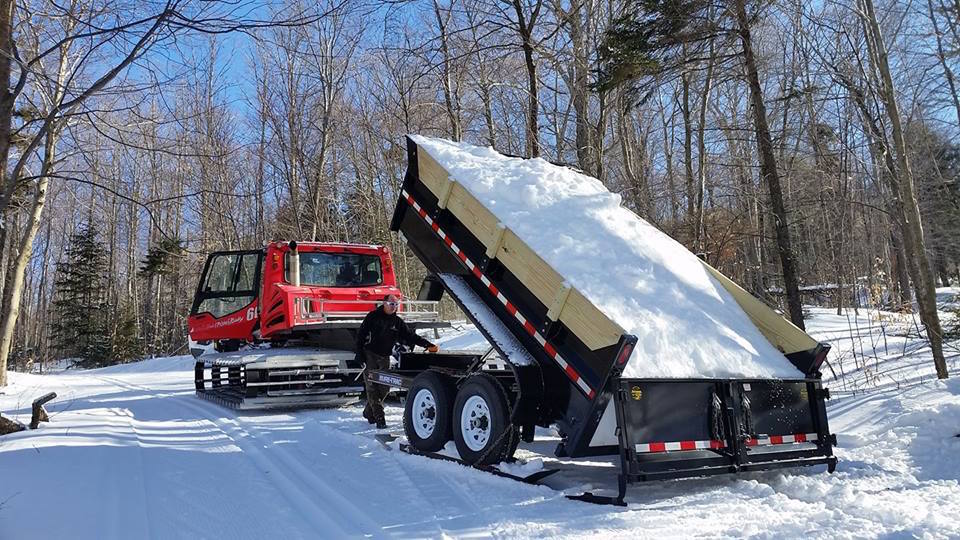
“We were moving snow 10 to 14 hours a day,” Seymour said. A PistenBully hauled snow in a 16-foot dump trailer to where they needed it. ORDA bought the trailer specifically for Van Ho.
Two weeks before JNs, groomers had buffed the 3.3 k loop to a 28-inch average depth with a mix of natural and manmade snow. Then, “We had really warm weather,” Seymour said. A warm three-day period with high winds and heavy rains reduced the base depth to 12-18 inches.
Then, starting Feb. 24, another three-day thaw cost precious base depth. A week before the championships, the race courses were down to an average depth of 4 to 8 inches.
The death blow came one night later. Driving rain and 50 mile per hour winds wiped out weeks of intense work. Wednesday morning, they inspected the courses. Not only was snow melting, but water was “flowing all over the place,” Seymour said. “We had large portions of the race trail that were totally washed out. There were sections of the trail that were lovely and totally groomable. But we also had a 100-meter section of the trail that was totally gone, like, 100 percent gone from pouring water.”
That morning, Van Ho still had snow stockpiled in the stadium out near the 3.3 k loop. But the forecast for Sunday through Wednesday of championship week called for temperatures in the mid 40s.
The forecast was accurate.
“We could have rebuilt the course so that it had four to six inches of snow everywhere,” Seymour said. “We knew that Mount Van Hoevenberg couldn’t survive a third major thaw in a four-week period.
“We had a course that was mostly built at the jumps,” he explained.
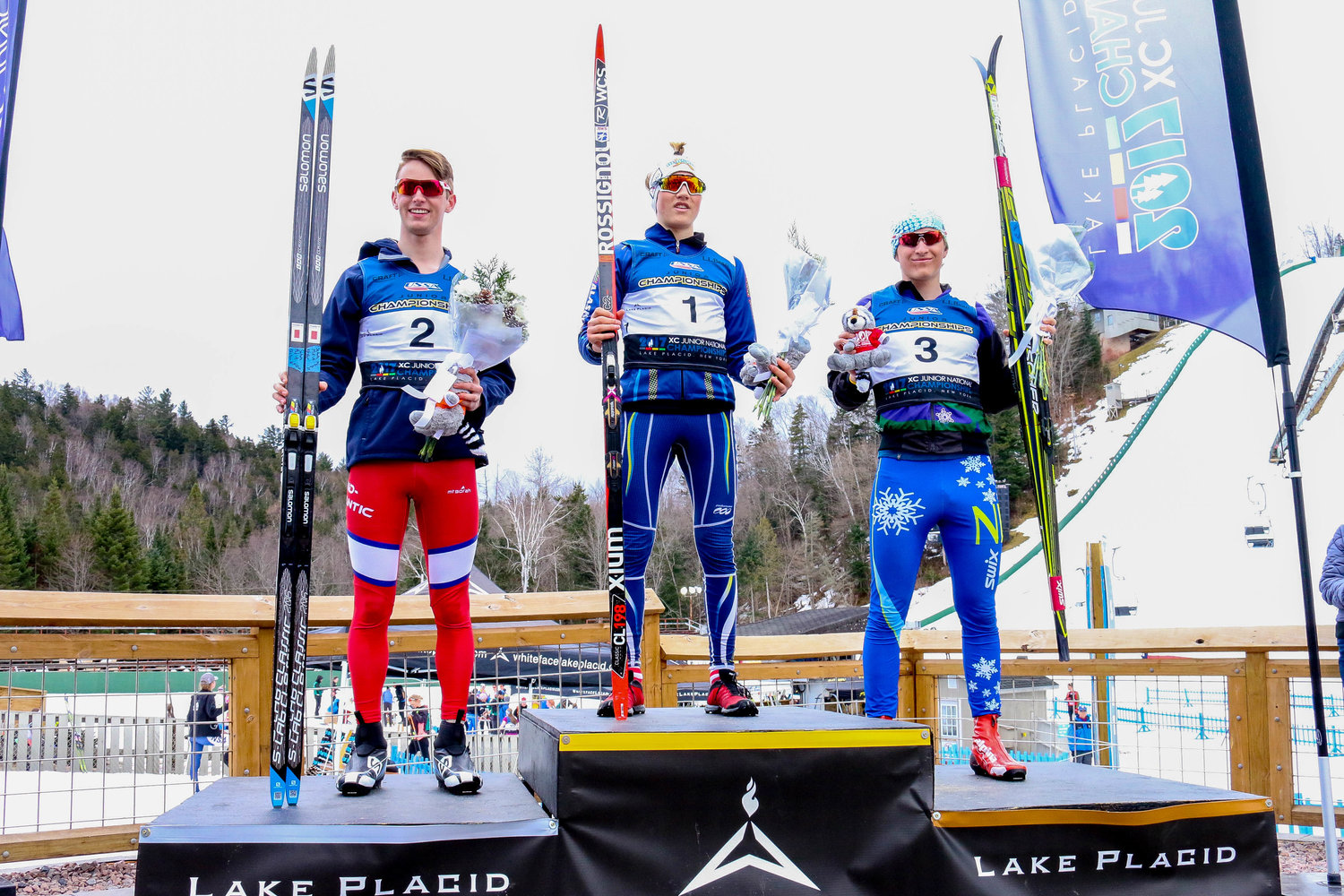
The U18 boys’ classic sprint podium at U.S. Junior Nationals, held at the Olympic Jumping Complex in Lake Placid, N.Y., with Gus Schumacher (c) of Alaska Winter Stars in first, Scott Schulz (l) of the New York Ski Educational Foundation in second, and Adam Glueck (r) of Ford Sayre in third. (Photo: XCJuniorNationals2017.com)
Blowing snow on site for 30 hours and working around the clock, ORDA employees also moved all the snow from the in-run of the ski jumps and the in-run and landing areas of the freestyle training area, which had a depth of eight feet. With that and the snow made on site, the Intervale loop was covered to an average depth of 2 1/2 feet for a successful Junior Nationals.
As a result of the venue change, there was only one adjustment to the schedule. Coaches, jurors and organizers agreed to switch the classic mass start to an individual start because of a narrow spot for two-way traffic midway through the loop.
While the Snow Factory ultimately didn’t play a part in JNs, it continued to blow snow at Van Ho, which remained open while the races happened took place at the jumps. Teams arrived early and trained on the trails, some choosing to cool down or train on off days at Van Ho.
“That was 100-percent Snow Factory,” Seymour said.
Besides the Factory, there have been other significant improvements to Van Ho. According to Allan Serrano, the FIS technical delegate who worked with ORDA to homologate Van Ho’s race trails, the stadium exit, along with much of the Interloopen portion of the Ladies’ 5 k loop, was widened.
“Most importantly they have been able to do rehabilitation work on the Ladies 5k, leveling and improving the water management so that it skis and grooms much better,” Serrano wrote. “They are able to have a high quality ski surface with lower snow.”
He added that Van Ho’s grooming capacity has also improved since its courses were certified in 2012.
“At that time the venue did not have a dedicated snowcat with track setters and now they have a machine with double track setters,” he wrote.
As race season winds down, what’s next? With the ability to make snow in warm temperatures, Seymour was intrigued by the opportunity to provide skiing on short loops in the offseason. He’s got the attention of John Farra, the high-performance director for U.S. Paralympics Nordic Skiing.
“We have found that it is most valuable for sit skiers especially to have access to snow in the ‘off season,’ ” Farra wrote in an email. “The nature of maneuvering a nordic sit ski on turns, downhills and out of the track is not something that can be duplicated on roller skis, so we have found [snow] much more valuable for sit skiers in advancing their technical skills. We are very interested in the Snow Factory project that ORDA has invested in and have been in touch with Kris about the possibility of getting our National Team to Lake Placid to take advantage of their new Snow Factory snow in this coming Games season.”
“Part of skiing currently is having a viable snowmaking option,” Seymour said. “The Snow Factory will guarantee the ability to open the venue when we want to and hold races as they’re scheduled; we can be counted on as a world-class venue. It’s a game changer.”
Trail runners and off-road cyclists are invited to participate in the inaugural ADK 80K, an eight-of-a-kind endurance racing event to be held in Lake Placid, N.Y. on Labor Day Weekend, Aug. 31 – Sept. 1, 2013.
The races cover 80 kilometers (80k) in distance, in a figure-8 design, feature $8,000 in prizes in 8 categories with an 8:00 a.m. start time. The weekend consists of two separate events, both taking place on the Mount Van Hoevenberg trail system used in the 1980 Olympic Winter Games biathlon and cross country ski races, and now celebrating 20 years as the home base of High Peak Mountain Bike Center.
The ADK 80K begins with a trail running race on Saturday, followed by Sunday’s mountain bike race with a cyclocross division. Both races include four 20 kilometer loops in a figure 8 design with aid stations every 5k, each returning to the family-friendly race village twice, complete with food, refreshments and live music. The festive weekend also includes a mini-trail run on Saturday and mountain bike race on Sunday for kids beginning at 4pm. Both mini-races cover a distance of 8 kilometers, with four loops of 2 kilometers each.
The ADK 80K is organized by the experienced team from High Peaks Cyclery and Downhill Mike of the Whiteface Mountain Bike Park. “It’s great to utilize the outstanding trail system at Mount Van Hoevenberg for a summer event of this sort,” said Brian Delaney, president/owner of High Peaks Cyclery, now celebrating 30 years of business in Lake Placid. “Downhill Mike and I have been dreaming of this event since the popular 24-hour team mountain bike endurance race was discontinued years ago, and we look forward to welcoming hundreds of athletes of all levels to join in on this inaugural weekend.”
Trail runners and cyclists can race solo, 2-person or 4-person teams. Cyclists can ride mountain bikes or cyclocross bikes. The first 80 registrants receive free t-shirts, and the top three winners in each category will win commemorative Adirondack-themed awards as well as winners’ jerseys or performance running t-shirts. Logo goods will be available for purchase in advance at High Peaks Cyclery in Lake Placid and on site at the event.
Registration is $80 per person, and is now open and information is online at highpeakscyclery.com, or call Brian with questions at 518.523.3764. Onsite registration will be available at 6:00 a.m. both days of the event.
An athlete training during a U.S. Ski Team camp in Lake Placid. Photo: TeamToday.
New York’s Olympic Regional Development Authority (ORDA) has received $5.6 million in funding in a budget measure that passed in the New York state assembly on Friday and the state senate on Monday.
ORDA manages Mount Van Hoevenberg, the site of the cross country, biathlon and nordic combined events during the 1980 Winter Olympics in Lake Placid NY, and the other legacy venues from those Games.
The appropriation is about 16 percent of ORDA’s approximately $34 million budget, and is $1 million less than the authority received last year. In a budget document submitted to the state in February, ORDA had projected receiving $7.1 million from New York.
Travis Proulx, the New York Senate’s deputy press secretary, noted that “ORDA has cash on hand which will allow them to absorb this reduction.”
ORDA Communications Director Jon Lundin said that the $5.6 million appropriation was “the number we’ve been anticipating.”
“Each year,” he added, “we’re operating with less and trying to do more.” Mount Van Hoevenberg “will run a little bit leaner” in the coming year.
Lundin said that even if ORDA had firm information about funding earlier in the spring, their position on hosting the World Cup biathlon race next February wouldn’t have changed.
“We needed to be creative from the very beginning,” Lundin said. The hangups that prevented Lake Placid from hosting the events were the upgrades to bring the venue to current International Biathlon Union standards. Lundin cited computerized targets and an improved judges’ tower as required measures, though he was unable to provide an estimate of the cost of improvements.
A collegiate race at Mount Van Hoevenberg in Lake Placid, which faces the possibility of closure if funding is not delivered in the New York state budget
Lake Placid’s cross country, biathlon and ski jumping venues face the possibility of closure if the state does not appropriate money later this month.
The Lake Placid Daily News reported in March that New York’s Olympic Regional Development Authority (ORDA), was at risk of losing all of its state funding for the coming fiscal year. The aid, approximately $6.6 million last year, comprises some 20 percent of ORDA’s budget.
A member of ORDA’s board of directors is on record in the Daily News story as saying that the authority would have to close without the state’s appropriation.
ORDA is the body that manages the legacy venues of the 1980 Winter Olympics in Lake Placid, including the cross-country, biathlon and sliding facilities at the Olympic Sports Complex at Mount Van Hoevenberg, just outside town. The Olympic ski jumps, Whiteface Mountain Ski Center, and Olympic Training Center in are also managed by ORDA.
While the closing of these areas would be a big loss to recreational skiers, it would be an even bigger blow to the elite and developing athletes that train at these venues. The combination of ski trails, biathlon range and jumps in close proximity to one another make this a valuable resource for local athletes.
The New York Ski Education Foundation runs extensive youth programs that make use of the Olympic Sports Complex. It’s also a training center for American biathletes and Nordic combined skiers. The U.S. Ski Team holds an annual fall training camp in Lake Placid.
“It would be a tragedy for biathlon if Mount Van Hoevenberg were to be shuttered,” said Max Cobb, U.S. Biathlon’s executive director.
Cobb said he thought that juniors and developing athletes would be impacted more than elite athletes. Juniors ski and compete in the area all year round, while elite athletes like Lowell Bailey and Tim Burke train in Lake Placid only during the dryland season, prior to traveling for World Cup events.
While people might be willing to drive a long distance to try a new activity for the first time, Cobb said that to ensure consistent training and world class progression, athletes should live within a one hour drive of a venue.
As well as the cross-country trails and biathlon range, Lake Placid is also home to the ORDA-managed ski jumps. In addition to the iconic 90- and 120-meter Olympic hills, the jumping complex has three smaller hills for developing athletes. Athletes can train on three of the five jumps during the summer, sliding on a combination of plastic shingles and porcelain marble halves.
While there are ski jumping hills throughout New England, ranging from 10 to 90 meters, few of them have summer jumping facilities. And Ken Barker, president of the Salisbury Winter Sports Association in Salisbury, CT, said that summer jumping is essential to training from J5 through Olympic athletes.
Barker’s club will put plastic shingles on their 20-meter hill for the first time this summer. (They’re also rebuilding their large hill for the 2011 Junior Olympics.) And Barker cited the Lebanon Outing Club, in New Hampshire, as another facility that offered summer jumping. But few jumps in the region have the same level of programming as Lake Placid.
Finally, there’s ORDA’s Sports Development Program, which offers year-round educational opportunities to youth groups, including sports clinics in biathlon, luge, bobsled and curling. They even partner with the New York City Parks Department’s Winter Jam, offering residents the opportunity to try out cross-country skiing in Central Park.
Brad Clark, ORDA’s sports development manager, organizes outreach programs—activities like school field trips and interactive clinics at the various venues. If a child shows potential in a particular sport, Clark helps them find appropriate coaching. Without ORDA, Clark said, these outreach programs would not exist.
The tight budget situation is underscored by the news last week that ORDA had declined an opportunity to host a biathlon World Cup race at Mount Van Hoevenberg in February, 2011.
Jon Lundin, ORDA’s communications director, said that the organization “would have needed to upgrade the facilities to comply with IBU [International Biathlon Union] requirements for a major World Cup event.”
“We certainly are looking into [making the upgrades]; we just couldn’t do it this year,” Lundin said. He added that passing on the biathlon race was a “one-time blip,” noting that ORDA planned to host international events in the sliding sports, and possibly a World Cup freestyle event, in the coming year.
In an interview with FasterSkier, Lundin said that he didn’t know how ORDA’s operation might be changed if the state does remove funding. However, he added that state law stipulates that Mt. Van Hoevenberg cannot be privately owned or leased to a business-person in the private sector.
Travis Proulx, the state senate’s deputy press secretary, told FasterSkier that there is “still no finality to the status of ORDA’s funding.” He said that the senate didn’t want to cut ORDA’s appropriation in the first place, but that alternative funding is needed.
With one to two weeks until a budget is finalized, Proulx said that the Senate is “looking for ways to keep the state’s role in ORDA alive,” citing alternative budget cuts brought to the table by the Democratic caucus and alternative revenue options submitted by the Governor David Paterson—including one proposal to allow the sale of wine in grocery stores. Regardless of the final decision, both houses of the New York legislature, as well as the governor, are required by law to be in agreement on the state budget.

 This coverage is made possible through the generous support of Marty and Kathy Hall and A Hall Mark of Excellence Award. To learn more about A Hall Mark of Excellence Award, or to learn how you can support FasterSkier’s coverage, please contact info@fasterskier.com.