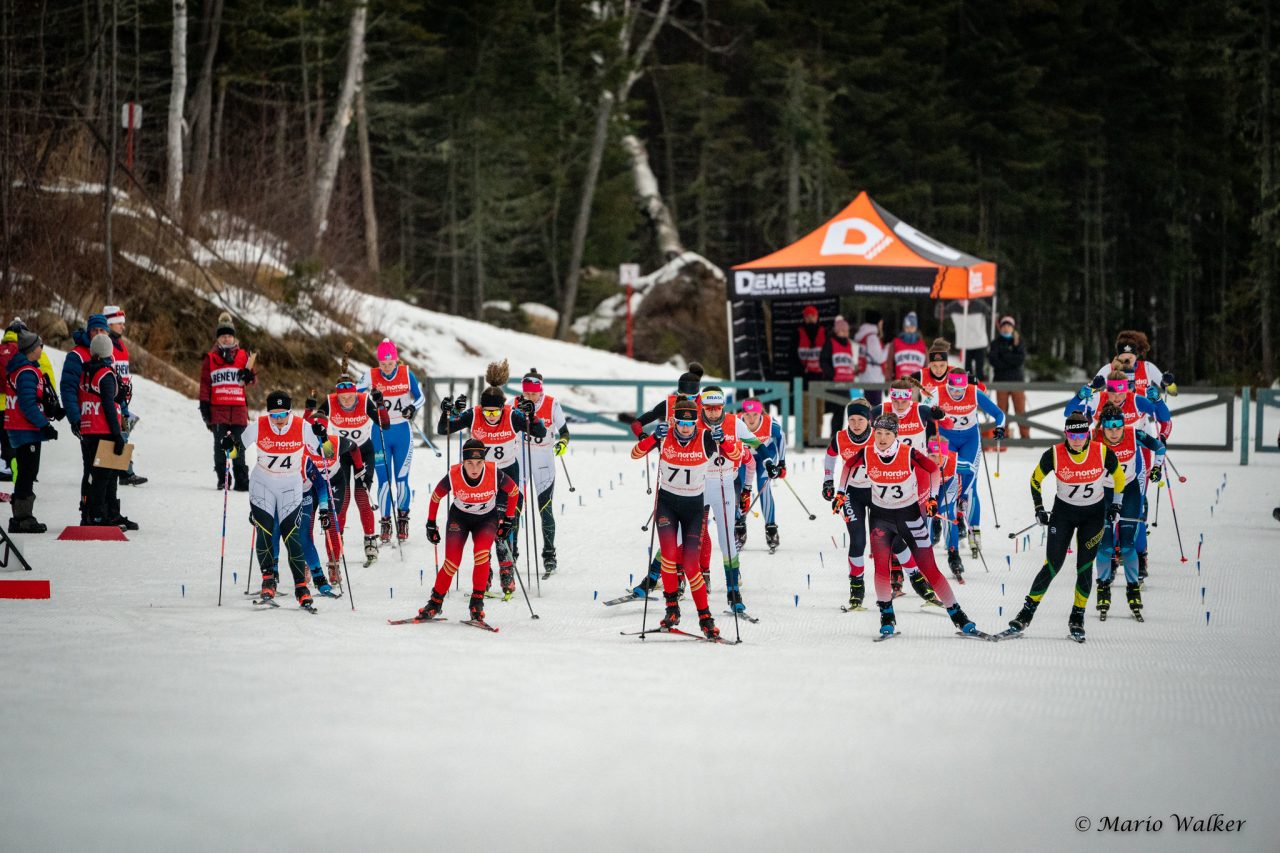
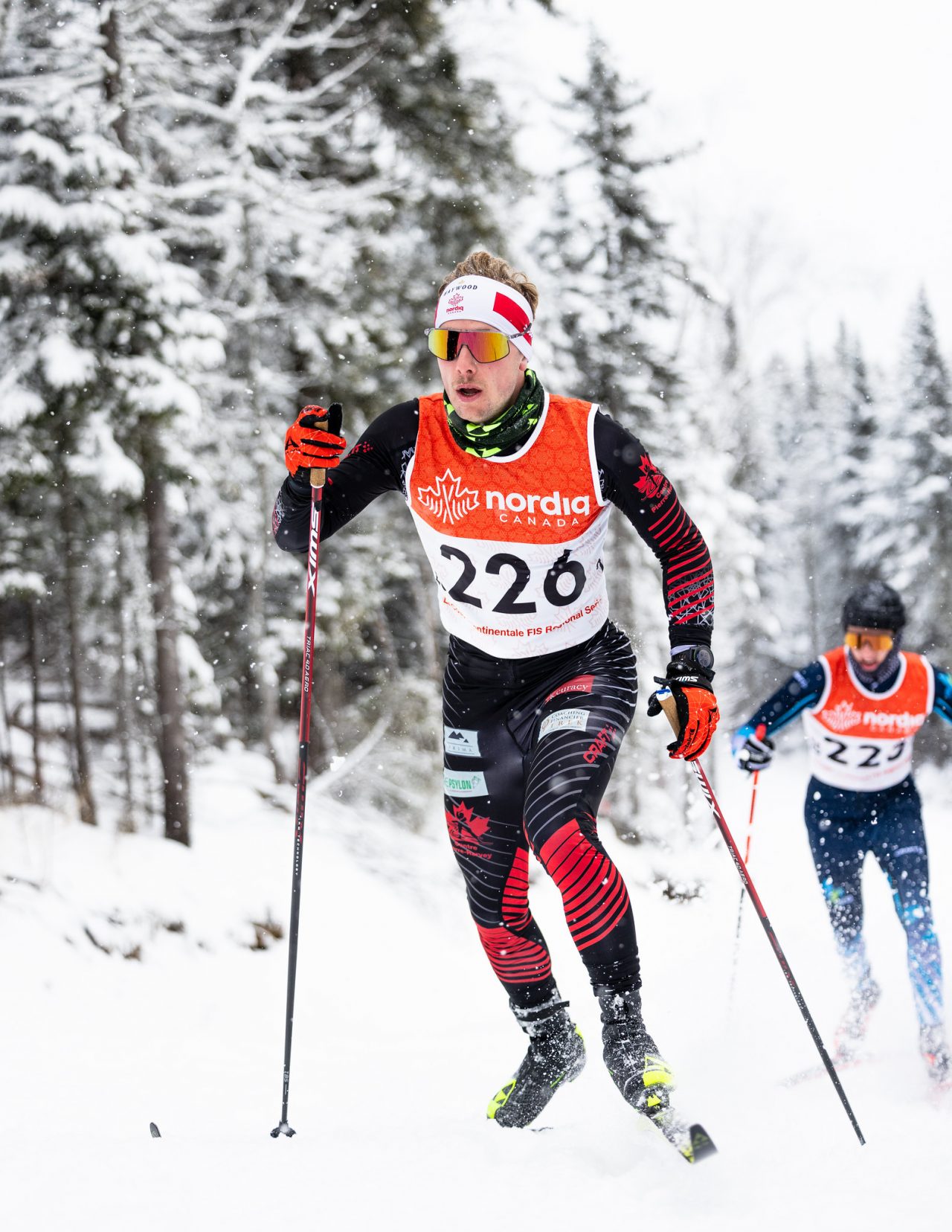
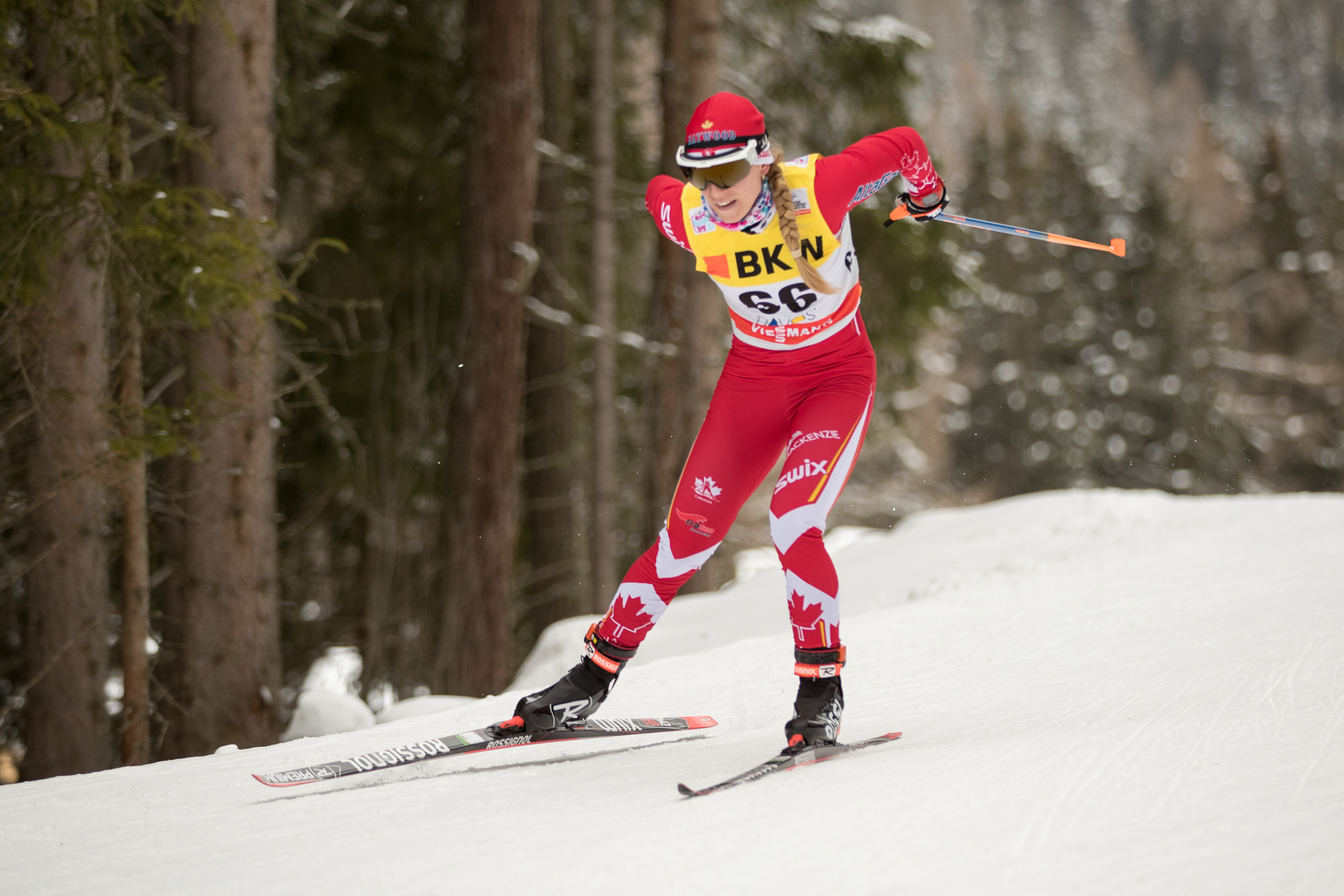
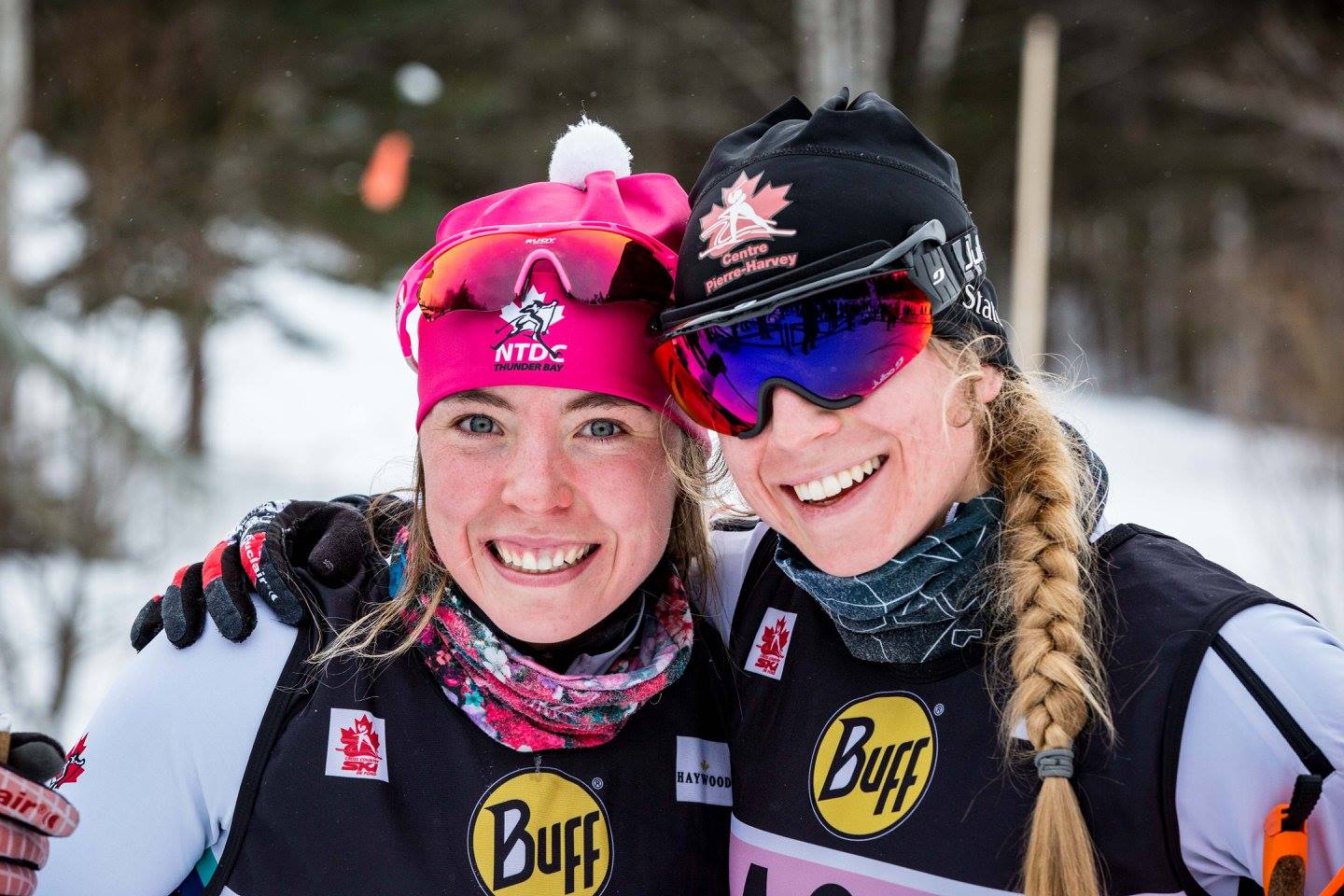
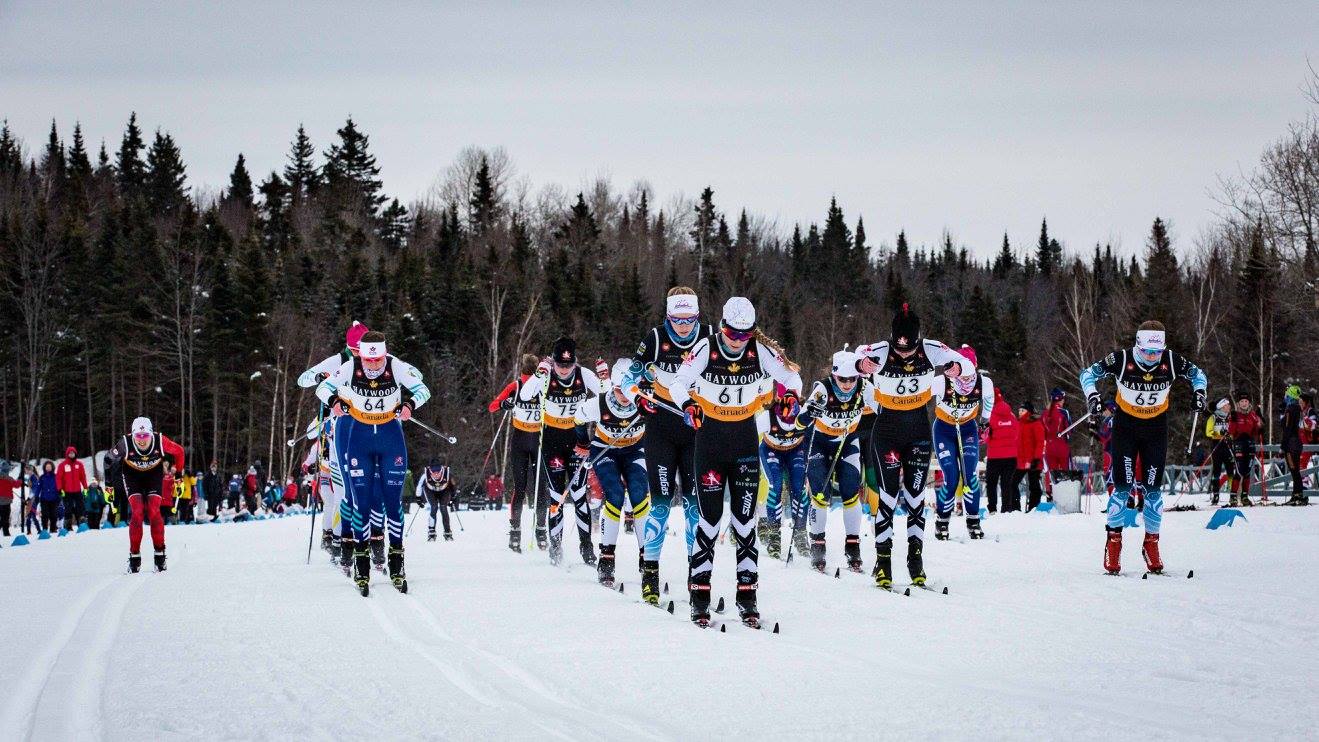
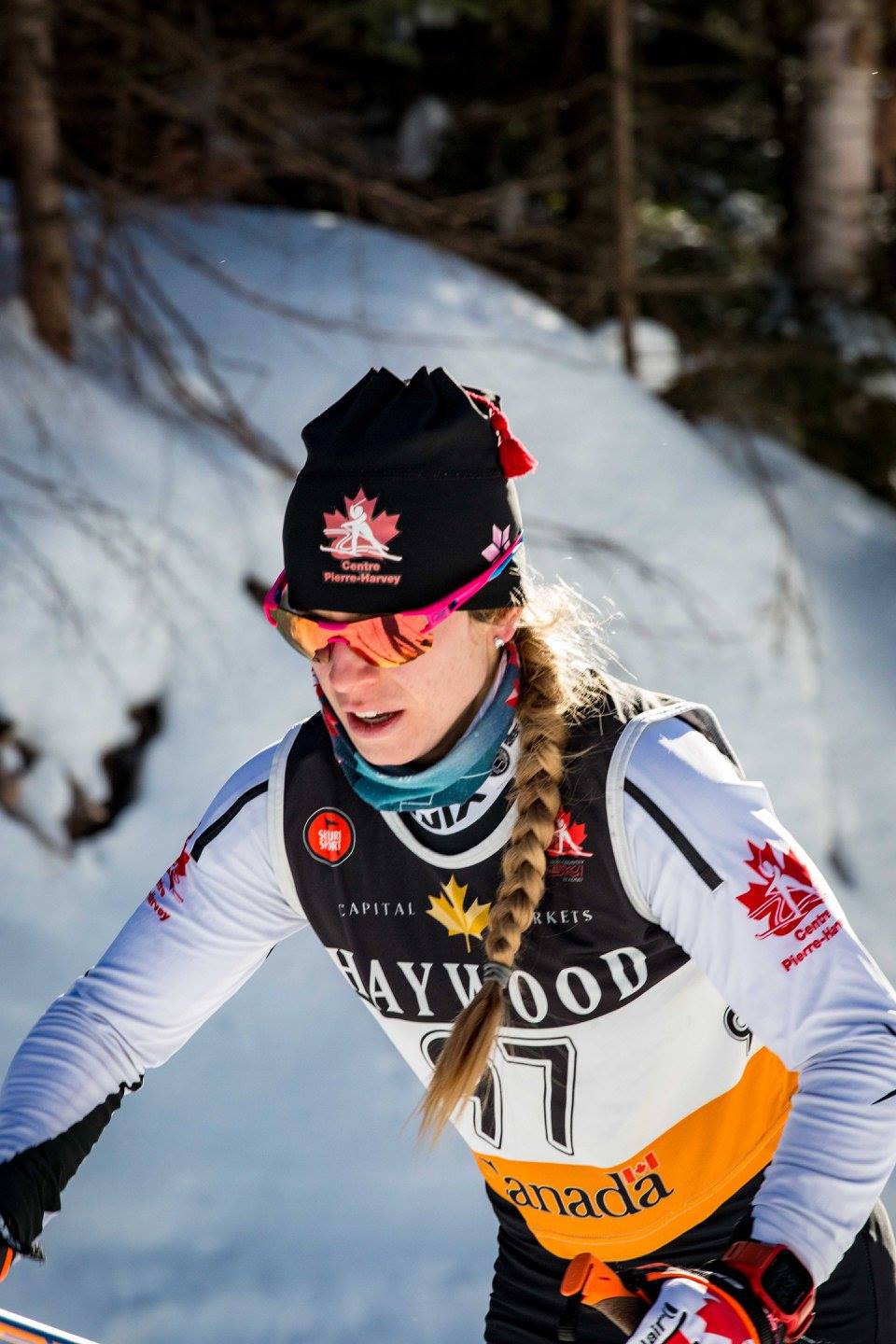
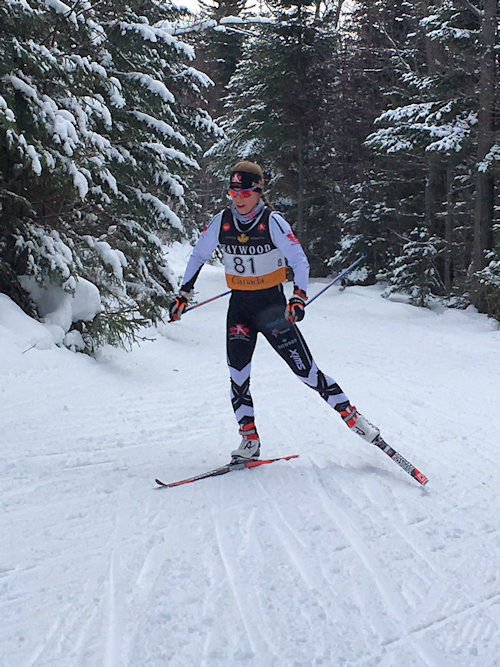
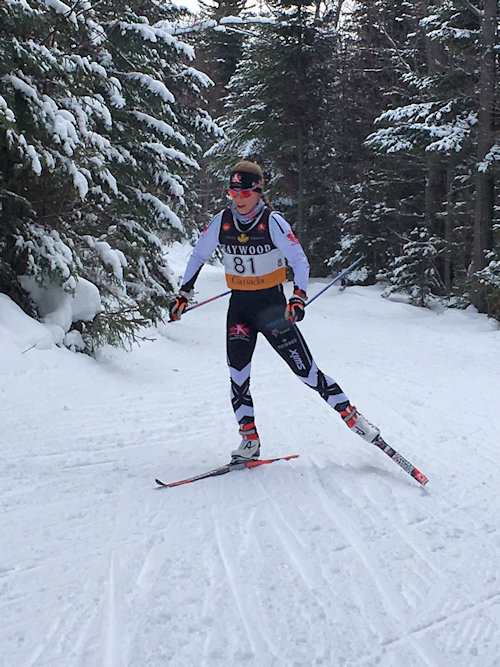
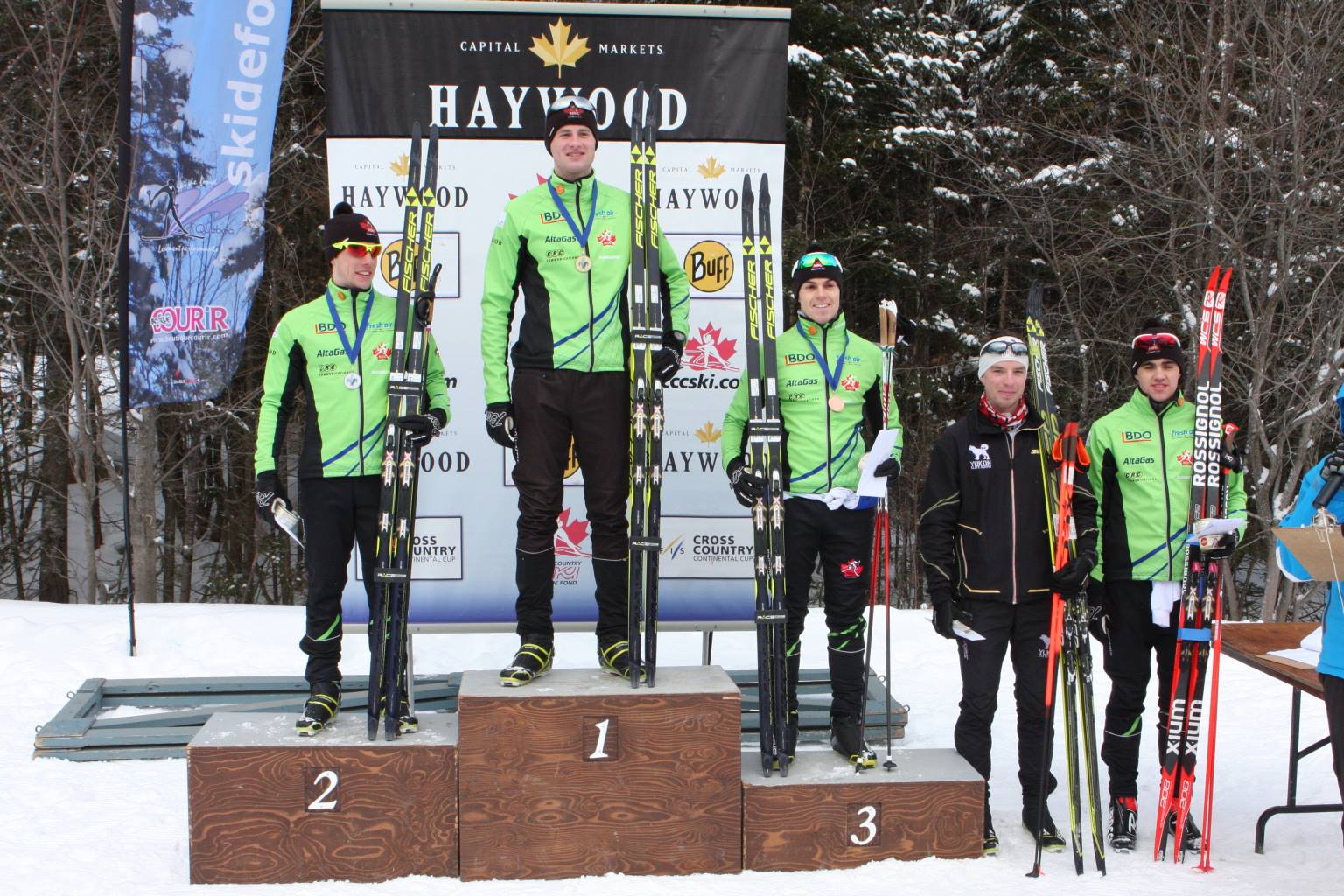
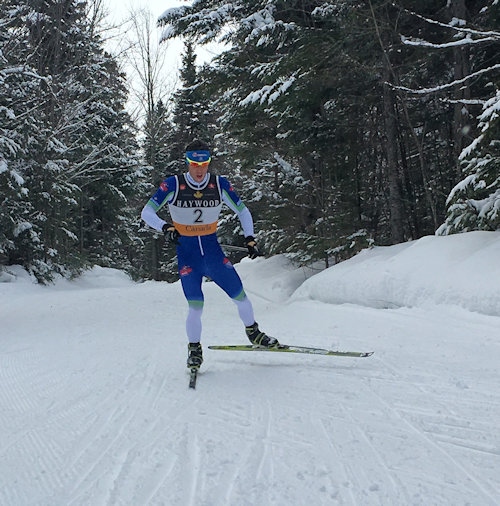
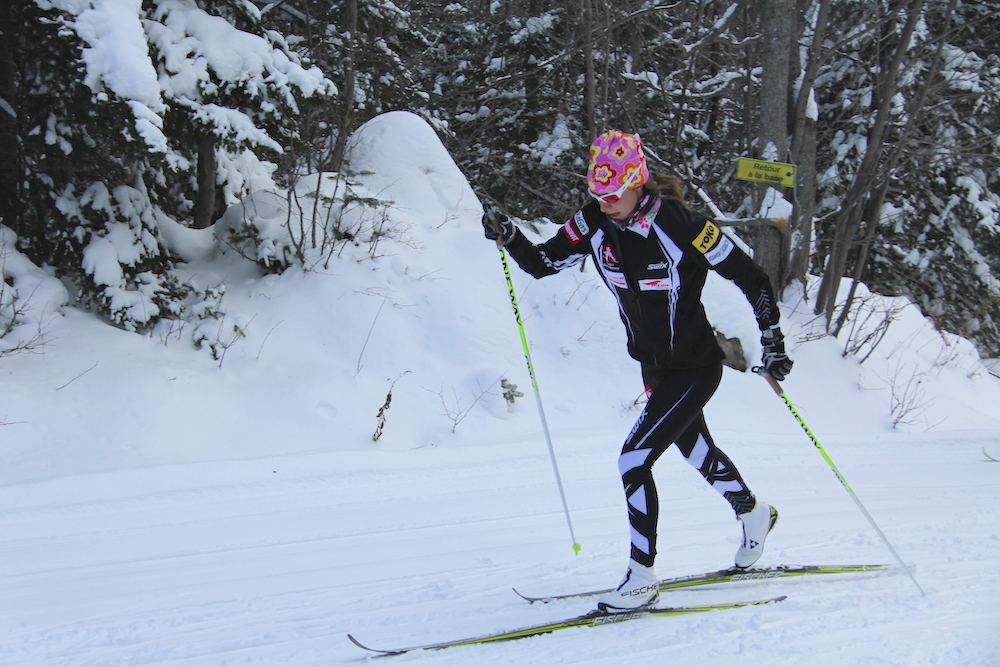
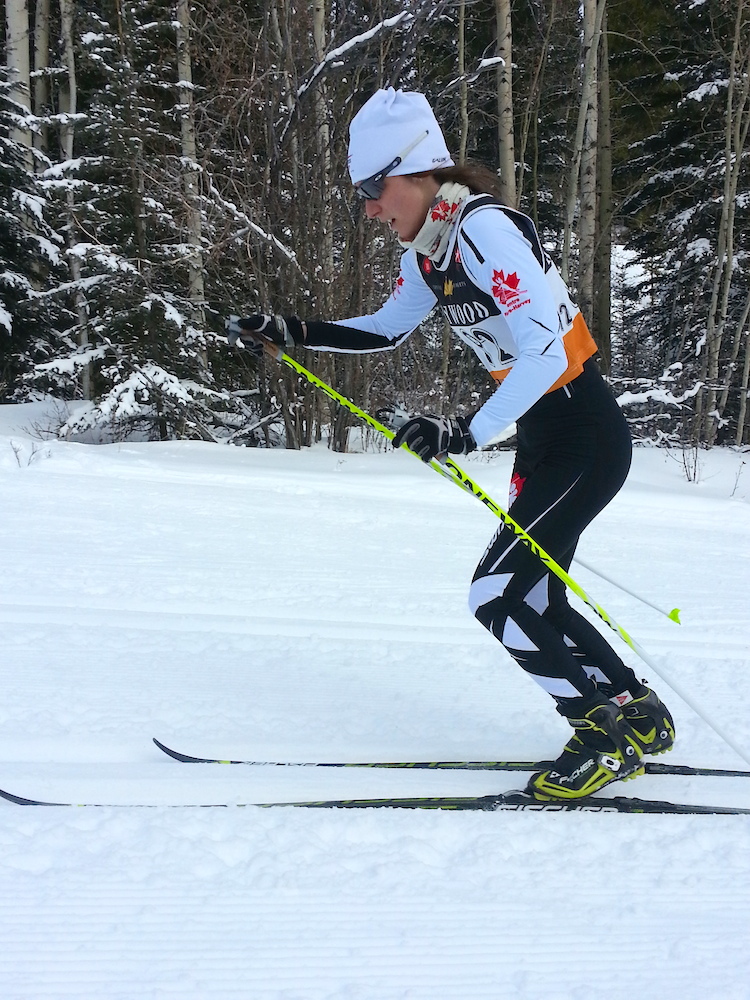
The women start at Mont Sainte Anne. This is the first mass start 20km for most of the field. (Photo: Mario Walker)
Mont Sainte Anne (MSA) held the final pre-Christmas races in Canada over the weekend, with a 20km freestyle mass start Friday, freestyle sprints on Saturday, and 10km individual start classic on Sunday.
Fresh snow, steep hills, and temperatures comfortably below freezing greeted 400+ racers at a continental cup hosted by Skibec, Centre National d’Entraïnemente Pierre Harvey (CNEPH) , and Club Nordique MSA.
MSA is a popular racing destination, as Nakkertok’s Bronwyn Williams explained: “I love racing at MSA because the trails are amazingly challenging! For some other race courses you need to work hard to bury yourself but at MSA the courses go out of their way to destroy you and if you’re not careful they will. That’s what makes it so fun though because you are not just racing your competitors, but you are also trying to survive the courses.”
Friday
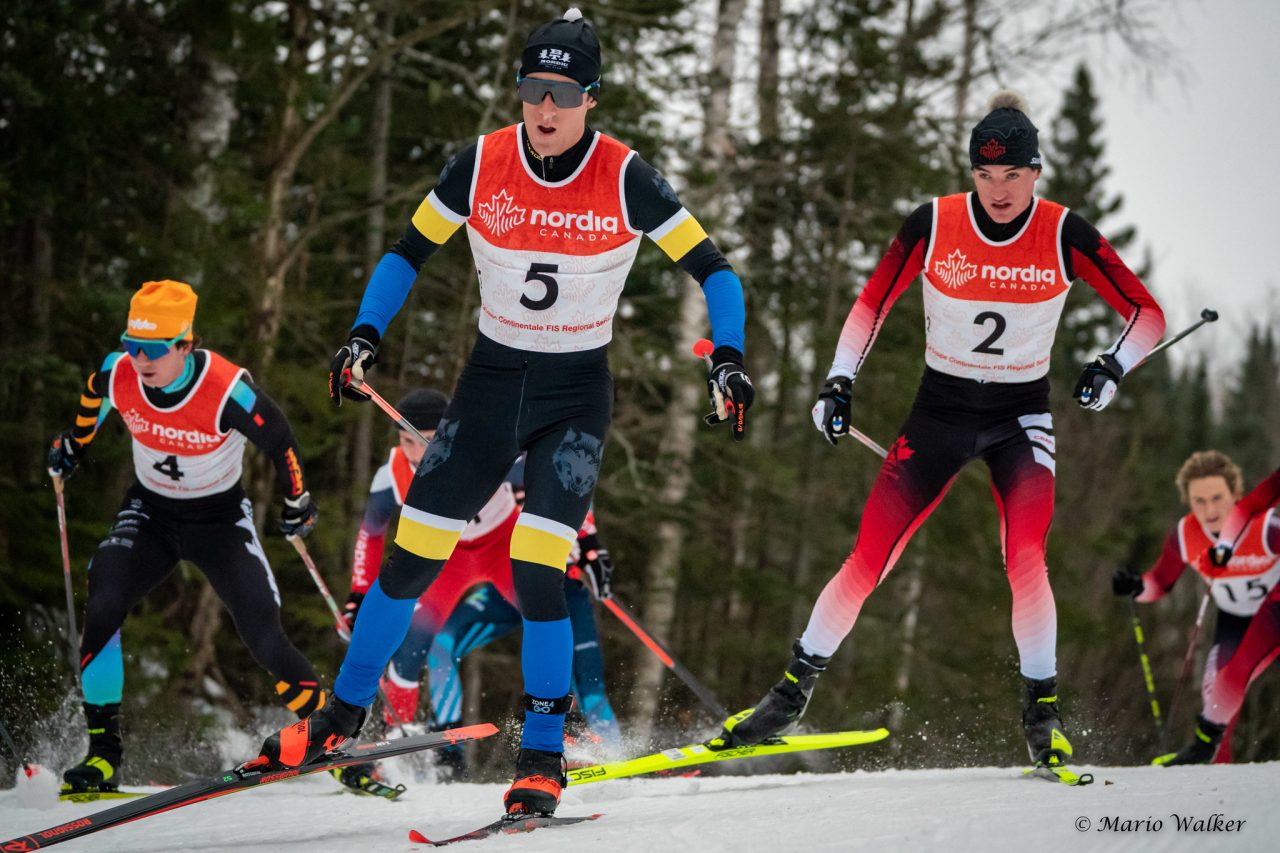
Winner Sasha Masson (#2) skiing patiently in the lead pack. (Photo: Mario Walker)
Sasha Masson (CNEPH) kicked off the weekend with a win in the 20km skate, finishing in 47:44.9, 6.2 seconds clear of four skiers: Orford’s Léo Grandbois, Montériski’s Alexandre Bourque and Xavier Lefebvre, and Big Thunder’s Conor McGovern.
“It was a good day overall,” Masson wrote to FasterSkier. “I played it safe and skied with the pack for a bit, then used my legs to work my skis on the flats and the downhills. Today, pushing over the top and in the downs was essential and allowed me to win.”
For the women, it was the U20 show with Kanata’s Helen McCulligh winning in 59:08.5, followed by MSA’s Ophélie Grandmont at 8.9 seconds and Whitehorse product Constance Lapointe at 9.8 back.
“It was a very fast day out on the course,” McCulligh told Nordiq Canada. “It was my first ever time racing a 20km, so I didn’t know what to expect going in.”
As in Davos two days later, the new distance caused some learning moments and a change from ‘normal’ tactics.
“We had a really big group of girls, a big pack stuck together for a long time.”
Saturday
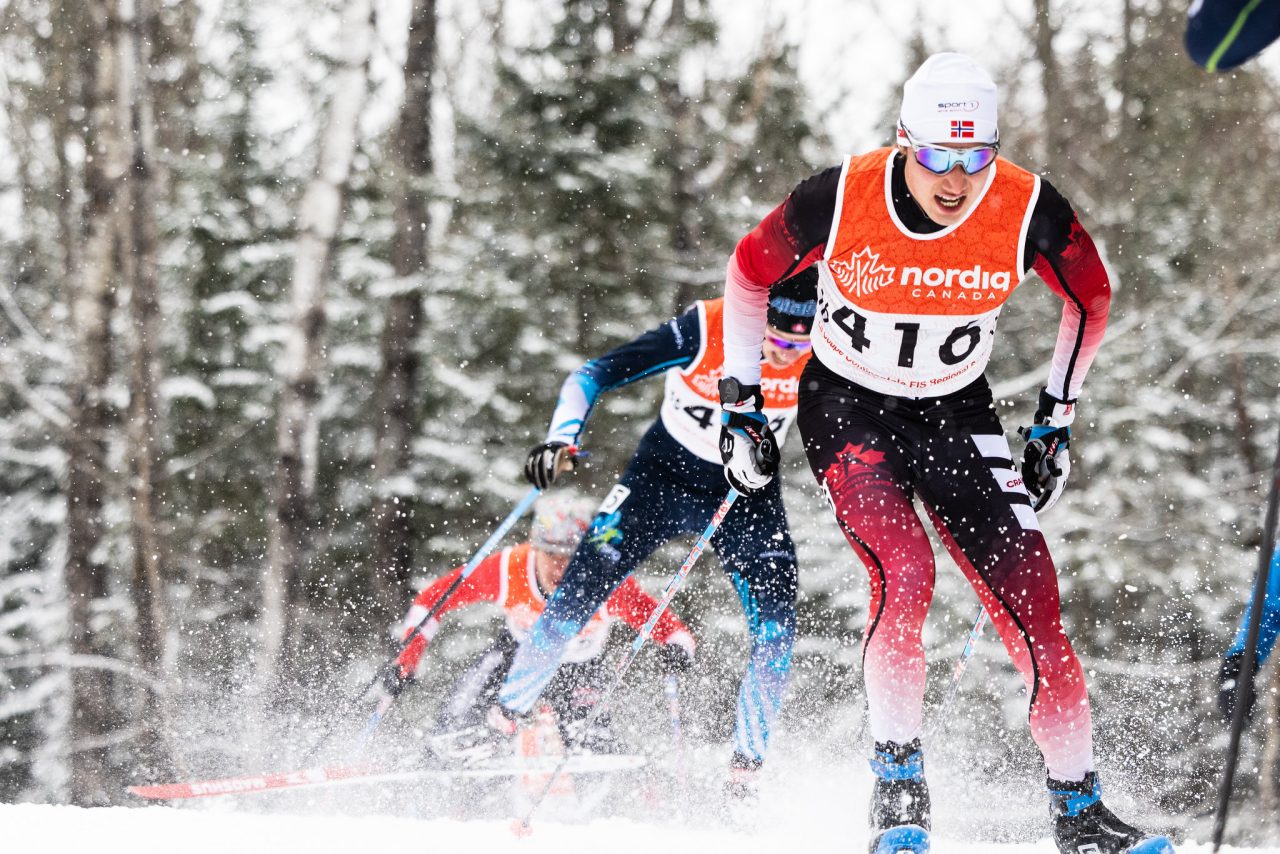
Mats Halvorsen chasing hard in the semi-final. (Photo: Raphaël Payo)
Saturday brought a 1.1km skate sprint and a deeper field with the addition of many student athletes.
Chelsea’s U20, Ry Prior, now training with the Alberta World Cup Academy, won the Open men’s final in 2:20.53, ahead of CNEPH teammates Felix-Olivier Moreau at 1.58 back and Guillaume Pelchat at 3.25 seconds.
Chelsea’s U18, Tory Audet, continued her domination, skiing away from the group in each heat on her way to win in 2:35.94, 10.13 seconds ahead of Nakkertok’s Bronwyn Williams. Katherine Mason was third for Nakkertok, 12.54 behind.
Audet went with a straightforward tactical plan: “I didn’t think much about tactics,” she said. “I just tried to ski the course as fast and efficiently as possible due to the fact that it was a very short course.”
A very short course at MSA? There was a course change announced at 7:30am race day.
“The course ended up basically being a short 1km loop that had one really big uphill followed by a downhill and a loop of the stadium,” Williams explained in an email. “It was a wind tunnel through the end of the stadium and the snow wasn’t really fast because it was snowing. I found out pretty quickly that if I got out in front at the beginning, skied controlled until the middle of the big hill and then accelerated over the top of the hill and into the downhill that no one would be able to draft off me on the downhill and through the windy stadium. This tactic really helped secure my spot in the A final.”
Sunday
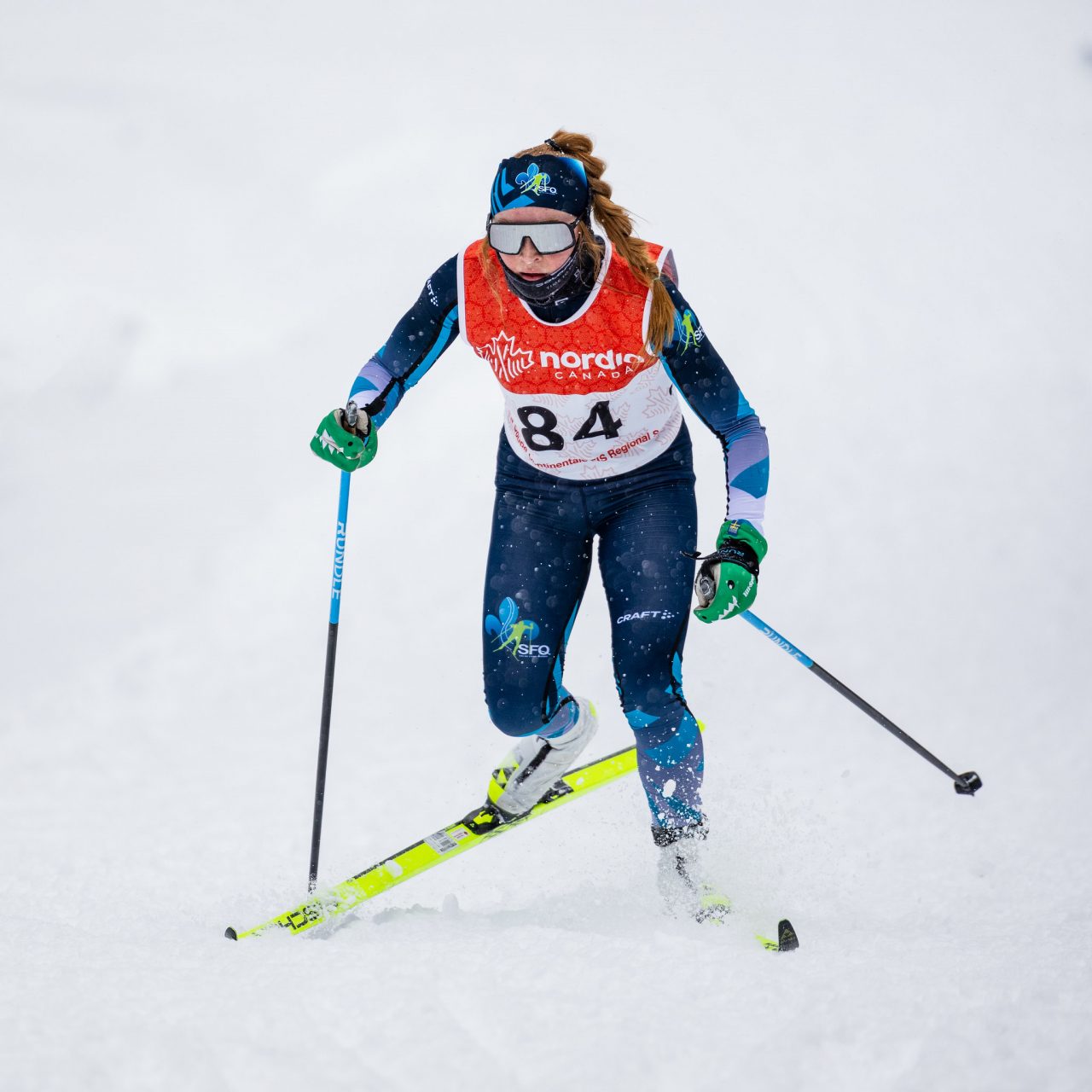
Tory Audet pushing to a snowy win in the 10km. (Photo: Raphaël Payo)
The 10km classic brought more fresh snow but the same women’s winner. Audet won in 36:15.9, ahead of Williams in second again at 25.6 back. Lappe’s Hannah Shields was third at 1:37.0.
“The 10km classic race yesterday was definitely one of the hardest races I’ve done,” Audet wrote to FasterSkier. “The course had some epic climbs and with the fresh snow we got, there weren’t any tracks going up any of the hills making it very difficult. I felt good, I think I paced my race very well, and my skis were awesome!”
Williams, one of three athletes older than U23 to reach the podium this weekend, was not expecting to repeat her 10km victory from the previous weekend.
“The race was two times a crazy challenging 5km course that had huge hills and finished with about 1km of flat double pole…the bane of my existence. Tory Audet, my friend and an incredible athlete, started 30 seconds behind me, so I decided my goal was to see how long I could stay ahead of her.”
The strategy worked to the end, with Williams finishing with 4.4 seconds to spare.
Felix-Oliver Moreau on the trail to victory. (Photo: Raphaël Payo)
For the men, Moreau moved up a step on the podium, winning in 32:13.1. Orford’s Nicolas Beaulieu was second, 4.6 behind to improve on his 6th in the sprint. CNEPH’s Mats Halvorsen was third at 12.7 back.
This brings Canadian ski racing to a holiday pause, with lots of positives to look back on: all the Canadians who raced World Cup period 1 have at least one top 30 result, first-year senior Liliane Gagnon earned her first World Cup weekend in Davos, eight days of FIS racing happened at three Canadian venues, the Para National team collected a suitcase worth of World Cup medals, and Nordiq Canada has signed on with Abuse-Free Sport, a significant upgrade from the previous SafeSport program.
New amateur cross-country skiing event in March 2018
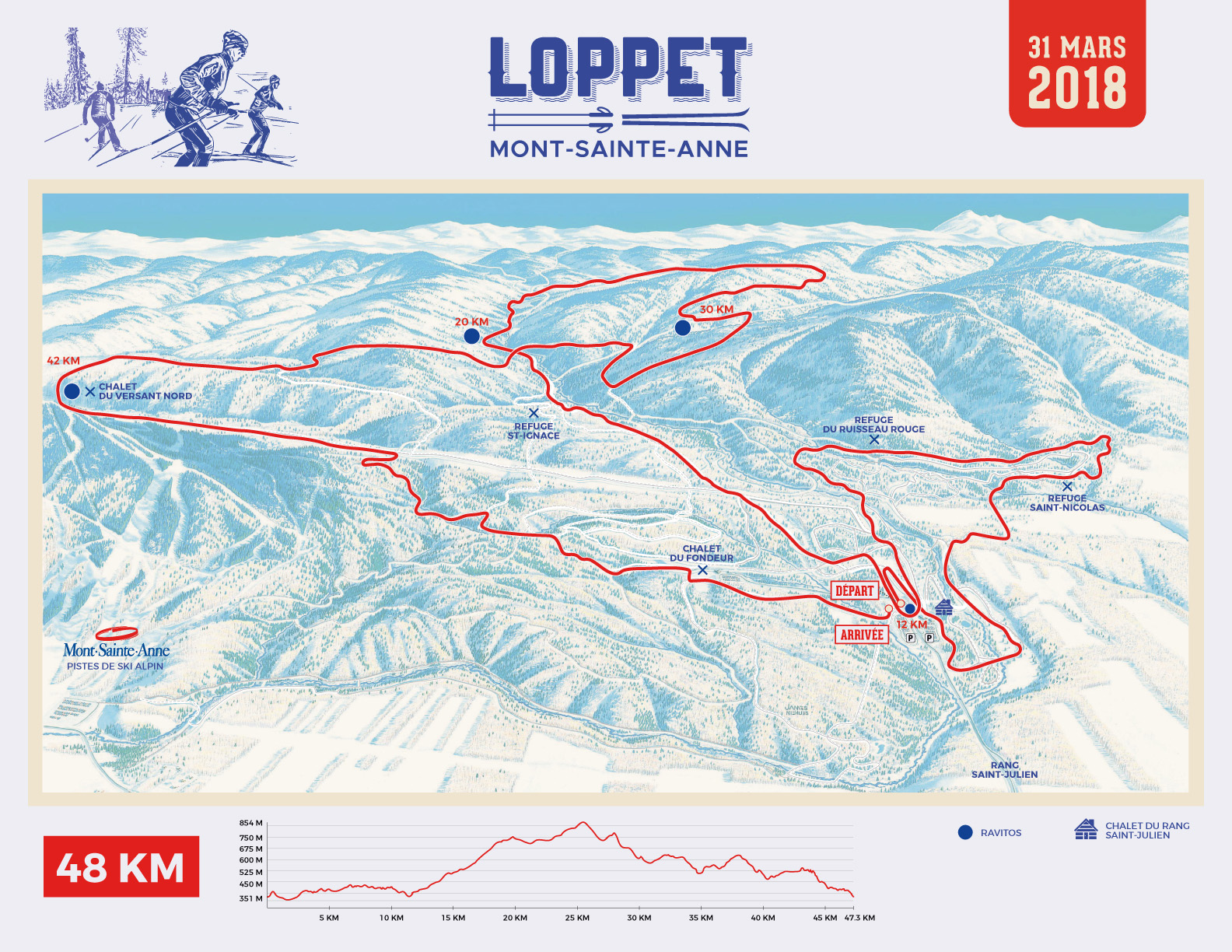
QUEBEC CITY (Wednesday, February 28, 2018) – Cross-country skiing enthusiasts now have a new event to look forward to with the inaugural Mont-Sainte-Anne Loppet coming up on Saturday, March 31. With 48K and 25K freestyle distance races, 10K classic and freestyle distances and a 1.5K loop for young skiers, nearly 500 novices, intermediates and experts cross-country skiers are expected to take to the trails at Mont-Sainte-Anne. This new addition to the Quebec City cross-country calendar will be not only a sporting challenge, but also a fun way for skiers to wrap up the season.
“We want the Mont-Sainte-Anne Loppet to become an annual fixture, and most of all, we want cross-country skiers to have a blast and wrap up the season in style with this celebration of spring,” said Patrice Drouin, president of event producer Gestev on behalf of Quebec Winter Events Corporation. “We were inspired by the Vasaloppet in Sweden, which now attracts more than 15,000 skiers. We see great potential to grow this new event event bigger and better in the future!”
Starting and finishing at the Rang Saint-Julien Lodge in Saint-Férréol-les-Neiges, the 48K and 25K courses are a unique opportunity for skiers to explore the Mont-Sainte-Anne backcountry and discover areas not usually open to the public!
“We’re excited to be hosting a new event like this at Mont-Sainte-Anne and shining the spotlight on Canada’s biggest cross-country skiing centre. We hope the Loppet will not only attract elite skiers, but also inspire and draw newbies to this fantastic sport,” said Maxime Cretin, the new vice-president and general manager at Mont-Sainte-Anne.
The mayor of Saint-Férréol-les-Neiges, Parise Cormier, is also thrilled to be rolling out the red carpet for this new event. “It’s an honour for our town and the entire Côte-de-Beaupré region to celebrate the end of the season with an event that shines the spotlight on the newly renovated cross-country facilities at Mont-Sainte-Anne,” she said. “We’re proud to be involved in such a high-profile happening and are sure it will be a huge benefit for the community.”
Alex Harvey first to register
Saint-Férréeol-les-Neiges native and locals’ favourite at the Olympics in PyeongChang, Alex Harvey was the first to sign up for the 48K distance at the Mont-Sainte-Anne Loppet this March 31, not just to ski on home snow again but also to rub shoulders with participants—and maybe even give them a few pro tips! “Skiing the trails right in my backyard after the Olympics is a dream come true,” said Alex Harvey. “I’ll officially be on vacation after a big season, but I’m stoked to be skiing at home again and baing a part of the inaugural edition of this event, which I hope turns into a regular happening and keeps growing bigger and better. Cross-country development here in Quebec is something that’s very important to me and I’m thrilled to see Gestev and Quebec Winter Events Corporation taking the initiative to get such an awesome amateur event off the ground.”
More information and registration details available at www.loppetmsa.com.
About Quebec Winter Events Corporation
The mission of Quebec Winter Events Corporation (QWEC) is to promote winter sports on home snow through international events including the Sprint Quebec FIS Cross-Country World Cup, Ski Tour Canada and the Cross-Country World Cup Finals, as well as the FIS Freestyle Ski and Snowboard World Cups at the annual Jamboree festival. In addition to attracting the world’s top winter sport athletes, QWEC works hard to support the development of amateur sport through each of its events.
Cendrine Browne (CNEPH/Canadian National U25 Team) celebrates her 11.9-second win in the women’s 15 k skiathlon on Jan. 8 at Mont Sainte-Anne NorAm Trials in Quebec. (Photo: Mario Walker/NorAm MSA 2018 Facebook)
Since March of last year, Cendrine Browne has been waiting and trying, with all her might, for another top 30. She achieved it twice last season, placing 26th in the World Championships 30-kilometer mass start and 35th in the World Cup 10 k skate in Ulricehamn, Sweden (30th with Olympic-style scoring, which counts the top-four athletes for each nation in a given race).
To meet Cross Country Canada’s (CCC) alternate qualifying criteria for the 2018 Olympics, Browne, who turned 24 this past September, needed one more top 30 at the World Cup with the same type of scoring.
She had four weekends to give it her all in late November and December.
Browne, of the Canadian National U25 Team and Centre National d’Entraînement Pierre Harvey (CNEPH), a.k.a. Pierre-Harvey National Training Centre, finished the 2017/2018 season-opening World Cup mini tour in 72nd overall with the 62nd-ranked pursuit time in Kuusamo, Finland.
“That was my first [weekend of racing] so it was tough,” Browne recalled on the phone in early January. “But the last race of the mini tour went much better. I started to have good race feelings so I knew I was going in the right direction. The next weekend was Lillehammer [Norway] and I performed pretty well there in the skiathlon.”
She finished 45th to lead two Canadian women finishers. With Olympic-style scoring, she was 31st.
“To qualify for the Olympics I had to do a top 30 so 31st was a little frustrating, but I knew I was able to do a top 30,” Browne said. “I knew I could do a real top 30, not only a four per nation top 30. But I only had four weekends to do a top 30 and I was down to two.”
Cendrine Browne racing in the World Cup 10 k freestyle on Dec. 10 in Davos, Switzerland. She placed 45th for the second World Cup distance race in a row. (Photo: Reese Brown / U.S. Ski & Snowboard)
In Davos, Switzerland, she tied her season best of 45th in the 10-kilometer freestyle and led four Canadian women, but she was still outside the top 30 with Olympic scoring. Her result at altitude (about 1,560 meters above sea level) was promising, she said, but still not quite there in terms of what she needed.
One weekend later, it all came down to two races in Toblach, Italy. There, she finished 55th in the 10 k skate and 66th in the 10 k classic pursuit.
“Maybe I had put some pressure on myself, but I felt pressure from my federation and pressure to do that top 30, and I don’t work very well with pressure,” she said. “So unfortunately when we went to Toblach, I didn’t perform at all. I was so stressed out that I didn’t even have fun racing, and I just felt awful the whole skate race. I cried a lot.”
With Period 1 of the World Cup behind her and Christmas break on the horizon, she told herself it wasn’t over yet. But she was still disappointed.
“I was supposed to stay [in Europe] for Christmas … I was so focused on Plan A that I didn’t even think about Plan B,” she said.
On the bright side, “Plan B” involved races in her home province of Quebec at Mont Sainte-Anne (MSA), where she trains with CNEPH. And she got to spent time with her family and boyfriend in her hometown of St-Jérôme, about 50 kilometers northwest of Montreal, as well as reset mentally for NorAm Olympic trials starting Jan. 5.
“I was so focused on Plan A that I didn’t even think about Plan B.” — Cendrine Browne, Canadian National U25 Team and Pierre-Harvey National Training Centre, on qualifying for the Olympics
“I was really really stressed out the week before the first race [at trials] and I was feeling the pressure again, and I really didn’t want to react the the same way as I did in Toblach so I went to see my sports psychologist,” Browne said. “She explained some stuff to me, like instead of thinking that the pressure is bad and instead of trying to run away from it, she said I have to try to accept it, and if I accept it, it would help me to go faster.”
With that in mind, Browne tried to keep everything in perspective. Then, she came out at full steam for the classic sprint on Jan. 5, the first day of MSA NorAm trials.
“I think it really worked well because I managed to sleep better the night before the race, and the morning of the race I was feeling like myself again,” she said. “I was skiing and just loving the glide as I usually do when I’m having a good day. I was smiling … and I felt free and I felt like myself. I feel like when I’m stressed out, I’m not having fun any more and that day I was having fun again.”
A self-described freestyle distance specialist, she placed second in the classic-sprint qualifier then fourth overall in the final. As the top-performing woman between the qualifier and final, excluding fellow national-team member Dahria Beatty (who had previously met Canada’s alternate qualifying criteria for the Olympics), Browne effectively secured one of Canada’s coveted quota spots at the 2018 Olympics in PyeongChang, South Korea.
While that wasn’t a done deal until a few weeks later, when CCC named its 11-athlete Olympic team, that result put Browne in the best place any Canadian Olympic hopeful would want to be.
“I can’t say I’m qualified yet because it’s kind of complicated,” Browne said on Jan. 7. “… We can only say, like Daria, Emily [Nishikawa] and I, that we have reached an Olympic criteria and that we’re in good position to go to the Olympics.”
Beatty and Emily Nishikawa, members of Canada’s World Cup Team, met CCC’s “Alternate Qualifying Criteria A” (three top-30 results) last season. According to CCC’s Olympic selection criteria, one female sprinter and one female distance skier would be selected to the Olympic team based on trials. So Browne effectively secured the female sprint spot, and as the rest of the week at MSA played out, she ended up being the top distance skier at trials as well.
On Jan. 8, Browne won the women’s 15 k skiathlon on Day 2 of the trials. Two days later, she won the 10 k classic interval start as well. In the event that the trials sprint leader was the top distance skier as well, as was Browne, the criteria was written so that the second-ranked distance skier in those two distance races would be selected.
That spot went to Anne-Marie Comeau, Browne’s former teammate. The two trained together at CNEPH three years ago, before Comeau left skiing due to an injury and concentrated on running. At last month’s trials, Comeau placed second in the skiathlon, about 12 seconds behind Browne, and third in the 10 k classic, about a minute and 5 seconds back. Browne won the classic individual start by 39 seconds over Katherine Stewart-Jones, who had previously placed fifth in the skiathlon.
“I know she has a huge VO2 max,” Browne said of Comeau, a student at the Université Laval. “She has a huge cardio and these courses were perfect for her, so I knew she could do well, but I’m really surprised that she could actually be on the Olympic team, just because she wasn’t sure she wanted to ski anymore, so that’s really a big surprise for everybody. She trained for running for two years almost, and we didn’t think she would be such a big comeback.”
(Browne is also enrolled at Laval, where she takes classes toward a bachelor’s degree in sports intervention in the fall, as well as HEC Montréal, a university business school where Browne is pursuing a certificate in administration during the summer and winter terms. “It’s important to prepare my post-career now,” she said during another interview this summer.)
While both Browne and Comeau were named to the Olympic team on Jan. 29, along with Beatty and Nishikawa on the women’s side, Browne said her results at trials gave her confidence moving forward.
“I was surprised because classic sprints usually are not my best race at all,” she said of her result in the classic-sprint qualifier to start the trials. “But I think I’m in good shape right now and that’s why I managed to do so well. Also the sprint course is really hard here, it’s like a World Cup course, so it’s made for distance skiers, I would say. Pure sprinters get tired on that course, it’s so hard. So I think it was a good course for me.”
Going into the races at MSA, Browne had been on the NorAm podium 12 times since 2013. Two of those races were sprints (both in 2015).
“I’m definitely more of a distance skate skier, without a doubt,” she said.
Four Races, Four Big Results
The MSA classic sprint marked Browne’s first time skiing heats since last year’s U.S. nationals in Utah, where she qualified fifth in the classic sprint and went on to finish 22nd after being eliminated in the quarterfinals.
On Jan. 5, she clocked the second-fastest qualifying time on MSA’s 1.2 k course, 3.13 seconds behind Beatty, who won the qualifier in 3:41.55. Olivia Bouffard-Nesbitt, of Rocky Mountain Racers (RMR), qualified third (+8.08) and Maya MacIsaac-Jones (Canadian U25 Team/RMR) qualified fourth (+8.49). Taking Beatty out of the equation, that meant Browne needed to place fourth or better in the final to lock up that women’s sprint spot. According to the CCC sprint selection process, a given athlete’s result in the qualifier and final were scored equally (one point per place, lowest points win). So Browne had 2 points after qualifying and MacIsaac-Jones had 4. In the final, MacIsaac-Jones placed second to Beatty and Browne finished fourth, bringing both of their point totals to 6. The tiebreaker, according to the criteria, was the top qualifying result, which Browne had.
Asked about home-course advantage on the trails she’s skied on for the last six years with CNEPH, Browne said the sprint course was brand new and specifically designed for the 2018 trials.
“I hadn’t tried those yet, but they’re great. They’re really hard,” she said.
In the heats, she made a point to lead early in her quarterfinal and semifinal in order to set the pace.
“The course was so hard that you couldn’t start too fast, so I went in front of everybody and didn’t go too fast on the first uphill,” Browne recalled. “My race really started at the top of the first huge pitch, and at the top of that big uphill, that’s when I started to go faster and that’s where I created a little gap.”
She won both her quarterfinal and semifinal to advance with ease to the heats, 1.5 seconds ahead of Annika Hicks, of the Alberta World Cup Academy (AWCA) in the quarter and 2.81 seconds ahead of Hicks again in the semifinal.
NTDC Thunder Bay’s Katherine Stewart-Jones (l) and CNEPH’s Cendrine Browne, both the Canadian U25 Team, after the NorAm Trials classic sprint on Jan. 5 at Mont Sainte-Anne, Quebec. (Photo: Mario Walker/NorAm MSA 2018)
In the final, Browne found herself behind Beatty (also of AWCA) and Stewart-Jones, of the Canadian U25 Team and National Team Development Centre (NTDC) Thunder Bay, at the top of the last major climb. They jumped in the tracks on either side of her, and Browne found herself without a track for the downhill.
Beatty crossed the finish line first once more (after winning both her quarterfinal and semifinal as well), finishing in 3:45.02, while MacIsaac-Jones followed 0.64 seconds later in second place. Stewart-Jones was 1.2 seconds back in third, and Browne 4.5 seconds behind in fourth. Hicks placed fifth (+10.21) and Andrea Dupont (RMR) rounded out the women’s final in sixth (+12.18).
Going into the final, Browne wasn’t aware she needed to finish fourth or better.
“I don’t really like thinking about criteria before I go into a race so I had no idea what I had just done,” she recalled. “A friend [Alexis Turgeon] told me when I crossed the finish line, he said, ’I think you got that Olympic spot!’ I was like, ‘What?’ and then the rumors started to spread and then my coaches told me it was true, I had made it. It was pretty great.”
One of those coaches was her coach, Louis Bouchard, head coach at CNEPH, also a Canadian World Cup coach and Alex Harvey’s personal coach, who attended the classic sprint at NorAm trials then left for Europe on Sunday.
“He said he was almost as stressed out as I was and he didn’t sleep before the first race,” Browne said. “It’s a relief for him as well.”
As for the distance races at trials, Browne said she had been targeting both.
“I really didn’t expect to qualify in a sprint race,” she said on Jan. 7. “I was hoping to win those [distance] races and do a spectacular criteria, so I still want to do really well in those races. I don’t want to think about the result because I only want to think about what I can control, which is my movements and how I ski, but I want to have great feelings during this race and ski really well.”
Cendrine Browne (61) leading the women’s 15 k skiathlon on Jan. 8 at Mont Sainte-Anne NorAm Trials in Quebec. She went on to take the win by 11.9 seconds over Anne-Marie Comeau (Université Laval). (Photo: Mario Walker/NorAm MSA 2018 Facebook)
On Monday, Jan. 8, she went on to win the 15 k skiathlon by almost 12 seconds after leaving the pack toward the end of the first 7.5 k classic leg.
“My goal was to start really hard and try to break away right at the start,” Browne recalled.
But she wasn’t able to shake skiers such as Beatty, MacIsaac-Jones, Comeau, or Stewart-Jones as quickly as she’d hoped. She built a small gap on the others around 6 k, but Comeau caught her before the transition to skate and Browne fell on the final climb before the exchange.
“I fell right before the downhill so I lost my gap,” Browne recalled. “And then we headed towards the ski exchange and I had some trouble with my binding and I couldn’t clip it on. It didn’t work, so I lost like another five seconds there. Anne-Marie was at the ski exchange before [me], and it took me like 2.5 k to catch up to her.”
After catching Comeau about a third of the way into the skate leg, Browne said she took the lead in an effort to drop Comeau over the next 2.5 k.
“I thought I could gap her, but I couldn’t,” Browne said. “And so on the last 2.5 k, I thought about my tactic. I saw how she skied, and I saw where I could pass her, so I stayed behind her and waited for the last big uphill, and I passed here there. … I knew I had faster skis and I knew I’m better on sections that need more power.”
With about a kilometer to go, Browne skied away to an 11.9-second victory. The next day, she raced to second in the freestyle sprint (a NorAm race but not an Olympic trials event) after qualifying in third.
She hadn’t planned on racing that second sprint of trials (and her third race in five days), but her coach, Bouchard, encouraged her to use it as intensity training before the Olympics.
“At first I wasn’t supposed to do that sprint, but … I had to race as much as I could before leaving [for Europe],” she said. “After the qualifier, I asked Louie, ‘I’m feeling really tired. Should I race in the heats?’ and he said, ‘Yeah, you should.’ … I didn’t know how it would turn out, but it turned out pretty well.”
The next day, she woke up for her fourth race of the week, the 10 k classic, not feeling as fatigued as she had on some of the previous days.
“Of course, I was tired, but I was telling myself everybody’s really tired,” Browne recalled. “My goal was to push as hard as I could during the whole race because I had to prepare as well as I could for the Olympics.”
Cendrine Browne racing to first in the women’s 10 k classic on Jan. 10 at Mont Sainte-Anne NorAm Trials in Quebec. (Photo: Mario Walker/NorAm MSA 2018 Facebook)
Despite being one of the last starters in that race, she said she wasn’t quite sure where she stood during it, so she simply pushed as hard as she could.
“It was like, I don’t wanna be second … and then it turned out that I had a really big gap,” she said. “I felt so good during that race. You don’t feel that good that often in races during the year, so I think I’m in really good shape leading towards the Olympics so that’s really exciting and it’s great news.”
Before leaving Quebec for a mid-January training camp in Livigno, Italy, Browne summarized her trials performance.
“I really wanted to show that I deserved my spot,” she said. “I qualified in a sprint race, but I really wanted to show that I was that I was good in distance racing, too, because I am a distance racer. … I guess you could say I qualified in all the events, but I just wanted to show Cross Country Canada that I that I deserved my spot and I really wanted to be safe. I think that’s what kept me going.”
And while qualifying domestically was her last resort to get to her first Olympics, Browne said it all worked out in the end.
“‘Actually I’m kind of happy I was in Mont Sainte-Anne; it gave me confidence that I really deserve my place and it was really nice to ski at home, well, kind of at home,” she said. “My boyfriend was there, my family was there, and lots of friends and everybody was cheering … it was really fun. Great atmosphere and the races were really well-organized.”
“You don’t feel that good that often in races during the year, so I think I’m in really good shape leading towards the Olympics so that’s really exciting…” — Browne
Browne and the rest of the Canadian World Cup team returned to World Cup racing Jan. 27-28 in Seefeld, Austria. There, she placed 54th in the freestyle sprint then 37th in the 10 k freestyle mass start. She was the second Canadian in the 10 k, after Nishikawa in 35th, and with Olympic-style scoring, Browne would’ve been 33rd.
“I think us three girls did really well today, considering we are just coming back from a training camp,” Browne said after the mass start, referring to Nishikawa, herself, and Beatty, who placed 45th. “So it’s really looking good for the Olympics.”
Path to PyeongChang
Last summer, Browne worked to rehab back tension and knee tendonitis. Those injuries only set her back about two weeks in July, she said, and she attended all training camps, including the Canadian women’s team camp in New Zealand in late July and early August.
“I did a total of 60 hours of training in just under three weeks and realized that despite my small injuries my shape was intact; I was as much in my place as before among these girls,” Browne said in August.
As of early January, she said she was injury free.
With more than 40 World Cup starts currently behind her, Browne said she’s reached a new level with her racing. Last year was about understanding “the importance of self-confidence,” she said last summer, “but also that the most important thing is to have fun.
“It’s easy to forget when you’re at the top level,” she continued. “When I was stressed before the start of a race, I would ask myself, ‘Why are you doing this?’ Because I like it.”
Initially, it was lining up against the best skiers in the world that intimidated her.
“In the beginning, you reach the highest level, you face the best in the world. It’s intimidating being new to the field, but I’ve learned to master this stress throughout the season,” she said. “At the end, I felt in my place.”
— François Léger Dionne, Andrea Potyondy-Smith and Gabby Naranja contributed
Canadian national-team member Cendrine Browne (r) hanging with her teammates Katherine Stewart-Jones (l) and Dahria Beatty at a training camp in Tremblant, Quebec, in May. (Photo: Dahria Beatty) La membre de l’équipe nationale canadienne Cendrine Browne (D) en compagnie de ses coéquipières Katherine Stewart-Jones (G) et Dahria Beatty lors d’un camp d’entraînement à Tremblant, Québec, en mai. (Photo: Dahria Beatty)
Canada’s Philippe Boucher (CNEPH) racing to 22nd in the men’s 20 k skiathlon at 2017 Junior World Championships at Soldier Hollow in Midway, Utah. (Photo: FlyingPointRoad.com)
In an effort to showcase the North Americans who competed at last week’s International Ski Federation (FIS) 2018 Nordic Junior/U23 World Championships in Goms, Switzerland, we asked those qualifying athletes several questions about themselves — actually, we had them fill in the blanks. Here we have 20-year-old Philippe Boucher, of the Centre National d’Entraînement Pierre-Harvey (CNEPH), who represented Canada at his first U23 Worlds (after previously competing at three Junior Worlds).
Last week in Goms, Boucher placed 42nd in the freestyle sprint and 45th in the 15 k classic.
***
“My full name is Philippe Boucher, but you can call me Phil.
I was born and raised in Lévis, Québec, and I learned to ski at Club de ski La Balada in Lévis.
I spent the time between Mont Sainte-Anne trials and Junior/U23 Worlds alpine skiing in beautiful powder snow at MSA. I rested three days at home. I left Quebec on Jan. 14 en route to Praz de Lys, France, for a training camp with the Canadian ski team.
The funnest workout training camp I did in the last training year to prepare for this was a 3-week training camp this fall on the Dachstein glacier in Austria with Alexis Dumas, my teammate on the CNEPH. We’ve been on the World Junior/U23 Championship trip for four years together; he’s one of my best friend and training buddy.
This is my second time in Switzerland and fourth time racing internationally, and so far it’s been good.
One difference I’ve noticed between Switzerland and Canada is the salami is awesome.
Skiing and racing in the Alps is fun and challenging. The weather can change quickly. I like when it’s unpredictable. Usually racing at altitude is OK for me because I’m based in MSA at sea level, but I’ve been training and racing a lot at altitude these past 4 years. I still need some time to adapt, but when I’m adapted it usually goes well for me. There are one (Mont-Sainte-Anne) mountains around where I live.
One of the things I’m most excited about for Junior/U23 Worlds in Goms is to compare my level of racing with the best in the world and to eat the good food at the hotel. No cooking is the best.
One race I’m especially targeting there is the 30 k skiathlon.
I really hope I can chat/make friends with someone from France and try to speak with their accent and expressions.
My favorite thing at the breakfast where we are staying is chocolate croissants.
Fondue is delicious. And the chocolate is miam !!
If I had a totally free day here and didn’t have to worry about race fitness or training, I’d spend it backcountry skiing in the Swiss Alps.
The best way to follow me on social media is on Instagram @p_boucher97.”
Cendrine Browne, of the Pierre-Harvey National Training Centre and Canada’s national U23 development team, leading the women’s 10 k freestyle pursuit on Jan. 31 at the Mont Sainte-Anne trails in Quebec. She went on to win by nearly 1 1/2 minutes to take the NorAm leader’s bib. (Photo: CCC)
(Note: This article has been updated to include comments from Andy Shields on his pursuit win.)
The NorAm series continued last weekend with a two-day pursuit in Mont Sainte-Anne, Quebec. While this format hasn’t been used at this level in Canada for three years, the Ski Tour Canada in early March will have two pursuit days.
Cendrine Browne, of the national U23 development team and Pierre-Harvey National Training Centre (CNEPH), won Saturday’s 5-kilometre classic individual start in 14:37.3 to lead a U23 and CNEPH podium sweep. Sophie Carrier-Laforte finished 7.2 seconds back in second, followed by Frédérique Vézina at 30 seconds behind the winner in third.
Browne was the only European B-Tour skier to race this weekend after arriving back from Nove Mesto, Czech Republic (where she represented Canada on the World Cup), five days earlier on Monday, Jan. 25.
“I chose to race because I would have done intensity anyways on Saturday,” Browne wrote in an email. The convenience of racing on her home trails at Mont Sainte-Anne (M.S.A.) added to the appeal.
“I wasn’t sure if I would do Sunday’s race, but I’m in good shape so I’ll do it,” Browne wrote on Saturday. “The Noram points are also interesting if I win.”
Browne did win Sunday’s 10 k freestyle pursuit. With Carrier-Laforte not starting, she started 30 seconds ahead of Vézina and expanded her lead to 1:29.1 with the fastest time of the day in 27:51.3. Browne was ranked fifth going into the weekend and, with the top three in the overall NorAm standings absent, her convincing victory on Sunday will give her the leader’s bib for next weekend.
Vézina started second, with three other racers within 10 seconds of her. While she was happy with Saturday’s classic podium, noting “5km has never been my strong suit,” she was frustrated with her pursuit, in which she placed fifth, 2:29.1 behind Browne. “My skis were so slow that the girls passed me in the first downhill like I was stopped,” Vézina wrote in an email.
Olivia Bouffard-Nesbitt, of Canada’sU23+ Development Team, started sixth and pulled away from Annika Hicks (Canmore), who started fourth, to take second. Crossing the line nearly a minute and a half (1:29.1) after Browne, Bouffard-Nesbitt held off Hicks by 5.9 seconds for the second spot on the podium. Hicks placed third (+1:35).
“I initially wanted to work with someone to try and make time on the leader,” Bouffard-Nesbitt wrote in an email. “After gauging the willingness of the skiers around me to chase Cendrine, I decided that instead I would try to race tactically for second place. I shared the lead with Annika for most of the race as we distanced ourselves from 4th and 5th.”
Also on her hometown trails, Marie Corriveau (CNEPH) improved one place to finish fourth (+2:25.1), 4 seconds ahead of Vézina to repeat as top junior woman on Day 2 at M.S.A.
Thunder Bay National Development Centre swept the podium (top three) in the men’s 10 k classic on Jan. 30 with Bob Thompson in first, Andy Shields in second and Michael Somppi in third. Colin Abbott of the Yukon Elite Squad placed fourth (second from r) and a fourth NDC skier, Evan Palmer-Charrette (r) was fifth. (Photo: Skibec Nordique/Facebook)
NDC Thunder Bay All the Way
On the men’s side, Bob Thompson of the Thunder Bay National Development Centre (NDC) took his first NorAm distance win on Saturday, finishing the 10 k classic individual start in 26:12.2, just 0.3 seconds faster than teammate Andy Shields. Michael Somppi completed the Thunder Bay podium sweep, 14.5 seconds behind Thompson in third.
“[It] feels very good to get my first Distance NorAm win and share the podium with my teammates,” Thompson wrote in an email. “I enjoyed the course: it was challenging with some quick climbs and some longer more gradual climbing sections that you really had to focus to keep your speed up on.”
“The race today was good,” Shields wrote on Saturday. “I felt like I was in shape which is a feeling I’ve been missing up to this point. I could push hard and not pay the price in heavy limbs.”
Shields noted that he and Thompson would start the pursuit together, giving them the opportunity to work cohesively to stay ahead of Somppi, a strong skate skier.
However, on Sunday in the men’s 15 k freestyle pursuit, Somppi quickly caught the two frontrunners.
“Today, tactics were pretty simple,” Somppi wrote in an email. “I went out fast, caught Andy and Bob early. I put myself in a position to contend for the win, but I did not have the energy to make it happen.”
Somppi faded to fourth, posting the seventh-fastest time on the day. Thompson also struggled, eventually outsprinting a group of six to finish ninth.
“Bob led out the first km then I went to the front,” Shields explained in an email after Sunday’s race. “I figured the pace needed to be quite high to maintain the gap to the rest of the field so when I started to lead I picked up the pace. By 2km in I could hear Bob behind me dropping off the pace. I didn’t know at the time but Somppi caught us just as I was pulling away. I skied a nerve-racking 13km out front for the rest of the race with Somppi within 15 seconds of me for most of it. It was pretty stressful, but it ended up being the winning strategy.”
Andy Shields (NDC Thunder Bay) racing to a 45-second win with the fastest time of the day after starting second in the men’s 15 k freestyle pursuit at the NorAm at Mont Sainte-Anne in Quebec on Jan. 31. (Photo: CCC)
Shields held strong and skied uncontested to the win in 37:09.3, the fastest time of the day and 45 seconds ahead of second and third.
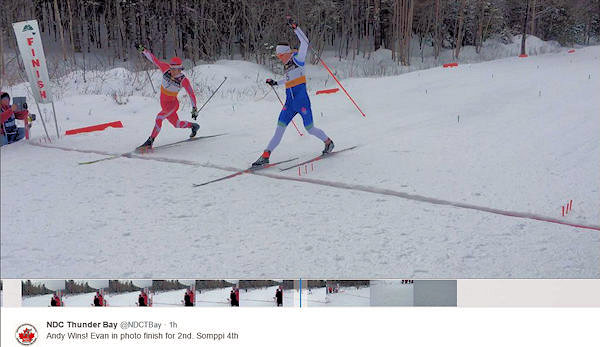
After starting the pursuit fifth and seventh, respectively, Evan Palmer-Charette (NDC Thunder Bay) and Brian McKeever, of the Para Nordic World Cup Team, separated themselves from the second chase group to fight for the podium. Palmer-Charette beat McKeever by the slimmest of margins to take second, 45 seconds behind Shields, while McKeever placed third with the same time. Somppi finish 11.1 seconds later in fourth.
McKeever could have been at the International Paralympic Committee (IPC) World Cup in Pyeongchang, South Korea, but according to Cross Country Canada, he opted to try for a Ski Tour Canada selection.
Somppi was disappointed with his energy and his fourth place.
“The trails were super and I enjoyed the skiing here,” he wrote. “I would prefer to be training right now and avoiding racing, however I have to qualify for the Tour and I believe I did enough to stay in contention this weekend.”
Canadian Para-Nordic World Cup skier Brian McKeever (l) and Thunder Bay’s Evan Palmer-Charette (r) in a photo finish for second at the men’s 15 k freestyle pursuit on Jan. 31 at the Mont Sainte-Anne NorAm in Quebec. Palmer-Charette had the edge and McKeever placed third. (Photo: CCC/NDC Thunder Bay Twitter)
***
The NorAm now moves to Gatineau in western Quebec, starting with sprint racing on Friday. Jess Cockney is back from Europe for his first North American races of the season. Of more than 780 registered racers, the only notable absentee is Andrea Dupont, who is slated to race for Canada on the World Cup in Drammen, Norway, this Wednesday as the NorAm leader.
First-year senior Frédérique Vézina, 20, of the Pierre-Harvey National Training Centre, training in Quebec.
This ‘Pros of Tomorrow’ series, brought to you by the generous support of Fischer Sports, aims to highlight some of the most notable up-and-coming athletes around the world, which may or may not be Fischer-sponsored skiers. If you have an idea for a top-notch skier you’d like to read more about, please email info@fasterskier.com with the subject line: ‘Pros of Tomorrow’. We’re also looking for stories about intriguing juniors, collegiate skiers, or lesser-known athletes; please email us with names — subject line: ‘From the Pack’.
***
Frédérique Vézina of the Pierre-Harvey Training Centre during a NorAm classic race.
While the famous father-and-son duo Pierre and Alex Harvey is at the very heart of cross-country skiing in the province of Quebec, another family name has become increasingly part of Quebec’s nordic culture: Vézina.
Former Canadian Ski Team member Jocelyn Vézina was one of Canada’s strongest skiers in the ’80s, alongside teammates Pierre Harvey and Yves Bilodeau (now Canada’s head wax technician). His 20-year-old daughter, Frédérique Vézina, a first-year senior, is rising fast on the Canadian nordic ski scene.
Just like Alex Harvey, she grew up at the foot of the Mont-Sainte-Anne ski slopes — 200 meters precisely. Eager to race and expend her energy, she joined MSA Nordic Ski Club. Competing in both cross-country skiing and kayak at the time, she chose to give up the latter in her mid-teens.
“The ski lifestyle was more appealing to me. I liked the fact that it involved so much diversity,” Vézina said last month on the phone from her home in Saint-Ferréol-Les-Neiges. “In the summer, I’ll run, cycle, even do triathlons, which all prepare me well for skiing.”
And while her background in kayak boosted her upper-body strength in skiing, she said that now she struggles to keep up on the water with her former teammates.
Last year’s racing season was “long but rewarding,” the former junior national-team member said. Her consistency at the Canadian Juniors — she placed third, second and won the last race —- enabled her to make the trip to Val di Fiemme, Italy, for the 2014 FIS Junior World Ski Championships.
With wax setbacks, she placed 30th in the skiathlon, but found success a week later in a FIS race in Ramsau, Austria.
“Last season, I spent two months away from home, competing in Europe,” she said. “We had bad skis in Italy, but Austria was a big hit for me! I made it to the podium [in second place] in the 7.5 k skate race, which was really unexpected.”
She loves distance races, especially the skiathlon, said sprinting isn’t her strongest suit.
“I think I have much more slow-twitch muscle fibres. I’m built on my father’s slim frame,” she said.
This summer, she worked on her weaknesses, focusing on speed and devoting more time to anaerobic training. She stayed mainly at home, training with the Pierre-Harvey Training Centre (Centre National d’Entraînement Pierre Harvey, or CNEPH) team, then in October, joined other members of the Canadian national team in Park City, Utah, for an altitude camp.
This season, she hopes to qualify for the U23 World Ski Championships in Almaty, Kazakhstan. So far, she’s posted two top-30 results at the U.S. SuperTour in Bozeman, Mont., where she was 23rd in the 10 k classic and 29th in the classic sprint, and two top 20’s (13th and 18th) in the 7.5 and 10 k classic races at the NorAm opener Dec. 13-14 in Rossland, British Columbia. She did not race at the most recent NorAm Dec. 19-20 at Sovereign Lake, B.C.
“I’m aiming for a top 20 in Kazakhstan,” she said. “I just received a bunch of skis to try out. I hope that the only thing stopping me from good results will be myself, not my skis!”
Asked whether she dreams of representing Canada at the Olympics one day, she hesitates for a moment.
“I’m not one to dream too much. Of course I would like to race at the Olympics, but if I do, I want to do well, not just participate. If anything, I dream of becoming the next Beckie Scott!” she said. “She didn’t benefit from all the programs available to today’s young athletes, yet did really well and became a role model for us. If she could do it, why can’t I?”
Vézina recently completed her CEGEP (Collège d’Enseignement Général et Professionnel) and has considered pursuing a career in sports medicine.
MONT SAINTE-ANNE, Québec — While Alex Harvey was the man of the day at Canadian Ski Nationals on Tuesday, Devon Kershaw, Lenny Valjas and the remaining World Cup crew (including Chandra Crawford, Dasha Gaiazova, Alysson Marshall and Kevin Sandau) also met a strong welcome after flying into Québec late Monday night and racing the next day.
Cross-country ski fans, friends, family and media outlets came out to Mont Sainte-Anne to catch a glimpse of the nation’s top skiers in their flashy red suits. Several competitive skiers showed up as well for a shot at contending with some of the world’s best.
The first thing I did was ask Alex if he was coming to nationals. He was like, ‘Of course I’m coming.’ I was like, ‘OK, I need to go just to see how I do against them.’ That was fun. I’ve been friends with him since I was a kid when we were in Mont Sainte-Anne together.
There’s lots of biathletes who make podiums on lots of World Cups … so we know that the top biathletes are pretty much the same as the top cross-country skiers. I’m not a top biathlete; I’m just hoping to do good and those guys [Devon Kershaw, Alex Harvey, etc.] are the best skiers so it’s really cool to be not so far behind them.
I wish I could do more cross-country, but it’s rare that the opportunity comes, especially with the strong guys.
[Note: Bédard said he last competed at Canadian cross-country nationals in 2007.]
David Greer (Pierre-Harvey National Training Centre), 5th
Alex was really moving today. He started 45 seconds behind me and caught me at about 2 k. I tried to stay with him for about 10 seconds and decided I’m probably better off just racing my own race. That wasn’t very encouraging, but later in the race I felt better and better and then got encouraging splits.
End of the season, a lot of people are fried and not super pumped about the racing, but it was definitely super fun having those guys here because we don’t get to race with them very often. You see them racing World Cups all year so it’s the one chance we have to measure ourselves against them. I was definitely looking forward to it.
Brent McMurtry (Pierre-Harvey National Training Centre/Senior Development Team), 6th
I was getting splits off of Devon and Ivan [Babikov] I was third. Devon caught me for 30 seconds after two-and-a-half kilometers or something, but I was not going the same speed as him. It was good motivation because once he caught me and went by, I was able to keep him in sight for the next two laps so I sort of knew I was at least a little bit competitive.
Devon was second in the World Cup, Alex last weekends had two podiums. You know that when you’re two minutes back, it’s two minutes off the best in the world. It’s not where I want to be and not where I think I can be, but at the same time, it’s not so bad.
I’m staying at Alex’s house; they’re good friends of mine. It was funny sitting around at breakfast [Tuesday] morning with Devon and Alex. Their season is done and talking about things other than skiing and just life. It’s nice to have them around.
Erik Carleton (Rocky Mountain Racers/National Para-Nordic Team), 8th
It’s my only chance to race against our World Cup team. … I knew it would be, for sure, at a different level. When Alex passed me [about halfway through], I just saw the pace he was going. I stayed with him a bit, then the last lap was pretty tough after that. … You can just see he’s really efficient and he keeps pulling away. He was gone on the last lap.
Canadian National Ski Team member Alex Harvey rounds the stadium at his club's trails in Mont Sainte-Anne, Québec, in the 15 k freestyle individual start on Tuesday. Harvey won the race by nearly 33 seconds.
MONT SAINTE-ANNE, Québec – Alex Harvey had no idea what he was in for. Or maybe he did.
Fourteen hours after he and several other Canadian National Team members stepped off a plane in Québec City and concluded a 32-hour trip back from the World Cup Finals in Sweden, Harvey was back in his native Saint-Ferréol-les-Neiges, Québec, preparing to race again.
If it had been up to Harvey, he would have slept in a little later. His mom woke him up with a kiss on the cheek at 7:30 a.m. Tuesday before she left for work. Regardless, he was pretty excited about his his first day at Canadian Ski Nationals, hosted by his Club Nordique Monte St. Anne.
Alex Harvey talks to the media after posting what turned out to the fastest 15 k freestyle time at Canadian Ski Nationals on Tuesday.
The 23-year-old generated about as much hype as one can expect at a cross-country ski race in North America. Several news outlets flocked to the Quebec City International Airport at 10:30 Monday night to see Harvey and his celebrated teammates, including overall World Cup runner-up Devon Kershaw and Lenny Valjas.
Late Wednesday morning, Harvey’s fans followed him to the trails where he warmed up. They asked for his autograph, snapped photos and showered Kershaw with attention as well.
After both finished Wednesday’s 15-kilometer freestyle individual start, Harvey and Kershaw hardly made it out of the finish pen. Sweaty and spent after racing in nearly 20 degrees Celsius (68 degrees Fahrenheit), both found they were even more sought after as two of the top finishers.
Harvey crushed his competition with the help of resounding cheers every time he skied through the stadium, winning the three-lap race in 40:54.1. His World Cup teammate, Ivan Babikov was second, 32.9 seconds back, and Kershaw finished third (+1:44.8).
“It was hard,” Harvey said of the combination of travel, lack of sleep and challenging snow conditions on Tuesday. “I talked with Devon after the race. It might have been the hardest race of the season for both of us. It was so slow out there.”
Alex Harvey (CNST) on the second of three laps in the 15 k freestyle individual start at Canadian Ski Nationals on Tuesday.
Harvey pulled through by pushing hard from the start. Five kilometers in, he led by 18.6 seconds over Babikov, Tuesday’s 10 k classic champion. Kershaw was 19.7 seconds back in third, affirming that the local hero was truly on a roll.
He kept up the pace through the second lap, coming into the stadium 11.7 seconds ahead of Babikov. Kershaw was still in third, but nearly 52 seconds back.
“I didn’t know how it was going to be here,” Harvey said, referring to his recent highs, including a World Cup Finals victory in Falun, as well as some of the lows this season.
“It ended up being good and with the fans, the crowd, just everybody being so psyched. I didn’t have a choice to ski fast or not,” he said.
Just minutes before his race, Harvey spoke to a group of young children in French. They sent him off with a chant that echoed around the stadium throughout the afternoon: “Ahh-lex! Ahh-lex!”
“They had banners and singing songs so it was really special to see all these 8-year-olds just having the best time,” Harvey said. “It motivated me for the win, for sure.”
Kershaw said the homecoming experience was humbling. Seeing how famous Harvey was in Québec and how excited people got about him, the team and the sport, was great for cross-country skiing, he said.
It also made Harvey that much harder to outdo.
“There was no chance I was going to beat Alex today,” Kershaw said.
With a tendency to open hard in races, especially individual starts, Kershaw discovered he was six seconds down on Harvey about 2 or 3 kilometers in.
Canadian National Team member Devon Kershaw (l) leads Eric Wolcott (Black Jack) up a hill during the 15 k freestyle individual start at Canadian Ski Nationals on Tuesday.
“He closes way harder than me so the victory was going to be Alex’s, absolutely,” Kershaw added.
While skating in soft conditions wasn’t his specialty, Kershaw said he felt good until about 7 k, where he broke a pole. The handle ripped off and he skied the next kilometer without a pole.
“There was nobody out there; it’s not the World Cup,” he laughed.
When he did get a pole, it was 140-centimeters long, which was about 20 centimeters too short. He found better replacement soon after and finished the race with a 157 ½.
“It was a real struggle today and the conditions were really hard,” Kershaw said. “It’s kind of frustrating for some bad luck to happen, but the World Cup season’s over so let’s not get too greedy.”
Babikov was happy with his result considering he started ahead of Kershaw, Harvey and nearly 160 others in the men’s open race.
“I was just trying to ski my race, ski strong throughout the whole three laps,” Babikov said. “It was really hard to do because it’s so soft and it was hard to pole. It didn’t matter if you had poles or no poles.”
Ivan Babikov (CNST) wears the leader's jersey at Canadian Ski Nationals in the 15 k freestyle individual start on Tuesday after winning Monday's 10 k classic race. Babikov placed second on Tuesday.
He was impressed with his teammates’ performances after one long day of travel.
Upon leaving Falun, Sweden, at 2 a.m. on Monday, they flew to Frankfurt, where their flight to Canada was delayed. Once in Montreal, the men’s and women’s national team members found they had five hours to kill because of a missed connection. Harvey said they enjoyed some St-Hubert Chicken for a pre-race meal and arrived in Québec City around 10:30 p.m.
By the time Harvey fell asleep, he said it was 6 a.m. Falun time.
While he and the rest of the national team planned to recover for Thursday’s sprints, recently moved from Québec City’s Plains of Abraham to Mont Sainte-Anne, several outsiders to Canadian cross-country were also looking forward to the competitive sprint day.
Canadian biathlete and World Championships team member Marc-André Bédard was encouraged by his performance in Tuesday’s 15 k, where he placed fourth (+2:25.7) despite starting nearly 45 minutes after the frontrunners. Because he and several other biathletes didn’t have FIS points, they were seeded near last.
“What was really hard was to pass people all race,” Bédard said. “It felt like I said ‘track’ 200 times today.”
Without any splits throughout the race, he had no idea where he stood or where he finished for several minutes after the race.
“I had no expectations … I was hoping to be in the top 20, top 30, it’s hard to say,” he said. “I’m really tired, too. I wanted to have fun and I’m really happy with the result.”
Pierre-Harvey National Training Centre athletes David Greer and Brent McMurtry placed fifth and sixth, respectively. Baptiste Gros of France was seventh and Erik Carleton (Rocky Mountain Racers/National Para-Nordic Team) finished eighth before catching a flight to Finland with Brian McKeever for the IPC World Cup on Thursday.
Michael Somppi (Thunder Bay National Development Centre/NST) was ninth and Kevin Sandau (Alberta World Cup Academy/NST), who flew in with the national team Tuesday night, was 10th.
Alex Harvey (l) and his father, Pierre, embrace after Harvey won the 3.3 k freestyle sprint at the World Cup Finals in Falun, Sweden, on Friday. Twenty-five years ago, Pierre won a World Cup in Falun. Alex Harvey is a local hero in Quebec and will return for the Canadian nationals next week.
This year, the Haywood Canadian National Championships have been pushed back a week to accommodate a special group – Canada’s World Cup elite, which are returning in force to put on a show for the home crowd in Quebec.
With Alex Harvey, Devon Kershaw, Chandra Crawford and all the major Canadian stars slated to participate, the fields will be some of the deepest in North America all season. The Canadian World Cup squad has turned in no less than 12 World Cup medals this winter and will be back to entertain their native fans.
The Location
Hosted by Skibec Nordique and Club Nordique Mont Ste-Anne (MSA) for the first time since 2007, the eight-day competition will be held between two venues. Starting Saturday, the club team sprints will take place in Quebec City, one of the oldest cities in North America, on the historic Plains of Abraham. The individual open freestyle sprints are also scheduled for downtown Quebec on Thursday.
About 45 minutes north of the provincial capital, Mont-Sainte-Anne and its large trail network will hold the remaining races, including an interval-start classic race on Monday, interval skate on Tuesday and classic mass start on Saturday, March 24.
The Events
This year, Canadian nationals open with team sprints on the Plains of Abraham, a large downtown park and national historic site. Individual-start racing begins Monday at MSA with 10 k senior men’s and 5 k senior women’s distances. Tuesday includes 15 k men’s and 10 k women’s individual-start skate races.
The Open categories then have Wednesday to rest before heading south to Quebec City for Thursday’s 1.7/1.5 k freestyle sprints. The championships wrap up a week from Saturday with 50/30 k classic mass starts back at the club trails.
The Skiers
With the Canadian National Ski Team attending, racing will be some of the most competitive on this side of the Atlantic all season. After several of its athletes qualified for World Cup finals, many will arrive back in Canada on Monday and race from Tuesday on.
Harvey will be the highlight as he returns to race in his home province of Quebec. Kershaw will also be a big favorite as the all-around skier, who currently sits second in the World Cup overall standings.
Young Canadian sprinter Len Valjas also stayed in Europe after earning his first World Cup medal last week in Drammen, Norway. Another World Cup team member, distance specialist Ivan Babikov will raise the level of the field significantly at nationals; the two individual-start races are his to lose.
Outside of the World Cup, the depth of the Canadian men remains strong, particularly in sprinting.
NorAm leader Kevin Sandau (Alberta World Cup Academy/Senior Development Team) remained in Europe for World Cup finals, but the strong distance skier that raced his first Holmenkollen this season will be back to contest the 50 k classic at nationals next Saturday.
Veteran skier Drew Goldsack (AWCA/NST) had a bumpy ride over the course of the season, climbing as high as fifth place in the team sprint in Dusseldorf, Germany, before crashing hard in the final of a NorAm skate sprint in Whistler, B.C., where he suffered a concussion, injured his shoulder and broke his favourite pair of skis. Ever since his recovery, he’s been pushing hard for a positive result, especially in the sprints.
His World Cup Academy teammate, Phil Widmer will also be vying for a top spot in the short distances at nationals. The 29-year-old was consistent on the NorAm and earned a trip to Europe. In Scandinavian and Alpen Cup action, Widmer fought his way to the final in two sprints, facing Switzerland’s World Cup leader Dario Cologna in one of them.
One of this season’s top NorAm skiers at any distance, Graham Nishikawa (AWCA/NST) has been a consistent podium contender and earned some valuable World Cup experience in November and December. He collected four top-10 finishes on the mid-winter Alpen and Scandinavian Cup swing.
Two more Academy members, Jesse Cockney (NST) and Patrick Stewart-Jones are both threats in the sprint with plenty of experience in NorAm A-finals this season. Cockney is fresh off a trip to the U23 World Championships in Erzurum, Turkey.
Well-rounded Brent McMurtry (Pierre-Harvey National Training Centre/NST) stood on the podium at every NorAm stop this season, yet lost the NorAm World Cup spot to Sandau. McMurtry will doubtlessly be hungry after a winter without a trip to Europe.
As for younger skiers, Graeme Killick (AWCA/NST) finished in the top 20 twice at U23 Worlds. His U23 teammate, David Greer (CNEPH/Whitehorse) is also climbing the distance ladder.
Thunder Bay’s National Development Centre features a trio of strong males. Michael Somppi (NST) enjoyed a series of solid races on the OPA Cup circuit in Europe, Chris Hamilton picked up some international racing experience at U23 Worlds, and Harry Seaton emerged as a strong sprinter on the NorAm circuit this year.
On the women’s side, two of the nation’s leading women, Crawford and Dasha Gaiazova remained in Europe for World Cup finals along with Alysson Marshall (AWCA/NST), who claimed the NorAm World Cup slot.
Perianne Jones (NST) is back in Canada and primed for several national-championship events. After finishing in the top 30 in two World Cup distance races, she is a favourite for both individual-start races.
Emily Nishikawa (AWCA/NST) will be one of her challengers. A close runner-up to Marshall in the NorAm standings, Nishikawa notched 17th at U23 Worlds.
Watch out for 2006 Torino Olympian Amanda Ammar, an Independent racer from Canmore, Alberta, who is on a charge in her comeback year. Ammar picked up two bronze medals in the last NorAm in Orford, Quebec, and had a several top NorAm results throughout the season. She also won the Gatineau Loppet 51 k freestyle in February.
Kate Brennan (AWCA/Kanata Cross Country), who won the 5 k classic race at the final NorAm of the season, is a strong sprinter also enjoying her first full season back on the circuit. She was recovering from a shoulder surgery last year.
Andrea Dupont (Rocky Mountain Racers) is perhaps the biggest sprint threat, as she has made the finals in every NorAm sprint this season. Andrea Lee (NDC Thunder Bay/Strathcona Nordic) also had a breakout year, turning in a handful of top-10 results on the NorAm circuit, including her first win in the 15 k freestyle mass start in Orford.
Club skiers Zoe Roy (RMR) and Alana Thomas (Nakkertok) skied well enough earlier this season to earn a trip to Europe for international racing experience. Thomas went on to place eighth in an Alpen Cup 10 k pursuit in Switzerland.
The Americans
While it is Canadian nationals, Quebec City’s close proximity to the Eastern seaboard and the extremely competitive field attracted some Americans.
The confirmation list featured about a dozen competitive U.S. skiers, including Craftsbury Green Racing Project members Dylan McGuffin and Tim Reynolds. Ida Sargent is back in Craftsbury after spending most of the season abroad on the World Cup, and wrote in an email that she would attend nationals and possibly race a sprint and a distance race.
U.S. Ski Team development member, Skyler Davis, who suffered from illness earlier in the season, is also registered along with Leif Zimmerman (Bridger Ski Foundation) and Bryan Cook (CGRP).
Simi Hamilton (USST) wrote in an email that he was heading to Canada and planned on racing the 15 k interval-start skate on Tuesday and Thursday’s individual skate sprint.
Euro Invasion
The Americans aren’t the only ones taking notice of the stiff competition at Canadian nationals. According to a Cross Country Canada press release, several notable French and Norwegian skiers will be there, thanks to a grant from Sport Canada’s International Hosting Program.
In the senior ranks, sprint specialist Roddy Darragon of France is of note as a World Cup and Olympic veteran. If his name sounds familiar, it’s because he won silver in the sprint at the 2006 Winter Games. He was recently fifth in a World Cup freestyle sprint in Poland, and placed fifth in a team sprint earlier this year in Milan, Italy.
Two talented Norwegian juniors will test themselves in Canada. Both Junior World Championships medalists, Sindre Bjornstad Skar and Martin Nyenget are considered top-tier in their country.
For more information, visit skinationals2012.com and follow FasterSkier’s live coverage here.