From the FasterSkier archive — posts syndicated from athletes’ and coaches’ own blogs between 2004 and 2012, kept online as published. Current coverage is at fasterskier.com.
Montana State University is looking to hire a new Head Nordic Coach for their NCAA Division-I Ski Team. Bobcat Skiing is one of the longest standing ski teams in the country with a history of All-Americans, National Champions and excellent team results. Join the Montana State University’s Athletics Department. A dynamic working environment for persons seeking a student-centered learning environment distinguished by innovation and discovery. Bozeman and the Gallatin Valley offer outstanding ski training and competition venues and a committed ski community.
Description:Responsible for overseeing Montana State University’s Nordic Ski program in Bozeman, Montana. Responsibilities include: student-athlete welfare, academic integrity, public relations, sport-specific fund raising, rules compliance, and planning and implementation of practices and competition. The Head Nordic Ski Coach reports directly to the Sr. Associate Athletic Director.
Head Nordic Coach job posting, you can apply directly on the page, just click the button at the top “Apply for this Job.”
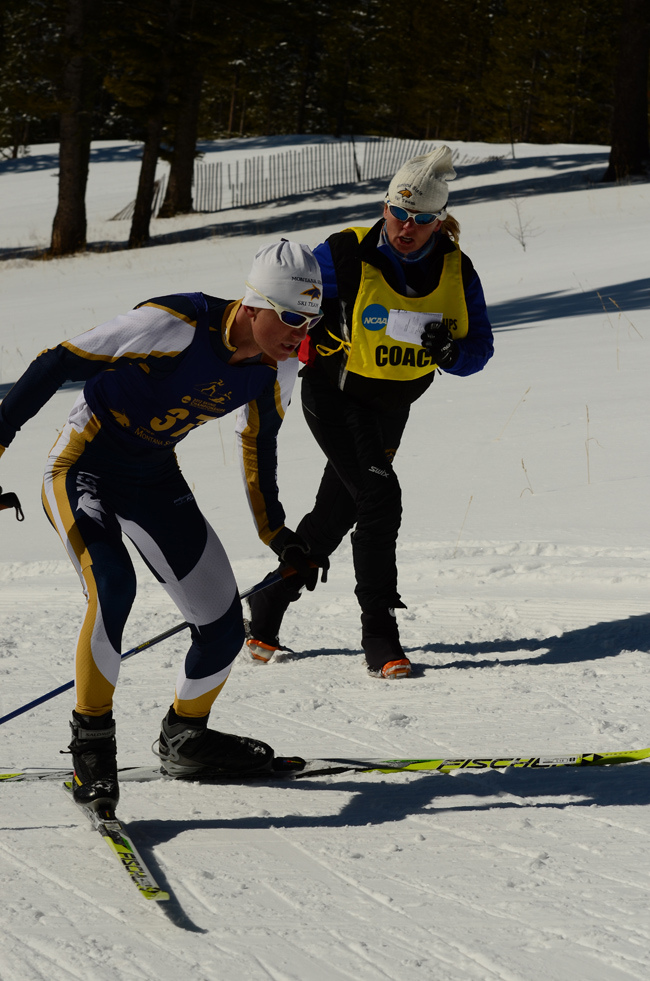
Matthew Perry Johnson, shown here in an earlier position with Alaska Winter Stars, began working as the new head coach for the Montana State University Ski Team in August 2015. (Photo: Montana State University)
Multiple schools in the Rocky Mountain Intercollegiate Ski Association are experiencing flux with their nordic coaching staff going into the 2020/2021 ski season, according to representatives from each school. The schools in question are the University of Alaska Anchorage, University of Utah, and Montana State University, all of which have well-established nordic programs that placed highly at last year’s NCAA Championships. Neither Anchorage nor Montana State currently has anyone filling this position. Utah has two nordic coaches on staff, but they are both subject to furloughs of unknown length due to budget shortfalls.
University of Alaska Anchorage, or UAA, has multiple problems for the future: The Board of Regents is meeting today and tomorrow to vote on a proposal from the chancellor and athletic director to cut both the men’s and women’s ski teams after this academic year. But it appears to have a more immediate problem for the present: The school does not officially have anyone currently coaching the nordic team.
Marine Dusser was named RMISA Nordic Coach of the Year in her first year leading the UAA Seawolves. (Photo: Adam Verrier)
Trond Flagstad was announced as the new UAA head nordic coach in May 2019, and was set to “begin his duties on August 18th,” 2019. What appears to be his official UAA bio page is still available online (albeit at a site not hosted by UAA). Nonetheless, Flagstad does not seem to have publicly coached at UAA during the 2019/2020 ski season or academic year. He is not listed as a current UAA employee in the online directory.
“Our nordic ski position is currently vacant and we are working through the hiring process,” a UAA media relations representative wrote to FasterSkier on Thursday.
There is no ski coaching position currently listed on the UAA jobs site.
At the University of Utah, meanwhile, Athletic Director Mark Harlan announced last week that the school would furlough every employee in its athletic department, for periods ranging from 1 to 8 weeks. The news was widely reported by, among others, the Deseret News, Sports Illustrated, and local TV station KUTV.
In a September 5 tweet, Harlan wrote, “All staff and coaches will furlough a minimum of 1 week to a maximum of 8 weeks.Head coaches, myself and cabinet will furlough for 2 weeks. We are fully operational as we stagger the schedule through Jan 1. Sharing this sacrifice as a team allows us to emerge stronger than ever.”
Following the decision of the Pac-12 conference to postpone all fall sports – in particular, the main revenue sport of football – Harlan told the Deseret News in August that the decision could lead to the school losing $50 to $60 million in income against an annual budget of $91 million.
“Everyone in the athletic department is furloughed anywhere from 1-8 weeks,” wrote Utah media relations representative Joseph Feldman to FasterSkier on Thursday. “The priority on when those furloughs are happening is to make sure the student-athletes are still operating as normally as they can and still have all of the resources they need. The rest of the department will be fully functional as the furloughs are staggered until January 1.”
Utah media relations representative Paul Kirk did not directly answer specific questions about when Director of Skiing Fredrik Landstedt and Head Nordic Coach Miles Havlick will be or have been furloughed, or for how long the two men will be or have been furloughed. Kirk wrote to FasterSkier on Saturday, “We are unable to share specifics about when any staff member or coach is on furlough, but when an individual is on furlough his or her email out of office reply may reflect that.”
It appears from Harlan’s tweet and Feldman’s statement that both Landstedt and Havlick have been or will be furloughed for some period of between 1 to 8 weeks, at some point between last week and January 1, 2021. If either or both of them is treated as a “head coach” under Harlan’s standards, then his furlough is or will be for 2 weeks.
On Sunday, through a spokesman, Landstedt stated, “The ski coaches are staggering their furloughs during the fall, and one or more coaches will be working at all times during this period. The University of Utah Ski team has been practicing with coaches present since the second week of school.”
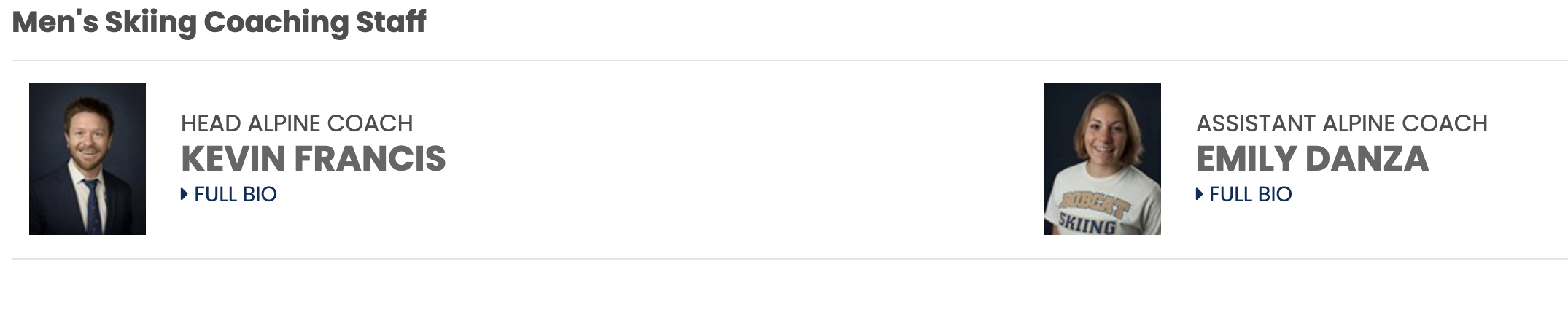
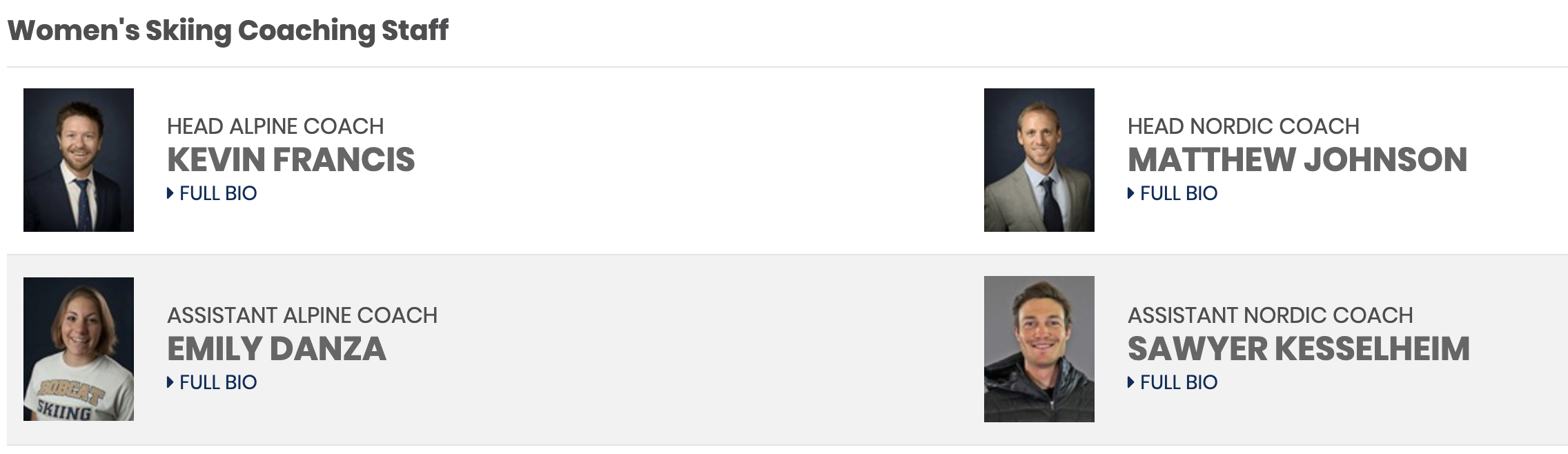
Counting alpine coaches and student assistant coaches, Utah has a healthy six coaches currently listed on its roster. 400 miles to the north, however, Montana State University only has two people listed as ski coaching staff: Kevin Francis, the head alpine coach, and Emily Danza, assistant alpine coach. (The “staff” section for the women’s skiing roster looks the same.)
That’s Matthew Johnson and Sawyer Kesselheim, both recently associated with the MSU nordic team but no longer there.
The Montana State athletic department confirmed in a Thursday email to FasterSkier that both men had moved on: “We received a letter of resignation from Matt Johnson last week. Montana State is currently working with its HR Department to search for a new head coach. Sawyer Kesselheim was not planning on returning this season.”
There is no ski coaching position currently listed on the MSU jobs site.
As of Thursday morning, Johnson was still listed as the head nordic coach in the MSU online directory:
He also still lists his current job as MSU head nordic coach on Facebook and LinkedIn.
Attempts to contact Johnson on Wednesday and Thursday for comment were not immediately successful.
Montana State placed seventh at this year’s NCAA Championships. UAA was sixth, and Utah was first. Of the six RMISA schools that scored points in the nordic race at this year’s NCAA Championships – UAA, University of Alaska Fairbanks, Colorado, Denver, MSU, and Utah – fully half of them are without an active nordic ski coach at this point in the season. It further appears that Denver (second at this year’s NCAAs), which last season employed Rogan Brown as an assistant nordic coach, only has head nordic coach Toni Roponen at present, with no assistant coach for the nordic team.
This story has been updated with additional information about the timing and nature of furloughs at the University of Utah.
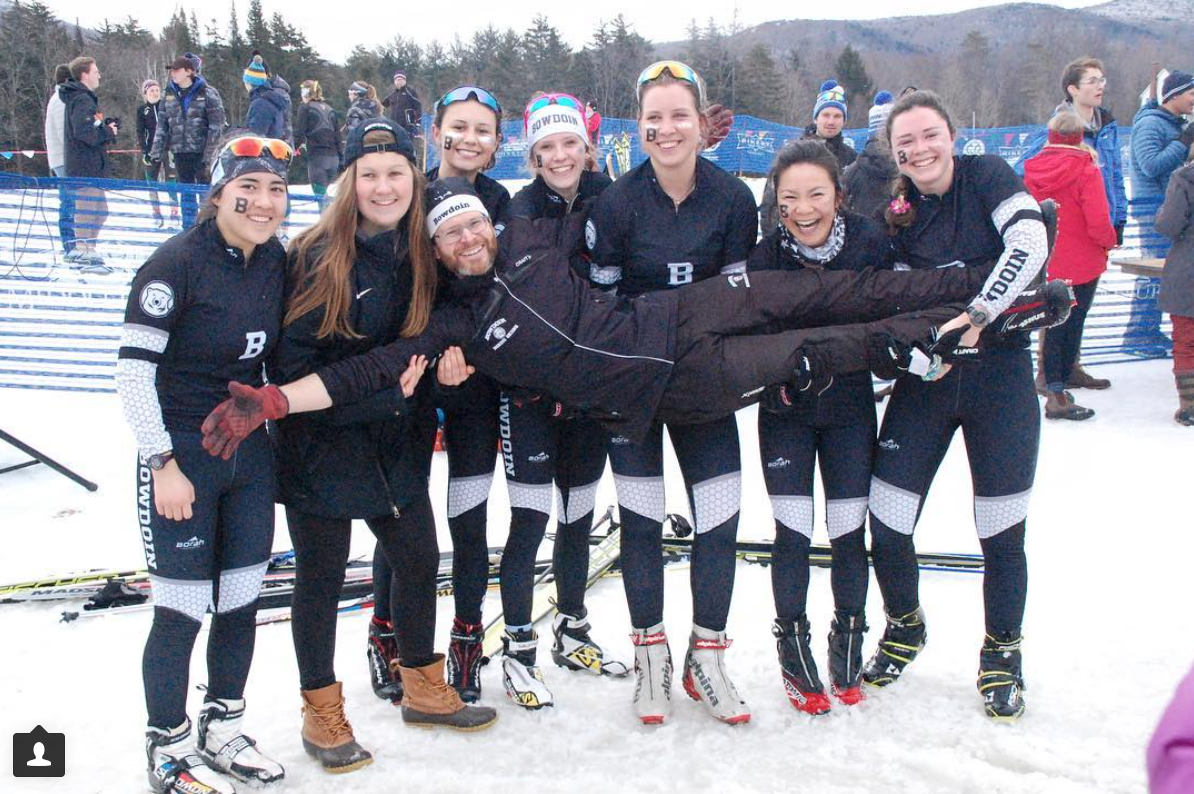
Bowdoin nordic skiers with head coach Nathan Alsobrook. In July, Alsobrook was recognized as NENSA’s 2018 Coach of the Year. (Photo: @bowdoinskiing/Instagram)
Building on one of its most successful seasons yet, the Bowdoin College nordic ski team, out of Brunswick, Maine, recently jumped back into training under the guidance of head coach Nathan Alsobrook. Last winter, three skiers qualified for NCAA Skiing Championships, one alumna qualified for the U.S. Olympic team (Kaitlynn Miller, class of 2014), and one visually impaired skier Jake Adicoff (’18) earned a silver medal at the Paralympics. It was a season that Alsobrook names as a highlight of his coaching career.
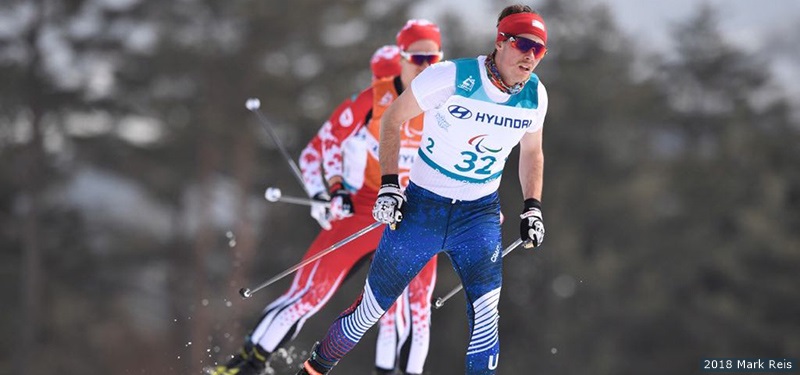
American Jake Adicoff leads Canada’s Graham Nishikawa and Brian McKeever in the men’s visually impaired 20 k freestyle at the Paralympic Winter Games in PyeongChang, South Korea. Adicoff earned silver (behind McKeever) in the men’s visually impaired 10 k classic in PyeongChang. (Photo: US Paralympics/Mark Reis)
“The most fun thing about has just been to see the very slow but steady progress that the program has been able to make over the past several years,” Alsobrook said in a phone interview last month. “It’s been very fun and exciting.”
To top it off, Alsobrook was recognized by the New England Nordic Ski Association (NENSA) as 2018 Coach of the Year in recognition of his team’s steady progress and his contributions to the growth of cross-country skiing in New England.
“Over the past years, Nathan has been active in NENSA Programming, including serving as a coach at Eastern Regional Camps, chairing the Coaches Education Committee and running L100 Technique clinics for the state of Maine,” a NENSA press release stated. “Through his dedication to these programs he has made the Bowdoin Nordic Team a visible and attractive institution for skiers to continue their careers.”
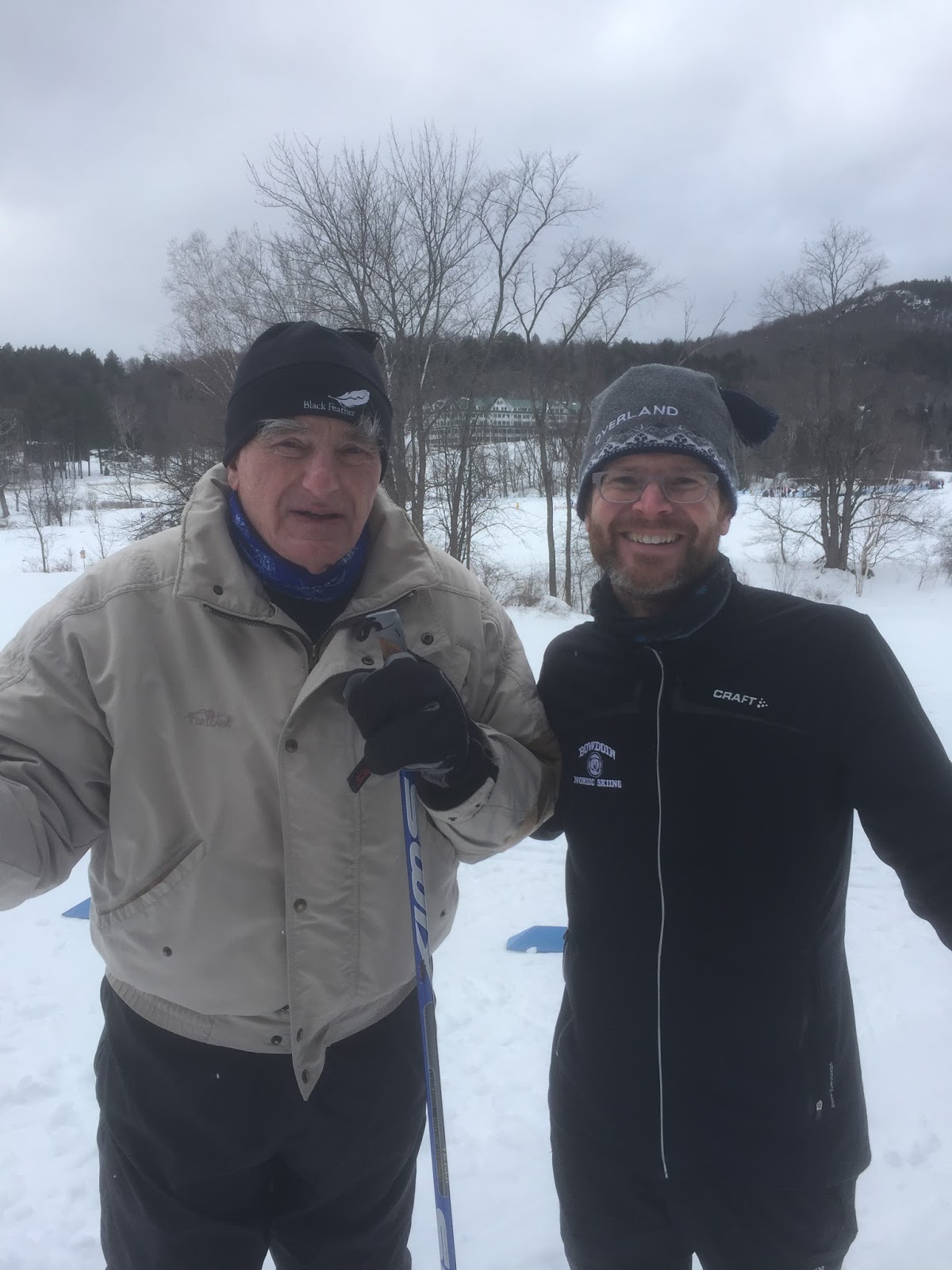
Current Bowdoin Nordic Ski Team Head Coach Nathan Alsobrook (r) with Marty Hall, who coached at Bowdoin for eight years and was inducted into the U.S. Ski & Snowboard Hall of Fame this past spring. (Photo: Bowdoin Nordic)
A Bowdoin graduate (’97) himself, Alsobrook returned as head coach in 2007, taking the place of former U.S. and Canadian national team coach Marty Hall, to whom he attributes planting the seeds for Bowdoin’s current development.
“He was really responsible for taking Bowdoin out of where it had been,” Alsobrook said of Hall’s eight years with the team. “We really weren’t functioning at a super high level before Marty came in. He was able to really push for the college to bring more resources to the sport and just sort of professionalize the whole program. He essentially created this really great foundation for me to springboard off of.”
Before Bowdoin, Alsobrook coached at Whitman College, Montana State University (MSU), Colby College, and the Pocatello XC Ski Foundation, and earned a master’s in exercise physiology from MSU in 2005.
While it didn’t happen overnight, over the years, the Bowdoin Polar Bears have trended upward in the Eastern Intercollegiate Skiing Association (EISA) nordic rankings.
“We had individuals pop great races, and we had these flashes of brilliance that more was possible, but it took so many years for us to become competitive as a team. It was not until 2013 that we sent a skier to NCAA’s during my tenure,” Alsobrook explained. “We would have little successes here and there, a great relay performance or a single race where we would finish very competitively, but we never really put it together for consistent week after week Carnival team performances. It was really only last year that that finally happened, where all of a sudden for the combined men’s and women’s nordic events we would find ourselves finishing in the top half of the league.”
Every weekend on the Carnival circuit last winter, either Bowdoin’s men’s or women’s team placed in the top six. And it saw three skiers — more than ever before — qualify for NCAA’s in Steamboat Springs, Colorado: Gabrielle Vandendries, Renae Anderson and Elliot Ketchel.
Outside of the results, Alsobrook said he enjoys the culture of the student body at Bowdoin and feels that it contributes to the dedication and work ethic of his athletes.
“There is this really great sense of balance here at Bowdoin, and we really try to compliment that in our program,” he said. “It’s such a fun mix of these very academically focused and engaged students. … They just love learning, they love being in this environment and challenging themselves, and then they’re just so ready to get out and train hard.
“I think we do a pretty nice job here at Bowdoin of making this a very collaborative experience, the learning experience and certainly the athletic experience,” he continued. “And it’s just such a natural fit for when you’re trying to create this very team-centered program like I’m trying to do here, that that culture is already in place at the college. I mean, people really want to do well here, in whatever they’re doing, and they’re going to work really hard to do it, and yet they’re trying to help everyone else do the same. That’s something I really appreciate … any competition is directed toward making everyone better.”
His coaching philosophy aims to capitalize on this dedication to personal success, while also reflecting the sense of balance achieved at the school.
“I can’t remember who started saying this, but it’s something we started saying around our team: ‘Happy people ski faster,’ and that is really at the heart of what we are trying to do,” he said. “I know that my skiers are going to get more out of themselves on the race course if they feel very fulfilled with their Bowdoin experience as a whole.”
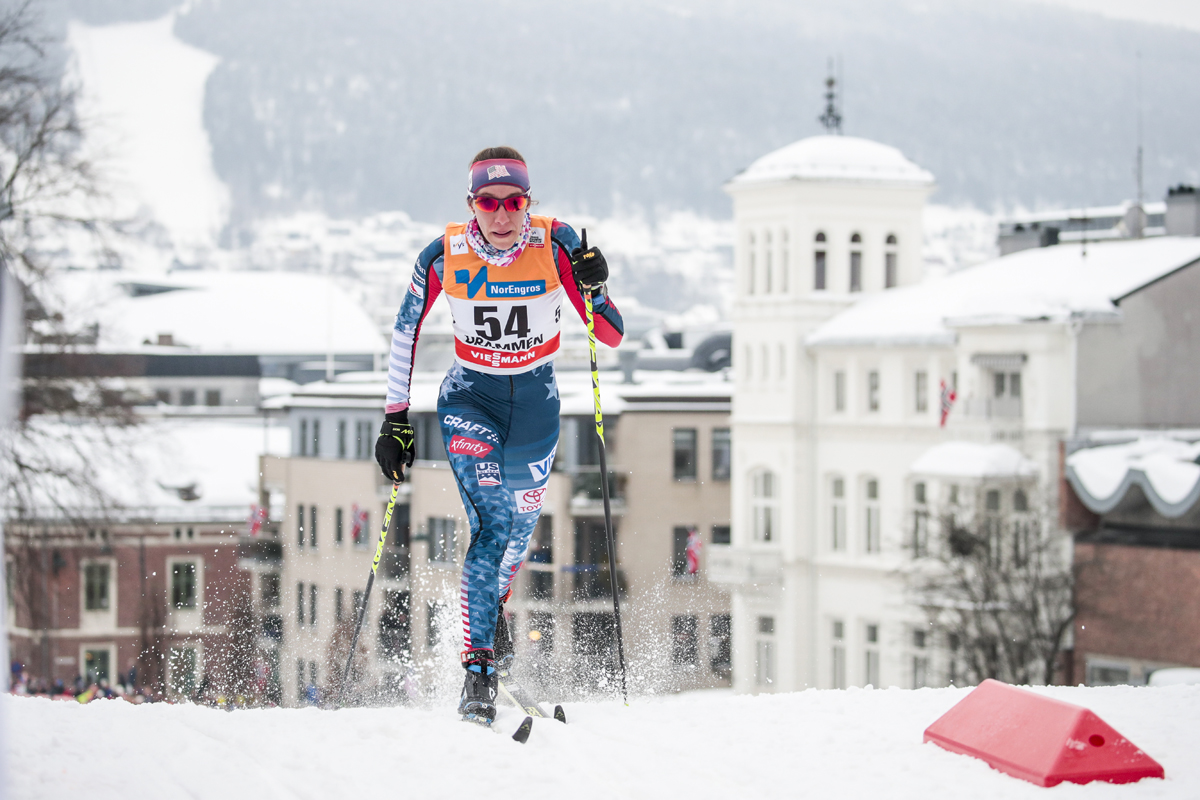
Bowdoin alumna Kaitlynn Miller racing to 53rd in the World Cup classic sprint qualifier last March in Drammen, Norway. (Photo: Fischer/NordicFocus)
According to Alsobrook, this culture and balance served Kaitlynn Miller, who now skis for the Craftsbury Green Racing Project, well in her time at the school. He described Miller as “very studious, very thoughtful … and yet very focused when it came time to train.”
Miller ended last season as the overall SuperTour leader and has earned World Cup starts in November and December as a result.
“It was really nice to have someone that embodied what we are trying to do in our program,” he continued. “For someone who is such a high-level athlete, she is just extremely humble, very kind and thoughtful, very team-centered. It was really fun to coach an elite athlete who was such a team-centered, selfless person … It’s been a real pleasure to watch her take off.”
As for the upcoming season, Alsobrook will continue to focus on the continued growth of his team.
“With my athletes, we’re all about the process,” he said. “Having said that, of course, I have outcome goals, essentially I want to see the team keep moving forward. We’ve never won the Maine State Championship, for example … so we’re really excited to go after that this year. We’ve come close a few times, and maybe this will be our year,” he said.
Another goal will be to continue to place highly at EISA Carnivals and to develop a strong championship team. Last year, its two female athletes at NCAA’s — Vandendries and Anderson — posted top-30 finishes in Steamboat.
“Certainly bringing back a good contingency of skiers to NCAA’s again is a big goal,” he said. “We had a number of times where our [team] finishes [in EISA competitions] were fourth, fifth, sixth pretty consistently throughout the season, and that’s a pretty good place to be in a league as competitive as EISA. I do not want to stay there and keep cranking out those finishes, I want to keep getting better. … I mean, hey, we did fourth last year, why not try for third this year? They’re just great things for us to keep fighting for while at the same time we stay firmly grounded on the process.”
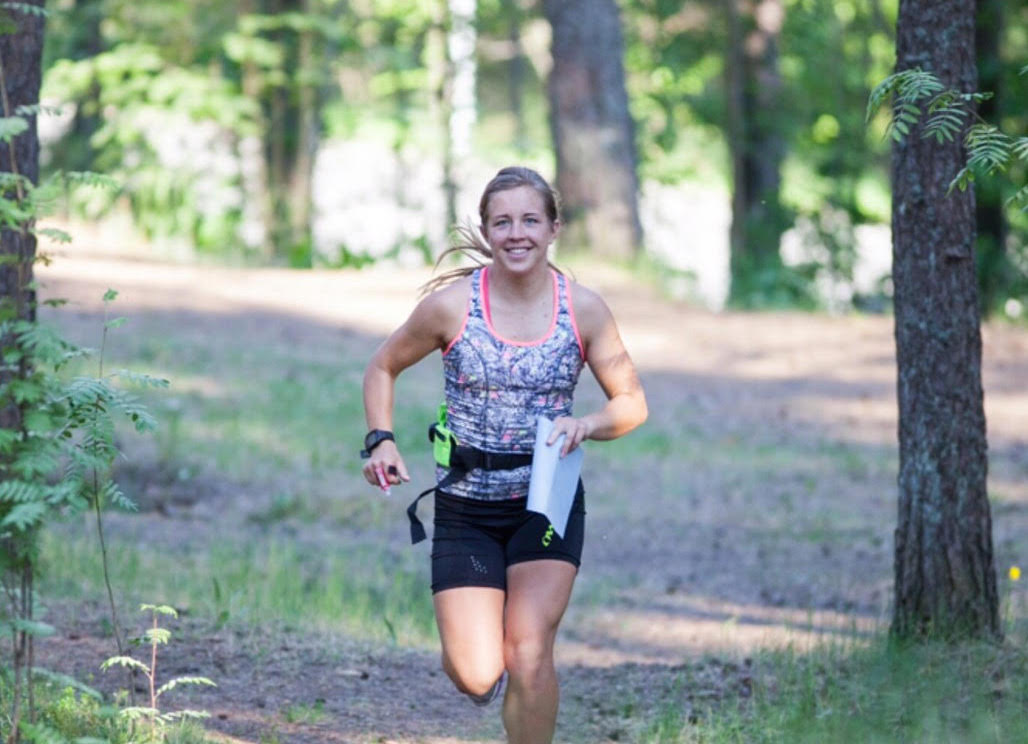
Montana State University skier and Estonian national-team biathlete Johanna Talihärm running outside of Tallinn. (Courtesy photo)
After spending last summer training in the U.S. with the Craftsbury Outdoor Center’s U23/collegiate summer training group, this year Johanna Talihärm decided to go home to Estonia.
The FIS Cross-County World Cup swings by Otepää periodically (as does the Continental Cup circuit and biathlon’s IBU Cup series), but Talihärm is originally from Tallinn, Estonia’s capital and a World Heritage Site. That’s the atmosphere she moved back to for the summer — which she said had both pros and cons.
“It is easier at home, because of no extra travel and friends and family nearby,” Talihärm, who turns 24 later this month, wrote in an email. “Other than that I would say Craftsbury was perfect. There’s an amazing and super strong group of girls to train with, biathlon and nordic girls and guys training together, an awesome nature-preserving environment and just a beautiful place.”
https://www.instagram.com/p/BUcroSMDjTt/
The Montana State University (MSU) skier finished seventh in the 15-kilometer freestyle at NCAA Skiing Championships in March, improving on her previous best finish of 13th. She and Annika Miller were the team’s only nordic All-Americans this year.
Johanna Talihärm training on the shooting range in Otepää, Estonia. (Photo: Detlef Eckert/Courtesy of Johanna Talihärm)
A few weeks earlier, Talihärm had been at IBU World Championships in Hochfilzen, Austria, representing Estonia on biathlon’s biggest stage. She placed 57th in the 15 k individual, a result about which she said at the time, “it was all right.” Talihärm, Estonia’s top finisher at those Championships, is planning to go to the 2018 Olympics.
Over the summer, she’s focusing on aspects of training that can help both her biathlon career and her college skiing.
“I would say that my general goal is to get stronger and ski faster, and all the training I do benefits both, my biathlon and college racing,” she said. “Shooting has given me a lot of mental strength and an ability to concentrate that benefits skiing, too.”
Over email, Talihärm explained what summer training is like in Estonia.
FasterSkier: Where are you based this summer? Is this the same area you grew up in, or is your training base away from your family home?
Johanna Talihärm: I live in Tallinn, the capital of Estonia, which is in the north, but spend a lot of time training three hours away in Otepää which has a world class training center with two shooting ranges and good rollerksiing opportunities. Also as Estonia is very flat, Otepää has some hills to train on, to switch it up from completely flat Tallinn.
FS: Do you have a team that you are training with, or are most of your training sessions alone? Are there a lot of other athletes and teams using the same area/facilities?
JT: I train with the biathlon national team, but most of them are located in Otepää. I train mostly alone when I’m at home.
More work on the shooting range. (Courtesy photo)
A lot of teams come to Otepää for their summer training. The Russian ski team is there with almost all teams (juniors, men, women, para, local club teams and even some youth groups), Ukrainian women’s biathlon team was there last week, also [Slovenian World Champion] Jakov Fak, some Russian biathletes are coming (for example Anton Shipulin), Kazakhstan has been there in the past, and also Estonian nordic skiers and athletes from neighboring countries like Latvia, Lithuania and Finland.
FS: When you are planning your summer training and thinking of what you need to work on for the upcoming season, how do you coordinate between your various coaches about how to design training?
JT: I follow my national team plan when I’m in a training camp with them, MSU training when in school, and I fill up the time in between myself to make it all work. I have to credit the coaching education I got from my sports high school and coaches seminars by Estonian federations for the ability to make educated choices about my training.
FS: What’s the hardest workout you have done so far this summer?
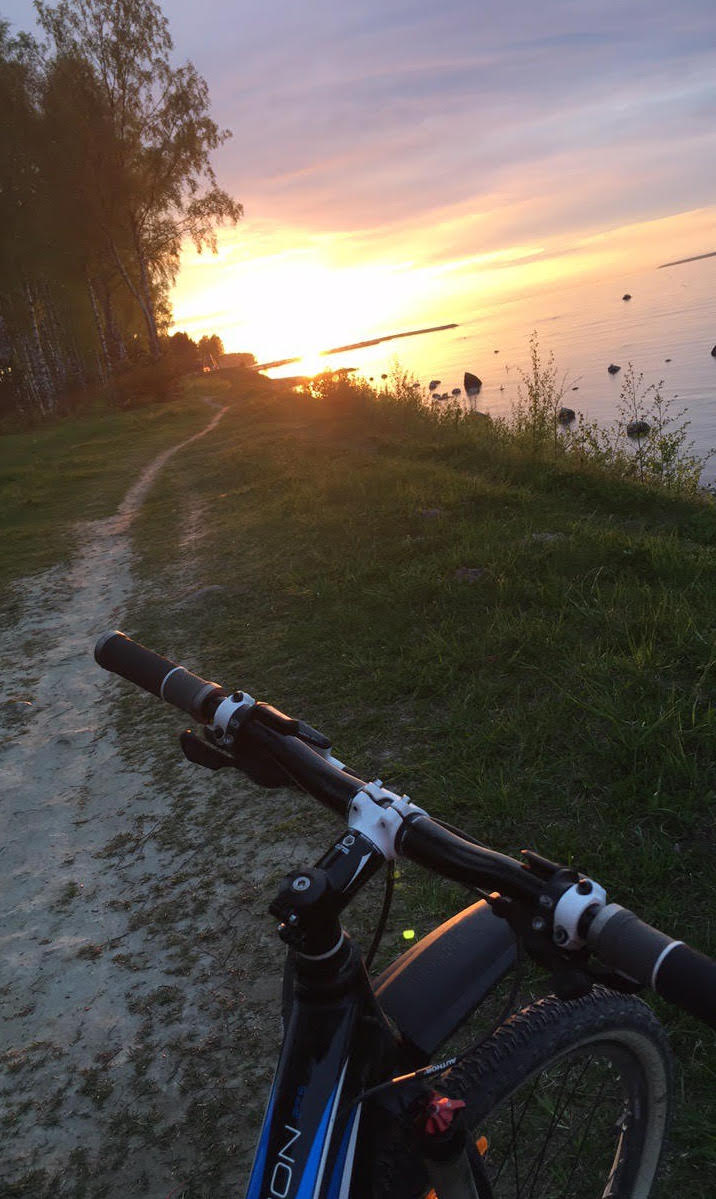
A photo from an evening bike ride along the coast in Tallinn. (Courtesy photo)
JT: Probably a long lonely run in the rain at home. Not the hardest physically, but definitely mentally.
FS: Are there any absolute favorite places to run or bike or rollerski? Where are you always excited to do a workout?
JT: I’m always excited to work out in a new place. I love exploring new trails in my hometown Tallinn, especially the ones right by the coast. I’ve been there so often that I never expect to find anything new, so the joy is even bigger when that happens.
FS: Maybe related, is your area set up best for some parts of training? Are there excellent hills for intervals, or great places to do long workouts without being repetitive, or what do you think is the best aspect training-wise?
JT: I think my hometown is not the best place to train for skiing in the long term, but it has amazing long paved loops ideal for rollerskiing.
FS: What do you do when you are not training? Do you need to have a job?
JT: I have an internship in Tallinn this summer.
FS: How was your spring — did you get to do a good start to training while you finished up school?
JT: I was pretty wiped out by the load from school, training, racing and travel, so I took a little extra time to recover. I was careful with the intensity at first, but in general I don’t think it will make a big difference in the long run.
FS: What is the best part of Estonian summer, aside from training?
JT: Being able to see everyone, not having to do all my tasks at home in one or two weeks, no packing nor long travel, various bodies of water to swim in, familiar food and warm and long summer days.
Talihärm taking a swim in the lake next to the shooting range in Otepää. (Courtesy photo)
Casey Smith (Maine Winter Sports Center/U.S. Biathlon B-team) on his way to placing second in a NorAm mass start in Canmore, Alberta, in December 2014. (Photo: Jake Ellingson)
Casey Smith has endured a few things that would cause any athlete to question whether to continue with their professional career.
In February 2015, the Washington biathlete crashed hard while training in Canmore, Alberta, before the International Biathlon Union (IBU) Cup races to be held a few days later. He was knocked unconscious, broke ribs, a shoulder blade, and bones surrounding his vertebrae, and punctured a lung.
But Smith – using the physical and mental endurance he had cultivated in biathlon – persevered, joining the Craftsbury Green Racing Project (CGRP) in Vermont and returning to international competition in the 2015/2016 season.
“It definitely [felt sweet],” he said of a few good races last season. “It was really cool to be able to – I got back to the same level I was at before. In Europe this year I didn’t have quite as good results as the year before, but also the first week I got food poisoning really bad. That took a pretty big toll on me, and didn’t have anything to do with the crash.”
Come spring, the 24 year old decided to call it quits with his biathlon career and return to Bozeman, Mont., to finish a degree at Montana State University. He had enrolled after high school before transitioning to being a full-time athlete.
His decision was unrelated to the ordeals of the year before. It came down to something much simpler: joy.
“The whole year of the training season and racing season, I wasn’t feeling as motivated,” he explained on the phone from his home in Washington’s Methow Valley. “I said that I wanted to do this as long as I was having fun, but it was turning into more of a job kind of thing. It was getting to the point where it wasn’t as much fun anymore. So I thought it was time to move on.”
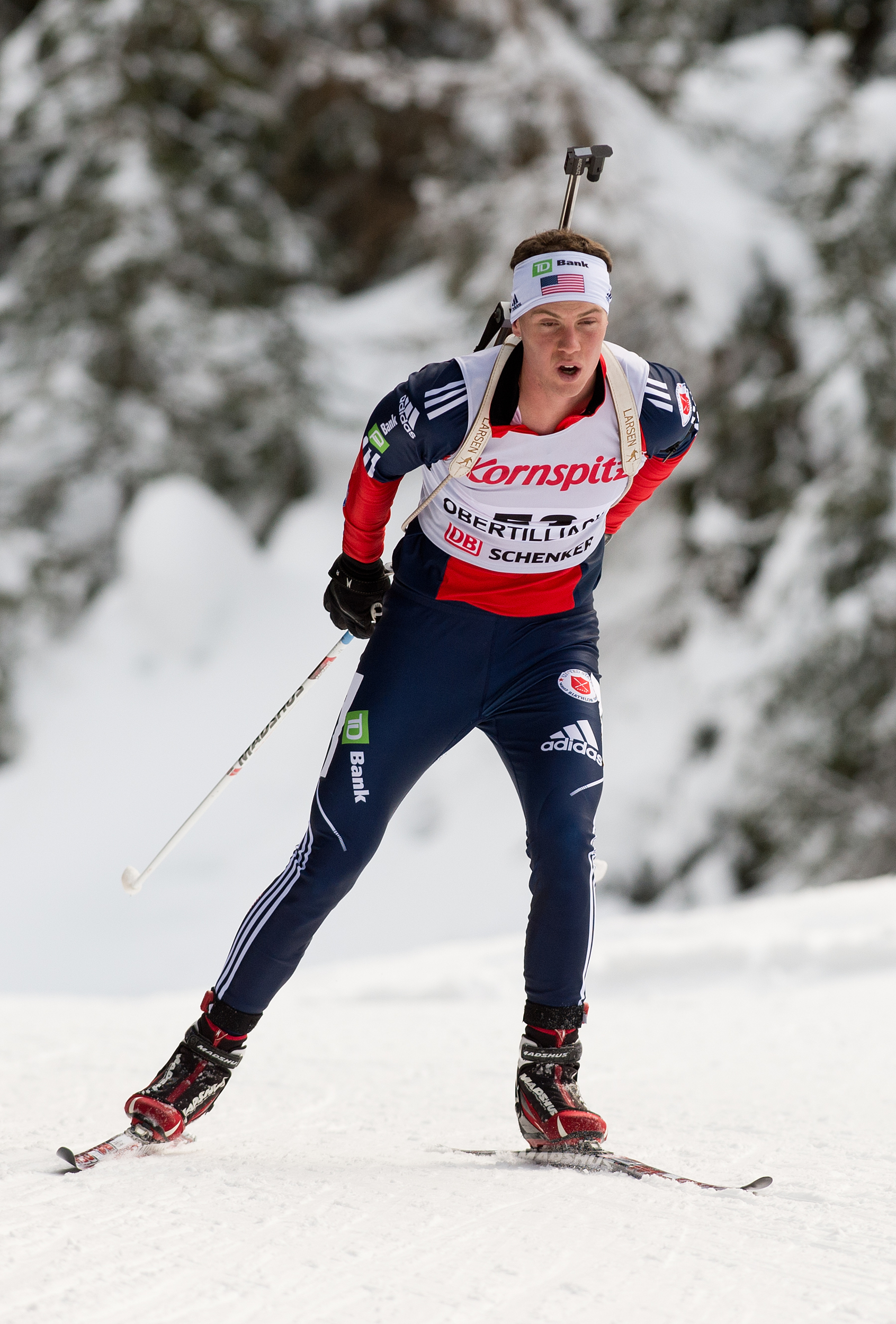
Casey Smith (USA) en route to 37th place in the junior men’s individual at 2013 World Junior Championships in Obertilliach, Austria. He had his career-best finish of 23rd place in the pursuit there. (Photo: US Biathlon/NordicFocus.com)
Smith was a top junior for the U.S. before and during his first stint in Bozeman. He had top-30 finishes at World Youth and Junior Championships in 2011 and 2013, as well as two apiece at Open European Championships in the junior races in 2012 and the senior races in 2014.
“It was great having other guys to train with,” he said of his time in Vermont. “I really hadn’t had too much of that, at least when I was in Maine. So that was really nice, and I really enjoyed working with Pepa [Miloucheva]. It helped me with my ski technique a lot, for sure.”
Looking back, he said having the chance to travel the world was one of the best things the sport had offered him.
“The last several years we would always go to Canmore over Thanksgiving, and so I could build relationships with people there,” he said. “Then when you land in Europe at competitions you run into them again, and I was able to make friends from all around. That was pretty cool.”
There were results highlights from this season, too.
“At [U.S. National Championships], it was really cool that all the national team was there [after the World Cup finished],” he reminisced. “It made it real races. In the sprint I had a pretty good race, and right in the mix. Also in Canmore at the trials it was a little bumpy the first few, but the last race I was finally able to pull it together and have a really good race.”
After the injuries sustained the year before, Smith had attacked training and racing with a new direction, and it worked.
“It was a traumatic experience, but I felt like I was able to bounce back from it miraculously quickly,” he said. “It almost helped me a little bit because I was so much more focused on being perfect on my physical therapy and being super diligent every single day. So I had to be really focused in general.”
Casey Smith leads Craftsbury Green Racing Project Head Coach Pepa Miloucheva at a training camp at La Forêt Montmorency, Quebec, in November 2015. (Photo: Caitlin Patterson)
And yet, he became aware that he wasn’t as fired up to keep it up for years. He decided that he would return to Bozeman for the fall semester. Smith initially told himself that he would return home to Washington and mull over whether to continue to compete while he finished his degree, or to call it quits on biathlon altogether.
The latter won out, and now he’s fully invested in school and his future outside of sport.
“I’m going to be in the animal science program,” he explained. “My plan is that my family has a small sheep farm here in Washington, and I’d like to come back and grow that bigger… and live in the Methow and have that lifestyle.”
Most of the friends he started school with at Montana State years ago have graduated, but that didn’t concern Smith.
“I feel like now I’m going to school because I want to learn, and before I was there because I wanted to do biathlon and train and there was other people doing that there, and by the way I was going to school on the side,” he said. “Now I’m going there because I really want to go to school.”
Until the fall semester begins, he’s helping his family and uncle out on their farms and doing odd jobs in the Methow Valley.
He may help with biathlon in the Bozeman region, and will definitely help his mother, Betsy Devin-Smith, who is the head coach of the Methow Valley Nordic Ski Education Foundation’s biathlon team.
“I’m sort of stuck helping her with that, like it or not,” he joked.
Of the life transition, Smith said that everything was feeling good so far.
“I don’t really miss it now,” he said of biathlon. “The opportunity to ski as often, maybe I’ll miss. I’m sure I’ll still ski a lot, but not every day for hours.”
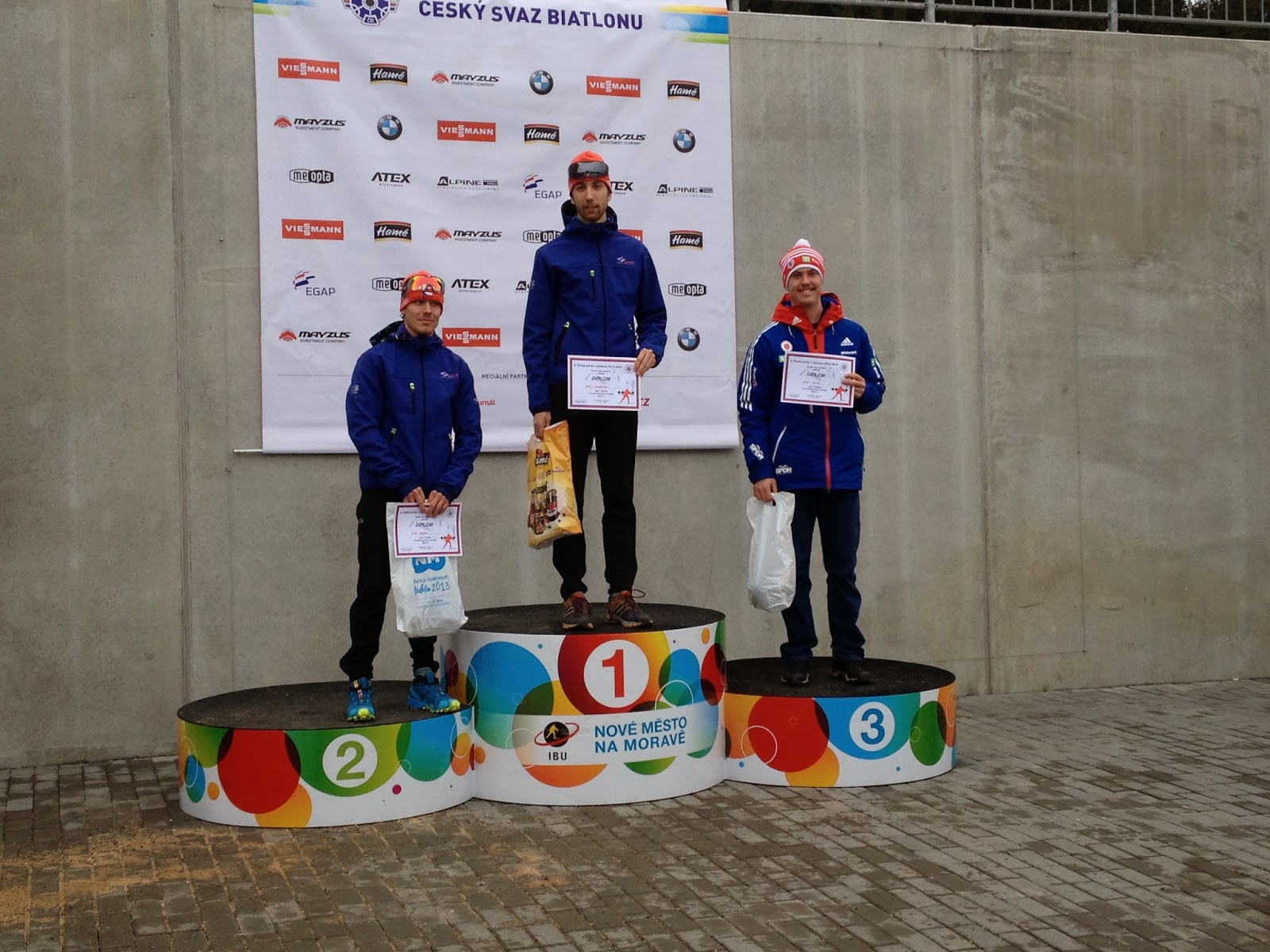
Casey Smith (right) on the podium at a Czech Cup biathlon race in 2014. (Courtesy photo)
Note: FasterSkier is seeking photos from the nordic races at 2016 NCAA Skiing Championships. Please email info@fasterskier.com with photos of top finishers or for more info.
***
Two juniors, one from Montana State University (MSU) and the other from the host team, the University of Colorado-Boulder (CU), claimed the ultimate collegiate titles on Thursday at 2016 NCAA Skiing Championships in Steamboat Springs, Colo.
It was the first of two days of nordic racing at Howelsen Hill, and Anika Miller (MSU) and Mads Strøm (CU) emerged as the individual winners in the 5- and 10-kilometer freestyle races, respectively.
The women’s 5 k freestyle podium on the first day of nordic racing at 2016 NCAA Skiing Championships in Steamboat Springs, Colo. Anika Miller (MSU) placed first, Petra Hyncicova (CU) finished second and Utah’s Sloan Storey took third. (Photo: MSUBobcats.com)
Miller led four Bobcats in the top 10, winning the women’s 5 k freestyle individual start in 13:06.1. Her teammate, Cambria McDermott, placed fourth, 9.4 seconds back.
“When I finished, I had no idea how I’d done actually until my teammates jumped on me and were screaming,” Miller told NCAA.com. “I had no idea. I just started crying.”
A native of McCall, Idaho, Miller bested second-place finisher Petra Hyncicova (CU) by 7.9 seconds for the win, becoming the first MSU skier to win an individual title since 1978, when Dan Brelsford (now the director of skiing) won the slalom race, according to an MSU press release. She is also the first female skier to win an individual title for MSU.
Just one-tenth of a second behind Hyncicova, Sloan Storey (University of Utah) reached the final step of the podium in third.
An NCAA champion in 2014, Strøm achieved his second freestyle title in the men’s 10 k freestyle on Thursday in 22:06.8. His time proved to be 10.6 seconds faster than runner-up Ian Torchia of Northern Michigan University (NMU). Denver University’s Moritz Madlener placed third (+19.8).
For Strøm, the win was his fifth in a row and seventh total this season, according to a CU press release.
“It feels awesome, it feels amazing,” the 24-year-old Norwegian told CUBuffs.com. “For ten months this has been my goal and to accomplish my goal is amazing. I was so nervous. I knew there was going to be a mass crowd out. I just had to find good skis, good pacing, and push it as hard as possible. It was definitely the best win of the year. Pulling it off when it matters the most is great.”
Mads Strøm of the University of Colorado-Boulder celebrates his win in the men’s 10 k freestyle on Thursday at 2016 NCAA Championships in Steamboat Springs, Colol. (Photo: Jamie Schwaberow/NCAA via CUBuffs.com)
Strøm explained he had to “push it all the way to the end,” so hard that he was physically ill across the line.
“I was so tired in the end,” he added. “As soon as I crossed the finish line, I had to lie down.”
With his seventh win, Strøm is the winningest male nordic skier in CU history. He exceeded the amount of wins of Per Kare Jakobsen (who won six races in 1989) and Ove Erik Tronvoll (six in 1999). It was also the 89th individual win by a Buff, the most of any school in NCAA history, the CU release stated.
For women’s runner-up Hyncicova, a 21-year-old sophomore from the Czech Republic, second stood as her best result of the season and matched her career best.
“It was so hard, but it was really nice in the end. I didn’t hope for getting second, so it’s really nice,” Hyncicova told CUBuffs.com. “I really didn’t have any idea what I was hoping for. In each race you want to win, but I didn’t expect that I would win here because I was always around fifth [place] this season. I went to Romania a couple of weeks ago [for U23 World Championships], so I was really tired and didn’t feel that great.
“I was really nervous before the start,” she added. “But once I saw everyone here — the alpine’s and everyone who cheered for us — I was like, ‘Yes I have to do it. I have to do it for the team.’ ”
Team Standings (through 4 races):
Montana State: 282
Utah: 264
Denver: 263
Colorado: 214.5
Vermont: 154
New Mexico: 139.5
Dartmouth: 126
Alaska Anchorage: 124
Northern Michigan: 122
Middlebury: 81
“I feel somewhat relieved but happy,” CU Nordic coach Bruce Cranmer said. “Compared to racing, coaching is way more stressful. You are worried about everyone and getting the right wax. I am still trying to calm down. I get so fired up.
“Mads did great,” Cranmer added. “The guy that got second [Torchia] is one of the top U.S. [skiers] that went to World Juniors. [Mads] was on really good form before he got here, so I had high expectations without trying to get too caught up.
“As for Petra, we were hoping for a top five finish. That is we thought she was capable of. … For her to finish in second is awesome. … She does really well in skating.”
Late last month, Torchia led the U.S. junior men in Romania with his top individual result of the week in 15th in the 15 k freestyle. It was his second-best at Junior Worlds since placing 11th last year in the 20 k skiathlon.
Following Torchia in second, Northern Michigan had three in the top 10 with Adam Martin in fourth (+28.4) and Jake Brown in ninth (+56.1).
“We knew that if we had a good day, all three of those guys were capable of winning and we just didn’t know which one,” said NMU Head Coach Sten Fjeldheim told NCAA.com. “We weren’t shocked or surprised that they’re all in the top 10, but you never know at altitude.”
The base elevation of Steamboat Springs’ Howelsen Hill is about 6,700 feet.
Through four events (two cross-country and two alpine) at 2016 NCAA Championships, Montana State leads the team standings with 282 points and Utah is second with 264. Denver is a close third, with 263 points after two days of racing. With a win and second-place finish on Thursday, CU moved into fourth in the standings, with 214.5 points.
MSU’s previous team best was seventh, which it achieved last year with 259 points. The University has already exceeded that total at the halfway point of the championships. Racing wraps up Saturday with 15/20 k classic mass starts.
“The momentum definitely helps our mindset, but the bottom line is we’ve got to go out and race the same way that we race everyday. That’s the way to succeed,” MSU Head Coach Matthew Johnson told NCAA.com. “Trying to mix it up and change it for the championship isn’t going to go well. Coming in with too much excitement isn’t going to go well, but skiing like we’re in the lead and skiing like we’re champions is going to do well for us.”
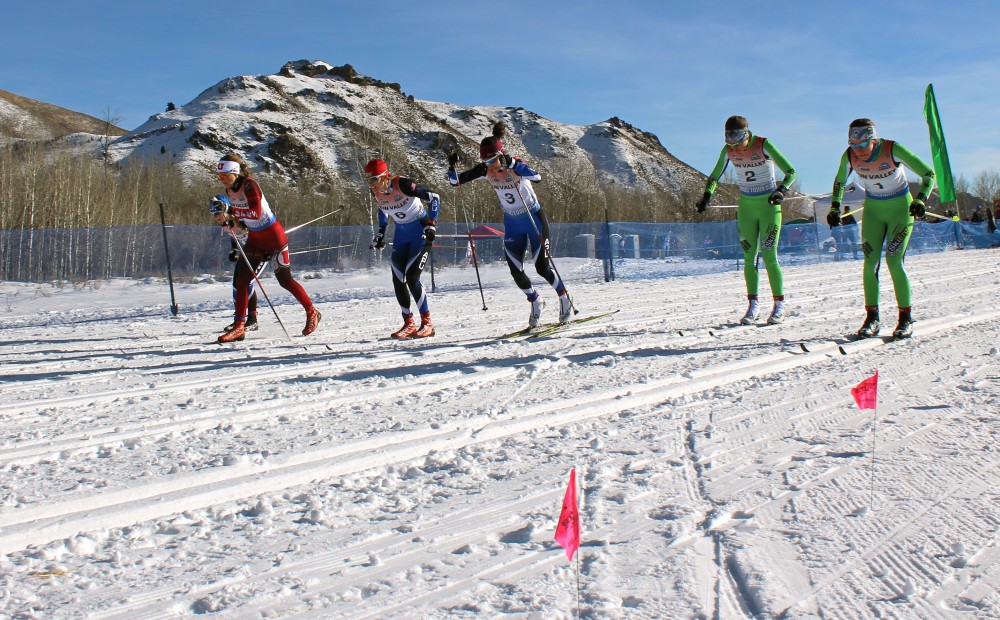
Racers power onto the course at the start of the women’s SuperTour classic sprint final on Saturday in Sun Valley, Idaho. From left to right: Hannah Halvorsen, Veronika Mayerhofer, Becca Rorabaugh, Chelsea Holmes, Caitlin Patterson, and Kaitlynn Miller.
SUN VALLEY, Idaho — The opening day of the second SuperTour on the season brought a welcome change from last weekend: warmer weather. After enduring start delays and colder temperatures in West Yellowstone, Mont., racers enjoyed relative warmth and sunshine while sprinting in an open field at the Trail Creek venue in Sun Valley.
The 1.3-kilometer course set up for the classic sprint was ready to go thanks to the work of many coaches and volunteers throughout the week. Though the course started and finished in a flat stadium, it featured two climbs, a small one out of the start, and a larger one that reached the high point before dropping into the stadium. Both climbs represented an opportunity for the athletes to show off their striding ability.
This was something that the women’s race winner, Becca Rorabaugh of Alaska Pacific University (APU), was able to take full advantage of.
“I just love big striding and I knew that was going to be a sweet spot for me,” she said in a post-race interview. “I was really looking forward to that second hill.”
After placing sixth in the qualifier, Rorabaugh skied to a win in her quarterfinal before being narrowly bested by Kaitlynn Miller of the Craftsbury Green Racing Project (CGRP) in their semifinal. However, Rorabaugh, 26, was able to carry more energy into the final, where she won in 3:38.46, almost exactly one second ahead of Miller and 1.3 seconds ahead of Caitlin Patterson, also of the CGRP.
“I was slowly getting my motor going throughout the day and it turned out that I was able to last perfectly through the final,” Rorabaugh said. “It was just taking me a while to get going. I felt like I was really on it in time for the last heat, so it just worked out.”
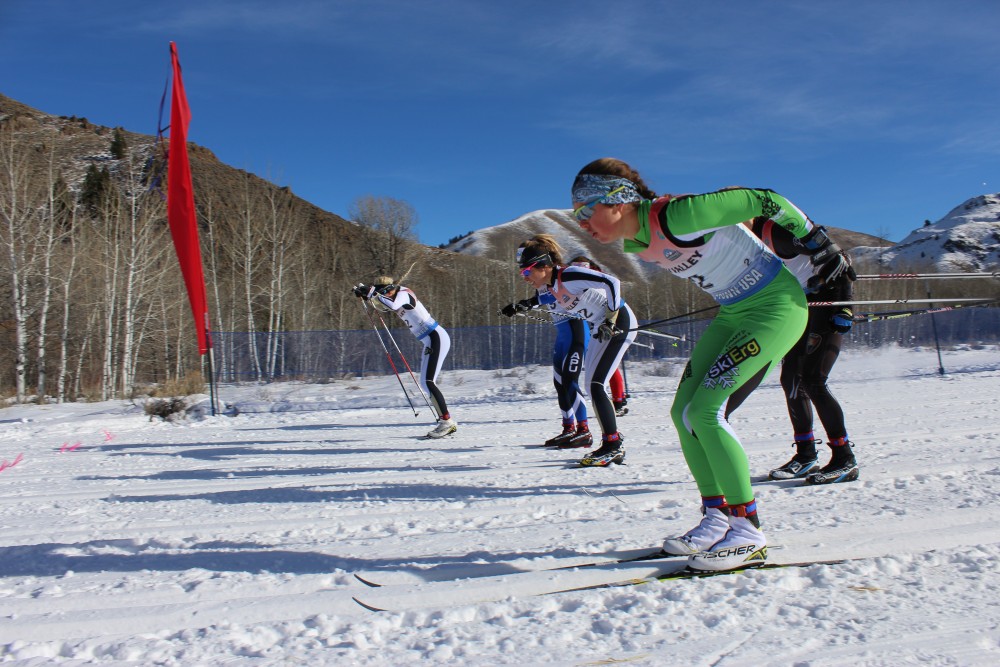
Caitlin Patterson (in green) racing head-to-head with CU’s Christina Rolandsen (l) and Petra Hyncicova (center, in white) in their SuperTour classic-sprint quarterfinal in Sun Valley, Idaho.
Miller, meanwhile, skied strong throughout the day, but was unable to stay with Rorabaugh in the final. The 24-year-old CGRP skier won the qualifier in 3:35.73 before dominating her quarterfinal, winning it by over six seconds.
Her strategy of setting a fast pace from the start worked well in her semifinal, too, as she was able to edge Rorabaugh to the line. While Miller didn’t have quite enough energy in the final to stay ahead of the day’s winner, she had just enough to claim the second spot on the podium.
“[It felt] really good. The conditions are great, our skis were working really well, and it’s just a beautiful day,” Miller said after the final.
Miller’s teammate, Patterson was also pleased with how the day went, both for her and her teammates. It started with Craftsbury biathlete Clare Egan notching a career-best 16th in the IBU World Cup sprint in Östersund, Sweden, and Patterson said their team built upon that. She finished second in the qualifier and kept that speed throughout the rounds, winning her quarterfinal and semifinal before placing third in the final.
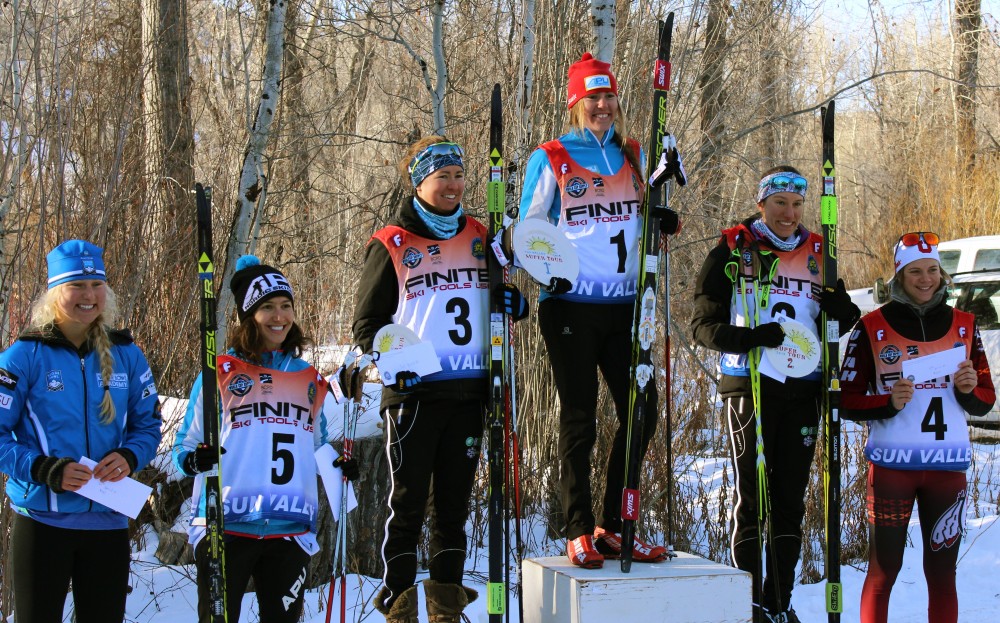
The women’s Sun Valley Super Tour 1.3 k classic sprint podium: (from l to r) Junior Hannah Halvorsen in sixth, Chelsea Holmes in fifth, Caitlin Patterson in third, Becca Rorabaugh in first, Kaitlynn Miller in second, and Veronika Mayerhofer in fourth.
“We just went for it, especially Kait. I don’t know if you saw her quarterfinal and semifinal, she just took off with it!” Patterson explained. “I felt like I had to fight a little more, but I think all around, a good day for both of us.”
Interestingly, none of the top three women in Saturday’s sprint placed in the top 10 in the skate sprint a week ago in West Yellowstone. Having another week to acclimate certainly helped the women from lower elevations, but the simple fact that this week’s sprint was classic made a big difference, too. Rorabaugh said she enjoys the striding while Miller feels classic skiing at altitude is just a bit easier than skating at some 5,750 feet above sea level.
The trio hopes to build upon their success in the sprint during Sunday’s 10 k classic. For Rorabaugh, a 10 k might just be the perfect race for where she is at right now.
“I’m looking forward to it because I feel like I have pretty good distance fitness. If it took me a whole day to get going today, odds are a 10 k could go alright,” she said.
As for the second- and third-place finishers, they said they were both feeling confident heading into Sunday.
“Watch out for us,” Patterson said of her team in Sun Valley. “All four, in green, watch out. We will be there.”
In fourth, Veronika Mayerhofer of the University of Utah, who won her quarterfinal and placed third in the semi, finished 3.76 seconds after Rorabaugh and 2.46 seconds off the podium. Just 0.25 seconds back, Chelsea Holmes (APU) placed fifth in the final, 4 seconds after Rorabaugh. Last week in West Yellowstone, Holmes placed fourth in the skate sprint, and last weekend’s sprint runner-up 17-year-old Hannah Halvorsen (Sugar Bowl Academy) reached the final again and placed sixth (+19.19).
***
Olivia Ekblad of Montana State University crests the second hill before dropping back into the stadium.
In the junior women’s heats, meanwhile, a pair of Montana State University (MSU) skiers took first and second. Freshman Olivia Ekblad from Winthrop, Wash., won with sophomore Gretchen Burkholder from Steamboat Springs, Colo., following close behind in second. Rounding out the podium in the junior heats was Sun Valley’s own Annika Landis.
These spots were good enough for ninth, 10th and 11th junior women overall, as eight others qualified for the open heats. Halvorsen led those top juniors, finishing sixth in the overall standings. Still, the duo from MSU feels the sprint was a great way to start off their season.
“We have a really good group of girls at MSU to train with so its fun,” Ekblad explained. “Awesome coaches too. We’re definitely going to throw down this year, it’s going to be fun.”
With the recentrelease of VO2maxdata by the Norwegian Olympic and Paralympic Committee and Confederation of Sports, FasterSkier decided to explore similar research taking place in the U.S.
***
BOZEMAN, Mont. — Liz Stephen. Kris Freeman. Wendy Wagner. Torin Koos. The list of nordic skiers goes on. The list, though daunting to many, is simply a part of the project for Dr. Dan Heil.
Currently a professor and program leader of Health and Human Performance at Montana State University (MSU), Dr. Heil has been conducting research on VO2max for 25 years.
“My first research project as a Masters graduate student in Exercise Physiology evaluated changes in VO2max. That project was in 1990,” Heil wrote in an email.
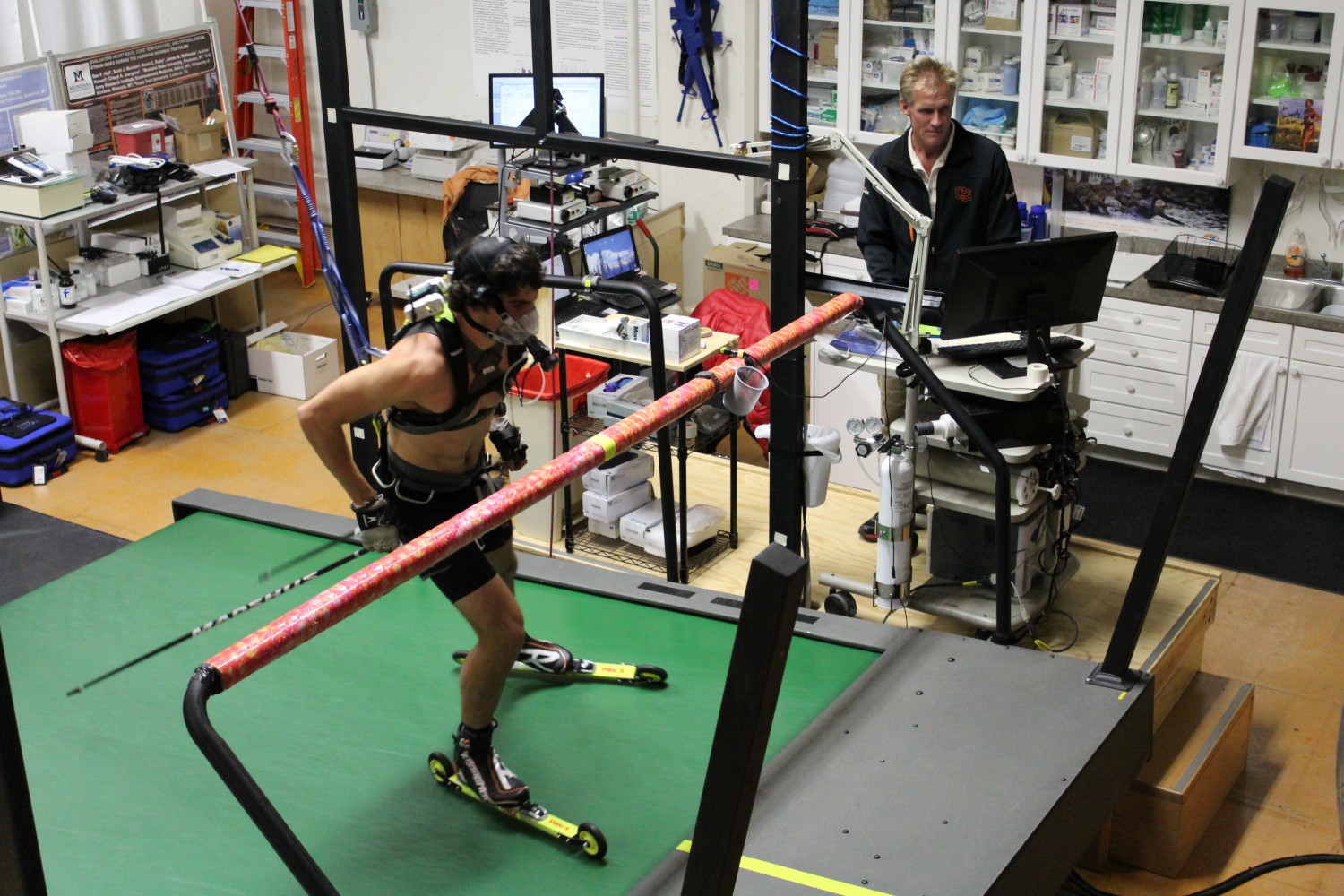
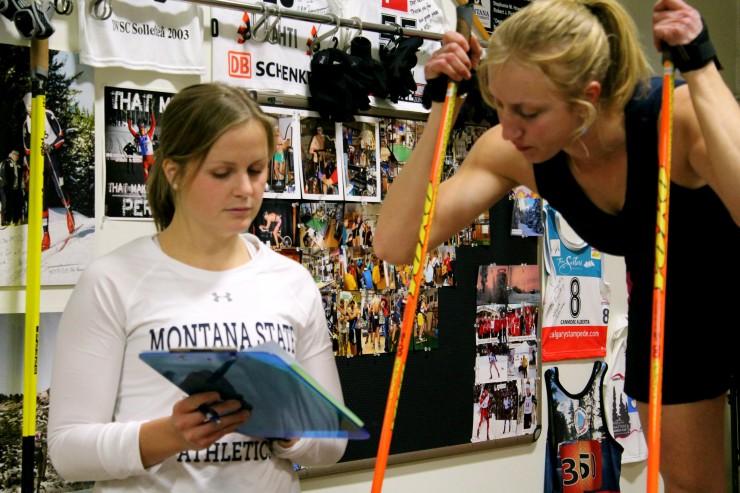
MSU professor and program leader of Health and Human Performance, Dr. Heil (r) controls treadmill speed and incline during a recent rollerski V02max test for BSF elite athlete Akeo Maifeld-Carucci.
Given its dimensions alone, the new rollerski treadmill at the MSU Movement Science/Human Performance Lab (MSL) in Bozeman outmatches the lab’s previous VO2maxresearch equipment.
Beyond increased size, the new treadmill — which the department received in 2010 by as a gift from a university dean — also reaches speeds of up to 25 miles per hour and inclines that range from a -10 to a +40 percent grade.Only five other treadmills of similar caliber are known to exist in the U.S. today. However, the oversized treadmill is not the only piece of equipment that makes Heil’s research unique.
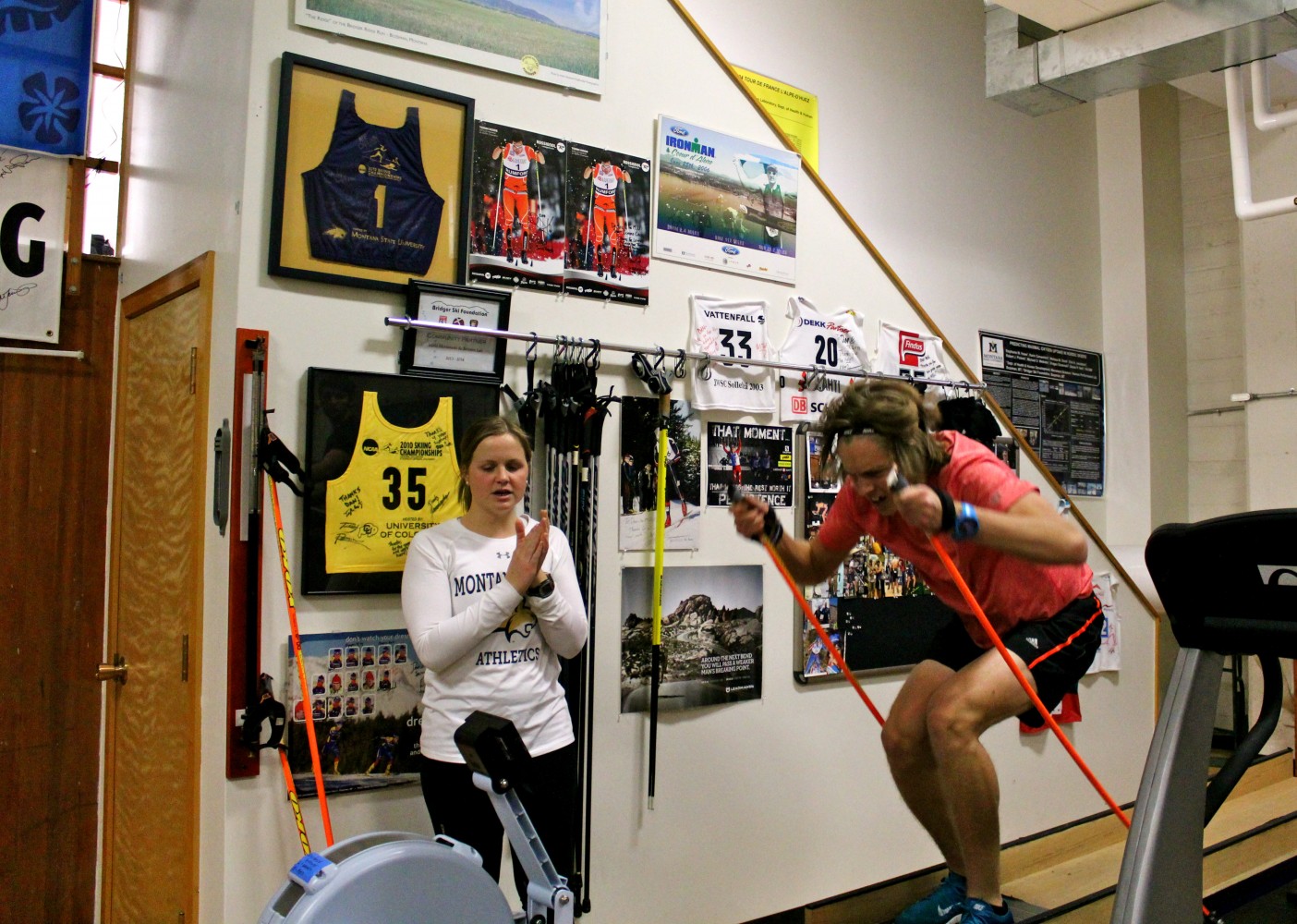
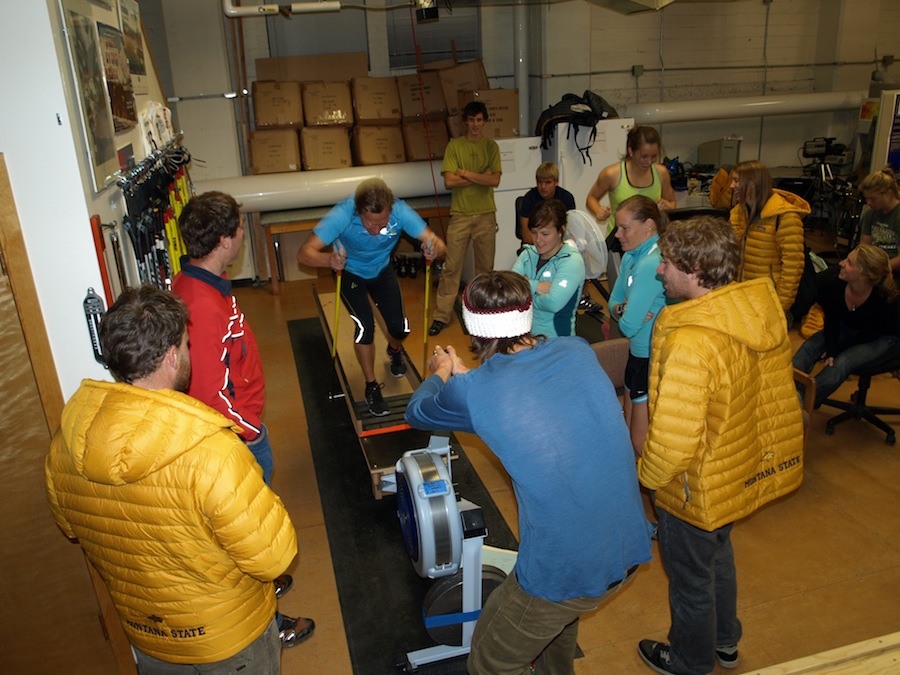
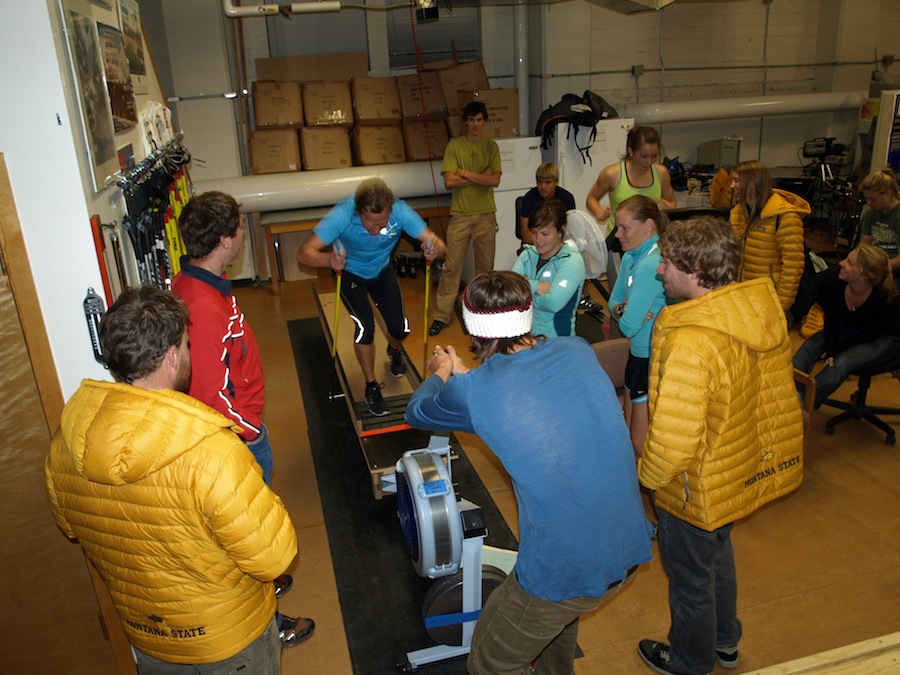
“We call it an upper-body power ergometer … [it] was designed about ten years ago with a former grad student of mine, [Bowdoin College Nordic head coach] Nathan Alsobrook,” Heil said during an interview inside MSU’s performance lab.
Essentially a rowing-machine-gone-double-pole, the aim of the invention, according to Heil, is double-pole simulation.
“The neat characteristic about this is that it integrates ski poles into the double-poling motion … Unless you have access to this lab and this ergometer, you don’t get upper-body power measures,” he explained.
But why bother with upper body power measures? In a predominantly endurance-driven sport, like nordic skiing, shouldn’t the emphasis be on an athlete’s VO2max?
“A high VO2maxis never a disadvantage — Ever!” Heil wrote in the email. “With that said, however, there is only a relatively small window of improvement that each athlete can expect to gain with appropriate training. So the best strategy for training is to make sure that an athlete has optimal opportunity to realize their full V02max potential with training (which can take several years).”
In other words, an athlete’s VO2max, has the potential to change, but only to the extent that physiology and genetics allow.
Where does that leave cross-country skiers who want to continue to improve race performance past their peak VO2max?
According to Heil, power generation.
“What elite [nordic] athletes have been doing over the past decade or so, is a very intense focus on developing muscular strength and power to add on top of the decade or more of aerobic base they’ve already got,” Heil said.
The use of climbing equipment, such as upper-and lower-body harnesses, prevent the athlete from hitting the treadmill in the event of a fall. MSU nordic skier, Karsten Hokanson (fright) gets some final adjustments from Dr. Heil (c) and graduate student/MSU nordic athlete, Lina Hultin (l).
The use of climbing equipment, such as upper-and lower-body harnesses, prevent the athlete from hitting the treadmill in the event of a fall. MSU nordic skier, Karsten Hokanson (l) gets some final adjustments from Dr. Heil (c) and graduate student/MSU nordic athlete, Lina Hultin.
The new treadmill at MSU’s Movement Science/Human Performance Lab, which is 8-feet wide and 10-feet long, can reach speeds of 25 miles per hour and grades from -10 to +40. Here, Dr. Dan Heil (l) explains the rollerski treadmill stages to BSF collegiate PG athlete Mitch Harris prior to testing.
BSF collegiate PG athlete, Mitch Harris receives tips during his first rollerski VO2max treadmill test in mid-November.
BSF postgrad Ben Grodner (l) gets ready to rollerski for the time on a treadmill, while Dr. Dan Heil gives him some pointers on how to start.
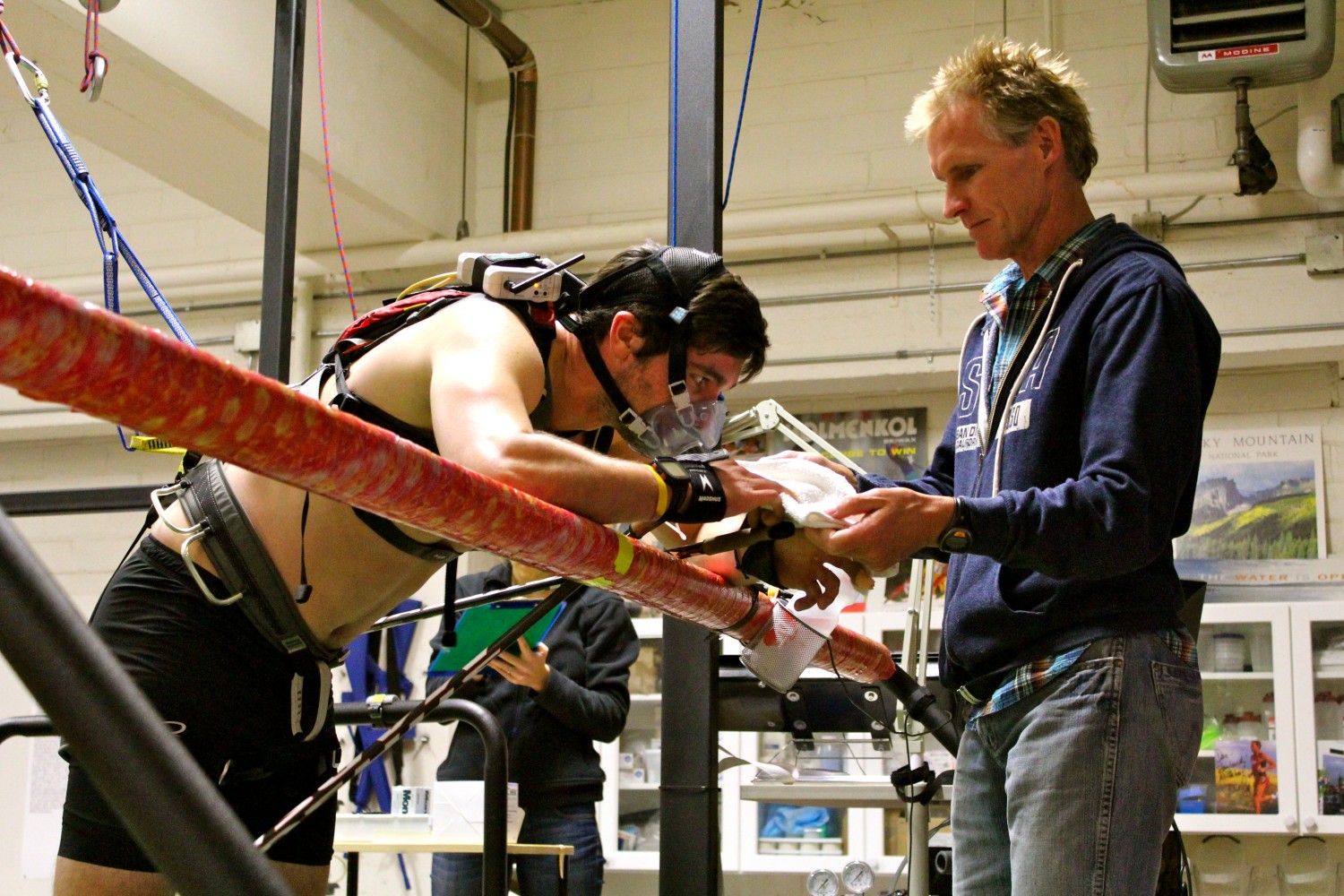
Dr. Dan Heil (r) hands BSF elite athlete Nicholas Michaud a towel after his rollerski VO2max test in MSU’s Movement Science/Human Performance Lab.
BSF’s Nicholas Michaud during a V02max test at the MSU MSL in mid-November, 2015.
Graduate student and MSU nordic skier Lina Hultin (l) cheers on Logan Diekmann, full-time BSF PG athlete, as he tests his upper-body power using the ergometer designed by Dr. Dan Heil and Nathan Alsobrook.
MSU graduate student and nordic skier, Lina Hultin reviews upper-body power strength with BSF athlete and rollerski-treadmill veteran Jennie Bender using Dr. Dan Heil’s ergometer.
“If [an athlete is] interested in being able to track their training progress, maybe all they need to be able to track is changes in upper body power, not V02max,” said Dr. Dan Heil, who is pictured with BSF elite athlete Jennie Bender after Bender’s VO2max test at the MSU performance lab earlier this month.
Unlike many endurance sports, cross-country skiing draws upon muscular strength, balance and coordination, as well as aerobic fitness.
For example, though elite distance runners and nordic skiers are often categorized as similar endurance athletes, Heil’s observations provide a notable distinction.
“One of the big differences between these two groups is that virtually all elite distance runners seem to have incredibly high VO2maxvalues and tend to be similar in body size and shape,” he wrote. “Nordic skiers, in contrast, seem to be more varied in body size and shape and not have as consistently high VO2maxvalues. Having a high VO2maxis always going to be a benefit to an endurance athlete, but I think Nordic skiing has evolved to a point where advanced upper body strength and power are almost equally important to success.”
Heil’s current research with MSU graduate student and nordic skier, Lina Hultin of Örebro, Sweden, examines the relationship of race performance to rollerski treadmill VO2maxand upper body power from a Concept2 SkiErg versus the MSL ergometer.
“Usually at least once, if not twice, and sometimes three times a year, we have the [MSU and Bridger Ski Foundation nordic] athletes come in and do a rollerskiing VO2max test that includes lactate threshold,” Heil said.
Using the numbers from these tests, Heil and Hulton will later look at correlations between the athletes’ test results and SuperTour race performances.
“Upper-body power is a good cumulative measure of the strength and power training, as well as the specific aerobic training, the rollerskiing, that the [athletes] have been doing, all in a very concise measure,” Heil said. “VO2max and the lactate threshold can be a little bit more in flux with how someone feels or if are they’re on the edge of getting sick. If [an athlete is] interested in being able to track their training progress, maybe all they need to be able to track is changes in upper-body power, not VO2max.”
“I think Nordic skiing has evolved to a point where advanced upper body strength and power are almost equally important to success.” — Dr. Dan Heil, professor and program leader of Health and Human Performance at Montana State University
In the interest of time, upper-body strength might be the way to go when tracking performance and training progress in the future. However, in the interest of science and skiing, V02max and threshold remain dear to the heart.
“From a coaching standpoint, we use the threshold data more than the VO2maxdata when were planning training,” said MSU Nordic Head Coach Matt Johnson.“They can use their threshold data to tailor individual workouts when doing intervals.”
Dr. Heil (r) hands BSF elite athlete Nicholas Michaud a towel after his rollerski V02max test in MSU’s Movement Science/Human Performance Lab.
BSF elite athlete Jennie Bender also pointed out that the rollerski treadmill “is a great way to work on technique and really pay attention to your body mechanics because it’s such a controlled environment,” she said. “It’s kind of like skiing in the dark or running in the dark. You’re more focused on what your body is doing and you don’t have to watch out for any obstructions.”
Yes, thankfully — for the athletes at least — Heil has not developed virtual potholes for his tests … yet.
What Heil has launched is the continual promise of questions and thought about nordic athletes and sport.
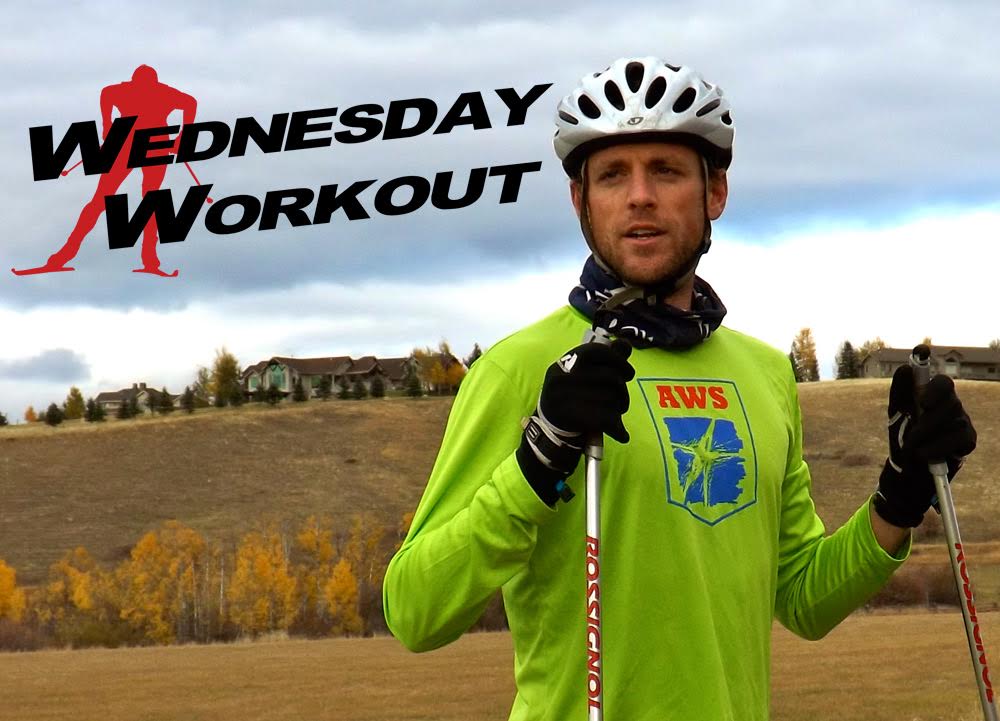
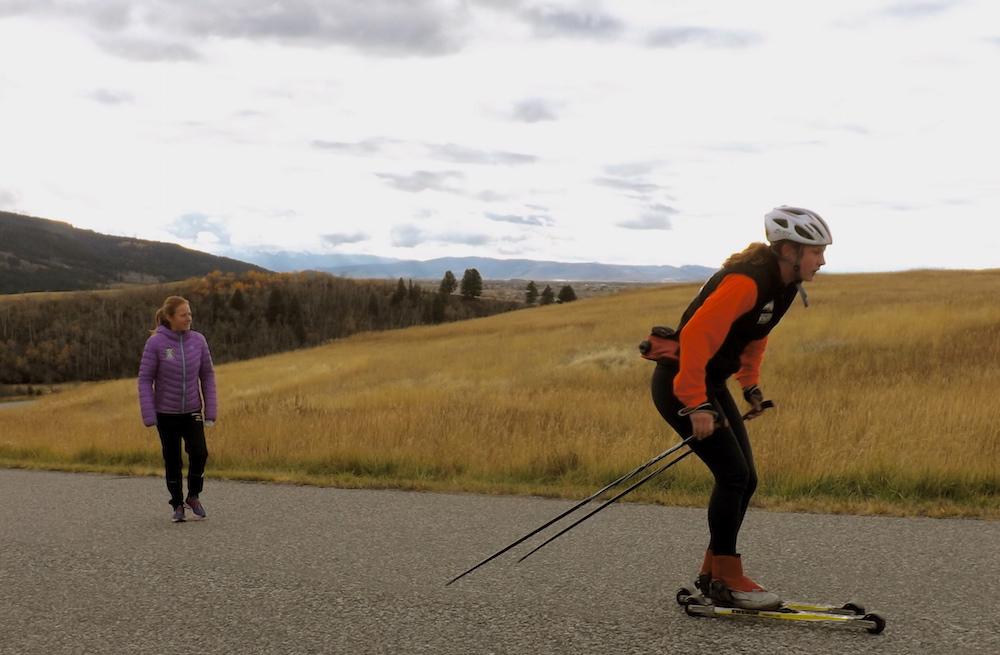
Montana State University (MSU) Nordic Head Coach Matt Johnson before an uphill double-pole strength session in late October at Triple Tree Ranch in Bozeman, Mont.
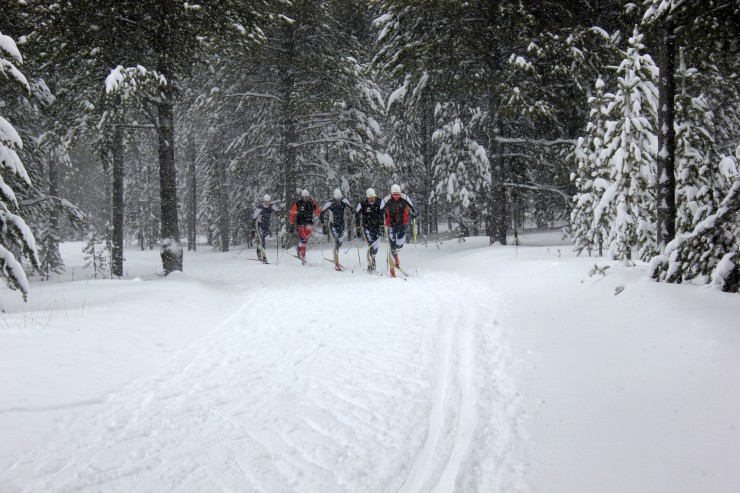
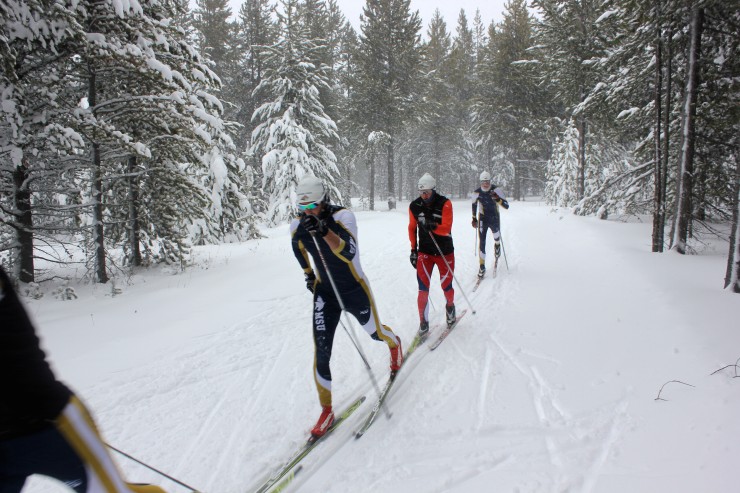
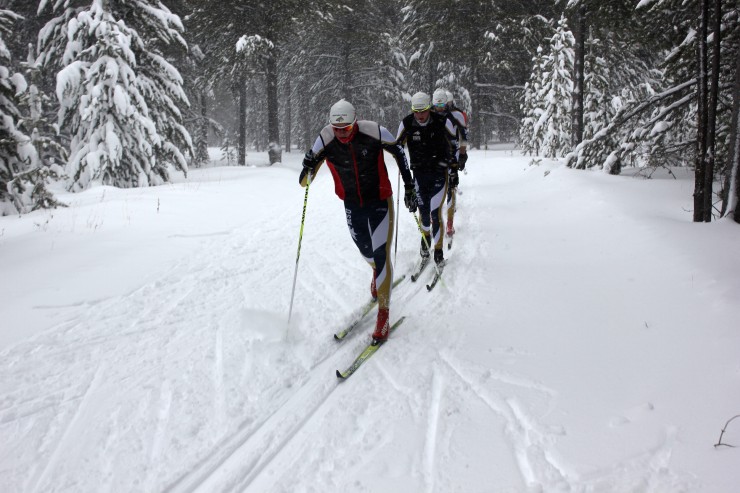
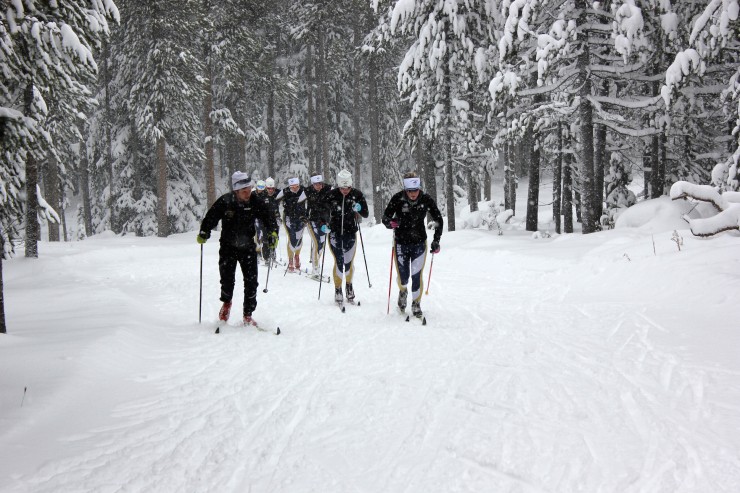
For this week’s workout, FS tagged along during an uphill double-pole session with the Montana State University nordic team on Oct. 27. Reporter Gabby Naranja did a few sets on bike, which she found equally fun and thrilling.
***
BOZEMAN, Mont. — The one workout no skier should sacrifice? Specific strength. At least, according to Matthew Johnson, head coach of the Montana State University (MSU) nordic team.
“We try to do a specific arm strength workout once a week,” said Johnson, who joined the MSU Bobcats in June after the resignation of former head coach Kristina Trygstad-Saari.
The importance of a double pole, specific-strength workout, Johnson explained, goes beyond just grinding your arms to a pulp in order to climb up a hill. These workouts are about “figuring out how to use the technique and the strength that you’re finding in the gym and applying it to your poling motions out here in varying types of terrain,” he said during an MSU training session last week.
Of course, that in no way negates the noodle-arm effect brought on by most double pole, strength-specific workouts.
“Sometimes it is about getting a consistent steep grade and working it, making your arms tired and then just being able to hold it [while] keeping your technique together and keeping your core strength together,” he said.
As a cross-country skier, arm strength is just part of the game.
“Rollerskis are great imitations of skis, but they’re not perfect,” Johnson said. “[Therefore] a lot of our classic skiing is going to be arm specific, strength specific, because that’s a really important thing with actual skiing.”
For MSU skiers at least, the arms do not go neglected.
“We want to develop a team that trains together and races together,” Johnson said. “We also want to see an upward result trend for every athlete right through [U.S. SuperTour] Spring Series [in March]. Since our college season doesn’t start until the 10th of January or so, we’re really pushing the fitness aspect of this all the way through November into December.”
According to Johnson, it’s workouts like this that will lead to better ski performances, particularly with the college race schedule in mind.
“It’s really easy to waste time rollerskiing,” he said. “[When] you do a double pole or a ski session you’re doing the same motion thousands of times. Every single time you practice that motion you’re either making yourself better at it or you’re ingraining bad habits. Like they say in music, practice makes permanent, so we try to practice good permanence.”
Especially for a college athlete with limited time to ski, “practicing good permanence” is important.
MSU assistant coach Anja Gruber (l) with MSU skier Maria Gesior during an uphill double-pole workout.
“College skiing is so incredibly hard sometimes because there’s a huge time constraint with school and social life,” explained Anja Gruber, former University of Vermont (UVM) college ski racer, two-time NCAA champion, UVM business-school valedictorian, and current assistant coach for the MSU nordic team. “I don’t think anybody could get through college racing on their own. It’s really important to be part of a team with good energy.”
And despite a recent high turnover of coaches, the MSU nordic team maintains an upbeat outlook. Super-senior Sawyer Kesselheim of Bozeman, Mont., indicated that he would like to see MSU men’s nordic “consistently have three guys place in the top ten at races.” When asked about Johnson, Kesselheim spoke favorably of the new coach.
“I really like Matt,” he said. “He’s super focused, organized, and professional. He has good workout plans and keeps the workouts exciting.”
This enthusiasm extends into MSU’s newer team members as well. “It’s been great having Matt coach us,” said freshman Sarah McCandless from Jackson Hole, Wyo. “He’s got great positive energy.”
Whether or not Johnson’s athletes actually have fun during these workouts, the benefits are undeniable.
“We’re dealing with a group of athletes who are here to work hard,” Johnson said. “It’s a big responsibility being on a team at a school like this and as they expect a lot of us, we expect a lot of them. There are a lot of moving parts, so you have to be creative, flexible, and on top of things, motivated.”
The Workout
Warmup: 25-30 minutes easy Level 1 skiing double pole and double-pole kick
The Set: 2-4 times double pole up a 3 k hill. Johnson suggests “finding something with some rest so you can recover and feel the difference between the different [transitions].”
Purpose: To figure out how to apply gym strength to double pole motions in varying types of terrain
Goal: Rather than speed, focus on maintaining correct double pole body position throughout the hill while in a fatigued state
Cool Down: 25-30 minutes easy Level 1 skiing
MSU men (from left to right) Noah Andersen, Sawyer Kesselheim, and Erik Axelsson during a 3 k uphill double-pole strength session in Bozeman, Mont.
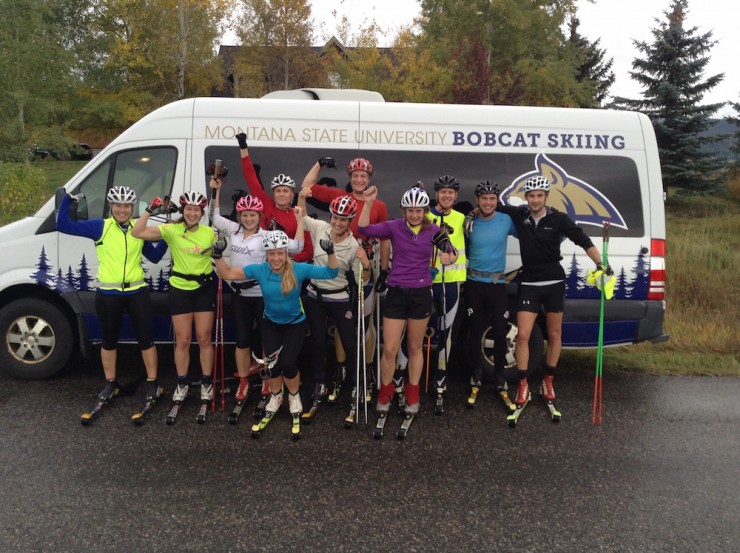
MSU Nordic Ski Team in November, 2015: (left to right): Joelle Romo, Olivia Ekblad, Lina Hultin, Johanna Taliharm, Erik Axelsson, Anika Miller, Sawyer Kesselheim, Maria Gesior, Noah Andersen, Forrest Mahlen, Martin Muan. (Courtesy photo)
MSU assistant coach Tim Whiton skis alongside his athletes during an interval as part of this week’s Wednesday Workout.
WEST YELLOWSTONE, Mont. — Even though the Montana State University (MSU) Ski Team is stationed only an hour and a half north of West Yellowstone, Mont., its skiers still have to adjust to the elevation.
MSU – Bozeman, which sits at roughly 4,800 feet, is 2,000 feet lower than West Yellowstone. Fortunately for the MSU skiers and those who come from well below 6,000 feet, the week leading up to the 2014 SuperTour opener is the perfect opportunity to adjust.
That’s why the majority of the MSU intensity workouts in West Yellowstone have focused on threshold intervals. That changed Tuesday as head coach Kristina Trygstad-Saari began preparing the team for the season’s first weekend of races.
In order to get the team race-ready, Trygstad-Saari introduced a series of Level-4 intervals to prepare her skiers for racing at altitude before the SuperTour races this coming weekend.
“Part of it is physiological and part of it is mental,” she said, explaining that once athletes process lactate at altitude, it allows them to deal with it in a more efficient manner once they begin racing.
As for the mental side of the workout, Tuesday’s new snow, strong winds, and variable trails made for a challenging morning.
“On a day like today when we didn’t have perfect grooming and it was their first hard workout, they were probably feeling it after the first interval and so they just had to push through five. That’s exactly what they’ll be doing Friday and Saturday” she said.
The Workout:
Warm up: 30 minutes continuous skiing followed by six minutes of 15 second pickups followed by 45 seconds of easy skiing.
Intervals: 5 by 4 minute intervals with the first at threshold and the following three at level 4 or 5 k race pace. Rest until heart rate returns to resting or after four minutes.
Cool down: 20 to 30 minutes continuous skiing.
After arriving at the bustling trailhead of the Rendezvous Ski Trails, MSU athletes set out on a warm up consisting of a 30-minute ski followed by six minutes of a cycle of 15-second pickups proceeded by 45 seconds of rest.
“We wanted them well warmed up… [The pickups] make sure that they were feeling warm and snappy by the time they did the first interval,” Trygstad-Saari said of the warm up.
“It’s just like a race. If you go out of the start gate feeling warm and ready to go you’re just going to maximize your race time,” she continued.
Once the MSU team was warm and snappy, the real workout began with skiers embarking on five four-minute intervals starting at threshold and progressing to level 4, or 5 k race pace.
According to Trygstad-Saari, four minutes is long enough to make the intervals hurt, but short enough from her skiers to maintain technique and speed throughout each interval.
As the team dispersed to cool down following the intensity, Trygstad-Saari noted that she was expecting great things from the MSU athletes this season. However she and her assistant coach Tim Whiton have been stressing a controlled start to the season.
“They’re all coming into fine form but we’re trying to remind them that we’re early in the season and we don’t want them peaking for West Yellowstone races. They’re all excited to race and we’re all excited to see what they can do,” she said.
Check out MSU’s promotional video for the 2014/2015 season here.
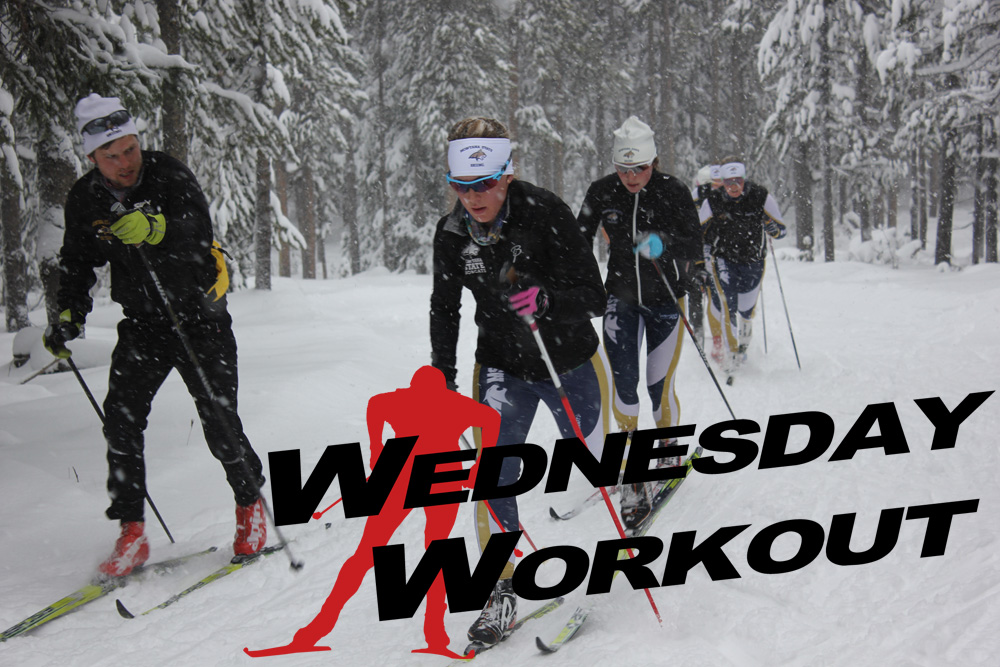
Wednesday Workout: MSU Intervals in West Yellowstone
Wednesday Workout: MSU Intervals in West Yellowstone
Wednesday Workout: MSU Intervals in West Yellowstone
Wednesday Workout: MSU Intervals in West Yellowstone
Wednesday Workout: MSU Intervals in West Yellowstone
Wednesday Workout: MSU Intervals in West Yellowstone
Members of the Bridger Ski Foundation elite and postgraduate perform trail maintenance at Bozeman’s Lindley Park in September. (Photo: Bridger Ski Foundation)
The future of the Bridger Ski Foundation (BSF) elite and postgraduate team was a bit uncertain in July.
Shortly after coming on as BSF’s new elite-and-postgrad coach in May, alumna and Bozeman, Mont., native Kristina Trygstad-Saari left her position to lead the Montana State University (MSU) nordic team.
To make matters worse, soon-to-be BSF athletes Sam Tarling and Eric Wolcott decided to retire from skiing, leaving just two elite skiers, Jennie Bender and Riley Eusden, on the team.
Today, however, the woes of the summer are behind BSF as it says its team is stronger than it has been in years. In a remarkable turn of events, the elite and postgraduate team now boasts 14 high-level athletes led by Truckee-native Bernie Nelson.
Rebuilding the Team
Dragan Danevski, the Bridger Ski Foundation head coach and program director. (Photo: Bridger Ski Foundation)
According to BSF Head Coach Dragan Danevski, the summer months were trying for the team’s skiers and coaches due to the uncertainty of the program. However, Danevski and his colleagues worked tirelessly to build the team from the bottom-up.
“It was not good for BSF’s image in the summer,” Danevski said in a phone interview. “Many of us were not happy with how that developed. It was disappointing for us.”
According to Danevski, the first step in rebuilding the team was hiring a coach.
Nelson, who served as assistant coach to Grethe Hagensen and Chad Andersen at MSU, was exactly what Danevski was looking for: she had extensive knowledge of the sport, experience racing, and energy.
“This is not a job for everybody. Everyday you have to work with athletes, you have to energize them, and you have to motivate them,” he said. “You can do that only if you as a coach are energetic and enthusiastic. That is what we see with Bernie.”
Once Danevski hired Nelson, he was faced with the daunting task of completing the team roster.
With persistence and good luck, Danevski recruited 10 incoming and current MSU students to join the postgraduate program.
Nelson was also instrumental in building the the team’s numbers. Given her experience as a college athlete from her days at MSU, the 23 year old could relate to university students as they balanced school and skiing.
With the postgraduate team squared away, all that remained was the addition of more elite skiers to the team.
American skiers had already been with their respective teams since the beginning of the summer, but fortunately for Danevski and BSF, two foreign skiers were looking for an American team to join.
Bernadette Nelson joined BSF as its elite and postgraduate coach in September after Kristina Trygstad Sarri left the position in June. (Photo: LinkedIn)
Australian Paul Kovacs contacted Danevski this spring about the possibility of training with the BSF elite team. Always open to new energy, Danevski remained in touch with the Australian and accepted him on his squad. After hearing about the opportunity from Kovacs, another Australian skier, Mark Pollock jumped at the chance to train in Montana and worked to earn a spot on the team as well.
Both Kovacs and Pollock raced in the FIS Australia New Zealand Cup this summer, and now that the Australian winter is over, the two will travel to Bozeman in the coming weeks to begin their training and racing with the team.
Reflecting on the changes to his team, Danevski said he was pleased with the progress and happy that the program was able to recover from a tumultuous summer.
Bender, who spent part of August and September in the east, said that she didn’t recognize the team when she returned to Bozeman.
“When I left for the Lake Placid [training camp] there were three athletes,” she said. “When I came back there were 14 new people and a new coach. Now that we have this big group, there’s been great a vibe.”
Team Veteran: Bender
The women’s 1.5 k freestyle sprint podium at the 2014 U.S. Cross Country Championships , with Jennie Bender (c) of the Bridger Ski Foundation, Caitlin Gregg (l) of Team Gregg/Madshus in second, and Rosie Brennan (APU) in third. (Photo: Tom Kelly/USSA)
At the center of the BSF elite team, Bender has seen it all. In the past two years, she’s had ranging results spanning from the top of the podium to the back of the pack.
Since she began skiing with BSF last season, the Vermont-native earned her second national title in January. At the same time, however, she failed to accomplish her goal of making the 2014 Olympics and struggled to find her form in last March at the World Cups in Finland and Norway.
Bender said that a major factor in her inconsistent results over the past two years was her health. In addition to a case of mono and Lyme disease in 2012, Bender suffered a herniated disk in 2013. Due to fatigue and pain, her training and racing suffered.
“The last two years have been a physical struggle and a mental struggle,” Bender on the phone. “Having a couple good races at nationals was huge. … I didn’t go out and accomplish what I was hoping to do with my World Cup starts, but having those starts was important for me and I’m hoping to have more because I’m ready for that next stage. I feel that there is more that I can give.”
Despite the impediments of the the last two years, Bender said she believes the 2014/2015 season will be her best yet. With her health intact and little-to-no pain in her back, she said she recently finished her most consistent-and-productive summer training to date.
She also has a new outlook on life and skiing. Bender said she learned important aspects about herself from the past ups and downs, and that such lessons will aid her in her search for top results.
“Tenacity became really important. I’ve had my lowest of the lows and my highest of the highs all in one year with being at my wits end and then being on top of the podium,” she explained. “Being thrown into different those two different spectrums, I’ve learned to maintain a solid head and realize what’s important and what’s not important in life. I think it’s been a good lesson on how to stay positive and not dwell on the negative.”
As the winter approaches, Bender said that she is excited to demonstrate the hard work she has put into her training over the past months. Her season goals are lofty – a spot on the 2015 U.S. World Championships team – but not out of reach.
A Team of Potential
Bender’s teammates are also aiming high.
According to Danevski, Kovacs hopes to compete for the Australian World Championships team in Sweden this February, while Pollock’s main goal is to race at the U23 World Championships in Kazakhstan.
Three of the nine postgraduate skiers are training to compete at Junior World Championships, while the rest of the squad is looking to prequalify for Junior Nationals by ranking as top-20 juniors at U.S. nationals in January in Houghton, Mich.
While the team will have the opportunity to accomplish their goals in a few short months, the way BSF sees it, it’s already won half the battle, rebuilding from what many would call a devastating summer.
“I think BSF has potential to be a very solid elite team,” Bender said. “Everyone on the team is in a really good space. Everyone is working hard and it’s great.”
Grethe Hagensen runs alongside former Montana State University athlete Tyler Reinking at the 2012 NCAA Championship in Bozeman, Mont. Hagensen was head nordic coach at the university for a decade. (Photo: Stuart Jennings)
Grethe Lise-Hagensen served as Montana State University’s Head Nordic Coach from 2003 to 2014. During her decade as head coach, Hagensen brought the team from a state of near non-existence to ranking third in the nation at the 2010 NCAA Championships. In May of 2014, Hagensen’s contract was not renewed by the university’s administration. FasterSkier sat down with Hagensen in July to talk about her time at the helm of the MSU program and the accomplishments she achieved during her ten years as head coach.
***
BOZEMAN, Mont. — Like most Norwegians, Grethe-Lise Hagensen was born with proverbial skis on her feet. Unlike most Norwegians, she decided to bring her successful ski career to the United States.
Hagensen grew up in Tromsø, Norway, roughly 300 miles above the Arctic Circle where she found an early introduction to skiing out of necessity. Her family didn’t have a car and like many of the other townspeople, she had no choice but to ski into town whenever she needed to go to school, buy groceries, or visit friends.
Hagensen’s skiing soon evolved from a means of travel to a form of competition as she was introduced to racing. Her entrance into world of ski racing would change her life forever, and by the time she was a teenager she had already won a Norwegian national championship and was on the Norwegian National Ski Team.
In 1979, Hagensen was part of what she described as the “the biggest athletic event in northern Norway.” A relay team consisting of Hagensen and fellow Tromsø skiers made their way to the top of the podium, astounding spectators.
“It was a huge sensation. It is still probably the biggest athletic event that has ever happened in northern Norway because we were such underdogs,” she said during a recent in-person interview. “For us to win it was a shocking thing. Top ten would have been a sensation, and we ended up winning.”
Hagensen first ventured to the U.S. to attend the University of Wyoming. During her time there, she earned all-American honors each of her four years at the university and was part of its winning team in the 3 x 5 k relay at the 1985 NCAA Skiing Championships.
Hagensen graduated from the University of Wyoming in 1986. She returned to Norway, where she coached both soccer and skiing. She then married American John Villar and the couple had two daughters.
In 2002, Hagensen and her family made the decision to move to Bozeman, Mont. for a year so that her children, Bjørk and Embla, could learn English. The family’s plan was changed when a friend informed Hagensen that the head coach position at Montana State University (MSU) was available.
Hagensen applied for the job, accepted the university’s offer, and has lived in Bozeman ever since.
“Suddenly they could smell gold”
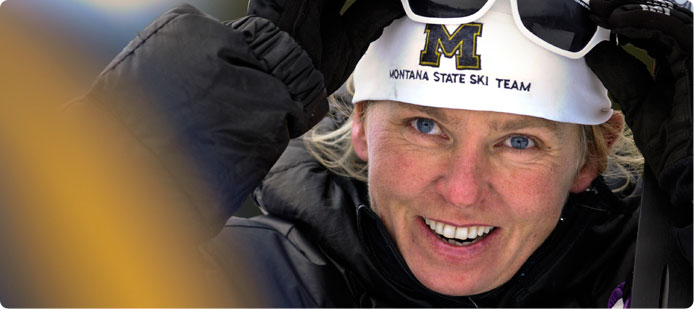
Grethe Hagensen smiles in an undated photo. Hagensen served as head nordic coach at Montana State University from 2003 to 2014. In 2010 she lead the team to third place in the nordic rankings at the NCAA Championships. (Photo: Montana.edu)
When Hagensen took over as MSU’s head nordic coach in 2003, it was the first year since the 1980s that the university had a male team. While women had been part of the team for many years, their results were lackluster and recruitment was challenging.
“You need to have results to get good athletes — it’s like the chicken and the egg,” Hagensen said of her entry into the program in 2003. “I thought it would take me five years to build up a winning team that would be competitive against CU [the University of Colorado] and DU [the University of Denver].”
The winning combination came earlier than expected. While a handful of good finishes from MSU skiers scattered the results of the Rocky Mountain collegiate series in Hagensen’s early years as head coach, it wasn’t until 2007 that the team really started to excel.
The turning point came during the first weekend of Rocky Mountain Intercollegiate Ski Association (RMISA) races at Soldier Hollow in Midway, Utah. With a relatively strong first day of competition, Hagensen was optimistic about the mass-start races. During the women’s 10 k, she was waxing the men’s skis and conversing with a fellow coach.
“I remember I said to one of the coaches, ‘I might get a medal today’ and he said to me, ‘Grethe, you might take the top three,’ ” Hagensen explained. “After that I don’t remember anything.”
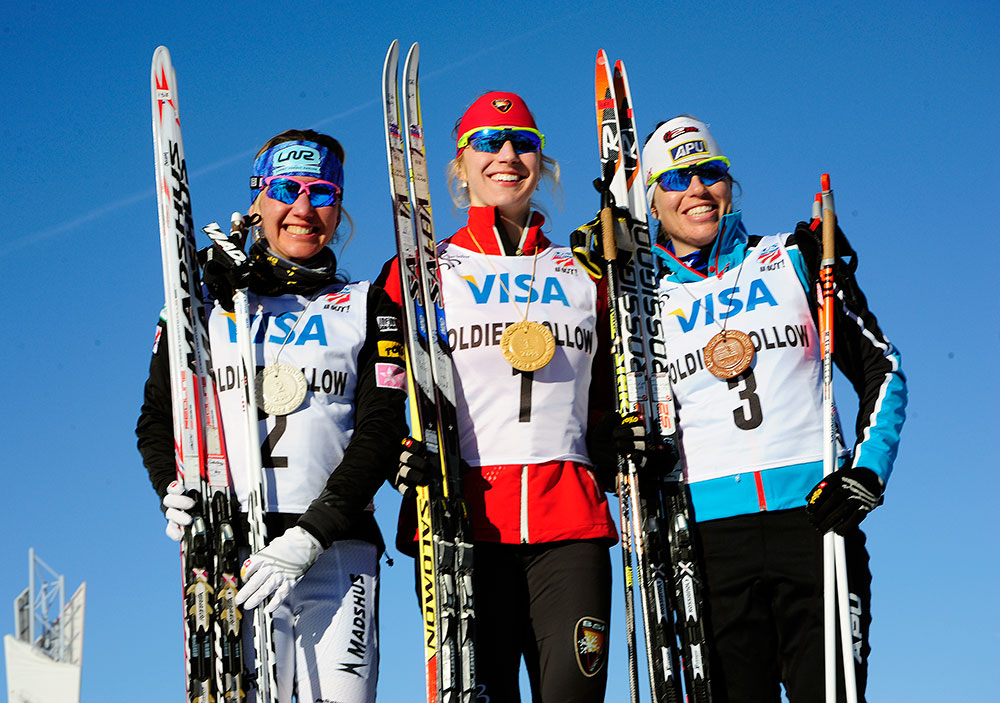
Her colleague was correct as a trio of MSU women consisting of Jamie Woelk, Mandy Bowden Axelson and Claire Rennie rounded the corner into the final stretch of the women’s race. The three Bobcats swept the podium, separated by less than a second.
It was the first time in RMISA history that a women’s team had taken all three spots on the podium in a single race, but the historic moment almost didn’t happen as all three skiers were nearly disqualified.
“We almost got disqualified because someone said that I skied next to them,” Hagensen said. “I don’t remember skiing but I must have because I was in shock. I was so happy. Maybe I skied maybe I didn’t, who knows.”
Despite the alleged incident, the women’s results stood and Hagensen was issued a warning. The moment, however, was a major turning point for the program, which had existed on a small scale four years prior.
“Suddenly they could smell gold. Once you do it, you have broken the barrier,” Hagensen said.
She credits the rapid rise of the MSU nordic team to a focus on American athletes who might have been overlooked by other universities, some of which heavily recruit European skiers and only the best American juniors.
“I always had, not the best juniors in the U.S., but maybe the ones who were a little bit behind,” she said. “I tried to get them to become the best. You have Ryan Scott and Tyler Reinking, these guys were OK and then we just built them. That’s what made me the most proud over my years: taking care of the Americans.
She also made sure to focus on building technique before anything else.
“We tried to tap into whatever edge they had. Technique was something that we had to work on a lot,” she said. “You can’t be the best if your technique is a handicap. I tell everyone to focus on their technique and then we get them to the next level.”
After joining the big show in 2007, MSU continued to progress at an unprecedented rate. With recruitment soaring and a tight-knit team, Hagensen entered the 2009/2010 season with high hopes.
With their eyes on the NCAA Championships in Steamboat Springs, Colo., the team qualified a full six-person squad for the event: Scott, Reinking, Bernhard Roenning, Kaelin Kiesel, Mellie Park, and Casey Kutz.
Underdogs from the beginning, MSU wasn’t expected to be overly competitive, let alone make a run for the podium. However, they did just that with all three men placing in the top 10 in the second day of competition. The results propelled the squad to third place overall at NCAAs.
“We had a phenomenal year, and suddenly we had three [men in the] top ten and Kaelin Kiesil was fifth,” Hagensen said. “Sometimes everything lines up.”
Later that year, Hagensen received the Intercollegiate Coach of the Year Award in recognition of her contributions to MSU.
Termination After a Decade
The Montana State University Nordic Team performs upper-body testing in an undated photo. (Photo: Dan Heil)
After 2010, both Hagensen and the MSU nordic team continued to find success with top finishes in the RMISA and NCAA race series. In 2012, for the first time in school history, MSU qualified a full team in both alpine and nordic for the NCAA Championships that took place on their home courses in Bozeman, Mont.
Hagensen also received the RMISA Coach of the Year Award that year.
During the 2012/2013 season Hagensen took a sabbatical year so that she could spend time with her mother in Norway who had just suffered a stroke. During that season, assistant coach Chad Andersen took over the responsibility of the team.
In what would be her final season as MSU’s head nordic coach, Hagensen lead her team to qualify a full NCAA Championships squad once again. At the 2014 NCAAs in Soldier Hollow, MSU saw two athletes — Jessica Yeaton and Sawyer Kesselhiem — earn all-American honors with fifth- and ninth-place finishes.
Adding to the season’s milestones, the nordic team won both the men’s and women’s awards for team of the year at the Montana State Athletics’ 2014 ALL (Academics, Leadership and Life Skills) Banquet in April.
Not long after, Hagensen said she received a positive review from her athletic department and was given a mandate to hire a new assistant coach. The new assistant coach, Andrew Morehouse, had both a verbal and written agreement with Hagensen for his position that was yet to be made official by the university.
In May, she said she was summoned MSU Athletic Director Peter Fields’ office for what she assumed would be a conversation about the assistant-coaching position.
What she experienced was far from what she expected.
Instead of discussing the assistant coach position, Fields told Hagensen that her contract would not be renewed in the coming year.
“They asked me to come in and I thought they were going to ask me about the new assistant coach that I was to hire,” she said. “… Ten years of my life was canned in two minutes.”
The university declined to comment on the decision due to its personal nature, according to Sports Information Director Tom Shutlz.
“I’m still traumatized,” Hagensen said. “You would think that an institution would bring you in and give you a reprimand or warning or something, but the fact is that there is no job guarantee. You would think that Montana State University would be bigger than this and that they would communicate.”
Hagensen claims that Fields gave her no indication as to why her contract was not renewed and failed to even thank her for ten years of service to the university.
She quoted from her prepared statement regarding her departure from MSU:
“I was surprised that after a decade of strong performance as a head coach, my boss Peter Fields made no comment to me about all the success that the nordic ski teams that I have coached have brought to MSU. Most surprising was the reaction of President Cruzado, who has as well reported record on workplace issue and good management practices. I realize that most of us have one-year contracts and that MSU management can make changes as they see fit. But after a decade as an MSU coach, to be tossed aside without any reason…”
MSU issued a press release on May 22, which read in its entirety: “The contract of Montana State head Nordic ski coach Grethe Hagensen will not be renewed, announced Bobcat Athletics Director Peter Fields, Thursday afternoon. Hagensen recently completed her tenth year at Montana State. A national search for the position will be conducted.”
There were those who weren’t surprised by the move. Three former skiers of Hagensen who wished to remain unnamed, claimed that coach was distracted and absent during her last year of coaching.
When asked about these claims, Hagensen said she made a conscious effort to take a back seat in the 2013/2014 season because she did not want to overbear the atmosphere that assistant coach Chad Andersen had created during her sabbatical year.
“Last year I wasn’t there and this year I was easing back in so that I wasn’t too powerful or too controlling,” Hagensen said. “Maybe I should have done it differently but those are small things. Not enough to get fired. It is an adjustment.”
Despite some athlete discontent, Hagensen has received many positive reviews from former athletes, including Scott who graduated in 2012. While Scott had not yet returned an inquiry from FasterSkier at the time of publication, he was quoted in a 2011 Montana State University press release saying that, “she (Hagensen) cares about you personally as well as how you are doing as a skier. She taught me how to seek out my strengths and capitalize on those, which carries over to all aspects of my life.”
In the same article, Axelson (member of the podium sweeping team in 2007) is quoted saying, “Grethe taught us that in order to be successful, you have to be self-motivated; you have to know what you want and go after it. When you are driven, opportunities come your way–that’s Grethe’s legacy.”
Hagensen was pleased that Trygstad-Saari was tapped for the position, insisting that Trygstad-Saari could accomplish the one goal Hagensen never did with MSU.
“My dream while at MSU was always to win the NCAA Championship,” Hagensen wrote in an email after the announcement. “As the new head nordic coach, Kristina Trygstad-Saari brings experience in racing and coaching to the team. Together with MSU Alpine coach Kevin Frances, I believe the MSU ski team has the potential to achieve that goal, winning the NCAA Championship. I wish them all the best.”
Unsure of what exactly lies ahead of her, Hagensen explained her future will likely involve traveling between the U.S. and Norway. During her sabbatical year she taught at the University of Tromsø which may be a future possibility for the Norwegian.
She’s planned a trip to Oslo with her oldest daughter, Embla, who’s taking a postgraduate year at an outdoors school. Her youngest daughter, Bjørk, has a year left at a boarding school in Park City, Utah.
Wherever Hagensen finds herself, she’s certain of one thing: she will always remember her time at Montana State with fond memories and will continue to be proud of the athletes she coached.
Matt Liebsch (XC United/Team StrongHeart) enjoying the view from the chartered flight he shared with friend Brian Gregg (Team Gregg/Madshus) from Oroville, Wash., to Bozeman, Mont., on Dec. 7. (Courtesy photo)
We know, you’ve been on the edge of your seat since the release of “The Adventures of Gregg and Liebsch: Part I,” and you can’t wait to find out what happened to the two Midwest pals in their quest to qualify for the Olympics. While the rest of the story has yet to be written, we’re happy to pick up where we left off: the plane ride from Washington state to Bozeman, Mont.
***
Three hours later, they made it. Aside from an unpaved runway in Oroville, Wash., Matt Liebsch and Brian Gregg described their six-seat chartered flight as the smoothest plane ride they had ever been on. But Gregg’s wife, Caitlin, wasn’t so sure as she waited up for them the night before their SuperTour races.
“Our ground speed was only about 150 knots, but it’s amazing what you can do when you take out the ups and downs and curves in the roads,” Liebsch said on the phone earlier this month.
Had the weather been unfavorable – too windy or altogether too risky to fly – the two would’ve had to drive 575 miles east to Bozeman, a trek they made less than a week earlier in the opposite direction. In an effort to better their FIS profiles, Liebsch and Gregg competed in the first NorAm distance race of the season at Sovereign Lake, British Columbia, 2 ½ hours north of Oroville. They had raced the SuperTour season-openers the week before in West Yellowstone just south of Bozeman.
Brian Gregg in the co-pilot’s seat of a six-seat chartered plane. (Courtesy photo)
Now they were on their way back to Montana to race the next day.
With the plane’s passenger seats pushed down in to fit their skis and oversized duffel bags, Liebsch sprawled out in the back and Gregg sat up front with pilot and friend Monte Catlin as they took off shortly after 8 p.m.
Flying about 9,000 feet above the ground, Liebsch said they could see the mile-high Mount Spokane in the distance. All the while, he had cell service. Knowing that they were going to touch down in Bozeman around 12:30 p.m. – too late for anyone to pick them up – Liebsch called a taxi.
“I had 4G the whole time,” he said. “I didn’t know how we were gonna race the next day. When we landed in Bozeman it was like -17 [degrees].”
Dropped off at the hotel at 1 a.m., Gregg greeted his wife with a knock on her door. She handed them their dinner – Walmart rotisserie chicken, Jasmine rice and homemade applesauce – and nodded off while they ate in the lobby.
“We told her she should try to sleep, but the challenge is, there’s sort of a lot of excitement and I think Caitlin was nervous about the small plane,” Gregg said on the phone.
The next morning on Sunday, Dec. 8, Gregg woke up at 8:30 a.m., “bouncing around,” Liebsch said.
“I was kind of mad,” Liebsch recalled.
With temperatures well below zero, the men’s 15-kilometer classic mass start was delayed until 1 p.m. The women were scheduled to race at noon.
“There was so much adrenaline from the excitement of the flight and having a good race in Silver Star,” Gregg recalled after he placed first and Liebsch was second in the Sovereign Lake 15 k freestyle individual start.
The chartered plane Brian Gregg and Matt Liebsch took to Bozeman, Mont., on Dec. 7. (Courtesy photo)
The two had made the last-minute trip to Bozeman because of their results. They agreed if they went 1-2 in the NorAm, they’d splurge for the $2,100-dollar chartered flight that same day.
The morning after, Gregg said he suffered a bit of an energy crash. The fatigue starting to set in, Liebsch skipped warming up and tested his skis at noon. With two skate races in West Yellowstone followed by another in Canada, he didn’t pack any classic race skis.
“I was going to race in my rock skis,” Liebsch said.
Fortunately, Liebsch is the race services director at Gear West in Long Lake, Minn., and he had his coworkers wax and overnight two of his best classic skis to Bozeman. Once there, Montana State University (MSU) helped Liebsch and the Greggs with race wax.
“It was just crazy that it all worked out,” Liebsch said. “Thinking back, that was nuts.”
To satisfy the legal-racing limit of -4 degrees Fahrenheit, organizers delayed the women’s start delayed to 1:30 p.m., and the men didn’t go off until 2:30. Liebsh couldn’t believe they were actually going to race until he saw the women head out. Frostbitten from similarly cold temperatures the day before, he stayed inside until eight minutes before his race.
Three months ago, Liebsch rolled his ankle in a half-marathon trail run and had relied on Level-1 classic training since. With low expectations for his first classic distance race of the season, he said the first couple kilometers were rough.
“I felt pretty in control the whole classic race and I was pretty content to sit a row or two back from whoever was in the front,” he said. “I didn’t know if the travel or the race before would catch up with me … it was good to sit behind some really good classic skiers, too.”
Frigid temperatures canceled the Bozeman classic sprint the day before, putting Gregg ahead in the overall SuperTour standings. Doing well enough in the classic distance race would solidify his lead for Period 1, which Caitlin led as well on the women’s side.
“Brian was really like, ‘Hey, this opens the door for me to get that overall SuperTour World Cup leader and I’ll get to travel with Caitlin overseas,’ ” Liebsch recalled.
Patrick Johnson (Far West) leads Brian Gregg in the 15 k classic mass start on Dec. 8 in Bozeman, Mont. (Photo: Anya Caldwell Bean)
“We went in with pretty low pressure,” Gregg said. “Our main goal was to be in the main pack, the lead pack.”
“It was nice that we had the fundraiser going, like, ‘Oh man we cant go down there and suck!’ ” Liebsch said. “Even during the race Brian and I would look at each other like, ‘We gotta stay in here.’ It was kind of funny. You just think of all those people that were donating to help you get there.”
With two hills left in the race, Dmitriy Ozerskiy of Central Cross Country (CXC) attacked ahead of Miles Havlik (Sun Valley Ski Education Foundation) and Patrick Johnson (Far West) up front. Liebsch searched for an opportunity to pass Johnson on the narrow-and-twisty trail, but without much luck.
“There wasn’t a lot of space to move up and Dmitriy was gone by that point,” he said. “A lot of herringboning the last two big hills and I actually kind of liked that.”
Liebsch finished fourth and Gregg took fifth, 12.8 and 13.5 seconds back from Ozerskiy, who won in 44:47.7. Gregg ended up beating Ozerskiy by 1 point for the overall SuperTour lead and accompanying Period 2 World Cup starts in January.
“We’re both very happy with fourth and fifth, and we’re really lucky MSU stepped up helped us wax both of our skis and Caitlin’s skis,” Gregg said. “It’s kind of a cool story, but it depends on a lot of different clubs that made it possible.”
The Ongoing Journey
A week later, the Greggs were back in British Columbia – this time for the Rossland NorAm – and Liebsch was home in Minnesota with his two kids and wife, who’s expecting their third child in late March/early April.
Liebsch had considered racing the Davos World Cup in Switzerland that weekend, but decided to take a breather and rest up for U.S. nationals Jan. 4-10. He had spoken to the US Ski Team (USST) coaches in October about it, and there was a possibility that as many as three World Cup starts would be open for the men’s distance race in Davos.
“It just got tight on turnaround time and do that international travel right before Christmas and leading up to nationals it didn’t make sense; it was going to cost a lot of money,” Liebsch said.
He reasoned that an international flight with 11 to 13 hours of air-travel time plus another 4 ½ hours on a train would’ve left him “basically worthless” when he arrived three days before the race.
“I’d also be trying to get the body used to that time change,” he said. “It just wasn’t going to set me up or Brian up for a successful result there. If we had really crushed it was West Yellowstone we might have skipped Silver Star and gone over.”
In West Yellowstone, Gregg was second in the 15 k skate race (the first American), and 16th in the skate sprint. Liebsch placed fourth in the 15 k after sitting out the sprint.
“My opportunity for a better FIS point result was going to be in Bozeman,” he explained. “We kind of knew after doing that crazy weekend travel we were going to be blown out. Racing right at that legal [temperature] cutoff, it takes a lot out of the body.”
Team Gregg, with Caitlin (second from l) and Brian (r), and Matt Liebsch (l) in Bozeman, Mont. (Courtesy photo)
And so the two continue the Olympic-qualification dance and weigh their options in the next month leading up to the 2014 Winter Games in Sochi, Russia. In early January, the Greggs will take advantage of World Cup starts immediately after the U.S. nationals 20/30 k distance races on Jan. 8.
“Right now, the plan is that Caitlin will take a 5 o’clock flight after the 20 k … to Prague,” Gregg said. “I’ll stay in Utah and help wrap up things here. I would probably fly the next day or two while we’re trying to work out logistics. I probably won’t do that first weekend in Nove Mesto [Czech Republic].”
The goal is experience and racing overseas as much as possible this season, he said.
“I think you learn so much just being over there,” he said. “Caitlin’s only had five World Cup starts; I got a bunch of starts in 2010 as the Period 4 World Cup leader. I think the more starts, you can get the better. If nationals go well, we’re staying over in Europe as the Period 3 and 4 World Cup leaders. There’s still a lot of work [ahead] … but it’s cool to know that that possible.”
While the Greggs try to turn some heads on the World Cup circuit with top-50 results or better, Liebsch said he’d need to notch a top 15 at a race like Davos in order to crack the top-50 overall World Cup criteria.
“The number one criteria is you’ve got to be ranked in the top 50 overall in the World Cup rankings,” he said of the U.S. Olympic standards. “A lot of women are going to make that criteria.”
The men’s side is a bit more open, he said.
“If I had gotten top 15 at Davos, I would’ve liked to think that would’ve been enough to get discretion done … that’s the number two criteria,” Liebsch explained. “And then the third criteria is looking at the FIS distance and sprint list. They’re gonna name up to a maximum of four sprinters and look at the distance list and fill in the rest of the team with distance guys.”
That’s where he’s hoping his low FIS points, boosted by recent races in Montana and British Columbia, will help. At nationals, Liebsch will focus on the 30 k – just like Gregg – in order to be one of the top picks on the non-USST men’s distance list. That’s why he hasn’t focused on sprinting.
“I didn’t do any sprint racing this year because historically I don’t have that genetic gift of tiger spring,” Liebsch said with a laugh. “If I could win the 30 k skate at nationals, that would be huge. I’ve never really had a bad 50 k skate result … Hopefully [I’m] skating well enough to get the nod for the 4 by 10 [relay at the Olympics].”
With a World Cup top 30 under his belt (in Canmore 2010), he said the USST might consider that. They’ve also waved the discretion limitation; last season only 25 percent of the World Championships picks could be based on discretion. “This year, there’s no such clause,” Liebsch said.
“Last year for world champs, they took five men; I was number six on the list,” he added.
“They’re gonna name the people that make the hard criteria, then they’re going to look at the FIS distance list,” Liebsch explained. “They have that discretionary card in there to see if somebody’s trending upward very rapidly that gives them leeway to put them on the team, or if somebody’s tanking, they can take them off as well, that’s what I think.”
“Brian and I have pretty good FIS profiles,” he continued. “The point opportunities at nationals will be pretty good, so the guys that have a good nationals have a good potential to move up.”
Because of the rolling 12-month FIS profile, Liebsch said he can rely on his best races from last season, which came in the spring.
“If I have a bad [nationals], I’m not going to move backward,” he said. “I want to stay healthy and make sure I have some good solid results. Ideally I’d like to be able to train and peak for February, but if you’re not on the Olympic team, you don’t get that luxury.”
But for now, he was happy to be home.
“It was super special to surprise my kids and get them off the bus,” he said after returning from Bozeman. “It’ll be nice to be at home for the holidays.”
Montana State University’s Movement Science Lab is looking for Nordic skiers to participate in a research project this fall and winter. We are looking for Masters-level cross country skiers who fit the following criteria:
40-69 years old, male or female.
Competitive cross-country skiers who plan on participating in the 2014 Boulder Mountain Tour.
Interested in being part of a ground-breaking study on this unique population of athletes.
The purpose of the project described below is to characterize the typical training patterns of Masters-aged skiers during the fall and winter. To accomplish this goal we simply want to record what your current training practices using two well-established measurement techniques: 1) Heart rate monitoring and 2) Training Log recording (see ‘Study Details’ below).
We will be in Ketchum, ID next Saturday, October 5th at Velocio Cafe!
Date: Saturday, October 5th
Times: 11AM to 6PM (drop-ins on the hour, every hour)
Location: Velocio Cafe: 601 Sun Valley Rd
We will be holding 7 drop-in informational sessions every hour on the hour (11AM, 12, 1, 2, 3, 4, and 5PM). Stop by and pick up your materials to participate in the MSU Masters ski study!
*If you are able to make it please RSVP with your name, age, gender, and time we will see you at Velocio. We will get you set up with both your training log and monitor at this time.
*If you are unable to attend but would like to participate in the study please email us at msuskistudy@gmail.com.
Is Nordic skiing your primary winter sport? Are you planning to participate in the 2014 Boulder Mountain Tour 32 km skate ski race? If so, you fit the criteria for our Masters ski study!
This project is being conducted to evaluate the seasonal training and racing practices of Masters-level cross country skiers in order to begin building the knowledge base necessary for improved coaching and training of this unique population. This research project involves wearing a telemetry-based heart rate monitor and maintaining an exercise training log over the course of two 14-day sessions (early-fall and mid-winter seasons) as well as during the 2014 Boulder Mountain Tour 32 km skate ski race (Sun Valley, ID). Since your own plans already include training for and participating in the 2014 Boulder Mountain Tour skate ski race, all that you are being asked to do is wear a heart rate monitor and fill out the accompanying exercise training log.
There is no cost to you (the participant) and participation in this research project is voluntary. If you agree to participate you will be asked to attend one the informational sessions at Velocio Cafe (see above) during which you will learn how to use your heart rate monitor and record exercise data in your training log. You will collect and record exercise data for 14 days during the early-fall training season. Upon completion of the initial collection period, you will immediately return your heart rate monitor system and training log to the Project Directors, Emily Ranta and Tara Vetrone, for initial data analysis.
The second data collection period will begin in early January as soon as you receive your heart monitor and training log. You will collect and record your training through the completion of the Boulder Mountain Tour on February 2nd, 2014. The project directors will be collecting the heart rate monitor systems immediately following the 32 km skate ski race. You will be asked to email your completed Excel-based training log to the Project Directors; handwritten training logs may be delivered in person or returned in standard mail.
Upon completion of the Boulder Mountain Tour, you will receive a PDF file via e-mail of your own recorded heart rate (as a graph) from all recorded exercise bouts over the course of both collection periods. In addition, we will randomly select four study participants to get reimbursed for their Boulder Mountain Tour entry fee (up to $100). Winners for this drawing will be notified shortly after the weekend of the Boulder Mountain Tour.
Questions?
Do not hesitate to email the project directors, Emily Ranta and Tara Vetrone, with any questions that may arise: msuskistudy@gmail.com.
Please forward this email to anyone you know who may be interested in participating. Thank you for your interest in Nordic ski research- we look forward to working with you throughout this study!
Bridger Ski Foundation elite and post-grad team members Jennie Bender (front) and Akeo Maifeld-Carucci (l) celebrate the fruits of their training session with coach Andrew Morehouse (r) near Bozeman, Mont. (Photo: Anya Caldwell Bean)
Note: This is the fifth preview in our series on U.S. elite teams, which we’ve dubbed the “The 12.” We asked coaches to tell us what’s new and whom to look out for in the coming season and will publish additional previews in the coming weeks in no particular order.
Team: Bridger Ski Foundation (BSF) Nordic Elite Team
Coaches: Dragan Danevski (program director/head coach), Andrew Morehouse (competitive team/elite/post-grad coach, service tech), Tim Baucom (competitive team/junior coach, service tech)
A BSF skier working hard in the offseason near Bozeman, Mont. (Photo: Anya Caldwell Bean)
Post-grads: Sawyer Kesselheim (Montana State University), Patrick Madden (MSU), Will Meyer (University of New Hampshire), Akeo Maifeld-Carucci (Harvard), Ketchum Wilt (formerly of Sun Valley Ski Education Foundation);
Natalie Flowers (Dartmouth), Lizzie Gill (UNH), Katie Gill (University of Denver), and Cambria McDermott (MSU junior, red-shirting to pursuit some non-NCAA skiing goals)
Who’s new: Reinking (MSU Master’s student), Bender (formerly of Central Cross Country, a.k.a. CXC), Bean (2013 UNH graduate), Malcolm (former US Biathlon member)
Top results last season: Seasoned veteran Torin Koos, who turns 33 on Friday, pulled out impressive performances in January at Soldier Hollow, winning two national titles in the freestyle sprint and 30-kilometer classic mass start in Midway, Utah. A couple weeks later, the U.S. Ski Team did not name the former Olympian to its World Championships squad, stirring up some controversy, but you can expect Koos, who’s nearly finished with his Master’s in communication at Westminster College in Salt Lake City, to be back this season – hungry for his fourth Olympics.
Torin Koos celebrating his overall Tour de Twin Cities win in late January.
Later last season, Koos won the Tour de Twin Cities (five stages of SuperTour races) and led the overall SuperTour standings for World Cup Period 3. He traveled to Whistler, British Columbia, in late March and won the 50 k freestyle mass start before coming down sick at SuperTour Finals in California.
Newcomers to the BSF elite team, Bender won the classic sprint at SoHo for her first national title and Bean achieved All-American status at NCAA Championships in Ripton, Vt., where she was sixth in the 15 k freestyle mass start.
At age 19, Kesselheim cracked the top 30 at the Junior World Ski Championships in Liberec, Czech Republic, placing 29th in the 10 k skate.
Coach’s comment: In an email, Morehouse explained that most of the elite team has been at their base in Bozeman, Mont., since May. “With the combination of a good group of college skiers, energy has been high and there has been a great atmosphere for training,” he wrote.
Jennie Bender (l) working out with her new team, the Bridger Ski Foundation, in Bozeman, Mont. (Photo: Anya Caldwell Bean)
BSF opted out of its annual training camp in Bend, Ore., because of a lack of snow, but is off to Canmore, Alberta, on July 25 for about two weeks of dryland training. In September, the team plans to head back up to Alberta, about a nine-hour drive, for an on-snow camp on the Haig glacier.
According to Baucom, the team is excited to expand its elite and post-graduate programs (from the three elite-team members last year, all of which were men). The post-grad team has yet to be finalized, but a large group of college skiers have been training with BSF this summer.
“With the opportunities that Bozeman has to offer, I think the potential for growth is huge,” Baucom wrote. “We have a great community of skiing enthusiasts here who are excited to support these athletes. … With Montana State University in town, BSF also gives athletes the opportunity to develop as postgraduate skiers and gain in-state status before pursuing a college ski career.”
In terms of goals, Baucom expects his athletes to commit to long-term individual objectives and BSF aims to create a positive atmosphere to make those possible.
“Individual goals range from medaling at international championships, to qualifying for junior and U23 worlds,” he added.
Upper-body power testing with the Montana State University Nordic Team (Dan Heil photo)
Graduate Study of Exercise Physiology in Nordic Skiing
The Department of Health & Human Development (HHD) at Montana State University (MSU) in Bozeman, MT, is actively seeking applications for graduate study in applied exercise physiology (Masters degree only; Fall 2013). Dr Dan Heil (dheil@montana.edu), a Professor in exercise physiology, specializes in studies of physiological and biomechanical determinants of Nordic skiing performance, as well as the development of models of energy expenditure during sport and work performance.
Our lab has an oversized treadmill for roller ski testing of Nordic skiers and there are several on-going collaborative studies on Nordic skiing with several other research labs. Here is an on-line article recently posted by the MSU Media Services about the lab’s testing of the MSU Nordic Ski Team:
Graduate Assistantships (teaching and research) may be available to qualified applicants, the details of which are specific to each faculty member. Applicants should contact Dr. Heil directly about the availability of assistants for the 2013 Fall semester.
Qualifications: In general, the best qualified applicants will have an undergraduate degree in Exercise Science, or related field (such as biology), with undergraduate coursework that includes:
Anatomy and Physiology (1 yr + labs)
Inorganic Chemistry
Physics
Statistics
Anatomical Kinesiology
Biomechanics
Exercise Physiology
Exercise Testing & Prescription
Applicants who do not have this coursework within their submitted transcripts when applying may be required to take some of these courses as prerequisites to the HHD graduate program in exercise physiology.
Deadline for Applications: While applicants can apply at any time to the graduate program, the first round of reviews for applicants wanting to begin in the Fall of 2013 begins after February 15th, 2013.
Torin Koos of the Bridger Ski Foundation elite team races to a fifth-place finish in the 30 k classic mass start at the 2012 U.S. nationals in Rumford, Maine. (Photo: Flying Point Road / flyingpointroad.com)
Note: This one of several previews in a quick-and-dirty series on U.S. elite teams. We asked coaches to send their 2012/2013 rosters and tell us what’s new for the coming season. We will be publishing additional reports over the next few weeks. Teams are presented in no particular order.
Team: Bridger Ski Foundation (BSF) Nordic Elite Team
Coaches: Dragan Danevski (program director/head coach), Tim Baucom (assistant coach/service tech), Andrew Morehouse (service tech)
Leif Zimmermann (BSF) during a NorAm classic-sprint qualifier at the Sovereign Lake Nordic Centre near Silver Star, British Columbia. (Jesse Winter Photography/ jessewinterphotography.com)
Who’s new: Kesselheim (A native of Bozeman, Mont., and former BSF junior who will be redshirting his sophomore year at Montana State University in an effort to make the 2013 World Junior Championships)
Who’s missing: None
Top results last season: A three-time Olympian, Koos landed on the SuperTour podium early last winter, placing second in both the classic and skate sprints in West Yellowstone, Mont. At U.S. nationals in January, he defended his sprint title in the skate race and was fifth in the 30 k classic mass start. Koos then flew to Norway to live and train for three months with the Strindheim Idrettslag ski club in Trondheim. This year, he’s focused on making the World Cup races in Canada and World Championships in Italy.
Zimmermann started last season with a SuperTour victory in the 15 k freestyle at West Yellowstone and landed several other top-10 results early on in the domestic circuit. The 2006 Olympian and four-time national champ was fifth at two NorAms (15 k classic and 15 k skate) last year, and won the Owl Creek Chase 21 k skate race in Aspen, Colo., and Winter Teva Mountain Games 10 k skate in Vail, Colo.
Kesselheim returns to Bridger after his freshman year at MSU, where he consistently placed in the top 15 at Rocky Mountain Intercollegiate Ski Association (RMISA) races. He qualified for NCAA Championships as MSU’s fourth man, was a three-time All-American and placed third at 2012 Junior Nationals in the OJ relay.
Coach’s comment: The elite team may be in various parts of the country and world – Koos is in Salt Lake City working toward his Master’s degree and Zimmermann recently spent two weeks in Peru leading a running trip up the Inca Trail – but they unite when needed. Koos joined the group in June during a 10-day on-snow camp in Bend, Ore., and he’ll return to Bozeman for several training blocks, according to coach Tim Baucom.
Torin Koos working out at a Bridger Ski Foundation training camp in Bend, Ore., in June. (BSF photo)
In an email, Baucom pointed out that Koos was recovering from shoulder surgery this time last year, unable to rollerski with poles and work on his upper body until the end of the summer.
“Right now he is well ahead of where he was last year, and we expect him to not only contend all major sprint events, but the distance events as well,” Baucom wrote. “Leif has been a major presence on the SuperTour for many years and if he stays healthy we expect to see him contending for the SuperTour distance title.”
The main focus for both Koos, who turns 32 next week, and Zimmerman, 28, will be the Canadian World Cups and 2013 World Championships, he added.
“For Sawyer, gaining experience at the national level is crucial for his development,” Baucom wrote. “He will still be a junior, and World Junior Championships are definitely a major goal.”
In late July, BSF heads north for a dryland camp in Canmore, Alberta.
The Department of Health & Human Development (HHD) at Montana State University (MSU) in Bozeman, MT, is actively seeking applications for graduate study in applied exercise physiology (Masters degree only; Fall 2011). Dr Dan Heil (dheil@montana.edu), a Professor in exercise physiology, specializes in studies of physiological and biomechanical determinants of Nordic skiing performance, as well as the development of models of energy expenditure during sport and work performance.
Our lab has a new oversized treadmill for roller ski testing of Nordic skiers and we are planning some collaborative studies on Nordic skiing with several other research labs. Here is an on-line article recently posted by the MSU Media Services about the lab’s testing of the MSU Nordic Ski Team:
Graduate Assistantships (teaching and research) may be available to qualified applicants, the details of which are specific to each faculty member. Applicants should contact Dr. Heil directly about the availability of assistants for the upcoming Fall semester.
Qualifications: In general, the best qualified applicants will have an undergraduate degree in Exercise Science, or related field (such as biology), with undergraduate coursework that includes:
Anatomy and Physiology (1 yr + labs)
Inorganic Chemistry
Physics
Statistics
Anatomical Kinesiology
Biomechanics
Exercise Physiology
Exercise Testing & Prescription
Applicants who do not have this coursework within their submitted transcripts when applying may be required to take some of these courses as prerequisites to the HHD graduate program in exercise physiology.
Deadline for Applications: While applicants can apply at any time to the graduate program, the first round of reviews for applicants wanting to begin in the Fall of 2011 begins after February 15th, 2011.
The Department of Health & Human Development (HHD) at Montana State University (MSU) in Bozeman, MT, is accepting applications for graduate study in applied exercise physiology (Masters degree only; Fall 2009). Dr Dan Heil (dheil@montana.edu), an Associate Professor in exercise physiology, studies physiological and biomechanical determinants of Nordic skiing performance, develops models for the energetic of energy expenditure during maximal performances and every day activities, as well as the use of electronic monitoring devices for tracking free-living behavior. Dr John Seifert (john.seifert@montana.edu), an Associate Professor in exercise physiology, studies determinants of muscular fatigue in Alpine skiers, the physiological responses to acute cold exposure, as well the potential influence of nutrition supplements on physical performance.
More information about Dr Heil’s background can be found at this web address:
Graduate Assistantships (teaching, research, and service) may be available to qualified applicants, the details of which are specific to each faculty member. Applicants should contact Drs Heil and Seifert directly about the availability of assistants for the Fall of 2009.
Qualifications: In general, the best qualified applicants will have an undergraduate degree in Exercise Science, or related field (such as biology), with undergraduate coursework that includes:
Anatomy and Physiology (1 yr + labs)
Inorganic Chemistry
Physics
Statistics
Anatomical Kinesiology
Biomechanics
Exercise Physiology
Exercise Testing & Prescription
Applicants who do not have this coursework within their submitted transcripts when applying, may be required to take some or all of these courses as prerequisites to the HHD graduate program in exercise physiology.
Deadline for Applications: While applicants can apply at any time to the graduate program, the first round of reviews for applicants wanting to begin in the Fall of 2009 begins after February 15th, 2009.