From the FasterSkier archive — posts syndicated from athletes’ and coaches’ own blogs between 2004 and 2012, kept online as published. Current coverage is at fasterskier.com.
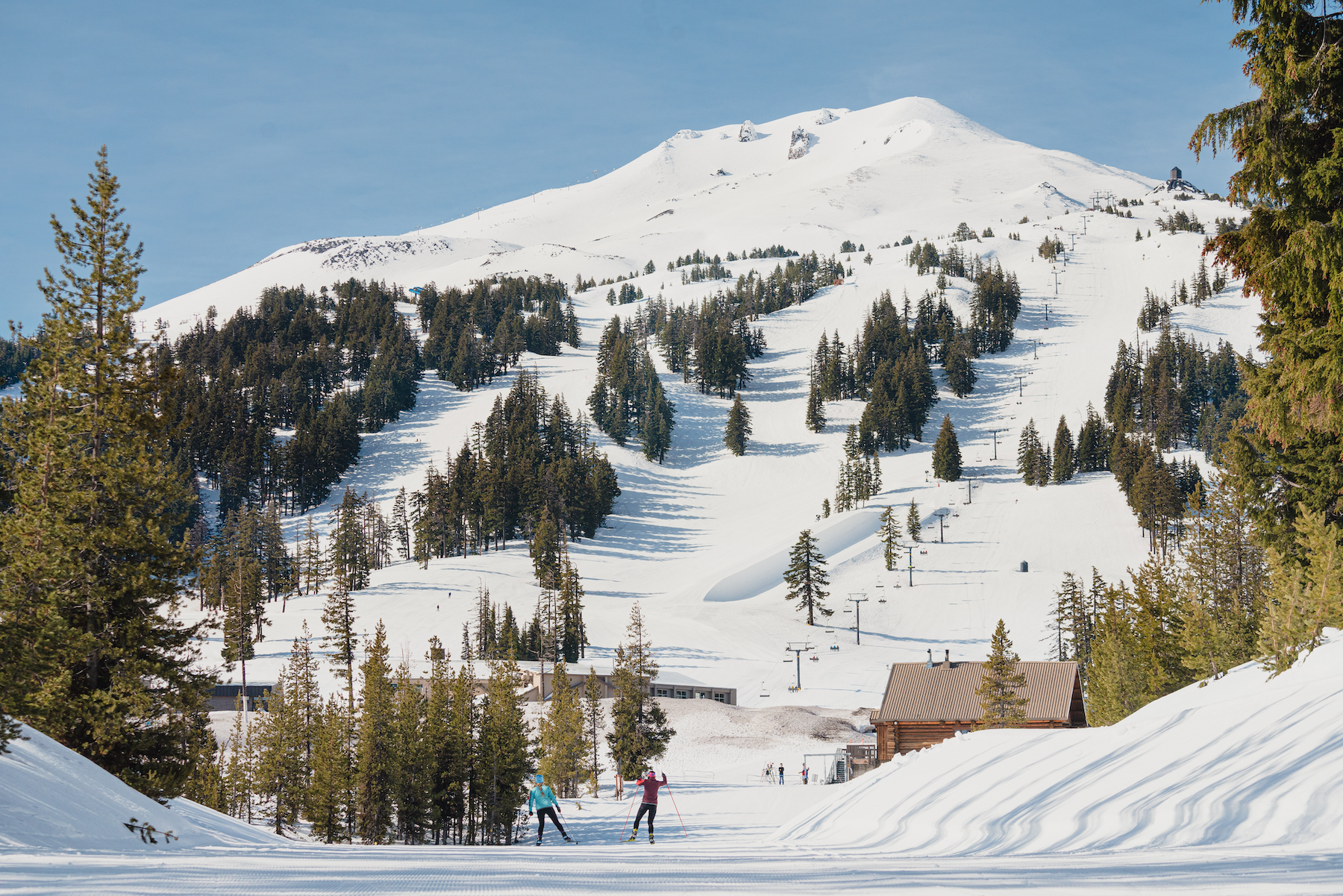
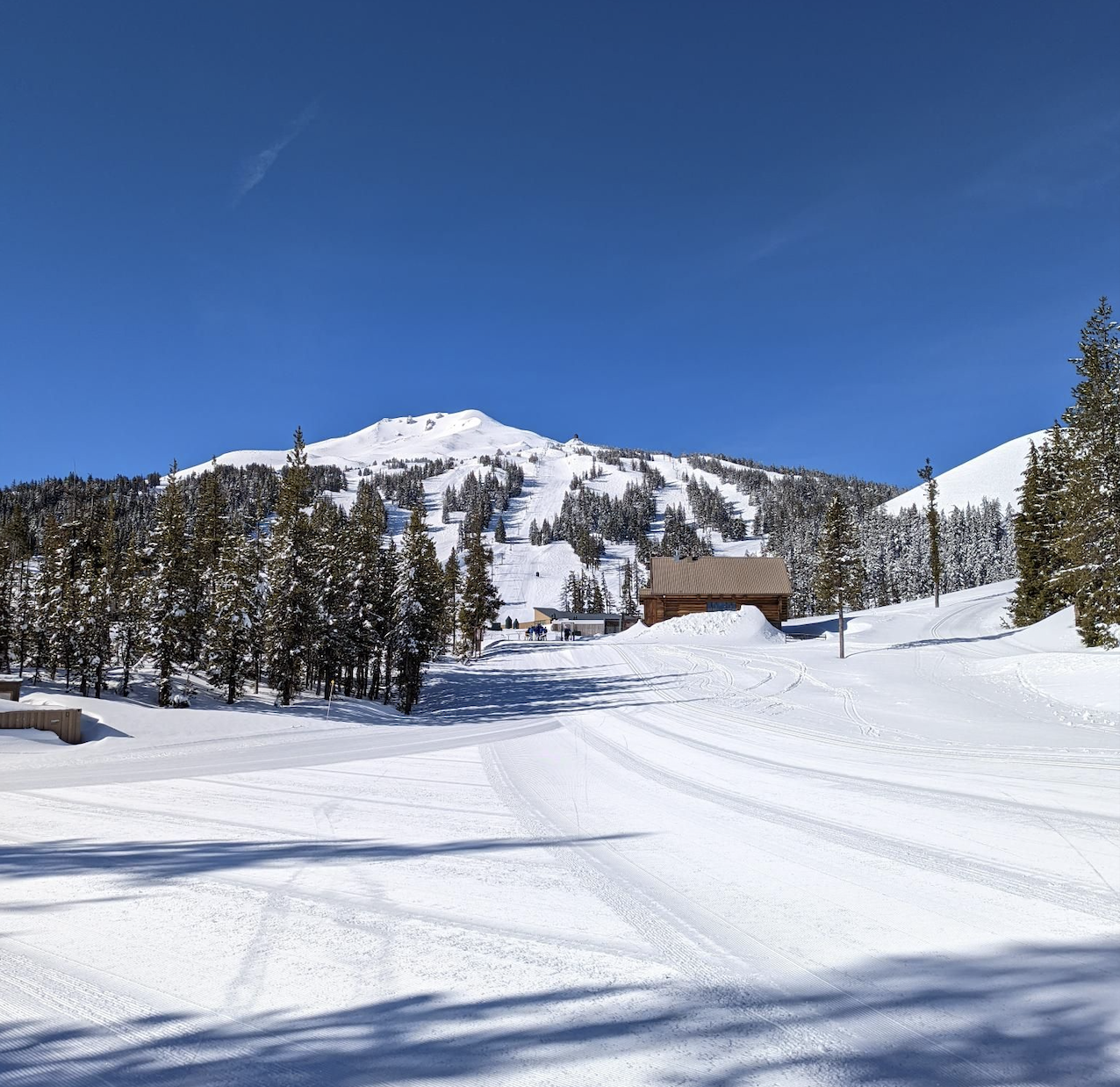
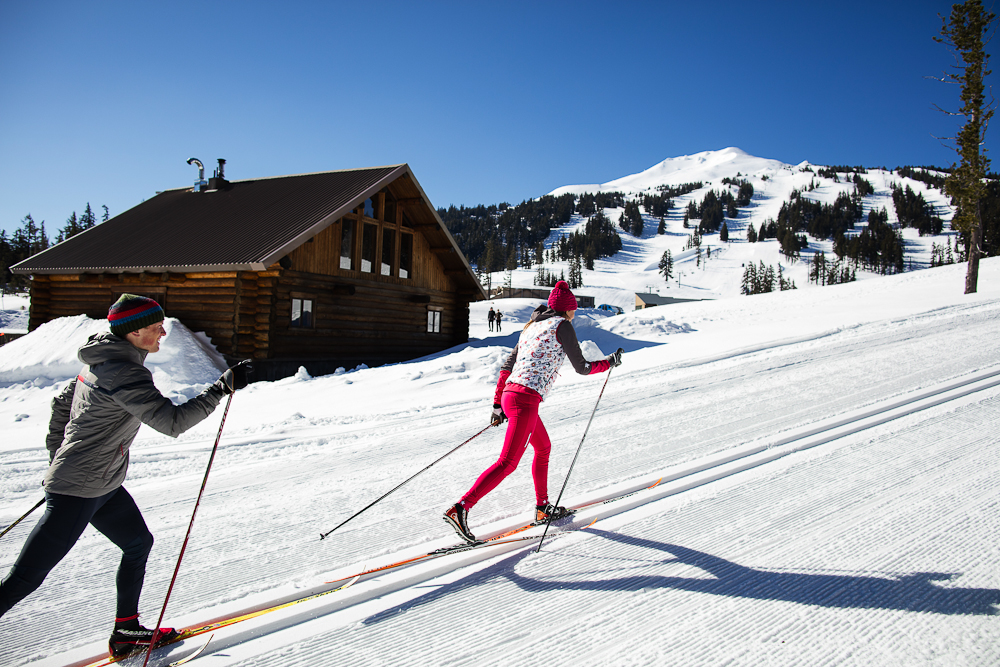
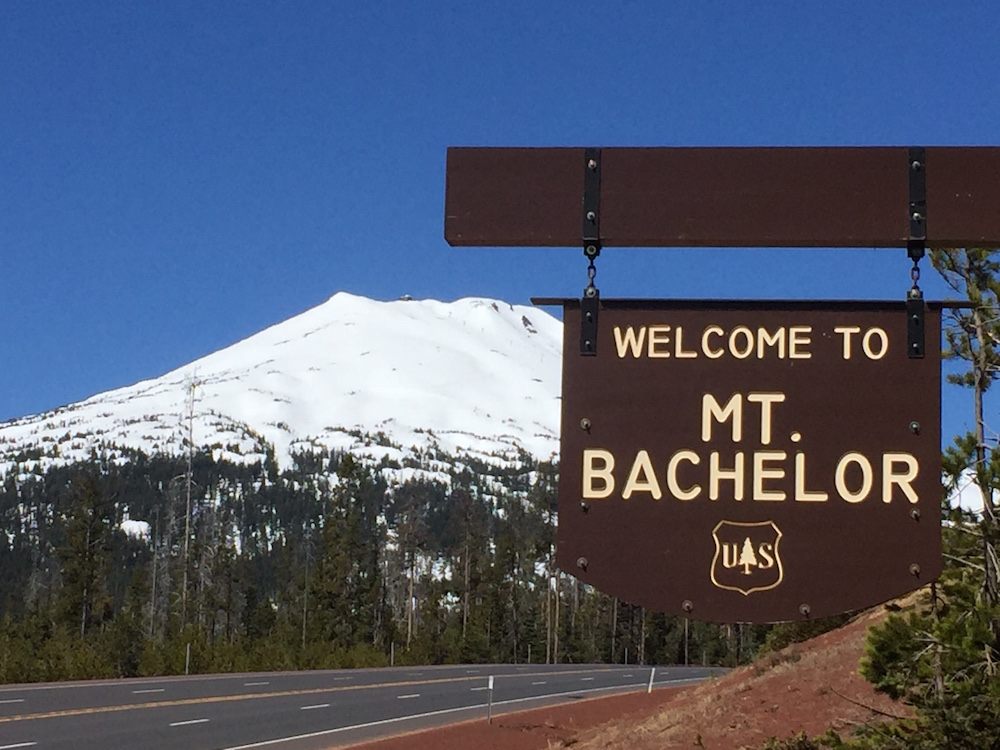
If there’s ever a place for a cross-country skier to put on their bucket list, Mt. Bachelor in central Oregon is it. With a ski season that typically lasts into late May and can even extend to June—with natural snow some 6,400 feet above sea level—the Mt. Bachelor Nordic Center is spring skiers’ paradise.
According to Nordic Manager Sydney Powell, Mt. Bachelor (about 22 miles west of Bend, OR) has been inundated since January with snowstorms that brought powder conditions throughout the winter and a 10-foot snowpack (120-inch base depth) as of early March.
“The grooming team has worked long hours to keep up with it all, but we are really grateful to have this challenge given the lack of snow in some places [of the country],” Powell stated. “May 26 is our planned season-end date, so there are nearly [two] months of skiing yet to go!”
On April 6, it will host the Cascade Crest, the last race of the Mt. Bachelor Cup Series organized by the Mt. Bachelor Ski Education Foundation (MBSEF). Powell described the 25 k course that winds throughout much of the trail system as “hilly but very scenic.” The 25 k skate race is the most popular, and the 50 k marathon tour entails two laps of that course. There’s also a 12.5 k distance and a 5 k kids’ race. All races are freestyle discipline.
To close out the official season, the Nordic Center also has a variety of fun spring activities planned, including an Easter egg hunt on March 31, “Treats on the Trails” on April 12 and May 12 (Mother’s Day), and a spring deck concert/closing weekend celebration on May 25. While not entirely nordic, the Pole Pedal Paddle, MBSEF’s signature event, is slated for May 18. The multi-sport relay includes an alpine leg, 8 k cross-country ski, 22-mile road bike, 5-mile run, 1.5-mile canoe/kayak/SUP paddle, and 0.4-mile sprint.
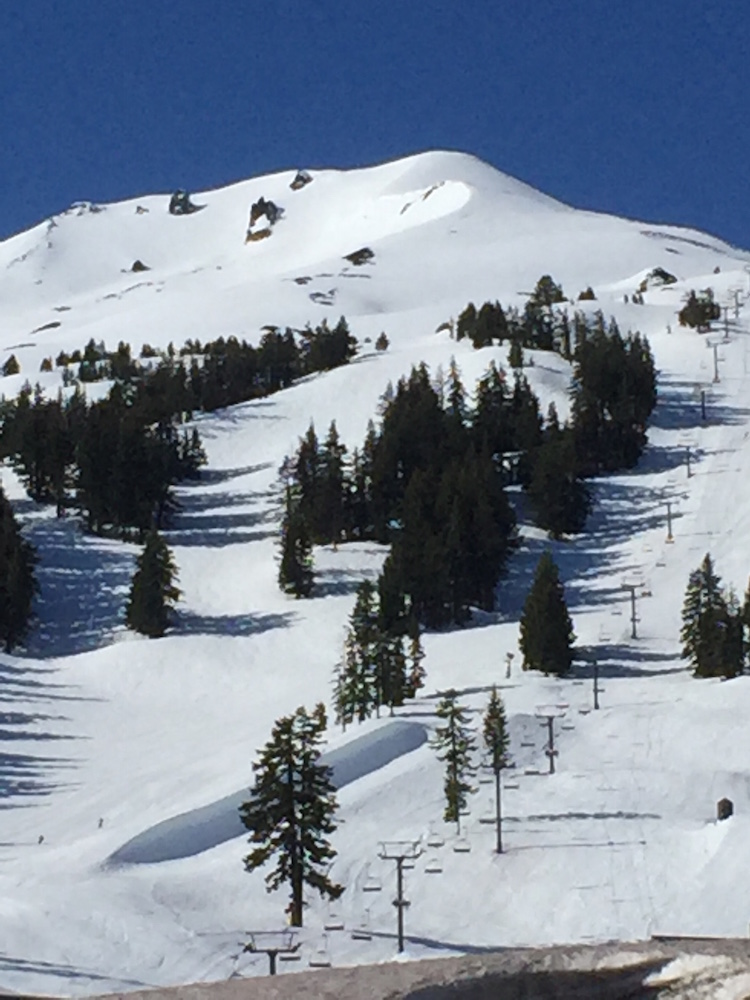
A dormant volcano in the Cascade Range, Mt. Bachelor tops out at 9,068 feet and regularly experiences high winds and extreme storms. This keeps the ski season extending from November through May most years and into June for teams who pay to use the trails.
“We hope to host the US Ski Team, Biathlon Team, and Para Team again this May,” Powell explained. “We offer contract grooming in June for club teams and typically get a pretty good turnout from club ski teams from the western states. We’ll offer June grooming again this season for interested teams if snow conditions allow it.”
Powell was confident most of the trail network would remain open into May. In late March, temperatures were still in the mid-20s and low-30s Fahrenheit. She expected the Nordic Center to have at least 15-20 kilometers still open at the end of the season and said they hoped to offer skiing on the remaining snow into mid-June.
That’s typically when ski teams from around the country, from club to national level, visit Mt. Bachelor to start training for next winter, even if only on a few kilometers of snow. Cross-country skiing in June is as much a novelty as it is a rarity in the U.S.
According to U.S. Ski Team Head Coach Matt Whitcomb, the 25-minute drive down to Bend, where the ski team stays during their visit, at an elevation of roughly 3,300 feet, makes for a key training and recovery combo.
“We can also go rollerskiing in the afternoon, we can go mountain biking, we can run in shorts and T-shirts,” he told FasterSkier during the team’s Mt. Bachelor training camp in May 2022. “It’s like you’re experiencing the summer and the winter on the same day for two weeks in a row.”
Mt. Bachelor is a similar distance from Sunriver, a small resort town to the south. It’s marketed as the Pacific Northwest’s largest resort playground, with everything from cross-country and downhill skiing to snowshoeing and dog sledding in the winter, plus mountain biking, cycling, trail running, paddling, concerts, and more in the summer.
“Central Oregon is an awesome spring destination,” Powell explained.
For those who have visited before, Powell said not much has changed in the last ten years since she’s worked there—which is a good thing.
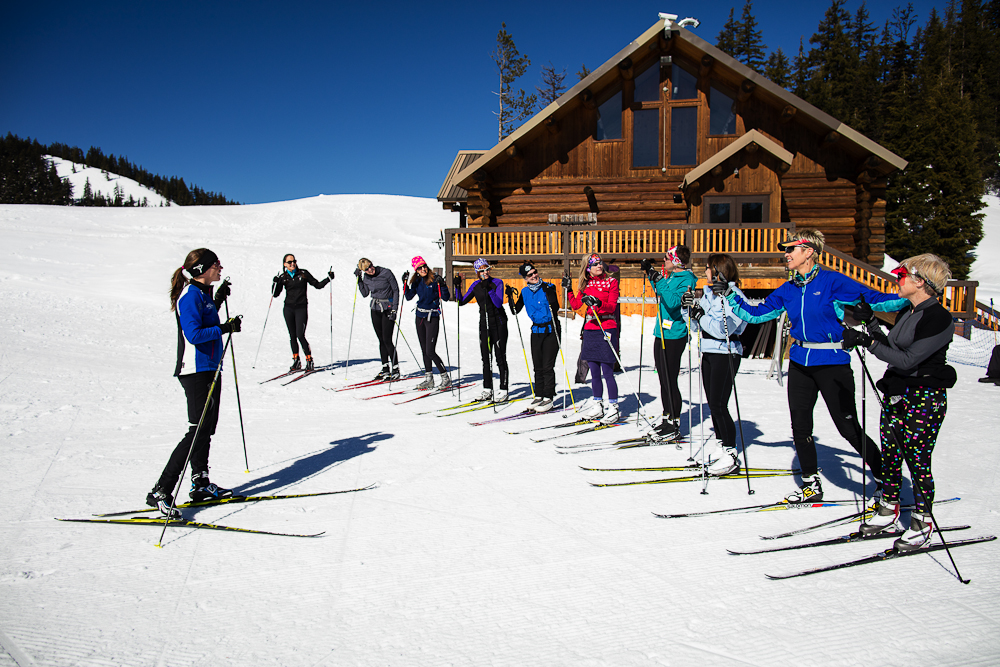
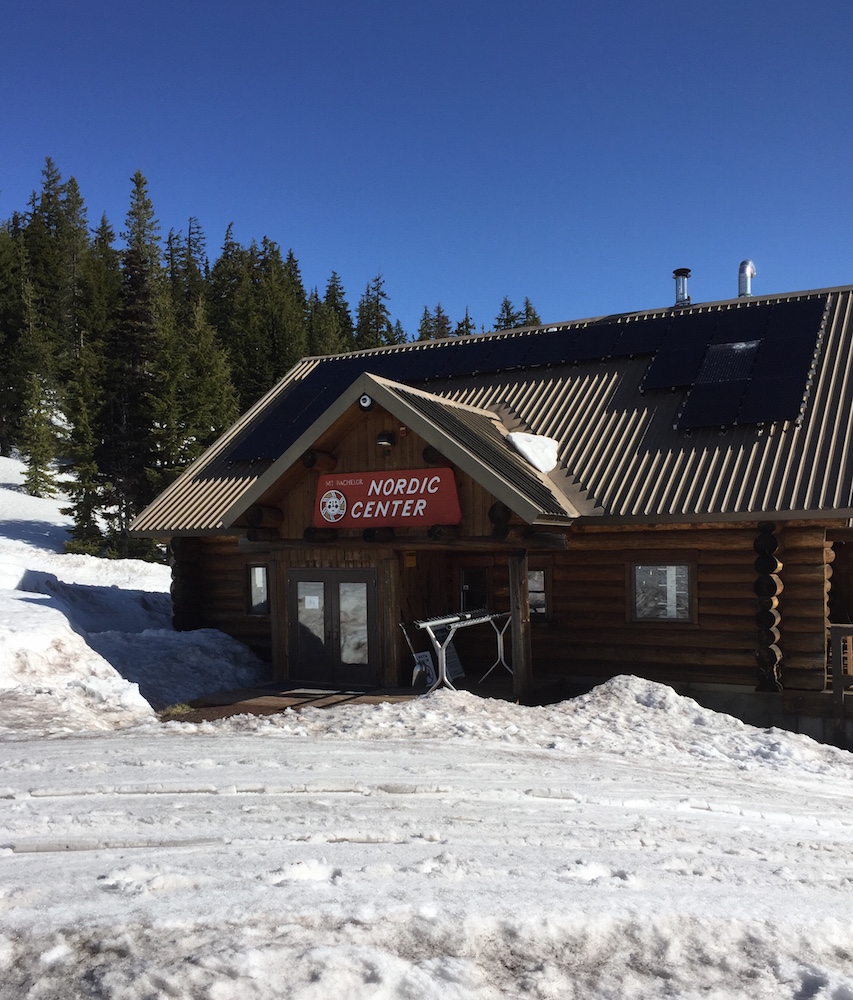
“We have a nordic lodge and offer lessons for all levels every day of the week,” she said. “We also have a cafe on-site and a retail shop with rentals. We have nordic ski patrol and day grooming, so a pretty full-service nordic offering.”
For Whitcomb, it’s the trees and world-class trail system that get him.
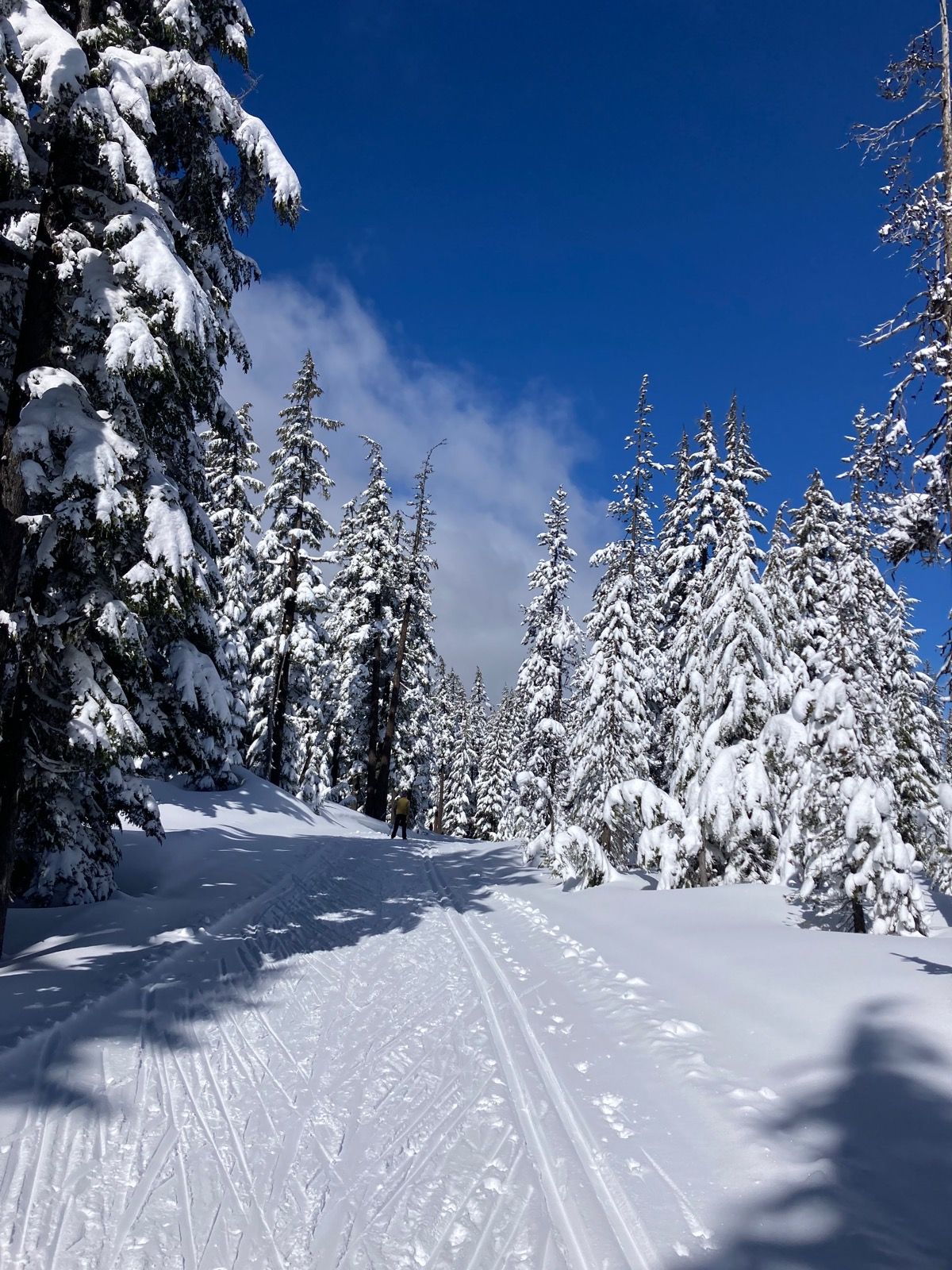
“You’re skiing through Douglas fir—just these massive, old trees—on creative, windy, hard trails…,” he said. “It’s just such a wonderful environment. The way these cascade forests smell this time of the year when the new growth is coming up—you step out of the car when you first arrive, and it’s like, ahh. I could be blindfolded and tell you exactly where I was.”
May or January? The US Ski Team has found prime conditions at Mt. Bachelor during the 2022 Bend Camp. (Photo: Noel Keeffe)
Believe it or not, it is mid-May. For those following a traditional cross-country calendar, this means the start of a new training year, building toward the 2022/2023 competition season. And, for many of the top American athletes, this means it’s time to make an annual pilgrimage to Bend, Oregon for the on-snow camp of the season at the Mt. Bachelor Nordic Center.
The weather gods were kind to the camp attendees, with nearly a foot of fresh snow falling on Mt. Bachelor last weekend, restoring it to mid-Winter conditions. April was also a fruitful month for snowfall, setting up for a base-depth of 92” currently reported on the trails – not bad for May!
To learn more about the camp and what has made Bend and Mt. Bachelor a staple of the U.S. Ski Team’s early season training, FasterSkier connected with head coach Matt Whitcomb, who shared that he has been coming to Bend almost-annually for the last 26 years.
He first experienced the trails at Mt. Bachelor during the 1996 U.S. National Championships.
“I was rooming with Justin Beckwith (current NENSA Competitive Program Director),” Whitcomb recalled fondly. “Amy Caldwell took us out and then Sverre [Caldwell] joined us, and we had our first experience racing Nationals. And it really jumped out as this town that had skiing at its center, not only alpine but cross country.”
The following summer, Whitcomb, Beckwith, and a couple additional training partners hopped into a car and drove to Oregon to spend the summer of ‘97 in Bend.
“But we weren’t, by any means, the first people to do this – we were following in the footsteps of Justin Wadsworth and Pat Weaver and a whole bunch of other people. And by our senior year [at Middlebury College], we had twenty-something people driving out from the east just to experience what Bend has in late May and June, and we’d be there through August until we had to go back to college.”
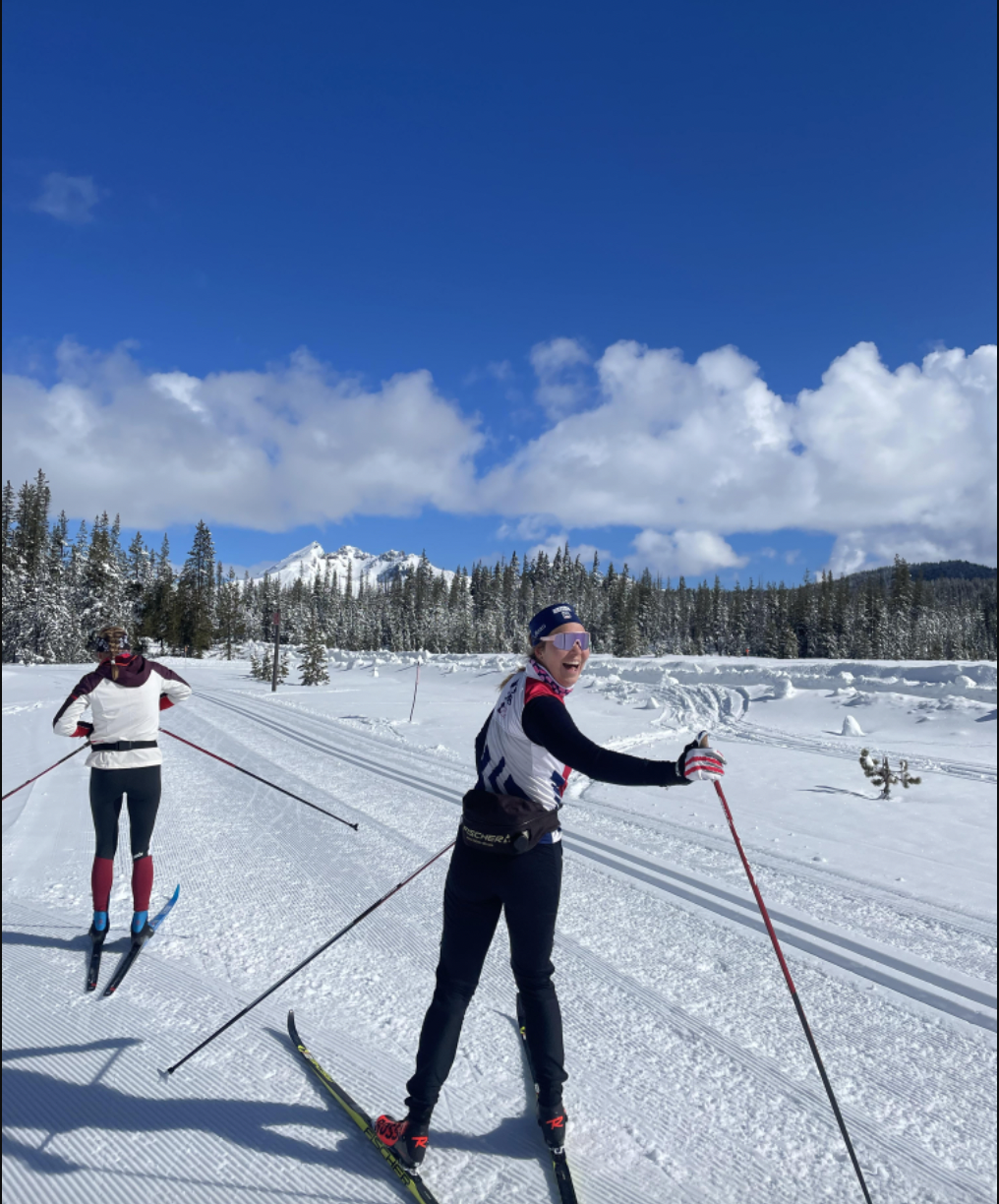
Lina Sutro (right) and Alayna Sonnesyn (left) enjoy fresh snow and a fresh groom at Mt. Bachelor during the 2022 Bend Camp. (Photo: Lauren Jortberg)
What Bend has in late May and June, he said, is a vast array of diverse training opportunities, which most importantly includes snow.
“That’s probably the first thing that really drew us in, particularly as people from the East.”
He shared that the snow report they had received from Mt. Bachelor Nordic Center manager Sue Foster was measuring the accumulation from April storms in feet, not inches.
But it’s not just the access to snow on its own that makes Mt. Bachelor worth the trip.
“The trail system is world class. You’re skiing through Douglas fir — just these massive, old old trees on creative, windy, hard trails, and on a good year they’ll have close to 30 or 40 kilometers groomed for us still in May.”
In addition to its geographical location and an accumulation of over 300” of snow annually, the elevation of the Nordic Center preserves the snowpack for late season skiing. The parking lot sits at roughly 6,000’ above sea level, while trails range from 5,750 to 6,400’.
This puts Mt. Bachelor in a similar altitude zone to Soldier Hollow, UT, offering athletes both an early season bump in red blood cells and the opportunity to fine tune their altitude skiing strategies, “which is something that we really value. Because skiing at altitude is not just something for the aerobically gifted; it’s also something for people that develop the skill of how to actually ski at altitude. So that’s been great.”
Whitcomb also lauded the convenience of Mt. Bachelor relative to their lodging down in Bend, roughly a 25 minute drive down the mountain at a significantly lower elevation of roughly 3,300’. In addition to easy access to the trails, this gives the team the opportunity to train high and sleep low, as well as to enjoy non-ski training modalities in a totally different climate.
“So recovery is complete. We can also go roller skiing in the afternoon, we can go mountain biking, we can run in shorts and tee shirts. It’s like you’re experiencing the summer and the winter on the same day for two weeks in a row.”
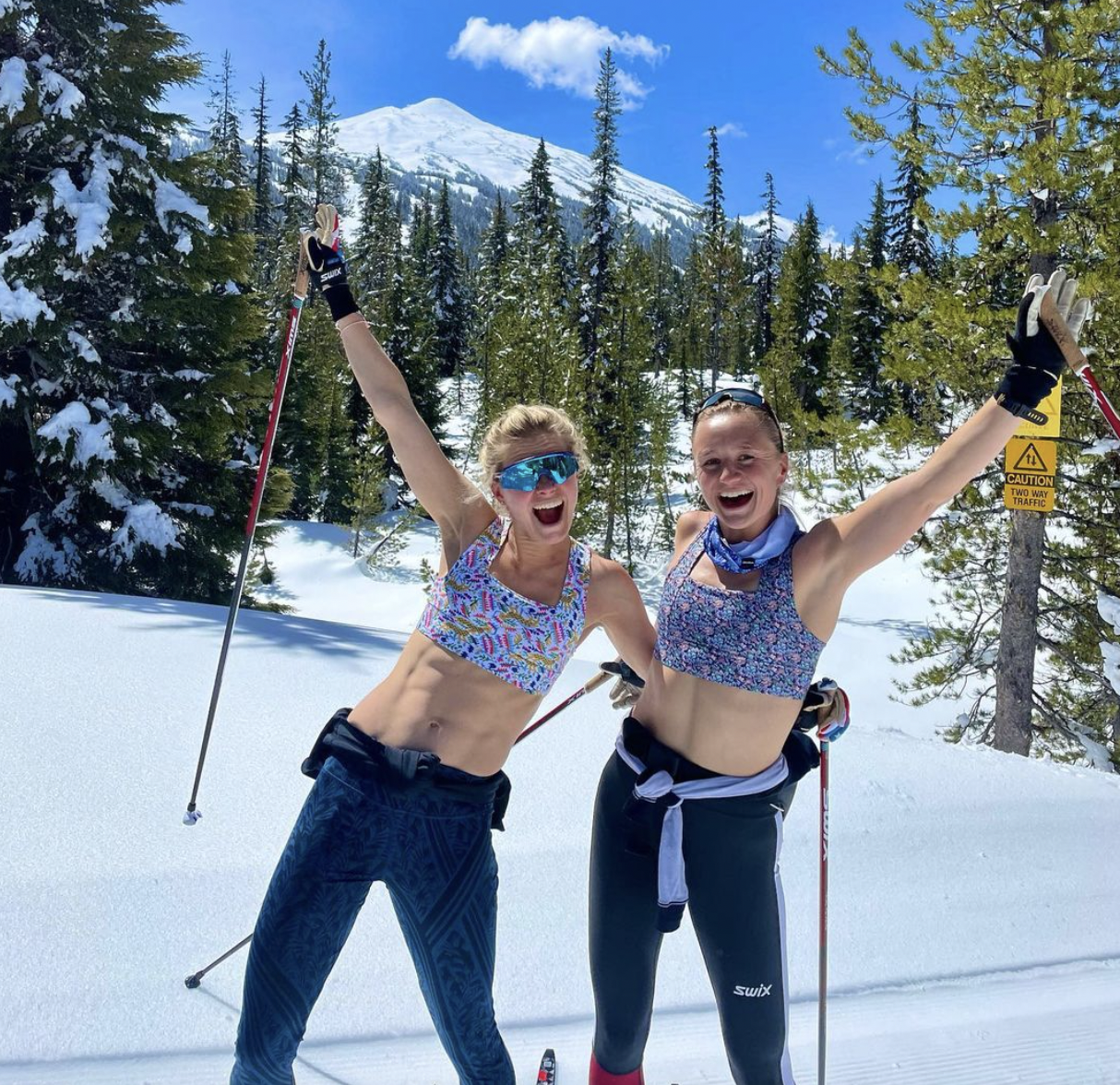
Fresh snow and vitamin D — Jessie Diggins and Alayna Sonnesyn head to Mt. Bachelor for the 2022 US Ski Team spring training camp. (Photo: Lauren Jortberg)
Overall, Bend and Mt. Bachelor have become a special place for Whitcomb, and for the many athletes who have made their way there over the years.
“It’s just such a wonderful environment. The way these cascade forests smell this time of the year when the new growth is coming up — you step out of the car when you first arrive and it’s like, ahh. I could be blindfolded and tell you exactly where I was.”
While Mt. Bachelor offers high quality grooming all season, Whitcomb also spoke to the relationships the US Ski Team have developed with the trail operations team, and their willingness to adapt their usual grooming patterns to best serve the visiting skiers. This year, Whitcomb is looking to replicate the track format of a World Cup stadium so the team can practice “switching lanes in the finish and figuring out how to develop more speed — a bit of a twist to our [usual] speed training.”
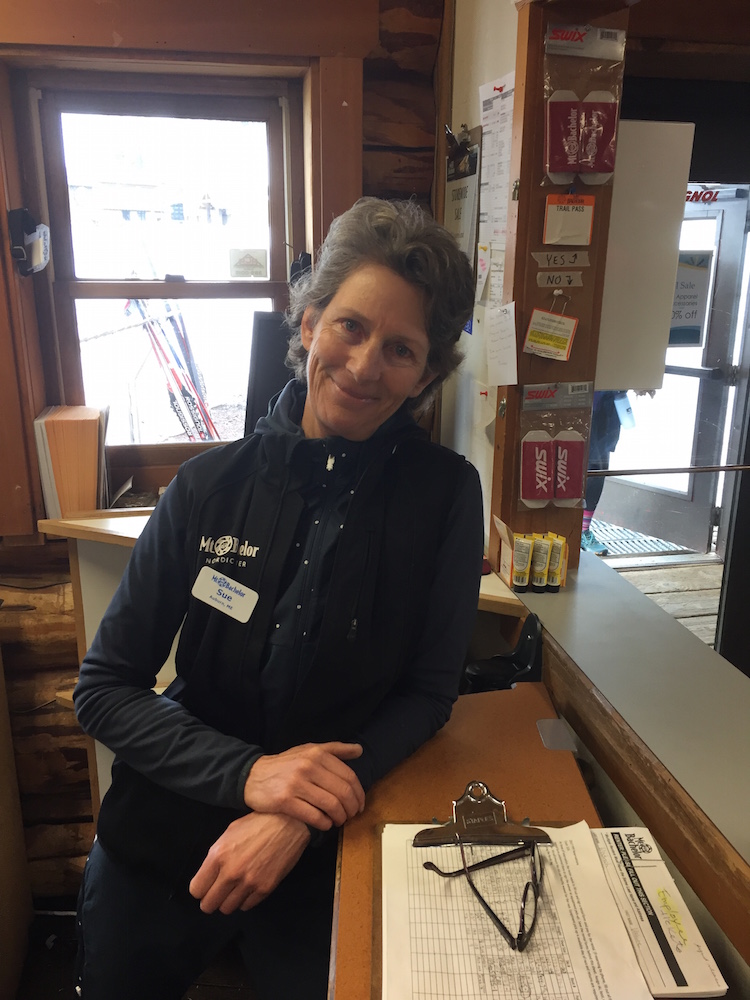
At the helm, and helping US Ski Team coaches interface with the grooming team, is the aforementioned Nordic Center Manager, Sue Foster, who Whitcomb says has been an invaluable resource over the years.
“She meets us in the lodge every day, she helps us prepare the TV and the chairs so that we can do a little visualization before every session. And she’s just a delightful, inviting person that makes you want to come back and see [her.] It’s rare that every athlete on the team knows the names of the people working the lodge, but Mt. Bachelor is one of those places.”
Midwinter conditions return in May to Mt. Bachelor. (Photo: Alayna Sonnesyn)
Off the ski trails, Whitcomb shared that a highlight for many athletes is the lower elevation terrain in Bend, where the unique volcanic geology of Mt. Bachelor sets up for miles of tacky “hero dirt” for afternoon rides.
“The mountain biking is some of the best in the US, particularly in May, before it’s gotten dusty.”
During the late spring, many trails along the Deschutes River are also beginning to open up, and often the team will be dropped off an hour and a half up-river to enjoy a point-to-point run back to their cluster of rental houses.
This year, the team is spread between three large rental homes in close proximity, with the staff house centrally located to host nightly team dinners catered by USOPC chef Megan Chacosky. To reduce COVID risks among the team and staff, masks are still worn during team meetings, allowing them to safely happen in-person. Though mask mandates and COVID safety precautions are largely being dropped, Whitcomb expressed the importance of keeping athletes and staff healthy, setting everyone up for success during the high-volume summer months of training.
“I think the world has made a major shift to decide that the pandemic is over, but we’re pretty well aware that the COVID is not done yet.”
Finally, Whitcomb cited the greater ski community in Bend as a reason the camp has been such a valuable component of the annual training cycle.
“As far back as I can remember, it didn’t matter whether we are registered with a local club or not, we were always being invited by [coach/director] John Downing to the XC Oregon sessions. He’s still a good friend of the team, and we have so many locals in town that are helping us out and welcome us every year to town.”
Acknowledging that he was only giving the short-list of names from the Bend skiing community who have supported and welcomed the team each year, he also noted former physiologist at the Olympic Training Center in Colorado Springs Tim Gibbons, who builds excitement for the camp by giving Whitcomb snow reports all winter, indicating how the trails are shaping up for spring skiing. And lastly, he thanked the members of the Mt. Bachelor Ski Education Foundation (MBSEF), including nordic director Dylan Watts.
This community support allows the team to maximize their time training in Bend, while also creating opportunities for outreach via programs like Fast and Female or hosting workouts for the MBSEF junior athletes. This partnership helps the team feel connected, and also stoke the enthusiasm of the next generation of cross country skiers.
“It just really feels like a family that we’re coming back to every year. So thanks to everybody that has always been welcoming. We try to be great ambassadors for the sport, and we need partners like this [to continue to move forward as a nation].
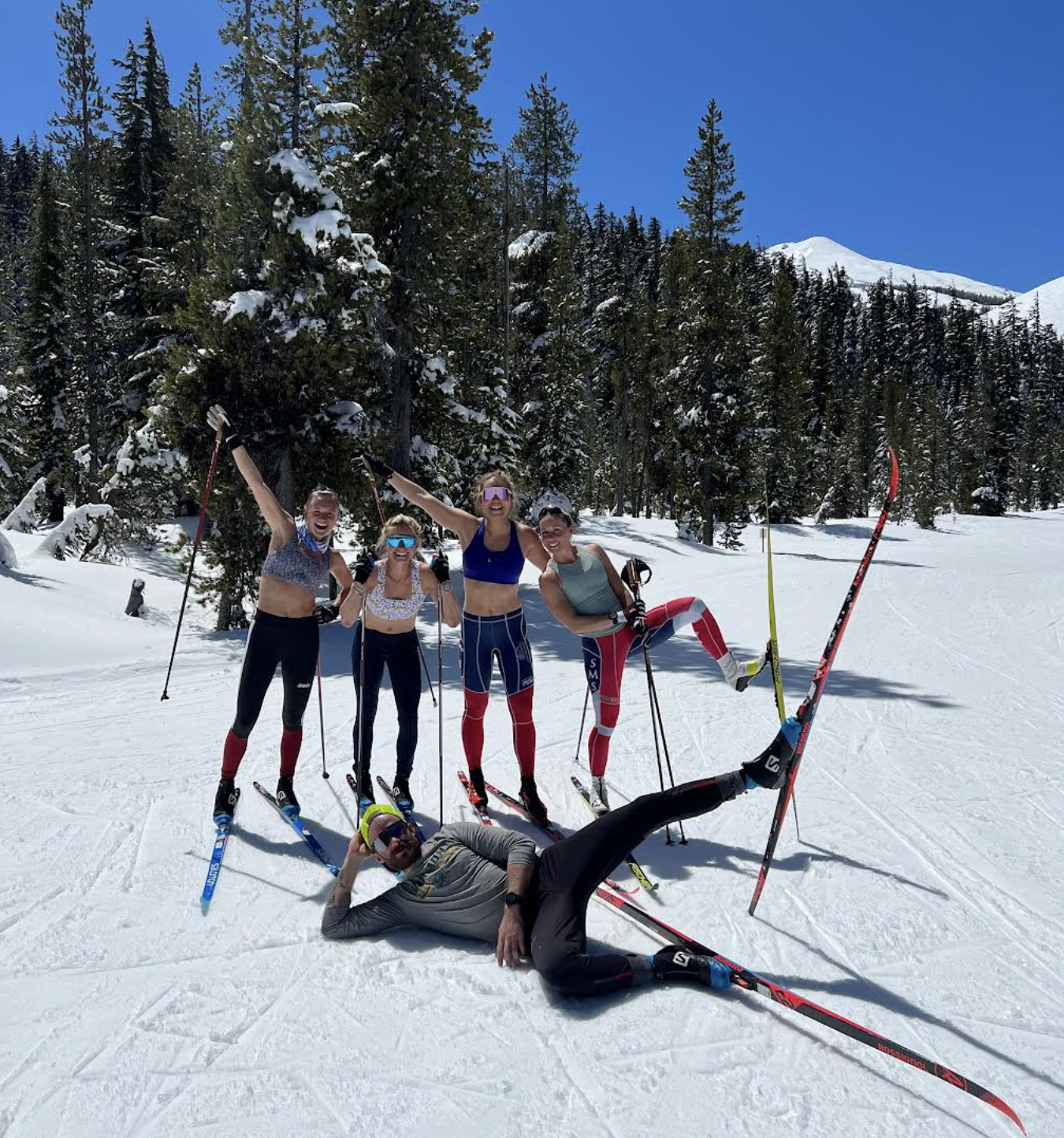
Sun, snow, and lots of training during the 2022 US Ski Team camp at Mt. Bachelor. (Photo courtesy Alayna Sonnesyn)
The Mt. Bachelor Nordic Center is known for it’s world class spring cross-country skiing. You can find more information about spring conditions at mtbachelor.com.
Jesse Thomas finishes the 2017 Ironman World Championship in Kailua-Kona, Hawaii. (Photo: Red Bull Content Pool)
In some mountain communities, the transition from winter to spring is known as mud season. That’s not the case in Bend, Oregon where transitions are welcome and mud is relatively scarce. Jesse Thomas, dad, partner, entrepreneur, and world-class triathlete remains a Bend local – the kind whose roots extend to an upbringing in Bend back when the myths of this outdoor mecca barely filtered beyond wetter parts of the Pacific Northwest.
In endurance sports circles, Thomas is widely known as a now-retired yet formidable triathlete. So abrupt or gradual transitions are simply part of the cycle. For years Thomas specialized in the rigors of swim-bike-run. There were three-a-day training sessions. The pool time, the road riding miles, and pavement pounding logging running miles. It takes a toll and it takes a fastidious nature to make it all work.
Finding a piece of mind for Thomas, is, in fact, part of his daily ritual that includes juggling real-life transitions. He helps manage Picky Bars, a Bend-based company he co-founded with his wife Lauren Fleshman, care for their two young children, and in some capacity, still finds a way to get outside and elevate the heart rate.
“One of the main brand mantras of Picky Bars is balance,” said Thomas. “That extends as a microcosm, like nutritional balance, but also in the macro in terms of overall life balance. We make sure we’re all making time for family, exercise, and health. The reason a lot of people live in Bend is that it’s a place where the community values that balance.”
Jesse Thomas races in the 2017 Ironman World Championships in Kona, Hawaii. (Photo: Red Bull Content Pool)
Although growing up close to the Mt. Bachelor Nordic Center’s trails, Thomas grew up downhill skiing and participated in a mix of sports like basketball and running. Thomas, who ran at Stanford as a top steeplechaser, caught the running bug early. In elementary school, his PE teacher organized a program called Jog-raphy. Students were incentivized to run. Thomas found a calling.
Years later cross-country skiing and the Mt. Bachelor Nordic Center drew Thomas in.
Another solid snow year at the Mt. Bachelor Nordic Center: (Photo: Brian Becker/Mt. Bachelor)
Thomas won the Wildflower Triathlon six times. It doesn’t take a math savant to conjure the pounding on his body. “Cross-country skiing became a way of breaking up winter training,” said Thomas. “It was right after we had our son, so about six winters ago. It was a lot harder for me to travel for winter training camps as we began our family. So during the winter, it meant I’m going to be on the bike trainer almost exclusively. For running, it can be crazy unpredictable outside. I needed to find something where I could just go out in nature and exercise. I knew it wasn’t that risky in terms of injuries, so I got on skis and started teaching myself how to skate.”
Mentored by a Bend cadre of fit skate skiers, Thomas discovered his unrefined skate skiing benefited his triathlon training. Thomas relied on his motor, not so much his technical acumen, to keep up with his partners.
“Part of the reason I liked skate skiing in the early days was that I was so bad that it was a hard workout for me,” Thomas said of his early skate ski sessions. “Just to keep up, it was like going out there and doing a super high-intensity tempo run just to ski with my buddies who were all keeping it pretty casual.”
Spring is the time to transition at the Mt. Bachelor Nordic Center. Ski in the morning, bike/run in the afternoon. (Photo: Brian Becker/Mt. Bachelor)
Skate skiing became a thing for Thomas. He describes himself as somewhat “fragile” as a runner. Over the course of his career, he and his coaches kept his annual mileage relatively low for an Ironman athlete. “For those last couple years I raced professionally my longest training run would be around 12 miles, and I would then race an Ironman on that. Later on, skate skiing became a measurable part of my winter training regimen. It was something that my coach and I really leaned into. I became skilled enough that I was at really low risk of hurting myself, and I could get great workouts in. The other thing we loved is that I could just keep my running mileage really low during the winter.”
Come winter, the short jaunt to the Mt. Bachelor Nordic Center remains a wintertime staple for Thomas. It’s a place he finds primed any day of the week. Having grown up in Bend, he knows the snow supply at Bachelor is more than ample. And the trail layout, according to Thomas, is to his liking for its roller-coaster feel.
If you’re up there before work and see some dad up there in his trademark aviators who looks like he could throw down in Kona, that would be Thomas. Those roller coaster trails at the Mt. bachelor Nordic Center now more of a “play hard” respite from his life’s new precise yet less race-oriented transitions.
His transitions now look less typical of triathlon culture. There’s no wetsuit to strip, bike cleats to clip in, or running shoes to cinch on. At least in the context of the formal triathlon grind. Now there’s laundry, kid’s toys, school drop-offs, lunches to make, Picky Bars to help steer, and, of course, some play.
The Mt. Bachelor Nordic Center is known for it’s world class spring cross-country skiing. You can find more information about spring conditions at mtbachelor.com.
Triathletes Jesse Thomas (left) and Kyle Klinger (right) swim in Elk Lake with Mt. Bachelor as the backdrop. (Photo: Red Bull Content Pool)
Graham Zimmerman climbing Celeno 2 in Alaska’s Wrangell Mountains. (Photo: Chris Wright.)
Walking down the street in Bend, Oregon, or perhaps sipping a curated latte, the mustachioed Graham Zimmerman looks like he’d fit right in as a Brooklyn creative. Svelte sartorial taste? Check. An overactive mind capable of wordsmithing and capturing raw visuals as a film-maker? Check.
Admittedly, Zimmerman could discover a fine calling for himself immersed in big-city life.
But, for every Yin there’s a Yang. During certain parts of the year, you’re as likely to find Zimmerman high in the Karakoram mountains as you are in front of an editing suite crafting a film or ruminating on a coffee roast. The 34-year-old Zimmerman is in fact a wizened alpinist. And in an over-mapped, over-way-pointed world, he’s primarily keen on ascending mountains via new routes. Something in the climbing world called first-ascenting.
As with most sporting disciplines, alpinism recognizes its own version of the biggest, the baddest, and the boldest with an award called the Pilot D’or – “The Golden Axe”. Considered the highest achievement in mountaineering, Zimmerman was short-listed for the award in 2015, and won in 2020 as part of a team that first-ascended the South East Face of Link Sar (7041m, M6+ WI 4 90°, 2300m) in the Pakistani, Karakoram. What you need to know about the alpine specific nomenclature rating the climb is this: it’s big, bad, and bold.
Bend resident Chris Wright Climbing on Link Sar, Pakistani Karakoram. (Photo: Graham Zimmerman)
Although Bend and its surrounding mountains have alpine-relief, they are not considered a traditional hot-spot for alpinists – the ice climbing is nearly non-existent and the high-peak’s rock trends toward wobbly Jenga tower unstable. Places like the Tetons and Estes Park are alpinist attractants. Historically, not so much Bend.
“I am a professional mountain climbing athlete,” said Zimmerman. “As part of my training for that I do a lot of uphill travel. And an important part of training for that is large volume training – that means more time keeping my heart rate within certain boundaries while moving.”
With knees of a sixty-year-old, Zimmerman discovered skate skiing was his ticket to boundless trails and controlled intensity zones all while minimizing knee impact.
“Skiing here at Mount Bachelor has proved to be an amazing tool,” Zimmerman said. “And so this morning, for example, I was out at Bachelor, pulling up at 7 am when they opened the gate for Covid parking. I put on my touring skis and skinned up and down the cone feature. I did about 4500 feet of uphill skinning, along with skiing back down, then I went back to the car, drank a little bit of coffee, swapped out my touring boots for my skate boots, grabbed my skate skis, and skate skied for about an hour and a half through the Bachelor Nordic complex.”
Zimmerman is a skate-skiing neophyte drinking in technique nuances. He, like most in the cross-country ski tribe, sees it as a means to stay fit and healthy, but also move semi-effortlessly through the forest.
A skate ski lesson at the Mount Bachelor Nordic Center. (Photo: Brian Becker/Mt. Bachelor)
“I feel like skate skiing is something that has a very steep learning curve, not too dissimilar from something like surfing,” he said. “But there’s a moment that came for me and I think it comes for a lot of people, where you find yourself generating speed, generating momentum. There’s kind of this moment where you’re like, ‘Oh, I get it’. As soon as I felt that, I knew this was going to be something that I would be doing for the rest of my life.”
Here’s the thing: it’s rare that any climber, despite how popular culture might assign it, has a “deathwish”. For Zimmerman, that “rest of my life” he refers to is meant to be a long one. Sure, risk is part of everyday life, and perhaps even more so for those spider-manning up a peak poking into the upper troposphere, but Zimmerman is keen for the long-term high-fulfillment existence.
“Here are a few equations with which I am currently working,” said Zimmerman as he posited his notion of exposure to risk. “I am an expedition alchemist, and that means the baseline risk I am engaging with certainly has the potential to be very high. And so while I am continuing to prepare for objectives like this summer when I am going to the Karakoram to try something big and hard, my risk profile will go up pretty dramatically while I am there. I will spend the entire summer managing that risk. My goal, in particular, now that I am a little older and my prefrontal cortex is a little more developed, is to reduce my risk during the rest of the year, so that my overall annual risk profile can go down.”
Graham Zimmerham hauling a load towards Mt. Laurens in the Alaska Range. (Photo: Mark Allen)
What you won’t find Zimmerman doing is free soloing or climbing into and descending high avalanche terrain near Bend. He can climb safely at nearby Smith Rock, cruise limitless miles of single track or gravel, ski-mountaineer when the snowpack is stable (which it most often is), go to the climbing gym, and of course, skate ski at the Mount Bachelor Nordic Center. All these activities, in the aggregate, have a relatively low-risk factor.
“That’s something that is of value to me,” Zimmerman explained. “I’m fastidious about managing my risk profile when I am preparing for these big expeditions to places and routes that are considered to be some of the hardest alpine climbing in the world. I am doing so in a way that I am not increasing my risk at home, and that, I believe, is making it more likely that during my entire year, I am likely to survive.”
Graham Zimmerman skiing a Bend, Oregon classic somewhere in the Three Sisters Wilderness. (Photo: Mason Lacy)
Sunrise over the Three Sisters Wilderness with a kiss of alpenglow on the peaks is often when Zimmerman keeps this all in balance one side of the skate ski “V” at a time. Zimmerman could be king of many proverbial hills here in Bend. He’d rather be humbled at the Mount Bachelor Nordic Center zipping down Oli’s Alley or simply working on balance techniques on the oval. The cool thing, Zimmerman’s risk for trying something new and being imperfect is high. Skate skiing at Mount Bachelor suits this expedition alchemist and his low-risk calculus when in Bend.
“There’s so much value in starting something new,” he said of the gift that has been skate skiing. “It’s not only in terms of checking your ego and keeping yourself in line but also, for me, making incremental improvements in climbing is really hard. It takes a lot of effort to improve 1%. Whereas doing something new – like skate skiing, I see improvement every time I go out. I’m improving something like 15% per year or more. That’s fine. You know, being crappy at something is hard but getting better at something is fun.”
Sunny Striding at the Mt. Bachelor Nordic Center. (Photo: Brian Becker/Mt. Bachelor)
Barry Wicks of Bend, Oregon. Tools of his winter-trade: skinny, ski, ski-mountaineering skis, and plenty of smiles. (Photo: Aidan Whitelaw)
At six foot four, Bend Oregon’s Barry Wick remains a person you want to draft behind. The former World Championship mountain biker and cyclocross rider still carries many in town on his wings. There’s the fact of the matter tallness, and yes drafting behind him does feel like you’ve got just a little more lift. He’s also the brains behind bike manufacturer Kona’s endurance cycling team, he’s the endurance team manager, and the owner and artist behind Hella Sweet Ink, maker and curator of funky customized gloves and sneakers. This much is true: His vibe will give you a little lift too.
Long gravel grinds, up and down trail runs, skate skis at the Mt. Bachelor Nordic Center and big vert ski-mountaineering jaunts are how Wicks now finds balance as a former pro athlete who still feels best when lighting out. Bottom line, he’s got an uncanny harmonic resonance, and sometimes an eclectic buzz. As any person who’s been around an elite endurance athlete without their daily aerobic fix, the buzz can be seismic.
Barry Wicks in his desert element. (Photo: Courtesy Barry Wicks/Kona)
In the months, which are plenty here in Bend, when the biking is unprime and hours too short for a mighty ski tour, Wick can be found sublimely skating Bend’s nordic trails. Wick’s father ski patrolled Mount Hood. His younger days spent tagging along on the volcano’s slopes feeling free. He rode lifts, poked around a bit on touring skis, but never gravitated to cross-country skiing until later.
“Skiing in the bigger mountains is a large part of what I look forward to every year –it’s just from that experience of growing up on the snow and having a love for the mountains and being outdoors,” said Wicks. “I just started Nordic skiing simply as a way to stay fit. But when I moved to Bend, having Mount Bachelor’s cross-country ski trails and their reliable snow was new for me. I picked it up as a side-of-side-benefit of something to do in the winter that would keep me fit. I equate skate skiing to what I love about mountain biking. Flying through the woods on my skis is similar to what I do on my mountain bike.”
Barry Wicks and John Sterling (l-r) pushing big skis circumnavigating Broken Top in the Three Sisters Wilderness. (Photo: Aidan Whitelaw)
His love for skate skiing is derived from the simple combo of the kinesthetics and zooming through old fir tree forest. For the once dedicated pro, now there’s no HRM, Strava, or logging miles. The ski loop and pace dictated by other life and work responsibilities, not priming the pump and conditioning muscles to higher lactate loads.
“I just want to get that feeling now, it’s like a lightness and connection to the world like an escape from like the sort of the trappings of real life as they call it,” said Wicks. “I’m not trying to have perfect form and I’m not trying to look excellent on my skis. For me, it’s about the feeling I get when I’m skiing. If I can reach that feeling where I feel like I’m flying through the woods effortlessly, I don’t really care what I look like. I know that in cross-country skiing, along with cycling, there’s this very finite thing where you have to look a certain way with your form – refined and efficient. I don’t focus on that.”
For years, real-life for Wicks did go round and round at ungodly paces, as he bike-raced against the world’s and nation’s best. Long before his adopted relaxed fit ethos of modern mountain biking, there was a unifying theme for Wicks – Lycra. Wick’s proclivity for soul sport wasn’t always his driving force. To make it to a World Championships, one embraces a singular focus. Wicks was as myopic as the rest.
Barry Wicks flying. (Photo: Courtesy Barry Wicks/Kona)
As he progressed to the upper echelons of the sport, Wicks began questioning the purpose of his endeavor. During his career, Wicks spent three winters racing the cyclocross circuit in Belgium. Add cold mud to the Lycra and a hungry-for-opportunity field and it becomes a free for all.
“It was an interesting experience because I’d be out there racing, battling, and my coach would tell me to give everything for that. It didn’t matter, 15th place or 30th, or second, you have got to go all-in,” recalled Wicks. “I’d be out there on the racecourse battling and seeing some kid from an Eastern Bloc country that was just killing himself to get that spot ahead of me. And I remember thinking, ‘Yeah, that kid probably needs this more than I do.”
Classic skiing near Dutchman Flat at the Mt. Bachelor Nordic Center. (Photo: Brian Becker/Mt. Bachelor)
The equation to be your best, said Wicks, can be easy to solve: go hard, train and fuel wisely, get proper equipment. As he reassessed his own needs and goals, Wicks explained it took years to extract himself from “the racer mentality”: going hard and aspiring to be the best. Literally, the best.
At 39, Wicks, with horse-mane hair well past his shoulders, has allegedly slowed down.
“There’s so much to the world that you’re missing when going as hard as you can, you’re totally tunnel vision,” he said. “Right now I have this philosophy I call the 60% rule. I try not to go harder than 60% of my hardest. I try not to go harder than 60% at things because I feel like it takes the enjoyment away for me.”
If you find yourself, like this skier did, on a long ski tour recently with Wicks, and you get the sensation you’re slightly pegged, pushing what feels more like the 85% rule, that’s Wicks’ 60%. Take note, that’s likely the same on the ski trails. Even when skating and grinning amongst big old trees at the Mt. Bachelor Nordic Center, the Wicks 60% is in fact fast and wide open to possibility.
Striding at the Mt. Bachelor Nordic Center. (Photo: Brian Becker/Mt. Bachelor)
Mt. Bachelor in Bend, Ore., as seen in May 2017. (All photos: FBD)
You should be in Bend. Bend, Oregon. Right now.
For all of my “shallow readers” in the audience, those unable to focus on any piece of written work longer than 140 characters (you know who you are), you can stop here. You’ve both learned everything you need to know and also everything your SnapChat-addled brain can handle, so you’re done. For those of you with attention spans longer than those of fruit flies, dig in, as I’m about to plan your next trip for you — and here’s the good news — it’s this weekend. Or next year at this time. And every year thereafter.
Let me see if I can guess what’s going on right now for most of you — you’ve already storage waxed your skis for the summer, you’re back out on your mountain bike, and you’re re-reading each of my whap-stick reviews (skate & classic) every night before you go to bed. You tell yourself each morning as you go through your visualization and meditation routine, in which you attempt to teleport into my magnificent body and life, that this is the year that you’re going to set a PR at the (insert your favorite race here), beat your nemesis (insert the name of that person who you’ve been chasing for a decade or so) or finally slay that dragon and qualify into Wave 6 of the Birkie. Then your change-adverse subconscious kicks in and tells your mind, “Hey brain, these are great goals — you know what we really ought to do? We should do the same thing that we’ve been doing for the last 5, 10, 15, or 20 years, I bet THIS year is the year that it finally works.” Sure, that’s one approach, but you know what’s an even better tactic, one that might actually work? Try something new. And he’s a shocker, start by spending more time on snow. It is for this strategy that this report is going to come in handy.
Mt. Bachelor Nordic Center in May 2017.
Once you make this leap of faith and commit to change, the hard part is over and then it’s just a matter of figuring out what you’re going to do differently (read, better). As usual, I have you covered, as what better way to dilute the knee-buckling pressures of adulthood and obstinate Great Danes than to escape to a place filled with cool people. And not just cool people, YOUR people. And Bend is that place. Not only can you still get on snow here right now, but you can get on really good snow.
This isn’t an article about some BS 2 k loop in a carbon-monoxide-filled tunnel in the armpit of Europe. In fact, it’s about as far away from that (both literally and figuratively) as possible. The Nordic center in Bend is nestled between 1,752 and 1,950 meters at the base of Mt. Bachelor and offers an amazing array of trails and options. Right now, all 56 k of perfectly prepared trails are open and believe it or not, the venue is still getting regular new snowfall.
Sue Foster, Mt. Bachelor Nordic Ski Center director
“This is truly an amazing place,” said Sue Foster, director of the Mt. Bachelor Nordic Ski Center. “Our snow in early to mid-May is usually quite reliable, but this is a particularly great year, even for us. We’re still grooming the whole network, so every trail is still open, which is pretty awesome for this time of year. We may shut the lower loops down soon, but we’re still going to to have a lot of skiing available into mid-June.”
It is for all of these reasons and more (more on this in a bit), that Bend is the venue of choice in May for all of the U.S. nordic national teams: US Biathlon, Cross Country, Nordic Combined, Paralympics Nordic, and several top junior teams are either here right now or coming shortly.
“This is a fabulous place to train in May,” said US Biathlon Women’s Coach Jonne Kähkönen. “We’ve been coming here for several years as it is a perfect place to log a lot of quality hours on snow, really focus on technique and have a wide variety of outstanding dryland training options as well.
Jonne Kähkönen, US Biathlon women’s head coach, in Bend, Ore.
“I coached in Finland before I took this position with US Biathlon and we used to go to the glacier in Ramsau, Austria, for a similar camp, but this is really much better,” he continued. “Not only is the snow as good or better, but everything is much easier logistically, as you don’t have to take a gondola up every day to ski and the afternoon dryland training is accessible from right outside the condo. It’s a great way to start the season.”
Reigning biathlon world champion Lowell Bailey elaborated on some of the concepts from Kähkönen: “I come to Bend because it has been one of the most dependable places for quality on-snow training in May. With more than 50 kilometers of trails and world-class grooming, there is no better place to start the training season each year.”
His fellow world championship medalist Tim Burke concurred: “Bend is the perfect place to kick off the training season because you can combine ski-specific training in the morning with world class mountain biking in the afternoon. I don’t know of any other locations that can offer this combination in May.” But don’t just take their word for it, as this video says it all:
Determined to build on the incredible success of last season, the US Biathlon men’s team arrived in Bend looking leaner and more focused than ever, with their mantra being, “New year, new gut.” From left to right: Leif Nordgren, Tim Burke, Lowell Bailey, Sean Doherty.It is also important to point out that while Lowell (l) and Timmy (r) aren’t skiing quite as much as me here, they’re still skiing a fair amount and since the skiing is at altitude and there is an oxidative stress associated with high levels of aerobic training, the camp has already taken its toll on both athletes, for while they don’t look bad in the aforementioned video and photo, here is a shot of them on their first day in Bend, so wear that sunscreen people.
The XC mafia is out in force, too, with their whole gaggle on-site as well. “I’ve spent a lot of time here,” said Chris Grover, head coach of the U.S. Cross Country Ski Team. “Probably going back to the ’80s. From the national-team perspective, it’s a no-brainer — we can ski every morning on legitimate cross-country trails, which is not really something you can do on the glaciers in Europe, then in the afternoon, Bend also offers all sorts of amazing dryland options. On top of all of that, the community support that we have here is unreal: everything from the management and staff at Mt. Bachelor, to fellow skiers, to the community in general, we are always blown away at how nice people are here and how willing everyone is to lend a hand if we need help with something crazy. It’s an incredible place.”
Andy Newell (U.S. Ski Team) training both on snow and on dry land earlier this month in Bend, Ore.
The cross-country athletes share all of these sentiments as well: “The U.S. Ski Team Bend training camp is a tradition that pre-dates me, for sure,” said longtime, wily U.S. Ski Team veteran Andy Newell. “I don’t know the exact origins, but I believe it started a generation or two before me with Justin Wadsworth and all of those guys — maybe even earlier, I’m not sure — but there’s a reason why we keep coming back, it’s because it’s pretty awesome.”
Newell continued, “Bend is sweet for many reason: amazing trails, reliable conditions, and manageable elevation, so the overall quality of the training is very high, which is not something you can do in many places in Europe, especially at this time of year. In addition, the overall vibe is really cool. The camp itself has lots of focus on technique, not hammering intervals, so it’s really nice to be able to just enjoy being back together with your teammates and have fun being back on snow. Plus, as you well know, FBD, the afternoons are open for all sorts of shenanigans. It is without a doubt one of the best camps of the year.”
So elites are here, pre-elites are here, juniors are here, but what about you, the mid-life crisis, disenfranchised desk jockey with 2.2 kids, a white picket fence and a possible brain-damaged Great Dane that somehow still does not know his name, is this place for you? Of course it is.
FBD’s Great Dane
How can I write this with such confidence? Well, for starters, I am one of you: you are “my people” and vice versa. I’ve been on the tracks every day for two weeks and the skiing is amazing. However, if you are a regular reader, Instagram follower (and you certainly should be, as I am awesome), or you only know me by reputation, you may have some “concerns.” For example, why don’t we take a completely wild hypothetical: let’s say that I have lost my mind and have been filling my free time pretty much exclusively just skiing, mountain biking, paddling, and trolling Josh Smullin on Instagram. Again, this is purely hypothetical. So in this clearly random and arbitrary example, you’re now likely thinking, “this dude is nuts, I’m not going to listen to him” (often a very sound strategy, btw). OK, fine, if you aren’t going to listen to me, nonetheless Lowell, Timmy, Andy, or Kikkan, maybe you will listen to one of my favorite nordic power couples and dyed-in-the wool, uber-Master Blasters, Pat and Cyndy Flores. I’ve crossed paths with these globe trotters in Alaska, Switzerland, all over the continental U.S., and seemingly every other place where the snow is good, so it made complete sense that these crafty snow-chasers were smiling in the sun on the deck as I walked up to the nordic center one morning.
Pat FloresCyndy Flores
“You can’t beat Bend in May,” noted a tan, fit, and rested-looking Pat Flores. “Cyndy and I would come up here regardless, as there is so much great training, good restaurants and nice people, but what really makes the trip a no-brainer for us is we do JD’s master’s camp each year and this is really the icing on the cake.”
Cyndy agreed, “This is one of the few places that not only has reliable snow in May, but to be able to stay in a nice condo only 20 minutes from snow and also less than 10 minutes from a really cool town with all kinds of great restaurants, shops and fun stuff to do, makes this a ‘must-do’ every year. JD’s masters camp is great, the skiing is great, the food is great and if you’re really lucky, you might get to ski with FBD!” (Ed. note: REALLY LUCKY, as he is both everywhere and quite elusive, all at the same time, in particular when stories are due).
I have personally never attended one of JD’s camps, so being the always suspicious, ever-vigilant investigative reporter than I am, I didn’t just take Pat and Cyndy’s word for it, I also went straight to the source, XC Oregon Head Coach John “JD” Downing. “The camp is a great way for masters skiers to get to the next level,” Downing said. “We keep it fairly small, so there is a lot of personalized attention and the venue is amazing. Bend doesn’t just have skiing in May, it has really good skiing in May. Sadly, climate change is a reality everywhere, but this is one of the places that still seems to be holding up well. In fact, some of the best days I’ve ever had on snow anywhere in the world have been in Bend in early May. As you well know, you can ski all morning, then bike and run in the afternoon on a trail system that is also world class. You can even go play a round of golf. It’s an extraordinary thing, really. This why so many national teams come here at this time of year.”
Chris Grover, head coach of the U.S. Cross Country Ski Team, earlier this month in Bend, Ore.
Speaking of national teams and master blasters, Kähkönen offered very valuable advice for athletes of all ages, in particular masters: “My recommendation is to adapt your training to your length of stay. If you can only make it out for an extended weekend, that’s OK, as this can still be very productive. In this scenario, focus on skiing well and don’t worry too much about your levels of exertion. You’re at altitude and you probably won’t feel as good if you are sea level athlete, but for a short stay, that’s okay. If you are able to come out for a more extended block of training though, keep a close eye on your levels. Altitude can be tricky, so be careful to not go to hard every day. You should use this camp to set a solid aerobic base and technical foundation for the year, so be smart.”
Grover also offered up some top-secret, US Ski Team ninja sh*t: “This is a phenomenal place for skiers at all levels to come to start their seasons, as Mt. Bachelor can throw lots of different conditions at you. We view this as a strength, not a weakness, though, as it’s a great place to improve your skills, in particular in classic. If you’re here for a week, you’ll likely ski on hard wax, klister and zeros, so it is a perfect environment to test equipment, wax and work on technique in these different conditions. Even if you are mainly skating, you’ll get fresh snow, wet snow, dry snow, old snow, hard pack, and slush, sometimes many of these in one day. These variable conditions are something that you usually don’t get on glaciers, so without a doubt, practicing in this environment has made us better skiers as a national team and it most certainly will help skiers of all levels.”
For more on my travel idiosyncrasies, check out this wonderful podcast from some dude named, “Jason”.
Now that this esteemed panel has convinced you to make the trip, the next question is, “How are you going to roll? There’s BALLER, FBD-style, which means that you’ll need a stevedore to unload all of your gear (I like to have the options to choose between lots of colors and styles of underwear each morning).
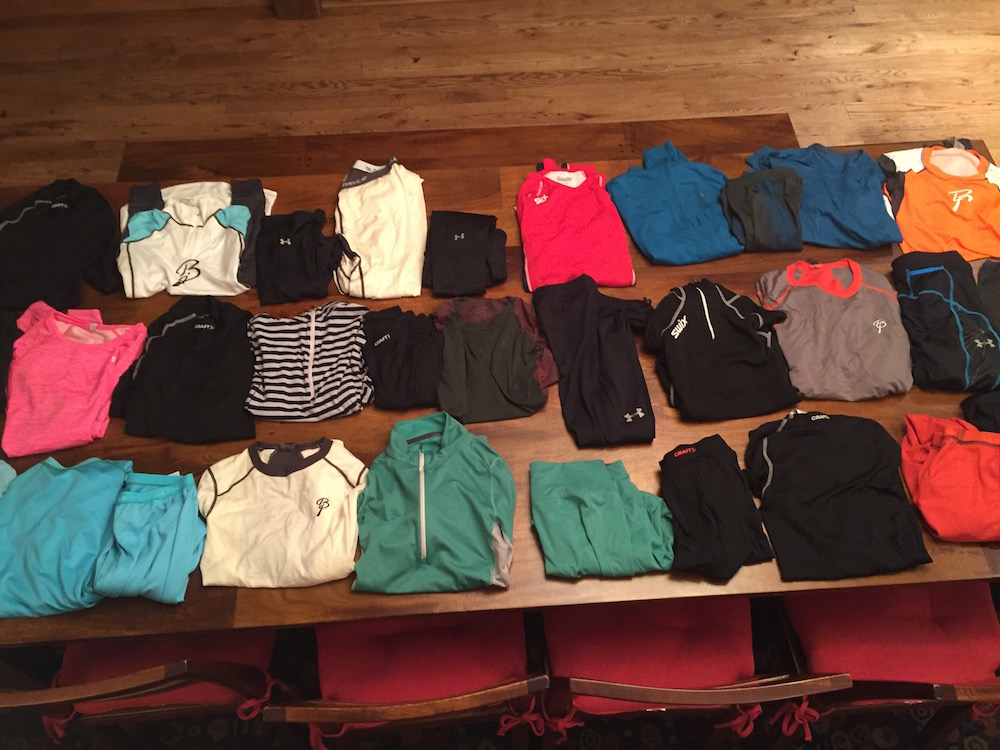
Study at the feet of the master and bring six sets of skis (rock classic, cruiser classic, race classic, rock skate, cruiser skate and race skate — yes, not having both cold race skate and warm race skate still has you upset, but you’re praying that you’ll be able to make your “cold skate” race skate skis work, as you are pretty frickin’ adaptable). Now over-stuff your ski bag with base layers of every conceivable thickness, material, color and style. Ditto for mountain-bike gear. Double-ditto for running gear. Better bring that paddling gear, too, just just in case Timmy Burke gets his nerves back after his horrific loss to me in our race on Lake Placid, then, since everyone knows you have a reputation for looking real nice for the ladies, you’ll also need your traditional two bags of personal grooming items and tastefully coordinated couture.
To adequately transport all of this crap, you’re going to need one of those stupid monster trucks but that’s OK, as your top priority is to make it to the tracks every day, regardless of road conditions, completely ignoring the fact that the scenic highway to the mountain is perfectly maintained and essentially never closes. You’ve never been one to listen to reason and you’re certainly not going to start now (after all, you are a self-loathing nordic skier who pays money to suffer) so you rationalize this ridiculous gas guzzler with the explanation that you also need this vehicle so you have room for the sherpas, in particular your shirt sherpas, as those dudes are indispensable. If you’re fortunate enough to snag one of the rare and exclusive invites to have dinner with me and you show up looking like you slept in your clothes, “my people” will immediately show you to the door. You’ve been warned. So yup, better pack that travel steamer as well.
This excessively wasteful and cumbersome manner of travel isn’t for everyone though — I get that — and to be fair, it is really more of a lifestyle and not something for which everyone is suitable emotionally and financially equipped, which is fine. Some of you out there in FasterSkier-land may consider yourself the nordic version of Seal Team 6, and thanks to my gripping expose on why you never need to do laundry again, you may prefer to go commando and travel with just one pair of socks, undies, and a T-shirt. Well, fear not my nimble travelers, I have you covered here as well (see what I did there?).
How to go “lean and mean”
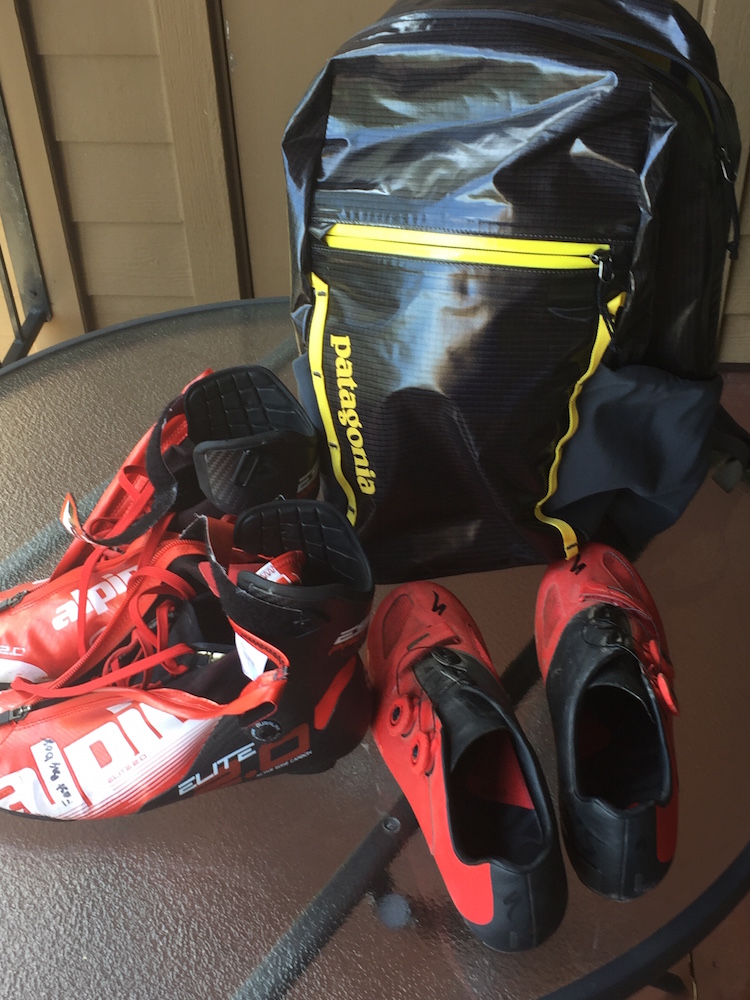
If you want to really go for it, you can do this trip with just a backpack. Load your ski boots and cycling shoes in your day pack and wear your running shoes. Stuff your one extra pair of socks and skivvies into your boots, eschew the bulky and pesky toothbrush for a pack of Tic Tacs that you pick up at a gas station in town, and POW, you are set. The fine folks at my favorite shop, WebCyclery, will hook you up with the rest: skis, boots, poles and mountain bike. If you’re one of those “I don’t need 20 outfits but I need my own skis” types, fear not, as WebCyclery also has a public wax bench, so you don’t actually have to choose between either of these two extreme examples and there is plenty of room for a reasonable, middle-of-the-road approach. Do yourself a favor, though, and regardless of which camp you gravitate towards, avoid the “why you need to travel wax” lecture from my good buddy Zach Caldwell and be pro: travel wax, then scrape at WebCyclery or up at the nordic center. The most important point here is regardless of where you are on the baggage, underwear and ski spectrum, I’m dead serious, you really can do a great, multi-day training camp with only a carry-on bag.
Now you’re geared-up and ready to crush the ski each morning, but what about the rest of your day? Glad you asked. It just so happens that Bend has a wide variety of trails to suit every skill level taste and agro level. Whether you are a normal person who can can chill in Level 1 and simply enjoy the super fun, flowing trails, or if you are one of “those guys” who gets all kitted up and lurks in the bushes ready to pounce on Adam Craig or Ryan Trebon as they ride by so you can shame them with your exemplary nordic fitness (completely disregarding the fact that they are probably out cruising and you’re about to ‘ring the bell’) none of that matters. What matters is that this place is perfectly suited for you to either be super-smart and carefully but gradually build your base fitness while loving life, or you can go out and hammer every day and completely blow yourself up by doing stupid sh*t. I know that’s how some of you roll and I’m not your mother, so knock yourself out. If you do fall into the latter category, please be sure to tell Adam and Ryan that I say hi, but don’t come crying to the FBD when you find yourself wrecked in January. Remember, no one wants to be a “Thanksgiving star and a Christmas turkey.” Church.
Just one of the many savage views that you will encounter on one of the nation’s best bike trail systems.
All right, where was I? Ah, yes, what to do with the rest of your day: the ski was epic, you tore up the dirt faster than the GOP shredding Obamacare and since you’ve now logged over six hours of training on your way to being sick and injured, you’re so hungry that you’re ready to eat your own head. Please tell me you’re not one of those annoying nordic nerds who flies with chopped up, organic, locally sourced carrots in your carry-on, nestled between the hand sanitizer and the Nalgene bottle that you filled up in the bathroom. If so, stop it, stop it right now. Have a beer and a can of Pringles on the flight like a normal person.
If this is you however, you’re probably also going to cook breakfast at your condo each morning and subsist on PBJs that you eat in the car on the drive home, as you’re concerned about not achieving the correct 4:1 carb/protein ratio before your glycogen window closes. This is all well and good, but I’d kill myself if I lived like this, so my advice to my one or two normal readers is treat yourself, after all, who deserves it more than you, right? Don’t worry, I hear ya, you’ve blown 90% of your disposable income on new skis, flights, condos, and Great Danes, so you don’t want to break the bank on lavish meals. Fair point. But, in addition to all sorts of great restaurants with real plates, flatware and food served by humans, there are some economical options that fit the bill nicely without decimating your wallet: two FBD favorites are Parrilla and The Pancake Wagon. There’s also a parking lot full of food trucks, aptly named, “The Lot,” which offers all sorts of options for people comfortable eating food that has been prepared in a structure that can drive away at a moment’s notice, one step ahead of the law.
And let’s not forget the beer — ah, my beloved beer, the source of, and solution to, so many of life’s problems. So while the FBD loves beer and Bend has all kinds of great beer places, interestingly enough, you know what the FBD hates? To be fair, this list is long and distinguished and merits an entire series of its own, so for now let’s confine this to the context of this discussion, the FBD hates the hipster/yuppie/hippie/yippie whateverthehellyourproblem is, beer snob. Yes, beer is awesome, but you know what none of us need? Some smug, pseudo-olfactory savant weirdo wearing an outfit that looks like it came out of my grandmother’s basement and a haircut that screams that he lost a bet, telling us why some particular brew “has a nose that resembles Costa Rican coco beans buried behind a pit toilet with a hint of a 1972 Volkswagen Bug seat covers,” or whatever nonsense the hip crowd is spewing these days. Just order you goddamn beer and shut up. Guy code is that you have between 15 – 20 seconds to place a beer order, with no editorializing. The ONLY circumstances in which you can offer anyone at the table any advice or commentary whatsoever is if they directly and specifically ask you a question and even in this very focused and narrow circumstance, you answer must again be limited to 15 – 20 seconds. I don’t make the rules, I just enforce them.
So assuming you navigate through these hipster-invested waters of annoying ignorance, pomp and circumstance, you should be good to go. Or are you? If you’re anything like me, my thinking in this situation usually goes something along the lines of, “I skied over 50 k today AND crushed Adam Craig in a race so secret that not even he knew it was happening, so I have earned these 162 ‘cheat calories’…..…Wait a minute…. 162 calories? In only ONE beer? Damn, that’s a lot. Maybe I should go do some sit-ups in the bathroom or I’ll never make that cut for Wave 6. I feel fat just thinking about this. Now everyone is looking at me, I can feel it. Oh crap. Do I look fat in these pants? I knew I should have skied another hour. I wonder what Noah Hoffman is having for dinner? I really wish he still blogged daily……” Then I go in the bathroom and do 15 minutes of core while sobbing uncontrollably. But that’s me.
OK, let’s move on. I now have you set up for skis, bikes, and food, anything else else? Well, if you’re anything like me, you’ve probably going to completely disregarded the very sage advice of world-class coaches like Kähkönen and Grover (we don’t need to talk about my lactate reading after doing a supposed threshold block with Burke and Bailey), and you’re now completely wrecked. Sure, you could give up and fly home while attempting to pick up the pieces of your shattered life, or, you could simply train wisely in the first place, but we all also know that you are a stubborn nordic skiers, so you aren’t going to do either one of those things, which means that your only other option is to get some professional help. Step One is to get a massage from someone who specializes in working on athletes. For this, my go-to guy is Scott Yount. He has worked on all kinds of elite skiers, so stop your crying, he can get your whiny nordic ass back out there overtraining in no time. If things really get bad, or if you showed up with some pre-existing conditions (which shortly won’t be covered by proposed, “new and improved” and “really terrific” Affordable Care Act, so act fast), hit up the PT to the stars, Dave Cieslowski, DPT, CSCS. He also specializes in Type-A, needy, nordic skiers (and is one himself), so you guys will hit it off great.
Finally, since as always, I like to make all of these reports as long and rambling as possible, not to mention my rigorous and adorable sense of honor and integrity, I would like to go on record right now and state that I do not receive any sort of remuneration whatsoever from any of these people, organizations, restaurants, shops, businesses, clubs, cliques, or churches. My uncle does not own the bike shop, nor does my brother-in-law work at the burrito place. I am simply giving you a sampling of some of your many options and suggesting places for which I have had very positive experiences. My goal is to make your trip out here not only as easy as possible, but also as fun and as successful as all of mine have been, with as little effort on your part as possible. Let’s be real clear here, too — this is this is like divulging your secret powder stash or favorite surf spot, so if you do happen to run into me somewhere in the world, suffice it to say that you owe me a beer, as you aren’t getting information of this quality from many other places. That’s just how we roll at here at FasterSkier.
You also need to promise to use this information for good, never evil. I’m trusting you with all sorts of top secret beta and if you embarrass me, I’m gonna be pissed. If you bring a bunch of East Coast attitude, use your cell phone in line at the burrito place, or get all pushy in the tent behind The Pancake Wagon and someone kicks you in the nuts, well, you had it coming. Don’t hate on these places or write me that my recommendations suck — that’s on you — this is not check-in at the Philadelphia International Airport. You are in polite society now, so act accordingly.
A few other tips, as noted earlier, the weather is unpredictable, so come prepared for sun, wind and snow, perhaps all in the same day. Embrace this, though, as there is something incredibly bad-ass about having to have the heat blasting on the drive up to the ski and the AC cranking on the drive home. Be prepared to deal with whatever the mountain throws at you — remember, skiing is an outdoor activity and you will most likely see very different conditions each day. Thankfully, I was able to shoot perhaps the most informative video EVER on mental preparation, so I’d advise watching this every morning before you head up:
In general, the optimal ski window is usually between 8:30-10:30 a.m., so lie around in bed for too long and things will get soft. If you consider your weather forecasting and navigational skills to be superior, there is also amazing crust cruising to be had when the conditions cooperate.
Crust cruising in Bend
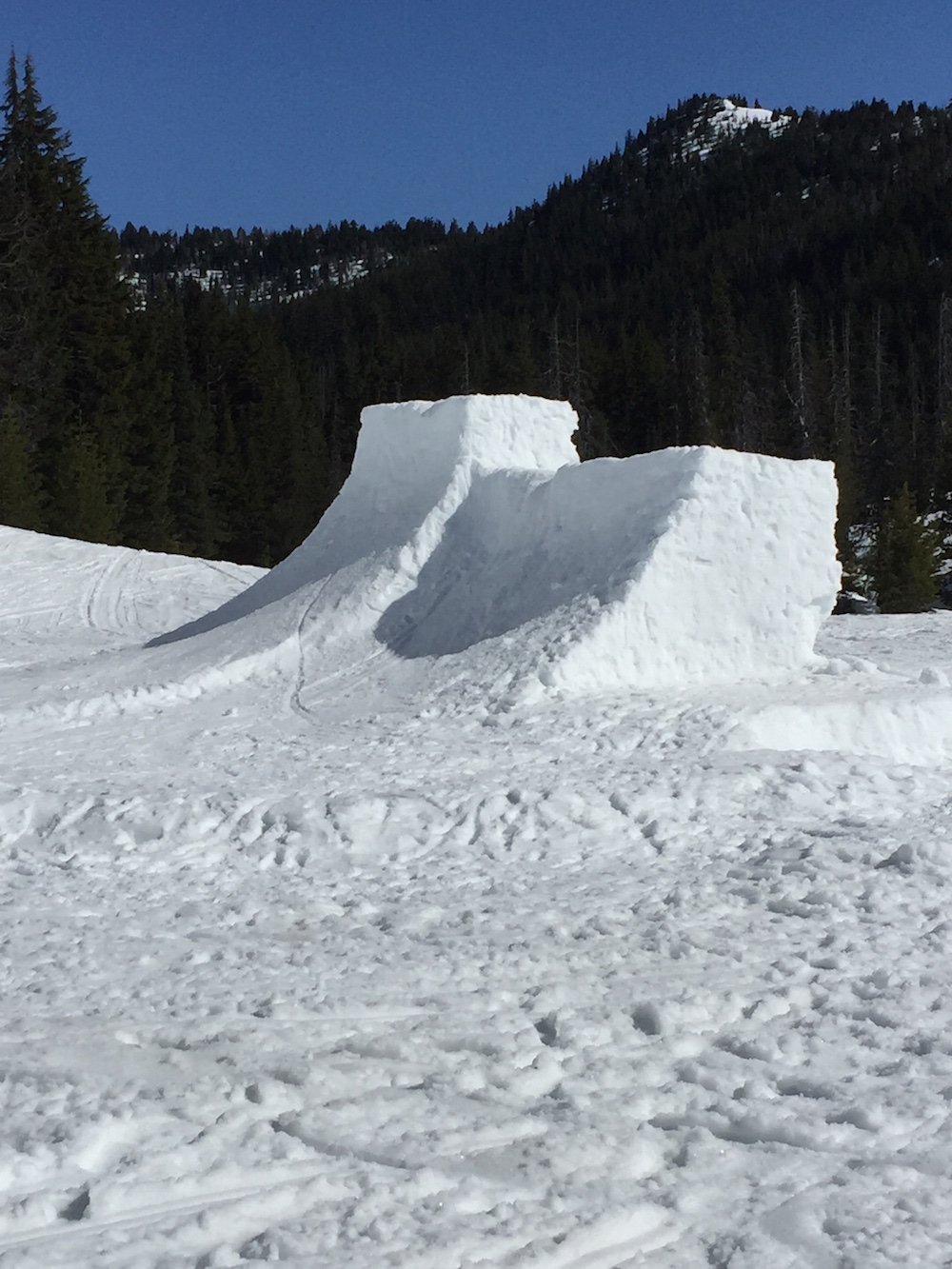
Watch your goodies coming back in, though, as one route back to civilization has some mighty big kickers: these are known as, “FBD Killers,” so I only hit them a few times.
FBD killers
The alpine skiing is also awesome, if you’re in to that sort of thing. Some of the really hard-core locals will hit the tracks at 8:30 for a few hours, transition directly to alpine, grab some lunch, paddle, then go for a ride or run. If that’s not a perfect day, I don’t know what is.
Mt. Bachelor alpine area
In conclusion, Bend is one of the nicest places in the world to be in May for nordic skiers of all levels. “I never, ever get tired of this place,” Foster mused. “Every day up here is special. Each day has its own personality and every one is different. Even the drive to the nordic center is amazing. You’re in the trees for most of the trip up, then you hit the high country, turn the corner, and you can see the mountains — it’s breathtaking. It’s just such a cool reminder that everything is okay in the world.”
So instead of squandering those frequent flyer miles on something stupid like going to visit family, invest in your future and book a flight into Bend (Redmond) today. From there, you are less than 30 minutes away from having all of your problems solved. You’re welcome.
And remember, you owe me a beer. One that doesn’t smell too much like VW seat covers, if it’s not too much trouble, please.
Dartmouth College Freshmen Emily Hyde racing “back” East at the Williams Carnival 10k skate in Lake Placid, NY. Hyde will soon to be training “out” West. (Photo: Olivia Amber)
Dartmouth College freshman skier Emily Hyde is that quintessential bi-coastal athlete: she learned to ski fast in Bend, Ore., and she headed “back” East for the Ivy League academics and to race against some of the country’s best collegiate cross-country skiers. With the East’s grim snow year, Hyde is looking forward to coming home, for yes, on-snow training in June.
Bend is a nordic skiing hotbed. And Hyde took charge there early on. She was a four-time Oregon High School State Cross-Country Ski Champion and she won two Junior National titles her senior year. Perhaps there is no other way to describe it, but Hyde was a big fish in Bend’s somewhat-small pond. Fast forward to this past year, and Hyde held her own on the Carnival circuit and said she loved being pushed by her teammates.
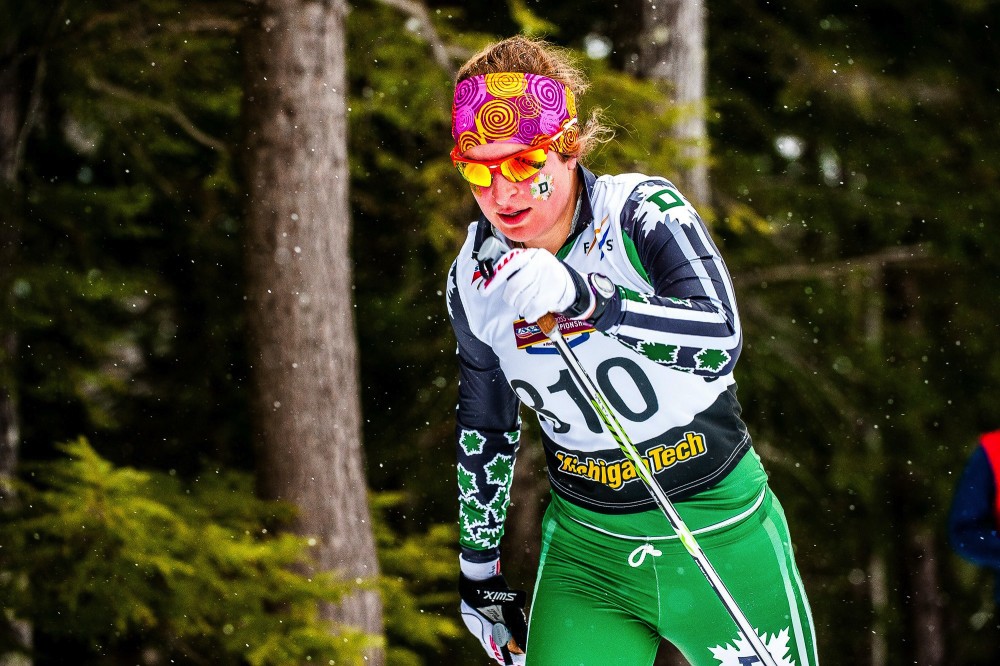
Dartmouth freshman Emily Hyde racing in the 10 k classic at 2016 U.S. Nationals in Houghton, Mich. (Courtesy photo)
“I think it was really awesome to sort of not be the big fish in a small pond anymore,” Hyde said on the phone. “My team was big enough that everybody was better at some things than everybody else. I know this girl will be really good on this day. Another girl will be really good on that day. But I think that was really cool, because it always kept you accountable. It was just cool to always have someone a a level above you in whatever you were doing.”
Hyde is that type of skier: she is always wanting to improve.
“Personally, I need to keep working on skate skiing,” Hyde said about what she’ll be working on this summer. “My first year in college it was back to back to back racing whereas at home , it was every other week or a week off and then a high school race. I sort of chose what races I was going to do. But this is every weekend and everybody does it. So I think just working on being consistent and being able to push through and be fast every single weekend for six weekends in a row. And I’m not entirely sure how I am going to do that yet. But I think just continuing to build the base.”
Hyde’s goals — improving her skating and building a big base — brings us to this Wednesday Workout which Hyde is a bit homesick for: “The Not-So-L1 Crust Cruising into Broken Top.”
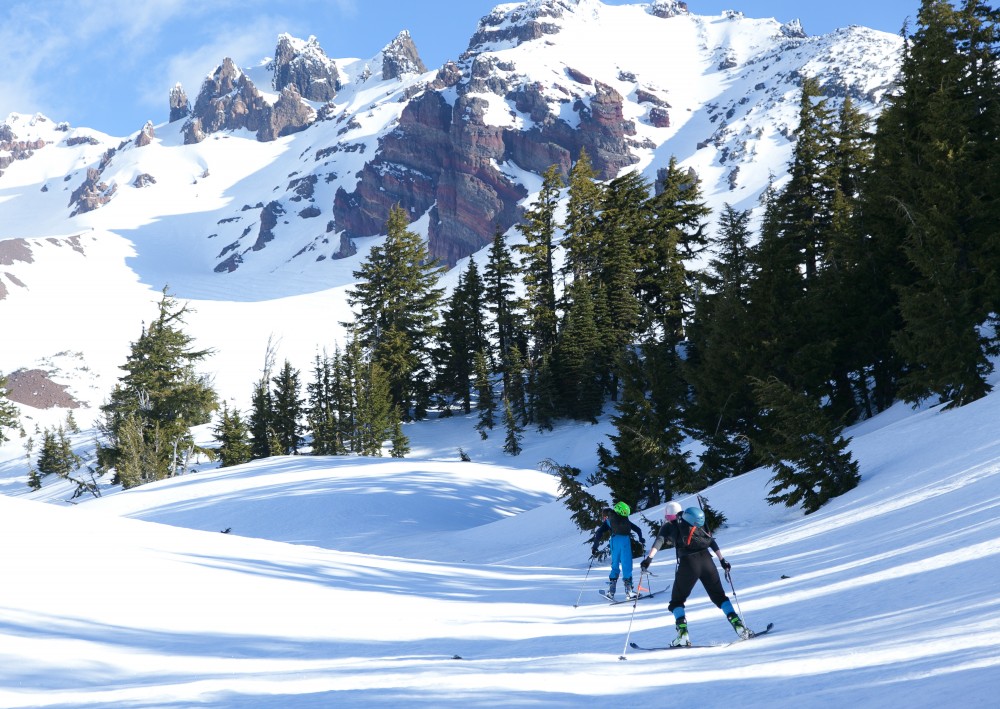
Two Bend locals, Aidan Whitelaw and Zoe Roy, nearing Broken Top’s bowl. (Photo: Jason Albert)
Hyde was on the fence as to whether she’d call it a true Level 1 effort. “You go kind of fast, it feels so good to crust cruise and chase your friends around,” Hyde said. Higher up, as skiers gain altitude, the terrain changes. It morphs from a gradual climb with a few punchy steeps into a sustained grueling climb.
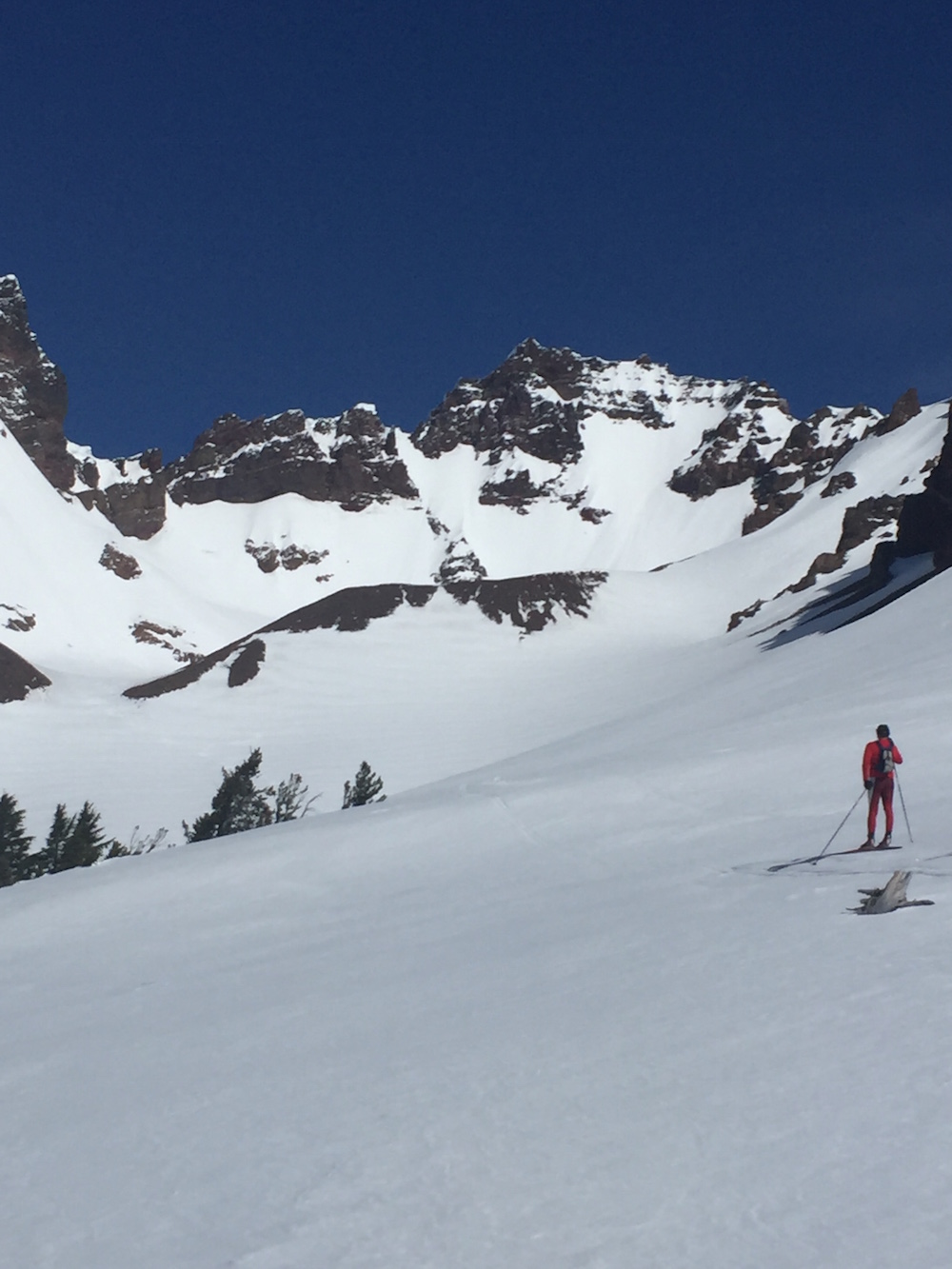
Broken Top, an extinct volcano, features a massive bowl resembling more of a headwall as it steepens and steepens.
“Once you get into the bowl, it is quite steep and quite high,” Hyde noted. “So you can’t really make that L1 unless you one-step and take a breath. I guess I don’t really think about doing it L1, I just want to get to the top.”
The nature of the workout, where the terrain dictates the effort, will help Hyde wake the body up as she adapts to her hometown stomping grounds for the summer.
“It’s going to be an altitude adjustment for sure,” Hyde said. “I think it is cool I’ll be back on skis, which is more natural and it will be the longest workout I will have done. It’s going to be hard in that sense and hard because it is at altitude. But I am not going to dread it. I don’t know if my legs can handle it for three hours — it will be hard but it is a good adjuster.”
Broken Top Crust Cruise How To’s:
– Watch the weather. Wait for a several day’s long high pressure system with clear cold nights.
– Head up to Mt. Bachelor Nordic Center on a bluebird day, head out the Common Corridor Trail, hang a left at the snow covered road, and head downhill to Todd Lake.
– Ski across Todd Lake, assuming it’s frozen, and head north. Gain the ridge, and aim towards Broken Top. The wide open bowl on Broken Top’s east-southeast flanks will be obvious as you ascend above tree line.
Round trip: approximately four hours.
Looking towards Broken Top’s Bowl from a foggy Todd Lake. (Photo: Jason Albert)
New Year’s Eve at the Mt. Bachelor Nordic Center near Bend, Ore. (Photo: Rion O’Grady/Mt Bachelor Nordic Center Facebook)
Is there room at one ski center to support two junior development programs? In central Oregon, it depends on who you ask.
Mount Bachelor, 22 miles outside Bend, Ore., is a touchstone for nordic skiers. Located in Deschutes National Forest, Mt. Bachelor operates with a special use permit from the US Forest Service (USFS). The U.S. Ski Team has run training camps here and they’ve hosted national championships. In addition, there’s an extensive alpine mountain. With a base lodge at 6,300 feet above sea level, the venue boasts generally good snow conditions.
Mt. Bachelor has a longstanding relationship with the Mt. Bachelor Sports Education Foundation (MBSEF), a nearly 30-year-old nonprofit which has development programs for nordic, alpine and freestyle skiing. MBSEF runs its ski programs on the trails at Mt. Bachelor.
The much-newer Bend Endurance Academy (BEA), a nonprofit founded in 2009, would like to share the trails — at least, in low snow years. Except for a couple of rare occasions, BEA has not had permission to run its programs on Mt. Bachelor.
Since its inception, BEA has used Meissner Nordic, a nonprofit ski center also located on Mt. Bachelor. Run by volunteers, Meissner Nordic grooms 40 kilometers of ski trails on US Forest Service land.
It’s all good, until the weather doesn’t cooperate. Located 1,500 feet lower on Mt. Bachelor than the eponymous ski area, the previous two winters, 2013/2014 and 2014/2015, were difficult for Meissner, while Mt. Bachelor enjoyed better conditions higher up the mountain.
In February 2015, BEA approached Mt. Bachelor resort officials about using public lands at the Mt. Bachelor Nordic Center. They denied BEA’s request, except for the last two weekends of the season.
A group of Bend Endurance Academy youth skiers in February 2016. (Photo: Ryder Utrecht/Bend Endurance Academy Facebook)
This year, the academy has circulated a petition called Let the Kids Ski, calling for more access to Mt. Bachelor.
“There are two places in central Oregon that have groomed nordic trails,” said BEA Board President Cris Himes. “Meissner Nordic and Mt. Bachelor. Meissner has worked very well until recently due to ski conditions.
“What we’re looking for is equal and reasonable access,” Himes continued. “Equal to any other paying customer and community group.”
According to Dave Rathbun, Mt. Bachelor’s former president and general manager who resigned in mid-March, the resort had existing relationships with four businesses “to run their businesses sort of inside our own,” he said. “We still have to get approval from the Forest Service for these concessionaires.”
MBSEF, whose board Rathbun also sat on, is the designated concessionaire for nordic and alpine ski programming. Rathbun is no longer a member of that board.
In a December interview with the Bend Bulletin, Rathbun characterized BEA’s interest in Mt. Bachelor as a desire to use the resort as “a home base for their business.”
“[BEA] want to operate their business within ours, and in most cases at a time when we’re already at capacity,” Rathbun told FasterSkier. “It’s very busy at the times they want to have access.”
Rathbun added that Mt. Bachelor is “at capacity” for instruction in both in nordic and alpine skiing. “We’re not going to open it up to any other concessionaires.”
In addition to its own paying customers, Mt. Bachelor’s agreement with the USFS requires the resort to accommodate people who want to access backcountry skiing via a “common corridor.”
According to Rathbun, “that’s another 10,000 visits per year,” in addition to about 30,000 visitors per year skiing Mt. Bachelor.
Himes feels that the lodge might be crowded, but believes that the trails are not. For her, the primary issue is ensuring that kids have access to skiing. The lack of decent snow is a barrier to participation, and this is reflected in the numbers. Although BEA’s competition team is larger than last year, the enrollment in its youth club and nordic development programs is down 38 percent and 28 percent respectively from the 2014/2015 season.
“Last year Mt. Bachelor did a remarkable job of keeping their snow,” Himes said. “When we can’t run our programs at Meissner, we need to be able to take our kids to groomed trails somewhere else. The only option is Mt. Bachelor Nordic Center.”
New Year’s Day 2016 at the Mt. Bachelor Nordic Center near Bend, Ore. (Photo: Lew Becker/Mt Bachelor Nordic Center Facebook)
During the snow drought two seasons ago in 2014/2015, Rathbun reflected, “I wanted to be a good neighbor. We gave BEA access to nordic center in afternoons, the last couple of weekends in March. I think it worked out well and they appreciated being able to get on snow.”
In a July email to BEA, Rathbun offered the academy access on Tuesday and Thursday afternoons and weekends after 12 p.m., with certain blackout dates during peak periods. These times apparently didn’t match BEA’s program schedule, and according to Himes, left only three weekends out of the winter for training. In September, Himes met with Rathbun to negotiate more favorable access times, to no avail.
“I’m really sorry about that, but that’s the only way we feel it can work, based on how crowded we are,” Rathbun told FasterSkier.
“I can see both sides,” said Alan Watson, the Pacific Northwest Ski Association (PNSA) nordic program director. “My interest is in promoting the success of all these programs. I would like Mt. Bachelor to let BEA train on their trails. It would be good for skiing in the northwest.”
Is trail crowding a red herring? Rathbun said that BEA skiers were welcome to come up and ski so long as they had a pass, but that organized training with a coach wouldn’t be permitted – except at the times listed above.
Does Mt. Bachelor wield trail access as a cudgel? From a distance, it’s hard to tell. But FasterSkier obtained three documents sent anonymously to Himes. One was Oregon School Ski Association’s (OSSA) participation policy. OSSA is one of the two governing bodies for high-school alpine skiing in central Oregon, and holds race meets at Mt. Bachelor. Circulated in December 2014, the policy required students on high school ski teams to participate in four training sessions each week, including races.
OSSA Race Director Matt Cutter said that there were students that participated in both high school and club programs, and that OSSA’s goal with this policy was to instill team unity.
“We don’t want ringers,” Cutter said of athletes who only show up for race meets. “We needed to get something in writing.”
The other two documents, both dated Jan. 8, 2015, are responses from Rathbun and John Scheimer, MBSEF’s executive director, to OSSA. Rathbun’s letter decried OSSA’s participation policy, stating that it would negatively impact “students who club race with MBSEF and have other extracurricular interests.” The letter concluded, “…with our strategic partner MBSEF, we [Mt. Bachelor] will be reviewing all elements of OSSA activities occurring on Mount Bachelor. … Any changes in these privileges will be communicated to you as soon as possible.” Scheimer’s letter to OSSA was written in a similar tone.
Scheimer declined an interview request for this article.
In response to the letters, Cutter said that OSSA rescinded its policy. “That was not our intention at all” to exclude anybody, or force a student to choose between a club program and the high school team, Cutter explained.
Cutter viewed the disagreement as minor, adding, “I can’t stress enough how much support Mt. Bachelor gives us.”
Rathbun said that his letter was actually in response to scheduling conflicts between OSSA and OISRA, a second governing body for Oregon high school alpine skiing. However, neither his letter nor Scheimer’s make any reference to OISRA. Cutter said that while Rathbun discussed scheduling with OISRA, it was in correspondence from August 2015.
“The kids know each other, the parents know each other, we support each other’s kids,” said Himes of BEA and MBSEF. “I am really hoping that we will be working cooperatively with MBSEF.”
With good conditions this winter, trail access at Mt. Bachelor wasn’t as crucial. Next year may be a different story.
Mt. Bachelor Nordic Center is seeking a full time groomer for the 2015/16 season. On snow season runs November through May, (usually June!) some potential for year-round work.
Experienced candidates with a passion for Nordic skiing who are willing to relocate to the recreation capital of the Northwest in beautiful Bend, Ore., please direct letters of interest to sfoster@mtbachelor.com.