From the FasterSkier archive — posts syndicated from athletes’ and coaches’ own blogs between 2004 and 2012, kept online as published. Current coverage is at fasterskier.com.

Tag: Muonio

  • The Road to Ruka: A Sunset Bus Ride into the World Cup Winter

    The Road to Ruka: A Sunset Bus Ride into the World Cup Winter

    This coverage is made possible through the generous support of Marty and Kathy Hall and A Hall Mark of Excellence Award. To learn more about A Hall Mark of Excellence Award, or to learn how you can support FasterSkier’s coverage, please contact info@fasterskier.com.

    Aerial view of Ruka (FIN) this morning, with the start of the World Cup season less than a day away. (Photo: Modica/NordicFocus)

    For six hours on Tuesday, the U.S. Cross-Country Ski Team watched Finland scroll past the windows of a northbound bus, the day’s thin slice of sunlight slanting low across the snow. The sun in late November never rises entirely above the horizon there—”maybe ten degrees,” Matt Whitcomb noted—and so the world outside was washed in a pastel light that never quite felt like midday. In that part of the Arctic, sunrise and sunset are effectively the same event.

    That is the moment Whitcomb pays attention to every year.

    “As it sets, as you’re driving in those first two hours of the bus ride,” he said, “it sort of feels like it’s the official close of the preparation season.” The athletes may have left Muonio only hours earlier, but that sunset marks a boundary: everything before is training; everything after is racing. “That’s it,” he said. “The prep season’s over. It’s time to race now.”

    The bus carried all seventeen athletes—nine men and eight women—each holding a different version of readiness. Some were energized, some were still finding their legs, some were quietly anxious. An Olympic season magnifies everything. For veterans, this opener in Ruka is familiar and charged; for athletes on the bubble, the weekend marks the start of a two-month test whose outcomes will determine whether they get to ski in Italy in February.

    But for one last window of time, before the waxing trucks and the bib pickup and the official training, the whole team was suspended in this Arctic twilight. It is a soft entry into what quickly becomes a hard world.

    When the bus crested the final kilometers into Ruka, the athletes looked out the left side toward the hill that dominates the course—a climb they will race up and over repeatedly in the coming days. “Every year,” Whitcomb said, “that road goes right up the largest hill on the course… your first trip up that is in the bus.” The hill glowed under floodlights. Below it, the village looked like it had been placed inside a glass ornament. “It’s lit up like a snow globe around here.”

    By the time the athletes stepped off the bus and into the cold, the World Cup season had begun.
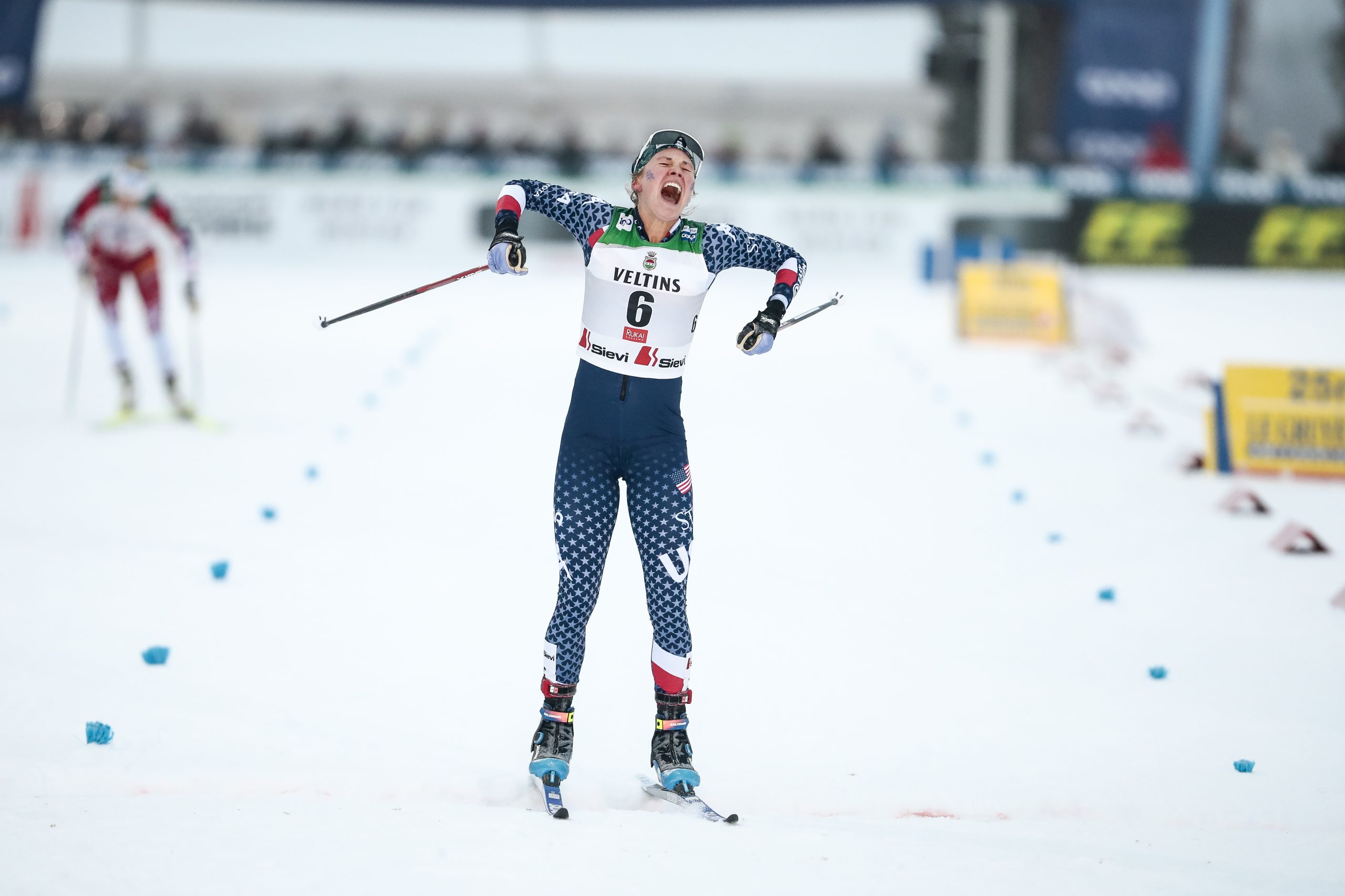
    Jessie Diggins (USA) was able to find another gear at the finish which no one could match to take victory in Ruka a year ago in the Mass Start. (Photo: NordicFocus)

    What They Carry From Muonio

    A week earlier, the team was skiing through air so cold it could freeze eyelashes. Muonio is remote even by Finnish standards, a strip of trails and cabins surrounded by deep quiet. The temperatures dropped to –5°F for the high and –10°F for the low, and the athletes masked up, moving carefully to avoid frozen lungs. No one did intensity that day; even the coaches agreed the cost wasn’t worth the risk.

    And yet the camp was a success.

    “It was right on the edge of being too cold,” Whitcomb said, “but we made it work. And nobody has residual coughing, so I think that’s the tangible indicator that we didn’t push too hard.”

    More importantly, Muonio was calm this year. There were no lingering illnesses, no cascade of early-season injury setbacks. “This year has been a better year with regard to preparation,” he said. “We’ve had fewer long-term illnesses, fewer acute injuries.” In an Olympic season, where every missed week feels like a month, that is no small thing.

    Muonio is the last place where the athletes can simply train, ski, nap, and repeat. Once they arrive in Ruka, the season accelerates in a way no one can fully control.

    Zanden Mcmullen (USA) coming to the line in Ruka in 2024. (Photo: Thibaut/NordicFocus.)

    Ruka’s Glow and Ruka’s Pressure

    Ruka is where the World Cup hardens into its proper form. The quiet trails of Muonio are replaced by a carnival of nations: wax trucks pulled side by side, technicians moving in practiced circuits, athletes from every powerhouse country striding around the stadium. For all teams, the opener reveals the truth of the summer: whose fitness is real, whose technique held up, whose body needs another two weeks before coming online.

    “The moment we arrived here in Ruka,” Whitcomb said, “you start to see the waxing vehicles from other nations… the reality of it hits, and you could feel butterflies sort of emerge as a team.” Even the veterans feel it. “Munio last week was all about recovering from jet lag… and you arrive here, and it’s like: official training, then race, race, race. It’s go time now.”

    He emphasized that the stress is not negative. Stress, in his framing, is a sign that something meaningful is at hand. “It’s indicative of the privileged environment that we live in,” he said. “We’re doing something important, something these athletes work really hard for, and something that they’re ready for—and that’s why they feel stressed.”

    In an Olympic year, there is no such thing as a low-pressure opener.
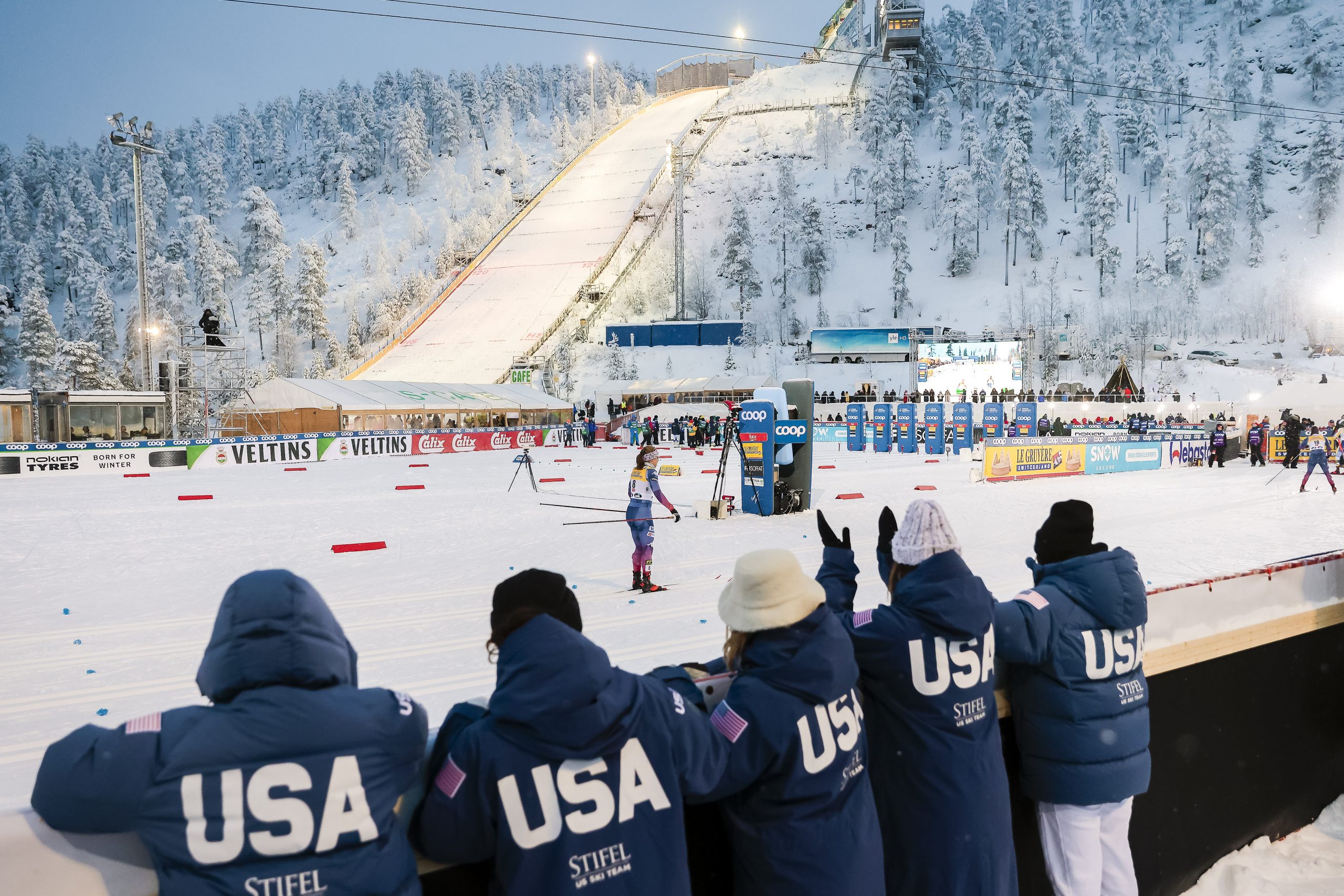
    The U.S. team looks on in Ruka in 2023.  (Photo: NordicFocus)

    The Team Within the Team

    The most striking thing about this group, Whitcomb said, is not its athletic potential—though several athletes are carrying top-10 ambitions into the weekend. It’s the internal energy.

    “It feels as supportive a team as I think we’ve ever had,” he said. “Not better, but certainly as good as any team we’ve ever had.” A year ago, he described a similar feeling, but something about the last month apart has deepened it. “They just vibe together,” he said. “They’ve really missed each other.”

    From outside, the U.S. team can look like a logistical patchwork—athletes based in Vermont, Alaska, Idaho, Colorado, Norway; college skiers who drop in and out; development athletes rotating through Europe. But when they’re together, Whitcomb believes the culture gives them a competitive advantage.

    “One of the privileges our nation has,” he said, “is that we are not as competitive as Norway is.” He doesn’t mean competitive in results—he means internally. In Norway, a single race in Beitostølen can determine whether an athlete gets a World Cup start or disappears back into domestic anonymity. “Literally that one race… has a lot of say in whether your winter is going to be successful,” he said.

    In the U.S., the pressure comes from the Olympics, not from your teammates. “A positive team vibe really does some work for you,” he said. It prevents the “little stresses”—the ones that accumulate in toxic environments—from becoming overwhelming in an Olympic year.

    “When the only stress you have to worry about is the silly one that is racing,” he said, “you can overcome that.”
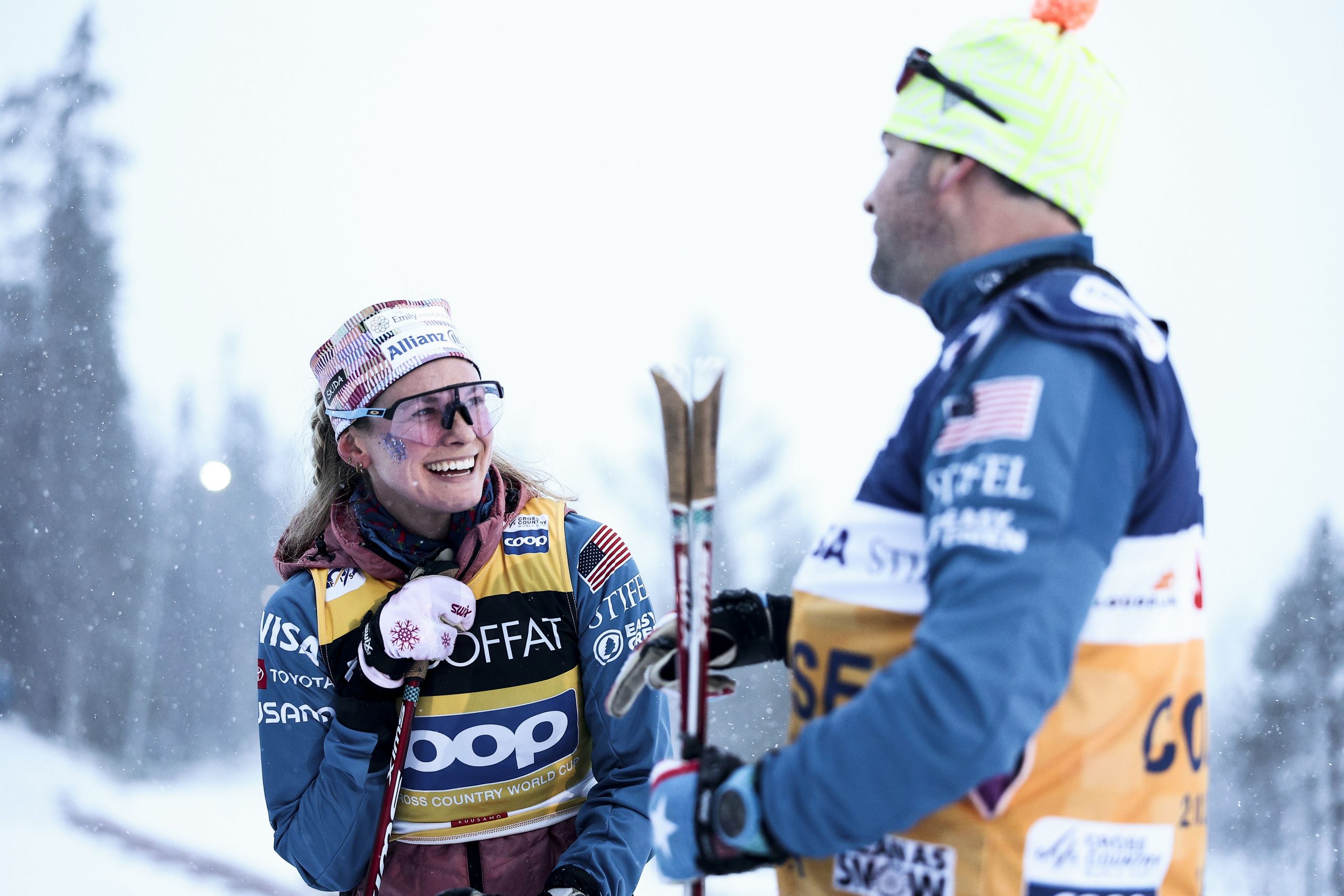
    Jessie Diggins (USA) keeping it light with her coach, Jason Cork. (Photo: NordicFocus)

    Olympic Stakes, Explained Clearly for Once

    For athletes and coaches, the rules of Olympic selection are a map that everyone has memorized; for the public, they are a maze. Whitcomb walked through the system with the clarity of someone who helped write it.

    There are three primary pathways:

    1. Top-8 in an Olympic event on the World Cup

    If an athlete finishes top-8—but only in a race that exactly matches an Olympic event—they automatically qualify.

    Classic sprint in Trondheim? Yes.

    20k Skiathlon in Trondheim? Yes.

    10k skate in Davos? Yes.

    Team sprint? No.

    Any race similar but not identical (ie, the 15k Skiathlons)? No.


    2. Top-45 on the World Cup ranking list (by Oberhof)

    Any athlete inside the top-45 overall (distance or sprint, depending on discipline) meets the selection criteria. They still need a spot available, but their case becomes strong.


    3. Discretionary selection

    This exists—but is avoided whenever possible.

    “To be candid,” Whitcomb said, “that’s a goat auction in itself.”

    In an Olympic year, the staff prefers not to touch discretion at all.
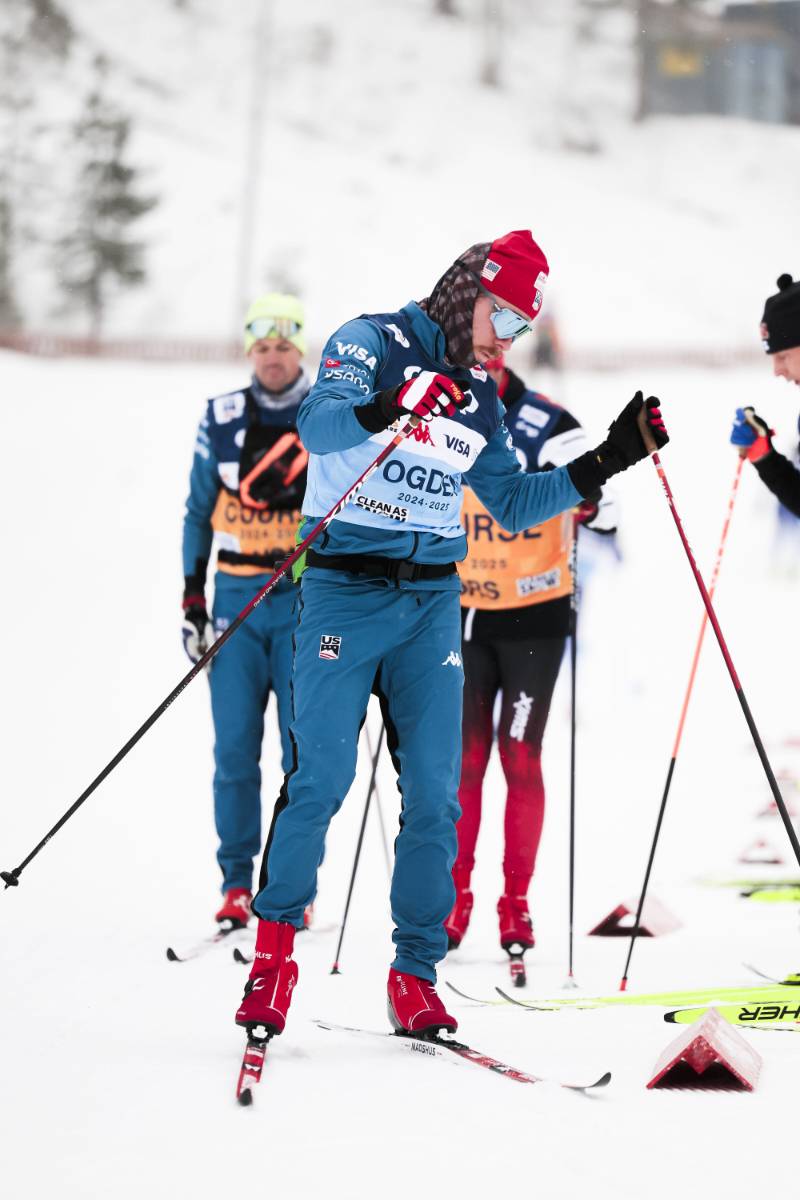
    Ben Ogden (USA) working on ski selection on Thursday in Ruka (FIN) a year ago. (Photo: NordicFocus)

    Roster limits

    Right now, the U.S. holds seven men’s spots and eight women’s spots, with a realistic chance of earning an eighth men’s spot. It will not exceed 8 + 8.

    Domestic results?

    For someone skiing exceptionally well at Senior Nationals to force their way in, there must be vacancies left by athletes who didn’t meet criteria on the World Cup. In most years, Olympic qualification is won or lost by Christmas.

    This is why every World Cup start in Period 1 matters. Every 12th place, every quarterfinal, every decent distance day contributes to the math.

    But to Whitcomb, that math isn’t the point. It’s how athletes handle pressure that determines whether the season becomes joyful or claustrophobic.

    “Meet Your Body Where It Is”

    On Thursday night, in the team meeting before the weekend races, Whitcomb planned to give a simple message.

    “You start that 10k, and you’re going up the first hill,” he said, “you just meet your body where it is. You do your very best that day.”

    He wants the athletes to tune out the noise:

    • the coaches on the sides of the trail
    • the athletes they pass
    • the athletes who pass them
    • the crowd, the music, the reporting, the points

    “You deal with the one vehicle that you’re driving,” he said. “And you try to enjoy it.”

    Because fitness today doesn’t predict February.

    Because the Olympic Games begin on February 7th, the only date that truly matters.

    Because early-season expectations are a trap: some athletes are ready this weekend; others won’t feel themselves fully until the Tour de Ski.

    “The human body,” he said, “is a wildly unpredictable thing.”

    If there is one truth that governs the first weekend of racing, it is that.
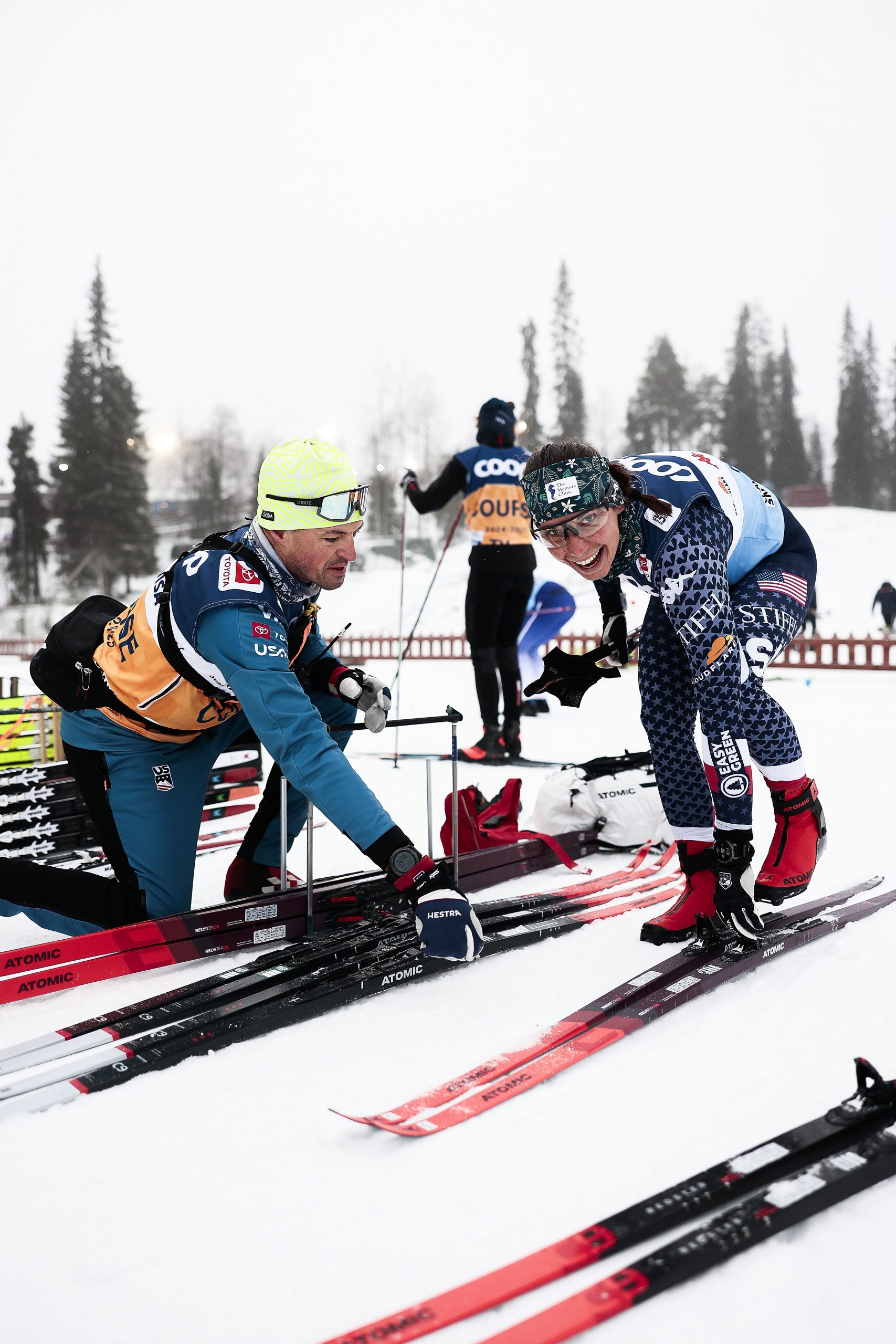
    Julia Kern testing her skis with her longtime tech, Eli Brown a year ago. (Photo: NordicFocus)

    Why Ruka Still Matters

    Still, the weekend is not symbolic. It is competitive, decisive, and formative. Whitcomb believes the team is “positioned well to have a great opener,” but he also knows that Ruka rarely tells the whole story of a winter. The temperatures are often frigid, and the travel is too recent. But it gives athletes one thing they cannot simulate anywhere else: the clarity of racing.

    “Early,” he said, “but it can’t come soon enough. We’re really excited.”

    Ruka is where the starting gun echoes for the first time, but it’s also where the season’s unseen forces begin working: confidence, doubt, momentum, cohesion, luck, health, and perspective. Many Olympic stories begin here without anyone realizing it until months later.

    The First Night in the Snow Globe

    By Tuesday evening, the team had unpacked their bags in the small condos near the stadium. By Wednesday, when we spoke, through Whitcomb’s thin door, we could hear athletes talking after dinner—laughing, telling stories, building team chemistry. “You can hear people probably through my door,” he said, because “they’ve really missed each other.”

    Outside, the northern lights edged across the sky.

    Inside, there were skis to prep, race plans to finalize, nerves to manage.

    And in the morning, the first climb of the season would begin at the bottom of that hill they had ridden over on the bus.

    There are a few actual rituals in a sport defined by travel and unpredictability. But in the U.S. team’s calendar, the bus ride to Ruka is one of them. It marks the line between the world that was and the one that’s about to begin. Between training and racing. Between imagining and knowing.

    The sun had long since set, but the trail lights of Ruka glowed through the fog, warm against the cold.

    The World Cup season officially starts tomorrow.

    And for the U.S. team—healthy, united, a little nervous, and very ready—there is nothing left to do but ski.

    Rosie Brennan (USA) dialing in her skis a year ago. (Photo: Modica/NordicFocus)

    How to Watch

    In the United States:

    Ski and Snowboard Live


    Schedule

    November 28th:  

    10k Interval Start Classic – Women at 4:30 am EST and Men at 7:15 am EST

    November 29th:  

    Classic Sprint – Heats begin at 5:25 am EST

    November 30th:  

    20k Mass Start Freestyle – Men at 4:00 am EST and Women at 5:45 am


    Love Stories Like This? Help Keep Them Coming.

    Feature interviews like this one take time, access, and care to produce. If you value thoughtful storytelling and independent ski journalism, please consider becoming a Voluntary Subscriber. Your support directly fuels the work we do to cover the people, places, and moments that make our sport special.

    Join the FasterSkier community!


    Jessie Diggins (USA) celebrates a hard earned victory in the Ruka 20k Freestyle in 2024. (Photo: NordicFocus)
  • Pärmäkoski And Bakken Rule The Season Openers

    Pärmäkoski And Bakken Rule The Season Openers

    Madshus racers delivered a handsome collection of solid performances in biathlon and cross-country, including two stellar victories.

    First, Sivert Bakken (NOR) set the standard both at the range and on the course, winning the biathlon season opener at Sjusjøen (NOR) on Saturday by ten seconds.

    “What a way to start the season. It was huge for me to win in front of a huge crowd and with such a strong field,” says Bakken, who is thrilled to be back into racing and excited about the season ahead.

    On Sunday, Bakken put in a top-10 finish in the mass start, despite two penalty laps.

    Related coverage
    Meet Team Beijing 2022

    As a curious side note: Ski Classics cross-country marathon specialist Astrid Øyre Slind posted the fastest skiing time in the women’s sprint on Saturday. Missing only one target the first time at the range, her nerves messed her up for the second shooting, and Slind ended up in 27th place overall with a total of five missed targets.

    “I started shooting in March, and I thought it would be interesting to give biathlon a go before the marathon season starts in December,” Slind says after her first ever biathlon competition.

    When Krista Pärmäkoski (FIN) stepped up to the start line for the first time this season on Sunday, she won the 10-kilometer skate race on home turf in Muonio.

    “I have been waiting all summer to be able to compete again, over all it was a good and balanced performance,” says Pärmäkoski, after winning by 0.9 seconds in her first race of the season, with a start list worthy of a World Cup.

    “It felt hard to get going, and it was hard to know how I was because I didn’t get many splits. But on the second lap, I was told it was really close and that I had to really push it all the way to the finish line.”

    The 30-year-old Finn is entering her 14th season at the World Cup level and aiming for her fourth Winter Games in February.

    Related coverage
    Krista Pärmäkoski renews her contract with Madshus through the 2022 season

    Next weekend, both Norway and Sweden kick off their FIS cross-country seasons, in Beitostølen and Bruksvallarna, respectively, both featuring incredibly strong start lists.

    On November 26 to 28, Ruka (FIN) host the FIS World Cup opener, while the biathletes head to Östersund (SWE) for the IBU World Cup opener on November 27 to December 5.

    Let the 2021/22 season roll!

    Curious about their #SeriouslyFast gear? Check out what’s the big deal with the new Madshus redline 3.0

    Krista Pärmäkoski won the 10-kilometer skate race in Muonio (FIN) on Sunday, her first race of the season. Photo: Petri Ikavalko
  • The Devon Kershaw Show: A 21-22 Season Opener featuring Russell Kennedy

    The Devon Kershaw Show: A 21-22 Season Opener featuring Russell Kennedy

    The Devon Kershaw is back from summer hibernation!

    This week, Devon takes a break from medical school to break down the first big tune-up races of the season in Muonio, Finland. Joining him are the show’s new co-host, former FasterSkier reporter Nat Herz, along with Canadian athlete Russell Kennedy, who popped a huge result in one of the races in Finland.

    Russell catches us up on the European circuit; we also discuss Charlotte Kalla’s recently awarded honorary doctorate degree, disgraced former Estonian racer Andrus Veerpalu’s son’s presence in Finland, and impressive results by 43-year-old Finnish skier Riita-Liisa Roponen.

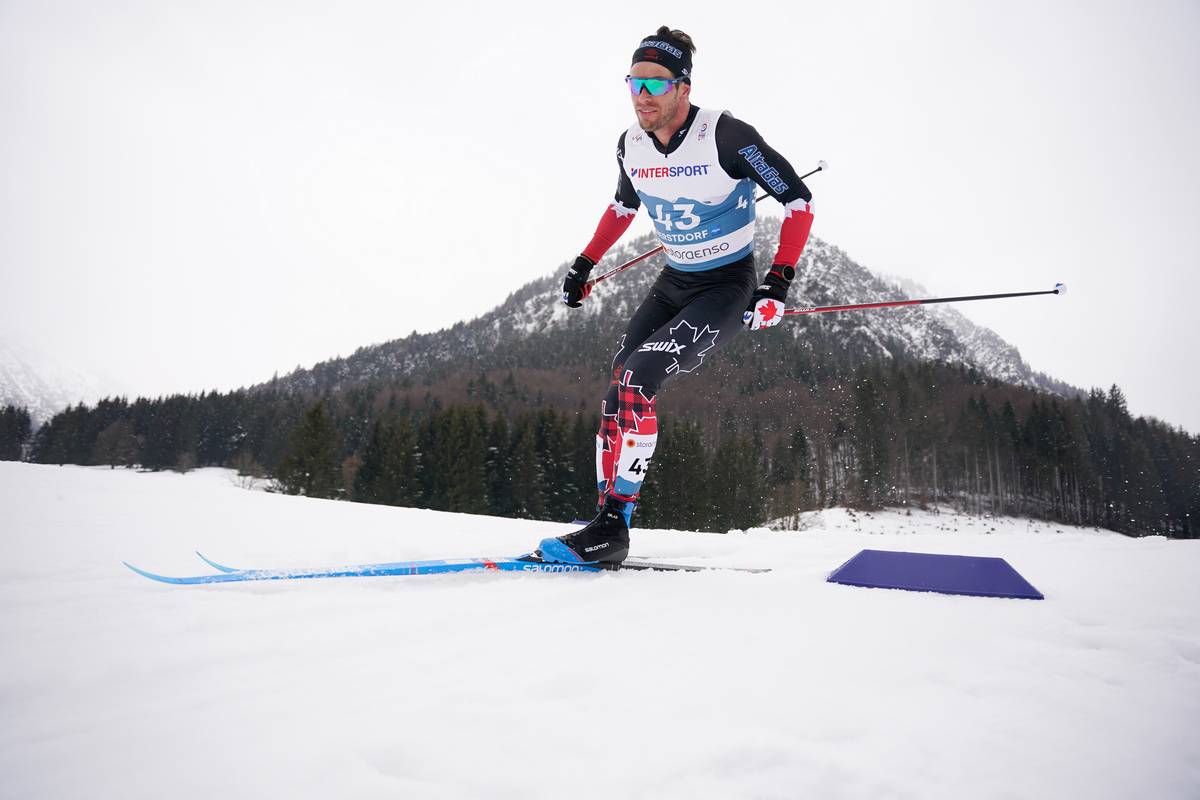
    Russell Kennedy on course during the 2021 FIS World Ski Championships in Oberstdorf, Germany. (Photo: NordicFocus)

    Relevant reading:

    Muonio results: https://www.fis-ski.com/DB/general/event-details.html?sectorcode=CC&eventid=50257&seasoncode=2022
    Kalla’s honorary degree: https://www.aftonbladet.se/sportbladet/a/G36A69/har-hyllas-kalla–ny-hedersdoktor
    Veerpalu’s son’s Instagram page: https://www.instagram.com/andersveerpalu
    A FasterSkier Q+A with Roponen: https://fasterskier.com/2020/02/transitions-training-and-birkie-preparation-a-qa-with-riitta-liisa-roponen/

  • More Early Racing as Cologna, Kylloenen, and Van Der Graaf Get Wins

    More Early Racing as Cologna, Kylloenen, and Van Der Graaf Get Wins

    Racers navigate a steep climb and descent on the race loop at Bruksvallarna on Saturday. (Photo: Jocke Lagercrantz/Bruksvallsloppet.se)

    The World Cup season draws ever-closer as season-opening races continued this weekend in Sweden, Finland, and Switzerland.

    In Muonio, Finland, a long weekend of racing wrapped up with 10 and 15 k skate races. Finland’s Anne Kylloenen took the win in the women’s 10 k, besting Emilie Kristoffersen of Norway by 8.2 seconds. Kylloenen’s national-team teammates Laura Mononen and Aino-Kaisa Saarinen took third (+14.0) and fourth (+17.1), respectively. Merete Myrseth, a Norwegian skier who competed for the University of Utah on the NCAA circuit last season, finished 17th, +57.1.

    In the men’s 15 k, Alexey Chervotkin of Russia took a 13.8-second win over Iivo Niskanen of Finland. Denis Spitzov of Russia was third, +17.5, and University of Utah alum Snorri Einarsson fourth, +21.2. Einarsson is competing for Iceland. Graham Nishikawa of Canada finished 19th, +1:14.4, and Brian McKeever 40th, + 2:05.3.

    Finishing sixth (+37.0) was Maxim Vylegzhanin of Russia, who made his second flower ceremony of the weekend. The International Olympic Committee (IOC) decided on Thursdayto strip the Russian skier of three silver medals from the 2014 Olympics for doping violations and ban him from all future Olympic Games. However, the International Ski Federation (FIS) has not yet taken any action since he and five other skiers were banned from the IOC, meaning that all six athletes are currently free to take part in non-Olympic ski competitions. FIS has not yet responded to a request for comment about Vylegzhanin’s continued competition.

    https://www.instagram.com/p/BbZO7VFFYpg/

    In Bruksvallarna, Sweden, Sunday meant skate sprinting, and Norwegians took both the men’s and women’s wins. In the men’s race, Paal Troean Aune bested countryman Even Northug in the final, with Anton Persson the only Swede on the podium in third. None of the top sprinters from either country competed. Jack Carlyle of Canada finished 60th, 19.4 seconds behind Aune’s qualifying time.

    In the women’s sprint, Wenche Aune Snildalsli took the win over four Swedes: Emma Thalin, Moa Olsson, Jackline Lockner, and Wilma Joensson were next across the line, and Latvia’s Patricija Eiduka finished sixth.

    A large contingent of international racers has also been training in Davos, Switzerland, where organizers have a lengthy saved-snow loop covering some of the same terrain which will host the World Cup in mid-December. On Friday and Saturday, the Swiss competed with the German and Italian teams in sprint and distance races, with a few individual athletes from other countries attending as well.

    In Friday’s sprints, Laurien Van Der Graaf came out on top for the home team, besting Germany’s Laura Gimmler and Steffi Boehler in the ‘A’ final after Gimmler had won beat her by 1.59 seconds in the qualifier. Fourth place went to Sandra Ringwald, also of Germany, and fifth to Ilaria Debertolis of Italy. In the men’s sprint Thomas Bing claimed the win for Germany, skiing away Switzerland’s Erwan Kaeser by more than two seconds. Giacomo Gabrielli and Stefan Zelger of Italy were third and fourth, and Janosch Brugger of Germany rounded out the ‘A’ final in fifth.

    https://www.instagram.com/p/BbUYGpgl2V_/

    In Saturday’s distance races, Katerina Smutna – racing for the Czech Republic after taking a break for several years to focus on a long-distance marathon career – won the three-lap, 10.5 k competition by just three seconds over Katharina Hennig of Germany, with Boehler another 12.2 seconds back in third. Van Der Graaf finished fourth, + 27.1, and Debertolis fifth, +39.6.

    In the men’s four-lap race, covering 14 k, Swiss Olympic gold medalist Dario Cologna took a commanding 26.6-second win over Russia’s Ilia Chernousov. Jonas Dobler of Germany claimed third, +33.8, with Giandomenico Salvadori of Italy fourth (+59.2), narrowly beating out Livio Bieler of Switzerland (+1:00.9).

    Chernousov could soon become an Olympic champion like Cologna. Vylegzhanin’s disqualification from the 2014 Olympics, along with that of Alexander Legkov, leaves Chernousov to inherit a gold medal in the 50 k freestyle, where he initially finished third. He has not been named in any of the doping investigations by the World Anti-Doping Agency or the International Olympic Committee. In fact, a Russian ski coach recently claimed that Chernousov had turned whistleblower and informed against his Russian teammate, but Chernousov has denied that allegation.

    https://www.instagram.com/p/BbW9TxXnxwI

    Results

    Bruksvallarna

    Women’s sprint qualifier – final

    Men’s sprint qualifier – final

    Muonio

    Women’s & men’s skate distance races

    Davos

    Sprint races (one document, men & women / qualifier & heats)

    Distance races

  • Finns, Russians, Norwegians & Swede Nab Early-Season Wins; Vylegzhanin Competes Despite IOC Ban

    Finns, Russians, Norwegians & Swede Nab Early-Season Wins; Vylegzhanin Competes Despite IOC Ban

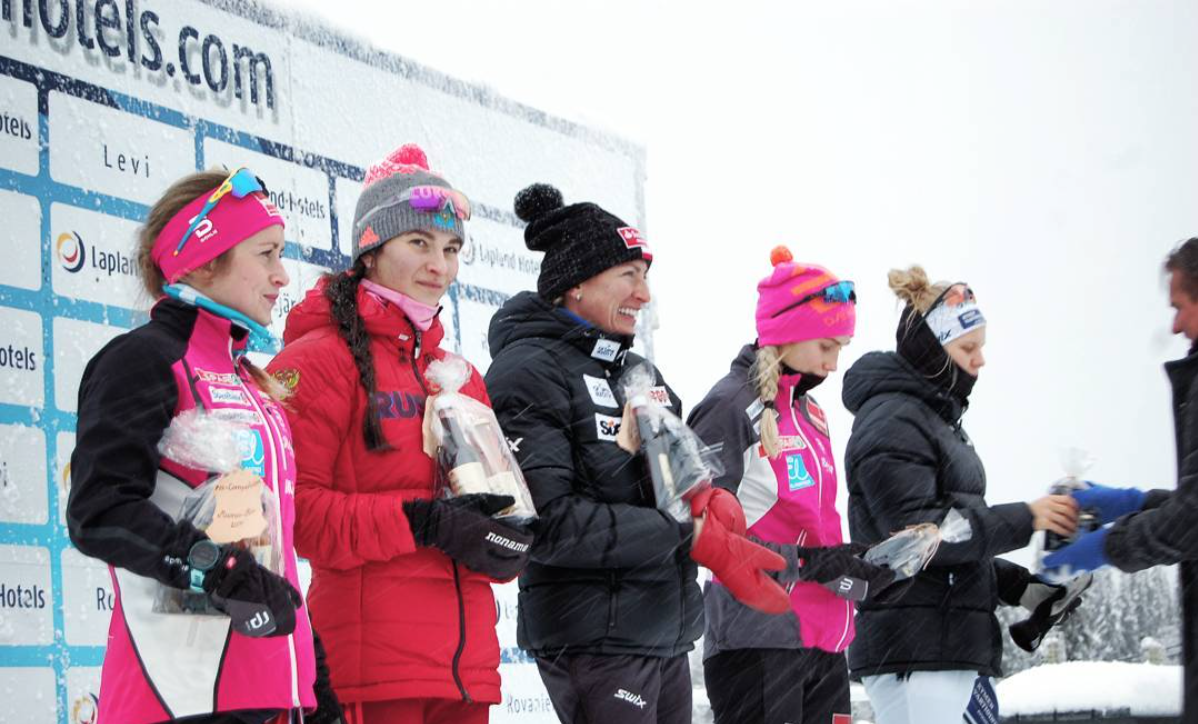
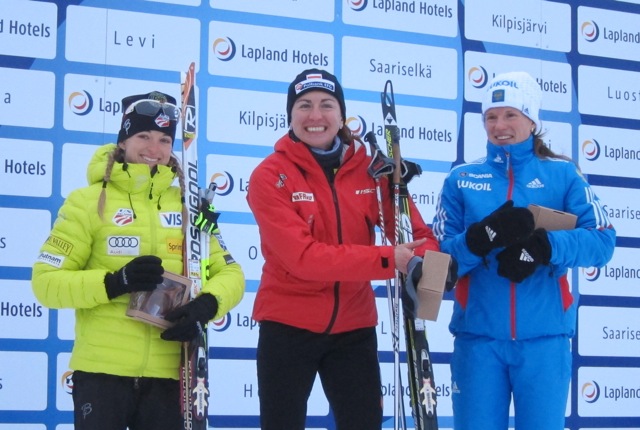
    (l-r) Anna Svendsen of Norway, Natalia Nepryaeva of Russia, Justyna Kowalczyk of Poland, Lovise Heimdal of Norway, and Leena Nurmi of Finland receive prizes after rate women’s classic sprint in Muonio, Finland, on Friday. (Photo: Ski Muonio/Instagram)

    FIS races are already being contested in Finland and Sweden this weekend, with most top Scandinavian racers sitting out but a few national-team members and others picking up their first victories of the season.

    The competitions in Muonio, Finland, drew the most diverse field, including racers from Norway, Russia, Japan, China, Canada, Estonia, and Slovakia, among other countries. In the men’s classic sprint on Friday, the home team got a win from Ristomatti Hakola; he and Russia’s Alexander Bolshunov went 1-2 in both the qualifier and the final. Russia’s Andrey Parfenov rounded out the podium. In the women’s sprint, Anna Svendsen took the win over Russia’s Natalia Nepryaeva, with Justyna Kowalczyk of Poland finishing third.

    On Saturday, racers moved up in distance. In the 10 k classic, Bolshunov – a U23 World Champion last season – bested Russian teammate Alexey Chervotkin by 20.6 seconds, with Andrey Sobakarev making it a sweep another 21.6 seconds back. Brian McKeever and Graham Nishikawa of Canada finished 56th (+2:10.6) and 63rd (+2:18.5), respectively.

    Also in the men’s race was Maxim Vylegzhanin. The International Olympic Committee (IOC) decided on Thursday to strip the Russian skier of three silver medals from the 2014 Olympics for doping violations and ban him from all future Olympic Games. However, the International Ski Federation (FIS) has not yet taken any action since he and five other skiers were banned from the IOC, meaning that all six athletes are currently free to take part in non-Olympic ski competitions. In a press release, FIS stated that “the next steps will be the review by the FIS Doping Panel of the six verdicts upon the receipt of the reasoned decisions” but did not provide a time frame for these decisions.

    In the women’s 5 k classic, Finland’s Krista Parmakoski posted an 18.4-second win over Nepryaeva, with Kowalczyk third again, +24.2.

    Bruksvallarna, Sweden, hosted races on Saturday as well, with a primarily Swedish and Norwegian field but some other racers as well. Norway’s Chris Andre Jespersen topped the 15 k skate, posting a 31.4-second win over Simon Lageson of Sweden. Norwegian Tore Leren was third, +53.1. Canada’s Jack Carlyle finished 38th, +2:29.5. Petter Northug and his brother Even were in Bruksvallarna this week but decided at the last minute not to race, with Northug making his debut in Beitøstolen, Norway, next weekend instead.

    In the women’s 10 k skate, Swedish national team member Emma Wiken bested Lina Korsgren – a long-distance specialist who finished eighth in the Visma Ski Classics standings last season – by 9.8 seconds. Berit Mogstad of Norway finished third, +15.3 seconds.

    https://www.instagram.com/p/BbW-cRsn14l/

    Results

    Muonio

    Classic sprint: men’s qualifier – men’s final – women’s qualifier – women’s final

    Classic distance: men’s 10 k – women’s 5 k

    Bruksvallarna

    Skate distance: men’s 15 k – women’s 10 k

  • 17 Questions for 2017: Caitlin Patterson

    17 Questions for 2017: Caitlin Patterson

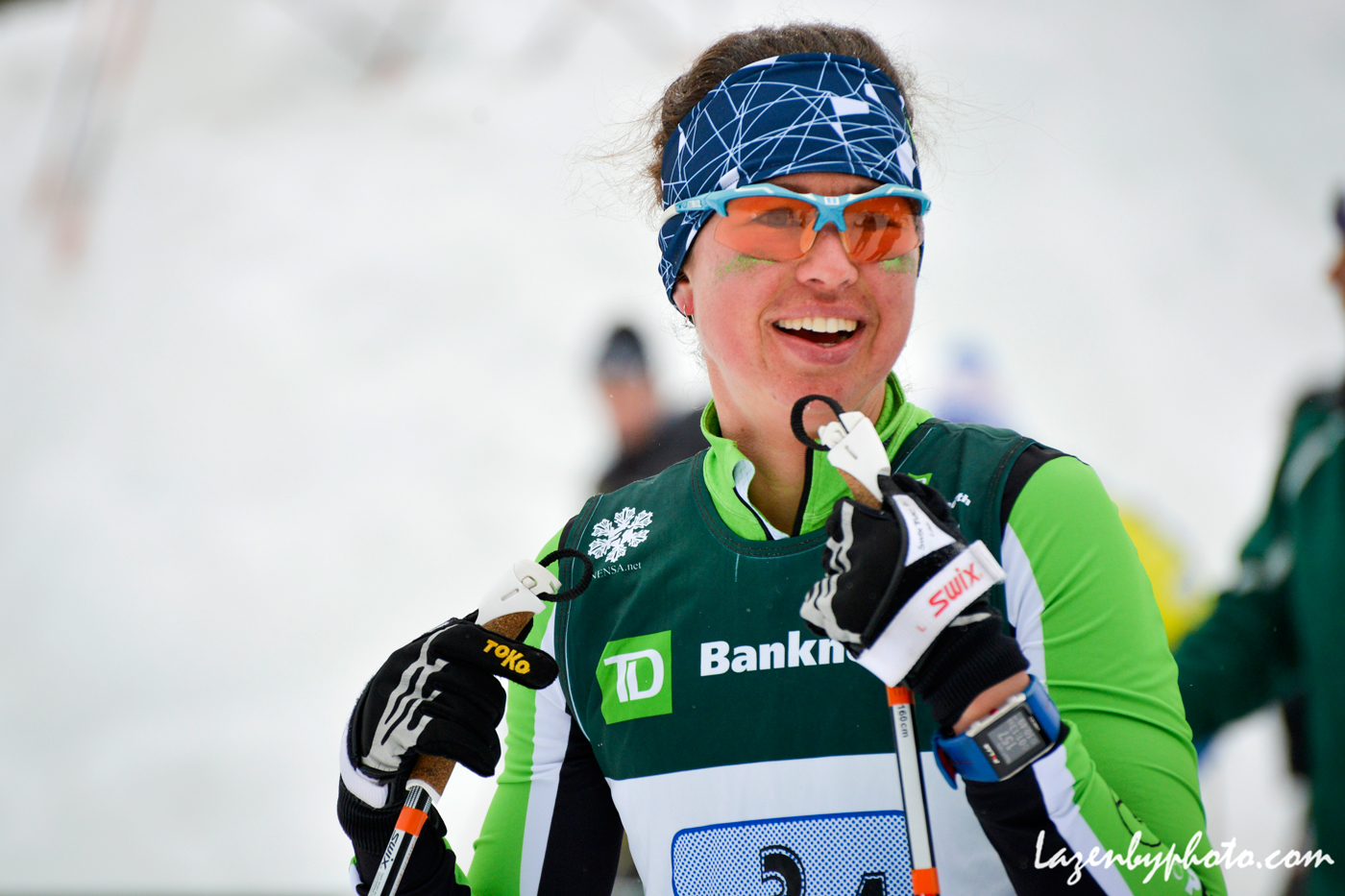
    Craftsbury's Caitlin Patterson before anchoring "Vailbury Green" to second in the mixed relay at 2016 SuperTour Finals in Craftsbury, Vt.(Photo: John Lazenby/Lazenbyphoto.com)
    Craftsbury’s Caitlin Patterson before anchoring “Vailbury Green” to second in the mixed relay at 2016 SuperTour Finals in Craftsbury, Vt. (Photo: John Lazenby/Lazenbyphoto.com)
    Welcome to ’17 Questions for 2017′, where we are catching up with top American and Canadian athletes before the beginning of the winter season. 

    ***

    Craftsbury Green Racing Project skier Caitlin Patterson had a tough end to the winter in 2016: she locked up the overall SuperTour title, but got sick before the Ski Tour Canada and was unable to compete in the final World Cup series of the year, something that had been the focus for so many North American athletes.

    But that SuperTour title earned her World Cup start rights for the first period of racing this season, and Patterson headed to northern Europe a bit early to get some early starts in Muonio and Saariselkä, Finland.

    While the top Finns were present in Muonio, as well as Polish star Justyna Kowalczyk, the field in Saariselkä was primarily Russian, with the German national team also present.

    “The races this past weekend were a bit of an adventure – 0°C and very tricky classic conditions,” Patterson wrote in an email about the races in Saariselkä, where she finished 23rd in the 5 k classic and 14th in the classic sprint. “And the courses had some funny 180 degree corners which are not what you usually see, and yet the races felt pretty big and official with all the different nations represented and especially so many Russians. Once again it was fun for me to put on a bib and race, and though I definitely didn’t feel my best for the distance race, I had quite a good sprint day and was happy to end the weekend on a good note.”

    Patterson, 26, is now ready for to represent as the SuperTour leader.

    “Yes, I am ready for the World Cup to start, or will be by the weekend at least!” Patterson wrote after traveling to Ruka, where the first weekend of racing will be held. “I have a few more days to become more familiar with the courses, test skis, do some pre-race intensity and then it will be go time! Of course I’m nervous, it’s the World Cup, but I’m also very excited and looking forward to racing!”

    1. Biggest change in your life in the last five or so months since the ski season ended?

    I got a car, my first one. Yes, I’m 26. I drove my parents’ cars during high school, but I never had a car in Vermont until this summer.

    2. Biggest change in your training?

    A little more volume, better quality all around. There haven’t been any huge changes, just a progression that makes sense while following the same training philosophy as the past years with the GRP.

    3. Major areas of improvement you’ve seen so far?

    Strength, particularly core stability/body connectivity, which has helped me ski with better and more stable technique.

    4. Whom you’ve been working closest with this offseason (coaches or training partners)?

    I’ve been working as closely as ever with coach Pepa Miloucheva, and enjoying training sessions with all of my GRP teammates.

    5. Best trip in the last five months (and why)?

    Oo that’s a tough one, I’ve been on several great trips, one to Alaska to ski on the Eagle glacier for the first time, and one to Slovenia and Austria to train on snow there. I’d have to go with the Slovenia/Austria trip, because the Julian Alps of Slovenia were great for exploring and make me want to go back soon for more hiking. And Ramsau, Austria is a spectacular place and great for fall training; I am building up lots of good memories from the three September camps I’ve been to on the Dachstein glacier in Ramsau.

    6. Favorite cross-training?

    Running, which luckily is a staple of my summer and fall training

    7. Favorite non-athletic activity or pastime this summer?

    Looking at close-up details of the natural world, and sometimes photographing them.

    8. Song that was your jam this summer?

    I enjoy hearing what other people come up with for pump-up workout music or music for the gym and car rides, but I’m not exactly great at coming up with that stuff myself, or staying on top of current trends. Some of my favorite music is by a folk group called Crooked Still.

    9. All-time favorite race moment?

    Of my personal race moments, the 10k skate mass start in Falun last year, where I first scored World Cup points, stands out. During the race I had no idea what place I was skiing in, but I was fighting for every second and pushing myself as hard as I ever have. It was incredible to learn in the finish pen that the hard work had been worth it, I had skied to a 25th place result!

    10. First thing you pack in your bag when you leave for Europe?

    Metaphorically, I pack my camera first. Physically the camera doesn’t go into the bottom of my bag, that would be my ski boots.

    11. Venue/event you’re most excited to visit this season?

    All of the World Cup venues in Period I, since they’ll all be new to me. So we can start with Ruka, Finland, since that will be first!

    12. Who will win the World Cup title this year?

    Oestberg and Sundby

    13. Biggest sacrifice you feel you’ve made choosing this career path?

    I don’t regret that skiing has been my highest priority for a long while now, but sometimes I do wish that I could give my full effort to academic studies or an engineering career. As a ski racer my time and attention is just so divided, with training and travel and racing, that I’ve never been able to commit 100% to intellectual work. Some day in the future I will, but for now there’s no rush.

    14. If you could change one thing about your sport, what would it be?

    Doping. I wish there was a better way to ensure that all athletes are competing clean, to be able to trust our fellow competitors and have the public trust the integrity of the athletes.

    15. What did you have for breakfast this morning?

    This morning I made egg-banana pancakes and ate them with yogurt, berries, and honey. It took me a few days to fill in all these questions and I had to change this answer every day! I really like eating something different just about every morning, because breakfast foods are nice, and fun to cook! Especially this past week as one of the last that I’ll be able to cook for myself for a while, I’ve been rotating through many of my favorites. I just have to be careful not to let myself launch into complex or long-lasting breakfast projects most days because I need to get out the door and train.
    16. In 5 years, I’ll be ____?

    Either ski racing at the Olympics, or engineering bridges while skiing on the side. Only time will tell which path is right.

    17. In 50 years, I’ll be ____?

    Still skiing and enjoying playing outside as much as ever.

  • Sargent and Patterson Prep for World Cup at Muonio FIS Races

    Sargent and Patterson Prep for World Cup at Muonio FIS Races

    Ida Sargent (bib 5) chasing Poland's Justyna Kowalczyk in the sprint quarterfinal in Muonio, Finland, on Friday. (Photo: Caitlin Patterson)
    Ida Sargent (bib 5) chasing Anastasia Kirillova of Belarus in the sprint quarterfinal in Muonio, Finland, on Friday. (Photo: Caitlin Patterson)

    In less than two weeks, the FIS Cross-Country World Cup will kick off in Kuusamo, Finland.

    But two American skiers are already in the country, putting on bibs for the first time this season and waxing up their race skis. Four hours north of Kuusamo, above the Arctic Circle, Craftsbury Green Racing Project athletes Ida Sargent and Caitlin Patterson are racing in Muonio.

    “Coming over here early is a good opportunity to get the jet-lag and time change out of the way before the World Cup, and also shake out some racing jitters and remember all the little details of getting to the start line prepared,” Patterson explained in an email.

    The pair are supported by Craftsbury head coach Pepa Miloucheva, and the Rex wax team thanks to arrangements by Toni Roponen, the husband of a Finnish World Cup skier who is friendly with some of the American women.

    “They don’t speak any English though, which is interesting,” Sargent wrote of the race-ski preparation.

    On Friday, Sargent was the first woman out of the start in the classic sprint qualifier. She ultimately logged the fifth-fastest time.

    “It was snowing and they didn’t have any forerunners skiing in the tracks for the time after the course closed,” Sargent explained. “I was the first starter so I plowed the track around the entire course. So that was frustrating but otherwise I was pleasantly surprised with how good the race felt!”

    Although the races are FIS-sanctioned, the trails aren’t as wide as some World Cup level venues and only four athletes were put in each sprint heat, rather than six.

    Skiing in a quarterfinal heat with eventual winner Justyna Kowalczyk of Poland, Sargent failed to advance and ended up ninth on the day.

    “The four person heats on the narrow course in the snow was a little interesting and I was not on my game at all, so I made some stupid mistakes and was third in my quarterfinal when I should have easily moved on,” Sargent wrote in an email. “I was a little pissed at myself afterward, but grateful for the opportunity to get back into the racing mindset before the World Cup begins.”

    Anna Svendsen of Norway finished second and Yulia Tikhonova of Belarus third. The men’s sprint was won by Finland’s Ari Luusua, with World Cup regular Anssi Pentsinen second. Norway’s Erik Valnes rounded out the podium.

    Anssi Pentsinen of Finland leads a heat in the men's classic sprint in Muonio. (Photo: Caitlin Patterson)
    Anssi Pentsinen of Finland leads a heat in the men’s classic sprint in Muonio. (Photo: Caitlin Patterson)

    Saturday brought 5 and 10 k interval-start classic races for the men and women, and while Patterson had sat out the sprint, she finished 16th in the 5 k, 1:03.5 behind race winner Kowalczyk. Sargent finished six seconds and three more places back in 19th. The top ten was packed with Finnish national team members, with Krista Parmakoski finishing second and Aino-Kaisa Saarinen, who skipped much of last season to have her first child, in third.

    “I can’t say I was entirely happy with where I ended up in the results, top 10 was only 4 seconds up and that would have felt a lot nicer than 16th,” Patterson wrote. “But I did feel pretty good skiing, if a little too relaxed at the start, and when Justyna Kowalcyzk and Riita-Liisa Roponen both caught me at the very top of the course, I had a great time chasing them both on the downhills and was only a few seconds back at the finish. It’s a good reminder of what it feels like to race, and also of how tight finishing times can be, especially here in Europe.”

    Sargent didn’t feel as fresh, and will take Sunday off instead of racing the 10 k skate.

    “I felt really tired today so maybe the jetlag and excitement of being back on snow and skiing again is catching up to me,” Sargent said. “But most importantly I’m very excited to get the season going and very thankful for the chance to do a few of these races with Craftsbury before the World Cup begins later this month!”

    The men’s 10 k was won by Lari Lehtonen of Finland, with countrymen Perttu Hyvarinen and Sami Jauhojaervi coming in second and third.

    The Craftsbury pair arrived in Finland only on Tuesday, and seemed satisfied with their form and efforts given the short timeframe to adjust to both the time zone change and being on snow.

    Justyna Kowalzcyk of Poland leads a heat in the women's classic sprint in Muonio, Finland. (Photo: Caitlin Patterson)
    Justyna Kowalzcyk of Poland leads a heat in the women’s classic sprint in Muonio, Finland. (Photo: Caitlin Patterson)

    “The transition back to snow is going smoothly,” Patterson wrote. “I was fortunate enough to be able to get on snow twice this summer, on the Eagle and Dachstein glaciers, and with that plus just getting more experienced as an athlete and having more summer-to-winter transitions under my belt, the feel of skiing comes back quickly. Or at least distance skiing does, I think skiing with higher intensity will take a bit more refinement before I’m fully settled. I’m somewhat jet-lagged still, and adjusting my sleep schedule, but while I don’t feel super snappy out skiing, it’s not bad.”

    After the weekend, Miloucheva will fly back the the U.S. to travel with the rest of the team to the West Yellowstone Ski Festival, and Sargent and Patterson will travel to Saariselka for more competitions.

    Sargent is a member of the U.S. Ski Team, and has had good results in Finland before. At the season-opening World Cups in Kuusamo, she finished seventh in the sprint in 2015 and fifth in 2014.

    Patterson, meanwhile, earned her World Cup starts by dint of winning the 2015-2016 U.S. SuperTour. She has raced European World Cups for parts of both of the last two seasons, including top-30 finishes in both Falun, Sweden, and Lahti, Finland, the site of this year’s World Championships.

    It will be Patterson’s first year starting the season on the World Cup.

    “I don’t really have any expectations for these races, having never been here before, so my goal is just to focus on the preparation and do everything I can to keep feeling good and making progress towards racing faster,” she wrote. “Of course it would be nice to land in the results near some of the World Cup regulars who are here, but that would be a bonus. The key thing is to be ready for the World Cup start in 2 weeks, and these races will help me remember what it feels like to go hard, get in touch with the feel of skiing fast on snow, and make a few technique adjustments if Pepa and I notice anything. I’m looking forward to testing out some skating in the 10k tomorrow!”

    Results:

    Friday sprint men / women

    Saturday classic men / women

  • Poltoranin, Nousiainen, Jauhojärvi & Niskanen Take Wins over International Field in Muonio

    Poltoranin, Nousiainen, Jauhojärvi & Niskanen Take Wins over International Field in Muonio

    Racing has kicked off in Muonio, Finland, with classic sprints on Friday and an 8.2/15 k classic race on Saturday. While skiers from the home country took many spots on the podium, Alexei Poltoranin of Kazakhstan prevailed in the men’s sprint, beating Ristomatti Hakola by a ski length.

    Alexey Poltoranin (KAZ) racing for the Tour de Ski in Cortina-Toblach (ITA) in 2015. On Friday he won the classic sprint at FIS races in Muonio, Finland. (photo: Fischer/NordicFocus)
    Alexey Poltoranin (KAZ) racing in the Tour de Ski in Cortina-Toblach (ITA) in 2015. On Friday he won the classic sprint at FIS races in Muonio, Finland. (photo: Fischer/NordicFocus)

    With just 16 skiers advancing to heats, and four skiers per heat because of the narrow width of trails, action was fast on Friday afternoon. According to Poltoranin, the races are tests for the Kazakh team.

    “My Estonian coach, Mati Alaver, who I have been working with for two years and my sparring partner, 2002 and 2006 Olympic Champion Andrus Veerpalu, who I have been training with since the summer until the last starts and who also happens to be my serviceman and test pilot, are also in Muonio,” he said in an interview with Astana Times on Friday.

    He also shed some light on the fighter’s mentality that took him to the top later that day.

    “In times of hardships I think if I slow down and lose one to three seconds, then have I worked for nothing since my childhood?” he said. “This is why we are training, to fight for every second, for every place.”

    Finally, he had some requests for Kazakhs at home: watch skiing on television, and do it themselves.

    “I recommend everyone to start skiing, because it is a healthy lifestyle,” he said. “Your body muscles are working, including the heart, and most importantly it is not as traumatic as jogging.”

    Mona-Liisa Nousiainen bested Krista Pärmäkoski in the women’s final after also winning the prologue.

    “In the final, Krista pulled a pretty good pace,” Nousiainen told Kestävyys Urheilu.

    Nousiainen is planning in the first World Cups of the season, to be held in Kuusamo, Finland. After also winning a sprint in Vuokatti earlier this month, she certainly seems to be a compelling choice for sprints. But with few top women from other countries competing in Muonio, she was wary of assigning her wins so far too much importance.

    Finland's Sami Jauhojärvi crosses the line ahead of Russia's Nikita Kriukov to win a gold medal in the Sochi Olympic team sprint in 2014.
    Finland’s Sami Jauhojärvi crosses the line ahead of Russia’s Nikita Kriukov to win a gold medal in the Sochi Olympic team sprint in 2014.

    “Sure, these messages indicate that the training sessions have gone well,” she said, according to a translation. “But the main contests are of course still ahead.”

    Alena Prochazkova of Slovakia was third in the A-Final.

    Come Saturday, Poltoranin slipped to the third spot of the podium as Sami Jauhojärvi was the man of the day. The Finn opened up a 43.5 second gap to teammate Hakola over the course of 15 k of classic skiing, with Poltoranin another 1.8 seconds behind in third.

    “I hope my mother believes the broadcast,” Jauhojärvi said at the end of an interview with Kestävyys Urheilu. “And my son Oiva at home. Dad won!”

    The field was also filled with a few former NCAA skiers. University of Utah alum and sometime Norwegian World Cup skier Snorri Einarsson placed seventh, +1:38.3 behind Jauhojärvi. Former University of Alaska Anchorage skier Vahur Teppan of Estonia placed 38th (+4:38).

    Kerttu Niskanen of Finland skiing to fourth place in the 30 k classic at 2015 World Championships.
    Kerttu Niskanen of Finland skiing to fourth place in the 30 k classic at 2015 World Championships.

    In the women’s 8.2 k, Pärmäkoski again finished a close second, this time behind Kerttu Niskanen. Niskanen clocked a time just 2.3 seconds faster.

    Working through falling snow and powdery trails, Niskanen called the course less than ideal.

    “The snow was falling and the trails were in messy condition,” she said, according to a translation. “It was a mess that somehow came forward.”

    She revealed in an interview with the Iltalehti newspaper that she is focusing on a World Cup overall placing, and intends to race the Ski Tour Canada.

    “It doesn’t make sense to race all the races for the period, but most I can ski,” she said. “The Tour de Ski and the Canadian tour, theirs is a big role. If they do not go well, you will have to forget the overall World Cup competition.”

    Riita-Liisa Roponen, a formidable force on the FIS Marathon Cup in the last few years, placed third +24.5.

    “Time, well well – it seems I can still stride with the young girls,” 37-year-old Roponen quipped to the Kaleva newspaper.

    Aino-Kaisa Saarinen, a Finnish longtime star who recently announced that she was pregnant, finished ninth (+1:22.3). She explained after the race that she plans to continue racing until she begins to be afraid of crashing, at which point she’ll stay away from the start line.

    Utah alum Maria Gräfnings placed tenth, four seconds behind her. College of Saint Scholastica’s Anita Kirvesniemi placed 43rd (+3:58.9).

    Racing continues Sunday with skate distance competitions.

    Results: 

    Friday women’s / men’s sprint

    Saturday women’s 8.2 k / men’s 15 k

  • 10 Questions with Men’s SuperTour Leader Reese Hanneman

    10 Questions with Men’s SuperTour Leader Reese Hanneman

    Reese Hanneman racing at the world-famous Holmenkollen last March, when he placed 56th in the 50 k classic mass start. (Photo: Jennie Bender)
    Reese Hanneman (Alaska Pacific University) racing at the world-famous Holmenkollen last March, when he placed 56th in the 50 k classic mass start. (Photo: Jennie Bender)

    Busy times call for pointed questions. We caught up with Reese Hanneman, the men’s SuperTour leader from last season — which earned him World Cup starts this November and December — shortly after he arrived in Muonio, Finland, 11 time zones away from his home in Anchorage, Alaska.

    To get there, Hanneman, an Alaska Pacific University (APU) skier who turns 25 on Christmas, had layovers in Seattle, Reykjavík (Iceland), Oslo (Norway), and Helsinki (Finland) before finally arriving in Rovaniemi — about three hours south of Muonio by car.

    “I had to pay baggage fees for my three bags twice because they said they couldn’t print that many connections on the bag tags, which I think was bogus,” Hanneman wrote in an email.

    But the defending classic-sprint national champion (who podiumed in all four events at 2014 U.S. nationals) made it and has been training on snow to prep for the first official races of the season next weekend in Kuusamo, Finland. Hanneman spent most of last March in Europe and finished the 2013/2014 season (with the exception of Super Tour Finals) on the World Cup circuit, racing in Lahti, Finland; Drammen, Norway; Holmenkollen in Oslo; and Falun, Sweden, at World Cup Finals.

    ***

    1. What’s one essential you packed for the next couple months in Europe?

    “Hot sauce; I’ve got a full bottle ready to go. It’ll get you out of any potentially bland situation.”

    Reese Hanneman doesn't leave for Europe without a bottle of hot sauce. How to pick just one...
    Reese Hanneman doesn’t leave for Europe without a bottle of hot sauce. How to pick just one…

    2. What part of Euro life or culture are you most excited for?

    “Bathrooms you can’t even turn around in. Oh wait, ‘most’ excited? Sharing tiny beds with Hoff.”

    Shower, sink and toilet all within inches of each other. Everything's tinier in Europe. (Photo: Houzz.com)
    Shower, sink and toilet all within inches of each other. Everything’s tinier in Europe. (Photo: Houzz.com)

    3. What are you going to miss most about home?

    “Being able to get away. Europe is pretty much people just everywhere.”


    Reese Hanneman in Muonio. (Photo: Erik Bjornsen)
    Reese Hanneman in Muonio. (Photo: Erik Bjornsen)

    4. What’s one race/venue that you’re particularly excited for in the next several weeks, and why?

    “The opening weekend in Kuusamo is gonna be pretty sick; classic sprint and 15k classic. But then of course racing in Lillehammer will be epic.”


    5. What’s one thing you’ve been working hard on, technically or otherwise, with your skiing this offseason?

    “I focused on my skating, like I have been for a few years now. Just trying to refine my technique so I can bring my efficiency up to par with my classic skiing.”


    6. What’s your “secret weapon” for a successful start on the World Cup circuit this season?

    “I think I am at a great spot… I don’t really have the expectations of doing really well, but I have enough World Cup experience under my belt and the confidence that I can hang with these guys, that I might be able to put it together. So I would say, I have the potential but not the pressure.”


    7/8. How nervous do you get for the first race of the season? How different is it starting the season in Finland vs. Montana?

    “Usually, I get nervous only if I am putting a lot of pressure on a certain race. But a lot of times for me, the first race of the year kind of seems like it’s too soon, like I haven’t gotten myself fully amped up for it yet. Which actually can end up working pretty well. I am really excited to be here on the World Cup instead of in West, but to be honest, I will try to approach it the same way mentally. I guess that’s easy to say now, but I might start getting psyched when I see all the TV cameras and cable cams and wax semis in Kuusamo.”

    “I am really excited to be here on the World Cup instead of in West, but to be honest, I will try to approach it the same way mentally. I guess that’s easy to say now, but I might start getting psyched when I see all the TV cameras and cable cams and wax semis in Kuusamo.” — Reese Hanneman, APU skier and 2013/2014 men’s overall SuperTour winner


    9. What will you miss about West Yellowstone?

    “Bison burgers and milkshakes after the races. And seeing homies from all over the ski world.”

    Mmm... bison burgers, a West Yellowstone staple. (Photo: BisonBasics.com)
    Mmm… bison burgers, a West Yellowstone staple. (Photo: BisonBasics.com)

    10. If you could ski like any famous World Cup skier (past or present), who would it be?

    “[Swedish four-time Olympic gold medalist and three-time world champion Thomas] Wassberg was a boss. That old school classic technique… unreal.”

    Thomas Wassberg (Photo: Flickr)
    Swedish cross-country legend Thomas Wassberg (Photo: Flickr)

    Bonus: Who’s your World Cup crush?

    “Oh man… haha. I’ve had a thing for [Norway’s] Marthe Kristoffersen since like back at my first World Juniors. She doesn’t even have to try. Six years later, I’m still waiting to be introduced.”

    Marthe Kristoffersen, 25-year-old Norwegian National Team member (Photo: FIS)
    Marthe Kristoffersen, 25-year-old Norwegian National Team member (Photo: FIS)

    Last word: “I’d like to give a shoutout to a couple people who have been crucial in helping me get to this point. Alaska Pacific University has invested a lot into me, and I wouldn’t be here without them and my coach Erik Flora. And then my sponsors at the Allergy, Asthma and Immunology Center of Alaska, The Alaska Community Foundation, Alaska Children’s Eye, Girdwood 2020, PDC Engineers, and the Alaska Club for their support.”

    2013/2014 overall SuperTour leader Reese Hanneman (APU) racing in the classic sprint at SuperTour Finals on March 23 in Anchorage, Alaska. He went on to win the final. (Photo: Rob Whitney)
    2013/2014 overall SuperTour leader Reese Hanneman (APU) racing in the classic sprint at SuperTour Finals on March 23 in Anchorage, Alaska. He went on to win the final. (Photo: Rob Whitney)
  • 10 Questions with Women’s SuperTour Leader Caitlin Gregg 

    10 Questions with Women’s SuperTour Leader Caitlin Gregg 

    Brian Gregg cheers on Caitlin at SuperTour Finals in Anchorage, Alaska. (Photo: Madshus/Facebook)
    Overall women’s SuperTour leader Caitlin Gregg racing at SuperTour Finals in Anchorage, Alaska, while husband Brian Gregg (l) cheers her on. (Photo: Madshus/Facebook)

    Busy times call for pointed questions. We caught up with Caitlin Gregg, the women’s SuperTour leader from last season — which earned her World Cup starts this November and December — before she jetted to Muonio, Finland, nearly 4,000 miles from her home in Minneapolis.

    On Sunday morning, she flew out of Calgary, Alberta, after spending about a month in nearby Canmore (also about 4,000 miles from Muonio), where she trained on snow at Frozen Thunder with her husband and Team Gregg teammate, Brian. She purposely scheduled her first layover in Minneapolis to spend about five hours with Brian before flying to Paris that night.

    In an email, Gregg explained she’d arrive in Paris at 8:35 a.m. Monday morning, leave for Helsinki two hours later and arrive in Finland later that afternoon. From there, she’d fly north to Rovaniemi, Finland, arriving around 5:40 p.m., and then planned to drive about three hours farther north or Muonio. In total, she figured she was in for 36 hours of travel.

    Gregg, who won the U.S. nationals 20-kilometer freestyle mass start and placed second in two other events at nationals last January, celebrated her 34st birthday on Nov. 7.

    ***

    Caitlin Gregg gets a bug hug from her husband at the finish at last year's West Yellowstone SuperTour opener, where she won both the skate sprint and 10 k skate in Nov. 2013. (Courtesy photo)
    Caitlin Gregg gets a bug hug from her husband at the finish at last year’s West Yellowstone SuperTour opener, where she won both the skate sprint and 10 k skate in Nov. 2013. (Courtesy photo)

    1. What’s one essential you packed for the next couple months in Europe?

    “The Samsung phone that Brian got at the Olympics. We got a T-Mobil plan for it so that I can use to keep in touch with him while I am gone! He also loaded videos and movies for me to watch 🙂 I am also bringing a good pencil and a sketch pad. Drawing helps me relax!”


    2. What part of Euro life or culture are you most excited for?

    “All of it!!! Everything still seems new to me so it’s all fun. I am really looking forward to the breakfasts (well all meals!) being prepared and ready to eat when I wake up! I know by the end of the trip I will look forward to making my own meals, but right now nothing sounds better than a pre-made buffet with good bread, jam and cheese :)”


    3. What are you going to miss most about home?

    “This one is pretty easy…Brian! There is nothing like traveling the world and racing on the World Cup with your husband!”


    Gregg’s travel essential: “A good pencil and a sketch pad. Drawing helps me relax!”


    4. What’s one race/venue that you’re particularly excited for in the next several weeks, and why?

    “Lillehammer [Dec. 5-7], I hear it is a hilly course and there is a 5K Skate which is my favorite format. Plus it’s cross country ski racing in Norway which is always incredible.”


    5. What’s one thing you’ve been working hard on, technically or otherwise, with your skiing this offseason?

    “Last year was all about skate altitude distance racing, trying to make the Sochi 30K, so this year I have been much more ‘well-rounded’ in my training approach with more classic and sprint specific workouts! I obviously love skate skiing, but it’s be fun to mix the focus up a bit! So trying to be more well-rounded in my race results.”


    6. What’s your “secret weapon” for a successful start on the World Cup circuit this season?

    “The ‘Fish Factor!’ Those of us from the original CXC Team will all agree that we were at a HUGE advantage having [U.S. Ski Team coach Bryan] Fish as our coach and waxing our skis. I am really excited to be working with Fish again this year and on the World Cup! I have a ton of confidence in my skis and my waxing heading into the season which feels great!”


    Caitlin Gregg (front) with some of her biggest fans at last year's SuperTour opener in West Yellowstone, Mont. (Courtesy photo)
    Caitlin Gregg (front) with some of her biggest fans at last year’s SuperTour opener in West Yellowstone, Mont. (Courtesy photo)

    7/8. How nervous do you get for the first race of the season? How different is it starting the season in Finland vs. Montana?

    “I always get nervous no matter what the race…but I absolutely love racing! I usually start the season pretty strong and have had my best races early on in West Yellowstone. I am looking forward to a new venue and racing at a lower elevation to start off the season. Obviously the competition will be very strong and very deep but I like the challenge and the unknown.”


    9. What will you miss about West Yellowstone?

    “I will miss all the awesome cheering from my Loppet Nordic Racing teammates and all the familiar faces on the trails and at the first races in West Yellowstone. It’s great to start the season with so much enthusiasm for the sport!”


    10. If you could ski like any famous World Cup skier (past or present), who would it be?

    “Charlotte Kalla! I love how smooth and effortless she makes skiing fast look!”

    Sweden's Charlotte Kalla racing to silver in Thursday's 10 k classic individual start at the 2014 Olympics in Sochi, Russia.
    Sweden’s Charlotte Kalla racing to silver in the 10 k classic individual start at the 2014 Olympics in Sochi, Russia.

    Bonus: Who’s your World Cup Crush?

    “Axel Teichmann [a two-time world champion and two-time Olympic silver medalist from Germany]. Brian knows [this] and makes fun of me. The crush goes way back to an elevator ride at the 2007 World Championships with Laura Valaas.”

    Germany's Axel Teichmann after winning the second stage of the Tour de Ski, the 15 k classic pursuit, on Friday.
    Germany’s Axel Teichmann (17) after winning the second stage of the 2011 Tour de Ski, the 15 k classic pursuit.
  • Kowalczyk, Poltoranin Take First Two Muonio Races; Americans and Canadians Jump in the Mix

    Kowalczyk, Poltoranin Take First Two Muonio Races; Americans and Canadians Jump in the Mix

    Each November, it’s tradition for some of the world’s best nordic skiers to go where the sun don’t shine – or appears very little. The fact is that Muonio, Finland, above the Arctic Circle has snow this time of year when other parts of Europe are still waiting for the skiable stuff.

    Justyna Kowalczyk of Poland during one of last year's FIS races in Muonio, Finland. This weekend, Kowalczyk won two out of three Muonio competitions from Nov. 15-17.(Photo: Petri Ikävalko/Hevoskuuri.fi)
    Justyna Kowalczyk of Poland during one of last year’s FIS races in Muonio, Finland. This weekend, Kowalczyk won two out of three Muonio competitions from Nov. 15-17.(Photo: Petri Ikävalko/Hevoskuuri.fi)

    Starting Friday, the unofficial Finland Triple began in Muonio, with hundreds of skiers flocking to the northern region for their first International Ski Federation (FIS) races of the season.

    Poland’s cross-country celeb Justyna Kowalczyk jumpstarted her season with a sizable victory in the 1-kilometer classic sprint, topping Russian Evgenia Shapovalova by more than 7 seconds in the final, as well as Russia’s Julia Tikhonova in third and Natalia Matveeva in fourth. Finland’s Mona-Lisa Malvalehto placed fifth out of 146 female competitors.

    In the men’s 1.3 k classic sprint on Friday, Alexey Poltoranin of Kazakhstan beat Finland’s runner-up, Ari Luusua, by 3.23 seconds in the final, as well as third-place finisher Russian Anatoliy Volkov (+5.56). Ales Razym of the Czech Republic was fourth and Estonia’s Peeter Kummel placed fifth out of 255 men.

    Leading a small American contingent in Muonio, Dakota Blackhorse-von Jess (Bend Endurance Academy) placed 34th in the sprint qualifier. Welly Ramsey was the fastest from the Maine Winter Sports Center (MWSC), placing 113th, teammate Sam Tarling came in 209th, and post-grad Austin Huneck was 239th. Another MWSC post-grad, Emily Ramsey finished 128th in the women’s race.

    On Saturday, Kowalczyk and Poltoranin again topped their respective podiums – this time in the 5 and 10 k classic races. Kowalczyk defeated Russia’s Yulia Tchekaleva in second by 21.6 seconds, and Germany’s Nicole Fessel in third (+27.3). Finland’s Anne Kyllönen and Kertu Niskanen placed fourth and fifth, respectively, out of 199 women.

    Poltoranin edged Lukas Bauer of the Czech Republic by 6.8 seconds, and German Hannes Dotzler in third (+24.2). Razym finished fourth for the second-straight day, and Germany’s Tim Tscharnke placed fifth out of 331 finishers.

    Kris Freeman in Muonio last year. (Photo: Petri Ikävalko / Hevoskuuri.fi)
    Kris Freeman in Muonio last year. (Photo: Petri Ikävalko/Hevoskuuri.fi)

    Kris Freeman (MWSC) led the Americans in his first race of the season in 34th, 1 minute and 11 seconds behind Poltoranin, who won in 24:33.7. Tarling placed 109th, 2:09.8 back from the winner. Canadian Para-Nordic veterans Brian McKeever placed 160th and Erik Carleton was 242nd.

    Racing ended Sunday with the women’s 10 k and men’s 15 k individual skate. Russian Petr Sedov stole the spotlight from Finland’s Matti Heikkinen, who was leading until Sedov finished 7.8 seconds faster in 34:56.5. Two other Finns rounded out the top four with Tero Similae in third and Lari Lahtonen in fourth, and Franz Goering of Germany was fifth out of 188 men. Poltoranin did not race.

    Freeman finished 32nd, 1:15.1 after Sedov, McKeever was the top Canadian in 63rd, (+2:13), and Welly Ramsey was 116th (+3:24.7) Carleton placed 125th (+3:38), and Tarling was 126th (+3:39.5).

    Russian Irina Khazova won the women’s 10 k in 25:46.2, ahead of teammate Tchekaleva in second (+28.3), and Eva Vrabcova-Nyvltova of the Czech Republic in third (+49.5). Finland’s Gretel Niskanen placed fifth, and Russia’s Svetlana Nikolaeva was fifth out of 159 women. Kowalczyk fell to 24th, behind teammate Sylwia Jaskowiec in 21st. American Emily Ramsey placed 155th.

    ***

    Results: 

    Friday’s classic sprint: women | men

    Saturday’s 5 and 10 k classic: women | men | photos

  • Weekly Roundup: Season Kickoffs

    Liz Stephen (l) with Justyna Kowalczyk (POL) and Russia’s Yulia Tchekaleva (r) on the podium on Sunday in Muonio, Finland. Kowalczyk won the FIS 10 k skate race by 4.46 seconds over Stephen. (Holly Brooks courtesy photo)

    After months of training and anticipation, the nordic sports opened their seasons around the world this weekend with races around the world. Established veterans had several dominating performances, but there were new faces on the podiums as well, signaling that when World Cup racing starts next weekend, things could be pretty interesting.

    In Bruksvallarna, Sweden, the Swedish, Canadian, and Slovenian national teams butted heads in a three-day race series. One of the biggest surprises was Swedish 23-year-old Emma Wiken taking a 2.4-second win over Charlotte Kalla on the first day of racing. But otherwise, Sweden’s top stars prevailed, with Daniel Richardsson, Johan Olsson, Teodor Peterson, and Ida Ingemarsdotter taking wins and Kalla returning to completely decimate the women’s field in the 10 k skate. Canada had strong performances as well, with Alex Harvey placing fourth in the 10 k classic, Ivan Babikov third in the 15 k skate, and Chandra Crawford second in the skate sprint. Katja Visnar of Slovenia also stepped on the podium in the sprint.

    To the northeast in Muonio, Finland, even more national teams tried out their racing legs. Finland was joined by Russia, the United States, the Czech Republic, Poland, Kazakhstan, Japan, and Germany in a three-race series. Justyna Kowalczyk of Poland swept the women’s competitions, and was at her most dominant in a 29-second win in Saturday’s 5 k classic. For the men, Alexey Poltoranin of Kazakhstan took two victories before Matti Heikkinen of Finland bested the field in the 15 k skate. The U.S. had several top performances, headlined by Liz Stephen‘s second-place finish in the 10 k skate, just 4.6 seconds down on Kowalczyk; Holly Brooks and Jessie Diggins also made the top ten. But Kris Freeman also placed fourth in the men’s classic race, and Andy Newell and Ida Sargent both made the sprint finals.

    Meanwhile, Beitostolen, Norway, was hosting the opening races for both skiers and biathletes. The women’s races were characterized by familiar Norwegian faces on top of the podium: Maiken Caspersen Falla in the sprint, Therese Johaug in the two distance races, and Tora Berger dominating the biathlon competitions. Perhaps the biggest surprise was Marit Bjørgen‘s two losses to Johaug, including a 50-second blowout in the classic race. Petter Northug won on Friday before falling in the sprint final, leaving Anders Glørsen to take the win, while Chris Andre Jespersen skied to a huge victory on Sunday. World Champion Martin Fourcade of France won Saturday’s biathlon sprint, before sitting out Sunday’s mass start and leaving the victory to Erlen Bjøntegaard.

    Finally, the U.S. race season began in Fairbanks with the Tour de Ski Fairbanks, a three-day series culminating in pursuit races on Sunday. Designed to be a meet for University of Alaska Anchorage and University of Alaska Fairbanks skiers, the weekend consisted of prologues on Friday, classic mass starts on Saturday, which included sprint preems, and then skate pursuits on Sunday. Logan Hanneman and Raphaela Sieber, both from UAF, picked up the overall titles, although Viktor Braenmaark and Marine Dusser (UAA) had the fastest ski times on Sunday and Rebecca Konieczny (UAF) won the women’s prologue.

    Elsewhere on the site, we previewed the upcoming race seasons – nordic combined, biathlon, the U.S. and Canadian World Cup squads – and conditions and potential start lists for on upcoming races at West Yellowstone and Canmore. Finally, we checked in with Canadian biathlete Nathan Smith as his team made their final World Cup preparations, interviewed APU coach Erik Flora, reviewed the history of Olympic anti-doping efforts, and examined why U.S. skiers no longer have free phone service in Europe.

    Here’s a roundup of race reports and results.

    Bruksvallarna, Sweden: Friday 5/10 k classic | Saturday 10/15 k skate | Sunday skate sprints | results

    Muonio, Finland: Friday classic sprints | Saturday 5/10 k classic | Sunday 10/15 k skate | results: here from race organizers (scroll down for earlier races), eventually here on FIS

    Beitostolen, Norway: Friday 10k skate & 15k skate | Saturday classic sprints | Saturday biathlon sprints | Sunday 10/15 k classic | Sunday biathlon mass starts | biathlon results | ski results

    Fairbanks, Alaska: Friday blog post  |  Saturday blog post  | Sunday blog post  | results will eventually be posted here.


  • Stephen Second to Kowalczyk in Muonio; Brooks and Diggins Make Top 9

    Stephen Second to Kowalczyk in Muonio; Brooks and Diggins Make Top 9

    Liz Stephen (l) with Justyna Kowalczyk (POL) and Russia’s Yulia Tchekaleva (r) on a non-existing podium Sunday in Muonio, Finland. Kowalczyk won the FIS 10 k skate race by 4.46 seconds over Stephen. (Holly Brooks photo)

    Anyone who’s seen Liz Stephen train knew she was completely capable of doing what she did Sunday in Muonio, Finland.

    For cripes sakes, she challenged the guys during a US Ski Team interval trail-running session this summer. Earlier at that camp in Lake Placid, N.Y., she defended her title in the annual Climb to the Castle rollerski race, beating her personal best by more than a minute uncontested.

    Holly Brooks (USST) on her way to 7th in Sunday’s 10 k skate in Muonio, Finland.(Kikkan Randall courtesy photo)

    That takes guts, something Stephen and many others knew she had all along. The 25-year-old US Ski Team (USST) veteran said what she needs this season is confidence. Sunday’s second-place result should give her a start.

    In the 10-kilometer freestyle individual start, Stephen was 4.46 seconds off the win, which Justyna Kowalczyk of Poland claimed for her third straight title of the weekend in 26:21.47. For Stephen, it was her best result in a FIS race since January 2010 at Soldier Hollow, Utah. She has never made the podium in a World Cup, but intends to this year.

    “I think I’m getting to the point where I need to start believing and almost, expecting isn’t the right word, but you can’t expect to win a race you don’t believe in [winning],” Stephen said on the phone. “That’s kind of been my goal this year, believing that a podium is possible or a top five is possible. Today, for sure, it’s not the World Cup, so I went in believing that a podium or a win was possible.”

    With USST head coach Chris Grover giving splits around 3 and 8 k, Stephen knew she was in contention. At 3 k, Grover said she was tied with Kowalczyk and U.S. teammate Holly Brooks for second behind Finland’s Riita-Liisa Roponen, and by the 8 k mark, Stephen had held her place while trailing Kowalczyk by about five or six seconds.

    While the splits were helpful, Stephen said she simply kept thinking, “faster, faster, faster.” There was no way she was going to let off after feeling like she could have gone a bit harder on Saturday (where she was pleased to place 13th in her first race of the season: a 5 k classic race). The course made for a strong finish with nearly two kilometers of gradual downhill to the end, she said.

    Just 1.1 seconds behind Stephen, Yulia Tchekaleva of Russia placed third, 0.2 seconds ahead of Roponen in fourth. Finland’s Krista Lahteenmaki and Anne Kylloenen took fifth and sixth, respectively, and Brooks finished seventh, 26.2 seconds out of first.

    After starting early and leading at one point, Brooks said on the phone that she was excited to hear a backsplit that she was in contention with Kowalczyk. Brooks made a mistake on the last long downhill, skiing outside the track instead of in it, and knew it as soon as she saw someone she passed at the top of the climb zoom by her in the tracks.

    Holly Brooks snaps a photo of USST teammate Liz Stephen on Sunday after Stephen placed second to Justyna Kowalczyk in the 10 k freestyle individual start in Muonio, Finland. (Kikkan Randall courtesy photo)

    “I caught the girl that started a minute ahead of me and put some time into her, but then later, she came flying past me,” Brooks said. “I was kind of hitting myself, like ‘Ooh, I lost a bit of time there,’ because the tracks were pretty much ice rails.”

    A mix of rain and snow before the race made for fast conditions, she said. “It was kind of that hard-packed fast squirrely stuff with a little bit of give on the hills so it was really fun conditions,” Brooks said.

    Considering she nailed a top 10 in her first weekend of racing, Brooks was happy.

    “It’s the same distance it’s the same technique as the opening race next Saturday [in Gällivare, Sweden],” she said. “It’s important to think about what World Cup pace is. It’s different than maybe a pace in a time trial back home and the mistakes that you make really bump you down the results sheet quite fast here. It’s been nice to have a warmup before the World Cup kicks off.”

    Also in the top 10, Svetlana Nikolaeva (RUS) was eighth and American Jessie Diggins (+33.9) placed ninth. For the three USST women competing Sunday, it was their best showing of the weekend; Diggins placed 28th and Brooks was 34th on Saturday. Diggins raced all three events and was 30th in Friday’s 10 k skate.

    Jessie Diggins (USST) en route to a ninth-place finish Sunday in Muonio, Finland “I skied the last 7km of the race with the Russian girl who started one bib ahead of me,” Diggins wrote in an email. “I caught her and then she latched on, and although she never took a turn leading it was good to have her right behind me, like a reminder to keep pushing hard.” (Photo: Petri Ikävalko / Hevoskuuri.fi)

    “They were all excited,” Grover said of the U.S. women on Sunday. “I think it was very cool that just about everybody was able to put together one pretty good race over the weekend … especially given that we’re just still six days after arriving and so nobody’s quite normalized on their sleep schedule or anything like that yet. We’re still kind of getting our feet underneath us.”

    Regardless, it was good to get these races out of the way, he said. For someone like Diggins, early competitions were critical for building momentum and confidence, but he left it to Diggins to decide how many races to do. Most USST members did two of three. She wanted to get some starts behind her, he said.

    “I expected to feel tired from the week but the energy was still there,” Diggins wrote in an email. “I felt for the first time like I was really in race mode … like I was able to get into that mental state and really push hard and focus the whole way. It’s a good sign for me!”

    Throughout the race, she thought about three things, in all seriousness: “Focus on technique during the race, don’t fall down, and don’t accidentally grab anyone else’s equipment or warmups,” she wrote.

    She was pleased with how the weekend went, especially for Stephen and her team on Sunday. Stephen said she was grateful for all the support from her teammates, wax techs and coaches.

    “Any podium you’re on, it doesn’t matter if it’s some local race in your town, they’re always fun to stand on,” she said. “There wasn’t even a podium today and it was still fun to go in for the hug with Kowalczyk.”

    She didn’t get any prize money, either, just a wooden cup. But Stephen wasn’t complaining. On Sunday night, she celebrated with teammates by watching the new James Bond movie at an underground theater beneath the ski area.

    ***

    Men’s 15 k freestyle individual start podium: Finland’s Matti Heikkinen (c) won, Lukas Bauer of the Czech Republic (l) was second and Jens Filbrich (GER) was third. (Photo: Petri Ikävalko / Hevoskuuri.fi)

    With wooden cups as prizes, Grover said the races didn’t carry much weight results-wise, but they were important before the season starts next weekend in Gällivare.

    “It’s just a chance for everybody to get on snow and work the kinks out in some races before it turns to actually being a World Cup,” he said.

    Lukas Bauer (CZE) tweeted a photo of himself racing to a second-place finish Sunday in the 15 k freestyle individual start in Muonio, Finland. It was his second silver of the weekend. (twitter.com/Lukas_Bauer)

    In the men’s 15 k skate, Matti Heikkinen of Finland took the victory in 34:40.54. For the second straight day, Lukas Bauer of the Czech Republic took second and German Jens Filbrich of Germany placed third, with Bauer finishing 9.9 seconds behind Heikkinen and Filbrich trailing by 28.5 seconds. The winner of Friday’s classic sprint and Saturday’s 10 k classic, Alexey Poltoranin (KAZ), did not race Sunday.

    After battling the flu last week and placing 32nd on Saturday, Heikkinen tallied his first win of the weekend on Sunday. He knew he had it in him, as did his coach.

    “Heikkinen is an athlete who leaves [everything on] the ski track at all times,” Finnish head coach Magnar Dalen told Hevoskuuri.fi. “Heikkinen competes to win.”

    Noah Hoffman led the U.S. men in 13th about 0.47 seconds ahead of teammate Kris Freeman in 14th and about 1:18 behind Heikkinen. After placing 30th on Saturday, he was pleased with the improvement.

    “I wanted to ski with higher energy,” Hoffman wrote in an email. “The snow conditions today were challenging with temperatures above freezing this morning. The course was glazed. It was hard to relax and stand on my skis well. I have struggled with these conditions in the past. Because of the challenges of the snow and the flatter conditions, I was happy with the way I executed my plan, stayed relaxed, and with the result.”

    Meanwhile, Freeman felt a little shakier than usual. In an email, he wrote that he chased Heikkinen from about 6 to 10 k, but “ended up … exploding.”

    “Today was not a great race for me,” Freeman wrote. “I did not feel comfortable on my feet and was taxing my stability muscles heavily.  To quote [Canadian] Devon [Kershaw] from a few years ago ‘I felt like Bambi on ice skates.’  My fitness is good though and I am looking forward to next weekend.”

    Also racing for the U.S. on Sunday, Sylvan Ellefson had his best result of the weekend in 29th. Simi Hamilton was 53rd and Andy Newell was 77th.

    Complete results (scroll down for women’s 10 k free and men’s 15 k)

  • Repeat Victories for Kowalczyk and Poltoranin; Freeman Fourth for U.S. in Muonio

    Repeat Victories for Kowalczyk and Poltoranin; Freeman Fourth for U.S. in Muonio

    Top finishers from the 10 k classic in Muonio, Finland, on Saturday. Photo: Petri Ikävalko / Hevoskuuri.fi.

    On a clear, cold morning in Muonio, Finland, time marched one step closer to the World Cup and turned up mounting anticipation for it’s commencement by a few degrees. Alexey Poltoranin (KAZ) claimed his second victory of the weekend in the 10 k classic, though the rest Kazakh team was not quite as dominant as it was in Friday’s sprint. Lukas Bauer (CZE) was less than five seconds back from Poltoranin in second place and Germany’s Jens Filbrich (+13.18) took the third spot.

    Freeman after finishing the 10 k. Photo: Petri Ikävalko / Hevoskuuri.fi.

    Kris Freeman (+18.3) led the U.S. squad with a fourth-place finish. The American won this very race two years ago, and was satisfied with the effort this time around.

    “I was hammering the whole time and had consistently fast splits, so it’s a great starting point,” he said. “I knew I’d have to have a really, really good day to [win], and instead I just had a really good day.”

    Freeman’s splits were right in the mix with the top three finishers for much of the 10 k.

    “He was very much in contention the whole race and the splits that we had on him had him really neck-and-neck with Bauer and Poltoranin and Filbrich for a long time, so he felt good about that,” said U.S. Ski Team head coach Chris Grover.

    The transition to the European time zone is sometimes a rocky one, but Freeman thought he has adjusted well thus far.

    “This was a better race than last year, so it’s a good start,” he said.

    Noah Hoffman. Photo: Petri Ikävalko / Hevoskuuri.fi.

    Noah Hoffman crossed the finish line 30th for the U.S. (+1:00). Like many of his teammates, he noted that it’s always hard to gauge expectations and takeaways from the first race of the year.

    “I am a little disappointed with the result because I believe my fitness is better than I showed on the results sheet today,” he said.

    Nonetheless, “I am glad to have worked the cobwebs out and am looking forward to another opportunity tomorrow… I believe this is a good result to build from tomorrow and next week,” Hoffman said.

    Fellow Coloradoan Sylvan Ellefson was 44th on Saturday, 13.6 seconds behind Hoffman.

    “My game plan was to find a good rhythm and start possibly a little slower than usual, then build until I felt I was at a pace I could sustain and even push at certain spots. That’s exactly what I did, so I was happy with 44th,” Ellefson said.

    Racing resumes in Muonio on Sunday with a 10/15 k freestyle.

    “I am very exctited for the 15 k skate tomorrow,” Ellefson said. “Super…excited!”


    Kowalczyk hammering to her second win of the weekend in the women’s 5 k classic. Photo: Petri Ikävalko / Hevoskuuri.fi.

    Justyna Kowalczyk (POL) finished the 5 k classic with 29-second gap over Yulia Tchekaleva (RUS). Masaka Ishida of Japan skied to an impressive third place (+35.96). There were again an sizeable number of women (141) competing, but with parts of the World Cup field scattered between throughout Sweden and Norway this weekend, Kowalczyk’s winning margin merely piqued interest for the true season opener next weekend in Gaellivare, Sweden, where she’ll go head-to-head against Therese Johaug (NOR), Charlotte Kalla (SWE), and the rest of the international field.

    Liz Stephen (USA) in action, March 2012.

    For now, though, there was plenty of racing to be had in Muonio. Liz Stephen led the way for the U.S. in 13th (+1:00) in her first race back on European snow.

    “It’s always good to get the first one out of the way,” Stephen said. “The cobwebs have built up a bit during the summer months and it’s good to start to brush them off with the first race.

    Grover noted that Stephen’s performance was a particular highlight, as he could see evidence of her off-season classic work.

    “Liz had a really good race for her and she was excited about that,” he said. “I think she’s made a step forward in her classic skiing. The 5 k classic traditionally hasn’t been her favorite event, and she had a good race and was right in the mix.”

    As to how valuable feedback is from Saturday’s results, Stephen wasn’t putting too much store by it.

    “I think it is always tough to judge fitness off of one race, much less the first one of the season, but I am happy with how I felt today and psyched to kick the World Cup season off in Gaellivare next weekend,” she said.

    Sneaking into the top 30 behind Stephen was Jessie Diggins (+1:21).

    Diggins striding in Muonio. Photo: Petri Ikävalko / Hevoskuuri.fi.

    “I was focusing on process goals like smoothly testing skis and making sure I focused on technique during the race instead of getting sloppy,” she said. “The game plan was to not worry about results or placing but to get in a really good workout, zone in on what race-pace needs to be, and work out the kinks of racing again.”

    At the end of the day, Diggins felt that 5 k had gone by faster than expected.

    “I think I could have gotten in a sharper warm-up and pushed much harder sooner. But I guess that’s why we’re doing this — to remember what a 5 k pace is really like!” she said.

    Holly Brooks put a bib on for the first time on Saturday and finished 34th, 6.3 seconds behind Diggins. While she “wasn’t ecstatic” with her result, Brooks was satisfied to have gotten the first race effort of the year out of the way.

    “The course has a huge climb on it in the middle, and I got to the end kind of wishing I could do another lap,” she said. “It’s early season and I had a hard time reaching that top end.”

    Ida Sargent, who produced the top American finish in Friday’s classic sprint, ended up less than half a second behind Brooks in 36th. Sargent was experiencing stomach problems on Saturday and wasn’t “super psyched” with her race.

    All the same, “I feel a little more prepared for the first World Cups next weekend,” she said.

    Muonio 5/10 k classic results.

    Ida Sargent. Photo: Petri Ikävalko / Hevoskuuri.fi.
  • Poltoranin, Kowalczyk Win in Muonio; Newell, Sargent Take U.S. to Finals

    Poltoranin, Kowalczyk Win in Muonio; Newell, Sargent Take U.S. to Finals

    Kazakhstan swept the men’s classic sprint podium in Muonio, Finland on Friday. Photo: Petri Ikävalko / Hevoskuuri.fi.

    It may have been a relatively relaxed tune-up race, but there was no lack of depth in the field that showed up for the FIS classic sprints in Muonio, Finland, on Friday. Kazakhstan produced an impressive sweep of the podium; Alexey Poltoranin, a traditionally strong sprinter, led the charge while compatriots Nikolay Chebotko and Denis Volotka (KAZ) followed close behind. American Andy Newell, who led much of the final heat, finished fourth after a slight misstep in a steep uphill finish.

    Newell said he felt like he could have won the race, but simply got passed on an S-turn downhill coming into the last stretch. He skied at the front early in the final round, just as he’d won the morning qualifier and led each of his quarterfinal and semifinal heats from start to finish.

    Andy Newell (USA) catching his breath after the finish. Photo: Petri Ikävalko / Hevoskuuri.fi.

    “I tried to ski in the front and control the race as much as I could. I did that for my first two heats, and in the final I tried to do the same thing,” Newell said. “I led the majority of it but got passed on the downhill… I passed one back in the finish, but then as I herringboned [at the finish] I had a major slip and [Volotka] got me right at the line. So I’m a little disappointed, but it was still a pretty good day.”

    Despite jet lag from arriving in Finland on Monday, Newell said he felt fairly good throughout the day. There wasn’t much riding on the outcome, but as it was everyone’s first test of the year against a good international field Newell said he still felt some pre-race nerves.

    “I think you’re always a little nervous for the first sprint of the year to see how your body responds to the hard efforts and how you recover between the heats,” he said. “With 300 men starting so it was pretty serious. I was a little nervous, but it’s not a World Cup. It’s pretty low key.”

    The rounds were not without aggression, however. Mattias Strandvall (FIN) was disqualified in the quarters for switching lanes in front of Simi Hamilton (USA) in the finishing stretch. Hamilton (USA) advanced to finish eighth overall. Having just arrived in Finland on Tuesday, he thought the race went “pretty well” despite missing his top gear.

    “All day, I felt like I was missing some energy during the two long double pole sections,” he said. “I felt very good on the striding sections, of which there were plenty because the course ended up going up a pretty long and steep climb twice.

    “I was happy with how I tactically skied the quarter and semi, which was my goal for the day. I was able to get up front early, control the pace and take the best lines, and I was able to make aggressive moves on the sketch downhill to get into the top three in both of the heats.”

    The final American competing on Friday was Sylvan Ellefson, who finished 5.98 seconds out of qualifying and placed 66th.

    “I felt fast but not snappy,” he said. “Didn’t feel like 66th but I think [it] speaks to the depth of the field here.”

    On the whole, U.S. Ski Team head coach Chris Grover was happy that four of his athletes, two men and two women, qualified for the heats.

    “We feel good about how [the season] started,” he said. “It was kind of a nice start to the season and it was cool to get four athletes qualified for the rounds given that it’s such a big quality field here.”

    Part of the women’s top six receiving their awards. Justyna Kowalczyk (POL), second from right, was the second-ranked skier on the World Cup in 2012. She won in a photo finish. Photo: Petri Ikävalko / Hevoskuuri.fi.

    In the women’s race, odds-on favorite Justyna Kowalczyk (POL) delivered her first win of the season against a 150-plus woman field, beating Finland’s Mona-Liisa Malvalehto in a photo finish. Anne Kylloenen (FIN) took third followed closely by Evgenia Shapovalova and Anastasia Dotsenko of Russia.

    Ida Sargent led the American contingent in sixth place. She qualified fifth in the morning and began her final heat nearly five hours later, a factor that Sargent said left her feeling a little drained at the end of the day.

    “I felt good all the way until the final when I felt pretty tired and was just holding on,” she said. “It was a really long day with a long break between qualifying and the heats and then big breaks between the heats… Figuring out how to manage the time and keep my body well fueled through all the heats is something I need to work on.”

    Because it was only a warm up race, Sargent didn’t set too many expectations for the day

    “It’s the first race of the year and we just got over here, so I wanted to stay relaxed and have fun,” she said. “I’ve been feeling good during training but I’ve been struggling with the jet lag more than usual so I wasn’t sure how it would go. I’m really happy with sixth and it was cool to ski with those ladies.”

    The only other American competing on Friday was Jessie Diggins, who qualified in 30th despite tripping on the uphill finish. In her quarterfinal heat she made another fall, a mistake that Diggins said was “embarrassing and didn’t feel awesome, not going to lie. Falling in sprints is something I don’t want to ever do, and it’s something I need to get better at.”

    Though it wasn’t a high-stakes race, she hadn’t wanted to take the races in Muonio any less seriously.

    “It’s hard for me to lower my expectations, even when I know it’s the first race of the season and at the end of a fairly hard training week and jet-lag, I shouldn’t be expecting much. So I’d been really hoping to make the rounds, which I did but I just got tired in the rounds and couldn’t hang on,” Diggins said.

    Between three days of racing, the American athletes are generally competing two to three events. Kikkan Randall, Liz Stephen, Holly Brooks, Noah Hoffman, Tad Elliott and Kris Freeman are also currently in Muonio, and between them will represent the U.S. along with Friday’s sprinters in Saturday’s 5/10 k classic or Sundays 10/15 k freestyle.

    Muonio classic sprint results.

  • After Surprise Win in Muonio, Einarsson Switches Focus to World Cup – For Now

    After Surprise Win in Muonio, Einarsson Switches Focus to World Cup – For Now


    Courtesy photo.

    Many European skiers arrive in the U.S for college and are exhausted from year of trying to “make it” at the international level. While they find success in NCAA skiing, for some it is the last hurrah of a career that’s already lasted twenty years.

    Snorri Einarsson was not one of those skiers. For one thing, when the Norwegian arrived at the University of Utah, he was just 20 years old. For another, he was incredibly motivated.

    “It is rare to find someone that’s at that high level like Snorri… that realizes the value of having balance in their life, being part of a team, training hard, and using it as a stepping stone,” said Eli Brown, Einarsson’s coach at Utah.

    Einarsson spent several years skiing for the Utes; in 2007 he won an NCAA Championship in the 20 k at Jackson, New Hampshire. Then he went back to Norway. If he was like most European college skiers, the U.S. community never would have heard from him again.

    But once again, Einarsson was different. Since leaving Utah he has racked up consistently impressive results and climbed ever-higher in the Norwegian ski world. In 2010, he started his first World Cup and finished 32nd in the 50 k at Oslo. Last year, he raced the Tour de Ski and the 15 k in Drammen, where he finished poorly.

    “I realized quickly on Saturday’s 15 k that it would not work as it should,” he wrote on his blog at the time. “I was finally almost done with the distance and realized that something is not right today. But as an Icelander and northerner in my throat, I know that it is no use to either quit the race or give up before the season is over.”

    This year, the Tromsø resident is off to a good start. He took home the victory in Muonio, Finland last week in some of the first FIS race action of the year. Last year, Einarsson got lucky at the last minute and was added to the roster for the Tour de Ski; if he can keep his form from Muonio, even bigger things might be on his radar this year.

    He’s currently ranked 101st on the FIS distance list; only three Americans outrank him (Kris Freeman in 33rd, Tad Elliott in 99th, and Noah Hoffman in 100th). He’s just ahead of the Czech Republic’s Martin Koukal.

    FasterSkier caught Einarsson for a quick interview before the season started in earnest.

    FasterSkier: What have you been up to since leaving Utah? What team are you training with?

    Snorri Einarsson: After leaving Utah, I started studying physiotherapy at University of Tromsø. My first year home I pretty

    much used for rehabilitation after having surgery in both my knees before leaving Utah. Since then things have just been going better every year. After coming home it was easier to train as much as the best, and then I started to do progress pretty fast. I train with a regional team here in northern Norway. Here I get to train with positive and strong racers from northern Norway. I love the atmosphere in the team, that is a really important thing for me.

    Einarsson skiing with Lars Flora (USA) in Drammen last year.

    FS: Who are your teammates? Will they get to race on the World Cup this year, do you think?

    SE: I train mostly with Erlend Skippervik Sætre, Martin Vatshaug, Morten Eliassen, Andreas Nygaard, Bjørn Thomas Nygaard and Håkon Mikalsen. Of those, Håkon is most likely to get a World Cup start this year.

    FS: Did you find it hard to get back into the community in Norway – did you feel like people had forgotten your name when you went to the U.S., or was it just like it had been before?

    SE: I didn’t think it was hard to come back. I went to the U.S for the experience, and I trained and had a good time there. After spending two years in the desert I think it was really nice to come home and run in the mountains again. It’s not like anybody really knew my name before I left, so that part was pretty easy. I don’t really care if people know my name or not- if you ski fast enough people learn your name.

    FS: What about training – when you came back to Norway, did you feel like you had lost any ground on your competitors, or were you right where you wanted to be?

    SE: Training in the U.S gave me valuable experience with altitude, and taught me a lot about racing on a very close team. It was a new setting. It’s almost like you are part of a big family. When I got home I was very much on my own, training alone every day. It was hard in the beginning when you’re used to having your friends around every day, but also a lot more flexible.

    I think it’s natural to increase the number of training hours compared to what I was doing in the U.S since I’m not in a time crunch all the time anymore. I went from about 600-650 hrs at Utah to around 900 hours in two years. I think I have found a system that works for me.

    FS: You got to race the Tour de Ski last year, that’s pretty cool! How did that come about?

    SE: I qualified through good results in the Scandinavian Cup and Norwegian Cup.

    The Tour de Ski was a really fun experience- really tough, but fun. I was really nervous in the beginning and I’m not a fast sprinter, so in the beginning it didn’t go too well, but I had some better luck towards the end. After the Tour de Ski I was totally shot and it seemed really hard to ski fast for the rest of the season.

    FS: How has your training gone this year?

    SE: Training this year has gone very well. I adjusted the training a little, I’m now doing more level 4 intervals. Before I used to do a lot of level 3 and train more hours. Now I cut down on some of the volume and am training a little harder than before. I think it’s important to evaluate and change things up every year and not to train exactly the same thing every year. If your body gets too used to one thing it’s easy to get bored and sloppy. I also did some changes in my strength training turning it to more stabilization and balance exercises. I think this really helped my strength and technique on skis. I’m trying to link my strength training to skiing as much as I can- that keeps me motivated.

    FS: Were you surprised to pick up the win in Muonio?

    SE: I was really surprised to win in Muonio. I was not sure what to expect, but I was sure that a top 10 would be the best I could do on a good day. A friend of mine gave me splits every lap telling me that I was in the lead, so i just gave it everything and tried to finish strong. I was really glad to win.

    FS: What are your plans and goals for the season?

    SE: My initial plan was to ski fast in the Scandinvian Cup races and Norwegian championships. I didn’t plan to be in such good shape so early, so I guess I just have to wait and see what Sjusjøen brings and then just go from there. I don’t really plan too much, I wish I was better at that but it just doesn’t work for me. To me it seems kind of pointless to have a plan if you change it every five minutes.

  • Notes and Quotes from Muonio: Rolling with the Punches

    Ida Sargent, Pepa Miloucheva
    Ida Sargent (front) and Craftsbury Green Racing Project coach Pepa Miloucheva look on during Saturday's skate races in Munio, Finland. Photo: CGRP.

    The only Americans to race this weekend were athletes on the Craftsbury Green Racing Project (CGRP), who competed all three days in Muonio, Finland after training there for about a week. When they booked flights for Europe, it was with the goal of getting in quality early-season training on snow and brushing off the race cobwebs with serious European competition.

    With the abysmal snow conditions in Scandinavia leading up to this weekend, and no reason for optimism in race-day forecasts, those objectives became easier said than done. Everyone, not just Craftsbury, had to jockey for position on a 2.5 k ribbon of granular, artificial sugar with nearly 500 other skiers. The snow problem forced Norway to cancel its season opener, making Muonio and this weekend’s only other racing opportunity in Bruksvallarna, Sweden, even more crowded than anticipated.

    So, things didn’t go as planned. But this is nordic skiing. Over the course of a racer’s career, one is bound to face a situation (or two, or twenty) where everything seems to fall apart. Travel logistics disintegrate. World Cups get canceled. Poles break. The stakes could be low or high, and Muonio at least provided competitors an opportunity to fine-tune their race-day adaptability when the stakes were relatively low. Here are some notes and quotes from Craftsbury on this weekend:

    On dryland warm-ups: Only being able to run for a warm up and not being able to test skis [the course was closed from 10:30 till the completion of the guys at around 3] made things a little tricky but was good lesson in flexibility on race morning. – Pat O’Brien

    On facing Justyna Kowalczyk in her first international race: The most valuable aspect of the trip for me was just being in the same race as Justyna Kowalczyk. Also, getting on snow early is extremely valuable, even if it is a 2.5km loop! – Clare Egan 

    On freshly-ground skis taking a beating: The conditions are actually pretty good if you don’t look at the bottom of the skis! [I] wish Zach Caldwell can see how his work of art got destroyed! – Pepa Miloucheva

    On holding your own: On distance [training] days I’ve realized it’s easiest to just ski my own pace and not worry about all the people around me.  If someone wants to pass me, I keep going and let them go around and then do the same when passing other skiers.  It’s easy to get intimidated and jump out of the way for every approaching skier but that just makes for a lot of stopping and starting. – Ida Sargent, via CGRP

    On realizing nobody’s snow is perfect: Overall this trip has been very different than when we came here last year. Today was the first day that felt at all like winter, unlike last year when the temps never above freezing. All of Scandinavia has been struggling for snow and we were very fortunate to be in one of the places that had solid skiing for the last several weeks. It makes you realize even a venue 200+ km north of the arctic circle isn’t immune to unpredictable weather. – Pat O’Brien

    On the motivation a tougher field inspires: …With a deep, highly competitive international field of racers fired up for the season to begin, there’s definitely a contagious energy around these races. When I was racing today, Clare cheered me on by screaming “every second counts!” and it couldn’t have been more true—in these races, every second could easily be five places. Thats crazy! And it’s also definitely very motivating. – Hannah Dreissigacker, via CGRP

    On getting on snow for a whole month in November: The snow may have been dirty at times, and the skiing crowded, but it was skiing in late October and early November, something you just can’t get in New England. And I’ll take that over roller skiing any day. – Pat O’Brien

  • Kowalczyk Sweeps in Muonio, Jauhojärvi Nabs Victory

    Kowalczyk Sweeps in Muonio, Jauhojärvi Nabs Victory

    Craftsbury Green Racing Project, Muonio, Finland
    Clare Egan of the Craftsbury Green Racing Project (CGRP) placed 39th in the 5 k classic in Muonio, Finland, on Sunday. She is pictured here in Saturday's 5 k skate, in which she was 55th. Photo courtesy of Ethan Dreissigacker.

    As the air turned slightly cooler in Muonio, Finland, Justyna Kowalczyk (POL) won her third race of the weekend on Sunday in the 5 k classic. In only two short laps, she bested the women’s field by 20 seconds, clocking in at 11:40.7. Aino-Kaisa Saarinen (FIN) notched her second runner-up performance of the weekend.

    Sami Jauhojärvi (FIN) won his first race of the series in front of a home crowd after placing second on Saturday, topping Alexey Poltoranin (KAZ) and Anssi Pentsinen (FIN) in the 10 k. Jauho said to Hevoskuuri.fi that he wasn’t completely satisfied with his performance over the three days, he felt the best in Sunday’s distance classic. The Finn is getting revved up for the Kuusamo, Finland World Cup on Nov. 25–27, which features a sprint followed by a distance race and pursuit.

    Leading the way for the Craftsbury Green Racing Project (CGRP) women was Ida Sargent (CGRP/USST) in 26th, +1:13.3. Though Sunday’s 89-woman field was much smaller that Friday or Saturday’s races of 100+, Clare Egan’s 39th (+1:23.1) was not far behind Sargent. Hannah Dreissigacker finished only 7 seconds behind Egan (+1:30.4) to round off the American showing.

    With the snow temperatures closer to freezing on Sunday than it’s been all week, Egan said the tracks held up much better than for Friday’s classic sprint. The past three days have been her introduction to European racing, the lone professional rookie to make the trip with CGRP. Egan said she was pleased with how her race today went.

    “My wax worked well, and I felt good,” Egan wrote in an email. “Since [before Friday] I had never raced in an international field like this, I did not know what to expect, but I am happy with how my races went.”

    CGRP head coach Pepa Miloucheva said she was satisfied with her team’s performance in sub-par snow condtions, but noted they were far from in top form.

    “Overall, the athletes were a little tired, as we didn’t [ease] our training much before the races,” she said. “But they were able to put good effort and also have some pretty good results.”

    Pat O'Brien getting out of the gate in Saturday's 10 k skate. In the 10 k classic on Sunday, he was 61st. Photo: CGRP.

    On the men’s side CGRP was led by Pat O’Brien in 61st, +1:25.2 back from Jauhojärvi’s winning time.

    “Racing in Europe is always a great experience,” said O’Brien. “The fields are deeper and more competitive than in a comparable race in the US. Have an off day here and you can be way down on the results sheet. Humbling. Have a good race and you can be up with some big names, see where you are fitness-wise, and where you need to improve for the rest of the season.”

    Tim Reynolds was +1:42.6 back in 80th, followed by Dylan McGuffin in 101st (+2:10.3) and Ethan Dreissigacker in 129th (+2:59.0). The men’s field was nearly as deep as Saturday’s skate distance with 152 competitors.

    Though Scandinavia wasn’t able to provide the snow conditions originally hoped for, Miloucheva and her athletes all felt they had a valuable racing experience in Muonio.

    “Despite the luck of snow this year, we were lucky and we ware able to put lots of hours on skis since we got to Finland,” said Miloucheva. “The conditions are actually pretty good if you don’t look at the bottom of the skis!”

    Full results

    Ida Sargent, Pepa Miloucheva
    Ida Sargent (front) and Craftsbury Green Racing Project coach Pepa Miloucheva look on during Saturday's skate races in Munio, Finland.


  • With Athletes Arriving Daily, Scandinavian Races Will Be Crowded

    With Athletes Arriving Daily, Scandinavian Races Will Be Crowded

    Members of the Craftsbury Green Racing Project training in Muonio, Finland. Photo: CGRP.

    Whether or not the Beitostølen World Cup gets canceled, there will be races in Scandinavia this weekend. But they will be fewer, and snow scarcity across the map is forcing remaining race organizers to get creative. Muonio, Finland and Bruksvallarna, Sweden each have three kilometers or less of the artificial stuff — snow guns can only compensate so much for nature. One thing’s for certain out on the course this weekend: it will be crowded.

    For Cross Country Canada’s (CCC) development athletes currently in Sweden with the national team for the first of the new convergence trips, plans for early European racing exposure could be completely derailed. With only 2.5 k of spotty manmade snow, race organizers have eliminated Friday’s race and limited the 15 k on Saturday to 230 men and the 10 k on Sunday to 120 women, with start rights going to skiers with the highest FIS rankings.

    Depending on how many athletes show up, convergence athletes may end up going home without seeing a single race.

    “I really hope they can race,” said head coach Justin Wadsworth. “Hopefully they’ll get one race in Bruksvallarna.”

    If they don’t, Wadsworth isn’t sure whether it will be worth keeping them in Europe until the next FIS races November 19 – 20 in Rovaniemi, Finland. “It’s not looking good,” he said, “It’s also warm up there.”

    Athletes planning on heading to FIS races in Muonio, Finland found out today that they won’t have to worry about a cutoff, but the decision presents its own challenge: a very crowded course. As of today, there were only 3 k open. Muonio race organizer Heikki Kivinen confirmed that the cutoff was off the table, and noted that there would be “very many” racers starting Friday (qualifier-only classic sprint), Saturday (5/10 k skate) and Sunday (5/10 k classic).

    CGRP head coach Pepa Miloucheva reported via email no one knows what the current entrant count is, as more athletes and teams have been arriving every day. But a crowded course hasn’t dampened her team’s spirits. USST/CGRP’s Ida Sargent, for one, is looking forward to getting races under her belt.

    “I think it will be a valuable racing experience because there are so many fast skiers here,” said Sargent in an email. “It’s still early November and [these are] our first races of the year, so I’m more looking to put on a bib and do a few races.”

    — Kieran Jones contributed reporting.

  • Muonio: then and now

    Its hard to imagine how different our experience in Muonio, Finland has been since we were here last year. Normally cold snowy weather has been replaced by warm temperatures and steady rain. Despite the unseasonable weather, the grooming staff at Olos has done well to provide great skiing for the numerous national and club skiers frequenting the 3k loop. Today the track was closed to skiing as the workers frantically reallocated precious snowpack from one of the out-back sections to shore up the racecourse for the coming competitions on the weekend.

    Perfect trails awaiting us the first day

    Perfect trails awaiting us the first day

    DSC01038

    Reserve snow-pack opposite the biathlon stadium last year

    This years pile... The groomers said they stockpiled more snow for upcoming season than ever before but a warm rainy September resulted unprecedented melt

    This years pile… The groomers said they stockpiled more snow for upcoming season than ever before but a warm rainy September resulted unprecedented melt

    Workers at Olos uncovering the last bit of snow summered over in the halfpipe. The excavator breaks up and removes the frozen wood chips that cover the snowpack and the front end loader moves the 6 month old snow

    Workers at Olos uncovering the last bit of snow summered over in the half pipe by the alpine area. The excavator breaks up and removes the frozen wood chips that cover the snow-pack and the front end loader moves the 6 month old snow

    Saving 3k worth of snow over the summer neccesitates a huge amount of woodchips

    Saving 3k worth of snow over the summer neccesitates a huge amount of woodchips

    First tracks last year

    First tracks last year
    And foot tracks this year... (Photo: Ethan D)

    And foot tracks this year (Photo: Ethan D)

    High noon, 11-10-10

    High noon, 11-10-10

    11-7-11 (Photo Ethan D)

    11-7-11 (Photo Ethan D)

    The white ribbon below (Photo: Ethan D)

    The white ribbon below (Photo: Ethan D)

    Got wind? (Photo: Ethan D)

    Got wind? (Photo: Ethan D)

    Moving snow

    Moving snow (Photo: Ethan D)

    Patching up the race loop (Photo: Ethan D)

    Patching up the race loop (Photo: Ethan D)

    Although the weather seems to be conspiring against us, the skiing has remained solid.  Its seems we are past the worst of the rain and the mercury is finally dropping after 2 pretty nasty weeks. Big thanks to the workers at Olos for all of their hard work keeping the tracks open and several hundred people on snow. The races this weekend should certainly prove interesting with large competitive fields tearing around the shortened race loop. Might look a bit like this…

    Trainin' in the train

    Trainin' in the train