From the FasterSkier archive — posts syndicated from athletes’ and coaches’ own blogs between 2004 and 2012, kept online as published. Current coverage is at fasterskier.com.
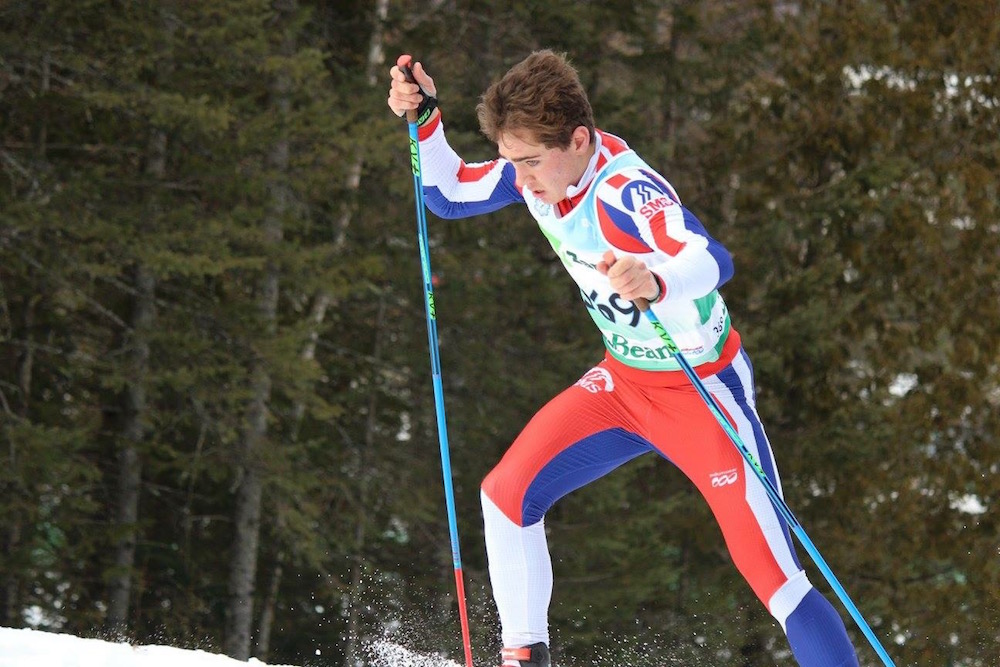
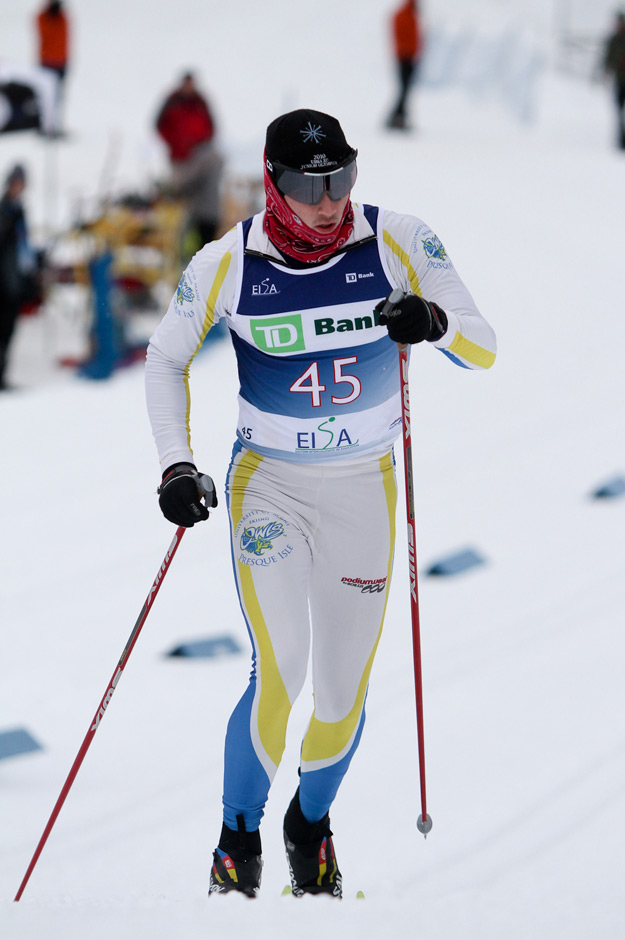
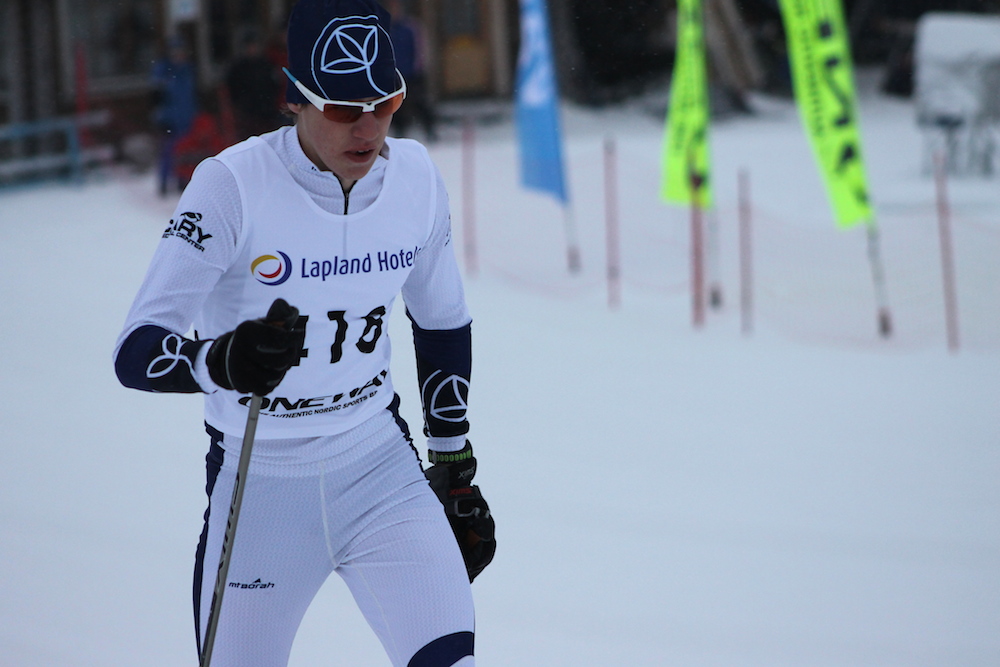
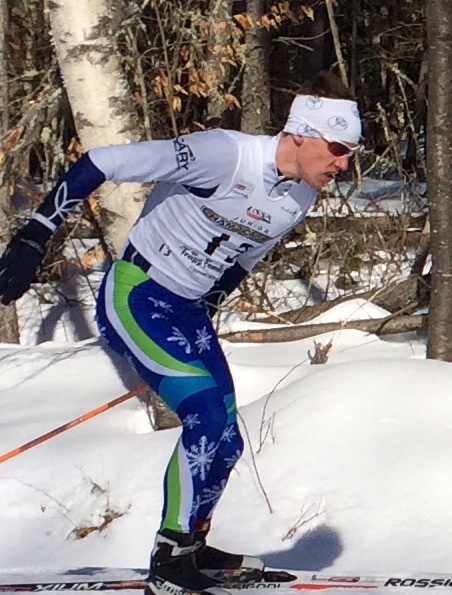
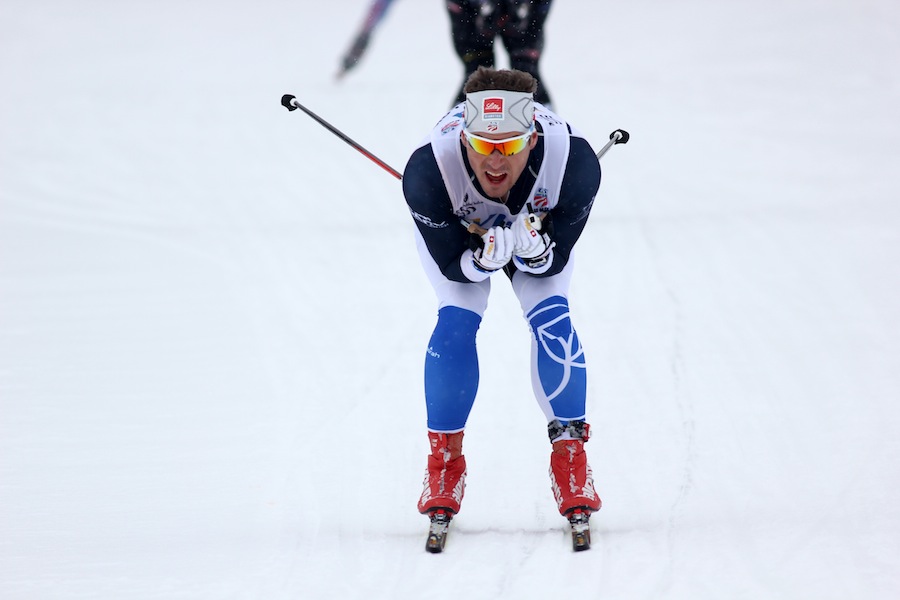
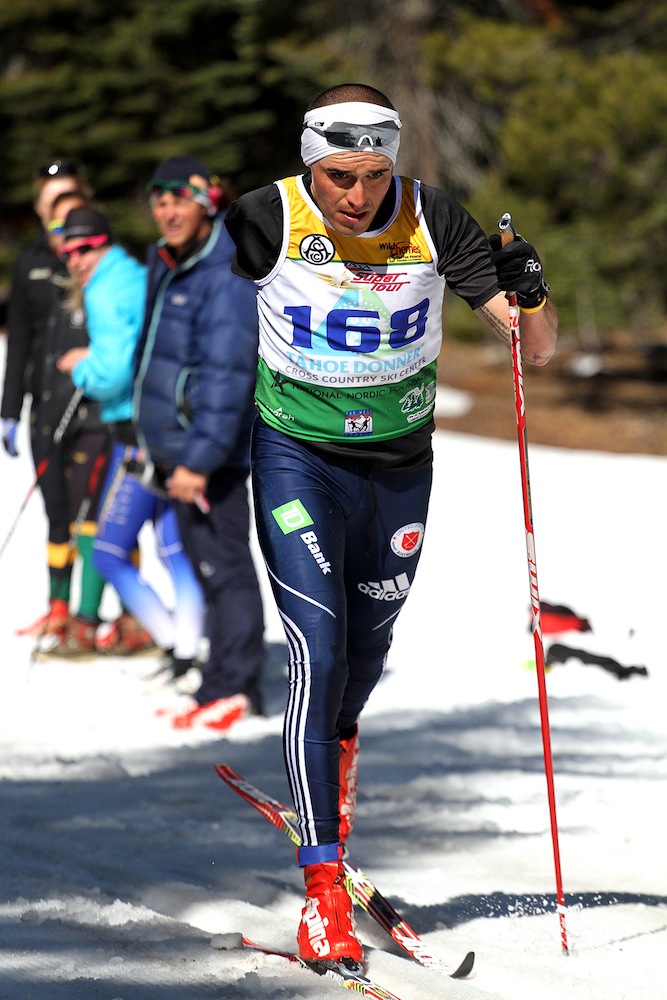
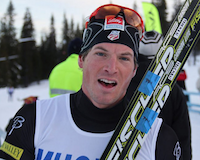
Kam Husain, of the Stratton Mountain School, racing at U.S. SuperTour Spring Series last season in Craftsbury, Vt. (Photo: NENSA/Facebook)
In an effort to showcase the North Americans competing at this week’s International Ski Federation (FIS) 2017 USANA Nordic Junior World Championships and U23 Cross Country World Championships at Soldier Hollow in Midway, Utah, we asked those qualifying athletes several questions about themselves — actually, we had them fill in the blanks. Here we have 19-year-old Kam Husain, of the Stratton Mountain School, who’s representing the U.S. at his first Junior Worlds.
***
“My full name is Kamran Husain, but you can call me Kam. I was born in Leonardtown, Md., raised in Fort Kent, Maine, and one thing you should know about my hometown is we grow lots of potatoes.
I started cross-country skiing when I was six, thanks to MWSC [Maine Winter Sports Center]. I currently train in Stratton, Vt., with SMS [Stratton Mountain School].
If I’m not skiing, you might find me rewatching ‘Game of Thrones’. If I had to pick a favorite book, it would be ‘Outliers‘.
One of the things I’m most excited about for Junior Worlds at Soldier Hollow is racing a skiathlon. One race I’m especially targeting there is the classic sprint.
The best advice anyone ever gave me about skiing or racing was to pace myself. One of the best race memories I have is winning the NENSA J2 Fest.
If I could meet one World Cup skier, it would be Katharine Ogden.
If I don’t end up being a professional skier, I’ll probably be somewhere a little warmer.
I’m missing zero days of school to be here; I’m taking a gap year.
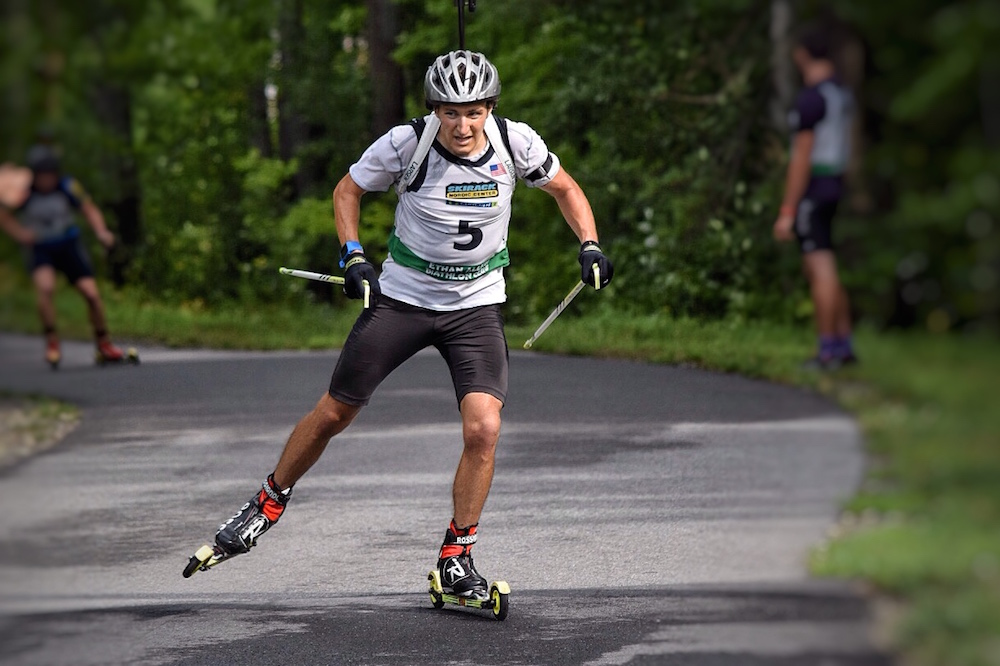
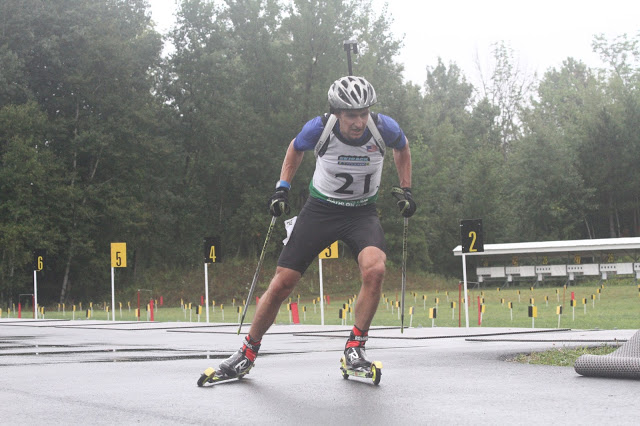
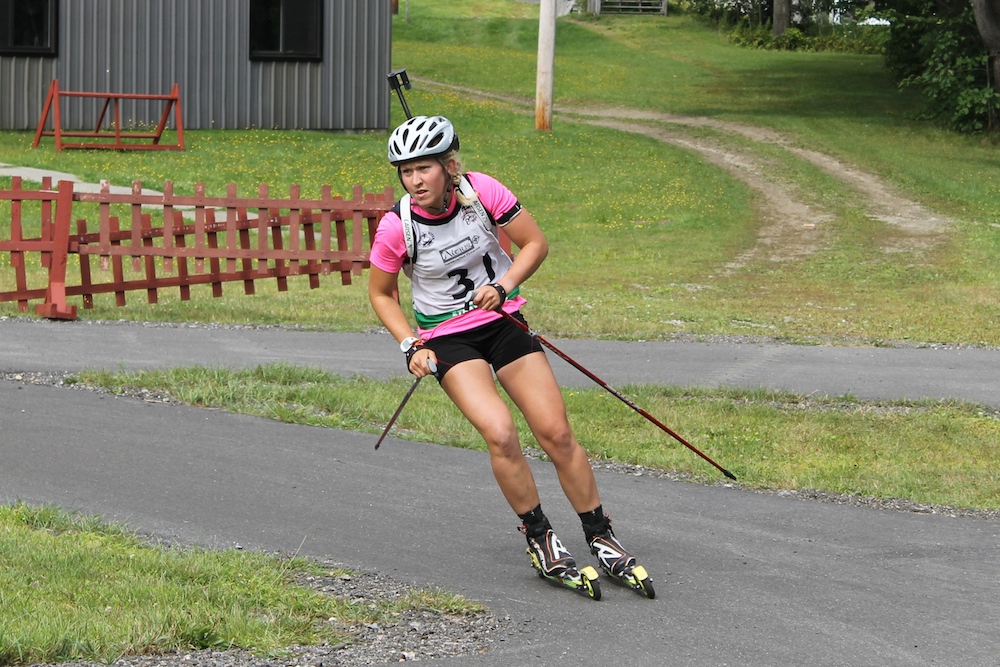
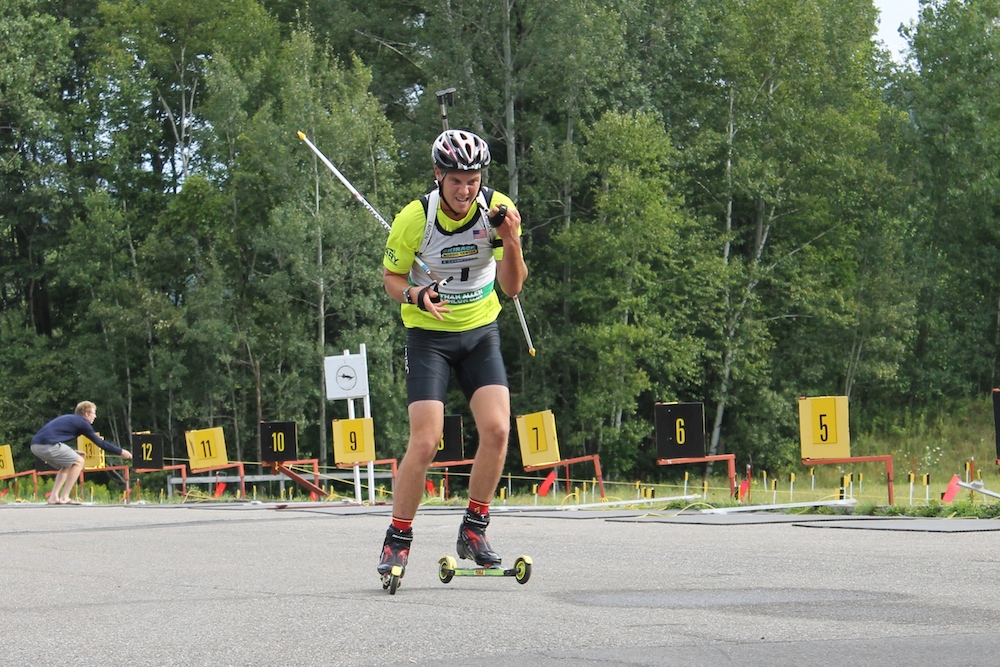
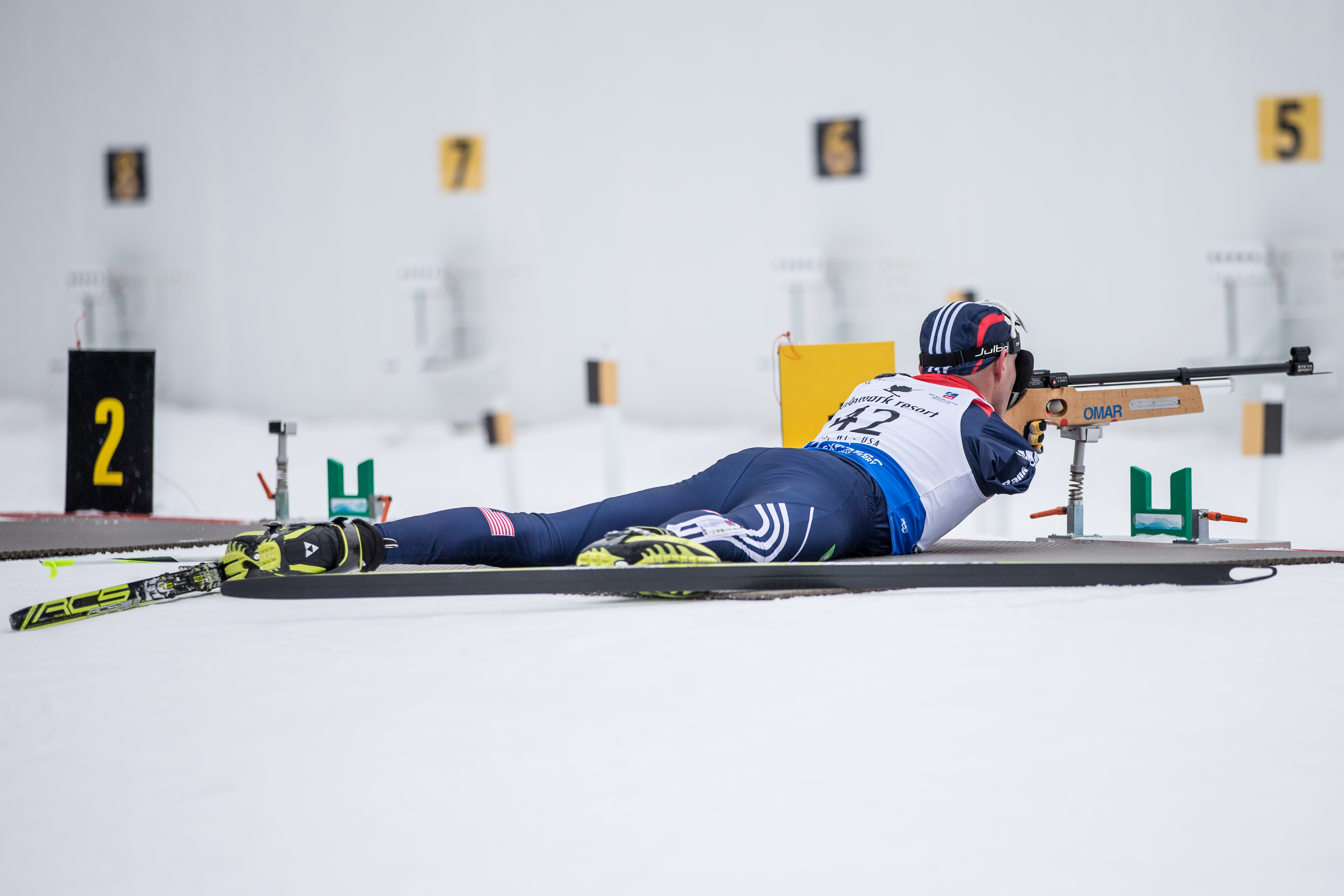
Russell Currier (Outdoor Sports Institute) during the men’s mass start at the 2016 US Biathlon National Rollerski Championships on Aug. 14 in Jericho, Vt. (Photo: Katrina Howe)
“The season that never was continues at its steady pace.” That was how Russell Currier, a three-time national team biathlete and 2014 Olympian opened one of his blog posts in late March of this year.
According to that month’s post and the two months prior, Currier’s ski career had reached an all-time low. While the two seasons prior (2013/2014 and 2014/2015) involved him racing on the national team and within seconds of top-20 times on the International Biathlon Union (IBU) World Cup, the year after saw Currier relegated to a reserve-athlete status. Within two years he had been dropped from the national team and was watching races he had formerly been competitive in from the screen of his laptop.
The sudden change wasn’t easy on him.
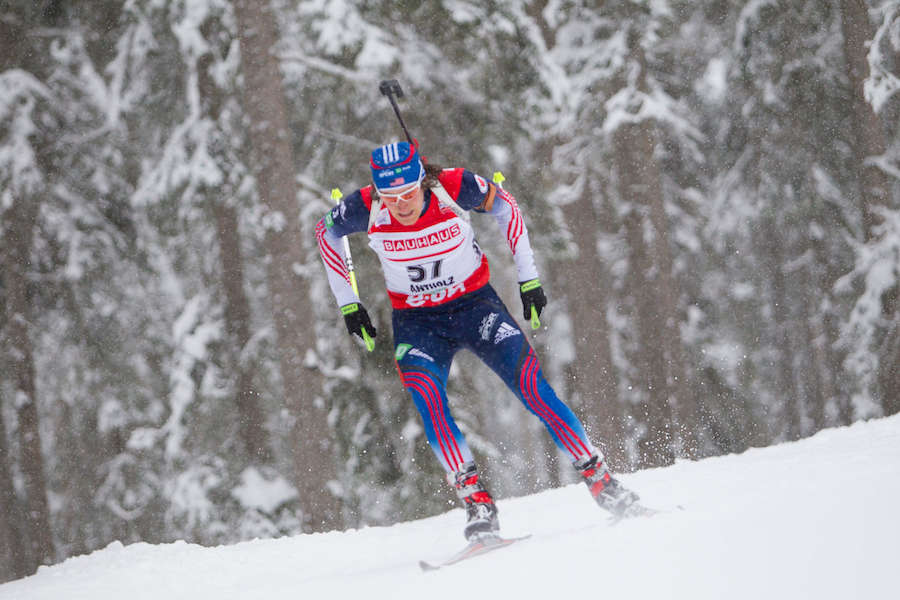
Former national-team member Russell Currier competing in a 2014 World Cup sprint in Antholz, Italy. (Photo: USBA/NordicFocus.com)
Currier, now 29, had spent countless hours, even as an eighth grader, with a headlamp and bounding poles on his hometown hills in Stockholm, Maine, contemplating how many 5:30 a.m. intervals he could fit in prior to school, while his peers contemplated how many more times they could snooze their alarms.
He had worn the U.S. colors competitively not only at IBU World Cup events, but at the Olympics in Sochi, Russia, as well. But last season, he watched his former US biathlon teammates race against the backdrop of Italy’s Dolomite mountain range, while he looked on from the couch.
“I went from being convinced I was going to keep racing biathlon to looking for something else whether it was marathon racing or just a whole new career,” Currier said on the phone from Maine. “It was a little tricky trying to find a definitive decision by the end of April.”
But by the end of April, Currier had reached a decision. Throwing caution to the wind, he decided once more to live, eat and breathe biathlon.
“…[Here’s] to thrashing it for another round,” Currier wrote in an April blog post. “In the long run, if I win I win and if I lose, I win.”
“I just wanted to see if I could produce any results or make anything happen again,” Currier said in November of his decision to give biathlon another go.
According to US Biathlon Chief of Sport Bernd Eisenbichler, Currier’s decision to continue was also encouraged by his national team’s coaches.
“Russell was unsure in the spring, if he should continue with the sport after a disappointing season 15 – 16,” Eisenbichler wrote in an email. “We had a couple of calls together with him and the coaches and at the end of this discussion process he decided to keep going.
“It was clear for everyone involved, that some things at the shooting part must change and Russell and his coach at home Seth Hubbard put forward a good strategy and we could provide a few good resources to support that,” Eisenbichler continued in the email. “We know, that Russell has the physical capacity to lock top results at the [World Cup].”
With that in mind, Currier got back in the training lane. He spent his summer and fall once more in “the County”, exploring Northern Maine’s treasured trails and roads. Involved with the Maine Winter Sports Center since the beginning of his biathlon career, he remained affiliated with the revamped-and-renamed center, now the Outdoor Sports Institute (OSI), despite it shifting its emphasis away from elite teams. Along with its name change, Currier also witnessed a change in financial support when the program drastically reduced its Olympic Development Team funding in the spring of 2015.
“It was mostly in terms of resources,” Currier explained. “When you have to make a trip happen to qualify for a team and you need the support financially to make that plane ticket and that hotel room, it made things different in terms of needing to be a little more careful. But the core is still there. We still have practices held every few mornings a week and we still have races.”
Since no senior elite biathlon team for OSI presently exists, Currier spent much of his offseason training on his own or with under-23-aged athletes who joined OSI for the summer. The work appeared to pay off, and by late August, Currier was racing well at this year’s US Biathlon time trials in Jericho, Vermont.
Russell Currier (OSI) competing in the men’s mass start sprint race in Jericho, Vermont August 2016.
In order for Currier to be selected to US Biathlon’s World Cup team, however, he needed to also perform at Biathlon Canada’s time trial races on Nov. 9 and 10 in Canmore, Alberta.
In Canmore’s two 10 k sprints, Currier placed 10th on Day 1 (the third U.S. man behind Lowell Bailey and Tim Burke, respectively) and seventh on Day 2 (again, the third U.S. male behind Burke and Bailey, respectively, both of which had already prequalified for the World Cup). A day after the races finished, Currier received an email informing him that he had been selected to compete in World Cups 1, 2 and 3 on the IBU World Cup this season.
“It was a huge relief,” Currier said of being named to the team. “It feels good and it was just a huge relief.”
His selection includes the IBU World Cup opener in Östersund, Sweden, as well as races in Pokljuka, Slovenia, and Nove Mesto, Czech Republic.
But in order to race those weekends, Currier must requalify at an IBU Cup prior to the start of the World Cup season, since he did not race any World Cups last season. Currier planned to leave the U.S. this Tuesday, Nov. 22, for the IBU Cup in Beitostølen, Norway, this Friday through Sunday.
“In order to prevent anybody coming out of the blue that isn’t qualified to be on the World Cup, or shouldn’t be there, they have a standard you have to meet at the IBU Cup just below the World Cup,” Currier explained. “So I have to fly to Beitostølen first, race the sprint race there [on Friday] and meet the standard.”
Though Currier still needs to requalify for the IBU World Cup, Eisenbichler has complete faith in Currier’s ability to compete against other World Cup regulars, grounding his decision to select Currier based on his recent sprint performances.
“Just like in the past years, we kept one spot open for the Dec [World Cups] on the men’s side,” Eisenbichler wrote. “We agreed to take the winner of the roller ski trials (2 races in Aug and 2 races in Oct) and one athlete by discretionary choice to the WC prep camp in Canmore and decide there after the camp is finished, whom of the two we take on to the [World Cups] in Dec. Russell won the trials and Paul Schommer was our discretionary pick.”
“Both worked very well at the camp and were close in training, but Russell was stronger than Paul in the two races at the end of the camp,” Eisenbichler continued in the email. “As he was also the winner of the trials races we decided to pick Russell. on top of the Biathlon complex performance, Russell showed also a higher level at physical side in terms of ski speed.”
As Currier prepares to pack his bags for Europe and potentially another full World Cup race season, he is relieved to be back on US Biathlon’s World Cup Team, but also more open to adjustment than he’s perhaps been in the past.
“It’d be nice to stay on the World Cup … and then beyond that it would be nice to make the 2018 team,” Currier said of his goals within the sport. “But after last season, it’s just kind of a day-by-day, month-by-month structure, more so than in the past. At this point, it’s just if I can say I tried, it’s better than nothing. If I try, I succeed.”
***
We asked Currier to give our ’17 Questions for 2017′ a go. Here are his responses:
1. Biggest change in your life in the last five or so months since the ski season ended?
I invested in a new, French-made stock. Since I’ve been using the same stock for the last six years, it has taken some adjustment. My neighbor is a machinist and has helped me out with a lot of custom made parts that supplement the original design. He made me a bladed trigger a while back, which is exactly what it sounds like, an incredibly sharp trigger which creates a major incentive not to jerk the trigger quickly.
2. Biggest change in your training?
This will be my lowest year in terms of volume since I was a junior. However, I’ve added in a little more intensity and the overall quality of my training has been better.
3. Major areas of improvement you’ve seen so far?
The base for my position in prone is much more stable this year. Tight and consistent groups are possible now. I worked a lot this summer with one of the professional marksmen that has assisted USBA in the past – he’s an Olympic gold medalist, so he has a lot of good advice. Though the sports are fundamentally similar, they are executed at different speeds and heart rates, so there’s a lot of adaptation that has to take place.
4. Whom you’ve been working closest with this offseason (coaches or training partners)?
OSI’s (Outdoor Sports Institute is the renamed Maine Winter Sports Center) Seth Hubbard has been a super helpful coach despite the lack of resources for an OSI elite team. Since OSI lost funding it has been a bumpy road. As one of the only places in North America with a fully paved, world class biathlon venue, it’s still a great training ground and is open to more attention
5. Best trip in the last five months (and why)?
Canmore, it just felt nice to be back in the training camp schedule and working with the national team again. Plus, it’s great to get on snow as early as October to readjust to the different feel of natural skiing.
6. Favorite cross-training?
Running, it’s the most affordable and all terrain form of training there is. There’s a certain ease and ensuing calm in doing something your body was made to do.
7. Favorite non-athletic activity or pastime this summer?
Mostly nerd things and it’s finally deer season. Though, I’m down to one afternoon left to see anything in the field.
8. Song that was your jam this summer?
We’re Not Going To Make It – The Presidents and Lingonberry was my favorite jam.
9. All time favorite race moment?
Maine State meet class B Sophomore year. Very few in Rumford saw that win coming.
10. First thing you pack in your bag when you leave for Europe?
Noise cancelling headphones, batteries for headphones, then back up headphones. I think mental recovery is as important as physical recovery, and quiet is a crucial part of that. On the road, that can be hard to come by.
11. Venue/event you’re most excited to visit this season?
Nove Mesto, CZ. Nice, closed in and well balanced profile. A course built more for skiers and less for TV cameras.
12. Who will win the men’s and women’s World Cup titles this year?
I don’t follow XC enough to make a bold decision and biathlon is too off the wall inconsistent to call.
13. Biggest sacrifice you feel you’ve made choosing this career path?
An income.
14. If you could change one thing about your sport, what would it be?
No doping, no politics.
15. What did you have for breakfast this morning?
A lot. About half of my caloric intake comes from breakfast. I really think highly of breakfast
Casey Smith (Maine Winter Sports Center/U.S. Biathlon B-team) on his way to placing second in a NorAm mass start in Canmore, Alberta, in December 2014. (Photo: Jake Ellingson)
Casey Smith has endured a few things that would cause any athlete to question whether to continue with their professional career.
In February 2015, the Washington biathlete crashed hard while training in Canmore, Alberta, before the International Biathlon Union (IBU) Cup races to be held a few days later. He was knocked unconscious, broke ribs, a shoulder blade, and bones surrounding his vertebrae, and punctured a lung.
But Smith – using the physical and mental endurance he had cultivated in biathlon – persevered, joining the Craftsbury Green Racing Project (CGRP) in Vermont and returning to international competition in the 2015/2016 season.
“It definitely [felt sweet],” he said of a few good races last season. “It was really cool to be able to – I got back to the same level I was at before. In Europe this year I didn’t have quite as good results as the year before, but also the first week I got food poisoning really bad. That took a pretty big toll on me, and didn’t have anything to do with the crash.”
Come spring, the 24 year old decided to call it quits with his biathlon career and return to Bozeman, Mont., to finish a degree at Montana State University. He had enrolled after high school before transitioning to being a full-time athlete.
His decision was unrelated to the ordeals of the year before. It came down to something much simpler: joy.
“The whole year of the training season and racing season, I wasn’t feeling as motivated,” he explained on the phone from his home in Washington’s Methow Valley. “I said that I wanted to do this as long as I was having fun, but it was turning into more of a job kind of thing. It was getting to the point where it wasn’t as much fun anymore. So I thought it was time to move on.”
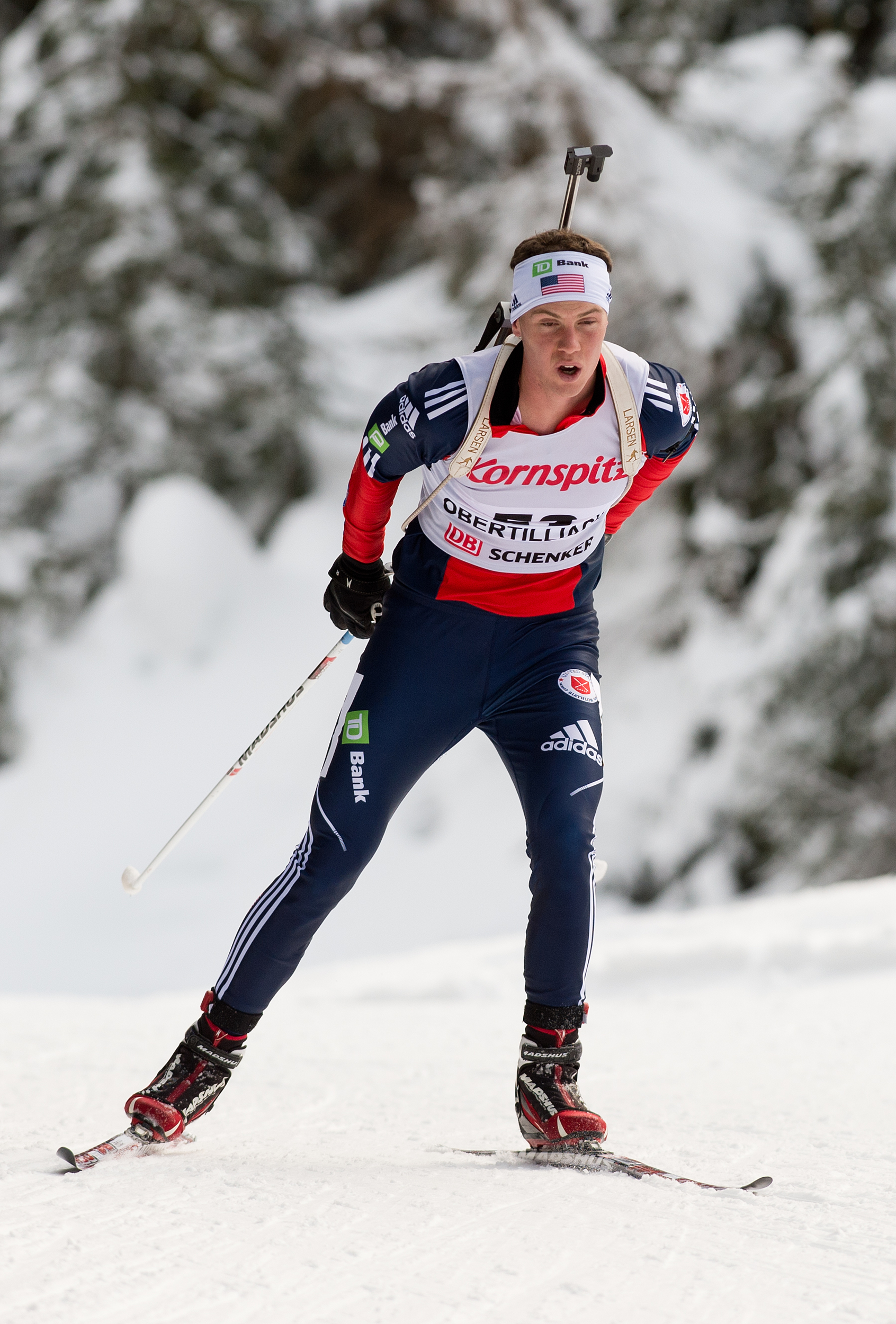
Casey Smith (USA) en route to 37th place in the junior men’s individual at 2013 World Junior Championships in Obertilliach, Austria. He had his career-best finish of 23rd place in the pursuit there. (Photo: US Biathlon/NordicFocus.com)
Smith was a top junior for the U.S. before and during his first stint in Bozeman. He had top-30 finishes at World Youth and Junior Championships in 2011 and 2013, as well as two apiece at Open European Championships in the junior races in 2012 and the senior races in 2014.
“It was great having other guys to train with,” he said of his time in Vermont. “I really hadn’t had too much of that, at least when I was in Maine. So that was really nice, and I really enjoyed working with Pepa [Miloucheva]. It helped me with my ski technique a lot, for sure.”
Looking back, he said having the chance to travel the world was one of the best things the sport had offered him.
“The last several years we would always go to Canmore over Thanksgiving, and so I could build relationships with people there,” he said. “Then when you land in Europe at competitions you run into them again, and I was able to make friends from all around. That was pretty cool.”
There were results highlights from this season, too.
“At [U.S. National Championships], it was really cool that all the national team was there [after the World Cup finished],” he reminisced. “It made it real races. In the sprint I had a pretty good race, and right in the mix. Also in Canmore at the trials it was a little bumpy the first few, but the last race I was finally able to pull it together and have a really good race.”
After the injuries sustained the year before, Smith had attacked training and racing with a new direction, and it worked.
“It was a traumatic experience, but I felt like I was able to bounce back from it miraculously quickly,” he said. “It almost helped me a little bit because I was so much more focused on being perfect on my physical therapy and being super diligent every single day. So I had to be really focused in general.”
Casey Smith leads Craftsbury Green Racing Project Head Coach Pepa Miloucheva at a training camp at La Forêt Montmorency, Quebec, in November 2015. (Photo: Caitlin Patterson)
And yet, he became aware that he wasn’t as fired up to keep it up for years. He decided that he would return to Bozeman for the fall semester. Smith initially told himself that he would return home to Washington and mull over whether to continue to compete while he finished his degree, or to call it quits on biathlon altogether.
The latter won out, and now he’s fully invested in school and his future outside of sport.
“I’m going to be in the animal science program,” he explained. “My plan is that my family has a small sheep farm here in Washington, and I’d like to come back and grow that bigger… and live in the Methow and have that lifestyle.”
Most of the friends he started school with at Montana State years ago have graduated, but that didn’t concern Smith.
“I feel like now I’m going to school because I want to learn, and before I was there because I wanted to do biathlon and train and there was other people doing that there, and by the way I was going to school on the side,” he said. “Now I’m going there because I really want to go to school.”
Until the fall semester begins, he’s helping his family and uncle out on their farms and doing odd jobs in the Methow Valley.
He may help with biathlon in the Bozeman region, and will definitely help his mother, Betsy Devin-Smith, who is the head coach of the Methow Valley Nordic Ski Education Foundation’s biathlon team.
“I’m sort of stuck helping her with that, like it or not,” he joked.
Of the life transition, Smith said that everything was feeling good so far.
“I don’t really miss it now,” he said of biathlon. “The opportunity to ski as often, maybe I’ll miss. I’m sure I’ll still ski a lot, but not every day for hours.”
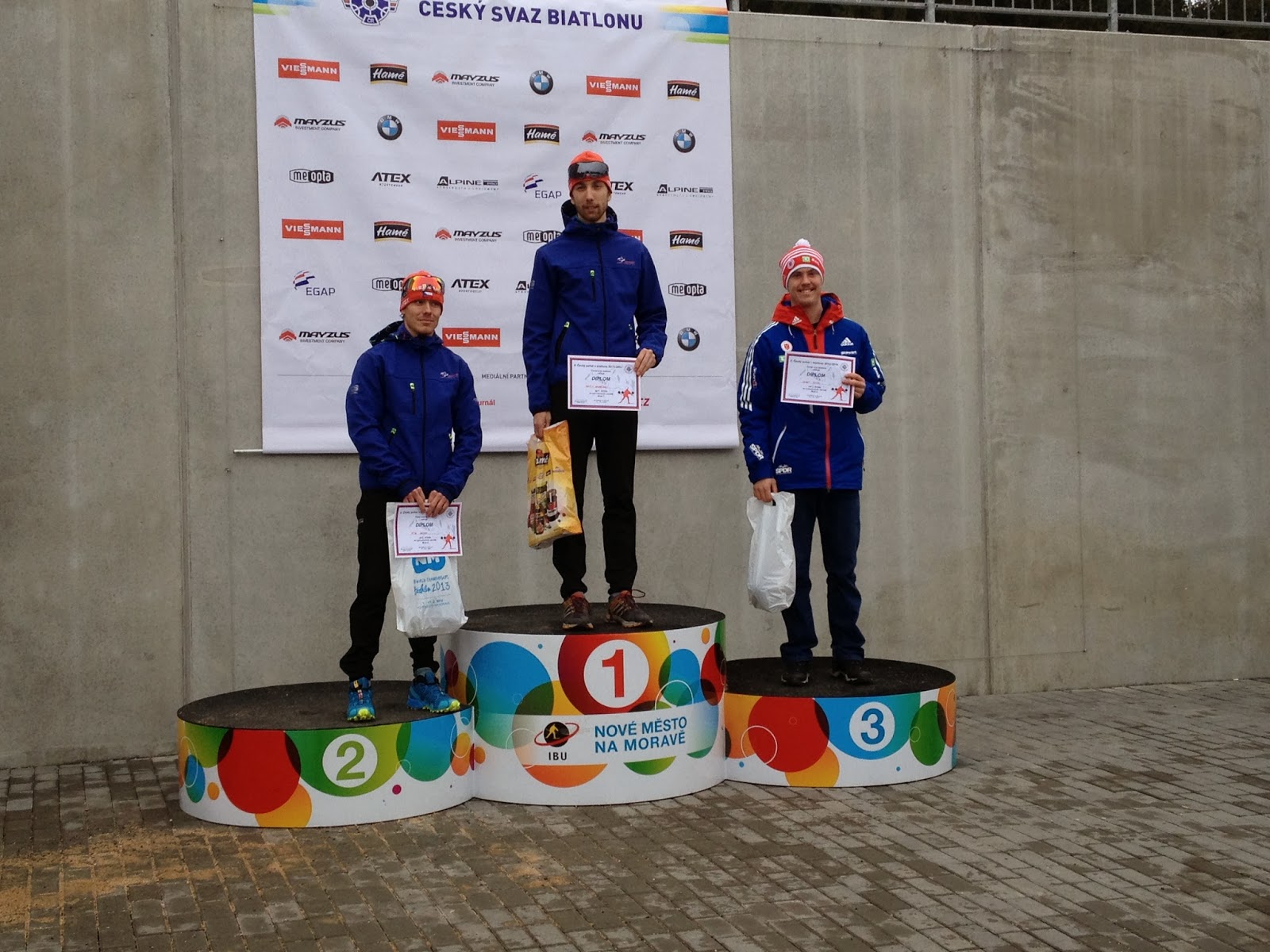
Casey Smith (right) on the podium at a Czech Cup biathlon race in 2014. (Courtesy photo)
Not just winter sports, the Maine Winter Sports Center (MWSC) becomes the Outdoor Sport Institute (OSI). (Photo: OutdoorSportInstitute.com)
Sometimes change is due to a slow drip, other times it’s a tsunami.
In July, Andy Shepard, founder and president of the nonprofit Maine Winter Sports Center (MWSC), announced a name change. MWSC was rebranding as the Outdoor Sport Institute (OSI). Although the new name is without its homegrown “Maine” roots, OSI will remain very Maine-centric.
OSI Program Director Mike Smith explained in a phone interview that OSI’s name change was the result of the slow-drip kind of change. Smith has worked for the MWSC since 2009. He began as a community development coach, was promoted to community development director, and in the spring of 2014, became program director and chief operating officer (COO).
“The evolution that is being seen now is really an evolution that started years ago and especially about two years ago — we started going through some big changes,” Smith said. “And now the name and brand change is reflecting the things that already started to evolve several years ago and that we have been working on. We reached the point where it really became necessary to update the name to better reflect everything we were doing.”
The changes Smith spoke about are twofold. First, MWSC lost major funding back in April 2014. That was the tsunami type of change. But almost immediately, the center began trying to raise money. Shepard spearheaded a fundraising campaign with seed money from Mary Barton Smith, a Presque Isle, Maine, native and philanthropist. Barton Smith (no relation to Mike Smith) also pledged to match significant dollars to an ongoing $20-million endowment campaign — in a recent Mainebiz article, Shepard said Barton Smith’s contribution could be upwards of $8 million, as the endowment process continues to build momentum.
OSI will support junior-level biathlete development as well as biathletes in its gap-year program. (Photo: OSI)
The second aspect of MWSC’s change, also precipitated by funding limitations, is something that intially alarmed the U.S. nordic community. In the past, a select group of emerging and national-team biathletes and cross-country skiers could count on some financial, housing and logistical support from MWSC.
“We recognized a couple years ago that the current model of ski clubs in the U.S. was not one that I think where we are going to be strongest,” Mike Smith said. “We wanted to focus more on juniors, more on developing kids at that youth and high-school level up through and into their post-high-school careers since we simply don’t have the funding to support athletes for three to four — five years into their adult career … I know a concern in the cross-country world has been, ‘Oh now we are losing this program and we don’t care about competition.’ I would just reiterate that that is definitely not the case. We have moved ourself out of the same category as an APU [Alaska Pacific University] and Sun Valley Ski team, but we are connected as ever to the ideas of outdoor sport and what you can do with it. I think big picture, what we can offer in competitive sport will grow beyond nordic sport, but it will continue with nordic sport.”
At this point, OSI will not attempt to challenge the Stratton Mountain School (SMS) T2 elite teams of the world. But according to Smith, those initials — OSI — will have a lasting imprint on the future of Maine as both the state’s rural communities and OSI define their new possibilities.
Simply put, the institute is a four-season organization.
Winter may be last seemingly forever in Maine, but the earth spins and spring and summer inevitably come. For the past few years, under the MWSC banner, and now OSI, the organization branched out beyond winter sport.
“We have moved ourself out the same category as an APU [Alaska Pacific University] and Sun Valley Ski team, but we are connected as ever to the ideas of outdoor sport.” — Mike Smith, OSI program director and chief operating officer
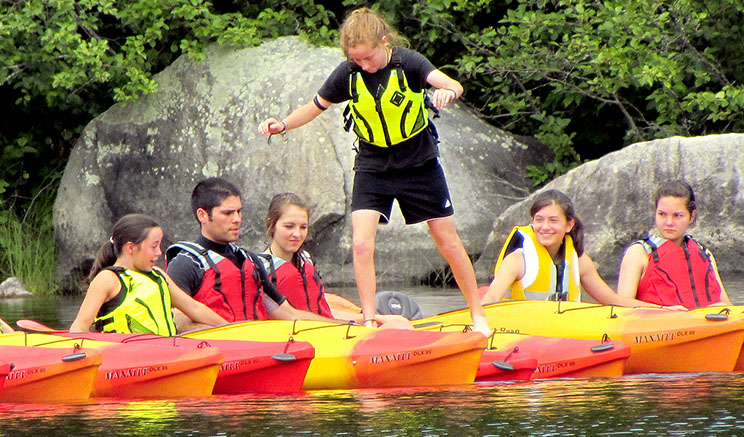
Since its inception in 1999, MWSC’s core mission was to provide wellness opportunities through sport for some of Maine’s most rural and economically depressed communities. Beyond the nordic sports, primarily biathlon and cross-country skiing, OSI will offer resources and classes in whitewater kayaking, trail running, stand-up paddling, and mountain biking — activities MWSC had already begun offering.
“The mission of the Maine Winter Sports Center was originally based on using skiing to create a model of sustainability for rural communities in northern Maine,” Shepard explained in an interview with Mainebiz. “That model included an economic development component based on the building of Nordic venues and redevelopment of alpine ski areas, as well as a full range of programs intended to empower kids through a world-class curriculum of outdoor sport education. Over the years, paddle sports, mountain biking, hiking and climbing were added and our scope became statewide.”
Yet bringing opportunities to a vast region mandated a rethinking of how the nonprofit was organized. Smith explained that OSI is decentralized despite MWSC’s name being historically linked with nordic facilities in Fort Kent and Presque Isle.
“Here in Maine you talk to people about Maine Winter Sports Center and they assume that you are talking about a specific facility and specific facility in a specific town which isn’t the case,” Smith said of how OSI will branch out in the state. “We don’t own those nordic venues in Fort Kent and Presque Isle. We still work with them and we have athletes training there, but those facilities are managed by local nonprofit organizations. And we felt it was important that people recognize that and don’t assume that those places are ours and that we are taking care of them because those folks are looking for support as well.”
For now, although he is on the road most days, Smith’s office is based in Caribou, Maine, just north of Presque Isle at the northeastern tip of the state. Shepard, OSI’s CEO, keeps his office at the other end of Maine, nearly 300 miles south in Freeport. OSI maintains its adventure director in western Maine, development directors in the mid-coast region, its head biathlon coach in Fort Kent, and a head nordic coach positioned in southern Aroostook County. Mid-state, OSI stores its equipment and trailers to more efficiently deliver gear to communities engaging in its programs.
With its tentacles throughout the state, Smith explained that OSI is better positioned to foster long-term healthy lifestyle choices among Maine’s residents. The state’s past reliance on natural resource extraction — the bread and butter of many rural communities — is having its day of reckoning.
That leaves many towns struggling to maintain a positive self image. By more fully realizing its mission of increased participation in outdoor sport, Smith believes OSI is a resource for those places.
“From my experience, it’s not from an economic place first, it’s from a wellness place,” Smith said. “It’s a, ‘Jeez, we have this awesome spot, how can we get our community out here?’ Because we know it is good for our community.
“Our focus is for programming and engaging people in outdoor sport and then what they [the community] can do to help facilitate. It’s not like we are showing up and saying if you all learned to mountain bike, your entire community’s economy is going to change. We are saying, if you engage in this, the same tool that makes you successful in engaging in this are the tools that can help you be successful in forging out where you want to go and what you want to do with your life and with your community.”
Supporting a community, according to Smith, can have different looks: OSI can rent equipment like mountain bikes, stand-up paddleboards, and cross-country skis so a summer class can be offered, an after-school program, or a two-week physical-education unit. OSI also offers classes for educators so they, too, can run outdoor sport programs. Adults will have the opportunity to participate in local OSI clinics or participate in more complex adventure or athletic trips.
“We are not just there to just show up for two days and run this camp, we are there to work with that community to figure out how this can work long term for them,” Smith explained.
Left to right: MWSC biathletes Brendan Cyr, Mikaela Paluszek and Russell Currier during a head-to-head shooting workout last December 2015 at the Fort Kent Outdoor Center in Fort Kent, Maine. (Courtesy photo)
Back to the earth spinning — winter comes early to Maine. And OSI will compliment what MWSC has done in the past with regards to biathlon and cross-country skiing, but not at the post-collegiate level. OSI is still interested in podiums, but its place is in fostering, what Smith referred to in an email as, “participation and performance” at the junior levels of the sport.
OSI will offer what it is calling “gap-year support” to nordic athletes between the ages of 17-20, up to two years out of high school.
“We have realized that, especially here in Maine, at the junior level if we want more folks on the podium at an upper level, we want more folks engaged at a lower level. And I think everyone understands that wherever they are,” Smith said about promoting nordic sports at the highest levels. “And we recognize that we need to figure how to help more young people self identify first as an active person that wants to go outside let alone someone who is interested in competing in nordic sport. And we are lucky in that we have a diverse array of programs under the OSI umbrella that is pulling a lot more kids in starting at ten years old, then up through high school. And we have made structural changes in high school racing programs so that now we have more OSI coaches on the ground in more parts of the state working to get more new faces out there.”
Several athletes, including Russell Currier, Kelsey Dickinson and Casey Smith, had already lost their funding due to MWSC funding cuts in 2014. Dickinson left biathlon (at least for now) and returned to the College of St. Scholastica, where she was the runner-up in the 5-kilometer freestyle at 2016 NCAA Central Regional Championships. Casey Smith (no relation to Mike nor Mary Barton Smith) joined the Craftsbury Green Racing Project to continue his biathlon career.
Mike Smith explained that OSI is currently without any collegiate or post-collegiate cross-country skiers. They will begin recruiting athletes for their 2017 gap-year cross-country program this fall. The biathlon racing team will consist of two gap-year athletes and three University of Maine-Fort Kent biathletes.
Seth Hubbard, sport development director and biathlon head coach for OSI, said in an interview that 2014 Olympic biathlete Currier continues to train with OSI and his assistance from OSI is limited to training-site support. As for potential gap-year athletes in biathlon or cross-country that would like to transition into the elite levels of their respective sports, “We can set them up for that,” Hubbard said.
Although not involved with the highest end of competitive nordic sport, OSI is committed to building toward the future. There’s a name change and a bigger umbrella when considering the scope of their mission.
“All that is about building capacity for everybody. We recognize that no matter how many coaches we have at the high-school level, no matter how many adventure programs we have at a high-school level, no matter how many kids in our gap-year programs both in competitive sport and in adventure, we have a finite number,” Smith said. “But if we can work with communities through youth development through education, through equipment rental, though trail development, the impact we can have is exponential. And everyone wins.”
The McCall Winter Sports Club (MWSC is a member club in the Intermountain Division) is looking to fill a Head Nordic coaching position. The MWSC is a combined Nordic, Alpine, and Big Mountain program that is based in the mountains of McCall, Idaho. Currently, the Nordic Program has approximately 70 participants that are supported by a core group of assistant coaches and parent volunteers.
McCall boasts a great variety of Nordic ski areas that offer skiing from late November through mid-March. The three primary Nordic ski areas (Bear Basin, Ponderosa State Park, and Jug Mountain Ranch) have extensive trail offerings that provide a wide range of terrain for skiing.
McCall, ID (population ~3,000) is a small mountain resort town located on the shores of Payette Lake. It is located 100 miles north of Boise, Idaho (state capital with an area population ~ 350,000+). There are three local alpine ski areas that serve your lift serve needs (The Little Ski Hill, Brundage Mountain and Tamarack Resort) and excellent access to backcountry skiing. McCall is also situated in the heart of some of the best river running (kayak/raft) in the U.S. There are ample mountain lakes and bike trails to explore.
Maine Winter Sports Center (MWSC) biathlete Brendan Cyr finishes his second round of prone shooting during a late-December workout at the Fort Kent Outdoor Center in Fort Kent, Maine.
Before the USA Youth and Junior Biathlon World Championship Team Trials kicked off this week (Dec. 27-30) in Anchorage, Alaska, FasterSkier caught up with the Maine Winter Sports Center (MWSC) biathlon program for a workout to help prepare athletes for the heat of the competition season. The workout can be done once or twice per training cycle and may be easily adapted into a cross-country workout.*
FORT KENT, Maine — What could be better than a rugged set of intervals with Northern Maine’s finest. How about a rugged set of intervals with a rifle?
Though not everyone can handle shooting with a simultaneously high heart rate, Seth Hubbard, biathlon director and head biathlon at the Maine Winter Sport Center (MWSC), said a head-to-head shooting workout is essential for biathletes looking to improve both their skiing and shooting.
“What we’re trying to do is recreate the pressure of coming into the range of a competition with other racers around,” Hubbard said on the phone.
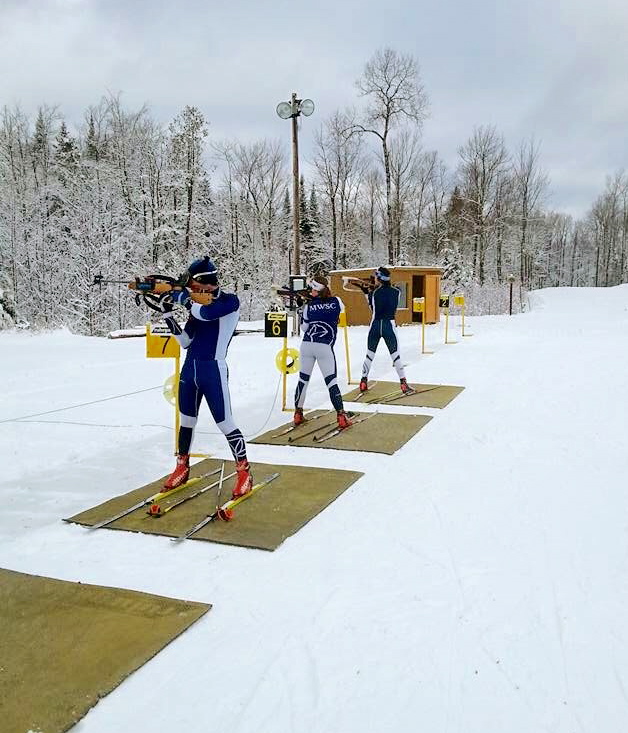
Left to right: MWSC biathletes Brendan Cyr, Mikaela Paluszek and Russell Currier shoot during a head-to-head workout in late December at the Fort Kent Outdoor Center in Fort Kent, Maine. (Courtesy photo)
In order to mimic the high stakes and stress of a race, the workout itself involves a 4 x 1-kilometer mass start, with shooting and 150-meter penalty laps to follow each 1 k interval loop.
“What it does is it puts a lot of pressure on shooting well. You want to shoot fast, but you also want to hit your targets because the penalty loops, in comparison to the 1 k loops, are a pretty large percentage of the [workout],” Hubbard pointed out.
The shorter-distance interval loops allow athletes to push the pace without overexerting themselves too much prior to upcoming competitions, while also providing a practice scenario for shooting with a high heart rate and high pressure.
“This is a workout we use as we get closer to competitions to mimic race efforts and race stress level,” said Hubbard, “It is also something we’ll use periodically throughout the year just to stay in touch with that stress of a shooting competition.”
Brendan Cyr of Caibou, Maine, currently a post-graduate biathlete at the MWSC who plans to attend St. Lawrence University next fall, said the workout strengthened his preparation for the Youth and Junior World Championships trials taking place this week in Anchorage.
“I like the workout because I get to practice shooting with a very elevated heart rate,” Cyr said during an in-person interview. “The head-to-head racing is also great preparation for competitions because [my teammates and I] generally hit the mats at the same time and have the added pressure of shooting with other athletes around.”
Current MWSC biathletes in the program, in addition to Cyr, include Brian Halligan, Cody Johnson, Hannah Streinz, Mikaela Paluszek, Maddie Phaneuf, and elite athlete, Russell Currier.
Brendan Cyr (MWSC) rounds the stadium of the Fort Kent Outdoor during a workout in late December in Fort Kent, Maine.
With a smaller team compared to previous years, Hubbard looks to expand the breadth of their program, as well as its depth.
“We don’t just want to push to get numbers if they’re not going to be the people who are going to mesh well with the program and mesh well with the area,” Hubbard said.
He added that the MWSC program continues to seek dedicated athletes willing to grow individually and athletically in the hillocks of northern Maine.
“Whether or not they’re going to be the next Olympian, we want to draw in and develop more mature athletes. Mature in the sense that they’ve developed — as an athlete and an individual — a better understanding of planning, process, commitment, and goal setting, whether those are in life or skiing.”
The Workout: Head-to-Head Shooting
Warmup: 20-25 minutes easy Level 1 skate skiing
Intervals: 4 x 1 k mass start with shooting and 150-meter penalty laps after each 1 k interval (depending on the amount of targets missed). Skiing should be continuous.
– Shooting format is prone, prone, standing, standing
– 1 k interval effort/pace should be race pace or just above race pace. “You’re trying to get race intensity experience — something that’s going to be a very challenging intensity to be shooting at,” Hubbard explained.
*Cross-country adaptation: Instead of shooting in between each 1 k interval, take approximately two minutes of rest before beginning the next interval piece.
Russell Currier working on strength at the Fort Kent Outdoor Center in northern Maine. (Photo: Seth Hubbard)
(Photo: Seth Hubbard)
(Photo: Seth Hubbard)
(Photo: Seth Hubbard)
(Photo: Seth Hubbard)
This week’s workout comes from Russell Currier of the Maine Winter Sports Center. A 2014 Olympic biathlete, Currier, 28, recently placed second in the US Biathlon trials, narrowly missing the cut for a national-team camp in Park City, Utah.
“The shape was pretty much what I wanted,” Currier wrote in an email after the second set of trials earlier this month. “It wasn’t great, but it shouldn’t be too fast in October. This year it felt less of a race for a 4th or 5th [World Cup quota] spot race and more of competition against the whole National team. It’s nice that the team has made improvements, but it makes qualifying in October more difficult.
From here, he’ll focus on the next set of team trials in December at Mt. Itasca in Coleraine, Minn.
“After that, the goal is to race well on the IBU cup and try to move up from there,” Currier wrote.
***
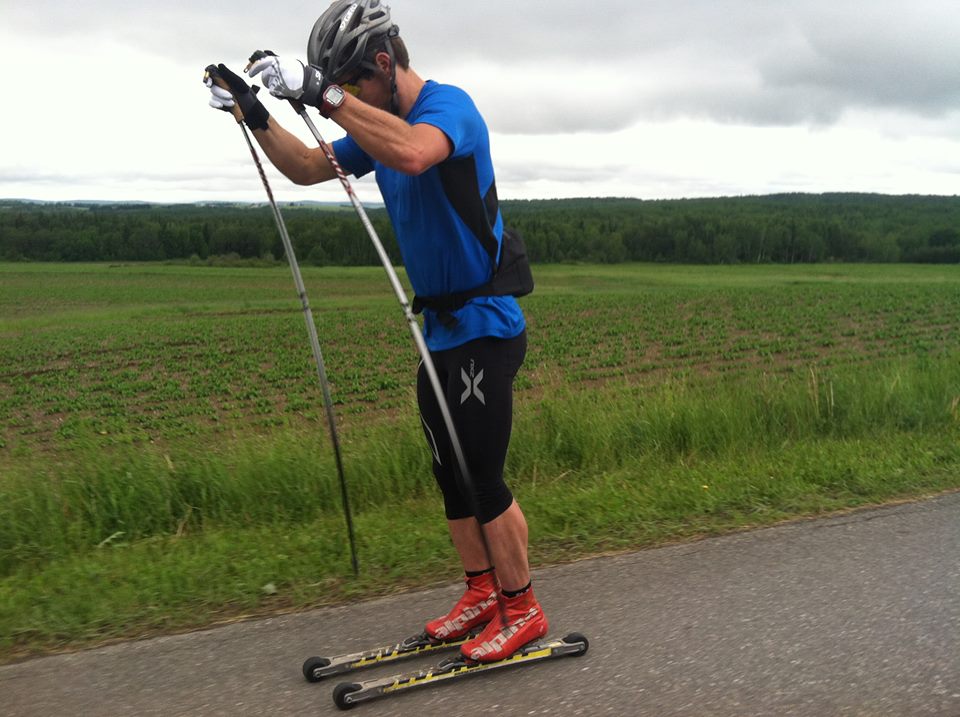
It may have been the start of the 2009, or maybe it was the 2010, training season when I first saw “TSS” written in a training plan sent to my inbox. Confused, I asked my coach for an explanation during a Skype meeting. To the best of my memory it was described as “rollerskiing up a short and steep hill while focusing on the best form and longest glide possible.” Or something along those lines. If I have to describe it to another athlete, I tend to start with saying it’s your most aggressive downhill technique, while skiing uphill. Truthfully, the first question usually refers to not knowing what TSS stands for. Since, this isn’t the most popular training idea in US Biathlon history, the answer may vary depending on who you ask. The common reply has been “Top Secret Strength” or just “Top Secret Stuff.” My personal favorite is “Totally Stupid Strength.”
Another way of describing TSS would be to think of it as hill bounding on skis. If you had to combine a weight-room strength session with a rollerski-technique drill session the result would be TSS. It’s on my training plan year round. All you need is a short, steep climb you can ski up and down repeatably without being in the way. You’re only going as far as you can in 20 poles plants so it doesn’t really need to be an alpine hill.
“If you had to combine a weight-room strength session with a rollerski-technique drill session the result would be TSS.” — Russell Currier, Maine Winter Sports Center (MWSC) Olympic Development Team biathlete
The purpose is to reinforce good ski technique and power with the exact muscle groups involved in that technique. The focus is to generate the best form and longest distance per cycle as you can. Any choice of skate technique will work. Sometimes this tends to feel like skiing in slow motion. Sometimes it feels strange to be forcing a slow tempo V2 alternate up a wall, but it also makes it feel that much natural on the flats and downhills. One of the advantages it has over hill bounding on foot is the use of double pole, adding an upper body component. In my experience, this is as effective doing core strength in a gym.
The Workout: Technique Specific Strength
The Place: Groomed trails or pavement. Steep, approximately 30-meter-long climb.
Warmup: Easy distance skating 15 to 20 minutes.
The Important Part:
– 5 x 20 Double Poles
– 2 x 20 Skating without poles
– 2 x 20 V2 cycles
Repeat once or twice and add some extra V2 alternate and V1 sets if the energy is still there. Should be 15 to 25 cycles, or pole plants, depending on the technique.
Total routine is about 25 to 45 minutes.
Cool Down:
20 to 30 minutes easy skiing or running
When there is a bad habit in your technique that you can’t seem to forget, this is the workout to use to combat that habit with a correct one. TSS doesn’t require a lot of resources beyond decent trails and functional equipment. This is a strength training that contributes directly to the sport we’re trying to compete it. I’m always trying to update the quality of training in my plan. That being said, the afternoon TSS sessions still find a place in my average week.
Justin Fereshetian representing the University of Maine Presque Isle at the Lake Placid SuperTour in 2011. While at UMPI, he trained with the Maine Winter Sports Center and so knows their program from both an athlete’s and a coach’s perspective.
Justin Fereshetian knew from a young age that he wanted to coach.
“I knew that once I was finished racing, I wanted to be a coach,” the Turner, Maine, native said in a phone interview on Tuesday. “I’ve grown up just going to track meets, going to cross-country meets, and helping out. I was getting to be around that atmosphere all the time and I really enjoyed it. Then I got really into skiing, and I wanted to continue that avenue.”
After attending the University of Maine, Presque Isle, Fereshetian took his first step down the coaching path when he worked as an assistant for the Maine Winter Sports Center (MWSC) last season.
This spring, with a reorganization of the nonprofit and the dismissal of head coach Will Sweetser, Fereshetian was handed the opportunity to go one step further: to become the head cross country coach in a program where he had trained and raced himself.
“I was a part-time assistant, and I really loved it,” Fereshetian said. “Now that I will be full-time, I’m really pumped.”
He may be just 25 years old, but Fereshetian already impressed fellow MWSC staff last season with his approach to coaching. Sweetser said he had been working to create a full-time position for his mentee, maybe not this year but next year, and encouraged Fereshetian to apply for the new position after his own departure.
“He’s pretty self-aware,” Sweetser said. “He knew that he would like to have another year or two to work with a more experienced coach to get his legs fully under him. I think that’s pretty cool to have a younger coach with that kind of awareness… I’m pretty impressed with his ability to be humble and open to suggestions. And if you talk to the athletes, he has a great rapport.”
Fereshetian is now less than a month into his tenure, and still learning what his role is in the organization. With the disappearance of funding for MWSC’s Olympic Development program, most of the senior athletes who were formerly in the cross country team have now left.
“We don’t really have any nordic postgrads that are staying throughout the fall,” Fereshetian said. “We have a couple who will be here for part of the summer before heading off to college in the fall.”
He’ll try to rally the experience of those older athletes, while they are around, to motivate and inspire the high school crew which will form the core of the MWSC cross country program this season.
“It’s really helpful having those guys around, because I can give them advice on what to do but then they can have someone who’s had experience with success and be able to look at what they are doing,” he said. “To have someone there racing and doing a really good job, it’s great to have good role models.”
MWSC is coming off one of its best years ever for junior cross-country skiing.
“We had six athletes in attendance at Junior Nationals last year, and we had even more than that qualify,” Fereshetian explained. “That was the most kids that Maine Winter has sent to one JN’s, I believe. That was really special.”
Three of the athletes (Austin Huneck, Daniel Streinz, and Lance McKenney) turned in top-10 performances in individual races; so did former MWSC athlete Kamran Hussein, who had moved to the Stratton Mountain School.
“My goal is to continue their development and try to help be able to reach their goals again,” Fereshetian said. “We definitely want to send multiple kids back to JN’s again.”
Fereshetian is mostly sticking to the MWSC training script that has been written by Sweetser and biathlon coach Seth Hubbard, saying that it has been proven to work. He’ll add his own little twists, though.
To do that, he has a lot of inspiration to draw on. Fereshetian’s father, Al, is the track and field and cross country coach at Bates College in Lewiston, and has earned Coach of the Year honors in multiple different athletic leagues, including in his previous tenure at Appalachian State University.
“I definitely learned a lot from my dad,” Justin Fereshetian said. “And I also learned a lot from the great coaches that I’ve had: Paul Stone, Alexei Sotskov, Will. I had a lot of really influential people to gain knowledge and resources from.”
According to MWSC CEO Andy Shepard, taking young coaches with passion and a good work ethic and turning them into experts has always been the organization’s strategy.
“A lot of the coaches we’ve hired over the years have been young, and just getting started,” Shepard said. “We’ve given them access to resources and a support network that has helped them turn into some of the best coaches in the country… We believe that we’re capable of developing these coaches with the right attitude and work ethic, into world class coaches. I think our track record would suggest that we have success with that too.”
Right now, the summer group is training five days a week, and Hubbard has been helping Fereshetian through the process of learning the ins and outs of the job.
“Right now we have kids all over the place, and the training group is a little bit small right now,” Fereshetian said. “But once we get further into the summer we will get more closer to normal.”
And Fereshetian is also helping out with a training camp that draws athletes from all across the state: any athlete who qualified to represent Maine at the U16 or Eastern High School Championships, or to represent New England at Junior Nationals, or to represent the U.S. at World Junior Championships, is invited. The camps happen four times a year and this time edition is at Sugarloaf.
“We work with coaches from around the state to bring shared best practices together, and then all of that is applied to the kids who show up at this camp,” Shepard said. “It’s an awesome bunch of kids. We’re working not only on technique, but there’s also a lot of classroom stuff, nutrition and hydration and physiology. It’s one of my favorite times of the year.”
In that atmosphere, Fereshetian is being shaped into a leader.
“Definitely, there are big shoes for me to fill,” the 25-year-old said of his new job. “I in no way expect to be the type of coach that Will Sweetser was right off the bat. He had a lot of experience, and I learned a lot from him this last season. It was great working with him. But I feel confident in my abilities as a coach, and I’m really excited. It’s a little bit daunting, but I’m definitely a lot more excited than nervous.”
Russell Currier competing in a World Cup sprint in Antholz, Italy, in 2014. An Olympian in Sochi and a two-time sixth-place World Cup finisher, Currier had his worst season in years and was cut from the U.S. National Team. Paired with funding cuts to his home club, the Maine Winter Sports Center, Currier and his teammates are trying to pick up the pieces. (Photo: USBA/NordicFocus.com)
For a group of biathletes based in Maine, two painful announcements came in the last few weeks: first, the news that their home base, the Maine Winter Sports Center (MWSC) would be drastically reducing the support offered to its Olympic Development Team (ODT), and secondly, that many of them did not get re-named to teams by the United States Biathlon Association (USBA).
When the team nominations came out, neither Russell Currier nor Casey Smith were back on the B-team, and Brian Halligan and Kelsey Dickinson were not re-named to the National Development Group. Only one MWSC athlete, Maddie Phaneuf, retained her spot, in her case on USBA’s upper-tier development squad, the X-Team. Phaneuf, still a junior, got her first World Cup start this past season.
Smith, Currier and Dickinson had represented the United States at IBU Cup competitions, the circuit one tier below the World Cup. Halligan, a first-year junior, had competed at World Youth and Junior Championships. All four are now struggling to decide whether to stay in Maine for the upcoming training year, and if so how to support themselves both financially and with coaching at trials competitions, since MWSC will no longer send staff to out-of-region races.
USBA Chief of Sport Bernd Eisenbichler heard about the cuts and has talked to the athletes, but it did not affect the national team selections. He said in a phone interview that while he wishes that he could support the struggling MWSC athletes more, it’s not the job of the federation to take over for the clubs.
“Maine Winter Sport is a great partner for us,” Eisenbichler said. “Together we must see what we can do for the athletes. But it is also clear that the federation cannot take care of all biathletes in America. So we have to have criteria and we have to have a qualification system to get more funding, resources, and coaching attention along the way. There are not a lot of clubs out there with lots of resources, so it’s not really good for us what happens there right now, I have to say honestly. But I also really want to speak to [MWSC President] Andy [Shepard] to hear more details about it.”
Kelsey Dickinson talking to U.S. Women’s Coach Jonne Kähkönen at USBA’s Talent ID Camp last year. Dickinson was selected to be part of USBA’s Development Group last season.
At the time of his interview, Eisenbichler emphasized that he had not yet spoken with the MWSC CEO, Shepard, who made the decision.
“I don’t want to talk about inside things as I don’t know,” Eisenbichler said. “I just can say that I know Andy and his team did a great job over the last decade being a great development resource for us and our athletes, and getting them ready for the next level. I feel very thankful for that. If there are changes now, there will be a good reason for it. I want to talk to him in more detail.”
For Dickinson, though, that support from MWSC just gave her a painful taste of what she could have had, before it was taken away.
“People don’t realize necessarily the commitment that it takes to be a senior level biathlete that’s not getting massive amounts of support from U.S. Biathlon,” she said. “It’s heartbreaking to be in this place where I’m looking at next year and trying to make it work because I want to pursue biathlon. A lot of people are feeling that right now. I’m not the only one.”
Not Quite Good Enough
In most cases, the athletes saw it coming that they wouldn’t get re-named to the USBA teams. Currier, a 2014 Olympian who has two previous World Cup top 10’s to his name, had his worst season in several years..
“The season started out pretty well but by January I was mentally and physically exhausted,” he explained. “Since then I have felt a little better. For me it was a good summer with some big improvement. I just got really stressed out on race day and couldn’t put it together on the shooting range, and that spilled over into the skiing. I never really got going the way I wanted things to go. It just sort of snowballed.”
Casey Smith (left) on his way to placing second in a NorAm mass start in Canmore, Alberta, in early December. (Photo: Jake Ellingson)
Neither he nor Smith made the criteria to get re-named to the national B-team. The objective criteria would have been two top-35 performances on the World Cup or at World Championships. While Currier raced the first period of World Cups, with a top finish of 61st, Smith did not appear at the sport’s highest circuit. His top IBU Cup finish was 38th in a sprint in Ridnaun, Italy; Currier placed consistently in the high 30’s in early January.
While the USBA rules allow for discretion in naming the B-team, Eisenbichler said that none of the athletes made a compelling case for themselves with their non-World Cup results.
“The B-team for us is really a team that we really want to have people who when they come to the World Cup they would be really competitive there,” Eisenbichler said. “And unfortunately nobody really made the criteria, and for nobody was there an outstanding result where you can say, okay, this is a discretionary thing. We know that all these athletes, Casey Smith, Russell Currier and Wynn Roberts, have the potential to be there, and have already showed that they can be at a much higher performance level than they were at this year. But unfortunately this year was not their strongest year.”
Roberts, a 2010 Olympian who is a member of the National Guard biathlon program, also had his hat in the ring. He placed in the top 30 of the IBU Cups in Canmore, Alberta, in three different races. But the fields were not deep, with just 45 or 46 finishers, and even when he placed 22nd in a sprint, he was 1:41 back in a race that took the winner just over 24 and a half minutes, or about 6% slower than the winner.
Smith, an Under-26 athlete and younger than Currier and Roberts, could have also qualified for the B-team by placing in the top third of the field at Open European Championships. But his best finish, 61st out of 98, did not come close.
Brian Halligan (Maine Winter Sports Center/USBA Development Team) competing in the NorAm mass start in Canmore, Alberta, on December 7. Halligan later swept all three junior men’s races at World Youth and Junior Trials in Mount Itasca, Minnesota. (Photo: Jakob Ellingson.)
Still, Smith, who crashed hard while training on course at the final IBU Cups of the season in Canmore, believes that if he hadn’t had to abandon the rest of his season he could have turned in results that would have netted him a nomination. As it was, he was laid up with broken ribs, bones in his back, and a punctured lung, and will be recovering for a long time before fully resuming training.
And he also believed that domestic results should have spoken in his favor.
“I would have thought that after winning the IBU trials two years in a row they would see more potential in me,” he wrote.
The USBA criteria note that winners of the National Championships – which Smith missed with his injury – would be invited to a summer training camp and evaluated for eventual inclusion on the B-team or another team, although such a naming is not guaranteed. The double victor at nationals, Patrick Johnson of the Auburn Ski Club, was named to the X-team, an intensely-focused training group based in Lake Placid, N.Y., for outstanding juniors and cross-country skiers converting to biathlon. A standout skier, Johnson has been doing biathlon for roughly a year.
As for why Halligan and Dickinson were not re-named to the Development Group – a lower-tier, non-residential program below the X-team – both understood that they hadn’t raced as well as they had hoped this season. Halligan, for instance, said that he had overtrained.
“By the time I got to Europe my body was just exhausted and I didn’t have too great of a result,” he said. “So I honestly didn’t expect to get called back to the Development Team this year.”
As a first-year senior, Dickinson was thrilled to have made the IBU Cup team, a goal she said she hadn’t been confident she could achieve. She hoped that that accomplishment would have been recognized, but at the same time understood why the results themselves were not. She got to race in Poland and Italy, where she had a top finish of 68th, as well as in Canmore, where she twice placed 28th out of 36 women.
Kelsey Dickinson competing at the 2014 North American Rollerski Championships at Ethan Allen Firing Range in Jericho, Vermont.
“There are criteria,” she said. “I didn’t do well when I was over in Europe. It was a bit of a rough trip. The new levels that they have are pretty tough especially because it’s mostly the A1, A2, and A3 teams now I think. I understand… I get why I didn’t get named.”
In order to be a better biathlete in the future – and biathlon is the sport she intends to follow long-term – she has read the criteria and, metaphorically, the writing on the wall. Incidentally, what she needs to do may not in the long term be incompatible with a return to the College of Saint Scholastica, where she was enrolled before spending a year at MWSC to focus on biathlon full-time.
“My goal this year is to ski faster,” she said. “That’s why they didn’t name me to anything. It was because I wasn’t skiing fast enough this year. Skiing for the NCAA circuit and skiing for [coach] Chad Salmela, I think I could make some of those advances.”
Cuts on the Home Front
Between the dual cuts, the four athlete are looking at a loss of opportunities to train in Lake Placid with other top-level biathletes, reduced contact with national team coaches and other support staff, like sports psychologists, and, perhaps most significantly to their chances of getting re-named to a national team down the road, a cut in both funding and coaching support for national trials races in the summer, fall, and winter.
That also affects other biathletes, like Katrina Howe, who also represented the U.S. at IBU Cups in Canmore but hasn’t been a member of their development program since 2010, the year after she graduated from the University of Vermont.
Maine Winter Sports Center athletes and friends enjoying Lake Tahoe on their trip to U.S. National Championships in March. There, Dickinson, Phaneuf and Katrina Howe shuffled back and forth between places two and four in the combined junior/senior women’s results. (Photo: Katrina Howe/Facebook)
“Last year our trips, like to Canmore and Minnesota for trials, were all covered by Maine Winter as part of being on the team,” said Halligan, who paid to be part of MWSC’s postgraduate training program for the last two years. “This year the trip to Junior World trials will be covered. But all the others, like for rollerski races and IBU Cup trials, you have to cover those on your own. And also since Seth [Hubbard] is the only coach at the moment, they won’t be sending a coach out there either. So you’ll have to go at it alone, or have to hook up with another team.”
Hubbard did not return a request for comment.
The financial stretch seemed to trouble some athletes more than others; Halligan didn’t seem overly concerned with the increase in tuition of the postgraduate program, although covering travel expenses was a stressful prospect. For the senior athletes, however, who had not been paying program fees, the vastly increased expense seemed devastating.
“For me it’s a financial thing,” Dickinson said in an interview. “I can’t afford to fund myself and be completely unsupported next year.”
With Will Sweetser leaving as the head of MWSC’s cross country skiing program, Hubbard’s responsibilities in northern Maine have changed and increased. Not having him with the team on the road is one of the most daunting changes for the biathletes: there’s additional components to preparing for a biathlon race compared to a ski race, like zeroing on the shooting range.
Casey Smith competing in the men’s 10 k sprint at the 2014 North American Rollerski Championships.
“With me the biggest thing was even if we could hire a part time coach to come with us to Canmore, Minnesota and those different places, it’s a little different in biathlon especially because when you’re working with someone through the whole year they really understand your shooting,” Dickinson said. “It’s harder to just jump in with someone else.”
Halligan and Smith both said that the support changes are making them look at other clubs and doing some cost analysis. Smith wrote that the change “makes me question if [MWSC] will continue to be the best option for me.”
For Dickinson, the financial aspect as well as the coaching support is what is making her contemplate a return to college.
“I qualified for World Juniors in Presque Isle basically training [at College of Saint Scholastica] and doing biathlon on my own,” Dickinson said. “I didn’t have a coach. I was shooting on my own – there’s a range, although I don’t know what the status of it is now that I’m going back. I had a little help from Chad [Salmela, the CSS coach and a former biathlete] but not really because he’s so busy with the team. He supported me going to different races. The problem is that I made this really big jump last year as a first year senior with qualifying for the IBU Cup and that level of training does require have a coach and having higher level opportunities. I see that a little more difficult for me to make that happen on my own in Duluth while I’m going to school. It would just require so much more.”
While all lauded the training group atmosphere in Maine, which will remain despite the funding changes, Currier is the only one who seemed to be definitely staying, although he said that he is still working out the details of how that can be compatible with international competition.
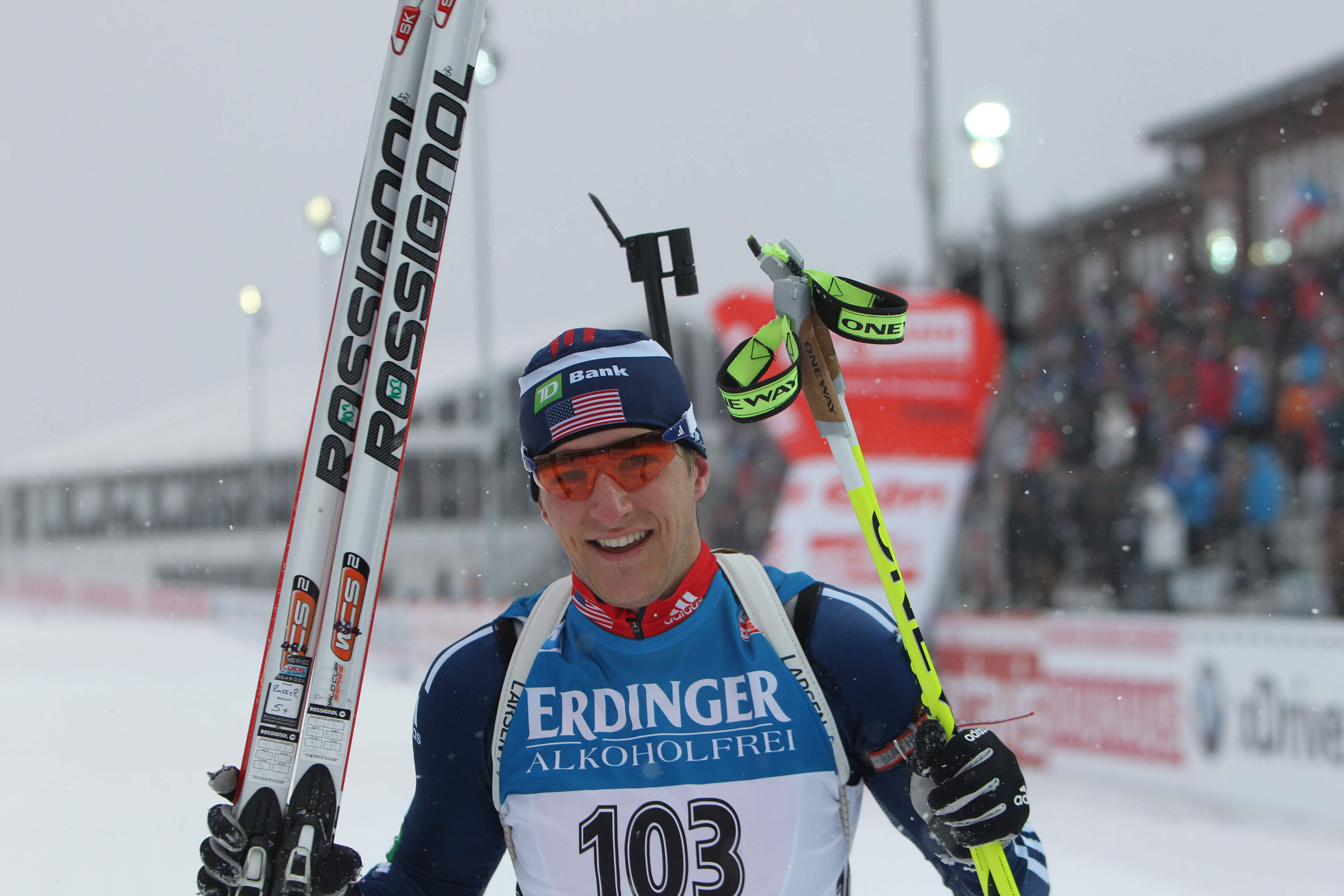
Currier at the finish of the Nove Mesto sprintin 2012, where he came from bib 103 to place sixth. (Photo: USBA/NordicFocus.com)
“For me, it still makes sense to be there because nobody knows training in the area like I do,” the 2014 Olympian explained. “I know where all the good roads are. For me it’s home, really. From a training perspective that’s a big advantage.”
An Open Door?
Eisenbichler said that just because athletes were not named to the national team in the spring did not imply that they would never be named again. In a new strategy, USBA expanded their national team by nominating or promoting six athletes in November last year. According to Eisenbichler, the same thing could happen this year as early as the end of August, after national rollerski championships in Jericho, Vermont.
“It’s first of all good to have rewards on the way for athletes who are developing in a fast way,” Eisenbichler said. “But also to use the opportunity to say okay, we add an athlete who shows a good performance level right now to the team and make the [national] training group even stronger, so everyone can capitalize on that.”
For Currier, “that’s the plan,” he says, in terms of getting his national team creds back and all of the coaching and supplementary support that entails. He hopes to still talk to national team coaches in the coming months about changes he is thinking of making to his training, and wishes that he could maintain his relationship with the team’s psychologist and other staff.
“We’ve talked to all of them individually and it’s really important for me to be clear, and say that the door is not shut for any of the teams during the training period,” he said. “If you show a really good development, or show a really good performance marker during the [rollerski] nationals compared to our A team who are really World Class performers… you have a really good chance to get named to the ‘B’ team end of August, or be invited to some camps in the fall.”
Smith is more cynical about the offer.
“With adding people to the ‘B’ team, they said the same thing last year, that there would be more opportunity for training and coaching in Lake Placid after the rollerski races in August,” he wrote in an email. “This turned out true only for athletes trying biathlon for the first time, not existing athletes. I am not holding my breath that this will actually happen and think that it is more just to pacify us for the summer.”
Dickinson, meanwhile, said that she applied to be a part of the Talent ID Camp for a second year, hoping that by competing with other junior-level biathletes and elite cross country skiers she can prove that she deserves funding or at least the invitation to some national team camps. She indicated that USBA staff had encouraged this move.
“I had hoped to get more opportunities to work with Jean [Paquet, USBA’s Head Development Coach] this year,” she said. “For people like Maddie who have had complete access to the national team resources, you look at the jump that she’s made this year. It really does make a difference. It’s going to be really hard for all of us that… aren’t getting anything.”
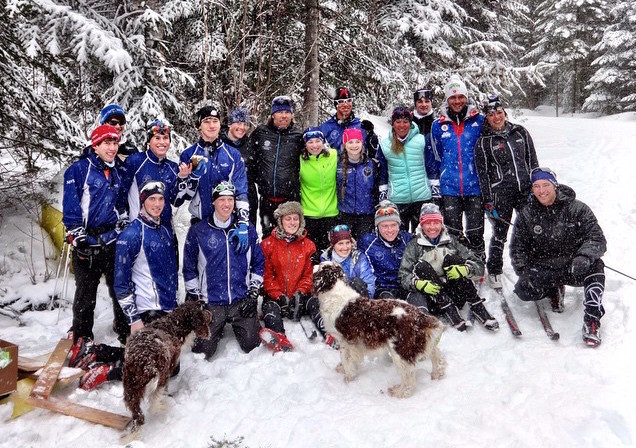
Members of the Maine Winter Sports Center cross-country and biathlon teams on one last ski of the 2014/2015 season in early April in Fort Kent, Maine. (Photo: Facebook/Katrina Howe)
Earlier this month, Will Sweetser, competitive sports director at the Maine Winter Sports Center (MWSC), revealed on his Facebook page that his 15-year term with the program had drawn to a close:
“I can’t thank all of you who’ve made Maine Winter Sports Center and Maine Winter Sports Center Athletes such a success enough. Wish that I could give another 15 years to establishing my dream in Maine,” he wrote.
“Don’t know yet where I’ll be,” Sweetser, 44, added in a comment. “Sudden news.”
While the Maine native said in a phone interview he wasn’t able to elaborate on the departure at the time, he noted, “The leadership of Maine Winter Sports Center is shifting a little and we’re moving a different direction. I’m on to my next adventure; I have no idea what that’s going to be be…”
On April 13, Sweetser was vacationing at a family residence in Florida with his wife Sarah Dominick, an assistant nordic coach at Bowdoin College in Brunswick, Maine. The two live nearly 300 miles north of Brunswick in Stockholm, Maine, between the MWSC’s base in Caribou and Fort Kent.
The Maine Winter Sports Center Cross-Country Olympic Development Team (ODT) getting ready for a rollerski in northeastern Maine in 2013, with Kris Freeman (in blue), Welly Ramsey, Hilary McNamee and competitive programs director Will Sweetser (r). (Photo: Facebook/MWSC)
Originally from Auburn, Sweetser skied for Dartmouth, and Dominick was an All-American skier at Bates College and former MWSC coach. Sweetser has coached at Bates, the Jackson Hole Ski Club in Wyoming, and Carrabassett Valley Academy and Rangeley Lakes Ski Club in Maine.
“We were committed to raising a family in Maine and it came as a surprise,” Sweetser said of the recent news, adding that he and Dominick “will be searching for something new to do while we’re expecting a baby.”
Their first child is due in October.
“I’m really proud of the work that the organization has done in the field of competitive skiing [and] biathlon and I’m very thankful for all the time that I had with fantastic young athletes in the state of Maine,” Sweetser added.
He started the position as head of the cross-country team in 2000. Along with Sweetser’s departure, the Olympic Development Team (ODT) program is being restructured, according to MWSC President and Chief Executive Andy Shepard.
That means that ODT athletes, including Welly Ramsey, and biathletes Casey Smith, Russell Currier and Katrina Howe, will have to finance their travel for the coming 2015/2016 season.
“In the short term — this coming season — the program will be more of a Training Center program,” Shepard wrote in an email. “We will continue to offer coaching for the athletes who want to train with us. We are also looking at opportunities to provide part-time coaching positions to provide some funding for them.”
For the coming season, the MWSC, which has an annual total budget of $1.1 million, according to Shepard, will shift its focus to its junior and postgraduate programs. In 2013/2014, the center operated with about a $1.4 million dollar budget, supplied by the Libra Foundation.
“The staffing structure we have had historically is set up to support those [junior and postgraduate] programs effectively,” Shepard wrote. “We have had a lot of success over the years placing kids from our programs on Olympic Teams. We are very proud of that heritage and are committed to continuing that tradition in the future. We just need to find a way to do so in a sustainable way. We hope to have a coach on board soon and will work with that coach to create a new vision for that program.”
He explained that they were looking to fill Sweetser’s position in the “next couple weeks.”
“While racing is a part of a much larger outdoor education program structure, we’re very proud of our role in racing in Maine and it will remain a critical part of our programming moving forward,” Shepard wrote. “Maine has some of the top skiers and biathletes in the country and we want them to be able to stay at home to pursue their Olympic dreams.”
Currier described the ODT cuts as “unfortunate, but it isn’t necessarily unfair,” he said in a phone interview. “Getting athletes on the World Cup is a goal for MWSC, but it’s not the primary goal. If anything, it’s sort of an indirect goal. … Ultimately, the primary goal is to build a skiing community, not just a few fast athletes. So when the budget got stretched a little thin, they had to re-prioritize what is important.
“While we still have training sessions for really good athletes, most of the resources and development will go toward that younger, local group,” he added. “It’s kind of a double edged sword. It’s fair, but it’s difficult for me.”
Cash Flow
In February 2014, MWSC discovered it would lose its funding from the Libra Foundation in April 2014. The program immediately launched two fundraising efforts, the first of which involved asking Maine-based foundations and corporations for three years of support with a goal of raising $550,000 by March 2014. The second spawned from an initial matching gift from Presque Isle native Mary Barton Smith, who pledged $100,000 plus a $400,000 matching grant.
A few months later, Smith donated another $2 million with an additional $3 million in matching to kick off the program’s $20-million endowment campaign for the long-term sustainability of the MWSC.
In the last 14 months, Shepard noted that the center has made “significant progress in our fundraising,” raising $3.9 million dollars. Two million of that was toward the program’s $20-million endowment and another $3 million would come from Smith’s pledged matched funding.
“We still have a lot of work to do, but we are off to a great start,” he wrote.
This season, the MWSC is increasing its Adventure Initiative Program from five sessions last year to 10 sessions this year, “including the possibility of a month-long program in the Patagonia region next fall,” Shepard explained. “We are increasing our budget for the Junior Race program and we are working on an exciting new biathlon program that we plan to announce in May. We have also launched a new initiative, collaborating with land trusts in Maine to provide trail design, programming, gear and leadership development.”
But for the program’s highest-level skiers, funding cuts to the ODT (specifically to travel outside the East) and the cross-country coaching void have led many to reconsider their futures at Maine Winter Sports.
The Initial Shock and What’s Next
Will Sweetser, former competitive programs director at the Maine Winter Sports Center (MWSC), holds athlete Welly Ramsey during a season-ending team ski in early April in Fort Kent, Maine. Sweetser had been Ramsey’s coach for the last six seasons. (Photo: Facebook/Welly Ramsey)
“We came close to a breakthrough this season, and I hope any future success of mine will be rightfully attributed to him,” he wrote. “The man has had an amazing impact on my life, playing coach, friend, co-worker, mentor, employer, disciplinarian, and much more. He always went the extra mile and I can unequivocally say that I wouldn’t be here without him.”
Ramsey added that Sweetser was “responsible for nearly every Maine skier developed in the past 15 years,” and helped propel MWSC’s junior team to one of its most successful seasons last winter despite the loss of its development coach, Amber Dodge. In an email, Dodge explained that she took a job as youth program manger with the New England Nordic Skiing Association (NENSA) last fall after moving in with her boyfriend and ski racer Kris Freeman in Thornton, N.H., last summer.
“I learned so much as a coach, thanks to Will and [biathlon director] Seth [Hubbard],” she wrote of her three years with the MWSC. “I miss the athletes I worked with dearly as we were able to spend so much time with them year round.”
Ramsey explained he was “currently in negotiations with the Maine Winter Sports Center about my future with the program, and have contacted other clubs with whom I can see my career excelling.”
He would like to stay in Maine “and continue helping develop the next generation of athletes, but I do need to make the choices which are best for my career,” he added. “Whether I stay or go will hinge largely on how effectively I fundraise this spring. Later this month, I’ll lay things out and assess my move based on fundraising potential, race and wax support, and training group. I have a big year of training planned and I’m excited for the opportunities this seemingly precipitous event has yielded, both in Maine and elsewhere.”
His teammate, Austin Huneck described the news about Sweetser as “a huge shock to everyone.” Huneck started as a postgraduate under his guidance two years ago and felt he had made major gains in the time since.
“It’s very sad for me to see him go after everything he has done to help MWSC and athletes across the state,” Huneck wrote in an online message. “It’s hard to put into words how much Will has done for the ski community during his years with Maine Winter. He has helped me grow so much as an athlete and a person, and I’m not sure I would be were I am today without him. I know whatever he goes on to do next will be a great adventure. I’m grateful to have known him as not only my coach but as my friend.”
While he had initially planed to return to MWSC for his third season, Huneck explained that his plans are “very up in the air.”
“Will being gone does have an impact on my decision to return, but I know Seth Hubbard and [program director] Mike Smith at Maine Winter will do a great job to hire a new coach to fill his shoes,” he wrote. “MWSC has seen a loss of funding for the elite level athlete support going into next year, and this is also going to have a big impact on my decision. I am currently looking into attending college next season, and speaking with coaches at other clubs around the country. But at this time, I cannot say what my plans are for sure.”
“Will Sweetser is a great coach, without him in my corner the year before the Sochi Paralympics I don’t think I would have been as happy as I am with my performance and progression in the sport of Cross Country skiing,” Bermejo, a MWSC cross-country team member, wrote in an email. “It was a shock to me and to other athletes the sudden departure of Will from MWSC.
“As far as my career, I had spoken to Will about the possibility of returning to MWSC this year but I will not be going due to his departure,” he added. “Lucky for me he will be moving closer to me here in Wyoming, where I intend to seek his help to improve my technique.”
Sweetser did not say whether he and his wife planned to move from Maine.
Howe, a biathlete with the program, wrote in an email that she was “devastated to hear about his departure from MWSC. Although he wasn’t my coach … I got to work with him quite often and thoroughly enjoyed it. I haven’t worked with many coaches who love skiing as much as Will does.
“For Will and his wife Sarah it’s truly a lifestyle, not just a job,” she added. “They will be sorely missed at MWSC … As with the departure of any coach, good or bad, it’s an opportunity for growth and change in the program. Hopefully the position will be filled by someone who shares the love and enthusiasm for skiing that Will has.”
In the aftermath of the ODT cuts, Howe explained she was unsure of her plans going forward.
“Ideally I’ll be in a position to continue with biathlon but if that doesn’t happen my backup plan is to get reacquainted with my classic skis and jump into some cross country races this coming winter,” she wrote. “At some point I see myself becoming a coach, but I can’t say how soon that will be.”
Presque Isle native, Mary Barton Smith, has given a gift that, when matched, will generate $8,000,000.
CARIBOU, Maine — Mary Barton Smith, whose $500,000 matching gift in February of 2014 kicked off a successful $1.4 million dollar fundraising campaign and gave the Maine Winter Sports Center (MWSC) new life, has given a $2,000,000 gift and an additional $3,000,000 matching gift to kick off MWSC’s $20-million-dollar endowment campaign. Fully matched, Smith’s gift will represent $8 million dollars in endowment contribution.
When it was announced in February of 2014 that the MWSC would be losing its funding in April of that year, the future of the organization was in serious doubt. The MWSC immediately launched a campaign intended to secure the funding necessary to continue operations beyond April and give it time to develop a more sustainable and diversified funding model to move forward.
“Mary’s belief in the Maine Winter Sports Center and its impact on the health and well-being of Maine residents has been transformative,” said Andy Shepard, President and CEO of the MWSC. “She has put us in a position to ensure that we can continue to have that impact by challenging others who share her commitment to Maine to join the campaign and give to the endowment fund.”
Currently, the MWSC has two fundraising efforts running simultaneously. The first has been ongoing since February of 2014 and is reaching out to Maine’s foundations and corporations to support operations over the next three years. This campaign, with the ongoing support of best-in-class Maine brands, LL Bean and Emera Maine, will give the MWSC a bridge to our endowment-driven long-term sustainability. The second campaign-to generate the $20 million dollar endowment, will ensure that long-term sustainability-and is being kicked off today.
“The endowment campaign will engage the help of individuals and organizations that share the MWSC’s commitment to a healthier Maine and to the effective stewardship of our remarkable natural resources, which serve as the classroom for MWSC’s programming,” said Dick Trafton, Chairman of the MWSC board.
Casey Smith (right) on the podium of a Czech Cup race in Nove Mesto, Czech Republic, this season. Photo courtesy of Casey Smith.
It’s been a while since the U.S. Biathlon Association (USBA) team nominated a new member to the national team. Last year, with the focus on an upcoming Olympics, the squad was focused solely on veterans; the previous time around, the only new naming was Hannah Dreissigacker, who already had an elite career as a cross-country skier behind her.
So when Casey Smith’s name showed up on the national team roster which was announced earlier this month, it represented a significant move toward development for the USBA. Smith raced for the Maine Winter Sports Center last season, and as a first-year senior placed 22nd in the sprint at Open European Championships.
“The fact that Casey made really good progress last year in a short amount of time as a first-year senior, we are excited,” USBA High Performance Director Bernd Eisenbichler told FasterSkier. “For Casey it was really a good result at the European Championships, and he qualified for the Olympic trials and the IBU Cup. He had the exposure to international racing. For sure he still needs improvement to be on the World Cup level, but it’s positive signs.”
Smith received a “B” team nomination based on USBA criteria. He is the youngest addition to the senior national team in years, and will be tapped to fill roles vacated by retiring veterans Jeremy Teela and Jay Hakkinen in the future. Eisenbichler admitted that with a successful Olympic Games behind them, it was time for the team to start looking forward – starting with athletes like Smith, who has been in the USBA pipeline for years.
“If you look at our team structure, that’s what we have to do because for sure there’s a little bit of a break behind Tim [Burke] and Lowell [Bailey] on the age side, so for sure we have to work hard to fill that,” Eisenbichler said. “We’re doing all possible efforts to do that, with recruiting and with developing our own athletes.”
Smith is a four-time World Youth and Junior Championships competitor who notched finishes in the low 30’s in each of those appearances. After finishing high school in the Methow Valley region of Washington, he attended Montana State University and trained as a biathlete. After finishing his junior career, Smith decided to focus even more on biathlon and moved to the Maine Winter Sports Center (MWSC).
“Last year when I joined MWSC my goal was to make the Olympic team,” Smith wrote in an e-mail. “I knew that the first three spots were pretty much set, but I thought that the last two spots were pretty wide open. I know from where I was to making the Olympic team would be a huge step but if you want to make big gains you need to set even bigger goals.”
Smith certainly made a splash as he set out on his Olympic hunt: he won a series of trials races at Mount Itasca in Minnesota, earning selection to an IBU Cup tour where the international competitions would also serve as the final selection trials for the Olympic team.
They were Smith’s first appearances on the competitive international circuit, which is like a second-tier World Cup. He collected two finishes in the mid-40’s and was ultimately not picked for the Games. But Smith doesn’t consider it a failure – he stayed in Europe for Open European Championships and some other small races as well.
“The IBU Cups were cool because there were so many competitive athletes and several of the people I was racing there went on to place in the top of World Cup events,” Smith wrote. “Even though I did not accomplish my main goal of making the Olympics, I was still very happy with what I was able to accomplish. Not only did I race in my first IBU cups and qualify for the national B-team from my results at the European Champs, but I had an excellent early season as well, I was the overall Noram leader until I left for Europe, and I won the US IBU Cup trials.”
He got used to a higher level of competition as well as the craziness of life on the road in Europe: for instance, competitions he was slated to race with a teammate in Slovenia were canceled because there was so much snow that the shooting range was buried. Among Smith’s other accomplishments were two third-place finishes in Czech Cup races in Nove Mesto.
Seth Hubbard, the biathlon coach at MWSC, said that Smith was an apt pupil in his first season of full-time training.
Casey Smith chasing Russell Currier in the mass start competition at IBU Cup trials in Mount Itasca, Minnesota in December. Photo courtesy of Casey Smith.
“He is a very enthusiastic biathlete and is really wanting to be doing the work to get to the next levels in the sport,” Hubbard told FasterSkier. “For Casey, having a season where he was focused on his development as a biathlete was great. A few important pieces for athletes transitioning from school into full time sport are to be focused on why you are taking the time to be an athlete, and to also leave a little time for life outside of sport. Casey did a great job of balancing these two items.”
And Smith found MWSC a rewarding place to train. He was challenged by Russell Currier, a World Cup veteran who ultimately earned the Olympic nomination.
“Compared to years past while I was in school I did not make a super large jump in hours, but I think that the quality of my training improved dramatically,” Smith wrote. “One, I was able to do specific combo training at the 10th Mountain Ski Center in Fort Kent and two, I had individual coaching for most workout sessions. I think both of these factors contributed to my success this season.”
Smith will be joined on the “B” team by Currier, as the only two men to receive that nomination. No women will be on the “B” team. What that means is that the pair will stay largely in Maine, and attend a few camps with “A” team athletes Burke, Bailey, and Leif Nordgren throughout the season.
“It’s a couple of camps, time in June in Lake Placid, and then again in August in Lake Placid, and they have the nationals where they meet up and see where their performance level is against the big guns,” Eisenbichler explained. “Then they have the Utah camp and the testing week. That was the idea behind it, that we need them to get ready for the next level, expose them to the big guns when it’s right, and they can still work on their own development and progress in a calm environment.”
To some extent, the theory seemed to be: if it ain’t broke, don’t fix it. Smith improved steadily last season, and Eisenbichler thought Maine was likely a big part of that change.
“The idea is that they are up in Maine and can profit from each other in training,” Eisenbichler said. “Casey is a really good shooter and Russell is for sure a really good [skier], so they can profit from the other’s strengths and weaknesses and work together on this. It’s really good to be up in Maine with Seth Hubbard because he’s really with our philosophy of training.”
Hubbard agreed, and was happy to keep the two men around on his team.
“This made the most sense as far as being able to provide as much support from a financial, coaching and training group perspective,” he wrote in an e-mail. “With these two athletes as well as some of the older junior biathletes and nordic athletes we are fortunate to have a strong and diverse training group in Maine. In the past year it had worked well through different portions of the season when Russell was able to spend more time with the team.”
Smith and Currier’s training will be overseen jointly by Hubbard and the national team staff, an additional piece that Smith welcomed (other than a conference call at the beginning of the season, he said he had little oversight from USBA last year).
“Besides attending these camps I will be able to consult with the national team coaches,” he wrote.” I am excited about being invited to these camps because it will be more national team coaching support then I have ever received.”
MWSC recently lost its title sponsor, but through fundraising has made significant steps towards recovering its budget. As of May 1, MWSC had raised over $350,000 and had received about $450,000 from Mary Barton Smith, primarily through an ongoing matching challenge.
Smith said that there was still a bit of uncertainty, but that he hadn’t heard any way that the funding situation would directly affect him.
“I know that I will be primarily based in Fort Kent, and will have housing thanks to the Phyllis Jalbert biathlete house,” he explained.
Eisenbichler was also unconcerned about the potential changes to MWSC.
“I’m not worried about Maine Winter Sports Center,” he said. “They have a strong leader there and he is doing everything in his power to keep that program going. We’re really happy to have this program in place and I think it’s a great program.”
Austin Huneck of the Maine Winter Sports Center racing in Muonio, Finland, early last season. (Photo: Will Sweetser)
Editor’s Note: The following interview with 19-year-old Austin Huneck gives a glimpse of what it’s like to be a postgraduate skier and make the transition to full-time training and racing after high school. Have a suggestion for an interesting subject for a similar “Faces and Places” series (could be a junior, postgrad or senior skier from any nation)? Send it to info@fasterskier.com.
***
As a Shenendehowa high-school student in Clifton Park, N.Y., Austin Huneck represented Mid-Atlantic twice at junior nationals. In 2013, he was the New York State distance champion. As his graduation date neared, Huneck, who recently turned 19, enrolled in the Maine Winter Sports Center (MWSC) postgraduate program to focus on skiing before college.
Austin Huneck of the Maine Winter Sports Center racing for New England at Junior Nationals in early March in Stowe, Vt. (Photo: Will Sweetser/MWSC)
“Austin has been an excellent addition to our program,” MWSC Competitive Programs Director Will Sweetser, wrote in an email. “A real head down, quiet, lead by doing kind of athlete.”
Sweetser explained that Huneck joined the MWSC late last summer “a bit behind our first year U18s. That changed quickly,” he wrote. “By race season, he was helping to push the group along. The early season trip to Finland was a real eye opener for him, and he used the experience to boost his training during race season. Kudos go to Seth Hubbard and the biathlon group who spent most of the time training with Austin since he lived with the crew in Fort Kent.”
Huneck described his trip to Finland last November as a season highlight. He and other MWSC athletes competed in the sprint and the 15 k classic race at Muonio.
According to Sweetser, postgraduate athletes “must show potential to qualify for USSA Junior Nationals or Biathlon World Youth Teams.” The program is limited to five athletes in each discipline — cross-country skiing and biathlon. Although MWSC focuses on Maine athletes, they consider athletes from other states. In an email, Sweetser wrote that more 60 percent of MWSC postgrads qualify for the New England Junior National team.
Postgrad skiers collaborate with MWSC coaches to develop their training programs. But MWSC doesn’t just ramp up high schoolers’ hours and send them out to ski. The postgrads also commit 50 hours a year to volunteer work and are required to take two college classes during their program.
Early last season, Huneck talked to FasterSkier about his experience in Finland and the transition from his home club, the Hudson United Race Team (HURT) in Albany, N.Y., to MWSC.
FS: How did the races go in Muonio?
AH: I [did the sprint] and the 15 k skate race. The 15 k result was a little bit better. The sprint didn’t go very well for me. In the distance race, since I didn’t have any FIS points going in …I started right at back of the junior boys. Then behind me were the men. On course, I got passed by some of the best skiers in the world.
FS:Were things different from what you expected over there?
AH: Sort of. I expected competition to be a lot tougher than it was. More competitive.
FS:What can you take away from the races over there to use for the rest of the season?
AH: Racing over there, and training over there was a really cool experience. I got to ski alongside some really great skiers. The races give me something more to compare to when I race back here in the U.S. There’s always that next level up from racing in New England and the United States.
FS: What made you decide to take a postgrad year?
AH: I knew I wanted to continue skiing after high school. I wasn’t sure what I wanted to go to college for, what I wanted to study. I figured that doing a postgraduate year at MWSC would give me an opportunity to better my skiing. Maybe when I go to college I’d have a good chance to ski for my college team. And also it gives me a whole year to think about what I want to study.
FS: Was MWSC the only program you looked at?
AH: For me, MWSC far and away the best choice. It’s a highly regarded program, and really good coaches. I didn’t really look at any other places.
FS:What was it like going from Team HURT to MWSC?
AH: HURT is pretty much the extent of skiing in NY for juniors and masters. It’s one of the biggest clubs in New York. MWSC is the biggest junior club in Maine. MWSC is pretty much close as it gets to a skiing lifestyle. The interest in New York is not there for cross-country skiing. The fields aren’t as deep in New York. There’s a lot more interest in skiing at MWSC. They also have better coaching at MWSC. David Paarlberg-Kvam of Team HURT does a phenomenal job of coaching, he does all he can. But MWSC has that extra something.
FS: Did you have a big increase in hours?
AH: It was a big jump. Last year, I trained a little under 400 hours. This year, I plan to be a little over 500. It’s a big jump, but I’m handling it pretty well.
FS:Where do you live?
AS: I live in Fort Kent, Maine. We have a house for the athletes [at MWSC]. It’s mostly biathletes. I don’t do biathlon but I do live in the house. There’s six of us. We all have our own room.
FS:What’s your day like?
AH: We go rollerskiing or running around 8 a.m. … The middle of the day, we have free time. Then we have a second practice session at 3:30.
FS: What sort of community service are you working on?
AH: One of the things we do is help out with the development part of the MWSC program, which brings young kids out to have fun, play games and learn what skiing and biathlon are all about. Also, once a month each of the athletes goes into a different elementary school in the surrounding areas to give a presentation and talk to kids about different things such as, what we do at MWSC and what skiing is, healthy living, healthy eating, and so forth.
FS: What advice would you give to juniors about a postgrad year?
AH: I think it’s a great idea. Doing a postgraduate year anywhere would put you in good position for college the next year. The level I was at last year, where I could go to a college with a good ski team, maybe I wouldn’t quite be on that team. But after doing a postgraduate year, hopefully I’ll be in a better position for when I go to college, to be on that ski team.
In early April, we followed up with Huneck to find out how his season turned out.
FS:How did the rest of your season go?
AH: Overall I think I had a good season. I put in a lot of hard work into this year, and produced my best results because of it. I am happy with how everything is going and will return to ski with the Maine Winter Sports Center next year.
Junior Nationals went well. (A U20 skier, Huneck placed 18th in the 15 k freestyle and 12th in the 10 k classic in the national championships in Stowe, Vt., a set of races he made his primary goal for the season.) I had a couple decent races, but they weren’t quite what I was hoping for. I went in with a goal of a top-10 finish, and ended up just outside the top 10 each race. It was a good week however, great skiing and beautiful weather and many of my teammates had great races and New England was able to win the Alaska Cup fairly handily.
FS: What are you planning for the summer and next season?
AH: This spring, I’m heading home to New York from mid-April to the end of May to spend time with my family. I will return to northern Maine in early June to train with my teammates for the better part of the summer. For the 2014/2015 ski season, I hope to continue to improve and produce good results at Nationals in Houghton, Michigan, and at Junior Nationals in Truckee, California. And I will stick with MWSC for the upcoming season.
FS:What are your summer training goals or focuses?
AH: Over the summer, my main goal is a lot of volume. In skate, I want to improve my V1 technique. In classic, I want to improve my double pole. And I’ll be working part-time to defray some of my expenses.
We also asked Sweetser about Huneck’s progress:
“I can’t wait to see what he’ll do this year with a full summer in our program,” Sweetser wrote. “He will be based in Presque Isle with a new crew of PGs. Most of his morning training will be with Welly Ramsey. The two are a great fit, as Welly is the last guy we had through the program who showed such a meteoric rise in potential.”
The Maine Winter Sports Center announced that come April it’s largest sponsor, the Libra Foundation, would cease funding. The Center is now working to raise enough funding so that it can continue operations in the coming years.
It was quite the shock when the Maine Winter Sport Center lost its biggest sponsor, the Libra Foundation, this past February. The Foundation, which had supplied roughly $1.4 million of the Center’s revenue in past season and over $33 million since the Center’s start 15 years ago, decided it was simply time to part ways and let the Center find success on its own.
While the pull of funds followed the guidelines to the Libra Foundation’s model facilitating the growth of community organizations, the suddenness of the withdrawal threw many within the Center into shock and jeopardized its ability to secure funding for the next fiscal year. Since then, the organization has been scrambling to gather donations for the coming year.
For those who haven’t been apart of the Maine Winter Sports Center it’s easy to think of the organization as another ski club that makes up part of the nordic community in the U.S. In reality, it is much more.
In providing the means for areas like Black Mountain and Rumford (site of the 2011 and 2012 Cross Country Championships) and the Nordic Heritage Center (host of the 2014 IBU World Youth/Junior Biathlon Championships) MWSC has established an infrastructure for nordic skiing to flourish in the state. In addition, with well over 4,000 youths involved in the Center’s programs, MWSC has been making an impact on its surrounding community.
In order to make sure that impact continues, Andy Shepard, President and CEO of MWSC, has been on an all-out blitz to secure as many donations as possible before the end of April.
His efforts have proven successful thus far, as the Center has raised roughly $810,000 since the February announcement.
“It’s not enough for us to run our full range of programs for the year. It’s enough to get started, but we have an ongoing funding campaign that ends this month,” Shepard said in a phone interview. “The sense of urgency around this is the fact that the fundraising campaign ends at the end of the month.”
US Biathlon staff snap a photo of the podium in Presque Isle, Maine at the 2014 IBU Youth/Junior World Championships. The Nordic Heritage Center, which hosted the event, was supported by the Maine Winter Sports Club. The Nordic Heritage Center will now be part of the newly formed Aroostook Nordic Inc. which will continue to be supported by the Libra Foundation. (Photo: Craig Cormier)
Fortunately, the Center may have found some luck in a local benefactor. Mary Barton Smith, a Presque Isle, Maine native with ties to the origins of Silicon Valley, has offered a $400,000 matching gift that must be met by April 30th.
“[Smith] appreciates the work of the Maine Winter Sports Center,” said Shepard. “Her primary focus is on the health of Maine’s youth and realizes the role that the Maine Winter Sports Center is playing across the state, but particularly in Aroostook County on trying to address childhood obesity and create a healthier lifestyle.”
Smith has agreed to match any donations up to $400,000 by April 30th. Currently the Maine Winter Sports Center has raised $210,000 since the start of the matching campaign, most of which has come from donations of $5 or $10 from the local community. “[The gifts are] from individuals and families that have been a part of our program around the state or who respect the work that we do.”
“That’s encouraging to us because they’re coming from all over the state and other countries.”
In addition, several five-digit donations have been gifted, including a $25,000 from an anonymous donor.
As of now, the Maine Winter Sports Center is focused on securing as much funding as possible for next year. However, as soon as the money is secured, the emphasis will shift towards long-term sustainability.
While still in the initial phases of implementation, Shepard has about $310,000 in long-term sponsor agreements. He believes he can get that number up to $500,000 or $600,000.
“And then the focus beyond that is creating a foundation and focusing on creating an endowment to secure the long-term sustainability of the Center for generations to come,” he said.
With this major shift in its budget, the Maine Winter Sports Center will have to undergo some changes, but not enough for anyone affected by the Center’s programs to notice. One such change will be the split of the company into two separate organizations. Programming across the state will remain as the Maine Winter Sports Center and will be run by Shepard and a new operating board. The 10th Mountain and Nordic Heritage Centers will become Aroostook Nordic Inc., which will continue to be supported by the Libra Foundation.
Four-time Olympian Kris Freeman, who skied for the Maine Winter Sports Center in the 2013/2014 season, races in the 2014 U.S. Nationals 30 k freestyle mass start this past January. Freeman is leaving the center for the upcoming season.
“The takeaway of all of this, is that from the perspective of those in the community we don’t anticipate that they will see a change in what we’re doing. We’re going to continue to offer the programs that we have and in fact we have some plans on expanding some of our programs like the youth racing program that we’re looking to expand across the state,” said Shepard of the restructuring process.
“The question is with our resources how do we scale these programs to meet the emerging needs of the state of Maine in a sustainable way as possible. That’s what we need to figure out.”
Shepard has faith that everything will happen as it should, at the very least because of his excellent staff. “If anyone can figure out how to do this, it’s these guys,” he said.
One such staff member is Will Sweetser, Competitive Program Director and Cross Country Coach at the Center. According to the Dartmouth graduate, not much will change in regards to the competitive side of the Center. Most competitive team skiers will remain, such as Welly Ramsey and Omar Bermejo, with the exception of those headed to National Team for biathlon, like Russell Currier and Annalise Cook.
The only real change to the membership of the competitive team will be the departure of Kris Freeman, who joined the team this past season after leaving the U.S. Ski Team.
“[Kris] is pretty confident in his funding abilities and is stepping away from the program requirements that would have him in Maine. He’s going to stay closer to home for the rest of his training,” said Sweetser. “The relationship with Kris is still really good. He and I still talk quite a bit and there is no negativity on either side.”
Despite a history of hosting top-tier athletes, further recruitment to the Maine Winter Sports Center’s elite team seems unlikely and as the organization continues forward they plan on finding their talent from within Maine.
“We were some of the first to recruit so-called elite-level athletes to the full-funded club program. We started that 12 years ago, but in the years that have come we have built a strong enough structure in Maine that we seem to be able to generate enough national level and beginning international level athletes. It’s not really necessary for us to look outside state borders,” said Sweetser.
With a successful fundraising campaign and a continued plan to grow the Center’s capacity, Sweetser believes the development program will continue to mature.”We’ll see the Maine Winter Sports Center evolve in a more robust Olympic development program for the state of Maine. It’s my contention that you’ll see other sport clubs follow our lead when we’re able to do that.”
“We really do capture the imagination of young Maine athletes looking to go beyond the high school ranks, and they see kids and young adults in their neighborhood who are able to pursue their dreams in college and after college right here at home. I think that’s a really valuable tool for our state. I look forward to seeing that continue.”
At the end of the day, Shepard believes that the Maine Winter Sports Center is an essential centerpiece to the Maine’s sports culture and society. With programs in 140 communities across Maine, it’s hard to imagine the loss that Center would not only have on the Maine community, but the nordic ski community across the country.
“The Maine Winter Sports Center has a 15 year track record of making a difference in Maine. Our programs have been recognized around the country and around the world. There’s a tremendous amount of respect for what we do and how we do it and the past eight weeks have demonstrated in a most profound way how important what we do is to the people of Maine.”
To donate to the Maine Winter Sports Center access their website here, or send to Maine Winter Sports Center, 552 Main St. Caribou, ME 04736.
Omar Bermejo of the U.S. Paralympics Development Team cracks a smile during the 2013 SuperTour Finals hill climb at Sugar Bowl Resort on April 8 in Truckee, Calif. (Photo: Mark Nadell/MacBeth Graphics)
The wind howling sideways across Sugar Bowl’s alpine slopes in Truckee, Calif., skiers and spectators alike at the U.S. SuperTour Finals hill climb in April grimaced in the cold. The Spring Series skate race was mostly a snow squall, with competitors battling a headwind at times as they pushed toward the top.
Rounding one of the last corners into a blustery abyss, Omar Bermejo smiled for the camera. He might as well have been back in San Diego, Calif., where he was stationed with the U.S. Marine Corps; Bermejo appeared in his own world, immune to his frigid surroundings.
Omar Bermejo (U.S. Paralympics) climbs more than 1,000 feet to the top of Mt. Disney at Sugar Bowl Resort for the SuperTour Finals hill climb on April 8 in Truckee, Calif. (Photo: Mark Nadell/MacBeth Graphics)
“Being a Marine, you kind of crave those little, like, I-hate-my-life kind of moments,” Bermejo said three days later on April 11. “I don’t know, I liked it.”
Skating was his favorite technique and doing so up a mountain wasn’t awful – even with one arm, the U.S. Paralympics Development Team member explained. A Marine for more than 10 years, Sgt. Bermejo rewarded himself for surviving four deployments in Iraq by buying a motorcycle in 2008. Cruising around that June in San Diego, he hit a patch of dirt on a curve and lost control of the bike, crashed and had his right arm amputated as a result.
Four months later,he started skiing for physical therapy, and it didn’t take long for the U.S. Paralympics Nordic Program to catch wind of his new hobby.
“During my recovery, I had rehab [and the therapists] were like, ‘Hey do you want to try cross-country skiing?’ ” Bermejo, 31, recalled at Spring Series on April 11. “I was like, ‘Yeah, I want to go down some hills.’ And then they were like, ‘All right, go up that hill.’ I was like, ‘Wait a second, you tricked me!’ ”
His voice fluctuated with excitement as he spoke, not long after racing 20 kilometers on the last day of the season. “Actually I started on classic skis and I was like, ‘Oh wow, this is like running. I feel great!’ ”
Bermejo was, and remains, a fiercely competitive athlete. Before his accident, he was a road runner, racing 10 k’s, half marathons, you name it, Bermejo explained on the phone in June. He was just about to leave his hometown of Grand Rapids, Mich., to fly east to live and train with the Maine Winter Sports Center (MWSC) in Caribou, Maine.
Early last season, MWSC head coach Will Sweetser helped Bermejo and Kevin Burton, a U.S. Paralympics visually impaired skier, at the SuperTour in Bozeman, Mont. The relationship continued through U.S. nationals and SuperTour Finals, with Bermejo meeting the team in March for a weeklong training camp in Maine. Ultimately, Sweetser asked Bermejo if he wanted to move there.
“I really jumped at that,” Bermejo said. “I’m a stand-up athlete so I can sort of keep up with the able-bodied guys.”
U.S. Paralympics Development Coach Eileen Carey (c) with two of her athletes, Omar Bermejo (l) and Kevin Burton at the 2013 IPC World Cup in Cable, Wis. (Photo: James Netz)
By stand-up, Bermejo meant his adaptive category, which allows him to ski just like anybody else with just one arm. His able-bodied teammates include Kris Freeman, Sam Tarling and Welly Ramsey of MWSC’s Olympic Development Cross-Country Team (ODT).
“We are really excited to have Omar join us as a member of our ODT,” Sweetser wrote in an email. “While working with him last year as a service tech, he and I hit it off. I think that many of the professional clubs can offer a whole lot of help to most stand up adaptive athletes.”
“Pretty psyched to have Omar join us,” he added. “Our junior group love him and really get pumped to train with him.”
Not long after settling into Maine, Bermejo presented to the MWSC juniors. In September, he traveled to Italy with top skiers like Freeman, Tarling and U.S. Ski Team member Noah Hoffman to train at altitude in the Italian Alps.
“Sometimes I feel as if I don’t belong there since in reality I have only been skiing for only two years,” Bermejo wrote in an email. “But whenever those thoughts come around is when I tell myself that I must push myself a little harder or smarter to get through and succeed at my training.”
***
Three days after ascending more than 1,000 feet to the top of Sugar Bowl’s Mt. Disney, nearly 8,000 feet above sea level, Bermejo completed the 20 k classic at U.S. Distance Nationals on a borderline-hot, slushy day. About five kilometers in, he broke his pole. With no one around to hand him a replacement, he skied the next several hills without any use of his upper body. In his first Sprint Series, Bermejo wasn’t about to quit.
Omar Bermejo during a slushy 20 k classic at U.S. Distance Nationals on April 11 at Royal Gorge near Truckee, Calif. (Photo: Mark Nadell/MacBeth Graphics)
“I had to basically no pole the whole thing,” Bermejo said after finishing in just over an hour and a half. “Towards the way back, somebody gave me a pole so I’m like, ‘OK,’ … it was the last [race] so I had to make it count.”
That kind of grit is what U.S. Paralympics quickly picked up on. Post-rehab, Bermejo moved to Arizona to be with friends and lift his spirits.
“I was trying to deal with my arm being missing,” he said. “I used to be a strong guy, like great runner, so I wanted to get back to that.”
He discovered U.S. Paralympics coach Rob Rosser was hosting a biathlon clinic at the University of Arizona and decided to check it out.
“I was in the mode that I could do anything,” Bermejo said. “[Rosser] invited me to the Empire State Games in upstate New York and I was like, ‘Wow, this is great. I want to continue doing this.’ ”
Arizona, he soon realized, was not the best place for skiing. Bermejo started shopping around for new places to live and train, and Marc Mast in Sun Valley, Idaho, invited him to check out his Wood River Ability Program. In the summer of 2011, Bermejo moved there permanently.
U.S. Paralympics Development Coach Eileen Carey, formerly of the MWSC, wrote in an email that she first worked with Bermejo at a development camp in February 2012 in Lake Placid, N.Y., where he traveled for the Empire State Games.
“Since that time he has been hooked and has dedicated himself to becoming a Paralympic skier and biathlete,” Carey explained. “He has made huge gains in such a short period, which I would attribute to his professional and driven approach. He is introspective and I think that helps him see the small progressions that he makes and keep perspective on the fact that he is not yet the athlete he will one day become.”
“Being a Marine, you kind of crave those little, like, I-hate-my-life kind of moments, but I don’t know, I liked it.” — Bermejo on the 2013 SuperTour Finals hill climb at Sugar Bowl Resort
Last winter, Bermejo competed at the International Paralympic Committee (IPC) World Cup in Cable, Wis., and skied well enough to earn points. That gave him affirmation and hope. In a year, he wondered if he could make the 2014 Paralympics.
Omar Bermejo competed in both biathlon and cross-country events at the IPC World Cup in Cable, Wis., last season. (Photo: James Netz)
He decided his best shot would be in biathlon. “With my Marine background and the shooting, it’s something that holds near and dear to my heart,” he said.
“Right now on the international level, I’m like a nobody, but I want to get there,” Bermejo added. “They’ll be like, ‘Here comes the American guy; watch out for him.’ Eventually that’s what I want to do, I want to be a force.”
Months after his East-Coast move, Bermejo was already pleased with his progress. Sun Valley was a great start, he explained, but he needed to train with others and follow a specific outline.
“I asked my Paralympic coaches if moving to Maine would be a good idea and they told me it would be great if I was willing to sacrifice my then current social life and my love for the west of the country,” Bermejo wrote in an email. “I must say it was tough and one hell of a move but I have made huge improvements working with all the coaches at MWSC and I believe I am ready to use my newfound skills to work in the upcoming season.”
Along with Carey, U.S. Paralympics Nordic High Performance Director John Farra encourages stand-up athletes to train with an elite club with able-bodied nordic skiers.
“He has made a significant commitment to the sport and it has resulted in impressive improvement for a relative newcomer,” Farra wrote in an email. “We are excited for Omar to integrate into the MWSC program and see how far they can help him progress with his skiing. “
So far, the best thing he’s learned is to “slow down to go fast,” he wrote. “When I first started skiing just freshly out of the Marine Corps my technique was to go as hard and quick as possible and hopefully I would go fast enough, however, after a couple of races I took a beating and I was not going anywhere.”
In Maine, he realized if he relaxed and thought more about smooth skiing and glide, he could suddenly go faster and longer without feeling tired.
Following U.S. nationals in January, U.S. Paralympics will select its national team for the 2014 Winter Games in Sochi, Russia. While Bermejo isn’t a shoe-in for one of the 19 spots, he’s optimistic.
“Omar is one of the athletes who is Sochi ‘Eligible’ and in a good position to be able to qualify for the Team,” Farra wrote, referring to the Paralympic-team criteria. “I would expect he will make the team if he continues to train in a professional way through next winter.”
“Omar has been a great part of our program over the last year or so,” Carey wrote. “He is an A-lister through and through. He is one of those people you meet and hope you will know forever.”
Looking at the strides he’s made since his accident five years ago, Bermejo feels grateful for the opportunities he’s been afforded by the U.S.
“I am proud to have served under our flag in the military and would like to keep serving my country but this time as an inspiration to never quit and never stop dreaming no matter what happens,” he wrote.
“I want people to know that it does not matter how fast I can complete a race, how many people I can beat, what skis or waxes I use, or even how many medals I can accrue in my lifetime.. What matters is achieving happiness.. And I know I have already won at that ever since I started Nordic skiing.”
He has several people to thank for his quick rise within the sport, including Mast, who “was the first person that saw potential in me,” the Hall family in Casper, Wyo., “for opening their doors and allowing me to make my training easier,” and his girlfriend Lindsey Hall “for giving me the inner strength to keep going when the going is tough.”
Omar Bermejo (U.S. Paralympics/Maine Winter Sports Center) during an altitude training camp with the MWSC at Stelvio Pass in Italy in September. (Photo: Omar Bermejo)
Omar Bermejo (U.S. Paralympics/Maine Winter Sports Center) during an altitude training camp with the MWSC in the Italian Alps in September. (Photo: Omar Bermejo)
Omar Bermejo (U.S. Paralympics/Maine Winter Sports Center) during an altitude training camp with the MWSC in the Italian Alps in September. (Photo: Omar Bermejo)
Each November, it’s tradition for some of the world’s best nordic skiers to go where the sun don’t shine – or appears very little. The fact is that Muonio, Finland, above the Arctic Circle has snow this time of year when other parts of Europe are still waiting for the skiable stuff.
Justyna Kowalczyk of Poland during one of last year’s FIS races in Muonio, Finland. This weekend, Kowalczyk won two out of three Muonio competitions from Nov. 15-17.(Photo: Petri Ikävalko/Hevoskuuri.fi)
Starting Friday, the unofficial Finland Triple began in Muonio, with hundreds of skiers flocking to the northern region for their first International Ski Federation (FIS) races of the season.
Poland’s cross-country celeb Justyna Kowalczyk jumpstarted her season with a sizable victory in the 1-kilometer classic sprint, topping Russian Evgenia Shapovalova by more than 7 seconds in the final, as well as Russia’s Julia Tikhonova in third and Natalia Matveeva in fourth. Finland’s Mona-Lisa Malvalehto placed fifth out of 146 female competitors.
In the men’s 1.3 k classic sprint on Friday, Alexey Poltoranin of Kazakhstan beat Finland’s runner-up, Ari Luusua, by 3.23 seconds in the final, as well as third-place finisher Russian Anatoliy Volkov (+5.56). Ales Razym of the Czech Republic was fourth and Estonia’s Peeter Kummel placed fifth out of 255 men.
Leading a small American contingent in Muonio, Dakota Blackhorse-von Jess (Bend Endurance Academy) placed 34th in the sprint qualifier. Welly Ramsey was the fastest from the Maine Winter Sports Center (MWSC), placing 113th, teammate Sam Tarling came in 209th, and post-grad Austin Huneck was 239th. Another MWSC post-grad, Emily Ramsey finished 128th in the women’s race.
On Saturday, Kowalczyk and Poltoranin again topped their respective podiums – this time in the 5 and 10 k classic races. Kowalczyk defeated Russia’s Yulia Tchekaleva in second by 21.6 seconds, and Germany’s Nicole Fessel in third (+27.3). Finland’s Anne Kyllönen and Kertu Niskanen placed fourth and fifth, respectively, out of 199 women.
Poltoranin edged Lukas Bauer of the Czech Republic by 6.8 seconds, and German Hannes Dotzler in third (+24.2). Razym finished fourth for the second-straight day, and Germany’s Tim Tscharnke placed fifth out of 331 finishers.
Kris Freeman in Muonio last year. (Photo: Petri Ikävalko/Hevoskuuri.fi)
Kris Freeman (MWSC) led the Americans in his first race of the season in 34th, 1 minute and 11 seconds behind Poltoranin, who won in 24:33.7. Tarling placed 109th, 2:09.8 back from the winner. Canadian Para-Nordic veterans Brian McKeever placed 160th and Erik Carleton was 242nd.
Racing ended Sunday with the women’s 10 k and men’s 15 k individual skate. Russian Petr Sedov stole the spotlight from Finland’s Matti Heikkinen, who was leading until Sedov finished 7.8 seconds faster in 34:56.5. Two other Finns rounded out the top four with Tero Similae in third and Lari Lahtonen in fourth, and Franz Goering of Germany was fifth out of 188 men. Poltoranin did not race.
Freeman finished 32nd, 1:15.1 after Sedov, McKeever was the top Canadian in 63rd, (+2:13), and Welly Ramsey was 116th (+3:24.7) Carleton placed 125th (+3:38), and Tarling was 126th (+3:39.5).
Russian Irina Khazova won the women’s 10 k in 25:46.2, ahead of teammate Tchekaleva in second (+28.3), and Eva Vrabcova-Nyvltova of the Czech Republic in third (+49.5). Finland’s Gretel Niskanen placed fifth, and Russia’s Svetlana Nikolaeva was fifth out of 159 women. Kowalczyk fell to 24th, behind teammate Sylwia Jaskowiec in 21st. American Emily Ramsey placed 155th.
Kris Freeman of the Maine Winter Sports Center rollerskis up Umbrail Pass in the Italian Alps. (Photo: Noah Hoffman/www.noahhoffman.com)
Two weeks of living and training nearly 11,000 feet above sea level can do a lot for Noah Hoffman and Kris Freeman’s preparation for the upcoming season. A lot of help if managed appropriately, a lot of harm if done wrong.
The two elite U.S. skiers are wrapping up an on-snow camp in the Italian Alps. Hoffman (U.S. Ski Team/Ski and Snowboard Club Vail/Team HomeGrown) joined a trip arranged by the Maine Winter Sports Center (MWSC), of which Freeman is an Olympic Development Team member. A crew from the Green Mountain Valley School in Vermont also trained on the glacier, but lodged separate from the MWSC group.
Hoffman and Freeman followed separate training plans, but with the same basic camp rule: don’t get too tired. If they come out of the camp needing two or three weeks to fully recover, they will miss out on valuable time reserved for intensity and sharpening before the season-opening races. Neither had previously lived and trained at as high of an altitude in their careers.
Freeman and the MWSC group are on their way back to the U.S. on Monday, while Hoffman heads to Germany to train for a week with German World Cup skier Hannes Dotzler, who, at 23, remains one of the best skiers in the world in 24-year-old Hoffman’s age group. Hoffman said he wants to learn as much as possible from him.
Dotzler finished sixth in the 15 k classic at last season’s World Cups in Canmore and La Clusaz, France, and seventh in the 50 k classic at World Championships.
Freeman designated it a volume-only camp, logging a ton of slow hours. Hoffman did one intensity session each week, to keep in touch with the speed he developed over the summer.
Noah Hoffman (U.S. Ski Team/ Ski and Snowboard Club Vail) strides on the Stelvio Pass glacier. (Photo: Noah Hoffman/www.noahhoffman.com)
“I have always been able to handle huge loads of volume training and I also have a long history of responding well to high altitude,” Freeman wrote in an email. “I had my best races of [last] season at the Canmore World Cup right after spending two weeks at 8000 feet in Aspen.”
Freeman had two top-15 finishes in Canmore. He didn’t realize until he got to Italy how close they were to Valdidentro, where he won the 30 k classic at the U23 World Championships in 2003 and placed 16th in a World Cup there in 2009, a week before finishing 4th in the 15 k classic at World Championships.
“I thought Stelvio was the best option for a September on-snow camp,” Freeman wrote. “Overall, the quality of skiing and quality of life has been much better than other glacier experiences I have had.”
Freeman reported firm tracks and winter-like weather on the Stelvio Pass glacier, with occasional snowfall to freshen things up. They kicked on hard wax around a two and a half mile loop neighboring an alpine area. Freeman and Hoffman, roommates on the World Cup circuit for the past five years, stayed together in Hotel Livrio, where they skied out the front door.
It was Freeman’s first time on snow since the spring. Hoffman skied on Eagle Glacier in Alaska and at the Snow Farm in New Zealand this summer. They didn’t have much company on the loop, but last week shared it with the Italian military team and Olympic gold medalist Cristian Zorzi.
MWSC coach Will Sweetser re-stocked the food supply frequently so the athletes could refuel between workouts. An early start was required to ski twice in a day on the glacier, as the trails closed for grooming at 3 p.m. daily. Sweetser also assisted with ski prep, letting the athletes focus on recovery during a condensed first half of the day.
Hoffman didn’t check the altitude on the glacier when he was packing for the trip, so he had to adjust his workout schedule with coach John Callahan upon arrival.
“The original plan with a high load of volume, intensity and specific strength didn’t make sense to pursue at this altitude,” Hoffman wrote. “John and I were not disappointed by the situation. We saw it as an opportunity to earn extra benefit from training, a good test of my ability to handle this altitude, and of course a reality we had to accommodate, not unlike a changed travel schedule, an illness, or difficult weather conditions.”
Also on the glacier from MWSC were ODT members Welly Ramsey, Sam Tarling and Omar Bermejo. Canadian Brandy Stewart was also with the group.
The Maine Winter Sports Center Cross-Country Olympic Development Team (ODT) gets ready for a rollerski in northeastern Maine, with Kris Freeman (in blue), Welly Ramsey, Hilary McNamee and competitive programs director Will Sweetser (r). (Photo: MWSC/facebook.com/maine.Winter.Sports.Center)
Note: This is the sixth preview in our series on U.S. elite teams, which we’ve dubbed the “The 12.” We asked coaches to tell us what’s new and whom to look out for in the coming season and will publish additional previews in the coming weeks in no particular order.
Cross-Country Olympic Development Team (ODT): Kris Freeman, Sam Tarling, Welly Ramsey; Hilary McNamee, Anna Van der Rhee (trying to qualify for Sochi Olympics for The Netherlands). According to Sweetser, McNamee is focusing on finishing her studies at Dartmouth and will race primarily in New England.
XC Post-Grads: Emily Ramsey (New Sharon, Maine), Zoe Chase-Donahue (Freeport, Maine), Sarah Becker (Yarmouth, Maine), Abby Popenoe (Portland, Maine), Austin Huneck (Clifton Park, N.Y.)
Collegiate Summer Program: Nick Michaud (Bates College), Gabby Naranja (Bates).
Biathlon ODT member Katrina Howe during skate hill workout. (Photo: Seth Hubbard)
Who’s new: Tarling (2013 Dartmouth graduate), Smith (formerly of Montana State University), Bermejo (Grand Rapids, Mich.), all post-grads except Emily Ramsey (second year).
Who’s missing: None.
Top results last season: Sweetser intends to send a minimum of four athletes to the Olympic Winter Games or in Bermejo’s case, the Paralympics. The most-obvious four that could make that goal a reality are Freeman, Currier, Cook, and Bermejo. But look out for the new guys, including Tarling and Smith, training with the Caribou-based MWSC on the northeastern tip of Maine.
A three-time Olympian, Freeman, 32, was not renominated to the U.S. Ski Team for the first time in a decade. He won his 16th national title last January in the 50 k classic, but finished the 2012/2013 World Cup season with with three top-30 results. Sweetser said Freeman and Ramsey have had some very productive training sessions this summer.
“[Freeman] is nowhere near the crazy specific fitness he had late last summer, however, he is lighter, faster [ran fastest 5 k (15:53) since 2004 in June] and happier than he’s been in years,” Sweetser wrote in an e-mail.
Sweetser added that Tarling has been an “instant plus” in MWSC’s community programs, which include juniors, high-school skiers and adults. He was a presenter at the Maine Team Camp in Fort Kent earlier this month, which hosted 43 of the state’s best high school skiers.
MWSC teammates, biathlete Raleigh Goessling leading cross-country skier Welly Ramsey during bounding intervals in northeastern Maine. (Photo: Seth Hubbard)
The 2011 NCAA 10-kilometer freestyle champion won twice on the Eastern Intercollegiate Ski Association (EISA) circuit in his senior season at Dartmouth and finished fifth in the 30k classic at U.S. nationals.
“(Tarling) is very professional in his approach to creating a career as a ski racer,” Sweetser wrote. “He is gelling well with our entire team and is a fantastic addition at junior training camps.”
Van der Rhee (formerly Sprague), a native of Stockholm, Maine, and Utah alum, married a man from The Netherlands and has since established citizenship there. To qualify for the Olympics, she needs World Cup starts, which may be earned with either a sub 100-point distance race or sub 120-point sprint in International Ski Federation (FIS) competition. Last year, in returning to racing after a seven year hiatus, Van der Rhee had one sub 150-point race.
Cook leapt 38 spots (83rd to 45th) in the biathlon world rankings last year. She tallied her first World Cup top 20 in Italy and two more in the pre-Olympic races in Sochi, Russia. This will be her second year with MWSC.
Currier, 26, is trying for his first Olympics as a returning member of the U.S. Biathlon Team. The MWSC veteran pulled out a pair of sixth-place finishes on the World Cup in 2012 and was a critical component of the U.S. relay team that finished fifth in January in Oberhof, Germany.
Smith, 21, is one of the most promising young biathletes in the country. He competed in the International Biathlon Union (IBU) youth and junior World Championships four times each, with his best junior-world finish coming last January in the 12.5-kilometer pursuit, where he was 23rd. Smith got a feel for northern Maine when he competed at U.S. Biathlon Nationals in Fort Kent last March.
“As expected, Casey has been a great fit with our program,” Hubbard wrote in an e-mail. “He has great energy and focus.”
Coach’s comment:
“From my perspective as director, this group is more of a team than we’ve ever had,” Sweetser said of the multi-tiered elite team, now in its 11th year. “We are prioritizing group training twice each week with biathletes and XC skiers together. There is no doubt that our program will have one of the best men’s distance teams in U.S. XC. These guys could easily meet all of their goals this year given the progress we’ve seen thus far.”
The “NENSA Fox,” Abby Weissman (r), youth programs director for the New England Nordic Ski Association (NENSA), at the 2012 TD Bank Bill Koch Festival. Weissman wears the costume at events and writes a weekly newsletter called “Fox Tales.” (Photo: Kris Dobie)
Editor’s note: This is the final piece of a four-part series called ‘Part of the Team: The Impact of Female Coaches in the U.S.’ In Part I, two-time Olympian and former U.S. Ski Team member Nancy Fiddler introduced herself, Part II took a look at several influential female collegiate coaches, and Part III explored female coaching at the junior level. Part IV discusses women who work with the little guys, the future of skiing, through youth programs across the country.
***
For many years, the height of my winter weeks came on Friday afternoons at 3:00. The snowy parking lot of the Tamarack Cross Country Ski Center in Mammoth Lakes, Calif., would fill with cars full of kids with an end-of-school-week itch. Soon, the ski center was full of snowsuit-clad youngsters jostling for space on the pine benches.
The ski center prepares for the Gliders’ arrival ahead of time, lining up rental boots on the counter in a row from smallest to biggest. Skis and poles are fanned out across the snow out front, and the coaches are dressed and ready for action. Dashing between the tasks of helping the youngest tie, zip, and Velcro their boots and fitting tiny hands into pole straps, while also greeting and chatting with parents, I was typically in a full sweat by the time the Gliders lined up behind their team nation flags at 3:15.
Gliders coach Marie French with her 10-11-year-old group, the “Norwegians” at the Tamarack Cross Country Ski Center in Mammoth Lakes, Calif. (Courtesy photo)
Fifty skiers between the ages of 6 and 10 are divided into Norwegians, Swedes, Americans, Russians, and Italians. The coaches stand at the head of the team lines. My favorite way to begin sessions was by calling first for quiet, and then for the Gliders’ Stomp. The sound of a hundred skis stomping on the packed snow begins in a disharmonious din, but grows into a unified beat of left, right, left, right, louder and louder. With the energy channeled, the coaches siphon off their groups, race through the teaching lanes and into the afternoon’s planned activities.
Shouts, squeals, and laughter ring through the Lower Lakes Basin for the next hour and a quarter, as the kids skate through games of Sharks and Minnows, hunt for treasures, do relay races, or take off on adventures through the snowy forest. With plentiful snowfall in the Eastern Sierra, a favorite Glider activity is Powder Pigging.
The goal of Powder Pigging is simple; climb a large hill either by means of a groomed trail or by breaking trail and then, simply, ski down through the un-groomed snow. The coaches themselves are big fans of Powder Pigging, because, after all, they are just overgrown kids who like to ski the trees. Powder Pigging is the hidden teacher of all skiing skills: balance, stance, weight shift, turning, and getting up after the occasional crash. Above all, Powder Pigging is the big motivator to ski repeatedly up the hill in pursuit of that perfect downhill run.
Heading back to the ski center for the awaiting hot chocolate and Oreo snack after an exhilarating game or adventure, tired and happy, we smile those silly grins that almost hurt your face.
Skiing with the youngest kids feels like the most important coaching I have ever done. When I retired from ski racing in 1993, I made it a goal to bring cross-country skiing to the kids of the Eastern Sierra. I began with high school and middle school teams, but didn’t get around to forming the Gliders program until my daughter, Laurel, was 5 and in need of an organized ski program.
I had gone about the process in the wrong order, I realized. The youngest kids form the base of the skiing pyramid! They are the future of our sport; the life-long participants, the racers, the coaches, the officials, the instructors, and the parents of the next generation of cross-country skiers.
Part IV of my series on the role of female coaches in U.S. skiing focuses on women who work with the youngest participants of the many cross-country ski programs around the country. I connected through email with six female youth coaches from Maine, Idaho, and California to find out more about their jobs, their programs, and their love of cross-country skiing.
Grassroots ski programs take the form of Bill Koch Youth Ski League, local ski clubs, Ski P.E., and middle-school teams. The coaches who help foster these programs are working close to home with a large base of participants. Youth nordic ski coaches are often providing a child’s first outdoor winter experience. They are getting kids off couches and onto skis from New England to California.
Sparking Interest
“Our team is open to any kid who can find boots. We have no tryouts and supply two pairs of skis, two sets of poles and a uniform. We are trying to expose as many kids as we can to cross-country skiing in a community with a very strong alpine skiing leaning.” — Mary Ellen Benier, head nordic coach at Alder Creek Middle School, Truckee, Calif.
With big ski mountains offering thousands of feet of terrain and plentiful snowfall, places like Truckee and Mammoth Lakes have a lot to offer downhillers. Kids growing up in these communities have plenty of opportunities to ski and snowboard the steep and deep, and play in the half pipes and terrain parks of giant ski areas. Attracting kids to cross-country skiing in these places can be challenging.
Mary Ellen Benier, head coach of the Alder Creek Middle School nordic team, with Ian Smith (r) and David Dalicandro (l) last winter. (Photo: Mark Nadell/MacBeth Graphics)
Despite the lure of the alpine areas in the region, the Alder Creek Middle School (ACMS) team draws nearly 80 kids annually. The Tahoe-Truckee area is home to four major nordic areas with long operating seasons. The community of people who live in this area have embraced the active lifestyle, including nordic skiing. Benier and her co-coach, Mark Nadell, have worked hard to capture a large number of participants to the middle-school program.
Benier wrote she aims to keep her program “big, fun, accessible and viable. My pay works out to probably .20/hr, so it’s a labor of love. The draw is the fun factor and the enthusiasm of the kids.”
The ACMS team has become established in Truckee as a cool place to be, thanks to the efforts of Benier and the rest of the staff. It is affordable, the equipment has been taken care of, and it can compete with alpine and snowboarding teams with its reputation for being inclusive and fun. Kids want to be part of this energy.
Nordic youth programs across the country are finding ways to attract the youngest skiers to the sport. Lauren Jacobs is the mid-Maine Healthy Hometowns coach for the Maine Winter Sports Center (MWSC). Jacobs’ job is to support active, outdoor lifestyles in the communities she serves. The MWSC offers year-round programming to help promote healthy living, and nordic skiing is a good solution to the long Maine winters.
According to Jacobs, “The main issue I see is less about how to retain skiers for the long-term than it is about getting them to start in the first place,” she wrote. “Money plays a big role in this. Getting started in skiing can be an expensive endeavor, one that many parents are reluctant to try if they’re not sure their kids will enjoy it. Children who grow up in active, outdoor families often get started in sports like nordic skiing ‘automatically’, but kids who don’t come from that background can have a really difficult time getting involved.”
Lauren Jacobs (Courtesy photo)
Jacobs cites initiatives like the MWSC and New England Nordic Ski Association (NENSA) ski-lease programs as being instrumental in getting families to introduce their kids to nordic.
The MWSC has figured out a way to expose large numbers of the general youth population to cross-country skiing. Jacobs explained that the children who come from skiing families come to the sport fairly easily. The MWSC is literally bringing skiing to the places where kids actually are; school and after-school programs.
“One of my favorite things is bringing our Healthy Hometowns ski trailer to different schools for a couple weeks at a time,” she wrote. “Getting to ski with PE and Health classes means I’m getting to ski with all kids, whether they come from an outdoorsy background or not.”
Jacobs echoed Benier’s commentary on boosting participation. “My job is to make the introductory experiences as positive, fun, and accessible as possible,” Jacobs wrote.
Abby Weissman is NENSA’s youth and introductory programs director. A Maine native, she’s responsible for putting on major events like the Bill Koch Festival, which draws 600 kids and their families.
New England is home to over 40 active Bill Koch League (BKL) clubs. There are a lot of kids who are exposed to skiing in New England because of this activity. Weissman is going into her sixth year working for NENSA and has seen the organization’s youth membership grow 40 percent since she started.
“It’s all about momentum and community,” she wrote. “The key is to have lots of excited families who are bringing their energy and flavor to local programs. That’s where the growth comes from. There’s not a cookie cutter approach that will work perfectly for each club — it has to be adapted to the energy and needs of the families and skiers in that club.”
Weissman is clear that everything NENSA accomplishes would not be possible without tremendous community support. She sings praises of the many volunteers who consistently give back.
“There are a lot of moving parts and my favorite part of my job is seeing how wide the community reaches and how much we can accomplish when we work together,” she wrote.
The Skis for Kids lease program, which Weissman oversees, provides over 300 pairs of skis to New England kids. Accessible equipment, abundant Bill Koch League clubs, and volunteer support and activism are providing plenty of cross-country skiing opportunities to children in the northeastern US.
Must Love Skiing
“I began coaching two years ago. I’d grown up alpine skiing and came to nordic skiing as an adult. I fell in love with the sport, the local nordic community and culture and wanted to get more involved and keep learning.” — Mia James, development coach at the Sun Valley Ski Education Foundation (SVSEF), Sun Valley, Idaho
So how does one become a nordic youth coach? With all the kids out there running around on cross-country skis, it would take an army of leaders to provide a safe environment where the fun and learning take place. The female coaches referenced in this story have a diverse set of skills and backgrounds, but share one important passion: a special relationship with skiing.
Sun Valley Ski Education Foundation (SVSEF) devolopment coaches Mia James (l) and Laurie Leman at the 2013 Devo Tri. (Photo: Nancy Fiddler)
James has been coaching the Devo Team at Sun Valley for two years. She has done some local racing and knocked the American Birkebeiner off her bucket list. A self-acclaimed newbie, James is fueled by her enthusiasm and respect for skiing.
“Like any new discovery, I want others to be as excited as I am about skiing,” she wrote.
Being involved with 7- to 11-year-old kids on snow has been an empowering experience for James. She sees skiing as a source of lifelong fun and friendships.
“I hope that I can build confidence by helping kids realize that with dedication and focus they can accomplish things they thought were beyond them – a lesson they will carry throughout life,” she wrote.
It does take a village for someone like James to find a footing as a nordic ski coach. She credits the support of the SVSEF coaching staff, which she describes as outstanding examples of skiers, coaches and people.
She acknowledges Muffy Ritz and her VAMPS (all-women masters nordic program with over 160 participants) program. “Like SVSEF, the VAMPS coaching staff is first rate — a huge source of technical knowledge, confidence, and enthusiasm. I certainly would not be the skier or coach I am without my VAMPS experience.”
James sees herself as a contributor to the big picture of U.S. skiing. She feels she is at the foundation of the sport, helping establish future generations of skiers who will take it forward.
At Tamarack Cross Country, Jane Lester has been teaching and coaching for 14 years. Like James, she was a latecomer, drawn to the sport because of its camaraderie. An occasional citizen racer, Lester loves the peaceful quality of skiing most of all.
Lester heads up the Tamarack Gliders program for 5 to 11 year olds. She has used a lifetime of teaching experience to become the coach she is today. She feels that her special skill is developing personal connections with each student.
“I am passionate about the sport so it is easy to come to work!” she wrote. “I feel like I am making a difference locally. We maintain a very high level of programming, all the way down to the 5 year olds.”
Marie French has been coaching the Tamarack Gliders for five years – not much longer than she’s been skiing. Regardless, French is an avid participant in all the local races and attended the Masters World Cup in Italy last winter.
“I like racing and training myself,” she explained. “It felt very natural to work with kids who have fun and passion for cross-country skiing”.
French hopes to continue to improve as a skier and racer so that she can bring more knowledge back to the kids she works with. She is channeling her excitement about nordic skiing directly into the children and knows she is making a difference when the Gliders move up to the middle school team and then the high school team.
Mary Ellen Benier at the 2013 U.S. Distance Nationals at Royal Gorge in Soda Springs, Calif. (Photo: Mark Nadell/MacBeth Graphics)
Benier has been leading the ACMS team for eight years. She plunged into coaching when her son, Stefan, joined the team in sixth grade.
“His draw to join the team was primarily social and resulted in nordic kids becoming his core group of friends through college,” she wrote.
A skate-skiing enthusiast for 15 years before she took up coaching middle schoolers, Benier considers herself a proficient skier, but without any formal training or racing experience outside of the occasional Great Race.
Benier’s son moved beyond middle school a long time ago, but Benier has continues to coach the team. “It is a benefit to our society to turn any kid onto exercise and a sport you can do for a lifetime,” she wrote.
Once a mom, always a mom? Benier explained she possesses some special “kid skills” that apply to coaching. She brings something else to the mentoring table as well: “a female perspective on hurt feelings, tired bodies, bad days, silliness, total success, crushing failure, and hugs.”
Lester and Benier share the desire to function as female role models for the girls. They’re concerned lots of girls drop out of sports in middle and high school, but Benier believes she is making a difference.
“I can’t match the racing backgrounds of some male co-coaches, but I can offer the perspective of cross-country skiing as a lifestyle and what you can get out of it,” she wrote.
Jacobs picked up nordic as a senior in high school at Gould Academy in Bethel, Maine. She skied her way onto the Bates team, where she competed for four years. From there, she skied for the Skibec Club in Quebec City, followed by two years with the Craftsbury Green Racing Project (CGRP).
Jacobs blended her athletic career with an interest in coaching early on. “Coaching started for me as a young gymnast coaching other young gymnasts,” she wrote. “I guess I’ve sort of always been a coach! I just enjoy sharing the sports I love. It seems natural.”
Coaching gymnastics was a stepping-stone to coaching high-school skiing in Farmington, Maine, after college. Jacobs got into coaching the local BKL program while training with Craftsbury , and it was not long after that she started working at MWSC.
For Jacobs, her own experience serves as her platform for coaching. “As someone who didn’t start skiing until my senior year of high school, it’s nice to be able to tell kids that they don’t have to have grown up with skis on their feet to still love the sport and go far with it,” she explained.
While not every kid will become a ski racer, Jacobs’ message is this: “I think it’s really important that the ski community recognizes how essential to our community every member is.”
She points out that aspiring female nordic coaches in New England are fortunate in that they have an amazing group of mentors to look up to in elite and collegiate coaches Cami Thompson-Graves, Becky Woods, Tracey Cote and Pepa Miloucheva.
Abby Weissman at the Frost Mountain Nordic Grand Prix (Photo: Matt Trueheart)
Weissman wrote that she fell “completely and wildly in love with cross-country skiing” when she moved to Carrabassett Valley, Maine, in 2004. A competitive runner in high school and college, her exposure to skiing was limited to family outings while growing up in Maine.
Working in the Sugarloaf Outdoor Center and then as an English teacher at Carrabassett Valley Academy, she spent many hours nordic skiing in the woods nearby.
“I worked really hard on my technique then with the goal of being a more efficient skier,” she wrote. “I wasn’t interested in competing, just being in good enough shape to enjoy long adventures.”
Weissman feels that her experience as a “middle-of-the-pack athlete” has fueled her interest in coaching kids. “I loved the hard work of training and the thrill of competition but my goal was never to win events,” she wrote. “I just loved the process. I got so much out of being on a team and learning how to be an endurance athlete. It was always fun to me.”
Besides working for NENSA, Weissman puts on Fast and Female events in New England. She’s inspired by the current U.S. women’s national team, which, she wrote is a “phenomenal example of teamwork and healthy competition.” She couldn’t ask for better role models for kids in the East.
Weissman acknowledges NENSA’s former executive director Pat Cote for his leadership and encouragement. “He would always listen to my crazy ideas and never shot them down.”
Kids on Skis
“It’s all about fun for the younger skiers. If we catch their interest year after year, even if it’s with a ride on the groomer or rolling around in the powder, they will love cross-country skiing and come back for more.” — French
The departing shot of this story – and series – is of the kids (and adults) who benefit from the creative energy of the female leaders of their programs. The many clubs, leagues, programs and teams around the country are alive and well. Youth development is producing outdoor enthusiasts, healthy kids, ski racers, and lifetime nordic skiers.
At least for kids, the secret is in the play. Lester is a firm believer in teaching skills through fun activities.
“Treasure hunts and patrol races are always big hits. No season would be complete without some time off track,” she wrote. “Powder pigging in the deep snow is a must! I think it is so important to access the fun and freedom of cross-country skiing to retain the youngest skiers. They already know how to play, it’s the coaches’ job to play with them!”
Jacobs is a fan of ski games because “they get kids moving, increase balance and speed, and- more importantly-help establish a really positive, fun atmosphere among a group,” she wrote. adding that she uses scavenger hunts to encourage kids to ski longer distances.
Another way to motivate kids to ski longer is the Kilometer Odometer chart used by the Tamarack Gliders. Lester doesn’t like to overemphasize skiing kilometers just for the sake of kilometers. She wrote that the chart works because “cross-country skiing is a very challenging sport and tracking the distance covered is a way for them to ‘see’ their accomplishments daily.”
Lester likes the skill-pin program that they adopted from Auburn Ski Club as another motivator. “The kids earn pins according to the skills they master,” she explained. “They can move up through the different colors to help them track their improvement over the years.”
Weissman’s nickname is “NENSA Fox” for the fox costume she wears at events. In keeping with this theme, she writes a weekly newsletter called “Fox Tales.” Working tirelessly to organize Bill Koch League events and competitions, Weissman stays on track with how youth participation fits into the big picture of skiing in the U.S.
“Youth Development is one of the most important pieces of developing a thriving ski community,” she stated. “If the goal is to have top athletes at the Olympic level, then growing the base helps to have a bigger pool to draw from and more kids to raise the level of competition. I’m less concerned with the competition and more about the fun and the lasting benefits of being involved with sports at an early age.”
The 13,000-square-foot lodge at Black Mountain in Rumford, Maine.
After announcing Wednesday that the Maine Winter Sports Center (MWSC) is closing Black Mountain Ski Resort in Rumford, Maine, six-time host of the U.S. Cross Country Nationals, President/CEO Andy Shepard is hoping a buyer will step forward soon.
“At this point, I am completely focused on finding a way to keep Black Mountain operating next year,” Shepard wrote in an email. “While MWSC won’t be involved, there has been too much progress and the mountain is too close to making money to stop now.”
Maine Winter Sports Center President and CEO Andy Shepard (l) with two-time Olympic nordic skier Chummy Broomhall at Black Mountain in Rumford, Maine. Broomhall designed the mountain’s 17-kilometer trail system in the 1960s. (Photo: flyingpointroad.com)
Shepard told the Lewiston Sun Journal that is has not been decided whether its nordic trails will also be closed.
In the meantime, Shepard has started the Black Mountain of Maine Fund in an effort to find a nonprofit to transition ownership to and a group of individuals or corporations willing to provide economic stability. In its first day, the fundraiser brought in $2,300 dollars and was up to nearly $9,000 dollars on Friday. It has a goal of $100,000 dollars.
A Rumford town vote to eliminate funding to the mountain made Shepard’s decision to close the resort after 10 years of ownership “untenable.” The Portland-based Libra Foundation supports the MWSC, and its partners knew when they purchased the mountain in 2003 that they couldn’t sustain it without a supportive community.
The new owners would inherit a 13,000-square-foot lodge less than 10 years old, an internationally certified nordic venue, a snowmaking system, and Maine’s fourth-highest vertical mountain with a 50-year history. Two-time Olympian Chummy Broomhall (who competed at the ’48 and ’52 Games) designed its 17-kilometer trail system, along with the Olympic nordic trails in Lake Placid, N.Y., and Squaw Valley, Calif.
The volunteer-driven Chisholm Ski Club has hosted nationals at Black Mountain, along with the 1950 World Championships, NCAA Championships (1976, 1999, 2009), 1996 Junior Olympics and 1991 U.S. Biathlon Championships.
The venue is not a primary training site for the MWSC Olympic Development Team. The club’s office is in Caribou, a five-hour drive north of Rumford. Its athletes train on world-class trails at the Nordic Heritage Center in Presque Isle and the 10th Mountain Ski Center in Fort Kent.
A longtime host of high-school state championships, Black Mountain also regularly holds Maine’s largest high-school race, the Jon Sassi Memorial Classic, which doubles as the state’s J2 team qualifier. It’s also the home course of the Bates College Nordic team, which hosts a carnival for the Eastern Intercollegiate Ski Association (EISA) circuit.