Tag: Myriam Bedard

  • Smith Soars into Canadian History with World Champs Silver, Breaks Up Bø Brothers in Sprint

    Smith Soars into Canadian History with World Champs Silver, Breaks Up Bø Brothers in Sprint

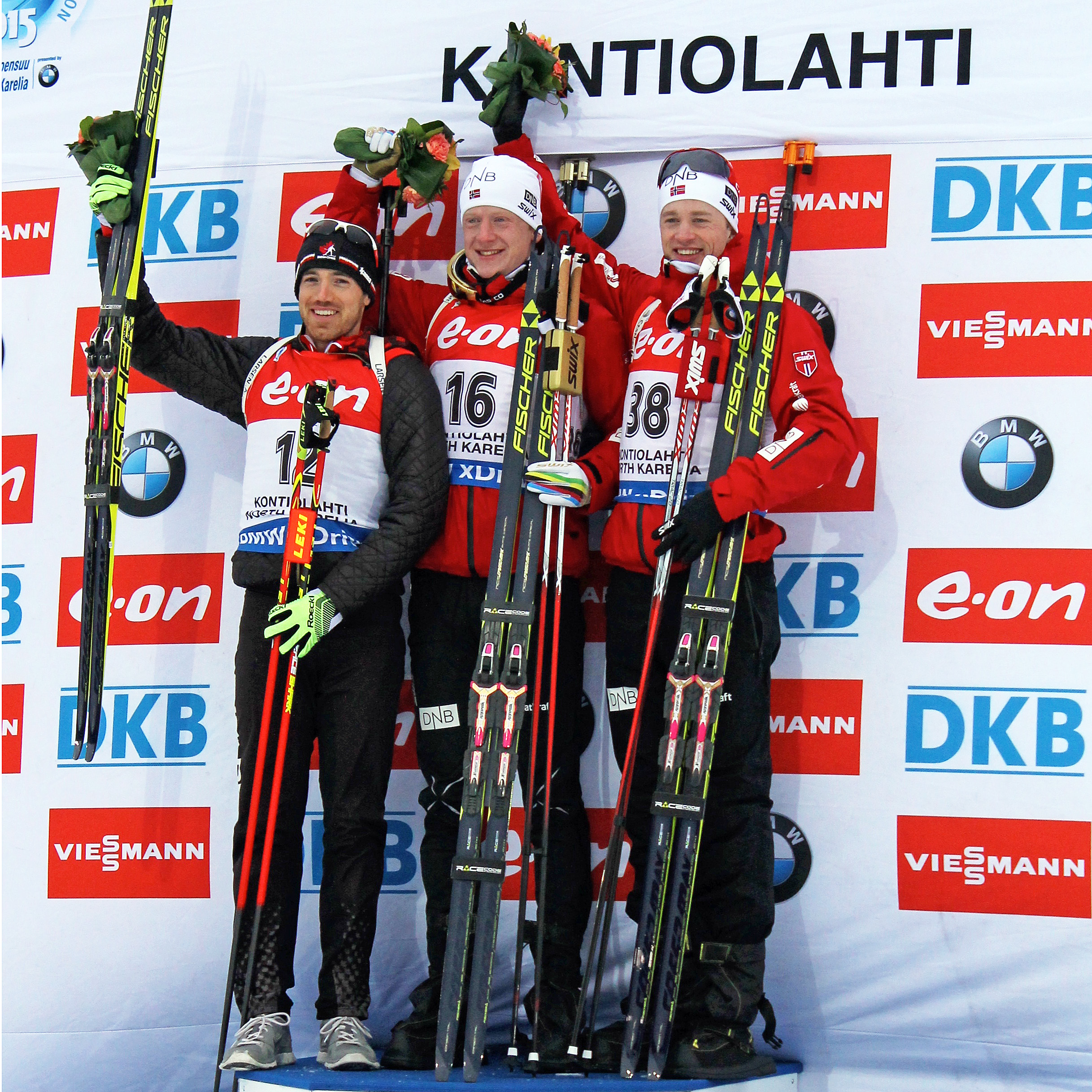
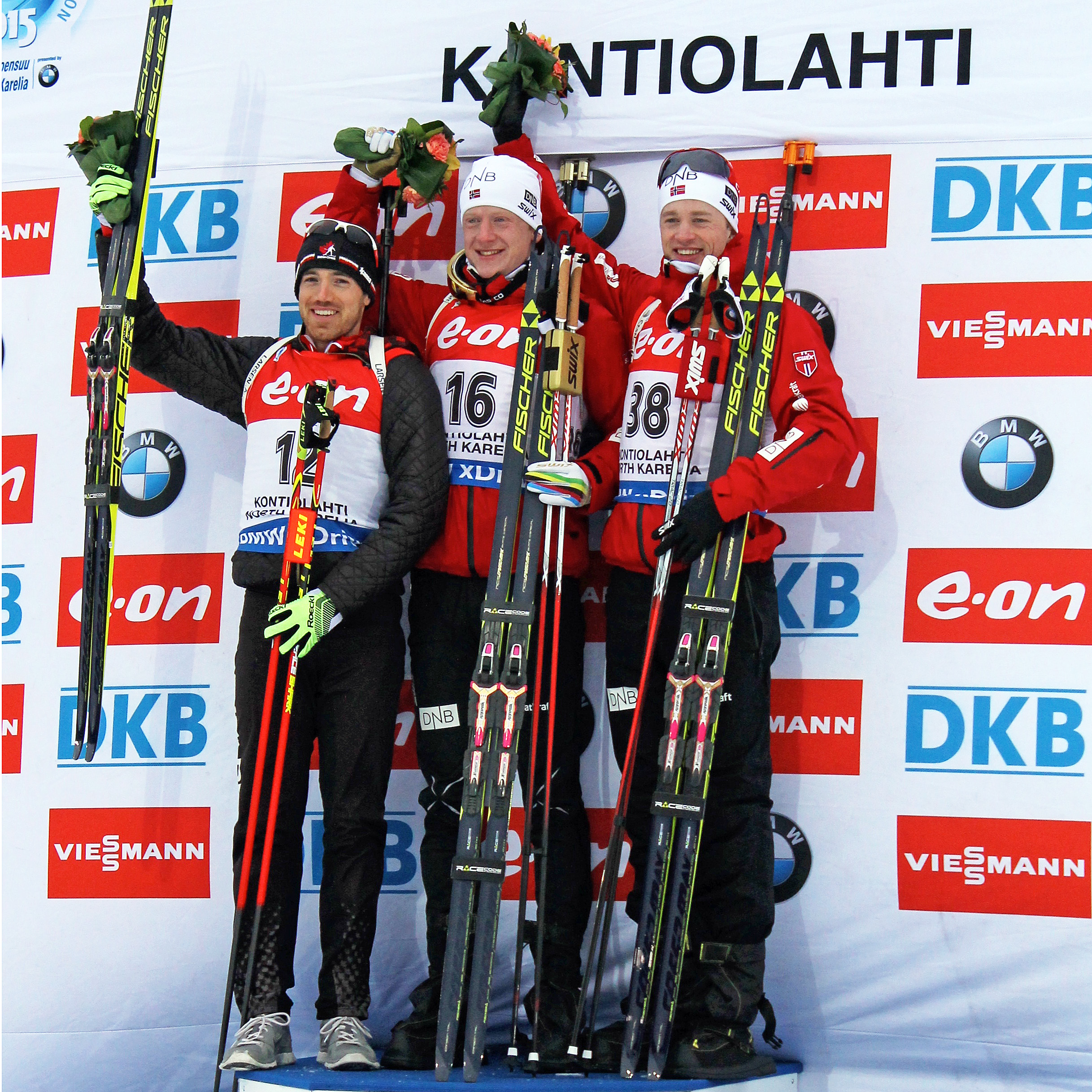
    Nathan Smith (l) on the 2015 IBU World Championships 10 k sprint podium on Saturday with Norwegian brothers Johannes Thingnes Bø (c) and Tarjei Bø (r) in Kontiolahti, Finland. Smith placed second for Canada's first-ever men's podium at World Championships.
    Nathan Smith (l) on the 2015 IBU World Championships 10 k sprint podium on Saturday with Norwegian brothers Johannes Thingnes Bø (c) and Tarjei Bø (r) in Kontiolahti, Finland. Smith placed second for Canada’s first-ever men’s podium at World Championships.

    KONTIOLAHTI, Finland — As Norwegian brothers Johannes Thingnes Bø and Tarjei Bø prodded and joked with each other on the podium of the men’s 10-kilometer sprint at IBU World Championships on Saturday, Nathan Smith simply grinned from the second-highest step on the podium.

    Finally, after the first round of many congratulations to come, it was starting to set in for the 29-year-old Canadian.

    Smith had just done something no other Canadian male had done before: he medaled at World Championships. Not only did he place in the top three, he finished squarely in second, 12.1 seconds behind winner Johannes Thingnes Bø, and 13.2 seconds ahead of Bø’s older brother Tarjei for silver.

    “When Johannes was 16, 17 years old he started winning Junior World Championships and he was following my steps all the time,” Tarjei, 28, reminisced in a post-race press conference. “We talked about this a lot during the summertime when we were at home training together. We love to compete and we love to fight each other, but still we are the team against the rest of the world so today is a big day for us.

    “We beat the world almost — it was only Nathan who came between us so congrats to him,” he added with a laugh.

    Everyone laughed.
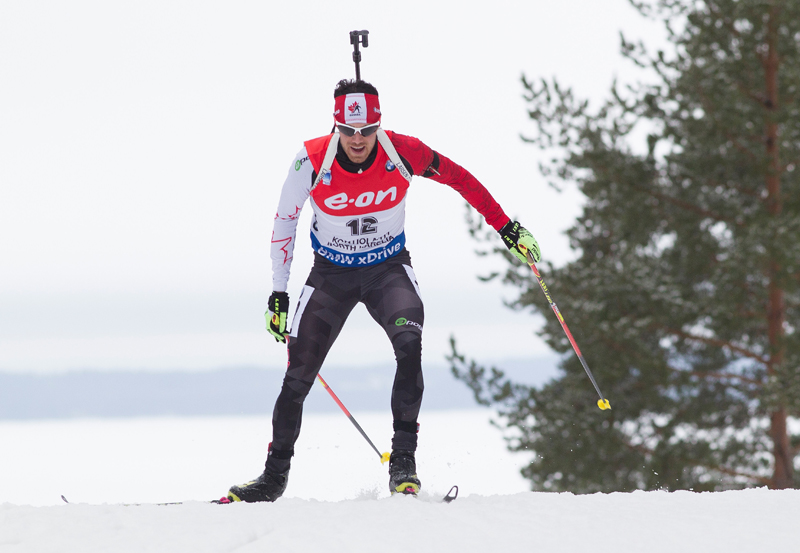
    Nathan Smith (Biathlon Canada) racing to Canada's first men's medal at IBU World Championships on Saturday in the 10 k sprint in Kontiolahti, Finland. Smith achieved silver for his first career podium at the World-Cup level. (Photo: Fischer/NordicFocus)
    Nathan Smith (Biathlon Canada) racing to Canada’s first men’s medal at IBU World Championships on Saturday in the 10 k sprint in Kontiolahti, Finland. Smith achieved silver for his first career podium at the World-Cup level. (Photo: Fischer/NordicFocus)

    Then there was Smith, a regular top-10 contender on the World Cup for the last two seasons, but unlike the Bøs, someone who had never tasted the podium before. Going into World Championships, his personal best was fifth in the pursuit on Nove Mesto, Czech Republic, just under a month ago.

    “It’s overwhelming,” Smith said of the attention he received Saturday as soon as the results were final. “I knew I could have some good races, but you never really believe it until you do it. It’s hard to explain, it feels great though.”

    All that came after shooting slump in January, when Smith placed 78th in an IBU World Cup sprint in Antholz, Italy.

    “I took some time away from my rifle and then I came back into Nove Mesto and Oslo and my shooting was right up there again so I had a lot of confidence with my shooting,” he said after hitting nine of 10 targets on a windy range in Kontiolahti on Saturday.

    “My skiing’s been pretty consistent all year. I haven’t had too many days where I’m dying out there, so I knew if I had an average day and nine or 10 here with the wind, that it could be really good.”

    Yet after starting 12th and taking the lead at the finish by 30 second, Smith wasn’t exactly sure what “really good” would amount to. He was bumped down one place by 21-year-old Johannes Thingnes in bib 16, but after that, no one came close.

    Based on World Championships rules for “unusual weather conditions,” the grouping system that determined starting order was altered for Saturday to allow nations with competitors ranked in the top 50 on the World Cup to enter “any draw group they choose.”

    Naturally, with a salted course for the just-above-freezing temperatures and the forecast for snow later in the day, the top men decided to go first. And out of 127 competitors, Smith was close enough to the front that it worked out for him as planned.
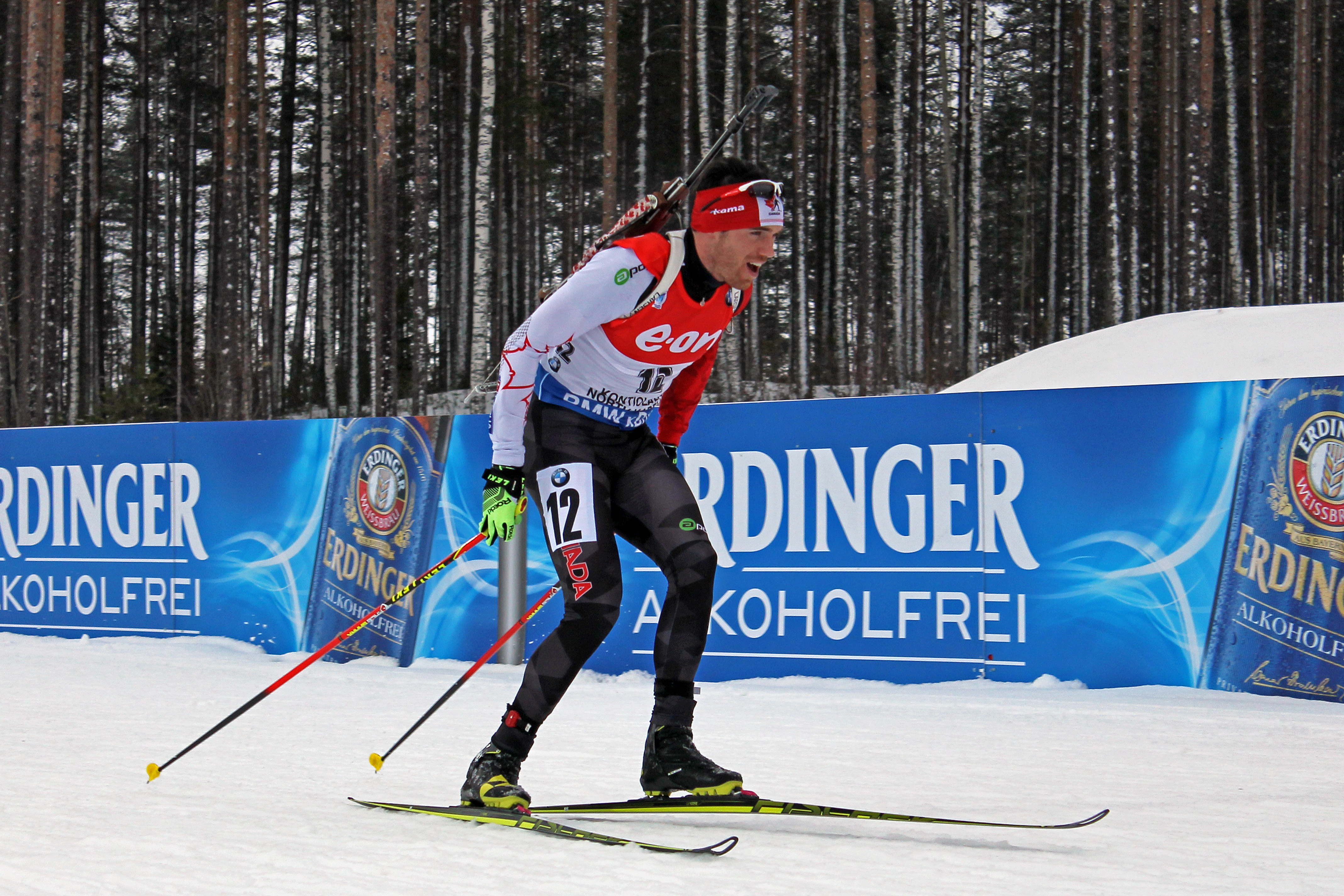
    Nathan Smith (Biathlon Canada) racing to Canada's first men's medal at IBU World Championships on Saturday in the 10 k sprint in Kontiolahti, Finland. Smith achieved silver for his first career podium at the World-Cup level.
    Nathan Smith approaching the range at the IBU World Championships 10 k sprint on Saturday in Kontiolahti, Finland. Smith went on to place second for a historic silver for the Canadian men’s program.

    With a headwind coming into his first shooting, he took note of the gusts from his right side and clicked a couple to the right. After hitting his first three prone shots, Smith felt the wind pick up even more, so he shaded, which led to perfect 5-for-5 shooting.

    “I got a little lucky for my last hit,” Smith recalled.

    That put him in second after prone, and he went on to ski the sixth-fastest second lap (out of three). In his second-and-final stage, Smith missed one, which was a success considering two men in the entire field finished the race with perfect 10-for-10 shooting (Tarjei being one of them).

    “I tried so hard in standing; I didn’t just whip though it and throw some shots away,” Smith said.

    However, he posted the sixth-fastest range time in standing to finish the race as the fourth fastest on the range overall. On skis, he was seventh fastest overall on course.

    “I worked really hard on the skis,” he added.

    “We beat the world almost — it was only Nathan who came between us.” — Tarjei Bø, Norway’s sprint bronze medalist

    “Before the race, Nathan knew that this course suited him,” Canadian national team coach Roddy Ward explained. “He doesn’t like gradual climbs, but the steeper climbs he feels comfortable with — offset. There’s quite a lot of that here. So he was pretty confident out there and he definitely looked like he had really good fitness.”

    Ward was out on course for most of the race while Canadian head coach Matthias Ahrens was in the range. But before he ventured out, he caught a glimpse of Smith whipping through the stadium.

    “I watched Nathan go around and I thought to myself, ‘Nathan’s gonna be a hero back home after this race,’ ” Ward predicted. “And then I said, ‘Don’t jinx it!’ and then I said, ‘I can’t  jinx it.’ I was pretty confident. He knew he was in good shape, too. I think he had pretty good confidence, but hey, he’s on the podium for the first time ever in a World Championships so of course it’s a bit of a surprise.”

    Like many who have followed Smith’s progression, from breaking out at the 2014 Olympics with three top-15 results in Sochi, Russia, Ahrens knew it was a long time coming.

    “With his good shooting and efficient shooting — shooting usually very fast — and then given that he had really good ski speed today, he was already looking quite solid, quite early,” Ahrens reflected. “[He has] the shooting efficiency, he shoots accurate, but also very fast. He’s always on the top five in the World Cup in that particular category when you analyze the race. His skiing has improved over the last three years and he’s now at a point, if everything comes together, then he can be on the podium.”
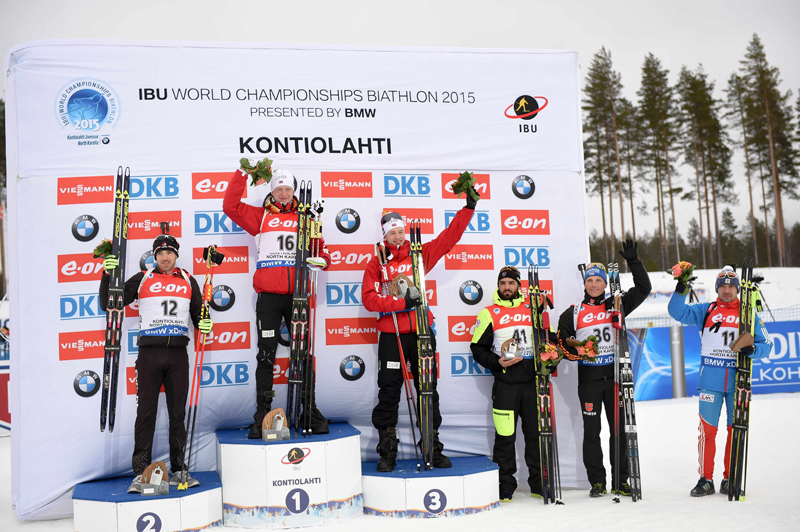
    The men's 10 k sprint podium at 2015 IBU World Championships in Kontiolahti, Finland. From left to right: Silver medalist Nathan Smith (Canada), gold medalist Johannes Thingnes Bø (Norway), bronze medalist Tarjei Bø (Norway), Simon Fourcade (France) in fourth, Erik Lesser (Germany) in fifth, and Evgeniy Garanichev (Russia) in sixth. (Photo: Fischer/NordicFocus)
    The men’s 10 k sprint podium at 2015 IBU World Championships in Kontiolahti, Finland. From left to right: Silver medalist Nathan Smith (Canada), gold medalist Johannes Thingnes Bø (Norway), bronze medalist Tarjei Bø (Norway), Simon Fourcade (France) in fourth, Erik Lesser (Germany) in fifth, and Evgeniy Garanichev (Russia) in sixth. (Photo: Fischer/NordicFocus)

    So the snowflakes fell at the right time and right place for Smith, who made history for Biathlon Canada. Previously, no man had medaled at World Championships, and Smith followed up on the success of former teammate Jean-Philippe Le Guellec, who won a World Cup sprint in 2012 in Östersund, Sweden, and retired after last season.

    Retired biathlete Myriam Bédard holds the Canadian women’s and overall record with two golds from the 1994 Lillehammer Olympics and another from 1993 World Championships.

    “I think how things started for our team was having Jean-Philippe Le Guellec leading our young men to success in the way that he actually was the first one on the podium, winning a World Cup, and that gave them confidence that really they all could do it,” Ahrens said. “That made a big mental breakthrough to our team, to the men, in many ways. The confidence, being able to do it in racing, but also what it takes in training to get there.

    “It shows the younger athletes what is possible when they put the work in, when they put the belief in,” he added.

    The silver medal was also huge in terms of future funding for Biathlon Canada. On the heels of Cross Country Canada’s Alex Harvey racking up silver and bronze at the FIS Nordic World Ski Championships last month in Falun, Sweden, biathlon essentially had to bring home some hardware as well to ensure an adequate budget from Own The Podium — Canada’s governmental branch of sport funding — for next season.

    “This is important for our funding because we are just actually judged by medals at World Championships or Olympic Games,” Ahrens explained. “Therefore it’s a very important step in the right direction.”

    “It shows the younger athletes what is possible when they put the work in, when they put the belief in.” — Biathlon Canada Head Coach Matthias Ahrens on Nathan Smith’s silver-medal performance

    To his own surprise, Smith reached that marker in the first individual race of 2015 World Championships. Going into Saturday’s race, he later explained he would have been happy with a top eight. Three years ago, he wasn’t sure how much longer he’d last as a professional biathlete.

    “Going into the Olympics last year, I was thinking it was going to be my last year,” Smith explained. “I was like, I’m going to do whatever I can to get to the Olympics.”

    Two summers ago, he made some significant tweaks to his training and preparation. He targeted his weaknesses and honed in on them, like uphill rollerskiing. He made his own rifle stock, which he currently uses, and started doing things he had never done before, such as dry firing.

    “We always say that North Americans in general are late developers compared to the Europeans,” he observed. “We’re, like, five years behind them in development. I think it just takes a bit longer when we’re isolated in Canada.”

    As of Saturday, Canada’s on the map. Smith went head to head with top skiers like Russia’s Evgeniy Garanichev, who started 11th and led after a clean prone, as well as Johannes Thingnes, and was fast enough to hold off Tarjei, who posted two perfect stages.

    Like Smith, Johannes Thingnes had one standing miss, and started 16th to come through each checkpoint with the consistently fastest times. At the end of the day, the Norwegian had the fastest course time as well.

    “It was maximum of what we could expect today, two brothers on the podium for the first time and also my first [World Championships] gold medal in my first [individual] start,” Johannes Thingnes said in the press conference. “So it could not have been better.”

    After the press conference, Smith said he hadn’t talked to his parents yet — they were on a bike trip in Argentina.

    “Usually they wake up really early in the morning to watch [my races], but I don’t think they have reliable internet there so we’ll see when they find out,” he said casually. “I’ll send them an email.”

    Three Canadian Men Make Pursuit

    Also for Canada, Brendan Green placed 21st (+1:14.3) with a single standing penalty and Scott Gow was 50th (+2:06.2) with one prone miss and one standing miss, to qualify for the pursuit. The youngest man on the team, Christian Gow finished 73rd (+3:11) in his World Championships debut. After starting 109th, he faced some of the toughest, slowest conditions of the men’s race and came away with three penalties — one in prone and two in standing.
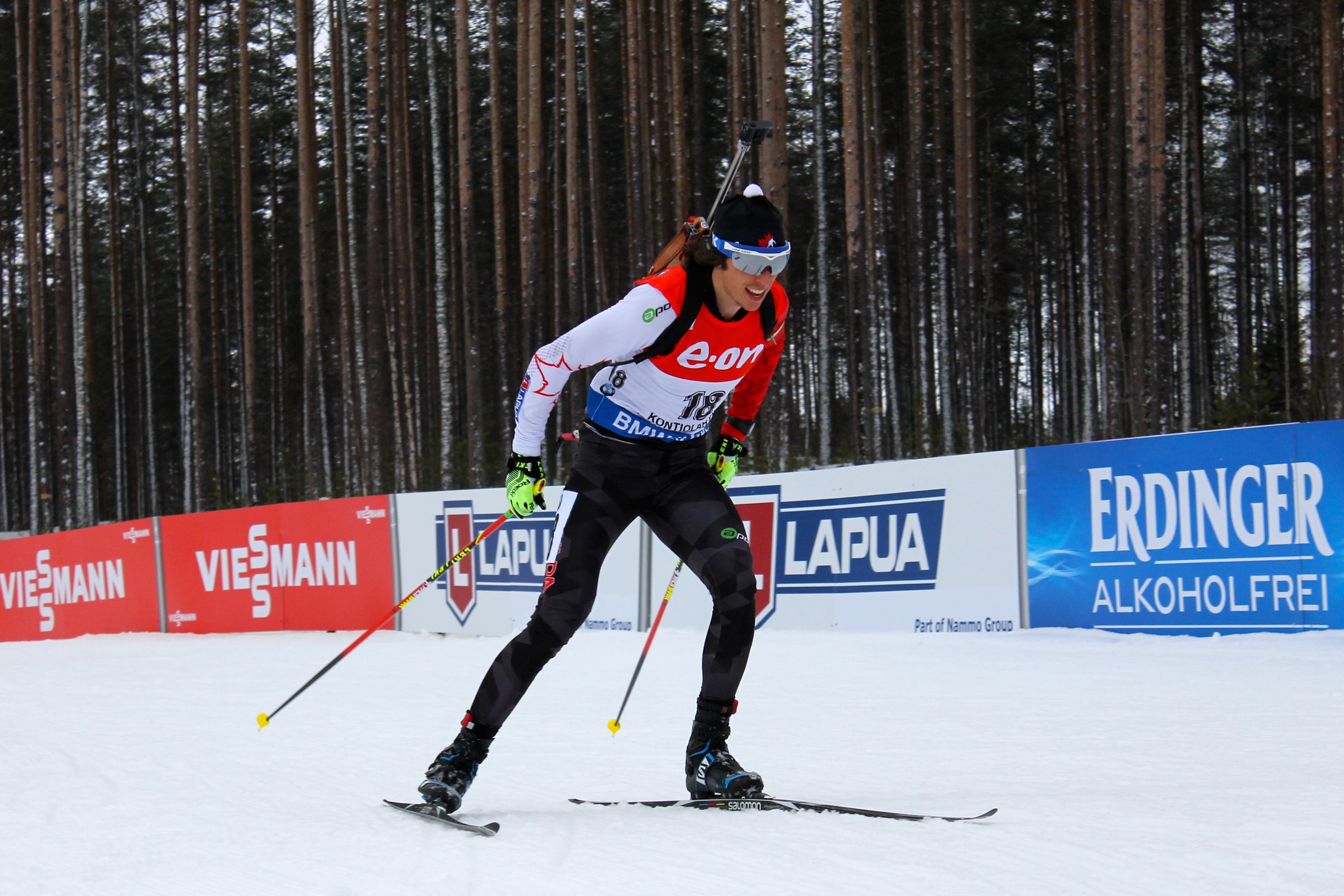
    Canada's Brendan Green on his way to 21st in Saturday's 10 k sprint at IBU World Championships in Kontiolahti, Finland. He'll start Sunday's pursuit 1:14 behind the race leader.
    Canada’s Brendan Green on his way to 21st in Saturday’s 10 k sprint at IBU World Championships in Kontiolahti, Finland. He’ll start Sunday’s pursuit 1:14 behind the race leader.

    “I just figured that if I felt decent on the skis and I knew I’d have to have some good shooting, probably at least eight, maybe nine out of 10, and I thought that was really possible,” Christian explained. “But the wind was a bit tricky and I think I gave away a shot prone. Standing was just tough. I felt really unsettled. Every time I lined up on the target, the wind seemed to push me away.”

    On his way to the starting line, Christian realized that Smith had all but secured second.

    “I couldn’t even believe it,” he said. “We know as a team we’re quite strong, and Nathan and Brendan especially have been really really close to the top. … I think sometimes they underestimate themselves a little bit … I knew they could hit the podium with the right race. When I started, that’s when I realized he was going to hold that because that’s when all the threats were coming in [and] his time was better than theirs. That was awesome.”

    “I saw [Nathan] clean prone and I saw him leading standing with one miss,” said older brother, Scott Gow, 24, who started 55th. “I thought, ‘Oh, maybe he’ll do well.’ He stayed up there. It was motivating to try and go out there and put in a good ski race and aiming to shoot as well or as better than him. It was more motivating to see him do so well.”

    Personally, Scott said he had hoped for a top 30.

    “That’s my personal goal at every race,” he said. “Today, with the wind the way it was I figured 80 percent, 90 percent shooting would [be enough], and I made the low end of that. The skiing suffered a little on the last lap. I was just kind of tanked.”

    Not long after Smith started, Green took to the course and ended up tying Belgium’s Michael Roesch for 21st.

    “I’m a little bit disappointed and I was hoping for better skiing,” Green said. “With the shooting I had on a day like today, I would expect a better result. It wasn’t a disaster, it was just the skiing wasn’t quite there. I’m not sure why that is. I’m set up well for the pursuit.”

    In Sunday’s 12.5 k pursuit, Green will start alongside Roesch, 1:14 behind Johannes Thingnes, while Smith will head out 12 seconds after the race leader in second.

    “Obviously in a pursuit, I’m going to have an advantage over everyone except Johannes, so that’s an advantage,” Smith said in the press conference. “But there’s so many guys breathing down our necks that I’ll have to fight really hard to maintain it.”

    “Everything is possible,” said Tarjei, who will start 25 seconds behind his brother. “Two races now, two medals [for Norway], and same with my brother, so I have to win tomorrow to catch up with him. No chance.”

    “It’s kind of funny,” Smith said of being sandwiched between the Bø brothers. “I do feel a little left out, but I’m happy for them.”
    Results

  • As Skiing Takes Spotlight in Quebec, Biathlon Canada Aims to Leverage World Cup Win to Grow Sport, Solve Budget Cuts

    As Skiing Takes Spotlight in Quebec, Biathlon Canada Aims to Leverage World Cup Win to Grow Sport, Solve Budget Cuts

    Jean Philippe Le Guellec, a Quebec native, became the first Canadian man to win a biathlon World Cup competition when he took an 18-second victory in a sprint in Ostersund, Sweden on Saturday.

    As the FIS Cross Country World Cup descends on Quebec, there’s another Canadian governing body that is hoping that fans and sponsors will remember its’ athletes successes this weekend – Biathlon Canada. Quebec native Jean Philippe Le Guellec became the first Canadian man to stand on the IBU World Cup podium, much less at the top of it, on Saturday.

    In fact, the success of Canada’s ski team, which is surely one reason that Quebec and Canmore were able to draw these World Cups, is one thing that inspired Le Guellec. He wanted to begin to match the success of the skiers, who have gained media attention, popularity, and funding from their exploits.

    “We’ve been looking at the cross country guys – Devon Kershaw, Alex Harvey, and a lot of the team actually have cracked the podium in the last couple years,” Le Guellec said during a press conference after his 18-second sprint victory in Östersund, Sweden. “It’s really great to be able to do this on the biathlon side too, and I really hope that it carries out throughout the season and throughout the years.”

    And while it is, frankly, beyond unlikely that biathlon’s top circuit will make a stop in the French-speaking province anytime soon, in some ways the sport in Canada owes a debt to Quebec more than any other province. Before Le Guellec, the last World Cup winner was Myriam Bédard, another Quebec native; of the three Canadians who have made it to the podium, only Zina Kocher is from outside the province, growing up in Alberta.

    “Granted, we’re only talking about three individual athletes here – two out of three is not a pattern, necessarily,” Biathlon Canada High Performance Director Chris Lindsay told FasterSkier in a phone interview on Monday.

    But pattern or no, Quebec is a unique place for sport in Canada, and nordic sports in particular. The current success of Le Guellec, Alex Harvey, and other Quebec natives comes as no surprise to Lindsay, who spent time in the province himself when he was training as an athlete.

    “The values espoused by the Quebec culture are much more conducive to being supportive of small-town sport, regional sport, and provincial sport,” Lindsay said. “I see a lot of similarities with how a local community in the United States would be able to support their team, maybe a local football team, where they can go out and actually get tangible support from the community. There’s the sense that the community will take ownership of this, because it’s people in the community who are participating.”

    Le Guellec picked up biathlon in 1999, the year that Bédard, a bronze medalist in the 1992 Olympics and then a double gold medalist in 1994, retired; he and the other Quebec biathletes work for much of the year at a venue bearing her name, the Myriam Bédard Training Centre at Valcartier, outside of Quebec City.  Lindsay drew parallels between the support given to the two World Cup winners.

    “Myriam’s success was partly because Myriam was Myriam, and she was an extraordinary athlete,” he said. “But also because there were mechanisms early on in her career which allowed her to be successful and to continue the sport and be well-supported. And I think you see the same thing with JP…. In Quebec you see an understanding that through participation in sport, and excellence in sport, we are promoting ourselves and we are reinforcing our understanding of who we are.”

    A New Hero?

    Lindsay hopes that Le Guellec can achieve something else that Bédard did, as well – inspiring a generation of athletes to consider biathlon, and to believe that success is possible.

    “We are very hopeful that JP becomes one of the symbols that Myriam was,” Lindsay said. “One of the reasons that JP got into the sport was because of the success and notoriety of Myriam Bédard…. We got very close to having that sort of hero status for JP at the Vancouver Olympics in 2010 [where he finished sixth], but we weren’t quite there. So hopefully this is coming full circle.”

    In Canada, Bédard’s fame has almost faded. Lindsay estimated that most athletes have a memory of one or two Olympic cycles; if they don’t make the national team, eight years is about the point where they leave the junior ranks and consider college, either leaving high-level sport completely or perhaps focusing on cross country skiing. In fact, many young biathletes weren’t even born yet when Bédard was winning her medals.

    For Le Guellec, putting Canadian biathlon back on the world stage has been a major goal.

    “The implications of yesterday, the consequences of that, I’m totally on board with,” Le Guellec told FasterSkier after Sunday’s pursuit in Östersund. “It’s what I’ve been working on all these years, essentially, to prove that Canadians can be up there. Tim [Burke] proved it [for the U.S.] two years ago being the leader before Christmas, and it was time for a Canadian to do that too. So North America can be up there.”

    (Americans agreed: “That was an awesome day for North America,” U.S. biathlete Susan Dunklee said after her own sprint race on Saturday. “We know what it’s like, and that’s a huge step for [Canada], because I don’t know if that’s been done before. It’s really cool.”)

    At the grassroots level of the sport, getting people involved – particularly kids – is something that Biathlon Canada actually excels at as a national body. Over 60 clubs are spread across the country, with several thousand athletes, coaches, and officials, and a “cadet” program that involves thousands more through the Royal Canadian Air, Army, and Sea Cadets program. In comparison, the U.S. Biathlon Association has just a few hundred members race each season.

    But the governing body wants more, and the high performance director hopes that Le Guellec’s performance can help the sport snag some more participants. At the very least, it has garnered more exposure for a little-known sport in the country.

    “We’ve enjoyed in the past weekend what I would call almost unprecedented media coverage,” Lindsay said. “We’ve been national news on each of our national sports networks and a lot of our regular broadcast networks have picked up the story. It has really been remarkable to see this level of support for any nordic sport, but especially biathlon, because we’re just not used to it.”

    Realistically, though, Lindsay knows that the team is going to have to keep the strong performances coming if it wants to stay in the public eye. (To outside observers, for instance, the FIS World Cup racing in Quebec and Canmore will quickly take the spotlight away from the biathlon team’s success.) Luckily, success within a team can feed on itself, and the rest of the biathletes are ready to deliver.

    “When someone is doing well on the team, it pumps everyone up, and I think that really motivates everyone to give everything they have on race day,” Kocher said on Saturday after placing 10th in her own race; she’s aiming to get back on the podium for the first time since 2006.

    Money Troubles, But No Quick Fix

    It’s not just fans and potential athletes that will be looking for another World Cup victory to inspire them, however. Biathlon Canada just this spring saw a budget cut from Own the Podium, a joint public-private partnership in Canada that targets funding towards the national teams most likely to win medals at World Championships and Olympic Games.

    While having an actual World Cup winner should definitely help Biathlon Canada state its case for getting their funding back – and maybe more – it’s not so simple. Own the Podium looks primarily at World Championships and Olympic performances, for one thing. But for another, funding is doled out on a comparative basis, so if other sports have good seasons too, well, the biathletes might have to do much more to earn their salaries.

    “The reality of the Own The Podium situation is that they have limited funding, and we have a number of winter sports,” Lindsay said, sounding weary. “The winter sports that are demonstrating that they are capable of reliably producing medals are the ones that are going to be at the head of the queue. We hope that this result helps to substantiate our claim that we have athletes who, given proper levels of support – not extraordinary, just proper – can make the jump from being a top-16 athlete to being a podium athlete.”

    As Lindsay discussed this spring, it’s a constant source of frustration that biathlon – a “mature” sport, unlike, say, freestyle skiing or snowboarding, and also one where the shooting aspect creates much more variability in the number of winners compared to a pure endurance sport – doesn’t get much attention from funders. Last season, for instance, before the budget cut, Kocher, Le Guellec, and Brendan Green all achieved top-ten World Cup results. To any fan of the sport, that would indicate medal potential.

    “Everyone in the nordic community recognized that JP’s multiple top-16 finishes [at the Vancouver Olympics] were remarkable, and cause for celebration, but they didn’t really match up against the snowboarders and the hockey team, the alpine skiers and curlers,” Lindsay said. “Without having someone on the podium, the reality is you’re in a different tier. Fourth place is not the same as third place.”

    Canadian biathlete Megan Imrie agreed, saying that the team’s strong performances don’t always appear so impressive to spectators who are new to the sport.

    “I know we’ve been really close to really good performances on a number of times, but nobody really cares about that unless you’re one, two, or three,” she told FasterSkier after the sprint on Saturday. “So having him as a World Cup winner at the first World Cup of the year is going to hopefully put biathlon up in the spotlight a little bit more.”

    Lindsay said that he was “optimistic,” and that talks with Own the Podium would certainly continue. He has also been working hard trying to use Le Guellec’s win to help attract more sponsors, which the team desperately needs in the wake of the cuts.

    “One of our big pitches, of course, is that we’re kind of a bargain,” he said. “The reality of our budget is that any little bit helps. And any little bit immediately has a massive effect on what we can do programming-wise in order to support even more success as we go on… but we are cognizant that it is going to take more than one weekend of results to make it really stick in people’s minds, that Biathlon Canada is an investment that could really pay off in partnership.”

    For now, the team can just enjoy the spotlight for a little while longer.

    “It’s been crazy,” Le Guellec told FasterSkier regarding the attention he received on Saturday. “My twitter followers doubled overnight. Definitely a lot of e-mails, a lot of facebook-posts. That was overwhelming, actually, more than any of the interviews themselves. But it was pretty cool to see all the support.”