Tag: Nadezhda Skardino

  • Friday Rundown: Domracheva Tops Kontiolahti Sprint; Crawford 12, Egan 13th

    Friday Rundown: Domracheva Tops Kontiolahti Sprint; Crawford 12, Egan 13th

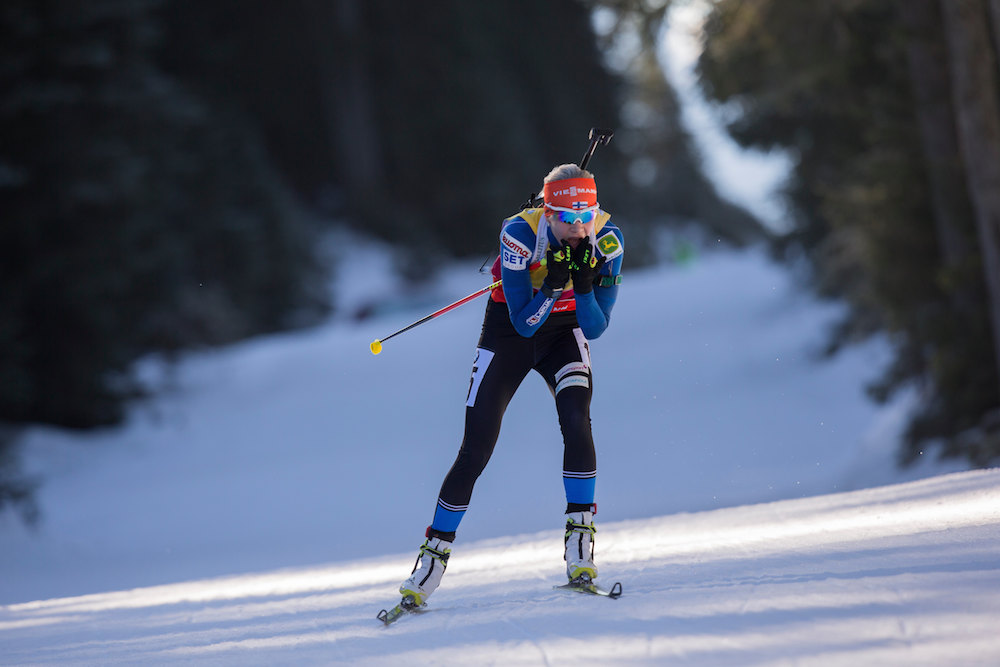
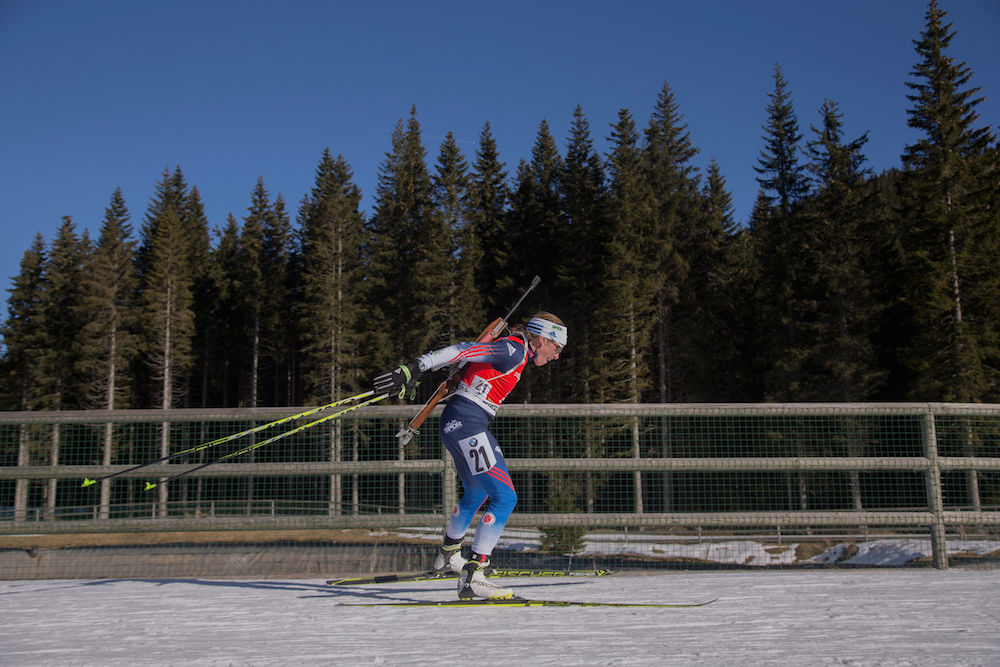
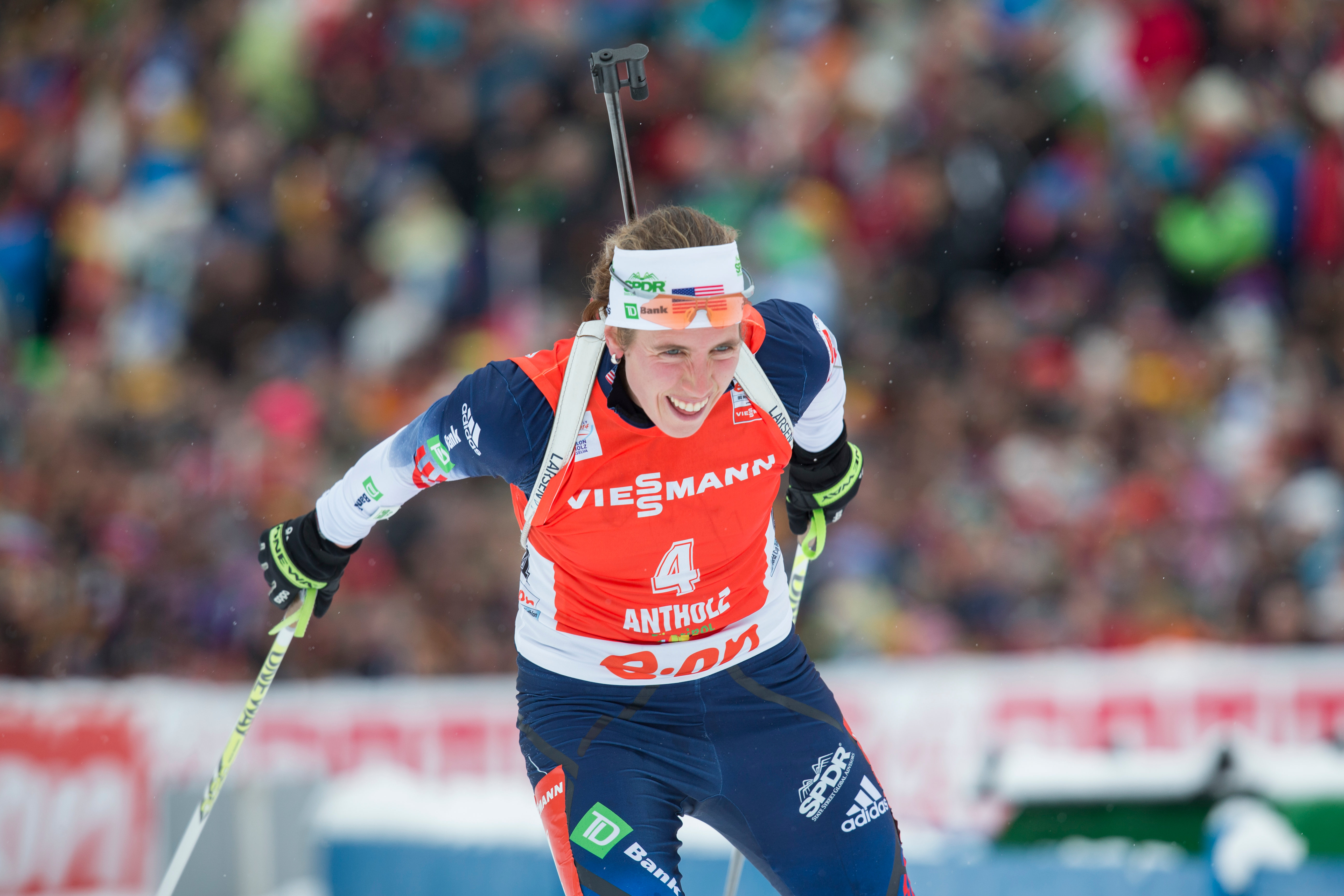
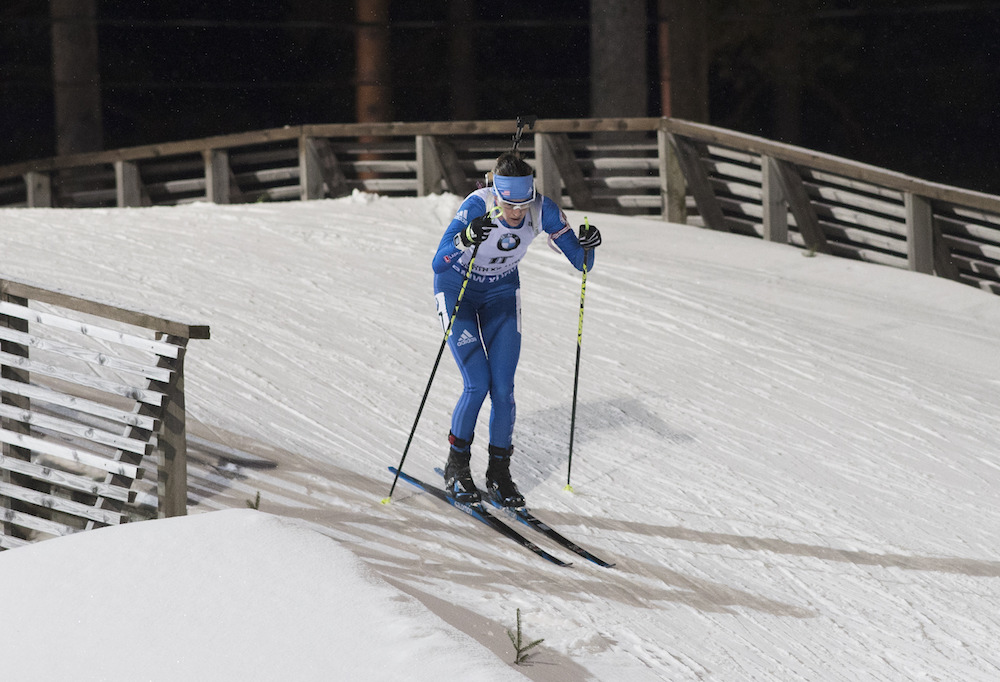
    Clare Egan (US Biathlon) racing to a career-best 13th in the women’s 7.5 k sprint at Friday’s IBU World Cup in Kontiolahti, Finland. (Photo: USBA/NordicFocus)

    IBU World Cup (Kontiolahti, Finland): Women’s 7.5 k sprint

    Darya Domracheva of Belarus raced to her third World Cup victory of the season on Friday, and American Clare Egan tallied a career best in 13th, just behind Canada’s Rosanna Crawford in 12th in the International Biathlon Union (IBU) World Cup women’s 7.5 k sprint in Kontiolahti.
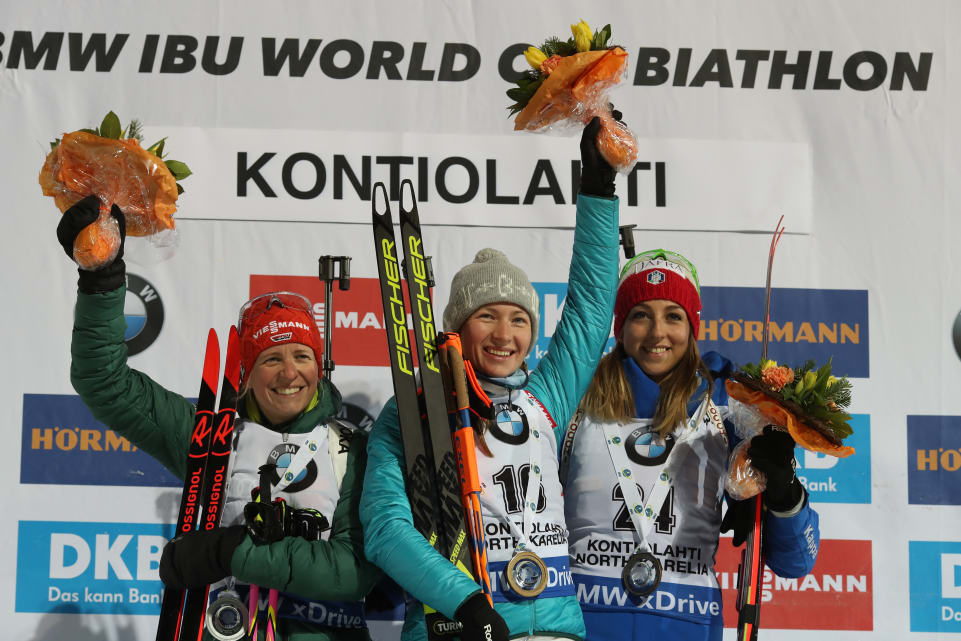
    The women’s 7.5 k sprint podium at the IBU World Cup in Kontiolahti, Finland, with Belarus’s Darya Domracheva (c) in first, Germany’s Franziska Hildebrand (l) in second, and Italy’s Lisa Vittozzi (r) in third. (Photo: IBU/Biathlonworld)

    Domracheva started 16th and shot a perfect 5-for-5 in prone, then missed one in her standing bout, but skied to first with the fastest overall course time. Her position in the leader’s chair looked secure until Germany’s Franziska Hildebrand, who started 49th, shot clean in both stages and headed out on her last loop with a 17.6-second lead on Domracheva’s time. But Hildebrand couldn’t match Domracheva’s pace and finished 0.5 seconds short of the winning time of 20:56.8 at the finish.

    “I really like to compete here in Kontiolahti,” Domracheva said, according to an IBU press release. She won two gold medals there at 2005 Youth/Junior World Championships and went on to win her first two World Cup races there in 2010.

    “This is a tough track, always very difficult but it always a good chance to take some seconds if you are in good shape,” she said. “I have some good memories from here…”

    “I am very proud of myself,” Hildebrand said of her race, according to the IBU. “Dasha made a really strong last loop and I tried to do it as well. It was very close but I am happy to be second … I had to concentrate and have the confidence that I could shoot clean today.”

    Italy’s Lisa Vittozzi started 24th and came within 5.5 seconds of Domracheva’s time, after missing one standing target (0+1), to place third, 5 seconds behind Hildebrand.

    Vittozzi achieved her first career podium in Kontiolahti last year.

    “This is an amazing place for me,” she told the IBU. “I like this track so much and feel in good shape. I tried to do my best in the shooting range and finally I did it.”

    Ukraine’s Yuliia Dzhima shot clean but was 11.7 seconds short of the podium in fourth place (+17.2), Germany’s Laura Dahlmeier followed in fifth (+19.4; one penalty), Veronika Vitkova of the Czech Republic placed sixth (+21.0; no penalties), Ukraine’s Vita Semerenko was seventh (+21.0; no penalties), France’s Marie Dorin Habert eighth (+32.0; no penalties), Germany’s Maren Hammerschmidt ninth (+33.9; one penalty), Finland’s Kaisa Makarainen 10th (+34.4; two penalties), and Belarus’s second woman in the top 11, Nadezhda Skardino 11th (+35.3; no penalties).
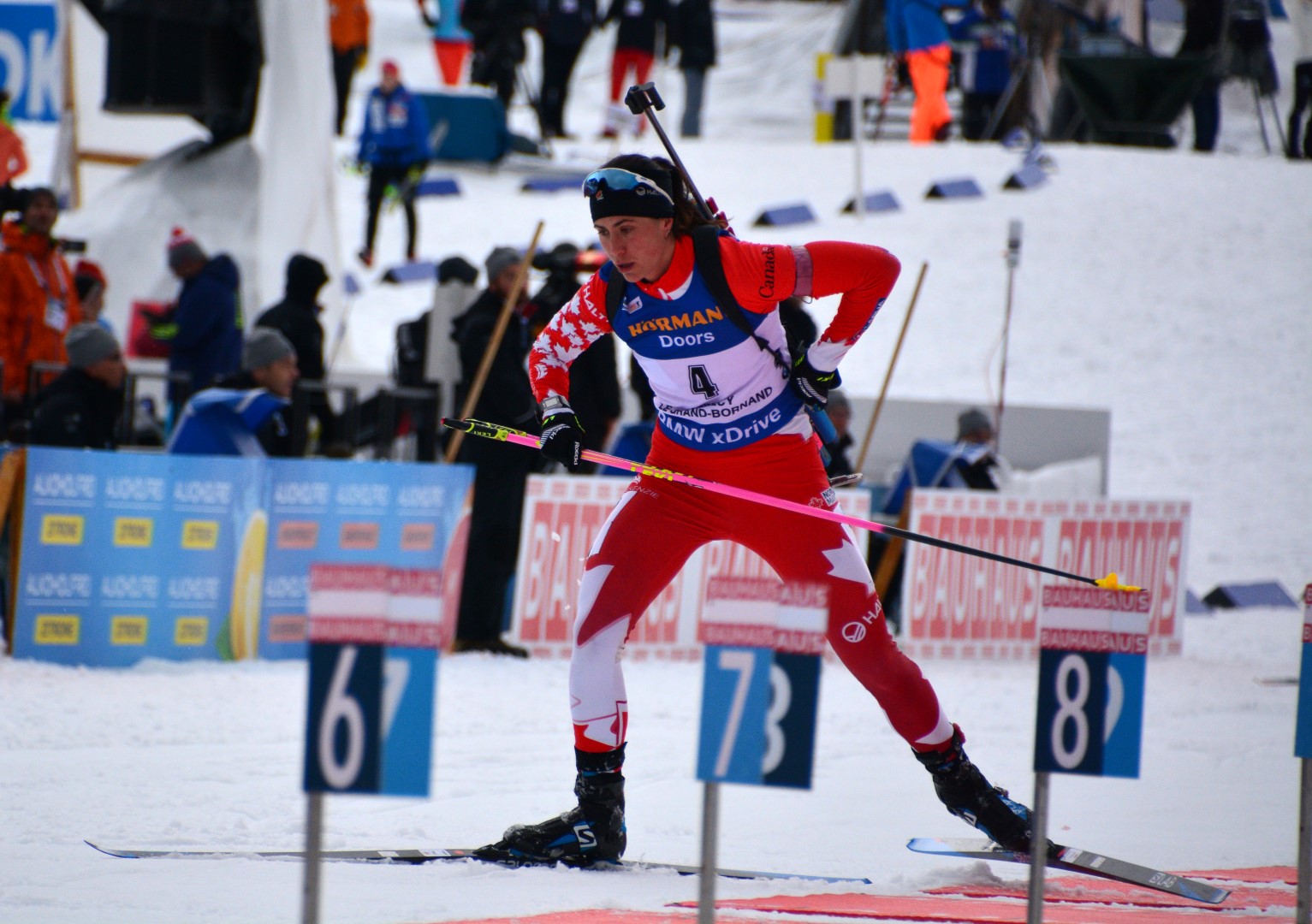
    Rosanna Crawford (Biathlon Canada) leaving the range during the women’s IBU World Cup sprint earlier this season in Annecy, France. . (Photo: Glen Crawford)

    Crawford led Canada in 12th (+46.5) with a single prone penalty (1+0) for her best sprint result since the 2014/2015 season. Also this season, Crawford raced to a career-best third place in a 15 k individual and fourth in a 12.5 k mass start.

    “It was a little bit windy and some fresh snow made for a soft track, but I had amazing skis from our techs and was feeling good skiing,” Crawford wrote in an email. “I’m really happy with how I executed my race today, I really tried to channel my inner Jessie Diggins and never stop fighting! The hills are steep and long here, something I usually struggle with, but I tried to push them mentally aside and focus on what I am good at, there are a lot of flat sections where my two skate one skate is really strong, and on the big up hills I just tried to stick with whoever was around me.

    “I had a lot of fun out there tonight, something I didn’t think I would ever say about this race course!” she continued. “… I am really happy to have some good ski speed in a spring finally!”

    Egan, of the U.S., achieved her best World Cup result in 13th (+46.9) with a single standing miss (0+1) and the 14th-fastest overall course time. Her previous best was 16th in a sprint four year ago.

    After the Olympics, Egan explained in an email that she rented an apartment in Helsinki and spent the first part of the off-week spending some alone time and doing “some serious R&R. I don’t think I realized how chaotic the Olympics were until I had peace and quiet for the first time in 3 weeks,” she wrote.

    “After a week of mostly easy skiing on my own I was really antsy to race today,” Egan added. “I also felt motivated coming off my season-best performance in the women’s relay in Pyeongchang. My individual results have been really mediocre this year so I was looking to take the momentum and confidence from the relay and carry that into today’s race.”
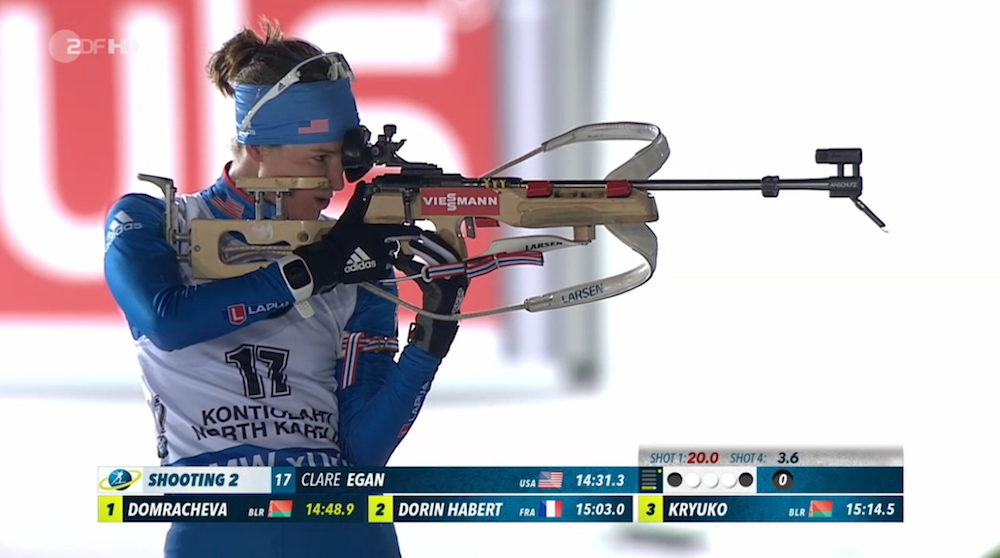
    Clare Egan (US Biathlon) during her standing shooting of the IBU World Cup women’s 7.5 k sprint in Kontiolahti, Finland. (Screenshot: ZDF broadcast)


    During Friday’s sprint, she noticed her skis were running really well.

    “I can say without any doubt that we had the fastest skis today and that played a big role in my ski time,” Egan wrote. “I had a personal best ski time (rank) by at least 10 places today.”

    After starting one bib and 30 seconds behind Domracheva, Egan knew she was having a good race when she could see the eventual winner for most of the first loop.

    “Our skis were so fast that I honestly had to adjust my technique to account for the extra glide– exceptional!” she added. “On my last loop, I realized I was still ahead of Laura Dahlmeier, who started :30 seconds behind me, and I fought super hard to hold her off all the way to the finish line!

    “I was shocked to have a career best with one miss,” Egan concluded. “But I had a major PR on my ski time rank, and this is biathlon! I’m very, very happy to have a great result, but happier about the performance behind the result.”

    With their results on Friday, both Egan and Crawford earned starts in Sunday’s 12.5 k mass start, according to a provisional start list.

    “I’ll have another opportunity tomorrow in the mixed relay and Sunday in the mass start, which is only the second of my career,” Egan wrote.

    “I was pretty disappointed to not qualify for the mass start at the Olympics,” Crawford wrote. “My bad sprint had many far-reaching consequences. So I am glad I get another chance to go out there and fight with the best!”

    Also for the U.S., Susan Dunklee finished 36th (+1:27.0) with three penalties (1+2), Emily Dreissigacker was 62nd (+2:15.7) with two misses (2+0), and Joanne Reid was 74th (+2:38.7) with two misses (0+2) as well.

    Canada’s Emma Lunder finished 43rd (+1:48.0) with one miss (1+0), Julia Ransom was 58th (+2:07.9) with two penalties (1+1), and Sarah Beaudry finished 66th (+2:20.3) with two misses (1+1) as well.

    This year’s Kontiolahti World Cup does not include a pursuit race. The single mixed relay and mixed relay are set for Saturday, followed by men’s and women’s mass starts on Sunday.
    Results

  • Thursday Olympic Rundown: Belarus Gold in Thrilling Women’s Biathlon Relay; US 10th Team in NoCo

    Thursday Olympic Rundown: Belarus Gold in Thrilling Women’s Biathlon Relay; US 10th Team in NoCo

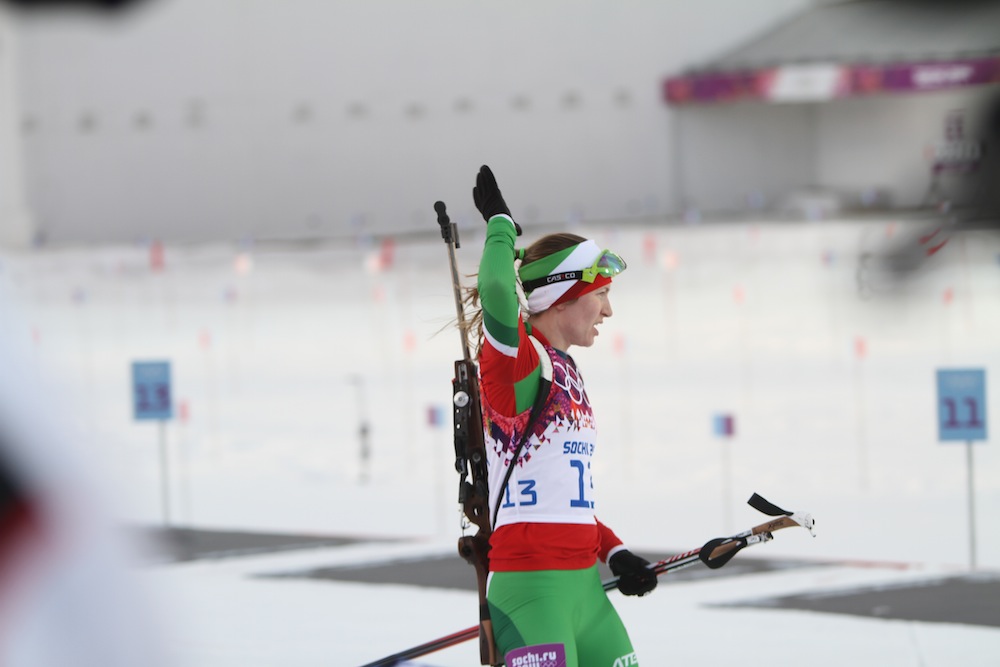
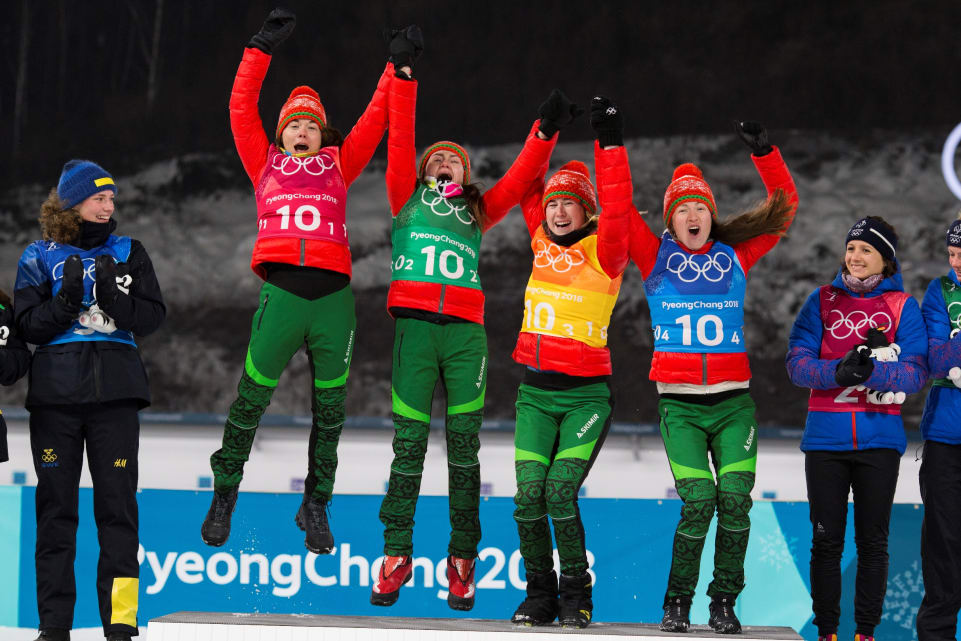
    The Belarusian women’s biathlon team of Nadezhda Skardino, Irina Kryuko, Dzinara Alimbekava, and Darya Domracheva celebrates winning gold in the relay. They were ranked 10th coming into the day. (Photo: IBU/Biathlonworld.com)

    FasterSkier would like to thank Fischer Sport USAMadshus USAConcept2Boulder Nordic Sport, and Swix Sport US for their generous support, which made this coverage possible.

    ***

    2018 Olympics (PyeongChang, South Korea): Biathlon Women’s 4 x 6 k relay

    Full report

    Ranked just 10th coming into today’s women’s relay, the team from Belarus stole the show with Darya Domracheva skating across the line to claim the fourth Olympic gold of her career after strong efforts from Nadezhda Skardino and Iryna Kryuko, both of whom have stood on the World Cup podium before, and newcomer Dzinara Alimbekava, a 22-year-old newcomer with just 11 World Cup starts to her name. It was the first relay medal ever won by Belarus at the Olympics.

    The setting was windy and snow-blown and the race was extremely tight, with seven teams with one penalty loop (or a few spare bullets) worth of time going into the final leg. The Belarusians’ nine spare rounds were the best shooting of the day; while that spare-round tally was matched by Slovakia, Kazakhstan, Bulgaria, and Japan, those teams had penalty loops as well.

    Sweden actually wasn’t one of them, but with perfect shooting and a fast ski time 15 k gold medalist Hanna Öberg brought the team to silver after starting the anchor leg in eighth, a minute back. She benefitted from many missed shots by the leaders, and then passed France’s Anais Bescond on the final loop to claim second, 10.7 seconds back, for her teammates (Linn Persson, Mona Brorsson, and Anna Magnusson) while France (Bescond, Anais ChevalierMarie Dorin Habert, and Justine Braisaz) took bronze (17.6). These medal-winning teams used 12 and 14 spare rounds, respectively, an unusually high tally.

    Norway (Synnøve SolemdalTiril EckhoffIngrid Tandrevold, and Marte Olsbu) finished fourth, +29.7, Slovakia fifth (+38.4), Switzerland sixth (+43.5) after winning a photo finish against Poland (+43.6), and Germany finished seventh (+53.9).

    The Canadian team of Sarah BeaudryJulia RansomEmma Lunder, and Rosanna Crawford finished 10th, +1:33.4. Their shooting of eleven spare rounds and one penalty loop was among the better scores of the day.

    The United States had a strong start, with Susan Dunklee tagging off in second place, Clare Egan maintaining a good position in fourth, and Joanne Reid rebounding from one bad shooting stage to tag off in sixth. Anchor leg Emily Dreissigacker crossed the finish line in 13th, +2:01.9.

    Results

    ***

    2018 Olympics (PyeongChang, South Korea): Nordic Combined Team Competition

    After sweeping the medals in the large hill competition, perhaps it was not a surprise that Germany won the nordic combined team event. It was a blowout: ranked second after the jumping round but starting the cross-country ski relay just six seconds behind Austria, the Germans quickly took the lead and then just extended it. Their team of Vinzenz Geiger, Fabian Riessle, Eric Frenzel, and Johannes Rydzek won by 52.7 seconds over Norway’s Jan SchmidEspen AndersenJarl Magnus Riiber, and Jørgen Gråbak. Austria hung on for third, +1:07.8, with Wilhelm DeniflLukas KlapferBernhard Gruber, and Mario Seidl.

    The United States team of Taylor FletcherBen BerendBen Loomis, and Bryan Fletcher lost out on a photo finish with Poland and finished 10th out of 10 teams, +5:16.7.

    Results

  • Saturday Olympic Rundown: Norway Tops Women’s Relay, U.S. 5th; Kuzmina Dominates Mass Start

    Saturday Olympic Rundown: Norway Tops Women’s Relay, U.S. 5th; Kuzmina Dominates Mass Start

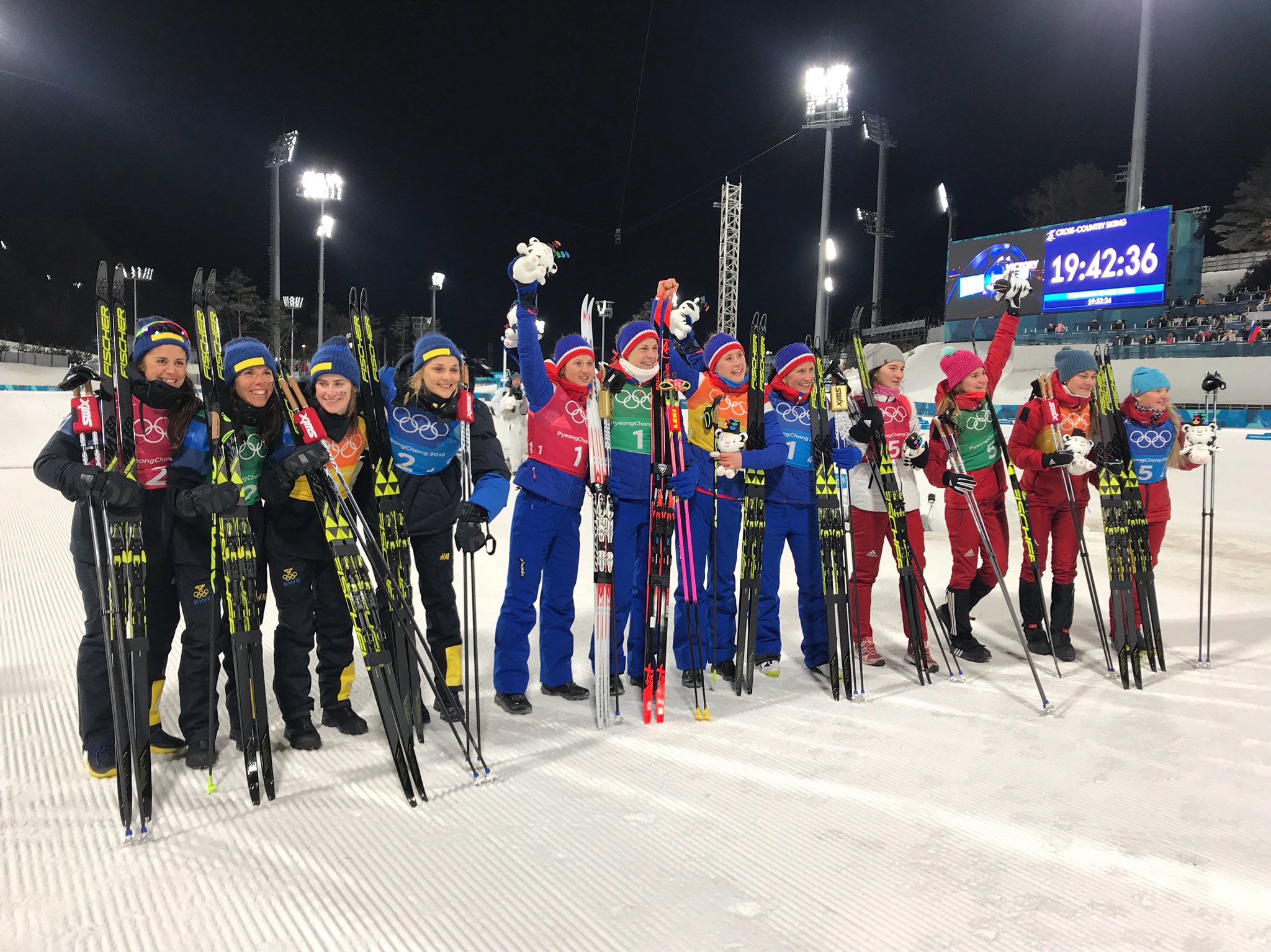
    Norway won the women’s 4 x 5 k relay, with Sweden taking silver and Russia bronze. (Photo: FIS Cross Country/Twitter)

    FasterSkier would like to thank Fischer Sport USAMadshus USAConcept2Boulder Nordic Sport, and Swix Sport US for their generous support, which made this coverage possible.

    2018 Winter Olympics (PyeongChang, South Korea): Women’s 4 x 5 k Relay

    International report

    North American report

    It wasn’t the wire-to-wire triumph that Norway sometimes achieves, but the pre-race favorites got the job done despite a scare midway through, thanks to dominant skiing by Ragnhild Haga and smooth strength from anchor Marit Bjørgen.

    Norway took gold in the 4 x 5 k relay by two seconds over Sweden in 51:24.3 minutes. Olympic Athletes from Russia took bronze (+43.3), Finland fourth (+1:02.6), and the United States fifth (+1:20.5).

    The first leg went out with Natalia Nepryaeva of Russia setting a blistering pace, fracturing the field almost immediately. A number of racers tried to stay with her only to get shot off the back of the pack. Taking a different pacing strategy, Slovenia’s Anamarija Lampic made up ground in the final section of the first leg to tag off in second, with Norways’ Ingvild Flugstad Østeberg third, all within a few seconds of each other.

    Part of Nepryaeva’s fracturing of the field led to U.S. lead skier Sophie Caldwell getting dropped, to tag off 1:01.5 minutes back in 11th place.

    In the second leg, Charlotte Kalla of Sweden and Kerttu Niskanen of Finland clocked the fastest times, making up 24.4 and 9.9 seconds that had been lost to Russia and Norway by their teammates Anna Haag and Aino Kaisa Saarinen, respectively. In the meantime, Astrid Uhrenholdt Jacobsen of Norway had a disastrous relay leg and notched just the eighth-fastest split time, falling to fourth.

    Yulia Belorukova of Russia continued to lead the race on that second leg, but Kalla tagged off at the end of the classic portion just 1.4 seconds back, and Niskanen in third (+10.1). Sadie Bjornsen made up three places to tag off in eighth (+1:05.2).

    Jacobsen tagged Haga 29.8 seconds out of first. From that point, Haga gradually reeled in the leaders over the course of the 5 k skate leg. It was an absolutely dominant performance, with the fastest split time by 24.7 seconds in a less than 12-minute race.

    Sweden’s Ebba Andersson led Russia’s Anastasia Sedova for the whole leg and stayed clear of the field, but Haga — the gold medalist in the 10 k skate — made up enough ground to finish her effort in third, 3.4 seconds back.

    That was more than enough for Bjørgen to work with, and she and Swedish anchor Stina Nilsson quickly dropped Anna Nechaevskaya of Russia and set off on their personal duel for gold. Bjørgen led the whole way, but could not make any decisive move to drop the Swede. Instead, over the top of the climb she had about a second, which Nilsson could not close on the downhill or the final flats into the finishing straight: gradually, Bjørgen just added a meter and another to her lead and crossed the line with gold.

    Nechaevskaya continued to lose time on the leaders, but still held on to bronze. Krista Pärmäkoski skied an aggressive effort for Finland to pass the team from Switzerland, which had been in fourth after strong legs from Laurien van der GraaffNadine Fähndrich, and Nathalie von Siebenthal. But 21-year-old Lydia Hiernickel was unable to keep the pace and Switzerland dropped to seventh by the finish, getting passed by not only Parmakoski and Jessie Diggins, but also Sandra Ringwald of Germany. The Germans finished sixth (+1:49.4) and Switzerland seventh (+1:51.5).

    Kikkan Randall had skied the third-fastest split of the field (behind Haga and Andersson) in the third leg to bring the U.S. into sixth, and Diggins also skied the third-fastest split (behind Bjørgen and Nilsson) for her leg to bring the team up to fifth at the finish.

    The Canadian team of Dahria BeattyEmily NishikawaCendrine Browne, and Anne-Marie Comeau placed 13th (+4:50.3) of 14 teams.

    Results

    ***

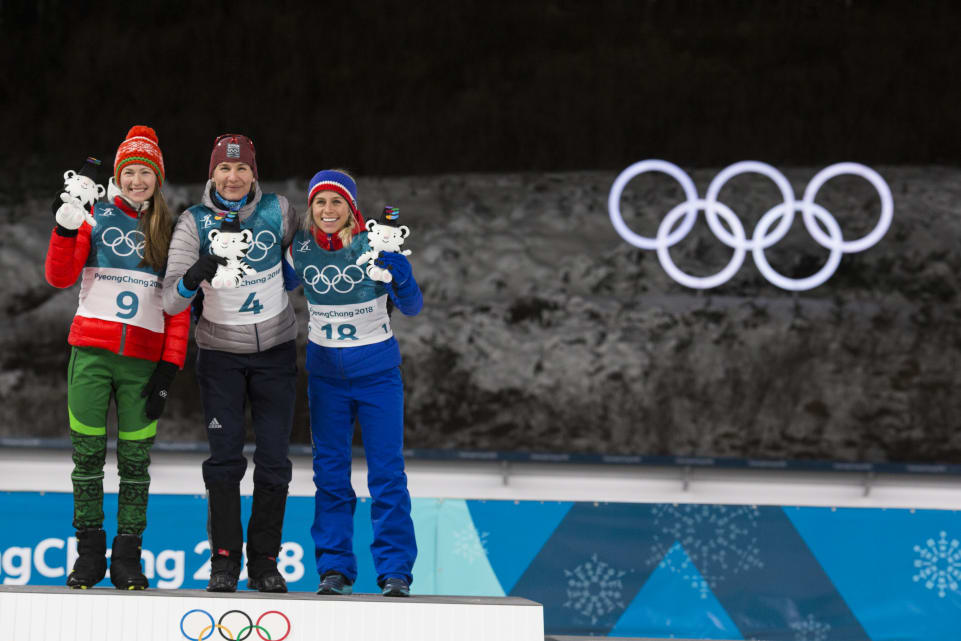
    The women’s biathlon 12.5 k mass start medalists at the 2018 Olympics in PyeongChang, South Korea, with Slovakia’s Anastasiya Kuzmina (c) in first, Belarus’s Darya Domracheva (l) in second, and Norway’s Tiril Eckhoff (r) in third. (Photo: IBU/Biathlonworld)

    Biathlon: Women’s 12.5 k mass start

    Full report

    Not even a miss in the final stage could keep Slovakia’s Anastasiya Kuzmina from her third medal of the 2018 Olympics, this time gold, in the women’s 12.5-kilometer mass start on Saturday at the Alpensia Biathlon Center.

    Kuzmina took charge early in the five-loop race, leading Germany’s Laura Dahlmeier into the range for the first prone shooting stage. There, Kuzmina cleaned all five targets quickly to get back out on course in first, while Dahlmeier missed one to slip out of the top 20, while several other athletes cleaned.

    Kuzmina went on to hit every target over the next two shooting stages to distance herself from second place, and even with a miss on the last standing stage, she left the range 24.7 seconds clear of Darya Domracheva of Belarus in second.

    Domracheva had put herself in second with clean shooting in the first two stages, then dropped to fifth with a miss on the third stage. Italy’s Dorothea Wierer was up to second by the fourth shooting after three clean stages, then fell back to seventh with a miss on the last standing.

    There, Domracheva cleaned to get back into silver-medal contention, 9.3 seconds ahead of Norway’s Tiril Eckhoff in third.

    Heading into the final downhill into the stadium, Kuzmina had enough time to grab a flag from one of her team’s staff members running alongside the trail. She crossed the finish line first in 35:23.0 minutes without anyone close for her third-career Olympic gold (after winning the sprint at the 2010 and 2014 Games).

    Domracheva skied on her own to second, 18.8 seconds behind, for her first medal of the 2018 Games (and fifth of her career after winning three races at the 2014 Olympics).

    Eckhoff, who had skied two penalty laps, took third, 27.7 seconds behind Kuzmina, while Italy’s Lisa Vittozzi held off Sweden’s Hanna Öberg, Wierer and Belarus’s Nadezhda Skardino for fourth place (+45.6). Öberg placed fifth (+46.5), Wierer was sixth (+47.3), and Skardino seventh (+47.9), ahead of Norway’s Marte Olsbu in eighth (+51.6), France’s Marie Dorin Habert in ninth (+57.9) and Finland’s Kaisa Mäkäräinen in 10th (+1:00.9). Dahlmeier, who had won two races and placed third in another at these Olympics, finished 16th (+1:47.1) with two penalties (1+1+0+0).

    No North Americans qualified for the mass start.

    Results

  • A New Season for Biathlon Canada: Ransom Rockets to Career-Best Ninth

    A New Season for Biathlon Canada: Ransom Rockets to Career-Best Ninth

    Julia Ransom (Biathlon Canada) racing to ninth in the women’s 15 k individual on Wednesday at the IBU World Cup opener in Östersund, Sweden. In her first World Cup race of the season, it was Ransom’s career-best result and Biathlon Canada’s best individual result since 2015/2016. (Photo: Biathlon Canada/NordicFocus)

    Entering this season, members of Biathlon Canada had everything to gain and not a whole lot to lose. They had already had their funding reduced to zero by Own The Podium, save for a $50,000-dollar provision that paid for a coach, and its athletes were left to determine their offseason plan: stay home to train or self-fund training camps elsewhere. Many chose to spend most of their summer at the team’s base in Canmore, Alberta, and most started the season on the fly — without any preseason tuneup races in Europe — this week in Östersund, Sweden.

    Julia Ransom was one of those athletes. After prequalifying for Canada’s International Biathlon Union (IBU) World Cup Team for the first trimester of racing, Ransom, 24, jumped into the 2017/2018 season with the Östersund mixed relay this past Sunday — three days after flying over from Canada.

    There, she raced the second leg of the relay and tagged off in 15th, down two spots from where her teammate Emma Lunder tagged her in 13th. The team ultimately finished 15th, with teammates Scott Gow and Brendan Green.

    “Today was a tough day for me. My legs were lead on the course,” Ransom wrote in a post-race email to FasterSkier on Sunday.

    Three days later on Wednesday, it was another ballgame. With little to lose in the women’s 15-kilometer individual in Östersund, Ransom raced to a career-best ninth, which stood as her team’s best non-relay result in two seasons.

    In the first individual race of the season, Ransom is well on her way to securing a spot on Biathlon Canada’s 2018 Olympic team, meeting half of the team’s “Priority 2” Olympic criteria standards. She needs another top 16 to fulfill that second-tier criteria. Priority 1 is one top-eight result in a World Cup (or World Championships, in a championships year like last season) or a top-three in a World Cup relay.

    So far, she is the only one on her team who has cracked the top 16 in two seasons. Last winter, her best result (and her previous personal best) was 18th at 2017 World Championships in the 15 k individual. Canada’s best non-relay result in 2016/2017 was Scott Gow’s 17th place in a 20 k individual World Cup race.

    And again, it’s the first race of the season.

    “I am still in shock with how well today went,” Ransom, a Penticton, British Columbia, native in her fourth World Cup season, wrote in an email to FasterSkier on Wednesday.

    “It is such a relief to start racing again,” she continued. “I wasn’t too nervous today; I had a race plan that I had confidence in and I was excited to give it a go. I also was looking for redemption after my painful relay leg on Sunday.”

    Conditions were chilly, at -12 degrees Celsius (10 degrees Fahrenheit), but calm, accounting for clean shooting for seven out of the top-nine finishers. Ransom was one of them.

    She started 20th (out of 102) and cleaned all four stages in the longest-format women’s race on the circuit. In individual races, shooting is weighed heavily; a minute is added to a competitor’s final time for each missed shot. Fortunately for Ransom, she hit all 20 targets.

    “I was getting some pretty exciting splits during the whole race (top 5, second place, catching the leader etc) so I had an idea this was going to be a good day as long as I kept my shooting together,” she reflected. “I took a sigh of relief after the 20th target went down and just tried to ski as well as I could to the finish. I did take look at the big screen as I left the range, just to make sure I was hearing the techs right!”

    Ransom initially crossed the finish line in third, 28.8 seconds behind Sweden’s Mona Brorsson in first and 9.8 seconds behind Eva Puskarčíková of the Czech Republic in second. Both Brorsson and Puskarčíková also shot clean.

    The 55th starter, Nadezhda Skardino of Belarus, ultimately posted the best shooting and skiing performance of the day, racing to her first World Cup win (and first podium in three years) in 42:57.4 minutes with 20-for-20 shooting. Norway’s Synnøve Solemdal started 75th and shot clean but came up 2.9 seconds short at the finish to place second, bumping Ukraine’s Yuliia Dzhima to third (+12.0). The top-four women all cleaned with another Ukrainian, Valj Semerenko, placing fourth (+30.1).

    Slovakia’s Paulina Fialková finished fifth (+32.2) with a single penalty (0+0+0+1), while Brorsson ultimately placed sixth (+49.6) and Puskarčíková seventh (+1:08.6).

    Ransom ended up ninth for her best World Cup level performance by nine places, ahead of Norway’s Marte Olsbu in 10th and about eight seconds behind France’s Justine Braisaz in eighth.

    “Starting off the season with a top ten has validated the hard work our team has put in and also given me a lot of confidence going forward. It’s a great building block to say the least,” Ransom wrote.

    Asked what she thought made the difference with her training this year, she explained that she’d honed in on increasing her shooting speed.

    “It’s still a work in progress but I am happy where I am so far,” she wrote. “I also did a ton of extra strength work and core stability and it has proven to make a big difference on the skis.”

    On Wednesday, Ransom’s overall shooting and range times ranked in the middle of the pack, around 50th, while her overall course time was slightly faster in 42nd.

    Biathlon Canada Head Coach Matthias Ahrens praised Ransom’s ability to perform under pressure.

    “Especially as the tension mounted, with each clean bout, Julia was closer the podium and she managed the pressure very well,” he said, according to a team press release. “She didn’t get too excited or too nervous, executing clean shooting each time.”

    Four Canadians started Wednesday’s 15 k, with Rosanna Crawford finishing 39th (+3:32.6) with three penalties (0+0+1+2), following her crash in Sunday’s single mixed relay.

    “Rosanna, considering the crash of Sunday, had a really nice race,” Ahrens said in the press release. “It wasn’t certain if she’d race today, and we went in with a strategy not to risk any further injury. She managed a very good race, with a quite good ski time. Her rifle also required repairs from Sunday’s race. Overall, not knowing how she would hold up, particularly on one of the hardest Individual courses on the circuit, it was a nice result for her, in the World Cup points.”

    Megan Bankes finished 75th (+6:28.9) with three misses (2+1+0+0) and Lunder was 83rd (+7:06.3) with five penalties (0+0+2+3).

    US Biathlon started three women, with Susan Dunklee leading the team in 53rd (+4:12.7) with four penalties (1+0+1+2). Clare Egan finished 79th (+6:52.5) with five misses (0+2+1+2) and Emily Dreissigacker was 81st (+7:03.5) with three misses (0+0+1+2).

    The men start their season with a 20 k individual on Thursday at 11:15 a.m. Eastern Standard Time.

    Results

  • Crawford Keeps Her Cool for 13th in Östersund 15 k; Egan Leads U.S. in 44th

    Crawford Keeps Her Cool for 13th in Östersund 15 k; Egan Leads U.S. in 44th

    Rosanna Crawford (Biathlon Canada) racing at 2015 IBU World Championships in Kontiolahti, Finland.
    Rosanna Crawford (Biathlon Canada) racing at 2015 IBU World Championships in Kontiolahti, Finland. In the first individual race of the 2015/2016 season, Crawford, 27, placed 13th in the 15 k with 90-percent shooting.

    If you were wondering whether a podium in the first race of the season took the pressure off Rosanna Crawford for the first individual women’s race on Thursday, the answer is no.

    “I am very realistic that the single mixed relay isn’t like any other race we do and that it didn’t have most of the strongest women,” Crawford wrote in an email. “So I was quite nervous going into today’s race, wondering where I would land, to see if all my hard work over the summer had paid off.”

    Crawford, a 27-year-old two-time Olympian and Biathlon Canada team veteran, had experienced success in Östersund, Sweden, well before last Sunday. At last season’s International Biathlon Union (IBU) World Cup opener there, she placed 12th in the sprint and 16th in the 15-kilometer individual distance race.

    This year, she landed in between the two and placed 13th in Thursday’s 15 k individual, the longest format on the women’s circuit. It was her personal best in a 15 k, and it came right at the start of the season.

    “It was a calm day on the range in terms of Ostersund, a little flutter of the flags, maybe a 2-3 click wind and it was quite consistent,” Crawford explained. “I knew a lot of girls would be shooting well, so I just made sure to stay focused on my self and my range routine.”

    Italy's Dorothea Wierer (l) smiles for cameras after her first-career IBU World Cup win on Thursday in Ostersund, Sweden. She won the 15 k by 14 seconds. (Photo:  IBU/Evgeny Tumasov)
    Italy’s Dorothea Wierer (l) smiles for cameras after her first-career IBU World Cup win on Thursday in Ostersund, Sweden. She won the 15 k by 14 seconds. (Photo: IBU/Evgeny Tumasov)

    The 41st starter, she knocked down 18 of 20 targets, missing one on each of her standing stages to finish 2:41.6 behind Italy’s Dorothea Wierer, who shot clean to win her first-career World Cup in 42:17.

    “I do not think the first win has hit me yet, but happy to win, not just for me but for our team,” Wierer, who started 46th, said in a post-race press conference. It was also her first time shooting 100 percent in a 15 k.

    “I was a little sick last week so I was not so brilliant on the skis today, but it was okay,” Wierer added. “The shooting was good, though; I turned off the head and just shot like in training.”

    Besides Wierer, three other women also cleaned and finished in the top 12: Ukraine’s Olena Pidhrushna, who placed third, and two Belarusians, Nadezhda Skardino in sixth and Nastassia Dubarezava in 12th. The second-place finisher, Marie Dorin Habert of France missed two on the second stage, but skied the fastest course time to reach the podium, 14.1 seconds behind Wierer. Pidhrushna finished 37.8 seconds back from the Italian in third.

    Meanwhile, Crawford hung in the top 20 throughout the race, rising from 19th to 13th on her third of five loops. At the end of the day, her course time ranked a modest 35th, but her range time was notable: she was fourth fastest of 101 finishers.

    “I really wanted to be control in the range. Last year I missed 2 in my last standing to hit 17/20, so I wanted to beat that,” Crawford recalled. “I learned a few things from the single mixed relay last Sunday. It reminded me not to stress too much in the range and to just remember that I am a good shooter.”

    Her shooting time ranked sixth overall. After cleaning her second prone — the third of four stages — Crawford had a sense she was having a good race.

    “Skiing felt strong and the targets were going down, so that just left my last standing!” she wrote. “On my last loop I knew the top 10 was close, but I just didn’t quite have enough gas in the tank to bring me closer!”

    She started 13th and ended there, 8.2 seconds behind Dubarezava in 12th and about 22 seconds out of 10th. Previously, Crawford’s best finish in an individual race had been 16th last year in Östersund. At 2013 IBU World Championships in Nove Mesto, Czech Republic, she placed 17th in the 15 k individual with 95-percent shooting.

    “I am happy with my result but know that skiing isn’t quite where I want it yet,” Crawford wrote on Thursday. She reflected that she started too hard and forgot to control her skiing.

    “In the end I don’t think it changed things too much ski speed wise, but I did get a bit slower as the race went on,” she added. “Looking forward to Saturday’s shorter race!”

    The women’s and men’s races continue in Östersund with the 7.5/10 k sprints on Saturday and 10/12.5 k pursuits on Sunday.
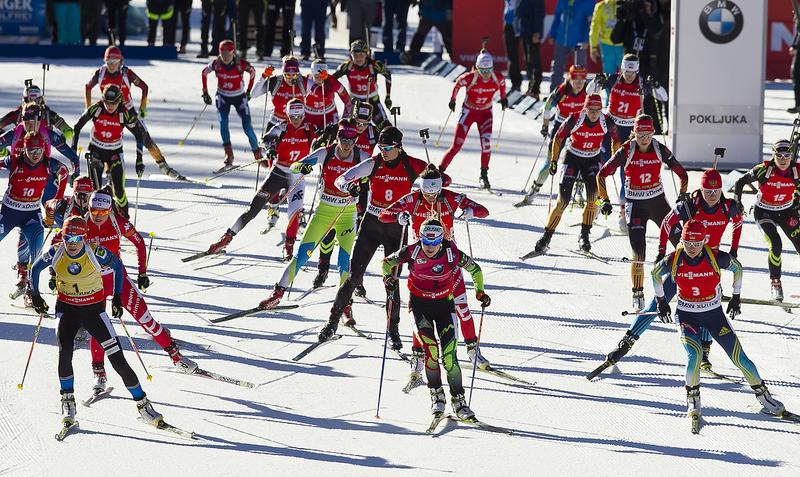
    “I definitely want to consistently be in the top-15, with hitting the top-10 more than last year,” Crawford said in a Biathlon Canada press release. “My main goal is a podium in a non-team event. These first three World Cups [in Östersund, Hochfilzen and Pokljuka] are my favourite venues, so I know they will be my best chance to be on the podium.”

    After Crawford, Canada’s Julia Ransom finished 52nd (+5:25.6) with three penalties (1+2+0+0), Megan Tandy (formerly Heinicke) placed 67th (+6:54.2) with five misses, and Zina Kocher was 98th (+11:30) with nine penalties. For each miss in an individual race, a minute penalty is added.

    Clare Egan finishing 44th in Thursday's 15 k individual for her best result at that distance at that level. (Photo: USBA/NordicFocus)
    Clare Egan finishing 44th in Thursday’s 15 k individual for her best result at that distance at that level. (Photo: USBA/NordicFocus)

    Leading the U.S. in her first year on the World Cup team, Clare Egan placed 44th (+4:52.9) with 17-for-20 shooting. She cleaned both prone stages and missed one on the first standing and two on the final standing.

    It was her second-best finish at the World Cup level after placing 40th in the sprint at 2015 World Championships in Kontiolahti, Finland. She started racing internationally last season.

    “The conditions were perfect tonight. Clear skies, fast track, little wind,” Egan, 28, wrote in an email.

    She started last in bib 103 and saw her teammate Susan Dunklee finish before she started.

    “It was actually relaxing to take my time and hang out for 40 minutes in the cafeteria eating cookies while I waited,” Egan said in a US Biathlon press release.

    “I really did not know what to expect, because anything can happen in biathlon, but in the best case scenario I was hoping to hit all my prone targets and only miss a few in standing,” she wrote in the email. “That is exactly what happened so I am really pleased.”

    The key to her success was “Fake it till you make it!!!” Egan explained. “It is crucial to be confident on the range, so I am doing my best to convince myself that I am a super solid shooter even when it doesn’t look like it through my sights, and sometimes it works.”

    She felt like her racing had come around since Sunday, when she and Sean Doherty teamed up to  place 15th in the single mixed relay, and explained her skis “were also incredibly fast today so that was a big advantage.”

    American Hannah Dreissigacker (r) rounds a corner with Poland's Magdalena Gwizdon (l), Germany's Vanessa Hinz (second from r) and others at the IBU World Cup 15 k individual in Ostersund, Sweden. (Photo: USBA/NordicFocus),  Manzoni/NordicFocus. Every downloaded picture is fee-liable.
    American Hannah Dreissigacker (r) rounds a corner with Poland’s Magdalena Gwizdon (l), Germany’s Vanessa Hinz (second from r) and others at the IBU World Cup 15 k individual in Ostersund, Sweden. (Photo: USBA/NordicFocus)

    After recording her best-ever shooting percentage at the World Cup level, Egan was excited about her chances to improve as she finds her race shape.

    “I need to keep using every race opportunity to test out the things I work on in practice and fine tune the racing process so that it becomes second nature,” she wrote.

    Her teammates, Hannah Dreissigacker, Dunklee and Annelies Cook placed 80th, 84th and 91st, respectively, in what appeared to be an off-day for the rest of the Americans. Dreissigacker missed five targets (0+1+3+1), and Dunklee and Cook each missed nine.

    “Sometimes you just have a bad day on the range,” Egan wrote. “I missed all five standing targets in our pre-world cup season opener less than two weeks ago. You can also be really, really close to hitting the target but that doesn’t show on the results sheet. Our team is very strong and I learn from Hannah, Susan and Annelies every day. One of their most important lessons is about resilience. Having a rough day at the range is just part of this crazy sport.”

    Results

  • Green Keeps Streak Alive: 50-for-50 on IBU World Cup with Career-Best Fifth in Antholz

    Green Keeps Streak Alive: 50-for-50 on IBU World Cup with Career-Best Fifth in Antholz

    Biathlon Canada's Brendan Green (l) acknowledges the crowd, including his parents, during his first appearance in an IBU World Cup awards ceremony on Thursday in Antholz, Italy. He placed fifth in the men's 10 k sprint for a career best. (Photo: Matthias Ahrens)
    Biathlon Canada’s Brendan Green (l) acknowledges the crowd, including his parents, during his first appearance in an IBU World Cup awards ceremony on Thursday in Antholz, Italy. He placed fifth in the men’s 10 k sprint for a career best. (Photo: Matthias Ahrens)

    Brendan Green couldn’t put his finger on it after the men’s 10-kilometer sprint in Antholz, Italy, but whatever it was, he was hoping it kept up.

    The 28-year-old Canadian rolled to his fourth-straight flawless IBU World Cup race on Thursday — flawless in the sense that he didn’t miss a single shot, and perhaps the most perfect of all four given that he achieved a career-best fifth place in doing so.

    “I’ve always loved racing here in Antholz and it is definitely my favourite stop on tour,” Green wrote in an email. “It’s hard to say exactly why I’ve been able to find success here. It’s a fun venue to race, the atmosphere and fans are awesome, the weather is almost always perfect, and the course is one that maybe plays a little more into my strengths.”

    Just over a year ago, Green recorded his previous career-best World Cup result of eighth in the Antholz sprint. On Thursday, he broke an IBU record for the longest clean-shooting streak of any man on the circuit in the last two years, according to RealBiathlon.

    Brendan Green (Biathlon Canada) celebrating fifth place in the men's 10 k sprint on Thursday at the IBU World Cup in Antholz, Italy. It topped his previous career best of eighth, which he previously achieved in the Antholz sprint a year earlier. (Courtesy photo)
    Brendan Green (Biathlon Canada) celebrating fifth place in the men’s 10 k sprint on Thursday at the IBU World Cup in Antholz, Italy. It topped his previous career best of eighth, which he previously achieved in the Antholz sprint last year. (Courtesy photo)

    As of last Sunday, Green was the first biathlete to clean a three-race weekend in 2014/2015, closing out the races in Ruhpolding, Germany, in 18th in the mass start.

    And on Thursday, he became the first male in the last two seasons to notch 50-for-50 shooting, matching Belarusian female biathlete Nadezhda Skardino, who did so in Ruhpolding last season.

    “It’s been awesome to have had such success with my shooting since Christmas,” wrote Green, who hasn’t missed a target in a race so far this second World Cup trimester. He returned to the circuit in Ruhpolding, starting with a relay on Jan. 15.

    “After the first trimester of racing I came home with some specific changes in mind that I needed to address before I continued back on the World Cup circuit,” he explained. “No major changes or revelations, but I did make a few small positional adjustments and then from there fine tuned a few areas in my approach to shooting.  So far it seems to be working and I really hope that I can continue on in the season with strong shooting.”

    But no pressure.

    “At the moment I’m trying not to overthink it too much and focus more on each race day to day,” he added.

    With his fifth-place result, Green will start Saturday’s 12.5 k pursuit in fifth, 24 seconds behind sprint winner Simon Schempp of Germany. On Thursday, the Canadian finished 24.4 seconds behind Schempp and 3.5 seconds off the podium.

    Schempp, who tied Italy’s Lukas Hofer for first in last season’s Antholz sprint, won it outright on Thursday in 23:18.8, 14 seconds ahead of Russia’s Evgeniy Garanichev. It was the German’s second-straight victory and fourth ever since he won the Ruhpolding mass start four days earlier.

    Germany's Simon Schempp on the podium after his second-straight IBU World Cup win (and fourth overall) in the men's 10 k sprint on Thursday in Antholz, Italy.
    Germany’s Simon Schempp on the podium after his second-straight IBU World Cup win (and fourth overall) in the men’s 10 k sprint on Thursday in Antholz, Italy.

    Schempp cleaned his third-straight race with the second-fastest course time. Switzerland’s Benjamin Weger was fastest on course in the three-lap race, but missed one prone target to place fourth, 30.9 seconds behind Schempp and 0.8 seconds off the podium (behind Slovenia’s Jakov Fak in third).

    “This is crazy. The last three races were really good for me,” Schempp told the IBU. “I think I made good progress in my training over Christmas. I am really happy about January.”

    Green’s overall course time ranked ninth and his range time was 31st-fastest among 102 finishers. The 42nd starter, Garanichev cleaned with the third-fastest range time and skied to second with the sixth-fastest course time — coming closer than anyone but still 14 whole seconds away from Schempp, who started in bib 29 ahead of him.

    An early leader, Ole Einar Bjørndalen of Norway exhausted at the finish of the IBU World Cup men's 10 k sprint on Thursday in Antholz, Italy. He ended up ninth.
    An early leader, Norway’s Ole Einar Bjørndalen exhausted at the finish of the IBU World Cup men’s 10 k sprint on Thursday in Antholz, Italy. He ended up ninth.

    Fak started 48th, and with the fourth-fastest ski time and sixth-ranked range time, the Slovenian was headed for first with one shooting stage and one lap to go, but missed his final shot (his lone penalty of the day) to finish 20.1 seconds behind Schempp.

    “The pressure on the trigger was not quite right and I missed by a small amount,” Fak told the IBU. “I was shooting really well in zeroing — no misses. That probably gave me too much confidence. It is better to miss a few and then you work harder to make sure you hit in the race.”

    However, for Green, who started 53rd and jumped from 15th after prone to fifth after standing, it was about keeping his momentum going.

    “Brendan always seems to get into race shape in skiing and shooting after Christmas, it takes him a while to gain the right pacing and shooting confidence in race intensity,” Biathlon Canada Head Coach Matthias Ahrens wrote in an email.

    “We worked a little bit on his zeroing pending on what type of race related to how the pace is being pushed, i.e. individual compared to sprint, mass start, relay, etc.,” Ahrens explained. “Historically he also has quite good races in Antholz with fast ski times, maybe it is the combination of the altitude with the course profile which suits him.”

    Green compared it to his training base in Canmore, Alberta, in terms of “weather, snow, and terrain,” he wrote. “I’m sure training and living at 1400 meters [4,600 feet] in Canmore would also be another factor. The fact that I have had some of my better results here, like my sprint race last year is definitely a motivator as well.”

    Brendan Green after finishing a career-best fifth in the men's 10 k sprint at the IBU World Cup in Antholz, Italy.
    Brendan Green after finishing a career-best fifth in the men’s 10 k sprint at the IBU World Cup in Antholz, Italy.

    He also had his parents to race for and in front of, after they traveled three days from the Northwest Territories to watch him race for the weekend. They arrived in Antholz on Wednesday night.

    “I think the most special part of today was having my parents in the crowd,” Green wrote. “They’ve dedicated so much time and energy towards my career and for them to see in person what I spend my winters doing and experience the World Cup atmosphere was awesome for them. It was really special to be able to share my result today with them and I think that’s what I’ll remember most from today — seeing my parents smiling and waving a flag from the grande stand during the prize ceremony.”

    From the start, Green knew his skiing already felt stronger than last week. And after his first shooting stage, he realized he was on track for a top result if he stayed on the same unblemished path.

    “I tried not to take any risks shooting and focus more on a steady and consistent race,” he wrote. “I think if I can race in control with a process that I know I can trust, that will be the key factor to good results for me.”

    Leaving standing with 10-for-10 shooting behind him, he looked up at the big screen to see his split time: fifth. From there, the Canadian staff gave him splits on the final lap.

    “I did all I could on my last lap, I knew it was tight and that the podium was close, there really wasn’t too much else going through my mind,” Green wrote.

    Brendan Green (c) in fifth stands between Swiss fourth-place finisher Benjamin Weger (l) and Norway's Henrik L'Abee-Lund, who was sixth, at the 10 k sprint awards ceremony in Antholz, Italy.
    Brendan Green (c) in fifth stands between Swiss fourth-place finisher Benjamin Weger (l) and Norway’s Henrik L’Abee-Lund, who was sixth, at the 10 k sprint awards ceremony in Antholz, Italy.

    When he finished, he looked up again, confirmed he had held onto fifth and turned his attention to the stands. Still standing at a time when most other racers collapse to catch their breath, he raised one arm to celebrate.

    “Today was a great result for me,” he wrote. “I’m sure I’ll think about those 4 seconds to the podium eventually, but for now I’m especially happy with the race I executed and the end result.”

    According to a tweet from Biathlon Canada, Green will receive “clean shooting pins” for his last several performances.

    Former US Biathlon racer Sara Studebaker explained in an email that the national-team coaches used to reward her teammates for clean-shooting races with “Fika” — coffee and pastries.

    “It really is pretty cool that Brendan cleaned the whole weekend! If that had been me, I probably would have celebrated with a couple glasses of wine with my team,” Studebaker wrote after his Ruhpolding performance. “But at the same time, it’s your job to shoot well … so you can’t go too crazy. It’s awesome, but also kind of like, ‘yeah, that’s what I’m SUPPOSED to do.’ ”

    “ I probably would have celebrated with a couple glasses of wine. … It’s awesome, but also kind of like, ‘yeah, that’s what I’m SUPPOSED to do.’ ” — former US Biathlon member Sara Studebaker on clean shooting

    Biathlon Canada High Performance Director Chris Lindsay noted that Green’s progression and shooting success has been in line with the team’s expectations.

    “Brendan has consistently been a very strong shooter for a number of seasons,” Lindsay wrote in an email. “The change in the past two years following his [back] injury has been that the ski speed has improved. I think that the work that our physiologists, physiotherapists, and strength coaches did to rebuild his fundamental movement skills has been paying off and serves as a lesson for young athletes. You have to get the basic fitness correct before working on the things that will shave the final seconds off your time. It’s a similar philosophy to shooting — hit the targets first, then worry about speeding up.”

    Lindsay also pointed out that Green is following a similar pattern to last season, “where December laid the foundation for the success around the Olympics,” he wrote.

    But Green explained that he had hoped to start this season stronger than he did.

    “It was never really the plan to follow a similar trajectory as seasons past,” he wrote. “I would say almost the opposite, this year I was really hoping to start off the season and first trimester with a bang. I’m not sure why I historically get better as the season progresses but it’s starting to seem more and more like a very difficult trend for me to change.”

    Lowell Bailey (US Biathlon) racing to 32nd in the IBU World Cup 10 k sprint in Antholz, Italy. (Photo: USBA/NordicFocus)
    Lowell Bailey (US Biathlon) racing to 32nd in the IBU World Cup 10 k sprint in Antholz, Italy. (Photo: USBA/NordicFocus)

    With his first-ever appearance in the flower ceremony (top six), Green led three teammates, including Christian Gow, who qualified for Saturday’s pursuit in 52nd (+2:03.9). Scott Gow finished 74th (+2:38.5) with three penalties (2+1), and Nathan Smith ended up 78th (+2:43.3) with four misses (2+2).

    Two Americans made the top-60 cutoff for the pursuit as well, with Lowell Bailey placing 32nd (+1:31.2) with a single standing miss, and Tim Burke finishing 48th (+2:02.1) with three penalties (1+2).

    Also for the U.S., Sean Doherty placed 63rd (+2:19) with three misses (1+2), and Leif Nordgren missed four for 80th (+2:49.5).

    Results

  • Mäkäräinen Rallies for Pokljuka Mass Start Win; Crawford Caps Trimester Off in 12th, 8th Overall

    Mäkäräinen Rallies for Pokljuka Mass Start Win; Crawford Caps Trimester Off in 12th, 8th Overall

    Finland's Kaisa Mäkäräinen celebrates her 7.6-second victory over Anais Bescond of France (back left) on Sunday in the 12.5 k mass start at the IBU Cup in Pokljuka, Slovenia. (Photo: IBU/Rene Miko)
    Finland’s Kaisa Mäkäräinen celebrates her 7.6-second victory over Anais Bescond of France (back left) on Sunday in the 12.5 k mass start at the IBU Cup in Pokljuka, Slovenia. (Photo: IBU/Rene Miko)

    No matter what anyone else thought, Kaisa Mäkäräinen knew she still had it. Even at the end of a long string of 10 IBU World Cup races in 22 days, even as the laps wore on in Sunday’s 12.5-kilometer mass start, even after falling nearly 29 seconds back with two penalties in her third shooting.

    “I did not feel too bad this morning and hoped some of the other girls would be more tired,” the 31-year-old Finnish biathlete told the IBU after the last race in Pokljuka, Slovenia. “After the third shooting, I felt that I had to work a little bit harder.”

    Kaisa Mäkäräinen racing to second in Saturday's 10 k pursuit at the IBU World Cup in Pokljuka, Slovenia. (Photo: Fischer/NordicFocus)
    Kaisa Mäkäräinen racing to second in Saturday’s 10 k pursuit at the IBU World Cup in Pokljuka, Slovenia. (Photo: Fischer/NordicFocus)

    And so she did.

    Embarking on her fourth of five 2.5 k laps, she came within 15 seconds of France’s Anais Bescond, who found herself in the lead after the first standing with clean shooting through three stages. Mäkäräinen latched onto Ukraine’s Valj Semerenko, who, like her, had also been in the top two without a miss up until the third bout. There, a single penalty lap put Semerenko 13.2 seconds out of the lead in fifth.

    On the second-to-last lap, the two worked to catch the four women ahead of them: Bescond, Germany’s Vanessa Hinz, Gabriela Soukalova of the Czech Republic, and Nadezhda Skardino of Belarus. Hinz, Soukalova and Skardino had also hit all of their shots to that point.

    At the last shooting, Bescond led Hinz and Soukalova into the range, carefully hit all of her shots and left the range in first once again. Hinz missed her first shot, and Soukalova and Skardino both cleaned, followed closely by fast-shooting Mäkäräinen and Semerenko, who also hit all five targets on the last standing.

    France's Anais Bescond leading on her own with one lap to go in the Pokljuka mass start
    France’s Anais Bescond leading on her own with one lap to go in the Pokljuka mass start.

    Bescond, 27, left the stadium with a 9.8-second head start on Soukalova, tucking on her own on a descent, catching her breath and preparing for a tough final lap.

    Mäkäräinen took off in fourth, 18 seconds out of first and 4.3 seconds behind Skardino in third. It didn’t take long for Mäkäräinen to get around Skardino and Soukalova, and the three-woman chase quickly formulated — then soon after dissipated when Skardino and Soukalova couldn’t keep up.

    With just over a kilometer to go, Mäkäräinen caught and passed Bescond, who gave everything she had to stay with her. Skardino was another 11 seconds back in third, followed closely by Soukalova, and Semerenko, now 23.6 seconds behind.

    Mäkäräinen took her tempo to the next level on a downhill leading into the final rise before the stadium. On the descent, she cruised toward the finish uncontested, pumped her arms and swung one fist up victoriously.

    She had done it again, winning her 13th World Cup in 34:18.8 and tallying her eighth podium of the season. Bescond held onto second, 7.6 seconds behind Mäkäräinen, and waved to the crowd as she celebrated her second-best World Cup result and best mass-start finish.

    “Today was a perfect day for me,” Bescond told the IBU. “My feeling on the skis was better and the shooting was perfect. I am happy to finish 2014 with a podium.”

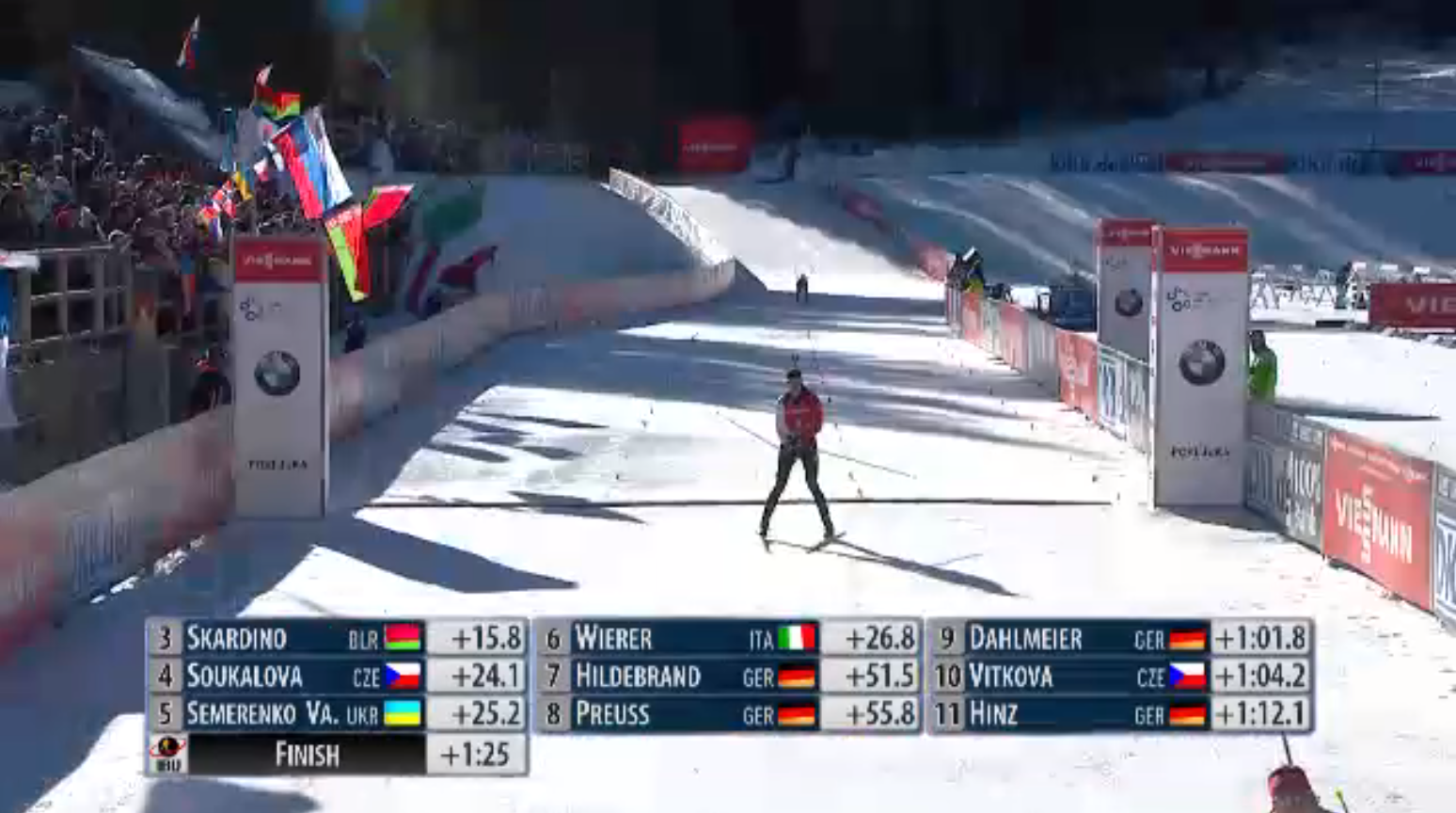
    Skardino locked up third, 15.8 seconds back, and Soukalova held off Semerenko by 1.1 seconds in fourth (+24.1).

    Rosanna Crawford (Biathlon Canada) finishing 12th on Sunday in the IBU World Cup mass start in Pokljuka, Slovenia.
    Rosanna Crawford (Biathlon Canada) finishing 12th on Sunday in the IBU World Cup mass start in Pokljuka, Slovenia.

    Canada’s Rosanna Crawford finished 12th, 1:25.2 back with three penalties (1+1+1+0), for her second-best mass-start result after a series of career bests in Pokljuka and Hochfilzen, Austria, the weekend before.

    “I was feeling really confident going into the race, feeling like maybe today could be the day for that elusive 20/20,” Crawford reflected in an email on Monday. “There was a bit of wind, but nothing crazy. My shooting average has been great so far, 88% I think, much better than I’ve ever shot, but prone is definitely my weak spot right now and it’s almost always one miss!”
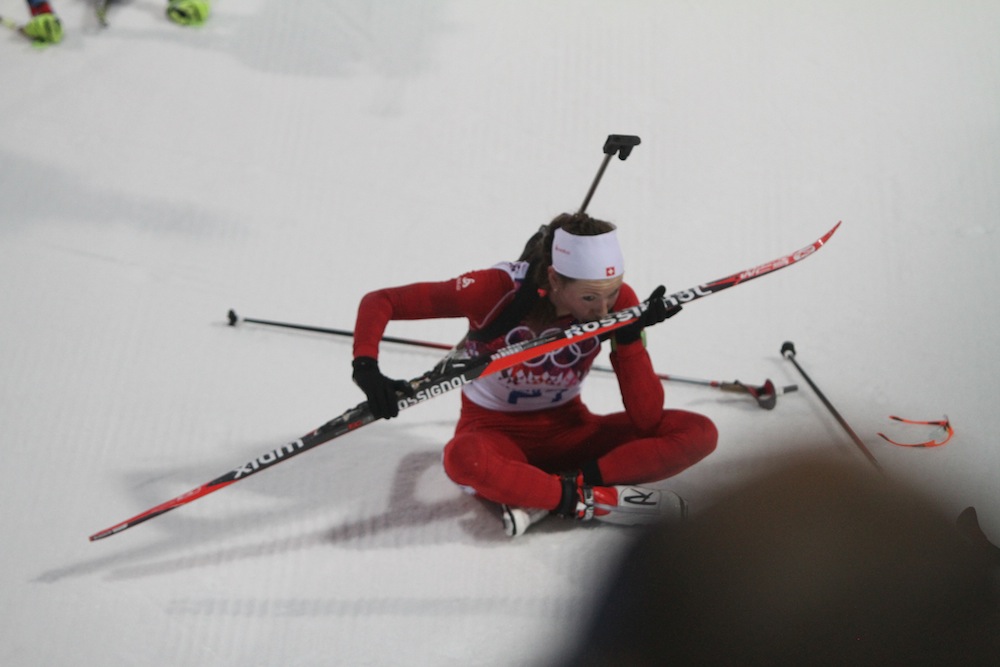
    In three weeks of racing, she missed more than one shot in a single stage just twice.

    “So I am happy with [that], but I really need some 100% races if I want to be on the podium,” she wrote. “Skiing was decent today, our skis were good, nothing like the Hochfilzen pursuit ski feeling, but that race was one of that ‘awwww yea’ days that don’t happen too often!”

    Crawford explained she struggled on the longer uphill, but usually caught back up to her closest competitors on the second half of the course. On the last lap, she glanced back to see Italy’s Karin Oberhofer just behind her.

    “I knew if I could just make it to the top of the hill first I would hold her off!” Crawford wrote. “Last loops have been good for me this year. I feel like I usually have bit of gas left to make up some ground or hold someone off, but still cross the finish line totally empty, knowing that I passed the race well.”

    At the end of the day, she posted the third-fastest range time with 85-percent shooting and wrapped up the first trimester in eighth overall in the World Cup. On Monday, she was flying home to Canmore, Alberta.

    “I am really happy with where I am heading into the Christmas break, only one race that wasn’t in the top 16,” she wrote. “I’ll take a few days to recover and spend time with my family and dogs and then try to get some good training in before coming back to Europe. … After a mental break, I’ll put some focus into prone shooting and see if I can stop missing one shot every time :)!”

    Susan Dunklee (US Biathlon) racing to 22nd in the women's 12.5 k mass start at the IBU World Cup in Pokljuka, Slovenia. (Photo: Fischer/NordicFocus)
    Susan Dunklee (US Biathlon) racing to 22nd in the women’s 12.5 k mass start at the IBU World Cup in Pokljuka, Slovenia. (Photo: Fischer/NordicFocus)

    The other North American in the race, American Susan Dunklee finished 22nd (+2:26.9) with four penalties (2+1+1+0) to put herself 22nd in the overall World Cup.

    “It was a beautiful, sunny day to end on in Slovenia and I had fun in my last race of 2014,” Dunklee said in a US Biathlon press release. Like Crawford, she had been battling a cold since earlier in the week.

    “My body felt a lot better than [Saturday’s pursuit] and even though I missed a couple shots early in the race and lost touch with the lead pack, I had people to chase down every loop,” she said. “Team USA is looking forward to the holiday break and some time back home. All the European athletes are jealous that we’ll have lots of snow; it looks like a green Christmas for everyone over here.”

    Mäkäräinen (l), Domracheva (c), and Valj Semerenko (r) leading the women's 12.5 k mass start on Sunday at the Pokljuka World Cup in Slovenia. (Photo: IBU/Rene Miko)
    Mäkäräinen (l), Domracheva (c), and Valj Semerenko (r) leading the women’s 12.5 k mass start on Sunday at the Pokljuka World Cup in Slovenia. (Photo: IBU/Rene Miko)

    Also worth noting, early in the race after the first shooting, Darya Domracheva of Belarus fell out of contention as she was exiting her penalty loop after one miss. The Pokljuka pursuit winner, she had been leading the mass start with Mäkäräinen throughout the first lap, but collided with another racer, who was heading into the loop. Crawford was right behind Domracheva when it happened.

    “It was a pretty crazy crash,” she recalled. “Darya and I were the first ones to enter and as we were leaving I was looking left to make sure I could get out unscathed and then smack, she collides right with a French athlete, lands right on her back/rifle and spins a bit, looked like it hurt!”

    Halfway around the second 2.5 k lap, Domracheva rebounded to pass Crawford and a number of others. But she struggled with her spare rifle in the second prone, missed four, and pulled out of the race on the third lap.

    While Crawford described the incident as “unfortunate,” she added, “I’m pretty sure the rule is that people leaving the penalty loop have to yield to people entering. This penalty loop is also one of the more sketchy ones for that happening.”

    With the DNF, Domracheva currently sits third overall in the World Cup, behind Mäkäräinen in first and Semerenko in second.

    Results

  • Domracheva Rips Östersund 15 k Despite Rocky Last Loop

    Domracheva Rips Östersund 15 k Despite Rocky Last Loop

    Darya Domracheva celebrates her 20th World Cup victory on Thursday in the 15 k individual in Östersund, Sweden. (Photo: IBU/NordicFocus)
    Darya Domracheva celebrates her 20th World Cup victory on Thursday in the 15 k individual in Östersund, Sweden. (Photo: IBU/NordicFocus)

    Something about the medals the top women received on Thursday in their first individual IBU World Cup of the season fascinated Darya Domracheva. Standing atop the podium after the 15-kilometer race in Östersund, Sweden, she spoke excitedly about it to Finnish runner-up Kaisa Mäkäräinen, who smiled and agreed — yeah, it was pretty neat.

    Domracheva was borderline chatty during the flower ceremony, smily and upbeat after another World Cup victory — her 20th, according to an IBU press release.

    The 28-year-old Belarusian biathlete, who won three Olympic golds in Sochi, is often unstoppable. Once she gets ahead in a race, she’s often hard to match. And on Thursday, with her long, flowing pony tail and snowflake earrings, Domracheva kind of seemed flawless — except for when she missed two targets and tripped over a rock on the last loop.

    “I crashed on the last loop, which was scary but most importantly, a rock ruined my ski,” she told the IBU afterward. “I just hope that my servicemen can repair it.”

    Finland's Kaisa Mäkäräinen after placing second in the 15 k individual in Östersund, Sweden. (Photo: IBU/NordicFocus)
    Finland’s Kaisa Mäkäräinen after placing second in the 15 k individual in Östersund, Sweden. (Photo: IBU/NordicFocus)

    Rock or not, she was well on her way to the win and ended up topping Mäkäräinen by 27.9 seconds in 46:43.6. Mäkäräinen, in second throughout the five-loop race, started four minutes ahead of Domracheva in bib 13 (of 96), and finished with first. The whole time, however, she knew she’d have to ski like crazy and be perfect on the range to beat Domracheva.

    Mäkäräinen had two penalties as well, one on each of the second and third bouts, and Domracheva shot clean through the first two stages before missing one her third and fourth time in the range.

    “It was my mistake; I was leaving the shooting range a bit earlier than I should have!” she said. “Still it was a good shooting result for me.”

    Conditions on Thursday were better than what the men experienced in the 20 k individual the day before. High, variable winds on Wednesday evening calmed to a gentle breeze for the women’s race. But with well-above-freezing temperatures, the snow was still chewed up and slow.

    “It was really tough and deep snow around the tracks; you never had a chance to rest,” Mäkäräinen said. “In downhills, you had to be careful not to fall down. I got lucky because a Russian girl fell in front of me and somehow I managed to get around her without a fall.”

    After Domracheva cleaned the first prone, Mäkäräinen trailed by 6.3 seconds in third. From that point on, the two remained relatively close, with Domracheva posting the fastest-overall course time by 15 seconds over Mäkäräinen in second. Domracheva skied the third-fastest last loop because of her crash, behind Mäkäräinen and Germany’s Franziska Hildebrand, an early leader in bib 8.

    Valj Semerenko (Ukraine) after shooting clean to place third in the 15 k individual in Östersund, Sweden. (Photo: IBU/NordicFocus)
    Valj Semerenko (Ukraine) after shooting clean to place third in the 15 k individual in Östersund, Sweden. (Photo: IBU/NordicFocus)

    The initial top finisher, Hildebrand ended up sixth overall with two penalties, 2:25.7 behind Domracheva. Ukraine’s Valj Semerenko shot perfectly for third, finishing 10.2 seconds behind Mäkäräinen with the eighth-fastest course time. Semerenko was one of three women in the field to notch 20-for-20 shooting.

    “I seemed to have lost my shooting touch in our last training camp but somehow I found it today!” Semerenko told the IBU after notching her sixth-career podium.

    Semerenko bumped another Belarusian, Nadezhda Skardino, to fourth (+2:04.3) after Skardino — who had one penalty — took the lead at the finish from Hildebrand. (Mäkäräinen finished shortly after to claim the top position before Domracheva.)

    Veronica Vitkova of the Czech Republic was the third fastest on course to overcome three penalties and place fifth (+2:09.1). After Hildebrand, Norway’s Tiril Eckhoff was seventh, Russia’s Ekaterina Glazyrina eighth, Sweden’s Elisabeth Högberg achieved her first-ever top 10 in ninth, and France’s Sophie Boilley was 10th.

    Olga Podchufarova of Russia took 11th, about 19 seconds ahead of Canada’s Megan Heinicke, who recorded a career-best 12th with a single miss on the second stage (+3:31).

    Heinicke started 62nd and initially finished 11th, only to be bumped one place by Glazyrina.

    While Domracheva said she was taking it race by race and trying not to look too far ahead, Semerenko dedicated her third-place finish to her sister, Vita, who tried to recover from back surgery this summer and fall. Last week, Ukrainian Biathlon Federation President Vladimir Bryzhnak announced that she would miss the entire season because of a herniated intervertebral disc.

    “This was a hard competition today. It is hard without my sister here now,” Valj Semerenko told the IBU. “I now have to work for two people. Out on the tracks, I felt her support; I was competing for both of us.”
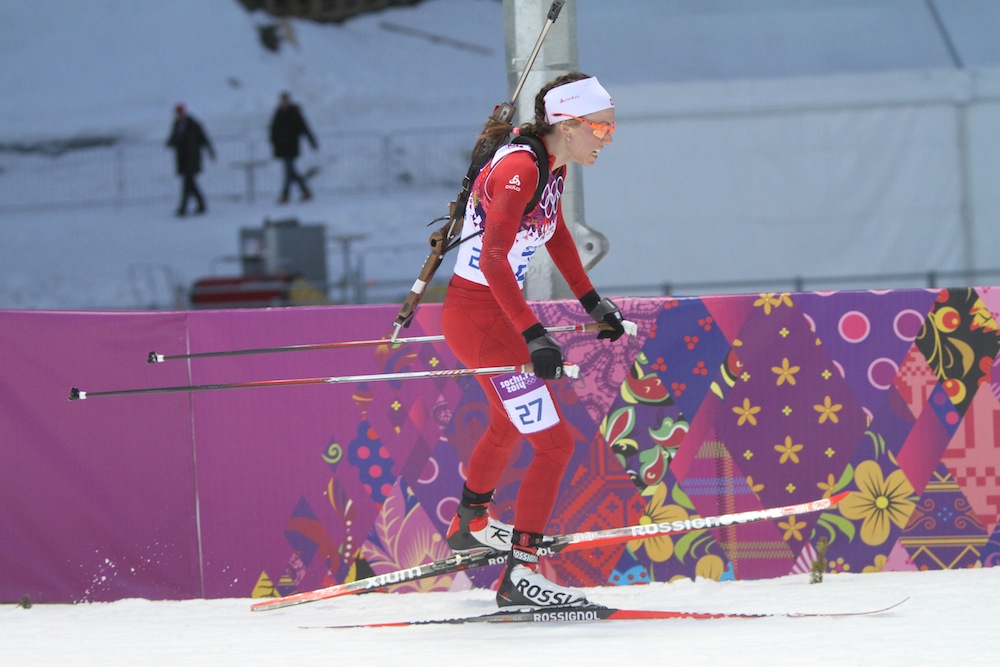
    Gabriela Soukalova of the Czech Republic in 62nd slipped out of contention with four penalties in the first prone and an additional miss on each of the second and last stages for six total. Germany’s Miriam Gössner placed 68th with seven penalties after suffering a concussion in a rollerski crash in the offseason.

    Results

  • Domracheva Makes It a Double in 15 k Individual, Gasparin Captures First Swiss Biathlon Medal

    Domracheva Makes It a Double in 15 k Individual, Gasparin Captures First Swiss Biathlon Medal

    Dasha Domracheva racing to her second gold of these Olympics in Friday's 15 k individual start. She became the first Belarusian athlete to do so at the same Winter Games, winning by more than a minute and 15 seconds in Sochi, Russia.
    Dasha Domracheva racing to her second gold of these Olympics in Friday’s 15 k individual start. She became the first Belarusian athlete to do so at the same Winter Games, winning by more than a minute and 15 seconds in Sochi, Russia.

    FasterSkier’s coverage is made possible through the generous support of Rudy Project.

    SOCHI, Russia — Dasha Domracheva had an inkling things were going according to plan as she rounded the biathlon loop at the Laura Olympic Center five times on Friday night.

    For starters, the Belarusian gold medalist from Tuesday’s pursuit had opened with flawless shooting in prone, taking the lead over the 12 women who started ahead of her in the biathlon 15-kilometer individual start.

    Three others challenged her through the first stage — Finland’s Kaisa Makarainen, Gabriela Soukalova of the Czech Republic, and Slovakia’s Anastasiya Kuzmina — with clean shooting and fast skiing. Three kilometers later, Domracheva suffered a one-minute penalty in the first standing, but it wasn’t a big deal; even with the added time she was still within 11.8 seconds of the lead.

    Dasha Domracheva of Belarus in the range. She ended up with a single penalty to win the Olympic 15 k individual on Friday night in Sochi, Russia.
    Dasha Domracheva of Belarus in the range. She ended up with a single penalty to win the Olympic 15 k individual on Friday night in Sochi, Russia.

    By the third lap, the 27-year-old Domracheva started to turn it on, clocking the fastest ski times from there on out and shooting clean for the remainder of the race. At times she was minutes ahead, and by the finish, she had topped Olga Zaitseva, Russia’s early leader by 3:47.3 minutes in 43:19.6.

    Then, she waited, and as competitors like Makarainen completed their races, she gradually realized the second gold was hers. Makarainen was 2:43 behind with three penalties, Soukalova missed one on each standing to finish nearly two minutes back, and Kuzmina had three penalties in the last stage that took her out of contention.

    Switzerland’s Selina Gasparin cleaned for the first time in her career, as did Nadezhda Skardino, also from Belarus. Skardino finished second, 1:38.2 behind Domracheva, for the time being. Domracheva waited long enough to watch her come into the final stretch, then grabbed her things and ran inside to get changed.

    Selina Gasparin kisses her skis, which helped her to the 10th-best course time of the day and a silver medal.
    Selina Gasparin kisses her skis, which helped her to the 10th-best course time of the day and a silver medal.

    The 52-degree evening had finished with temperatures around 48 degrees Fahrenheit (the warmest of the 2014 Games yet), and the Olympic champion was getting cold.

    “It was amazing because I got information on the track that I’m in the lead and Nadezhda [was] in second,” Domracheva said in a post-race press conference. “I tried to wait for her after the finish line, but I got a little bit frozen at the end of the race.

    The two met up in the changing area and press mixed zone after the race. Gasparin’s faster ski time ultimately bumped Skardino to third by 22.7 seconds, and the Swiss skier earned her country’s first-ever biathlon medal with silver. Skardino retained her spot on the podium in third — another first for Belarus with two athletes winning medals in the same event at the Winter Olympics.

    And Domracheva became the first Belarus athlete to win two gold medals at the same Winter Games.

    “I cannot say it was an easier race for me,” Domracheva said, referring to her 37.6-second win in the preceding pursuit. “In a few loops I was together with Soukalova and she followed me quite easy. I tried to do everything. That was fighting today. On some parts of the track I was so tired and after the downhills, I sit …. almost without any power, but you need to recover on the downhills and be clever coming into the shooting range.”
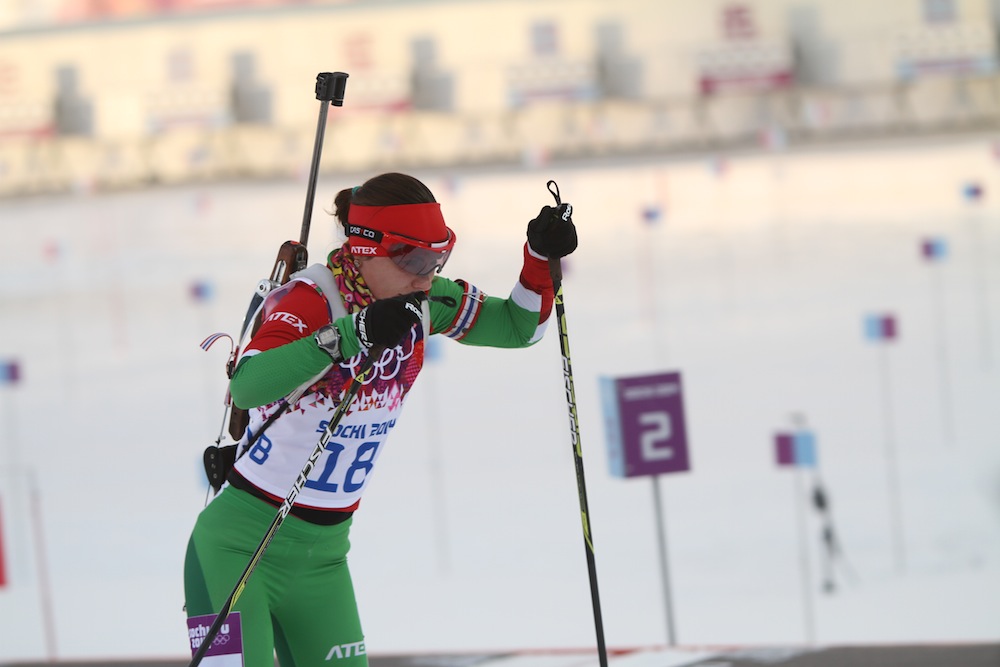
    That was where Domracheva made the difference. Clean shooting — or as close to it as possible — is essential in an individual start, with each penalty adding a minute to an athlete’s total time.

    Even with a penalty, Domracheva won by a minute and 15.7 seconds, but mostly because she skied the fastest third, fourth and fifth loops, and took her time in the range. Soukalova placed fourth with two misses, 1:57.5 behind the winner.

    “Today … the course was harder and the loop was more difficult in terms of relief,” Domracheva said, comparing the 15 k individual to the 10 k pursuit.

    “But both of them I cherish them and value them very much,” she said of her two medals. “With this one I just confirmed that I was an Olympic champion, so that was very important.”

    From Rural Training to Olympic Medal

    Selina Gasparin of Switzerland gimaced her way through a tough final loop to hang on to a silver medal.
    Selina Gasparin of Switzerland gimaced her way through a tough final loop to hang on to a silver medal.

    The oldest of three sisters, Gasparin, 29, followed the lead of middle child Elisa, who captured eighth at the Olympics in last Saturday’s sprint. It was by far a career best and first international top 10 for the 22-year-old Elisa.

    On Thursday, Selina Gasparin continued the family’s good showing by not only shooting perfectly for the first time in her career, but becoming the first Swiss biathlete to medal at the Olympics.

    Two months ago, she became her country’s first biathlete to win a World Cup. That’s when she started to dream big, specifically for Sochi.

    “I have never won a medal in my whole life, no junior championship or European championship, nothing,” she said.

    Growing up in a rural part of southeast Switzerland, the Upper Engadin region, Gasparin said she followed the lead of Elisa, who tried biathlon first with a friend. Once she started training with the national team, Gasparin realized she needed to train at home where “there is nothing,” she said.

    “I had to ask the farmer if I could put some targets for shooting,” she said.

    She also had to find some suitable paved roads for rollerskiing. “It took me almost ten years now to build it all up. It was also motivating to be the first one in World Championships and the first woman ever in Olympic Games in Vancouver, first World Cup win … now it’s like the first medal ever for Switzerland. We have no world championship medal so for me it’s really crazy.”

    With silver in hand, she’s excited to go home.

    “I [said] that if I come home with a medal, I want every Swiss to know what biathlon is,” she said. “Because some thought it was like running or cycling or something.”

    Gasparin was also excited to find success on the same day as Swiss cross-country skier Dario Cologna, who won the men’s 15 k classic individual start Friday afternoon. Cologna hails from Vail Müstair, less than an hour drive from Gasparin’s hometown of Samedan. Both speak the regional language of Romansh.

    “It’s a very special day for [people] of my language,” she said. “We are all from a small area in Switzerland. It’s only about point-five percent of the population that speaks Romansh. It’s kind of like a secret language.”

    Russian-Born Skardino Makes Belarus History 

    Nadezhda Skardino of Belarus leaving the range after one of her perfect shooting bouts.
    Nadezhda Skardino of Belarus leaving the range after one of her perfect shooting bouts.

    After starting out as a cross-country skier on St. Petersburg junior team, Skardino, 28, switched to biathlon at age 20 when she was just about to retire from the sport.

    “The junior coach suggested I try biathlon and I liked that very much,” she said through a translator. “I thought of finishing my career, but once I started shooting I liked it … then it was not opting for Belarus, but it was opting for biathlon. The Belarus national team suggested that I represent Belarus so I tried that and I liked that.”

    She never anticipated to become a Belarus citizen, it just worked out that way. On Friday, she was happy it did as she made history with Domracheva.
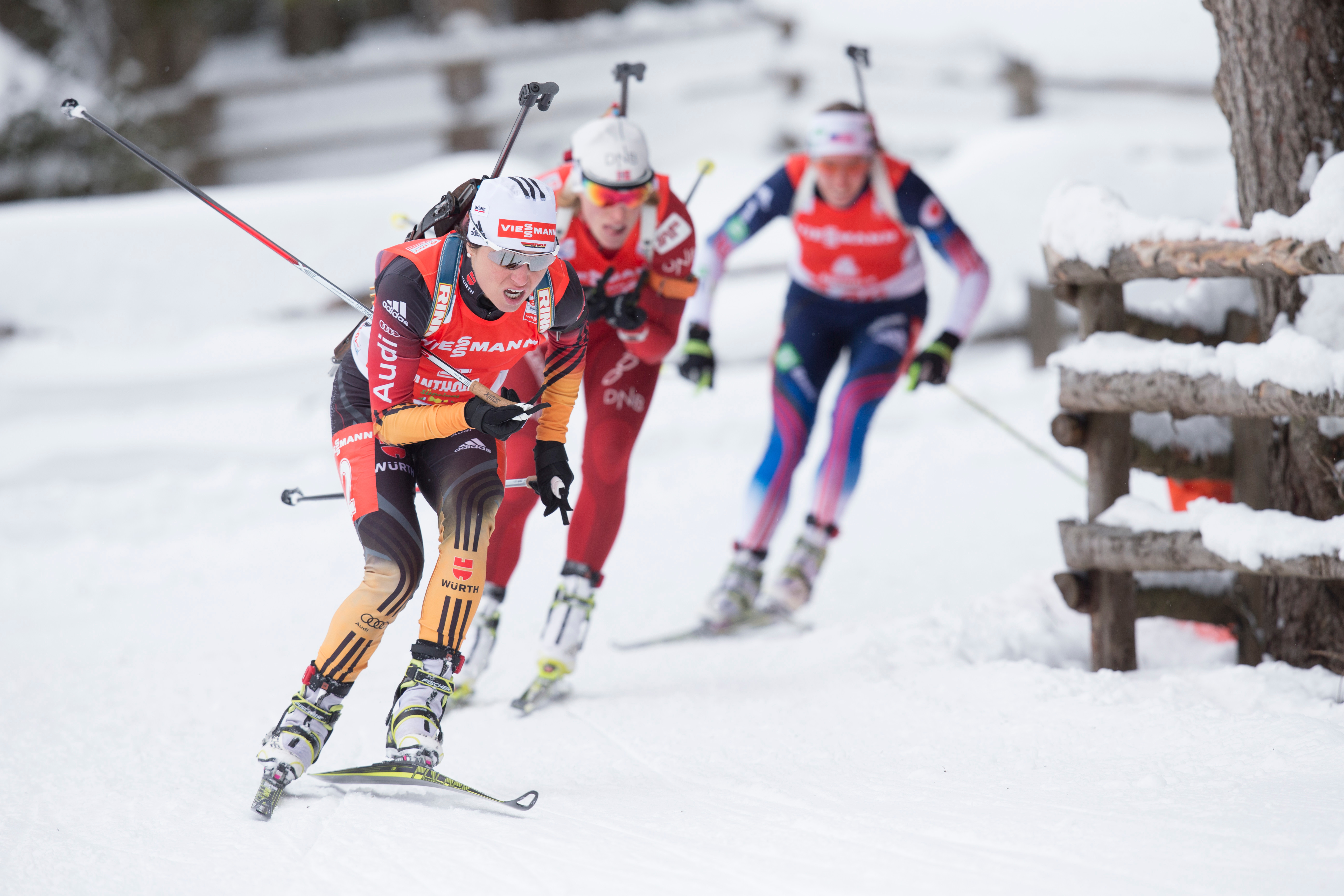
    “It was my dream to be on the same to be on the podium with Daria and I’m very glad that it came true,” she said.

    Domracheva said the team’s depth is a testament to their success.

    “Now you see that Belarus is a really strong team,” she said. “Only with a good team around you can achieve these results.”

    The second gold wasn’t quite as emotional for the winner, but that’s because she was prepared.

    “This was my dream and helped me very much to be less emotional after,” she said. “I got very emotional after I won the first medal. I tried to control my emotions to be a new Daria … to compete, to perform and to enjoy the work that I love.”

    Results

  • As Olympics Draw Near, Veteran Henkel Tops Biathlon Field Again; Dunklee 23rd in Antholz

    As Olympics Draw Near, Veteran Henkel Tops Biathlon Field Again; Dunklee 23rd in Antholz

    IBU world cup biathlon, pursuit women, Antholz (ITA)
    Andrea Henkel of Germany leads Norway’s Tora Berger and Susan Dunklee of the United States in today’s 10 k pursuit in Antholz, Italy. Photo: USBA/NordicFocus.com.

    Looking at the finish pen of the women’s 10 k biathlon pursuit in Antholz, Italy, today, you could be forgiven for thinking that a battle might have occurred.

    World Cup athletes staggered across the finish line, some nearly falling before their final time was clocked. Their ski technique, usually the best in the world, looked shortened and powerless; sprint finishes happened in slow motion. Exhausted athletes lay in the snow for minutes trying to recover some energy.

    “Every loop was pretty hard, and not just the last one,” winner Andrea Henkel of Germany said in the post-race press conference.

    At 2,000 meters of elevation – about 6.500 feet – Antholz is the first time most the World Cup field has encountered significant elevation in weeks. Coming in the third week of intensive racing in a row, that was particularly punishing.

    “I think the elevation got to everyone, and it was harder than usual,” American biathlete Susan Dunklee said in a phone interview. “Coming into standing, everyone’s legs were shaking a little bit. It was tough.”

    Henkel, a 15-year veteran of the German national team, did exactly what she needed to do to win after starting the pursuit in bib two, 6.7 seconds behind Anais Bescond of France.

    Calm and collected, Henkel cleaned each of her four stages, always taking a few seconds longer than her closest competitors to ensure accuracy. Darya Domracheva of Belarus, who had a sizeable lead coming into the first standing stage, missed two shots in each of the last two stages.

    “I took my time in shooting and I got lucky that the others did not hit as many targets as I did,” Henkel said. “It all just worked out for me.”

    She was clean again and again, as the group of skiers around her gradually shrank down. By the time she left the last stage, she had a ten-second lead on Nadezhda Skardino, also of Belarus.

    It was a nailbiter of a final two kilometers, with Skardino edging closer and closer to Henkel. The 36-year-old German grimaced in pain as she pushed with everything she had. With 900 meters to go, Skardino had closed the gap to five seconds.

    “I knew Skardino might come closer,” Henkel said. “I thought if I still had the lead at the Huberalm, then I had a chance.”

    Dunklee fighting through a painful ten kilometers at elevation. Photo: USBA/NordicFocus.com.
    Dunklee fighting through a painful ten kilometers at elevation. Photo: USBA/NordicFocus.com.

    She did: Skardino made contact coming into the stadium, but was unable to do any more than shadow Henkel to the finish line. Completely exhausted, Henkel managed to raise her fists in victory as she crossed with a 1.6-second advantage.

    “Of course I wanted to win, but Andrea was strong and I am happy to be second,” Skardino said in the press conference. “It was a hard competition today but my skis were good and I felt really good so this race was easier than some other times.”

    Tiril Eckhoff of Norway seemed to be headed to the second podium of her career when she left the final stage in third place, with 11 seconds of time on Domracheva, who was in fourth. But Norwegian teammate Tora Berger had no mercy and charged after the leaders, passing Domracheva immediately and overtaking Eckhoff in a finishing lane sprint. In her push for the yellow overall leader’s bib, she was uninterested in allowing her younger teammate to have any part of the glory.

    “I didn’t realize that it was Tiril that I was fighting against,” Berger told Norwegian broadcaster NRK. “I just did what I had to do, because I wanted the podium.”

    But the NRK commentators were having no part of it, calling her “relentless” and saying she doesn’t treat her teammates well on the trails.

    For her part, Eckhoff was gracious

    “I heard that she was coming, so it was very painful to get the seconds taken away from my lead,” she told NRK. “I tried my hardest, but the older athletes are still the best…. it was close. One day I will get there.”

    Domracheva finished fifth and Teja Gregorin of Slovenia sixth. The breakout performance of the day came from Chaoqing Song of China, who finished tenth; it was just the second top-ten of her career and her best result since 2010.

    Dunklee, who started the pursuit in fourth position just behind Domracheva and Henkel, finished 23rd. She cleaned the first stage but collected one penalty in the second prone, three in the first standing, and one more in the final standing.

    “One poor standing stage cost me a lot of places and suddenly felt very tired on the skis on loop four and lost a lot of places there,” she said.

    Early on, Dunklee had been skiing with Henkel in a top-five position.

    “It was comfortable, and things were going according to plan,” she said of her first-ever pursuit start in such a strong position.

    And it was a comfort to be skiing with Henkel, the girlfriend of Dunklee’s teammate Tim Burke.

    “Andrea comes and trains with us in the U.S. sometimes, so I know that my ski speed can be right up there with hers,” she said. “I consciously choose to catch a ride with her at the start of the race. We have very different ski styles but it is still relaxing to let someone else lead and I trusted she would choose a smart pace.”

    Even if the pair separated after Dunklee’s shooting woes began – they were compounded by a broken pole and losing some ammunition clips, which she estimated cost her about eight seconds on the range when an official had to bring her replacements – Dunklee found the German veteran’s win very motivating.

    “I know how hard she works, and for how long, so I was so happy to see her on top today,” Dunklee said. “And because I know I can ski her pace on a good day, that’s a good feeling too.”

    Next time, Dunklee hopes to be more “calm and in control” throughout the whole race, just like she said Henkel was today.

    “I have some of the parts, but the whole thing didn’t come together,” Dunklee said. “Each time you do this it gets easier, so I think when I’m in this position next time it will be even better.”

    Megan Heinicke, the lone Canadian to qualify for the 60-woman pursuit, did not start the race. Sara Studebaker, the other American who made the cut, finished 48th with four penalties, one in each shooting bout.

    Results

  • Soukalova Surprises With Pokljuka Sprint Win

    Soukalova Surprises With Pokljuka Sprint Win

    Gabriella Soukalova (CZE) turned in the best race of her career on Friday with a win the Pokljuka, Slovenia, 7.5 k sprint.

    Taking herself, her coaches and the biathlon world completely by surprise, 23-year-old Gabriella Soukalova (CZE) won the 7.5 k sprint in Pokljuka, Slovenia, on Friday. The win is her first ever on the World Cup; prior to this she had only one top-ten on her record. Second place went to Miriam Gössner (GER) and third to Nadezhda Skardino (BLR).

    “This was the race of my dreams,” a smiling Soukalova said in the press conference. “This summer when I was ill, I never expected that this would happen.”

    Her clean shooting in both stages ultimately gave her the edge over Gössner, whom she beat by only 2.1 seconds. Gössner skied the first lap 13.1 seconds faster than Soukalova and spent less time on the range, but two errors in the standing position put her at a deficit going into the final 2.5 k.

    Gössner very nearly climbed out of it, too, as she posted the fastest final lap time, but Soukalova was able to hold her off, won, and has already been dubbed the Czech Republic’s new rising star.

    “This joy keeps me warm and alive,” said Czech coach Jindřich Šikola to iDNES.cz. Two years ago, he says he could not have imagined a result like Friday’s, with two women in the top ten (another of his athletes,Veronika Vitkova, was eighth).

    “Since the beginning of the season the team [is] in a great mood, the girls hold together. We are on the winning wave,” Šikola said.

    Soukalova is not traditionally a strong shooter; she made two mistakes in the Oestersund sprint and two again in Hochfilzen last week. On Friday, however, she stopped over thinking things on the range and shot perfectly.

    “I did not think about the shooting from the start as I normally do so maybe that was the key. I am very happy with what happened today,” Soukalova said.

    “This is great promotion for our team and the World Championships in Nove Mesto…I do not know if my shape will be this good for those Championships, but I will do my best.”

    Friday’s win propelled Soukalova from tenth to fourth in the overall World Cup rankings.

    Gössner, despite barely missing the top of the podium, was pleased with her result. Her season thus far has been on the upswing relative to the previous one, and second place is the 22-year-old’s best 2012 finish yet.

    “My running shape is quite good right now,” she said. “I am past my problems now. After a good summer of training I just started over and focused on this new season.”

    In the slow, snowy conditions on Friday the top two women put distance between themselves and the next finisher; Skardino ended up 30.1 seconds back in third despite clean shooting. Her first lap was relatively slow, 18.6 seconds slower than Gössner’s. She later moved within 15 seconds of Soukalova, but lost another 15 seconds in the final few kilometers.

    Skardino said she hadn’t really expected a podium finish on Friday, “but I know that if I run well and shot well, it is always a possibility…It was only on the final loop that my coach told me I was in second and I should run hard!”

    Men and women’s biathlon action continues on Saturday with a 10/15 k pursuit.

    Women’s 7.5 k sprint results.