
From the FasterSkier archive — posts syndicated from athletes’ and coaches’ own blogs between 2004 and 2012, kept online as published. Current coverage is at fasterskier.com.

Tag: Nadine Faehndrich

  • Sundling Seizes Drammen, Denying Skistad on Home Snow

    Sundling Seizes Drammen, Denying Skistad on Home Snow

    This coverage is made possible through the generous support of Marty and Kathy Hall and A Hall Mark of Excellence Award. To learn more about A Hall Mark of Excellence Award, or to learn how you can support FasterSkier’s coverage, please contact info@fasterskier.com.

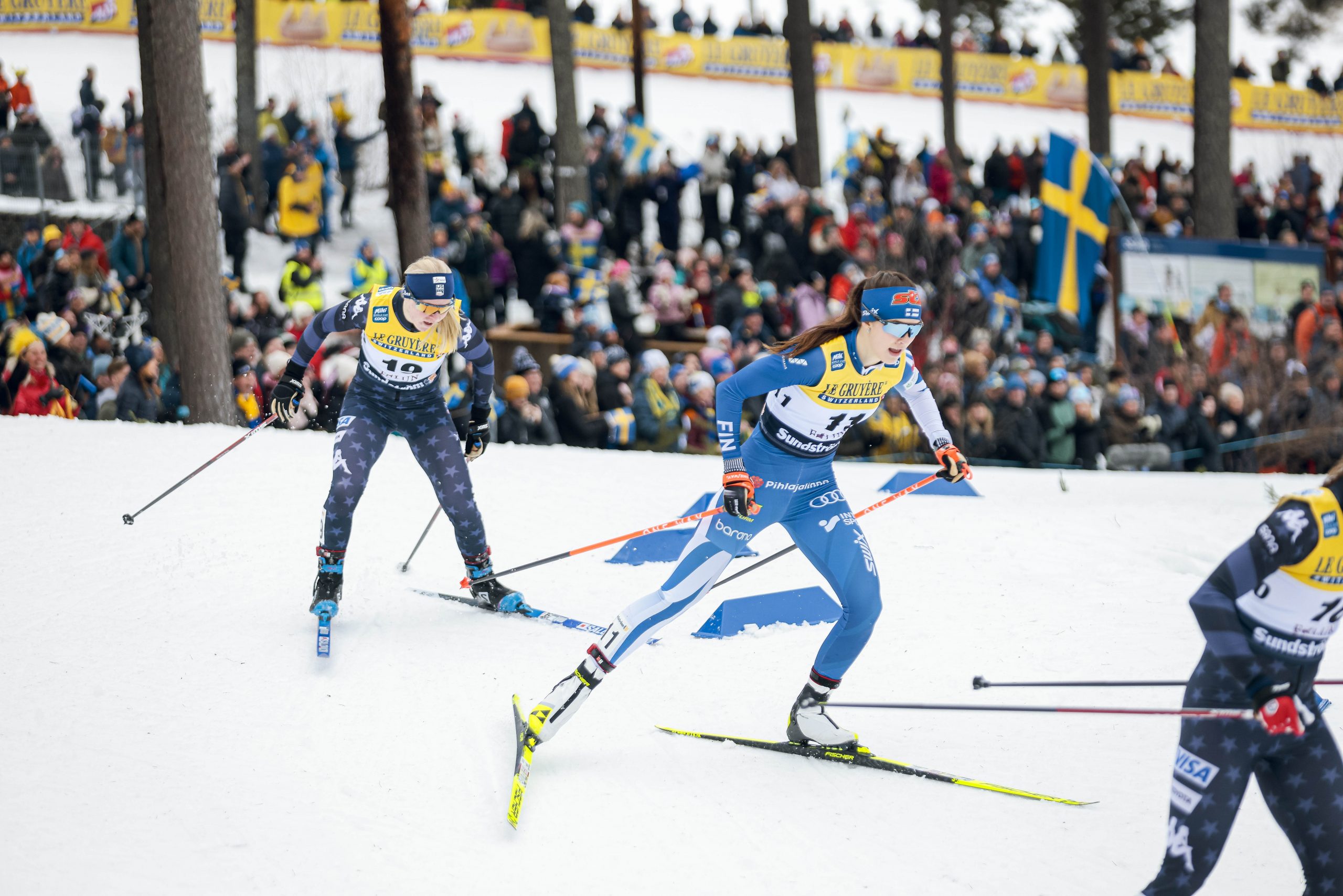
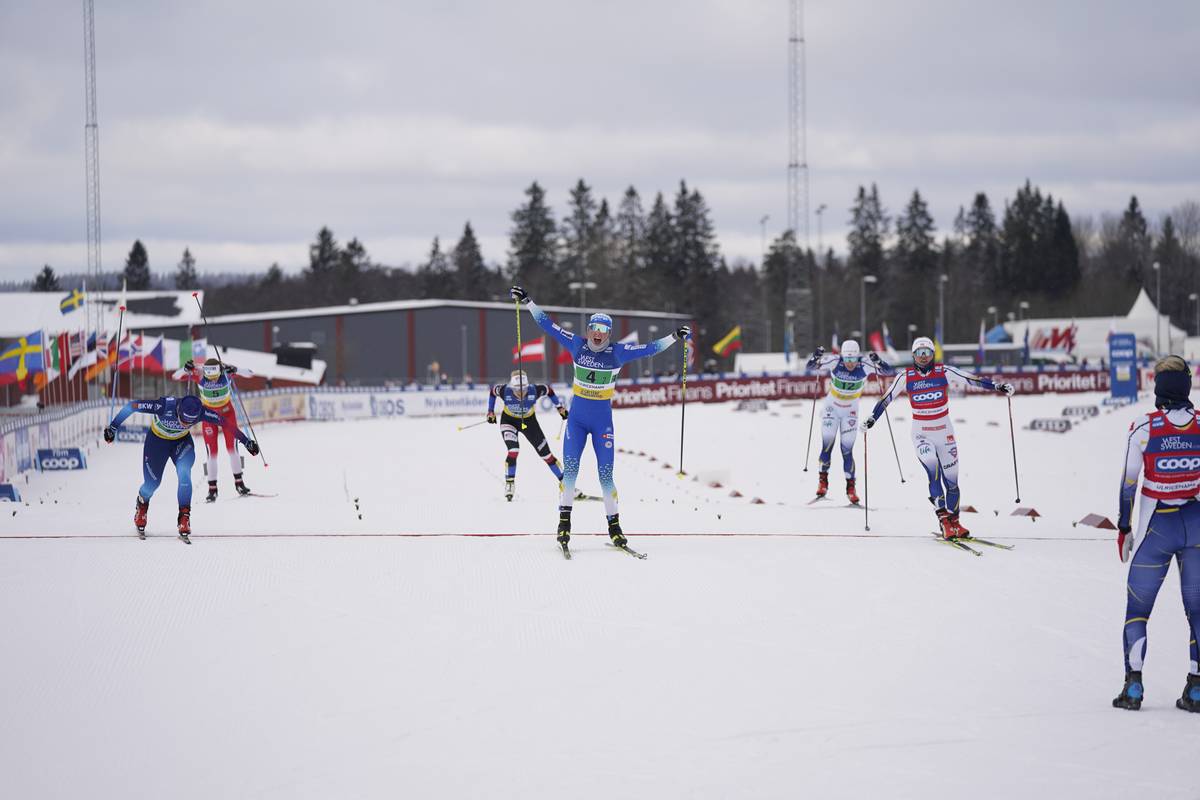
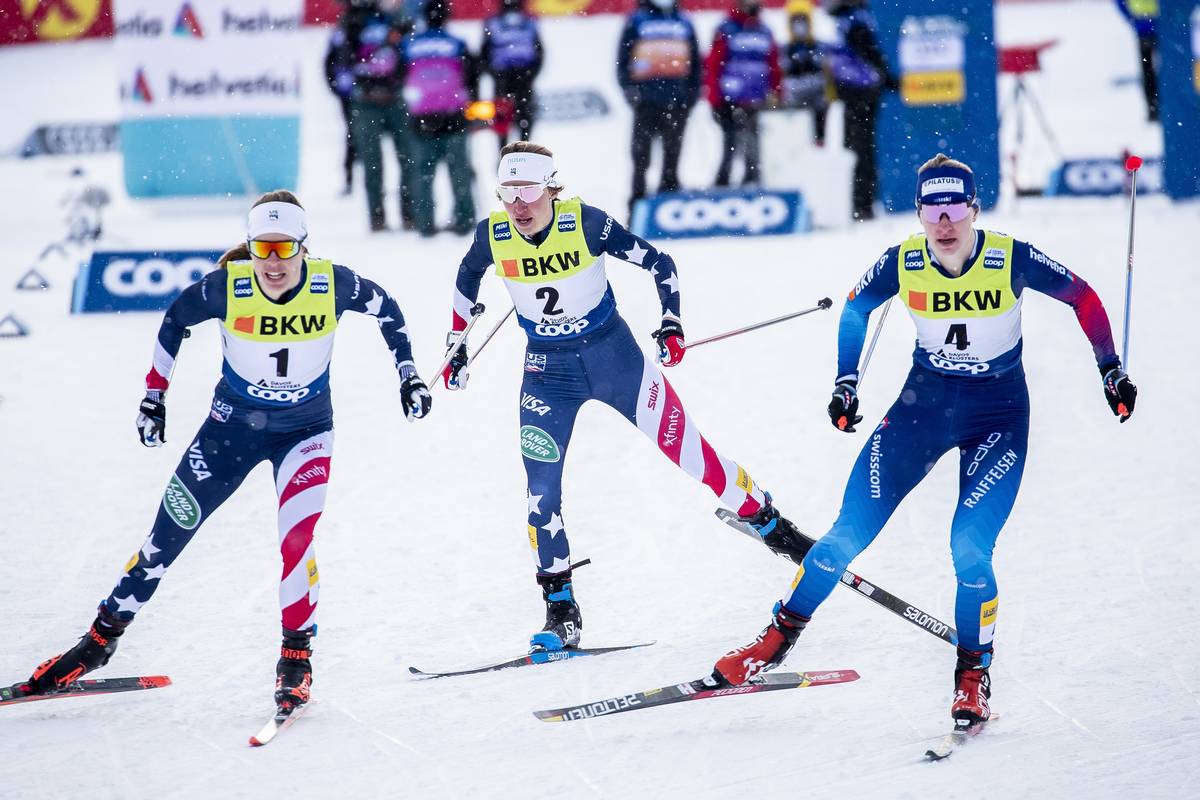
    The women’s sprint final comes into the finish in Drammen, Norway with: Laura Gimmler (GER), Ane Appelkvist Stenseth (NOR), Jonna Sundling (SWE), Nadine Faehndrich (SUI), Johanna Hagstroem (SWE), and Kristine Stavaas Skistad (NOR), (l-r). (Photo: Nordnes/NordicFocus)

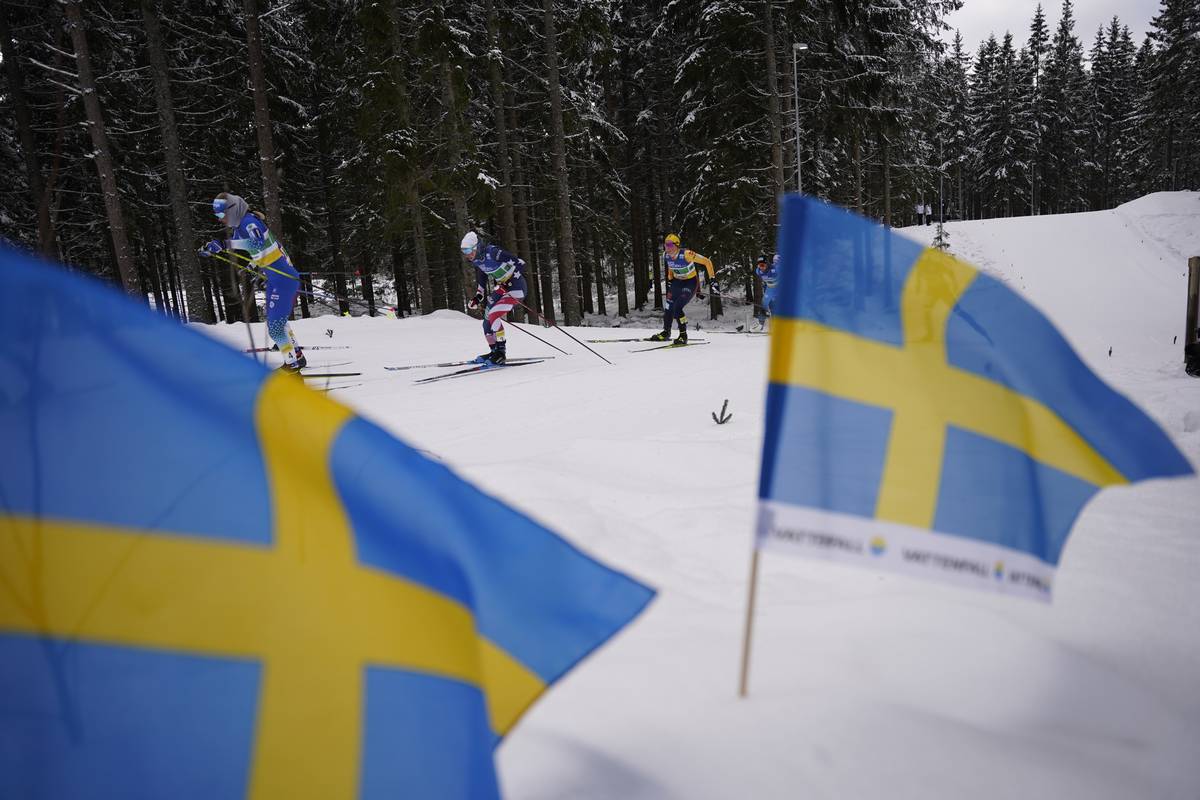
    The snow was trucked in, the rock band was playing near the finish, and Norwegian children cheered from second-story windows along the course. On a rare midweek World Cup race day in Drammen — a small city just southwest of Oslo where the sprint course loops through the streets, wraps around an old fountain, and finishes on the snow-covered steps of an iconic church — Jonna Sundling of Sweden took home another World Cup sprint victory.

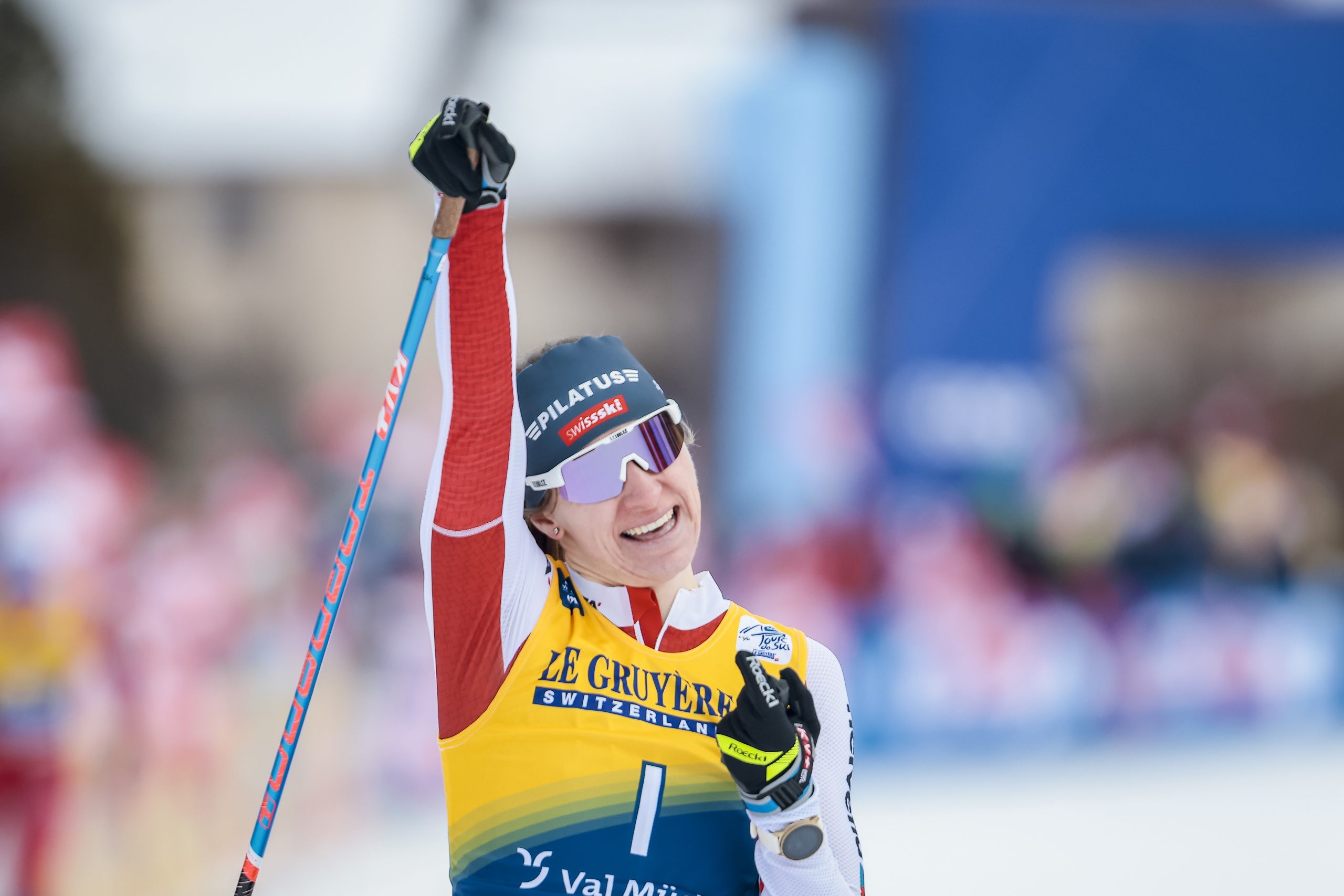
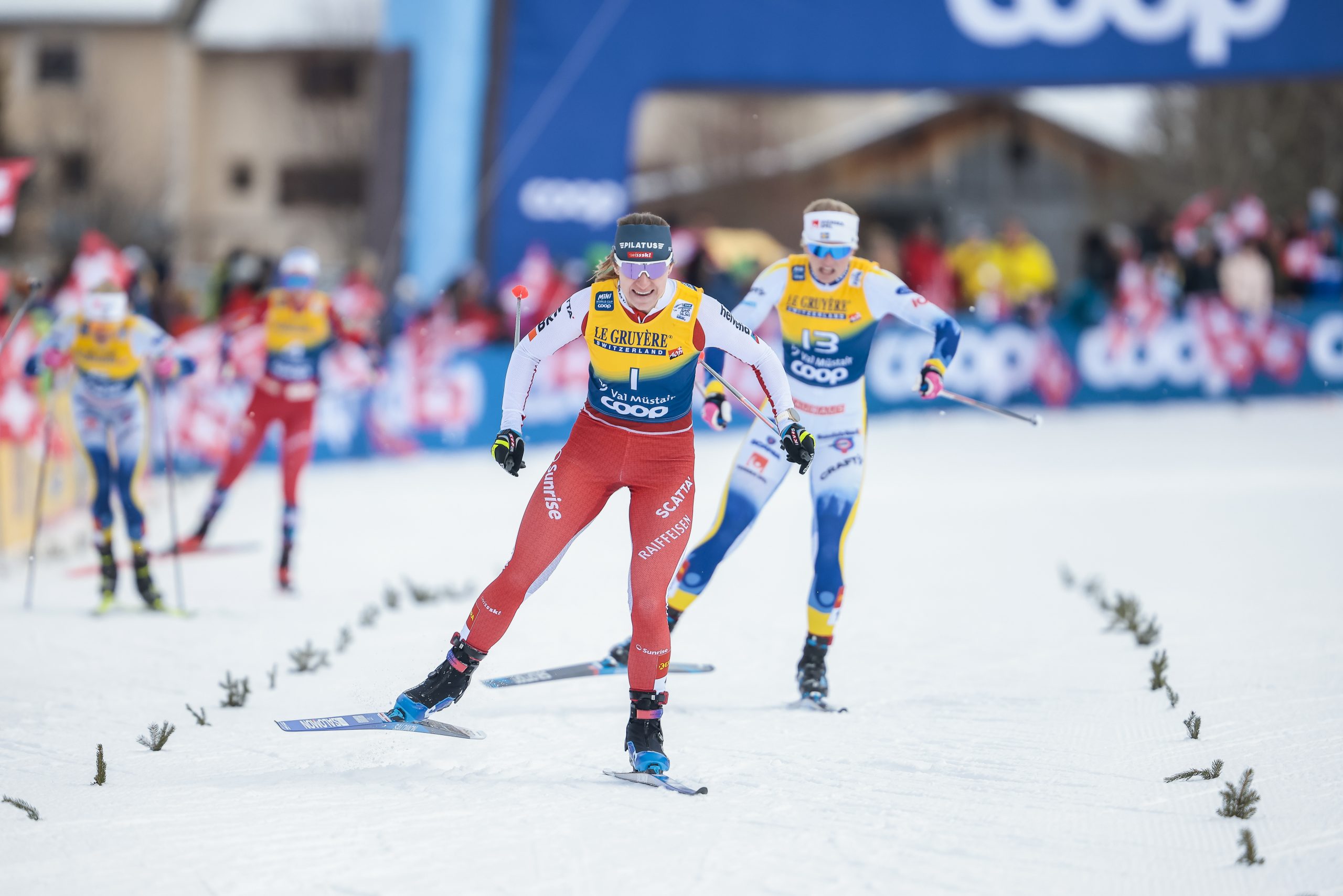
    Sundling won the women’s classic sprint, going stride for stride with Norway’s Kristine Stavaas Skistad before pulling away in the final meters. Switzerland’s Nadine Faehndrich, racing her final classic sprint before retirement, earned the bronze.

    It was Sundling’s fifth individual World Cup victory of the season and the latest chapter in an intensifying rivalry with Skistad that has captivated ski fans, especially Scandinavian ones, for the last few seasons. From the World Championship final in Trondheim last year to the Olympic final in Milano Cortina, Sundling, with the rest of the Swedish sprinters, and Skistad have been locked in a tactical chess match. On Thursday in Drammen, it was Sundling who played the final move.

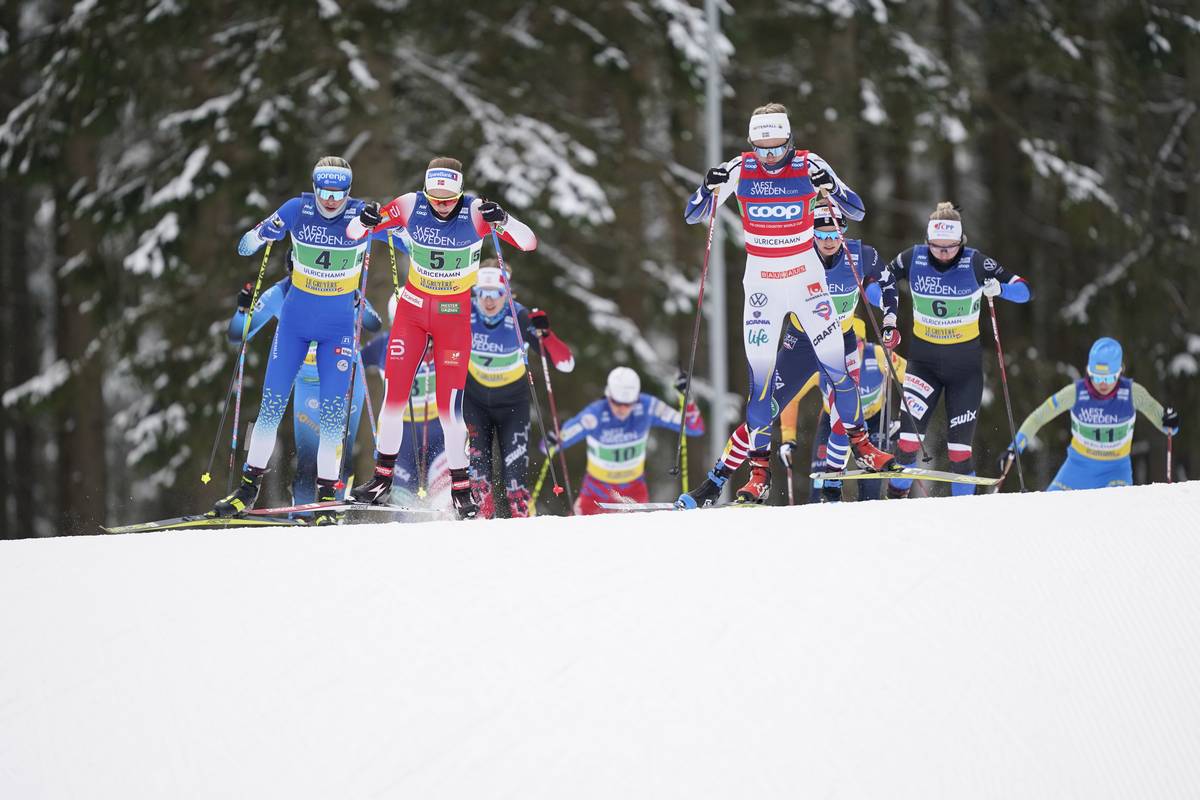
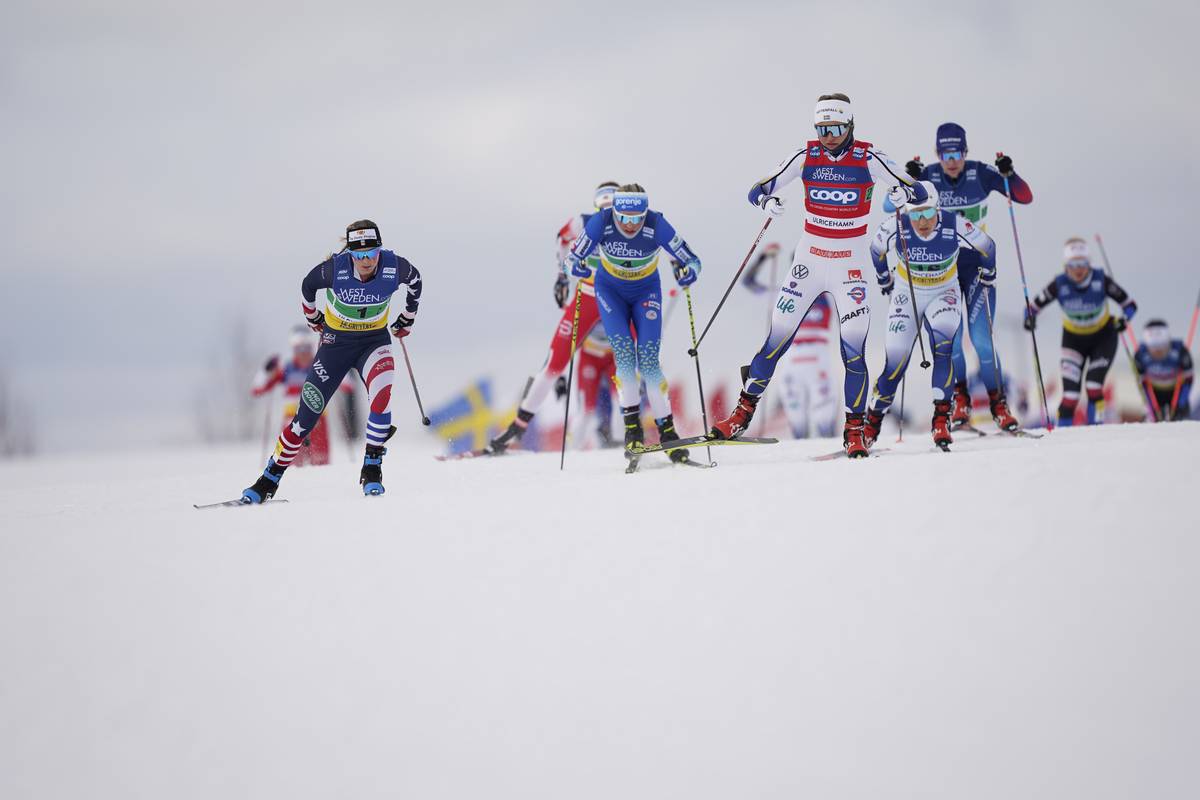
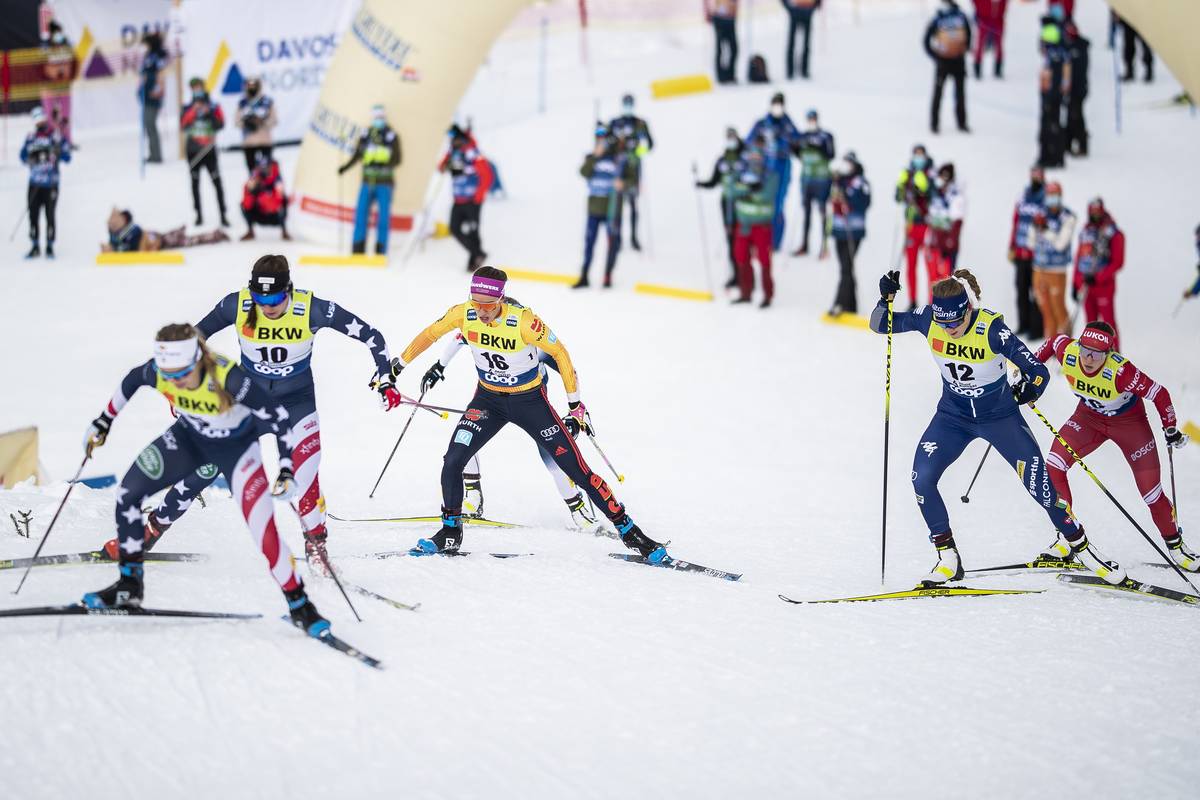
    Quarterfinal number one heads up the first climb with: Barbora Antosova (CZE), Mathilde Myhrvold (NOR), Jessie Diggins (USA), Melissa Gal (FRA), (l-r). (Photo: Nordnes/NordicFocus)
    Qualification and Quarterfinals

    Sweden’s Linn Svahn, the reigning Olympic sprint champion, posted the fastest qualification time at 2:41.87 — nearly three seconds clear of Sundling’s 2:44.39. But qualification speed, as World Cup sprinting always reminds us, is only the entry ticket.

    Two Americans advanced to the heats. Jessie Diggins, the overall World Cup leader wearing the yellow bib in what she called a “full circle moment,” qualified 17th in 2:50.91. Rosie Brennan, seeded 28th, also made the top 30.

    Diggins chose Quarterfinal 1 alongside Sundling and Skistad — a loaded heat. Skistad took the win with Sundling second via a photo finish, just 0.18 seconds separating them. Diggins fought hard for third, advancing as a lucky loser after finishing just 0.22 seconds behind Sundling.

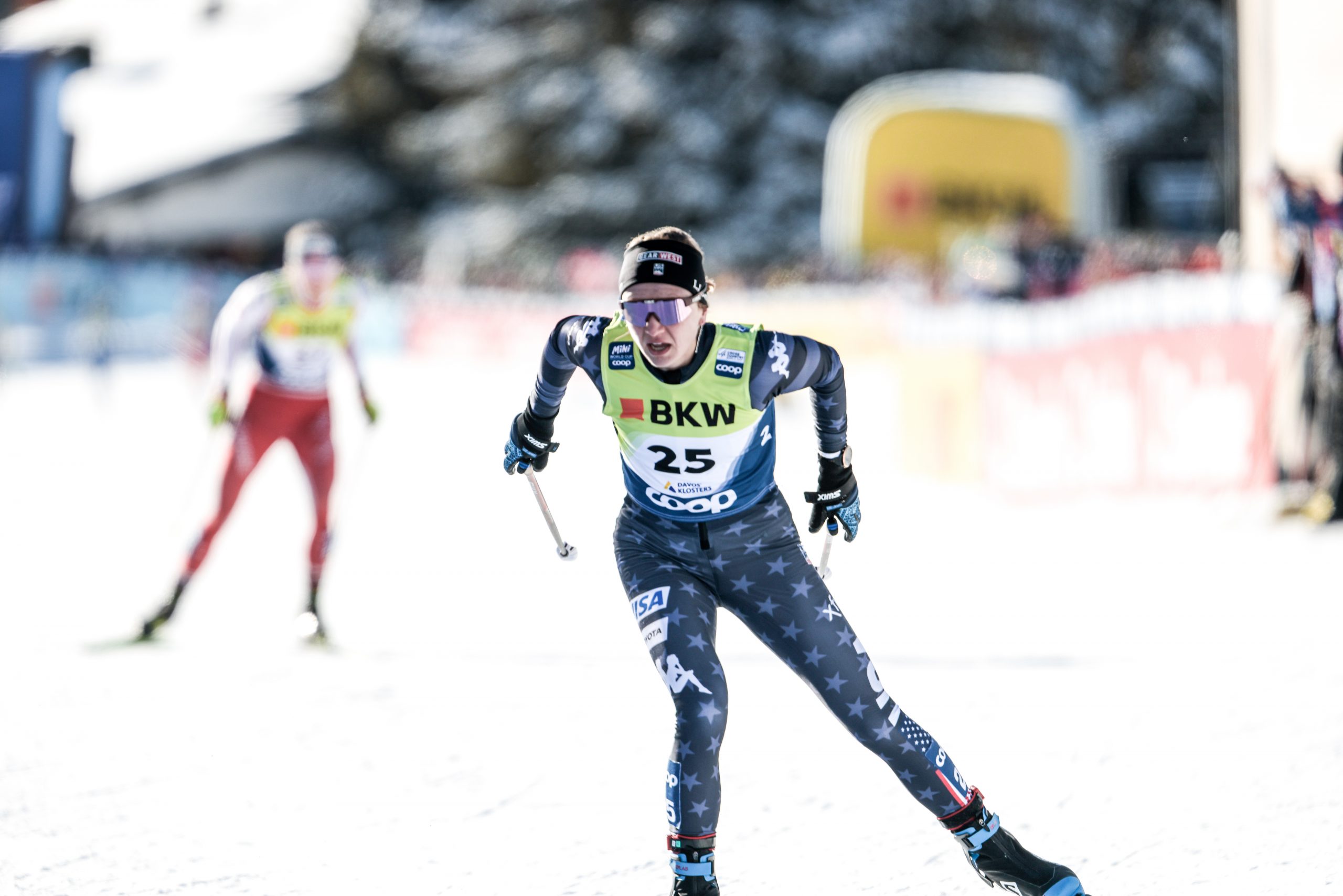
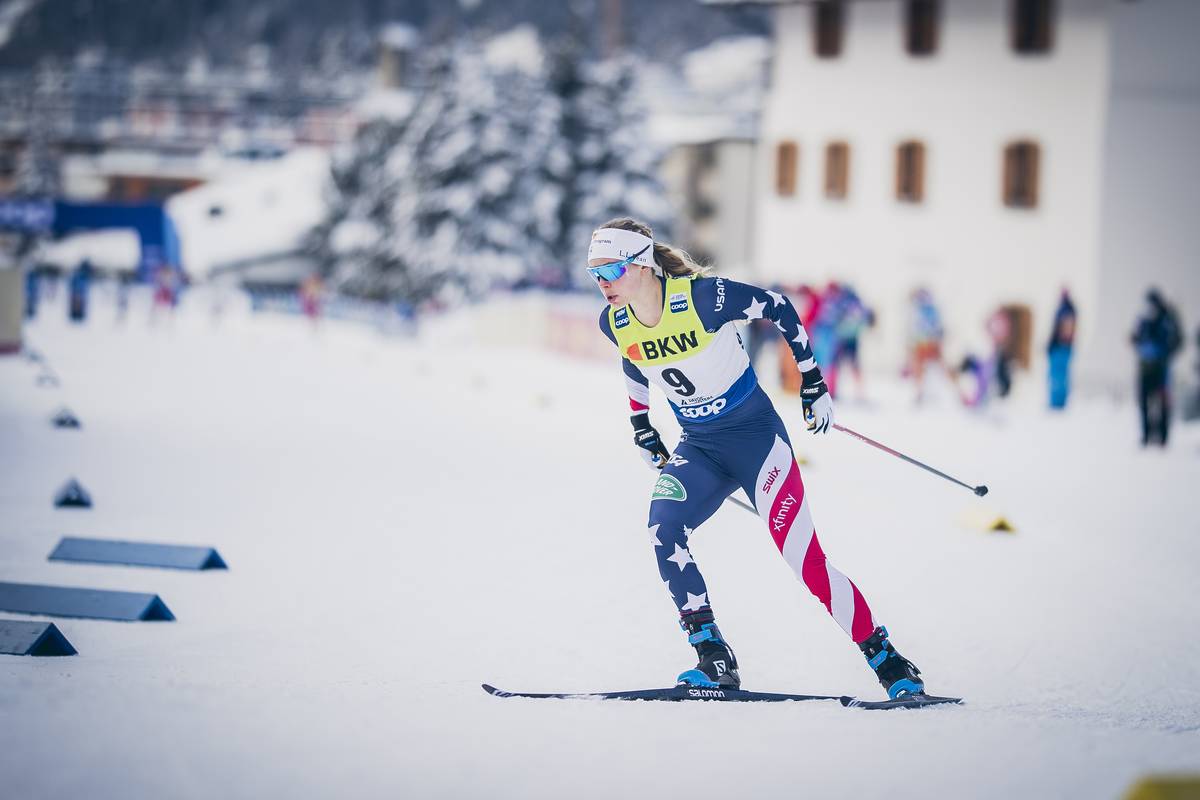
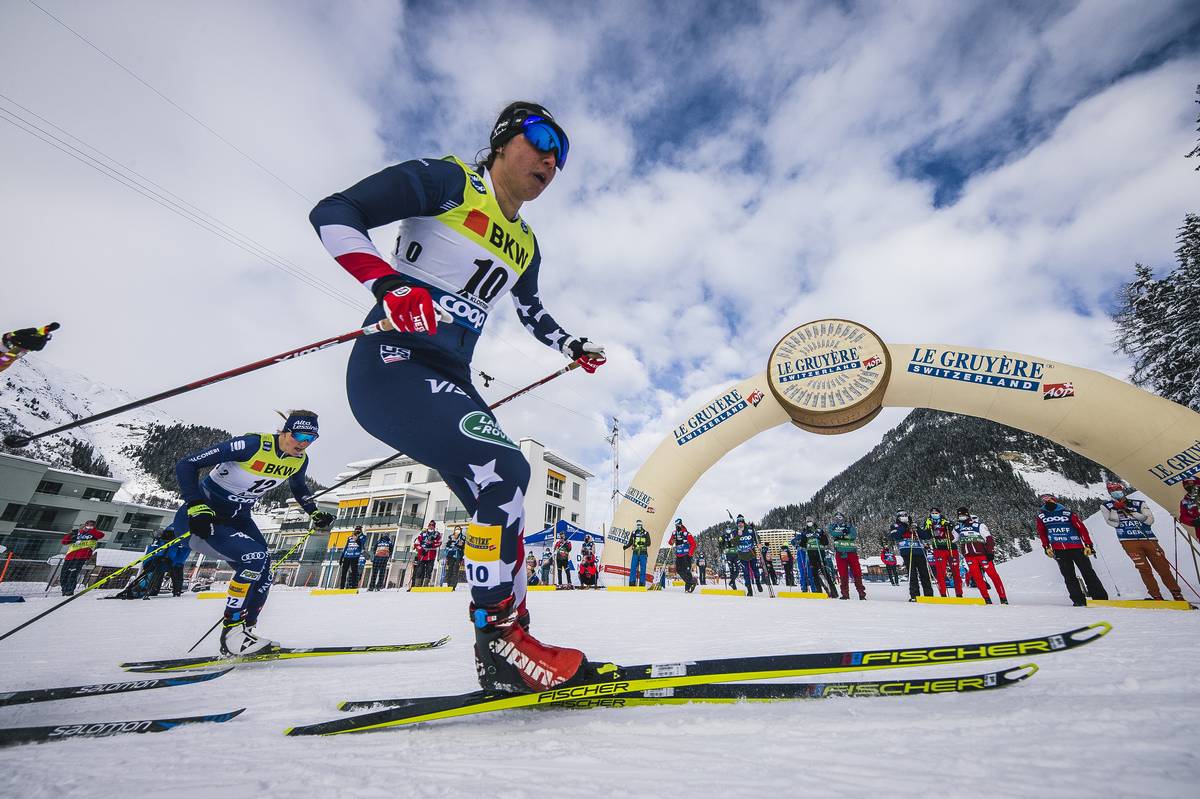
    Rosie Brennan (USA) said after the race, “Drammen is one of my favorite races, it’s a fun course and always has a lively atmosphere.” (Photo: Nordnes/NordicFocus)

    Brennan’s day ended in the quarterfinals. Racing in Heat 3, she bobbled heading into the downhill and lost the draft, which was a costly moment on a course where the slipstream effect was enormous all afternoon. She finished fifth in her heat.

    “I was happy to get a chance in the rounds, but the conditions were very tough,” Brennan said. “They salted the course, and it was skiing great in the qualifier and then got really icy for the rounds. Anyway, I bobbled into the downhill and lost the draft and then just don’t have the power I need to pass that many people up the finish stretch, so I was disappointed to not be more in the mix.”

    Meanwhile, Svahn survived a scare of her own… as her quarterfinal rounded the fountain that anchors the bottom of the course behind the start gates, five of the six athletes ended up in a pile and Svahn seemingly had the most bodies and equipment to navigate as she got back out on the course, but somehow recovered to advance. The Olympic champion’s troubles, however, were only beginning.

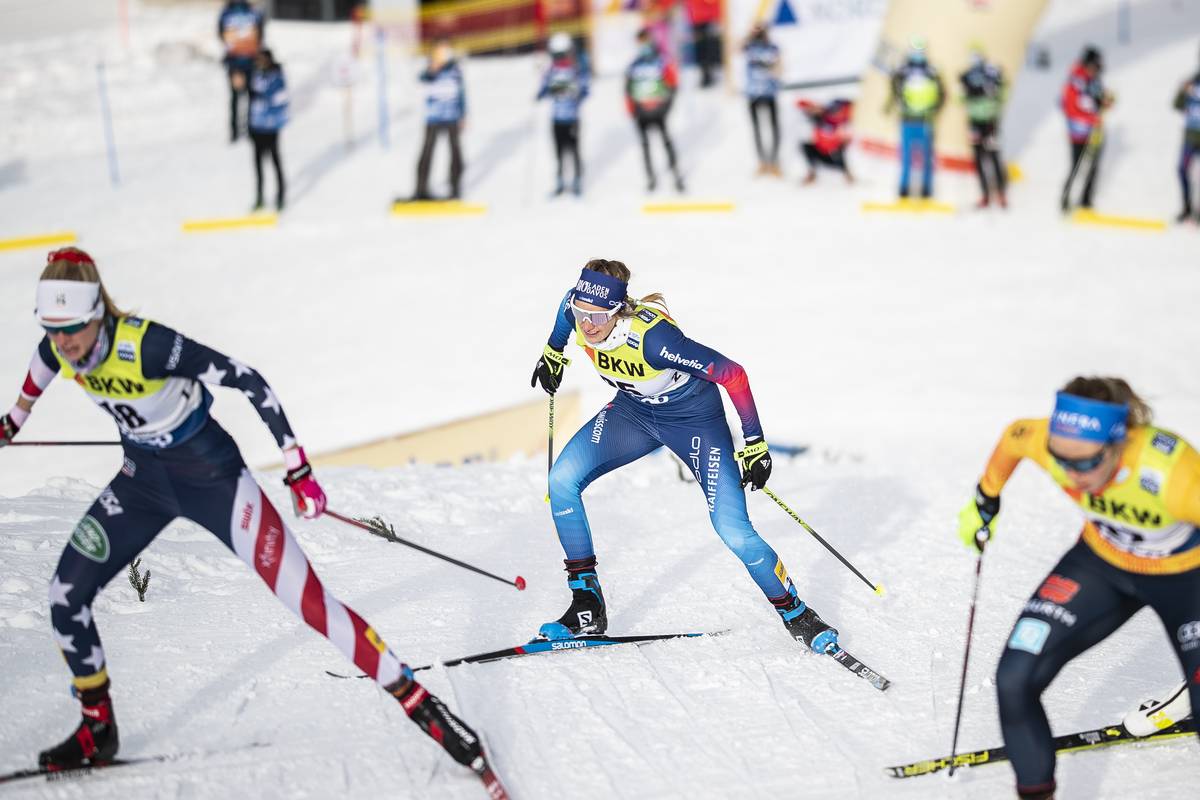
    Maja Dahlqvist (SWE) and Jessie Diggins (USA), (l-r) during the second semifinal. (Photo: Nordnes/NordicFocus)
    Semifinals

    The two semifinals told entirely different stories, and the contrast between them shaped the final.

    In Semifinal 1, Skistad took the win with Sundling second, just 0.20 seconds back. Both advanced automatically. Behind them, Svahn finished third and would not advance.

    Semifinal 2 was a different race entirely. Johanna Hagstroem and Ane Appelkvist Stenseth pushed the pace from the gun, stringing the field out over the first climb. But on the long downhill, the draft did its work. Faehndrich and Laura Gimmler of Germany surged past, using the slipstream to slingshot into the lead.

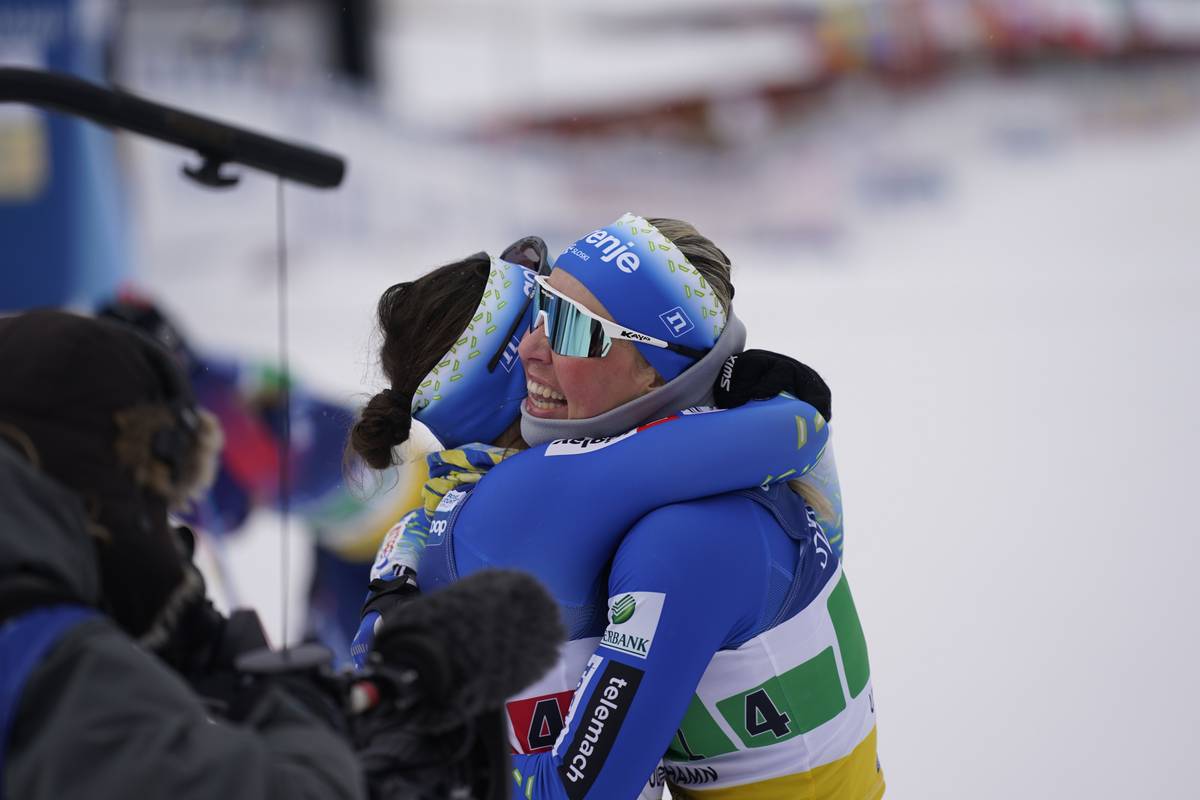
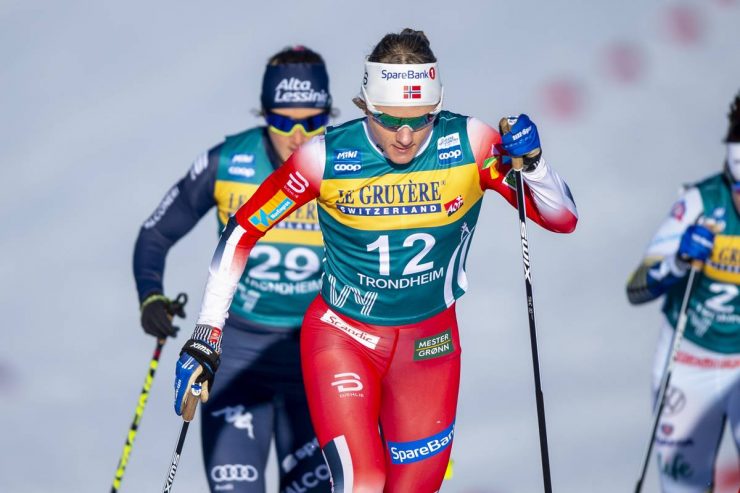
    Nadine Faehndrich (SUI), who is planning to retire after the season, found a little extra Drammen magic today as she finished on the podium in third. (Photo: Nordnes/NordicFocus)

    Faehndrich won the heat decisively. Gimmler was second. The fast overall times meant Hagstroem would advance along with Stenseth, who just out-lunged Diggins for fourth and the second lucky loser position.

    For Diggins, the day ended in 10th. But she left Drammen at peace.

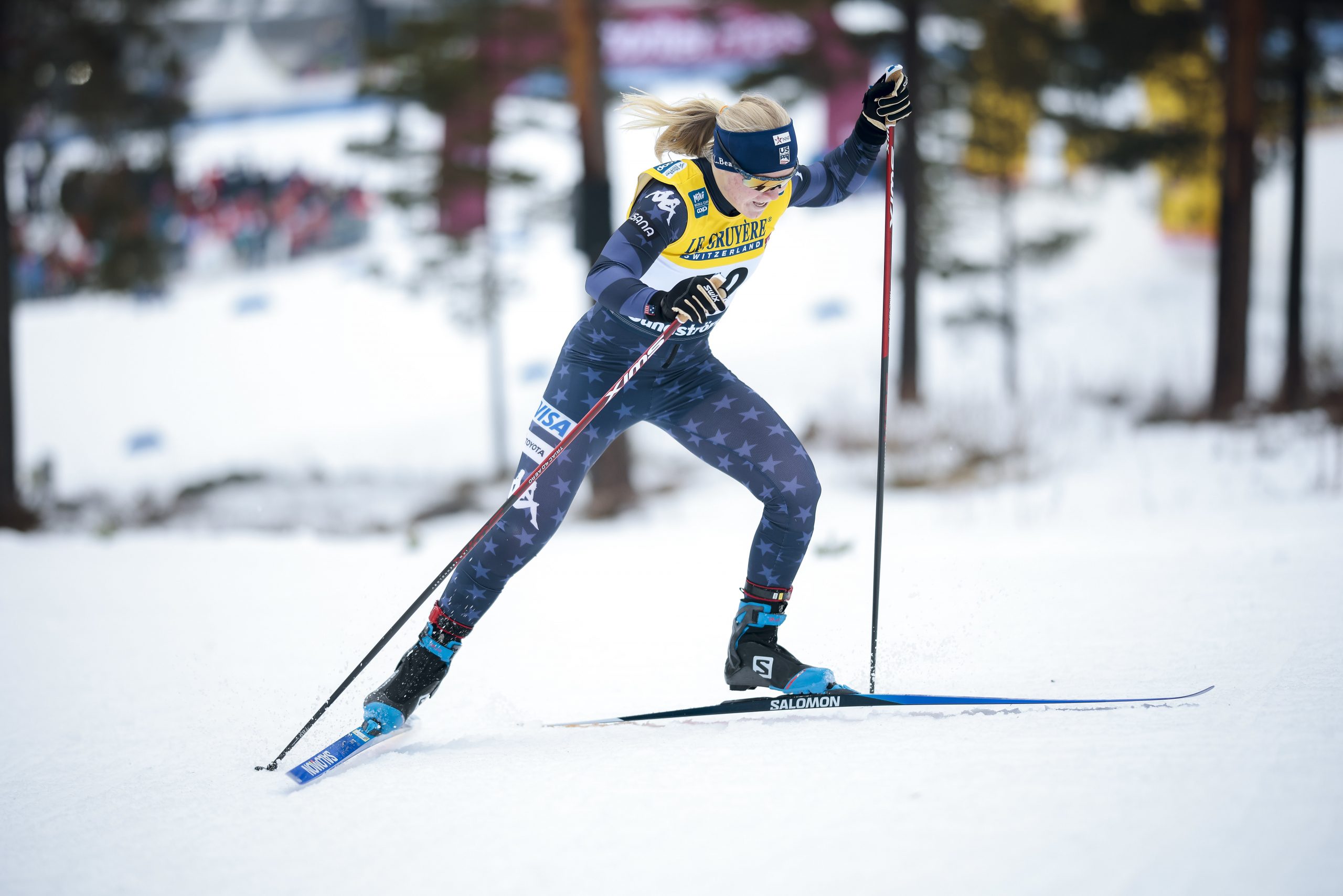
    “This was really cool because the Drammen area was my first ever World Cup start and it was a skate sprint,” Diggins said. “So it’s kind of a very full circle moment to close it out with a classic sprint here as the last classic sprint of my career.”

    She had tried something new in the heats, sitting in the draft instead of going to the front, a departure from her usual aggressive approach. “Normally, because literal strength is not my strength, I usually just try to go really, really hot and try to go off the front,” she said. “I was like, nope, I don’t think that’s gonna work for me here with the crazy draft and slingshot effect. I was taking a lot of notes in warm-up, and in the quarterfinal, I had the smallest tuck of my life. It was just really fun to try to believe in myself as more of a pure sprinter and to try to be a little more tactical.”

    She acknowledged she ran out of power in the semifinal, but had no regrets. “I still felt like I executed my plan to the best of my ability, and that’s always a cool feeling.”

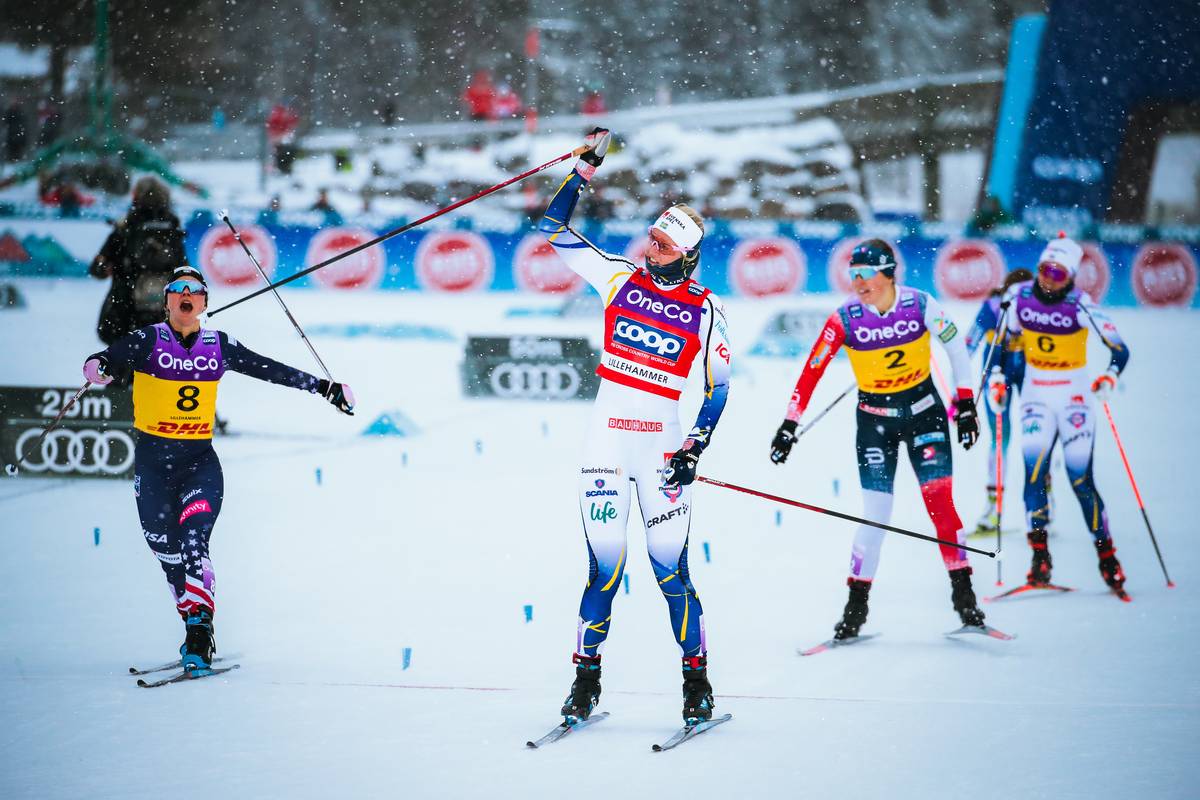
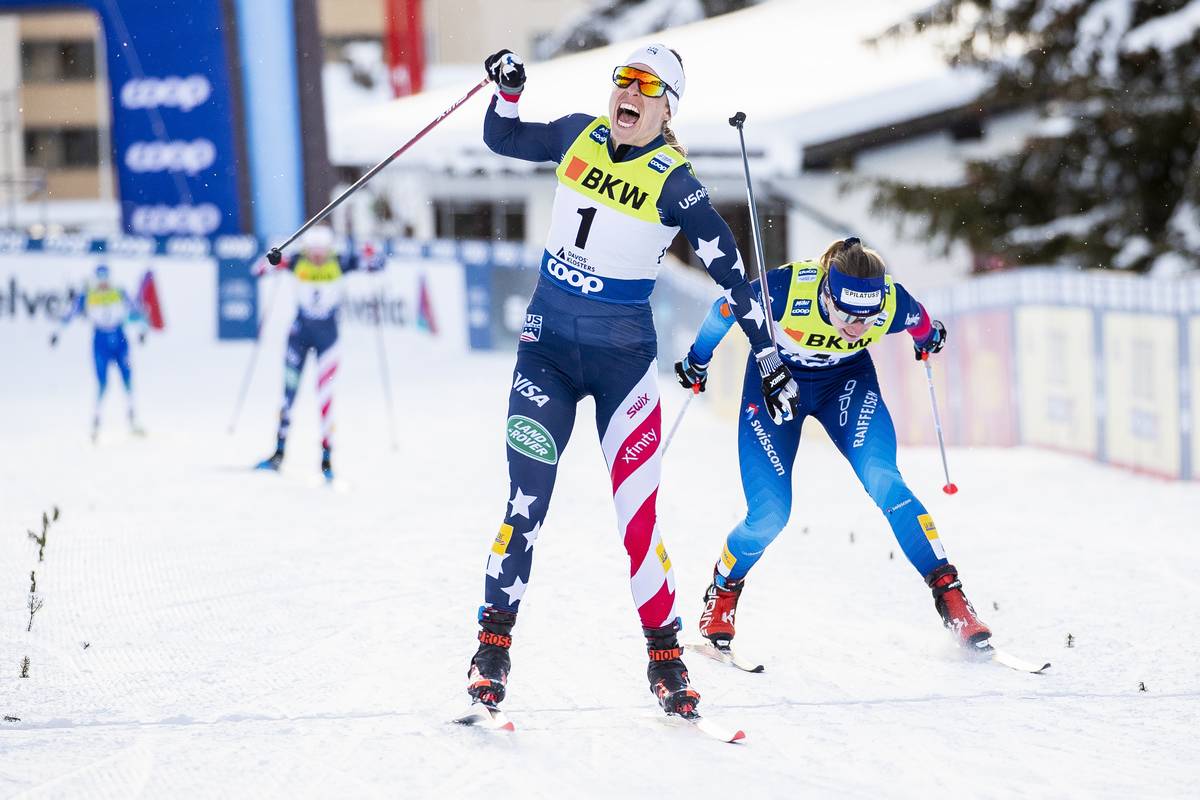
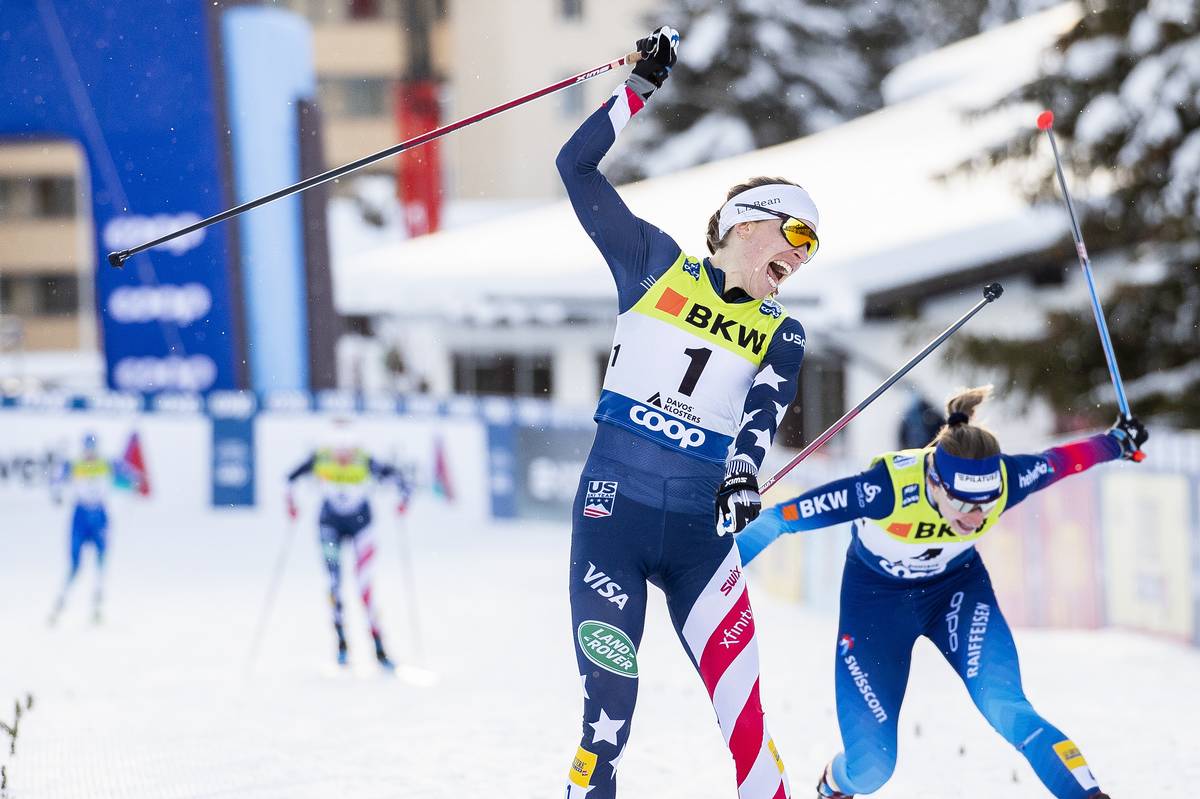
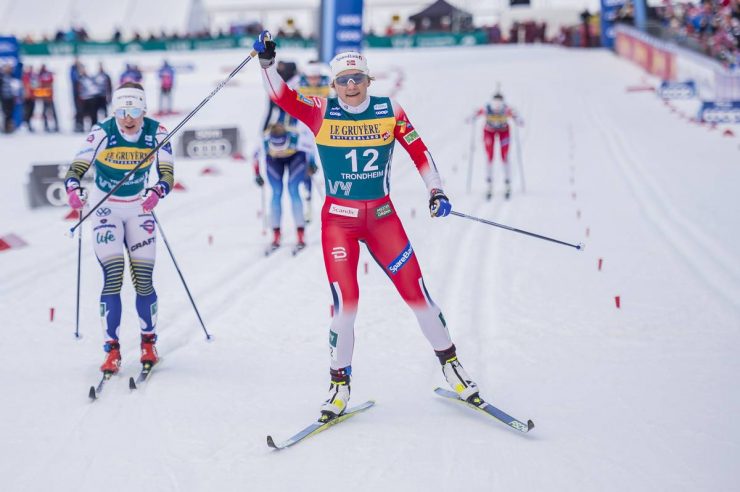
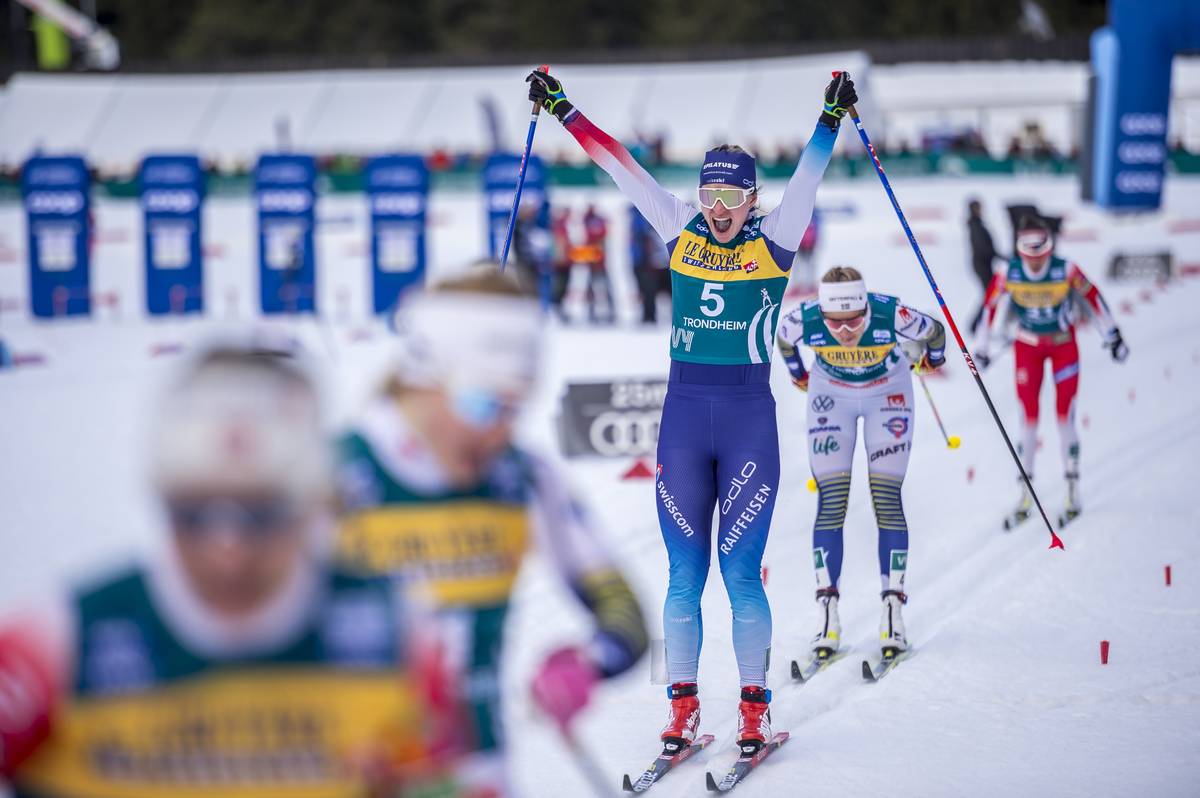
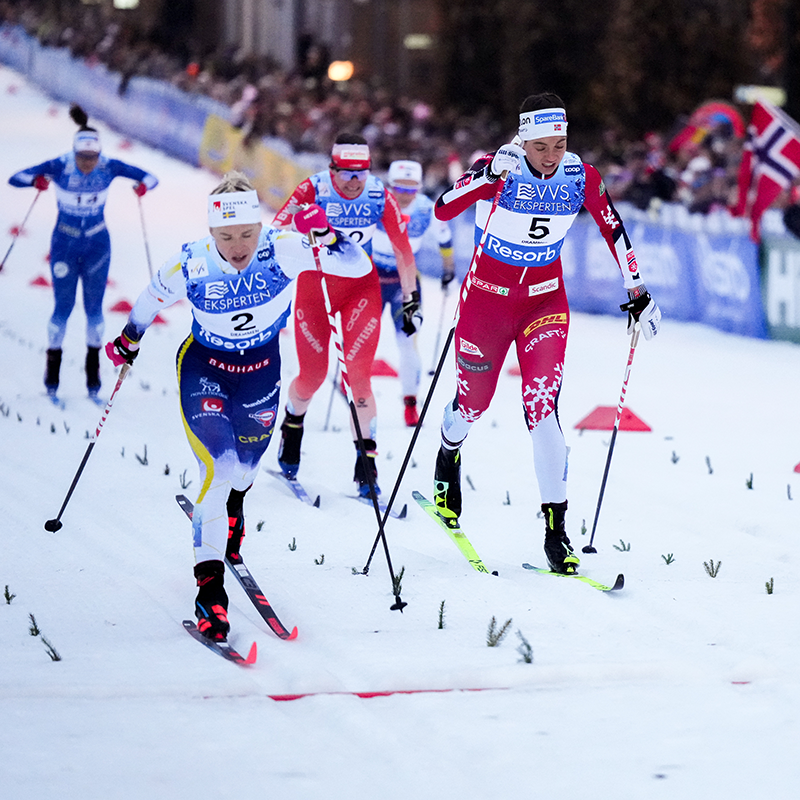
    Jonna Sundling (SWE) crosses the finish line just ahead of Kristine Stavaas Skistad (NOR) for the win in Drammen, Norway. (Photo: Nordnes/NordicFocus)
    The Final

    Six women lined up for the final: Sundling and Hagstroem for Sweden, Skistad and Stenseth for Norway, Faehndrich for Switzerland, and Gimmler for Germany. Svahn and Maja Dahlqvist, the Olympic gold and bronze medalists in the sprint classic, were both absent.

    On the opening climb, Skistad sat behind Sundling in a familiar posture — patient, conserving, waiting for the right moment. As Kikkan Randall mentioned on the broadcast, Skistad almost never leads into a downhill. She baited Gimmler into taking the front position, then tucked into her slipstream.

    Coming off the descent and around the final hairpin, Faehndrich made her bid, surging past Gimmler and into third. But the race was between the two women everyone expected.

    Sundling and Skistad skied side by side on the final climb, and what followed was a scene that encapsulated their rivalry. Stride for stride, shoulder to shoulder, neither yielding a centimeter. Sundling’s transition from double pole to striding was fractionally sharper — she carried more momentum through the final meters — and she crossed the line with a small advantage.

    “It is usually very tight in Drammen, but today it was extremely tight,” Sundling said on air afterward. “Till the last meter. I was like, okay, I need to continue all the way over the finish line. It was tough, but I’m happy that I was the first person over the line.”

    For Faehndrich, the bronze was a fitting farewell. The 30-year-old Swiss racer, who announced her retirement this season, now sits third in the sprint World Cup standings at 700 points — just behind Hagstroem (708) and within striking distance of leader Dahlqvist (720) heading into the final sprint of the season in Lake Placid next weekend.

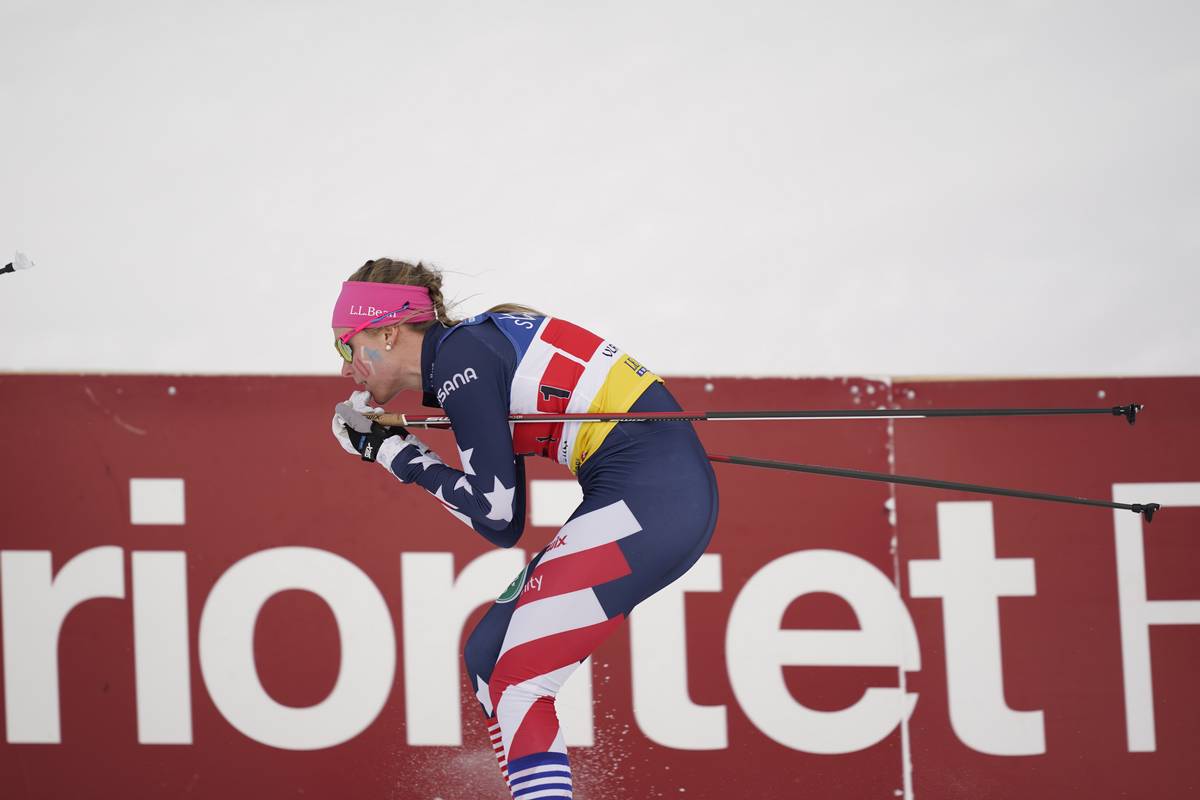
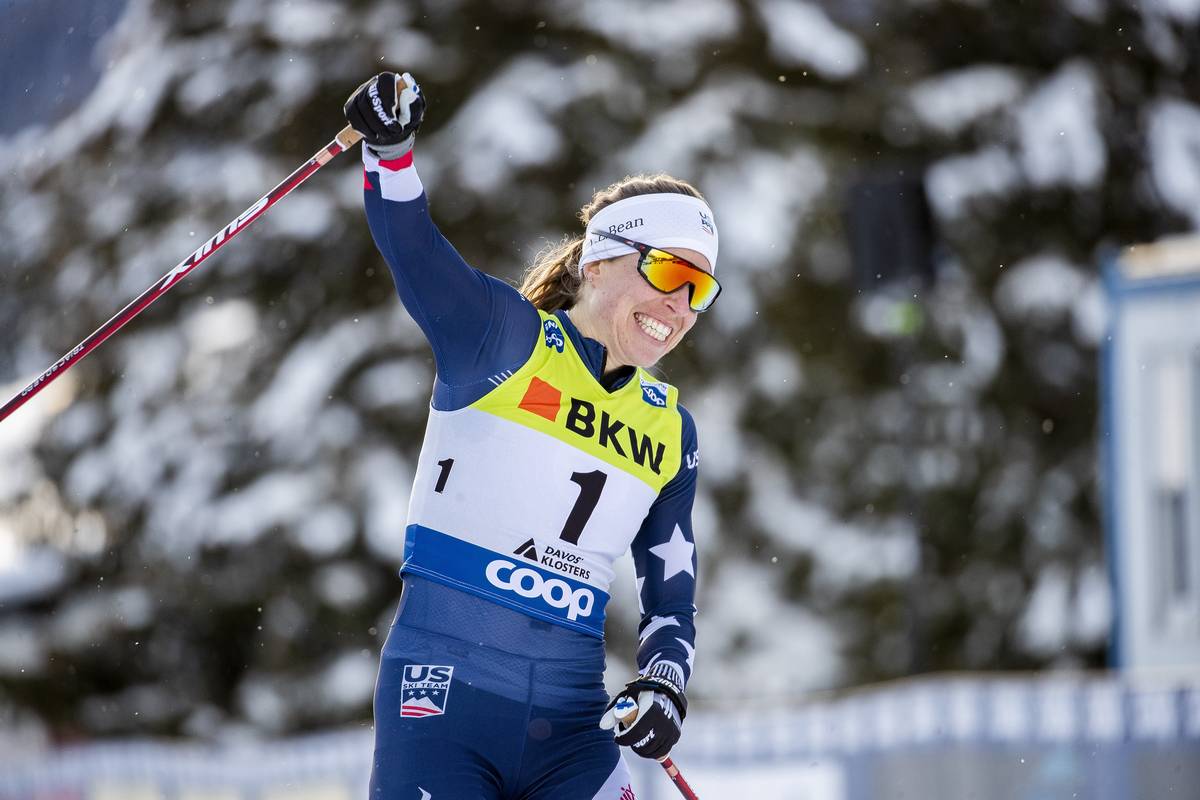
    Jessie Diggins (USA) gave her fans something to cheer about during her quarterfinal when she charged to the finish line. (Photo: Nordnes/NordicFocus)
    Looking Ahead

    Diggins continues to lead the overall World Cup standings with 1,961 points, 275 points ahead of Sweden’s Moa Ilar, a margin that appears insurmountable with four races remaining. The distance globe, too, seems firmly in her grasp. But the sprint crystal globe race is wide open: Dahlqvist, Hagstroem, and Faehndrich are separated by just 20 points at the top of the standings, and the final sprint in Lake Placid could decide everything.

    For Diggins, there’s another milestone ahead — she’s only a few nights away from sleeping in her own bed before racing in front of an American crowd at the World Cup Finals. “Very, very, very excited about that,” she said.

    The World Cup moves to the historic Holmenkollen venue in Oslo on Saturday for the Women’s 50 k Freestyle Mass Start, before the season concludes in Lake Placid, New York, March 20-22.


    Drammen Women’s Classic Sprint QUALIFICATION RESULTS

    Drammen Women’s Classic Sprint FINAL RESULTS


    Love Stories Like This? Help Keep Them Coming.

    Feature stories like this one take time, access, and care to produce. If you value thoughtful storytelling and independent ski journalism, please consider becoming a Voluntary Subscriber. Your support directly fuels the work we do to cover the people, places, and moments that make our sport special.

    Join the FasterSkier community!


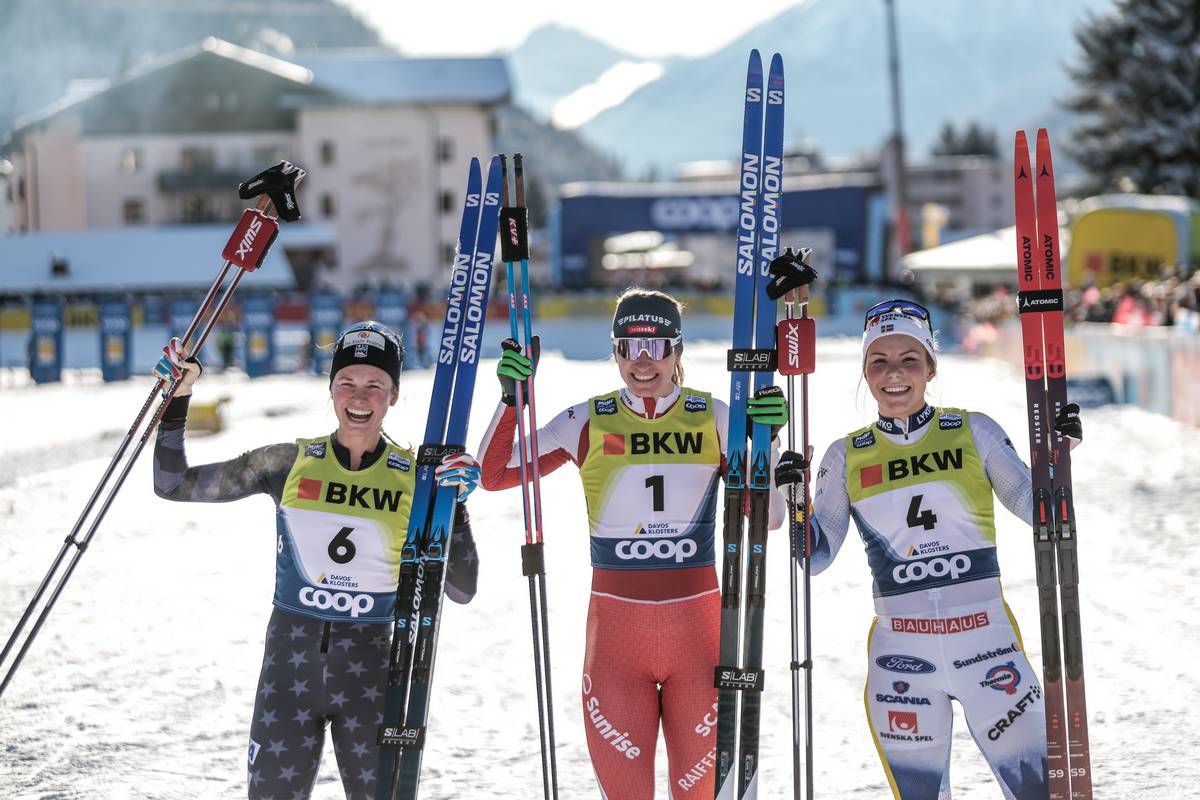
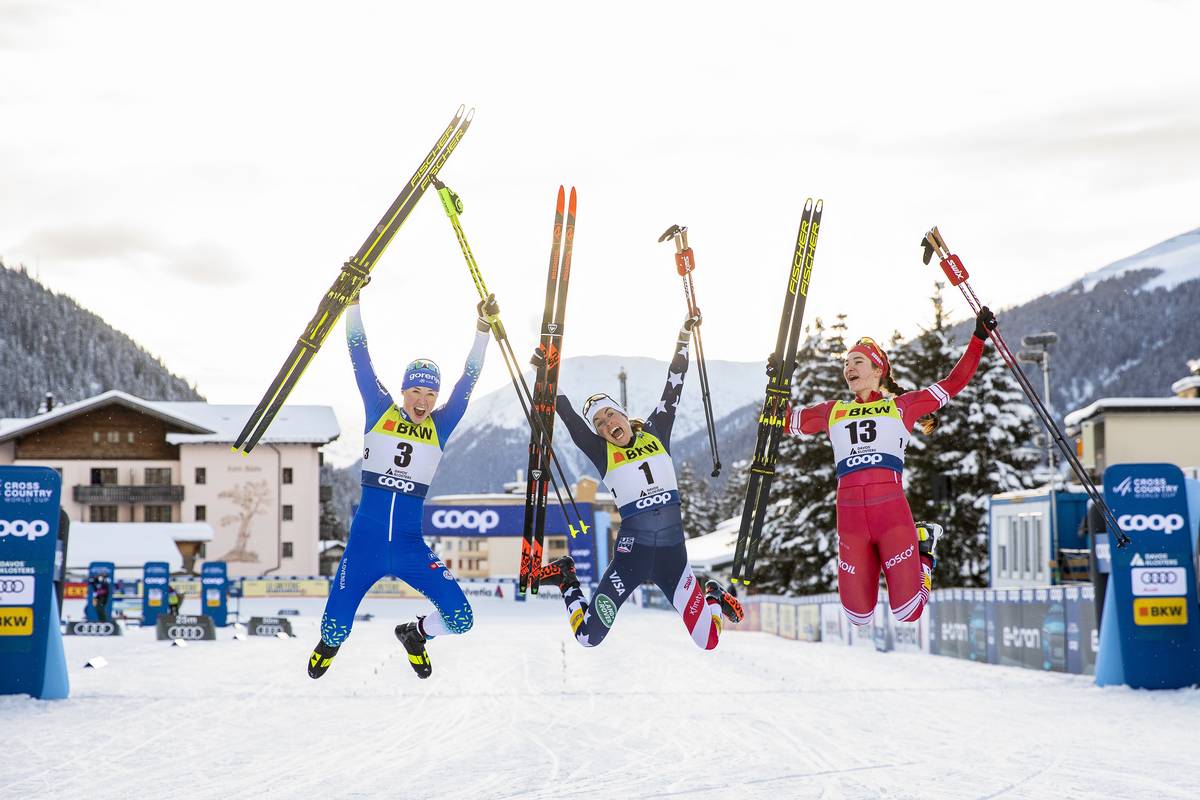
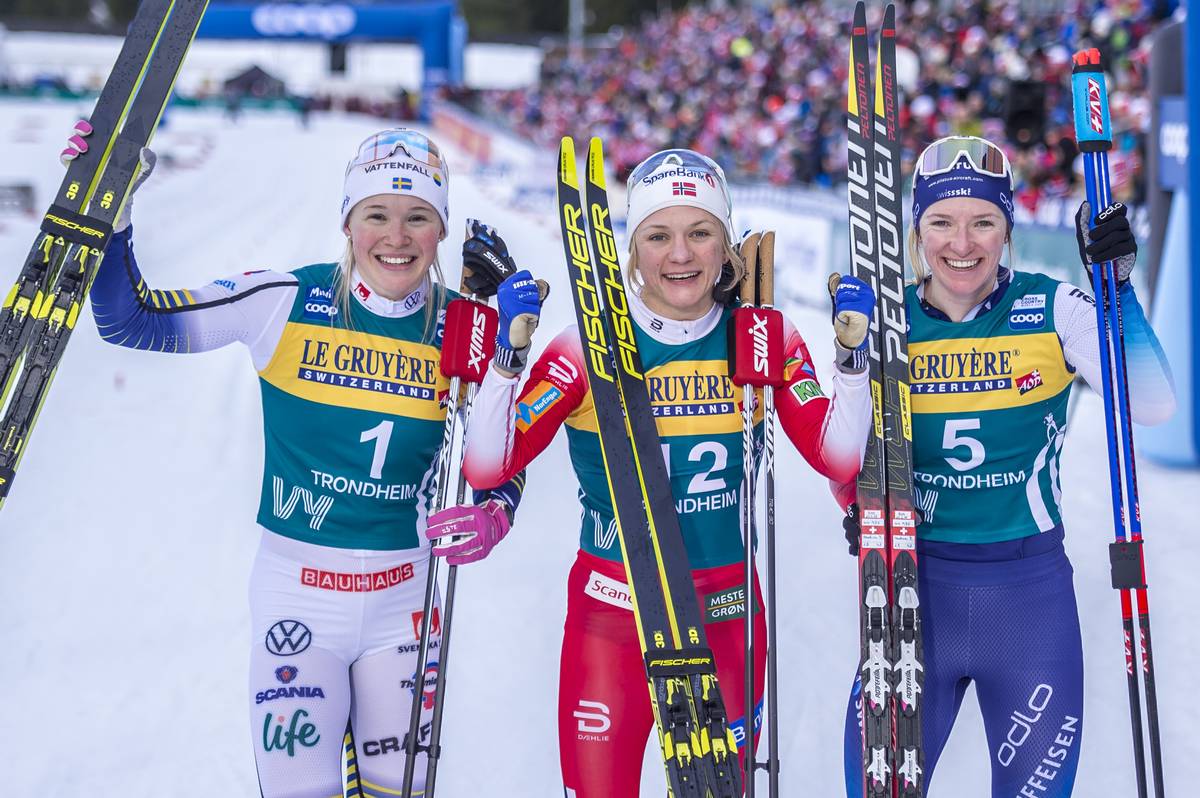
    Kristine Stavaas Skistad (NOR), Jonna Sundling (SWE), and Nadine Faehndrich (SUI), (l-r) share the Classic Sprint podium in Drammen, Norway. (Photo: Nordnes/NordicFocus)
  • More Than One Tactic—Svahn Masters Falun Sprint

    More Than One Tactic—Svahn Masters Falun Sprint

    This coverage is made possible through the generous support of Marty and Kathy Hall and A Hall Mark of Excellence Award. To learn more about A Hall Mark of Excellence Award, or to learn how you can support FasterSkier’s coverage, please contact info@fasterskier.com.

    Linn Svahn (SWE) can afford to ignore all the recommended tactics normally employed on Falun’s infamous Sprint course. She’s just too fast. (Photo: Thibaut/NordicFocus)

    Falun’s Sprint course rewards experience . . . but not every skier who possesses that experience pays very close attention. Skiers can get distracted by how they feel, by how their heat is shaping up, by the tactics of others. Sometimes, that sort of counter-punching can prove profitable. Not in Falun . . . not on most days anyway.

    In Falun, skiers prepare for an infamous and well-known draft on the penultimate downhill . . . they either deal with that draft, or they find themselves out of contention. By now, every skier should know that whomever is leading at the top of the significant downhill is almost certain to be swallowed up by the field. Leading is a mistake, and it appears nearly impossible to establish enough of a lead to overcome the advantage gained by skiers speeding up from behind. Falun represents perhaps the most tactical—and most obvious—of all World Cup Sprint courses. And it will manufacture that same crucial factor next year when the World Championships are staged on this very same course. If skiers take advantage of watching replays of these races, they’ll begin to see that there’s only one tactic to employ in Falun . . . unless, of course, you just happen to be lots faster than everyone else, like Linn Svahn.

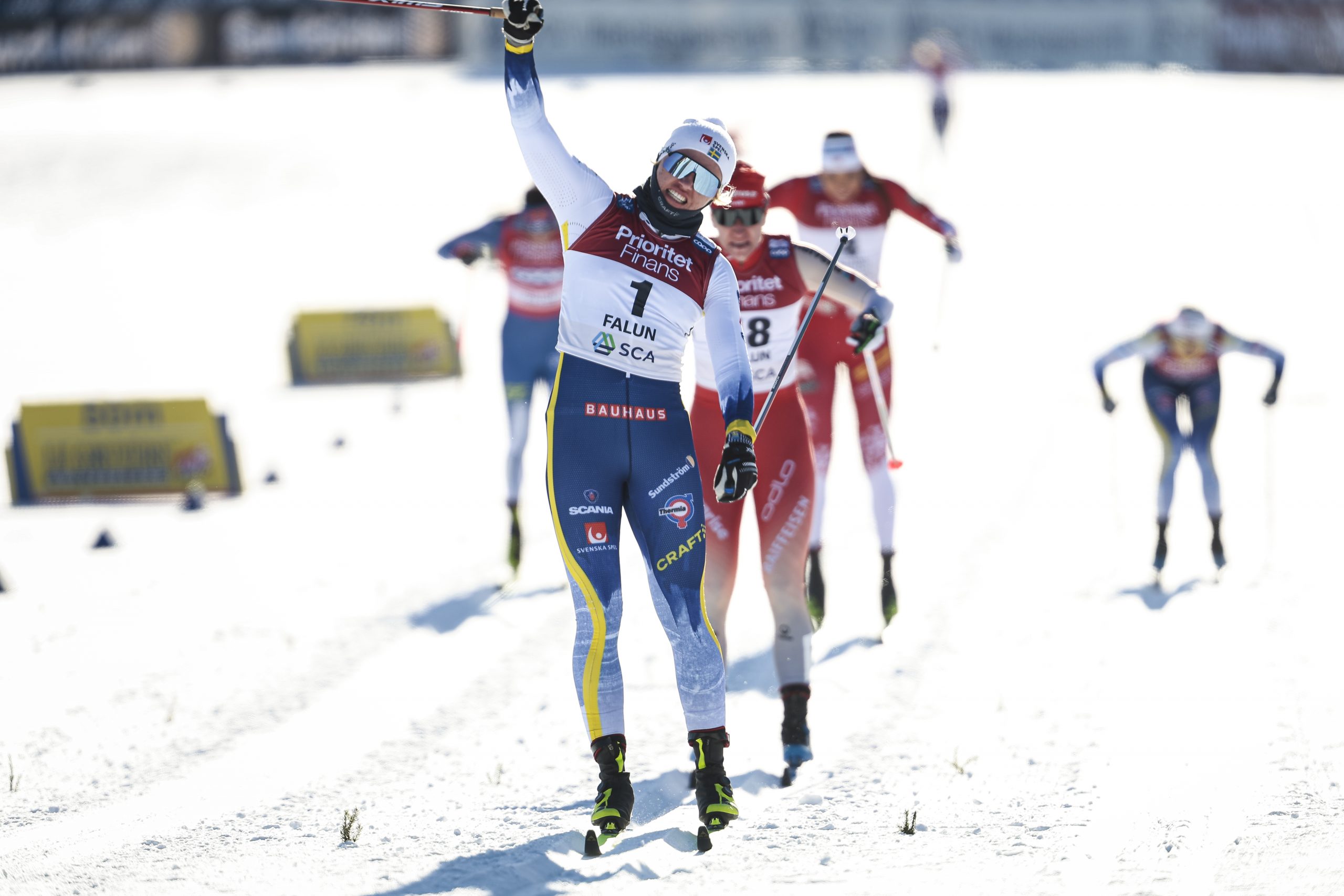
    In the Sprint final, Svahn found herself forced to the front by a cagey Kristine Stavaas Skistad who positioned herself to take advantage of Falun’s infamous draft. What Skistad did not anticipate was the raw speed that Svahn would bring to the Final. Stuck as she was at the front, Svahn simply engaged the after-burners on the course’s penultimate uphill—a tactical decision that had proven disastrous for every other skier in Falun’s Sprint heats. Accelerate there, and you’re all but certain to get caught on the downhill. But Svahn is riding the crest of a wave that has carried her to the very top of the Sprinting world. The same speed she employed to claim dominant wins in both the Classic Sprint and Team Sprint in the Olympics a week ago continued to propel her to the top step of the podium in Falun. Skistad set things up well in the Sprint Final, but Svahn was simply too strong.

    Nadine Faehndrich (SUI) continued her recent podium run in third place ahead of Coletta Rydzek (GER), Maia Dahlqvist (SWE) and Johanna Hagstroem (SWE).

    Americans qualified two skiers into the heats—Jessie Diggins and Sammie Smith—both of whom would find themselves undone by Falun’s infamous draft in their quarterfinal heats. Diggins would finish the day 17th, Smith 23rd.

    Canada’s Liliane Gagnon would qualify seventh, confirming her arrival on the international Sprint scene by advancing to the semifinal where she wold finish tenth on the day.

    Liliane Gagnon (CAN) announced her arrival as a World Cup Sprint contender with a brilliant 10th place finish in Falun. (Photo: Authamayou/NordicFocus)
    After the Olympics . . .

    The Olympics are over, the biggest pressure is off, the medals are stowed safely away. Now it’s back to the re-start of the World Cup season that these skiers began months ago. Returning, as the skiers do now, to the post-Olympic season, this is a time when we may find out who is truly worn out from the Games, contrasted with who may have mis-calculated their peak for the Olympics, but may now find themselves in top shape as all those who collected Olympic medals are strangely and uniquely vulnerable.

    The weeks following the biggest competitions are sometimes full of surprises, especially when a few of the medal-winners and event-dominators choose to stay home. Who can blame them? They spent weeks and months and years and careers building up to those Olympic Games. And those who succeed in claiming the medals that the media expected must then run the loving gauntlet of media attention and sponsor responsibilities that accompany Olympic success. After the Lake Placid Olympics in 1980, where the immortal speedskater Eric Heiden had proven to be unbeatable (winning all five of the five speedskating events), Heiden signed up for the All-Around World Championships, where he promptly got beat. Lesson learned: just because you’re the best one week doesn’t guarantee you’ll be the best every week . . . not after the insistent press, the pressing sponsorship responsibilities, and the adoring crowds have gotten done with you, anyway.

    Diggins entry into the Falun’s World Cup Freestyle Sprint was significant for another reason: after today, she stands alone as the skier who has recorded more individual World Cup starts than any other. (Photo: Jason Cork/FasterSkier)

    Switzerland has one of its medalists on the starting line, but not the other. Nadine Faehndrich is here, but no Nadja Kaelin (medalist in both the Team Sprint—with Faehndrich—and the 50 k). Sweden has its newly crowned Sprint Queen, Linn Svahn, in the lineup, but Jonna Sundling—Sweden’s former Sprint Queen—has stayed home. And of course the USA’s Jessie Diggins was here . . . isn’t she always here? Every weekend, every event, every starting line, Jessie Diggins lines up to race. That’s why she’s seemed nearly impossible to best in the season-long World Cup standings: she’s almost always signed up to race, and she’s almost never out of contention. It’s an astonishing level of durability and prolonged excellence, one that we’ll be able to enjoy and appreciate for only a few more weeks until her retirement . . . until that racer who we’ve known would always be there is no longer there. Believe me, we’ll miss Jessie Diggins terribly in seasons to come.

    But, for the time being, Diggins has a World Cup Overall title to defend . . . a defense that would benefit from a few more Sprint points. Her fourth place qualifying time would reward her efforts, but she would ski impatiently in her quarterfinal, fining herself undone by the strategic draft that heat-leaders give up on Falun’s Sprint course. Diggins would finish fourth in a heat that was not fast enough to offer advancement as a lucky loser.

    “It was my 357th World Cup start,” said Diggins. “It was just a really cool chance to feel extra grateful to my team, to look back on why that was possible, and to look at the bigger message for me here, that asking for help with my mental health got my physical health to a place where I could race this hard for this long . . . And the season isn’t over yet!”

    Samantha Smith (USA) just keeps getting stronger week after week. (She would qualify 19th, and finish the day 23rd). Photo: Thibault/NordicFocus)
    Tactics on Display

    The first quarterfinal involved Skistad and Svahn. Skistad dangled at the back mid-heat, but glided forward on the final downhill to finish second behind Svahn.

    Liliane Gagnon (CAN) qualified seventh at the start of the day, and she skied strongly in the second quarterfinal (won by Switzerland’s Nadine Faehndrich) to claim a lucky loser spot, and a space in the semifinal.

    Diggins headlined Quarterfinal 3. She led from the start but seemed hindered by slower skis onthe significant downhill. Diggins ran out of gas in the final straightaway as the heat was taken by Coletta Ryzek (GER) ahead of Moa Ilar (SWE).

    Sammie Smith (USA) began the day aas the 19th qualifier, continuing to show the form that saw her named to the US Olympic Team. Smith lined up in Quarterfinal 5 where Julie Myhre (NOR) and Johanna Hagstroem (SWE) provided the early pace. Smith has begun to reveal a strategic preference: allowing herself to drop back into the field early on, then charging forward late in the race. She did that again in Falun, storming up the final climb. Unfortunately, experience suggests that the draft given up on Falun’s Sprint course is often the deciding factor, and Smith (like Diggins before her) found herself swallowed up on the descent. Hagstroem would take the heat win, ahead of Julie Bjervig Drivenes (NOR).

    “I felt like I skied the hills really strong today and was disappointed with some of my tactical decisions,” said Smith. “Unfortunately, Falun is notorious for a large draft on the final downhill. I was trying to ski to my strengths today, but I should have been more patient and tried to tuck behind other skiers so I didn’t get drafted so much.”

    “The more time I have on skis, the more races I get to do, the better I feel,” Smith continued. “I’m really looking forward to the last few weeks of the season.”

    Kristine Stavaas Skistad (NOR) showed that she understood the tactics that Falun’s Sprint course dictates, but Linn Svahn (SWE) was just too fast. (Photo: Authamayou/NordicFocus)
    Tactics Confirmed—Sprint Semifinals

    Semifinal 1 offered Skistad a chance at Redepption after a disappointing fifth place finish in the Olympic Classic Sprint,and she perhaps better than anyone else seemed to understand the importance of utilizing Falun’s draft. Gagnon streaked forward to contend with Svahn and Faehndrich, while Skistad and Rydzek—famously fast closers—lingered at the back. Skistad easily coasted back into contention in the draft of the long downhill, and was able to get to the tails of Svahn before the finish line. Those two would move on to the final while Rydzek and Faehndrich would wait to see if they would move forward as luckylosers.

    The second semifinal involved a slate of Swedes: Moa Ilar, Moa Lundgren, Hagstroem, and the cagey veteran, Dahlqvist, who rarely leads in the early stages of heats. True to form, Dahlqvist hovered around third or fourth. Hagstroem would ski the downhill draft section to perfection, launching into the lead at the bottom, and followed across the line by Dahlqvist. Again, experience ahead of speed.

    Linn Svahn (SWE) established a gap ahead of Kristine Stavaas Skistad (NOR) in the Sprint final. Usually, Falun’s course would not reward such audacity, but Svahn was able to hold her advantage to the end. (Photo: Authamayou/NordicFocus)
    Tactics Defied

    In the ongoing defense of her lead in the season-long Sprint standings, Dahlqvist had done her job in just getting to the Final. Her lead would be protected for another week in her quest to finish the season wearing the Sprint leader’s red bib. But the other skiers in the Final had other challenges in mind. Team Sweden’s Hagstroem, Svahn, and Dahlqvist matched up against Skistad, Faehndrich, and Rydzek. Skistad went to the front, where it appeared she would control the pace (and force others to go around her into the lead). Her tactic seemed to be working as Svahn found herself at the front. Skistad must’ve been pretty satisfied with that positioning . . . satisfied, that is, until Svahn applied the power. In just a few strokes, Svahn accelerated up the hill where no one else dared acccelerate, creating a massive gap that left Skistad in an unexpected panic.

    While Skistad may be one of the fastest sprinters in the world, her strength is definitely not in quick acceleration. Though Skistad would chase gamely, Svahn was gone, the finish line photo making the result appear far closer than it really was. Faehndrich would hold on for third ahead of a fast-charging Rydzek. Dahlqvist would finish fifth, holding her lead in the World Cup standings, but seeing her lead shrink in the wake of Faehndrich’s podium performance. That season-long race is definitely tightening, and appears likely to be decided in the final World Cup weekend in Lake Placid.

    Falun Women’s Freestyle Sprint RESULTS

    Falun Women’s Freestyle Sprint QUALIFYING

    Love Stories Like This? Help Keep Them Coming.

    Feature stories like this one take time, access, and care to produce. If you value thoughtful storytelling and independent ski journalism, please consider becoming a Voluntary Subscriber. Your support directly fuels the work we do to cover the people, places, and moments that make our sport special.

    Join the FasterSkier community!
    The victory lap in Falun. Linn Svahn (SWE), Kristine Stavaas Skistad (NOR), Nadine Faehndrich (SUI). (Photo: Thibault/NordicFocus)
  • The Devon Kershaw Show: A Tesero team sprint slugfest

    The Devon Kershaw Show: A Tesero team sprint slugfest

    This episode was made possible through the generous support of our voluntary subscribers.  If you value coverage like this, please support FasterSkier with a voluntary subscription.  

    The highs were high and the lows were low in the Olympic team sprint in Italy, with the Ogden-Schumacher men’s team claiming silver and the Diggins-Kern women’s pair finishing out of the medals. Devon and Nat break the whole thing down.

    We’ll be back after Saturday’s men’s 50 k. Reach us at devon[at]fasterskier.com and nat[at]fasterskier.com. We’re really grateful for all the support during the Olympics — thanks for notes and encouragement.

    A reminder: This is a homegrown podcast done by two guys working long hours and late nights. We’re also paying real money to be here in Italy. If you can, support the show and FasterSkier’s ongoing coverage with a voluntary membership. We’re also offering a bonus during the Olympics: a WhatsApp group with notes on Nat’s experiences in Italy, the food he’s eating, interview transcripts and more.

    Send nat[at]northernjournal[dot]com a confirmation of your voluntary membership and the number he should use for WhatsApp and we’ll get you signed up. You can also Venmo him directly at @nat-herz if a membership isn’t for you. We’re suggesting a minimum of $10, but we also won’t turn anyone away who wants to join because of an inability to pay.

    Help Support Our Olympic Coverage!

    FasterSkier will have our own Nat Herz on the ground at the Olympics, which, to be honest, is a very big financial lift for us. If you value the thoughtful work and access FasterSkier provides at championships like this one, please consider becoming a Voluntary Subscriber. Your support directly fuels the work we do to cover the people, places, and moments that make our sport special.

    Join the FasterSkier community!
  • Sweden Wins Gold, America Shows Heart in Exciting Women’s Team Sprint

    Sweden Wins Gold, America Shows Heart in Exciting Women’s Team Sprint

    This article was made possible through the generous support of our voluntary subscribers who have helped us put our Nat Herz on the ground reporting at the Olympics. If you value coverage like this, please support FasterSkier with a voluntary subscription.

    Jonna Sundling (SWE) follows Jessie Diggins (USA) during the Olympic Women’s Team Sprint in Tesero, Italy. (Photo: Vanzetta/NordicFocus)

    PREDAZZO, ITALY — Eight years ago, on a different continent, the words “Here Comes Diggins!” by Chad Salmela vaulted American cross-country skiing into a new era. On Wednesday in Val di Fiemme, the event that changed everything for the United States returned to the Olympic stage.

    The Women’s Freestyle Team Sprint has long been one of the Americans’ signature races. In the PyeongChang 2018 Winter Olympics, Kikkan Randall and Jessie Diggins delivered the nation’s first Olympic gold medal in cross-country skiing. Last March in Trondheim, Diggins and Julia Kern claimed World Championship silver.

    On Wednesday, Diggins started the race in the first leg, handing off to Kern for the anchor leg, as they had in their previous medal run. They hoped for one more shared championship moment.

    It was not to be. The Americans finished fifth, in a race that required not just fitness but flawless execution. Sweden’s Jonna Sundling and Maja Dahlqvist took gold. Switzerland’s Nadja Kaelin and Nadine Faehndrich secured silver. Germany’s Laura Gimmler and Coletta Rydzek won bronze after a late-race crash by Finland opened the door in the final turn.

    For the Americans, the margin was not dramatic. But close, at this level, does not bring home a medal.

    Jessie Diggins (USA) and Jonna Sundling (SWE), (l-r) come through the stadium during the Olympic Women’s Team Sprint.  (Photo: Vanzetta/NordicFocus)
    “Honestly, left it all out there.”

    The Team Sprint is one of the sport’s most punishing formats. Two skiers qualify individually; their times are combined to determine which 15 nations reach the final. In that final, the athletes alternate laps — three each — on a course that offers no reprieve.

    Often, one skier brings distance strength, and the other sprint speed. For the United States, Diggins and Kern blur those categories. Both are capable of driving pace. Both can finish.

    From the gun, Diggins did what she has done throughout her career: she went to the front.

    She and Sundling stretched the field immediately, driving into the Zorzi Climb, the race’s defining ascent. The early order — Sweden, the United States, Norway, Canada — hinted at the nations prepared to dictate terms.

    Jonna Sundling (SWE) stretches her lead. (Photo: Vanzetta/NordicFocus)

    When Sundling surged later in the race, Diggins expected it.

    “I knew she was probably going to do that,” Diggins said afterward. “And I was like, just do the best that you can do. You know, like, you can’t control anything except your effort and your heart. And I was like, skiing out of my body, and I just did everything that I could, and I’m proud of that.”

    That theme — control what you can — carried through her reflections.

    “Honestly, I almost passed out like four different times,” she said. Then, clarifying: “No, from going that hard, no regrets. Honestly, left it all out there. I feel like we did everything we could, and that is the only thing you can control at the end of the day.”

    Julia Kern (USA) and Jessie Diggins (USA), (l-r) gather in the finish area after the race, Diggins racing in the US team’s relay socks for the final time. (Photo: Barbieri/NordicFocus)
    One final lap with ‘Relay Socks’

    By the last exchange, Sweden had carved out daylight. Switzerland began clawing into Finland’s hold on silver. Behind them, Germany, Norway, the United States, and Finland battled for bronze.

    On the final descent, Finland’s anchor, Jasmin Kahara, lost her balance in the sweeping right-hand turn and fell, sliding out on her stomach. Germany and Norway slipped past in their tucks. Kern, just meters behind, fought to the line, but the podium had narrowed to two.

    Coletta Rydzek (GER) brings home the bronze medal for Germany with Norway’s Julie Bjervig Drivenes just off camera. (Photo: Vanzetta/NordicFocus)

    As they drove for the line side by side, aerodynamically no-pole skating with everything they had, it was clear this was going to be close. Germany claimed bronze while Norway left empty-handed in fourth. Just behind, Kern brought the United States to the finish in fifth.

    For Diggins, the moment carried a different weight. It was, by her admission, her last Olympic relay leg.

    “I love racing with this girl. I’m so, so proud of her,” she said of Kern. “And, yeah, it’s emotional to feel like I’m never gonna pull on those relay socks again.”

    When asked whether there was a sense of handing the event forward, she reflected on the arc of her career — from her first team sprint world title in 2013 to the growth of youth programs back home.

    “It’s just really cool to be part of the evolution of American skiing,” she said.

    Julia Kern (USA) and Nadine Faehndrich (SUI), (l-r) find their lines around a tricky corner. (Photo: Vanzetta/NordicFocus)
    Whitcomb knows they can win

    For Head Coach Matt Whitcomb, the analysis was candid and clear-eyed.

    “Yeah, it was a good race,” Whitcomb said. “Of course, this is an event that we know we can win, and we didn’t today.”

    In a format this tight, small imperfections are decisive.

    “For even a bronze medal to happen, both legs have to be firing exquisitely,” he said. “We swung as hard as we could. We did our best. We were prepared to win today, and we just didn’t.”

    Of Kern’s anchor leg, Whitcomb offered both empathy and affirmation.

    “Julia is an incredible performer, and one thing you can always trust from her is that you’re gonna get her absolute best,” he said. “We saw it on the final climb. I was happy with how she climbed. Just didn’t quite have the entire thing today, and that’s okay.”

    Jessie Diggins tags Julia Kern (USA), while Jonna Sundling tags Maja Dahlqvist (SWE), (l-r) in the exchange zone between laps.  (Photo: Vanzetta/NordicFocus)
    Diggins in the best fitness of her life

    Diggins has raced these Games managing injury concerns, including rib pain after a fall in the opening Skiathlon. But when asked whether her fitness was lacking, she pushed back.

    “I feel like I’ve come into this with the best fitness in my life,” she said. “And that’s one of the only things I could control.”

    There is comfort, perhaps, in that certainty — in knowing preparation was not the missing piece.

    “I was skiing out of my body,” she said. “And I just did everything that I could.”

    In Olympic-level team sprinting, that is sometimes enough. On Wednesday, it was not quite.

    But the American women did what Diggins described as the only thing you can in cross-country skiing: you have to leave it all on the course without regret.

    Women’s Team Sprint — Qualification Results
    Women’s Team Sprint — Finals Results


    Help Support Our Olympic Coverage!

    FasterSkier will have our own Nat Herz on the ground at the Olympics, which, to be honest, is a very big financial lift for us. If you value the thoughtful work and access FasterSkier provides at championships like this one, please consider becoming a Voluntary Subscriber. Your support directly fuels the work we do to cover the people, places, and moments that make our sport special.

    Join the FasterSkier community!


    Nadine Faehndrich (SUI), Nadja Kaelin (SUI), Maja Dahlqvist (SWE), Jonna Sundling (SWE), Coletta Rydzek (GER), and Laura Gimmler (GER), (l-r) share the Olympic Women’s Team Sprint podium in Tesero, Italy. (Photo: Vanzetta/NordicFocus)
  • Kern Takes Podium in Tallinn City Sprint. Joensuu Locks up Sprint Lead

    Kern Takes Podium in Tallinn City Sprint. Joensuu Locks up Sprint Lead

    This coverage is made possible through the generous support of Marty and Kathy Hall and A Hall Mark of Excellence Award. To learn more about A Hall Mark of Excellence Award, or to learn how you can support FasterSkier’s coverage, please contact info@fasterskier.com.

    Julia Kern (USA) took her first individual podium since 2019. (Photo: NordicFocus)

    Today’s nighttime mid-week Freestyle city Sprint in Tallinn, Estonia is an unique event. It’s one day of individual Sprint racing coming at the tail end of the season leading into the final weekend of racing in Lahti, Finland. The race also requires all skiers to use the same ski wax.

    In the women’s event— with the chase for the Overall crystal globe already mathematically secured by Jessie Diggins and a 50 kilometer World Cup finale looming this coming weekend— there wasn’t much incentive for the American star to race today. Her teammate Rosie Brennan would also be taking the day off. But it wasn’t just Diggins and Brennan who would be missing from the lineup. World Sprint Champion Jonna Sundling (SWE) is ill and not racing. Her teammate Linn Svahn, who has had an almost unbearable string of bad luck, is also still on the sidelines suffering from concussion symptoms. That meant that Kristine Stavaas Skistad (NOR), along with Sprint crystal globe leader Jasmi Joensuu (FIN) and Nadine Faehndrich (SUI) would be catapulted into the pre-race favorites position. With Joensuu entering the day leading the Sprint cup by 148 points over Sundling, and 157 points over Faehndrich—with only one individual Sprint race remaining after today— she was in prime position to cement her chances for the Sprint crystal globe.

    It has been an odd journey for the Finnish skier who could receive the Sprint crystal globe and yet hasn’t won a World Cup Individual Sprint race this season and has only been on the Sprint podium once. A victory today would help to erase that asterisk from her championship.

    With Diggins not racing, Julia Kern (USA) immediately moved into the favorite position for team USA.

    The script was set perfectly by the qualifying results when Faehndrich finished first besting Joensuu, who qualified second, by almost two seconds. Kern also had a strong qualifier finishing sixth. But at the end of the day it was Faehndrich who triumphed taking the victory with Maja Dahlqvist (SWE) finishing second, and Kern taking a dramatic third for her first individual podium since 2019.

    It was a satisfying day for Kern. “It feels really good, especially after over 5 years since my first individual podium,” said Kern. “I never stopped believing, and I felt like coaches and teammates close to me as well, and it feels good that how I imagined I can ski finally all came together today. I feel like I’ve had a lot of injuries and obstacles along the way that have often disrupted my training, so even in a year where I still experienced major training disruptions, it means that it’s still possible with enough patience and persistence!”

    Kern also acknowledged the efforts of the wax technicians. “The staff did an amazing job in ski testing and strategy today, especially with the limited course access and neutral waxing rules. They were cheering so loud around the course that I no option but boost into another gear and I feel so grateful for their unwavering belief over the years, and especially this season where I was reminded to be patient, and that likely my form will catch up and come around at the end of the season!”

    It was definitely a race of redemption for Kern who struggled early in the season after a summer of nagging injuries. “A podium possibility is something I have been chasing the past 5 years ever since my first podium. I never stopped believing that I had it in me, but there were definitely times when it felt far out of reach, like in Period 1 this season. Things with sprinting were really not clicking early season, which wasn’t so surprising given my injury ridden fall. But I knew my fitness was there with strong distance races, so I worked really hard with the coaches and strength coach in the lead up to World Champs to get my sprinting gears back. The belief has always been there deep down, but I feel like my body has not been able to get there. I’m pleasantly surprised how quickly I was able to build back my sprint gears in the last month, making it feel that much sweeter!”

    Joensuu finished sixth and was still in the awkward position of being on the cusp of winning the Sprint crystal globe, having never won a Sprint and only having found the podium once. But that’s the lesson of a long World Cup season; persistence and durability often win out over intermittent victories and podiums.

    Nadine Faehndrich (SUI) took the Sprint victory, but she can’t overcome Joensuu’s crystal globe lead. (Photo: NordicFocus)
    Women’s Freestyle Sprint-Quarterfinals

    In heat number one, Kern had the difficult task of facing off against Skistad, and Moa Ilar (SWE), the winner of the most recent world cup Sprint. But very quickly, the entire heat was turned upside down when three athletes fell in an early turn, including Ilar. That paved the way for Kern to advance with little difficulty. Kern quickly jumped to the front to take the lead, which she held until the finish line, with Skistad content to sit far back in second place conserving energy.

    All eyes were on Jasmi Joensuu (FIN) to see if she could maintain her Sprint lead and whether she could win a Sprint race. (Photo: NordicFocus)

    Emma Ribom (SWE) and Mathilde Myhrvold (NOR) took the second heat with the narrow course proving to be the most dominating factor.

    Heat four included the two fastest qualifiers with Faehndrich and Joensuu facing each other. Joensuu blasted out from the start immediately, but Faehndrich was able to take the lead up the steep final hill with Joensuu drifting back to third having been displaced from automatic advancement by Katerina Janatova (CZE). Joensuu would have to wait until the next heat was completed to see if she could advance as a lucky loser. If she didn’t, her lead for the Sprint cup would dwindle substantially.

    Sammy Smith (USA) qualified for the heats, but couldn’t advance out of the quarterfinals. (Photo: NordicFocus)

    In the final heat the only other American to make the heats, Sammy Smith, would try to advance to the semi-finals, but she couldn’t keep up with the pace set by Johanna Hagstroem (SWE) who won the heat. But more importantly to the Sprint cup standings, Joensuu’s time from the prior heat held up for her to advance as a lucky loser which let her avoid what would have been a disastrous outcome had she not advanced out of the quarterfinals.

    Women’s Freestyle Sprints-Semifinals
    Kristine Stavaas Skistad (NOR) found herself in the unusual position of being shut out of the finals. (Photo: NordicFocus)

    Kern was in the first semifinal and would again face Skistad as well as Ribom, Maja Dahlqvist (SWE), and Myhrvold. Skistad didn’t waste any time going to the front with Dahlqvist right behind her. Kern was pinched to the outside early but was able to pick her way toward the front as Dahlqvist shot into the lead. Kern and Skistad came to the line together with Dahlqvist ahead of them taking the victory. In an incredibly tense photo-finish Kern nipped Skistad at the line to finish second. It was now Skistad who was in the unusual position of having to wait on a lucky loser position with Kern automatically advancing to the finals.

    Kern had to adjust her strategy during the race. “My strategy was to be as far front as possible and push the pace. Unfortunately I did not have a great start and my backup strategy was to move up and find a window as I lapped through and that is what I did. I knew I was feeling really strong in the second lap all day, so if I could be in the right position, I had confidence I could go.”

    The second semifinal was packed with top contenders with Joensuu, Faehndrich, Janatova, Hagstroem, and Coletta Rydzek (GER) facing each other. Joensuu and Faehndrich again went to the front early with Faehndrich setting the pace. Faehndrich was able to put a small gap on the field early, but the group quickly closed in on her with Joensuu doggedly in pursuit. Faehndrich pushed hard up the final hill and was able to re-establish her lead over Joensuu who began to fade. Gina Del Rio (AND) took advantage of Joensuu’s slowdown and finished second. But miraculously once again Joensuu was able to advance as a lucky loser. Joensuu’s good fortune was Skistad’s bad luck as she would not be able to advance as a lucky loser and for the first time in a long time, she wouldn’t reach the finals.

    Maja Dahlqvist (SWE) had a strong showing finishing second. (Photo: NordicFocus)
    Women’s Freestyle Sprint-Finals

    In the finals Kern would match up with Faehndrich, Dahlqvist, Del Rio, Joensuu, and Rydzek. Joensuu had been living a charmed existence all day having advanced twice through the heats using the lucky loser position. Having reached the finals ensured that she would maintain a healthy lead going into the final Sprint this weekend. But there was still a podium to contend for today. Following the previous heat’s form, Faehndrich shot to the front at the start with Del Rio gamely following closely. Faehndrich continued to charge as the field went up the final steep hill with Dahlqvist behind her and Kern in third. Faehndrich put in a big gap on the field to take the win with Dahlqvist finishing second, Kern finished third to take her second ever individual world cup podium, her first since she finished third in Planica in 2019. Joensuu finished sixth but it was mission accomplished for the Finnish skier who miraculously managed to maintain an insurmountable Sprint cup lead by advancing twice as a lucky loser.

    For Kern it was a landmark day finding an individual podium after a very long absence, and for Joensuu it was a combination of luck, persistence, and speed which locked up her grasp of the Sprint crystal globe. Joensuu will go into the final weekend of racing with an insurmountable 129 point lead in the Sprint competition with only one race left to be contested.

    Maja Dahlqvist (SWE), Nadine Faehndrich (SUI), Julia Kern (USA), (l-r) (Photo: NordicFocus)

    Women’s Freestyle Sprint, Tallinn, Estonia: Results

  • Fast Tracks: World Champs—Switzerland’s Nadine Faehndrich following the relay

    Fast Tracks: World Champs—Switzerland’s Nadine Faehndrich following the relay


    This reporting costs money. Please support this coverage with a voluntary subscription (below) so FasterSkier can provide this level of access to the sport we all love year-round.

  • Falun Classic Sprint—Linn Svahn is Back!

    Falun Classic Sprint—Linn Svahn is Back!

    This coverage is made possible through the generous support of Marty and Kathy Hall and A Hall Mark of Excellence Award. To learn more about A Hall Mark of Excellence Award, or to learn how you can support FasterSkier’s coverage, please contact info@fasterskier.com.

    Linn Svahn (SWE) was the dominant World Cup Sprinter before injury derailed her young career. With her confident win in the Falun Classic Sprint, she appears to have returned to form just in time for the upcoming World Championships. (Photo: Modica/NordicFocus)

    As followers of cross country skiing, we may be some of the most spoiled fans in the entire sports world. Nordic skiing is incredibly taxing and exhausting, and the World Cup tour is a non-stop whirlwind of uphills and downhills, airplanes and hotel rooms, foreign foods and unpredictable winter weather. Still, what we expect (as fans) is that skiers will continue to show up each weekend to entertain us in this unscripted drama unfolding across the forests and snowfields of northern Europe. What they do, week in and week out, is simply amazing. Little surprise then, that some of them eventually need a break. Over the past few weeks, some notable stars have been conspicuous by their limited appearances. Consider the lists of the injured: Kristine Stavaas Skistad (NOR) and Jessie Diggins (USA). The ill or exhausted: Linn Svahn (SWE) and Maja Dahlqvist (SWE). And the recently returned: Julia Kern (USA). In Falun, Sweden, nearly all of the serious Sprint contenders—including the durable every-weekers like Jasmi Joensu (FIN), Johanna Hagstroem (SWE) and Nadine Faehndrich (SUI)—were gathered for the Classic Sprint. With only Sweden’s Jonna Sundling being absent, the crowd in Falun would be in for a treat.

    Americans Jessie Diggins, Julia Kern, and Sammy Smith advanced to quarterfinals by qualifying 8th, 10th, and 14th respectively. Diggins and Kern would advance to semifinals, ultimately finishing 7th and 8th. Smith would bow out in her quarterfinal, earning a 30th place finish. Other American finishers included Erin Bianco 33rd, Kate Oldham 34th, Emma Albrecht 41st.

    Among Canadians, Olivia Bouffard-Nesbitt finished 32nd, Katherine Weaver 37th, Sonjaa Schmidt 45th, Amelia Wells 50th.

    Back from an extended break following the Tour de Ski, Julia Kern (USA) showed great speed in her quarterfinal heat, advancing easily to the semifinal where she would earn an eighth place finish on the day. (Photo: Modica/NordicFocus)
    Falun Classic Sprint

    Fans had not seen Svahn since January’s Tour de Ski. In Falun, she was able to move easily through Quarterfinal 2, showing a bit of the spark and tactical control that epitomized her early career (where she had already won 12 World Cup Sprints). Skistad and Joensu moved on from Quarterfinal 1 while Kern (also recently returned to the World Cup field after a lengthy absence) dominated Quarterfinal 3 in which Dahlqvist overcame a broken pole to chase down the entire field and storm from behind in the closing meters to claim a space in the semifinals. Diggins led Quarterfinal 4 early on, to finish in second behind Faehndrich. Hagstroem and Julie Myhre (NOR) advanced out of Quarterfinal 5.

    Semifinal 1

    The first semifinal pitted Skistad against Joensu, Svahn, Kern, Coletta Rydzek (GER), and Mathilde Myhrvold (NOR). Skistad would go quickly to the lead, but did not seem eager to push the pace. Joensu volunteered to lead the significant downhill with Svahn wisely tucked in behind, from which position she was able to surge forward for the heat win (ahead of Skistad). Kern found herself off the back early on, but was able to recover for fourth in the heat. Joensu would advance to the final as a lucky loser, but Kern would find herself bumped out of the final position by finishers in Semifinal 2.

    Semifinal 2

    Diggins would line up for the second semifinal against Myhre, Hagstroem, Faehndrich, Dahlqvist, and Gimmler. After a slow start, Diggins would weave her way through the field, but was never able to advance farther than fourth (behind Dahlqvist, Faehndrich and Hagstroem, all of whom would advance to the final).

    Kristine Stavaas Skistad (NOR) relies on power in sprinting. Today in Falun, her form appeared slightly off, but still good enough for third place in the World Cup Classic Sprint. (Photo:  Authamayou/NordicFocus)
    Sprint Final

    Skistad drove quickly to the front in the Women’s Sprint Final, marked by Svahn who accelerated impressively over the top of the course’s steepest climb. Up the first climb, Skistad dropped back behind Faehndrich while Dahlqvist and Hagstroem trailed the field. Svahn would power to the line for her 13th World Cup Sprint win, demonstrating that she is back at full strength as the field looks forward to the World Championships two weeks from now in Trondheim. Faehndrich would hold on for a hard-earned second, while Skistad settled for third, just holding off a hard-charging Dahlqvist in the final meters.

    Falun Women’s Sprint RESULTS

    Falun Women’s Sprint QUALIFYING

    A beaming Linn Svahn (SWE) is joined by Nadine Faehndrich (SUI) and Kristine Stavaas Skistad (NOR) on the World Cup Classic Sprint podium in Falun, Sweden. (Photo:  Authamayou/NordicFocus)
  • The Devon Kershaw Show: Go big and go Goms

    The Devon Kershaw Show: Go big and go Goms

    Goms! These races, in Switzerland, were unambiguously awesome. Wipeouts, sun, fondue, North American podiums and breakout performances. And an Alaskan guest who watched the races firsthand.

    We really went above and beyond the call of duty this week — we’ve got sounds from the side of the trail and even a profanity-laced tirade from Devon if you stick it out to the end of the show. We’ll be on scene at the next round of World Cups, which are in a couple of weeks in Canmore, Alberta.

    A sincere thank you to everyone who’s generously pitched in to support us over the past few weeks. Email us at devon@fasterskier.com and nat@fasterskier.com. We’ll be back soon.

  • The Devon Kershaw Show: Live from Estonia, it’s Tuesday night

    The Devon Kershaw Show: Live from Estonia, it’s Tuesday night

    Estonia put on one heck of a show at a city sprint in the nation’s capital, Tallinn, this week. We give you a full recap with the help of an on-site expert, Vahur Teppan, and break down some complaints about a new system designed to level the waxing playing field — which may not have worked.

    We’ll be back for one more recap after the Lahti Ski Games in Finland this weekend. Devon is at devon@fasterskier.com and Nat is at nat@fasterskier.com.

  • Skistad Wins Again: Crystal Globe Race In Focus Under Tallinn’s Lights

    Skistad Wins Again: Crystal Globe Race In Focus Under Tallinn’s Lights

    This World Cup coverage is made possible through the generous support of Marty and Kathy Hall and A Hall Mark of Excellence Award. To learn more about A Hall Mark of Excellence Award, or to learn how you can support FasterSkier’s coverage, please contact info@fasterskier.com. 

    Jonna Sundling (SWE) and Kristine Stavaas Skistad (NOR) at the front of their heat in Tallinn, Estonia. (Photo: NordicFocus)

    For the last week of World Cup sprinting, two pairs of skis have followed each other back and forth, every stride marked in tandem with the other. Twenty meters from the finish in Tallinn, Estonia Tuesday night, the matched skis of Kristine Stavaas Skistad (NOR) and Jonna Sundling (SWE) knocked together. Through the quarterfinal, semi-final, and final it had been the same sight: Sundling leading out Skistad at the front of each of their heats, completing two laps of the up-then-down downtown course as night-time city-racing returned to the World Cup. Sundling had burst over the top of the final climb each time to distance herself from the chaotic tangles that characterized the racing the rest of the night. But in the Final, Skistad followed, closing on Sundling as they hit the bottom of the hill, moving to the outside and, for the third consecutive World Cup sprint, crossing the finish in first place.

    With the exception of the World Championship Classic Sprint—which Sundling won—Skistad has not lost a World Cup sprint she started this calendar year. Tallinn was the latest chapter in her remarkable emergence to the front of the World Cup field after having struggled under the weight of expectation the past few seasons. It also marked the first victory on matched glide wax in World Cup history, adding to the luster of Skistad’s winning move on the final Tallinn downhill. Skistad will look to cap off this run as the World Cup heads to its final sprint in Lahti, Finland next Saturday.

    Sprint Crystal Globe—Focusing on the Semifinals

    (Click here for a refresher on the New World Cup points math this season)

    What had been a grouping of just Skistad and Sundling through the quarterfinal and semifinal was joined by one other skier in the final. Nadine Faehndrich (SUI) went into the last steep pitch of the final climb in a defiant hop skate that moved her over the top of the climb in third place, and closer to a Crystal Globe. When she crossed the finish line in third place to round out the podium, it marked a significant step towards securing first place in the sprint classification for the whole season. As the World Cup began its final week, eyes were just as much on that result as they were on the day’s winner. Faehndrich had entered the day just two points ahead of Maja Dahlqvist (SWE) for the sprint Globe with two races on the calendar.

    The pair wouldn’t meet head-to-head, but Faehndrich’s approach to her semifinal was a sign that her eye was on the Swedish sprinter’s results. Faehndrich started the second semifinal with the knowledge that Dahlqvist had just finished in a lucky loser spot in the first quarterfinal. Which spot, third or fourth, wasn’t exactly clear, as Dahlqvist closed late on a move from Czech skier Tereza Beranova in the sprint for third place, with it going to a photo finish. When the question was resolved, Beranova had won the boot throw, nipping Dahlqvist by 0.01 seconds. Dahlqvist stood in the second lucky loser spot.

    Nadine Faehndrich (SUI) leads out the second semi-final with Lena Quintin (FRA) in tow. Faehndrich’s third place netted her points in a close Sprint Classification battle over Maja Dahlqvist (SWE). (Photo: NordicFocus)

    In the second semifinal, Faehndrich wasted no time pushing the pace. By drawing out the field, there was a chance that the third place skier in her semifinal could knock out Dahlqvist by posting a faster time. Faehndrich proved to be a step ahead of the field, easily cruising to first place in the heat; behind her, the chase had left two skiers vying to keep her pace. Coletta Rydzek (GER) won the two-way battle over Lena Quintin (FRA), but Quintin finished third place a second ahead of Beranova and Dahlqvist’s time. With the first lucky loser spot, Quintin knocked out Dahlqvist, and gave Faehndrich the opportunity to net points ahead of Lahti. With Faehndrich’s third place—and Dahlqvist seventh—the Swiss skier netted 18 points, which after bonuses grew to 20 points. Into the final race, then, the difference was 22 points, as Faehndrich angled to become the first Swiss woman to win the sprint classification, and the second Swiss skier after Dario Cologna.

    Four Americans in Heats, Globe Hunt Little Changed

    Jessie Diggins, Rosie Brennan, Julia Kern, and Sammy Smith all advanced to the quarterfinals. The layered nature of the World Cup field was fully on display in the first quarterfinal; Jessie Diggins and Sammy Smith lined up in an all-star heat that included Sundling and Skistad. Smith looked to continue her impressive World Cup debut, qualifying for heats in a second straight race at 17 years of age, while Diggins stood poised to try to gain some points on Tiril Udnes Weng in the World Cup Overall classification (the difference between the two at the start of the day stod at 102 points). Despite the stakes, Diggins’ approach stayed centered on racing the race in front of her. “For me personally, I’m just trying to focus on racing the best I can,” Diggins said. “I have concrete process goals everyday when I go out there.”

    Jessie Diggins (USA) under the lights in Tallinn. Diggins’ and Tiril Udnes Weng’s (NOR) quarterfinal exits left the World Cup Overall largely unchanged going into Lahti this weeknd. (Photo: NordicFocus)

    Sundling and Skistad stayed controlled through most of the heat, before pushing over the final climb. Smith held onto the back of the heat through the first lap, before Sundling pushed the pace. Diggins had moved from the back of the pack on the last climb, but Sundling’s move over the top left her out of the race when the pack stretched in the final downhill. She ended up finishing fourth, sitting for themoment in a lucky loser spot.

    Weng followed in the second quarterfinal that included Maja Dahlqvist and eventual finalist Tereza Beranova (CZE). Beranova skied with bib 28, and with her resilient push to the final, would prove to play a big role in both Crystal Globe races today. After following a move on the final climb from Weng, Beranova edged the World Cup leader out for the second spot. That left Weng in the second lucky loser spot, which knocked Diggins out of the running. Weng’s own lucky loser spot, though, would be lost in the next quarterfinal, when Appelkvist Stenseth came across the finishline and bested her time by half a second.

    The race for the Overall left Tallinn largely in a stalemate. Weng finished 14th on the day, while Diggins finished 18th, netting the Norwegian 8 points and bringing her lead to 110 points. Diggins also enters Lahti in second in the Distance classification, just 22 points behind Kertuu Niskanen (FIN).

    A late fall in her quarterfinal left Julia Kern (USA) out of the race, but with the best American finish of the day in 17th. (Photo: NordicFocus)

    Julia Kern finished as the top American on the day in 17th, after Kern’s skis traversed the soft snow at the periphery of the finishing curve, and an untimely fall left her fourth in the heat.

    Mixed Reactions to Wax Protocol

    The first ever wax protocol-controlled World Cup race in Tallinn saw mixed reactions from the techs and skiers. “It was an interesting concept,” said US Ski Team Coach Jason Cork, “but in practice when you pick skis the day before and see conditions change, it’s really challenging…it can leave you frustrated.”

    For many, ski selection frustrations alone wouldn’t have been a reason not to try the concept, but when combined with the timing of the event in Tallinn, such a drastic race day change was ill-advised. “There is so much that’s unsettled in the World Cup standings,” Cork said in post-race comments. “Do this as a test event or showpiece, but on the World Cup, with so many points and so much money on the line, it seems a little crazy.”

    All eyes will be on the race for the Crystal Globes as the World Cup heads to Lahti for its final weekend. A Team Sprint kicks off the weekend Friday, before the Faehndrich-Dahlqvist battle in the Sprint classification is decided Saturday, and the Overall and Distance classifications are settled in a 20 k classic Mass Start Sunday.

    In that Overall title chase, Jessie Diggins is coming away from Tuesday with positive signs for the weekend. “I’m really pleased with how my energy has come back,” she said. “It was quite a lot doing a 50 k, two sprints, and a 10 k in the span of seven days. I was pretty tired yesterday. I’m missing power right now, but am happy with where my energy is headed.”

    Full Tallinn Skate Sprint RESULTS

    World Cup Classification STANDINGS

    The first quarterfinal heads out on course Tuesday night, including race winner Kristine Stavaas Skistad (NOR), second place Jonna Sundling (SWE), and Americans Jessie Diggins and Sammy Smith. (Photo: NordicFocus)
  • Women’s Sprint Chase Remains Tight, American Teenager Sammy Smith Qualifies for Heats

    Women’s Sprint Chase Remains Tight, American Teenager Sammy Smith Qualifies for Heats

    This World Cup coverage is made possible through the generous support of Marty and Kathy Hall and A Hall Mark of Excellence Award. To learn more about A Hall Mark of Excellence Award, or to learn how you can support FasterSkier’s coverage, please contact info@fasterskier.com. 

    The clock is winding down on the World Cup season. After this weekend, there will be only three individual races remaining—two of those are Sprints. With time running out, increased urgency has attached to each race and the fight for the women’s Sprint Crystal Globe is tight. Coming into today’s race in Falun, Sweden, Nadine Faehndrich (SUI) is in first place by only five points over Maja Dahlqvist (SWE). Johanna Hagstroem (SWE) is in striking distance 34 points back. Given sprinting’s volatile nature, this is a neck and neck race; as dramatic as it can get.

    For someone leading the points race, Faehndrich has flown somewhat under the radar (perhaps because she’s not from one of the dominant cross-country nations). With time fleeting, today was her chance to move by herself into the spotlight, to expand her lead, and to hand Switzerland its first Women’s Crystal Globe.

    Nadine Faehndrich (SUI) did enough today to maintain her lead in the hunt for the World Cup Sprint Championship. (Photo: NordicFocus)

    Also looking to beat the clock were Americans Julia Kern and Jessie Diggins. Kern currently sits in fifth place in the Sprint competition and would hope to cement her position. Starting the day, Jessie Diggins was 145 points behind Tiril Udnes Weng (NOR) for the overall crystal globe competition and needed to earn points on Weng to close the gap.

    Kristine Stavaas Skistad (NOR) receives congratulations from Maja Dahlqvist (SWE) after winning today’s Sprint. (Photo: NordicFocus)

    After the clock had stopped, Kristine Stavaas Skistad (NOR) emerged to take first place. She was followed by Jonna Sundling (SWE) and Maja Dahlqvist. Faehndrich finished fourth.

    The top American finisher was Jessie Diggins in 13th.  Right behind her was Julia Kern, 14th. Sammy Smith finished 27th, Rosie Brennan was 29th, Novie McCabe 42nd, Hailey Swirbul 45th, and Lauren Jortberg 46th.

    The top Canadian was Liliane Gagnon in 32nd. Katherine Stewart-Jones was 36th.

    Rosie Brennan’s (USA) day ended early when she was unable to advance out of her quarterfinal heat. (Photo: NordicFocus)
    The Quarterfinals

    It was a day of narrow misses for the Americans with none of the women advancing out of their quarterfinals.  Kern and Diggins both finished third in their heats but were unable to advance via the lucky loser route. In Brennan’s quarterfinal, the race was broken up early. Brennan was quickly thrown to the back and simply couldn’t match the pace which ensued. Her day would end there. She commented after the race that “with all this racing, after a pretty long season, my body’s been a little unpredictable…today my body had nothing…it was tough to find much sprint or power in my legs. Time to rest up and a few more races to fight for.”

    In the third quarterfinal Kern and Smith faced Jonna Sundling (SWE) who was the fastest qualifier. Sundling kept the pace hot from the start and established a very large lead which left Kern with rest of the pack trying to advance. Kern put on a hard burst at the end, finishing third, but did not find a lucky loser spot. Smith finished sixth, but still had a breakout day by qualifying for the first time in a World Cup Sprint.

    Critically, T. Weng was also knocked out which opened the door for Diggins to gain points.

    Jessie Diggins (USA) was unable to gain much ground in the hunt for the overall World Cup championship as she was unable to advance beyond the quarterfinals. (Photo: NordicFocus)

    Diggins went off in the fifth heat. The highest other qualifier in her heat was 12th. It was a golden opportunity for her to gain points on T. Weng. Diggins looked extremely strong and fast at the beginning. She clearly had excellent skis which helped propel her toward the front of the pack. However, toward the end she faded slightly and was swallowed by the pack.  She ended up third and would not find the lucky loser time to advance.

    The Semifinals

    The first semi-final was a very tactical heat with no one wanting to lead until the half way point when Jonna Sundling (SWE) pushed to the front, showing that she was unafraid to set the pace and that she was able to turn on the speed at will. Dahlqvist finished third and would advance on a lucky loser spot. In the other semi, sprint leader Faehndrich dominated her heat, winning easily to advance.

    The Finals

    So, the finals would line up with the two Sprint leaders facing off. The race began with a slow pace. As the skiers hit the first big climb Sundling shot out of the pack to the front with Skistad following her establishing a big lead over the rest of the field. Faehndrich and Dahlqvist were locked in battle behind the two leaders. Sundling pushed into another gear, but Skistad was able to slingshot past her.

    A few seconds back, Dahlqvist battled past Faehndrich to take third. Faehndrich ended up fourth. After a full day of racing, Faehndrich still led Dahlqvist, but by only two points in the hunt for the Sprint globe.

    There will be another mid-week event Tuesday in Tallinn, Estonia which consists only of a Sprint Freestyle race. With the sprint standings so close, the race will have an outsized impact on the hunt for the Sprint World Cup.

    Seventeen year old Samantha (Sammy) Smith (USA) lifted team USA’s spirits by qualifying for the heats. (Photo: NordicFocus)

    An otherwise disappointing day for team USA was tempered by Smith’s breakout performance. Smith is a seventeen year old who has received early acceptance to Stanford to play soccer and is a coach’s discretionary pick to race World Cup. Coach Matt Whitcomb said that the team’s somewhat disappointing performance was “overshadowed by Sammy qualifying in the top 20 as a 17 year old. It completely changed our day into one of the most memorable ones of the year.” Whitcomb had nothing but praise for Smith’s tactics in the qualifying round. “We were so impressed with her track craft in the qualification…we had no expectations.” Whitcomb continued that “she is here to race all of the final period sprints…in addition she will race as starts open up… she’s as well known as a soccer player as she is skier. She’s a gamer in any sport she plays.” Smith has adjusted to the international scene quickly. “In week two here, she’s joking around and she seems like she’s been travelling with the team for years,” Whitcomb said. “This last week and a half should be a continued blast.”

    After a day with American hopes dashed, it was a teenager who brought a smile to everyone’s faces.

    Women’s Freestyle Sprint RESULTS

    Women’s Sprint World Cup STANDINGS

    Womens Overall World Cup STANDINGS


  • The Devon Kershaw Show: New year, new tour — Val Müstair recap

    The Devon Kershaw Show: New year, new tour — Val Müstair recap

    Devon and Nat go guest-less for this opening episode of 2023, recapping the first two stages of the Tour de Ski in Val Müstair, Switzerland.

    We’ve got full breakdowns of flashy performances by Johannes Høsflot Klæbo and a Jessie Diggins debacle in the opening sprint race. We’ll be back with another episode mid-week as the tour rolls on; hit us with questions or emails at devon@fasterskier.com and nat@fasterskier.com


  • Faehndrich’s Speed and Klaebo’s Course Management On Display in TDS Stage 1

    Faehndrich’s Speed and Klaebo’s Course Management On Display in TDS Stage 1

    A rivalry renewed: Johannes Hoesflot Klaebo (NOR) and Federico Pellegrino ((ITA) at the finish line of the 2023 Tour de Ski Stage 1 Sprint in Val Mustair, Switzerland. Klaebo would finish first, with Pellegrino second. (Photo: NordicFocus)

    The FIS World Cup tour returned from a two-week holiday break, reconvening in Val Mustair, Switzerland for Stage 1 of the 17th Tour de Ski. A daunting mid-season challenge, the Tour de Ski (TDS) consists of seven stages contested over nine exhausting days, concluding next Sunday atop the Alpe di Cermis in Val di Fiemme, Italy.

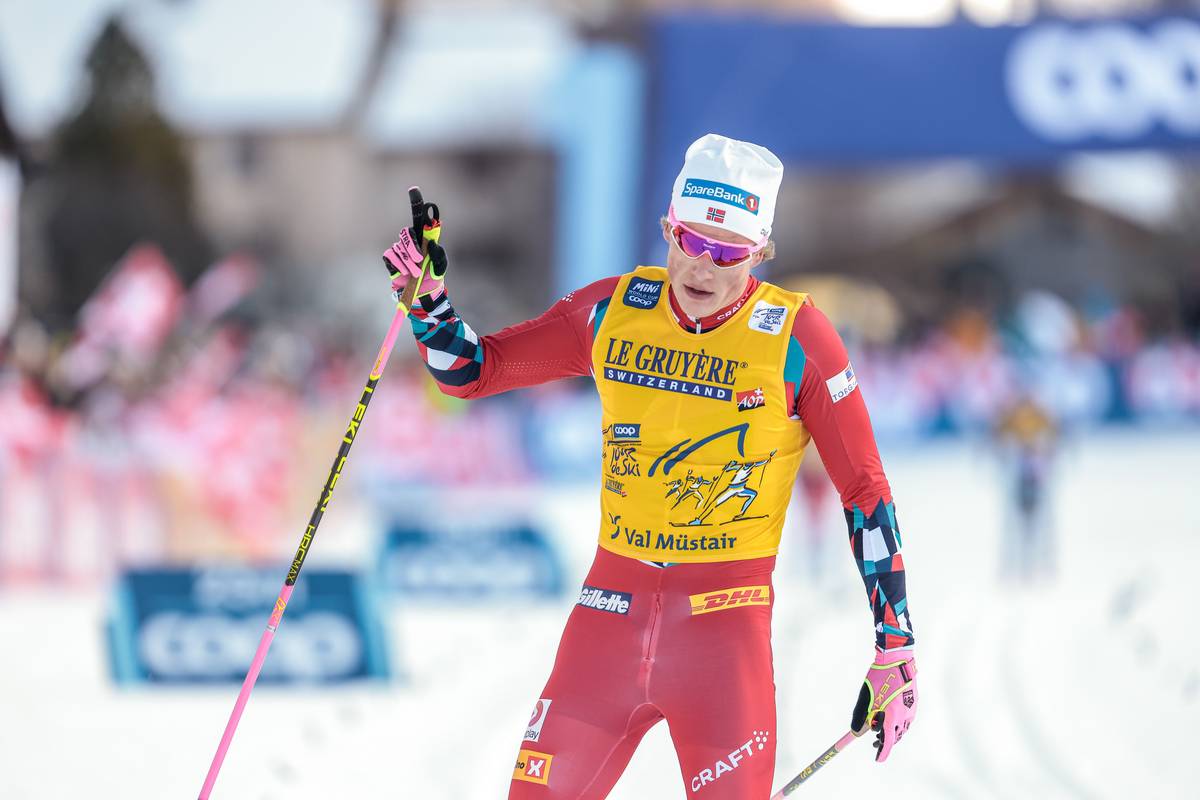
    At the start of this year’s tour, all eyes were on Johannes Hoesflot Klaebo (NOR), who finds himself in a prolonged battle for FIS World Cup points with Norwegian countryman, Paal Golberg. The Overall Crystal Globe competition is likely to be decided by their performances in the Tour de Ski, and today’s Freestyle Sprint stage may have been a taste of coming attractions. Showing speed and tactics that his rivals could not match, Klaebo coasted to the win in Val Mustair, followed by Federico Pellegrino (ITA) and Sindre Bjoernstad Skar (NOR).

    Americans experienced results both good and bad: Ben Ogden qualified a remarkable 4th, but would suffer a broken pole at the very start of his quarterfinal and finish the day in 13th. JC Schoonmaker was the 21st qualifier, but would finish 6th in his quarterfinal and settle for 26th on the day. American results in qualifying also included Gus Schumaker 50th, Zak Ketterson 59th, Finn O’Connell 67th, Kevin Bolger 74th, Hunter Wonders, 80th, Scott Patterson, 94th.

    Ogden offered an in-depth description of that broken pole, and the psychological process of re-grouping during a sprint race: “Today when I broke that early pole all I was thinking was how to catch up. I knew that my strength was in the flatter V2 before the steep climb, so I really just pinned it immediately after getting a new pole and surprised myself with how quickly I could get back to where I wanted to be amongst the other guys. My brain then went pretty quickly to damage control as I tried to evaluate how much energy I had used there. I was lucky to be feeling strong today and it didn’t really affect me too much. I think I was a little flustered and not exactly where I needed to be in the last minute or so, so that cost me a spot in the semi final, but I know that this could have happened regardless of the pole incident. It can be nice for the head to blame it on the pole, but overall it was just another learning experience out there and hopefully next time I can be in a better position and get through.”

    Canadian Graham Ritchie qualified 14th, ultimately finishing the day in 21st, ahead of countrymen Antoine Cyr 32nd, Russell Kennedy 33rd, Olivier Léveillé 55th, Sam Hendry 85th, and Remi Drolet 91st.

    Nadine Faehndrich (SUI) celebrates her Stage 1 win in Tour de Ski, 2023. (Photo: NordicFocus)

    In the Women’s field, the Stage 1 Sprint seemed most likely to be won by a sprint specialist while TDS contenders vied for finishing positions that would place them near the head of the field in Sunday’s 10 k Pursuit. The day played out much that way (though with a few surprising developments) as World Cup Sprint Leader, Nadine Faehndrich (SUI), took the win, followed by Maja Dahlqvist (SWE), and Lotta Udnes Weng (NOR).

    Julia Kern (USA) raced to 6th in sprint qualifying, but saw her day ended by a fall in the semifinal. She would finish the day in 11th. (Photo: NordicFocus)

    Julia Kern (qualifying 6th) and Rosie Brennan (qualifying 14th) would’ve had high hopes for the day, but Kern tumbled in a rutted corner to finish sixth in her semifinal (finishing 11th on the day), while Brennan faded in her quarterfinal and failed to advance, ending the day in 14th. Other American qualifying places included Alayna Sonnesyn 38th, and Sophia Laukli 69th.

    Among Canadians in qualifying, Katherine Stewart-Jones finished 48th, followed by Dahria Beatty 56th, and Lillian Gagnon 66th.

    Naturally, the surprising story in qualifying was the performance of Jessie Diggins, whose qualifying time was only fast enough for 40th place (failing to qualify for the quarterfinal heats). Via her Facebook account, Diggins later commented on her own performance, saying, “Sometimes your body feels great and your brain is ready and it just doesn’t work out—and that’s ok. The only things that’s not ok is to give up.” That’s quintessential Diggins. She will enter Stage 2 in a position well behind her main rivals, but with racing abilities like those Diggins has so often shown, her chances to contend for the overall TDS crown are likely to improve with each passing kilometer.

    TDS Women’s Freestyle Sprint

    Sprint Quarterfinals are sometimes treated as a bit of an afterthought in typical race reporting, but in Val Mustair, much of the action that’s likely to affect the week’s results occurred in the quarterfinals. Sweden’s Frida Karlsson—a serious contender for the TDS crown—advanced out of a fast quarterfinal in which she drove the pace. That speed in Karlsson’s heat—and a high-quality field in the second quarterfinal—forced Kern to employ a different strategy than she might normally undertake, leading out the first lap ahead of L. Weng and Dahlqvist. The strategy seemed to be working, as Kern distanced Dahlqvist on the uphill. Even so, Dahlqvist showed her class by attacking over the top, and scorching the downhill to win the heat. Kern held on for second, narrowly ahead of L. Weng in third (who would claim a lucky loser spot).

    Brennan dangled off the back of the pack at the start of quarterfinal 5, but worked her way back through the field at the end of lap one. Looking for space to pass, she took a very wide line up the hill, advancing two places into third, a position she was unable to improve before the finish. Her finishing time was not fast enough to claim a lucky loser spot. Brennan would end the day in 11th.

    Nadine Faehndrich (SUI) speeding to victory in the 2023 Tour de Ski Stage 1 Freestyle Sprint. (Photo: NordicFocus)

    Throughout the heats, Faehndrich continued dancing up the hill, showing a top speed that none of the others possessed. L. Weng and Karlsson claimed lucky loser spots in their semifinal, which could prove to be truly significant in the week long tour standings.

    The sprint final included Karlsson, Maja Dahlquist (SWE), L. Weng, T. Weng, Faehndrich, and World Cup distance leader Anne Kjersti Kalvaa (NOR). Having already shown that she is the fastest skier on the Val Mustair course, Faehndrich went straight to the lead, immediately gapping the field on the first hill. She navigated the subsequent downhill poorly, allowing the field to reel her in as they passed through the stadium at the end of lap 1. But the second time up the hill was a replay of the first, with Faehndrich’s higher tempo allowing her to gap the field and stay away through the finish. Dahlqvist surged in the finishing straight to push L. Weng down into third.

    With the Women’s Stage 1 Sprint concluded, the TDS overall contenders are now identifiable: T. Weng, L. Weng, Kalvaa, and Karlsson . . . with Americans Diggins and Brennan poised to strike. Faehndrich has now won consecutive World Cup sprint events in her home country and in front of Swiss fans. “At the moment, it’s like a dream,” she said.

    Klaebo (NOR, in third position) sets up the turn wide, carrying more speed and avoiding ruts that troubled other racers. (Photo: NordicFocus)
    TDS Men’s Freestyle Sprint

    The Val Mustair sprint venue consists of a two lap course with a significant mid-lap uphill, followed by a challenging, S-turn downhill that empties into the finishing straightaway. It was those S-turns that would prove significant in the day’s strategy, and in the mastery Klaebo displayed in his course management. His choice to set up the turns far wider than his rivals (carrying far more speed and avoiding ruts that worried so many racers) was key to his cruising to ultimate victory.

    Klaebo may be the world’s premier sprinter; nonetheless, he found himself overtaken in the finishing stretch two weekends ago by his longtime rival, Federico Pellegrino (ITA) who appears to be drawing much positive energy from the recent birth of his first child. Always one who seems to ski and race with joy, Pellegrino is riding a wave of optimism and success that saw him challenging Klaebo in the Stage 1 Sprint at Val Mustair. The stage was set for an excellent Sprint competition.

    As in the women’s sprints, the Men’s quarterfinals offered insight into the way the day would go, and demonstrated the ease and confidence with which Klaebo seemingly races. Boxed out on the uphill where he would usually make his move (and caught behind a stumbling Chanavat who stepped on his own pole, but managed to recover), Klaebo bided his time, then incorporated an entirely different line on the curving final downhill. He set up the turn so wide that it looked as if he was exiting the race course . . . only to re-set on the second half of the S, rocketing past all other racers. He entered the finishing straight with a commanding lead that he would hold easily through the finish.

    The day’s second quarterfinal also proved significant, as Ogden—the fourth qualifier—suffered a broken pole in just the first few meters of racing. Coaches were on hand to deliver a quick replacement, but Ogden would spend a great deal of energy clawing his way back to the field before the first climb. Continuing to improve with each passing week, Ogden’s form may be at a career high point, but the effort of chasing no doubt depleted his finishing sprint, and Ogden would fail to advance out of his quarterfinal, finishing the day in 13th.

    Reached for comment after his day of racing, Ogden offered a new American perspective on his expectations—and occasional frustrations—in World Cup racing. “There are minutes and hours after these races where all you can think about is what could have been,” he said. “But then when you take a step back it’s easy to put things into perspective and remember that it wasn’t more than two years ago when skiing in a world cup heat was a reach-goal of mine. So, the bottom line is at the moment, yes, immensely frustrating but in the big picture, I am happy with where I’m at as an athlete, and I’m stoked for every opportunity over here. ”

    Klaebo’s semifinal included Chanavat, Renaud Jay (FRA), Sindre Bjoernstad Skar (NOR), and Pellegrino. Despite that gathering of stars, Klaebo advanced easily, employing his wide-turn strategy and coasting to the finish line. Pellegrino came second, with Chanavat and Skar advancing as lucky losers. A sprint final showdown between Klaebo and Golberg was not to materialize, as Golberg appeared a bit fatigued—or even a bit disinterested—in his semifinal, allowing Michal Novak (CZE) and Richard Jouve (FRA) to advance.

    Sprint dominance on display: Klaebo (NOR) speeds to the win in Val Mustair. (Photo: NordicFocus)

    The problem to solve in every World Cup sprint final remains the same: what to do about Klaebo? He has tremendous speed, he’s tactically brilliant, and he’s supremely confident. Perhaps the only strategy is to try to run him off his feet. Good luck with that . . .

    The men’s sprint final involved Klaebo, Jouve, Pellegrino, Skar, Novak, and Chanavat. From the gun, the tall Frenchman went straight to the front, perhaps determined to make the pace so fast that a long day of sprinting would finally tire Klaebo. Chanavat led to the hill, where Klaebo’s wider line allowed him to float to the front in the company of Pellegrino who drove his speed over the top of the rise and into the lead. Again, Klaebo chose the widest line through the corners, maintaining speed and gliding through to the front. The second time up the hill he simply turned on the after-burners, and the race was all but over. His sinuous downhill line carried him to the finishing straight which he was able to ease across with no worry of being caught. Pellegrino collected second, ahead of Skar.

    Commenting in a post-race interview on the elevation of Val Mustair, Klaebo remarked, “Sprinting here at 1600 meters is really tough . . . I’m pretty glad I made the decision to stay in Davos for Christmas.”

    Klaebo leads the Tour de Ski after Stage 1, ahead of his main rival, Golberg, who earned 10th place on the day. Stage 2 may reveal which of them was able to preserve their energy in the interest of a week-long battle that’s just getting started.

    Racing at the Tour de Ski continues on Sunday in Val Mustair with Men’s and Women’s 10 k Classic Pursuits.

    Tour de Sprint Stage 1 Freestyle Sprint Women’s Results

    Tour de Sprint Stage 1 Freestyle Sprint Men’s Results

    Federico Pellegrino (ITA) celebrating life. (Photo: NordicFocus)
  • Diggins Takes Second in Davos Sprint Thriller

    Diggins Takes Second in Davos Sprint Thriller

    A_Hall_Mark_of_Excellence_Award-logo-300.png (300×244)This World Cup coverage is made possible through the generous support of Marty and Kathy Hall and A Hall Mark of Excellence Award.  To learn more about A Hall Mark of Excellence Award, or to learn how you can support Fasterskier’s coverage, please contact info@fasterskier.com.

    Today marked the return of the World Cup to the alpine valley of Davos, Switzerland. Davos, normally a luxury festooned playground for rock stars, politicians, royalty, and assorted billionaires would have a decidedly more blue-collar feel today as hard working skiers would grind around the freestyle rolling sprint course of 1.5-kilometers. At 5,120 feet above sea level, Davos is about 800 feet below the maximum elevation allowed by the International Ski Federation (FIS). So altitude would have to be accounted for. This morning was the women’s opportunity to test their mettle in the high-altitude luxe setting.

    Jessie Diggins (USA) with another sparkling day—and another podium finish—in Davos. Diggins would finish the day in second place(Photo: Nordic Focus)

    It’s not too early to start looking at the overall World cup standings, and coming into today’s sprints, Tiril Udnes Weng (NOR) was in first with 690 points. Frida Karlsson (SWE) was second with 588 points, and American Jessie Diggins was in third, totaling 538 points.  Karlsson would be sidelined this weekend, so it would be a golden opportunity for Diggins to challenge for second place overall.

    Health issues would once again be a major theme for today’s sprint. The Swedes dominated the sprints early in the season, but as Period 1 comes to a close, the Swedish squad has been decimated by illness. Swedish standout Maja Dahlqvist—a pre-race favorite and sprint winner at Davos last year—would sit out the weekend due to a cold. The Swedish sprint squad would also be depleted due the continued absence of Emma Ribom, who had won the first two sprints of the year and has now tested positive for Covid. Joining her on the Covid list of Swedish stars would be regular contenders Anna Dyvik and Ebba Andersson. So dire was Team Sweden’s situation that they advanced only two skiers into the qualifying round, one of whom, Jenny Solin, was in only her fifth World Cup race. But the Swedes still had an ace going into the start of the day with Johanna Hagstroem carrying the team’s hopes.

    Regarding illness concerns, U.S. coach Chris Grover told Fasterskier that, “It is literally a constant battle now.” He emphasized the logistical challenge with skiers feeling ill or being exposed and needing to isolate from teammates. “We’re basically talking about it at every team meeting.”

    Nadine Faendrich (SUI) remained consistent and dominant throughout the day, displaying unmatched speed and strength every time up the significant hill on Davos’ Sprint course. (Photo: Nordic Focus)

    The hometown crowd would pin its hopes on Nadine Faehndrich, the Swiss skier who posted the fastest qualifying time and has been sprinting well of late. Going into the race, she was ranked fourth in sprint points and won the World Cup classic sprint last week in Beitostolen, Norway.

    Racers had a beautiful day with bright sun and temperatures in the upper twenties. It was the best that Davos has to offer and a much needed respite from last week’s brutal cold in Beitostolen. Even so, the qualifying field was small, due to a mix of illness and fatigue, consisting of only 39 skiers. With the Americans’ entering five racers, the odds going into the race appeared favorable. Ultimately, four Americans advanced to the quarterfinals: Rosie Brennan qualified fifth, Jessie Diggins sixth, Julia Kern ninth, and Alayna Sonnesyn 25th. Lauren Jortberg narrowly missed qualifying, finishing 34th.

    Among Canadians, Dahria Beatty qualified 24th, Olivia Bouffard-Nesbitt 30th , and Liliane Gagnon 32nd.  It was the first time in the heats this year for Yukon native Beatty, and the first time ever for Quebec native Bouffard-Nesbitt.

    Davos Women’s Sprint

    In a tight race it was Faehndrich first, Diggins second, and Hagstroem third.  For the Americans who qualified for the heats, Julia Kern finished 10th, Rosie Brennan was 13th, and Alayna Sonnesyn was 24th. For Canadians in the heats, it was Beatty 23rd and Bouffard-Nesbitt 25th.

    Nadine Faehndrich (SUI) celebrates her second World Cup sprint win in as many weeks. (Photo: Nordic Focus)

    Diggins and Brennan ended up in the same quarterfinal heat.  It wasn’t necessarily a premeditated strategy.  According to Grover, “When Diggins chose the first heat no one else was in it. When Rosie chose, she went in it next which was a smart strategy.” But this meant that the Americans would have to finish 1-2, or have a fast race for both to qualify. It turned out to be an unlucky turn.

    Diggins easily qualified coming in second. Brennan finished third and would have to wait to see if she qualified as a lucky loser. She would not make the cut and finished 13th on the day, no doubt a disappointing outing after her excellent qualifying time. Brennan was squeezed out of advancing by Slovenian sprint specialist Eva Urevc, who performed exceptionally well. Grover commented that it was kind of surprising that Urevc was in the heat as well. “She skied great all day and was surprisingly strong.” In her comments after the race, Brennan said, “I did not have the day I was hoping for today. I am really struggling to find my power and speed in sprinting, which has been frustrating for me.” Addressing any lingering health concerns she continued that, “My fall and early season has been marred by illness, and I think that has made it difficult for me to find all my gears. I am doing my best to find patience as there are still many races left in the season, but patience is not my strength so it’s providing me with quite the challenge . . . I am healthy now, and my base fitness still feels good, so I am looking forward to tomorrow.” 

    Rosie Brennan (USA) giving it her all in Davos. (Photo: NordicFocus)

    Julia Kern qualified into the second quarterfinal and finished third in her heat as well.  She, too, would wait for a lucky loser spot, and ultimately did move forward as a lucky loser.

    Alayna Sonnnesyn was in the third quarterfinal. She finished fifth and her racing ended there, but it was a triumphant day for Sonnesyn since it was her first time qualifying into the heats.

    Alayna Sonnesyn (USA) reaching the sprint heats for the first time. (Photo: NordicFocus)

    In semifinals Kern found herself skiing in the first semifinal along with her teammate, Diggins.  Diggins and Kern started in the back of the pack, but Diggins quickly moved toward the front. Kern stayed in the back and did not seem to have the speed to make a move on the leaders. It was a very tactical race and heading toward the final stretch it was Diggins in third and Kern holding on in fifth. Kern barely missed out on advancing, while Diggins would proceed to the final.

    After the race Kern acknowledged her fatigue: “My body felt a bit tired today with the combination of altitude and all of the racing at the end of a long block.”  She added, “I was hoping to have a little more pep, but I fought super hard. It was scrappy out there, I was throwing elbows and pushing some arms in the quarterfinals to keep my position.  We were all screaming for Jessie in the finals.” 

    It is a sign of the growth and maturity of the U.S. program that there could be a note of disappointment with “only” one skier in the finals.

    The hometown hopes were kept intact when Faehndrich demolished the field in her semifinal, winning by a large margin.

    The Finals

    In the finals, Diggins slotted into the middle of the pack and then pushed herself into second. At the top of the first hill, T. Weng  made an early push to the front while Diggins remained third. Faehndrich powered herself into contention in the middle of the race. Diggins continued to push but could not keep the pace with Faehndrich. It was a four-way fight at the finish with Faehndrich having a slight lead. Ultimately, it was Faehndrich who would come out on top.

    Coming into the finish line, it looked like Diggins would have to settle for fourth, but she made a perfect final lunge to finish second. The depleted Swedish team was still able to find its way onto the podium with Hagstroem finishing third.

    After the race, Diggins commented that she was channeling the energy from the fans who were extremely enthusiastic. “This course can really take a lot out of you, so I was trying to be smart and conserve where I could,” she said.

    “In the finals my strategy was to tuck in behind either Tiril or Nadine, and I just sort of ended up skiing the inside line. I was like, well, I can’t stay behind all these girls . . . that won’t put me into a good place, so I kind of went for the Hail Mary . . . this is either going to work, or I’m probably going to go down . . . it ended up working. I just took a really sharp inside line and it got me my own lane. All that practicing we did down under in Australia really paid off with the lunge.”    Jessie Diggins

    Said Grover of the finish, Jessie had a fantastic last corner. “From my vantage point, with five meters to go I would have guessed she was going to finish fourth. Jessie spends a lot of time on finish speed and lunging, and it really paid off today.”

    T. Weng, who had led for much of the race, ended up on fourth by 1/100th of a second.

    Davos Women’s World Cup Sprint RESULTS

    The World Cup Sprint podium in Davos, Switzerland:  l-r: Jessie Diggins (USA), Nadine Faehndrich (SUI), and Johanna Hagstroem (SWE) (Photo: Nordic Focus)
  • Diggins’ First Podium of the Season; Dahlqvist Wins, Americans put 2 in Finals, 4 in Heats in Lillehammer

    Diggins’ First Podium of the Season; Dahlqvist Wins, Americans put 2 in Finals, 4 in Heats in Lillehammer

    This World Cup coverage is made possible through the generous support of Marty and Kathy Hall and the A Hall Mark of Excellence Award.  To learn more about A Hall Mark of Excellence Award or to learn how you can support FasterSkier’s coverage please contact info@fasterskier.com.

    By: Ben Theyerl

    For ski fans whose parents were smart enough to record the 1994 Winter Olympics on VHS tapes, Lillehammer will forever be a World Cup venue carrying the shadow of thousands of fans waving Norwegian flags as Bjørn Dæhlie did his signature “spin move“ on the way to Olympic glory. 

    Fast-forward to 2021, where the course has been reworked and modernized, the lycra is decidedly less exciting, and the multitude of Norwegian flags flying were interjected by a whole lot of Swedish and American ones. 

    Today, in the Birkiebeiner stadium – that quintessential home of Norwegian skiing – chances of victory blowing in from Sweden were very high. Going in, they had won the last 5 straight World Cup freestyle sprints, and 14 of the last 20 overall. The Americans too, looked to continue their history of success in the freestyle sprint. Of the 16 wins that the Americans have had in sprint events, 15 of them have come in freestyle, with two of those previous winners, Jessie Diggins and Rosie Brennan, in the field on Friday morning.

    In qualifying there were hints that as the field narrowed, it would be Sweden, Norway, and the United States whose skiers would fill the semifinal and final slots. Maja Dahlqvist continued her strong start to the season, winning the qualifier in a time of 3:11.59. She was joined by Tiril Udnes Weng (+1.38) and Nadine Faehndrich (+2.84) in the top 3 spots.

    The U.S. team placed three inside the Top 10, with Julia Kern the top qualifier in seventh (+4.90), followed by Jessie Diggins in eighth (+5.08), and Rosie Brennan in tenth (+5.49). Hannah Halvorsen rounded out the qualifiers for the heats in 21st (+8.18).

    Hannah Halvorsen (USA) sprints to 21st place in sprint qualifying in Lillehammer. (Photo: NordicFocus)

    Three strong national contingents then went to the quarterfinals. Norway with seven skiers, Sweden with five, and the United States with four. There they would face each other on a new 1.6k Sprint course that left little to be deciphered about what would be the deciding feature on the day. On this course, there was an A-climb, and after doing it once, they would loop back around and do it again.

    The Americans took a different approach to heat selection this week than they did in Ruka, where they raced late in the quarterfinal heats. Kern and Diggins lined up in the first heat together, joined by Tiril Udnes Weng. Kern led out the pack and raced consistently throughout, leading the first time up the climb with her teammate Diggins in tow. 

    A scene from the first heat of the quarterfinals, which included Julia Kern (Bib 7) and Jessie Diggins (Bib 8). (Photo: NordicFocus)

    For Diggins, the quarterfinal established the pattern that she would look to repeat throughout the day on the tough course. At the foot of the climb in the second loop, Diggins moved through to the outside of the pack and then powered to the front. By the time she was in the stadium, only Weng was left behind her, and that’s how they finished. Kern, meanwhile, sprinted to 3rd place, and after all the quarterfinals were settled, was just a tenth of a second out of a lucky loser slot for the semi-finals (which went to the Finnish skier Jasmi Joensuu). Kern ended her day in 13th overall.

    The other lucky loser slot was filled by Rosie Brennan in the second quarter-final. Brennan’s tactical approach to the course mirrored Diggins. In the second heat, Brennan matched up against Maiken Caspersen Falla and Nadine Faehndrich, and would finish just off the two to take third place in the heat, and first in the lucky loser slots.

    In the semifinal, Diggins found herself alongside three Norwegians, matching up against T.U. Weng, L.U. Weng, and Caspersen Falla. The heat saw the best execution of her tactical approach to the course all day, as she followed the first move up the climb from Jasmi Joensuu, then shot around the outside to carry speed into the downhill, before moving in a perfect swoop off the apex of the turn to the outside that allowed her to power up the final climb joined by T.U. Weng and Falla. At the finish, Diggins crossed in first again, with T.U. Weng right behind.

    The two would be joined by four skiers from the other semi-final. The Swedish pair of Dahlqvist and Ribom executed their tactical approach to the course to a tee, leading out the first part of the course and establishing a sprint that would be devoid of any posturing, then staying with any moves that occurred on the second-time through the climb – which came in this heat from Brennan – before finishing strong in the stadium sprint. Dahlqvist finished first, Ribom second, and Brennan came out the lucky loser for the second time on the day, advancing to the finals.

    Rosie Brennan (USA) rounds the corner in front of Anamarija Lampic (SLO) during the final in Lillehammer. (Photo: NordicFocus)

    The final field represented the Swedish and American fronts, who fully established themselves as the dominant force in Lillehammer. Two Swedes, two Americans, and just one Norwegian. Plus, Anamarija Lampic of Slovenia too. 

    The two leading countries’ different approaches to the course were most stark the first time up the climb, where Diggins and Brennan took the outside, and Ribom led the rest of the field on the inside track. At the top of that first ascent, the Americans took the animating action, Diggins shooting around the outside to lead the descent. 

    Brennan followed, reflecting her initiative to create an ideal position for the final climb: “I made a move early in the final to try to see what I had and unfortunately, was passed on the downhill into the last uphill” she said in an email to multiple news outlets.

    With Brennan back in the pack as they took to the second climb, what had been alluded to throughout the day gained clairvoyance – Dahlqvist and Diggins were the strongest in the field. As they crossed the finish line, what was clear became a result. Dahlqvist won her second sprint of the young World Cup season, as Diggins earned her first podium finish of the year. T.U. Weng rounded out the podium in 3rd, with Ribom finishing 4th and Brennan in 5th on the day.

    Maja Dahlqvist (SWE) wins 3rd straight sprint, followed by Jessie Diggins (USA) and Tiril Udnes Weng (NOR). (Photo: NordicFocus)

    If Ruka was an exciting first burst of energy for the World Cup season, then Lillehammer today was an indication that long-term trends do hold. Last year’s World Cup champion Jessie Diggins has her first podium of the season. Maja Dahlqvist is now on a three-win sprint streak going back to last season, and the most ascendant sprinter on the women’s circuit. And in the freestyle sprint, it’s the Swedish and American women who continue to rise to the top, with Norway, on their home turf, putting up an ever-valiant defense of their dominance on the world stage.

    Oh, and Americans can start dreaming of Jessie Diggins doing her best Bjørn Dæhlie impression in Beijing come February, as her second-place finish today means one-half of the Gold Medal highlight from the last Winter Olympics in 2018 is officially qualified. Diggins is the second American to qualify for this season’s Olympic team, joining Brennan (top-8 in both today’s sprint and last weekend’s 10 k classic) as objective qualifiers.

    Here’s Jessie’s post-race comments to FasterSkier:

    Jessie Diggins on her first podium of the season after finishing 2nd in Lillehammer. (Photo: NordicFocus)

    Stepping back into the quarterfinals, Hannah Halvorsen skied strong in the fourth heat of the quarterfinals, which included Dahlqvist and Lampic. Losing contact toward the finish, Halvorsen finished sixth in her heat, which put her in 28th place in the final standings.

    “I felt good today on the course,” Halvorsen wrote in a post-race email. “It was fun to have things come together. It was awesome to see our team put so many people in the top 30 this early in the season! I can’t wait to see what the season will bring for the US with so much potential in the mix!”

    Elsewhere in the results, North American women had a strong showing. Hailey Swirbul (USA) finished 42nd (+12.50), with Cendrine Browne (Canada) in 52nd (+14.63), Dahria Beatty (Canada) in 53rd (+14.73), and Katherine Stewart-Jones (Canada) in 55th (+15.34). Novie McCabe (USA) finished 56th (+15.34), Maya MacIsaac-Jones (Canada) finished 60th (+19.21), Katharine Ogden (USA) finished 61st (+19.89), and Sydney Palmer-Leger (USA) finished 62nd (+19.89).

    In a post-race interview, U.S. Ski Team Head Coach Matt Whitcomb answered a variety of questions on the men’s and women’s races in Lillehammer, including comments on the new course and the approach to heat selection this weekend relative to Ruka. He also shared his perspectives on the rounds, and an explanation of why qualification is a skill that athletes must learn, in reference to comments made by Sadie Maubet Bjornsen and Devon Kershaw on the post-Ruka episode of The Devon Kershaw Show.  Have a listen.


    Full Results:

    Qualification | Finals

  • Slovenia Tops the Field, Maubet Bjornsen and Diggins Finish Fourth

    Slovenia Tops the Field, Maubet Bjornsen and Diggins Finish Fourth

    Finals action with Maja Dahlqvist (SWE) leading Sadie Maubet Bjornsen (USA), (l-r). (Photo: NordicFocus)

    This World Cup coverage is made possible through the generous support of Marty and Kathy Hall and their A Hall Mark of Excellence Award. To learn more about A Hall Mark of Excellence Award or to learn how you can support FasterSkier’s coverage please contact info@fasterskier.com. 

    It was a rather cloudy day as the athletes circled Ulricehamn’s sprint loop again and again for Sunday’s freestyle team sprint, urged forward by the cheering of recorded crowds piped through a trailside loudspeakers. After first contesting a semi-final round earlier in the morning, the ten quickest teams moved onto the final, each athlete racing three laps for a total of 7.2 k (each loop being 1.6 k). 

    Anamarija Lampic (SLO), Mathilde Myhrvold (NOR), Linn Svahn (SWE), (l-r). Svahn’s team placed second overall, while Lampic was part of the winning Slovenian team. (Photo: NordicFocus)

    The pace was steady for the first few laps, as the women’s final progressed. Echoing her tactic from the semi-finals, Jessie Diggins skiing for USA I exited exchange three with a high tempo, pushing the pace to stretch out the pack. Diggins, who leads the overall World Cup and placed third in yesterday’s sprint, tagged her teammate, Sadie Maubet Bjornsen for her final lap with a lead of +0.3.

    Sadie Maubet Bjornsen (USA) tucks tight into the stadium (Photo: Nordic Focus)

    Maubet Bjornsen led out front, shadowed by two Swedes competing for Sweden I and Sweden II. This was Maubet Bjornsen’s first team sprint of the season. In her young 2020-2021 World Cup campaign, she was right in the mix with Sweden’s powerhouse sprinters. Maja Dahlqvist, representing Sweden I with teammate Linn Svahn, took the lead into the final exchange. With the rolling and working course, one that remained tough for athletes to break away on, the sharp end group of skiers tagged off in a dense pack. 

    Jessie Diggins (USA), Anamarija Lampic (SLO), Linn Svahn (SWE), (l-r) heading out for a final lap. (Photo: Nordic Focus)

    All out for the final lap, a group of eight athletes mostly stayed together. The podium was to be decided in the final few hundred meters. Navigating the corners as they descended into the stadium for the final time, Diggins was boxed out on the outside. With powerful no-pole skating, four athletes entered the finish straight in an all-out battle for the top position. Out lunging the others, Anamarija Lampic took the win for Slovenia. Svahn took second for team Sweden I and Nadine Faehndrich of Switzerland just nicked a boot in ahead of Diggins (USA) to claim third in a photo finish. 

    “I had a lot of fun being Sadie’s team sprint buddy today! This was a really hard course because it played to none of my strengths; it was windy, no big climbs, and pretty much impossible to drop people or even tire them out because the draft was so big,” Diggins wrote in an email. “So I played the cards I had and tried to push the pace, then tucked in to prepare for a sprint finish but ended up too boxed in. However, I was proud of how we skied a good hard race and left nothing on the table, and it was great practice for team sprints in the future! I was really stoked watching Sadie ski – with grace, power and confidence, and it inspired me to work my very hardest for her! ”
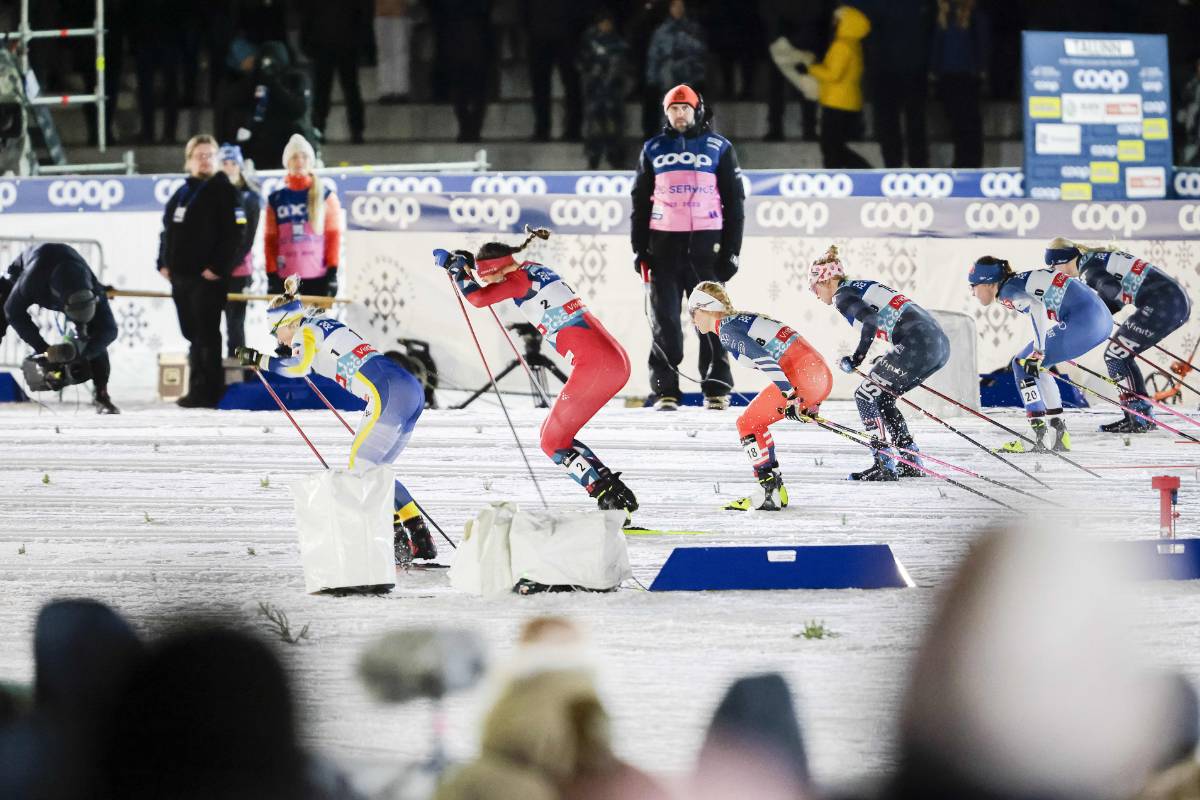
    Diggins, along with the U.S. Ski Team will be in Davos, Switzerland preparing for World Championships which begin February 24.

    Maubet Bjornsen expressed that World Cup sprints were something she’s reacquainting herself with.

    “It was a wild and close team sprint out there today! After feeling a little shy getting back to the full contact world cup sprint racing yesterday, I was feeling extra lucky to have six more chances to ski that course smarter today.
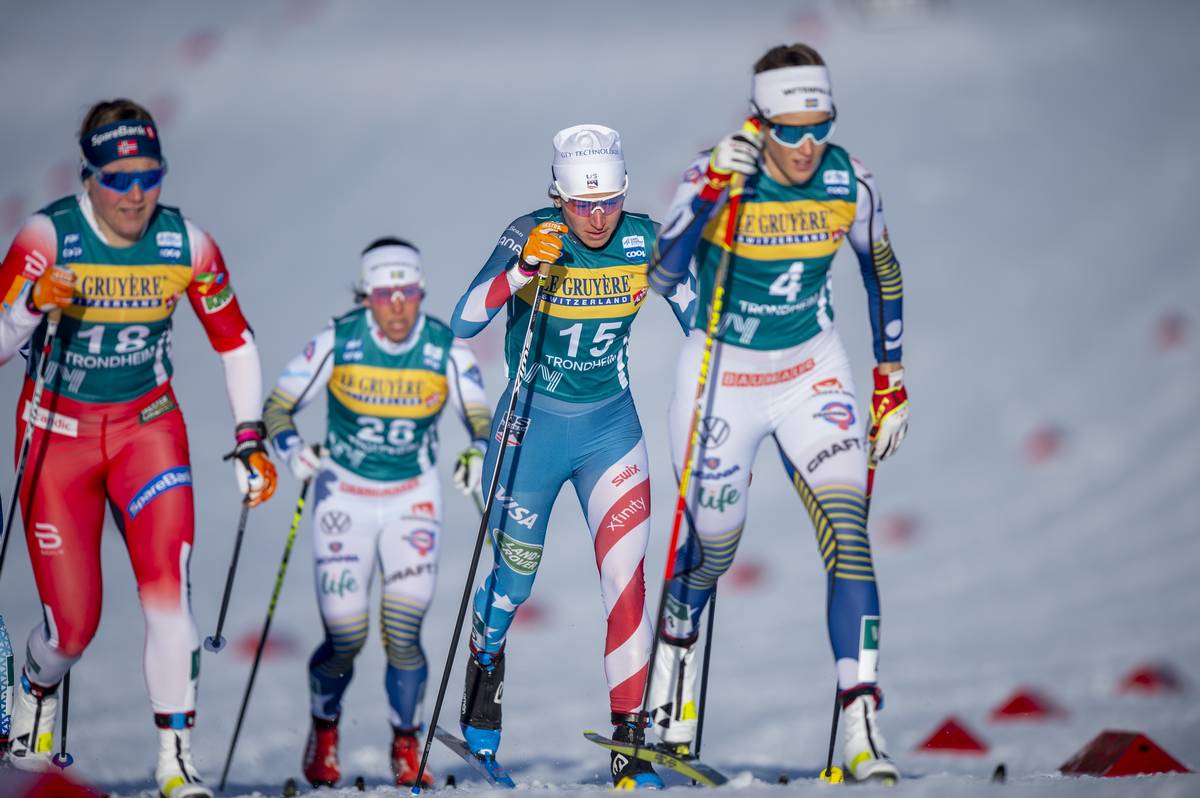
    “The semi finals were all about playing it smart, being in the right position, but saving energy for when it mattered most. We tried to learn as much as we could for the finals. That meant leading some laps, attempting some attacks, and sitting behind on some laps. We did a solid job of taking notes for the final. With such a strong head wind, it was a tough position to lead from the front. My mission was to stay in the front and out of trouble, and then attack on leg 3. On such a drafty, tactical course- Jessie and I had to get creative with our strengths. We would have loved to attempt to stretch people from the gun, but the wind was not in our favor.
    “After finishing fourth by a photo finish, we both of course left wanting a bit more, but also felt like we did the best we could with our strengths. Even if I am 31 years old, I still feel like every race is a learning lesson, so there are no losses.”
    Anamarija Lampic (SLO) celebrates her victory as the remaining athletes lunge for the line. (Photo: Nordic Focus)

    Lampic is currently leading the World Cup sprint standings with 377 points, 96 points ahead of Faehndrich who is in second. For Lampic’s teammate, Eva Urec, today’s victory represents her first career WorldCup win. “It was amazing, it’s my first victory so it feels amazing” said Urec in a post-race interview with FIS. 

    Happy Slovenians, Anamarija Lampic and Eva Urevc hug in the finish pen after placing first in Sunday’s team sprint. (Photo: Nordic Focus)

    Also competing for the U.S. was team USA II, Sophie Caldwell Hamilton and Julia Kern, who dropped back in the final lap of semi-final B and finished 6th (+14.8), not quick enough to advance. 

    Sophie Caldwell Hamilton (USA), Coletta Rydzek (GER), (l-r) racing in the team sprint semifinals. (Photo: NordicFocus)

    After being briefly obstructed during semi-final A when Victoria Carl, skiing for Germany I, lost a ski and went down, team Canada I (Cendrine Browne and Maya Macisaac-Jones) faded to finish seventh. In semi-final B, Canada II (Katherine Stewart-Jones and Dahria Beatty) finished 8th, +46.6 back from Sweden I (Linn Svahn and Maja Dahlqvist) who won the heat. 

    Racing continues on the World Cup in Nové Město, Czech Republic on February 20 with a classic sprint.

    Women’s Final Results

  • Brennan Nails First World Cup Podium and Win in Davos; Caldwell Hamilton 5th (updated)

    Brennan Nails First World Cup Podium and Win in Davos; Caldwell Hamilton 5th (updated)

    Rosie Brennan was all smiles after her first World Cup victory and podium in Davos, Switzerland. Photo: NordicFocus

    This World Cup coverage is made possible through the generous support of Marty and Kathy Hall and their A Hall Mark of Excellence Award. To learn more about A Hall Mark of Excellence Award or to learn how you can support FasterSkier’s coverage please contact info@fasterskier.com.

    With a thick, fresh coat of fluffy white snow that fell over the last week, Davos, Switzerland looked regal as ever despite the smaller field and lack of spectators for today’s 1.5-kilometer freestyle sprint. FIS described conditions as hard-packed, elevating what Sophie Caldwell Hamilton, who landed on the podium in Davos the last two years, called in a pre-race interview with FIS as a “technical and tactical” two lap course. Pumping music and cheering coaches, though perhaps a muted version of the norm, made the stadium feel significantly more full than the no-spectator reality.

    With the Scandinavian teams out of the running as they withdrew from the December rounds of the World Cup due to Covid-19 concerns, it would be easy to focus on who did not in Davos. Let’s instead focus on who did. 

    Rosie Brennan during the skate sprint qualification in Davos, Switzerland. Brennan won the qualifier – a career-best for the American. (Photo: Nordic Focus)

    On a roll this season, Rosie Brennan won the qualifier by 1.75 seconds in a time of 2:40.03. Rounding out the Americans in the finals, Caldwell Hamilton took second, Diggins fifth, Julia Kern 10th, and Hailey Swirbul 18th. 

    Jessie Diggins racing to 5th in the Davos sprint qualifier. (Photo: Nordic Focus)

    In the quarterfinals, Caldwell Hamilton faced off with Switzerland’s Nadine Fähndrich in what would be the fastest heat. The pack stayed together in the first lap, but the two peeled off to finish comfortably off the front, Fähndrich in the lead. 

    The next heats were much closer. Brennan finished second in a pack of four behind Slovenia’s sprint star Anamarija Lampic in heat two, and after taking the lead in the second lap, Kern won the third heat. 

    Jessie Diggins (left) leads Julia Kern (bib 10) at the front of the group during the quarterfinal of the 1.5 k sprint in Davos, Switzerland. (Photo: NordicFocus)

    Dropping into a tuck on the last descent and on Kern’s tails in the fast and furious final turn into the stadium, Diggins was in a tough position. Rather than putting herself in position for the sprint to the finish, she maneuvered to avoid tangling skis with Kern and lost some of her momentum. Despite powering down the straightaway and throwing her boot, she took third in the heat and was not fast enough to earn a lucky loser spot. 

    Round the bend, Julia Kern in the lead heading into the final straight during the quarterfinal of the 1.5 k skate sprint in Davos, Switzerland. (Photo: NordicFocus)

    Swirbul was also eliminated in the quarters after taking fourth in her heat. 

    Hailey Swirbul climbs amidst the pack during the quarterfinal of the 1.5 k skate sprint in Davos, Switzerland. (Photo: NordicFocus)

    In the semis, the three remaining American women lined up together in a stacked first heat with Lampic and Fähndrich. Brennan and Caldwell Hamilton held strong in the middle of the group while the Swiss and the Slovene set the pace. The foursome stayed tight, jockeying for positions in the second lap. 

    It was anyone’s game in the final straight, but Fähndrich held the others off on home turf to win the heat with Lampic and Brennan in a photo finish for second and third, respectively, behind her and Caldwell half a ski length further back in fourth. Both were able to secure lucky loser positions to advance into the final. Kern was eliminated after finishing 6th in the heat.

    To the line, Rosie Brennan (L) leads Switzerland’s Nadine Fähndrich and teammate Sophie Caldwell Hamilton in the final sprint during the semifinal of the rounds in Davos, Switzerland. (Photo: NordicFocus) 

    Eva Urevc of Slovenia and Natalia Nepryaeva of Russia advanced from the second heat of the semifinals. 

    Fähndrich and Lampic again took the pace out hot in the final round, but Brennan kept herself in the mix. Challenging Fähndrich, she powered into the lead on the final climb, cresting the hill in front and dropping into a tuck on the downhill. Brennan held her lead out of the final turn and into the straightaway, but Lampic, Fähndrich and Nepryaeva were close on her tails. 

    Adrenaline pumping and poles lashing, Brennan held her lead by a narrow margin, pumping her fist in the air as she crossed the finish line in 2:37.36, breaking into a wide grin as she gasped for air.  

    Rosie Brennan celebrates her victory and first World Cup podium after the freestyle sprint in Davos, Switzerland. (Photo: NordicFocus)
    Rosie Brennan celebrates her victory and first World Cup podium after the freestyle sprint in Davos, Switzerland. (Photo: NordicFocus)

    “It’s wild,” Brennan told FIS after the race. “I’ve never considered myself a sprinter, so to find myself on the podium is something I couldn’t even dream of.” 

    Lampic finished on her tails in second (+0.28), with Nepryaeva and Fähndrich in a photo finish for the final podium spot. They finished third (+0.49) and fourth respectively (+0.53). 

    The women’s podium at the 1.5 kilometer skate sprint in Davos, Switzerland. (Left to right) Anamarija Lampic (SLO) 2nd, Rosie Brennan (USA) 1st, Natalia Nepryaeva (RUS) 3rd. (Photo: NordicFocus)

    After losing contact with the lead group, Caldwell Hamilton finished fifth (+6.83), with Urevc behind in sixth (+15.58).

    FasterSkier spoke with Brennan while she awaited a blood draw at antidoping. Still euphoric, Brennan recounted her day and a result that she called “pretty unbelievable” and hadn’t fully set in. In fact, she thought there may have even been a mistake in the timing when she saw her name at the top of the qualifying list. Brennan also discusses training separately with clubs throughout the season, then coming together as a full American squad in Europe.

    Post-race interview with Rosie Brennan.


    Exhale. Sophie Caldwell in the mix during the heats of the 1.5 k skate sprint in Davos, Switzerland. (Photo: Nordic Focus)

    In a post-race interview, Caldwell Hamilton discussed her own strategy to keep herself out of risk of becoming tangled up with other skiers while staying in contention throughout the heats. She also shared how significant today’s results are for the team as a whole, regardless of the presence of the Scandinavian teams.

    Post-race interview with Sophie Caldwell Hamilton.


    Hannah Halvorsen, qualifying in 38th, in her first World Cup since suffering devastating injuries when she was hit by an automobile in 2019. (Photo: Nordic Focus)

    Returning to the World Cup just over a year after being struck by a car and sustaining severe injuries, Hannah Halvorsen placed 38th in today’s qualifier. Halvorsen provided an optimistic comment on how she feels after her first race. 

    “It was such a thrill to be able to get back on the race course,” wrote Halvorsen in an email. “I was both nervous and excited going into today’s race because I wanted to put down my best race. Everything went really well today so I am quite happy. Thanks to the coaches and wax techs, I had great skis and support. This feels like a great starting point, and I hope to improve off of this as the season continues. It is such an opportunity and honor to be here. The US team performed incredibly well today, and I couldn’t be more proud to be a part of this team.”

    Post-race interview with U.S. Head Coach Matt Whitcomb.


    Results: Qualification | Final

    Taking the victory and the sled, Rosie Brennan stands atop the podium in Davos, Switzerland. (Left to right) Anamarija Lampic (SLO) 2nd, Brennan (USA) 1st, Natalia Nepryaeva (RUS) 3rd. (Photo: NordicFocus)
  • Falla Steps up For the Trondheim Win; Five U.S. Skiers in the Heats

    Falla Steps up For the Trondheim Win; Five U.S. Skiers in the Heats

    The day began in Trondheim with a centimeter of snow, which then transitioned to big blue skies for the thousands of fans attending the fifth stage of the Ski Tour 2020, a 1.5 k classic sprint. The Norwegians can throw a cross-country race party. The scene, despite the different setting, was reminiscent of the festive cowbell and camp-out sideshow of Holmenkollen’s Frognerseteren. It’s not quite the Yankee stadium of cross-country skiing, but a sign that in the hot-beds of the sport, fans arrive in droves. 

    The sprint course was more traditional, meaning this was no simple VO2 max test of an effort — that went down on Stage 3, in  Åre, Sweden as athletes ascended an uber steep alpine ski hill to close out that event. Trondheim’s classic sprint was bolstered by two punchy climbs on a three-terrace course, long and fast glide outs, and two speedy corners which swung skiers through a 180-degree direction change to keep it spicy.   

    Sweden’s Jonna Sundling laid down the fastest qualifying time in 3:22.75, shadowed by her teammate, Linn Svahn, 0.24 seconds back. Maybe, not surprisingly, Therese Johaug was the third-fastest qualifier, 0.83 seconds back. Johaug won her first career sprint on Stage 3 of the Ski Tour. 

    Jonna Sundling of Sweden in bib 1, during her quarterfinal of the Stage 5 classic sprint in Trondheim, Norway. (Photo: NordicFocus)

    The U.S. packed five skiers into the heats. Sadie Maubet Bjornsen qualified in 10th (+6.20). Rosie Brennan in 11th (+6.34), Sophie Caldwell 15th (+7.32), Jessie Diggins 20th (+8.58), and Julia Kern 24th (+9.54). Yet the story on the U.S. women’s side ended earlier than their highwater mark norm, which is most often, representation in the six skier final. In no uncertain terms, this is the golden age of U.S. women’s cross-country skiing. A stars and stripes void marked the semis and final. No U.S. skiers advance beyond the quarterfinals. 

    In the third quarterfinal, Kern and Brennan lost contact with Sundling and Tiril Udnes Weng who came in 1-2, respectively. Kern was fourth in the heat (+3.7), Brennan fifth (+7.71). 

    Maubet Bjornsen and Diggins fell off the pace as well in the fourth heat, placing fourth and fifth respectively. Both were over four seconds off Norway’s Anna Svendsen’s pace of 3:19.34 who won that quarterfinal. 

    22.02.2020, Trondheim, Norway (NOR):<br /> Sadie Maubet Bjornsen (USA) - FIS world cup cross-country, individual sprint, Trondheim (NOR). www.nordicfocus.com. © Thibaut/NordicFocus. Every downloaded picture is fee-liable.
    Sadie Maubet Bjornsen during the Stage 5 classic sprint in Trondheim, Norway. (Photo: NordicFocus)
    “It was an extremely tricky weather day with a combo of rain/snow/sun, and everything in between,” Maubet Bjornsen emailed.
    “I was excited to put together a solid qualifier, but felt like a few adjustments would allow things to be even better for the heats. My body felt sharp and powerful, so I knew the key for me was to be quick out of the start, and do my favorite thing… ski from the front. I was quick out of the start, but struggled to hold the speed up the first climb. Since climbing is generally my strength, it’s unclear whether it was skis, body, or both that held me back. But, that’s how ski racing is. You can’t overthink anything too much, you just keep believing, and chasing away!
    “It is the tour of crazies for me, so I’m going to let it go, and look on to “the chase” tomorrow. With the tour ending with a 15k classic, I am sitting just outside top 10 overall, and really hoping to climb my way within that tomorrow. Let’s see if I can channel all amounts of frustration towards some constructive racing in the final day!”

    The last U.S. athlete eliminated was Caldwell. She placed third in the fifth quarterfinal, 1.53 seconds back on Norway’s Heidi Weng in first. Caldwell placed 14th in the final standings, Maubet Bjornsen 16th, Kern 20th, Brennan 21st, and Diggins 23rd. 

    Sophie Caldwell (bib 15) during her quarterfinal in Trondheim: Stage 5 of the Is Tour 2020. (Photo: NordicFocus)

    Post-race interview with U.S. World Cup Coach Matt Whitcomb

    Wintry weather moved in during the men’s quarterfinals. The blue-bird scene morphed quickly into an intermittent snowglobe. With the swift winds swirling around the stadium, the snow squalls eventually moved on as the semifinals progressed. 

    The 12 skier field in the two women’s semis consisted of six Norwegians, four Swedes, and two Swiss skiers in Laurien van der Graff in the first semi, and Nadine Fähndrich in semi two.  Fähndrich kept Swiss hopes alive by advancing to the finals after winning her semi. 

    The first semifinal featured Norway’s Maiken Caspersen Falla and Sweden’s Sundling. These two athletes were the skiers to watch. For Falla, by her own high standards, this has been an offseason, as the young Swedish sprint team has pushed her aside for precious top-of-the-podium real estate. Falla won the opening World Cup sprint in Ruka, Finland, otherwise, it’s been a first-place void for the former Crystal Globe sprint winner.

    In bib 12, Maiken Caspersen Falla strides it during her quarterfinal in Trondheim. (Photo: NordicFocus)

    In Falla’s semi, she and Sudling took first and second, respectively, with Astrid Uhrenholdt Jacobsen and Linn Svahn of Sweden in close contact, only a few tenths of a second back. In the final, Falla was locked in. Although at moments Sundling was side by side with Falla, the Norwegian dictated the decisive move off the front. Over the second climb, at roughly 2:25 into the race, Falla powered over the hill and into the glide out transition with only Sundling able to match two meters back. 

    Falla took the win in 3:15.55 with Sundling in second (+0.48). Fähndrich was third (+2.88), Anna Dyvik of Sweden fourth (+3.71), Svendsen fifth (+5.26), and Heidi Weng sixth (+6.64). 

    “This feels always like the [World Championships] so crowded and so many people screaming my name at the start and after the finish,” Falla told FIS after the race. “It’s an amazing atmosphere and I’m so happy to be here. There has been some hard distance races for me now. The 30 k and also 10 k was really hard so I’m really happy that I stayed in the tour, didn’t go home and got this opportunity to win here and race in this amazing atmosphere.”

    This was Falla’s 21st individual sprint win. She sits second overall in total World Cup sprint wins. Marit Bjørgen of Norway still reigns with 40 World Cup sprint victories. For Fähndrich, this was her second career individual podium. Prior to her third place on Saturday, the Swiss skier posted up a second place in Cogne, Italy’s 2019 10 k classic for her first World Cup podium.

    Hands up: Nadine Fähndrich earns a third place for the Swiss in Trondheim. (Photo: NordicFocus)

    Katharine Ogden in 37th was the top-U.S. skier outside the top-30. Alayna Sonnesyn placed 42nd, Caitlin Patterson 48th, and Rosie Frankowski 51st.

    For Canada, Emily Nishikawa finished in 34th, Katherine Stewart-Jones 35th (+14.19), Cendrine Browne 40th, 

    The Ski Tour overall looks certain for Johaug who placed ninth in Saturday’s sprint. She leads with a total time of 2:19:28. Weng remains in second (+2:33), and Ingvild Flugstad Østberg third (+2:34). Østberg finished 22nd in Stage 5.  This Norwegian trio is the likely overall podium, as Sweden’s Ebba Andersson is fourth at 4:48 back. Racing concludes for the Ski Tour on Sunday with Stage 6, a 15 k classic pursuit for the women.  

    Norway’s Therese Johaug (yellow bib) the Ski Tour’s overall leader was the third overall qualifier. (Photo: NordicFocus)

    Qualification | Results | Overall Ski Tour Standings 

    The women’s Stage 5 podium: Jonna Sundling (SWE) in second, Maiken Caspersen Falla (NOR) first, and Nadine Faehndrich (SUI) third, (l-r). (Photo: NordicFocus)
  • Three In A Row, Johaug Wins the Hill Sprint Showdown in Åre; Diggins 11th, Caldwell 12th

    Three In A Row, Johaug Wins the Hill Sprint Showdown in Åre; Diggins 11th, Caldwell 12th

    When Therese Johaug wins a sprint qualifier by 4.5 seconds and Sophie Caldwell qualifies in 23rd, you know it is not your average course. Held at the Swedish national alpine ski area in Åre, today’s event seemed to blend the infamous climb up the Alpe Cermis in the final stage of the Tour de Ski with skier cross on perhaps the shortest but toughest sprint on the World Cup.

    A gradual uphill start led skiers to a fast downhill into a swooping banked turn to the left. The course then ascends a pitch as steep as 28% up the base of the alpine hill, climbing nearly 60 meters within the final 200 meters of the course. Athletes would then need to walk back down to the start area. 

    The Åre sprint hill climb in profile. (Photo: Screenshot FIS Broadcast)

    Though less than 700 meters in total length, nearly half the usual distance, the course took the women roughly two and a half minutes, on par with a usual sprint time. 

    The event drew a roaring crowd, with fans lining the course, their yells and gaps echoing as athlete’s skied by. After the race, Matt Whitcomb recognized the event organizers for putting together a unique stage and drawing so many energetic spectators.

    Post-race comments from Matt Whitcomb.

    With Johaug at the top of the qualification list were Heidi Weng (NOR), Greta Laurent (ITA), Linn Svahn (SWE), and Laura Mononen (FIN), the most diversity in nations among the top five in the tour so far. This result also added mystery and excitement as it could be anyone’s game. Weng is a top distance skier, Laurent and Svahn are most recognized for their sprint performances, and Mononen normally hovers on the border of the top-30 FIS point scorers list, a relative unknown.  

    Rosie Brennan climbs to the top American result in qualification during the Stage 3 “sprint”. (Photo: NordicFocus)

    Rosie Brennan was the top American qualifier in 14th, followed by Jessie Diggins in 17th, Julia Kern in 18th, Sadie Maubet Bjornsen in 21st, and Caldwell in 23rd.

    Racing in the second wave of the quarterfinal, Diggins and Brennan took the pace out hot, trying to create a gap over the two top qualifiers, Johaug and Weng. Diggins led the way over the gradual climb and into the downhill, fearlessly flying into the banked turn with high speed. Riding up the berm to the outer lip of the curve, Diggins stayed in control, though only just. 

    Brennan and Diggins were still in the lead beginning the hill climb, but the two high-tempo Norwegians were gaining quickly. Weng and Johaug overtook the Americans midway up the climb, but Diggins did not let them get away. Maintaining contact, she crossed the line within 1.5 seconds of the Norwegians and advanced as lucky loser, her early effort to push the pace making it the fastest of the five heats.

    Diggins attacks the hill climb during the Stage 4 sprint in Åre, Sweden. (Photo: NordicFocus)

    Brennan fell back to fifth in the heat and did not advance. She ended her day in 22nd.

    Maubet Bjornsen and Kern raced in the fourth heat, finishing fourth and sixth, respectively. Maubet Bjornsen’s final rank was 20th. 

    At the start of the last quarterfinal round, Caldwell skied off the front, navigating the banked turn with ease and picking up momentum as she approached the base of the hill in V2. Caldwell stayed near the front through the climb, her technique smooth and controlled. As the course curved and leveled to the finish, it was Mononen and Caldwell at the front. They crossed the line together, immediately folding with hands on their knees in anguish.

    If this is what the finish of the quarters looks like, what will happen as the deep burn of cumulative fatigue starts to sink in?

    In the semis, Diggins faced off again with Johaug and Weng. Rather than flying off the front, Diggins sat in the middle of the pack over the first climb, hooking 180 degrees left and dropping into a tuck heading into the banked downhill. 

    Johaug was last into this turn and last to the base of the climb, but she was far from out of the race. Jump skating up the left side of the course, Johaug rocketed from the back of the pack to the lead, edging out Weng to win the round. 

    Diggins fell off the pack at the base of the climb and finished last in the heat, and 11th for the day.

    Relaxed, smooth, collected, per usual, Caldwell rounded the banked turn in second and was in the mix at the base of the climb. Then it was over.

    At the front, Svahn, Astrid Urenholdt Jacobsen (NOR), Laurent, and Mononen stepped powerfully up the climb. In the final meters, Svahn was at the front with Laurent close on her tails looking like a lock for second, until a last second surge by Jacobsen snuck her just ahead of the Italian at the line. As the heat was slower than the first, only Svahn and Jacobsen advanced.

    After falling off the pack, Caldwell took last in the heat and ended the day in 12th. 

    Breaking down the lineup in the final, you’ve got two pure distance skiers with a history of outstanding results in the TdS hill climb, Johaug and Weng, alongside their teammate, Jacobsen, an all-arounder skewed toward distance. These three women paired with three sprinters, Svahn, Jonna Sundling (SWE), and Nadine Faehndrich (CHE). A World Cup cocktail. 

    The Swedes took the lead at the start of the final, shooting around the banked curve and into the climb. Johaug, again, the last to the base of the hill. 

    As the grade increased, Weng and Jacobsen accelerated up the right side of the course, while Johaug repeated her uphill attack as she weaved through the other women to the front. The Norwegians skied three abreast as they passed under the Audi e-tron arch toward the steepest pitch, shortly before the finish.

    Therese Johaug leads Heidi Weng and Astrid Urenholdt Jacobsen through the final meters of the sprint hill climb. (Photo: NordicFocus)

    Increasing her tempo and beginning to jump skate, Johaug rounded the final bend in the lead with the win locked up. Her teammates, Weng then Jacobsen, crossing behind her in second and third, respectively. 

    As the other wobbly-legged women collapsed, writhing in agony with faces turned toward the snow, Johaug raised her arms in celebration, her lungs still functional enough to let out a loud yell. She looked as though she had just completed a particularly successful interval session, a much different appearance than the others. 

    Therese Johaug takes Stage 3 of the FIS Ski Tour 2020. (Photo: NordicFocus)

    “It was a crazy race,” smiled Johaug as she spoke with FIS at the finish. “But, as you know, I love uphills, and today as well was my day. Of course, you cannot call it a sprint race, but for me, it means a lot to stand atop the podium and I worked really hard for that, so I’m really happy.”

    The third straight all-Norwegian women’s podium of the FIS Ski Tour 2020. (Photo: NordicFocus)

    Commenting on the event in a post-race email, Caldwell wrote:

    “Today was a very different kind of sprint. I wasn’t sure what to expect, but when we checked out the course yesterday, I was pretty shocked that we were literally going up an alpine hill! I had never done anything like this because and I know I have the potential to flood, so I wanted to make sure I did some pacing for my qualifier. It didn’t end up being a ripping fast qualifier, but it was good enough and I was honestly psyched to qualify on a course like this that doesn’t exactly play to my strengths.

    “In my quarter I tried to get out fast and ski the technical corner how I wanted to and then I just focused on finding the faster snow and leaving a little left for the end. I was really happy with how my quarter went and on a course like this, making the semi final is a really good day for me. I also left everything I had in my legs on the course, so unfortunately in my semi final, even though I didn’t feel like I was breathing very hard, my legs weren’t exactly moving. So that was pretty different from a normal sprint where I usually feel like I can keep pretty good legs and energy through the final. Now it’s time for some recovery before the next stage!”

    Head down and grinding, Sophie Caldwell skis to 12th place in Åre. (Photo: NordicFocus)

    Outside the heats, Alayna Sonnesyn skied to 42nd (+17.24) in the qualifier, followed closely by Hailey Swirbul in 43rd (+17.31). Caitlin Patterson finished 46th (+19.76), Rosie Frankowski 56th (+23.55), and Katherine Ogden 59th (+27.58). 

    Racing for Canada, Katherine-Stewart Jones was the top qualifier in 34th (+15.56), followed by Cendrine Brown in 45th (+18.88), and Emily Nishikawa in 49th (+20.04).

    In a post-race call, Whitcomb provided further insight into the women’s day, expressing that the his athletes were “quite positive” about the result, but impressed by the difference in feelings between qualification and the quarterfinal.

    Whitcomb also explains that because of impending weather, the planned 38-kilometer point to point race across the Sweden-Norway from Storlein to Meråker may not be possible. The backup plan is a 15 k race for both men and women on an approximately 3 k loop in Meråker.

    Post-race interview with Matt Whitcomb.


    Qualification | Final Results | Tour Standings After Stage 3

  • Dresden Team Sprint Rundown

    Dresden Team Sprint Rundown

    Spectators gather in Dresden, Germany to watch the team sprint. (Photo: NordicFocus)

    It was dizzying in Dresden for the skate team sprints. The man-made loop of lightning-fast snow had skiers going literally round and round for a total of 11 exchanges between teammates. Each skier skated a single 0.7-kilometer lap, for a total of 7.8 k. Each skier raced six laps. Turn your head dizzy.

    Maja Dahlqvist (bib 15) and teammate Linn Svahn maintain their lead in the final laps of the Dresden team sprint. (Photo: NordicFocus)

    The Women’s Final

    The finals consisted of ten teams. Sweden I animated the race with its display of pull ahead speed late in the race. Sweden I featured Maja Dahlqvist, who won this event last year with Stina Nillson. This year, Dahlqvist and Linn Svahn, yesterday’s skate sprint winner, had the pleasure of burning plenty of matches in Dresden. 

    Sweden I’s tactics were clear: late in the race, with several exchanges remaining, apply speed to the front, separate from the pack, and position themselves for the win. According to FIS, that has been somewhat easy for Sweden to do of late: Sweden has won seven of the last eight women’s team sprint World Cup events. This includes the last five in succession. 

    So it was today, as Dahlqvist tagged to Svahn on the final lap with a 0.8-second gap on Switzerland I’s Nadine Faehndrich. Norway I came through 3.6 seconds back, and Sweden II another 0.4 seconds behind. 

    That was the race.  Faehndrich was able to close down and give Svahn a scare at the line for a photo-finish. 

    The finish line item read: Sweden I in first at 15:43.7, Switzerland I second (+0.09), and Sweden II third (+3.27). 

    The U.S. team of Julia Kern and Sophie Caldwell placed fifth overall (+6.61). The U.S. pairing advanced out of the semis after placing third behind Norway I in first and Switzerland I’s Laurien Van Der Graaf and Nadine Faehndrich. 

    Canada I’s Katharine Stewart-Jones and Dahria Beatty placed third in the second semi-final — in a photo finish with Germany I for second —  and did not advance as a lucky loser. In the team sprint format, the two top teams advance, with the six remaining spots in the final given to the next six fastest teams via lucky loser spots. Canada I placed 11th on the day. 

    Canada II’s Maya Macisaac-Jones and Katherine Weaver were 23rd overall.

    Women’s Team Sprint Results

    Laurien Van Der Graaff (SUI), Nadine Faehndrich (SUI), Maja Dahlqvist (SWE), Linn Svahn (SWE), Evelina Settlin (SWE), Linn Soemskar (SWE), (l-r) take the podium positions. (Photo: NordicFocus)

    The Men’s Final

    Looking for some smooth skiing technique cues for high speed skate skiing? Look no further than the Frenchman crossing the line in first on Sunday for France I. Lucas Chanavat — paired with Jay Renaud — was the kinesthetic perfection of coaches advising – and sometimes commanding —  athletes to ski big and tall.  

    Lucas Chanavat (bib 1) put on a clinic this weekend in Dresden, Germany. (Photo: NordicFocus)

    On Dresden’s quick 0.7 oval loop and deteriorating snow, Chanavat was simply big and smooth and just enough faster than the others.

    In an event that saw five teams on the final tag within 1.4 seconds, France did not exactly have this Dresden team sprint nailed shut.

    With the front five teams out of trouble, they came into the final straight drag race style. As noted, France I pipped in for the win. Sweden I’s Marcus Grate and Johan Haeggström were second (+0.09), and Russia I’s Andrey Krasnov and Gleb Retivykh third (+0.18). Norway I’s Håvard Solås Taugbøl and Sindre Bjørnestad Skar were fourth (+0.56).  

    Great Britain’s James Cluget and Andrew Young were eighth overall (+7.07). 

    Canada I’s Graham Ritchie and Bob Thompson were 14th overall, with Canada II 20th. For the U.S., JC Schoonmaker, a junior skier for the University of Anchorage Alaska, and Kevin Bolger were paired. They placed 21st for the day. 

    Men’s Results

    Marcus Grate (SWE), Johan Haeggstroem (SWE), Renaud Jay (FRA), Lucas Chanavat (FRA), Andrey Krasnov (RUS), Gleb Retivykh (RUS), (l-r) earn top honors in the men’s team sprint. (Photo: NordicFocus)