From the FasterSkier archive — posts syndicated from athletes’ and coaches’ own blogs between 2004 and 2012, kept online as published. Current coverage is at fasterskier.com.
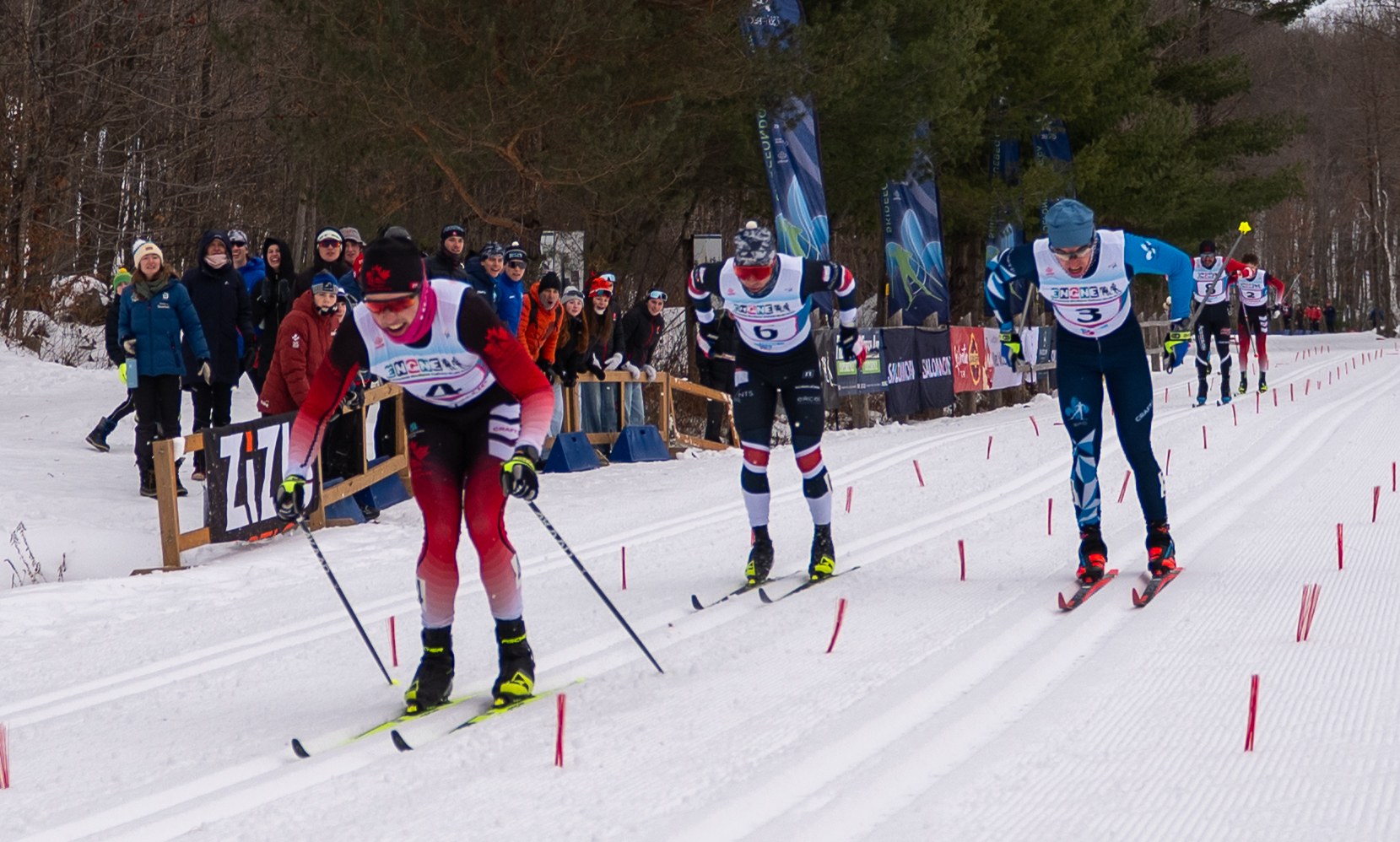
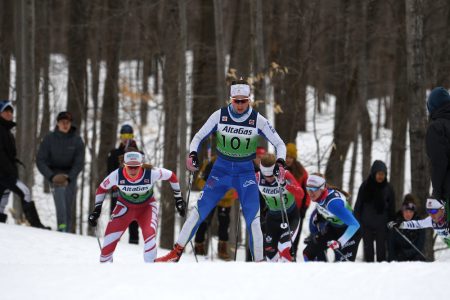
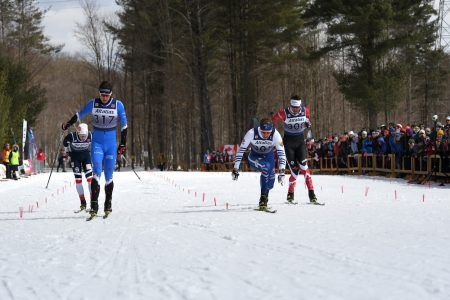
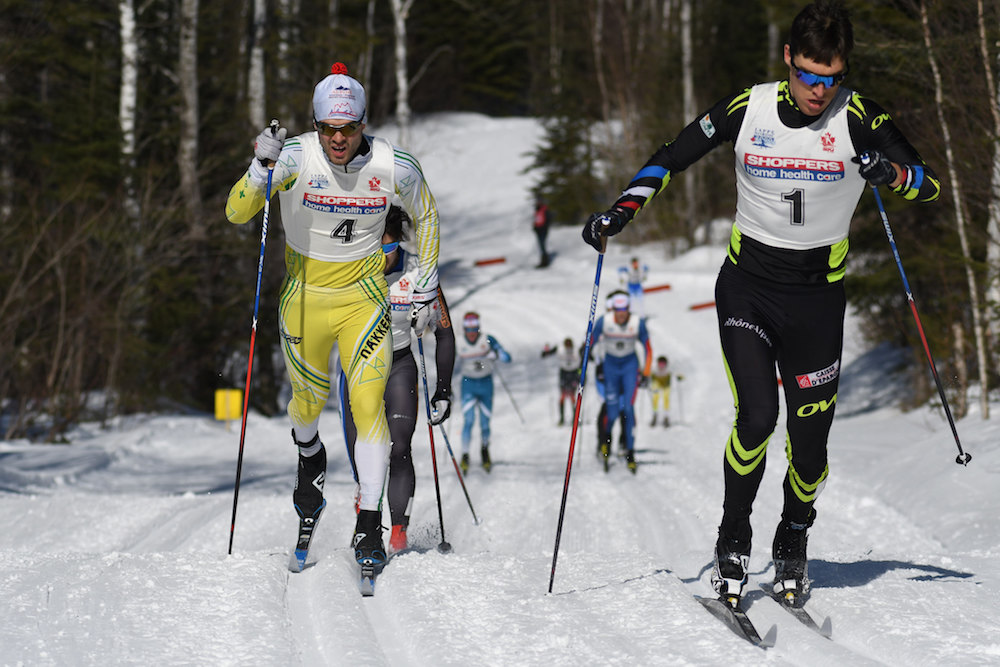
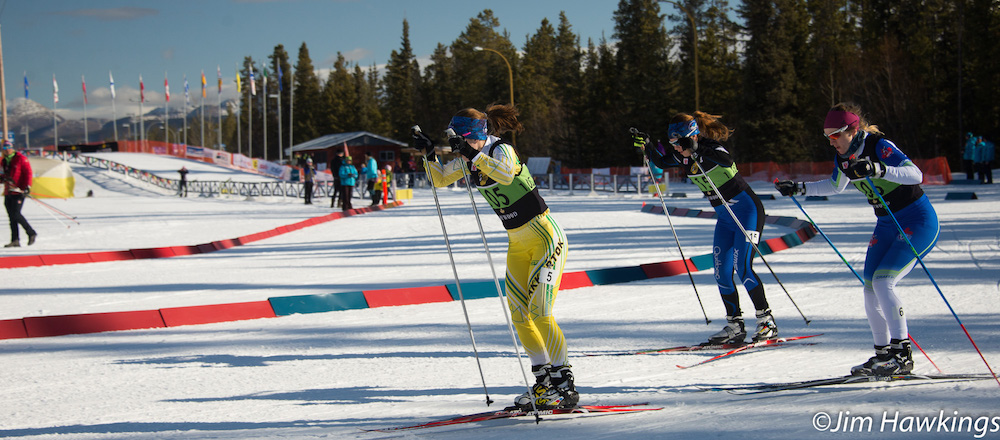
A classic sprint for the line at the Candy Cane Cup in December 2025. (Photo: Rob Smith)
The series, taking place in Gatineau, Quebec (near Ottawa), kicks off with the Canadian World Junior and U23 Championship trials, Dec. 18-21, and concludes with the Eastern Canadian Championships, Feb. 5-7. These FIS races, organized by Évènements Nordiques Gatineau Nordic Events (ENGNE), take place at Nakkertok Ski Club with the support of Ville de Gatineau and Tourisme Outaouais, longtime sponsors of the events and of skiing in the region.
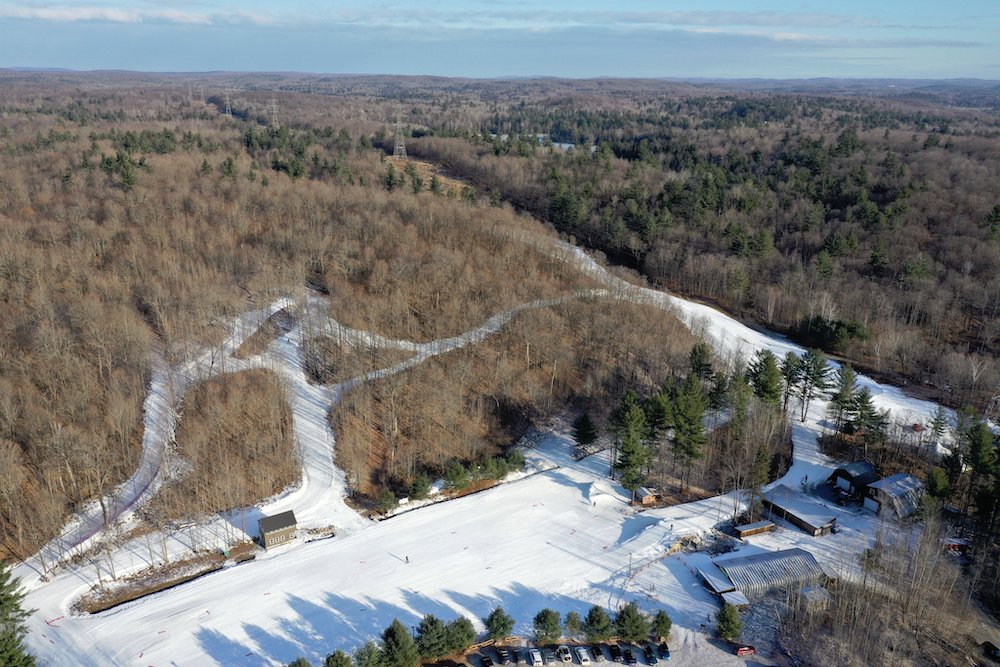
Nakkertok is known for its excellent grooming and for race trails supported by an extensive snowmaking system, and for a very experienced organizing committee (nakkertok.ca).
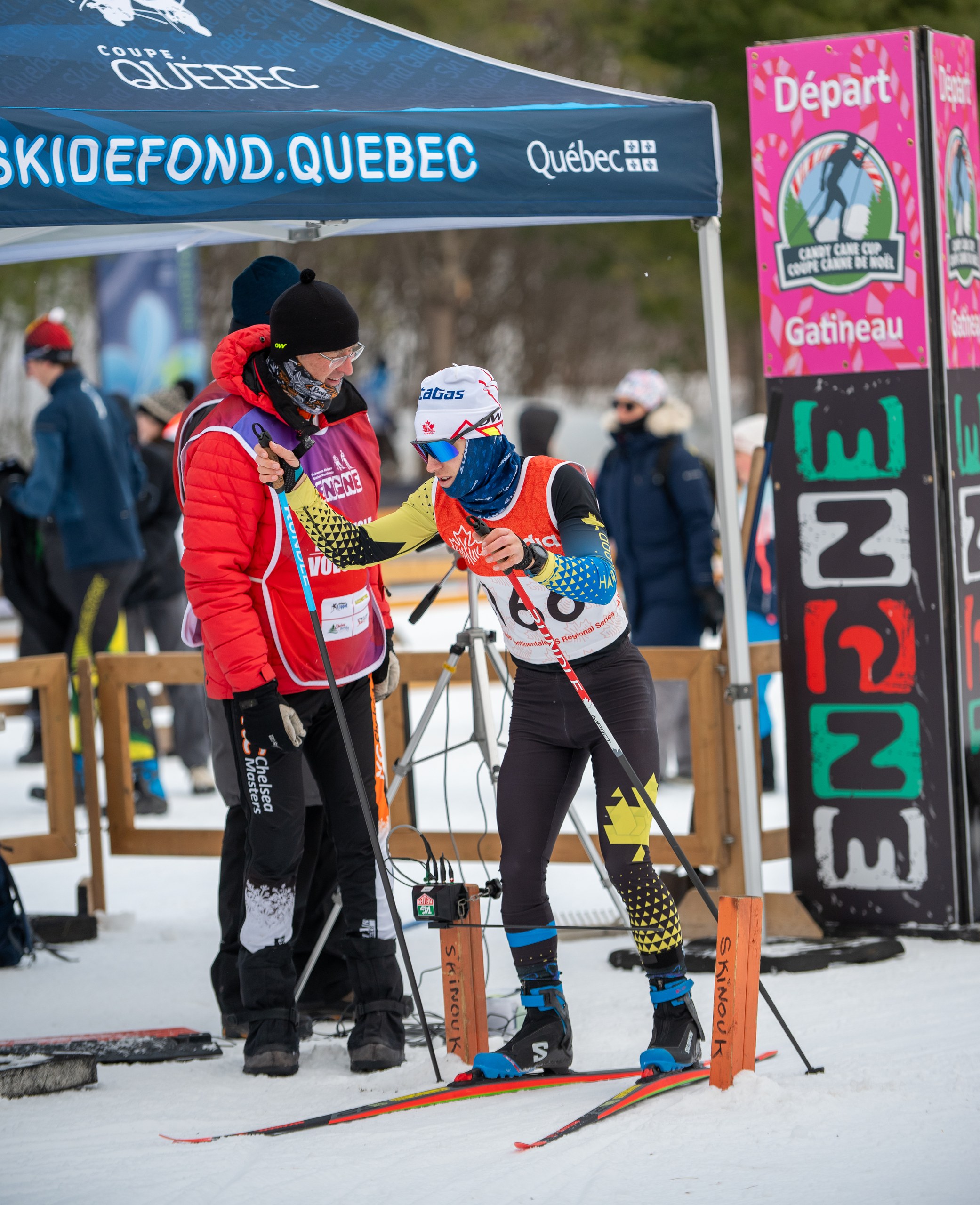
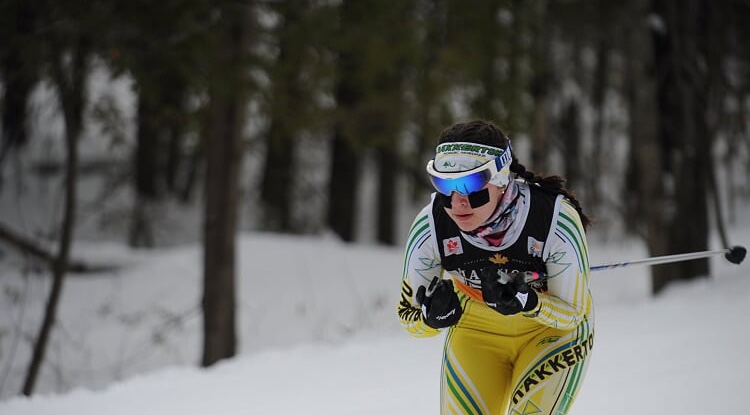
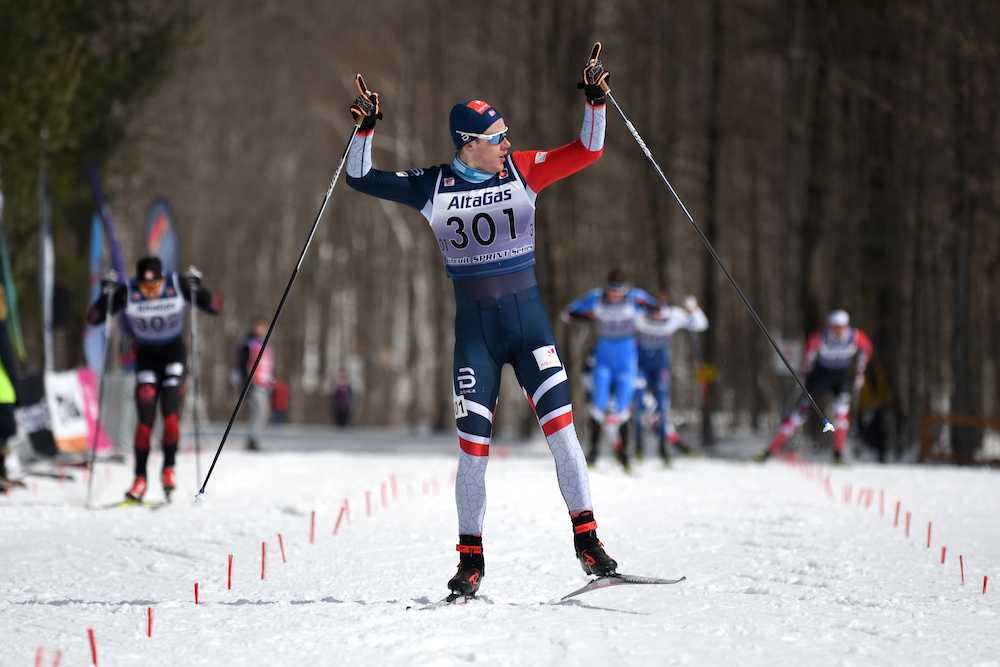
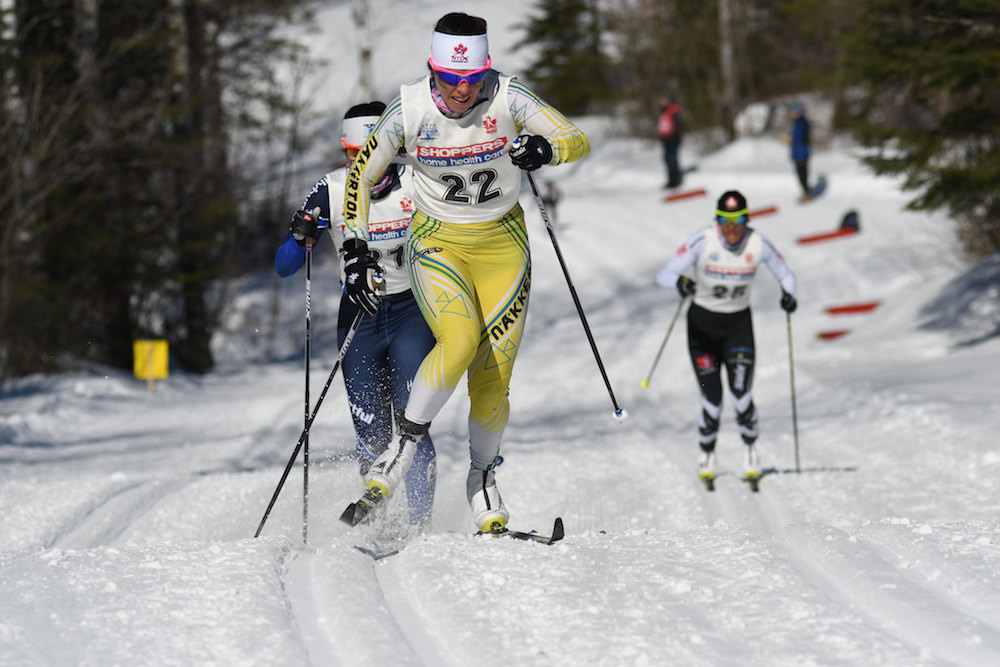
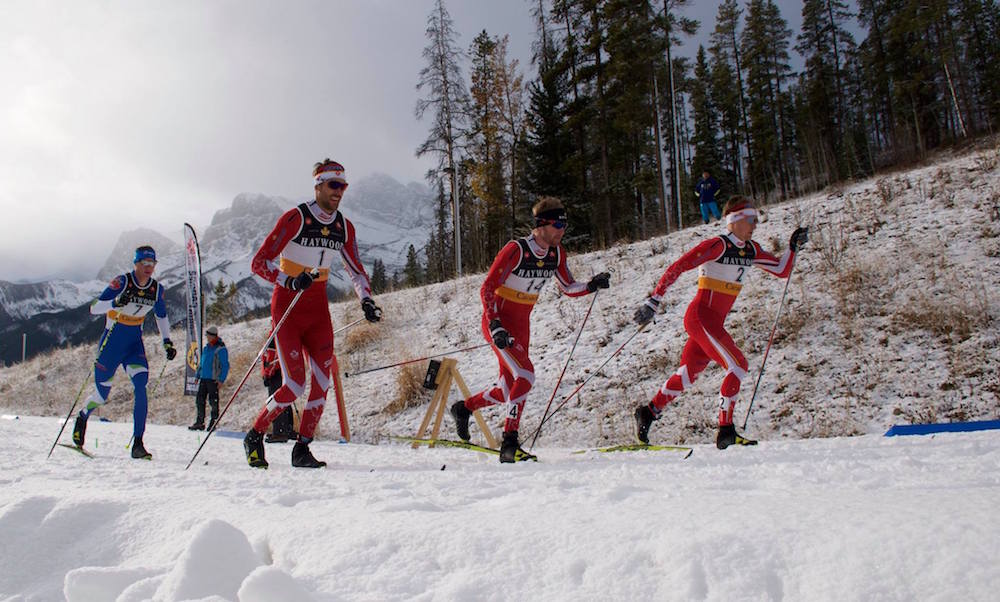
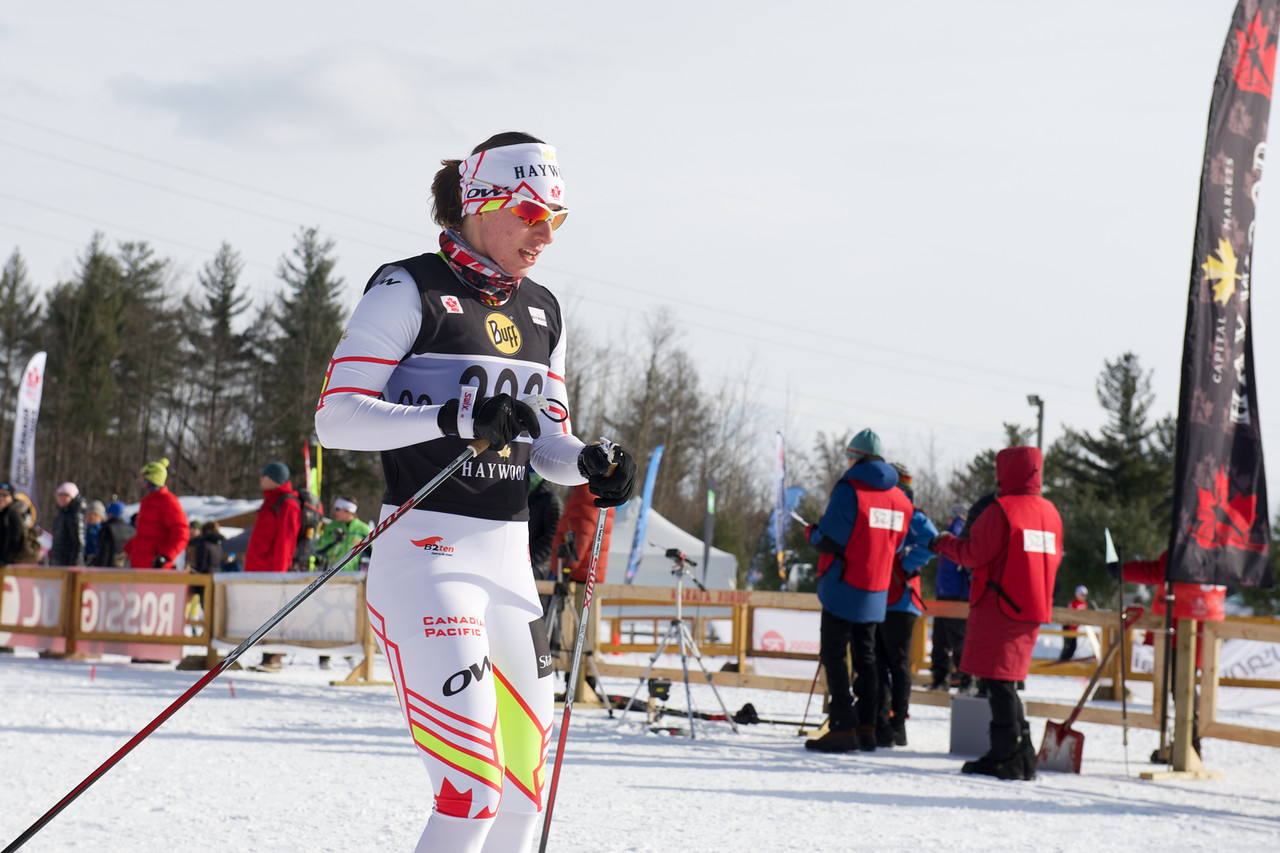
A racer leaves the start gate at the Candy Cane Cup in Gatineau, December 2025. (Photo: Rob Smith)
The Candy Cane Cup
The December races, also known as the Candy Cane Cup, will feature Canada’s best Junior and U23 athletes as they battle for positions on the Canadian team at the FIS Championships in Otepää, Estonia. The Candy Cane Cup is also the second Nordiq Canada NorAm event of the 2026-2027 season, identifying senior athletes for the Period 3 FIS World Cups. Winners in the Open class will claim $500 per race, with the overall winner receiving an additional $1,000 as a Hall Mark of Excellence (HME) Award. Junior race winners will receive $200 per race and $500 overall. Additional prize money will be awarded for other placings and categories, including ParaNordic events, with racers selected for the Canadian teams receiving an additional cash bonus.
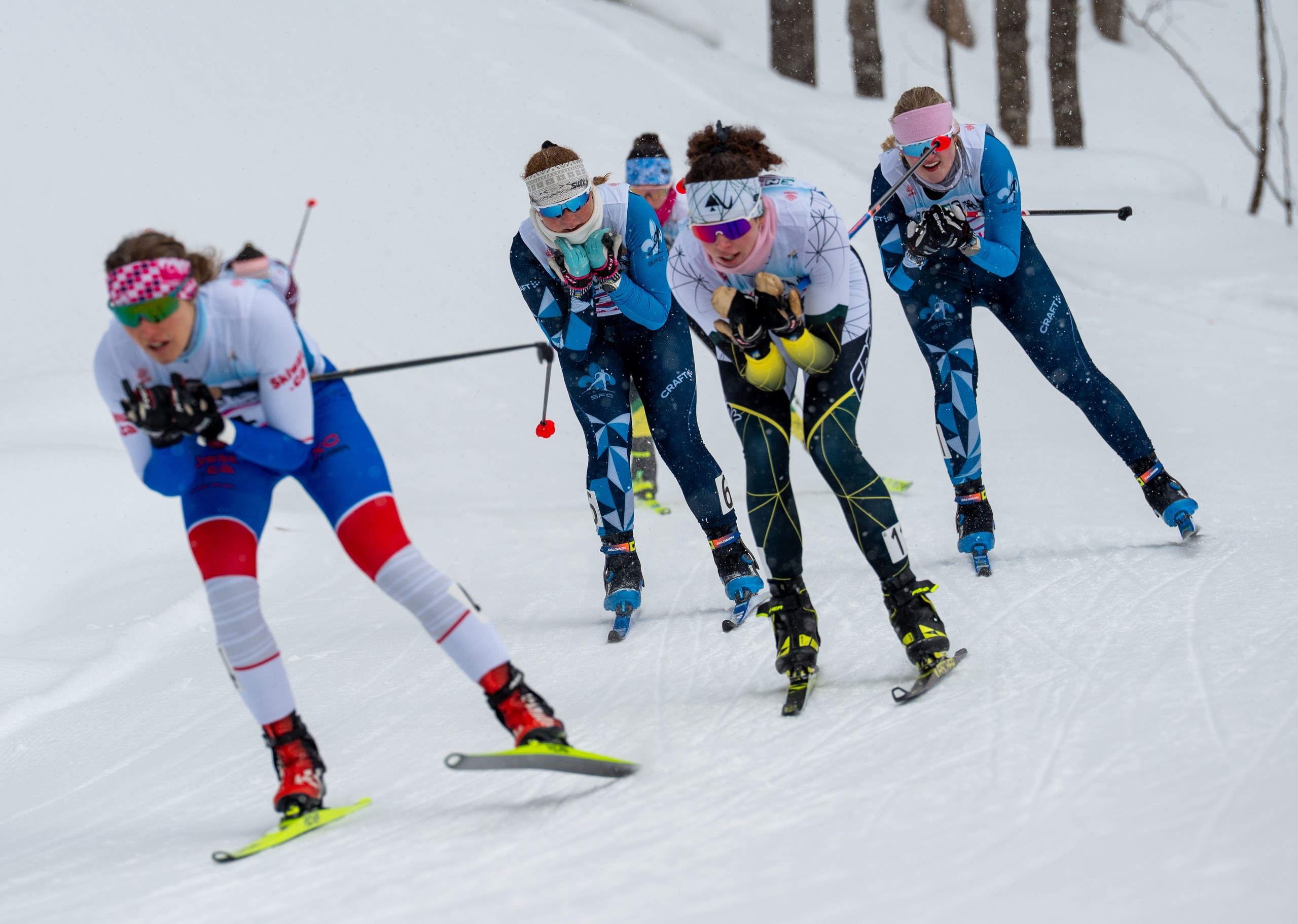
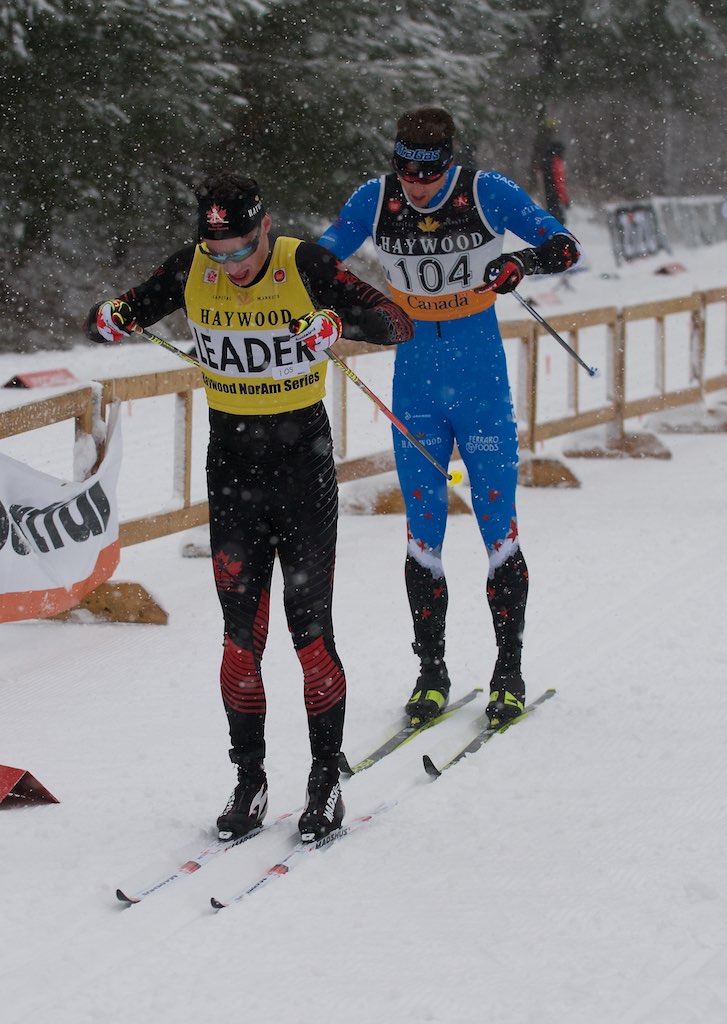
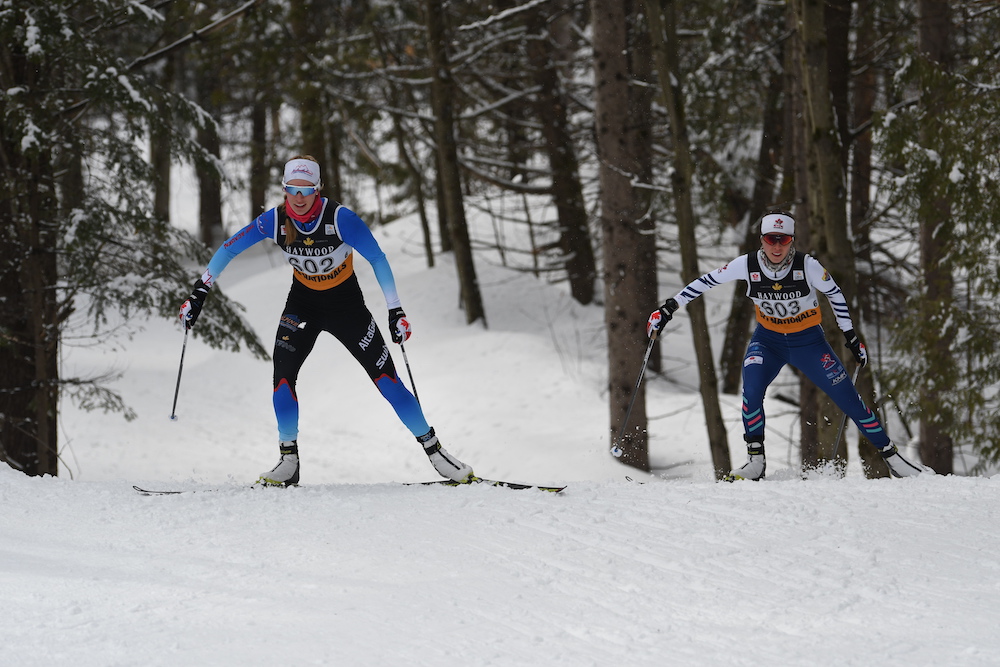
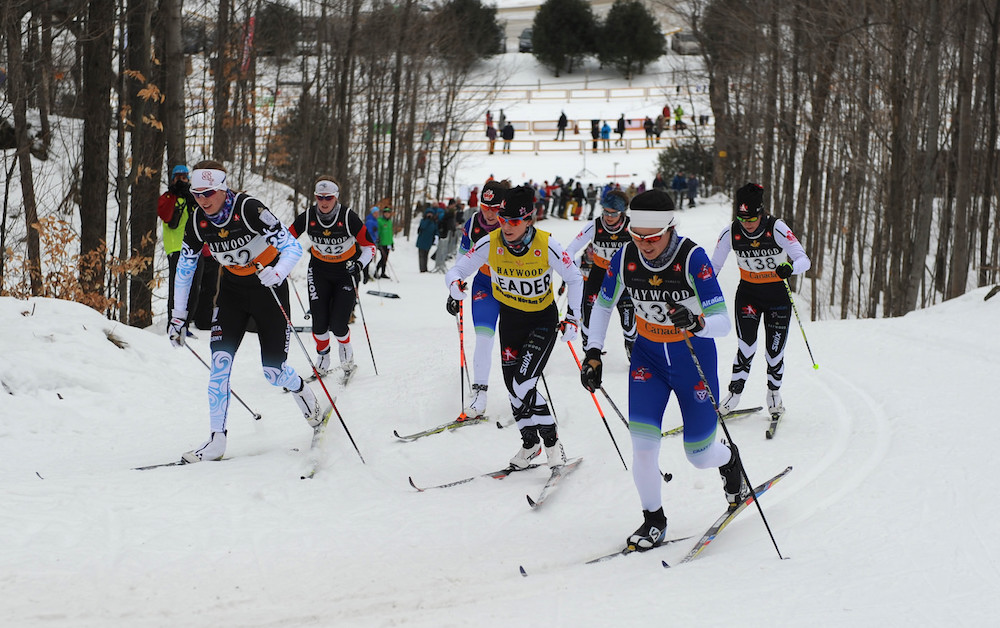
A chase group tucks through falling snow at the 2026 Eastern Canadian Championships. (Photo: Rob Smith)
The Eastern Canadian Championships
February’s Eastern Canadian Championships start the Friday following the NorAm and SuperTour races in Lake Placid, 2.5 hours “up the road,” and have a similar prize structure. Athletes who participate in both events will be eligible for the additional $2,700 in HME prize money for overall performances.
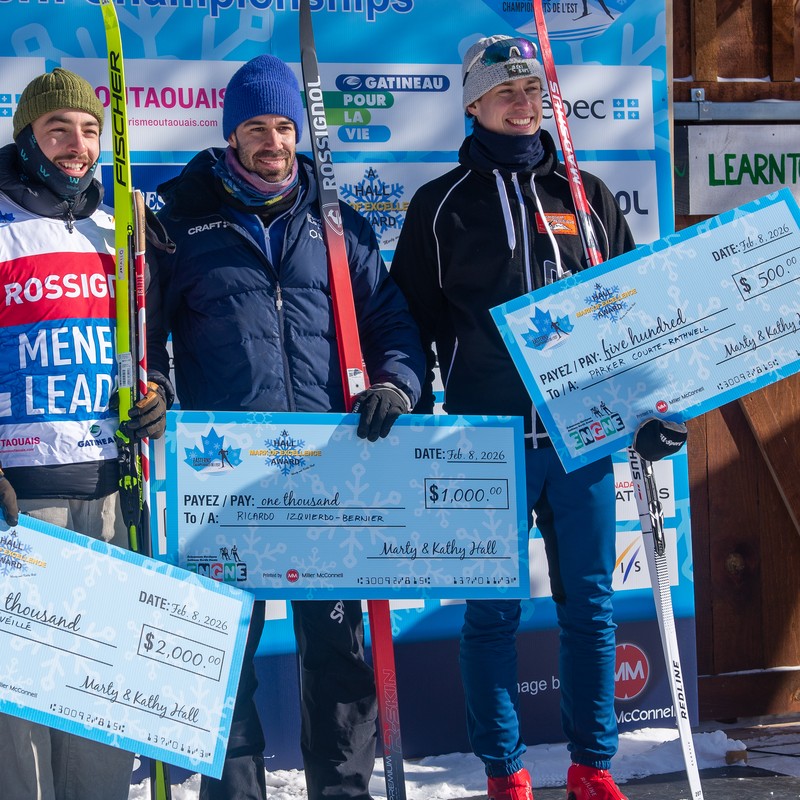
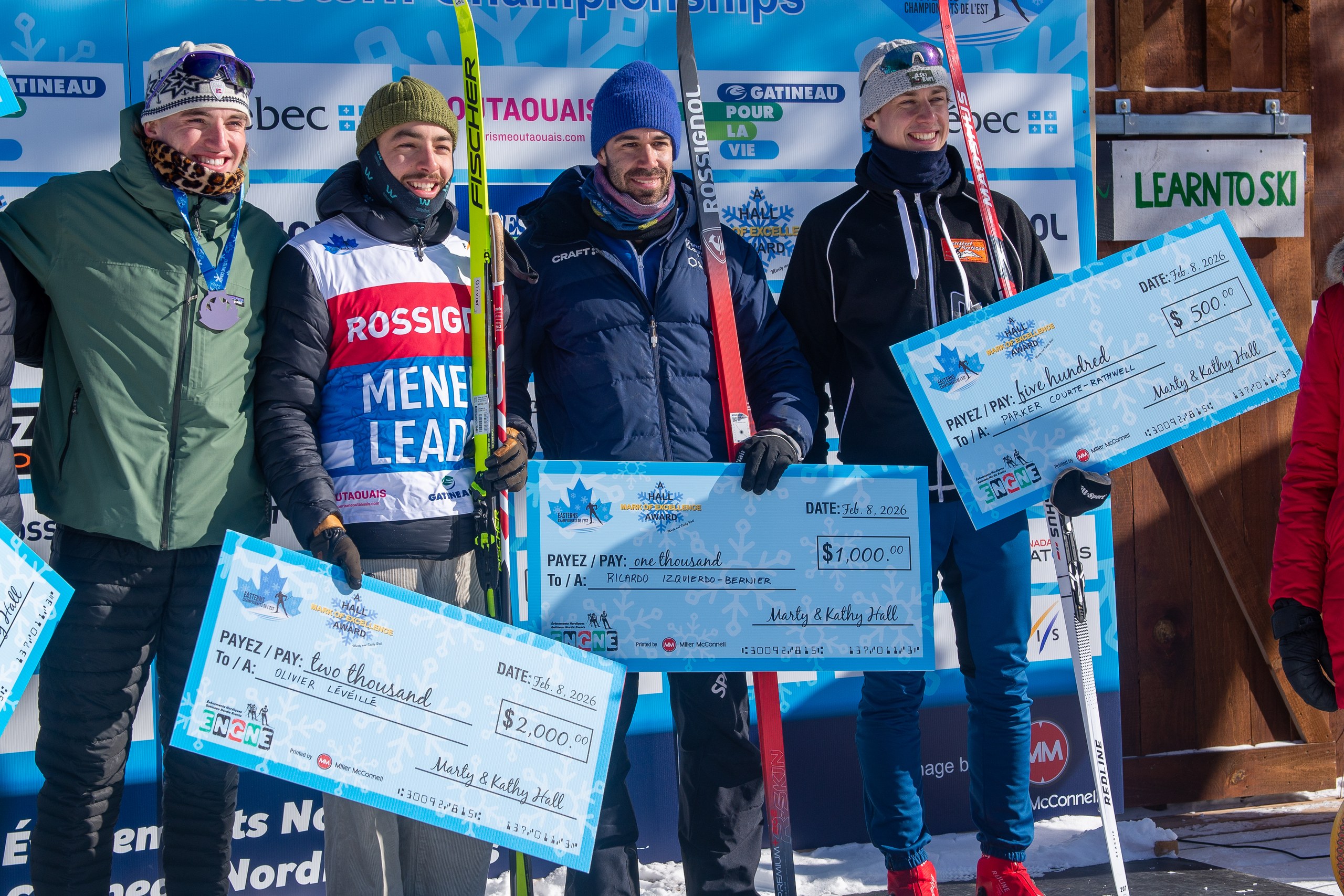
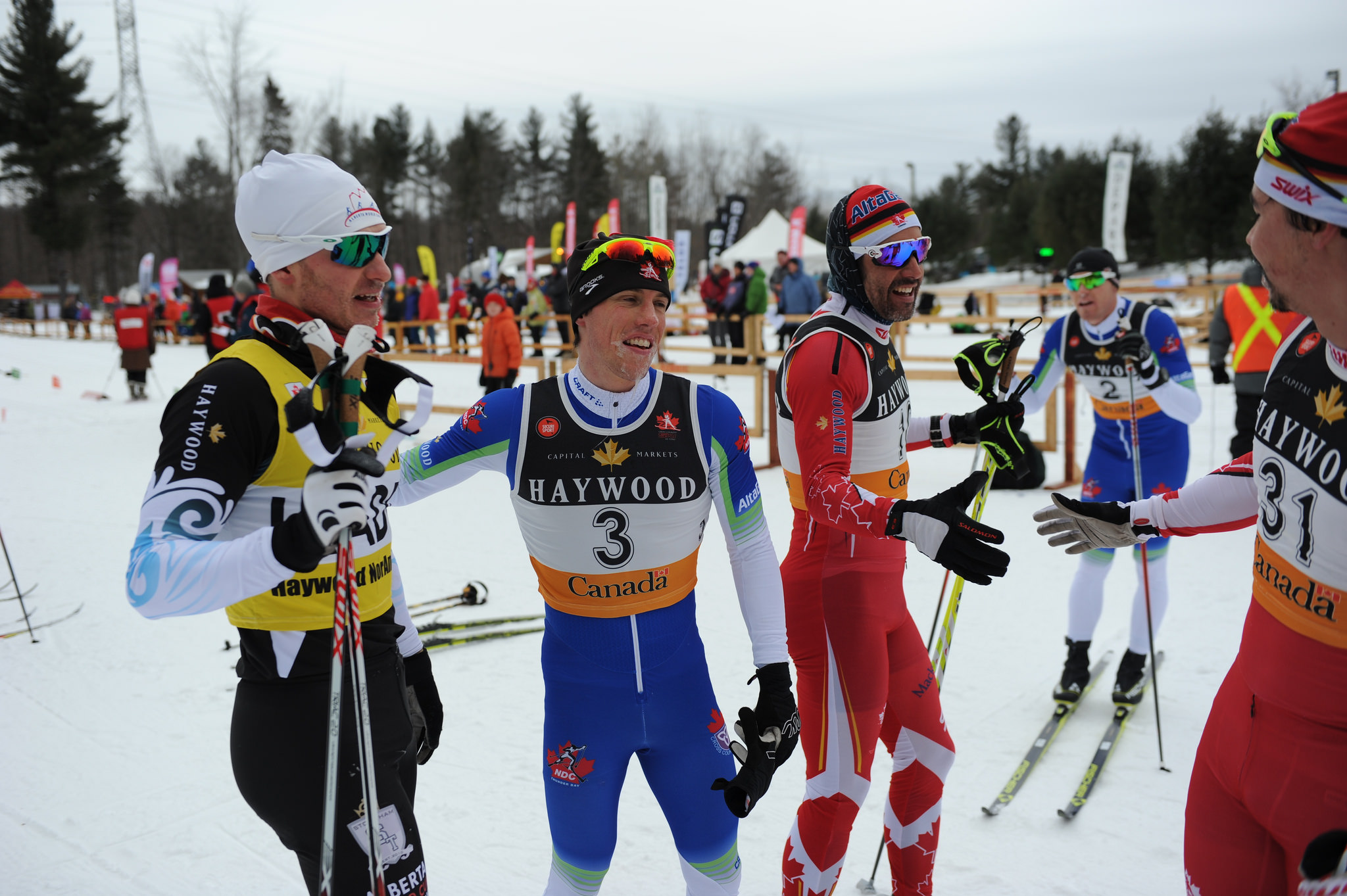
Hall Mark of Excellence checks for $2,000, $1,000 and $500 presented at the 2026 Eastern Canadian Championships, made out to Olivier Léveillé, Ricardo Izquierdo-Bernier and Parker Courte-Rathwell, respectively. (Photo: Rob Smith)
The Hall Mark of Excellence Award
The Hall Mark of Excellence Award program, founded by Marty and Kathy Hall, has provided over $70,000 of prize money at ENGNE events over the last six years, providing much needed financial support to athletes. As Kathy Hall described, “The intent of our program is to inspire and reward skiers, ultimately to enable them to continue to develop their potential and pursue their success at whatever level of skiing they choose.”
For the 2026-27 season events the HME is contributing $18,000, with an additional $17,000 provided by ENGNE and $8,600 by Nordiq Canada for the NorAm event.
“Nordiq Canada is pleased to contribute financially toward the December NorAm at Nakkertok and to work alongside ENGNE and the local organizing team to deliver a strong competition opportunity for Canada’s athletes,” said Beckie Scott, CEO of Nordiq Canada. “Investing in our domestic competition calendar is an important part of creating a high-quality pathway for athletes to develop, compete and prepare for international racing. We’re grateful to ENGNE and its partners for continuing to raise the standard of racing in the Ottawa-Gatineau region and for their commitment to supporting Canadian athletes.”
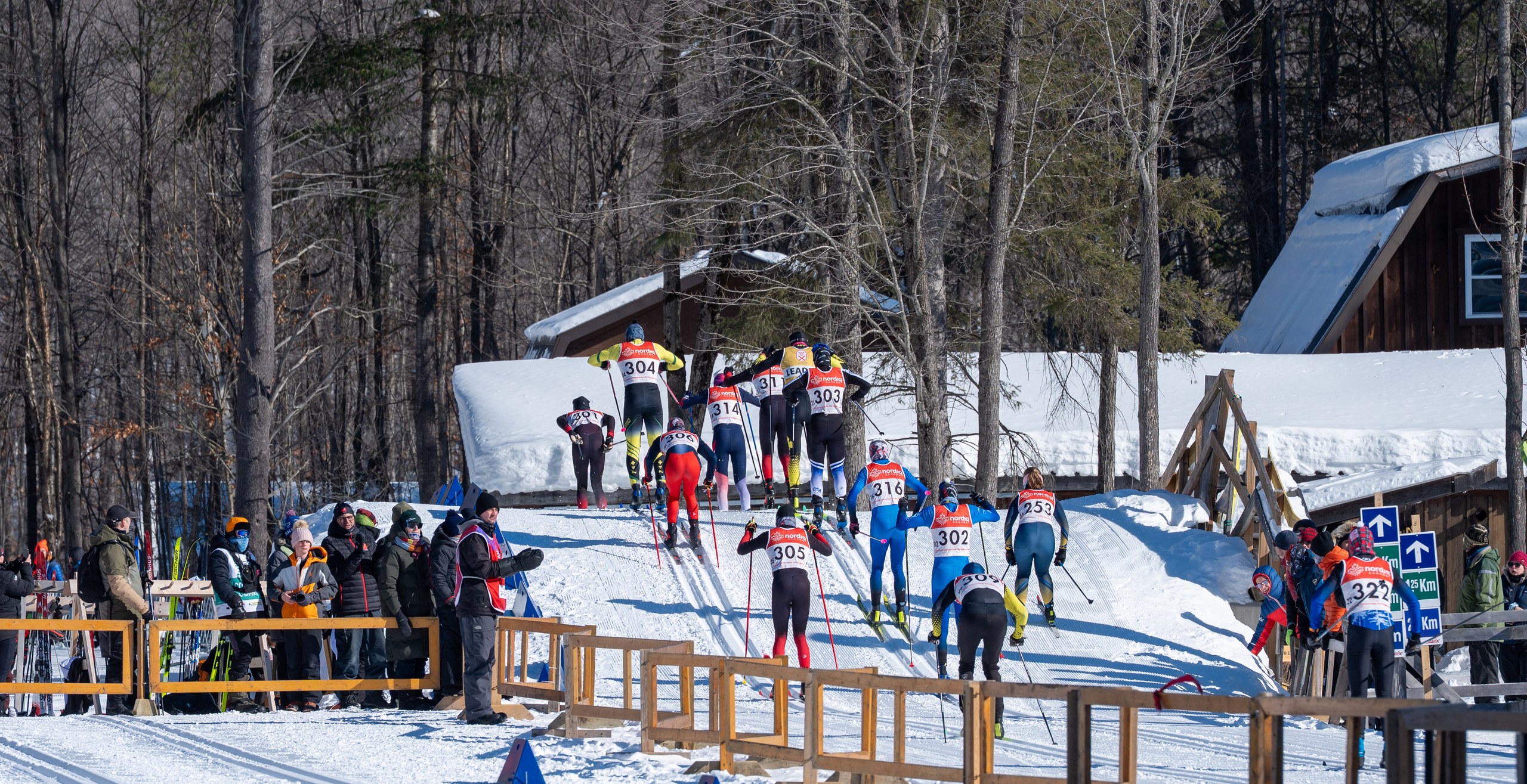
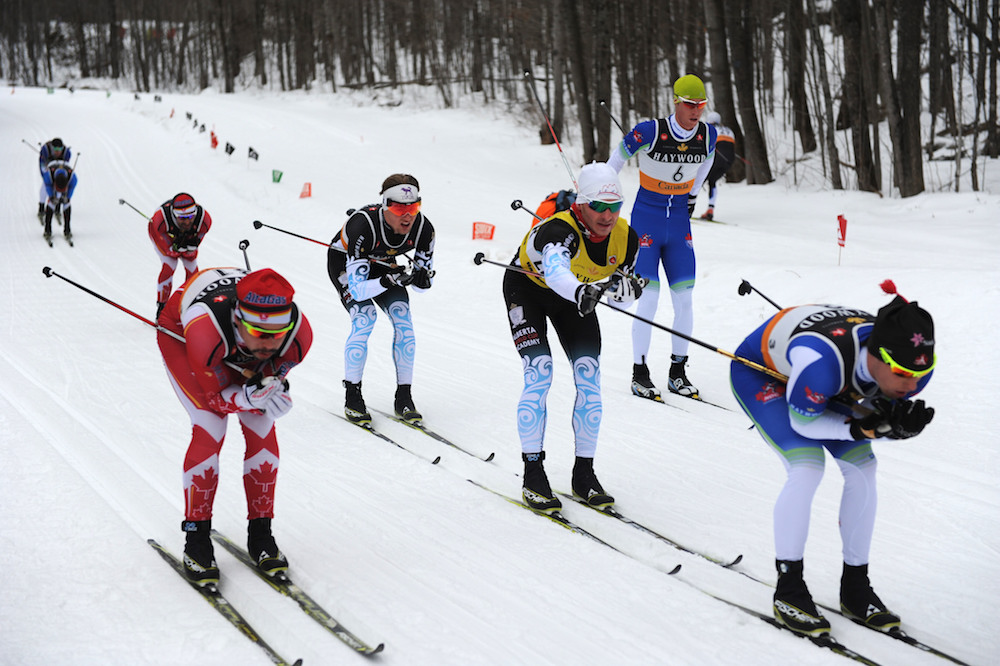
The field double-poles over a small climb early in the 2026 Eastern Canadian Championships. (Photo: Rob Smith)
A Record Year at Nakkertok
ENGNE has been organizing races in the Ottawa/Gatineau area since being formed to run the 2016 World Cup event as part of Ski Tour Canada. “A larger prize purse was important to us this season: it helps ease the financial load for athletes heading to World Championships,” said John Halvorsen, ENGNE President. “With the support of Nordiq Canada and Kathy Hall, we’ve set a record year for prize money at Nakkertok Nordic Ski Club, cementing its place as eastern Canada’s hub for world-class ski racing.”
As well as the Nakkertok trails, the Ottawa/Gatineau area has over 200 kilometres of ski trails, including Gatineau Park, home of the Gatineau Loppet, and an extensive urban trail system. It is a great area in which to train, explore and relax. We look forward to welcoming you to our winter ski home.
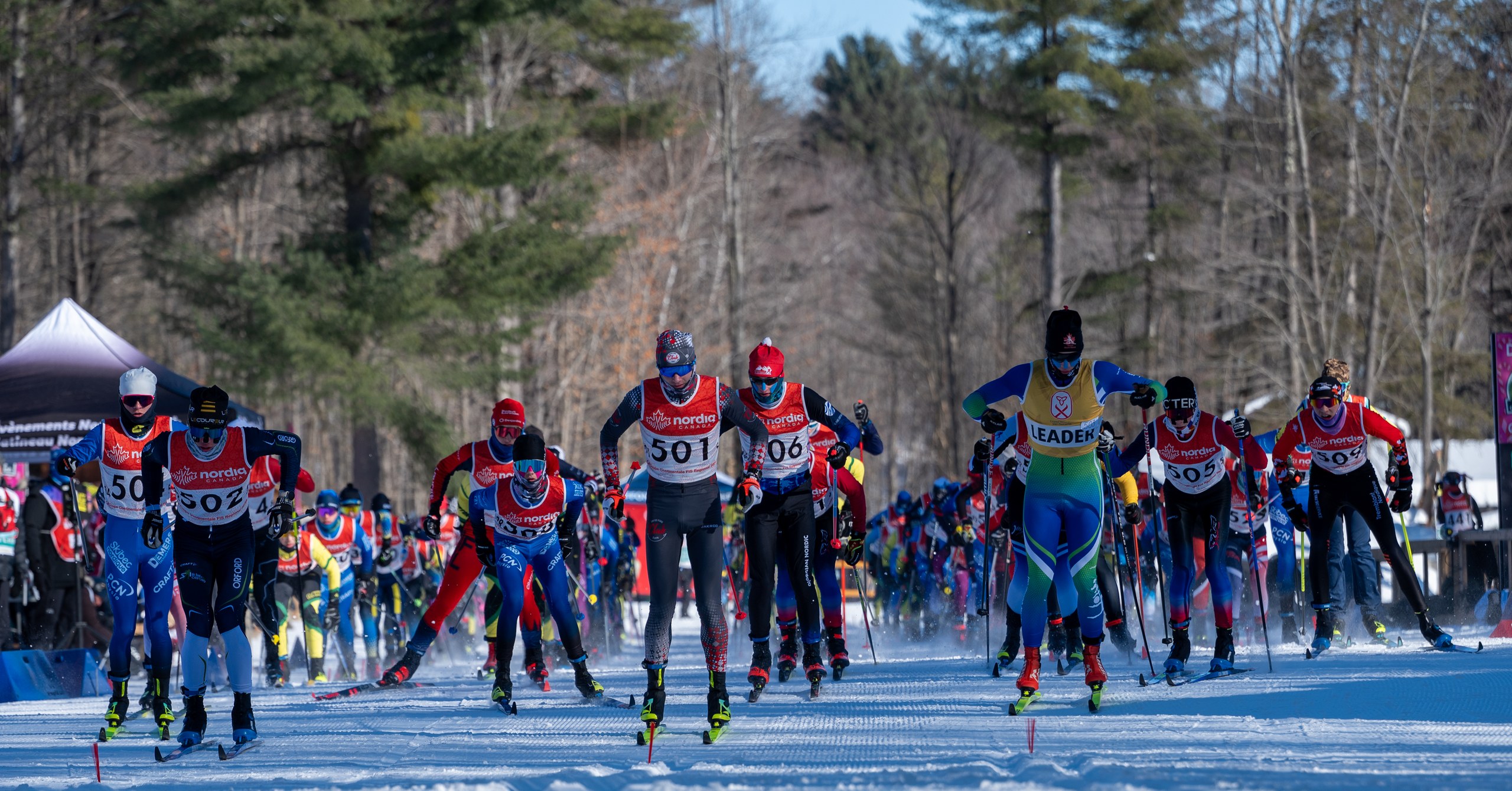
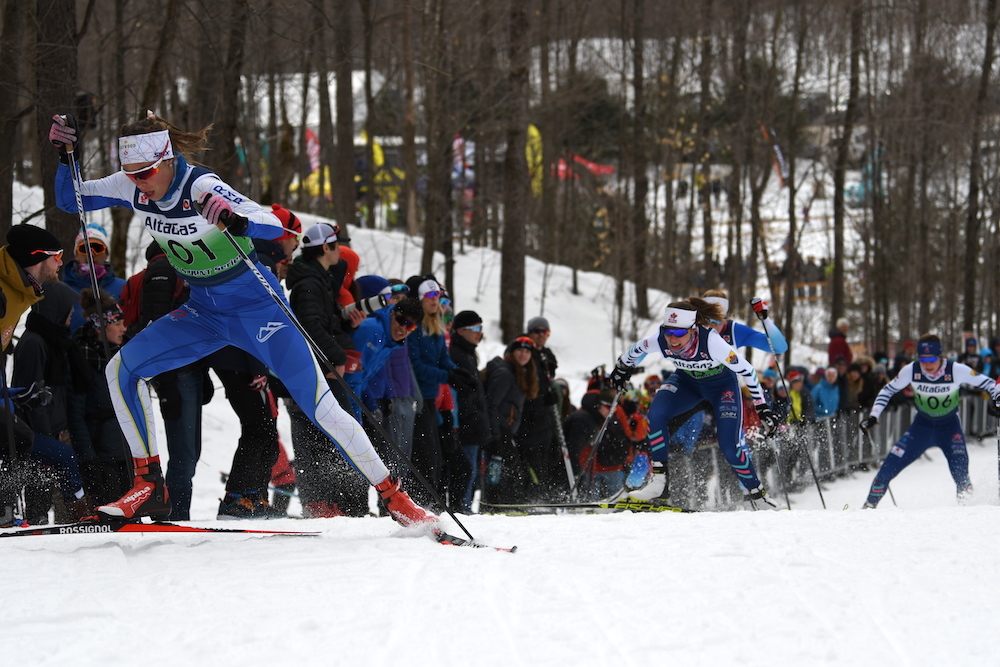
The mass start rolls out at the 2026 Eastern Canadian Championships. (Photo: Rob Smith)
Publishing press releases is a service we offer to the ski community, so please note these articles are not written by FasterSkier and therefore do not necessarily represent our thoughts and standards.
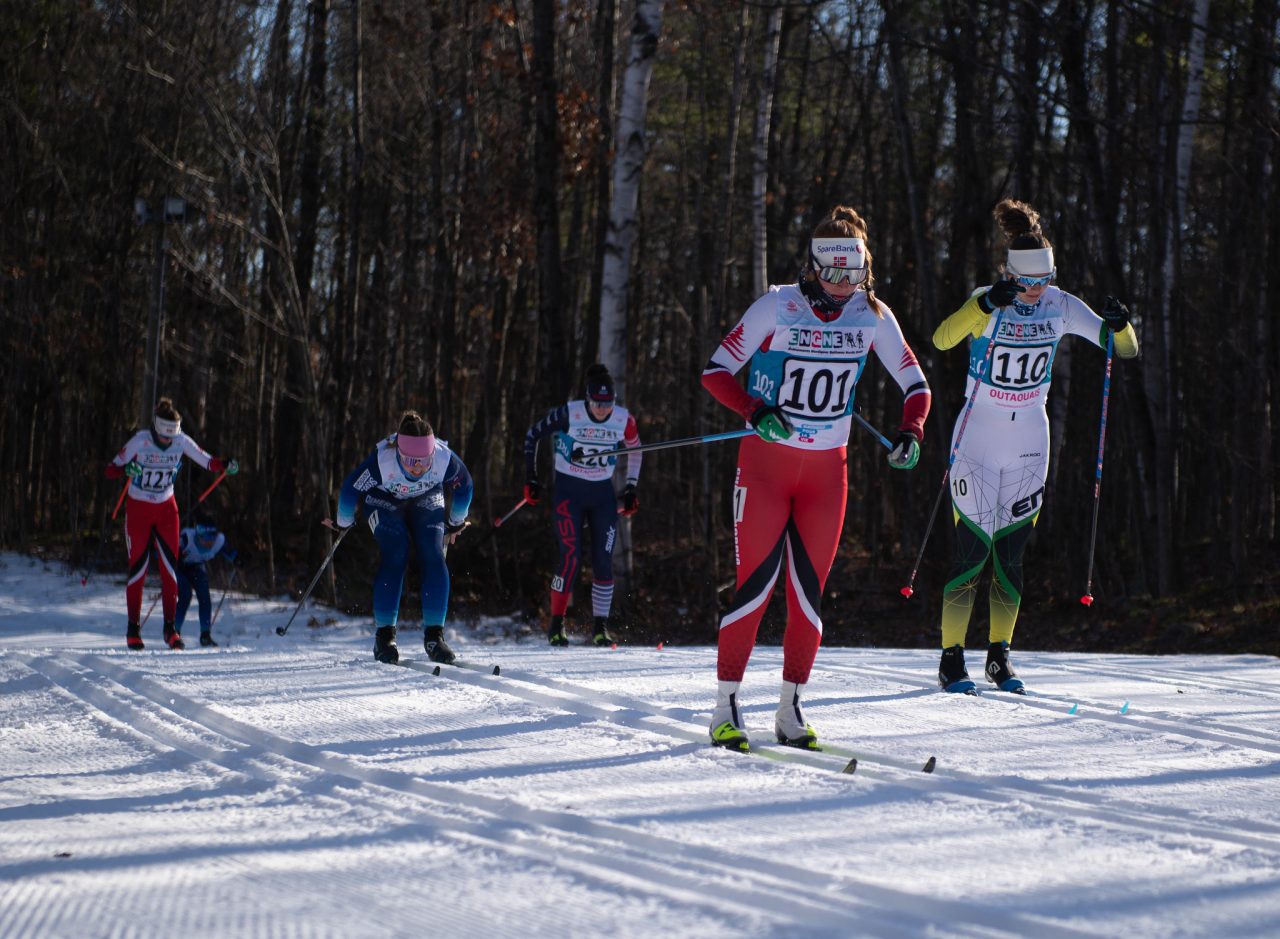
Tory Audet (#101) leads her quarterfinal on her way to victory. (Photo: Robert Smith)
Canadian racing continued with the Eastern Canada Cup #1 at Nakkertok Trails on December 10th and 11th. The event is hosted by Évènements Nordiques Gatineau Nordic Events (ÉNGNE), a collaborative organization that leverages the skills and volunteers of four local clubs: Chelsea Nordiq Ski Club, Nakkertok Nordic Ski Association, Club Skinouk and the Gatineau Loppet.
Canada recently divided the Canada Cup series into Eastern and Western to reduce the need for travel and to make the sport more accessible financially. The previous week in Sovereign Lake was a Nordiq Cup (World Cup starts on the line), US SuperTour, and Canada Cup combined. Despite being a “smaller’”race, there were 580 racers on the Nakkertok trails to discover surprisingly good skiing.
The large field comes in part from geography: FasterSkier once calculated that 12 million Canadians live within a weekend’s driving distance to Nakkertok, which is just outside Gatineau, Québec, right across the river from the national capital, Ottawa, in Ontario. That is almost the same number of Canadians as live in the entirety of Western Canada (2016 census numbers). Thunder Bay was not included in those “nearby” Canadians; nevertheless, a large group made the drive this weekend.
The “surprising” part of the good skiing conditions stemmed from lowered expectations after mid-week rainfall that destroyed much of the manmade snow, shortened the race loop, and dampened expectations. More on that later, but the pictures and the racer’s comments make it clear that a big thank you is owed to the grooming team and volunteers.
Classic Sprint Saturday
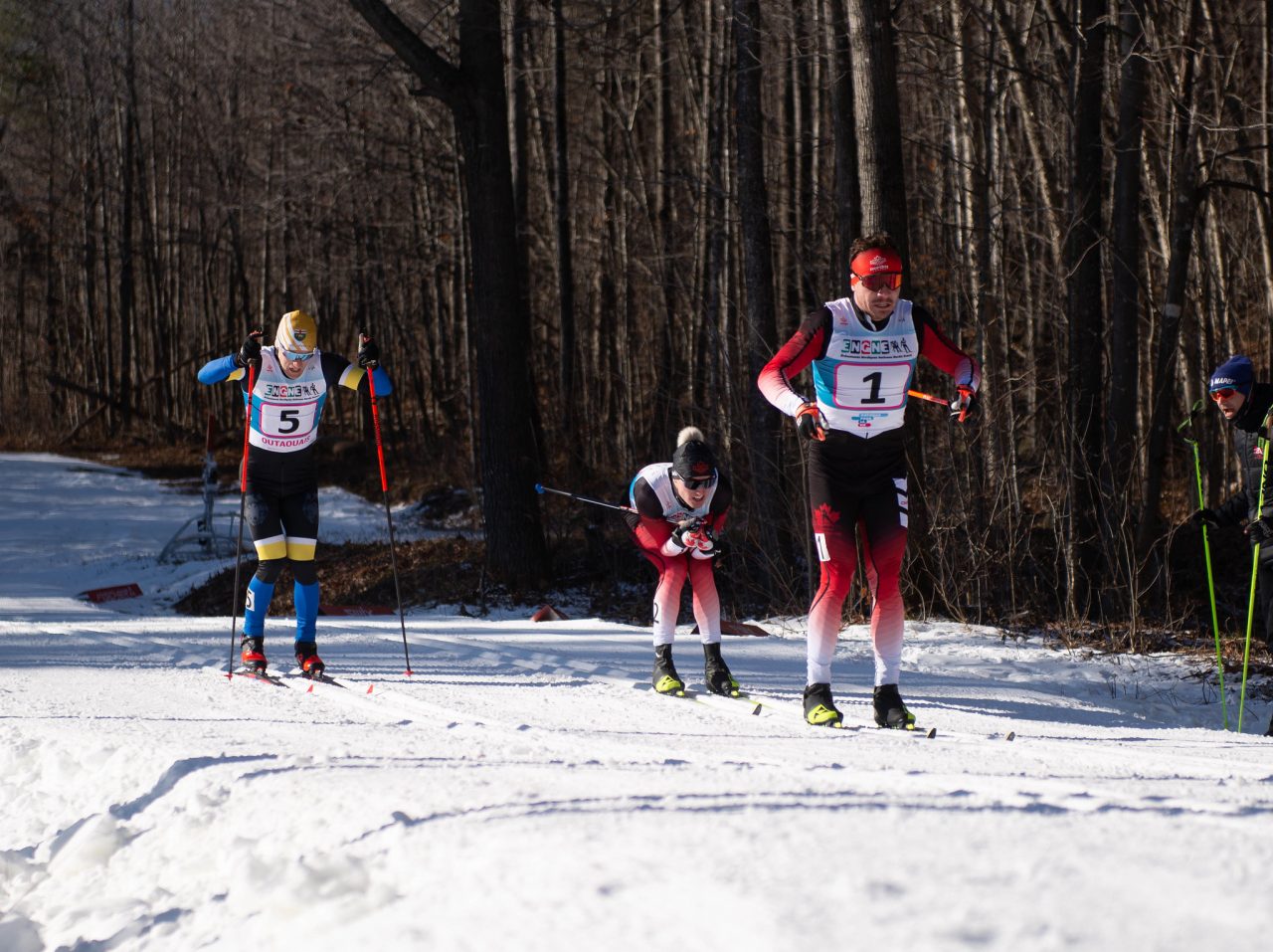
Léo Grandbois (#1) leads teammate Sasha Masson and Connor McGovern (#5) in the final. (Photo: Robert Smith)
Centre National d’Entraïnement Pierre Harvey (CNEPH) athlete Léo Grandbois won the 1.3km sprint in decisive style, qualifying first and winning all three heats to finish the day in 2:23.11. Sasha Masson, Grandbois’ teammate at CNEPH and the NextGen National team, was second, 2.35 back. Thunder Bay’s Conor McGovern was third, at 5.41 seconds.
In what would be a theme of the heats all day, the time gaps were large, with the winners blowing up the pack well before the finish was in sight.
“I’m happy with my race today, I felt good,” Grandbois said in an official interview. “It was nice weather, and the volunteers did an excellent job on the trails. I didn’t race strategic at all; I trusted my form and it worked really well.”
For the women, it was a similar situation, with local product Tory Audet winning everything. Audet, who is a U18 skier for Chelsea Nordiq and a member of the National Development team, is “racing up” in U20 this season which allows her to qualify for Open heats. Audet followed up her good results the previous weekend with a win in 3:02.84. Carlton U’s Maggie McClure was second, 7.64 behind, with CNEPH U20 Élie-Anne Tremblay placing third at 10.98 seconds back.
Audet’s official quote to the OC shows her growing professionalism, with a shoutout to the waxers: “[The race] was great, it’s so nice and warm here, compared to Sovereign Lake B.C. where I raced last weekend. My skis were fast, big thanks to my wax techs for a great day.”
In an email to FasterSkier, Audet expanded on her day.
“Skiing at home feels great, my kick was amazing which helped a lot, thanks to my wax techs! It felt great to win a race in front of my family and close friends.”
Free Distance Sunday
Léo Grandbois on his way to his second win of the weekend. (Photo: Tim Austen/ ENGE)
The men raced first again on the 1.64km loop, doing six laps to complete 10km. Grandbois continued his hot weekend, winning in 21:00.7, 10.2 seconds ahead of Montériski’s Xavier Lefebre, and 29.1 seconds clear of TBay’s Julian Smith.
“Today was a lot harder than yesterday I thought,” Grandbois revealed. “It was a course that I had to ski well because there were not many hills, but I am happy with the effort I put in.”
Last year it was Smith in total domination mode in December;this year it is Grandbois. How does a ski fan tell the difference between a “Christmas Star,” to paraphrase the Norwegians, from a skier having a great season? We will know by the end of January.
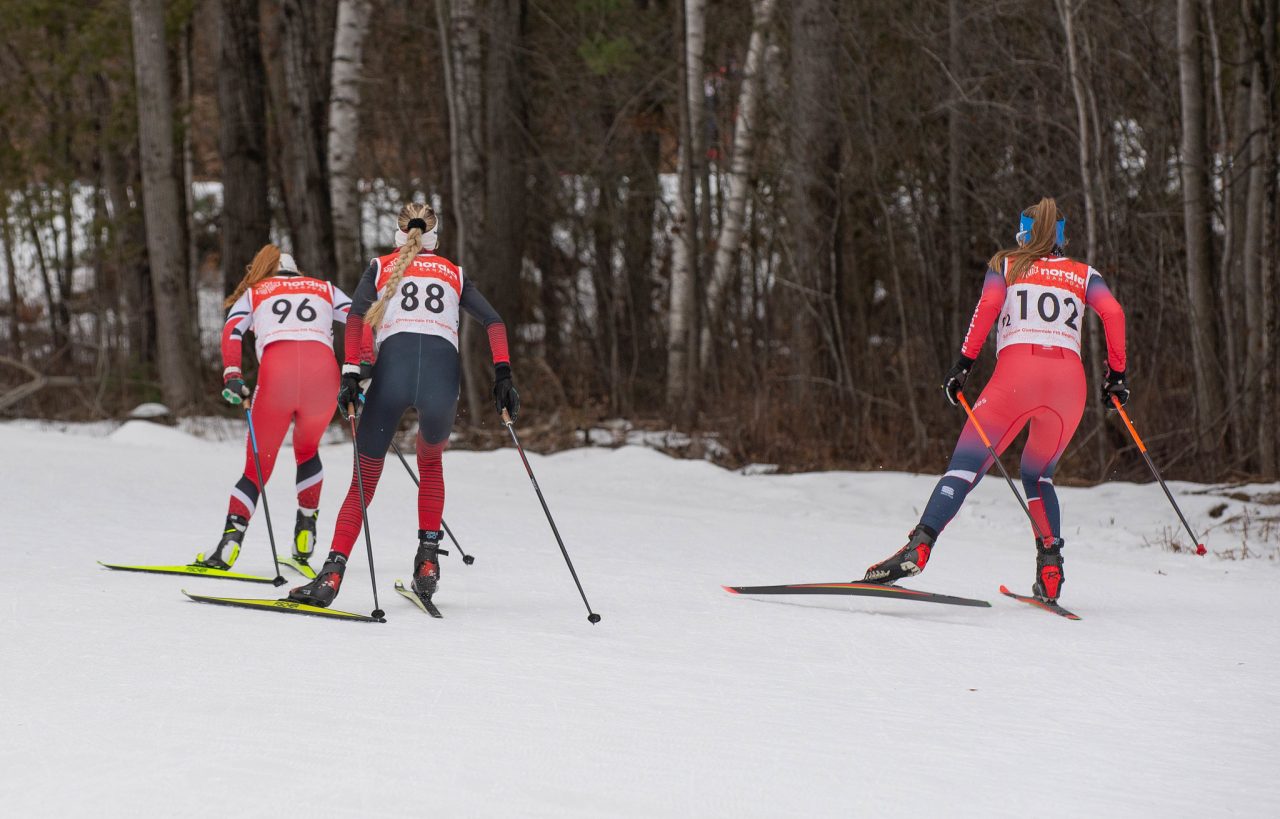
Tory Audet (#96) leads winner Bronwyn Williams (#88) during the individual start. (Photo: Robert Smith)
Bronwyn Williams grabbed the victory in the women’s 10km on her home course, finishing in 24:59.1.
“Super, super fun race today,” she said. “I really enjoyed skiing the six laps and tracking down the other skiers. I always love racing on my home trails at Nakkertok, there is always lots of people cheering me on.”
Williams’ Nakkertok teammate Shilo Rousseau was in second, 10.4 behind.
“The race today was hard, six laps is definitely a lot to count,” Audet shared with FasterSkier. “Conditions were great, and my skis were fast! It wasn’t the results I was hoping for, but this was my first completed long distance race since world junior championships last year, so it is a great feeling to be back in it and on the podium!”
Audet, who missed the end of last season through illness, is enthusiastically making up for lost time.
“This season I was selected to be part of the National Development team [and] with this team I was given the opportunity to attend many camps and meet so many incredible strong athletes where I was able to work with some of the best coaches in Canada! These camps were definitely my highlight of this year!”
Snowmaking
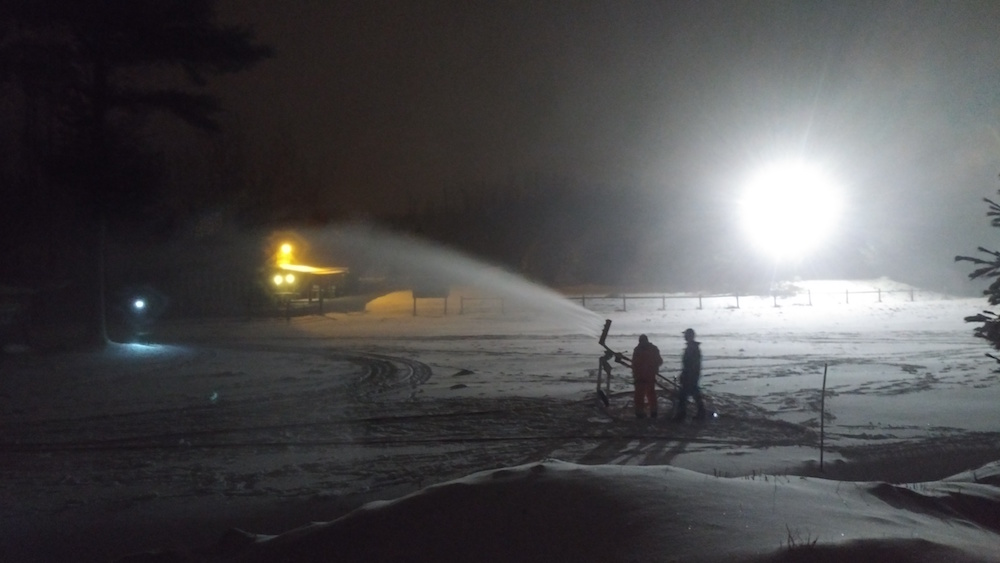
This race weekend—and the two weeks of training on snow that preceded it— wouldn’t have been possible without the Nakkertrak snowmaking project.
In a country with early season racing in October (Frozen Thunder in Canmore), November (Sovereign Lake), and a lot of groomed trail before December, it might seem like one more venue with snowmaking is not important. Is another 3km of trail important when 150km has been open for a month?
What matters here is not snow, but skiers. Most of the early season skiing is in the mountainous parts of BC, Alberta, and Labrador, which are all less populous areas.
Having a top racing venue 30 minutes from the national capital also makes cross country skiing a nationally important sport. People, including federal employees and elected officials, focus on what they can see.
“Getting in the training and racing early season for me is so important to prepare for bigger races later on in the season! With snow usually falling later around here, Nakkertrak is so helpful for all our eastern athletes!” — Tory Audet
Audet has set the goal of 2023 U20 World Championships in Whistler, and time on snow is a crucial factor in snatching that spot from motivated 19 year olds.
Organizing early season races is very similar to other races: make plans with the local ski community, negotiate courses and distances with the National Ski Federation, recruit a lot of volunteers, recruit chiefs to organize those volunteers, and a high level event appears in a puff of snow.
Without reliable snow, every part of that gets harder. More time is spent on contingency plans, money can’t be spent until the last minute, and volunteers are less enthusiastic if they aren’t sure they will be proud of the final result.
Long time Nakkertok and Cross Country Canada volunteer Toni Scheier explained the significance to FasterSkier:
“The Outaouais region has had only a couple of inches of natural snow so far this season. We have been able to ski on a part of our Nakkertrak artificial snow loop for two weeks, but pouring rain on Wednesday put even that in jeopardy. Fortunately, a cold snap Thursday allowed for some touch ups on Thurs that provided excellent conditions for the 580 racers skiing our 1.64 k track. Special mention to Kathy and Marty Hall for their Hall Mark of Excellence contribution of $25,000, to upgrade our snowmaking capacity this year and $4,000 cdn towards the prize money.”
Scheier was one of the volunteer team that brought Nakkertrak to life in 2016: planning, fundraising, promoting, and then expanding. New money this year has expanded the artificial snow loop again, introducing more hills.
Even with Nakkertrak, the first Eastern Canada race this season is the same weekend as the third World Cup in Europe. If Canada wants to see more athletes like Nakkertok’s Katherine Stewart-Jones banging out top 20’s in period 1 on the World Cup, bringing snow to skiers is essential. Just ask Audet.
Katherine Stewart-Jones leads a sprint heat on her way to domination. (Photo: Robert Smith)
The NorAm circuit moved east to the Nakkertok trails for three days of racing jointly hosted by Nakkertok Nordic, Club Skinouk, Chelsea Nordiq, and Kanata Nordic. Friday featured classic sprints, Saturday interval start free, and Sunday interval start classic.
The event was also the Candy Cane Cup for the younger categories, as well as Ontario Cup 1 and Coupe Québec 1. 374 athletes in the U16, U18, and Open categories competed on Friday with many more younger athletes racing Saturday and Sunday.
Nordiq Canada’s Jeff Ellis was there and has once again shared the full-length post-race interviews. Photographer Robert Smith has galleries for each day, so keep scrolling.
Nakkertok had over 3km of trail open thanks to their snowmaking, with a 2.5km loop used for the distance races.
The ‘NakkerTrak’ at Nakkertok before the 2019 NorAm weekend. (Photo: Natural Fitness Labs)
On the women’s side, it was the KSJ show, with home-grown national team member Katherine Stewart-Jones winning all three days.
In the sprint, Stewart-Jones finished in 3:19.96, comfortably ahead of AWCA’s Maya MacIsaac-Jones and RMR’s Katie Weaver at 2.43 and 3.93 seconds back respectively. The podium trio were the top three qualifiers, but in reverse order.
Stewart-Jones steamrolled the field in the free 5km, 36.8 seconds ahead of Laura Leclair in second and 39.9 seconds before Cendrine Browne, both of CNEPH.
The trend continued on Sunday, with Stewart-Jones finishing the classic 10km in 28:52.1, 1:18.1 ahead of Skibec’s Andrée-Anne Théberge and 1:29.8 ahead of AWCA’s Annika Richardson.
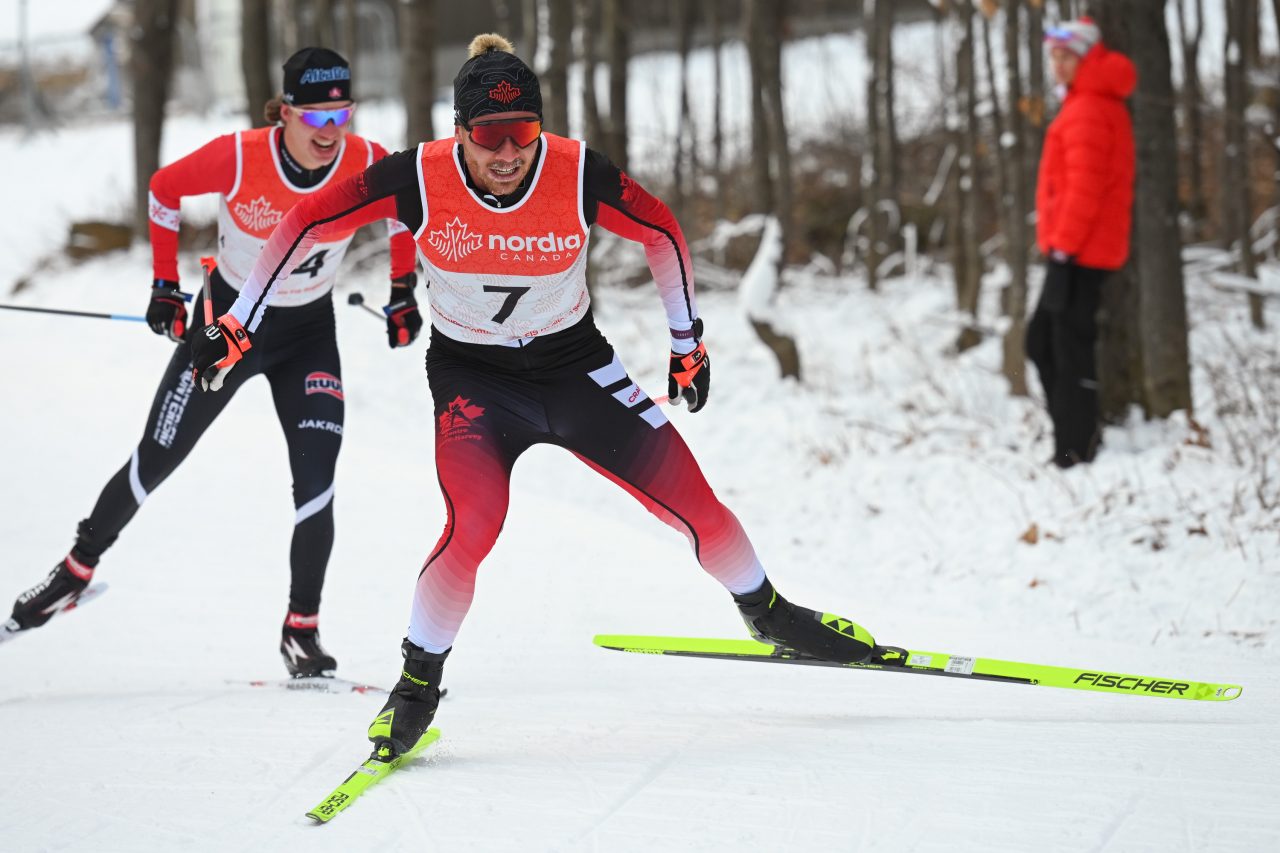
Antoine Cyr leads Julien Locke in the interval start classic. (Photo: Robert Smith)
For the men, Hardwood’s Bob Thompson kicked the weekend off with a sprint victory in 3:12.71, followed by national team member Antoine Cyr at 0.36 seconds and his CNEPH teammate Antoine Briand at 0.63.
On Saturday, Cyr won the free 10km in 22:10.4, 20.9 seconds ahead of Fondeurs Laurentide’s Ricardo Izquierdo-Bernier and 32.8 seconds clear of Team R.A.D.’s Evan Palmer-Charrette.
Palmer-Charrette stepped up to finish the weekend on top of the podium, winning the 10km classic in 24:43.8. National team member Julian Smith was second at 6.2 seconds followed by Cyr at 14.4 seconds.
For many Canadians this season, the big focus is on the Mt. Sainte Anne (MSA) NorAm in January, which is the Junior and U23 World Championship trials. That series is also a path to World Cup starts. As a result, a number of athletes chose the nearer of the two December NorAm races and skipped the other to reduce travel. Over 30 western Canadians drove to Sun Valley for the SuperTour event instead of flying to Nakkertok.
“I think that it’s good for younger athletes to chase high competition for development,” Stewart-Jones wrote in response. “It makes more sense for them to travel less too. This year, for most of the younger athletes and even a lot of the older ones, the focus is on trials in MSA in January so there is a lot of time to prepare for their optimal race performance.”
Stewart-Jones moved from Nakkertok to Canmore this training year, resulting in new training partners and a new personal coach, national team head coach Erik Bråten. That also meant returning to Nakkertok required two extra flying days and the associated illness risk.
“If I hadn’t been trying to get the COC spot locked up for the rest of the season I would have most likely gone to Sun Valley too.”
There is a complicated calculus to getting World Cup starts in Canada. The COC leader gets FIS-guaranteed starts and financial support from the host organization for each race weekend. Keeping the COC leader bib for the season would mean more and cheaper time on the World Cup for Stewart-Jones. Dahria Beatty and Emily Nishikawa chose to race period 1 in Europe instead, with Beatty qualifying for the next WC trip selection by placing 25th in the Davos sprint on Saturday.
Kate Mason skis for Nakkertok’s ENRG program and will be a college freshman this year. (Photo: courtesy Kate Mason)
Seventeen-year-old Nakkertok skier Kate Mason exemplifies a “get it done” attitude. The athlete is part of Nakkertok’s ENRG training program. Like many junior skiers, Mason found herself wanting when it came to accessing information regarding post-secondary ski opportunities in Canada. In particular, Mason was interested in combining academics with her training and racing.
Back when high level skiing and college was marketed as incompatible, the list of options to balance school and skiing were few. As the landscape in Canada morphed, Mason decided to create a database of potential Canadian options for the scholar-athlete. The resource served her as she began applying to colleges as a high school senior.
“Basically, it started out with I was just sitting in my room thinking about what to do after high school,” said Mason. “I wanted to ski. I wanted to go to a good school. I was pretty unsure about everything. I had a little spreadsheet with a few options. And then I was talking to a coach about it, and they suggested I share it as other kids would use it. So I started adding to it.”
Little by little, coaches, athletes, Fast and Female, and Nordiq Canada began sharing the resource.
Kate Mason (center) plans on skiing and studying this year at Ottawa’s Carleton University. (Photo: courtesy of Kate Mason)
Initially, Mason didn’t think much of her info gathering. Although, she knew many in Canada desired a single resource explaining the new options for post-junior skiers in Canada. She realized the value of her work this past winter at Canadian Nationals which Nakkertokk hosted.
“Me and my friends had a day off and we were getting shawarma before heading into the Nordiq Canada athlete meeting,” Mason said. “We showed up at the meeting pretty stoked about our shawarma and we just hung out in the back, listening to all the older kids.”
Mason explained that a former Nordiq Canada Board member began discussing the lack of resources describing skiing and academic opportunities in Canada.
“She just blurted out that some kid from Nakkertok made a whole spreadsheet and that is really the best thing we have right now,” said Mason. “And then the entire room turned around and looked at me and started clapping. And I was just this junior sitting back there.”
Since then, Mason has spoken to Nordiq Canada Board members and she is now the new Cross-Country Ski Ontario (XCSO) Athlete Representative. In her role, she has begun working with XCSO and Nordiq Canada on postsecondary ski options for Canadian skiers.
This fall, Mason will enroll as a freshman at Ottawa’s Carleton University where she will study health science with a concentration in biomedical science. She plans on skiing for both Carleton and Nakkertok’s ENRG.
As Mason explained in an email, “Carleton has a varsity ski team that can work in conjunction with ENRG, so I’ll race for both teams (as a number of my Nakkertok teammates do). Basically, in Canada, your ‘club’ is the club you’ve skied with since you were a little kid, and your team is either a university, provincial ski team or national ski team. So it allows athletes to represent two programs at once.”
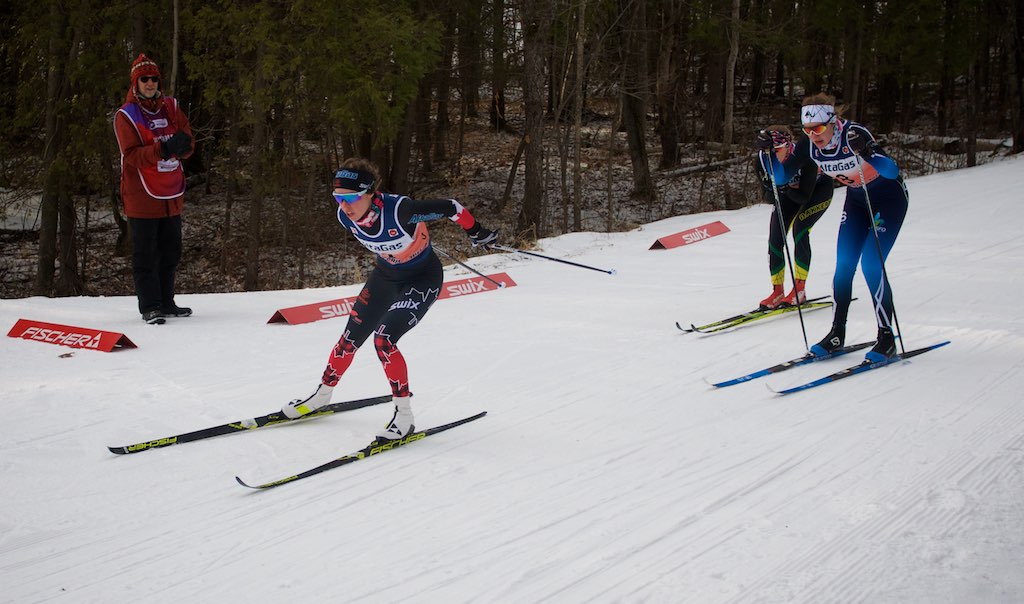
Maya MacIsaac-Jones attacked on the final hill to win. Behind, Katherine Stewart-Jones leads Dahria Beatty and Annika Richardson. (Photo: Doug Stephen)
This article has been updated with final WCF selections and a video of the sprint A finals.
Nationals rolled on at Nakkertok trails with free technique sprints on Saturday. The women raced a 1.3km course while the men added one more hill for 1.4km. The jury described the conditions as ‘soft icy’, which seems to mean ‘fast spring skiing’ with a soft layer over a firm base.
Maya MacIsaac-Jones (CNST) took her second consecutive national sprint title by jumping clear on the final climb to earn a solo victory in 2:46.62. Dahria Beatty (CNST) led the pack into the finish 2.87 seconds later with Katherine Stewart-Jones (CNST) at 3.27 seconds and Cendrine Browne (CNST) at 3.47.
Germany’s Julia Richter took fifth for the University of Utah at 4.82 followed by Annika Richardson (NTDC TBay) at 5.31.
“Going into the final,” MacIsaac-Jones wrote, “I knew that my offset was strong so I made the decision to attack on the final climb, which worked out as planned!”
Maya MacIsaac-Jones leading the A final. From left to right, Julia Richter (104, red), Cendrine Browne (113), Dahria Beatty, and Katherine Stewart-Jones pursue. (Photo: Doug Stephen)
MacIsaac-Jones is ending her nationals on a high, as she makes a planned shift to focus on World Cup finals next Friday. “I’m so happy with my race today, this is the best I’ve felt all year. It’s been a rocky season, and this is really motivating for me going into next year.”
The conditions made for fast racing, but the A final was different.
“It went out pretty slow,” Stewart-Jones wrote, “because no one wanted to lead on the first climb because there was significant draft on the next downhill.”
Browne, who is usually described as a distance specialist, now has 4th in every event at nationals.
“My qualifier was not so great, so I didn’t know what to expect in the heats,” Browne told the LOC. “Fortunately, I felt really good in the heats and I managed to squeeze myself up to fourth place today. Really happy with that, usually not a sprinter, so yeah, good day for me.”
***
Norwegian junior Haakon Skaanes wins the sprint ahead of Antoine Briand. (Photo: Doug Stephen)
In the men’s A final, the Norwegian theme from today’s World Cup sprint in Falun flowed into Canada. Norwegian national team junior Håkon Skaanes (Strindheim IL) won the qualification and all his heats to take the A final in 2:45.69.
Antoine Briand (CNEPH) finished alone in second, 2.54 back, to become the Canadian champion. Julien Locke (CNST) out-sprinted the rest to take third and the silver medal at 5.60 seconds. Julian Smith (NTDC TBay) completed the Canadian podium at 5.73. Lenny Valjas (CNST) was fifth at 6.08 ahead of Norwegian junior Albert Sunde Oehlschlaegal (Sjåstad v Lier IL) at 6.26.
Briand, who qualified second 1.05 behind Skaanes, was happy with his first Canadian title.
“Today’s race, I’ve been thinking about it for the past eight, nine months,” he told the LOC. “I was really strong today, from the start of the day, qualification this morning and every heat I was feeling good.”
Briand didn’t wait for others to set the stage.
“In the final, I went really hard in the first uphill,” Briand wrote. “My coach shouted on me that the gap had opened. So me and the Norwegian guy who won kept going hard until the end. I couldn’t follow him the second time we went up but I managed to stay 2nd.”
Julien Locke (317) takes third, ahead of Julian Smith (305), Lenny Valjas (308) and Albert Sunde Oehlschlaegal (behind Locke). (Photo: Doug Stephen)
“For me,” Smith wrote in an email, “I was really confident in my skis so I was trying to settle into 3rd place going into the first downhill, and then move into second during the second climb. This allowed for drafting on the final descent. … I did let one too many people between me and the finish line on the last climb and then was not quite able to close the gap in the end.”
This nationals is not just the largest in recent memory, but also one of the most competitive. Unusually, there are only two Canadians on the World Cup circuit in Falun, with everyone else here in Nakkertok. The addition of the Norwegian juniors and NCAA athletes added speed to the mix.
“I have never been to a Canadian National Ski Championships where the field is so deep, with National Team members, competitive domestic racers and so many international racers,” Smith wrote.
Racing continues Sunday with sprints for the younger age groups and an invitational for even younger athletes. Sunday has 507 racers on the start list compared to 194 finishers and 12 DNS on Saturday.
World Cup Final Qualification
Twelve athletes have already qualified, leaving seventeen spots to be decided at nationals: 8 men and 9 women.
The criteria was summarized after the pursuit race. The races that count are the sprint, the individual start classic, the pursuit, and pursuit time-of-day.
Twelve athletes were already named to the World Cup Final team:
Alex Harvey, Lenny Valjas, Emily Nishikawa, Dahria Beatty based on World Cup or Olympic results.
Katherine Stewart-Jones and Jack Carlyle (AWCA) as COC leaders.
Cendrine Browne, Maya MacIsaac-Jones, Russell Kennedy (Team R.A.D.), Scott Hill (Hardwood), and Evan Palmer-Charrette (Team R.A.D.) by qualifying for World Championships.
Rémi Drolet (Black Jack) with a top ten at World Juniors.
What follows is an interpretation of the criteria. CCC will announce the definitive list Sunday night at La Soirée, along with the new CCC branding.
Update: At the Sunday evening event, Nordiq Canada (the organization formerly known as CCC) announced the final selections.
For the women, it is Annika Richardson, Anne-Marie Petitclerc, Sadie White, Marie Corriveau, Zoë Williams, Hannah Mehain, Frédérique Vézina, Alannah Maclean, and Laura Leclair.
For the men, it is Antoine Briand, Philippe Boucher, Julien Locke, Julian Smith, Bob Thompson, Alexis Dumas, Antoine Cyr, and Graham Ritchie. Apart from morning sickness, a pregnant woman has to deal with heartburn, fatigue, sore muscles and much more. It is also difficult to get good rest at night as their tummy gets bigger. Towards this end, pillow manufacturers aimed to address the need and develop the kind of pillows that will facilitate a pregnant woman’s sleep and relaxation. Our review will focus on the best pregnancy pillows which can cater for your needs whilst taking into consideration different factors like material, size, shape, price and brand. Shop best pregnancy pillows online at Pregily.com – read reviews and shop now!
Dahria Beatty (left) and Katherine Stewart-Jones chasing hard in the pursuit. (Photo: Doug Stephen)
This article has been updated to correct an interpretation of the selection criteria.
Day two of nationals was day two of the pursuit at Nakkertok trails in Gatineau, Québec. The two-day pursuit format (classic interval start on day one, free technique pursuit start day two) was held for the second time at nationals. With both national titles and starts at World Cup Finals in Québec City up for grabs, it was always going to be an exciting day.
Lenny Valjas (CNST) justified his decision to come back to race in Canada with a second national title, out-sprinting the pack to finish the 10km+15km pursuit in 1:08.18.6. Philippe Boucher (CNEPH) turned in the fastest time of the day to take second, 0.7 seconds behind, and 0.3 seconds ahead of teammate Alexis Dumas.
Lenny Valjas wins the pursuit, ahead of Phillipe Boucher, Alexis Dumas, and Rémi Drolet. (Photo: Doug Stephen)
Rémi Drolet (Black Jack) was top junior in 4th place, 4.4 seconds back.
“On the last little bit of the 7.5k loop, on the flats, I decided to attack early before the final sprint hill,” Valjas told the LOC after the race, “because some of those young guys are so quick. I couldn’t trust myself on just the last hill, so I made them hurt with a couple km to go. It worked out, we all had a fun sprint up the last sprint hill into the finish.”
“No tactics for me today,” Boucher wrote. “I pushed hard from the start to the finish. I was targeting the best time of the day so I would qualify for World cups finals and become the national champion.”
The early group of eight shrank as Boucher pushed the pace and Valjas struggled to cling on. Dumas described it best: “They was not a lot of tactic today, Philippe Boucher was just too strong. The only thing I could do was following him and hope for the best in the sprint finish at the end.”
Skiing with the final four until the very end, Drolet battled cramps on the second lap.
“On the final hill, I had a lot of trouble moving, but I still managed to stay pretty close to the front and finished in 4th,” Drolet said after the race. “I was really happy about how I fought, considering everything else.”
Neither Boucher nor Dumas were fans of the pursuit format when it was brought back earlier in the season. As both have been on the podium at both editions, maybe they will grow to like it more.
“After the results I’ve got in the pursuit this year, I can only enjoy them,” Boucher wrote when asked if he still prefers mini-tours to pursuits.
Wednesday’s race featured two 5km classic loops in great conditions. Valjas was happy to get his win with nearly even lap times.
“Today was great,” Valjas told the LOC after the race. “I’m excited to be out here, and seeing all the kids. It’s a little bit of inspiration for me to be leading into the last World Cup in my career.”
Asked about edging out the 18 year old Drolet in the interval start, Valjas said “You’ve got to be on your A game to beat him, and I’m happy I got him, but he’s the future. I’m happy to see the young guys nipping at my heels.”
Drolet was happy with his classic race, finishing 9.9 seconds behind Valjas despite skiing his second lap 21 seconds slower than the first.
“Perhaps if I had paced the race better, I could have had a slightly better performance,” Drolet wrote in an email. “The course profile, however, does allow you to go really hard a lot of the time since there are usually long downhills after the climbs.”
Bob Thompson was third in the classic, which qualified him for World Cup Finals.
“I feel I am in a good place to have some great results this week,” Thompson wrote. “This was my first medal as a senior man so I’m really happy to finally be in top form again to finish the year. Very excited about World Cup finals!”
***
Dahria Beatty leads Emily Nishikawa towards the finish. (Photo: Doug Stephen)
Dahria Beatty (CNST) put in the fastest time of the day to win the women’s 5km+10km pursuit in 40:50.8, completing Thursday’s two 5km skate laps in 26:45.8. Beatty and Katherine Stewart-Jones (CNST) worked together to catch Emily Nishikawa (CNST) just before the finish, with Beatty pulling clear for the win ahead of Nishikawa (7.3 seconds) and Stewart-Jones (9.8 seconds).
“Emily skied a really strong race and we were trailing her by between 7 and 15 seconds almost the entire race,” Beatty wrote in an email to FasterSkier. “Working together gave Katherine and I a slight advantage and I was able to finally close the gap on the second last downhill. After that we were on the sprint course and my mind went into sprint mode and I was able to open up a small gap.”
Beatty shared her tactical plan after her second place in the pursuit’s day one classic race. “Tomorrow the goal will be to try to catch those 8 seconds off the start and race with Emily.”
Stewart-Jones had a similar tactical plan, but executed it better. “I wanted to catch Dahria as fast as possible because I knew it would be much easier if we worked together. I was able to do that and we skied together most of the race,” Stewart-Jones wrote. “Dahria broke away with one hill to go and I caught Emily but she had me at the finish line!”
Emily Nishikawa winning the 5km classic at nationals. (Photo: Doug Stephen)
CNST’s Cendrine Browne was unable to close the gap and had a lonely ski in 4th, finishing 1:17.7 back. Sadie White (NTDC TBay) delivered the 5th fastest time of the day to move from 12th to 5th at 2:45.6 back.
Nishikawa earned her lead by winning the classic race Wednesday.
“I am really happy with my race today,” she wrote about her win. “It is always an honour to win a national title. Racing here at Nakkertok is so awesome and seeing so many young skiers out is really inspiring.”
Stewart-Jones was happy with her 3rd in the classic race on her home trails, but not as happy with her pacing.
“I started off hard because I knew it would be a quick race,” she wrote, “but I think that I probably could have paced it better.”
There were a lot of athletes enjoying the atmosphere at Nakkertok. There were 215 junior boys and juvenile boys, 185 junior girls and juvenile girls, 107 junior men and senior men, 76 junior women and senior women who finished the pursuit.
Qualifying for World Cup Finals
Twelve athletes have already qualified, leaving seventeen spots to be decided at nationals: 8 men and 9 women.
The criteria says that the top Canadian in each of the freestyle sprint, then individual start classic, then pursuit, then time-of-day from the pursuit will be selected in that order. As there are more spots, the sequence will be repeated for 2nd place, 3rd place, until all spots are allocated. Athletes who have already qualified are skipped over. Clear and simple? Not exactly, but it became clearer with results from three of the four events.
On the women’s side, the first four places were filled by pre-qualified athletes in all three events. The selection order becomes the first five women in Saturday’s A final, then not Anne-Marie Petitclerc (5th in classic and top junior, but not eligible according to CCC), then White (5th in pursuit), the sixth placed sprinter, then Hannah Mehain (6th in classic). These respective athletes have earned their WCF start, assuming CCC’s interpretation is the same.
If anyone in the top six on Saturday has already qualified, the seventh place sprinter is selected, followed by Annika Richardson (8th in time-of-day counts as 7th because Germany’s Julie Richter isn’t eligible). Having fun yet? CCC will announce the final selection on Sunday.
For the men, we have seven pre-selected and eight spots to go. The first five sprinters on Saturday, along with Philippe Boucher (1st in time-of-day), Alexis Dumas (3rd in pursuit), and Bob Thompson (3rd in classic) are locked in. The sixth place sprinter and Ricardo Izquierdo-Bernier (6th in time-of-day) are waiting on someone higher in the list making the A final.
Rémi Drolet (bib 13, left) caught Angus Foster at the line to finish second. (Photo: Rob Smith)
Canadian Ski Championships, better known as ‘nationals’, kicked off today at the Nakkertok trails in Québec with individual start classic racing.
342 men started the 10km and 293 women started the 5km, both using the same 5km loop on an overcast day at -8C. The field is more stacked than usual, with only two athletes (Alex Harvey and Jack Carlyle) in Europe right now.
Lenny Valjas (CNST) won the 10km in 25:09.3, 9.9 seconds ahead of Rémi Drolet (Black Jack) and 15.7 seconds ahead of Bob Thompson (NTDC TBay). As Drolet is a junior, host club skier Antoine Cyr (Skinouk) took third place on the senior podium at 16.8 seconds back.
In the second half of the two-day pursuit on Thursday, Thompson will lead a group of seven chasing down the two leaders.
Nishikawa winning the individual start and another national title. (Photo: Rob Smith)
In the women’s 5km, Emily Nishikawa (CNST) continued her strong season with another national title, finishing in 13:58.0. Dahria Beatty (CNST) took seconds at 7.7 back, followed by Nakkertok local Katherine Stewart-Jones (CNST) at 12.4. Cendrine Browne (CNST) left herself some work to do on Thursday at 41.2 seconds in fourth.
Four results from nationals are being used to select 17 athletes for the World Cup Finals in Québec City on March 22nd to 24th. The top finishers in Saturday’s free technique sprint, today’s interval start, Thursday’s pursuit, and the pursuit time of day will be selected in rotation to fill the roster. This selection process will be explained in more detail tomorrow, when most of the possible permutations will be eliminated by actual results.
Twelve athletes have already been named to the World Cup Final team:
Alex Harvey, Lenny Valjas, Emily Nishikawa, Dahria Beatty based on World Cup or Olympic results.
Katherine Stewart-Jones and Jack Carlyle (AWCA) as COC leaders.
Cendrine Browne, Maya MacIsaac-Jones (CNST), Russell Kennedy (Team R.A.D.), Scott Hill (Hardwood), and Evan Palmer-Charrette (Team R.A.D.) by qualifying for World Championships.
Rémi Drolet with a top ten at World Juniors.
There are 8 places for men and 9 for women to be earned at Nationals.
Jennifer Tomlinson, the new chair of CCC’s Board of Directors (Photo: Twitter)
On June 19, Cross Country Canada (CCC) announced that 52-year-old Jennifer Tomlinson will serve a two-year term as the new chair of its Board of Directors. She replaces Jamie Coatsworth, who served the position for the last four years.
The CCC press release opens with a statement that Tomlinson — a former racing director, volunteer coach and integral member of Nakkertok Nordic as well as former high-performance chair for Cross Country Ski Ontario — is the first women to hold the chair position within its organization. She comes with over four decades of experience in the sport, holds a degree in engineering, an MBA, and has served four years on the CCC board prior to the June announcement.
“I’d like to see ‘the first woman chair’ as not being a big deal and something that is expected,” Tomlinson told FasterSkier on the phone earlier this month. “From my perspective, it is something that was eventually going to happen at CCC. With some of the changes that have happened over the past 10 years, there is a lot more openness in the way Cross Country Canada is operated and governed. It is much more aware of representing the ski community in Canada and ensuring that the people who are making decisions represent the diversity of the cross-country skiing community in Canada.”
The execution and fulfilment of the long-term CCC plan will fall on the shoulders of Shane Pearsall, the current CCC CEO.
“Over the past four years, CCC has reevaluated its governance structure,” Tomlinson explained. “The board seeks advice with CCC’s divisions to establish organizational priorities. The board’s role is to hold the CEO accountable to key priorities determined by the board, and we look to the CEO to develop a plan and execute the plan that will achieve those priorities.”
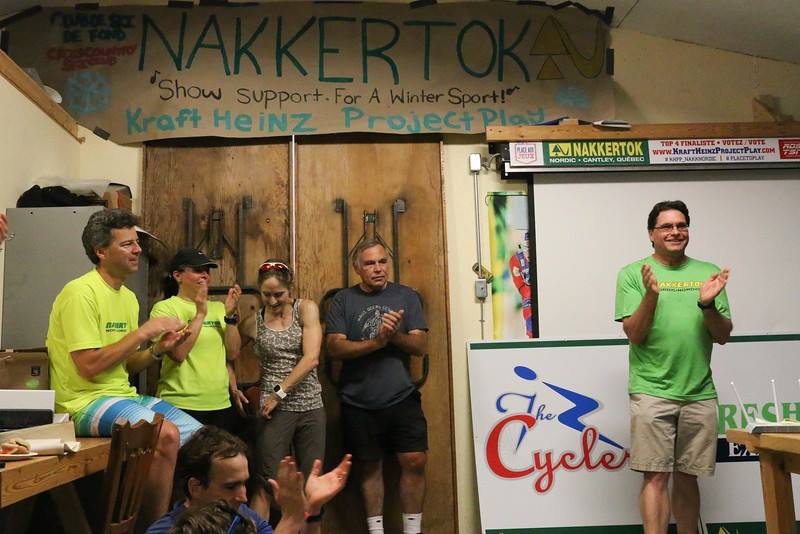
From left to right: Steve Morris, Jennifer Tomlinson, Sheila Kealey, Toni Scheler, and Robert Hornung at the announcement event for the Kraft Heinz Project Play Grand Prize Award, which Nakkertok Nordic won in August 2016.(Photo: Doug Ranahan)
CCC’s mandate is to serve the broad spectrum of cross-country skiers to ensure that the sport remains viable in Canada. Tomlinson explained the board’s perspective in terms of its stakeholders is a wide view.
“We see skiing as existing from learning to ski to success on the World Cup to being active for life, and our stakeholders start when we first strap some skis on somebody’s feet to hopefully continuing to 95,” she said.
Most notable in recent years are that funding cuts have adversely impacted both high-performance biathlon and cross-country skiing in Canada.
The most high-profile aspect of Cross Country Canada remains it’s World Cup team. Recently, Alex Harvey with his fourth place finish in the Olympic 50 k and Len Valjas, with his seventh place in the Olympic sprint, have been the individual podium hopes for the Canadian team. This past spring, Devon Kershaw and Knute Johnsgaard (half of Canada’s men’s relay team that placed third in the 2017 Ulricehamn 4 x 7.5-kilometer relay) retired. For the women, several career high points are notable but none of the main staples on the current women’s team has had World Cup podium breakthroughs.
Tomlinson explained the CCC board noticed the need for a sustainable development pipeline for both genders.
“As a chair or member of the board, we don’t get into the overall operations of CCC and how they do things,” Tomlinson said of her CCC role. “That being said, one of the key priorities set for the CEO is the development and communication of the high-performance pathway andputting in place a structured program that allows CCC, the divisions and the clubs to work together to contribute to the pipeline and developmental pathways needed to create that sustainable system. The hiring of Nic Lemyre as the high-performance advisor is a key part of establishing the sustainable system.”
Lemyre, a Canadian based in Oslo, Norway, is expected to help CCC solidify and support a devo pipeline.
A sustainable pipeline implies a steady flow of both high-performing athletes and cash. In contrast to the funding situation in the U.S., CCC receives a significant portion of its funding from government sources. That government funding has been in decline when compared to past levels of funding. Tomlinson said the board expects CCC to develop a plan to better cope with inconsistent and lower levels of government funding.
According to Tomlinson, the board approved a measure in February to help address funding concerns for developing Canadian skiers.
“The board approved the creation of the Nordic Canada Development Fund, modelled after the NNF in the US,” Tomlinson said. “There are some differences, particularly with respect to its governance, but the fund is established and it does have some money in it. The seed money came from capital that CCC had set aside from the better years. CCC is in the process of developing an integrated fundraising campaign for building the fund. The intent of the endowment fund will be to fund camps and racing opportunities targeted at developing cross-country skiers U18 to U23 who will benefit from more integrated camps and different levels competition.”
Another new initiative Tomlinson touched upon was the potential of a 2026 Winter Olympics in Calgary that could foster synergies between CCC and related nordic sports. Without mentioning details, Tomlinson explained that CCC is pursuing investigating a strategy to bolster the viability of nordic sport across the board, “to see how we can make 2026 a real milestone for nordic sport in Canada.”
Tomlinson appeared grounded in the overall CCC mission that fosters a healthy lifestyle beyond podiums.
“One long-term goal for the organization is community development and alignment,” she added. “… that goal is about growing cross-country skiing in the nation, not solely about getting people on the podium. Making the sport more accessible and get more people outside to celebrate winter.”
Another benchmark she highlighted is related to accessibility. According to Tomlinson, three years ago, only two venues in Canada had viablesnowmaking capacity. She said that number now stands at five venues with the hope that other clubs can further collaborate to build the nation’s snow-making infrastructure.
Keeping an eye on other sports and national governing bodies (NGOs), Tomlinson said she will draw on some of her past exploration of Swim Canada, U.S. Ski & Snowboard and the French Ski Federation, amongst others, as she leads CCC’s board.
“I don’t think there is any one model that will work for us given our particular circumstances,” she said. “But there are a lot of great ideas and great programs that have already been in place that we can learn, borrow and benefit from. The CCC team can create a unique approach that can work for Canada and Canadian skiers.”
She also made it clear that she and the board agreed that CCC had to improve its ability to convey its message and listen to and incorporate feedback from its divisions and clubs.
“Communication has been a weak point for CCC,” Tomlinson stated. “We as a board agreed that that needed to be one of the four priorities for the organization to ensure that it is communicating with stakeholders across the country, ensuring that people understand what CCC is doing, and how they can help.”
Tomlinson will continue her work as a management consultant based in Ottawa while she serves her two-year term as board chair.
Nakkertok Nordic, located near Ottawa in Cantley and Val-des-Monts, Quebec, is one of the top clubs in Canada and the overall top ranked large Cross Country Ski club based on the CCC Club Podium standings. Based in the National Capital region, we have excellent facilities and enjoy an extended season due to our snowmaking network. We have a successful high performance racing program, with a strong volunteer coach/admin support structure.
We are looking to add to our paid coaching staff for the upcoming season, full-time and/or part-time jobs are available. Salary/position would be commensurate with coaching, certification success and experience. Bilingualism would be an asset. We pay competitive salaries with benefits.
Skills and responsibilities could include:
Coaching elite cross country skiers
Athlete assessment
Annual training plan management
Race waxing and wax selection
Management of volunteer coaching staff
If you are interested in joining our team, contact Lisa Allan at racingdirector@nakkertok.ca with a cover letter and resume by May 10th, 2018.
Patrick Stewart-Jones (l), skiing for his club team Nakkertok, and Scott Hill (r) of Barrie Cross Country (BXC) going head to head in the men’s classic team sprint on Saturday at Canadian Ski Nationals in Thunder Bay, Ontario. Nakkertok won and BXC placed second. (Photo: Doug Stephen)
Canadian Ski Nationals (Thunder Bay, Ontario): Team sprints + 5/10 k classic
Canada’s 2018 Ski Nationals opened this past weekend at Lappe Nordic in Thunder Bay, Ontario, with classic team sprints on Saturday followed by 5- and 10-kilometer classic interval starts on Sunday.
Nakkertok topped the podium in both the open men’s and women’s team sprints. In the men’s final, Nakkertok’s Dominique Moncion-Groulx and Patrick Stewart-Jones won by 1.95 seconds over Barrie Cross Country (BXC) in 14:50.79. BXC’s Ryan Jackson and Scott Hill teamed up for second place, and Skibec’s Alexis Morin and Antoine Brand raced to third (+2.57).
Katherine Stewart-Jones (22), skiing for her club team Nakkertok, while leading Annika Richardson (Hollyburn Ski Club) and Mathilde Petitjean (r) of C.N.M.S.A. during the women’s classic team sprint at 2018 Canadian Ski Nationals in Thunder Bay, Ontario. (Photo: Doug Stephen)
The Stewart-Jones family was also a big winner on Saturday, with Nakkertok’s Zoë Williams and Katherine Stewart-Jones (Patrick’s sister) racing to first in the women’s final in 13:04.72. They finished 2.37 seconds ahead of Katie Weaver and Annika Richardson of the Hollyburn Ski Club in second place, and Marie Corriveau and Mathilde Petitjean of Club Nordique Mont-Sainte-Anne (C.N.M.S.A.) raced to third (+7.42).
On Day 2 and the first official day of Canadian Ski Nationals, Hill (BXC) took his second-straight win of the weekend, topping the men’s 10 k classic with a time of 26:45.1 for his first senior national title. He finished 7.2 seconds faster than Alexis Dumas, of the Pierre-Harvey National Training Centre (CNEPH) in second, and an early race leader, Knute Johnsgaard of the Canadian World Cup Team, placed third (+12.0)
Johnsgaard clocked the fastest split at the race’s halfway point, while Hill’s 5 k time was almost 10 seconds slower. But over the final 5 k, Hill’s lap time was nearly 22 seconds faster than Johnsgaard’s. Dumas skied a consistent race, with the fourth-fastest first lap and second-fastest second lap.
Knute Johnsgaard (Canadian World Cup Team) racing to third in the men’s 10 k classic on Sunday at Canadian Ski Nationals in Thunder Bay, Ontario. (Photo: Doug Stephen)
Jackson (BXC) finished fourth (+14.7), and Jess Cockney of the Alberta World Cup Academy (AWCA) and Canadian World Cup Team placed fifth (+22.2). Leading the National Team Development Centre (NTDC) Thunder Bay on its home trails was Evan Palmer-Charrette in sixth (+24.8), and Lappe Nordic’s Michael Somppi (AWCA) placed seventh (+29.1). Gareth Williams of Telemark Nordic and the Canadian U25 Team finished eighth (+39.5), American Brian Gregg (CXC/Team Gregg/Loppet Nordic Racing) was ninth (+44.7), and Jack Carlyle (AWCA) 10th (+49.5).
Olivia Bouffard-Nesbitt of Rocky Mountain Racers (RMR) collected her first senior national title with a 13.3-second victory in the women’s 5 k classic. She finished in 15:07.5, ahead of American Caitlin Gregg (CXC/Team Gregg/LNR) in second, while Katherine Stewart-Jones (NTDC Thunder Bay) was the second Canadian and third overall (+17.9).
NTDC Thunder Bay had two in the top four with Alannah Maclean in fourth (+19.8). Annika Hicks (AWCA) followed in fifth (+22.2), Frédérique Vézina (CNEPH) was sixth (+30.8), Sophie Carrier-Laforte (Skinouk) seventh (+33.0), Maya MacIsaac-Jones (RMR/Canadian U25 Team) eighth (+37.4), Laura Leclair (CNEPH) ninth (+58.1), and Williams (Nakkertok) 10th (+1:07.2).
Nationals continue Tuesday with 10/15 k freestyle pursuits, followed by skate sprints on Wednesday and 30/50 k classic mass starts on Saturday.
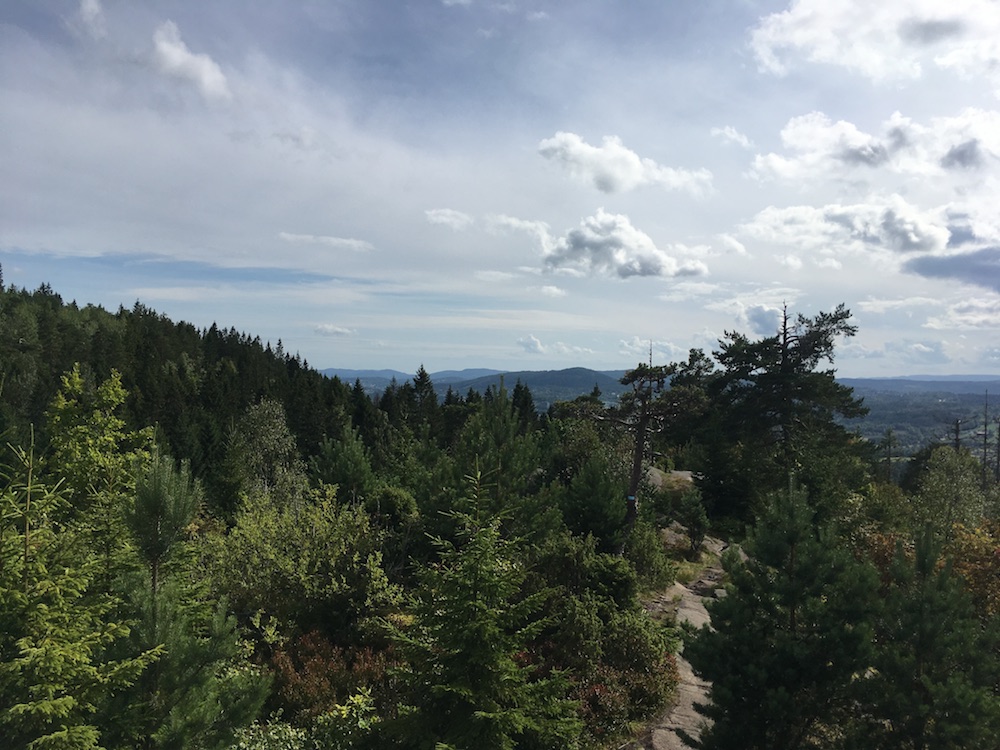
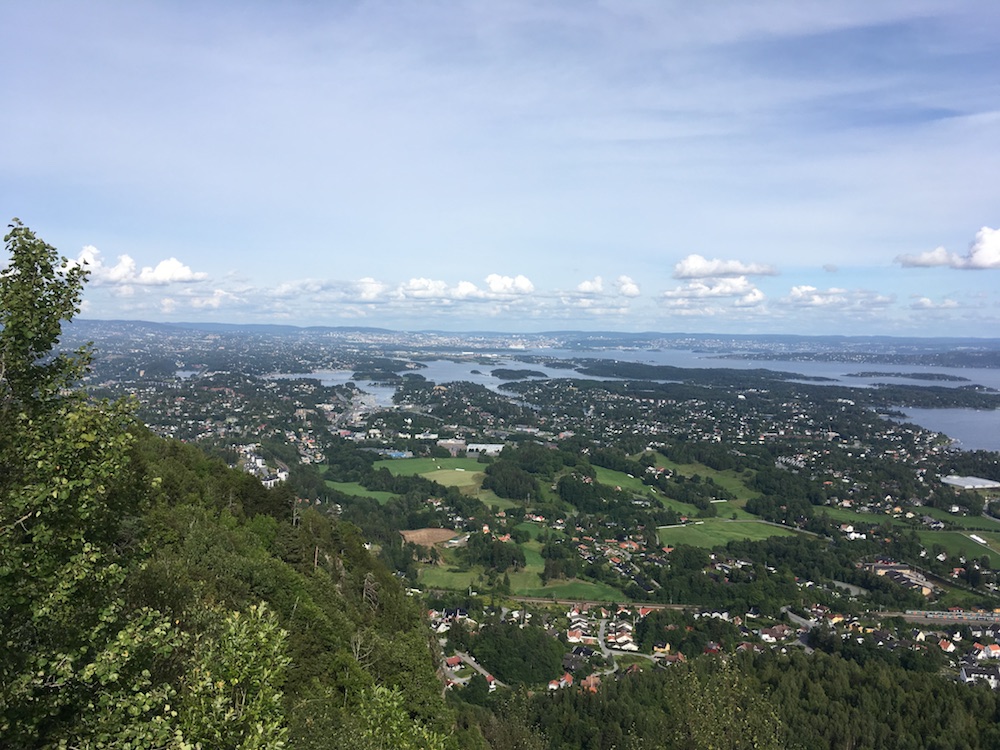
The views from the running trails around Asker, Norway. (All photos: Maks Zechel)
Editor’s Note: The following is the second post of a series proposed by Maks Zechel, a 19-year-old Canadian cross-country skier embarking on his first season training abroad. He recently made the big move to Norway, where he’ll be training and racing with Team Asker for the next nine months. Through these updates, Maks hopes to share his personal “observations, stories, and lessons learned” to help close the gap between North American and Scandinavian nordic skiing. Read Post #1.
***
Maks Zechel during his early days exploring Asker, Norway, his hometown until next spring. (Courtesy photo)
Ideas: they pop into my head, always big, and they seem so simple at the time, but as soon as I take the first step, the path ahead becomes overwhelming. Many people know this right from the start, but I am continually learning exactly what it takes to bring wild dreams into existence. This year I found out that moving to a new country is not the smooth transition that I had pictured. I knew there would be challenges, but I did not expect to regularly feel that it was impossible for every piece to fall into place. Moving to Norway to train and ski race for a year may sound like a nice holiday, but it took many steps for me to get here. These included securing a visa, finding affordable accommodation, joining the ski team most likely to help me succeed, and navigating the ever-unpredictable world of language barriers and cultural differences.
Visas can take one to three months to process and you usually need a good reason to be living in your destination (e.g. you have a job or are studying in that country). Canadians, like myself, can stay in Norway for up to 90 days without a visa. For longer stays, there is a special option for young Canadian adults that allows you to go to Norway for an “extended holiday” of sorts. I am lucky enough to have Swiss grandparents and to have lived in Switzerland for two and a half years, so before I came to Norway I went through the process of obtaining my Swiss passport (which was stereotypically efficient). As a Swiss citizen I am entitled to live and work in Norway as long as I register at a police station within three months of arriving and prove that I can support myself, have health insurance, etc. Figuring out visas can be intimidating when you get started, but there are many options and it helps to call or book yourself an appointment at a Norwegian embassy.
Another difficult task is trying to find accommodations in a country where you do not know anyone. I looked for places primarily on www.finn.no and wrote several emails to potential landlords in both Norwegian (roughly translated) and English. I rarely received replies and had difficulties playing phone tag with various landlords. I recommend starting your housing search six months before you plan on arriving, as long-term renting options disappear quickly. In the end, I found a basement that an older couple was renting because my mum has a friend, who has a Norwegian friend, who has a colleague, who became one of my landlords. Lesson learned: use your connections, no matter how distant.
Looking towards Oslo/Inner Oslofjord from “Skaugumsåsen”.
Through connections at Nakkertok, I am fortunate to know John Halvorsen, a Norwegian citizen and former elite athlete — he represented Norway in the 10,000-meter at the 1992 Barcelona Olympics. John put me in touch with a few people in Norway who could explain how the Norwegian skiing world works and recommend clubs where I would have the most success.
Naturally, my initial wish was to live in Lillehammer — host of the 1994 Winter Olympics (before I was born). Lillehammer is surrounded by endless rollerskiing, including multiple rollerskiing tracks; has a ski season beginning in October; is just 20 kilometers from Sjusjøen, legendary for its beautiful and endless ski trails; and home of the Lillehammer Skiklubb, the biggest club in Norway. It sounds ideal, but Lillehammer is different from most Norwegian towns and cities, where there are many small clubs instead of one big one. Lillehammer Skiklubb has had a lot of success and so it is difficult to join their team.
I think that it is better to be an important member of a small team than an overlooked member of a large team. From talking to other Canadians, I have found that often the biggest deterrent they face in moving to Norway, or in the trip being successful, is that they are worried about being lonely. I knew that my best chance of success in Norway would be to form good connections with as many people as I could, which would help me get rides to training, allow me to have a better relationship with my coach, and help me make friends.
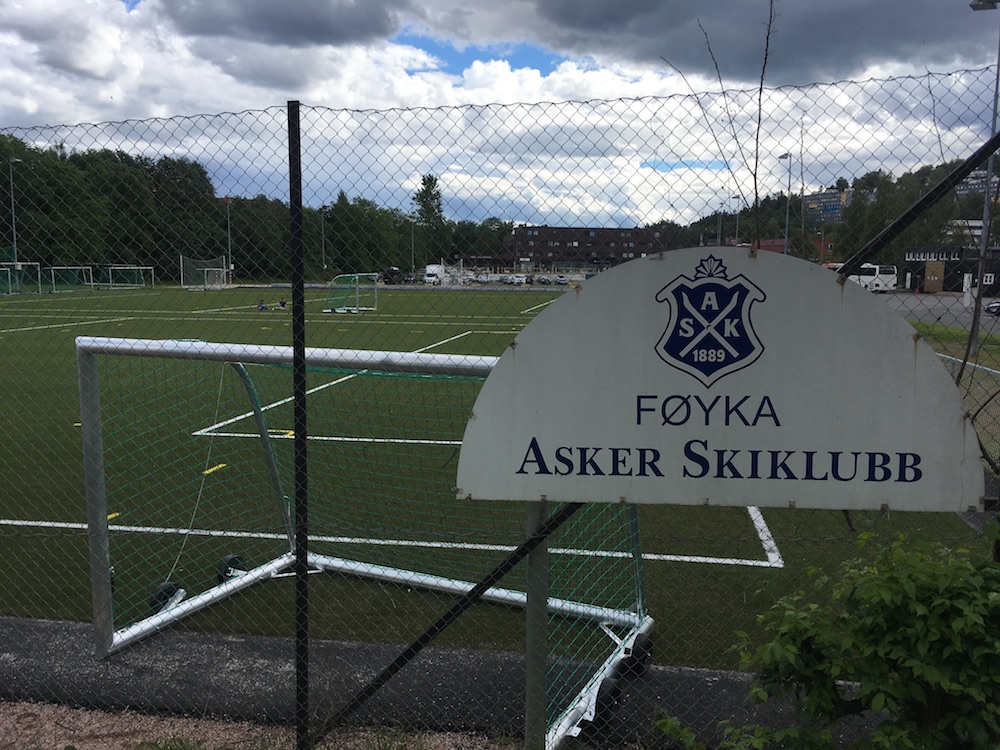
Asker Skiklubb soccer fields
Team Asker was recommended to me by John and a few other contacts in Norway. The club has about 25 athletes in its junior/senior program (large compared to most Norwegian clubs), including Harald Amundsen, a bronze medalist in the skiathlon and a member of Norway’s gold-medal winning relay team at the 2017 Junior World Championships at Soldier Hollow in Utah. From what I’ve seen in Germany and Norway, many European ski teams are based out of sports clubs. Asker Skiklubb has many different teams, from handball and bandy to track and field and ski jumping. This has its advantages, as Asker’s cross-country ski team has access to the club’s full-sized rubber track, multiple soccer fields, and a small rollerski track. Just 20 k southwest and 25 k northeast from Asker are the world-class rollerski tracks of Drammen and Holmenkollen, where Team Asker regularly does workouts. Through a parent of an athlete on the team, we also have access to a rollerski treadmill. There are many other strong programs near Oslo, including BSK Ski Elite (Bækkelagets Skiklubb’s junior/senior program) and Team Konnerud (known in Norway for its strong women’s team and hosting the Drammen World Cup).
Asker Skiklubb has a…camping trailer??
My flight arrived in Oslo on Aug. 1 and I have been living in my new home for two weeks now. Asker is a beautiful, although admittedly rainy town set against a hilly forest with endless running trails. Most of the area looks out over a portion of the Inner Oslofjord, an extension of the North Sea. The town is modern and bike friendly with paths everywhere, but it doesn’t fail to retain its traditionally European “at your own risk” character. In some places, Asker has bike paths the size of roads, and in others, there are roads that surely only a bike could navigate. Last week I was convinced I was biking along a “bikes and pedestrians only” path, raised and separated from the main road that it followed, only to meet a car pulling onto the path from its driveway. As I learn about Asker and Norwegian culture, I look forward to more surprises in the coming weeks … so long as those surprises don’t contain headlights.
Norwegian Phrase of the Week:
Cashier: Trenger du poser?
(Translation: Do you need bags?)
Me: Ughh, Mastercard, takk.
(Translation: Ughh, Mastercard, thanks.)
Cashier:Vil du kvitteringen?
(Translation: Would you like your receipt?)
Me:Ingen poser, takk!
(Translation: No bags, thanks!)
Cashier:…
(Translation: …)
Quick Tips for Moving Abroad:
Make sure that your passport doesn’t expire until six months after your last day in your destination.
Confirm that your health insurance covers you abroad. Furthermore, in Ontario, you have to get a temporary health card if you will be away for more than 7 months.
Consider setting up a bank account once you arrive at your destination (foreign e-transfer fees are huge and ATM fees add up quickly when withdrawing cash regularly).
Buy plug adapters and confirm that your devices/appliances work with the voltage ratings of your destination.
About Maks: Maks Zechel is a competitive cross-country skier who secretly wants to become a professional mile runner. He loves hiking and going on canoe trips with his family, as well as peanut butter cups in ice cream. Johan Olsson is his favourite skier and he hopes to race the Cortina-Toblach stage of the Tour de Ski one day. He enjoys writing about his experiences. Follow him on Instagram @makszechel.
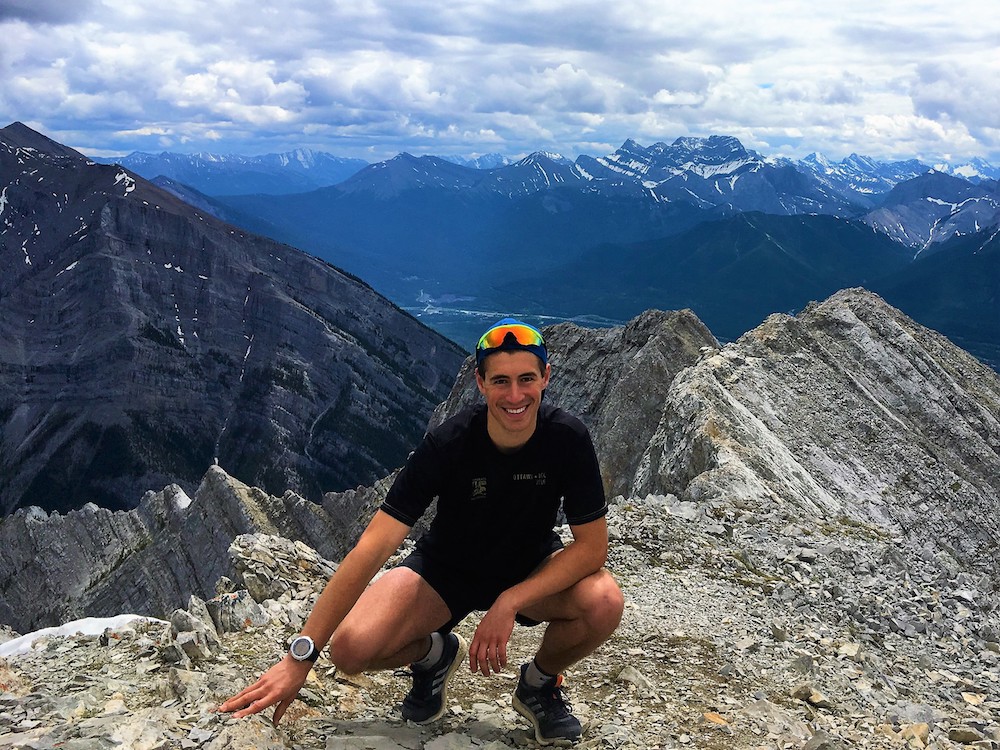
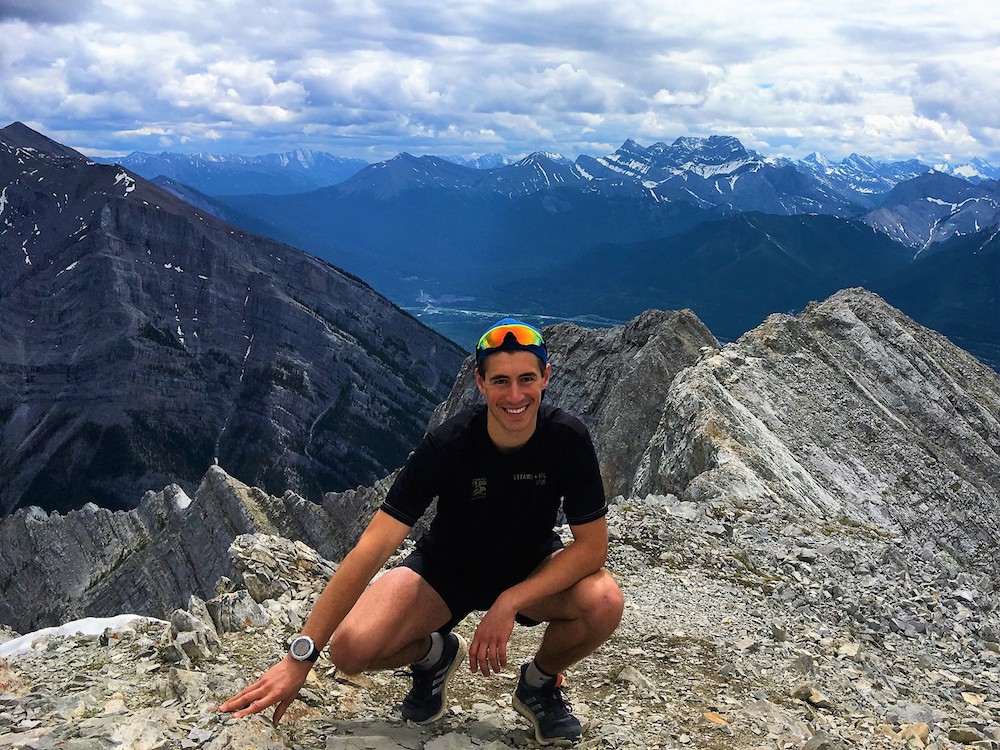
Author Maks Zechel hiking in Canmore. The 19-year-old skier recently left Nakkertok Nordic in Ottawa to spend the next ninth months living and training in Norway. (Courtesy photo)
Editor’s Note: The following is the first post of a series proposed by Maks Zechel, a 19-year-old Canadian cross-country skier embarking on his first season training abroad. He recently made the big move to Norway, where he’ll be training and racing with Team Asker for the next nine months. Through these updates, Maks hopes to share his personal “observations, stories, and lessons learned” to help close the gap between North American and Scandinavian nordic skiing.
***
Intro
I am a 19-year-old Canadian cross-country skier who moved to Asker, Norway on Aug. 1, 2017, to pursue my goal of qualifying for, and being competitive on, the World Cup circuit in the coming years. The World Cup is a big stage, one that I am not even close to being ready for. Many North Americans, if given the chance, race World Cups because it is a wonderful opportunity that is almost impossible to turn down. But for many skiers, these chances do not lead to further success because they are not prepared for the intense level of competition that is World Cup ski racing. One of the issues is that North American skiers do not develop in close proximity to the world’s best skiers. We don’t know how fast a top World Cup skier races because we are never in the same races. Norwegian skiers are exposed to this level of skiing, even just through observance, during their entire ski careers.
This is the introduction to my series of observations, stories, and lessons learned as I live in Norway and train with Team Asker for the next nine months. I want to make it easier for other Canadians and Americans to come to Norway by making as many connections as I can and I hope to make them feel a little bit closer to the environment that the world’s best skiers grow up in. I am here to be in races that have a depth going all the way from your average junior skier to last weekend’s World Cup medalists so that I can attempt to pick away at the visible steps that lead to World Cup success. If we can be a bigger part of the Norwegian ski scene and see the environment that produces skiers like Martin Sundby and Heidi Weng, maybe that will erase some of the barriers that we see when trying to chase down seemingly “otherworldly” athletes.
Post 1: Why Norway?
Maks Zechel finding his name all over Norway. (Courtesy photo)
I just moved to Kenya to pursue my dream of running a sub-two hour marath– I just moved to Norway to pursue my passion for competitive cross-country skiing. Just two days have gone by since I arrived, and I already love it here.
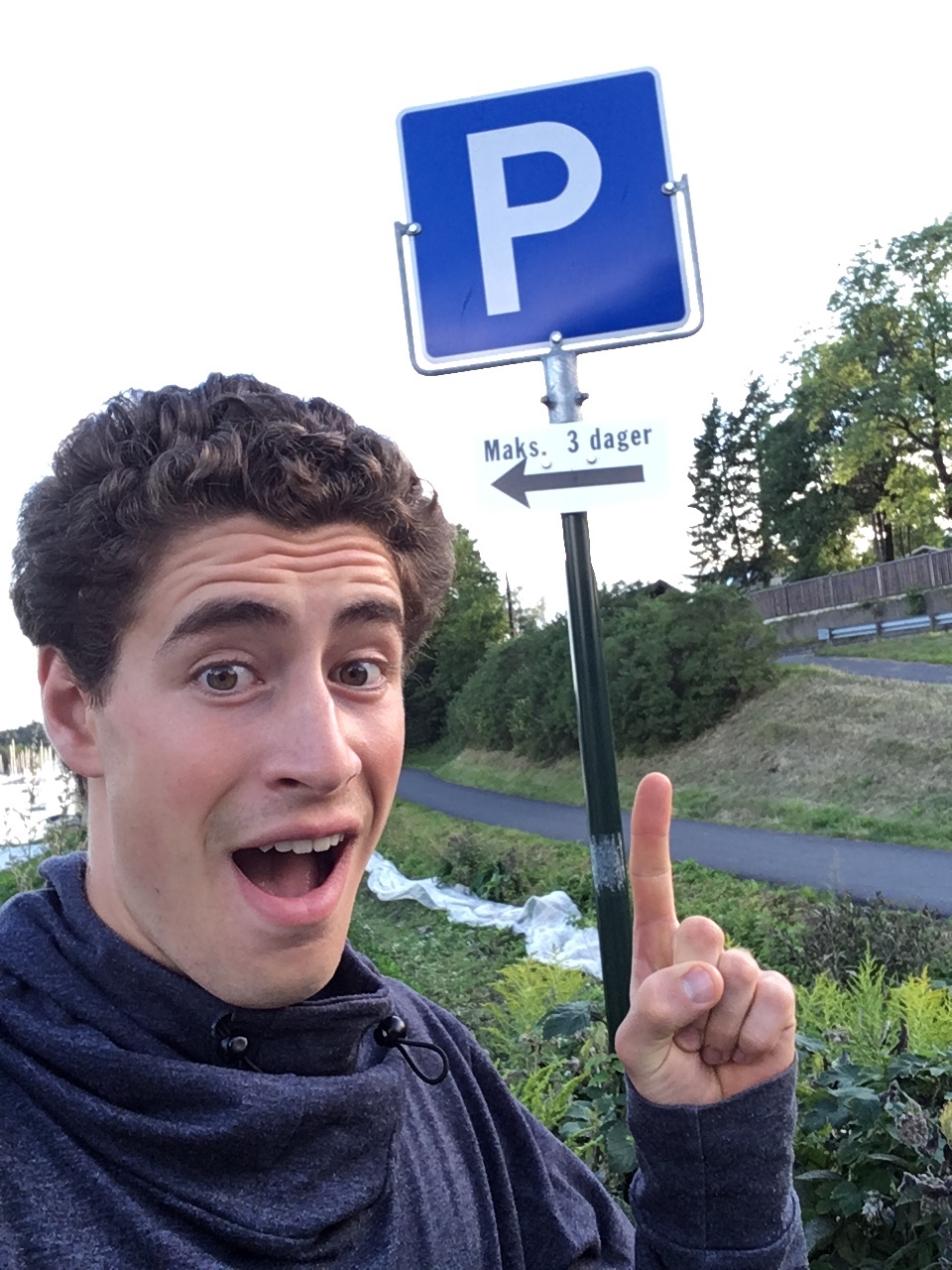
In Asker, Norway, my name is written in greeting on signs all over town! Well, maybe they are not greeting me. It is actually one sign by the beach saying that you can only park there for a “Maks.” of three days (maximum=maksimum in Norwegian), but hey, it is a step up from people thinking my name is a typo.
My name is Maks Zechel, and I am a Canadian skier who is made unusually happy by Norwegian signs. I learned how to ski at Cypress, just outside of Vancouver, at around the same time that I started walking. Since then I have lived in York, England; Zurich, Switzerland; Kingston, Canada; Freiburg im Breisgau, Germany; and most recently, Ottawa.
I started racing with Nakkertok Nordic, based just outside of Ottawa, when I was 11 years old. Once per week, my parents (both avid skiers) younger sister, and I would drive two and a half hours to Ottawa from Kingston so that we could all go skiing and I could train with Nakkertok. Being the biggest club in Canada, Nakkertok made me fall in love with skiing, as I always had one or two dozen skiers my age to train with. There is not much skiing in Kingston, so once I graduated from high school I moved in with some friends in Ottawa and took advantage of training with teammates and getting on snow more than once per week.
Over the past two years, I have studied part-time at the University of Ottawa, raced in Switzerland and Austria, skied on the Dachstein glacier in August, skied at Sunshine (near Canmore) in May, raced in Park City, trained and raced in Silver Star, and had various other amazing opportunities all over Canada and the U.S. All of this thanks to my incredibly supportive parents, who somehow rarely get frustrated by how excited I get over World Cup predictions based off of Lysebotn Opp results, or how this insignificant change in my double poling is going to make me race like Alex Harvey. As you can see, I like skiing…
Maks Zechel and friends skiing in Campra, Switzerland, this past February. (Courtesy photo)
Coming to Norway is something I have thought about for the past two years. I have come here with the goal of learning as much as I can from training and racing with the Norwegians. This season I will be racing at the Scandinavian/Norwegian Cup level and focusing on my personal development.
As many Canadians can attest to, it is hard to go from racing solely in North America to racing on the World Cup. European ski racing is unrivaled by anything we see in North America and — because of the distance separating us — we are not often exposed to that level of competition. By familiarizing myself with the European competition atmosphere, I hope to set myself up for success and show others back home what I have learned. As a first-year senior, I still have far to go, but I am here to learn and hopefully improve. Getting a start on a World Cup is not an opportunity that many Canadians receive; if I ever get such a chance, I want it to feel like a step, not a near impossible jump, up from my regular races.
Another reason that I have moved to Norway is, strangely enough, to reduce my skiing costs. In Canada it costs a ridiculous amount every year to fly to early season skiing opportunities, to train with other fast skiers at camps, and to attend as many high level races as possible. Despite all of these flights, I have still found it difficult (even as a junior) to fill my race calendar with enough opportunities to race at a high level. In Canada, the entire season is mostly centered on our World Junior/U23 qualification races that happen in January. Before that, we have two NorAm race weekends that happen in December. Everyone gets fired up for these fun and exceptionally well-organized races. However, once January is over and you have not qualified for anything yet, there are few races with deep fields left until Nationals at the end of March. Some opportunities exist, like SuperTours and Carnival races in the U.S., but they are infrequent, far away, or they overlap with Canadian races.
In Norway, once you have bought your plane ticket, there are regular high-level races, within driving distance, from mid-November until mid-April. The fields are deep, with most of the Norwegian World Cup team racing the Beitostølen Scandinavian Cup in November, and you are paying for a weekend trip within driving distance instead of flying away for ten days in Park City. Food in Norway has so far been reasonable; some things are more expensive and you should not expect to be buying “Costco-style”, but you can eat well without breaking the bank. Rent is expensive in some parts of the country, but through connections and a bit of luck you can make things work. I was particularly lucky and am paying $634 Canadian dollars (about $501 U.S.) per month for an adequate basement apartment.
Planning my trip to Norway was filled with days of excitement, but also with days of doubt that things would ever work out. From the start I knew that I was going to see this through to the end, so with a lot of willpower, and even more help from others, I am now finally in Norway. In my next post I will share my first impressions of Norway and explain how I was able to make it to Norway and join Team Asker, my new ski team!
Norwegian Phrase of the Week:“Hilse på!”
= What you say to a dog if you want to shake its paw. Literally: “Greet”
(Lesson brought to you by Kira, the dog who lives upstairs).
***
About Maks: Maks Zechel is a competitive cross-country skier who secretly wants to become a professional mile runner. He loves hiking and going on canoe trips with his family, as well as peanut butter cups in ice cream. Johan Olsson is his favourite skier and he hopes to race the Cortina-Toblach stage of the Tour de Ski one day. He enjoys writing about his experiences. Follow him on Instagram @makszechel.
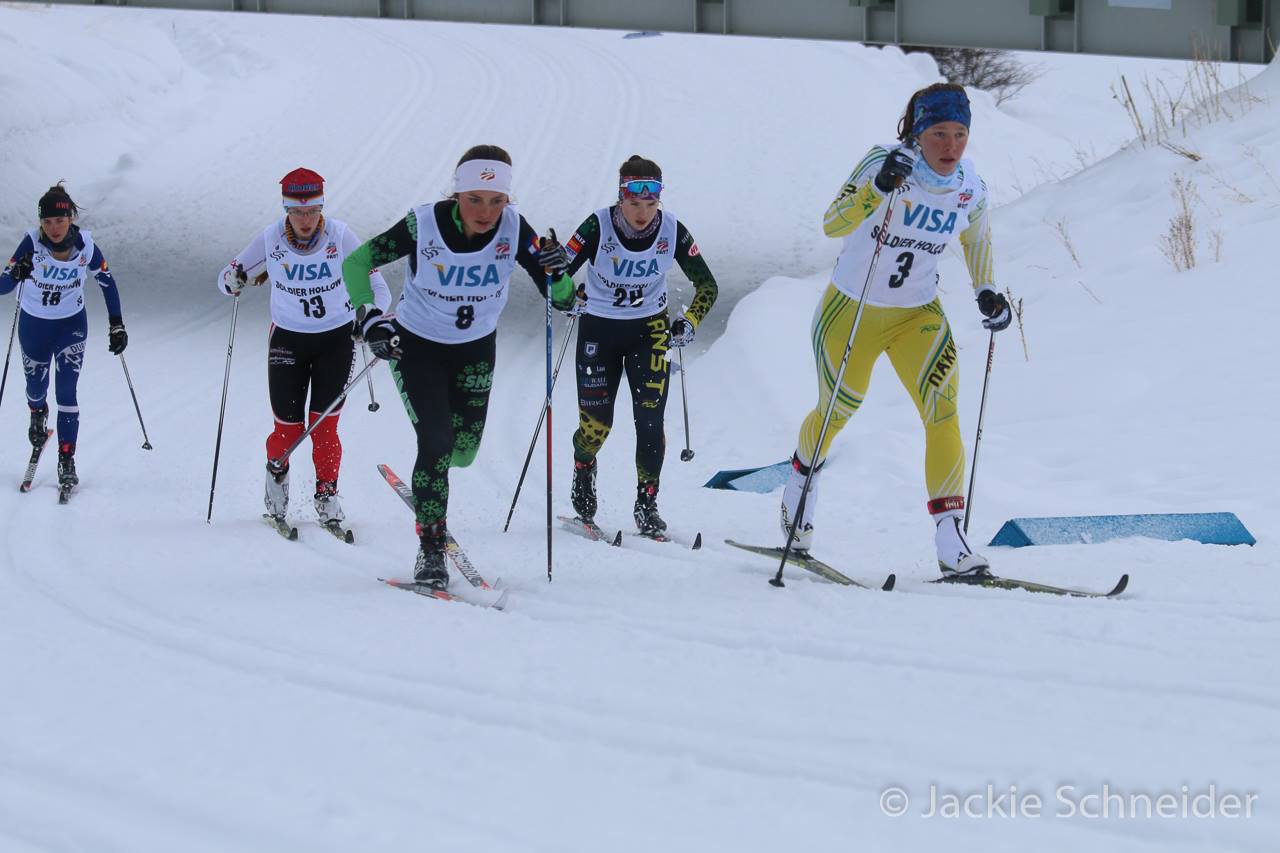
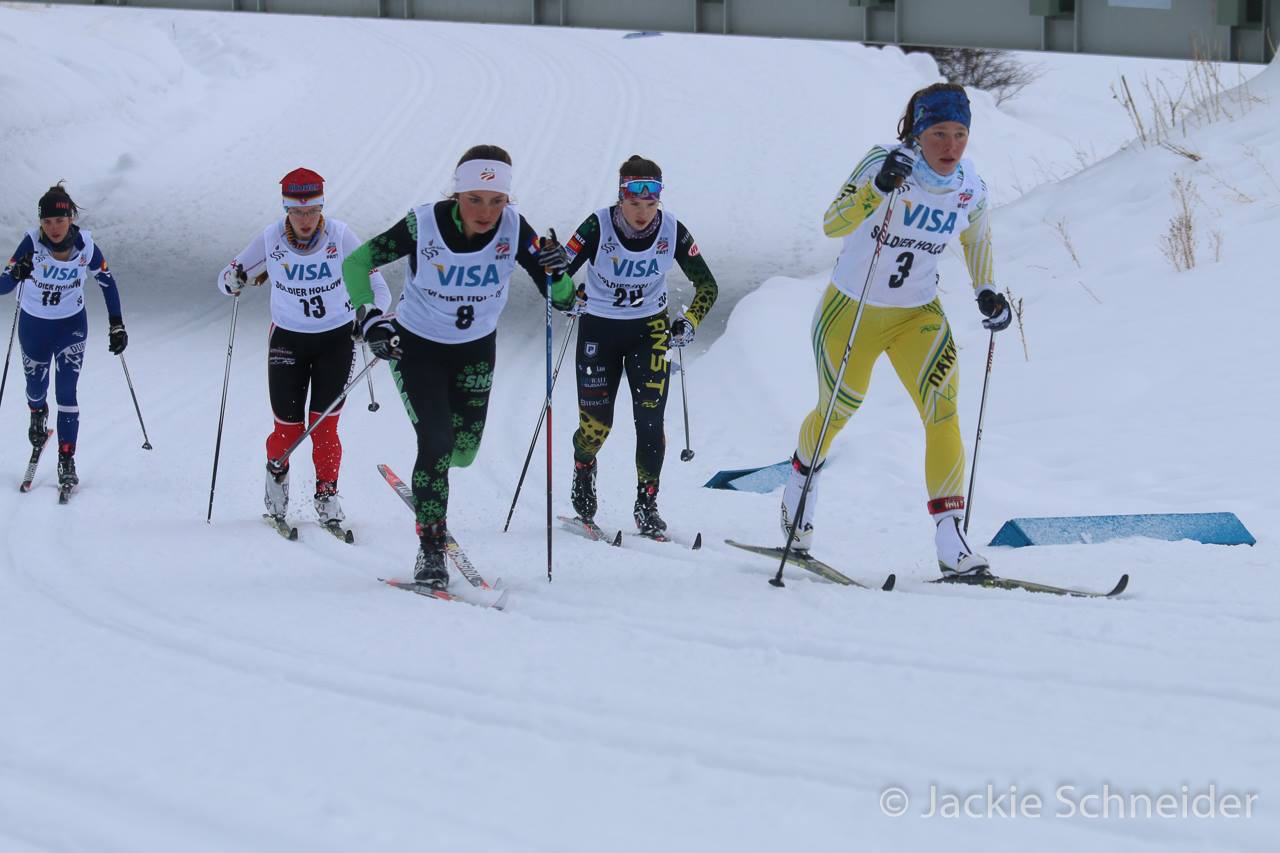
Nakkertok’s Claire Grall-Johnson (3) leading a junior classic sprint quarterfinal at 2017 U.S. nationals earlier this month at Soldier Hollow in Midway, Utah. (Photo: Jackie Schneider)
In an effort to showcase the North Americans competing at this week’s International Ski Federation (FIS) 2017 USANA Nordic Junior World Championships and U23 Cross Country World Championships at Soldier Hollow in Midway, Utah, we asked those qualifying athletes several questions about themselves — actually, we had them fill in the blanks. Here we have 19-year-old Claire Grall-Johnson, of the Nakkertok Junior Development Team, who’s representing Canada at her first Junior Worlds.
***
“My full name is Claire Grall-Johnson but you can call me Clairebear. I was born in Montreal, Quebec, raised in Ottawa, Ontario, and one thing you should know about my hometown is everyone is pretty bilingual and if ever you’re there you should hit up a sweet doughnut shop called ‘SuzyQ’.
I started cross-country skiing when I was four, thanks to my parents (who had to drag my brother and I out the door). I currently train in Ottawa with the Nakkertok Junior Development Team.
If I’m not skiing, you might find me working on some homework or hopefully eating something delicious. If I had to pick a favourite book, it would be ‘Harry Potter’ (duh) or ‘All the Light We Cannot See’ by Anthony Doerr.
One of the things I’m most excited about for Junior Worlds at Soldier Hollow is that it’s a beautiful venue with some tough courses. One race I’m especially targeting there is the classic sprint.
The best advice anyone ever gave me about skiing or racing was to appreciate the lifestyle I get to live as a student-athlete. One of the best race memories I have is the final day at Canadian Nationals in Whistler in 2013 when all the girls on our team had a super good day.
If I could meet one World Cup skier, it would be Krista Pärmäkoski.
If I don’t end up being a professional skier, I’ll probably be up to something science related.
I’m missing around 20 days of school to be here, and my teachers are probably thinking, ‘Good luck catching up!‘
(From left to right) Bob Thompson (NTDC Thunder Bay) chases Lenny Valjas (Canadian World Cup A-Team), Graeme Killick (AWCA/NST B-team), and Knute Johnsgaard (AWCA/NST U25 Team) at the start of a classic sprint heat at 2016 Frozen Thunder in Canmore, Alberta, on Nov. 1. (Photo: Jenn Jackson)
As promised, the Canadian version of “Where the (Skiable) White Stuff Is” (a.k.a. November skiing) is here, minus the bit about where to ski at Thanksgiving. Canada doesn’t usually have much snow at Thanksgiving, mostly because Canadian Thanksgiving is in early October. But by the time U.S. Thanksgiving rolls around in late November, there is an abundance of reliable snow to choose from in Canada.
In addition to major camps and well publicized early season track setting, there are a lot of places in Canada where people quietly start skiing when there is snow. Whitehorse in the Yukon is one of those places where “early” doesn’t have the same meaning as it does in the south. No one will advertise October skiing at Barkerville, British Columbia, but the Caledonia Nordic Ski Club in Prince George can tell you about it. FasterSkier’s West-Coast based Canadian contributor was on snow Oct. 8 this year.
All of the western venues mentioned here were affected by the same weather pattern than forced the cancellation of the Bozeman SuperTour. A heatwave rolled in on Nov. 3, starting with a very warm classic sprint in Canmore, Alberta, and ending in spectacular flooding near Whistler, B.C. It has been a better start in the east.
This article will focus on reliable set track and camps open to the public in November — in Canada (for the U.S. version, click here). If your favourite early season spot isn’t featured, you are in good company. Let us know in the comments below.
And if you are visiting Canada, remember that the U.S. dollar is worth $1.35 up here.
***
CAMPS
XC SuperCamp
Where: Sovereign Lake Nordic Centre and Silver Star Mountain Resort, Vernon, B.C.
A trailside photo from 2015 SuperCamp at Sovereign Lake/Silver Star (Courtesy photo)
SuperCamp has evolved over 30 years, but its always been held on natural snow and it’s always run camps in November. Four of this season’s seven camps are in November, and biathlon options were offered this month as well.
“SuperCamp is a very comprehensive nordic experience,” Shane Landreville, SuperCamp coordinator, wrote in an email. “Trail passes are included, as are lunches, off snow programs, wax sessions, massages, and ski demos.”
Ski-in/ski-out accomodation and restaurants are available at Silver Star. Vernon, a 20-minute drive and 1,200 metres lower in elevation, offers a wide range of food and lodging alternatives. Some of the November camps sold out in mid-October when registration opened.
Glenn Bond XC Ski Camps
Where: Labrador City, Newfoundland
The 2016 Glenn Bond XC Ski Camp at Menihek Nordic on Nov. 3. (Courtesy photo)
The four-year old Glenn Bond XC Ski Camp program travelled to Menihek Nordic in Labrador City, Newfoundland, for a November camp on natural snow.
“[This camp] was November 3-6 with 70-80 cms of snow and big smiles,” Bond wrote. “Menihek Nordic wins the prize for best early season xc ski conditions this year hands down.”
(Longtime SuperCamp attendees remember Bond from his time with that program.)
NATURAL SNOW
Menihek Nordic
Where: Labrador City, Newfoundland and Labrador
Fifty centimetres (roughly 20 inches) of natural snow at Menihek Nordic in Labrador City on Oct. 23, 2016. (Photo: Menihek Nordic)
Mention ‘Lab City’ to a national team member from the 1980s and you will see the good memories scrolling behind the smile. In the glory days of Pierre Harvey, the national team would kick off its season at Menihek before moving on to Silver Star for an early season elevation camp. After that national team stopped visiting the venue in 1988, it quietly dropped off the radar, to the point that FasterSkier missed this October skiing opportunity in last year’s guide.
Labrador City is not visited by many tourists. It’s at least a 13-hour drive from Quebec City, which is the nearest major population centre. But there are some big-name skiers that have visited, including Sweden’s Gunde Svan, Americans Bill Koch and Tim Caldwell, Norway’s Anette Bøe, and the Firth sisters from Canada’s Northwest Territories. Menihek Nordic hosted the 1983 World Cup Final, the 1985 World Cup opener and was a national training centre from 1981 to 1988. Mining communities are often multicultural: the World Cup hosts were able to find local translators for 20 languages from a population of less than 10,000. Koch designed some of the trails in 1981.
What makes this venue unique, other than reliable October-to-May skiing?
“Labrador is unique in that it is nearly the last frontier,” Menihek Nordic Ski Club President Gerry Rideout explained. “There is a certain magic about Labrador, it gets in your blood.”
This season, Menihek opened on Oct. 23, held four camps in November, had the full 34 k system set on Nov. 3, and plans to stay open to the first week of May (as usual).
Sovereign Lake/Silver Star
There were lots of smiles during U.S. Thanksgiving at Sovereign Lake. Methow Valley Nordic coach Laura McCabe (a two-time Olympian) led 30 kids over the top from Silver Star and FasterSkier caught them on the way back. Locals know to start at Sovereign and stop for a croissant in Silver Star village to fuel the second half of the ski. (Photo: Gerry Furseth)
This destination is actually two ski areas. The Sovereign Lake Nordic Centre (also Sovereign Lake Nordic Club) has been operating since the 1930s under a variety of names, while Silver Star Mountain Resort is more recent, opening as an alpine-skiing area in 1958. The two organizations have 105 kilometers of interconnected nordic trails and a surprisingly good relationship between the commercial resort and the volunteer-based club (which is one of the largest cross-country ski clubs in B.C.). Silver Star hosted a World Cup in 1991, Sovereign Lake in 2005.
Daily track setting runs from November to early April, with the full 105 k usually available from late November to mid-March. Sovereign Lake reopens in May for team camps and diehard skiers.
This season, both sides opened 10 days late on Nov. 20, with 57 k set by Nov. 25.
“We are still well below our average snow pack for this time of year, but are optimizing our small machine grooming to create great tracks and corduroy,” Sovereign Lake manager Troy Hudson wrote in an email on Nov. 24.
There were at least eight private camps in November, ranging from a master’s women’s group to biathletes to a combined U.S. club camp with the Mt. Bachelor Sports Education Foundation, Methow Valley Nordic and Momentum Northwest from Oregon and Washington.
MANMADE & STORED SNOW
Frozen Thunder
Where: Canmore Nordic Centre in Canmore, Alberta
Canmore is perhaps the best known of Canada’s nordic venues. Between the 1998 Olympics, reoccurring World Cups and last season’s final stages of the Ski Tour Canada, it is famous beyond the skiing world. Each October, Frozen Thunder opens a small loop with a combination of stored snow and manmade snow.
This year, Frozen Thunder opened on Oct. 22 with a 1.7 k loop. The regular season began on Nov. 19 and is scheduled to run to April 30. So far, Canmore has hosted seven days of cross-country ski races and three biathlon races in November. All the camps were private, with the Ukraine biathlon team traveling the farthest to Canmore.
Boreal Glide (Glisse Boréale)
Where: Forêt Montmorency, owned by the Université Laval, in Saint-Ferréol-les-Neiges, Quebec
Skibec skiers on the Boreal Glide at Forêt Montmorency north of Quebec City. (Photo: La Forêt)
Located 45 minutes north of Quebec City and belonging to Laval University, the ‘Boreal Glide‘ is an early season favourite in Quebec. Set in the largest teaching and research forest in the world (at 412 square kilometers), La Forêt Montmorency has 2.5 k of early season trail using stored snow and a larger system that depends on natural snow. As of Nov. 20, it had 20-24 inches of packed snowed and track groomed for both skating and classic.
“If I had to invest my money in one single cross-country skiing area in North America, I would honestly choose the Forêt Montmorency,” La Forêt’s Director of Operations Hugues Sansregret wrote in an email. “The fact that it sits on top of the Laurentian mountains is the best guarantee for early skiing.”
Boreal Glide opened on Oct. 28 without any official camps or events — just skiing. Can’t argue with that.
Callaghan Gold
Where: Whistler Olympic Park, Callaghan Valley, B.C.
Callaghan Gold on Nov. 7, 2016, at Whistler Olympic Park in Callaghan Valley, B.C. New this year, the loop includes the biathlon range. (Courtesy photo)
Canada’s other Winter Olympic venue has created Callaghan Gold, an early season loop of stored snow. The regular season opens on Nov. 24 (U.S. Thanksgiving) and ends in early April. Located in a cool valley surrounded by rainforest, this venue has been known for lots of snow in non-Olympic years. Weather has been a challenge in the fall of 2016, eased by two last-minute storms that expanded the stored snow loop to 21 k during the opening weekend.
In the project’s four-year history, Callaghan Gold has met some challenges. In its experimental year, the stored snow came out ‘gold’, coloured by the sawdust insulation. In 2014, the storage methods were improved and an 800-metre loop of lovely, white snow greeted skiers on opening day. In 2015, record-setting warm weather melted all the snow in March, leaving nothing to store. In 2016, Callaghan Gold opened on Oct. 29 with 600 metres of trail, expanding to 1.4 k on Nov. 4.
“The warm temps and significant rainfall of November took its toll on the Callaghan gold trail depth but we feel it held up well considering,” managing director Tim Hope wrote in an email.
Nakkertok Nordic
Where: Gatineau, Quebec
Nakkertok snowmaking in action for the first time in November, 2016. (Courtesy photo)
With two sets of ski trails just outside Ottawa and Gatineau, Nakkertok is the newest addition to reliable November snow. This month, one of the country’s largest ski clubs recently turned on its brand-new snowmaking equipment (which was largely funded by from its Project Play grand prize) and opened for skiing on Nov. 25.
According to Nakkertok Head Coach Kieran Jones, the club turned on five snow guns for the first time on Nov. 20 and was excited to test its new system and equipment. That night, the trails received an additional 15 to 20 centimeters of natural snow.
“Winter has definitely come to Ottawa-Gatineau, which is awesome!” Jones wrote. “Our initial goal was to create an 800m loop that covered our stadium, and extended out both ends. At that point we could then begin to push snow further to create 1 km of skiable terrain with a couple of quality climbs as well.”
He hoped they would have 1 k open for skiing by the end of last week.
“For now, the focus is on making sure we can have skate grooming,” Jones added. “Classic tracks will depend on the depth of snow that we’re able to produce. Nakkertok isn’t officially open to the public for day usage of the loop yet, but we’ll let you know as soon as it is!”
The Nakkertok Early Season Ski Loop (NESSL) is an important step for the region.
“It is great for the club, other clubs in the region and should allow a quality early season race site in the East,” Nakkertok fundraising mastermind Toni Scheier wrote in an email. “It will also ensure snow for the Easterns where clubs from across the country attend, (700 plus competitors) and for our Nationals bid, likely 2019.”
Pink posse: Katherine Stewart-Jones and teammates strike a pose at a recent rollerski workout. (Courtesy photo)
Welcome to “17 Questions for 2017″, where we are catching up with American and Canadian national-team members before the beginning of the winter season.
***
21-year-old Katherine Stewart Jones made her World Cup debut for Cross Country Canada last season, first in Europe and then in the Ski Tour Canada. The Nakkertok Nordic racer, now based at the NDC in Thunder Bay and taking courses at Lakehead University, then went on to pick up three bronze medals at Canadian National Championships in the senior division.
That’s coming off a junior career where she had two top-20 finishes at 2015 World Junior Championships.
1. Biggest change in your life in the last five or so months since the ski season ended?
Not having too much change this year has been a huge positive.
2. Biggest change in your training?
An increase in volume of about 100 hours and a lot more focus on double-pole.
3. Major areas of improvement you’ve seen so far?
Stewart-Jones training on the Haig Glacier this summer. (Courtesy photo)
My overall fitness in general
4. Whom you’ve been working closest with this offseason (coaches or training partners)?
I have continued to work with my coach Timo Puiras, my team’s new assistant coach Tim Wintoniw and my strength coach Paul Hemsworth. It has been great to be able to work with such a big group of girls this year. With 6 girls on my team there is always someone to train with.
5. Best trip in the last five months (and why)?
Park City. I loved the variety it provided for training, the endless roads and running trails kept things interesting!
6. Favorite cross-training?
Hiking! I love trail running/hiking and climbing mountain peaks
7. Favorite non-athletic activity or pastime this summer?
I love adventuring in general, camping, cliff/bridge jumping, discovering new places
8. Song that was your jam this summer?
Love on The Brain- Rihanna
9. All time favorite race moment?
Canada’s Katherine Stewart-Jones during the women’s 15 k skiathlon in Canmore, Alberta, last season. (Photo:Fischer/NordicFocus)
The Gatineau World Cup at the ski tour Canada. Racing in front of the home crowd on home soil was an unreal experience. It made me realize how lucky I am to have such a big support team behind me.
10. First thing you pack in your bag when you leave for Europe?
My earplugs, everyone who knows me knows how much I love sleeping.
11. Venue/event you’re most excited to visit this season?
Soldier Hollow! I rollerskied there this fall and the trails look like so much fun!!
12. Who will win the World Cup title this year?
Maiken Casperson Falla
13.Biggest sacrifice you feel you’ve made choosing this career path?
Stewart-Jones and her teammates seeing some early snow. (Courtesy photo)
Honestly, I really haven’t sacrificed much. I am pretty lucky to be able to do what I do. The one thing I wish I could do more of without compromising my training is to go on long backpacking adventures, but that can wait until the end of my ski career!
14.If you could change one thing about your sport, what would it be?
To be more accessible to everyone financially… its an expensive sport
A group of Nakkertok Nordic members perched atop a groomer in late December 2012. (Photo: Nakkertok Nordic Facebook)
As the winners of this year’s Kraft Heinz Project Play $250,000-dollar grand prize, Nakkertok Nordic — a nearly 50-year-old cross-country ski club based in Cantley, Quebec — already knows where the money will go. Earlier this month, the club learned that it had been voted the winner over 819 other nominations across 550 Canadian cities, and plans to invest in a snowmaking system and improving the area’s 75-kilometers of trails.
One of four finalists, Nakkertok earned the most online votes (out of a total of 900,000) in an two-day period. Second, third and fourth place each received $20,000.
“It was absolutely thrilling,” Jennifer Tomlinson, a longtime club volunteer and Nakkertok’s former race-program director, said of the grand-prize win to the local CTV Ottawa. “Over-the-moon excitement for everybody and a complete surprise.”
Since the majority of Nakkertok’s support stems from community volunteers, $250,000 dollars also allows the club to focus future fundraising efforts elsewhere. Nakkertok Nordic President Robert Hornung further explained that purchasing snow machines benefits the program beyond getting a head start on snow.
“It will enable skiers to get on snow earlier, lengthen the ski season, and improve the quality of snow conditions throughout the season for both competitive training / racing and recreational skiing,” Hornung wrote in an email. “It will also enhance our ability to continue to host major cross country skiing events like the Eastern Canadian Cross Country Ski Championships and opens up the possibility of hosting races at our facility in December. In addition, the investment will provide new opportunities for the use of our facility on a four season basis.”
From left to right: Steve Morris, Jennifer Tomlinson, Sheila Kealey, Toni Scheler, and Robert Hornung at the announcement event for the Kraft Heinz Project Play Grand Prize Award, which Nakkertok won on Aug. 4. (Photo: Doug Ranahan)
A volunteer member to Nakkertok Nordic since she was 8 years old, Tomlinson indicated that the club could have the snowmaking system installed by the change of the seasons.
“We had planned on doing fundraising and building towards snowmaking, but this allows us to establish it in, like, a snap,” Tomlinson said on the phone. “We can get it done this fall.”
Tomlinson, who also volunteer coaches for Nakkertok, pointed out that much of this would not be possible without those who are a part of the community and even those outside it.
“That this couldn’t have been done without the contribution of, quite frankly, the whole cross-country skiing community across the country,” she said. “We had support from coast to coast to coast and then even people who were traveling even outside the country were voting for us.”
Established in the early 1970s by three families intent on creating a local ski program and trail system for the area, Nakkertok has grown over the years from a few families to over 1,400 members. The club has a Learn-to-Ski program as well as a racing program and adult development program. Much of the program’s growth is attributed to the club’s culture.
“I think that model has worked really well for us because as we’ve grown, we’ve built our strengths through the membership and the investment people have personally, not just financially,” Sue Holloway, a volunteer coach whose mother served as the program’s first president, said on the phone.
Nakkertok Nordic skiers await the announcement of the Kraft Heinz Project Play grand-prize winner, which it won on Aug. 4. (Photo: Doug Ranahan)
“They don’t just belong, they contribute,” she said of Nakkertok’s volunteers. “You know, ‘I made that trail or I made that cabin,’ so you really feel a sense of ownership, which makes us a strong club.”
The culture Holloway described members of the club as having was a sentiment Tomlinson echoed.
“There is no unique circumstance that says you can buy your way out of doing your volunteer commitment,” Tomlinson said. “The expectation is that every adult member will do two days of volunteer work and if you’re in the racing program, every adult member will do six days of volunteer work. … It breathes the give-back model too. The kids see the effort and the contributions, and we build the expectation that the kids, regardless of how old they are, are going to contribute by helping to maintain trails, whatever it may be.”
The “give-back model” Tomlinson describes is evident in ski racers like Katherine Stewart-Jones, a former Nakkertok racer currently skiing for the national development centre in Thunder Bay, Ontario. Once a member of Nakkertok’s Jackrabbit program, Stewart-Jones, 21, now finds herself a volunteer for it.
“I had a training camp near my house actually and I went home after and I was only there for four days, but I made sure to go to practice and help out,” Stewart-Jones said on the phone. “I even gave a talk to the younger group.”
As winters become more mild, Stewart-Jones, a three-time Junior World Ski Championships competitor, sees the investment in snowmaking machines a smart one.
“We’ve had a lot of trouble in the past couple of years. I went home for Christmas for, like, six days and I just remember it was Christmas Eve and I was rollerskiing,” she said. “That’ll be super cool to have [a snow-making system].”
With $250,000 added to this year’s budget, the Nakkertok community was above all, appreciative to the support they received in order to win the overall award.
“Votes were coming in from Norway and all over Canada, the U.S. and Europe,” Holloway said. “We’re pretty proud of that. And that again just speaks to the breadth of the community. We were really appreciative of everyone, not just in the area, but across Canada and literally across the world who jumped onboard and gave a us a hand to make it happen.”
The women’s leaders in the 15 k classic mass start on Day 3 of Eastern Canadian Championships on Feb. 7 in Cantley, Quebec, with Dahria Beatty (l), Cendrine Browne (c), and Jenn Jackson (r) at the front of the pack. Beatty went on to win by 7.7 seconds over Browne, in the NorAm leader’s bib. (Photo: W. James MacLean)
Though patterns develop and race favorites exist, winning is never a given. At least according to Cendrine Browne, the NorAm leader and overall champion of the women’s 10-kilometer freestyle at Eastern Canadian Championships last Saturday, Feb. 6, at the Nakkertok Nordic Ski Centre, Cantley, QC
“I don’t think you can get used to winning. Winning is great but every day is different,” Browne, a member of Canada’s U23 Development Team and the Pierre-Harvey National Training Centre (CNEPH), wrote in an email.
“I chose to ski on white bases today at everybody’s surprise, but they were really fast,” Browne explained after winning in 27:10.8 minutes.
“I didn’t pace myself, I just went hard all the time and it worked pretty well,” she added. “I felt good mentally and physically, and that helped a lot.”
Finishing 9.1 seconds behind Browne was her biggest NorAm distance rival, fellow U23 Development Team member, Dahria Beatty, of the Alberta World Cup Academy (AWCA).
Beatty and Browne also both recently returned from World Cup races in Europe, where they teamed up with Emily Nishikawa and Maya MacIsaac-Jones in the first World Cup relay for all four women.
Rounding our Saturday’s top three for the women was Olivia Bouffard-Nesbitt, of the U23+ Development Team and Rocky Mountain Racers (RMR), who finished 21.8 seconds off Browne’s winning time.
“I was getting really good splits in the first 5k (being told I was leading) and I was having a lot of fun on course,” Bouffard-Nesbitt wrote in an email. “I faded in the second half of the race, but that can be a consequence of going hard at the start, so I have no regrets.”
Also of RMR, MacIsaac-Jones, who won Friday’s freestyle sprint on the first day of Easterns, was pleased with her fourth-place finish, 43.8 seconds behind Browne.
“My race today was really good — I was 4th, which is my best distance NorAm result this year!” MacIsaac-Jones wrote in an email.
Somppi Dethrones Sandau in 15 k Skate
Also on Saturday, Michael Somppi, of the Thunder Bay National Development Centre (NDC),claimed a decisive win in the men’s 15 k freestyle. Somppi completed the course in a time of 34:45.1, besting second-place finisher Kevin Sandau (AWCA) by 25.3 seconds.
“I’m super happy I was able to get back to feeling like myself in a skate race. I was really pumped to get back onto the top step at the NorAm,” Somppi wrote in an email.
The winner of every NorAm distance race he has competed in this season (with four victories total; he skipped the M.S.A. NorAm), Sandau regarded his next few weeks of race efforts as most important.
“Western’s has always been part of the plan leading up to the Tour,” Sandau wrote in an email, referring to the second set of championships, Feb. 19-21 in Prince George, British Columbia.
“Even with a [Ski Tour Canada] spot locked up now unofficially, I’ll be using it as some final hard efforts before flying out East,” he added.
The Ski Tour Canada, doubling as World Cup Finals, starts March 1 in Gatineau, Quebec, and extends through March 12 with the last four races in Canmore, Alberta.
Noting he was “pumped” to be on the podium on Saturday, Russell Kennedy, of the Canmore Nordic Ski Club, finished third, 31.2 seconds behind Somppi.
“I nailed my pacing. That was huge it really helped me as I made up a lot of time at the end,” Kennedy wrote in an email.
Kennedy also pointed to external sources of motivation during his race, including the man who started just ahead of him, Brian McKeever, of the Canadian Para-Nordic Ski Team.
“It also was good to have Brian there. He was super motivating,” Kennedy wrote.
McKeever, visually impaired, raced to fifth overall, 1:01.9 out of first and 19.6 seconds behind Knute Johnsgaard (AWCA/U23+ Development Team) in fourth.
Though Saturday left her chasing downBrowne,Beatty positioned herself as the woman to beat by the Nakkertok course’s final climb on Sunday in the women’s 15 k classic mass start.
“My plan going into today was to stay in contact until the final climb and leave everything on that final climb,” Beatty wrote in an email on Sunday.
Despite losing contact at one point during her third lap of the 5 k loop, Beatty managed to stick to her plan. Amidst Sunday’s snowfall, the Whitehorse native left everything on the last uphill and came away with the win in 46:54.4.
“I was able to regain contact with Cendrine and my skis were gliding especially well so I was able to carry good speed into the final climb and get a gap before the downhill into the finish,” Beatty wrote.
Browne finished 7.7 seconds later in second place.
“A second place is great but I could have won…My skis were so slow!” Browne wrote in an email.
Finding herself at the back of the lead pack during the downhills, Browne put her focus into Sunday’s course climbs.
“I told myself that if I wanted to win, I would have to give everything I had in the uphills because I couldn’t count on my skis in the downhills,” Browne wrote. “So in the second last uphill, I tried to break away from the pack. It worked. I had a 10-meter gap before the second last downhill.”
However, by the bottom of the hill, Beatty caught back up to Browne.
“As I was going down, Dahria passed me like I was still,” Browne added. “I tried to catch up in the last up hill and fell. So I didn’t catch her. I finished 2nd. I was disappointed. I hate giving excuses but I think I could have won.”
Finishing just 2.0 seconds behind Browne, and 9.7 seconds behind Beatty, was NDC Thunder Bay’s Katherine Stewart-Jones in third place.
“There was a big lead pack for a lot of the race. It was easy to stay relaxed because I had very fast skis,” Stewart-Jones wrote in an email. “I think the race came down to the last couple of hills of the course, whoever had energy left in the tank.”
She pulled some energy from fans on from the trailside.
“It was amazing to see the support from my home club,” Stewart-Jones, who grew up training with Nakkertok, wrote. “There were so many people out there cheering me on!”
After a large crash in the first lap, Bouffard-Nesbitt lost contact with the front group and raced to a 10th overall (+2:01.0).
“I’ve hardly classic skied this winter due to my stress fracture, and I’ve really been struggling in classic races,” Bouffard-Nesbitt wrote in an email.
“As a whole I’m happy with the weekend. I’m going to try to not be too hard on myself for this last classic race,” she added.
Shields Takes All in 20 k Mass Start
The men’s leaders during the 20 k classic mass start on Feb. 7 at Eastern Canadian Championships in Cantley, Quebec, with Andy Shields (r) leading, Brian McKeever (l), Sandau (yellow bib), with Sandau’s AWCA teammate Knute Johnsgaard behind him, and Scott Hill (6) of NDC Thunder Bay right there in the lead pack. (Photo: W. James MacLean)
En route to his third-career NorAm win, Andy Shields (NDC Thunder Bay), came away victorious in the men’s 20 k classic mass start on Sunday.
Shields completed the four-lap race in 52:53.6, besting second place finisher Jesse Cockney (CNEPH/NST) by 12.1 seconds.
“The herringbone sections were coved in deep sugary snow but I felt comfortable on them,” Shields wrote in an email.
With 2 k to go, Shields gapped the field during a herringbone hill and skied comfortably away to first place.
“It never felt like the pace was unmanageable so a ‘thank-you’ to the body for being in good shape today,” Shields wrote.
Cockney confirmed that Shields’ skiing on Sunday was left unrivaled by any other skier on course.
“Andy definitely won with stronger legs today. He was skiing the steep climbs really well and had lots left for the final lap,” Cockney wrote in an email.
After starting in bib 31, Cockney was happy to have maneuvered his way up to the front of the pack.
“I’m quite happy to have moved up from bib 31 to near the front. The distance races here have also been better feelings pushing hard than the rest of the year,” he wrote.
Finishing just 1.3 seconds off of Cockney was Johnsgaard in third, 13.4 seconds behind Shields.
“Kevin and I were leading a lot on the first lap, but there was a bit of fresh snow in the tracks and it was hard to drop the group,” Johnsgaard wrote in an email.
“We’d get a gap on some climbs and then it would come back together on the downhills. The course was basically double pole and then herringbone up steep climbs in ankle deep corn snow,” he added.
According to Johnsgaard, the herringbone sections played to Shields’ strength, but not his own.
“Not exactly my idea of a nice classic course,” Johnsgaard wrote. “Andy had some super herring bone on the last major climb and broke away a bit.”
Sandau, who had been skiing in the front pack with Shields, Johnsgaard and Cockney, crashed, which he wrote cost him “a podium spot.”
Despite his fall and fifth-place finish, 20.4 seconds off of first place, Sandau was satisfied with how he felt during the races.
“The past couple weeks had a really good chunk of volume and I was happy how I felt in both distance days and had some good fight,” Sandau wrote.
Ahead of Sandau in fourth, McKeever was half a second off the podium and 14 seconds behind Shields.
— Gerry Furseth and Alex Kochon contributed reporting
(From left to right) Kevin Sandau, Andy Shields, Brian McKeever, Michael Somppi, and Jess Cockney after the men’s 20 k mass start on Sunday, Feb. 7. Shields won by 12 seconds over Cockney, Knute Johnsgaard (not shown) placed third, McKeever was fourth, Sandau (the NorAm leader) fifth and Somppi eighth on the last day of Eastern Canadian Championships in Cantley, Quebec. (Photo: W. James MacLean)
Mark Rajack rollerskiing with XC Ottawa on Oct. 5. (Photo:Dave McMahon/XC Zone)
OTTAWA, Ontario — Mark Rajack, a dual citizen of Canada and Trinidad and Tobago, was first introduced to nordic skiing two years ago in 2012, but in the time since, he’s not only learned to ski and compete in his new sport, but he’s also set his sights higher than many will in their skiing careers.
Rajack, 33, lived in Trinidad and Tobago until the age of 6, at which point his parents were drawn to Ottawa for a job opportunity. From the time of his move, it would still be almost three decades until he would discover cross-country skiing.
“You don’t come from a tropical country with a background in winter sport,” said Rajack, mostly a recreational cyclist before skiing. “I didn’t know that Gatineau Park [Ottawa’s largest ski-trail network and outdoor destination] existed until I started working at the local bike-and-ski shop.”
Discovering Skiing
“I started [skiing] the year I turned 32 and it was an accident,” he explained in an interview at Carleton University on Sept. 3.
He wanted to learn how to fix bicycles so he got a job working at a bike shop. In the process, he got to know some ski racers who worked part time at the same place.
“A lot of the bike shops here are ski shops in the winter, so it was through the racers working in that ski shop and through their community orientation that they managed to bring me on and just teach me to ski from scratch,” he said.
Rajack’s initiation was not exactly a cake walk.
“It was horrible,” he recalled. “I had no glide. It was too cold. I got the wax wrong and with no technique it was just a struggle from the very start to the very end. And it was because I was expressing my struggles in skiing that a member of XC Ottawa said, ‘You know what, I’ll take you out and I’ll teach you to ski properly on my Zone-1 [easy] days.’ ”
That skier was 23-year-old Andre Marchand, a longtime XC Ottawa skier and now Rajack’s good friend.
“I remember Mark picking up the technique instructions I was giving him pretty quickly,” he wrote in an online message. “It was impressive, and then after about 40 min of some pretty good technique skiing from a newbie, he just started falling over here and there, on downhills but also on flats… Now he’s regularly skiing for 2 or 3 hours at a time with Team XC Ottawa and he has no problems doing that!”
Looking back, Rajack stressed the importance of the local ski community and the type of person it takes to get a newcomer excited about a sport and its culture.
“It takes people who are fully inclusive and I’ve found that in the ski community we have here in Ottawa-Gatineau,” he said.
Gatineau Parkway rollerskiing with XC Ottawa. (Photo: Dave McMahon/XC Zone)
Setting Goals
After getting on snow a few more times his first winter, the season of 2012/2013, Mark decided he wanted to venture deeper into the world of his newfound sport.
“I went to a race in Val Morin [in Laurentides, Quebec] with Andre just to see what it was about,” he said. “When I went to the race, his dad took me to the wax tent. His dad explained how races operate, I saw the culture behind the race, I saw the environment and I knew instantly that it was something that I would enjoy. It was then that I decided that I would try to get into racing. That would be the long-term goal.”
Just 1 1/2 years down the line, Rajack is a member of the Trinidad and Tobago National Ski Team and aiming for 2015 World Championships in Falun, Sweden, and 2018 Winter Olympics in Pyeongchang, South Korea.
One-and-a-half years down the line, Rajack is a member of the Trinidad and Tobago National Ski Team and aiming for 2015 World Championships in Falun, Sweden, and 2018 Winter Olympics in Pyeongchang, South Korea.
“It took about three-to-four months before the idea entered my head that I had the option to ski for Trinidad and Tobago and then I started to look into it,” he said. “It was only through a fluke joke. Some of the skiers I was with were critiquing some of the techniques of the non-snow countries at the [2013] World Ski Championships and only then did I think, ‘You know what? That could be me!’ ”
It just so happened that Trinidad and Tobago has a ski association, already linked to the International Ski Foundation (FIS), the president of which is a skier who lives in Calgary. Once Rajack made that connection, it was a matter of applying for his FIS license. With a mountain of ski technique and experience to climb, he set off to join a team.
Naturally, he wanted to join Marchand, so he applied at XC Ottawa. It didn’t matter that he had no skiing or endurance sport background, “they were still able to justify bringing me on because I fit their mandate of national and international competition,” Rajack explained.
With the pieces starting to fall into place, he jumped headfirst into the world of nordic racing and started to compete last February.
“The premise of last year [2014] was learn to ski and race locally,” he said.
He started with Eastern Canadian Championships in Cantley, Quebec, where he placed 53rd in the 15 k freestyle and 50th in the 20 k classic mass start — last in both events.
“Next year’s focus is a different one,” he said. “Next year, there’s a focus on more NorAms than local races and I’m aiming to break the 300 FIS-point limit,” which is the FIS standard for Olympic qualification.“I always get that Jamaican bob-sled team reference,” he said.
The other big focus for him this season is World Championships.
“Me being the only skier for Trinidad and Tobago competing at an international level, I basically by default have qualified for Falun,” he said. World Champs differs from a standard World Cup, which has a tougher points criteria.
“But when I get [to Falun] I have to qualify for the distance race,” he added. “It’s likely that people in my situation will only get to race the 10k free and then the classic-sprint qualifier.”
Getting to race at least two races at World Championships will provide Rajack with a wealth of experience, and he was excited for the opportunity.
“Without a doubt I’m very much looking forward to it,” he said.
He’ll have a support team there to help him with waxing and other preparations, including coach Mike Vieira and Colin Abbott, a competitive skier with the Yukon Elite Squad. Rajack estimated the whole trip will cost him around $850 dollars, with complimentary accommodations, and he explained Viera and Abbott are paying their own way to support him.
Abbott spent three years with XC Ottawa before leaving the city to train full time for another three years.
“I kept close ties with XCOttawa and heard about Mark joining the team long before I met him,” Abbott wrote in an email. “I returned to Ottawa this year to complete my studies at Carleton University and met him in September this year. From what I have seen of him so far he is motivated, realistic and open to critical feedback. I believe he has the ability to make the 300 FIS point cutoff to qualify for the next Olympics in Korea.
“As far as international success, he will probably never be a medal contender on the World Cup,” he added. “His technique is his biggest weakness right now and he knows it. He’s put in a lot of time this summer focusing on becoming more efficient.”
The Sacrifice
With a new focus on racing, Rajack finds training taking up more and more of his time.
“I’ve put my career on the back grill for the moment,” he said. “As a teacher with the Ottawa-Carleton district school board, I very well could have made choices that would’ve led to me being a full-time teacher at this point. I’ve made the decision to continue substitute teaching to focus on my skiing for the next four years.”
“In terms of finances, too, I was at one point saving for a downpayment on a house,” he said. “Potential house [or] potential Olympics.”
In a place like Canada, where high-performance skiing does not hold the same clout that it does in other countries, there’s always the pressure, both societal and financial, to follow the path of least resistance: school, job, house.
“I think it takes a bit of bravery to not lead that scripted life when there’s a lot of pressure to conform,” Rajack said.
“I think it takes a bit of bravery to not lead that scripted life when there’s a lot of pressure to conform.” — Mark Rajack, Canadian dual citizen and Trinidad and Tobago’s lone national cross-country ski team member
But he’s willing to make the sacrifice — even without financial assistance from the Trinidad and Tobago government.
“At this time, the government is unable to provide support,” he said. “And I understand the challenge of understanding what someone like me is trying to do, especially that I’m, right now, off the island.”
Unfortunately, that puts him in a sort of no-man’s-land for funding. Without the Trinidad and Tobago or the Canadian governments helping him out, and with the limited workload that he is able to fit in around training, finding sponsors will be one of the many challenges for Rajack in the coming months.
What does he see as key in his preparations for international competition?
“It just comes down to trusting people who have done this their whole lives, listening to them and believing that, if I follow what they do and if I keep my effort and dedication up, I’ll be well under that 300 FIS points standard by the time the Olympics roll around,” Rajack said.
The Greater Good
XC Ottawa skiers in early October, including Mark Rajack (front c) and Andre Marchand (to Rajack’s right). (Photo: Dave McMahon/XC Zone)
At the end of the day, it’s not all about the Olympics for Rajack. His dream is to help grow the sport that has already given so much to him and, in doing so, help those new to winter climates who struggle with getting used to the colder season just as he did when he moved to Canada.
“There’s no way for me to be living in Trinidad and training to ski but if I could wish anything, ultimately, it is that we develop a rollerski team in Trinidad and Tobago,” he said. “In the same way that you have North American athletes who play tennis and golf who go down south to do whatever golf camps and tennis camps in the states, well the reverse can be true. We’ll take those rollerskiers and bring them up to [The Forêt] Montmorency or Nakkertok and get them time on snow and then put them in competition.
“I don’t know if that will ever happen, but there’s always the dream and then there’s the reality — that would be the dream,” he continued. “The reality is that it will probably just be members of the Trinidad and Tobago diaspora [who become involved in skiing], which is spread right across the world. You’ve got Trinidadians living in every corner of the world and many of them, like me, live in northern climates and, like myself at one point, the winter is a significant negative impact on their quality of life.”
“If, through my efforts, I could help a Trinidad and Tobago kid get to the World Cup in a way I would feel that I had made the World Cup as well.”
The men’s 20 k classic mass start on Sunday at the 2014 Canadian Eastern Championships in Cantley, Quebec. (Photo: Cross Country Canada)
As all eyes shift to the fast-approaching Olympics in Sochi, Russia, the domestic-racing show resumed in Cantley, Québec, where nearly 700 skiers competed at the three-day Canadian Eastern Championships last weekend. The NorAm was back in full swing after a short break, which gave time to those who didn’t qualify for the Olympics to regroup and return stronger and faster.
***
The championships started with freestyle sprints on Friday. Raphaël Couturier of the Pierre-Harvey National Training Centre (CNEPH) topped the field in the men’s 1.5-kilometere qualifier in 3:20.35, 5.7 seconds ahead of Graham Nishikawa (Canadian Senior Development/Para-Nordic Team) and another 0.09 seconds ahead of Michael Somppi (Alberta World Cup Academy), who advanced in third. In the final, it was the same trio who took the podium spots in the same order.
“I had great skis prepared by [Skinouk coach Pierre-Olivier] Dorego and I felt that I had a lot of energy to give, especially in the sprint where I gave everything from the start, opening a gap over the rest of the guys,” Couturier wrote in an email.
Despite the absence of some of the best Canadian skiers, who were racing the World Cup in Italy, Couturier was “very happy to be back in good shape. I did a lot of volume in the last two weeks and it seems to have worked well. It is a relief and it gives me confidence for the races to come!”
In his first year as a senior, the victory was his first in a senior NorAm competition.
In the 1.4 k women’s sprint, Andrea Dupont (Rocky Mountain Racers) set the fastest qualification time in 3:45.63, 1 second ahead of Alysson Marshall (AWCA/NST). A junior, Jennifer Jackson (NDC Thunder Bay) was third, another 1.52 seconds behind, in the qualifier.
At the end of the day Marshall took the victory, Dupont finished second and Erin Tribe (NDC Thunder Bay) took the last spot of the podium for her best result of the season.
“The weekend was good. I love racing out east,” Dupont wrote in an email. “It is fun coming back and racing in some of the places I did when I was younger. The east has great snow this year and trails were in amazing condition. Nakkertok always puts on a good race and I always look forward to the Montreal style bagels at the end :)”
Saturday was middle-distance day with individual starts. In the women’s 10 k freestyle, Dupont started fast then hung on with the third-fastest second lap to beat Zoe Roy (Team Ninja) by 17.8 seconds in 28:37.3. Tribe outsprinted teammate Alannah Maclean (NDC Thunder Bay) by 0.3 seconds for third, 38.2 seconds behind Dupont. Marshall, who skied the fastest second lap, placed fifth (+45.5).
In the men’s 15 k freestyle, Nishikawa led from start to finish to top Couturier by 13.4 seconds in 36:28.5. Somppi once again took bronze, 31.1 seconds after Nishikawa. Kevin Sandau (AWCA/NST) was nearly another minute behind in fourth (+1:29.0).
“I felt great last weekend at Easterns — lots of energy,” Nishikawa, who’s headed to the Sochi Paralympics in March, wrote in an email. “It was nice to feel good racing again. Pretty cool to see how many skiers participated.”
“The 15K skate was again a great race,” Couturier wrote. “I had a fast start and I managed to keep up the speed.”
Fifteen to 20 centimetres of fresh fell overnight before Sunday’s classic mass starts. In the men’s 20 k, Nishikawa outlasted Somppi by nearly 30 seconds for the win in 58:52.1. Somppi held off Christopher Hamilton (AWCA) by a toe in a photo finish for second (+29.3). Hamilton took third, and Sandau placed fourth, another 17.4 seconds back.
Marshall picked up where she had left off on Friday to capture her second win of the mini tour in 52:33.6. Dupont placed second, 6.7 seconds back, and Roy was third, 9 seconds after Marshall. Another 1:03.5 behind, Tribe and Maclean tied for fourth.
“I was super happy with my distance results this weekend,” Dupont wrote. “I haven’t had much chance to race distance this year, so it was fun to take my focus off of sprinting for the weekend.
“My weekend went very well,” Somppi wrote. “I am happy to have been able to hit the podium in every race. I was really hoping for a victory, but hats off to Graham and Raphael, they were both really strong this weekend. My racing shape is continuing to improve and I feel my best is not far away now.”
Next Stop: Europe
Cross Country Canada is organizing a European racing tour mid-February, and while no official announcements have been made yet, some athletes will head over the pond to gain international experience. For those that don’t make it overseas, the next NorAm races will be the Western Canadian Championships Feb. 13-16 at Caledonia Nordic in Prince George, B.C.
“I had decided of regardless what happened this weekend I was going to head over to Europe and race some OPA’s,” Dupont wrote. “Now, there might be some other opportunities for me. I am waiting to hear about the CCC OPA trip and maybe some World Cup starts in March.”
“I will be departing next week to Europe for Scandinavian cup races and hopefully the Lahti World Cup,” Somppi explained. “I’m really looking forward to racing in Europe and hopefully having my best races of the season while I’m there.”
Nakkertok skiers hard at work during a recent track workout. From left to right: Isaac Alexander-Cook, Kyle Curry (St. Lawrence University), Cary Pomeroy, Phil Marshall, Brendon Howard, Symon Stowe, and Patrick Van Walraven. (Photo: Jesse Williams)
Welcome to Wednesday Workout, where we provide and break down training ideas on a weekly basis. This week, Kieran Jones, head coach of the Nakkertok Ski Club in Ottawa and former FasterSkier reporter, gives some advice for developing a strong baseline and widening the range between easy and max efforts.
***
Skiers like pain. Skiers like feeling exhausted. Regardless of whether you’re a 10 year old girl, a 55-year-old master-blaster, or an Olympic champion, if you’re a skier, you love feeling the hurt.
But sometimes, to get to the hurt, you need to lay out a strong baseline. And to do that, you have to think beyond “I want to hurt.”
Nakkertok has approximately 50 athletes in the two programs I directly coach, with almost all of them falling in the 15- to 20 year-old age range. As a coach of these Junior athletes, my major goal is to expand their physical literacy to the point where there is a range beyond “slow” and “all-out.”
2013/2014 Nakkertok Nordic Team (Courtesy photo)
The Workout: Cue Level 3 Running Threshold Loops
Easy 15-minute warmup jog, followed by dynamic warmup exercises, including 5 x 6-second acceleration sprints for range of motion
4 x 10 minutes on rolling terrain, with 3 minutes recovery between each rep
Easy 15 minute cool-down jog
The major goal of the workout is to ensure that athletes are running at the correct speed and effort level. Depending on your available metrics, you can control it a number of ways. If you’re using heart rate zones based off a maximum heart rate, I recommend 82-88 percent of your max. If you’re using a lactate monitor, target lactate readings of 3-5 mmols. If you’re running based on ‘feel’, aim an 8 out of 10. Finally, if you’re running based on pure effort level, think of a pace you can sustain for around 50-60 minutes.
The first step is to mark out a clear loop over rolling terrain. I like to make the loop so that the faster athletes do a little more than 1 loop, and the slower athletes do a little less than one loop, so that whole group can start each rep together.
Generally I don’t get too bent out of shape about the number or grade of uphills, but it’s important to consider the level of runner you have. I try to avoid loops with hills I know will crush the groups’ legs on the first interval.
The greatest thing about the loop is that no matter what you have a number of metrics you can record as a coach. If you’re high-tech enough to own a lactate monitor, you can set up a lactate-test station, and take samples as people come off the loop. If your athletes have heart rate monitors, you can record max values for each rep. If you only have a stopwatch, you can record times for the loops for each athlete. Or if you have nothing but the shirt on your back, you can drop that shirt where you end on the first rep.
For pacing, emphasizing that the first rep should feel quite easy is important. If an athlete is breathing hard, or glancing at their watch every 5 seconds thinking “oh god, please let this end” on the first or second rep, chances are they are going too hard. If by the third interval they aren’t able to hit the same time or finish point, then you know they’ve gone out of the gate too fast.
If you’re measuring heart rates, I like to see a consistent increase without a huge jump or drop off. For example, recording a max heart rate at the end of each interval, I want to see the following: Rep 1: 165, Rep 2: 170, Rep 3: 172, Rep 4: 174.
The above athlete will finish the workout without collapsing on the ground due to the feeling of “concrete block” legs, be able to do an easy cool down, have a nap, and be ready to roll again by 3 PM for the afternoon workout.
The part B of this workout is something athletes love. We often return to the same spot six or eight weeks later, and repeat the workout. The athletes have recorded the time or distance they were able to travel the first time, and then are able to see themselves beat that mark working at a lower effort level or heart rate. As the workout is running, you remove the variable of rollerski speed, broken pole tips, or traffic that can often throw off data collection in a rollerski workout. Not all athletes can make it to World Juniors, or win a medal at Canadian Nationals – but all athletes want to see that the work they are doing is resulting in improvement.
My favourite part about this workout is that it forces athletes to think about controlling their speed and effort. If you’re a highly motivated skier (see: every skier ever) it’s quite easy to go out and hammer at your max. But it’s harder to rein yourself in, and work in the right range.