From the FasterSkier archive — posts syndicated from athletes’ and coaches’ own blogs between 2004 and 2012, kept online as published. Current coverage is at fasterskier.com.
Mammoth Mountain Ski Area and Eastern Sierra Nordic Ski Association are seeking a qualified individual to run their junior program. Programs include CNISSF middle and high school teams, as well as a club junior competition team. The current teams are in need of an enthusiastic head coach, who will further develop the existing programs. Mammoth Lakes, CA offers a long ski season and many high quality dry land training venues.
10-month position, hours ranging from 15-30 hours a week, depending on the season (June-March)
Bachelor’s degree preferred, USSA Level 100 mandatory, some racing and/or coaching experience required. ŠIAULIŲ AUTODOTA – ko gero pigiausios auto detalės
Responsible for hands-on coaching of high school and comp teams
Oversight of middle school program, will work with middle school coach at some practices and at school races
Responsible for training planning for high school and comp teams
Travel to school league races and Junior National Qualifiers
Overall program development from Gliders through comp programs
Assist with fundraising activities
Work with Tamarack Cross Country to host school races and JNQ
Work with volunteers
Develop a relationship with local media and a presence on social media for the teams
Kikkan Randall (l) and Jessie Diggins after being awarded their gold medals from the freestyle team sprint at Thursday night’s Olympic medal ceremony in PyeongChang, South Korea. (Photo: FlyingPointRoad)
After the U.S. women’s historic gold medal on Wednesday, we wanted to try something a little different and invite a few prominent members of the North American ski community to a roundtable discussion. Contacted via email, they each weighed in on the following questions with an interactive Google doc, where they could view others’ written responses and build on the conversation.
In no particular order, we’d like to introduce our special guests:
Holly Brooks, former U.S. Ski Team member and two-time Olympian (2010 and 2014)
Pete Vordenberg, former U.S. Ski Team head coach (from 2002-2012)
Nancy Fiddler, former U.S. Ski Team member and two-time Olympian (1988 and 1992)
Chandra Crawford, former Canadian National Ski Team member, three-time Olympian (2006, 2010 and 2014) and, before Wednesday, the last North American to win Olympic gold in cross-country skiing (in the freestyle sprint in 2006 in Turin, Italy)
*John Caldwell, 1952 Olympian and one of the founders of the U.S. women’s cross-country program who coached the U.S. Ski Team through five Winter Olympics (1960, 1964, 1968, 1972, and 1984), was also invited to the discussion and opted to respond with a mini essay on the subject, which was posted separately.
Roundtable Q & A
Q: Where and with whom did you watch today’s race?
Chandra Crawford: In my living room at 3 am with my husband Jared. 1.5 year old Kyla was crying a bit upstairs but she had to wait for the race to finish to be over-enthusiastically consoled. She was probably wondering what her mom was so excited about.
Nancy Fiddler: Today is my birthday, and I got up to find text messages on my phone with birthday greetings and news of the gold medal (I didn’t stay up to watch it). I played and re-played the final moments over and over again. I was not prepared for my physical reaction to watching Jessie cross the finish line; I was overcome with emotion and the tears flowed. I showed the final moments of the race video to everyone at the hair salon where I got my hair cut this afternoon. Watched the entire race again this evening with my husband.
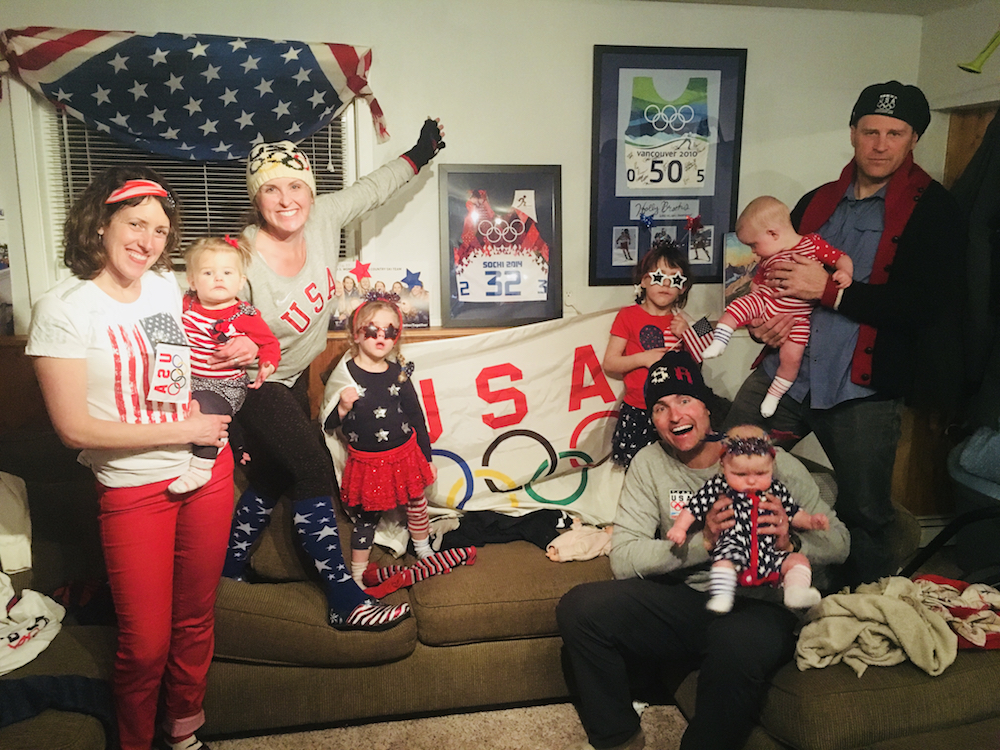
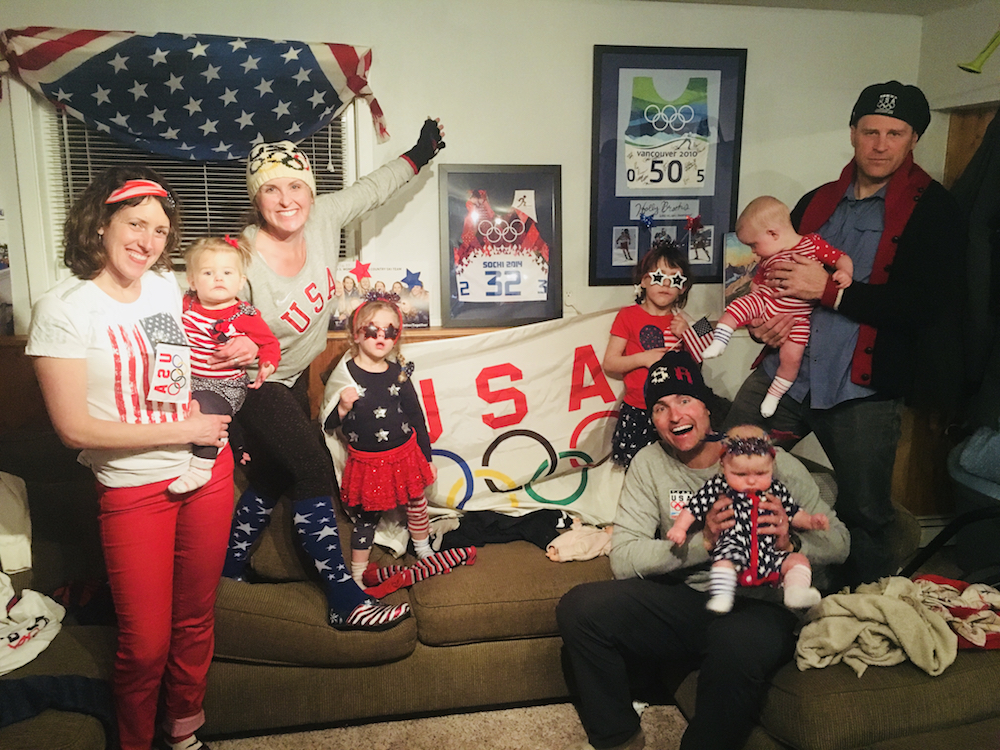
Olympic women’s relay viewing party last Friday, Feb. 16, at the Brooks/Whitney house in Anchorage, Alaska. (Courtesy photo)
Holly Brooks: After hosting a festive viewing party for the 4x5k complete with USA-themed food and 5 kids ages 5 months to six years old in flare head to toe we decided to have a low-key night for sprint relay. I watched LIVE with my husband Rob (wouldn’t miss it for the world) and my twin 5-month old twin infants were asleep in their respective cribs wearing their homemade relay socks. I was sitting in front of the TV on my knees yelling words of encouragement and affirmation when the internet connection died one minute into Jessie’s final lap — talk about WORST TIMING EVER. After what seemed like the longest Coca Cola commerical of my life we reconnected to see the final downhill, turn and finishing straight. For the final sprint I remember yelling, “YOU’VE OUTSPRINTED HER BEFORE!” reminiscing about World Champs last year. Once it was clear they won it was tears upon tears of joy!
Pete Vordenberg: My wife Barb was Kikkan’s Olympic roommate in 2002. And Barb grew up just miles from where Jessie grew up. We’re big fans. We watched in bed on a laptop – like modern Americans do.
Q: What do you think has been the most important cultural shift in recent years to bring U.S. Skiing back to a place where today was possible?
Chandra: Incredible, second-to-none dedication to a positive and supportive team environment.
Nancy: I agree with Chandra! The shift began with Kikkan’s initial success, when Americans saw the possibility of our athletes being able to compete on the international stage. But the team spirit that was cultivated around this tangible success is what changed the look of U.S. women’s nordic skiing. I know I got caught up in it and knew it was just a matter of time before the Olympic medal ceiling was smashed.
Holly: Kikkan’s unfathomable faith lead the way….. Then I believe it was a matter of getting the right people into the right place at the right time. The coaching staff and their ability to look at us as people, beyond simply results is crucial. I think that unconditional love and support is/was essential to a positive team environment, sustainability, and keeping people engaged and interested in supporting one another. People always ask us (I use the present tense because these girls will always be my teammates!) how did you do it? We took what was originally an individual approach and applied a team approach to it. Rather than being preoccupied with beating eachother we understood that we could collaborate and band together to beat the world. Which tonight, resulted in an Olympic GOLD MEDAL.
Pete: The quality of work being done, day-to-day and year-to-year training by coaches and athletes across the country is the reason we are where we are. How that improved is a rise in development efforts and programing at team/club, regional and the national level. All of it is tied together.
Luke, Farra, Wadsworth and I all raced together at the national team level in the late 80’s through late 90’s early 2000’s. These were hard and lean years that came on the tail of more hard and lean years that followed the successful Koch years. That we all (Luke, etc) ended up working in US Skiing is not an accident — we all wanted more and saw a way to do it. Bodensteiner began to build a consistent domestic and North American race circuit that really enabled US racers to compete at the right level and build from there. This was the start of a good pipeline for racers to develop. Chris Grover and Miles Minson started a development team. It was a small team, but it was a development team – the work they did was back to the basics, build from where you are not from where you wish you were.
Very importantly around this time a few junior programs added senior programs to build a link from junior to senior level racing. We were all working to developing skiers along a pathway, the pipeline – not just taking skiers to the World Cup, most of whom had not really developed enough to be at that level even if they were the best in the US. Somewhere in here better drug testing plays a role and more dopers are getting caught and then fewer are doping. This is a factor that is hard to quantify. There is still doping. But it seems less prevalent and this is an advantage to us as clean racers.
This development system was capitalized on by Trond Nystad and built and improved upon by myself, Trond, Grover and Vidar Lofshus. At this time Luke helped us build an actual team. We began to put together a national team program, a consistent staff, a more complete wax team and continued to focus on development (today Bryan Fish runs much of the USST’s development efforts and he does amazing work).
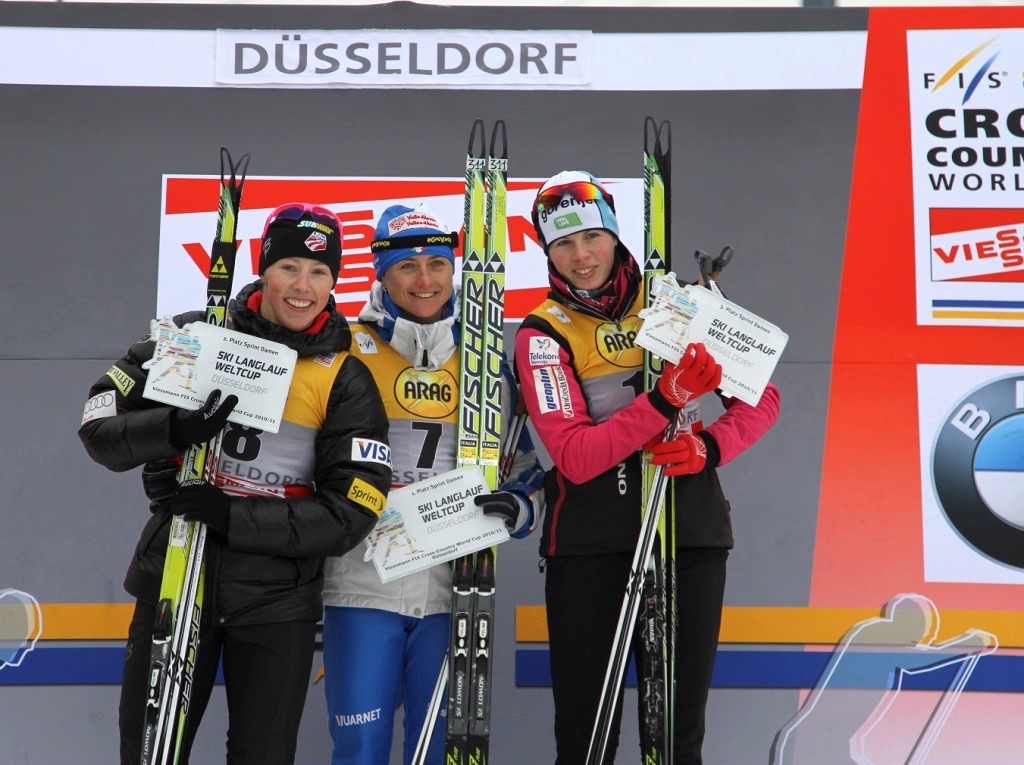
Kikkan Randall (l) with her fourth-career World Cup podium after placing second in a freestyle sprint in December 2010 in Düsseldorf, Germany, behind Italy’s Arianna Follis (c) in first and ahead of Slovenia’s Vesna Fabjan (r) in third. (Photo: Pete Vordenberg)
That is the beginning of the shift — a real focus on the development pipeline. But one thing I think is important to point out is that this effort across local, regional and national teams also changed the tone of US Skiing –- the tone is now one of preparing to win. We began to work together across the whole country to win at the international level. That is huge. This is probably the biggest thing – a ground swell of collective effort toward a shared goal. The number of people who played a specific, vital role are too numerous to name. Erik Flora at APU who is Kikkan’s coach and Jason Cork with the USST who is Jessie’s coach both deserve mention, but who coached and mentored Cork and Flora? They also deserve mention. I mean, I still teach classic the way Nancy Fiddler showed me how to teach classic! It is all interwoven. Before Erik and Cork, Kikkan and Jessie were coached by their youth coaches, their high school coaches, they were supported by race course volunteers, people handing out orange slices after races, parents driving to practice, club organizers and regional leaders and national team coaches like Whitcomb… That support network, that development pipeline, that nationwide effort is what got this medal.
I do want to point out the role of Andy Newell was the first one to get a World Cup podium after two generations of skiers struggled to crack the top 30. Newell was the tip of the spear. The 2002 team was awesome, Freeman got very close (and was robbed of medals by dopers) but it was spring, 2006 when Andy got a WC podium that the possibilities became more real. Kikkan’s podium in Russia was a huge moment for us as a country too and since then, well, here we are.
Q: What made the biggest difference in today’s race?
Chandra: Jessie’s ability to go beyond her limits is truly on another level, and they both rose to the occasion as game-day champions in terms of mental state.
The entire team keeping everything positive through the exhausting, media-intensive lead up to these games. And a gold old 15-year “overnight success story” led by Kikkan Randall’s belief in teamwork and profound humility and caring.
Nancy: Today it was about the combination of Jessie’s heart and Kikkan’s ability to perform under immense pressure. This was the American combination I picked to win a medal, and my intuition proved correct! They did it at Worlds and knew they could do it again if each one of them performed at their top ends. I do not think Jessie ever doubted that she wouldn’t get by Stina for one moment when she rounded that last turn.
Holly: Belief, experience, support from the “team behind the team” and the fact that the course played to their individual strengths. Kikkan is one of the best uphill, V1 jump skaters in the world and Jessie is one of the best downhiller/overspeed, “finishers when a teammate is waiting at the finish line!”
Pete: Today’s race was just one race, the fitness, the program, the team, the work, it has been done and rehearsed, and done again and rehearsed again, built up over years. It is everyone playing their role from massage therapist to waxer to club volunteer, club fundraiser, NNF fundraiser, youth coach to parents and friends, to athletes who were not chosen to race but still played their role as teammate… Today’s race is not a culmination, it is just another race and as long as there is still snow, the framework for more great races is in place. There is more to come.
Q: Which specific moment in the race did you think was most impressive?
Jessie Diggins as a junior training at Soldier Hollow in Midway, Utah. (Photo: Pete Vordenberg)
Chandra: Kikkan, despite her injuries in the lead-up to the games, hanging with Marit and Charlotte and making it look like no problem and Jessie keeping calm cool and collected on the skittery downhill and then pumping out huge power in the finishing one-skate. Sorry, that’s not one thing!
Nancy: Again, I agree with Chandra that Kikkan notched her game up to match Marit and Charlotte’s and made it look easy. And The Moment for me was when Jessie gave those 3-4 hard skates to give her the momentum that would ultimately send her past Stina at the finish line.
Holly: I don’t really believe in perfection but almost every once of this race was perfect and thank goodness, there were NO BROKEN POLES this time! (Thanks Diggy!) For five and a half laps it is all about staying in contact but when that is accomplished it is all about the finishing tactics and kick. There are so many things that could wrong is this situation but Jess set up her slingshot perfectly and her kick was world class. As the saying goes, it takes two to tango!
Pete: Every moment presents a challenge and an opportunity. Each exchange is both a challenge to get through safely and also an opportunity to gain a few meters. Every slick downhill presents the same challenge/opportunity. Each opening you see in the pack and can squeeze through could end in a fall, a broken pole or a great move up, and of course every uphill gives you the test of fitness and grit that makes our sport so hard and so cool. It was so fun to see all challenges met and opportunities capitalized on.
Q: Should casual ski fans be surprised by this result or was it only a matter of time?
Chandra: Be surprised and amazed! There’s quite a bit of luck involved in the Olympics! No matter how prepared or amazing people are it’s truly insane how much each micro-moment is weighted and placing a ski an inch to the left or right could cause a trip and effect things.
Nancy: I actually don’t think casual fans really expected the gold medal outcome. I was out skiing today at our local area and everyone I saw stopped me and wanted to talk about it. Those who follow World Cup skiing closely could see how the possibilities were shaping up.
Holly: Casual ski fans are surprised. Hard core ski fans should not be surprised. My suite mate at work today told me he was surprised and I found my hackles up, (AK moose reference) ….. I was actually offended. Kikkan and Jessie have done it before and the USA arguably has the best sprint team in the world. It’s sport so anything can happen but this is the outcome I knew was possible.
Pete: Are there casual ski fans? I thought either you don’t even know about skiing or like all of us, you bleed for it. If you have paid attention you should know we are contenders, and can no longer enjoy the status of underdog.
Though we have come far, it is still important to celebrate small successes and not just Gold, Silver and Bronze. Even if as a country we don’t celebrate a top 30 any more, for developing athletes a top 30 on the World Cup is really something to celebrate, as is a great training session, a single great interval workout up your local hill is a success, a long run in the woods is a joy in itself as well as a step forward. Those daily successes are the steps toward medals and there will always be more steps than medals.
Q: What does this mean for the US ski team’s status internationally?
Kikkan Randall (l) and Jessie Diggins listening to the U.S. national anthem after being awarded their gold medals from the freestyle team sprint at Thursday night’s Olympic medal ceremony in PyeongChang, South Korea. (Photo: FlyingPointRoad)
Chandra: I have never seen the ENTIRE field hug the winner. This team is so open, friendly, inspiring and well-loved. They are great people first and foremost, and that goes for the women’s team, men’s team, coaches, techs and support staff.
Nancy: RESPECT. I think the U.S. women have been getting noticed more and more the last several years, especially now that the team has so much depth. In addition to the successes of Kikkan, Jessie, and Sophie, Sadie has turned heads with her consistent results, and now Ida and Rosie are making their way into the top 20 in the world. It is apparent that even the toughest competitors out there genuinely like the American girls. Even without the gold medal, I would say that the American women have been accepted as challengers on any race day. And at the same time, they are friends with everyone. Watching every competitor congratulate Kikkan and Jessie after their win was just as satisfying as watching the race for me.
Holly: I would echo what Chandra said – if the skiers from other countries couldn’t win they were happy that we did. I’ve never seen so many genuine smiles or congratulatory hugs at a finish line. It was same in 2012 when we had our first relay podium. Our competitors were genuinely happy for us and as Marit Bjorgen said, it is “healthy for the sport.” Also of note would be the sportsmanship that Kik and Diggs displayed on the venue podium. Past races winners have been happy but remained on their podium block. In contrast, Kikkan and Jessie hugged their competitors to the right and to the left. I have witnessed our team spearhead a cultural shift on the entire World Cup. I think people have realized that we can be competitive as hell but be friends once the races are over. We have lead by example that you can be fun AND successful at the same time!
Q: What does this mean for the development of cross-country skiing in the U.S.?
Chandra: Get ready for the inspirational boost to our sport to last several hundred years, I reckon!
Holly: I think this is a watershed moment. The floodgates are open, the Olympic glass ceiling is shattered. This might be the “first – historic” medal but I expect more to come. We have some promising juniors in the pipeline and they should hold their heads high at international races. They are part of team USA and we mean business! Watch out world.
Nancy: I have seen huge leaps and bounds in the development of our sport since I was a racer back in the 70’s-90’s. There was no national picture to junior development, our international results were sporadic, and it seemed like there was no pipeline to success. I began coaching juniors soon after I retired in 1993, and shortly thereafter, I began to see some direction. The groundwork was being laid in the form of USST outreach to regional coaches. Coaches were becoming educated, regional camps started happening, and there was a whole lot of sharing of ideas across the country. Junior competition showed just how many kids were benefiting from the better system. I watched Sophie and Kikkan race at JN’s and was impressed by their technique and speed; I knew that this was the beginning of a better U.S. SkiTeam. With all the REG and U-16 camps, support from the NNF, strong clubs, and better coaches education, we have created a base of competitive skiers who grew up in this improved system. We have had success on the World Cup, at World Championships, and now a gold medal. The gold medal is going to stimulate our base of junior skiers to even more success. Seeing Jessie and Kikkan win that medal is BELIEVING that it is possible.
Pete: It means we are on a good path. But it doesn’t mean we can relax. If we want to win, and win even more frequently then the work, the innovation and collaboration, the learning, and failing and trying again must be on-going.
I would actually love to hear some history on how US Skiing entered that long period of drought after the Koch era. I think there could be some important lessons for us to keep in mind as we move forward from here.
If this success shows us anything it is a matter of working together across the entire country, pulling people together and working hard toward a shared goal. Maintaining, even improving on the positive and cohesive team and US xc community atmosphere supports this. Positive and solution-oriented work, action and words are the path to success.
One more specific thing is that I would like to see some of these women assume regional and national team leadership roles. For me this is the next step to build on our success.
***
Thank you to everyone who participated in this conversation.
Kikkan Randall (l) and Jessie Diggins after winning a historic gold for the U.S. in the women’s freestyle team sprint at the 2018 Olympics in PyeongChang, South Korea. (Photo: FlyingPointRoad)
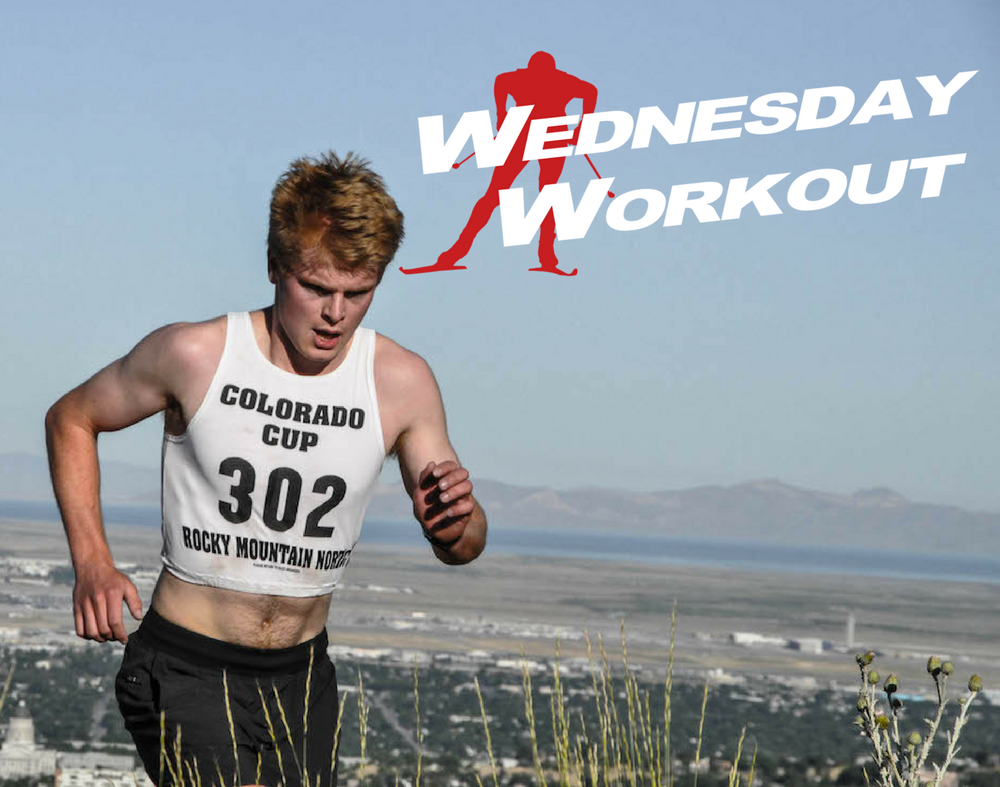
Peter Wolter, of the Sun Valley Ski Education Foundation, racing to the fastest time up Agony Hill during the 2017 Western Regional Elite Group (REG) time trial in Salt Lake City, Utah. (Photo: Matt Whitcomb)
When it comes to U.S. Regional Elite Group (REG) training camps, there are a few running themes that remain consistent across the country and from year to year. In the East, West and Alaska, participants in the U.S. Ski Team’s development program are tested with an uphill run, agility course and a roughly half-mile double pole, all of which are timed and done individually.
Western REG coaches Mike Elliott and Bill Hokanson explained how the run is done at Agony Hill, adjacent to the University of Utah in Salt Lake City. The “hill”, on the 6,348-foot Mount Van Cott, has been an REG staple since 2006, according to Elliott, a three-time Olympian and former U.S. Ski Team (USST) member. It has been used since the 1990s by the USST, the University of Utah Ski Team, Wasatch Ski Academy, The Utah Nordic Alliance, Park City Nordic Ski Club, and Soldier Hollow Nordic Ski Club, Elliott wrote in an email.
The Agony Hill course records set more than a decade ago still stand, which Hokanson explained was partially due to trail construction since.
“We’re not 100% convinced the modern course is exactly equivalent to the historical one,” wrote Hokanson, head coach of the Wasatch Nordic Ski Academy in Park City and Salt Lake City.
For instance, Morgan Arritola set the junior women’s record of 16:55 minutes up the 1.7-kilometer climb in 2004. The rest of the course records were set before that by John Aalberg (12:46), Nancy Fiddler (15:46) and Rob Whitney (reportedly under 14:00) for senior men, senior women and junior men, respectively.
“Variations in the Agony Hill TT course over the past 3 – 4 decades may in part account for the difficulty contemporary athletes have faced in trying to set new records,” Hokanson wrote. “However the records are held by 4 of the toughest, fittest, most talented athletes of all time, which may fully account for the tenacity of their record efforts.”
Here’s how you can replicate the Agony Hill time trial in your own backyard:
“Agony Hill can be developed anywhere and it does not have to be all uphill,” wrote Elliott, now executive director of Rocky Mountain Nordic in Durango, Colo. “My coach, Dolph Kuss, used a course on the edge of Durango when I was in college a Fort Lewis college in 1965 & 1966. It was a loop next to the local cemetery. The area is still called test tracks.”
Elliott recommends a climb lasting 12 to 15 minutes for athletes 18 and older. He also suggested starting athletes individually (via interval starts).
“It can be all out for one lap or Level 3 below threshold intervals,” Elliott added. “Try and have around the same time each time. It can be a 15-minute run to see how far you can go. Like Agony Hill, it can be all uphill.”
He explained that these kind of time trials measure fitness, pacing and rate of improvement over time, and recommended doing this workout once every other week or once every three weeks.
The Workout: Agony Hill uphill time trial
1. Warmup: Light running and stretching for 30-40 minutes
2. Uphill Run: Interval-start recommended
Option 1: One time, all-out effort: see how far up the hill/mountain you can go
Option 2: Level 3 intervals: aim for consistent times
3. Cool down
Agony Hill specifics:
Where: Mount Van Cott, east of the University of Utah in Salt Lake City
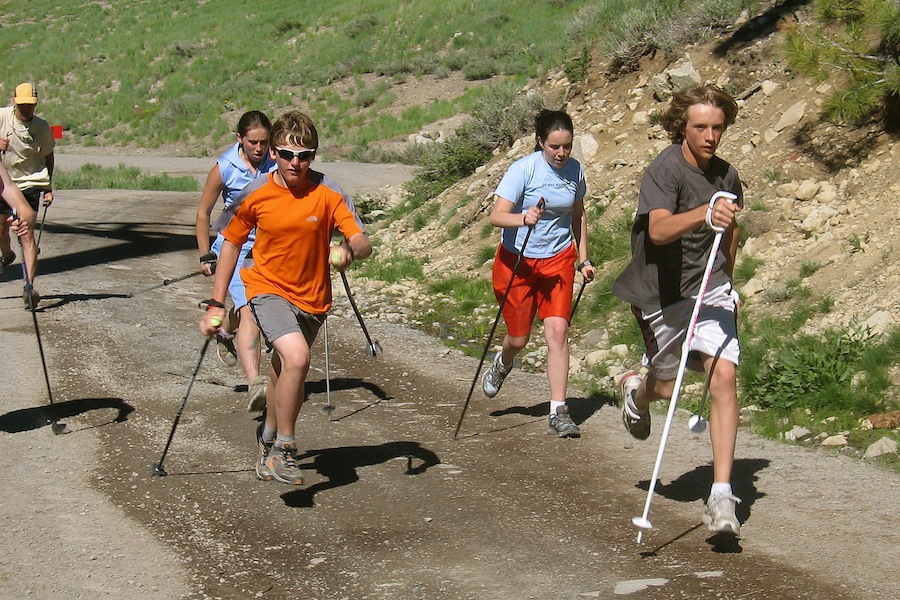
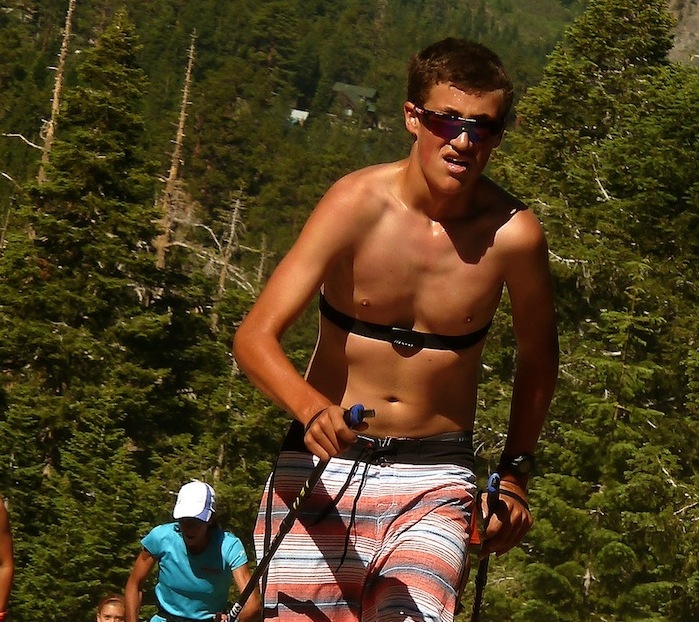
Brandon Herhusky leads Far West juniors in a ski walking/moose hoofing workout at the 2012 June Lake Camp in California. (Photo: Mark Nadell/Macbethgraphics.com)
For this week’s workout, we’ve brought back a how-to-guide to ski walking, hill bounding and moose hoofing, written by former U.S. Ski Team member Nancy Fiddler, a two-time Olympian and past FasterSkier contributor. Fiddler shared this workout, which works for juniors to masters, in four years ago. Read the original here.
***
[circa June 2013]
Ski walking, hill bounding, and moose hoofing are a great way to incorporate ski-specific movements into a dryland workout. There are many ways to use these training tools, but I am going to recommend a favorite interval workout that touches on all three techniques. This low-impact workout works great for skiers of all ages and abilities, from juniors to masters.
“It helps to think of a deer bounding through the forest. The deer’s feet briefly make contact with the ground, and then it is flying forward with all four feet off the ground.” — Nancy Fiddler’s description of hill bounding
I was introduced to foot-specific training back in the late ’80s by my U.S. Ski Team coach, Torbjørn Karlsen. Although much has changed about skiing since then, this type of training, which mimics the diagonal stride movement, remains highly valuable to cross-country skiers today.
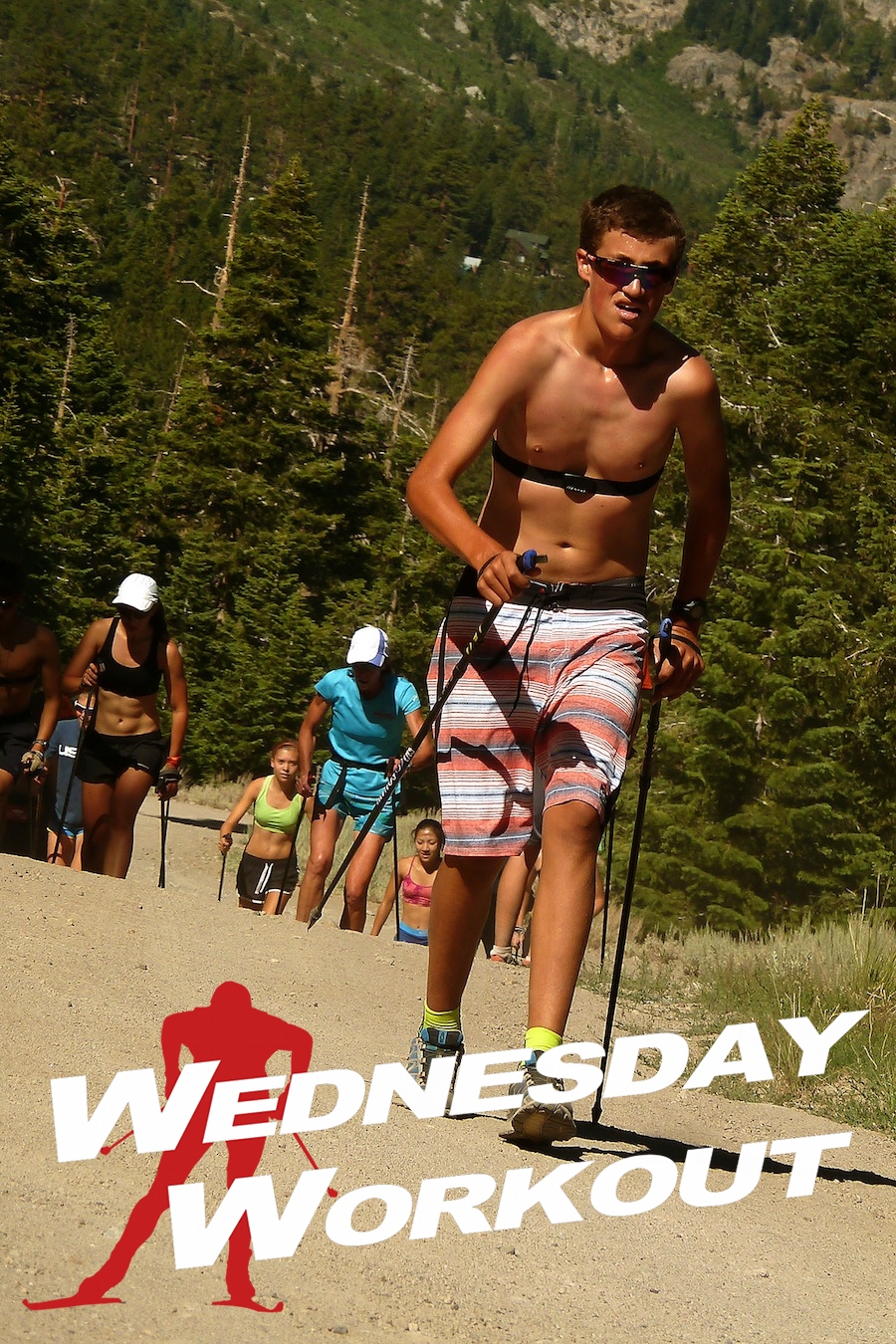
Ski walking is diagonal striding without the glide. Think of the arm and leg swing as pendulums while striding on foot up a gradual incline. It’s key to not reach too far up the hill with the foot and to make a complete weight transfer (hip over foot) upon footfall.
The 2008 Auburn Ski Club Development Team during a ski-walking workout in Squaw Valley, Calif. (Photo: Mark Nadell/Macbethgraphics.com)
Add poles, and ski walking is highly specific. It is important to have ski poles that are about sternum-high in height, or about 10 cm shorter than your classic poles. While ski walking, keep the poles angled so that the hands are low and the arms can swing freely forward. The hand is pushing the pole down and back, finishing just past the upper leg. The pole will plant further back than when on skis.
Hill bounding resembles striding up a steep hill on skis. It is more explosive than ski walking and it helps to think of a deer bounding through the forest. The deer’s feet briefly make contact with the ground, and then it is flying forward with all four feet off the ground. To practice, start with a jog up a moderate hill, then make each footfall more explosive. Lifting the front knee will help extend the bound. Again poles are planted angled back with hands low. The kick will be assisted by the pole push.
Moose hoofing is similar to hill bounding, but less explosive, and therefore more sustainable for longer periods of time. Think of moose hoofing as a way to imitate the diagonal stride up a long, gradual hill. The timing of the kick and pole push remain synchronized, as in bounding, but not as snappy. I like to think of a moose shuffling through the forest, not in as big of a hurry as the bounding deer.
The Workout: 4’s and 1’s
Find a dirt or grass hill about 400 meters or more in length. The incline should be gentle to moderate and fairly consistent. Alpine ski areas and logging roads work great.
Warm up: 15-20 min easy jogging. Add some gentle dynamic stretches and some arm and leg swings.
Get explosive: Do a set of 6-10 hill bounds (15-20) sec each. Use the first one or two to coordinate technique and timing, and then work on popping off the ground with each bound. It is possible to do this with or without poles.
Intervals: 4 minutes steady ski walking at a Level 3 effort. Walk back down the hill for recovery (recommend 3 minutes recovery), then moose hoof back up the hill for 1 minute. By the end of 1 minute, you will be in Level 4! Recover back down the hill for 1 minute then repeat the cycle. Depending on your fitness level and time of the year, try for 3-6 cycles of ski walking and moose hoofing.
Cool down: 10-15 minutes of easy jogging.
Equipment: running shoes, water bottle, and short ski poles.
Twenty-three days ago, Hannah Halvorsen hit the send button in her email, delivering 60 messages to cross-country skiers across the U.S. and worldwide. The subject line read: “Just two sentences!” Recipients who opened the message were greeted with two prompts: 1) “What’s one way that you’ve been affected by eating and body image in cross-country skiing?” and 2) “What’s one thing you tell yourself or perspective that you use that has been healthy or helped you?”
Twenty responses, numerous follow-up emails and 15 videos later, Halvorsen, an 18-year-old U.S. Ski Team rookie, had acquired enough footage to compile a video titled “Breaking The Silence”. Published last Saturday, Oct. 22, the video had already acquired over 3,000 views by early Wednesday. According to Halvorsen, it was a month-long project she created with the intention of raising awareness and opening discussions about disordered eating and body image among nordic skiers.
This fall wasn’t the first time the topic had crossed her mind. The issue was one she had mulled over during much of her junior skiing career and during the past season, she began brainstorming ways to bring it into nordic skiing’s spotlight.
“I decided a video would be better than doing an article because I’ve seen articles out before and I wanted to do something a little bit different and more emotional,” Halvorsen, of Truckee, Calif., said on the phone Monday while at a U.S. Ski Team (USST) training camp in Park City, Utah. “I’ve been wanting to do a project on this topic for a long time because the longer I’ve been skiing the more I realize this is a huge issue. Even traveling internationally I’ve talked to kids from other countries and it’s the exact same thing.”
Hannah Halvorsen (far left) with some of Team Norway’s junior athletes while competing for the National Nordic Foundation’s U18 team at the 2015 Scandinavian Cup in Ornskoldsvik, Sweden. (Photo: usaj1team.blogspot.com/)
Halvorsen’s video includes responses from junior and collegiate skiers, current and former USST members, as well as American and international athletes, all sharing their thoughts on the issue.
“I told people to keep it light,” she explained. “I wasn’t asking people to confess. I didn’t want to be super personal or controversial because I’m not a professional and I didn’t want to make something that could offend people or hurt people. I just wanted to bring awareness.”
Halvorsen is a U.S. development team member who races for the Sugar Bowl Nordic Team, has qualified for two Junior World Championships and competed in three Scandinavian Cups as well as the 2016 Youth Olympic Games. It took her roughly four to five follow-up emails per person to obtain enough footage for the video, but by the time she arrived to Park City last week on Monday, Oct. 17, she’d received enough material to put together “Breaking The Silence”.
“I knew that I was coming to this U.S. camp, so if I didn’t end up getting any footage I was just going to pester the girls at the camp and film them myself, but I ended up getting plenty beforehand,” Halvorsen said.
“The longer I’ve been skiing, the more I realize this is a huge issue. Even traveling internationally I’ve talked to kids from other countries and it’s the exact same thing.” — Hannah Halvorsen on body image issues and disordered eating in skiing
The compilation is five minutes long and provides a montage of women’s perspectives on how body image and eating have affected female cross-country skiers, with World Cup race footage interspersed throughout the video as well. Though all of the featured interviews are of women, Halvorsen points out that disordered eating and body image may also be an issue among men who cross-country ski, even if manifested in different ways.
“I had a lot of discussion on whether I should include males [in the video],” she said. “It’s tricky because it’s almost seen as a woman’s issue, so men are more sensitive about being asked about it. … I did ask a few men and they weren’t comfortable with it, so then I thought maybe I should just direct my focus on women because that’s the issue I understand. I know what it’s like for women; I don’t know if it’s slightly different for men and if I’d be tackling something totally different [by asking them], but I do think men are struggling with it, too.”
So far, Halvorsen said the responses to the video had all been positive, with many commenting that more conversation about issues like these need to happen.
She also pointed out that the video is not the solution to disordered eating and body image amongst nordic skiers, but rather a step in the right direction.
“I know that not everyone who watches it is going to be perfect and never struggle with body image, but there might be something in there that resonates with someone no matter how small of an impact it is,” Halvorsen said. “It helps people believe that they’re not alone because it’s so unspoken I think people think they’re the only ones thinking about it.”
Halvorsen also asked Truckee-based nutritionist and health coach Natalie Boggs how to best support those struggling with disordered eating or body image. Her response was fairly short and simple: “If you notice someone who seems to be struggling, you can ask them if they are feeling OK and if there is anything you can do to help.”
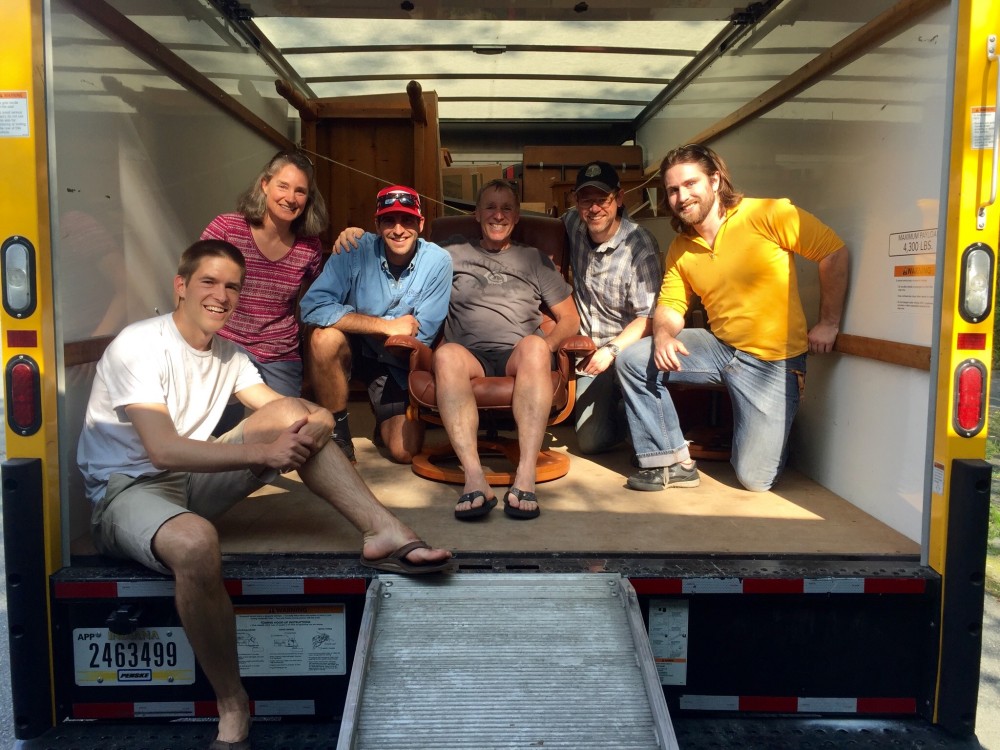
(From left to right) Austin Caldwell ’14, Scottie Eliassen ’90, Sam Tarling ’13, Ruff Patterson, Erik McEwen, and Leif Johnson ’13 in the back of Patterson’s U-Haul last Tuesday, May 24, prior to Patterson’s departure west. (Photo: Sam Tarling)
In late March, Ruff Patterson, 61, announced he was stepping down as head coach of the men’s nordic team at Dartmouth. This is a story of his impact and legacy as a coach, first as a U.S. Ski Team assistant and later at Dartmouth in Hanover, N.H.
“There were no non-heroes out there today.” — Ruff Patterson, after a four-hour rainy run with the Dartmouth men’s nordic team, circa 2007
***
Twenty-seven years ago, a group of men convened in the basement of Robinson Hall, home of the Dartmouth Big Green ski team. Veteran faces intermingled with those of eager newcomers — including the likes of current U.S. Ski Team Head Coach Chris Grover.
Wisecracks and an accompanying chorus of chortles percolated amongst those assembled, drifting up into the stairwell. A few shuffled their feet as they awaited their coach’s arrival for the first fall practice of the ski season.
However, the figure that eventually greeted the gang beneath the building’s floorboards was not that of John Morton — the coach who recruited Grover the prior spring and whom Grover expected to work with during his four years of undergraduate study at Dartmouth.
That autumn afternoon, September 1989, the individual who approached the group was as novel to the Dartmouth ski team as any of Grover’s fellow freshman teammates. With time, however, he would become synonymous with the school’s ski program.
“This was all happening pre-internet, pre-email, pre-mobile telephones,” Grover on the phone of his recruiting process to Dartmouth. “There was never any sort of news release or anything that went from Hanover to where I grew up in Anchorage, that would’ve said, ‘Hey, by the way, John Morton quit and there’s a new coach named Ruff Patterson and he’s going to be taking that coaching place.’ So here I was that following September, expecting to see John Morton show up for practice, when Ruff Patterson rolls in … That was an interesting transition. We were all getting to know somebody new on the first day.”
The Patterson Siblings, Sun Valley and the USST
“You gotta love it!” — Ruff Patterson on skiing, racing and training with the Dartmouth men’s nordic ski team, circa 2013
Situated nearly 6,000 feet above sea level, the city of Sun Valley, Idaho, holds a unique history as one of the first destination ski resort areas in America. Famed names such as Dick Durrance, Ernest Hemingway and Picabo Street have carved the region’s mountainside slopes and the locals’ love for skiing, particularly alpine, goes almost unparalleled.
Ruff Patterson coaching with the U.S. Ski Team in the 1980s. (Photo: Gordon Vermeer and Eric Packer)
This held especially true for Susie, Pete, Barbie and Matt Patterson, Ruff Patterson’s four younger siblings. Surrounded by Idaho’s Sawtooth Mountain Range, and with support from their parents Joannie and Jim Patterson, all five developed a deep devotion to skiing. To many in the community, they became known as Sun Valley’s “First Family” of skiing.
In a way, however, Ruff was the ‘black sheep’ of the household. Susie became a two-time national champion alpine skier, Pete qualified for the Winter Olympics in downhill skiing twice, and both Barbie and Matt established themselves as adept alpine skiers. Meanwhile, Ruff chose a slightly different ski path than his siblings. He chose cross-country.
“[In] high school, I had a brother and sister who were both traveling, very young, for the national alpine team and I was kind of the guy in the background helping them get through school and fixing skis and stuff like that,” Ruff said in a phone interview in April, shortly after he announced his retirement from Dartmouth. “Contact with people, having to deal with traveling and and competing started really young for me, but [ski coaching] was not something I planned on doing after college.”
As a student enrolled at the University of Colorado Boulder (CU), Ruff originally intended to become a doctor. He placed himself on the pre-med track and graduated with a degree distributed in the fields of biology, chemistry and psychology. Ruff also competed for the Buffs’ ski team. During his undergraduate years, CU won four NCAA Championship titles — though in his senior year the title, ironically, ended in a two-way tie with Dartmouth.
Despite his initial plan, post-grad life did not leave Ruff pouring over MCAT entrance exams or medical-school applications. Instead, he found himself back in his beloved hometown, ski coaching with Rob Kiesel, the founder of the Sun Valley Ski Education Foundation (SVSEF) nordic program.
The first few years of coaching for Ruff were far from glamorous. He spent most of his time supporting the SVSEF junior racing team and acting as a professional porter and nordic roadie for the U.S. Ski Team (USST).
“Rob hired me as the national team coach, and you know when you start out, you’re carrying a lot of ski bags and traveling a lot,” Ruff said. “Those first years I was traveling internationally with the team and just doing a lot of the groundwork. I don’t think a lot of the groundwork has changed for those poor guys. They earn every cent.”
Kiesel, the man who hired Ruff, influenced Ruff’s path into coaching. As Ruff put it, Kiesel was more than just a family friend. Kiesel was Patteron’s role model and mentor.
“I wouldn’t be coaching today, nor begun coaching if it weren’t for Rob,” Ruff previously wrote in an email after Kiesel passed away in 2011. “Both my sister Susie and brother Pete wouldn’t have had the Alpine skiing careers they had if it weren’t for Rob. My brother Pete wouldn’t be guiding in Greenland or Nepal if it weren’t for Rob. More importantly, Rob was an integral part of our family.”
As Patterson’s grip on the nordic race world grew, he began to move up in position and expertise. For 10 years, he worked for the USST, a better part of those alongside Mike Gallagher. While co-coaching with Gallagher, Ruff assumed the role of “primary assistant” coach to the USST, often working with the women.
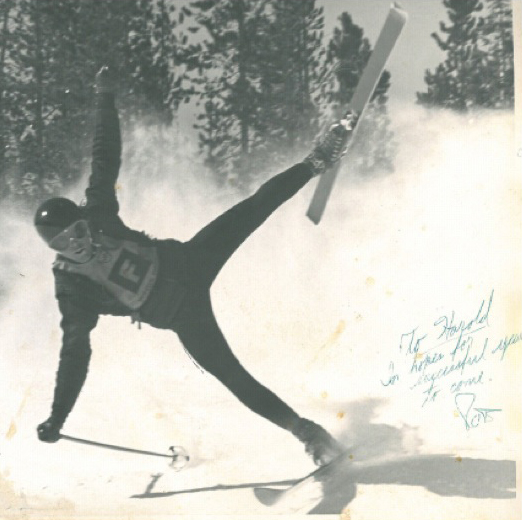
Rob Kiesel, Patterson’s coach, showing off his downhill skills at Winter Park in 1964 (Photo: Harald Bjerke)
“[Mike Gallagher] and I would worked really closely together and I was sort of his primary assistant as the year grew on,” Ruff said. “When we’d split up, I would end up taking the women and there were a few years where I was actually labeled the women’s coach. But for the most part, he and I were more of a team and I was more of his assistant during my primary coaching year.”
Ruff’s stint with the USST brought him to the Olympics, alongside Kiesel at the 1980 Winter Olympics in Lake Placid, N.Y., and with Gallagher at the 1984 and 1988 Games in Sarajevo, Yugoslavia and Calgary, Alberta, respectively. He mentioned working alongside U.S. Ski Team coaches Torbjørn Karlsen and Peter Ashley as major influencers in his career as well.
His work for the USST helped women like current Methow Valley Nordic Team head coach, Leslie Hall –the sister of Patterson’s future Dartmouth College co-coach, Cami Thompson-Graves — to the Olympics.
“He was one of the main coaches at the 1988 Olympics, my first Olympic experience and the main memories that stick with me are his smile, laugh and bad jokes!” Hall wrote in an email. “My relationship with Ruff has evolved so much over time, from being an admiring junior who wanted his attention and help, to being a friend on mountain biking trips to Moab, to being the sister of his co-coach at Dartmouth.”
He also helped current Middlebury College assistant coach and University of New Hampshire alum Patty Ross, and Bates College alum Nancy Fiddler to Olympic levels of racing.
“Ruff was always there with a joke or someway to diffuse a tense situation,” Fiddler said on the phone. “Everybody gets so caught up in [skiing] and if you were feeling kind of involved in a way that wasn’t healthy, he just brought you back and reminded you that, ‘Hey it’s ski racing it’s supposed to be fun, and if you’re not having fun, what the hell are we doing.”
Changes To Hold Onto: Skating and the Mental Breakthrough
“Weight shift, weight shift, that’s the key.” — Ruff Patterson during a skating technique workout with the Dartmouth men’s nordic ski team, circa 1989
Little did Bill Koch know that when he entered Sweden’s 1980 Worldloppet marathon, he would rock the ski world forever. During that winter’s fated 50-kilometer ski race, Koch witnessed what has since become a staple in cross country skiing: the skating technique.
After Koch began to implement skate skiing into his own national and international races, the sport changed forever — a change Patterson perceived first-hand.
U.S. cross-country legend Bill Koch pioneering the skating/freestyle technique in the ’80s. (Photo: Peter Ashley)
“I was incredibly fortunate to live through the skating revolution,” Patterson said. “To see the live world change, everybody else’s world change and how people react to that, that whole thing was, man, something to live through.”
“You can sort of compare it to — right now there’s this big double poling thing,” he added. “Skating was very much the same thing. It was a complete unknown. So for everybody, including sports staff like myself, it was like, ‘What’s going to happen here?’ ”
What happened was rattling to some and rectifying for others. Patterson pointed out that he saw many attempt to prevent the change, but the skating technique, ultimately was here to stay.
“You know, they were trying to do everything possible to make it less possible to skate,” Patterson said. “A lot of the controls they tried were almost laughable now.”
As Patterson sees it, there are certain circumstances when evolution of the sport is inevitable. Occasionally, adaptation outweighs resistance.
“What I’ve discovered during those periods is … if you’re here to play the game, you have to figure out a way to go with it,” he said.
Skating and double poling aren’t the only areas Patterson says he has seen development in skiing. To Patterson, the mentality of American ski racers is what has changed the most. Especially for the U.S. women.
“When Kikkan [Randall] opened the door, the barrier, for Americans to do well in Europe, I think the whole mental game changed,” Patterson said. “I’m hoping that this mindset moves into the boys’ group [in the U.S.], that mentality of just, ‘Hey, we can compete and win against the big boys and the big girls.’ That’s probably one of the most significant changes I’ve seen since I’ve started coaching.”
Dartmouth Dudes and Loving What You Do
“Boys, I want medals!!” — Patterson to the Dartmouth men’s nordic ski team, circa 2012
Freezing rain. Mosquitoes. Heavy, humid heat. The Northeast Coast makes many westerners go weak in the knees. Patterson was one of them. Located in the heart of Hanover, N.H., a move to Dartmouth promised Patterson the very bipolar weather, bug bites,and Vitamin-D deficiency he dreaded the most.
Ruff Patterson discovered that the eastern biking may make up for his dislike of East Coast climate. (Photo: Dartmouth Ski Team Facebook)
“When I first took the job I was a western guy and I thought, if I lasted three or four years I’m going to be lucky,” Patterson said. “I was terrified of bugs and humidity and once I got here the bugs and humidity were terrible, but then I realized that the road biking and other stuff in the East were just incredibly great. But I never planned on being here as long as I did.”
Patterson’s original estimated three-to-four-year window turned into seven, soon 11, and eventually 27. Overcoming his fear for East Coast climate was only part of it. His deepening devotion to the Dartmouth men’s team also drew him to stay.
“I just kept saying over and over again ‘I love what I do,’” he said. “Just absolutely love what I do and I just felt that it stayed like that all the way through.”
Patterson’s philosophy to love what you do and see it through transferred to his athletes. During his 27 years at Dartmouth, he coached three men to individual NCAA Championship titles — Glen Randall in 2008, Sam Tarling in 2011, and Patrick Caldwell in 2015 — and he also helped Dartmouth to an NCAA team title in 2007, with All-American athletes Mike Sinnott and Ben True.
“When I came in as a freshman, I was very hesitant to fully buy into his philosophy of training,” Tarling, a 2013 grad, wrote in an email. “After my first year working with Ruff, our relationship strengthened and I decided to stay in Hanover for the summer and work with him. I discovered that some of the silly things we did in training had the most influence on my performance, and that what seemed like random workouts and drills had a purpose. I ended up staying every summer after that to work with Ruff.”
Tarling was not the only athlete who at times questioned some of Patterson’s practices. Both Grover and Carl Swenson, a 1992 graduate and three-time Olympian, recalled recovery runs with Patterson as conclusively easy, in spite of athletes’ attempts to do otherwise. Patterson wanted his skiers to be fast when they needed to be and to step back and enjoy training the rest of the time.
“We’d go out for a ‘Ruff Waddle’ recovery run,” Swenson said. “Ruff would make us run behind him. It was to teach us to go easy … because all we wanted to do was race every workout.
“He was just the right coach at the right time for me,” Swenson added. “He kept me at it, really. I think it’s a period where a lot of people get interested in other things and, as everybody knows it takes some time to develop as a distance athlete, and he really kept me on track as best as anybody could have in a period when I was not on track by any means.”
Gaining credence with athletes like Tarling and Swenson and witnessing their progress, for Patterson, was another piece of what made college coaching worthwhile.
Just a few of “the kids” as Ruff Patterson (not shown) calls them (left to right): Nils Koons, Sam Tarling, and Eric Packer (Photo: Ruff Patterson)
“Winning over athletes and gaining their trust, I can’t tell you the rewards behind something like that,” Patterson said. “That’s just another piece of this overall puzzle, but sort of everything. Once again, it’s the people and stories behind them that have made it for me.”
Though Tarling, who is now working as a software engineer in Denver, Colo., indicated he’s “happily enjoying being a recreational athlete for a change,” he still feels indebted to Patterson for all that he’s helped him achieve.
“Our relationship began with many conversations about how we could best work together to help me achieve my goals in ski racing, but progressed to the point where Ruff was much more than my ski coach,” Tarling wrote. “He was – and is still – my mentor, my confidant, my hero, my friend.”
Patterson was much more than a coach to many of his athletes. He was a pillar, the adviser and ally searched for not only on the trails, but off them as well. He did not force his athletes to grow. He fostered them to take the steps on their own. As numerous athletes indicated, his door was always open to whoever happened his way.
“Ruff impacted my life on so many different levels beyond skiing,” Patrick O’Brien, current head coach for Stratton Mountain School T2 Team and 2010 graduate, wrote in an email. “He wanted you to grow as an athlete and an individual. He was always there for support when you needed him but understood many decisions or choices had to be yours alone to make. He asked for, and brought out the best people had to offer.”
Patterson did bring out the best people had to offer, but in ways beyond just results. He saw value in every athlete, carnival circuit caliber ski racer or not.
“The guy who never makes it, the ones who just make these incredible strides … the really talented guys,” Patterson said, “All athletes are rewarding.”
Ruff Patterson on Mt. Moosilauke in New Hampshire’s White Mountains with the Dartmouth team (Photo: Gordon Vermeer and Eric Packer)
Patterson’s ability to work with athletes of all kinds, stems from his coaching style. Passionate, patient, perceptive, he held the unique capacity to turn the complexities of cross country skiing into common sense.
“Ruff has that elusive quality you see only in the very best of coaches — he makes skiing seem simple,” Packer, who graduated in 2012 and is now racing for Alaska Pacific University (APU), wrote in an email. “He has the ability to use just a single suggestion to make really dramatic improvements in your skiing.
“Hand in hand with that, Ruff really believes in the importance of building a quality training group, and holds that at the core of his coaching philosophy,” Packer added. “You learn from the group, push the group, and rely on the group. In an atmosphere like that, when everyone is working together, pushing each other in a competitive but also fun atmosphere, everyone improves.”
Humor and having fun was also a training philosophy greatly prized by Patterson.
“I call them the kids.The gang. The team. I’ve been so lucky to be able to work with these guys. Even the ones that have been nightmares, looking back that’s what’s kept me here. The people, for sure.” — Patterson on his 27 years as the Dartmouth men’s nordic head coach
“One of my favorite memories started about midway through my time at school when he would finish every pre-race meeting with a story from his previous coaching experiences,” O’Brien wrote. “All would have you rolling over laughing and reminding you that although the sport may change over the years, the spirit of it never did. It made you feel connected the people who have come before you, understanding the challenges they faced were the same as the ones in front of you now.”
However, Patterson’s impact on the nordic community cannot be pinned solely to skiers he worked with directly. As Sinnott pointed out, numerous of individuals have been influenced by the former Dartmouth head coach, whether he realizes or not.
Ruff Patterson
In two words or less… “A Mentor” — Thompson-Graves “Unassuming” –– Tarling “Wise” — Tarling “Passionate”— O’Brien “Remarkable”— Sinnott “Solid”— Grover “Supportive”— Grover “An Icon”— Packer
“You go through his office and he’s got handwritten thank you notes from John Nystad from when John Nystad was skiing for UVM [University of Vermont],” Sinnott said on the phone. “Ruff had these powerful impacts on skiers that he wasn’t even mentoring or that weren’t in his program.”
With the women too, Patterson was — and still is — a hit.
“Ruff used to get more Valentine’s Day cards than anyone else on the team,” Sinnott reflected, referring to the Dartmouth Carnival tradition of ‘Carni Crush.’ “Everyone on the circuit felt the warmth and the magnitude of Ruff. And that’s the cool thing. It’s not just the people that are obvious on a piece of paper, but it’s everyone else that might have glossed by him.”
While many of Patterson’s athletes cite him as the reason they are where they are today, Patterson is adamant that his athletes are the ones who’ve kept him in the game.
“I call them the kids,” Patterson said. “The gang. The team. I’ve been so lucky to be able to work with these guys. Even the ones that have been nightmares, looking back that’s what’s kept me here. The people. For sure.”
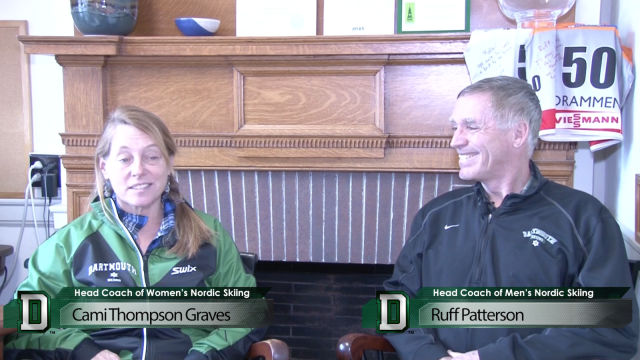
Dartmouth’s Dynamic Duo: Patterson and Cami Thompson-Graves
“Are we having fun yet?” — Patterson to the Dartmouth men’s nordic ski team, circa 2010
Bonnie and Clyde. Ernie and Bert. Starsky and Hutch. Cami and Ruff. While not many modern day duos find themselves in competition with the infamy of the previous pairs, Cami Thompson-Graves and Patterson are two that do.
In a coaching partnership that’s lasted longer than some marriages, the two have carried each other through the numerous highs and lows of coaching a Division I college ski program.
“We’ve been together longer than most people have been married,” Patterson said. “We’ve definitely had our ups and downs, but because of it, the two of us have become incredibly close.”
Though the two admit they’ve spat like siblings at times, they also agree that what they have gained out of their 27 years together is irreplaceable.
“She’d be the first one to tell you, it’s not like it was all wine and roses the whole time,” Patterson said. “ It’s just we’ve been through a lot together.”
Dartmouth’s longtime duo Cami Thompson-Graves (l) and Ruff Patterson during a 2015 interview .(Photo: DartmouthSports.com)
The two have also supported each other — and their teams — through the loss of Dartmouth athlete, teammate and friend, Torin Tucker. Tucker, who died of a heart anomaly while competing at the Craftsbury Marathon two years ago, was also from Sun Valley and described by many as having a similarly contagious smile.
A rare verve to come across, no loss the magnitude of Tucker’s is easy. For Patterson, learning to live in the memories and moments of Tucker as the epic adventuring, intellectually curious and compassionate mountain town-er he was, no matter the time it took to get there, helped he and the Dartmouth community move forward with Tucker in their hearts.
“There’s no way you can tell somebody to get over stuff,” Patterson said. “You just have to deal one day at a time, one minute at a time.”
The support and history between Thompson-Graves and Patterson, therefore, goes far beyond just van rides, wax benches, and debates over who’s who.
“We had some great moments, talked about skiing endlessly and also fought and bickered like siblings at times,” Thompson-Graves wrote in an email. “But, along the way, there were many fun race days where we worked hard, shared our nerves, and when things had to come together, they did!”
More than anything during their time together, Thompson-Graves was a firsthand witness to the dedication Patterson put towards his athletes and coaching.
“Ruff loved his guys, they meant everything to him,” Thompson-Graves wrote. “He was there, day in and day out and knew them all well. Some of them might have driven him crazy but, even with the frustrations, he loved the times when it all came together for them.”
All in all, it takes a special circumstance for two individuals to work together toward a common goal for that length of time.
“When you sum it up, I wouldn’t have traded that for anything,” Patterson said. “Because being able to figure out a way for two quite different people to work together and do as well as we have done together … boy, that doesn’t happen very often in life.”
What’s Next?
“Don’t overthink it.” –Ruff Patterson to the Dartmouth men’s nordic ski team, circa 2006.
Forty years ago, Patterson — clad in a black graduation cap and gown — strolled across the CU stage to receive his diploma. Like many of the student athletes he would eventually coach, he had post-college plans that would inevitably change, a passionate fervor for cross country skiing, and an anything but linear trajectory ahead.
Forty years later, with his final cohort of college senior skiers before him, not much has changed. As Patterson departs Dartmouth, there is a piece of him that feels as if he is once again striding across the graduation stage, leaving school behind to discover what’s next.
“It wasn’t until the day before I resigned that I actually knew I was going to do it,” Patterson said. “I didn’t sleep that night, I can tell you that much.”
“It sort of feels like I jumped off a cliff doing this,” Patterson said of his resignation. “I was in a little bit of a shock for a few days, but I’m going to sell my place here, pack up a U-Haul and return west, which I’ve been wanting to do forever. And then stir the pot up a little bit and try to find something else to do. I have no idea what that’s going to be. I feel like a college kid again.”
2015 NCAA Champion Patrick ‘Paddy’ Caldwell (l) with coach Ruff Patterson. (Photo: Dartmouth Ski Team Facebook)
Even if Patterson is now physically distanced from Dartmouth — he headed west last week Tuesday — his legendary role and presence is not. His impact extends beyond Dartmouth, into the lives of past, present and future mentees — some of which he will never meet in person. Many he will have infiltrated with his coaching philosophy alone.
“Ruff was really responsible for creating that atmosphere with the [Dartmouth men’s] team, in terms of camaraderie he created in the group,” Grover said. “And certainly, as you know, that’s a big thing for us these days with the USST. The team and the athletes are quite successful on an individual basis because we tend to try to build a family atmosphere around the team. Ruff really did the same.”
Patterson’s stamp survives in the USST, the skiers who are now software engineers, lawyers, coaches, writers and more.
“You know, I came into a great group early on,” Patterson said of his first few years coaching at Dartmouth. “It took a while to establish my own style. It doesn’t mean that the style that Mortie [John Morton] had way back when was, there’s no way you could say it was bad or good … I absolutely know that the next person that’s going to come in in my place is going to be exactly the same; have their own style … I got to put my stamp on things and the next person here is going to put their stamp on things.”
Semi-uncertain of what his future holds beyond bike trails, mountain towns, and some RV roaming, Patterson is certain that Dartmouth has green grass ahead and he, a wanderlust for western blue skies.
“I know they’ll find somebody good,” Patterson had said of prospective coaches for the Dartmouth head coaching position, prior to the hiring of Brayton Osgood in May. “And I know that the school will always support skiing … My personal opinion is that they’re going to just keep going and there’s nothing wrong with that … Field of dreams.”
Canada recently launched a Report Doping Hotline though the Canadian Centre for Ethics in Sport. “Our Government is committed to eliminating doping in sport and ensuring Canadians athletes compete on a safe and fair field of play,” Canadian Minister of State (Sport) Bal Gosal said in a press release. “This increased contribution from the Government of Canada and our partners will enhance the Canadian anti-doping program by strengthening its testing and investigative capacity.”
“With increased intelligence we can test the right athlete, at the right place and at the right time. This is a huge win for fair and clean sport.” — Paul Melia, Canadian Centre for Ethics in Sport CEO and President, in a press release
On Nov. 5, the Canadian Centre for Ethics in Sport announced the creation of a new and anonymous Report Doping Hotline (1-800-710-CCES), funded by the Canadian government, Canadian Olympic Committee and the Canadian Paralympic Committee to the tune of nearly $1 million Canadian dollars.
According to the CCES website, the hotline came about as a result of public-opinion research commissioned by the CCES. According to its findings, “Canadian and athletes want clean sport.” The additional funding will ensure that all Olympic and Paralympic athletes will be tested during the months leading to the Sochi Olympics and provide a risk-free platform for reporting their peers.
Canada is not the first country to come up with a snitch line for doping accusations. The United Kingdom and Australia have similar hotlines, as well as the United States. Another endurance sport, cycling is also attempting to round up dopers through its Union Cycliste Internationale (UCI) Hotline. The UCI hotline, in place since January 16 records calls then forwards them to trained specialists in the anti-doping field who then decide what actions need to be taken to catch the suspected cheaters.
Established in 2004, US Anti-Doping Agency (USADA) Play Clean Tip Center (1-877-752-9253) invites callers to leave a message so that the USADA can contact the caller. It is also possible to email or physically mail a note.
“The line was designed as an avenue, for anyone, but especially for athletes, to contact USADA when they believe doping has compromised the integrity of sport,” USADA Media Relations Manager Annie Skinner wrote in an email. “Callers may choose to remain anonymous and all information is evaluated.”
According to Skinner, USADA also accepts tips about suspected cheaters outside of the U.S.
“It’s another step toward catching dopers. Testing does catch some people, but going ‘inside’ the sport and allowing an avenue for clean athletes to report suspicious activity is important.” — Justin Wadsworth, head coach of Cross Country Canada’s World Cup Team
Canada’s doping hotline seems to be getting some use, with an “all lines are busy” message frequently encountered by callers, as this FasterSkier reporter learned through a battery of calls over the course of several days.
An Olympic gold medalist from the 2002 Winter Games, Canadian Beckie Scott stands behind the new hotline. Initially third in the 5-kilometre pursuit, she became the first North American woman to earn an Olympic gold more than two years after the Games; the first- and second-place finishers were disqualified for testing positive for banned substances.
In an interview with CBC Radio’s “As it Happens,” Scott said she would have used the hotline had it existed when she was racing. She would have called about suspicious activity she witnessed, which didn’t include her Canadian teammates, who were 100-percent clean, she said.
Her husband and current head coach of the Canadian national cross-country ski team, Justin Wadsworth also supports the hotline.
“It’s another step toward catching dopers,” he wrote in an email. “Testing does catch some people, but going ‘inside’ the sport and allowing an avenue for clean athletes to report suspicious activity is important. I think the future of catching athletes and teams who dope is through more investigative work coupled with targeted out-of-comp testing. Either way, allowing an anonymous way to give testing agencies more info is a good thing.”
While Wadsworth hints at that doping is larger than isolated individual incidents, the CCES website comes right out and states: “Athletes who dope, rarely, if ever, act alone.”
Citing the Lance Armstrong doping scandal, CCES President and CEO Paul Melia wrote on his blog that doping riders were aided and abetted by coaches, trainers, doctors, and others. Catching and punishing those in the supply chain will put a dent in doping, he reasoned. Working with Border Services Agencies is a start. Much can be learned from intelligence gathering on the importation of banned substances and drug enforcement agencies can provide information on drug busts and seizures. Name gathering at the drug trafficking level can lead to names and destinations at the receiving end of the deal.
“Perhaps there is a more immediate and valuable source of information, that up until now has gone largely untapped,” Melia added. “That source is the athletes themselves.”
While the new World Anti-Doping Agency (WADA) Code gives caught dopers reduced sanctions if they provide information on others involved in banned behavior, the new code does not encourage clean athletes to share suspected doping activity.
“It is up to individual countries, their sports governing bodies and their national anti-doping agencies to come up with ways to do this,” Melia explained.
The plan is big in Canada and with nearly $1 million dollars behind it, it is clear that the nation intends to catch dopers before they get to Sochi in February. The first step might be to man the phone lines with actual people, rather than automated requests to leave messages.
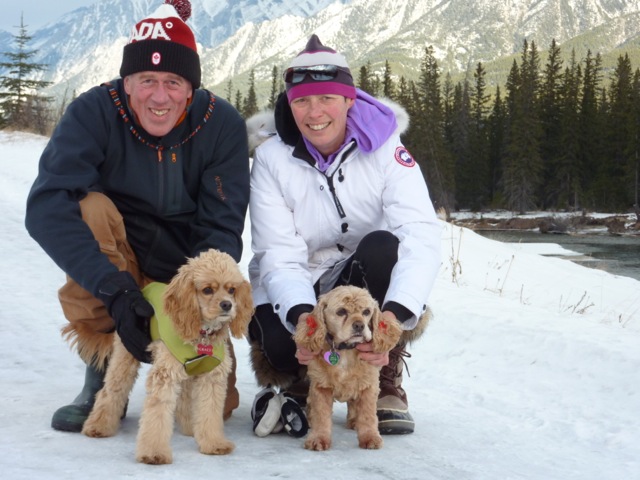
Dave Wood, Alison and their two Cocker Spaniels (Courtesy photo)
Several weeks ago, I received an email from Dave Wood, a longtime head coach of the Canadian National Ski Team. He had just arrived in my hometown of Mammoth Lakes, Calif., with a small group of athletes from Black Jack Ski Club in Rossland, B.C. We planned a rendezvous to catch up and to chat about the local training hot spots.
It had been a few years since Wood had been in Mammoth with skiers. Back around 2003 or 2004, during his tenure as Canada’s national-team head coach, he had discovered this high-altitude training location through an online search and some U.S. distance running links. A reconnaissance to the area gave him all the information he needed: a “live high and train high or low” scenario with great fall weather and miles of trails and open roads.
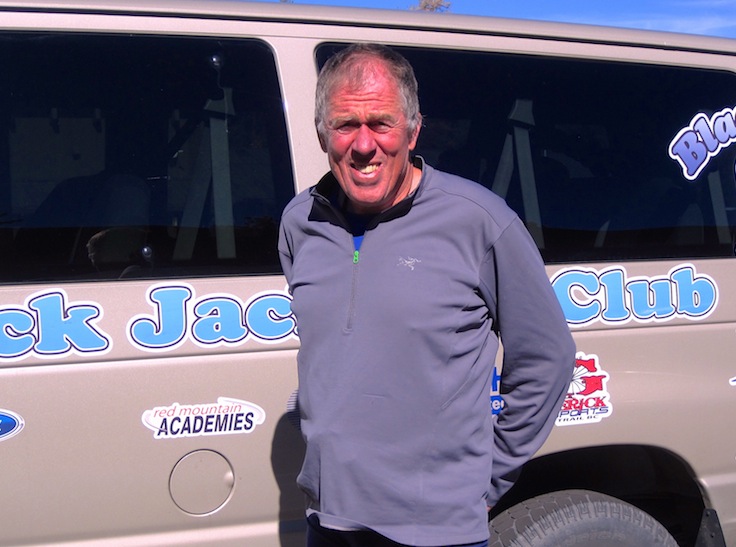
Dave Wood during a recent altitude dryland camp in Mammoth Lakes, Calif.
For several subsequent falls, Wood and his national team left their home base in Canmore, Alberta, for three weeks of high-altitude sunshine in the Eastern Sierra. Now, Wood was back, this time with a few dedicated athletes from Black Jack, of which he had been the head coach since 2010.
The Black Jack camp format was similar to the national-team camps he ran in Mammoth years before. Condominium living at just over 8,000 feet gave athletes rollerskiing options right out the door, with single-track running trails not too far away. Proximity to the town of Mammoth Lakes offered a fitness club, grocery store, and some rest day “in-town” opportunities were just a short bike ride away.
As Wood explained over coffee, the beauty of coming to Mammoth was the convenience of being able to stay in town and drive 40 minutes down to 4,000 feet for intensity training. He raved about the “exceptional rollerskiing,” where on one lonely road leading to Nevada, his athletes saw only a handful of cars during an over-distance rollerski workout.
I had hoped to join Wood and his Black Jack skiers for several workouts, but managed just one: a long run in Lower Rock Creek. Wood had to leave town for a couple of days, so he enlisted me to take the athletes to a nearby trailhead for their run over Duck Pass. Several inches of snow overnight jammed up that idea, so I drove down the hill with the guys and Chisa Obayashi, a Japanese skier who has been training under Wood’s supervision the past few months. I had in mind beginning the run out of the snow zone at the Paradise trailhead, just north of Bishop, Calif.
The Black Jack Ski Club, with head coach Dave Wood, while hiking Mount Assiniboine on the Great Divide on the British Columbia/Alberta border in August 2011. (Photo: Dave Wood)
Tagging along on the run through towering Jeffrey pines and golden aspens, I was able to learn a little bit about the Black Jack athletes. David Palmer and Colin Ferrie, accomplished junior skiers, are heading into their first year as seniors. They, along with teammate Julien Locke, who missed the trip due to an injury, are among the best in their age group in Canada. They have had solid training all summer including a trip to get on snow at the Haig Glacier. Following their Mammoth camp, they will be heading to Canmore for some time on Frozen Thunder.
An adopted Black Jack skier, Obayashi made the trip down to Mammoth with the men’s team and was also planning to join them after in Canmore, where she would get some snow kilometers before going to Finland for the start of the racing season. Obayashi connected with Wood through her manager in Japan and had only positive things to say about her training experience in North America, she told me as we ran on the Lower Rock Creek trail.
The kind of individualized coaching she was receiving from Wood was hard to come by in Japan. She had no regular training group in Japan, so the opportunity to train with Black Jack was setting her up well for her quest to make the Japanese Olympic Team.
Chief, Cook and Bottle Washer
A few days later, I met up with Wood again for lunch. He pulled up in the team van on time, but appeared a bit flustered. Dressed in running clothes, he explained that he had dropped off his group over in June Lake to do a three-hour, point-to-point run. He then drove to the termination of the run, parked and began to run the trail in to meet the athletes. They ended up missing a key turn and added nearly an hour to their run. Wood shook his head, muttering something about knuckleheads, but it was hard for Wood to disguise his pride in his skiers.
The soft-spoken 58-year-old Wood is unflappable, handling his role as “chief, cook and bottle washer” for Black Jack in his customary professional manner. He uses the same thorough and systematic system to train his club skiers as he did to build a solid Canadian team. Wood uses the Mammoth camp as an altitude block is based on science, experience and much thought. There is even a short recovery phase when the athletes pack up and go down to 4,000 feet to sleep.
Dave Wood at the 2010 Olympics in Callaghan Valley, British Columbia. (Courtesy photo)
Four years after resigning from his position at Cross Country Canada following the 2010 Olympics, Wood seems to have landed on his feet. As he explained it, after 18 years with CCC, holding positions as head wax technician, head coach and team leader, it was time to move on. He described his transition without a trace of rancor. In fact, the move to Rossland seemed like the most natural thing in the world.
After eight years of commuting from Canmore to Rossland to see his girlfriend (about a 6 ½-hour drive in good weather), Wood saw his exit from CCC as the perfect opportunity to move in with Alison, an operating-room nurse at a local hospital. At the same time, Black Jack was looking for a head coach, so Wood felt the timing was perfect.
Black Jack is a well-established nordic club with over 700 members. It offers programs for 4 year olds to masters, with a small, but active racing program. Ski Academy opportunities are available for Black Jack skiers, as well as for the local alpine program, Red Mountain Racers.
With about 3,500 residents, Rossland is nestled in the Monashee Mountains of the West Kootenay region at an elevation of 3,410 feet. Winter sports are a big deal there, which usually has skiing from early November through late April. Red Mountain Resort boasts an average 300 inches of snowfall per year and the Black Jack trail system features 40 kilometers of groomed track, a lighted loop, a kids terrain park, and a biathlon range. An extensive mountain-bike park offers single track riding and running during the summer, making Rossland an ideal home for a nordic skier.
Wood’s approach to ski racing is simple. He believes the bottom line is using the training to become faster.
“You can’t improve by just going to Europe to race,” he said. “You have to figure out a way to cut 45 seconds over 15 kilometers before going.”
He likes to keep travel to a minimum during the training phase in order to accomplish goals. There are so many training and racing opportunities out there for skiers, but it’s easy to lose sight of what you are really after, which can boil down to those 45 seconds.
Thoughts from a Former Coach
While Wood has been busy with Black Jack the past several years, he’s kept an eye on what is happening at the national level in Canada. Coaching the nation’s top skiers through CCC gave him perspective on his job as a club coach, which notably has different viewpoints and team structure than the nation’s four training centres. There is a lot of training, racing and experience necessary to bridge the gap from club to national-team skier and even more to move into the international realm.
Wood’s approach to ski racing is simple. He believes the bottom line is using the training to become faster.
On the state of skiing in Canada, Wood has definite concerns. He recognizes the success of the women’s team in recent years, with medal performances by Beckie Scott, Sara Renner and Chandra Crawford, and a men’s team highlighted by Devon Kershaw’s overall second place in the 2012 World Cup, and Kershaw and Alex Harvey’s sprint championship title at the 2011 World Championships. The problem CCC faces is a lack of depth in its program, he said.
Wood sees the potential for Canadian success at Sochi in the sprint and team sprint. On the Canada’s stated goal of winning two medals, Wood said, “You have to ski the race before you win the medal.”
While Harvey is a proven racer, Kershaw has to have a better year than last year for any of this to happen, he said. Wood sees lack of depth on the women’s side as a liability, as well as problems with the Olympic qualification system. It’s difficult to compete against teams like Russia, Norway and Sweden that have large pools of athletes racing at a high level. Those countries can play with putting athletes with fresh legs out in every race.
One of the underlying problems he sees within the Canadian system is that all of the funding is at the World Cup level. He estimates that what was CCC’s $180,000 dollar budget in 1999 is probably now close to a $2-million dollar budget. Development is left up to the four training centres. While these centres are nationally funded, Wood said there’s a lack of a coaching system, resulting in inexperienced coaches.
In his opinion, the biggest hurdle for athletes taking part in the training centres is the cost. At a given training centre, he estimated $12,000 Canadian dollars covers a year of coaching and four weekends of racing, but by the time the racing season is over, participants doll out $20,000 to $30,000 annually. Sponsorships are difficult to come by and jobs are low-paying in the training centre locales. Wood isn’t sure enough athletes are going through the system to build the kind of depth CCC needs to become an international power.
Adding to the situation is the lack of skier development opportunity through the Canadian universities, he said. Lots of junior athletes are dropping out of the sport at 18 years old to get an education.
Wood is confident that what he is providing at Black Jack is an affordable, high-quality program for juniors and seniors to help make the jump to the international level. A lot of money is spent on Integrated Sports Teams at the national training centres, he said. Besides the expense of these doctors, trainers, massage therapists, etc., is the cost of waxing and equipment.
“Cut down on this nonsense, and it would be affordable,” Wood said.
Wood keeps expenses down for his athletes by, once again, keeping things simple. He keeps his wax box stocked with a minimum of wax brands, and while not denying that wax technology is a major element of ski racing, he said it helps to remember what the race really comes down to.
“Cut down on this nonsense, and it would be affordable.”
After the Mammoth camp, Wood and the Black Jack skiers planned to head back to Rossland for a short break. Wood had a few days of downtime with Alison and their two Cocker Spaniels, then was due in Canmore for an on-snow camp at Frozen Thunder.
The schedule in November is dedicated to snow camps in Vernon and Rossland, with racing kicking off at December NorAms in the same locations. Things ramp up in January for the Black Jack skiers, with a NorAm in Canmore, the qualifier for Olympics, U23, and Junior World competitions. The remainder of the season sees the team criss-crossing Canada attending Eastern and Western Canadian Championships, and Canadian Championships in Newfoundland in March. The season concludes with March BC provincial events.
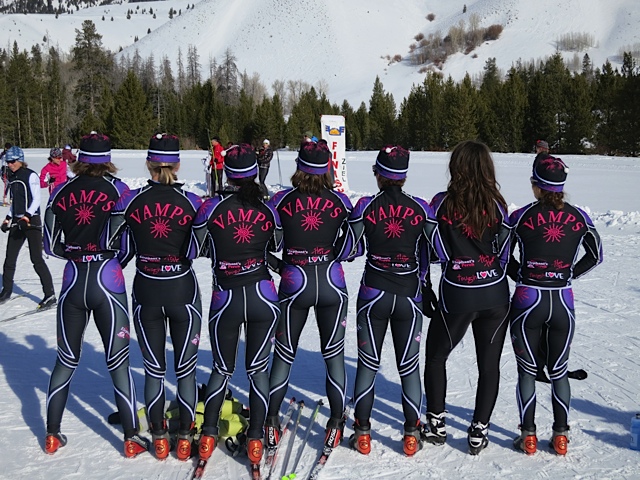
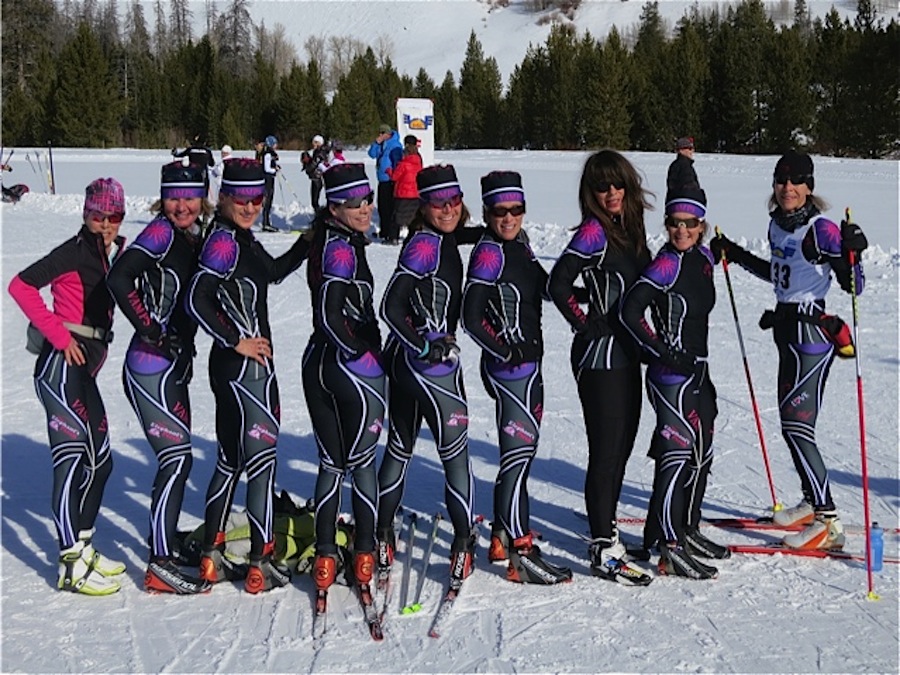
The VAMPS, one of the largest all-female masters programs in the country, based out of Sun Valley, Idaho. (Photo: Muffy Ritz)
Last winter, I had the good fortune to live in Sun Valley, Idaho, where I was quickly absorbed into the large nordic community the area is famous for. My workweek consisted of coaching juniors with the Sun Valley Ski Education Foundation (SVSEF), running a masters program through Galena Lodge, teaching private lessons through Blain County Recreation District, and working with the Vamps.
***
Nordic Town USA is crawling with good skiers: Olympians, NCAA champions, U.S. Ski Team alumnae, Junior National champions, Birkie winners, and Masters World Cup medalists can be seen cruising the valley’s extensive trail system daily.
If this sounds intimidating to the average skier training for a local race or just looking for a good workout, it’s not. It is inspirational. The skiing folks in Sun Valley know that these individuals make their sport credible. They also know the contributions many of these standouts have made.
VAMPS creator and director Muffy Ritz after winning three gold medals at the 2011 Masters World Cup. (Photo: Toko)
Muffy Ritz, founder and director of the VAMPS program, has used her ski racing experience and love of the sport to become one of Sun Valley’s most prominent nordic leaders. Ritz got her start in cross-country skiing at the University of Colorado (CU). Tired of alpine racing, she tried out for the nordic team her junior year and discovered her passion.
In a phone conversation, Ritz, 56, explained how she quickly picked up ski technique following her CU teammates around in practice. She loved the challenge of the sport, but what really comes through talking to Ritz is her love for the nordic skiing family. Becoming a nordic skier changed her life, and in turn, she’s changed others’ through skiing.
A member of the U.S. Ski Team (USST) from 1982 to ’84, Ritz was also part of the rising ski-marathon movement in the 1980s as part of Team Rossignol. She proved her talent at endurance events by racing eight marathons over back-to-back weekends. She won the prestigious American Birkebeiner in 1985 and 1986.
Ritz has proved her toughness on a bike as well, holding the second-fastest time in the Race Across America, a transcontinental road-cycling race, in 9 days, 6 hours and 32 minutes. She also holds several age-group titles in National Marathon Mountain Bike Championships.
In 1990, Ritz left her position as a junior coach at the Green Mountain Valley School in Vermont and moved to Sun Valley. There, she connected with SVSEF Head Coach Rick Kapala and began a 10-year stint coaching juniors. In 2000, Ritz felt the need to turn her full attention to her newly formed Vamps, which stands for “Vimmen And Muffy’s ProgramS.” (The name came about in the program’s second year. Previously called “Ladies’ Clinic,” Ritz and her participants were looking for a catchier name, something fun and maybe a little racy. Playing around with one of the Swedish skiers in the group who called women, “vimmen,” they settled on Vamps.)
Several members of VAMPS masters group who completed the annual dryland “Vamps Challenge,” an optional list of accomplishments that many women tackle each year in and around Sun Valley, Idaho. (Photo: Muffy Ritz)
Her brainchild, Vamps is 130-women strong with 11 coaches. So how did the largest all-women masters ski program in the U.S. start?
It all began with one woman who requested biweekly private ski lessons from Ritz in 1996. A little worried about entertaining one student twice a week all season, Ritz proposed getting a group together to make the lessons more fun. This was the beginning of Vamps; four upper-intermediate level women who were committed to perfecting their skills and fitness.
Word spread, and the following winter, Ritz had 40 women who wanted a weekly program. She quickly added a couple more coaches to deal with the various ability levels.
By the winter of 1998-99, the Vamps grew to 60 and began to take on a life of its own. The popularity of the group rose from a fitness-driven, outdoorsy population of women who viewed cross-country skiing as a fun, social and sometimes-competitive way to spend the winter. The winter season was preceded by a dryland segment, which took place all over the valley in groups of eight.
Ritz has never advertised the Vamps program. Spread entirely by word of mouth, drawing in women from their late-20s to late-70s with a range of experience goals, Vamps classes were taking Sun Valley by storm. She recalls charging $15 per 90-minute session that season, a killer value for the participants. In keeping with the spirit of making the program accessible, Ritz has kept the cost somewhere around $300 for 12 sessions.
Nancy Fiddler and the AMPS, a highly competitive women’s group within the Vamps masters program. (Photo: Muffy Ritz)
It became necessary to form ability and interest-driven groups in order to meet the needs of the growing program. Ritz and her team of coaches came up with names like the Amps, a competitive group looking for a weekly high-intensity workout.
There were groups for women who simply wanted to skate, as well as an all-classic group called the Scamps. The Super Tramps grew at the beginner-and-lower intermediate end to become a cohesive group of competent skiers with a keen desire to improve technically. The V2’s are a tight-knit group of friends, all over 60 years old.
Vamps classes were being held in different skiing locales around the valley, but by 1999, Ritz moved her programs to the Sun Valley Nordic Center, where they enjoyed the benefits of liability insurance, consistent grooming and a spacious meeting room.
She eventually capped Vamps at 130 participants, where it remains today. In 2002, it became mandatory to participate in the dryland program in order to be admitted into the Vamps ski program. Ritz explained that this was one way to screen participants and to keep the numbers under control.
Being a Vamp
It’s hard not to become infected by the Vamps spirit. The laughter, shouts of encouragement, and general party atmosphere that characterize a Vamps class are a reflection of Ritz herself.
She is an enthusiastic cheerleader of every Vamp, offering personalized tips and encouragement. She makes every participant feel important and shows them the baby steps necessary to meeting their goals. Every Vamp wants to be as physically strong as Ritz and many are emboldened by her confident example. The bottom line is that skiing with Ritz is just plain fun.
Susan Usher (front), Julie Moses (l) and Christine Davis Jeffers (r) of the VAMPS masters program work some dryland drills at River Run in Ketchum, Idaho. (Photo: Muffy Ritz)
The coaches who work alongside Ritz have a deep pool of talent and experience. They are a cast of colorful characters who, between them, have a couple hundred years of racing and coaching experience.
Ritz has never had any trouble filling her coaching roster; in fact, there is sometimes a waiting list to get on the Vamps coaching team. While the coaching staff consists of women who have had some kind of connection with Ritz through ski racing over the years, not just anyone qualifies to be a Vamps coach.
First, Ritz requires that all on-snow Vamps coaches work the dryland segment. This is a several-month commitment in the fall, when the Vamps are gearing up for the winter season through some pretty hard-core workouts. Every coach is expected to lead some portion of the workouts, which consist of ski walking and bounding intervals, strength training, plyos, and technique work.
Ritz is looking for coaches with some sort of training, such as PSIA or USSA certifications, as well as racing experience. Above all, she wants coaches with a passion for skiing who have the skills to pass this on to others. Essentially, if you want to coach Vamps, you had better bring something special to the table.
In addition to Ritz, this season’s coaching roster includes: Brooke Hovey, Betsy Youngman, EJ Harpham, Mary Tess O’Sullivan, Joney Otteson, Joan Scheingraber, Colleen Hayes, Susie Quesnel, Katherine Sheldon, Kate Whitcomb, and Karoline Droege.
The success of the Vamps may be based on the attitude of the group. It is not required that Vamps participants become ski racers. In fact, only about 15 percent of the Vamps regularly tie a number on each season. Ritz estimates a few more, about 30 percent, spend the year working toward the high point of Sun Valley’s race season, the Boulder Mountain Tour.
The Sun Valley VAMPS, serious about having fun at the Billy Goat Loppet in Sun Valley, Idaho. (Photo: Muffy Ritz)
Last winter, Ritz and 18 Vamps traveled to Asiago, Italy, to participate in the Masters World Cup for the first time as an official group. There had been casual forays of a small number of Vamps to the Masters World Cup in McCall, Idaho, and to Silver Star, B.C., but this was their inaugural international trip.
In Asiago, they made quite a splash in their stylish black-and-purple race suits. They picked up a few age-group medals and showed others how to have a good time at a major European ski event.
But the Vamps might be remembered best for one particular stunt at worlds. Somewhere along the course, one of the V2’s took a wrong turn, Ritz explained with a laugh. The rest of the V2’s gamely followed and they all wound up beating fellow American and master-racer extraordinaire Trina Hosmer. The results didn’t hold, of course, but the Vamps are still laughing about the incident.
What the Vamps share is a willingness to work hard and to try new things. For some, this means racing the Birkie. For others, it is being able to ski without stopping to the high point on the Sun Valley trail system or to finally learn the V2 timing. The reasons to join the Vamps are basic: learning to ski, fitness, friendship, and having fun.
For many, the Vamps experience is the beginning of a sporting life, according to Ritz. She has countless stories of women who have thrived by joining the program, many without any prior athletic experience. The older Vamps have bonded over the experience of taking up a new sport mid-life and pursuing it into their 60s and 70s. They ski together on days they don’t meet as a group, and use the summer and fall to meet for hikes and gym workouts.
VAMPS dryland training on Dollar Mountain (Photo: Muffy Ritz)
The “Vamps Challenge” comes around during the fall dryland season and again in the winter. The challenge invites all Vamps and coaches to tackle a list of accomplishments on their own time. It includes a certain number of push-ups and air squats a week, hikes up local peaks or long ski routes, puzzles, and volunteer service. At the end, a party is thrown to honor those who completed the “Vamps Challenge.”
The Vamps are a big piece of the nordic scene in Sun Valley, and not just because they seem to be all over the vast trail system practicing drills and pursuing their challenges. Community service is a big part of being a Vamp, and Ritz has long been a proponent on giving back to the sport.
If you are a Vamp and not competing in an event, summer or winter, you should be signing up to help at an aid station or with registration. The Vamps are a cheerful presence at all the major Sun Valley races. Additionally, they are volunteers for Girls on the Run and other programs and are generous supporters at the annual Galena Benefit. The Vamps organize a scholarship fund each season to benefit women who might not otherwise be able to join the program.
Ritz admits that the Vamps are a consuming project. She works hard to make it the kind of program everyone wants to join. Traditions like the fall Pumpkin Hunt on Dollar Mountain, costume events, the Boulder Mountain Tour, and parties and gatherings are what distinguish the Vamps from other programs.
Every conversation I have had with Ritz about the Vamps has been filled with excitement and pride. In the end, she said it’s all about giving women confidence through sport.
VAMPS having fun at the 2007 Inga-Låmi cross-country ski tour at the Sun Valley Nordic Center. (Photo: Muffy Ritz)
***
About the Author: Nancy Fiddler is a two-time Olympian and 14-time National Champion. She has been coaching juniors and masters for 20 years in Mammoth Lakes and Truckee, Calif., and most recently in Sun Valley, Idaho. She lives most of the time in the Eastern Sierra with her husband and daughter and is currently trying to get in touch with her creative side through writing.
Nancy Fiddler adds some resistance to her push ups with a 10-pound weight vest her coach gave her when she was on the U.S. Ski Team. Her cat Jemima hangs around for moral support.
Walking through the garage the other day, I spied my turquoise weight vest languishing in the corner. I became very excited, not because I wanted to actually use it, but because it was a seemly topic for a Wednesday Workout.
This particular weight vest had, until recently, taken a very long vacation from any kind of work. My former coach TorbjørnKarlsen had generously supplied the vest back in the early ’90s, when I was in full ski training mode. It is made of a canvas-type material and has numerous long, thin pockets that hold sandbags and wrap completely around it. Fully loaded, my vest holds 10 evenly distributed pounds.
Nancy Fiddler works on balance and core while doing kayakers with a weight vest and medicine ball.
The weight vest had been a staple of my strength training and I had been pleased to pull the thing out a couple of summers ago when my daughter, Laurel, was ready to incorporate it into her dryland training. She was 17 and had been doing a general and specific strength program for several months. It was the perfect way to add resistance to the exercises we had been doing in our outdoor gym. We also added it to some of our specific strength sessions on rollerskis.
When used properly, a weight vest enhances a strength-training program, especially when it is not possible (or affordable) to train in a fully equipped gym. It is a simple tool that provides enough resistance to make some good strength gains! It may be necessary to begin with the vest lightly loaded for the first couple of times.
The Workout: Circuit Training
– Warm up as you normally would for strength training.
– Choose 5 or 6 exercises for your workout.
For example:
Push-ups
Pull-ups
Triceps press
Step-ups
Planks
Kayakers with a ball
Planks with a weight vest
Complete one set of the exercises without the weight vest, then do two more sets with the vest. Pay close attention to proper form when wearing the vest. Wearing the vest, it will be possible to do only half to two thirds of the repetitions as without the vest.
The Workout: Specific Strength
This workout can be accomplished on rollerskis or skis.
– Warm up for 20 minutes.
The following exercises can be done on a variety of terrain, but to start, seek moderately steep terrain that it is possible to double pole or single stick up without loss of technique. It is recommended that the skier have a good base of general and specific strength before attempting weight-vest training.
Double-Pole Repeats
Wearing the weight vest, double pole for 1 minute up the hill.
Repeat the same drill without the weight vest, concentrating on quickness of movement.
Continue to do the 1 minute repeats, alternating wearing the vest and without. Focus on getting hips quickly up and forward.
Begin with 2-3 cycles and work up to 5.
“Locked and Loaded”
Wearing the vest, isolate the initiation phase of the double pole by tapping the poles into the snow or pavement from the high and forward position. This will feel like an upper abdominal muscle crunch. The poles will not follow through, as this is not a full double pole! Try repetitions of 30 seconds.
Repeat the “locked and loaded” drill without the vest.
Begin with 2-3 cycles and work up to 5.
Single-Stick Repeats
Choose a more gradual hill than used for double poling.
Wearing the weight vest, single stick (no legs) for 45 seconds up the hill.
Repeat without the vest, concentrating on speed of arm swing forward.
Continue the 45-second repeats, alternating with and without the vest. Focus on engaging the core and keeping hips up and forward, which will allow a free and swift arm swing.
Begin with 2-3 cycles and work up to 5.
It is possible to mix the above exercises into a single workout, aiming for a total of 12-15 repeats, or to just work on one set of exercises. Finish the workout with an easy cool-down.
My 25-year-old weight vest has been surpassed by newer, sleeker models. There are a number of good weight vests on the market. Choose one that fits snugly to the torso and has even, weight distribution. A final word of advice: don’t begin your weight vest training with a fully loaded vest!
Mike Gallagher, a three-time Olympic cross-country skier and former U.S. Ski Team head coach, at his home in Pittsfield, Vt., on Nov. 1, 2011. Gallagher died last week on Oct. 3, his 72nd birthday.
Note: This tribute has been updated to include comments from Mike Gallagher’s wife, Tyna, and additional photos from John Estle.
Mike “The Eagle” Gallagher was a diehard baseball fan. Several springs ago, he accompanied his nordic-skiing cronies, John Estle and Peter Ashley, to Tampa, Florida for some sunshine and the rituals of spring training. A three-time Olympic cross-country skier and head coach of the U.S. Ski Team from 1980-86, Gallagher was in hog heaven hanging with his buddies and watching his beloved New York Yankees tuning up for the season, Estle said recently on the phone.
Mike Gallagher gets some help from his wife Tyna before being inducted into the Mount Washington Road Race Hall Of Fame in 2011. Gallagher won all four years he entered the race from 1968-71. (Photo: Jim Fredericks)
The trip to Florida was the invention of Estle and Ashley, also former U.S. Ski Team (USST) coaches, who convinced Gallagher to join them. It took a little coercion, because Gallagher was scheduled to get a hip replacement that same week. In the end, Gallagher rescheduled the surgery and left muddy Vermont for balmy Florida. The trio bunked up with Estle’s partner’s family in Tampa.
During their stay, their host family held a Passover celebration. In remembering the trip, Estle chuckled and said Gallagher was quite caught up in the traditional Jewish celebration. This Irish-Catholic boy from Vermont had never experienced anything like it and loved being included in the large family gathering. In fact, after a week of watching his heroes Derek Jeter and Mariano Rivera playing the game, it was the Passover that Gallagher raved about.
A “man’s man” is how Estle described Gallagher, who passed away at home in Pittsfield, Vt., on Thursday, his 72nd birthday.
“He embodied physicality and sport, yet he was very spiritual and humanistic at the same time,” Estle said. “When you visited, you were the best friend he ever had. He always made you feel good.”
The Man, The Legend
On Oct. 3, 1941, Gallagher was born in Yonkers, N.Y. Raised in Rutland, Vt., Gallagher got his first ski lessons from his father, who served in World War II in the fabled 10th Mountain Division. He went on to become an accomplished runner and alpine skier, laying the foundation for nordic skiing, which would eventually become his life.
Mike Gallagher at a small race in Europe the early ’70s using Scott poles. (Photo: Marty Hall)
Kicking and gliding on wartime skis he modified for racing, Gallagher won his first high school race as a member of the Rutland High School team. He went on to captain his team, and won a Junior National championship in 1959.
After graduating from Rutland High, Gallagher took a post-graduate year at Vermont Academy then set his sights on Colorado. He attended the University of Colorado, motivated by training with friends Bob Gray and Mike Elliott. This was the beginning of a long-term friendship and the rock upon which U.S. cross-country skiing would grow for many years.
“That trio of Elliott, Gray and Gallagher carried the program for a ton of years, made huge sacrifices, and were all wonderful people living life to the fullest,” their former U.S. Ski Team (USST) coach Marty Hall wrote in an email.
Life was good in Colorado for Gallagher’s freshman year, but then Gray and Elliott moved on, forcing Gallagher to carry on without his training buddies for three more seasons. Seeking more opportunity in skiing, Gallagher set off for Norway, where his ski training took off.
He went on to make three Olympic teams in 1964, 1968, and 1972, and three World Championships. In addition, Gallagher notched nine national titles. His proudest result was 19th in the 50-kilometer classic race at Holmenkollen, Norway, in 1968. He accomplished all of his off-season training while holding down a full-time job. Gallagher’s love for skiing and legendary work ethic is what defined him for the rest of his life.
Gallagher (r) with his son, Jesse, in his Elan work van. (Photo: Mike Gallagher)
Gallagher applied his talent and formidable energy to bike racing in New England, a sport in which he excelled for many years. In 1972, he was the 25-mile road biking national champion.
Retired from racing, but still enthralled with the sport, Gallagher turned to coaching. He was head coach of the USST from 1980-86, Olympic-team coach in 1980, 1984, and 1992, and a high-school coach for 17 years. With Gallagher at the helm, Bill Koch won the overall World Cup title in 1982.
The nordic vice president of Fischer USA, Ashley summed up Gallagher’s insightful coaching style in a 2011 interview with FasterSkier. “Mike was the perfect guy for Kochie because he allowed him to do things in a different way, was flexible when he needed to be and would stand on things when he needed to.”
Gallagher vast knowledge of all things nordic led him to employment in several ski companies over his career, among them Splitkein, Hexcel, Edsbyn, and Elan.
For many years, Gallagher shared his love and expertise of skiing as the nordic director at Mountain Top Inn in Chittenden, Vt. He also taught skiing at the nearby Mountain Meadows in Killington.
In 2007, Gallagher was inducted into the Vermont Skiing Hall of Fame. He was also into the Mount Washington Road Race Hall of Fame in 2011, a race he won from 1968 to ’71.
Gallagher is survived by his wife, Tyna, sons Sean and Jesse, and a grandson.
Athlete, Coach, Mentor, Friend: Remembering Mike Gallagher
Some people are larger than life. Gallagher was one of them. When you think of throwing rocks into a pond, the largest ones make the biggest splash and send the ripples furthest. Gallagher touched the lives of many because his ripples reached the far edges of the pond. – Nancy Fiddler
Mike “Jumpin’ Jack” Gallagher (l) and longtime friend John Estle in April 2003 in Pittsfield, Vt. (Photo: John Estle and Norma Haubenstock)
Many people met Gallagher through cross-country skiing and then became friends for life. Famed nordic announcer Peter Graves is one, remembering in an email message how he met Gallagher.
“I first met Mike in the late ’60s when he came to my high school to do a clinic. With his typical verve he talked about what a great sport XC was,” Graves wrote in an email. “With that and his sparkling USA warm-up, I became a follower. Over the years, we shared special moments of reflection in his sauna and pondered things, sport and the meaning of life. What was said in the sauna always stayed in the sauna. What he leaves is a rich tapestry of goodness, of inspiring countless people to ski and enjoy the richness of life. He was a smart guy with deep feelings, and as an Irishman myself, I could always understand the joy he felt in singing his Irish songs. He touched so many people, I’m going to miss him for a long, long time.”
Teammate and close friend Elliott recounts in an email how, on a 2012 visit to New Hampshire, he drove 330 miles round trip just to have dinner with Gallagher and Gray. The three remained friends for years after they dominated the U.S. skiing scene.
Elliott and Gallagher had the best kind of competitive relationship. They raced against each other at Junior Nationals and in college, and ended up teammates on the 1964, 1968, and 1972 Olympic teams as well as the 1966 and 1970 World Championship squads.
“We met in 1959 at the Junior National Championships. We always had a friendly rivalry training and racing,” Elliott wrote in an email. “Michael had ‘XC1’ on his Vermont vanity license plate. That license plate was a huge motivating factor for me because I wanted my results to force him to change his vanity license to ‘XC2’. Whenever I did not want to train, I just had to think of that license plate and then I was out the door training.”
Elliott also remembers Gallagher’s infectious singing. “When he called his friends on the telephone and they answered, he would often break into an Irish song. We all knew who was on the other end. He cultivated many friends from all walks of life. He really was such a good guy.”
Gallagher checking on the beehives in November 2011 at his home in Pittsfield, Vt. Seventy years old at the time, he said he spent most of his time gardening and mowing nine acres of his 50-acre property.
Gallagher was the consummate tough mountain man, but Elliott saw a gentler side of him on their many travels together. “He once dressed as Santa Claus and passed out presents to children at a resort where we were staying in Scandinavia,” Elliott wrote. “His wonderful laugh and his accent made him a believable Santa Claus to the children. I have nothing but the fondest memories of my life with Michael.”
As competitors and avid outdoorsmen, Elliott and Gallagher shared many adventures. “Gallagher came out to Colorado in 1973 and we went backpacking,” Elliott explained. “He was not really fond of heights and I really took advantage of that fact and enjoyed scaring the hell out of him in the Colorado mountains. He was a very good sport about the whole situation. He loved fly fishing in those high mountain lakes.”
One of the many athletes Gallagher coached, Kevin Brochman remembered how Gallagher used humor to get him through tough situations, a behavior Brochman still resorts to. A two-time Olympian, Brochman also recalled Gallagher’s discomfort in high places, something that seemed to make him more human.
“Mike was a great coach and led the team to a US men’s best, 4th in the world, in 1982,” Brochman wrote on Facebook. “I felt honored to be part of his tenure from 1981-86. HE LOVED TO LAUGH. He did not care too much for the gondola ride up to Dachstein Glacier though!”
Former U.S. Ski Team head coach Mike Gallagher with one of his athletes, Jim Galanes, after a 1984 World Cup race. (Photo: Mal Lockwood)
As a coach, Gallagher set the bar high for his athletes, yet he stood behind them in every situation. The U.S. men’s squad, under his direction, achieved huge success.
“When Michael was the USST XC coach, he often traveled to where the national team skier lived to help them individually with their training,” Elliott explained. “He was instrumental in helping Bill Koch win the World Cup. Bill has nothing but kind, complimentary things to say about the job Gallagher performed.”
Ashley’s long friendship with Gallagher began at Colorado, where Gallagher helped save Ashley from a near-death experience following a collision with a tree. Later, Ashley and Gallagher coached the USST together. Ashley will always remember what he believes to be one of Gallagher’s major contributions to the sport of skiing in this country.
“Gallagher was a man who stood by his decisions, which served him well during the skating revolution,” he said on the phone. “He advocated for allowing the athletes to move the way they wanted to on a race course at a time when many of the international ski leaders were against skating. Gallagher was able to represent the USA’s desire to skate in the international coaching arena. We have a lot to thank him for, in that regard.”
Ashley, Gallagher, and Ruff Patterson brought skating back from the World Cup to the U.S. racing and recreational-skiing population. Their dissemination of skating knowledge put many Americans on skate skis in the ’80s.
Gallagher’s energy and personality were the driving forces in his coaching. As 1984 Olympian Sue Long Wemyss stated online: “I was fortunate to be on the USST and to get to know Mike during the years he was head coach. He was so lively, so positive. He leaves a huge hole.”
Helping Koch top the World Cup was just a small part of the impact Gallagher had on nordic skiing in the U.S. His knowledge was vast, his reach deep and his vision global. According to Ashley, “He had a huge influence on the younger skiers and was something of a father figure to many. The kids really looked up to him.”
Mike Gallagher enjoying some playtime at his Pittsfield, Vt., home in April 2003. (Photo: John Estle and Norma Haubenstock)
Former USST skier Tim Kelley was one of the many juniors inspired by Gallagher. He also weighed in on his memory of Gallagher on Facebook.
“Besides being a hero for U.S. cross-country skiing, Gallagher was always very supportive of the young guns. He enthusiastically welcomed newcomers into the XC skiing cult. I remember once at a junior camp at his place doing a circuit strength workout at his stations in the woods. And then we finished off the workout by helping him lift logs up for the cabin he was building.”
University of Denver Head Coach David Stewart echoed Kelley in another comment: “Gallagher was a big influence on me when I was just a Bill Koch League racer, inspiring me and many others with his enthusiasm for every level of the sport.”
Gallagher expected a lot, but gave a lot. His dreams are being carried on by the many who were influenced by his spirit. Cambridge Sports Union Head Coach Rob Bradlee carries on some of the best Gallagher traditions in his own work.
“I remember him coaching me at a training day at Putney when I was 15,” he wrote online. “With his enthusiastic urging, I did more push-ups than I thought I could ever do. His energy was infectious.”
There were valuable lessons beyond the push-ups, Bradlee explained. “As a non-competitive skier I was always impressed by how kind and encouraging he was to me. That I loved skiing was good enough for him. And in the long run, he helped me be a better coach by modeling that inclusive behavior.”
Dartmouth coach Ruff Patterson and Gallagher go back a long ways. They have worked together, recreated together, and shared a lot of good times. Patterson was Gallagher’s best man when he married Tyna in 2002.
“Gallagher was a strong man who expected things from people,” Patterson said on the phone. “He was direct and didn’t mind saying what he thought. He pushed all of us as hard as he pushed himself. I wanted to strangle him one day and hug him the next! We were incredibly close.”
The Quintessential Vermonter
“Taking in nature and spending time outdoors is what life was like with Mike. It could be as simple as sitting on our deck, looking out at the mountains sipping coffee and just taking in the beauty of our surroundings. Even though it was peaceful and it was also energizing. Mike was an avid fisherman and hunter, who could turn almost any outing into an adventure with his gift of storytelling. Mike had a joke or two for almost any topic, it was truly amazing how he could remember so many jokes. Even though he loved living off the beaten track, almost recluse, whenever there was a gathering Mike was sure to be the center of attention. With a twinkle in his eyes and his voice booming with excitement he would draw everyone into the story or joke he was telling. While his accomplishments were bigger than life, he was modest and would only talk about them when asked. He was warm, affectionate and fun-loving, he enjoyed putting a smile on someone’s face. He touched so many lives in a positive way, including mine. I am so proud of the man known as Michael Gallagher, he was the love of my life, my soulmate and my heart is breaking.” — Tyna Gallagher
Gallagher beside his heart-shaped pond, where he married his wife Tyna, at their home in Pittsfield, Vt. Gallagher gave FasterSkier a tour of his 50-acre property in November 2011.
Gallagher embraced the Vermont lifestyle; he built the home he lived in and stayed busy and active to the end of his life by tending his garden, mowing, keeping bees, cutting wood, and hunting and fishing.
He raised his boys, Sean and Jesse, to be strong outdoorsmen as well as excellent skiers, and loved the time he spent in the woods with them.
Visitors to his Pittsfield home remember the sauna sessions. Between plunges into the refreshing pond, Gallagher told his famous stories and occasionally broke into song. Gallagher delighted everyone who took part in living large with him.
Elliott succinctly put into words what many are thinking: “I wish I would have spent more time with him.”
Peter Ashley at the 1984 Sarajevo Olympics opening ceremony. Now the nordic vice president at Fischer Skis USA, he was the U.S. Ski Team women’s coach from 1984-85. (Courtesy photo)
Peter Ashley is “Mr. Fischer” in the United States. For over 18 years, he has been vice president of the nordic division at Fischer Skis. He is responsible for everything that has to do with Fischer Nordic USA: ski selection, pricing, marketing, reps, budget, and more.
Peter Ashley during a recent cruise near Portsmouth, N.H. (Photo: John Estle)
Although Fischer is his life these days, Ashley has been involved with cross-country skiing in many other capacities for decades before working for Fischer. He has truly been around the nordic block. Ashley has had just about every job that skiing offers and has experienced the evolution of the sport firsthand. FasterSkier’s Nancy Fiddler caught up with him recently on the phone in a conversation about the development of cross-country skiing and some of his best stories from a pivotal period in the 1980s.
Ashley, 62, lives in Contoocook, N.H., with his wife, Rhonda, and three Maine Coon cats. New England is his home now, but Ashley is a self-declared westerner with strong roots in Jackson Hole, Wyo. For Ashley, the West was where the whole skiing thing started.
Growing up, his family was hugely involved with skiing and the Jackson Hole Ski Club (JHSC). Ashley trained and raced alpine, then nordic with the JHSC, making his first Junior National nordic team in the mid 1960s when he was in eighth grade. He continued to race alpine and nordic until his junior year in high school, when he admits that his size and athletic talent were more suitable to cross-country skiing.
It has been all nordic ever since for Ashley, who went on to race at the University of Colorado under the direction of Bill Marolt. After graduating in 1974 with a degree in finance, the same year that fiberglass skis were introduced, Ashley returned to Jackson Hole to try his hand at coaching. He got his feet wet coaching juniors for four years as head coach of JHSC, the beginning of a 12-year run of coaching that took him all the way to the U.S. Ski Team. Along the way, Ashley worked with a lot of interesting characters, traveled the world, and witnessed firsthand some big changes in skiing.
“Skiing was a very, very different sport 25 years ago.”— Peter Ashley
World Cup cross-country ski racing has been divided into two disciplines since the 1986/1987 season: classic and freestyle (skating). The evolution of skiing from an all-classic technique sport to a two-discipline sport took place over the course of several rocky seasons and saw some major battles.
A multiple Olympic gold medalist, Sweden’s Thomas Wassberg, after whom the “Wassberg” skating technique is named, freestyle racing at the 1985 World Championships in Seefeld, Austria. (Photo: Peter Ashley)
The year was 1985; the place: Seefeld, Austria, and the event: the 35th Nordic World Ski Championships. There was a lot of drama in the days leading up to the races, and the hot topic was skating. The question surrounding the final preparation was whether skating would be allowed in the championship races, or just the traditional classic skiing.
Left to the Norwegians, who had already banned skating in junior competition in Norway, there would not have been any skating at the 1985 Worlds. The prevailing attitude is best summed up by Norwegian Ivar Formo, Controller of Equipment, who said, “no one can be the World Champion on skis without grip wax.”
The women’s coach for the U.S. Ski Team (USST) from 1984-85, Ashley was in the thick of this historical debate. Cross-country skiers had been experimenting with skating for a couple of years. As he remembers it, skiing had taken on a hybrid form by the time of the Seefeld World Championships. Skiers were still using kick wax, but moving with the marathon skate and a gliding herringbone, which eventually morphed into a rudimentary V1 technique.
With narrow trails with set tracks and athletes using short poles, long skis and kick wax, the stage was hardly set for the break out of skating. Still, athletes were looking for faster and faster methods of skiing. At Seefeld, just days before the first race, Swedish skier Gunde Svan was seen experimenting with one very long pole and no kick wax. This silliness by the eventual-double gold medalist was quickly put down by the organizers, who were desperately looking for a way to prohibit skating at the Championships.
According to Ashley, the way it finally went down was with a nations’ meeting where a vote would temporary prohibit skating in Seefeld. A unanimous vote was required. All it took was a single “no” vote from the Australians, and the rest is history.
Annette Bøe of Norway skating at the 1985 World Championships in Seefeld, Austria (Photo: Peter Ashley)
Ashley recalls snow conditions on the Seefeld courses contributing to the decision by some teams to abandon kick wax entirely. As if 32 degrees Fahrenheit wasn’t bad enough, the snow was extremely dirty. “Nothing was kicking and everything was slow,” Ashley said.
For some athletes, this was the first time they would race without kick wax. The Americans had been fooling around with the skating techniques and little to no kick wax for some time on classic equipment, according to Ashley, who recently learned that was a different story for the Norwegians, whose ski leaders did not embrace skating.
In a conversation two years ago with former biathlete and nordic skier Grete Nykkelmo, Ashley said he learned that the Norwegian women were not allowed to skate in training. Nykkelmo, who won four medals at 1985 World Championships: a gold in the 20 k, bronze in the 5 and 10 k, and a silver medal in the relay, said that the Norwegian women had to quickly get with the program. In the end, skiers who went with kick wax were losers. The Norwegians managed to top the medal charts at Seefeld, but the battle wasn’t over yet.
The 1984-85 World Cup season was fraught with conflict over skating. Ashley remembers that in the races prior to the World Championships, organizers went to great lengths to keep skating out. He describes barriers built on the race trails to prevent any kind of skating, ugly coaches’ meetings and threats of disqualifications.
After Seefeld, things were still not resolved and for the rest of the season, race organizers tried everything possible to keep classic skiing as part of every race. Some races (Falun ’85 World Cup) had sections of course that were classic only and other sections on the same course that were “freestyle.”
“We were just trying to make sense of all the technical changes that were happening.” — Ashley
A season later, the 1985-86 World Cup was all skating. Classic skiing had all but disappeared for the time being (except for in Norway). Poles got longer, skis got shorter, and a good solution for boots was yet to be arrived at. In short, it was an equipment revolution and nordic skiing experienced a huge bump in sales.
U.S. cross-country skiing great Bill Koch, who pioneered the skating/freestyle technique in the 80s. (Photo: Peter Ashley)
Only a decade earlier, cross-country skis went from wood fabrication to fiberglass, a phenomenon that changed the sport completely, according to Ashley. Fischer fiberglass skis first appeared at the 1974 Falun worlds. Adidas was the first company to do away with the bulky three-pin bindings and duck-billed boots, replacing them with running-shoe-like boots and 38-millimeter bindings. The skis were faster and the boot-binding system sleeker, but it was still classic skiing.
In 1986 and 1987, Ashley once again found himself in the middle of everything. He was now responsible for Cross-Country Coaches Education for the U.S. Ski and Snowboard Association (USSA). He recalls this period an “extremely challenging” time to be trying to teach the country how to ski. Skating was here to stay, but by 1987, thanks largely to the Norwegians, classic skiing was back in international competition. It was now no longer possible to use any form of skating in a classic race.
What started as a hybrid classic-skate technique was now two distinctive methods of skiing. While classic skiing remained much the same, advances in skating equipment like higher cut, plastic-cuffed boots caused skating techniques to change almost overnight. Pole timing to match terrain evolved and Ashley was running to keep pace with all of it. V1, V2, V2 Alternate – these were names Ashley and others came up with to describe the new techniques. He remembers this period in U.S. skiing history as a bit chaotic, with too many experts and no definitive organization. He also recognizes this time as when the sport was thrown “wide open.”
The Path to Fischer
After the 1986-87 season, Ashley found himself without a job. It was a time of change, and USSA and the USST, in preparation for a merge, let the coaching staff go. For Ashley, it was time to move on, but he wasn’t ready to let go of the sport entirely.
For a year, he cut trails at Jeremy Ranch in Park City before beginning a stint working at Pacific Mountaineer in Palo Alto, Calif. The move to the Bay Area was a big one for Ashley, who had always lived in the mountains, but he stayed involved with skiing by coaching masters near Lake Tahoe.
In 1994, Ashley got a phone call from former skier Dan Simoneau, who presented an opportunity that ultimately led to Ashley’s current position at Fischer. A two-time Olympian and current nordic director at Mt. Bachelor Sports Education Foundation, Simoneau was getting ready to leave Fischer, then owned by Raichle Molitor, for a new job at Timex. He offered Ashley a position as Fischer product manager and Ashley took him up on it. By November, Ashley was living in Connecticut and quickly learning everything there was to know about Fischer skis. He admits that on his first purchasing trip to Europe, he felt more than a little bit unprepared.
Going on 19 years with the company, Ashley has landed and is thriving. He is grateful for the success of Fischer and acknowledges that the company is grateful that people believe in them at the top of the sport.
“This is not an un-cool sport to be in nowadays.” — Ashley
Ashley has seen tremendous growth and change in the sport of cross-country skiing in the U.S. He believes the sport is benefiting already from the recent success of the U.S. women’s team. This success in a sport dominated by Europeans was a long time coming. Ashley has seen generations of female cross-country skiers in our country pave the way for today’s champions. There have been many hurdles to cross, like doping, politics and funding problems over the years, but the image of cross-country skiing has never looked better, he said.
Looking back over the decades, Ashley sees nordic skiing as much more main stream now than 20 years ago. Nordic skiers used to be branded as eccentric, loner types in the ’70s and ’80s, dedicated athletes in a fringe winter sport with very little media exposure. Kooky behavior was not uncommon and almost expected of the athletes of this period.
There are higher expectations for today’s nordic athletes. The sport is maturing in the U.S. and is highly professional for athletes and coaches alike. Social media has increased the visibility of today’s skiers, who are able to manage their own brand. Media training is necessary for athletes to help them deal with this increased visibility. The bar has been raised, according to Ashley, and there is no better example than Kikkan Randall of a nordic skier who “acts the right way.”
Finally, Ashley is excited to see the success of U.S. skiers directly affecting the numbers of kids entering the sport today. It’s a new, very cool sport to be a part of.
Peter Ashley is putting together a slideshow of the history of skating, the cast of characters of the time, and the international scene from the early to mid-80s to present this fall at FinnSisu in St. Paul, Minn.
The Far West Nordic junior team posing before splitting up into two groups to climb North Peak (in the background), plus added “alumni” to make the hike extra special. The 2013 Far West Nordic June Lake Camp was led by Nancy Fiddler (back right), Mark Nadell and Marie French with the support of Mike Mcelravey and Steve Twomey. Athletes included Carson Bold, Laurel Fiddler, Connor Kusumoto, Phillip Oxford, Cameron Small, Cody Atwood, Piper Joubert, Quinn Lehmkuhl, Jane Nall, JC Schoonmaker, Camille Syben, Lindsay Twomey, Cameron Valois, Ryland Belisle, Savannah Blide, Markus Brun, Peter Carroll, Tyler Ferrera, Chloe Gorman, Bri Parker, and Sam Zabell (and, of course, Curious George). Far West alumni include Alex Kopytko, Branden Deeter and Grayson Forsberg. (Photo: Mark Nadell/macbethgraphics.com)
JUNE LAKE, Calif. – Far West Nordic juniors from Truckee, North Tahoe, Sugar Bowl Academy and Mammoth programs took part in a four-day camp in the Eastern Sierra July 18-21. Camping in June Lake in the Mono Basin National Forest, participants experienced lots of sunshine and warm temperatures while putting in some high-quality training.
Far West junior Peter Carroll demonstrates a true catch and release during the 2013 Far West Nordic June Lake Camp in California. (Photo: Mark Nadell/macbethgraphics.com)
Campers from the north and south merged at the county park on the north shore of scenic Mono Lake on Thursday afternoon for some foot agility, skate plyos, and circuits to kick off the camp. Friday was a double-workout day with a focus on classic skiing. It was all about bounding, moose hoofing and ski walking intensity in the morning, followed by rejuvenation in the cool water of June Lake. Hot is the best single word to describe the afternoon rollerski workout, but the 21 athletes focused on some specific strength drills to complete the day.
The highlight of the camp is the traditional peak-bagging event on Saturday. Two groups attacked North Peak in Yosemite National Park with 100-percent success rate. One group circumnavigated the peak as well as summiting. Lots of glacial-lake swimming, watermelon on the summit, and a trip to Mono Cone kept the group cool.
By Sunday morning, there were signs of wear and tear on the campers’ faces, but everyone fired up for one more workout; a skate rollerski with a focus on technique and some distance. Back in camp, it was time to pack up and say goodbyes to old and new friends. Camp coaches Mark Nadell, Marie French and Nancy Fiddler were still standing at the end, and pleased with the effort and enthusiasm of the group.
Nancy Fiddler leads rollerski skate drills during the recent Far West Nordic June Lake Camp in California. (Photo: Mark Nadell/macbethgraphics.com)
You asked, we answered! Welcome back to another installment of our Question and Answer (Q & A) series. This time around, FS contributor and former national-team member Nancy Fiddler gives some rollerski training tips. Got a question of your own? Email questions@fasterskier.com.
1. I only own skate rollerskis. For double-pole sessions, should I use classic length poles or skate? — Dan, south central Pennsylvania
This depends on what your skiing goals are. If you are training for classic skiing and racing, you will want to do double pole sessions on your classic-length poles. If you only skate, then these sessions would be most beneficial using skate poles.
You have a few options for these double-pole sessions. The first is to double pole for distance or over-distance. Using fast-rolling skate skis, it is possible to double pole some hills as well as flat terrain. Find rolling terrain, if possible, to get the most out of these sessions.
It is also possible to use your skate roller skis and classic poles to do a specific strength session. Find a sustained uphill and create a set of double pole repeats. The terrain will dictate the length of each effort. I like to mix sessions of shorter strength intervals on steeper terrain with sessions of longer intervals on more gradual terrain.
Examples of specific-strength, double-pole workouts:
8-10×30 seconds on a steep uphill with 1-minute recovery
6-8×60-90 seconds on a moderate uphill with 1-minute recovery
3-5×3 minutes on a gradual uphill with 2-minute recovery
You can also incorporate some single stick repeats into these strength sessions.
2. When I can’t get out on rollerskis, what would be the best option in the gym? I have access to a rowing machine, elliptical, stair climber, bike and treadmill.
I would choose the rowing machine and the treadmill. The rowing machine offers a full-body workout and you have some good options with the treadmill, including some uphill work.
Indoor distance sessions can be fairly tedious, even with good tunes. If you are trying to fit in over 30 minutes of distance, an option would be to mix some time doing some easy running or ski walking on the treadmill (keeping the grade fairly low) with some time on the rowing machine. You might switch modes every 15 minutes to make the workout more interesting and valuable.
Another option in the gym is to do some interval training. It is possible to get a great workout in under an hour, including a warm-up and cool-down. Again, mixing training modes can make a workout more fun.
Example:
15-minute warmup on the treadmill (run or ski walk).
Alternate 3-minute threshold intervals on the treadmill and rowing machine with 2 minutes easy in between. Go for 4-6 hard efforts.
The “NENSA Fox,” Abby Weissman (r), youth programs director for the New England Nordic Ski Association (NENSA), at the 2012 TD Bank Bill Koch Festival. Weissman wears the costume at events and writes a weekly newsletter called “Fox Tales.” (Photo: Kris Dobie)
Editor’s note: This is the final piece of a four-part series called ‘Part of the Team: The Impact of Female Coaches in the U.S.’ In Part I, two-time Olympian and former U.S. Ski Team member Nancy Fiddler introduced herself, Part II took a look at several influential female collegiate coaches, and Part III explored female coaching at the junior level. Part IV discusses women who work with the little guys, the future of skiing, through youth programs across the country.
***
For many years, the height of my winter weeks came on Friday afternoons at 3:00. The snowy parking lot of the Tamarack Cross Country Ski Center in Mammoth Lakes, Calif., would fill with cars full of kids with an end-of-school-week itch. Soon, the ski center was full of snowsuit-clad youngsters jostling for space on the pine benches.
The ski center prepares for the Gliders’ arrival ahead of time, lining up rental boots on the counter in a row from smallest to biggest. Skis and poles are fanned out across the snow out front, and the coaches are dressed and ready for action. Dashing between the tasks of helping the youngest tie, zip, and Velcro their boots and fitting tiny hands into pole straps, while also greeting and chatting with parents, I was typically in a full sweat by the time the Gliders lined up behind their team nation flags at 3:15.
Gliders coach Marie French with her 10-11-year-old group, the “Norwegians” at the Tamarack Cross Country Ski Center in Mammoth Lakes, Calif. (Courtesy photo)
Fifty skiers between the ages of 6 and 10 are divided into Norwegians, Swedes, Americans, Russians, and Italians. The coaches stand at the head of the team lines. My favorite way to begin sessions was by calling first for quiet, and then for the Gliders’ Stomp. The sound of a hundred skis stomping on the packed snow begins in a disharmonious din, but grows into a unified beat of left, right, left, right, louder and louder. With the energy channeled, the coaches siphon off their groups, race through the teaching lanes and into the afternoon’s planned activities.
Shouts, squeals, and laughter ring through the Lower Lakes Basin for the next hour and a quarter, as the kids skate through games of Sharks and Minnows, hunt for treasures, do relay races, or take off on adventures through the snowy forest. With plentiful snowfall in the Eastern Sierra, a favorite Glider activity is Powder Pigging.
The goal of Powder Pigging is simple; climb a large hill either by means of a groomed trail or by breaking trail and then, simply, ski down through the un-groomed snow. The coaches themselves are big fans of Powder Pigging, because, after all, they are just overgrown kids who like to ski the trees. Powder Pigging is the hidden teacher of all skiing skills: balance, stance, weight shift, turning, and getting up after the occasional crash. Above all, Powder Pigging is the big motivator to ski repeatedly up the hill in pursuit of that perfect downhill run.
Heading back to the ski center for the awaiting hot chocolate and Oreo snack after an exhilarating game or adventure, tired and happy, we smile those silly grins that almost hurt your face.
Skiing with the youngest kids feels like the most important coaching I have ever done. When I retired from ski racing in 1993, I made it a goal to bring cross-country skiing to the kids of the Eastern Sierra. I began with high school and middle school teams, but didn’t get around to forming the Gliders program until my daughter, Laurel, was 5 and in need of an organized ski program.
I had gone about the process in the wrong order, I realized. The youngest kids form the base of the skiing pyramid! They are the future of our sport; the life-long participants, the racers, the coaches, the officials, the instructors, and the parents of the next generation of cross-country skiers.
Part IV of my series on the role of female coaches in U.S. skiing focuses on women who work with the youngest participants of the many cross-country ski programs around the country. I connected through email with six female youth coaches from Maine, Idaho, and California to find out more about their jobs, their programs, and their love of cross-country skiing.
Grassroots ski programs take the form of Bill Koch Youth Ski League, local ski clubs, Ski P.E., and middle-school teams. The coaches who help foster these programs are working close to home with a large base of participants. Youth nordic ski coaches are often providing a child’s first outdoor winter experience. They are getting kids off couches and onto skis from New England to California.
Sparking Interest
“Our team is open to any kid who can find boots. We have no tryouts and supply two pairs of skis, two sets of poles and a uniform. We are trying to expose as many kids as we can to cross-country skiing in a community with a very strong alpine skiing leaning.” — Mary Ellen Benier, head nordic coach at Alder Creek Middle School, Truckee, Calif.
With big ski mountains offering thousands of feet of terrain and plentiful snowfall, places like Truckee and Mammoth Lakes have a lot to offer downhillers. Kids growing up in these communities have plenty of opportunities to ski and snowboard the steep and deep, and play in the half pipes and terrain parks of giant ski areas. Attracting kids to cross-country skiing in these places can be challenging.
Mary Ellen Benier, head coach of the Alder Creek Middle School nordic team, with Ian Smith (r) and David Dalicandro (l) last winter. (Photo: Mark Nadell/MacBeth Graphics)
Despite the lure of the alpine areas in the region, the Alder Creek Middle School (ACMS) team draws nearly 80 kids annually. The Tahoe-Truckee area is home to four major nordic areas with long operating seasons. The community of people who live in this area have embraced the active lifestyle, including nordic skiing. Benier and her co-coach, Mark Nadell, have worked hard to capture a large number of participants to the middle-school program.
Benier wrote she aims to keep her program “big, fun, accessible and viable. My pay works out to probably .20/hr, so it’s a labor of love. The draw is the fun factor and the enthusiasm of the kids.”
The ACMS team has become established in Truckee as a cool place to be, thanks to the efforts of Benier and the rest of the staff. It is affordable, the equipment has been taken care of, and it can compete with alpine and snowboarding teams with its reputation for being inclusive and fun. Kids want to be part of this energy.
Nordic youth programs across the country are finding ways to attract the youngest skiers to the sport. Lauren Jacobs is the mid-Maine Healthy Hometowns coach for the Maine Winter Sports Center (MWSC). Jacobs’ job is to support active, outdoor lifestyles in the communities she serves. The MWSC offers year-round programming to help promote healthy living, and nordic skiing is a good solution to the long Maine winters.
According to Jacobs, “The main issue I see is less about how to retain skiers for the long-term than it is about getting them to start in the first place,” she wrote. “Money plays a big role in this. Getting started in skiing can be an expensive endeavor, one that many parents are reluctant to try if they’re not sure their kids will enjoy it. Children who grow up in active, outdoor families often get started in sports like nordic skiing ‘automatically’, but kids who don’t come from that background can have a really difficult time getting involved.”
Lauren Jacobs (Courtesy photo)
Jacobs cites initiatives like the MWSC and New England Nordic Ski Association (NENSA) ski-lease programs as being instrumental in getting families to introduce their kids to nordic.
The MWSC has figured out a way to expose large numbers of the general youth population to cross-country skiing. Jacobs explained that the children who come from skiing families come to the sport fairly easily. The MWSC is literally bringing skiing to the places where kids actually are; school and after-school programs.
“One of my favorite things is bringing our Healthy Hometowns ski trailer to different schools for a couple weeks at a time,” she wrote. “Getting to ski with PE and Health classes means I’m getting to ski with all kids, whether they come from an outdoorsy background or not.”
Jacobs echoed Benier’s commentary on boosting participation. “My job is to make the introductory experiences as positive, fun, and accessible as possible,” Jacobs wrote.
Abby Weissman is NENSA’s youth and introductory programs director. A Maine native, she’s responsible for putting on major events like the Bill Koch Festival, which draws 600 kids and their families.
New England is home to over 40 active Bill Koch League (BKL) clubs. There are a lot of kids who are exposed to skiing in New England because of this activity. Weissman is going into her sixth year working for NENSA and has seen the organization’s youth membership grow 40 percent since she started.
“It’s all about momentum and community,” she wrote. “The key is to have lots of excited families who are bringing their energy and flavor to local programs. That’s where the growth comes from. There’s not a cookie cutter approach that will work perfectly for each club — it has to be adapted to the energy and needs of the families and skiers in that club.”
Weissman is clear that everything NENSA accomplishes would not be possible without tremendous community support. She sings praises of the many volunteers who consistently give back.
“There are a lot of moving parts and my favorite part of my job is seeing how wide the community reaches and how much we can accomplish when we work together,” she wrote.
The Skis for Kids lease program, which Weissman oversees, provides over 300 pairs of skis to New England kids. Accessible equipment, abundant Bill Koch League clubs, and volunteer support and activism are providing plenty of cross-country skiing opportunities to children in the northeastern US.
Must Love Skiing
“I began coaching two years ago. I’d grown up alpine skiing and came to nordic skiing as an adult. I fell in love with the sport, the local nordic community and culture and wanted to get more involved and keep learning.” — Mia James, development coach at the Sun Valley Ski Education Foundation (SVSEF), Sun Valley, Idaho
So how does one become a nordic youth coach? With all the kids out there running around on cross-country skis, it would take an army of leaders to provide a safe environment where the fun and learning take place. The female coaches referenced in this story have a diverse set of skills and backgrounds, but share one important passion: a special relationship with skiing.
Sun Valley Ski Education Foundation (SVSEF) devolopment coaches Mia James (l) and Laurie Leman at the 2013 Devo Tri. (Photo: Nancy Fiddler)
James has been coaching the Devo Team at Sun Valley for two years. She has done some local racing and knocked the American Birkebeiner off her bucket list. A self-acclaimed newbie, James is fueled by her enthusiasm and respect for skiing.
“Like any new discovery, I want others to be as excited as I am about skiing,” she wrote.
Being involved with 7- to 11-year-old kids on snow has been an empowering experience for James. She sees skiing as a source of lifelong fun and friendships.
“I hope that I can build confidence by helping kids realize that with dedication and focus they can accomplish things they thought were beyond them – a lesson they will carry throughout life,” she wrote.
It does take a village for someone like James to find a footing as a nordic ski coach. She credits the support of the SVSEF coaching staff, which she describes as outstanding examples of skiers, coaches and people.
She acknowledges Muffy Ritz and her VAMPS (all-women masters nordic program with over 160 participants) program. “Like SVSEF, the VAMPS coaching staff is first rate — a huge source of technical knowledge, confidence, and enthusiasm. I certainly would not be the skier or coach I am without my VAMPS experience.”
James sees herself as a contributor to the big picture of U.S. skiing. She feels she is at the foundation of the sport, helping establish future generations of skiers who will take it forward.
At Tamarack Cross Country, Jane Lester has been teaching and coaching for 14 years. Like James, she was a latecomer, drawn to the sport because of its camaraderie. An occasional citizen racer, Lester loves the peaceful quality of skiing most of all.
Lester heads up the Tamarack Gliders program for 5 to 11 year olds. She has used a lifetime of teaching experience to become the coach she is today. She feels that her special skill is developing personal connections with each student.
“I am passionate about the sport so it is easy to come to work!” she wrote. “I feel like I am making a difference locally. We maintain a very high level of programming, all the way down to the 5 year olds.”
Marie French has been coaching the Tamarack Gliders for five years – not much longer than she’s been skiing. Regardless, French is an avid participant in all the local races and attended the Masters World Cup in Italy last winter.
“I like racing and training myself,” she explained. “It felt very natural to work with kids who have fun and passion for cross-country skiing”.
French hopes to continue to improve as a skier and racer so that she can bring more knowledge back to the kids she works with. She is channeling her excitement about nordic skiing directly into the children and knows she is making a difference when the Gliders move up to the middle school team and then the high school team.
Mary Ellen Benier at the 2013 U.S. Distance Nationals at Royal Gorge in Soda Springs, Calif. (Photo: Mark Nadell/MacBeth Graphics)
Benier has been leading the ACMS team for eight years. She plunged into coaching when her son, Stefan, joined the team in sixth grade.
“His draw to join the team was primarily social and resulted in nordic kids becoming his core group of friends through college,” she wrote.
A skate-skiing enthusiast for 15 years before she took up coaching middle schoolers, Benier considers herself a proficient skier, but without any formal training or racing experience outside of the occasional Great Race.
Benier’s son moved beyond middle school a long time ago, but Benier has continues to coach the team. “It is a benefit to our society to turn any kid onto exercise and a sport you can do for a lifetime,” she wrote.
Once a mom, always a mom? Benier explained she possesses some special “kid skills” that apply to coaching. She brings something else to the mentoring table as well: “a female perspective on hurt feelings, tired bodies, bad days, silliness, total success, crushing failure, and hugs.”
Lester and Benier share the desire to function as female role models for the girls. They’re concerned lots of girls drop out of sports in middle and high school, but Benier believes she is making a difference.
“I can’t match the racing backgrounds of some male co-coaches, but I can offer the perspective of cross-country skiing as a lifestyle and what you can get out of it,” she wrote.
Jacobs picked up nordic as a senior in high school at Gould Academy in Bethel, Maine. She skied her way onto the Bates team, where she competed for four years. From there, she skied for the Skibec Club in Quebec City, followed by two years with the Craftsbury Green Racing Project (CGRP).
Jacobs blended her athletic career with an interest in coaching early on. “Coaching started for me as a young gymnast coaching other young gymnasts,” she wrote. “I guess I’ve sort of always been a coach! I just enjoy sharing the sports I love. It seems natural.”
Coaching gymnastics was a stepping-stone to coaching high-school skiing in Farmington, Maine, after college. Jacobs got into coaching the local BKL program while training with Craftsbury , and it was not long after that she started working at MWSC.
For Jacobs, her own experience serves as her platform for coaching. “As someone who didn’t start skiing until my senior year of high school, it’s nice to be able to tell kids that they don’t have to have grown up with skis on their feet to still love the sport and go far with it,” she explained.
While not every kid will become a ski racer, Jacobs’ message is this: “I think it’s really important that the ski community recognizes how essential to our community every member is.”
She points out that aspiring female nordic coaches in New England are fortunate in that they have an amazing group of mentors to look up to in elite and collegiate coaches Cami Thompson-Graves, Becky Woods, Tracey Cote and Pepa Miloucheva.
Abby Weissman at the Frost Mountain Nordic Grand Prix (Photo: Matt Trueheart)
Weissman wrote that she fell “completely and wildly in love with cross-country skiing” when she moved to Carrabassett Valley, Maine, in 2004. A competitive runner in high school and college, her exposure to skiing was limited to family outings while growing up in Maine.
Working in the Sugarloaf Outdoor Center and then as an English teacher at Carrabassett Valley Academy, she spent many hours nordic skiing in the woods nearby.
“I worked really hard on my technique then with the goal of being a more efficient skier,” she wrote. “I wasn’t interested in competing, just being in good enough shape to enjoy long adventures.”
Weissman feels that her experience as a “middle-of-the-pack athlete” has fueled her interest in coaching kids. “I loved the hard work of training and the thrill of competition but my goal was never to win events,” she wrote. “I just loved the process. I got so much out of being on a team and learning how to be an endurance athlete. It was always fun to me.”
Besides working for NENSA, Weissman puts on Fast and Female events in New England. She’s inspired by the current U.S. women’s national team, which, she wrote is a “phenomenal example of teamwork and healthy competition.” She couldn’t ask for better role models for kids in the East.
Weissman acknowledges NENSA’s former executive director Pat Cote for his leadership and encouragement. “He would always listen to my crazy ideas and never shot them down.”
Kids on Skis
“It’s all about fun for the younger skiers. If we catch their interest year after year, even if it’s with a ride on the groomer or rolling around in the powder, they will love cross-country skiing and come back for more.” — French
The departing shot of this story – and series – is of the kids (and adults) who benefit from the creative energy of the female leaders of their programs. The many clubs, leagues, programs and teams around the country are alive and well. Youth development is producing outdoor enthusiasts, healthy kids, ski racers, and lifetime nordic skiers.
At least for kids, the secret is in the play. Lester is a firm believer in teaching skills through fun activities.
“Treasure hunts and patrol races are always big hits. No season would be complete without some time off track,” she wrote. “Powder pigging in the deep snow is a must! I think it is so important to access the fun and freedom of cross-country skiing to retain the youngest skiers. They already know how to play, it’s the coaches’ job to play with them!”
Jacobs is a fan of ski games because “they get kids moving, increase balance and speed, and- more importantly-help establish a really positive, fun atmosphere among a group,” she wrote. adding that she uses scavenger hunts to encourage kids to ski longer distances.
Another way to motivate kids to ski longer is the Kilometer Odometer chart used by the Tamarack Gliders. Lester doesn’t like to overemphasize skiing kilometers just for the sake of kilometers. She wrote that the chart works because “cross-country skiing is a very challenging sport and tracking the distance covered is a way for them to ‘see’ their accomplishments daily.”
Lester likes the skill-pin program that they adopted from Auburn Ski Club as another motivator. “The kids earn pins according to the skills they master,” she explained. “They can move up through the different colors to help them track their improvement over the years.”
Weissman’s nickname is “NENSA Fox” for the fox costume she wears at events. In keeping with this theme, she writes a weekly newsletter called “Fox Tales.” Working tirelessly to organize Bill Koch League events and competitions, Weissman stays on track with how youth participation fits into the big picture of skiing in the U.S.
“Youth Development is one of the most important pieces of developing a thriving ski community,” she stated. “If the goal is to have top athletes at the Olympic level, then growing the base helps to have a bigger pool to draw from and more kids to raise the level of competition. I’m less concerned with the competition and more about the fun and the lasting benefits of being involved with sports at an early age.”
Editor’s note: This is the second installment of a four-part series on the impact of female nordic coaches in the U.S. In Part I, former U.S. Ski Team member Nancy Fiddler introduced herself and reason for writing about the topic. Part II takes a look at several female collegiate coaches and their influence at that level. Parts III and IV will discuss female coaches in the Junior Nationals pipeline as well as grassroots programs across the country.
***
Part II of my series on female cross-country ski coaches in the U.S. looks at the careers of five female collegiate coaches. As I have said before, back in the 1970’s, when I was a collegiate racer, there were no female coaches on the scene. I contacted these women through email and was pleasantly surprised by their generous and very eloquent responses. Each has made a contribution to skiing and has a distinctive story to tell.
To give a little background, Cami Thompson-Graves is an old teammate and friend, Tracey Cote someone I have heard much about and finally met a year ago, and Becky Woods is the daughter of Bob Flynn, who was the head ski coach when I was at Bates. As a coach, I watched Abi Holt and Kristina Trygstad-Saari during their racing careers, and now am following their coaching careers with interest.
Cami Thompson-Graves
Women’s Team Coach, Dartmouth College, 24 years
“I see myself as just one person contributing to a team.” — Cami Thompson-Graves, on how she’s contributing to the big picture of women’s skiing in the U.S.
Dartmouth women’s coach Cami Thompson-Graves (r) and interim men’s coach Kristina Trygstad-Saari. (Photo: Flying Point Road Photography/flyingpointroad.com)
Cami Thompson-Graves has indeed contributed to the recent success of the U.S. Women’s Cross Country Ski Team. Just this spring, 2012 Dartmouth graduate Sophie Caldwell was named to the U.S. Ski Team (USST) B-team.
While Dartmouth did not win the 2013 NCAA Championships, its women are definitely players on the national collegiate stage, with freshman Mary O’Connell taking second and fourth places in March in Ripton, Vt. With the woman affectionately known as Coach Cami at the helm, Dartmouth won NCAAs in 2007.
Her own racing pedigree, which spans a career from Vermont High School Ski Meister to USST member, has seen some success. Thompson-Graves was a promising racer in the mid ’80s with near perfect technique whose career was cut short after a bout of overtraining. She turned her talents to coaching.
Thompson-Graves’ 24-year career at Dartmouth College in Hanover, N.H., puts her at the leading edge of the phenomenon of female collegiate coaches in a traditionally all-male environment. Pursuing an interest in motivating and developing athletes, Thompson-Graves began her career at Dartmouth as a development team coach, soon moving up to the head women’s coach position.
“I love the women I work with,” she said. “They have such different personalities and work towards their goals each in their own way.”
Dartmouth women have a strong role model to look up to in their coach, who juggles her career with being married and parenting. Thompson-Graves feels like she is making a difference for the skiers in her program.
“I think we have a great team here, and it is all those women working together that help each of them achieve whatever their goals are,” she said.
Beyond teaching the women in green the secrets to maintaining a rigorous training and racing schedule while attending classes in one of the country’s top schools, Thompson-Graves is impacting her skiers in other ways.
“Hopefully they are learning to think big … and to make their own decisions,” she said. “It is so important for women to realize they can do this.”
Her coaching style is distinctive; one might say she leads in a soft manner.
“I feel strongly that a coach is a mentor, not a dictator,” she said. “We should be challenging, guiding, and nurturing rather than micro-managing and directing.”
On the subject of whether female nordic coaches are on a par with their male peers, Thompson-Graves is vehement that a woman is capable of doing anything a man can in this field. The difficulty for women, she believes, is that the lifestyle is tough, especially for young coaches.
“If we want more women to be involved in the sport, then we need young women to see it is something they can and might want to aspire to,” she said. “I am lucky that I can do my job and still have a family. Some coaching jobs are much less family friendly.”
Thompson-Graves will be leading young women in skiing for some time to come; she knows she has a great coaching situation and she appears to get just as much back as she gives to the team she coaches. As long as Thompson-Graves feels like she is doing a good job, she will continue to coach.
“When I see so many of the women I have worked with still involved in the sport in some way I am proud of what I have accomplished,” she said
Tracey Cote
Head Nordic Coach, Colby College, 16 years
“I’m modeling the great things about being involved in skiing for a long time. Some of my proudest moments have been to watch my former skiers in their new roles as coaches. This contribution, I know, is making a difference.” – Tracey Cote
Tracey Cote was running cross-country at the University of Minnesota-Duluth when her teammates convinced her to go out for the brand-new nordic team. Cote ended up pursuing her love for her the sport even after the Duluth team was cut two years later, transferring to Northern Michigan University, where she ran and skied for the duration of her undergraduate career.
A year after taking a part-time coaching position at Colby College in Waterville, Maine, Cote was offered a full-time faculty position there, coaching the men’s and women’s nordic teams. On top of her racing experience, Cote has a Master’s degree in health education and a teaching degree.
Heading into her 16th year at Colby, she hasn’t looked back.
“The one thing about ski coaching is that as sad as it is to see your seniors leave, you’re always excited to see your incoming skiers develop and you can’t imagine not being her for their four years,” she said. “This pattern could keep me coaching for the next 25 years!”
Citing fellow college coaches Becky Woods (Bates College) and Dartmouth’s Thompson-Graves as mentors, Cote soon hit her stride as a coach and leader of young people. Athlete development is what she likes most about her job and the challenge to inspire each skier to reach his or her potential.
“My biggest reward is seeing what my skiers accomplish after Colby,” she said. “I feel lucky to have developed close relationships with such amazing people.”
Cote said she’s not afraid to push her skiers to make them better, but she is their biggest fan and supports them when they are struggling.
With three boys, ages 4, 6 and 9, Cote and her husband, Patrick, are an involved nordic-skiing family. Waterville has recently been a hotbed of activity with the formation of the Central Maine Ski Club four years ago and the recent addition of the Quarry Road racing venue just a short distance from campus. While on sabbatical leave last year, Cote jumped into athlete development at the grassroots level and got the “Get Ready to Race Program” for third- and fourth-graders off the ground.
Cote will be back on the college circuit next winter and looks forward to getting back to her job developing athletes at the highest level.
“Although I coach a small program in the scheme of things, I do my best to develop athletes at the highest level,” she said. “I see my program as a step to bigger opportunities in skiing.”
On the topic of gender equality in coaching nordic, Cote said she “feels very lucky to be in the college world, as I feel men and women are treated very equally and the Eastern [conference] coaches are very professional.”
She is not sure that coaching at the Junior National level has reached that degree of professionalism and is more male-dominated, but thinks this will change with time.
Between her jobs as head coach, associate athletic director and senior women’s administrator at Colby, Cote is a wife and a mom. She knows what it is like to be busy.
“Obviously, the U.S. Ski Team has been primarily coached by men, and I may be wrong, but I don’t think too many women are willing to live the lifestyle it takes at that level,” she said.
Cote sees herself as a role model for women and said she’s “really proud to be one of a few women in any college sports program coaching men … with the U.S. women doing so well and being such an inspiration to a whole new crop of women, I hope we see female coaches at the highest ranks.”
Abi Holt
Head Nordic Coach, University of Utah, four years
“I think I am one of a few coaches in the country who has coached at literally every level of skiing. I have coached youth ski leagues, middle school skiers, high school skiers, college, US Ski Team, and masters… and taught beginner ski lessons.” – Abi Holt
A former Sun Valley junior and eventual coach, Abi Holt (l) with SVSEF nordic director Rick Kapala (Photo: Max Durtschi/SVSEF blog)
Abi Holt, head coach of the men’s and women’s nordic teams at the University of Utah in Salt Lake City has a solid grasp on the skiing pipeline. Her own ski-racing background covers just as much ground.
As a junior from Sun Valley, Idaho, Holt was a three-time junior national champion and an 18-time junior All-American. Skiing for Dartmouth, she was an NCAA All-American. She said she fell into coaching “sort of by accident.”
All it took was a phone call from Park City coach, John Callahan (formerly of The Utah Nordic Alliance, or TUNA) to steer Holt to a career in ski coaching in 1999. Fresh out of college and new in town, Holt needed a job, so she spent the winter as Callahan’s assistant coaching the high-school-age competition team the following season.
After three years in Park City, Holt moved back to Sun Valley, coaching there for five years, then put in a year in Vancouver, British Columbia, as the Hollyburn Ski Team head coach. Back in Utah, she took a position as University of Utah assistant coach and signed a joint contract with the USST as an assistant development coach. Holt is now heading into her fourth year as Utah’s head coach.
The lifestyle appears to agree with Holt, who said she likes her job for
“the variety! Getting outside and not sitting at a desk all day. Watching young people develop into fantastic human beings. The challenge of managing team dynamics.”
Holt’s impact on the men and women she coaches goes beyond the management of training and racing.
“I believe that involvement with Nordic skiing creates great humans,” she said. “I hope that young skiers who I am involved with learn how to mix the necessary intensity of the sport with some humor.”
Holt knows she has a great situation in her position at Utah. She loves her job and her confidence demonstrates that she is at the top of her game. After finishing second at NCAA Championships for the last three years, Holt is focused on winning in 2014. She believes that college skiing has a place in the pipeline of U.S. skiing.
“College programs are well-funded and we have access to a tremendous amount of support for our athletes,” she said. “Additionally, nearly every coach in this country has come through a college skiing program, so if nothing else, we are feeding the coaching system.”
Holt sees herself as a role model for her athletes, but also for women looking at coaching as a career option. At Utah, she is the only woman who is a head coach of a men’s team at a university where many men serve as head coaches of women’s teams.
“I’d like to think that my team’s success serves as proof that women can be successful as ski coaches, no matter which gender they are working with,” she said.
Holt has dedicated herself to her career and sees herself as “one of the women who is leaning in to the profession and the industry,” she said. “I have worked hard and pushed hard to get to this position.”
She is a self-proclaimed “true fan of American nordic skiing” and a “constant advocate of college skiing.” Finally, Holt believes that “women coaches are on par with the male coaches in the U.S. – there just aren’t enough of them!”
Becky Woods
Head Nordic Coach, Bates College, 20 years
“Performance and success correlate with one another! If I can help my athletes perform well and find success in ski racing this will translate into their personal lives as well. It is about building confidence, finding self-assurance, and believing in your abilities.” – Becky Woods
Bates head coach Becky Woods (r) with one of her former athletes, Sylvan Ellefson, who graduated in 2009, and her daughters Kaelyn and Emma at the World Cup sprints last December in Quebec City. (Courtesy photo)
The head men’s and women’s nordic coach at Bates College in Lewiston, Maine, for the last two decades, Becky Woods can be described as a quiet force. She has built the team into a reputable program over the years and has become a much-beloved coach by her athletes.
Woods, who skied for Bates and graduated in 1989, began her career as an assistant coach on weekends, where she helped out on the Carnival circuit. After a stint in coaching juniors of various ages in Colorado, she returned to Maine, where she was asked to come back to Bates as head coach.
While Bates might not be the biggest heavy-hitter on the NCAA circuit, Woods consistently turns out high-quality skiers. Among them are four All-American skiers – Sylvan Ellefson, Justin Easter, David Chamberlain, and Justin Freeman – who have all had a big presence on the U.S. skiing stage.
For Woods, coaching runs in the family as her father, Bob Flynn, coached at Bates for many decades. In the ’70s, he served as head ski coach and also served many years as a coach of baseball and golf. He continues to coach as one of Woods’s assistants in the winter. She called him her mentor: “My Dad ‘Coach Flynn’ was and continues to be someone I go to for advice, support, and a few laughs!”
As a collegiate coach, Woods is highly in-tune with her athletes.
“I think I build some solid relationships with my skiers,” she said. “It is really important for me to get to know the ‘whole’ person so I can help them be the best ski racers they can be.”
She considers herself to be a big part of their lives while they are at Bates. “We consider ourselves a ski family here,” she said. “So in that sense, once you enter the family, you are here to stay!”
The life of a college skier is a demanding one, and Woods is there to help her athletes.
“Balancing their workloads is a challenge,” she said. “Academic schedules combined with daily, consistent training and racing is a tough combination but something that is so worth it.”
Woods is a strong believer in collegiate skiing. “The opportunities that my athletes have are just fantastic and to be a part of that is a privilege.”
She knows she’s preparing her skiers for a career in ski racing beyond college, should they choose this path. “When skiers from Bates are skiing on the World Cup and at the Olympics, it certainly feels like we are having an influence at a level larger than just collegiate skiing.”
While not all Bates skiers continue on to the big leagues beyond college racing, Woods prepares everyone for life. “I think my role as a D1 college coach is to prepare athletes physically, mentally and emotionally for what is to come,” She said.
She said she’s equally proud of “those folks who leave Bates and go on to give back in skiing. It is a true testament to their experiences here at Bates and their passion for skiing.”
Woods credits her husband, Tucker, with whom she has two teenage daughters, for giving her the support she needs to pursue her career. She believes that the women who coach skiing are absolutely on par with their male peers.
“There are fewer women coaching, but I don’t think that speaks to the abilities of the coaches, more to the choices that people make professionally,” she said.
Kristina Trygstad-Saari
Interim Men’s Coach, Dartmouth College, one year
“From both my experiences as an athlete and a coach, it’s important to have women in the mix … as a junior skier, it was always beneficial to be around strong, healthy, positive women. I figure that more perspective and diversity is always better.” –Kristina Trygstad-Saari
Kristina Trygstad-Saari while training with the Bridger Ski Foundation. (Courtesy photo)
Dartmouth grad Kristina Trygstad-Saari (’07) thought she was returning to her alma mater last year to serve as the development-team assistant. In the end, the men’s team needed her more and she wound up coaching that team for the fall and winter.
Trygstad-Saari has been a cross-country ski racer most of her life, and now she wants to give back some of what she learned during her racing career. She had a stellar career as a junior with the Bridger Ski Foundation (BSF) in Bozeman, Mont. She holds nine Junior National titles and was sixth at World Juniors, and has competed in World Cup races and skied on the U.S. Development Team.
While studying at Dartmouth in Hanover, N.H., Trygstad-Saari decided to take a break from serious skiing. She didn’t stay away long, making a trip to the NCAAs her junior year in 2006. After a few years of racing out of college and an Olympic-team bid, Trygstad-Saari turned her experience toward coaching.
Trygstad-Saari quickly climbed the coaching ladder, returning to BSF to work for her former coach, Dragan Danevski. Coaching J5’s her first year and J2’s and masters the next year, Trygstad-Saari drew from Danevski’s knowledge.
“Once I started coaching for BSF, he was an obvious mentor and a resource,” she said. “He has incredible experience with coaching and athletics.”
It was just a year later that Trygstad-Saari was learning from another revered coach, this time at Dartmouth.
“Coach Cami Thompson-Graves was an exceptional mentor,” she said. “She gave me the freedom to learn through experience while also sharing her own knowledge and experiences to help me along.”
Trygstad-Saari sees herself as a role model for the athletes she works with and feels that she is making a difference through her coaching. She has a big worldview of cross-country skiing, but works on a very “local and personal level,” she said. “I really try to connect with each individual I‘m working with, and if I can have even the smallest positive effect on most of the people I work with, then I’m happy. A little bit can go a long way.”
Trygstad-Saari uses her own experiences as an athlete, ski racer, and student to guide her athletes. “I had a lot of ups and downs in my ski career, especially during college, and I try to share what I learned to help others.”
Having fun and working hard go hand-in-hand for Trygstad-Saari and are the foundation of her coaching method. She reminds her skiers that a love of the sport is just as important as success.
“Creating a healthy environment for training and racing is one of my priorities,” she said. “Providing this on the development levels will only help skiing on the highest levels.”
Trygstad-Saari sees a future for herself in ski coaching and would eventually like to be a head coach of a college team. Her coaching plans are open-ended, but for the time being, she is working at her favorite summer job: catering. That said, come next winter, Trygstad-Saari will be pursuing her passion for coaching cross-country skiing.
Brandon Herhusky leads Far West juniors in a ski walking/moose hoofing workout at the 2012 June Lake Camp in California. (Photo: Mark Nadell/www.macbethgraphics.com)
Ski walking, hill bounding, and moose hoofing are a great way to incorporate ski-specific movements into a dryland workout. There are many ways to use these training tools, but I am going to recommend a favorite interval workout that touches on all three techniques. This low-impact workout works great for skiers of all ages and abilities, from juniors to masters.
” It helps to think of a deer bounding through the forest. The deer’s feet briefly make contact with the ground, and then it is flying forward with all four feet off the ground.” — Nancy Fiddler’s description of hill bounding
I was introduced to foot-specific training back in the late ’80s by my U.S. Ski Team coach, TorbjørnKarlsen. Although much has changed about skiing since then, this type of training, which mimics the diagonal stride movement, remains highly valuable to cross-country skiers today.
Ski walking is diagonal striding without the glide. Think of the arm and leg swing as pendulums while striding on foot up a gradual incline. It’s key to not reach too far up the hill with the foot and to make a complete weight transfer (hip over foot) upon footfall.
Add poles, and ski walking is highly specific. It is important to have ski poles that are about sternum-high in height, or about 10 cm shorter than your classic poles. While ski walking, keep the poles angled so that the hands are low and the arms can swing freely forward. The hand is pushing the pole down and back, finishing just past the upper leg. The pole will plant further back than when on skis.
Hill bounding resembles striding up a steep hill on skis. It is more explosive than ski walking and it helps to think of a deer bounding through the forest. The deer’s feet briefly make contact with the ground, and then it is flying forward with all four feet off the ground. To practice, start with a jog up a moderate hill, then make each footfall more explosive. Lifting the front knee will help extend the bound. Again poles are planted angled back with hands low. The kick will be assisted by the pole push.
Moose hoofing is similar to hill bounding, but less explosive, and therefore more sustainable for longer periods of time. Think of moose hoofing as a way to imitate the diagonal stride up a long, gradual hill. The timing of the kick and pole push remain synchronized, as in bounding, but not as snappy. I like to think of a moose shuffling through the forest, not in as big of a hurry as the bounding deer.
The 2008 Auburn Ski Club Development Team during a ski-walking workout in Squaw Valley, Calif. (Photo: Mark Nadell/macbethgraphics.com)
The Workout: 4’s and 1’s
Find a dirt or grass hill about 400 meters or more in length. The incline should be gentle to moderate and fairly consistent. Alpine ski areas and logging roads work great.
Warm up: 15-20 min easy jogging. Add some gentle dynamic stretches and some arm and leg swings.
Get explosive: Do a set of 6-10 hill bounds (15-20) sec each. Use the first one or two to coordinate technique and timing, and then work on popping off the ground with each bound. It is possible to do this with or without poles.
Intervals: 4 minutes steady ski walking at a Level 3 effort. Walk back down the hill for recovery (recommend 3 minutes recovery), then moose hoof back up the hill for 1 minute. By the end of 1 minute, you will be in Level 4! Recover back down the hill for 1 minute then repeat the cycle. Depending on your fitness level and time of the year, try for 3-6 cycles of ski walking and moose hoofing.
Cool down: 10-15 minutes of easy jogging.
Equipment: running shoes, water bottle, and short ski poles.
Former U.S. Ski Team member Nancy Fiddler racing to 15th in the 15 k classic at 1989 World Championships in Lahti, Finland.
Part I: My Story
By Nancy Fiddler
In 1993, after a seven-year stint of racing on the national and international stage, I returned home to Crowley Lake, Calif. I had picked up cross-country skiing late as a college sophomore at Bates in Maine, then quit and floundered for a few years before making a comeback at the age of 30. I was a national champion 14 times over, two-time Olympian and member of the U.S. Ski Team. Now at 37, my ski-racing career was over and my future open-ended. It was time to get on with the rest of my life.
That spring, the U.S. Olympic Committee (USOC) was offering a career-counseling seminar for retired Olympic athletes in Los Angeles, so I thought, “Why not?” I spent a day with basketball players, swimmers, pole vaulters and other fellow Olympians, going through the steps to finding success in the world outside of sports. We wrestled with career choices, self-evaluations and large life decisions, like moving to a new city, to turn our disciplined ways in a new direction.
Far West coach Nancy Fiddler striding out in 2011 at Auburn Ski Club in Soda Springs, Calif. (Photo: Mark Nadell/www.macbethgraphics.com)
The only problem was that I was not ready to leave the sport I had grown to love so much. Move to a city? I wasn’t picturing any of it. My husband and I had a home in a beautiful place in Crowley Lake and were hoping to start a family. When I asked about careers in our sport, the seminar leader made it clear that staying in my small mountain community and coaching cross-country skiing was not going to take me very far.
I returned home with all of the fine skills I had acquired as an athlete and subsequently listed on the USOC forms. Discipline, motivation, time management, desire for excellence – all these marketable skills were not going to make me an investment banker, a CEO, a small-business owner, or even a real estate agent.
Our Eastern Sierra community lies at the bottom of a large downhill ski area and has an equally large alpine and snowboarding culture. Nordic skiing occupies a small space in this environment, and at the time of my retirement 20 years ago, there was not a single youth nordic program in the area. I took a deep breath and began banging my hard head against the wall.
I began by volunteering to teach skiing at an elementary school phys-ed class in Mammoth Lakes, Calif. I dragged one of my friends along to help me and thus began my coaching career and the nordic programs that still exist today in my community.
My first high school team was truly a gamble; I walked into the school with some posters advertising a new nordic team; everyone welcome. Of the eight kids who showed up to practice, only one of them had ever been on cross-country skis before. I taught them all to ski, took them to school-league races in my car and didn’t get paid a thing. On that team alone, I saved one boy from a high-school career of hallway fist fights, gave a few kids their only chance of making a high-school team, coached a roller-hockey player to a Junior Nationals (JN) exhibition sprint title, and saw a bunch of kids fall in love with my favorite sport.
Twenty years have passed and now those elementary school programs have around 100 participants and another 40 between the middle and high schools. I organized Masters clinics and season-long programs, taught in the nordic ski school, formed a club team and made it my goal to bring nordic culture into my community.
While I have been a JN coach for Far West many times, most of the coaching I have done has taken place close to home. I have passed up opportunities to travel on World Junior trips and more because I was dedicated to my project and my teams.
When our daughter was born, it was even more difficult to imagine traveling much farther than the school-league races. Part of me still wonders whether I should have taken the leap right after my racing career ended and moved to a new place and a new career. At the very least, why didn’t I start shopping for a collegiate coaching job?
Nancy Fiddler’s Far West junior summer camp in July 2012.
I reasoned there were many kids right here at home needing my skills and dedication. There were many people along the way who had taken the time to teach me the ways of cross-country skiing, and it seemed perfectly natural to turn around and give it back. It changed my life, so why not try to enlighten others?
After reading Chelsea Little’s recent article tackling the subject of gender stereotypes in nordic skiing, I began to think hard about the situation. What stayed with me was the reference to the scarcity of female coaches on the international circuit. I couldn’t stop thinking about the many highly qualified and experienced women in the U.S. who are leading skiers of all ages and abilities in this greatest of sports. I wondered about their stories and knew it was time to shed some light on the work they do.
I quickly drew up a list of the female ski coaches I knew. The list grew with the help of some good references, and soon I had a lengthy compilation of coaching contacts across the country, all working at various levels. Many coaches took the time to answer my questions about their careers and themselves. While each story is unique, and each coach has her own voice, there are many common threads. We are all part of The Team.
Part II of this series will focus on women in collegiate coaching. When I raced at Bates in the late ’70s, there were no female coaches anywhere in college skiing. While men still outnumber women in this field, at least five women now hold head coaching positions on Division I college teams and have changed the traditionally all male climate of collegiate coaching forever.
Below the collegiate level lies a vast population of junior skiers, from Bill Koch Youth Ski League and other similar programs aimed at 5 to 11 year olds, to school-league teams and rapidly growing club programs for 12 to 19 year olds. Part III will investigate the role female coaches play in the Junior National pipeline. Grassroots programs and the coaches who invest in the youngest skiers are the topic of Part IV.
It is my hope that my story shows how far the U.S. has come in terms of skier development in the last 20 years. Faster juniors and more of them are coming up through the pipeline with an army of qualified coaches behind them.
Women are rapidly joining the ranks with plenty to offer in terms of mentoring both boys and girls. The success of the women’s U.S. Ski Team in recent years is a testament to the work of many coaches, all the way down to the most basic level working with the youngest kids.