From the FasterSkier archive — posts syndicated from athletes’ and coaches’ own blogs between 2004 and 2012, kept online as published. Current coverage is at fasterskier.com.
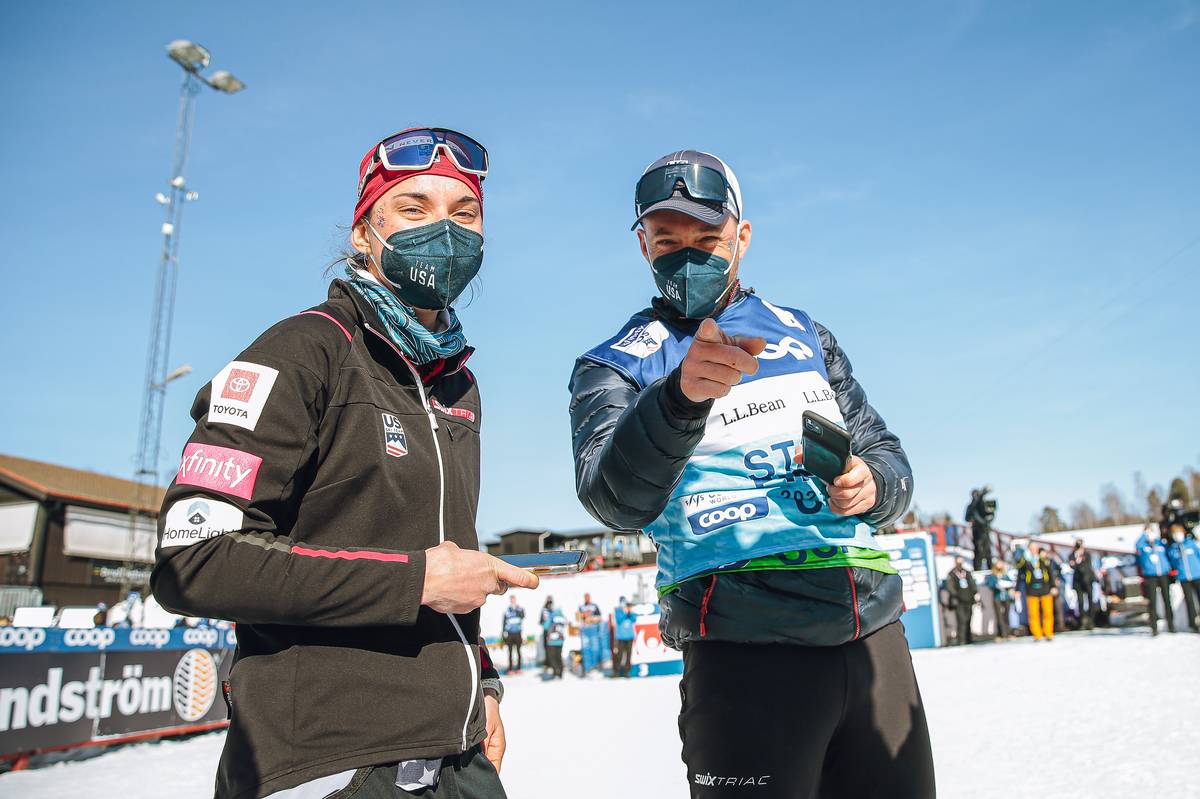
Matt Whitcomb has been a staple of the U.S. Ski Team coaching staff for a decade, seeing it through some of its most successful years. We hear from him about the coaching lifestyle, equal distance racing and other topics in another episode that we took a litttttle too long to post.
U.S. Ski Team head coach Matt Whitcomb (right) and Julia Kern seem course-side during the 4 x 5 k mixed relay amidst the 2021-2022 World Cup Finals in Falun, SWE. (Photo: NordicFocus)
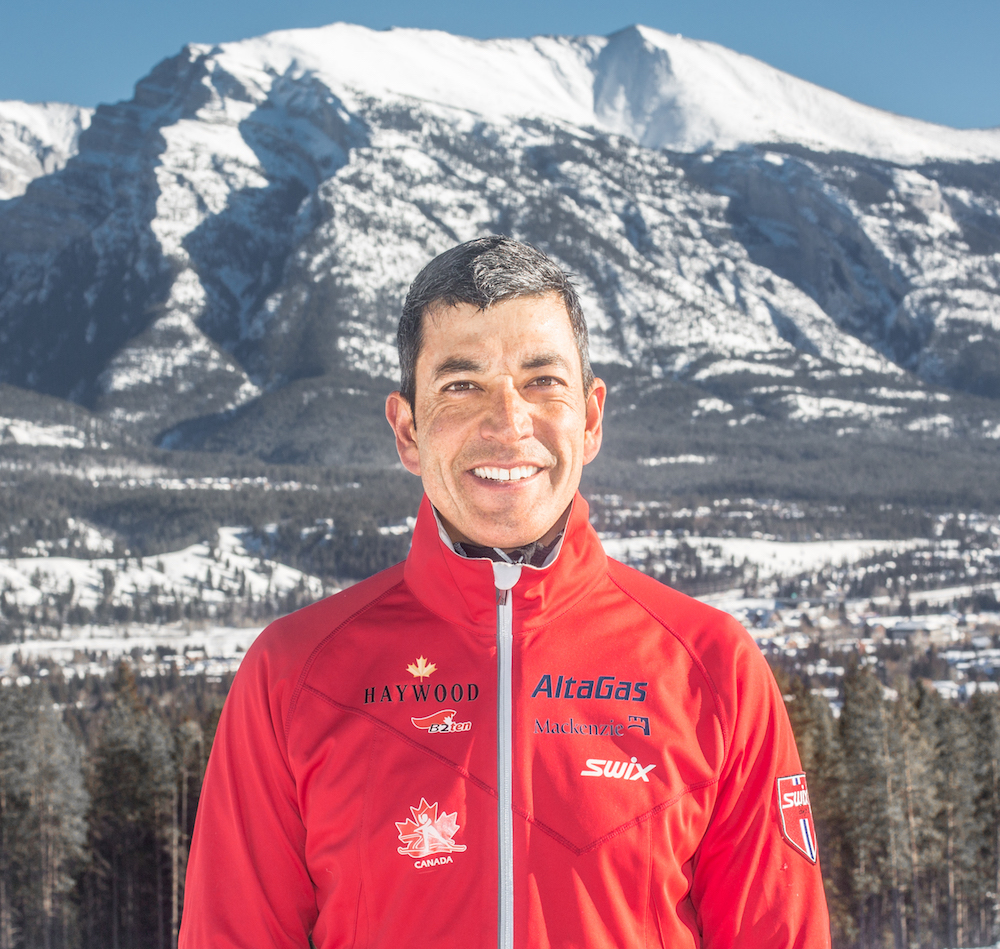
We have no excuses for our prolonged absence other than it being the summer time. Devon has school and kids to take care of; Nat has…well, Nat really has no excuse. We taped this show with Robin McKeever, the new Canadian coach, and we’re just getting around to posting it now.
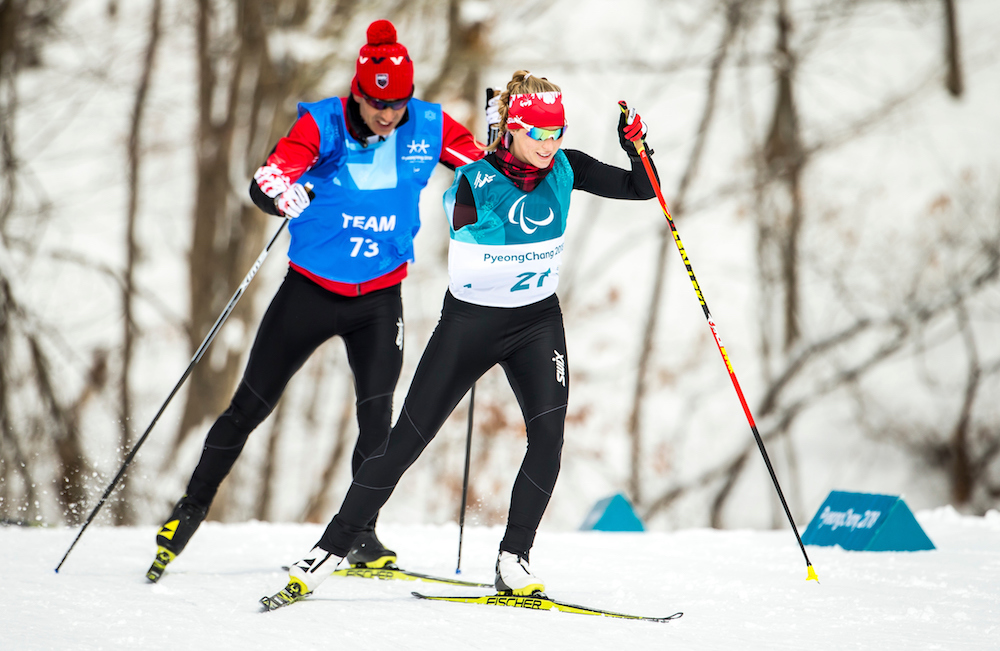
PyeongChang 9/3/2018 – Emily Young, of Kelowna, BC, and Coach Robin McKeever, of Canmore, AB, during a biathlon/cross country training session at the Alpensia Biathlon Centre during the 2018 Winter Paralympic Games in Pyeongchang, Korea. Photo: Dave Holland/Canadian Paralympic Committee
You’ve been waiting on pins and needles for the first episode of this season’s Devon Kershaw Show; we know. But it’s been a busy spring. This edition was recorded a couple of weeks ago, so apologies we’re not up to speed on all the latest developments, but we break down some retirements and other off-season news and we’ll be back soon with some discussion of equal distance racing and other news.
Though the FasterSkier team would select other highlights from the 2022 Beijing Olympic Games, one of the most read articles we produced featured the responses of members of the ski community to a story published on February 8th by the New York Times, which included the following quote:
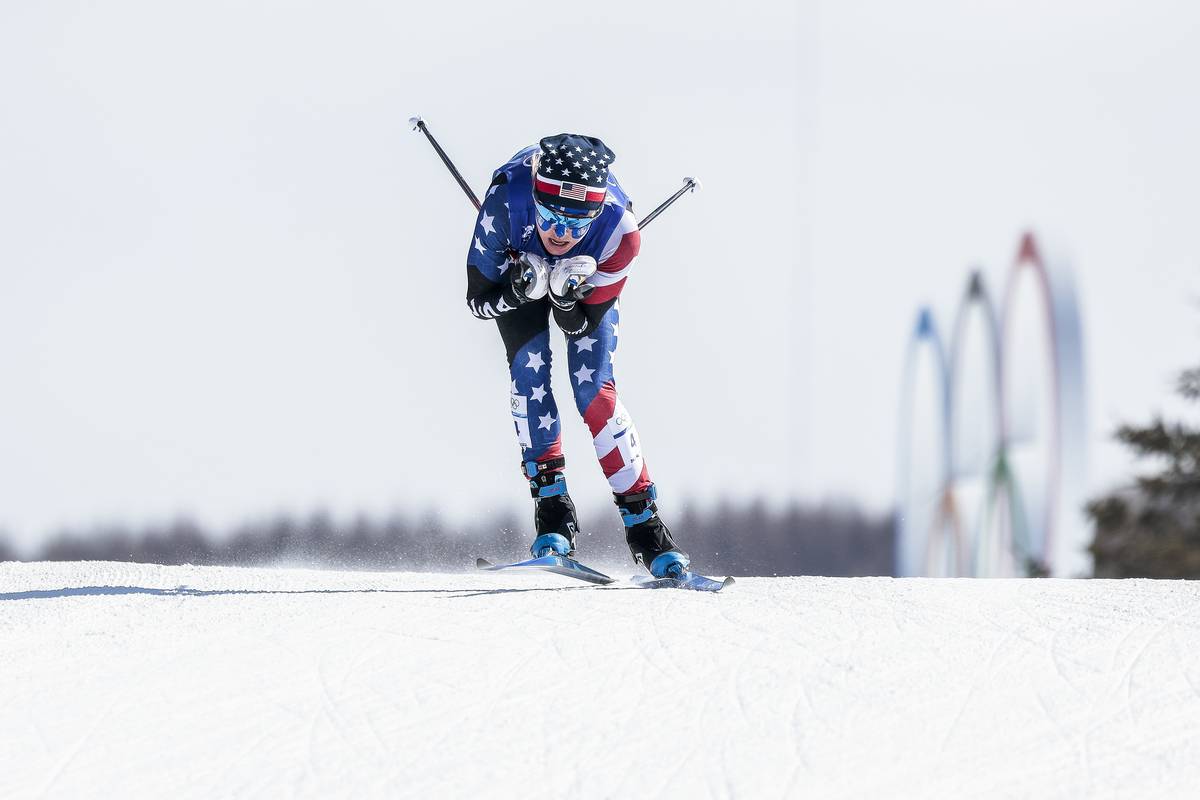
“In a sport that has so many women with massive shoulders and thighs, Diggins looks like a sprite in her racing suit, and it’s not clear exactly where she gets her power. But the power is there, as she flies up hills, and comes off climactic turns with a burst. On the downhills, she tucks low and cuts through the air.”
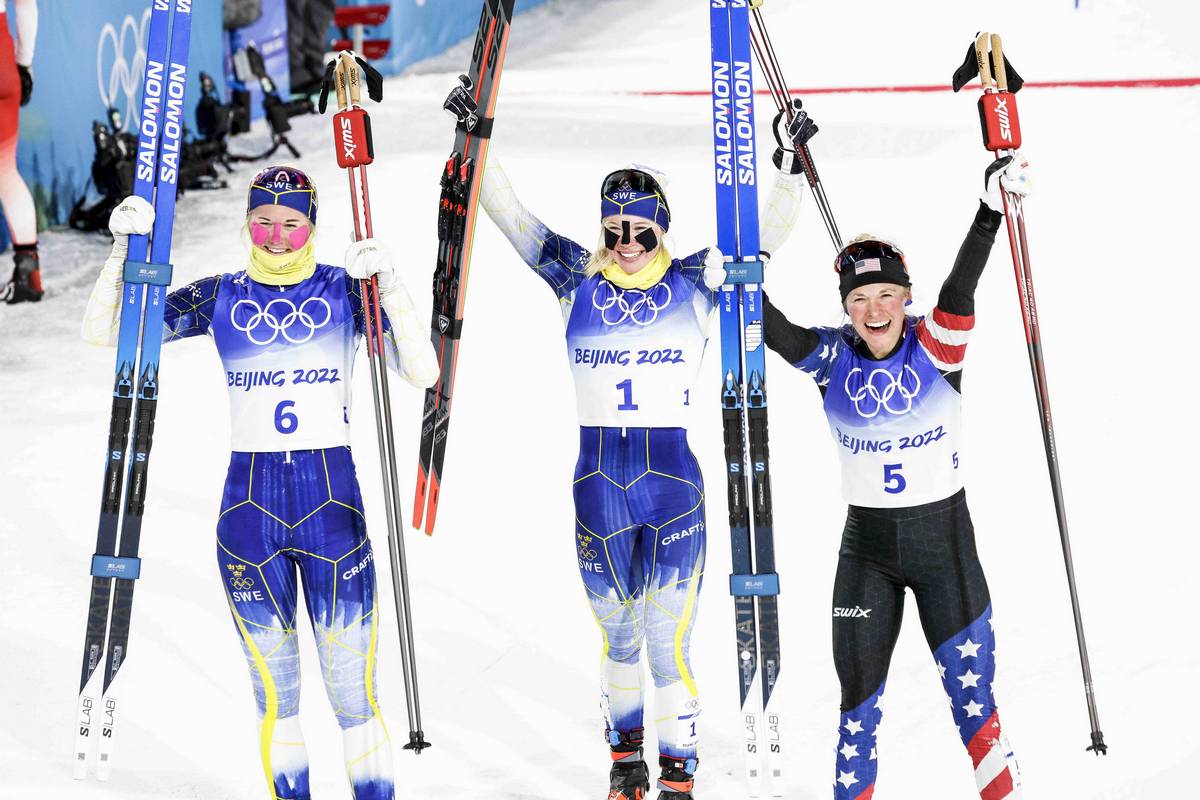
The women’s Olympic 1.5-kilometer freestyle podium: Sweden’s Jonna Sundling took gold ahead of teammate Maja Dahlqvist and American Jessie Diggins. (Photo: NordicFocus)
Following the initial backlash sparked by the quote has prompted a number of insightful conversations – and questions – on how athletes, men and women, are portrayed by the media, whether there is room for descriptions or comparisons of athletes’ bodies to narrate a scene for a reader, and how the landscape of sports media has shifted with time.
For this discussion, FasterSkier brought together a panel that spans both the athlete and media perspective on the issue.
Perhaps needing the least introduction for this audience, the first voice you’ll hear belongs to Rosie Brennan. In addition to her role as one of the top American cross country skiers for more than a decade, Brennan is also an advocate for the organization Voice in Sport which provides mentorship for developing female athletes across all sports. And she was a member of the women’s Olympic skate sprint final in Zhangjiakou, taking fourth place just behind Diggins, the race which sparked the discussion in the first place.
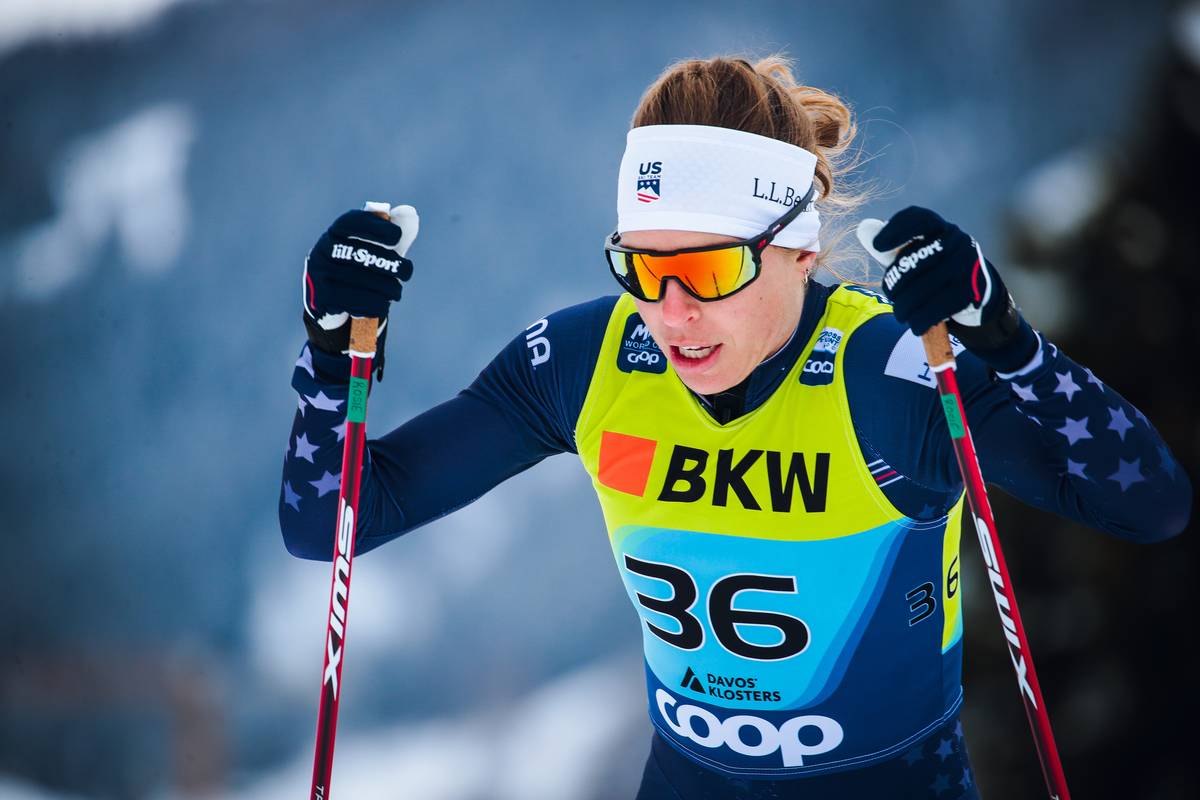
Putting together another highlight weekend in Davos, Rosie Brennan skis to 4th in the 10k individual start skate. (Photo: NordicFocus)
The second belongs to professional trail and ultra runner Corrine Malcolm, whose first go at professional endurance sport was in biathlon, from which she retired in 2014 after experiencing overtraining syndrome, likely coupled by relative energy deficiency in sport (RED-S). Alongside her athletic career, Malcolm has become a coach for other endurance athletes, while also becoming an advocate for women in sport, and has also engaged with this topic from the media side of the coin while calling some of the top ultra running events worldwide, including the Western States Endurance Run in California and the Ultra Trail du Mont Blanc (UTMB) which begins and ends in Chamonix, France. She’s also the co-host of an engaging podcast called Trail Society, which dissects challenging topics in the trail and ultra-running space.
Biathlete turned professional trail and ultra runner Corrine Malcolm discusses body comments in the media on the Nordic Nation podcast. (Courtesy photo)
We’ve also got Brian Metzler, an award-winning veteran journalist and author in the endurance space who currently writes for a number of publications including Outside, Competitor, Women’s Running, Triathlete, and Trail Runner magazines. Writing with perspective from his own athletic career, Metzler is Colorado Running Hall of Fame inductee (2015) who adventures on foot, ski, and sometimes alongside a burro, throughout the high country of Colorado.
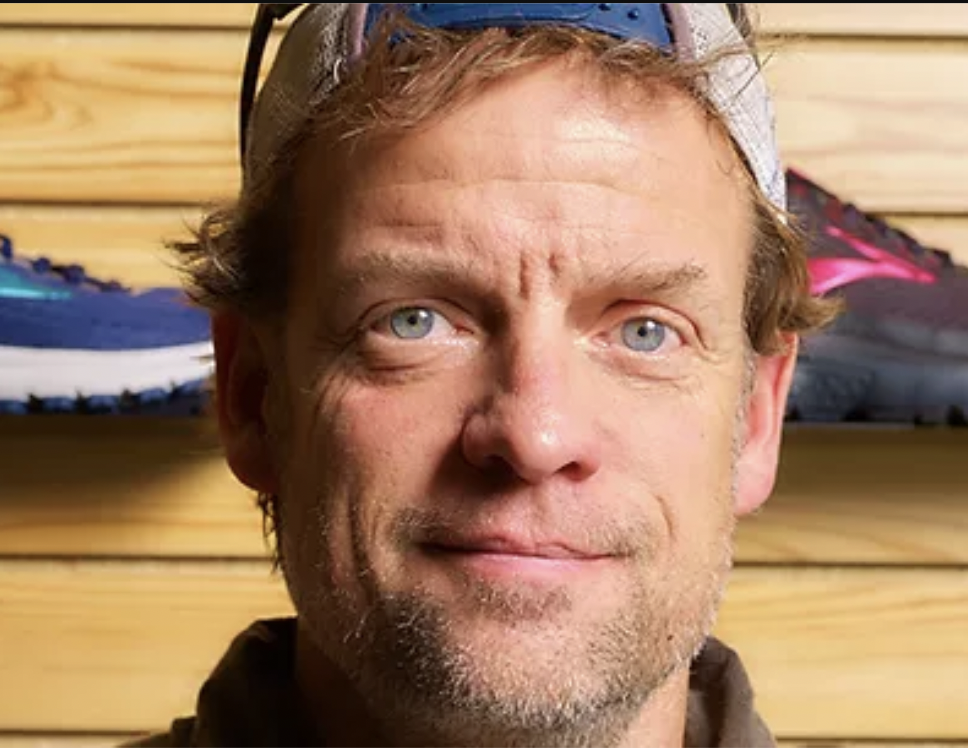
Long-time sports journalist and author Brian Metzler joins FasterSkier’s panel to discuss body comments in the media. (Photo: brianmetzler.com)
Lastly, you’ll hear a cameo from our own Nat Herz, on lunch break from his “real job” as a full-time reporter for the Anchorage Daily News. Having written for FasterSkier from 2009 through 2015 before making a return this year as our 2022 Olympic Correspondent and co-host of the Devon Kershaw Show, Herz shares insights from his time covering cross country skiing paired with those from behind a very different desk.
Some of the talking points discussed include:
Initial responses to the NY Times story
A writer’s responsibility to be informed on the sport being covered, in addition to the physical and/or mental health challenges that may be pervasive in that setting
Differences between American and European media, and shifts in focus, norms, or trends in sports media
Differences, or lack thereof, of covering athletes of different genders
Please note that the Craftsbury Green Racing Project Ski and Biathlon teams and U23 summer programs are currently accepting applications for the upcoming training year, which will close on April 10th. Click here for more information.
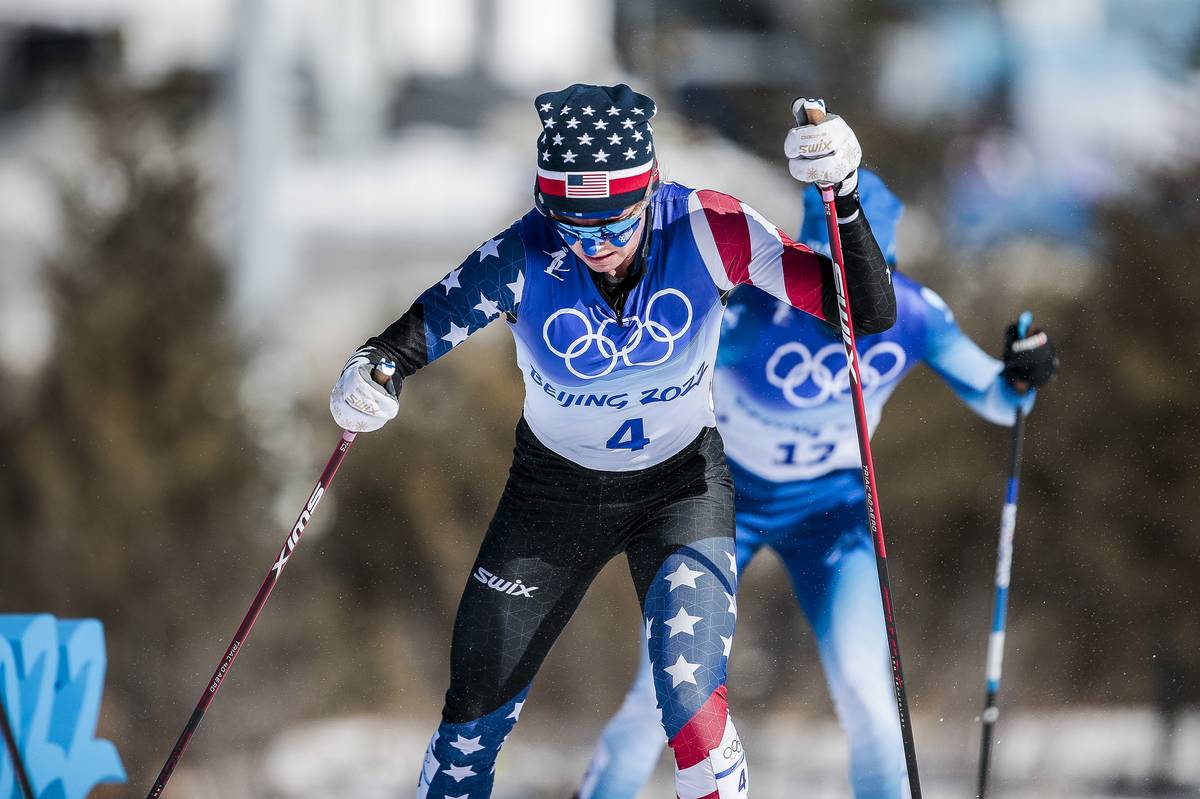
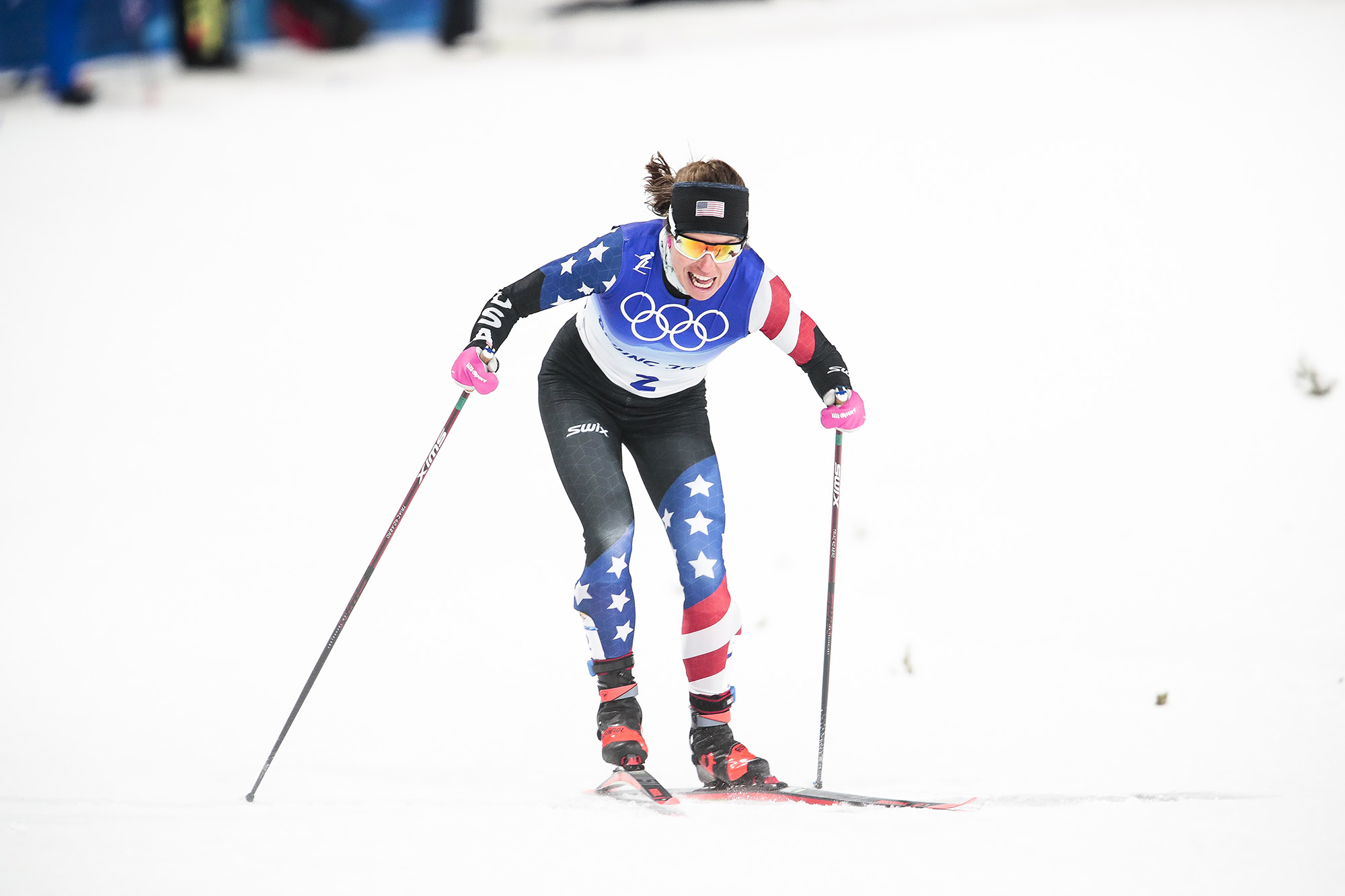
Jessie Diggins (USA) and Rosie Brennan find their position in the early moments of the women’s freestyle sprint final. (Photo: NordicFocus)
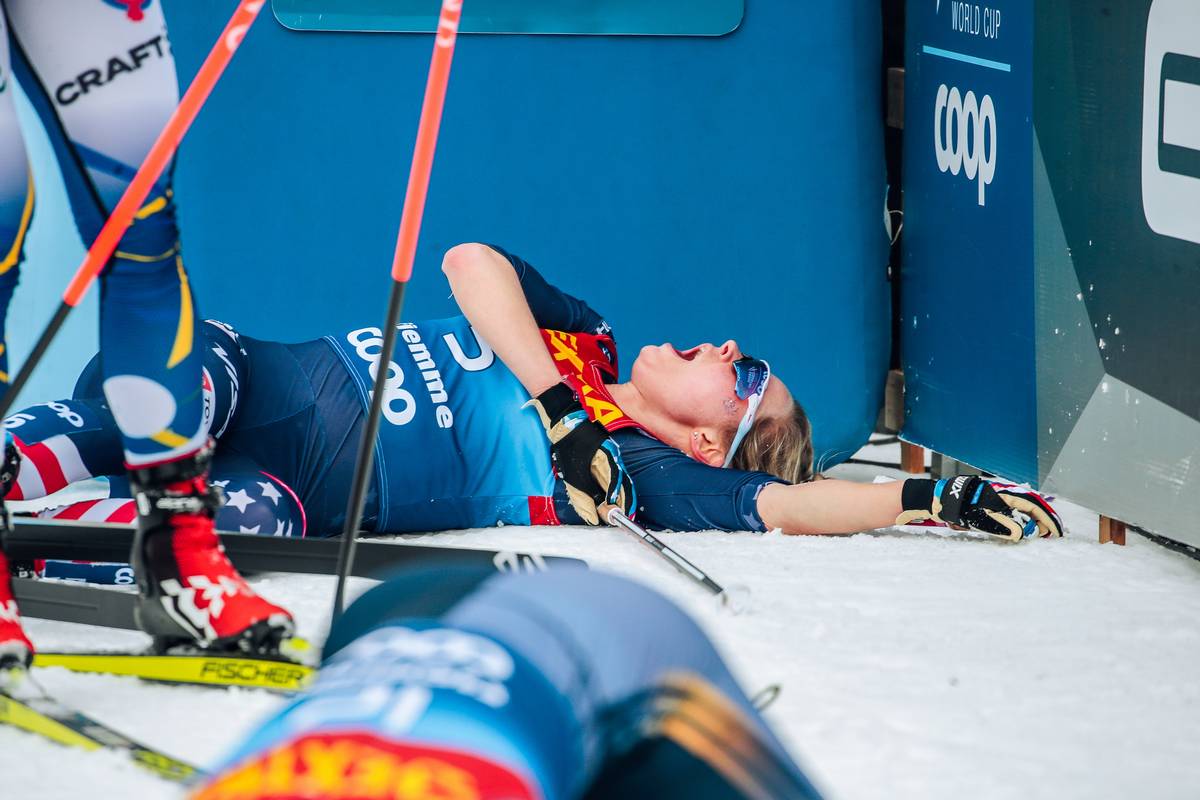
Diggins takes silver in the women’s 30 k skate. A bout with food poisoning 24 hours before her final Olympic race set the stage for what she later described as “one of the hardest things I’ve ever done.” (Photo: NordicFocus)
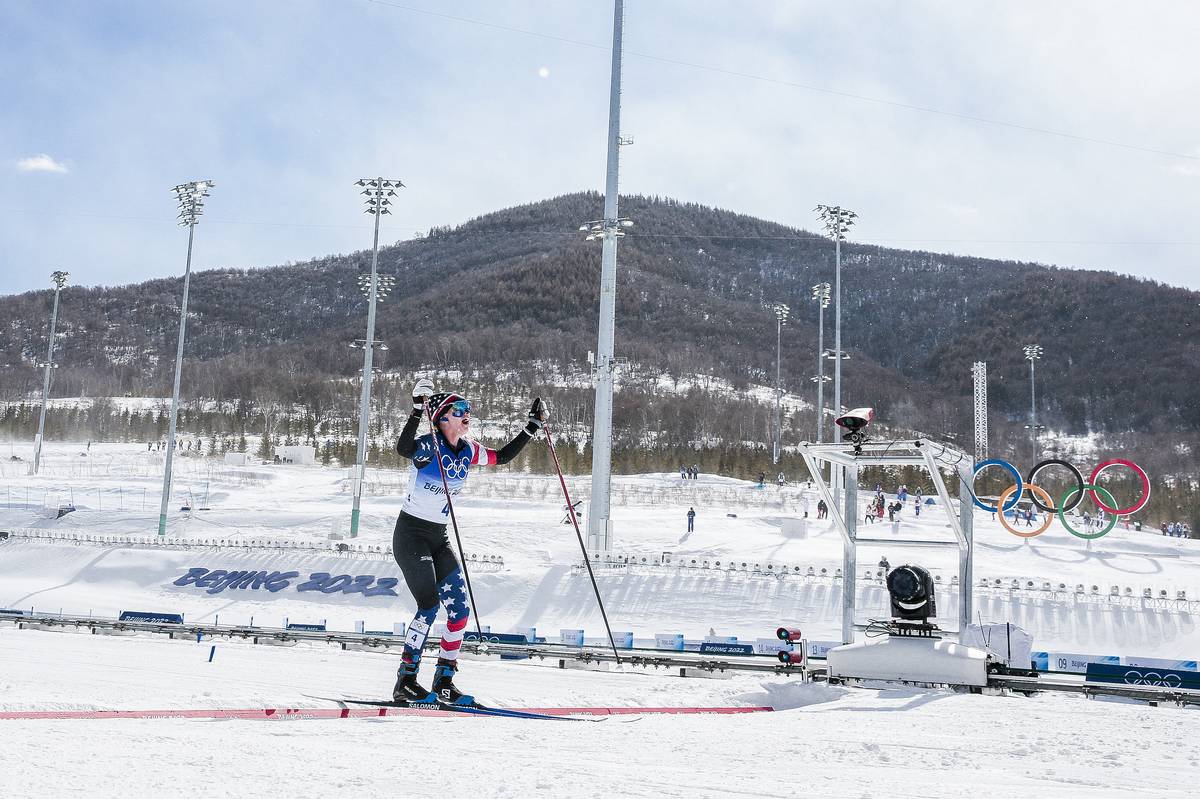
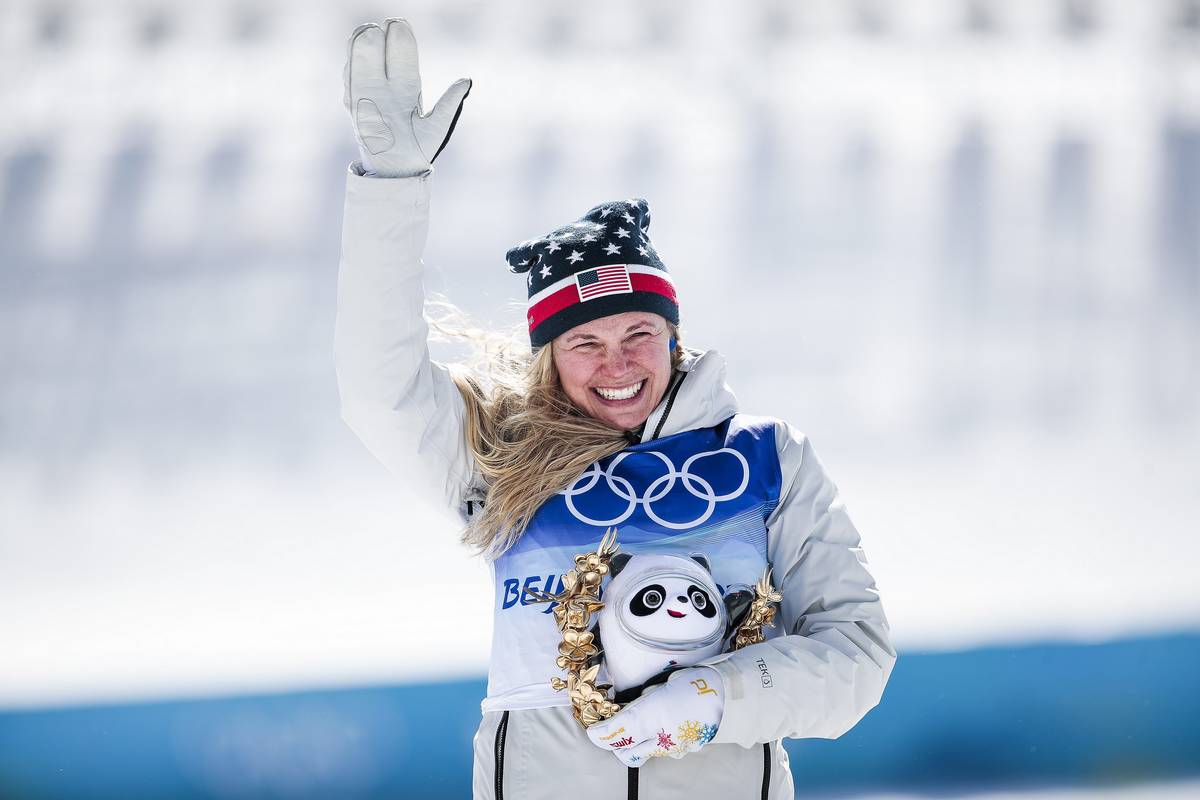
On February 20th, Jessie Diggins made Olympic history yet again, taking second in the 30 k mass start skate to round out the colors of her medal collection. Gold in the freestyle team sprint in 2018, silver in the 30 k skate, and bronze in the individual skate sprint.
Now thirty years old, Diggins is the most successful American cross country skier in Olympic history. She has spent over a decade rising to the top of American and international ski racing, elevating those around her as she reaches for goals that make us lose sight of the fact that the American women’s cross country program was only reinstated with funding in 2006.
There are currently thirty-nine pages of articles tagged with Diggins name on the FasterSkier archives, detailing the many steps forward, and backward, she has taken in her career, transforming her into the athlete, role model, and spokesperson she is today.
Her first tagged appearance was on January 25th, 2010 amid coverage of the Junior World Ski Championships in Hinterzarten, Germany. Both Diggins and Sophie Caldwell (now Hamilton) raced in the quarterfinals of the 1 k freestyle sprint that day, where Diggins crashed and ultimately finished 26th.
“50 meters into her quarterfinal here, Jessie Diggins found herself on the ground, seeing stars,” wrote one of FasterSkier’s young reporters, Nat Herz.
Perhaps it is fitting that 12 years later, following the press conference for Diggins’ Olympic silver medal, it was Herz who caught Diggins as she left, creating the opportunity for this unique interview. The following has been lightly edited for clarity and to account for the extreme wind at the venue, which significantly impaired the audio in a few places.
Jessie Diggins earns an Olympic silver medal in the women’s 30 k mass start skate. (Photo: NordicFocus)
Nat Herz / FasterSkier: How are you feeling?
Jessie Diggins: Honestly, I’m feeling okay now. I haven’t felt that bad at the finish of a race maybe ever. It was a little scary. I couldn’t really walk. But also I’m not surprised, because like 24 hours ago I felt pretty awful too. It’s been a wild, wild last 48 hours.
***
Following the race, Diggins had shared with the media that came down with food poisoning the day before the race, leaving her unsure whether she would be able to line up for the final Olympic event, and if she did, what amount of fight would be left in her body.
Elaborating on what it had been like to cross the line in second place after this experience, Diggins said she felt “disbelief” and that mentally, she had been preparing herself to accept whatever outcome the day would behold. “You’ve had a great time [at these Games] and just do what you can to take care of yourself.”
Diggins continued by explaining the support she received leading into the race that allowed her to keep herself in the positive headspace she needed to perform.
JD: I had a great talk with my sport psychologist, my fiancé, and with my parents. They reminded me that this — the weather, the wind, it’s just like skiing at Giant’s Ridge in Minnesota when I was a kid. You know, I’m just gonna go out there and ski because I love to race and [we’ll] see what happens. My mom reminded me last night, ‘You don’t have to decide right now. Wait. Just see how you feel once you’re actually racing. And then see how you feel in another 5 k and another 5k. You don’t know right now and that’s okay.’ So I went from like, ‘Wow, this is not the race prep I envisioned’, like laying in bed force feeding myself oatmeal and soup from a can. I was really proud of the amount of sport drink I consumed… and I was just like, ‘Okay, we’re just gonna see what happens out there.’ And I just wanted to race because I love to race.
Jessie Diggins fights through food poisoning-induced cramps to win a silver medal in the 30 k skate. (Photo: NordicFocus)
How she would feel while racing became apparent early. Diggins explained that by 12 or 13 k, her body was already beginning to fight against her efforts.
JD: I just kept trying to keep down some sugar and then my left knee started cramping and then my right quads and my left quads and my left hip. I tried to keep telling myself ‘Use your arms, use your arms.’
Grateful for the distraction and encouragement as she endured the pain of racing in that state, she expressed her gratitude from the support she received from the sidelines.
JD: I think we had like all of US Biathlon out there. The whole ski team was out there, all the techs. I mean, Oleg was cheering on the last lap, ‘We’re proud of you!’ And I was like, ‘I’m gonna cry.’ That was the coolest thing. Pretty much every other country also started cheering for me, and so I felt like the whole world was helping me get up those hills when my legs were just spasming and going numb. And I just kept thinking, ‘I’ve got to keep pushing as hard as I can, because at any point — what if my legs give out? I can’t back down. I can’t let up on this pace. I just have to keep going.’
FS: I imagine you were kind of on this seesaw between, ‘I’m in a medal winning position and I could fall over at any time…
JD: I was trying very hard to not think about that, and just think about using my arms, using my head — what I mean by that is like, I’d come over the top and it’s really windy, and I’m like, ‘Okay, I’m just going to doublepole.’ Or, ‘I’m gonna hold this tuck longer.’ Because it was the sustained climbs where I started to really cramp, so I kept thinking like, ‘Okay, I gotta ski as smart as I can, and be really thoughtful about where I use my legs and where I use my arms.’ Which is funny, because normally, I’m a legs skier, so that was a funny flip for me. I tried not to let myself think about a medal, because I had to stay focused on getting through the race, and not let myself think about anything else.
Jessie Diggins pushes through food poisoning to win a silver medal in the 30 k mass start skate. (Photo: NordicFocus)
FS: When you think about the amount of pride you’re gonna feel in finishing that race the way that you did, when you’re ultimately able to look back on that, would you say this would rank up there in your catalog of things you’ve had to suffer through?
JD: I think that might have been the hardest thing I’ve ever done in my life. It might be. Finishing the Tour de Ski this year was also very hard, but that’s why I did it.
I told myself last night, nothing will probably feel harder than being actively sick and finishing that final climb. I’ve prepped for this. My head is tough as it is ever going to get, and I need that right now. And I’m grateful for all those super hard training sessions and all those super hard races where I finished, without being able to feel my legs at all because in the middle of the race [today], when my legs were spasming and I couldn’t really feel them, I was like, ‘This is not new.’ Unfortunately, which is probably medically concerning. But this is not a new thing for me, and so I know I can survive this.
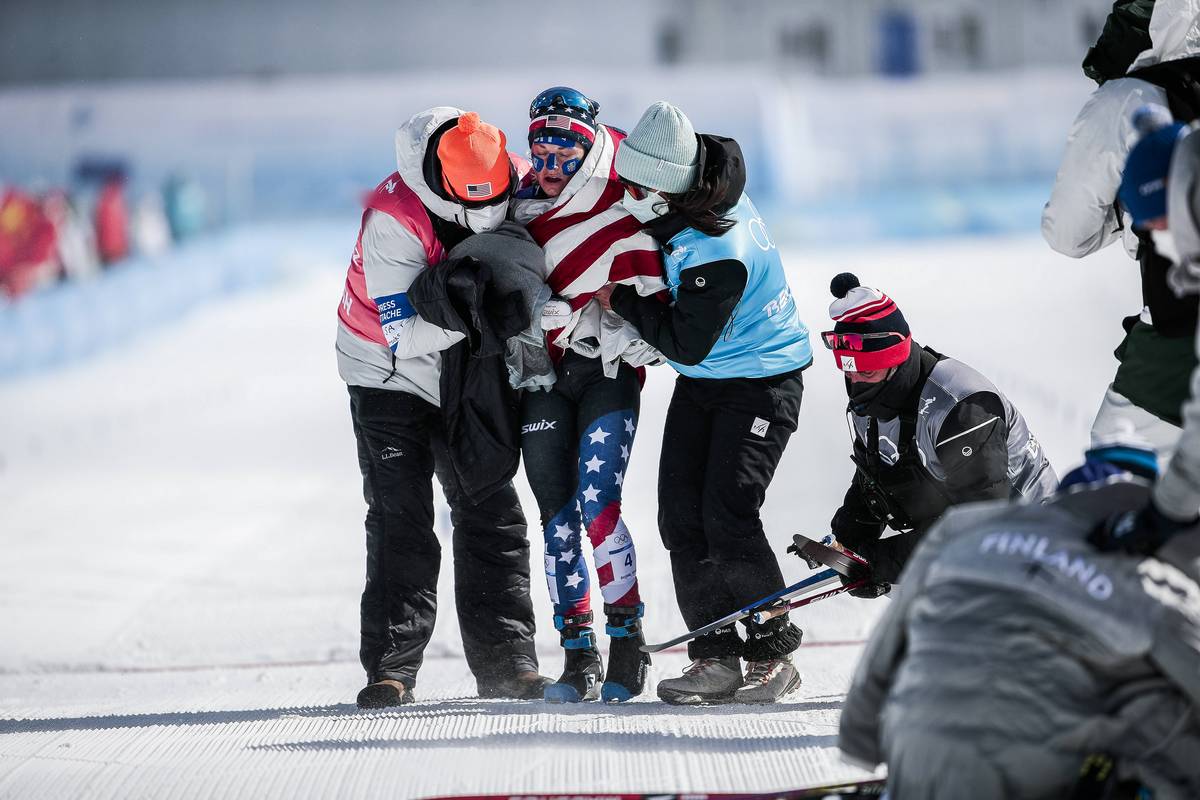
After collapsing at the finish line, Diggins is helped off the course following the Olympic 30 k skate, where she pushed through food poisoning to earn a silver medal. (Photo: NordicFocus)
The other prominent storyline of the day was that Rosie Brennan knocked on the door of an Olympic medal yet again, perhaps helping Kerttu Niskanen of Finland to bronze, only to walk away empty handed herself in sixth place. Brennan had been fourth in the freestyle sprint the week before, and had tagged off to Diggins in third place after her final lap of the classic team sprint where the Americans finished fifth.
It was perhaps not altogether a very different Olympic experience from Diggins’ in PyeongChang in 2018, where she took fifth in two individual races, sixth in another, and seventh in the last. In the 10 k skate, Diggins fifth place meant she was the first woman not to earn a medal, as Marit Bjørgen (NOR) and Krista Pärmäkoski (FIN) had tied for third.
FS: When you think about Rosie’s results today, and here, just overall. Is there anything you would want to say about that, because you’ve sort of similar positions — fourth places, tough spots.
JD: I do know how that feels, and I think it’s so important to remember that nobody gets to say if that was a good race or not but Rosie. Nobody gets to judge. Nobody gets to criticize. She’s the one who gets to define what success looks like. And personally, I’m just so proud of her. I mean, the Olympics is an emotional roller coaster. And she rode it with grace, and as a good teammate, and looked out for other people. She’s just been amazing. And to me, she found success in every definition that matters.
FS: If you were Rosie, would you be proud of your races?
JD: Yeah, I would. Because when I was fourth [in the 10 k skate in PyeongChang], or fifth because of the tie, I was proud. When you give it everything you have in a race, you can and you should be proud. And I think that’s that.
Rosie Brennan works against the lead while leading a chase pack during the 30 k skate, which included eventual bronze medal winner Kerttu Niskanen. (Photo: NordicFocus)
Has it really been a week since the Olympics already? The World Cup’s furious schedule forges on with more racing this weekend in Lahti, Finland. Special guest host, Finnish Olympic gold medalist Sami Jauhojaervi, joins us to break down those results and other Finnish highlights from this season.
We also cover results from the World Junior Championships in the early part of the podcast, and finish with a brief discussion of how cross-country skiing is handling Russian participation on the World Cup circuit given the country’s invasion of Ukraine.
It had been more than a month since Sophia Laukli last wore a race bib. Her last competitions took place on January 15th and 16th during the 2022 Sun Valley Nordic Invitational, where she was second to Rosie Brennan in the 5 k individual start skate, racing at altitude on a tough course. Eleven days prior, she was the fifth woman, and the first American, to the top of the Alpe Cermis in Val di Fiemme, Italy during the final stage of the Tour de Ski.
Earlier in the season, Laukli popped a Top-20 at altitude in Davos, Switzerland, finishing 19th in the 10 k individual start skate.
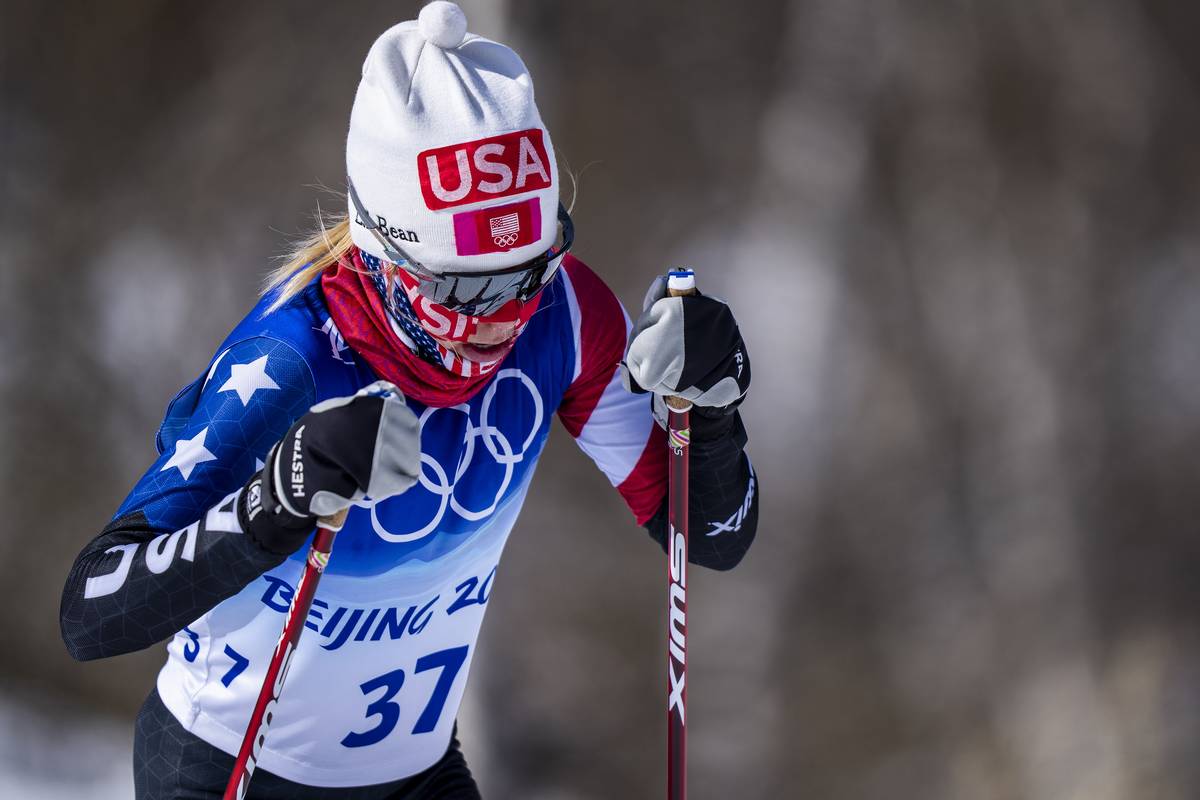
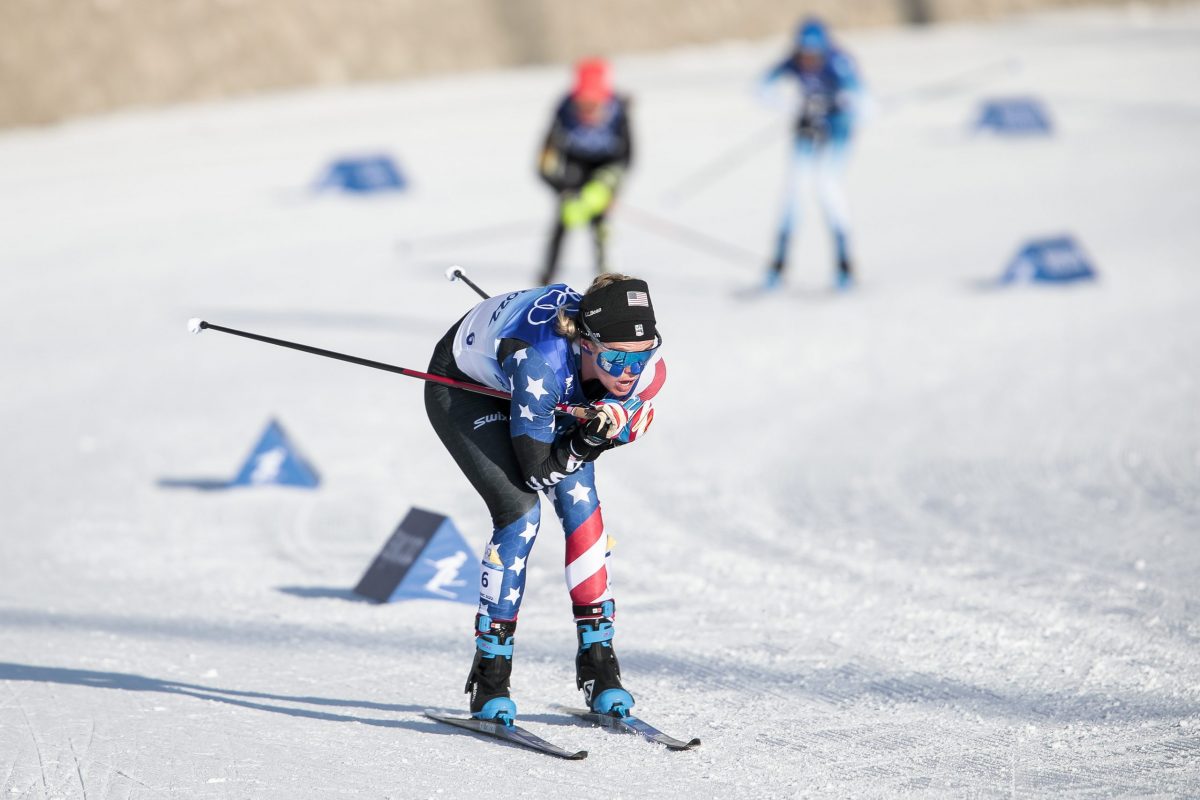
Racing through brutal wind and cold, Sophia Laukli skis to 15th in the 30 k skate. (Photo: NordicFocus)
It’s become clear: Laukli is a contender in freestyle distance races, and the harder (and higher) the better.
Heading into the Games, Laukli knew she would be starting the 30 k mass start freestyle. Given the elevation, the challenge of the course, the technique, and the distance, perhaps this selection by the coaches was a no-brainer.
“I love this course,” Laukli said of the venue in Zhangjiakou in a post-race interview with FasterSkier in the mixed zone. “The hills really work to my advantage.”
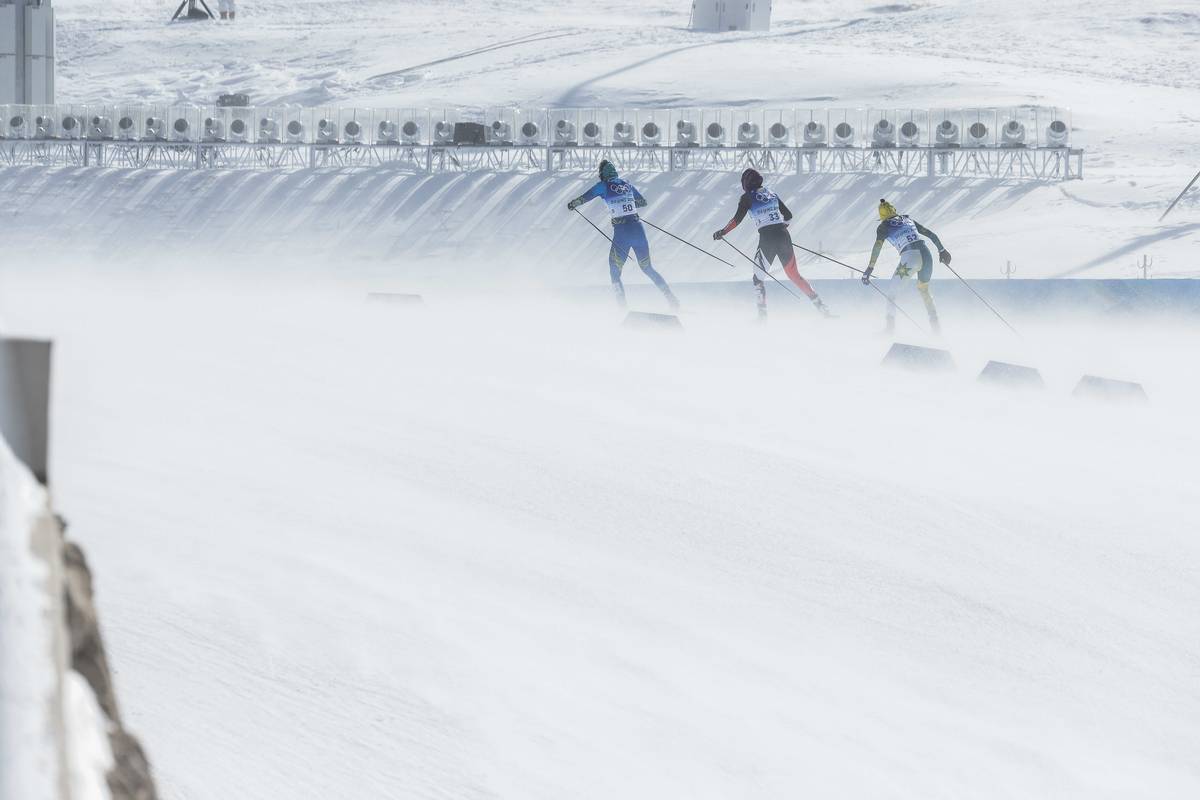
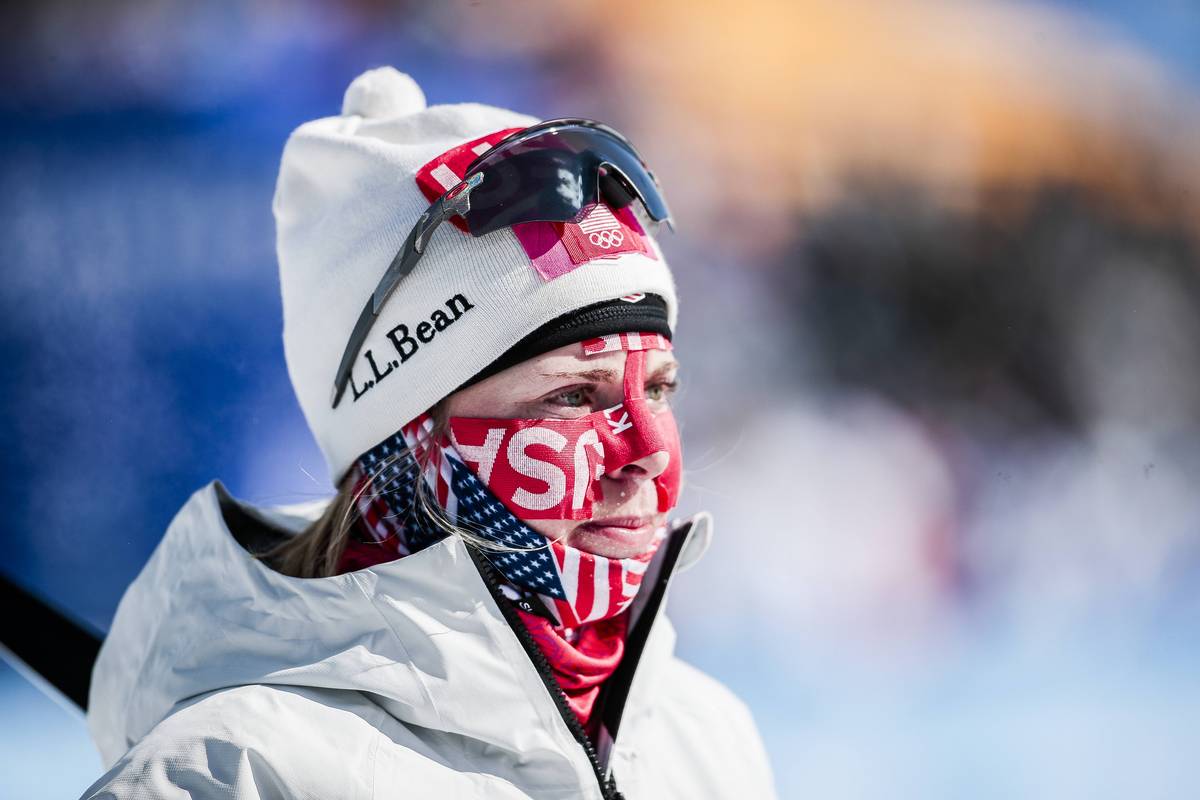
But no one could have predicted just how challenging the day would be. Wind ripped across open sections of the course, forcing athletes to drop into low gears even on flatter sections just to stay upright and moving forward. Most athletes wore large strips of tape across their faces, with buffs covering all remaining exposed skin save for their mouths and noses.
Snow-filled wind gusts obscure the v-boards lining the 7.5 k course in Zhangjiakou during the women’s 30 k mass start skate. (Photo: NordicFocus)
The American women showed they could handle whatever Zhangjiakou threw at them that day. Highlighted by Jessie Diggins silver medal performance – earned while fighting through painful cramping and fatigue after spending two days with food poisoning – the team put all four starters inside the top-20. Rosie Brennan skied to 6th, with Laukli in 15th, and Novie McCabe 18th.
But Laukli was almost 13th.
With only a few hundred meters to go, Laukli made a wrong turn, accidentally following the lap course rather than the route to the finish lanes.
How did it happen?
“I honestly don’t know exactly,” Laukli said in the mixed zone. “There was a huge gust of wind that kind of covered where it was marked ‘finish’ and ‘lap’, and I think it was a combination of [being] tired and not really seeing where to go. I definitely noticed a little bit too late, and then got passed, but I guess those things happen. I’m definitely a little bit bummed out. But I’m happy with the overall race.”
Laukli is not the only athlete to have made a wrong turn at the Olympics. A wrong turn during the 30 k classic might have cost Austria’s Theresa Stadlober a medal at the 2018 Games in PyeongChang. There’s adrenaline, fatigue, nerves, and so many other factors at play, without wind gusts lifting clouds of dry loose snow into the air in the stadium.
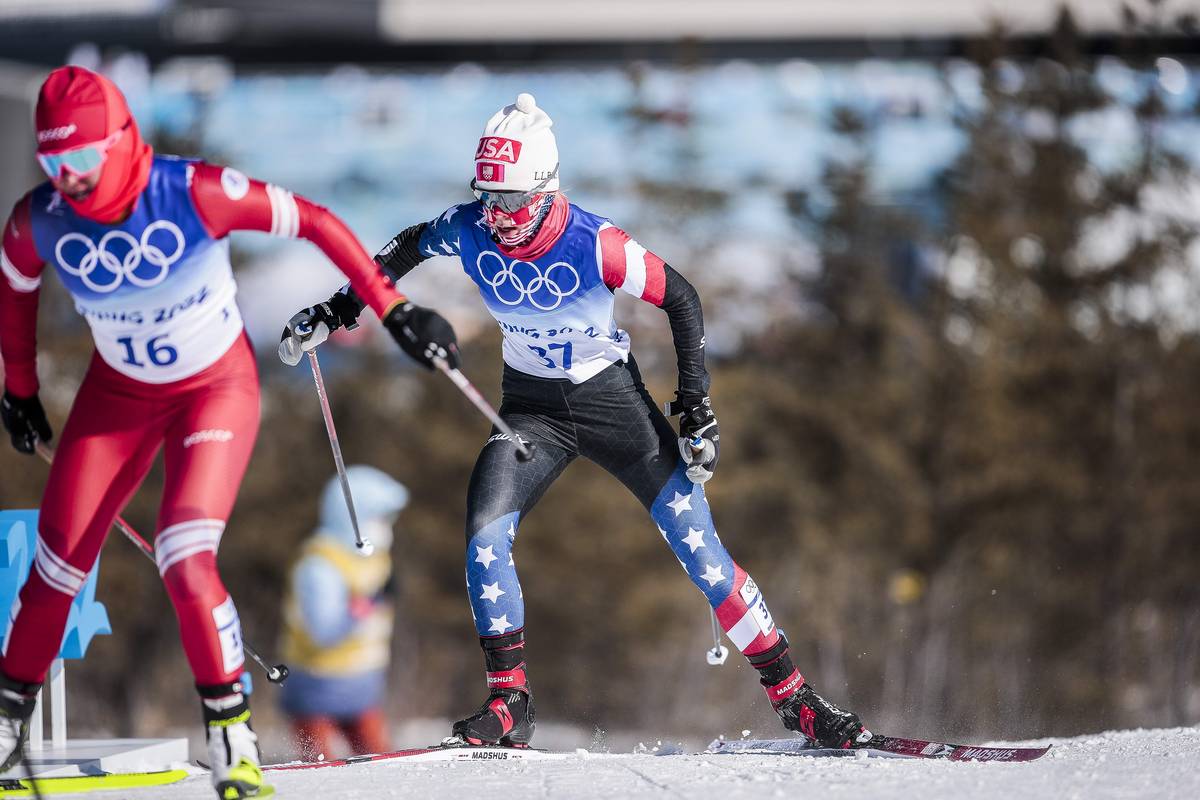
“I’m bummed for her,” said coach Chris Grover, “that she lost two places, because she worked hard for those… but she did the right thing, retracing her steps all the way back, and that’s one of the lessons that you do once on the big show and then you never do it again. Jessie did it in Sochi.”
Despite a wrong turn inside the final 400 meters, Sophia Laukli finished 15th in the 30 k skate in her Olympic debut. (Photo: NordicFocus)
Having one of the best races of her season during her first and only appearance at the 2018 Games, Laukli admitted she felt panicked as she backtracked to the split to avoid disqualification. Having come to a stop and lost all momentum, it was devastating to see a pair of Norwegian twins, Lotta and Tiril Udnes Weng, skiing fast with a tailwind toward the final bend into the stadium. There was nothing Laukli could do to avoid losing those two places.
But to her coaches and supporters, this wrong turn was not the defining moment of Laukli’s Olympic debut.
Laukli showed mental toughness, dedication, and patience as she spent the three weeks prior to the 30 k training in Zhangjiakou, watching, supporting, and celebrating her teammates as they raced in earlier events, while trying to stay focused on her own opportunity that was yet to come.
“It was definitely not the easiest last month,” she told FasterSkier. “I really love racing, and so to have such a long break and just wanting to race, it was a bit tough.”
She explained that, without races as a fitness checkpoint, she poured herself into her training to maintain her race shape, but ultimately was not sure what would happen on race day.
“I think I was lucky in that it was a 30 k – it’s maybe easier to race a 30 k when you’re not in your fastest form, because it’s just a slower race. So I think that helped a lot.”
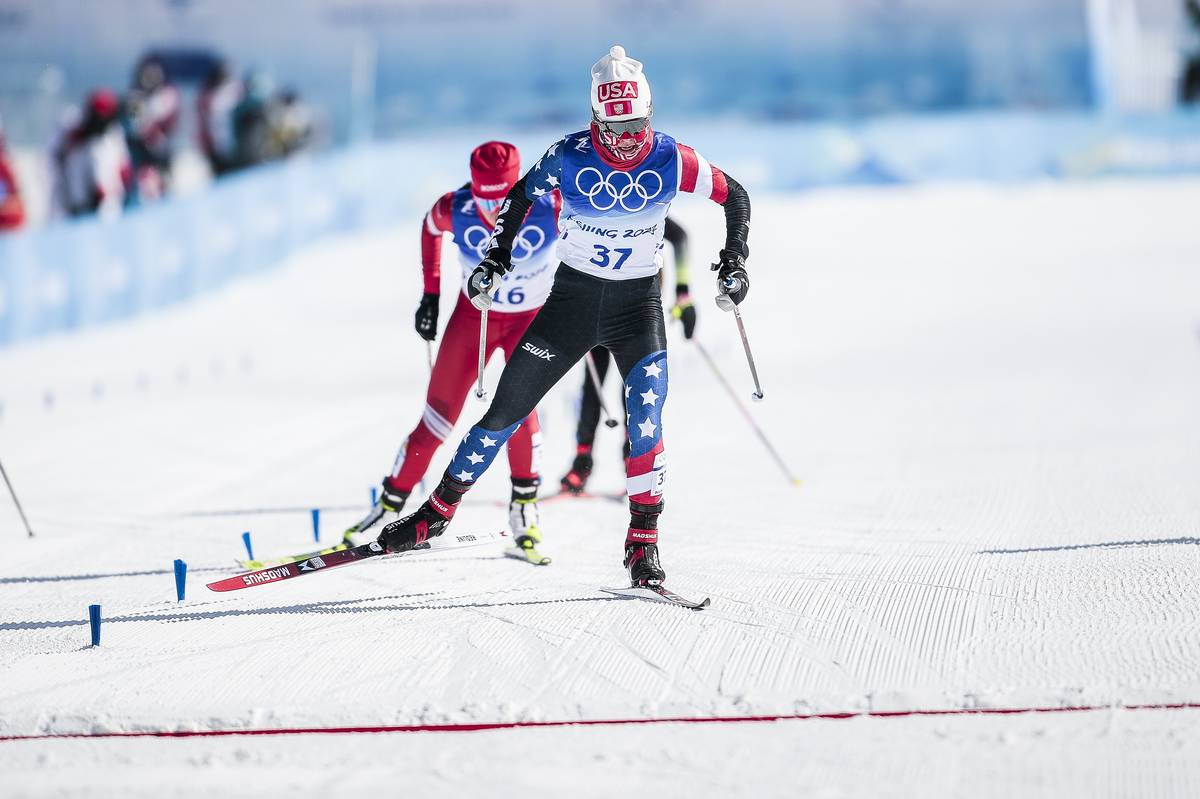
Racing on her own for the second half, Sophia Laukli finishes her Olympic debut in 15th place. (Photo: NordicFocus)
At the 10 k mark, Laukli sat in 15th, racing on the back of a large chase group led by Rosie Brennan. Over the next 5 k, a group of three, including Laukli, lost contact with this group and slowly separated. For the second half of the race, as the wind “really, really picked up”, Laukli found herself racing on her own with no one to work with or use as a wind break. At times, the headwind was so strong that Laukli said she ended up fighting it in V1 as she lapped through the false flat of the stadium at 22.5 k.
Ever onward, Laukli kept pushing, eventually overtaking a Latvian athlete who began to fade to find herself in 13th – 13th in the world at the Olympics – with a roughly 45 second gap to the next skier in the final kilometer.
“I felt like I was able to pace it pretty well,” she said. “It was definitely a bummer that I had to see most of it alone because I think it would have been beneficial to be in a group. But I did my best and I’m pretty proud of how it went.”
While the takeaway here should remain that Laukli posted a top-15 result in her first Olympic performance at 21-years-old in some of the gnarliest conditions imaginable, the sting was still painful as she passed through the mixed zone.
“I’m probably in a better place than I was the minute after I finished. But to be honest, I’m pretty pissed. I really wanted to prove myself today, to prove that I earned that start. And just to make such a stupid, preventable mistake at the end… I was not stoked. But like I said, that happens, I guess. It sucks that it’s at the Olympics in my Olympic debut, but yeah, not a lot I can do about it now.”
Perhaps Nat Herz said it best as their conversation in the mixed zone ended.
“As a guy who watches a lot of these races, I don’t think anyone’s gonna hold it against you, or remember it in however many years.”
Sophia Laukli pushes to the line for 15th in the 30 k mass start freestyle. (Photo: NordicFocus)
American cross-country skier Jessie Diggins scores another Olympic medal in Beijing, this time a silver, gutting out a strong race even though she was suffering from food poisoning. We break down the full 30 k freestyle race with Therese Johaug’s win and a furious chase for bronze. And we’re thrilled to welcome guest hosts Holly Brooks and Sadie Maubet (Bjornsen), the retired U.S. Olympians who joined us from Alaska.
We’ll be back when the World Cup resumes in Lahti next weekend. (Seriously?! So soon.) Get us at devon@fasterskier.com and nat@fasterskier.com in the mean time.
We know we haven’t gotten to all your questions over the course of the Olympics, but we hope to catch up with a mailbag episode soon once things settle down.
Sadie Maubet (Bjornsen) and Holly Brooks snap a picture during an Olympic watch party in Anchorage. (Courtesy photo)
This isn’t a spoiler, even if it spoiled some of the glory Saturday: Organizers shortened the Olympic men’s 50 k to a 28 k skate. People were mad; the athletes still raced and delivered a good show. We’ve got our own show here, featuring guest star Kris Freeman, the retired American Olympian.
Alaska’s Scott Patterson threw down the best Olympic result for a U.S. man in nearly a half-century, too. We break that down, plus the Russians and Norwegians on the podium, and we’ll have one last Olympic podcast after the women’s 30 k skate tomorrow.
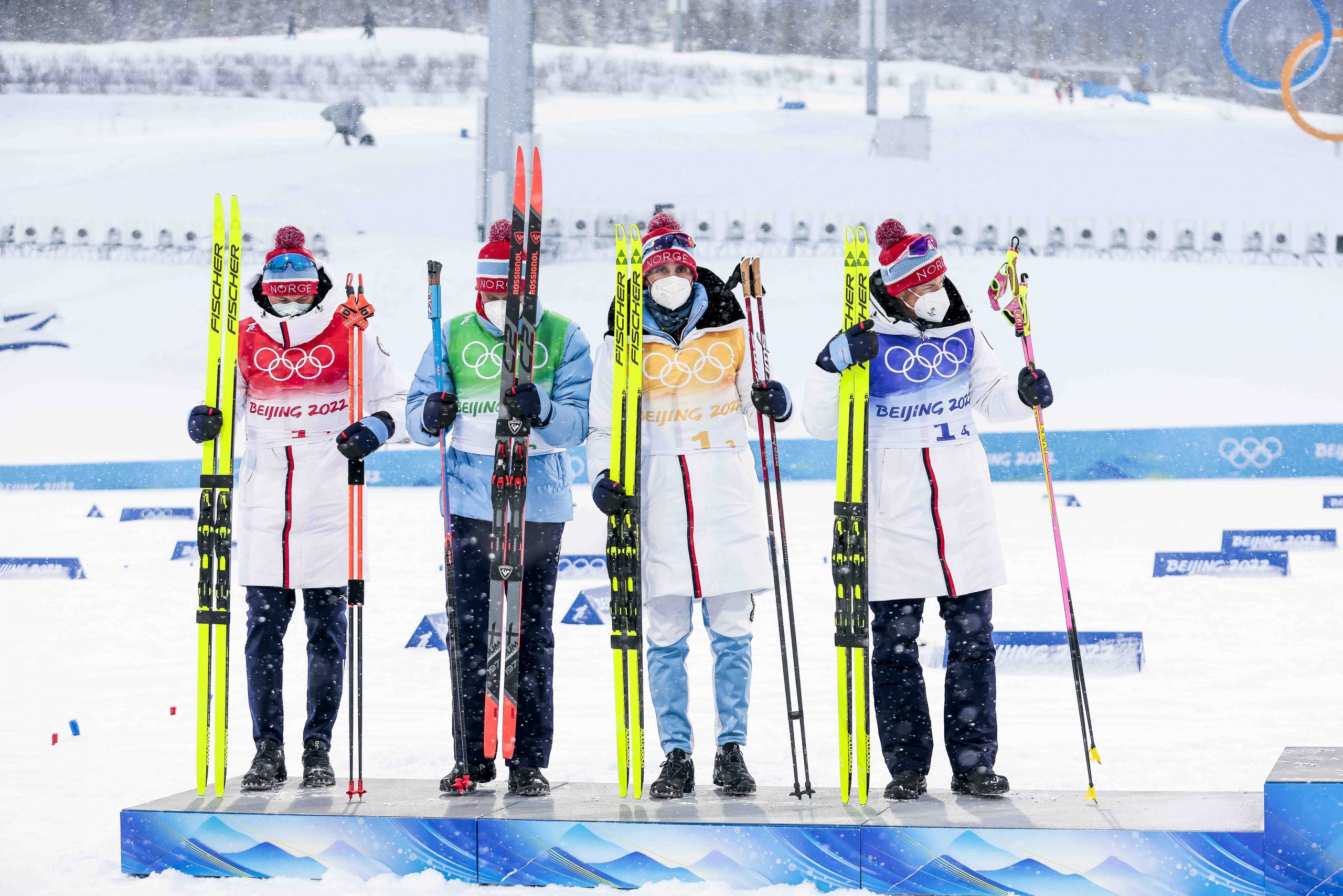
The men’s 4 x 10 k relay itself lacked for drama, but fortunately there’s plenty going on in the Norwegian team for us to talk about. Devon and Nat are back to break down Russia’s convincing win in the relay, the most disappointing silver ever for Norway and a gold-like bronze for France.
Emil Iversen (NOR), Paal Golberg (NOR), Hans Christer Holund (NOR), Johannes Hoesflot Klaebo (NOR), (l-r) were the only team not celebrating their medal after the 4 x 10 k relay (Photo: NordicFocus)
We’ve got our latest episode straight out of China to break down Iivo Niskanen’s dominating win in the Olympic 15 k individual start classic. We talk about some of the drama on the Norwegian team, cover the American and Canadian results and bring on special guest Vahur Teppan, a retired Estonian athlete who coached members of China’s national team for the past four years.
Thanks for listening!
Iivo Niskanen celebrates a gold medal performance in his signature event, the 15 k individual start classic. (Photo: NordicFocus)
The pod is back to recap a good old-fashioned individual start throwdown, with special guest Kristin Størmer Steira.
We break down Therese Johaug of Norway’s nail-biting win over Finland’s Kerttu Niskanen and another nail-biting race for third between Finland’s Krista Pärmäkoski and Russia’s Natalia Nepryaeva. And we discuss questions about the U.S. team selection for the upcoming women’s relay, and the pressure cooker environment of the championships.
We’ll be back after tomorrow’s men’s 15 k.
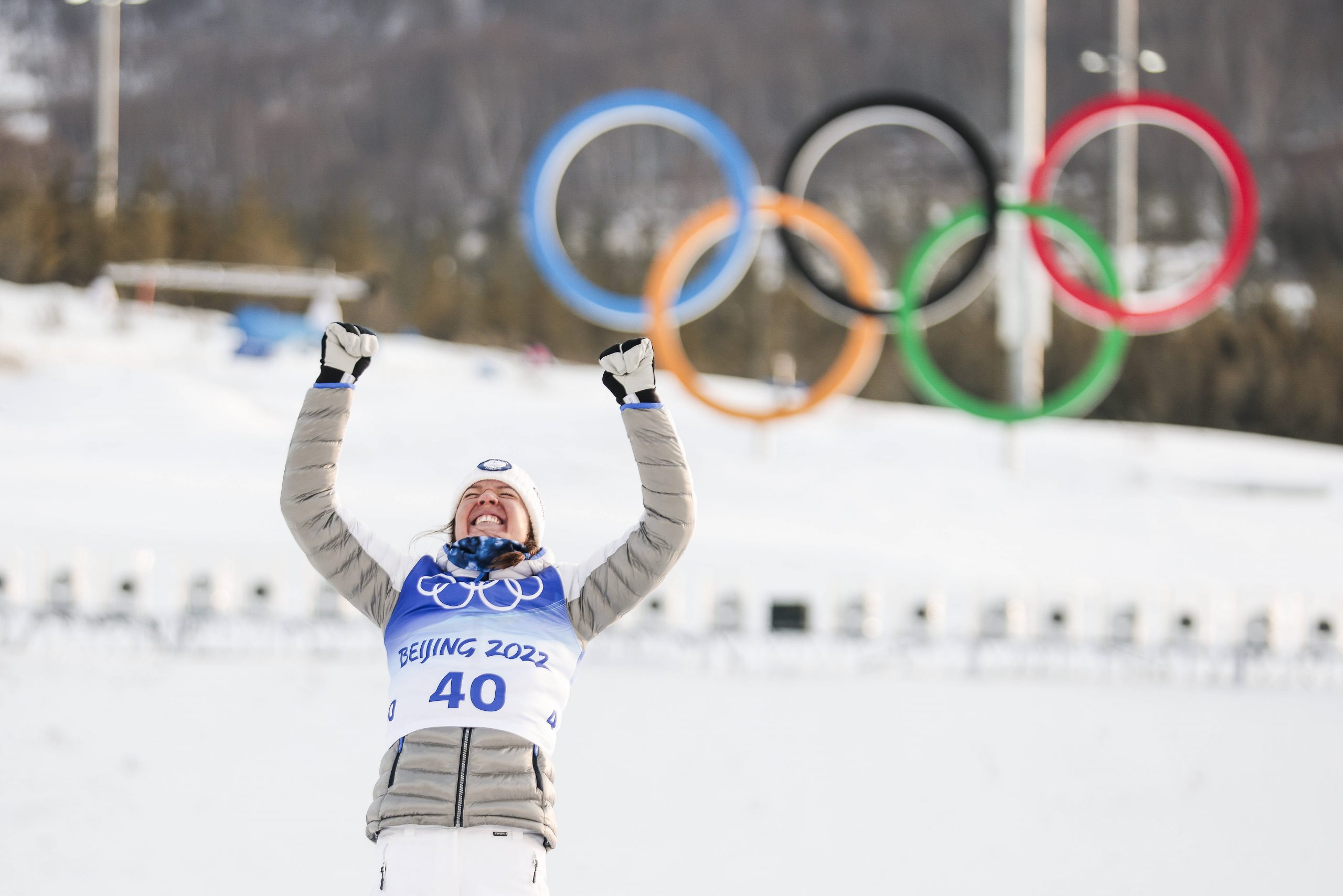
Kerttu Niskanen (FIN) celebrating her first individual Olympic medal. (photo: NordicFocus)
Here’s Nat and Devon breaking down (and celebrating) an historic day for the U.S. A bronze medal for Jessie Diggins stands as the highlight – she’s the first American woman to win an individual medal – but there were several other steps taken forward by the men and women wearing stars and stripes.
In particular, Rosie Brennan popped the second fast time in qualification. Overcoming a bad pole plant-induced fall in her quarterfinal, she powered through to take second (to the eventual winner), building momentum each round to finish 4th, just meters behind Diggins .
Ben Ogden races the quarterfinal of the men’s freestyle sprint during the 2022 Beijing Olympic Winter Games. (Photo: NordicFocus)
And you’ve got all four American men – also a record – in the Top-30, and Ben Ogden skiing into the semis to finish one second behind Pellegrino and Klæbo, landing in 12th as the top American men’s sprint finish in history.
So much more. Thanks for listening.
After stumbling out of the start, Rosie Brennan (USA) charges back to the front of her quarterfinal heat. (Photo: NordicFocus)
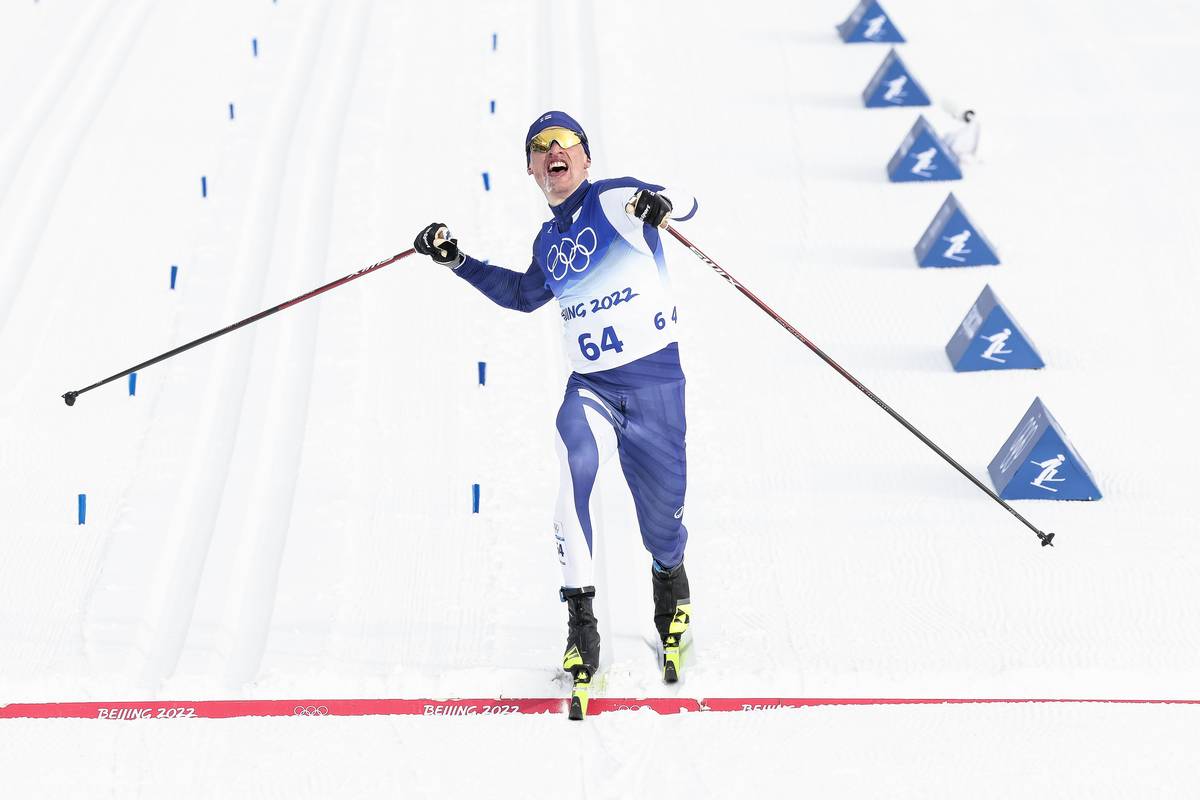
Kicking off the 2022 Beijing Olympic Games with a look into the women’s skiathlon. Co-host Nat Herz was on site during the race, braving the wind and cold to collect deeper insights into the scene, while Kershaw gives his hot take as a very-well-informed armchair quarterback. Note that Kershaw picked two of the top-three athletes correctly in his pre-Olympic podium picks: unsurprisingly, the favorite, Therese Johaug took gold, while Natalia Nepryaeva (ROC) earned silver instead of the bronze Kersh predicted. (Find full compiled picks and current standings for the Devon Kershaw vs. Alex Harvey Olympic podium predictions showdown here.)
Stay tuned for regular updates and race breakdowns over the course of the Games! Thanks for listening.
Jessie Diggins throws down an impressive performance in the skating half of the women’s 15k skiathlon, the opening event of the 2022 Beijing Winter Olympic Games. (Photo: NordicFocus)
This episode of the Devon Kershaw Show breaks down the lead-up to the Olympics with special guest star Alex Harvey, the Canadian World Championships gold medalist. Harv and Kersh make their podium predictions for the six Olympic events; we discuss the nightmare scenario with COVID cases inside Norway’s national team; and Nat checks in from his quarantine in Los Angeles in advance of his flight to Asia.
We’ll be back periodically during the Olympics — send questions and comments to devon@fasterskier.com and nat@fasterskier.com. And you can follow Nat’s journey to Beijing here on FasterSkier, or on Twitter and Instagram at @nat_herz.
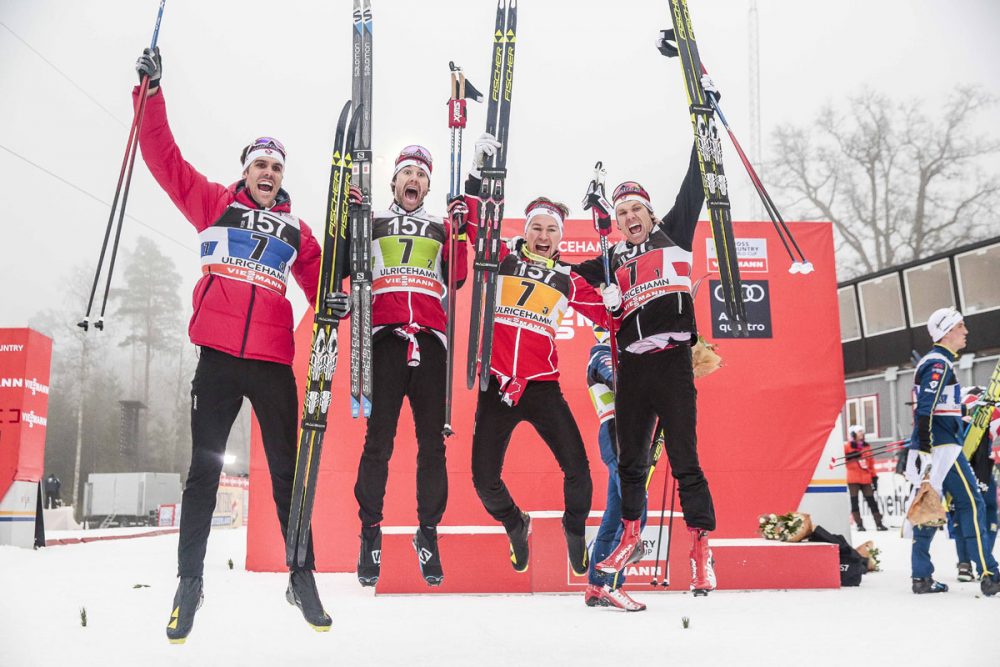
Left to right: Canada’s Len Valjas, Alex Harvey, Knute Johnsgaard, and Devon Kershaw after their historic third place finish in the 2017 men’s 4 x 7.5-kilometer team relay in Ulricehamn, Sweden. (Photo: Fischer/Nordic Focus)
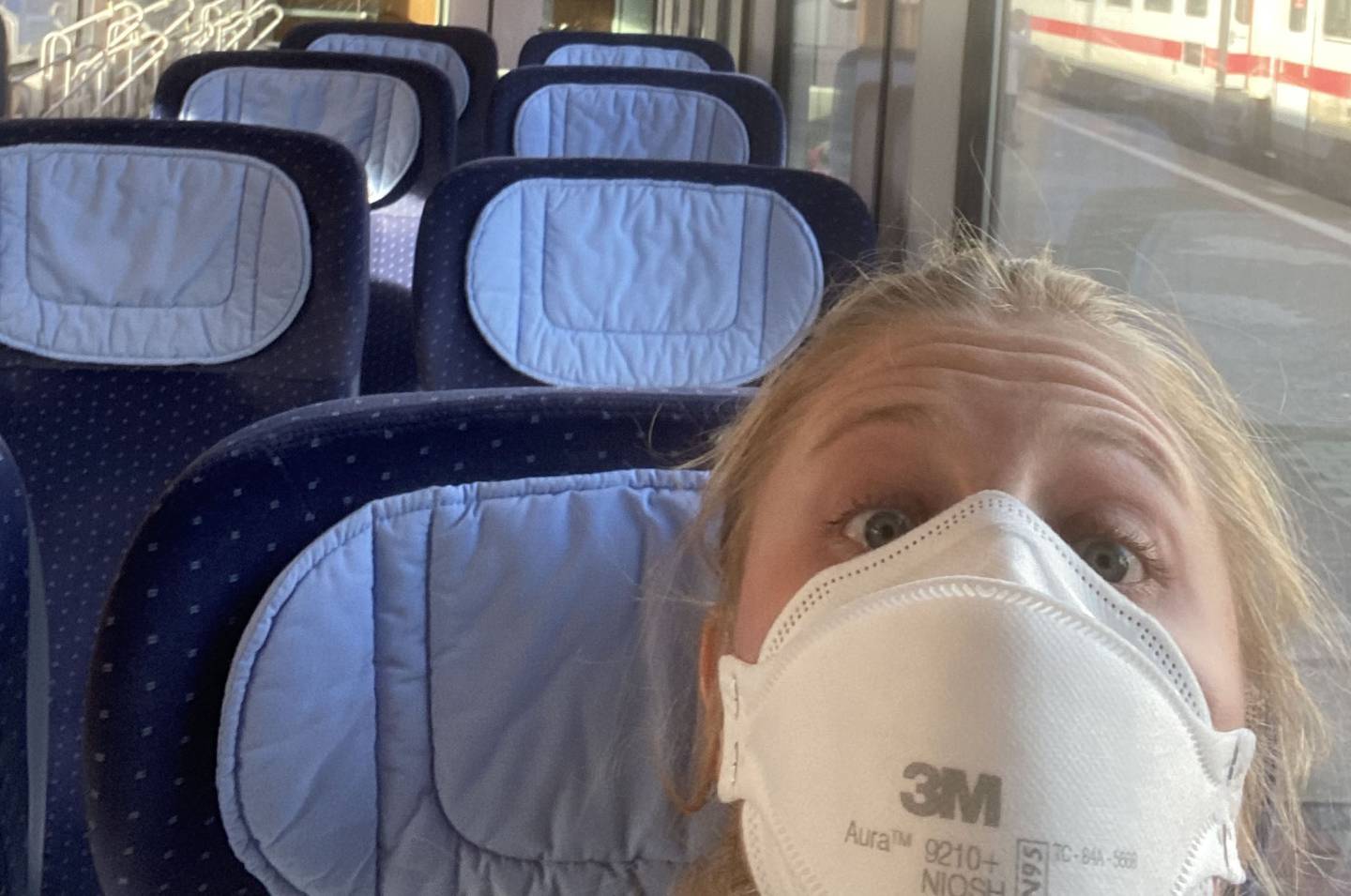
Hailey Swirbul searched out an empty train car to ride in while trying to avoid infection with the omicron variant on her way to a ski town in Austria this month. Swirbul is one of a number of Alaska athletes taking rigorous COVID-19 prevention measures to avoid derailing their hopes of competing in the Winter Olympics in Beijing. (Courtesy photo)
This article originally appeared on Wednesday January 19th, 2022 in the Anchorage Daily News. Reposted with permission.
The organizers of next month’s Winter Olympics in Beijing have imposed a rigorous regime of testing, quarantines and isolation for incoming athletes and staff.
Among the casualties is Steve Patterson’s pickleball game.
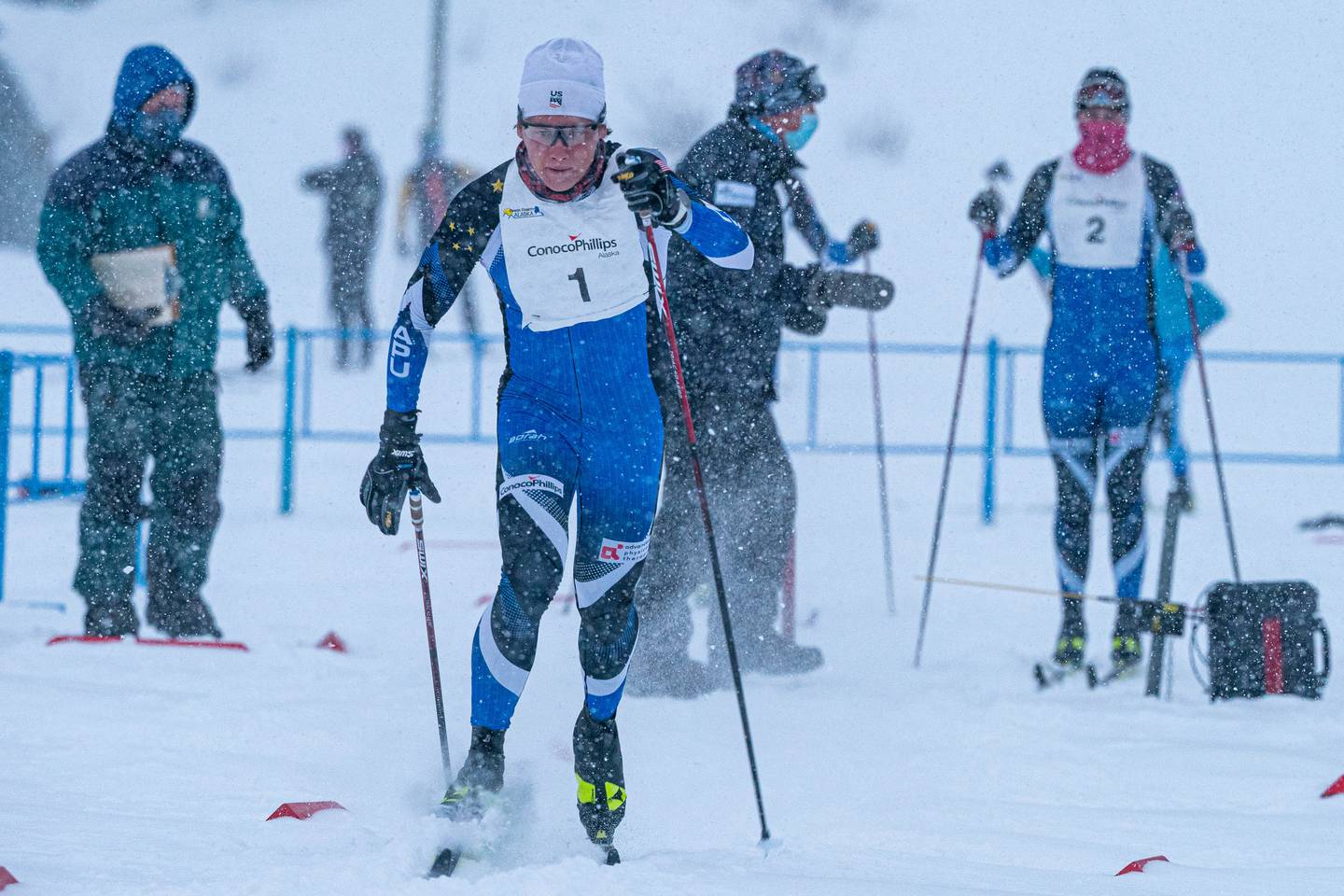
Patterson has two adult children, Scott and Caitlin, who grew up in Alaska and are both Olympic hopefuls in cross-country skiing.
They’re planning to prepare for the games from their parents’ home in Montana. Which means the whole family is being careful to avoid any contacts that could invite the coronavirus into their home — potentially derailing access to China for Scott, 29, and Caitlin, 31.
The Patterson siblings are two members of what’s currently one of America’s most COVID-conscious demographics: aspiring Olympians with plans for Beijing.
China, with its “zero COVID” policy, has draconian requirements for anyone flying into the country for the Games. They start with two negative lab tests just to get on the plane to China, followed by another immediately upon arrival at Beijing’s main airport.
A positive test would disrupt teams’ meticulously laid plans for travel and training, and even asymptomatic cases would almost certainly force athletes to miss flights and competitions for which they’ve trained for years.
As a result, Alaska athletes and others involved with the Olympics are going to great lengths to stay free of omicron as the variant spikes across the U.S. and the globe — even with training and competition schedules that include inevitable cross-country or intercontinental travel.
“This experience that I’ve dreamed of my entire life is sort of now just grounded in stress, more than anything,” said Luke Jager, a 22-year-old Anchorage cross-country skier likely to be named to the Olympic team. “I’m sure at some point, being over there, it’ll kind of set in. But right now, the challenge of not getting COVID feels just as big as the challenge of even qualifying for the Games did.”
Luke Jager starts a race at Anchorage’s Kincaid Park in 2020. (Loren Holmes / ADN)
Chris Grover, the Anchorage-raised program director for the U.S. cross-country ski team, recently returned home to Idaho from the European racing circuit.
He spent his first few days with his in-laws, rather than with his family, to avoid catching the coronavirus from one of his children who’d had a potential exposure.
Meanwhile, one of the athletes that Erik Flora coaches at APU, he said, has even been wearing masks around and sleeping in a different room from their romantic partner.
“That’s the commitment that probably tops just about everything,” Flora said. “You’re messing with the human spirit at that point.”
More than a half-dozen cross-country ski racers with Alaska ties have a good chance to make the American Olympic team when it’s named Thursday — joining two curlers, a hockey player and a figure skater as some of those destined for Beijing from the 49th state.
In interviews, the skiers and coaches describe taking Olympic-level anti-omicron precautions. But each faces a unique set of risks, depending on their circumstances.
Hailey Swirbul also trains with APU in Anchorage; she planned to return from European racing to Alaska for a pre-Olympic camp, where she could spend time with her boyfriend and dog.
But after catching a cold, Swirbul, 23, decided to stay in Europe and avoid two rounds of major international travel.
After three train rides — sporting an N95 mask, with no breaks for eating or drinking onboard — Swirbul arrived in Austria for pre-Olympic training. There, she and her teammates broke into smaller groups that don’t mix indoors.
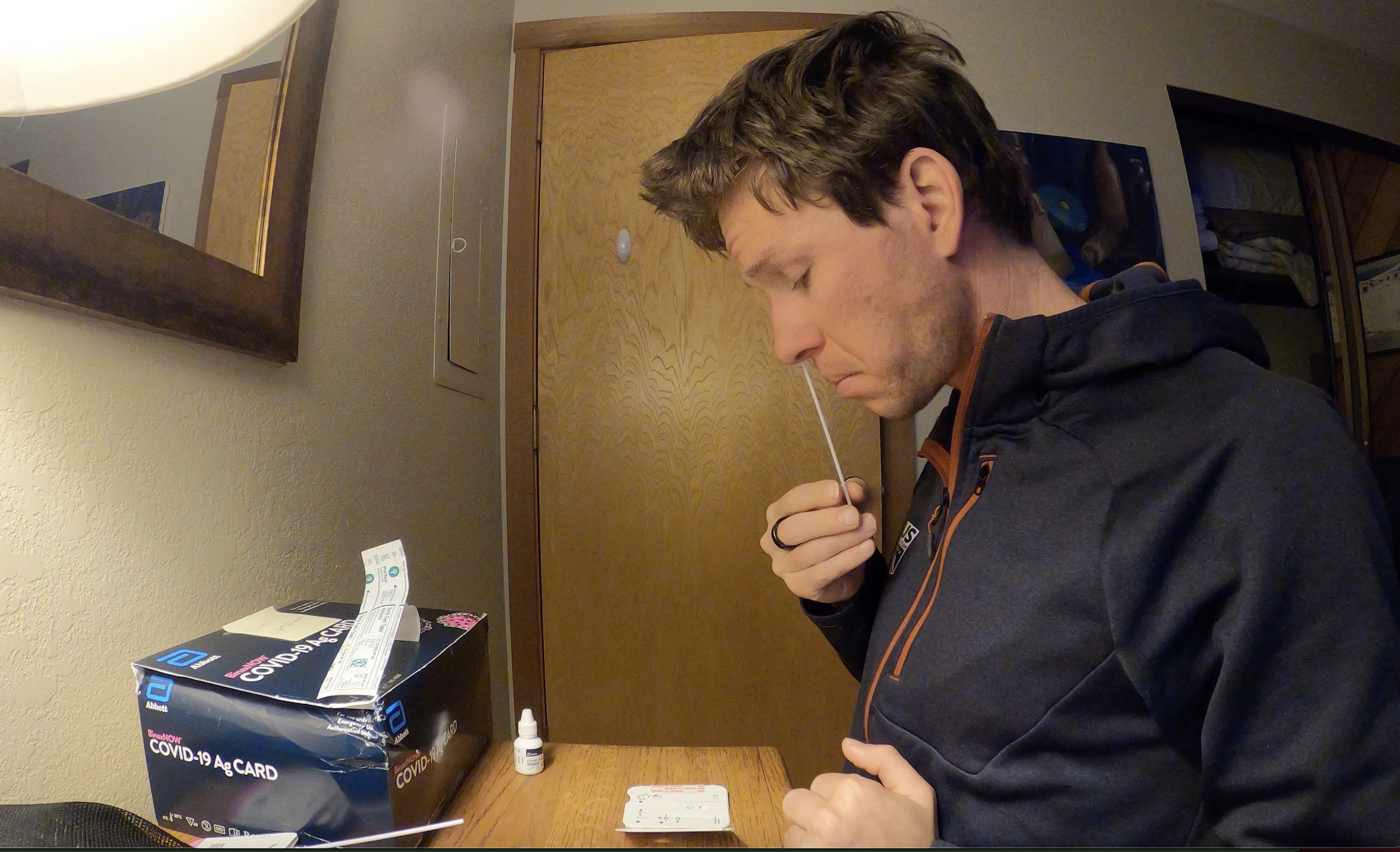
Scott Patterson self-administers a COVID-19 rapid test. (Courtesy photo)
The athletes take rapid antigen coronavirus tests every day, retrieve meals cooked by a team chef, bring them back to their living quarters and eat only after washing their hands. Swirbul got in the habit of climbing out a window to leave her apartment, rather than walking through a shared space that would require her to don an N95.
She also turned down an invitation to meet a friend, outdoors, for hot chocolate. And “definitely no grocery stores — we haven’t been in those since we’ve been here,” Swirbul said in a Zoom interview.
Jager has suffered through much more of a saga. Outside of international competitions, Jager races for the University of Utah, and he had to return from top-level European racing a few weeks ago to compete in collegiate events in the U.S.
When he arrived, the coronavirus was circulating among his team, so he couldn’t move back into his house. In a phone interview last week, he described staying in the vacant home of friends of his girlfriend’s parents before a race series in Idaho.
“They get back tomorrow night. So, we’re trying to find some other place to stay because we’re trying not to see anybody,” he said. “I’ve been nomading, pretty hard.”
Jager returns to Europe this week for a training camp in Italy with the American team, then will fly to Beijing from Switzerland.
JC Schoonmaker, another likely Olympic team member who competes for University of Alaska Anchorage, is on a similar program to Jager, except he traveled and lived with his collegiate team during races in the western U.S. this month.
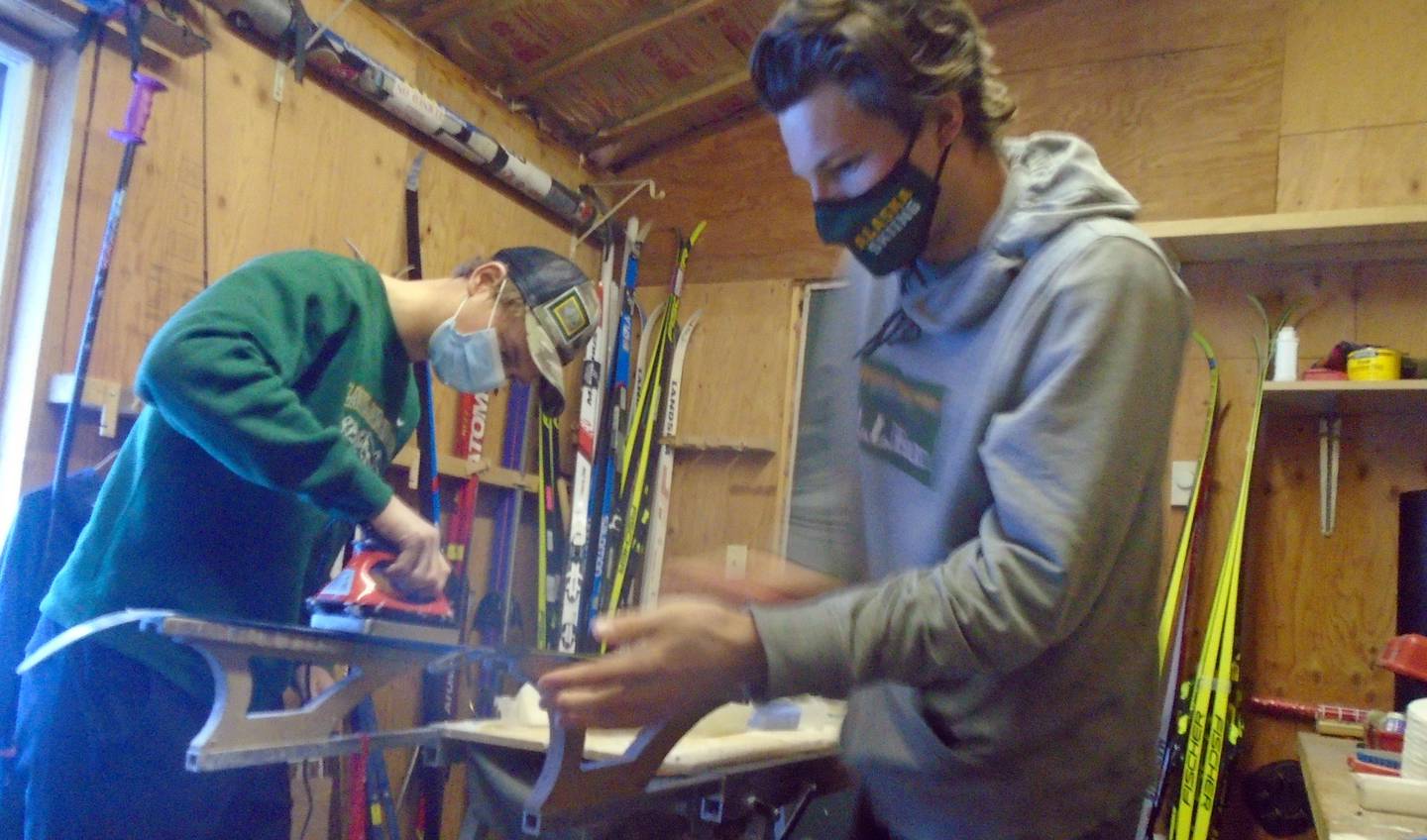
JC Schoonmaker, right, and a teammate tune skis Friday, January 14, 2022, before a weekend of racing in Idaho. Schoonmaker is one of a number of Alaskans taking rigorous COVID-19 prevention measures to avoid derailing his hopes of competing in the Winter Olympics in Beijing. (Adam Verrier)
Schoonmaker’s coach, Trond Flagstad, said the UAA coaches are doing all the shopping; they enter the athletes’ houses to drop off groceries only while wearing masks.
“It’s definitely risky, but I’m pretty confident,” Schoonmaker said. “And I really do trust my teammates — I think they’re doing a good job.”
Aside from presenting obvious logistical problems, the coronavirus has affected the skiers in subtler ways, too.
It’s forced them to keep their support networks at a social distance, whether that’s partners, family members or friends. And with coaches taking on more risks, like grocery shopping, it’s also harder for them to work closely with their athletes, or even to drive them to races in vans.
Added all up, it makes for an especially grueling, and isolating, build-up to what was one of the most pressure-filled experiences in athletics even before the pandemic.
“It really weighs on me,” said Rosie Brennan, a medal hopeful who trains with APU in Anchorage. “It’s honestly harder than preparing yourself to race.”
With the Games, and the negative tests required to enter China, approaching, each swab presents aspiring Olympians with a new reason to worry — especially with the awareness that omicron may present itself without symptoms.
“You know how it is when you’re a skier: You’ve got stuff coming out of your throat and you’re always blowing your nose and stuff,” said Jager. “You’re like at 7,000 feet, you’re like, ‘Maybe I’m a little tired today and I just blew my nose a couple extra times. Definitely could be low-level symptoms of COVID.’”
One silver lining for the Alaska ski racers, in the final days before the games begin: They’re not alone.
One of Norway’s top cross-country skiers, Heidi Weng, made tabloid headlines in that country when she said she wouldn’t be seeing her boyfriend before Beijing.
And Maja Dahlqvist, a Swedish cross-country superstar, has to stay at least 6 feet away from her boyfriend, American cross-country skier Kevin Bolger. That applies even as their teams hold separate pre-Olympic training camps on the same trails in Italy.
“I mean, of course we wish we could hold hands or hug,” Bolger said in an email. “But both knowing what is on the line, we will survive until after Beijing.”
In this episode of the Devon Kershaw Show, we bring back Zach Caldwell, one of North America’s leading ski and wax experts. We get into the arcane and arguably misguided rules around the use of fluorocarbon waxes at high-level races, along with potential challenges for wax and ski technicians at the little-studied Beijing Olympic venue.
You can find a host of resources from Zach on skis, wax, and grinds that might more-directly apply to your own skiing and racing at CaldwellSport.com.
We’re finally here with a long-promised mailbag episode for you this week. Devon takes us through questions from more than a dozen listeners; we cover World Cup competition formats, tactics, training, broadcasting and a bunch of other random fun stuff. We’ll be back soon with coverage of Olympic team selection and hopefully some more intel on the Olympic venue in Beijing.
Send us questions and feedback to devon@fasterskier.com and nat@fasterskier.com.
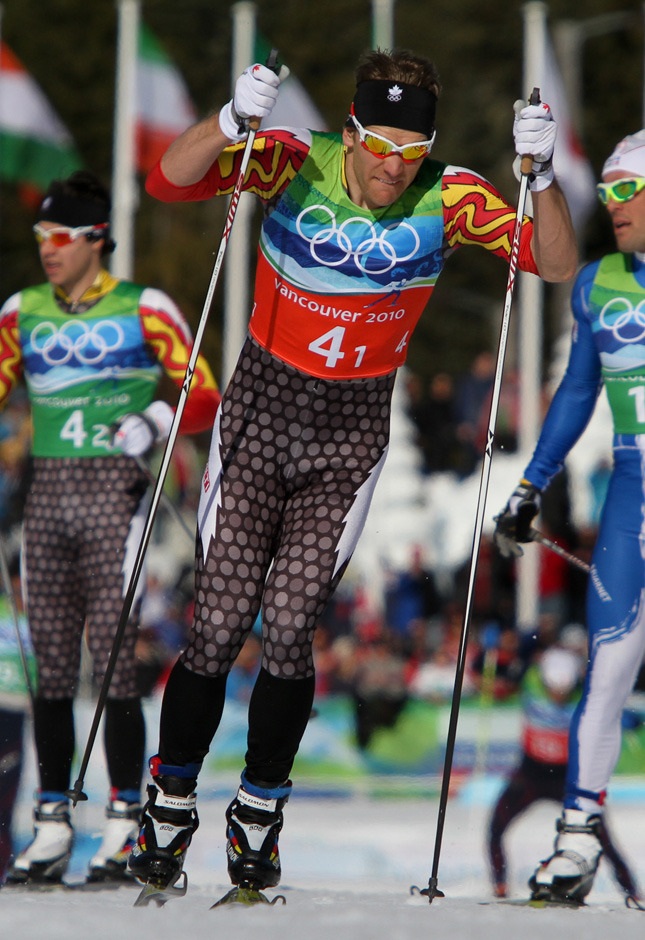
Devon Kershaw racing in the 2010 Olympics in Vancouver.
We’ve got extra-special Alaska-based guest Kikkan Randall joining us for this episode to recap the 2021/22 Tour de Ski. We break down a rough finish for a head cold-afflicted Jessie Diggins, some sensational skiing by Johannes Høsflot Klæbo, and some lingering questions about Olympic preparation.
Kikkan Randall finishing the Tour de Ski’s final climb on Sunday. (Photo: FasterSkier archives)Jessie Diggins embodies the soul crushing, full body burning cumulative fatigue of the Tour de Ski following the final hill climb up the Alpe Cermis. (Photo: NordicFocus)
Welcome back to the Devon Kershaw show for our Tour de Ski stage 3 and 4 recap. We get into Frida Karlsson’s withdrawal from the tour after her egregious take-out of Jessie Diggins in Saturday’s classic sprint. We also cover Calle Halfvarsson and Joanna Hagström delivering for Sweden, Johannes Klæbo giving a couple of beat-downs, and Diggins’ come-from-behind win Friday.
We’ll be taping a mailbag episode next week — send us your questions at devon@fasterskier.com and nat@fasterskier.com. And happy new year.
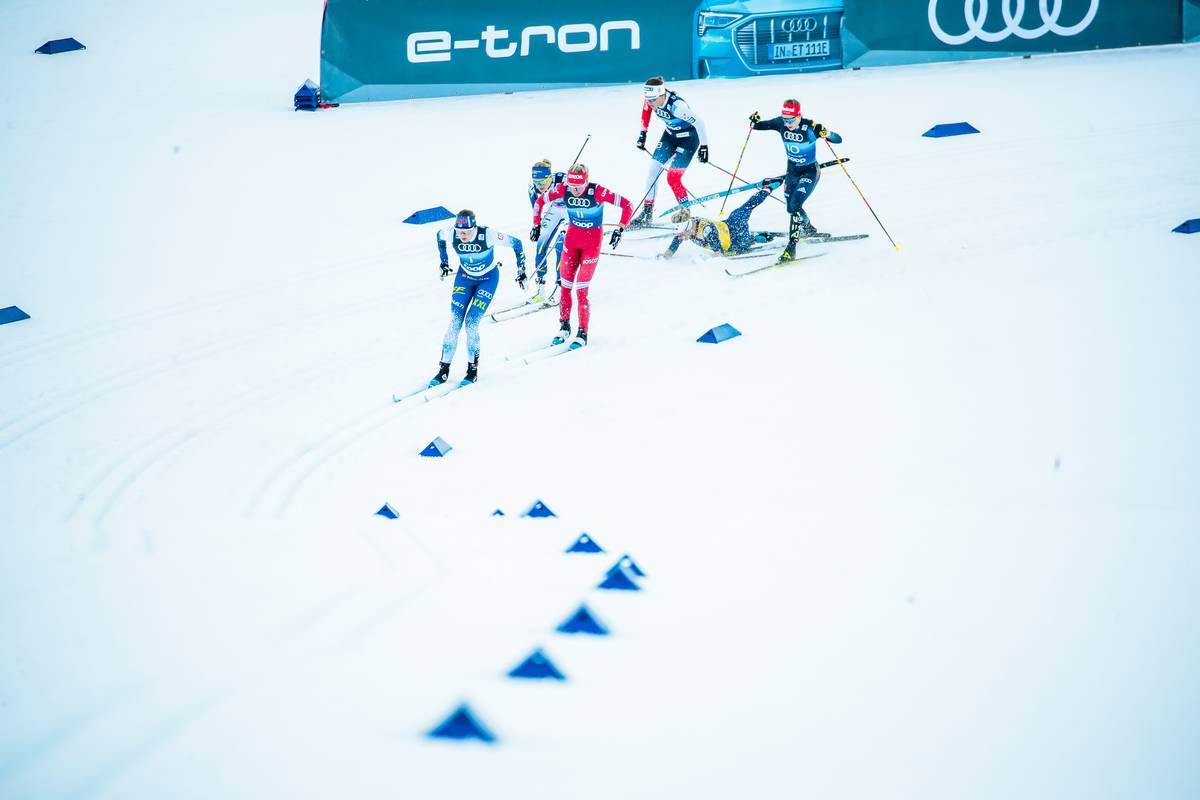
Jessie Diggins goes down in her quarterfinal heat. Frida Karlsson (SWE) was penalized for obstruction, but the fall left Diggins in 3rd place overall in the Tour de Ski. (Photo: NordicFocus)