From the FasterSkier archive — posts syndicated from athletes’ and coaches’ own blogs between 2004 and 2012, kept online as published. Current coverage is at fasterskier.com.
Davos brought another entertaining weekend of racing for American ski fans, with Rosie Brennan in the mix in both competitions, a podium from Jessie Diggins, and breakout performances from Hailey Swirbul, Sophia Laukli, and Novie McCabe.
Devon Kershaw and FasterSkier’s Nat Herz take us through the results with special guest Eirik Brandsdal, the longtime, now-retired Norwegian World Cup sprint racer.
The Devon Kershaw is back from summer hibernation!
This week, Devon takes a break from medical school to break down the first big tune-up races of the season in Muonio, Finland. Joining him are the show’s new co-host, former FasterSkier reporter Nat Herz, along with Canadian athlete Russell Kennedy, who popped a huge result in one of the races in Finland.
Russell catches us up on the European circuit; we also discuss Charlotte Kalla’s recently awarded honorary doctorate degree, disgraced former Estonian racer Andrus Veerpalu’s son’s presence in Finland, and impressive results by 43-year-old Finnish skier Riita-Liisa Roponen.
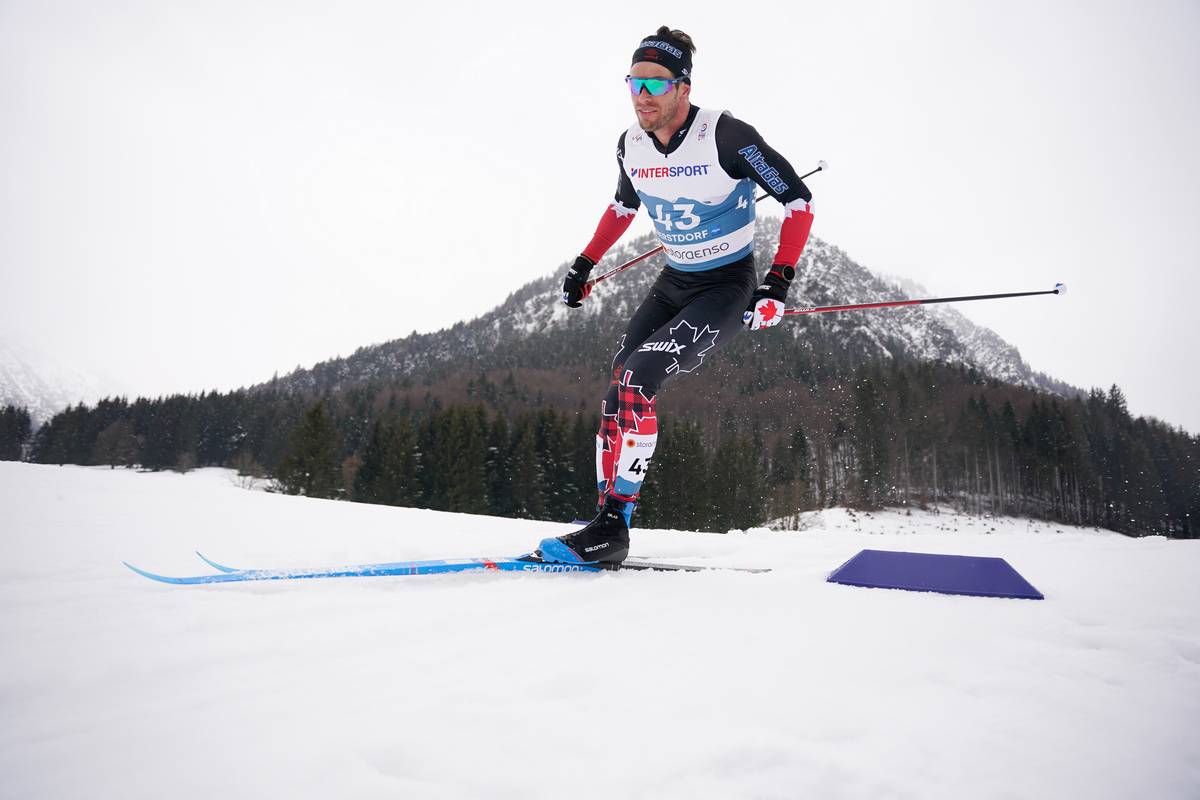
Russell Kennedy on course during the 2021 FIS World Ski Championships in Oberstdorf, Germany. (Photo: NordicFocus)
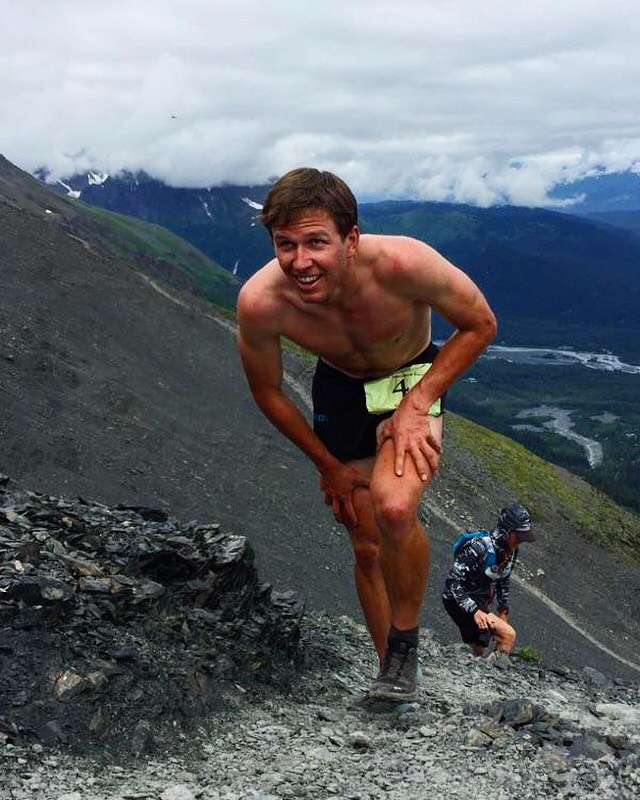
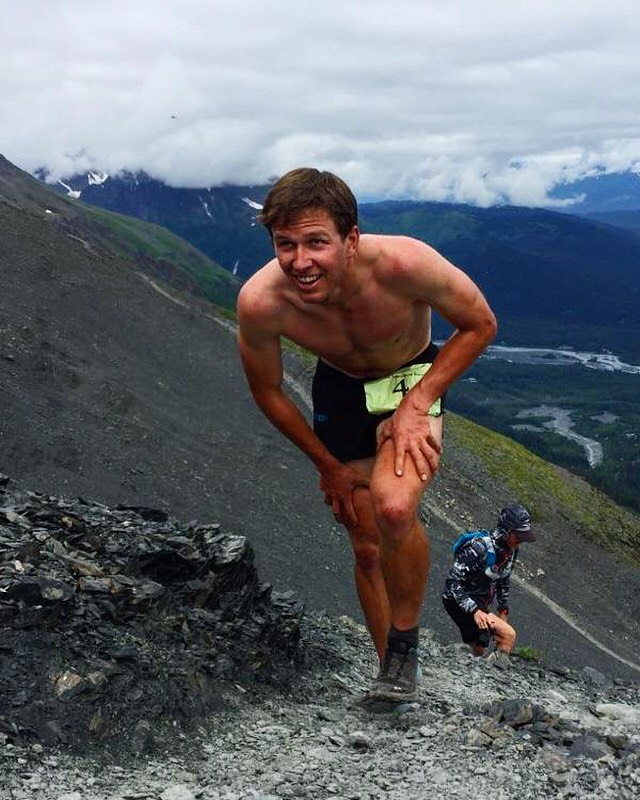
U.S. Ski Team B-team member and Alaska Pacific University skier Scott Patterson scaling his way to the top of Mt. Marathon in Seward, Alaska on July 4, 2017. (Photo: Rob Whitney)
As with other epic modern-day adventure race series, the fabled origin of Seward, Alaska’s annual Mount Marathon — held every July 4 — began with beer and a bet: who among us can run from the streets of downtown to the top of the 3,022-foot mountain crowding Seward’s skyline, then back to the bottom the fastest? What about within the hour?
While the footrace race has evolved massively since the port town’s pioneer miners took on the challenge, clambering up its craggy course in woolen pants and workman’s boots nearly 90 years ago, it holds no less prestige for the millennial athletes or spectators who partake nowadays. To many Last Frontier residents, it is their Olympics. An estimated 30,000 outsiders annually inundate the town’s (population 2,500) sidewalks just to watch the event.
“It’s Mount Marathon. It’s Alaska. It’s my Fourth of July,” Allie Ostrander, the 2017 women’s overall race winner and a Soldotna, Alask. native,told Alaska Dispatch News reporter (and former FasterSkier editor) Nat Herz after the competition. “Fourth of July feels empty without Mount Marathon.”
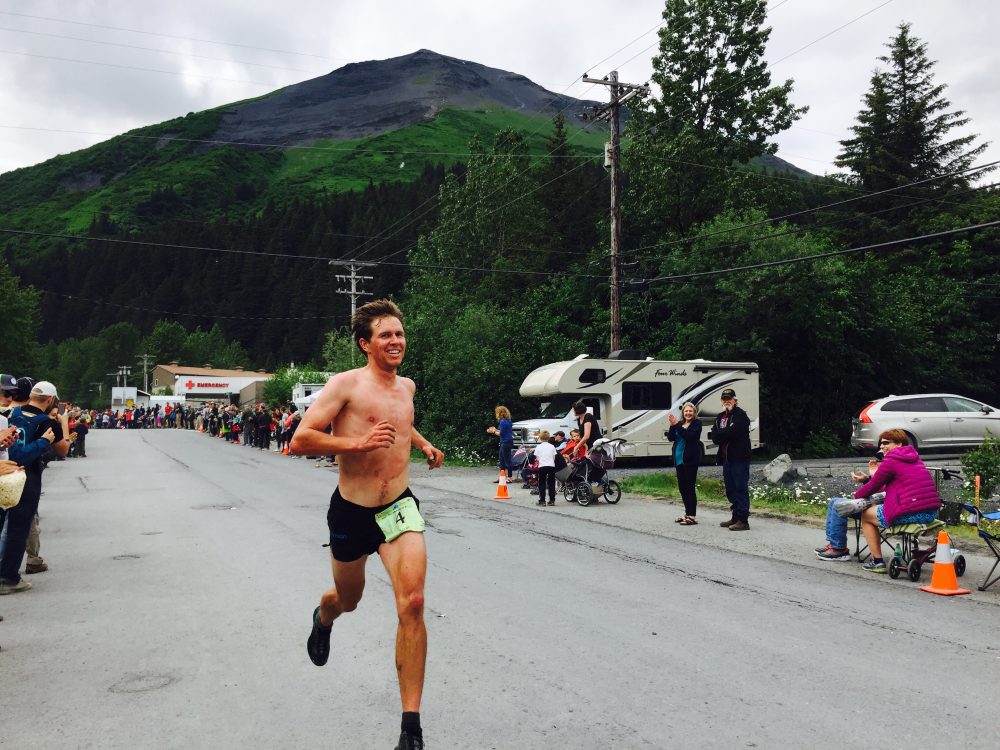
Scott Patterson on his way to winning the 2017 Mt. Marathon running race on July 4 in Seward, Alaska. (Photo: Holly Brooks)
Despite the obvious risks associated with careening down a mountain at top speed, stories of close encounters with kidney failure, brain-damagingfalls, and disappearance deterred a few from re-entering this year’s version of the event.
The upcoming 2018 PyeongChang Winter Olympics was reason enough for the current Mt. Marathon course-record holder and last year’s overall male champion, David Norris, to watch from the sidelines. His Alaska Pacific University (APU) teammate, Scott Patterson, who also recently earned a U.S. Ski Team (USST) nomination, however, did not.
“It’s a big deal up here. I just figured why not go again?” Patterson, an Anchorage native, explained on the phone.
In his debut Mt. Marathon race, Patterson had twisted his ankle and ultimately finished fourth last year. This year, as he weighed out his risk in racing, he arrived at a far less insidious calculation.
“There’s definitely always a risk, that downhill is tricky,” Patterson said. “But I think looking at the competition beforehand, I knew that I could probably have a pretty good lead at the top and stake the downhill at my own speed; not really have to duke it out with someone down the hill.”
With that, Patterson entered the 2017 event aiming for the win, but not the record. Norris was not on the start list, nor Kilian Jornet, the 2015 record holder and a professional ski mountaineer and ultramarathon runner, not to mention Patterson had recently returned from the men’s USST training camp in Park City, Utah, which ran from June 26-July 5. Patterson departed the camp early to return for the race.
“Everyone was saying going into it that it was my race to lose,” the 25-year-old Patterson said. “The other guys who could really challenge me on the uphills this year skipped it, so it was kind of just me just out there on my own.”
Patterson completed the 5-kilometer race in a time of 44:30 for the win, just over three minutes off the course record. The closest male finishers behind Patterson were Erik Johnson in second place just under a minute back (+0:52), and Kenneth Brewer in third, a little over two minutes behind (+2:23). Patterson’s first-place finish at Mt. Marathon is nothing unheard of among cross-country skiers. A number of other nordic athletes have been crowned the overall champion, including current USST A-team member Kikkan Randall, former USST athlete and Olympian Holly Brooks, APU nordic coach Eric Strabel, and Norris.
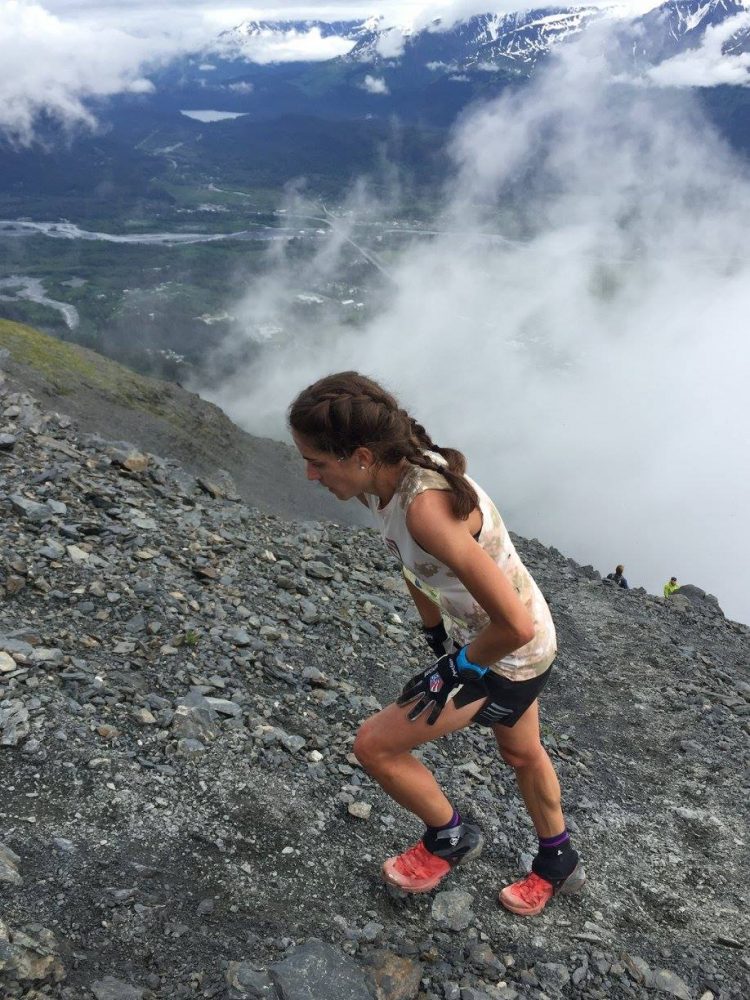
Morgan Arritola scaling her way to the top of Mt. Marathon in Seward, Alaska on July 4, 2017. (Photo: Rob Whitney)
The runner-up in this year’s women’s event, Morgan Arritola, was also a member of the 2010 Vancouver nordic Olympic squad and skied competitively for over six years before she made the switch to mountain running in 2012. In her debut Mt. Marathon race, Arritola, 31, finished second in a time of 51:09, a minute and fifty seconds behind the 20-year-old Ostrander, who won in 49:19.
While Arritola did preview the course once, she also indicated that she didn’t hold a whole lot over herself in terms of expectations and outcome going into race. Ultimately her goal coming into her first Mt. Marathon event was to “take it all in.” In discussions with her former teammates and champions, Randall and Brooks, the advice remained fairly simple: enjoy the atmosphere.
“I didn’t really pre-race research. That’s not really my style,” Arritola, of Ketchum, Idaho, wrote in an email to FasterSkier. “Everyone has their own way of handling racing and I tend not to overthink.
“I would love to come back next year,” she continued. “If there was a race-specific goal it would be to know the route I’m taking better. I asked for directions a few times 🙂 and be more confident on the downhill. I haven’t raced that kind of downhill and I just never got into a good rhythm.”
While Arritola has three U.S. Mountain Running Championship titles to her name and a World Mountain Running bronze medal, mountain running is not where she is indelibly focused. She is currently going back to school for a degree in respiratory therapy and working various jobs to help fund her racing, such as The Rut 50 k in Big Sky, Mont., which she is registered to race in September.
“I’m not running full time like with skiing,” Arritola wrote. “I am in my last year of school and running just keeps me sane. I don’t overthink it, I do what I want with it, and I enjoy it.”
Finishing behind Arritola to round out the women’s top three was mother of three and three-time Mt. Marathon champion, Christy Marvin, in third place with a time of 52:22.
In the junior race division of the event — in which racers run approximately halfway up the mountain before turning around for the descent — APU’s Luke Jager won the boys’ race in a time of 29:09, marking Jager’s second junior title in a row. Jager was followed by Gavin Block in second in a time of 29:32 and Ali Papillon in third in a time of 30 flat. The junior girls title went to Molly Gellert (Alaska Winter Stars) in a time of 32:53, also for the second year in a row. Behind Gellert in second was Ruby Lindquist finishing in a time of 33:55. Kendall Kramer (FXC) came in third, finishing in a time of 35:06 for the girls race.
Nick Crawford, 28, who headed the Bogus Basin Nordic program as well as the Lathrop High School ski team, will assume the role of head coach of the University of Alaska Fairbanks nordic and cross-country running teams in July. (Courtesy photo)
After a four-year hiatus from Alaska, Nick Crawford is returning to Fairbanks to take over as the new head nordic and cross-country running coach at University of Alaska Fairbanks (UAF).
Originally from Hawley, Mass., Crawford skied for Bowdoin College in Brunswick, Maine, and spent two years in Fairbanks from 2009 to 2011 as the assistant coach for Fairbanks Cross Country and head coach at Lathrop High School. While at Lathrop, he coached Logan Hanneman to the Alaska state Skimeister title in 2011. Hanneman swept the individual freestyle and classic races that year.
Crawford, 28, recently finished a master’s degree in exercise science from Boise State University and applied for the opening at UAF in April. In addition to his studies, Crawford was head coach and program director of the Bogus Basin Nordic Team in Boise, and oversaw its youth ski programs.
“This is really perfect timing for me to return to Fairbanks because it’s a place I really love to be a skier, an excellent community and a fantastic program with Alaska Nanooks,” Crawford said in a phone interview last week.
The coaching position opened suddenly, as Scott Jerome, head coach of the Nanooks’ nordic and cross country teams for 10 1/2 seasons, was put on administrative leave shortly before the 2015 U.S. Cross Country Championships took place in January. His contract expires June 30 and will not be renewed.
Citing confidentiality policies regarding personnel, UAF officials did not comment on the circumstances surrounding Jerome’s departure. In January, UAF spokeswoman Marmian Grimes told the Fairbanks Daily News-Miner that his leave was not a result of NCAA eligibility sanctions placed on UAF last November.
“It’s not related to the past NCAA violations; it’s not new violations that prompted this issue,’’ Grimes said. “It was just us [UAF] needing to go in a different direction with coaching for these teams.”
During his senior season on the team, Jonas Lӧffler told the Nanooks’ Sun Star in February that the skiers themselves vocalized a need for a leadership shift.
“We athletes were involved in the whole process of Scott leaving. We were the initial people to say we needed change,” Lӧffler said.
Scott Jerome, former head coach of the UAF cross-country running and nordic teams. (Photo: UAF.edu)
Jerome was one of several switchups in the UAF athletics department. Also this past winter, volleyball head coach Mallory Larranaga was let go after two seasons “following the self-reporting of violations of NCAA rules on Jan. 13,” according to the Star.
“There are many rumors swirling on why Larranaga was fired on Feb. 12, from the less than stellar record of 7-48, to the NCAA violations that happened with a recruit this past summer [of 2014], which included the filming of visits and practices,” the Star stated.
As of mid-May, UAF was looking to fill the vacancies left by its outgoing women’s basketball assistant coach Greg Bruce, who retired in April after 30 years with the program, and sports information director Drew Desrosiers, who planned to step down when his contract ends June 30, the News-Miner reported.
Jerome, 44, coached 17 All-Americans, including Marius Korthauer, who became the Nanooks’ first national champion at 2008 NCAA Skiing Championships in the men’s 20-kilometer classic race.
More recently in 2014, senior Max Olex placed second in the 20 k freestyle at NCAAs and Nichole Bathe finished fourth as a freshman at the championships. Before joining UAF in 2004, Jerome spent four years heading the nordic and cross-country teams at Gustavus Adolphus College in St. Peter, Minn.
In an email to FasterSkier, Jerome wrote that he was still in Fairbanks and had “begun a PhD program in biochemistry at UAF focusing on human performance, specifically overtraining syndrome.”
Following his departure in January, assistant nordic coach Christina Turman took over as interim head coach, with support from Josh Eide, of Marquette, Mich. She will remain in the position until Crawford officially starts in July.
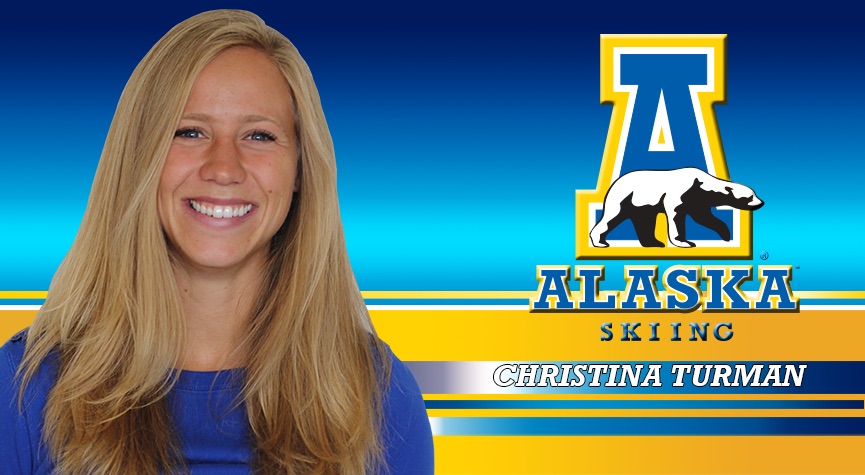
Christina Turnman came on as UAF assistant nordic coach in 2013. (Photo: UAF.edu)
Turman, 27, did not apply for the head-coach position, but said she felt pressure from university’s administration, friends, family, and athletes to do so. She explained she preferred to remain an assistant, to work and learn under someone else to develop as a coach while preserving time for her family. She will remain assistant coach.
“I’m delighted to have her stay on,” Crawford said. “I think the program has done really well under her tenure as interim head coach. I look forward to working with her. ”
For Turman’s part, she’s excited for the future of the team.
“I think the future is bright. I’m excited to be back with the program for a third season next year, we have some really solid returning athletes and some good ones coming in,” she said in an interview in her UAF office. “There’s no reason UAF shouldn’t have one of the most competitive teams in the nation. We have the resources, we have the trails, we have the climate for it, so I look forward to continuing to be with the program and watch it build and become more and more successful.”
“There’s no reason UAF shouldn’t have one of the most competitive teams in the nation.” — Christina Turman, assistant coach entering her third season with the UAF nordic team
UAF has a young team, with most of its returning women being either sophomores or juniors, and a lot of depth in the men’s team as well. This season, they picked up incoming freshmen Max Donaldson, three-time Alaska state Skimeister and 2015 Junior National champion. Turman coached him while head coach of West Valley High School before starting at UAF.
As for Crawford, he said that he is joining a successful program and doesn’t want to change too much too soon. Both he and Turman said that they have already discussed working together on what to tweak and what to keep the same in order to continue to build on the Nanooks’ success.
“You really want to make sure you have a good philosophical fit with the program,” UAF Athletics Director Gary Gray said in an interview at UAF, referring to Crawford. “It’s also important – this happens sometimes – we’ll hire someone from the lower 48, and in a year they’re homesick. And that’s not completely unusual. So it’s trying to find someone that is that right fit, of someone that we think is going to give that stability to the program.
“Things that attracted us to Nick included his familiarity with this community,” Gray continued. “He has coached here, he has recruited here. He had some successful results with his club program in Boise. … The fact that Nick has been here before and was part of this community, that seems to speak well of his fit to Fairbanks.”
“The fact that Nick has been here before and was part of this community, that seems to speak well of his fit to Fairbanks.” — UAF Athletics Director Gary Gray
Crawford is also a close personal friend of FasterSkier’s former editor, Nat Herz, who also skied for Bowdoin.
“Nick’s decision not to use me as a reference has clearly paid off again,” Herz wrote in an email. “I look forward to testing his mettle when we both race in next year’s Oosik Classic in Talkeetna. Also, his athletes should ask him about that time he tried — and failed — to complete the gallon challenge when we were in college together.”
As the World Cup season keeps rolling, so does the FasterSkier podcast! In this week’s edition, Topher Sabot and Nat Herz continue the series with the two founders of the Nordic Commentary Project blog, Colin Reuter and Christopher Tassava. Starting with the wild sprint races in Dusseldorf, Germany, we move on to predictions for Davos, ponder early-season peaking, and, of course, discuss the latest news on the anti-doping front to emerge from Russia. Tune in!
The World Cup season is nigh, and we’ve streamlined our podcast so that we can offer it on a more regular basis over the course of the winter. This time, Nat Herz chats with contributors Colin Reuter and Christopher Tassava about all the Scandinavian racing action last weekend, their picks for the season-opening World Cup events this coming Saturday and Sunday, and, of course, the final word on the new U.S. Ski Team suits.
Readying myself for my first-ever ski jump, on the 18-meter hill in Lake Placid. Photo, Dave McCahill
As I pulled into the parking lot in Lake Placid at 8:30 on a Saturday morning, two hours before the launch of my ski jumping career, I was feeling an appropriate amount of trepidation. Not none, but not a jaw-clenching, heart-thumping terror, either. More like pre-race nerves.
I got out of the car, carried my backpack up to the lodge, and took a look around. I could see four ski jumps: the two gigantic Olympic 90- and 120-meter hills, a slightly smaller one, and then a medium-sized jump directly in front of me. That couldn’t be the 18-meter hill that I’d be jumping off later today, could it? It looked way too big. Where was the tiny jump that I’d be learning on?
I was in Lake Placid for a Grasshopper Camp hosted by the New York Ski Educational Foundation (NYSEF). All the other participants were juniors, but Dave McCahill, one of the coaches, had agreed to let me participate. He told me that as an experienced cross-country skier, I’d be jumping off the 18-meter hill with ease by the end of the day. I took his word for it.
At 8:45, McCahill arrived. After exchanging greetings, I pointed at the medium-sized jump and asked him as nonchalantly as possible: “So, is that the 18-meter?”
I was trying to sound calm, even though an answer in the affirmative would consign me to certain death.
“Oh yeah!” McCahill said cheerfully. “That’s it!”
My mind immediately filled with unprintable words. My fate was sealed.
Suiting Up
My plan for the day was twofold. First, I was in Lake Placid to write a standard, third-person story about the Grasshopper camps. I was hoping to answer the question that everyone asks—or at least the question that I always ask—whenever I see anyone competing in ski jumping: How would you ever get started in such an insane sport?
The purpose of my second piece was essentially the same, but from a different angle. Instead of merely watching the kids jump and getting the story second-hand, I wanted to try it myself. If a bunch of ten-year-olds with minimal skiing experience could successfully land from the 18-meter hill, I should be able to pick it up fairly quickly, given my eight years of cross-country ski racing experience. Right?
McCahillagreed. “We could shoot you off the 18-meter by the end of the first day. It’d be radical,” he wrote in an e-mail.
The gear I borrowed from NYSEF for the day.
McCahill, a former elite jumper and nordic combined racer himself, helped me pick out an eight-foot pair of neon green Elan jumping skis and ratty boots, the latter of which did not look like they would be able to withstand the massive forces of landing from the 18-meter jump. To test them out, I squeezed the boots on, stepped into the bindings, and found myself tilting forward at a precarious angle. I felt like I was about to pitch face-first onto the carpet. At what point was I getting too far into this operation to back out?
The kids started arriving, all of who were rambunctious, friendly, and inquisitive. And normal—none of them had mohawks or piercings. The parents were normal, too: They didn’t look negligent, or even indifferent, as one might expect of people who would allow their children to participate in what I was beginning to see as a dangerous, fringe sport. After a fierce game of soccer and a quick stretching session, it was time to suit up. The kids peppered me with questions.
“How old are you?” “Have you ever been ski jumping before?” “Are there going to be pictures of me in the newspaper?”
I tried my best to answer all of them. Through these fractured conversations, I also obtained some valuable information myself. I was informed that a mere three kids had had to go home so far, presumably due to injury. One girl told me that she was the “only” kid left from Connecticut—there was another, but he broke his collarbone during the previous day’s jumping session.
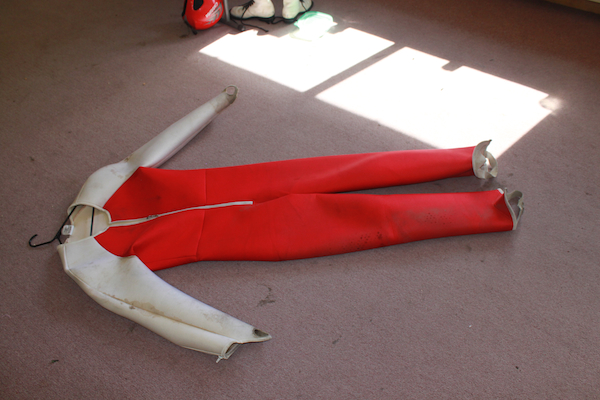
All these disturbing tidbits were imparted to me as I was preparing to go outside and tackle the same collarbone-destroying hill myself. Before doing so, I had to remove my clothes and step into the red-and-silver jumping suit I’d been issued, which felt like an oversize wetsuit made out of thick, soggy cardboard. Capped off with my black alpine ski helmet, I felt like an ungainly summer snowman.
A few of the kids immediately started hiking to the top of the hill, but I stopped in the middle of the slope, along with most of the other participants. Before flying off the jump, McCahill wanted me to glide down the landing hill a few times, starting at the flat area just beneath the take-off. That would allow me to get a feel for my equipment, and for the plastic surface that Lake Placid uses to replace snow during the summer.
I watched a handful of the kids slide down. It seemed pretty straightforward, although the hill still looked steep. I took my place at the top, jammed my boots into my bindings, and cautiously inched out over the crest. I was at the bottom, unscathed, before I knew it.
After two more quick runs without any trouble, I was starting to get a little more confident. But I still needed some more time to adjust to the equipment.
Wrong. When I got back up the top of the landing hill for the fourth time, McCahill told me to keep walking. It was time to hit the jump.
“Really?” I asked, hoping he was joking. My preference at this point was to take a few dozen more landing hill runs before lunch, then perhaps attempt a single jump in the afternoon session. If I was up to it.
“Oh yeah, you’re ready,” McCahill said.
McCahill did not appear to be kidding—he had already refocused his attention on a string of ten-year-olds as they flew through the air. Resigned, I put my head down and began hiking up the rest of the hill.
Summoning the Confidence
At the platform at the top of the hill, I was greeted by the half-dozen kids in line to take their own jumps. There were five different start positions, each with their own “bar”—a six-foot long section of two-by-four spanning the width of the tracks. Jumpers sit on the bar before pushing off and sliding down the in-run to the take-off.
McCahill had told me to start from the second position, almost at the bottom of the platform. Many of the kids were jumping from higher up, at four and five. I watched a handful of them. The majority flew through the air and landed smoothly—one confident boy in a cow-spotted suit even got his skis into the textbook V-style. A few lost their footing on the landing and spun their way to a stop on the grass below, but all of them quickly jumped up, dusted themselves off, and headed back up the hill.
As I watched the kids jump, I could see that there didn’t seem to be any life-threatening forces at work. The kids were sliding down no more than 50 feet of in-run, and they didn’t appear to be traveling more than 15 or 20 miles an hour when they reached the take-off—which was no more
Inching my way out onto the bar. Photo, Dave McCahill
than four feet off the ground. It looked close to fail-safe, but none of that mattered—it’s impossible to rationalize something as precipitous as ski jumping for the first time. All I could think about were broken legs and broken arms—frustratingly unimaginative injuries.
As I began the process of putting my skis on, I could feel myself tightening up. My heart was already pounding, and then, before I was ready, it was my turn. Matt Cook, another NYSEF coach and former elite ski jumper, put the bar in place for me. I leaned out and plopped my butt on the nearest edge, scooting cautiously out to the middle. The two-by-four felt more like a one-by-two, and I could feel it bending beneath me. And just like that—after a few e-mails to coordinate my visit, a three-hour drive, and twenty minutes of familiarizing myself with the gear—I was alone at the top of the in-run, and I no longer had a choice. Like it or not, I was about to begin my ski jumping career.
I looked at Cook, waiting for him to tell me that everything would be fine, that I wasn’t going to hurt myself. Instead, he tried to give me practical advice, saying something about keeping my weight centered over the middle of my feet. It was absolutely not what I was looking for; I wanted straight, dumb reassurance. But I didn’t get it.
When Cook finished talking, I waited for a grand total of five seconds. Then, I stood up. Working up the courage to take a ski jump isn’t at all like navigating a steep hill on alpine or cross-country skis—when you’re doing that, you have to renew your commitment each time you start a new turn. With ski jumping, you only have to summon your confidence once, and then you have no choice: There’s nothing you can do to stop yourself once you’ve started sliding.
McCahill captured the jump on video, which shows me assuming a highly conservative crouching stance as soon as I stand up. While there was a vague resemblance, this stance is not to be confused with what real jumpers call in-run position. This was holy-crap-I’m-about-to-go-flying position. I went sailing off the end of the jump without moving a muscle—the only parts of my body that budged before hitting the ground were my arms, which I threw
In the air on my first-ever ski jump. Photo, Dave McCahill
backwards to steady myself. I traveled roughly three meters—just over two percent of the distance that Swiss jumper Simon Ammann flew in his gold medal-winning jump in the large hill competition in the Vancouver Olympics—before touching down, upright. I stayed atop my skis for a few meters, then sat down as I reached the bottom of the landing hill. My skis splayed to the left as the plastic ran out, then slammed into the grass and dirt at the bottom, wrenching the back of my boots against my calves. I sat up to the sound of whistles and tiny hands clapping. For something that had made me so terrified, the experience was remarkably straightforward.
Getting Comfortable
I took two more jumps that morning. The second was as scary as the first, but by the third jump, I was getting a little more steady. However, I had yet to actually jump—all I’d done was ride my skis through the take-off, too tense and focused to bother with even straightening my legs.
After my three jumps, we were already done with the morning session—which was fine with me. Imagine hiking uphill on a sunny summer day while wearing an extra-thick wetsuit and helmet, with skis in tow—that’s what I’d been doing for the past half-hour, and the activity had resulted in a level of perspiration that I never thought possible. Even after pulling down the zipper and letting the top half of the suit hang around my waist, I was still sweating buckets. By the end of the day, I had nearly soaked the suit through, and I would remain dehydrated for days.
It was only eleven, but I was already tired and beat up. The backs of my legs were sore from being slammed against my boots at the bottom of the landing hill, and I was covered in the dirt kicked up from my skis. We all headed inside and peeled off our suits, and the kids immediately moved on to a session on the giant trampolines used by the freestyle jumpers to practice. I was content to watch, and to chat with McCahill about NYSEF’s programs.
After a couple of hours for lunch, it was time to jump again. I pulled the suit on for a second time, and despite my hopes that might have dried off in the two hours that I left it in a heap on the floor, it hadn’t. It was sticky and clammy, which, as I was informed by assistant coach Tara Geraghty-Moates, is “part of summer jumping.” No matter—I would be hot and covered in sweat again in a few minutes, anyway.
The kids began the afternoon session by practicing telemark position while sliding down the landing hill. (Telemark landings are slightly more
My suit, dirty and soggy after a day of jumping.
stylish, and earn extra points in competitions.) McCahill told me not to worry about this just yet, instead recommending that I try to make my jumps a little more aggressive—at least, when I feel comfortable doing so. I head up the hill intent on jumping—not just riding through the take-off.
After hitting the jump a couple more times, I realized that I was not longer intimidated—and that I was actually starting to have fun. Despite the imposing look of the hill, the unwieldy skis and the sport’s reputation for inaccessibility, jumping was actually easy, and intuitive. By my fourth flight of the afternoon, I was practically sprinting my way back up to the top of the hill, rushing past kids lugging skis twice their size and refusing to even take the time to unzip my suit.
Despite the fact that I was now jockeying for position with them at the top of the hill, the kids were adding to my enjoyment. They seemed to have a full grasp of the scale of my endeavor—while they were unfailingly sympathetic and encouraging on my first few jumps, the kids also seemed to recognize the absurdity of a 23-year-old being a participant in their camp, and none of them hesitated to laugh or poke fun at me. But they also told me, in jumper’s vernacular, to “have one,” each time I sat on the bar and readied for take-off. One girl even offered me technique advice, suggesting that a lower in-run position would force me to make a more powerful jump. It worked.
Blue Meters
After five attempts in the afternoon, I was finally starting to jump. I was gliding farther and farther down the hill each time (although still nowhere near as far as the best kids), and I’d figured out how to sit back on my skis and avoid toppling over as I approached the run-out.
My suit was soggy and my legs were sore from the backs of my boots, but I still had one more goal for the day: to reach the blue line that stretched across the landing hill roughly 15 meters from the take-off.
I was still jumping from the second start position, and I was getting close—my boots were coming down about even with the line on my fourth and fifth attempts of the afternoon. On my way back up the hill, I informed McCahill that I had to make it to the blue line by the end of the day.
“You know how to do that, don’t you?” he asked me. “If you start from five, I guarantee you that you’ll make it.”
That was not what I was hoping to hear from McCahill—I was under the impression that I wouldn’t have to stretch my comfort zone any further on this day. While I had been content for my jumping career to begin and end from the second start position, I was now faced with the challenge of starting 10 feet higher on the in-run.
Strapping on the skis. Photo, Dave McCahill
I climbed up the hill to the platform and contemplated the view from the bar—it wasn’t hugely different. I gulped, stood up, and rode down the in-run to the take-off, jumping with the same conservative technique as I had on my first attempt of the day—barely budging my position until I’d landed. Predictably, this left me with an unimpressive result, still a couple of meters shy of the blue line.
“You didn’t think you’d actually have do anything to get there, did you?” McCahill teased me as I hiked past. “You still have to jump—and this is your last shot before the end of the day!”
Dirty and sweating, but still intent on hitting the blue line, I hiked up the hill and strapped on my skis one final time. At the take-off, I mustered just enough of an impulse to clear the blue line—or so I thought. I walked back up the hill to pick up my camera and ask McCahill if I’d made it.
“Blue meters!” he said. “Nice work!”
Triumphant, I returned to the lodge and pulled off the suit. With the quarter-inch of soggy foam no longer clinging to my body, I felt amazing. I stacked my skis against the wall alongside the rest of the NYSEF loaners, returned my boots, and hung up my suit. All told, I’d taken ten jumps, and probably flown no more than a cumulative 100 meters—still far shorter than Ammann’s gold-medal winning flight. But I already felt like a seasoned veteran, and I caught myself contemplating sticking around for another day of the camp. Jumping had been shockingly easy to learn—I spent no more than an hour in the morning getting used to my gear, and by the afternoon the fear factor had already worn off. A few days later, I was already plotting my return to Lake Placid for weekend jumping sessions, and scouring the internet for novice nordic combined competitions in the winter. It’s not too late for me to make a run for the 2014 Olympics, is it?
Interested in trying ski jumping or nordic combined? There are a large number of clubs with novice hills throughout the country, especially in the northeast, which welcome newcomers. For anyone already comfortable on a pair of cross-country skis, the basics can be learned in a session or two. Contact your nearest club for more information—the website SkiJumpEast.com has an extensive directory, as does SkiJumpingCentral.com.
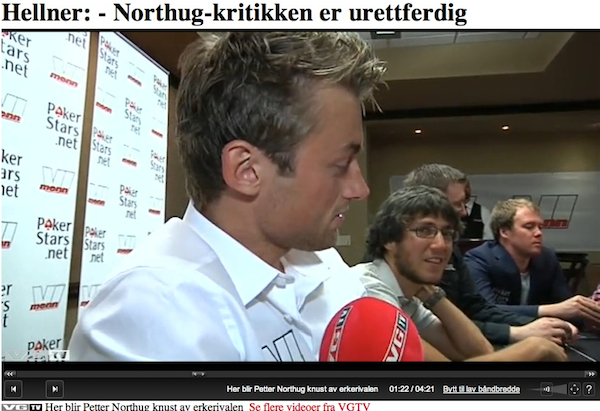
I sneak a look at the video camera as Petter Northug does an interview with the Norwegian newspaper Verdens Gang. Screenshot from Vg.no
I step off the bus from the Strip into the Las Vegas evening and walk inside the Palms Casino, about 40 minutes early for the poker game between Marcus Hellner and Petter Northug. I haven’t eaten since breakfast, and I’m just coming off a two or three mile walk in search a loaf of bread, jostling tourists in 100-degree heat. The only place I can find to make my peanut butter and jelly sandwich is a bench in the parking garage, where I sit watching security guards rolling by on bicycles.
At 7:00, it’s time to go meet Thorkild Gundersen, my contact from Vi Menn, the magazine that sponsors Petter Northug and brought him to Las Vegas. Thorkild brings me up to the poker room. I don’t know what I expected, exactly, but it wasn’t this: a private meeting room filled with a dozen journalists, an open bar, a couple of card tables, even a backdrop for photo-ops. Thorkild and Alex Oysta, the Vi Menn editor-in-chief, are wearing tuxedos, and while there are a handful of people dressed casually, there are also a bunch wearing really nice clothes. I was as dressed-up as I ever get—corduroys and a polo shirt, which I’d even taken the time to steam in the shower in the morning—but it didn’t feel like enough.
I‘m introduced to Thor, a kind-looking older man who apparently is a Norwegian poker legend—the “godfather” of the game in the country. I stand around and talk awkwardly for a bit before Thorkild gives a short speech in Norwegian, and everyone sits down at the card tables. Alex tells me to take a seat. Apparently, we’re playing some informal cards with all the other journalists, as well as some professional Swedish and Norwegian poker players who are mixed in—they’re here to watch Petter and Marcus.
It’s hard to tell exactly who’s who, and though it’s a pretty friendly atmosphere, I’m anxious. It seems like there are high rollers everywhere, and then there’s me—an unshaven 22-year-old in sneakers who doesn’t speak Norwegian.
The dealer flicks each of us cards. We play an open hand on behalf of the reporters at the table, then a few more. After 15 minutes, Northug and Hellner finally show up—and Northug is shown to the empty seat directly next to me. Like, six inches away. Like, close enough to smell his cologne, and for me to be worried about the fact that I was walking around baking in the sun for two hours that afternoon, and probably smelled pretty bad myself. I know that the whole Scandinavian hero-worship thing isn’t cool, but I am a ski journalist and, ultimately, a ski fan, and Northug is the very best skier in the world, so I was incredibly nervous—even though I look down and notice that his shoes are untied. As we play our first few hands, Northug does interviews with Norwegian television stations. Sitting right next to him, I’m obviously in the shot—the cameras are almost pointed straight at me—and I try not to fidget and screw it all up.
Eventually, I end up in a predicament with Thor, the Norwegian legend. I have Ace-Nine, and Thor has just gone all-in—wagered all his chips on a single hand. I have the option to call (to match his bet), or to fold. I consult with the Norwegian poker player to my left, and then Thorkild walks up behind me and asks Petter what he thinks I should do. I show him my cards. He leans back in his chair, contemplating. Thor doesn’t care—he has played poker with Larry Flynt and L.A. Lakers owner Jerry Buss—and is amiably chatting with the guy next to him; my heart is pounding as I wait for Northug to give me some advice.
The view from my seat at the table. Thor Hansen, the Norwegian poker legend, is on the left with the white collar.
He looks at the cards one more time, giving me a pained expression. “I would play it—that’s what I’d do,” he finally says. So I do, obviously, pushing my chips to the middle of the table.
Because we’re “all-in” and have no more chips to bet, Thor and I each turn over our cards, revealing the worst possible predicament for me. Thor has Ace-10, which means, essentially, that I am screwed. We’re playing Texas Hold’em—the same type of poker played at the World Series—and the way it works is that after getting your own hand of two cards, five additional communal cards are dealt in the middle of the table. Now, since Thor’s own hand is better, pretty much the only way I can possibly beat him is if a nine turns up.
The first four cards are flipped over and offer no help to me. I’m about to lose, to be forced out of the game. And then the dealer turns over a nine. The whole table laughs and cheers, as Petter turns to me with a grin. “I told you to play it!” he crows.
I’ve won the hand. I’m shaking as I reach out to pull all the chips back into my corner, and trying not to let anyone notice— although if Petter is anywhere near the poker player everyone says he is, there’s no way he didn’t.
After another few hands, it occurs to me that I should probably introduce myself. Eventually, I work up the courage to stick out my hand, tell Petter my name, and ask about his training that morning. Surprisingly, he gives me his full attention, telling me about his rollerski workout in Red Rock Canyon.
I’m 22—one year out of school and finishing eight minutes down on Simi Hamilton in college races. Today, I’m sitting a foot away from the best cross-country skier in the world. And despite the fact that I’m supposed to be a journalist who would kill for a one-on-one interview with Northug, I can’t think of anything else to ask him. Tomorrow, and the next day, and the rest of my life, there will be time for professionalism, but for now, I’m out of questions. All I can do is sit, and soak it in.
Today, we bring you the first in a series of podcasts with Nat Herz, Topher Sabot, and Colin Reuter and Christopher Tassava, the two founders and editors of the blog Nordic Commentary Project.
Reuter and Tassava describe their blog as “world cup nordic skiing chatter with a side of analysis, from two skiers and ski-racing fans. In these podcasts, we’ll offer some deconstruction of the last few weeks of developments in the cross-country ski world—and hopefully even make a handful of provocative statements. This week, we started out by discussing the failed plan for a Canadian Tour de Ski in the winter of 2012.
What? Yeah, that’s right, there are lots of great reasons to be a Nordic skier, but one of them is that there are a whole lot of fit, attractive people wearing spandex. Here is a list of some of the hottest European skiers on the World Cup. We may have forgotten a few so feel free to write them into the comment section and we will add them to the list. We did not want the North Americans to dominate so we made an executive decision to eliminate all of them… sorry Andy and Morgan.
Superficial? Certainly, but remember that it is spring time, and you’re supposed to be having fun.
All of our photos of these athletes are from races, so we are using google images to supplement. If you don’t have a poster on your wall, google will provide.
Please vote at the bottom of the page. We will tally the scores and then enter a second round of voting to determine the winners!