From the FasterSkier archive — posts syndicated from athletes’ and coaches’ own blogs between 2004 and 2012, kept online as published. Current coverage is at fasterskier.com.
The women’s podium from the fourth stage of the 2018/2019 Tour de Ski — a 10 k classic mass start. Russia’s Natalia Nepryaeva (left) placed second, Norway’s Ingvild Flugstad Østberg (center) first. and Anastasia Sedova (right) also from Russia third. (Photo: Fischer/Nordic Focus)
It was a snowy and grabby day in Oberstdorf, Germany, for Stage 4 of the Tour de Ski (TdS). The temperatures were sitting right around freezing, making it challenging conditions for dialing kick wax. Many racers skied on zeros for this 10-kilometer classic mass start. But throughout the race, many women appeared to be struggling to find the right amount of kick as slipping on the hills was a common theme for some.
U.S. Ski Team Coach Matt Whitcomb commented on the day’s tricky conditions.
“The races were typically hard Oberstdorf races, in some ways, it’s what every cross-country skier dreads and in other ways, it’s what is so great about this sport,” Whitcomb said. “It was a really challenging day surface wise, conditions were slow, the course was hard and it snowed like hell, so it was a challenging day today.”
Ingvild Flugstad Østberg of Norway drag racing down the final 100 meters with Russia’s Natalia Nepryaeva in Oberstdorf, Germany during Stage 4 of the Tour de Ski (Photo: Fischer/Nordic Focus)
Wearing bib 2 as the TdS second overall skier, Norway’s Ingvild Flugstad Østberg fought hard for the victory today finishing in 32:08.9 minutes. Østberg led the majority of the race, only giving up the lead three times before quickly taking it back — once to Krista Pärmäkoski of Finland and twice to Natalia Nepryaeva of Russia.
Østberg spoke with an International Ski Federation (FIS) reporter after the race and noted she had to be persistent.
“It was a really tough race and when we saw it was snowing and knew it would be hard to be in front, but I knew I had to try and I just had to work and work and work and maybe people would fall off one by one,” Østberg told FIS.
Nepryaeva attempted to pull away from Østberg in the finish stretch and nearly took the win. But Østberg out lunged her across the line.
Østberg recounted, “the Russian were really strong, especially in the last uphill. But today, I just decided to give it all and in the last 100 meters, I just had to try and it was an incredible feeling to cross the finish line first.”
Today’s victory makes Østberg the overall leader of the TdS.
“It’s really fun to be in the lead of the Tour de Ski. I’ve been here before and it’s always fun and I’ve been working hard for four stages. But I know a lot can happen in the next three, so I just have to take it race by race,” Østberg said.
https://youtu.be/c34Cc8tVKQ8
In nearly taking the win, Nepryaeva displayed she has the overall fitness to contest a top overall spot at the Tour. The twenty-three-year-old Nepryaeva kept pace with Østberg the entire race. She never was more than five seconds behind the day’s winner. In the last 2.5-k of the race, Nepryaeva’s teammate Anastasia Sedova caught her, allowing the two Russians to work together and challenge Østberg.
Despite being out-lunged, this is not the first time this season that Nepryaeva has gone head to head with Østberg. During Stage 2 of this year’s Tour, a 10 k skate, Nepryaeva beat Østberg by just under a half-second for her first career World Cup victory. After today’s result, Nepryaeva is positioned second place in the overall TdS standings.
Sedova skied a very strong race as well, putting in a massive effort to finish third. After the first 2k, she was in 11th, but she moved quickly through the pack and by 7.5k she was in the mix for a podium position. Once catching her teammate Nepryaeva, Sedova settled in with the winning pace and finished five seconds behind Østberg. Sedova’s third-place finish put her into sixth in the overall TdS standings.
Jessie Diggins of the U.S. Ski Team was the first North American to cross the finish line. Diggins started today with the TdS leader’s bib. In what was admittedly a tough waxing day, Diggins held onto the lead pack for the first kilometer before falling back to 24th. After the race’s mid-point, Diggins found her groove. She surged forward to 12th place at the 5 k time check, 18.7 seconds back. Diggins finished in 11th (+58.5). After Stage 4, Diggins is in fourth overall in the TdS standings, 1:26.3 minutes behind overall leader Østberg.
“Frankly, we missed the boat on the wax today, but I fought as hard as I could and I know I’m in great shape right now,” Diggins texted FasterSkier after the race. “I did everything I could with what I had today! And now the pressure of the leader’s bib is 100% off, and I’m just going to ski as hard as I can tomorrow and recover as smart as I can!”
Whitcomb also commented on the USST women’s skis, confirming that day’s dicey conditions.
“We did not have good skis for the women, it was straight up just a really difficult race for them because of this,” Whitcomb said. “What I will say is about 2/3rds of the race had very bad skis and our girls did incredibly well considering those things.”
Diggins will be racing in the next three stages of the TdS as she plans on completing the Tour.
“The goal remains the same for Jessie, whether starting 1st, 4th or 50th,” Whitcomb said. “Until the finish line on Alpe Cermis, we’re racing to win. It’s just how she does things.”
Sadie Bjornsen (USST) finished 15th on the stage.
Sadie Bjornsen of the U.S. Ski Team during Stage 4 of the Tour de Ski — a 10 k classic mass start race. (Photo: Fischer/Nordic Focus)
Diggins and Bjornsen skied in the same pack for the majority of the race. During the first half of the race, Bjornsen sat in 17th. When Diggins made a move, skiing into 12th, Bjornsen followed suit, skiing to 15th. Bjornsen held this position for the remainder of the race and finished 1:05.4 minutes behind Østberg. Today’s result lands Bjornsen in 10th in the overall TdS standings.
“It was a really challenging race out there,” Bjornsen texted. “Unfortunately, our team really missed the kick, so we had to fight with what we had. Our skis were icing really bad, which made it quite challenging to ski both the uphills and the downhills. Thank goodness there were a few flat sections out there to feel like I was out for a ski race. It’s a bummer to have a day like today because my body felt really good, and I really like this course for classic skiing- but that’s life, and sometimes you have to just laugh it off and hope you can learn something as a team from the experience.”
Bjornsen will exit the Tour after tomorrow’s fifth stage.
“Tomorrow will be the last race of my tour, as I have planned to not complete the full tour this year, and try to do a training block without too much accumulated race fatigue,” Bjornsen explained. “So, let’s hope tomorrow can work out a little better, and I can make some use of these good feelings!” Bjornsen told FasterSkier.
After her exit, Diggins will be heading to Seefeld, Austria to join some of her other teammates for a mini-training camp before World Cup racing starts up again after the Tour.
“Given how strong Jessie and Sadie skied today with skis that weren’t working for them, I’m very optimistic about tomorrow,” Whitcomb stated. “These two are strong right now, and pretty pissed off. That’s a good combo to bet on.”
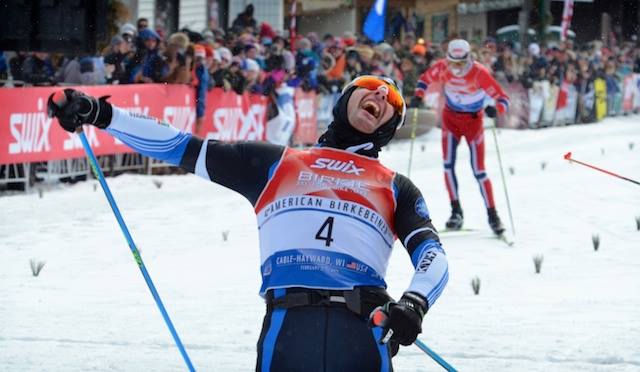
Italy’s Segio Bonaldi celebrates after winning in a sprint finish at the 2015 American Berkebeiner in Hayward, Wis. It was Bonaldi’s second Birkie title. (Photo: American Birkebeiner Ski Foundation)
The 2015 American Birkebeiner in Hayward, Wis., was spared the most frigid weather gripping the Eastern U.S., as temperatures hovered around 15 degreesFahrenheit when Saturday’s 51-kilometer freestyle elite race began. And despite three to four inches of new snow, even the sun made an appearance during the race.
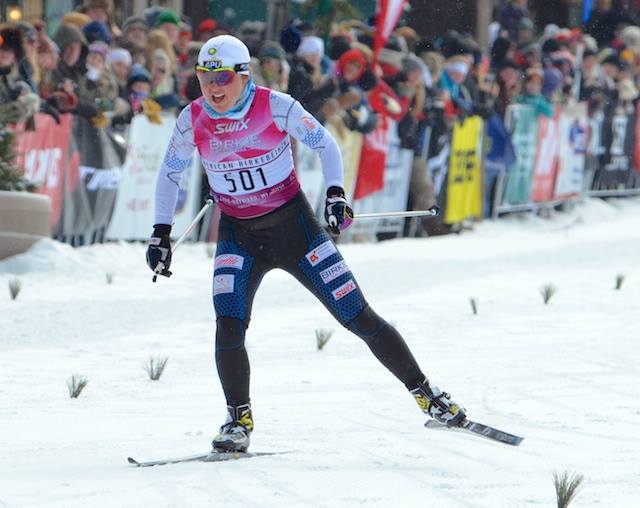
In was in these conditions that American Holly Brooks, of Alaska Pacific University in Anchorage, Alaska, won her second Birkie, claiming victory in a time of 2:34:33.
Holly Brooks racing to her second Birkie victory on Saturday in Hayward, Wis., which she won by nearly 30 seconds to reclaim the FIS Marathon Cup overall lead. (Photo: Darlene Prois/ABSF)
However, she first had to ward off Aurelie Dabudyk of France, who stuck with Brooks until she began her final push on the flats of Lake Hayward, a few kilometers from the finish.
Brooks came into the race second overall in the FIS Marathon Cup, but reclaimed the lead after Saturday’s win.
The 32 year old told FasterSkier that the top four women were together for most of the race. At “B*itch Hill” – a steep climb about 40 k into the race – she said she heard a second snow machine behind her.
“I looked over my shoulder and there was the sea of men who had caught us,” she explained. “I knew it was a now-or-never moment.”
As the leading men passed the first four women, Brooks decided to make her move. She tagged onto the group of men and managed to break from the group.
However, she was surprised to find Dabudyk was able to hang behind her.
“I did not want to leave it to the finish sprint and therefore pushed as hard as I could on Lake Hayward. I did not dare to look back before the finish line to be sure not to lose any seconds,” she explained to the press. “I didn’t want to be ‘that skier’ who looked back and lost the sprint because you miss a crucial pole plant or something.”
As usual, she said Main Street in Hayward was incredibly loud and festive.
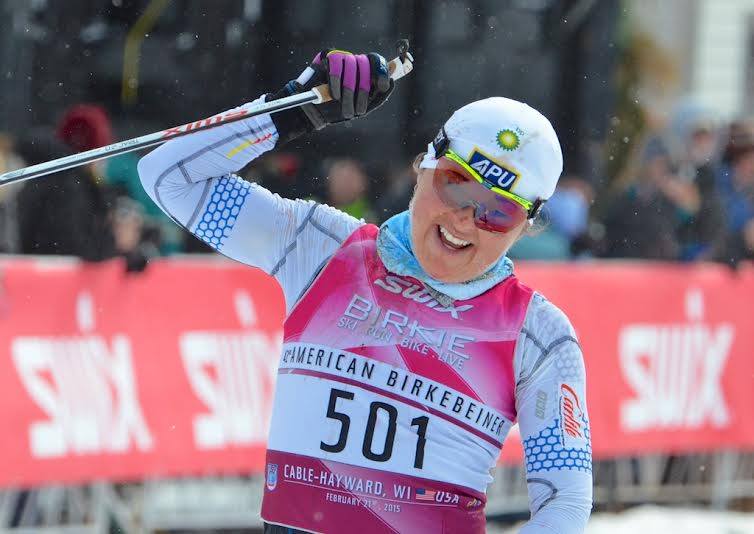
“It would have been fun to grab a flag and celebrate a bit but ensuring the win and reclaiming the red bib was more important!” she said. “I am really happy that I could win the Birkie again today!”
Holly Brooks celebrates after winning her second American Berkebeiner on Saturday in Hayward, Wis. The win put her back in the lead of the overall FIS Marathon Cup. (Photo: American Birkebeiner Ski Foundation)
Dabudyk went on to finish second, 28.1 seconds behind Brooks. Tatiana Mannima of Estonia was nearly two minutes back in third (+1:59.9), barely holding off German Anja Gruber, who placed fourth (+2:02.1).
Mannima has won the last two FIS Marathon Cup races, while Gruber is coming off three podium finishes earlier this month in SuperTour races in Craftsbury, Vt.
Dabudyk said to the press that she wanted to stay with Brooks until the finish, though down the stretch Brooks had too much power for her.
“But I am really happy with my second place,” she added.
Mannima said that she pushed hard from the start to see which skiers could hold onto her speed. She was able to stay in the lead group until Brooks and Dabudyk finally took off with 10 k to go.
“At Lake Hayward, I was trying to stay behind Gruber, as it was pretty windy on the lake. I hoped to pass her before the finish line, which I did,” she explained, adding that she is happy to just be on the podium.
American Caitlin Patterson (Craftsbury Green Racing Project) ended up fifth (+9:31), after winning the SuperTour 20 k classic mass start in Craftsbury late last month.
Bonaldi wins second Birkie in exciting fashion
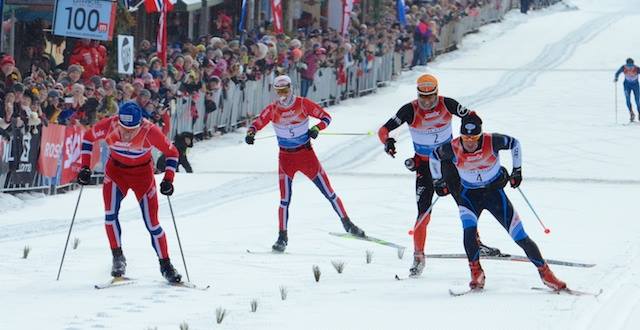
Italy’s Segio Bonaldi (r) outlasts three Frenchmen en route to his second American Birkebeiner victory on Saturday in the 42nd annual Birkie in Hayward, Wis. (Photo: Darlene Prois/ABSF)
The men’s race offered a more dramatic finish, as Italian Segio Bonaldi outsprinted three Frenchmen to win by less than a second.
Bonaldi, Birkie winner in 2013, finished in 2:12:21.1. He passed France’s Christopher Perrillat-Collomb in the final 100 meters to win by just 0.5 seconds. Benoit Chauvet and Mathias Wibault were also in the lead group, and Chauvet finished in third (+1.7) while Wibault faded to fourth (+5.0).
Chauvet told the press that he tried to break out of the lead group of 20 at the first climb, but no one was willing to break with him. However, the racers slowly began to spread apart at about the 35 k point, and Chauvet was able to work with Perrillat-Collomb.
“At this point all were thinking about winning the race,” he said.
Chauvet explained that his tactics failed him, however, and that Bonaldi was smarter and stayed behind the others until the final stretch. Chauvet said he probably made his final sprint too early, as he tried to be first coming off the new bridge that drops the skiers into downtown Hayward and the final straightaway to the finish.
“I did not feel so well until 15 k before the finish,” Bonaldi said. “My skis were also not very good so I tried to stay behind and to wait for the finish sprint. I kept energy for that.”
The 36 year old added that he really wanted to win this year, especially after finishing third last year, but was not sure he would have a clear shot at victory until 100 meters before the finish line.
“I am very happy!” he said.
“I am little bit disappointed to be third as I wanted to win. I have to come back for the victory next year,” Chauvet said.
The top American, Lex Treinen (APU), finished nearly 20 seconds after Wibault in fifth and was 24.5 seconds from the win. Last year, he placed 10th in the Birkie. American Brian Gregg (Team Gregg/Madshus) finished in eighth (+1:51.4).
FIS Marathon Cup leader Petr Novak of the Czech Republic came through in 11th (+5:51.4).
“I had the worst skis of my life. I lost so much on the downhills. It was a mental fight for me all the way through and right until the end!” Novak said in a statement to the press. Despite his rough day, he still retains the lead in the overall FIS Marathon Cup standings.
American Matt Liebsch (XC United/Team Strong Heart), 2009 Birkie winner, finished 10th (+3:10.8), while 2012 Birkie winner Tad Elliott (Ski & Snowboard Club Vail Elite) took 16th (+10:29.5).
Naryshkina, Mork take classic titles
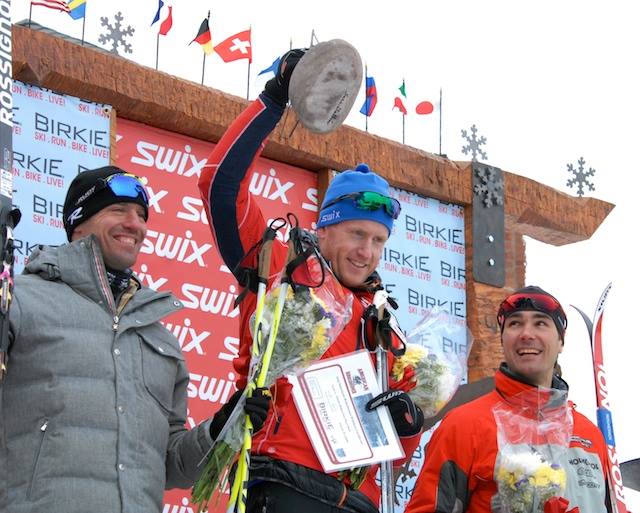
Men’s 55 k classic Birkie winner Ole Christian Mork (c) is with second-place finisher Torin Koos (l) and Thomas Seidel (r), who placed third. (Photo: ABSF/Facebook)
In the 55 k classic race, Natalia Naryshkina of Russia and the CXC Team took the women’s win in 3:19:20.2, while Norway’s Ole Christian Mork won the men’s race in 2:54:22.1.
Naryshkina beat runner-up Josie Nelson of Medicine Lake, Minn., by 3:44.9, and Kelly Sillicorn of Winona, Minn., by 3:50.9. Isabel Caldwell, younger sister of U.S. Ski Team member Sophie Caldwell, placed fourth (+6:14.8).
Mork, of Oslo, outlasted four-time U.S. Olympian Torin Koos by 8.8 seconds and Thomas Seidel, of Salt Lake City, in third by 14.7 seconds.
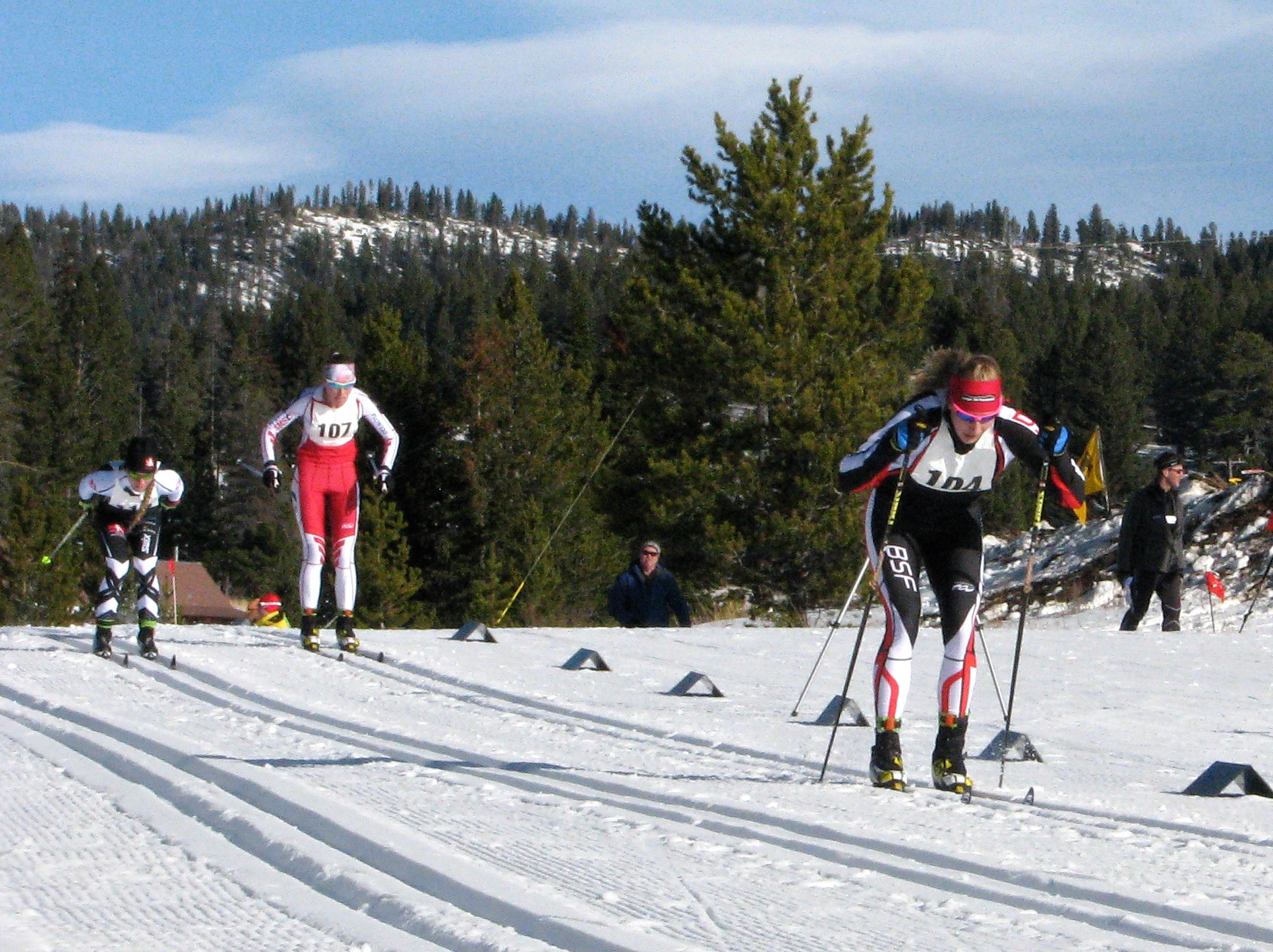
Jennie Bender of the local Bridger Ski Foundation (r) leads Stratton’s Erika Flowers (second from l) and Cendrine Browne (l) into the stadium during the second quarterfinal of the women’s 1.5 k SuperTour classic sprint at Bohart Ranch near Bozeman, Mont. Bender went on to place second to APU’s Rosie Brennan in the women’s final.
BOZEMAN, Mont. — On a 45-degree day with spring-like conditions, Rosie Brennan of Alaska Pacific University (APU) cruised to first place in the women’s 1.5-kilometer classic-sprint final at Bohart Ranch on Saturday, the first day of the Bozeman SuperTour.
While 26-year-old Brennan crossed the line in 3:55.83, a small crowd cheered for Jennie Bender of the local Bridger Ski Foundation (BSF) as she powered her way to second, 5.4 seconds behind Brennan, for her second-straight podium in as many SuperTour sprints. Caitlin Patterson (Craftsbury Green Racing Project) took the final podium spot in third, 9.44 seconds back.
Patterson placed fourth in last weekend’s SuperTour 10 k skate in West Yellowstone, Mont., the distance opener of the season, which Brennan won. Rounding out the final was Russian Natalia Naryshkina (CXC Team) in fourth (+17.35) and Alysson Marshall (Alberta World Cup Academy/National Development Team) – who won last week’s West Yellowstone SuperTour skate sprint – in fifth (+17.40). Becca Rorabaugh (APU) was relegated to last in the final and sixth overall based on a jury decision.
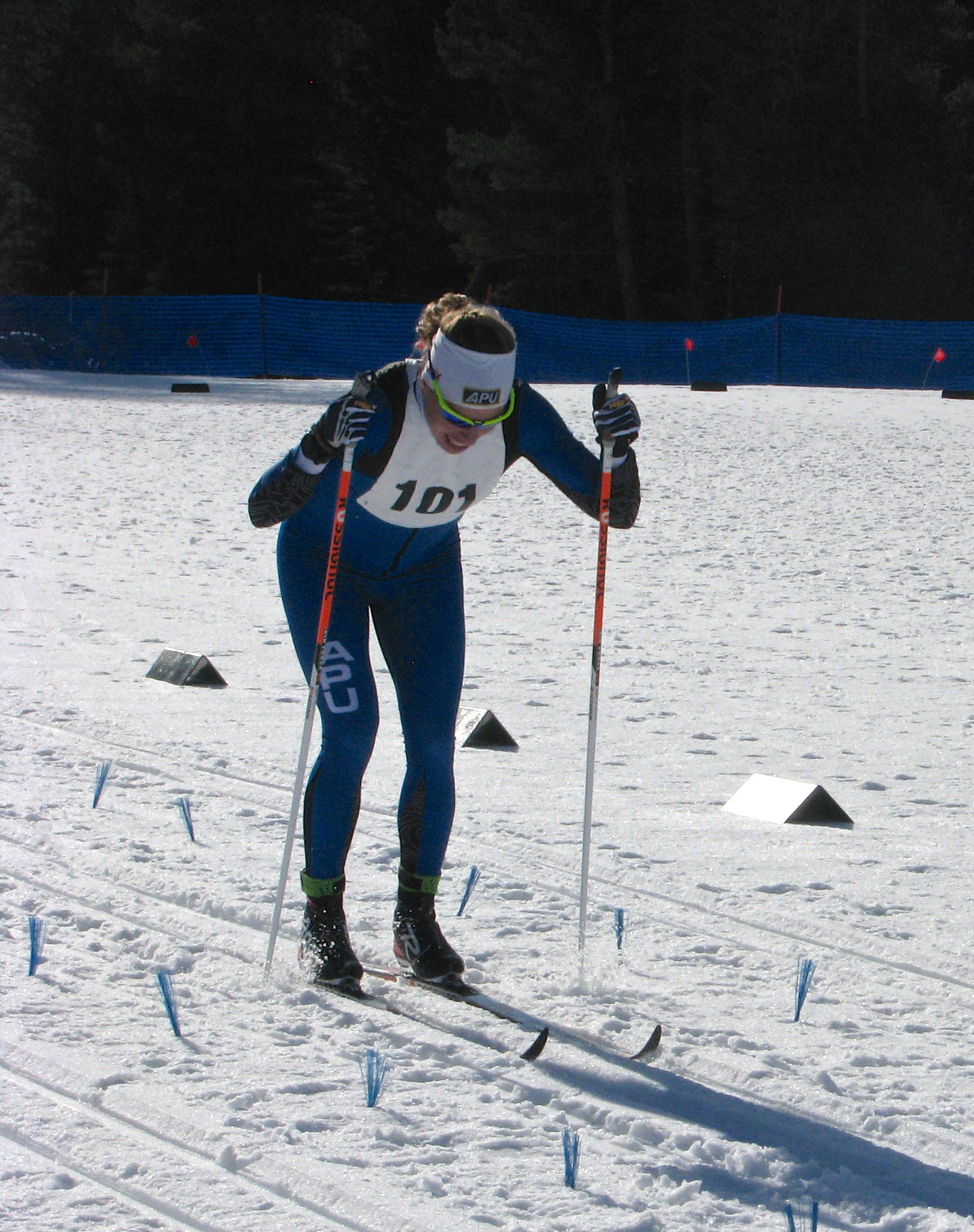
Rosie Brennan (APU) double poling to first in the women’s SuperTour classic-sprint final at Bohart Ranch near Bozeman, Mont.
Unofficial results following the race had listed Rorabaugh in fourth after Patterson. But a jury decision relegated her to last in the final for sixth.
According to Rorabaugh, she found that it was faster skiing outside the tracks and was double poling between the tracks through the upper stadium.
“As I was double poling next to the tracks, I turned too aggressively into the upper hill, and course officials decided it was worth bringing up,” she wrote in an email. “The funny part is that it wasn’t advantageous for me; in retrospect I should have been striding to try and accelerate into the hill. People say you learn something new every day, and now I really know how I should ski that transition!”
“Since technical limits aren’t actually the ones that we’re supposed to push as skiers, and I crossed the line on that one, it makes sense that I was relegated to the back of the A final,” she added.
After the clear-cut win, Brennan said her strength is “working the uphill sections,” and the difficult, hilly Bohart course certainly played to her advantage. She explained her strategy was to use her strengths “to tire people out and then just go for it.”
Brennan’s tactics were effective, as she was the top qualifier by 0.53 seconds over Marshall in 3:51, and Brennan went on to win her quarterfinal and semifinal. In the final, she grabbed the lead from the start and maintained it throughout the race, while none of the other skiers could match her speed and strength.
Brennan said she had fast skis and was not too worried about being caught on the course’s downhill sections, which included a steep hill halfway through the course that was immediately followed by a sharp, precarious curve. This curve gave skiers trouble throughout the day, particularly during the qualifier before the sun rose over the mountains and icy patches were still present.
Patterson was one of those skiers who had a close call.
“In my qualifier, I went way past the V-board and didn’t make the turn very well,” she said. “I think two people had to jump out of my way.”
Patterson managed to qualify in 11th before successfully navigating her way to the final (after placing second to Brennan in the quarterfinal and third behind Brennan and Bender, respectively, in the much-faster semifinal). After all that, Patterson was satisfied with third.
“I’m getting a lot better at sprinting than I used to be, and typically it wasn’t exactly my forte,” she said. “But I had a good fight with the other competitors and I’m pretty happy with how I did.”
Patterson recalled being in fifth or sixth after the first downhill and going into the first uphill, but switched tracks and passed a few others on the inside of a corner. By the time the group reached the halfway point – the tall hill before the steep downhill section – Patterson was third behind Bender, and the two would remain in those positions through the finish.
Ultimately, no one was able to catch Brennan.
“[She] was really good today, just about untouchable,” Patterson said.
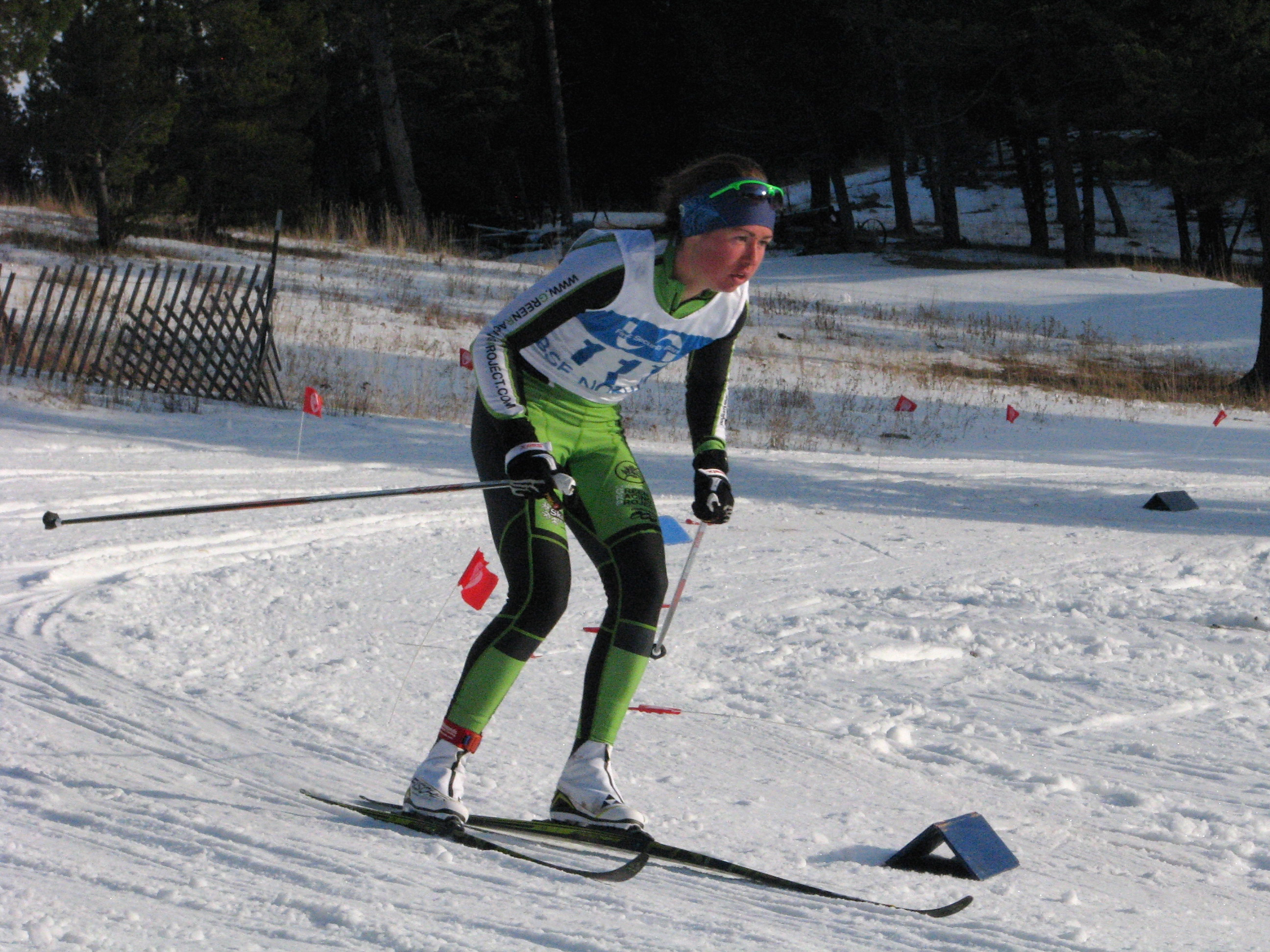
Caitlin Patterson (Craftsbury Green Racing Project) in qualifying. She went on to place third in the women’s Bozeman SuperTour classic-sprint final.
Bender was excited about her second-place result and said she’s looking forward to “battling it out” with Brennan in the future. “She’s looking strong, and I was psyched about how our final heat flew,” Bender said.
Starting on the outside, she said she was “boxed out” right away and pushed to the back of the pack. However, she “punched it on the first hill” and spent the rest of the race trying keep up with Brennan.
Unsurprisingly, there was a lot of hometown enthusiasm at the finish for Bender. “It’s so fun with all the home crew … a lot of people cheering me on, that means a lot,” she said, smiling.
Despite her strong finish, she explained that she has a lot of work to do moving forward, and that there is always something she can change or improve upon.
“I was psyched about today, but it’s just the tip of the iceberg,” she said.
The Bozeman SuperTour continues on Sunday with the 10 and 15 k classic races at Bohart Ranch.
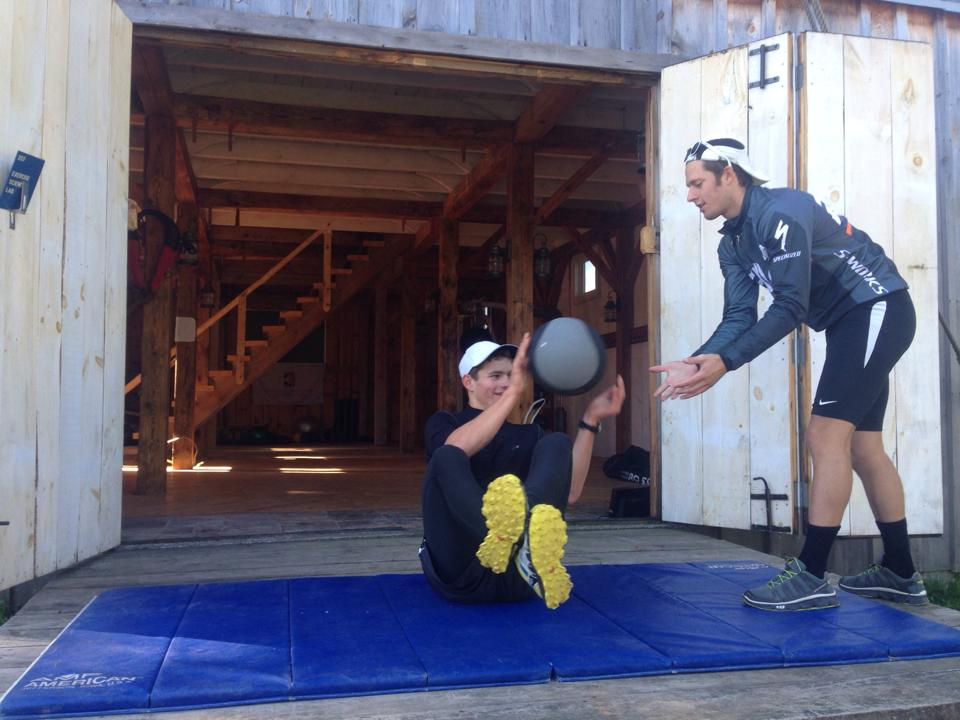
The newly appointed CXC Team Head Coach Andy Keller (r) works on strength with postgrad Scott Harrison outside a barn near Cable, Wis. (Photo: CXC Skiing/Facebook)
Three years ago, Andy Keller was a college kid looking for an internship toward his exercise-science degree at Michigan Tech. He knew a girl, who knew Jason Cork, and he used the connection to land an apprenticeship at the Central Cross Country (CXC) Ski Association in Cable, Wis.
At the time, Cork was heading up the CXC Team, which executive director Yuriy Gusev established in 2006 to support promising skiers striving for top national and international performances. Keller, who grew up just outside Minneapolis in Chanhassen, Minn., became Cork’s intern assistant.
Andy Keller started as an intern, then an assistant, and finally a junior coach before being promoted to CXC Team head coach this month, following the departure of Bill Pierce. (Photo: CXCnewsfeed.wordpress.com)
Months later, before Keller began his senior year, Gusev offered him a job.
“I said, ‘I kind of want a degree so I’ll talk to you in a little less than a year,’ ” Keller reflected on the phone last week.
He skied for four seasons at Michigan and graduated in 2012, then asking Gusev if there was still a spot for him. There was, though Keller’s job title and responsibilities changed three times before he officially got started, he said.
First, he was hired as sport-development manager, tasked with connecting CXC to youth clubs and high-school programs in the Midwest. Then, CXC’s assistant coach Gus Kaeding left to head the Stratton Mountain School (SMS) elite team in Vermont. Cook needed an assistant, and CXC’s board decided Keller would be it.
“Then there was a little bit of [difference] with coaching styles and athletes on the team, so Bill [Pierce] got brought on to work alongside Igor [and] I took more of a dedicated role to the junior program,” Keller said of last season. “This year started off the same way … I was focused more on the junior program.”
For the next several months, Badamshin oversaw the program and Pierce worked as the elite head coach. In late January, Badamshin died unexpectedly of a heart attack while skiing the Birkie trail between Cable and Hayward, Wis. He was 47, and his passing left CXC and the surrounding community stunned.
“A guy that works his ass off and is willing to do anything for his program … his passion truly lied with working with athletes,” Keller reflected. “[I] was just trying to carry on his legacy — inspiring kids to ski and getting them excited to be out there. If there’s one thing he was good at, it was definitely that, and also carrying on his work ethic. The guy wouldn’t complain. He’d be out there skiing 50 k and waxing…
“There was definitely big shoes to fill when he passed away,” CXC Team’s new head coach continued. “As I’ve come through, I’ve been working under a ton of coaches; my philosophy is I can always learn something. When I was interning under Jason and Gus that was what I loved to do — learning and listen.”
“There was definitely big shoes to fill when [Badamshin] passed away. … As I’ve come through, I’ve been working under a ton of coaches; my philosophy is I can always learn something.” — Andy Keller, CXC Team Head Coach as of September 2014
Keller Becomes Head Coach
That’s right, Keller, in his third season as a CXC coach, was recently promoted to head of its elite team following Pierce’s decision to accept a job in Colorado (he’s becoming nordic director of the Snow Mountain Ranch YMCA near Winter Park this fall) earlier this month.
But “elite” is a term Gusev and several other U.S. nordic directors like to stay away from: it’s about development and helping athletes reach their higher-competition goals. The CXC Team became Team Vertical Limit in 2009 as part of a sponsorship deal, and a year later it had 18 athletes, including a couple Olympians (Garrott Kuzzy and Caitlin Compton — now Caitlin Gregg).
The New: 2014/2015 CXC Team
CXC Team:
Cory Ellertson
Bjorn Batdorf
Bill Bowler
Chris Pappathopoulos
Hilary Patzer
Andrew Brown
Scott Johanik
Natalia Naryshkina (lives in Russia, plans to compete in western SuperTours and U.S. nationals)
Postgrads: (living in Cable this fall/winter)
Scott Harrison
Sam Boardman
College Summer Residency Group:
Nichole Bathe (University of Alaska Fairbanks)
Nicolette Reker (now at Winona State University, competing for CXC Team)
Tom Bye (Postgrad last year, now at Michigan Tech)
Thomas Kendrick (Michigan Tech)
Will Frielinghaus (St. Lawrence University)
Seth Mares (Gogebic Community College, plans to transfer to Michigan Tech)
International Training Partner:
Leandro Lutz (living in Cable this fall, plans to travel to Europe for international races in an attempt to qualify for World Championships; may stay in Cable and race U.S. circuit)
The CXC Team currently has eight members, most of which will be focused on top-10 results in Midwest marathons to attract sponsors. In addition, Keller is overseeing two postgrads, about 10 juniors and an international guest skier.
“All the coaches agreed, the team needs to get back to the roots of developing athletes,” Gusev explained on the phone. “You would have never called our team the CXC Elite Team, it just came later when this word became very popular.
“We always see our team as a development tool for that higher step,” he added. “We don’t see this team as full of stars, but we want to have a team open to athletes of that level. If it can help them great … It’s just like having a child: at some point you need to let them go and see if they can stand on their feet.”
Considering that, Gusev is encouraged by the direction his program is headed, especially with a homegrown coach at the helm.
“It’s exciting to see somebody who went through the original pipeline and became a coach,” he said. “And that’s a goal from the time he applied from an internship.”
Still, the last few weeks — and months — have been busy at CXC, to say the least. Following Badamshin’s passing, Gusev said the organization interviewed a couple people to hire in his absence, but ultimately, Pierce and Keller stepped up and said they could handled the added responsibilities without another coach.
“It was probably more emotional for some of us, but you just move on,” Gusev said. “The programs needed to move on as well and … we had to adjust right away.”
It didn’t take long for everyone to get back “in the groove,” he added. Pierce continued to serve as head coach and Keller as his assistant and junior coach.
Last Friday, Keller drove 300 miles southeast to Madison to test about 10 juniors at a weekend camp at CXC’s administrative headquarters. The group meets about once a month in various places, holding camps with other Midwest clubs, like Loppet Nordic Racing (LNR), May through December, Keller said.
He also helps host monthly CXC master’s camps, and while he’s not scheduled for every single one, he led a recent camp under Pierce’s guidance earlier this month.
“I made Andy run over half the sessions, and I watched him and helped him a little bit,” Pierce said. Then he told him and the rest of CXC about his decision to leave.
“I saw it coming,” Keller reflected. “Bill did talk to me as he found out more about the new position he was taking.”
In Cable, where Keller lives in a condo on the Telemark property, he spent the summer working with six athletes in CXC’s new college summer residency program, which Pierce initiated.
“That overlapped with what you would call our team now, more of a marathon team,” Keller said of his previous and current responsibilities, coaching juniors and now seniors as well. “The athletes that we’ll have competing on the SuperTour is relatively small.”
Those skiers include two postgrads from LNR — Scott Harrison and Sam Boardman — who plan to live and train full time in Cable this fall and winter. Their main races include western SuperTours, U.S. nationals, and the Midwest Junior National qualifiers .
“We don’t see this team as full of stars, but we want to have a team open to athletes of that level. … It’s just like having a child: at some point you need to let them go and see if they can stand on their feet.” — CXC Executive Director Yuriy Gusev
With an overall emphasis on regional competitions, CXC is looking to assemble the best skiers in the Midwest.
The Old: What happened to last season’s CXC Team?
Not returning: Karl Nygren, Eric Wolcott, Dmitriy Ozerski (was flying back-and-forth from Russia for races)
With a single returner from last year’s CXC Team (college skier Tom Bye), Keller explained what happened:
“When Igor [Badamshin] took over there was little bit of communication issues … a little bit of discontent,” he said. Athletes like Karl Nygren, who might have had as many as five coaching changes in seven years, ultimately decided to leave the program.
“If there’s anything the program needs is some stability,” Keller said.
“As the coach now, I’d love to build the program back up to how it was when I interned,” he said, referencing past CXC standouts like Jessie Diggins, Caitlin Gregg, Brian Gregg, and Jennie Bender. “…That was the year they won the NNF Cup so that’s the level I’d like to bring it back to.”
One of Gusev’s priorities is hiring another coach focused on sport development to further connect CXC with grassroots organizations and schools throughout the central U.S. Looking at the big picture, it’s about promoting the sport and coaching development. In the long run, CXC is hoping that will translate into athlete retention.
“Regardless whether the athletes come to us directly or not … it’s a matter of whether we have consistent, easy to follow progressions, like soccer does or swimming does,” Gusev said of two sports he considers domestic successes in the U.S. “[Those sports outline the] steps to high school, college and beyond, which doesn’t exist really in cross-country skiing. We have all the pieces in place, and we can communicate that to parents.”
For Keller, his goal is to help grow the base and competitive nature of skiers in the Midwest, which includes Illinois, Indiana, Iowa, Kansas, Michigan, Minnesota, Missouri, Nebraska, North Dakota, Ohio, South Dakota, and Wisconsin.
“It’s where I grew up,” he said. “[We’re] trying to make the Midwest more of a ski powerhouse, and that’s definitely happening. We’re developing athletes, but we’re having a hard time getting them to stay around.”
He counted eight skiers in elite programs outside their region, including Jessie Diggins (SMST2), Anne Hart (SMST2), Ben Saxton (SMST2), Gordon Vermeer (Craftsbury Green Racing Project), and Rosie Frankowski (Alaska Pacific University).
“It seems like everybody wants to go somewhere else and I’ve got to figure out why,” Keller said. “I think the level of support CXC gives is among the best … It’s just we’re not in the mountains and we don’t have a glacier to [train on]…
“The Midwest might not be the most sexy training site as a Sun Valley or something like that,” he continued. “… [But] it’s not that we’re not producing the athletes.”
“It seems like everybody wants to go somewhere else and I’ve got to figure out why. I think the level of support CXC gives is among the best … It’s just we’re not in the mountains and we don’t have a glacier to [train on]…” — Keller
In terms of coaching styles, Keller said he gained a lot from working with Cork, Kaeding, Pierce, and Badamshin.
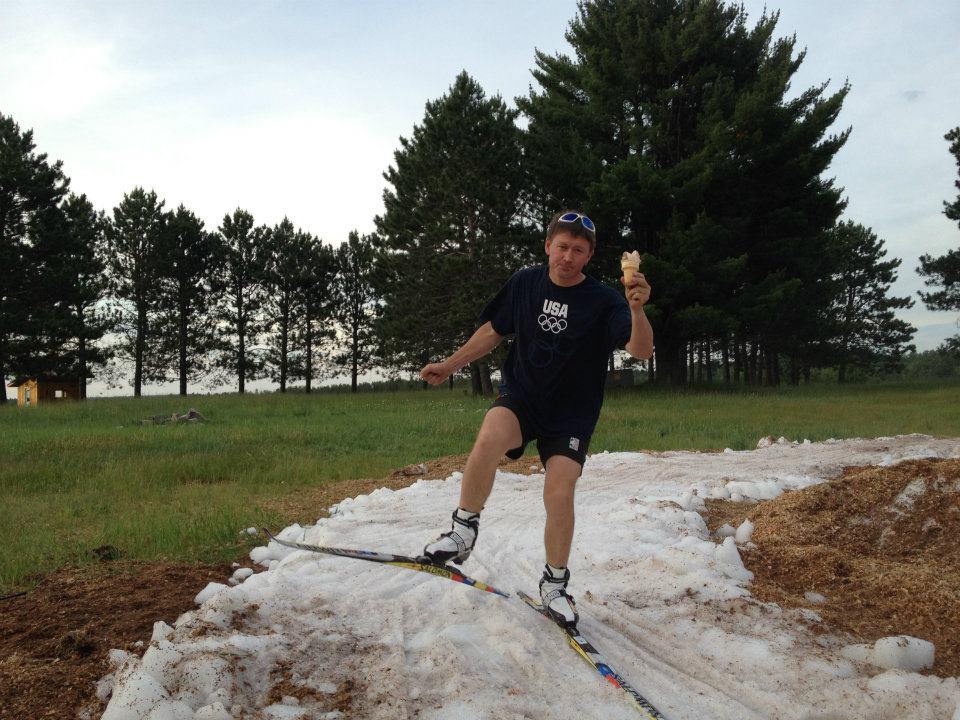
Coach Igor Badamshin having some fun on a few patches of snow. Photo is titled “Snowflakes, ice cream and Igor,” by former CXC Team elite coach Bill Pierce. Badamshin was the CXC program head coach until his unexpected death in January 2014. (Photo: cxcnewsfeed.wordpress.com)
“I’d hope I’d be maybe as analytical [as Cork],” he said. “I’m hoping I can be half as enthusiastic and motivating as Igor … I try to pull from all those guys and find out what works for myself and what doesn’t fit my personality. I would say I’m relatively soft-spoken and sometimes it’s a little bit harder for me to put myself out there. I hope I’ve gotten better at that.”
When it comes to managing athletes, Pierce will continue to write training plans for those that started with him at the beginning of the season, including Cory Ellertson, Chris Pappathopoulos, Andrew Brown, and Scott Johanik.
Keller said he’ll take on those that joined the team more recently and will be in Cable the next several months: the two postgrads and guest skier Leandro Lutz from Brazil, who plans to travel to Europe to try to qualify for 2015 World Championships.
As for coaching and waxing for 18 or so skiers throughout the season, Keller said that working alongside other Midwest clubs at races, especially at main events like U.S. nationals, should help. And not all the athletes will compete at the same events, given their varied focuses — from marathons to junior-qualifying races.
At the same time, Keller said he’s looking forward to having an assistant or some kind of helper in the future. Gusev said the new hire would largely help with junior camps.
In the last month since Pierce’s decision, he said he’d been working with Keller on the transition and will continue to offer assistance beyond his final day at the end of September.
CXC Team’s fall/winter crew during a recent workout in Cable, with postgrads Scott Harrison and Sam Boardman, and guest skier Leandro Lutz from Brazil, who will be joining the team for the next couple months. (Photo: CXC Skiing/Facebook)
“I’ve basically given [Keller] my daily responsibilities,” Pierce said earlier this month. That included even the little stuff, like “teaching him how to smooth out a trail and pick rocks and seeds.”
“There’s definitely a lot to catch up on as far as ski selection and things like that,” Keller observed. “Working with Rossignol, getting in contact with those guys, getting up to speed with things Bill might’ve taken care of as far as a team aspect and getting [ready] to compete.”
He’s also tasked with attracting sponsors through top results in Midwest marathons.
“We’ll do fine with that,” he said of his mostly marathon-focused team. “Our postgrads have goals of trying to make World Juniors … definitely a big one is qualifying for Junior Nationals and trying to make top-20 [there]. The goals for the marathon team is being on the podium or top 10 … that should be no problem.”
He’d also like to bring the CXC Team back to an “elite, elite” team, he said, by recruiting recent graduates.
CXC Para Nordic Team member Steve Baskis training with U.S. Paralympics Nordic Program in the ski tunnel in Torsby, Sweden, earlier this month. (Photo: CXC Skiing/Facebook)
According to Gusev and CXC’s mission statement, the 2,000-member organization has four straightforward goals: to build its base, promote the sport, achieve competitive success, and create partnerships through collaborations. The way he sees it, member athletes are part of that as well.
“[The CXC Team] athletes are in a community to be motivation to adult athletes at clinics, to be role models and whatever else comes with it,” Gusev said. “With competitive excellence, we hope to get them to the level [of someone like Garrott Kuzzy or Tad Elliott, who made the U.S. Ski Team]. We hope the athletes that come through our program will eventually contribute to international success…”
Emerging Adaptive Team
CXC is also focused on building its adaptive program under coach Andrew Poffenberger, another Minnesota native who skied as a junior and studied health fitness at Gustavus Adolphus College in St. Peter, Minn.
Augusto “Goose” Perez (sit-skier, cancer survivor, 2014 Paralympian)
John Oman (standing athlete, 2014 Paralympian)
“Emerging Talent” Program:
“People who have tried nordic skiing on several occasions and show promise, interest in competition, and commitment to the sport,” Poffenberger wrote. “This is an area where I am looking to grow in the next few months as people turn their attention from fall sports to winter.”
Junior Para Development: Focused on youth development and coaches interested in instructing adaptive skiers in high schools. “Our annual coaches clinic and certification will include a few sessions on adaptive nordic skiing for those interested this year,” he wrote.
This year, the CXC Para Team has expanded to include five elite athletes, four of which went to the 2014 Sochi Paralympics: Aaron Pike, Travis Dodson, Augusto “Goose” Perez, and John Oman. Its fifth member, Steve Baskis, a blind athlete and veteran, recently joined the U.S. Paralympics Nordic Team at an on-snow camp in Sweden.
Poffenberger also works with three “emerging talent” adaptive skiers — those “who have tried nordic skiing on several occasions and show promise, interest in competition, and commitment to the sport,” he explained in an email.
In addition, he coaches about four or five junior-development skiers, athletes that “can sit ski for 10 to 15 k in a session,” Gusev said. “Andrew’s done an amazing job with them.”
“Ideally we would like to mirror the development structure of able-bodied skiing,” Poffenberger explained. “Possibly the most important component of that structure is youth development. If we expect to be competitive at the highest level, we need to start developing young athletes.”
Among their efforts: CXC has submitted a proposal to include adaptive nordic at the Wisconsin state meet.
“We are also seeking out coaches who are willing and able to coach adaptive nordic skiing at the high school level,” he added.
Last week, Poffenberger attended a conference with The United States Association of Blind Athletes at the Olympic Training Center in Colorado Springs.
“I love working with these athletes because they have perspective of the entire picture, and don’t let small things stand in their way,” he said, now in his second season with the team.
“I hope we can keep having more and more individuals like [Poffenberger and Keller] that get involved with a sport as a profession,” Gusev said. “They understand the way athletes move from one stage to another stage and it’s easier for them to communicate with athletes at the younger level what expectations are. That’s really the goal.”
Dmitriy Ozerskiy of Russia out-lunges Tim Reynolds (Craftsbury Green Racing Project) to win the men's freestyle elite sprints at the American BIrkebeiner festival in Hayward, Wis., on Thursday.
All American Birkebeiner coverage is brought to you through the generous support of Concept2, makers of the SkiErg.
Birkie Elite Sprints are available to watch here (recorded live by CXC).
HAYWARD, Wis. – In theory, every high-level racer in downtown Hayward on Thursday should have been a distance specialist. With the 50 k American Birkebeiner in two days, one would have thought that’s what they were there for.
The 500-meter elite freestyle sprints proved otherwise, as 26 skiers zoomed up and down Main Street on freshly packed natural snow. Essentially, the single-elimination bracket left no second chances as racers attempted to master the art of going all-out.
Jennie Bender (CXC) celebrates her Birkie elite sprint victory on Thursday after beating Clare Egan (l) in the final.
Jennie Bender of Central Cross Country (CXC) demonstrated her sprint savvy with a powerful V2 alternate, first beating Rebecca Dussault, a two-time elite sprint winner and 2010 Birkie champion, formerly of CXC and now races for Salomon.
In the semifinals shortly after, Bender knocked out the reigning Birkie sprint champion, Natalia Naryshkina of Russia, who out-lunged Bender for first place last year.
Trailing Bender in this year’s semi, Naryshkina, who also races for CXC, cramped up and pulled back before the finish. Bender advanced to the final, where she topped Clare Egan of the Craftsbury Green Racing Project to claim the sprint victory and $500 dollars that came with it.
After the race, Bender said she felt a little over-raced and initially considered skipping the sprints.
“I was pretty tired this afternoon, and I was like, ‘Well, I’ll kind of go and see,’ ” she said. “I have a hard time saying ‘no’ to a sprint.”
In the end, she was glad she did the downtown sprints.
“I kind of needed today as a little bit of a tune-up,” Bender said. “I’ve been needing a kick in the butt to get going. Some speed will help me, I think, for this weekend.”
On Saturday, Bender will embark on her first 50 k Birkie skate race. She won last year’s classic race and set a course record in the 54 k at the American Birkebeiner.
As for the biggest hurdle in Thursday’s race, with a slightly downhill straight shot to a pylon and back, Bender said it was the sharp turn on the “super-slick snow.”
Women's podium at the American Birkebeiner's 500-meter elite sprints. (From left to right): Clare Egan (CGRP) in third, Jennie Bender (CXC) in first, Natalia Naryshkina (RUS/CXC) in third.
That made it hard to stay on your feet and even more difficult to do at high speeds.
“A lot of the sprints these days have an endurance component, but this is pure, fast-twitch muscles, all-out go,” Bender said.
Egan took the $250 second-place prize after beating Sara Hewitt (CXC) in the quarterfinal and Audrey Weber (Atomic) in the semi. In her first time racing an out-and-back short sprint, Egan said the technical aspect of making the tight turn was both crazy and fun.
“I’m usually not that successful in short sprint races, especially kind of flat ones just because there are a lot of people that are more powerful than me,” Egan said. “But I somehow made it around the pylons and my skis were really fast, and it just ended up working out today.”
She also found her lucky charm: a set of brass pigs, which she shook before the race. Teammate Susan Dunklee bought the trinkets in Austria and gave them to Egan to hold in her hand and shake for good luck.
“I kind of felt like I was in a slump recently and I realized it was because I hadn’t had my lucky pigs,” Egan said. “I definitely gave them a little shake before the race and I think that might have helped me.”
Naryshkina was third after beating Weber in the consolation round.
Russians Go to Work
In the men’s race, Dmitriy Ozerskiy of Russia dominated his competition, including his lone teammate at the Birkie, Maxim Fadeev. Ozerskiy was coming off a broken-pole mishap in Madison, Wis., which took him out of contention for the SuperTour freestyle sprint title last weekend.
Dmitriy Ozerskiy (RUS) at left edges Jari Joutsen (FIN) in a head-to-head semifinal round at the Birkie elite sprints in Hayward, Wis., on Thursday.
On Thursday, he topped the elite field of 17 men, edging Tim Reynolds (CGRP) in the final with one last lunge. Ozerskiy previously beat Finland’s Jari Joutsen in the semifinal with a similar photo finish.
After he eliminated Fadeev in the quarterfinal, his teammate immediately shifted gears to help him. Fadeev said he applied high-fluoro “Russian special liquid” on Ozerskiy’s skis, which helped make the difference.
“I like the short distance,” Ozerskiy said after V2-ing to the win.
“He’s a great sprinter for short distance in Russia,” Fadeev said. “If this format sprint was in Russia, I think that he would be first or second in the medals.”
Fadeev suggested that Ozerskiy could be of Olympic caliber in a sprint of similar distance. Ozerskiy started off strong, beating Morten Eide Pedersen (NOR/Lillehammer) in the opening round.
The men's podium at 2012 Birkie elite sprints. From left to right: Tim Reynolds (CGRP) in second, Dmitriy Ozerskiy (RUS) in first, Jari Joutsen (FIN) in third.
The runner-up of the day, Reynolds raced the Birkie sprints two years ago and said the turn at the end always made things interesting. Fortunately, he got around it fine.
After winning his first two rounds comfortably (first over Norway’s Halvor Korboel Thoner and later against Vegard Kjoes Egge of Lillehammer), Reynolds ousted Switzerland’s Philip Furrer by an inch. Reynolds was on the other side of the photo finish in the final.
“I thought I could get [Ozerskiy] and I just got a little squirrely at the end and lost a little bit of space,” Reynolds said. “Short course, you can’t make any mistakes.”
Joutsen placed third after topping Furrer, his friend and travel partner at their first Birkie, in the consolation round. Joutsen said he had fun but would have preferred a one-way sprint uphill to avoid the turn, which, “for a big guy, it’s very tight.”
“Your skis can [get] in the fence,” Joutsen said. “In the rollerski World Cup, they have this 200-meter to 300-meter sprint straightaway. It’s very interesting.”
CXC skiers Jennie Bender (l) and Natalia Naryshkina (r) lunge at the finish. Bender won the women's A-final of the SuperTour 1 k freestyle sprint in Madison, Wis., on Sunday.
All Madison SuperTour and American Birkebeiner coverage is brought to you through the generous support of Concept2, makers of the SkiErg.
MADISON, Wis. – At the first 90-degree turn on the four-corner course around Capitol Square, Jennie Bender almost came to a stop. Standing up, she scanned her three competitors in the women’s A-final at the SuperTour 1 k freestyle sprint on Sunday.
The Central Cross Country (CXC) Elite Team skier was looking for one in particular.
Bender eventually drew the response she was looking for out of Natalia Naryshkina, a Russian skier who trains with CXC. Naryshkina took the lead up the first and only hill, and Bender tucked behind.
The 24-year-old University of Vermont grad wasn’t going to make the same mistake again.
Bender conserved her energy behind Naryshkina, who won Saturday’s classic sprint by less than a boot length over Bender. Behind the Russian on the downhill, Bender followed her into the last turn and made her move to initiate the true race.
In a repeat from Saturday’s A-final, the two sprinted neck-and-neck to the line. There, Bender extended her right leg, and this time, she was pretty sure she had won. Bender had, just ahead of Naryshkina. Sara Hewitt (CXC) followed in third after edging Hannah Dreissigacker (Craftsbury Green Racing Project), who was fourth.
The women's freestyle sprint podium at the Madison SuperTour, from left to right: Natalia Naryshkina (RUS/CXC) in second, Jennie Bender (CXC) in first, Sara Hewitt (CXC) in third.
“It was definitely not a pretty thing,” Bender said of the finish. “Technique was all out for the last 100 meters there, but I definitely wanted it pretty bad today. No one likes being out-lunged.”
Naryshkina probably didn’t, but the Russian previously enjoyed winning the photo finish. She understood Bender’s tactics.
“I made an experiment running in first,” Naryshkina said through a translator. “Jennie Bender sat back and at the finish she was first. When you’re in first, you’re against the wind, and on the downhill it’s so much different than when you’re in second. … It’s more energy.”
She said her lower back hurt after Saturday’s double-pole races, and she planned to rest up for before skating the American Birkebeiner on Saturday. Naryshkina lives at Telemark Resort in Cable, Wis.
Last year’s classic Birkie champion, Bender said Sunday’s outcome was a result of her refined strategy. On Saturday, she tried to lead all of the heats, leaving her with little energy at the finish.
“I definitely feel the past races that I’ve been doing; I’m pretty tired,” Bender said. “So I decided to see if she’d lead. … She’s a really, really good sprinter so it’s fun to have someone to lunge with at the finish.”
With that 1-2 finish and Sara Hewitt’s best result of the season, CXC swept the podium. Hewitt, who lives in Canmore, Alberta, and joined CXC last summer, said she was happy with the performance after finishing eighth on Saturday.
“I had better tactics,” Hewitt said. “I was able to get behind the leaders and stick with them throughout the course. I didn’t push it too hard to try to go around and lead because I knew I needed to draft them on the downhill.”
Her game plan consistently played out, as Hewitt placed second in her semifinal after Bender and made the A-final. There, she said the pace was unusually slow, but joked she had little to compare it to.
“I was like, ‘Are all A-finals like this?’ but it was very definitely controlled,” Hewitt said. “I didn’t want to take the lead; I don’t think anyone really did.”
Skiing with teammates helped, although Hewitt said had not trained much with Naryshkina. She knew enough to keep behind the two on the last downhill and try to secure third rather than outsprint them.
Clare Egan (CGRP) won the B-final for fifth overall, ahead of CXC sisters Nicolette Amber and Olivia Amber in sixth and seventh, respectively. The second-fastest qualifier, Hilary McNamee (Maine Winter Sports Academy) was eighth after placing fourth in her semifinal to Naryshkina, Dreissigacker and Nicolette Amber, respectively.
Natalia Naryshkina of Russia, who skis with the help of CXC, edges Jennie Bender (CXC) at front by a foot in the A-final of the Madison SuperTour 1 k classic sprint on Saturday.
All 2012 Madison SuperTour and American Birkebeiner coverage is brought to you through the generous support of Concept2, makers of the SkiErg.
MADISON, Wis. – Two hours seems like a lot of time between qualifiers and heats, but when it comes down to it, sprints are sprints. They’re restless from start to finish.
Between the SuperTour 1 k classic races at the heart of Wisconsin’s state capital on Saturday, some athletes killed time by running around downtown. Others, like Natalia Naryshkina of Russia, looked for a new pair of skis.
After placing fifth of eight women in the qualifier, Naryshkina, who lives in Cable, Wis., decided to trade her classic boards for skate skis. On the four-corner loop around Capitol Square, there was no striding. Just double pole.
The switch meant convincing her Central Cross Country (CXC) support staff, including Igor Badamshin and Kevin Johnson, to wax her freestyle skis on the spot. Once grip-free, Naryshkina discovered she had much more success, placing second to Jennie Bender (CXC) in the semifinal to advance to the A-final.
There, Naryshkina made her double pole count and slipped her leg out ahead of Bender’s to win the classic sprint in a photo finish. The 27-year-old had tucked in behind Bender shortly after the start and waited for her moment to challenge her.
The women's podium at the Madison SuperTour classic sprints: 1. Natalia Naryshkina (RUS/CXC) at center; 2. Jennie Bender (CXC) at left; 3. Hannah Dreissigacker (CGRP) at right
Hannah Dreissigacker (Craftsbury Green Racing Project) worked her way to third from the outside lane and held her position to the finish. Hilary McNamee (Maine Winter Sports Center) was fourth in the A-final.
In a translated Skype interview, Naryshkina wrote that she jumped out from behind Bender and into another track at the beginning of the last straightway. The two proceeded to race even with one another, as Bender powered through the double pole and Naryshkina kick double poled to keep up.
“I just edged out Jennie by a foot throw,” Naryshkina wrote. “Very close race; Jennie is strong skier.”
Six years ago, Naryshkina lived about 10 miles from Madison in Verona, Wis. Racing there for the fourth time on Saturday, she was excited about the win.
“It’s important for me to win any sprint because I love sprints,” she wrote. “There is no 2nd place! Only 1st!”
Clearly disappointed after the A-final, Bender looked down as she poked the manmade snow with her pole. She had been the fastest women’s qualifier in 2:18.7, more than 6 seconds ahead of Dreissigacker in second and 6.2 ahead of McNamee in third.
Bender also won her semifinal against Naryshkina, who was second on skate skis. She used a similar tactic for the final: lead from the start and keep pushing.
“It was pretty close lunge at the end with Natalia,” Bender said. “Of course I wish I had that extra inch. … But it’s OK.”
Dreissigacker was lucky to make the A-final after she nearly missed the start. After beating McNamee and CXC’s Nicolette Amber and Sara Hewitt in the semifinal, Dreissigacker decided to run a lap around the snow-covered loop.
Start of women's A-final at Madison SuperTour classic sprint on Saturday: (from l to r) Natalia Naryshkina (RUS/CXC), Jennie Bender (CXC), Hilary McNamee (MWSC), Hannah Dreissigacker (CGRP)
She saw her teammate Clare Egan whiz into the last stretch of the B-final and knew she needed to be at the starting line. Egan went on to win, and Dreissigacker sprinted to the start on foot.
“I got to the line and I was shaking,” Dreissigacker said after having no option or time to jump in any lane but the outside.
While running wasn’t a problem – she likes to warm up with some jogging – Dreissigacker said it was a little more than usual.
“I had my adrenaline going before the race and during it,” she said.
That fueled her to a third-place finish she was satisfied with after arriving in Madison around 11 p.m. Friday night. Fresh off a biathlon trip in Canada, Dreissigacker said she was tired and had few expectations heading into the classic sprints.
“I’ve been feeling like I don’t have much speed in my legs so it was good,” she said. “It was a little speed workout.”
In the B-final, Egan topped Nicolette Amber, who was sixth overall. Olivia Amber placed seventh and Sara Hewitt was eighth.