From the FasterSkier archive — posts syndicated from athletes’ and coaches’ own blogs between 2004 and 2012, kept online as published. Current coverage is at fasterskier.com.
Nathalie von Siebenthal during the 2016 Davos, Switzerland World Cup. (Photo: Fischer/NordicFocus)
Switzerland’s top women distance skier Nathalie von Siebenthal announced her retirement Tuesday from elite level cross-country ski racing. According to the International Ski Federation (FIS), von Siebenthal took a break after the World Cup season and did not regain the motivation to continue.
“The decision to take a break in spring was really important for me,” von Siebenthal told FIS. “In autumn I felt like my body was ready to go fully into training again. After a few days however, I had to admit that neither my body, nor my mind wanted to continue. Now I am sure that resigning from the professional sport is the right thing to do for me.”
At twenty-six-years-old, von Siebenthal leaves the sport at a relatively young age.
She emerged at U23 Worlds in 2014 with an eighth place in the 7.5 k/7.5 k skiathlon. A year later at U23s, she placed third in the 10 k freestyle and won the skiathlon.
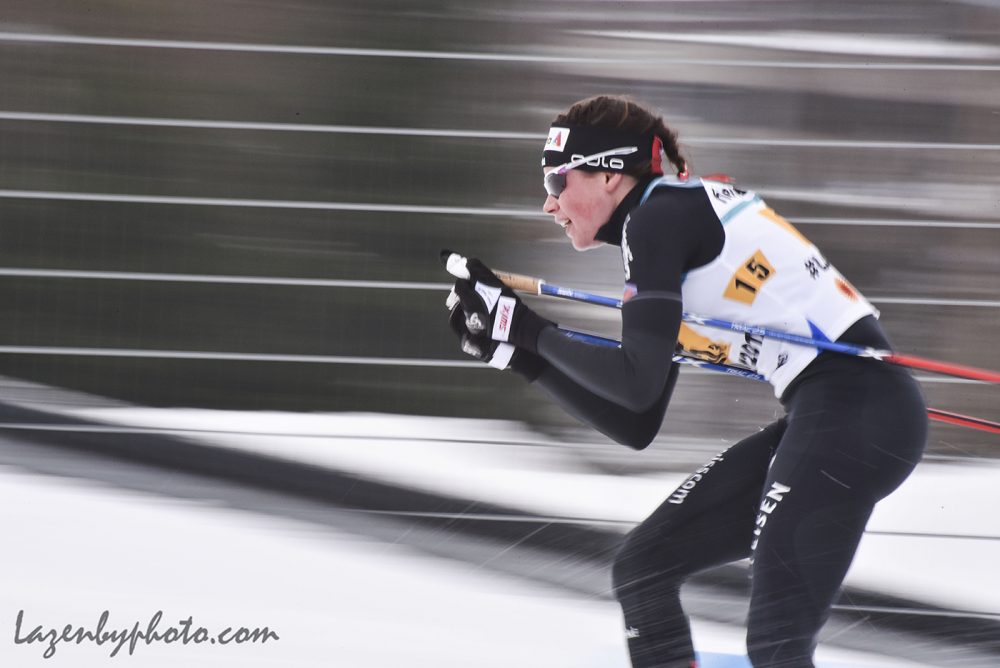
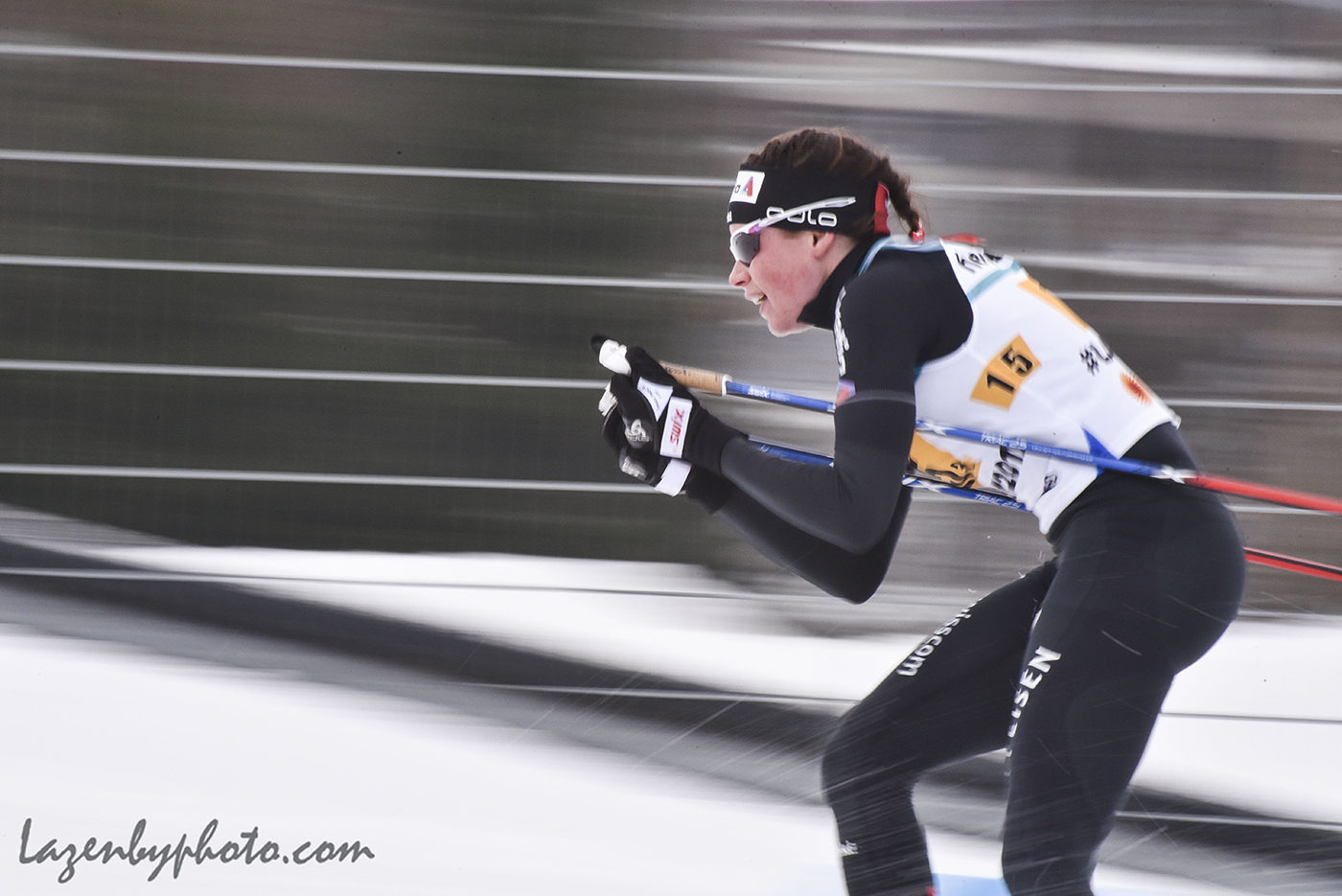
Switzerland’s Nathalie von Siebenthal racing the second-fastest third leg of the women’s 4 x 5 k relay at 2017 World Championships on March 2 in Lahti, Finland. Her team finished seventh. (Photo: John Lazenby/Lazenbyphoto.com)
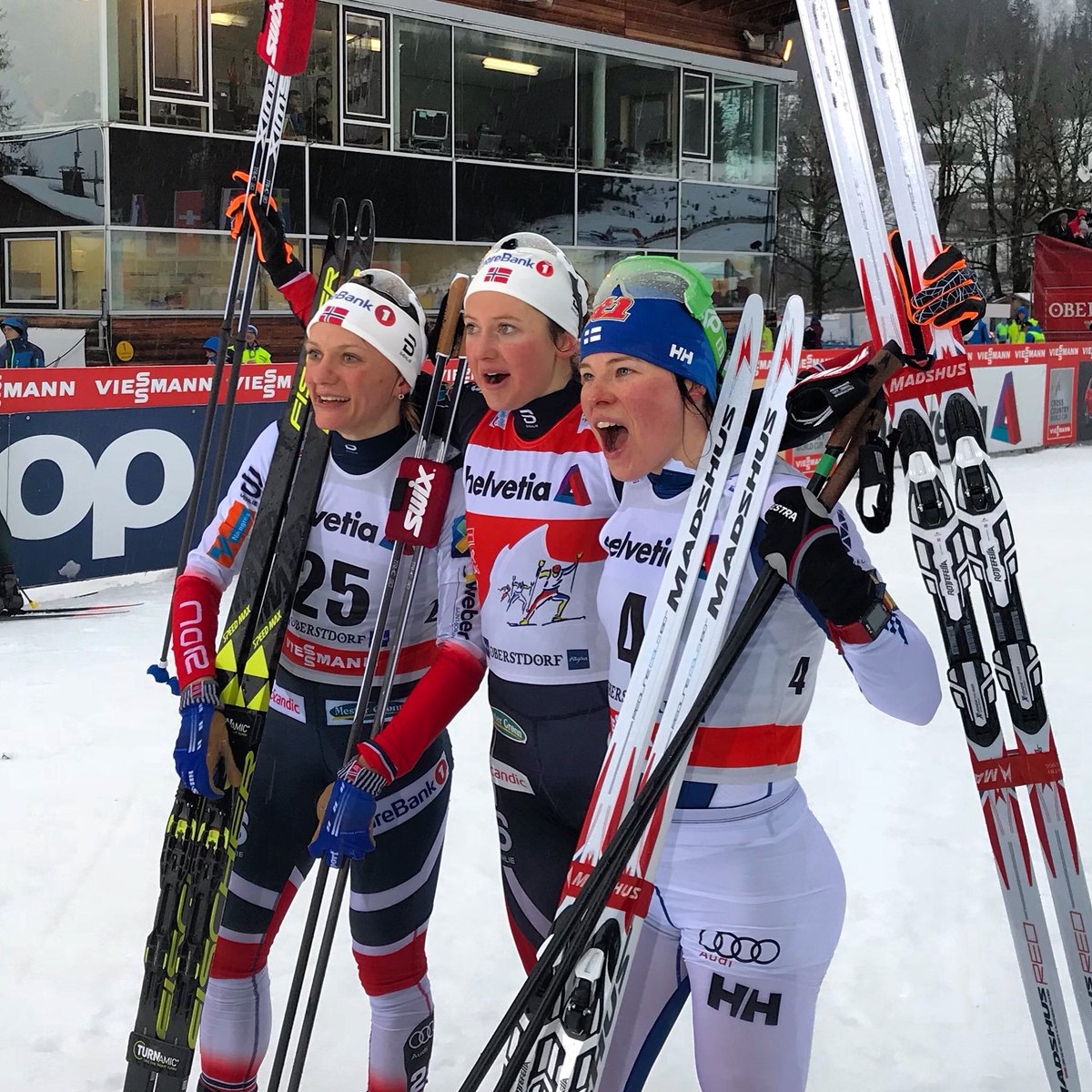
On the World Cup, she posted numerous top-ten results. Her best individual World Cup races were a fifth place in 2017 during the Davos 10 k skate, and a fourth during the 2018 10 k mass start skate in Oberstdorf, Germany – part of the Tour de Ski.
At the 2017 Lahti World Championships, she was fourth in the skiathlon. Most recently, von Siebenthal raced to seventh overall at the 2019 World Championship 30 k skate in Seefeld, Austria.
During the 2018 PyeyongChang Olympics, she was sixth in both the skiathlon and 10 k skate.
According to FIS, von Siebenthal raced on the World Cup for five seasons.
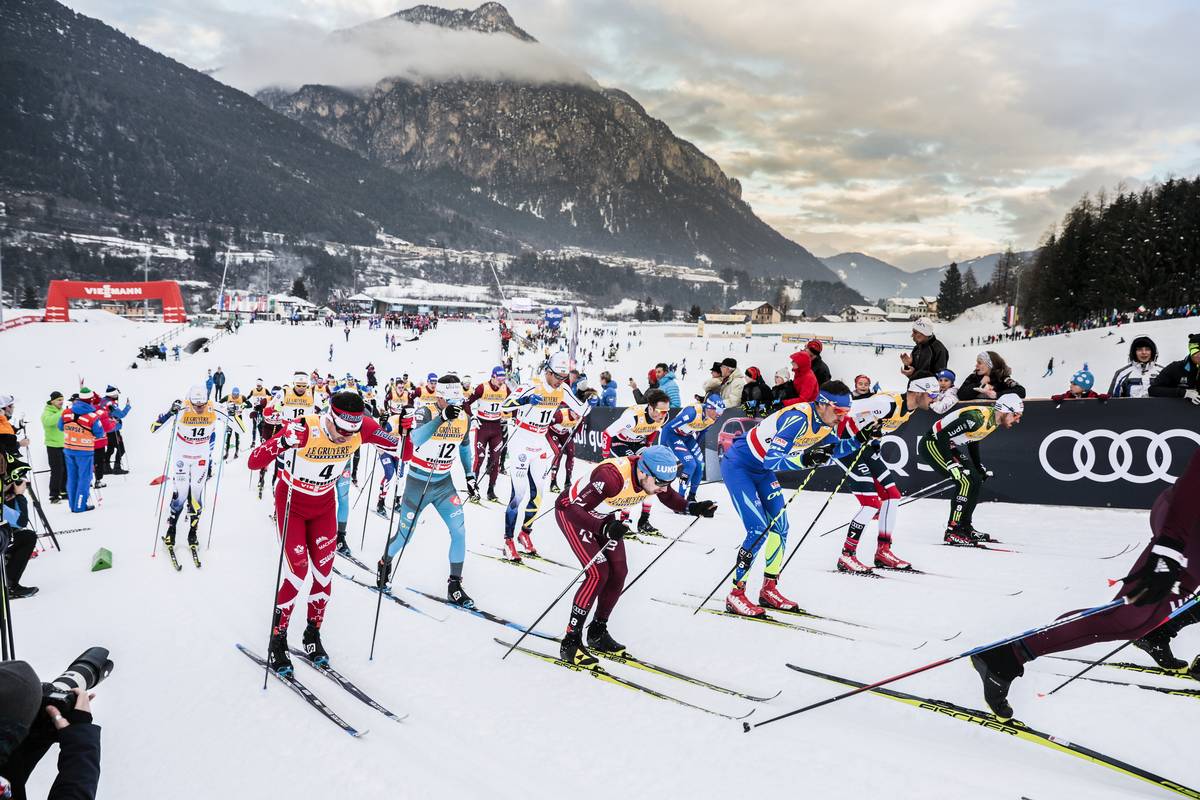
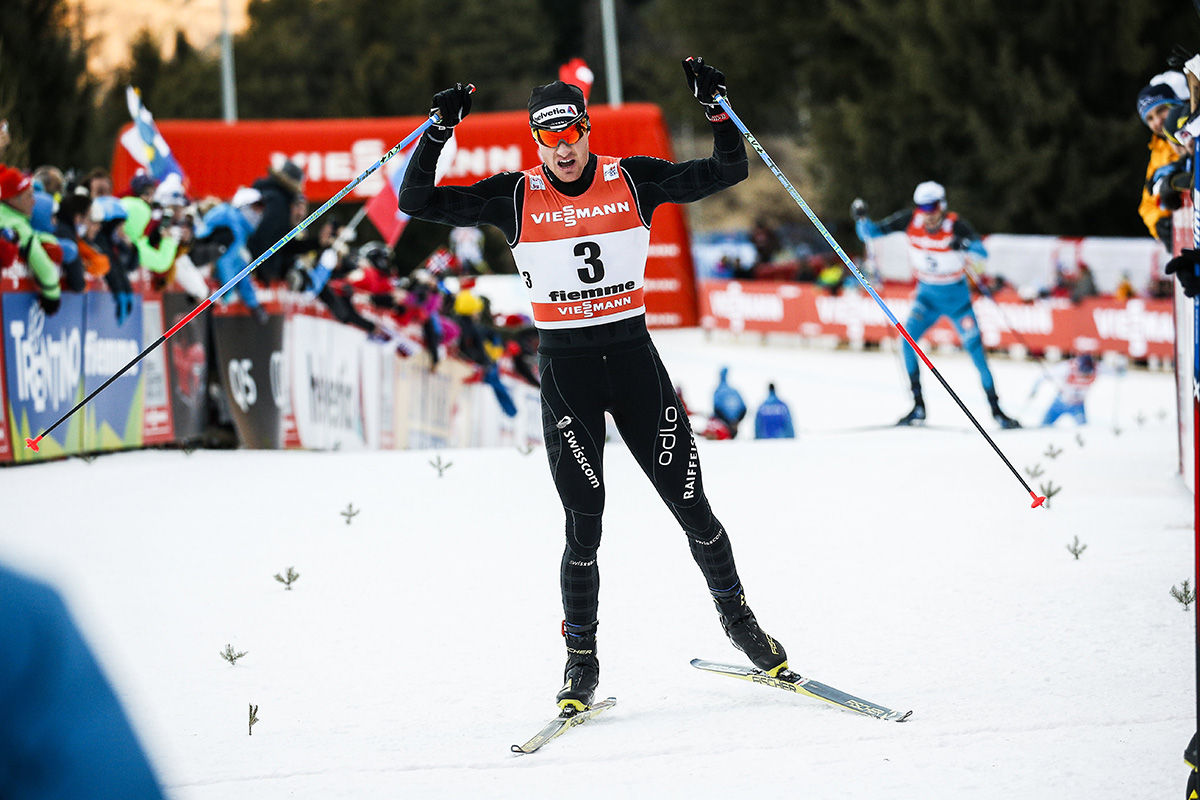
The start of the men’s 15 k classic mass start at Stage 6 of the 2018 Tour de Ski on Saturday in Val di Fiemme, Italy, with (front row, left to right) Canada’s Alex Harvey, Russia’s Sergey Ustiugov, Kazakhstan’s Alexey Poltoranin, Norway’s Martin Johnsrud Sundby, and Switzerland’s Dario Cologna. (Photo: Salomon/NordicFocus)
Beginning this Saturday in Toblach, Italy with a freestyle sprint is the 13th edition of the Tour de Ski (TdS). According to the International Ski Federation (FIS), over the course of seven stages the men will race 80.918 kilometers, the women 60.67 k.
The TdS has become both a staple and a spectacle of the annual World Cup calendar. With a jam-packed series of races primacy is placed on both the ability to recover well and wither less as the TdS transpires.
Prognostication can be tricky in a long-form template like the TdS. So much can go astray during seven races not to mention the travel and dicey germ-avoidance.
Last season’s winner on the women’s side, Heidi Weng of Norway, sits 18th overall in the World Cup standings (14th in distance). She has four top-20’s in the four distance events she’s contested with her best result an eighth in Lillehammer’s 10 k skate. Although featuring two sprints in the first three stages, the TdS remains a distance skier’s paradise.
Weng has skied solidly on the World Cup, but she has yet to show the form that made her a TdS overall winner in 2017 and 2018. Norway has won the last five iterations of the TdS: Marit Bjørgen won once in 2014/2015, Therese Johaug twice (2013/2014, 2015/2016), and Weng the last two years.
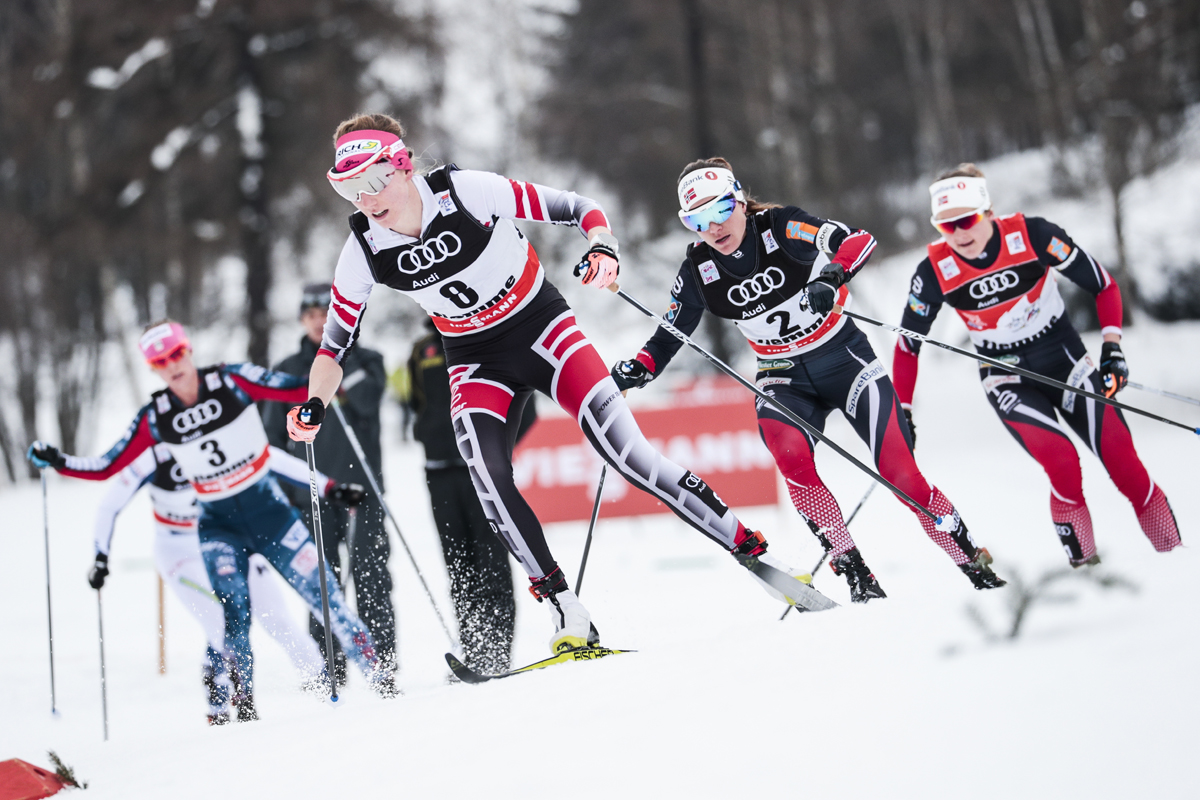
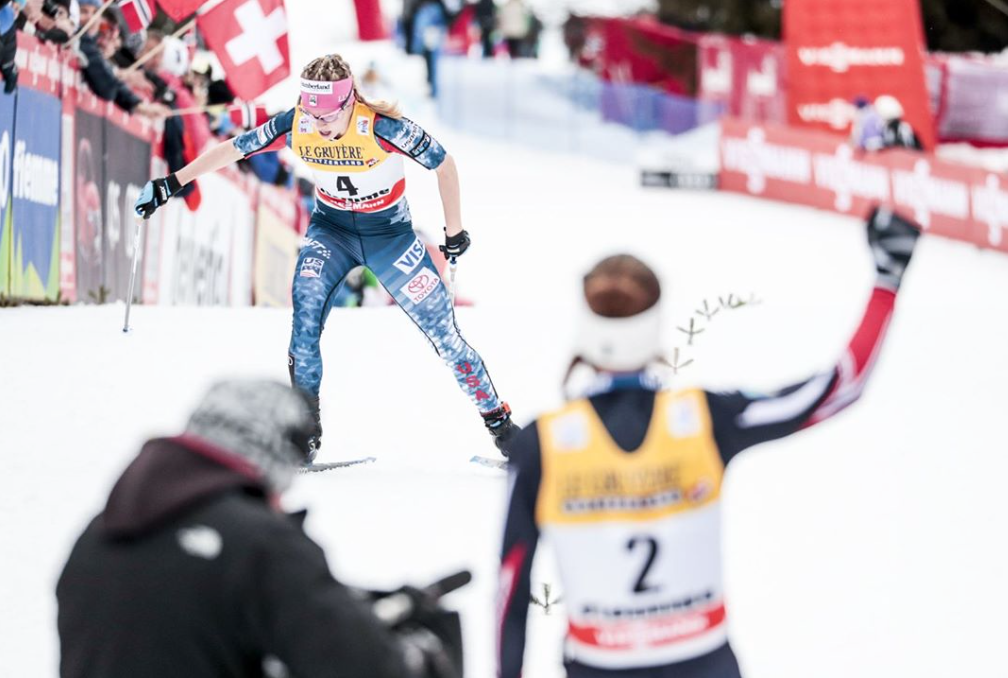
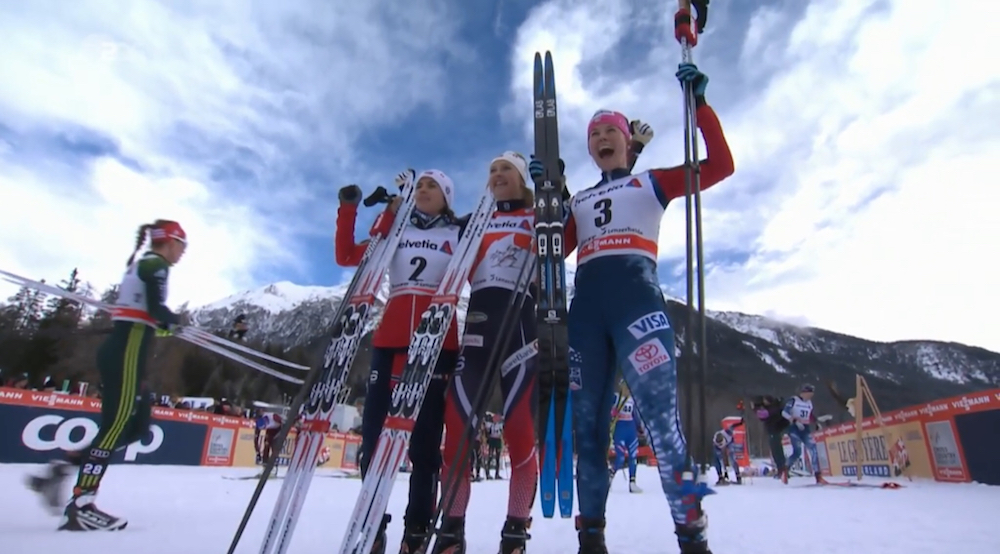
Austria’s Teresa Stadlober leads Norway’s Heidi Weng (2) and Ingvild Flugstad Østberg, American Jessie Diggins (3) and others around a downhill corner during the women’s 10 k classic mass start at Stage 6 of the 2018 Tour de Ski in Val di Fiemme, Italy. (Photo: Fischer/NordicFocus)
If Norway is to keep the streak alive, Ingvild Flugstad Østberg, last year’s TdS runner up, could be the heir apparent. She currently ranks second in the World Cup overall and 15th on the sprint list.
Johaug, having returned from an 18 month doping ban, has been on a distance race tear. She has won all five World Cup distance events this season. Johaug, however, will not be lining up for the TdS.
Only five different women have earned distance podiums this season — Johaug, Østberg, Sweden’s Charlotte Kalla and Ebba Andersson, and Finland’s Krista Pärmäkoski. Along with Johaug, Kalla and Andersson are skipping the TdS. (Andersson sits third overall on the World Cup, Kalla fifth.) With the TdS missing three of the five top ranked World Cup distance skiers, daily stages and the overall podium are up for grabs.
Last season’s third overall finisher, Jessie Diggins of the U.S. Ski Team (USST), often cites the TdS as a point in the season when her form trends towards podium performances. She sits eighth in the current distance standings and could very well have a stout TdS.
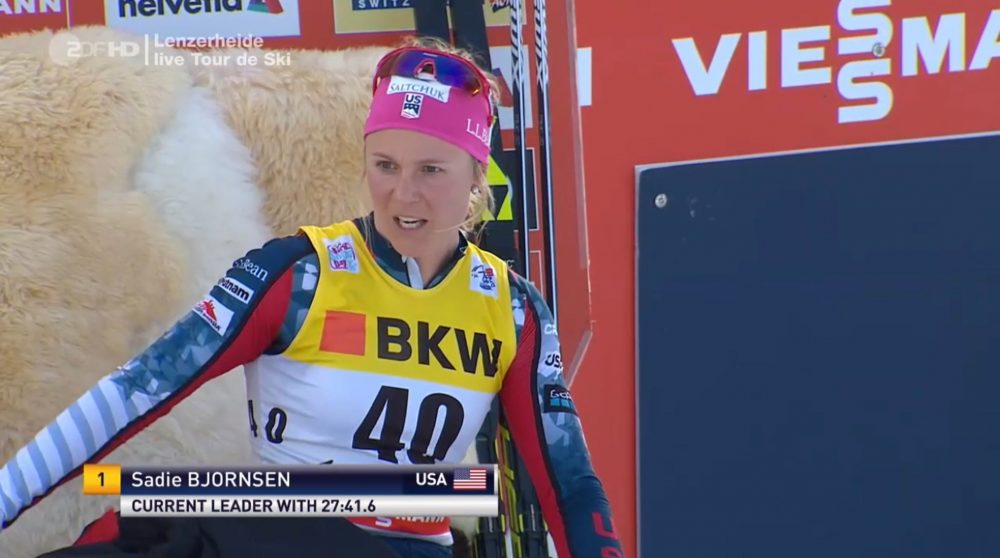
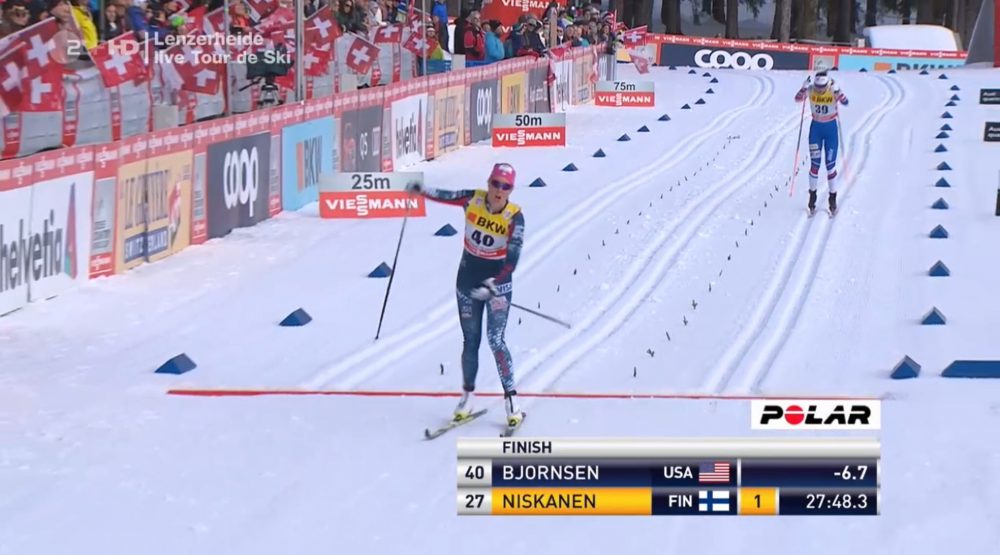
Russia’s Natalia Belorukova and Yulia Nepryaeva look strong as does Sadie Bjornsen (USST), and Austria’s Teresa Stadlober.
With less than predictable distance stage podiums for the women, it may simply come down to a drag race on the Alpe Cermis final climb Jan. 6.
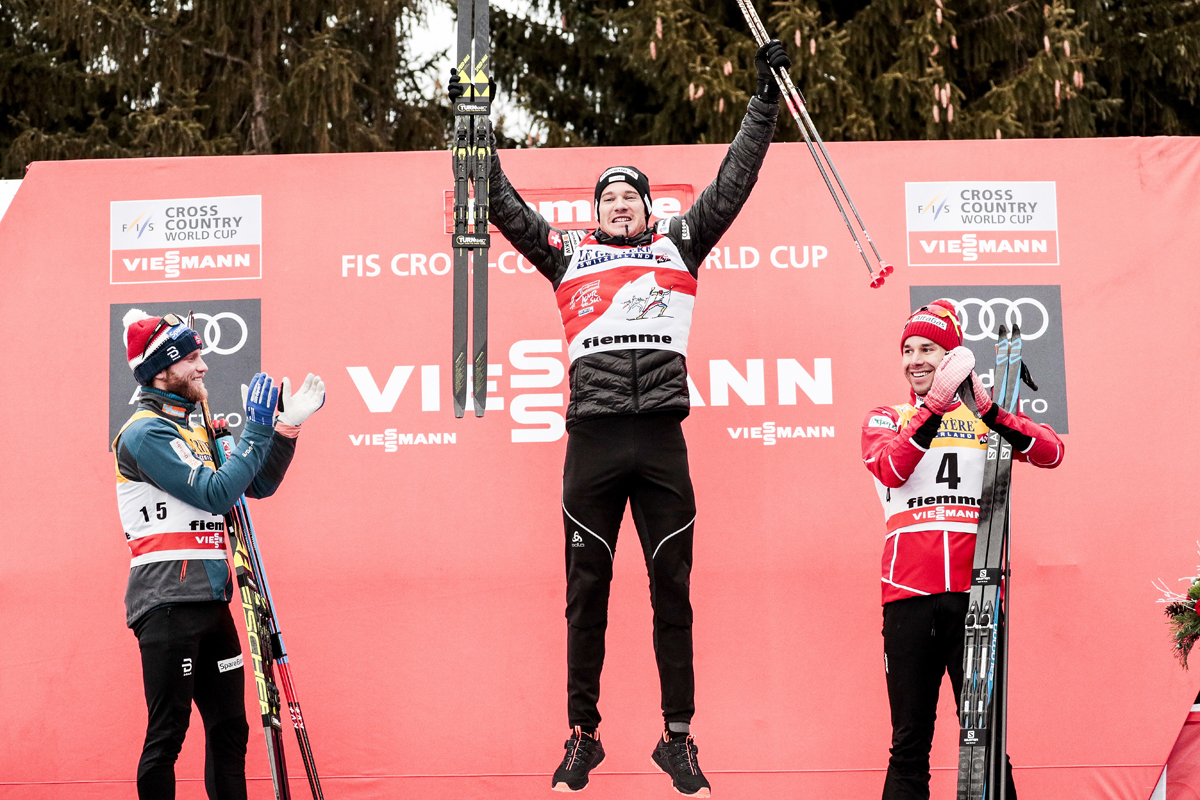
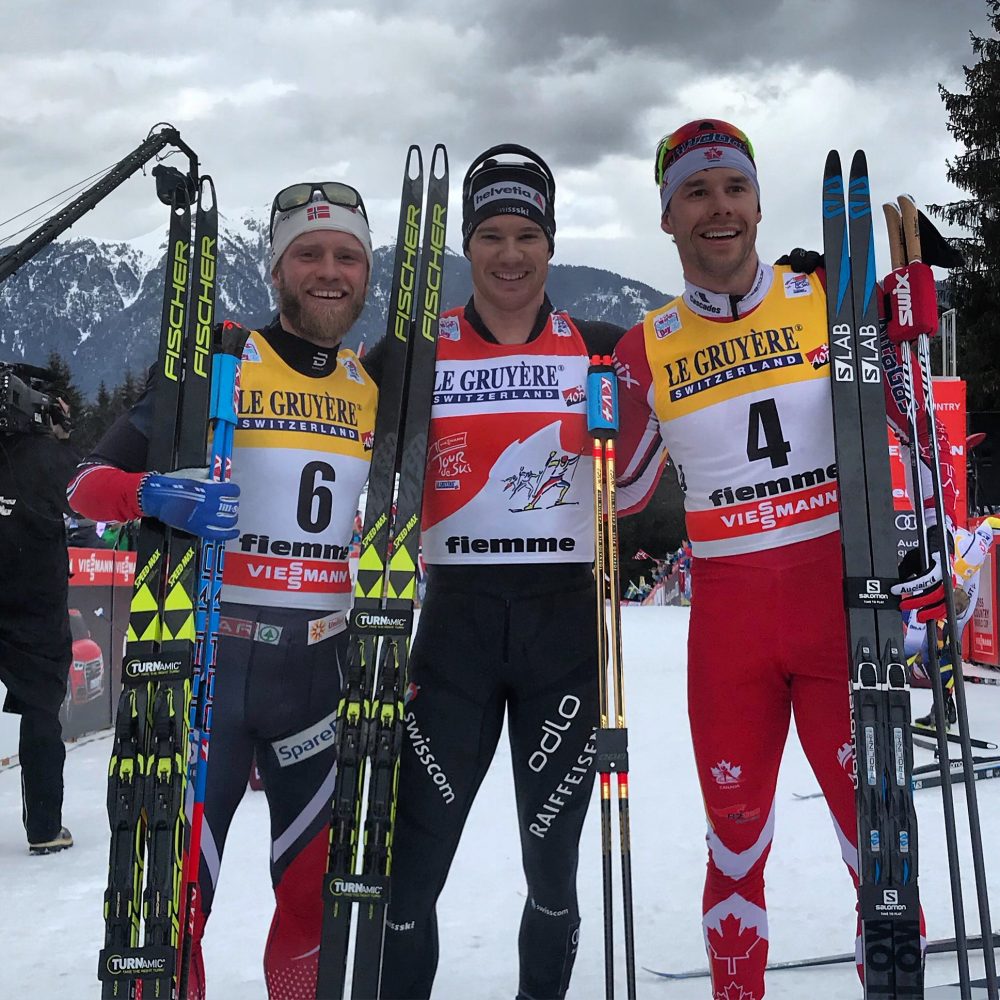
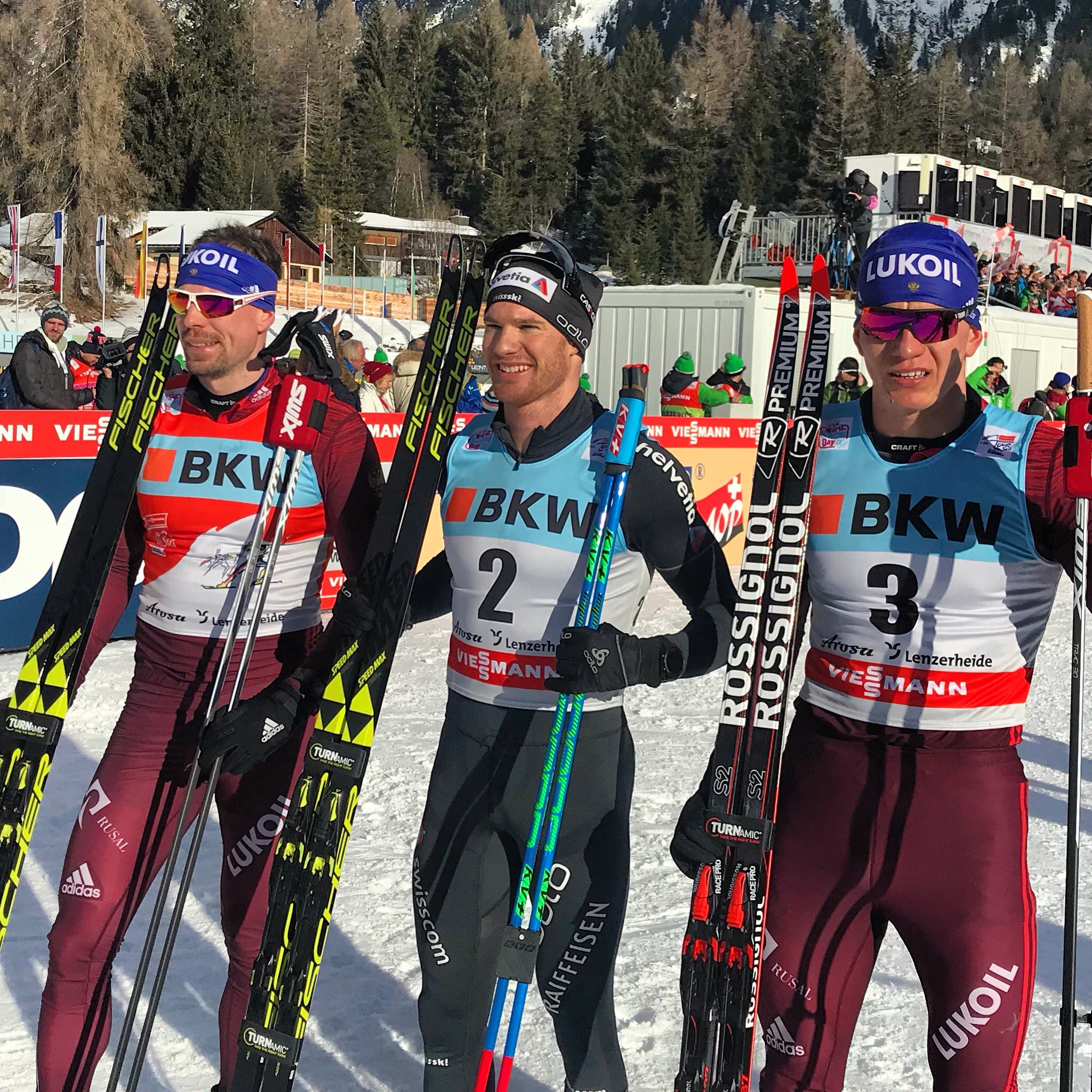
Switzerland’s Dario Cologna (c) celebrates his fourth Tour de Ski overall title. He was joined by Norway’s Martin Johnsrud Sundby (l) and Canada’s Alex Harvey (r) on the podium in second and third, respectively. (Photo: Fischer/NordicFocus)
The men’s scene is also open to interpretation. Last season’s TdS winner, Switzerland’s Dario Cologna, was in fact a surprise victor. Prior to Cologna’s stage two win in last year’s TdS, it had been nearly three years since the four time TdS overall winner had won a World Cup. Cologna sits 21st overall on the World Cup currently. Given last year’s resurgence, anything is possible for the Swiss skier.
Then there’s Martin Johnsrud Sundby form Norway. He finished on the TdS podium the last three years. At thirty-four-years-old, Sundby is ranked first on the distance list, with a second, a third, and a fourth place in distance races this season.
Sundby won the TdS on two occasions – in 2013/2014 and in 2016. His 2015 win was stripped after he tested positive for excessive levels of Salbutamol. He placed second in the past two Tours.
In a field rife with talent, Sundby’s ability to race and rebound and race and rebound will be tested. Sjur Røthe, Emil Iversen, and Didrik Tønseth— all from Norway— look in form. And there’s Norway’s Johannes Høsflot Klæbo. The winner of last season’s overall World Cup has had flashes of his past explosive self. He could be a TdS protagonist.
The men’s field is notably tight. Along with the Norwegians, several Russians could pop a podium, a stage win, and the overall. Russia comes with a loaded team ready to exploit. Alexander Bolshunov leads the overall World Cup – he’ll turn twenty two on Dec. 31st. He’s backed by teammates Evgeniy Belov, Andrey Melnichenko, and Denis Spitsov.
Canada’s Alex Harvey placed third overall last year and he looked stronger as the TdS progressed.
The Stages
Stage 1: Dec. 29, skate sprint in Toblach, Italy.
Stage 2: Dec. 30, 10 k/15 k skate in Toblach, Italy.
Stage 3: Jan. 1, skate sprint in Val Müstair, Switzerland.
Stage 4: Jan. 2, 10 k/15 k classic mass start in Oberstdorf, Germany.
Stage 5: Jan. 3, 10 k/15 k skate pursuit in Oberstdorf, Germany.
Stage 6: Jan. 5th, 10 k/15 k classic mass start in Val di Fiemme, Italy.
Stage 7: Jan 6th, 9 k final climb skate pursuit in Val di Fiemme, Italy.
Teams
United States
Women: Sophie Caldwell, Sadie Bjornsen, Jessie Diggins.
Men: Ben Lustgarten, Simi Hamilton, Erik Bjornsen, Kevin Bolger.
U.S. Ski Team Head Coach Chris Grover noted in a text that Caldwell, Hamilton, and Bolger will likely cease the TdS after the stage three sprint. Additionally, this is a small team for the U.S. at the TdS. Several athletes turned down TdS nominations including Scott Patterson (USST), Andy Newell (SMS T2/Salomon), Kyle Bratrud (SMS T2), Rosie Brennan (APU), Rosie Frankowski (APU), Caitlin Patterson (CGRP), and Julia Kern (SMS T2). These skiers plan on racing U.S. Nationals this January in Craftsbury, Vermont.
Canada
Women: Emily Nishikawa, Dahria Beatty
Men: Alex Harvey, Lenny Valjas, Bob Thompson
Norway
Women: Ingvild Flugstad Østberg, Maiken Caspersen Falla, Astrid Uhrenholdt Jacobsen, Kari Øyre Slind, Kathrine Rolsted Harsem, Heidi Weng, Lotta Udnes Weng, Tiril Udnes Weng Mari Eide, Anna Svendsen
Men: Martin Johnsrud Sundby, Hans Christer Holund, Emil Iversen, Didrik Tønseth, Simen Hegstad, Krüger, Sjur Røthe, Johannes Høsflot Klæbo, Martin Løwstrøm Nyenget, Eirik Brandsdal, Finn Hågen Krogh
Russia
Women: Yulia Belorukova, Lidia Durkina, Anna Zherebyateva, Mariya Istomina, Natalia Nepryaeva, Anna Nechaevskaya, Anastasia Sedova, Elena Soboleva
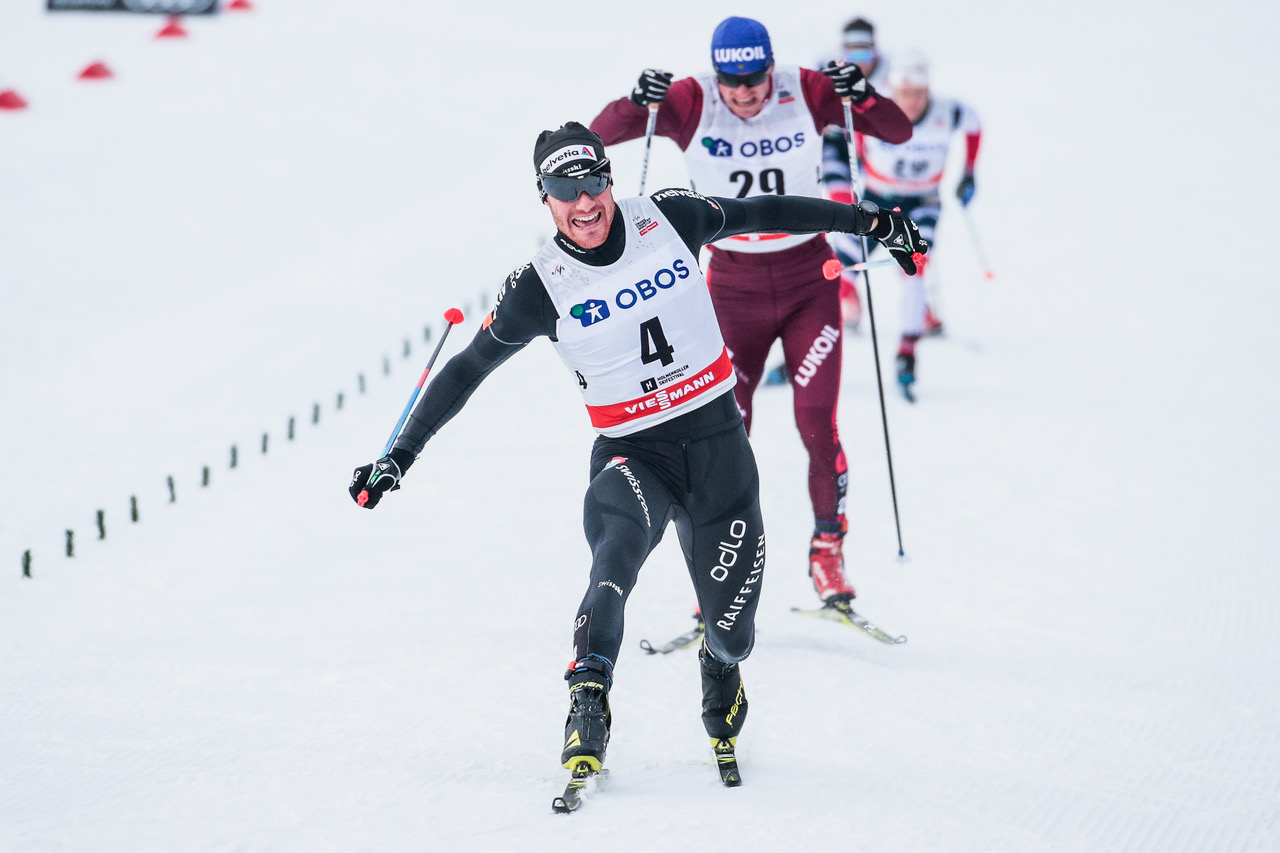
The photo finish for first between Switzerland’s Dario Cologna (near) and Norway’s Martin Johnsrud Sundby at the 2018 Holmenkollen 50 k freestyle mass start in Oslo, Norway. Cologna got it by 0.01 seconds. (Photo: FIS Cross Country/Twitter)
Welcome to FasterSkier’s World Cup Preview, where we check in with the top-10 teams from last year’s FIS Cross Country World Cup tour before the season starts with the Ruka weekend in Kuusamo, Finland, on Nov. 24 with a classic sprint.
***
Switzerland
Overall in Nations Cup Last Year: 6th
Women’s Ranking 2017/2018: 7th
Men’s Ranking 2017/2018: 4th
However lopsided Switzerland World Cup profile appears – think Dario Cologna prime time all the time – the team is more than a set of shoulders to carry its star. Certainly, Cologna can steal the show, as his return to form last season proved, but the Swiss collective of athletes proved their World Cup mettle in 2017/2018.
Twenty-five-year-old Nathalie Von Siebenthal arrived on the World Cup in-form. In Ruka, the start of last year’s World Cup, she placed sixth in the 10-kilometer freestyle pursuit. Between Ruka and the Olympics, Siebenthal raced to numerous top-10’s in distance events while placing eighth overall in the Tour de Ski (TdS).
Switzerland’s Nathalie von Siebenthal racing the second-fastest third leg of the women’s 4 x 5 k relay at 2017 World Championships on March 2 in Lahti, Finland. Her team finished seventh.
In PyeongChang, Siebenthal was able to bring the Swiss team near the front of the women’s distance race pack. In the 15 k skiathlon, Siebenthal placed sixth overall, 2.9 seconds behind fifth place Jessie Diggins (USST) who was dialed for a stellar Games. In the individual start 10 k skate, Siebenthal again was sixth.
Nadine Fähndrich, at twenty three years old, should help the Swiss women’s team build upon last year’s solid performance. By season’s end, Fähndrich was ranked 21st on the sprint list and 31st on the distance list. She finished 27th overall on the World Cup.
The Swiss women’s team gets deeper. There’s veteran skier Laurien van der Graaf who had several top-10’s on the World Cup and Olympics. She won the Lenzerheide, Switzerland and Seefeld, Austria skate sprints, was the fifth ranked sprinter in the world last season, and 21st overall.
Cologna is back: Second in the final overall standings, first in distance. Let’s just say he’ll round out an already well-rounded Swiss team.
Jovian Hediger, at twenty-seven, will take some of the pressure off Cologna when it comes to the Swiss men’s expectations. He finished the season ranked 19th in the sprint cup.
Left to right: Finland’s Krista Pärmäkoski in second, Norway’s Marit Bjørgen in first and Sweden’s Stina Nilsson in third after the women’s 30-kilometer classic mass start at the 2018 PyeongChang Olympic Winter Games in South Korea. (Photo: Noah Hoffman)
PYEONGCHANG, South Korea — In the final stretch, the familiar Marit Bjørgen ceremony went down with no other skiers in sight and the Norwegian flag in her hand. The 37-year-old five time Olympian and mom is leaving these Games as the winningest Winter Olympian in history.
Prior to Bjørgen, Norwegian biathlete Ole Einar Bjørndalen was the most decorated Winter Olympian with 13 medals total. After earning a bronze in the Pyeongchang team sprint, Bjørgen surpassed Bjørndalen’s medal total by one. She added gold to her collection on Sunday after taking the win in the women’s 30-kilometer classic mass start. All told, Bjørgen now has 15 Olympic medals, eight of them gold.
Norway’s Marit Bjørgen on her way to gold during in women’s 30 k classic mass start, the last race of the 2018 Olympics in PyeongChang, South Korea. (Photo: Scott Patterson)
She claimed the win in the final race of the Olympics in 1:22:17.6 hours. Finland’s Krista Pärmäkoski claimed silver (+1:49.5) and Sweden’s Stina Nilsson earned bronze (+1:58.9).
Finishing just 1.5 seconds behind Nilsson and out of the medals ceremony was Norway’s Ingvild Flugstad Østberg in fourth (+2:00.4), Swednen’s Charlotte Kalla placed fifth (+2:57.2), ahead of Finland’s Kerttu Niskanen in sixth (+3:01.6).
American Jessie Diggins closed out her 2018 Winter Games in seventh (+3:37.2), while Norway’s Heidi Weng finished in eighth (+4:07.9). Austria’s Teresa Stadlober ended up ninth (+4:14.1), after skiing in second until a game-ending turn onto the wrong course, and Japan’s Masako Ishida claimed 10th (+4:20.8).
The 30 k classic is Bjørgen’s race. She’s masterfully dominant in the technique and peerless in the distance. In the post-race press conference, Bjørgen words about the women’s ultimate distance race were succinct.
“I think it’s easier to do a good 30 k when you are getting older,” Bjørgen said of her years of training load and its impact on distance preference. “You have lots of training behind you. I have ten years more training than Krista [Pärmäkoski], so then I think it’s a little bit different to do a 10 k than 30 k. I knew that this was my distance also. Today we can see.”
Here’s what we saw: A powerfully rhythmic Bjørgen pull away from an already diminished field. Her force of nature skiing began around 8 k, and by 11.25 k, barring any mishap, her 15th gold was secured.
“I wanted to try to be high speed from the beginning,” Bjørgen said. “I had perfect skis so I can do my technique very good, so I could relax on skis. After seven and a half kilometers, I looked behind me and see it was two, three girls behind me and I tried to push more. Also, after the longest downhill, I had five seconds. Then after one lap I had ten. I knew I had to speed up more, and I heard I had twenty and then thirty. Then I knew that this is my day. I have to ski well and then have all the speed ups. I had the good feeling in my body.”
Marit Bjørgen on the shoulders of her Norwegian teammates after winning the women’s 30 k classic mass start for her eighth-career Olympic gold medal in the last race of the 2018 Olympics in PyeongChang, South Korea. (Photo: Noah Hoffman)
Bjørgen made her Olympic debut at the Salt Lake Games in 2002. There, she won a single silver medal in the 4 x 5 k relay (with Bente Skari, Hilde Pedersen, and Anita Moen. She was 22 at the time). Bjørgen then went on to compete in the 2006 Torino Games, coming away once again with another silver — this time in the 10 k classic. Over the next three Olympics, Bjørgen amassed 13 more medals, eight of them in individual events.
Recognizing the relatively young talent around her on the podium (Pärmäkoski is 27 years old and Nilsson is 24), Bjørgen understood that as she steps down, others are primed to take her place.
“I had my best years from 30 to 37, and she is still not there so I think we will see lots of Krista in the future,” Bjørgen said.
While Bjørgen’s Olympic career is through, she left the door open for competing in the 2019 World Championships this time next year in Seefeld, Austria. Before departing PyeongChang, Bjørgen was in the Olympic limelight one last time as the Norwegian flag bearer in Sunday’s Closing Ceremony.
For more details on how Sunday’s 30 k transpired for silver and bronze, complete with quotes, check out our race rundown.
North Americans Led by Diggins in 7th
American Diggins has already proved a point in PyeongChang: the big stage is hers. She placed fifth in the 15 k skiathlon, fifth in the 10 k skate, sixth in the classic sprint, fifth in the 4 x 5 relay, and first in the team sprint. Bar none, she produced the most-consistent and high-placing run of results any U.S. cross-country skier to date.
American Jessie Diggins racing to seventh in the women’s 30 k classic mass start on Sunday at the 2018 Olympics in PyeongChang, South Korea. (Photo: Scott Patterson)
Coming into the stadium for the first time during Sunday’s 30 k classic, Diggins again was in the medal hunt. The American took a rare fall on the course’s hallmark technical downhill, setting her for a lung-burning chase back to the lead pack.
“Not everything went according to plan. I rolled my boot in the slush in a nice little crash and had to sprint for a while to get back to the pack,” Diggins told FasterSkier after.
She managed to regain her place at the front within the following lap at 7.5 k. Between 8.3 k and 11 k, a gap slowly opened up in front of Diggins that included Kalla, Niskanen, Pärmäkoski, and Stadlober.
“I spent the rest of the time in no man’s land chugging away,” she reflected. “I felt like I was just sprinting the entire time. I was proud of that. I didn’t give up. I didn’t say, ‘OK, I don’t have a chance to medal, I’ll just screw around out here.’ I really gave it everything I had, and I kept pushing myself.”
The second American on Sunday was Sadie Bjornsen ten places after Diggins in 17th (+6:32.6). Bjornsen said her race was a mixed bag of what she called “good and bad.”
American Sadie Bjornsen on her way to 17th in the women’s 30 k classic mass start at the 2018 PyeongChang Olympics in South Korea. (Photo: Noah Hoffman)
“I tried to stay with the group at the beginning and went on too slick of skis which just exploded myself,” Bjornsen reflected. “Took me a solid 7.5 k to get myself back to together. It was certainly very fun there the last 15 k. Nothing really felt good about it … But I definitely am really happy with the way that I finished that race and digging deep until the end. It was a fun 30 kilometers of suffer fest.”
Like her race, Bjornsen’s second Olympics was a bit of a rollercoaster with a top individual result of 14th in the classic sprint (she also placed 15th in the 10 k freestyle).
“A collection of feelings throughout the Games,” she said. “It was certainly really a bit of a heartbreak to not make the team sprint. Took a little bit of an emotional toll there for a few days. Then to have the medal, that definitely brought it back to nothing but positive vibes.
“It’s a great feeling to walk away with,” Bjornsen continued. “Who knows if I’m coming to the next [Olympics], but if I am coming to the next one, I definitely have some higher goals and some higher hopes. I certainly learned something here.”
Rosie Frankowski (l) leading her American teammate Caitlin Patterson during the women’s 30 k classic mass start on Sunday at the 2018 Olympics in PyeongChang, South Korea. In Frankowski’s first Olympic race, she placed 21st. (Photo: Scott Patterson)
Following Bjornsen’s finish, American Rosie Frankowski finished 21st (+8:53.8). The Minneapolis, Minnesota, native found out three days ago that she would be starting Sunday. Beaming with an ear-to-ear grin after Sunday’s mass start, the 26-year-old Frankowski exuded energy and effervescence after her first Olympic race.
“I was crazy. I didn’t expect, honestly, to feel that good and just keep jamming and going,” Frankowski reflected of her top-30 performance. “I told [my coach Erik] Flora that I was going to start easy, and he just nodded, because I say that every race and I never start easy.”
Frankowski skis for Anchorage’s Alaska Pacific University (APU) under the guidance of head coach Erik Flora. Flora was in PyeongChang as a U.S. coach and provided Frankowski with sage advice as she headed into her first world-caliber race (Frankowski has never competed at the World Cup or World Championships level).
“Honestly, Flora was like, ‘Win or lose, you’re racing in the Olympics,’ ” Frankowski reflected. “My one goal for the whole day was just to finish smiling. I honestly can’t tell you, when I came down that downhill on the last lap, it was so cool. That feeling, and when you’re hyped to have done a 30 k, and to know like you just raced in the Olympics and no matter what your result is, that’s just incredible. I can’t describe that feeling.”
American Caitlin Patterson on her way to 27th in the 30 k classic mass start at the 2018 Olympics in PyeongChang, South Korea. (Photo: Noah Hoffman)
American Caitlin Patterson placed 26th (+10:26).
“It was solid. 30k is such a long race,” Patterson said. “There are ups and there are downs. I guess I’m still processing it a little bit. I’m pleased with the effort that I put out there, I felt like I was working really hard, especially in the middle and second half. I was a little frustrated that all that hard work wasn’t really catching anybody. But overall it was good. It’s still really cool to race here.”
For Canada, Emily Nishikawa led the way in 30th (+12:14.1). She was followed by Cendrine Brown in 43rd (+19:06.3), as Anne-Marie Comeau did not finish.
“It was really tough out there today. I had first good two laps, and then I started feeling low on energy and it was getting harder to kick my skis,” Browne said. “But it was really important for me to keep going no matter what. I’m at the Olympics right now so it wasn’t even a question for me if I wanted to stop or not. I just wanted to keep going.”
The 30th place finish is Nishikawa’s best individual Olympic performance.
— Alex Kochon, Harald Zimmer and Gerry Furseth contributed
An emotional Marit Bjørgen after winning the last race of her Olympic career, the women’s 30 k classic mass start, on Sunday at the 2018 Olympics in PyeongChang, South Korea. (Photo: Noah Hoffman)
Norway’s 27-year-old Ragnhild Haga racing to gold, her first Olympic medal, in the 10 k skate at the 2018 Olympics in PyeongChang, South Korea. (Photo: FlyingPointRoad)
FasterSkier would like to thank Fischer Sport USA, Madshus USA, Concept2, Boulder Nordic Sport, and Swix Sport US for their generous support, which made this coverage possible. PYEONGCHANG, South Korea —Be honest. Who chose Norway’s Ragnhild Haga as Thursday’s gold medal favorite?
In pre-race hearsay, the 26 year old seemed an outside shot for the win. On the Olympic stage, other names openly circulated the 10-kilometer freestyle race. Sweden’s Charlotte Kalla was one.
The 30-year-old Swede had already proven her form — and Olympic intent — by opening the 2018 Pyeongchang Winter Games with a skiathlon win. Even with that hardware tucked away, Kalla was by no means overzealous to have her sights set on another distance gold medal. She’s well known on the World Cup for her 10 k podium performances. Two Olympic cycles ago, she collected gold in the Vancouver 10 k skate race.
If not Kalla, then the Norwegian name ‘Marit Bjørgen’ was certainly heard. Haga’s teammate, Bjørgen, has been first or second in all but five World Cup 10 k skate races she’s entered over the past decade. At the Vancouver 2010 Winter Olympiad, the Norwegian finished two places behind Kalla to take the 10 k freestyle bronze.
Sweden’s Charlotte Kalla racing to second at the 2018 Olympics in PyeongChang, South Korea. (Photo: FlyingPointRoad)
After Kalla and Bjørgen, another name to consider was Norway’s Ingvild Flugstad Østberg. At one time perhaps considered a sprint specialist, Østberg is more a cross-country all-arounder. She has three 10 k freestyle World Cup wis, one from 2016 and two from this season.
Add to the medley Finland’s Krista Pärmäkoski, who, with numerous second and third place 10 k World Cup podiums, was plenty hungry to take a freestyle win (she earned her first 10 k classic victory earlier this year in Planica, Slovenia). Another name tossed around in the stands and over the loudspeaker was Jessie Diggins of the U.S.A.
Prior to PyeongChang, Diggins made it palpably clear twice, if not more, that striving for a medal is a goal of hers at these Winter Games. Her gutsy win the Seefeld 10 k freestyle mass start — the final World Cup event before the 2018 Olympics — was the first performance nod to the direction she hoped to head in South Korea.
Her second sign off came in a Jan. 29 blog post titled “Brave Enough”.
Jessie Diggins after placing fifth in the women’s 10 k freestyle at the 2018 Olympics in PyeongChang, South Korea. It was her second top-five and her third top-six of the Games. (Photo: FlyingPointRoad)
In that post, Diggins makes it clear that it is not necessarily whether the suitcase she packs at the end of the games includes a gold, silver, or bronze disc strung with blue-ribbon. It is the idea that as she watches the smoke clear from the closing ceremony’s firework display and stands to depart the 2018 Olympic venue, she leaves knowing that she went after that prize the best that she could.
“I want to know that I was brave enough to want it,” she writes, of achieving the first women’s cross-country Olympic medal.
In the line just before, she writes, “I know it’s not impossible, after all.”
A 2015 World Championships silver medalist in the 10 k freestyle and known for her ability to grind through grueling uphills in skating events to the top of the field, it would be imprudent to say that Diggins was not a medal contender. By the start of Thursday’s 10 k, the 26-year-old Afton, Minnesota, native had securely nailed a spot in the polls. No one was pulling your ear.
Not necessarily in the predictions was Haga — until the Norwegian’s stats were pulled up on paper. In 10 k freestyle events, Haga has had seven top-five World Cup performances. Three of those were podiums (second or third place) that came in the past two months.
Still, while Haga has been racing the World Cup since 2010, none of those eight years produced an outright win. The Norwegian’s best performance to date was in this year’s Ruka 10 k pursuit, where she finished with the top time of day. The PyeongChang Games mark Haga’s Olympic debut and Thursday’s 10 k skate is her second only Olympic race. Last Sturday she crossed 15th in the skiathlon, which she personally described as “just a bad day.”
“It is easy to get a little bit uncertain about my shape and skis and everything,” Haga said during a press conference after Thursday’s 10 k. “We didn’t know exactly what happened, but I just tried to put it behind me.”
Norway’s Marit Bjørgen racing to a tie for third with Finland’s Kris Parmakoski (not shown) in the women’s 10 k skate in the PyeongChang Games. (Photo: FlyingPointRoad)
Redemption came knocking. Haga covered Thursday’s 10 k course in a time of 25:00.5, which put her in the leaders chair, and later, the top of the podium with gold.
Haga didn’t start the day as number 1, but in bib 50, exactly two minutes ahead of Kalla.
At first, Kalla had the fastest splits, besting Bjørgen, who had started earlier in bib 32, by almost five seconds and Pärmäkoski (bib 48) by six seconds at the 1.4 k checkpoint. At the 5 k mark, Kalla had doubled her lead on both the Finn and the Norwegian.
“I tried to ski very offensive from the first lap,” Kalla said at the press conference. “I knew that it will be very tough today. When you are on the bottom of the long downhill you will work very hard until you are there the next time. It was hard to keep up a good technique today, because I became very tired. It was hard to get recovery.”
Østberg in bib 58 was skiing in third by the halfway point. Diggins, who started in bib 56, had moved from seventh to fifth by 5 k, 13.5 seconds away from the win and 4.5 seconds away from third.
Jessie Diggins racing to fifth at the 2018 Olympics in PyeongChang, South Korea. (Photo: FlyingPointRoad)
Backtracking to the first 1.4 k, Haga had the fourth-fastest time, before moving into second behind Kalla at the halfway mark.
In another kilometer, everything shuffled. Kalla’s pace dropped in rank and she moved back into second. Haga’s pace came out 1.7 seconds faster than the Swede’s to take the lead. Diggins was now in third, skiing 17.9 seconds out from the win and 0.7 seconds ahead of Bjørgen in fourth. At 6.2 k, Pärmäkoski lingered in fifth, 2.6 seconds away from Diggins.
All five skiers held their positions over the next 2.2 k.
“I wanted to start first in the group because, I thought that maybe after the first lap I could go out with Ingvild Flugstad Østberg or Heidi Weng,” Bjørgen explained at the press conference.
While she waited in the finishing pen, Diggins, Kalla, Haga and Pärmäkoski were still on course.
“I heard after 5 k that I was close up to the medals,” Bjørgen continued. “The problem for me was that I was losing in the middle of the race, like I have done this winter.”
With less than two kilometers left in the race, Haga buried her competition. With legs that looked fresh, the Norwegian headed up the final climb and finished 31.9 seconds faster than Bjørgen.
“I think I had a better start than usual,” Haga said at the press conference. “I felt very good and got good messages from the coaches, that I was only a few seconds behind. On the last lap I was very afraid that some of the others were going to speed up. So I increased my speed and got some more seconds. I just focused on staying on my feet on the last downhill and to give it all to the finish line.”
Jessie Diggins pushing toward the finish in the Olympic 10 k skate. (Photo: FlyingPointRoad)
Back out on course, the American was visibly working every turn, every hill, to her max.
“Of course you want a medal, you always want a medal, that’s why we are here, that’s like the point of the Olympics,” Diggins told FasterSkier after the 10 k. “But there are other things that are also really important besides the actual hardware. I think it’s important to not put other people’s expectations on me. To be that close and to be skiing with the best in the world. I have looked up to Marit my entire life.”
To take a quick tick back in history, Diggins was born eight years before Bjørgen’s World Cup debut in 1999. The American came onto the World Cup circuit in 2011. When Bjørgen competed in her first Olympics at the Salt Lake City 2002 winter games, Diggins was 11 years old.
Bjørgen would go on to compete at four more Winter Games and take home six Olympic gold medals before tallying her 12th Olympic medal on Thursday. The 37-year-old Norwegian is a nordic-powerhouse presence, one that Diggins, and many others, idolized growing up. The only difference is now Diggins finds herself vying for the same Olympic step.
On Thursday, she tied that result, placing fifth (+35.2) in the 10 k. This time around, she was 3.3 seconds away from third (shared by Bjørgen and Pärmäkoski) and 3.3 seconds away from the bronze medal.
“I could not have gone any harder,” Diggins reflected. “I can honestly look back and say, I don’t know where I would have found those seconds. I pushed my body way past its limit, I killed myself out there, and I thought I was gonna pass out on that last climb. I was completely locked up. That’s a really good feeling to know you gave it everything that you had and more than you thought you could give. I’m really proud of today.”
The women’s 10 k freestyle podium on Thursday at the 2018 Olympics in PyeongChang, South Korea, with (from left to right) Sweden’s Charlotte Kalla in second, Norway’s Ragnhild Haga in first, and Norway’s Marit Bjørgen and Finland’s Krista Parmakoski tied for third. (Photo: FlyingPointRoad)
Diggins was bumped into fifth due to a tie finish between Bjørgen and Pärmäkoski. The Finn and the Norwegian were each awarded an Olympic bronze medal.
“I think that it’s better that both of us stand on the place today,” Pärmäkoski said at the press conference. “Of course Marit is one of my idols when I was younger. It’s really nice to stand on the same podium today.”
The Olympic medal is the 27-year-old Pärmäkoski’s third, after she placed third in the skiathlon last Saturday and second in the relay at the 2014 Olympics in Sochi, Russia. .
“I am really happy for a bronze today,” Bjørgen said at the press conference. “I can still sit there and think about that I could do something better there, but I have no chance to do it again, so I’m really happy to sit there and share it with Krista.”
In second with silver and her second medal of the 2018 Games was Kalla.
“It was for sure a different feeling from the mass start. In the mass start you know exactly what position you have. Today you have to work hard all the time,” Kalla said. “I fight the hardest that I could, and I’m satisfied with my performance.”
Haga retained the top time through them all, earning her first Olympic medal at her first Olympics in the color of gold.
“It was just a perfect day,” Haga said, adding with a laugh, “My uncle was in the Olympics and I think he finished eighth once. I wanted to beat his result.” Her uncle, Anders Bakken, raced in the 1980 Olympic Winter Games in Lake Placid, New York, according to her Olympic bio. “So now maybe I’m best in the family, too.”
Three Americans in Top 20
Following Diggin’s fifth place, her fellow U.S. Ski Team members Sadie Bjornsen placed 15th (+1:42.1) and Kikkan Randall finished 16th (+1:49.9).
Sadie Bjornsen racing to 15th in the women’s 10 k freestyle at the 2018 Olympics in PyeongChang, South Korea. (Photo: FlyingPointRoad)
“I decided I was not gooing to pace, just go on sending mode and see what I could do, see if I could hold it,” Bjornsen told FasterSkier. “I guess I wasn’t able to hold it as much as I would have liked, but I still am really happy. I think that’s my best Olympics result yet, and I think there is more yet to come, some awesome races still around the corner.”
Bjornsen actually finished one place better in Tuesday’s classic sprint, where she was 14th overall.
The third-best American on Thursday, Randall may have earned her spot in the U.S. women’s relay on Saturday.
Kikkan Randall racing to 16th in the women’s 10 k freestyle at the 2018 Olympics in PyeongChang, South Korea. (Photo: FlyingPointRoad)
“I was looking at pictures of Breck on the way up [to the race venue] and just knowing that if I skied happy and skied my own race I would perform well and I think it worked,” she told FasterSkier after Thursday’s 10 k. “I know my skate shape has been good all year, so just was happy to be able to lay it down after kind of a frustrating end to the skiathlon. The team events are the ones I look forward to the most over the last four years and would love to be in a position to go for it.”
Liz Stephen was the fourth American finisher on Thursday, finishing in 30th (+2:35.4).
“I think you did something wrong if you get to this point and your not smiling at least. I mean it’s the Olympics,” Stephen said to FasterSkier while smiling in the mixed zone. “I definitely didn’t have the best race I was hoping for, but I mean, our team has so much good to focus on, and that’s what I plan on doing.”
Liz Stephen racing to 30th in the women’s 10 k freestyle at the 2018 Olympics in PyeongChang, South Korea. (Photo: FlyingPointRoad)
PyeongChang marks Stephen’s third Olympics. For a moment after the race, the 31 year old reflected on the fact that it is most likely her last.
“It is a little emotional for sure,” Stephen said of the significance of the moment. “I definitely had thoughts out there like, ‘Hey, this could be your last race, this could be your last ever Olympic race, don’t leave anything out there,’ so that’s motivational in a good way. It wasn’t ever a negative, like, ‘Oh, this is going to be my last race. I don’t want to end this way.’ It was like, ‘This is maybe my last race, let’s go get it.’ So we will see, maybe I will get another one, but if I didn’t, goddamn, this has been fun.”
Emily Nishikawa racing to 32nd in the women’s 10 k freestyle at the 2018 Olympics in PyeongChang, South Korea. (Photo: FlyingPointRoad)
Competing for Canada, Emily Nishikawa (+2:41.) led the way in 32nd. Dahria Beatty (+2:48.4) was 37th, Cendrine Brown (+3:11.9) 43rd, and Anne-Marie Comeau (+4:10.8) 62nd.
“I had all these little process goals just to ski each section of the course the best I could,” Nishikawa told FasterSkier. “I think I really did that. I just focused on technical aspects and just little things like pushing over the tops and working the corners well, and I think I did a really good job of that so I am really, really happy with my race today.”
For more quotes and photos from Thursday’s 10 k, click here.
Women return to the race venue for the 4 x 5-kilometer relay Saturday.
— Jason Albert, Ian Tovell, Chelsea Little, Harald Zimmer, and Alex Kochon contributed
Norway’s Marit Bjørgen congratulates her teammate Ragnhild Haga on Haga’s win in the women’s 10 k freestyle on Thursday at the 2018 Olympics in PyeongChang, South Korea. (Photo: FlyingPointRoad)
It was a disappointing opening to the Olympics for Johannes Thingnes Bø of Norway, who despite winning eight World Cup races this season started the Games with finishes of 31st and 21st in the sprint and pursuit. But on Thursday he showed why he was a medal favorite and won the 20 k individual race – only by 5.5 seconds, but that margin becomes impressive when you consider that he had two penalties, and thus two minutes of penalty time, while silver and bronze medalists Jakov Fak of Slovenia and Dominik Landertinger of Austria (+14.2) shot clean.
Johannes Thinges Bø celebrates with Norwegian team staff after winning Olympic gold in the 20 k individual despite two missed shots. (Photo: IBU/Biathlonworld.com)
Sweden’s Sebastian Samuelsson followed up a silver medal in the pursuit with fourth place in the individual, missing one shot and notching a time 29.1 seconds behind Bø. France’s Martin Fourcade, gold medalist in the pursuit, missed two shots like Bø but finished in fifth (+42.4). Switzerland’s Benjamin Weger placed sixth (+48.6) with one penalty.
It was a good day for Canada on the back of strong shooting: Scott Gow placed 14th (+2:02.5) with one penalty for a career-best result result; he had previously had two 16th-place finishes on the World Cup this season. With the same shooting, Brendan Green placed 22nd (+2:26.6). Christian Gow had two penalties to finish 26th (+2:57.2). Canada’s fourth man, Nathan Smith, missed five shots and placed 81st (+8:11.9).
For the United States, shooting was not as successful and Tim Burke led the way in 41st (+4:01.9) with four penalties. With one less penalty Sean Doherty was close behind in 44th (+4:21.8). Lowell Bailey placed 51st with four penalties (+4:53.0) and Leif Nordgren missed five shots to finish 66th (+6:27.3).
Sweden’s Hanna Oeberg (center) won gold in the biathlon women’s 15 k pursuit, followed by Slovakia’s Anastasiya Kuzmina (left) in silver and Germany’s Laura Dahlmeier in bronze. (Photo: IBU/Biathlonworld.com)
A few days after teammate Samuelson scored a career-best result to earn silver in the pursuit, Hanna Öberg of Sweden used perfect 20-for-20 shooting to capture gold in the women’s 15 k individual. The 22-year-old’s previous best results were fifth place in both Monday’s pursuit, and in a World Cup race last season.
She bested the two pre-race favorites: Anastasiya Kuzmina of Slovakia had two penalties but still managed a silver medal, her second of the games, finishing +24.7. And double gold medalist Laura Dahlmeier of Germany had one penalty and earned bronze (+41.2).
It was a good day for both of those teams as Franziska Preuss of Germany finished fourth, +59.0 with clean shooting, and Paulina Fialkova of Slovakia placed sixth (+1:02.3) with one missed shot. Poland’s Monika Hojnicz finished sixth (+1:54.8) with one missed shot as well.
The United States was led by Susan Dunklee in 19th, with two penalties (+3:26.3). Her teammate Joanne Reid finished 22nd (+3:34.1), her best-ever result in top-level international competition, with just one missed shot. Clare Egan finished 62nd (+6:53.6) and Emily Dreissigacker 67th (+7:09.2) with four penalties apiece.
For Canada, Rosanna Crawford led the way in 26th (+3:48.7) with two penalties and Sarah Beaudry was close behind in 29th (+3:58.4) with one missed shot. Emma Lunder finished 54th (+5:49.4) with three penalties and Julia Ransom was 74th (+8:31.4) with five missed shots.
Montana State University student Johanna Talihärm of Estonia finished 50th (+5:36.8) with three penalties.
Thursday afternoon saw more of the same for the women’s cross-country ski events at this year’s Winter Olympics: Scandinavia filling up the podium, with American Jessie Diggins tantalizingly close to that breakthrough American podium in fifth. This time it was Norwegian Ragnhild Haga in first in the 10 kilometer freestyle individual start, Charlotte Kalla of Sweden in second (+20.3), and Finland’s Krista Pärmäkoski and Norway’s Marit Bjørgen tied for third (+31.9).
The bronze is Bjørgen’s 12th lifetime Olympic medal, moving her into a tie with fellow Norwegian Bjørn Dæhlie for the most Olympic medals won by a cross-country skier. Countryman Ole Einar Bjørndalen, a biathlete, holds the overall Winter Olympics record with 13.
Diggins was 35.2 seconds back of Haga in fifth. She was in seventh place through 1.6 k, up to fifth at 5 k, up to third at 6.2 k, and still in third at the 8.4-k time checkpoint, 1.9 seconds up on Bjørgen and five seconds up on Pärmäkoski. But her form seemed to break down over the final uphill, and Diggins lost just enough time on Bjørgen and Pärmäkoski over the final 1.6 k to slip off the podium.
Between a 4.6-second deficit to third in Saturday’s skiathlon and a 3.3-second gap here, Diggins has now missed two bronze medals by a combined 7.9 seconds over 25 kilometers of racing.
Jessie Diggins pushing to the finish in the Olympic 10 k skate. The American finished fifth. (Photo: FlyingPointRoad)
Sixth place went to Swiss skier Nathalie von Siebenthal (+49.8), who slowed slightly after a fast start that saw her with the second-ranked time through 1.6 k. Ingvild Flugstad Østberg (+1:05.5), in seventh, was the third Norwegian in the top seven.
Olympic Athlete from Russia Anastasia Sedova (+1:07.3), Austrian Teresa Stadlober (+1:15.6), and Olympic Athlete from Russia Anna Nechaevskaya (+1:24.3) rounded out the top ten.
Sadie Bjornsen (+1:42.1) in 15th and Kikkan Randall (+1:49.9) in 16th were the next two Americans. Randall started relatively early with bib number 23, and was the leader in the clubhouse when she crossed the finish line. Liz Stephen (+2:35.4) was 30th.
For the Canadians, Emily Nishikawa (+2:41.) led the way in 32nd. Dahria Beatty (+2:48.4) was 37th, Cendrine Brown (+3:11.9) 43rd, and Anne-Marie Comeau (+4:10.8) 62nd.
Also of note, Australia’s Jessica Yeaton, who lives and trains in Anchorage with Alaska Pacific University, recorded an Olympics personal best finish of 41st (+3:09.1). University of Alaska Anchorage student Casey Wright, also competing for Australia, finished 81st (+6:55.8).
University of Colorado skier and NCAA champion Petra Hyncicova of the Czech Republic finished 60th (+4:09.4). University of New Hampshire alum Annika Taylor of Great Britain finished 75th (+5:52.4).
And Jaqueline Mourau of Brazil, who lives and trains in Quebec, was 74th (+5:49.8).
Sweden’s Stina Nilsson (center) won gold in the classic sprint at the 2018 Olympics on Tuesday in PyeongChang, South Korea, with Norway’s Maiken Caspersen Falla (left) taking silver and Russia’s Yulia Belorukova bronze. (Photo: FlyingPointRoad)
PYEONGCHANG, South Korea — Tuesday at PyeongChang’s Alpensia cross-country venue, the site of the Olympic Games women’s 1.25-kilometer classic sprint, Sweden’s Stina Nilsson took gold. On an evening when athletes were already challenged by an aerobic capacity testing course, shifting winds and falling snow, another factor made the challenge debilitating.
Nilsson came into the Games well-rested and well-primed to take her first individual Olympic medal. The 24 year old had come close before; at her first Olympics, the Swede placed 10th in the freestyle sprint in Sochi, Russia. There, she went on to claim bronze in the classic team sprint with teammate Ida Ingemarsdotter.
A year later in Falun, Sweden, at World Championships, Nilsson placed second in the individual classic sprint. When you are close, you begin to think more about achieving a singular goal and less about overall season-long outcomes.
Nilsson last raced a World Cup the weekend of Jan. 20-21 in Planica, Slovenia, where she raced to 13th place in the 10 k classic. The day before, on Jan. 20, Nilsson took a small prize: a World Cup classic-sprint win.
In her run up to PyeongChang, Nilsson explained she was able to focus on her training and block out distractions.
“Not so much pressure the last weeks, because I have not been on the Internet so much,” Nilsson said at the post-race press conference. “And not on Instagram. So the most pressure comes from myself, and that’s the pressure that I have to deal with. But today I managed to control those feelings and just ski so fast as I can.”
With temperatures hovering around 25 degrees on Tuesday evening, Nilsson was unstymied by the gusting winds or falling snow in formulating the answer to her success equation. Starting with Tuesday’s qualifier in PyeongChang, Nilsson marked the fastest time, stopping the clock in 3:08.74 minutes. With Nilsson pushing the pace, she also scored a win in the quarters. Again in her semifinal, Nilsson placed first after dualing with the 2014 Sochi skate-sprint champion, Norway’s Maiken Caspersen Falla (who also won the skate sprint at last year’s World Championships), in a photo finish.
“I had a really good day,” said Nilsson, a 2015 World Championships classic-sprint silver medalist. “I felt strong already in the prologue, and I felt also strong in the quarterfinal, and in the semifinal. I felt like I had some energy saved for the final.”
Sweden’s Stina Nilsson and teammate Hannah Falk (4) embrace after Nilsson won the classic sprint gold medal at the 2018 Olympics in PyeongChang, South Korea. (Photo: FlyingPointRoad)
Lining up in the final trying to prevent Nilsson’s clean sweep on the day were Falla, Nilsson’s Swedish teammate Hannah Falk, American Jessie Diggins, and Russians Natalia Nepryaeva and Yulia Belorukova.
The energy Nilsson stated she had saved for the final was more than sufficient. Off the line she set the pace up the course’s first climb — a climb not steep enough to create big gaps and string out the field. The group stayed together with two skiers in the inside lane, three in the adjacent lane, and Diggins skiing outside the tracks and closing on the outside.
Topping out on the hill and taking a sharp 180-degree turn, Nilsson led but no skier pulled away. Down the hill, the six skiers tucked and glided and double poled into the course’s decisive climb with Belorukova then Falla the closet skiers to challenge.
The final hill is where Nilsson seized the day.
“I just wanted to cross the finish line totally tired, so I just went for it in the last uphill,” Nilsson said about her race tactics in the final. She carried considerable speed over the final climb and the gap grew to the two closest chasers, Falla and Belorukova.
“My plan was to save the most of the power until the last part of the [final] climb,” Falla, 27, said at the press conference. “But when the two others got a little gap in the first downhill, I used too much power in the first part of the climb. So in the top where I was planning to use all my power, there wasn’t that much left.”
Nilsson still had power to spare. She soloed off the front to win the final in 3:03.84 minutes. Falla took silver (+3.03), Belorukova, a 23-year-old Olympic rookie, bronze (+3.37).
In the post-race press conference, Belorukova was asked about the tense relationship between the International Olympic Committee (IOC) and the Russian Ski Federation. The IOC banned numerous Russian skiers from PyeongChang for doping violations. Those Russian athletes competing at the 2018 Winter Olympics are not competing under the Russian flag, but as Olympic Athletes from Russia (OAR).
“Good question,” Belorukova said through an interpreter. “There is nothing that will break us, there is nothing that will instill fear into us, we are strong and we will fight until the end.”
Nepryaeva ended up fourth (+9.14), Falk fifth (+11.16), and Diggins sixth (+11.23). FasterSkier will post an additional report on the U.S. women’s results.
Sweden’s Charlotte Kalla winning gold in the first race of the 2018 Winter Olympics in PyeongChang, South Korea, the women’s 15 k skiathlon, on Saturday ahead of Norway’s Marit Bjørgen (behind, in red) and Finland’s Krista Parmakoski, respectively. (Photo: FlyingPointRoad)
PYEONGCHANG, South Korea — Hot from the start, the expected Olympic-opening pace in the women’s 15-kilometer skiathlon on Saturday was a blistering tease. With the U.S. Ski Team’s Jessie Diggins, Norway’s overall World Cup leader Heidi Weng and Sweden’s Charlotte Kalla striding three abreast on the opening climb, the tactics were clear: hang with chargers from the get-go. That’s the blistering part.
Much is at stake on the Olympic stage and making the cut with the skiers up front on Saturday’s skiathlon required high-rev, keep-in-contact speeds with just enough pedal off the gas to keep hopes alive. On a course built into a golf course that would seem to require golfers to be marathon-fit — the hills are for real — the attrition from the back was steady. Yet at 3.75 k into the classic leg, the race hadn’t been decisively shattered. There was still a semblance of an organized field of skiers. Twenty-four skiers ranging from Germany’s Victoria Carl in first to Finland’s Laura Mononen in 23rd, were separated by 4.3 seconds at 3.75 k. That part was the tease.
Germany’s Victoria Carl (front), followed by Sweden’s Charlotte Kalla and American Jessie Diggins, leading the women’s field on a downhill during Saturday’s 15 k skiathlon at the 2018 Winter Olympics in PyeongChang, South Korea. (Photo: FlyingPointRoad)
Although it may have appeared like it could have been any one of those skier’s race, that was only a mirage. Already the skiathlon champ from the 2010 and 2014 Olympics, Norway’s Marit Bjørgen, had moved into the front. Her control move wasn’t decisive, but it was a reminder to the young corps of racers in her midst that her final Games wasn’t a farewell tour.
Bjørgen skied in front, but the likes of two Swedes, Charlotte Kalla and Ebba Andersson, kept a checkmate-type watch on the venerable queen of international cross-country skiing. Also on Bjørgen’s flanks were teammates Weng and Ingvild Flugstad Østberg, Finland’s Krista Pärmäkoski, Switzerland’s Nathalie von Siebenthal, and Austria’s Teresa Stadlober. And right in there, for moments in contact, then out of contact, then right there again, was perhaps the most tenacious in the bunch, Diggins.
Weng was the first out of the ski exchange at 7.5 k followed in order by Østberg, Bjørgen, Kalla, Pärmäkoski, Andersson, Stadlober, Russia’s Natalia Nepryaeva, Diggins and von Siebenthal.
Jessie Diggins (standing, in blue) in the ski exchange while Norwegians Heidi Weng (r) and Ingvild Flugstad Østberg (second from r) prepare their departure at the halfway point of the women’s 15 k skiathlon on Saturday at the 2018 Olympics in PyeongChang, South Korea. (Photo: FlyingPointRoad)
Immediately after the exchange, a long grinder of a hill kicks up out of the stadium. And it was not as if Kalla played her full house of a hand at the start of the skate portion, but she certainly made it clear her fitness and motivation were no bluff.
From 9 k to 11.5 k, the race was all about gamesmanship. At moments, Kalla and Andresson appeared to be setting the pace in an attempt to prevent others from upping the tempo. The two Swedes slowed around 26:40 minutes, and allowed Bjørgen to take over the pace-making. Although Bjørgen’s limited World Cup run this year has shown a smidge of mortality — she’s won two of 10 World Cup races entered — one couldn’t help but think that Bjørgen would simply pull away after some herculean effort and dust the field.
Around 12 k into the race, roughly 32:40 minutes in, Kalla dug into a powerful V2 and sure enough gapped the lead group by five then ten meters. With 1.5 k to go, Kalla had a 9.6-second lead on Bjørgen in second. Bjørgen led the chase, with Andersson, Pärmäkoski, von Siebenthal and Diggins close behind her.
The women’s 15 k skiathlon medalists on Saturday at the opening race of the 2018 Olympics in PyeongChang, South Korea, with Sweden’s Charlotte Kalla (c) in first, Norway’s Marit Bjørgen (l) in second and Finland’s Krista Parmakoski (r) in third. (Photo: FlyingPointRoad)
“I knew that she was trying to attack in that area, so I was looking for her,” Bjørgen said of Kalla during a post-race press conference. “We had a downhill and then she attacked when we were down. I tried to follow her, but we were too many girls and I didn’t get her back like I wanted to. So she got some meters early in the attack, and then I knew that it was hard. I tried and pushed hard to attack her, but she was too strong.”
Kalla’s version of her winning move illustrates the singular focus with which she’s skied on the World Cup this season. The 30-year-old Swede has entered eight races, winning three and placing second twice.
“I didn’t know exactly where Marit was,” Kalla recalled in the press conference. “I knew that she was in the front somewhere, but I just tried to focus on my performance when I increased the speed and not what the others did. … Yes, there were thoughts about what are the others doing but I just tried to focus on my performance all the time and just look forward and I knew that I have been in pain many times during the summer.”
Kalla’s victory, however, never really seemed certain with Bjørgen chasing — as if the 37-year-old Norwegian could simply roll back the years and gobble up meter after meter until she clung to Kalla’s tails.
Only after Kalla had gone up and over the steep final climb and came bolting down a sweeping banked turn close to the stadium’s straightaway finish, was her win assured. With enough distance on the chasers, Kalla raised her arms in victory and scored gold.
Winning the skiathlon in 40:44.9 minutes, Kalla became the first Swedish women to have won three gold medals at the Olympics. The victory is her second in a non-relay event at the Games, with her last individual gold coming in the 10 k freestyle back in 2010 in Whistler, British Columbia. Her second gold came four years ago at the Olympics in Sochi, Russia, where she anchored Sweden’s 4 x 5 k relay team to the win.
Bjørgen pulled slightly ahead of Pärmäkoski and Andersson to place second, 7.8 seconds behind Kalla. Before the descent into the stadium, Pärmäkoski passed Andersson on the last climb stayed just ahead of her to the finish, toeing for bronze (+10.1), while Andersson, a 20-year-old first-time Olympian, placed fourth (+10.9). Diggins pushed for fifth (+14.7), which stands as the best Olympic finish by an American female cross-country skier.
Norway’s Marit Bjørgen (r) leads the pack through the stadium heading into the second lap of the skate portion in the women’s 15 k skiathlon at the 2018 Winter Olympics in PyeongChang, South Korea, while Sweden’s Charlotte Kalla (5) and Ebba Andersson (16) and Switzerland’s Nathalie von Siebenthal (10) follow. (Photo: FlyingPointRoad)
Bjørgen remarked at the press conference that her years racing at the sharp end of the World Cup has allowed her to fully understand how to peak for the big events.
“Since before Sochi, I was doing actually the same, competing before Christmas and then not competing so much before the Olympics,” she said of her established tapering plan. “I have been training and not doing the Tour de Ski, so that has been good for me, and I really wanted to do the same this year.”
One race into the Olympics, that recipe has worked. But Bjørgen knows, too, her time is divided with caring for a young child, and afterall, she is Marit, so a limited World Cup race schedule might not be such a big deal.
“Things are different for me now, to be a mom also it’s harder to do every race,” Bjørgen said. “And of course I am 37 years old … I think that’s not good for me to do every race. And also, I don’t need so many races to do a good race.”
So while it was an all-Scandinavian podium (or more accurately, all-Nordic nations podium) on Saturday, Diggins is knocking.
During the classic portion of the skiathlon, there were moments when it appeared the U.S. Ski Team (USST) member would pop just enough off the lead pack to acquiesce the ground lost. But that is not her style. She skied fierce.
Diggins (near) and Kalla racing during the women’s 15 k skiathlon at the 2018 Winter Olympics in PyeongChang, South Korea. (Photo: FlyingPointRoad)
The splits on the results sheet don’t indicate what was evident. Diggins willed herself to keep in the bronze-medal hunt. On the last hill before the finish, Diggins went for it. Whatever fumes were left gave the momentary appearance that just maybe she could close the gap to Pärmäkoski and even Bjørgen. To say the American skier came up short is to get it wrong. She has proven she’s in the Olympic medal hunt. This athlete came through.
“I am really psyched with today,” Diggins told FasterSkier after the race. “It was a really good race. It was not my best race, but in terms of skis, tactically, physically, mentally, that was a really really good race for me. I was just struggling with some cramps out there, like my triceps were twitching on me and I couldn’t quite feel my legs. And so when I was trying to go and make my move, I just … I was pushing so hard and my body wasn’t quite responding the way I was hoping it would.”
Diggins went on to explain that she’ll focus on her race hydration and fueling to temper the prospects of cramps.
A fifth place for Diggins in a gutsy performance was a confidence boost.
“Being seconds out of a medal is so exciting because I know it’s possible,” she added. “I have the belief, I have the confidence, and I have the love and support from home. And I definitely have the boards, oh my gosh, our techs did such a good job, my skis were so fast. So I am really happy with it.”
Canada’s 24-year-old Cendrine Browne, of Cross Country Canada’s National U25 Team, was the next best-placed North American, finishing in 33rd (+3:17.0). In her first Olympics, Browne explained that her pre-race nerves were settled after an anxious Olympic-qualifying series before the Games.
Cendrine Browne (Canadian U25 Team) racing to 33rd in her first Olympic race, the 15 k skiathlon at the 2018 Winter Olympics in PyeongChang, South Korea. (Photo: FlyingPointRoad)
“I was really calm actually, I was more stressed out for trials [in early January] before coming here because I really wanted to be here,” Browne said. “So now that I’m here, I just want to enjoy and race and do my best. I just want to finish every race and tell myself, yes, I did everything I could today.”
American Caitlin Patterson (also in her first Olympics) skied to 34th (+3:30.0). U.S. Ski Team member Kikkan Randall placed 40th (+4:02.3).
In her fifth Olympics, Randall explained after the race that she still felt those pre-race nerves.
“Just because you’ve done it more times doesn’t mean it gets any easier,” Randall, 35, explained. “I definitely was nervous. It helped to walk in the Opening Ceremony last night because that’s always such a highlight. I’ve been having a really good time with the girls.”
Randall knows the pulsing nature of race dynamics and that the scorching pace someone like Bjørgen, Kalla or Diggins can throw down isn’t insurmountable if it’s your day.
“I was definitely nervous coming into today just because I knew when I ski well and ski in the pack, I can have a really good performance,” Randall said. “But it’s always kind of a critical point out there when the pace is high and whether or not you can hang with it. So I wanted to try and be able to hang with that pace today and that was my goal. I did it for about 2 k and then I kind of fell apart. It’s just how it goes.”
Randall admitted she was surprised she didn’t have better sensations during the race after what she stated was a solid week of training.
Canadian World Cup Team member Emily Nishikawa finished 44th (+4:31.7), Canada’s Anne-Marie Comeau (a Laval University student at her first Olympics) finished 48th (+4:57.9), Australia’s Jessica Yeaton (who trains with Alaska Pacific University) was 50th (+4:59.9), Canada’s Dahria Beatty 52nd (+5:32.4), and American Rosie Brennan 58th (+6:51.1).
“It wasn’t a great day for me as I’ve been struggling with some illnesses the last month and it’s kind of just left me a little bit of an empty feeling,” Brennan told FasterSkier after the race. “I was hoping that it would have turned around by now but I wasn’t quite there so I’m happy to be here and happy to have finished my first Olympic race and I’m hoping I still have some time to turn things around in the coming weeks.”
The men’s 30 k skiathlon is the next cross-country event on the schedule in PyeongChang, set for Sunday at 1:15 a.m. Eastern Standard Time.
— Harald Zimmer, Alex Kochon and Aleks Tangen contributed
The finish of the women’s 15 k skiathlon, with (standing, from left to right) Sweden’s Charlotte Kalla, her teammate Ebba Andersson and Norway’s Marit Bjørgen looking on, while American Jessie Diggins (near) recovers on the ground with Austria’s Teresa Stadlober (4) and Switzerland’s Nathalie von Siebenthal after the first race of the 2018 Olympics in PyeongChang, South Korea. (Photo: FlyingPointRoad)
The start of the women’s 15 k skiathlon on Saturday, Day 1 of the 2018 Winter Olympics, with (front row, from left to right) Austria’s Teresa Stadlober, Norway’s Ingvild Flugstad Østberg, Norway’s Heidi Weng, American Jessie Diggins, and Sweden’s Charlotte Kalla leading out of the stadium in PyeongChang, South Korea. (Photo: FlyingPointRoad)
The 2018 Winter Games kicked off Saturday with the women’s 15-kilometer skiathlon, which saw Sweden’s Charlotte Kalla take her second-career individual Olympic gold (third including relays) and first individual gold in eight years. Not far behind her, American Jessie Diggins achieved the best Olympic result for an American woman in cross-country skiing.
After Kalla established herself as a leader early in the opening 7.5 k classic leg, the Swede spent much of the race working with her teammate Ebba Andersson to counter any type of attack from the Norwegians, specifically Marit Bjørgen.
On rock-solid classic conditions in PyeongChang, Bjørgen led the second half of the classic leg up until the ski exchange, where she entered the “pit stop” first, just ahead of Kalla in second. Norway’s Heidi Weng was in third at the time and swapped into her skate gear fastest, leaving the exchange about 28 seconds later in first. Her Norwegian teammate Ingvild Flugstad Østberg followed her in second and Bjørgen emerged in third, just ahead of Kalla in fourth.
Meanwhile, Diggins skied consistently in the top 10 and within about four seconds of the lead throughout the classic leg, entering the exchange in 13th and leaving in ninth, 5.4 seconds after Weng.
While Kalla took the lead early in that first skate lap, Switzerland’s Nathalie von Siebenthal made a move into first on a climb just before 9.75 k, while Bjørgen kept her close. Andersson continued to keep herself in the mix, skiing in third, just ahead of Kalla in fourth and Finland’s Krista Pärmäkoski in fifth. Diggins slotted behind two Norwegians, Østberg and Weng, while Austria’s Teresa Stadlober followed. At 9.75 k, 11 women were within 6 seconds of first.
Bjørgen reclaimed the lead shortly thereafter, but Kalla made her game-changing move on a climb about 34 minutes into the race, just before the 12.5 k checkpoint. There, the Swede had begun to gap the pack and was 5.5 seconds ahead of Bjørgen in second. Andersson remained in third, 5.9 seconds back, just ahead of von Siebenthal, Pärmäkoski, and Stadlober. Diggins in seventh pushed to keep herself in the chase group and was able to with about 2.5 to go.
One kilometer later, Kalla was nearly 10 seconds clear of Bjørgen, as well as Andersson and Pärmäkoski. The Finn moved ahead of Andersson on one of the last climbs to put herself in third as they headed down and back toward the stadium.
Sweden’s Charlotte Kalla celebrates her victory in the women’s 15 k skiathlon on Saturday at the 2018 Olympics in PyeongChang, South Korea, and her first individual Olympic gold medal in eight years. She beat Norway’s Marit Bjørgen (behind) by nearly eight seconds. (Photo: FlyingPointRoad)
All alone, Kalla skied to the win in 40:44.9 minutes, what Bjørgen distanced herself from third place and claimed second, 7.8 seconds later. Pärmäkoski took the bronze medal in third (+10.1), less than a second ahead of Andersson in fourth (+10.9). Kalla’s previous Olympic gold medals came individually in the 10 k freestyle at the 2010 Games in Whistler, British Columbia, and with her team in 2014 in the women’s 4 x 5 k relay in Sochi, Russia.
Diggins finished fifth (+14.7) for a new all-time best for a female American cross-country skier at the Olympics (after Sophie Caldwell placed sixth in the sprint at the 2014 Games), about three seconds ahead of von Siebenthal in sixth (+17.6). Stadlober placed seventh (+26.6), Russia’s Natalia Nepryaeva was eighth (+33.0), Weng was ninth (+40.7), Sweden’s Stina Nilsson 10th (+48.9), and Østberg 11th (+58.3).
In her first Olympics, Canada’s Cendrine Browne (Canadian U25 Team) led her team in 33rd (+3:17.0), ahead of American Caitlin Patterson (also in her first Olympics) in 34th (+3:30.0).
U.S. Ski Team member Kikkan Randall placed 40th (+4:02.3), Canadian World Cup Team member Emily Nishikawa finished 44th (
+4:31.7), Canada’s Anne-Marie Comeau was 48th (+4:57.9), Australia’s Jessica Yeaton (who trains with Alaska Pacific University) was 50th (+4:59.9), Canada’s Dahria Beatty 52nd (+5:32.4), and American Rosie Brennan 58th (+6:51.1).
The men’s 30 k skiathlon is the next cross-country event on the schedule in PyeongChang, set for Sunday at 1:15 a.m. Eastern Standard Time.
Germany’s Laura Dahlmeier racing to her first Olympic gold (and first Olympic medal) on Saturday in the women’s 7.5 k sprint, the first biathlon race of the 2018 Winter Olympics in PyeongChang, South Korea. (Photo: FlyingPointRoad)
2018 Winter Olympics (PyeongChang, South Korea): Biathlon women’s 7.5 k sprint
While most others struggled on the range in the first biathlon race of the 2018 Olympics, Germany’s Laura Dahlmeier held steady and shot clean, then posted the winning time in the women’s 7.5 k sprint on a windy Saturday evening in PyeongChang.
The 23rd starter (out of 87 finishers), Dahlmeier had to wait a long time for her gold medal to be confirmed, but she had done it, winning with a time of 21:06.2 minutes for her first Olympic medal. She has seven gold medals from World Championships but this was her first at her second Olympics. And on Saturday, she was one of just two women in the top 20 to hit all 10 targets in the two-stage race. Russia’s Tatiana Akimova was the other and she finished 20th.
The 24-year-old Dahlmeier bested the time of Norway’s Marte Olsbu, who started 11th and had a single miss in prone (1+0), by 24.2 seconds. Olsbu’s time was good enough for second, just ahead of the Czech Republic’s Veronika Vítková, who started right behind her in bib 12, in third place (+25.8). Vítková also had to ski one penalty lap after a standing miss (0+1). For Olsbu, 27, this is her first Olympics. For Vítková, 29, it was her first individual medal in three Olympic Games.
France’s Marie Dorin Habert missed the podium by 7.3 seconds in fourth (+33.1), after one prone penalty (1+0). Germany had two in the top five with Vanessa Hinz in fifth (+40.3) with one miss, Italy’s Lisa Vittozzi was sixth (+40.5) with one miss, Sweden’s Hanna Öberg seventh (+40.8) with one miss, Switzerland’s Irene Cadurisch eighth (+45.5) with one miss, Belarus’s Darya Domracheva ninth (+46.2) with two penalties, and France’s Justine Braisaz 10th (+47.9) with two penalties as well.
Julia Ransom (Biathlon Canada) racing to 40th in the women’s 7.5 k sprint at her Olympic debut in PyeongChang, South Korea. (Photo: FlyingPointRoad)
Canada’s Julia Ransom was the top North American in 40th (+2:08.8) with one standing penalty (0+1). Canada had all four women finish in the top 60 (thus qualifying for Monday’s pursuit) with Rosanna Crawford in 53rd (+2:23.0) with three misses (1+2), Emma Lunder in 54th (+2:24.2) with two standing misses (0+2), and Megan Tandy in 57th (+2:36.6) with a penalty in each stage (1+1).
One American finished in the top 60 to qualify for the pursuit: Emily Dreissigacker, in her first Olympics, in 51st (+2:21.0), after shooting 9-for-10 (0+1). Clare Egan just missed the cutoff in 61st (+2:45.4) with three misses (1+2), Susan Dunklee fell out of contention with five misses (1+4) to finish 66th (+3:06.9), and Joanne Reid finished 86th (+5:12.6) with seven penalties (+3:06.9).
Estonia’s Johanna Talihärm, a Montana State University student who lives in Bozeman, finished 22nd (+1:20.8) with one miss (0+1) for her best individual result at her second Olympics.
The men’s 10 k sprint takes place Sunday in PyeongChang at 6:15 a.m. EST.
American Jessie Diggins (c) celebrates her fourth-career individual World Cup win, and her first in a distance longer than 5 k, after winning the women’s 10 k freestyle mass start at Sunday’s World Cup in Seefeld, Austria. Norway’s Heidi Weng (l) placed second and Ragnhild Haga (r) was third. (Photo: Salomon/NordicFocus)
About seven minutes into the women’s 10-kilometer freestyle mass start on Sunday at the World Cup in Seefeld, Austria, Jessie Diggins made her intentions clear. She wasn’t in it for a free ride — she was willing to pull, and not just take her turn up front, but actually try to string out the field and win this thing.
As she led a group of 31 within 15 seconds of her at 3.3 k, Diggins, a 26-year-old U.S. Ski Team member who’s on a mission for medals at the upcoming Olympics in two weeks, never looked back. She didn’t ask for help from the Norwegians behind her; she just hammered.
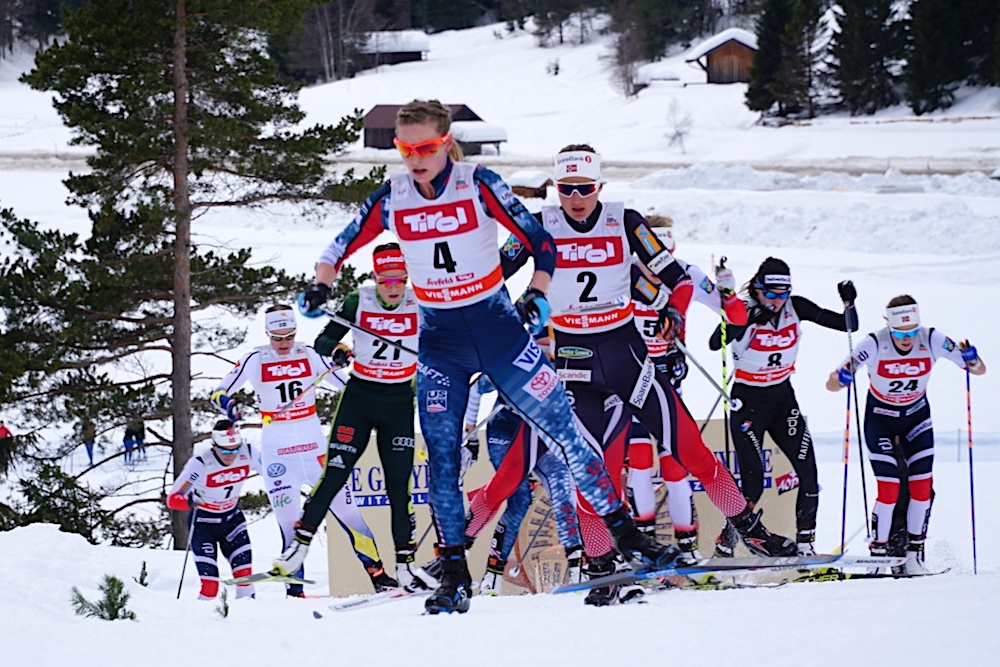
American Jessie Diggins (4) leading Norway’s Ingvild Flugstad Østberg (2) and the rest of the women’s field in the 10 k freestyle mass start at the World Cup in Seefeld, Austria. (Photo: Garrott Kuzzy / LumiExperiences.com)
Meanwhile, Norwegian teammates Heidi Weng and Ingvild Flugstad Østberg kept her close, and at 4.6 k, Østberg moved into first. The group was down to 12, with another American hanging in there as well, as Sadie Bjornsen skied in 12th, 4.6 seconds back.
Two kilometers later, it appeared the Norwegians were working together, not just to keep themselves through the race, but to prevent Diggins from getting too close to the front. Diggins remained in third, less than a second behind Østberg and Weng, while a third Norwegian Ragnhild Haga skied just behind her. Switzerland’s Nathalie von Siebenthal and Germany’s Katharina Hennig remained in the mix in fifth and sixth, about two seconds back, as did Norway’s Kari Øyre Slind and Bjornsen another second behind.
With just over 2 k to go, Diggins attacked in earnest near the bottom of the last grueling (nearly 500-meter-long), multi-tiered climb on the women’s 3.3 k course. No one was able to match her pace, not Østberg, not Weng, not Haga, as she raced up the rest of the hill and over the top completely alone.
Behind her, the chase group split in two, with the three aforementioned Norwegians then approximately eight others skiing several meters behind. Bjornsen was in that second group, which continued to drop in numbers as they continued up the climb.
On the winding descent back toward the stadium, with just under a kilometer to go, Diggins put all of her faith into her skis.
“I felt awesome, my skis were amazing, the techs worked so hard,” she told FasterSkier in person after. “These Salomon skis I was on were just ripping down that corner.”
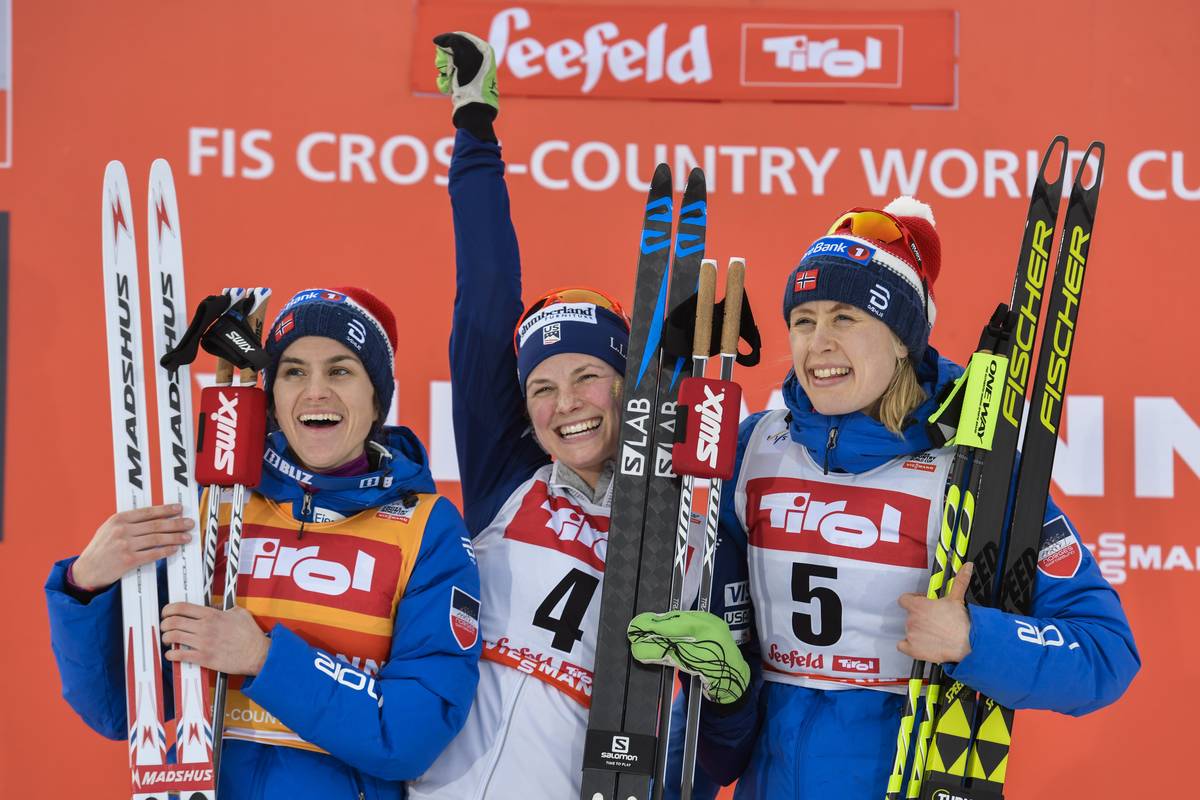
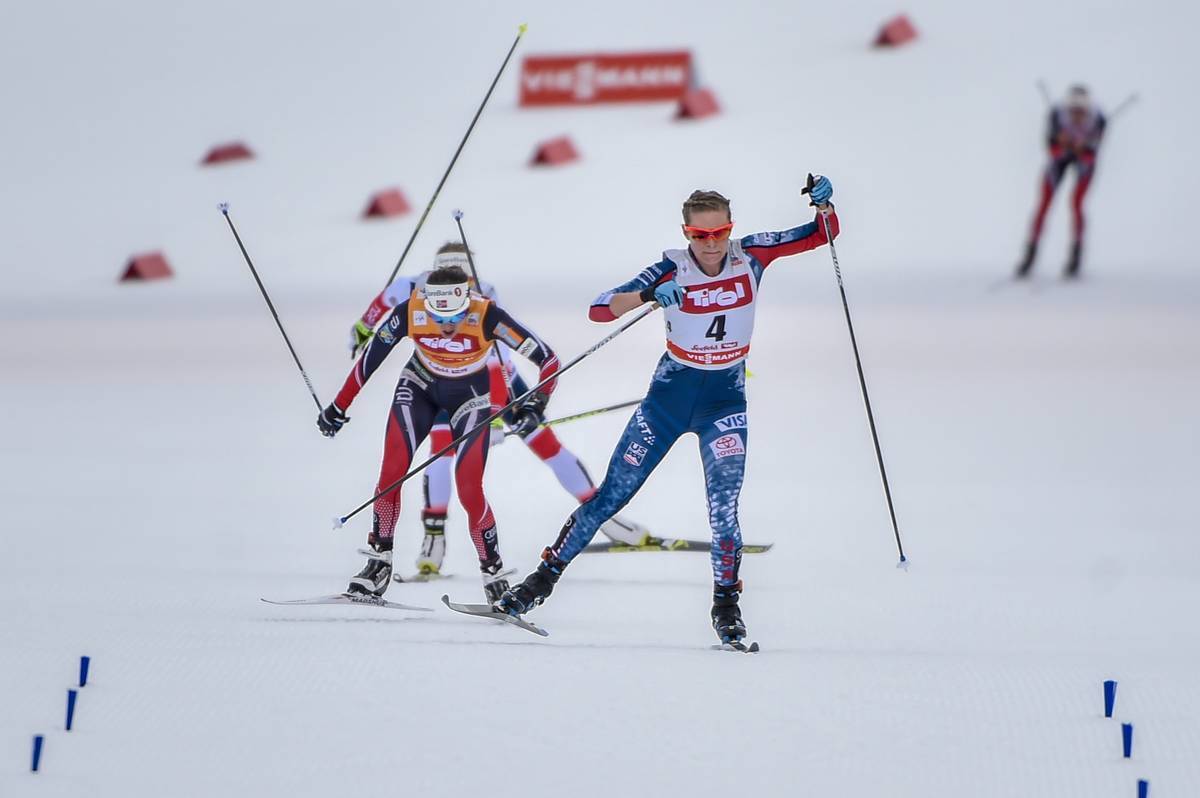
American Jessie Diggins (4) leads Norwegians Heidi Weng and Ragnhild Haga in the finishing stretch of the women’s 10 k freestyle mass start at the World Cup in Seefeld, Austria. (Photo: Salomon/NordicFocus)
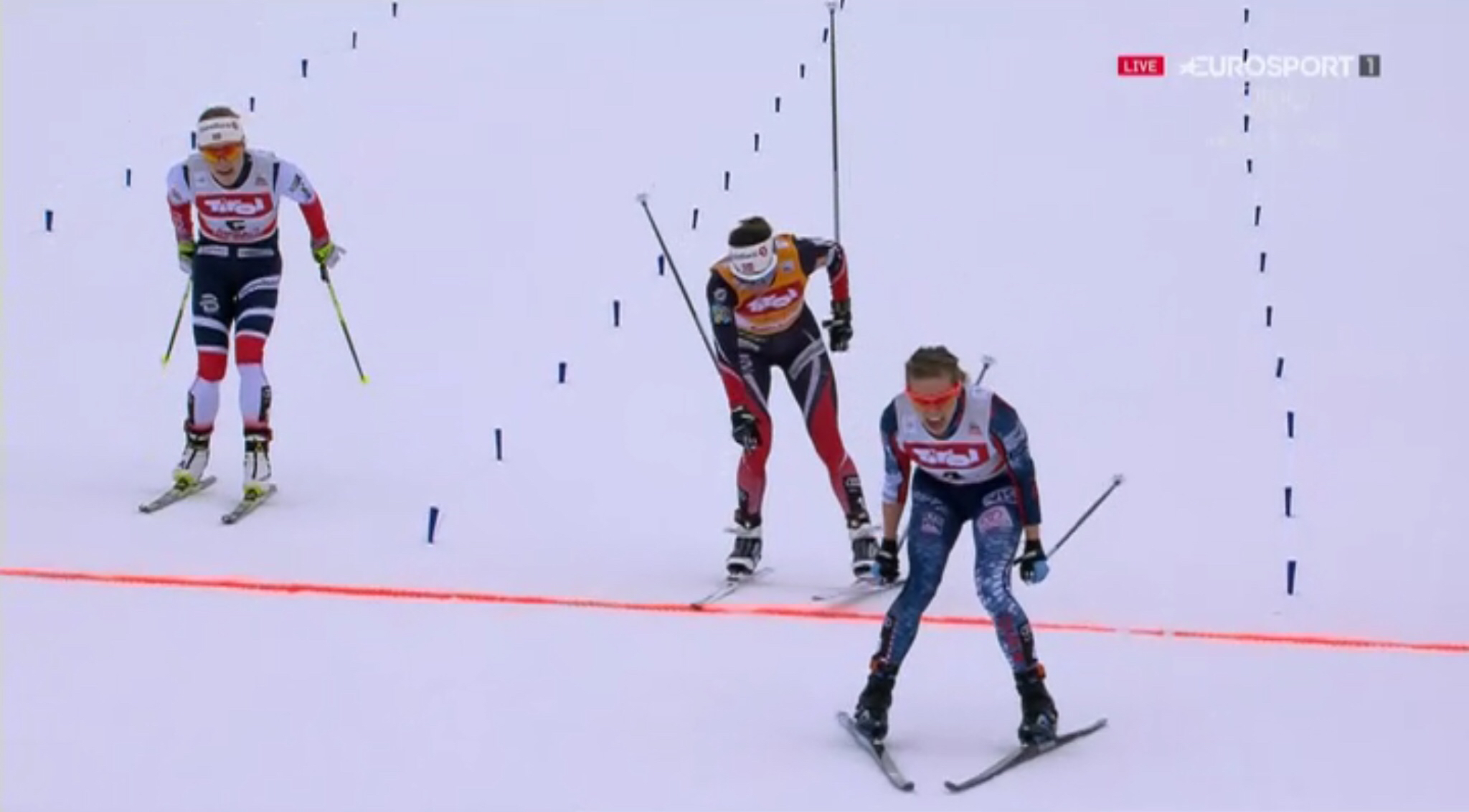
But before the final hill, a relatively small rise about 200 meters before the finish, Weng and Haga were close, just a few strides and about a second behind. Again, Diggins didn’t look back; she simply used every ounce of everything she had left — energy and technique-wise — to get the maximum number of pushes in before the finish.
And she did it. Diggins held off the two Norwegians, crossing the line first in 23:08.5 and throwing her fists down in elation. Seven-tenths of a second behind her, Weng free-skated to second place, just 0.3 seconds ahead of Haga in third. Østberg finished 7.7 seconds later in fourth (+8.7), and the fourth Norwegian in the top five, Marit Bjørgen placed fifth (+16.7) just ahead of Austria’s Teresa Stadlober in sixth (+16.9), Slind in seventh (+19.1), and Bjornsen in eighth (+20.5). Von Siebenthal followed in ninth (+30.3) and Finland’s Kerttu Niskanen placed 10th (+31.8).
Notably, it was Bjørgen’s first World Cup race since mid-December. But even more notably, for the second-straight race in Seefeld — the site of next year’s 2019 World Championships — an American woman won. Sophie Caldwell tied for first in Saturday’s freestyle sprint, and on Sunday, it was all about Diggins.
For Diggins, the win was her first in over a year and her fourth-career individual World Cup victory. And she did so in the last race before the Winter Olympics start on Feb. 10 in PyeongChang, South Korea.
“It’s a really good time to figure out how to ski a 10 k race,” Diggins told FasterSkier after. “I am really excited. I’m so pumped for the Games, I’m feeling well, the peaking plan is working, and I’m just excited to get there and see what I can do.”
She apparently took mental notes on the men’s 15 k mass start that took place earlier on Sunday, as Switzerland’s Dario Cologna attacked on the same climb to secure the win ahead of Canada’s Alex Harvey and Norway’s Martin Johnsrud Sundby.
“I saw how well it worked for Dario, and I thought, ‘OK, I’m gonna go for it! I just have to ski gutsy and if they reel me in they reel me in, but maybe I can hold them off,’ ” she reflected.
“I just put my head down and it wasn’t pretty, but I just hammered,” she said in a post-race interview with the International Ski Federation (FIS).
Before that, Diggins said she had been trying to figure out where to ski in the pack.
“ ‘OK, if I’m in the front, how hard am I working? If I’m in the middle…’ You don’t want your poles to get stepped on so it’s easier for me to just be near the front the whole time,” she told FasterSkier.
Diggins’s three other wins have come in 5 k freestyle individual starts — all of which were stage World Cups. Sunday marked her first time getting 100 points, rather than 50, for the win, which counts toward overall World Cup standings. Heading into the Olympics, she ranks third in the Overall World Cup (379 points behind Weng in first and 180 behind Østberg in second) and third in the Distance World Cup (225 points behind Weng in first and 108 behind Østberg in second). Bjornsen is seventh in the overall standings and 11th in distance.
“I’m happy with how I raced,” Weng said after Sunday’s race, according to a FIS press release. “I made a mistake up the final climb and then couldn’t go with Diggins, but I pushed hard all the way to the finish, but Diggins was the better skier today.”
Bjornsen is seventh in the overall standings and 11th in distance.
“It was an exciting, and super fun final race before the Olympic Games!” Bjornsen wrote in an email to media outlets. “Today’s 10k skate was hot from the start, on a really fun course here in Seefeld. I think the nature of the course kind of held the pack together a bit more, which always makes for a fun race! I felt really good out there, and was super happy with the day.
“I feel like I made a bit of a tactical error being stuck behind some skiers that were dying a bit on the far part of that last lap, but it is one new step for me,” she continued. “I learned something out there, and I challenged myself, and I am feeling really good about the feelings I have in my legs leading into the games! It will be great to have two more weeks to rest, recover, and come in sharp for these exciting races to come. I am so excited to see our team on fire right now too. The vibe is great, the spirit is high, and we are so excited to take on the world in a few weeks here! Win or lose, I think this team is going to do something great!”
Eighth place is Bjornsen’s best result in distance skate race longer than 5 k, not counting pursuits. Earlier in the day, her brother Erik finished ninth in the men’s 15 k.
“ … I got my brother by one spot, which is a daily competition for the two of us,” Bjornsen wrote. “He set the bar high this morning. I am just so excited to see how well he did, and Simi [Hamilton, who placed 12th] as well. Those two have a bright future for the team sprint, I can’t even wait to watch!”
Three American women landed in the top 15 and five were in the top 30 on Sunday. Kikkan Randall finished 14th, 48.5 seconds behind Diggins and just over eight seconds outside of the top 10.
“I think it was a good race, I don’t think it was a great race,” Randall told FasterSkier on Sunday. “I made a bad tactical move on the first lap and missed that first group when they went, so then I spent some time chasing and I had a good energy left at the end so that was fun. … I think every race is going to get better and better so I am pretty happy with today.”
The result tied her previous best distance finish this season (a 10 k freestyle in Davos, Switzerland). Randall has been dealing with a stress reaction and tendonitis in her foot since that Davos World Cup in mid-December.
“Foot is hanging in there, its not great, but it’s good enough to race,” she said. “To make it through two skate races here and still holding together I am optimistic, so now we kind of just go to single races [at the Olympics], so I think I will be able to make it through the season. I also made it in the stadium today just in time to see Jessie win.”
Caitlin Patterson of the Craftsbury Green Racing Project (CGRP) finished 23rd (+1:00.7) for her second time in the World Cup points (top 30) in as many distance races she’s competed in this season. The U.S. SuperTour leader after Period 1, Patterson earned World Cup starts for Period 2 in January and is also headed to the PyeongChang Olympics.
On Sunday, she said she had to adjust to the stop-and-go pace near the back of the pack.
“I think I was still getting used to the pace swings, the way you go up and down and … accordion and stuff, but it was a good fun race,” Patterson said. “I think I had a few struggle moments on some of the bigger climbs … but I held it together, and the downhills were good and I was pretty happy with the finish, passing at least one person, catching up to the tail end of a pack in front of me. … Some good fun over here.”
Liz Stephen also finished in the top 30 in 29th (+1:18.2) after working her way up in the pack from 44th at 3.9 k. It was her sixth top 30 of the season. Also for the U.S., Rosie Brennan finished 53rd (+2:26.9).
Emily Nishikawa of the Canadian World Cup Team led three Canadian women in 35th (+1:36.5). Just one-tenth of a second later, Cendrine Browne (Canadian U25 Team) followed her across the line and placed 37th (+1:36.6) in a photo finish with France’s Coralie Bentz for 36th. Dahria Beatty (Canadian World Cup Team) finished about 22 seconds later in 45th (+1:58.9).
For the Canadian women, this weekend marked their first World Cup races in a month. While Nishikawa stayed in Europe to train during the Tour de Ski, Browne and Beatty returned to Canada for NorAm Olympic trials in early January. After that, they met up with Nishikawa and the rest of the team for a training block in Livigno, Italy.
“I think us three girls did really well today, considering we are just coming back from a training camp, so it’s really looking good for the Olympics,” Browne said.
“Just echoing what Cendrine said, coming off a training camp, you never really know what to expect for this weekend, but the goal is to be good at the Olympics,” Nishikawa said. “I was happy with the way I felt and the second half of the race. I need to work at starting a bit faster on the mass starts — somehow I end up at the back of the field and just work my way through it.”
“It was lots of fun,” Beatty said of her race. “I had a good start and then died a little bit in the middle, but it was nice to see some of [my teammates] up ahead and try to keep going. I actually had a really good last kilometer, I was able to finish strong and pick off some girls … I think it was one of my better distance races so far this year.”
While Beatty placed 20th in Saturday’s sprint for a season best, 45th marked her second best result of the World Cup season so far.
— Gabby Naranja, Ian Tovell and Harald Zimmer contributed
American Jessie Diggins (r) celebrates her win on Sunday in the World Cup women’s 10 k freestyle mass start in Seefeld, Austria, ahead of Norway’s Heidi Weng (c) in second and Ragnhild Haga (l) in third. (Screenshot: Eurosport broadcast)
APU’s Tyler Kornfield (126) leads APU’s Eric Packer (118) and DU’s Eivind Romberg Kvaale (124) to the line in the men’s 30 k classic mass start at 2018 U.S. Cross Country Championships on Sunday in Anchorage, Alaska. Kornfield, Packer, and Kvaale finished first, second and third, respectively. Kris Freeman (10, second from left) was fourth overall and the third American.
U.S. Cross Country Championships (Anchorage, Alaska): 20/30 k classic mass starts
Sweden’s Hedda Bångman denied Caitlin Patterson of her first outright victory of the week at 2018 U.S. Cross Country Championships, but Patterson as the first American racked up her third-straight national title in the women’s 20-kilometer classic mass start at Kincaid Park on Sunday in Anchorage, Alaska.
The top-three Americans in the women’s 20 k classic mass start on Sunday at 2018 U.S. nationals in Anchorage, Alaska, with Caitlin Patterson (1) of the Craftsbury Green Racing Project (CGRP) in first, Rosie Frankowski of APU (l) in second, and Kaitlynn Miller (r) of CRGP in third.
Bångman, a 22-year-old freshman at the University of Colorado Boulder (CU), pulled off a 15.9-second win in the mass start, crossing the line in 1:00:55.3 hours. Patterson, of the Craftsbury Green Racing Project (CGRP), finished second, but was the top American in the event for the third time this week, and Rosie Frankowski, of Alaska Pacific University (APU), notched third (second American), 19.6 seconds back.
Rounding out the top 10 was Jessica Yeaton, who trains with APU and races for Australia, in fourth (+44.1), Kaitlynn Miller (CGRP) as the third American in fifth overall (+1:13.5), Alayna Sonnesyn of the University of Vermont (UVM) in sixth (+1:25.3), Chelsea Holmes (APU) in seventh (+1:55.4), Norwegian CU skiers Christina Rolandson and Anne Siri Lervik in eighth (+1:55.7) and ninth (+1:56.1), respectively, and Erika Flowers of the Stratton Mountain School (SMS) Elite Team in 10th (+2:14.6).
The men’s 30 k classic mass start was incredibly close, with APU’s Tyler Kornfield taking his first-ever distance national title (he was the 2012 classic sprint national champion) in 1:21:43.6. He edged his teammate Eric Packer by 0.7 seconds at the line, and Eivind Romberg Kvaale, a sophomore at the University of Denver (DU), finished 1 seconds back in third.
Kris Freeman (Caldwell Sport) was just off the overall podium in fourth (+1.6), but was the third American. Another DU skier, Dag Frode Trollebø, also from Norway, finished fifth (+2.0), and APU had three in the top six with David Norris in sixth (+2.5). Noah Hoffman (Ski & Snowboard Club Vail) finished seventh (+2.6), Scott Patterson (APU) eighth (+3.6), and Craftsbury’s Adam Martin and Ben Lustgarten followed in ninth (+14.7) and 10th (+14.9), respectively. With Brian Gregg (CXC/LNR/Team Gregg) in 11th (+16.1), the men’s top 11 were separated by less than 17 seconds.
IBU World Cup (Oberhof, Germany): Men’s and women’s relays
Racers on the range during the men’s 4 x 7.5 k relay on a foggy Sunday at the IBU World Cup in Oberhof, Germany. (Photo: IBU/Biathlonworld)
The Swedish men’s team and French women won the second relays of the International Biathlon Union (IBU) World Cup season on Sunday, with Sweden winning the men’s 4 x 7.5 k relay by 1:10.8 over Italy, and France besting Germany by 32.4 seconds.
Notably, most of the top teams didn’t start all of their “A” teamers.
In the men’s race, Sweden’s Martin Ponsiluoma, Jesper Nelin, Sebastian Samuelsson, and Fredrik Lindström combined for their first win together — and the first win for most of the members on the team.
“It is a dream when you are a kid to compete in a World Cup,” Samuelsson said, according to an IBU press release. “To have a win is really amazing!”
The Swedish women’s team also landed on the podium in third (+48.2).
“What a race by the whole team,” said Lindström, who also has one non-relay World Cup win (from 2012) to his name. “It could not be better.”
Conditions could not have been much more difficult for shooting on Sunday, with the fog that had descended early in the day for the women’s race worsening for the men’s race. When there wasn’t fog, there was wind.
Misses were common throughout the two races, and even with racers being able to use three spares per shooting stage to clean, there were a high number of penalty laps.
But the Swedish men kept their penalties to a minimum, with just one for the entire team and a total of nine spare rounds used among them. After Ponsiluoma came through the first exchange in sixth, Nelin skied them into third, Samuelsson picked off another place despite skiing a penalty after his standing stage to put them in second, and Lindström anchored them to first.
“The conditions today were so special. Somehow I felt not so nervous, I was calm and had luck on my side,” Lindström said at a post-race press conference about his nearly flawless shooting (0+0; 0+1).
“I have never [been first] before,” he added. “Not like this in a relay at least. That’s really fantastic.”
“I had to look up to see if I was aiming the right way,” Nelin said after cleaning prone (0+0) then using two spares to clean standing (0+2). “I had no idea where I was aiming, so it was really difficult. But I hit, and it was good. Maybe these conditions fit me and I should never see anything.”
Italy placed second with Thomas Bormolini, Lukas Hofer, Dominik Windisch, and Thierry Chenal combining for two penalties and 11 spares. Hofer had skied them up from eighth to second, and Windisch then took the lead on the third leg to put them in first at the final exchange, 1 minute ahead of Sweden. But Chenal slipped with the seventh-fastest last leg time and a penalty after standing.
“Being on the podium with the team is always a special feeling,” Hofer said at the press conference. “For Thierry, it’s the first year in the World Cup, and he does a really good job, not just today. I am really happy that he could close out this relay. Second place is like a win for us.”
Norway placed third (+2:04.6) with Vetle Sjåstad Christiansen, Henrik L’Abée-Lund, Lars Helge Birkeland, and Tarjei Bø. Together, they had three penalties (two from L’Abée-Lund and one from Birkeland) and 14 spares.
“I grew up on Holmenkollen so I practiced a lot there [in fog],” L’Abée-Lund said. “But today was really really hard, I didn’t see anything in prone. Standing was OK, but prone was really difficult.”
“It’s great to be on the podium,” Christiansen said. “Of course Norway always wants to win, but today we are very happy for our brothers in our neighbor-country Sweden.”
The Canadian men placed 10th (+6:23.1) out of 25 teams with Christian Gow, Scott Gow, Brendan Green, and Carsen Campbell having a combined six penalties and 20 spares. Three of those penalties came on Scott Gow’s second leg, two from Campbell’s anchor leg, and one on Christian Gow’s first leg.
After a penalty on his first prone stage (1+3), Christian cleaned standing with a spare (0+1) and tagged Scott in 11th, 53 seconds out of first. Scott then had two penalties in prone and three in standing, but managed to improve to eighth given how much everyone else was struggling with the shooting as well. Green kept them in eighth with two clean stages (0+2, 0+3), and Campbell, in his first World Cup relay, cleaned prone (0+2) but had two standing penalties (2+3) to put the team in 10th at the finish.
In an interview with German broadcaster ARD halfway through the race, Canadian coach Matthias Ahrens called the range conditions, which ranged from thick fog to unpredictable wind, “very hard to assess.”
“… To be honest, the good thing was that conditions were very bad,” he later added. “So regarding visibility, almost everyone was on the range at the same time [with the same irregular conditions]. They had to wait very long, and of course had bad conditions to shoot, but much of the field was there at the same time.”
The French women’s team, of Anais Bescond, Anais Chevalier, Celia Aymonier, and Justine Braisaz, celebrate their relay victory on Sunday at the IBU World Cup in Oberhof, Germany. (Photo: IBU/Biathlonworld)
In the women’s race, with better shooting visibility, France’s Anais Bescond, Anais Chevalier, Celia Aymonier, and Justine Braisaz took the win in 1:12.42.4, with one penalty and 10 spares. After Bescond put them in first through the first exchange, 6 seconds ahead of Italy in second, Chevalier had to ski a penalty loop after prone but cleaned standings (1+3, 0+0) and tagged off in second, 23 seconds behind Italy, now in first.
One loop later, France was back in first thanks to Aymonier, who cleaned with just two spares (0+0, 0+2), and they extended their lead from 0.8 seconds at the last exchange to 32 seconds at the finish with Braisaz, who shot 0+1, 0+3, and skied the fastest anchor leg.
“I know that it’s always good for Justine to start in the first position, so I really wanted to pass the relay to her in that,” Aymonier said in a press conference after.
“I was nervous, too,” Braisaz said. “That kind of shooting turned my mind upside down, actually. The crowd was very loud, and … I wasn’t very focused on what I did. It was a bit foggy, too, so that made it harder. But finally it was a French day, maybe.”
“In my mind the whole team is really strong, and really able to get the first place,” Bescond said. “After years and years and years behind Germany’s team we finally did it. So just Oberhof spirit I think.”
Germany placed second with Vanessa Hinz, Denise Herrmann, Franziska Preuss, and Maren Hammerschmidt. They combined for two penalties and 13 spares; with a penalty on Hinz’s first leg and one more on Hammerschmidt’s last shooting. After being tagged in 14th, Herrmann skied them into fourth, 40 seconds out of first, and Preuss elevated them to second, which Hammerschmidt held onto.
“I was struggling a little bit in the prone shooting,” Herrmann said. “But the skiing was good today, and also the standing [shooting]. I tried to go fast on the track and catch some girls.”
Sweden, with Linn Persson, Anna Magnusson, Elisabeth Högberg, and Mona Brorsson, avoided the penalty loop and used eight spares to reach the podium for the first time in six seasons. In sixth place at the first exchange, they slipped one place to seventh on the second leg, but Högberg raced them up to fourth with near-perfect shooting (0+0, 0+1) with one leg to go. Brorsson then anchored them to third with clean shooting (0+2, 0+1) and the third-fastest last leg.
“It’s just super nice for us! I am super happy,” Magnusson said. “We were very emotional at the finish.”
When Brorsson was asked if she believe she could fight for the podium, she responded, “Not really. But I said to Linn, ‘Maybe it is our day today. Please let it be our day today.’ ”
The Canadian women finished 14th (+6:37.5), out of 20 teams, with two penalties and 13 spares. Sarah Beaudry initially put them in 15th after shooting 0+1, 0+2, then Julia Ransom had a standing penalty (0+2, 1+3) to slip one place to 16th. Megan Tandy picked off three places with clean shooting (0+0, 0+2) and tagged Emma Lunder in 13th, and Lunder had a penalty in prone but cleaned standing (1+3, 0+0) to finish in 14th.
The men’s overall 2018 Tour de Ski podium atop Alpe Cermis after the final Stage 7 hill climb: with Switzerland’s Dario Cologna (c) in first, Norway’s Martin Johnsrud Sundby (l) in second and Canada’s Alex Harvey (r) in third. (Photo: FIS Cross Country/Twitter)
Dario Cologna of Switzerland added a fourth Tour de Ski (TdS) title to his list of accolades on Sunday, winning the 2018 edition of the race in dominant fashion, with a 1:26.5-minute win over Norway’s Martin Johnsrud Sundby. And Canada’s Alex Harvey scored his first TdS overall podium in third.
The 31-year-old Cologna started the 9-kilometer freestyle pursuit up Alpe Cermis 1:15 ahead of Kazakhstan’s Alexey Poltoranin in second. Russia’s Sergey Ustiugov, slated to start third, did not start due to a back injury. Thus Harvey was the third man off the start line, 1:23 behind Cologna.
(Sweden’s Marcus Hellner, 13th after Saturday’s Stage 6, also did not start the Tour’s final stage.)
Early on, Cologna started putting time into his competitors, extending his lead on Poltoranin to 1:20.5 and Harvey to 1:24 at 1.8 k.
By 4 k, however, Harvey had used his speedy skiing on the flatter portions of the race leading up to the climb to catch Poltoranin, and the two clocked through that checkpoint 1:19.4 behind Cologna. Behind them, Russia’s Alexander Bolshunov skied just ahead of Sundby, another 21 seconds and 22 seconds back, respectively, in fifth and sixth.
While Harvey clawed back a few more seconds on Cologna, he was still 1:17.8 back at 6.2 k, with Poltoranin just 0.7 seconds behind him in third.
Harvey remained in second until around 8.5 k; with just a half kilometer to go, Sundby had caught both Poltoranin and Harvey, passing them both. Sundby held that position and finished second, 1:26.5 behind Cologna, who won in 28:52.1.
Harvey stayed strong for third (+1:30.6) while Poltoranin dropped off the Canadian’s pace in the final half kilometer and finished fourth (+1:41.7). Norway’s Hans Christer Holund placed fifth (+2:17.8), Bolshunov lost a spot to finish sixth (+3:09.7), France’s Jean-Marc Gaillard finished seventh (+3:16.7), Sweden’s Daniel Rickardsson eighth (+3:20.8), and Russia’s Alexey Chervotkin and Andrey Larkov took ninth (+3:33.5) and 10th (+3:37.8), respectively.
France’s Maurice Manificat, known for his strength in freestyle hill climbs and pursuit races, rose from 14th to 11th (+3:45.7) with the second fastest time of day, 12.8 seconds slower than Sundby as the time of day winner in 28:36.4. Cologna’s time was fourth fastest (+15.7), behind Russian U23 skier Denis Spitsov in third (+14.3) (Spitsov started 20th and finished 13th). Holund’s time ranked fifth (+20.6) and Harvey’s time was sixth fastest (+23.6) of the 43 men that finished the race.
The lone American man to complete this year’s Tour, Paddy Caldwell (U.S. Ski Team) skied the 22nd fastest time of day for 38th overall (+11:54.8).
Heidi Weng (center) celebrates her second Tour de Ski victory, with teammate Ingvild Flugstad Østberg second and the U.S. Ski Team’s Jessie Diggins third. (Photo: FIS Cross Country/Twitter)
In the women’s hill climb that kicked off the day, Heidi Weng raced to her second consecutive TdS title. The Norwegian started the day within two seconds of teammate Ingvild Flugstad Østberg, and the two skied together for the flat section of the nine-kilometer stage of the competition. But when the climbing got steep on Alpe Cermis, Weng left her teammate behind and eventually racked up a 48.5-second win.
The battle for third was less predictable. Jessie Diggins of the United States started the day in fourth, but made up the ten seconds to third-place KristaPärmäkoski of Finland in the first few kilometers. The pair climbed together for a while before Diggins attacked. Pärmäkoski tired on the final sections of the Alpe Cermis and Diggins took the podium in definitive style, 2:23.2 behind Weng and 24 seconds ahead of Pärmäkoski. It’s the first overall Tour de Ski podium for Diggins or any American athlete.
Teresa Stadlober of Austria finished fifth (+3:09.4), Kerttu Niskanen of Finland sixth (+4:17.0), Russia’s Anastasia Sedova seventh (+4:49.6), and Switzerland’s Nathalie von Siebenthal eighth (+4:56.1).
Sadie Bjornsen started eighth and slipped one spot to finish ninth (+6:15.0), giving the U.S. two top-ten finishers in the Tour de Ski for the first time. Liz Stephen finished 16th (+8:25.8) and Rosie Brennan 24th (+10:59.6).
En route to her win, Weng notched the fastest time of the day on the 9 k stage. Stadlober’s time was second, Diggins third, Østberg fourth, and Stephen fifth.
32 women finished this year’s edition of the Tour de Ski.
Heidi Weng (center) and Ingvild Flugstad Østberg of Norway and Jessie Diggins (right) of the United States atop the Tour de Ski podium on the Alpe Cermis. Diggins became the first North American to ever stand on the overall Tour podium, and Alex Harvey of Canada matched her feat a few hours later. (Photo: Val di Fiemme World Cup/Instagram)
The question wasn’t whether – it was when. Defending Tour de Ski champion Heidi Weng started the day with a two-second deficit to Norwegian teammate Ingvild Flugstad Østberg. But as one of the best climbers in the World Cup field, it was fairly certain that at the top of the Alpe Cermis, Weng would be crowned the Tour winner again.
The move came after about six and a half kilometers of the nine-kilometer skate pursuit starting in Val di Fiemme, Italy. Weng passed Østberg and then just kept going up the grueling Alpe Cermis, where grades approach 30%.
“I like to go in this climb,” Weng said in an interview with the Val di Fiemme media team. “It was really tough this year. I tried to stay focused and go very fast in the uphill. So I tried to get some speed in the last two kilometers. I was very stiff but I stayed focused. I heard my family and my mom and dad [cheering], so that’s very helpful to go fast!”
Tour de Ski winner Heidi Weng of Norway attacking the climb. (Photo: Val di Fiemme World Cup/Instagram)
Even though she had a big gap on Østberg by the finish – 48.5 seconds – Weng was still pushing hard, and collapsed at the line.
Østberg, too, pushed to the finish, picking up the pace on her V2 as she skied towards her winning teammate.
“I am very pleased to secure second place,” she told Norway’s NRK broadcaster, according to a translation. “I tried to fight with Heidi at the bottom of the hill, but… she was stronger than me up there. She was the strongest today. I had a day yesterday that ruined me a bit.”
Like in her first Tour de Ski title in 2017, Weng had to face neither Marit Bjørgen nor Therese Johaug as the race series wore on. Johaug has won the Tour de Ski twice and is currently serving a doping ban; Bjørgen has won once and is sitting out this year’s Tour to prepare for the Olympics, as are Swedish stars Charlotte Kalla (who won the 2008 Tour de Ski) and Stina Nilsson.
Diggins Grabs Historic Third Place for U.S.
The question of the day hadn’t really been about who would win – it was about what would happen after Weng crossed the line. A minute and a half behind the Norwegian pair at the start, Finland’s Krista Parmakoski tried to hold off American Jessie Diggins.
Diggins made up the ten seconds to Parmakoski in the first few kilometers, and the two skied together for the middle section of the race course. Beginning the climb, Diggins was leading but Parmakoski stuck close on her ski tails.
“I caught Krista maybe a third of the way on the flats and we traded leads, working together to go faster,” Diggins wrote in an email. “I love skiing with Krista – she’s an incredible racer and so tough, and really awesome to ski with.”
Game face: Diggins charging up the Alpe Cermis to her first Tour de Ski podium. (ARD screenshot)
Diggins made a move though, around the seven kilometer mark, and Parmakoski initially kept the gap small but then faded back and back.
“Honestly, I didn’t have a big plan for an attack on the climb,” Diggins explained. “My strategy was just to keep the tempo high, keep my body upright and leaning into the climb, and just keep moving. But on the ‘flat’ sections where we were weaving around gates, I noticed I was starting to pull away just a little bit, so I would push extra hard each turn and just keep my tempo up, and that’s how I gradually pulled away.”
Part of the reason was that Parmakoski had a problem with her left leg, which was made worse by the V1 climbing up the steep hill.
By the top of the climb, Diggins had just over 24 seconds on the Finn. She had turned in one of her better final climb efforts – collecting the third-fastest “time of the day”, just 41.9 seconds slower than the time posted by Weng, who not only won the Tour de Ski but also demolished the field in the climb itself.
“To get the third fastest time on the hill climb was a huge surprise for me, for sure!” Diggins wrote. “I woke up feeling good, drank way too much coffee, and stuck to my plan of catching up to Krista on the flats. I had AMAZING skis, so a huge thanks to Salomon and our incredible wax staff!”
As she skied towards the finish line, clearly exhausted, Weng and Østberg cheered her on. She finished 2:32.3 behind Weng. Diggins collapsed at the finish and the two Norwegians ran over to her to offer their congratulations.
Heidi Weng cheers as Jessie Diggins skis for the finish line atop the Alpe Cermis. (Photo: Val di Fiemme World Cup/Instagram)
“It was so cool coming into the finish, with Heidi and Ingvild cheering for me!” she wrote. “I love having friends from around the world and those girls are such awesome ski racers but most importantly, they’re great people and it was really fun to chat with them after. I’m really psyched for them!”
It was the first time a non-European athlete, man or woman, has stood on the final Tour de Ski podium.
“I’m really, really happy,” Diggins told the Val di Fiemme media team after the podium ceremony. “It’s really good for the sport in our country because we need to show our younger skiers that yeah, it’s possible, you can be a cross-country skier in America, and you can podium. So I hope this is really inspiring for all the younger cross-country skiers back home.”
Parmakoski finished fourth, +2:57.7. And with the Tour de Ski concluded and its points divvied out, Diggins is now third in the overall World Cup standings, too. The conclusion of the Tour de Ski was also a major payday for her: she earned 1000 Swiss Francs ($1025) for having the third-best time of the day, 1300 Francs for being third in the Tour de Ski sprint standings, and 23,850 Francs for being third in the Tour itself.
Teresa Stadloberof Austria finished fifth (+3:09.4) in the Tour de Ski, notching the second-fastest time on the stage (41.3 seconds behind Weng’s split) in a valliant effort to catch Parmakoski in case she faltered any further.
Kerttu Niskanenof Finland was sixth (+4:17.0), Russia’s Anastasia Sedova seventh (+4:49.6), and Switzerland’s Nathalie Von Siebenthaleighth (+4:56.1).
Bjornsen Ninth as Four Americans Finish Tour
American Bjornsen had started eighth, and along with Von Siebethal – who started ninth – skied up to Sedova. That had actually been a plan between the American and the Swiss.
“One thing I learned that I learned on the third day of the Tour [was that] if you are going to catch someone in front of you, you kind of have to do that in the first kilometer because after that everyone is just going at a hot pace,” Bjornsen said in an interview. “So today I went to talk to Nathalie before the start. I told her that we needed to work together on the flat and just switch leads, that we could make time on the girls in front of us. I pretty much did the first kilometer at what felt like sprint pace, and I led that part because I knew that Nathalie would jump in after that.”
Despite being mismatched in size – Bjornsen is tall, Von Siebenthal diminutive – the pair worked well together to close the gap to Sedova.
“She glides so much,” Bjornsen said. “Despite being a small person, we ski pretty similar. On the flat section at the beginning it was awesome. We were both really pushing the pace… even at the bottom the V1 section [of the climb] before the wall, she was the perfect person to follow because she is gliding so much. It was really nice.”
But the Russian then dropped the two once they reached the climb, and Von Siebenthal was more successful at keeping Sedova in sight.
“[On the flats] I exchanged very well with Sadie in the lead, we caught up to [Sedova] quite fast,” Von Siebenthal told Switzerland’s SRF broadcaster, according to a translation. “But she could draft with us, and initially in the climb she was behind us but then attacked and I didn’t see her again… I couldn’t quite catch up to her again. There wasn’t any better result possible.”
Bjornsen, who has only done the final climb once before and skipped it last year due to illness, found the steepest part of the course to be an unwelcome jolt.
“When we hit the first wall, I couldn’t keep with those two girls, and so then I was kind of on my own the rest of the time and just pushing up the hill,” she explained. “I kind of forgot about how long the climb was. So I was in this weird place of not wanting to redline, but also trying to push myself… I knew there were some hard chargers coming for me from behind and I was definitely on the struggle bus.”
Bjornsen slipped one spot to finish ninth (+6:15.0), but still gave the U.S. two top-ten finishers in the Tour de Ski for the first time.
“This summer I made a goal to finish top 10 in the Tour, so it feels really good,” Bjornsen said. “It definitely was one of those Tour — I feel like I had more disappointing days than I had great days. But the great days were so great it kind of left a good taste in my mouth at the end.”
Liz Stephenfinished 16th (+8:25.8) and Rosie Brennan24th (+10:59.6). Stephen had the fifth-fastest time on the stage, and Brennan the 17th-fastest.
Like Bjornsen, Brennan said she had some frustrating days along the way.
“It has definitely not been the best Tour for me,” Brennan said in an interview. “I think I tried to put in a little more training over Christmas, and I think I just made myself a little flat for the Tour. Then it didn’t help with the number of crazy days we had – I had some crashes in there and just so many crazy things, it was hard to tell exactly where my fitness was. But having a good time up the hill it tells you that you’re pretty fit.”
While many dread the final climb, Brennan explained that she thinks it is a good way to cap off Tour racing.
“I really like the climb, especially when you are so tired,” she said. “I actually think it is easier to do the same thing over and over again. You don’t have to think about how to ski a section. It is literally just putting one foot in front of the other. So I knew that if I could get my energy back, than I felt like I could have a better day today.”
Brennan, who has now scored World Cup points in eight different races this season in both skate and classic, sprint and distance, is looking forward to regrouping and using that fitness as the season builds towards the Olympics.
“I feel like I had a really good first day and good day today, so I guess I just have to forget the middle part,” she said of the Tour.
32 women finished this year’s edition of the Tour de Ski.
The results have implications for the Americans in terms of Olympic qualification: Stephen is now ranked 35th in the World Cup distance standings, bringing her within U.S. Ski & Snowboard’s objective criteria for the 2018 Games in PyeongChang, South Korea.
The rest of the Tour finishers had been well within the top-50 distance or sprint World Cup ranking needed for selection before the Tour began, but Stephen had been yet to score any World Cup points until the Tour de Ski.
The Tour de Ski Stage 5 women’s 10 k freestyle mass start podium on Thursday in Oberstdorf, Germany, with Norway’s Ingvild Flugstad Østberg (c) in first and Maiken Caspersen Falla (l) in second, and Finland’s Krista Pärmäkoski (r) in third. (Photo: FIS Cross Country/Twitter)
Tour de Ski Stage 5 (Oberstdorf, Germany): 10/15 k freestyle mass starts
In one of the more unconventional stages of the Tour de Ski — a rainy, seven-lap, 14.7-kilometer men’s freestyle mass start, and a five-lap, 10.5 k women’s mass start (both of which were adapted to a shorter course after damage from Wednesday’s storm) — two Norwegians outlasted a tightly packed group of competitors to the finish, with Emil Iversen winning the men’s race and Ingvild Flugstad Østberg capturing her third-straight win in the women’s race on Thursday in Oberstdorf, Germany.
Iversen posted his first win of the season after hanging in the pack throughout the relatively flat race, with a maximum climb of 16 meters and total climb of 50 meters.
In the finishing stretch, he outsprinted fellow Norwegian Sindre Bjørnestad Skar by 0.4 seconds for the win in 29:49.8 minutes. Italy’s Francesco De Fabiani reached the podium in third, just 0.9 seconds out of first. Switzerland’s Dario Cologna kept his overall Tour lead in fourth place (+3.7) and Canada’s Alex Harvey came out on top of a photo finish for fifth with Great Britain’s Andrew Musgrave taking sixth and Norway’s Finn Hågen Krogh seventh, all 4 seconds after Iversen.
Norway’s Martin Johnsrud Sundby placed eighth (+4.2), Germany’s Thomas Bing ninth (+4.9) and France’s Maurice Manificat 10th (+5.2).
Twenty-five skiers finished within 10 seconds of first, and 57 in the 67-man field ended up within 50 seconds of first.
Overall, Cologna continues to lead the Tour standings with two stages to go: a 15 k classic mass start on Saturday and 9 k freestyle hill climb on Sunday, both in Val di Fiemme, Italy. He is 53 seconds ahead of Russia’s Sergey Ustiugov, who placed 28th on Thursday, and 1:07.6 ahead of Sundby in third. Harvey remains in fourth, now 1:23.1 behind and 3.5 seconds ahead of Russia’s Alexander Bolshunov (+1:26.7), who finished 40th on Thursday after falling several times.
Erik Bjornsen led the U.S. men in 32nd (+11.7), Paddy Caldwell placed 39th (+15.5), and Andy Newell was 53rd (+43.2). Simi Hamilton did not start. Overall, Bjornsen is 20th in the Tour (+3:10.7), Caldwell 60th (+6:58.2) and Newell 65th (+9:37.1) out of 67, although this is expected to be Newell’s last stage of the Tour.
In the women’s race earlier in the day, Østberg secured a 1.9-second victory over her teammate, Maiken Caspersen Falla, a Norwegian sprint specialist. Østberg crossed the line first in 23:16.5 and Finland’s Krista Pärmäkoski joined the two Norwegians on the podium in third, 3.2 seconds out of first.
Switzerland’s Nathalie von Siebenthal finished 4.1 seconds back in fourth for her best World Cup result, Sweden’s Maria Nordström was fifth (+4.4) to tie her career best, Germany’s Nicole Fessel sixth (+5.5), Austria’s Teresa Stadlober seventh (+5.8), Norway’s Anne Kjersti Kalvå eighth (+6.5) for her first World Cup top 10, Russia’s Anastasia Sedova ninth (+6.7), and Sweden’s Emma Wiken 10th (+7.1). Norway’s Heidi Weng was another 0.1 seconds back in 11th (+7.2), and for the first time this season, no U.S. Ski Team members finished in the top 20.
Jessie Diggins placed 24th (+16.8), Sadie Bjornsen 26th (+20.8), Liz Stephen 28th (+24.5), and Rosie Brennan 36th (+52.7).
“Today was definitely a very different course than most due to the storm and trees falling down over the usual course!” Diggins wrote in an email to FasterSkier. “It was icy and flat, which meant that the pack stayed really tight together as there were no big climbs to break it up.
“Fortunately, I got into great position to sprint for the bonus seconds [on Lap 3],” she continued. “Unfortunately, 200 meters from the finish I hit ice and crashed hard into the boards, spinning around and losing quite a bit of time and places. But that happens sometimes in racing and I shook it off already!”
Østberg now leads the Tour standings by 57 seconds over Weng while Diggins is nearly 2 minutes back in third (+1:56.7). Pärmäkoski follows in fourth (+2:09.1), Finland’s Kerttu Niskanen is up to fifth (+2:34), Fessel is sixth (+2:39.8), while Bjornsen slipped two places to seventh (+2:47.0). Stephen is 27th overall (+5:12.2) and Brennan 33rd (+5:50.6) out of 43 women.
Ida Sargent and Sophie Caldwell did not start on Thursday and withdrew from the Tour to focus on the regular-season World Cup sprints next weekend in Dresden, Germany, which are also the focus for their U.S. teammates Kikkan Randall, Hamilton and Newell.
The women’s freestyle pursuit podium at Stage 3 of the Tour de Ski, with Norway’s Ingvild Flugstad Østberg (c) in first and Heidi Weng (l) in second and American Jessie Diggins (r) in third on Monday in Lenzerheide, Switzerland. (Screenshot: ZDF broadcast)
Tour de Ski Stage 3 (Lenzerheide, Switzerland): 10/15 freestyle pursuits
In the first three stages of the Tour de Ski (TdS), three different American women have reached the podium. Jessie Diggins became the latest in Monday’s New Year’s Day 10-kilometer freestyle pursuit in Lenzerheide, Switzerland.
Heading into Stage 3, the last one in Switzerland before the Tour moves to Oberstdorf, Germany, Diggins ranked third overall in the TdS. She started the pursuit in that place, 1:05 minutes after Tour leader Ingvild Flugstad Østberg of Norway. More than 30 seconds ahead of her, another Norwegian Heidi Weng headed out of the start in second place, 33 seconds after Østberg. And 10 seconds behind Diggins, her U.S. teammate Sadie Bjornsen started fourth, 1:15 out of first and just two seconds ahead of Russia’s Natalia Nepryaeva in fifth.
The women’s race then became a demonstration of strength and grit as Østberg kept herself out of reach, leading by a comfortable margin at every checkpoint and securing her second-straight win in 26:48.1 minutes. Weng could see her, and Diggins could see Weng, but neither linked up, as Weng finished second, 27.8 seconds after Østberg, and Diggins held onto third (+1:16.9) for her first podium of the season.
Behind Diggins, Finland’s Krista Pärmäkoski rose from eighth and 1:35 back at the start (starting behind her Finnish teammate Kerttu Niskanen in sixth and American Sophie Caldwell in eighth), to fourth at the finish, 1:45.9 out of first. Pärmäkoski outlasted Bjornsen by 0.3 seconds and Niskanen by 0.7 seconds at the finish to put herself in fourth overall in the Tour standings with four stages remaining, while Bjornsen placed fifth (+1:46.2) and Niskanen sixth (+1:46.6).
Norway’s Astrid Uhrenholdt Jacobsen moved up from 15th at the start to seventh at the finish (+1:59.9) with the fifth-fastest time of day. Austria’s Teresa Stadlober won the time of day, covering the course in 26:20.6 and improving from 22nd to 11th.
The U.S. had three finish in the top 20 with Caldwell placing 18th (+2:59.2) after skiing with a group of nine, led by Jacobsen and Switzerland’s Nathalie von Siebenthal, until the last of three laps. Caldwell fell off the pace around 7.5 k and skied the remainder of the lap alone to put herself 18th overall in the tour.
Liz Stephen started 37th and moved up to 31st (+4:07.7) with the 26th-fastest time of day (1:27.2 behind Stadlober). Rosie Brennan started 33rd and finished in that position (+4:17.9), and Ida Sargent finished 55th (+6:09.2) after starting 31st. Sixty-one women remain in the tour with four stages to go.
Cologna Takes Control
The men’s 15 k freestyle pursuit podium at Stage 3 of the 2018 Tour de Ski on Monday, with Switzerland’s Dario Cologna (c) in first, and Russia’s Sergey Ustiugov (l) in second and Alexander Bolshunov (r) in third in Lenzerheide, Switzerland. (Photo: FIS Cross Country/Twitter)
[UPDATED]
One second wasn’t enough for Russia’s Sergey Ustiugov to keep Dario Cologna at bay on the Swiss skier’s home turf, as the two started the men’s 15 k freestyle pursuit in first and second, respectively, with just 1 second between them on Monday in Lenzerheide.
Cologna took the lead after the first lap, around 3.7 k, and never relinquished as he scored his second-straight stage victory in Stage 3 of the Tour de Ski. Cologna previously won Sunday’s 15 k classic, but was second based on time back in the overall Tour standings to Ustiugov.
Between 3.7 and 4.7 k, Cologna put about six seconds into the Russian and was more than 19 seconds ahead of him by the 5.8 k checkpoint. Ustiugov skied around 22 seconds back at 10 k, still 15 seconds clear of another Russian Alexander Bolshunov in third and 43 seconds ahead of another one of his teammates Alexey Chervotkin in fourth.
Meanwhile, Canada’s Alex Harvey skied in fifth place with the six-man chase group Chervotkin was leading. Norway’s Martin Johnsrud Sundby took charge of that group by 13.3 k, while Harvey remained in fifth.
At the finish, Cologna took the win by 17.6 seconds over Ustiugov, crossing the line in 34:56.6. Ustiugov placed second and Bolshunov third (+45.5), while Harvey charged hard for the podium and placed fourth (+46.8). The Canadian beat Kazakhstan’s Alexey Poltoranin by 0.3 seconds for fourth, while Poltoranin settled for fifth (+47.1), Sundby sixth (+48.1), Norway’s Hans Christer Holund seventh (+48.2), Chervotkin eighth (+49.9), Finland’s Iivo Niskanen ninth (+51.5), and Sweden’s Marcus Hellner 10th (+1:21.7).
Cologna leads the Tour by 22.6 seconds over Ustiugov, Bolshunov is 55.5 seconds back in third, and Harvey 1:01.8 minutes back in fourth, just ahead of Poltoranin in fifth (+1:02.1), Sundby in sixth (+1:03.1) and Holund in seventh (+1:03.2).
Erik Bjornsen is up to 22nd in the Tour standings with four stages to go, 2:35.7 out of first, after placing 22nd on Monday and finishing 2:20.7 behind Cologna. The U.S. Ski Team’s leading man started 25th and skied the 26th-fastest time of day.
Can you guess who won the men’s time of day? France’s Maurice Manificat, who has a tendency to win these FIS points races, with a course time of 34:41.8. Manificat started 24th and skied up to 14th at the finish. Harvey’s time ranked fourth, 7.8 seconds slower than Manificat’s, while Holund was fifth fastest (+8.5) and Cologna sixth fastest (+13.2).
Four American men raced the third stage of the Tour, with Simi Hamilton finishing 48th (up from 54th at the start), Paddy Caldwell finishing 68th (up from 74th), and Andy Newell finishing 74th (after starting 69th). Overall, Hamilton, a sprint-focused skier who hadn’t planned on racing the whole Tour, according to U.S. head coach Chris Grover, is 48th in the Tour, 4:28.9 out of first. Caldwell is 68th (+6:19.4), and another sprinter, Newell 74th (+8:30.6) out of 77 men remaining in the TdS.
The women’s 10 k classic podium at Stage 2 of the 2018 Tour de Ski, with Norway’s Ingvild Flugstad Østberg (c) in first and Heidi Weng (l) in second, and American Sadie Bjornsen (r) in third in Lenzerheide, Switzerland. (Photo: FIS Cross Country/Twitter)
By the time Sadie Bjornsen sat down in the fur-lined leader’s chair on Sunday, the sunlight that had been shining brightly over sections of the women’s 10-kilometer classic course — blocked by trees and creating shade and temperature drops in some spots — was fading. Just an hour remained before sunset in Lenzerheide, Switzerland, and as she unclipped her bindings and walked out of the finishing pen, the current leader seat belonged to her.
With racers starting in 30-second interval increments and the final starter, Anastasia Kirillova of Belarus, having pushed past the start wand as Bjornsen strode past the halfway point, the 28-year-old American’s time of 27:41.6 would have to withstand 25 skiers — 23 to stay on the podium — if she were to retain her chilly, yet coveted chair.
That would mean staving off the likes of Norwegian powerhouses, Heidi Weng and Ingvild Flugstad Østberg, Finland’s Krista Pärmäkoski, as well as Saturday’s skate-sprint winner, Laurien van der Graaff of Switzerland, all of whom started behind Bjornsen.
The U.S. Ski Team (USST) seven-year veteran had already held off Finland’s Kerttu Niskanen and Laura Mononen, Norwegians Astrid Uhrenholdt Jacobsen and Kathrine Rolsted Harsem, Sweden’s Anna Haag, well as her own USST teammate, Jessie Diggins, who sat in fifth at the time off Bjornsen’s finish.
“I had no doubt that Sadie would crush it – she’s such a classic skiing machine and I couldn’t be prouder of her! She’s on fire!” Diggins, who started six bibs ahead of Bjornsen, wrote in an email.
As each racer finished, Bjornsen remained in the lead, the fog of her breath a reminder of the days falling temps and approaching hours of solar siesta.
Sadie Bjornsen sitting in the leader’s chair while waiting for the women’s 10 k classic Stage 2 of the 2018 Tour de Ski to finish. Bjornsen went on to finish third behind Norway’s Ingvild Flugstad Østberg in first and Heidi Weng in second (Screenshot: ZDF broadcast)
Live footage of skiers still on course, broadcasted on the large screen at the stadium’s epicenter kept her on guard. Two in particular were posing a challenge. Weng, who had started 14 bibs behind Bjornsen, was pacing on par with the American by the 3.5 k mark. Østberg, who departed the starting gate two bibs behind Weng, had put 14.7 seconds into Bjornsen by the time she was one-fifth of the way through the race.
By the halfway point, Weng had upped her tempo, and created a 13-second gap on Bjornsen’s time; at the same mark, Østberg had close to 22 seconds on the American.
When Bjornsen finished, Weng’s lead was still cushioned by close to eight seconds.
“I did not feel I was skiing fast but when I got the split times I heard I was gaining time on the other girls,” Weng said, according to an International Ski Federation (FIS) press release.
By the time Weng finished she had a 16.5-second lead over Bjornsen, moving the American into second place. However, Weng’s time in the chair was no more insular than Bjornsen’s. With two-thirds of the race complete, Østberg had 23 seconds on Weng and almost 40 seconds on Bjornsen.
With that kind of a lead, the final 2 k were Østberg’s to win and it appeared only a self-induced mistake would prevent her from taking it all. Perfection ruled the Norwegian’s skis. Østberg covered the final fifth of the race with precise certitude; as if she and the Lenzerheide course were confiding old friends (In fact, they were. In 2016 she won her first non-sprint distance World Cup in Lenzerheide during that season’s Tour de Ski (TdS)).
By the time Østberg finished, she had 25.7 seconds on Weng and 42.2 seconds on Bjornsen, claiming the win in a time of 26:59.4. Her first-place finish in Sunday’s 10 k, combined with her ninth place in Saturday’s sprint, puts her first in the overall TdS standings as racers head into Monday’s Stage 3 freestyle pursuit.
“I knew it was going to be a tough race in these conditions. My goal this season has been to get better each weekend. My shape is very good right now,” Østberg said, according to FIS. “Tomorrow I will be chased and it is going to be a tough race.”
American Sadie Bjornsen finishing the 2018 Tour de Ski Stage 2 women’s 10 k classic in first in Lenzerheide, Switzerland. She ultimately placed third behind two Norwegians, Ingvild Flugstad Østberg and Heidi Weng. (Screenshot: ZDF broadcast)
“Wow. What a dream day.” Bjornsen wrote in an email to media outlets. “A distance classic podium has been a dream of mine since I first started racing World Cup, so it was so fun to achieve that dream goal of mine today.”
“I had an awesome talk with my wax tech, JP, right before the start of the race, where he told me the most important thing that day was to trust what I do well, and never give up.. so I went with it,” Bjornsen continued. “I thought I was having a really tough race, and then I got my first split at 7.5k when Matt told me I was in second place and could win the race today. Suddenly, I had a fire lit under my butt, and I just gave every last bit for the last 2.5k. It was kinda fun not knowing what was happening, because it felt like a true surprise!”
Bjornsen finished yesterday’s sprint in 14th and with Sunday’s finish is now ranked fourth in the overall, just one place behind her teammate Diggins, who finished Sunday’s 10 k classic in seventh place (+1:04.4).
American Jessie Diggins during the women’s 10 k classic Stage 2 of the 2018 Tour de Ski in Lenzerheide, Switzerland. (Screenshot: ZDF broadcast)
“For me, I was really proud of how I held it together out there,” Diggins wrote in an email. “This is not my kind of condition and it was really hard to find kick out there – I felt like I was running, herringboning and bounding up the hills! But just a few years ago a day like today would have wrecked my overall tour time and now I’m able to hold my technique together and keep it flexible as conditions change, so I’m really happy about that!”
“Looking forward to tomorrow skate distance!” she added. “I’m starting in a little bit of no-mans land…but I love the chase and I’ll just put my head down and hammer!”
Rounding out the top 10 on Sunday was Niskanen in fourth (+48.9), Haag in fifth (+52.6), Germany’s Nicole Fessel in sixth (+58.2), Switzerland’s Nathalie von Siebenthal in eighth (+1:08.3), Germany’s Stefanie Böhler in ninth (+1:08.8) and Slovenia’s Anamarija Lampic in 10th (+1:10.9).
Also scoring in the points for the U.S. on Sunday was Sophie Caldwell in 21st (+1:40.6), Liz Stephen in 28th (+2:04.8) and Ida Sargent in 30th (+2:06.7).
Caldwell placed third in Saturday’s sprint and is now ranked seventh in the overall tour standings heading into Monday’s pursuit.
“My body felt surprisingly good after yesterday! When I woke up I was definitely a little tired, but my body felt good racing.” Caldwell wrote in an email. “The conditions were extremely tricky today, and our service team did an awesome job of making us the best skis possible.”
Though many sections on course were glazed over and the downhills iced over, Caldwell indicated the challenge was one she embraced.
“I enjoy tricky conditions like this where you really have to work to make the kick work because I think making skis kick is one of my strengths,” Caldwell wrote. “The downhills were icy and sketchy, so wax would inevitably wear off some, but I tried to really pace the first lap and be in control so I felt like I still had something to give on the second lap. I was really excited to see I ended up in the points! And of course seeing Sadie on the podium again put a huge smile on my face.
“Being in seventh in the tour right now is beyond any expectations I had,” she added. “10 km skates are generally the toughest discipline for me, but I will do my best and be running for dear life from everyone chasing me!”
After two stages out of seven in the TdS, Sargent ranks 30th and Stephen 37th.
Despite battling illness prior to the tour and feeling it worsen during Saturday’s sprint, Sargent started Sunday’s 10 k and was pleasantly surprised to see that her finish was within the points.
“I actually wasn’t sure if I was even going to race today but warmed up and decided to go for it. It felt really hard and I felt like I was struggling a lot so I have to admit I was very happily surprised to hear I was 30th,” Sargent wrote in an email. “I think this is the first time I have scored distance points at altitude. I’m looking forward to another race here tomorrow and then a day off and I have my fingers crossed that my body continues to come back around.”
Another USST member, Rosie Brennan skied to 38th (+2:20.5) on Sunday, putting her in 33rd overall.
The seventh USST member, Kikkan Randall did not start and withdrew from the Tour after experiencing pain in her left foot following the races in Davos three weeks ago,
“[I] have been trying to rehab the foot since with alternative training. Yesterday showed me I am making some progress with my foot and I didn’t want to set myself back with a classic race today. Classic seems to aggravate the injury more.,” Randall wrote in an email. “It was a tough decision but the Olympics are my big goal and I still have time to get my foot healthy if I am smart over the next couple weeks. I am looking forward to sharpening for the sprints in Dresden in two weeks.”
“Awesome to see the team take another podium today!” Randall added. “I’m so proud of our girls!”
In both Stage 1 and Stage 2, the U.S. has had five women in the top 30 and one on the podium. Four of the U.S.’s six starters for Monday’s skate pursuit will start in the top 30.
“It’s really motivating to have had two really strong days as a team,” Caldwell wrote. “I think the fact that we have a handful of people who could be on the podium or in the top ten on any given day says a lot about how strong our team is right now. I think we do a really good job of lifting each other up and pushing each other and it’s cool that there are so many people leading the team in so many ways.”
The women’s 10 k classic podium at Stage 2 of the 2018 Tour de Ski, with Norway’s Ingvild Flugstad Østberg (c) in first and Heidi Weng (l) in second, and American Sadie Bjornsen (r) in third in Lenzerheide, Switzerland. (Photo: FIS Cross Country/Twitter)
Tour de Ski Stage 2 (Lenzerheide, Switzerland): 10/15 classic
For the second-straight day of the Tour de Ski, an American landed on the podium, with Sadie Bjornsen placing third in the women’s 10-kilometer classic individual start on Sunday in Lenzerheide.
For Bjornsen, it was her third individual podium of the season and first in a race longer than 5 k. She finished behind two Norwegians, Ingvild Flugstad Østberg, who took the win in 26:59.4 minutes, and Heidi Weng, who was 25.7 seconds back in second.
Bjornsen was 42.2 seconds out of first and 6.7 seconds clear of Finland’s Kerttu Niskanen in fourth (+48.9). Sweden’s Anna Haag placed fifth (+52.6), Germany’s Nicole Fessel finished sixth (+58.2), and the second American in the top 10, Jessie Diggins in seventh (+1:04.4).
Switzerland’s Nathalie von Siebenthal placed eighth (+1:08.3) on home soil, just ahead of Germany’s Stefanie Böhler in ninth (+1:08.8), and Slovenian U23 skier Anamarija Lampič placed 10th (+1:08.9).
For Østberg, the win came two seasons after she won her very first distance World Cup race in Lenzerheide. With the win she leads the Tour standings by 32.8 seconds over Weng in second. Diggins is up to third overall (+1:04.9) and will start Monday’s 10 k freestyle pursuit accordingly, 1:05 seconds after Østberg, who will head out of the gate first.
Bjornsen is fourth overall (+1:15.4), just ahead of Russia’s Natalia Nepryaeva in fifth (+1:17.3) while Niskanen is another 15 seconds back in sixth (+1:32.0), and will start the pursuit with American Sophie Caldwell, who was second in Saturday’s Stage 1 skate sprint and ranks seventh overall (+1:32.0). Caldwell placed 21st on Sunday, 1:40.6 behind Østberg.
“It’s has been a huge goal of mine to be on the distance podium,” Bjornsen said, according to a FIS press release. “It felt really crazy out there today. At the 6.0 km I got the information I was in 2nd place. I had to ski a lot out of the track. I had to give everything I had in the last 2.5 km. I was little bit disappointed yesterday, I was hoping for more so today feels really great.”
The U.S. had five in the top 30 with Liz Stephen in 28th (+2:04.8) and Ida Sargent in 30th (+2:06.7). For Stephen, it was her first time in the points (top 30) this season. Rosie Brennan placed 38th (+2:20.5). Kikkan Randall did not start and thus withdrew from the Tour.
Dario Cologna rose to the challenge on Sunday, winning the second stage of the 2018 Tour de Ski for his first World Cup victory in three years.
The 31-year-old Swiss skier completed the men’s 15-kilometer classic individual start in 35:29.5 minutes, besting the time of Kazakhstan’s Alexey Poltoranin by 0.6 seconds to win in front of a home crowd in Lenzerheide, Switzerland.
Cologna started 62nd and sped up as the race progressed, clocking the fastest times from 6 k on. Russia’s Alexander Bolshunov started behind him in bib 68 and topped Cologna’s time at every checkpoint, skiing 7.4 seconds faster than him at 10 k. But over the final 5 k loop, Cologna prevailed and Bolshunov faded, with the Russian U23 skier finishing fourth, 14 seconds off Cologna’s winning time.
“It’s amazing, the first victory in Switzerland,” Cologna told Swiss broadcaster SRF. “I think it’s my 22nd [World Cup win], but the first one at home, which is very beautiful. And after a two-year break it really is a great satisfaction.”
Poltoranin started 27th and claimed his second podium of the season and first one of the tour, while Norway’s Martin Johnsrud Sundby scored his first podium since early December. Sundby placed third, 13.1 seconds out of first. Russia had two in the top five with another U23 skier, Alexey Chervotkin in fifth (+16.2). Norway’s Hans Christer Holund was sixth (+21.2), Finland’s Iivo Niskanen seventh (+22.9), Italy’s Francesco De Fabiani eighth (+27.2), Norway’s Didrik Tønseth ninth (+37.1), and Russia’s Sergey Ustiugov 10th (+37.1).
Canada’s Alex Harvey placed 20th (+57.9) and slipped two places in the overall standings to ninth. Russia’s Sergey Ustiugov, who won yesterday’s Stage 1 skate sprint, still leads the standings while Cologna is up to second, just 1.6 seconds back heading into Monday’s freestyle pursuit in Lenzerheide. Bolshunov is third, 12.7 seconds back, Poltoranin fourth (+22.0), Finland’s Ristomatti Hakola fifth (+27.7), Sundby sixth (+39.1), Niskanen seventh (+46.4), Chervotkin eighth (+49.8), Harvey ninth (+53.8), and Holund 19th (+54.5).
In Saturday’s 15 k classic, Erik Bjornsen led the U.S. men in 27th (+1:22.4), Simi Hamilton finished 58th (+2:41.8), Andy Newell was 71st (+3:11.5), and Paddy Caldwell 75th (+3:36.2).
Eighty-five men finished the second stage of the Tour de Ski; Canada’s second man, Devon Kershaw, did not race on Sunday and withdrew from the tour due to illness.
The SuperTour women’s 10 k classic mass start podium on Sunday in West Yellowstone, Montana, with Hedda Bångman (second from r) of the University of Colorado Boulder in first, and Craftsbury’s Kaitlynn Miller (third from r) and Caitlin Patterson (r) in second and third, respectively. From left: Caitlin Gregg in sixth, Katharine Ogden in fifth and Rosie Frankowski in fourth were also recognized at the flower ceremony. (Photo: FBD)
US SuperTour (West Yellowstone, Montana): 10/15 k classic mass starts
The second day of SuperTour racing took place as originally planned at the Rendezvous Ski Trails in West Yellowstone, with 22-year-old Hedda Bångman, of the University of Colorado Boulder (CU), and 33-year-old Brian Gregg (Team Gregg) winning the women’s 10-kilometer and men’s 15 k classic mass starts, respectively, on Sunday.
The men’s 15 k classic mass start SuperTour podium on Sunday in West Yellowstone, Montana,with Brian Gregg (c) of Team Gregg in first, David Norris (l) of APU in second, and Ben Lustgarten (CGRP) in third. (Photo: FBD)
Bångman, a Swedish freshman on the CU Ski Team, won the women’s race in 30:24.8, just ahead of two Craftsbury Green Racing Project (CGRP) skiers Kaitlynn Miller and Caitlin Patterson. While Miller placed second (+1.3) and Patterson was third (+3.4),
Rosie Frankowski of Alaska Pacific University (APU) finished another 10 seconds later in fourth (+13.5), and Katharine Ogden of the Stratton Mountain School (SMS) was fifth (+17.2). Caitlin Gregg (Team Gregg) followed in sixth, Felicia Gesior (CXC Team) was seventh, Anne Siri Lervik (CU) eighth, Erika Flowers (SMS Elite Team) ninth, and Corey Stock of the Bridger Ski Foundation (BSF) 10th.
In the men’s race, Brian Gregg pulled out a 1.9-second win over David Norris (APU), crossing the line first in 41:30.3. Ben Lustgarten (CGRP) reached the podium for the second-straight day (after placing second in Saturday’s skate sprint) in third (+4.6). Kyle Bratrud (CXC Team) finished fourth (+10.9) and Kris Freeman (Caldwell Sport) was fifth (+12.6). Tad Elliott (Ski & Snowboard Club Vail) followed in sixth, Eric Packer (APU) seventh, Ian Torchia (Northern Michigan University/U.S. Ski Team D-Team) eighth, Hunter Wonders (APU) ninth, and Martin Bergström (University of Utah Ski) 10th.
Sweden’s Charlotte Kalla winning the women’s 15 k skiathlon on Sunday at the Lillehammer World Cup in Norway. (Photo: Henrik Hunnes)
Sweden’s Charlotte Kalla pulled out another dominant distance performance on Week 2 of the World Cup, racing to a 19.7-second win in the women’s 15-kilometer skiathlon on Sunday, ahead of three Norwegians and American Jessie Diggins.
Kalla led at the halfway point of the skiathlon when skiers transitioned from classic to skate, just ahead of Norway’s Heidi Weng in second. The two had broken away around 4 k into the classic leg and put more than 20 seconds into the rest of the field by the transition, when Diggins came through 21.6 seconds back in third, leading a large chase group with Finland’s Krista Parmakoski, Norway’s Marit Bjørgen, Austria’s Teresa Stadlober, Norway’s Kathrine Rolsted Harsem, Finland’s Kerttu Niskanen, Norway’s Ragnhild Haga, and Switzerland’s Nathalie von Siebenthal, respectively.
While Kalla and Weng continued to trade the lead over the next 5 1/2 kilometers or so, by the 13.65 k marker, Kalla had dropped Weng, with 12 seconds between the two, while the chasers remained 29 seconds behind Kalla.
Over the next 1.2 k, that time gap grew to 20 seconds and 46 seconds, respectively, and Kalla skied off to her second win of the season in 42:24.7 minutes.
Weng placed second, 19.7 seconds back, and Haga claimed third (+43.6), after skiing alone for the last 4 k of the race. Bjørgen finished just ahead of Diggins for fourth (+54.3) and fifth (+57.0), respectively, and Stadlober was sixth (+1:04.9), Parmakoski seventh (+1:07.8), Norway’s Ingvild Flugstad Østberg eighth, Russia’s Natalia Nepryaeva ninth (+1:27.8), and Sadie Bjornsen 10th (+1:32.6).
Four Americans finished scored points in the top 30, with Kikkan Randall placing 16th (+2:06.5) and Rosie Brennan 29th (+3:07.7). Liz Stephen finished 36th (+3:25.7), Chelsea Holmes was 38th (+3:39.6) and Ida Sargent 55th (+6:41.1).
Cendrine Browne of the Canadian National U25 Team led Canada in 45th (+4:37.3), and Emily Nishikawa followed in 49th (+5:00.1). Katherine Stewart-Jones did not finish.
Klæbo Outlasts Sundby; Harvey 6th
A gassed Johannes Høsflot Klæbo (yellow bib) holding off fellow Norwegian Martin Johnsrud Sundby (r) for the win on Sunday in the men’s 30 k skiathlon at the Lillehammer World Cup in Norway. (Photo: Henrik Hunnes)
In the men’s 30 k skiathlon that followed, Norway’s Johannes Høsflot Klæbo made it a five-peat, proving himself once again unbeatable, this time in the first multi-discipline distance race of the season.
Klæbo outlasted [edit: rocketed past] teammate Martin Johnsrud Sundby to beat him by 1.3 seconds for his fifth-straight win in 1:16:47.1, and Norway swept the top four with Hans Christer Holund in third (+6.8) and Simen Hegstad Krüger in fourth (+10.9).
France’s Maurice Manificat followed closely in fifth (+11.3) and Canada’s Alex Harvey was next in sixth (+13.1), ahead of Finland’s Iivo Niskanen in seventh (+16.2), and Russia’s Alexey Chervotkin, Sergey Ustiugov and Alexander Bolshunov in eighth (+37.7), ninth (+42.2) and 10th (+59.6), respectively.
Klæbo skied patiently in the pack for essentially the entire race. For instance, at 11 k he sat back in 18th, just seven seconds from Canada’s Devon Kershaw in the lead.
One kilometer later, Klæbo remained 5 seconds back in 13th while Kershaw was 8 seconds back in 16th.
At the ski exchange at 15 k, Niskanen led Sundby and Italy’s Francesco de Fabiani and a total of 10 men within three seconds of first. Klæbo clocked through 5 seconds back in 13th, just ahead of Harvey in 14th (+5.3). Sixteen men remained within six seconds and striking distance of first. Kershaw in 18th had fallen off the pace and was 36 seconds back at the transition, just behind Russia’s Andrey Larkov.
While Harvey continued to ski around third place during the first 5 kilometers of the skate leg, Klæbo worked his way closer to the front and led at 22.5 k. By then, the lead group had dwindled to six within two seconds of first. Harvey remained in fourth.
Over the next 7.5 k, the lead changed several times, with Klæbo hovering near the tail end of the group. With about 200 meters to go, however, it was down to Sundby and Klæbo, with the former leading by 2 seconds (and Holund skiing seven seconds back in third). Klæbo ultimately had the most finishing kick to take the win by 1.3 seconds over Sundby, while Holund crossed 6.8 seconds later for third.
Canada had two in the top 20 with Kershaw in 19th (+2:59.7). Last year’s NorAm winner Russell Kennedy (Team R.A.D.) placed 53rd (+7:30.7), and Canadian World Cup Team members Graeme Killick and Knute Johnsgaard finished 54th (+7:41.3) and 60th (+9:49), respectively.
Two U.S. men landed in the points with Erik Bjornsen (U.S. Ski Team) in 20th (+2:59.9; just 0.2 seconds behind Kershaw) and Noah Hoffman in 28th (+3:37.8). Scott Patterson finished 36th (+4:56.1) and Paddy Caldwell was 56th (+7:43).
— International Biathlon Union (@biathlonworld) December 3, 2017
France’s Martin Fourcade overcame an early penalty and his No. 2 starting position to take the men’s 12.5 k pursuit win on Sunday, 40.8 seconds clear of anyone with 19-for-20 shooting (1+0+0+0).
Fourcade started 1 second behind Saturday’s sprint winner, Norway’s Tarjei Bø, and took control of the race after cleaning the second shooting stage. Bø missed one on the first prone stage then five more later in the race (1+0+3+2) to slip to 19th (+1:49.5) while Slovenia’s Jakov Fak raced up from 10th to second, 40.8 seconds behind Fourcade, with two penalties (1+0+0+1). Just behind him, France’s Quentin Fillon Maillet took third (+42.1) with identical shooting after Fillon Maillet started 12th and skied with Fak for most of the race.
France’s Martin Fourcade (l) and Quentin Fillon Maillet after placing first and third, respectively, in the IBU World Cup men’s 12.5 k pursuit on Sunday in Lillehammer, Norway. (Photo: IBU/biathlonworld)
None of the 58 finishers cleaned the four-stage race. American Lowell Bailey improved from 22nd to 17th (+1:40.2) with two misses (0+1+0+1). Canada’s Christian Gow achieved a career best in 21st (+2:04.6), up from starting 26th, after shooting 19-for-20 (0+0+1+0).
Also for Canada, Nathan Smith slipped from 24th at the start to 42nd (+3:19.2, three penalties), Scott Gow finished 50th (+4:10.9; six penalties) after starting 16th, and Brendan Green placed 51st (+4:18.6; five penalties).
One other American qualified in the sprint top 60 for the pursuit, with Tim Burke finishing 48th (+3:52.7; four misses).
In the women’s 10 k pursuit earlier in the day, Germany’s Denise Herrmann tallied her second-straight win (and the second win of her IBU World Cup career). She started first and successfully held of France’s Justine Braisaz, who started 15 seconds behind her in second place, by 25.8 seconds. While Herrmann missed two on her third shooting (0+0+2+0), Braisaz was one of three women in the field to clean (0+0+0+0).
Norway’s Marte Olsbu raced up from seventh to third place (+48.0) with two penalties (0+1+0+1).
Canada’s Julia Ransom placed 23rd (+2:48.1), up from 29th at the start, with two misses (0+0+1+1). Two of her teammates also qualified for the pursuit, with Rosanna Crawford finishing 52nd (+5:25.1) with six penalties (0+3+1+2). In her first World Cup pursuit, Megan Bankes completed three shooting stages before being lapped (3+1+1).
No American women qualified for the pursuit.
With the conclusion of the first IBU World Cup in Östersund, the circuit moves to Hochfilzen, Austria, where racing kicks off again Friday, Dec. 8, with men’s and women’s sprints.
Switzerland’s Dario Cologna celebrates third in at the top of the final climb in the last stage of the 2017 Tour de Ski on Sunday in Val di Fiemme, Italy. (Photo: Fischer/NordicFocus)
Welcome to World Cup Windup, where we check in with the top-10 teams from last year’s FIS Cross Country World Cup tour before the season starts with the Ruka Triple in Kuusamo, Finland, on Nov. 24.
SWITZERLAND
Overall in Nations Cup Last Year:Sixth
Women’s Ranking 2016/2017:Seventh
Men’s Ranking 2016/2017:Seventh
Who’s Back:
Olympic gold medalist Dario Cologna, who finished seventh in last year’s World Cup standings and third in the Tour de Ski; Nathalie Von Siebenthal, eighth in the Tour de Ski; Laurien Van Der Graaf and Jovian Hediger, with two sprint top-10’s each; Nadine Faehndrich, third in the U23 standings; Seraina Boner, the long-distance queen who helped the Swiss women finish seventh in the World Championships relay, and Toni Livers, also sometimes a marathon racer but also with a World Cup top-ten last season; Jason Rueesch, Jonas Baumann, and Curdin Perl, who teamed up with Cologna for fourth place in the World Championships relay.
Who’s Missing:
Switzerland’s Nathalie von Siebenthal racing the second-fastest third leg split in the women’s 4 x 5 k relay at 2017 World Championships on March 2 in Lahti, Finland. Her team finished seventh.
No notable retirements.
Pre-Season Results:
The Swiss team strutted their stuff on home soil in Davos earlier this month, with Dario Cologna winning a distance race against the Italian and German teams and Laurien Van Der Graaf picking up a win in the sprint.
Cologna also finished third behind Evgeny Belov and Sergey Ustiugov in a 10 k skate in Gällivare, Sweden, and Nathalie Von Siebenthal finished fifth in the 5 k skate. One day later, Cologna was fifth in a 15 k classic behind a Russian podium sweep. Then on Sunday, Nadine Faendrich made the sprint final where she finished sixth.
Best Social Media Presence:
On Dario Cologna’s Facebook page, he posted all summer a series of nine videos of the “Cologna Challenge”, a series of sometimes-humorous competitions between himself and his brother Gianluca Cologna.
On the men’s team, Jason Rüesch also has a great Instagram feed.
Nadine Faehndrich occasionally posts training videos on her Facebook page. Of the three women who scored World Cup points last season, only Laurien Van Der Graaf is on Instagram.
And of course, there’s also Swiss-Canadian Heidi Widmer, who is a member of the SAS Pro Team.
Sweden’s Charlotte Kalla racing to a win in her first race of the 2017/2018 season, the women’s 5 k freestyle in Gällivare, Sweden, on Friday. (Photo: Sporteventgallivare/Instagram)
Sweden’s Charlotte Kalla and Hanna Falk went 1-2 in Sweden’s season-opening International Ski Federation (FIS) race on Friday in Gällivare, with Kalla winning the women’s 5-kilometer freestyle by 8.8 seconds in 12:58.1 minutes. Falk, her teammate on the Swedish women’s team, placed second and Russia’s Yulia Belorukova took the third spot on the podium, 10.3 seconds out of first.
The host nation had three in the top four, with Ida Ingemarsdotter in fourth (+16.1). Switzerland’s Nathalie von Siebenthal finished fifth (+17.8), Russia’s Yulia Tchekaleva placed sixth (+23.4), and Russia’s Natalia Nepryaeva was seventh (+25.0).
Kikkan Randall of the U.S. Ski Team raced to eighth (+27.2), just ahead of Sweden’s Evelina Settlin in ninth (+32.0) and Russia’s Anna Nechaevskaya in 10th (+33.5). Japan’s Masako Ishida was just 0.3 seconds out of the top 10 in 11th.
In an email, Randall explained that she decided to venture to Europe earlier this year to get some racing in ahead of the World Cup.
“We also wanted a little extra time to let Breck adjust to the 10hr time change!” she wrote of her 1-year-old son, who will be traveling the World Cup circuit with Randall and her husband, Jeff Ellis, this winter.
(Article continues below)
Most of the U.S. Ski Team arrived in Rovaniemi, Finland, on Thursday, Nov. 16 (with the exception of Andy Newell, who is racing this weekend in Beitostølen, Norway, with Noah Hoffman). The rest of her teammates planned to train at the Santasport Olympic training center in Rovaniemi until Nov. 21, when the entire team will meet up in Kuusamo (also known as Ruka), Finland — the site of next weekend’s World Cup opener.
“I’m happy with my start today,” Randall wrote of Friday’s race. “It took my a couple km’s to get going today but I felt like I was finding my rhythm in the 2nd half of the course. It’s my first hard session this week after the travel over so today was a good jolt! It was a competitive field and I was satisfied to be in the mix.”
Ninety-two women raced the Gällivare 5 k skate, compared to 56 women on Friday in Beitostølen (Norway’s FIS season-opener). Randall planned to race the 10 k classic on Saturday in Gällivare, then skip Sunday’s classic sprint.
“It’s great to be back around other World Cup skiers again and I’ve always liked Gällivare so it’s nice to be back here,” she wrote. “My former wax tech lives here and has been taking great care of us. … Looking forward to meeting up with the team in Ruka next week.”
With 46 Swedes and 23 Russians accounting for most of the women’s field, Canada’s Emily Nishikawa put herself in the mix in 26th, 54.9 seconds behind Kalla. Nishikawa’s Canadian World Cup teammate Dahria Beatty placed 56th (+1:38.3).
For Nishikawa, who’s known as a distance skier, the top-30 result was notable in that a 5 k falls somewhere between a sprint and a distance race.
“5km is such a hard distance, and it is over so fast, but it is a lot of fun,” Nishikawa wrote in an email. “I have been able to work on my sprinting a bit more this summer as I have been injury free, so I’m looking forward to seeing more speed in my racing this season.”
She planned to race all three days in Gällivare, including Sunday’s sprint.
“With these races, I am just hoping to fine tune my fitness and get some hard intensity in to feel sharp for the upcoming World Cup races,” added Nishikawa, who’s entering her fifth World Cup season as a leading member of the Canadian women’s World Cup Team. “Today’s race was a really hard effort and I am happy with how I skied today.”
In the men’s 10 k freestyle on Friday, another one of the Russians sanctioned by the International Olympic Committee (IOC), Evgeniy Belov won in 23:08.5. He was 6.5 seconds faster than his Russian teammate Sergey Ustiugov, who placed second. Ustiugov is the defending Tour de Ski champion and Overall World Cup runner-up.
Switzerland’s Dario Cologna placed third, 7.6 seconds out of first, and Russia swept fourth through ninth, with Sweden’s Marcus Hellner following in 10th (+36.4). Out of the five actively competing skiers the IOC sanctioned earlier this month, all five raced on Friday in Gällivare, which was legal considering FIS had not ruled they can’t.
Four of those skiers are men. In addition to Belov, Maxim Vylegzhanin placed 14th (+43.2), Alexander Legkov followed in 15th (+45.9) and Alexey Petukhov finished 23rd (+56.7) out of 157 finishers on Friday.
Devon Kershaw (front) training with U.S. Ski Team sprinter Andy Newell in Sjusjøen, Norway, last week. (Photo: Noah Hoffman)
Ahead of them, Canada’s Devon Kershaw ended up 12th (+39.9), tying another Russian Artem Maltsev (who is not on the IOC-banned list) with identical times.
“My stance on the whole Russian fiasco is unchanged,” Kershaw wrote in an email, referring to a previous email he wrote to FasterSkier earlier this week when asked how he felt about the IOC-banned Russians competing in FIS events. “I find the entire thing both disturbing and hilarious. The fact that FIS is risking their credibility like this makes no sense to me. Apparently there will be an emergency meeting of sorts tomorrow about it (with FIS I’m assuming but I haven’t heard much about it) – so we’ll have to all wait and see what they come up with.
“As for seeing Belov win – I mean, that’s no surprise,” Kershaw continued. “He’s shown that he’s a force when he’s in form. But yeah, the fact that he and others have been recently banned for life by the IOC are winning races after that news came out just shows the Mickey Mouse club that our sport has become.”
As for his own race, Kershaw wrote that he felt great about it. The course suited him well without too much hard climbing. “… You kind of need to be pushing the whole way around. I really like courses like that,” he wrote.
The conditions, however, with about 10 to 15 centimeters of new snow from the early morning that continued into the race, made the course slower, which Kershaw found to be more challenging.
“But that is another reason why I am so satisfied with the effort today. Individual start skating in soft conditions? Not my favourite, so I’m happy how I was able to execute things,” he wrote. “For me to be in the mix in a 10km skate like that feels great. I had good energy all race and hit my technical goals for the race too, so I have to be satisfied.”
Kershaw and the rest of Canada’s Period 1 World Cup team arrived in Gällivare last Sunday. Over the last week, they’ve been testing equipment and getting into a race routine ahead of the World Cup opener, he explained.
“I changed various things with my training this year so it’s exciting to see how my body feels in the beginning of a new season,” Kershaw wrote. “… My goals are really to just be calm and execute well – which means going into the racing with no expectations other than to ski as technically well as possible while working on the whole pacing thing (which can be challenging at the beginning of the season when you don’t have that many races in the body). I’ll look to have another well executed race tomorrow and the results will be what they will be.”
Canada’s NorAm leader at the end of last season, Russell Kennedy (Team R.A.D.) was the next-best Canadian in 48th (+1:35.7), followed by Len Valjas (World Cup Team) in 49th (+1:37.0). Jack Carlyle (Alberta World Cup Academy) placed 67th (+2:07.2), Julien Locke (National U25 Team) was 72nd (+2:10.9), Graeme Killick (World Cup Team) 90th (+2:32.2), Brian McKeever (Para Nordic Team) 97th (+2:39.0), and Jess Cockney (World Cup Team) 119th (+3:10.7). Knute Johnsgaard (World Cup Team) did not start.
Racing continues in Gällivare this weekend with 10/15 k classic individual starts on Saturday followed by classic sprints on Sunday.
The all-Norwegian women’s 30 k freestyle mass start podium at 2017 Nordic World Championships in Lahti, Finland, with Marit Bjørgen (c) in first, Heidi Weng (l) in second, and Astrid Uhrenholdt Jacobsen (r) in third. (Photo: FIS Cross-Country/Twitter)
FIS Nordic World Championships (Lahti, Finland): Women’s 30 k freestyle mass start
Marit Bjørgen made it a four-peat on Saturday with her fourth gold and third individual win over the last week at 2017 Nordic World Championships in Lahti, Finland. (She previously won the 15-kilometer skiathlon, 10 k classic, and 4 x 5 k relay.)
The 36-year-old Norwegian closed out the championships with a 1.9-second victory in the women’s 30-kilometer freestyle mass start, finishing in 1:08:36.8 hours after setting the pace and leading a large group for much of the race. The group began to separate around 15 k, where it was down to 13 women with five seconds of first. At that point, Americans Jessie Diggins and Chelsea Holmes were within that lead pack.
While Holmes started to fall off the pace around 16 k, Diggins stuck with the leaders to the very end, only until four Norwegians broke away to race for the medals over the final kilometer.
With Bjørgen still charging hard up front, her teammates Heidi Weng, Astrid Uhrenholdt Jacobsen, and Ragnhild Haga followed, while Finland’s Krista Pärmäkoski trailed another second back in fifth and Diggins was one more second behind in sixth.
Bjørgen led the downhill into the stadium and skied away from her teammates before the finishing stretch, leaving Weng and Jacobsen to duke it out for second place. Weng got it by less than one-hundredth of a second, Jacobsen took bronze (+1.9), and Haga completed the Norwegian top-four sweep in fourth (+7.4).
Diggins passed Pärmäkoski and notched fifth (+10.4) for her career-best 30 k result. Pärmäkoski placed sixth (+11.3), Sweden’s Charlotte Kalla finished seventh (+13.9), Austria’s Teresa Stadlober was eighth (+15.5), Sweden’s Anna Haag ninth (+20.3), and Russia’s Yulia Tchekaleva 10th (+1:20.9) after edging Switzerland’s Nathalie von Siebenthal in a photo finish. Germany’s Stefanie Böhler placed 12th (+1:23.5) and Holmes finished 13th (+1:28.1) for her career best.
U.S. Ski Team member Liz Stephen placed 25th (+3:09.4), 6.6 seconds ahead of Canada’s national U25 Team skier Cendrine Browne, who notched a career best 26th (+3:16) in her first World Championships.
Holmes’s Alaska Pacific University (APU) teammate Jessica Yeaton, who races for Australia, finished 33rd (+4:32), Canada’s Dahria Beatty was 34th (+4:45.2), and American Caitlin Gregg 36th (+5:03.7).
Great Britain’s Annika Taylor, a California native, placed 38th (+6:19.4). Canada’s Emily Nishikawa was 40th (+6:41.5) and Katherine Stewart-Jones 41st (+7:18.6), and Brazil’s Jaqueline Mourão, who trains in Quebec, was 46th (+13:44.6) out of 47 finishers.
IBU World Cup (PyeongChang, South Korea): Women’s and men’s pursuits
The women’s 10 k pursuit podium at the IBU World Cup in PyeongChang, South Korea, with Germany’s Laura Dahlmeier (c) in first, Finland’s Kaisa Mäkäräinen (l) in second, and France’s Anais Bescond (r) in third. (Photo: IBU)
Coming off a fifth place in Thursday’s 7.5-kilometer sprint, Susan Dunklee held her position despite three penalties in the women’s 10 k pursuit on Saturday to finish fifth again at the International Biathlon Union (IBU) World Cup in PyeongChang, South Korea.
Germany’s Laura Dahlmeier racked up her second-straight win in as many races in PyeongChang (and sixth-straight, counting World Championships), finishing in 27:58.0 minutes with clean shooting. She was just one of four women out of 58 finishers that hit all 20 targets in Saturday’s four-stage race.
Finishing more than a minute later, Finland’s Kaisa Mäkäräinen placed second (+1:12.6) after starting fourth based on her sprint result. Mäkäräinen had two penalties, both in the first standing, but cleaned the other three stages (0+0+2+0). France’s Anais Bescond raced up from eighth at the start to third place (+1:18.9) at the finish, with a single penalty (0+0+1+0), while Norway’s Tiril Eckhoff missed her second-straight podium in fourth place (+1:32.0) after starting second but accumulating five penalties (1+2+1+1).
Eckhoff edged Dunklee, of the U.S., by half a second as Dunklee placed fifth (+1:32.5) with three misses (1+1+0+1).
Canada’s Rosanna Crawford rose from 30th to 19th (+2:49.1) for her best non-relay result of the season, with two penalties (1+1+0+0). Her teammate Megan Tandy also landed her first top 30 of 2016/2017 in 30th (+3:26.2) with two misses (1+0+1+0) after starting 39th. Also for Canada, Julia Ransom finished 44th (+4:18.4) after starting 41st and skiing four penalty loops (1+0+1+2).
Also for the U.S., Clare Egan finished 36th (+3:41.9) with three clean stages but three misses in her first standing (0+0+3+0), after starting 33rd. Joanne Reid slipped from 35th at the start to 52nd (+4:53.4), with five penalties (1+1+0+3).
The men’s 12.5 k pursuit podium on Saturday at the IBU World Cup in PyeongChang, South Korea, with France’s Martin Fourcade (c) in first, Russia’s Anton Shipulin (l) in second and Austria’s Julian Eberhard (r) in third. (Photo: IBU)
[UPDATED] One day after locking up the overall World Cup title, Martin Fourcade was back at the top of the podium in the men’s 12.5 k pursuit in PyeongChang.
Fourcade started third, after finishing third in Friday’s sprint, then shot clean to win in 31:24.2. Russia’s Anton Shipulin, who started 23rd, also shot 20-for-20 to race up to second place, 34.5 seconds behind Fourcade, with the fifth-fastest course time. In comparison, Fourcade’s course time was third fastest.
Friday’s sprint winner, Julian Eberhard of Austria finished third (+36.7) after skiing three penalty loops (0+2+0+1). His teammate Simon Eder placed fourth (+1:03.2) after starting eighth and cleaning three stages before missing two on the last standing (0+0+0+2).
Russia’s Evgeniy Garanichev improved from ninth at the start to fifth (+1:09.5) with two penalties as well (0+1+1+0). France’s Simon Desthieux was sixth (+1:13.5), Austria’s Dominik Landertinger seventh (+1:20.3), Germany’s Benedikt Doll eighth (+1:20.4) with the fastest course time after starting 20th.
American Lowell Bailey was another 0.2 seconds back in ninth (+1:20.6), just ahead of Italy’s Lukas Hofer in 10th, who finished with the same time. Bailey previously tallied the third podium of his career on Friday, placing second in the sprint, but had two penalties on Saturday (1+0+1+0) to slip to ninth.
Also for the U.S., Leif Nordgren improved to 28th (+2:28.9) after starting 37th and shooting 19-for-20 (0+0+0+1).
Christian Gow shot clean to lead Canada in 32nd (+3:17.4), up from 56th at the start. His older brother Scott Gow slipped from 27th at the start to 43rd (+4:05.9) with five penalties (0+1+1+3), and Brendan Green followed in 44th (+4:09.8) with three penalties (2+1+0+0) after starting 28th.