From the FasterSkier archive — posts syndicated from athletes’ and coaches’ own blogs between 2004 and 2012, kept online as published. Current coverage is at fasterskier.com.
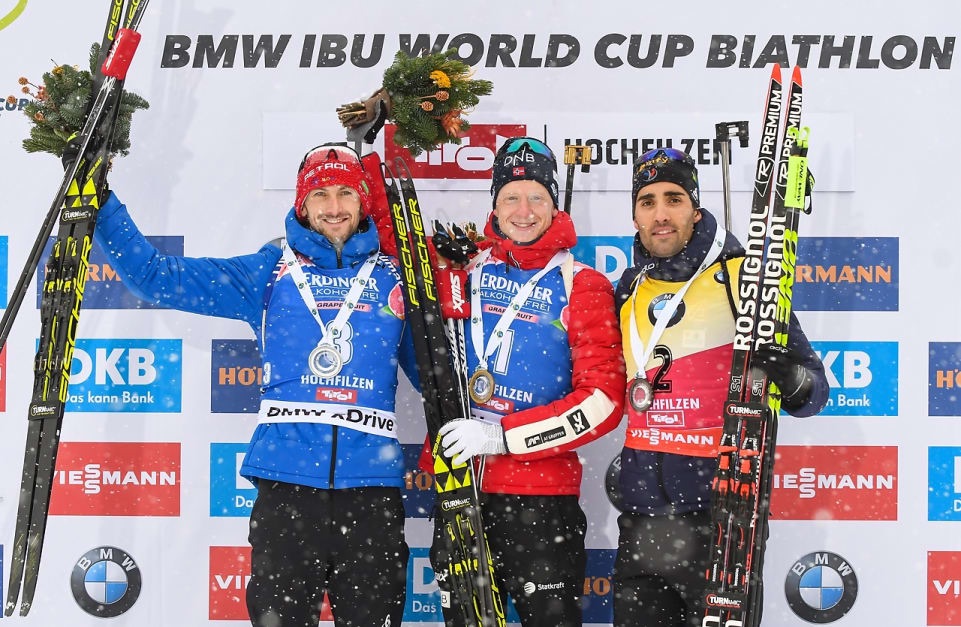
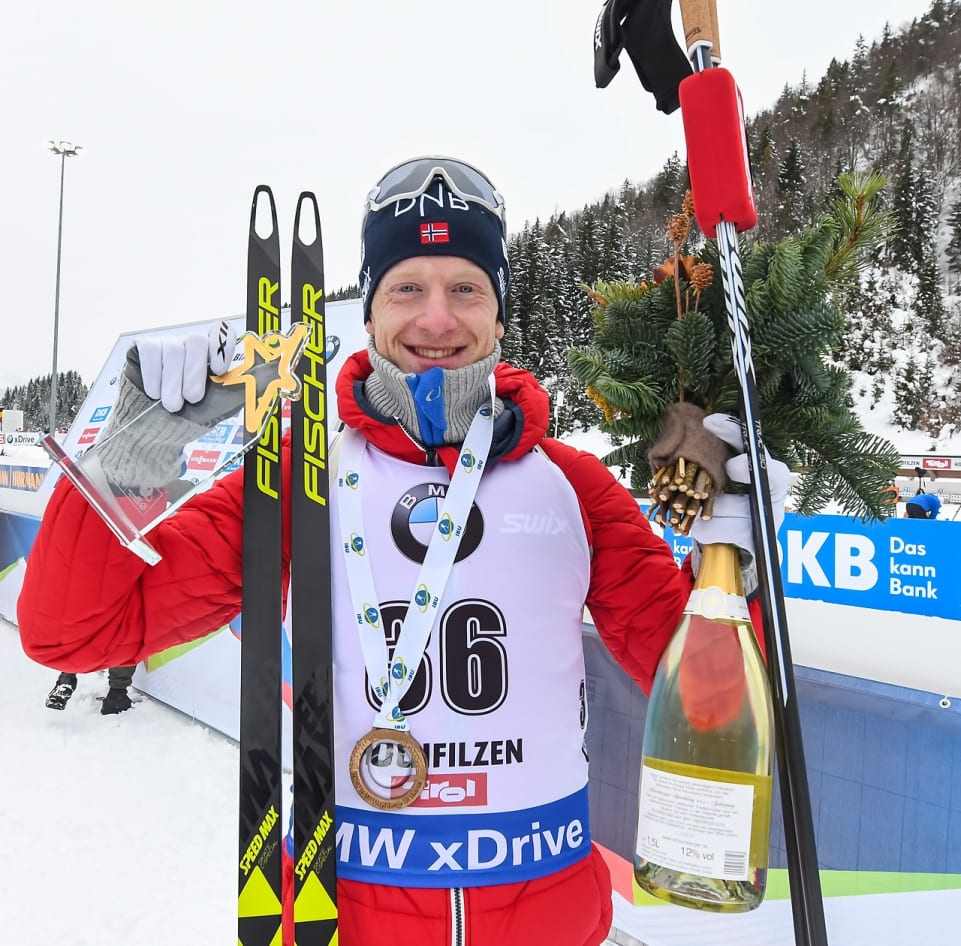
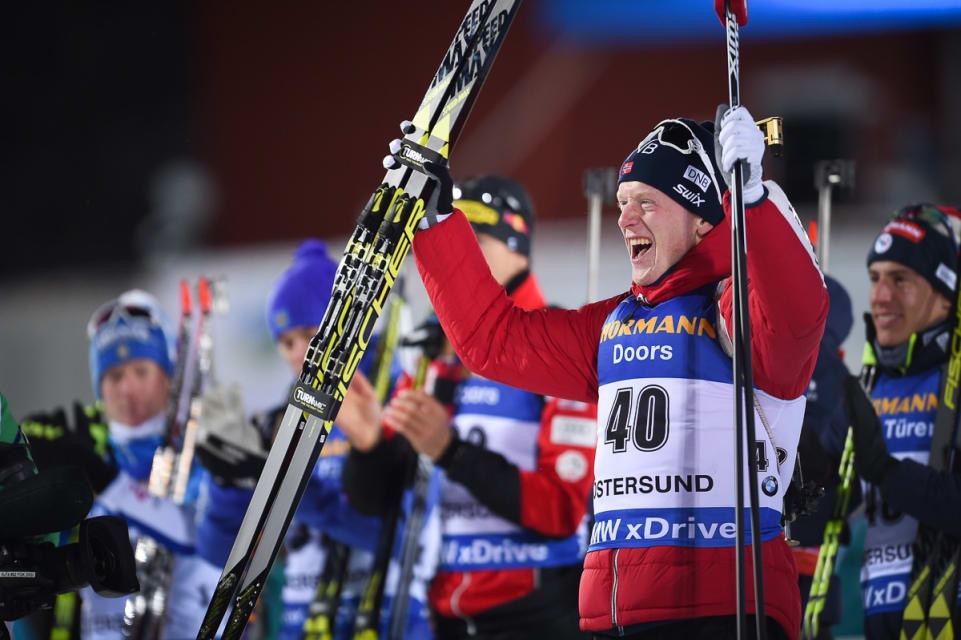
Norway’s Johannes Thingnes Bø with the first place hardware after winning the men’s IBU World Cup 10 k sprint in Pokljuka, Slovenia. (Photo: Biathlonworld,com)
IBU World Cup Pokljuka, Slovenia Men’s 10-kilometer Sprint
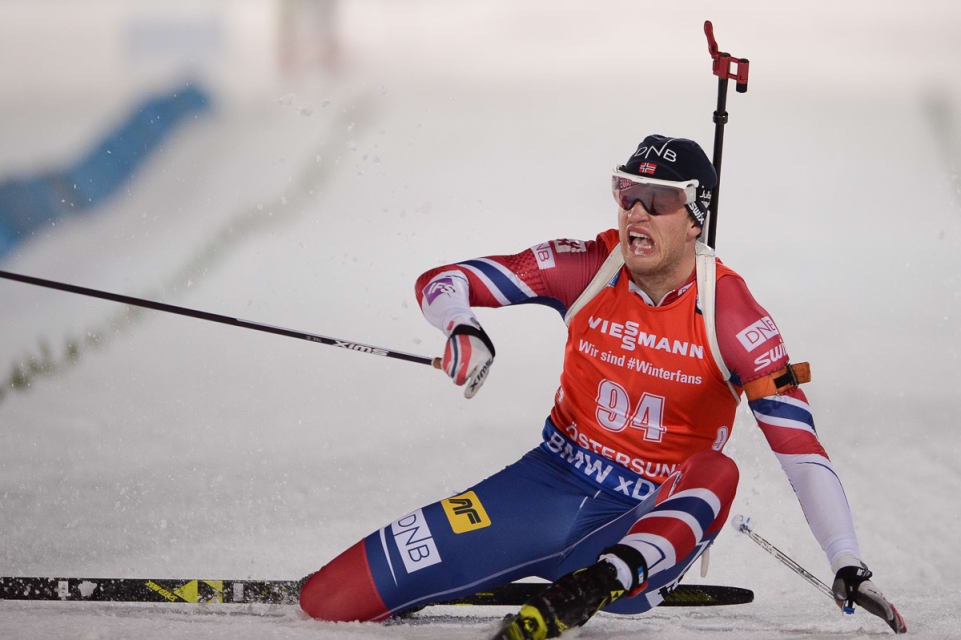
The men’s 10-kilometer sprint in Pokljuka, Slovenia was won today by Norway’s Johannes Thingnes Bø in a time of 23:46.3 minutes. During the two shooting stages, Bø skied a single penalty lap after missing one shot while standing.
Bø led the race from beginning to end, marking the fastest split at the first time check and never relinquishing control of the race.
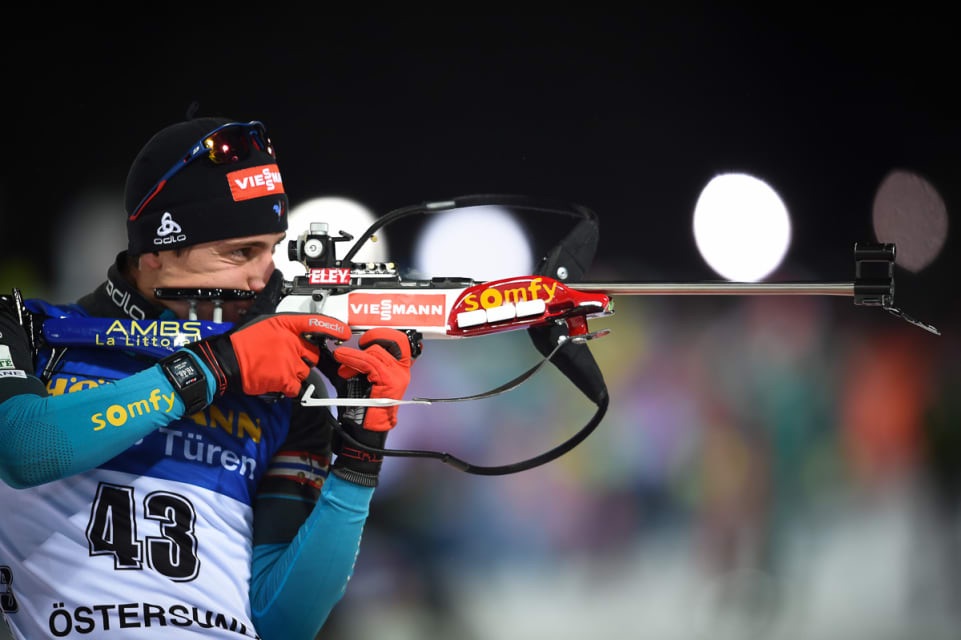
France’s Antonin Guigonnat placed second 16.1 seconds back. Guigonnat shot clean, skiing no penalty laps. Alexander Loginov of Russia was third. He also shot clean and finished 16.4 seconds behind winner Bø.
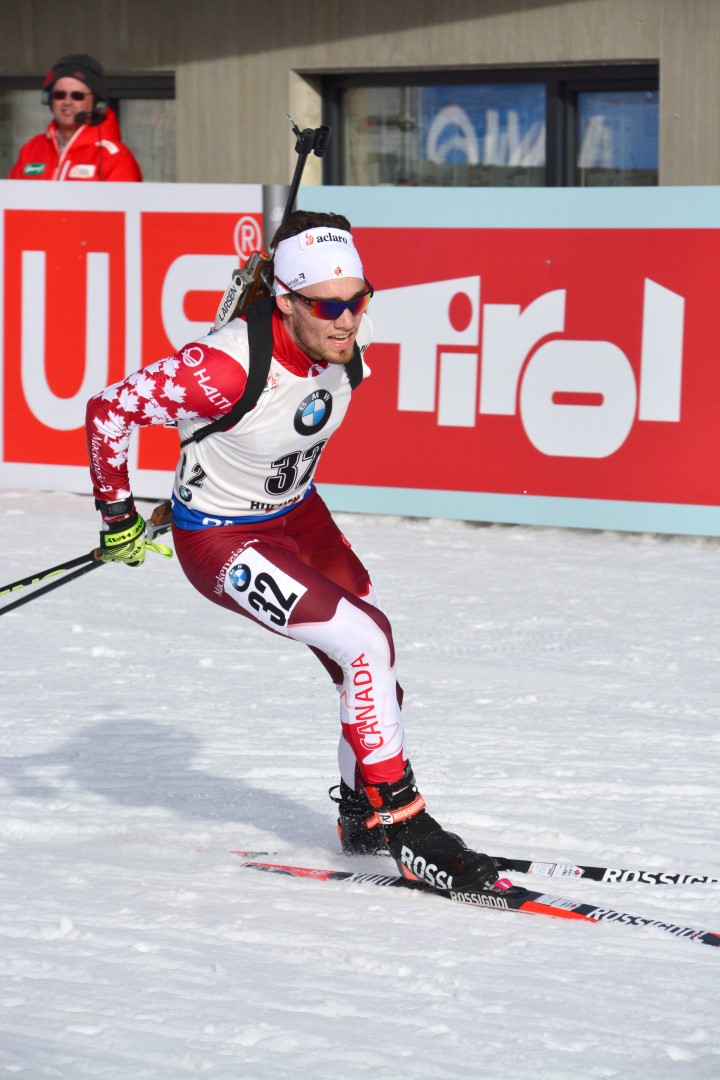
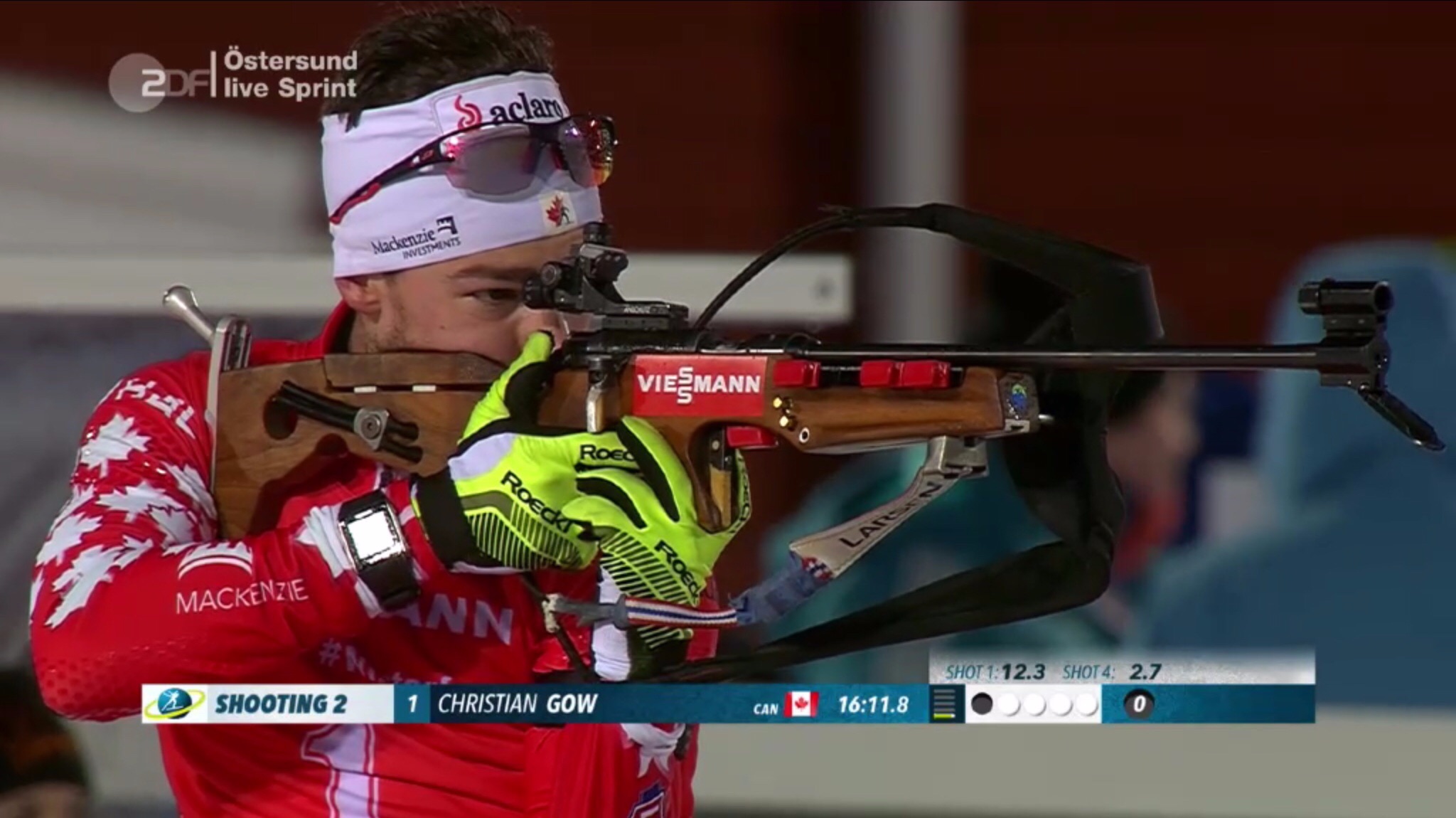
Canada’s Christian Gow had another strong performance, placing 17th (+1:01.2) after shooting clean. Christian Gow placed 16th in yesterday’s 20 k individual race.
Also for Canada, Brendan Green finished 81st (+2:36.9). Green had three penalties, one in prone, two standing. Nathan Smith was 88th (+2:54.4) after missing one target shooting prone. Scott Gow placed 93rd (+3:08.6) with four penalties. He missed two targets shooting prone, two standing.
American biathlete Sean Doherty placed 26th (+1:15.1) while shooting clean. Also for the U.S., Leif Nordgren crossed the line in 31st (+1:20.90.) He missed a single target shooting prone, and shot clean standing. Travis Cooper placed 103rd (+3:57.4). Cooper missed two targets shooting prone and three standing. Max Durtschi finished in 108th (+4:36.4) missing six targets in total; two in prone, four standing.
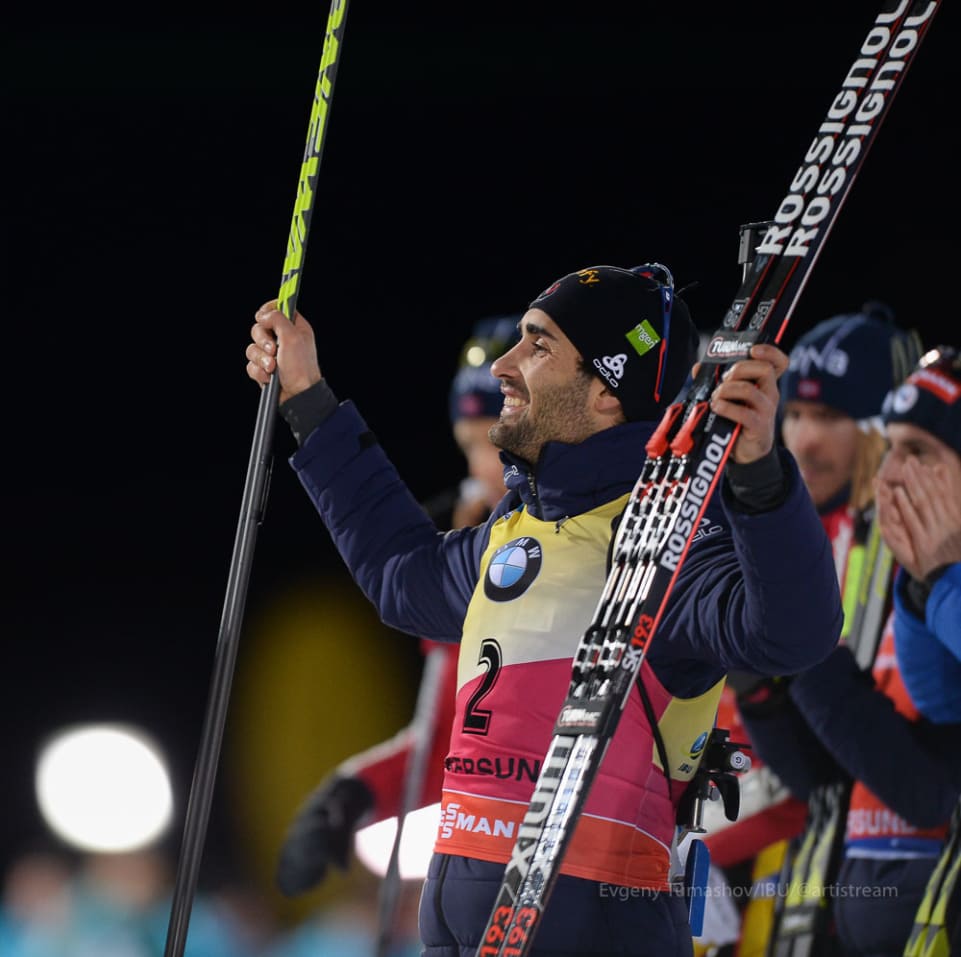
France’s Martin Fourcade shooting clean ans skiing fast as he won the men’s 20 k individual race in Pokljuka, Slovenia, site of the IBU World Cup’s first series of races this season. (Photo: Biathlonworld,com)
IBU World Cup Pokljuka, Slovenia 20 k/15k Individual
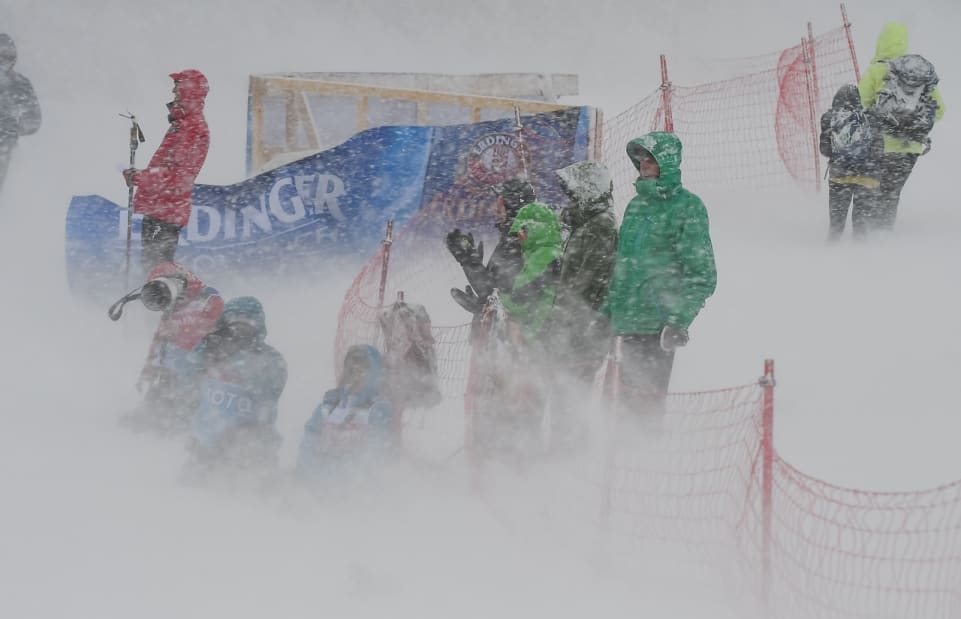
Not the least of the myriad variables affecting biathlon races, fickle weather has played games in Pokljuka, Slovenia, site of the first round on the IBU World Cup. The men’s 20-kilometer individual race was originally scheduled for Wednesday, but was postponed to Thursday due to fog.
For each missed shot in the individual races, athletes are penalized one minute. With a large cost for any shooting mistake, a single miss can punish a potential podium performance.
None other than France’s Martin Fourcade took the win today in 47:09.2 minutes. (Fourcade is a seven-time winner of the overall IBU World Cup.) Fourcade shot clean in all four of his shooting bouts. And shooting clean was the theme for the podium, the top-three finishers had no misses on the shooting range.
Second place went to Johannes Kuehn of Germany, finishing 4.2 seconds back. Third place was secured by Simon Eder, who stopped the clock 19.7 seconds back.
For Canada, Scott Gow skied to 14th (+1:43.3) with one miss. Brother Christian Gow was 16th (1:59.2) after also missing only a single target. Brendan Green skied to 100th (+9:04.1) after difficult shooting, during which he missed seven targets. Nathan Smith did not start.
For the U.S. Leif Nordgren was the best placed American in 40th (+3:24.5). Nordgren missed two shots. Teammate Sean Doherty was 59th (+4:28.2) after missing three shots, Max Durtschi was 102nd (+9:37.0), after missing six targets. Travis Cooper raced to 105th (+10:02.0), while missing six shots.
The women’s 15 k individual was won by Ukraine’s Yuliya Dzhima 43:06.6 minutes. She was clean in her shooting in her first career IBU World Cup win. Poland’s Monika Hojnisz had a single penalty as she placed second (+5.9). The result was a best-ever result for Hojnisz at this level of competition. The Czech Republic’s Marketa Davidova also missed a single target on her way to her first career podium, finishing 16.5 seconds back in third place.
U.S. biathlete Susan Dunklee missed one target on her way to placing 11th (+1:00.09). With each miss adding an additional minute to an athlete’s finishing time, it was a solid effort and indicator for Dunklee.
“I’m psyched to have a great result so early in the season,” Dunklee emailed FasterSkier.
Dunklee, the U.S. team veteran, made note of U.S. skier Clare Egan’s race day performance. “Clare also threw down an impressive ski split, so in spite of our 3 start quota challenge, our team future looks bright,” Dunklee added.
Egan placed 60th (+4:23.3) after amounting five penalties. She raced the 13th fastest ski time. Emily Dreissigacker, also for the U.S., placed 69th (+5:17.0). Dreissigacker has four penalties.
Canada’s Megan Tandy finished in 62nd (+4:30.4), after missing three shots. Rosanna Crawford, also for Canada,was 64th (+4:34.7) with four misses, Meghan Bankes 71st (+5:22.) with three misses, and Nicole Moser 98th (+10:20.4) with seven misses.
Nadia Moser racing to 11th in the junior women’s 10 k pursuit at IBU Junior World Championships on Sunday in Otepää, Estonia. (Photo: Bryan Dickson)
The third and final day of Biathlon Canada’s selection trials concluded on Friday in Canmore, Alberta. The “trials” serve as a method to fill roster spots for athletes representing Canada on the IBU World Cup, IBU Cup, and IBU Junior Cup for the first travel period to Europe.
Prior to the selection trials, only Rosanna Crawford and Scott Gow had prequalified for the IBU World Cup.
Friday’s race was billed as a modified relay. There was in fact no relay, it was an individual start race described as athletes having “3 spares per clip with penalty loops for further missed targets, as per a relay format.”
With no penalty lap due to limited snow, women were penalized 22 seconds per miss, the men 24 seconds. The women raced a total of 6-kilometers, while the men skied 7.5 k, which are the traditional distances for each respective relay leg in biathlon.
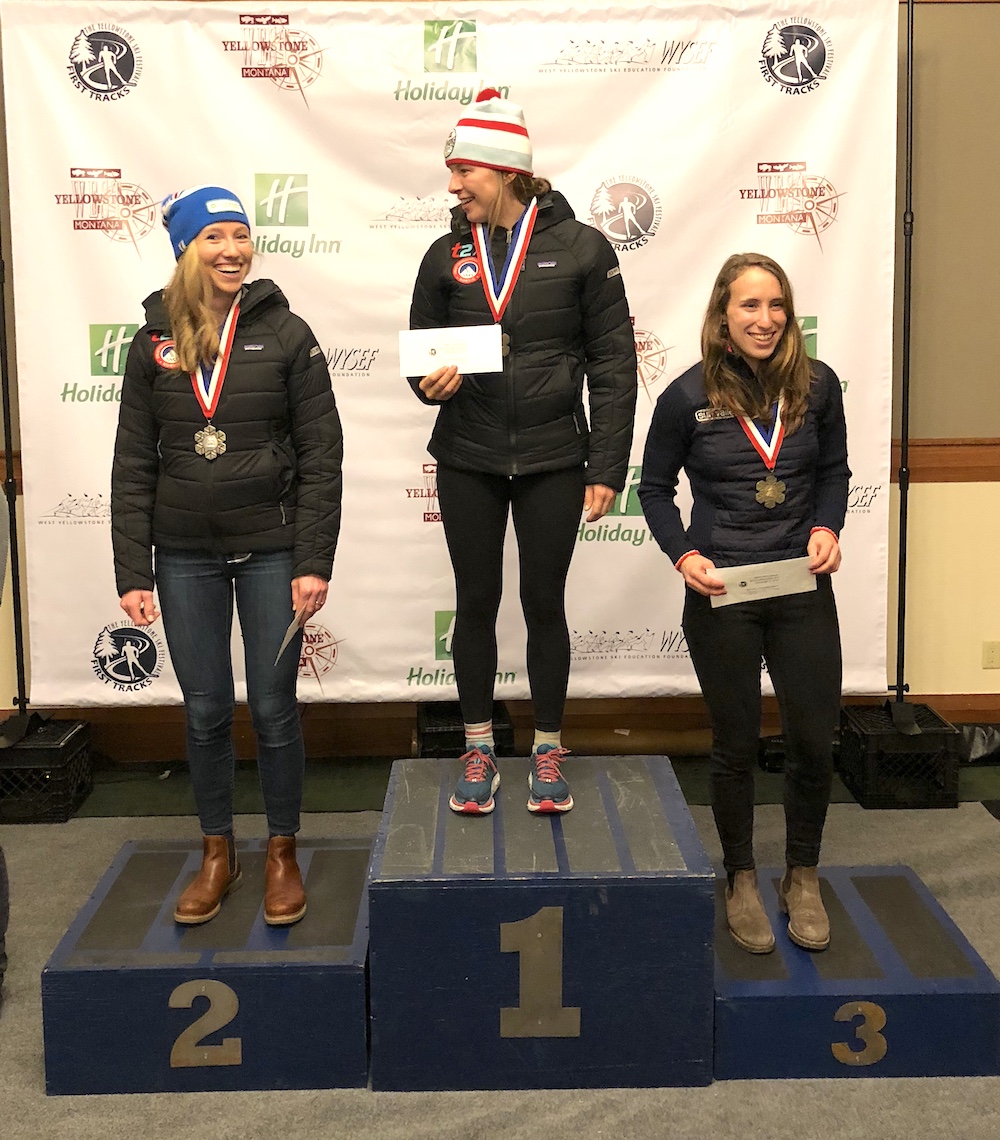
Nadia Moser racing for Biathlon Yukon won the women’s race in 19.57.5 minutes while cleaning prone and missing one shot standing. Emily Dickson (Team R.A.D.) placed second (+6.0) while shooting clean. Sarah Beaudry finished in third (+7.3) while also shooting clean in prone and standing.
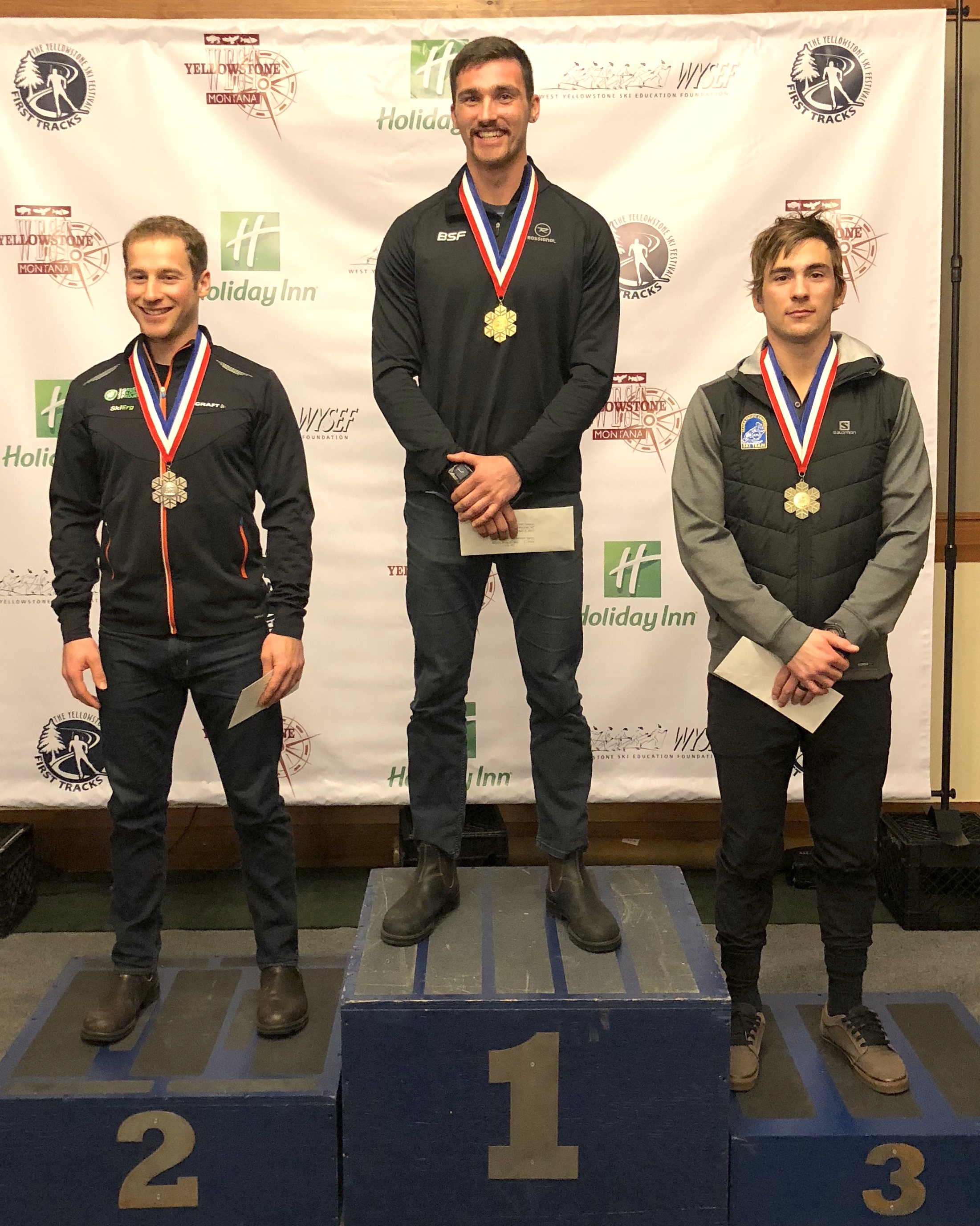
Senior National team member Christian Gow won the men’s race in 18:58.3 minutes after cleaning both his shooting stages. Brother Scott Gow, also a national team member, finished second (+8.9) with no misses on the range. Third place was taken by national team athlete Nathan Smith who crossed the line in 19:32 minutes. He missed two shots in prone and none standing. Smith won the second day’s sprint during selection trials.
Biathlon Canada is expected to announce its teams for European based racing on Monday, Nov. 11th.
Megan Tandy (bib 51) won the women’s sprint during the second day of racing at Canada’s biathlon selection trials in Canmore. (Photo: Matthias Ahrens)
Thursday in Canmore, Alberta day two of Biathlon Canada’s selection trials featured a sprint, with the men racing a total of 10-kilometers, the women 7.5 k.
Nathan Smith of Canada’s Senior National team placed first for the men in a time of 24:02.7 minutes. Smith missed one shot prone and cleaned standing. Christian Gow, winner of the trial’s Tuesday sprint, placed a close second (+4.2). Gow missed a single shot shooting prone and shot clean during his standing stage. Aidan Millar (Team R.A.D.) skied to third (+35.7) after missing two shots — one each in prone and standing.
With limited snow, the course is absent a penalty lap — male athletes were penalized 22 seconds per miss.
Megan Tandy, also part of Canada’s Senior National Team, won the women’s sprint in 21:17.5 minutes after cleaning her prone stage and missing one shot standing. Tandy placed second in Tuesday’s sprint.
Teammate Rosanna Crawford improved on Tuesday’s result, when she placed third, to take second (+5.7). Nadia Moser skiing for Biathlon Yukon, finished third (+21.2). Moser missed one shot in both prone and standing.
The women were penalized 22 seconds for each missed shot.
The selection trials will help determine Canada’s teams on the IBU World Cup, Ibu Cup and IBU Junior Cup for the first race period beginning the end of November. To date, only Scott Gow and Crawford pre-qualified for the 2018/2019 IBU World Cup.
Russell Currier, Tim Burke, Lowell Bailey, and Leif Nordgren after a fifth-place relay finish in the IBU World Cup relay in Oberhof, Germany, in 2013. Currier, Burke, and Bailey are all retiring. (Photo: USBA.)
With the 2018 Olympics come and gone, many of biathlon’s athletes are calling it quits. Here’s a roundup of who you won’t see on the World Cup next season – and who’s still on the fence about their future.
USA
2017 Word Champion Lowell Bailey has long planned to retire after the 2018 season, and now that time has come. His first World Junior Championships was in 1999 and he got his first World Cup start in 2002. He raced 2003 World Championships before taking a break to go to the University of Vermont, before returning and competing in the 2006, 2010, 2014, and 2018 Olympics. His eighth-place finish in the 20 k individual at the 2014 Games are the best ever by an American biathlete. Bailey is the Executive Director of the Crosscut Mountain Sports Center in Bozeman.
Susan Dunklee and Lowell Bailey celebrate after finishing second in the World Cup single mixed relay in Kontiolahti, Finland, in 2017. Austria won the competition. Bailey is retiring and Dunklee is undecided as to whether she will continue racing. (Photo: IBU/Twitter)
“I told myself this morning that I just wanted to go out on a high note,” he told FasterSkier in Oslo after leading off a U.S. relay team that finished seventh, in his last World Cup race. “I wanted to go out with a good result. And, I’m really happy to have shot clean in standing, clean from the clip in my last stage as a World Cup biathlete. That feels good. I’ll always remember that — that I went out with a clean stage.”
Longtime teammate and 2013 World Championships silver medalist Tim Burke will also retire. Burke has six World Cup podiums to his name including that silver medal, and led the World Cup partway through the 2009-2010 season. Burke started racing internationally at 2000 Junior World Championships, and made his first senior World Championships in 2004. Like Bailey, he is a four-time Olympian.
“It’s weird, I don’t honestly I don’t know if it’s truly hit me,” he said after the Oslo relay. “It might take weeks… I think it’s going to take a long time for all to settle in and for me to really reflect back on my career. Yeah, it’s a lot of emotion.” Burke says that his post-biathlon plans are not yet certain.
Tim Burke after placing sixth in a World Cup pursuit in Khanty-Mansiysk, Russia, in 2016. (Photo: USBA/NordicFocus)
Also retiring is Russell Currier, an off-and-on member of the national team and the Maine Winter Sports Center (now the Outdoor Sports Institute). Currier had two sixth-place World Cup results in 2012, and is a four-time World Championships team member. Since his World Cup debut in 2009, he has contributed to many U.S. relay efforts. He also competed at the 2014 Olympics, with a top finish of 49th, and was a member of the 2018 Olympic team though he did get any starts in PyeongChang.
“USBA nationals will be officially be the last race of my biathlon career,” Currier wrote in an email to FasterSkier this week.
The women’s team likely won’t see three retirements, and will thus have some more stability than the men’s crew, but there is more uncertainty regarding the women’s roster. Clare Egan wrote in an email this week that she was “Undecided!” about whether to continue racing. And in Oslo, after finishing third in the pursuit which was her last World Cup of the season, Susan Dunklee said the wasn’t sure if she would keep competing. “Ask me again in a month,” she said.
Canada
Julia Ransom retired in Oslo, as the 25-year-old is planning a career in dentistry and has many years of school ahead of her. “It’s just a good time for my partner and I to kind of move on,” she said after crossing the line in her final World Cup, the pursuit, hand in hand with teammate Rosanna Crawford.. “And it does feel right. It feels right.”
The Canadian men’s team (l-r) Christian Gow, Nathan Smith, Scott Gow, and Brendan Green celebrate bronze in the men’s 4 x 7.5 k relay at 2016 World Championships in Oslo, Norway. Both Green and Smith are undecided on their future plans. (Photo: JoJo Baldus)
Ransom scored two top-ten finishes at 2014 World Juniors, and made her first senior World Championships team in 2015. This season she had two top-ten World Cup finishes, and went to the Olympics in PyeongChang, where she finished 28th in the pursuit.
She is the only one from the Canadian team who is definitely retiring, but quite a few of her teammates are on the fence and there could be huge turnover on the team depending on what they decide. That includes Rosanna Crawford and Brendan Green, even though Crawford finally bagged her first World Cup podium this season.
“We’re not 100% sure yet,” Green said after the relay in Oslo. “Both Rosanna and I will sit on it a little bit over the spring. We will reevaluate a little bit and see what other opportunities arise. I think we both still love to race and train, and if we continue down that path I know we will still be motivated. But as of right now I’m not sure.”
2015 World Championships silver medalist Nathan Smith – who was also, along with Green, Christian Gow, and Scott Gow, part of a bronze-medal relay at 2016 World Championships – is also unsure. He missed most of the 2016-2017 season with health issues and though he returned to the World Cup and the Olympics this year, did not perform up to his own expectations.
Rosanna Crawford, Megan Imrie, Megan Tandy, and Zina Kocher celebrate a fourth-place World Cup relay finish in Annecy, France, in 2014. Crawford and Tandy may not keep racing after this season; Imrie retired in 2014 and Kocher in 2016. (Photo: Matthias Ahrens)
“I’m kind of waiting to see what happens with Biathlon Canada,” Smith wrote in an email this week. “I think some very difficult years are coming for the organization, unfortunately. That will play a big part in my, and I’m sure many other athletes’, decisions. Of course, I’m also not looking to have a continuation of the health problems over the last two seasons, which made competing at the highest level really difficult. So I will be keeping a close eye on how my body is reacting to training. If it’s still not coming around that would certainly not encourage me to continue either.”
2010, 2014, and 2018 Olympian Megan Tandy also struggled with health issues this winter, and is likewise not sure what her future holds.
“Originally it was my intention to retire after this season, however it was literally my worst season ever!” she wrote in an email. “I was sick more in the past 6 months than in the past two years. Anyways, I have taken some time since the Olympics to followup about my health and to consider options for next season. I want to race a final season – one where I feel good and can put up a good fight (not necessarily results dependant, I just want to leave this sector of my life feeling like I gave it all I got), but a lot of things will need to fall into place for that to be realistic: sponsor support, coaching opportunities during the training season, and my health of course.”
Poland
Weronika Nowakowska is calling it a career. The 31-year-old picked up two World Cup podiums in the 2015 season before taking a break from competition to give birth to twins. She made a successful return this season and represented Poland in PyeongChang, with a top finish of 21st in the individual. She also had sixth- and fourth-place finishes on the World Cup this year and contributed to four different top-eight relay efforts, including one at the Olympics.
“I leave happy, fulfilled and cheerful,” she wrote on her Facebook page, according to a translation. “I was not outstanding, but so far no Polish biathlete has done better”
France
Back in Oslo, French star Marie Dorin Habert ended her career. Dorin Habert – then simply Marie Dorin – competed in her first senior World Championships in PyeongChang in 2009, where she had a top individual finish of 18th and was part of the bronze-medal relay team. Fast forward and she had racked up a sprint bronze at the 2010 Olympics, seven World Cup wins, ten more World Championships relay medals, and four individual gold, one silver, and one bronze medal at World Championships, four of which were from the 2016 edition where she did not finish a single race without a medal.
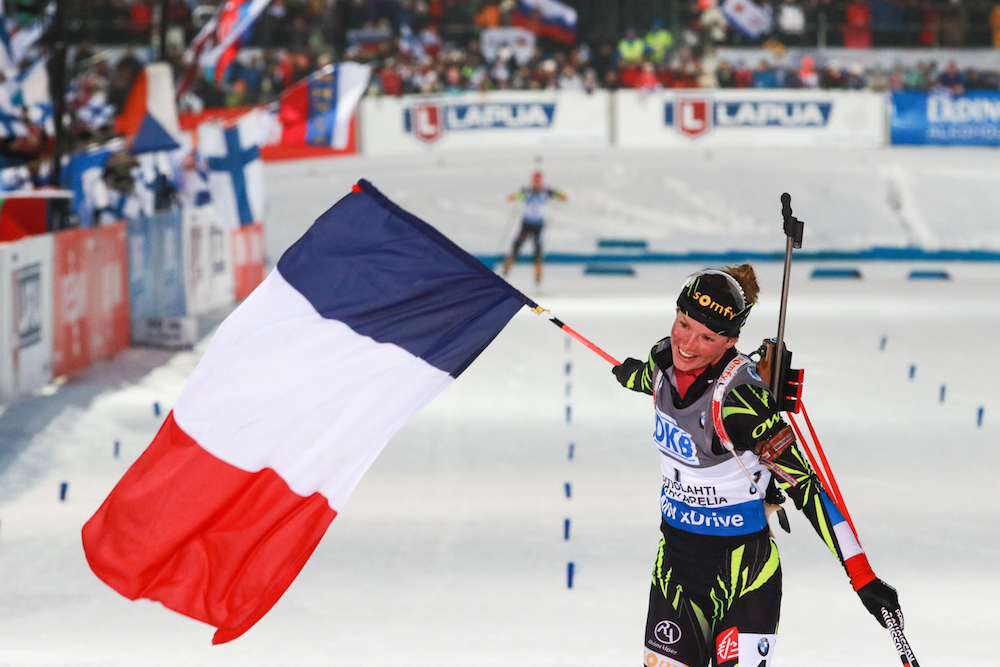
France’s Marie Dorin Habert celebrates her second win in as many races at 2015 IBU World Championships, after taking gold in the 10 k pursuit in Kontiolahti, Finland. (Photo: Kontiolahden Urheilijat/Jarno Artika)
She found herself back in PyeongChang for the 2018 Olympics, where, despite a frustrating season until then, she was fourth in the sprint, bronze in the women’s relay, and gold in the mixed relay.
“It’s so nice to end this way, to share it with all of the team, and the beautiful sun, and all the French people,” Dorin Habert said after winning the women’s relay in Oslo along with her teammates. “It’s a wonderful day for me. I would like to thank a lot, well, everyone, for being there in the biathlon family. I’m really happy to have this career, and I’m really happy for everything.”
Jean Guillaume Beatrix he told is also retiring. Beatrix was a World Junior Champion in 2009, before going on to be a five-time World Championships team member and a 2014 Olympic bronze medalist in the pursuit. He was part of three silver- and one bronze-medal winning men’s relay teams at World Championships. But this season, he did not perform well enough to make a very competitive French team for the 2018 Olympics. His retirement was “a decision precipitated by my results”, L’Equipe, according to a translation.
Czech
France’s Martin Fourcade leading Jaroslav Soukup of the Czech Republic during the men’s Olympic 12.5 k pursuit at the 2014 Olympics.
Jaroslav Soukup, the bronze medalist in the sprint at 2012 World Championships, where he was also part of the silver-medal mixed relay team, is retiring. Later in 2012, he suffered a horrendous accident while biking, including open fractures in his arm and neck and back injuries. By 2014, he made it back and won the same medals at the Olympics that he had at World Championships two years before: bronze in the sprint and silver in the mixed relay. Soukup qualified for the 2018 Olympics but only competed in the relay, which finished seventh. He had one World Cup top-30 this season.
Norway
Hilde Fenne, a staple of the Norwegian women’s team, retired after the last race of the season in Tyumen, Russia. Fenne never found breakout success as an individual; she had three top-15 finishes in her career. But she was an integral part of the women’s team and contributed to numerous World Cup relay podiums, as well as the gold-medal winning women’s relay at 2013 World Championships in Nove Mesto, Czech Republic.
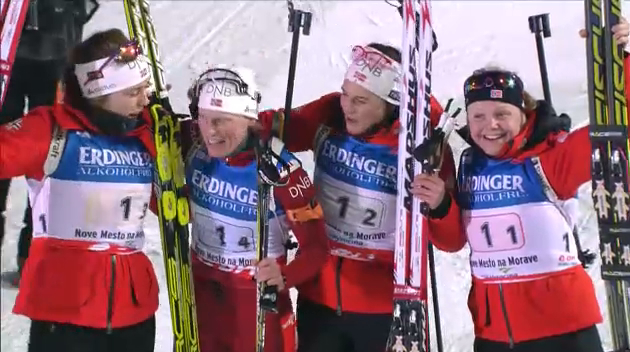
The Norwegian women’s relay celebrates its second-ever World Championships title after winning the 4 x 6 k event in Nove Mesto, Czech Republic. From left to right: Synnøve Solemdal, Tora Berger, Ann Kristin Flatland and Hilde Fenne.
In that final race, her teammates wrote her name on their cheeks. “She has been a very important piece for me,” teammate Synnøve Solemdal told NRK, almost in tears. “We have stayed in a lot of hotel rooms together. I’m going to miss her very much.”
On the men’s side, there is uncertainty as to whether some veterans will stick with racing or not. One is Ole Einar Bjørndalen, whowas left off Norway’s Olympic team, who for the first time since 1992 this season. And yet, the 44-year-old has not stated that he will retire, and some who know him are speculating that he may try to stick it out one more year and go out with better results than he saw this season.
Also with no stated plans is Emil Hegle Svendsen. Bjørndalen is the winningest athlete in World Cup history; Svendsen is number four. He won the World Cup overall title in 2010, and is a four-time Olympian. He won gold in the individual in 2010 and in the mass start in 2014, after which he suffered a total collapse anchoring the Norwegian men’s relay. In the past seasons he has been off and on, and he has only won two races since then. But this season he showed flashes of brilliance, and he was third in the mass start at the 2018 Olympics as well as anchoring the silver medal men’s relay and mixed relays.
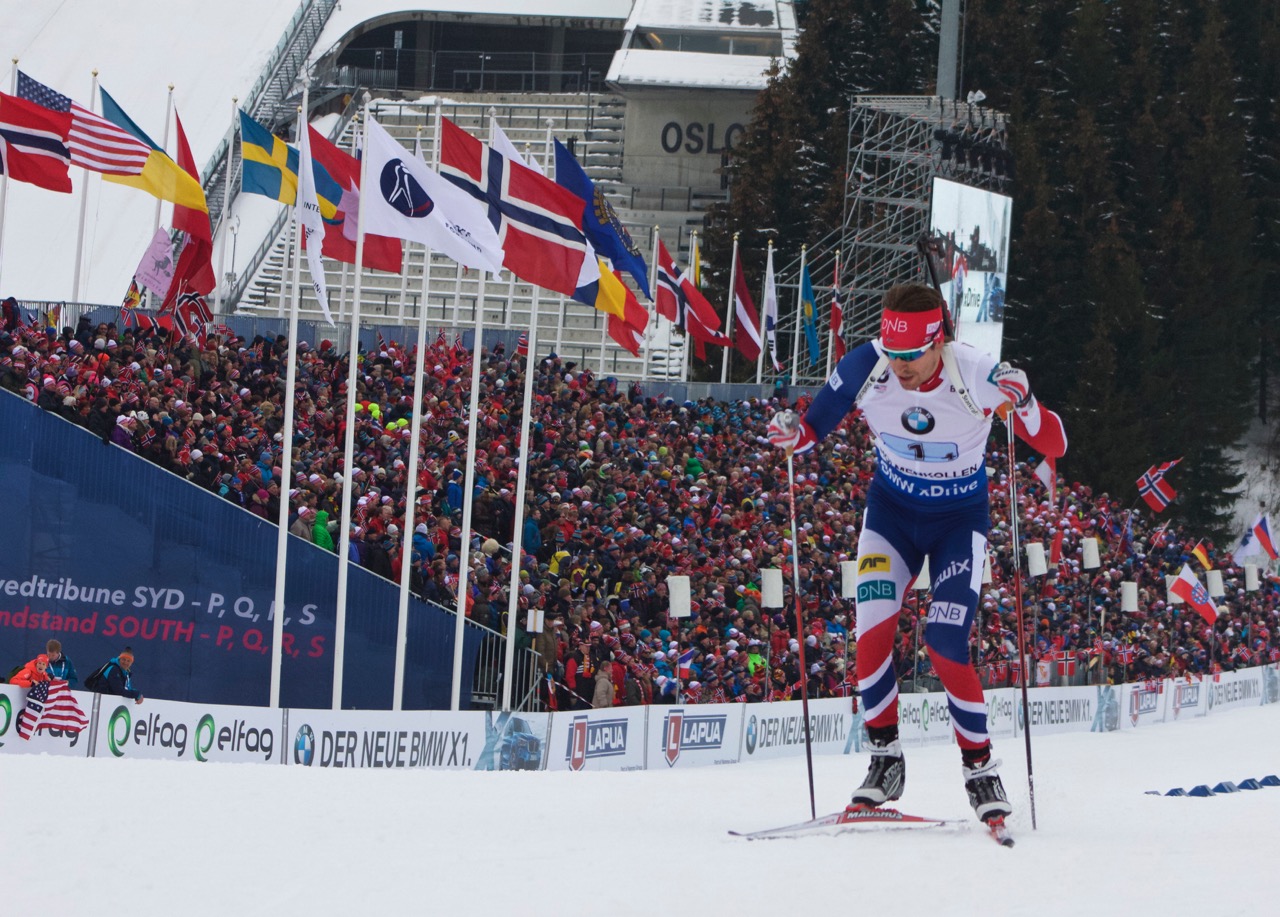
Emil Hegle Svendsen of Norway leaves the stadium in the 2016 Holmenkollen World Cup as thousands of his countrymen cheer him on. Svendsen has not officially announced his plans for next season. (Photo: JoJo Baldus)
“What Emil has done is absolutely fantastic,” teammate Tarjei Bø – who won the overall World Cup the year after Svendsen – told NRK two weeks ago. “He has won everything, and in addition done it several times, and he has come back again and again after being down. He has had a fantastic career and I hope he continues.”
Finland
She just won the overall World Cup crystal globe, but Kaisa Makarainen is not sure whether she will continue racing. In several previous years she had already discussed potentially retiring, but now she is reportedly waiting to think it over more as well as to discuss with the new team staff. U.S. Biathlon Women’s Coach Jonne Kahkonen, himself a Finn, was just announced as the new Head Coach for Finland.
Germany
Florian Graf, an athlete who finished as high as fourth on the World Cup in 2013 but has more recently been racing on the IBU Cup, is calling it quits at age 29.
Several other top athletes are suspected to be considering retiring, but there hasn’t been much on the record discussion by them. Stay tuned.
Norway’s Johannes Thingnes Bø celebrates his first Olympic medal — gold — in the men’s 20 k individual on Thursday at the 2018 Olympics in PyeongChang, South Korea. (Photo: FlyingPointRoad)
Johannes Thingnes Bø came into these Olympics as a definite favorite, right up there with Martin Fourcade. But PyeongChang quickly humbled the 24-year-old Norwegian, just as it did Fourcade, in the first race of the 2018 Winter Games. There, in the men’s 10-kilometer sprint, Fourcade finished eighth, missing three out of five in his first shooting stage, and Bø had the same problem with prone — missing three then shooting another penalty in standing — to end up 31st. It was the kind of result no one saw coming after those two had taken first or second in every non-relay World Cup race this season (except for one, the sprint that Bø’s older brother Tarjei Bø won on Dec. 2 in Östersund, Sweden).
The men’s second biathlon race of the Games, the 15 k pursuit, saw Fourcade back to his winning ways while Johannes Bø finished 21st.
“We both [knew] before the Olympics that it will not be only a fight between us, because we know the shooting range [here] is challenging,” Fourcade said when asked about Bø in a press conference after the pursuit. “I thought that at our best level, we could be difficult to beat but the wind and the Olympic situation will bring many opportunities for outsiders to take competition… It’s not a competition about Johannes today. It’s biathlon.”
Three days later in the men’s 20 k individual race on Thursday, Bø overcame any doubts and won his first Olympic medal in his second Games. It was gold, and he had achieved it with a time that stood up against 85 others in the men’s field. Even with two penalties that added two minutes to his final time (there are no penalty laps in the individual-format race), Bø finished the 20 k in 48:03.8 minutes and he posted the fastest overall course time of 43:11.4 in the process.
Despite his two previous races in PyeongChang, Bø — the overall World Cup leader in the 20 k individual — explained in a post-race press conference on Thursday that he never got down on himself.
Norway’s Johannes Thingnes Bø racing to first in the men’s 20 k individual on Thursday at the 2018 Olympics in PyeongChang, South Korea. The gold was his first Olympic medal in his second Winter Games. (Photo: IBU/Biathlonworld)
“After the two done races, I just let my shoulders down, and I knew there were still two great opportunities for me, individual and mass start,” he said. “Two races I have won before this season, so I knew that there still was a chance even if the sprint and pursuit was my favorite before the Olympics. So I always had the belief that I could do it. And you only need one chance, so if I missed out today there would still be a chance on the mass start, and I always believed that I could make it.”
He started Thursday’s individual race in bib 9 and was one of several of the top contenders who chose an early start because of more favorable conditions earlier in the day. It was the warmest race day yet at the Alpensia biathlon venue, and perhaps most importantly, less windy than it had been. At least that was the case early in the 20 k; the wind picked up as the race wore on.
Bø took the attention away from himself early in the race after missing one in the first prone stage — his third shot. That put him in seventh at the time and ultimately 52nd overall. From that point on, Bø quietly worked his way back into contention, cleaning the next two stages, then missing shot in the last standing stage. But because of his speediness out on the course, he still left the range in first.
In the finishing stretch, Bø nearly took himself out as his pole tip nicked his left ski. But he stayed upright, recollected himself and continued charging to the line. There, he finished 1:22.1 minutes clear of the previous race leader, Sweden’s Fredrik Lindström.
“I put my pole right down on my ski,” Bø told NRK after, according to a translation. “Two to three [centimeters] to the left and I would’ve put the pole on the inside of the ski, but it would’ve went well anyway, but you never know.”
As the rest of the starters embarked on the five-loop course and navigated the four shooting stages, it became evident that no one was going to touch Bø. He sat inside the leader’s cubicle at the venue, which had a small couch and TV to watch the rest of the race, along with a race-leader camera documenting his every move. He wasn’t glued to the screen by any means. It was probably hard for him to watch.
France’s Martin Fourcade (23) follows Sweden’s Fredrik Lindström (1) during the men’s 20 k individual at the 2018 Olympics in PyeongChang, South Korea. Fourcade went on to place fifth while Lindström placed eighth. (Photo: FlyingPointRoad)
Initially, Fourcade came closest to him, finishing 42.4 seconds off his time in second place. The Frenchman had been on track for his second-straight gold after cleaning the first three stages of Thursday’s race, but he missed his last two shots to slip to second behind Bø. And he couldn’t beat the Norwegian on the last loop; despite skiing the second-fastest final loop and second-fastest overall course time, Fourcade was still second to Bø, who was the fastest on both.
“That was like a gift,” Bø said at the press conference of Fourcade’s uncharacteristic late misses. “Even if he only had missed one of the two last [shots] he would have been the winner. But, you know, someone will miss one in the first shooting and one in the last, and others make two mistakes on the last shooting, so you just have to see for the total. And we both had two mistakes today and I was a little bit faster than him and that saved my result.”
Austria’s Dominik Landertinger racing to bronze in the men’s 20 k individual at the 2018 Olympics in PyeongChang, South Korea. (Photo: FlyingPointRoad)
Fourcade as the 23rd starter was later bumped off the podium by Austria’s Dominik Landertinger (bib 38) and Sweden’s Sebastien Samuelsson (bib 51), respectively. While Landertinger hung on for the medals, Samuelsson missed his second-consecutive Olympic medal in fourth place (+29.1), 14.9 seconds behind Landertinger.
While Landertinger had shot a perfect 20-for-20 and Samuelsson was one off that mark with a single penalty (0+0+1+0), the 57th starter, Slovenia’s Jakov Fak finished ahead of them both and just 5.5 seconds behind Bø for the silver medal. Like Landertinger, who earned bronze (+14.2), Fak was one of just three men who cleaned all four stages on Thursday. (Ukraine’s Artem Tyshchenko, who finished 29th, was the other.)
Once Fak finished, Bø could finally exhale and celebrate. He had done it.
“After the first shooting, I still believed that a medal could be won, could be possible, but after the last standing I thought I missed out on the podium,” Bø reflected at the press conference.
“I’m glad I fought through the final lap even with two misses,” he told NRK. “Because I thought the medals wouldn’t be possible, but I felt good, and I had no problems with changing gears out in the course. And thank God I did, because I ended up with the gold in the end.”
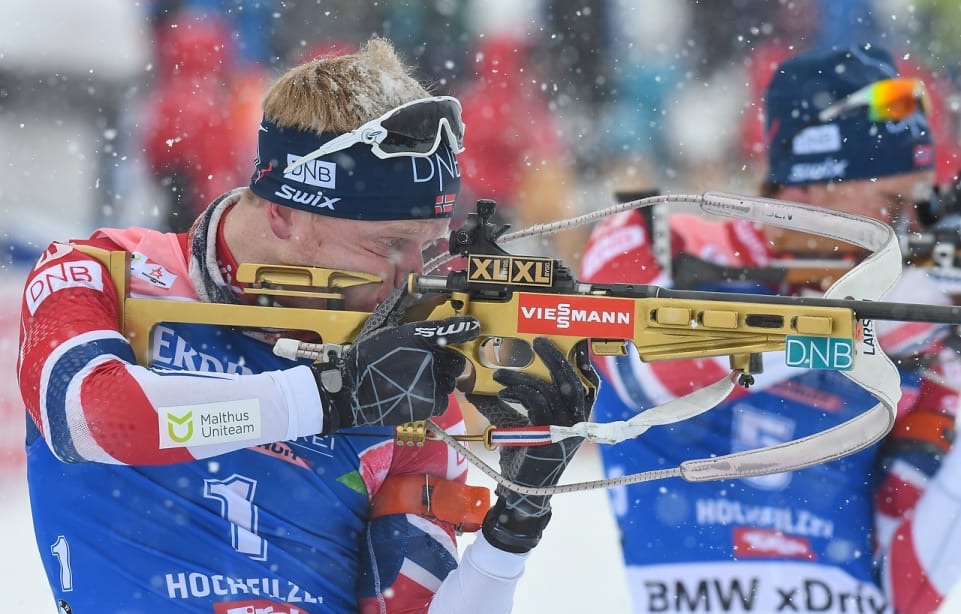
Bø’s previous Olympic best was fourth in the men’s relay at the 2014 Olympics in Sochi, Russia. He is a three-time world champion and won three golds at biathlon Junior World Championships, two of which came in relays in 2012 and 2013. Between that time of transitioning from the junior ranks to the World Cup in 2013, Bø became best known as the young and hard-charging biathlete with the gold-painted rifle. He later painted it pink, before going back to gold in the leadup to PyeongChang.
“I had a pink rifle for two years and I wanted to change it before the Olympics,” Bø said at the press conference. “The first season I came into the World Cup I had a golden rifle.”
The men’s 20 k individual podium at the 2018 Olympics in PyeongChang, South Korea, with Norway’s Johannes Thingnes Bø (c) in first, Slovenia’s Jakov Fak (l) in second, and Austria’s Dominik Landertinger (r) in third. (Photo: FlyingPointRoad)
After stepping back outside and into the stadium, Bø began to tear up. He finally connected with his brother Tarjei, who had finished 13th with two penalties, and they embraced in a special moment.
“It’s a great feeling,” Bø said of what it’s like to be an Olympic champion. “To describe with one word is just ‘amazing’. It’s every nice words you can find.”
For Fak, 30, who missed all but two World Cup races last season because of health issues, he said the silver medal was a “dream come true.” Earlier this season, he placed second in two World Cup pursuits.
“At the last Olympics in Sochi, I was sick before the Olympic Games,” Fak said at the press conference. “I fought until the last race to get some medals and my best result was fourth place in the mass start, so I missed it and it was a big struggle for me, the last two seasons were very hard. I was sick all the time. Last season I had only two starts on the World Cup and it would be better if I didn’t even have them. I had really a lot of problems and to come back into the whole season was a very big victory for me.”
Slovenia’s Jakov Fak pushing for silver in the men’s 20 k individual at the 2018 Olympics in PyeongChang, South Korea. (Photo: FlyingPointRoad)
After different illnesses plagued him last year — “I would train for two weeks and another sickness would come,” he recalled — Fak considered hanging up his rifle and quitting the sport. But his coach encouraged him to stick with it.
“We made a good plan. It was not to be on the highest level on the World Cup, but just to come back,” Fak explained. “And everything that I’ve done this season, the podiums, are just a big bonus for me.”
Landertinger, 29, earned his second Olympic bronze after helping Austria to third in the men’s relay in Sochi. He also has a relay silver from 2010 in Vancouver, British Columbia, but Thursday marked his first individual Olympic medal.
In September, he had back surgery to repair a herniated disc, and he didn’t start his World Cup season until early last month.
“I am really overwhelmed,” Landertinger told Austrian broadcaster ORF, according to a translation. “The last year was extremely tough. During the last races I already was a little bit despaired, and now the bronze medal, that is crazy. On the course I again did not feel good today, but I fought and put out everything I could. There were a lot of beautiful moments in my career, this medal was the most difficult one. Today I had to do it with the shooting, and that worked out.”
Fourcade ended up fifth on the day (+42.4), Switzerland’s Benjamin Weger placed sixth (+48.6) with one penalty, the Czech Republic’s Michal Krčmář finished seventh (+1:15.5) with one miss, and Lindström was eighth (+1:22.1) with one penalty as well.
Scott Gow’s Career-Best 14th
In his first Olympics, Canada’s Scott Gow raced to 14th (+2:02.5) for his best Olympic result by nearly 50 places after finishing 61st in the PyeongChang sprint. Gow cleaned three-consecutive stages then missed his first shot on the final standing (0+0+0+1) to slip out of the top 10. Regardless, 14th was still better than his career-best World Cup result after he had finished 16th in two races this season.
Canada’s Scott Gow racing to 14th in the men’s 20 k individual on Thursday at the 2018 Olympics in PyeongChang, South Korea. It was his career best at the World Cup and world-championships level. (Photo: FlyingPointRoad)
“I was very happy with it,” Gow said of his result in a post-race interview with FasterSkier. “A little disappointed to miss that one standing shot, especially when everything was going quite well in the range. Skiing was pretty good, and so overall I am very happy.”
Without having spoken with his coach yet, Gow wasn’t exactly sure where his lone miss went wrong, but he guessed it was a close one.
“I have a feeling that I missed it just high,” the 27 year old said. “That’s usually where I miss in standing, especially when it feels good. If it feels like it was good, if it feels like it was hit, I probably missed it just high.”
With weaker and less variable wind than in previous biathlon races this week, Gow said that presented a new challenge.
“When it’s this calm, relatively as calm, everyone can shoot well,” he observed. “So that puts a little extra pressure and emphasis on myself to shoot well. So going into today I knew that would be have to the focus, to hit targets, because even if my skiing is a little off I can make up for it with a really good shooting. And that was what was going through my head the last few days preparing for this.”
Looking ahead to the remaining races in PyeongChang, Gow said the hardest ones were over.
“Now it’s the relays,” he said. “And my body feels like it’s in fairly good shape. I was happy with my skiing today, and again, my shooting was much better today and it has been good all week. So as long as I can maintain a good training mode and a good training rhythm, I think it will be good, and I am optimistic.”
Canada’s Brendan Green racing to 22nd in the men’s 20 k individual at the 2018 Olympics in PyeongChang, South Korea. (Photo: FlyingPointRoad)
Canada had three in the top 30 with Brendan Green in 22nd (+2:26.6), with a single miss in the last stage (0+0+0+1), and Christian Gow in 26th (+2:57.2), with two penalties (1+0+0+1). For 24-year-old Christian Gow in his first Olympics, it was a big improvement from 62nd in the sprint.
“I think I kind of reset after the sprint. It was not even close to what I wanted,” Christian, Scott’s younger brother, told FasterSkier after. “But I guess what I realized kind of internalizing that race is that I am not defined by one race that I had. Of course of all the times that you want to perform is the Olympic Games. It was a bit of a bummer, and I looked at it as a chance to refocus for the races to come, obviously including this one.
“I was very happy with my effort,” Christian said before he knew his final result. “I felt like I had good energy on skis and was able to push the whole time, and more than anything I am just happy with what I did out there today.”
Canada’s Christian Gow racing to 26th in the men’s 20 k individual on Thursday for his best result at his first Olympics in PyeongChang, South Korea. (Photo: FlyingPointRoad)
Green, 31, was also pleased with his performance after placing 82nd in the sprint four days ago.
“I was a little worried going into today after the sprint. I mean, the sprint you had the wind, but I also had a pretty rough day on the skis as well,” he told FasterSkier. “So I was a little bit worried as to how today would play out, but I did a good race prep yesterday. I didn’t have a ton of guys to ski with today, but there were always people kind of within sight … I just tried to keep a pace that I could maintain and really focus on the shooting range.
“I think I was really able to capitalize on these less-windy conditions that we finally had today,” Green said. “And to get away with one miss, that’s a good day for sure.”
American Tim Burke en route to 41st in the men’s 20 k individual at the 2018 Olympics in PyeongChang, South Korea. (Photo: FlyingPointRoad)
In his fourth Olympics, Tim Burke was the top American in 41st (+4:01.9), a result he wasn’t happy with, after shooting four penalties (1+1+0+2).
“The strategy is always the same: it’s just to execute the game plan, and tonight I struggled with that on the range,” he told FasterSkier after. “I felt like I was decent on the skis, not great but not bad. … I felt like I tried to follow through with my plan, and some days it’s easier than others. And today it didn’t work out.”
Sean Doherty followed in 44th (+4:21.8) with three penalties (2+0+1+0).
“Prone has continued to have a few gremlins in it for me,” the 22-year-old two-time Olympian said. “I worked on it the last couple days in training, but I mean, today was less wind and I was looking forward to that, so I still have just a couple things to work out with it. Standing was great, felt super solid, skied well. You know, those two out of three categories went well, so prone is just continuing to plague me. It’s unfortunate.”
Lowell Bailey, the defending world champion in the 20 k individual, finished 51st (+4:53.0) after missing his first two shots of the day in the first prone then incurring two additional penalties (2+1+0+1). The four penalties added four minutes to his time.
Afterwards, Bailey was beside himself.
“I think shock is really the only way to describe it, completely shocked to miss those two,” he told FasterSkier. “I’ve never started an individual [race] like that. I felt really good about the shooting going into this, I had a game plan, I really felt like I had everything — I had a good plan, it just didn’t work out.
American Lowell Bailey gets up off the mat and ready to head back onto the course after a shooting stage in the men’s 20 k individual at the 2018 Olympics in PyeongChang, South Korea, where he finished 51st. (Photo: FlyingPointRoad)
“I knew the shooting conditions were more to my liking today and I felt really good about my training leading into it, especially on the shooting range, I felt like this was the race I had a good chance to do well in,” he continued. “The wind got me. It was just enough to push me out on the right side. The wind’s tricky here, sometimes it doesn’t register as strong as it actually is, so missing two shots right off the bat, that’s just a really tough way to start the race.”
At that point, he said he had two options.
“You can decide to give it your best because you’re representing your country or you can throw in the towel,” Bailey said. “And I think if there’s one thing I can take away from this race it’s that I never gave up.”
The fourth American finisher, Leif Nordgren placed 64th (+6:27.3) with five penalties (1+1+3+0). Canada’s Nathan Smith ended the race in 81st (+8:11.9) with five misses as well (0+1+4+0).
“I think it was a shooting race today,” Smith noted. “That was my focus. I felt comfortable taking it a little bit easier on the tracks. Unfortunately my third shooting, my second prone, was a disaster. I don’t know what happened. Other than that, my shooting was excellent. I’ll have to ask [coach Matthias Ahrens]. I was adjusting and I don’t know, [the targets] wouldn’t go down that time.”
Moving forward, Smith said he would take it easy in the days leading up to the relay next week. The mixed relay (2 women, 2 men per team) is scheduled for Tuesday, Feb. 20 and the men’s 4 x 7.5 k relay — the last biathlon race of the Games — is next Friday, Feb. 23.
No North Americans qualified for the 30-athlete mass start, with the men’s 15 k mass start taking place on Sunday.
It was a disappointing opening to the Olympics for Johannes Thingnes Bø of Norway, who despite winning eight World Cup races this season started the Games with finishes of 31st and 21st in the sprint and pursuit. But on Thursday he showed why he was a medal favorite and won the 20 k individual race – only by 5.5 seconds, but that margin becomes impressive when you consider that he had two penalties, and thus two minutes of penalty time, while silver and bronze medalists Jakov Fak of Slovenia and Dominik Landertinger of Austria (+14.2) shot clean.
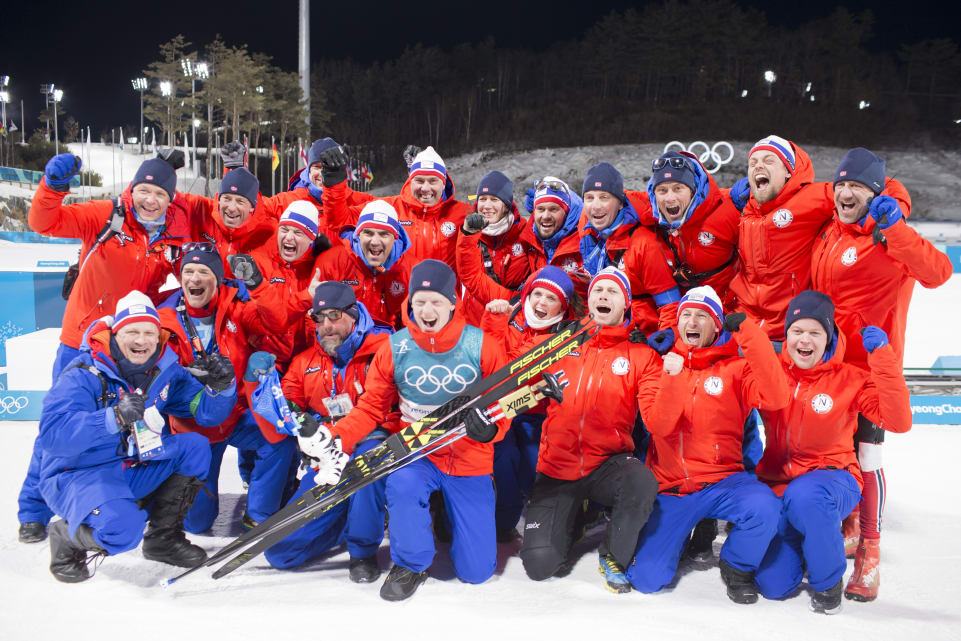
Johannes Thinges Bø celebrates with Norwegian team staff after winning Olympic gold in the 20 k individual despite two missed shots. (Photo: IBU/Biathlonworld.com)
Sweden’s Sebastian Samuelsson followed up a silver medal in the pursuit with fourth place in the individual, missing one shot and notching a time 29.1 seconds behind Bø. France’s Martin Fourcade, gold medalist in the pursuit, missed two shots like Bø but finished in fifth (+42.4). Switzerland’s Benjamin Weger placed sixth (+48.6) with one penalty.
It was a good day for Canada on the back of strong shooting: Scott Gow placed 14th (+2:02.5) with one penalty for a career-best result result; he had previously had two 16th-place finishes on the World Cup this season. With the same shooting, Brendan Green placed 22nd (+2:26.6). Christian Gow had two penalties to finish 26th (+2:57.2). Canada’s fourth man, Nathan Smith, missed five shots and placed 81st (+8:11.9).
For the United States, shooting was not as successful and Tim Burke led the way in 41st (+4:01.9) with four penalties. With one less penalty Sean Doherty was close behind in 44th (+4:21.8). Lowell Bailey placed 51st with four penalties (+4:53.0) and Leif Nordgren missed five shots to finish 66th (+6:27.3).
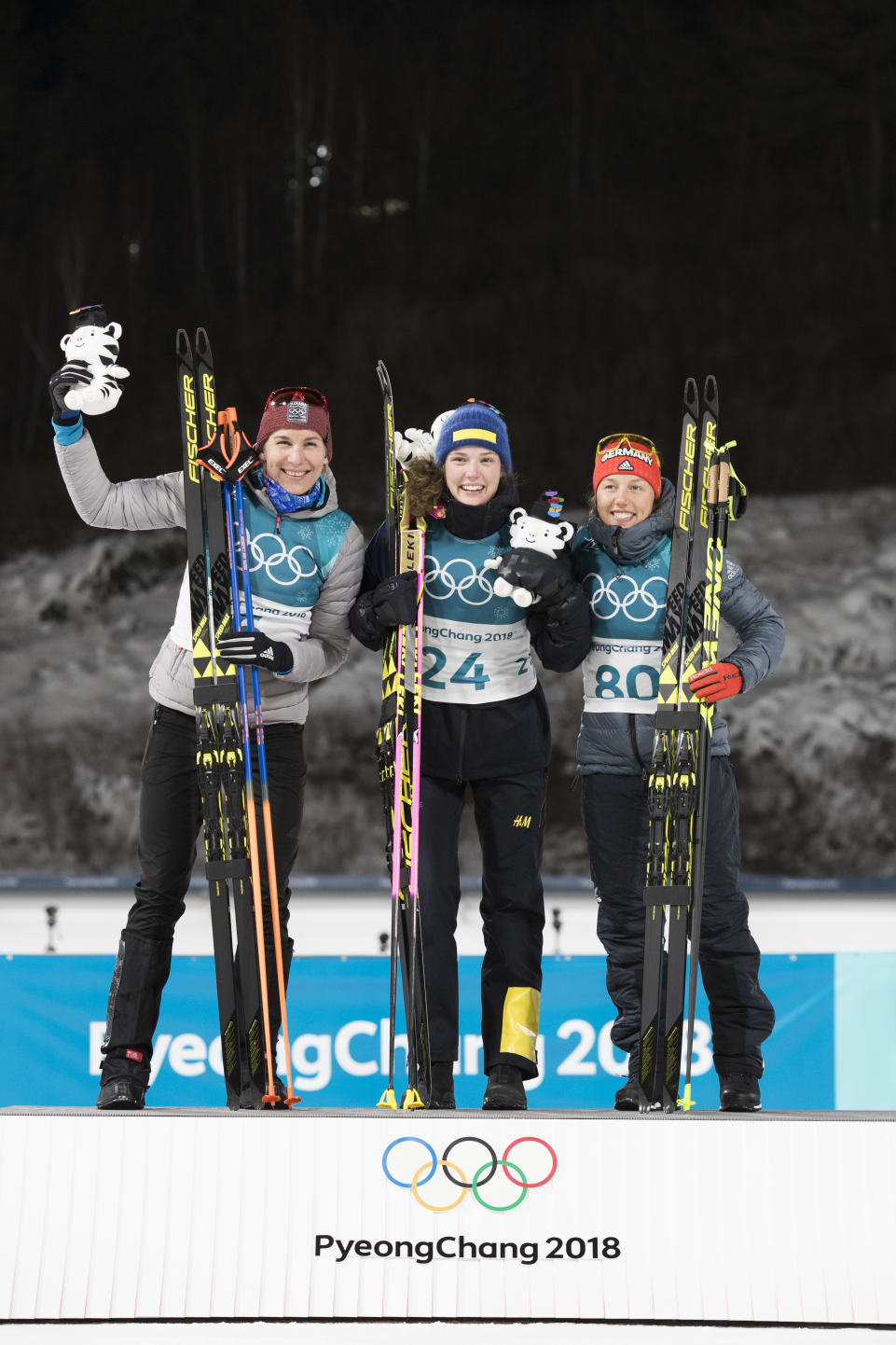
Sweden’s Hanna Oeberg (center) won gold in the biathlon women’s 15 k pursuit, followed by Slovakia’s Anastasiya Kuzmina (left) in silver and Germany’s Laura Dahlmeier in bronze. (Photo: IBU/Biathlonworld.com)
A few days after teammate Samuelson scored a career-best result to earn silver in the pursuit, Hanna Öberg of Sweden used perfect 20-for-20 shooting to capture gold in the women’s 15 k individual. The 22-year-old’s previous best results were fifth place in both Monday’s pursuit, and in a World Cup race last season.
She bested the two pre-race favorites: Anastasiya Kuzmina of Slovakia had two penalties but still managed a silver medal, her second of the games, finishing +24.7. And double gold medalist Laura Dahlmeier of Germany had one penalty and earned bronze (+41.2).
It was a good day for both of those teams as Franziska Preuss of Germany finished fourth, +59.0 with clean shooting, and Paulina Fialkova of Slovakia placed sixth (+1:02.3) with one missed shot. Poland’s Monika Hojnicz finished sixth (+1:54.8) with one missed shot as well.
The United States was led by Susan Dunklee in 19th, with two penalties (+3:26.3). Her teammate Joanne Reid finished 22nd (+3:34.1), her best-ever result in top-level international competition, with just one missed shot. Clare Egan finished 62nd (+6:53.6) and Emily Dreissigacker 67th (+7:09.2) with four penalties apiece.
For Canada, Rosanna Crawford led the way in 26th (+3:48.7) with two penalties and Sarah Beaudry was close behind in 29th (+3:58.4) with one missed shot. Emma Lunder finished 54th (+5:49.4) with three penalties and Julia Ransom was 74th (+8:31.4) with five missed shots.
Montana State University student Johanna Talihärm of Estonia finished 50th (+5:36.8) with three penalties.
Thursday afternoon saw more of the same for the women’s cross-country ski events at this year’s Winter Olympics: Scandinavia filling up the podium, with American Jessie Diggins tantalizingly close to that breakthrough American podium in fifth. This time it was Norwegian Ragnhild Haga in first in the 10 kilometer freestyle individual start, Charlotte Kalla of Sweden in second (+20.3), and Finland’s Krista Pärmäkoski and Norway’s Marit Bjørgen tied for third (+31.9).
The bronze is Bjørgen’s 12th lifetime Olympic medal, moving her into a tie with fellow Norwegian Bjørn Dæhlie for the most Olympic medals won by a cross-country skier. Countryman Ole Einar Bjørndalen, a biathlete, holds the overall Winter Olympics record with 13.
Diggins was 35.2 seconds back of Haga in fifth. She was in seventh place through 1.6 k, up to fifth at 5 k, up to third at 6.2 k, and still in third at the 8.4-k time checkpoint, 1.9 seconds up on Bjørgen and five seconds up on Pärmäkoski. But her form seemed to break down over the final uphill, and Diggins lost just enough time on Bjørgen and Pärmäkoski over the final 1.6 k to slip off the podium.
Between a 4.6-second deficit to third in Saturday’s skiathlon and a 3.3-second gap here, Diggins has now missed two bronze medals by a combined 7.9 seconds over 25 kilometers of racing.
Jessie Diggins pushing to the finish in the Olympic 10 k skate. The American finished fifth. (Photo: FlyingPointRoad)
Sixth place went to Swiss skier Nathalie von Siebenthal (+49.8), who slowed slightly after a fast start that saw her with the second-ranked time through 1.6 k. Ingvild Flugstad Østberg (+1:05.5), in seventh, was the third Norwegian in the top seven.
Olympic Athlete from Russia Anastasia Sedova (+1:07.3), Austrian Teresa Stadlober (+1:15.6), and Olympic Athlete from Russia Anna Nechaevskaya (+1:24.3) rounded out the top ten.
Sadie Bjornsen (+1:42.1) in 15th and Kikkan Randall (+1:49.9) in 16th were the next two Americans. Randall started relatively early with bib number 23, and was the leader in the clubhouse when she crossed the finish line. Liz Stephen (+2:35.4) was 30th.
For the Canadians, Emily Nishikawa (+2:41.) led the way in 32nd. Dahria Beatty (+2:48.4) was 37th, Cendrine Brown (+3:11.9) 43rd, and Anne-Marie Comeau (+4:10.8) 62nd.
Also of note, Australia’s Jessica Yeaton, who lives and trains in Anchorage with Alaska Pacific University, recorded an Olympics personal best finish of 41st (+3:09.1). University of Alaska Anchorage student Casey Wright, also competing for Australia, finished 81st (+6:55.8).
University of Colorado skier and NCAA champion Petra Hyncicova of the Czech Republic finished 60th (+4:09.4). University of New Hampshire alum Annika Taylor of Great Britain finished 75th (+5:52.4).
And Jaqueline Mourau of Brazil, who lives and trains in Quebec, was 74th (+5:49.8).
France’s Martin Fourcade defending his Olympic gold from four years ago on Monday in the men’s 12.5 k pursuit at the 2018 Olympics in PyeongChang, South Korea. (Photo: FlyingPointRoad)
Imagine for a moment, if you can, that you’re a two-time Olympic gold medalist from four years ago, and so far this winter, you’ve been on the podium in every biathlon World Cup you’ve raced but one (the first race, a single-mixed relay in November).
Your name is Martin Fourcade and you’re an 11-time world champion from France. You’re also a 29-year-old dad and you’ve spent the last four years since the last Olympics more or less preparing for gold in another race: the first race of the 2018 Olympics in PyeongChang, South Korea.
Now imagine that in that race, which you came into feeling more prepared than ever, you finished eighth after missing three targets in the first prone shooting stage.
Fourcade recalled in a press conference on Monday that his result in the men’s 10-kilometer sprint on Sunday wasn’t frustrating. It was disappointing.
“It was a really strange feeling,” Fourcade said after Monday’s 12.5 k pursuit. “… I was disappointed because yesterday I did not understand why I missed three, and I wanted this Olympic gold in the sprint more than any of the competitions. I worked really hard for this competition. I worked on my shooting for being good in the sprint, I worked on my skiing to be good in the sprint, and I think I was relaxed, I was in a good mood, I had good preparation. … And after the race [yesterday] I was really sad because I didn’t understand what I did bad.”
On Monday morning, he reviewed a photo of his missed shots in the sprint and figured out his error. The red flags that show the strength and direction of the wind in the range were waving more violently than he had remembered feeling during that prone bout.
“I realized it was not because I was unlucky … it was because I did a mistake, and from that time it was really much more easy to turn my anger into strength for the competition today,” Fourcade said. “It’s a bit masochist, but it works.”
Fourcade started the second race of the 2018 Games, the pursuit, 22 seconds behind Germany’s Arnd Peiffer (who won Sunday’s sprint) in eighth. Peiffer held his ground through the first loop and first prone shooting in first, hitting all of his targets and leaving the range in second, just 0.8 seconds behind Austria’s Julian Eberhard, who also cleaned and started the race in fourth.
France’s Martin Fourcade (8) skiing in the pack en route a gold medal in the men’s biathlon pursuit on Monday at the 2018 Olympics in PyeongChang, South Korea. (Photo: FlyingPointRoad)
Fourcade missed his third shot and emerged from the penalty loop still in eighth, now 28 seconds out of first. He and Peiffer both cleaned the second prone, putting Peiffer back into first and Fourcade up to sixth, 21 seconds behind, while Eberhard missed one to drop to seventh.
All the while, the little red flags blew in various directions, twirling around their posts. Gusts kicked up flurries of snow into the air, under a pitch black sky past 9 p.m. Korea time — the start of the men’s pursuit.
It was once again frigid out there and only those who were shooting carefully enough and could feel their fingers (or were managing it regardless) were succeeding.
On the third loop, Fourcade hooked up with a chase group in an effort to catch Peiffer, and by the end of that 2.5 k loop, they did. Heading into the range for the first standing shooting, Fourcade put himself in second, just ahead of Germany’s Simon Schempp in third and behind Peiffer in first. Fourcade and Peiffer lined up in the second and first shooting positions, respectively, putting the pressure on Peiffer in particular.
Then, Peiffer missed his first shot. He hit the remaining four, but it wasn’t enough — Fourcade had knocked down all five and had taken his time to do so, posting the 28th-ranked shooting time. While Peiffer skied his first penalty lap of the day, Fourcade headed back to the course in first place. Peiffer slotted into second, 20.3 seconds behind.
“I think it was a key time of the competition because on the third shooting, the wind was really tricky, challenging, probably it was the most difficult shooting of today,” Fourcade recalled of that standing stage. “I took a bit more time then my opponents to shoot my first ammunition and then when I realized I was the only one who shot clean, I knew that I was the only one who could decide who would be the Olympic champion. I didn’t say that I was sure I would win, but the decision was in my hand.”
He rounded the fourth loop on his own and entered the range for the last time all alone. Then, Fourcade cleaned all five targets with the ninth-fastest shooting time, and turned to the stands behind him with a celebratory fist pump.
“My finish line was not the real finish line, it was the last ammunition of my last magazine on the fourth shooting,” Fourcade said. “I really put all my energy into this shooting and I think if I had to fight with any athlete on the tracks, I wasn’t able to do it because after this shooting I was totally empty.”
He didn’t need to fight with anyone on that last loop. Behind him, Germany’s Benedikt Doll had moved into second with a clean final stage, 36 seconds back, and Sweden’s Sebastien Samuelsson was up to third, another eight seconds behind.
On that final loop, Fourcade locked up gold, coming into the stadium with enough time to grab a large French flag from the stands, about 100 meters from the finish. Meanwhile, Doll and Samuelsson duked it out for second, with Samuelsson closing the gap to Doll then challenging him on the final climb.
“I saw Sebastien behind me and my legs felt weaker and weaker in the long uphill,” Doll, the 2017 sprint world champion, said at the press conference. “And he came closer and closer, and then he [caught] me so I was thinking, ‘OK, now I need to make a new tactic for sprinting for the finish.’ ”
The 20-year-old Samuelsson overtook Doll, 27, as they crested the last climb and led the downhill toward the stadium finish.
“I knew we had really good skis today and I knew that if I can catch him at the top, I had a really good chance,” Samuelsson reflected. “My plan was to go a little bit later because I wanted a wind shadow, but [my team’s] waxers were … yelling a lot and then I just had to go. I was helped a lot with my skis today.”
Sebastien Samuelsson of Sweden celebrating silver in the men’s 12.5 k pursuit at his first Olympics on Monday in PyeongChang, South Korea. It was also his first non-relay podium at the World Cup/World Championships level. (Photo: IBU/Biathlonworld)
In the end, Samuelsson got him by 3 seconds for silver, finishing 12 seconds after Fourcade claimed the win in 32:51.7 minutes. Doll, who had started the pursuit in sixth, settled for bronze, 15 seconds behind Fourcade, for his first medal in his first Olympics with a single penalty (0+1+0+0).
“I couldn’t follow [Samuelsson] and he had faster skis,” Doll concluded. “He was a little bit stronger, and so I think he’s the right holder for the silver medal.”
In addition to shooting 19-for-20 (0+0+1+0), Samuelsson, who started the race in 14th, raced the fastest overall course time of the day, 8.6 seconds faster than Fourcade, who was second fastest. The young Swede reportedly told the International Biathlon Union (IBU) on Periscope that he’d cut his hair if he won a medal at his first Olympics in PyeongChang.
“I think nobody was thinking I’d be able to cut my hair after these Olympics, but now I have to do it, I have said so,” Samuelsson said at the press conference. “But I heard that my teammate said maybe you should keep the hair until the relays because you never know what will happen if you cut it.”
Samuelsson’s previous individual World Cup best was 13th in a sprint last season. He won a relay with his four-man team this season in the 4 x 7.5 k in Oberhof, Germany. After Monday’s pursuit, Fourcade said he congratulated him.
“I told Sebastien in the changing room, it’s not a bad day to start his first Olympics with his first international podium. I know a guy who did that eight years ago in the Olympics in Vancouver,” Fourcade said, referring to his first Olympic medal (silver) in the mass start at the 2010 Games.
Fourcade went on to win the pursuit and 15 k individual race at the 2014 Olympics in Sochi, Russia, where he also took silver in the sprint.
“Martin is, I mean, the perfect biathlete,” Samuelsson said. “I knew when he finished eighth yesterday that today he would be really fighting for the gold medal. For me, it’s a big victory for me to just be on the podium and Martin is unbelievably good.”
“Martin was not happy [after the sprint],” Doll said when asked about Fourcade. “Of course three mistakes in the prone shooting, it’s horrible, so it was for sure that today that he will fight and give everything to win, and in the end his plan fulfilled. He was I think the fastest skier or maybe Sebastien was the fastest skier, I don’t know, but he was the best biathlete today.”
France’s Martin Fourcade after winning the men’s 12.5 k pursuit on Monday at the 2018 Olympics in PyeongChang, South Korea. He also won the pursuit at the 2014 Sochi Olympics. (Photo: FlyingPointRoad)
In his book, “Martin Fourcade: Mon rêve d’or et de neige” (My dream of gold and snow), which came out in November, Fourcade wrote about how nervous he was the night before his first gold medal in Sochi.
“Four years ago before the Olympics in Sochi, I was simply shaking because I had a lot of fears,” Fourcade said at Monday’s press conference when asked about that passage from the book. “Many things changed in my life since Sochi. When I came here in Korea, I knew that I will be a happy man even without any Olympic gold in this event, so I think it helped me to take it more easy and I was in a really good mood and really satisfied with how I prepared this competition.”
Asked now if that fear is gone, he said it was.
The men’s 12.5 k pursuit podium at the 2018 Olympics in PyeongChang, South Korea, with France’s Martin Fourcade (c) in first, Sweden’s Sebastien Samuelsson (l) in second and Germany’s Benedikt Doll (r) in third. (Photo: IBU/Biathlonworld)
Finishing 47.5 seconds after Doll was Norway’s Tarjei Bø in fourth (+1:02.6). Bø started 13th and posted the fourth-fastest course time to overcome three penalties (0+0+1+2). He held off three others in a sprint to the line, with Schempp following in fifth (+1:02.7), after starting seventh, Switzerland’s Benjamin Weger placing sixth (+1:03.1), up from 15th at the start, and France’s Simon Desthieux placing seventh (+1:03.7), up from 12th. Peiffer ended up eighth (+1:14.1) with three penalties (0+0+1+2), and Sunday’s silver medalist Michal Krčmář of the Czech Republic finished 30th (+3:49.9) with seven misses (2+0+3+2).
Norway’s Johannes Thingnes Bø finished the race in 21st (+2:51.0), up 10 places from starting 31st based on his sprint result, with six penalties on Monday (0+2+4+0).
“We both [knew] before the Olympics that it will not be only a fight between us because we know the shooting range [here] is challenging,” Fourcade said of Johannes Bø, his main rival this season. “I thought that at our best level, we could be difficult to beat, but the wind and the Olympic situation will bring many opportunities for outsiders to take [medals], yesterday Arnd did in a magnificent way. It’s not a competition about Johannes today. It’s biathlon.”
Burke Up to 17th
Tim Burke (US Biathlon) racing to 17th in the men’s 12.5 k pursuit at the 2018 Olympics in PyeongChang, South Korea, up from 47th at the start. (Photo: NordicFocus/US Biathlon)
Three Americans and one Canadian qualified for the pursuit in the sprint top 60, and US Biathlon’s Tim Burke raced all the way up to 17th (+2:19.6) after starting 47th, with two penalties (0+1+1+0) and the 15th-fastest overall course time.
“I am very happy with the race,” Burke said in a post-race interview with FasterSkier. “I really felt like I put it together for the opportunities I was given in the race today, but this is not normal biathlon. You saw that they moved the downhill [competition] to a different day; we can’t do that in biathlon we have too many events, so we have to go on these days when it’s honestly unfair conditions like today. I benefited a lot from having very little wind in my standing positions, and I was able to move up a lot. Others I know were not so lucky. Unfortunately that is part of an outdoor sport.”
Asked how he reset after the sprint the day before, Burke said he talked about it with his coach.
“I was disappointed in the result not the performance,” he recalled. “I felt like I executed well. I felt like I hit my cues on the course and on the range, and it just didn’t happen yesterday. The game plan going into today was nothing, there was nothing new, stick to the things that have been working well for me in the World Cup and that’s what I did.”
After Burke, Lowell Bailey was the next best American on Monday, finishing 32nd (+3:51.6) after starting 33rd. He cleaned the first two stages but missed five between the two standing bouts (0+0+3+2).
American Lowell Bailey (33) racing to 32nd in the men’s 12.5 k pursuit at the 2018 Olympics in PyeongChang, South Korea (Photo: NordicFocus/US Biathlon)
“Unfortunately today, the weather got involved and I had one stage that really just threw my race off,” Bailey told FasterSkier after. “Wind, I mean, that third stage was just absolutely ridiculous. … There was nothing longer than 20 seconds of those big gusts and that time it was like two minutes. I got through of about 40 seconds of standing there waiting, time bleeding off the clock at that point I just started pulling the trigger, I couldn’t hold on the target, you just got to do your best on that point.”
Then there was Leif Norgren, also of the U.S., who finished 50th (+5:48.7), up from 58th at the start, with five penalties (2+2+0+1).
“Physically I think it was improvement from yesterday,” Nordgren told FasterSkier. “I still struggled with the wind and shooting, and it makes it kind of frustrating because with windy conditions like these it’s a big opportunity to move up in the pursuit and I wasn’t able to capitalize on that today. So a little disappointed in that regard, but that’s just how it goes sometimes.”
Canada’s lone man in the pursuit, Nathan Smith crossed the line in 54th (+6:06.5), after starting 44th, with four misses (0+0+1+3).
While he raced up to 37th after the first three stages, Smith dropped to 51st with three misses in the last standing.
“Three penalties on the last standing was really a lot of time spent in the loop,” he reflected.
Physically, he said the race felt, “really, really hard.”
Biathlon at the Olympics continues with the women’s 15 k individual on Wednesday and men’s 20 k individual on Thursday.
Keep calm and be the best: one missed shot early on did not keep France’s Martin Fourcade from defending his Olympic gold medal in the men’s biathlon pursuit. (Photo: FlyingPointRoad)
“Use this rage as energy!” Martin Fourcadewrote on Instagram after finishing eighth in the men’s 10-kilometer sprint on Sunday.
Um, yeah. The French biathlon star defended his gold medal from the 2014 Olympic pursuit with just one missed shot in Monday’s 12.5 k competition, taking the lead after the third shooting stage and never giving it back. He finished with a comfortable enough margin to grab the French flag and take his time waving it down the finishing straight.
A large pack of chasers were all in contention for second place coming into the final shooting stage, but of them all only Benedikt Doll of Germany and Sebastian Samuelsson of Sweden cleaned their targets. Samuelsson took his time to do so, and left the range with a nearly eight-second deficit on Doll. But he gradually worked his way up to the German on the trails, before putting in a spurt on one of the last small uphills on the course. The 20-year-old Swede managed to hold his lead on the swooping downhills into the stadium and not get consumed by the draft effect, and celebrated crossing the line in second place. Samuelsson’s previous best result was 13th place in a World Cup. It is Sweden’s first Olympic biathlon medal since 2010.
Tarjei Bø of Norway finished fourth (+1:02.6) after missing three shots; all the medalists had only a single penalty apiece. Germany’s Simon Schempp was fifth (+1:02.7), also with three penalties, and Switzerland’s Benjamin Weger finished sixth with two missed shots (+1:03.1), narrowly edging France’s Simon Desthieux (+1:03.7).
For the U.S., Tim Burke finished 17th (+2:19.6) with just two missed shots after starting in 47th position after a disappointing sprint race. Lowell Bailey placed32nd (+3:51.6) with five penalties — all in standing — and Leif Nordgren 50th (+5:48.7), also with five missed shots.
For Canada, Nathan Smith finished 54th (+6:06.5) with four missed shots.
With just one missed shot, Germany’s Laura Dahlmeier took her second gold medal of this young Olympic Games when she won the 10 k biathlon pursuit by 29.4 seconds. Dahlmeier finished no better than 13th in the 2014 Olympics — where she was only 20 years old – but four more years of experience have made her nearly unbeatable, if last year’s triple gold haul from World Championships serves as a basis for comparison. But even if she only nets these two golds, she has already made history: no other woman has ever won both the sprint and the pursuit at the same Olympic Games.
Dahlmeier started in bib 1 but the other medalists used stellar performances to move up after disappointing sprint races. Anastasiya Kuzmina of Slovakia edged France’s Anais Bescond by just 0.2 seconds to take silver. Kuzmina had started in bib 13 and won her medal despite four missed shots – she had the fastest course time of the whole field – while Bescond had started 19th but had hit all but one of her targets.
Fourth place went to the sprint silver medalist Marte Olsbu of Norway (+1:07.3), fifth to Hanna Öberg of Sweden (+1:08.9), and sixth to Denise Herrman of Germany (+1:19.4).
Rosanna Crawford of Canada started 53rd after a tough sprint race, but shot 18/20 and moved up to 19th place (+2:27.7), the best Olympic result of her career.
Montana State University student Johanna Talihärm, representing Estonia, missed four shots to finish 26th (+2:59.4). Just behind her was Canada’s Julia Ransom in 28th (+3:03.0) with one missed shot.
The lone American in the race, Emily Dreissigacker, set a new career best with 47th place (+5:01.4), and Canada’s Emma Lunder finished 53rd (+6:16.8). Teammate Megan Tandy did not start.
Germany’s Arnd Peiffer (front) on his way to winning the men’s 10 k sprint at the Alpensia Biathlon Center on Sunday at the 2018 Olympics in PyeongChang, South Korea. The German was one of just four men to shoot clean in windy conditions. (Photo: FlyingPointRoad)
Arnd Peiffer’s race day before the men’s 10-kilometer sprint at the 2018 Olympic Winter Games in PyeongChang began anything but ideal, not giving any indication that it would end as one of the luckiest days in the athletic career of the German, standing at the top of the podium and flanked by Michal Krčmář of the Czech Republic in second and Italy’s Dominik Windisch in third place.
“Shortly before ski testing, the bolt on my rifle broke. Then I slipped outside the wax cabin [on a flight of stairs] and badly bruised my elbow,” Peiffer told German broadcaster ARD about a series of mishaps that also included a cut to his hand, a forgotten key for his rifle storage locker and a poor warmup. “Somehow nothing was really working as planned, but then in the race everything did.”
About an hour before the race during dry firing target practice (without loaded ammunition clips), the bolt on Peiffer’s rifle that triggers the shots just snapped. On short notice the weapon had to be disassembled and the bolt replaced with the help of men’s head coach Mark Kirchner (a successful biathlete himself with a gold medal in the sprint and two in relays at the 1992 and 1994 Olympics), a problem that according to Peiffer “happens about once every six months to a year… That’s not so bad, but something you don’t really want to occur right before a race”.
“I am generally not superstitious at all,” Peiffer recounted during an interview with ARD in the Olympic broadcasting center late Sunday night. “But Mark told me, ’22 is a good bib number, I once became world champion with that… And [teammate Erik Lesser] also had a broken bolt before the individual race at the [2014] Olympics in Sochi when he shot clean four times and won silver, that was surely a good omen.’ I was like, yeah, that won’t help me today either.”
Yet after he had started his race, Peiffer was indeed the lucky one, hitting 10-for-10 shots in every bit as difficult wind conditions as the day before during the women’s sprint when his teammate Laura Dahlmeier won gold, while the presumed favorites such as France’s Martin Fourcade and Norway’s Johannes Thingnes Bø missed too many targets to contend for the medals.
In his prone shooting, Peiffer reacted correctly to a strong gust of wind from the left side of the range, adjusting his sights with several clicks on his rifle. Then in the standing shooting he took advantage of manageable conditions to shoot in rhythm and again remained clean. On the final loop he skied the 10th-fastest time (18th overall), crossing the line in a time of 23:38.8 minutes. That mark would not be beaten anymore by the 65 athletes starting behind him.
“I have waited a long time for this individual medal,” he said during his in-studio interview with ARD. “I won one in 2011 [at IBU World Championships] and since then had a few chances that I didn’t take advantage of, and sometimes didn’t have any chance at all. So that it worked out today, with a pretty mediocre course time, is a gift that I am very grateful for.”
It was Peiffer’s first individual medal at Olympics, following a silver medal in the men’s relay in Sochi and no podium in Vancouver in 2010. Most of the World Cup successes for the 30-year-old biathlete have been in sprints, and he won the title in this discipline at the 2011 World Championships in Khanty Mansiysk, Russia. His first World Championship medals also came in PyeongChang, back in 2009, when he took bronze with the relay and mixed relay, which he fondly remembered.
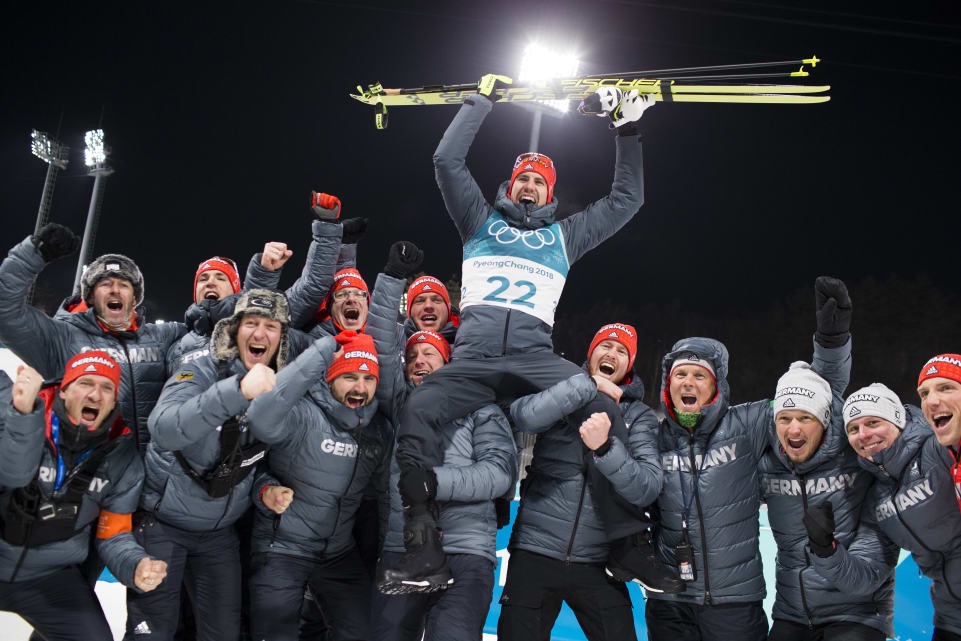
Germany’s Arnd Peiffer is hoisted up by his coaches, staff and teammates, celebrating his victory in the men’s 10-kilometer sprint on Sunday at the 2018 Olympic Winter Games in PyeongChang, South Korea. (Photo: IBU/Biathlonworld.com)
“I am honestly completely surprised that my result was so amazing, that I am standing at the very top,” he had told ARD right after the race. “I am just happy about my performance, because in Vancouver and Sochi I twice had a bad sprint [finishing outside the top 30]… So for today I just was determined to have a good one, have a good shooting performance, and if it had been a sixth place I’d also have been happy.”
The silver medal in Sunday’s sprint went to Krčmář, who also hit 10-for-10 and finished 4.4 seconds shy of Peiffer’s time. Starting behind Peiffer in the middle of the field, that clean shooting performance opened a window of opportunity to wedge himself between the times set by Peiffer and Windisch, who ultimately placed third (+7.7) with one penalty.
“For me, it was very hard in the last loop,” Krčmář said at the post-race press conference. “I [had no] power in last loop and my teammate on the track said to me, ‘You are five seconds behind Arnd’. I do maximum [went as hard I could], but Arnd [was really] better today.”
He made up 2.4 seconds on that final loop, but could not catch up to Peiffer’s time. It was the first sprint podium for the 27-year-old Krčmář at the World Cup or championships level, and at these Olympics it came just at the right moment.
“It’s true, for me a big, big medal. First in career,” Krčmář said. “It’s for me [a] very surprising day because I [felt bad] in the training here. My shooting in training [was] not so good. And now, zero-zero. I am lucky man today because I [had] very good condition in standing shooting and on the track.”
Windisch missed one target in his standing bout, and came back on the course 12.2 seconds behind Peiffer’s time and 5.4 seconds behind Krčmář. He narrowed that gap on the final loop, but it wasn’t enough to catch either one.
“The wind was not easy because it continued to change … but maybe it was the best for me because I had something to think about and to be concentrated on my work,” Windisch said at the press conference. “I didn’t think about results, and maybe that was my secret today.”
For Windisch, 28, it was the second Olympic medal of his career after he held Italy to bronze in the mixed relay in Sochi four years ago.
“The relay is always a tough race because you are racing also for your friends or for three other persons. Maybe it’s more pressure there,” Windisch said when asked to compare the two achievements. “But to win an individual medal [means] a little more because it’s really hard to reach it, because there are so many different good athletes. I think the emotions are really big. But also [for the] relay the emotions are maybe bigger because the whole team celebrates the medal.”
Down On Their Luck
Having started in bib 5, Austria’s Julian Eberhard led the race early on until Peiffer beat his time, and in the end he just missed a medal by 0.7 seconds when Windisch bumped him off the podium to fourth place (+8.4, with one penalty).
During the race, Eberhard, who has three World Cup victories to his name, broke a pole on the loop after prone shooting and had to ski about 300 meters before receiving a spare. But he couldn’t explain why he lost time on the final downhill before the finish.
“I definitely started today with the goal to get the victory. I did my job, and it was very close. Only eight seconds are missing, so of course this is very bitter now,” Eberhard told Austrian broadcaster ORF, according to a translation. “Especially considering that before the downhill 500 meters before the finish I was clearly in second place … Those are the little details that have to work out for a gold medal.”
Norway’s Erlend Bjøntegaard led the race after the prone stage with his time and in the end finished fifth (+17.4), also just missing the podium after he missed two targets in his standing stage (0+2). He had been selected as the final athlete on the Norwegian men’s Olympic roster, effectively replacing biathlon legend Ole Einar Bjørndalen, a decision debated controversially in his home country. But on Sunday, Bjøntegaard, 27, justified his start.
“It feels incredibly strange when you put it that way,” Bjøntegaard told Norwegian broadcaster NRK when told he might have been one miss away from the podium, according to a translation. “It slowly dawns on me that I was so close to an Olympic medal and the gold. There is a lot of buzzing in my head. I’m happy, but also a little disappointed and mad at myself. It’s strange to look at the results list. Very strange. I’m struggling to take it in, but it’s slowly coming to me that I was so close.”
A number of athletes could have echoed same feeling, including three of Peiffer’s teammates.
Benedikt Doll, the defending sprint world champion, placed sixth (+17.6) after missing his final shot. Mass-start world champion Simon Schempp came almost as close in seventh (+21.4, with one penalty), and Erik Lesser, whose past rifle troubles had served as a positive example for Peiffer, was not far behind in 11th place (+31.9, also missing his final shot), despite starting the race with a bruised ribcage.
“I am rooming with Arnd and lost our team-internal duel. So that totally annoys me,” Lesser jokingly told ARD.
“I think that is the hallmark of our men’s team. Today I was the lucky one who got through. From my point of view, it could have been any one of the other three as well. I am not just saying that, I truly believe that,” Peiffer told ARD.
“I will definitely drink a small beer with my coaches, wax techs and teammates, I won’t let myself be denied of that,” he added with a laugh, although it was already past midnight local time. “And then I’ll be looking forward to [the pursuit], because now the pressure is gone. We have a great starting position, the others also did a great race even if that won’t be at the center of attention now. We can be really proud of that.”
As for the presumed “Big Two” race favorites who have dominated the International Biathlon Union (IBU) World Cup this season, with France’s Fourcade standing on the podium in every individual race he started and Norway’s Johannes Bø having won eight races including three sprints, on Sunday they looked like mere mortals for once.
While Peiffer was approaching the finishing stretch, Fourcade, who had started in a later group in bib 54, missed three prone shots. He came out of the penalty lap with a split time that ranked 56th overall. That setback would have taken just about any other athlete completely out of contention, but with a clean standing shooting and the fastest overall course time of the day, Fourcade limited the damage and rose to eighth at the finish (+22.1).
Bø, currently ranked second behind Fourcade in the World Cup Total Score, also missed three shots in prone and another one in standing (3+1), crossing the line 1:12.7 back in 31st.
Their uncharacteristic days left openings and opportunities for the three podium finishers.
“I think on these conditions, it’s possible for everything and nothing, so today it was our lucky day and maybe not the day for Bø and Fourcade,” Windisch said at the press conference. “It was really difficult to shoot, and I think they will have many other chances at these Olympic Winter Games and they will be here [at the press conference] the next time.”
“I don’t know how this could happen,” Peiffer said at the press conference, still a bit incredulous about the outcome. “The other two [Fourcade and J.T. Bø] were dominating the season in ski times and on the range, so I didn’t expect that anyone would be in front of them, for sure not me.”
Four North Americans Qualify for Pursuit
American Lowell Bailey racing to 33rd in the first men’s race of the 2018 Olympics, the 10 k sprint, on Sunday in PyeongChang, South Korea. (Photo: FlyingPointRoad)
The best North American in the difficult conditions was US Biathlon’s 2017 individual-discipline world champion Lowell Bailey, who began his race by cleaning all his prone targets, leaving the range with a split time that ranked him in eighth overall.
Then Bailey was shown on the international broadcast as one of the last remaining podium contenders still out on the course when he came into the range again for his standing shooting, in which he missed the fourth shot and thus had to ski through the 150-meter penalty lap.
That set him back to 24th place, and after losing about 30 more seconds on the final loop he crossed the line 1:15.6 out of first in 33rd.
“I had a good performance on the range, I was happy with the shooting but, unfortunately, I just didn’t have it in the legs,” Bailey said, according to a US Biathlon press release. “I just haven’t had the ski shape that I had last year. I haven’t gotten the speed going this year and that’s the way biathlon is. It wasn’t a bad race. I had a really good first lap, I just didn’t have it on the second and third laps. With any luck I’ll feel better and better as the Games go on.”
Tim Burke (US Biathlon) en route to 47th in the men’s 10 k sprint at the 2018 Olympics in PyeongChang, South Korea. (Photo: FlyingPointRoad)
His teammate Tim Burke finished 47th (+1:47.5) with four penalties (2+2).
“Physically I felt descent. It wasn’t a bad start,” Burke told FasterSkier after the race. “Shooting was tough. I had four penalties. It was real tricky today; it’s a bit of a lottery and that’s the way it goes. … I thought I had similar wind [to zeroing] when I was shooting prone, but what makes it really tough here is it switches literally from one shot to the next. I am really curious to talk to the coaches and see where I was at because I felt totally fine and normally I don’t miss all these shots.”
“It’s a tough course because you have longer climbs,” he said of the course at the Alpensia Biathlon Center, after skiing the 28th-ranked time of the day. “A lot of biathlon courses today, the climbs are only 30 seconds long before you get a break and here you have a couple climbs that are significantly longer than that, so that suits me well.”
Leif Nordgren (US Biathlon) en route to 58th in the men’s 10 k sprint at the 2018 Olympics in PyeongChang, South Korea. (Photo: FlyingPointRoad)
Leif Nordgren will join them in Monday’s pursuit after finishing 58th (+2:10.2) with a missed shot in each of his shooting stages (1+1).
“I’m satisfied that I made the pursuit and there’s another [race] day tomorrow, but yeah, the shooting was quite tough today and the wind,” Nordgren said after. “I made two mistakes and that was too much to have a great race today.”
Asked about the challenging conditions, he added:
“The wind was obviously number one, but actually the cold is another thing. If your hands ever get cold, it impacts the shooting tremendously. If you pause just for a second to even think about how cold your hands are that can throw off the shooting right away. So little things like that. It doesn’t take much to really lose that focus.”
Sean Doherty (US Biathlon) racing to 65th in the men’s 10 k sprint at the 2018 Olympics in PyeongChang, South Korea. (Photo: FlyingPointRoad)
The fourth American starter Sean Doherty missed four of his five prone targets, having to shoot about in the middle of the lane positions on the wind-exposed range. The penalties set him back almost 2 minutes, and even a clean standing shooting was not enough to overcome that deficit. He ultimately finished 65th (+2:16.4, 4+0), only about 2.5 seconds out of the top 60 needed to qualify for the pursuit.
“The wind today is very highly variable and I really thought I had a handle on it in zero [target practice],” Doherty said after. “I had a good zero, I had a good shooting warm up. I had pretty good confidence in what I am doing with things. I came in and I thought I had it under control and obviously something is off. … When I came in I did not assess the wind to be that severe, I guess I didn’t give it enough credit. … But everything else went well. The skiing feels strong. Standing shooting was fine.”
Doherty skied the 48th-ranked course time for the day.
“The course is skiing well,” he said. “It’s very fast and firm and this is a good hard course. … I am happy with the skiing, I felt fairly energetic and I am pretty encouraged with that, but it’s just the range. You leave a lot out there when you miss four.”
The Canadians also struggled with the windy conditions and demanding course.
Nathan Smith was able to cope best, shooting clean in prone before having to ski one penalty lap in his standing bout (0+1) to finish 44th (+1:43.5).
“I was happy with my shooting,” Smith said of his race. “Nine out of ten so that’s good for the windy conditions. … My shooting has been really good this year. Whenever I race I’m probably like 90 percent average or something. I usually shoot pretty quick and this year I haven’t been afraid to slow down when I need to be to hit those targets.”
On the course Smith only skied the 77th-ranked time of 87 starters, after he missed every World Cup race since the sprint in Annecy, France, before Christmas.
“Skiing was hard,” Smith said. “I haven’t raced for two months so it’s hard to jump into the top level of racing when you have just kind of been racing by yourself for a bit after getting sick … When you’re not feeling tip top, I think the biggest difference is when you’re going over hills and stuff, you’re tired and you’re just like, ‘Oh yeah, I’m getting to a downhill,’ and you can’t really push hard through all those transitions.”
Unfortunately he was Biathlon Canada’s only team member to qualify for the pursuit, while others missed the top 60 by mere fractions of a second.
Scott Gow missed four shots in his prone stage before cleaning all targets in standing (4+0), finishing 2:14.0 back in 61st place. That was just 0.1 seconds behind Romania’s Cornel Puchianu, who had incurred just one penalty, and finished 60th.
Gow told FasterSkier he took special care to bundle up before the race to keep warm fingers and a feeling for the trigger, but when he reached the prone stage, the wind had changed directions from the zeroing target practice, posing yet another problem.
“I had a fairly consistent wind from the left I would say, then when I came in to shoot in the race, it had switched directions,” Gow said. “So I thought I had accounted for it and I could hear that I was actually, we call it splitting, but hitting like half the target there and I didn’t want to chance making an overcorrection. So it was disappointing. I think luck-of-draw type of thing. It was too bad.”
The four penalty laps set him back two minutes and all the way to 84th place at the split time, and despite hitting all his targets in the following standing stage, Gow couldn’t quite make up that deficit.
On the course he skied the 46th-ranked time of the day overall and the 29th-ranked final loop.
“It’s a really hard course,” Gow said. “It’s basically three big hills with a couple downhills in-between. There’s no transitional areas, there’s no flatter spots. So it feels like you’re always grinding up a hill just to go back down and have to go up it again. … I felt like I could go a little harder on the first two-thirds of the course, and then just make sure I drop back a little bit on the last climb before you come back into the stadium just for the shooting sake. Then also with the wind, especially the headwind, to try and ski behind people if possible to get a good draft. … Overall I would say I did a fairly solid job with my race plan.”
Christian Gow (Biathlon Canada) racing to 62nd in the men’s 10 k sprint at the 2018 Olympics in PyeongChang, South Korea. (Photo: FlyingPointRoad)
His brother Christian Gow was just behind him in 62nd, 2:14.7 back with three penalties (2+1). Thus he also was less than a second out of the top 60.
“The conditions are tough today,” Christian said after. “It’s windy. It’s not nearly as bad as it was this afternoon, that was crazy. But regardless, it’s changing a lot, which I think is the hardest thing.”
“I corrected in prone and so I have to talk to the coaches and see if it was me or if I missed the correction, where those misses were,” he said of his shooting performance. “Then standing I think was a bit more my fault than anything. Shooting on lane 30 here, it’s quite sheltered. It blocks most of the wind, so it was pretty calm when I shot there and I still came away with a miss.”
Christian skied the 61st-ranked course time, acknowledging that he was impacted by the cold temperatures and wind.
“Today I felt a bit heavier than I would have liked to on the track,” he said of his skiing. “It’s a tough course for sure, really big climbs in it, and you’ve got to manage your energy so that you can do them time and again. … The wind, absolutely you get thrown around by it, but I kind of figure that everyone is getting some of that at some point.”
Brendan Green (Biathlon Canada) en route to 82nd in the men’s 10 k sprint at the 2018 Olympics in PyeongChang, South Korea. (Photo: FlyingPointRoad)
The fourth Canadian starter Brendan Green cleaned prone and was also shown on the international broadcast as a potential late contender when he came into the range for his standing shooting. But with strong wind he then missed three shots, ultimately finishing the race in 82nd place (+3:09.2, 0+3).
“It was a tough day,” Green said. “The conditions were obviously very challenging. But on a day like today that … opens up the door a bit, there’s a good opportunity, but I just was not able to put together a solid performance today. … Standing I just had a lot of gusts, just couldn’t quite overcome the wind for standing.”
“It’s a very challenging course,” he said of the conditions. “The cold weather and the wind. The snow is very dry and very slow, kind of like a sandpaper feel to it. But hopefully the weather starts to cooperate and things start to warm up a bit and the wind drops.”
The biathlon competitions in PyeongChang continue Monday with pursuits for the women at 7:10 p.m. local time (5:10 a.m. EST) and men at 9 p.m (7 a.m. EST). The times back to the winner from the sprint carry over into the pursuit race.
Norway’s Simen Hegstad Krüger celebrates after winning gold in the men’s 30 k skiathlon on Sunday at the 2018 Olympics in PyeongChang, South Korea. (Photo: FlyingPointRoad)
It was an improbable move: Norway’s Simen Hegsted Krüger attacked a few kilometers from the finish of the men’s 30 k skiathlon, and the rest of the field let him go. Krüger didn’t let up and at one point had a lead of 25 seconds with just about two kilometers to go, all the more impressive because he had crashed just meters into the race and broken a pole, having to then make up 35 to 40 seconds to get back to the lead pack.
Norwegian teammates Martin Johnsrud Sundby and Hans Christer Holund tried to close the gap to Krüger in the final kilometer, but the 24 year old hung on for a 8-second win. Sundby was second and Holund was third (+9.0) to give Norway a medal sweep.
Denis Spitsov of the Olympic Athletes of Russia, also in his first Olympics, finished fourth, 12.7 seconds back. Maurice Manificat of France was fifth (+14.2), Dario Cologna of Switzerland sixth (+25.1), Andrew Musgrave of Great Britain seventh (+25.7), and Alex Harvey of Canada edged Martin Jaks of the Czech Republic for eighth (+33.4 and +33.8, respectively). Johannes Høsflot Klæbo of Norway, one of the pre-race favorites, finished 10th (+43.4).
For the U.S., Scott Patterson led the way in 18th (+1:07.5). Erik Bjornsen finished 42th (+4:34.7), Paddy Caldwell 51st (+6:58.1), and Noah Hoffman 54th (+7:08.7).
After Harvey’s top-10 finish, the next Canadian across the line was Devon Kershaw in 36th (+3:35.3). GraemeKillick finished 45th (+5:19.6), and Knute Johnsgaard was lapped and did not finish.
University of Utah alum Snorri Einarsson finished 56th (+7:13.9) in Iceland’s best result in Olympic cross-country skiing since 1994.
Arnd Peiffer on his way to winning the 10 k sprint at Alpensia Biathlon Center today. The German was one of just four men to shoot clean in windy conditions. (Photo: FlyingPointRoad)
With the race favorites each picking up a bevy of penalties, Germany’s Arnd Peiffer skated to a gold medal in the men’s 10 k sprint on Sunday. Both he and silver medalist Michal Krčmář of the Czech Republic shot clean, and were two of only four men in the field to do so. With that performance, Peiffer — whose lone senior Championship-level individual medal came when he won the World Championships sprint back in 2011 — made Germany two-for-two in biathlon races so far after Laura Dahlmeier’s win in the women’s sprint on Saturday.
The top of the results sheet was tight, with Krčmář finishing just 4.4 seconds slower than Peiffer. Krčmář only has one World Cup podium to his name, coming last season. Dominik Windisch of Italy finished with the bronze medal (+7.7) despite one missed shot, and edged out Austria’s Julian Eberhard (+8.4) seconds, who also had one penalty.
Erlend Bjøntegaard of Norway was fifth (+17.4) with two penalties, and Benedikt Doll (+17.6) and Simon Schempp (+21.4) gave Germany an impressive three spots in the top seven.
Those pre-race favorites? Martin Fourcade of France missed three shots in prone and despite cleaning standing, couldn’t make up enough time on the final loop for a top result. He finished eighth, +22.1. Johannes Thingnes Bø of Norway missed three shots in prone and then another in standing, finishing 31st, +1:12.7.
For the U.S., Lowell Bailey cleaned prone and then collected one penalty in standing to end the day 33rd (+1:15.6). Tim Burke had four penalties to land 47th (+1:47.5), and Leif Nordgren will join them in Monday’s pursuit after finishing 58th (+2:10.2) with two missed shots. Sean Doherty missed four of his five prone targets and was unable to come back from that blow, finishing 65th (+2:16.4).
The Canadians also suffered shooting woes. with Nathan Smith able to limit the losses to one penalty and finish 44th (+1:43.5). He is the only team member to make the pursuit. Brothers Scott and Christian Gow missed four and three shots, respectively, to earn the unlucky honor of being the first two men outside the pursuit cutoff in 61st (+2:14.0) and 62nd (+2:14.7). Brendan Green cleaned prone but then missed three shots in standing to finish 82nd (+3:09.2).
The women’s 10 pursuit and men’s 12.5 k pursuit are set for Monday at 5:10 a.m. and 7 a.m. Eastern Standard Time.
Biathlon Canada’s Emma Lunder (l) and Julia Ransom (r) after finishing 18th and 27th in the women’s 10 k pursuit on Saturday at the IBU World Cup in Annecy, France. (Photo: Glen Crawford)
Two hundred and thirty biathletes, 115 men and 115 women, will earn the right to be called a 2018 Olympian — 10 of whom will be Canadian.
The top-six teams in last season’s International Biathlon Union’s (IBU) final Nation’s Cup ranking can bring a full team of six men and six women to the Games. Canada’s men’s finished ranked 13th while the women ranked 15th, so each squad can bring five athletes.
Biathlon Canada’s criteria for the Games team are heavily weighted toward biathletes who can demonstrate success on the IBU World Cup. The Biathlon Canada High-Performance Working Group (HPWG) developed what it calls Internal Nomination Procedures (INP), which formulated the qualifying guidelines for PyeongChang. The Olympic qualification period, as established by Biathlon Canada, began last season on Nov. 25, 2016, and ends Jan. 22, 2018. Since the criteria began at the onset of last season’s World Cup, it also included results at the 2017 IBU World Championships.
The INP includes Priorities 1, 2, 3.1-3.7 and a Priority 4, a tiered and sequential system of results standards. Athletes meeting Priority 1 will be named to the team first, before those meeting Priority 2, and so on. In the event of a tie when determining rankings in the first three priorities, an athlete’s next-best World Championship or World Cup result during the qualification period will be used to break the tie.
It’s a tight go for all Canadian biathletes: there’s only 10 spots open, and each nation represented in the Olympics can field a maximum of four athletes in any individual biathlon race and a single team in the relay events.
“You can see pretty quickly here that the only way for anyone to get on the team now, and to supplant some of these people, is they need to score results on the World Cup,” Biathlon Canada’s High Performance Director Roddy Ward said on the phone in mid-November.
Ward was referring to this document detailing Olympic criteria standards met by specific athletes since June 1, 2017. Based on results from the first two World Cup weekends, positions have changed a bit when analyzing results through Dec. 9.
No Canadian biathletes have met Priority 1: a single top-eight individual or top-three relay result at a World Cup (WC) or World Championship (WCH).
Moving down one rung on the Olympic qualifying criteria standards and potential Olympic team spots begin to fill up. Prior to this year’s start of the IBU World Cup, Rosanna Crawford had already fulfilled Priority 3.1’s standard: three times in the top 30 on the World Cup or at World Championships (so had Scott Gow and Ransom, who will meet Priority 3.1 even if Ransom does not score another top 16 to meet Priority 2; she has turned in several more top 30’s, too).
Christian Gow (Biathlon Canada Senior National Team) racing to ninth in the men’s modified sprint at Biathlon Canada’s team trials in Canmore, Alberta. With the third-best performance percentage of the trials, Gow was the fourth man named to Canada’s IBU World Cup team for the first trimester of racing, and he has since turned in four top-30 World Cup results. (Photo: Peter Collins/petercollinsphoto.com)
Christian Gow is also currently qualified under the 3.1 standard after placing 21st, 26th, 29th, and 30th in races this season, and shooting consistently well in the process.
By doing so, Smith has definitely met Priority 3.2 benchmarks — two top-40 WC/WCH results — as have Brendan Green and Megan Tandy, both two-time Olympians already.
Green has several top 40’s from last season, and a 33rd-place finish in the pursuit in Hochfilzen. Tandy turned in her top 40’s last season as she did not qualify for the World Cup tour at trials in November, but has since torn it up on the IBU Cup circuit, collecting finishes of ninth, 11th, and 18th over two weekends of racing.
Macx Davies currently meets Priority 3.3 criteria: two top-60 WC/WCH results. Like Tandy, he started the season on the IBU Cup; there, he collected two top-30 results. Megan Bankes partially meets 3.3 after her 60th place on the first World Cup weekend, and is locked in for Priority 3.4 — one top-three World Junior Championship (WJCH) result after winning the individual race at 2017 IBU Junior World Championships.
The objective criteria set forth by Biathlon Canada extends through Priority 3.7 to determine the Olympic team, but as five athletes on both the men’s and women’s sides have already met higher priority criteria, they will not be used.
Julia Ransom (Biathlon Canada) racing to ninth in the women’s 15 k individual at the IBU World Cup opener in Östersund, Sweden. In her first World Cup race of the season, it was Ransom’s career-best result and Biathlon Canada’s best individual result since 2015/2016. (Photo: Biathlon Canada/NordicFocus)
Here’s the summary for the five available spots on the men’s and women’s side. Currently the women’s rankings are as follows: Ransom 1st, Lunder 2nd, Crawford 3rd, Tandy 4th, and Bankes 5th.
On the men’s side, it’s: Scott Gow 1st, Christian Gow 2nd, Smith 3rd, Green 4th, and Davies 5th.
As made clear by Ward earlier, the primary road to qualifying for PyeongChang is on the IBU World Cup. Even before this year’s results, the women already had four skiers meeting criteria from their World Cup results and a junior skier with a podium at Junior Worlds.
Similarly for the men, as of June 1, four skiers had fulfilled minimum criteria, while Smith recovered from illness he also had a 43rd place to partially meet Priority 3.4 — the two times in the top-60 benchmark.
“Just by virtue of this criteria, closed Olympic trials is not going to happen,” Ward said.
For now, 10 spots are open, and those spots are technically spoken for by skiers with World Cup opportunities.
Then there’s that 10-letter word — discretion.
This for sure can be debated, but in the case of making Canada’s Olympic biathlon team in 2018, it appears very clear what the criteria are.
“This is how we use discretion,” Ward began. “Either through current or historical results. That could be 50 results in the past or what is happening right now. For example, historical results would be how we prequalified Julia Ransom and Rosanna for the first tour here on the World Cup. That was based on last year’s results. Current result demonstrate the ability or the potential to meet Biathlon Canada’s objectives for the high-performance program.
“There is data on everything. But you know some form of discretion is necessary. You can never build criteria that is absolutely perfect in every scenario. Completely unrealistic. If you have to build with some notion of fairness and objectivity and also to give yourself a little bit of wiggle room to use discretion in those certain scenarios that pop up every year.”
Scott Gow (Biathlon Canada) after placing 16th in the IBU World Cup men’s sprint last month in Annecy, France. (Photo: Glen Crawford)
Once at the Olympics, as previously mentioned, only four athletes can start for each country in each competition. That means that a fifth team member on both the men’s and women’s side will be watching from the sidelines. And who that is will be formally known: of the 10 Canadian biathletes headed to PyeongChang, the fifth qualifier for the men’s and women’s team will be considered an alternate.
“The top-four ranked athletes in each gender get individual start rights, and the relays are up to coach’s discretion,” Ward stated.
In an email from Ward on Dec. 27, he noted Tandy, Beaudry and Carsen Campbell would get World Cup starts when the IBU World Cup resumes Jan. 4 in Oberhof, Germany.
“Due to their strong results on IBU Cup, they have earned an opportunity on the WC and to score criteria for the Olympics,” Ward wrote. “With a Sprint, Pursuit, Relay in Oberhof this will very likely be the last weekend to change the Olympic ranking. Qualifications end January 15th after Ruhpolding WC.”
Those three biathletes will join Lunder, Random, Smith and both Gow brothers all of whom have been racing on the IBU World Cup.
“This means we will also have a very strong team at IBU 4 with Davies, Green, Crawford, Moser, Bankes,” Ward explained further. “After WC/IBU4 there will very likely be another change up as we shift gears towards Olympic preparation and finalizing our top 4 who will start the Individual races at the Games.”
Three World Cup weekends remain until the PyeongChang qualification period concludes.
Caitlin Patterson (Craftsbury Green Racing Project) charging up the wall climb en route to the win in the women’s 10 k freestyle on Sunday at the Sovereign Lake NorAm/SuperTour near Vernon, B.C. (Photo: Peggy Hung)
NorAm/SuperTour (Sovereign Lake near Vernon, British Columbia): 10/15 k freestyle
VERNON, B.C. — The combined NorAm and SuperTour event at the Sovereign Lake Nordic Centre continued with individual-start distance races and continued with the theme of U.S. domination of the leaderboard.
Ian Torchia, of Northern Michigan University (NMU) and the U.S. Ski Team D-team, started the day with a big victory in the men’s 15 k freestyle, finishing in 36:29.7 minutes and on the heels of Canadian Para-Nordic guide Graham Nishikawa, who started 30 seconds ahead of him and ended up sixth. Jack Hegman of the Sun Valley Ski Education Foundation (SVSEF) placed second, 19.0 seconds back, to complete his good weekend. Canadian Para-Nordic superstar Brian McKeever rounded out the podium in third, 22.6 seconds back.
Graham Nishikawa (l) and Ian Torchia worked together after Torchia closed the 30-second gap en route to a victory in the men’s 15 k freestyle on Sunday at the Sovereign Lake NorAm near Vernon, B.C. (Photo: Peggy Hung)
The women were next to get some time in the sunshine with two laps for 10 k. Caitlin Patterson of the Craftsbury Green Racing Project (CRGRP) upgraded from Saturday’s silver to gold on Sunday with winning time of 27:13.0. Rosie Frankowski of Alaska Pacific University (APU) snatched second, 30.7 seconds back. Caitlin Gregg (Team Gregg) raced to third, 1 second behind Frankowski.
Former Canadian national-team biathlete Zina Kocher started her new cross-country career as the top Canadian in seventh (+1:31.2).
The weather was a repeat of Saturday: -2 degrees Celsius, windless and sunny. Smiles were evident everywhere, even for athletes who didn’t quite nail the pacing on an unforgiving course.
France’s Maurice Manificat (c) after winning the men’s 15-kilometer freestyle on Sunday in Davos, Switzerland. He finished ahead of Russians Sergey Ustiugov (l) and Alexander Bolshunov in second and third respectively. (Photo: FIS Cross-Country/Twitter)
FIS Cross Country World Cup (Davos, Switzerland): 10/15 k freestyle
After a day of sprinting, cross-country racers returned to the Davos World Cup venue on Sunday for the women’s 10-kilometer and men’s 15-kilometer freestyle individual start competitions.
For his first World Cup win in almost two years, France’s Maurice Manificat took the men’s 15 k race title in a time of 33:56.2. Exactly 4 seconds flat behind Manificat in second place was Russia’s Sergey Ustiugov. Ustiugov’s teammate Alexander Bolshunov, finished 10 seconds behind Ustiugov and 14.6 seconds behind Manificat for the men’s third and final podium spot.
The remainder of the men’s top ten included Norway’s Simen Hegstad Krüger in fourth (+21.3), Switzerland’s Dario Cologna in fifth (+26.5), Sweden’s Marcus Hellner in sixth (+35.4), Russia’s Denis Spitsov in seventh (+36.1), Hans Christer Holund of Norway in eighth (+36.9), Russian Alexey Chervotkin in ninth (+54.2), and Alex Harvey of Canada in 10th (+1:01.2).
The next best male North American finisher was American Patrick Caldwell in 41st (1:50.2).
Canada’s Devon Kershaw placed 44th (1:59.8), Graeme Killick 59th (+2:27.8), Russell Kennedy 68th (+2:43.4), and Julien Locke in 94th (4:27.5). Knute Johnsgaard did not start.
For the U.S., Noah Hoffman finished 48th (2:05.5) and Scott Patterson 88th (3:46.2). Simi Hamilton did not start and Andy Newell did not finish.
The women’s 10 k freestyle podium on Sunday at the Davos World Cup in Switzerland, with Norway’s Ingvild Flugstad Østberg (c) in first and Ragnhild Haga (l) in second, and Finland’s Krista Parmakoski (r) in third. (Photo: FIS Cross Country/Twitter)
In the women’s 10 k, 75 starters finished the 10 k course with Norway’s Ingvild Flugstad Østberg claiming first in a time of 25:28.5. Her Norwegian teammate, Ragnhild Haga finished 5.9 seconds behind her for second place. Krista Pärmäkoski of Finland raced to the third and final podium spot, 7.9 seconds back from Østberg’s winning time.
Rounding out the women’s top ten was Heidi Weng in fourth (+14.5), Austria’s Teresa Stadlober in fifth (+16.4), Switzerland’s Nathalie von Siebenthal in sixth (+16.4), Finland’s Kerttu Niskanen in seventh (+24.9), Sweden’s Charlotte Kalla in eighth (+26.8), Norwegian Marit Bjørgen in ninth (+35.9), and Astrid Uhrenholdt Jacobsen in tenth (+37.6).
Leading the U.S. women was Sadie Bjornsen in 12th (+44.6), seven seconds outside the top ten. The next two Americans finishers were within 3.1 seconds of each other, with Kikkan Randall finishing 14th (+56.8) and Jessie Diggins in 15th (+59.9).
Also scoring World Cup points for the Americans, Rosie Brennan finished in 17th (+1:11.2) and Chelsea Holmes in 29th (+1:32.9).
The U.S.’s Liz Stephen and Sophie Caldwell finishedin 40th (+1:58.5) and 52nd (+2:20.1), respectively.
For the Canadians, the team was led by Cendrine Browne in 45th (+2:05.9), followed by Emily Nishikawa in 50th (+2:18.4). Dahria Beatty placed 73rd (+2:53.0) and Katherine Stewart-Jones 79th (+3:44.6).
IBU World Cup (Hochfilzen, Austria): Men’s and women’s relays
Men’s and women’s relays took place on the final day of racing in Hochfilzen, with Norway winning the men’s 4 x 7.5 k and Germany topping the women’s 4 x 6 k by considerable margins.
Norway’s Ole Einar Bjørndalen, Henrik L’Abée-Lund, Erlend Bjøntegaard, and Lars Helge Birkeland raced to first in 1:21.21.8 hours, nearly two minutes clear of Germany in second, after taking the lead on L’Abée-Lund’s second leg. They avoided the penalty loop and used a total of nine spares, and never lost hold of first place for the rest of the race.
Germany raced to second (+1:54.9) with Erik Lesser, Benedikt Doll, Arnd Peiffer, and Simon Schempp, with zero penalties and 17 spares, after Peiffer lifted them from fourth to second on the third leg. Schempp held them there, despite using a maximum of three spares on each of his shooting stages, in the final leg.
France claimed third (+2:34.0) with Jean-Guillaume Béatrix, Simon Desthieux, Emilien Jacquelin, and Quentin Fillon Maillet, despite three penalties and 13 spares. Two of their penalties came on Beatrix’s first leg and another in Fillon Maillet’s final shooting. After being tagged in fifth, Jacquelin raced them up to third on the third leg and Fillon Maillet held onto that position for the last spot on the podium.
The U.S. men finished ninth (+3:38.3) with Lowell Bailey, Leif Nordgren, Tim Burke, and Sean Doherty, after they combined for three penalties and 13 spares. Bailey avoided the penalty lap and put them in third at the first exchange, while Nordgren slipped to seventh after a penalty, Burke remained in seventh with one penalty as well, and Doherty had one more penalty to anchor the team to ninth.
Canada placed 15th (+6:22.5) with six penalties and 20 spare rounds, with Christian Gow, Scott Gow, Nathan Smith, and Brendan Green. After being tagged in 21st, Smith raced them up to 13th, using just two spares to clean. Green anchored them to 15th after using six spares and skiing the 15th-ranked time on that last leg.
In the women’s relay that followed, Germany won by 44.9 seconds over Ukraine, with Vanessa Hinz, Franziska Hildebrand, Maren Hammerschmidt, and Laura Dahlmeier using nine spares while staying out of the penalty lap.
After Hinz raced them into first, Hildebrand slipped to fourth after using four spares on the second leg. Hammerschmidt raced the fastest third leg to put them back in first, and Dahlmeier held them there to the finish, crossing first in 1:14:36.4.
Ukraine (0 penalties, 5 spares) took the lead on the second leg but ultimately settled for second with Vita Semerenko, Yuliia Dzhima, Valj Semerenko, and Olena Pidhrushna. Dzhima put them in second heading into the race’s halfway point, but Valj Semerenko lost two places to tag Pidhrushna in third. Pidhrushna used just two spares on the final leg to bring them to second, about 20 seconds ahead of France in third.
Despite a tough first leg for Marie Dorin Habert, in which she had two penalties and tagged off in 14th, France rose to third place at the finish (+1:04.5) thanks to strong skiing and shooting from anchor Anaïs Bescond.
The team had a total of two penalties and 13 spares. Celia Aymonier used four spares to put them in ninth after the second leg, and third-leg Justine Braisaz lifted them one more place to seventh before Bescond skied the fastest last leg to pick off four more places.
Canada placed ninth (+2:31.6) with Emma Lunder, Rosanna Crawford, Megan Bankes, and Julia Ransom, with no penalties and nine spares. Crawford put them in fifth after the second leg, Bankes lost one place on the third leg, and Ransom slipped three more with three spares on her final shooting to finish ninth.
US Biathlon’s Sean Doherty (79) racing to 22nd in the IBU World Cup men’s 10 k sprint on Friday in Hochfilzen, Austria. On Saturday, he raced up to 17th for his best pursuit result on the circuit. (Photo: US Biathlon/NordicFocus)
One day after winning the International Biathlon Union (IBU) World Cup men’s sprint, Johannes Thingnes Bø held onto first place in the men’s 12.5-kilometer pursuit on Saturday in Hochfilzen, Austria. In difficult conditions with heavy snowfall and strong gusts of wind, the Norwegian decided the race when he shot clean in the final standing stage. He reached the finish line uncontested on the last loop in a time of 36:41.1 minutes, almost a minute ahead of Slovenia’s Jakov Fak (+58.8 with one penalty) and last season’s Overall World Cup winner Martin Fourcade (+1:10.0 minutes with five penalties).
“Best start of the season so far in my career,” the 24-year-old Bø said after his third victory of the season in a post-race press conference. “I have to enjoy it, you never know what the next races will bring.”
2:12.8 minutes behind him, US Biathlon’s Sean Doherty finished 17th for his best career result in a World Cup pursuit, improving by on an 18th place from a pursuit last season in Kontiolahti, Finland.
A day after scoring his first points of the new World Cup season in 22nd and shooting a perfect 10-for-10 in Friday’s 10-kilometer sprint, Doherty shot 18-for-20 in the pursuit (1+0+1+0).
“I am very happy with the race today,” Doherty wrote in an email to FasterSkier. “The execution on the range was good in the tough conditions we had today. It’s nice to have a solid back-to-back set of races here. … The ski shape is still a ways off but it’s heading in the right direction.”
In very difficult conditions in the first standing stage, several of the top racers like Norway’s Henrik L’Abee-Lund and Germany’s Arnd Peiffer incurred multiple penalties and to slip out of contention. Meanwhile, Doherty hit all but one of his targets in that stage and moved up to 16th. On the next loop he maintained that position about 1:50 back.
“The course was slow today, although not too soft,” Doherty commented on the conditions. “Fortunately it was not as snowy and windy as yesterday afternoon. There was a steady wind but it was manageable. I am pleased with my work on the range. If you want to compete at this level you have to shoot well.”
After the race up front had been decided in a final duel between Bø and Fourcade in the last stage, Doherty once again shot clean in the last standing stage and moved up to 11th. On the final loop, he could not quite hold that position and a small group passed him, yet coming onto the finishing stretch he was able to keep Ukraine’s Dmytro Pidruchnyi 0.4 seconds behind him in a push for 17th (+2:12.8).
“Unfortunately I didn’t quite have the legs to back up the solid shooting, as was clear on the last lap,” Doherty wrote. “Looking over my shoulder I saw that big pack of guys and I just tried to give it all I had. I wasn’t able to hang on but I was glad to be in that situation nonetheless.”
Starting out in 19th place based on his sprint result, Biathlon Canada’s Nathan Smith finished the day in 31st, 3:02.2 after Bø with three penalties (1+1+0+1).
After the first shooting stage, Smith had moved into 14th despite incurring a penalty.
“The wind was a bit changeable, especially in the first prone where it was blowing quite strongly,” he explained in an email after the race.
Smith skied the next lap in a group that included Germany’s Simon Schempp, who eventually would finish the race in podium contention, and got into a slight tangle with Schempp in a right-hand turn at the far point of the course, but both remained on their feet.
“I started pretty aggressive on the first lap but wasn’t able to maintain the speed of those around me after that,” Smith wrote. “I didn’t see who was tangling with me on that turn, but it was definitely an odd place to attempt an inside pass. I can’t say yet that things are turning around in the skiing department. I think I will just have to be very very patient.”
In the second prone stage, Smith incurred another penalty and dropped to 29th place, almost two minutes behind the leaders. He cleaned the first standing stage that followed, then had one more miss in the fourth and final stage.
“My shooting was pretty good once again today, given the challenging conditions,” Smith wrote. “It was definitely tougher conditions today, although the temperature was low enough that the falling snow wasn’t sticking to my glasses. The tracks were a little soft, and quite slow, especially out of the track where athletes were skiing.”
He started the final loop in 27th position and “like the previous ones, I was mostly focused on trying to minimize the number of skiers passing me,” Smith wrote. “It’s fun to pass but when you’re not feeling it its important to try and conserve energy.”
On the final meters of the race, he went head to head with Italy’s Thomas Bormolini and finished 0.4 seconds behind him for 31st.
“I thought I could take Bormolini but he got the middle track,” Smith recalled. “I tried my best in the outside and made a little ground, but the snow was just too deep over there. Tactically it would’ve been best to be in front heading through the tunnels [that are leading into the stadium].”
Smith’s teammate Brendan Green finished 33rd (+3:15.7), also with three penalties ( 1+0+1+1), after climbing nearly 20 places from his starting position by using his extensive experience to deal with snowy conditions that he described as “a classic Hochfilzen day”.
“Today was a much better race for me,” Green wrote in an email. “Yesterday felt completely off for some reason, so to be able to put together a solid performance today is reassuring. … I’m quite happy with the shooting considering the conditions. I was really hoping to shoot clean in the last bout, which would have made for a really great day, but all in all I’m happy with how I performed.”
After incurring that third penalty in the last standing stage, Green, who started 52nd, came back on the course in 37th place. He recalled seeing a group ahead of him, which he was able to catch by skiing the 17th-fastest course time on the final loop.
“I attacked early on and skied my way past a train of 5 athletes, and was able to hold them off for the rest of the loop with the exception of [Belgium’s] Michael Roesch. This was my strongest ski of the season which is hopefully a sign that my shape is coming around. It seems that no matter what I do, I struggle to find my form early on in the season.”
Doherty’s teammate, Lowell Bailey, the only other American who qualified for the pursuit, moved up from 53rd to finish 36th (+3:20.6) with three penalties (0+2+1+0).
The two remaining Canadian starters, Scott Gow and Christian Gow, finished 48th (+5:08.4) and 49th (+ 5:13.7), respectively, with Scott ending up with seven penalties (1+1+3+2), while his younger brother Christian had five penalties (2+0+1+2) and improved five places from the sprint.
Bø and Fourcade in Sync… Until Final Shooting
The two dominant athletes of the IBU World Cup season so far swapped the lead out on course and dueled on the range in Saturday’s pursuit. In the end the podium was nearly a repeat of Friday’s sprint, with Bø in first, and Fak and Fourcade flipping positions in second and third, respectively.
Medal ceremony for the men’s 12.5-kilometer pursuit at the 2017/2018 IBU World Cup in Hochfilzen, Austria, with Norway’s Johannes Thingnes Bø (c) in first place, Slovenia’s Jakov Fak (l) in second place, and France’s Martin Fourcade (r) in third place. (Photo: IBU/biathlonworld)
In the first shooting bout, Bø incurred two penalties to lose his 12-second head start on Fourcade, but he set out on his second loop just a second behind Fourcade. In the second prone stage, the two both shot clean, after shooting alongside each other and almost hitting their targets in a synchronous rhythm, before starting the third loop together.
While not quite able to hold up with Fourcade and Bø on the course with the 35th-ranked overall course time, Fak, who had started the day in third, was able to keep in touch with the leaders due to another solid shooting performance.
The 30-year-old, Croatian-born Fak, who has been racing for Slovenia since the beginning of the 2010/2011 season, is coming back from a slight slump last season, but is looking back on a storied career that includes a third place in the 2014/2015 World Cup Total Score and two gold medals at the 2012 and 2015 IBU World Championships.
By his own account, in preparation for the new season Fak mostly trained with the Ukrainian women’s team, which is coached by one of his old mentors. “They shoot good and I wanted to beat them and I guess that also works in the men’s field,” he said with laugh at the press conference.
In the first standing stage, Bø and Fourcade each incurred a penalty, and while Fourcade shot his sequence slightly faster, Bø was able to easily make up a six-second gap on the next loop, taking the lead again up the first big climb.
“[I] had a perfect race together with Johannes,” Fourcade said at the press conference. “We each did half the [work] in the front and it was a smart move because we wanted to keep the advantage and we knew the answer would be on the final shooting.”
Fak also had his only miss of the day in the third stage, but managed to improve his position as conditions worsened and a number of athletes had several penalties in this stage. Russia’s Maxim Tsvetkov and Germany’s Schempp were the first ones to clean this stage to leap into podium contention. Bø’s older brother Tarjei also cleaned.
Norway’s Johannes Thingnes Bø shooting in the standing position in difficult weather conditions on his way to the victory in the men’s 12.5-kilometer pursuit at the 2017/2018 IBU World Cup in Hochfilzen, Austria. (Photo: IBU/biathlonworld)
In the final stage Johannes Bø and Fourcade again stood side by side on the range, but this time Fourcade missed three while Bø hit every target to embark on the last loop with nearly a minute lead.
“He got the answer, and I didn’t…,” Fourcade sighed when he tried to explain what had happened in his final shooting. “With the snow conditions I went on my shooting mat a little late, I first had to open my rifle [sights snow cover] and I was simply a bit late compared to Johannes by just one or two seconds. … Then I heard that Johannes had a good shooting and I tried to shoot faster to catch him, and that was totally wrong today.”
“The people are always speaking about a fight of Martin against the Norwegian team,” Bø stated in the press conference. “Of course both me and him think about this, but still we fought together out there, we exchanged in the first position [helping each other], and that was a smart move for us.”
Fak managed to shoot clean again to leave the range for the last time in second, and while he could be relatively sure of second place, a fierce fight for third ensued behind him.
“It was very hard on the track, but I managed to stay calm on the shooting range and tried to shoot as [few] mistakes as I could,” Fak said. “It was only one mistake and so I am pretty happy about that, because if we look at the weather it was not so easy on the shooting range. On the track I used my shooting as an advantage, and it got me in the second position on the last lap, so I just needed to go a little faster in the beginning and then cruise to the finish.”
A group of Schempp, Tsvetkov and Tarjei Bø also came through the final stage with a clean shooting performance, and Fourcade joined them after he had completed his three penalty laps.
Fourcade led that group going into the longest climb of the course, then tried to break away, pushing hard over the crest of the hill with only Schempp able to stay on his tails into a corkscrew downhill section.
Schempp and Fourcade had a minor tangle as they positioned themselves on the slightly uphill finishing stretch, and Fourcade ended up outlasting Schempp in the final meters by half a second
“It was a big fight with Simon but also with Tarjei and Maxim Tsvetkov from Russia,” Fourcade said. “It was a big battle, and then at the finish line we crossed our skis. The advantage of being in the first position is that you can choose your own line, it’s what I did, and when I crossed my skis with Simon because I saw he chose the same line I went to the other line. … I said to Simon that I was sad, because I didn’t want to do it this way, but I fought really hard on the track to get the first position and choose my own track because it’s a big advantage.”
“In the finish sprint I really wanted to take the innermost lane, so wide right, and thought he’d take the middle lane,” Schempp told German broadcaster ARD in a post-race interview, according to a translation. “But then he still pulled onto my side and we tangled up and got a little bit into each other’s way, but everything is all right.”
Tarjei Bø came to the finish a second later in fifth (+1:11.9) with two penalties (1+0+1+0), while Tsvetkov finished sixth (+1:12.3), up from a 20th starting position, with just one penalty (1+0+0+0).
“I am happy I am in the top six, but I am a bit sad that I can’t fight today for a top three,” Tsvetkov told the IBU in an interview, via a translator.
“[Actually] I can’t understand why I missed today,” he added with a laugh when questioned about his lone penalty, which only he, Fak, and two more athletes achieved in this race.
The IBU World Cup in Hochfilzen concludes on Sunday with the first men’s 4 x 7.5 k and women’s 4 x 6 k relays of the season.
Fourcade announced during the press conference that he plans to skip the relay to focus on next week’s races in front of a home crowd in Le Grand Bornand, France.
Bob Thompson (304) of NTDC Thunder Bay leading Sun Valley’s Jack Hegman (307) and Patrick Stewart-Jones (317) of the AWCA during their quarterfinal of the NorAm men’s 1.3 k classic sprint on Saturday at Sovereign Lake near Vernon, B.C. (Photo: Peggy Hung)
NorAm/SuperTour (Sovereign Lake near Vernon, British Columbia): Classic sprints
On the opening day of the NorAm Continental Cup series in Canada (which doubled as a U.S. SuperTour), American Kaitlynn Miller of the Craftsbury Green Racing Project (CGRP) started Saturday with a nearly three-second win in the classic-sprint qualifier at the Sovereign Lake Nordic Centre, then went on to win her quarterfinal and semifinal before topping the final as well.
The women’s 1.3 k classic sprint podium and top five at the first NorAm of the season on Saturday at Sovereign Lake near Vernon, B.C., with (from left to right) Caitlin Patterson (CGRP) in second, Kaitlynn Miller (CGRP) in first, Hannah Halvorsen (APU/USST) in third, Kelsey Phinney (SVSEF) in fourth, and Liz Guiney (CGRP) in fifth. (Photo: Peggy Hung)
Miller was the fastest women’s qualifier by 2.87 seconds on the 1.3-kilometer course with a time of 2:59.39. Ultimately, she won the final in 2:57.53, 0.93 seconds ahead of her teammate Caitlin Patterson in second and 2.59 seconds clear of the third American on the podium, Hannah Halvorsen of Alaska Pacific University (APU) and the U.S. Ski Team (USST) D-team, in third place.
Halvorsen previously qualified third behind Kelsey Phinney, of the Sun Valley Ski Education Foundation (SVSEF) in second. Phinney finished fourth in the final (+2.85), while a third Craftsbury skier, Liz Guiney placed fifth (+3.53). The lone Canadian in the six-woman final, Sophie Carrier-Laforte of the Pierre-Harvey National Training Centre (CNEPH) placed sixth (+4.38).
Thompson Fends Off Five Americans
Of the six racers in the men’s 1.3 k freestyle sprint final, five of them were American. Bob Thompson, of the Thunder Bay National Team Development Centre (NTDC), bested them all for the win in 2:29.31, just 0.03 seconds ahead of Ben Saxton, of the Stratton Mountain School (SMS) Elite Team, in second place. Cole Morgan (SVSEF), the qualifying winner who had so far dominated all of his heats, ended up third overall, 0.48 seconds behind Thompson.
Sun Valley and APU each had two athletes reach the men’s final with Jack Hegman (SVSEF) taking fourth (+0.51), and APU’s Reese Hanneman and Tyler Kornfield placing fifth (+7.75) and sixth (+7.9), respectively.
To start the day, Morgan posted the fastest men’s qualifying time in 2:31.00, while last weekend’s SuperTour skate sprint winner Nick Michaud, of the Bridger Ski Foundation (BSF), qualified in second, 0.78 seconds back. Americans took the top-three qualifying spots with Logan Hanneman (APU) in third (+1.59), whileThompsonwas the top Canadian qualifier in fourth (+2.34).
Morgan won both his quarterfinal and the first semifinal to advance to the final, along with Thompson who placed second in that semifinal (and placed second to Hegman in the quarterfinals).Saxtonwon the second semifinal (after finishing second to Logan Hanneman in the quarterfinals) andKornfield was second behind Saxton in that semifinal to automatically advance to the final. Reese Hanneman and Hegman made it to the final as lucky losers after placing third and fourth, respectively, in the first semifinal.
Norway’s Johannes Thingnes Bø notched his second-straight win in Hochfilzen after Martin Fourcade of France missed three on the final shooting stage of the men’s 12.5 k pursuit on Saturday. Bø, who started the race 12 seconds ahead of Fourcade in second, cleaned the final standing stage to leave the range nearly a minute ahead of Slovenia’s Jakov Fak in second. Meanwhile, Fourcade, who had been skiing in first just ahead of Bø before the last stage, dropped 1:19 minutes back to fifth.
Norway’s Johannes Thingnes Bø (1) heading out of the start, 12 seconds ahead of the second starter, France’s Martin Fourcade (yellow bib), on Saturday in the IBU World Cup men’s 12.5 k pursuit in Hochfilzen, Austria. (Photo: IBU/biathlonworld)
While Bø skied the win in 36:41.1 minutes and Fak, the third starter, finished 58.8 seconds later in second place, Fourcade made up two places on the final loop to place third (+1:10.0) after passing Germany’s Simon Schempp and Russia’s Maxim Tsvetkov.
Schempp settled for fourth (+1:10.5), and Bø’s older brother, Tarjei Bø, passed Tsvetkov as well to claim fifth (+1:11.9), while Tsvetkov finished sixth (+11:12.3).
On another snowy afternoon in Hochfilzen, Johannes Bø had three penalties, two of which came in the first stage (2+0+1+0). Fak was one of four men in the race with just one miss (0+0+1+0) — no one cleaned — while Fourcade missed five (1+0+1+3). Schempp had four penalties (3+1+0+0) but held onto his starting position in fourth, Tarjei Bø improved from 14th at the start to fifth with just two misses (1+0+1+0) and Tsvetkov raced up from 20th to sixth with a single miss (1+0+0+0).
American Sean Doherty tied his second-best World Cup result in 17th (+2:12.8) after starting 23rd and 1:39 out of first. He had two penalties (1+0+1+0).
Canada’s top finisher, Nathan Smith placed 31st (+3:02.2) after starting 19th and missing three shots (1+1+0+1). His teammate Brendan Green rose to 33rd (+3:15.7), up from 52nd at the start, with three penalties as well (1+0+1+1).
Four Canadians qualified for the pursuit, with Scott Gow placing 48th (+5:08.4) with seven penalties (1+1+3+2). His younger brother Christian Gow crossed next in 49th (+5:13.7) after missing five (+5:13.7).
The other American man in the race, Lowell Bailey placed 36th (+3:20.6), up from 53rd, with three misses (0+2+1+0).
Kuzmina Gets First Win in Three Years
Slovakia’s Anastasia Kuzmina cleaning one of two standing stages in the women’s 10 k pursuit at the IBU World Cup in Hochfilzen, Austria, en route to a 10-second win. (Photo: IBU/biathlonworld)
In the women’s 10 k pursuit that followed, Slovakia’s Anastasia Kuzmina overcame a 22-second starting deficit to win her first race in three and a half years, shooting 19-for-20 (1+0+0+0) and finishing in 34:31.2. Kuzmina (the sister of Russia’s Anton Shipulin) started second behind Friday’s sprint winner Darya Domracheva of Belarus. Domracheva had a single miss as well in Saturday’s pursuit (0+0+1+0) but slipped to second after her penalty in the first standing stage, while Kuzmina cleaned the last three stages to take the win.
Domracheva settled for third (+11.8) and Finland’s Kaisa Mäkäräinen rose to second (+10.2) after shooting 18-for-20 (1+0+0+1) and skiing the fastest course time to rise from her starting position in sixth.
Italy’s Dorothea Wierer slipped one place to fourth (+51.6) after starting third and missing two (1+0+0+1), while Norway’s Marte Olsbu raced up from 13th to fifth (+58.2) with a single penalty (1+0+0+0). Ukraine’s Yuliia Dzhima improved from 20th to sixth (+1:08) with one miss as well (0+0+0+1).
Canada’s Emma Lunder achieved her second-best career World Cup result in 27th (+2:31.6) after starting 42nd and cleaning three stages after missing one in the first prone (1+0+0+0). Her teammate Rosanna Crawford improved from 49th at the start to 39th at the finish (+3:44.3) with four penalties, one in each stage (1+1+1+1).
The U.S. had one woman qualify for the race, Clare Egan, who finished 53rd (+5:21.6) with seven penalties (2+2+2+1).
For the third and final day of World Cup racing in Hochfilzen, the men’s and women’s relays will be held Sunday.
The women’s skate sprint podium at Saturday’s World Cup in Davos, Switzerland, with Kikkan Randall (r) of the U.S. Ski Team in third place, Sweden’s Stina Nilsson (c) in first, and Norway’s Maiken Caspersen Falla (l) in second. (Photo: Reese Brown/US Ski & Snowboard)
Kikkan Randall returned to the podium on Saturday in the first freestyle sprint of the 2017/2018 World Cup season, placing third in the women’s 1.5-kilometer skate sprint behind Sweden’s Stina Nilsson and Norway’s Maiken Caspersen Falla, respectively, in Davos, Switzerland.
Americans made up half of the women’s final, with Jessie Diggins racing to fourth and Ida Sargent sixth, with Norway’s Ingvild Flugstad Østberg between them in fifth.
Nilsson started the day by winning the qualifier in 2:51.71 minutes, while Østberg had the second-fastest qualifing time, 2.57 seconds back. Switzerland’s Nadine Fähndrich posted the third fastest qualifying time (+2.73), and for the U.S., Diggins qualified fourth (+3.37), Sargent fifth (+3.78), Randall sixth (+4.11), Sophie Caldwell ninth (+4.87), and Sadie Bjornsen in 11th (+5.38).
Nilsson then won her quarterfinal and the first semifinal before outlunging Falla by eight-hundredths of a second for the final win in 2:47.99. Randall (who won her quarterfinal and advanced to the final as a lucky loser in third in the first semifinal) finished 2.53 seconds after Nilsson for third overall, and Diggins (who won both her quarterfinal and the second semifinal) was 4.41 seconds back in fourth. Østberg finished 5.62 seconds back in fifth, and Sargent crossed the line 14.49 seconds back in sixth.
Caldwell placed eighth overall after winning her quarterfinal then placing fourth in the second semifinal, behind Diggins, Sargent and Germany’s Sandra Ringwald, respectively. Ringwald did not advance to the final, either, for seventh overall. Bjornsen placed 13th on the day after finishing third in her quarterfinal.
Also for the U.S., Julia Kern (U.S. Ski Team D-team) finished in 57th in the qualifying round, 16.55 seconds out of first.
Dahria Beatty was the top Canadian in 53rd (+15.53), followed by Katherine Stewart-Jonesin 55th (+16.18) and Cendrine Browne in 64th (+18.27).
In the men’s 1.5 k skate sprint, Norway’s Johannes Høsflot Klæbo rocketed to his sixth-straight win in as many World Cup races this season, topping the qualifier in 2:23.10 (by 1.27 seconds over France’s Lucas Chanavat and 1.73 seconds over Italy’s Federico Pellegrino in third) then winning his quarterfinal and semifinal comfortably before capping the day with a victory in the final in 2:28.07. Pellegrino placed second in the final, 1.8 seconds back, and Russia’s Alexander Bolshunov tallied his third podium of the season in third place (+4.64). Finland’s Ristomatti Hakola placed fourth (+5.39), France’s Richard Jouve was fifth (+8.65) and Russia’s Gleb Retivykh was sixth in the final (+18.34).
Americans Andy Newell and Simi Hamilton both qualified for the heats in 10th and 12th, respectively. Hamilton went on to place ninth overall after finishing second in his quarterfinal (behind France’s Renaud Jay) and fifth in the second semifinal (which Hakola won). Newell’s day ended in the quarterfinals, where he placed fifth, 2.44 seconds behind Klæbo, who won that heat. Overall, Newell was 21st.
Canada’s Alex Harvey qualified for the heats in 21st and went on to place 23rd overall after finishing fifth in his quarterfinal, 1.14 seconds behind Retivykh in first.
Also for Canada, Julien Locke missed qualifying in the top 30 by 1.07 seconds in 36th (+7.84). Russell Kennedy placed 48th (+9.39), Knute Johnsgaard was 52nd (+10.35), Jess Cockney 54th (+10.83), Devon Kershaw 63rd (+11.78).
For the U.S., Erik Bjornsen finished 58th (+11.12) and Paddy Caldwell 108th (+24.04) in the qualifier.
Darya Domracheva of Belarus after winning her first race in more than a year and a half, the women’s 7.5 k sprint at the IBU World Cup in Hochfilzen, Austria, on Friday. (Photo: IBU/biathlonworld)
Note: This article has been updated to include comments from Biathlon Canada’s Nathan Smith and Emma Lunder.
Calm wind and a light drizzle for the men’s International Biathlon Union (IBU) World Cup sprint on Friday afternoon in Hochfilzen, Austria, turned into a full-blown blizzard for the women’s sprint that followed. One multiple-time Olympic and world champion weathered the elements best, as Darya Domracheva of Belarus won the latter with clean shooting. She was one of four women in the top 20 that cleared all 10 targets amid the white-out conditions with a strong wind ripping sideways across the range.
“I am grateful that I was able to handle these challenging weather conditions today,” said the 31-year-old Domracheva, who had her first child just over a year ago, according to an IBU press release. “It has been a long time since I was on top of the podium, since March 2015, so it is nice to be here.”
Domracheva is the defending Olympic champion in three disciplines: the individual, pursuit and mass start. On Friday, she won the women’s 7.5-kilometer sprint for her first win over a year and a half, after taking the 2015/2016 season off to have a child and returning to the World Cup this past January. At 2017 IBU World Championships, she raced to silver in the pursuit.
During the women’s 7.5 k sprint on Friday at the IBU World Cup in Hochfilzen, Austria. (Photo: IBU/biathlonworld)
But on Friday, in the second sprint of the World Cup season, she was back to her winning ways in the most challenging of conditions. After the men’s race, wet snow began to fall more steadily. Temperatures dropped, making for drier snow that intensified in the minutes leading up to the race.
“The conditions were completely different in the race from the zeroing, so you had to adapt today,” said Domracheva, who started 71st of 102 women and bested Anastasia Kuzmina’s time by 22.1 seconds for the win in 22:40.2 minutes. Kuzmina, of Slovakia, who started just ahead of her in bib 69, placed second with a single penalty (1+0), bumping Italy’s Dorothea Wierer (bib 48), who also missed one prone target (1+0), to third (+30.6).
“It was really strange; I could see nothing on the tracks and I had to take off my glasses,” Wierer said, according to the IBU. “In these conditions, the race was decided on the shooting range; with one mistake, that was pretty good. … I think the conditions were the same for everyone; it was snowing for the whole race.”
“We were all hoping that the forecasted storm wouldn’t materialize, but just as predicted, the flakes started getting heavy about 20 minutes before the start,” US Biathlon’s Clare Egan explained in a post-race email to FasterSkier. “That’s when one of our wax techs says he thought about locking the wax cabin and fleeing the scene. Lucky for us he did not, and I think our skis were the best in the field today. I don’t know how they can make such fast skis for such slow conditions but somehow they manage!”
Egan led three American women in 35th, 1:56.1 minutes behind Domracheva, with a total of two penalties: one in prone and another in standing (1+1).
“While I was warming up the wind was extremely strong and then it seemed less intense during my race so I think the earlier starters had worse wind,” Egan recalled. “I took a couple clicks in prone [i.e., adjusted my sight for the wind] but that’s very standard. I actually did a completely normal shooting routine today in both prone and standing, which is a good thing. The trick in biathlon is to replicate your normal shooting routine even when you are in a high-stress race scenario.”
Egan started 68th, just ahead of Kuzmina. Her overall shooting time ranked 29th in the field, while her course time was 42nd. In comparison, Domracheva had the 43rd-ranked shooting time but was fifth-fastest out on course. Kuzmina was sixth fastest on course and had the second-fastest range time (including setup and actual shooting time).
“I did not do anything special today, but because I had special skis I managed a decent course time,” Egan wrote. “This year I am making a point to accept however my body feels on a given day and just focus on technique. When I do that, I know that even if I don’t feel great I can still have a great race.”
In the second World Cup stop of the season, 35th is a season best for Egan and her best result since placing 34th in a sprint last March. Last week in Östersund, Sweden, she placed 75th in the sprint and 79th in the 15 k individual.
“To borrow an expression I just learned from a British biathlete, I’m super duper chuffed with my race,” she wrote. “Last week’s racing was a real blow to my confidence so I’m very proud of the work I did to turn things around. It took a lot of mental gymnastics and help from our sports psychologist. Today’s race wasn’t exceptional but it was a solid biathlon performance and I’m very content with that. I will be completely happy when all of my teammates have races they can feel good about too. We are very much in this together.”
Egan will be the lone American woman racing in Saturday’s pursuit in Hochfilzen; both Emily Dreissigacker and Susan Dunklee finished outside the qualifying top 60. Dreissigacker placed 89th (+3:49.1) with three penalties (1+2) and Dunklee was 97th (+4:52.9) with eight penalties (3+5).
Two Canadian women landed in the top 60 to make the 10 k pursuit, with Emma Lunder in 42nd (+2:03.5) with a single miss (1+0) and Rosanna Crawford in 49th (+2:19.6) with two penalties (1+1). Megan Bankes just missed the cutoff in 65th (+2:55.3) with three standing penalties (0+3), and Julia Ransom finished 100th (+5:20.6) with seven misses (3+4).
“I was really happy with my shooting in the race,” Lunder wrote in an email. “I made sure to focus on my cues after making a 5-click correction for the wind, and took a bit of extra time setting up. It was snowing quite heavily, so I did my best to make every shot a good one, but unfortunately I did have one get away from me. When I came into standing it was a lot calmer, but still snowing a lot, so I was pleased with shooting clean! I’ve been working a lot this year on getting my confidence back in the shooting range, and I’ve seen improvements in both my prone and standing.”
She started second, with only one racer clearing the tracks ahead of her.
“I followed the tracks of Bib 1 for the first loop, just trying not to ski off the trail!” Lunder reflected. “It was really deep snow for that first loop but all things considered our wax team gave me some pretty quick skis for the race. I felt okay skiing today but I still need to find that next gear when I’m racing, so I’m excited to have a lot of girls around me to chase in the pursuit.”
Smith 19th, Doherty 22nd
Norway’s Johannes Thingnes Bø after winning his third race of the season (including a mixed relay and 20 k individual race last week Ostersund, Sweden) in Friday’s 10 k sprint at the IBU World Cup in Hochfilzen, Austria. (Photo: IBU/biathlonworld)
In the men’s 10 k sprint that opened the Hochfilzen weekend, Canada’s Nathan Smith raced to 19th — his best non-relay World Cup result since March 2016 — and American Sean Doherty placed 22nd for his best result since finishing 18th in a World Cup pursuit last March. Both Smith and Doherty shot clean, along with 12 others out of 108 competitors.
“Conditions for our race were quite good,” Doherty explained in an email. “Calm winds and overcast. Unfortunately a storm blew in for the women’s race so they had a much tougher course and range today.”
The top-four men all shot a perfect 10-for-10, with Norway’s Johannes Thingnes Bø in bib 36 setting a faster time around the course than France’s Martin Fourcade (bib 38), who also shot clean. Bø took the win in 24:18.4 and was 12.1 seconds clear of Fourcade, who ended up second. Slovenia’s Jakov Fak notched his second-straight podium (coming off a second place in Östersund’s pursuit) in third (+35.4).
“It is always better to be first rather than second,” said Bø, who also won the 20 k individual last week in Ostersund, according to an IBU press release. “I was lucky to shoot clean today. That is what I needed to get the win … My plan was like: go until you die, attack all the way. If you want to win, you cannot save the power…I was quite tired in the last loop, but I managed to hold on.”
Bø’s overall course time was the fastest of the field, 15.3 seconds faster than Fourcade.
“I cannot comment on any fight because Johannes had too big of an advantage after the standing shooting,” Fourcade told the IBU, referring to his 20-second deficit to Bø after the second shooting stage. “I am just happy that I was able to catch some seconds in the end. We had about the same ski speed as last week, but today he shot clean and I had not chance to win.”
“I shot clean and ran as fast as I could; that is all you can do,” said Fak, who started 33rd. “I never worried much after that … You can never be sure about the results until everyone has finished.”
Smith started 12th and finished 1:31.9 off Bø’s winning time, posting the fifth-fastest overall shooting time while hitting every target. Smith’s course time ranked 54th overall.
“I was carefull to take it easier for the last 15 sec before the range,” Smith, 31, wrote in an email when asked about his clean shooting. “It’s an awkward entry with a short steep bump.”
“I’m looking to continue the solid shooting while upping my ski speed a bit, back to around what my shape had been like in November,” he stated. “I’m happy with today’s race. Top 20 is a good accomplishment and a solid step in my comeback. For the pursuit I’m aiming to improve a little and grab a top 16.”
Doherty started in bib 79 and ended up tying Slovenia’s Klemen Bauer for 22nd, 1:39.2 back. (Bauer had a single penalty in prone.)
“As long as I stay disciplined the targets will fall,” the 22-year-old Doherty wrote of his clean shooting. “Overall I am happy with my race today. I am excited to take the momentum into the pursuit tomorrow.”
Saturday will be his first pursuit of the season after placing 82nd in the Östersund sprint. He also placed 38th in the 20 k individual there.
“The start to the season in Ostersund was tough,” Doherty noted. “That course there is one of the hardest on the whole circuit and we had exceptionally poor snow conditions for the individual, so that was a brutal race. Here in Austria I was looking to make a step froward towards the level of racing I know I am capable of and take care of the final Olympic criteria.
“To be honest my skiing is pretty poor right now, and that’s fine,” he added.
Doherty’s overall shooting time was 29th fastest while his course time ranked 57th.
“The important part of the season is still a ways away and that is when I will be on form,” he wrote. “In general I think I am off to a good start this season but there are still many races to go. So I just want to keep working and using each race as an opportunity to keep improving.”
All four Canadian men qualified for Saturday’s 12.5 k pursuit, with Scott Gow finishing 43rd (+2:25.1) with three penalties (2+1), Brendan Green 51st (+2:30.3) with one standing miss (0+1), and Christian Gow 54th with clean shooting.
For the U.S., Lowell Bailey is also in after placing 53rd (+2:32.4) with two penalties (2+0). Tim Burke finished outside the necessary top 60 in 73rd (+3:00.7) with three misses (1+2), Leif Nordgren was 98th (+3:40.2) with three standing penalties (0+3), and Paul Schommer 103rd (+3:54.6) with three misses as well (1+2).
The men race at 6:15 a.m. Eastern Standard Time Saturday, followed by the women at 8:45 a.m. EST.
France’s Martin Fourcade celebrating his first IBU World Cup win of the 2017/2018 season in the men’s 12.5 k pursuit on Sunday in Östersund, Sweden. (Photo: IBU/biathlonworld)
If you were to ask France’s Martin Fourcade what’s wrong with a second and third place, and even two fourth place finishes in the first four races of the International Biathlon Union (IBU) World Cup season, he’d likely politely tell you nothing — it just wasn’t up to his usual standards.
“Despite my two podiums here, I felt that if I had not won here, it would have been my worst season opener since, for seven years in a row, I won here,” the 29-year-old defending World Cup champion told the IBU after Sunday’s pursuit in Östersund, Sweden. “Now I can be very calm and relaxed for the next competitions.”
He got down to business out of the start of the men’s 12.5-kilometer pursuit, starting second, just 1 second behind Norway’s Tarjei Bø, who won the sprint to start the pursuit first. Early in the first of five 2.5 k loops, Fourcade set the pace with Bø and Germany’s Erik Lesser in bib 3 slotting in behind him. Fourcade entered the range first to take Lane 1 for the first prone stage, where he and Bø both missed a shot to slip to fifth and sixth, respectively, after each skiing a penalty lap. Meanwhile, Lesser missed four to drop out of the top 30 and nearly a minute and 20 seconds out of first.
While Fourcade left the range 10 seconds behind Norway’s Emil Hegle Svendsen, who had moved into first with clean shooting, he was back into first 2.5 k later. On the second prone, Fourcade and Bø both cleaned to leave the range just 3.8 seconds apart in first and second, respectively. Svendsen missed one to slip 18 seconds back to third.
On Loop 3, Fourcade switched into high gear. Bø kept pace, but by the time they lined up together for the first standing stage, Fourcade had the edge. The Frenchmen once again cleaned while Bø missed three to fall to 18th and nearly a minute and a half out of contention by the time he finished his penalty laps.
Game over. Fourcade spent the next two loops and final shooting going through the motions to secure his victory, cleaning the last standing stage with the 25th-fastest shooting time, then slowly turning to look up at the crowd. He appeared relaxed with his two closest challengers, his French teammate Quentin Fillon Maillet and Slovenia’s Jakov Fak, who started 2 seconds apart in 12th and 10th, respectively, and shot identically (1+0+0+1), skiing together more than a minute back in second and third.
Fourcade’s final loop time ranked 51st out of 58 yet he still finished first, 40.8 seconds clear of Fak, who dropped Maillet on the final climbs before the stadium. Fourcade claimed his first win of the season in 30:12.2, Fak placed second for his first podium since 2015, and Fillon Maillet took third (+42.1).
“I must say that I was very surprised because after the third shooting it was more a fight against myself,” Fourcade said. “I am very satisfied about the biathlon I showed.”
“I think Quentin and I worked well together, half the loop each pushing to keep on the podium,” Fak told the IBU. “Both can be very satisfied about finishing on the podium and leaving Sweden with this result.”
On a day with variable wind conditions and soft, slow snow, no one in the men’s race shot clean. Six hit 19 of 20 targets, including Fourcade and his brother Simon Fourcade (ninth place) and Norway’s Lars Helge Birkeland (sixth place) in the top 10.
Christian Gow (Biathlon Canada) racing to his previous career best of 23rd in the men’s 12.5 k pursuit at 2017 IBU World Championships in Hochfilzen, Austria. On Sunday, he placed 21st in the Östersund World Cup pursuit. (Photo: Glen Crawford)
Biathlon Canada’s Christian Gow also finished with a single penalty (0+0+1+0) in 21st for his best World Cup result. Gow had started the pursuit 26th and 58 seconds back, and picked off five places to finish 2:04.6 behind Fourcade.
“[Saturday] was my best sprint placing ever, so I knew I was in a good position for the pursuit,” Gow wrote in an email to FasterSkier. “I knew a top 20 was possible, and maybe more if my skiing was on form. Unfortunately, I had some shin issues skiing today so I wasn’t able to ski as well as I would have liked. But I did my job on the range and am happy with how the race turned out.”
The shin pain he referred to wasn’t anything serious, “just bothered me today for some reason,” he elaborated. “I’m not too concerned though, I’m sure they’ll be fine in a couple days.”
His shooting time ranked 22nd overall compared to his overall course time in 49th.
“The shooting conditions were challenging today, but I knew that I could still shoot well if I stayed focused in the range,” Gow wrote. “I shot confidently today and I think that helped a lot.”
He consistently left the range within striking distance of the top 20: first in 22nd, then in 21st, then 26th, and finally 20th.
“The course was pretty soft today. That added an extra challenge skiing,” he continued. “I made up all of my time in the range today, but am quite happy with my last loop. I am proud of how hard I was able to push myself on that lap to keep my placing.”
Leaving Östersund, where he and his older brother Scott Gow and another teammate Julia Ransom all achieved career bests to start their season, Gow said the team mood was positive.
“Almost everyone had at least one result that they can be proud of and we really performed well as a team which boosts everyone’s confidence I think,” he wrote.
Four Canadians qualified for the men’s pursuit, withNathan Smith finishing 42nd (+3:19.2) after starting 24th and missing three shots (1+0+0+2). Scott Gow placed 50th (+4:10.9) after starting 16th and incurring six penalties (1+2+1+2), and Brendan Green followed in 51st (+4:18.6) with five penalties (0+2+2+1).
Bailey Gets First Top 20 of Season
Lowell Bailey (US Biathlon) racing to 17th in the IBU World Cup men’s 12.5 k pursuit on Sunday in Östersund, Sweden. (Photo: USBA/NordicFocus)
Lowell Bailey led two Americans in the pursuit, starting 22nd and 50 seconds back and rising to 17th (+1:40.2) with two penalties (0+1+0+1). After cleaning the first prone stage, where several of the top competitors incurred penalties, Bailey moved up to 12th and 39 seconds out of first.
One loop later, he found himself nearly a minute back in 19th after a penalty on his second prone. Bailey worked his way back to 11th after cleaning his third stage, but slipped to 15th with a miss in the final standing stage.
“The range was tricky today. The wind was very shifty and constantly changing,” Bailey explained in an email. “I only tried to focus on the fundamental parts of my shooting (e.g. trigger squeeze, breathing, etc.) and make sure that I was taking good shots. My groups did move around from one prone to the next, but fortunately, most of the shots stayed in the hit zone.
“I’m happy with the shooting today,” he continued. “I tried to execute the type of shooting that I’ve worked on all summer. Although I was happy with the shooting result in the Sprint, I know that I could have shot faster. It’s a delicate balance; when to go for speed and when to hold back for accuracy.”
His shooting time in the pursuit ranked third overall, while his course time was 42nd.
“I definitely don’t feel in my best shape yet,” he wrote. “We deliberately approached the season conservatively, with the mindset that the Olympics are months away and I want to be in my best shape when I hit the tracks in Pyeongchang.”
Leaving Östersund, where he finished 22nd in the sprint and 67th in the 20 k individual, Bailey wrote that he was satisfied with his first week of racing considering that he came down with a cold a week earlier.
“All things considered, I feel very fortunate to have come away with some WC points in a field which seems to be one of the strongest international biathlon fields yet,” he wrote.
Also for US Biathlon, Tim Burke finishing 48th (+3:52.7) after starting 52nd and missing four shots (2+0+1+1).
With the conclusion of the first IBU World Cup in Östersund, the circuit moves to Hochfilzen, Austria, where racing kicks off again Friday, Dec. 8, with men’s and women’s sprints.
Norway’s Tarjei Bø celebrates his victory in the men’s 10 k sprint at the 2017/2018 IBU World Cup in Östersund, Sweden, his first win in four years. (Photo: IBU/Biathlonworld)
Biathlon Canada’s World Cup Team at the International Biathlon Union (IBU) World Cup in Östersund, Sweden, had a number of things to be happy about on Saturday afternoon as the first men’s 10-kilometer sprint race of the new season wrapped up.
Christian Gow was already smiling at the cameras as he stood in the starting-gate booth. Beginning the sprint as the very first starter in a large field of 108 athletes from 30 nations, Gow soon would have every reason to smile, as all alone on the range he shot clean in both his prone and standing stages under the watchful eyes of the spectators and his coach Matthias Ahrens, who watched through the lens of his spyglass. Gow kept himself ahead of the field and was the first athlete across the line after avoiding being passed.
“I enjoyed starting with bib 1 more than I expected,” Gow wrote in an email to FasterSkier. “I found that there are some extra elements that you don’t really consider when you start in the middle of the pack. The biggest differences are not having any information on splits for the first loop and that shooting on the range with no other athletes is kind of eerie. It is normally such a busy place, so to have it all to yourself and the entire crowd focused solely on you can add extra pressure. I am really happy with how I managed that today.”
Biathlon Canada’s Christian Gow shooting clean in the standing stage of the men’s 10 k sprint at the 2017/2018 IBU World Cup in Östersund, Sweden, on his way to a career-best sprint result. (Screenshot: ZDF)
He had to wait for a long time for the other starters to finish the race so he could know where his time stood. In the end, it was good enough for 26th place, 58.1 seconds back from the winner, Norway’s Tarjei Bø, in a very tight race at the top.
“I knew that the entire field was still to come, but that I had done my job so all I needed to do at that point was wait,” Gow wrote. “I am quite happy with my placing. With my time back from the leader being under one minute, I was hoping for a top 20, but am very satisfied anyways. Finishing in the top 30 is awesome, I have been on the cusp a half-dozen times, but only within it once before.”
Last season, in the World Championships pursuit in Hochfilzen, Austria, Gow finished 23rd.
Starting a few minutes behind him in bib 24, his older brother Scott also cleaned both stages and skied a little faster, initially crossing the line in fifth..
“It was almost frustrating having to wait so long to finally see the full results,” Scott Gow wrote in an email. “I knew I had a good day, but I also felt like a lot of skiers were finishing in front me as the race wore on.”
“Any finish in the top 30 and especially top 20 is very good for us,” Gow said of his team. “Today’s results helps increase my Olympic qualification which is a nice boost in confidence as the race season gets underway.”
With a top 16, Gow jumped a rank in Biathlon Canada’s Olympic criteria standards; he’s now halfway to Priority 2 (along with teammate Julia Ransom, who placed ninth earlier this week). Both need another top 16 to fulfill that second priority.
“It had rained a bit this afternoon and during our zero,” Scott Gow explained of Saturday’s conditions. “The rain made the track very fast and hard-packed, and the downhills were particularly tricky. The course also held up really well from start to finish so definitely fair conditions in that respect.”
Aside from the eventual winner, another athlete helped by that was teammate Nathan Smith. Starting very late in bib 103, he also managed to hit all 10 targets ultimately finished 24th (+54.3) between the Gow brothers.
While not close to his career-best results in the top five, most of which he achieved in 2014/2015, it was another step up for Smith, who placed 37th in the 20 k individual race on Thursday and missed most of the last season to illness.
“I expect to feel better this weekend in the sprint but will have to be realistic considering the cold and being ‘rusty’ after not racing last year, other than a few races,” he had predicted in an email after the individual on Thursday.
The fourth Canadian, Brendan Green finished 55th with two penalties (1+1), still also qualifying for the pursuit of the best 60 starters on Sunday.
Bailey Leads Five Americans in 22nd
US Biathlon’s Lowell Bailey also shot clean on Saturday, finishing 22nd and 49.8 seconds back from the winner, and six seconds ahead of Canada’s Smith.
”I’m happy with the race, especially after coming off of a cold this past week,” Bailey wrote in an email. “Our performance goals are to steadily progress with the season. I think this is a good step in the right direction.”
Last season, Bailey had achieved his career best in a sprint with a second place in the World Cup test event for the Olympic courses in PyeongChang, South Korea. Those races will be his main focus this season.
“The conditions on the track were MUCH faster than the Individual, which proved one of the slowest conditions I’ve encountered in my career!” Bailey explained. “The range was a bit tricky, with shifting winds, and I had at least one prone shot that was on the edge of the target.”
The other starters for US Biathlon struggled a bit more on the range today. Tim Burke placed 52nd, 1:42.3 back with three penalties (3+0), joining Bailey in the pursuit on Sunday.
“As seems to be the case in this race each year, the field is incredibly tight for tomorrow’s pursuit. It will be an exciting race,” Bailey stated in a US Biathlon press release.
Leif Nordgren finished 66th with two penalties (1+1), Sean Doherty was 82nd with three penalties (2+1), and Paul Schommer was 94th with four penalties (1+3).
While the three Canadians and Bailey shot clean, the men at the top of the field incurred at least one penalty and thus had to rely on their ski speed in this race.
Another Day, Another Bø Brother
Norway’s Tarjei Bø lunges across the finish line in the men’s 10 k sprint at the 2017/2018 IBU World Cup in Östersund, Sweden, to claim the victory just 0.7 seconds ahead of France’s Martin Fourcade. (Photo: IBU/Biathlonworld.com)
On Thursday in the men’s 20 k individual race, France’s Martin Fourcade was beaten by Norway’s Johannes Thingnes Bø, gapped by over two minutes in a dominating performance. On Saturday afternoon, Johannes missed too many targets to challenge Fourcade again, ultimately finishing 11th (+34.4 with three penalties).
But starting towards the back of the field in bib 94 when Fourcade had already ended his race, Bø’s older brother Tarjei snatched another victory away from Fourcade, who had already looked like the winner of the day after making up a deficit to two other athletes with one of his trademark furious final laps.
This time he was beaten by mere inches.
Still 7 seconds ahead of Fourcade when Bø left the range, after he also had to ski once through the penalty loop, Bø’s lead dwindled on the final lap. At the next split time, only a 3.1-second advantage remained, with 400 meters to go it was even down to 0.9 seconds heading into a downhill corkscrew into the arena.
“You can never trust those guys giving you the times,” Bø later joked about his coaches frantically yelling splits during the press conference. “Because they want to push you, so even if they say it’s one second you can also be behind.”
Pushing all out on the finish stretch, Bø lunged and crashed across the line in a time of 22:40.6 minutes, which was 0.7 seconds ahead of Fourcade’s time, causing the spectators in the ski arena of Östersund to erupt in a big roar.
“I was totally blacked out, to be honest,” Bø said at the press conference. “I had this incredible fight with Martin. Already when I warmed up I saw his last 500 meters, so I knew I had to just keep on pushing. It was such a relief after I woke up from the dead there, to see that I was number one… It’s always a mental game when you fight against such great athletes as Martin.”
It was Tarjei Bø’s first World Cup victory since the 2013 season, a sprint win at home in Oslo, Norway.
“It was a really tough time,” the 29-year-old Bø recounted the last few seasons of his career. “In 2016 I felt I sort of came back into the top. … I was going somewhere again. But then last season was a new punch in the face … I missed so much training. This season I tried not to push so hard in the summer to keep this flow in the training and not get stopped by all these sickness problems again. This win is definitely a relief after so many years with struggles.”
“It was quite a good biathlon competition until Tarjei came to the finish,” Fourcade said with a laugh at the press conference. “Of course I am a bit disappointed because I hoped for the victory for a long time … But that’s biathlon, and I am happy for him to be back on the top of the podium … I think I lost many times with less than one second, so I am used to that, but I am used to the opposite as well, so I will not cry.”
“Finally, I can say that I am equal with [my brother] Johannes again,” Bø added. “Fighting with Martin, who also has a brother [Simon Fourcade]… And when the younger brother becomes better than you, it’s so nice to beat them every once in a while.”
Germany’s Erik Lesser finished third, just 3.7 seconds back, after he also incurred one penalty lap in his standing stage, in his case with his last shot of the race. Lesser skied the 10th-ranked course time of the day, but was especially buoyed by his blazing-fast speed on the shooting range.
Lesser triggered the first shot in prone after only about eight seconds, almost twice as fast as some athletes use to take their position, and completed the stage roughly ten seconds faster than the two other podium finishers. His range time overall ranked as the best and shooting time as the second-best of the day, just 0.6 seconds behind Italy’s Dominik Windisch (however, Windisch also missed four targets to finish 62nd).
“Not 100% satisfied, I didn’t do my job on the final shot,” Lesser told German broadcaster ZDF while the race was still going on. “Though I’d rather miss the final than the first shot… But on the course it was top. In prone everything worked out, and I think the shooting time was again where I’d like it to be.”
“I am very happy that I won my first podium in a sprint competition, I never was on a podium [in that] before so right now I am very happy about this,” he later added at the press conference.
Norway’s Emil Hegle Svendsen had to settle for fourth place (+13.3), but could be seen walking out of the mixed zone smiling as Bø approached the finish to push him off the podium, and Lesser’s teammate Simon Schempp placed fifth (+15.0), both of which each had one standing penalty.
Switzerland’s Mario Dolder with a career-best sixth place (+16.0) and Sweden’s Fredrik Lindström in seventh position (+16.7) shot clean, but could not match the course times of the podium finishers on Saturday. Out of the entire field, nine athletes shot clean. Four of them were North Americans.
The race week in Östersund concludes on Sunday with pursuits for both the women and men.
“The level is incredible, I think 30 athletes within one minute,” Fourcade said in the press conference. “I don’t know if I have already seen that in a pursuit, so tomorrow will be a great fight.”
The men’s skate sprint podium at the first race of the 2017/2018 SuperTour season, with Nick Michaud (c) in first, Ben Lustgarten (l) in second, and Reese Hanneman in third. (Photo: FBD)
US SuperTour (West Yellowstone, Montana): Freestyle sprints
The women’s skate sprint podium at the first race of the 2017/2018 SuperTour season, with the SMS Elite Team’s Anne Hart (c) in first and Erika Flowers (l) in second, and Sun Valley’s Kelsey Phinney in third. (Photo: FBD)
Anne Hart and Nick Michaud were the big winners on opening day of the US SuperTour season at the Rendezvous Ski Trails on Saturday, taking individual victories in the women’s and men’s freestyle sprint finals, respectively.
Hart led into the finishing straight to take the win in 2:52.49 minutes, 0.88 seconds ahead of Erika Flowers, her teammate on the Stratton Mountain School (SMS) Elite Team, who placed second, and Kelsey Phinney, of theSun Valley Ski Education Foundation (SVSEF))in third (+0.92).
Hannah Halvorsen, of Alaska Pacific University (APU) and the U.S. Ski Team D-team, finished fourth (+2.16), Caitlin Gregg (Team Gregg) was fifth (+6.99), and Caitlin Patterson, of the Craftsbury Green Racing Project (CGRP), sixth (+7.22).
The win was Hart’s second on the circuit after winning a SuperTour 5 k skate two seasons ago. Last year in West Yellowstone, she placed third in the skate sprint (behind Jennie Bender, of the Bridger Ski Foundation, and Flowers, respectively).
Michaud, of the Bridger Ski Foundation (BSF), won the men’s final in 2:30.69 for his first SuperTour podium, just 0.17 seconds ahead ofBen Lustgarten (CGRP) in second and Reese Hanneman (APU) in third (+0.84). Rounding out the final, Kevin Bolger (SVSEF) finished fourth (+2.11), Ben Saxton (SMS Elite Team) fifth (+2.86), and Cole Morgan (SVSEF) sixth (+3.42).
FIS Cross Country World Cup (Lillehammer, Norway): Classic sprints
From right to left: American Sadie Bjornsen, Norway’s Maiken Caspersen Falla and Finland’s Krista Parmakoski after placing third, first and second, respectively, in the women’ 1.3 k classic sprint at Friday’s World Cup in Lillehammer, Norway. (Photo: FIS Cross Country/Twitter)
American Sadie Bjornsen returned to the World Cup podium for the second time in as many classic sprints this season on Saturday, placing third in the women’s 1.3-kilometer classic sprint behind Norway’s Maiken Caspersen Falla in first and Finland’s Krista Parmakoski in second.
Bjornsen started the day by winning the qualifying round by one-hundredth of a second over Parmakoski and Russia’s Natalia Nepryaeva, which were listed as qualifying in second and third, respectively (despite having the same time).
The U.S. Ski Team (USST) member who placed second in last week’s classic sprint in Kuusamo, Finland, Bjornsen won the qualifier in 3:22.45 minutes. She went on to advance in second out of her quarterfinal and then won her semifinal by 0.46 seconds over Sweden’s Stina Nilsson — who beat her in last week’s sprint.
While Falla won Saturday’s final in 3:19.98 (after qualifying in fourth, then winning her quarterfinal and semifinal as well), Parmakoski followed in second overall (+2.07) and Bjornsen achieved her second podium of the season in third (+5.01). Norway’s Ingvild Flugstad Østberg was just behind in fourth (+5.28), Nilsson finished fifth (+6.09), and the second American in the final, Jessie Diggins was sixth (+7.81).
Diggins previously qualified in seventh, finished second in her quarterfinal then advanced as a lucky loser in fourth place out of her semifinal (which Falla won).
Three American women raced in the heats, with Sophie Caldwell qualifying in ninth and ultimately placing ninth overall. She advanced in second out of her quarterfinal then finished fifth in the semifinal behind Diggins.
Also for the USST, Rosie Brennan finished 33rd in the qualifier, missing out on the top 30 needed to qualify by 0.26 seconds. Kikkan Randall finished 42nd, Ida Sargent was 44th, and Chelsea Holmes 64th.
Canada started four women, with Emily Nishikawa placing 58th, Dahria Beatty 59th, Cendrine Browne 63rd, and Katherine Stewart-Jones 65th.
Klæbo Still Undefeated, Ustiugov 2nd
The men’s 1.5 k classic sprint podium with Norway’s Johannes Høsflot Klæbo (c) in first, Russia’s Sergey Ustiugov (l) in second and Russia’s Alexander Bolshunov (r) in third. (Photo: FIS Cross Country/Twitter)
In the men’s 1.5 k classic sprint, Norway’s Johannes Høsflot Klæbo continued his undefeated World Cup streak with his fourth win in as many races this season.
He started off by winning the qualifier in 3:40.79, then his quarterfinal by 0.17 seconds over Russia’s Sergey Ustiugov. Klæbo and Ustiugov met again in the semifinals, where Ustiugov beat the Norwegian by 0.25 seconds, but in the final, where it really mattered, Klæbo again had the edge, winning in 3:33.88. Ustiugov finished 0.83 seconds back for second place, and Russia had two on the podium with Alexander Bolshunov in third (+1.29). Sweden’s Calle Halfvarsson finished fourth (+1.64), and Norway had two more in the final with Emil Iversen in fifth (+8.2) and Sondre Turvoll Fossli in sixth (+17.3).
Canada’s Alex Harvey was the lone North American to qualify for the men’s heats after racing to 22nd in the qualifier, 11.89 seconds out of first. Harvey’s day ended in the quarterfinals, where he finished sixth, 3.06 seconds behind Norway’s Pål Trøan Aune in first. Norway’s Even Northug took second in that heat (+0.26), Finland’s Ristomatti Hakola was third (+0.36), Norway’s Håvard Solås Taugbøl fourth (+0.67) and France’s Maurice Manificat fifth (+1.72) in that heat. Overall, Harvey placed 28th on the day.
Erik Bjornsen was the top American man in 35th and missed qualifying by 1.06 seconds. Andy Newell finished 38th and Scott Patterson was 74th for the U.S. Ski Team.
Jess Cockney was the second Canadian man in 57th, Len Valjas followed in 59th, Julien Locke was 61st, Russell Kennedy 63rd, and Knute Johnsgaard 67th.
IBU World Cup (Östersund, Sweden): Men’s 10 k sprint
Norway’s 29-year-old Tarjei Bø wins his first World Cup race in four years and three Canadians land in the top 26, led by Scott Gow with a career-best 16th that puts him one step closer to securing his place on Biathlon Canada’s Olympic team. Of the nine men that cleaned the two-stage race, four of them were North Americans (Gow, American Lowell Bailey in 22nd, and Canada’s Nathan Smith in 24th and Christian Gow in 26th).
Norway’s Johannes Thingnes Bø celebrates his more than 2-minute victory in the men’s 20 k individual race at the 2017/2018 IBU World Cup opening week in Östersund, Sweden. (Photo: IBU/Biathlonworld)
Norway’s Johannes Thingnes Bø routinely races with a rifle completely coated from the stock to the barrel in a bright golden paint, and on Thursday, in the International Biathlon Union (IBU) World Cup men’s 20-kilometer individual race in Östersund, Sweden, that display of his ambitions to be the best biathlete in the world didn’t even seem ostentatious.
The 24-year-old, three-time world champion didn’t just win the race, he won by a huge margin distancing the rest of the field by over two minutes.
“This is a big day for me, first win in the individual, I have waited for it and it feels good to now have won every [discipline] in the World Cup,” Bø later said in the IBU press conference. “Today was clean shooting for me and the others made mistakes, and then you get a minute for every mistake and suddenly it’s two minutes.”
Martin Fourcade, the perennial World Cup Total Score leader and last season’s individual discipline World Cup champion, remained clean through three shooting stages and looked to be on his way to another victory, but then the usually dependable French athlete missed two targets in his final standing shooting to incur two penalty minutes (0+0+0+2). Starting a few bibs behind Fourcade, his opponent Bø hit all targets also in the final stage, and with the third-best course time of the day, raced the final lap to a convincing victory.
In the finish Bø had a 2:14.3-minute lead on Fourcade, who, thanks to his fast skiing, managed to claim the third place on the podium.
“Sometimes you can only congratulate the winner and be satisfied with what you get with two mistakes,” Fourcade said at the press conference.
“I think I went too much attack on the last shooting,” Fourcade said in an English interview with German broadcaster ZDF. “I was really concentrated on my first three shootings, I knew what I had to do and it was pretty easy to apply. But in the Iast one I started thinking about clean shooting and a lot of negative thoughts […]. It’s a good lesson for the following races. Anyway, Johannes shot faster than I did today, so I [would have] had no chance to be on the first place even with no mistakes. It was not the result I was expecting, but it’s a quite good start, an OK start.”
Regarding his decision to go all-out on the final lap even though he knew he had a huge lead, Bø explained at the press conference: “I didn’t want to slow down and suddenly there is one guy like Ole Einar [Bjørndalen] coming from behind to beat me, so I tried to race as hard as I could, and that was a good training for the races to come.”
Starting late in bib 80, the 43-year-old veteran Bjørndalen did not seriously challenge Bø in this race, finishing 18th (+3:43.7) with one penalty (1+0+0+0).
France’s Quentin Fillion Maillet shooting clean on his way to second place in the men’s 20 k individual race at the 2017/2018 IBU World Cup opening week in Östersund, Sweden. (Photo: IBU/Biathlonworld)
Yet Fourcade was bested by his teammate Quentin Fillon Maillet, who placed second after starting a few positions behind him and shooting clean. But ultimately, Maillet had more than a two-minute gap to Bø, finishing 2:01.0 back with no penalties.
“Three yeas ago I had two fourth places and one podium here [in Östersund] so it’s a good place for me,” Fillon Maillet explained at the press conference. “Last year I had a lot of difficulties with my shooting, a lot of mistakes, a lot of penalty loops. So I am happy to start the season with a perfect shooting… I didn’t really change anything important with my shooting, just my head [laughs], something to think during the race. I work very hard to be better, so I am very happy to start with a good result.”
Austria’s Julian Eberhard finished fourth, just three seconds behind Fourcade with one penalty in his final shooting stage (+2:17.5; 0+0+0+1). Russia’s Anton Babikov in fifth (+2:34.1), Switzerland’s Benjamin Weger in seventh (+2:34.1) and Slovenia’s Jakov Fak in 12th place (+2:44.3) were the only other athletes besides Bø and Maillet to hit all 20 targets.
“I think Martin was on the podium in every race last year, so I should do the same to hold him behind me,” Bø joked at the press conference, when asked about wearing the yellow bib of the World Cup Total Score leader for the next race and his chances of winning the Overall World Cup this season.
“I am mostly focused on the Olympics,” Fourcade replied regarding this topic. “If I decide I need to skip some events I will, I already did that in 2014 [ahead of Sochi]. For now I am just focusing on the next competition… Many things to do before the Olympics… I am satisfied with the level I am at today.”
Also questioned by German broadcaster ZDF about recent revelations in the ongoing fight against doping and next week’s pending IOC decision on whether Russian athletes should be allowed to start at the upcoming Olympic Winter Games in PyeongChang or not, Fourcade had this to say:
“Regarding your question about the IOC, they will have a meeting soon and they will decide about the Russian issue. We [the biathletes] have no new information about it. But as an athlete I will keep the same position [as in the past]: I am mostly against collective sanctions, because I am sure there are really good Russian athletes who don’t use doping. Anyway, with what we heard about the Sochi Olympic Games, if it’s true – and the IOC should know that – it’s a big shame, and the ones who were involved need to be punished. You know, it’s strange because in a way I am against collective sanctions, but in another way with all the positive tests in the past year I lost faith. And I am really disappointed about that. You know, I am a big fan of sport, I dream of watching sport on TV. And I think when you lose faith it is not good for the sport. And as an athlete I sometimes lose it, so I can imagine the people on the other side of the TV also must have this feeling. So I know the IOC will take a good solution, but I have not, you know, only one solution, so it’s a pretty hard choice.”
Previously after Fourcade had just crossed the finish line, Russian biathlete Babikov immediately walked over to Fourcade to congratulate him on his race performance.
During last season’s IBU World Championships, there had been some harsh words between Fourcade — an outspoken critic of the use of performance-enhancing drugs and the way the IBU handled the situation following the release of the McLaren report — and some Russian athletes, especially past doping offender Alexander Loginov following the mixed relay race there. In Thursday’s World Cup race, Loginov placed ninth with one penalty (+2:38.1).
Burke 32nd, Doherty 38th for U.S.; Smith 37th for Canada
US Biathlon’s Tim Burke racing to 32nd in the men’s 20 k individual race at the 2017/2018 IBU World Cup opener in Östersund, Sweden. (Photo: US Biathlon/NordicFocus)
For the first time in an individual race in several years, US Biathlon started five men, thanks to the men’s team’s strong performance to clinch 10th in last season’s Nation Cup score. (For the Olympics, even the best teams can only start four athletes for the sprint, the pursuit and the individual race, whereas in World Cups, the highest-ranked teams by this score can enter up to six.)
Starting in bib 44, Tim Burke incurred three penalties, all in the first two shooting stages (1+2+0+0), on his way to the 32nd place in his first race of the season, 5:24.2 minutes back to Bø and 3:10 to the podium positions.
“There was some light wind on the range today but we have seen much worse here in the past,” Burke explained in an email to FasterSkier. “The wind was up a little but it stayed pretty consistent from the time that we zeroed [target practice] before the race. I felt like I needed to get some of the rust off in the first two stages after not racing a World Cup since last February. I was simply a bit too conservative and controlling in the first two stages but was able to adjust and shoot more from reaction in the last two stages.”
Burke had the 37th-fastest course time of the day, while his shooting and range time ranked 14th and 13th, respectively.
“Considering everything, I think this was a solid start for me and I feel like I can build from this result,” he summed up his first race day. “After ending last season early due to illness, and taking a long time to get completely healthy again, I definitely had a lot of unknowns heading into this season. That combined with the fact that I have only been here one week and was unable to train on snow the previous 10 days at home, gives me confidence that things are headed in the right direction.”
Starting very early in bib 3, 2016 Junior World champion Sean Doherty placed 38th, 5:50.0 minutes back with two penalties (0+1+0+1).
The other three Americans all finished within 10 seconds of one another. In a field of 108 starters, Leif Nordgren was 63rd, 8:06.0 minutes back with three penalties (1+0+0+2). Lowell Bailey, the 2017 world champion in this discipline, placed 67th (+8:11.0) with four penalties (1+1+0+2) in his first race of the season after having to skip the mixed relay races last weekend due to an illness, and Paul Schommer was 69th (+8:12.3) with four penalties (1+2+0+1).
“Tough start,” Bailey commented on his race, according to a US biathlon press release. “I definitely felt a bit stale today, both on the ski course and in the shooting range. With the fresh snow that fell overnight, the conditions were really challenging and I definitely didn’t feel like I was at my best on the tracks. I’ll regroup tomorrow and start looking toward the next race on Saturday.”
“The first World Cups can be some of the most challenging for our team,” Burke explained in his email. “We have less snow time, less [offseason/pre-season] racing and jet lag to deal with [compared to many competitors], which can be a big hurdle to overcome at the beginning of the season. Luckily it’s a long season!”
The Canadian men couldn’t quite match the peak performance Julia Ransom had achieved a day earlier in the women’s 15 k individual, with a clean shooting performance on her way to a career-best ninth place.
Nathan Smith, who, similar to Bailey had missed last weekend’s mixed relay races with an illness, achieved Biathlon Canada’s best result in 37th place (+5:47.2), just ahead of Doherty. With a light wind blowing from the front or left, Smith cleared 18 of 20 targets and only incurred two penalties in his second shooting stage (0+2+0+0) while firing fast to post the 12th-ranked shooting time of the day.
“Conditions were fairly good by Östersund standards,” Smith wrote in an email to FasterSkier. “Not as perfect as the women’s race yesterday but still pretty good. I’m not sure what happened on my first standing. I felt pretty in control but the misses were quite far out. I think maybe it was a timing thing where I didn’t have a fast enough reaction when it was in the black.”
In contrast to his fast shooting, Smith’s skiing time ranked in the middle of the field of 108 starters, with the 61st-best course time of the day. Last weekend Smith had to cancel a planned start in the single mixed relay race with Rosanna Crawford. In that race, Christian Gow replaced Smith, and Crawford tumbled in a downhilll crash.
“It was nice to get back to racing but on the other hand disappointing to have come down with a cold a few days ago,” Smith explained. “I had been 100% healthy all training year. It didn’t turn into anything too severe thankfully but definitely didn’t help me out at all today. Skiing conditions were really slow (even the winning time). I expect to feel better this weekend in the sprint but will have to be realistic considering the cold and being ‘rusty’ after not racing last year, other than a few races.”
Teammate Christian Gow placed 45th on Thursday (+6:20.2) with one penalt in the final shooting stage (0+0+0+1). His brother Scott Gow placed 53rd (+7:16.1) with four penalties (1+2+0+1), and Brendan Green was 68th (+8:11.5) with five penalty minutes (1+2+0+2).


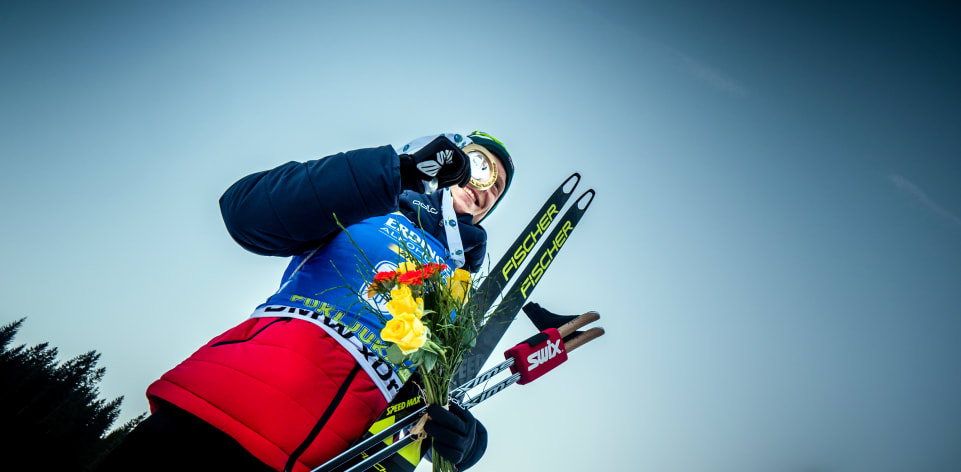

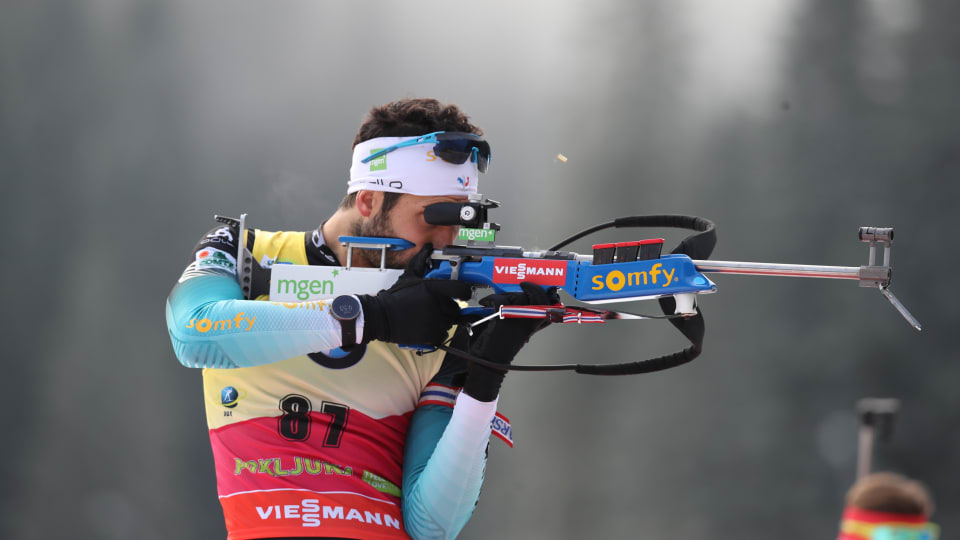

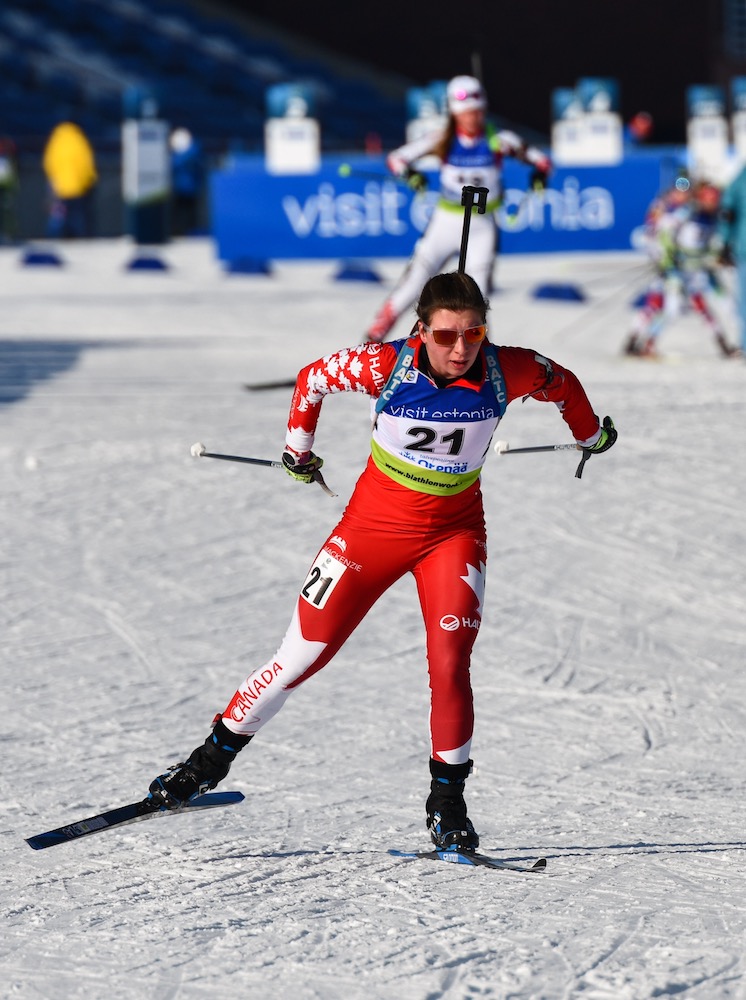

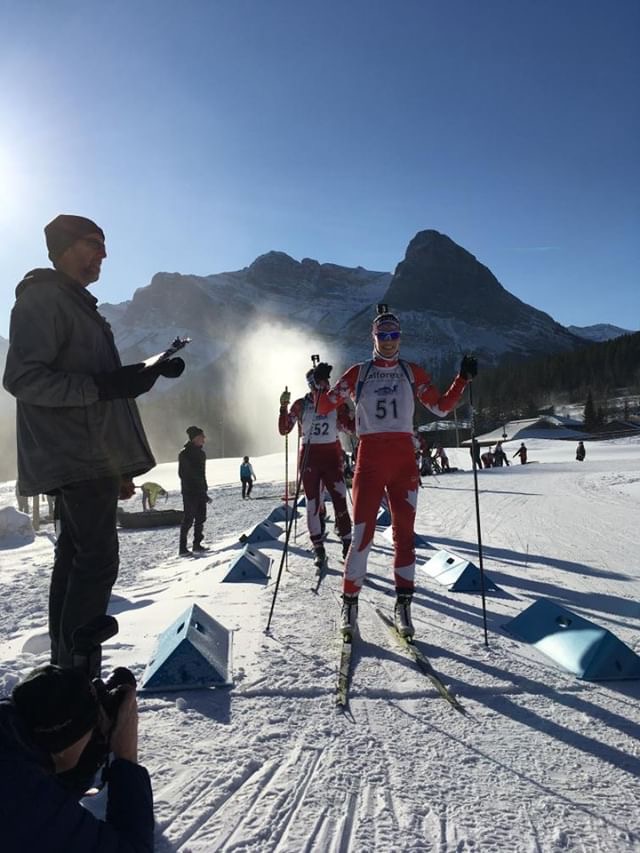

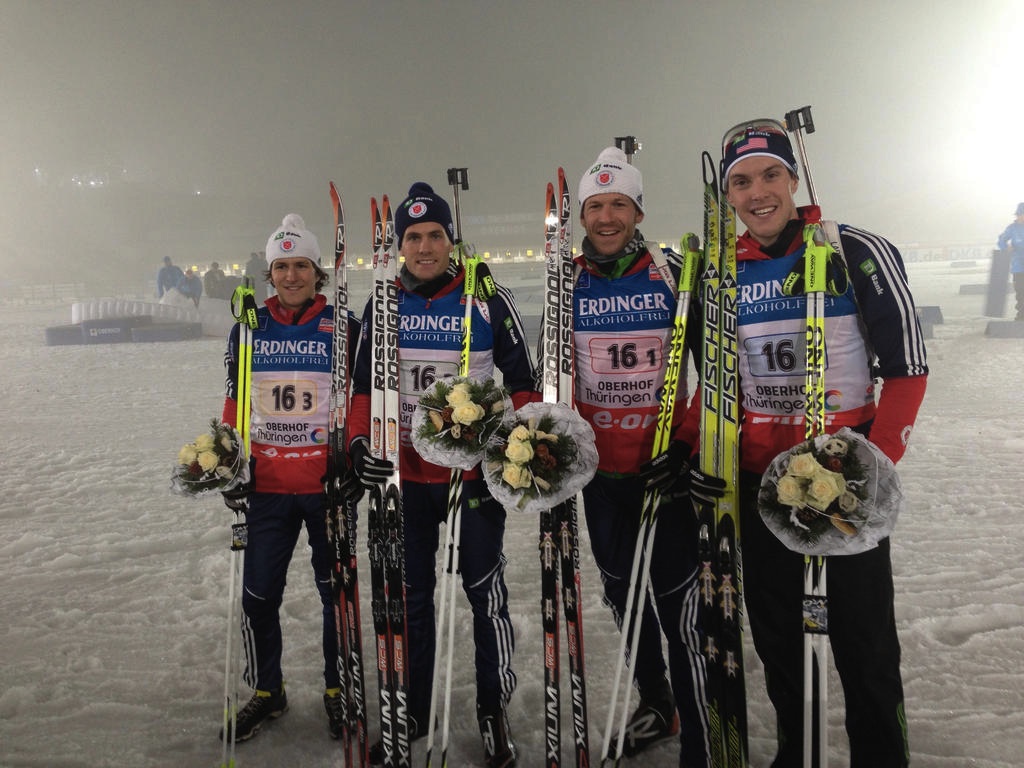
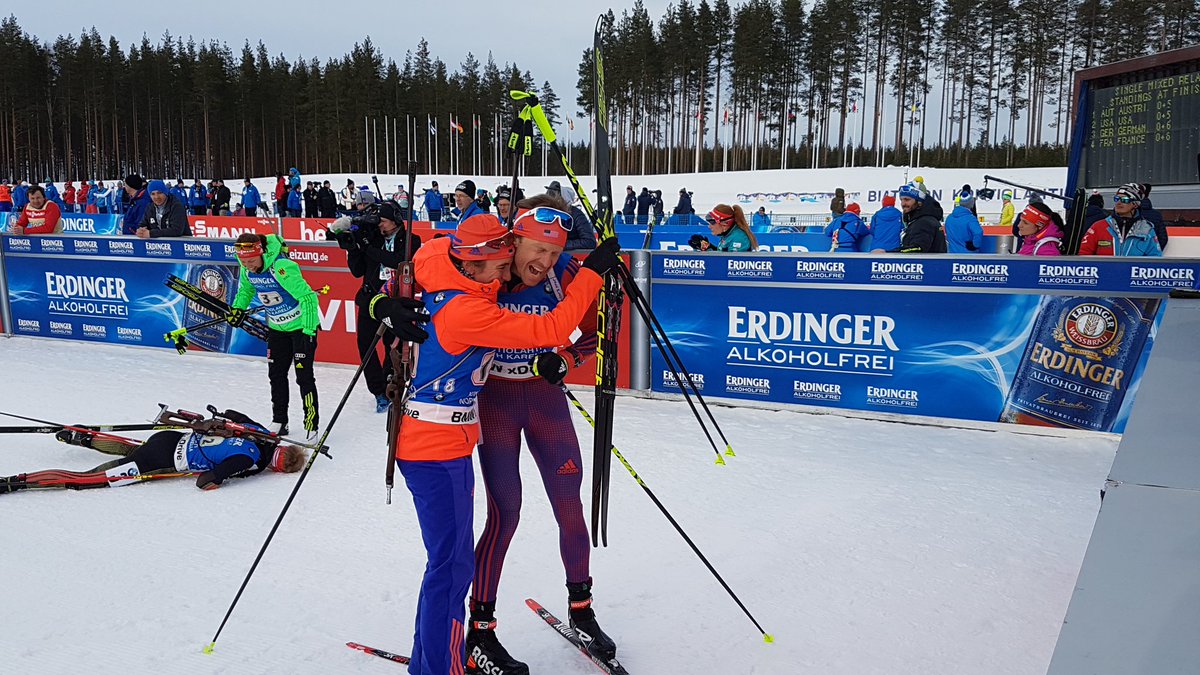
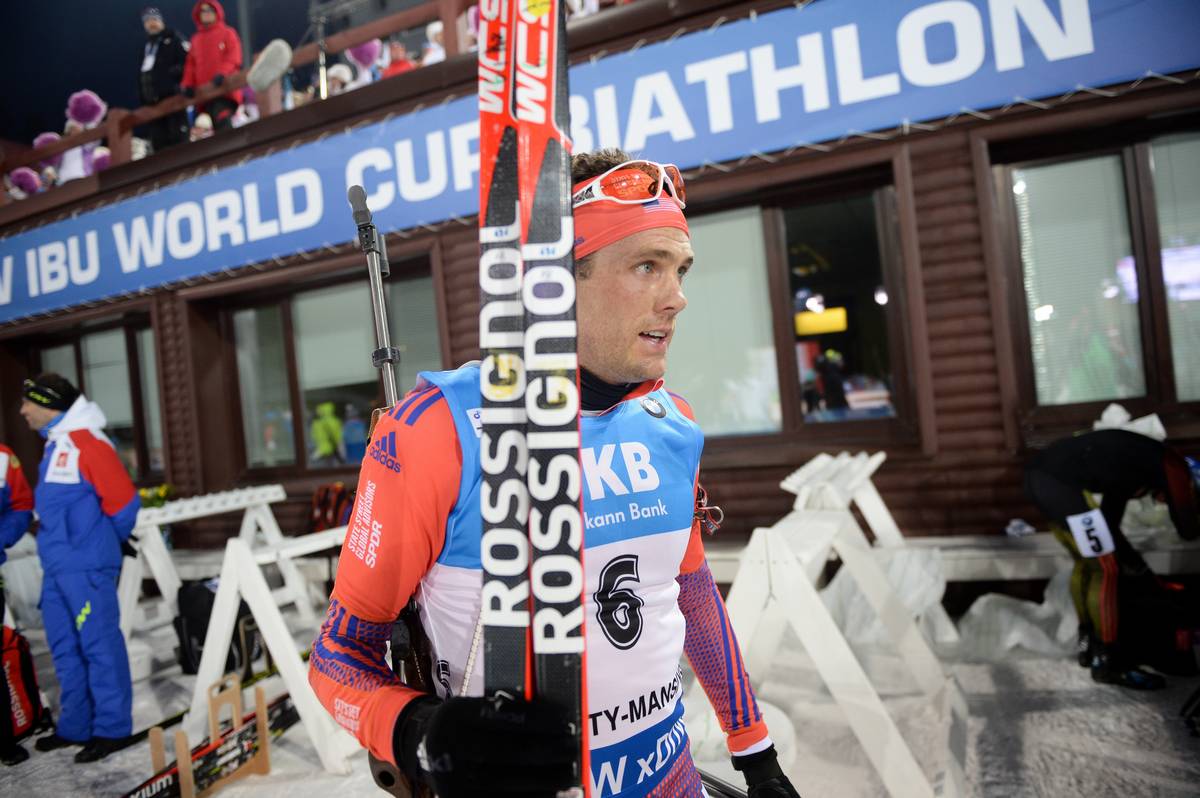
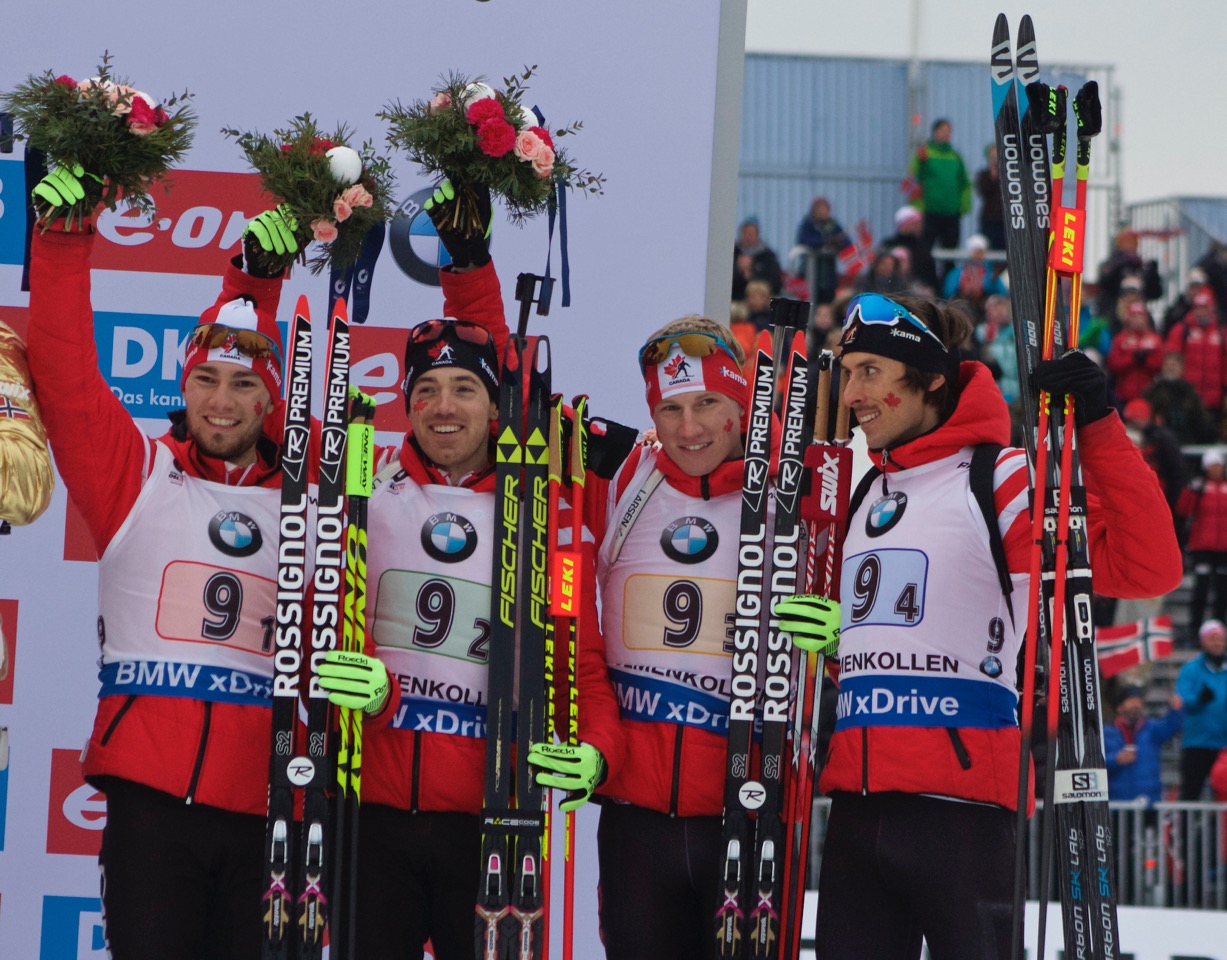
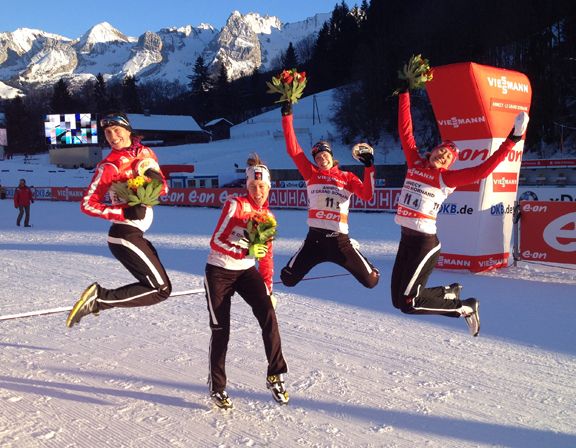
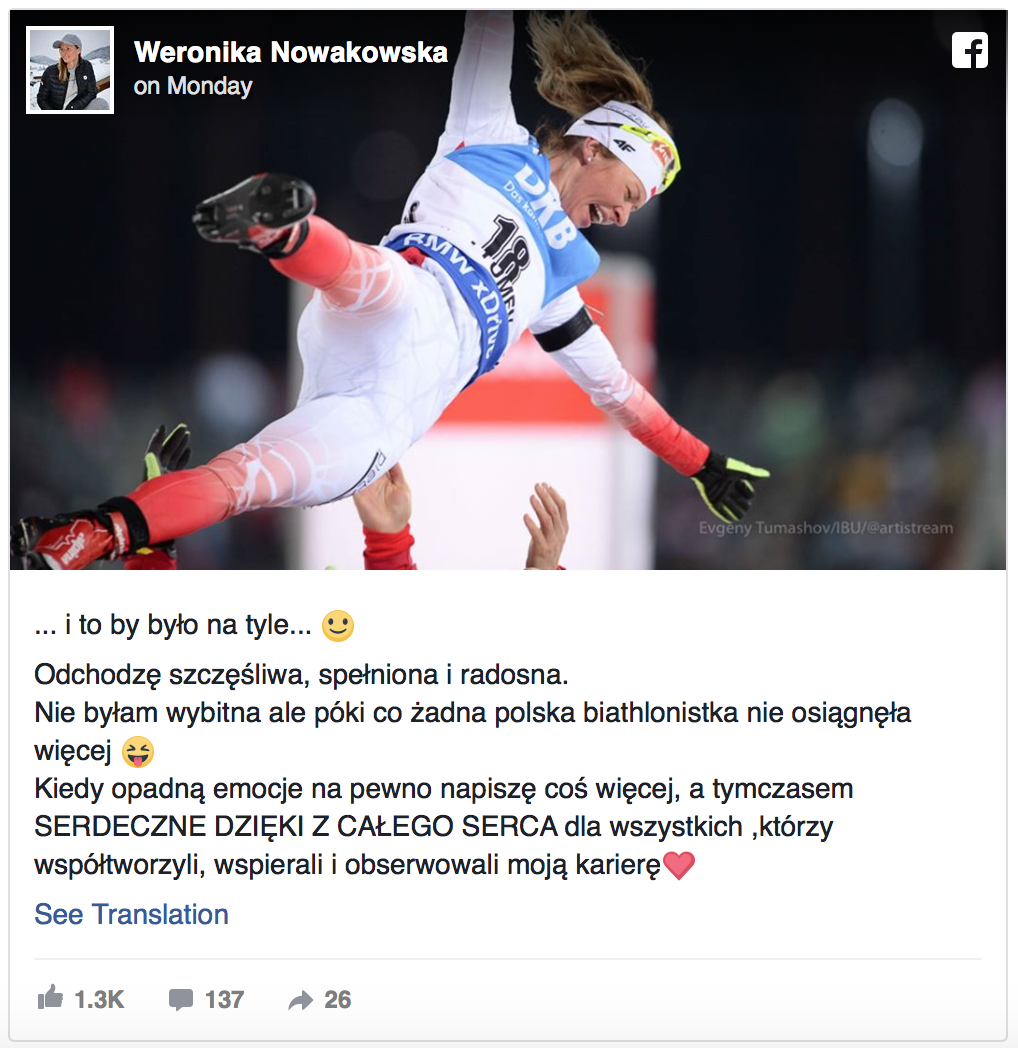 Weronika Nowakowska is calling it a career. The 31-year-old picked up two World Cup podiums in the 2015 season before taking a break from competition to give birth to twins. She made a successful return this season and represented Poland in PyeongChang, with a top finish of 21st in the individual. She also had sixth- and fourth-place finishes on the World Cup this year and contributed to four different top-eight relay efforts, including one at the Olympics.