From the FasterSkier archive — posts syndicated from athletes’ and coaches’ own blogs between 2004 and 2012, kept online as published. Current coverage is at fasterskier.com.
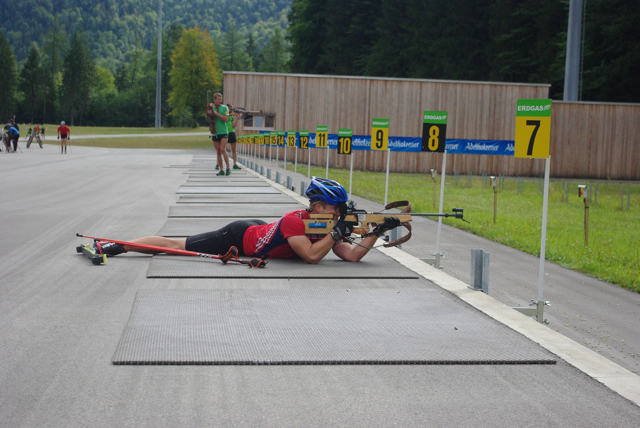
Jake Dalberg, a member of the National Guard biathlon program, shoots prone during a workout in Ruhpolding, Germany on Monday.
RUHPOLDING, Germany – When Jake Dalberg made the decision to join the National Guard at age 17, this was exactly what he had in mind.
“It was tough, but at the same time I felt like it was what I wanted to do and that was the way to do it,” Dalberg, now 19, said of the decision that the National Guard was his best route forward in biathlon.
In just his third year in the sport, Dalberg is here in Ruhpolding as a sort of adjunct member of the U.S. national team training camp. Although Dalberg and teammate Wynn Roberts are staying in separate accommodations and are supported entirely by their own program, not the U.S. Biathlon Association, they see the national team athletes on the range and the trails every day and have joined in to test themselves in time trials.
Wynn Roberts checks in with National Guard coach Sarah Lehto.
“We work together with the national team very well,” National Guard coach Sarah Lehto said as she watched Roberts and Dalberg shoot. “They come to Jericho and sometimes send athletes over to Jericho and we work with them. And in the winter once in a while I’ve gone to World Cups if they need another coach. So we work really well together and I have a good rapport with the coaches.”
That’s what allowed this trip to happen. Last year, 2010 Olympian Wynn Roberts joined the Guard team; he was the most experienced and high-level athlete to sign up in several years. This spring, Lehto began to think about how to best provide Roberts with the kind of training he needed, which basically meant training with his former national team teammates.
She asked USBA High Performance Director Bernd Eisenbichler if Roberts if the Guard could bring Roberts to Ruhpolding; only later did she decide to bring Dalberg along. Now, there are two athletes and two coaches from the team in Ruhpolding.
For Dalberg, it’s an unusual opportunity, and one he’s bent on making the most of.
“I really just want to learn a lot,” he said as he stretched after a two-hour skating, classic, and shooting combination workout. “I’m still in just my third year of biathlon so I there’s still a lot of learning going on. So just watching the national team, seeing how they do things, and trying to get as much out of it as I can.”
What is he learning?
“Just being efficient in skiing, and resting, and all the little things,” Dalberg said. “Sometimes I feel like I’m skiing well, but then I’ll go look at video and go, wow, I really have a lot to work on.”
Lehto sees the trip serving a different purpose for her two athletes. Dalberg has raced mainly on the NorAm circuit and at a few military races, including one in Italy last year; he seldom gets to compete against the national team. The coach hopes that this will give him some valuable experience.
Roberts (front) and Dalberg shooting together on the range.
“It’s good for him to see the next level,” Lehto said. “You know, he sees video comparing himself to some of the top racers in the world and it’s a good way for him to learn. You can talk about these things, but until you’re really immersed in it it’s really hard to know what it’s like. He’s the only U.S. junior getting this type of training right now.”
Another difference is that while Dalberg has been training more or less all year, Roberts took a break after the race season ended so that he could go through Basic Training and then get married. He’s only been training for part of the summer. But Lehto said that Roberts was taking things well, even when he finished farther behind the national team men in time trials than he usually would. She didn’t think the fact that he was still working on fitness was a major detriment for the camp.
“For Wynn especially, he needs to be immersed in this environment,” Lehto said.
Normally, the two athletes train together in Jericho, Vermont. The Guard team typically brings its entire eight-athlete squad together for training camps once a month. While the program has enough funding to do a trip like this every year, it doesn’t always make sense to do so.
“We have done trips to Scandinavia in the past, but it depends on who you’re working with whether it’s even worthwhile to come over here and be in this environment,” Lehto said. “We have athletes who we didn’t bring, who are not capable of being in this environment. But it will benefit these two, for sure.”
The spread in ability levels on the team makes her job interesting, but not easy.
“We just have two coaches but we have eight athletes covering the entire spectrum,” Lehto said. “So that’s really tough. But I feel like we’re rebuilding our program… now that things are calming down in the world, people are beginning to re-look at this option. It’s more enjoyable for me to work with athletes who are closer together, and who are true biathletes rather than looking within the National Guard to find athletes who could potentially be biathletes.”
As for Dalberg, the Guard is working out perfectly. After just missing the World Youth Championships team last year, he is entering his first year as a junior and aims to make the World Junior team to Obertilliach, Austria.
“It’s been really good,” Dalberg said of the Guard experience. “I have really great support and good coaching. And it’s a good place to train in Jericho and a good roller loop, so good facilities.”
After the national team finishes up in Ruhpolding at the end of the week, they will head to Oberhof, Germany, to train and test skis in the ski hall. The Guard athletes, too, will head in that direction.
“We’ll be three weeks here, which is kind of long, but we’ll be two weeks here and then when they’re kind of tired of this, then they get to go skiing in the ski hall,” Lehto said.
Dalberg was excited; he had only ever skied in the summer once, and it was a completely different experience. He hopes that this time might be better for training.
“I was in Chile once in the summer and I skied there, but that was at 10,000 feet,” he laughed. “I think this will be a little easier.”
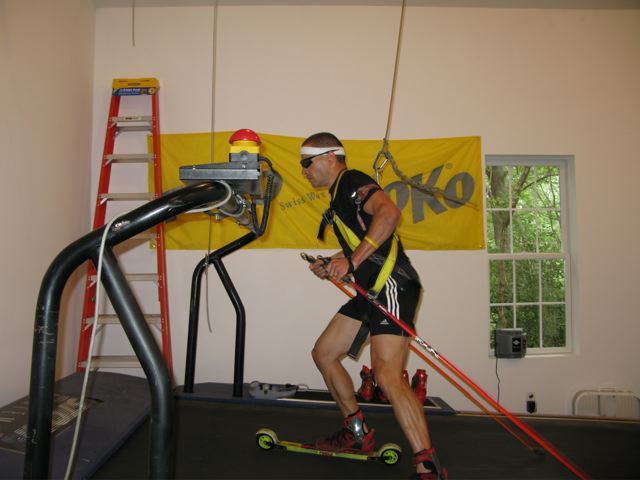
Duncan Douglas rollerskiing on his treadmill in Honeoye Falls, NY. Photo courtesy of Duncan Douglas.
There is only one thing that I really know about Duncan. Duncan truly enjoys punishing himself through endurance activity more than any other human that I know. Training is his drug of choice and he is a serious addict. – Tim Burke
Utter the name “Duncan Douglas” to anyone who knows anything about skiing, and you are guaranteed to elicit one of three responses: (1) dismissive incredulity, (2) respectful awe, or (3) idolizing hero-worship. If you hadn’t heard of the two-time Olympic biathlete before 2007, when he beat Kris Freeman to win the first Climb to the Castle on custom V2s, you certainly did in the ensuing uproar over wheel speed limitations.
For all the US ski community at large presumes to know about Douglas, there seems to be a general consensus there’s something about him—like what really motivates an ex-Olympian past his prime to try to prove that you can be fast and old—that can’t quite be pinned down. His is a rare enigma in a sport that keeps tabs on everybody’s business. This is perhaps why, at the height of its internet glory, Jacked Up Old Man got a few thousand hits a month. How that compares to regular FasterSkier blog traffic is proprietary information, but suffice it to say that for an anesthesiologist from Upstate New York, that’s pretty impressive.
Jacked Up Old Man, that legendary persona that captivated young and old ski fans alike, has now all but disappeared from the blogosphere. The Vancouver Olympics, which he was unabashedly shooting for, have come and gone without him. But at the age of 45, Douglas shows no signs of stopping.
When the idea for a story on Douglas came up during a FasterSkier planning meeting, I leapt at the chance to write it. As a native on Honeoye Falls, NY, where Douglas now lives, I’d grown up hearing about his latest athletic insanity from my high school ski coach, his good friend Bernie Gardner. Stories of some ex-Olympian biking up the Whiteface Mountain toll road five times in one morning were somehow supposed to goad us all into training harder for our next league meet.
And so the assignment was mine. What began as a simple workout piece turned into a full-on profile, as it became apparent that a brief account of Douglas on his rollerski treadmill couldn’t really do him justice. Nevermind what this guy does to get in shape, the real question is: why?
It is a testament to the infectiousness of Douglas’s enthusiasm for training that he convinced me to wake up before dawn for a strength workout when we had already planned a rollerski later that day. I got the impression over the phone that the treadmill demo I’d been hoping for was not going to be possible, but a roller-board session at 5:00 a.m. seemed like a good substitute for hardcore. So, we agreed to meet at ‘Area 143,’ the small barn in his backyard that houses his workout equipment.
Douglas had already started the circuit when I arrived the next morning: 50 reps on the roller-board, a minute of plyos, and 20 reps with an ab wheel. Repeat.
“You might want to do only twenty of these,” he said, stepping down from an original model of the VasaTrainer. Instead of being positioned flat on one’s stomach to muscle up the slide, like most trainers I’d seen before, Douglas’s version allowed for a pretty close approximation of an upright double pole. It looked painful.
“I’ve gotten off the roller-board wagon. Normally I like to do a workout like this three or four times a week. After a few months of that, I can go out on rollerskis and double pole like it’s nothing,” he said in between sets.
With a seemingly limitless tolerance for pain and general exhaustion, “nothing” for Douglas probably qualifies as excruciating for others. Never mind the fact that he races 30 to 40 times a year; he’s on call up to three times a week as an anesthesiologist at Rochester General Hospital and could be asked to leave his family at a moment’s notice for deployment as a National Guardsman.
Douglas racing this winter. Courtesy photo.
When I asked Tim Burke, a 2006 and 2010 Olympian who lives and trains out of Lake Placid, NY, to describe his fellow biathlete, this is what he wrote: “Duncan once told me that when he was training full time, he would go for a three hour run and if his average heart rate was not high enough when he finished, he would simply drink a coffee and a coke and do the run again. Another time, he was telling me how much he trained when he was my age. So I asked him, ‘Did you ever train over 1000 hours in a year?’ He simply replied, ‘Try 2000.’ If anyone else told me these stories, I would simply cry bullshit, but Duncan is crazy enough that you just never really know.”
This was the difficult thing about interviewing Douglas: it was hard to know when he was being serious, and when he was simply saying something for pure shock value, and probably laughing to himself while I tried to figure out whether he was joking or not. He’s so fit now you have to wonder: maybe he really did train 2000 hours a year when he was on the biathlon team.
According to the man who taught Douglas to ski at St. Lawrence University, he’s always attacked life with unwavering intensity. Robert Axtell, who retired from coaching at St. Lawrence in 2008, recalled Douglas’s first ski race at Tupper Lake.
“I was still racing quite a bit at the time,” said Axtell. “Duncan didn’t really know what to do, so I said to him, ‘Just follow me, and when you get ready to go, go.’ It was a mass start in a big field, and I was going along pretty good. I looked behind me for Duncan—he wasn’t there. I looked ahead, and there he was going up the hill. He ended up winning his first race.”
Douglas was at St. Lawrence for less than two years, and in that time qualified for NCAAs. Despite his brief time as college racer, he always maintained a strong relationship with his coach. Douglas lived with Axtell for a time, and would ski at night in the lit loop behind Axtell’s house.
With a seemingly insatiable appetite for self-inflicted pain and suffering, it would seem that Douglas would have been a difficult athlete to reign in. But Axtell said that the young Douglas was perfectly coachable, willing to learn and listen.
“He does what’s best for Duncan,” explained Axtell. “I think maybe people will think he won’t listen; he’s had coaches in the past he kind of balked at…but years ago he was really eager to learn and get ahead.”
“There might be times when he over trains,” Axtell conceded. “But he’s the type of person who can get by on very little rest; he’s just a high energy individual.”
This was my training partner for three separate workouts on a Monday in August. Our morning strength session was, predictably, excruciating. Within the first ten reps on the VasaTrainer my arms were screaming. I could tell my triceps were going to make me pay for thinking I could keep up.
“Right now I’ll do 15 to 20 sets of these, but eventually I’ll get up to 30,” said Douglas in between exercises. I decided it would be best for me not to bother counting how many sets it took for me to decide to start rolling tape instead.
Extreme muscle soreness didn’t set in until the next day, however, so I was still ready to tackle our rollerski scheduled for that afternoon. We met at the site of local club Rochester Nordic Racing’s (RNR) afternoon practice. I arrived earlier than Douglas to tag along for a warm-up with the RNR juniors. Upon hearing who would be stopping by later, head coach Jason Hettenbaugh told his athletes, “Keep an eye out: if you’re lucky, you might spot a Jacked Up Old Man on the road!”
Most of Douglas’s fan base might be over the age of 40, but you wouldn’t know it from the reactions this announcement elicited from the 20 or so high school kids around me. Five years after I’d graduated high school, Douglas was still being held up as the epitome of no-excuses dedication for local juniors. No more Olympics to ostensibly train for? No matter. “I’m just happy to get out there now,” he said after he arrived and we started an easy skate rollerski past farm fields.
At the December 2009 Mt. Itasca US Olympic Trial selection races in Coleraine, MN, which served as a pre-qualifier for a shot at the last few places on the Vancouver biathlon team, Douglas finished ninth in his best three out of five races. The US Biathlon Association ended up taking the top four guys from that event to IBU Cup races in Altenberg, Germany, where the last few spots on the Vancouver biathlon team were contested. After Mt. Itasca, Douglas took to his blog to talk about coming up short of his goal.
“Yes, I would’ve been thrilled to race in another Olympics and would not have tried if it wasn’t possible. The truth of the matter is that I just love training and racing,” he wrote.
Setting such a lofty goal for himself simply let him get away with the sheer volume of training that he would love to dedicate to the pursuit of athletic excellence all the time, Olympics or no. With a wife, four kids, and a demanding job, Douglas recognized that being an athlete was now a more selfish endeavor than when he was younger.
It was partly out of the need for an efficient way to fit in quality training that first prompted Douglas to purchase the piece of training equipment normally reserved for physiological testing labs. With few training partners and no coach but himself, Douglas set out make his comeback with a tool that let him rollerski in the dark before and after work.
“I used to rollerski around here in the dark with my headlamp, but that got to be too dangerous,” he explained.
He obtained the used Skatemill three years ago from the Netherlands, where it originated. His particular machine was a demo model in its previous life, and the company sent a technician to Douglas’s house to help him set it up. He had to rework the electricity coming to the barn so that it could handle the voltage the treadmill required. With the small shooting range he has set up in his backyard just outside the barn, he can combine rollerski workouts with target practice, simulating a winter race as best as possible.
“It was cheaper than building a rollerski loop,” he said.
The treadmill, it turned out, was perfectly operational, so back to The 143 we went after our rollerski, this time with my brother, Steve, in tow. After a quick safety briefing (“hit this red button to turn it off”), Douglas strapped into the harness and slowly brought the treadmill to speed. Skiing with it set to a 10% grade, he settled into an easy V2 near the front of the platform.
Though I’d prepared for the real thing by watching a few YouTube videos of Douglas on the treadmill, I was still struck by its sheer size. It was like being in some sort of NASA virtual-reality lab, only here we were mapping out the limits of an addiction to endurance sport, and the lengths to which a person would go to achieve a goal. There was nothing virtual about it.
When it was my turn to buckle into the harness, I was a little nervous. I started off without poles, to give myself a chance to get used to the feel of the belt moving under the skis. Surprisingly, rollerskiing on the treadmill was more like skiing on snow than on asphalt. It was easier to balance on one ski and let the belt freely move under my feet more. Of course, if I lost my balance for a split second here I’d end up flying off the back. At least asphalt stops moving if you fall.
After adding poles and experimenting with V1 and V2 for a few minutes, I decided I’d had enough for one day. Douglas is just as busy as ever, after all, and it was time to let him have dinner and get back to his family.
Before I’d tagged along for this series of workouts with Douglas, I had my theories as to why he held the attention of the ski world. I assumed it had something to do with his dedication to this sport beyond all reason.
But in spending a few hours with him, I realized there was more to it than that. I was honestly inspired when I drove away from his house that evening. If Douglas, with more than enough distractions in his life to make him surrender his aspirations of being a world class athlete, could find a way to still be competitive with skiers 20 years his junior, then what the hell was my excuse? True, I probably couldn’t afford my own rollerski treadmill, but my day spent trying to keep up with a jacked up old man made me realize that it actually wasn’t that hard. Painful, maybe, but all it really took was a commitment to a goal and the decision to try and meet it no matter what. A healthy enjoyment of punishing yourself certainly didn’t hurt either.
Correction: We originally stated the Robert Axtell retired as the head coach at St. Lawrence University in 2008. While he was the head coach from 1963 to 1973, he was an assistant when he returned to the program from 2001 to 2008. Ethan Townshend has been the St. Lawrence head coach since 2003. We apologize for the mistake.
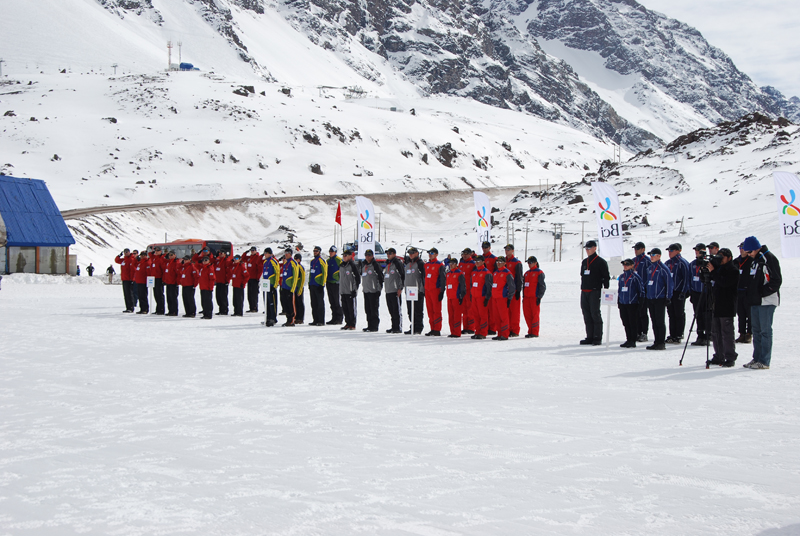
Team USA and US army staff pose in front of a spectacular Andes mountain view.
The National Guard, consisting of Army Soldiers and Air Force Airmen, sponsors a biathlon program that is headquartered at the Camp Ethan Allen Training Site (CEATS) in Jericho, VT. The “mission” of the program is to represent the National Guard and the United States Armed Services in national and international biathlon competitions, to include World Cup and Olympic events, while simultaneously developing the highest levels of skiing and rifle marksmanship necessary to improve the combat ability of individual Airmen & Soldiers. NG Biathlon fields teams in five international military competitions each year, culminating each August with the South American ski championships in Portillo, Chile. The article that follows was written by team member Brian Olsen, a Soldier in the UT National Guard and a Torino Olympic biathlete.
Teams assembled from Argentina, Brazil, Chile, and the USA in rank and file formation to mark the opening of the South American ski championship week.
I
“How do these races compare to others in which you have competed?” asked the Chilean radio announcer, by way of my translator and our team leader, Lieutenant Colonel Edward Soto.
Based in Los Andes, the radio station was doing its first-ever live broadcast from the Andes Mountains to publicize the 11th International Military Ski Championship (CIEM) being held in Portillo from August 10 to August 14. Eight of us huddled around a table and two microphones trying to explain what our sport was to a population even less informed about biathlon than the American people.
I looked around the table at my new friends from Chile, Argentina, and Brazil. “Whereas on the World Cup and at the Olympics,” I responded, “much of my time was spent sitting in hotels with my teammates preparing to do our best in competitions, while here all of the teams live together. The focus is on building friendships. The genuine spirit of competition is much more alive here likely because we are all facing the same difficulties: gasping for air at 9,500 feet, strong and gusty winds that take hold of our bullets, and adapting to life at a remote military post.”
The others agreed. While we didn’t all understand one another in spoken language – my high school Spanish has accumulated a decade of dust – in our eyes, we acknowledged the relationships we had built through common experience over the previous week.
II
The American team was fielded by the National Guard Sports office in Jericho, Vermont, with the eleven athletes and staff serving as airmen or soldiers in the Air or Army National Guard of six states: Alaska, Minnesota, North Dakota, South Dakota, Utah, and Vermont.
Why does the National Guard fund international biathlon teams? The answer ranges from historical to functional. Biathlon’s history is steeped in military tradition; in fact, the first biathlon race was a friendly match between Norwegian and Swedish border guards in the 1700s. Then and now, training and competing in the sport serves as good practice for military skills like physical fitness, marksmanship, discipline, and unit cohesion. Today, the international teams are sent to events in South America and Europe to build goodwill and friendship with foreign militaries.
III
“Chile has never been the spoilt child of fortune; like Saturday’s bairn in the nursery rhyme, she has had to work hard for her living.” – Julio Perez Canto, 1912
The trip began with all of the personnel arriving in Santiago, Chile on August 8 aboard over-night flights across the Equator. We were met by our Chilean Army liaison, Lieutenant Juan Valenzuela, who whisked us through customs. With rifles and body-bag sized ski bags, clearing customs in foreign lands is never an easy feat for the biathlete. It is even more difficult in Chile due to its ban on the importation of any sort of foodstuff.
Arriving on a weekend, the country we passed outside our van seemed eerily idle, as if the earthquake that had struck six months earlier had swallowed the population whole. Yet, neither the buildings nor the ground revealed any indication of the horror that shook the country on February 27.
From the outside perspective, it seemed that the competitions were in danger of cancellation due to the sheer destructive power of the earthquake, but as one officer would later relate to me, “These competitions have immense meaning to the Chilean Army, both to motivate our own soldiers and to show our guests our depth of hospitality and level of military competency.”
The route from the airport to Portillo underscores the rustic-nature of the country, especially in the mangled remains beside the road of a railway that once connected Santiago with Argentina, its foundation long-since swept away by avalanches and landslides. The final two-mile ascent contains twenty-nine switchbacks, a testament to Chilean perseverance. The climb would not be such an ordeal if it didn’t serve as the main trucking route between Santiago and Buenos Aires. If it had been a weekday, we could have been stuck on the road for hours weaving among exhaust-belching semi-trailer trucks waiting to cross the border at the top of the pass.
Immediately off of the Autopista Los Libertadores, the Chilean Mountain Warfare School’s mountain post is nestled in a barren meadow surrounded on three sides by 13,000-foot mountains. (The close proximity to the highway seemed to permit us witness to the entirety of trade between Argentina and Chile, but also left the snow and our lungs a tad sullied by petrochemicals.) This would be our home for the next ten days: an outpost of less than a dozen mostly concrete and corrugated blue metal buildings surrounded by Andesite boulders the size of elephants. A perilous fifteen minute walk up the highway lie Hotel Portillo and the Portillo Ski Resort, while fifteen miles away as the albatross flies stands Cerro Aconcagua, the tallest mountain outside the Himalaya at 22,841 feet.
IV
In the past, the competition series in Portillo had included three races: a 20-km individual race with four shootings and one-minute penalties per missed shot, a 10-km sprint competition with 150-m penalty loops for each miss, and a 25-km patrol race, in which four teammates tackle a long course and stop to shoot only once at one target each. This year, adding to the difficulty presented by the altitude and gusty winds, the organizers added a 15-km mass start biathlon race of four shootings, but shortened the individual and patrol races due to low snow conditions. Without taking into consideration the variable penalty loops skied by competitors, those that completed all four competitions skied a total of 56-km in races alone – longer than the popular American Birkebeinar!
The U.S. team fared well. SSG Jesse Downs (VTARNG) won the mass start competition and placed second in the individual competition, 2LT Brian Olsen (UTARNG) placed third in the sprint competition, and the team of Capt Eric Nordgren (NDANG), Olsen, MSG Doug Bernard (UTARNG), and SSG Downs took third place in the 21-km patrol race. Relatively new to the sport, Maj Becky Scott (AKANG), 2LT Brandon Adams (UTARNG), PFC Mike Scharn (SDARNG), and PV2 Jake Dalberg (MNARNG) had individual bests.
Our Officer in Charge (OIC), LtCol Edward Soto (AKANG), bunked the tradition of tending only to formal duties by jumping into the action himself, participating in two of the competitions. The athletes were supported by head coach SSgt Travis Voyer (VTANG) and NCOIC SMSgt Scott Belyea (AKANG).
V
On the free days, the athletes and staff were graciously taken on several trips in the area. When no vehicles were available to transport the group on a cultural tour, liaison Lieutenant Valenzuela and his wife volunteered to drive them in their personal vehicles the four hours to the coastal town of Valparaiso to visit the Chilean Naval Headquarters and Museum. Another group went on a day-long backcountry tour across the lake below the Portillo Hotel (Laguna del Inca) to catch some turns with a guide from the Mountain Warfare School. Others stuck to the Portillo Ski Resort’s slopes, provided with equipment and lift tickets free of charge by our Chilean hosts.
VI
The competitions came to a close with a ceremony full of pomp. Politicians and military leaders from the participating countries presented the medals. A military band played national anthems as flags were taken down. Inside, the formal lunch was preceded by exchanging gifts and the presentation of a Chilean dance from the north. Beer and wine flowed. Competitors and hosts reflected on the week’s experiences and said good bye until next year when the National Guard team will return to build upon these friendships and once again compete in the shadows of the Andes.
The final day of the South American ski championships featured a 25km "military patrol" biathlon. Team USA placed third (from left-to-right: Staff Sergeant Jesse Downs (VT), Captain Eric Nordgren (ND), MSG Doug Bernard (UTARNG) and 2LT Brian Olsen (UT)).
A 2006 U.S. Olympian, Brian Olsen is a soldier in the Utah Army National Guard’s 204th Maneuver Enhancement Brigade and graduate student at the University of Utah. He maintains a website at www.always-forward.com.
Readers interested in learning more about the National Guard Biathlon Program can contact Major Andrew Parsons at andrew.f.parsons@us.army.mil or at #(work)(802)899-7120.