From the FasterSkier archive — posts syndicated from athletes’ and coaches’ own blogs between 2004 and 2012, kept online as published. Current coverage is at fasterskier.com.
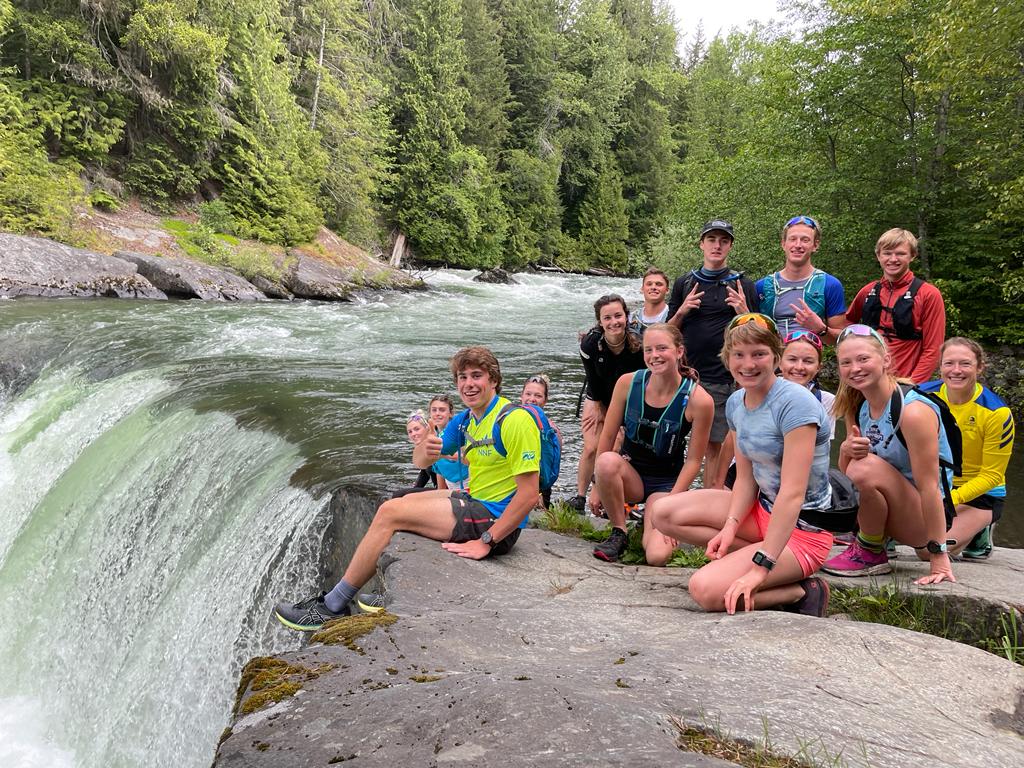
After an untold number of bear sightings and many hours of quality training, the U18 National Training Group (NTG) camp wrapped up in Whistler, B.C. the third week of June. The first of the National Nordic Foundations (NNF) Summer Series, the goals of the camp were twofold: the first was to give these athletes a chance to meet and train together, particularly since the annual U18 Nordic Nations Cup trip was canceled in January due to high COVID-19 cases in Norway; the second was to familiarize the athletes with the venue and living environment in Whistler, as it will be the site of the upcoming 2023 Junior/U23 World Ski Championships in January.
The camp’s attendees earned a spot on this trip after selection by the U.S. Ski & Snowboard (USSS) based on their performances at last year’s Senior Nationals in Soldier Hollow, UT and/or other USSS sanctioned races. Hailing from all over the country, 13 athletes made their way to Canada for a week of training and exploration.
Group shot of the 13 athletes from around the US who participated in the U18 NTG camp in Whistler, BC (Photo: Bryan Fish)
U.S. Ski & Snowboard Cross-Country Sport Development Manager Bryan Fish, explained in an email what this might mean for the American juniors. “Our teams have become very good at traveling well and executing overseas, however our first Junior World Ski Championship medals became a reality in 2017 when Park City, UT hosted Jr Worlds. Those home-field championships helped spark the successful trajectory of USA cross-country skiing. We are trying to build a similar positive environment for these 2023 Championships.”
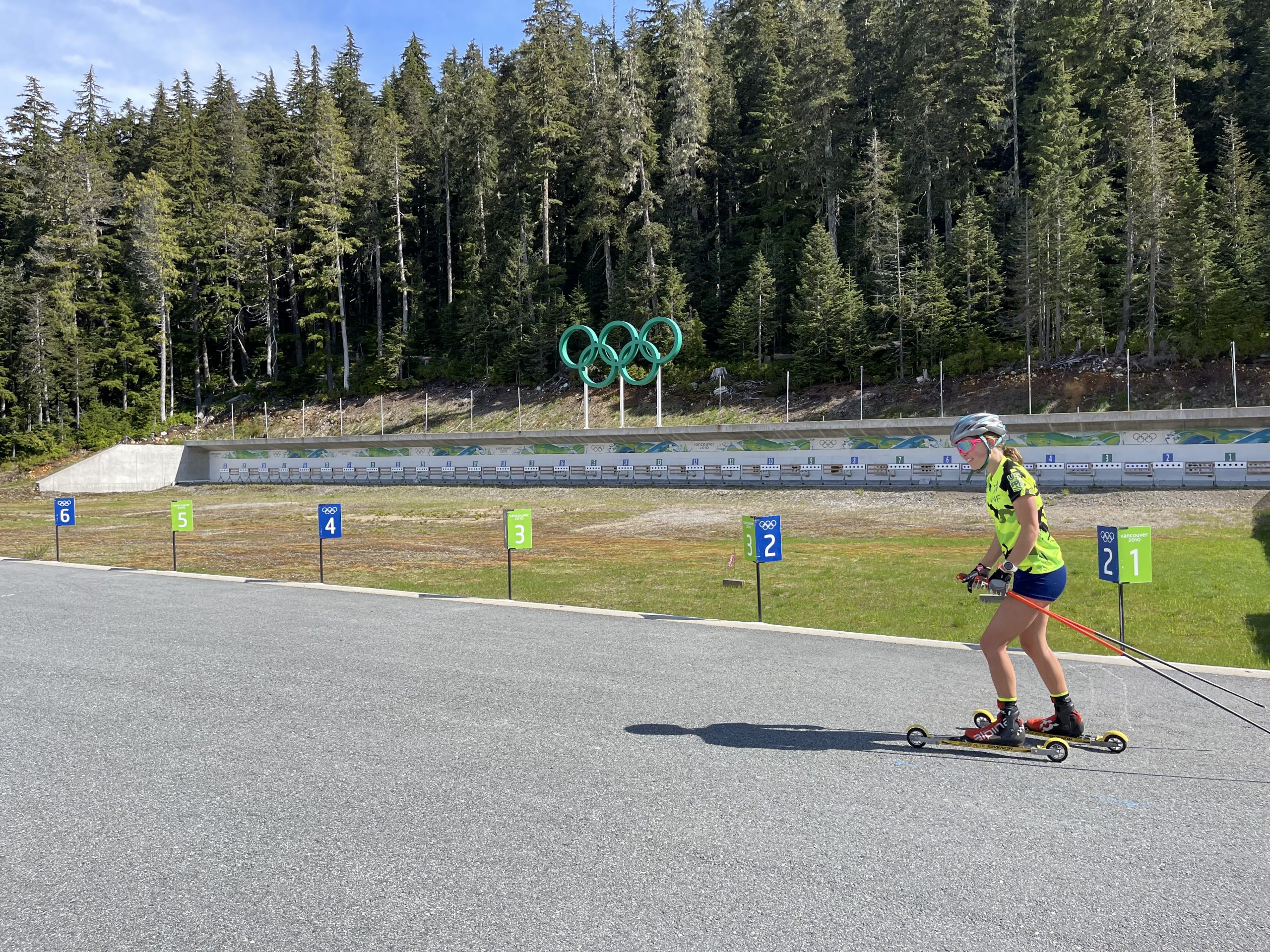
Getting familiar with the trails at the Whistler Olympic Park before 2023 Jr World Championships (Photo: Greta Anderson)
In addition to Fish, the camp’s coaching staff was comprised of U.S. Development Team Coach Greta Anderson, Alex Jospe from Stratton Mountain School, and Naomi Kiekintveld from Alaska Pacific University Nordic Ski Center.
After the recent conclusion of the NTG camp, Fish felt that the camp’s objectives had been achieved. He wrote, “the camp successfully achieved the goals of familiarizing ourselves with all aspects of the venue, the race courses, and the living arrangements. It was a great group of athletes which made for positive and motivating training sessions. The Whistler rollerski track is on a portion of the Jr World race courses, so we spent a great deal of time getting comfortable on the track at speed to understand how the course flows.”
Through collaboration with Nordiq Canada, the joint U.S./Canadian Spring National cross-country Championships were also held in Whistler in March, which Fish explained, “provide[d] our athletes with true on-snow race experience on these courses.”
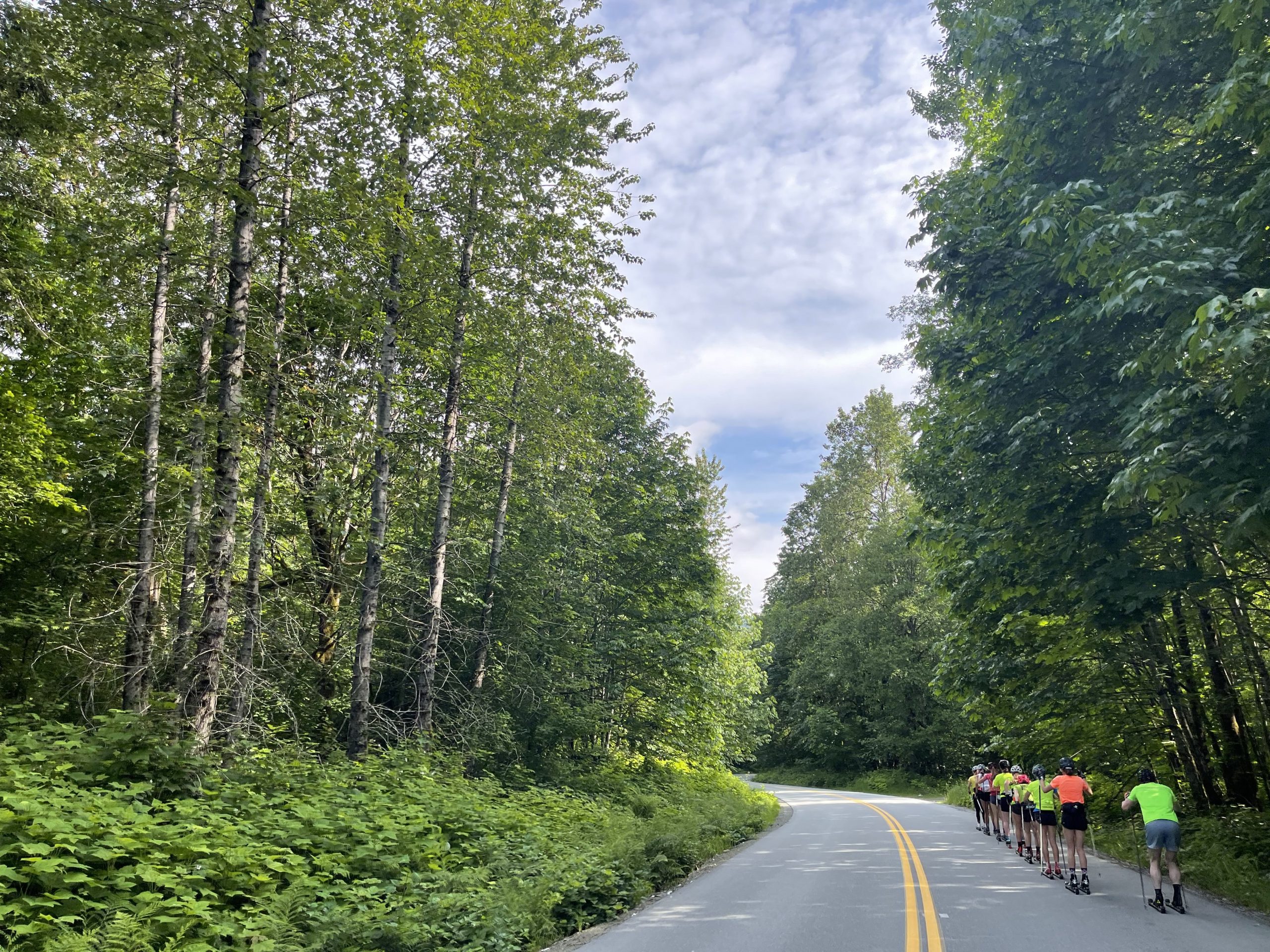
Exploring the area outside of the Whistler Olympic Park and getting some training (Photo: Greta Anderson)
As for the athletes’ perspective, in a blog post written for NNF, Midwest junior Cooper Camp reflected that for him, “one of the most valuable parts about this camp was being able to ski with the best juniors in the nation. Not only being able to get quality training in with each other, but also skiing behind others and learning from what they do, is one of the biggest benefits from camps like these.”
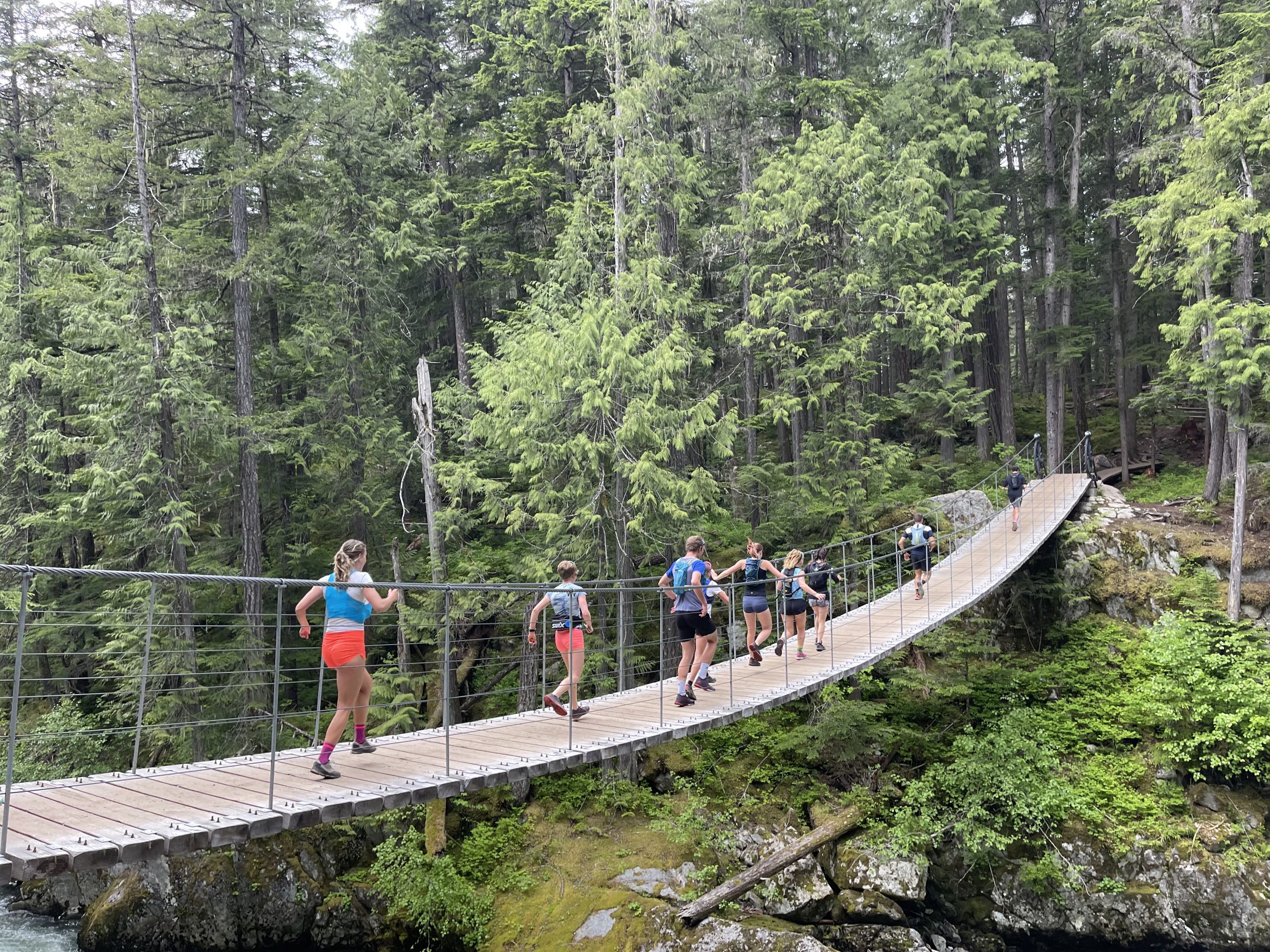
Campers head out for a long run (Photo: Greta Anderson)
Although the athletes have returned home to their respective clubs, there may be more opportunities for them to train together before the summer is over with both Regional and National Elite Group camps still to come. As to who will be returning to Whistler to represent the U.S. at the Jr/U23 World Ski Championships starting January 27th, 2023, both athletes and fans will have to wait until the conclusion of Senior Nationals (Houghton, MI) at the beginning of January before the team will be announced.
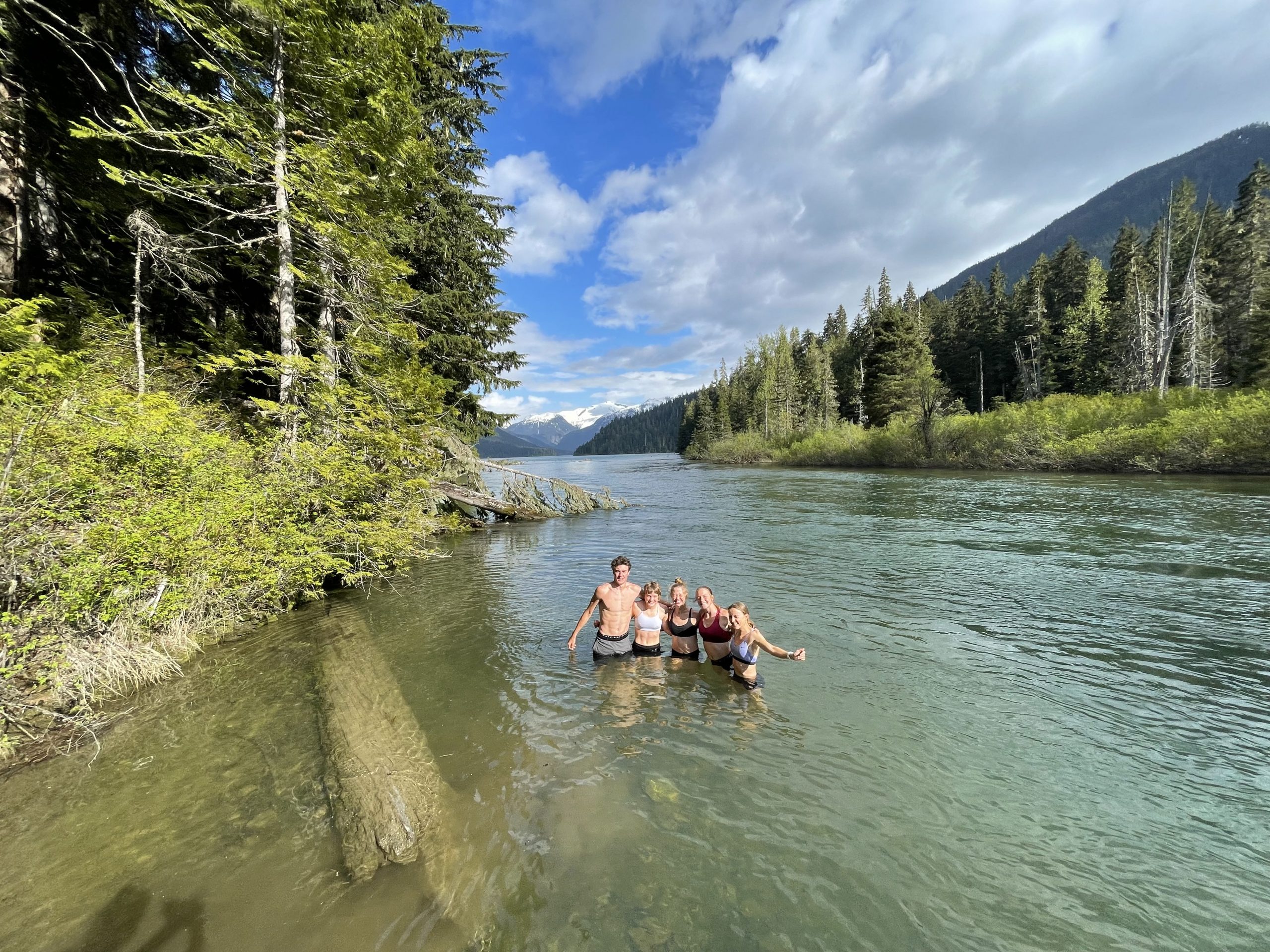
Campers cooling off after a day of training (Photo: Greta Anderson)
For an on-the-ground look at the recent camp, a recap video made by coach Alex Jospe, can be found here.
Ben Ogden and Bill Harmeyer during double-pole speeds at the 2017 Junior NTG Camp earlier this month at Soldier Hollow in Midway, Utah. (Photo: Bryan Fish)
For this week’s workout, we asked for a specific-strength workout from this year’s Junior National Training Group (NTG) Camp, which was held Aug. 2-15 near Park City, Utah. One of three coaches at the camp, Maria Stuber (head nordic coach at the College of St. Scholastica), shared the following, which she described as an “old-school endurance strength workout.” She led the camp with two U.S. Ski Team (USST) staff members, development coach Bryan Fish and World Cup wax technician Tim Baucom. Eighteen athletes attended — 10 men and eight women — all under the age of 21.
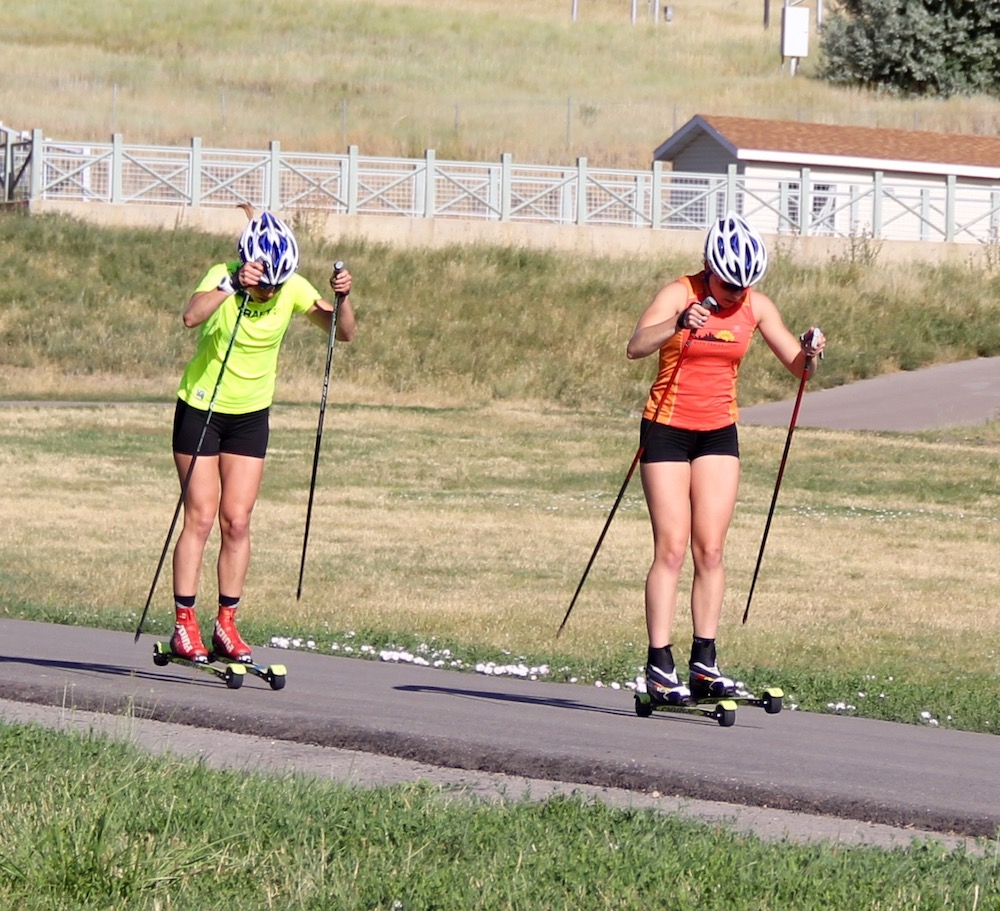
Lauren Jortberg and Nicole Schneider doing double-pole speeds at the 2017 Junior NTG Camp earlier this month at Soldier Hollow in Midway, Utah. (Photo: Bryan Fish)
“The U24’s are invited to other U.S. Ski Team camps like our October camp and our May Bend camp,” Fish explained in an email.
The goal of this month’s camp was “to get our very best together to train and learn from one another,” he wrote. “These are athletes that are already or very well may soon be on the U.S. Ski Team, so building a healthy and positive training environment for these athletes is critical. Secondly, building an environment where these athletes push each other yet trust one another is critical. Many of these athletes have already traveled overseas together and continuing to strengthen their comfort and focus toward how we can support, lean on and succeed together – as a group, as a nation, as a team.
“Third, we want to provide these athletes with meaningful feedback,” Fish continued. “The athletes work with our high performance department at U.S. Ski & Snowboard to learn what individual items they are already strong as well as windows of opportunities for improvement.”
The primary focus was to provide a “strong training environment,” he wrote, while also testing athletes in areas like strength, power and mobility with a protocol similar to the U.S. Ski Team.
Throughout the two-week camp, there was an abundance of rollerskiing and threshold ski walking/bounding, as well as strength work.
“One question that commonly comes up is why such workouts are becoming less familiar or possibly less utilized in coaches’ training plans,” Fish wrote, referring to specific strength. “I think it is because more programs are incorporating this type of effort into classic sprint training sessions. That being said … [this workout develops] many important technical and physical skills.”
Stuber explained that the workout emphasizes repetition “to work out technique issues and to feel efficiency differences,” she wrote. “It is also a fun social workout because the whole team stays in one place and you can have a good time with rivalries and inter squad competition. “
The workout: Specific Strength on Skis
20-minute warmup
Followed by:
8 x 30 seconds single stick
6 x 30 seconds core-only double pole
8 x 30 seconds double pole
20-minute cool down
“We did not harp on technique too much and let the athletes think and discover what was working best to move across the ground with the group,” Stuber noted. “We had video on an iPad for those who wanted to see what they looked like and if the changes they were feeling were showing up on camera.
“There were a lot of blisters,” she added. “Gloves are recommended for this workout.”
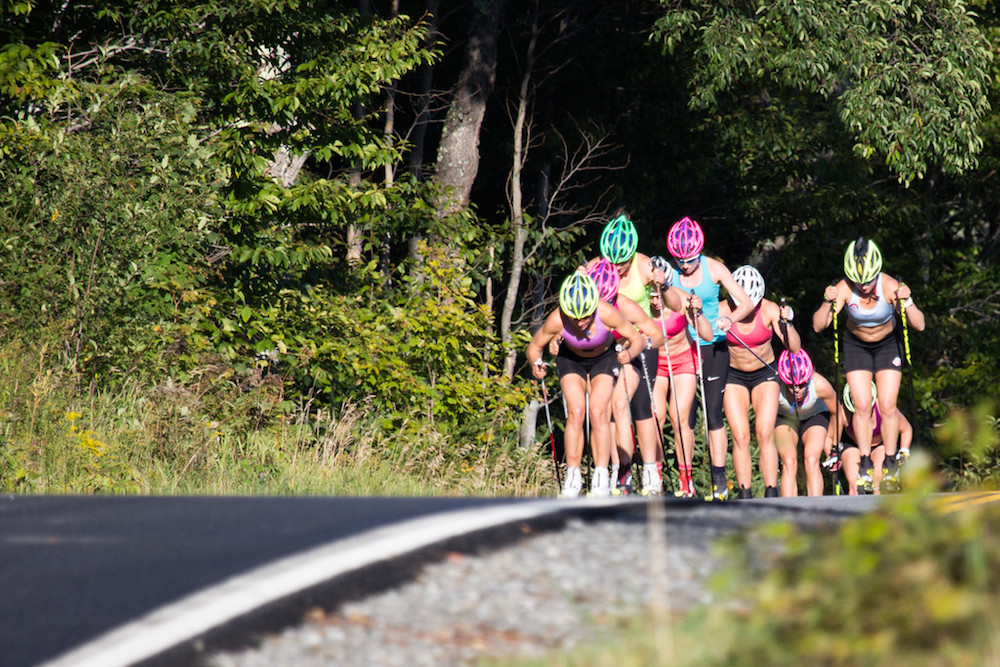
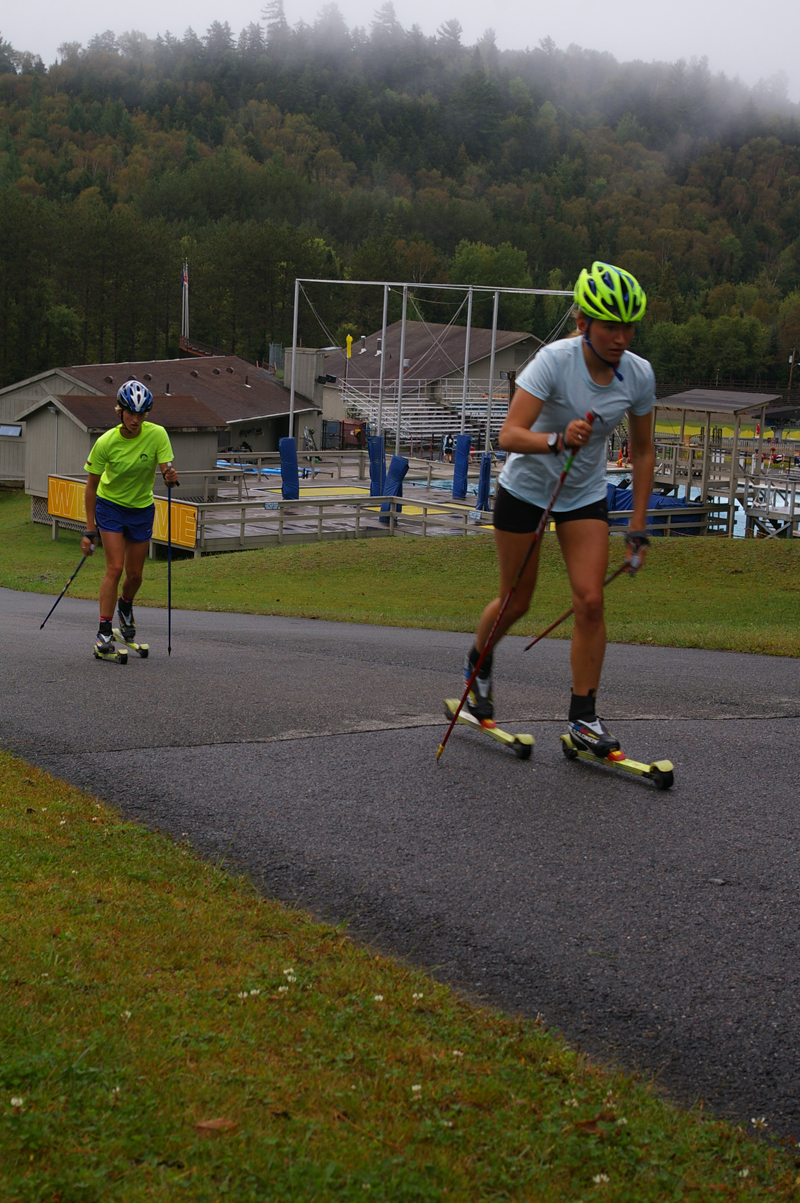
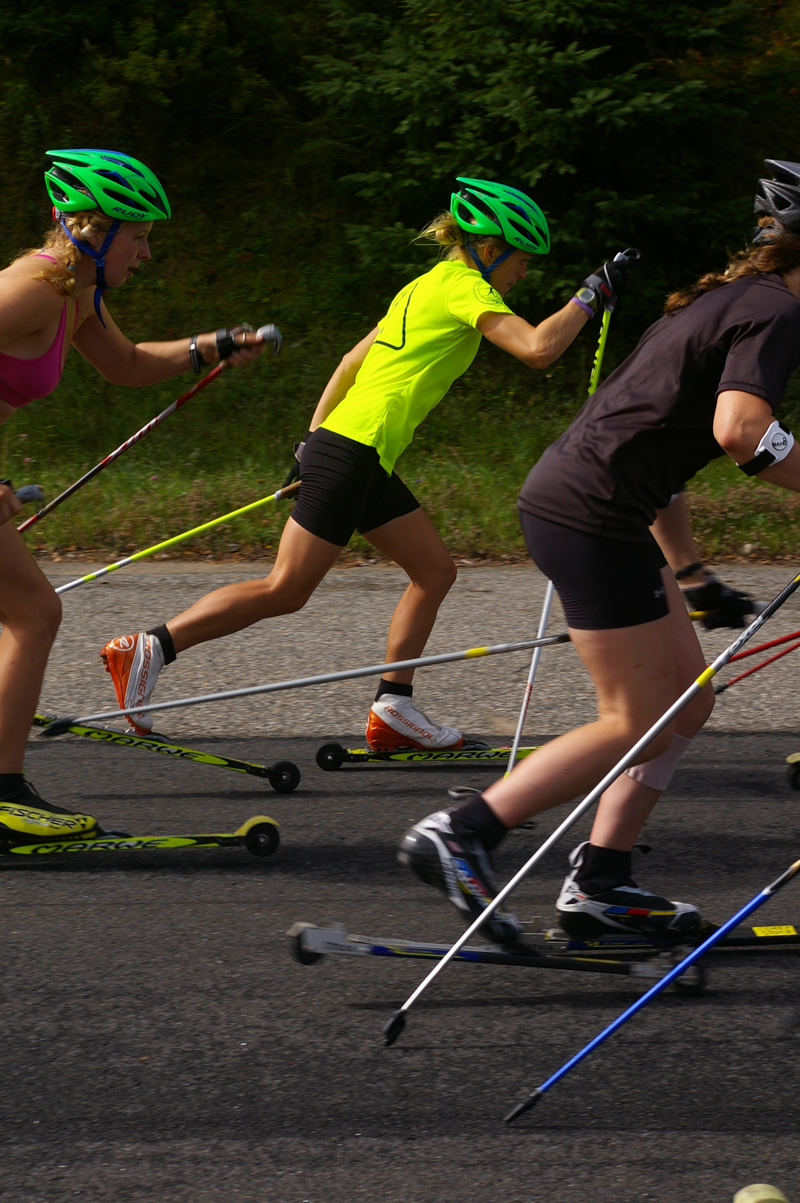
The women at the USST camp in Lake Placid, N.Y., push each other during some double pole intervals on the rollerski track earlier this week. (Photo: Reese Brown)
The fall season means many things to the cross-country skiing community. It means the temperatures decrease, the training intensity ramps up, and excitement for winter begins stirring in the soul.
For well over a decade now, fall for the U.S. Ski Team (USST) has also meant a training camp in Lake Placid, N.Y. Although the team has had camps in New Zealand and Norway not long ago, it still manages to squeeze in a one-week intensity camp before heading to another dryland camp in October in Park City, Utah.
The national team coaches were already in Lake Placid after hosting the National Coaches’ Education Symposium last weekend, and with half of the USST athletes training with the Stratton Mountain School T2 Team (SMST2) fewer than three hours away, it made sense to have a quick camp at the Olympic Training Center in Lake Placid.
“We wanted to give them the chance to come to a different venue, get on the rollerski track, and kind of have a check in with them to make sure things are going well technically and recovery wise and everything else,” said USST head coach Chris Grover in a phone interview.
But the eight national team athletes from the SMST2 Program, Jessie Diggins, Sophie Caldwell, Katherine Ogden, Julia Kern, Andy Newell, Simi Hamilton, Ben Saxton, and Patrick Caldwell, account for a small fraction of the nearly 30 athletes at the camp. Joining the USST is the rest of the SMST2 team, the Sun Valley Gold Team, the National Elite Group (NEG), and the National Training Group (NTG).
The NEG is made up of the best junior athletes from each region (East, Central, West, Alaska) while the NTG consists of the best U24 and U20 athletes in the United States, based on domestic and international results from last season. The SMST2 domestic team and the Sun Valley Gold Team are made up of elite American skiers not on the national team.
“The athletes in those clubs are the athletes that are just below the national-team level and aspiring to the national team level,” Grover said. “They are the ones that are knocking on the door and pushing everyone along. It’s really fantastic to have them all here.”
For all of the non-USST athletes, the camp represents not only an opportunity to train at the Olympic Training Center (OTC), but also the chance to live along side some of the national-team members and see how they train, refuel, and recover. They also receive some technique and training feedback from the national team coaches.
Andy Newell rollerskis through the colder weather. (photo: Reese Brown)
Because the camp is one week long this year, the group is trying to fit in as much training as possible to get the most out of the venue and one another. On top of a good number of hours, the plan is to have five intensity sessions throughout the week.
“Obviously if were having a longer camp, 10-day, 12-day, 14-day camp, we have to build in a little more recovery and here we’re just jamming through it and training all seven days. People are taking a break afterwards,” Grover explained.
In order to fit everything in, the USST is skipping what usually is the highlight event of its camp, the Climb to the Castle rollerski race up Whiteface Mountain in Wilmington. The race goes five miles up the Whiteface Memorial Highway to a castle at the summit and has an average incline of 8 percent. However, this year, the USST coaches felt the race didn’t quite align with the goals of the camp.
“The Climb to the Castle, as hard as it is to miss it because it is a fantastic event, it just didn’t play well athletically for the needs of the group,” Grover explained. “We wanted to do more sprint specific training and short intensity as opposed to giving up a whole workout or two to do the Climb to the Castle.”
Also contributing to the decision is the fact that many of the national-team members on the SMST2 team are more sprint-oriented, so the potential benefits of an uphill time trial are not as pronounced for those athletes.
Meanwhile, many US Biathlon team members will be racing the Climb.
“Obviously it is unfortunate especially for the organizers that the [U.S. cross-country] ski team is not doing it this year,” US Biathlon women’s coach Jonne Kähkönen wrote in an email. “For us and our athletes; it is one hard session at the end of the test week and in the middle of a tough block of fall training and the goal is always to go all in for these types of sessions — so in terms of that it doesn’t really change anything. We would have liked to have the tough competition there, but understand that it didn’t fit in their plans this time.”
“As for us; we will have all the athletes that are in 100% health in the race,” Kähkönen added.
In terms of the differences between this week’s camp and the U.S Ski Team’s two-week camp in Norway, the Lake Placid camp has about three times as many athletes in attendance and the domestic venue really makes for a different approach. In Norway, the group was exploring a new area, but in Lake Placid, the group is back to an old standby.
“This is obviously a very familiar place to us,” Grover said. “We know all the roads here and all the trails here and that sort of thing. So it’s really easy for us to plan where we are going.”
So while they had a good time training on new roads and paths in Norway, the group is taking advantage of the more familiar territory in Lake Placid, at least for a week. Next week, the athletes will head home to recover. But for the USST members, the time at home will be short. They have less than a month until their next camp begins in Park City on Oct. 12.
The U.S. Nordic Combined National Training Group poses for a team photo at the top of a mountain near Strbske Pleso, CZE, in early August. At bottom, Michael Ward (L) and Adam Loomis (R). Top, left to right, Erik Lynch, Cliff Field, coach Martin Bayer, Tyler Smith, and Steamboat Springs Winter Sports Club athletes Ben Berend and Aleck Gantick. Photo courtesy of National Nordic Foundation.
When Cliff Field met his parents for dinner in Steamboat Springs, Colo., last weekend, the family of three knew the discussion wouldn’t be easy.
A few days earlier, Field had stumbled on his mother’s quotes in a Steamboat Today article about his nordic-combined National Training Group. The focus was the team’s financial status following the budget cuts handed down by the United States Ski and Snowboard Association (USSA) this year. The underlying reality was that Field’s future in the sport was at stake.
“I think it was when he read the article online and saw my comment about us being $60,000 in debt,” said his mother, Susana Field. “And he said, ‘Well, what am I doing in this sport? Why haven’t you told me? I can just quit the sport right now.’ ”
Susana said she broke down crying at the table. She explained to her 19-year-old son that they wanted to make it work, but could no longer afford to do so.
Nordic Combined NTG members Michael Ward (L) and Cliff Field (R) sit at the top of a ski jump. Photo courtesy Cliff Field.
Since Field started competing internationally the summer before ninth grade, Susana and her husband, John, had spent some $35,000 a year on keeping him in the sport. They not only exhausted their savings, they maxed out their credit lines.
Speaking on the phone from her new home in Rangely, Colo. — about 2 ½ hours from Steamboat Springs — Susana said she was humiliated and embarrassed, but knew the importance of her family’s story. If they were struggling, other athletes’ families must be as well.
Back in 2006, Susana and John Field left their custom-cabinet business for other careers; Susana became a real-estate agent and John went to school in Rangely. Meanwhile, Susana battled breast cancer, and as the medical bills piled up, her son went higher in the sport — winning multiple junior-national titles.
She stayed in Steamboat to keep Field in the Steamboat Springs Winter Sports Club, but upon his graduation from high school last spring, she relocated. He stayed alone in the family’s former home — a rental unit Susana described as a trailer — and his parents visited when they could.
Looking ahead, Susana said they might have to sell that property.
“I know there’s some locals that think, ‘Oh, these are just rich kids that are flying over to Europe,’ ” she said. “But we haven’t put our hands out before. We did take the financial burden, and we just can’t anymore.”
Without money left for college tuition, Field was considering the military.
“It definitely ups the ante as far as what I’m going to do with my life if this doesn’t work out,” he said. “If we can’t find money, I’m probably not going to be able to go on with this sport.”
But for Field, who took some college classes with teammates while in Steamboat Springs this summer, the military may not be an option because he had asthma.
“I’m kind of just taking it as this season right now,” he said. “But it’s also like this is the last time I might be able to do something cool.”
Field said he used that as motivation to keep improving and hopefully make the U.S. Ski Team (USST), with just seven men between the A- and B-teams this season.
Their Own “Drive for 25”
Without any financial support from the USSA, some of the four other members of the National Training Group (NTG) — which was essentially a development or D-team — struggled to hang on as well, Field said.
Like the B-team athletes they trained with, some found accommodating jobs in Steamboat Springs. Others, like Field, found it difficult to work regularly between year-round trips to Europe.
For most of the athletes, their parents picked up the tab.
U.S. Nordic Combined NTG and Steamboat Springs Winter Sports Club athletes training on rollerskis. Photo courtesy of Cliff Field.
A former national team member with a 17-year-old son on the NTG, Kerry Lynch took it upon himself to lead the fundraising efforts. In an email, Lynch wrote that given the relatively small size of nordic combined, the sport faced inherent challenges. Especially at the development level, volunteer help was critical.
“Parents, families and private funding sources cannot be the sole funding mechanism for the developing athletes,” Lynch wrote. “That is not a long term model for success.”
He explained that while those at the top of the sport received adequate funding to compete in the World Cup, those below them had to figure out how to pay for travel, equipment and club costs. Although the financial challenge of nordic combined in the U.S. was nothing new, Lynch wrote that the struggling economy made things worse.
In an effort to offset about $250,000 in annual NTG costs, especially with travel, Lynch recently met with fellow National Nordic Foundation (NNF) board members to piggyback off a fundraising idea. Not long after the USST cross-country coaches Matt Whitcomb and Pete Vordenberg innovated the “Drive for 25,” urging skiers to donate $25 to the sport on Nov. 15, the NNF was happy to create a similar donation link online for nordic combined.
A few weeks after U.S. Nordic Combined launched its own “Drive for 25,” the website showed it had raised more than $20,000 for development athletes. And that wasn’t including checks that had been mailed in, said NNF director Dave Knoop.
“This has just been the most gratifying thing,” Knoop said of both the cross-country and nordic-combined fundraisers, which were ongoing and would accept donations well after Nov. 15. “It’s not the amount. … Getting the participation or the awareness out there is equally as important as getting the donation.”
If not for outside assistance, athletes like Erik Lynch, who was still in high school, said they wouldn’t be able to afford competing with the best skiers in Europe.
“There are supportive people in the skiing community who are donating now more than ever,” Erik wrote in an email. “Because of the recent financial support, I’m years ahead of where I would have been without outside funds. I have been able to achieve my yearly goals some said were unrealistic.”
In August, Erik made his World-Cup debut at the Summer Grand Prix in Germany, where he finished 52nd.
The U.S. Nordic Combined NTG with members of the Steamboat Springs Winter Sports Club in Ramsau, Austria, in August. Photo courtesy of Martin Bayer.
It’s Not All Gravy
While the ultimate goal for NTG skiers was to make the national team and receive more support, the road ahead wasn’t much easier, according to NTG head coach Martin Bayer.
USST members not yet on the World-Cup level had to pay their own way in the Continental Cup, he said. That could include three B-team members this year.
“It has changed,” Bayer said. “In the past, (the nordic-combined USST) had 10 guys that were fully supported everywhere they went. Every year it’s worse.
“Even with the results, you saw what happened in Vancouver,” he added, referencing the gold and silver medals the U.S. nordic-combined team won at the 2010 Olympics. “And the budget got cut.”
Understanding the situation and working within it has been the solution, according to U.S. Nordic Combined Head Coach Dave Jarrett.
“We don’t have an alternative, good or bad,” Jarrett said. “We just ski.”
Without the option to pursue nordic combined in college, junior athletes have to hold off on education while chasing the elite ranks of their sport. Some, like Field, wait several years to be named to the national team. Because U.S. Nordic Combined tends to move athletes up in groups, the development team remains in limbo.
“Kind of our M.O. is to get the group together, put them in residency from an early age, high-school age, and move them forward,” Jarrett said. “This NNF support is what’s going to enable them to continue skiing and be a full-time athlete.”
As for the sport’s expenses, Bayer pointed out that it’s no more than some other sports at that level, such as alpine. As for its finances, Jarrett said it was no worse than it had been. Fundraising wasn’t needed to sustain the sport in the U.S., it was meant to invest in the younger generations, he said.
“There was a time when you were on the ski team and you were getting some kind of stipend to be in residency,” Jarrett said. “That went away years ago. It’s not any more dire than it has been, it’s just that in some parents’ cases, maybe it’s more dire.”
He referred to the specific case of U.S. men’s ski jumping, which operated without USSA funding, and said that was what nordic combined wanted to avoid.
“Our funding goal is to endow our sport so that if that, in fact, ever happened to nordic combined, we would be in front of it,” he said. “You never know what’s around the corner. The pie hasn’t gotten any bigger, and there’s more pieces to be divided.”
While the U.S. Nordic Combined athletes and its NTG continue to work for national recognition — most easily won by Olympic and world championship medals — they continue to support themselves. In Steamboat Springs, several future Olympians can be found bussing tables or working in warehouses. According to Bayer, Adam Loomis squeezed in shifts at an Italian restaurant, serving food from 10 a.m.- 3 p.m. between morning and evening practices.
“By the end of the day, they’re tired kids,” Bayer said.
While Field worked part time at the town’s alpine slide last summer, he also rehabbed a badly sprained ankle on his own. Ever since a $2,000-medical bill forced him to stop physical therapy this fall, Field had been self-treating with ibuprofen and resistance bands.
“It’s kind of beyond icing,” he said. “You need flexibility in your ankle to ski jump, and it doesn’t have the flexibility that I would like. Hopefully it will come back before we get into the world junior competitions.”
For now, that was his focus: one step and one season at a time.
***
To support nordic combined and cross-country athletes in the “Drive for 25,” visit the NNF website and click “get involved” under each fundraiser.
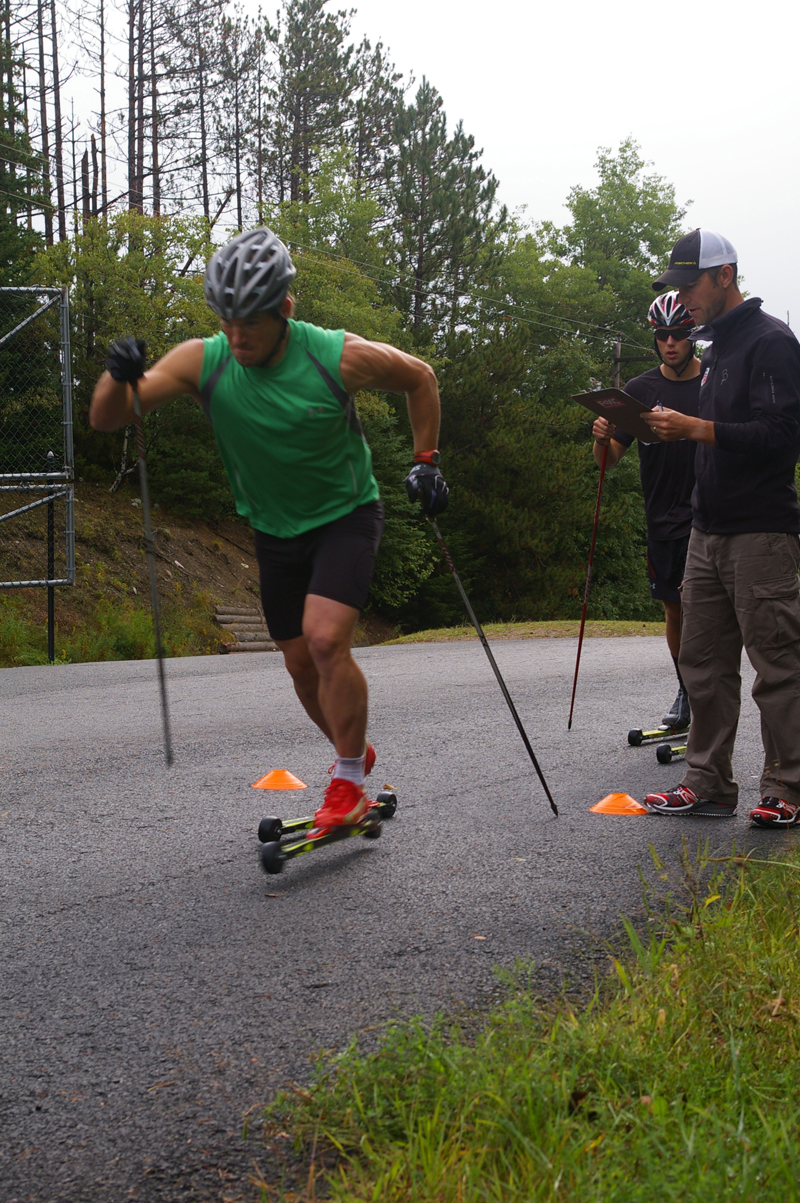
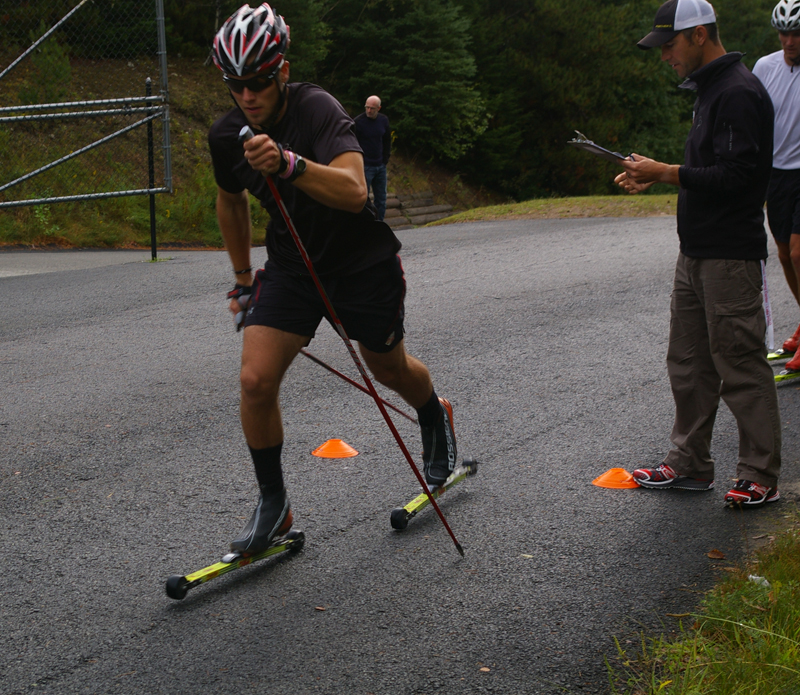
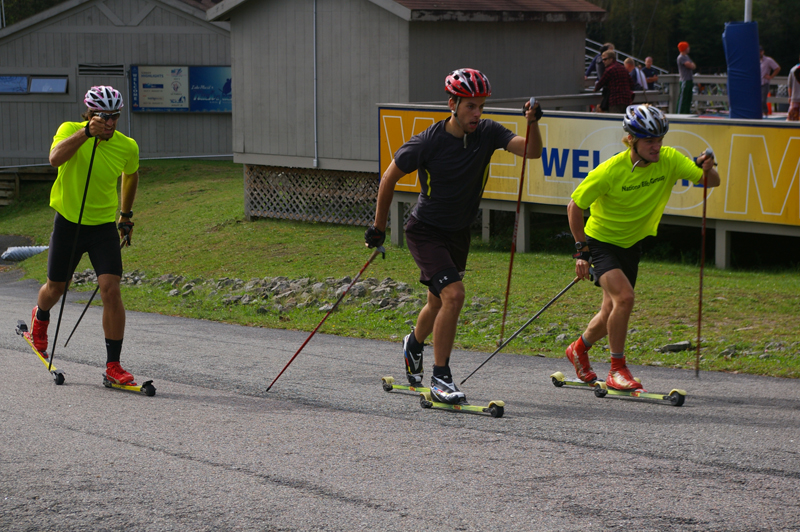
Several members of the U.S. Ski Team and National Training Group came out for Day 2 of the Lake Placid USST dryland training camp on Thursday, competing in a classic rollerski sprint.
Over the two-hour time trial, six women and nine men raced four times — the women on a 1.3-k loop and the men over 1.5 k. Everyone advanced to the finals, and the idea was to go hard.
Here is a recap in photos (select each for larger image). Stay tuned for more on the camp.
Six women line up for the quarterfinal of the classic sprint time trial at the 2011 Lake Placid USST training camp. Ida Sargent (front in red) and Liz Stephen (in yellow) listen to USST head coach Chris Grover.
Dartmouth skiers Sophie (r) and Isabel Caldwell (l) warm up for the prelims.
Freeman powers off the start line during a team time trial at last year’s U.S. Ski Team dryland training camp in Lake Placid, N.Y.
Corey Stock, of the National Training Group, near the top of the climb.
Skyler Davis, of the USST Development Team, accelerates from the start after head coach Chris Grover gave the go-ahead. Davis did not race additional heats because of illness.
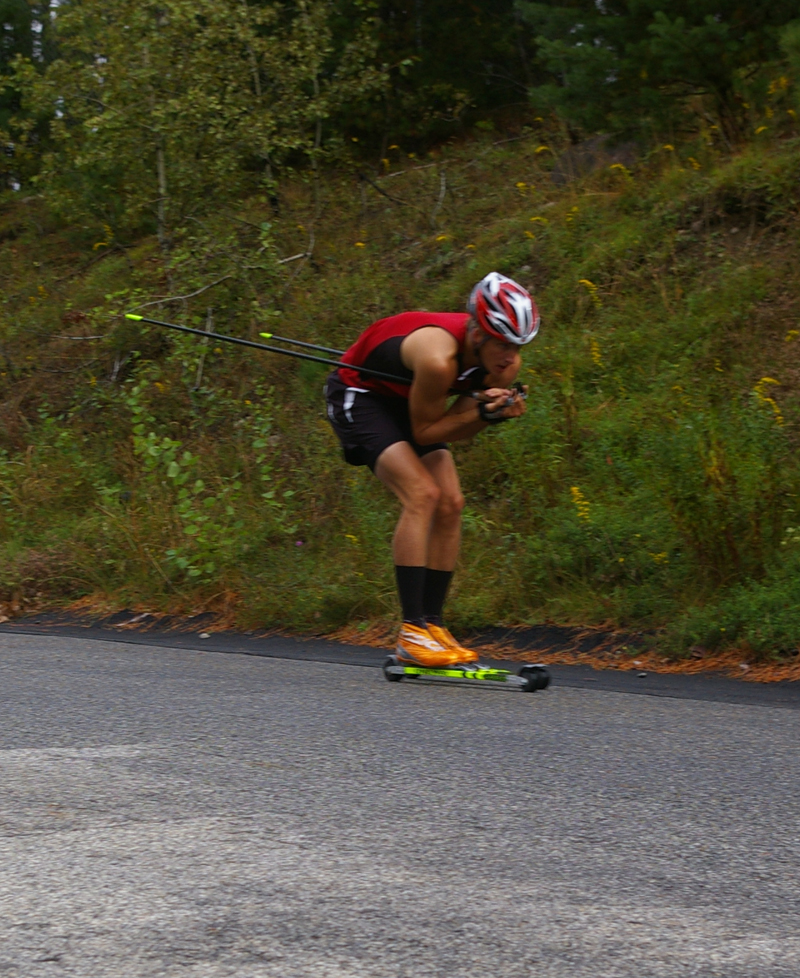
Matt Briggs, of XC Oregon, tucking the long downhill
Tad Elliot, of the USST B-Team, on the long grind.
David Sinclair, of the National Training Group, strides out.
Six women line up for the quarterfinal of the classic sprint time trial at the 2011 Lake Placid USST training camp. Ida Sargent (front left) and Liz Stephen (in yellow) listen to USST head coach Chris Grover.
USST head coach Chris Grover watches the first group of men race by. At front, Sylvan Ellefson (in white), Noah Hoffman, Tad Elliott and Kris Freeman.
The second group of men in the sprint time trial await their start. From left, Chase Marston (Middlebury), Doug Debold (Middlebury), David Sinclair (Dartmouth) and Sam Tarling (Dartmouth).
Second group of men race up the hill.
National Training Group skier Anne Hart (l), Sophie Caldwell and Corey Stock (r) take a breather after one of four heats in the sprint time trial.
Noah Hoffman, of the USST B-Team, focuses on technique between heats of the sprint time trial at the Olympic Jumping Complex in Lake Placid.
USST A-Team skier Liz Stephen, center, takes off with the pack.
David Sinclair rounds the entrance gate at the Olympic Jumping Complex in Lake Placid.
Liz Stephen cheers on Noah Hoffman, front (in blue), Kris Freeman and Tad Elliott in the time trial sprint.
Zach Caldwell, left, notes the finish time of Matt Briggs, front, and Sylvan Ellefson.
USST coaches Chris Grover and Bryan Fish, center, assist Kris Freeman (l), Noah Hoffman and Tad Elliott (r) with lactate-threshold and heart-rate tests after the sprint final.
The second group of men in the sprint time trial await their start. From left, Chase Marston (Middlebury), Doug Debold (Middlebury), David Sinclair (Dartmouth) and Sam Tarling (Dartmouth).
USST head coach Chris Grover watches the first group of men race by. At front, Sylvan Ellefson (in white), Noah Hoffman, Tad Elliott and Kris Freeman.
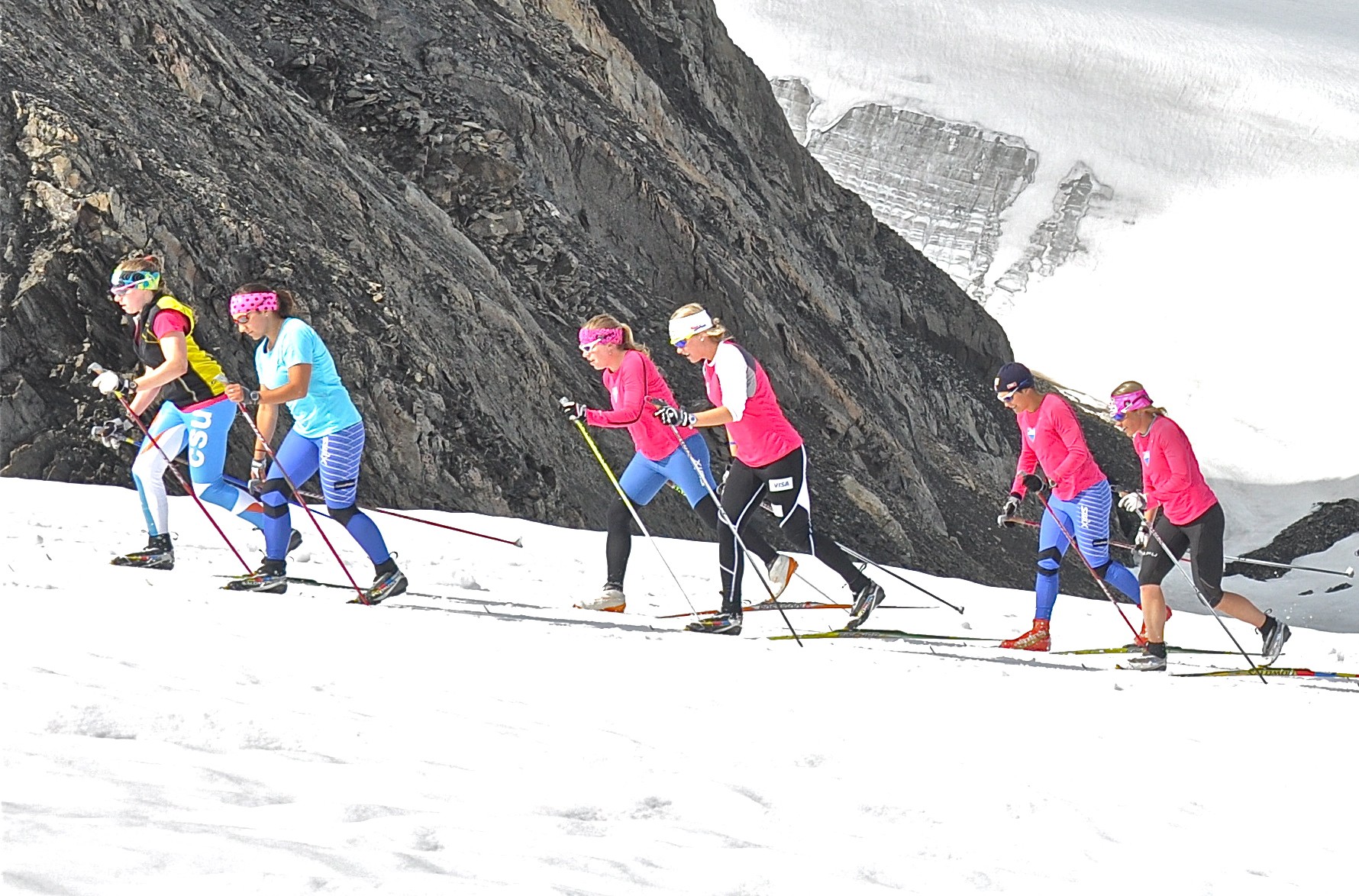
Corey Stock, far left, training with Kinsey Loan, Rosie Brennan, Sadie Bjornsen, Kate Fitzgerald, and Holly Brooks on the Eagle Glacier in Alaska. Photo: Matt Whitcomb.
How does a high school student from Massachussetts end up skiing on a glacier with the best athletes from the United States and Canada in the middle of the summer?
The answer is a program, and a promise for other young skiers. Corey Stock, a 17-year-old racer who usually represents the Cambridge Sports Union, was nominated this year to be a member of the National Training Group (NTG), a program of the U.S. Ski Team.
“The NTG is an under-21 step to our cross-country development pipeline,” U.S. Ski Team women’s coach Matt Whitcomb told FasterSkier in an e-mail. “Qualifying and racing at World Juniors qualifies an athlete for the NTG for the following year. Additionally, U.S. Ski Team coaches may select athletes via discretion based on outstanding results.”
Stock missed the first half of last season after getting surgery for compartment syndrome. But once her ski season got going, she picked up an Eastern Cup win and relay gold at Junior Nationals, as well as finishing second to Jessie Diggins, who has since joined the national team, in the distance skate race. While Stock didn’t race in Europe because she missed U.S. Nationals, her results were outstanding in their own right and she was nominated to the NTG.
“The NTG helps identify our best talents and hardest workers as elite skiers, and then provides new and challenging camp and race opportunities,” Whitcomb said. “Being identified as an elite skier is motivating and helps the U.S. retain athletes.”
NTG athletes are not funded by the U.S. Ski Team, but are invited to camps – they are actually required to attend at least one – as well as European Continental Cup trips.
Stock is one of seven athletes currently on the NTG roster. The others are Isabel Caldwell, Anne Hart, and David Sinclair, all of Dartmouth College; Heather Mooney of Stratton Mountain School and Middlebury College; Kinsey Loan of Alaska Pacific University Nordic Ski Club; and Scott Patterson of the University of Vermont.
Only Stock and Loan have attended a U.S. Ski Team camp so far, both traveling to the Eagle Glacier in Alaska for a combined camp with the Canadian national team (which FasterSkier wrote up here). FasterSkier caught up with Stock via e-mail to see what she thought of the experience.
FasterSkier: How did you end up at the camp in Alaska?
Corey Stock: I got to go to the camp because I’m one of the National Training Group athletes. As part of the group, one of the requirements is that you go to one of the U.S. Ski Team camps. Luckily, I was able to make it to the Alaska camp, and it was a really great experience. Kinsey Loan, who is also a member of the National Training Group and is from APU, was there as well. It was really great to get to know her. I’m really glad it worked out.
FS: Before you left, were you intimidated by the idea of training with the U.S. and Canadian national teams?
CS: I was definitely intimidated but I was also really excited to get to know them and to try to be training beside them. I was really nervous, but once I got up there I realized that even though they are amazing skiers, they are great people to be around and they’re just like anyone else.
FS: You’re from New England, where there isn’t snow in the summer. How much did it help you to get on snow this time of year?
CS: It was really exciting to be on snow after a month of dryland training and rollerskiing. It felt relaxing – not only was my whole body relaxed, but also my mind. It was just really fun to be back on snow, and it reminded me of how I’m looking forward to the season.
Just being on snow was really awesome, because I’ve never skied in the summer before.
FS: Is that chance to get on snow going to help your dryland training?
CS: It’s easier, I think, to work on technique on snow. Also, being on the glacier was gorgeous and it was super cool. But it definitely helped my technique.
FS: Which coaches did you get to work with?
CS: It was great because we had a really good coach to athlete ratio. The coaches there were Matt Whitcomb, Chris Grover, and Erik Flora, and Eric de Nys, the Canadian coach. They were all really helpful and it was really cool to get to know them. They were not just helping their own teams, but they were all branching out to everyone, so it was a good atmosphere.
FS: How did the camp fit in with your normal training plan – you obviously have different coaches back home?
CS: It fit right into my training plan because it was obviously hugely beneficial for the actual physical training part, but it’s also great to get a sneak peak into their lives and seeing what the rest of the U.S. and the younger skiers have to look and set our goals towards. I think mentally this camp was just as beneficial as it was for the training.
Athletes racing during the NTG Camp freestyle sprint (Screenshot from USST video)
Andy Newell (USST) may not have been racing against the best skiers in the world in the National Training Group’s sprint time trial at Soldier Hollow on Tuesday, but he certainly was not lacking in motivation.
“If there’s one thing World Cup sprinters don’t want to do, it’s be juniored,” said Matt Whitcomb, the U.S. Ski Team’s World Cup coach.
Newell won the men’s time trial by 13 seconds over Erik Bjornsen (MOD) and Reid Pletcher (SVSEF), but there was no question that he was working: his finishing lactate was 15.4 millimoles—a level at which most ordinary people would be curled up in the fetal position.
“Having TTs in a camp setting like this is great, because that’s really the only way to push yourself that hard,” Newell said in an e-mail to FasterSkier. “It’s tough to post lactates in the high 15’s when you’re out there by yourself.”
According to Whitcomb, Newell is currently in the middle of an altitude block, and his ability to post such high numbers after a number of solid workouts is “a good sign that he’s been absorbing his training.”
But while Newell was able to capitalize on the presence of the National Training Group (NTG)—an elite group of juniors and U-23 athletes in Utah for a camp—he wasn’t the only one benefiting. Whitcomb said that the skiers behind Newell got a huge boost from butting heads with a World Cup veteran.
“The impact that he had on the juniors and U-23 skiers that were in his heat was unbelievable,” Whitcomb said. “They were so engaged—so aware of the techniques he was using, just chasing him and chasing him and chasing him.”
On the women’s side, Liz Stephen (USST) and Sophie Caldwell (Dartmouth) battled each other for three full rounds. After tying for the fastest time in qualification, the pair skied away from the rest of the fields in their quarter- and semifinal heats, before Caldwell pulled away on the last downhill in the final for the victory. Alexa Turzian (SVSEF) was third.
“[Caldwell and Stephen] were basically just on each other like glue through every heat,” Whitcomb said. “They had an incredible workout pushing each other all day.”
Newell had given a talk on sprint preparation and tactics earlier in the week, and as a result, Stephen said that she tried a new protocol for recovery between heats.
“It’s easy to just ski around between heats–you are filled with lactic acid, tired and trying to mentally and physically prepare for another round or three,” Stephen wrote in an e-mail. “Having a real plan to stick to keeps you on task, focused and as fresh as possible for the coming rounds.”
While rollerski speed can make a big difference in dryland time trials, all the participants in the NTG camp time trial were using Marwes. However, Whitcomb cautioned, “even when they are matched, there are discrepancies between them, it seems.”
Newell said that after training with the NTG group for a few days, he’s “impressed with the next wave of top skiers in the U.S.”
“These guys are going to be the future of World Cup racing in our country,” he said.