From the FasterSkier archive — posts syndicated from athletes’ and coaches’ own blogs between 2004 and 2012, kept online as published. Current coverage is at fasterskier.com.
Canada’s Julien Locke with the overall win in the men’s classic sprint at the 2019 U.S. Cross-Country Ski Nationals in Craftsbury, Vermont. (Photo: John Lazenby)
With the thirty men who qualified for the men’s classic sprint heats on Friday in Craftsbury, VT. winnowed down to six in the final, Ben Saxton had already made made his mark in the quarterfinal.
The SMS T2 skier laid down the fastest qualifier in 3:18.58 minutes. He won his qualifier ahead of second place skier Zak Ketterson (who eventually made the finals as a lucky loser) and faced down with fourth fastest qualifier, Logan Hanneman (APU) in the second semi. Hanneman bested Saxton by less than one tenth of a second as they moved on to the final.
The second semi was won by Canada’s Julien Locke. Locke began his day qualifying in ninth, then won his quarter and semi as he advanced. He also established a pattern of skiing faster as the day transpired. He won the quarter in 3:21.79; his semi in 3:17.84.
In the final, Locke notched up his speed enough to beat both Saxton and Hanneman for the win. He stopped the clock in 3:15.46. Saxton placed second, Hanneman third.
Peter Holmes (SVSEF Gold Team) placed fourth, Canada’s Dominique Moncion-Groulx (Team R.A.D.) was fifth, and Zak Ketterson (NMU) sixth.
“I actually wasn’t feeling so great this morning so I wanted to be a bit calm in the heats,” Locke said. “And it was pretty obvious after the quarterfinal that that strategy was working because same thing there, I was a bit back at the start and then I could close down to the finish and I think a lot of guys were tying up because you know if you do a three minute sprint it’s a lot harder than doing a two minute sprint with a one minute warm-up, that’s kind of what I was doing today. I think it was just reinforcing that the first half of the course wasn’t very important.
“The final was fun,” Locke continued. “I started a little bit slow the other guys were really pushing off the line and I was dropped by a bit, but I just hung in there and stayed within contact. And then I knew that I was stronger on the climb so I just waited until the technique zone and then I put the hammer down and skied harder into the finish.”
The American podium from the men’s classic sprint at the 2019 U.S. Cross Country National Championships at Craftsbury, VT. From left to right, Logan Hanneman (APU) in second, Ben Saxton (SMS T2) first, and Peter Holmes (SVSEF Gold Team) in third. (Photo: John Lazenby)
Saxton claimed the U.S. national classic sprint championship as the first American across the line, with Hanneman in second, and Holmes third.
For Saxton, it was his fourth U.S. nationals sprint podium but his first national championship. Saxton placed second in 2014 and 2015 nationals, a skate and classic sprint respectively. Last year, at nationals in Anchorage, he placed third in the classic sprint.
“The final was really fun, the sun was out for most of the heats so we were all in a pretty good mood,” Saxton said to FasterSkier in Craftsbury. “It was a good clean race, everybody came through the technique zone pretty tight. The Canadian Julien Locke grabbed a meter or two at the end. And I couldn’t quite grab him at the end but I had my hands full running from Logan Hanneman anyway. He’s one of the fastest finishers we’ve got.”
In past nationals, Hanneman has qualified high in the rankings, yet Friday was his first career national’s podium. (In 2015, Hanneman was second in the skate sprint qualifier; first in the 2018 national’s skate sprint qualifier; second in the 2018 national’s classic sprint qualifier.)
“The final was pretty similar to the semi in that Ben and Zak Ketterson really took it from the gun,” Hanneman said after the race. “They controlled it out of the start, but after the quarterfinal, I kind of decided to hang back until the uphill because there’s a lot of time to be made over that uphill and into the finish. Those guys went out hot [in the final] and I was just behind them and Julien was behind me somewhere and we all came into the uphill kind of four abreast. I was in the far right track, then the striding came and yeah we closed that gap up to Ben and Zak [Ketterson]. Julien made his move kind of over the top of the uphill on the inside and I was far outside and there were people in the middle — he made it at the right spot. It was a fun race. Coming up here into the finish with all the crowd right here on the side and the sun, it was pretty nice.”
Holmes was the third American as he earned his first career U.S. national’s podium. The twenty-two-year-old Holmes graduated from the University of New Hampshire last year and is in his first year with the SVSEF Gold Team.
Pre-race favorite Andy Newell qualified in third after double poling the classic course on skate skis. Newell did, however, stride on his skate skis through the required technique zone.
Newell initially placed second in the fifth quarterfinal but was later suspended for interfering with a competitor causing them to fall.
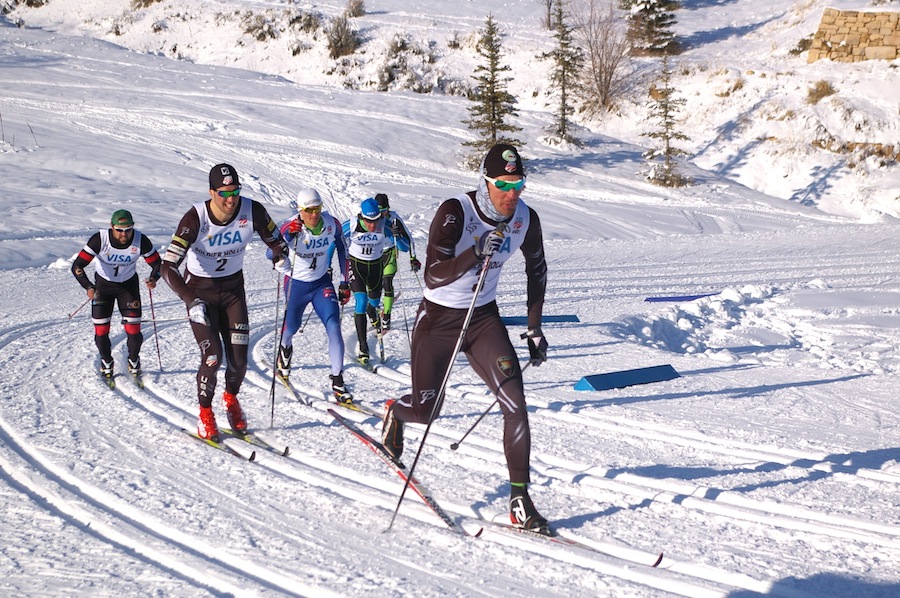
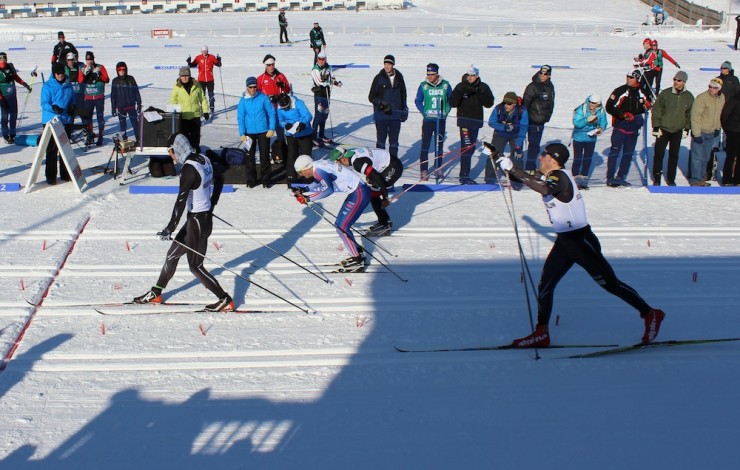
Torin Koos (Bridger Ski Foundation) leads the A-final of the classic sprint up the second of two climbs on the 1.3-kilometer course on Wednesday. Koos went on to win his fourth sprint title, seventh overall, ahead of Skyler Davis (second from left), who was fourth, Mike Sinnott (c) in second, and Dakota Blackhorse-von Jess (l) in third.
FasterSkier’s coverage of the 2013 U.S. Cross Country Championships is brought to you through the generous support of The Memory Clinic in Bennington, Vt.
MIDWAY, Utah – Unlike many of the blank slates surrounding him, young minds with open expectations at one of their first U.S. Cross Country Championships, Torin Koos had a lot to think about Wednesday.
Here he was, 32 years old and skiing for the umpteenth time at the Soldier Hollow nearly 6,000 feet above sea level. The 1.3-kilometer sprint course remained largely the same since his previous visits: rolling terrain with a long slingshot finish. Without any sizable trees in sight, there was no place to hide, no place to slack.
The former U.S. Ski Team member, now with the Bridger Ski Foundation and Rossignol, didn’t see himself falling behind anyhow. Nope, he had come to win, like always. Even after being sick for the start of the season. Even after being disqualified in last year’s U.S. nationals classic sprint – which ruined his run for his fourth straight national title – Koos was thinking positive and looking ahead.
“I tried not to think about that stuff last year,” Koos said after winning Wednesday’s sprint for his seventh national title, second in a classic sprint. “I know what happened in that race [last year] and I know that is absolutely just part of racing, and many things like that happened to me, I feel, even in that same race. It was a decision that was made. I don’t really agree with that, but that’s in the past.”
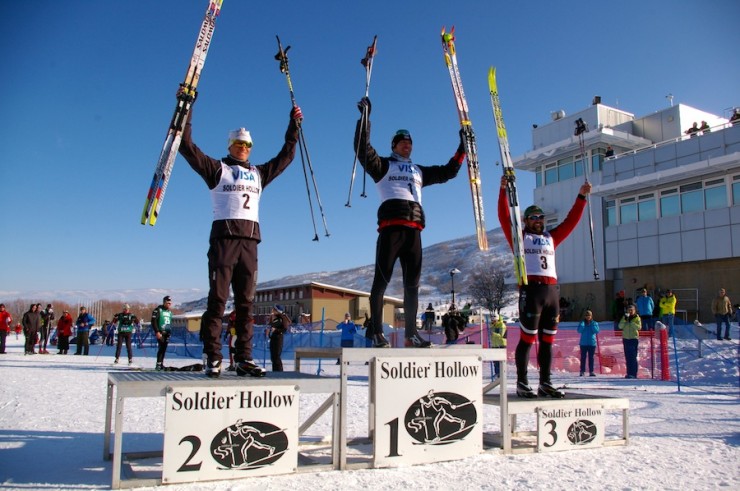
Torin Koos of the Bridger Ski Foundation/Rossignol (c) atop the 2013 U.S. Nationals men’s classic sprint podium, with Mike Sinnott (Sun Valley Ski Education Foundation) in second and Dakota Blackhorse-von Jess (Bend Endurance Academy) in third.
Standing in the stadium at Soldier Hollow, the site of the 2002 Olympics where Koos raced his first World Cup, Olympics and national championship, he smiled and soaked up the “now.” He had made a plan and executed it, he said.
The five men skiing behind Koos in the A-final – Skyler Davis (USST/Stratton Mountain School T2 Team), Mike Sinnott (Sun Valley Ski Education Foundation), Dakota Blackhorse von-Jess (Bend Endurance Academy), Ben Saxton (F.A.S.T. Performance Training) and Alex Howe (Craftsbury Green Racing Project) – weren’t exactly surprised that he took it. The three-time Olympian had challenged them from the beginning, double poling hard up the first gradual climb then continuously leading over a straightaway at the top.
Knowing that the most-used tracks were icing up, Koos opted for an outside lane up the second hill – a tactic he figured no one else would think of. Davis apparently did, skiing right behind Koos up the last climb and getting the benefit of some extra kick. Meanwhile, Koos put on the jets.
“I looked back and saw I had three or five meters, not very much, but I had the little bit of the climb [left] and I knew I had good skis so I tried to put in a little spurt up through the horseshoe,” he said. “I was able to get a little bit of a gap and hold it to the finish line.”
Davis tried to hang on, thinking he’d come up with a way to pass Koos on the long descent into the stadium, but he was caught off guard coming out of the screaming downhill corner.
“We all switched lanes for some reason,” Davis said. “I kind of got off balance then I got back on balance, went into the inside lane, double poling I was in second, third, second, third and then I was just gassed out.”
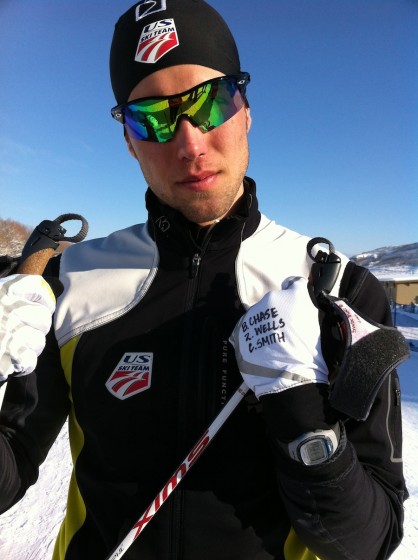
Skyler Davis pays tribute to his fallen friends, including Charlie Smith, a former nordic racer from Bend, Ore.
Davis settled for fourth while Sinnott edged Blackhorse-von Jess, the top qualifier, for second.
“I really wanted to win today,” the usually upbeat Davis said, looking at the ground. “A couple of my friends passed away so I was racing for them today.”
On his white ski gloves, he had written their names: “B. [Brian] Chase”, “Z. [Zachary] Wells”, and “C. [Charlie] Smith”.
While their deaths were separate, they had all come in the last week, Davis said. Chase and Wells were his friends from Vermont, and Smith was an NCAA bronze medalist who raced for the University of Nevada-Reno.
Blackhorse-von Jess, too, fought back emotions when talking about Smith, who shared his hometown in Bend, Ore. At the same time, Blackhorse-von Jess also used it as motivation for securing his fourth national podium, the first in a classic sprint.
“He’s definitely in many people’s thoughts this week, which is cool,” Blackhorse-von Jess said, adding that the support of his family watching him race for one of the first times in five or six years was uplifting.
His defining moment Wednesday came in his semifinal, when he fell in the scrub zone shortly after the start.
“The first thought was, ‘Expletive, coach is gonna kill me!’ The second thought was, ‘Mmm, I can probably get this back,’ ” Blackhorse-von Jess said. “Luckily I have really smart teammates who were at the first turn and they were like, ‘You’re fine, you’re gonna roll back into them, be relaxed,’ and that helped a lot. I stayed really calm and it was good.”
The finish of the men’s A-final at the U.S. nationals classic sprint on Wednesday at Soldier Hollow in Midway, Utah. Torin Koos (second from r) won, followed by Mike Sinnott (second from l), Dakota Blackhorse-von Jess (l) and Skyler Davis (r), respectively.
Blackhorse-von Jess did, in fact, catch up and went on to place second to Sinnott in the heat. In the final, the two chased Koos to the line.
“I got close to second, got real close,” he said. “Mikey and I had a really good battle. It was a lot fun. You want to be disappointed, but I raced hard and there’s nothing else you can do so I’m excited.”
Sinnott was also pleased – even though it was his third consecutive silver at nationals in the classic sprint.
“Happy birthday to Sylvan [Ellefson] is the first thing I want to say,” he said of his friend, who skis for Ski and Snowboard Club Vail and Team HomeGrown and placed 12th on Wednesday. “I would’ve liked to climb one more place up, but I was pretty happy. … It’s nice to have some good heats in this year.”
It was also good practice to be in them with someone like Koos. After qualifying in fourth behind Blackhorse-von Jess, Davis and Koos, respectively, Sinnott won both his quarterfinal and semifinal, but had to step it up once more in the A-final.
“Torin and Skyler went out a bit harder than I had done in the other heats and then Torin just picked it up on the hill,” Sinnott said. “It was a lot more of a kind of fast pace, real sprint race.”
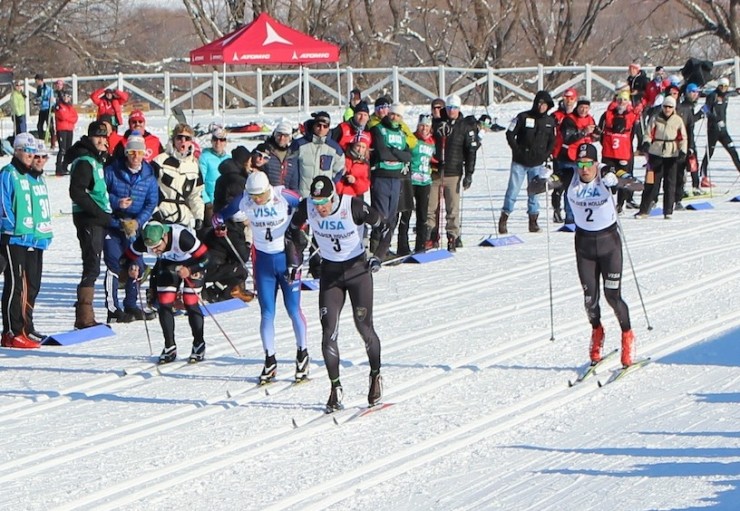
Torin Koos (BSF/Rossignol) pulling out the victory at U.S. nationals on Wednesday in the classic sprint ahead of Mike Sinnott (SVSEF) in second, Dakota Blackhorse-von Jess (BEA) in third and Skyler Davis (USST/SMS) in fourth.
The fifth- and sixth-place finishers, Saxton and Howe, respectively, felt similarly after making the A-final at senior nationals for the first time.
“At the risk of sounding like a fan boy, there are like posters of all these guys in my room that you get at expos or whatever and I was racing them today,” said Saxton, 19, currently taking a post-grad year to train in Wisconsin.
“My goal coming in was to qualify for senior heats so I was pretty excited to go past that,” he said. “It was just sprint racing, especially at Soldier Hollow, it’s a really tactical course and anything can happen and coaches gave us wicked fast skis.”
But fast skis can only get you so far, and when Koos and Davis initially took off, Saxton was a bit slow on the uptake and had to catch up before the second climb. Working his way up the inside lane, he started to slip and fade back again.
“Barring any miracle skis, it was not going to pull me back to contact on the downhill,” Saxton said. “I just double poled really hard and Alex gave me a great finish and it was really fun.”
Howe, 23, who recently graduated from the University of Vermont, had previously placed 21st in a classic sprint at nationals in 2009. Heading into Wednesday, he hoped to make the heats “and ski more than one,” he said.
Howe went on to place second in his quarterfinal and decided to go for it in the semi in hopes of advancing further. He did, but realized he was a bit drained at the start of the final. He resolved to hang toward the back and try to push at the end.
“Both times when we turned to striding on those two hills my legs were absolutely toast,” Howe said. “By the time I got to the bridge [near the finish], I was like maybe I’ll be able to catch [Saxton] but there was no way.”
Moving forward, Howe has his sights set on distance races and surpassing his expectations after an pneumonia sidelined him for six months this summer.
“Prior to that I wasn’t in the best shape going into the summer so I think I beat myself up going into that,” he said. “I just remember it being 95 degrees outside, and I was sitting inside underneath a blanket shivering. I had to go the hospital. … Hopefully that’s behind me.”
And as for his new standard: “I just like to think of it as I’m back doing more of where I should be,” said Howe, a 2008 Junior Nationals sprint champion. “I’m a little more focused now than I have been in the last couple years, putting my energy more toward what it should’ve been toward.”