Stifel Lake Placid Finals, a Coop FIS Cross-Country World Cup, to Bring Elite Ski Racing and Winter Festival Atmosphere to Lake Placid
FIS Cross-Country World Cup racing, fan experiences, athlete engagement, and live entertainment coming March 19–22
LAKE PLACID, N.Y. — The Stifel Lake Placid Finals, a Coop FIS Cross-Country World Cup, will offer more than world-class competition this March. The event will transform Lake Placid into a multi-day winter sports festival featuring themed race days, live entertainment, film screenings, interactive expo activations, and family-friendly programming.
In collaboration with the New England Nordic Ski Association (NENSA), the 10th Mountain Division, U.S. Ski & Snowboard, and the International Ski and Snowboard Federation (FIS), the Olympic Regional Development Authority (Olympic Authority) has curated a dynamic schedule that celebrates Nordic skiing and outdoor winter-sport culture.
A central focus of the week will be spotlighting women and girls in sport, networking opportunities, and hands-on activities. Fans will also have unique opportunities to connect with athletes through meet-and-greets, alumni celebrations, and special legacy moments — including Sunday’s “Last Lap” ceremony honoring retiring World Cup athletes.
Together, these events are designed to foster engagement, connection, and shared celebration across the Lake Placid community and the global ski family.
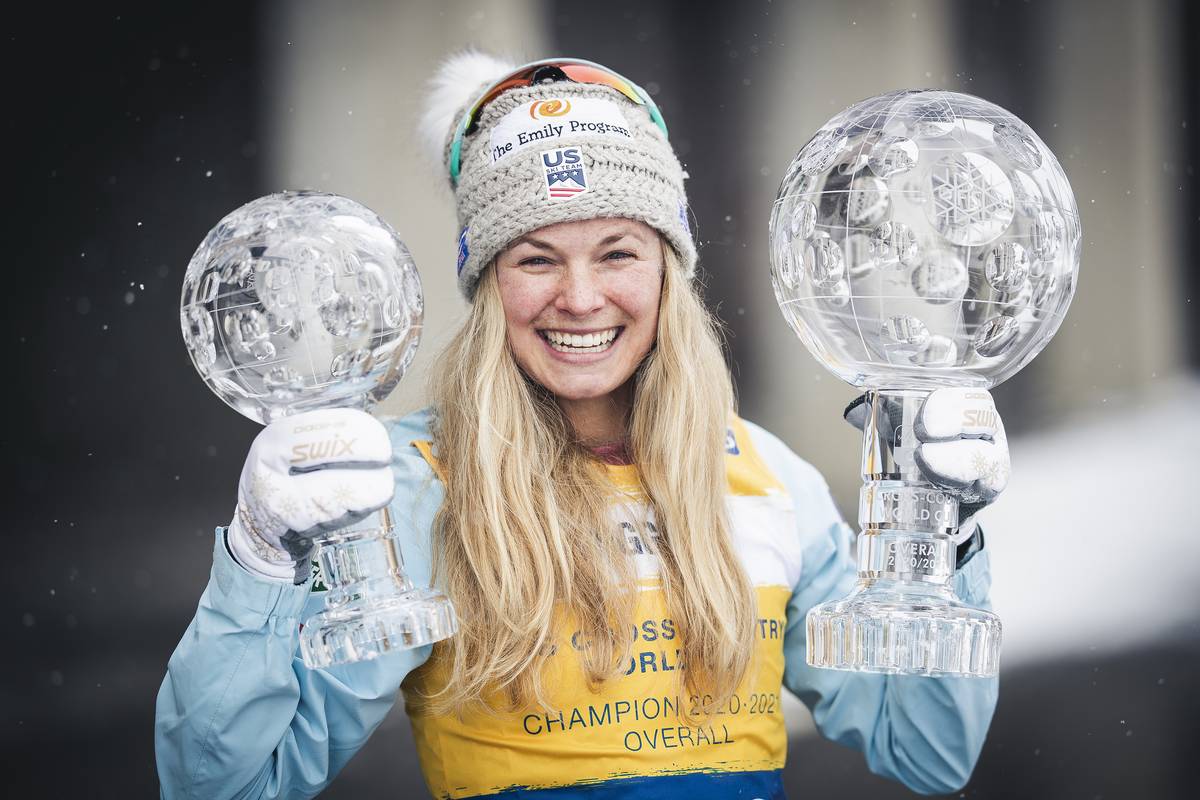
One final celebration of Jessie Diggins (USA) amazing career. (Photo: Authamayou/NordicFocus)
Event & Community Programming
In addition to World Cup racing, the Stifel Lake Placid Finals will feature a range of community events, athlete appearances, and festival programming throughout the week. Activities include youth programming, athlete conversations, live music, demonstrations, and opportunities for fans to connect with past and present champions.
Programming details may evolve, and additional events may be added throughout the week. Visitors are encouraged to check the official event schedule for the most up-to-date information.
Thursday, March 19 – Community & Kickoff
Opening day features official training and festival programming at Mt Van Hoevenberg, along with an evening film screening at the Palace Theatre that kicks off the festivities in downtown Lake Placid.
Friday, March 20 – Theme: Past
Friday celebrates the legacy of Nordic skiing and Olympic history in Lake Placid. The venue opens with festival programming, including the NENSA Terrain Park and Expo with L.L. Bean, regional athlete recognition connected to the 2026 Winter Olympics, and Adirondack Birds of Prey demonstrations. Fans can also watch presentations from the 10th Mountain Division, enjoy live music, and attend athlete interviews and meet-and-greets throughout the day. A highlight of the afternoon is the “One More Lap” legacy ski, featuring international and U.S. Ski Team alumni, including Olympic legend Thomas Wassberg and American champion Bill Koch, before World Cup racing and awards ceremonies conclude the day.
Saturday, March 21 – Theme: Future
Saturday’s programming focuses on the next generation of Nordic skiing. Activities include the NENSA Terrain Park and Expo with L.L. Bean, athlete appearances, and fan engagement opportunities. The Women in Sports Heroic Panel highlights leadership and opportunities for girls and women in athletics, while fans can also attend athlete meet-and-greets and participate in interactive programming throughout the venue. Competition highlights include the freestyle sprint finals, followed by Crystal Globe presentations. Youth racing also takes center stage with the World Cup Future Stars Sprint. Additional programming includes Lollipoppers to Olympians: A Celebration of New England Skiing, a live recording of the Skirious Podcast featuring Ben Ogden and special guests at the Olympic Jumping Complex, and evening film screenings at the Palace Theatre.
Sunday, March 22 – Theme: Present
Championship Sunday features entertainment, athlete appearances, and the season-ending races of the World Cup Finals. Live music, a DJ set, and ceremonial elements, including the 10th Mountain Division Color Guard and flyover, set the stage for the final competition. The afternoon concludes with awards ceremonies and the “One Last Lap” ceremony honoring retiring World Cup athletes.
Gus Schumacher (USA) and Ben Ogden (USA), (l-r) celebrate their silver medal at the Olympic Winter Games in Tesero, Italy. (Photo: Vanzetta/NordicFocus)
Competition Schedule | FIS Cross-Country World Cup Finals
Mt Van Hoevenberg | March 19–22, 2026
World Cup official training and competition runs March 19–22 at Mt. Van Hoevenberg, where the world’s top U.S. and international cross-country skiers will compete for overall and discipline Crystal Globe honors. The weekend culminates on Sunday with championship racing, awards presentations, and the “One Last Lap” ceremony recognizing retiring athletes.
Full competition schedule:
Thursday, March 19, 2026:
11:00 – 1:00 pm | 10km Official Training
1:00 pm – 3:00 pm | Sprint Official Training
Saturday, March 21, 2026:
10:30 am | Women’s Sprint Qualification Free
10:30 am | Men’s Sprint Qualification Free
1:00 pm | Women’s Sprint Final Free
1:00 pm | Men’s Sprint Final Free
Sunday, March 22, 2026:
12:30 pm | Men’s 20km Mass Start Free
2:30 pm | Women’s 20km Mass Start Free
Jessie Diggins (USA) and the US Ski Team celebrate in Goms. (Photo: Authamayou/NordicFocus)
Broadcast Schedule
NBC will air the Sprint Finals live on Saturday, March 21, from 1–2 p.m. ET. CNBC will air coverage of the Men’s and Women’s 10km Interval Starts on Saturday, March 21, from 2–4 p.m. ET. NBC will also air the Women’s 20km Mass Start on Saturday, March 29, from 1–2 p.m. ET on tape delay.
Andrew Kastning is one of a small crew of Americans who work as commentators on late-night broadcasts of European cross-country ski races. He works from laptops and a television in his home in Anchorage, Alaska, and says he draws energy from a jumpsuit donated by a local U.S. Ski Team member.
PREDAZZO, ITALY — By day, Andrew Kastning’s life sounds conventional: He’s a father of three, with a desk job in Alaska doing permitting work for a federal agency.
During the winter? It’s another story.
On periodic Friday and Saturday mornings, you’ll find Kastning awake at 1 a.m., 2 a.m. or 3 a.m., standing in his living room in a sports jumpsuit, wearing a headset and delivering a monologue while watching his television.
Welcome to the strange world of being a North American television announcer of Olympic-level cross-country skiing.
With nearly all of the sport’s premier races taking place at European venues, those following cross-country from stateside have to pull overnight shifts to catch the events on an internet livestream.
Kastning, who’s paid by the International Ski Federation to call an English-language broadcast, has outfitted his wife with earplugs and a face mask that plays white noise so she can sleep through his calls. But he still woke his family up with some particularly enthusiastic play-by-play two weeks ago, when a fellow Alaskan, Gus Schumacher, cracked the podium in two World Cup races in Switzerland.
“My oldest daughter said she dreams sometimes and hears me calling the race, like: ‘Jessie Diggins!’” said Kastning, referring to the U.S. Olympic medal-winning skier.
Other regular cross-country broadcasters include Chad Salmela, a former competitive biathlete and veteran analyst from Minnesota, along with Kikkan Randall, the retired Olympic gold medal winning cross-country skier, who lives in Anchorage.
Both Randall and Salmela also pull the weekend wee-hours shifts as regular hosts of the English language livestream. And the pair will be featured this month as commentators on NBC’s national Olympics broadcast — though rather than being on site in Italy, they’ll be working out of an office complex in Connecticut.
The NBC Olympic cross-country broadcast team of Chad Salmela, right, Kikkan Randall and Steve Schlanger prepared for the first event at an office complex in Connecticut. (Courtesy photo)
Still, the setup will be an improvement over the 2022 COVID Olympics, when the broadcasters were at the same complex but sealed into individual booths connected by plexiglass windows — so they wouldn’t be sharing the same air.
It’s also the first time cross-country skiing will have Olympic commentary from announcers who are working consistently together in the leadup to the Games, with a U.S. Ski Team donor helping to boost Salmela’s and Randall’s pay in recent years to keep them on the livestream for non-Olympic World Cup races.
Cross-country athletes, coaches and boosters say regular television coverage of the sport could ultimately help make the U.S. more competitive with traditional ski powerhouses like Norway and Sweden.
“An underappreciated role of the TV product is how it builds kids’ dreams of being future champions,” Randall said in an interview. “This can actually be an important piece of developing our pipeline for the future.”
Randall’s own experience shows how much more accessible cross-country skiing has become for American spectators in recent years. A digital platform, Ski and Snowboard Live, now allows consumers to pay to stream international races while they’re happening or on tape delay.
When Randall, 43, was in high school, she said, “I remember sending in a check via mail to the National Ski Education Foundation to get VHS tapes of the World Cups of the year before.”
Kikkan Randall competing during her World Cup career in Estonia. (Fischer/Nordic Focus)
“Outside the Olympics, that was the only way to see World Cup level skiing,” she said. It was “pretty much completely inaccessible,” she added.
Randall has now fully embraced her role translating cross-country skiing’s sometimes-complicated race formats to a mass audience.
“I was curious: Am I going to know what to say? It’s one thing to have lived it, and it’s another to be able to talk about it,” she said. “But it’s come to me more naturally than I thought it would, and I really enjoy it. I get, kind of, a thrill from it — and it makes me happy to still feel that connection to the sport.”
With two kids and a full-time job leading Anchorage’s ski association on top of the commentary gig, Randall said she has to weigh opportunities carefully. It’s helped that the ski team donor, a strategic consultant named Liz Arky, offered to bump up the pay rate for the core broadcast team of Randall and Salmela — who now earn more than the few hundred dollars a night Kastning gets when he fills in.
“They can hook you, because they’re such good storytellers, and they’re so immersed in it, and they’re so passionate about it — and I just feel like that’s infectious,” Arky said in an interview. “It’s incumbent on us to grow our community and grow the audience.”
Salmela, meanwhile, pulls double duty as a commentator for both biathlon and cross-country races that are nearly all in Europe. The repeated early morning wakeups are a grind, and Salmela said his doctor has questioned whether it’s worth the cost.
“It’s a hard existence for a guy who’s 54 and dealing with Parkinson’s,” Salmela said. “It’s a tough call, because I recognize that it’s important for the sport.”
Salmela’s looking forward to the Olympic broadcasts on NBC, though, as they offer the commentators substantially more support than they get for the World Cups during the rest of the season: statistics researchers, a producer, a sound assistant. Salmela also said he’s enjoyed the partnership with Randall, who he called a “natural analyst.”
Chad Salmela interviews cross-country skier David Norris at the American Birkebeiner in 2023. (American Birkebeiner Ski Foundation)
“Her content is superb,” he said. “Because she’s smart, and she’s been one of the best at the sport — so, her perspective is well-spoken and legitimate.”
Kastning’s job can be tougher: He’s a solo practitioner for all his broadcasts, with no other analysts to banter with or riff on his takes.
He spends lunch breaks in the days before the races looking for storylines and fiddling with an Excel statistics spreadsheet. He’ll try to nap a bit in advance, then wakes up, closes his sleeping kids’ bedroom doors and heads into the living room for a sound check that takes place an hour before the start.
The toughest nights are when he’s calling two separate races, one for men and one for women: There’s generally an hour, sometimes two, between them.
“It’s really tempting to take a nap in between, because we’re talking like 2 to 3 a.m.-ish,” he said.
Kastning draws energy, he said, from his jumpsuit, which was donated by Alaska Olympic cross-country skier JC Schoonmaker.
After the soundcheck, Kastning said, “I’m kind of waiting until 10 minutes out — the countdown begins.”
“And then I’m off and running,” he said.
Help Support Our Olympic Coverage!
FasterSkier has our own Nat Herz on the ground at the Olympics, which is a significant financial lift for us. If you value the thoughtful work and access FasterSkier provides at championships like this one, please consider becoming a Voluntary Subscriber. Your support directly fuels our work to cover the people, places, and moments that make our sport special.
In this episode, we’ve got Chad Salmela and Kikkan Randall on to discuss the experience of calling the 2022 Beijing Olympic Winter Games, live from a booth in Stamford, CT. The duo worked as cross country analysts, alongside long-time NBC play-by-play announcer Steve Schlanger. While Chad is a veteran in the role, this was Kikkan’s first Olympics inside the booth.
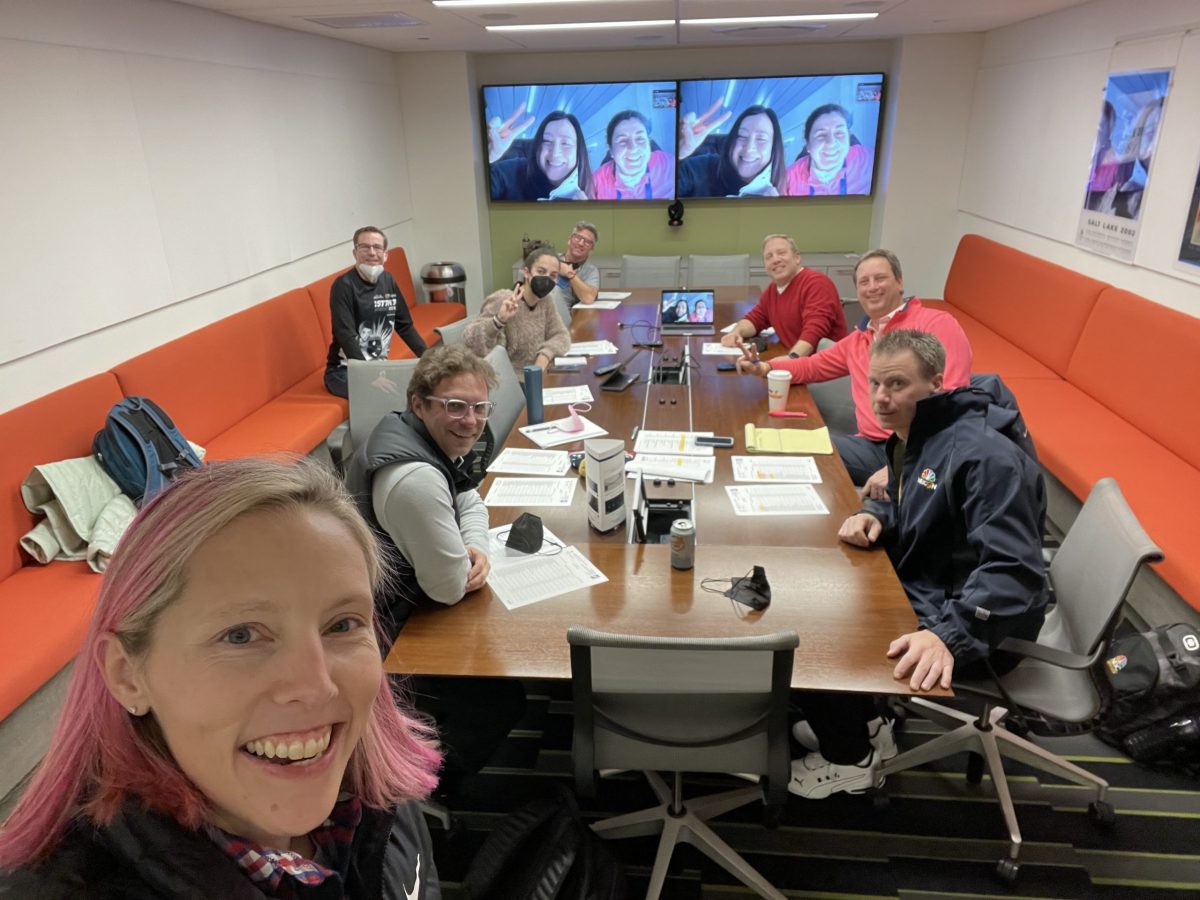
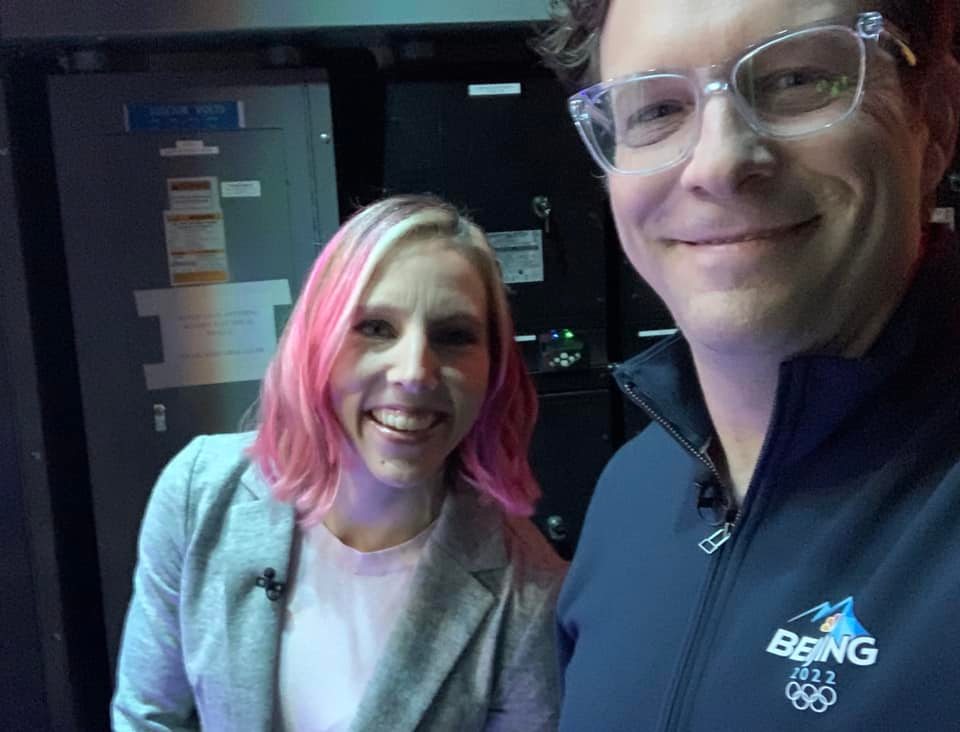
Kikkan Randall snaps a selfie with Chad Salmela and the NBC production crew during the 2022 Olympic Winter Games. (Courtesy photo)
During the call, Kikkan and Chad field a variety of questions on their experience – everything from staying fresh while calling races in the middle of the night for two weeks straight, to maintaining professional composure while watching your former teammates and long-time friends win Olympic medals – or come up short – and even, why are you suddenly pronouncing the Norwegian distance champion’s name “You-haug”?
Full of insights and laughs, this conversation was a treat, and it’s clear that both Chad and Kikkan are deeply invested in growing and serving the cross country ski community in the US.
Kikkan Randall and Chad Salmela discuss their experience as NBC’s cross country ski analysts during the 2022 Beijing Olympic Winter Games. (Courtesy photo)
Jessie Diggins: 2021 World Cup crystal globe winner – overall and distance. (Photo: NordicFocus)
The long-awaited “how to watch” article is here. I hear you — the season is a week away. What took so long?
Simply put, negotiating contracts with the various agencies that film and produce World Cup coverage is a complicated process. Olympic Channel announcer Chad Salmela used the word “cumbersome” to explain the process through which NBC secures the rights to these broadcasts. Cumbersome is not ideal when it comes to small niche sports that are not bringing in the same type of viewership or revenue as a sport like American football.
How this impacts this article: currently, no cross country or biathlon events are listed on PeacockTV. Until this week, the Davis U.S. Cross Country Ski Team Communications Director Tom Horrocks did not have conclusive information from NBC on scheduling. Similarly, Preston Noon who handles IT and Membership for the US Biathlon Association (USBA) did not receive a watch schedule from the Olympic Channel until last week, and NBC remains in flux. In short, it has taken us so long to present this information because we simply haven’t had it.
While last season, almost every cross country event could be watched through NBC’s PeacockTV streaming platform, this year will look a bit different. Events will be streamed live on either PeacockTV or on a new independent streaming site, Ski and Snowboard Live. Some weekends, races will be available on both platforms. An in-progress calendar indicating which streaming platform will feature each World Cup venue can be found here.
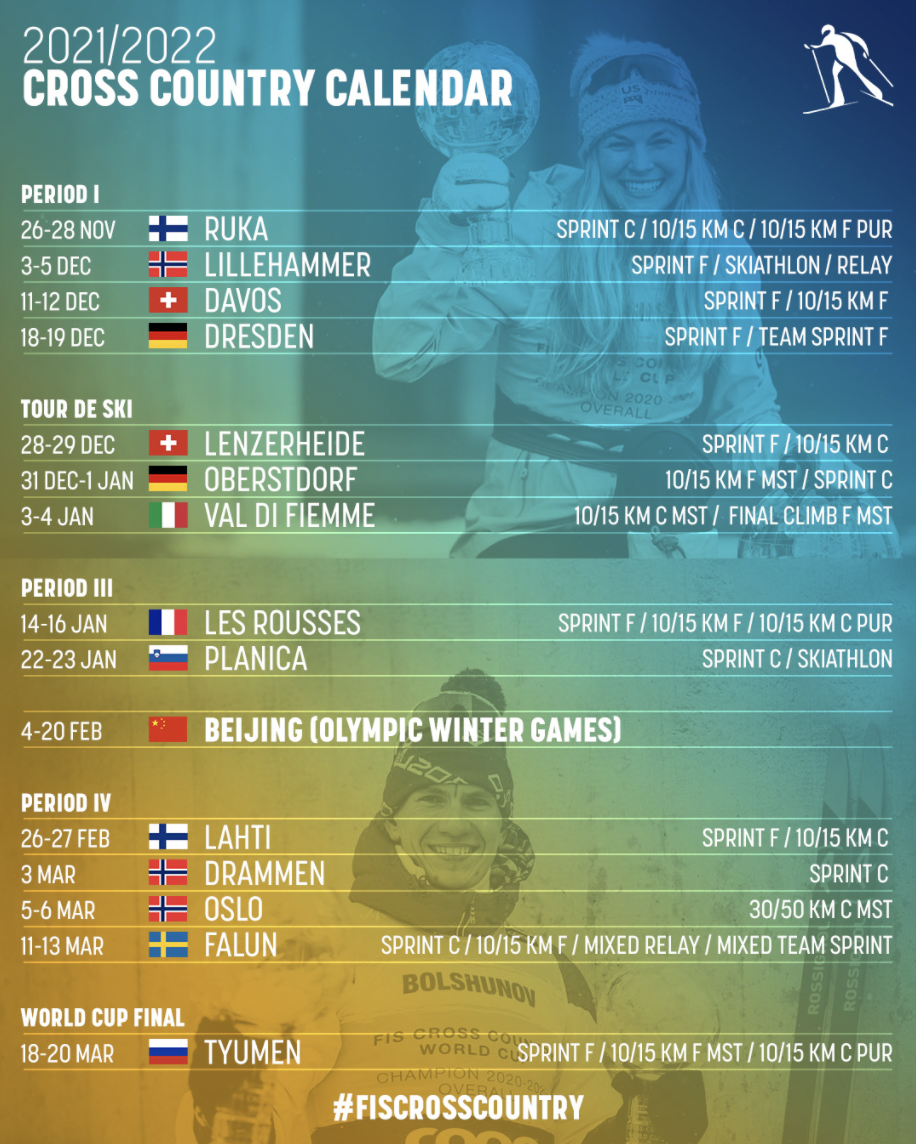
The 2021-22 FIS Cross Country events calendar. Click to enlarge. (Photo: Instagram @fiscrosscountry)
For example, the opening mini-tour in Ruka, FIN which begins next Friday, November 26th at 6:30 am Eastern can be streamed on both Peacock or Ski and Snowboard Live, however, the Lillehammer World Cup beginning December 3rd is only available on Ski and Snowboard Live. Based on the information available so far, these races will be a livestream only with no commentary.
Post-script update: After publication, U.S. Ski and Snowboard received information from NBC that all cross-country World Cup events will be available on PeacockTV. At this point, theNBC broadcasts will not include commentary, however, there will be English commentary on Ski & Snowboard Live.
As the Beijing Games grow nearer, we will run a separate article on viewing, which may require an additional subscription to access the Olympic Channel.
A premium subscription to Peacock TV is $4.99 per month plus an additional $5 per month for add-free viewing. If you are a customer of XFinity or COX, you have access to PeacockTV at no additional cost. On Ski and Snowboard Live, you have the option to either purchase a pass for a specific weekend of events for $2.99, or to subscribe for the whole season for $74.99. Subscribers also receive access to downhill, slalom, snowboard, and freestyle skiing events.
You can also expect timely individual race coverage and analysis from FasterSkier’s race reporting team as well as colorful commentary from our Canadian friend in Norway, Devon Kersaw. We hope this content enhances your experience as a fan of the sport.
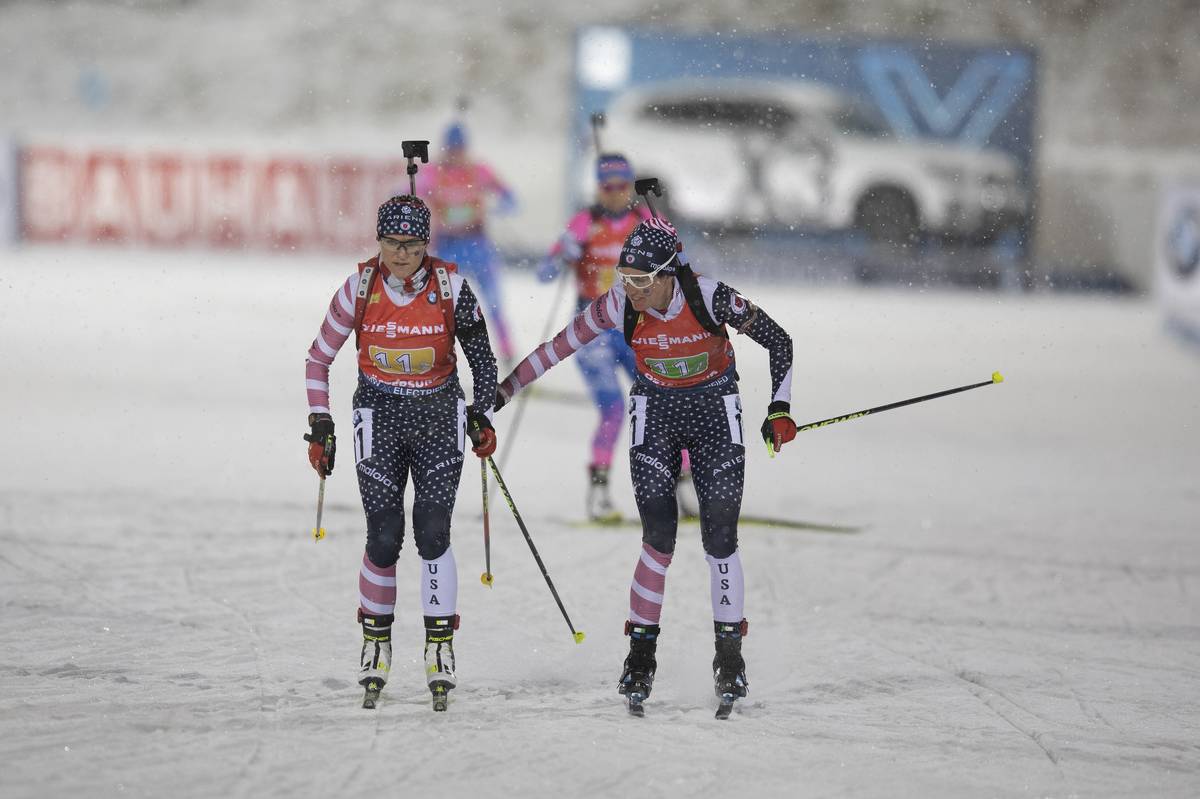
Clare Egan tagging Joanne Reid during the IBU World Cup 4 x 5 k relay in Östersund, Sweden. (Photo: NordicFocus)
On the biathlon side, at least the first four World Cup stops will be featured on the Olympic. This calendar begins in Östersund, SWE on November 27th and ends in Annecy, FRA on December 19th. These events will be streamed live with commentary; Salmela confirmed that he has been hired to call each of the events in Period 1.
(Read about the IBU’s plans to improve fan experience here.)
To view the Olympic Channel, you’ll need a subscription to a separate streaming service like Hulu Live TV or YouTubeTV. The cost of these platforms varies.
There you have it! As more information becomes available, we will provide updates to keep readers abreast of any changes or insights. In the meantime, see you here on Friday, November 26th for the opening cross country sprint races in Ruka!
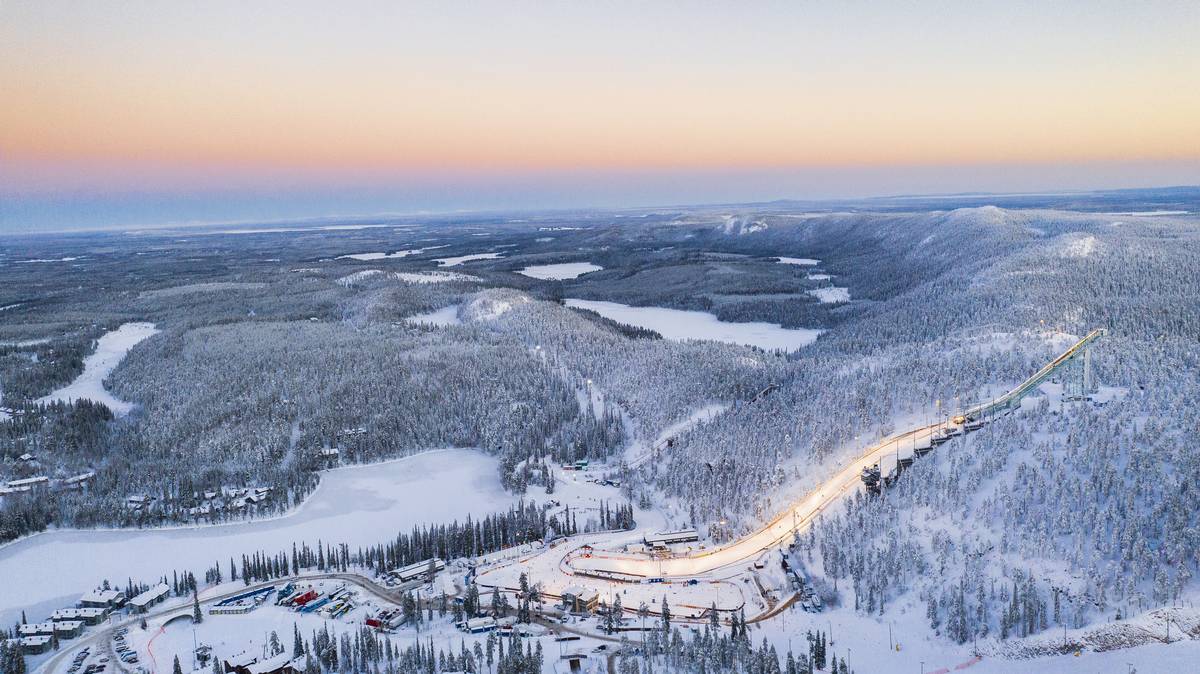
The Ruka, Finland racing/jumping complex. (Photo: NordicFocus)
After a year of postponement caused by the coronavirus pandemic, the summer Olympics are going ahead, with the opening ceremony on Jul 23, 2021, in Tokyo, Japan. Setting opinions aside about the lingering threat of COVID or other Olympic-related controversies, the coming weeks will provide countless moments of great sport. Although we are a winter-focused publication here at FasterSkier, we’ve done a little research into how you can best view the upcoming games.
NBC is the go-to channel for primetime coverage of the Olympics and can be accessed on most major streaming services. For viewers who don’t have cable, the Tokyo Games can be streamed, like the cross-country World Cup, through NBC Universal’s streaming service Peacock. There are also a variety of other streaming services that offer NBC. The options are listed below.
Peacock is the best choice for readers looking solely for live coverage of the Olympics. With a free account, you get access to NBC’s live broadcast. For play-backs, commentary or analysis, you can move up to the premium service option. A Peacock Premium subscription costs 4.99/month and can be cancelled at any time. If you want to go ad-free you can pay 9.99/month for Premium Plus.
Sling TV gives subscribers the first month of subscription for $10 (as opposed to the normal $35/mo). The Sling Blue package provides ESPN, NBC, the NFL Network. This option remains the best choice for die-hard sports fans.
Both a big step up in price, FuboTV or Youtube TV offer 120 and 85 channels respectively and allow greater flexibility in recording and storage options. FuboTV costs 64.99/month and Youtube TV is 54.99/month for your first three months.
The full schedule of Olympic events can be found here, with popular sports such as swimming and gymnastics kicking off July 24th, and track and field events beginning July 30th.
NBC Sports recently announced how U.S. based viewers can access web-based World Cup nordic, alpine, and biathlon events. (NBC Sports Gold screenshot)
Over the past few years, NBC has also been in the business of streaming and broadcasting ski racing events. Last winter, live and on-demand World Cup cross-country skiing could be viewed on NBC’s Olympic Channel. The Olympic Channel was a subscription-based pay-to-view service offered by NBC on either its website or through its cable TV broadcast.
NBC Sports Gold will offer its “Snow Pass” as its gateway to view World Cups online in the U.S. for those without the NBC Sports cable lineup. (As FasterSkier understands, consumers who have access to the NBC Sports channel suite through their cable provider should be able to stream World Cup content online with a pre-existing login.)
As the “Snow Pass” name suggests, you can purchase a seasonal subscription, or pass, for $69.99 that allows live and on-demand Internet access to every stop on the World Cup for several winter sports starting October 27. Those sports include alpine skiing, ski jumping, nordic combined, freestyle, snowboarding, cross-country skiing, and biathlon.
According to the press release, the “Snow Pass” complements, “hundreds of hours of Olympic winter sport programming airing across NBC, NBCSN, [and] Olympic Channel.” (NBC, NBCSN, and the Olympic Channel are cable-based channels and are separate from the “Snow Pass”.)
For biathlon, the “Snow Pass” is a new model. Here in the U.S., free live streaming and replays of IBU World Cup biathlon events have been available on the Eurovision website. This year, it appears the Eurovision live feed may be blocked in the U.S. Viewers will need either a cable subscription that includes NBC’s suite of cable sports channels or a viable “Snow Pass” web-login to view IBU World Cup biathlon.
According to the “Snow Pass” biathlon calendar, NBC will be carrying the 2019 IBU World Championships in Östersund, Sweden. The “Snow Pass” gains subscribers access to those Östersund races.
The “Snow Pass” also includes online access to view cross-country World Cups. The NBC World Cup cross-country schedule spans from the November 24, classic sprint in Ruka, Finland through the freestyle pursuits on March 24, in Quebec, Canada. All regular World Cup stops are scheduled as both streamed events and cable broadcast.
October 22nd’s press release states, “The pass also features live and on-demand coverage of the FIS World Championships, which take place every other year, from February–March 2019.” For alpine skiing, nordic combined, freestyle, snowboarding, and biathlon, all respective World Championship broadcast rights have been secured by NBC.
For fans of cross-country one scheduling omission stands out.
The 2019 Nordic Ski World Championship cross-country races in Seefeld, Austria are not listed as streamed or broadcast events on NBC’s platform. Purchasing a “Snow Pass”, as it currently stands, does not include access to view the World Championship cross-country races. FasterSkier has been told but has not confirmed, that the price tag for the Seefeld World Championship feed was exorbitant.
Veteran cross-country race announcer Chad Salmela, of “Here comes Diggins” fame, has been hired to add commentary to NBC’s events on the cross-country and biathlon schedule. Last season, most World Cup races streamed live on the Olympic Channel web-platform did not include live commentary.
FasterSkier will report on any developments regarding U.S. broadcast rights to the cross-country events at the Seefeld World Championships.
This winter, NBCUniversal viewers will have the opportunity to watch skiers like U.S. Nordic Ski Team member Sophie Caldwell compete live, with the company’s recent acquisition of rights to FIS World Cup events. (Photo: Fischer/Nordic Focus)
Being able to watch cross-country or nordic-combined competitions live from the comfort of your own home in any Scandinavian country is, well, normal. What if the same could be said of the U.S.?
A long-standing dream for many American nordic fans is becoming a reality with NBCUniversal’s recent acquisition of rights to almost all of the International Ski Federation (FIS) World Cup events.
Before NBCUniversal acquired the rights to broadcast and stream World Cup events, a separate company, Universal Sports Network owned them.
“Universal Sports had those rights for years, but Universal [Sports] never really exercised them, other than carrying coverage each year of the Tour de Ski,” explained Tom Kelly, vice president of communications for the U.S. Ski and Snowboard Association (USSA) during a phone interview on Tuesday.
However, after NBCUniversal took over and ceased the operation of Universal Sports Networktwo days ago, NBCUniversal gained the company’s assets, including the right to broadcast World Cup events.
“The big news for cross-country is the fact that cross-country ski racing from the World Cup — the entire World Cup — will be available in America and it never has been before,” Kelly said.
“The big news for cross-country is the fact that cross-country ski racing from the World Cup — the entire World Cup — will be available in America and it never has been before.” — USSA Vice President of Communications Tom Kelly, on NBCUniversal’s upcoming live-stream schedule for the 2015/2016 race season
Along with cross-country, most every nordic-combined event is scheduled to be streamed live, except for those in Austria. “The Austrian events are in a different rights package, so those are missing right now from the nordic-combined schedule. Everything is included for the cross country World Cup Tour this year,” Kelly said.
Bryan Fletcher (U.S. Nordic Combined) at the Nordic Combined World Cup Triple last January in Seefeld, Austria. As it stands, the 2016 Seefeld Triple is the only Nordic Combined World Cup that NBCUniversal does not have rights to stream this season. (Photo: FBD)
So how might skiers and avid fans alike access the races? According to Kelly, NBCUniversal is “planning on carrying those events through live streaming on their streaming platform, which is called NBC Sports Live Extra. You can download the app from any of the app stores, whether you have an Android or an iPhone. Or you can simply access it on the web.”
Unfortunately for Canadians, which follow their own set of broadcast regulations, our northern friends won’t be able to access this.
In addition to streaming of all World Cup events online, NBCUniversal plans to show the Tour de Ski live on one of its television broadcasting channels, Universal HD.
“One is a streaming platform, one is a broadcast platform. If you want to watch [the Tour de Ski] in Universal HD, you’d have to call your cable or satellite provider and you’d have to find out: Do I get that channel, if I don’t get that channel how do I get it, what do I pay, and so forth,” Kelly said. “With the streaming — and everything will be streamed live — you can watch that content live, but you can also watch it on demand later.”
– If using a tablet or handheld device, download the NBC Sports Live Extra app via iTunes (free download, subscription fees may apply)
– Stay tuned for subscription details; you may need to subscribe to NBC’s primary sports channel, NBCSN. Many cable and satellite packages already include NBCSN or Universal HD. Check with your provider.
– Save this schedule. All of the FIS Cross Country World Cups and all but three competitions on the FIS Nordic Combined World Cup 2015/2016 schedule will be streamed. Canadian World Cups, while not included on the current schedule, will also be shown.
– Tune in: Universal HD plans to televise the Tour de Ski daily.
“You don’t have to get up at 4 in the morning to watch [races]; you can get up during the day to watch and just pick whatever time you want,” Kelly explained. “That’s the beauty of the digital platform.”
Though the news may seem ethereal, some major details are still being sorted out. “We anticipate that in order to watch the streaming, you will need to be an authenticated subscriber to NBC through a cable network or through a satellite provider,” Kelly said. “We don’t know yet how [NBCUniversal] will manage the authentication on this. What we suspect is that you will need to be a subscriber to NBCSN [a division of NBCUniversal], which is their primary sports channel.”
In other words, watching live streaming of World Cup events may come at a cost of upgrading or paying extra for the sports channel.
However, Kelly believes that this won’t be an issue for most Americans wanting to watch live World Cup events.
“If you’ve got a decent cable package or satellite package, you’re probably going to find that you already have [NBCSN and Universal HD],” he said.The price to subscribe to NBCSN or Universal HD, if not already included your package, depends largely on your cable/satellite provider.
“For us, the big thing here is two-fold,” he added. “Number one, it’s the fact that everything will be streamed live, and number two, the fact that the potential audience size for the broadcast events of the Tour de Ski, will be dramatically larger than it has been in the past.”
With Universal HD reaching close to 10 times the number of U.S. homes reached during the Universal Sports Network era, according to Kelly, the potential of spreading awareness about nordic skiing with just one race series is huge.
A long-standing dream for many American nordic fans may come true with NBCUniversal’s recent acquisition of rights to stream almost all FIS World Cup events.
Of course, that all depends on number of subscribers and viewership.
“One of our initiatives is to get people to be aware that [NBC Sports Live Extra and Universal HD] exists and get them to participate and watch it,” he said. “NBC will monitor how many people are actually watching these events [and] that will undoubtably influence their future decisions. Our objective is to get people to watch and get people engaged in cross-country ski racing in America.”
As for USSA’s role in all this, it’s not much different than the rest of us. “We’re an interested party … We’re essentially lobbying them and encouraging them and at the same time, also helping to spread the word on it,” Kelly said.
Beyond the issue of subscription, English commentary is also potentially in the works. “Keeping in mind that this is not our broadcast, we are certainly going to encourage them to have English-language commentary on this [and] we are giving them suggestions as to ways to accomplish that,” Kelly said. “But ultimately it will be NBC[Universal]’s decision.”
LUSANNE, Switzerland – Longtime U.S. Ski and Snowboard Association (USSA) partner NBCUniversal has retained the U.S. broadcast rights for the Olympic Games through 2020. The decision was announced Tuesday by the International Olympic Committee following presentations by NBCUniversal, ESPN and Fox.
“For two decades NBC has raised the global level of awareness and support for the Olympic movement. Today’s decision continues and strengthens that vision,” said USSA President and CEO Bill Marolt. “This secures NBC’s passionate legacy of telling the stories of our athletes through the excitement of skiing and snowboarding.”
NBC has broadcast every Summer Olympics since 1988 and every Winter Games since 2002. Their 2010 Olympic coverage of Vancouver, where USSA athletes captured a record 21 medals including six gold, bested American Idol ratings twice during the course of the February Games, ousting the show from the No. 1 spot for the first time in six years.
Earlier this year, NBCUniversal was purchased by cable giant Comcast to create one of the most wide-reaching media platforms in history. Top-tier USSA events including the Audi FIS Alpine World Cup, U.S. Snowboarding Grand Prix and other elite level competitions are broadcast annually on NBC, Versus and Universal Sports.
“The USSA congratulates NBC and Comcast in retaining Olympic broadcast rights through 2020. We’re confident that NBC’s long history, tradition and legacy of Olympic broadcasting will only grow with the available media assets and capabilities Comcast brings to the partnership,” said USSA Chief Revenue and Marketing Officer Andrew Judelson. “The ability to continue our longstanding relationship will have a positive impact on our own programs with NBC. We look forward to the future.”
The winning bid of $4.38 billion secured exclusive rights to the 2014 Winter Games in Sochi, Russia, the 2016 Summer Olympics in Rio de Janeiro, Brazil as well as the 2018 Winter Games and 2020 Olympics, whose sites have not yet been chosen. NBCUniversal had already captured rights to the upcoming 2012 Summer Olympics in London.
Chad Salmela with one of his skiers at the College of St. Scholastica.
You may not recognize the name Chad Salmela, but if you live in the United States and watched any of the biathlon, nordic combined, or cross-country ski races at the 2010 Olympics, you’ve heard his voice. Along with play-by-play man Al Trautwig, Salmela spent the month of February holed up in a 50-square-foot room above the stadium in Whistler, doing the color commentary for NBC at the Games in Vancouver.
Salmela started announcing over ten years ago, and he did the color for the biathlon races at the 2006 Games in Torino, Italy. Last year, NBC approached him about calling all three sports at the 2010 Games, and after a tryout in Los Angeles, he landed the job.
Announcing isn’t his only talent; in addition to his work for NBC, Salmela is the head coach of the cross-country ski team at the College of St. Scholastica in Minnesota. He’s also the lead singer and guitarist for the band A M Herculis.
Now that the dust has settled, we caught up with Salmela to hear what it was like behind the scenes at the Games. Given that it’s his job to talk, it probably goes without saying, but one thing’s for sure: Salmela is not a tough guy to interview.
FasterSkier: So, you told me you couldn’t do an interview last week because your rock band was performing. I did a little Google sleuthing and listened to some of your guys’ tunes—so are these coaching and announcing things just side gigs?
Chad Salmela: I was ready to fold the band after this last gig, because I don’t have time. We really hadn’t played since this same music festival last year. Recording the CD—we did two days in November of ’08, and we finished the album. You know, making albums these days—it’s pretty much a joke, because everybody can do it. It’s like spending money on paint and painting. I’ve done three solo albums—this is definitely the most fun, because it’s the first time I’ve collaborated with people.
I’m not a very great guitar player—I can play, but if you listen to it, there’s not a lot of guitar virtuosity on the album. It’s a lot of white boy power chords. I honestly don’t listen to that much music, but I do compose. I’ve been married for almost two years, and these songs are pretty much songs from my last girlfriend. It’s good angry music, but the great thing is, when you’re kind of pissed off, you write your best stuff.
FS: Do you have any cross-country related tunes? Power ballads dedicated to Kris Freeman, or something like that?
CS: You have this cheesy effect that you kind of hold at bay—I think to write a song, you have to be…there are some parameters you set for yourself naturally, and I can’t express what those are, but I guess I know cheesy when I hear it or when I write it.
If it’s something I think has some merit and has something interesting going on in it, that’s kind of what I do. And I like it and I enjoy it. It’s a really nice diversion from all the other things I do. If I was single, I’d probably try to do it a little more, but I honestly don’t have time. We’re going to Finland in mid-July, and from there I’m taking my team to Oslo and the Torsby ski tunnel.
FS: Okay, so on to the serious stuff—so aside from being an NBC announcer, you’re also a ski coach at St. Scholastica? If you’re spending a month at the Olympics, how do you make that work?
CS: Around the time I got the job, my part-time assistant coach Brad Nelson quit—he just couldn’t do it any more. I got Josh Tesch, who skied for Green Bay. He’s helped Bryan Fish [with CXC] on and off. For me, the winter is all about waxing—the training is done, and you’re just reacting to what people’s form is giving them. It’s better to be there, but you can do that by e-mail almost. I was gone a lot—I was doing a lot of the International Ski Federation [FIS] World Cups prior to the Olympics, for Universal Sports, as warm-up.
A typical week was wax, test skis, and pack up; test skis all day Friday, make the team’s dinner, wax for first race; race, test for next race; wake up Sunday, test, send ’em out to race. Then I’d fly to L.A., call events sometimes on Monday and Tuesday, get on a flight and go to New York to call a biathlon race. In January, I was home seven days the entire month. That was actually worse than the Olympic month. I was there for every race for the team that was important—all the NCAA qualifiers. The only events I missed were the final events for the team in January. But I always focused on the team’s performance on those two weekends, and they rocked.
FS: And the announcing gig—your first event was at Middlebury, for trials for World Championships and U.S. Biathlon events?
CS: As a junior, I’d quit the season previous as an athlete. I got into Middlebury, started going to school, and Max Cobb [with the U.S. Biathlon Association] asked me to come over to Lake Placid and call the trials. It was nothing—I had a start list and a CD. There was no production at all. I just kind of announced the event.
That was ’98—and then we had a World Cup in January or February of 1999. I was still in college. I got called in—I did it with Peter Graves. He showed me a few tricks of how to set the tone with music. Peter was by no means doing sport production, where you’re actually choreographing the day in your mind with music choices that will fit the mood. Sport production was still pretty new in the U.S. But Peter and I did the World Cup, and I I have to credit Peter a lot with getting me to realize how to do it. And, from there, I got hired to do Junior Olympics in my last year at Middlebury. I think they paid me $500 for the week. But it was outdoors—there was no indoor announcing facility. The stadium moved twice; I was sick as a dog the entire time. But we had some great races with Tim Burke and Lowell Bailey and Ethan Foster and Sean Gallagher—there were some really great rivalry races. I got excited, and from that point on, people took notice. After the Junior Olympics I started realizing I kind of had something.
I ended up doing more biathlon events, did Junior Olympics one more time—I went out and did Nationals at Soldier Hollow, and [former biathlete] Lyle Nelson said “you’ve got to do this for the Olympics!” Then they were looking for announcers in the stadium for the Olympics, and there was a lot of uproar, because I was already working for the organization as sport manager. To have me switch gears and do sport production, everyone was freaked out. But Max Cobb said, “this is our chance to showcase the sport—let him do it.”
FS: And then from there?
CS: Everything snowballed. I sat in a production truck at the Pre-Olympic World Cups and met [producer] Kent Gordis—this was my first touch with TV. I was a spotter, some things went wrong—there was all kinds of interesting stuff that opened my eyes.
Al Trautwig (left) and Chad Salmela (right) calling the action during the men's 50 k classic at the 2010 Olympics.
With the [biathlon races on the] Outdoor Life Network (OLN), they said, “we want you to do it, with Bob Papa.” Bob was just a great commentator—I think we did ten and 15 shows a year, for three years, on OLN. Not a lot, but it was enough for me to really work with a pro. You start realizing that those guys are guys that [make you] look good. You can have a lot of things to say and not say them, because the guy next to you isn’t giving you time to say them.
If you look at what we did for [this] Games, it was the best job I’d ever done. It was because Al is so good at what he does. And it doesn’t come across that way, but if you go back and you watch the tape and see our train of thought, Al was always directing it—he was just setting us up for me to say what was in the back of my mind. It takes a real skilled professional to do that. If you look at the difference between—[Universal Sport announcer] Steve Schlanger’s new to the sport, he’s good and talented, but he’s not as seasoned as Al. I worked with Steve on the FIS competitions.
Looking at Al, he’s been doing this for 39 years. He’s just amazing—it was amazing how he understood. Even not being a complete expert on the sport, he understands enough about it just to set things up—and it’s much harder to do if we’re going live-to-tape like we were in Vancouver. I’m in awe of Al Trautwig.
FS: So, can you tell me about the tryout for the Vancouver job?
CS: Officially, they had a few shows left in the ’08-’09 season. They had the cross-country World Cup final in Sweden, and it’s not Universal Sports that does it. I’m basically getting booked by an [NBC] Vice President in New York, and I show up in L.A. with a bunch of guys who don’t know I am. I got called in to do real shows. We’re voicing over tape, so we’re not doing anything super-critical that they can’t fix. They brought me in, and I did the events in Stockholm and Falun. I got a call a month later and they said “we like you, we want to book you for the whole thing.”
I didn’t know if they were trying anybody else out. That’s how I got cross-country, nordic combined, and biathlon. Ironically, I didn’t call a [single] nordic combined race ever before the race [Johnny] Spillane and [Jason] Lamy-Chappuis sprinted for the line—that was my first nordic combined call. Which isn’t that hard. All you gotta do is know what [announcers] Jeff Hastings and Matt Vasgersian said on the lead-in—it’s still just a cross-country ski race, essentially.
FS: In your mind, what’s key to a good call?
CS: Trying to boil [it] down, at least for an American audience. A good call in Norway is very different than a good call in the U.S. Maybe I could have gotten much more technical than I ever did during Vancouver. I look at Kjell Erik Kristiansen, who does a lot of P.A. announcing—he’s amazing. He’s got a very mathematical mind, which I do not—I can’t look at a split time and get to the tenth of a second. I have to do the count. He gets it to the tenth of a second—the Norwegians expect that. If you say two seconds down, Kjell Erik will correct you, and say, “he’s 1.8 seconds down.” The race can be won by a tenth of a second.
In the U.S., people aren’t going to worry. You just have to tell a story. With a call in the U.S., you’re setting up a bunch of people—who don’t know who these [athletes] are—to like somebody. You have to tell a backstory. If you see a bunch of people with wacky foreign names, and all you’re talking about is the action, there’s no draw to any individual—you’re going to lose the viewer. That’s what drives people nuts, for the sports fan. We’re talking about the red army, we’re talking about Petter Northug over and over again—it sounds redundant to me and everyone else who knows who Petter Northug is.
Every time the Olympics come on, you’re seeing new viewers who haven’t seen the race yet. They don’t know who Charlotte Kalla is, or who Marit Bjoergen is. You have to be building the story. The great thing about it is that Al has great instincts for that. The true sports fans are like, “Al Trautwig doesn’t do anything.” But that stuff is the bulk of what’s going to get people to stick. If I can deliver the drama while the race is going on, and get those people drawn in to the Swedes working together [in the
Sweden's Johan Olsson during his solo move in the men's 30k pursuit
men’s 30 k pursuit], that’s why that race worked well even on American television. Because there’s all of a sudden a story to tell about people. You start building up the Anders Soedergren story: He’s a huge name but has not done anything all year. He’s a team player. All of a sudden, he’s a bit of a hero, and all of a sudden [bronze-medal winner] Johan Olsson is a hero. All of a sudden there’s all the competitors’ stories going on. When you can see the backstory within the call of the race, the American viewer will stay in tune—they won’t switch the channel. They have to say, “We have to see what happens to these Swedish guys!” All of a sudden, you’ve created a compelling story. That’s what a good call is—I can’t say that it’s the same thing from race to race.
One thing that really worked for nordic skiing overall was that every race had a great story to tell the American people. That’s not always the case, to have that many races unfold the way they did. The men’s relay, when Northug went nuts, and…there was something compelling going on during the entire 50 k—and then the finish was spectacular.
It’s not as if there is a universal [way to make] a good call, but for the Olympics, making the sport more accessible to the American people—it takes that long-term professionalism to set things up, work together on telling the stories, and finishing—if the race is great—with a great call in the finish. And then having Al gift-wrap it, put a bow on it, and kick that down the hall—and he does that better than everybody. The recap, he’s doing it off the cuff, and he gets these almost poetic endings. When you can close an event with a pro like that, you leave the booth feeling really good about what you just did.
FS: What did you feel like was your best call of the Games?
CS: I think if you look at the setup—at the being the first guesser, so to speak, when things were going down that actually happened, I have to say that the men’s pursuit was the best. I made the call that when Johan Olsson gets 20 to 25 seconds, the person who chases him down won’t get a medal. And that happened—it was Legkov, and Legkov got fourth. That, as far as being on top of something that could draw people into the event and actually have it play out, that was totally the best. My worst job of doing that was Aino-Kaisa Saarinen—I completely second guessed her changing skis in the final leg [of the 30 k classic], and it was completely the right choice.
To me, my favorite call was probably the first nordic combined medal with Spillane. We did a few things wrong there—first of all, Al and I didn’t go over the fact that there’s a ten-meter line, and he just about called Spillane gold. And I jumped it, and my enthusiasm was completely genuine. You can call it over the top, but it was such a great race. Spillane went for broke, and you gotta love that confidence. He didn’t win, but it was a spectacular effort, and for me it was great, because that call got on the Today Show, it got on a Coke commercial. For me, I think I’ll always cherish as an announcer for the rest of my life the fact that I got the chance to call Spillane’s silver, the team’s first silver, and the gold of Demong. He’s a friend, and I wanted that to be a spectacular day for him. I feel lucky that I got to try to do that. I get to be the voice of those guys’ memories—that’s pretty cool.
FS: What about the other way around? Were there any calls you screwed up?
I would say that the biggest…the moment of the games was the Spillane and Lamy-Chappuis sprint (the call starts at 1:02:00). I didn’t even remember it, because when you’re in that situation, your mind is racing. The format is this—and this was the first exciting call of the games between me and Al, we’re still getting used to each other: I’ll call anything exciting that happens on the big climb, because that makes sense. I’ll analyze who’s going to go when, and basically, a lot of moves happen on that final climb. Essentially my cut-out point, no matter what, is to let the play-by-play call the race to the line from basically 100 meters. I cut out at the turn.
Johnny Spillane during the Olympics
It was a total instinct—I wasn’t event thinking about it, but as they were coming to the line, Al goes, “Spillane’s got it!” and was going to say something else, and I just knew that Al was thinking that [the ten-meter line] was the finish line. And before he said “gold medal,” I didn’t want the word gold to come out of his mouth, and I just jumped on him and said “No! Lamy-Chappuis is coming on!” And [then] the race is over, and I didn’t think anything of it, and Al said that the producers thought we were all over each other at the finish.
I went home and was like, “I wonder where I stepped on Al?” I thought everything was okay, because I’m pretty much an amateur. I could watch our handiwork on NBC two hours later, and I watched the call and I realized then that that was my mindset. So I called Al up and I said “Al, first I want to apologize for jumping on [you].” He goes, “Don’t worry about it.” He goes, “dude, you saved my butt–that’s all I can say.”
FS: But it worked out, though?
CS: In the end, and I think Al feels the same way, it was the right thing for me to do. It was a learning experience for me. If I had been too timid, there would’ve been a little bit of hell to pay, and it probably would have come down a bit from the top brass at NBC. I didn’t know at the time what kind of possible wrath that would have brought on Al, for calling the gold to Spillane. Already, people are worried about us being too pro-American. If that had happened, it would have been a story in more places than that guy at the [New York] Post who figured out what had happened.
We all went out to dinner, and Al’s wife came. Halfway through she reached across the table and said, “I can tell Al likes working with you.” That was really nice to hear, and I think that in a lot of respects, that Spillane-Lamy-Chappuis call solidified that we got [each other’s] backs in this—from that point on, we were like a team.
FS: So clearly, you’re bringing things to the table as an announcer that you’ve taken from your job as a coach. But does it go the other way, too?
CS: I really think that any time you can touch the world level and see what’s going on, you see things and you learn things, and it gives you access to stuff that is happening. I see the same thing not just announcing, but interacting with the U.S. Ski Team coaches, and interacting with [coach] Bryan Fish at CXC. I’m doing a lot of things with my team in the physiology lab that I got through the channels at the U.S. Ski Team, via CXC. If I’m not out there being a part of the international nordic ski world, I become dated. If I have that access, that gives me an advantage as a coach. I feel I’m doing a really good job with the athletes…they get a higher level of coaching, I believe, because I’m connected at a higher level.
FS: So are you signed up for Sochi in 2014?
CS: I don’t know yet. They’ll probably give me a call a year before. At this point, who knows? Anything could happen. NBC doesn’t even have the rights for Sochi yet; they may not even want them. I think Vancouver was a good thing for them. My hunch is they were doing pretty well with the ratings. As much as you want to bitch at NBC, they’re going to do the best job of anybody. I think [NBC executive Dick] Ebersol is the guy for making the Olympics better. The sports fans hate it, but we’re never going to get a Eurosport kind of Olympics. Not even the European major networks are Eurosport-style production. They’re much more sport-based, but they also have a much more engaged audience in the sports. But still, if you look at the ratings of Eurosport, [they] don’t even touch the ratings of [German broadcasters] ARD and ZDF. They package these things just like Ebersol does, for the mass consumption of the German people.
For ski fans to compare NBC to Eurosport, it’s unrealistic. The best is to have a Eurosport-style [broadcaster] in the U.S. who gets the rights as well, which is never going to happen. But I think Ebersol gets the Olympics. If it goes to ESPN, I don’t know—it’s an unknown of how that’s going to be produced. Maybe they’ll do a great job, maybe they’ll go very sport-level, but can you see SportsCenter doing as good a job as NBC does? I don’t know.
Am I going to do Sochi? I think there’s a fair chance, but it’s impossible to say at this point.
It’s hard to let people know what you’re going through on this side. I love the sport—I think it has all the things it needs. I just think it has to be packaged in a way that Americans beyond the cross-country crowds will enjoy it. Unfortunately, that might mean you alienate some of the superfans, but if you want to make Torin Koos and Andy Newell and Kikkan Randall and these U.S. Ski Team people financially viable, this is worth doing for them for the long term. [If] we can actually fund junior development, it’s gotta be on TV, it’s gotta be exciting, and it can’t be this esoteric stuff. It has to be mainstream America in the way it plays out on TV, otherwise we’re a fart in the wind. So that’s the big picture.
The door to the NBC broadcast booth at Whistler Olympic Park
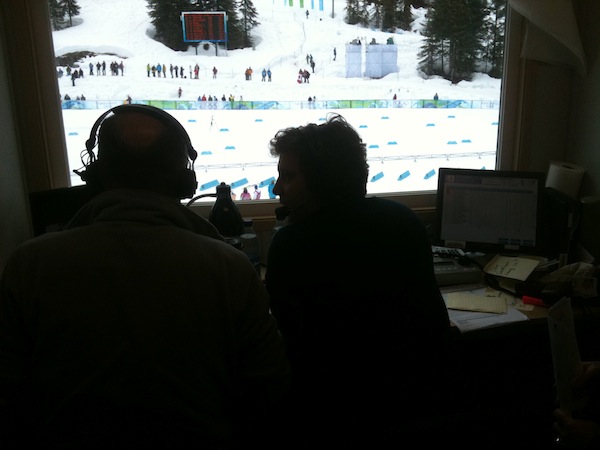
Before the NBC video feed of the cross-country skiing events at the 2010 Vancouver Games reaches a single American household, it must first flow through a cramped, spare, six by eight foot room perched above the bleachers at Whistler Olympic Park.
Inside, off two small monitors, is where announcers Al Trautwig and Chad Salmela call the action, with the help of their three producers and researchers. No room for lunchboxes—those are outside the door.
Al Trautwig (left) and Chad Salmela (right) calling the action during the men's 50 k classic
Fifty minutes before the start of the men’s 4×10 k relay, Trautwig and Salmela were standing outside in a light drizzle, next to the lunchboxes, engaged in an animated discussion about their picks for the race. Salmela thought Sweden will be tough to beat; Trautwig was pushing Italy. Salmela won the argument, and good thing, too—the Italians ended up ninth on the day.
Nicknames to Tendencies
Just like for the athletes and coaches, the work for the broadcasters begins far ahead of the start of the race.
The night before, and even the morning of, there’s plenty of research to be done, “anything from nicknames, to tendencies,” says R.J. Broadhead, who does the play-by-play for the Canadian television station CTV. He said he prepares for about three hours the evening prior to each event.
In the CTV booth, experience is varied. Broadhead normally calls hockey—though he has been doing more cross-country over the last year and a half, in the lead-up to the Games. But he also has former Canadian National Team coach Jack Sasseville and former Olympic champion Beckie Scott doing the color commentary.
“[Sasseville] sees it from a coach’s perspective; [Scott] sees it from an athlete’s perspective,” Broadhead said. “It’s a nice contrast.”
R.J. Broadhead (left) and Jack Sasseville (right) in the slightly more spacious CTV booth
Next door, in the NBC booth, Salmela is a voluble former elite-level biathlete who now coaches skiing at The College of St. Scholastica, in Minnesota. Trautwig’s realm is mainly basketball and hockey, but he is also a 13-time Olympic broadcasting veteran, having called the cross-country events in Torino and Salt Lake City.
Trautwig and Salmela are aided by two researchers, D.C. Robbins and Hugh Cooke, who sit at the back of the booth, internet connection at the ready. Wikipedia and foreign newspapers are especially handy when an underdog or a newcomer pops a big result—or even makes an appearance at the front, like Ben Koons did last week.
When that happens, the researchers do some digging online, then pass notes up to Trautwig and Salmela, who say they use about 20 percent of what they’re given.
But the researchers aren’t just glorified Googlers. During the men’s 50 k classic, Cooke even had a stopwatch at the ready, which he used to clock one of Petter Northug’s ski switches (seven seconds, for the record).
Taking What They’re Given
While the broadcast booth has a decent view of the stadium, Trautwig and Salmela end up calling most of the races from the two TV screens on the desk in front of them, which is cluttered with water bottles, McDonald’s coffee cups, and handwritten notes from Cooke and Robbins.
One of the TV screens shows what is called the “world feed”—the video shot by Olympic camera crews, then relayed to dozens of stations around the globe—while the other gives live splits from the race.
Everyone gets the same footage—NBC’s video feed is identical to Eurosport’s. Broadcasters can supplement with their own cameras—CTV, for example, has two crews in the stadium that can get shots of Alex Harvey or Devon Kershaw when they race past, but NBC doesn’t have anything extra.
“We’re just taking what they give us here—we’re at the mercy of the world feed,” said Salmela.
That makes it “critical” for the U.S. athletes to ski well, because, according to Salmela, “if the Americans aren’t in it, the world feed’s not going to show it—and we’ve got nothing to talk about.”
Keeping the Americans in the picture isn’t the only challenge for the NBC crew, though.
Al Trautwig (left), Chad Salmela (middle), and Hugh Cook (right) during the men's 50 k classic. The monitor on the left displays the video feed, while the one on the left has live splits from the race
With coverage usually sliced, diced, and shortened to fit whatever time allotment they get from the head honchos in Vancouver, the announcers have to fit their live calls into pre-arranged chunks, called “segments”—a process Salmela likens to “building a house in a day, and drawing the plans while you’re building it.”
If they mess up, it’s not the end of the world—they can go back and voice over key sections later. But most of the time, Trautwig and Salmela take only take one crack at the calls, and that’s when they’re live—even if the program isn’t slated to appear until hours later.
The Moment of Truth
Cross country skiing doesn’t have the same kind of constant action as a sport like hockey, for example, where players are always making shots, passes, and body checks.
That showed during a commercial break halfway through the 50 k—the longest and slowest event of the Games—when Trautwig and Salmela were chagrined to find out just how much racing remained.
“We’re going ’til noon? Somebody throw us a life vest!” Salmela joked.
But despite the Herculean task of finding something to talk about for over two hours of monotonous pack racing, Trautwig maintained that calling skiing isn’t anything special.
“I think every game is the same, and you just have to wait for the moment that defines it,” he said. “There’s going to come that moment of truth.”
True to his profession, Salmela couldn’t help but chime in himself.
“It’s our job to, just, try to portray that accurately, and warmly,” he said.