From the FasterSkier archive — posts syndicated from athletes’ and coaches’ own blogs between 2004 and 2012, kept online as published. Current coverage is at fasterskier.com.
Finals week has a way of compressing time. Days shrink into problem sets and exams; nights stretch just long enough to make sleep negotiable. When Jack Lange logged onto Zoom from Hanover in late November, he was finishing his senior fall at Dartmouth, a mechanical engineering major balancing equations while packing for a training block at Silver Star. The snow out west wasn’t cooperating. Races were being reformatted. Nothing felt settled.
That uncertainty didn’t seem to bother him much.
“We’re wrapping up school right now and then heading to Silver Star next Tuesday,” Lange said. “Hopefully, the snow conditions there improve a little bit.”
It was a measured answer—calm, almost deliberately so. Over the next hour, that calm would reveal itself not as indifference, but as something learned the hard way.
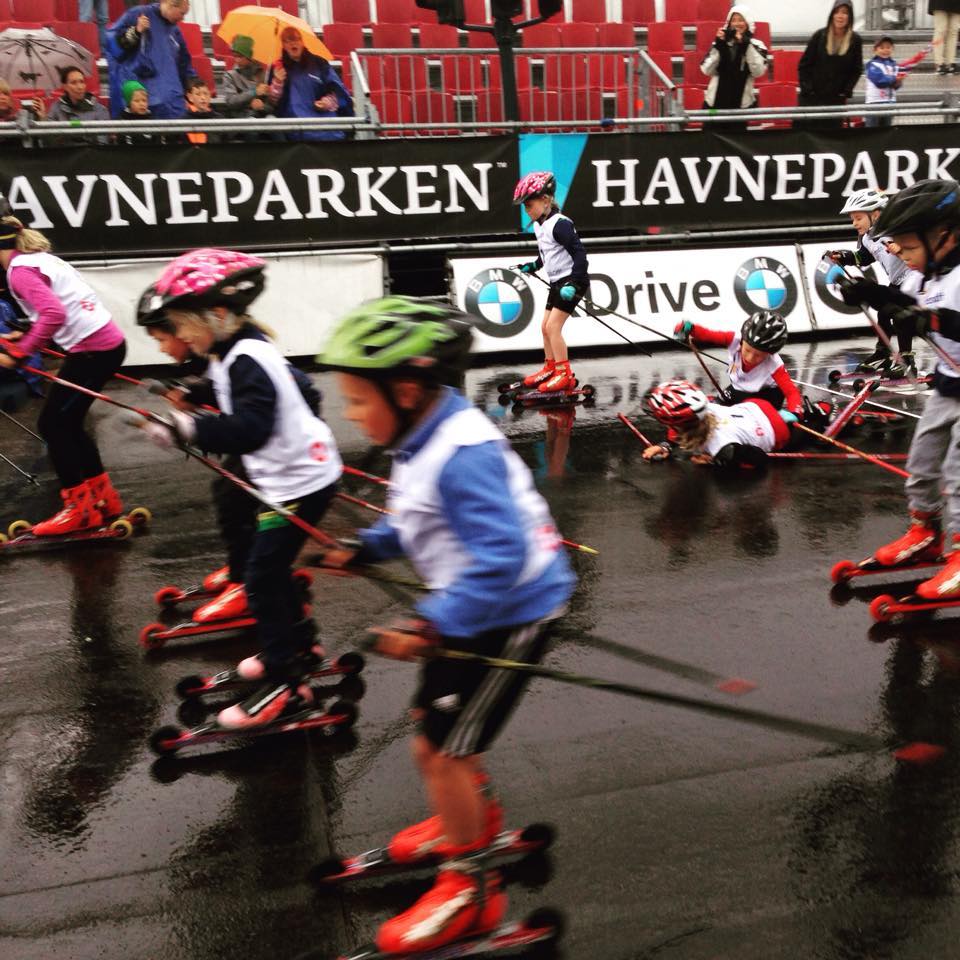
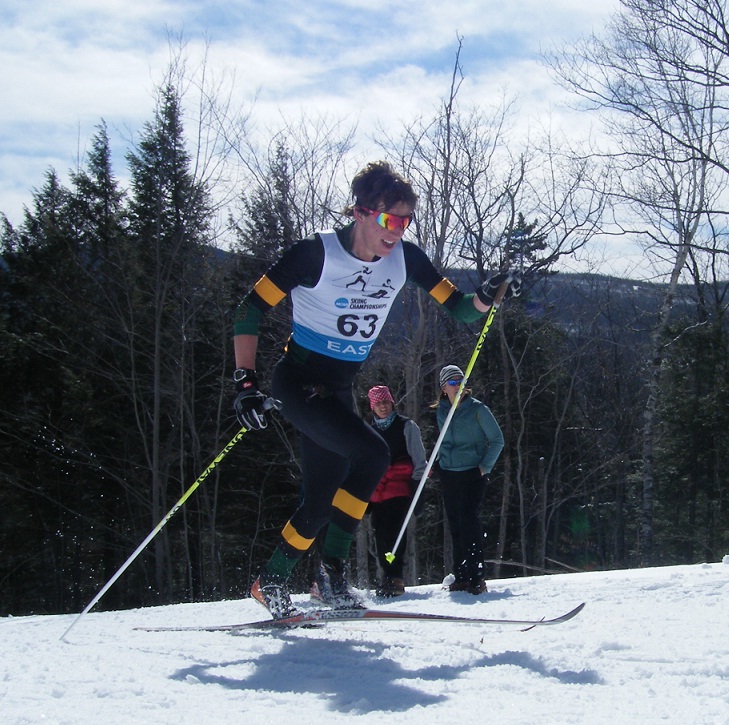
Young Jack Lange skiing in a New England BKL race. (Photo: Heidi Lange)
A kid who wasn’t supposed to be good at this
Lange grew up in Vermont’s Upper Valley, skiing out of Green Woodlands and the Ford Sayre Bill Koch League. It was the kind of childhood that feels almost mythic now: full-moon skis to a cabin, hot chocolate on a frozen pond, friends everywhere.
“I’ve always just made sure that that’s the thing that comes first,” he said. “Getting outside and enjoying being outside and enjoying pushing myself and having fun.”
He played everything. Soccer, where he was very aware he wasn’t the best. Swimming, where he gravitated toward breaststroke. Cross-country running. Mountain biking. For a while, he did both alpine and Nordic skiing, until a choice had to be made.
“My sister was doing more Nordic and more of my friends were on the Nordic,” he said. “So I just went with Nordic.”
Lange and friends meeting Jessie Diggins and Sophie Caldwell Hamilton at the Quebec World Cup. (Photo: Heidi Lange)
It wasn’t a natural fit at first. Lange remembers being the odd kid out on relay day—the one paired with a skier from another team because the numbers didn’t work.
“I wasn’t good at it,” he said simply.
What hooked him wasn’t speed. It was curiosity.
“I really like the amount that you can learn from being out in training,” he said. “Not even structured training—just being outside and having fun. I really enjoy the process of figuring out how hard I can push myself.”
By freshman year of high school, something shifted. He trained more. He paid attention. And suddenly the results were better than expected.
“That was kind of the confidence boost that launched me into, like, ‘Oh, this is something I can do.’”
2019 Junior National Championships in Alaska. Lange finished in fifth place with Dartmouth teammate Wally Magill in first. (Photo: Heidi Lange)
The pressure builds—and breaks
Lange’s junior years were uneven. Seasons were disrupted. Races were canceled. One winter meant nine consecutive weekends racing at Craftsbury, all interval starts—an exercise in patience for someone who loved head-to-head competition.
“I love mass starts,” he said. “I love racing next to people. Mind games and competitiveness.”
By his senior year, he had narrowed his focus to Junior Nationals. The goal was simple: qualify. Nothing more.
When he arrived at the 2019 Junior National Championships in Alaska, he was the last skier to qualify from New England. He started near the back in the 5-kilometer skate race at Kincaid Park.
“My goal for the entire season was to make JN’s,” he said. “And I was there, and I was like, I’m in Alaska. This is kind of crazy.”
Mid-race, a coach called out a split.
“One of the New England coaches is like, ‘You’re like three seconds out of top ten,’” Lange recalled. “And I was like, that’s pretty funny.”
He kept skiing. He finished fifth.
“That was way, way beyond where I ever could have expected to be.”
There’s a photo from that day—Lange among a group of skiers who would later become familiar names on the U.S. Ski Team. At the time, it felt surreal. In hindsight, it was clear it wasn’t the performance itself that mattered most, but the conditions under which it happened: no expectations, no fear.
That lesson wouldn’t fully sink in until later.
Lange with his parents, Heidi and Greg. (Photo: courtesy photo)
Dartmouth, and the weight of wanting it too much
Lange chose Dartmouth largely because it felt right. He wanted engineering. He liked the people. He trusted the coach.
“Brayton [Osgood] is such an amazing coach to work with,” Lange said. “He’s never the guy to show up and be like, ‘This is what you’re doing.’ He’s super approachable. He really wants us to find our spot in the sport.”
At Dartmouth, skiing wasn’t isolated from the rest of life—it was embedded within it. That integration became most visible during the most stressful week of the year: NCAAs, which overlap directly with finals.
“My freshman year, that finals week with NCAAs was kind of a dark time,” Lange said. “I was close to tears on the start line of the 20k race. Just so much pressure, so overwhelmed.”
He remembers warming up briefly, then stopping.
“I skied like fifteen minutes in the warm-up and just put my skis down,” he said. “I was completely broken.”
A kilometer into the race, he was in dead last.
And then something shifted.
“I saw Brayton on the side of the trail,” Lange said. “And I was like, you know—I don’t need to take this so seriously. I can show up, do my best at everything, and give 100 percent effort. If I do that, it’s gonna come through.”
It did. That race became one of his best of the season.
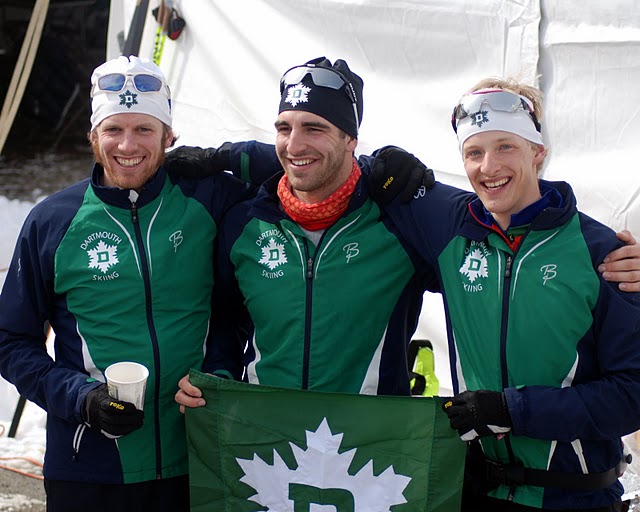
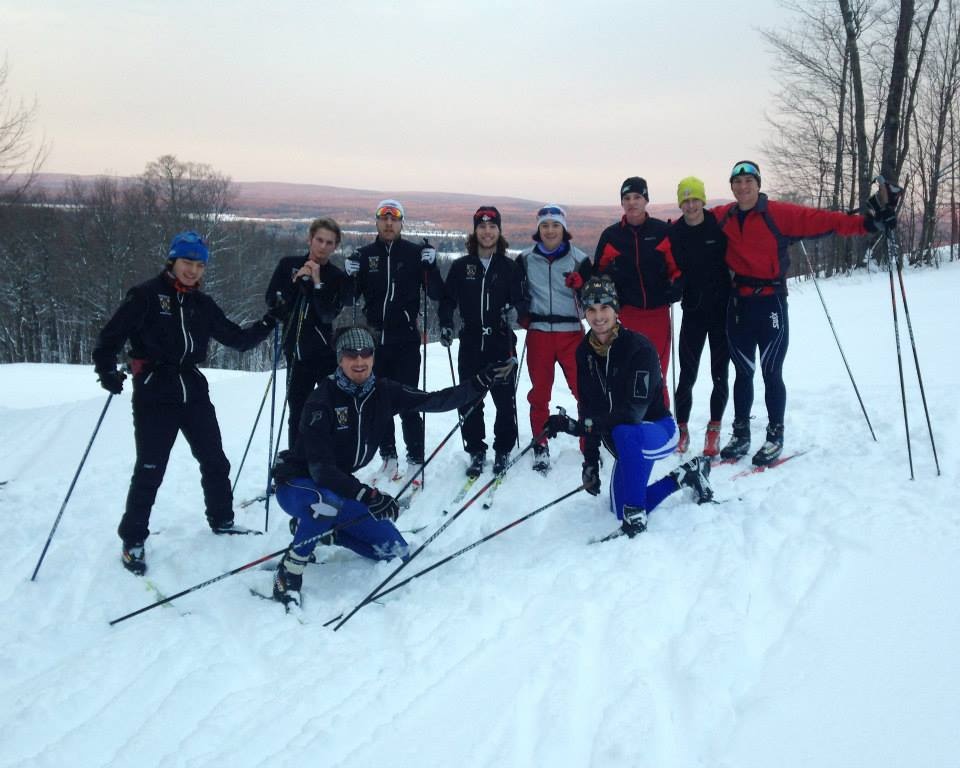
Dartmouth Ski Team (Photo: courtesy photo)
The things that make it lighter
The story of Dartmouth skiing is often told through tradition—green suits, first-years with mohawks, time trials. Lange points to different details.
There’s a sauna in the locker room.
“That’s a prime spot to get to know the team,” he said. “We rip this on all the time.”
There’s also life beyond skiing. Every non-freshman on the men’s team is in a fraternity. Lange lives in the Zeta Psi house with teammates and classmates—engineers, computer scientists, people whose lives orbit entirely different centers.
“I’m surrounded by a ton of people who have no clue what skiing means to me,” he said. “And that’s been a really huge part of being at Dartmouth.”
His best season, he said, came immediately after pledging.
“It taught me how to not put as much pressure on myself,” Lange said. “How to make this a sustainable thing that I could really enjoy.”
That balance—academic, athletic, social—isn’t accidental.
“None of the three would be as good without the others,” he said.
Lange’s favorite race: Prospect relay with Cam Wolfe and Cooper Camp. (Photo: Heidi Lange)
“You can’t live nervous”
Lange keeps a training log. He trains consistently. He admits he’s overcooked himself before. What he doesn’t do is chase numbers obsessively.
“I don’t think I’ve ever had an hour’s target that I’m trying to hit,” he said. “I’ve just trained for the enjoyment of it.”
There was a time, early on, when outside voices crept in.
“I was getting a lot of people saying, ‘You’re training too much. You’re doing this wrong,’” he said. “I got a little worked up about it and a little nervous.”
He paused.
“You can’t live nervous.”
It’s the line that keeps resurfacing, whether he’s talking about high school racing, college pressure, or the future beyond Dartmouth.
“I think anyone who’s in high school, middle school—just go out there because you enjoy it,” he said. “You’re gonna have crappy days. But if you go out there every day and just have a good time, and surround yourself with people you like to be around, things will work out.”
That philosophy shapes how he defines success now. Lange talks about team first. About racing in a green suit. About showing up energized.
“The guys here are here for the right reasons,” he said. “They’re skiing because they really enjoy skiing. That’s super energizing.”
Lange with his long time coach and mentor, Dennis Donahue. (Photo: Heidi Lange)
A quiet kind of confidence
Ask Lange where he sees himself years down the road, and he doesn’t reach for outcomes. He talks about process.
“The process of showing up every day,” he said. “How can I be the best athlete I can be today? That’s the most rewarding thing.”
Skiing, he believes, has taught him how to live—how to work, how to recover, how to stay curious.
“Wherever I am fifteen years from now,” he said, “all of the lessons that I’ve learned are still going to be extremely relevant and important.”
For now, there are finals to finish and skis to pack. The snow will either come or it won’t. The races will sort themselves out.
Lange will keep doing what he’s learned to do best: show up, stay loose, and ski without fear.
Because speed, he’s learned, is hard to find when you’re holding your breath.
Love Stories Like This? Help Keep Them Coming.
Feature stories like this one take time, access, and care to produce. If you value thoughtful storytelling and independent ski journalism, please consider becoming a Voluntary Subscriber. Your support directly fuels the work we do to cover the people, places, and moments that make our sport special.
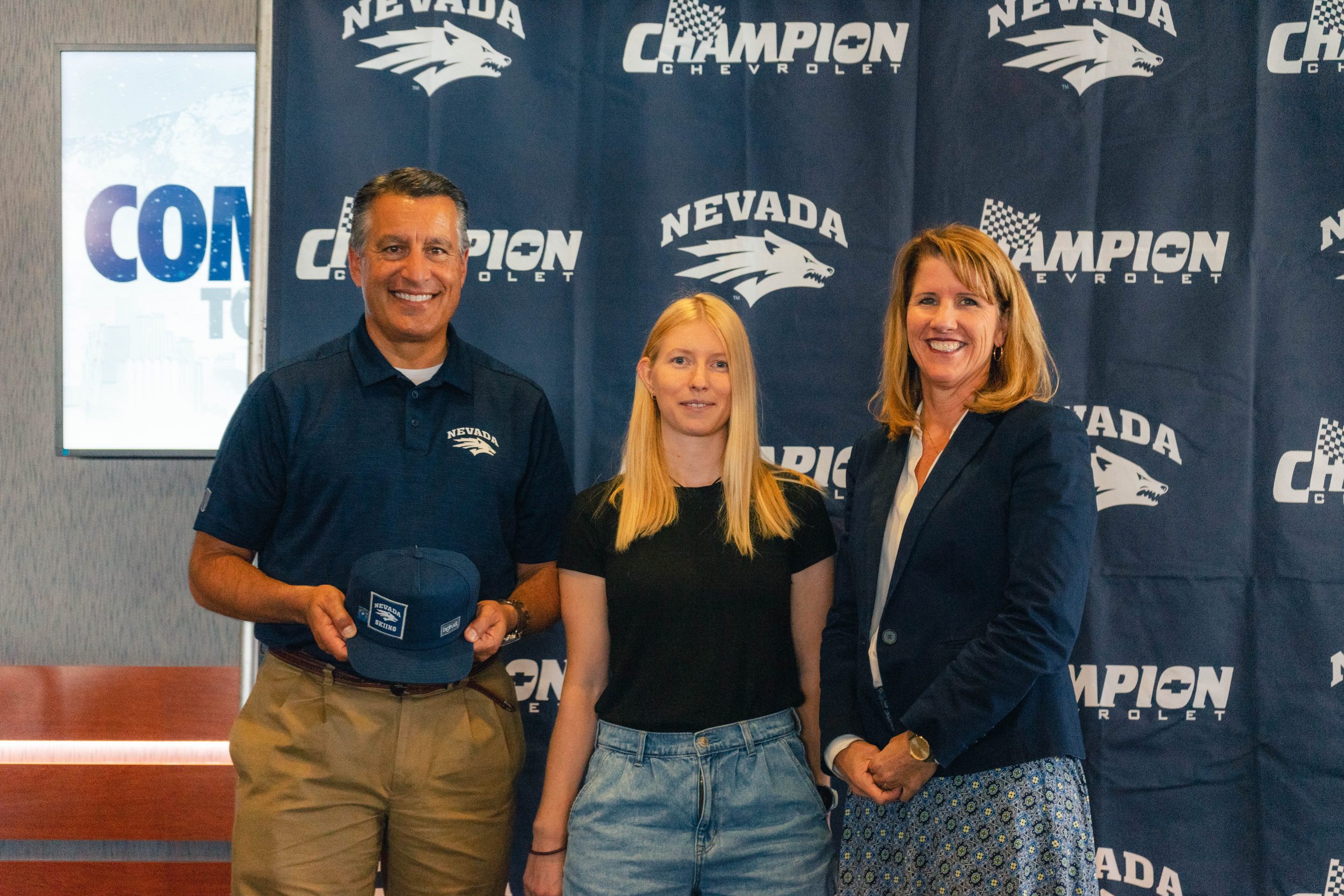
In a press conference on Wednesday, the University of Nevada, Reno (UNR) announced that it will once again support a Division I ski team, starting this season. For the time being however, the program will only have alpine skiing.
Both the president of the university and the university’s athletic director were present for the announcement, marking the moment. “It has been truly amazing to see how much the program’s return has energized our community,” said Nevada Athletics Director, Stephanie Rempe, “We look forward to this new era of Nevada Skiing and continuing the program’s rich, proud tradition.”
University of Nevada, Reno President- Brian Sandoval, UNR Alpine Coach- Mihaela Kosi, and Athletic Director Stephanie Rempe (left to right) (photo: Nevada Athletics)
But they acknowledged that having a nordic team is part of that equation, stating a plan to add nordic as soon as it is feasible (i.e. in the budget).
For many decades, beginning in 1936 when skiing was first established at the University, UNR had a successful team that hosted both cross-country and alpine skiing. Over that time, the program produced four Olympians (including Katerina Hanusova Nash, who represented the Czech Republic at five Olympics, three times in cross-country skiing and twice in mountain biking) and earned 14 top-10 team finishes at NCAA Championships. But in 2010 the ski program was cut.
The reinstatement of skiing at UNR was made possible by the University’s recent acquisition of Sierra Nevada University, which had an alpine team already in place. This season’s alpine roster will be composed primarily of athletes who had previously been competing at Sierra Nevada University, with the addition of a few new skiers and transfer students.
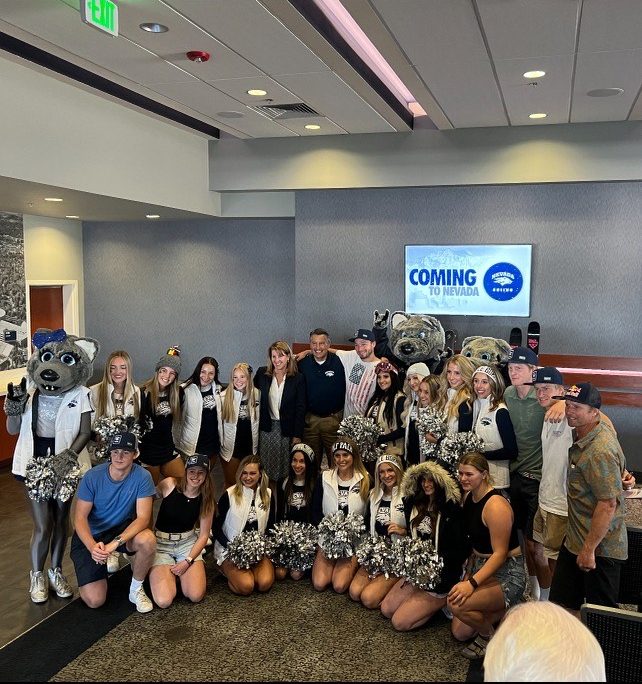
UNR cheer squad, athletic staff, current alpine team members, with Olympians Daron Rahlves, and David Wise at the press conference Wednesday (photo: Gus Johnson)
UNR’s ski team will compete as part of the Rocky Mountain Intercollegiate Ski Association (RMISA), which currently has nine member schools, though only five have both alpine and nordic programs.
“We’ve kind of let it be known to the athletic department that if they want to be competitive on the NCAA circuit, they’re going to need to fit in alpine and nordic,” said Gus Johnson, former racer for the UNR cross-country ski team and current advocate for that program’s return. Johnson is also a member of the UNR Ski Team Boosters and nordic sports director for Auburn Ski Club (ASC).
While there are only a handful of people working to bring back nordic to UNR at the moment, Johnson is hopeful about the future, “Being a Division I school, championships are important to them, so they realize that they need to get nordic started and it’s probably two or three years down the road,” he said.
UNR Ski Team boosters and athletic staff (photo: Gus Johnson)
Athletic programs getting cut from college budgets is not unusual, the University of New Mexico is perhaps the most recent skiing example, but it is less common to see those programs make a return. “It’s pretty rare that NCAA programs get reinstated,” said Johnson, “So there’s a glimmer of hope that nordic will be the next step.”
Readers interested in learning more about the effort to add nordic should contact Johnson.
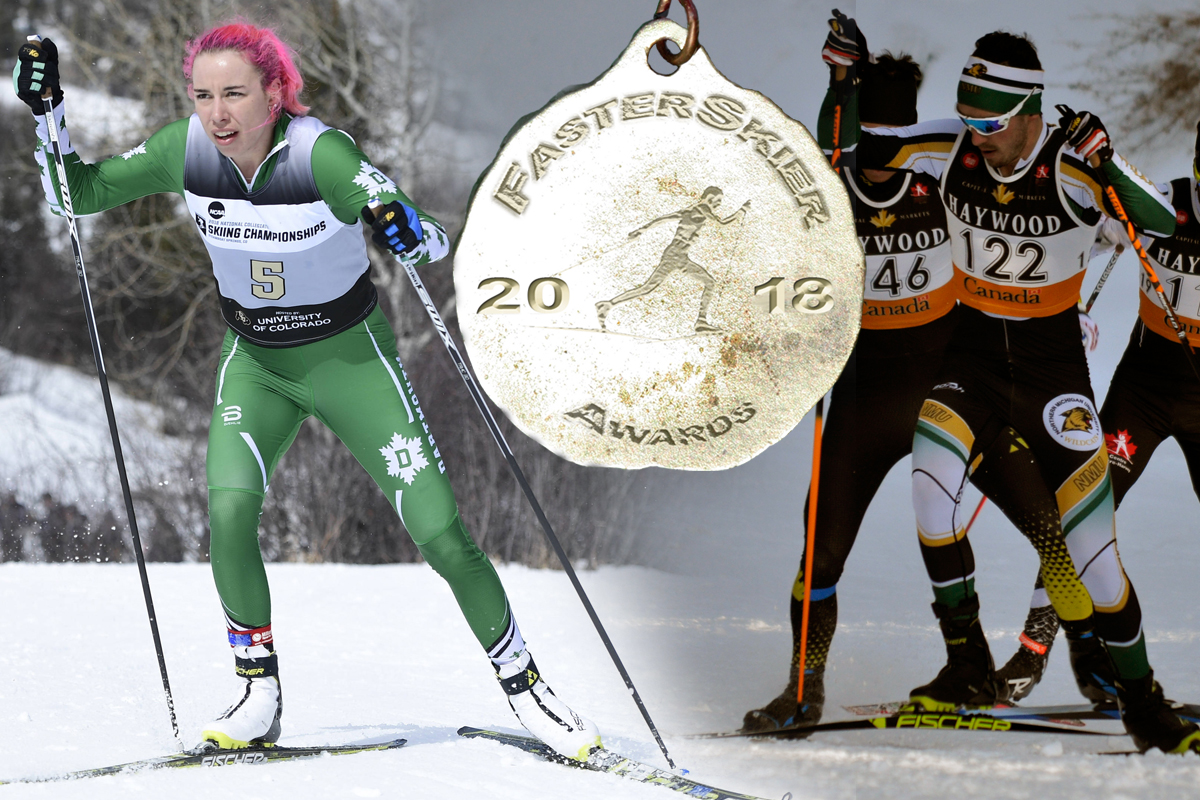
Katharine Ogden (left) and Ian Torchia (right) are FasterSkier’s 2018 Collegiate Skiers of the Year. (Photos: Dartmouth Sports/Clarkson Creative & XTS Photography)
With the 2017/2018 season officially in the rearview, FasterSkier is excited to unveil its annual award winners for this past winter. Votes stem from the FS staff, scattered across the U.S., Canada, and Europe, and while not scientific, they are intended to reflect a broader sense of the season in review. This set of honors goes to outstanding college athletes in cross-country skiing.
***
Katharine Ogden, Dartmouth College
Katharine Ogden skiing fast doesn’t exactly surprise anyone. A medalist in both individual and relay events at last year’s World Junior Championships, the Stratton Mountain alum and U.S. Ski Team “D” team member won half of the women’s races on the Eastern Intercollegiate Ski Association schedule this season, including the final three individual races of the year.
But when the Dartmouth skier swept both races at NCAA Championships, first winning the 5 k classic by a stunning 46.9 seconds, then taking the 15 k skate by 38.4 seconds, that was something else.
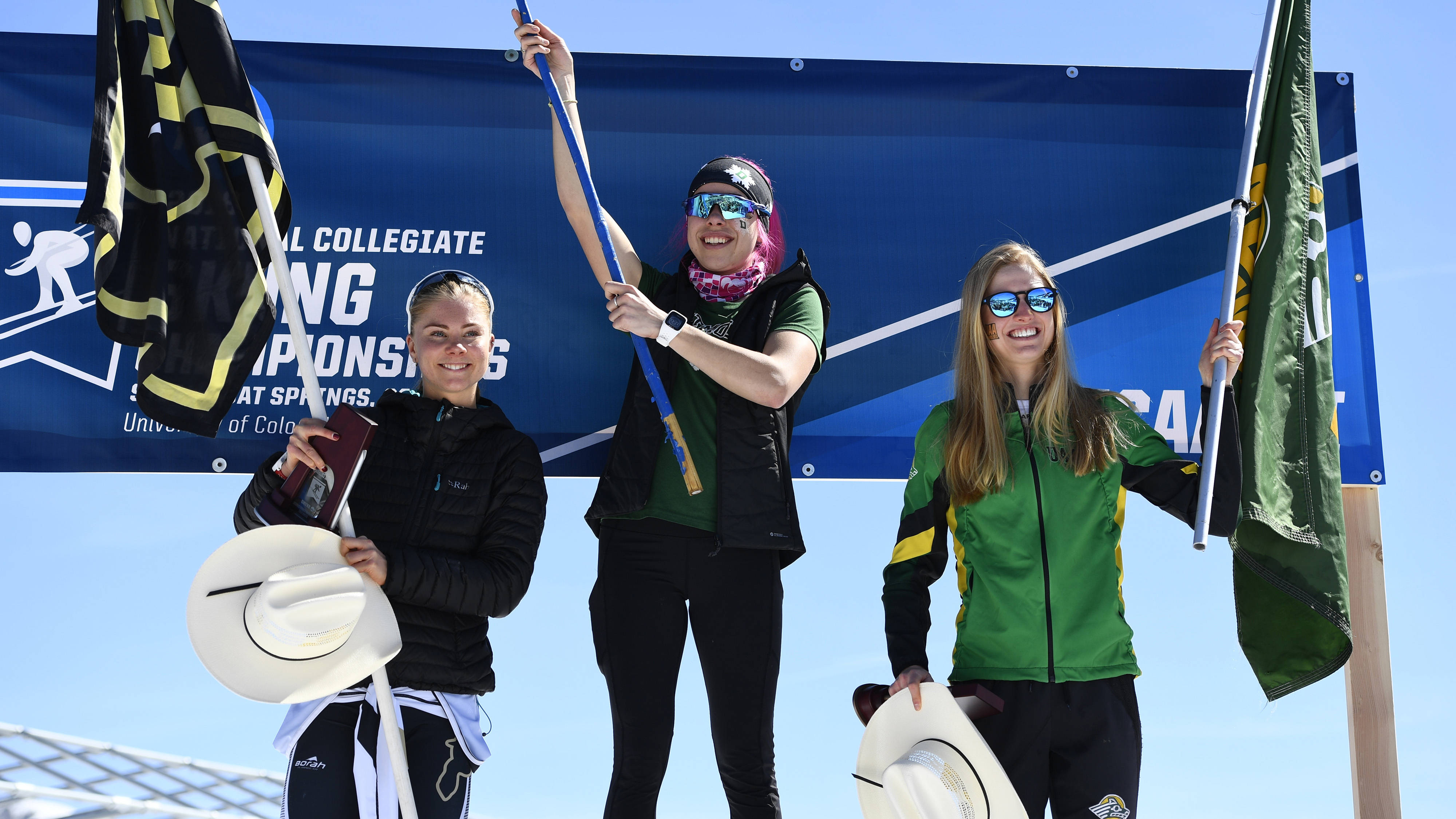
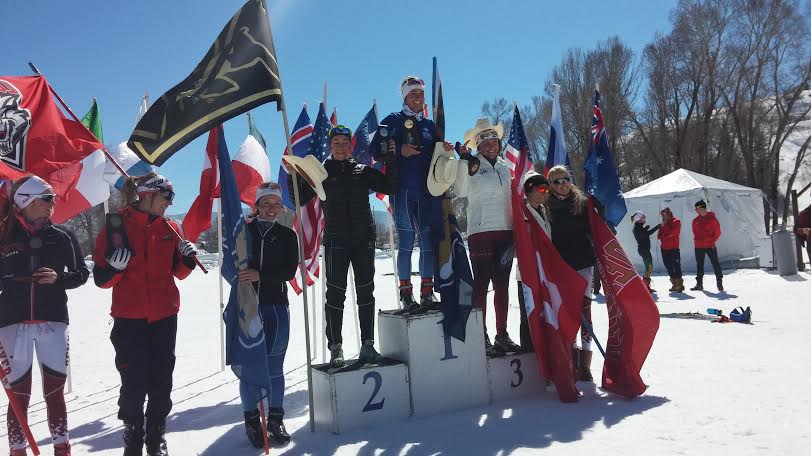
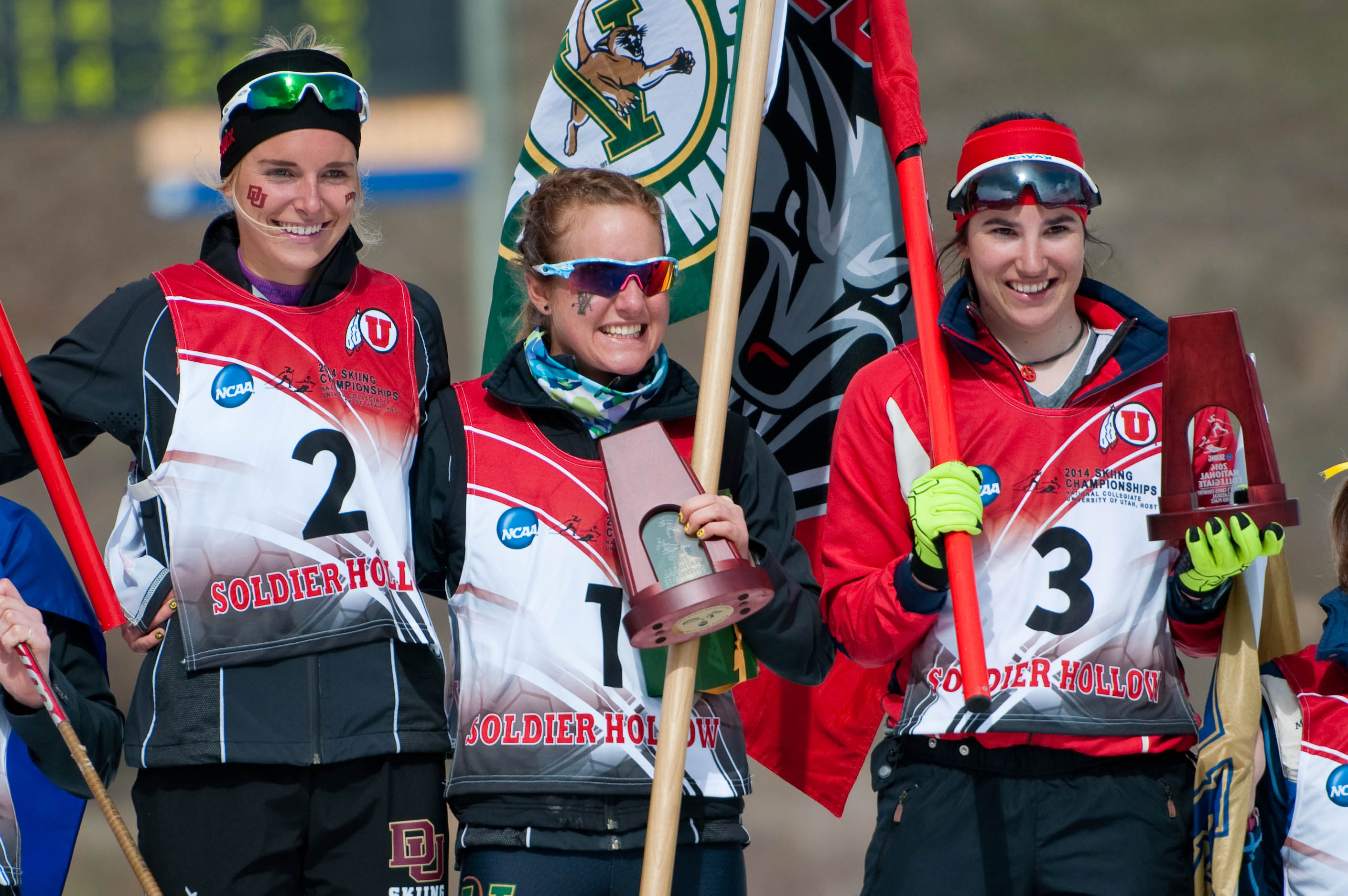
The women’s 5 k classic podium at 2018 NCAA Skiing Championships in Steamboat Springs, Colorado, with Dartmouth’s Katharine Ogden (c) in first, Colorado’s Anne Siri Lervik (l) in second, and University of Alaska Anchorage’s Hailey Swirbul (r) in third. (Photo: Clarkson Creative/DartmouthSports.com)
“I was definitely a little stressed because I didn’t know if I could hold that pace or if they would catch up to me, and it’s usually kind of a sketchy strategy to be skiing by yourself, so I kind of knew that in the back of my mind too,” Ogden told The Dartmouth of her mid-race decision to make a move after the 5 k mark of the mass start, when it then turned out that nobody went with her.
The last time an American topped both women’s races at NCAA Championships was a decade ago, and though both 2007 titles were taken by a Lindsey, they weren’t the same one: Lindsey Williams and Lindsey Weir, both of Northern Michigan University.
It wasn’t since 1990 and 1991, when Laura Wilson of UVM swept NCAA’s, that the same American woman had won both races.
“Katharine absolutely wanted this one, and she really likes to win,” said Cami Thompson Graves, the Dartmouth Director of Skiing and women’s Nordic head coach, in a press release after Ogden’s second title. “She wasn’t about to let a fall slow her down, she has such a great competitive fire.”
Despite Dartmouth’s strong history of women’s skiing – alums Sophie Caldwell, Ida Sargent, Rosie Brennan, and Susan Dunklee competed in the 2018 Olympics alone, with many more alums at previous Games – Ogden was actually the first female Big Green cross-country skier to take an NCAA title.
“One day I would love to be one of the Dartmouth alums racing in the Olympics,” she said in a Dartmouth press release. “A lot of the reason I decided to come here for school had to do with growing up with Sophie Caldwell and seeing what a positive experience she had at Dartmouth.”
Ian Torchia, Northern Michigan University
Likewise, Ian Torchia has been a top junior athlete for the U.S. for some time now. By the time he went to NCAA Championships, he had already been to U23 World Championships, where his 27th- and 32nd-place finishes were the top American results in the 30 k skiathlon and 15 k classic, respectively.
Although he is enrolled at Northern Michigan University and trains there with the team, college racing was not his number one goal this season. Torchia won a 15 k skate NorAm in Sovereign Lake, British Columbia, early in the season in pursuit of those higher goals.
The men’s 15 k freestyle podium on Day 2 of the NorAm opening weekend at Sovereign Lake near Vernon, B.C., with Ian Torchia (NMU/USST D-Team) in first, Jack Hegman (SVSEF) in second, Brian McKeever (Canadian Para-Nordic Team) in third, Kevin Bolger (SVSEF) in fourth (far left), and Adam Martin (Craftsbury GRP) in fifth (far right). (Photo: Peggy Hung)
“My main goal for the season was to have a strong start to the season so I could qualify for U23s and the Olympics,” Torchia wrote in an email last week. “Competing in Yellowstone and Silver Star was a first for me, and coming into Nationals in the first spot on the Olympic qualifying list was exciting and nerve-wracking. Unfortunately, I had some sub-par racing at Nationals and missed the Olympics but qualified for U23s. I was definitely satisfied with the efforts I put in at U23s, but not with my execution and results. Finishing barely in the top 30 was not was I was hoping for but racing alongside guys who have gotten top-10’s on the World Cup was definitely motivating and gave me a real idea of where I need to be and what I need to do to get there.”
Coming back from Europe, he had to re-tool and had a solid training camp in Steamboat Springs before NCAA’s.
There, he finished fifth in the 10 k classic, the top American 46.2 seconds behind race winner Martin Bergström of Utah.
And in the 20 k skate mass start, he took his first NCAA title, holding off Alvar Alev of the University of Colorado by just two seconds, with Eivind Kvaale of Denver University another two seconds back.
“The first two laps of the race were very slow and it took patience to follow Coach Sten [Fjeldheim]’s plan of not leading,” Torchia wrote. “The Denver guys led it out on lap three and started gradually pushing the pace. On the final lap, people started throwing down and I was able to cover moves until 2.5 k to go when I gradually pulled the trigger. Alvar Alev from Colorado went on the final uphill and I was able to hang with him into the 2 k downhill. Coming into the final downhill he slingshotted by me but I was able to overtake him before the final turn and sprint faster than I’ve ever sprinted before for the win! I am not known as a sprinter on our team, so I was definitely nervous with a big group around me. But Sten has always told me that a sea level distance guy can outsprint an altitude sprinter, as training at lower elevation is beneficial to speed training.”
Torchia was the first American in three years to stand atop the NCAA podium; the last guy to do it was U.S. Ski Team teammate Patrick Caldwell in 2015. University of Alaska Anchorage’s Hailey Swirbul said that the international flavor of college racing is fantastic and helps her prepare for international competition and to be a better skier.
But to win NCAA’s as an American is still a perk.
“I definitely did not think about it before the race, but after it was pretty cool to think about the rarity of American winners,” Torchia wrote. “Fun to share it with my buddy Paddy Caldwell!”
Honorable Mention: Zane Fields, Colby College
Colby’s Zane Fields (left) racing at NCAA Championships last season. This season, he became the school’s first cross-country skiing All-American.
And on the men’s side in the East, one of the biggest revelations was the Colby squad. Andrew Egger qualified for U23’s and finished 47th in the sprint there, the second American. (“To be honest, making the U-23 World Championship team wasn’t really on my radar when I decided to go to Alaska [for U.S. Nationals]… That said, my goal standing on the start line of the sprints was to win,” Egger told the Colby sports department.)
On the college circuit, though, it wasn’t Egger who was making Colby history. Zane Fields demolished carnival after carnival, sweeping all five skate races before also winning the final classic race of the eastern season. At NCAA’s, the Colby junior finished sixth in the 20 k skate.
It was the best season-long tally by any Colby skier ever, and that final race made him Colby’s first male All-American in cr0ss-country skiing.
“This season has been a dream,” Fields said in a Colby press release after the 20 k. “If you had told me two months ago that things would unfold the way they did, I wouldn’t have believed you. While the sport is an individual one, I have the greatest coaches and team supporting me through every race.”
As a team, the Colby men finished third in two races this season behind Fields, and had a number of fourth- and fifth-place finishes.
“This has been the most fun year of skiing I have ever had,” Fields said in the press release. “The season is one that certainly makes the 500-plus hours of training and sacrifices worth it. I’m excited to see what my team and I can accomplish next year.”
Honorable Mention: Alayna Sonnesyn, University of Vermont
Those half of the EISA carnival races that Katharine Ogden didn’t win? They went to UVM’s Alayna Sonnesyn, who dominated the first half of the season and won three skate races and two classic races.
Sonnesyn also had a stellar U.S. Nationals earlier in the season, finishing eighth in the skate sprint and sixth in the 20 k classic; all but one of the skiers ahead of her in that race (winner Hedda Baangman of Sweden) went to the Olympics.
Kelsey Dickinson during the women’s mass start at the 2016 US Biathlon National Rollerski Championships on Aug. 14 in Jericho, Vt. (Photo: Katrina Howe)
The Washington native had been training at the Maine Winter Sports Center (now the Outdoor Sports Institute), and had been a member of the U.S. Biathlon Association’s development team. But when team nominations came out in the spring of 2015, she wasn’t on them. At the same time, the Maine Winter Sports Center cut most funding to its senior teams.
With few options, Dickinson headed back to the College of Saint Scholastica, where she had done one year of college already.
“When I left biathlon, part of it was because I just wasn’t skiing fast enough,” Dickinson said in an interview this month. “So I asked how I could keep skiing, one, but also how could I get faster. I realized that going back to college was going to be the best way to do that, but I wasn’t going to be able to go back to college, and do biathlon, and get better at skiing. I decided that I would just ski in college and finish out my eligibility.”
Dickinson still has one year of that eligibility left, but her biathlon career has come back sooner than expected. After strong college results last season, she was accepted into a summer training program at the Craftsbury Outdoor Center in Vermont. This summer, she spent time training with some of the country’s best cross-country skiers as well as having dedicated biathlon training and easy access to a shooting range.
“Our goal for her this year is to make that Olympic team, for sure, but she’s really four years ahead of schedule with it,” Dickinson’s ski coach at Saint Scholastica, Maria Stuber, said.
“Nothing about what’s going on right now is what I expected to happen,” Dickinson, a double-major in philosophy and natural science, said. “I thought that I would make it through this semester and not have to be traveling that much. I’m just going by communicating with my professors on a day-by-day basis and playing it by ear.”
Kelsey Dickinson (St. Scholastica) racing to 26th in the women’s 15 k freestyle mass start at 2017 NCAA Skiing Championships on March 11 at the Jackson Ski Touring Center in Jackson, N.H. (Photo: flyingpointroad.com)
Stuber had only positive things to say about Dickinson’s work ethic and professionalism.
“She was really clear about her goal to be a biathlete, and she has not wavered on that at all,” Stuber explained. “We said, okay, if you want to be a biathlete at the end of college, what needs to happen for you to be in the top few women, not a bubble skier but someone who is going to be on the World Cup? The bottom line was that she needed to ski a lot faster.”
The work Dickinson put in paid off, and last season she ended up ranked sixth in the Central Collegiate Ski Association rankings, the top woman not from perennial powerhouse Northern Michigan University. She has now represented her team at NCAA Championships twice.
“She made some big technical improvements last winter,” Stuber said. “But she was sick from early January, for over a month. She had some really good races but I don’t know if either of us felt like she really got to show her stuff last winter like we thought she could… I think mainly we just made it apparent that she had it in her to go even faster.”
That was enough to get her to Craftsbury. Dickinson had applied to the summer training program the previous year but not gotten in.
“I had a really good summer of training,” Dickinson said. “I’m really grateful to be able to have gone to Craftsbury and trained with the team there. That made all the difference for me, just to be around a lot of high-level athletes.”
At Saint Scholastica, she is the one leading the team. One of the big focuses of going to Vermont was to get Dickinson used to seeing how more efficient technical skiers moved.
Kelsey Dickinson representing the Maine Winter Sports Center at NorAms in Canmore in December, 2014. Her last international biathlon races were at IBU Cups in Canmore in March, 2015, where she twice finished 28th.
“She could sit behind someone and try to figure out how to make skiing easy, instead of always trying to think in intervals of how to make it hard, and how to go harder,” Stuber said. “There’s this awesome mindshift when you’re going hard but trying to make it easy, which you don’t get to do when you are leading so much.”
Stuber herself was a senior athlete at Craftsbury at one point, so she knew head coach Pepa Miloucheva well and was not worried that there would be any problems with Dickinson adjusting to the training approach. (“She was my coach before and I have a ton of respect for what she is doing there — so to be able to work with Pepa as a peer was really cool for me,” Stuber said.)
In addition, Dickinson knew Sam Dougherty, the biathlon coach at Craftsbury.
“Sam and Pepa work together to build the plan depending on what the biathlon schedule requires and what the cross-country athletes are doing,” Dickinson explained. “They try to make it comprehensive so people can train together… I have known Sam for a while because of we overlapped racing a little bit back when I was a junior. And Pepa, her philosophy is very similar to Maria’s. I get along great with Pepa and she has been an amazing coach. I’m lucky that the transition was really easy.”
Dickinson turned in two third-place finishes at rollerski biathlon races in August.
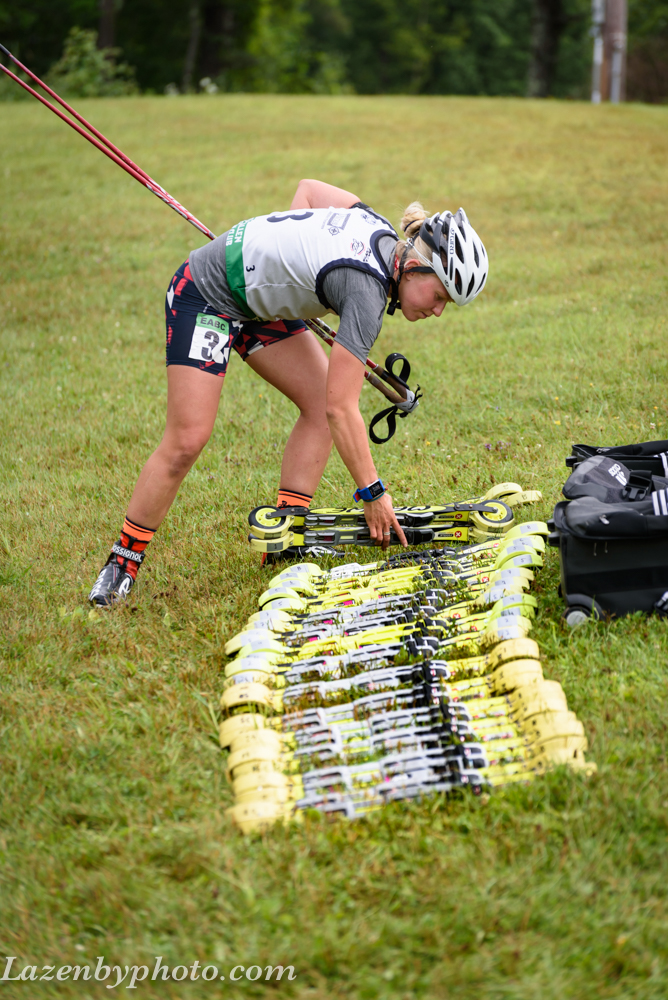
Kelsey Dickinson (Craftsbury Collegiate Summer Team) picking out rollerskis for the women’s mass start on Aug. 13, at USBA Rollerski Championships in Jericho, Vt. She placed third on both days of the two-day championships. (Photo: John Lazenby/Lazenbyphoto.com)
“I knew I was feeling good and that if I put all the pieces together then things could go well, but I wasn’t quite expecting that for sure,” she said.
That put her in a good position to fight for a World Cup spot. Susan Dunklee, who was pre-qualified for the World Cup, had won both races. Dickinson could even afford one less-stellar race when the qualification series wrapped up with two more competitions in October.
Because she was still in school and had options for how to spend her race season – including competing domestically in December, in an attempt to qualify for the IBU Cup in January and from there trying to make the Olympics – she didn’t feel pressure.
“I think actually having school was a little bit helpful in that way,” she said. “I just was looking at the weekend as an opportunity. If things went well then that would be great, but if things hadn’t gone well then I still had a lot of great things going on back at school with the team there… I was in a good place emotionally, just happy to be there.”
At those last two trials races, Dickinson finished second and fifth, and locked up the World Cup spot.
Her goal is still the Olympics. As such, when she gets to the World Cup later this month – she has to first go to the second-tier IBU Cup in Sjusjøen, Norway, and score qualification points – she will focus mainly on process.
While at least one more woman will be added to the Olympic roster based on December World Cup results, the team won’t be filled until January, when several athletes will be sent to the IBU Cup to fight for the last spots. That means that Dickinson can focus on performing well in January, when the season is in full swing and she has some races under her belt, and fight for an Olympic berth there.
“Her process is going to be the most important thing,” Stuber said. “I don’t think she needs to be concerned with what her results are at those first World Cups… if she can use these World Cups to get a really good process dialed in, then when she goes to the IBU Cup she will be really ready to do what she needs to do there to secure an Olympic spot.”
“It was such a huge goal just to get to this point,” Dickinson agreed. “Looking forward I’m just going to approach things as an opportunity. It’s an opportunity for learning, it’s an opportunity to race, to do what I love to do. So I think that in that sense, I obviously want to do well and I want to hold myself to a high standard. But I am just very grateful that I can have this opportunity and I’m very open to what it will bring.”
In the past two seasons, Dickinson bought into college racing completely.
“She tries really hard to be a good captain and sometimes I think that adds to her stress level,” Stuber said. “She just tries to do everything that she commits to, to do it really well.”
But now, she’s back to biathlon.
“If I could come across saying anything, I just want to express how grateful I am to all the people who have supported me,” Dickinson said. “Like Maria and Chad [Salmela], and Pepa, and everyone thoughout the years who have allowed me to get to this point. Because it has been a really long journey.”
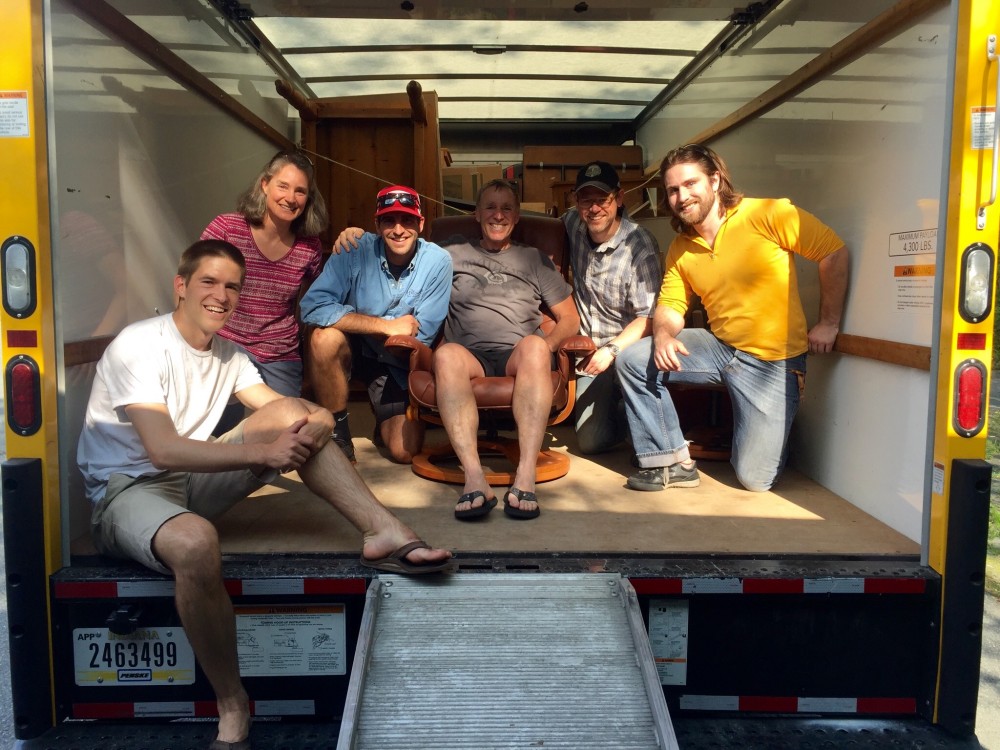
(From left to right) Austin Caldwell ’14, Scottie Eliassen ’90, Sam Tarling ’13, Ruff Patterson, Erik McEwen, and Leif Johnson ’13 in the back of Patterson’s U-Haul last Tuesday, May 24, prior to Patterson’s departure west. (Photo: Sam Tarling)
In late March, Ruff Patterson, 61, announced he was stepping down as head coach of the men’s nordic team at Dartmouth. This is a story of his impact and legacy as a coach, first as a U.S. Ski Team assistant and later at Dartmouth in Hanover, N.H.
“There were no non-heroes out there today.” — Ruff Patterson, after a four-hour rainy run with the Dartmouth men’s nordic team, circa 2007
***
Twenty-seven years ago, a group of men convened in the basement of Robinson Hall, home of the Dartmouth Big Green ski team. Veteran faces intermingled with those of eager newcomers — including the likes of current U.S. Ski Team Head Coach Chris Grover.
Wisecracks and an accompanying chorus of chortles percolated amongst those assembled, drifting up into the stairwell. A few shuffled their feet as they awaited their coach’s arrival for the first fall practice of the ski season.
However, the figure that eventually greeted the gang beneath the building’s floorboards was not that of John Morton — the coach who recruited Grover the prior spring and whom Grover expected to work with during his four years of undergraduate study at Dartmouth.
That autumn afternoon, September 1989, the individual who approached the group was as novel to the Dartmouth ski team as any of Grover’s fellow freshman teammates. With time, however, he would become synonymous with the school’s ski program.
“This was all happening pre-internet, pre-email, pre-mobile telephones,” Grover on the phone of his recruiting process to Dartmouth. “There was never any sort of news release or anything that went from Hanover to where I grew up in Anchorage, that would’ve said, ‘Hey, by the way, John Morton quit and there’s a new coach named Ruff Patterson and he’s going to be taking that coaching place.’ So here I was that following September, expecting to see John Morton show up for practice, when Ruff Patterson rolls in … That was an interesting transition. We were all getting to know somebody new on the first day.”
The Patterson Siblings, Sun Valley and the USST
“You gotta love it!” — Ruff Patterson on skiing, racing and training with the Dartmouth men’s nordic ski team, circa 2013
Situated nearly 6,000 feet above sea level, the city of Sun Valley, Idaho, holds a unique history as one of the first destination ski resort areas in America. Famed names such as Dick Durrance, Ernest Hemingway and Picabo Street have carved the region’s mountainside slopes and the locals’ love for skiing, particularly alpine, goes almost unparalleled.
Ruff Patterson coaching with the U.S. Ski Team in the 1980s. (Photo: Gordon Vermeer and Eric Packer)
This held especially true for Susie, Pete, Barbie and Matt Patterson, Ruff Patterson’s four younger siblings. Surrounded by Idaho’s Sawtooth Mountain Range, and with support from their parents Joannie and Jim Patterson, all five developed a deep devotion to skiing. To many in the community, they became known as Sun Valley’s “First Family” of skiing.
In a way, however, Ruff was the ‘black sheep’ of the household. Susie became a two-time national champion alpine skier, Pete qualified for the Winter Olympics in downhill skiing twice, and both Barbie and Matt established themselves as adept alpine skiers. Meanwhile, Ruff chose a slightly different ski path than his siblings. He chose cross-country.
“[In] high school, I had a brother and sister who were both traveling, very young, for the national alpine team and I was kind of the guy in the background helping them get through school and fixing skis and stuff like that,” Ruff said in a phone interview in April, shortly after he announced his retirement from Dartmouth. “Contact with people, having to deal with traveling and and competing started really young for me, but [ski coaching] was not something I planned on doing after college.”
As a student enrolled at the University of Colorado Boulder (CU), Ruff originally intended to become a doctor. He placed himself on the pre-med track and graduated with a degree distributed in the fields of biology, chemistry and psychology. Ruff also competed for the Buffs’ ski team. During his undergraduate years, CU won four NCAA Championship titles — though in his senior year the title, ironically, ended in a two-way tie with Dartmouth.
Despite his initial plan, post-grad life did not leave Ruff pouring over MCAT entrance exams or medical-school applications. Instead, he found himself back in his beloved hometown, ski coaching with Rob Kiesel, the founder of the Sun Valley Ski Education Foundation (SVSEF) nordic program.
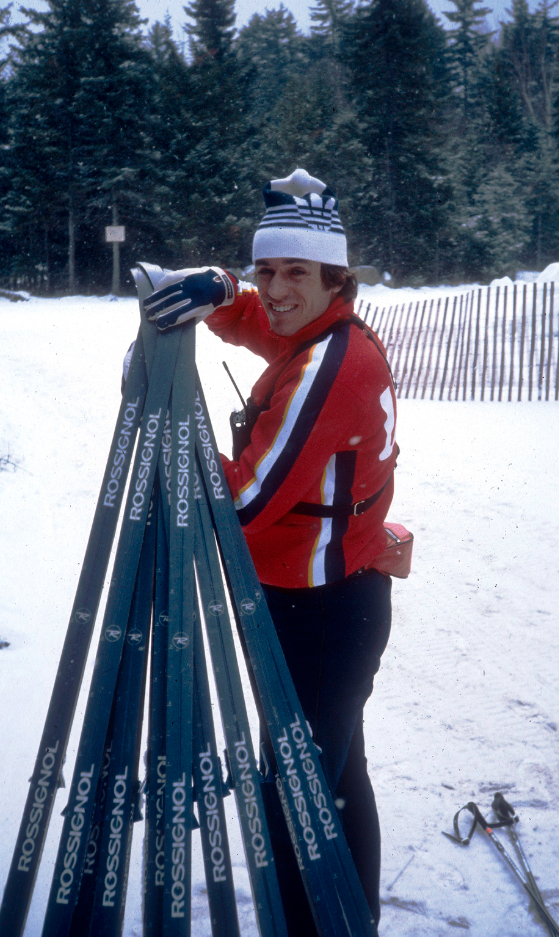
The first few years of coaching for Ruff were far from glamorous. He spent most of his time supporting the SVSEF junior racing team and acting as a professional porter and nordic roadie for the U.S. Ski Team (USST).
“Rob hired me as the national team coach, and you know when you start out, you’re carrying a lot of ski bags and traveling a lot,” Ruff said. “Those first years I was traveling internationally with the team and just doing a lot of the groundwork. I don’t think a lot of the groundwork has changed for those poor guys. They earn every cent.”
Kiesel, the man who hired Ruff, influenced Ruff’s path into coaching. As Ruff put it, Kiesel was more than just a family friend. Kiesel was Patteron’s role model and mentor.
“I wouldn’t be coaching today, nor begun coaching if it weren’t for Rob,” Ruff previously wrote in an email after Kiesel passed away in 2011. “Both my sister Susie and brother Pete wouldn’t have had the Alpine skiing careers they had if it weren’t for Rob. My brother Pete wouldn’t be guiding in Greenland or Nepal if it weren’t for Rob. More importantly, Rob was an integral part of our family.”
As Patterson’s grip on the nordic race world grew, he began to move up in position and expertise. For 10 years, he worked for the USST, a better part of those alongside Mike Gallagher. While co-coaching with Gallagher, Ruff assumed the role of “primary assistant” coach to the USST, often working with the women.
Rob Kiesel, Patterson’s coach, showing off his downhill skills at Winter Park in 1964 (Photo: Harald Bjerke)
“[Mike Gallagher] and I would worked really closely together and I was sort of his primary assistant as the year grew on,” Ruff said. “When we’d split up, I would end up taking the women and there were a few years where I was actually labeled the women’s coach. But for the most part, he and I were more of a team and I was more of his assistant during my primary coaching year.”
Ruff’s stint with the USST brought him to the Olympics, alongside Kiesel at the 1980 Winter Olympics in Lake Placid, N.Y., and with Gallagher at the 1984 and 1988 Games in Sarajevo, Yugoslavia and Calgary, Alberta, respectively. He mentioned working alongside U.S. Ski Team coaches Torbjørn Karlsen and Peter Ashley as major influencers in his career as well.
His work for the USST helped women like current Methow Valley Nordic Team head coach, Leslie Hall –the sister of Patterson’s future Dartmouth College co-coach, Cami Thompson-Graves — to the Olympics.
“He was one of the main coaches at the 1988 Olympics, my first Olympic experience and the main memories that stick with me are his smile, laugh and bad jokes!” Hall wrote in an email. “My relationship with Ruff has evolved so much over time, from being an admiring junior who wanted his attention and help, to being a friend on mountain biking trips to Moab, to being the sister of his co-coach at Dartmouth.”
He also helped current Middlebury College assistant coach and University of New Hampshire alum Patty Ross, and Bates College alum Nancy Fiddler to Olympic levels of racing.
“Ruff was always there with a joke or someway to diffuse a tense situation,” Fiddler said on the phone. “Everybody gets so caught up in [skiing] and if you were feeling kind of involved in a way that wasn’t healthy, he just brought you back and reminded you that, ‘Hey it’s ski racing it’s supposed to be fun, and if you’re not having fun, what the hell are we doing.”
Changes To Hold Onto: Skating and the Mental Breakthrough
“Weight shift, weight shift, that’s the key.” — Ruff Patterson during a skating technique workout with the Dartmouth men’s nordic ski team, circa 1989
Little did Bill Koch know that when he entered Sweden’s 1980 Worldloppet marathon, he would rock the ski world forever. During that winter’s fated 50-kilometer ski race, Koch witnessed what has since become a staple in cross country skiing: the skating technique.
After Koch began to implement skate skiing into his own national and international races, the sport changed forever — a change Patterson perceived first-hand.
U.S. cross-country legend Bill Koch pioneering the skating/freestyle technique in the ’80s. (Photo: Peter Ashley)
“I was incredibly fortunate to live through the skating revolution,” Patterson said. “To see the live world change, everybody else’s world change and how people react to that, that whole thing was, man, something to live through.”
“You can sort of compare it to — right now there’s this big double poling thing,” he added. “Skating was very much the same thing. It was a complete unknown. So for everybody, including sports staff like myself, it was like, ‘What’s going to happen here?’ ”
What happened was rattling to some and rectifying for others. Patterson pointed out that he saw many attempt to prevent the change, but the skating technique, ultimately was here to stay.
“You know, they were trying to do everything possible to make it less possible to skate,” Patterson said. “A lot of the controls they tried were almost laughable now.”
As Patterson sees it, there are certain circumstances when evolution of the sport is inevitable. Occasionally, adaptation outweighs resistance.
“What I’ve discovered during those periods is … if you’re here to play the game, you have to figure out a way to go with it,” he said.
Skating and double poling aren’t the only areas Patterson says he has seen development in skiing. To Patterson, the mentality of American ski racers is what has changed the most. Especially for the U.S. women.
“When Kikkan [Randall] opened the door, the barrier, for Americans to do well in Europe, I think the whole mental game changed,” Patterson said. “I’m hoping that this mindset moves into the boys’ group [in the U.S.], that mentality of just, ‘Hey, we can compete and win against the big boys and the big girls.’ That’s probably one of the most significant changes I’ve seen since I’ve started coaching.”
Dartmouth Dudes and Loving What You Do
“Boys, I want medals!!” — Patterson to the Dartmouth men’s nordic ski team, circa 2012
Freezing rain. Mosquitoes. Heavy, humid heat. The Northeast Coast makes many westerners go weak in the knees. Patterson was one of them. Located in the heart of Hanover, N.H., a move to Dartmouth promised Patterson the very bipolar weather, bug bites,and Vitamin-D deficiency he dreaded the most.
Ruff Patterson discovered that the eastern biking may make up for his dislike of East Coast climate. (Photo: Dartmouth Ski Team Facebook)
“When I first took the job I was a western guy and I thought, if I lasted three or four years I’m going to be lucky,” Patterson said. “I was terrified of bugs and humidity and once I got here the bugs and humidity were terrible, but then I realized that the road biking and other stuff in the East were just incredibly great. But I never planned on being here as long as I did.”
Patterson’s original estimated three-to-four-year window turned into seven, soon 11, and eventually 27. Overcoming his fear for East Coast climate was only part of it. His deepening devotion to the Dartmouth men’s team also drew him to stay.
“I just kept saying over and over again ‘I love what I do,’” he said. “Just absolutely love what I do and I just felt that it stayed like that all the way through.”
Patterson’s philosophy to love what you do and see it through transferred to his athletes. During his 27 years at Dartmouth, he coached three men to individual NCAA Championship titles — Glen Randall in 2008, Sam Tarling in 2011, and Patrick Caldwell in 2015 — and he also helped Dartmouth to an NCAA team title in 2007, with All-American athletes Mike Sinnott and Ben True.
“When I came in as a freshman, I was very hesitant to fully buy into his philosophy of training,” Tarling, a 2013 grad, wrote in an email. “After my first year working with Ruff, our relationship strengthened and I decided to stay in Hanover for the summer and work with him. I discovered that some of the silly things we did in training had the most influence on my performance, and that what seemed like random workouts and drills had a purpose. I ended up staying every summer after that to work with Ruff.”
Tarling was not the only athlete who at times questioned some of Patterson’s practices. Both Grover and Carl Swenson, a 1992 graduate and three-time Olympian, recalled recovery runs with Patterson as conclusively easy, in spite of athletes’ attempts to do otherwise. Patterson wanted his skiers to be fast when they needed to be and to step back and enjoy training the rest of the time.
“We’d go out for a ‘Ruff Waddle’ recovery run,” Swenson said. “Ruff would make us run behind him. It was to teach us to go easy … because all we wanted to do was race every workout.
“He was just the right coach at the right time for me,” Swenson added. “He kept me at it, really. I think it’s a period where a lot of people get interested in other things and, as everybody knows it takes some time to develop as a distance athlete, and he really kept me on track as best as anybody could have in a period when I was not on track by any means.”
Gaining credence with athletes like Tarling and Swenson and witnessing their progress, for Patterson, was another piece of what made college coaching worthwhile.
Just a few of “the kids” as Ruff Patterson (not shown) calls them (left to right): Nils Koons, Sam Tarling, and Eric Packer (Photo: Ruff Patterson)
“Winning over athletes and gaining their trust, I can’t tell you the rewards behind something like that,” Patterson said. “That’s just another piece of this overall puzzle, but sort of everything. Once again, it’s the people and stories behind them that have made it for me.”
Though Tarling, who is now working as a software engineer in Denver, Colo., indicated he’s “happily enjoying being a recreational athlete for a change,” he still feels indebted to Patterson for all that he’s helped him achieve.
“Our relationship began with many conversations about how we could best work together to help me achieve my goals in ski racing, but progressed to the point where Ruff was much more than my ski coach,” Tarling wrote. “He was – and is still – my mentor, my confidant, my hero, my friend.”
Patterson was much more than a coach to many of his athletes. He was a pillar, the adviser and ally searched for not only on the trails, but off them as well. He did not force his athletes to grow. He fostered them to take the steps on their own. As numerous athletes indicated, his door was always open to whoever happened his way.
“Ruff impacted my life on so many different levels beyond skiing,” Patrick O’Brien, current head coach for Stratton Mountain School T2 Team and 2010 graduate, wrote in an email. “He wanted you to grow as an athlete and an individual. He was always there for support when you needed him but understood many decisions or choices had to be yours alone to make. He asked for, and brought out the best people had to offer.”
Patterson did bring out the best people had to offer, but in ways beyond just results. He saw value in every athlete, carnival circuit caliber ski racer or not.
“The guy who never makes it, the ones who just make these incredible strides … the really talented guys,” Patterson said, “All athletes are rewarding.”
Ruff Patterson on Mt. Moosilauke in New Hampshire’s White Mountains with the Dartmouth team (Photo: Gordon Vermeer and Eric Packer)
Patterson’s ability to work with athletes of all kinds, stems from his coaching style. Passionate, patient, perceptive, he held the unique capacity to turn the complexities of cross country skiing into common sense.
“Ruff has that elusive quality you see only in the very best of coaches — he makes skiing seem simple,” Packer, who graduated in 2012 and is now racing for Alaska Pacific University (APU), wrote in an email. “He has the ability to use just a single suggestion to make really dramatic improvements in your skiing.
“Hand in hand with that, Ruff really believes in the importance of building a quality training group, and holds that at the core of his coaching philosophy,” Packer added. “You learn from the group, push the group, and rely on the group. In an atmosphere like that, when everyone is working together, pushing each other in a competitive but also fun atmosphere, everyone improves.”
Humor and having fun was also a training philosophy greatly prized by Patterson.
“I call them the kids.The gang. The team. I’ve been so lucky to be able to work with these guys. Even the ones that have been nightmares, looking back that’s what’s kept me here. The people, for sure.” — Patterson on his 27 years as the Dartmouth men’s nordic head coach
“One of my favorite memories started about midway through my time at school when he would finish every pre-race meeting with a story from his previous coaching experiences,” O’Brien wrote. “All would have you rolling over laughing and reminding you that although the sport may change over the years, the spirit of it never did. It made you feel connected the people who have come before you, understanding the challenges they faced were the same as the ones in front of you now.”
However, Patterson’s impact on the nordic community cannot be pinned solely to skiers he worked with directly. As Sinnott pointed out, numerous of individuals have been influenced by the former Dartmouth head coach, whether he realizes or not.
Ruff Patterson
In two words or less… “A Mentor” — Thompson-Graves “Unassuming” –– Tarling “Wise” — Tarling “Passionate”— O’Brien “Remarkable”— Sinnott “Solid”— Grover “Supportive”— Grover “An Icon”— Packer
“You go through his office and he’s got handwritten thank you notes from John Nystad from when John Nystad was skiing for UVM [University of Vermont],” Sinnott said on the phone. “Ruff had these powerful impacts on skiers that he wasn’t even mentoring or that weren’t in his program.”
With the women too, Patterson was — and still is — a hit.
“Ruff used to get more Valentine’s Day cards than anyone else on the team,” Sinnott reflected, referring to the Dartmouth Carnival tradition of ‘Carni Crush.’ “Everyone on the circuit felt the warmth and the magnitude of Ruff. And that’s the cool thing. It’s not just the people that are obvious on a piece of paper, but it’s everyone else that might have glossed by him.”
While many of Patterson’s athletes cite him as the reason they are where they are today, Patterson is adamant that his athletes are the ones who’ve kept him in the game.
“I call them the kids,” Patterson said. “The gang. The team. I’ve been so lucky to be able to work with these guys. Even the ones that have been nightmares, looking back that’s what’s kept me here. The people. For sure.”
Dartmouth’s Dynamic Duo: Patterson and Cami Thompson-Graves
“Are we having fun yet?” — Patterson to the Dartmouth men’s nordic ski team, circa 2010
Bonnie and Clyde. Ernie and Bert. Starsky and Hutch. Cami and Ruff. While not many modern day duos find themselves in competition with the infamy of the previous pairs, Cami Thompson-Graves and Patterson are two that do.
In a coaching partnership that’s lasted longer than some marriages, the two have carried each other through the numerous highs and lows of coaching a Division I college ski program.
“We’ve been together longer than most people have been married,” Patterson said. “We’ve definitely had our ups and downs, but because of it, the two of us have become incredibly close.”
Though the two admit they’ve spat like siblings at times, they also agree that what they have gained out of their 27 years together is irreplaceable.
“She’d be the first one to tell you, it’s not like it was all wine and roses the whole time,” Patterson said. “ It’s just we’ve been through a lot together.”
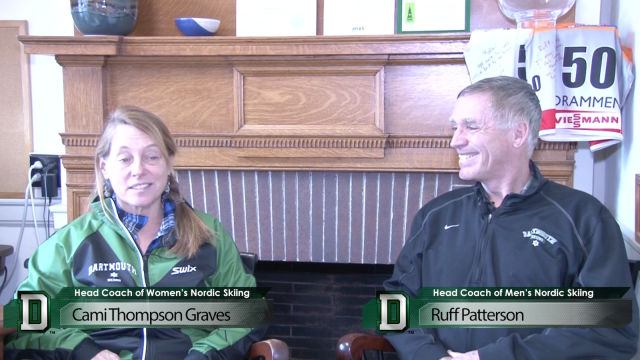
Dartmouth’s longtime duo Cami Thompson-Graves (l) and Ruff Patterson during a 2015 interview .(Photo: DartmouthSports.com)
The two have also supported each other — and their teams — through the loss of Dartmouth athlete, teammate and friend, Torin Tucker. Tucker, who died of a heart anomaly while competing at the Craftsbury Marathon two years ago, was also from Sun Valley and described by many as having a similarly contagious smile.
A rare verve to come across, no loss the magnitude of Tucker’s is easy. For Patterson, learning to live in the memories and moments of Tucker as the epic adventuring, intellectually curious and compassionate mountain town-er he was, no matter the time it took to get there, helped he and the Dartmouth community move forward with Tucker in their hearts.
“There’s no way you can tell somebody to get over stuff,” Patterson said. “You just have to deal one day at a time, one minute at a time.”
The support and history between Thompson-Graves and Patterson, therefore, goes far beyond just van rides, wax benches, and debates over who’s who.
“We had some great moments, talked about skiing endlessly and also fought and bickered like siblings at times,” Thompson-Graves wrote in an email. “But, along the way, there were many fun race days where we worked hard, shared our nerves, and when things had to come together, they did!”
More than anything during their time together, Thompson-Graves was a firsthand witness to the dedication Patterson put towards his athletes and coaching.
“Ruff loved his guys, they meant everything to him,” Thompson-Graves wrote. “He was there, day in and day out and knew them all well. Some of them might have driven him crazy but, even with the frustrations, he loved the times when it all came together for them.”
All in all, it takes a special circumstance for two individuals to work together toward a common goal for that length of time.
“When you sum it up, I wouldn’t have traded that for anything,” Patterson said. “Because being able to figure out a way for two quite different people to work together and do as well as we have done together … boy, that doesn’t happen very often in life.”
What’s Next?
“Don’t overthink it.” –Ruff Patterson to the Dartmouth men’s nordic ski team, circa 2006.
Forty years ago, Patterson — clad in a black graduation cap and gown — strolled across the CU stage to receive his diploma. Like many of the student athletes he would eventually coach, he had post-college plans that would inevitably change, a passionate fervor for cross country skiing, and an anything but linear trajectory ahead.
Forty years later, with his final cohort of college senior skiers before him, not much has changed. As Patterson departs Dartmouth, there is a piece of him that feels as if he is once again striding across the graduation stage, leaving school behind to discover what’s next.
“It wasn’t until the day before I resigned that I actually knew I was going to do it,” Patterson said. “I didn’t sleep that night, I can tell you that much.”
“It sort of feels like I jumped off a cliff doing this,” Patterson said of his resignation. “I was in a little bit of a shock for a few days, but I’m going to sell my place here, pack up a U-Haul and return west, which I’ve been wanting to do forever. And then stir the pot up a little bit and try to find something else to do. I have no idea what that’s going to be. I feel like a college kid again.”
2015 NCAA Champion Patrick ‘Paddy’ Caldwell (l) with coach Ruff Patterson. (Photo: Dartmouth Ski Team Facebook)
Even if Patterson is now physically distanced from Dartmouth — he headed west last week Tuesday — his legendary role and presence is not. His impact extends beyond Dartmouth, into the lives of past, present and future mentees — some of which he will never meet in person. Many he will have infiltrated with his coaching philosophy alone.
“Ruff was really responsible for creating that atmosphere with the [Dartmouth men’s] team, in terms of camaraderie he created in the group,” Grover said. “And certainly, as you know, that’s a big thing for us these days with the USST. The team and the athletes are quite successful on an individual basis because we tend to try to build a family atmosphere around the team. Ruff really did the same.”
Patterson’s stamp survives in the USST, the skiers who are now software engineers, lawyers, coaches, writers and more.
“You know, I came into a great group early on,” Patterson said of his first few years coaching at Dartmouth. “It took a while to establish my own style. It doesn’t mean that the style that Mortie [John Morton] had way back when was, there’s no way you could say it was bad or good … I absolutely know that the next person that’s going to come in in my place is going to be exactly the same; have their own style … I got to put my stamp on things and the next person here is going to put their stamp on things.”
Semi-uncertain of what his future holds beyond bike trails, mountain towns, and some RV roaming, Patterson is certain that Dartmouth has green grass ahead and he, a wanderlust for western blue skies.
“I know they’ll find somebody good,” Patterson had said of prospective coaches for the Dartmouth head coaching position, prior to the hiring of Brayton Osgood in May. “And I know that the school will always support skiing … My personal opinion is that they’re going to just keep going and there’s nothing wrong with that … Field of dreams.”
Linn Eriksen of the University of Denver celebrates her win in the women’s 15 k classic mass start at the 2016 NCAA Skiing Championships in Steamboat Springs, Colo. (Photo: Jamie Schwaberow/NCAA Photos)
In March, FasterSkier recently published an article (Part I) on college ski racing in the U.S. and what a change to National Collegiate Athletic Association (NCAA) Championships might require in regards to adding a sprint race. In the second part of the series, we explore why men’s and women’s race distances are different at the collegiate and World Cup level and whether this constitutes a need for change.
***
Men | Women. Women | Men. Scanning the athletics webpage for an American institution of higher education that boasts a varsity sports team becomes a sail down the Casiquiare canal, with gender bifurcation an obligatory outcome.
Resting under the canopy of NCAA sports, however, nordic skiing presents itself as somewhat of an anomaly. Shared race days. Shared coaches. Shared course site. Shared team. At the surface level, gender in collegiate nordic skiing is almost arbitrary.
Olivia Amber (r) of Colby College and teammate Amy Bianco celebrate their top-20 finishes in the women’s 15 k classic mass start at the 2016 NCAA Skiing Championships in Steamboat Springs, Colo. (Photo: Colby.edu)
Yet, closer inspection reveals one particular area in collegiate cross country skiing where the genders differ: Race distance. In most individual nordic events at the college level, the course length of women’s and men’s races are not the same. The trend is a 5-kilometer deficit for women’s race events in comparison to men’s events.
For Molly Peters, the head nordic coach at Saint Michael’s College and former NCAA All-American in nordic skiing for Middlebury College, this is a problem.
“We’re sending a message to all the young women who have a goal to ski in college,” Peters said in a phone interview. “I just can’t imagine that they feel like their equal as people or athletes when they look and they see, ‘Oh, look every single race I’m going to be skiing 5-kilometers less.’ How are men every going to look at women equally and how are women ever going to look at themselves as being equal if you’re always skiing 5-kilometers less?”
With that in mind, Peters promised herself to reshape the sport.
“It had to be my mission in life to get it changed,” Peters said. “I feel like my best bet to get it changed is to change the NCAA Championships because everyone bases all their racing off of what the NCAA does. Every EISA [Eastern Intercollegiate Ski Association] Carnival is basically not equal because they follow whatever the NCAA does. It all trickles down.”
The Trickle Effect: One Theory on Why Race Distances Differ
A single change can create countless more. When Title IX was passed in 1972, a change was instituted in the treatment of both genders by federally funded college institutions. Within the realm of campus athletics, the alteration brought about numerous others, including an increase in the number of women participating in college sports, the scope of sports available to women and men (in certain instances, harmfully so), and perceptions of women who choose to ‘play.’
Recent Middlebury College returnee, Annie Pokorny, points out that this sort of ‘trickle down’ change should not be looked at lightly.
“When women entered sport, some rules were tweaked to account for physiological differences, but also to support the idea that athletics could be harmful to women, (particularly their reproductive systems,” Pokorny wrote in an email.
Pokorny is completing her undergraduate senior thesis on feminist philosophy and the philosophy of sport. While she admits she is not an expert, her studies and experience in nordic skiing quantify her knowledge on the subject.
Pokorny explained that myths surrounding the female body and exercise in the 20th century, caused men “to adjust sport to make it safer and more “womanly”), which turned into a conceptual connection between women and the need to protect them.”
“That conception turned into tradition, one that still thrives today in the form of shortened distances for female endurance athletes,” Pokorny added.
The top 10 in the women’s 5 k freestyle race at the 2016 NCAA Skiing Championships in Steamboat Springs, Colo. (Photo: Matt Johnson/MSU)
For Pokorny and Peters, these types of traditions were made to be broken.
“The best things that have ever happened are from people changing tradition,” Peters said. “My purpose is to get the NCAA Championships changed to be the same distance for men and women because that will trickle down to the smaller races.”
But implementing change in the NCAA Championship event and NCAA skiing is no easy task.
“NCAA skiing is comprised of a wide variety of institutions: Division I, II and III; private and public; and large and small,” Dave Stewart, head nordic coach at the University of Denver, wrote in an email. “Any choices about race format, distances, etc. must take into consideration the perspectives of this diverse group and, ideally, the decisions should be made with the goal of broadening participation at the NCAA level and increasing competition.”
If Stewart is right, the question becomes: Would making race distances equal between men and women broaden participation and increase competition?
A Second Theory & the Distance Debate: Should Men Race Shorter or Women Race Farther?
When it comes to long distance endurance events, some research argues women fare better than men.
“Women can race just as long as men,” Montana State University (MSU) incoming senior Anika Miller said on the phone. “If [the NCAA] wanted us to do a 50 k in college, sure we could do it, but it wouldn’t make any sense athletically.”
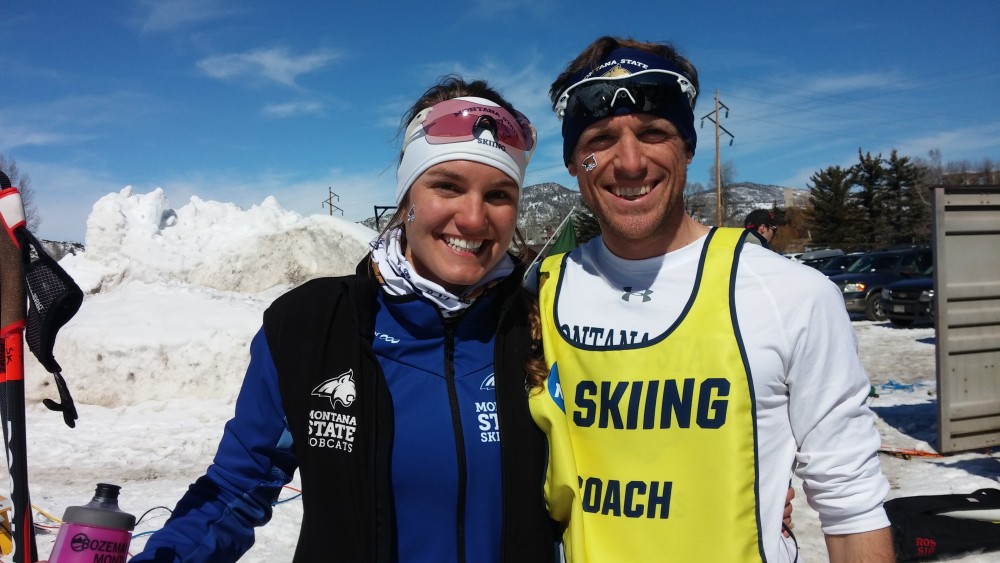
Montana State University’s Anika Miller (l) with head coach Matt Johnson after Miller took won the women’s 5 k freestyle at the 2016 NCAA Skiing Championships in Steamboat Springs, Colo. (Courtesy photo)
Miller — a native of McCall, Idaho, and this year’s NCAA champion in the 5 k freestyle — doesn’t doubt the ability of women to race the same distance as men.
What she questions is whether it’s necessary for women to do so.
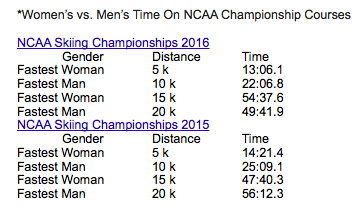
“It’s kind of a hard conversation to have as a female athlete because you don’t want to say that women are inferior,” Miller said. “My opinion on it is that the race distances are good as they are as far as women doing a shorter distance than the men. Because time wise … for the 15 k versus the 20 k at least, sometimes the guys only race it five minutes different than the women, which isn’t really that large of a margin, [meaning] effort wise, it’s more equal.”
The point Miller makes is that women and men are currently racing equal. Equal amounts of time on course, at least in the 15 k and 20 k events (*see men’s and women’s course times).
Oscar Friedman, coming off his senior season at Dartmouth where he was a captain of the men’s nordic team, also argued that close to equal amounts of time on course is more important than equal course distances between men and women.
“The point of having those different race distances was to make the men’s and women’s races equally competitive,” Friedman said on the phone. “That being said, if women are internalizing it, then that’s a bigger issue. If there’s a push from within the sport, women should be the ones deciding the race distances.”
The push from women within the sport varies, but much revolves around whether women race longer or men race shorter distances. Kelsey Phinney, coming of her senior season and also a captain at Middlebury, admitted that originally the idea of equal distances didn’t appeal to her because she assumed women would be required to race farther.
“I think the misconception has been that equal distances meant that women had to race longer,” Phinney on the phone. “But it doesn’t mean that women have to go 10 k and 20 k it could mean that men go 5 k and 15 k. Or that the races range from sprints to 30 k.”
Rachel Hampton, an incoming senior at Harvard University, advocated that while women are capable of racing men’s distances, men would benefit from racing shorter lengths.
“There’s a feminist side of me that wants to say that girls can do anything boys can do and there’s no theological reason why we shouldn’t be able to race the same distance as them,” Hampton said on the phone.
“I will say I sometimes feel bad for the guys because it seems like they only race long races. I think if we added sprinting and a few 5 k races for the guys and did a wider range of distances, that would be better for them. And I think if the men were on that plan, the women could then get on the same distance plan.”
However, when men competing in college were asked if they would be willing to race the same length as women, responses were often shaped by race distances at other levels of nordic competition.
“Shortening the men’s distances would be a huge disservice because as I see it, the goal of NCAA skiing is to make American skiers as competitive as possible on the World Cup,” Friedman said. “I would be completely against shortening the men’s races. But if women want to make the call and race longer, they should fully be able to do that.”
For a few women, however, simply adjusting the women’s race lengths to match those of the men sends a certain message: Women have to be like men to be equal.
“I think the message it sends depends a lot on whether you shorten the distance of men or you increase the distance that women have to race,” Bates College ’16 grad and skier Britta Clark said on the phone. “Trying to increase the distance that we race in the name of equality, but at the same time really just saying that equality is women doing what men do, I don’t think it’s necessarily speaking to the issue.”
Clark’s point is supported by Dartmouth College Women’s Head Nordic coach and Director of Skiing Cami Thompson-Graves, also a member of the NCAA Men’s and Women’s Skiing Rules Committee, chair of the USSA Cross Country Committee, and most recently, a member of the International Ski Federation(FIS) Ladies’ Cross Country Committee.
“I don’t feel the need for women to do men’s distances,” Thompson-Graves said on the phone. “Why don’t we just do women’s distances? Why can’t we just be different … I’m a big believer in being proud to be a woman, and not a little man.”
Harvard’s Rachel Hampton leads a Dartmouth skier during the 2016 Colby Carnival. Hampton went on to compete at the NCAA Skiing Championships in Steamboat Springs, Colo. (Photo: FlyingPointRoad.com/Harvard Facebook)
Increasing women’s distances strikes some as a forfeiture of female identity for one that is male. Which is one reason Peters more strongly advocates for decreasing men’s distances to be the same length as women’s.
“In skiing, I think the men should come down,” Peters said. “The 20 k is really irrelevant, even at the international level. I see nothing wrong with the 5 k, I think men should do 5 k. Five k is super exciting and can be a great race. I think it should be 5 k, 10 k, 15 k, and then add in the relays and sprints.”
However, a men’s 5 k race doesn’t appear on numerous nordic race calendars — national or international — either.
“I don’t think at the national or international level men race 5 k so maybe that’s a distance skill set that would only be applicable to college skiing in the U.S.,” Raleigh Goessling, coming of his senior season at the University of New Hampshire, said on the phone. “If the race distances were changed, I feel like the distances that are contested at other levels of the sport and other formats should also play into it.”
The Window Between U.S. College Racing and the World Cup
At the international level, women and men rarely race the same distance. FIS course lengths — like the NCAA — are designed around the gender of the athletes competing.
FIS Cross-Country Committee Chair and Norwegian Olympian Vegard Ulvang indicated that similar to college racing in the U.S., FIS race distances have been different for decades. One potential reason for these differences aligns with Porkorny’s findings. According to Ulvang, how female athletes were viewed in endurance sports when they started ski racing influenced the original length of women’s race courses.
“The history behind the differences comes from the time where the nations believed that women were weaker — [with the] first female race in 1952,” Ulvang wrote in an email to FasterSkier. “Today we of course know better. Female athletes are better prepared for longer distances than men, so principally the distances should be equal.”
Principality does not always equal response. Ulvang indicated that even if the race distances should principally be equal, one major driving force for the committee to keep women’s race distances shorter than men’s rests on the race experience for spectators.
“The argument has been that the time gap between the 20 best women is bigger than that of the men,” Ulvang wrote. “Longer distances would create a ‘worse TV product’ — with one racer skiing alone [during the race].”
T.V. time does not strike Peters as an excuse for NCAA Championships and U.S. college cross-country ski schedules to follow the same format as the World Cup.
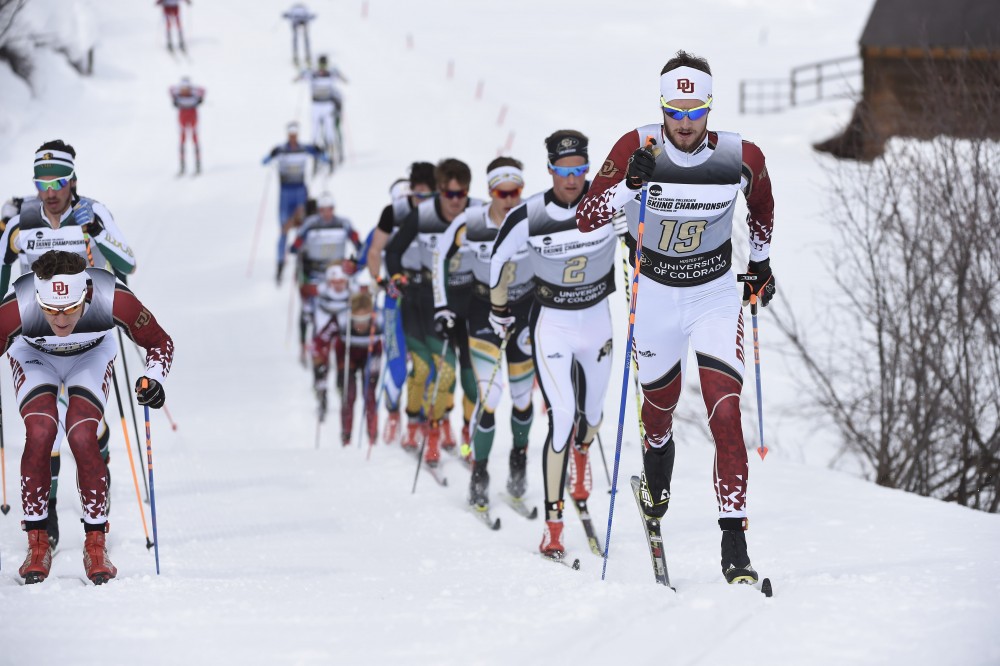
The men’s 20 k classic mass start at the 2016 NCAA Skiing Championships in Steamboat Springs, Colo. (Photo: Jamie Schwaberow/NCAA)
“A lot of people will say well, look at what they do at the Olympics, and look at what they do at the World Cup — it’s vastly different,” Peters said. “The women do so much less. But that doesn’t make it right. That’s a reason why NCAA follows it and EISA follows it, but that doesn’t make it right.”
Stewart, who has helped the Denver Pioneers achieve five NCAA Championship titles, supports the idea that NCAA skiing in the U.S. could act as a catalyst for change.
“As long as FIS schedules longer races for men than for women in international championships, there will be some resistance to equal distances at other levels, but I see no reason why the NCAA should not be a trendsetter and work to turn the tide on this,” Stewart wrote in an email.
He supports equal distances in cross-country skiing, seeing it as a statement that should be sport-wide, not just within NCAA nordic skiing.
“Equal distances for men and women should be implemented in our sport, both at the NCAA and international levels,” Stewart wrote. “We have had equal distances in the sports of swimming and track and field at the international and collegiate levels for many years. Equal distances would reinforce gender equity and would send the right message about our sport.”
Yet, when it comes to World Cup race lengths versus those contested at the NCAA, some argue the Championship event is already sending a message to other levels of cross country competition.
“I actually think that NCAA’s, where the women race 15 k and the men race 20 k, is much more equal than on the World Cup when the women race 15 k and the men race 30 k,” Rosie Brennan, Dartmouth grad and current U.S. Ski Team (USST) member, said on the phone.
Brennan is not opposed to a more balanced race length distribution between men and women. Her concern with changing race distances at the World Cup and NCAA collegiate level is ensuring that the racers’ performance and perspective are taken into account.
“I think it would be nice if they tried to make the [race distances] a little closer,” Brennan said. “I also think the reason the distances were different in the first place was the idea that the time the race takes should be fairly equivalent, so the effort is the same. If the time differences [between men and women] are getting to be much greater, to the point that the races are no longer requiring the same amount of effort, then I think it’s worth proposing some sort of a change and [is] something to re-visit over time.”
Brennan’s suggestion to visit the race experience for athletes doesn’t go unsupported. Men’s and women’s race distance differences have been discussed at the collegiate and World Cup level. But the actual number of times the topic has been statistically ‘re-visited’ remains a bit blurry.
Regarding conversations within the college circuit, Peters indicates that implementing changes to men’s and women’s race distances has been thrown around for some time.
“Patty Ross, who coaches at Middlebury, she’s been fighting it for 25 to 30 years and she’s had no success,” Peters said.
Ross could not be reached for comment.
Within the FIS Cross Country Committee, Ulvang indicated that the turn of the millennium was when most conversations regarding the different course lengths at the World Cup level of racing began.
“[The] question has been discussed in the FIS committee a few times the last 15 years,” Ulvang wrote.
Beyond that, four-time Olympian, USST member, Fast and Female USA President, FIS athlete rep, and now a new mother Kikkan Randall revealed that World Cup athletes have also had at least one opportunity to make their opinion about equal distances known.
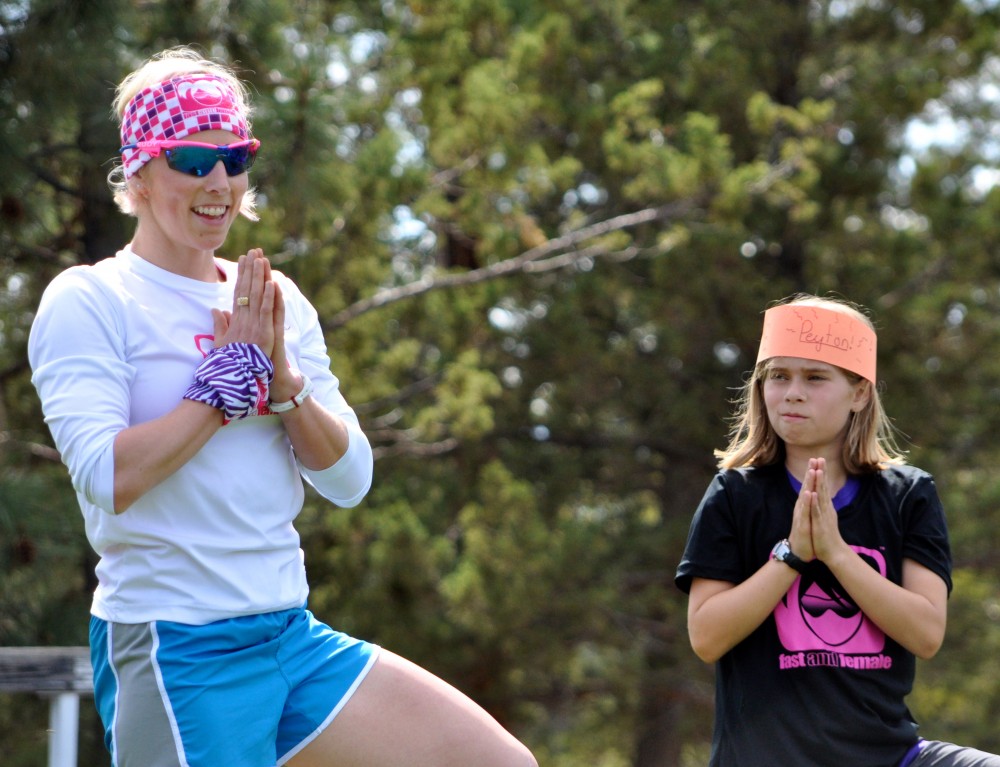
Fast and Female USA President Kikkan Randall leading a Fast and Female session two years ago in Bend, Ore. (Photo: Matt Whitcomb)
“It’s an interesting topic that actually comes up quite often on the World Cup,” Randall said. “As the athlete rep to FIS, I do a survey at the end of each season and couple years ago, as part of the survey, I sent out that question [of equal distances].”
The responses Randall received found most women on the World Cup circuit — at least a few years ago — did not want to race the same distances as men.
“The majority of women actually said that they were not interested in racing the same distances as the men,” she said. “I’m considering putting that same question on the survey again this year because the comment was brought up a couple times this spring.”
And how might women racing on the World Cup respond to shortening men’s distances to make the lengths equal? The question has not been posed, but Randall may incorporate it into her next athlete poll.
“That would be another interesting take on the same question,” Randall said. “This year on the World Cup I feel like the distances were reduced a little bit with so many tour [multi-stage] events, so again it’d be an interesting time to poll the athletes and see how they feel.”
Conclusion: Connecting Part I and Part II
As long as there is snow around, colleges with nordic programs in the U.S. will continue to attract a cohort of cross-country skiers looking to compete, while simultaneously continuing their education. For many, choosing college over a club team is not the end of a cross-country skier’s long term career. It is also the potential beginning.
“The way our country is, you’re always going to have athletes choosing to go to college after high school no matter what path they’re on,” Brennan said. “So I think the more that that can be facilitated, the better it is. I mean there are a lot of good club programs that offer alternatives for people who choose that, but I think the NCAA can provide a route as well.”
Some individuals also see the NCAA as an opportunity for Americans to attend college in the U.S. and potentially compete against athletes from other countries.
“As a venue for athletes to develop into international level skiers, [the NCAA circuit] is a great place because there are really high-level skiers from all over the world in the small microcosm of NCAA skiing,” Chad Salmela, outgoing nordic coach of the College of St. Scholastica, said on the phone.
With an assured influx of athletes choosing skiing and school — and the opportunity for some to race international athletes at ‘home’ — many don’t deny the difficulty of disconnecting U.S. collegiate racing and higher levels of nordic competition.
“From a purely objective standpoint, I would say that a junior athlete who chooses to skip college (at least until they are completely done with their racing career, whenever that may be) and pursue ski racing full-time starting at age 18, is much better set up to ski faster on the World Cup level later in their career,” current USST member and former Middlebury skier Simi Hamilton wrote in an email.
“However, because of the small numbers of junior skiers we have in our country (relative to all the other skiing powerhouse nations), college is a great way to keep kids engaged and in touch with racing during a period of their lives when they may have decided they want to do something completely different,” he added.
Yet, if NCAA racing is to preserve itself as one potential path for athletes looking to make professional steps in the sport, college and World Cup racers alike agree that conversations about change — be those for adding sprinting or making race distances equal between men and women — need to continue.
“I think incorporating sprints at the NCAA is definitely worth talking about and pushing forward because that’s at least one-third of the races we do [on the World Cup], if not more,” Brennan said. “I think trying to stay current is a valuable thing.”
Ida Sargent, a Dartmouth grad and current USST member, agreed that sprinting deserves spotlight attention in present-day skiing.
“I can obviously only speak for the women’s distances but I liked how there was a short and a longer distance race,” Sargent wrote in an email regarding NCAA race distances. “I think a more important change would be adding in more sprint races. We race a sprint almost every weekend on the World Cup and when I was in college we would have one a year at the most.”
With one more year of college racing left at MSU, Miller also pushed adding more sprint races to the college race circuit to foster cross country skiers’ development.
“I think it’s unfortunate that we don’t have sprinting,” she said. “Because that’s such a great development tool.”
Though Miller and Sargent are at odds with Pokorny’s press for equal distances, all three do seem to agree that changing customs can create better opportunities and a better outlook for cross-country skiers.
Mads Strøm of the University of Colorado racing to first place in the men’s 10 k freestyle at 2016 NCAA Skiing Championships last week in Steamboat Springs, Colo. (Photo: CUBuffs/Buffzone.com)
Note: This article has been updated to include comments from Ethan Townsend as of Thursday, March 17.
With the conclusion of the collegiate season taking place at the 2016 NCAA Skiing Championships in Steamboat Springs, Colo., last week, FasterSkier provides a look at the some of the latest involving school, sport and the Championship races. Part I examines the tradition behind the NCAA Skiing Championships format, and what it would take to change it.
A Brief History of NCAA Skiing Championships
5 k/10 k. 15 k/20 k. Scrolling through the archives of the National Collegiate Athletic Association (NCAA) championship events for nordic skiing is akin to strolling through a 1950s U.S. ‘Levittown’ neighborhood: Variation zero to none. Another online record for the past 16 years of NCAA Skiing Championships provides a similar finding. Nordic races at this event are traditionally two races for each gender: women race 5 kilometers and 15 k, while the men race 10 k and 20 k. Though the discipline alters between freestyle and classic, the distances for each respective gender remain the same.
A phone conversation earlier this season with Cami Thompson-Graves, Dartmouth College women’s head nordic coach and director of skiing, NCAA Men’s and Women’s Skiing Rules Committee member, Chair of the USSA Cross Country Committee, and most recently, a member of the International Ski Federation (FIS) Ladies’ Cross Country Committee, revealed a similar story.
Dartmouth women’s coach Cami Thompson-Graves (r) at 2016 U.S. nationals in Houghton, Mich.
“So as long as I can remember, [the championships] have been two races,” Thompson-Graves explained. “Way back when … it was an individual race and a relay. But then when skating came along, we went with one classic race and one skate race. Pretty much for the last 25 years, we’ve alternated every two years and done a long mass start of one and a shorter of the other.”
So what if the championship races have stayed the same for the past 25 plus years? Why should anyone in or out of the college-race scene care?
“I skied in the East and tradition is a big deal in the East,” Chad Salmela, head nordic coach of The College of St. Scholastica in Duluth, Minn., said on the phone. “People like tradition, but at the same time, tradition can limit your outlook as to what the future could possibly hold.”
Coaches, Committee Members and Athletes on Change
According to Salmela, the championship event controls quite a bit of what events college racers will compete in during the regular season.
“Let’s face it, the championships really drive what happens in the regular season because everybody is trying to qualify,” Salmela said.
That’s certainly the case for the 2016 Rocky Mountain Intercollegiate Ski Association (RMISA) nordic race schedule, with all but one weekend following the 5 k/10 k and 15 k/20 k format.
“It varies from region to region,” Thompson-Graves said of the 5 k/ 10k and 15 k/20 k race distances in the Eastern Intercollegiate Ski Association (EISA) schedule. “If those are the [championship] events, we’ll try to do those races one weekend back to back early in the season and our regional championship is usually similar to the NCAA Championship.”
This year, the EISA schedule included a men’s and women’s 1.5 k classic sprint, as well as a men’s and women’s sprint relay event.
Kelsey Phinney, a Middlebury College senior from Boulder, Colo. competing at 2013 NCAA Skiing Championships at the Rikert Nordic Center near Middlebury, Vt.
Still, a few individuals question if this is enough and whether the current NCAA Championships nordic skiing schedule necessitates change.
“I love sprinting and I would love to see it in the championship events for college races,” Kelsey Phinney, a senior at Middlebury College, said on the phone.
“I think sprinting is a really good development tool in terms of gaining speed and applying tactics during your races. It’s such an exciting part of our sport right now and it has such a presence on the World Cup that in terms of development, it makes a lot of sense to include it,” Phinney added.
Raleigh Goessling, a senior at the University of New Hampshire (UNH), agrees.
“I think that sprinting is already a really big part of nordic skiing at every other level, except the college level,” Goessling said on the phone. “I think that college programs should get on board with that.”
Goessling’s point was bolstered further by Salmela.
“I’m very much in favor personally of adding sprinting to the championship,” Salmela said. “I think it modernizes the sport and it’s inevitable. The question is when and how.”
Attempting to Answer ‘How’
In an effort to resolve the question of ‘how,’ Salmela — whose four year term on the NCAA Men’s and Women’s Skiing Rules Committee expired this past September — and committee members created a proposal for the 2016/2017 race season.
The proposal, submitted last spring to the NCAA for review, included a menu offering championship race organizers the opportunity to select the race lengths and format, based on the courses and course crews available to the championship event host-site.
“What we proposed to the NCAA put the onus on the organizer of the championships to decide on a menu of FIS distances and disciplines,” Salmela said. “The idea was to leave it up to the committee to steer it in a way that sprinting becomes a part of NCAA skiing, but is not necessarily a mandated thing every year.”
Thus, any International Ski Federation (FIS) event, from a sprint to a 30 k, had the potential to show up at a championship race series.
However, the proposal was returned this past fall to the NCAA Men’s and Women’s Skiing Rules Committee for further review.
Ethan Townsend (l), chair of the NCAA Men’s and Women’s Skiing Rules Committee and St. Lawrence University head nordic coach, congratulates the 2016 NCAA 10 k freestyle champion, Mads Strøm of the University of Colorado. (Photo: Joel Riechenburger/Daily Camera via CUBuffs/Buffzone.com)
“It’s not been denied,” Ethan Townsend, chair of the NCAA Men’s and Women’s Skiing Rules Committee and St. Lawrence University head nordic coach, explained on the phone prior to the championship. “It’s just kind of a big change and the NCAA wanted us to vet it out a bit more.”
The most recent discussion regarding the proposal took place last week in Steamboat Springs, Colo. at the 2016 NCAA Championships.
“I think we are looking to re-propose what the skiing committee approved this past summer with some changes,” Townsend wrote in an email post-2016 NCAA’s. “I’m not really confident we will get that change through but we are going to try.”
With the next NCAA Men’s and Women’s Rules Committee meeting taking place in early June, Townsend predicts changes to the NCAA Championship event won’t be implemented for another season or two.
“Any changes will take at least until 17/18 I think,” Townsend wrote, “it’s too late to have this in place for next season.”
While select coaches from the east, west, and central locations convened last week to go over a number of NCAA issues–including the proposition of holding NCAA Championships in Alaska, a topic Townsend described in an email as “more concerning in the immediate term for a variety of reasons”–athletes remained topics of conversation, but not contributors to the dialogue.
At some levels, the lack of voice is not a deliberate choice. Currently, there is no athlete representation on the NCAA Men’s and Women’s Rules Committee.
“That’s not our call,” Salmela said. “The committee makeup is entirely driven by the NCAA … I think it would be awesome to have an athlete or a couple athletes on each sport committee, but that’s not a skiing issue, that’s an NCAA sport-wide issue.”
That doesn’t mean that student athletes’ don’t have plenty to say.
“Although I’m personally not a sprinter, I think it is a good move if we want to develop competitive skiers to race on the World Cup,” Dartmouth senior Oscar Friedman said on the phone. “That being said, I would probably support a calendar that more closely mirrors the World Cup. If there’s only two races at NCAA’s, I don’t think it makes sense to have a sprint. I would prefer there be three races; one can be a sprint and two distance races.”
While many might agree with Friedman, financial restrictions decrease the feasibility of adding another race day.
“We are only funded by the NCAA for 5.5 days and we currently have four races days, alternating Nordic and Alpine events,” Fredrik Landstedt, the secretary-rules editor for the NCAA Men’s and Women’s Skiing Rules Committee and head nordic coach for the University of New Mexico, wrote in an email. “It is very unlikely that the NCAA will increase their spending on the Skiing Championships to add extra days.”
Landstedt also extrapolated that the the duality of NCAA skiing — shared scoring between alpine and nordic, as well as combined points between men’s and women’s teams in order to win a championship title — makes bringing a sprint into the championship particularly complicated.
Fans at the 2015 NCAA Skiing Championships in Lake Placid, N.Y.
“A sprinter can be tripped or obstructed and your entire team can lose the Championship because of something that was not related to the strength of the skiers on your team,” Landstedt wrote. “This happens all the time in sprinting. When it is an individual race for individual glory, it is very different compared to when it affects not only the rest of the Nordic team, but the Alpine team as well.”
Instead, Landstedt suggested that an “Individual Sprint Championship” be incorporated into NCAA Championships.
“I believe that we could add an Individual sprint championship race where the winners will be recognized by the Collegiate Ski Coaches Association as the NCAA Sprint Champions,” Landstedt explained. “It might mean that there are 3 Nordic races in a 4 day span but if the sprint race is an individual race, slow sprinters and some skiers from the teams that are competing for the team trophies might chose to skip this race.”
A Way Out of the NCAA’s Quagmire?
A change to NCAA Championships is particularly complex.
“We’re basically only going to be allowed to have two races at the championships and so how are we going to pick those two races and make it fair for everyone?” Thompson-Graves questioned.
“… Program budgets are probably all over the map and we all have to follow different rules,” she pointed out. “[Dartmouth has] to follow Ivy League rules and Division I rules, Middlebury, Colby, Bates, and Williams are following NESCAC [New England Small College Athletic Conference] rules and Division III rules. We’re all trying to compete head to head and yet we face a lot of different kinds of issues.”
School budgetary divides and division differences are just the beginning.
Landstedt also wondered whether adding sprinting will encourage sprint racers to become more specialized in college racing and if schools with larger budgets will be at an advantage to recruit and travel to sprint venues for training.
“Major concerns include how to fit sprinting in to a team format, having highly educated officials and a jury that can handle lots of protests and rule correctly on obstruction and interference issues common in sprint races, limited number of race venues with good sprint courses, expense related issues, recruiting,” he explained. “I also believe that sprint racers will become more and more specialized and that it will be harder and harder for distance skiers to compete in sprints and vice versa.”
“People like tradition. But at the same time, tradition can limit your outlook as to what the future could possibly hold.” — Chad Salmela, College of St. Scholastica head coach and former member of the NCAA Men’s and Women’s Skiing Rules Committee
All of these concerns compressed into two days of competition makes for a challenge. But it’s a challenge that Salmela feels cannot go untouched.
“If you look a the repertoire of what FIS has for nordic skiing right now, it’s a multitude of events,” he said. “To cap for that in two days is probably one of the greatest challenges the committee faces in trying to be a relevant piece of ski racing — not just American ski racing — but ski racing. And I think that’s why sprinting needs to be looked at. The sport has to be relevant.”
An Issue of Relevancy: College Racing and The World Cup
How much focus should college skiing in the U.S. place on preparing athletes for higher levels of nordic competition? How many skiers move on past college to ski professionally? Would this number grow if changes were made to NCAA Championships?
“There’s a very tenuous argument, I feel, that NCAA skiing is the best path for the top talent in the country to develop into World Class skiers,” Salmela said. “I think that it’s a wonderful and lucky mechanism for retaining athletes who maybe don’t progress at the international pace for their age.
“From a U.S. Olympic Committee perspective, the NCAA is a safety net that you don’t have to fund to keep talented skiers developing,” he added.
From 2005 to 2009, Simi Hamilton, 28, raced for Middlebury, where he was a three-time NCAA All-American, before he made the leap to the U.S. Ski Team. Hamilton nabbed two individual podiums this season on the World Cup, first in a freestyle sprint in Toblach, Italy, and again at the freestyle sprint earlier this month in Gatineau, Québec.
“When the question comes up of how college ski racing affects/overlaps with the overall development of a racer that wants to race full time (World Cup or domestic circuit) after school, it’s always tricky to answer,” Hamilton wrote in an email. “I don’t think there’s any way one person can say, ‘Yes, it fits in great’ or ‘no, the two don’t mesh at all.’ If I were answering the question based on what it did for me, I would definitely say that it helped. Skiing throughout college gave me an opportunity to stay in touch with racing, while giving me enough space from the sport to become more mature as an athlete and as an adult.”
Sophie Caldwell soaks up her first World Cup win at the Tour de Ski Stage 4 classic sprint in Oberstdorf, Germany. (Photo: Fischer/NordicFocus)
Caldwell, a 2012 Dartmouth graduate and five-time NCAA All-American, who won her first individual World Cup in January at the the women’s classic sprint in Obsterdorf, Germany, also explained college ski racing was the right decision for her.
“I don’t think I was mature enough or mentally ready to ski full time right after high school, so I think having the balance of skiing and school in college worked out really well for me” Caldwell wrote in an email. “By the time I graduated from Dartmouth, I was four years older and more experienced, and ready to give professional skiing a stab.”
Though both have seen recent success on the World Cup and both agree that development varies from person to person, they also confer on the point that perhaps it’s time to re-evaluate race distances at NCAA’s.
“Sprinting is becoming more popular and almost half of the World Cup races are now sprints, so it definitely would be worth considering for college racing,” Caldwell wrote.
Hamilton pushed the point even further.
“I think that NCAA needs to do some serious restructuring of their planning and scheduling in college xc ski racing,” he wrote. “It’s crazy to me that athletes still go to the championships and only race one middle distance race and one long distance race.
“It’s hard to be too critical about the current system that is in place now because I am successful at what I do and I think I have quite a few years left of skiing successfully on the World Cup circuit, but that shouldn’t be an excuse for the NCAA to keep things exactly the way they have been for the last 30+ years,” he added.
In conclusion, Hamilton added two primary goals college skiing should strive for within the U.S.
“The first is giving young athletes a chance to be a part of something in college that is great,” he wrote. “The importance of being part of a team, no matter what kind of team, cannot be overstated. Regardless of whether an athlete wants to ski after college or not, college skiing should provide every xc athlete with a really fun chance to work hard at something and focus on achieving goals beyond the classroom.”
While Hamilton’s first objective of college skiing revolved around teamwork and team skiing, his second goal emphasized individual aspirations.
“The other goal that college ski racing should strive for is giving young races a chance to develop into the kind of athlete they want to become after college, if that is something they are serious about pursuing,” he wrote. “Personally speaking, if I had been given more opportunities while I was in school to focus on sprinting, there’s no doubt that I would have entered the World Cup circuit with more confidence and better prepared.”
“Personally speaking, if I had been given more opportunities while I was in school to focus on sprinting, there’s no doubt that I would have entered the World Cup circuit with more confidence and better prepared.” — Simi Hamilton, U.S. Ski Team sprinter and former Middlebury skier
As a place where athletes have the opportunity to compete and train at a relatively low cost, college does seem to provide a great opportunity to further develop nordic skiers and skiing in the U.S.
“Most of these college programs are providing coaching and transportation and waxing and all those things to make it easy for athletes to race, which they maybe don’t appreciate until they’re out of school and trying to do it on their own,” Thompson-Graves said.
Yet, lumping U.S. college racing and the World Cup all in one does not appear to be the answer, either.
“I think the challenge is that we’re trying to accommodate a lot of different kinds of athletes in college racing,” Thompson-Graves added, pointing out that “some programs are just happy to race carnivals,” while other U.S. college programs “challenge [athletes] to think bigger and do more if that’s what they want to do.”
Ultimately, however, most believed that it should be a priority that skiing in the U.S. stays relevant.
“I guess I fall into the camp that would like to see us doing, in college skiing, races that are sort of done in the national and international calendar,” Thompson-Graves said. “To me, it’s important that our athletes are learning to race whatever the current races are throughout the world. That’s important to me.”
Annie Pokorny racing to 33rd in the 10 k classic at the 2014 U23 World Championships in Val di Fiemme, Italy. (Photo: Flyingpointroad.com/NNF)
This week, the top collegiate cross-country skiers in the U.S. converged in Steamboat Springs, Colo., to wrap up the season at the NCAA Skiing Championships, which begin Thursday with the 5/10-kilometer freestyle individual starts and wrap up Saturday with the 15/20 k classic mass starts. One Middlebury skier has the unique opportunity to be reimmersed in the collegiate circuit after a glimpse at post-collegiate skiing and will race for the NCAA podium with a different appreciation for collegiate competition.
Annie Pokorny, 23, returned to the collegiate racing circuit this season after a two-year hiatus while training and racing with the Stratton Mountain School T2 Team. Although this is a rare progression, it was a path that has allowed her a different depth of experience in the sport.
Skiing for Middlebury College, Pokorny had a breakthrough season in 2013 as a sophomore where she netted two top-10 finishes at U.S. nationals in Midway, Utah, and finished in the top 30 twice at U23 World Championships in Liberec, Czech Republic. The season reflected a huge improvement over the previous year where she finished 47th in the 10 k freestyle at U.S. nationals.
Although most collegiate skiers who continue onto the professional level exhaust their eligibility before moving on, Pokorny wanted take the sport to the next level sooner rather than later. In the spring of 2013, the Spokane, Wash., native made the difficult-but-measured decision to join the SMST2 team based out of Stratton, Vt. Pokorny was excited to be a part of the culture of success SMST2 built and join World Cup-level skiers such as Jessie Diggins and Sophie Caldwell. She also knew the opportunity might not present itself in another two years after she graduated and wanted to capitalize on her momentum by training and racing full time.
Annie Pokorny (SMST2) at the top of the coach’s climb during a training day before the December 2015 SuperTour in Sun Valley, Idaho.
While training and racing with SMST2, Pokorny continued to take classes at Middlebury and balanced coursework with an international race schedule. She would take the fall semester off when training volume was high and take classes full time in the spring.
“The logistics have certainly been complicated, coordinating with professors to miss multiple weeks or months of class by Skyping into lectures (an idea inspired by Sadie Bjornsen), writing additional essays and navigating the black hole that is European village internet,” Pokorny wrote in an email. “However, I got to take advantage of the international racing available to me; finding balance never felt like a sacrifice.”
While Pokorny has posted solid results the past two seasons with SMST2, another breakthrough season proved elusive. With both her skiing and academic goals in mind, Pokorny made another pivitol decision — to return to college racing.
“I decided to return to college racing because it gave me the chance to have six weeks of consistent, competitive, comped racing while also allowing me the structure to take a full course load and graduate in the spring,” she explained.
However, the process of returning to collegiate racing required more than just agreement from her coaches. Because collegiate cross-country skiing is an NCAA sport, athletes must abide by the NCAA amateurism rules and in the eyes of the NCAA, Pokorny was considered a professional athlete while skiing for SMST2.
However, since Pokorny could prove she never made money from racing at SMST2, she was eligible to return to the collegiate circuit after being reinstated as a Middlebury athlete as a senior with junior eligibility. To ensure everything was in order before she put on a Middlebury suit, Pokorny sat out the first two carnival races.
Annie Pokorny (l) with several Stratton Mountain School (SMS) T2 teammates in 2014. (Photo: SMST2 Blog)
Although it was a process, Pokorny said she felt supported in her decision from Middlebury, SMST2 and the ski community.
“Patrick O’Brien and Sverre Caldwell at SMST2 showed an immense amount of support for me returning to collegiate racing, which I’m glad I had before starting the process of returning,” she wrote. “When we knew I had eligibility, the Middlebury program communicated that to the rest of the Eastern Intercollegiate Ski Association (EISA) circuit and I received nothing but support from every coach and competitor.”
Pokorny describes her transition back as “nearly seamless.” In addition to being welcomed back to the team and collegiate racing, being on campus and attending lectures eliminated the stress of remote coursework.
She has also returned as a force on the EISA circuit, winning the 5 k classic pursuit at the Williams Carnival, the 5 k freestyle at Middlebury Carnival, taking second in the 10 k classic at University of Vermont Carnival and earning a berth to NCAA Championships.
“On the skiing side, I think one of the valuable lessons of skiing internationally is that it teaches you a certain flexibility and ability to navigate with new waxing, coaching and racing situations, so everything leading up to the races felt completely normal to me,” she wrote. “The Midd coaches, Andrew Johnson and Patty Ross, have worked to make sure that I felt supported on training and race days while the entire Midd team embraced my return like I was coming home.”
The transition also illuminated the unique and constructive culture of collegiate racing and how it can pave the way for international racing.
“I suppose one way my perspective has changed is that as an older, more experienced racer, I can appreciate the details that make racing NCAA a standout experience,” she explained. “In addition to the team culture and glitter and pride in representing your school, I can better see how what we learn on this circuit can transfer to international racing. The practice in mass starts, for one, and scoring points for and representing something greater than yourself, for another, are two things that will contribute to my racing after I graduate.”
Although it is easy to think that skier development is a linear process, this is rarely, if ever, the case. Pokorny’s grounded thoughts on her journey illustrate this phenomenon. There are lessons that can be taken from every race, from every experience despite if an athlete is aware and open to growth.
“I never considered returning to college racing a step back, but rather a step sideways, onto another incredibly competitive circuit that would contribute to my growth as a skier,” she wrote. “In the past three seasons, I have had some incredible experiences and feel that I have grown as a skier in so many different ways. I would never choose a different path, circuitous as it was.”
Jørgen Grav of the University of Vermont racing in an Eastern Intercollegiate Ski Association (EISA) race. (All photos courtesy of Grav)
The 2015 Blink Festival brought many of the world’s best cross-country skiers together for three days of rollerski racing in Sandnes, Norway. But the festival is much more than just a race for World Cup level athletes. There are open races for junior athletes ages 11 to 20, as well as opportunities for those with low enough International Ski Federation (FIS) points to race against the best seniors in the world.
Anyone can try to sign up for the high-caliber race series, but because it has grown to be so popular, the 150 athletes with the lowest FIS points get chosen for the senior races. This year, one of them was 23-year-old Jørgen Grav of the University of Vermont (UVM).
Grav was born and raised in Oslo and is training at home in Norway for the summer before his senior year at UVM. He lives just five minutes away from the Holmenkollen ski jump and works at a nearby boat-classification company that certifies and insures large ships. He has an agreement worked out with his employers where he gets a week off every three weeks or so in order to more effectively train for his senior year of college racing. His work schedule also gave Grav an opportunity to compete in this year’s Blink Festival.
He began the festival with a strong showing in the Lysebotn Opp. He finished 45th in the 7-kilometer uphill rollerski race, ahead of household names like Petter Northug and Finn Hågen Krogh. The UVM Catamount described the location of the race in Lysebotn, located at the end of a fjord, as one of the prettiest places in Norway.
The men begin the climb during the Lysebotn Opp.
“[The race] starts at sea level and it literally goes straight up for 640 meters and it has 27 switchback turns. It goes through 1.1k of tunnel, and the first k is completely flat. So it’s basically all that climbing in 6 k,” Grav said in a recent phone interview. “At least we do it on number 1 wheels, because it would be brutal on number 2 wheels.”
The fastest racers in the Lysebotn Opp, Finland’s Matti Heikkinen, Russia’s Alexander Legkov and France’s Maurice Magnificat, manage to V2 the entire climb, which has an average incline of 10 percent. Grav was able to V2 most of the race, but had to take a few breaks and switch to V1, he said. His effort was good enough to put him within five minutes of the leaders and shatter his personal record from three years earlier.
“I finished at least two minutes faster than what I did three years ago so I am super happy about that and anything less than five minutes behind those guys up a tough course like that you should be satisfied with,” Grav said.
Friday and Saturday brought two more days of rollerski racing and other events in downtown Sandnes. One such event was the shooting duel, a range-focused event for the biathletes where they run about 10 meters to the shooting mat, shoot five targets as quickly as possible, and then run 10 meters back to the finish. The event goes quickly, with the winning times for both the men and the women being under 20 seconds.
“Its really entertaining; it’s good TV I think,” Grav stated about the shootout format.
A part of the race course in Sandnes.
For those who attend Blink in person, like Grav, there are some added perks. The festival has a VIP tent with live music and bleachers set up all the way around the 900-meter course so spectators can enjoy the action. The organizers even temporarily pave part of a pedestrian-only street so the race goes right by the fans. They also add bridges and turns to keep it exciting for spectators.
Because of the tight course setup, Friday’s mass start could only accommodate 30 racers. World Cup skiers get a free pass to the final, but the rest of the participants have to qualify with a short, two-lap race to determine the remaining spots. There were only 12 available, and Grav finished 15th, missing the final by seconds.
“I wish [the World Cup skiers] all had to race the qualifier so we all had the same chance, but I think it’s good in a way because then in creates more exposure [for the sport] on TV,” Grav said.
He had strong races on Thursday and Friday, but met some trouble in Saturday’s sprint qualifier — and he wasn’t alone. Rain poured down all day, making an already technical course very slippery.
“I was way off. I couldn’t ski properly and I think a lot of people just didn’t want to race because it was not safe,” Grav said about the sprint. He finished 30th in the preliminary round, but much like the mass start, some spots in the heats were reserved for World Cup athletes who bypassed the qualifier. As a result, Grav’s 30th place was not enough to put him in the heats.
A look from above at a concert during the festival. (Photo: Jørgen Grav)
Though there are many things about Blink that Grav enjoyed, he said the kids in attendance were one of the highlights. They all get a chance to race, and then they stay to cheer on their idols and get autographs.
“They love standing around outside of the finishing area and are up in your face for getting you to sign their bib number or their autograph book and everything,” Grav said. “You feel like a real celebrity. It’s super cool.”
The energy from the spectators also impressed the incoming college senior, though at a rollerski festival in Norway, he didn’t expect much less.
“It feels like a festival with people that love skiing,” he explained.
Grav also attended last week’s Toppidrettsveka, where he finished 41st overall. He said feels he is in his best shape ever because he has been able to focus on his training and has a fast group of peers keeping him motivated and setting strong examples. Grav also feels he has made some promising technique changes this summer.
“I’ve been switching more over to increased double poling in my training which is the development of the sport right now, more upper body strength,” he said. “I think that is going to be a big thing this winter.”
Looking ahead to this winter, his main goal is to place in the top three at the 2016 NCAA Skiing Championships in Steamboat Springs, Colo. Last season, Grav finished ninth in the 20 k classic mass start.
Some kids racing at the 2015 Blink Festival.
As for after college, Grav plans to continue skiing. He will try and reach one of the recruit teams for the Norwegian National Team and then ultimately hope to get selected to the team. Grav knows it’s a tall order, but as long as he continues to love skiing, he sees no reason to end his career.
“It’s the toughest country in the world to get on the national team so its definitely a commitment to get all the way there, but as long as I have the motivation in the spring every year to start up a new year then I am probably going to keep going!” Grav said.
The Gustavus Adolphus College ski team out training. Photo courtesy of Tyler Gustafson.
Note: This is a more in-depth analysis of the situation at Gustavus Adolphus College, which we announced with a previous report last week. You can read the initial article, with ski team coach Jed Friedrich, here.
When Gustavus Adolphus College announced late last week that its varsity ski program was going to shifted to club status, the news came as a shock. Of course, it was devastating to Gustavus Adolphus skiers, both current and past: the team was their life while they spent their four years at the small liberal-arts college.
“The alumni were shocked when we heard that the team had been cut,” Kathleen DeWahl, a 2008 graduate of Gustavus Adolphus, wrote in an e-mail. “I remember talking with someone in the administration when I was in school, and they made a comment that Gustavus was 100% behind the team and that it would never be cut because the team was such a great representation of what Gustavus was about.”
But it wasn’t just Gusties themselves who expressed surprise. Even from the outside looking in, the program just didn’t seem like something you’d want to cut.
“I don’t think anybody, anybody expected this,” College of Saint Scholastica head coach Chad Salmela told FasterSkier. “I certainly didn’t… This year alone, they were competitive. We went head to head with them at the Minnesota championships, and they beat our women’s team. Our women’s team beat Northern Michigan this season! It’s not like they are bad.”
Students, alumni, and ski enthusiasts around Minnesota and the rest of the country have been trying to mobilize to engage the Gustavus Adolphus administration in a dialogue about why the decision was made and whether there’s any way to undo it, but it hasn’t been easy.
The athletic department has not picked up the phone any of the times that FasterSkier has tried to contact them, and alumni have had no better luck.
“Last Thursday I got a text from a college teammate that the team was being dropped,” former Gustavus Adolphus skier Jens Brabbit told FasterSkier. “Then it went viral on facebook. From there, they made the official announcement on the website. In that time, everyone was sending out e-mails to the athletic director, the president, and the board members, trying to tell them how we feel. That was alumni, and the ski community as a whole.”
On Tuesday Brabbit told FasterSkier that they had yet to hear any response from the administration, but later e-mailed to say that a meeting had been set up with the president.
There has been an outpouring of support, including a petition that has garnered, at the time of publication, 2,627 signatures (you can find it here). The Gustavus Adolphus student body is roughly 2,600 students, with 19 of them on this year’s ski team.
“We feel like that’s a pretty powerful message,” Brabbit said. “When you have a petition on such a small campus, where it’s larger than the campus as a whole, it’s such a huge message.”
Brabbit, who competed at NCAA championships in 2010 and 2011, is one of the alumni heading up the effort to get administrators to come to the table.
“We were trying to get a meeting with all the alumni and the decisionmakers to see if we can discuss and have a negotiation,” he explained. “We are hopeful we can try to get that set up. We feel we should be owed at least that opportunity to talk to them… We’ve had lots of academic and athletic successes in that program. We feel like we’ve always been a good ambassador of Gustavus Adolphus and we haven’t done anything to ruin that reputation.”
“The Gustavus Nordic team is one of the most dedicated, hardest-working teams I have ever known. We train countless hours each year, we boast the highest average GPA out of all teams here at Gustavus, and we are all heavily involved in activities both on and off campus. It saddens me to think that an entire team full of exemplary student-athletes won’t, according to the Gustavus administration, “benefit the future of Gustavus”… it has cut a team of some of the greatest student-athletes, and has eliminated its chance of receiving similar students in the future.”
—Tyler Gustafson, Gustavus Adolphus junior and Biathlon World Junior Championship competitor
Brabbit said that he had heard “through the grapevine” that the college president Jack Ohle was out of the country and that athletic director Tom Brown would not consider making a decision without him.
When they do get their chance to speak, they will lay out a number of arguments about why the ski team is worth keeping. One is its tradition of excellence. While it’s true that Gustavus Adolphus, a D-III school, has not sent a skier to the NCAA Championships in a few years, they have in the past, including in 2008 when they sent a full squad of three women – a high mark for a midwester D-III school – and Laura Edlund finished 18th in one of the races.
DeWahl, one of that year’s NCAA competitors, believes that the team is absolutely capable of repeating the feat.
“I know I had it in my head that I wanted to qualify for NCAA’s, and so did Laura Edlund and Kelly Chaudoin,” DeWahl wrote in an e-mail. “And that was the thing that allowed us to get three women to Nationals my senior year. We had a group of women who were serious about training and competing and about getting everyone on the team to compete on a higher level… I definitely think that it would be possible for the team to get there again, with the right combination of people and support from the school.”
Salmela, a longtime observer of college skiing, pointed out how remarkable this is in the central division, where there are currently very few quota spots for NCAA’s. Other recent team cuts have come from teams in very different positions from Gustavus Adolphus. For instance, the University of Nevada Reno in the western conference had much higher expenses as a D-I team with scholarship athletes.
And the colleges of Saint John’s and Saint Benedict’s, also in Minnesota, canceled their teams, which were also D-III. However, they had nowhere near the success of Gustavus Adolphus.
“Saint Johns and Saint Bens never had a full time coach,” Salmela said. “I think it’s safe to say, they had never truly invested in success as a ski program… The coach was a really good guy and worked hard, but he was still part-time, so he was at a huge disadvantage to the rest of us who are full-time. That cancelation didn’t surprise anybody that much. Gustavus on the other hand is really heavily invested and they have a robust and passionate alumni group. They have had way, way, way higher success rate.”
Brabbit points out that as a D-III school, this success rate – every once in a while sending a team to NCAA’s – comes at a very low cost, so he is not sure what the cost-cutting benefit is to the school of eliminating the team.
“We never had a crazy college budget like the big D-I schools,” he said. “We never asked for much. We were a very, very small-budget team and the cost of going to that school is so large, we feel like it does more bad publicity for the school than anything [to cut the team].”
The ski team has brought the college other good publicity, too. For instance, this year, college junior Tyler Gustafson took a break from the college racing circuit to compete at World Junior Championships for biathlon. He was the top American in the junior age category with a string of mid-40’s results.
Of course he had to find time to go to the shooting range himself, but the ski team made the results possible, said Gustafson, who was the subject of a glowing feature on the college’s website.
“I can honestly say I would not have qualified for and achieved the results I did in the recent World Junior Championships if it weren’t for the support of my fellow teammates and coach,” Gustafson said. “They are and have been incredibly supportive of my biathlon ambitions… If I didn’t have my teammates training and pushing alongside me this entire season, I can’t say I would have had the results I did. One would hope that the school would take pride in such results that not only I, but other biathletes have achieved through help by the Gustavus Nordic program.”
“Even outside of season and out of school, the team still stays together. In school, we’d have pancake breakfasts after long Sunday rollerski sessions all spring. We still get together at races during the winter and to train in the summer when folks are in the same town, state and continent, and the alumni know the skiers who are on the team now.”
—Kathleen DeWahl ’08, NCAA Championship qualifier
Plus, there are other advantages to the team. It’s a close-knit community that allows students navigating how to live away from home for the first time to form strong bonds and find positive role models. DeWahl talked about how Chandra Daw, an upperclassman when she arrived at Gustavus Adolphus, inspired her to take skiing seriously. That type of interaction hasn’t disappeared.
“One of the benefits of having a small team is that it allows us to bond and form relationships like no other,” Gustafson said. “And, as we constantly push one another and support one another, our team continually becomes closer and stronger.”
DeWahl described the team atmosphere and the fact that she’s still friends with almost all of her old teammates.
“As a D-III school, academics were still expected to take precedence over sports, so if someone needed a hand with homework or a project there was someone on the team who was willing and able to help,” DeWahl wrote. “And if you had a lab or class during practice, there was always someone who was happy to get up early to go train with you, so you weren’t alone.”
It has also allowed students in Minnesota, a part of the country where many people descended from Scandinavian and central European immigrants, a way to connect to their heritage. Gustavus Adolphus emphasizes this in other aspects of campus life: the King and Queen of Sweden came to the university a few years ago, and the college runs an exchange program to Sweden. In 2009, several participants went to the Vasaloppet.
“Gustavus takes pride in its Swedish heritage, yet, in a short-sighted decision, has cut a sport that is central to the lives of so many Swedes both past and present,” Gustafson marveled.
“I don’t think the people making the decision are Swedes. Whether the connection between cross country skiing and Swedish heritage ever-I can’t say I was there, but my hunch is that it never even entered the conversation,” Salmela said.
“There’s a good strong grassroot community of skiing in Minnesota. Programs are getting bigger and it’s an important part of Minnesota. There’s a lot of MIAC schools, but now there’s only one other MIAC program that has an NCAA team. It makes the decision even easier. A lot of people who are skiing in Minnesota are going to not look at Gustavus because of that. It’s a lifelong sport, so we need to keep it going.”
Plus, it’s not like skiers are causing trouble at the school. Everyone involved pointed out that the cross country ski team often has the highest GPA of any team on campus and go on to productive and in some cases high-profile careers.
“Those kids are smart kids,” said Salmela. “They’re the kind of kids who people are fighting for to get into their colleges.”
So finally, the biggest reason that Gustavus Adolphus may want to continue a varsity program is to be able to grab those students away from the likes of Salmela’s College of Saint Scholastica program, or rival Saint Olaf. Both alumni and current skiers confirmed that the ski team was a major reason that they chose Gustaus Adolphus over other options.
“Personally, I would not have looked at it without a NCAA program,” said Brabbit.
“When I was looking at colleges, skiing was a major part of my decision,” said DeWahl, who had competed at junior national championships all four years in high school. “I only applied to two schools, both with good physics programs, the subject I planned to major in. Gustavus had a ski team and the other school didn’t, and when I visited GAC, it was skiers who showed me around campus, took me to their classes and talked to me about the school. In the end, my decision to go to Gustavus was very easy because of the team and the people on the team.”
“When I searched for colleges, I did so with every intention of skiing,” said Gustafson. “That was my first priority. I also knew that I wanted to stay in Minnesota in order to further pursue my biathlon goals (the World Junior Championships). Gustavus was the ideal place for me because it offered not only a great ski program, but great academics as well… Coming to Gustavus, my goals were to ski as competitively as I could, while having fun doing it.”
The school said in its announcement that they were cutting the varsity team because they were choosing to focus only on Minnesota Intercollegiate Athletic Conference sports – only teams which could bring them home a trophy. Skiing used to be one such sport, but in 2004 MIAC rules changed to require six colleges to take part in a sport if it was going to be a championship event. Skiing fell below that mark.
But to the skiing-crazy Minnesota community, the current and former students suggested, lack of a MIAC trophy might not matter. They know all about the Central Collegiate Ski Association, and about NCAA Championships and the honor of even competing in such an event.
“If you’re looking for a D-III skiing experience in the Midwest, it just dropped by 33%,” Salmela said. “Your options are down to two schools. It’s not a healthy marketplace – I mean, three is barely healthy…. We need them. College skiing needs as many programs as we can get. And with a roster of 19, there’s no doubt that the market is there.”
Skiing brings in not only good students who become good ambassadors for the school but also tuition money, pointed out Salmela, who is familiar with the situation at his own college.
“Take what the college considers to be the net income they get from a student, and multiply it by the number of people on the team,” he said. “Or just multiply it by the number of people who wouldn’t be at Gustavus if it didn’t have a ski team. I’d be really surprised if they were losing money on skiing… To piss off 19 people and hundreds of alumni to save not much money, it just seems crazy. If they had eight skiers, I could totally get that. But they had 19 skiers.”
“Gustavus is a D-III school competing against D-I schools, so attracting all-stars to the team is always going to be tough and we don’t have the option to allow skiers a red-shirt year to develop or to get over an injury. So having the school’s backing, in terms of coaching, facilities, transportation, and just general confidence, is imperative to developing a team that can be successful.”
—DeWahl
Although Brabbit was enthusiastic about the chance to have a meeting with the administration, and explained that the team also had one of the college’s board members on their side trying to improve the situation, he was realistic about the chance that the team might be reinstated: it was probably low.
And although President Ohle is retiring at the end of this year, Brabbit didn’t feel that waiting until the autumn and appealing to the incoming president would be any better.
“Personally I feel that the longer it drags out, the less likelihood there is of changing the decision,” Brabbit said. “A friend of ours tried to already e-mail the new president with no response. They weren’t even a skier, just an endurance athlete who supports all endurance sports.”
Nevertheless, the fight will go on.
“I wouldn’t say that we’re optimistic since no [other university] ski team has made it back to varsity after being moved to club status, and the administration has been vague about the reasons for the decision, but we plan on fighting the decision and supporting the team, no matter what the final outcome is,” DeWahl wrote.
As for the current members of the team, the uncertainty is throwing them for a major loop.
“Because of the positive environment I, along with the rest of my team, continually improve year after year,” Gustafson said. “It’s truly disappointing that all this progress we’ve worked towards has been in vain… In regards to skiing for Gustavus next year, I was extremely excited. Our team had great results this season, and next year looked even more promising. It’s devastating for anyone to have their senior year of competition taken away from them – especially when the sport has been a part of their life for so long.”
Salmela wasn’t hopeful about the team being reinstated either, but he said that he and the rest of the Midwest ski community would do whatever they could do help.
“My team, yesterday they put together a picture of the team, and sent them supportive messages and trying to rally around them and get the decision overturned,” he said over the weekend. “It’s kind of like getting news that one of your loved ones has passed. It’s a little bit like sending flowers – I would love to see them reinstate the team as a NCAA varsity sport, and I don’t know how realistic that is.”
What can the ski community do to help? Brabbit said that besides signing the petition, calling and e-mailing administrators was extremely important. The alumni group has chosen three administrators to focus on:
The women’s podium in today’s 5 k classic at the 2014 NCAA Championships in Soldier Hollow. In first is Anja Gruber (UVM), second is Sylvia Nordskar (DU) and third is Eva Severrus (UNM). (Photo: Bert Boyer) All proceeds from photo sales will be directly donated to NNF.
FasterSkier’s coverage is made possible through the generous support of Madshus.
Anja Gruber didn’t surprise anyone but herself when she claimed the top spot in today’s 5-kilometer classic NCAA Championships at Soldier Hollow, Utah, hosted by the University of Utah. The humble 22-year old junior at the University of Vermont (UVM) repeated her victory from last year by skiing the course in 13:38.4.
Conditions on the course were fickle, with only bare ground to be seen around the course, which was composed entirely of artificial snow. Temperatures were in the 50’s, with many skiers racing in shorts and short sleeves. That didn’t put a damper on Gruber’s enthusiasm, however.
Anja Gruber (UVM) skis her way to the win in the 5 k classic at the 2014 NCAA Championships. (Photo: Bert Boyer) All proceeds from photo sales will be directly donated to NNF.
“It’s pretty exciting,” she said, without a trace of her native German accent. “After last year I wouldn’t have expected that I could do this again. I knew I was in good shape and I knew my classic skiing was pretty good, and I like this course and I knew that if my skis are good and I have a good day I can have a good race. But having a good race and winning are two different things, so it’s really really exciting.”
Her performance allowed her to best 20-year old Sylvia Thorson Nordskar (+9.3), originally from Norway and a freshman at the University of Denver (DU), and 21-year old Eva Severrus (+22.6), originally from Slovenia and a freshmen at the University of New Mexico (UNM). Nichole Bathe, an 18-year old freshman at the University of Alaska Fairbanks (UAF) finished fourth (+29.3). Bathe is originally from Madison, Wisconsin.
Nordskar said she wasn’t feeling that well, coming off of illness.
“It was an okay race but not perfect because I’ve been sick for two weeks, and in those conditions I did a good race and I’m very happy with a podium,” she said. Her team is also in the lead, something that Nordskar could hardly be happier about.
“I think both the [DU] guys and girls won today, so that is so cool! So fun! I really enjoy skiing here – we are a team and we have so much fun together.”
Severrus only arrived at UNM in the beginning of 2014, and has obviously already made her mark in the ski program there. It has also made its mark on her.
“Awesome result, awesome season behind me. I’m real happy with these results,” she said. The race was an interval start, and she skied the course alone.
“Hammering all the time.” She said.
Gruber’s race strategy was a bit more nuanced, but even after the race she seemed a little unsure of what she did.
“I though that it was going to be a really fine line between pushing it too hard on that first hill and being too cautious. I tried to go out pretty hard but maybe not that hard,” she said, her tone indicating equivocation. “I guess it worked.”
Sylvia Nordskar (DU) skis her way into 2nd place in the 5 k classic at the 2014 NCAA Championships. (Photo: Bert Boyer) All proceeds from photo sales will be directly donated to NNF.
“Honestly, I felt really good,” she added, “which doesn’t happen so often, and so it’s really exciting [when it does]. I caught the girl in front me pretty fast, so I was like ‘whoa whoa whoa, watch out,’ but then you get a whole lot of rest [on the downhill] and I was being pretty careful [so I just decided to keep going].”
Asked about her plans for Saturday, Gruber aimed high.
“I think we didn’t have the best day as a team [today], and I think we’re gonna want some redemption for that. I know we’ve had really good skate races as a team and I think it’s the most exciting thing to race with my two favorite teammates.”
Nordskar, for her part, felt the same as Gruber. But in classically Norwegian fashion, she was direct:
“I want to win!” She blurted, but quickly adopted a more cautious tone. “But first I have to be healthy, and relax now. I’m glad there’s no race tomorrow so we have one day. But just to go and have fun and hopefully we have three girls in the front.”
With eight RMISA wins to her name this season, Joanne Reid (University of Colorado) will be worth watching at the 2013 NCAA Championship at Middlebury College this Thursday and Saturday.
Men’s and women’s giant slalom kicked off the 2013 NCAA Championships on Wednesday at the Snow Bowl in Middlebury, Vt. The University of Vermont leads the team scores after the first of four events; nordic races begin on Thursday with a 5/10 k individual classic. Here’s a taste of who to watch as the East vs. West showdown heats up at Rikert Touring Center.
Scott Patterson in carnival action this winter.
University of Vermont:
The defending NCAA Champions will be bringing their A-game to the classic and freestyle events this week. Though they have a pretty young team — only one of six on the nordic squad has previous NCAA experience — youth didn’t seem to be a problem for the Catamounts in the regular season. Led by junior Scott Patterson’s undefeated freestyle record and Anja Gruber’s multiple podium appearances, UVM won all six carnivals this winter. Patterson in particular turned heads by winning a few mass start races by huge margins and is definitely a favorite for an individual title. The big question is how his carnival performances will stack up against the big guns from the West, as the last time he saw Miles Havlick (UU) was at U.S. Nationals. Patterson and his team will head to Rikert with close to a home-field advantage as they seek to be the best college team in the country for the second year in a row. Their alpine team already started off strong on Wednesday and lead the team scores after giant slalom.
University of Colorado:
UVM’s carnival record is impressive, but the Buffs come to Middlebury with a perfect regional winning streak, too, and though CU sits in third behind UVM and CU after Wednesday, once the nordic events get underway NCAAs could turn into a UVM-CU showdown. Their results from the RMISA season are staggering; on the women’s side, someone from the CU women’s team won every single race. Senior Joanne Reid tallied eight (eight!) individual victories and teammates Eliska Hajkova and Maria Nordstroem picked up the other two. On the men’s squad Rune Oedegaard led the way with three individual wins. The altitude to sea level factor could help the Buffs in Vermont — it certainly didn’t hurt them when they won at Stowe in 2011 — and the memory of their loss in 2012 will be a powerful motivator.
Dartmouth:
The Big Green came close to finally upsetting UVM at the EISA Championships this February but was thwarted on the last day by UVM’s strong alpine squad. Still, the depth on Dartmouth’s nordic team is formidable. Senior Sam Tarling claimed two classic wins this winter and will look to reclaim his 2011 NCAA title, and teammates Silas Talbot and Scott Lacy were each on the podium at regionals. The women are also podium threats: freshmen Mary O’Connell came on strong at the end of the season with two wins at Bates and junior Annie Hart will want to carry on the team’s momentum from the carnival season. It takes a competitive alpine and nordic squad to put together an NCAA title, of course, but on the cross-country trails Dartmouth has often put together the top nordic team scores.
University of Utah:
Senior Miles Havlick, the defending NCAA 20 k classic champion, will be hard to beat in Middlebury. He was named RMISA regional MVP for the second straight year based on the number of NCAA qualification points he accrued in four weekends: 388 out of a possible 400. He won five races in the first four invitationals and also claimed the 20 k freestyle at RMISA Championships. Teammate Einar Ulsund was usually right behind Havlick in results, and on the women’s side Rose Kemp was a regular top contender for the women. As a team the Utes were usually second to the Buffs on any given RMISA weekend, and after the giant slalom concluded on Wednesday the team is in fourth in the team standings.
Other athletes to watch:
Andrew Dougherty (University of Denver), David Norris (Montana State University), Lukas Ebner (University of Alaska, Anchorage), Logan Hanneman (University of Alaska, Fairbanks), Marine Dusser (UAA), Ben Lustgarten (Middlebury College), Annika Taylor (University of New Hampshire), Anya Caldwell Bean (UNH), Annie Pokorny (Middlebury).
Ways to follow the 2013 NCAA Championships:
Watch the NCAA Championships races live online at NCAA.com (Thursday, the men’s 10k is at 10:00 a.m. ET and the women’s 5 k starts at 12:00 p.m. ET).
Dartmouth junior Annie Hart (left) with her training partners from the Stratton Mountain School T2 Team: Sophie Caldwell (second from l), Jessie Diggins and Erika Flowers (r). Before starting the USST dryland camp in Park City, Utah, the women participated in a Fast and Female event in Park City on Oct. 7. (Erika Flowers photo)
Annie Hart has been hanging out with the Stratton Mountain School (SMS) T2 Team for a couple months now, but don’t get it wrong, she’s still a Dartmouth skier.
A 20-year-old junior, Hart spent most of the summer studying and training at Dartmouth College in Hanover, N.H. That way, come late August, she could take the fall off.
Annie Hart (r) rollerskiing with SMS skier and former Dartmouth teammate Erika Flowers. (Austin Caldwell photo)
In an email from Park City, Utah, where she’s been training with the U.S. Ski Team (USST) for the last week, Hart explained she’s taking advantage of Dartmouth’s D-Plan. Typically, it allows sophomore or juniors to take one term off after attending summer classes.
“I decided to take the fall off, which works great with skiing because the fall is a super important time to work on technique and fitness and going fast,” Hart wrote.
Once she made her decision, which her parents and college coach Cami Thompson fully supported, Hart needed a team to train with. A Minnesota native, she was familiar with Vermont’s new SMS elite team since her former teammates Sophie Caldwell and Erika Flowers were on it.
“I figured it would be an easy transition, given that I’d spent the past two years training and racing with Soph and Erika and thought this would be a good way to spend the fall,” Hart wrote. “One of the things that is sort of scary with taking a fall off to focus solely on skiing is the very good possibility of overtraining.”
She knew Stratton’s nordic program director, Sverre Caldwell, and worked with its head coach, Gus Kaeding, with Central Cross Country (CXC) last summer in the Midwest. Given her past experiences with those them, as well as her college teammates, Hart chose Stratton without giving much thought to other programs.
Stratton skiers Sophie Caldwell (l) and Erika Flowers (c) having fun with Dartmouth junior Annie Hart, who has been training with the SMS team this fall. (Erika Flowers photo)
Still on the university racing circuit, she had to keep the arrangement training-based without being a member. Kaeding said on the phone from Park City that he didn’t hesitate to invite her to join workouts and USST camp trips (Hart also went to Lake Placid, N.Y.), but she paid her own way.
“I thought it would be good to have one more good skier around that fits in well with the group,” Kaeding said. “She’s an excellent cook, which makes up for my inability there. So she’s been with us and she’s not officially on the team. We’ve given her a few of the shirts and stuff, but she pays for everything on her own.”
On Wednesday, Hart will travel to Canada with the team for the USST on-snow camp at Frozen Thunder in Canmore, Alberta, through Oct. 27. She’ll stick with Stratton through the SuperTour races in Bozeman, Mont., Dec. 1-2.
Last summer, Kaeding said Hart proved she was at another level while training with CXC. She went on to finish fourth at NCAA Championships in the 15-kilometer classic and was eighth at the SuperTour Finals in the 10 k classic.
“I think she got in a lot better shape last summer,” Kaeding said. “I’d like to think that was some of the reason she improved her results last year.”
Hart explained her time spent with Kaeding and Jessie Diggins (SMS/USST) at CXC made the decision even easier.
“He obviously knows his stuff, and seeing him work with Jessie and then watching her progression to being completely and totally amazing also helped me make my decision,” she wrote.
Regarding her thought process in taking this fall semester off, Hart had a couple of reasons.
“One of them is to sort of test drive what my future beyond college skiing will look like,” she wrote. “I like having a lot to do and one of my biggest worries is that if I didn’t have anything to do besides ski I would go crazy and not in a good way. So by taking off this fall, I could sort of practice what it would be like to do nothing but ski. And so far so good! I don’t find myself rotting away in a basement or just waiting for training sessions to happen.
“What helps this is that I really love the SMS team and we all keep each other busy,” she added. “The other main reason is that last year I had a pretty good season, and I would like to see what I could do if I didn’t have school as a distraction in the fall. I’ve come to realize how much time school can take up, and how it definitely plays a limiting factor. That said, I think that by having to deal with school and skiing at the same time, I have proven to myself that I can do it (both school and skiing), and that I really do love school and I have no regrets about going to Dartmouth.”
At the same time, it’s nice taking a break from homework, she wrote. This winter, she’s going in with some high expectations coming off several personal bests last season. No. 1: she wants to make the U23 World Championships in Liberec, Czech Republic. Also, she wants to improve her performances at NCAAs.
“Once I get back to Dartmouth and on the carnival circuit, I want to help our team to some team carnival victories, and then hopefully carry that on to NCAAs,” she wrote. “In terms of measuring progress, I just go by how I’m feeling. I understand that there are ups and downs in training, but as long as the general trend in terms of feeling good is at an upward slope, then all systems go.”
***
Extras: USSA photos from Oct. 7 Fast and Female event in Park City, which Hart participated in.
Photographer Stuart Jennings shares his perspective from Saturday’s closely-contested NCAA Championships classical mass start races at Bohart Ranch, Montana. Holly Hart also captured video (above) of the nail-biter photo finish between Amy Glen (UVM) and Sophie Caldwell (Dartmouth).
The men’s pack early on.
Climbing.
Miles Havlick (UU) pulling away.
Sjur Prestseater (UNM) and Franz Bernstein (UVM) leading the train.
Michael Schallinger (MSU)
Miles Havlick (UU)
David Norris (MSU)
Rune Oedegaard (CU) at the front of the charge.
David Norris (MSU)
Franz Bernstein (UVM) leading Eric Packer (Dartmouth).
Amy Glen (UVM) leading Sophie Caldwell (Dartmouth) in the final meters.
The pack.
Maria Graefnings (UU) and Annie Hart (Dartmouth) at the front.
Joanne Reid (CU)
Eliska Hajkova (CU)
Steffi Hiemer (UAA)
Maria Graefnings (UU)
Annie Pokorny (Middlebury)
Beth Taylor (Bates)
Rose Kemp (UU)
Annie Hart (Dartmouth) leading up a hill.
Early in the women’s 15 k.
Annie Hart (Dartmouth) leading the pack.
Sophie Caldwell (Dartmouth)
Erika Flowers (Dartmouth)
Ase Carlson (MSU)
Linn Klaesson (UNM)
Caroline Carpenter (SLU)
Beth Taylor (Bates), Elizabeth Izzo (UNH), Laura Rombach (UAA)
Former UVM skier Amy Glen, who won an NCAA title in the 15 k classic race on March 9 at Bohart Ranch in Bozeman, Mont.