Finals week has a way of compressing time. Days shrink into problem sets and exams; nights stretch just long enough to make sleep negotiable. When Jack Lange logged onto Zoom from Hanover in late November, he was finishing his senior fall at Dartmouth, a mechanical engineering major balancing equations while packing for a training block at Silver Star. The snow out west wasn’t cooperating. Races were being reformatted. Nothing felt settled.
That uncertainty didn’t seem to bother him much.
“We’re wrapping up school right now and then heading to Silver Star next Tuesday,” Lange said. “Hopefully, the snow conditions there improve a little bit.”
It was a measured answer—calm, almost deliberately so. Over the next hour, that calm would reveal itself not as indifference, but as something learned the hard way.
Young Jack Lange skiing in a New England BKL race. (Photo: Heidi Lange)
A kid who wasn’t supposed to be good at this
Lange grew up in Vermont’s Upper Valley, skiing out of Green Woodlands and the Ford Sayre Bill Koch League. It was the kind of childhood that feels almost mythic now: full-moon skis to a cabin, hot chocolate on a frozen pond, friends everywhere.
“I’ve always just made sure that that’s the thing that comes first,” he said. “Getting outside and enjoying being outside and enjoying pushing myself and having fun.”
He played everything. Soccer, where he was very aware he wasn’t the best. Swimming, where he gravitated toward breaststroke. Cross-country running. Mountain biking. For a while, he did both alpine and Nordic skiing, until a choice had to be made.
“My sister was doing more Nordic and more of my friends were on the Nordic,” he said. “So I just went with Nordic.”
Lange and friends meeting Jessie Diggins and Sophie Caldwell Hamilton at the Quebec World Cup. (Photo: Heidi Lange)
It wasn’t a natural fit at first. Lange remembers being the odd kid out on relay day—the one paired with a skier from another team because the numbers didn’t work.
“I wasn’t good at it,” he said simply.
What hooked him wasn’t speed. It was curiosity.
“I really like the amount that you can learn from being out in training,” he said. “Not even structured training—just being outside and having fun. I really enjoy the process of figuring out how hard I can push myself.”
By freshman year of high school, something shifted. He trained more. He paid attention. And suddenly the results were better than expected.
“That was kind of the confidence boost that launched me into, like, ‘Oh, this is something I can do.’”
2019 Junior National Championships in Alaska. Lange finished in fifth place with Dartmouth teammate Wally Magill in first. (Photo: Heidi Lange)
The pressure builds—and breaks
Lange’s junior years were uneven. Seasons were disrupted. Races were canceled. One winter meant nine consecutive weekends racing at Craftsbury, all interval starts—an exercise in patience for someone who loved head-to-head competition.
“I love mass starts,” he said. “I love racing next to people. Mind games and competitiveness.”
By his senior year, he had narrowed his focus to Junior Nationals. The goal was simple: qualify. Nothing more.
When he arrived at the 2019 Junior National Championships in Alaska, he was the last skier to qualify from New England. He started near the back in the 5-kilometer skate race at Kincaid Park.
“My goal for the entire season was to make JN’s,” he said. “And I was there, and I was like, I’m in Alaska. This is kind of crazy.”
Mid-race, a coach called out a split.
“One of the New England coaches is like, ‘You’re like three seconds out of top ten,’” Lange recalled. “And I was like, that’s pretty funny.”
He kept skiing. He finished fifth.
“That was way, way beyond where I ever could have expected to be.”
There’s a photo from that day—Lange among a group of skiers who would later become familiar names on the U.S. Ski Team. At the time, it felt surreal. In hindsight, it was clear it wasn’t the performance itself that mattered most, but the conditions under which it happened: no expectations, no fear.
That lesson wouldn’t fully sink in until later.
Lange with his parents, Heidi and Greg. (Photo: courtesy photo)
Dartmouth, and the weight of wanting it too much
Lange chose Dartmouth largely because it felt right. He wanted engineering. He liked the people. He trusted the coach.
“Brayton [Osgood] is such an amazing coach to work with,” Lange said. “He’s never the guy to show up and be like, ‘This is what you’re doing.’ He’s super approachable. He really wants us to find our spot in the sport.”
At Dartmouth, skiing wasn’t isolated from the rest of life—it was embedded within it. That integration became most visible during the most stressful week of the year: NCAAs, which overlap directly with finals.
“My freshman year, that finals week with NCAAs was kind of a dark time,” Lange said. “I was close to tears on the start line of the 20k race. Just so much pressure, so overwhelmed.”
He remembers warming up briefly, then stopping.
“I skied like fifteen minutes in the warm-up and just put my skis down,” he said. “I was completely broken.”
A kilometer into the race, he was in dead last.
And then something shifted.
“I saw Brayton on the side of the trail,” Lange said. “And I was like, you know—I don’t need to take this so seriously. I can show up, do my best at everything, and give 100 percent effort. If I do that, it’s gonna come through.”
It did. That race became one of his best of the season.
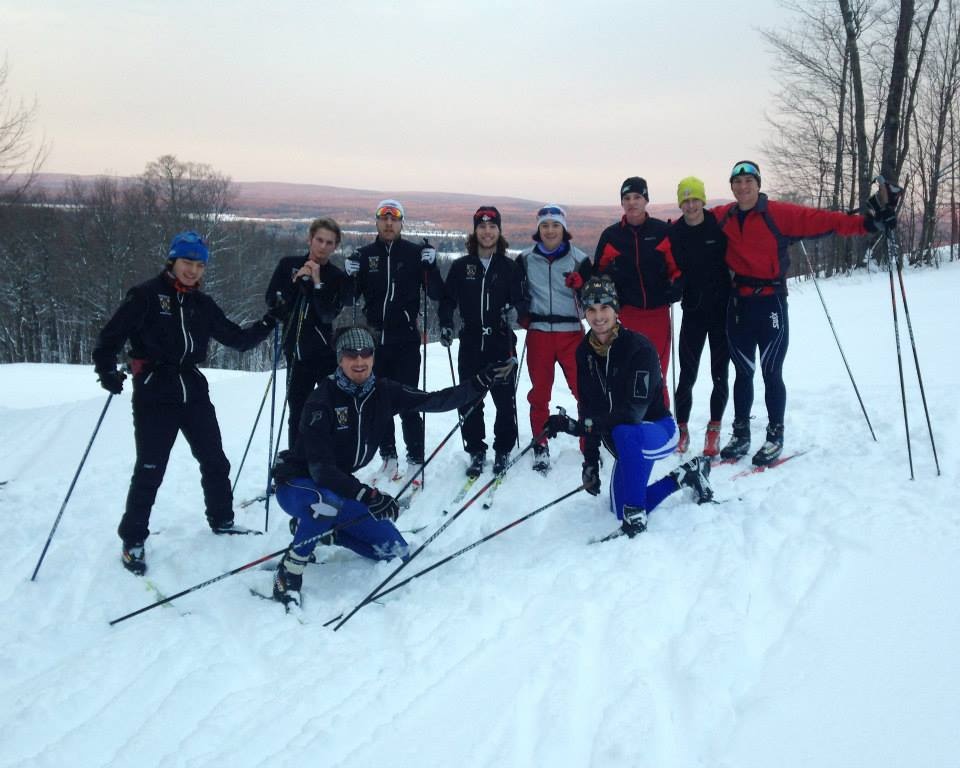
Dartmouth Ski Team (Photo: courtesy photo)
The things that make it lighter
The story of Dartmouth skiing is often told through tradition—green suits, first-years with mohawks, time trials. Lange points to different details.
There’s a sauna in the locker room.
“That’s a prime spot to get to know the team,” he said. “We rip this on all the time.”
There’s also life beyond skiing. Every non-freshman on the men’s team is in a fraternity. Lange lives in the Zeta Psi house with teammates and classmates—engineers, computer scientists, people whose lives orbit entirely different centers.
“I’m surrounded by a ton of people who have no clue what skiing means to me,” he said. “And that’s been a really huge part of being at Dartmouth.”
His best season, he said, came immediately after pledging.
“It taught me how to not put as much pressure on myself,” Lange said. “How to make this a sustainable thing that I could really enjoy.”
That balance—academic, athletic, social—isn’t accidental.
“None of the three would be as good without the others,” he said.
Lange’s favorite race: Prospect relay with Cam Wolfe and Cooper Camp. (Photo: Heidi Lange)
“You can’t live nervous”
Lange keeps a training log. He trains consistently. He admits he’s overcooked himself before. What he doesn’t do is chase numbers obsessively.
“I don’t think I’ve ever had an hour’s target that I’m trying to hit,” he said. “I’ve just trained for the enjoyment of it.”
There was a time, early on, when outside voices crept in.
“I was getting a lot of people saying, ‘You’re training too much. You’re doing this wrong,’” he said. “I got a little worked up about it and a little nervous.”
He paused.
“You can’t live nervous.”
It’s the line that keeps resurfacing, whether he’s talking about high school racing, college pressure, or the future beyond Dartmouth.
“I think anyone who’s in high school, middle school—just go out there because you enjoy it,” he said. “You’re gonna have crappy days. But if you go out there every day and just have a good time, and surround yourself with people you like to be around, things will work out.”
That philosophy shapes how he defines success now. Lange talks about team first. About racing in a green suit. About showing up energized.
“The guys here are here for the right reasons,” he said. “They’re skiing because they really enjoy skiing. That’s super energizing.”
Lange with his long time coach and mentor, Dennis Donahue. (Photo: Heidi Lange)
A quiet kind of confidence
Ask Lange where he sees himself years down the road, and he doesn’t reach for outcomes. He talks about process.
“The process of showing up every day,” he said. “How can I be the best athlete I can be today? That’s the most rewarding thing.”
Skiing, he believes, has taught him how to live—how to work, how to recover, how to stay curious.
“Wherever I am fifteen years from now,” he said, “all of the lessons that I’ve learned are still going to be extremely relevant and important.”
For now, there are finals to finish and skis to pack. The snow will either come or it won’t. The races will sort themselves out.
Lange will keep doing what he’s learned to do best: show up, stay loose, and ski without fear.
Because speed, he’s learned, is hard to find when you’re holding your breath.
Love Stories Like This? Help Keep Them Coming.
Feature stories like this one take time, access, and care to produce. If you value thoughtful storytelling and independent ski journalism, please consider becoming a Voluntary Subscriber. Your support directly fuels the work we do to cover the people, places, and moments that make our sport special.
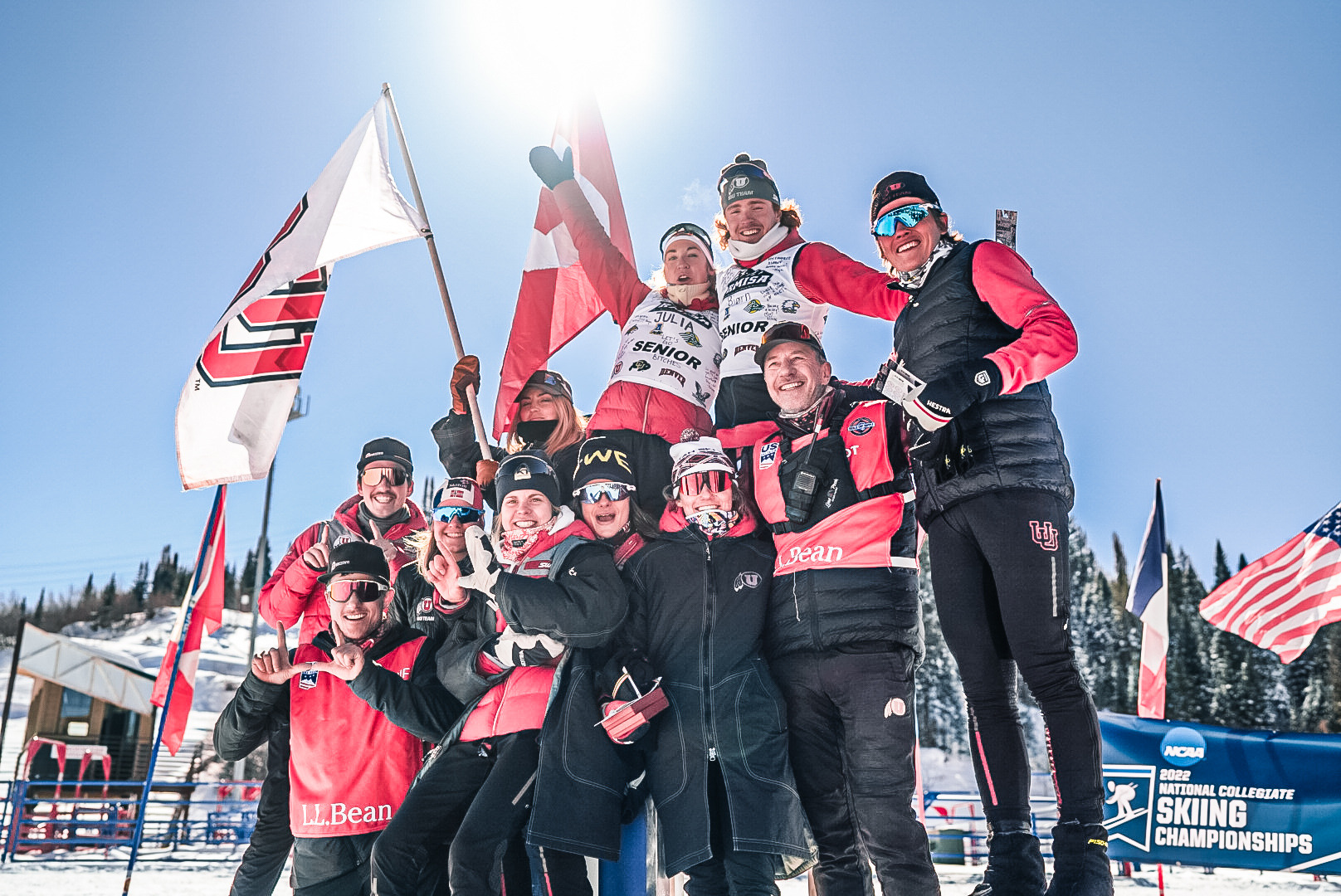
The University of Utah (UU) team celebrates on a sunny day in Park City at the 2022 NCAA Championships. The Utes won the NCAA team title, their 3rd in a row. (Photo: Tobias Albrigtsen / @untraceableg)
With a cohort of some of the best U23 skiers in the country, the program is setting a trend for young American skiers pursuing international-level and college skiing simultaneously.
After the first day of this year’s NCAA Championships, held at Soldier Hollow, Utah, the team scoring was close. The familiar schools were all there, the University of Utah (UU) at the front, with the University of Colorado (CU), Denver University (DU), and the University of Vermont (UVM) all close behind.
How close? Well, all within 100 points in the NCAA team scoring system – which doesn’t mean much.
Team NCAA scoring is hard to comprehend. It is best described as archaic and arcane; a cumulative score between alpine and nordic across genders, and disciplines, over two days of racing (with no sprint race to be found).
You can understand it in archaic terms then – the four big programs that have historically dominated NCAA skiing all went into the final day with a notion that they might just add another title (UU, CU, DU, and UVM account for 63 out of the 69 titles awarded in NCAA history).
Then, the 15 k women’s skate mass start went off.
What happened within the first kilometer was anything but arcane. Three skiers, all clad in the white and red of the University of Utah pulled away as if they were out for a team interval session.
The sight of that trio, together, has become an international force over the past couple of seasons. Sophia Laukli, Novie McCabe, and Sydney Palmer-Leger earned a Junior Worlds relay medal for the US together inMarch 2020. They’ve since climbed intotop tens on the World Cup together, also done a lengthy FasterSkierinterview together as well.
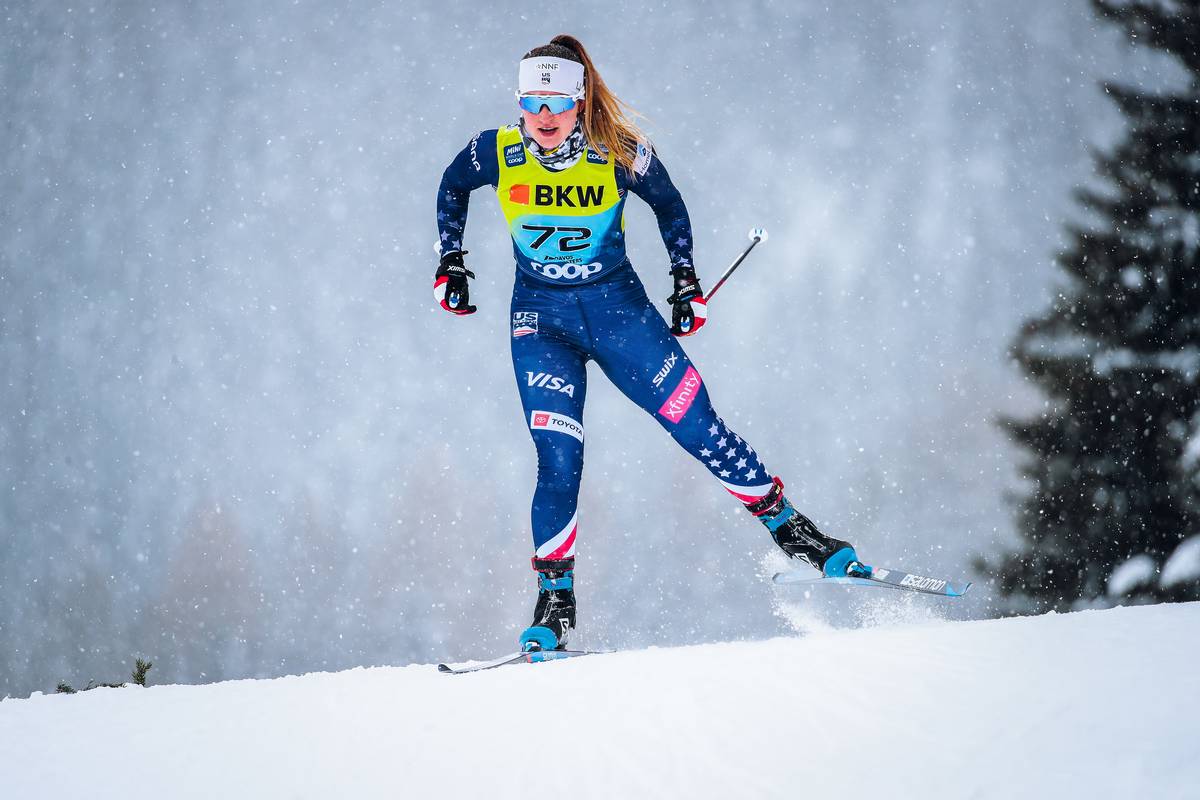
Sydney Palmer-Leger (USA) racing to 53rd position in the qualifier. (Photo: NordicFocus)
Coming into this particular NCAA race, Laukli and McCabe had just come home from representing the United States at the 2022 Beijing Olympics, while Palmer-Leger came in looking for athird NCAA championship title in only her second year on the circuit.
The only question then, was which UU skier would take the race. As Sophia Laukli broke away from McCabe and came across the line to do just that, she checked yet another of the boxes for accomplishments all three had now achieved. Before McCabe and Palmer-Leger had NCAA Championships, then McCabe, Palmer-Leger, and Laukli did. It only added emphasis to the dominance of UU in NCAA skiing beyond that one race.
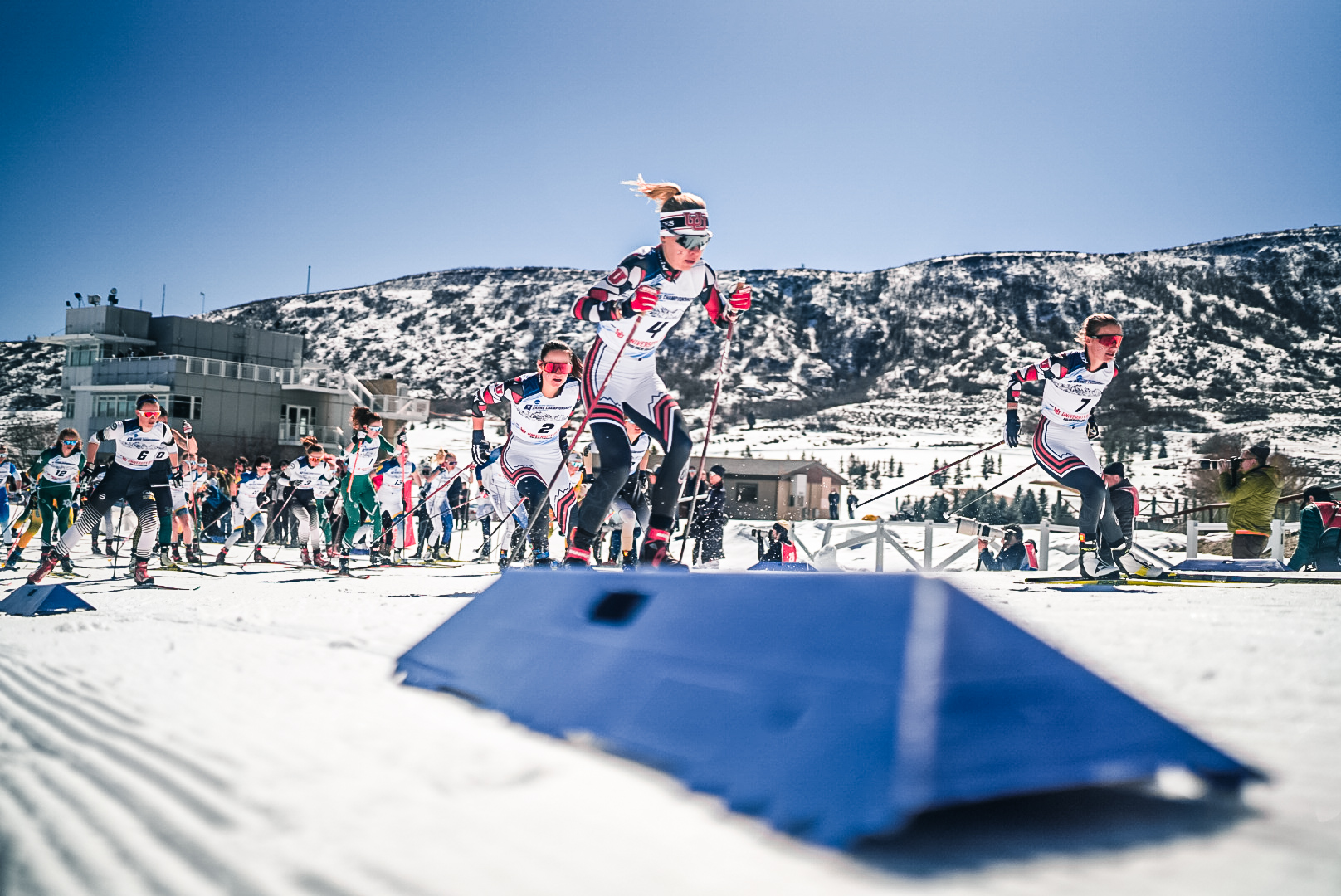
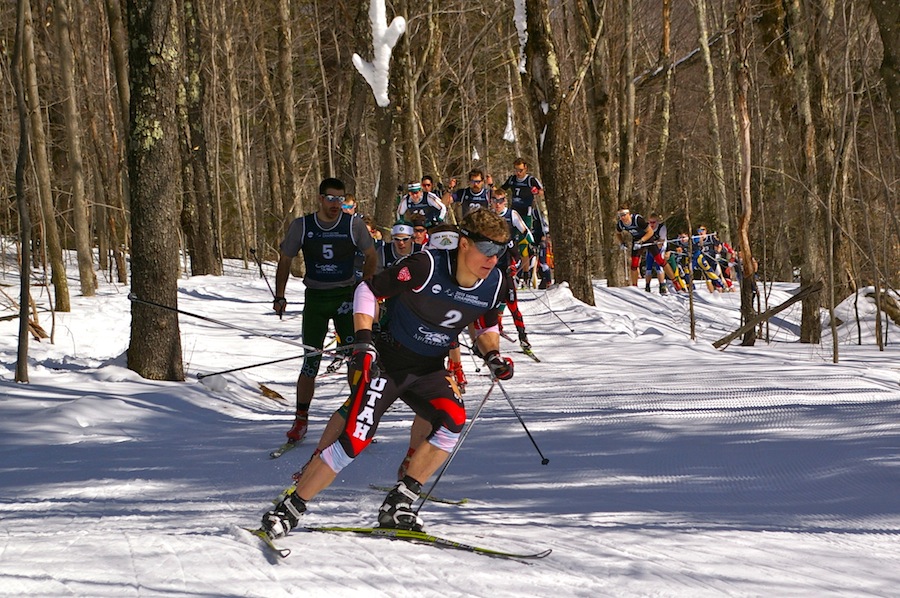
Sophia Laukli (bib 4), Novie McCabe (bib 7), and Sydney Palmer-Leger (bib 2) lead the women’s 15 k free during the 2022 NCAA Championships in Soldier Hollow, UT. (Photo: Tobias Albrigtsen / @untraceableg)
The UU nordic women had contributed roughly half of the points required to win UU’s third straight NCAA Team Championship, despite making up just a quarter of the team.
“I can’t take credit for building that, I’m just keeping it going” said UU Head Nordic Coach Miles Havlick in a call about the UU women’s dominant performance. “They’re a special group, unlike anything the NCAA has seen as long as I’ve been involved with it.”
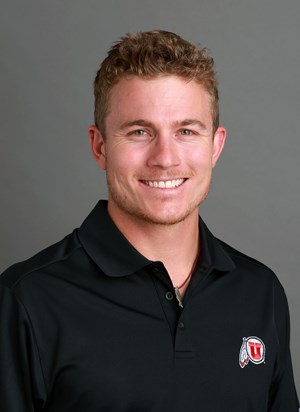
Miles Havlick, University of Utah cross-country ski head coach. (Photo: University of Utah)
Havlick has seen a lot. As an athlete for UU in the early part of the 2010s, he put together an NCAA career that was remarkable in the heights it reached – Havlick won two NCAA Championships in 2012 and 2013 – as it was in its pound-for-pound consistency over four years.
After a post-grad stint professionally racing for Sun Valley SEF and a couple seasons developing his coaching in the US, in Norway, and in Australia, he returned to the NCAA circuit, and to UU, in 2018. Havlick first stepped in as Assistant Coach before taking over the position of Head Nordic Coach in 2019, working with veteran ski directorFredrik Landstedt to bring the UU program to new heights.
Havlick may be quick to dismiss his influence in building the UU program, but there are implicit hints talking to him that his coaching is perfectly contoured to athletes wading through top-level racing while managing their development as a person.
“I like to think I use my racing experience, especially having raced a lot of these specific races…college is a challenging time where you’re developing, living on your own for the first time, and adjusting…and that’s without also managing an international racing career. Hopefully, I can relate and provide some wisdom to our skiers on how to do that.”
University of Utah Nordic coach Miles Havlick was a two time NCAA Champion during his career for the Utes, including winning the 20 k skate race at NCAAs in Middlebury, VT in 2013.
The particular knack for balancing skiers making their way onto the World Cup and wanting to pursue collegiate skiing became particularly important this season. Before the NCAA season had even started, the UU team was spread far-and-wide racing the World Cup.
“Sydney, Novie, and Sophia all were racing the first period of the World Cup. It was awesome they got that opportunity, and they all made the most out of it. It’s so easy to forget how young they are, and they were able to take whatever results they had with a grain of salt and just focus on skiing and learning as much as they can wherever they are.”
As rising juniors and seniors, Palmer-Leger and McCabe, and Laukli will be back at UU next year, and with their World Cup results this year, are all but sure to also be continuing to race internationally as well.
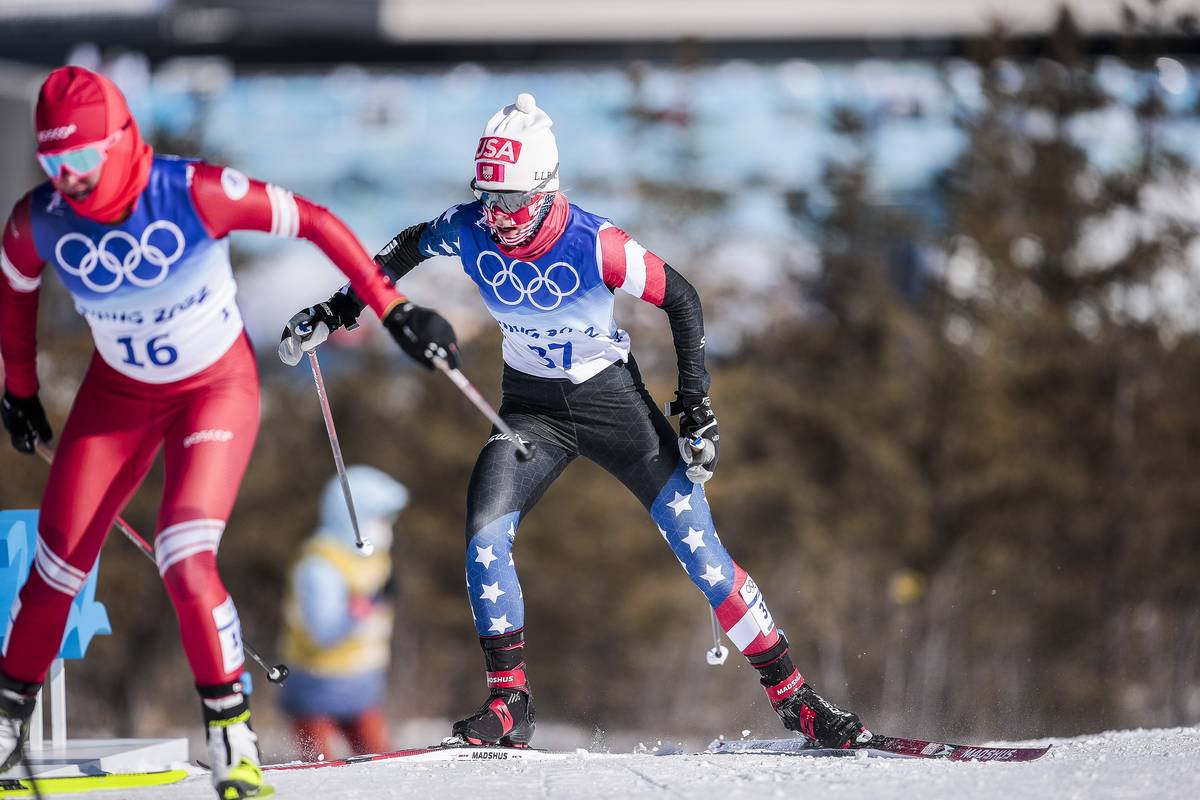
Sophia Laukli finished 15th in the Olympic 30 k skate race while representing the US in Febuary. (Photo: NordicFocus)
That, along with an equally talented core of male skiers, including NCAA All-American Sam Hendry and US Olympian Luke Jager, positions UU to continue its run of NCAA titles in the coming years. Something that Havlick says the UU team doesn’t take for granted. “I’m sure we have a huge target on our backs. It [would be] easy to coast and get stagnant. As long as we keep an attitude towards improvement and working hard, and on my end continuing to be smarter in my decision-making, I think we can stay as the top college program for years to come.”
That improvement in decision-making will include all the facets of coaching familiar to nordic coaches – waxing, training, team atmosphere – but at UU, it will also be precedent setting.
Along with UVM’sBen Ogden, the NCAA titles of McCabe and Laukli this year marked the first time in NCAA history that American-born athletes won every race. The collegiate race circuit, long a gauge of where young US skiing stood in relation to international talents, saw that gauge blown wide-open in 2022. The bar for US skiers is now being set by other US skiers, with McCabe, Laukli, and UVM’s Ogden all making breakthroughs at the World Cup and Olympic level. With their success, the relationship between the collegiate circuit and national team is set to evolve too.
Positioned in Salt Lake City, just 90 minutes from the headquarters of US Ski and Snowboard in Park City, with four athletes who have already worn the US suit on the World Cup, the US Ski Team athletes at UU and Havlick are cognizant that they will determine what that evolution looks like:
“The strength of the American Juniors on the world stage was shown in the last few years, and now we’re starting to see that push through to the college age, especially here. I’m hopeful that we can continue to build on the relationship we have here with the national team, and that the trend we’ve seen, where the national team is realizing the benefits of college skiing, continue. That helps skiers in the US, and the US skiers who do go represent us [on the international stage].
As a young athlete, Brennan pushed against the wishes of US Ski and Snowboard to compete for the US national team while skiing for Dartmouth with teammates like Ida Sargent and Sophie Caldwell. After completing her degree in 2011, she became a persistent domestic skier for Alaska Pacific University (APU), bouncing on-and-off of the national team while pursuing graduate-level education. Then, in 2020, a decade into her post-undergrad career, Brennan won a World Cup, and since has been one of the top skiers in the world.
One year, two generations: In 2021, Rosie Brennan (left) finished 7th in the Tour de Ski’s Alpe Cermis hill climb. In 2022, Novie McCabe (right) matched that result by taking 7th in the same race. (Photos: NordicFocus)
That success saw US Ski Team Head Coach Matt Whitcombreflect to FasterSkier Reporter Nat Herz that US skiing’s previous stance towards collegiate skiing “[was] not realistic, because you’re not taking the American culture into consideration.”
(Read more about the shift in perception on NCAA skiing’s role in athlete development here.)
Building upon Brennan’s example, the international and domestic performances of athletes exploring the NCAA-World Cup duality demonstrates that American skiing culture is now pliable as to where its top skiers turn for development in their skiing, and in their lives.
What that balance of collegiate and international skiing looks like will be set by the phenomenally talented skiers who are currently at the top of the collegiate ranks, with support and collaboration from both their NCAA and US Ski Team coaches.
At the University of Utah, that influence is a central feature of the program, rather than an exception. McCabe, Laukli, Palmer-Leger, Jager, and their coach Havlick have already broken the precedents of US skiing and are looking ahead to next season with expectation and a simple approach, as Havlick says “We’re proud of this year, for sure. We’ll let those results be though as we start training…I just want to keep one thing – the culture of hard work and process.”
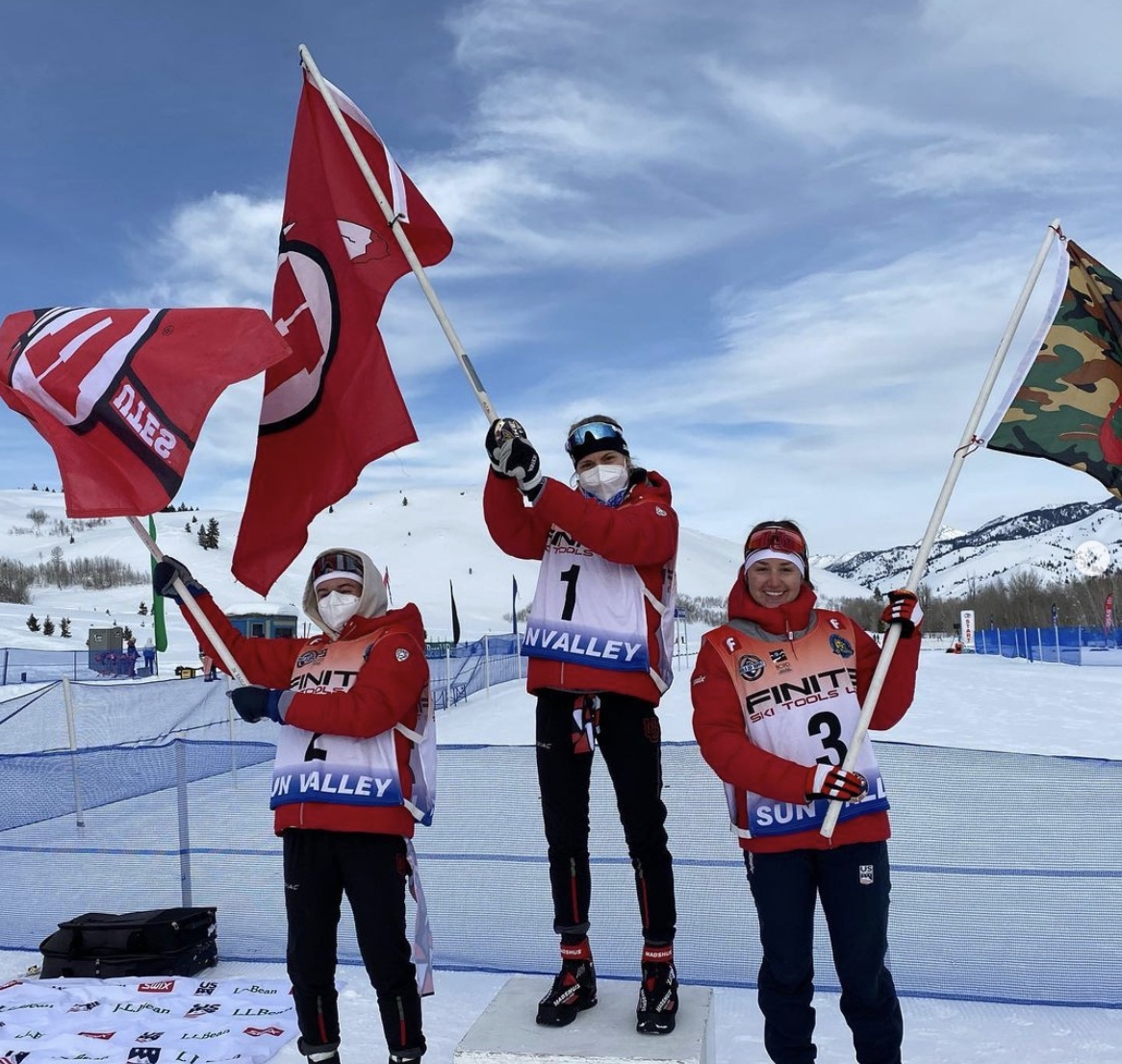
Utah teammates Sophia Laukli, Novie McCabe, and Sydney Palmer-Leger go 1-2-3 at a RMISA race in Sun Valley last January. (Photo: Instagram @utahskiteam)
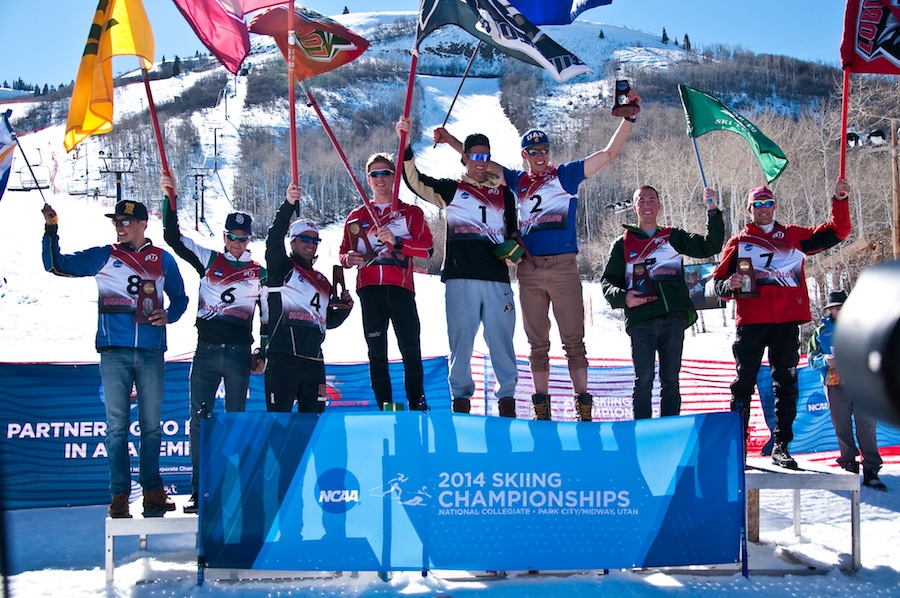
The men’s podium in the 20 k freestyle mass start at the 2014 NCAA Championships in Soldier Hollow. (Photo: http://bertboyer.zenfolio.com) All proceeds from photo sales will be directly donated to NNF.
LAKE PLACID, N.Y. — Come Wednesday, the 148 best collegiate skiers in the U.S. will descend upon Lake Placid for the 2015 NCAA Skiing Championships. Hosted by St. Lawrence University, NCAA’s will serve as the premier collegiate races of the season as skiers aim for both individual and team success. The last time Lake Placid hosted the Championships was 33 years ago in 1982, when the national races were only for men.
The nordic portion of NCAA’s will take place on the trails of the Mt. Van Hoevenberg, the site of the cross-country events in the 1980 Olympic games. The first day of competition on Wednesday will comprise of the 5- and 10-kilometer women’s and men’s freestyle interval starts, while Friday will feature the 15/20 k classic mass starts. Conditions should be pristine in the Adirondacks as recent weather has provided ample snow and below average temperatures.
The 2015 NCAA Championships will have similar team favorites in 2014. At last year’s championships in Park City, Utah, the University of Denver dominated the nordic races to win the overall team title. With several departures from the Pioneers’ squad, however, other schools from the west and east will look to capture the trophy.
The University of Colorado enters the NCAA’s as the top-ranked team from the Rocky Mountain Intercollegiate Ski Association (RMISA). The Buffs earned the most combined points throughout the season and were recently crowned the RMISA regional champions. If that wasn’t enough to boost their pre-championships confidence, their history in the east certainly will. Colorado has won the last two national collegiate titles in the east in 2011 and 2013.
Utah and Denver followed close behind in the 2015 RIMSA points rankings and will likely be Colorado’s top competition in New York, while the University of Vermont will look to extend its Eastern Intercollegiate Ski Association (EISA) dominance to the national stage. The last time Vermont won the NCAA team title was in 2012 in Bozeman, Mont.
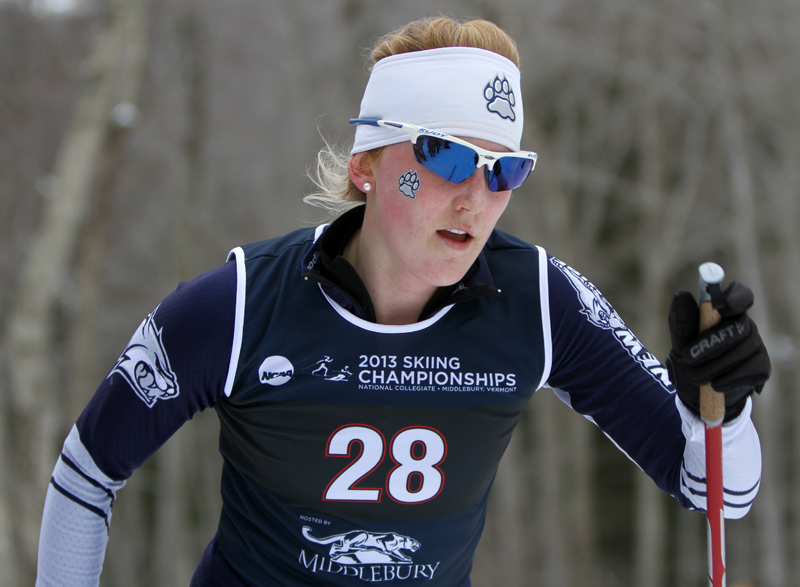
University of New Hampshire’s Annika Taylor races in the 2013 NCAA Championships.
The East:
If there are two skiers from the EISA to know before the start of NCAA’s, they are Middlebury College’s Heather Mooney and University of New Hampshire’s Annika Taylor.
With five wins apiece in the 2014/2015 season, Mooney and Taylor have shut out the rest of the eastern competition from the top of the podium. While their fight for eastern dominance will continue in Lake Placid, it remains to be seen how they will match up with the western and central women.
The Middlebury College women’s nordic team has qualified a full team for the first time in many years, including Mooney, Kelsey Phinney and Stella Holt. The trio has won many women’s nordic competitions throughout the season and will look to do the same in Lake Placid. If the recent EISA Regional Championships results are any indication — where Mooney and Phinney finished second and third, respectively, in the 15 k classic mass start — the Panthers are well on their way to their goal.
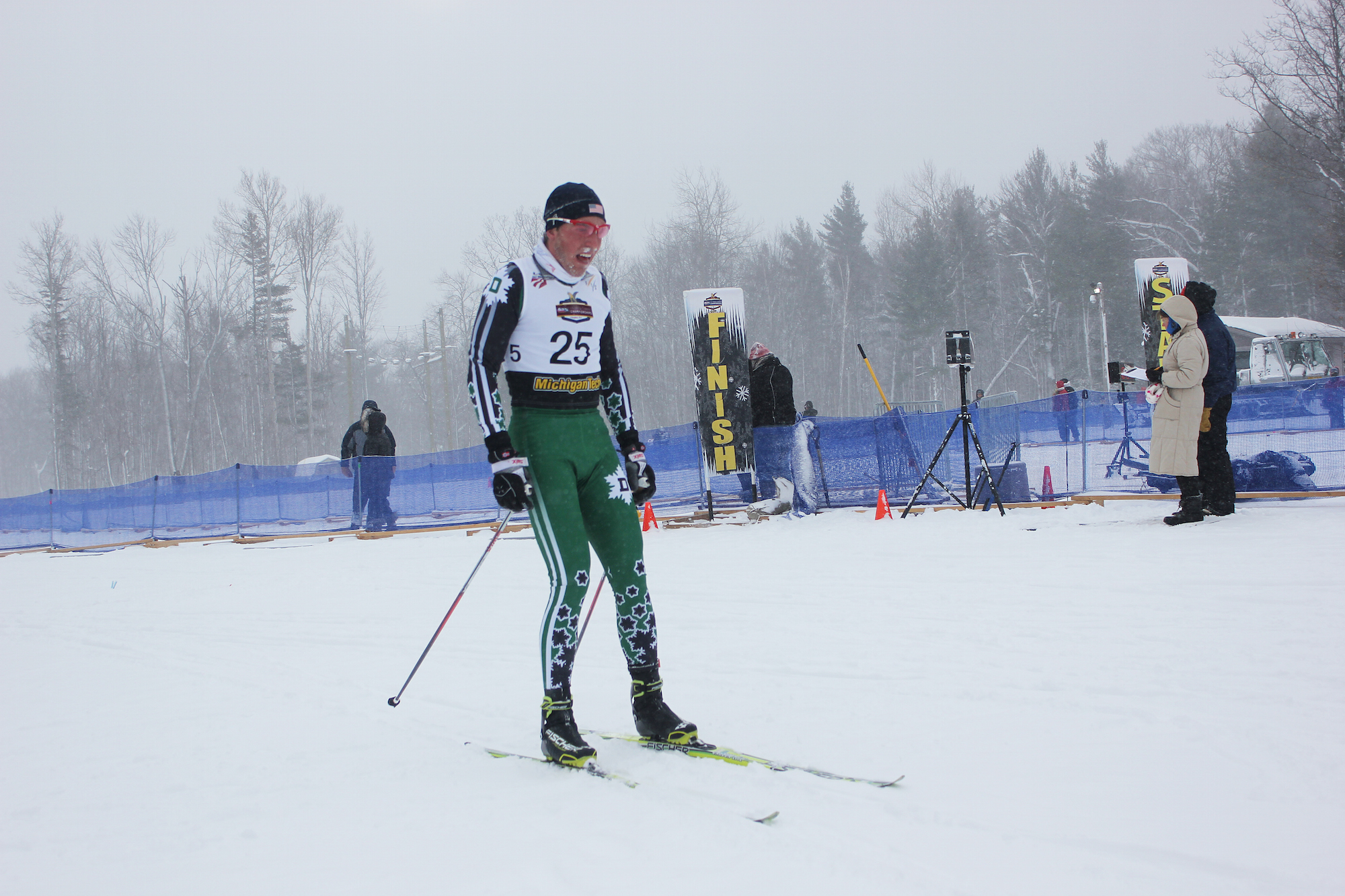
Paddy Caldwell (Dartmouth College) finishes the men’s 15 k freestyle in fourth place at the 2015 Cross Country Championships in Houghton, Michigan.
If the eastern women have been defined by two individuals, the region’s men are characterized by dueling schools — Vermont and Dartmouth. The Vermont trio of Rogan Brown, Jørgen Grav and Jack Hegman ended the eastern season ranked second, third and sixth, while Paddy Caldwell, Fabian Stocek and Silas Talbot took the first, fourth, and fifth spots.
Caldwell, who spent a large chunk of the season in Europe at the U23 World Championships in Almaty, Kazakhstan, enters as one of the favorites at NCAA’s. Last year, his best finish was fifth in the 20 k freestyle mass start. Talbot’s best finish at 2014 NCAA’s was 11th in the 20 k freestyle.
Brown’s best finish at the same championships was 13th in the 20 k freestyle, while Grav’s was 20th in the 10 k classic.
The West:
Rune Malo Ødegård of CU races to first in the 10 k individual classic at the 2014 NCAA Championships in Soldier Hollow. (Photo: http://bertboyer.zenfolio.com) All proceeds from photo sales will be directly donated to NNF.
If Caldwell wants to step atop the NCAA podium, he’ll have to overcome the RMISA frontrunners from the University of Colorado, Rune Malo Ødegård and Mads Ek Strøm. With the exception of one race, the two have alternated on the top rungs of the 2014/2015 RIMSA podium in every single competition. By the end of the regular season, Ødegård won five of 10 races while Strøm won four.
Ødegård is no stranger to NCAA’s as the Norwegian won two national titles in 2013 and 2014. His wins made NCAA history, as he is the first collegiate skier to repeat as an individual national championship in the classic discipline. Strøm earned his national title in the 20 k freestyle mass start in 2014.
While the two Buffs are the RMISA favorites, there are several other standouts to watch in this week’s races. German Moritz Madlener of DU and enters Lake Placid as the third-ranked westerner after earning bronze in four western qualifiers. The University of Utah’s Niklas Persson is another potential top finisher. The Ute finished third at 2014 NCAA’s in the 10 k classic. Mats Rudin Resaland of the University of New Mexico is also another top contender, and will look to improve on his bronze from last year’s 20 k freestyle.
The University of New Mexico’s Emilie Cedervarn is the top-ranked western woman after winning the last four RMISA races of the season. The Utes’ Veronika Mayerhofer is close behind for total wins in the west with three. Denver’s Sylvia Nordskar will look to repeat her podium performances from 2014 NCAA’s where she placed second and third. The Norwegian only raced the first four RMISA races this season. She won both the races in the Utah qualifiers and placed first and second at the Colorado invite before taking a six-race hiatus.
Other skiers to watch from the West are the Buffs’ Petra Hyncincova and the Utes’ Sloan Storey.
Central:
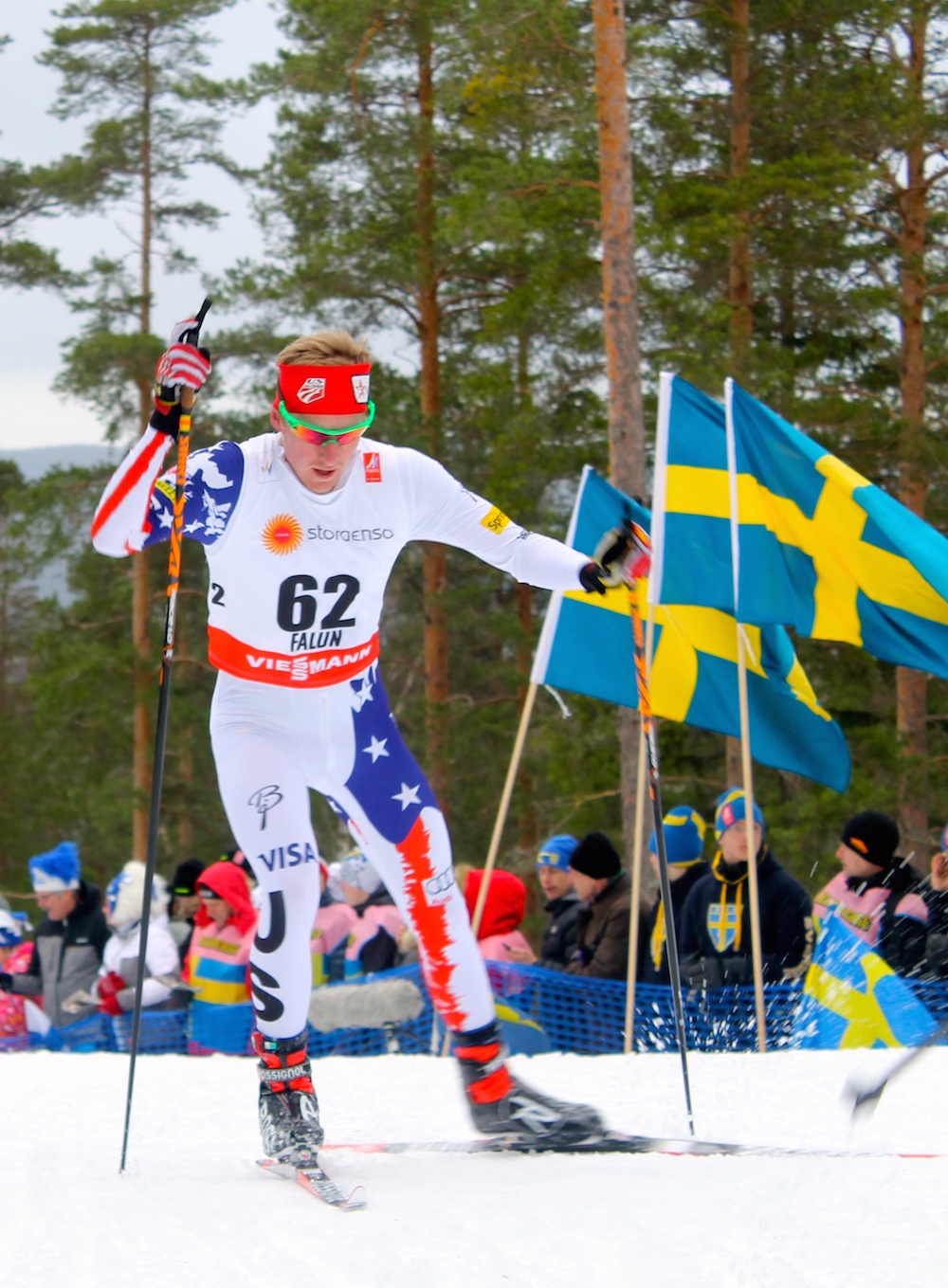
Kyle Bratrud of Northern Michigan University racing to 52nd in the men’s 15 k freestyle at 2015 World Championships in Falun, Sweden.
Kyle Bratrud of the University of Northern Michigan is the favorite from the central region after a successful season that saw him win the 15 k freestyle at the 2015 U.S. nationals and compete at the U23 World Championships in Almaty, Kazakhstan, followed by senior World Championships in Falun, Sweden.
Bratrud will look to overcome the fatigue of weeks of international racing and travel to fight for a spot on the NCAA podium. In 2014, he was the top American in the 10 k classic in sixth overall.
Joining Bratrud in the quest for collegiate success will be teammates Fredrik Schwenke and Erik Soderman. If the UNM trio can repeat their impressive performances from U.S. nationals, they have the possibility of leading the men’s nordic at NCAA’s. Last year, the men finished third overall in the 10 k classic and helped their coach, Sten Fjeldheim, earn 2014 national coach of the year.
Logan Hanneman of the University of Alaska – Fairbanks is another strong skier to watch from central.
Despite the graduation of Rosie Frankowski, the central women have a chance at top performances from NMU’s Jordyn Ross and Michigan Tech’s Deedra Irwin, among others. They will look to build on the region’s successful 2014 Championships to gain more starting spots in future national events.
Live timing will be available at BartTiming.com. FasterSkier will be on site for both days of nordic racing, so stay tuned for recaps from Wednesday and Friday.
Arnaud Du Pasquier, a Swiss member of Colorado University’s 2014 NCAA Championships squad, competing in the 15 k classic World Cup in Davos, Switzerland, on Saturday. Du Pasquier is using Switzerland’s obligatory military service requirement to ski full-time this year.
After a few seasons at Colorado University, Arnaud Du Pasquier felt the pull of home: he went back to his native Switzerland to do a year of military service.
“Every man has to do military service, it’s still obligatory in Switzerland,” Du Pasquier explained after finishing the 15 k classic World Cup race in Davos, Switzerland, on Saturday. “So I got called in. There are two reasons you can stop your studies: if you’re pregnant – and I’m not going for that! – or if you have to do military duty.”
So how did he end up ski racing on the World Cup? There are many ways to fulfill your military service requirement in Switzerland. Many young men actually participate in the army; men and women alike also spend a year doing civilian service. Du Paquier, who hails from Pontresina, just down the road from St. Moritz, is fulfilling his by skiing in the military sports program.
“Now I’m just racing,” he said. “I raced pretty well last week. The home country gets ten extra start spots, so I raced well last week and that’s how I qualified.”
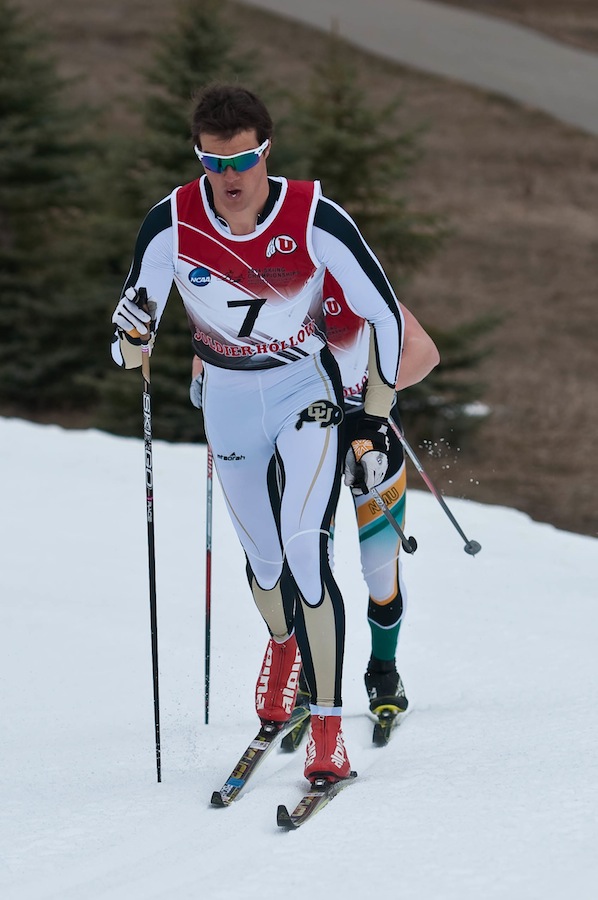
Since he didn’t qualify through, and isn’t on, the national team, Du Pasquier showed up to race in his CU Buffaloes suit.
With this coming weekend’s races in La Clusaz, France, moved to Davos, Du Pasquier will likely get another crack at it, too.
At CU, he was “basically a walk-on”, head cross-country coach Bruce Cranmer wrote in an e-mail. Du Pasquier snagged a pair of top-tens, including at 2013 RMISA Championships, and considers himself a distance specialist.
In 2013 he also made the NCAA Division I All-Academic Team while majoring in physics, and received the Buffs’ “Most Improved Student-Athlete Award”. His online bio explains that one reason he chose CU was because of the university’s five nobel laureates in Physics.
In 2014, he placed 19th in the 10 k classic and 36th in the 20 k freestyle at NCAA Championships, helping CU to fourth place overall.
“Arnaud has been a very hard worker and has had a full plate taking physics and math while trying to compete at a high level,” Cranmer wrote.
Du Pasquier hopes that the experience of spending a full year racing in Switzerland and getting some World Cup starts – he finished 82nd – will make him faster when he returns to CU as a senior next season.
“I don’t think it will change the way I race, but I think I would be able to be more on top,” he said. “Before, usually top 10, that was my goal at the races. I hope that now I can come back and be top three, or something like that. I think that will be way more fun, to be in front in college races.”
On Saturday, though, he had way more practical worries.
“I was pretty nervous, for sure,” he laughed. “I was mainly nervous because of my gear. I’m not on the national team so I have to take care of that myself.”
Dario Cologna’s ski prep, this was not.
“Luckily I had a guy helping me who was pretty good,” Du Pasquier said. “After I knew that I had okay skis, I was just having fun. I didn’t race as well as last week. I think my skis were just a tiny bit slow, compared to the other guys. But it was fun and I think it’s a really good experience.”
Cranmer agreed.
“I think a year in Switzerland, doing some military service and racing some World Cups will be a great experience for Arnaud and give him an idea of what it take to compete at the highest level,” he wrote. “Arnaud is a very upbeat and optimistic person so he strongly believes that he can not only improve but be a top level skier.”
That infectious enthusiasm certainly was apparent, even in the finish pen of a race where he got pummeled.
“I hope I can make some guys nervous,” Du Pasquier said. “The guys who saw me on TV, I hope they are getting nervous for next year.”
Jason Lemieux (left) and Bud Fisher coached the Williams College ski team together for the last two years. This season, Lemieux has taken over head coaching responsibilities. Photo: ephnordic.blogspot.com.
When longtime Williams College Nordic coach Bud Fisher began to contemplate retirement, he knew someone who might want his job.
He called Jason Lemieux, a former Williams racer who had gone on to ski for the Subary Factory Team before moving to Hood River, Oregon, to be closer to his wife’s family. Lemieux was happy on the West coast, coaching with XC Oregon and working marketing for a carbon fiber manufacturing company.
But he had never given up the idea that it would be nice to coach at his alma mater – which is also only half an hour from where he grew up in Massachusetts.
“It would have been a lot to give up for any other location, or any other school that is farther away from my family,” Lemieux said in an interview last week. “So this was pretty much what we had on the top of our list, and what we were willing to make the sacrifice for.”
Lemieux spent the last two years working side by side with Fisher as an assistant coach. The official handoff – or at least the emotional one – happened over spring break in Sjusjøen, Norway, where the current Williams team and a group of alums took a trip with Fisher to spend a lot of time on snow and celebrate their love of the sport.
“We ended up with a group of about 50 people skiing all day every day,” Lemieux said. “The kids were just all fired up. After such a long season, they still wanted to ski all day every day. It was a once in a lifetime trip. We’re hoping to do it again down the road sometime.”
Fisher always instilled Scandinavian values about the role of sport in a balanced life in his athletes. Having coached briefly at the NTG in Lillehammer, Norway, he knew exactly how much a part of life skiing is in Norway.
And that’s something that Lemieux says he will work hard to keep as a tenet of the Williams program.
“We used to always talk about the lifestyle to income ratio,” he said of Fisher. “That’s the goal, one way to find happiness. We’re definitely about the lifestyle, and it’s how I am too. When people are struggling or trying to balance, it’s all about the love of the sport. It has to be fun. It’s not just about the results.”
Official practice doesn’t start until the first Monday in October, but Lemieux says he has obviously been in touch with the team and it is shaping up to be one of the college’s best years ever.
Williams placed 15th at NCAA Championships last year, with the best cross country performance by Eli Hoenig, who placed 17th in the 20k freestyle. This year, Lemieux belives that the men’s team might be the best the school has ever seen.
He’s particularly excited about 2015 NCAA’s, which are to be held in Lake Placid, New York.
After graduating from Williams in 2001, Lemieux moved to Lake Placid to coach the Nordic combined team at the National Sports Academy. It’s where he made a big jump in his own skiing, after using mornings to train before teaching and coaching in the afternoons and evenings. So he knows the race trails well and says that it’s informing his team’s training this fall.
“Those trails are awesome, they’re great,” Lemieux said. “We’ll be doing some workouts that mimic the Lake Placid courses. There’s big ups and big downs there.”
So what has changed at Williams now that Lemieux is alone at the top?
The Schnellsteigen running time trial awaits Williams skiers this fall. Photo: ephnordic.blogspot.com.
Some things are superficial.
“Well, the average age in the office went down by a lot,” he laughed. “We have a new alpine head coach as well, and of course two new assistants because we both were the assistants before.”
And in a big relief to Ephs fans everywhere, Lemieux is touting a new race suit which more closely resembles the classic purple cow print than the suits of the last few years, which relegated the pattern to a small strip on the sides.
“I don’t think people will see a whole lot of difference from the outside looking in, but we do have new ski suits,” he joked. “They are definitely identifiable as a purple cow suit. It’s a modern world version of the purple cow.”
As an alum himself, Lemieux is intent on upholding the Williams Ski Team traditions, many of which date back decades. This fall, many of the standard workouts and time trials will still be on the schedule.
“We always do a race called the Schnellsteigen, which is about an hour uphill running race,” he explained. “It’s good training, but it’s also just a tradition. There’s 30 or 40 years of data so people can look back on their Schnell time. We’ll of course do that.”
But he is also adding some new variety to the training routine.
“We do a lot more creative agility workouts now, and different ways to train specific technique strength and speed,” Lemieux said. “I’m a little les straight-line focused. I like to have them working on a lot of different things for agility and athleticism. We’re doing some newer tests as well. We never had really a double-pole test, and we started a shorter uphill running test two years ago as well.”
So the updated Williams team? Lemieux hopes that by building on the school’s long tradition of Nordic excellence and introducing a few key new ideas, the Ephs will be able to rise to even greater heights.
“It’s important to be really consistent and have traditions, but at the same time you have to always look for new workouts and always look for new routes,” he said. “You try not to do the same thing every week, just to keep people excited about going to practice.”
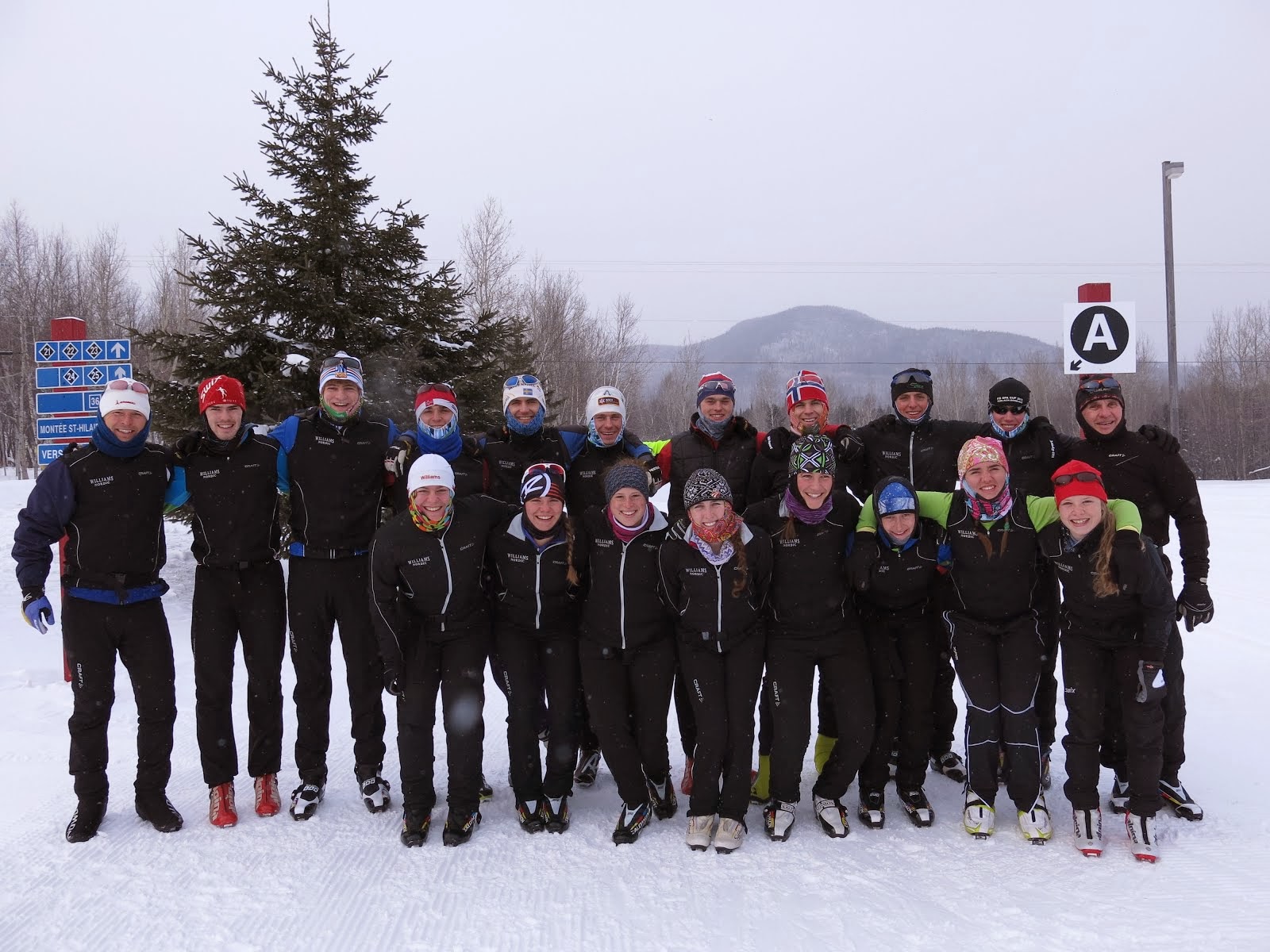
The 2013-2014 Williams team, with Lemieux (standing, left) and Fisher (standing, right). Photo: ephnordic.blogspot.com.
The Gustavus Adolphus College ski team out training. Photo courtesy of Tyler Gustafson.
Note: This is a more in-depth analysis of the situation at Gustavus Adolphus College, which we announced with a previous report last week. You can read the initial article, with ski team coach Jed Friedrich, here.
When Gustavus Adolphus College announced late last week that its varsity ski program was going to shifted to club status, the news came as a shock. Of course, it was devastating to Gustavus Adolphus skiers, both current and past: the team was their life while they spent their four years at the small liberal-arts college.
“The alumni were shocked when we heard that the team had been cut,” Kathleen DeWahl, a 2008 graduate of Gustavus Adolphus, wrote in an e-mail. “I remember talking with someone in the administration when I was in school, and they made a comment that Gustavus was 100% behind the team and that it would never be cut because the team was such a great representation of what Gustavus was about.”
But it wasn’t just Gusties themselves who expressed surprise. Even from the outside looking in, the program just didn’t seem like something you’d want to cut.
“I don’t think anybody, anybody expected this,” College of Saint Scholastica head coach Chad Salmela told FasterSkier. “I certainly didn’t… This year alone, they were competitive. We went head to head with them at the Minnesota championships, and they beat our women’s team. Our women’s team beat Northern Michigan this season! It’s not like they are bad.”
Students, alumni, and ski enthusiasts around Minnesota and the rest of the country have been trying to mobilize to engage the Gustavus Adolphus administration in a dialogue about why the decision was made and whether there’s any way to undo it, but it hasn’t been easy.
The athletic department has not picked up the phone any of the times that FasterSkier has tried to contact them, and alumni have had no better luck.
“Last Thursday I got a text from a college teammate that the team was being dropped,” former Gustavus Adolphus skier Jens Brabbit told FasterSkier. “Then it went viral on facebook. From there, they made the official announcement on the website. In that time, everyone was sending out e-mails to the athletic director, the president, and the board members, trying to tell them how we feel. That was alumni, and the ski community as a whole.”
On Tuesday Brabbit told FasterSkier that they had yet to hear any response from the administration, but later e-mailed to say that a meeting had been set up with the president.
There has been an outpouring of support, including a petition that has garnered, at the time of publication, 2,627 signatures (you can find it here). The Gustavus Adolphus student body is roughly 2,600 students, with 19 of them on this year’s ski team.
“We feel like that’s a pretty powerful message,” Brabbit said. “When you have a petition on such a small campus, where it’s larger than the campus as a whole, it’s such a huge message.”
Brabbit, who competed at NCAA championships in 2010 and 2011, is one of the alumni heading up the effort to get administrators to come to the table.
“We were trying to get a meeting with all the alumni and the decisionmakers to see if we can discuss and have a negotiation,” he explained. “We are hopeful we can try to get that set up. We feel we should be owed at least that opportunity to talk to them… We’ve had lots of academic and athletic successes in that program. We feel like we’ve always been a good ambassador of Gustavus Adolphus and we haven’t done anything to ruin that reputation.”
“The Gustavus Nordic team is one of the most dedicated, hardest-working teams I have ever known. We train countless hours each year, we boast the highest average GPA out of all teams here at Gustavus, and we are all heavily involved in activities both on and off campus. It saddens me to think that an entire team full of exemplary student-athletes won’t, according to the Gustavus administration, “benefit the future of Gustavus”… it has cut a team of some of the greatest student-athletes, and has eliminated its chance of receiving similar students in the future.”
—Tyler Gustafson, Gustavus Adolphus junior and Biathlon World Junior Championship competitor
Brabbit said that he had heard “through the grapevine” that the college president Jack Ohle was out of the country and that athletic director Tom Brown would not consider making a decision without him.
When they do get their chance to speak, they will lay out a number of arguments about why the ski team is worth keeping. One is its tradition of excellence. While it’s true that Gustavus Adolphus, a D-III school, has not sent a skier to the NCAA Championships in a few years, they have in the past, including in 2008 when they sent a full squad of three women – a high mark for a midwester D-III school – and Laura Edlund finished 18th in one of the races.
DeWahl, one of that year’s NCAA competitors, believes that the team is absolutely capable of repeating the feat.
“I know I had it in my head that I wanted to qualify for NCAA’s, and so did Laura Edlund and Kelly Chaudoin,” DeWahl wrote in an e-mail. “And that was the thing that allowed us to get three women to Nationals my senior year. We had a group of women who were serious about training and competing and about getting everyone on the team to compete on a higher level… I definitely think that it would be possible for the team to get there again, with the right combination of people and support from the school.”
Salmela, a longtime observer of college skiing, pointed out how remarkable this is in the central division, where there are currently very few quota spots for NCAA’s. Other recent team cuts have come from teams in very different positions from Gustavus Adolphus. For instance, the University of Nevada Reno in the western conference had much higher expenses as a D-I team with scholarship athletes.
And the colleges of Saint John’s and Saint Benedict’s, also in Minnesota, canceled their teams, which were also D-III. However, they had nowhere near the success of Gustavus Adolphus.
“Saint Johns and Saint Bens never had a full time coach,” Salmela said. “I think it’s safe to say, they had never truly invested in success as a ski program… The coach was a really good guy and worked hard, but he was still part-time, so he was at a huge disadvantage to the rest of us who are full-time. That cancelation didn’t surprise anybody that much. Gustavus on the other hand is really heavily invested and they have a robust and passionate alumni group. They have had way, way, way higher success rate.”
Brabbit points out that as a D-III school, this success rate – every once in a while sending a team to NCAA’s – comes at a very low cost, so he is not sure what the cost-cutting benefit is to the school of eliminating the team.
“We never had a crazy college budget like the big D-I schools,” he said. “We never asked for much. We were a very, very small-budget team and the cost of going to that school is so large, we feel like it does more bad publicity for the school than anything [to cut the team].”
The ski team has brought the college other good publicity, too. For instance, this year, college junior Tyler Gustafson took a break from the college racing circuit to compete at World Junior Championships for biathlon. He was the top American in the junior age category with a string of mid-40’s results.
Of course he had to find time to go to the shooting range himself, but the ski team made the results possible, said Gustafson, who was the subject of a glowing feature on the college’s website.
“I can honestly say I would not have qualified for and achieved the results I did in the recent World Junior Championships if it weren’t for the support of my fellow teammates and coach,” Gustafson said. “They are and have been incredibly supportive of my biathlon ambitions… If I didn’t have my teammates training and pushing alongside me this entire season, I can’t say I would have had the results I did. One would hope that the school would take pride in such results that not only I, but other biathletes have achieved through help by the Gustavus Nordic program.”
“Even outside of season and out of school, the team still stays together. In school, we’d have pancake breakfasts after long Sunday rollerski sessions all spring. We still get together at races during the winter and to train in the summer when folks are in the same town, state and continent, and the alumni know the skiers who are on the team now.”
—Kathleen DeWahl ’08, NCAA Championship qualifier
Plus, there are other advantages to the team. It’s a close-knit community that allows students navigating how to live away from home for the first time to form strong bonds and find positive role models. DeWahl talked about how Chandra Daw, an upperclassman when she arrived at Gustavus Adolphus, inspired her to take skiing seriously. That type of interaction hasn’t disappeared.
“One of the benefits of having a small team is that it allows us to bond and form relationships like no other,” Gustafson said. “And, as we constantly push one another and support one another, our team continually becomes closer and stronger.”
DeWahl described the team atmosphere and the fact that she’s still friends with almost all of her old teammates.
“As a D-III school, academics were still expected to take precedence over sports, so if someone needed a hand with homework or a project there was someone on the team who was willing and able to help,” DeWahl wrote. “And if you had a lab or class during practice, there was always someone who was happy to get up early to go train with you, so you weren’t alone.”
It has also allowed students in Minnesota, a part of the country where many people descended from Scandinavian and central European immigrants, a way to connect to their heritage. Gustavus Adolphus emphasizes this in other aspects of campus life: the King and Queen of Sweden came to the university a few years ago, and the college runs an exchange program to Sweden. In 2009, several participants went to the Vasaloppet.
“Gustavus takes pride in its Swedish heritage, yet, in a short-sighted decision, has cut a sport that is central to the lives of so many Swedes both past and present,” Gustafson marveled.
“I don’t think the people making the decision are Swedes. Whether the connection between cross country skiing and Swedish heritage ever-I can’t say I was there, but my hunch is that it never even entered the conversation,” Salmela said.
“There’s a good strong grassroot community of skiing in Minnesota. Programs are getting bigger and it’s an important part of Minnesota. There’s a lot of MIAC schools, but now there’s only one other MIAC program that has an NCAA team. It makes the decision even easier. A lot of people who are skiing in Minnesota are going to not look at Gustavus because of that. It’s a lifelong sport, so we need to keep it going.”
Plus, it’s not like skiers are causing trouble at the school. Everyone involved pointed out that the cross country ski team often has the highest GPA of any team on campus and go on to productive and in some cases high-profile careers.
“Those kids are smart kids,” said Salmela. “They’re the kind of kids who people are fighting for to get into their colleges.”
So finally, the biggest reason that Gustavus Adolphus may want to continue a varsity program is to be able to grab those students away from the likes of Salmela’s College of Saint Scholastica program, or rival Saint Olaf. Both alumni and current skiers confirmed that the ski team was a major reason that they chose Gustaus Adolphus over other options.
“Personally, I would not have looked at it without a NCAA program,” said Brabbit.
“When I was looking at colleges, skiing was a major part of my decision,” said DeWahl, who had competed at junior national championships all four years in high school. “I only applied to two schools, both with good physics programs, the subject I planned to major in. Gustavus had a ski team and the other school didn’t, and when I visited GAC, it was skiers who showed me around campus, took me to their classes and talked to me about the school. In the end, my decision to go to Gustavus was very easy because of the team and the people on the team.”
“When I searched for colleges, I did so with every intention of skiing,” said Gustafson. “That was my first priority. I also knew that I wanted to stay in Minnesota in order to further pursue my biathlon goals (the World Junior Championships). Gustavus was the ideal place for me because it offered not only a great ski program, but great academics as well… Coming to Gustavus, my goals were to ski as competitively as I could, while having fun doing it.”
The school said in its announcement that they were cutting the varsity team because they were choosing to focus only on Minnesota Intercollegiate Athletic Conference sports – only teams which could bring them home a trophy. Skiing used to be one such sport, but in 2004 MIAC rules changed to require six colleges to take part in a sport if it was going to be a championship event. Skiing fell below that mark.
But to the skiing-crazy Minnesota community, the current and former students suggested, lack of a MIAC trophy might not matter. They know all about the Central Collegiate Ski Association, and about NCAA Championships and the honor of even competing in such an event.
“If you’re looking for a D-III skiing experience in the Midwest, it just dropped by 33%,” Salmela said. “Your options are down to two schools. It’s not a healthy marketplace – I mean, three is barely healthy…. We need them. College skiing needs as many programs as we can get. And with a roster of 19, there’s no doubt that the market is there.”
Skiing brings in not only good students who become good ambassadors for the school but also tuition money, pointed out Salmela, who is familiar with the situation at his own college.
“Take what the college considers to be the net income they get from a student, and multiply it by the number of people on the team,” he said. “Or just multiply it by the number of people who wouldn’t be at Gustavus if it didn’t have a ski team. I’d be really surprised if they were losing money on skiing… To piss off 19 people and hundreds of alumni to save not much money, it just seems crazy. If they had eight skiers, I could totally get that. But they had 19 skiers.”
“Gustavus is a D-III school competing against D-I schools, so attracting all-stars to the team is always going to be tough and we don’t have the option to allow skiers a red-shirt year to develop or to get over an injury. So having the school’s backing, in terms of coaching, facilities, transportation, and just general confidence, is imperative to developing a team that can be successful.”
—DeWahl
Although Brabbit was enthusiastic about the chance to have a meeting with the administration, and explained that the team also had one of the college’s board members on their side trying to improve the situation, he was realistic about the chance that the team might be reinstated: it was probably low.
And although President Ohle is retiring at the end of this year, Brabbit didn’t feel that waiting until the autumn and appealing to the incoming president would be any better.
“Personally I feel that the longer it drags out, the less likelihood there is of changing the decision,” Brabbit said. “A friend of ours tried to already e-mail the new president with no response. They weren’t even a skier, just an endurance athlete who supports all endurance sports.”
Nevertheless, the fight will go on.
“I wouldn’t say that we’re optimistic since no [other university] ski team has made it back to varsity after being moved to club status, and the administration has been vague about the reasons for the decision, but we plan on fighting the decision and supporting the team, no matter what the final outcome is,” DeWahl wrote.
As for the current members of the team, the uncertainty is throwing them for a major loop.
“Because of the positive environment I, along with the rest of my team, continually improve year after year,” Gustafson said. “It’s truly disappointing that all this progress we’ve worked towards has been in vain… In regards to skiing for Gustavus next year, I was extremely excited. Our team had great results this season, and next year looked even more promising. It’s devastating for anyone to have their senior year of competition taken away from them – especially when the sport has been a part of their life for so long.”
Salmela wasn’t hopeful about the team being reinstated either, but he said that he and the rest of the Midwest ski community would do whatever they could do help.
“My team, yesterday they put together a picture of the team, and sent them supportive messages and trying to rally around them and get the decision overturned,” he said over the weekend. “It’s kind of like getting news that one of your loved ones has passed. It’s a little bit like sending flowers – I would love to see them reinstate the team as a NCAA varsity sport, and I don’t know how realistic that is.”
What can the ski community do to help? Brabbit said that besides signing the petition, calling and e-mailing administrators was extremely important. The alumni group has chosen three administrators to focus on:
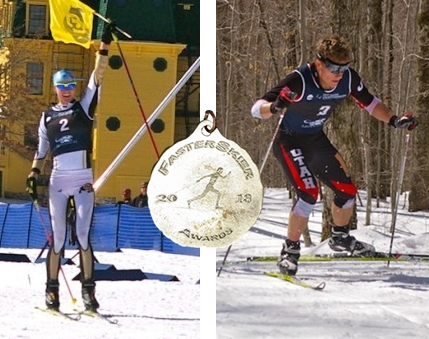
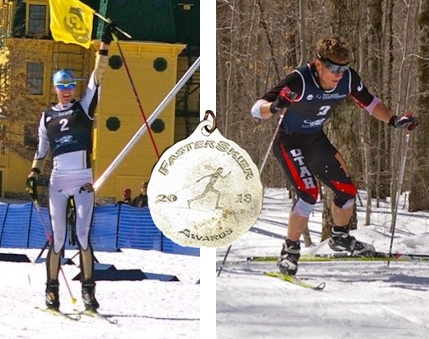
Joanne Reid (University of Colorado) and Miles Havlick (University of Utah) are FasterSkier’s 2013 Collegiate Skiers of the Year.
After a one-year hiatus, our Skier of the Year awards are back. We start with the collegiate category, where for the first time in FasterSkier’s history of giving such prizes Americans took both of the top honors: NCAA freestyle champions Miles Havlick (University of Utah) and Joanne Reid (University of Colorado).
Miles Havlick (USA/University of Utah)
Havlick (Photo: Steve Fuller/Flyingpointroad.com)
When it came time to nominate athletes in the college division, Havlick was at the top of a very short list. There is no question he deserves the honor; in college skiing all roads lead to NCAA Championships and his performance there was the storybook ending to a stellar college career. Not only did the senior from Boulder, Colo., defend his 2012 20 k NCAA title this year, which is no easy feat, he did so against one of the most competitive fields the NCAA has ever seen. The freestyle race, with its dramatic sprint finish and Havlick’s six-tenths winning margin, is not one to be forgotten any time soon. And at an event that’s all about team, Havlick was the first of all three Utes in the top five in the mass start, which propelled Utah from fourth to second on the last day of the Championships. For Havlick, it was a “perfect” ending to his time in Utah’s black and red.
Leading up to NCAAs, the signs were all there that Havlick was bound for success in Vermont; he won six out of ten RMISA regional races and never once finished outside the top 10. At the Montana SuperTours prior to the beginning of the college season, he just missed out on a trip to Canmore, Alberta, as an American representative on the World Cup. He’s our 2013 award-winner because of his achievements in college skiing, but when Havlick makes the transition to racing professionally after graduation he’s bound to shake up the men’s field at the national level.
Joanne Reid (USA/University of Colorado)
Joanne Reid leading CU teammates Eliska Hajkova (4) and Maria Nordstrom (9) in the 15 k freestyle at NCAA Championships. Reid won by nearly 27 seconds and Hajkova was second. (Photo: Steve Fuller/Flyingpointroad.com.)
The skier-of-the-year choice was also clear in the women’s collegiate category. Joanne Reid, in a ridiculously dominant senior season, won eight out of ten regional races leading up the final showdown in Ripton, Vt. At NCAAs, she added another ‘W’ to her resume in the 15 k mass start classic to lead CU to an improbable come-from-behind team win on the final day. It’s hard to call a team with 18 NCAA Championships in its trophy case (now 19) an underdog, but that’s what the Buffs were when they entered the last day of NCAAs 54 points down to the University of Vermont. Colorado relied on its nordic women for the lion’s share of the team score, and with the pressure on Reid delivered a 27-second victory over teammate Eliska Hajkova. Reid later said was unaware of her gap on the rest of the field until she realized the crowd would fall silent after she skied by.
A look back at Reid’s previous record demonstrates just how big a jump she made in the last year: though she’d already been on the NCAA podium as a sophomore in 2011, winning is quite a different thing. Illness plagued the Palo Alto, Calif., native midway through last season, and prior to this year she had only two collegiate wins to her name. What happened next, of course, is history: in the last few months Reid more than quadrupled her win record as she tore through the RMISA circuit like it was no big deal. Reid comes from an intimidating lineage of elite endurance athletes, but with her new individual NCAA title she’s on her way to creating a powerful reputation of her own.
Honorable Mention:
David Norris (USA/Montana State University)
David Norris’ wide-reaching accomplishments this year are worth noting. He particularly didn’t stand in the college circuit, but that was because he skipped half the season to race internationally — first at a little thing called the World Cup in Canmore, then at U23 World Championships in the Czech Republic. In between he was third in the 30 k classic at U.S. Nationals to Torin Koos and Erik Bjornsen. Norris finished a respectable 11th and 12th in the NCAA races, and immediately thereafter he jumped on a plane to compete for the U.S. at OPA Cup Finals in Italy. When he returned, he continued racing at Spring Series. It’s been said that college and skiing are difficult to pursue at the same time, but Norris and his coaches proved this year that the logistics are doable.
Sam Tarling (USA/Dartmouth College)
Like Norris, Tarling put together solid performances both in and out of the college circuit this year. A repeat NCAA title remained elusive for the Mainer, but like Norris the Dartmouth senior accrued impressive results domestically and internationally. Tarling was fifth in the 30 k at U.S. Nationals, joined Norris in representing the U.S. at U23 World Championships, and despite having to miss the first two EISA carnivals he was the second-ranked Eastern qualifier to NCAAs, where he finished 10th and seventh in the 10 k and 20 k, respectively. He joined Norris again in Toblach, Italy, for OPA Cup Finals, where was the top American man in the mini-tour final standings. After SuperTour Finals Tarling announced he’s going pro, and if past results are any indication he’s headed for big things next year.
Patterson leading Matias Saari (4th), and Matt Adams (2nd) about 1.5 miles into the Crow Pass Crossing on July 21. Courtesy photo.
On July 21, University of Vermont junior Scott Patterson became the youngest winner of the Crow Pass Crossing, a grueling 24-mile backcountry trail race in Girdwood, Alaska. With a winning time of 3:05:16.7, the 20-year-old survived thousands of feet of climbing, treacherous and overgrown terrain, a few river crossings, and the ever-present danger that “you could literally run right into a bear” — clearly, a win that signifies Patterson is in pretty good shape.
But the race was more important to him than off-season races generally are. It was one of several that Patterson signed up for this summer to specifically test his fitness and build back his racing confidence on the heels of what he calls “an extremely disappointing ski season.”
Within the first 500 meters of the Williams carnival 10 k last February, Patterson knew something was wrong. He was skiing at what was supposed to be his usual race pace, but his body simply didn’t have the energy to sustain it for more than half a kilometer.
The low point came partway through what had already been an subpar sophomore season and prompted Patterson to take time off to figure out how to get healthy again.
Patterson as a freshman, skiing at the 2011 SuperTour Finals.
“Last year was the first since I really began seriously training that I have not experienced significant increases in fitness and results,” Patterson said.
As a freshman the year before, he had been named the Eastern Intercollegiate Ski Association (EISA) rookie of the year, picking up two wins and four other podium finishes in his first year as a college skier. He finished eighth and 20th in the 10 k and 20 k, respectively, at NCAAs.
As a sophomore, Patterson was suddenly struggling through regular-season carnivals.
“About midway through December I started to notice problems with how I was racing and how I was feeling especially at higher intensities,” he said.
Patterson ruled out overtraining fairly quickly, but it wasn’t until April that he was able to fully resolve his health issues and began regaining fitness. Meanwhile, the season had continued and finished without him; his teammates at UVM won the 2012 NCAA championship. It was just the post-season scenario every college athlete envisions, but Patterson was on the sidelines.
Determined to help the Catamounts to a repeat national title in 2013, the Alaska native returned to Anchorage this summer set on using the time to regain his old form. To do this, he signed up for an unusually high number of mountain running events, triathlons and bike races to test himself throughout the summer. The Crow Pass Crossing was his most recent test, and his second year entering the event. Unlike previous summers when he’d train straight through summer races, Patterson specifically focused on Crow Pass.
“This year I approached the race a little differently,” he said. “After racing it once, I knew better how my body would behave. After an extremely disappointing ski season, I signed up for more races this summer and actually put in specific training for them, especially on Crow Pass.”
His preparation consisted mainly of doing more and longer trail runs. “This was something both enjoyable and beneficial for later racing,” Patterson said. “I made sure I trained so that I was ready for it, but not to the extent that would not also be beneficial for skiing.”
Racers ascending to the Pass on a wet race day. Courtesy photo.
The work paid off; just over three hours after leaving the start line on the morning of July 21, Patterson won Crow Pass against a challenging field.
“I had high expectations going into the race, but I also knew that anything could happen over 24 miles depending on how everyone was feeling,” he said.
The outcome also depended on avoiding injury. With slippery and overgrown terrain to contend with, Patterson wasn’t the only one to leave blood out on the course. On wobbly legs in the last three miles, he ran the final section of the race unchallenged, having dropped fellow leaders Matthew Adams and Matias Saari after crossing a waist-deep Eagle River.
“The final miles seemed to drag on until the last long gradual uphill to the finish,” Patterson said. “Luckily I have never had anyone around me at that point because battling for the finish would be rather painful.”
Adams ended up coming in second, 3:22 behind Patterson. Third-place finisher Andrew Arnold, who is a frequent training partner of Patterson’s, came in at 3:18:31.4.
Alaska Winter Stars skier Andrew Arnold (3rd), two miles from the finish. Couresy photo.
As Patterson continues to build back fitness and confidence through the rest of the summer, he has his sights ultimately set on a junior season and maybe a few key championships — U23s, NCAAs, SuperTour finals. When he’s not working as a mechanical engineering intern at an Anchorage firm, he’s been training with his junior club, Alaska Winter Stars.
“My training is going well,” Patterson said. “We generally get a good group of college skiers returning…as well as younger skiers looking for fast training partners.”
As the end of August approaches, college skiers all over the country look towards heading back to school. Patterson returns to Vermont on the twenty-first, and will be competing in the Race to the Top of Vermont the day before classes begin.