From the FasterSkier archive — posts syndicated from athletes’ and coaches’ own blogs between 2004 and 2012, kept online as published. Current coverage is at fasterskier.com.
The National Nordic Foundation (NNF) is excited to announce the election of a new Chairman of the Board, Peter Ashley. Peter succeeds former Executive Director and long-time Board Chair, David Knoop who is moving into an unofficial advisory role with the organization. Over the past eight years, Knoop transformed the nearly-defunct National Cross Country Ski Education Foundation (NCCSEF) into a fundraising powerhouse that has contributed in excess of $1 million to developing nordic athletes since 2010.
“I can look back to eight years ago,” says Knoop, “and there was a real need for an organization to fill in the gaps between what the clubs were capable of and what the U.S.S.A./U.S. Ski Team was doing. We had a few bright spots like Kikkan Randall and Andy Newell, but overall, the ‘Development Pipeline’ was more theory than practice. The NNF arose out of a need to create funding and a sustained budget for development programs.” David, further reflecting on the subsequent eight years: “The NNF is a success story that I’m very grateful to have been a part of and enjoy with so many of you. I know that the NNF will continue to be successful with your support and I wish everyone all the best and hope to see you around enjoying the sport and lifestyle that we love.”
Peter Ashley, who has been on the NNF Board of Directors for the past two years brings a wealth of experience and connections from a lifetime in the skiing community. Among his many accomplishments, the Jackson, Wyo., native, spent nine seasons as a U.S. Ski Team coach before working over 20 years with Fischer Sports as National Sales and Marketing Manager for their Nordic Division.
“This is an exciting time to be involved with the NNF,” says Peter. “The past years’ results are a testament to the hard work of the nordic community over the last 20 years. I look forward to working with all the nordic clubs, coaches, athletes and the entire nordic community to continue and improve on the past years’ success. Soon we’ll announce the NNF funding of summer projects in 2017!”
Executive Director, Hennie Kashiwa’s role remains unchanged. “I am very excited for the NNF to have Peter’s wealth of experience both in skiing and as a leader,” says Kashiwa. “As we transition, however, it is critical to recognize the work that Dave Knoop put into the NNF. Without Dave, the NNF would simply not exist as it does today. Both personally and as a member of the skiing community, I’d like to thank Dave for the monumental impact he’s had on our sport.”
Members of the Sun Valley Ski Education Foundation Gold Team with coach Colin Rodgers in Europe last season. (Photo: NNF)Five years ago, David Knoop was a self-described master blaster looking for a cause, and the National Cross Country Ski Education Foundation (NCCSEF) was going to be it.
His process of finding the NCCSEF didn’t happen overnight. In fact, the nonprofit had been more or less defunct since 2008, when founder Reid Lutter decided he was too busy to continue its mission of supporting junior development in U.S. nordic skiing.
After starting the NCCSEF, formerly based in St. Paul, Minn., 14 years earlier with Rick Kapala and evolving to the point where they could send American kids to Junior World Championships, Lutter simply had other focuses as a ski coach and owner of a custom-apparel company, Podiumwear.
Meanwhile, Knoop, who lives in Park City, Utah, and works as an insurance broker in Salt Lake City, was figuring out his own calling. In the spring of 2008, his 20-year-old son Matthew Knoop was killed by a hit-and-run driver while on a mission for The Church of Jesus Christ of Latter-day Saints in Brazil. The oldest of Knoop’s two children, Matthew was a Park City High School soccer standout who captained his team to a state championship in 2006, his senior year.
After his passing, Knoop started to research charitable causes to devote himself to.
“My son didn’t get paid to go on a volunteer mission — it was something he wanted to do because he made a difference,” Knoop said on the phone this week. “He taught me a lesson there and I just decided I could give back.”
Simi Hamilton on his way to winning the U23 World Championships skate-sprint qualifier by one second in 2010 in Hinterzarten, Germany. He went on to place 26th after his pole broke in the quarterfinal. This season, Hamilton, 27, is a member of the U.S. Ski Team A-team. (Photo: NNF)By way of the U.S. Ski Team, he found the NCCSEF. A regular donor to the team, Knoop eventually got a direct request from then-U.S. Ski Team (USST) director John Farra.
“Farra said, ‘I want you to take over the NCCSEF,’ ” Knoop recalled. “I was like, ‘I don’t even know what you’re talking about it.’ He was like, ‘I’ll help you with it for a couple of months.’ ”
Knoop remembered thinking about the potential of the sport and the ranging emotions people have when it comes to their perception of the USST or its national governing body, the U.S. Ski and Snowboard Association (USSA). Instead of admiring the problem, he decided it was time to take positive action.
According to Knoop, the National Nordic Foundation (NNF), which came to be in 2011 out of the same 501(c) because “just saying [NCCSEF] is a mouthful,” started with a basic structure — not exactly a business plan.
“[Farra] said, this is junior development, this is how junior development works, these are the projects that are sorely in need of funding,” Knoop said.
From there, the former soccer coach and longtime nordic enthusiast began to immerse himself in U.S. cross-country skiing from the club to national-team levels.
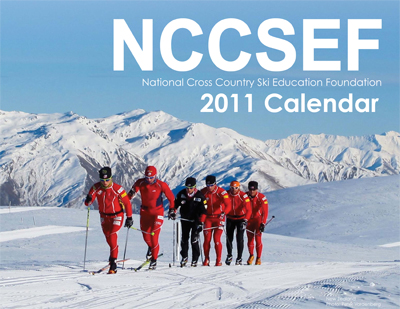
The 2011 NCCSEF calendar cover. (Photo: FasterSkier)Then, he got some help from Kapala. The head of the Sun Valley Ski Education Foundation (SVSEF) nordic program, Kapala knew of a generous donor in Sun Valley, Idaho, who would likely support a national cause as well, and he connected him with Knoop.
“The first year I did a bit of wandering in the wilderness by myself — John Farra gave me a lot of guidance in terms of projects he felt were important … Rick Kapala had a few people he introduced to me,” Knoop said. “They were kind to me. They could tell I really didn’t know what I was talking about, but I had an idea and there was probably half a dozen donors that wrote some good-sized checks and said, good luck with your experiment.”
Knoop was not a professional fundraiser; he was a volunteer with a demanding day job. Once donors realized that and understood that he had little to gain, he said they became easier to approach and usually more likely to open their wallets.
NNF’s Rise
In 2009, the NCCSEF came back to life with roughly $35,000 dollars in the bank. Five years later, Knoop as the director checked the balance from his Salt Lake office: the NNF had about $215,000 in reserves for cross-country skiing and about $43,000 for nordic combined. And that was more than three weeks before the Drive for 25 (D25) ended.
Annually the foundation raises more than half a million dollars in donations. With goals of raising $150,000 for cross-country and $50,000 for nordic combined in this year’s D25, the NNF was more than halfway there with 19 days to go. As of Friday, 75 percent of the target had been reached for cross-country and 14 percent for nordic combined.
While the discrepancy between the two sports might seem large, Knoop explained that it’s misleading: nordic combined parted ways with the NNF this summer, then returned to the organization three weeks before the D25 started Oct. 1.
When USSA defunded nordic combined in April, NNF board member and nordic-combined veteran Billy Demong devoted his offseason to fundraising to save his sport. One of his first moves was partnering with USA Ski Jumping.
NNF Board of Directors:
David Knoop (executive director)
Reid Lutter
Joey Caterinichio
Yuriy Gusev
Jennifer Barba
Steve Fuller
Kerry Lynch
Billy Demong
Contract employees:
James Southam (administrator)
Andrew Gardner (public relations)
According to Knoop, that led nordic combined — which was in search of top-to-bottom funding — to search for funding outside the NNF, which reserves financial support for national B-team athletes and those in the developing ranks below them and above Junior Nationals.
“My response to Billy [was], ‘You can leave the NNF, but we’re not kicking you out. There’s no hard feelings,’ ” he said, explaining that they kept their lines of communication and nordic-combined’s checking account within NNF open.
“We even funded a summer project for them with some remaining funds they had,” he added. “Kerry [Lynch] and Billy remained on our Board of Directors.”
Over the course of the summer, nordic combined generated most of the money it needed to get through the next season and put a renewed emphasis on development and future sustainability. As a result, Knoop said the program was probably stronger as a result.
“They’ve had a heck of a ride,” he said. “They got a fair amount done through [USA Ski Jumping] all summer long, then they kind of realized, we benefit from being part of the NNF. There’s no takeaway here — why wouldn’t we have three buckets of revenue?
“They came back to us three weeks before the Drive for 25 and you can see the result,” he added. “It’s not very scintillating, but they’ll be back.”
At the same time, the Drive is one of multiple nordic-combined fundraisers held each year. The then-NCCSEF added nordic combined to its support structure in the spring of 2011.
“Nordic combined historically has done really well,” Knoop said. “[As] Kerry Lynch said, ‘We might be small, but we’re mighty.’ ”
The Drive: what it is and how it started
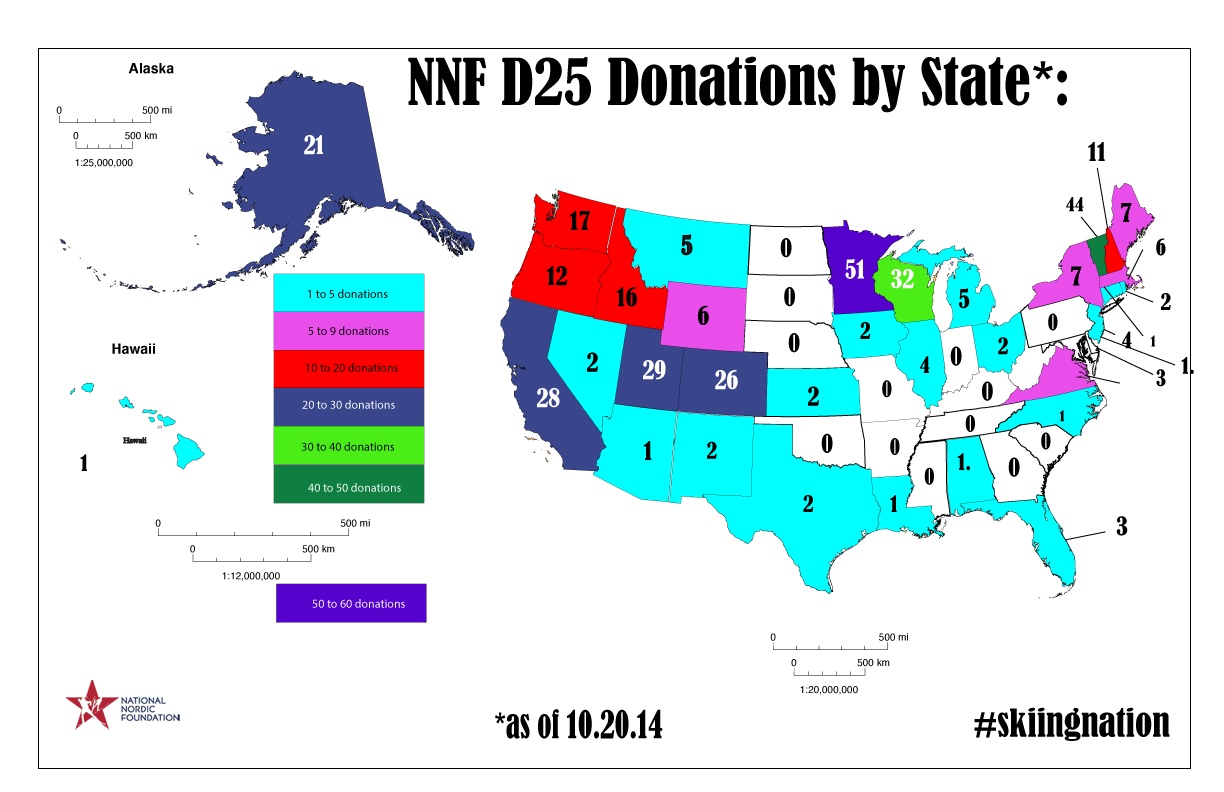
NNF’s D25-donation tally by state, with director David Knoop emphasizing the importance of the number of donors over the fundraising amount. “There’s a national appetite for this,” he says.
In its fourth year, the D25 is one of two annual fundraisers the NNF holds for cross-country. Alternatively, nordic combined prefers to spread its efforts, and typically solicits donations in different forms multiple times a year.
The idea to encourage an estimated 4,000 U.S. nordic enthusiasts to donate in the name of development came to life in 2011 with founders Peter Vordenberg and Matt Whitcomb, then both U.S. Ski Team coaches. They reasoned if thousands donated $25 on a single day — Nov. 15 — it could make a lasting impact on developing cross-country skiers.
“U.S. cross country skiing is in financial trouble,” a 2011 press release for the D25 stated. “While we have improved from a nation that seldom put a single skier in the top 15 on the World Cup to a nation with World Cup and World Championship podiums we are currently operating at a budget of less than a tenth of our toughest competitors. And more importantly our budget shortfalls are making it impossible for our younger developing athletes to afford the racing opportunities they require to compete among the best.”
There were two ways to get involved: simply donate $25 on Nov. 15, or even better, become an ambassador and persuade at least 10 others to donate $25 on the same day.
The premise was solid, but NNF’s mailbox nearly couldn’t handle it. Knoop said it was a good problem to have, “Sure enough, on November 15, it rained [money] on that day … We raised like $50,000, like, holy smokes,” and the buzz surrounding the Drive was what left a lasting impression.
But there were questions. Knoop said he received checks in the months following with letters asking if the NNF would still accept donations. Of course they would, he always responded. And while the Drive took different forms in the years to come — from lasting almost three months last year, to six weeks this year — the goal was the same: to get “hay in the barn” so NNF’s board could allocate funds for the fast-approaching winter.
“Sure enough, on November 15, it rained on that day … We raised like $50,000, like, holy smokes.” — David Knoop, NNF director on the inaugural Drive for 25 in 2011
Before the Drive, Knoop said he focused on larger donors, and Vordenberg and Whitcomb drew his attention to the importance of a grassroots presence. What he later found was the NNF could have the best of both worlds, with big-time donors offering to match the amounts raised by grassroots donors.
The NNF is currently promoting a matching challenge for U.S. Nordic Combined’s Drive for 25, effective until Nov. 12, 2014. (Photo: NNF press release)Nordic combined currently has a matching challenge on the table: if it reaches $20,000, it’ll receive $20,000 in matching grants. As of Oct. 24, it had raised just over $7,000.
NNF’s athlete ambassadors sometimes have their own matching proposals to help them reach individual fundraising goals.
Katharine Ogden of the Stratton Mountain School led this year’s ambassadors in donations after exceeding her goal of $3,000 with more than $4,300 as of Oct. 24. The second-highest fundraiser, Paddy Caldwell of the USST D-team raised nearly $2,000 of his $2,500 goal in that time.
Knoop said those athletes went above and beyond their expectations as ambassadors, but he encouraged anyone who has benefited or could benefit from the NNF’s support to fundraise on its behalf as well.
And that’s the part of the Drive that hasn’t changed over the last four years. According to Knoop, the bottom line is, ambassadors are still expected to get 10 friends to donate $25 before Nov. 12.
While fundraising isn’t glamorous, it’s necessary, Knoop said.
“It’s about as tedious as your parents asking you to mow the lawn,” he said. “In terms of the timing of it, we run it a bit longer because all these kids are going to school, they’re training and to tell them they’ve got to get something done in one or two weeks, it’s not going to happen. We need to give these kids some time to build momentum.”
Not all of NNF’s roughly 80 ambassadors are developing athletes. USST Head Coach Chris Grover has raised the third-most amount of donations as an individual and USST Assistant Coach Jason Cork is fifth on the list after Team Gregg.
Several members of the USST A-team, the elite tier that doesn’t receive money from the NNF, are also ambassadors. According to NNF’s public-relations director Andrew Gardner, everyone on the USST with the exception of Andy Newell received NNF funds as developing skiers — and Newell supports the NNF regardless.
“What we’re trying to do now, twenty years later is say, there’s a whole development need and there’s a space between Junior Nationals and the A-team on the U.S. Ski Team that’s a funding void. In terms of development, that’s what you need.” — Knoop
Understanding the NNF
Last year, the D25 exceeded its goal of $150,000 for cross-country and raised $170,000 with 1,071 donors. That’s great, Knoop said, but what confounds him is how many nordic skiers still don’t know what the NNF is.
“I race a lot in the Midwest; it is master-blaster central,” he said. “Just imagine, part of our tagline is: generations helping generations. I wear an NNF patch on my hat and yet as a master blaster going to a fairly large citizen race, I can stand there at the starting line and easily 90 percent of the athletes will have no clue what that NNF patch is. That’s the potential. Whether or not we ever reach a broader base, that is the question mark.”
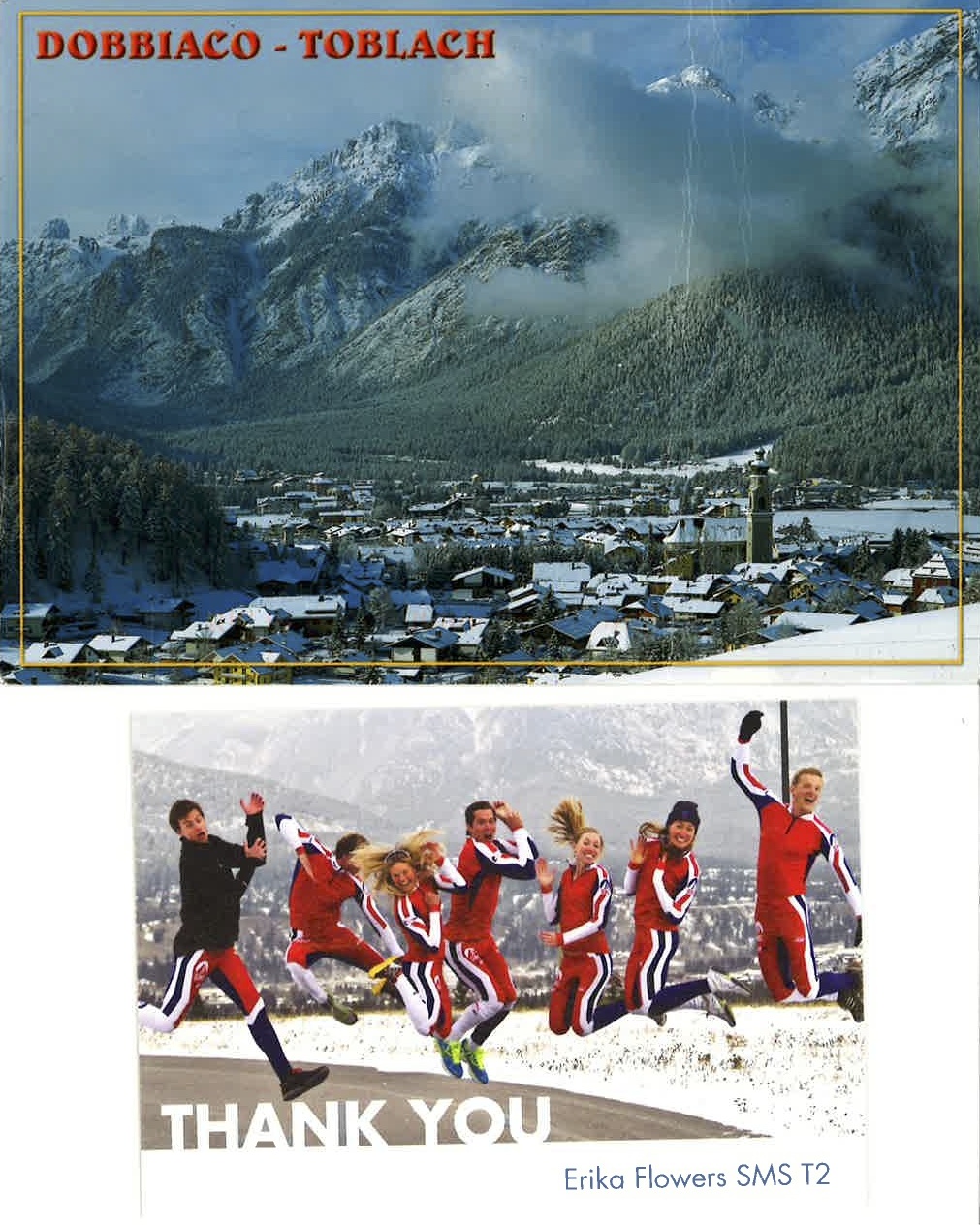
An example of thank-you postcards the NNF receives by the dozens each season. Above: from Italy. Below: from the SMST2 Team
In a perfect world, he’d set a goal of half a million dollars for the D25 and the NNF could still “blow through that money” if it was all raised. The U.S. is competing in an international realm with players like Norway and Germany with multi-million dollar budgets.
“I’m glad that we’re a half-million dollar organization,” he said, referring to the $516,000 NNF received in donations last year (up from $192,000 in 2012 and $352,000 in 2013). “I’d like to see us one day get to be a million-dollar organization, but as you can see we’re competing against countries that are far more robust. … We’ve been able to do far more with far little, and the reality is that it’s never enough.”
Last year, the NNF’s expenses amounted to about $120,500 in administrative-and-fundraising costs like website development and maintenance, and two contract salaries with Gardner and full-time administrator James Southam. On top of that, NNF spent some $313,000 on athletics in 2013/2014, specifically pillar projects — the initiatives it stands behind and works to support year after year — for a total profit of about $82,000.
Since the foundation’s inception, helping athletes afford U23 and Junior World Championships has been a priority. This season, the NNF stated on its website that it aims to spend $80,000 on that event (70 to 80 percent of its cost to U.S. athletes) and $348,000 total on athletics.
“I want to say that’s a three to four-thousand dollar expense per athlete,” Knoop said. “We typically tell the athlete the event will cost you $700 or $500 … plus your airfare. We want you over there and focused on racing and not have your parents stressed about money.”
After the D25 ends in Nov. 12, Knoop said his eight-member board will meet over conference calls to discuss how to spend the money — and how much they should use.
“Let’s say we hit $150,000 — it’s going to be a fun meeting for cross-country to say we have $350,000 in the bank, what do you want to spend?” he explained. “They all want to know, here’s how much we have, how much do we want to spend? Let’s be careful, let’s be conservative … how much should we save? As a rule of thumb, with $350,000, we typically spend half of it.”
NNF’s funding goals for 2015 amount to nearly $350,000, between projects like U23/junior worlds, paying for a development coach, assisting World Cup skiers, and supplementing the OPA, Scando and U18 trips in Europe. Besides the D25, the NNF relies on other fundraisers throughout the year, like the online auction held last winter that raised upwards of $150,000.
“Let’s just say for whatever reason the Drive for 25 falls flat, we’ve got those other fundraising mechanisms,” he said.
The NNF also gets direct donations from certain photographers like board member Steve Fuller, who sells his nordic photos on FlyingPointRoad.com and gives all proceeds to the foundation.
A thank-you postcard from Mattie Watts from New Brighton, Minn., now a freshman on the University of Vermont nordic team.Over time, Knoop has learned about the delicate balance of relying on loyal donors while searching for new support. For this reason, he writes handwritten thank-you notes to anyone that mails a check, and while online donations far outnumber those received by mail (and come with automatically generated thank-you’s), he tries to remember to thank online donors when he sees them in person.
When it comes to the timing of fundraisers, Knoop said it’s OK when others in the ski community are raising money simultaneously. The Stratton Mountain School T2 Team is currently promoting its own Matching Grant Challenge, where a private donor will match all team donations up to $25,000 before Nov. 15.
As a team, Stratton’s raised more than $7,000 for the NNF this year.
“If they’re donating to a club or some other cross-country initiative, there’s no need to cannibalize each other — that’s not going to further our sport,” Knoop said. “To the degree that people want to donate to the NNF and they see the value of what we’re doing, then I fully support that. If they want to support an initiative in another part of the country, then that’s great … and they should do it. We still win as a sport.”
The Greater Goal
In the years since its resurrection, Knoop said the NNF’s growth has been more gratifying than surprising.
“We’re not a huge nonprofit, but for our sport and the niche that we provide, I’d say we’re pretty successful,” he said.
“When you look at the entire potential of cross-county skiing, then I’m like, OK, I guess we’re never going to be like Norway where every citizen owns a pair of cross-country skis,” he later added. “But if we have a couple thousand people who get what cradle-to-grave skiing is all about, then we should have no problem getting our message across.”
That said, Knoop, in his late 50s, isn’t sure he’ll be onboard when the NNF reaches full steam.
“I’m going to get tired one of these days and I hope to hand the NNF baton off to someone who has the energy,” he said, noting his gratitude to Lutter for having the vision to start it.
With a cash fund to rely on for rainy days, Knoop said he dreams of finding enough money to start an endowment: a “big chunk of cash” that goes into an interest-bearing account and cannot be touched. Meanwhile, his example of a million-dollar endowment would generate $100,000 in additional cash each year — and he imagined what the NNF could spend that on.
At the same time, saving that much reserve money or finding a million- or half-million-dollar donor isn’t easy.
“I’ve never asked people for money in my life, and I’ve gotten more comfortable with it,” Knoop said. “I’m moderately comfortable getting people to write checks for $10,000 to $100,000 dollars so far…”
At the end of the day, there’s one thing that matters most to Knoop, and that’s whether the NNF is staying true to its mission statement: “to support athletic excellence in developing nordic athletes in the United States.”
Whenever there’s a question or debate amongst the board regarding what they should help pay for, he said that’s what they go back to.
Never Saw It Coming
In August, Knoop suffered a stroke that knocked him to the ground shortly after finishing a running-interval workout in Park City.
“Obviously that was quite a shock and it’ll probably take me a year to recover,” he said. “I had a brain aneurism. It had been there like a ticking time bomb … [that] dated back to youth football.”
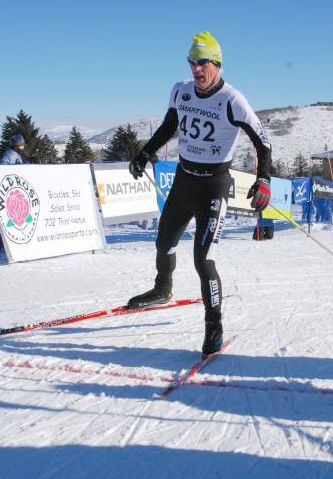
National Nordic Foundation (NNF) Director Dave Knoop doing his thing as a self-described master blaster. (Photo: NationalNordicFoundation.org)
At the time, he was only about a mile from USSA’s Center of Excellence (COE), located next to a hospital. Knoop had been feeling strong and striding along some single-track trails when he finished his last interval, walked for a bit, then began an easy jog.
“I walked about a hundred or two-hundred meters and then just about as I started to run, I got really dizzy and I had no feeling and I dropped in the dust,” he recalled. “[I thought], ‘Oh, that’s great, you look like an idiot here.’ I knew something was wrong, but I had no comprehension it was a stroke.”
He tried to get back to his feet, but fell down without any feeling along the right side of his body. He later learned he had 50 percent paralysis.
Within minutes, a mountain biker discovered him and told Knoop to relax. He could talk, but with the right side of his face not working, it was difficult. As the biker tried to call for help, his cellphone was dying. Meanwhile, thunderstorms started to roll in.
“I’m like great, the fire station is only a mile away, the guy’s cell battery’s dying, it was just a calamity,” Knoop said.
It took the paramedics two hours to get to him.
“These firefighter guys were totally city and they had no idea that the trails existed,” Knoop said, adding that he still intended to thank them personally and provide them with some info on the trail system.
They loaded him onto a stretcher with a single wheel and pushed him a bumpy mile to their entry point, which was about 500 meters away from the hospital. Knoop couldn’t remember when, but at some point, they transferred him to an ambulance.
Once inside the hospital, he was informed he had about 45-minutes left in a three-hour window to reverse his paralysis with an anti-stroke medicine. While there was a 97 percent success rate, there was also a slight chance that the drug could lead to complete paralysis or death.
“The way they read the riot act to you, it’s like, big gulp,” Knoop said.
With his 24-year-old daughter at his side, they decided to take the chance. Within three minutes of being injected, Knoop could feel the medicine starting to work with tingling sensations in his right arm and leg.
Fewer than three months later, he was working out three to four times a week at “low Level 1” to avoid raising his heart rate. “I’m glad I can do this,” he said. “Walking I’m a little dizzy and yet I can go for a run on a trail and I feel fine. It’s weird how your brain gets affected.”
Sitting at his desk earlier this week, Knoop explained his short-term memory has been affected, his right arm and one of his fingers still tingle, and certain nerves in his arm and shoulder muscles feel like they’re firing at all times.
“I’ve had a number of CAT scans and MRI’s that show me pictures of parts of the brain that have been damaged,” he explained. “I’m not sure how it all works but your brain will remap itself in terms of just sending nerves and neurons around the dead parts, but it takes months if not over a year for that to [happen].”
Regardless, he feels lucky and compelled to carry a cell phone any time he works out alone.
“I didn’t take a cell phone with me — I prefer to workout away from people. I love to be in the wilderness all the time, mostly because I’m working in an office in downtown Salt Lake City,” he explained. “Now it’s like, I cant work out anymore without having my cell phone on me.”
And with responsibilities like NNF, he was grateful to have Southam and Gardner around. While the “three amigos” planned for this year’s D25 well before August, Knoop said they finalized its structure and implementation without him in the weeks after.
“James worked for a number of months on new fundraising mechanism [for nonprofits]: StayClassy,” he said. “Andrew worked on photography and getting the message out.”
“I think this year we’re much more organized,” he added. “If there was ever a time for somebody on the team to take a hit … I’m glad to see it doing well. The NNF or the Drive for 25 really shouldn’t be about any one person or a few key people, it should be about a whole community putting it together. As long as there’s the right framework, there should be the structure to make it happen.”
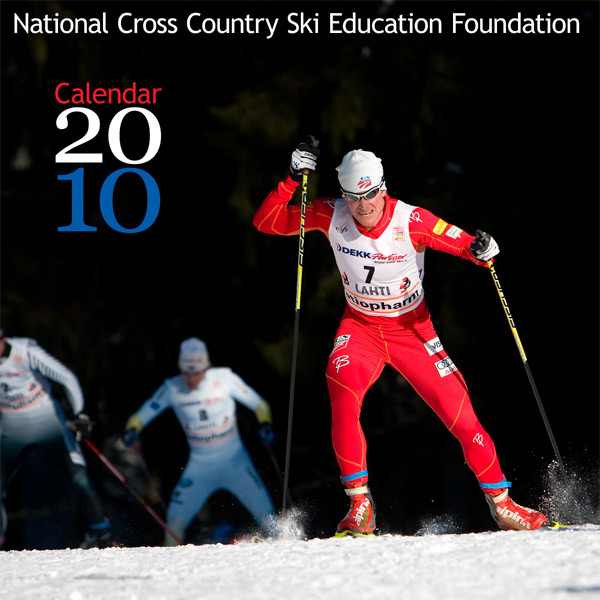
The NCCSEF Calendar, one of the foundation's fundraisers.
Last week, the National Cross Country Ski Education Foundation (NCCSEF) announced on its website that it is now calling itself the National Nordic Foundation (NNF). But changes at the foundation are more than just in name only. Nordic Combined now falls under their auspices, and over the next few weeks NNF will be testing out a new marketing and fundraising strategy.
The non-profit foundation was set up as NCCSEF in 1997 to help elite developing skiers access international racing opportunities. The money helps defray the costs athletes otherwise pay out of pocket for World Junior Championships, U23 Championships, and J1 Scandinavian Cup trips. Since its inception, the foundation has also incorporated World Championships, OPA Cups, and North American training camps to its list of funded projects, and offers travel reimbursement incentives to unfunded athletes if they podium at high-level events.
In June, NCCSEF added Nordic Combined to its fundraising umbrella, whose athletes face the same financial barriers to racing in Europe that Cross Country athletes do. In brainstorming fundraising strategies with U.S. Ski Team (USST) Nordic Combined coaches David Jarrett and Kerry Lynch, NNF Director David Knoop began wondering why the disciplines were doing things separately. “National Nordic Foundation” reflects the new inclusion of Nordic Combined, and together Knoop hopes that NNF will be able to better leverage itself in its effort to raise money for the broader Nordic pipeline.
“I’m excited about the inclusion [of Nordic Combined]; it doesn’t make sense having them create their own 501(c)(3), so linking up is a great idea. It will help both sports achieve their objectives,” agreed John Farra, who sits on the NNF Board of Directors.
The shortened acronym is also not insignificant. Over the course of his work for the foundation, Knoop said he would talk with people all the time that weren’t exactly sure what NCCSEF was or did. As an organization that exists primarily to raise money and awareness for Nordic skiing, he didn’t think the confusion exactly helped in attracting potential donors, especially those unfamiliar with the sport.
Since becoming the foundation’s director in 2009, Knoop said he’s learned a lot about fundraising and how public perception matters. In the past, NCCSEF was funded primarily by a small number of key donors writing big checks, Knoop explained, and didn’t pursue grassroots support to the extent that it aims for now.
“We’ve worked the last couple of years on trying to make it more mainstream. Your $25 or $50 check is just as meaningful, and we want to have a more broad base appeal,” he said.
NNF’s new fundraising strategy includes a marketing push on social media platforms to generate excitement for their work. The new Pillar Projects are the separate Championship trips and training camps that have always served as the foundation of the organization, with the key addition of Nordic Combined.
“The Pillar Projects are a way to give a donor a chance to see exactly where their money is going. I assured the Nordic Combined folks that if people want to give directly to them, they wouldn’t have to worry about splitting their money with Cross Country,” Knoop explained.
The decision to incorporate one new Nordic discipline and not others—for instance, biathlon or ski jumping—was a function of limited resources and the historical independence of governing bodies within the U.S.
“I’d love to include all Nordic disciplines, but we have to take it one step at a time. Working with Nordic Combined is a fair amount to take on right now,” said Knoop.
At least for biathlon and women’s ski jumping, additional Nordic disciplines operate under their own governing bodies. The U.S. Biathlon Association (USBA) has existed apart from the U.S. Ski and Snowboard Association since its inception, and is accustomed to control over its own administration and budget, explained Max Cobb, USBA’s Executive Director. They have their own non-profit foundation set up to supplement the funding they receive from the USOC and key sponsorships.
The same goes for women’s ski jumping, which was supported under USSA until 2009, when it had yet to be added as an Olympic event. The primary objective of Women’s Ski Jumping USA (WSJUSA), a non-profit founded in 2003, became getting its elite athletes to the Olympics, according to the organization’s media relations director Whitney Childers. Since a significant aspect of NNF’s mission is to provide development opportunities for junior skiers, there has been a difference in objective between the foundations until now.
With the decision of the International Olympic Committee (IOC) to add women’s ski jumping to the Olympics in April of 2011, Childers said that they are beginning to restructure their funding to better support youth development, and would be open to the possibility of collaboration with NNF.
“Our foundation is always open to forming new relationships with other non-profits to provide support for the best women’s ski jumpers in the US,” she said.
Collaboration between the disparate non-profits within the Nordic spectrum may be possible in the future, said Knoop. “If the broader ski community can have more unity, and single sense of purpose instead of all these different silos, that would be great. But for the time being, we’ll see how this works with Nordic Combined.”
To read more about what NNF is doing to promote U.S. skiing, or to make a donation, visit their website.
The 2nd annual National J2 Talent ID camp supported by NCCSEF is set to take place August 1-8th in Sun Valley, ID. The top 22 J2 boys and top 22 J2 girls in the country (14-15 year olds) have qualified to attend this camp through selection from their best two races from the 2011 USSA Junior Olympics last March.
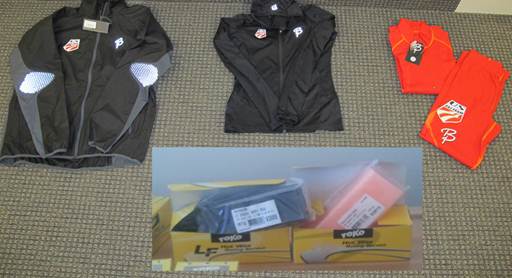
Athletes will post “vote for me” to the Facebook/NCCSEF wall (and if possible post a picture of the camp) then ask their friends and team back home to “like” them. Top 3 Liked vote getters by the end of Camp will be awarded USST BD jacket or race suit and Toko HF wax. You must Like NCCSEF to nominate yourself and to vote.
Sun Valley, ID: The 2nd annual National J2 Talent ID camp is set to take place August 1-8th in Sun Valley, ID. The top 22 J2 boys and top 22 J2 girls in the country (14-15 year olds) have qualified to attend this camp through selection from their best two races from the 2011 USSA Junior Olympics last March.
This camp is the first national step up the U.S.S.A. development pipeline and is designated a Level 1 Project within the NCCSEF’s funded/fundraising Pillar Projects. Originally the brainchild of Rick Kapala, SVSEF, the collaboration from regional coaches and continued support from NCCSEF (National Cross Country Ski Education Foundation) and USSA (United States Ski and Snowboard Association), have enabled this camp to continue on after a very successful inaugural camp in 2010 hosted by Michigan Tech. This year’s site at Sun Valley offers a spectacular setting for athletes with great roller skiing, hiking, training facilities, lodging and other fun adventures nearby!
Participating athletes will be provided with an excellent week of dryland training alongside their J2 peers. The camp will have 2 to 3 athletic training sessions per day and will also provide participants with up-to-date information on nutrition and health management, current international ski technique, goal setting, and training planning and execution. All sessions have 3 goals: 1) Help athletes understand various physical and technical skills need to succeed in the sport 2) Provide the athletes with appropriate training stimuli 3) Afford the staff an opportunity to assess the abilities of the athletes.
The camp is staffed by an array of Coaches including Bryan Fish-USST, Rick Kapala – Camp Director and Head Coach of the SVSEF Program, Janice Sibilia – NENSA Director of Competition Programming, Ali Deines- Head Coach Jackson Hole Ski, Josh Smullin & Eric Pepper-Head Club Coaches from RMD, Nancy Fiddler – 2 Time Olympian, Multiple US National Champion and now Mammoth Team Coach, Dan Simoneau – 2 Time Olympian, Multiple US National Champion and Nordic Director of MBSEF. This staff is supplemented with 5 collegiate coaching interns from across the U.S.
NCCSEF will invest $3,000 in funding this year to help offset the camp costs, while USSA is donating coaching staff time, all of which help to ensure some of the top coaches in the country will be guiding these young athletes. The NCCSEF exists to raise money to support key Pillar Projects in the Nordic skiing disciplines of Cross-Country and Nordic Combined. These Pillar Projects, such as the National J2 Talent ID camp, are specifically chosen to facilitate consistent long term athlete progression up the USSA Development Pipeline from local to international stardom.
The biggest developmental hurdle facing young American Nordic racers is gaining consistent access to quality coaching, training, and racing experiences. Unlike their European counterparts, America’s top athletes are spread throughout our vast country and live an ocean away from the center of Nordic racing in Europe. Providing the next generations of U.S. Nordic athletes affordable and straightforward access to a progression of international quality experiences, such as this National J2 Talent ID camp, represents our nation’s greatest development opportunity and funding need.
The National Cross Country Ski Education Foundation has added the discipline of Nordic Combined to its roster of supported Nordic disciplines.
As NCCSEF director David Knoop states “In both Cross Country and Nordic Combined gaining ongoing and consistent quality training, racing, and coaching experiences is the biggest challenge facing developing American skiers who are spread throughout our vast country and live thousands of miles away from Europe, the center of Nordic racing.”
Adding Nordic Combined to its sport’s rosters allows NCCSEF’s proven fundraising and development support program to better compliment the entire USSA Nordic development pipeline.
U.S. Ski Team Nordic Combined Head Coach David Jarrett states, “The Nordic Combined sport community is excited that NCCSEF has opened its great fundraising and support structure to Nordic Combined. Providing developing athletes ongoing access to a progression of quality racing, training and coaching experiences represents the biggest funding need and development opportunity at present for our country. We have some great athletes aiming to keep the winning tradition alive for Nordic Combined, but with very limited number of events in the U.S., it is important that they get overseas as much as possible to continue their progress.”
Stay tuned as NCCSEF announces its updated Nordic skiing development plan based on annual support of its Pillar Projects. Funding of the Pillar Projects ensures the nation’s top Nordic skiers, starting at the J2 age group and ending when they reach the World Cup Red Group, gain access to the highest caliber racing, training and coaching experiences.
The NCCSEF invested $43,000 in six 2010-2011 Cross Country Ski Racing Projects with a goal of helping Team Tomorrow become Team Today! One of the investments was in a trip to the Europe Continental Cup (Europa or OPA Cup) Finals in Rogla, Slovenia and Ramsau, Austria, March 7-21. We want to share some thoughts athletes and coaches developed from this trip that will help them better pursue their dreams.
Sylvan Ellefson-Ski and Snowboard Club Vail-Team HomeGrown – Learned:
Europeans are no more talented than Americans. We train just as hard. We just need to change our mentality about overseas racing.
A solid, positive group of racers can make a racing experience even better.
Having support from coaches from all over the US can give you perspectives in a different light for the better.
Being more accustomed to racing on European turf helps prepare and be more ready for the next time you encounter racing outside of the US.
Not every day is going to be Extra Blue skiing. When going gets tough and variables you can’t control prevail, you have to learn how to dig deep and find what that motor of yours can actually do.
Noah Hoffmann-US Ski Team-SVSEF/ASPEN – Learned:
The importance of patience when things aren’t going well or you can’t race because of sickness or injury.
A ton from watching my fellow teammates. I especially enjoyed the sprint. We have some incredible athletes in this country who have some of the best technique in the world. I can learn a ton from watching them and I’m looking forward to training with them this summer!
That there is no reason to be scared of athletes from Europe or put them on a pedestal. They are doing the same things we are and they aren’t, as countries, better than us.
Just how hard the coaches work when they are doubling as wax staff. I am so impressed with the work ethic and dedication of the staff, and I gained a whole new respect for them and their work.
The importance of being able to ski on all courses and in all conditions. When we first got to Ramsau, I thought I was racing, and I was really nervous about the flatter course and the icy, fast conditions. I don’t know how well I can ski in those conditions. I need to work on those weaknesses and build confidence so that it’s not an issue.
Leif Zimmermann-Bridger Ski Foundation Elite Team – Learned:
Time change vs. Performance. After traveling to and from Europe many times now, I have been able to develop a routine to help me adjust to all the changes your body has to cope with, then race to the top of your ability (e.g.- large time change, different food, different beds, different snow and climate, ext…) This has been really challenging for me to overcome. Yet definitely something I have improved on!
Ski and Grind selection. I always learn something new about how my skis and grinds run over in Europe!
Coaches and Athletes. Working with new coaches and athletes from around the country is always a learning experience! I am 100% confident everyone took something away from this trip that will improve their ability!
Competitors. I always learn a lot from racing with developing and world cup level athletes from around Europe. From warming up with medal winners, to skiing with other skiers in the race, to seeing how they utilize there technique on different terrain. I take away something every time I’m exposed to these Competitors!
Enjoyment. For me, after racing for 12 years, sometimes a new “venue” can be very refreshing and also very motivating! I always enjoy experiencing a new country and culture! To have these new experiences, while following my true passion, is something I will keep with me long after I’m not a “ski racer” anymore.
Becca Rorabaugh-APU Nordic Ski Center – Learned:
Everyone has ups and downs. Some of the girls that seemed unbeatable one day would be in the teens on the result list the next. They didn’t seem upset about it either, they knew that they were capable of more and would show it next time.
It’s important to be flexible and relaxed. This is something that I noticed during a few trips to Europe: the food probably won’t be familiar and comfortable, the wax team will have a different way of organizing ski work, and the course might not be finalized until the day before. In the end, it’s going to be fine. You can perform well on schnitzel and potatoes, the skis will not ruin your race, and everyone has to do the same course…
Don’t ski too hard on the first couple of days at altitude after a 10 hour time change! I think I came close to giving myself a cold from that. Even if your training buddy goes fast, you shouldn’t!
Ski racing is a professional vocation. The European teams really impressed me with their professional manner. Everyone on those teams was on the job at the OPA races. The athletes are there to race, and the techs are there to tech. I am not saying that wax techs shouldn’t get to watch the races too, I know I appreciate Brian, Gus, and Casey cheering out there, but all of the other wax rooms were packed up and moved out by the end of the last race because the techs were packing during the race. They were there to get their stuff done, just like the racers were. It’s a little different from the American perspective because we have trouble seeing skiing as a true vocation; people see full-time athletes like us almost as ski-bums. I think it’s easy to start thinking that skiing is something that we do because we don’t have a bigger or better opportunity because that’s how other people tend to see us. Watching the Euro’s approach to skiing helped to remind me that it’s not.
It’s really important to practice skiing in all kinds of conditions. Most of the snow that we skied on was not at all like what I have raced on in the US, even the hardwax classic skiing was greasier and trickier. The last day in Ramsau was sloppy and wet klister skiing, something that I hadn’t really practiced until I started training with APU on Eagle Glacier in the summers. Racers in the west and in Alaska need to make sure to find some gnarly training conditions sometimes, because it’s pretty rare to get to race on extra blue hardwax in Europe!
Bryan Fish-Continental Cup Coach-U.S. Ski Team- Learned:
It is really valuable for clubs and the National Team to work hand-and-hand. Learning happens full circle.
We have warm conditions in the states, but they typically happen towards the end of the season. This is no different than overseas. Maybe we need to continue skiing and racing later into the year like our counterparts overseas. Seek out these “unfavorable” situations as a learning experience instead of planning away from them.
A great amount is learned in skiing with and against others of equal or slightly higher level. When I say ski – that means training and competing. There is a huge value in seeing what other successful athletes and teams are doing day in and day out. You pick up a little piece here or there and add it to your tool box.
There is a learning curve when taking groups from a variety of backgrounds. It is positive, but merging athletes and coaches from a variety of programs takes patience, strong communication and cooperative efforts. It’s an adjustment for all parties, but the end result – can and was totally positive.
I think US athletes are more familiar with their equipment and racing below the freezing point. I think we should seek out opportunities to develop a level of experience and comfort in warmer conditions.
The annual pilgrimage to Scandinavia has become an important part of the US development pipeline over the last decade. Twelve US athletes and three coaches make up the 2011 J1 Scando team.
“This is a trip we’ve been running for at least a dozen years now, in conjunction with the National Cross Country Ski Education Foundation,” US Ski Team Development Head Coach Matt Whitcomb said to FasterSkier.
Whitcomb points out that the J1 “Scando Cup” trip is significant for a couple of reasons. Obviously, it is an exciting and eye-opening for the individual athlete. Furthermore, the J1 Scando trip is also the first step of the elite development pipeline that includes international racing, he said.
“They get to travel with members of our national team, CXC, Green Team, APU. That is a huge step for a lot of them,” Whitcomb said.
Finally, the American presence at the Scandinavian Cup races also increases the international experience of the local racers. Just like for the American skiers, these races are a step on the Scandinavian teams’ elite development ladder and their initiation into international racing.
“It’s a neat deal if you think about it. We’ve done this trip for so many years because it is so successful. The Scandinavians have always been very welcoming to us and I think us being there adds to the depth of the competition,” said Whitcomb, noting that most of the racers come from Norway, Sweden, Finland, Latvia and Estonia.
“We’re always chasing podiums on the J1 trip, but the main thing is the international racing experience,” Whitcomb said.
Adversity is a learning opportunity
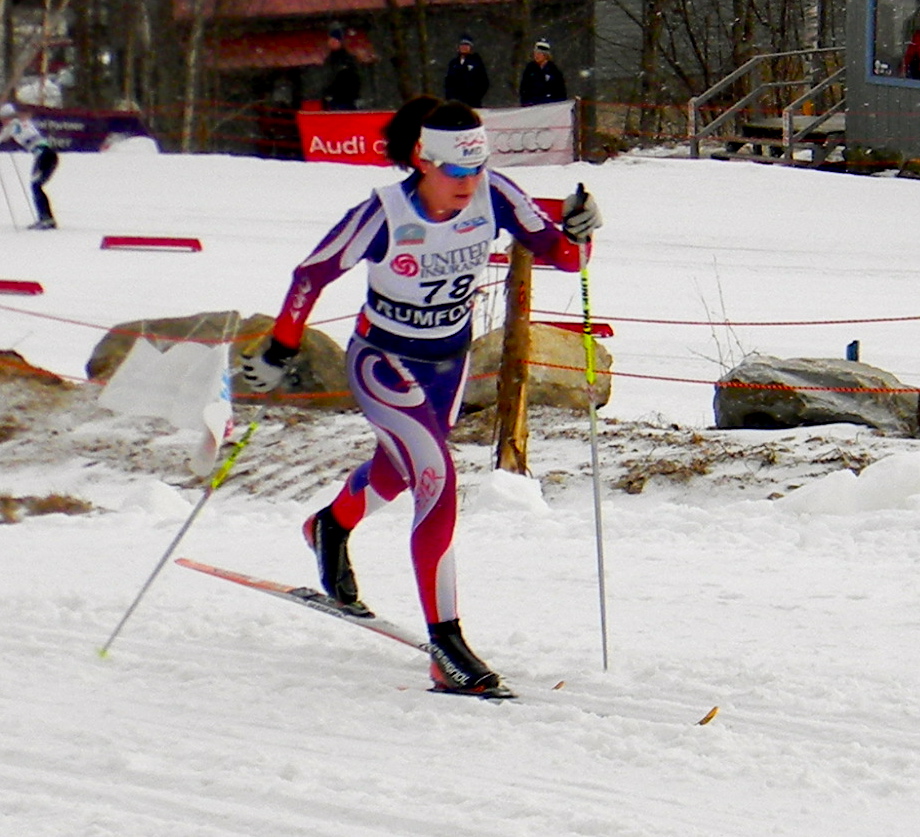
Stella Holt at work in the 10K classic at US Senior Nationals in Rumford, Maine. (Photo: Doug Durfey)
For Stella Holt, 17, of Glacier, Montana, being named to the team was a huge accomplishment. Her inclusion on the team is almost like a fairytale: hard work and persistence is rewarded.
After several seasons of injuries and illness just racing at the US Senior Nationals in early January was more than Holt had accomplished for a long time. Her first two attempts at going to nationals got derailed.
“My second year as a J2, I strained a ligament in a sledding accident,” Holt recalled. Then in the summer of 2009 she broke her ankle and spent the entire fall recovering from that. And just when she was literally getting back on her feet again, she came down with mononucleosis, right about the time she would have gone to nationals. But while irritating and disappointing, Holt considers those roadblocks a learning experience.
“The last couple of years have been challenging with all the obstacles, but the age I am now is the perfect time to go through all of that. And I pretty much feel that OK, I’ve already gotten that out of my way,” Holt said to FasterSkier.
Aimed for the J1 team
Holt has attended the western regional camps with the US Ski Team in Park City, Utah, for the past two summers, she has done well at the junior national level, even last season when she was held back by mono. The Scando Cup was the next logical step. Holt set out for the US Senior Nationals again. And she had the J1 trip in the back of her mind.
“It was my goal to make this team and I had an inkling it might happen. I had taken the steps in order to get there,” Holt explained, adding that racing at the international level has been her goal for a couple of years.
She came to Rumford and went to work.
“I knew as soon as I had finished the skate race on Thursday and the announcer read off the top ten juniors that I had done enough to secure my spot,” Holt said.
Curious and realistic
Stella Holt (Glacier Nordic Ski Club, bib 9), 40th place in the women's 10K skate at the West Yellowstone SuperTour this fall.
“I’m not sure what to expect. I’ve never been to Europe before. But I know the level of competition over there will be really challenging. Here I am used to a certain level of success, but I know that overseas that will be different. I would like to do well, but I don’t know what to expect. I think having that knowledge going into to the races will help,” Holt said.
However, Holt looks at the experience as more than just a week of racing overseas.
“I met a couple of the other juniors while I was in Maine and we had a quick introduction to the coaches. But I’ll meet 11 new people and get to know them really well,” she said with a grin.
A role model for her team
Robin Brooks, head coach for the Glacier Nordic Team, says Stella Holt has earned every mile of the trip.
“She is a strong individual. She is very tough,” said Brooks, her voice filled with respect and admiration for her athlete’s accomplishments.
“People here kept saying that if Stella could only stay healthy, she would have such a great season, so that has been her focus this season, just to stay healthy,” Brooks said, noting that there was never any question about Holt’s talent or potential.
But most noticeably, Holt has an attitude and a work ethic that spreads throughout the Glacier Nordic Team, Brooks said.
Holly Brooks with the Glacier Nordic Ski Team at the 2010 West Yellowstone Ski Festival. Stella Holt third from the left.
“Stella is just a great motivator to her teammates. And she is involved in everything: She is the class president and she was the captain of her cross country running team when they went to state this fall. It’s been fun to have her on the team,” Brooks said to FasterSkier.
And the feeling is mutual.
“I love our team! They’re all very supportive and we work together really well,” Holt said.
J1S trip roster
The J1 Scando team consists of 12 athletes, six girls and six boys. The girls are: Annie Liotta (Alaska Winter Stars), Marion Woods (Alaska Winter Stars), Cambria McDermott (Stratton Mountain School), Stella Holt (Glacier Nordic Team), Sharmila Ahmed (GO Training), and Hannah Boyer (FXC). The boys are: Logan Hannemann (FAST), Patrick Caldwell (Stratton Mountain School), Forrest Mahlen (APUNSC), Dylan McGarthwaite (Minneapolis Ski Club), Peter Mamrol (Alaska Winter Stars) and John Hegman (Mansfield Union High School). Heather Mooney (Stratton Mountain School) was originally also named to the team, but she will instead be racing in the World Juniors in Estonia, which are going on at the same time as the races in Sweden.
Additionally, there will be three coaches for the trip: Head coach Matthew Johnson of the Burke Mountain Academy, coach and service tech Peter Leonard of FXC and Kate Barton of the Jackson Hole High School Ski Team.
The $11,000 grant from NCCSEF and contributions from all the 10 USSA Junior Olympic divisions fund the coaches’ trip expenses and other running costs, while the athletes have to pay $1,450 each to cover the rest of their expenses. The US J1 team leaves for Sweden on January 26, for a pre event training period at Camp Södergren in Österssund, Sweden, before heading to Örnsköldsvik on February 1.
Twelve athletes were named to the US Junior World Championships team Friday, after the completion of the the first three US Nationals events. They all bring experience and ambition to the races held in Otepää, Estonia, January 25-31.
US Junior World team head coach Matt Whitcomb says this year’s team is particularly deep and experienced. All of the skiers have raced in Europe, and several are embarking on their third trip to the World Juniors.
“That just makes for a smoother trip, and adds opportunities for better results,” Whitcomb said, noting that the result list is not the only way to measure success.
“I don’t lay down too many result-oriented expectations. It’s about the process of traveling internationally, adjusting and train well every day at pre-camp. For the race week, I expect them to prepare for, and approach the races like professionals, and honestly, we have never had a problem with this. They are so well prepared from their home clubs,” Whitcomb said.
But while the coaches are careful to spell out specific expectations, the athletes are well dialed on what they want to achieve.
Erik Bjornsen (UAA) take Lars Flora (APU) and Skyler Davis (SMS) to the line. Photo: Andy Canniff, Swix Sport
Coming off his best US Senior Nationals and feeling stronger than ever in both sprint and distance events, Erik Bjornsen believes both he and the rest of the US guys have a shot at the podium.
“I think there are a couple of US guys that can be on the podium any day there. I think if things feel right, I think I could be on the podium,” said Bjornsen, who traditionally has done best in the sprints.
Joanne Reid in the skate leg of the women's pursuit at the World Juniors 2010 in Hinterzarten, Germany.
Joanne Reid also thinks this year could be a good one for her. Last year, she delivered an 18place in the pursuit and helped the team to an eighth place in the relay. Her ambitions for this year are no less.
“I’m going out there to see what I can do and race my best of course. I’m hoping for another top 20 this year,” Reid said, noting that she feels her best chances are in the pursuit and the distance skate.
“I’m definitely better at skating than striding. I really hope they don’t put me in the sprint. I’m the worst classic sprinter ever,” Reid said with a laugh.
Top priority
For Bjornsen, going to World Juniors one last time in his career has been on his mind all fall. And going into Nationals, he thought he had a decent shot at making the team.
“I didn’t expect to be named, but I was feeling pretty good and felt like my chances were pretty good,” Bjornsen said.
Fourth place in the classic sprint, his best result ever at Nationals, didn’t hurt his chances. Additionally, his distance results were also his best ever. Now, Bjornsen is looking forward to showing his game to the world.
Tyler Kornfield
Tyler Kornfield, also a veteran of the World Juniors, focused his season around peaking for the championships, hoping he would race well enough at nationals to snag a spot on the team, even if his peak is planned for the end of the month. That proved to be a piece of cake: Kornfield was eighth overall in the classic sprint and ninth in the 15K classic. To him, the latter was the most exciting.
“Doing so well in the classic distance shows that I have distance speed as well, and that’s really encouraging. These are definitely my best races, at least distance-wise,” said Kornfield, who so far has been most dominating in the sprints.
Making the team: a complete surprise
While some of the athletes had a pretty good idea of where they ranked, being named to the team was a complete surprise to Reid.
“I was pretty surprised when they called my name. My face was very entertaining to watch,” said Reid, who didn’t feel like her first two races at Nationals were particularly strong bids for a ticket to Europe.
“I had two bad races before the skate race, both classic,” she explained. However, winning the skate race on Wednesday clinched the deal, and Reid is set to go.
Experience = confidence
Having raced at the world-level before doesn’t take anything away from the excitement, the athletes say. It simply adds to the experience.
“I’m definitely really excited, but being named to the team is just a part of the process. I want to go to World Juniors to do well, not just to have fun,” Bjornsen said, who spent a couple of months racing in Europe last year. Heading into his third World Juniors, he is as seasoned as they come.
“The first year, everything was definitely a big surprise, and I felt out of place. Now I feel like I can go there and race well,” Bjornsen said.
Jessie Diggins (CXC) having fun and going fast. The two things are related.
Jessie Diggins, who is also going to her third World Juniors, agrees. She finds it comforting to know what she’s headed for, and thinks experience adds to the confidence level.
“The first year, it was pretty overwhelming. I was trying to figure out what I was doing. Now I can focus on racing, and the scene doesn’t overwhelm me,” said Diggins.
“You know what to expect, you know the food will be different, you know what can distract you or even throw you off,” Diggins explained, adding that she is also excited that so many of the racers were there last year too. “We’re a good team. It’s good to know your coaches and your teammates. I find that pretty nice.”
Relax – and race like heck
At this point, the athletes have to trust that they have laid down the volume and done the work. Now they just need to polish the details and sharpen the tools.
Whitcomb’s only concern is that some of the athletes will do too much leading up to the races.
“It’s easy to get caught up in how other athletes train, that might already be adjusted to the time and train too much,” he explained.
The trip is sponsored by the US Ski Team and the National Cross-Country Ski Education Foundation, but the athletes also have to pay $1,700 each, plus airfare to cover the costs. However, any athlete who posts a top-3 result in an individual competition will get their travel costs reimbursed by NCCSEF. Additionally, the US Ski Team will reimburse the travel costs for the top two female and top two male racers. To be eligible for the USST reimbursement, a junior must post a top-10 in an individual competition.
“This is just an added incentive,” said Whitcomb, who knows that all the skiers will race their best at the championships regardless.
Trip roster
The World Juniors team consists of six girls and six boys, plus nine coaches. The girls are Jessie Diggins (CXC), Heather Mooney (Stratton Mountain School), Joanne Reid (Colorado University), Kinsey Loan (APU), Isabel Caldwell (Dartmouth) and Amy Glen (UVM). The boys are Tyler Kornfield (UAF), Erik Bjornsen (UAA), Scott Patterson (UVM), Skyler Davis (Stratton Mountain School), George Cartwright (NMU) and Andrew Dougherty (Denver University).
The coaches are head coach/trip leader Matt Whitcomb (USST), service tech Randy Gibbs (USST), service tech and jack of all trades Oleg Ragilo (former USST), service tech Andrew Johnson (UVM), and service tech Casey Fagerquist (APU), as well as coaches Justin Beckwith (GMVS), Amy Caldwell (Boulder, Colo.) and Dan Weiland (Ski and Snowboard Club of Vail, Colo.)
In its ongoing effort to help Team Tomorrow become Team Today, the National Cross Country Ski Education Foundation challenges every U.S. athlete competing at the 2011 U23/Jr. World Nordic Championship to achieve an individual top three “Podium” race result. Each athlete that achieves this fantastic performance will see NCCSEF reimburse their entire unfunded trip expenses. Three U.S. athletes; Kris Freeman 2003 1st, Laura Valaas 2007 2nd, and Liz Stephens 2008 3rd, have reached the Podium. This NCCSEF funding pledge is in addition to the $10,000 in NCCSEF funds which are already committed to funding the trip’s coaches and operating expenses.
NCCSEF Matching Challenge
The NCCSEF challenges the ski community at large to help fund the entire trip. Make your tax deductible contribution to www.NCCSEF.org designating JR/U23 Worlds and we will ensure that your contribution goes to offsetting trip expenses for all athletes.
U.S. Ski Team Top Athletes Challenge
The U.S. Ski Team in its ongoing effort to develop, guide and assist U.S. athletes to reach top international results will reimburse unfunded trip expenses for the U.S’s top two male and female U23/Jr. Championships competitors. Top two ranking will be tallied based on each athlete’s best individual Championship result. To be ranked for this award a Jr. competitor must achieve a top-ten result while a U-23 competitor must have a top-eight result. Tie breaker will use second-best results.
2011 Junior and Under-23 World Championships
This U.S. Team directed trip is one of the premier steps in the elite athlete and coach development pipeline. Trip qualification criteria can be viewed at www.ussa.org sports/cross country/advancement. The Trip cost is $1700 plus airfare. The trip starts Jan. 16 from the U.S. arriving in Helsinki Finland Jan, 17 for a training camp in Vierumaki, Finland. On January 23 the team will travel to Otepaa, Estonia where the Championship will be held form eth 26th to the 31st.
For more information on NCCSEF, and these and future funding initiatives, and to make your charitable contribution visit www.NCCSEF.org
The National Cross-Country Ski Education Foundation has pledged to fund all U.S. athletes who represent the country at the 2011 World Nordic Ski Championships and whose expenses are not funded by the U.S. Ski Team.
Dave Knoop, NCCSEF director, stated that “the World Championships are the premier nordic competition outside of the Olympics. We wanted to make sure each athlete who qualifies for the Championships could focus on their preparation for the games, and not worry about covering the cost for this trip.”
The World Nordic Ski Championships will take place in Oslo, Norway from February 23 to March 7, 2011. For more information, visit www.oslo2011.no/en/
For more information on the U.S. World Championship Team qualification and funding standards visit USSA.org, sports, cross country, advancement.
NCCSEF Fundraising Challenge
The NCCSEF challenges the Ski Community at large to help fund these athletes. Make your tax deductible contribution to NCCSEF designating World Championships and we will ensure that your contribution goes to offsetting trip expenses for all athletes. To contribute and learn about NCCSEF please visit www.nccsef.org
Purchase 10 Calendars or more for $10.00 each, and resell them for $20.00 each. 1-9 Units available for $20.00 each. Shipping Included. Email nccsef@gmail.com how many you would like to order and your shipping/mailing address. If you wish to pay by credit card let us know and we will email you a credit card invoice via PayPal. If you wish to pay by check tell us and send the check to: NCCSEF/32 West 200 South #149/Salt Lake City 84101.
To order email NCCSEF@gmail.com with shipping address and quantity wanted, we will reply with payment options.
The NCCSEF promotes the development of U. S. cross-country ski racing through its support of activities that challenge and enable athletes to achieve higher competitive goals and of efforts that will lead to success in international competitions. The non-profit NCCSEF is funded through charitable contributions made by cross county skiing enthusiasts.
For more information on NCCSEF, these and future funding initiatives, and to make your charitable contribution visit www.NCCSEF.org
American athletes racing on an NCCSEF-supported trip in La Feclaz, France. Photo courtesy of TeamToday.org
If you’re planning on racing in Europe this winter on any of the trips supported by the National Cross-Country Ski Education Foundation (NCCSEF), you can thank Jerry Gilbert.
Gilbert, a retired electrical engineer and avid master skier, died of lymphoma in 2008, and in his will, he left some $80,000 for NCCSEF. The money took nearly two years to find its way to the organization, but now that it has, that donation should be supporting aspiring athletes for decades to come.
With the help of Gilbert, and under the leadership of Business Director Dave Knoop, NCCSEF has nearly doubled its budget for the 2011 season, jumping from $25,000 to $43,000 in the last year. It has also expanded its initiatives, with plans to support athletes on trips to Finland for early season racing, as well as those heading to Norway in February for the World Ski Championships.
And according to Knoop, the organization isn’t done. Additional funding—as much as $20,000 to 30,000 more—could come into play later this season, in the shape of individual skier grants as rewards for top finishes, or as support for groups already planning on travel to Europe.
“We’re going to take another look later this fall,” Knoop said. “[Those] are ideas that we’re kicking around for our next round of funding.”
Participants on last year's NCCSEF-supported OPA Cup trip in France. Photo courtesy of TeamToday.org.
Founded by Reid Lutter and Sun Valley Ski Education Foundation Program Director Rick Kapala in 1995, NCCSEF has typically disbursed grants and funded American trips to the World Junior and U-23 Championships, as well as a team of younger juniors that travels to Scandinavia for competitions.
This year, the funding is going deeper into the pipeline. In addition to money for the aforementioned projects, NCCSEF is providing financial support for a late-season domestic European tour, similar to a trip that they helped send to France and Slovenia last year.
Beyond that, there are the new initiatives that will fund the season-opening races in Finland and the World Ski Championships in Norway.
“They’re really prioritizing supporting international trips, and in my opinion, that’s the right place to be sending this thing,” said U.S. Ski and Snowboard Association (USSA) Nordic Director John Farra, who sits on NCCSEF’s board as a liaison between the two organizations. “These are small steps, and they’re small amounts of money right now, but I think they’re going to be really directly benefiting the athletes in our pipeline that really need it.”
Knoop took over management of organization before the last season, and after appealing to some key donors, was able to raise another $60,000 over and above the Gilbert bequest. That, combined with some money that Lutter had set aside from previous years, left the organization with roughly $220,000 in the bank at the beginning of this season.
While disbursing that money is the fun part, Knoop said that he’s conscious of the need to maintain a healthy balance in NCCSEF’s coffers for years to come, in the form of an endowment.
“That concept creates long-term sustainability, so that it’s not a flash in the pan,” Knoop said. “The idea of building up an endowment, but also spending more on projects—it’s a balance…It will be an ongoing discussion with the board as to how much is appropriate to spend.”
In an interview, Knoop said he didn’t know the endowment’s current value given the recent funding commitments, but he pegged it at somewhere between $100,00 and $200,000. He said that he would like to see it grow to $500,000.
USSA and NCCSEF are both non-profits, and it might seem that the two would be competing for the same pool of money. But both Farra and Knoop maintained that their organizations were complimentary.
“My bosses have no problem with it, because essentially, what NCCSEF is doing is it’s picking up where we leave off—it’s a really healthy partnership that way,” Farra said. “It’s not trying to duplicate. If my budgets were bigger, I’d probably be thinking about it similarly.”
Salt Lake City, Utah-September 20, 2010: In its continuing effort to aid the development of American cross country ski racers, the National Cross-Country Ski Education Foundation (NCCSEF) will help support a racing and training trip to Finnish Lapland this coming November. The trip will offer select racers and coaches an opportunity to experience European racing intensity at the very outset of the 2010-11 competitive season.
Will Sweetser, Director of Cross-Country Skiing at the Maine Winter Sports Center, has led groups to Finland several times in the past, and will serve as trip leader on this swing through Muonio and Rovaniemi. In addition to gaining European racing experience, these races are due to be scored to the USSA National Ranking List (NRL), which will provide racers the opportunity to lower their USSA points profile
Sweetser states, “The chance for racers to hit five FIS races with this level of competition is fantastic. We’ll go to two sprints, two classic distance races and one skate distance race. In past years, the competition at Muonio has been very close to the World Cup level. It has been a real eye-opener and a chance for athletes from our group to fairly assess where they stand before our season opens in North America.”
The trip, slated to run from November 3-22, has up to 4 additional spots for USSA racers. If interested, please contact Will Sweetser at will@mainewsc.org.
NCCSEF’s $5000 investment will go toward trip and coaching expenses. By reducing trip costs on racing and training travel to Europe, the organization hopes to increase the opportunities for top tier of U.S. juniors, U23 and senior racers to gain international race experience.
For more information on NCCSEF and to make your charitable contribution visit www.NCCSEF.org.
Participants in the U.S. OPA Cup trip in France – Photo from TeamToday.org
The IOC hasn’t yet decided on a location for the 2018 Winter Olympics. But it’s safe to say that the road to those Games travels through Slovenia, at least for some of America’s cross country skiers.
Thanks to a $10,000 grant from the National Cross Country Ski Education Foundation (NCCSEF), and more funding from the U.S. Ski Team, a group of 15 athletes has set up shop in the resort town of Rogla. There, the skiers are contesting this weekend’s OPA Cup Finals—skiing’s equivalent of a minor league World Series.
It’s the first time in recent memory that such a large contingent has traveled to race on the circuit overseas, and officials back home are hoping that the opportunity to mix it up with the Europeans will help make the Americans more competitive at an earlier age.
“If someone is in the pipeline, and they want to be a part of the future of the sport…they need to get some European experience,” said John Farra, who directs the cross country program at the U.S. Ski and Snowboard Association (USSA). “That’s the right model.”
USSA has funded small OPA Cup trips in the past, and another was planned for this year. But with the economic crisis hitting the organization hard, Farra said that the U.S. Ski Team (an arm of USSA) only had money in its budget for one coach, one wax tech, and two athletes—albeit with a few more spaces on the trip for skiers who could pay their own way.
That was when NCCSEF stepped in. Created in 1995 by junior coaches Reid Lutter and Rick Kapala, the foundation has given travel grants to developing skiers since 1997—including, for example, one that helped future Olympian Kris Freeman attend his first World Junior Championships in 1998.
For the OPA Cup trip, their $10,000 contribution went towards bringing additional coaches, as well helping to pay for lodging and vans for other, non USSA-funded athletes who wanted to go. While these skiers still had to pay their way to get to Europe, Farra said the NCCSEF funding reduced total trip costs by $400 to $500 per athlete.
In addition to his role at USSA, Farra is also on the board of NCCSEF, and he said that the two groups had been in discussions since the summer about finding a way to send a bigger OPA Cup trip.
“In the past, a couple of stragglers have kind of tagged along [on the U.S. Ski Team OPA trip],” Farra said. “This year, the concept was, ‘we need a trip.’”
NCCSEF’s funding for the additional coaches allowed administrators to open the trip up to a much larger number of athletes than previously planned. There were no selection criteria—anyone who wanted to go could go.
In order to make the trip more inviting, USSA didn’t schedule any big domestic races in early March. Basically, Farra said, the message for developing skiers was that “if you’re not in the Junior Olympics and you’re not in NCAA’s, then you’ve got to be doing OPA.”
American athletes racing in La Feclaz, France – Photo from TeamToday.org
The group started with two races last weekend in La Feclaz, France, and finishes with three more in Slovenia. The competition on the OPA Cup is fierce, including a number of athletes with World Cup experience—and that’s exactly what the American coaches want to see.
“This group is looking for…experience outside of their comfort zones, knocking heads with some of the best developing racers in Europe,” said Matt Whitcomb, a U.S. Ski team coach on the trip, in an interview from La Feclaz.
Along with deep fields, Whitcomb said that the OPA Cup races also offer good opportunities for the Americans to improve their FIS points, which should trickle back down into the U.S. once the group returns home.
Indeed, the athletes on the trip have been popping solid points races left and right: Brian Gregg, Mike Sinnott, and Peter Kling all have posted career-bests on the trip.
And for athletes who will be spending most of their winters competing outside the United States if they ever become World Cup regulars, even the simple (or sometimes not-so-simple) experience of traveling and dealing with logistics should help them down the road.
While NCCSEF was almost defunct last year, chair Dave Knoop said that a new board and some big donations from key donors this year have given it new life. This year, the foundation also helped fund the U.S. teams at the U-23/World Junior and J-1 Scandinavian Championships, as well as the OPA Cup trip.
The hope, Knoop said, is ultimately for NCCSEF to be able to provide even more money for those trips, as well as for other initiatives—even helping athletes travel to Junior Nationals, for example. With a handful of generous donors—and a large bequest from a master skier who recently passed away—the foundation has some lofty goals for the future.
While NCCSEF isn’t capable of funding deeper down into the pipeline right now, Knoop says that “it’s a vision.”
“It will take a little bit more time and momentum to be able to hand out enough scholarships, if you will, to make a difference,” he said. “There’s certainly a greater picture that can be achieved.”
For athletes’ perspectives on the trip, check out the numerous blog posts to the left of the main column and in our XCFeeds section, as well as this post from TeamToday.org. To learn more about NCCSEF, visit their web site.
The new NCCSEF calendar is back after a one-year hiatus and it is available through some local clubs, or via NCCSEF.org. Just donate $20 via the paypal link at nccsef.org and you will be sent one of the new NCCSEF Calendars with awesome photos and important dates of interest to cross country skiers.
$20 for one calendar, $15 for each additional, and shipping is free.
The National Cross Country Ski Education Foundation (NCCSEF) is a backbone for the development of world-class skiers in the United States. Buy the calendar to show your support.
NCCSEF, which has been supporting the development of cross country skiing in the U.S. for 12 years is back and ready to expand its reach to support even more development projects that affect the national pipeline. In addition to providing its traditional financial support for coaching and logistics for the Junior Scandanavian Championships (J1 Trip), NCCSEF will fund the volunteer coaching staff for Junior and U23 World Championships, and plans to provide support for OPA Cup trip for developing seniors, as well as support for REG camps and the first J2 Elite camps which will occur for the first time in the summer of 2010.
A new website has been launched and the widely popular NCCSEF calendars are back after a one-year hiatus. Visit www.NCCSEF.org for more information and to support the NCCSEF cause to raise the level of skiing in the U.S.
As World Championship silver medalist and NCCSEF grant recipient Kikkan Randall puts it, The National Cross Country Ski Education Foundation is a backbone for the development of world-class skiers in the United States.
The not for profit organization NCCSEF is celebrating 12 years of supporting U.S. skiing and we have a lot to be proud of. We have granted over $175,000 in NCCSEF Future Funds over that period. In fact, we’ve funded every World Junior Championship team since 1997 and every J1 Scando Cup team since it was initiated in 1999. Now, as we gear up for Vancouver 2010 and beyond, there is even more work to be done!
NCCSEF provides the essential funding for the junior and under-23 competition and preparation projects making up several key steps in the development pipeline. The development pipeline is the pathway to success in the
sport of cross country skiing. Funding supports specific projects and is dispersed according to the current needs of each project by the NCCSEF board. NCCSEF is made up of a board including:
Reid Lutter – NCCSEF founder
Joey Caterinichio – USSA Junior Chair
John Farra – USSA Nordic Director
David Knoop – NCCSEF Business Director
Kristina Joder-Casey – Treasurer and former NCCSEF recipient
NCCSEF is made up of supporters from all walks of life such as yourself.
This is the second installment of our holiday gift guide, featuring gift ideas in the $20 to $50 range. Feel free to use the comment section to share your own ideas!
The National Cross Country Ski Education Foundation announces their 2009 fundraiser calendar. It is filled with high-quality images of the US Ski Team from recent World Cup action and features photos and bios of the next generation of US ski racers – before they become household names.
The NCCSEF has granted over $175,000 to junior racers in the last 12 years. They’ve funded every World Junior Championship team since 1997 and every J1 Scando Cup team since it was initiated in 1999. The annual calendar is a major component of the NCCSEF Future Fund and you can be a part of this great tradition with your purchase!
$15 of each sale goes directly to NCCSEF – BNS is only recuperating costs of fulfilling this item…
Editor’s Note: We just found out that the NCCSEF calendar may in fact be canceled this year. A real shame. We will make an announcement when we know for sure.
There is nothing worse than cold hands – and nothing better than a sweet pair of gloves. Toko Thermos are a great all-around training and race glove, keeping hands warm in cold temperatures, but are not overly bulky and do well even as the temps head back up.
Two Planks and a Passion: The Dramatic History of Skiing
MSRP: $29.00
Predating the wheel, the ski has played an important role in our history. This is brilliantly brought to life in this engaging book. Roland Huntford’s brilliant history begins 20,000 years ago in the last ice age on the icy tundra of an unformed earth. Man is a traveling animal, and on these icy slopes skiing began as a means of survival.That it has developed into the leisure and sporting pursuit of choice by so much of the globe bears testament to its elemental appeal. In polar exploration, it has changed the course of history. Elsewhere, in war and peace, it has done so too. The origins of skiing are bound up with the emergence of modern man and the world we live in today.
$40 for a groove scraper? It seems outrageous until you use one of these – highly recommended by Zach Caldwell and Nathan Schultx of Boulder Nordic Sport, this tool is worth the price. How many times has your groove scraper jumped out and put a nice 45 degree cut in your perfect base? Never again.
A great winter training water bottle belt featuring an insulated bottle holster and plenty of storage for kick wax and snacks. This is not your average drink belt – Nathan takes hydration seriously and it is obvious by the quality and function of their systems.
A traveler’s dream – a perfect gift for the frequent traveler – be it in the car or on a plane. Skiers travel quite a bit, and catching up on rest is very important. A good travel pillow is essential.