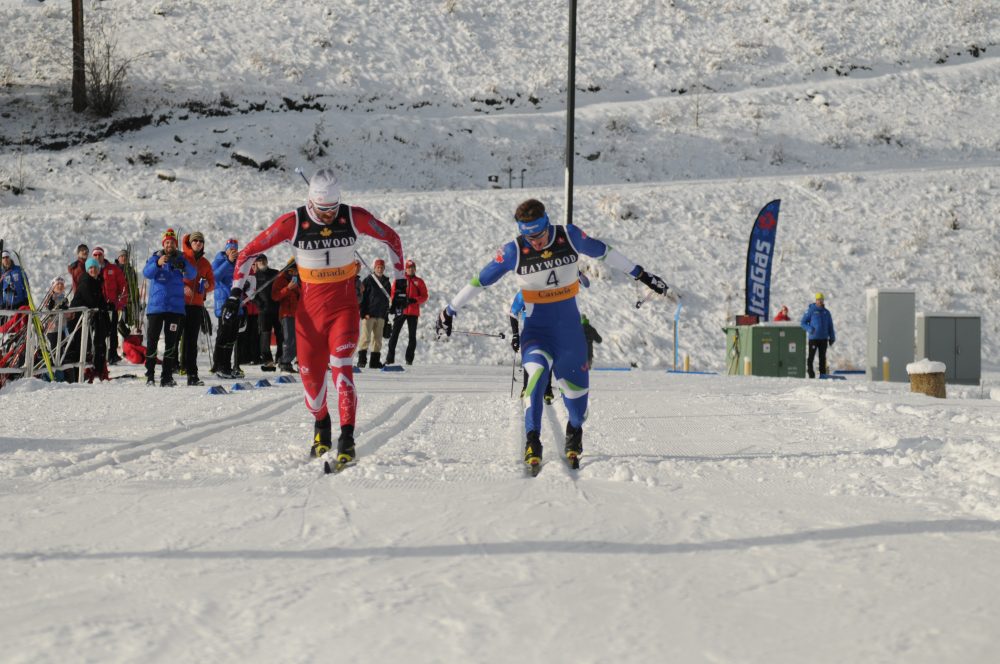
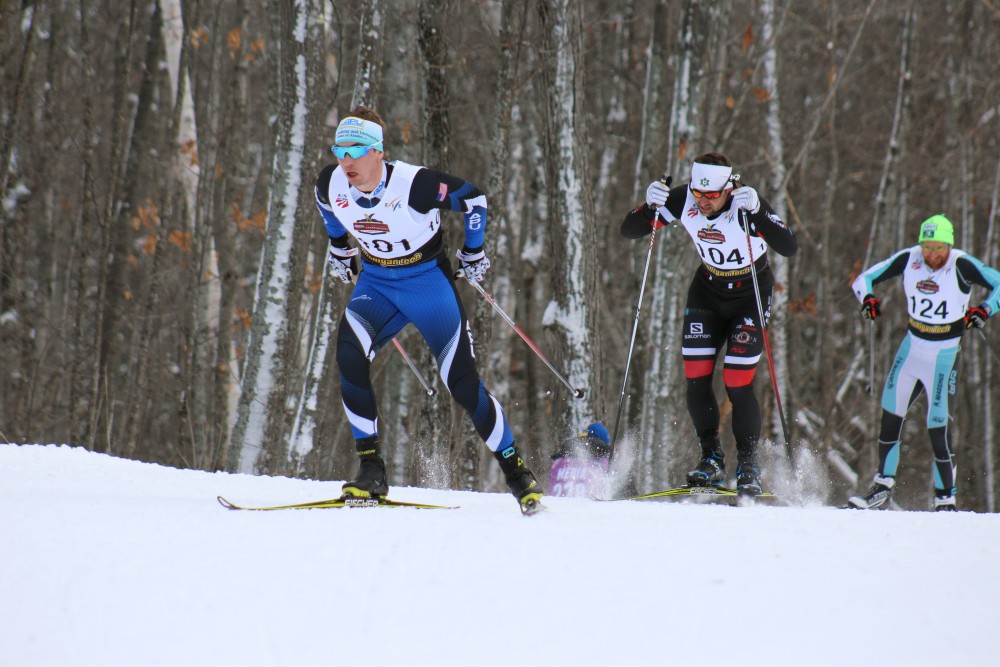
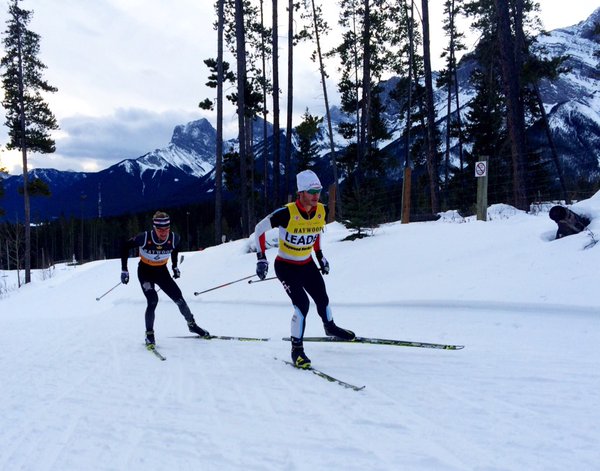
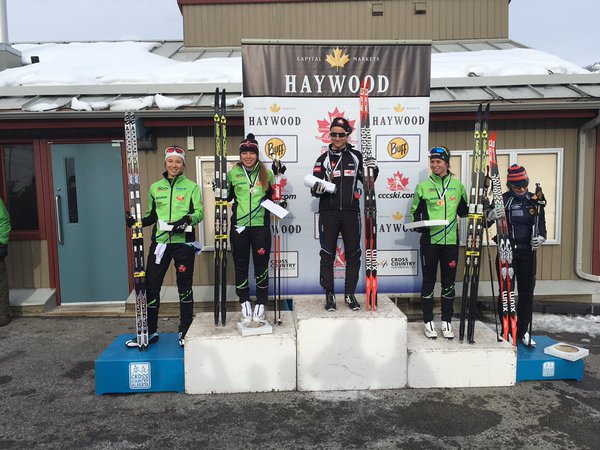
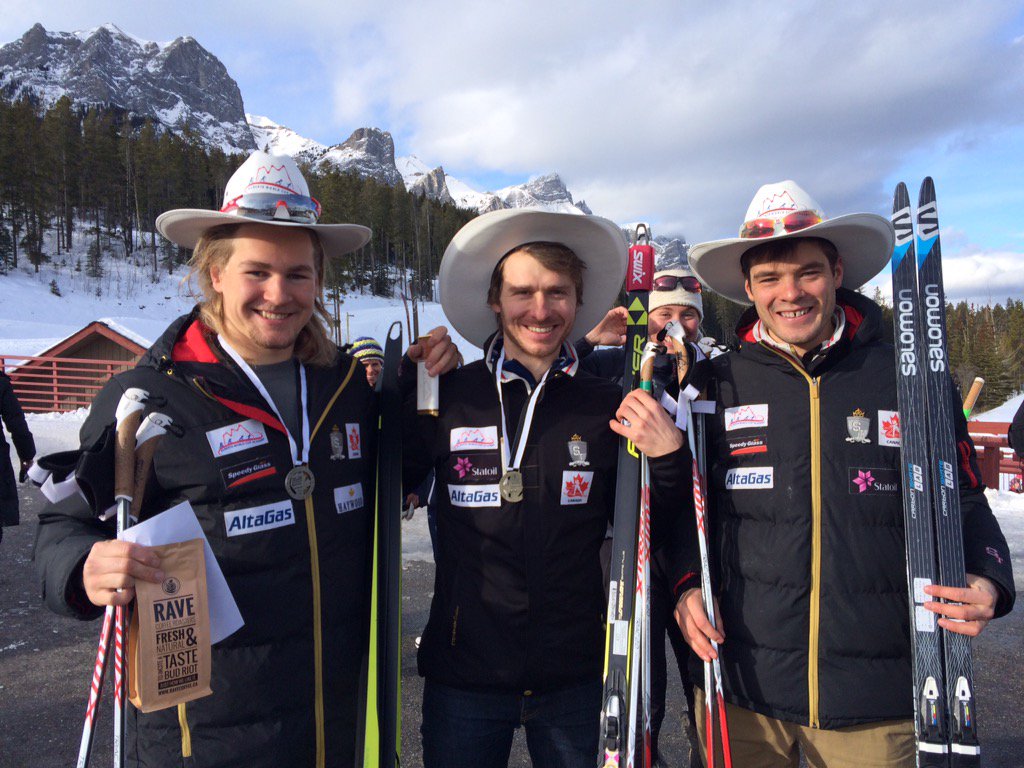
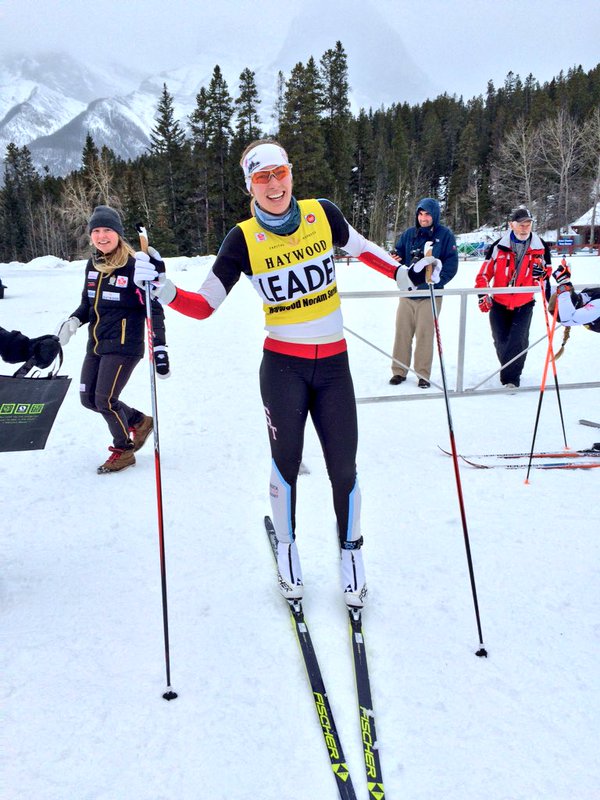
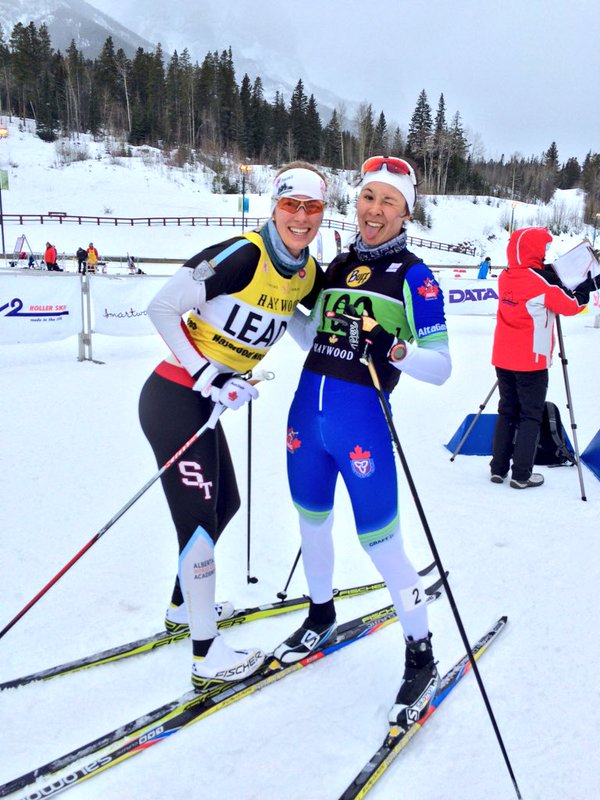
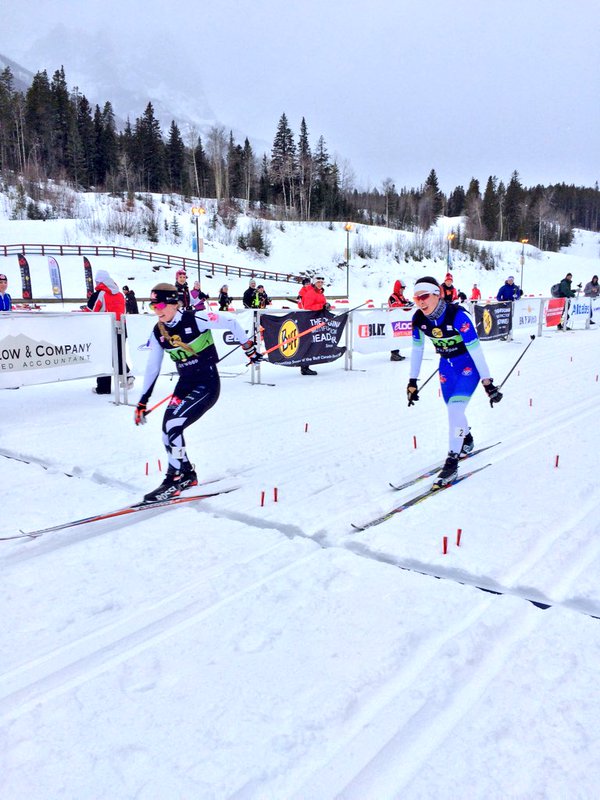
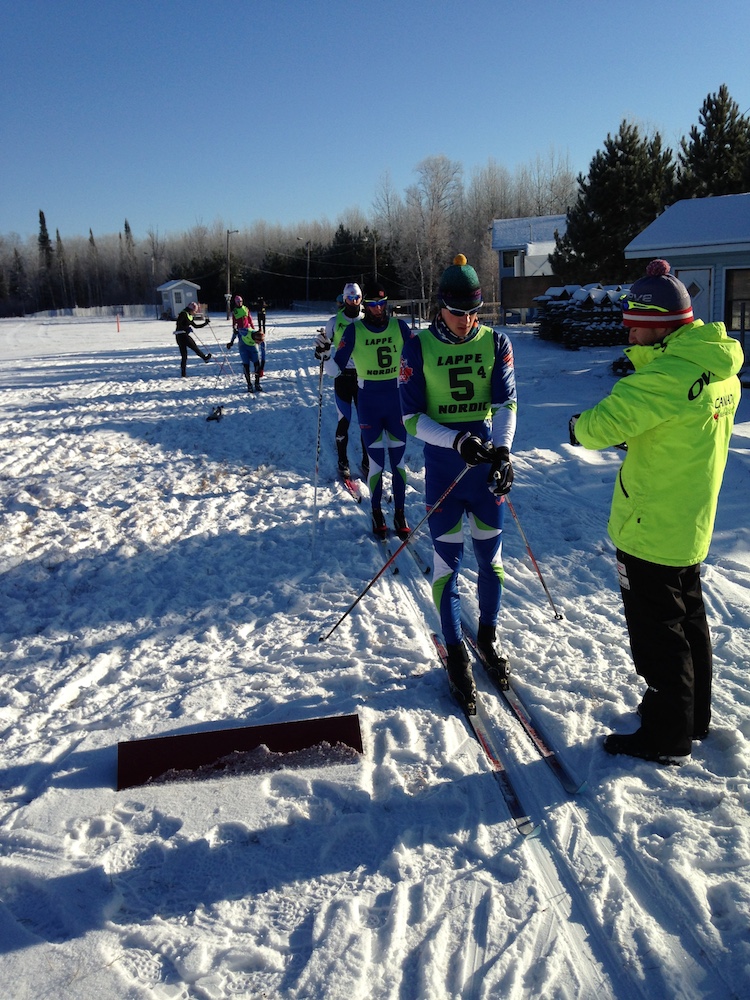
Canadian World Cup Team member Len Valjas (1) and Bob Thompson (NTDC Thunder Bay) lunge to the line during Wednesday’s Frozen Thunder classic sprint at the Canmore Nordic Centre in Canmore, Alberta. (Photo: Doug Stephen)
Clouds heavy with building snow and a winter-storm warning already in effect cast a second anticipatory shadow over a jittery group of racers gathered on Wednesday for the first Frozen Thunder race of the season at the Canmore Nordic Centre in Canmore, Alberta.
At stake for some of the top Canadians participating in the day’s classic sprint was the opportunity to secure the final spot on the men’s World Cup team for the first period of World Cup racing starting later this month. Nearly 12 centimeters of snow had fallen the night before on the two-lap race track, and for many stepping out onto the freshly groomed trails, months upon months of training prep was in the barn.
“That World Cup spot. That has been a goal for pretty well the whole year,” said Bob Thompson, who trains with the Thunder Bay National Team Development Centre (NTDC), on the phone after Wednesday’s races.
Thompson, 26, was not the only one hoping to book a plane ticket for World Cup Period 1, which starts Nov. 24 in Kuusamo, Finland, and continues through December. Sixty-six skiers started Wednesday’s men’s sprint qualifier and anyone in the hunt for that World Cup spot would have to outperform them all, excluding the Americans and Canadian World Cup Team member, Len Valjas, who was prequalified for the World Cup.
Even with the competition’s added edge, many racers went about business as usual on race day and in the days leading up to the event, Thompson explained.
“It’s been fairly carefree the week we’ve been here,” said Thompson, who arrived in Canmore with his NTDC teammates on Oct. 23. “The morning [of the sprint] I wouldn’t say things were a bleak atmosphere or super serious, it was just kind of everyone was doing their thing.”
Thompson went about his warmup the way he normally would on race day. In retrospect, he saw his plan as well-executed and his warmup as strong, despite breaking a pole during his intensity segment. For him, the qualifier went “really well,” he said.
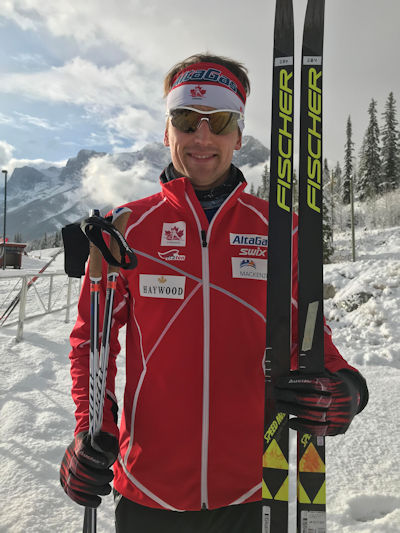
Julien Locke (Canadian U25 Team/Black Jack) after winning the men’s classic sprint qualifier at Frozen Thunder in Canmore on Wednesday and securing the final spot on the Canadian men’s team for World Cup Period 1. (Photo: Cross Country Canada)
But Julien Locke, of the Canadian U25 Team and Black Jack Ski Team, was the fastest man in the open men’s qualifier and thus earned that coveted World Cup spot. Locke, 24, posted the top time of 3:37.81 minutes, nearly a second ahead of Valjas in second (+0.97) and 3.57 seconds ahead of the third qualifier, Dominique Moncion-Groulx of the Alberta World Cup Academy (AIAWCA). Thompson qualified fourth, 4.15 seconds off of Locke’s winning time.
“I didn’t have regrets or second thoughts on how I raced,” Thompson said. “Julien had a great race, props to him. I’ll just have to come back next time.”
Locke could not be reached at press time, but he spoke with Cross Country Canada (CCC) in a video posted on Twitter after the race.
“I’m really excited to have won the race this morning and qualified for Period 1 World Cup, but the Olympics is the big goal this year,” Locke said. “It’s super important to go get results on the World Cup, and I’m excited to have a chance to do that.”
According to CCC High Performance Director Thomas Holland, Locke and the rest of the World Cup Team (excluding Alex Harvey and Cendrine Browne) will head to Gällivare, Sweden, on Nov. 10, where they’ll compete in a weekend of International Ski Federation (FIS) races from Nov. 17-19. Meanwhile, Harvey and Browne, who train out of the Pierre Harvey National Training Centre (CNEPH) with coach Louis Bouchard in Quebec, will train in Davos, Switzerland, in advance of the World Cup opener in Finland.
But let’s get back to Frozen Thunder. With the qualifier behind them and the heats slated to take place in a zero-elimination King’s Court format, many racers approached the rest of Wednesday adamant on getting in some solid race efforts.
“The King’s Court format that we use in the heats was a great showcase for athlete development whereby every athlete entered in the race gets to race all 3 heats,” Holland explained in an email. “The format sees men and woman and para-skiers in some of the same heats – super fun event for all the athletes.”
In the first heat, Thompson, Locke, Valjas, and Moncion-Groulx went head to head, yet with the heats starting one minute apart on the two-lap track, there was a constant influx of skiers and some overlap.
“I think comments were made that we were dogging it a little bit,” Thompson said of that initial round. “There were other heats that we were basically skiing in the first lap with that were going faster than us … they were running pretty quick through the starts.”
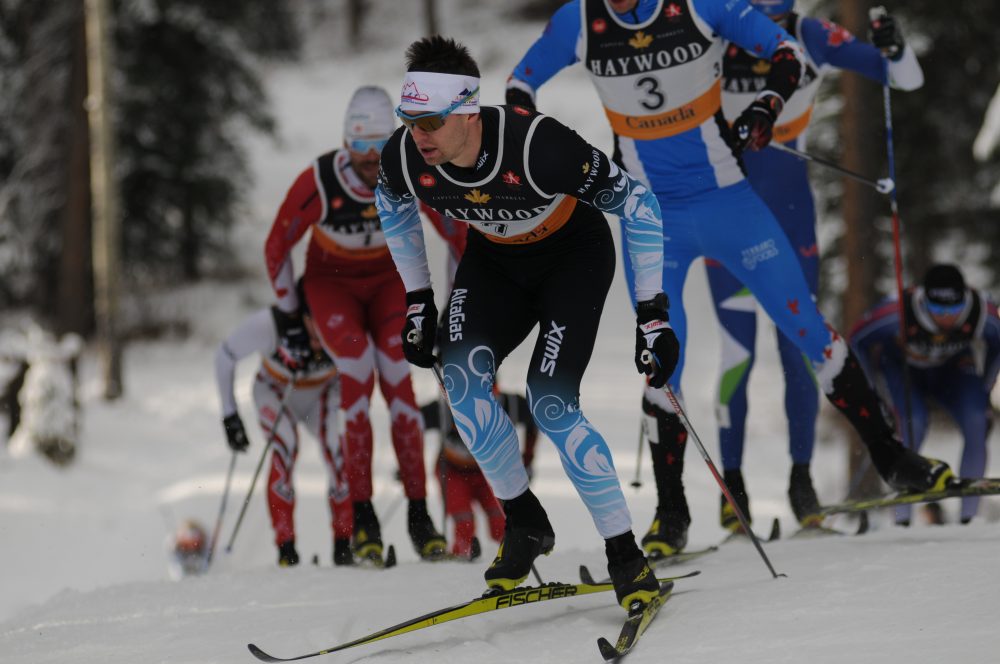
Dominique Moncion-Groulx (Alberta World Cup Academy) leads Julien Locke (3), of Canada’s U25 Team and Black Jack, and Len Valjas (l), of the Canadian World Cup Team, during a Frozen Thunder classic sprint heat on Wednesday at the Canmore Nordic Centre in Canmore, Alberta. (Photo: Doug Stephen)
In the second heat, Locke and Valjas paired up with Knute Johnsgaard (Canadian World Cup Team/AIAWCA) and American Cole Morgan, of the Sun Valley Ski Education Foundation (SVSEF). Thompson and Moncion-Groulx faced another American SVSEF skier, Kevin Bolger, as well as NTDC Thunder Bay’s Andy Shields. Four men advanced to the senior men’s final: Bolger, Thompson, Locke and Valjas.
In the final, Thompson recalled creating what he saw as “a bit of a gap” between himself and Valjas, yet Valjas, a seasoned World Cup sprinter, caught him in the lunge to the line for first. Overall on the day, Valjas placed first, Thompson second, Locke third, and Bolger fourth.
With the King’s Court format, female racers competed in the same same qualifier as the men, with Dahria Beatty (U25 Team/AIAWCA) emerging as the fastest female qualifier in 4:20.66. Her time was 8.56 seconds clear the second woman, American Chelsea Holmes, of Alaska Pacific University (APU), and 10.03 seconds ahead of Katie Weaver (Hollyburn Ski Club) in third. The third-placed Canadian woman in the qualifier, Annika Hicks (AIAWCA) clocked in fourth (+13.25).
In the heats, the women continued to race with the men. In the all-women final, Maya MacIsaac-Jones (U25 Team/Rocky Mountain Racers) took the win, Hicks placed second, Holmes third, and Frédérique Vézina (CNEPH) fourth.
Frozen Thunder racing continues Friday with men’s 10 k and women’s 7.5 k distance races, starting at 9 a.m. Mountain time. In a press release, CCC anticipated a turnout of 115 participants.
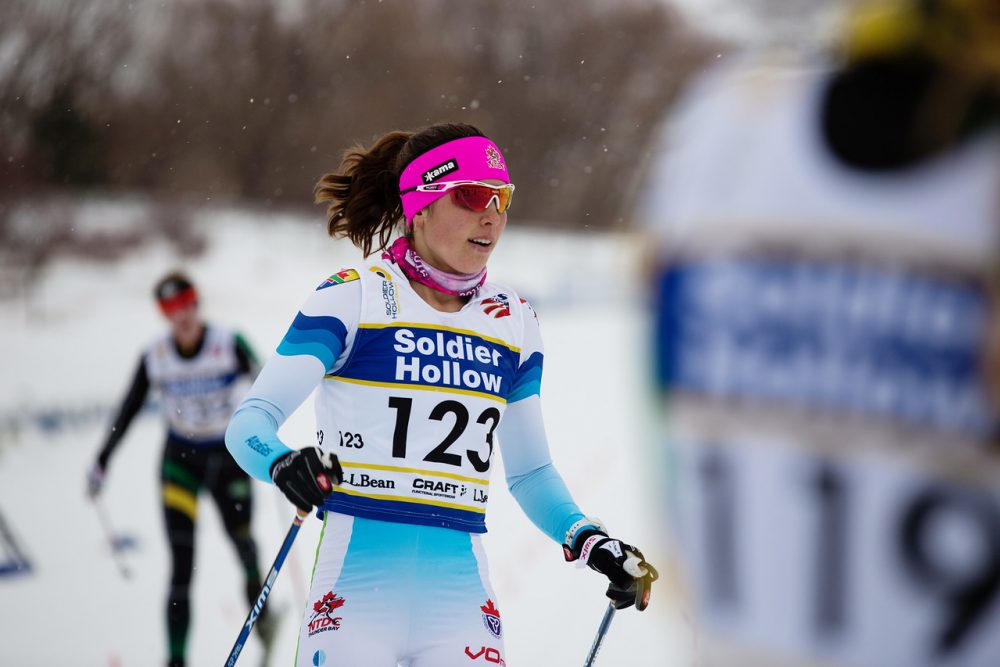
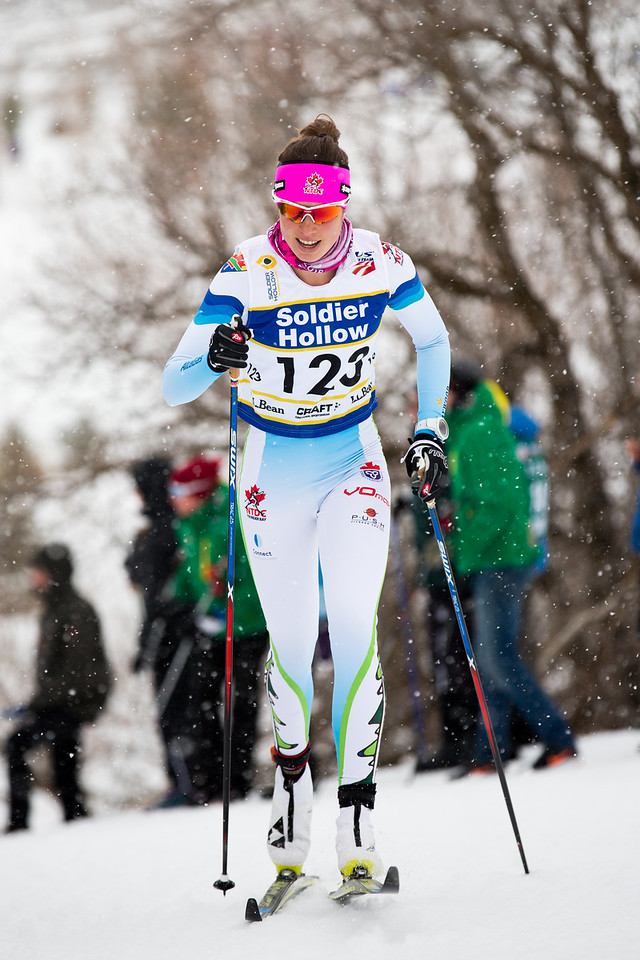
Annika Richardson (NTDC Thunder Bay/Canadian Junior National Ski Team) finishing third in the junior women’s 7.5 k classic at 2017 U.S. Cross Country Ski Championships last month at Soldier Hollow in Midway, Utah. (Photo: U.S. Ski Team)
In an effort to showcase the North Americans competing at this week’s International Ski Federation (FIS) 2017 USANA Nordic Junior World Championships and U23 Cross Country World Championships at Soldier Hollow in Midway, Utah, we asked those qualifying athletes several questions about themselves — actually, we had them fill in the blanks. Here we have 18-year-old Annika Richardson, of the National Team Development Centre (NTDC) and Canadian Junior National Ski Team, who’s representing the Canada at her first Junior Worlds after competing at last year’s Youth Olympic Winter Games.
“My full name is Annika Richardson, but you can call me Annika. I was born in Vancouver, B.C., raised in Vancouver, and one thing you should know about my hometown is that we are trying to become the greenest city in the world by 2020.
Annika Richardson (NTDC Thunder Bay/Canadian Junior National Ski Team) racing to third in the junior women’s 7.5 k classic at 2017 U.S. Cross Country Ski Championships last month at Soldier Hollow in Midway, Utah. (Photo: U.S. Ski Team)
I started cross-country skiing when I was 2 or so, thanks to my parent’s love of the outdoors. I currently train in Thunder Bay with NTDC Tbay.
If I’m not skiing, you might find me curled up with a good book and a hot cup of tea. If I had to pick a favorite book, it would be ‘The Hobbit’ by J. R. R. Tolkien or ‘The Chronicles of Narnia’ by C.S. Lewis (sorry can’t pick).
One of the things I’m most excited about for Junior Worlds at Soldier Hollow is the home field advantage our team will have after a long altitude camp in Park City in the fall, as well as our experience actually racing there at US National a few weeks ago. One race I’m especially targeting there is the 5km Skate.
The best advice anyone ever gave me about skiing or racing was to keep on smiling. One of the best race memories I have is the 5km Skate at the Youth Olympic Games.
If I could meet one World Cup skier, it would be Heidi Weng.
If I don’t end up being a professional skier, I’ll probably be a student trying to finish the degree (whatever that is) that I am currently working on…
I’m missing who knows how many days of school to be here, and my teachers are probably thinking, ‘What a dedicated student.‘
HOUGHTON, Mich. — Three days of racing at U.S. Cross Country Championships on the Michigan Tech Trails down and just one more to go with the 1.5-kilometer classic sprint taking place on Saturday. Check out the following photo gallery featuring some of the top moment’s from Thursday’s 20 and 30 k freestyle mass starts.
Photo: Tad Elliott of Ski and Snowboard Club Vail crosses the line in first for the men’s 30 k freestyle mass start on Thursday at U.S. nationals in Houghton, Mich. (Photo: Christopher Schmidt)
Photo: Early on in the of the men’s 30 k freestyle mass start on Thursday at U.S. nationals in Houghton, Mich. (Photo: Christopher Schmidt)
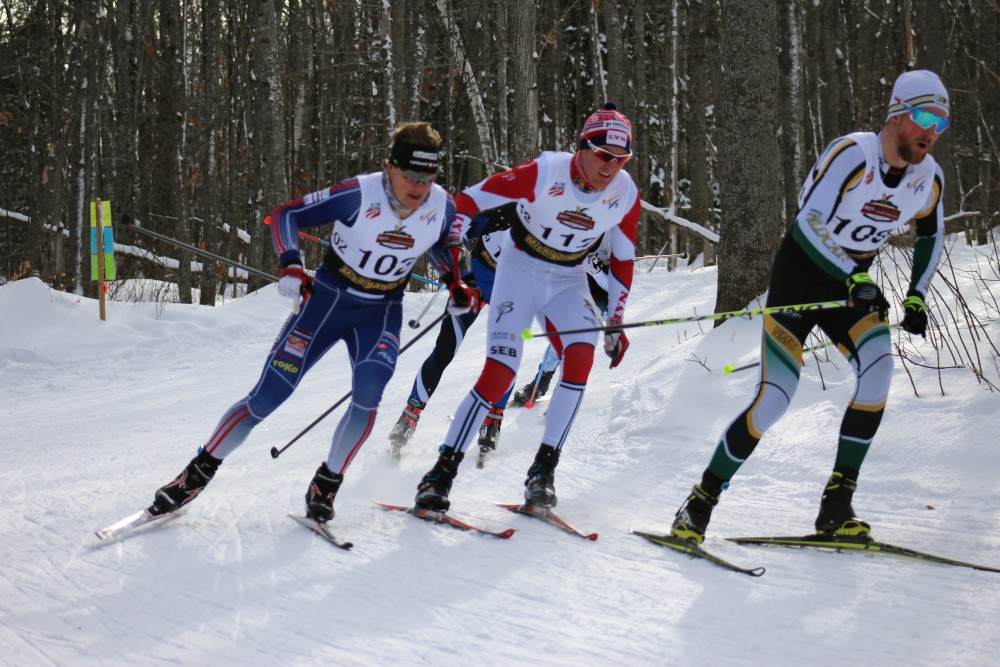
Photo: (right to left) Matt Liebsch of Gear West/Salomon leads Kevin Sandau of the Alberta World Cup Academy and Brian Gregg of Team Gregg/Madshus early in the men’s 30 k freestyle mass start on Thursday at U.S. nationals in Houghton, Mich. Gregg went on to finish second overall, while Sandau took seventh, Liebsch eighth. (Photo: Christopher Schmidt)
Photo: (right to left) Canada’s NDC Thunder Bay athlete Michael Somppi crests the top of a hill in first, ahead of Brian Gregg of Team Gregg/Madshus, Northern Michigan University’s Adam Martin, and Alaska Pacific University’s Scott Patterson, during the first lap of the men’s 30 k freestyle mass start in Houghton, Mich. Somppi went on to finish third overall, Gregg second, Martin fourth, and Patterson fifth. (Photo: Christopher Schmidt)
Photo: Racers (left to right) Kyle Bratrud of CXC, followed by Northern Michigan University’s Adam Martin and teammate Jake Brown, along with Team Freebird’s Kris Freeman chasing a break away group of Brian Gregg (Team Gregg/Madshus) (not shown), Tad Elliot (Ski and Snowboard Club Vail) (not shown), and Kevin Sandau (AWCA) (not shown) half-way throught the second lap of the men’s 20 k freestyle mass start race on Thursday at U.S. nationals in Houghton, Mich. Bratrud went on to place tenth overall, Martin fourth, Brown sixth, and Freeman ninth.
Photo: The front pack (right to left) led by Team Freebird’s Kris Freeman, Ski and Snowboard Club Vail’s Tad Elliot, Alaska Pacific University’s Scott Patterson, Northern Michigan University skier Adam Martin, and Gear West/Salomon skier Matt Liebsch during the third lap of the men’s 30 k mass start at U.S. nationals in Houghton, Mich. Elliot eventually surpassed Freeman and took the overall win. Patterson claimed fifth, Martin fourth, Liebsch eighth, and Freeman ninth.
Photo: (left to right) Kris Freeman of Team Freebird leads Tad Elliot of Ski and Snowboard Club Vail, Alaska Pacific Universit skier Scott Patterson, CXC skier Kyle Bratrud, Canadian NDC Thunder Bay athlete Michael Somppi, and Gear West/Salomon skier Matt Liebsch during the men’s 30 k freestyle mass start on Thursday at U.S. nationals in Houghton, Mich. Tad eventually took first, Freeman ninth, Patterson fifth, an Somppi third, Bratrud tenth, and Liebsch eighth. (Photo: Christopher Schmidt)
Photo: Tad Elliott of Ski and Snowboard Club Vail takes charge and and the overall win of the men’s 30 k freestyle mass start on Thursday at U.S. nationals in Houghton, Michigan. (Photo: Christopher Schmidt)
Photo: Racers (left to right) Adam Martin of Norther Michigan University, teammate Jake Brown, Alaska Pacific University skier Scott Patterson, and Canadian NDC Thunder Bay skier Michael Somppi battle it our for third during the final 150-meters of the men’s 30 k freestyle mass start race on Thursday at U.S. nationals in Houghton, Mich. Somppi eventually overtook Martin for the third place spot overall. Martin placed fourth, Patterson fifth, and Brown sixth.
Photo: Racers take off out of the stadium during the women’s 20 k freestyle mass start on Thursday at U.S. nationals in Houghton, Mich. (Photo: Christopher Schmidt)
Photo: A lead pack develops early on with (right to left) Craftsbury Green Racing Project’s Caitlin Patterson, Stratton Mountain School skiers Anne Hart and Katharine Ogden, Alaska Pacific University’s Chelsea Holmes, and Boulder Nordic Junior Racing Team coach, Eliska Hajkova during the women’s 20 k mass start on Thursday at U.S. nationals in Houghton, Mich. (Photo: Christopher Schmidt)
Photo: (left to right) Alaska Pacific University skier Chelsea Holmes heads the front group of racers, including Craftsbury Green Racing Project skier Caitlin Patterson, Stratton Mountain School skiers Anne Hart and Katharine Ogden, Boulder Nordic Junior Racing Team coach Eliska Hajkova, and SMST2 skier Erika Flowers during the women’s 20 k freestyle mass start on Thursday at U.S. nationals in Houghton, Mich. Patterson later surpassed Holmes for the overall win. Holmes took second, Ogden third, Hart fourth, Flowers fifth, and Hajkova sixth.
Photo: Alaska Pacific University skier Becca Rorabaugh (l) and Middlebury College racer Kelsey Phinney racing to an eighth and seventh place respectively during the women’s 20 k freestyle mass start on Thursday at U.S. nationals in Houghton, Mich.
Photo: Kaitlynn Miller of the Craftsbury Green Racing Project follows Sun Valley Ski Education Foundation skier Mary Rose during the second lap of the woomen’s 20 k freestyle mass start on Thursday at U.S. nationals in Houghton, Mich. Miller went on to place tenth overall.
Photo: (left to right) Alaska Pacific skier Chelsea Holmes skiing in front of Stratton Mountain skier Katharine Ogden and SMST2 teammate Anne Hart, as well as Craftsbury Green Racing Project skier Caitlin Patterson during the women’s 20 k freestyle mass start on Thursday at U.S. nationals in Houghton, Mich. (Photo: Christopher Schmidt)
Photo: Caitlin Patterson of the Craftsbury Green Racing project races to another championship title during the women’s 20 k freestyle mass start on Thursday at U.S. nationals in Houghton, Mich.
Photo: Stratton Mountain Skier Katherine Ogden raced to a third overall finish in the women’s 20 k freestyle mass start on Thursday at U.S. nationals in Houghton, Mich. (Photo: Christopher Schmidt)
Photo: Erika Flowers skiing for Stratton Mountain School crossed the finish line in fifth after the women’s 20 k freestyle mass start on Thursday at U.S. nationals in Houghton, Mich. Flowers was the third SMST2 female skier to cross the line in the top five, behind teammate Anne Hart who took fourth and Katharine Ogden who placed third (not shown).
Photo: Boulder Nordic Junior Racing Team coach, Eliska Hajkova racing the final 100-meters to finish sixth overall in the women’s 20 k freestyle mass start on Thursday at U.S. nationals in Houghton, Mich.
Canadian Olivia Bouffard-Nesbit of the Alberta World Cup Academy races to a ninth place finish during the women’s 20 k freestyle mass start at 2016 U.S. National Championships in Houghton, Michigan. (Photo: Christopher Schmidt)
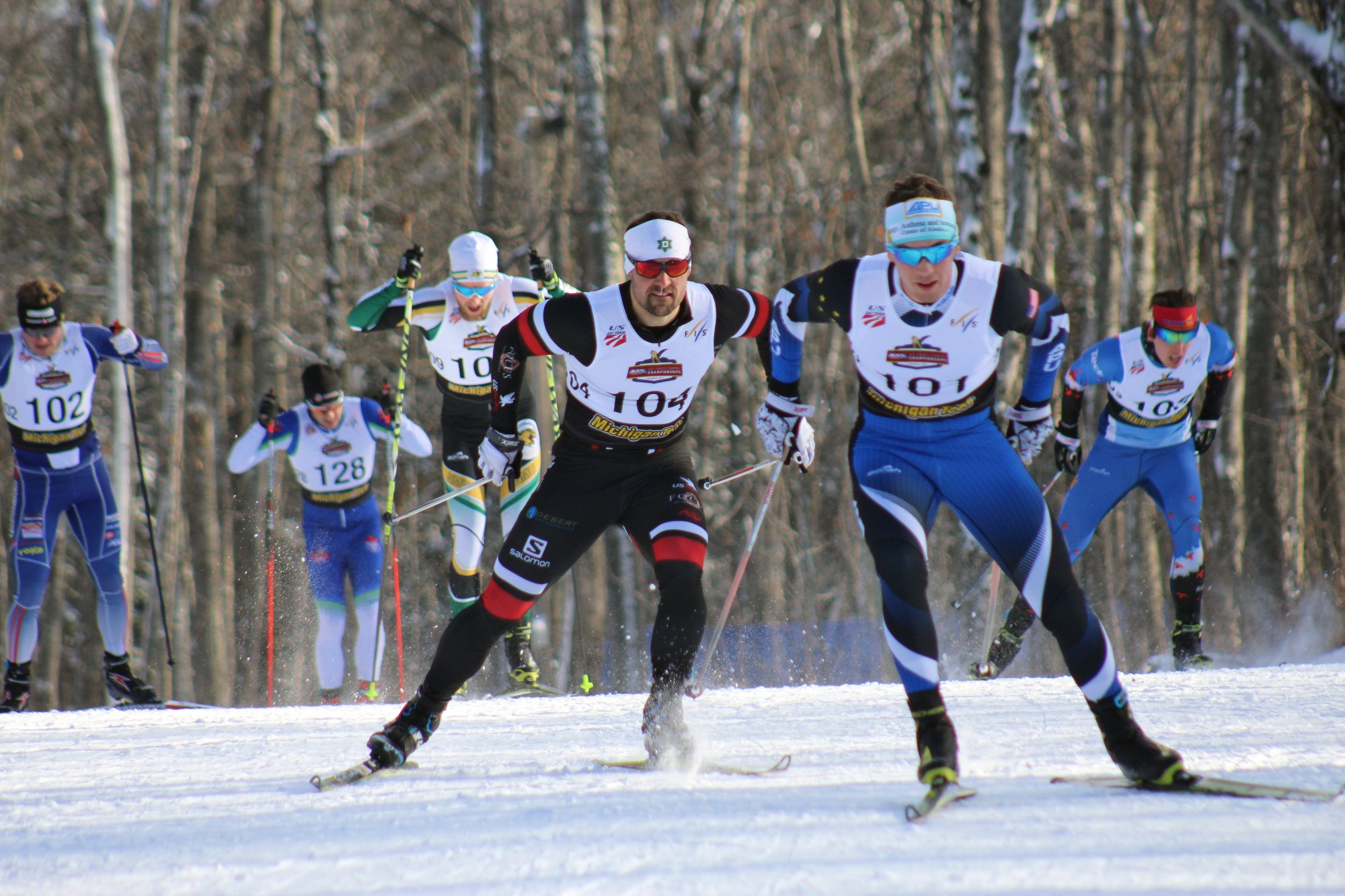
APU’s Reese Hanneman (Bib No. 101) leads Bend Endurance Academy’s Dakota Blackhorse-von Jess (Bib No. 104) as well as (back: left to right) Miles Havlick (SVSEF), Evan Palmer-Charrette (NDC Thunder Bay), Fredrick Schwencke (NMU), and Julien Locke (Team Black Jack) during the final of the men’s 1.5 k freestyle sprint on Monday at U.S. nationals in Houghton, Mich.
HOUGHTON, Mich. — With close to a 500-meter incline to the finish, rounding the same course potentially four times in head-t0-head heats and a qualifier, Monday’s 1.5-kilometer freestyle sprint at U.S. Cross Country Championships proved a test beyond sheer fitness and tact. For overall race winner, Reese Hanneman of Alaska Pacific University (APU), it was combination staying smart, smooth and relaxed.
“I was just trying to stay relaxed [through the heats],” said Hanneman, a 2014 classic sprint national champion, after notching his second sprint title on Monday. “I know that I’m in great sprint form right now. I have the acceleration, I have the power and I was just trying not to use that unnecessarily early. This finish is very long and very uphill so it takes a big punch in order to make it to the line first.”
The fastest qualifier in a time of 3:18.07, the 26-year-old Hanneman held his own in first all the way through the men’s final.
“I could tell all day watching Reese that he was very comfortable,” runner-up and defending skate champion Dakota Blackhorse-von Jess, of the Bend Endurance Academy, said in a post-race phone interview. “He’s skiing really well right now.”
In his quarterfinal, Hanneman was first out of the start and in the lead as the group headed out onto the 1.5 k course. Rounding the final corner, again it was Hanneman in first, followed by Canada’s Alexis Turgeon (Skinouk/Quebec Ski Team) close to 10 meters behind.
Hanneman won that heat in 3:18.07, while Michigan Tech’s Didrik Elset, chose the left outside lane to overtake Turgeon, ending up 0.31 seconds behind Hanneman for second in the quarterfinal.
Hanneman and Elset met again in the same semifinal, along with Blackhorse-von Jess, Brian Gregg (Team Gregg), Canada’s Michael Somppi (NDC Thunder Bay), and Silas Talbot (Alaska Winter Stars).
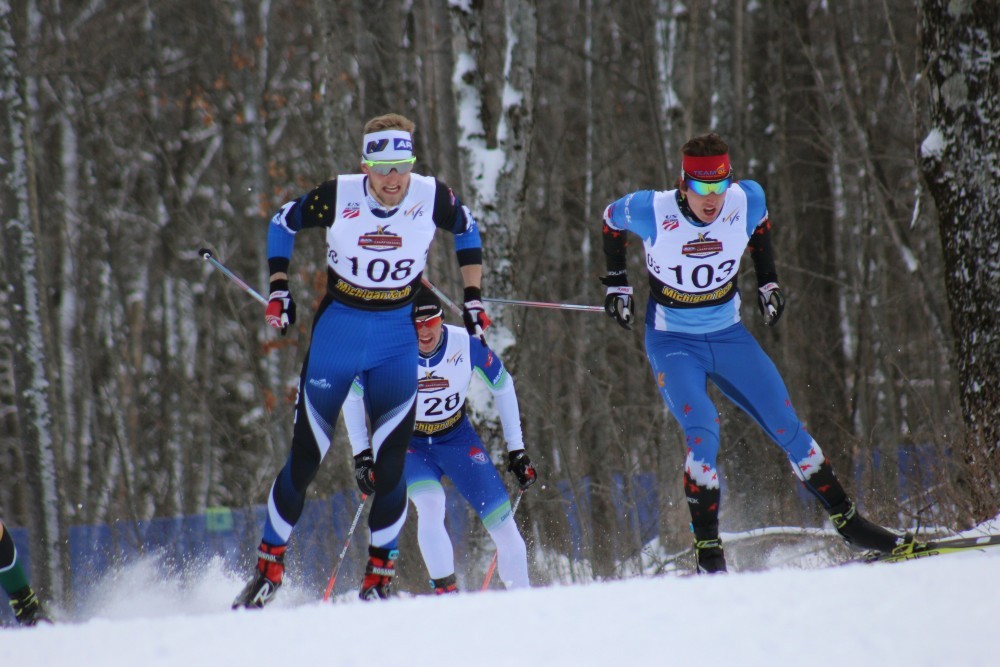
Canadian Julien Locke (l) (Team Black Jack) challenges Eric Packer (APU) at around 400-meters to the finish of the semi-final for the men’s 1.5 k freestyle sprint on Monday at U.S. nationals in Houghton Mich. Locke went on to finish third overall (+2.89). Canadian Evan Palmer-Charrette (Bib No. 128) also advanced to the final and finished sixth overall (+12.93).
Hanneman and Elset led out of the start gate, with Blackhorse-von Jess and Gregg tucked in close behind them. However, it was Hanneman once more who led the final uphill stretch to the finish, with Blackhorse-von Jess skiing right on his ski tails.
Gregg managed to close the gap to the front two, and the three lunged for the line with Hanneman finishing first in 3:17.42, 0.21 seconds ahead of Blackhorse-von Jess in second, and 0.33 seconds ahead of Gregg in third.
As Gregg waited to see if his time would be fast enough for a “lucky loser” spot in the final, the second semifinal, with APU’s Eric Packer and Logan Hanneman, Northern Michigan University’s Fredrik Schwencke, Miles Havlick (Sun Valley Gold Team), and Canadians Julien Locke (Team Black Jack), and Evan Palmer-Charrette (National Development Centre Thunder Bay) stepped up to the line.
Schwencke and Havlick led from the start with Packer, the two Canadians, and Logan Hanneman (Reese’s younger brother) not far behind.
Packer cornered into the final stretch in first, but with approximately 150 meters to go, Schwencke made the pass on Packer’s right while Locke moved into the left lane. Palmer-Charrette moved in behind Locke, while Havlick challenged Schwencke on the right.
In a four-way lunge for the line, Scwencke won the second semifinal win in 3:17.04, while Havlick finished just 0.07 seconds after. The third- and fourth-place efforts by the two Canadians, Locke (+0.14) and Palmer-Charrette (+0.27), proved worthwhile, as they both earned the two available lucky loser spots in the final.
Fredrick Schwencke (NMU) leads Miles Havlick (SVSEF) and Haakon Hjelstuen (Lyn Ski) around the final corner before the last 500-meter incline to the finish during their quarterfinal of the men’s 1.5 k freestyle sprint on Monday at U.S. Nationals in Houghton, Mich.
“In both the quarter and semi, I stayed pretty relaxed during the first two thirds of the course and was at the back of the pack,” Palmer-Charrette, 21 said. “After saving my legs off the start, I was able to work my way up after the main climb through the finishing stretch to the front, or close to the front.”
The action for Palmer-Charrette and the five other finalists — Hanneman, Blackhorse-von Jess, Locke, Schwencke, and Havlick — continued as they lined up for the men’s final.
Hanneman and Havlick took it out from the starting gate, with Havlick moving to the front for the first part of the course.
“I was leading on the lower part of the course and then I just kind of ran out of steam on the top part,” Havlick recalled. “Obviously these sprint races are some of the toughest days, but I was psyched to be in the final for sure.”
After Havlick led the first part of the final, Hanneman made his move during the second large climb on the course.
“I was in second up the first climb and then there was a little downhill and I tried to work that corner and I was able to slingshot around and get my own lane up the second climb,” Hanneman said.
From that point on, the past classic-sprint champ and last year’s early season SuperTour leader gained momentum for the finish.
“The final didn’t really break up until the second main climb, then Reese Hanneman really pushed the pace and opened the field up a bit,” recalled Palmer-Charrette, who placed sixth overall.
As Hanneman rounded the final corner in first, Blackhorse-von Jess raced into the righthand lane, challenging him for the win.
“I built a little gap and Dakota was able to get away from the rest of the guys and he bridged up to me,” Hanneman said. “Then we came into the final lanes and I was ahead and he kicked and pulled up next to me and I was able to kick again and put the hammer down in the last 30 meters and get away from him.”
Hanneman took the final win in 3:15.14, while Blackhorse-von Jess finished 0.35 seconds behind him.
“I’m pretty pleased to finish the day on the podium, fighting for the win,” said 29-year-old Blackhorse-von Jess.
Left to right: Overall winner Reese Hanneman (APU), ahead of Dakota Blackhorse-von Jess (Bend Endurance Academy) and Brian Gregg (Team Gregg/Madshus) during their semi-final of the men’s 1.5 k freestyle sprint on Monday at U.S. Nationals in Houghton, Mich.
“I don’t think I’ve been in fifth place in a heat in a normal SuperTour or a nationals championship in a long time, and I was in fifth place today at one point and that’s cool,” added Blackhorse-von Jess, who won both sprints at last year’s nationals. This year, he won the SuperTour classic sprint in Sun Valley, Idaho, in early December.
“There’s a lot more moving around. There’s a lot more jostling for position. There’s more sprinting going on and it makes racing fun,” he said.
Finishing 2.89 seconds after Blackhorse-von Jess was Locke in third for his first-ever U.S. nationals podium.
“Today was fun,” Locke, 22, said. “We have our U23 World Champ trials next week so today was mostly just to see how my shape is and have a good race before that event. I’ll race the sprint on Saturday here and hopefully I can podium again”
Palmer-Charrette is also looking for a top result at Canada’s U23 World Championship trials Jan. 14-17 at Lappe Nordic in Thunder Bay, Ontario.
“It was a good day for Evan,” NDC Thunder Bay head coach Timo Puiras wrote in an email. “His shape has been steadily improving all race season and I look forward to seeing how he will race at the World U23 Trials on his home trails in Thunder Bay next week.”
In his first skate-sprint final, collegiate skier Schwencke raced to fourth overall, 4.27 seconds after Hanneman.
“I’ve never in my whole career of skiing qualified for a skate sprint so it was pretty fun to be in the final,” Schwencke said.
“After the qualifier and the quarterfinal, everything was just a bonus,” the 23-year-old Norwegian added. “It was an amazing day.”
Havlick finished fifth (+6.29) and Palmer-Charrette took sixth (+12.93).
While it’s no secret that Hanneman will leave this race as the name to beat, he remains elusive about the pre-race sound beats that helped him come into his own.
“It wasn’t Justin Bieber, we’ll just say that,” said Hanneman with a smile.
Kevin Sandau in the NorAm leader’s bib sets the pace from the front of the pack in the men’s 16.5 k freestyle mass start on the second day of the NorAm opener in Canmore, Alberta. His Alberta World Cup Academy teammate, Knute Johnsgaard, chases him down. (Photo: Alberta World Cup Academy/Twitter)
You’ve seen it on the World Cup, and now it’s happening at the domestic level: double poling a classic distance race, as seen at Canada’s NorAm opener in Canmore, Alberta.
The top men went without kick wax for the 10-kilometer classic interval start on Saturday, Dec. 5, double poling around a 2.5 k biathlon loop.
Kevin Sandau of the Alberta World Cup Academy powered to the win in 24:42.9 minutes, edging his AWCA teammate Knute Johnsgaard (National U23+ Development Team) by 2.9 seconds. Ian Murray (Capital Region Training Group) skied the fastest last lap to edge Brian McKeever of Canada’s Para Nordic Ski Team by 3.5 seconds for third, 9.5 seconds back from Sandau.
In an email, Sandau, 27, explained that double poling was essentially a no-brainer on the Canmore Nordic Centre’s biathlon trails — flatter than the usual race course with shorter climbs.
“Off the start I knew I needed to be aggressive as it was going to be a fast race,” he wrote. “Just gunned it off the start and trusted my body could clear the lactate from my arms on the downhills. Felt pretty solid throughout so wasn’t a bad plan.”
Johnsgaard explained he would have preferred striding over double pole, so considering that, he was happy with second place.
“Of course I would have liked to be 3 seconds faster! I was being extra careful not to do any skate or step turns, perhaps too careful,” Johnsgaard wrote in an email. “I just tried to pace things right and find the fastest part of the track. I was outside the track almost the whole race.”
For Murray, third stood as his NorAm career best.
“At the age of 37 I guess you could say I am coming into my groove,” Murray wrote. “I was 22nd on the first lap which was a bit slower than I hoped to start. Kevin Sandau passed me when I was on my second lap and that kicked me into gear. I have been focusing on ski marathon racing the last couple of years so I’m still figuring out the pacing for the 10 and 15km races.”
McKeever explained that he tried to build into the race, but was missing a few gears. “[I] was overly cautious about not skating, and consequently was not aggressive enough,” he wrote in an email.
In his first time double poling a distance race, Colin Abbott (Yukon Ski Team) in seventh (behind CNEPH’s Alex Dumas in sixth) observed that the pacing is different.
“You don’t max out aerobically as easily so the concern for pacing is trying not to burn your arms too soon in the race,” Abbott wrote. “I went out maybe a bit faster than was ideal, and definitely slowed on the last lap but don’t think the end result would have changed much if I started slower.”
NDC Thunder Bay athletes (in green) took second, third and fourth in the women’s NorAm 5 k classic interval start, behind Sophie Carrier-Laforte (c) of the Pierre Harvey National Training Centre in first. Katharine Stewart-Jones (second from l) placed second, Alannah Maclean (second from r) with third, and Jenn Jackson (l) was fourth. Rocky Mountain Racers’ Andrea Dupont (r) placed sixth. (Photo: NDC Thunder Bay/Twitter)
In the women’s 5 k classic race, Sophie Carrier-Laforte of the Pierre Harvey National Training Centre (CNEPH) won the two-lap race in 14:31.5, followed by U23 Development Team member Katherine Stewart-Jones (NDC Thunder Bay), 10.3 seconds back.
Thunder Bay had two on the podium with Alannah Maclean in third, 17.9 seconds behind Carrier-Laforte, and another athlete in fourth: Jenn Jackson (+30.8)
“I was aiming for a podium this week but didn’t expect to get it today,” Stewart-Jones wrote in an email. “It’s a very short race so I planned on going out really hard and just try to hold on to the same pace. On the first lap, I focused on skiing efficiently and then just went as hard as I possibly could on the second [lap].”
She added that her double-pole work this summer appears to have paid off.
While Stewart-Jones’s first lap ranked fourth and second lap was second-fastest among the women, Carrier-Laforte skied the fastest last lap. Andrea Dupont (Rocky Mountain Racers) was fastest on Lap 1, but faded on Lap 2 to place fifth (+36.0). Maclean posted the second-fastest opening lap.
Kevin Sandau (c) and his Alberta World Cup Academy teammates Knute Johnsgaard (l) and Patrick Stewart-Jones (r) placed first, second and fourth, respectively in the men’s NorAm 16.5 k freestyle mass start on Dec. 6 in Canmore, Alberta. (Photo: Alberta World Cup Academy/Twitter)
On Sunday, Dec. 6, Sandau repeated with a win in the second race of the season: the men’s 16.5 k freestyle mass start. The races were once again held on Canmore’s biathlon trails, this time on a 3.3 k loop.
Sandau won it in 38:59.9, again ahead of Johnsgaard, who finished 36.6 seconds back in second. About a minute and 3 seconds behind Sandau, McKeever placed third, four-tenths of a second ahead of fourth-place finisher Patrick Stewart-Jones (AWCA).
For Sandau, the race and the victory were even better than the day before.
“The 15km skate played out a lot more to my strengths and really let me test out my fitness,” he wrote. “I knew before the start I just wanted to go full throttle right from the gun. It was a mass start, and there was a crazy westerly wind, so I knew this race was going to be easier to bunch up and make it harder to break away.”
He strategized his pace changes for the bottom of the five-lap course, where there were two “decent climbs,” he explained. His fourth time around, he broke away from Johnsgaard and skied the rest of the race alone.
“I knew once I could break away from anyone, I could really start to put some time in because they had to fight the wind just as much as I did at that point on,” Sandau wrote.
Johnsgaard anticipated that Sandau would be the man to beat, “so the two of us started hard right out of the gate to try and lose the field as soon as possible,” Johnsgaard wrote.
They broke away around 5 k, and while Sandau’s pace felt fast, Johnsgaard explained holding on until the last 3.3 k lap.
“By that time I was hurting pretty bad and lost a lot of time on my last lap,” he wrote. “I thought everyone would catch back up to me but luckily we had opened up a big enough gap earlier on.”
McKeever noted the superior shape of Sandau and Johnsgaard compared to him and the rest of the field. “It went as well as it could have,” McKeever wrote. “I played the tactics right and made the most of the day.”
Dahria Beatty of the U23 Development Team and AWCA charged hard on the last lap of the women’s 10 k freestyle mass start to win by 8.8 seconds in in 27:07.5. Frédérique Vézina placed second and her CNEPH teammate Cendrine Browne (NST U23 Development Team) took the final podium step in third, 13.7 seconds behind Beatty. Another CNEPH skier Jaqueline Mourao, originally from Brazil, was 1.4 seconds off the podium in fourth. Mourao turns 40 later this month.
“It’s always amazing to be able to win a race!” 21-year-old Beatty wrote in an email after her second senior NorAm victory. “I ended up leading most of the race. My original plan had been to sit back for the first lap in the pack and then if I felt strong push the long climb that was on both the second and third lap.”
As she approached the climb on the second of three laps, she explained she tried to keep the pace high to “string out the pack.”
“On the final lap on the same long climb I had a ski lengths gap coming off the downhill so I took advantage of that small gap and just skied as hard as I could without looking back,” Beatty wrote. “I didn’t let off at all until the final 500 meters when I finally checked to confirm the gap my coaches had been telling me I had.”
Vézina wrote that, while she made a race plan and executed it well, mass starts are a toss up.
“You can expect some things but at the end you can really make intelligent decisions once you are in the race,” Vézina wrote. “I’m happy with the way I managed my race.”
Despite a broken pole at the beginning of the race and losing contact with the leaders, Browne was pleased to see where she stacked up at the start of the season.
“You always ask yourself if you are in shape or not compared to the other skiers,” Browne wrote. “The tactics didn’t play out as planned … I was planning on leading with Dahria but it didn’t really work out because I had to make my way back to the front.”
Sunday’s 10/16.5 k freestyle mass start results:Men | Women
Women’s Canmore NorAm classic sprint winner Dahria Beatty (AWCA/NST U23 Development Team) after her A-final victory. (Photo: CCC/Twitter)
On Tuesday, the final day of NorAm racing in Canmore, Beatty went on to win the women’s 1.5 k classic sprint final by 2.51 seconds over Browne. Earlier in the day, Browne topped the qualifier in 4:36.2, and Beatty was 6.8 seconds off the pace to qualify in fifth.
Browne and Beatty both won their quarterfinals before facing off in the semifinal, where Browne took first by 1.62 seconds over Beatty in second. In the final, Beatty explained that for the first time in a race, she screamed in elation as she crossed the finish. It was her first senior sprint victory.
“Going into this race I wanted to ski in the top two in all heats to avoid being stuck at the back of an accordion-effect after the herringbone climb. In all my heats I was able to do that,” she wrote. “Everyone’s skis were icing after this climb so it was easy to lose time kicking it off at the top. For the final I asked my coach to put a less sticky wax on so I would ice less and I think that made a big difference. I was still able to make it up the hills but more importantly I was able to crest the hill super aggressively on both laps, thus carrying more speed into the downhill.”
With two big climbs separated by two downhills, Beatty explained that it made sense to push hard each time up. That made pacing simple; she simply wanted to be in front.
“When I came down the last hill in the lead I went into sprint mode and didn’t look back,” she wrote. “I had to look at the results afterwards to realize how far behind the others were.
Another great thing about today was the rain waited until the women’s race was over, bonus.”
Dahria Beatty (l) and Jenn Jackson after Tuesday’s NorAm classic sprint in Canmore, Alberta. Beatty won the race for her second-straight victory of the weekend, and Jackson placed third behind Cendrine Browne (not shown). (Photo: CCC/Twitter)
Browne was pleased to win a sprint qualifier for the first time in her career and did so by four seconds over Jenn Jackson. Later in the final, she edged Jackson by 0.25 seconds for second place. Jackson was third, ahead of Andrea Dupont in fourth, Vézina in fifth, and Marie Corriveau (CNEPH/National Junior Team) in sixth.
For Browne, 22, it was her second podium in a senior sprint.
“In the semi final, my plan was to climb the last hill faster then Dahria so I would have more speed than her in the downhill. I had the same plan in the A final but it didn’t work out as well,” she explained. “I had a pretty high level of energy today but I still tried to manage it in the quarter final and in the semi final. … My skis were great. I had great kick and my skis were fast, and that helped me a lot.”
Bob Thompson (Thunder Bay NDC) made the top 30 to qualify for the heats in the 1.5 k men’s sprint, but was more than 17 seconds off the pace in 20th. Johnsgaard set the time to beat in the qualifier in 3:51.05.
In the quarterfinals, Thompson placed second to Julien Locke (Black Jack), but came back to beat Locke in the semifinal by 0.15 seconds. Thompson went on to win the men’s final by 1.24 seconds over Patrick Stewart-Jones.
Cendrine Browne (CNEPH) edges Jenn Jackson (NDC Thunder Bay) for second in the women’s NorAm classic sprint final. (Photo: CCC/Twitter)
“Definitely great to finish the day and the weekend with a win, seems I’m becoming notorious for coming off a poor qualifier and then figuring things out in the heats,” Thompson wrote in an email.
After the quarterfinal, he switched from grip skis to zeros/rub skis, he wrote, “and they made a huge difference.
“I definitely let my skis do a bit of work so I tried to keep the first lap in control and just keep a solid position in second or third and then just make sure to stay close over the top into the downhill to get the draft,” he added. “Tough day to try and lead into the downhill and finish.”
“Bob was really strong in the finish today and I have to accept that,” Stewart-Jones wrote. “The final was a little bizarre because the pace started out fast, but then on the top of the climb on the second lap it slowed right down because it was so narrow and no one could get by the leader. The pack bunched right up and from there on it was pretty much a 6 way drag race to the finish.”
Andy Shields (NDC Thunder Bay) placed third, 1.35 behind Thompson. Sandau was fourth, Locke fifth and Johnsgaard sixth.
“The classic sprint was a big turnaround from how I was skiing on the weekend,” Shields wrote. “Distance skiing so far this year has felt terrible. Luckily my sprinting pep is still strong. I went on wax for the quarter and it was unbelievably fast.”
With wet snow and rain before his semifinal, Shields switched to zeros, “which had crazy grip but lacked a bit in glide,” he wrote. “The techs were able to tune my zeros for the final. … Happy with now having NorAm podiums in both skate and classic sprinting, as well as podiums in both skate and classic distance.”
NDC Thunder Bay’s TeamUp “The Rhythm of Winter” campaign
(Press release)
Campaign: TeamUp
NDC Thunder Bay is very grateful that Robbie Craig has Teamed Up with us to raise funds by creating this Nordic-inspired original piece of art for this campaign. We have been given the honor to name it, “The Rhythm of Winter.” Those who enjoy the outdoors will be inspired by this one of kind 18″ x 24″ acrylic painting, and the opportunity could be yours to hang it in your home, office, ski chalet or club house.
Your chance to win ‘The Rhythm of Winter” is simple. Visit www.teamupndc.com or at the kiosk during Ski Nationals in Thunder Bay, and with each $5 contribution your name will be entered in the draw. The winner of the painting will be announced on April 1st, 2015.
In addition, we want to share this unique artwork with as many people as possible, and therefore have made it available in limited quantity prints, 5 x 7″ ($15 plus $5 shipping) and 12 x 15″ ($45 plus $15 shipping). It would also make a wonderful gift for a family member, your ski friends, an athlete, or a coach.
THUNDER BAY CROSS COUNTRY SKIERS KICK OFF 2014/15 RACING SEASON
NDC ROCK Ski Invitational held at Lappe Nordic Centre
THUNDER BAY, ON (Nov. 14, 2014) – Thunder Bay XC-skiers kicked off their 2014/15 racing season today at the Lappe Nordic Centre. 14 athletes competed on a 2-kilometre loop expertly shoveled and groomed by local ski aficionado Pauli Kaki. The Men’s 8 lap (16km) race was dominated by Andy Shields who won by 2 minutes over fellow National Development Team member Bob Thompson. Evan Palmer-Charrette, also of the National Development Team rounded out the podium in third. Victory in the Women’s 5 lap (10km) competition was taken by NDC skier Jenn Jackson over teammate Alannah MacLean. Local Lappe Ski Club skier Laura Inkila took 3rd place.
National Development Centre Head Coach Timo Puiras was quoted as saying “This was a good practice race for our upcoming season. Having recently returned from an altitude camp in Alberta everything looks to be on track.” NDC athletes will depart Thunder Bay at the end of November for a month long racing series in Montana and British Columbia. Puiras continued “the main goal of the season will come in January when athletes will be looking to qualify for the World Junior/Under 23 World Championships in Almaty Kazakhstan.” Puiras will be the lead coach for those Championships and is confident that several Thunder Bay National Development Centre athletes will ski fast enough to qualify. The season will culminate in March when Thunder Bay will play host to the Canadian National XC Ski Championships.
The annual NDC Nordic Fest FUNdraiser Dinner will be held Saturday November 15th at 6pm. Tickets are still available. Please email ndcthunderbay@gmail.com for more information.
Editor’s Note: The following training-camp recap was written by Jenn Jackson, a member of NDC Thunder Bay and Canada’s Junior National Team. Last month, her training centre, located in Thunder Bay, Ontario, returned to one of its favorite places south of the border: Wisconsin. To submit your own camp writeup, please email info@fasterskier.com with the subject line: “Camp Recap.”
***
As summer slowly begins to turn to fall, the National Development Centre of Thunder Bay made its way south for its final dryland camp of the year.
From Aug. 16 to 27, athletes of NDC Thunder Bay could be found rolling along the roads near Hayward, Wis. The team has hosted camps in the area before; taking advantage of the quiet, well paved roads, and extensive trail systems, which play host to the American Birkebeiner in late February.
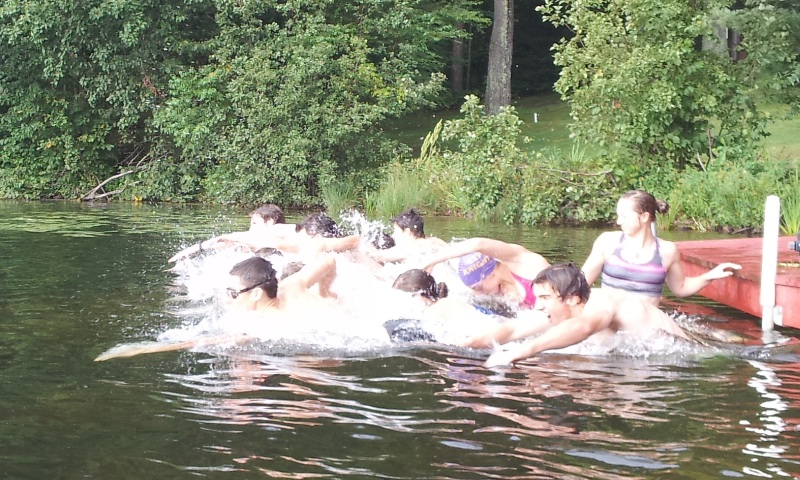
The start of NDC’s swim-run-ski triathlon time trial in Hayward, Wis., which according to coach Timo Puiras “is a bit of a tradition at the Hayward camp.” (Photo: NDC Thunder Bay)
“There was a nice variety of terrain so we could concentrate on exactly the technique and training aspect we were focusing on for any particular training session,” NDC Head Coach Timo Puiras wrote in an email. “Living on the lake at Crest Hill resort meant we could access a wide variety of training venues right from our front door making recovery and rejuvenation post workout ideal.”
Puiras explained that, for most of the team, the focus of the camp was high quality roller ski volume, but that some of the more senior athletes had “ … a more intensity driven camp.”
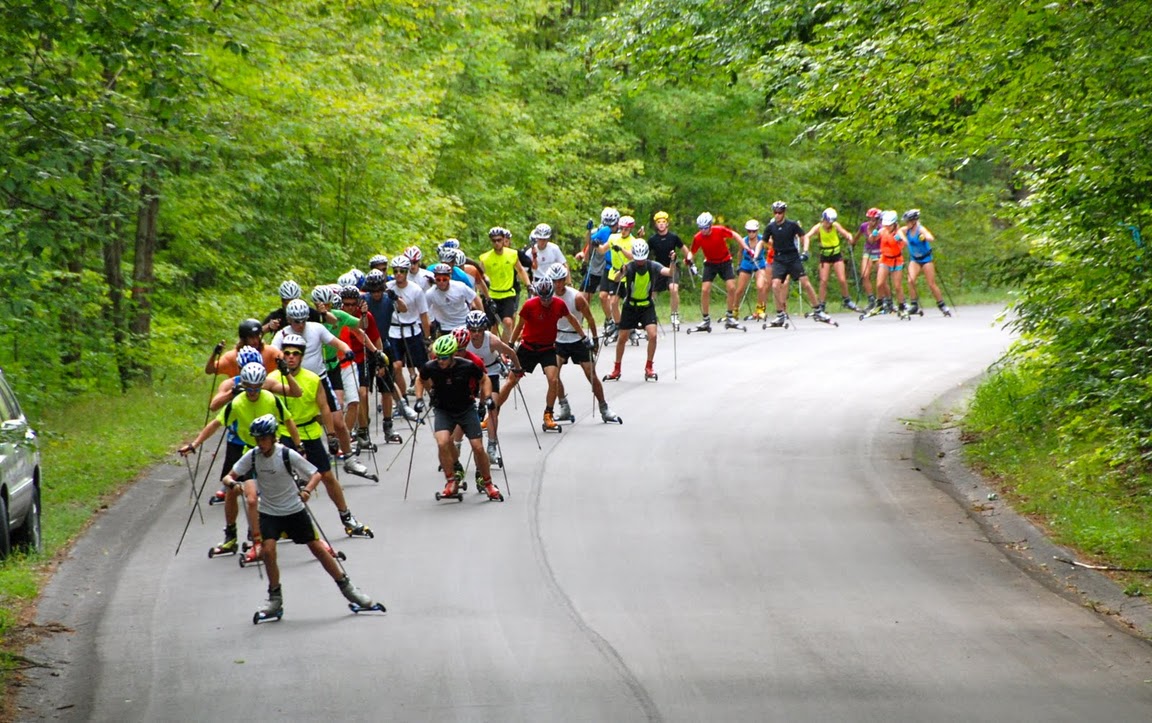
During the 12-day camp, the group completed three intensity sessions, all involving rollerskiing – a marked change from the NDC’s typical summer intensities, which are done almost exclusively running or ski striding.
One of these workouts was a rollerski-sprint paceline, which the team adopted from Canadian World Cup Team coach Tor-Arne Hetland after a collaborative camp earlier this summer in Bend, Ore.
“We do the paceline to practice good form and speed,” NDC athlete Andy Shields explained. “With the drafting component we get to use very fast movements without it being too fatiguing. When we get to the head of the train, the sprit at the front simulates a sprint to the finish line.”
To ensure everyone was competitive within the paceline, assistant coach Victor Wiltmann inventoried and reassigned rollerskis to athletes according to who was strongest in the sprints and who needed a little extra speed.
For new athletes Julian Smith and Sam Greer, this was their first training camp with the team and was a very positive experience.
“It was incredible,” Smith wrote. “You are isolated, you spend a lot of time with your teammates and you get to learn a lot about all of them.”
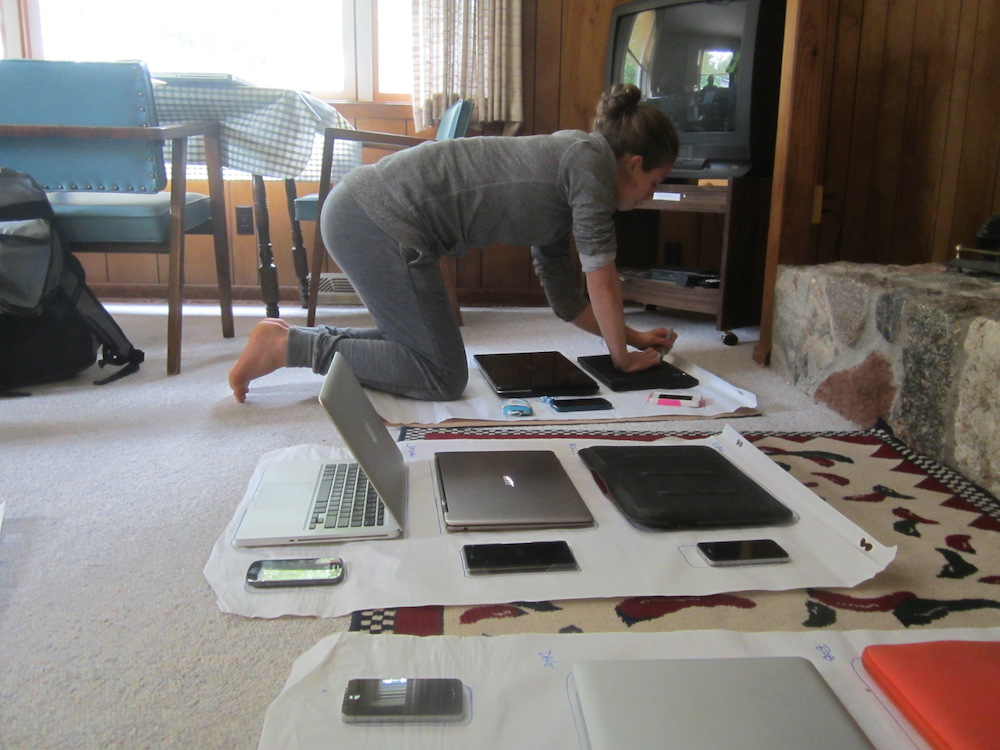
Depositing technology for the blackout, which coach Timo Puiras explained was meant “to encourage team building and to prohibit screen time in the afternoon.” (Photo: NDC Thunder Bay)
This isolation was not only geographical, but technological as well.
“The technology blackout was a bit of an experiment,” Puiras wrote. “I had two main goals for the technology blackout: to encourage team building and to prohibit screen time in the afternoon, most importantly just before sleep. I was curious to see if preventing screen time in the afternoon would have any effect on recovery and sleep. Obviously this was a highly unscientific, subjective observation, but no one on the camp got sick and everyone’s mood stayed notably positive.”
Without their electronics, the athletes enjoyed the lakeside facilities, “… spending quality time together, swimming in the lake, playing guitar, and slacklining” Smith wrote. In the evenings, some athletes would do supplementary sprint workouts, dashing from the sauna down to the docks and into the lake.
Midway through the camp, the athletes hit their longest single-session day with a four-hour classic rollerski. Rather than staying to the familiar roads near the Crest Hill, the coaches mapped out a 65-kilometre loop which wound its way up and around Cable – where the team would use CXC’s team gym for strength, then back to the resort.
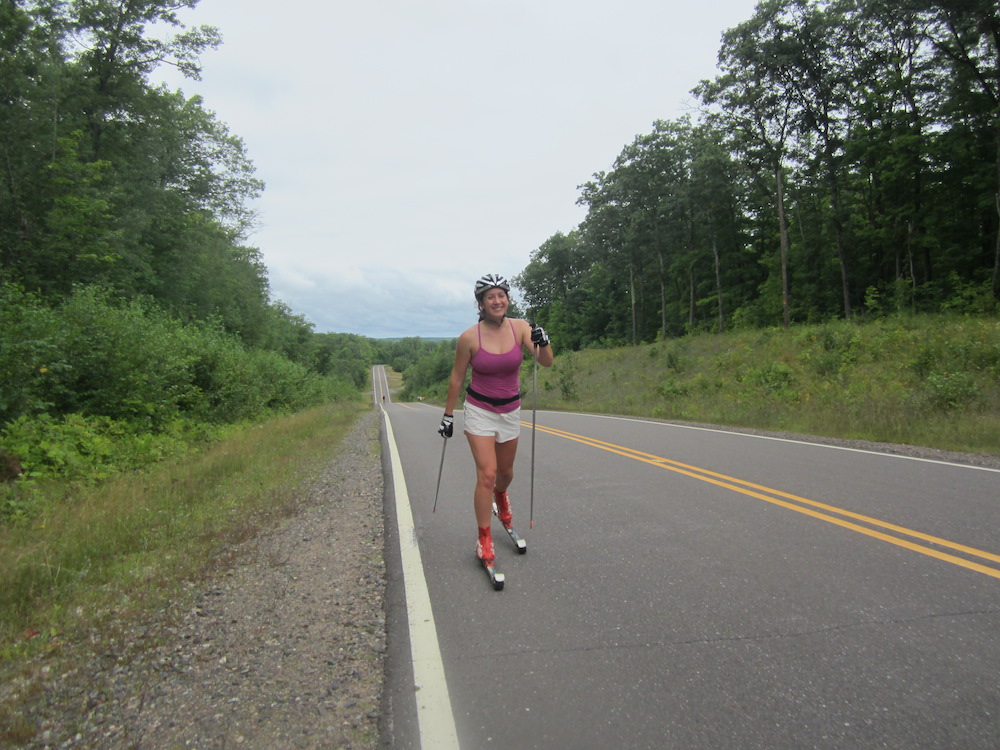
Guest athlete, Holly Brown during four-hour classic roller ski workout (Photo: NDC Thunder Bay)
On the workout, Puiras commented: “I am fairly certain that this is the first time in my career that after 4 hours of roller skiing every single athlete was still positive and could have easily kept on going for more.”
That positivity wavered slightly for some as the final intensity workout of the camp approached: the swim-run-ski triathlon time trial, which according to Puiras “is a bit of a tradition at the Hayward camp,” and challenged some of the land-loving athletes with a 230-metre lake swim.
In an effort to have men and women finish close to the same time, the men’s run and roller ski courses were slightly longer (4.7 k and 12.8 k) than the women’s (3.5 k and 9.0 k). As the athletes finished the TT, it was the women who seemed to have the edge on the shorter course. For results, click here.
The team has now returned to the north side of the border so the student-athletes can prepare for the start of the academic semester at Lakehead University and Confederation College.
With more than half of the training season behind them, “Everything is on track and looking positive for the fall training season,” Puiras wrote.
The team will train locally in Thunder Bay until mid-October when they head west to Canmore for Frozen Thunder. In the meantime, they have a testing week scheduled, as well as the Pancake Run.
***
The National Development Centre of Thunder Bay is one of three high performance training centres in Canada. Last year the team had athletes qualify for both Junior and Under 23 World Championships, and won numerous medals at Canadian Nationals. They are currently running a campaign to compensate for severe funding cuts to their program, to learn more visit: TeamUpNDC.com and follow @NDCTBay on Twitter.
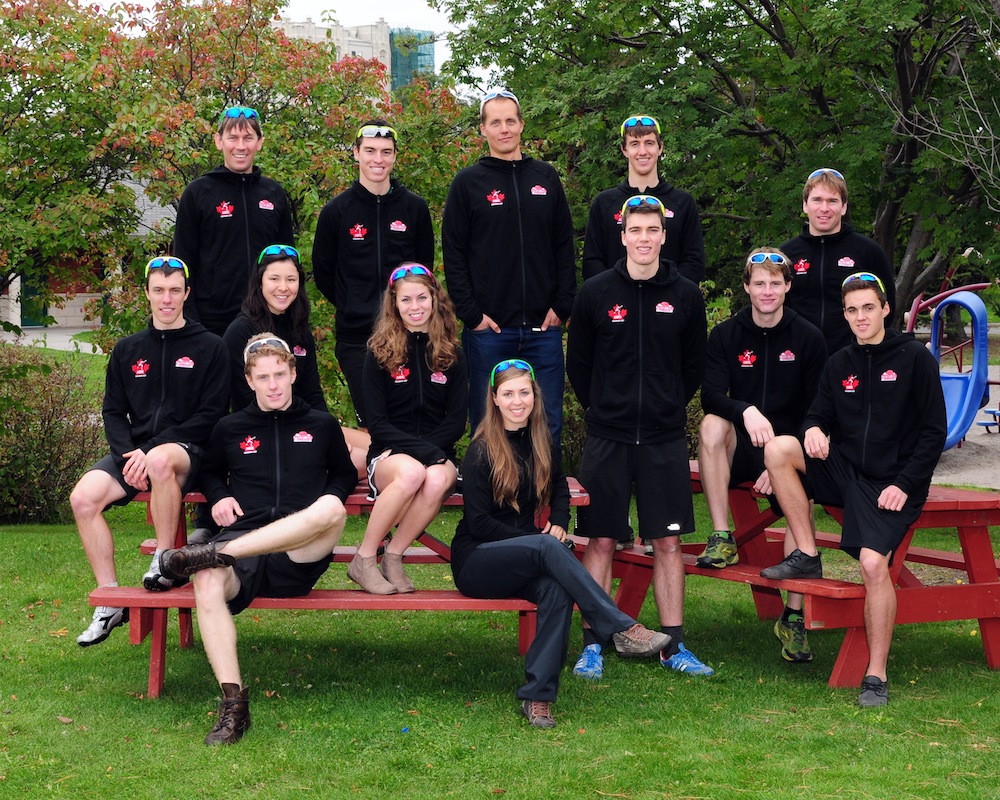
The 2013/2014 NDC Thunder Bay squad. Front Row (left to right): Andy Shields, Jack Carlyle, Jenn Jackson, Alannah MacLean, Erin Tribe, Nick Monette, Bob Thompson, Evan Palmer-Charrette. Back Row (l-r) executive director Eric Bailey, Scott Hill, head coach Timo Puiras, Ben Wilkinson-Zan, and assistant coach Victor Wiltmann. (Photo: NDC Thunder Bay)
Note: This is the third of four previews providing an inside look at Canada’s national training centres this season. We asked coaches to tell us what’s new, whom to look out for and the outlook on the winter ahead. Teams are presented in no particular order.
Team: National Development Centre Thunder Bay (NDC)
Coaches: Timo Puiras (head coach), Victor Wiltmann (assistant coach)
Other staff: Eric Bailey (executive director), Camille Cheskey (wax technician), Paul Hemsworth (strength and conditioning coach)
Seniors: Andy Shields, Jack Carlyle, Nick Monette, Bob Thompson, Erin Tribe, Alannah Maclean; Juniors: Scott Hill, Evan Palmer-Charrette, Ben Wilkinson-Zan, Jenn Jackson
Who’s new: Jackson (from Team Hardwood in Ontario) and Wilkinson-Zan (from Nakkertok in Ontario).
Who’s missing: Andrea Lee (studying in New Mexico); Dudley Coulter (now an athlete development coordinator for Cross Country B.C. in Vernon); Jimmy Gunka (at Lakehead University in Thunder Bay, Ont.); Jordan Cascagnette (at Nipissing University in North Bay, Ont.); Julian Freitag (studying at a university in southern Ontario).
NDC Thunder Bay skiers Jack Carlyle, Scott Hill and Andy Shields (not in order) enjoy the fruits of their efforts after become three of seven men to break the 1:20 time-trial threshold on Oct. 18. (Photo: Timo Puiras)
Top results last season: Last December, Shields and Tribe both qualified for the Quebec and Canmore World Cups, with Shields notching 41st in the Quebec skate sprint and Tribe placing just outside the individual top 50 in Quebec in 57th.
In January, Shields, Hill and former NDC skier Lee all made it to Liberec, Czech Republic, for the Junior and U23 World Championships. Back home, Hill, Carlyle, and MacLean each reached the NorAm podium as juniors.
Coach’s comments:
Of six seniors, five are still in the U23 bracket (excluding 24-year-old Tribe), and the team has a new head coach in Timo Puiras.
“It is a great group of athletes to work with,” Puiras wrote in an email last month. “Everyone is motivated and improving.
In late July, the team traveled to Austria for three weeks of on-snow training on the Dachstein glacier. “Half of our athletes had never been to Europe before so this was not only a great training camp but also a great learning experience,” Puiras explained. “All of our athletes have their main racing goal involve making it to Europe this winter.”
They spent the bulk of their training season in and around Thunder Bay, with smaller groups of athletes attending Ontario provincial camps. Before heading to Canmore, Alberta, for two weeks of skiing earlier this month, three NDC skiers (Shields, Carlyle and Scott) completed a time trial in record time and joined four others to slip under the Pancake Run’s 1:20-mark since 1979.
Recent in-team testing has also indicated all-around improvement, and Puiras is excited about what his athletes could accomplish this season.
“We want to qualify as many athletes as possible for World Junior/U23 Championships,” Puiras wrote. “As a program we’ve started working more closely with a Strength and Conditioning coach and I’d like this relationship to continue to grow here in Thunder Bay.”
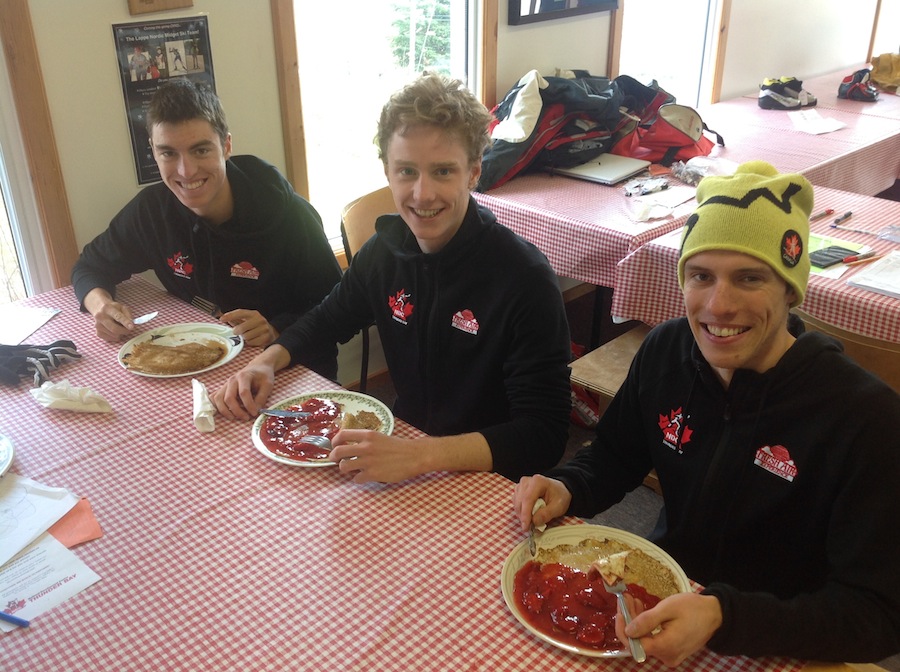
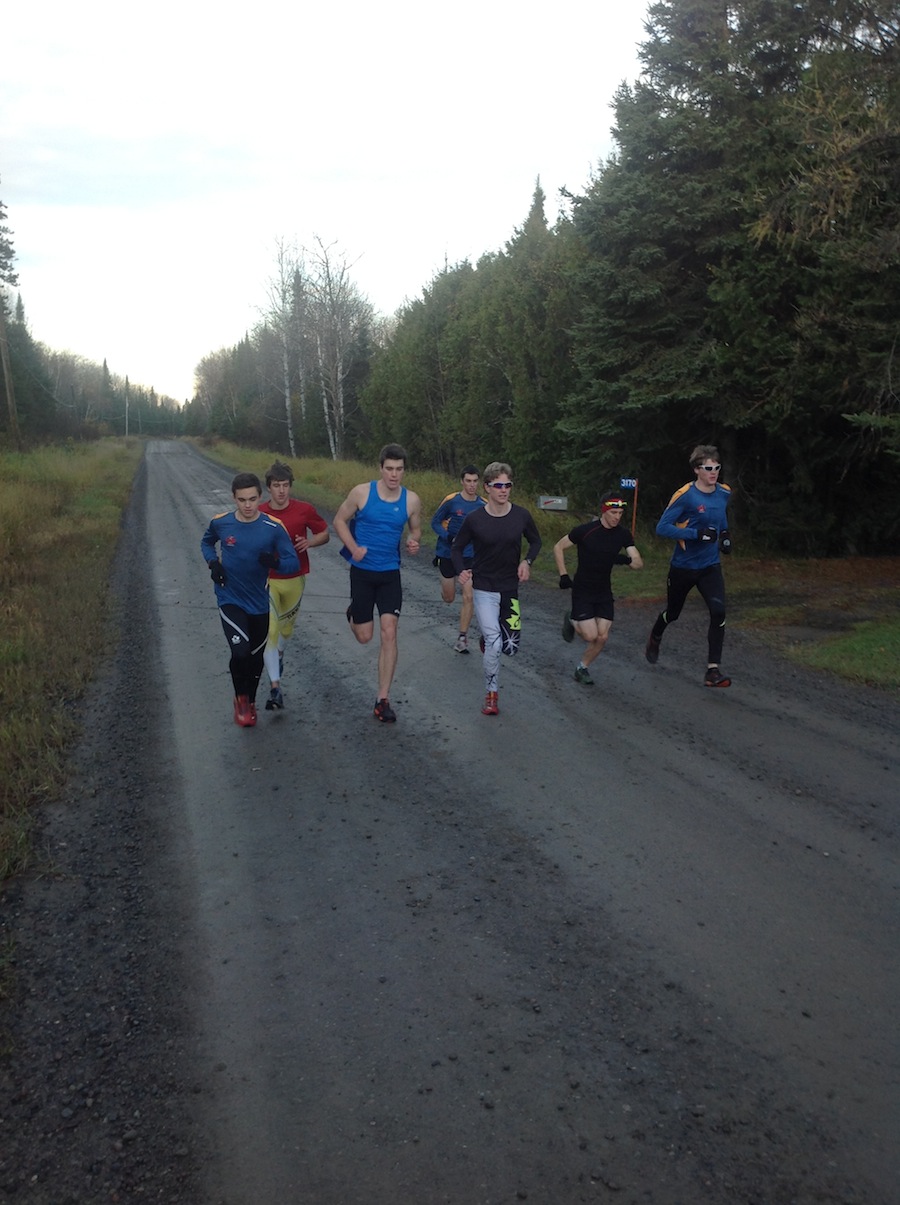
The NDC Thunder Bay men’s team competes for a chance to win pancakes for a year by breaking the historic Pancake Run threshold of 1 hour, 20 minutes on Friday in Thunder Bay, Ontario. From left to right: Evan Palmer Charrette, Ben Wilkinson Zan, Nick Monette, Scott Hill, Jack Carlyle, Andy Shields, and Bob Thompson. (Photo: Timo Puiras)
Note: The following was written by NDC Thunder Bay Head Coach Timo Puiras, son of 1976 Canadian Olympian and Lappe Nordic Ski Centre owner Reijo Puiras, about the historic Pancake Run, which took place on Friday.
THUNDER BAY, Ontario — The NDC Thunder Bay Team raced the annual Lappe Pancake Run on October 18th, 2013. The 22km loop run on hilly gravel road has a long and historic tradition.
The run was started as an annual fitness test in 1979 by Pauli Kaki, who was coaching Reijo Puiras, 1976 Olympian and current owner/operator of the Lappe Nordic Ski Centre. Reijo ran his best time in 1980. Pauli recorded the time as 1:20:00 but Reijo insists the time was 1:19:59 on his wristwatch. The debate endures to this day.
About 10 years ago Reijo put out the challenge that whoever could break his time would receive Lappe’s famous Finnish pancakes free for one year. Since then 7 athletes have run under the 1:20:00 threshold. Three of those athletes ran it this time.
Jack Carlyle squeaked in under the mark at 1:19:51. Scott Hill ran a Junior Mens record of 1:18:33 and Andy Shields ran a new course record in a blazing time of 1:16:23.
About 10 years ago Reijo put out the challenge that whoever could break his time would receive Lappe’s famous Finnish pancakes free for one year. Since then 7 athletes have run under the 1:20:00 threshold.
NDC Thunder Bay skiers Scott Hill (l), Jack Carlyle (c) and Andy Shields enjoy the fruits of their efforts after become three of seven men to break the 1:20 time-trial threshold on Friday. (Photo: Timo Puiras)
Previous course record holder (1:18:12) and former NDC Thunder Bay member Chris Hamilton (current Alberta World Cup Academy athlete) tweeted “New Pancake Run king @AndrejShields. Well done buddy! #lappe #de-throned”.
Reijo commented after the event that it was “a fantastic run. The course is as tough now as it was 30 years ago. It is a heart-warming event because I can relate to how difficult it is”
The women’s version of the Pancake run is 15km and starts at the 7km mark of the men’s course. Although not as storied and historic as the men’s race, the Pancake threshold of 1 hour is just as difficult.
This year’s race winner Jenn Jackson remarked that although she didn’t get under the threshold on this occasion she is looking for a pancake sponsor to fuel her way to a fast time next year.
The National Development Centre – Thunder Bay (NDC) is pleased to announce that Timo Puiras has been hired as our Head Coach for the 2013/2014 season and beyond!
The Board, the athletes, and the staff are all thrilled to have Timo take the reins of the program and continue to deliver one of the highest quality programs in the country.
Timo Puiras, new head coach of NDC-Thunder Bay (Courtesy photo)
Timo has a long history of High Performance racing and training in Thunder Bay, and also with NDC. He has worked in the role of Assistant Coach and wax technician-extraordinaire for the past 5 years in various capacities.
Working with our other staff, Timo will continue to develop all aspects of the training and racing environment and we are very confident it will continue to progress and evolve to meet the needs and goals our athletes in the years to come.
NDC Executive Director Eric Bailey stated: “We are very excited to have Timo back with our Team as Head Coach. He has an incredible passion for our sport, and his commitment to excellence is unwavering. He has a very rich history in our community and will bring a very strong understanding of training and racing to our athletes.
“His greatest strength lies in the relationships and the trust he builds with an athlete. His approach to coaching is very much athlete-centred; a philosophy that meshes very well with the program and the team at NDC-Thunder Bay. He will treat athletes with a great deal of respect, which has always been a cornerstone of the program at NDC-Thunder Bay.”
A look at the National Development Centre (NDC) Thunder Bay 2012/2013 team (Courtesy photo).
This is the first preview in a quick-and-dirty series about Canadian elite teams. We asked coaches to send their 2012/2013 rosters and tell us what’s new for the coming season. We will be publishing additional reports over the next few weeks. Teams are presented in no particular order.
Team: National Development Centre Thunder Bay
Coaches: Mark Doble (head coach); Victor Wiltmann (assistant)
Senior roster: Andy Shields, Dudley Coulter, Bob Thompson, Jimmy Gunka, Jordan Cascagnette;
Erin Tribe, Andrea Lee
Who’s new: Thompson, and according to coach Doble, he’s fitting right in.
“After having spent the previous three seasons in Canmore as a member of the [Alberta World Cup] Academy, Bob’s personal approach to ski racing is very consistent with the professional ski culture that exists in Canmore,” Doble wrote in an email. “As a result, he brings an added level of maturity and motivation which really helps to balance out the equally important mentality to enjoy every minute of what we do. “
Who’s missing: Michael Somppi, Chris Hamilton and Harry Seaton.
Somppi and Hamilton joined the World Cup Academy this year, which was a good move in terms of new training partners and competition for the coming season, Doble wrote. Seaton’s going to focus more on school and possibly race at the university level.
Erin Tribe (NDC Thunder Bay) competing at the Sovereign Lake NorAm near Silver Star, British Columbia, on Dec. 10. Tribe placed 18th in the classic sprint, and went on to record several NorAm top 10’s throughout the season. (Jesse Winter Photography/jessewinterphotography.com)
Top results last season: Lee, 21, won the 15 k freestyle mass start at a NorAm in Mont Orford, Quebec, and finished 10th in the 30 k classic mass start at Canadian nationals. She and her teammate, Tribe, tallied several NorAm top 10s, and Tribe went on to place seventh, eighth and ninth at nationals in the skate sprint, 5 k classic and 30 k, respectively.
Hamilton had three top-50 results at U23 World Championships in Turkey, and Somppi – who’s also on the Canadian Senior Development Team – placed third at nationals in the 10 k classic and notched several NorAm podiums throughout the season.
Coach’s comment: When former head coach Eric Bailey announced he was leaving the Ontario team after eight years, Thunder Bay knew changes were coming. They got two new coaches, Doble from Team Hardwood and Wiltmann from the North Bay Nordic Ski Club, and Doble wrote that the spring and early summer went well.
“With me being new to the team, the athletes were forced to make a transition to a new coach and a new program,” he wrote. “As such, I felt that it was important to make this transition as easy as possible for the athletes, while, at the same time, continuing to do things in the way that I wanted and in the ways that I felt were the best for each athlete.”
According to Doble, May was hectic with Wiltmann not officially starting until the end of April, but Doble used his familiarity with Bailey’s training methods to ease the process.
“I also wanted to implement certain things that I knew were going to be a big change, and it was quite a balancing act to introduce these things in the right amounts and in the right way,” he wrote. “Establishing good communication was very important for this, which I feel has gone really well.”
For example, Gunka, who first admitted he was suffering from overtraining symptoms in January, is back to full-time training and using his experiences to move forward, Doble explained.
“We are in a place now where we have a very good idea of what each individual athlete needs, which has lead to some pretty drastic differences in training programs in certain cases. Every athlete has their own weaknesses, which constantly change as we train them. The fun part is to find what those weaknesses are, and then identify a strategy to remove that limitation.”
With Tribe, 23, as the oldest member of the seven-person squad, Doble found the team’s youth exciting.
“Two of our big goals for this year are to get as many people on the U23 Championships team as possible, and also capitalize on the National group spots for the Canadian World Cups,” he wrote. “I think these two goals are very motivating for this age group, and so it is awesome to work with really motivated athletes that are willing to take some risks and yet, at the same time, be very smart about the way they are preparing.”
Bailey trailside, urging his athletes on. Courtesy photo.
When National Development Center Thunder Bay (NDC-TB) Head Coach Eric Bailey announced in December that he was going to retire at the end of the season, the Canadian ski community wondered who, if anyone, could possibly replace him.
Over the last eight years, Bailey had quietly built a reputation as a leader at the remote training center, situated at the head of Lake Superior in Ontario. While Canmore gets most of the press these days and Quebec feeds off of every ounce of Alex Harvey’s success, the Thunder Bay squad has been steadily gaining momentum; last year Bailey placed one athlete on Cross Country Canada’s (CCC) senior development team and sent three to World Junior and U23 Championships.
“Eric has worked productively over several years to transform the Thunder Bay NDC into a credible program, as was witnessed by the performance achievements in the 2010‐11 season,” CCC High Performance Director Thomas Holland said in a press release announcing the retirement.
But while the Thunder Bay team is wondering what’s next, Bailey says that he’s not done yet, and is honing in on his final season. With two members of last year’s U23 team returning, he knows that this winter can be a successful one.
“To build on a really good year, that’s an amazing thing because the momentum is there right from day one,” he told FasterSkier in an interview. “To be able to build on that right from early May, it was phenomenal.”
Mike Somppi has graduated to senior status, but as this weekend’s U23 trials begin in at the Whistler Olympic Park, Erin Tribe will be hoping to repunch her ticket and several other Thunder Bay skiers will try for their first international teams.
Small is Beautiful
Since the advent of the National Development Center system in 1993, Thunder Bay has had it’s ups and downs. Its successes – for example by alumni Chris Jeffries, a 2006 Olympian – were tempered by growing pains.
“There was a year back in 1999 or 2000 that the Thunder Bay training center was 22 people,” Bailey said. “It went from 12 or something the year before and it grew too fast, I think. It imploded in one year. People left.”
As a Thunder Bay native, Bailey has seen the ups and downs of the program. One way that he has garnered the respect of his peers has been to learn from the center’s past mistakes. One basic lesson, he said, was to keep the team small.
“We’ve always kept the team at a size where team dynamics are really manageable,” Bailey said. “We want to grow sustainably so that we can continue to manage our resources… not go from zero to hero overnight. That’s a key for success for a training center.
“It’s really contributed to the results, because everyone gets along, everyone’s pulling on the same rope.”
Team size and coach-athlete ratios might seem like just numbers, but to Bailey, they are a central tenet of a coaching philosophy. Somppi explained that the coach treats each athlete as an individual.
“Eric’s coaching style is personal, and it is very obvious he cares immensely about the athletes,” Somppi told FasterSkier. “I’ve been fortunate to work with Eric for several years and we’ve been able to develop a strong athlete-coach relationship, with a solid understanding of what each other needs in order to be successful.”
In his tenure, Bailey kept his team at a size where each athlete could have that experience. This year, the 12 NDC-TB athletes have a four-person support staff. That’s in contrast to the two big NDC’s, the Centre National d’Entrainement Pierre Harvey in Quebec and the Alberta World Cup Academy in Canmore, which field 15 and 21 athletes, and in line with the youngest NDC, the Callaghan Valley Training Center, which has 11.
Bailey told FasterSkier that when he announced his plans to the team in Rossland, British Columbia in December, Somppi talked about how far the program had come in terms of support.
“It was only three or four short years ago that we had ten athletes and it was just me,” Bailey said. “It was a one-man show. So we’ve grown the team size only a little bit, but the support a lot.”
What Makes Thunder Bay?
While Bailey’s coaching and philosophy are undoubtedly one reason that the training center has such ardent supporters, he has built the team on foundation that predated his involvement.
One pillar of success is the center’s location. Unlike the other two NDC’s, Thunder Bay is not near a major city like Calgary or Quebec City – “for better or for worse”, Bailey said.
“The athletes that come here are super committed,” he explained.
And the city itself, home to just over 100,000 people, has strong Scandinavian roots, which make it ripe for skiing excellence.
“I’m from here, so it just seems normal to me,” Bailey said. “But to [the athletes], they’re beside themselves, a lot of these people from Ontario, or from out East, or West. They say, ‘wherever we go and ski, people want to talk to us!’ And I think that makes Thunder Bay pretty unique.
“It’s probably up there in Canada in terms of what percentage of the community has a cross-country ski past.”
Another plus is a partnership with Lakehead University. When the development centers were implemented, providing educational opportities was a goal, and it’s something that Thunder Bay has fulfilled while simultaneously reaping institutional benefits. The program’s “integrated support” is housed at the university, from physiological testing to dieticians and sports psychologists.
Athletes can take classes, too, and Bailey said that most live within walking distance of Lakehead.
“Some take as many as three or four courses, which is officially part-time, and then others are taking one or two classes,” he said. “Others, like Mike Somppi on the senior national team, aren’t taking any. But he did – that’s the thing. The year before he joined the training center he was taking mechanical engineering, five classes.”
Somppi is the team’s most senior member along with Seaton, and according to Bailey his career illustrates the benefits of Thunder Bay. Between the city’s strong support for nordic skiing, the University and its ski team, and the Big Thunder club team, it’s a good place to be a skier.
“You can start just below the training center status, trying to make it on,” said Bailey. “You can take some school, race for the varsity program there, get really high-caliber coaching through Big Thunder, let’s say – they have a full-time coach, Adam Kates – and then make the leap onto the training center team.
“It’s very smooth and seamless.”
A Really Good Year
In the end, though, Thunder Bay is just another training center. And without any context, its results aren’t as impressive; CCC’s senior development team is flooded with athletes from the other two NDC’s, while Somppi is the only Thunder Bay skier on the list. Why, then, is the coach so lauded?
Thunder Bay is small, and Bailey’s goals for each athlete are individual. With the personal attention he has designed into his program, almost all of the athletes – who ranged from first-year juniors to last-year U23s – achieved their goals last season.
“As a Training Centre coach, Eric has embraced his role to turn junior racers into experienced seniors who are capable of essentially coaching themselves,” Somppi said.
Since a quarter of the small team represented Canada in international competition, the rest of the squad was able to feel ownership over their success. That led to eight of the ten athletes returning this year, the best retention rate Thunder Bay has ever seen.
“Not only are most athletes having good results, but the ones that weren’t superstars are still all in,” Bailey said. “They want to be part of the team, they know that the dynamic, the work ethic, and the quality workouts are going to get them there eventually.”
Perhaps more than results, an athlete’s attitude and perception are what keep them skiing faster and faster. Faith and belief are themes that Bailey kept coming back to in his interview; they were the programs biggest strengths at the moment, he said.
“Faith is everything as an athlete, and as a system, and as a coach,” he said. “When you have faith in your program and you believe that it’s going to work, and you believe that it’s the team for you, it’s sort of like a self-fulfilling prophecy. When you believe it, it happens.”
And when the athletes have faith in him, Bailey returns the favor. He hoped to see more Thunder Bay athletes on the senior development team next year, and had no doubt that his skiers could qualify for World Juniors, U23’s, and the February OPA Cup trip as well.
They’re already on track: in the skate sprint at the Rossland NorAms, Somppi and Seaton both made the A-Final, which garnered the program more attention.
“This is the first time in my eight years with the centre that I have had two athletes in the A-Final together,” Bailey said in a press release at the time. “I am so proud of them.”
Nothing Left to Teach
That success by senior athletes is part of the reason Bailey felt that it would be all right to leave.
“I knew I couldn’t move on until [the program] was really stable and sustainable and in a really good position to replace me,” he explained. “And I feel that it is now – I feel that it can and will be successful in years to come.”
The senior athletes like Somppi, Tribe, and Seaton are part of the legacy Bailey will leave behind. Regardless of who the program hires to replace him, the coach was sure these older athletes, who had worked with him for several years, would pass along what they had learned; he doubted that any would switch programs after his departure.
“It’s like a business, where you have the veterans around and they’re showing the young people the ropes, and then they get to be in that middle class and they can pass on their information,” Bailey told FasterSkier. “It’s a continuum of knowledge not only about ski racing, but about how we do things here in Thunder Bay.”
Somppi agreed that Bailey had given him the skills he needed as a senior racer, and that the athletes would stick together and help one another out, come what may.
“[Bailey] has steered me in the right direction and gradually stepped back, allowing me to take on more of a role in planning my daily training,” Somppi said. “This has helped me learn what I need as an athlete.”
Bailey is ready to cut the students loose: he wasn’t sure he had much to offer skiers like Somppi anymore.
“I think it will be a healthy thing [for the seniors], because over that amount of time you impart most of the wisdom that you have, a good coach does,” the coach said. “The bigger picture of how to be a good athlete, what’s important, how to read your body, what’s your response to training – a lot of that stuff I’ve taught them.”
But besides coaching, Bailey has been slowly building organizational infrastructure which will ensure the team’s success after he is gone. The expansion of the coaching staff, the partnerships with Lakehead, the thriving board of directors for NDC-TB: these are thing things that have earned him such respect in Canada.
“Eric has put a lot of effort into developing a strong support team that will provide the program with some stability and allow a new head coach to step in much more easily,” Somppi said. “It is due to Eric’s hard work along with the NDC board members that our program has such an awesome support team. This will be Eric’s lasting legacy.”
The Unkown Knowns
Bailey’s decision mirrored one seen in the United States a year earlier, when Sun Valley Ski Education Foundation coach Travis Jones decided to hang up his coaching hat and spend less time traveling. Bailey, too, said that it was getting difficult to swing one long road trip after another.
“The travel is really intense at the high-performance level,” he lamented. “I just want a change of lifestyle, I guess. To be around. Last year I was out of town 180 days, so I want to spend more time with friends and family.”
He emphasized that his retirement had nothing to do with the Thunder Bay program itself – he was still on good terms with everyone at the NDC, and he thought that the team was in the best position it had been in years.
“In fact I’m really, really happy with where the Training Center is at,” he said. “It’s an opportunity for me to move on, try new things.”
While Bailey wasn’t sure what he’d do next – something was “brewing” but he couldn’t discuss it – he isn’t planning on leaving the ski world.
“This is a decision that I made without necessarily knowing [what I’d do next],” he laughed.
“I’m just as passionate now about this sport as I’ve ever been. I’ve seen what someone with desire and logic can do in a fairly short time, I’ve sort of proven that to myself, so I want to do that again in another way. All I know is that I want to stay in the sport, in Canada, and it’s something I feel good about doing as a career.”
In the meantime? He’s planning a trip with friends after the season is over, and will make sure he has several months of vacation, no matter what his next job might be.
“I’ve been going pretty solid without a break for about ten years, so I’m definitely going to take a couple months and relax a little bit,” he said. “Let it all sink in.”
The entire camp in a stretching session (Photo: Graham Longford)
Over 115 athletes, 30 coaches, the full National Development Center Thunder Bay (NDC T-Bay) roster, and Canadian National Ski Team (CNST) World Cup team member Len Valjas. Does this sound like any ski camp you’ve been to this year? Unless you’re in Norway, chances are it sounds more like a skiing fantasy rather than reality.
Yet Ontario’s Team Hardwood, a club just outside of Orillia, Ontario, attracted the massive numbers in a training camp at the end of August.
According to Mark Doble, head coach of Team Hardwood, the club based at Hardwood Ski & Bike and the camp organizer, the total came to 149: 31 coaches, 15 mentor athletes, and 103 junior athletes.
Last year he and Team Hardwood hosted a similar camp. It featured some major star power: American star Kikkan Randall as well as Canadian National Ski Team member Perianne Jones attended, creating a focus for female skiers. Also, then up-and-comers Len Valjas and Graeme Killick were present with Eric de Nys, CNST Development Team coach.
As a result, the turnout was good, as there were over 60 registrants present to take advantage of the high quality athletes and coaches.
But Doble was floored by the response this year. “I was shocked,” he said in an interview with FasterSkier.
He did make a few changes to the camp that he hoped would draw in a few more skiers.
“Going in, we were planning on having great coaches, as well as older athletes to look up to – a couple of different perspectives.”
Doble also attributes the rapid rise in camp participation to simple word-of-mouth.
“The success of last year’s camp, and that we have good rollerskiing got around,” he said.
For Doble, the biggest goal of the camp was to make sure each workout was done at the best possible quality.
“We tried to do everything we could to encourage that,” he said, “We spent a lot of time developing the actual workouts as well as looking at the camp in its entirety to make sure it fit well together.”
The camp had a wide variety of activities, covering all aspects of training: a strength and agility session, several long Zone-1 workouts with technique stations, a Level-4 intensity set, a sprint tactics session led by Len Valjas (CNST) and Harry Seaton (NDC T-Bay), and finally, a cross-country race on the last day. The evenings were jam-packed as well, featuring presentations by the NDC athletes, NDC Head Coach Eric Bailey, and Valjas.
Team Hardwood Coach Mark Doble (foreground) goes over a few last minute details before the mens' start. (Photo: Graham Longford)
With a camp this size, there are always going to be challenges. In particular, Doble felt that the strength and weights components were important to cover, but difficult with a large group.
“We couldn’t just go lift weights in a gym,” he said, “So we had to find another way to make that portion accessible.”
Instead, he opted to engage a local strength training expert, Brock Tadashore, who did a series of body weight and functional strength exercises with the group, and then had a short question and answer session dealing with some of the most common injuries skiers experience.
Rollerskiing also posed a unique challenge. While Hardwood Ski & Bike is a well-equipped facility, it is a major mountain biking destination in the summer, and as such, has no paved rollerski trails as are found at some large ski centers in North America.
Instead, Doble had to find a stretch of road that was close enough to avoid having to drive massive amounts of athletes, yet with a light enough traffic load that it would be safe.
He opted for a 15 k stretch of mostly deserted country road, one which the local club uses regularly. He managed to find a spot with enough terrain variety for quality intervals, and distance as well.
“The primary goal was to get in a quality workout, but safely,” said Doble.
“The section of road we used has very little traffic, and Hardwood has a good rapport with the locals, who understand and are familiar with people rollerskiing.”
Doble was also clear that when the registrations came pouring in, several volunteers stepped up to help him out.
“Without them [the volunteers] it would be impossible for this to go,” he said.
While Doble had some challenges with organising the large group, he wasn’t the only coach present.
Around 20 coaches from various clubs around the provinces helped Doble corral athletes, and assisted with camp activities.
Doble had a well-qualified collection of coaches to draw upon. Eric Bailey, head coach of the National Development Center Thunder Bay (NDC T-Bay,) his assistant coach Timo Puiras, Cross Country Canada (CCC) Eastern Coaching Coordinator Lisa Patterson and Ontario Ski Team coach Pavlina Sudrich.
In addition to a junior training camp, some 15 mostly senior athletes including the entire NDC Thunder Bay participated as ‘athlete mentors’, where they lead smaller groups of junior athletes, and gave the younger skiers a chance to observe and ask questions of athletes at the next level of development.
The idea of using older athletes as mentors for juniors is not a new one, but Doble had the advantage of having a large number of skiers, as well as some athletes familiar with the area and the system.
“It’s kind of cool actually doing the workouts with the other athletes, instead of just talking to them and then going to do our own training,” Erin Tribe said.
Part of the group rollerskis up a hill close to Hardwood Ski & Bike (Photo: Graham Longford)
Tribe, a third-year veteran of NDC T-Bay and former Team Hardwood athlete herself was enthusiastic about the camp.
“This is the biggest camp I’ve ever been to!” Tribe said. “I just try to set a good example, and a lot of them are enthusiastic if you’re able to point something out.
“Especially if you’re able to say ‘You’re working on something I’m still working on,’ it’s great for them to hear.”
For Tribe, who has been an athlete in Ontario her whole career, she has seen the evolution of the camp experience personally.
“I think one of the biggest things is the number of coaches,” she said.
“When we’re out there in our small groups of 10 or 20, now there are five coaches around to help out and give tips. As much as were developing athletes at these camps, we’re developing coaches.”
While Tribe gets a kick out of seeing athletes develop, she personally feels the camps add value to her training season.
“I just get really excited all over again,” she said. “I know that I love the sport, and I love training … here there’s so much energy that it’s almost easy to do an 18 hour week followed by an 18 hour week. It makes things easier with all these people around.”
And for Tribe, getting to train with more girls is a bonus, as NDC T-Bay has just three.
“Any age, any level, I’m down,” she said.
“It’s really awesome to see these numbers,” said Jordan Cascagnette, also a former Team Hardwood athlete who has spent the last two years at the Alberta World Cup Academy before joining NDC T-Bay this season.
“It’s been crazy; when I was here as a member of Team Hardwood I did this camp every year, and there were always 20 or maybe 30 athletes at most.”
As for the mentorship experience, Cascagnette thought it was a positive. “It’s cool to be on the other side of the fence,” he said.
“I remember being at these camps when the guys from Thunder Bay would come and train, and I was always a timid guy, so I would just hang back and watch.”
“I think having that role model is great – last year in Canmore when I got the chance to ski with Devon (Kershaw) it was great. Being able to train with someone who is at the level you want to beat is really helpful.”
For the NDC athletes, the timing was good – they were just finishing up a tough block of training in Southern Ontario during the week of the camp, and were able to still get in some quality training.
While the camp was primarily for young athletes, coaches also had a chance for professional development. The club coaches engaged in a coaching development seminar, organized by Pavlina Sudrich.
Sudrich and Doble set up the schedule so that during athlete rest and nap times in the afternoon, the coaches were able to get a little classroom and discussion time.
Featuring seminars on overtraining, yearly training plan construction, and functional movement screening, coaches were able to get a little education. As well, Sudrich organized a mentor-mentee system among coaches at the camp, giving those with less experience a chance to learn.
In terms of the overall success of the camp, Doble viewed the explosion of numbers as a positive development for skiing in the region, and across Canada as a whole.
“I think the trend we’re seeing in Ontario isn’t exclusive to Ontario,” he said, “The quality seems to be getting better and better every year.”
And Doble is already thinking about plans for next year – he hopes another large camp will be hosted in the province again.
“It’s important for our club, and it’s the highlight of the year,” said Doble. “It’s good for clubs to host other clubs.”
Len Valjas (L) and Harry Seaton (R) of NDC T-Bay talk about sprint tactics (Photo: Graham Longford)