From the FasterSkier archive — posts syndicated from athletes’ and coaches’ own blogs between 2004 and 2012, kept online as published. Current coverage is at fasterskier.com.
Editor’s note: This is it. The final day of our spin on the holiday gift guide, brought to you by our gear-review guru, who, over the last 12 “business” days, compiled a 12-day list of gift ideas (in various price ranges) for all the nordies in your life. So if you see him, say thanks. And stop asking about his underwear-washing regimen. He’ll get to it when he gets to it.
***
It is with carpal tunnel-ridden wrists, a rapidly dwindling supply of thinly-veiled sexual references, and a heavy heart, that I must sadly inform you that this is the last installment of the 2016 edition of “12 Days of FBD.” I like to think that every day can be a day with FBD, as hopefully all of you have taken these amazing gift ideas to heart and bought every single thing on each and every one of these lists. To be clear, if you have followed all of my instructions carefully, you should have actually bought TWO of everything on all of the lists, as you’re going to give one away and keep one for yourself — nothing is more pro than that.
As you undoubtedly expect, we’re going to go out with a bang, as I really have saved some of the best for list. These aren’t just gift ideas, these are THE gift ideas.
Like skiing? Guess what you need to ski? Snow. Thanks to one of the strangest elections perhaps in the history of democracy, we have a president-elect who believes that despite overwhelming scientific evidence, climate change is a myth being perpetrated by the Chinese. This is a problem if you intend to venture out of your house for any reason at some point in the rest of your life. Instead of sitting around complaining about this travesty, DO SOMETHING about it. Most politicians are like sheep — they follow the flock, so make your voice heard and support one of the great organizations out there fighting for not just our winters, but the very survival of our planet. One very good organization leading the fight to save Earth is Protect Our Winters. I put this in the “Under $30” category, but you can most certainly donate any amount. Please also feel free to donate in the names of others, in particular if they also refuse to believe the near unanimous scientific consensus on climate change (Guess what you’re getting for X-mas, this year Rob Magee?). If you breathe air, don’t want your house destroyed by flood, or even remotely care that future generations won’t be able to walk outside for more than 30 seconds without their clothing burning off their bodies if we don’t address this problem right now, you’ll be glad you supported these folks. Donate at ProtectOurWinters.org.
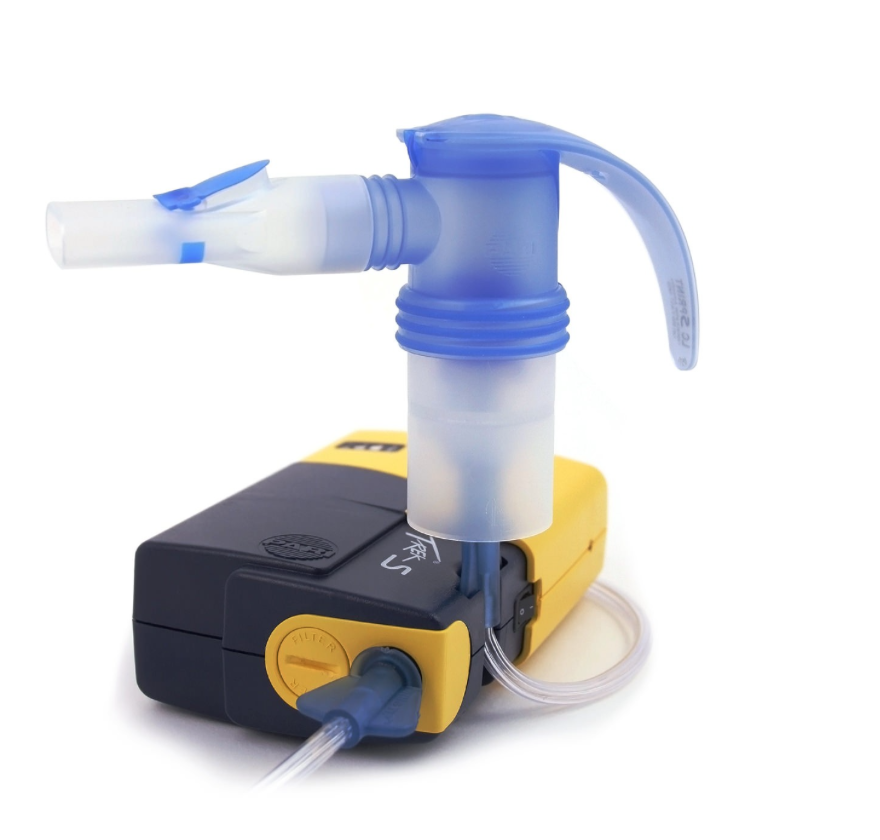
Maybe you can’t ski like the Norwegian National Team, but you can share their approach to pharmacology and ethics. No asthma? No problem! Fly to Norway, find a “sympathetic” doctor, and boom, you’re TUE’d and on your way to better splits. Available at JustNebulizers.com.
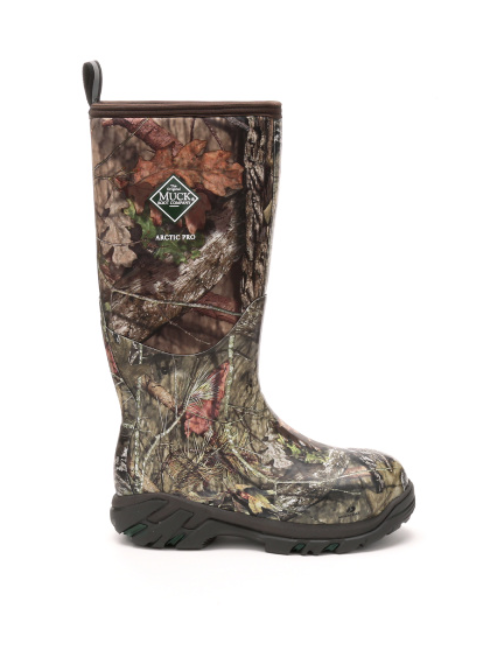
What do watching races, retrieving your intransigent Great Dane and getting Christmas trees have in common? Cold feet — remember way back when we started this journey I told you we’d discuss both cold hand and cold feet? (No, not the marriage type of cold feet, you’re on your own with that one) — and while we’re on the topic of cold hands, for the love of God, NO, you DO NOT have Raynaud’s Syndrome, you simply have shitty gloves, so stop it with your hackneyed, amateur, self-diagnosis.
I don’t know if there is a more exciting sport anywhere in the world than biathlon: this amazing competition combines all of the coordination, fitness and discipline of cross-country skiing with the laser-like focus of precision shooting, therein adding a mental toughness and focus factor simply not found in most other sports. The extremely narrow margin of error involved in shooting golf ball-sized targets 50 meters away in wildly unpredictable weather at near-max heart rate means that you see frequent lead changes, action all the way down to the wire, and emotion and intensity in its rawest form.
It is for all of these reasons that biathlon is one of the few sports that I will actually watch. I’d much prefer to actually be out doing sports rather than sitting at home watching others do them. I have this crazy notion that controlling my own destiny (and activity) is somehow healthier than attempting to live vicariously through others. I’m not alone either, as there was a landmark study in 1972 by noted behavioral psychologist Martin Seligman, on a phenomena known as “learned helplessness”. The main finding of the study (and subsequent related studies) is that organisms are much happier if they are in environment they can control. This Sunday, you can go for a ski, or you can scream at the TV at the overpaid, steroid-abusing mercenaries, who, contrary to popular belief, DO NOT represent your city, state or personal values. And should your team win, please never forget your role in that whole process.
The choice is yours: watch other people do stuff or go make yourself better. Get out there and work on your technique. Learn how to classic ski. Learn how to classic wax. Then give up on classic waxing and buy these (Rossi skis from Day 3). Or, call Caldwell in hourly intervals if you even have the slightest inkling that your kick wasn’t perfect. Don’t just take my word for this though, test it yourself. See which strategy leads to happiness. I’m not your mother, so I’ll leave it up to you if you want to shape your own future or let your happiness be dictated by events over which you have literally no control. Seems like an easy choice to me, but hey, what do I know, I’m just that guy who only uses the passing lane for passing cars, then immediately returns to the correct driving lane in order to allow faster moving vehicles to safely pass.
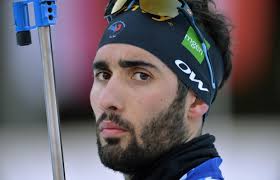
Since after that little sermon, you are now no longer watching football, how are you going to spend your Sunday afternoons? Here’s an idea — let’s go back to what we talked about two paragraphs ago — why not try biathlon? Biathlon isn’t just for unkempt French dudes, it is for everyone. There are several excellent programs right here in the good ol’ US of A than can get you started safely, certified and really to rock (including Colorado Biathlon, Minnesota Biathlon, Ethan Allen Biathlon, Casper Mountain Biathlon, Bridger Biathlon, to name just a few).
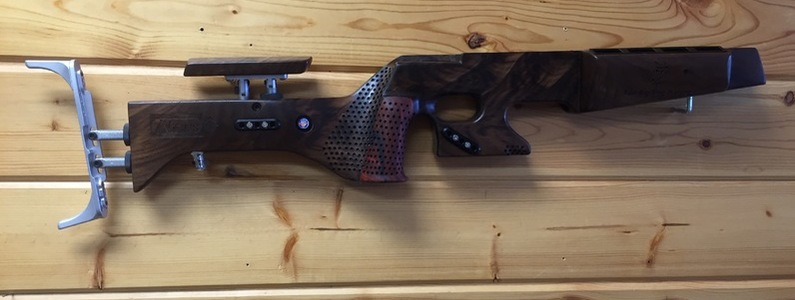
FBD Pro Tip: If you are going to race in the greatest of all winter sports, biathlon, here’s a shocker, you’re going to need a rifle. As we have already clearly shown over the course of the past 12 days, if something is worth doing, it’s worth doing well, so if you’re going to race, you might as well outfit yourself with the best gear possible: the Custom Altius biathlon stock. Available at AltiusGuns.com.
I’m sure it’s not a secret by now that the FBD likes gear, nay, LOVES gear. And it loves him right back. Ask any good craftsman and they’ll tell you success is all about having the right tool for the job. Sure, you can use a screwdriver to pound a nail, but you know who does this? A certain guy by the name of Primative Pete. Following this metaphor, you certainly can wear a digital watch out to dinner, but you know who does this? A certain guy who’s not getting laid that night. Plain and simple, you’re not going to meet any girls (or boys) if you’re wearing a digital watch. Now don’t panic here fellas, the protocol regarding male fashion accessories is ridiculously simple and can be broken down into three simple rules:
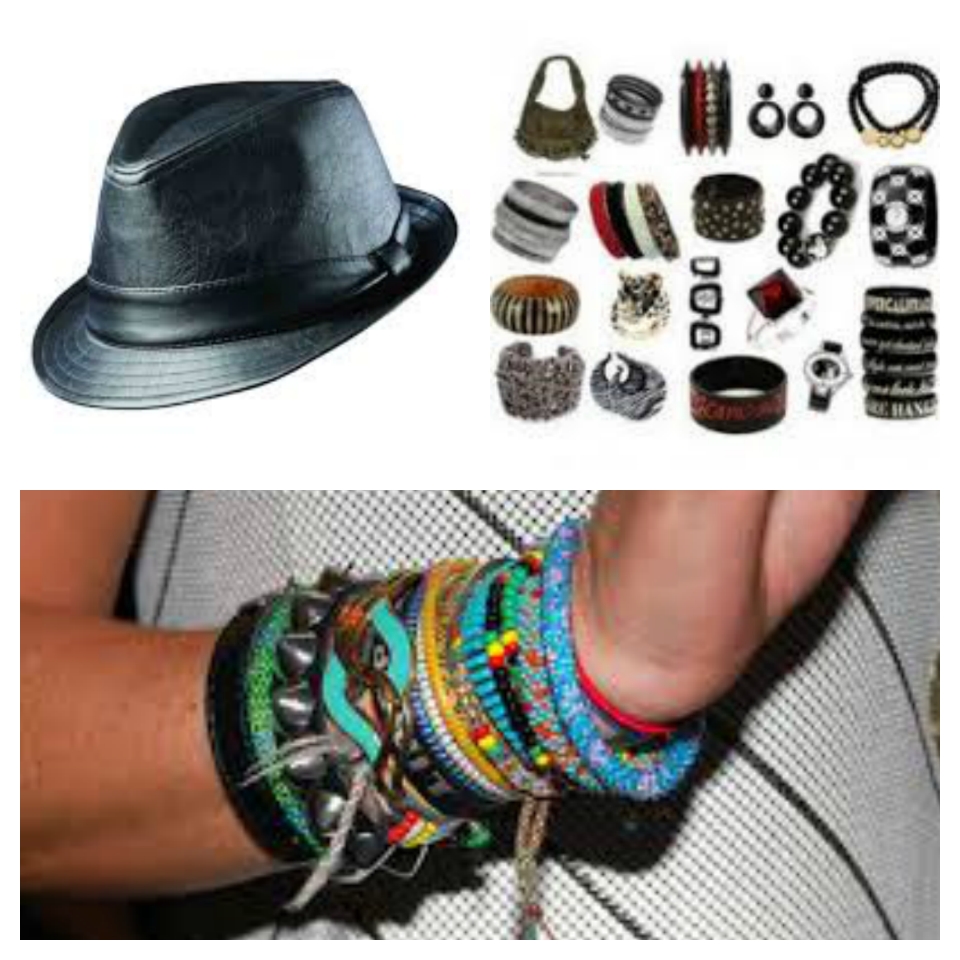
1. No jewelry. Ever. (Wedding rings don’t count, as those are more anchors than they are ornamental). Why no jewelry? This should be quite self-explanatory, but in the off-chance that you still have questions, these photos pretty much say it all:
3. Have a nice watch. If you’re paying attention and following the above guidelines, you’ll realize that this protocol doesn’t leave a lot of wiggle room for dudes to accessorize. This is by design, as while women often excel in this arena, guys usually massively screw it up.
None of these items shown here should ever be on your body at any time, for any reason:
What should always be on your body? A nice watch. We already covered training watches in Day 5, but what about those two hours per day in which you are awake but not training? If you have somehow managed to cloak all of your glaring narcissistic tendencies enough to dupe an unsuspecting female into joining you at a local fine dining establishment, for heaven’s sake, show up with some game. We’ve been over the underwear protocol in excruciating detail, but trust me, underwear selection and hygiene level will not even come into play if you goof up the basic stuff, and having a nice watch is, well, basic stuff. Remember to guys, you only have to follow THREE frickin’ steps here and two of them are just things to NOT do, so everyone out there should be able to handle this.
Here’s what’s awesome about this code of conduct though, not only is it ridiculously simply for even the most fashion inept male to follow, but a nice watch can be a treasured heirloom for literally generations to come. On very special occasions, I still wear a watch my grandfather gave me and it means the world to me. Watches can also be used to mark special occasions, therein giving the gift lifelong significance. If you give (or are given) a good watch for graduation, a birthday, anniversary, etc., you will think about that event and that giver essentially every time it is worn, and isn’t that what holiday giving is really all about?
I am particular fortunate in that the lovely Mrs. FBD (yes, there really is a Mrs. FBD) will occasionally reward a good performance in the bedroom with a watch and I’m proud to say that I’m up to a collection of three beautiful time pieces. Far be it for me to be one to brag, but let’s just say that I can maybe even see another one being added in the next few years.
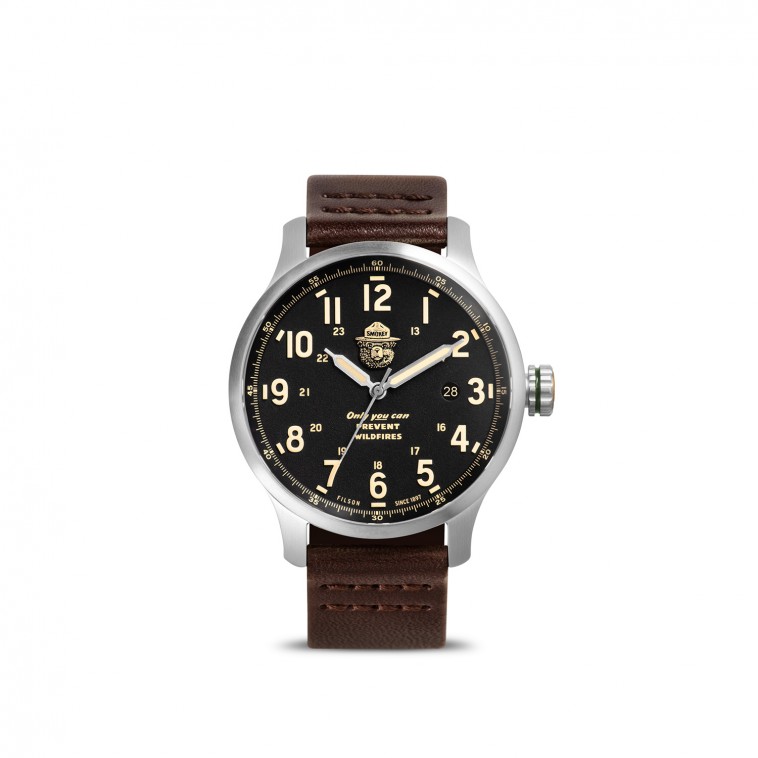
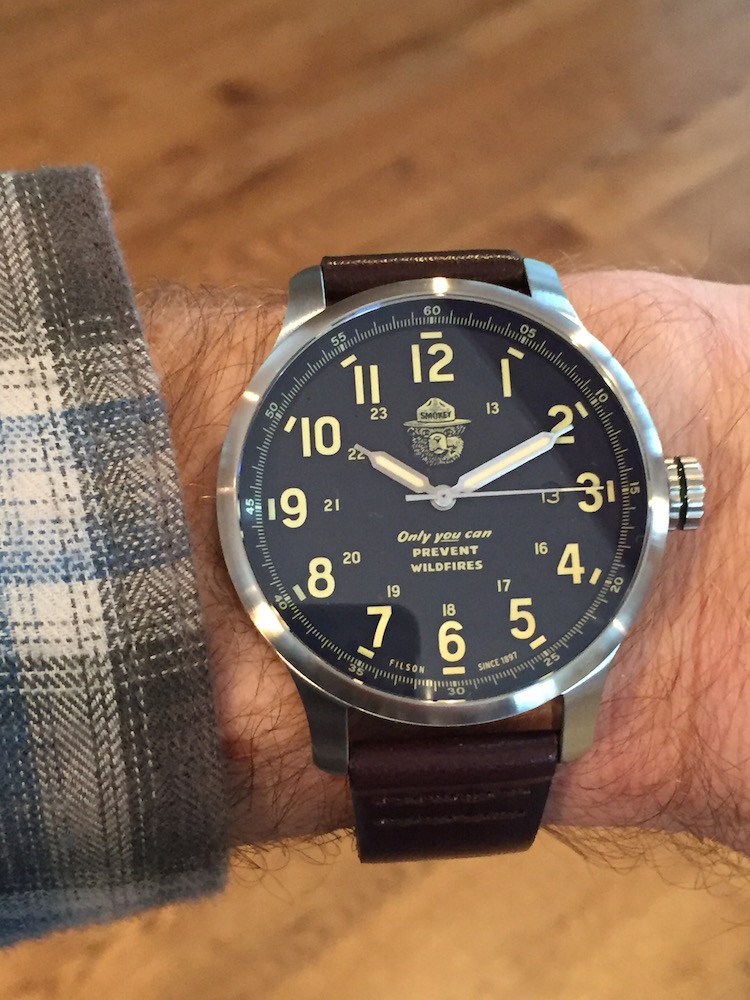
Now that we’ve proven our theorem on why you need a decent watch, the obvious next question is, “Which one?” As usual, we have you covered here too. FBD loves watches and while an easy pick may be a Rolex, Omega, Bell and Ross, Cartier, or Breitling, none of these brands may really be “you.” This is why one of my new favorite Mickey’s is this:
The Smokey Bear Watch, FBD pick for $250+
Made in Detroit at the Shinola Watch Factory, this watch is a very limited edition and celebrates the history of one of the most iconic and longstanding environmental movements, forest fire prevention. In a time when we need to be doing everything we can to help our environment, it is refreshing to see a company paying tribute to one of the most effective environmental public service campaigns ever and even donating a percentage of the sales to the US Forest Service.
I’ve saved this for the last day because this is honestly one of the best picks of the series. Yes, it is a bit spendy, but of the over 60 products suggested in the past 12 days, this one is the most “Chrismas-tree ready” (this is the Christmas equivalent of a construction project being “shovel ready”). Why? Well, this gift has pretty much everything. For starters, the watch comes packaged beautifully:
Next, included with the watch is a seven-page bound history of the Smokey Bear forest fire prevention campaign, which is quite interesting. Also included are very nice retro Smokey Bear cards, featuring classic iconography:
These elements all make the gift much more interesting and gives the whole thing a very luxurious feel. So while every nordic nerd would most assuredly appreciate unwrapping a double-pole machine that looks like it has been packaged by the loser of a drunken, monkey knife fight…
… with one simple phone call, you can not only have without a doubt one of the most impressive looking gifts, but also one that will carry significance for literally generations to come. So while the watch is indeed a bit pricey, trust me when I say that it is a wonderful gift.
And remember, you’re never going to meet a woman if you’re wearing a digital watch. Church. Available at Filson.com.
We’ve been on quite a journey together these last 12 days and I think we’ve learned a lot about each other along the way. You all have learned that I wear my underwear for 10 days at a stretch (no pun intended) without washings. I’ve learned that people love to read about gear, even if it requires digging through literally pages of weird, cryptic ramblings on a wide variety of often only loosely-related topics. And my editors have learned that it is easy to tell when I’m getting fired up. Like now. I’m getting fired up because everyone is writing in asking for more, so I’m going to miss you people.
As is the case in any good race, succeeding in this series has required excellent pacing. Since this isn’t my first day on the radio, I believe that, as usual, I have paced myself perfectly (this was drilled into my head doing rollerski TT’s at SoHo with the Loppet Nordic Racing Team. If you skied positive splits in the TT, you did the dishes), so I’m “negatively splitting” this mo-fo — not only am I not running out of energy, I seem to only be picking up speed. I’m not going to lie to you, this means that I am struggling a bit to say goodbye. This, combined with my perfectly timed taper and peaking energy levels, means I feel compelled to throw in a few more FBD Bonus Picks.
*FBD Super Bonus Pick: FBD Bonus Pick #2 is also a real peach, and oh golly, I’m hot today. What is it? Or should I say, WHERE is it? The answer to those questions, in order, is that it is a gift certificate to a training camp on Haig Glacier. Led by Matt Liebsch, one of the only two American men to win the U.S. Birkie in the past 15 years, this camp can lay the foundation for one of your best seasons ever.
There’s an old adage in ski racing, “A good winter is built in summer,” so get a head start on next year’s season now by giving the gift of getting the kooky nordic skier in your life the hell out of the house for a week in the summer. Everyone wins in this equation: Haig Glacier camp, approximately $1,500 (2017 pricing is not set yet). More information available by email; send Leaper in hourly intervals at matt@pioneermidwest.com.
**FBD Super Duper Bonus: A week at FBD fantasy camp. Even though you’re a nordic skier, hopefully you have enough of a life that you’ve never considered one of these events, Rock ‘n’ Roll Fantasy Camp, New York Yankees Fantasy Camp, or God forbid, Philadelphia Eagles Fantasy Camp, but what about FBD fantasy camp? Now we’re talking. For just $100,000, you can walk in my shoes for a week (not literally, as I’d never let any of you filthy people wear any of my beautiful footwear). You can experience firsthand the indignity of verbal abuse from East Coast motorists, having your precious belongings destroyed by an unruly and essentially untrainable Great Dane, and if you’re really lucky, perhaps we’ll even let you turn in a rambling, unhinged manifesto about dirty underwear, wax brushes and why you need to be matching your hat, gloves and buff. It’s a once in a lifetime experience that’s happening daily. FBD Fantasy Camp, $100,000. Available at Marketwatch.com (I’m somewhere down on the list with all of the other really expensive, dangerous ones, after all, it IS in Philly, where essentially anything can happen to you at any time).
Finally, thank you all for hanging in there with us to the very end. For many, this has been a crazy, tumultuous year and hopefully these columns have brought some pleasure to all of you in their own right and have also stimulated, encouraged or aided you in some way, shape to form to increase your enjoyment of one of the greatest sports, activities and lifetime pursuits one could ever find, nordic skiing. Have a great holiday everyone and hopefully I’ll see you out there. And please remember on that drive to the tracks, races, or gear store, the left lane is a PASSING lane.
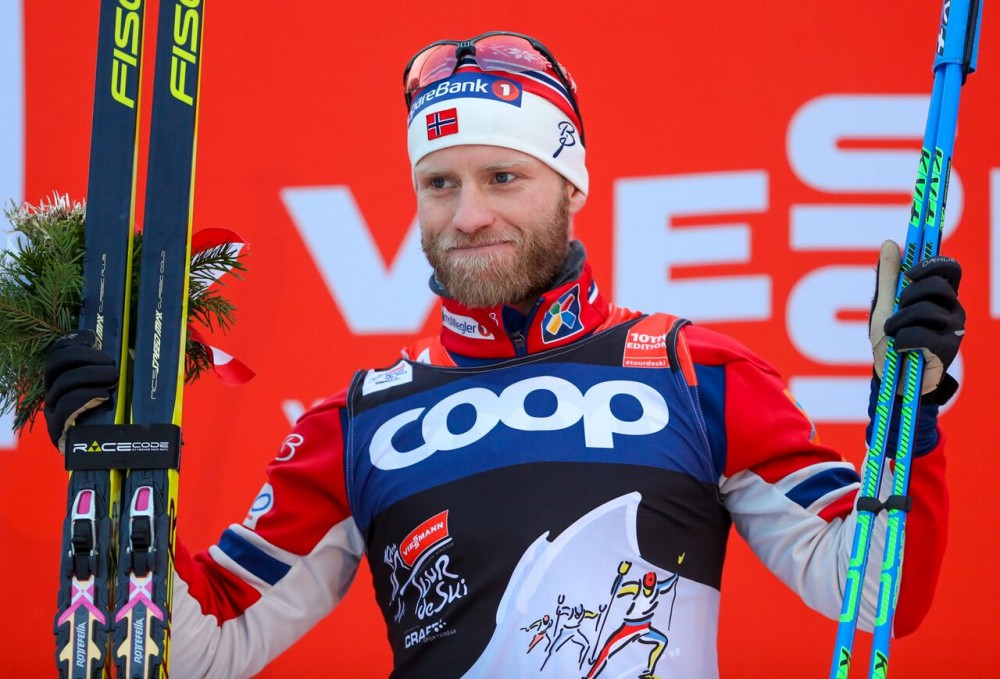
Norway’s Martin Johnsrud Sundby at the 2016 Tour de Ski. (Photo: Marcel Hilger)
As Norwegian skier Martin Johnsrud Sundby continues to consider whether to appeal his doping ban to the Swiss Supreme Court, both he and the World Anti-Doping Agency (WADA) are speaking publicly about the case.
The International Ski Federation (FIS) had initially acquitted Sundby, but WADA appealed the case to the Court of Arbitration for Sport (CAS) and won. The ski champion lost his 2015 Tour de Ski title as well as the 2015 overall World Cup title, although his two-month ban was shorter than most punishments in doping cases.
In Norway’s Aftenposten newspaper, Sundby said that he now regretted keeping the case a secret until WADA won its appeal rather than speaking out about it earlier.
FIS rules do not require acquittals to be made public, but Aftenposten revealed that the Norwegian Ski Federation had even gone as far as having its communications manager, Espen Graff, draft a press release after FIS cleared Sundby. The federation strategized that it would be better to get ahead of the case in the media sphere.
But Sundby stopped the plan from going forward, instead waiting to see the result of WADA’s appeal. He now says he believes that if he had gone public after the acquittal, it would have discouraged WADA from appealing at all.
In the same piece, Sundby said that his failure at 2015 World Championships in Falun, Sweden, was due to the case. He had learned of his positive tests in January and the stress caused him to get sick and miss most of the Championships, then turn in what was by his standards an unimpressive performance in the 50 k.
At issue in the case is whether asthma medication is performance-enhancing at high concentrations. The drug, salbutamol, is also banned because it is a masking agent.
Speaking about the case publicly for the first time, WADA Scientific Director Olivier Rabin told Norwegian newspaper VG that the drug did indeed have benefits for athletes.
“The latest research shows that large doses can have an effect,” he said.
Previous research had indicated that at recommended therapeutic doses, salbutamol did not affect healthy airways. That is, the drug could not relax muscle that was not constricted, for instance by asthma or exercise-induced bronchoconstriction.
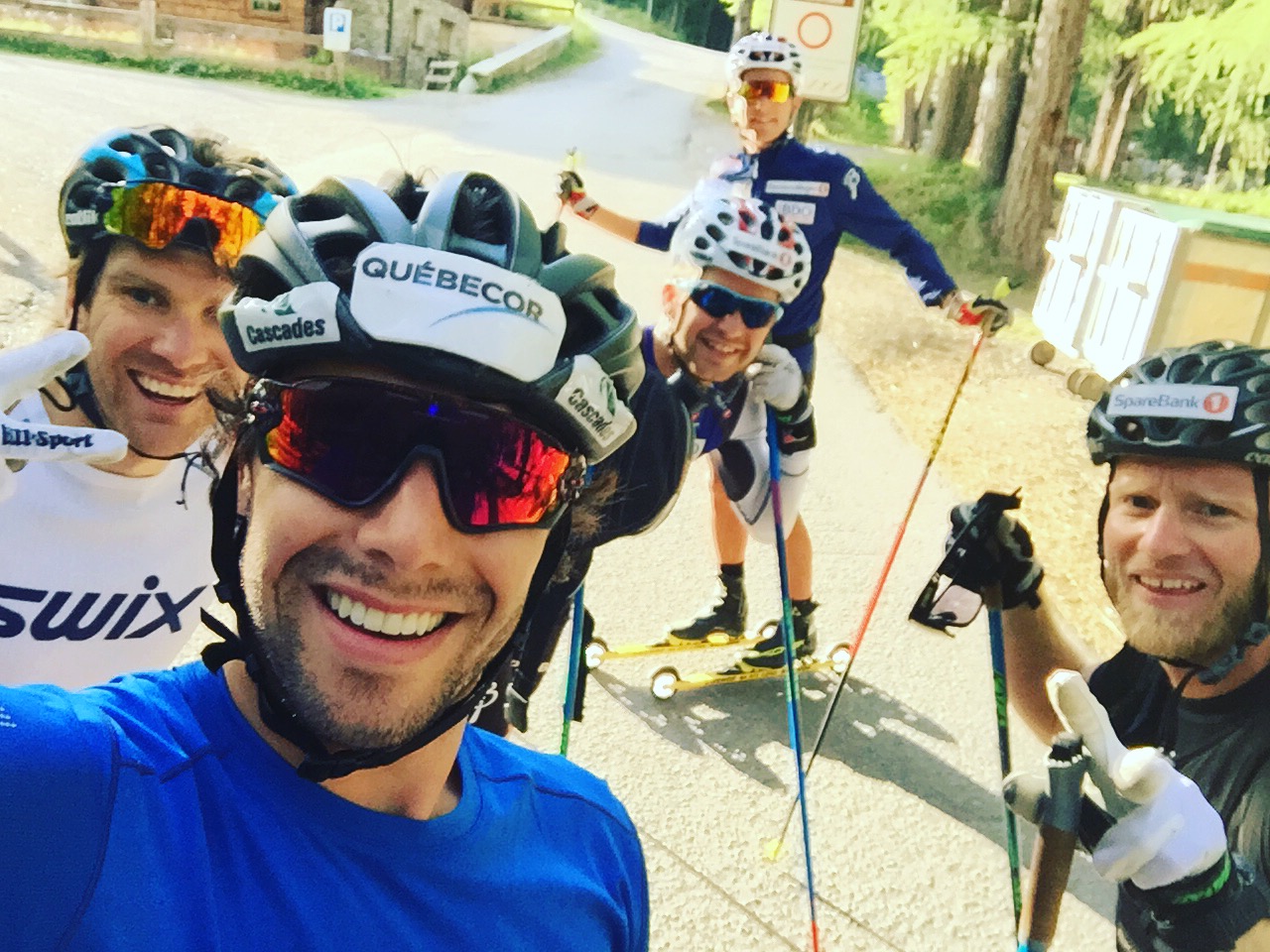
Martin Johnsrud Sundby of Norway (right) training with Canadian skiers in Livigno, Italy, earlier this month. (Photo: Alex Harvey/Instagram)
However, the drug does not work only in lung tissue, and that appears to be part of the argument against high doses.
Jørgen Jensen, a professor at the Norwegian School of Sport Sciences, suggested to VG that the drug may affect skeletal muscle, increase muscle growth and speed recovery. He cited research showing that the class of drugs, beta-2 agonists, appears to be more beneficial to sprinting and power events than to endurance performance.
But the case continues to reverberate in the ski world. Russian World Cup skier Evgeniy Belov accused the Norwegians of corruption since there was a long gap between Sundby’s positive test in January 2015 and the resolution of his case at CAS, which allowed him to complete the whole next season with no competitors the wiser as to his case.
His two-month suspension during the summer also didn’t affect a competition season.
The International Biathlon Union (IBU) has cleared three athletes who had tested positive for the heart medication meldonium in early 2016. Eduard Latypov of Russia, Artem Tyshchenko of Ukraine and Eva Tofalvi of Romania will not serve suspensions because, as the Anti-Doping Hearing Panel concluded, “they bear no fault” in having the drug in their bodies.
The panel did not find evidence that they took the drug after the Jan. 1 date when it was added to the Prohibited List, and decided that they could not have known that it would stay in their bodies for a longer period of time. All three athletes will have relevant results canceled, but are free to return to competition.
Meanwhile, Russian hackers continue to leak files stolen from WADA’s databases, primarily showing Therapeutic Use Exemptions for athletes who competed in the 2016 Summer Olympics in Rio de Janeiro, Brazil. Some data also show positive drug tests in Rio for the same substances.
Several of the cases involved salbutamol and other asthma medications; one TUE was for a drug to treat attention-deficit hyperactivity disorder. Perhaps the majority involved anti-inflammatory medications which are commonly used to treat injuries, but are banned without a TUE.
Data on 29 athletes from a variety of countries has been released so far, but the records of all 10,000 athletes who competed in Rio may be compromised.
“Given this intelligence and advice, WADA has no doubt that these ongoing attacks are being carried out in retaliation against the Agency, and the global anti-doping system, because of our independent Pound and McLaren investigations that exposed state-sponsored doping in Russia,” WADA Director General Olivier Niggli said in a press release. “We condemn this criminal activity and have asked the Russian Government to do everything in their power to make it stop. Continued cyber-attacks emanating from Russia seriously undermine the work that is being carried out to rebuild a compliant anti-doping program in Russia.”
Although law enforcement has asserted that the hacks originated in Russia, the country’s Minister of Sport, Vitaly Mutko, denied it.
“How can you prove that they are hackers from Russia? You blame Russia for everything,” he told The Telegraph.
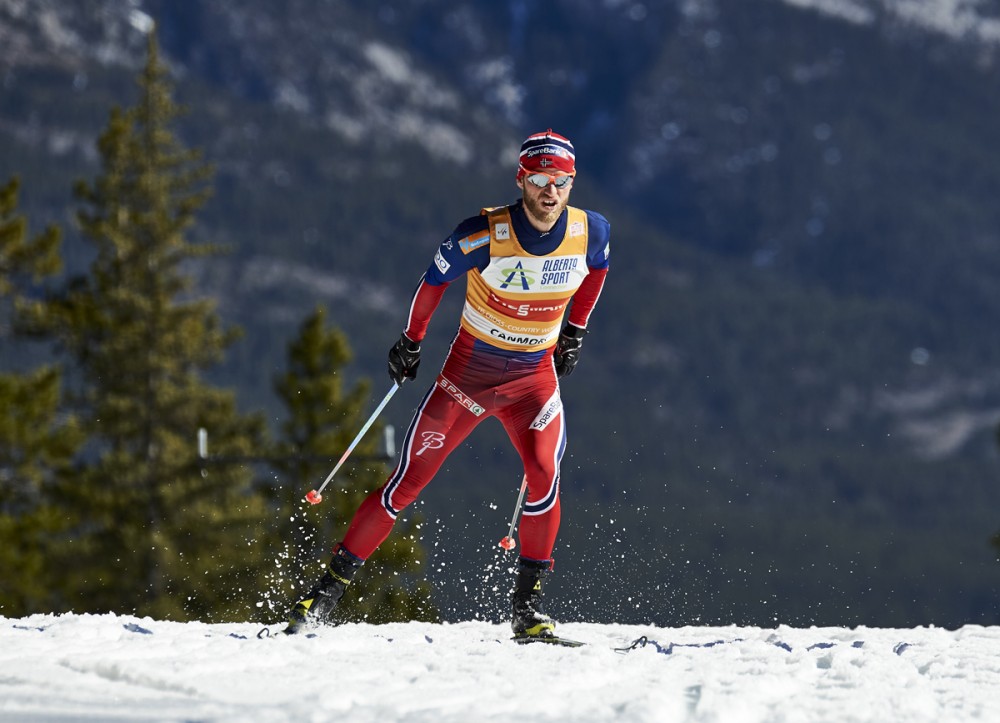
Norway’s Martin Johnsrud Sundby during the men’s 15 k skate leg of the Ski Tour Canada in Canmore, Alberta. Sundby may not be the only Norwegian athlete who used a nebulizer to take asthma medication — even healthy athletes were allegedly recommended to do so. (Photo: Fischer/Nordic Focus)
As Norwegian skier Martin Johnsrud Sundby has decided to appeal his doping ban to the Swiss Supreme Court, stories have emerged suggesting that the Norwegian Ski Federation recommended that healthy skiers use salbutamol nebulizers – the same drug and method Sundby was issued a two-month ban for – as preventative therapy to maximize performance.
But what of the past? Norway’s TV2 talked with several cross-country skiers who say they were told by the national team to use nebulizers, even though they did not have asthma. A nebulizer delivers beta-2 agonists, drugs which help relax muscles in the airways. Such medications are banned for use by athletes up until a threshold dose.
In the same piece, national team director Vidar Løfshus said that this constituted “preventative care” to make sure that no athletes had airway obstructions.
The Norwegian Ski Federation announced on its website that it would be conducting a full review of medication use policies in the wake of the scandal.
Erik Røste, the president of the federation, said that he expected that healthy athletes would not have been prescribed medication, but sought to clarify whether his assumption was true. The investigation will be carried out by people not affiliated with the federation in order to maintain independence. Anti-Doping Norway has been consulted about assisting.
Røste also said that he was concerned that the stories could damage the reputation of the federation.
That seems to be already happening. Swedish national team doctor Per Andersson told Swedish media that prescribing medication to healthy athletes was a “dangerous path”.
Meanwhile, Sundby had been sanctioned for using high concentrations of salbutamol via a nebulizer. FIS had initially not suspended him, but the World Anti-Doping Agency (WADA) appealed the case to the Court of Arbitration for Sport (CAS), which banned him from competition for two months. Because some results were invalidated, Sundby lost his 2015 overall World Cup title as well as the overall Tour de Ski win.
CAS is the highest governing body in sports, and decisions cannot be appealed or overturned. However, Sundby decided to appeal the case to a non-sports body, the Swiss Supreme Court, because he felt that the judgement was unfair. He told Norwegian media that he was “not guilty.”
Based on WADA rules, the maximum amount of salbutamol that is allowed to be inhaled is 1600 micrograms over 24 hours. Sundby’s samples taken Dec. 13, 2014 after the 15-kilometer classic in Davos, Switzerland, and Jan. 8, 2015 after the 25 k freestyle pursuit at the Tour de Ski in Toblach, Italy, and analyzed by a WADA accredited laboratory exceeded those limits.
His case hinges on a few words, as Sundby and the Norwegian medical team believe that the WADA limit applies only to medication taken in an inhaler, while Sundby used a different device, a nebulizer.
As an athlete with a documented history of asthma, Sundby likely could have received a therapeutic use exemption (TUE), which may have allowed the nebulizer use. But he did not apply for one, and such exemptions cannot be obtained retroactively.
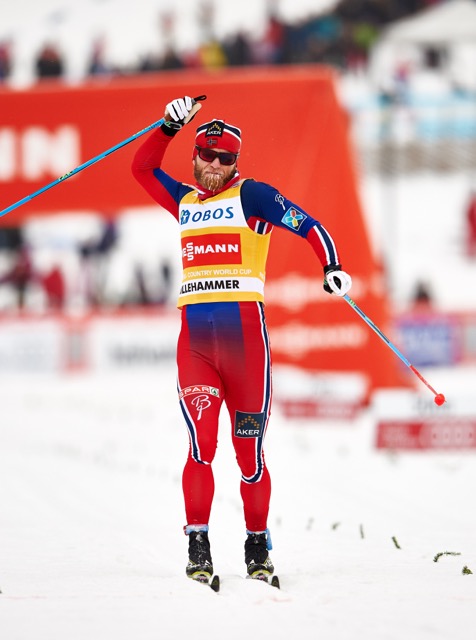
Martin Johnsrud Sundby (Norway) after winning the men’s 15 k classic pursuit for the overall Lillehammer mini-tour title in December 2014 in Norway, following the Davos World Cup. (Photo: Fischer/NordicFocus)
Norway’s Martin Johnsrud Sundby has been stripped of his 2015 Tour de Ski and 2014/2015 overall World Cup titles after the Court of Arbitration for Sport (CAS) upheld an appeal by the World Anti-Doping Agency (WADA) against him and the International Ski Federation (FIS).
The reigning three-time overall World Cup champion, Sundby, 31, was penalized for twice exceeding the amount of salbutamol, also known as albuterol and a “standard therapy against asthma symptoms,” according to a FIS press release, allowed in an athlete’s system and not possessing the necessary medical exemption when he was tested.
Based on WADA rules, the maximum amount that is allowed to be inhaled is 1600 micrograms over 24 hours. Sundby’s samples taken Dec. 13, 2014 after the 15-kilometer classic in Davos, Switzerland, and Jan. 8, 2015 after the 25 k freestyle pursuit at the Tour de Ski in Toblach, Italy, and analyzed by a WADA accredited laboratory exceeded those limits.
“While the medication is normally applied by a handheld metric dose inhaler (MDI), the athlete used a nebulizer to administer the prescribed salbutamol for the treatment of his asthma, which requires a higher labelled dosage than the MDI and thereby exceeded the allowed maximum dose,” FIS stated in its press release on Wednesday. “The FIS Doping Panel had therefore found that the athlete had not committed an anti-doping rule violation when he used a nebulizer as a legitimate means to administer salbutamol instead of a metric dose inhaler (MDI).
“The CAS found however that the epithet ‘inhaled’ was meant to distinguish inhalation from other mechanics of inhalation like ingestion or injection and did not refer to the stage of administration (e.g. the amount that comes out of the device or which was eventually delivered to the athlete’s mouth or lungs),” the release continued. “The allowed dose must be understood as the dose prescribed by the doctor, i.e. the ‘labelled’ or ‘nominal’ dose. Any higher dose, e.g. because of the need to use a nebulizer, requires a Therapeutic Use Exemption (TUE). When the tests were conducted in December 2014 and January 2015, the athlete was not in possession of a TUE and therefore found guilty of an anti-doping rule violation.”
WADA appealed the FIS Doping Panel’s decision, made Sept. 4, 2015, which defended Sundby. The CAS upheld WADA’s appeal and, effective July 11, 2016, sanctioned Sundby for two months. FIS announced this decision in its press release.
“I was at the store when the team doctor called. I was told that I had been over the limit twice,” Sundby said at a press conference as reported by NRK, according to a direct translation. “There and then it felt like the sky came crashing down. I could not believe it. I have never ever used an asthmatic dose that hasn’t been prescribed.”
“It felt like the sky came crashing down. I could not believe it. I have never ever used an asthmatic dose that hasn’t been prescribed.” — Martin Johnsrud Sundby
According to FIS, while CAS “acknowledged in the athlete’s favour that he had not intentionally broken the rules, that has a medical condition requiring the administration of salbutamol and that he had used salbutamol by nebulizer as prescribed by his team doctor, as he had done so before without any problems,” they also noted that anti-doping rules must be strictly adhered to and “that the prescription of the team doctor as to the use of the nebulizer to administer salbutamol outside of a hospital was arguably questionable from a medical point of view as well as the fact that the athlete and his team doctor had not made any enquiry of WADA, FIS or the manufacturer whether inhalation by a nebulizer would still require a TUE under the revised anti-doping rules.”
Sundby’s win on Dec. 13, 2014 in Davos (where he edged his teammate Didrik Tønseth by 6.6 seconds) and third-place finish in the Toblach 25 k (behind teammate Petter Northug and Sweden’s Calle Halfvarsson, respectively) have been nulled. In addition to being disqualified from those races, Sundby is no longer listed as the overall champion of the 2015 Tour de Ski, after he initially won the final hill climb by 34.5 seconds over Northug in Val di Fiemme, Italy. Northug is now listed as the winner and Sundby is not on the final results. Sundby is also no longer the 2014/2015 overall World Cup champion, Switzerland’s Dario Cologna is.
In a separate press release, FIS announced the recalculated results and standings from 2014/2015:
“The impact on the 2014/15 FIS Cross Country Cup World Cup standings and FIS Tour de Ski standings are as follows:
– Sundby forfeits the 143 points he earned for the two races where he has been disqualified – 100 World Cup points for the victory in Davos and 43 points for his third place finish in Toblach.
– With the Sundby disqualification on the 13th December 2014, the podium for the 15 km classic in Davos (SUI) is now as follows: 1. Didrik Toenseth (NOR); 2. Dario Cologna (SUI); 3. Sjur Roethe (NOR).
– With the Sundby disqualification at the 8th January 2015 in the 25 km pursuit in Toblach (ITA), the podium for that race is now as follows: 1. Petter Northug JR. (NOR); 2. Calle Halfvarsson (SWE); 3. Evgeniy Belov (RUS).
– In accordance with the Tour de Ski regulations, Sundby also forfeits his overall 2015 Tour de Ski victory and 400 World Cup points he earned for it as well as prize money of CHF 108’000. The new standings for the 2015 Tour de Ski are as follows: 1) Petter Northug JR. (NOR); 2. Evgeniy Belov (RUS); 3. Calle Halfvarsson (SWE).
– The breakdown of prize money from the Tour de Ski 2015 that Sundby has to return for redistribution to the newly ranked athletes is as follows: CHF 90,000 or first place in the Tour de Ski, CHF 2,000 from the third place of the Tour de Ski sprint standings and the World Cup earnings for the two races, CHF 15,000 for the victory in Davos and CHF 1,000 for the third place finish in Toblach.
– Additionally, Sundby forfeits the World Cup points and prize money from the remaining Tour de Ski races after Toblach, namely the last two stages in Val di Fiemme in which he finished 8th and 3rd. This amounts to a further 73 World Cup points and CHF 1,000 in prize money.
– The final 2014/15 FIS Cross Country World Cup standings have also been recalculated and are as follows: 1. Dario Cologna (SUI) – 1103 points; Petter Northug JR. (NOR) – 1047 points; Finn Haagen Krogh (NOR) – 897 points. Sundby moves down to sixth place in the overall World Cup standings with 748 points and forfeits CHF 22,275 in the overall World Cup prize money standings.
– In total, Sundby forfeits 616 World Cup points for the 2014/15 season and CHF 131,275 in prize money. This includes all races directly and indirectly affected by the CAS decision.”
“I was sure that the case would be dropped quite fast, but then it turned out that WADA didn’t understand the rules in the same way as the whole Norwegian medical team,” he continued. “When WADA appealed, I thought it was a formality. I went into the 2015/2016-season knowing I was innocent, and also that I was acquitted. I think the verdict is totally unreasonable. I have to live with it, and I will stay strong knowing I have done nothing wrong.”
“FIS fully shares the view of the CAS that Martin Johnsrud Sundby is not to be considered as an intentional doping offender but that his sanctions result from the strict application of the anti-doping rules and the WADA Prohibited List as a consequence of his reliance on questionable medical advice to administer salbutamol outside a hospital,” FIS concluded.
“I am pleased that the Norwegian Ski Association so firmly takes responsibility for what happened, and that they so firmly emphasize that I personally have not tried to do anything illegal in this case,” Sundby said in the team press release, according to a direct translation. “Of course, I understand that this case is of public interest, and that’s why I come to this press conference and reply to media inquiries. However, I ask for understanding that I will return to the two most important things in my life after this: my closest family and my career as a ski racer.
“The situation I am in currently is any athlete’s nightmare. I’ve always competed clean. I hope and believe this case will not have further consequences for my future career or my preparation for the upcoming season.”