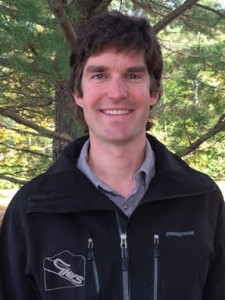
There’s a chill in the air, but winter is still months away. With New England’s weather forecasts predicting a sunny autumn weekend with temperatures in the mid-60’s (high teens Celsius), the coast of Maine looks like the ideal event destination this weekend. The New England Nordic Ski Association (NENSA) is ready to oblige with the staging of The Maine Event: XCX Sprints on Sunday, October 23. This is one of the many events hosted by NENSA that is designed for skiers of all ability levels from those just learning, to enthusiastic Masters participants, to seasoned racers. It’s part of the NENSA philosophy that is organized by NENSA’s Competitive Program Director, Justin Beckwith.
“In New England, we generally look on roller ski events as festive, as gatherings,” Beckwith said, “As a means for aspiring skiers to gain race experience rather than pursue race victories. We try to maintain a fun, festive environment, and NENSA’s philosophy is reflected there. It’s as much about gathering skiers together as it is about competing.”
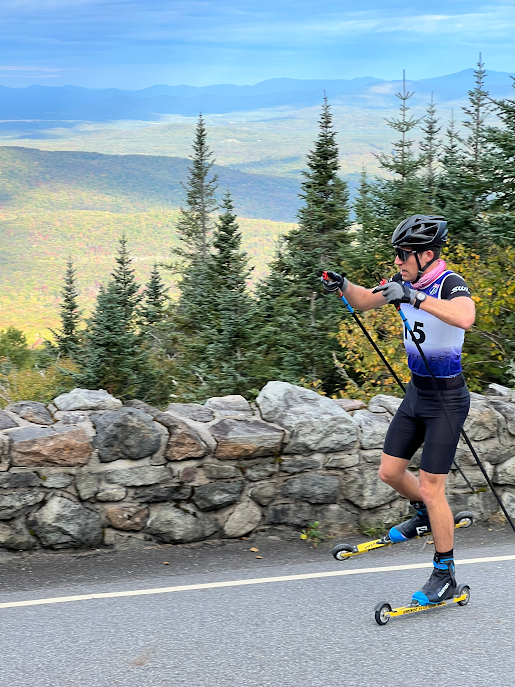
Nearing the Whiteface summit in Climb to the Castle, 2022 (NENSA photo).
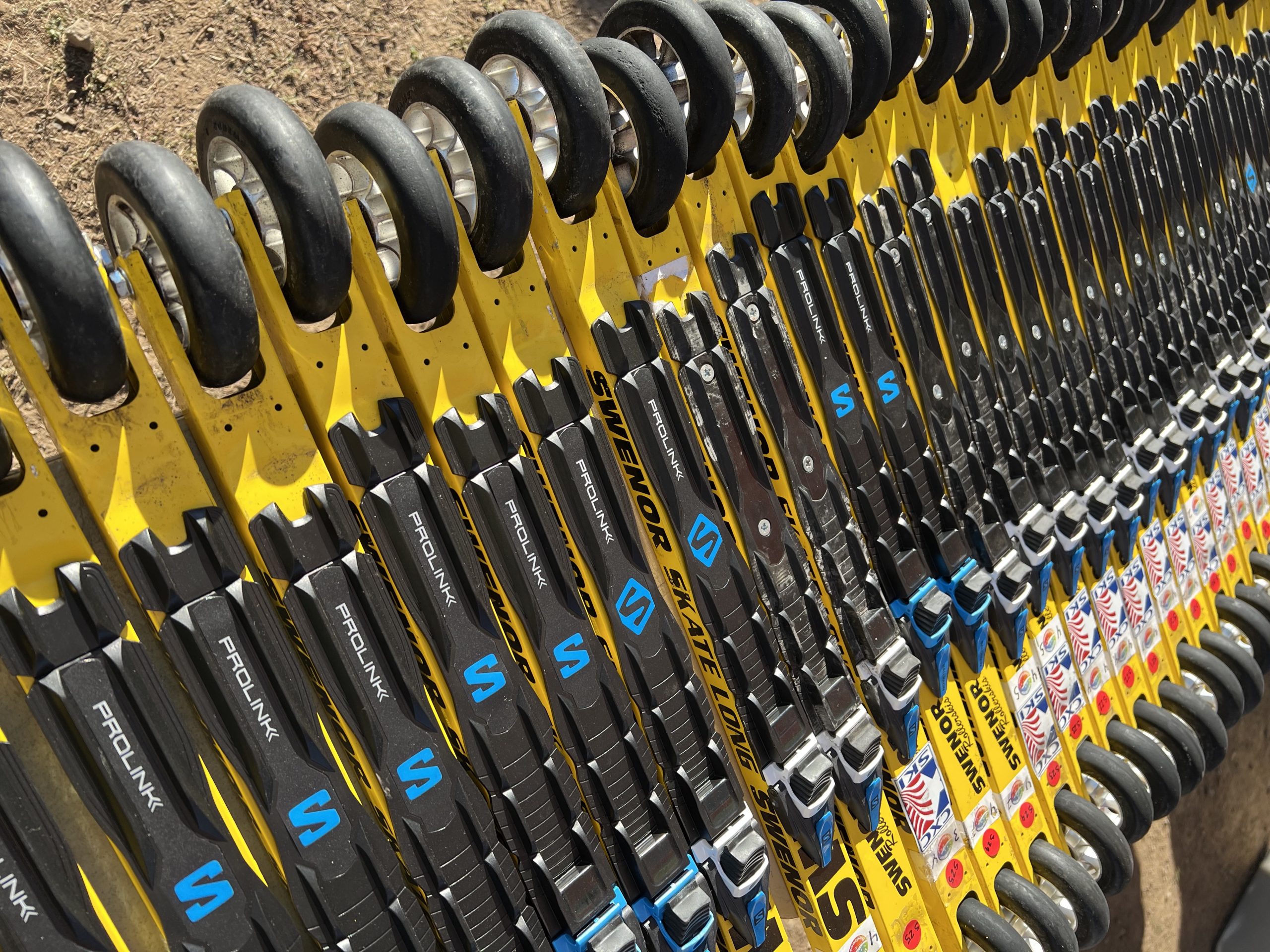
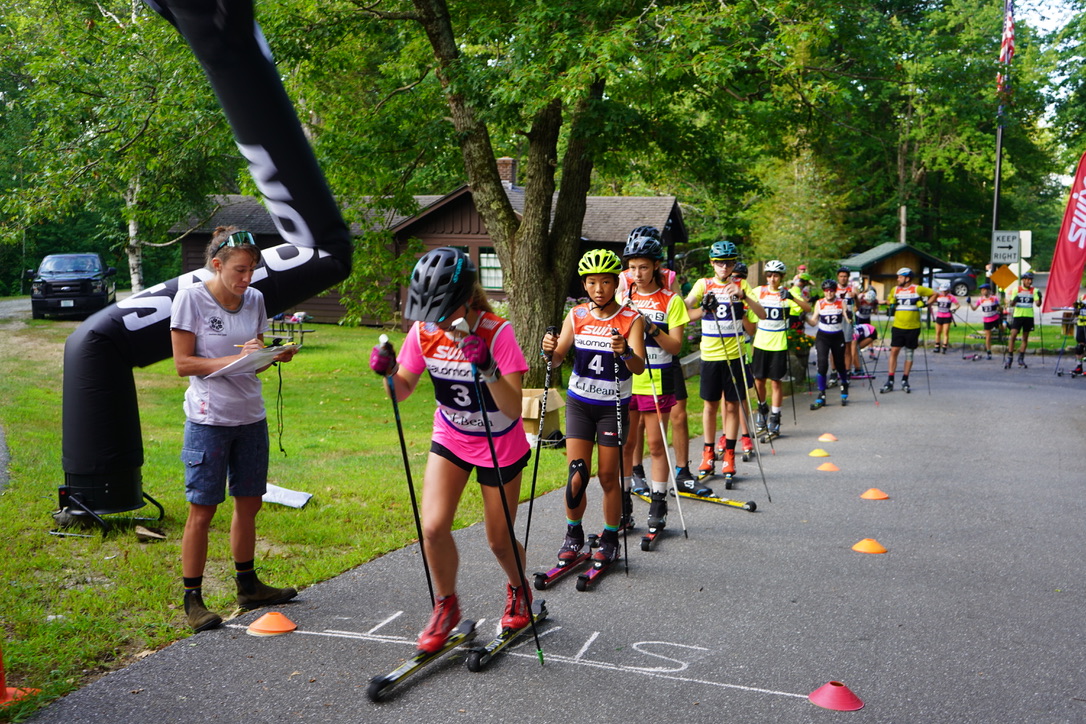
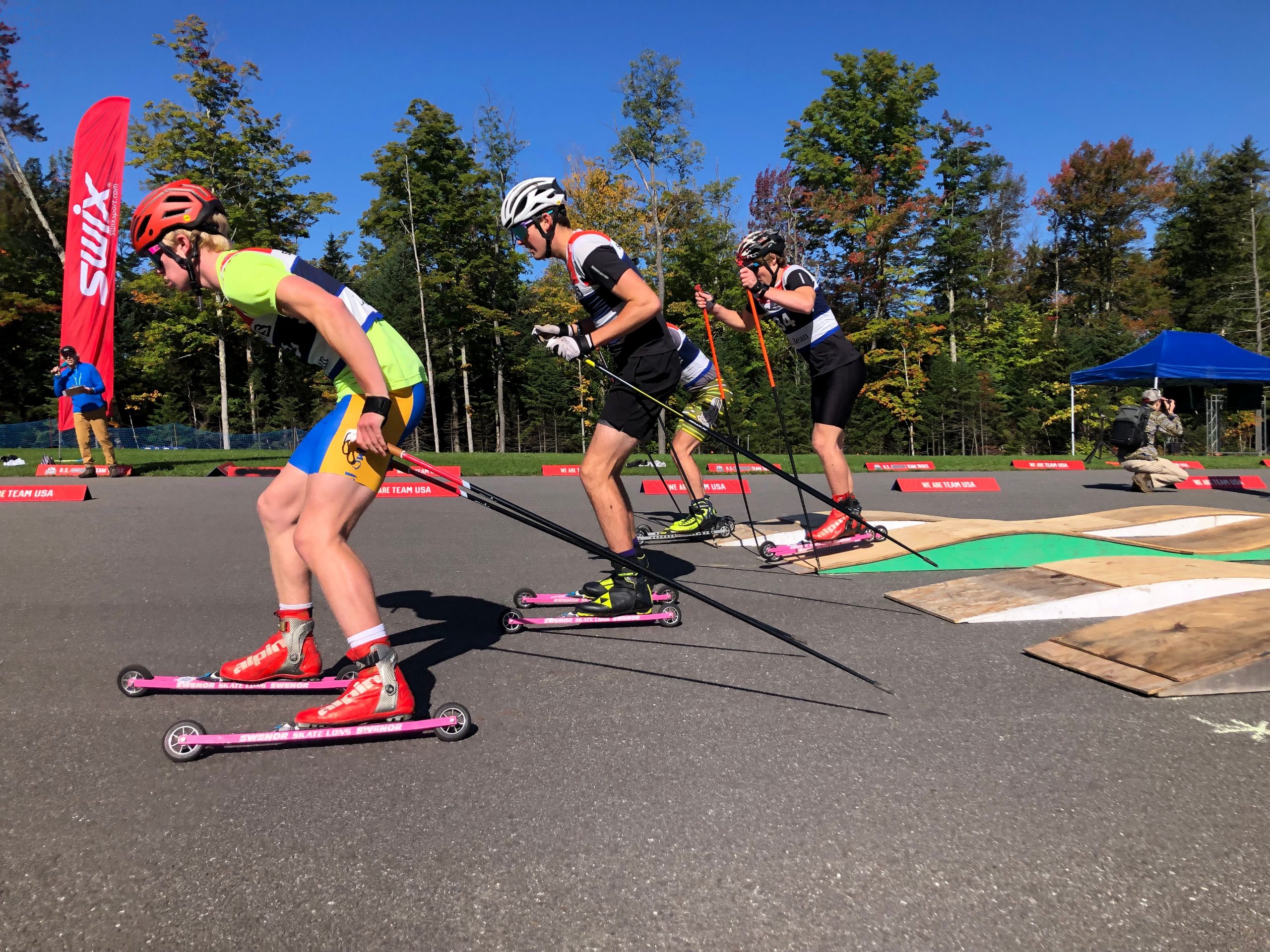
NENSA’s seasonal calendar identifies a large number of roller ski opportunities, but to call them “races” is to misunderstand NENSA’s efforts. The events that NENSA stages are intended to be less of a “race,” and more of a controlled event. Matched roller skis are provided for event contenders, so no one needs to worry about a mechanical disadvantage. Ramps, bicycle bumps, NENSA wave boards (designed and built by Beckwith, himself), and other fun elements are incorporated in nearly every event. “We want skiers of all skill levels and competitive ambitions to have the opportunity to gather together,” says Beckwith. “Racing can be part of that, but any festival can offer more.”
NENSA stages a variety of roller ski events and ski community gatherings throughout the summer:
NENSA also offers numerous clinics aimed at those new to roller skiing in the form of NENSA’s Learn-To-Rollerski clinics. There the focus is on learning roller skiing fundamentals: stopping and turning, basic technique fundamentals, agility skills, and games.
“When NENSA started, one of the goals was to strengthen clubs within the region.” Beckwith said. “By my tenure, many clubs were already well organized, and they were doing their own camps and programs. NENSA’s new aim became how to capitalize on the activities already being staged in New England by adding heightened programming and bringing the clubs together.”
NENSA events can also offer high-level competition, though in an environment that’s designed primarily to offer training experience for young athletes: learning the psychology of racing, the timing of warming up and warming down, the ins and outs of race-day fueling and hydrating, the strategies of racing against the clock, or the terrain, or other competitors. But the format and intent of each event needs to strike a delicate balance: “For years, I’d sent athletes to compete in the App Gap Challenge as part of Green Mountain Valley School’s summer training camp,” Beckwith remembered. “Even then, the App Gap event was called a ‘challenge’ rather than a race. It wasn’t so much a competition as it was a way for skiers to measure improvement year after year.”
While NENSA stages events that could be described as “races,” Beckwith made it clear that NENSA is not attempting to create a roller ski athlete, nor to stage events that would otherwise interrupt the progression of any ski-athlete’s summer training: “Too much racing in the summer can be an interruption to ski training,” Beckwith said. “Athletes need to consider that these races are not so serious, but that they are simply an addition in the summer season.”
While ski-event organizers in the West and Midwest are beginning to consider seeking FIS and/or USSA sanctioning for roller ski events in seasons to come, that’s not where NENSA is focusing its efforts. NENSA’s mission is to do more than one thing: development and growth of cross country skiing, and providing competitive opportunities for cross country athletes. NENSA’s combination of racing, skills events, instruction, and community gatherings may continue to be the way to accomplish that. Perhaps the place to begin on a glorious New England autumn weekend is on the coast of Maine. Go to NENSA’s website for further event information, and for THE MAINE EVENT Registration.
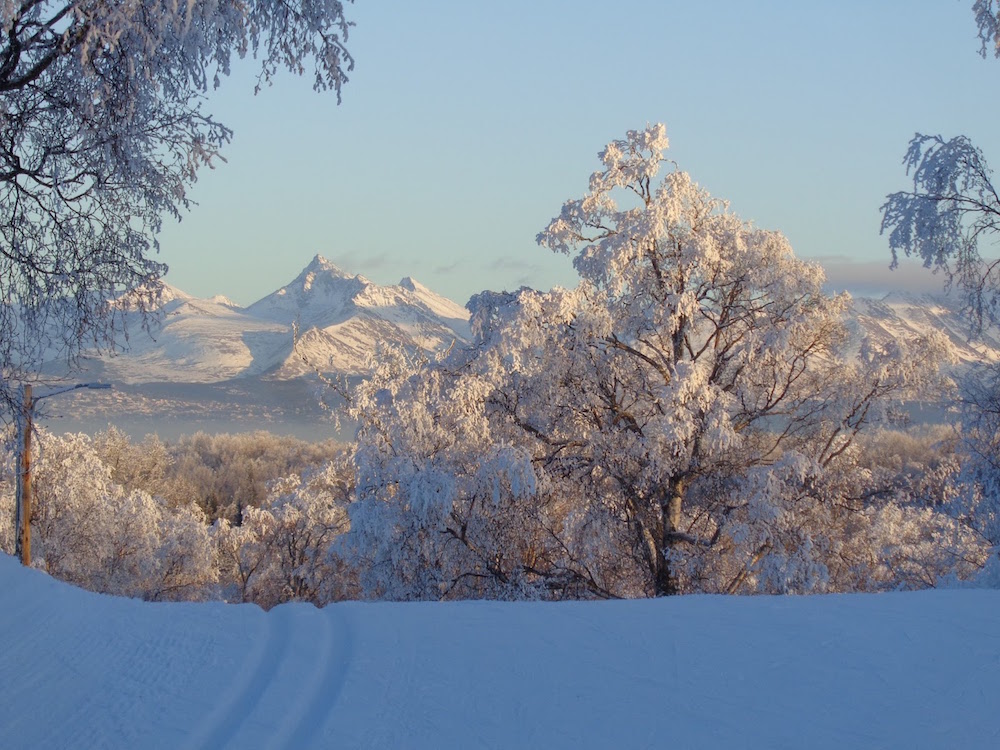
The Chugach Mountains are seen from the Lekisch Loop, part of one of the homologated courses used for FIS races at Kincaid Park in Anchorage, Alaska. (Photo: Adam Verrier)
This article has been updated with additional information about the Birkie, about all races in Vermont, and about the current state of emergency orders in Anchorage.
FasterSkier has previously reported on the significance of FIS points, points earned in races sanctioned by the International Ski Federation that can be used to compare skiers to one another even when they did not engage in head-to-head competition. Under normal circumstances, an athlete’s FIS points are used for things like selection to the following season’s national team, while team selection for international competition is generally based more on an athlete’s performance in head-to-head racing in the current season.
In this year, with all national-level races having been cancelled, FIS points are poised to take on additional significance, as U.S. Ski & Snowboard leadership will necessarily be relying more on discretion to choose teams for international competitions such as 2021 World Championships, in Oberstdorf, and 2021 Junior World Championships, in Lahti.
As U.S. Ski Team Cross Country Program Director Chris Grover told FasterSkier this fall, when it comes to comparing American performance in domestic competitions held in different parts of the country, “We know the athletes so we can easily gauge the quality of the field. If the race is a FIS race or an NRL race, we also have points to use in determining field quality. Then we simply look for stand-out performances.” Regarding comparisons between Americans racing in Europe and Americans racing domestically, the calculus was similar: “As in the case of domestic racing, it’s easy to judge the quality of the race by seeing which athletes are in the race and what the FIS points look like.”
So, FIS points are going to be exceptionally important for American athletes this winter.
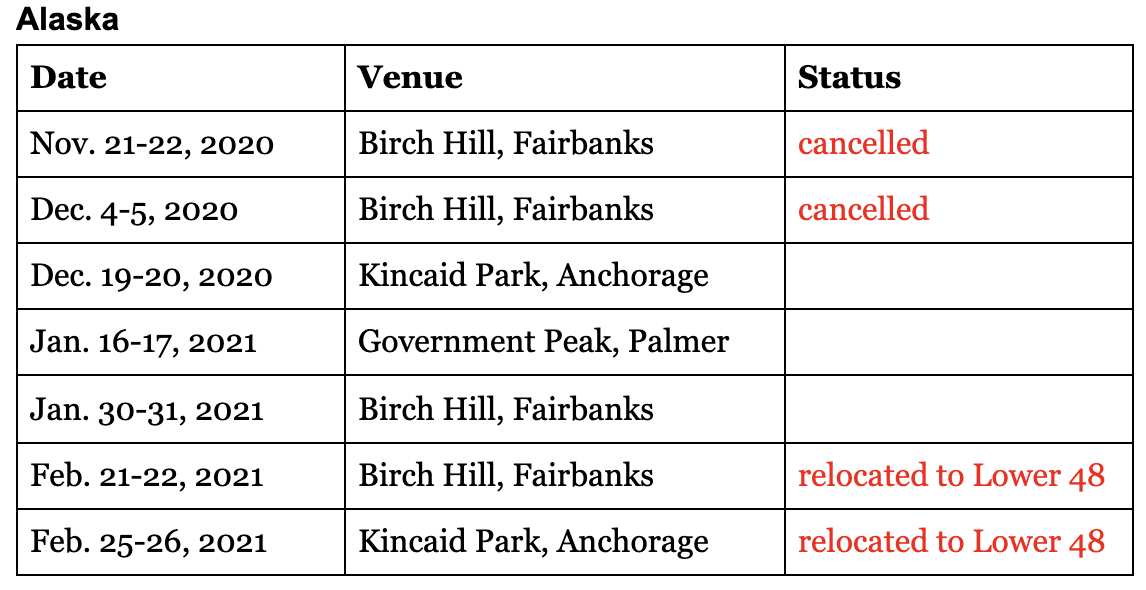
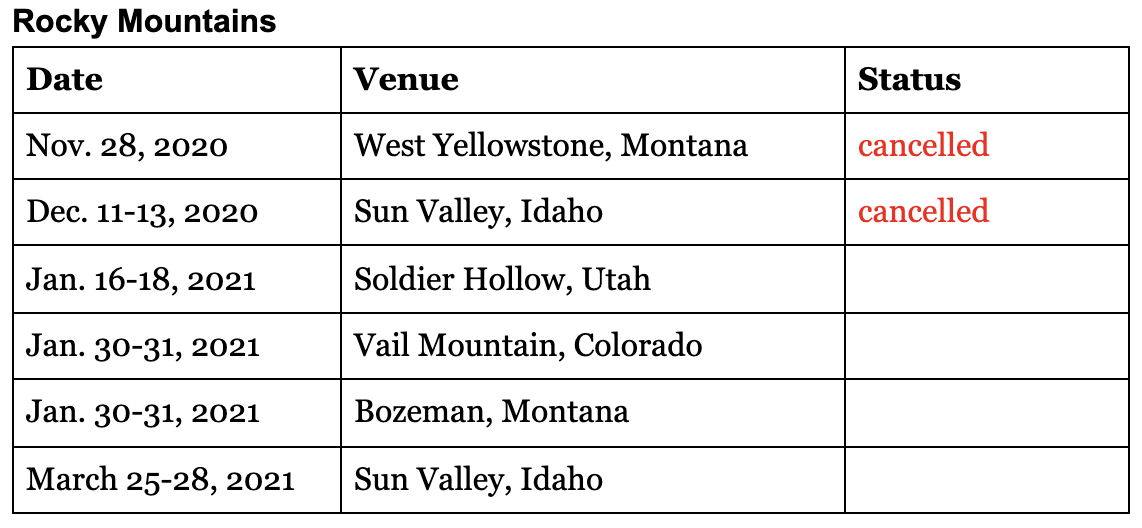
So where are the FIS races going to be held? The short version of this article is just a link to this page on the FIS website. Here are the American FIS races for the 2020/21 season. Click around and take a look at it. The end.
Kendall Kramer races in Lahti, Finland, on her way to fourth place in the U20 15 k classic mass start at 2019 World Juniors. (Photo: Doug Stephen)
But, like many things in life these days, these plans are subject to change. Due to the pandemic and public health considerations, to be sure, but also due to the catch-22 of fluoro use and FIS sanctioning. Accordingly, the rest of this article provides an annotated list of this winter’s American FIS races, organized by geographic region, with an attempt to include the most current information regarding race status. If, four months from now, public health considerations made it impossible to have a single FIS race in this country this winter (and there are already asterisks or outright cancellations around more than half of them), at least this article can serve as a historical artifact from a more optimistic time.
(As a brief aside, it is worth noting that athletes who are unable or unwilling to race this winter will not see their FIS points suffer, if they buy a FIS membership for this season. As USSS representative Adam St. Pierre wrote in an email to USSS members in October, “Each FIS and [national ranking list] Points list released in the 2020/2021 season will include all races since May of 2019. Your points can not get worse this season, but they can improve if you are able to race and achieve better results than you did in 2019/20. You must have an active FIS license for the 2020/2021 season in order to maintain your FIS points for the 2021/2022 season.” So if you’re sitting out this season of competition but intend to race next year, it may well be worth shelling out for a FIS license simply to preserve your standing.)
The opening weekends of racing in Fairbanks were cancelled by race organizers on Saturday, “in light of the current high rate of COVID-19 infections around the state, as well as local and statewide hospital/ICU bed capacity, and given Governor Dunleavy’s extension of the public health emergency through December 16,” according to a statement from the Nordic Ski Club of Fairbanks. In a more detailed follow-up statement posted Sunday, the ski club explained that it is moving all of its scheduled races to virtual events through the end of this calendar year. The advisory group that helped the ski club reach this decision included three physicians alongside the ski club’s race crew.
“We are disappointed to not be able to compete, though considering where Alaska is with COVID, it is a responsible decision and we support Fairbanks in their decision,” APU head coach Erik Flora told the Anchorage Daily News on Saturday.
“As coronavirus cases continue to skyrocket in the state, cracks are appearing in Alaska’s fragile health care system,” Alaska Public Media reported on Friday. Providence Alaska Medical Center in Anchorage, the state’s largest hospital, recently requested at least one mobile morgue, the Anchorage Press reported the same day. As of Saturday afternoon, two out of three civilian hospitals in Anchorage were sufficiently full that they were not accepting incoming ambulances.
The state’s next scheduled FIS race weekend, the December Besh Cups in Anchorage, does not seem to be barred by either the current Emergency Order governing the Municipality of Anchorage or its attachment covering organized sports specifically. However, the attachment explicitly bars spectators from attending sporting events, and states that “events that include participants from outside the Municipality [of Anchorage] should be postponed.” Anchorage Besh Cup races typically include multiple participants from Fairbanks and the Mat-Su Valley.
The state’s final two scheduled FIS race series, RMISA competitions in Fairbanks and Anchorage, will not be held in Alaska, but rather will be relocated to the Lower 48.
As of Sunday, Alaska as a whole ranked 14th in the country for daily reported Covid-19 cases per capita for the state overall, with 77 per 100,000 residents. A USSS document setting forth official guidance for domestic competitions advises event organizers to assess current case levels within the community, and defines “high community spread” as more than 25 new reported cases per day per 100,000. “In the event of high community spread,” USSS advises, “it is recommended you speak with your local health authority regarding ICU bed utilization and ventilator availability in the location’s level 1 medical center catchment.” Under this standard, every single venue discussed in this article is currently experiencing “high community spread,” save for those venues in Vermont.
Athletes leave the start area in a mass start classic race at Government Peak Recreation Area, Palmer, Alaska, on what is now a homologated course used for FIS races, in February 2020. (photo: Russell Hood)
As FasterSkier reported earlier this month, although some standard programming at the Yellowstone Ski Festival will continue, the biathlon race and FIS nordic race have been cancelled. As a representative of the ski festival told FasterSkier, “We took all of the factors in, gathered all our info, and based on the increase in [COVID] cases and what the county was recommending. With what is going on, we just felt the right thing to do for the community, and for the safety of everyone was to cancel the races.”
As of Sunday, Montana ranked 8th in the country for daily reported cases per capita, with 103 per 100,000 residents. Utah was 9th, with 99; Colorado was 13th, with 81; Idaho was 15th, with 76.
Bridger Ski Foundation athletes out for a first ski in West Yellowstone in 2015. (Photo: Courtesy Bernie Nelson)
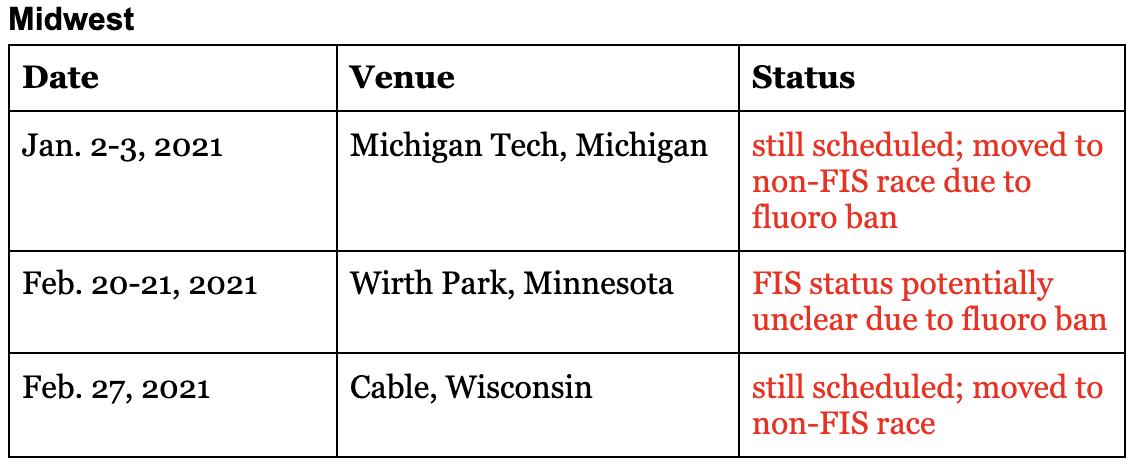
Michigan Tech is among the American venues caught in a catch-22 following the relatively last-minute decision by FIS to postpone its long-announced ban on fluorinated waxes: FIS is no longer banning fluoros; U.S. Ski & Snowboard still is banning fluoros; Michigan Tech is a fluoro-free venue; in terms of jurisdiction and sanctioning, FIS trumps USSS.
In response, Michigan Tech representatives emailed FasterSkier earlier this month that they would remove the FIS status from their races in order to remain fluoro-free. “By removing FIS sanctioning from this event, this allows us to place a fluoro ban for this race event, and all race events we are hosting for the 2020-21 season,” wrote Michigan Tech head coach Thomas Smith. “As US Ski & Snowboard has banned the use of fluorinated waxes from all USSS sanctioned events for the 2020-21 season, we will still maintain USSS sanctioning for this January 2-3 event with a fluorinated wax ban.”
Moving to Wisconsin in late February, the race still listed on the FIS site as “50 km F Mst” likely needs no introduction; this particular 50-kilometer mass-start freestyle race is, historically, the American Birkebeiner, a point-to-point race from Cable to Hayward. But this year’s Birkie has already undergone substantial change, and currently takes the form of a five-day event over a 46-kilometer loop course, “with limited and staged start waves each morning” for five days in a row.
Birkie representatives stated by email that this year’s race will not be a FIS race: “We are not FIS sanctioned for the 2021 American Birkebeiner, but we are sanctioned by US Ski and Snowboard.” Regarding the status of a fluoro ban at a USSS-sanctioned Birkie, race organizers wrote, “the 2021 Birkie Events will be fluoro-free. We are working on determining how testing will be implemented and right now, our goal is to do testing on a limited number of skiers.”
As of Sunday, Wisconsin ranked 5th in the country for daily reported cases per capita, with 119 per 100,000 residents. Minnesota was 6th, with 110 cases per 100,000 residents. Michigan was 19th, with 67 cases per 100,000.
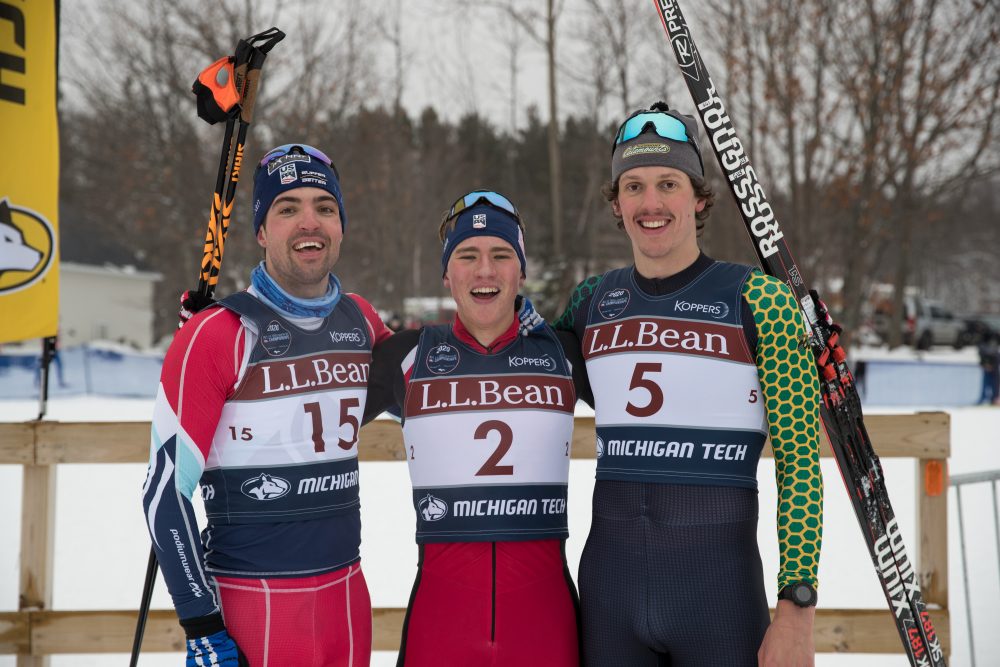
The Men’s podium from 2020 Senior Nationals in Houghton, MI. Ben Saxton in second, Gus Schumacher first, and Bill Harmeyer third (l-r). (Photo: Reese Brown)
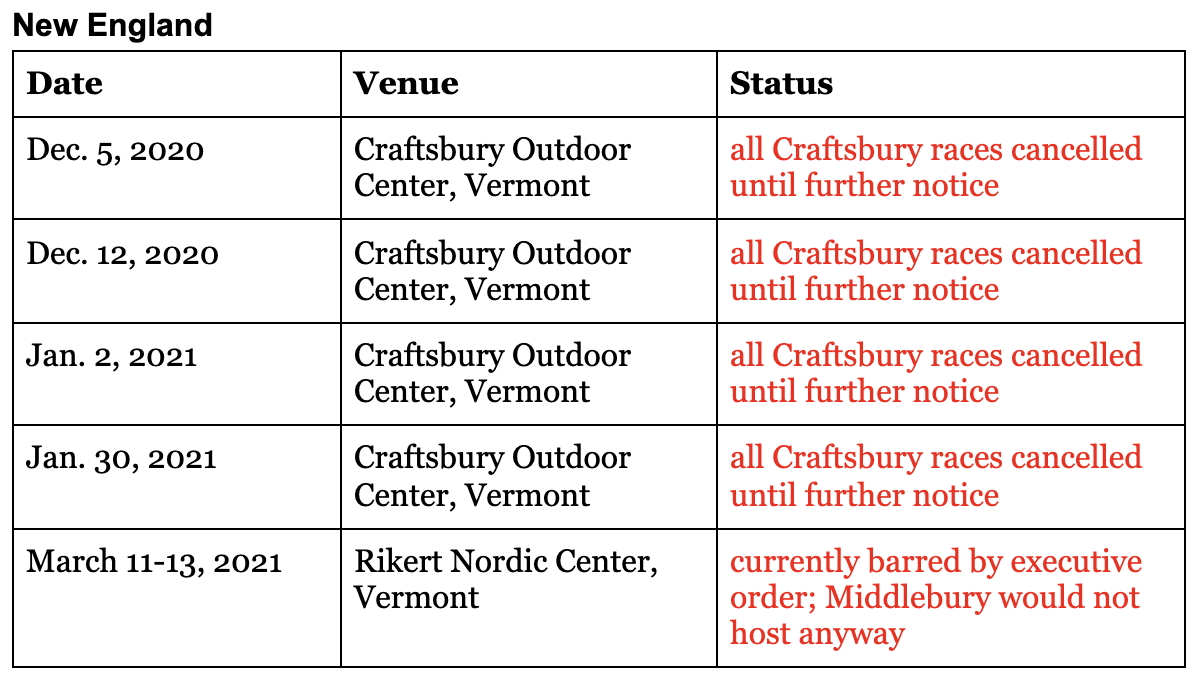
In a November 13 announcement, the Craftsbury Outdoor Center stated that all ski races on its grounds are currently cancelled: “2. Races are on hold: similarly, all ski races at the Outdoor Center are canceled until further notice.” This update came in response to a new addendum to an executive order from the state’s governor. The order, which went into effect on November 14 and continues through December 15, at which point it will be reassessed, provides that multiple-household gatherings are suspended, and that all recreational sports programs are suspended, save for school-sponsored sports activities.
If these provisions remain in place in March 2021, the NCAA Championships would not be able to occur, as it is by definition a multiple-household gathering. Moreover, there is currently a quarantine requirement for visitors coming to Vermont from beyond its borders. Finally, Middlebury (the theoretical host) announced last month that it “will not hold any athletic competitions during the winter season.” So even if NCAA Championships happen, in any form, it seems unlikely that this will be within the state of Vermont.
(While the possibility of these championships occurring at all is outside the scope of this article, the fact that both the Ivy League and NESCAC (New England Small College Athletic Conference) have cancelled winter sports – that’s the ski teams at Dartmouth, Harvard, Bates, Bowdoin, Colby, and Middlebury, among others – poses additional challenges to the possibility of nationwide collegiate skiing competition.)
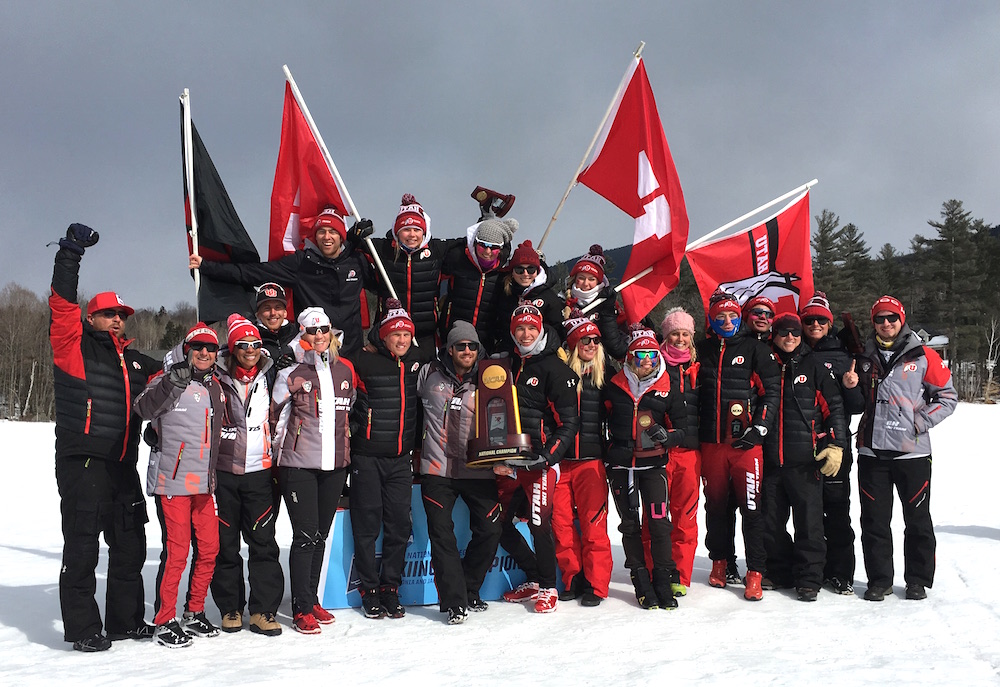
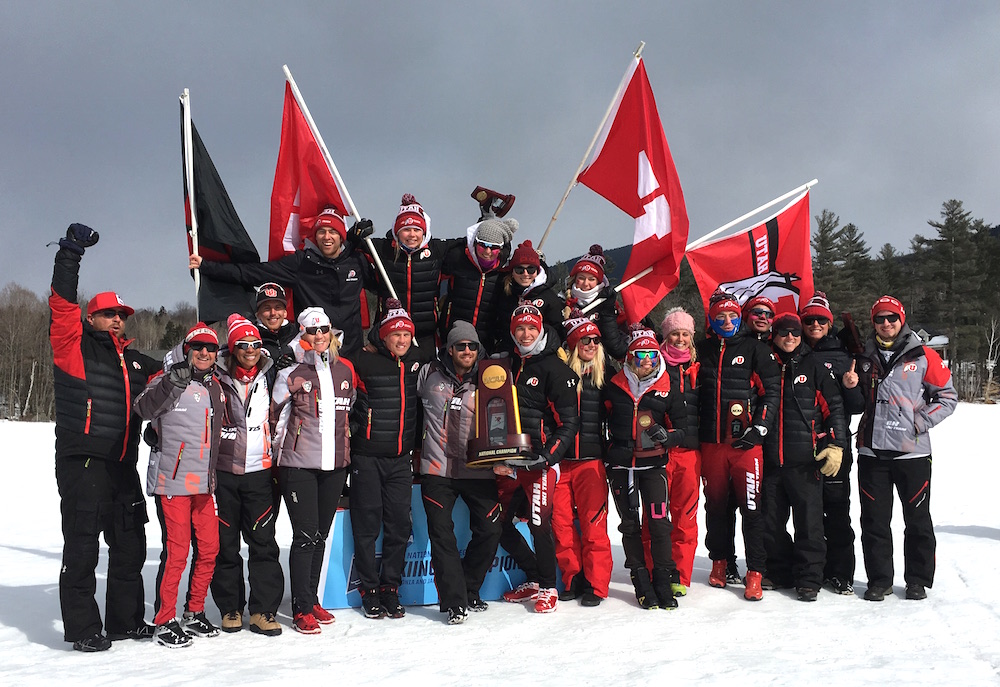
The University of Utah ski team celebrating its first NCAA title since 2003 on Saturday at 2017 NCAA Skiing Championships in Jackson, N.H. (Photo: Jason Clay/Colorado)
NCAA Skiing Championships (Jackson, N.H.): 15/20 k freestyle mass starts
On the final day of the National Collegiate Athletic Association (NCAA) Skiing Championships in northern New Hampshire, the University of Utah pulled out a 16.5-point victory over the University of Colorado-Boulder (and finished 17.5 points ahead of the University of Denver) in the team standings, and the two previous NCAA champions from Thursday’s 5/10 k classic races, Martin Bergström and Petra Hyncicova, achieved their second-straight titles in as many nordic races this week.
On a frigid Saturday morning in Jackson, N.H., with temperatures just below zero Fahrenheit for the start of the men’s 20 k freestyle mass start, Bergström, a Utah freshman from Sweden, outlasted the University of Colorado’s (CU) Mads Ek Strøm, a Norwegian senior and two-time 2016 NCAA champion, by 0.5 seconds to win his second-straight race in 46:02.8 minutes. Moritz Madlener, a German senior at Denver University (DU), placed third (+0.6). Just behind him CU’s Petter Reistad, of Norway, finished fourth (+1.2), and Dartmouth College’s Fabian Stocek, of the Czech Republic, placed fifth (+1.9).
While temperatures warmed up to about 1 degree for the women’s 15 k freestyle mass start and the wind picked up to about 15-20 miles per hour, the women raced three laps around the Jackson Ski Touring Center’s race loop and navigated even faster downhills that caused a few crashes.
Hyncicova used her love for downhills and skate races to capture her second consecutive NCAA title, breaking away with University of Vermont (UVM) junior Alayna Sonnesyn on the second lap. The Czech Republic native and CU junior attacked on the A-climb at the top of the course and won by 21.1 seconds in 39:21.6. Sonnesyn, of Minnesota, bested her third place from Thursday’s 5 k with a second-place finish on Saturday. CU’s Christina Rolandsen, of Norway, finished third (+38.9), ahead of Idaho native Anika Miller of Montana State University (MSU) in fourth (+44.0).
Utah took fifth and sixth with Merete Myrseth (+1:01.5) and Guro Jordheim (+1:16.1), and had two other men in the top 10 (Martin Mikkelsen in 8th and Kevin Bolger in 10th) to achieve the alpine-nordic team title.
In the women’s race, the Utes were the only team with all three women in the top 14, with Natalia Müller in 14th (+1:32.1).
“The turning point of today is when Guro broke a pole, and she was back in the 20’s, and she and Natalia were skiing together,” Utah Director of Skiing Kevin Sweeney said, according to a team press release. “We told them that they had to go and they busted out and made a big move. The men’s results were tremendous, but whether or not we were going to win was based on those guys making the move. It was exceptional athleticism and gutsy performances.”
The NCAA team title was the 11th for Utah and its first since 2003.
“I am stunned with the win today,” Sweeney added. “In all my years of coaching, it was one of the most challenging four days of competition. I say that because the weather was incredibly cold and windy, and challenging from both a waxing perspective, as well as visibility and conditions. I know all the teams had to deal with it, but it really beat us up. It took a lot of perseverance and gutsy performances for us to win. We struggled a little bit in the slalom, but they were going for it and came up short.
“We’ve been crunching numbers and have been able to beat Denver and Colorado by about 30 points on a really good showing during the RMISA season, but didn’t know if we could do it in the championships,” he continued. “Bergström was skiing at a whole new level this week, and Mikkelsen had stepped it up, and I knew Kevin Bolger could get top 10. I was also confident in the women, who have been skiing awesome, so I felt good there. It’s awesome to be able to take this new trophy back to our new ski building.”
As for those earning All-American status on Saturday with a top-10 finish, Utah had five (Bergström 1st, Myrseth 5th, Jordheim 6th, Mikkelsen 8th, Bolger 10th), Colorado had four (Hyncincova 1st, Strøm 2nd, Rolandsen 3rd, Reistad 4th), Denver had two (Madlener, Dag Frode Trollebø 7th), MSU had two (Miller 4th, Johanna Talihärm 7th), Dartmouth had two (Stocek 5th, Luke Brown 9th), UVM had one (Sonnesyn 2nd), Northern Michigan University (NMU) had one (Adam Martin 5th), the University of Alaska-Fairbanks (UAF) had one (Sarissa Lammers 8th), UNH had one (Lizzie Gill 9th), and Bowdoin had one (Hannah Miller 10th).
Stay tuned for a more in-depth report with quotes and photos from Saturday’s skate mass starts.
USSA Cross Country Junior Championships (Lake Placid, N.Y.): Freestyle team relays
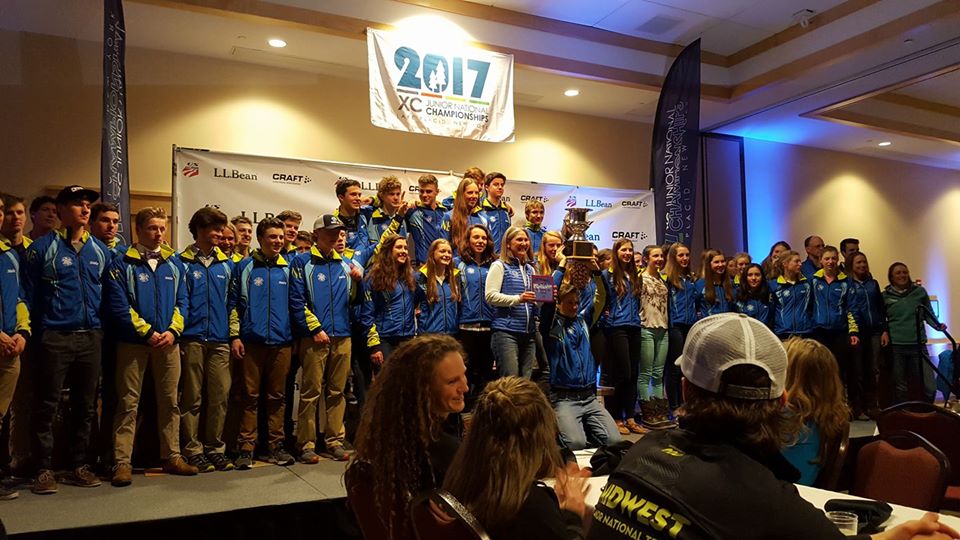
The 2017 U.S. Junior Nationals Alaska Cup winners, New England, at the awards ceremony on Saturday in Lake Placid, N.Y. (Photo: XCJuniorNationals2017/Facebook)
[UPDATED] For the final day of 2017 U.S. Junior Nationals in Lake Placid, N.Y., regional divisions formed three-racer teams for the U16, U18 and U20 freestyle relays.
Intermountain swept the U16 team events with Lane Myshrall, Skylar Patten and Johnny Hagenbuch winning the U16 boys’ relay by 3.6 seconds over the Midwest’s James Schneider, Alexander Nameth and Peter Moore in 23:00.4 minutes. Another 1.1 seconds back, Alaska reached the podium in third (+4.7) with Eli Hermann, Zander McMullen and George Cvancara.
Intermountain’s U16 girls’ team of Sarah Morgan, Annabel Hagen and Sydney Palmer-Leger posted a 53.7-second victory over New England’s Charlotte Ogden, Anna Lehmann and Abigail Streinz, winning in 26:21.4. The Pacific Northwest finished 18.1 seconds later in third place (+1:29.9) with Fiona Max, Gretta Scholz and Annie McColgan.
Alaska won the U18 boys’ relay with Luke Jager, Canyon Tobin and Gus Schumacher finishing in 21:42.9, 7.5 seconds ahead of New England’s Elliot Ketchel, Adam Glueck and Ben Ogden in second. The Midwest’s Anders Sonnesyn, Patrick Acton and Luc Golin rounded out the podium in third (+22.2).
Rocky Mountain topped the U18 girls’ relay with Katja Freeburn, Ezra Smith and Maddie Donovan crossing first in 25:47.3. Just 5.8 seconds back, Intermountain’s Brooke Dunnagan, Anna Gibson and Sofia Schomento placed second, and the Midwest secured third (+16.7) with Margaret McCollor, Luci Anderson and Anja Maijala.
The U20 men’s relay title went to New England, with Kam Husain, Koby Gordon and Daniel Streinz pulling out a 1.3-second win over Alaska’s Tracen Knopp, Logan Mowrey and Hunter Wonders in 21:53.1. Intermountain followed in third (+8.8) with Eli Jensen, Peter Wolter and Nathan Wells.
The Midwest came up big in the U20 women’s relay, with Abby Jarzin, Hannah Rudd and Margie Freed finishing 10.1 seconds ahead of New England’s Alexandra Lawson, Mary Kretchmer and Mackenzie Rizio in 25:41.4. Another 1.1 seconds back, Intermountain’s Leah Lange, Maddie Morgan and Marin Coletta placed third (+11.2).
New England won the Alaska Cup with 325 points, the same point total as Intermountain in second. Alaska placed third in the overall team competition with 295 points, just five points ahead of the Midwest in fourth.
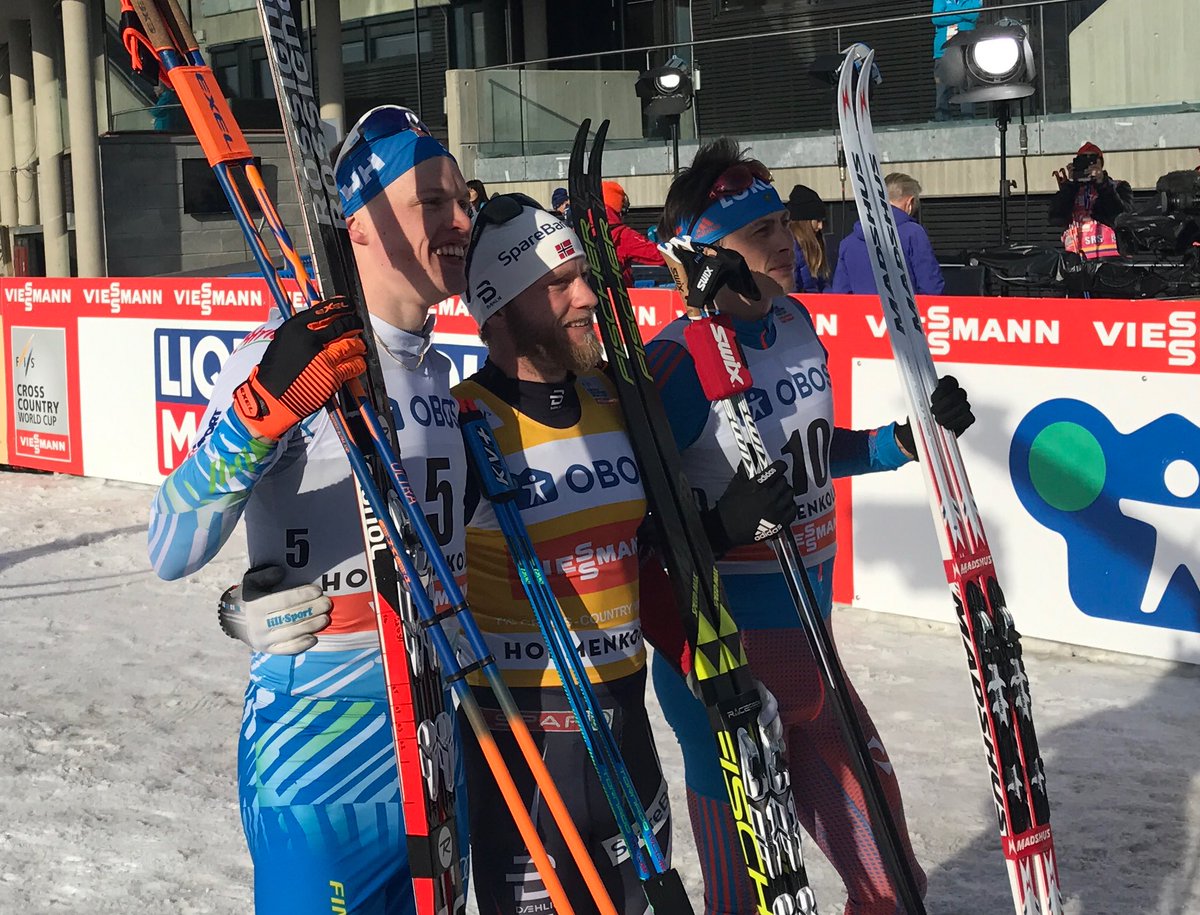
Left to right: Finland’s Iivo Niskanen, Norway’s Martin Johnsrud Sundby and Russia’s Alexander Bessmertnykh after placing second, first and third, respectively, in the Holmenkollen World Cup men’s 50 k classic mass start on Saturday in Oslo, Norway. (Photo: FIS Cross-Country/Twitter)
In a historic Holmenkollen, Norway’s Martin Johnsrud Sundby took his second 50 k win in a row, claiming this year’s title in a time of 2:02:59.7 (he won last year’s Holmenkollen in a time of 2:08:41.9).Sundby is now the only male skier towin two consecutive World Cup Holmenkollen 50 k competitions.
Crossing behind Sundby in second was Finland’s Iivo Niskanen, 9.9 seconds back from the race winner’s time. In a three-way photo finish, Russian Alexander Bessmertnykh bestedNorwegians Niklas Dryhaug, and Sjur Røthe in the lunge to the line, with Bessmertnykh taking third (+1:15.2), Røthe fourth (+1:15.2) and Dryhaug fifth (+1:15.2).
Canada’s Alex Harvey was just two tenths of a second behind the three-way lunge, finishing in sixth (+1:15.4). Norway’s Christer Hans Holund crossed 2.2 seconds later in seventh (+1:17.2). Three more Russians rounded out the top ten, with Sergey Ustiugov finishing in eighth (+2:35.0), Andrey Larkov two tenths of a second behind in ninth (+2:35.2) and Sergey Turyshev in tenth (+2:42.2).
The top U.S. skier for the day was Scott Patterson (Alaska Pacific University), earning World Cup points in 28th (+7:18.8). Canada’s Devon Kershaw crossed 33rd (+2:11:59.1) and American David Norris (Alaska Pacific University) finished 35th (+9:56.4).
Two more Americans competed in Saturday’s Holmenkollen, with Noah Hoffman finishing in 38th (+11:02.6) and Ben Lustgarten 46th (+18:44.7). Canadian Russell Kennedy was the final North American to finish in 47th (+20:16.3).
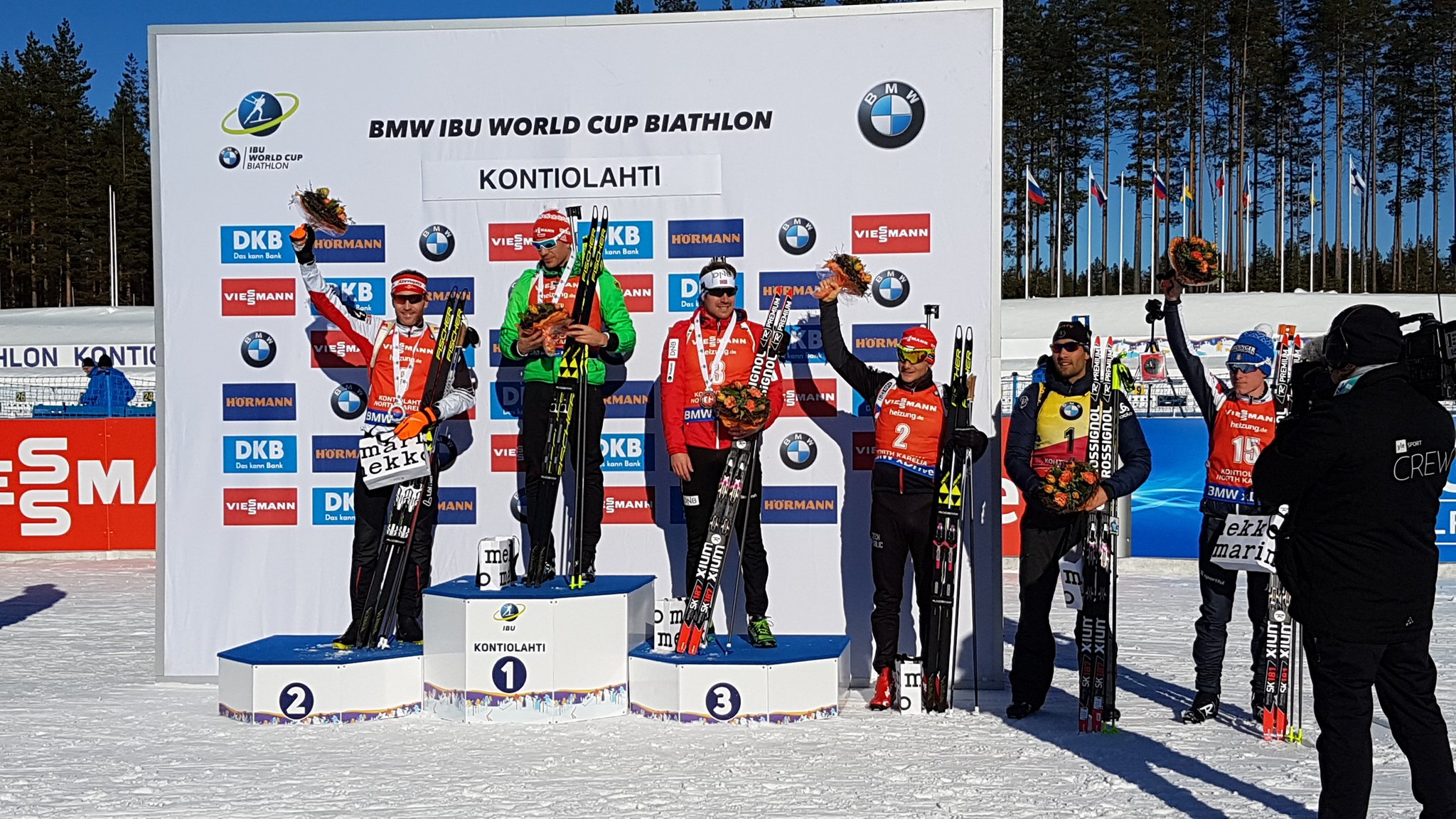
The IBU World Cup men’s podium after the 12.5 k pursuit in Kontiolahti, Finland, where Arnd Peiffer of Germany outsprinted Simon Eder of Austria for the win. (Photo: IBU/Twitter)
After one day knocked down to the second spot of the podium, it was back to the usual winning ways for Germany’s Laura Dahlmeier in the 10 k pursuit. Dahlmeier caught Norway’s Tiril Eckhoff, who won Friday’s sprint, early in the race after Eckhoff had one penalty in the first prone and second-starter Dahlmeier cleaned. While Eckhoff picked up five more penalties as the race went on, finishing 15th (+1:12.0), Dahlmeier had just one – and cleaned when it counted, on the final shoot with France’s Marie Dorin Habert and the Czech Republic’s Gabriela Koukalova right there with her. Dorin Habert missed one shot and held on to second place (+16.5) despite the penalty loop, while Italy’s Lisa Vittozi picked up her first individual podium in third (+19.9).
The win secured the overall World Cup title for Dahlmeier, her first. “That makes me really speechless,” she told Germany’s ARD broadcaster. “This is an amazing moment.”
Susan Dunklee collected four penalties and dropped from fifth place to 14th (+1:02.8) for the United States. Teammates Clare Egan and Joanne Reid finished 45th (+3:24.7) and 52nd (+4:07.0), respectively.
For Canada, Julia Ransom finished 53rd with three penalties (+4:14.0) and Emma Lunder 58th with four missed shots (+6:20.7).
Earlier in the day, Martin Fourcade had started the men’s race in bib one and set out to win the men’s 12.5 k pursuit, but was undone by four errors on the shooting range. No matter: the French biathlete still picked up the World Cup crystal globe for the pursuit discipline after finishing fifth (+25.5 seconds) and now he’s skipping tomorrow’s mixed relays to go be with his wife, who is about to have their second child.
Capitalizing on Fourcade’s errors were a group of chasers, among whom Arnd Peiffer of Germany managed to shoot 20-for-20. The race came down to a sprint finish between him and Simon Eder of Austria; Peiffer took a 0.3-second win for his eighth career victory. Emil Hegle Svendsen of Norway finished third, +2.3 seconds, and Andrej Moravec of the Czech Republic fourth, +9.8.
Besides Peiffer, the only other man in the field to shoot clean was Sean Doherty of the United States. That allowed Doherty to jump from 44th at the start to a season-best 18th (+1:19.5) at the finish, the top result for the American team. Lowell Bailey finished 27th (+1:57.2) and Leif Nordgren 43rd (+3:24.4) with three and four penalties, respectively.
Christian Gow led Canada with just one penalty and a 37th-place finish (+2:36.0), a big improvement from his 50th-place starting position. Brendan Green placed 50th with three penalties (+4:47.3).
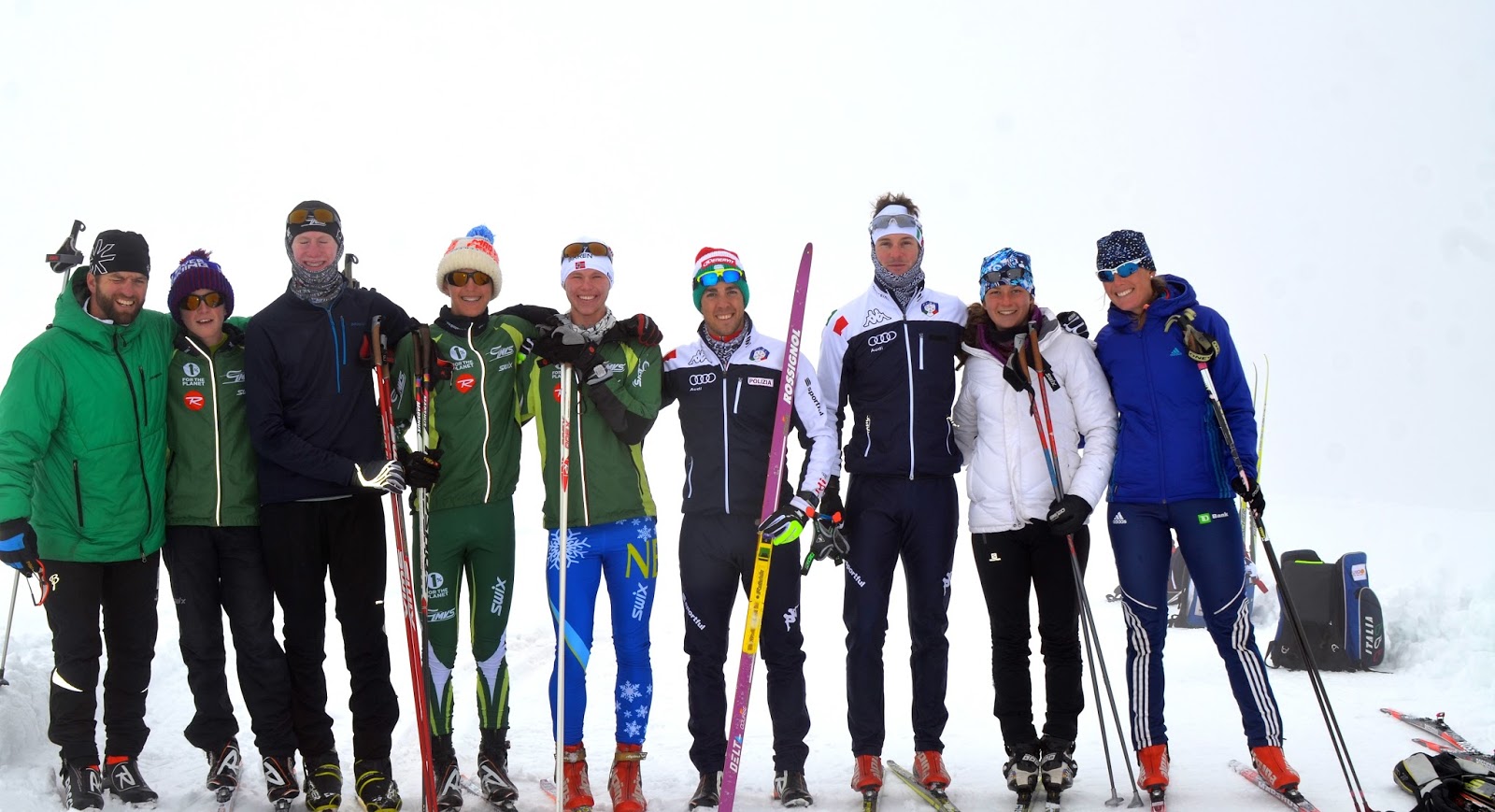
A group shot of the Green Mountain Valley School (GMVS) Nordic Team with Italian national-team members Federico Pellegrino and Simone Urbani. Pellegrino has won three individual World Cups. The GMVS team traveled to Italy in early September for two weeks of training around Mals and on the Stelvio Glacier. Longtime nordic director Justin Beckwith is pictured at far left, and new coach Katrina Howe at far right. (Photo: gmvsxc.blogspot.com)
Over the last nine years, Justin Beckwith’s name has become synonymous with the Green Mountain Valley School (GMVS) in Waitsfield, Vt. Now, with the hiring of 2010 Olympian Garrott Kuzzy as nordic director and biathlete Katrina Howe as nordic coach, two other well-known individuals in the ski community have become the new faces of the program, and Beckwith has vowed to help with the transition.
But before Beckwith — a former Middlebury College skier, Junior World Championships coach and wax technician, J1 Scando Trip leader, and the New England Nordic Ski Association’s 2012 coach of the year — started as an assistant coach at GMVS, he built houses.
That’s one of the trades he’s returning to.
In August, Beckwith, 36, decided to step down as Green Mountain’s nordic director, ushering in a new era for the program, which started in 1981 under Jim Fredericks. Muffy Ritz took over as nordic director from 1986 to ’89, after which GMVS Nordic went by the wayside at the ski academy until Norwegian Jon Arne Enevoldsen started a biathlon program in 2002, according to the Vermont Ski and Snowboard Museum.
Former GMVS head coach and nordic director Justin Beckwith (second from r) with Green Mountain’s former elite and postgraduate athletes (from left to right) Nick Gardner, David Sinclair and Ian Moore (l-r) during last year’s fall trip to Italy. (Photo: GMVS)
A few years later, Beckwith came into the picture. In a phone interview on Monday, he recalled how the current GMVS nordic program started with a Norwegian coach and core group of families. Through grassroots efforts, targeting local Bill Koch programs and creating a “viable option for kids from the [Mad River] valley to start taking up cross-country,” the private school’s nordic team began to attract more homegrown skiers from central Vermont. In turn, that spawned interest well beyond the state’s borders.
During Beckwith’s tenure, in which he led the program for the last seven years, he also united with local clubs to develop the Central Vermont Co-Op Race Series to elevate the level of nordic competition. His largest team size was 15. This year, its has seven nordic athletes, including one post grad.
“Over the years, I’ve been able to support some really awesome athletes in the program,” Beckwith said. “To be able to offer that opportunity, helping foster a passion for skiing and then to get to see them become young adults and continue to do amazing things.”
Sometimes, he had to dig into his own pockets to do so. And while he said it was a personal decision to step down, he felt the time was right to put the program into new hands for strategic planning and new energy.
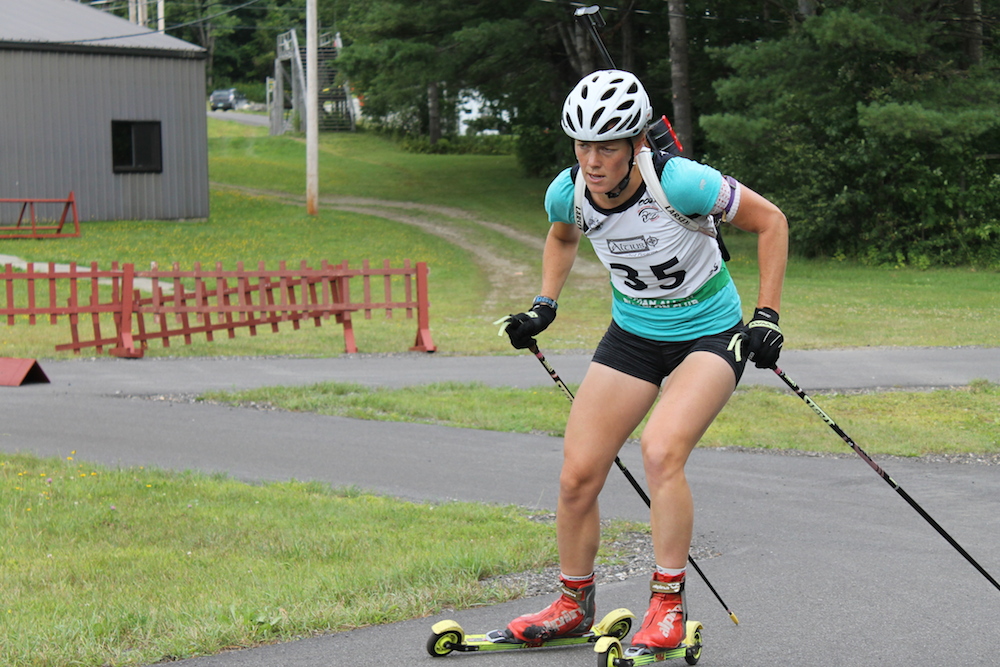
Katrina Howe, a former biathlete with the Maine Winter Sports Center Olympic Development Team, competing at last year’s 2014 North American Rollerski Championships in Jericho, Vt.
That’s where Kuzzy and Howe came in.
Howe, a former national-development team biathlete who spent the last five years training with the Maine Winter Sports Center (MWSC) Olympic Development Team, joined Beckwith as an assistant coach in July. At 29, she had retired from racing this spring — her decision prompted by a loss of funding at MWSC — but she wasn’t ready to leave the sport.
“I knew I wanted to stay involved and I always knew I wanted to be a coach,” Howe said on the phone last week. “I contacted Justin and it turns out he needed an assistant coach.”
He hired her and the two went ahead planning the summer, including a fall training camp in Italy. Before she started, Beckwith and his then-assistant coach Shane MacDowell hosted an Eastern Regional Elite Group (REG) in June. MacDowell left GMVS to join Northern Michigan University as an assistant coach in July.
“There’s been a lot of change in the program [recently],” Beckwith said.
For the REG camp, Beckwith’s long-term goal had been to boost enrollment. New England has so many summer training options that it’s often difficult to unite the best juniors at a single venue, he explained. The REG camp attracted New England’s entire J1 and J2 teams, he said.
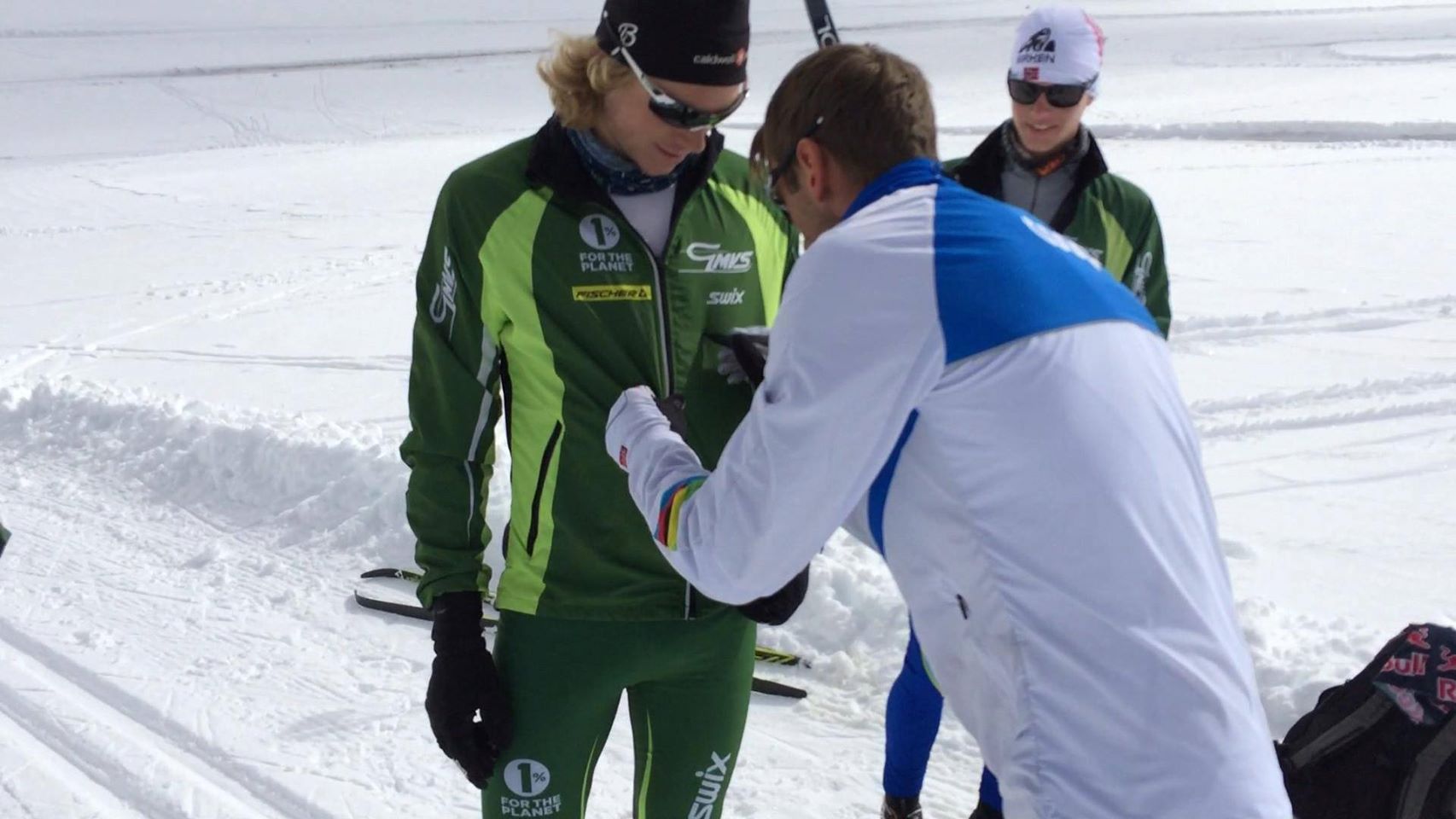
Norwegian Petter Northug posted a photo of himself on Facebook signing a GMVS nordic skier Forrest Hamilton’s jacket during a recent trip to Italy for skiing on the Stelvio Glacier. He captioned it, “Big in the US!” (Photo: Petter Northug/Facebook)
“It was a great success … I think we were missing two to three kids from the junior national team,” he said, adding that there were 38 participants. “I would say we had 95 percent of the best kids in New England together.”
That was a capstone on the previous open training camps GMVS hosted for the last eight summers.
“I just wanted to make sure I was handing it off [to the right people],” Beckwith said of the nordic program. “Katrina was awesome. … I’m really happy that Garrott stepped up,” he added. “We have had some great conversations.”
Howe started working for GMVS when school started, Aug. 17. The day before, she learned Beckwith wasn’t returning as head coach.
“It was a pretty sudden transition,” she said. “We had about two-and-a-half weeks of school and Justin was around so he definitely helped me with a basic knowledge and lay of the land.”
After that in early September, Beckwith, Howe, staff member Jere Brophy, and their athletes traveled to Mals in northern Italy for two weeks of dryland training — including hiking and rollerskiing — and on-snow skiing at the Stelvio Glacier.
New GMVS nordic director Garrott Kuzzy (Photo: GMVS)
When they returned in late September, Kuzzy had been hired as nordic director. In the time since — the last two weeks — he’s been working with Howe.
“This August, when Justin decided he was going to move on, the Green Mountain Valley School reached out to me and I decided it was a great opportunity to get back into the ski world and work with high-school age level kids,” Kuzzy said. “… It’s not a huge life transition. It’s just an opportunity to be more involved in skiing. I think they’ve got a lot of resources and are very dedicated to the nordic program.”
Kuzzy, 32, a Middlebury grad who spent the last several years in Middlebury and will continue to live there, previously served as product director of VBT Bicycling and Walking Vacations. While he explained it was a “very challenging decision to leave” VBT after four years, he always wanted to stay involved in nordic skiing. He did so by launching VBT’s cross-country ski tours and assisting local clubs, including Mansfield Nordic and Frost Mountain Nordic, at their annual camps.
“The experience I gained with VBT is an asset and something I can apply to my role as Nordic Director at GMVS,” Kuzzy wrote in an email. “My role consists of a balance between strategic planning, execution and ski coaching. As Nordic Coach, Kat Howe spends much of her time writing the training plan and training with the team.”
While he and Howe plan to discuss and determine the program’s overarching goals this month, Kuzzy said on the phone last week that they want to further integrate nordic within the GMVS community.
“Traditionally it’s been an alpine-heavy school,” Kuzzy said, explaining that of roughly 120 skiers at the academy, seven are nordic athletes.
Howe pointed out that a couple of alpine students had already shown interest in nordic. “The number may grow before too long!” she wrote in an email.
“At this point, my goal is to provide as much opportunity as possible for skiers who really want to see what they can do with nordic skiing,” Kuzzy explained. “One thing I really like about GMVS is the academic focus; it was recently rated the top academic private high school in Vermont [by the 2015 Niche Rankings]. … And this motto of, skiing is a metaphor for life. My goal is to extend the opportunity, to learn more about life through ski racing.”
Howe said she felt similarly.
“If I didn’t have the interest or the academic [background], I don’t think I’d totally appreciate the experiences I’ve had as a skier,” the four-year University of Vermont skier said. “The trips weren’t always necessarily about the racing. I think that carried over well for me.”
Already, Kuzzy said he’s been having a lot of fun with the athletes.
“That’s been the highlight, the workouts with the kids,” he said. “They’ve been fantastic.”
“They’re just all awesome, hugely motivated [athletes],” Howe said. “They have a huge world sense of adventure. That’s why I fell in love with nordic, and these kids just love that and want to get out there and do new things. It’s not just about specific training for them, and that’s definitely come from Justin.”
“They have a huge world sense of adventure. That’s why I fell in love with nordic. … It’s not just about specific training for them, and that’s definitely come from Justin.” — GMVS Nordic Coach Katrina Howe, on the team’s current athletes
While Beckwith was unsure what his exact role with the program would be this winter, he knew he’d be offering race support. So far, he’s filled an advisory role to help with the transition and was part of the recruiting process for a new director, he said.
Beckwith has also been the lead kickwax technician for New England at Junior Nationals for the last six or seven years, and he plans on doing that again this season.
“It’s definitely open ended and I want it to be a positive vibe,” he said. “It was hard to leave my current kids… [but] I’m not leaving, I’m still here, part of their lives, but it’s definitely a hard transition for sure.”
He’ll continue to live in Warren, near the school, where he can show Kuzzy and Howe the traditional time trial spots, and their starting and ending points.
“I definitely envision doing some workouts with them,” he said.
Meanwhile, he said he’ll be able to spend more time with his new wife, Brie Beckwith, a physical trainer for U.S. alpine skier Mikaela Shiffrin and the U.S. women’s alpine team, whom he married in April. He’ll also continue building with friends.
“It’s pretty fun to get back to that,” he said.
This winter, Beckwith said he’ll groom the Sugarbush golf course and help “the community in areas I was not able to before. … It’s exiting to not have the narrow focus of helping one program, but helping all programs out, and I definitely plan on being a part of the New England waxing staff.
“The last two years I’ve been with the World Junior kickwax staff so I’m leaving all doors open,” he added. “I plan on staying involved as a ski tech.”
The U18 men’s 3 x 2.5 k classic relay on the last day of 2015 U.S. Junior Nationals at Auburn Ski Club in Soda Springs, Calif. (Photo: Mark Nadell/MacBeth Graphics) All profits from photo sales will be donated to the National Nordic Foundation.
The 2015 U.S. Junior Nationals came to a close Saturday with the 3 x 2.5-kilometer classic relays at Auburn Ski Club in Soda Springs, Calif., where New England and Midwest both tallied two relay wins. At the end of the weeklong series of races, New England took the overall team title, the Alaska Cup, by 167 points over Midwest. Intermountain placed third overall, 43 points out of second.
Photos from Saturday’s relays and a complete gallery, courtesy of Mark/Nadell/MacBeth Graphics. All profits from photo sales will be donated to the National Nordic Foundation (NNF).
(Photo: Mark Nadell/MacBeth Graphics)
The U16 women’s podium from Saturday’s 3 x 2.5 k classic mass relay at 2015 U.S. Junior Nationals at Auburn Ski Club in Soda Springs, Calif. (Photo: Mark Nadell/MacBeth Graphics)
(Photo: Mark Nadell/MacBeth Graphics)
The U16 men’s podium from Saturday’s 3 x 2.5 k classic mass relay at 2015 U.S. Junior Nationals at Auburn Ski Club in Soda Springs, Calif. (Photo: Mark Nadell/MacBeth Graphics)
The U18 women’s podium from Saturday’s 3 x 2.5 k classic mass relay at 2015 U.S. Junior Nationals at Auburn Ski Club in Soda Springs, Calif. (Photo: Mark Nadell/MacBeth Graphics)
The U18 men’s podium from Saturday’s 3 x 2.5 k classic mass relay at 2015 U.S. Junior Nationals at Auburn Ski Club in Soda Springs, Calif. (Photo: Mark Nadell/MacBeth Graphics)
The U20 women’s podium from Saturday’s 3 x 2.5 k classic mass relay at 2015 U.S. Junior Nationals at Auburn Ski Club in Soda Springs, Calif. (Photo: Mark Nadell/MacBeth Graphics)
Mansfield Nordic Club seeks to hire a Junior Team Development coach to lead our top youth skiers toward higher-level skiing on our Junior Competition team. Our new coach will be a high-energy skier with strong communication, leadership and interpersonal skills. The position is for approximately 15-20 hours per week, November 2014-March 2015. There is likely potential for this position to lead into the Head Coach for our Junior Competition Team in May 2015.
Coaching our Development Team with 10-12 fast, motivated skiers, age 12-16, who strive to make the MNC Competition Team. Several of these skiers are among the top in New England and ready for specialized technique and race coaching.
Provide motivation, technique development and race savvy in a fun and energetic environment.
Create a passion & joy for skiing with determination & toughness to be the best skier they can be.
Collaborate closely with BKL and Competition Team head coaches to bridge athletes from the BKL youth program to the Junior Competition Team
Expand the number of female athletes transitioning from BKL to Junior Team
Provide race support at 8 NENSA Eastern Cup races and at 3-4 BKL races
Design individualized training programs for each athlete with long & short range goal setting
Lead and train a parent volunteer wax team
Actively communicate and coordinate with parents and with school ski team coaches
Mansfield Nordic Club is one of the largest and most diverse Nordic ski clubs in New England with programs for 200+ skiers age 7-70. Our home training facility is the Ethan Allen Biathlon Range in Jericho, Vermont with snowmaking, lights, piston bully grooming, challenging competition level trails, stadium, full biathlon range, large lodge and 5km paved roller ski system.
We also train at numerous facilities including Trapp Family Lodge and Craftsbury Outdoor Center. Our members range from recreational fitness skiers to top competitive skiers. Our youth, junior, collegiate and masters skiers have been on the podium at the New England BKL Festival, Junior Nationals, NCAA competitions and Masters National and World championships. We provide programs for Bill Koch League recreation skiers, Bill Koch League Race Team, Junior Development Team, Junior Competition Team and Masters fitness and Masters competitive groups. In addition to our winter skiing programs, we host a summer training program for junior skiers, a fall training program and a Thanksgiving Camp with 2010 Olympian Garrott Kuzzy.
MANSFIELD NORDIC CLUB DEVELOPMENT TEAM COACHING POSITION
Mansfield Nordic Club seeks to hire a Junior Team Development coach to lead our top youth skiers toward higher level skiing on our Junior Competition team. Our new coach will be a high-energy skier with strong communication, leadership and interpersonal skills. The position is for approximately 15-20 hours per week, November 2014-March 2015. There is likely potential for this position to lead into the Head Coach for our Junior Competition Team in May 2015.
Our new coach will have primary responsibilities for:
Coaching our Development Team with 10-12 fast, motivated skiers, age 12-16, who strive to make the MNC Competition Team. Several of these skiers are among the top in New England and ready for specialized technique and race coaching.
Provide motivation, technique development and race savvy in a fun and energetic environment.
Create a passion & joy for skiing with determination & toughness to be the best skier they can be.
Collaborate closely with BKL and Competition Team head coaches to bridge athletes from the BKL youth program to the Junior Competition Team
Expand the number of female athletes transitioning from BKL to Junior Team
Provide race support at 8 NENSA Eastern Cup races and at 3-4 BKL races
Design individualized training programs for each athlete with long & short range goal setting
Lead and train a parent volunteer wax team
Actively communicate and coordinate with parents and with school ski team coaches
Mansfield Nordic Club is one of the largest and most diverse Nordic ski clubs in New England with programs for 200+ skiers age 7-70.
Our home training facility is the Ethan Allen Biathlon Range in Jericho, Vermont with snowmaking, lights, piston bully grooming, challenging competition level trails, stadium, full biathlon range, large lodge and 5km paved roller ski system. We also train at numerous facilities including Trapp Family Lodge and Craftsbury Outdoor Center. Our members range from recreational fitness skiers to top competitive skiers.
Our youth, junior, collegiate and masters skiers have been on the podium at the New England BKL Festival, Junior Nationals, NCAA competitions and Masters National and World championships. We provide programs for Bill Koch League recreation skiers, Bill Koch League Race Team, Junior Development Team, Junior Competition Team and Masters fitness and Masters competitive groups.
In addition to our winter skiing programs, we host a summer training program for junior skiers, a fall training program and a Thanksgiving Camp with former Olympic skier Garrott Kuzzy.
Jackson’s former executive director, Thom Perkins enjoying the Wildcat Valley Trail in Jackson, N.H., in 2013. (Photo: Kathy Bennett)
“When I look at a trail, I look at it as a big earth sculpture,” Thom Perkins said in a recent phone interview.
It’s the old joke: what do you do with a fine-arts degree? For Perkins, the recently retired director of the Jackson Ski Touring Foundation (JSTF), degrees in sculpture and photography led to sculpting land.
JSTF’s longest-tenured executive director after spending the last 38 years in Jackson, N.H., Perkins sounded like he was still on the job. His passion for the ski center — and skiing — came through clearly.
And Perkins has done way more than develop Jackson. He organized and skied the first traverse of the White Mountains’s Presidential Range, from Randolph to Crawford Notch, in 1983. In 2008, he collaborated with John Morton to homologate the Wave trail to International Ski Federation (FIS) specifications. At the time, it was one of only three FIS homologated trails in the U.S.
He’s been chief of competition at multiple New England Nordic Ski Association (NENSA) and National Collegiate Athletic Association (NCAA) championship events, as well as trials for the 1986 World Championships team. JSTF president Kevin Killourie credited Perkins with securing a bid for the 2017 NCAA Skiing Championships.
Perkins was recently nominated for induction into the U.S. Ski and Snowboard Hall of Fame. In 2010, SkiNH presented Perkins with its Al Merrill award for contributions to cross-country skiing. He’s also a board member emeritus of the Cross Country Ski Areas Association. The National Ski Journalists Association gave Perkins an award for lifetime achievement.
In an animated discussion covering Jackson’s history, community, and trail building, Perkins discussed Jackson and his future plans, veering off topic to provide background information, and coming back, all without needing to catch his breath.
Long before the JSTF, people skied in Jackson. Perkins has a photo of a woman skiing on what is now the golf course, taken in the 1880s. A New England Ski Museum timeline mentioned the Jackson Ski and Outing Club. Formed in the mid-1930s, it provided ski instruction and organized ski races, dogsled races, and jumping meets. John Morton won a race at Jackson during his career at Middlebury College. A man named Bradford Boynton, proprietor of the Wildcat Tavern, cut and marked a ski trail behind his establishment. This information came from a monograph attributed to – you guessed it – Perkins.
An Economic Engine: Jackson President on Perkin’s Legacy
“Thom Perkins created an economic engine that didn’t exist,” Kevin Killourie said on the phone.A local real estate agent and JSTF’s president, Killourie has worked closely with Perkins for the last three years.”People come to Jackson to ski,” he said. “Half of those people wouldn’t come if it wasn’t for Thom’s dedication in developing the [trail] network and JSTF into what it is today.“When Thom started, we had to borrow money to buy a snow machine,” he explained, describings JSTF’s beginnings as “three rigs, a shovel, and a lot of ambition. Forty-three years ago, local business owners saw the value of non-motorized recreation.”Characterizing JSTF as a nonprofit operating in a weather-dependent business, he added, “We had to budget conservatively. We figured out ways to make our trail network adaptable to low snow conditions. That’s something Thom recognized, and that we’ve worked on for the past decade.”“Recreation is paramount in Jackson. That’s why people come here. Thom Perkins developed a network that allowed that to continue and prosper. Everyone that is a property owner or business owner in Jackson and the surrounding area benefits from Thom Perkins’s work over almost four decades.”
With more than half of the trail network on private land, Killourie credited Perkins’s influence on private landowners as a big reason for JSTF’s success: “Those landowners allow us to use their land so that everyone can recreate. That’s a really big deal.”
“Thom saw the bigger picture,” he added. “He used to say all the time, ‘Without land, there will be no skiing.’ And he’s right.”
Over time, JSTF worked to widen and level trails for grooming in low snow conditions. “All those things cost money,” Killourie said, adding that the community donated more than $50,000 dollars to the foundation. “That’s the culture in Jackson. That’s why [people] buy a house here. Thom put the foundation in for all those things to happen.”
Breanne Torrey has been named JSTF’s acting director. According to Killourie, Perkins recommended Torrey as a good person to succeed him as director.
Starting out as a ski patroller, Torrey bootstrapped her way to become director of operations, becoming ski patrol director and doing “almost every job except giving lessons.” She will collaborate with Dave Kinsman, a local businessman and avid skier. Kinsman has been named JSTF’s transition coordinator.
“A lot of really good things going that Perkins planted the seeds for will bear fruit over next year to 10 years,” Killourie said. “The future is very bright in Jackson.”
Jackson’s first executive director was Avery Caldwell, Perkins said. Caldwell wrote the proposal that locals approved to start the Jackson Ski Touring Foundation in 1972. Caldwell resigned in the summer of 1973. According to Perkins’s monograph, “The winter had gone sour with the lack of snow and with not enough skiers paying the $0.50 trail support donation.”
In 1976, JSTF was in its fourth year as a nonprofit that promoted skiing. Perkins was a ski instructor in Connecticut and the artist-in-residence at a private school.
At the time, former Olympian Jack Lufkin was working at the Jack Frost ski shop. He assumed the role of executive director from 1973 to 1976.
“After he left, the board put out a call for resumes,” Perkins said, explaining they received 100 applications for the position. “They interviewed 10 people and hired me.”
Asked about the choice of a nonprofit model, Perkins explained it evolved that way because of land-ownership issues. “The Jackson trail system utilizes a lot of private land,” he said. “Landowners are much more agreeable to allowing the use of their land for charitable purposes rather than profit. I don’t think the model would have worked had it been a profit-making business as well as it does as a nonprofit.”
If the ski center owns all the land where its trails are located, a nonprofit might not be the best business model. “But in Jackson’s particular case, it’s the smartest thing,” he said.
“Most people think skiing is all about the snow. In cross-country skiing, it’s about land,” Perkins added. “You can have all the snow in the world, but if you’re not allowed to go on it, it’s worthless. A huge effort goes into landowner relations. That’s one of the background things that people don’t see when they come in to ski.”
At the outset, Perkins said the trail system used logging roads and “convenient trails” with some 125 kilometers of terrain.
One hundred twenty-five k? Even back in 1972?
“A lot of those were hiking trails, and they were very minimal,” Perkins said. “Cross-country skiing back then was a lot different than it is now. Grooming was primitive; people didn’t expect the kind of grooming we have today. [People would ski] a hiking trail into the backcountry for a long day trip.
“Most of the trails, when I arrived, were either overgrown or very narrow, and all of them were poorly surfaced,” he added. “There were rocks, boulders, stumps and holes… you needed a lot of snow to open a trail.”
In the beginning, trails were cut, rather than built. Just enough trees came down to open a trail through the woods, “without branches flopping in your face.”
As Jackson evolved, many of the original trails were discontinued to comply with the national-forest permit process. “Now that we have 150 k of trails, it’s not that we’ve just added 25. We’ve added a lot more than 25, because we’ve replaced trails as well,” Perkins explained.
“Our emphasis today at JSTF is to make the trails modern, make them smooth, make them wide enough to be groomed, groom them so they’re pristine. Not just a trail of convenience, but a trail that’s designed to ski.”
He explained that the Foundation spends a “third of a million dollars” on fewer than 5 k of trail.
“Trails today are constructed, they’re not just cut. They’re sculpted into the landscape. My degree is in fine arts. When I look at a trail, I look at it as a big earth sculpture. We’re sculpting an experience into the landscape when we design a trail.”
A Natural Setting
Although some other New England ski centers have installed snowmaking, it’s not on Jackson’s horizon at present. Perkins believes that Jackson can give skiers a great experience without snowmaking.
“Because the trail system is so large, we can provide reliable snow in upper elevation plateaus that historically get very good snowfall,” Perkins said.
In some winters when Jackson was dry, there were still 18 inches of snow and 15 to 20 k of trails available without snowmaking.
“Our emphasis was to make sure those trails were available, accessible and groomable with very small amounts of snow,” he said. “We’ve probably got upwards of 50 k of trail we can groom with 4 inches of snow on the ground. And when we started, we maybe had five k. Maybe eight k, if we’re lucky.”
“Our challenge is simple: try and ski all the trails in one day. I dare you,” he said. “Only three people have done it. Dave was the first, and a very good friend of mine. He died of cancer last year and we renamed the event in his honor. There could be 115 k of trails open.”
When JSTF started, their forest-service permit was a free permit. Until 1980, there was no charge for the use of National Forest Service land. In 1980, JSTF transitioned to a fee permit, which offered revenue flexibility.
“It was a tough nut to swallow because in 1979, 1980, we didn’t have any snow,” Perkins said. “Nobody had any snow in the East. ‘Now you have to pay us,’ and we didn’t have any money. It was very slim pickings in the ’80s. We operated on a budget that was microscopic.”
Asked about working with the National Forest Service and private landowners, Perkins reminisced, “Back in 1970s, the [national forest] district ranger Swede Olsen and I and a couple of his staff would go walking in the woods. We’d hang flags and Swede would look at it and say, ‘This looks really good. This will be great for skiing. Go ahead.’ And that was the approval process. Walk in the woods, cut the trail. And now, the approval process is probably two years, and $10,000 for paperwork. What’s really interesting is the end result – the trail that we built with the science and without the science is exactly the same.”
And the entire forest has a mileage allotment for new trails for all uses. “Everyone’s fighting for something like 10 miles of new trail, forest wide. I’m not sure of the exact number, but there’s a small allotment of trail.”
To get around that, JSTF offers to abandon trails that don’t work for them in order to build better trails elsewhere, which doesn’t increase their total miles of trails.
As for private landowners, each one is different, Perkins said. “We have 65 individual landowners. Some are extremely amenable if you suggest something. Others are wary of the use of their land and will say, ‘No, I like it the way it is’ or, after a lot of talking, planning, a lot of handholding and consulting, they will agree to make the changes.”
Asked if Jackson had a desired balance between groomed and backcountry trails, Perkins said they don’t have a ratio or percentage goal in mind. “Certainly JSTF is big enough to accommodate all types of skiing. That’s what Jackson does, is accommodate all skiers.
“It’s a matter of understanding the market,” he continued. “As the market evolves, the percentages may change. And you say, ‘We’re doing OK with this, we need to improve that.’ Right now, JSTF has 17 major projects on the five-year plan. Three of those were accomplished last fall. There are 14 left to do in the next four years. And they’re all doable. The foundation is not going to wait around. It’s a very active organization. It just wants to be better all the time.”
Perkins spent the last 35 years seeking access to a high-elevation plateau called Prospect Farm. Last year, he finally received permission from “very generous landowner” to build a parking lot on the land. Four days after getting the go-ahead, the construction company JTSF hired was cutting trees, and a week later, the parking lot was finished.
Improving the Alice’s Alley trail was another project. “We rebuilt it,” Perkins said. “We resurfaced, widened, pulled a bunch of rocks out of the way, rerouted one section, and improved the drainage. That trail went from requiring two feet of snow to a trail you can ski with four inches of snow.”
The White Mountain Classic included that trail this year because of the work done in the offseason. Last year, Alice’s Alley wasn’t used in the race because of snow conditions.
A Labor of Love
A quick glance at Perkins’s blog suggests he’s living the life: skiing every day, kicking back in the sun. The reality of his work was different.
“I spent more time providing the skiing than doing the skiing,” Perkins said.
Between October 15 and April 1, his average workweek was between 70 and 77 hours. Some weeks were even busier, like the White Mountain Classic Week, in which he worked up to 100 hours.
“Every single day, I was dealing with marketing and staffing and all kinds of stuff,” he said. “The foundation is a major economic engine for Jackson in the wintertime. The variables that happen every single day, if you’re not on top of it, you won’t know what hit you. Every single day, you have to pay attention.”
“I spent more time providing the skiing than doing the skiing.” — Thom Perkins, Jackson Ski Touring Foundation executive director for 38 years
Would it have been easier financially to operate as a for-profit business?
“It wouldn’t work,” he said. “The community spirit that’s been developed in Jackson is extraordinary. There are a couple places across the country where that’s been emulated. The people in Jackson are very protective of the trails. There are municipal ordinances protecting the ski center because the townspeople recognize the importance of what we do. No one can conceive of Jackson without cross-country skiing. Jackson IS cross-country skiing.”
While he may be retired, Perkins doesn’t plan to sit around. He plans to remain in the vicinity of Jackson. He’ll be sailing – he’s a certified merchant marine captain, and has sailed off the Maine coast for 30 years. An accomplished musician, he and Kathy Bennett will be touring New England this summer.
“I’d like to go to the Quebec Winter Carnival, ever since I saw it in National Geographic in the 1950s,” Perkins said.
And he’ll stay connected to skiing. “I’m looking to offer my expertise to other cross-country ski areas on a consulting or a short-term basis so they get more of what Jackson does, so that the sport will grow,” he said. “There’s a lot of people that believe cross-country skiing is a special sport. And I would like to see other cross-country ski areas be the best they can be, so the sport itself grows.”
Austin Huneck of the Maine Winter Sports Center racing in Muonio, Finland, early last season. (Photo: Will Sweetser)
Editor’s Note: The following interview with 19-year-old Austin Huneck gives a glimpse of what it’s like to be a postgraduate skier and make the transition to full-time training and racing after high school. Have a suggestion for an interesting subject for a similar “Faces and Places” series (could be a junior, postgrad or senior skier from any nation)? Send it to info@fasterskier.com.
***
As a Shenendehowa high-school student in Clifton Park, N.Y., Austin Huneck represented Mid-Atlantic twice at junior nationals. In 2013, he was the New York State distance champion. As his graduation date neared, Huneck, who recently turned 19, enrolled in the Maine Winter Sports Center (MWSC) postgraduate program to focus on skiing before college.
Austin Huneck of the Maine Winter Sports Center racing for New England at Junior Nationals in early March in Stowe, Vt. (Photo: Will Sweetser/MWSC)
“Austin has been an excellent addition to our program,” MWSC Competitive Programs Director Will Sweetser, wrote in an email. “A real head down, quiet, lead by doing kind of athlete.”
Sweetser explained that Huneck joined the MWSC late last summer “a bit behind our first year U18s. That changed quickly,” he wrote. “By race season, he was helping to push the group along. The early season trip to Finland was a real eye opener for him, and he used the experience to boost his training during race season. Kudos go to Seth Hubbard and the biathlon group who spent most of the time training with Austin since he lived with the crew in Fort Kent.”
Huneck described his trip to Finland last November as a season highlight. He and other MWSC athletes competed in the sprint and the 15 k classic race at Muonio.
According to Sweetser, postgraduate athletes “must show potential to qualify for USSA Junior Nationals or Biathlon World Youth Teams.” The program is limited to five athletes in each discipline — cross-country skiing and biathlon. Although MWSC focuses on Maine athletes, they consider athletes from other states. In an email, Sweetser wrote that more 60 percent of MWSC postgrads qualify for the New England Junior National team.
Postgrad skiers collaborate with MWSC coaches to develop their training programs. But MWSC doesn’t just ramp up high schoolers’ hours and send them out to ski. The postgrads also commit 50 hours a year to volunteer work and are required to take two college classes during their program.
Early last season, Huneck talked to FasterSkier about his experience in Finland and the transition from his home club, the Hudson United Race Team (HURT) in Albany, N.Y., to MWSC.
FS: How did the races go in Muonio?
AH: I [did the sprint] and the 15 k skate race. The 15 k result was a little bit better. The sprint didn’t go very well for me. In the distance race, since I didn’t have any FIS points going in …I started right at back of the junior boys. Then behind me were the men. On course, I got passed by some of the best skiers in the world.
FS:Were things different from what you expected over there?
AH: Sort of. I expected competition to be a lot tougher than it was. More competitive.
FS:What can you take away from the races over there to use for the rest of the season?
AH: Racing over there, and training over there was a really cool experience. I got to ski alongside some really great skiers. The races give me something more to compare to when I race back here in the U.S. There’s always that next level up from racing in New England and the United States.
FS: What made you decide to take a postgrad year?
AH: I knew I wanted to continue skiing after high school. I wasn’t sure what I wanted to go to college for, what I wanted to study. I figured that doing a postgraduate year at MWSC would give me an opportunity to better my skiing. Maybe when I go to college I’d have a good chance to ski for my college team. And also it gives me a whole year to think about what I want to study.
FS: Was MWSC the only program you looked at?
AH: For me, MWSC far and away the best choice. It’s a highly regarded program, and really good coaches. I didn’t really look at any other places.
FS:What was it like going from Team HURT to MWSC?
AH: HURT is pretty much the extent of skiing in NY for juniors and masters. It’s one of the biggest clubs in New York. MWSC is the biggest junior club in Maine. MWSC is pretty much close as it gets to a skiing lifestyle. The interest in New York is not there for cross-country skiing. The fields aren’t as deep in New York. There’s a lot more interest in skiing at MWSC. They also have better coaching at MWSC. David Paarlberg-Kvam of Team HURT does a phenomenal job of coaching, he does all he can. But MWSC has that extra something.
FS: Did you have a big increase in hours?
AH: It was a big jump. Last year, I trained a little under 400 hours. This year, I plan to be a little over 500. It’s a big jump, but I’m handling it pretty well.
FS:Where do you live?
AS: I live in Fort Kent, Maine. We have a house for the athletes [at MWSC]. It’s mostly biathletes. I don’t do biathlon but I do live in the house. There’s six of us. We all have our own room.
FS:What’s your day like?
AH: We go rollerskiing or running around 8 a.m. … The middle of the day, we have free time. Then we have a second practice session at 3:30.
FS: What sort of community service are you working on?
AH: One of the things we do is help out with the development part of the MWSC program, which brings young kids out to have fun, play games and learn what skiing and biathlon are all about. Also, once a month each of the athletes goes into a different elementary school in the surrounding areas to give a presentation and talk to kids about different things such as, what we do at MWSC and what skiing is, healthy living, healthy eating, and so forth.
FS: What advice would you give to juniors about a postgrad year?
AH: I think it’s a great idea. Doing a postgraduate year anywhere would put you in good position for college the next year. The level I was at last year, where I could go to a college with a good ski team, maybe I wouldn’t quite be on that team. But after doing a postgraduate year, hopefully I’ll be in a better position for when I go to college, to be on that ski team.
In early April, we followed up with Huneck to find out how his season turned out.
FS:How did the rest of your season go?
AH: Overall I think I had a good season. I put in a lot of hard work into this year, and produced my best results because of it. I am happy with how everything is going and will return to ski with the Maine Winter Sports Center next year.
Junior Nationals went well. (A U20 skier, Huneck placed 18th in the 15 k freestyle and 12th in the 10 k classic in the national championships in Stowe, Vt., a set of races he made his primary goal for the season.) I had a couple decent races, but they weren’t quite what I was hoping for. I went in with a goal of a top-10 finish, and ended up just outside the top 10 each race. It was a good week however, great skiing and beautiful weather and many of my teammates had great races and New England was able to win the Alaska Cup fairly handily.
FS: What are you planning for the summer and next season?
AH: This spring, I’m heading home to New York from mid-April to the end of May to spend time with my family. I will return to northern Maine in early June to train with my teammates for the better part of the summer. For the 2014/2015 ski season, I hope to continue to improve and produce good results at Nationals in Houghton, Michigan, and at Junior Nationals in Truckee, California. And I will stick with MWSC for the upcoming season.
FS:What are your summer training goals or focuses?
AH: Over the summer, my main goal is a lot of volume. In skate, I want to improve my V1 technique. In classic, I want to improve my double pole. And I’ll be working part-time to defray some of my expenses.
We also asked Sweetser about Huneck’s progress:
“I can’t wait to see what he’ll do this year with a full summer in our program,” Sweetser wrote. “He will be based in Presque Isle with a new crew of PGs. Most of his morning training will be with Welly Ramsey. The two are a great fit, as Welly is the last guy we had through the program who showed such a meteoric rise in potential.”
Intermountain’s U16 women after winning the 3 x 3 k freestyle relay at 2014 Junior Nationals.
STOWE, Vt. — Here is the final video in our four-race recap series from 2014 U.S. Junior Nationals at Trapp Family Lodge, the 3 x 3-kilometer freestyle relays on March 8. Intermountain swept the three-person U16 relays, New England topped the podium in both the U20 men’s and women’s relays, and Alaska got a win in the U18 category.
Katharine Ogden (Stratton Mountain School) racing to a J2 girls victory in Monday’s 5 k freestyle opener at the 2013 Junior Nationals in Fairbanks, Alaska. The first leg of New England’s relay, Ogden went on to win gold with her team on Tuesday. (Photo: bertboyer.zenfolio.com. All proceeds go to NNF)
FAIRBANKS, AK — Not even a navigational gaffe could derail the New England J2 girls in Tuesday’s 3X3k classic relay at the U.S. Cross Country Junior Nationals.
Katharine Ogden, the lead skier for New England, lost the substantial lead she’d gained on Rocky Mountain’s Hailey Swirbul after she accidentally skied into the finish lane instead of the lap lane — despite large signs that directed skiers — as she approached the end of the first leg. Ogden was thus forced to backtrack out of the finish lane and into the correct exchange lane.
Instead of having a lead of perhaps 10 seconds, New England’s second skier, Leah Brams, inherited a 6-second deficit to Rocky Mountain.
It wasn’t the first time Ogden made the error.
“For the last qualifier me and Julie (Kern) and Katharine all went the wrong way,” Brams said. “We were like ‘It’s never happening again.’”
But it happened again on another sunny day with temperatures in the teens at the Jim Whisenhant Trails at Birch Hill Recreation Area. The mistake added a little drama but wasn’t worth fretting about for New England.
“I wasn’t that worried,” Brams said. “I was a little nervous, but I ski better when I have someone to pace off.”
Brams proceeded to build a nearly insurmountable 26-second lead by outpacing RM’s Jordan Floyd. New England anchor Kern then coasted home to secure the national championship in 34 minutes, 1 second. The dominant victory was no surprise — Ogden, Kern and Brams swept the J2 podium in the 5K freestyle on Monday.
Intermountain’s J2 boys relay anchor Zach Williams finishing second in the 3×3.3 k, just 6.6 seconds behind Alaska’s Max Donaldson, who notched his second victory in two days. (Photo: facebook.com/pages/JN-2013-Fairbanks/153097771413595)
Alaska anchor Lydia Blanchett, with the fastest third leg, rallied to win her team the silver-medal in 34:46 while Rocky Mountain slipped to third in 35:11.
The boys J2 race also played out as expected, with Alaska’s Jake Bassett, Tristan Sayre and Max Donaldson leading from start to finish.
“Yesterday we all got top four so we knew we were the favorite (team),” Sayre said.
Bassett skied the scramble leg and tagged to Sayre with a 4.2-second lead over Intermountain’s Logan Diekmann.
Sayre then busted the race open with the fastest second-leg to increase the gap to 18 seconds.
“I was pretty frantic at the start … then I relaxed because that’s what everyone was telling me to do,” Sayre said.
Sayre, from Fairbanks, made up some of his ground on the seemingly interminable “Sidewinder” hill, the second of two major climbs on the 3.3-kilometer course.
Donaldson, Monday’s runaway winner, had the honor of clinching the gold medal on his hometown trails.
While Donaldson was able to ski without anyone threatening him, he would have welcomed more pressure.
“It would have been nice to ski behind someone and maybe pass them in the end,” Donaldson said.
Intermountain held on for second place in 30:30 while New England won bronze in 30:41.
All 2012 Cross Country Junior Nationals coverage is brought to you through the generous support of The Memory Clinic, in Bennington, Vt., committed to caring for the mind since 1987. Currently conducting clinical research on the Alzheimer’s disease vaccine.
MIDWAY, Utah — Watch Paddy Caldwell (New England/Stratton Mountain School) breeze to victory in the Wednesday’s J1 boys’ mass start 10 k (above) and Corey Stock (NE/Cambridge Sports Union) move her way up to take the girls’ race (below).
Corey Stock (r) and Sloan Storey (l) lead the J1 girls 10 k freestyle mass start to the top of the final climb at the 2012 Cross Country Junior Nationals at Soldier Hollow in Midway, Utah, on Wednesday. Stock (NE/Cambridge Sports Union) made her move on the hill and edged Storey (IM/Sun Valley) for first.
All 2012 Cross Country Junior Nationals coverage is brought to you through the generous support of The Memory Clinic, in Bennington, Vt., committed to caring for the mind since 1987. Currently conducting clinical research on the Alzheimer’s disease vaccine.
MIDWAY, Utah – As Corey Stock glanced up Hermod’s Hill, the grueling climb at Soldier Hollow made famous by the 2002 Salt Lake Winter Olympics, she thought about the three racers in front of her.
The 17-year-old from New England couldn’t get over how good they looked.
2012 Junior Nationals J1 girls podium after the 10 k freestyle mass start at Soldier Hollow on Wednesday: Bib 1. Corey Stock (NE/Cambridge); 2. Sloan Storey (IM/Sun Valley); 3. Marion Woods (AK/Alaska Winter Stars)
That’s Stock for you. After winning eight Junior Nationals titles, including Wednesday’s J1 10-kilometer freestyle mass start, she still shifts the focus to others.
Yes, she caught up to Sloan Storey (IM/Sun Valley), Marion Woods (AK/Alaska Winter Stars) and Emily Hannah (RM/Steamboat Springs) on that hill and took a permanent lead.
Yes, hills are one of her strengths, which is partly why the Cambridge Sports Union skier has achieved two titles in as many races at the 2012 Cross Country Junior Nationals.
But Stock, who won Wednesday’s mass start in 29:20.6, said she went into the race without expectations. Initially second then fourth by the second of two laps, she hoped she get back in the mix.
“They had a gap on me for a lot of it so I was just trying to stay as close to them as I could,” Stock said. “But it was really cool watching them. They’re such strong climbers.”
Stock finished 6.3 seconds ahead of Storey, who was second after leading most of the last climb. Four girls converged at the bottom of the hill, and Storey started them up it.
“Corey Stock caught back up to the lead group and then I decided to try to go for it,” Storey said. “They all stayed along and it was just a fight all the way until the finish.”
As the two met near the top of Hermod’s Hill, named after the course’s Norwegian designer Hermod Bjorkestol, Stock took off.
“I realized I needed to start making a move to stay on the podium,” Storey said.
Unable to catch Stock, she successfully held off Woods by 0.9 seconds. Woods finished third (+7.2).
Smiling after the race, Stock, who won Monday’s classic sprint, talked about how much she liked the course and the girls she raced against.
“It was a great race,” Stock said. “It was a really hard one, but it was really fun. Really fun.”
Hannah finished fourth (+12.5) after mostly skiing in second. Sarah Freistone (AK/Alaska Nordic Racing) was fifth, Jesse Knori (IM/Sun Valley) was sixth, and Canadian Maya McIsaac-Jones (Rocky Mountain Racers) placed seventh.
Kelsey Phinney (RM/Boulder Nordic) was eighth, Margaret Pope (IM/Sun Valley) was ninth and Rachel Hampton (RM/Durango Nordic) was 10th.
Paddy Caldwell knew exactly who was trailing him and by how much in the J1 boys 10 k freestyle mass start on Wednesday. Hearing splits from his New England coaches throughout the race, Caldwell was aware of his 5- to 10-second gap as he neared the end of the first loop.
Patrick Caldwell (NE/Stratton) about 30 seconds in front of the pack on the last lap of Wednesday's 10 k freestyle mass start at the 2012 Junior Nationals in Soldier Hollow in Midway, Utah. Caldwell won by nearly 30 seconds.
With one lap to go and four New England teammates working together behind him, Caldwell (Stratton Mountain School) said he had a surge of inspiration.
He not only felt good; he knew was setting the pace for a potential team sweep.
“Coming through the lap lane, I started to put the hammer down and really pushed through the transitions as much as I could,” Caldwell said.
His skis proved they were fast as he rode them to the front of the pack on a gradual downhill before a massive climb. On the backside of Hermod’s Hill – the Whale’s Tail – he soared ahead and decided to keep pushing the pace.
With four kilometers to go, Caldwell heard four of his teammates were about 20 seconds behind him. That was great news, he thought, and soon Caldwell was 30- to 45- seconds ahead.
He crossed the finish line in 24:39.3, nearly 30 seconds ahead of anyone else. For Caldwell, it was his second individual victory at Junior Nationals and third including a relay.
“It’s huge,” Caldwell said. “It’s been a long season and this is championship time, and it’s really fun and exciting to have it all come together.”
Behind him, Eli Hoenig led a pack of New Englanders to the finish. Hoenig (Cambridge Sports Union) was second (+27.9), Fabián Stocek (NE/Holderness) was third (+28.2), and two others on the team – Sean Doherty (Mt. Washington) and Gino Pastore (Stratton) – rounded out the top five.
Four New Englanders chase teammate Paddy Caldwell (not shown) in the J1 10 k freestyle mass start at Junior Nationals on Wednesday. From left to right: Sean Doherty, Eli Hoenig, Fabian Stocek and Gino Pasatore
Monday’s classic sprint winner, Hoenig said it was a great feeling to be part of a New England sweep. On Tuesday night, he said one of their coaches told them to work cohesively if they found themselves in a pack ahead of the 80-plus racers.
While they were a chase pack of their own, the four maintained the momentum in an effort to catch Caldwell, switching the lead every 500 yards or so.
“We might have been slowly gaining, but we were definitely slowly breaking away from the pack,” Hoenig said.
Unsure if they’d close the gap, they tried anyway. On the final downhill, Hoenig as the group’s leader realized he needed to work for second.
“I thought [Stocek] was gonna shake-and-bake me, like, slingshot ahead,” Hoenig said. “It was a close one.”
After Doherty (+39.6) and Pastore (+41.6), Cal Deline of RM/SSC Vail finished sixth (+1:07.4). Jackson Hill (RM/Summit Nordic) was seventh, Max Scrimgeour (RM/Steamboat Springs) was eighth, Patrick McElravey (FW/Auburn) was ninth and Christian Shanley (RM/SSC Vail) was 10th.
Eli Hoenig (NE/Cambridge Sports Union) cruising around a corner on the back side of the sprint course in Solder Hollow. Hoenig won the J1 men's classic sprint at Junior Nationals on Monday.
All 2012 Cross Country Junior Nationals coverage is brought to you through the generous support of The Memory Clinic, in Bennington, Vt., committed to caring for the mind since 1987. Currently conducting clinical research on the Alzheimer’s disease vaccine.
MIDWAY, Utah — Eli Hoenig (New England/Cambridge Sports Union) knows how to make himself hurt.
He got off to a fast start and skied in front as the A-final pack moved up the first hill.
By the time he group came within sight of the finish line, Hoenig trailed teammate Paddy Caldwell (NE/SMS). But Hoenig didn’t doubt the speed in his double pole as he gained on Caldwell, who was striding down the straightaway
The J1 boys' sprint podium. Hoenig (1), Caldwell (2) and Morgan (3).
Inch by inch, Hoenig pulled ahead, and won by a slim 0.63 seconds. After crossing the line and managing to congratulate Caldwell on his race, his stomach protested to the ordeal of skiing four all-out sprints in one day and emptied itself in the finish pen.
“I don’t know, maybe it was something I ate, or I just went really hard,” said Hoenig once he’d recovered. “I feel great mentally—physically I’m kind of down in the dumps.”
It would be unsurprising if Hoenig’s finish line discomfort were simply a matter of exerting himself beyond his limit. His father confirmed in the finish area that it wasn’t the first time his son’s lunch had ended up on the snow after a race.
Hoenig and Caldwell’s battle left the rest of the J1 boys’ final a full 11 seconds back from the winning time. Cole Morgan (Intermountain/Sun Valley Ski Education Foundation) took the bronze medal, Nick St. Clair (Pacific Northwest/Bend Endurance Academy) took fourth, Zach Goldberg (Midwest/Minnesota Valley) finished fifth and Harris Dirnberger (MW/Central Cross Country JDP) was sixth.
Corey Stock (NE/CSU) raising her arms in triumph after winning the classic sprint at Junior Nationals on Monday.
As junior skiers grow through the age-class ranks, there are certain names that routinely pop up near the top of results at Junior Nationals. Corey Stock’s (New England/Cambridge Sports Union) is one such name. But she isn’t simply fast; she consistently performs at the very top of her game when it counts the most, destroying her competition.
Monday’s classic sprint at Soldier Hollow was no exception. After posting the fastest qualifier that morning, Stock went on to win the J1 final 4.36 seconds ahead of Jesse Knori (Intermountain/SVSEF). She opened an early lead and never let up.
“I was trying to just go all-out from the beginning and open a gap early,” said Stock after her win. “There are big hills in the beginning, and hills are probably my strong suit.”
A solid double-pole was also crucial to surviving the sprint. As the sun warmed the snow to well above 40 F, the course became soft and slow. The J1 girls’ were some of the last heats to go off, and featured with the worst of it. For the finals, the weather changed its mind again, and cloud cover began to cool the tracks back down.
“It was definitely pretty slow and sluggish in the [heats], but it’s good practice to learn to change it up in the different conditions,” said Stock.
The Lincoln-Sudbury senior doesn’t take each new win lightly; her triumphant fist pump as she crossed the line could easily have been in celebration of her first national title.
“It feels really nice—to be skiing against all these awesome athletes back in the U.S.,” said Stock, who was in Erzurum, Turkey at the end of February for her first World Junior Championships.
Behind Stock, Knori claimed the runner-up spot in front of third finisher Mary O’Connell (Rocky Mountain/Steamboat Springs WSC). Heather Mooney (NE/Stratton Mountain School) was fourth, Lucy Newman (RM/SSWSC) finished fifth and Emily Hannah (RM/SSWSC).
Henry Harmeyer of Mansfield Nordic and New England leads the J2 boys A-final down the last descent of the 1.3 k classic sprint at the 2012 Cross Country Junior Nationals at Soldier Hollow in Midway, Utah, on Monday. Harmeyer won the sprint ahead of Mansfield teammate Ben Hegman (c) and Cully Brown of RM/Durango (r).
All 2012 Cross Country Junior Nationals coverage is brought to you through the generous support of The Memory Clinic, in Bennington, Vt., committed to caring for the mind since 1987. Currently conducting clinical research on the Alzheimer’s disease vaccine.
MIDWAY, Utah – Amid more than 400 racers at Soldier Hollow on Monday, Henry Harmeyer and Ben Hegman stood as the lone representatives of Mansfield Nordic.
Fourteen and 15 years old, respectively, the two did about all the northern Vermont club could have asked for at the 2012 Cross Country Junior Nationals. They likely pleased their New England team as well.
New England and Mansfield Nordic racer Henry Harmeyer in bib No. 1 celebrates winning the J2 classic sprint at Junior Nationals at Soldier Hollow on Monday. Ben Hegman (l) of NE/Mansfield was second and Cully Brown (r) of Rocky Mountain/Durango finished third.
Harmeyer won the J2 classic sprint in 3:54.99, more than a second ahead of his closest competitor: Hegmen.
“That was amazing,” Harmeyer said, smiling.
He had found the 1.3-kilometer course challenging and exciting, using his strong double pole to his advantage.
“I was in front, got passed on the hills and then, on the double pole at the end [I] brought it in, in front,” Harmeyer said.
He couldn’t stop smiling. His teammate finished just 1.12 seconds behind, and Cully Brown of Rocky Mountain/Durango Nordic placed third (+3.91).
The win contributed to New England’s 5-for-5 sweep on the day. In every A-final in which it had a competitor, the region topped the podium.
There were six races total, the last of which included five Midwest skiers and a Great Lakes racer in the OJ girls A-final. Paige Schember of F.A.S.T. claimed the MW victory.
In the J2 boys A-final, Koby Gordon (NE/Stratton) pulled off fourth, Karston Hokanson (Intermountain/Wasatch) was fifth and Matthew Muffoletto (AK/Alaska Winter Stars) finished sixth.
On a balmy afternoon with the sun beating down on the open course, fast skis mattered, and New England evidently had them.
After qualifying for the heats in seventh, Harmeyer won his quarterfinal and semifinal. Hegman was second in his semifinal, and Brown made the A-final in third. Gordon won the other semifinal by nearly six seconds over Hokanson and Muffoletto, respectively.
Thomas O’Harra (Alaska/APU) won the morning qualifier and later placed fourth in Harmeyer’s semifinal. In the B-final, O’Harra finished second to Steve Hokanson (Midwest/Sisu SC), putting them eighth and seventh overall.
Just over a week ago, Julia Kern was racing in Estonia at the J1 Scando Cup and led the American women in the 5 k classic, placing 14th. If that wasn’t impressive enough, consider she’s a J2.
Julia Kern (center) on the podium after winning the J2 classic sprint crown at Junior Nationals at Soldier Hollow on Monday. New England teammate Brooke Mooney of Stratton (l) was second, and Alayna Sonnesyn of Midwest/Sisu SC (r) was third.
The Cambridge Sports Union skier from Massachusetts returned to the states to race at Junior Nationals, nearly 5,500 feet above sea level at Soldier Hollow. She overcame the elevation as well.
Third in Monday’s 1.3 k classic sprint qualifier, Kern was second in her quarterfinal and third in her semi. Skiing in third on the last downhill of the A-final, she figured it was time to aim for first.
Kern won the J2 girls sprint title in 4:19.03 after passing New England teammate Brooke Mooney (Stratton) on the final stretch. Mooney was second (+3.33) and Alayna Sonnesyn (MW/Sisu SC) placed third (+5.98).
“I was in the back to start, and then I realized, ‘Oh shoot, I need to catch up,’ ” Kern said after the A-final. “I went pretty hard and our skis were really, really fast and then I tucked behind Brook … We pulled it in and fought it out at the end.”
Kern said the sprint racing with several heats was a little tough on the body, making her sick at one point. But she pulled it together and gave the A-final her best effort.
“I feel pretty good,” she said. “I had expectations to maybe make the finals but I wasn’t thinking I was gonna win, but it was my goal.”
Her Cambridge teammate, Zoe Snow was fourth, and New England took four of the top five spots with Katharine Ogden (Stratton) in fifth. Canadian Marte Haakenstad-Braaten (Rocky Mountain Racers) finished sixth.
The fastest J2 girls qualifier, Mooney won her quarterfinal and placed second in her semifinal to Ogden. Sonnesyn won the other semi, 0.79 seconds ahead of Snow.
Both Sonnesyn and Snow won their preceding quarterfinals.
Paige Schember of F.A.S.T. Performance Training (center) hugs one of her Midwest teammates after winning the 1.3 k sprint A-final for the 2012 Junior Nationals OJ sprint title at Soldier Hollow in Midway, Utah, on Monday.
All 2012 Cross Country Junior Nationals coverage is brought to you through the generous support of The Memory Clinic, in Bennington, Vt., committed to caring for the mind since 1987. Currently conducting clinical research on the Alzheimer’s disease vaccine.
MIDWAY, Utah – Paige Schember knew her strengths, and they didn’t include sprinting.
Regardless, the St. Olaf College skier and F.A.S.T. Performance Training athlete decided to go for it in the 1.3 kilometer classic sprints at the 2012 Cross Country Junior Nationals on Monday. She held her own and represented the Midwest all the way to the OJ A-final, where Schember continued her gutsy racing.
Paige Schember (Midwest/F.A.S.T.) celebrates after crossing the line first at the 2012 Junior Nationals OJ sprint A-final. Rachel Mason of Great Lakes/Michigan Tech (in yellow) finished second, and Sharmila Ahmed of the Midwest/Go Training (l) was third.
Trailing Rachel Mason (Great Lakes/Michigan Tech) for the first half of the race, Schember attacked on the up-and-over final climb at Soldier Hollow and cruised ahead to an OJ sprint title in 4:20.25.
Mason was second (+4.02), and Sharmila Ahmed (Midwest/Go Training) was third (+4.65).
In the last race of the nearly eight-hour opening day of competition at Junior Nationals, Schember was the only non-New England winner. In five other races, the eastern team had a champion in every category, from the J2s to the OJ boys.
Without a New Englander in the OJ girls A-final, the race was all about the Midwest. Five of six competitors were from there.
Schember’s F.A.S.T. teammate, Elizabeth Simak finished fourth. Claire Galvin of Go Training was close behind in fifth, and Alice Flanders (Sisu Ski Club) placed sixth.
“It hasn’t even registered yet; I feel so awesome,” Schember said after the race. “That race was so much fun and I’m just in shock.”
That morning, she had been excited to qualify for the heats in 17th.
“I’m not a sprinter. I don’t consider myself one,” she said. “Every race I thought, I’ll just look forward to the next one and take it race by race. If I qualify, I qualify—and then every race was like, ‘Wow,’ so I’m just amazed right now.”
After placing second in her quarterfinal to Simak, Schember won her semifinal ahead of Galvin and Simak, who were second and third, respectively. Mason as the fifth-fastest qualifier won both her quarterfinals and semis.
The top qualifier, Felicia Gesior (GL/Northern Michigan) finished fifth in the B-final and 11th overall. She won her quarterfinal and was fourth behind Schember in the semis.
In a 1.3 k sprint, there isn’t much time for decisions. So when Eric Lustgarten, a sophomore at St. Lawrence University, forged ahead on the second and final significant climb at Soldier Hollow, he knew there was no turning back.
St. Lawrence University and New England skier Eric Lustgarten (c) on the podium after winning the 2012 Junior Nationals 1.3 k classic sprint at Soldier Hollow in Midway, Utah, on Monday. Austin Cobb (l) was second and Nick Michaud (r) rounded out the New England podium sweep in third.
Previously hanging behind his New England teammates in the A-final, Lustgarten said the pace was relaxed. With five of six racers from New England, it wasn’t rocket science to figure out why. Regardless, Lustgarten chose to push the tempo.
“I realized I either needed to make a move or stick in second on the downhill to catch a draft,” Lustgarten said. “I decided to take it. Skis were perfect, magic skis today, and just finished as fast as I could.”
Lustgarten won the final for the OJ sprint championship in 3:08.15, nearly three seconds ahead of Austin Cobb (NE/Stratton Mountain School), who made up considerable ground from skiing around fifth to finish second (+2.71).
Nick Michaud of the Maine Winter Sports Center was third (+3:23) after passing the only non-New Englander, Sawyer Kesselheim (Intermountain/Bridger Ski Foundation), toward the end of the race.
With Dartmouth’s Silas Talbot in fourth (+3.78), New England swept the top four. Kesselheim finished fifth (+6.73) and Hans Halvorsen (NE/Green Mountain Valley School) was sixth.
Michaud qualified in first earlier on Monday. He went on to place second in the quarterfinals to Kesselheim and second in the semifinals to Lustgarten.
Lustgarten was the fourth-fastest qualifier and placed second in his quarterfinal to Kevin Bolger (IM/Sun Valley). Bolger went on to place second in the B-final after Kyle Bratrud (MW/Minnesota Valley), putting Bratrud in seventh and Bolger in eighth.
Toko ran a Facebook promotion where the public was asked the question “Which division’s JO team has the most fun?” The winning team was to receive $2000 worth of Toko waxes and tools. The promotion ended 12 January and Mid Atlantic took the win with 1034 votes. New England was second with 896 and Alaska a distant third with 373. Congratulations to Mid Atlantic!
Recent thaws and frozen nights in the Northeast created icy fast conditions for the final weekend of Eastern Cup racing. The Eastern Cup racing series is the highest level of competition hosted by New England Nordic Skiing Association (NENSA) that allows serious racers and citizens to race against each other in first class settings. The series is used as the seeding basis for the naming of the New England Junior Olympic team that will fly out to compete against other regional team in Minneapolis, MN, in March later this season for the 2011 Junior Olympics.
Day 1: 10 k freestyle
Saturday’s race was held on Dartmouth College’s own course on Oak Hill. Fast speeds required careful thinking to safely navigate the course as fast as possible. The final results had some packs of ten to twenty skiers within a one minute time spread.
Hannah Dressigacker of the Craftsbury Green Racing Project (CGRP) was the first across the line in a time of 27:47.2, ahead by a significant seventy-five seconds in an otherwise tightly packed women’s field. Next across was NCAA winner Alison Crocker, former Dartmouth skier and a Rhodes Scholar currently conducting post-doctoral work in astrophysics. Snagging the final spot on the podium and leading the rest of the tightly packed women’s field was Saratoga biathlete Carly Wynn.
Patrick O’Brien (CGRP) showed the top form that has earned him the season points leader’s bib and won the men’s race in a time of 24:33.3. Bret Bedard of Berkshire Trails was next, only six seconds back from O’Brien. Rounding out the top three was Michael Lessard, racing his first post-collegiate year with Maine Winter Sports Club (MWSC).
Day 2: 5/ 10 k classic
The final day of Eastern Cup action took place at Holderness School on the Cheri Walsh course. Snow conditions were similar to yesterday’s race, icy tracks and little extra snow that made for some klister waxing and fast skiing.
Hannah Dressigacker (CGRP) skis to victory at Holderness
Dressigacker (CGRP), starting fifteen seconds back from season points leader Corey Stock of Cambridge Sports Union (CSU), hung on tight and managed to cross the finish line only five seconds after Stock for a ten-second win in a time of 15:07.2. Stock’s performance was nothing short of impressive, finishing the series with two first place and two second place finishes after starting the season late to allow more recovery time from summer surgery. Fresh from racing in Europe and coming in for the last podium spot was Heather Mooney of the Stratton Mountain School (SMS).
In the men’s race, the top two spots were taken by Justin Freeman of Holderness School and Patrick O’Brien (CGRP) respectively, both who have been trading blows back and forth in several high-level classic races this season. Freeman, former US Olympic skier, finished with a blazing fast time of 25:57.6. O’Brien was ten seconds back from Freeman and earned more points to add to an already impressive lead in the points series for the Easter Cup. O’Brien’s teammate Tim Reynolds (CGRP) was third for the day, coming in behind by thirteen seconds.
Justin Freeman (498) thundering down the finishing stretch
After racing, skiers congregated inside to award prizes for the day’s finishers, recognize the season’s leaders in points and the naming of the New England Junior Olympic Team. O’Brien and Stock won for the overall men and women’s category, while skiers Tyler Foulkes (SMS) and Cate Brams (CSU) were the points winners of the J2 category.
The Eastern Cup ended with NENSA Competitive Programs Director Janice Sibilia and Head Coach of the New England Junior Olympic team Matt Boobar congratulated racers for an excellent season, particularly to the skiers named that were competing against high-class athletes trying to earn the points to make the team. Boobar commended the team for their season performance and emphasized that while the depth of the Eastern Cup series makes being named to the team difficult, it creates a high level group that will defend their two-year championship streak.