From the FasterSkier archive — posts syndicated from athletes’ and coaches’ own blogs between 2004 and 2012, kept online as published. Current coverage is at fasterskier.com.
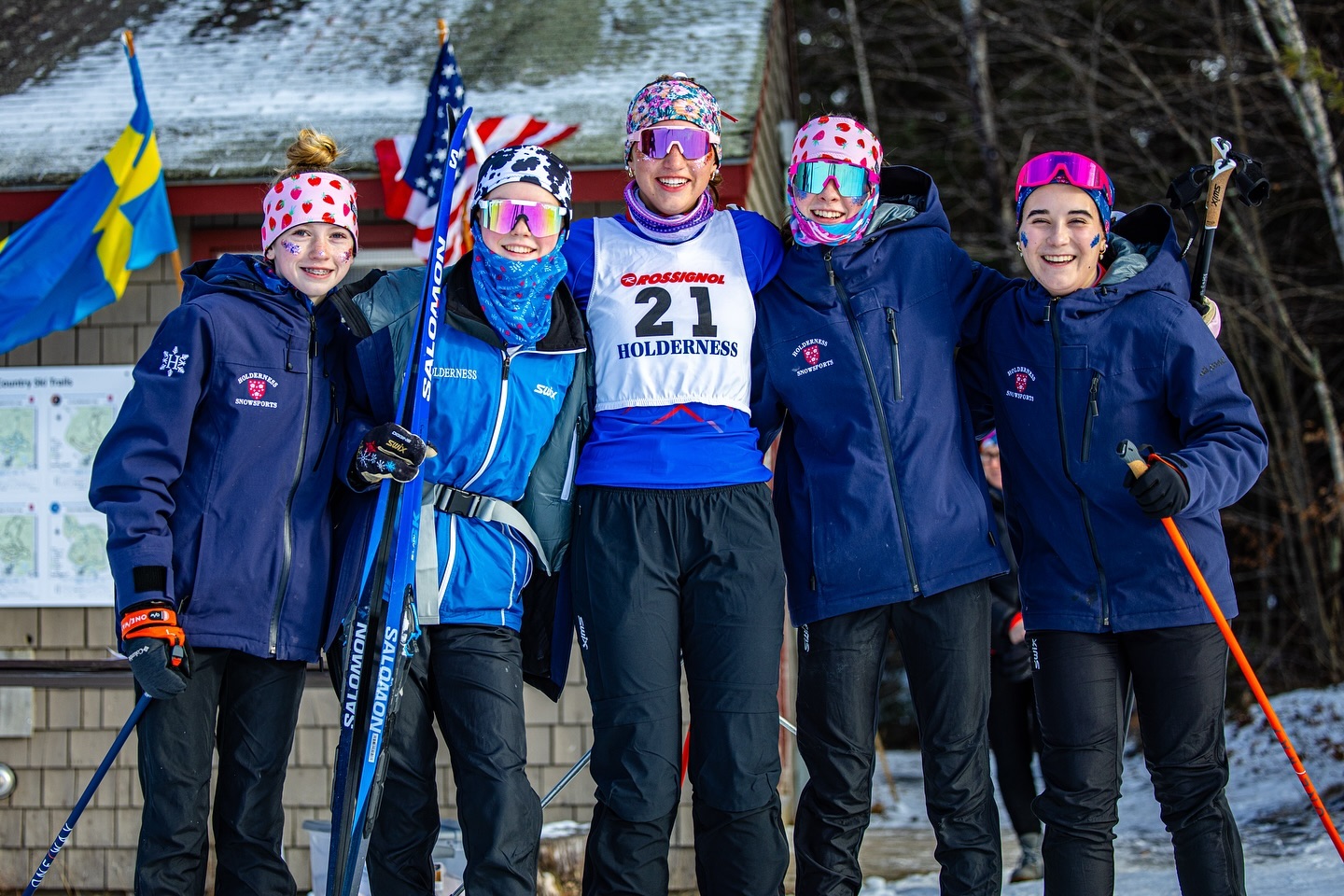
Holderness School seeks a full-time Nordic Program Director to promote passion and spirit for the sport of Nordic skiing. Reporting to the Holderness School Snow Sports Director, Ben Drummond, this position contributes to the overall success of the school’s on-snow programs. The role is responsible for managing the newly homologated Davis Cross Country Ski Trails, with coaching, instructing, recruiting, and building the ski community at Holderness.
Holderness School occupies an important place in the New England Nordic skiing community through its history of instruction and competition, its updated facilities, and its long commitment to junior athlete development. US Ski & Snowboard has named Holderness School a USSS Gold-certified club and a high-performance center, the highest honor awarded to an affiliated ski program. Gold-certified clubs possess a heightened level of accountability to maintain and build upon areas of both strength and improvement, to ensure the longevity and stability of the organization, and to help, through feedback and observation, to grow the cumulative strength of clubs throughout regions and across the country.
Overview
Located amid the lakes and mountains of central New Hampshire, Holderness School is a traditional co-ed independent secondary school, serving grades 9-12. Holderness strives to strike a balance in fostering the resources of the mind, body, and spirit: the mind through a challenging college preparatory curriculum; the body through outdoor activities and required interscholastic athletics; and the spirit through school and community service and affiliation with the Episcopal Church. Holderness remains, by choice, a small school where everybody plays an important role and where students, faculty, and staff maintain close personal relationships.
Diversity Mission Statement
Holderness School is committed to being a community that celebrates and supports diversity in its many forms because multiple perspectives and experiences are vital to educational excellence and strengthening our community. Diversity refers to the human facets of race, ethnicity, national origin, religion, gender, sexual orientation, age, ability, and socioeconomic status. Holderness strives to create opportunities for cooperation, broaden the educational experience of all students, and enrich the lives of all community members.
Essential Duties and Responsibilities
Specific responsibilities include, but are not limited to:
Recruit, develop, mentor, and coach the Holderness School Nordic Ski Team.
Collaborate with Head Coach Pat Casey to develop and implement a training and competition plan for the Holderness Nordic team and Holderness Nordic Club Eastern Cup Skiers.
Collaborate with the Director of Facilities, CFO, and the snowmaking team on snowmaking schedule, quality, depth, and grooming.
Schedule, plan, coordinate, and host large events such as the Lakes Region independent school league, the state-wide Coaches Series, and the New England Nordic Ski Association (NENSA) Eastern Cup races and Championship Events.
Develop, maintain, and communicate training records, race schedules, skier goal sheets, and end-of-season skier evaluations to parents and skiers. Review the evaluation with every athlete and parent to ensure complete understanding.
Ensure skier safety.
Participate in three on-campus student-focused weekends per year, facilitating weekend activities for students.
Coach one Fall or Spring season of sports or activities.
Be available for race duties at race venues. Attend required department meetings and regular meetings with the Director of Snow Sports.
Plan and participate in travel and coach at Lakes Region and NENSA competitions across the Northeast; national and international travel if athletes qualify for national or international championship races.
Oversee club activities including marketing, membership, trail access, and annual club activities, including Bill Koch Youth Program and Holderness Middle School Team.
Promote the development of character, community, and curiosity in all dealings with students. Support the mission and philosophy of Holderness School by acting as a positive contributor to the school community, actively participating in the school’s life as a role model of appropriate behavior with students, parents, colleagues, and other members of the school community, and enforcing school rules.
Pursue opportunities for professional growth on an annual basis.
Other duties as assigned.
Qualifications
Interest in and demonstrated skill working with adolescents.
Knowledge of ski training and technique.
Bachelor’s degree required.
Ability to connect with junior racers.
Ability to collaborate and work as part of a team.
A commitment to an inclusive community; experience or interest in integrating diversity, equity and inclusion into the curriculum is essential.
Ability to make contributions to the School outside of snow sports, including athletics, extra-curricular programs, and residential programming.
Valid Driver’s License and clean driving record.
The Process
If interested in this position, please send a resume and letter of interest to holderness-employment@holderness.org.
Application material received before April 1, 2025, will be given priority consideration.
Holderness School offers a comprehensive benefits package that includes health, dental, vision, life insurance, generous retirement match, tuition remission for dependents, professional development opportunities, use of grounds and facilities, and meals when school is in session for you and your family. This is a year-round position.
All employment is contingent upon the successful completion of a criminal background check.
Holderness School is an equal opportunity employer and will not discriminate or tolerate discrimination against any employee or applicant in any manner prohibited by law.
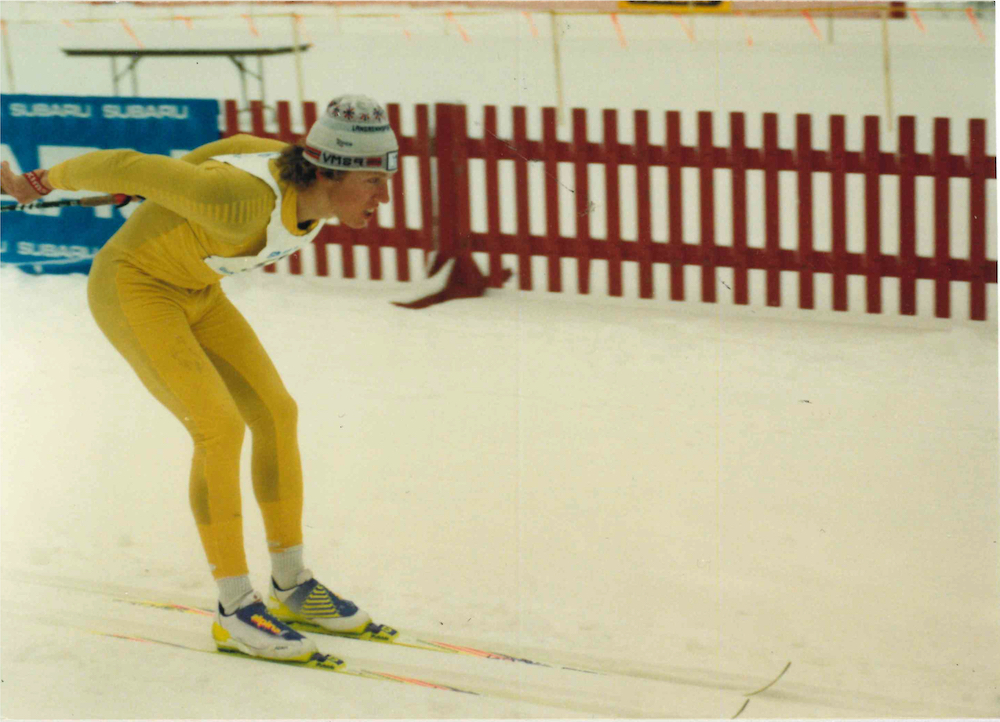
“1992. Senior year of college. Biwabik, Minnesota. Another cold day. Olympic trials. I was in the top ten in every race that week and came about as close as possible to making the Olympic Team without making it.” (courtesy photo)
Editor’s note: This is the second essay in our new series, “Letters to my younger self.” Lauren Fleshman provided the modern locus classicus for this genre; Adam Verrier ably takes up the mantle here. While the first two essays, from Adam now and John Wood before him, have set a high bar, the general theme of this series is clear: If you were writing a letter to your younger self, what would you want to tell them about skiing, life, or skiing and life? Additional contributions from our readers are respectfully requested and gratefully accepted; see the bottom of this article for our contact info.
Adam grew up in New Hampshire, as he discusses in this memoir. He skied collegiately for the University of Wyoming, when it had an NCAA ski team, and was a nordic ski Olympian at the 1994 Lillehammer Games. He began dominating Anchorage endurance sports soon after, with wins in the Crow Pass Crossing, Lost Lake Run, and Tour of Anchorage among many other items on his local race résumé. He has the all-time record for podium finishes in the Tour of Anchorage 50k skate, the unofficial Alaska citizens championship contested by dozens of Olympians over the years, with eight. At 53, Verrier recently qualified for the classic sprint heats in a loaded Anchorage JNQ field, only to bow out so that a junior could race instead. He has announced numerous prominent American ski races. He founded the iconic Oosik Classic ski race now held in Talkeetna, Alaska. And he is a very, very nice guy.
But “None of these things define who Adam Verrier is,” current University of Alaska Anchorage head coach title Sparky Anderson wrote in a recent blog post. “Adam is a musician, a connoisseur of experience, deeply interested in anyone lucky enough to engage him in conversation, a rural Alaska home appraiser, and an avid clothing-optional motorcycle operator.” As Anderson also notes, Verrier has been a volunteer assistant coach for the UAA ski team since 2001. Verrier keeps a delightful, sometimes idiosyncratic blog about the UAA nordic team here.
By Adam Verrier
Dear Seventeen-Year-Old Adam,
I’ve been asked by FasterSkier.com to write a letter to my “younger self.” So this is your future 53-year-old self, with some advice and some insights based on the intervening 36 years’ worth of life experience between you and me. (By the way, FasterSkier.com is a “website” on the “internet.” Since it’s 1985, you’ve probably never heard these terms before, but that’s a topic for another conversation.)
Under normal circumstances, I’d never write to you from the future and spoil your suspense. After all, isn’t life all about finding your own way forward, being ignorant but curious, charting your own course, trying to make good decisions, and hoping for a little luck, too? To write to you from the future with the answers seems like a great way to deprive you of most of the excitement and joy that a life has to offer. So ordinarily, I would never agree to this. But since I don’t believe in time travel, I’ve agreed to participate.
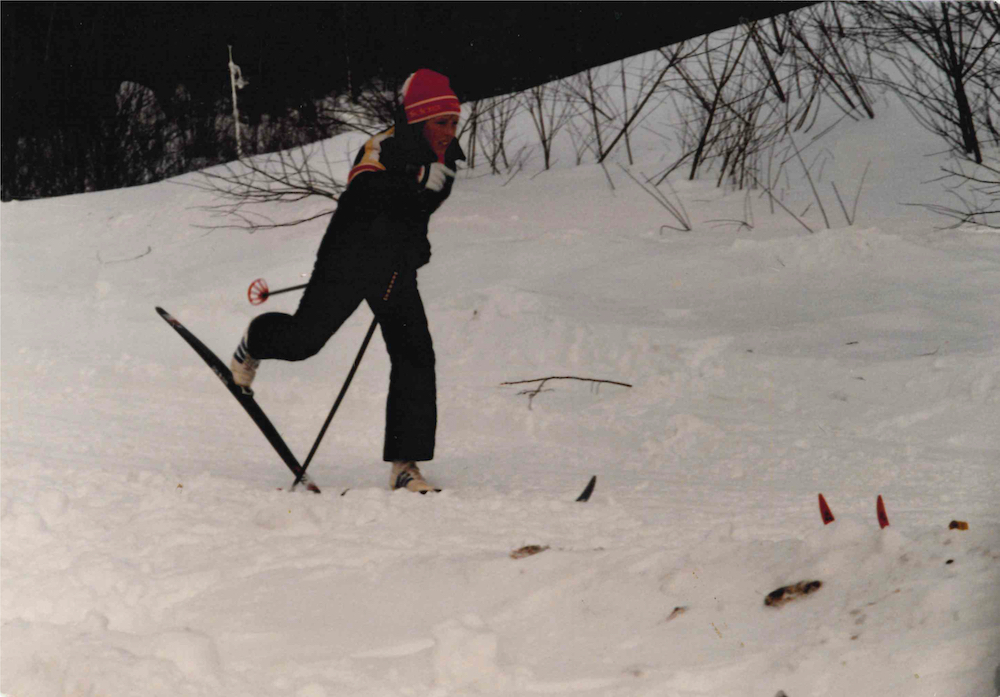
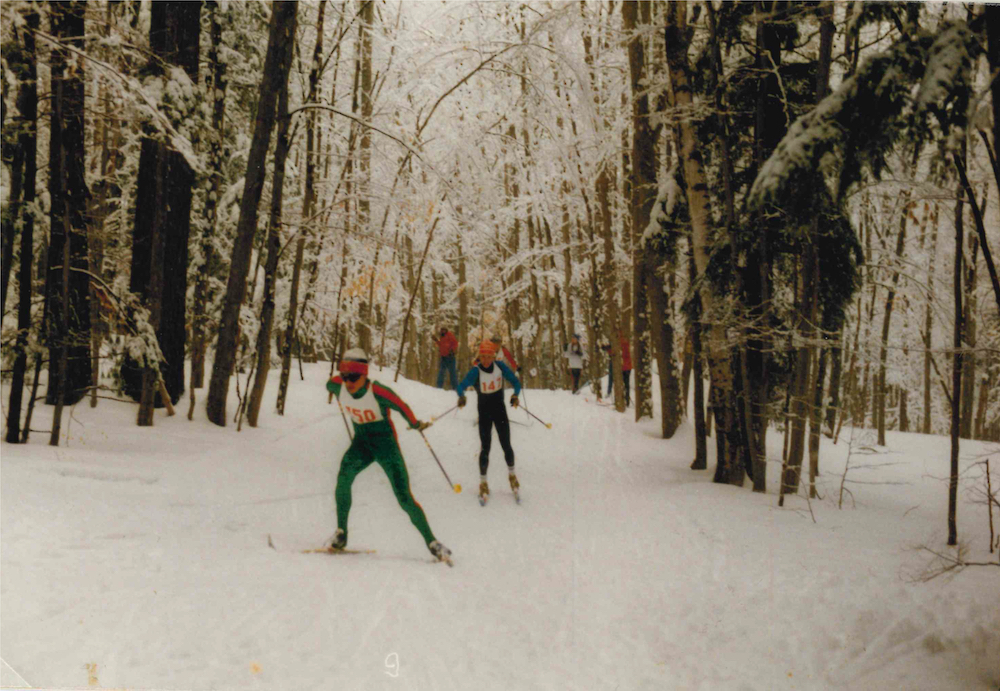
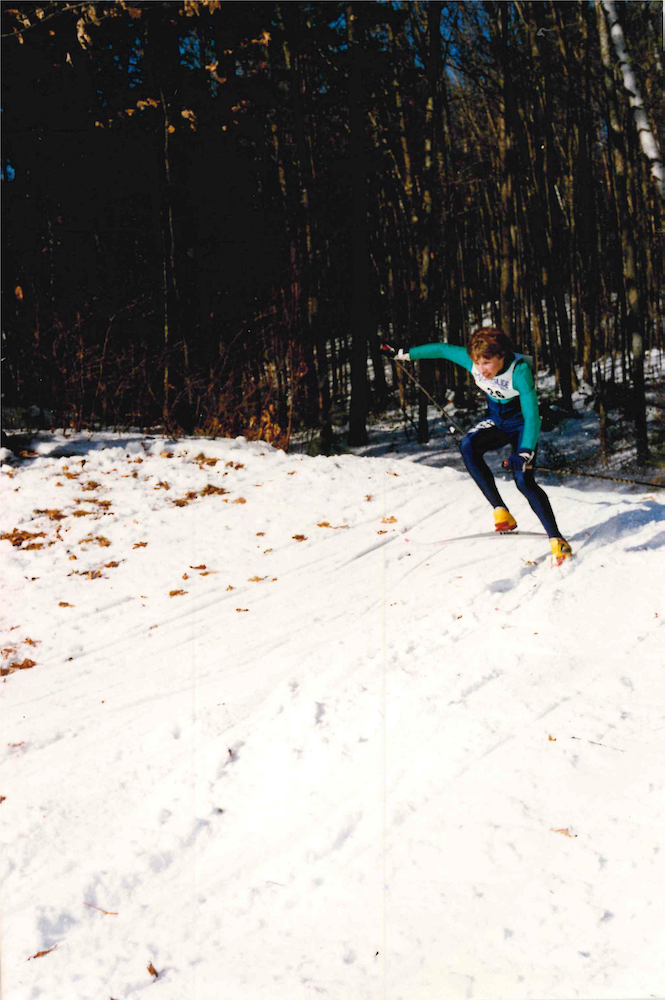
“Probably 1984. Bretton Woods, NH. I remember it was FREEZING cold that day!” (Courtesy photo)
As fate would have it, I had a conversation just last week about pretty much this same topic during ski practice with the women on the college team that I’ve been volunteer-assistant coaching for years. It was suggested, during our warm down after a set of intervals, that I use my little mobile recorder to tape conversations with them – our college skiers – about skiing, about life, about their hopes and dreams – and then we could listen to it 20 or 30 years in the future and see how differently things will turn out in reality, as compared with how we now think they will.
When I was their age, I had such a dramatically different set of goals and ambitions for myself from what has actually transpired over the years from then until now. I never would have imagined my life would follow the path that it has, and I’d have never imagined that I’d end up living in Alaska. And I expect they’ll feel the same way thirty years from now. Because, really, isn’t it that way for most people who are curious and open to new ideas and new experiences?
At this point in your young life, Adam, I know that things are looking and feeling pretty dark. High school is a struggle, and you hate it. It seems you’re spending all your time studying and doing homework, and trying so hard just to get C-minuses. No matter how hard you try to understand it, algebra doesn’t make any sense at all, chemistry is beyond your comprehension, and your English teacher thinks your writing sucks.
Cross-country skiing is your favorite sport, but you’ve never really been very good at it. I mean, yes, good locally against your friends, but you’re not remotely in the same league as the best skiers in the New England. You’ve been racing in all the New England qualifying races, trying to make Junior Nationals for years, but have never qualified. And you’ve never even been very close to making it. You want to go to college but there’s the question of how to pay for it. Joining the military and using the G.I. Bill to go to college like Uncle Tommy seems like the most likely route, but there’s also the chance that distance running could get you a Division 1 college athletic scholarship. Because running is the thing that you’re actually very good at. Problem is, while you love cross-country skiing, you dislike running. You find it jarring and uncomfortable, and you can’t imagine having to keep doing all that running, all the way through college. You feel like you’d probably rather join the military.
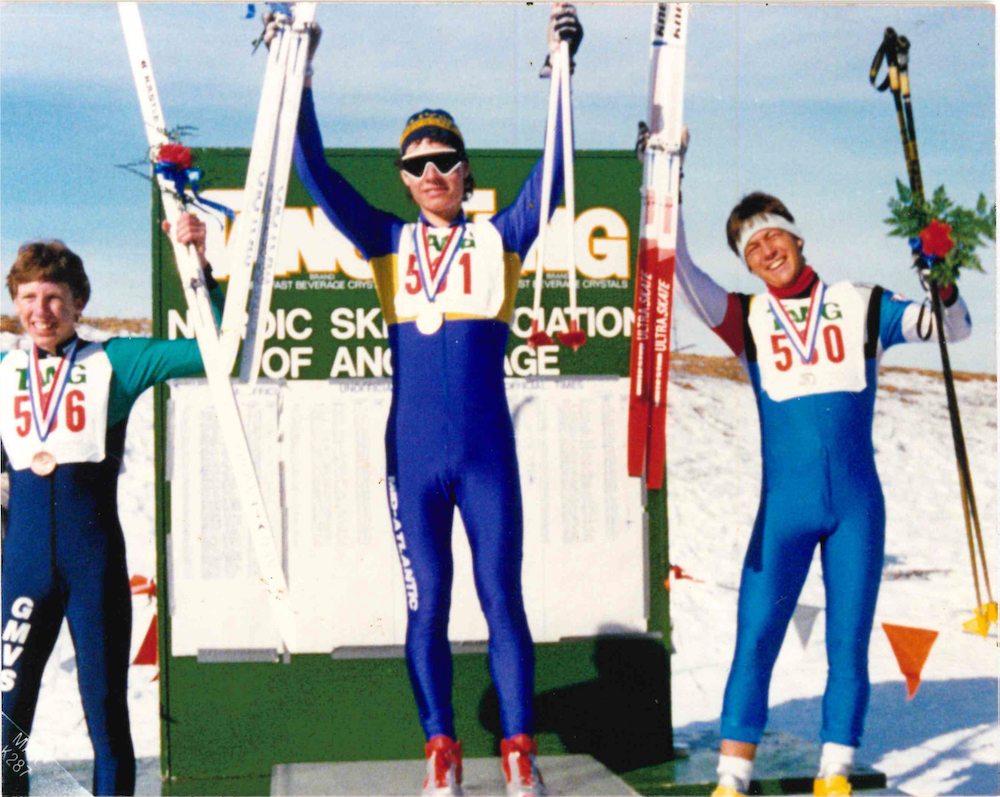
“Getting my first look at Alaska. Junior Nationals. 1987. I was third [far left]. That looks like Jeff Graves in second. And Ed Lynt in first.” (Courtesy photo)
As I said earlier, I’m now a volunteer assistant ski coach for an NCAA ski team. Yeah, seems hard to imagine now, doesn’t it? I get to be the “team uncle” to this group of kids (older than you, I know, but I call them kids) who are talented and smart and ambitious. When I think back to when I was seventeen, it seems unimaginable that I’d go from being a frustrated high-school athlete with a strong work ethic but dim prospects, to being someone that they’d let hang out with a group of elite athletes like we have here on this college team. But somehow I went from there to here. And I’m going to tell you how I think it happened. I will tell you what your future has in store for you, and how I think you could do a lot better, with less frustration and misery than what I’ve put myself through.
In the very near future, you’re going to have some luck in one particular ski race – the New Hampshire state high school championship. Due to some inclement weather conditions (heavy snow and rain on race day) and because you’ll have extraordinarily fast skis on that day (due to pure luck with the weather – maybe all those rocks you’ve hit gave your bases lots of anti-suction structure to handle the soggy snow) you’ll win a race against skiers who are usually a lot faster than you. This one lucky result will open a door, which will lead to other opportunities, and your goals and ambitions will change with each new result and new opportunity.
“New Hampshire State High School Championships. 1986. Carl Swenson in front, obviously knew how to skate. Me, in back, obviously kind of fumbling around with it. But I won that race, somehow. That turned out to be a very big day for me.” (Courtesy photo)
I know that becoming a member of a college ski team doesn’t seem realistic now. It seems like either distance running or the military are the options for getting tuition paid for. Because you’re definitely not going to do it with an academic scholarship, the way things are going! But because of this one lucky race, you’re going to take the opportunity that’ll be offered to spend your senior year of high school at a ski academy. There, you’ll find out that you really don’t have very good skiing technique, and that this lack of technique is likely the reason your running is so much better than your skiing. You’ll also find out that, even though you train more, and far harder, than all your high school teammates now, you’re really not training very much at all, compared to the best in your age group. Finding out about this thing called a “training log,” and having teammates who are surprised you don’t know how to “V2-skate”… a lot is going to change in the near future.
One thing that’s going to keep changing is your goals and ambitions. I know what your goal is now: to find a way – any way – to escape rural northern New Hampshire and go west – anywhere west of the great plains – like your uncle Ronnie who escaped New England and became a cook at a restaurant in Lake Tahoe. Uncle Ronnie’s accomplishment – his escape from rural life – has been your ambition for as long as you can remember.
But you’ll find that just one year at the ski academy (Green Mountain Valley School), coached by one of most energetic and extraordinary women you’ll ever know, will change your thinking dramatically. Having never qualified for the New England Junior Nationals squad, you’ll finally qualify next year as an eighteen-year-old, and then actually win gold and silver at Junior Nationals, and it will seem very surreal and weird, like it’s not even you doing the skiing that week. Because everybody, especially you yourself, knows that you’ve never been fast enough to beat any of these other kids; they’ve always been much faster than you. But you’ll have to reconcile yourself with this new reality.
This result will provide the opportunity to be on a Division 1 college ski team. It will provide the opportunity to go west. To the University of Wyoming! As a high school senior, your goal will be, by the time you’re a senior in college, to get a few top-20 finishes in some western college races. If you can accomplish this, you’ll feel like you can legitimately call yourself an elite skier and a big success.
Summer 1994, Östersund, Sweden, US Ski Team training camp. Cart racing on our day off. Back row from left: Ben Husaby, Coach Sten Fjeldheim, Todd Boonstra, Justin Wadsworth, Verrier, Marcus Nash, Carl Swenson. Front row from left: Leslie Thompson, Suzanne King, Kerrin Petty, Nina Kemppel, Laura Wilson, Pete Vordenberg. (Courtesy photo)
I know this is going to sound utterly unbelievable to your 17-year-old self, but one thing is going to lead to another, and there are actually going to be some college wins in your future. There’s even going to be some World Cup racing and an Olympics. I know that this isn’t even remotely on your radar at this time in your life, but you’ll be shocked at how your future reality will differ from the way you imagine it now, when your only goal is to escape from this dark, rural life in this little town where it feels like nothing has ever happened, and it seems nothing ever will.
One thing that’s going to be of use to you as you move upward and onward in this sport is your inclination toward angst and melancholy. The discomfort that’s endemic to this sport will be an opportunity to explore your tendency to gravitate toward the dark and difficult, and toward isolation and self-reflection. Your most memorable, most rich, most intense workouts will be the ones done alone, in driving snow, in the dark, and half-lost. And your most successful races will be those rare occasions when you can manage to manipulate your own reality, to convince yourself that discomfort is no longer part of the equation, and that the ski race performance is more important than life or death. That the immediate moment is everything – is the only thing. It’s quite a stretch. You’ll learn some real mental gymnastics to manipulate your perception of reality for the purposes of a good race performance. For now, this penchant for despair and darkness mostly manifests itself as raw angst. But you’ll find, when you learn to work with it, that it can be a powerful tool in a sport like cross-country ski racing.
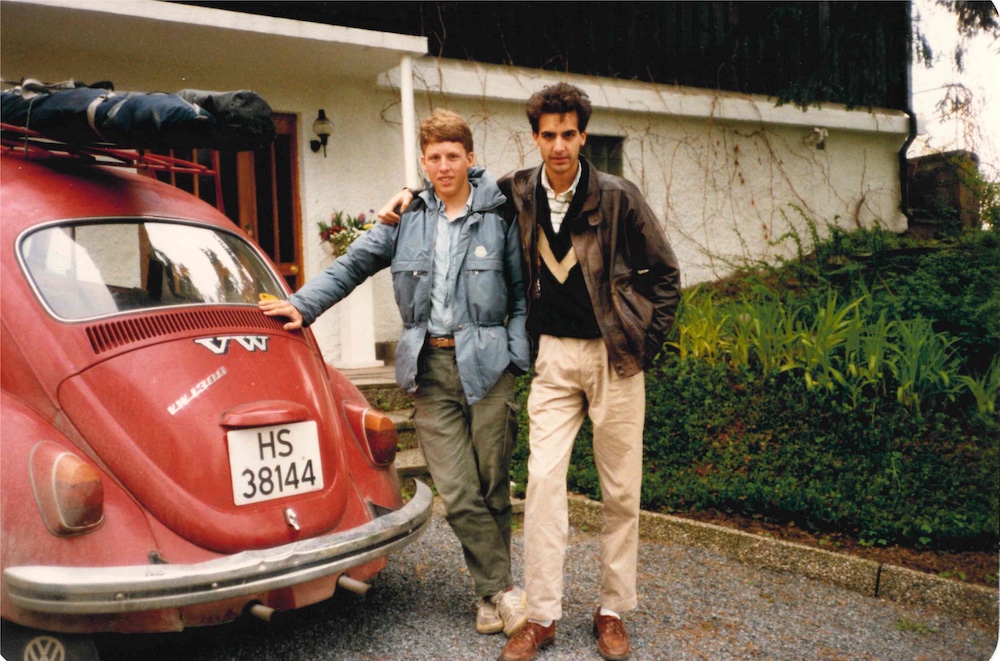
Verrier in Nesbru, Norway, outside of Oslo, in 1988. “With my 1962 VW Beetle and my friend Tariq Eik,” he writes. (Courtesy photo)
But the coin has two sides, and you’re going to see your friends and teammates struggle with some of the same feelings of futility and desperation that you have now. Many of your friends, teammates, and competitors are not going to survive their twenties. You’re going to be left shocked and speechless every time you hear about another friend.
You’ve heard it said that your brain is your most important muscle in sports, and I know you think that’s nonsense – everyone can see that it’s your heart, lungs and muscles that are most important in this sport. But you’re going to find out as you get older that it’s actually true; your brain really is your most important organ. Without focus, without willpower, without problem-solving, we’re not going to accomplish much. My friend Roy, who was an all-star Division I college basketball player and went on to play a decade in the pros, told me recently, “When I was younger, I wanted to explore the limits of what my body could do, but as I got older I gradually became a lot more interested in exploring the limits of my mind.”
Now I have some advice for you. If you want to do better at this sport than I did, spend less time thoughtlessly bashing yourself through workouts than I did. Instead, find ways to train smarter. Don’t just take all your coaches’ advice and grind through the training on the presumption that if you just do the workouts prescribed by whomever your coach happens to be, the success will automatically follow. That’s not a given. The most successful athletes in any sport have always been the creative ones who found their own way to do things nobody had done before. Among skiers, Bill Koch, Gunde Svan, Marit Bjørgen, Kikkan Randall, Petter Northug, Bode Miller… all of these skiers did things their own way, and in so doing became the best, or among the best, in the world. And the most successful skiers I’ve known here at UAA have been the ones who haven’t always agreed with what their coaches have told them. They’ve had their own opinions and they’ve been pretty stubborn. The best skiers I’ve known here at UAA… coaching them has not always been a picnic.
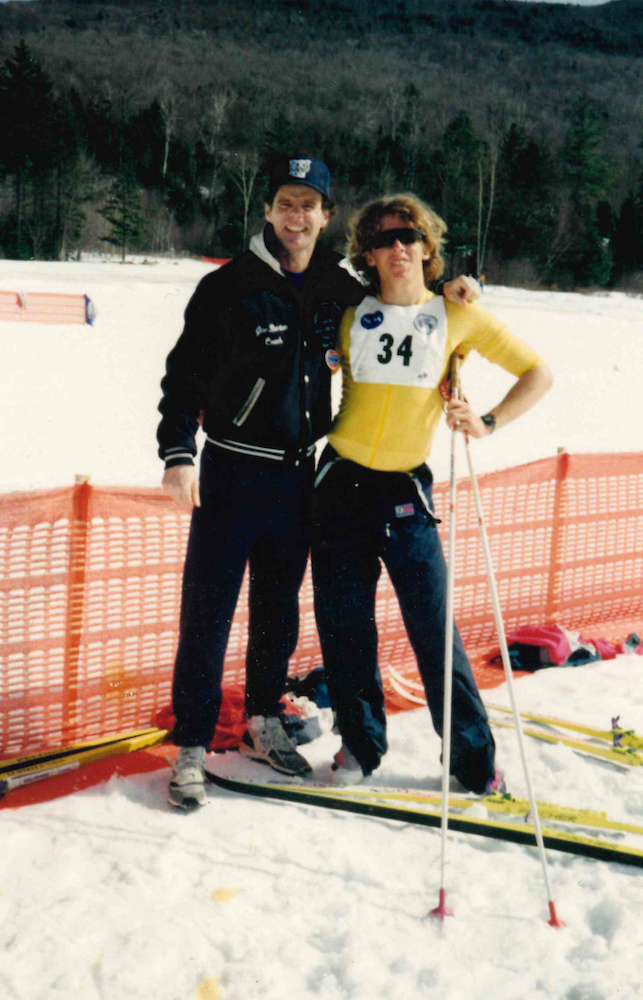
1992 NCAA Championships. Waterville Valley, NH. With my friend Joe Barton. (Courtesy photo)
The most important think that you should know, though, is that success in this sport is not going to turn you into something else; it’s not going to get you millions of dollars and a future in Hollywood. I know (because I remember) that you have this vague notion that there’s some kind of firm and defined dividing line between “success” and “not success” in this sport. I know that you have this foggy conceptualization that if you can achieve “success” by whatever criteria you’re defining it at the moment, then everything will be OK, you will have “made it” and you’ll be happy and satisfied and relaxed and proud of yourself. And I know that you don’t allow yourself to think about the consequences to your psyche if you don’t achieve “success,” whatever that means.
But I can tell you now, as your future 53-year-old self, that the reality is nothing like this. For example, my biggest regret in skiing is not quite ever winning an NCAA Championship. I came very close a couple of times, but never quite pulled it off. Nevertheless, the time I came closest was when I was beaten by my teammate in one of my best, most focused, and most excellent races ever. It was such a dramatic and fun day for me! Thus, as it turns out, my biggest regret in this sport is also one of my very favorite and most special moments.
You think that “success” and “not success” are defined by results, on paper. But I can tell you that, in hindsight, one of my proudest moments in this sport was a few years ago when my friend Ian told me that he used to call me “The Scrapper” because it was his impression that I would never give up, regardless of how well or how poorly I was doing. If there was going to be a battle for 467th place, I was going to fight hard to win that little battle. It made me feel so good to hear that from Ian, who is the same age as me but has always seemed to me like a role model, much more mature and a far better athlete than me, ever since we were young. Hearing Ian say that to me felt as much like “success” as I’ve ever felt.
“Success” and “not quite” are not nearly as defined and concrete as your young mind now conceives them to be. You’re going to find out, gradually over time, that your definition of success will morph and change in relation to, and in synch with, your goals. You’ll recalibrate to your successes and you’ll rationalize your failures. And you’ll also find out, because you’ll have friends with Olympic gold medals, that after the elite-level skiing is over, life goes on and these people do normal-people stuff just like you and me, with jobs and spouses and dinner parties and divorces and mortgages and everything else.
After the ski racing career is over, the most important and salient thing you’re going to be left with, contrary to this vague idea you have now, is not going to be a million dollars or a Hollywood acting career or free beers for life.
The most important and lasting thing you’re going to be left with is the memories of the good times you’ll have, and the friends you’re going to make.
As my friend Lucy, who was on another country’s national team, and about the same age as me, and whom I visited earlier this fall while on a motorcycle trip, said, “I can’t hardly remember what I had for breakfast this morning, but I remember all those crazy times racing in Europe like it was yesterday, and all the friends made along the way. And those good times and those good friends are the most special thing.”
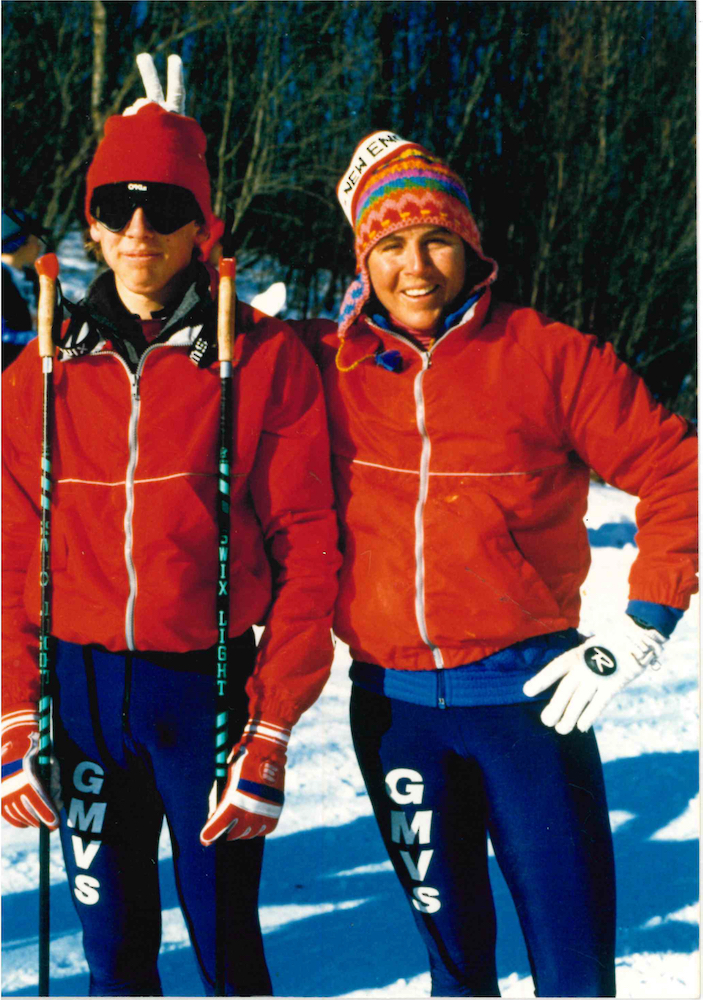
1986, 18 years old, with Muffy Ritz, who had a big influence on me. (Courtesy photo)
So now, as I’m writing to you, they’re letting me be a volunteer assistant coach for a group of kids who are just a few years older than you are now. I hate to break it to you, but these kids seem much more mature and pleasant to be around than you will be when you go to college in a couple of years. Your college life will be a lot more pleasant for you and those around you if you could just dial down the intolerance and dismissal of your teammates’ goals which may be a little different or a little less all-consuming than your own. You could learn a thing or two from one of our current UAA kids, who is a lot better skier than you will be, who told me a few weeks ago that if he couldn’t be a personable and friendly guy for his friends and teammates to be around, he would quit the sport. Because it wouldn’t be worth compromising his humanity just to be a successful athlete. I found this statement shocking and profound, and I’ve been thinking about it a lot lately. It occurred to me that when I was his age, I had pretty much the opposite point of view. And it probably showed.
Seventeen-year-old Adam, you have a lot to learn in the years ahead. But even now, I’m finding out that I have so much to learn from the young people I’m around. This volunteer coaching gig gives as much to me as I give to it. The energy and curiosity of our skiers goes back with me to my “day-job” office after ski practice and influences how I handle the rest of my day. Their optimism and vigor inspire me to try new things and take chances for myself. Their search for purpose and meaning nudges me out of my own complacency, both physically and mentally.
“1987, Holderness, NH. First time I qualified for Junior Nationals. 18 years old.” (Courtesy photo)
Ultimately, my advice to you, seventeen-year-old Adam, is to tone it down with the obsessing and worrying about the future, and about achieving success. Connecting with the experiences and the people around you won’t prevent you from training hard or training smart. Enjoying the journey won’t preclude success. The fire and brimstone stuff is great as a race-day tool to help you achieve a transcendent performance, but it has no place in the team van.
And ultimately, none of this matters as much as you think it does.
* * *
If you are interested in submitting a letter to your younger self, or know of someone with a compelling story that might be a good fit, please contact us at info@fasterskier.com with questions or for more information. Don’t be put off by Adam’s credentials; we’d love to hear from you even if you’re not a former Olympian.
Dublin School, an intentionally small 9-12 co-ed college preparatory boarding school located in beautiful, rural southwestern N.H., seeks a Mathematics Teacher and Nordic Coach to join our community.
As a residential boarding school, employees are expected to fill multiple roles. The successful candidate for this position would be expected to teach four sections of mathematics, coach Nordic in the winter, and perform dorm duty and serve a regular rotation on a duty team. Dublin is looking for a candidate with a passion for mathematics and integrated science education.
Dublin’s 160 students are required to participate in a range of competitive athletic and other afternoon activities. These include alpine skiing, basketball, crew, cross country running, dance, equestrian, lacrosse, mountain biking, Nordic skiing, sailing, snowboarding, soccer, tennis, and ultimate. We have particular strength in endurance athletics.
Situated in the highest village in New England with perfect weather and landscape for training, Dublin has the resources to support every level of athlete. We have over 15 miles of trails on our 400-acre campus including the first high school Nordic ski course in the world to receive a certificate of homologation from The International Ski Federation (FIS) allowing Dublin to host international Nordic ski events. With over 600 feet of vertical gain on campus, our trails can create any level of challenge for biking, running and skiing.
Cross-country skiing has enjoyed a renaissance at Dublin School with the team growing to over 30 student-athletes. The Boys’and Girls’ Team won the Lakes Region Championships in 2017 and the Boys’ were 2017 New England Champions as well. Our fully homologated Nordic Center is one of the most enjoyable and exciting ski venues in the east. The trails reach 1800 feet above sea level, face north, and receive and retain significant snowfall.
The School recently completed a brand new Outing Club that has ski storage, waxing rooms, a ski lodge, and a new trail to the Nordic Center from the front door. When not out skiing the trails, running up Mount Monadnock or roller skiing by lakes on the beautiful back-roads of southern New Hampshire, the team uses the Whitney gymnasium for strength and circuit training.
Benefits: As a residential school, Dublin School is committed to attracting and retaining the highest quality faculty and staff through a substantial compensation plan, including competitive salary, TIAA-CREF retirement benefits, full medical coverage and optional dental, life insurance and long-term disability, on-campus housing and tuition remission to Dublin students of faculty/staff members.
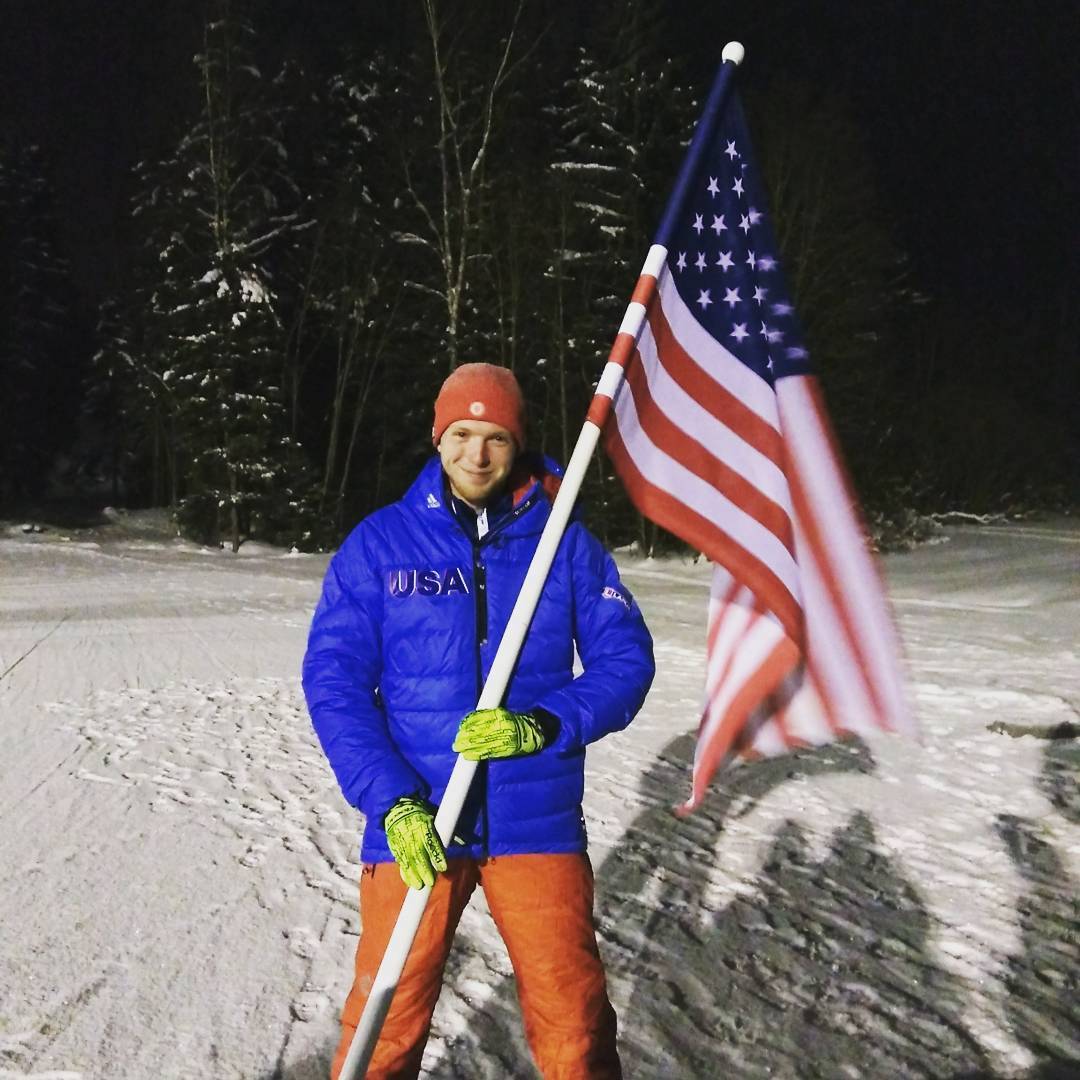
Tim Cunningham, of the St. Lawrence University Ski Team, representing Team USA at the 2018 IBU Youth/Junior World Championships in Otepää, Estonia. (Courtesy photo)
In an effort to showcase the North Americans competing at this week’s International Biathlon Union (IBU) 2018 Youth and Junior World Championships in Otepää, Estonia, we asked those qualifying athletes several questions about themselves — actually, we had them fill in the blanks. Here we have 19-year-old Tim Cunningham, a freshman on the Saint Lawrence University ski team who is representing the United States at his first World Junior Championships.
On Tuesday, Cunningham was part of the U.S. junior men’s team that finished 19th in the 4 x 7.5 k relay.
***
“My full name is Timothy Michael Cunningham, but you can call me Tim. I’ll probably answer by name but if you want better odds than that come shake my hand. It’s a more memorable introduction because it requires you to make eye contact, else it would be very weird and uncomfortable.
I was born in New Jersey, but I was raised in Springfield, N.H., and I learned to ski at Kearsarge Regional High School my freshman year. I was told I’d get to do biathlon. Little did I know they meant paintball biathlon. Not the same thing.
I spent the time between World Youth/Junior trials and Worlds mostly skiing, but also classic striding occasionally and studying a great deal of the time.
The most fantastic workout I did in the last training year to prepare for this was the USATF Mountain Running Championships 10 k on Mt. Cranmore. That was an exciting time in my life, I got to run the race in silence, just me the 53% grade on the last 500 meters to the top, and my demons.
I’m still learning the ropes of the sport, I started really training for biathlon August 1st of this past summer (2017) so the things that I’m really working on to improve my biathlon are my prone position (natural point of aim and relaxing) and racing like a biathlete, not a cross country skier.
This is my first time in Estonia and first time racing internationally, if you don’t count the Norwegian Birkebeiner, and so far, it’s been incredible. The course here in Otepää is really well built. It’s very tough out of the gate with really steep hills and sustained climbs but leaves room for good smooth skiing. There really aren’t any tough transitions on the course, just sheer fun.
Panorama shot of the 2018 IBU Youth/Junior World Championships venue in Otepää, Estonia. (Photo: Tim Cunningham)
One difference I’ve noticed between Estonia and the United States is they speak Estonian and serve pickled herring for breakfast.
One of the things I’m most excited about for World Youth/Junior Championships in Otepää is meeting a ton of new people from around the world and having some awesome race efforts on what may now be my favorite course.
One race I’m especially targeting there is the Individual race. It’s the longest race we do, which suits me, but it is also the first race I will do as a biathlete, not counting trials and the NorAm circuit.
Watching the Olympics in the leadup to my own races was motivating of course, but also a really good chance to see how other people, much better than I, handle the range at championship events. One of my favorite moments of the Games was watching to Jessie Diggins and Kikkan Randall win Olympic gold! That really motivated me to do well and maintain a good attitude at these championships in Otepää. Also, Martin Fourcade’s win in the Mass Start race was another one of my favorite moments.
At Worlds, I really hope I can chat/make friends with someone from every country. There are so many opportunities to learn about different cultures and people from very different backgrounds that it’s really hard to pick just one to want to talk to. I think the first thing I would ask someone is “What’s your name,” followed by general small talk. I’d like to learn a little bit of language from each country if possible, specifically “thank you” and “good luck,” or “have a good day/race.”
My favorite thing at the breakfast where we are staying is… well I don’t know what it is, it looks like wet feta cheese, yummy, but it goes really well with granola and berries, so I think I’ll keep eating it.
Before this trip, if you said “Estonia”, the first thing I’d think of would have been Otepää. There is an awesome video of Thomas Northug smashing a classic sprint in otepaa that I’ve seen numerous times.
Now that I’m here, I’m pretty sure something I’ll always remember will be… that’s hard to say. I’m hoping the best of this trip hasn’t happened yet. But so far, the most memorable thing has been traveling for almost a day to get here. I saw the sun and moon twice each between flying from the USA to Sweden and Estonia and finally taking the van to the hotel. And I get to do it again too! I will always remember this course though: it’s so well laid out, and with a gorgeous stadium and outer loop, that it will be hard to not miss in the US.
If I had a totally free day here and didn’t have to worry about race fitness or training, I’d spend it training and increasing my race fitness. But only for a few hours, every other hour would be spent exploring the mountains and talking to the locals about their culture and folklore. Also, their take on climate degradation and what they, as Estonians, are doing to decrease it.
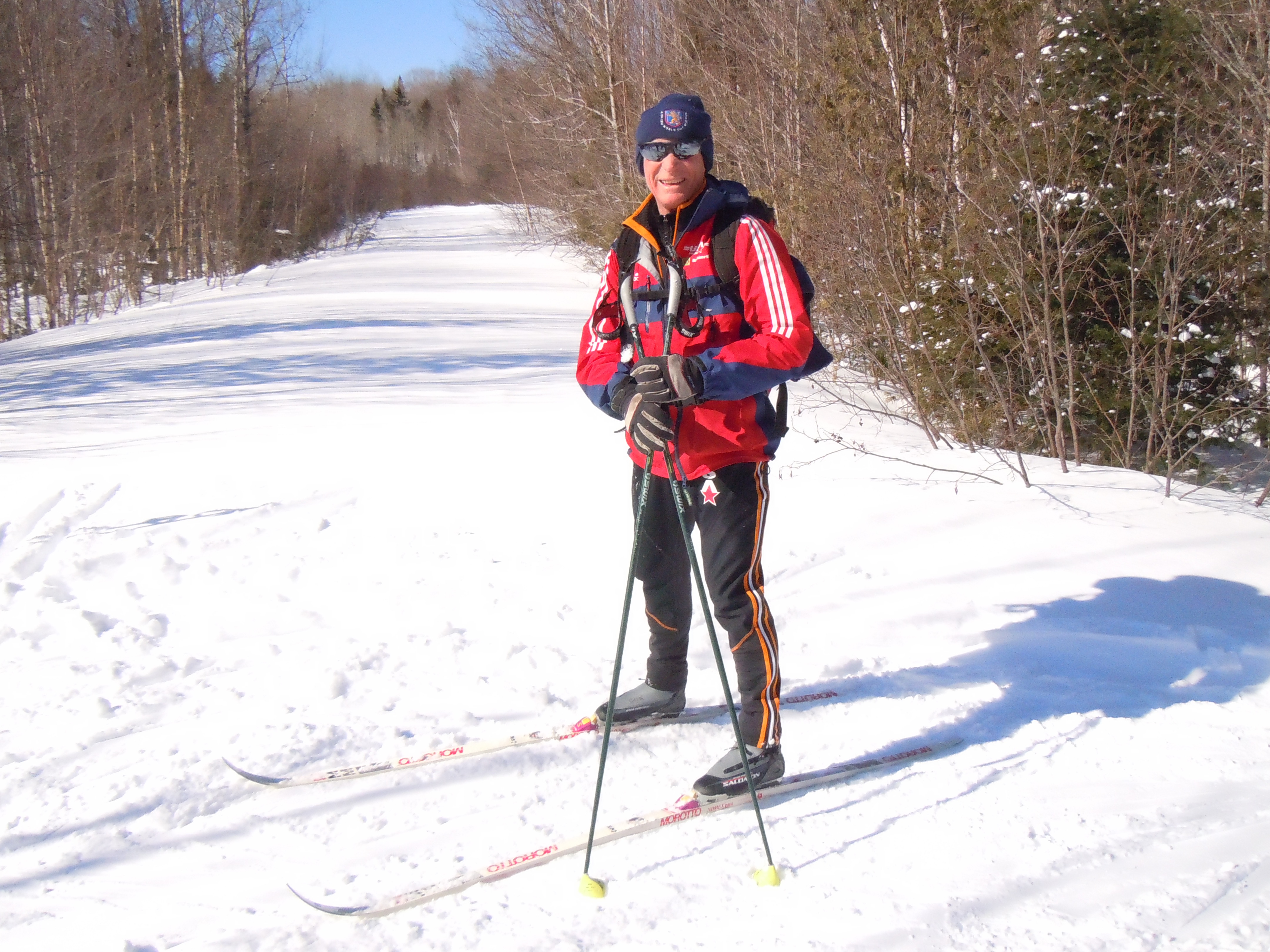
Charlie Kellogg skiing in Maine with the AMC alumni group the O H Association. (Photo: Doug Hotchkiss)
Bob Gray was hiking in the Sierra Nevada mountains, off the grid, when it happened. Later his phone began buzzing, and he learned that his former U.S. Ski Team teammate and friendly rival over decades and decades of races, Charles Kellogg, had passed away.
Gray was surprised. Kellogg had not been well, but the end came fast once months of excruciating pain was finally diagnosed as a malignant and fast-metastasizing sarcoma.
“It hit me hard,” the 76-year-old Vermont farmer said on the phone, still from the trail, last Saturday. “It could be me next… I miss him terribly.”
Kellogg, 75, had been one of the ties that kept Gray and the ski community together.
“It’s pretty much nose to the grindstone,” Gray said of his life at 4 Corners Farm in Newbury, Vt. “Charlie made a special effort to talk; he was always calling me up. It was great to talk to him. He would drag me out of that focused world.”
But while it’s hard for Gray, at the moment, to connect to Kellogg’s family or other friends, in a way the mountains are a poetic place for Gray to say goodbye to Kellogg, who was a longtime member of the Appalachian Mountain Club (AMC) and its alumni Old Hutsman (OH) Association, and who always made time for a ski or a hike, even if he had just flown back from a work trip to Asia.
“It’s been on my mind, these two days, just thinking about him,” Gray said. “I had nothing to do but walk and contemplate, without any distractions. It’s a pretty emotional moment for me.”
The Storyline
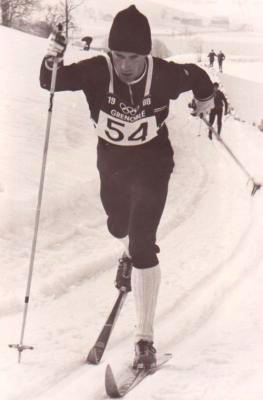
Kellogg competing at the 1968 Olympics in Grenoble, France. (Photo: US Biathlon Association)
Kellogg, a 1968 Olympian in cross-country skiing and a national champion, died a week ago on Sept. 21. Known as “Chuck” or “Spike” to some friends, Kellogg was an integral member of the nordic community, a mentor and friendly face to many on the trails.
As noted in his U.S. Biathlon Hall of Fame induction description, Kellogg wasn’t obviously bound for skiing glory from day one. But the guy who grew up primarily in Andover and Brookline, Mass., picked up skiing at Holderness Academy a few hours north in New Hampshire and never looked back.
And so perhaps his first impact on the sport was as the fast racer everyone was chasing: in college races for Williams College, then as he took up biathlon and eventually won a national championship in 1965, and then still as he competed as a cross-country skier in the Olympics and raced as a member of the U.S. Ski Team (USST).
“He was one of a group of half a dozen guys who I would describe as the early generation of capable international-caliber nordic skiers in this country,” said John Morton, an Olympian and coach. “There were a couple of individuals who preceded them, but… I remember when I was on the U.S. ‘B’ team, and those guys set the standard, and the rest of us just desperately tried to keep up.”
Gray remembers a relay race in Reit im Winkl, Germany, in 1968.
“Charlie came in in the lead, and Jack [Lufkin] kept it, and I was able to hold on – we won a relay race in Europe,” Gray marvels. “It was amazing. Everybody was going crazy over there. It was kind of unusual for an American team to win a relay.”
Kellogg’s race career never really ended. In 1998 he won a World Masters Championship in Lake Placid, N.Y.
There, too, Gray was Kellogg’s teammate.
“Neither he nor I had very good points,” Gray remembers. “We started in the back. But we both had incredible skis so together we made up to the front through 80 people. All of a sudden we were in the lead. I couldn’t hold it up – Charlie went on to win. He’s a great skater! Talk about tough competition, that’s the best of the best. I know he was very proud of that.”
Kellogg never boasted about his success, and not all of his friends were familiar with the details of his ski career. But it’s possible to be humble and proud at the same time, and Kellogg was.
“He was very proud of his achievements,” said Doug Hotchkiss, a friend from near Kellogg’s home in Massachussetts who was part of a nonprofit board and also the O H Association with Kellogg. “Of course, he was very modest, so you would never know it unless you asked him about it. But then it was clear.”
No matter which year you ask about, his friends and teammates will tell you that he was a great guy to be around. Kellogg was a role model for how to balance a job, a family, and high-level training.
“I always admired and was continuously impressed with how Charlie was able to balance his training at a high level while working full time for IBM and fulfilling his responsibilities and obligations as a husband and a father,” USST teammate Mike Elliott wrote in an email. “In the late 60s, there just were not many athletes who could do that successfully.”
“He was disciplined and a very tough athlete,” Gray agreed. “But just a real pleasure to go head to head with.”
Kellogg never stopped skiing – this year he competed in the White Mountain Classic in Jackson, N.H., and earned an age-group podium in the 10 kilometer at Masters National Championships in Craftsbury, Vt. – but as he grew older he also bettered the ski community in other ways.
His expertise as a board member was so impressive that a group of biathletes in 2006 lobbied hard for him to be elected vice chairman of the United States Biathlon Association (USBA).
“While most countries were increasing staff numbers, sponsors, and athlete support, many of us felt that USBA was headed in the opposite direction,” Lowell Bailey, one of the signatories on an open letter before the election, wrote in an email. “Charlie represented one of the new faces that we felt could help facilitate and oversee the difficult changes that USBA would need to undertake in order to remain competitive internationally.”
Kellogg, who worked in sales at IBM and later at Global Partners, had a knack for business and nonprofit interactions. He was described by colleagues in three different organizations as a model board member. Besides his help with USBA, he was also the president of the Manchester Essex Conservation Trust near his home in Massachussetts, and a board member of the Jackson Ski Touring Foundation, where he and his wife had recently bought a condominium.
How did he manage it all – these many tasks and passions which added up to more than most people could handle?
“He was hyperactive is what he was!” Hotchkiss remarked with a laugh. “But he loved it.”
And people loved Kellogg.
“We had a regularly-scheduled board meeting this week, and all of us were thinking how much we’re going to miss Charlie,” said Ken Kimball, a friend on the Jackson Ski Touring Foundation board.
The Hutsman
Before he became a full-time skier, Kellogg started working in the AMC huts. At just 16 years old, he spent his first season at Lake of the Clouds on Mount Washington in New Hampshire. Soon he was the hut manager.
His legend preceded him, said Hotchkiss, who didn’t actually meet Kellogg until later.
“Everything I ever saw him do, he led by example, not by being loud and boisterous and carrying a big stick,” Hotchkiss recalled. “I had heard of Charlie and seen that he had all kinds of records for speed hiking. In those days we kept records of the macho things – it was all boys working in the huts then, no women. It was how much weight you could pack, how fast you could go, all of that. That was the measuring stick amongst guys. How many dishes you could wash in as short a time as possible, how big a pancake you could make. Part of the fun of working in huts was bringing the crew together.”
When U.S. Supreme Court Chief Justice William O. Douglas visited Lake of the Clouds in 1960 with a National Geographic camera crew in tow, Kellogg was managing the hut. He ended up in photos in the magazine. He was 20 years old.
Working in the huts was fun and gave Kellogg a chance to stretch his legs. But working on Mount Washington, home to some of the most extreme weather on earth, was also serious. Kellogg wrote in a recent O H Association newsletter of going out in a gale to find and retrieve the bodies of two young hikers who had perished, dressed only in cotton.
“Of course the terrible visibility contributed to [a lack of volunteers] and the wind was keeping people inside their respective buildings where they plied their trade, such as TV broadcasting, checking weather or testing jet engines,” Kellogg wrote.
Weather didn’t keep him or his friend Greg Prentiss inside, of course.
The ties he forged, to other hutsmen, hikers, and the mountains themselves, stayed strong. Kellogg also worked as a mountain guide in the Grand Tetons at one point, and trekked in Nepal.
Hotchkiss soon met him again, this time in earnest.
“In 1978 when another Old Hutman and I showed up near Jasper in the Canadian Rockies to do a randonée ski trip,” Hotchkiss said. “We were flown back into a remote camp by helicopter, and then for a week we spent every day climbing up with skis with skins, and descending. Charlie was there with his wife and his brother-in-law and his wife’s sister. And so there were six of us who were connected, but we didn’t know they would be there!”
After a day of skinning up thousands of feet, taking a few runs, and then descending to camp, Hotchkiss was usually looking for “an ibuprofen and a beer.”
Not Kellogg or his wife, Gillian.
“Charlie and Gillian would put on their cross-country skis and go out for more skiing on the frozen lake,” Hotchkiss said. “Every day! And then be ready to go the next morning.”
While Kellogg spent a decade racing at the top levels of national and international competition, he was also just as happy going out on the trails with friends who hadn’t been elite athletes. He and Hotchkiss went on several O H Association trips to Maine, where groups of hutsmen and women could ski from the Little Lyford Ponds lodges.
“He was always miles ahead of everybody,” Hotchkiss said. “I’m sure you’ve been hiking with a dog, where the dog goes bolting ahead and eventually will return. That was Charlie’s method.”
While racing was something he loved – Gray and Morton both recalled that Kellogg would never, ever, let it go in a sprint finish, even after a marathon distance spent going together – non-competitive pursuits were also key.
“A lot of athletes, they have their competitive life and then they move on to something else,” Morton said. “They may be nostalgic about the old days, when they were in shape and could do the Presidential Traverse in a single day. Charlie Kellogg kept at it. He probably up until relatively recently could still do a Presidential Traverse in one day, and look forward to it.”
Kellogg was a lifelong steward of ski and hiking trails, as well, not just maintaining AMC trails or those at the Manchester Essex Conservation Trust, but then later in Jackson.
“As we looked at new trail configurations he’d be out in the field skiing around trying to find a new route,” said Ken Kimball of his time with Kellogg in Jackson.
“He was always miles ahead of everybody. I’m sure you’ve been hiking with a dog, where the dog goes bolting ahead and eventually will return. That was Charlie’s method.” — Doug Hotchkiss, friend of Charlie Kellogg
The Racer
After five summers of training on Mount Washington, in a systematized way or not, Kellogg was beginning to turn heads on the Eastern college circuit. By his senior year at Williams, in 1962, he was the captain of the team.
The next year, he headed to Alaska to join the Modern Winter Biathlon Team at Fort Richardson to fulfill his Army service. During the war, men like Peter Hale, Terry Aldrich, Dennis Donahue, Bill Spencer, and John Morton paid their dues at Fort Richardson, although not all overlapped with Kellogg.
“He said it was great,” laughed Hotchkiss. “He got to ski every day!”
In 1964 Kellogg went to Fairbanks for the Equinox Marathon, which his biathlon teammate Jerry Varnum won, while Kellogg was second. The Fort Richardson program was already a few years old at that point, but it was close to Anchorage, not Fairbanks. The pair’s exploits led the Fairbanks Daily News-Miner to write a blurb, “What does biathlon mean?”
Kellogg represented the U.S. in international competition including in Östersund, Sweden, where he was the top American finisher at the 1964 World Military Championships.
After leaving the Fort Richardson program, Kellogg went back to straight skiing.
“Charlie was very serious in training and when studying the sport of cross-country skiing,” Elliott wrote. “I have nothing but fond memories of my experience of training and racing with Charlie. John Caldwell, as the USST Coach, organized ski team members for running and hiking the length of the Long Trail in summer of 1969. Pictures of that experience shows a bunch of lean fit young men. On that trip were John Caldwell, Peter Davis, Everett Dunklee, Mike Gallagher, Tom Corbin, Ned Gillette, Bob Gray, Charlie Kellogg, Jack Lufkin, and myself, Mike Elliott.”
Gray, too, remembers that trip well – and the crew that went with it.
“It raised a lot of awareness for the team,” said Gray, noting that the men would come off the trail and have dinner or drinks with communities in the local towns every night. “The U.S. Ski Team was gaining ground. A few years later, it was Bill Koch. We were sort of the foundation.”
Elliott said that Kellogg was one of the smartest guys on the team: after eventually making the Olympics, he went to the Tuck Business School at Dartmouth. His LinkedIn profile lists “the Shakespearian authorship question” as a hobby.
And that cerebral nature also came through in sport. Kimball, who would later work and ski with Kellogg in Jackson, remembers meeting him for one of the first times at an Eastern ski race around 1970.
“I was at a race at the Swedish Ski Club in Vermont, and I was just coaxing my just-married wife to also start cross-country skiing,” Kimball said. “That was in the day when race courses were quite snowshoed-out, quite different than today. Here’s a guy out talking about snow crystals and how they penetrated different kinds of waxes. In that day that was all very new and scientific and the rest of us were wondering what this guy was really talking about. But obviously his results showed what he was talking about! That was my introduction to Charlie.”
Kellogg was clearly a leader on the trails.
“The most accurate way to sum it up would be to say that I was in some of the same races that Charlie was in,” said Kimball, who had raced in college and was continuing while he went to graduate school.
But racing was no easy task in those days.
“I was on the U.S. Ski Team for 14 years,” Gray said. “By the last year, they began to have some kind of payments, but I think it was 1500 dollars. To be able to train year round – I didn’t do that until 1970, even then it was hard. By the time I left the team in 1974 I was broke. I mean broke.”
Yet Kellogg held it all together, seemingly.
“When Charlie was racing, you really had to have a second job to stay alive,” Kimball said. “It wasn’t like today where you are a professional or semi-professional athlete. He was like everybody else: you had something else that was a major part of your life to sustain your family and your income, which meant that you really had to have a love for the sport to continue to participate at a high level. He obviously sustained that for quite a while.”
The Board Member
While continuing to ski, run, hike, and bike for fun, Kellogg also transitioned to professional life. After going to the Tuck School and working for IBM and Global Partners, his personality and skills came to be in great demand in the nonprofit world.
Hence that letter, which was signed by biathletes Bailey, Tracy and Lanny Barnes, Jeremy Teela, and Tim Burke. Of the four paragraphs dedicated to lobbying for five different nominees, fully half of that text was devoted to Kellogg.
“As Vice President Mr. Kellogg would support new fundraising initiatives and help USBA gain the necessary resources to reach a medal at the 2010 Vancouver Olympics,” they wrote at the time. “As a successful professional fundraiser, he understands the fine points of generating financial stability within an organization. The new Vice Chairman must be business savvy, but also possess an adequate knowledge of our sport. Charlie Kellogg is more than qualified in both respects.”
Kellogg more than delivered once he was elected, according to the biathlon community.
“What struck me most about working with Charlie was the thoughtfulness with which he promoted biathlon and cross-country skiing at both the elite and recreational levels,” Walt Shepard, a former biathlete who was an athlete representative, wrote in an email. “His love for the sport — coupled with his serious credentials as a former Olympian — inspired enthusiasm from folks in both camps. More than anything, he was just a great guy to have a conversation with. He was very interested in getting to know people, and I really appreciated that about him.”
“More than anything, he was just a great guy to have a conversation with. He was very interested in getting to know people, and I really appreciated that about him.” — Walt Shepard, former biathlete and athlete representative
Bailey agreed.
“[Kellogg] was at the core of a group of newly elected board members and staff who ushered in a new chapter in USBA’s history,” Bailey wrote in an email. “In many people’s eyes this is the period where USBA went from an ‘also ran’ to a legitimate medal contender on the world stage… Perhaps more impressive was Charlie’s genuine love of our sport and the athletes and staff of USBA. I considered him not only a crucial member of our US Biathlon Team, but more importantly, a friend who cared about my life both as an athlete and a human being.”
It was after the election of Kellogg and other new board members that Burke and Teela hit the World Cup podium for the first time, and then in 2014 Bailey and Susan Dunklee did as well.
“He was on the board during a time of probably the most dramatic advancement of the sport in America, and the most success for our program and our athletes,” Morton said. “He was part of the leadership which has allowed our team – we’d had individual athletes, but certainly never more than one or two – that so consistently were in a position to be on the podium. He was part of putting that program together, and probably more importantly, securing the funding.”
In the nonprofit world, moving towards decisions and policies can be a painstaking process if a board of directors is fractured. Kellogg proved to be adept at advocating not only for his own ideas, but for forward progress.
“He seemed impatient, but he somehow was able to show patience,” Hotchkiss said. “When you’re working for nonprofits it’s more of a consensus-based decision. He had a real talent for moving groups towards that.”
“He was a very good board member,” agreed Kimball. “I’ve served on a number of boards and some people are just warming a seat, but others really join in and participate. Charlie was one of the latter.”
Kimball said that Kellogg was particularly good at understanding the challenges Jackson faced, given that many of their trails are situated on private land which makes further development impossible.
“Charlie was also very good at bringing up his ideas constructively with the board, and pushing his ideas forward, and also trying to make them happen,” Kimball said. “A lot of people are willing to just spit out ideas and hope that someone else will pick up and do all the work. That’s not how I would label Charlie. He was also willing, if people disagreed with him, to accept that as well. It was a real pleasure to work with him.”
So both at the national and the local level, the ski community was lucky to benefit from Kellogg’s devotion.
“Charlie has paid it forward by paving the way for so many others that have come after him,” Elliott wrote.
The End
Hotchkiss was around this summer as Kellogg’s pain got worse. It was months before the sarcoma was diagnosed as the underlying problem, but Hotchkiss knew Kellogg was in trouble when he took the short route home during a trail-clearing day for the conservation group.
“That was completely unlike him,” said Hotchkiss, who added that he could never imagine how Kellogg, who was outside at every possible moment, ever held a desk job.
By August, Kellogg was in the hospital and had to miss Lake of the Clouds’ 100th birthday party, an O H Association event he had been looking forward to.
“I did get a book of pictures of Mount Washington, and a lot of his friends signed it and put comments it,” Hotchkiss said. “That’s the kind of association we have. We all stick together. I brought it back, and he seemed to enjoy going through that and reading the notes from people who were up there.”
Others are left looking back at particularly fond memories of their friend.
“When the UNH Carnival was up here, there was a race for old codgers like Charlie and myself, and we all went out and did our one or two kilometer loop,” Kimball said. “When you ski with Charlie, he always had a big grin on his face. He’s just a good person to be around.”
***
To honor Kellogg, donations may be sent to two organizations he devoted so much time to:the Charlie Kellogg Memorial Funds at the Manchester Essex Conservation Trust, P.O. Box 1486, Manchester, MA 01944 or at the Jackson Ski Touring Foundation, P.O. Box 216, Jackson, NH 03846.
Do you have any memories of Kellogg to share? Please write them in the comments below.
For the first time in nearly four decades, Jackson Ski Touring Foundation has a new leader. Breanne Torrey, who has been with the organization for six years and has held the positions of Head of Ski Patrol and Director of Operations, has been named the Foundation’s new Executive Director. She is the first woman in this role and follows former Executive Director Thom Perkins, who retired in the spring of 2014 after 38 years with the organization.
“The future of the Jackson Ski Touring Foundation is in very capable hands. We are extremely fortunate to have Breanne Torrey as our new Executive Director,” said Kevin Killourie, Jackson Ski Touring Foundation Board President. “She has a true passion for the outdoors, our organization and the local community. Look for great things to happen at Jackson Ski Touring. Our future is very bright.”
In addition to Torrey’s appointment, Andy Inkell, who has been in charge of grooming for nearly 20 years, has been named Head of Field Operations. After serving the Foundation as Office Manager for four years, Raetha Stoddard has been named Director of Public Relations. In this new role, she will also continue to handle office management duties.
In addition to this new leadership, Jackson Ski Touring Center is now a National Ski Patrol (NSP) Facility. “The NSP System is the largest and most respected winter sports rescue group in the country and is known around the globe,” said Torrey. “This is a big endorsement that only a few other U.S. institutions have earned, including the American Red Cross, the YMCA and the Boy Scouts.” The new affiliation means guests have highly trained rescue personnel available to assist them if needed.
Additional programs will also be offered this year: Jackson Ski Touring is partnering with the American Heart Association (AHA) for a “Ski Your Heart Strong” Fundraiser. To participate, skiers will set a goal based on the number of hours they will ski and raise pledges for the AHA. Registration includes a free day pass and a “Ski Your Heart Strong at JXC” t-shirt. A kickoff GO RED event will be held on January 17, 2015.
Due to growing interest in snowshoeing, private snowshoe tours will be offered. Guests can explore the more than 45-mile snowshoe trail system with a local naturalist. Tours are geared toward guest needs and last about two hours. Advance reservation is needed with a minimum of two guests.
A new Friday Sliders group for beginners will be added to the schedule. This group gives novice skiers a chance to ski with a member of the ski school, learn about the terrain and gain new techniques while enjoying the company of other skiers. The beloved Friday Gliders group will also continue to meet to ski and socialize.
The Jackson Ski Touring Foundation is a community based not-for-profit 501(c)(3) organization, chartered to maintain trails in and around the charming Village of Jackson, NH. The “Foundation” maintains 150 km of varied and breathtaking cross country ski and snowshoe trails. Foundation trails connect with A.M.C. trails in Pinkham Notch and White Mountain National Forest backcountry adventure trails. The Foundation operates under a Special-Use Permit with the White Mountain National Forest, and with the cooperation of 75 private landowners, and the Village of Jackson. More information about the Foundation and its offerings can be found on the web at www.jacksonxc.org.
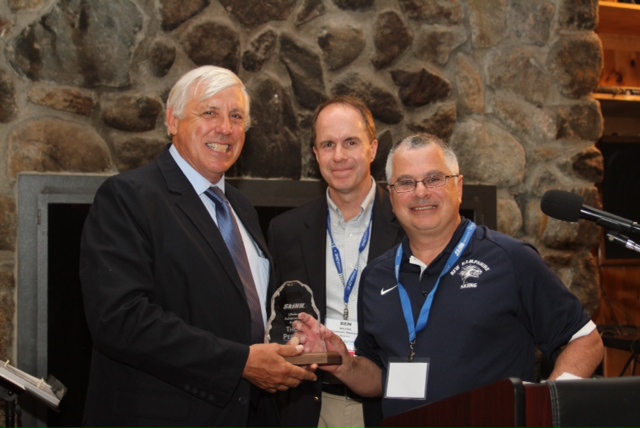
Thom Perkins of Intervale, NH, has been given the lifetime achievement award from Ski NH. The award recognized his contributions to Nordic skiing in New Hampshire. The award was presented by Cory Schwartz, the UNH Nordic Ski Team coach, and Ben Wilcox from Cranmore Mountain Resort.
As the Jackson Ski Touring Foundation Executive Director since 1976, Perkins was instrumental in transforming the village of Jackson, NH into one of the nation’s premier cross country skiing and snowshoeing venues. Passionate about the sport of Nordic skiing, Thom developed the trail system from a modest offering of trails to the present far-reaching network of 150 kilometers. Perkins’ retirement goals include increasing the number of great cross country ski facilities available to the public by using his extensive background to help small and midsized areas develop and grow through facilities design, business management and marketing. He has started a consulting company to do just that.
An active member of the cross country skiing community, a 2014 nominee to the U.S. Ski and Snowboard Hall of Fame and the 2010 winner of the Ski NH Al Merrill Award for outstanding contributions to cross country skiing, Perkins has provided training opportunities for skiers from school children, college teams, Paralympic and Junior National competitors to Olympic level athletes. During his time at Jackson, Perkins organized competitions ranging from local citizen races to World Championships. His expertise in facilities design and use was drawn on for the 2002 and 2010 Winter Olympic sites to help plan the use of the venues after the completion of their respective Olympic Games.
Cory Schwartz in his introductory remarks at the presentation ceremony spoke about one particularly challenging NCAA National Championship event when rain had washed away the snow from the competition venue, “Within minutes, Thom was developing a plan. … Ten hours later we held a national championship {at an alternative site}….something that no one else had accomplished and I am not sure if there are many people who could have.”
Thom Perkins is a founding member and Board Member Emeritus of the international trade association of Nordic ski areas – CCSAA. He was the recipient of the 2011 North American Ski Journalist Association Lifetime Achievement Award and was named one of 25 Nordic Heroes in the United States in a feature article in Cross Country Skier Magazine.
Ski NH is the statewide association representing 33 alpine and Nordic resorts and more than 200 lodging and guest service properties in New Hampshire. – See more at: http://www.skinh.com/
The Jackson Ski Touring Center’s event calendar is full of events this month for both skiers and spectators, from Ski NH’s Learn to Ski Week and the Collegiate Invitational Criterium and UNH Winter Carnival Races to the White Mountain Classic 30K citizen marathon.
There is a long tradition of recreational and ski competitions in Jackson dating back to the 1930s when they were organized by the Jackson Ski and Outing Club. Notable past events include the U.S. Ski Team tryouts in 1986, the World Nordic Championships for the Disabled in 1990, the U.S.S.A.’s Junior Olympics in 2000 and the NCAA National Championships in 1984, 1995 and 2007.
First time skiers can take advantage of Ski NH’s Learn to Ski Week from Jan. 11-18 with specials on lessons, rentals and trail passes. This is the perfect opportunity for anyone to learn to ski. Participants must register and schedule through Ski NH by calling (603) 745-9396.
On Jan. 11, groups will take to the trails for the Collegiate Invitational Criterium, competing on a 1.4 km sprint course. Races start at 10:00 a.m. At noon, there will be a Coaches and Alumni 1.5 km Fun Race.
The UNH Winter Carnival Races will take place on Jan. 24 and 25 beginning with the men’s 10 km classic race at 10:00 a.m., followed by the women’s 5 km classic technique race at 11:30 a.m. Saturday’s races feature mass start free technique races starting at 9:30 a.m. Spectators can take one of the frequent shuttle buses to watch the athletes ski through an international course on the Eagle Fields. Lunch is available in the Eagle’s Landing Pub in the Eagle Mountain House.
The following day, on Jan. 26 at 9:30 a.m., citizen and expert skiers will compete in the 10th Annual White Mountain Classic 30k. This is one of the 2014 TD Bank Marathon Citizen Series and one of the prestigious one day Club Championship events.
More information about these and other upcoming events at Jackson Ski Touring Center is available at www.jacksonxc.org/event-calendar.
The Jackson Ski Touring Foundation is a community based not-for-profit 501(c)(3) organization, chartered to maintain trails in and around the charming Village of Jackson, NH. The “Foundation” maintains 150 km of varied and breathtaking cross country ski and snowshoe trails 2 hours north of Boston. Foundation trails connect with A.M.C. trails in Pinkham Notch and White Mountain National Forest backcountry adventure trails. The Foundation operates under a Special-Use Permit with the White Mountain National Forest, and with the cooperation of 75 private landowners, and the Village of Jackson. More information about the Foundation and its offerings can be found on the web at www.jacksonxc.org.
My favorite run is not long. It clocks in at a modest one hour and twenty minutes.
My favorite run does not climb big mountains. The elevation gain is less than one thousand feet.
My favorite run does not have lots of expansive views. It only has two viewpoints.
Obviously, based on what I’ve said so far, my […]