From the FasterSkier archive — posts syndicated from athletes’ and coaches’ own blogs between 2004 and 2012, kept online as published. Current coverage is at fasterskier.com.
The Iowa caucuses were this week, and on this edition of The Daily, we have a recap of the results with our political correspondent, Reid Epstein.
Wait, sorry, we got confused. This is still a cross-country skiing podcast. But this is, in fact, the crossover xc-politics content you’ve been waiting for. Epstein, a friend of the pod who is really a political correspondent for the New York Times, interviewed Jessie Diggins a few days ago to get her perspective on finishing second place when it’s really gosh darn cold — which, apparently, is an appropriate analogy for the big story of this year’s Republican Iowa caucuses. So since we couldn’t get Diggins on the podcast this week, we thought it would be fun to hear from Epstein, instead.
If you hate this, or hate us now, we’re sorry, but we actually think this was pretty fun. We’re posting a mailbag episode at the same time for those of you who want vanilla ski racing content. Send us your hate mail, race predictions (World Cup or GOP primary) and feedback at devon@fasterskier.com and nat@fasterskier.com.
On February 8th, cross country skiing made the New York Times headlines as Jessie Diggins collected an historic bronze medal in the 1.5-kilometer freestyle sprint. No American woman had ever won an individual medal in cross country skiing, and no American cross country skier of either gender had won multiple Olympic medals. Diggins had earned gold in 2018 racing the freestyle team sprint with partner, and current NBC analyst, Kikkan Randall.
Normally, attention given to niche sports by mainstream media is welcome – cross country skiing is a blip on these outlets’ radar roughly once every four years during the Olympics – but a statement included in the report was quickly met with criticism from athletes and coaches in the sport.
Here’s the statement written by veteran sports journalist Matthew Futterman:
“In a sport that has so many women with massive shoulders and thighs, Diggins looks like a sprite in her racing suit, and it’s not clear exactly where she gets her power. But the power is there, as she flies up hills, and comes off climactic turns with a burst. On the downhills, she tucks low and cuts through the air.”
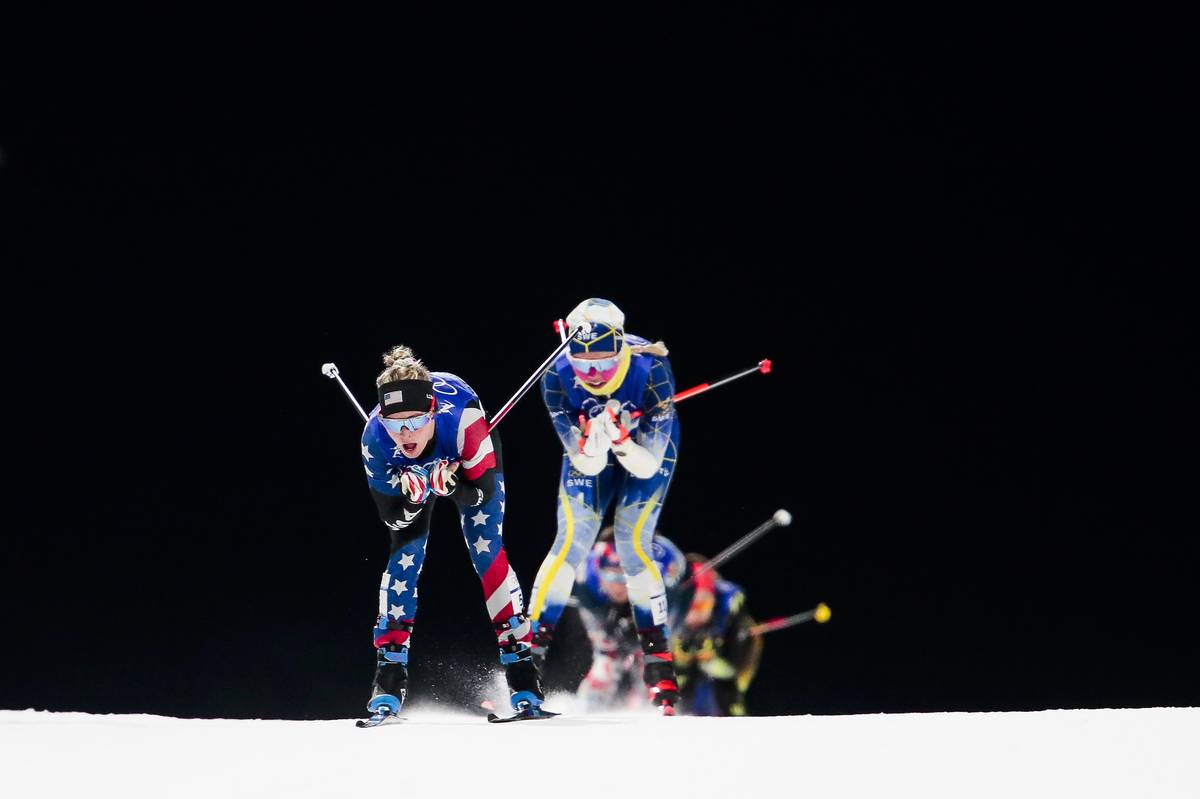
Jessie Diggins drops into a tuck as she leads Sweden’s Emma Ribom into the downhill during the 1.5-kilometer freestyle sprint event in the 2022 Beijing Olympic Winter Games. (Photo: NordicFocus)
All-American Colby College ski team alumna turned professional mountain runner for the North Face, Olivia Amber was quick to respond on social media, telling Futterman to “do better” and offering suggested edits to his wording.
Amber proposed: “In a sport that requires a unique combination of upper and lower body strength, Diggins’ ability to apply power is extraordinary, and it’s very clear how she has become one of the best athletes in the world.”
Her instagram story was shared widely amongst her followers. Explaining why this language struck a nerve, Amber wrote the following to FasterSkier.
“The way the media often covers athletics objectifies women and excludes people that don’t conform to the myth of an ideal body type. The language used in the recent NY Times piece is yet another example of this broader issue in women’s sport. It’s a clear oversight that demonstrates a lack of knowledge on the author’s subject. Featuring the size and shape of women’s bodies devalues the lifetime of hard work these athletes put into achieving the pinnacle of their sport.”
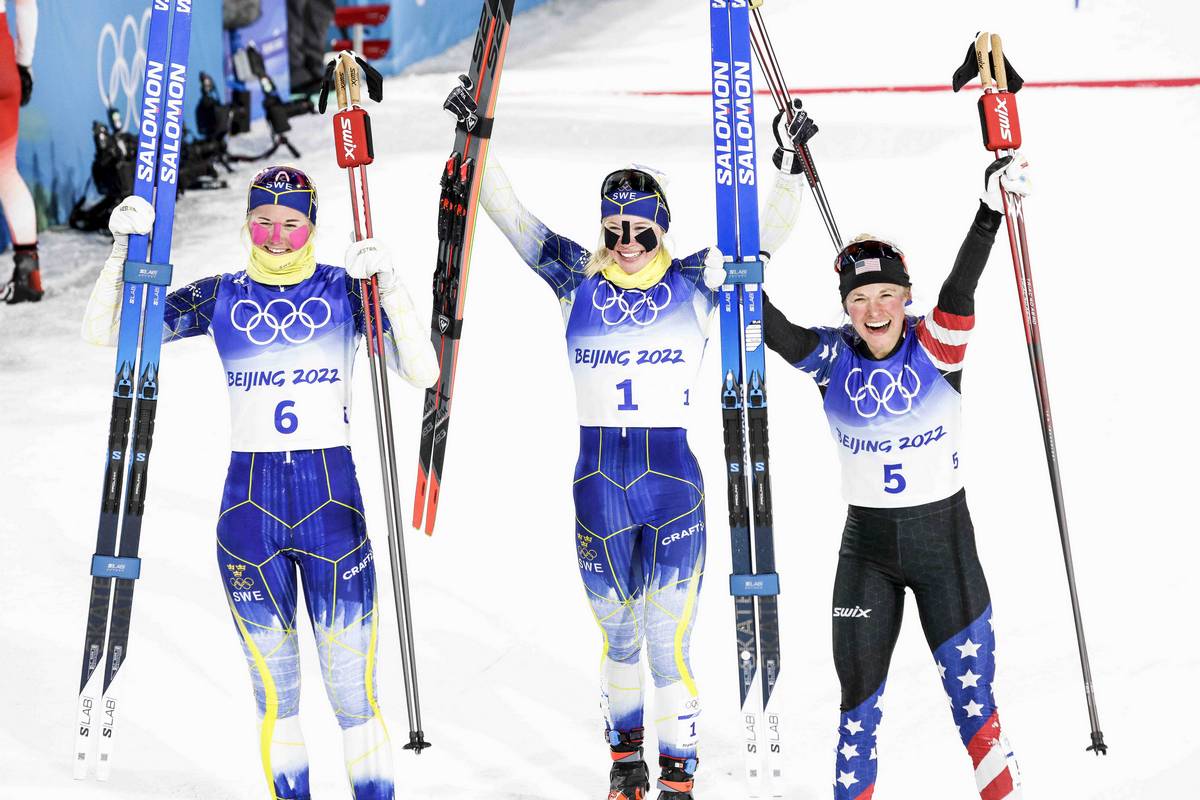
The women’s Olympic 1.5-kilometer freestyle podium: Sweden’s Jonna Sundling took gold ahead of teammate Maja Dahlqvist and American Jessie Diggins. (Photo: NordicFocus)
FasterSkier contacted Futterman to see whether he had a response to the criticism his statement had received. Futterman explained that he would need clearance from the Times’ communications department in order to respond. FasterSkier later received the following from a spokesperson:
“We aim in our sports coverage to cover male and female athletes accurately, equally and fairly. We believe sometimes their physiques are relevant to their performance. In this case, our description of cross country skier Jessie Diggins’s noticeably different physical attributes in contrast to others in her sport were an important and relevant detail. Her dominance in the sport was also the subject of alengthy feature on Feb. 4.”
However, many readers continue to find fault with the statements at play.
“I have always held the NY Times in high esteem for their quality reporting, which is why I was absolutely floored to read Matthew Futterman’s comments about my teammate’s body,” writes Holly Brooks, two-time Olympian and licensed professional counselor who offers eating disorder support to athletes through her practice and advocacy. “On a day where Jessie made U.S. history by becoming the first female individual medalist in cross country skiing, Mr. Futterman chose to make inconsiderate comments about her body, questioning the source of her power. Please hear me loud and clear: It is NEVER appropriate to comment on an athlete’s body with regard to their weight, shape or size. Instead, emphasize their power, fight, tenacity and strength. And to the NY Times: Jessie, athletes worldwide, and the entirety of your readership deserve better. Mr. Futterman should apologize for his insensitive words and be sent to sensitivity training.”
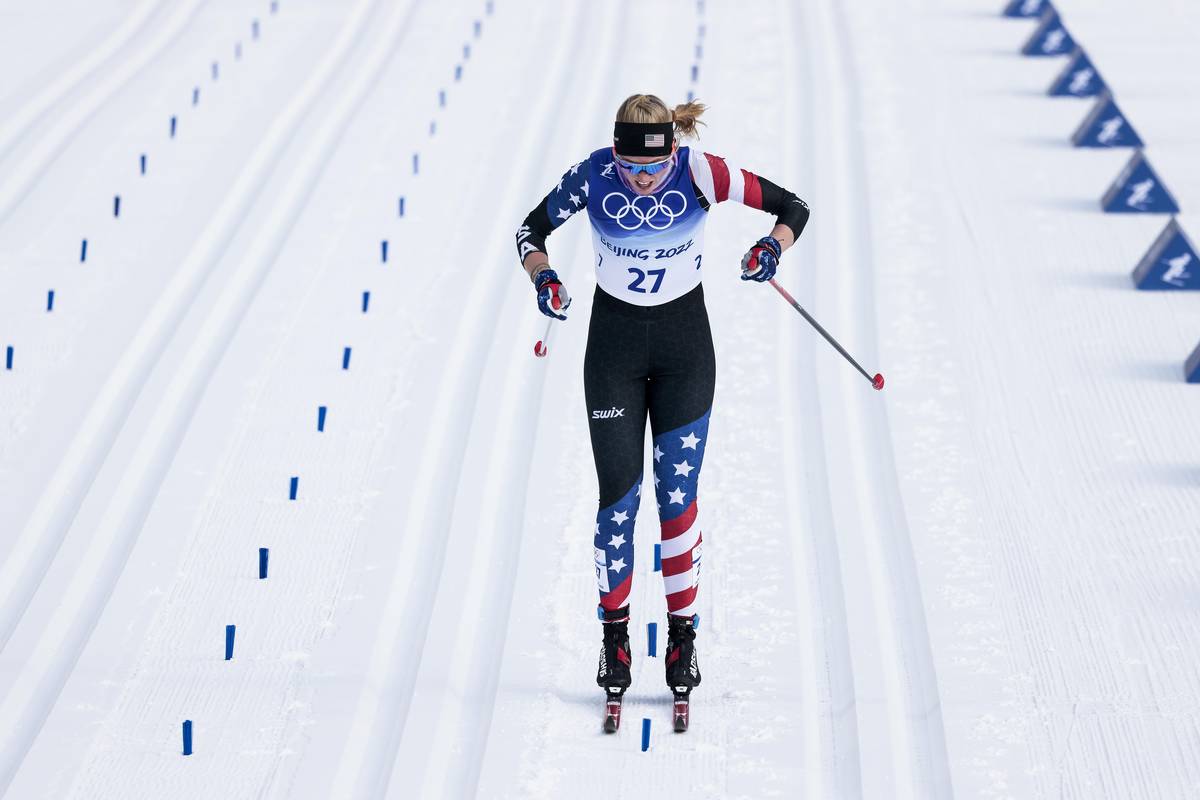
Jessie Diggins (USA) takes control of her quarterfinal during the 1.5 kilometer freestyle sprint. (Photo: NordicFocus)
It is not the first time Diggins has received comments regarding her body from the media. She was once asked whether her talent on downhills was related to her size, versus her skill. One strategy she has begun to employ to avoid comments that might have a detrimental impact on her mental preparation has been to avoid reading them altogether.
When asked in the mixed zone after the 10 k classic whether she had heard anything regarding Futterman’s story, Diggins said, “To be honest, I don’t read things written about me and I think that’s a very, very healthy thing. But it’s unfortunate with Rule 40 that you can’t see the invisible headgear sponsor that is there at all times for me.”
After sharing a blog post titled “Body Image Issues” in June, 2018 Diggins has openly shared her own challenges with disordered eating, body dysmorphia, and bulimia across many platforms, including her book, Brave Enough. Outside of the Olympic blackout period, described in Rule 40, Diggins wears the logo of the Emily Program, a leader in eating disorder treatment and education, on her hats and headbands, acting as an advocate for the facility she credits with supporting her through her own recovery journey.
She now regularly rejects the narrative that “lighter is faster”, and instead repeats how properly fueling her body and prioritizing her mental and physical health have led her to perform at this level. Diggins aims to be an example for future generations of skiers.
“It’s important that women everywhere know that they’re good enough the way they are,” Diggins said. “You don’t have to be a certain body type to win at the Games; you have to be healthy and happy and have a great support crew.”
Diggins’ advocacy in this space was a focal point in a message penned by Kris Hansen, a former cross country ski coach at Diggins’ alma mater in Stillwater, MN, sent to the Times after reading the piece. Hansen also shared her response publicly on Facebook.
“Eating disorders, or disordered eating, are sadly very common in young women athletes… conditions that are definitely exacerbated by insensitive and inaccurate reporting like Mr. Futterman’s,” she wrote.
Hansen called it “ironic ignorance” that an athlete who raises awareness for body image issues in sport would be described in this way.
“Jessie is no ‘sprite’,” Hansen continued. “She is a powerful woman, an exceptional athlete, a World Champion, a thoughtful and articulate advocate for women athletes, and now a multi-medal Olympian.. I can also tell you from where she gets her power: hundreds of hours of training her body and her mind, on the snow, in the weight room, with her coaches… Further, her competitors are not “women with massive shoulders and thighs”. They are women who, like Jessie, have worked very hard to build bodies that can climb a hundred meters in a matter of seconds and then navigate an icy technical downhill….again and again for 30 kilometers. You have done Jessie, and all women athletes, a disservice with your ignorance and disrespectful characterization.”
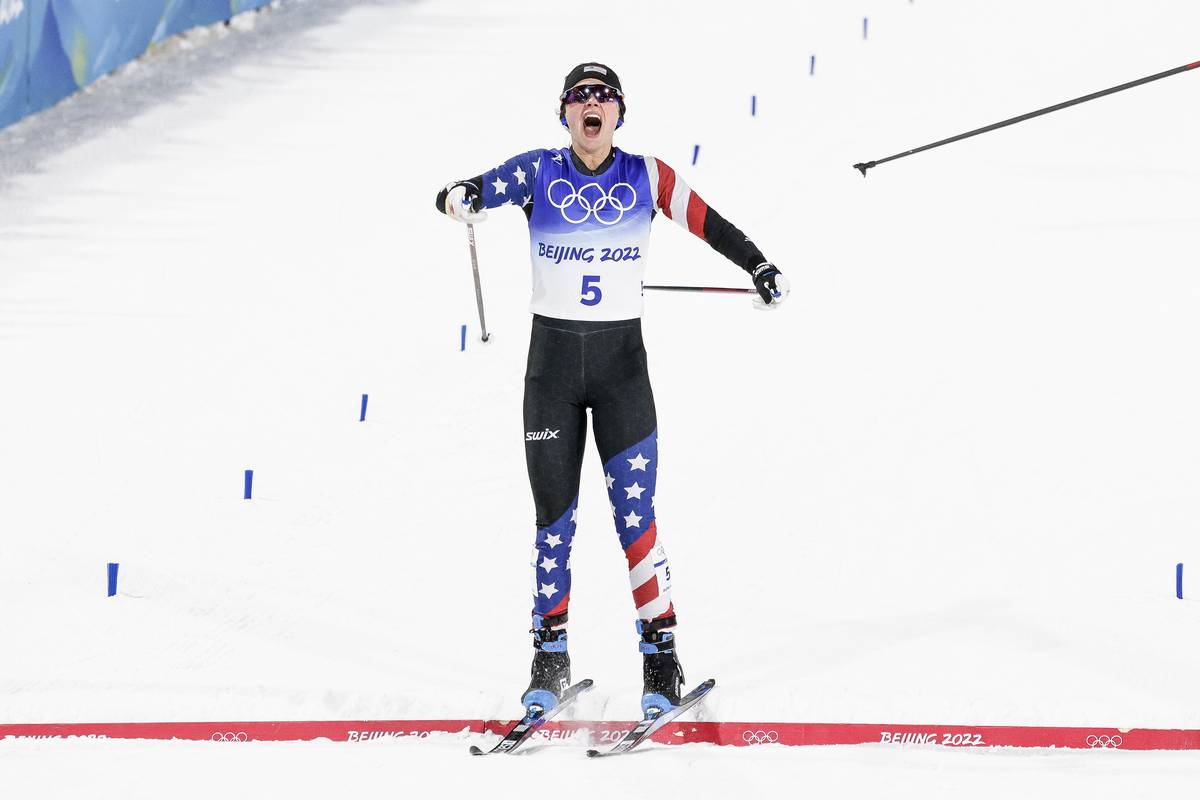
Jessie Diggins crosses the line in third to earn the first individual Olympic medal in women’s cross country ski history. (Photo: NordicFocus)
College of St. Scholastica head coach and founder of the Women Ski Coaches Association Maria Stuber offered a solution-oriented approach, advocating for awareness and education that might better support and protect athletes of all levels from body-centric messaging.
“What is very obvious here is that if the NY Times reporters and editors do not understand why this language is damaging, and we have a long way to go in education. If a career sports journalist isn’t learning this, certainly parents and youth coaches are not either. We are to the point where prominent athletes, like Naomi Osaka, are refusing to participate in news conferences or talk to journalists because of their ignorance on this topic and the potential damaging effects on mental health of athletes. Maybe the NY Times would be willing to help with the education component? How do we make sure you can’t become a sports journalist (or editor) without some body image/mental health education? Equal representation of women in sports media careers would certainly help.”
Like Diggins, many athletes at the Games are choosing to remain disconnected from the news and are not engaging with topics that might derail their focus. Others, like the Russian Olympic Committee’s Veronika Stepanova, have spoken out about the article. Stepanova shared a video of herself reading the statement on Instagram, sardonically captioning the post “Objectification? Never heard of it.”
Novie McCabe races to 24th in the 10 k individual start classic during the 2022 Olympic Winter Games. (Photo: NordicFocus)
FasterSkier had the opportunity to ask Hailey Swirbul and Novie McCabe thoughts on the statement in the mixed zone following their performance in the 10 k individual start classic race Thursday.
“I think that our sport is so unique and so powerful in the sense that every single body type can succeed at this sport,” Swirbul responded. “It doesn’t matter how you look, it matters how you race with your heart, how hard you work, and I know that everyone on our team works so freaking hard, Jessie included. Everyone on that podium deserves that spot, no matter what they look like.”
“I think the older girls have kind of been trying to ignore it a bit,” McCabe explained. “But it was obviously pretty uncalled for and insensitive, and they need to do better… Jessie got a medal because she’s the best out there and not because of anything about her body, so I think just insinuating that there’s something there was not okay.”
Swirbul also stated that response from the community to the Times article has not been a distraction for her as she prepares for Olympic competition.
“It makes me appreciate my own strength and how hard I work to gain fitness and muscle. I think it just really makes me appreciate how diverse our sport is all across the board.”
Speaking more broadly to whether a focus on the appearance of athletes’ bodies from the media is frustrating for her, Swirbul concluded, “I hope that as a culture, we can move away from body types and focus on the hard work and the courage and the bravery that everyone races with every day. I really hope that that’s where we move in the future.”
Hailey Swirbul pushes to the finish of the 10 k individual start classic during the 2022 Olympic Winter Games. (Photo: NordicFocus)
Front page of the Anchorage Daily News on Thursday, Feb. 22, 2018.
You may have noticed that Kikkan Randall and Jessie Diggins won a gold medal yesterday. (If you’ve forgotten, or just haven’t seen the video in the last five minutes, you should probably go watch that finish sprint one more time. We’ll wait.)
The rest of the world noticed. For longtime fans of the sport, one of the most surreal things about Wednesday may have been seeing cross-country skiing – our sport, a niche sport, a pastime that typically merits mention in The Gray Lady only when it’s in that one piece about cross-country skiing and “topographical Buddhism” that all your friends sent you even though we’re totally cooler than that and don’t actually wear helmets and goggles when we ski – in The New York Times, andThe Washington Post, andThe Washington Post again, and The Wall Street Journal, and so on. Apparently gold medals talk or something.
Here’s a non-scientific roundup of how the Americans’ win was covered in English-language media. Coverage is arranged from very roughly the most-national newspapers (“the U.S. wins a medal”) to the most-parochial (“local hero Randall/Diggins wins a medal”), followed by a handful of online-only publications. Particularly good lines and, in some case, unfortunately imprecise lines are highlighted.
Best line: “The team sprint – especially on this brutal course – is a sadistic event. It requires two skiers to take turns skiing three legs each of 1.25 kilometers. With two rounds of racing for the top 10 teams, that means six all-out sprints for each skier, with a little more than an hour to recover between the semifinals and the final.”
Least-accurate line: “Randall, an Alaska native, was the first American woman to break into the elite of international cross-country skiing, and there was a long period in which she was the only woman on the United States team.” (The phrase “Alaska Native” is the preferred term of cultural identity for the indigenous peoples of Alaska; it’s a small point, but “native Alaskan” would be more appropriate for someone who grew up in Alaska but is of Caucasian heritage. Plus, Randall was technically born in Salt Lake City while her mother was in law school in Utah, before moving to Anchorage in childhood.)
Best line: “Diggins, the ebullient talisman of the US team who spends her downtime learning hip-hop dance routines from YouTube tutorials, was third entering the final lap before finding an extra reserve to overtake both the Swedish and Norwegian teams and secure the history-making gold.”
Front page of the Minneapolis Star Tribune sports section on Feb. 22, 2018. (Photo: Scott Beutel)
Best line: “While Bjoergen was winning 14 medals, Randall was waiting for one. Diggins had made it happen with her 100-meter sprint. Randall had made it possible with the previous 16 years.”
Best line: “Technically, every mother deserves a gold medal.”
Least-accurate line: “And Randall – who intentionally positioned her childbirth midway between two Olympics and in a non-World Cup year – has attracted admirers for her decision to stick with her craft.” (The World Cup of course went on in Randall’s absence in the 2015/2016 season; it was a non-World Championships year.)
Best line: “Kikkan Randall screamed at the Alpensia Cross Country Centre’s finish line here as Jessie Diggins, her teammate on the two-woman sprint relay, ricocheted off the final turn for home.”
Least-accurate line: “The Americans found themselves in an unusual position: racing the powerhouse Norwegians and Swedes for gold over the final meters.” (Well, actually, Diggins and Randall have been competing head to head with Scandinavia for many years now, often with World Cup or World Championship gold at stake.)
Best line: “When President Obama first got inaugurated,” Randall said, “I had a dream that I was sitting on Air Force One talking to him about cross-country skiing and telling him it is a really cool sport but didn’t get enough attention. He said [in the dream] when he became president, he would help make cross country a higher profile.”
Least-accurate line: “Each racer skies three legs on the twisting, undulating course, and the three medalists separated themselves from the rest of the 10-team field entering the final loop.” (The verb is “skis,” guys, not “skies.”)
Front page of the Minneapolis Star Tribune (see bottom right) on Feb. 22, 2018. (Photo: Scott Beutel)
Best line: “When she reached the finish line, Diggins said, she couldn’t feel her legs. Within moments, though, she came out the other side of the pain cave, into the light of a golden evening.”
Least-accurate line: “It was the 18th Olympic medal for Bjoergen, the most of any Winter Olympian in history.” (Bjørgen’s cumulative medal haul is stunning, but in fact stands at “only” 14 Olympic medals total.)
Best line: “Diggins has stayed a part of the Stillwater team. She sent a text from South Korea last week before the Ponies girls team went out and won the team title. Wednesday the texts were going the other way.”
Best line: “Few Americans have Olympic gold medals. Fewer still have an ice cream flavor named after them. Jessie Diggins has one, and she might soon have both. … The goal is to introduce the flavor in coordination with a citywide celebration of Diggins’ accomplishment that Afton officials, business owners and residents are planning to honor their hometown hero.”
Best line: “Randall and Bjoergen, 37, are both five-time Olympians and both are mothers of toddlers. Randall’s son, Breck, will turn 2 in April, and Bjoergen’s son turned 2 in December. Both have shown that neither age nor motherhood spell the end of a world-class career.”
Least-accurate line: “[Diggins is] also a three-time World Championship medalist – in 2013, she and Randall won the team sprint at worlds – and a frequent visitor to the World Cup podium.” (Diggins has four World Championships medals.)
Best line: “I puked after a lot of races that year. There is old camcorder footage of me vomiting at a race in Michigan’s Upper Peninsula and you can audibly hear all of my teammates – and I do mean ‘all,’ I was one of the last guys across the line – scream with laughter.”
Best line: “On the fourth lap, Diggins made a move, pulling ahead of the entire field. Even though I already knew the outcome of the race before I watched the full replay, I still sat up in my chair when I saw Diggins pull ahead. I’ve watched enough cross-country skiing to know it’s rare for an American to ever pull ahead. ‘She’s going to do it,’ I said, even though I knew she had already done it. That’s how thrilling this race was: It made me nervous about an outcome that I already knew was not in doubt.”
Least-accurate line: “On Wednesday in Pyeongchang, cross-country skiers Kikkan Randall and Jessie Diggins pulled off the United States’ biggest upset of the Winter Games, winning a gold medal in the women’s team sprint. It’s safe to say no one saw this coming. If cross-country skiing is the NFL, then the United States is the Cleveland Browns. Imagine how surprised you’d be if the Browns made the playoffs, then got to the Super Bowl, then hoisted the Lombardi Trophy, having defeated Norway along the way.”
(The U.S. team is currently ranked fifth in the Nations Cup (the women alone are third), barely behind Finland for fourth. Luke Bodensteiner, U.S. Ski & Snowboard Chief of Sport, told FasterSkier yesterday, “I think we came in feeling like team sprint was not only our best opportunity for a medal, but probably a pretty high likelihood for us, honestly.” The Browns, by contrast, just suck.)
Best line: “People often call cross-country skiing an individual sport. But more than anything, Randall’s and Diggins’ success is a counterpoint to that idea; their victory is a testament to the people rallying behind them. … This community pushed through dips in funding, apathy in American ski culture, and the general challenges that come with pursuing the hardest sport on the planet. Today, Randall and Diggins proved that this is truly a team sport.”
Least-accurate line: [Not applicable; author Annie Pokorny, a recently retired elite American domestic racer, knows her stuff.]
The New York Times reports that after several days of interviews with Russian sports officials, the country’s leaders are admitting that systematic doping occurred across a wide number of sports over the last several years:
“It was an institutional conspiracy,” Anna Antseliovich, the acting director general of Russia’s national antidoping agency, said of years’ worth of cheating schemes.
The move creates an awkward situation for those who vigorously denied the doping reported by Richard McLaren in a special investigation for the World Anti-Doping Agency.
That includes the president of the Cross Country Ski Federation of Russia, who said that “I know that my athletes did not take anything,” and blamed former Moscow lab director Grigory Rodchenkov for sabotaging her skiers with “dirty tricks.”
The admission of guilt is likely a move to try to try to stanch the bleeding of Russia’s reputation in the sports world. Several major events, including World Cup ski races and World Cup and World Junior Championships biathlon events, had been relocated from Russia already. Before that, biathletes had threatened to boycott events in Russia. Six skiers and two biathletes have already been suspended from competition, with more suspensions possibly on the way. And many in the sports world had called for Russia to be banned from the upcoming 2018 Olympic Winter Games.
But the admission didn’t come with much of an apology. Vitaly Smirnov, a top International Olympic Committee member and former Russian Minister of Sport, blamed western countries for creating an environment where Russians felt they had to cheat.
“Russia never had the opportunities that were given to other countries,” Smirnov said in the piece. “The general feeling in Russia is that we didn’t have a chance.”
And those hoping for truth and reconciliation are likely to be disappointed. Russia appears uninterested in assigning blame. From the New York Times piece:
“I don’t believe we have enough time in life to clarify everything, to understand who’s the winner and the loser, who’s right and who’s wrong,” Mr. Kusnirovich said, calling on the authorities not to sanction the nation at a future Olympics for what happened at previous Games. “Even during Stalin’s times there was a saying: ‘The son is not responsible for his father’s sins.’”
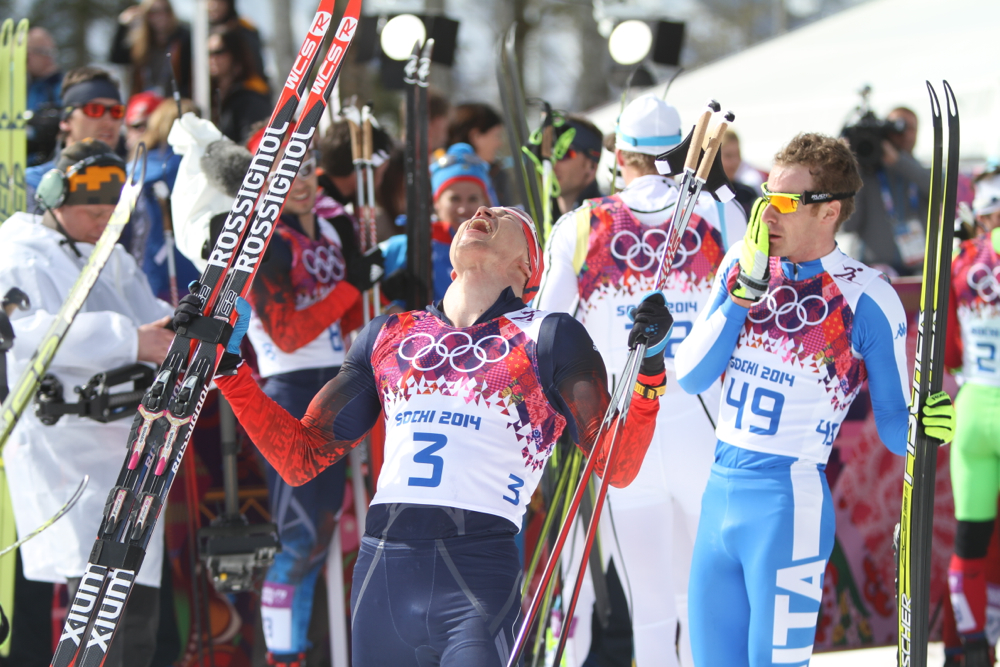
Alexander Legkov (3) after winning his first Olympic medal with gold in the 50 k freestyle mass start in Sochi, Russia. He beat fellow Russians Maxim Vylegzhanin and Ilia Chernousov, who took second and third, respectively, to complete Russia’s first-ever podium sweep at the Olympics.
In interviews with the filmmaker Bryan Fogel which were published in the New York Times, the head of the laboratory that handled anti-doping samples at the 2014 Olympics in Sochi, Russia, said that “dozens” of Russian athletes were doping at the Games, including 14 cross-country skiers.
Grigory Rodchenkov said that he had a list of athletes which were targeted to receive illicit drugs, handed to him by the sports ministry. He alleges that along with members of the Russian intelligence service, his staff replaced the supposedly tamper-proof bottles containing the athletes’ urine with urine collected months earlier, thus ensuring clean test results for the athletes.
Although the full list of athletes was not named, the New York Times did specify that Alexander Legkov, the gold medalist in the 50 k freestyle race which concluded the cross-country ski program at the Games, was among the offenders.
Should Legkov be disqualified, then Norway’s Martin Johnsrud Sundby stands to move from fourth up to third place in that race.
Russia sent 20 cross-country skiers to Sochi, meaning that 70% of the team stands to be sanctioned for doping if the allegations prove true.
For instance, Russians also took second and third in the 50 k. If Maxim Vylegzhanin and Ilia Chernousov are also among the 14 offenders on the ski team and are retroactively disqualified, then Sundby stands to earn gold. Sergei Dolidovich of Belarus, who finished fifth, would earn silver and sixth-place Robin Duvillard of France bronze.
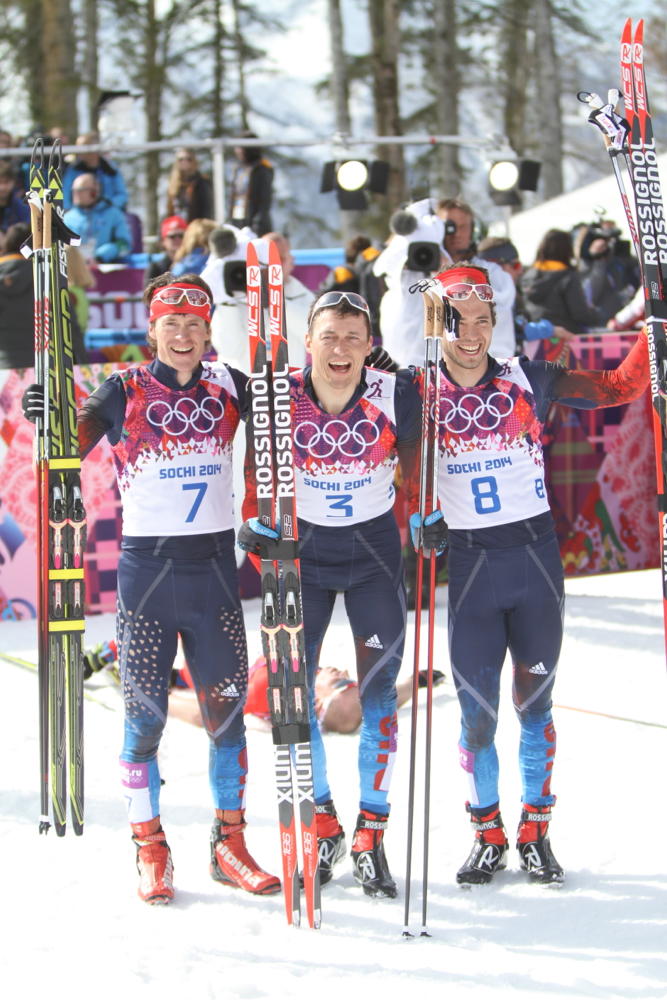
The Russian podium grinning ear-to-ear after Alexander egkov (3) won gold, Maxim Vylegzhanin (7) earned his third silver in Sochi, and Ilia Chernousov took bronze in the 50 k freestyle mass start, the last race of the 2014 Winter Games.
Some had long suspected that the Russian podium sweep, as well as Legkov’s heroic leg of the 4 x 10 k relay, were not natural.
“Pushing that hard the whole relay and then jump-skating that hill is not possible. Period,” Wadsworth said in Sochi.
The Russian men’s 4 x 10 k relay team ultimately took silver at the Games. Should that team be disqualified then third-place France stands to receive silver medals and Norway move from fourth up to bronze.
Vylegzhanin and Nikita Kriukov also won silver in the team sprint, ahead of Emil Jönsson and Teodor Peterson of Sweden in third and Ola Vigen Hattestad and Petter Northug of Norway in fourth.
Should two- or four-year bans be applied starting from Sochi, results of numerous international competitions since then would also change.
The World Anti-Doping Agency (WADA) has not yet released a statement about the piece. The Agency is gathered in Montreal, Canada, today for an Executive Board meeting.
WADA released a statement on Tuesday in response to an investigation by CBS’s 60 Minutes in which another whistleblower, Vitaly Stepanov, spoke of Rodchenkov’s Sochi doping list.
“The World Anti-Doping Agency (WADA) announces that it will immediately probe the new Russian doping allegations, related to the 2014 Sochi Olympic Games, which were broadcast on Sunday on CBS 60 Minutes,” the organization said in a press release. “The broadcast features additional allegations of doping misconduct by Russian athletes and entourage members at the Sochi Games that had not previously been exposed.”
The International Olympic Committee, which is responsible for testing at the Games, called on WADA to investigate.
“These allegations are very detailed and very worrying and we ask the World Anti-Doping Agency to investigate immediately,” the IOC said, according to the Associated Press.
The International Ski Federation also does not appear to have made an official comment.
Russia’s sports minister, Vitaly Mutko, told the New York Times that the allegations were “a continuation of the information attack on Russian sport.”
Rodchenkov also said that he had destroyed not just the 100 or so urine samples belonging to Russian athletes in Sochi, but a total of more than a thousand samples that his lab was responsible for. The implication is that other results may also be in question.
While the IOC has said that it would re-test the Sochi samples if there was hard evidence that the testing process had been manipulated, Rodchenkov’s lab’s destruction of so many samples leaves a question mark as to whether this would be either possible or productive.
Rodchenkov claims to have developed a three-drug cocktail to give athletes. Despite a slow start to the Games, the Russians ultimately won 13 gold medals, the most by any country.