From the FasterSkier archive — posts syndicated from athletes’ and coaches’ own blogs between 2004 and 2012, kept online as published. Current coverage is at fasterskier.com.
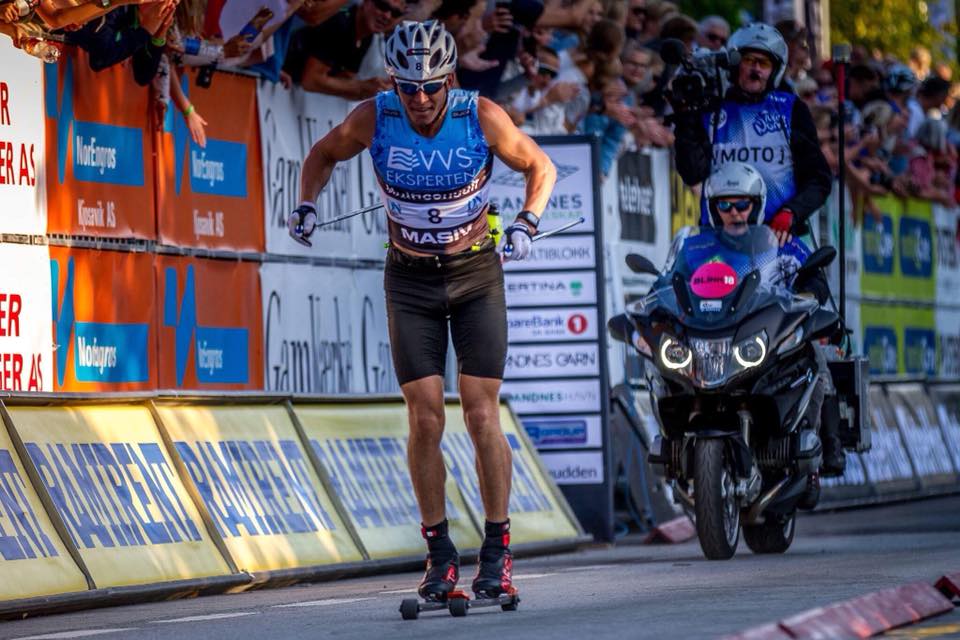
Russia’s Alexander Bolshunov racing to first in the Blink Classics men’s 60 k on Wednesday in Sandes, Norway. (Photo: Blink Ski Festival/Facebook)
A predictor for the winter ski season ahead? Could be. Either way, Norway’s Blink Ski Festival, or as it’s called in Norway, Blinkfestivalen, remains the ultimate in rollerski racing and returned for the 12th year in a row on Wednesday.
The festival opened with elite men’s and women’s distance rollerski races, known as the Blink Classics. For the third-straight summer, the Blink Classics featured a 60-kilometer mass start for the men and a 50 k for the women.
Eighty-six men competed in Wednesday’s 60 k, which began in the city center of Ålgård and finished in the municipality of Sandnes. A complete course map, which deviated little from last year’s rendition, may be found by clicking here.
By the end of the men’s 60 k, it was Russia’s Alexander Bolshunov who finished first in 2:10:51.6 hours. The 22-year-old Bolshunov had a number of World Cup podiums last season and one win in the final 15 k of the year. He also earned three silver medals and one bronze at the 2018 Winter Olympics in South Korea.
Finishing just 5.9 seconds behind him was another Russian, 19-year-old Sergey Ardashev, in second place. The third elite man across the line was Norway’s Anders Mølmen Høst, 27, of the Lyn Ski club, who finished 1.8 seconds out of second place and 7.7 seconds back from first.
Norwegians occupied the rest of the top 10, with Tord Asle Gjerdalen in fourth (+8.1), Øystein Petterson in fifth (+8.3), Hans Christer Holund in sixth (+8.3), Sjur Røthe in seventh (+8.7), Simen Hegstad Krüger in eighth (+8.7), Runar Skaug Mathisen in ninth (+10.3) and Martin Johnsrud Sundby — the winner of last year’s Blink Classics 60 k — in 10th (+10.8).
Nearly half of the men’s field came from nations from outside Norway, with athletes hailing from Russia, France, Canada, the U.S., Great Britain, Finland, Sweden, and Italy. Canadian World Cup skier Alex Harvey was the top North American in 14th (+1:19.0).
Also for Canada, Scott James Hill placed 53rd (+11:00.0) and Bob Thompson was 56th (+11:53.1). Ian Torchia was the lone American in the event, racing to 55th (+11:52.3). Canada’s Evan Palmer-Charrette did not start.
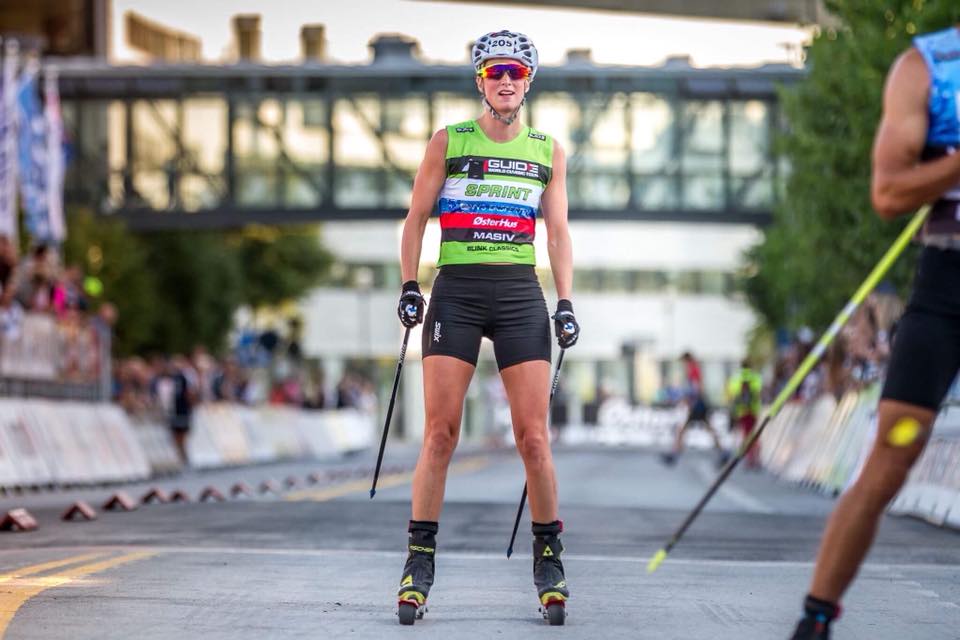
Norway’s Kari Vikhagen Gjeitnes finishing first in the Blink Classics women’s 50 k on Wednesday in Sandes, Norway. (Photo: Blink Ski Festival/Facebook)
In the elite women’s 50 k, which had just nine finishers, Norway’s Kari Vikhagen Gjeitnes finished first in 2:21:19.0. Second place went to Astrid Øyre Slind, who crossed 33.9 seconds after Gjeitnes, and the third and final podium spot went to Poland’s Justyna Kowalczyk (+5:55.4).
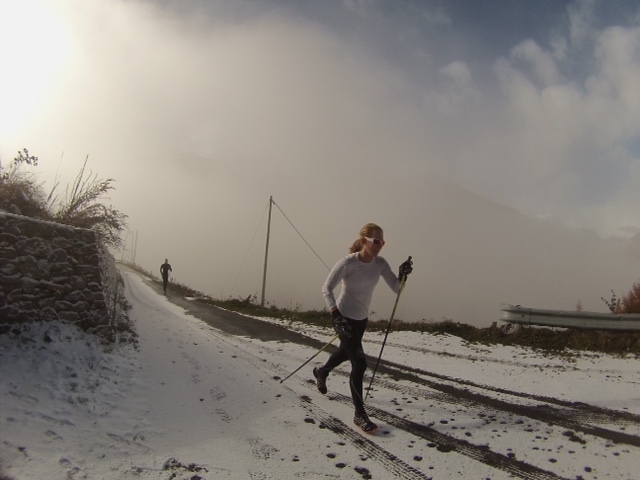
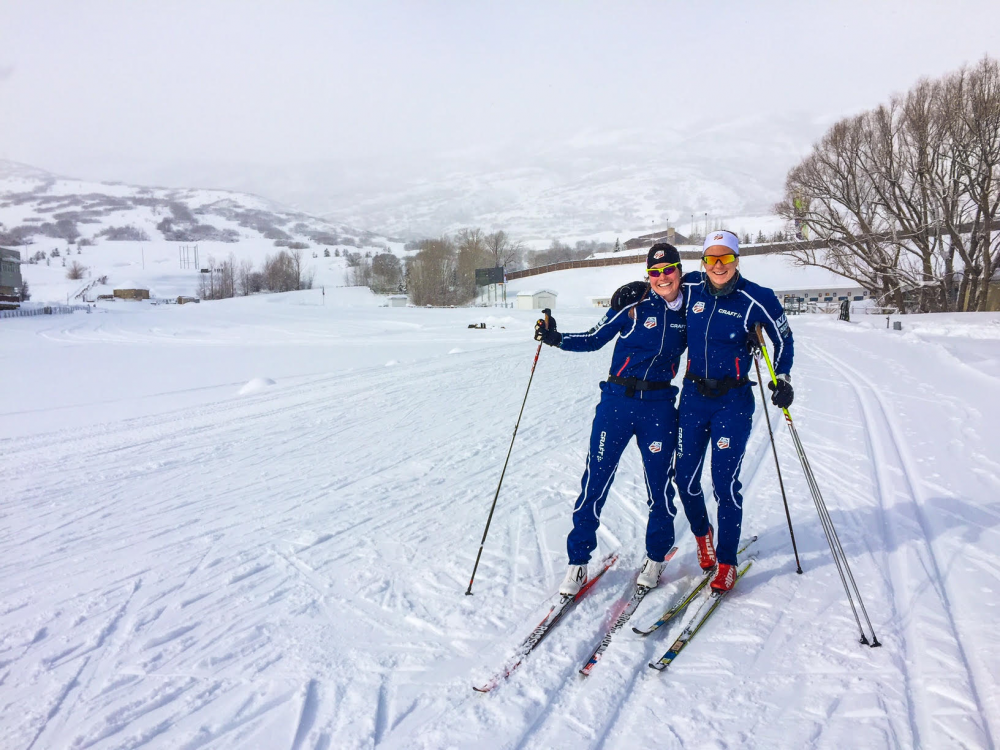
Nichole Bathe (l) and Annika Taylor, both American-born members of the British Nordic Ski Team, during a training session last fall in the Rhône-Alpes region of France. (Courtesy photo)
This week FasterSkier presents a workout from British national ski team members Nichole Bathe and Annika Taylor. Last season, both Bathe and Taylor competed overseas on Great Britain’s national nordic team. They were interviewed on the phone last fall and email this spring.
***
May. For some, it’s a month marked by caps and gowns and new beginnings. Last year, May was a month in question for Nichole Bathe. The Madison, Wisconsin, native had just graduated from the University of Alaska Fairbanks (UAF) with a degree in justice and social work. But immediately starting a nine-to-five job was not what she wanted to do.
During the school year, she had raced for UAF’s ski team, qualifying for three NCAA Championships and finishing as the top American in fourth place as a freshman. As a senior, she qualified for U23 World Championships in Midway, Utah. A few of Bathe’s coaches suggested that she continue her cross-country career after college.
“I had no idea what I was going to do at graduation in May,” said Bathe, now 23. “But I was always wondering what it would be like to focus on skiing as a whole, instead of having school in the way of that.”
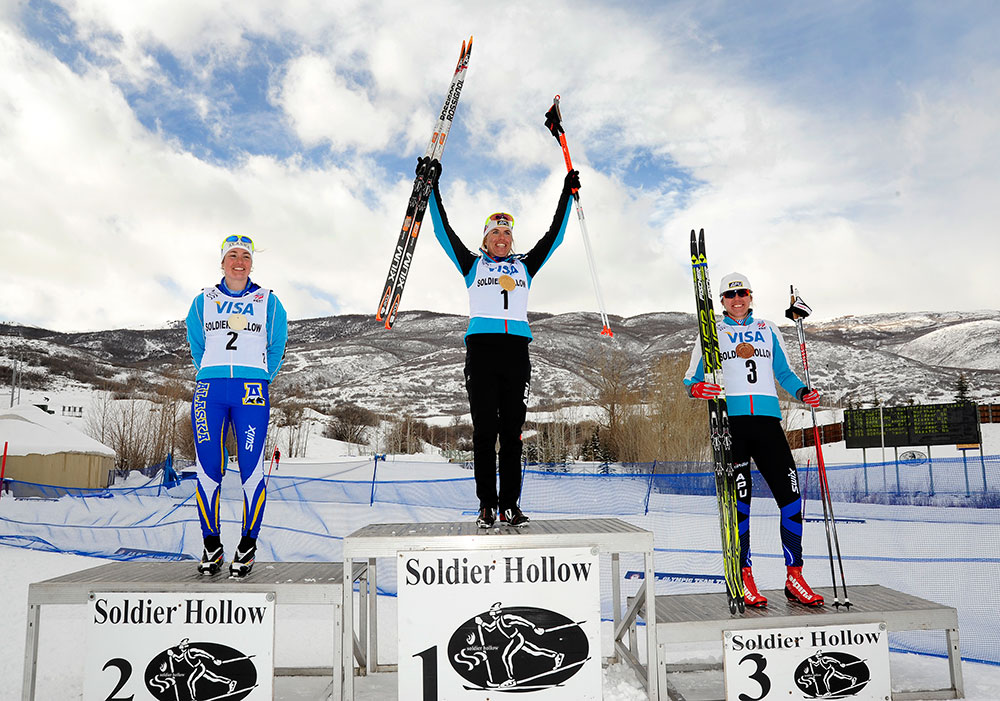
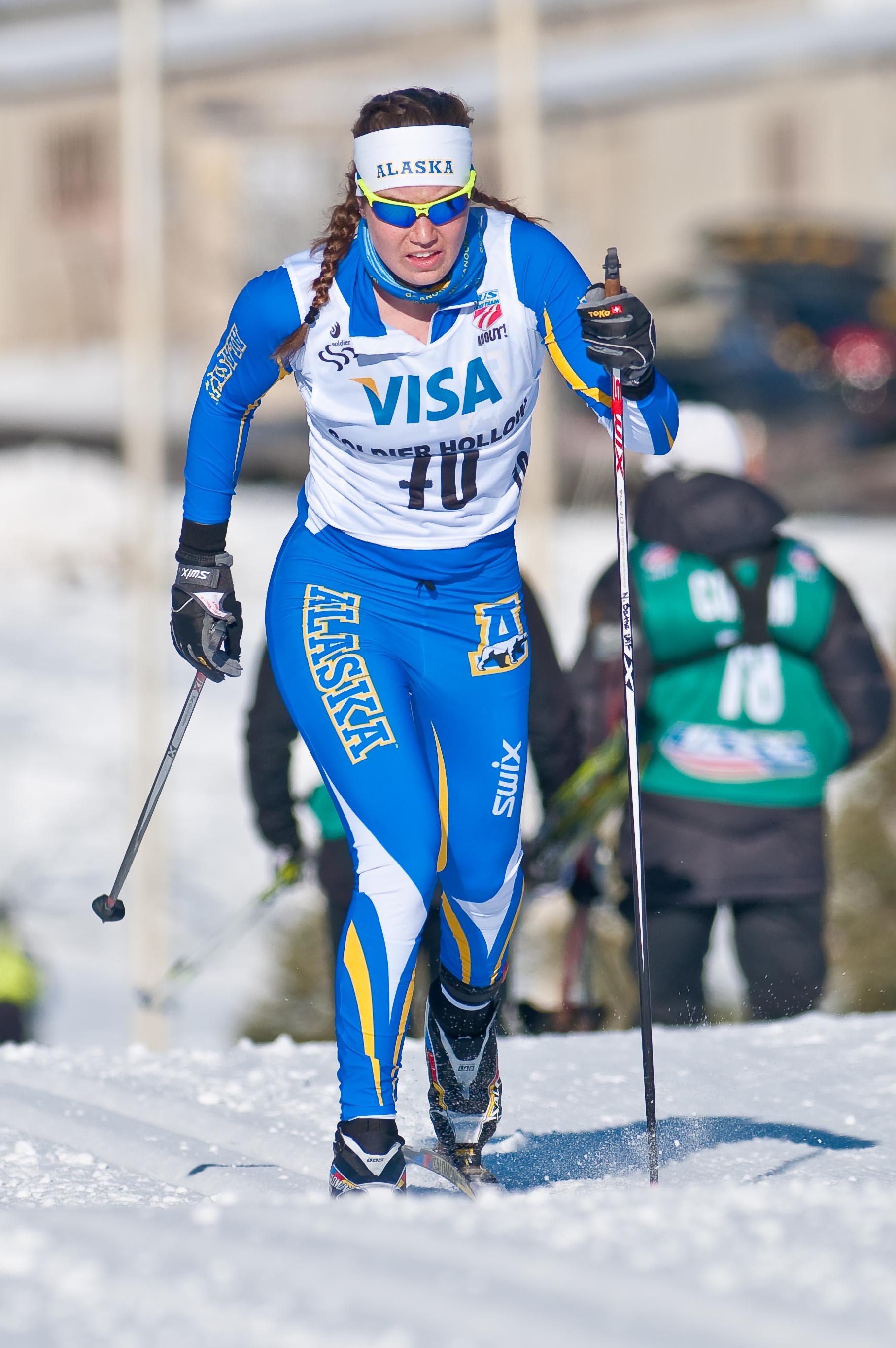
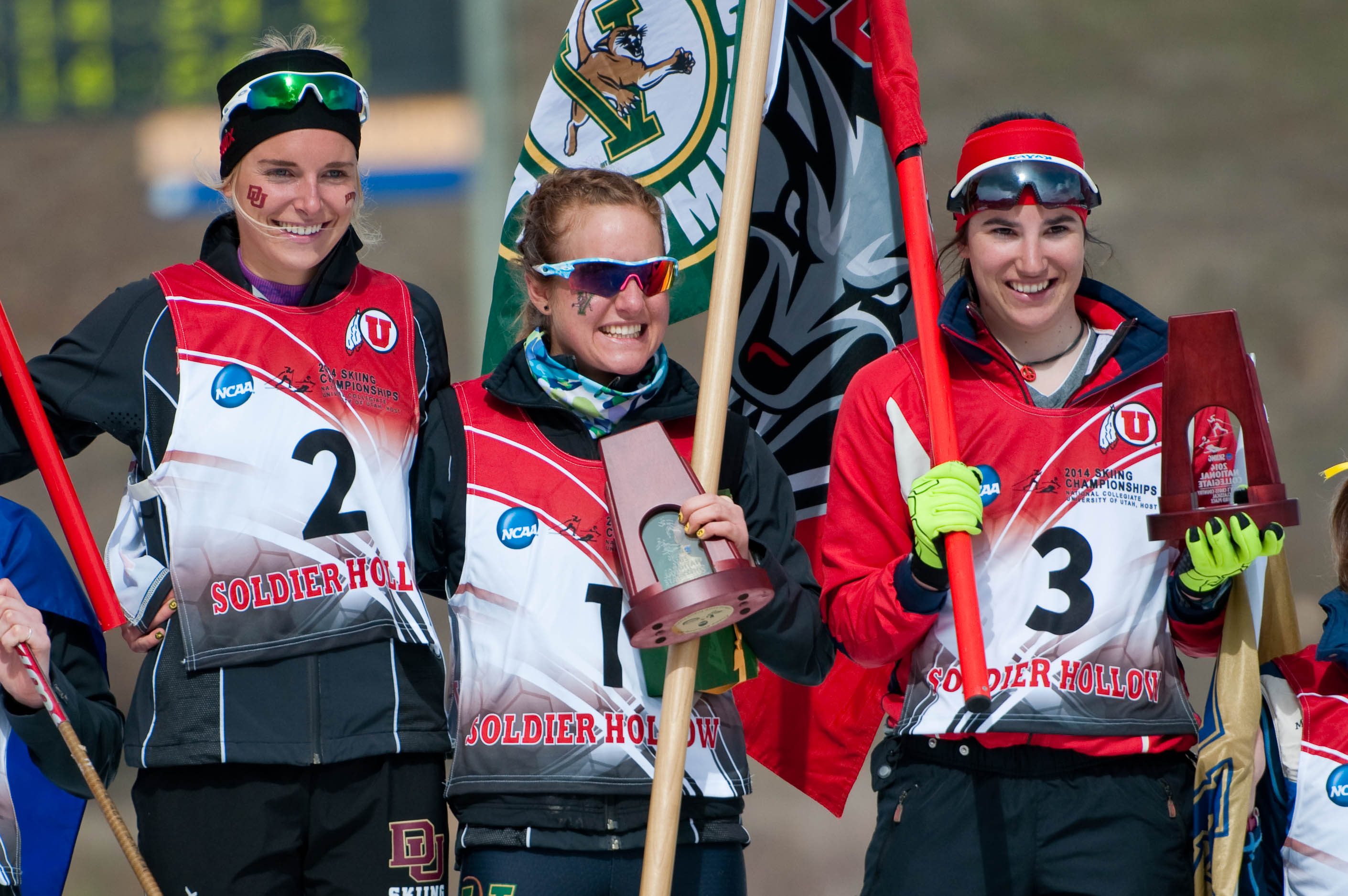
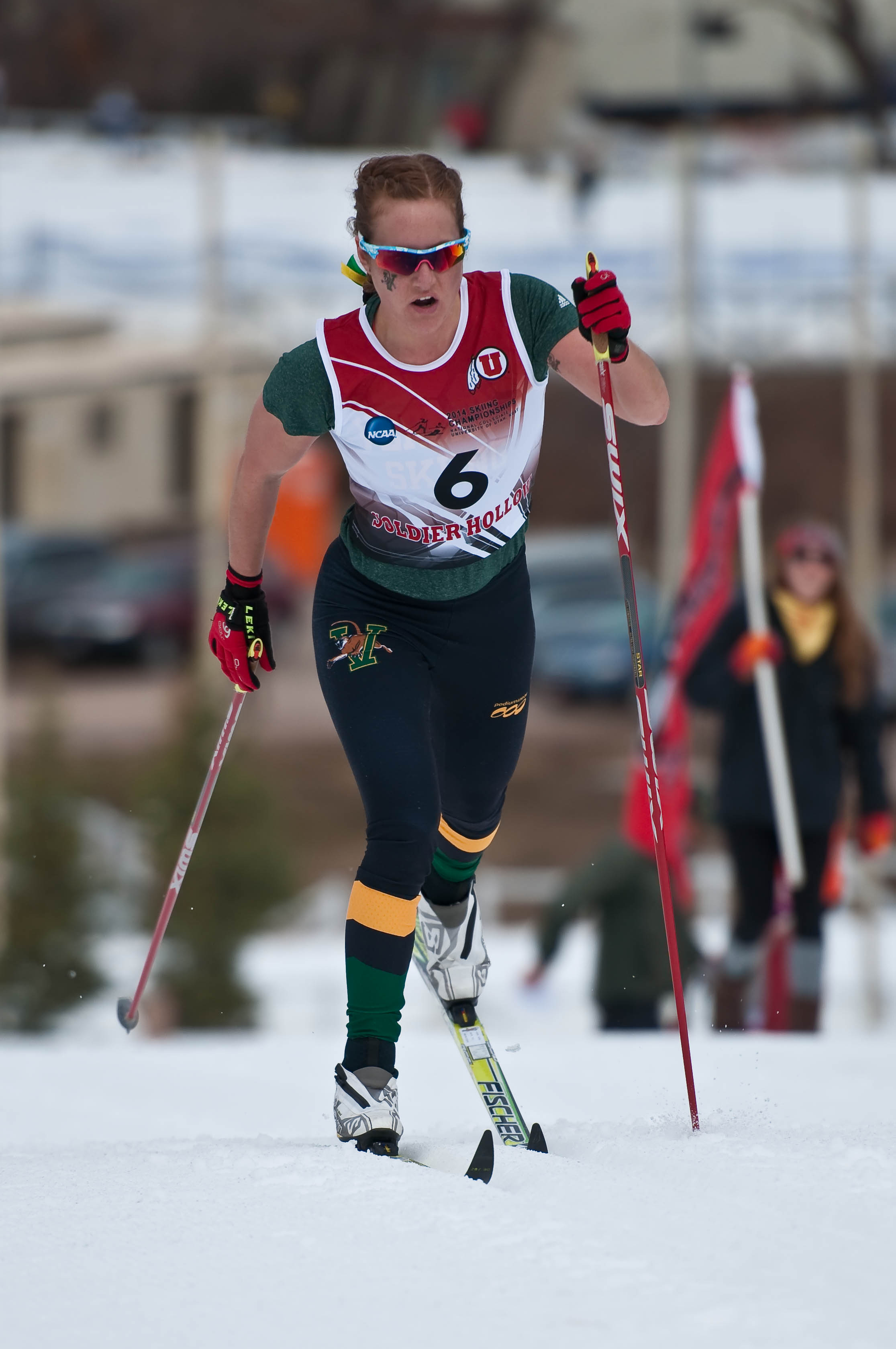
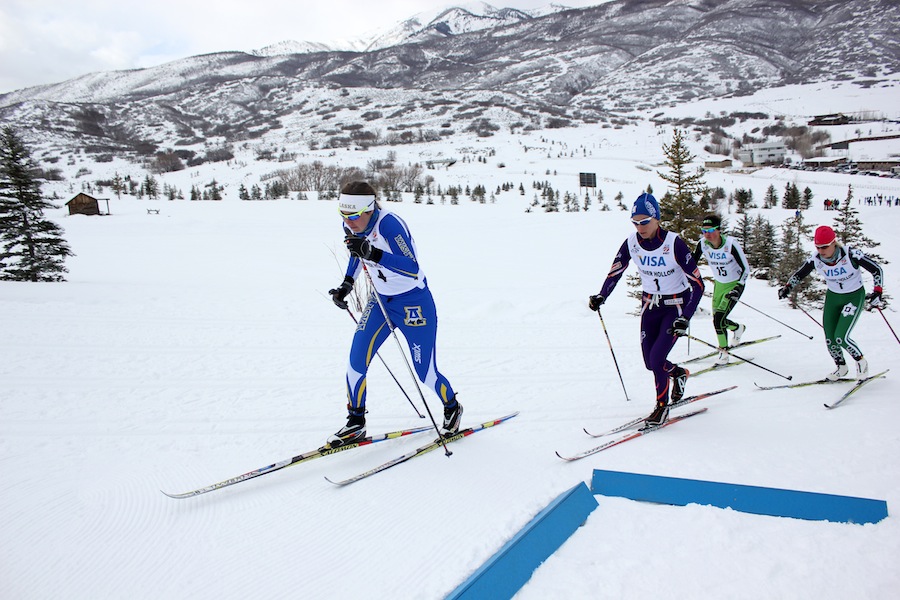
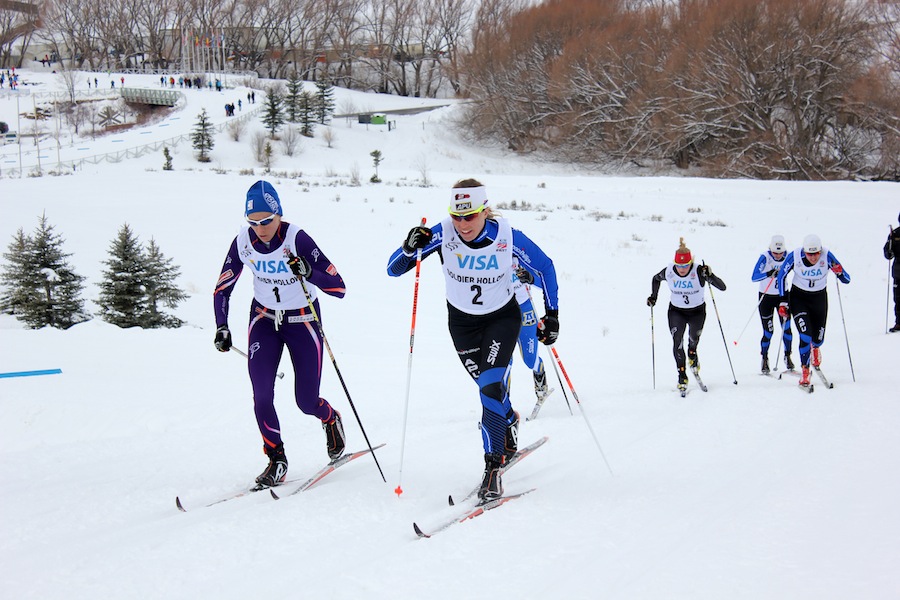
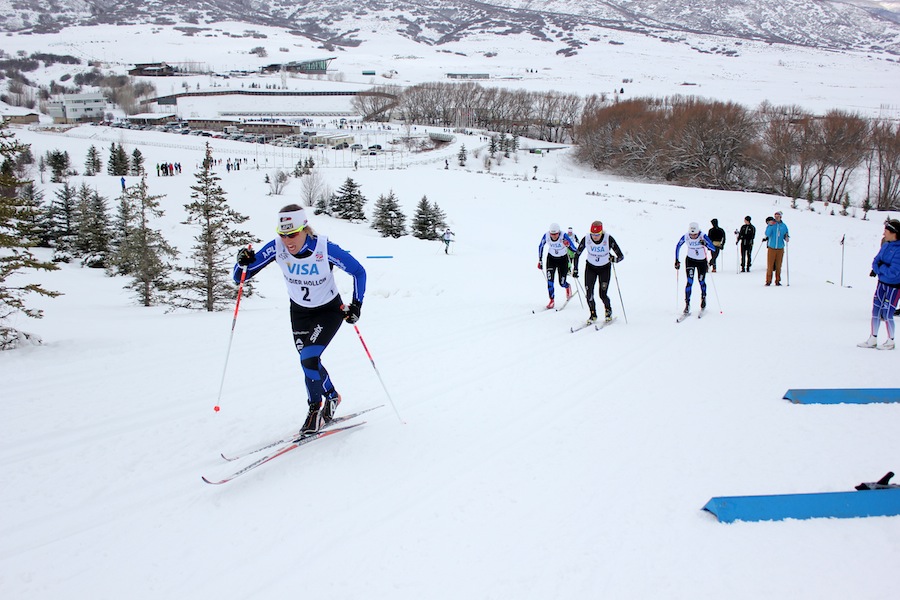
Nichole Bathe of the University of Alaska Fairbanks (l) as the second American in the classic sprint at 2014 U.S. nationals at Soldier Hollow in Midway, Utah. Rosie Brennan (c) finished first and Becca Rorabaugh (APU) placed third. (Photo: Tom Kelly/U.S. Ski Team)
By June of last year, Bathe made a phone a call. The recipient was Annika Taylor.
Taylor presented a unique situation in nordic sport. After growing up in Truckee, California, and graduating from the University of New Hampshire (UNH) with a chemistry degree in 2015, Taylor — a dual citizen – moved to Europe to ski for Great Britain’s national team, which is based in Lillehammer, Norway. (Taylor holds one passport through the United Kingdom and one through the United States, thanks to her father who is originally from the U.K.)
Bathe contacted Taylor because she shared a similarly unique family background. Both of Bathe’s parents hail from Britain, and since she was born in the U.S., Bathe is an American citizen.
If Bathe wanted, she could apply for dual citizenship and follow Taylor’s path, moving to Norway to ski for Britain. (Bathe only needed one of her parents to hold a valid British passport order to apply. Not all countries permit individuals to become dual citizens; the Czech Republic and Estonia, for example, require individuals to rescind one).
In their conversation together, Bathe asked Taylor about the logistics of moving to Europe. Taylor was reflective in her advice. She encouraged Bathe take into consideration not just the training she hoped to receive, but also the lifestyle changes she would have to make.
“When you move to a new country, you get challenged as a person,” Taylor, 24, explained.
During her first full year abroad, Taylor trained predominantly with a professional Norwegian team. Her teammates at the time spoke little English, she explained. While she had a background in basic Spanish, Taylor’s exposure to Norwegian was minimal when she arrived in Lillehammer.
The process of learning the language came gradually, she said. After a few months, Taylor had picked up conversational phrases. A few months after that, she purchased a grammar book to better her understanding of sentence syntax. Meanwhile, her primary language instruction stemmed from training sessions and talking to her teammates in Norwegian.
“When you’re out training with people and you’re out for three hours, you’re practicing constantly, asking questions and trying to explain yourself,” she said.
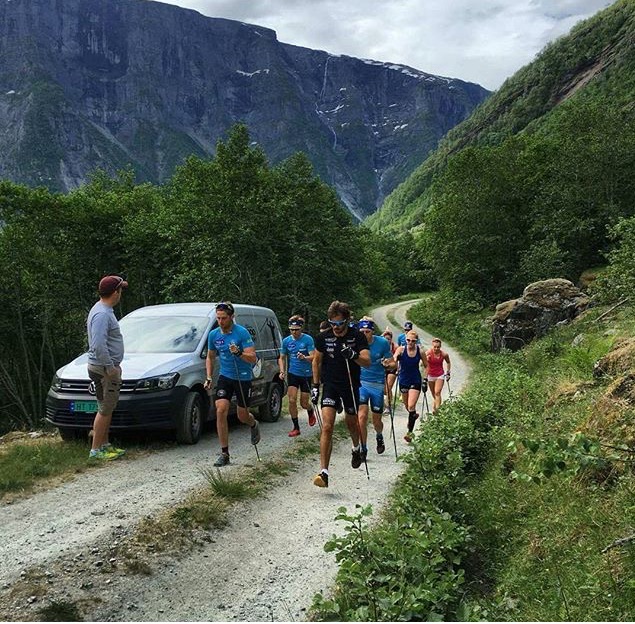
Annika Taylor (back right, in blue tanktop) during an elghuffs workout with Norwegian Coop talent team in 2016. (Courtesy photo)
In the end, Taylor said the language barrier was worth breaking through. She recalled a strength session she did with Norway’s Heidi Weng (now the two-time reigning overall and distance World Cup champion) and the confidence it gave her. Most importantly for her, Taylor was able to train with athletes who are World Cup regulars.
“I needed women who had international experience and not just experience in the U.S.,” Taylor said of her decision to join the British team.
After speaking with Taylor, Bathe realized she felt similarly. She had skied for Central Cross Country (CXC) program for the past nine years, returning each summer to train with the CXC Team, while a student at UAF. By the end of her college career, she’d tallied a fourth place, seventh, 12th, and 13th in the NCCA Championship races she’d contested. She’d competed at five U.S. senior nationals, finishing on the podium in third (as the second American) in the classic sprint in 2014.
But Bathe wanted to test herself outside the U.S.
“I felt that I was going to get the most out of taking a year or two to ski if I went all in and moved to Europe and had the chance to train with high-caliber people all the time,” Bathe said.
Bathe sent her application to the U.K. last spring, was granted dual citizenship and moved to Lillehammer in the early fall. Her application included proof of her parents’ original U.K. citizenship documents and Bathe’s U.S. birth certificate information.
“It’s actually pretty streamlined once they have all the information,” she explained.
This winter, Bathe earned a spot on the British national team. Her focus for the season remained on U23 World Championships in Goms, Switzerland. There, her best result was 37th in the 10-kilometer classic.
“I was lucky to race in Europe all year and really learned a lot about racing and just training in general,” Bathe wrote in an email. “Even though it wasn’t the year I had hoped for results-wise, it was a really useful year for me and I know now what I need to do to race faster and to just ski better in general.”
Taylor, who came into the season prequalified for the 2018 Winter Olympics, explained that she came down with an illness that plagued her from October through February. At her first Olympics in PyeongChang, South Korea, she finished 60th in the 15 k skiathlon and 75th in the 10 k skate.
“My body just didn’t have anything left to give in races,” Taylor reflected in an email. “I had to deal with a lot of feelings of ‘failure’ and push on past the disappointment of last season, but I am glad to report that I’m out the other side, loving training, looking forward to giving my best another season, while setting my sights on achieving a Doctor in Physical Therapy in my future!
“Athletes have ‘off years’- we are only human!” Taylor continued. “I definitely learned how to control the things I could control this past season, and learned to let go of the uncontrollable. It was a humbling experience and gave me a new empathy for those athletes that suffer from injury and illness on a regular basis!
“There’s something quite unique about the community of people and the resilience and determination, but also finesse that cross country skiing demands, that seems to shape quite interesting and well-rounded human beings. I think every athlete can recall a story of when their sport treated them to a ‘mountain-top’ experience and plenty of times where they experienced the low-lows that result when you dedicate your energy, time and emotion to something you love. It’s always a gamble to give something your all: you either succeed spectacularly or fail spectacularly, and somehow we keep coming back for more! It’s a cross country skier, human condition!”
Annika Taylor of the British national team during a bounding workout.
For the upcoming season, both Taylor and Bathe plan to continue racing for Britain. Bathe spent some time in Wisconsin this spring before returning to Lillehammer for training. Taylor is currently spending some time in Truckee before returning to Scotland and eventually Norway. As of this spring, both women were fully funded by the team, leaving only housing and food as their primary expenses.
“The hardest part of this last season was just managing the disappointment in results,” Bathe explained. “Seeing your name at the bottom of a results page is a bit of a gut punch, at the beginning of the season that was tough but once I figured out how to handle that and understand that I wasn’t going to have the dream season I envisioned it became more of a learning season and a technique season.
“Looking to the future I’m excited to race again and am much better prepared for those slap-in-the-face races that happen when your newer to the World Cup,” Bathe added.
The two teammates recommended the following Norwegian “elghuffs” bounding workout:
The Workout: “Elghuffs” a.k.a. hard bounding/ski walking uphill intervals
Goal: Get a good Level 3-5 workout in “and not get dropped to hard by the Norwegians!”
When: Can be done 1-2 times a week through the fall
Where: Alpine hill
“We do it in a town called Hajfell which is just outside of Lillehammer at a downhill mountain bike and ski area,” Bathe wrote.
The set: 6 x 6 minutes Level 4
“Then we catch the gondola back down the mountain for free,” Taylor wrote. “Pretty sweet that Hafjell offers that to people who go on foot or bike up!”
Top tip: “Don’t start too hard; it will catch up to you by the top,” Bathe wrote.
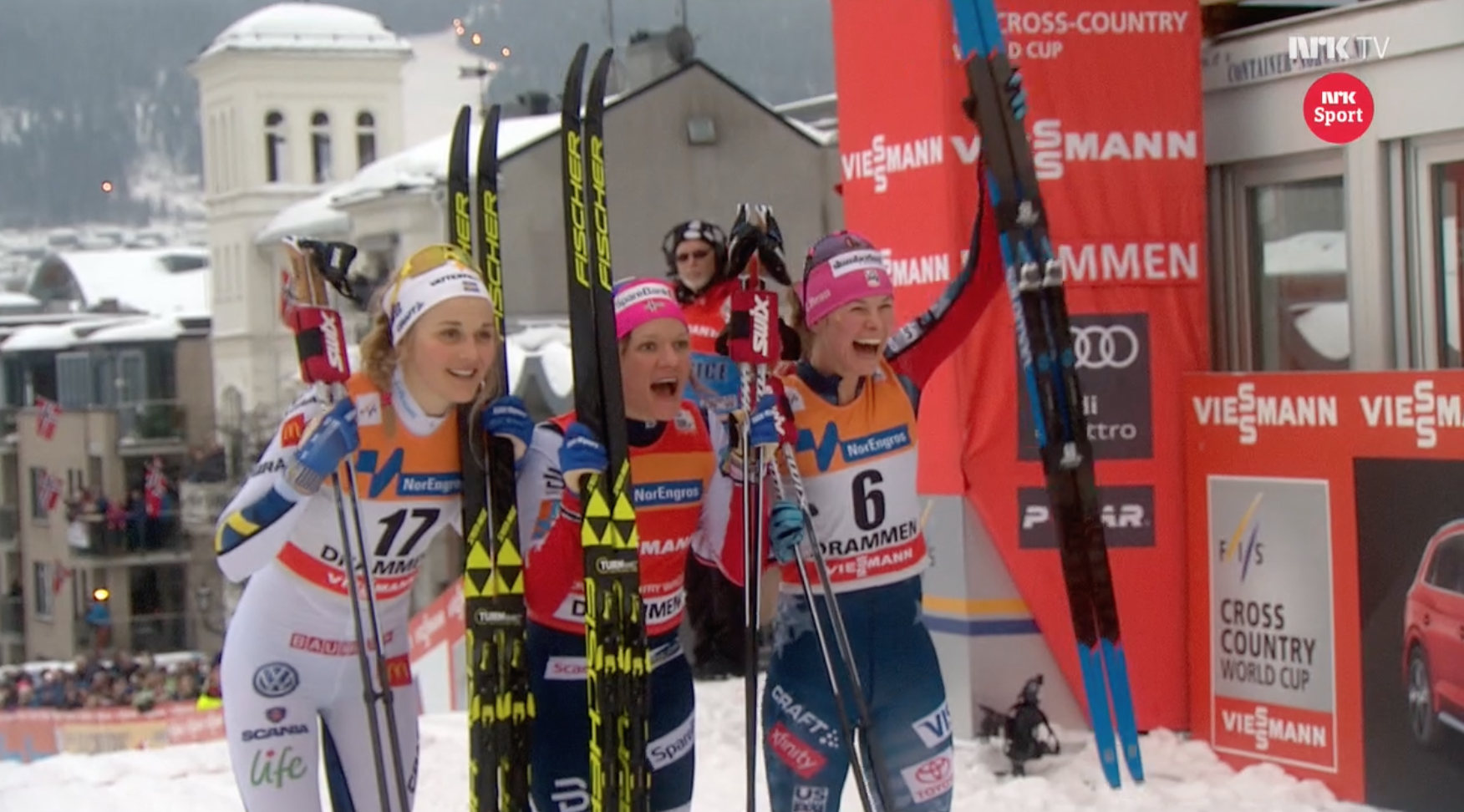
Maiken Caspersen Falla of Norway (center) won the classic sprint in Drammen and all but wrapped up the Sprint Cup. Stina Nilsson of Sweden (left) was second and Jessie Diggins of the United States third. (NRK screencap)
FIS Cross Country World Cup (Drammen, Norway): Classic sprints
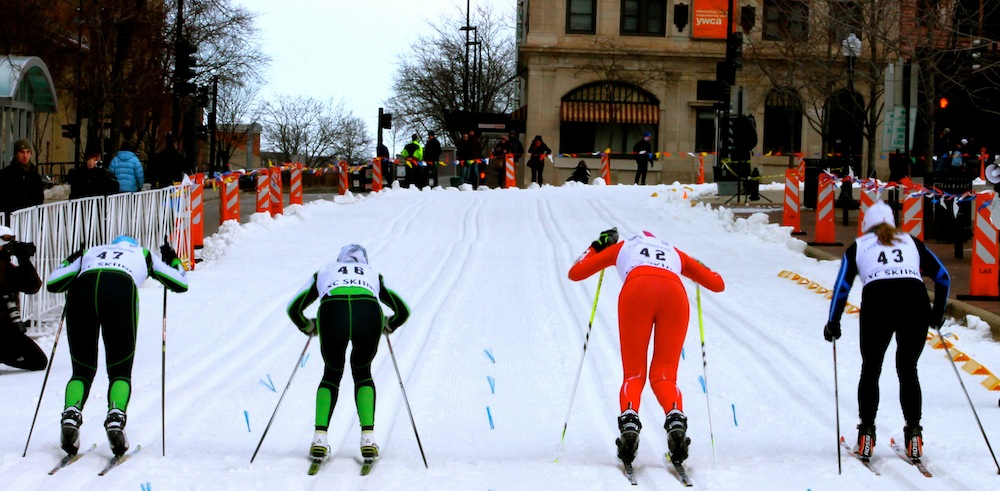
The cross-country World Cup hit the city on Wednesday, with classic sprints contested in the Oslo suburb of Drammen on snow which had been trucked onto the streets. And the crowd was rewarded with wins by two Norwegian favorites: Maiken Caspersen Falla in the women’s sprint and Johannes Høsflot Klæbo in the men’s race.
In the women’s final, Falla and Natalia Nepryaeva of Russia battled at the lead for much of the race, but Falla pulled away from the field on the last climb to the finish. Stina Nilsson of Sweden and Jessie Diggins of the United States pulled past Nepryaeva in the final few hundred meters to claim spots on the podium; Krista Parmakoski of Finland was fifth and Katja Visnar of Slovenia sixth.
With the win, Falla all but wrapped up the World Cup’s Sprint Cup crystal globe: she is just two points from having it clinched, with one sprint remaining on the calendar. In Falun, Sweden, in ten days, she more or less just has to make the heats to earn her third Sprint Cup in a row.
Also racing for the United States, Sadie Bjornsen and Sophie Caldwell made the quarterfinals, but did not advance past that round. Bjornsen ended the day in 21st and Caldwell in 27th.
Ida Sargent and Rosie Brennan were 47th and 48th in qualifying, followed by Kikkan Randall in 50th and Kaitlynn Miller in 53rd.
For Canada, Emily Nishikawa finished 52nd and Dahria Beatty 55th.
Great Britain’s Nichole Bathe, who raced for the University of Alaska Fairbanks, finished 58th.
In the men’s final, Russia’s Alexander Bolshunov set the pace for most of the heat. Klæbowas on his ski tails, and drew even on the course’s on downhill, where Norwegian teammate Eirik Brandsdal also caught up to them. Skiing back up to the finish, Klæbo ramped up to a furious tempo and was uncatchable. Brandsdal passed Bolshunov to claim second by a healthy margin. Sindre Bjørnestad Skar finished fourth, Kasper Stadaas fifth, and Emil Iversen sixth, all for Norway.
The lone North American to make the heats, Erik Bjornsen, qualified in 26th and finished the day in 18th. Teammate Andy Newell just missed the quarterfinals after finishing 33rd in qualification. Logan Hanneman and Kevin Bolger finished 49th and 50th, and Reese Hanneman 56th.
For Canada, Julien Locke placed 51st in qualifying, Alex Harvey 54th, and Andy Shields 58th.
Norway’s Marit Bjørgen racing to a 29-second win in Friday’s 10 k classic FIS race in Beitostølen, Norway. (Photo: Aleks Tangen)
(Note: This article has been updated to include comments from Nichole Bathe.)
BEITOSTØLEN, Norway — The question of whether Bjørgen or Weng will be the bigger name this season went in the favor of the former on Friday at Norway’s first big matchup of the season. Marit Bjørgen, now 37 and in her 20th World Cup season, won the first race of the three-day International Ski Federation (FIS) weekend in Beitostølen, starting last out of 56 women and finishing first in the 10-kilometer classic individual start, with 29.4 seconds between her and Weng in second place.
On a morning that marked the start of the 2017/2018 season in Norway, with temperatures just below zero and a snow squall during the women’s pre-race warmup, the snow covering the course appeared loose but ample.
Weng, the 26-year-old reigning Overall World Cup and Distance World Cup champion who started 30 seconds behind fellow Norwegian national-team member Bjørgen, told reporters after the race that she was satisfied with her performance, but could have skied better and “could have had better grip”.
For the first 2 kilometers of the race, Bjørgen’s pace was comparable to that of another one of her teammates, Ingvild Flugstad Østberg, who started just ahead of Weng. But halfway through the race, Bjørgen was nearly 22 seconds up on Østberg and 28 seconds ahead of Weng.
While Bjørgen continued to put seconds into her teammates in the final 5 k — blowing through the 7 k checkpoint 28 seconds faster than anyone else — Weng and Østberg battled for second. Weng clocked through 6.1 k just 2.7 seconds faster than Østberg and skied 5.1 seconds faster than her over the next 900 meters. Despite crossing the finish 11.6 seconds faster than Østberg, Weng’s time in the leader’s chair was short-lived, as Bjørgen finished 29.4 seconds faster with a winning time of 29:30.9 minutes.
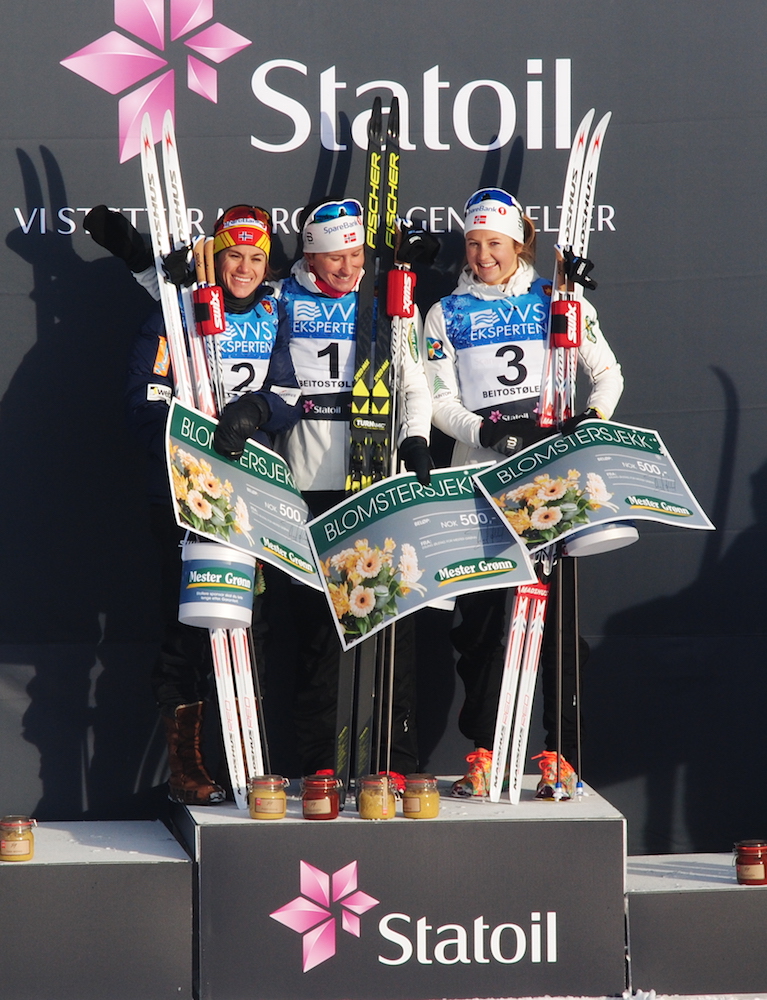
The women’s 10 k classic all-Norwegian podium at Friday’s FIS race in Beitostølen, Norway, with Marit Bjørgen (c) in first, Heidi Weng (l) in second and Ingvild Flugstad Østberg in third. (Photo: Aleks Tangen)
Østberg claimed third, 41 seconds back and 10 seconds ahead of another Norwegian national team member Ragnhild Haga in fourth (+51.0). Norway swept first through 13th place with Kathrine Rolsted Harsem in fifth (+1:08.1), Astrid Øyre Slind in sixth (+1:27.5) and notably, sprint specialist Maiken Caspersen Falla in ninth (+1:54.3).
“Marit is superior,” Weng said in a post-race interview with NRK. “This is top level and I have to step it up.”
She added, “29.4 and 41 seconds is a lot, but Marit is not invincible.”
But even Bjørgen has to tell herself to ski relaxed for the first race of the season.
“I tried to stay calm and ski my way up to Weng,” Bjørgen told NRK. “Considering that she held the yellow bib [as the World Cup leader] last year, I think that’s pretty good.”
Bjørgen reflected that she could have skied the flatter parts of the course better.
“Heidi did well there, and it was fun to ski behind here and learn from her,” she said.
Norwegian national-team member Ragnhild Haga racing to fourth in the women’s 10 k classic FIS race on Friday in Beitostølen, Norway. (Photo: Aleks Tangen)
Fourth-place finisher Haga told reporters that she was pleased with her technical improvements in classic, which she has been working on for three years.
“It was fun, and I’m glad I was able to race at such a high level,” Haga said.
Three Americans, two of which race for Great Britain, finished 29th, 30th and 31st: Annika Taylor (+3:48.2) Nichole Bathe (+3:51.3) and Anne Hart (+3:51.4), respectively. Taylor was born in California and is a member of Great Britain’s women’s team, as is Bathe, who hails from Wisconsin and is also a member of the CXC Team. Hart, originally from Minnesota, races for the Stratton Mountain School (SMS) Elite Team in Vermont.
Since mid-September, Bathe, a recent University of Alaska Fairbanks graduate, has been living in Lillehammer, Norway, while training with the British national team.
“It’s been quite the transition especially from college racing but it has been such a great learning experience and makes me really exited for the season!” Bathe wrote in an email. “That was my first race of the season and I thought it went okay. I went out pretty hard which caught up to me in the end but overall I think it was a good start to the season.
“Typically I am more of a sprinter but in general I like classic more than skate and 5k classic is my absolute favorite race,” she added. “This winter I am focusing on U23s [World Championships] and skiing fast there especially in the sprint. I will mainly be racing in Europe this year. I am racing the Kuusamo World Cups and then heading onto the OPA and Scando Cup races!”
In an in-person interview with FasterSkier, Hart explained that she made a point to get on snow earlier this season and spent the last two weeks training in Sjusjøen, Norway. After this weekend, she’ll return to the U.S. for the first SuperTour races in West Yellowstone, Montana, Dec. 2-3.
“I’ve been told by just about everyone that this is more competitive than a World Cup in part because these are [the Norwegians’] major qualifying races [for the World Cup], or their only ones I think,” Hart said of Beitostølen. “So I just went out hard. I had great kick on my skis so I just was really working on skiing well because last year that was an area I think I just got really frantic.”
During training on Thursday, Hart skied one lap with Bjørgen.
“Yesterday I actually skied with — stalked — Marit on an easy lap, and I was just trying to imitate her skiing,” Hart said. “So I was just trying to think of her out there and obviously not quite as fast, but I was really psyched with how I skied everything well. I felt a little tired on the last bit, but again, I didn’t fall apart and I’m really pleased with that.”
American Anne Hart (SMS Elite Team) racing to 31st in the women’s 10 k classic FIS race on Friday in Beitostølen, Norway. (Photo: Aleks Tangen)
For Hart, the biggest difference she noticed in this initial race of the season was the fact that she was having fun.
“Last year I was just struggling the whole season to find that ‘fun’ gear, I guess, and today I was really enjoying the whole time and really pushing and not looking forward to the end,” she said. “Instead of thinking, ‘I have to make it another kilometer,’ it was like, ‘Oh my god, I only have a kilometer to go. I’ve gotta really give it all I’ve got.’ ”
For Canada, Isabella Howden, of the newly formed Barrie Cross Country (BXC), finished 53rd (+7:18.2). Afterward, Howden, who started 16th, recalled being passed by the five fastest women on her second lap, which she said was beneficial.
“That was pretty cool, seeing them and getting to stay with them on the downhills and copy their technique for as long as I could see them,” she said.
For Howden and some of her Canadian teammates, Beitostølen is familiar territory; they raced there last year. Regardless, she was in awe of the atmosphere.
“It’s so cool … all the kids up there cheering and there’s a whole crew around the corner with all their cowbells, like 10 of them,” she said with a laugh.
Sundby Pulls It Together
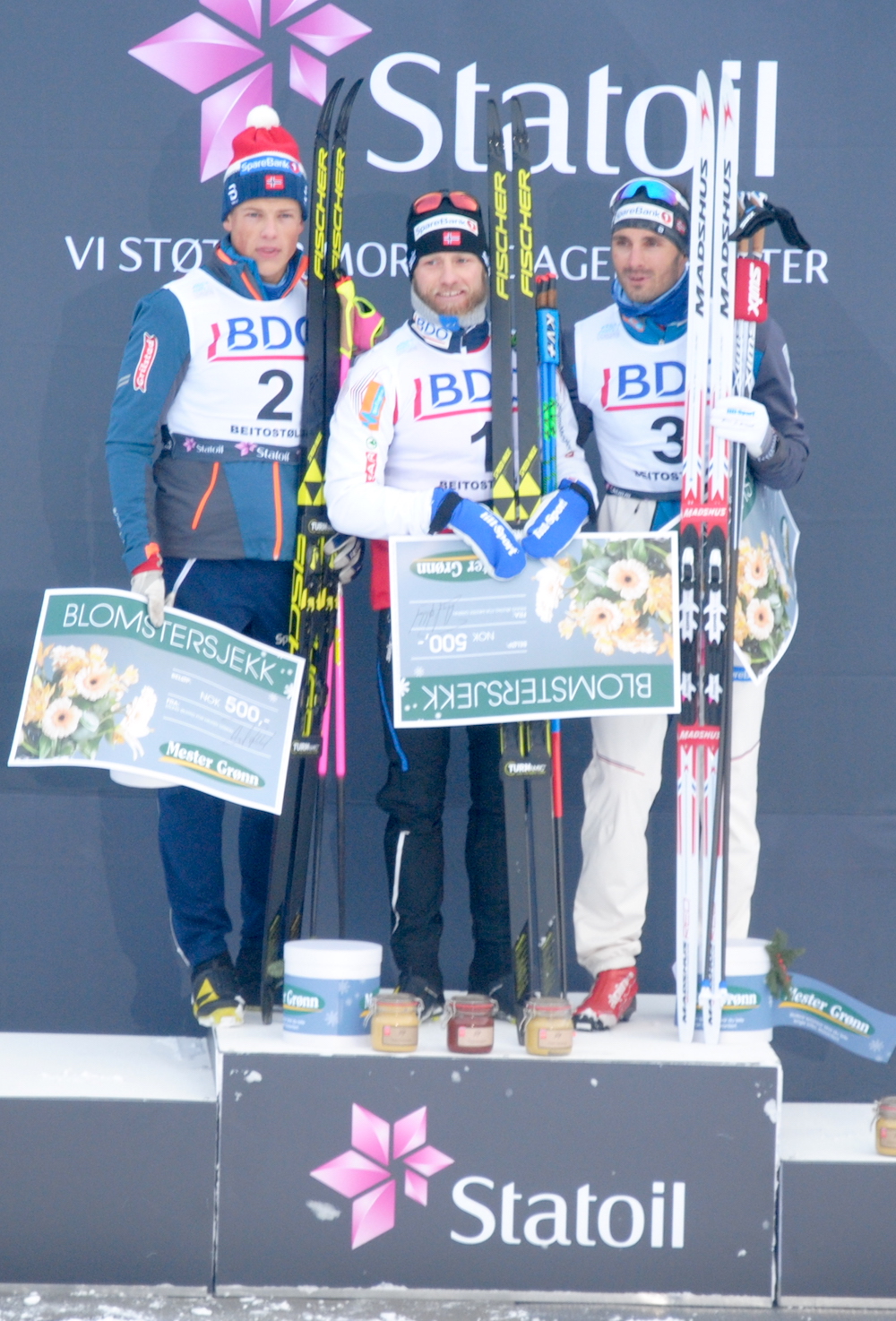
The men’s 15 k classic all-Norwegian podium at Friday’s FIS race in Beitostølen, Norway, with Martin Johnsrud Sundby (c) in first, Johannes Høsflot Klæbo (l) in second and Hans Christer Holund in third. (Photo: Aleks Tangen)
In the men’s 15 k classic individual start that followed, defending World Cup champion Martin Johnsrud Sundby took the win by 18.2 seconds over Norwegian teammate Johannes Høsflot Klæbo, who won last season’s Sprint World Cup at the age of 20.
Now 21, Klæbo is recognized as more of an all-around force, and on Friday, he led the men’s race up until the 4.9 k checkpoint. Sundby started last out of 158 men and trailed Klæbo until 6 k. But from that point on, the race was Sundby’s; at 9.8 k, he was 12.3 seconds faster than Klæbo in second place.
“I had to pull myself together,” Sundby told reporters after the race, explaining that he felt tired around 6 k. While the rest of his race required some extra effort, Sundby expressed contentment with his performance.
“This was something positive that I will take with me going into the season,” he said. “This was the first race of the season and it could have gone both good and bad. … It was so-so, I felt goofy skiing today, but that was also the case for everyone else.”
He attributed that awkward feeling to challenging conditions, “but that is also good practice,” he said. “I didn’t feel all that well in the first 5 k, but after that I was able to speed up and I felt that was able to control the race.”
And he did so without going too far into the pain cave.
“I didn’t have to dig as deep as I have done sometimes in the past,” Sundby said.
Sundby’s winning time of 38:57.2 was 18.2 seconds faster than Klæbo in second and 37 seconds clear of Hans Christer Holund in third. The top-seven men — all Norwegian — finished within 59 seconds of first. The women were a bit more spread out, with the seventh-place woman, Silje Theodorsen (Kvaløysletta Skilag), finishing 1:36.3 behind Bjørgen.
Holund clawed his way into the race after his 4.9 k time ranked 11th. With about 5 k to go, the Norwegian national-team member was up to fifth, and by 11.9 k, he was within reach of the podium in fourth place.
Didrik Tønseth ended up just 1 second off the podium in fourth (+38.0), while Johan Hoel (Åsen IL/Team Veidekke Oslofjord) placed fifth (+42.2), ahead of Simen Hegstad Krüger in sixth (+44.1) and Emil Iversen in seventh (+59.0).
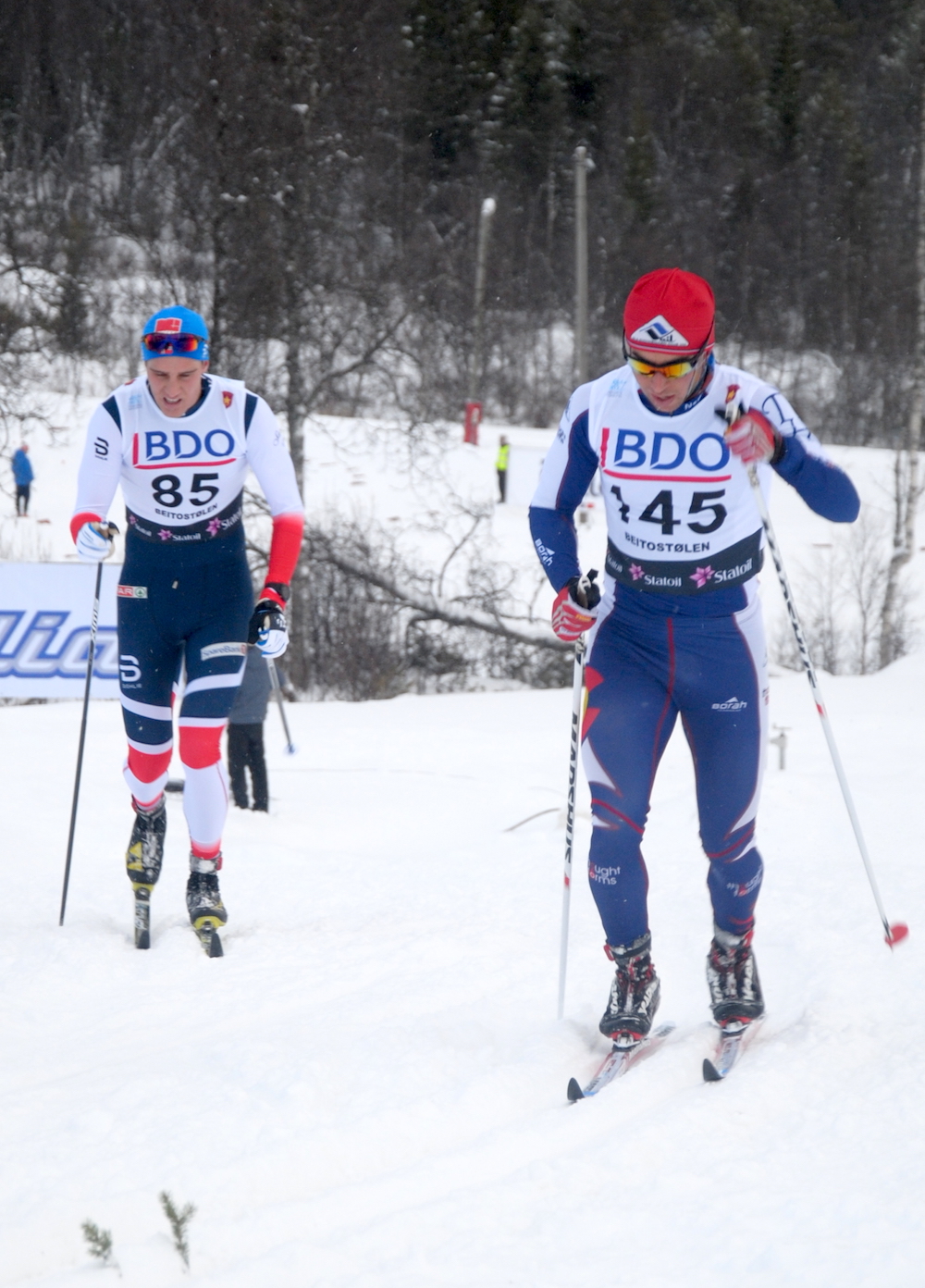
Noah Hoffman (r) passes Norway’s Torstein Bu during the men’s 15 k classic FIS race season opener on Friday in Beitostølen, Norway. Hoffman went on to place 29th, while Bu finished 75th. (Photo: Aleks Tangen)
The lone American in the race, Noah Hoffman placed 29th, 2:25 minutes behind Sundby. After a slow opening that put him in 47th at the 2.1 k mark, the former U.S. Ski Team member settled into a pace that put him within the top 30.
Afterward, he told FasterSkier that his performance was a good starting point. He started the race toward the back of the field in bib 145, just ahead of several top Norwegians.
“It was a little unfortunate that there was a big train that formed right behind me, and those guys didn’t catch me until less than a k to go,” Hoffman reflected. “I was hoping they’d get me a little sooner or not get me at all, but it was good.”
In terms of a race plan, he explained that he tried to ski with energy and build throughout the entire 15 k, which he felt he did.
“I got a little excited the second time up the big hill and maybe burned a little too much, but for the most part it was a good effort and I’m looking to build this for Sunday and then obviously into next weekend,” he said.
After Sunday’s second set of distance races in Beitostølen, the 10/15 k freestyle individual starts, Hoffman will race four weekends of World Cups as an invited member of the U.S. Ski Team (USST) for Period 1. He missed the objective qualifying criteria for renomination to the USST by one place (he ranked 51st in the World Cup at the end of last season) and is thus skiing independently this year, paying his own way (and paying his own wax technicians, Zach Caldwell and recently retired USST tech Peter Johansson) so that he can race in Europe.
“The early season is important for me this year because I don’t have guaranteed start rights for the whole winter, so I need to ski well,” Hoffman, 28, said. “And I believe I’ve done everything I can to prepare and I hope to see the results from that.”
Several Canadian juniors raced the men’s 15 k as well. Ryan Jackson led them in 97th (+5:16.8), followed by Scott Hill in 99th (+5:19.1), Joey Foster in 124th (+6:45.3), and Maks Zechel in 143rd (+8:25.5).
“It was hard out there today,” said Foster, a 21-year-old member of BXC, noting that he was still feeling the effects of travel after arriving in Europe a week ago. “Considering how I felt, the race was pretty good. … I started with what I thought was a pretty conservative pace and I got in with a good train of people, and I skied with them for almost the whole first lap, and from there I just kind of fell off pace. … I think my leadup to the race just wasn’t as good as it could’ve been, so I wasn’t feeling as crisp as I would’ve liked.”
The Beitostølen FIS races continue through the weekend with classic sprints on Saturday, which U.S. Ski Team member Andy Newell plans to race, and 10/15 k skate races on Sunday.
The Russian men finishing in unison to take first, second and third in the men’s 30 k skiathlon, the final race of 2017 U23 World Championships at Soldier Hollow in Midway, Utah. Alexander Bolshunov (8) was deemed the winner, Alexey Chervotkin (1) was second, and Denis Spitsov (11) third. (Photo: FlyingPointRoad.com)
FIS Nordic Combined Junior World Championships (Park City and Midway, Utah): Normal hill/5 k
American Ben Loomis (6) leads Norway’s Lars Ivar Skaarset (7) during the third leg of the nordic-combined 4 x 5 k team event on Thursday at 2017 Nordic Junior Worlds at Soldier Hollow in Midway, Utah. Loomis brought the U.S. from ninth to seventh, and his team ultimately finished seventh. (Photo: FlyingPointRoad.com)
[UPDATED] In the individual normal hill/5-kilometer Gundersen on Saturday, the last nordic-combined competition of 2017 Nordic Junior World Championships, American Ben Loomis captured his first top 10 in his third Junior Worlds in ninth place.
Eighteen-year-old Loomis jumped to 10th then picked off one place in the 5 k to finish ninth, 1:22.3 minutes behind the winner, Germany’s Vinzenz Geiger.
Geiger led after the jump and started the ski race 4 seconds ahead of Japan’s Yuto Nakamura in second. Geiger was able to hold off Finland’s hard-charging Arttu Mäkiaho, who raced from ninth to second, by 22.6 seconds. France’s Laurent Muhlethaler raced from fifth to third (+23.9) for the final spot on the podium, while Nakamura slipped to fourth (+42.8).
The U.S. had two in the top 15 with Stephen Schumann in 15th (+1:44.3), up from 20th after the jump. Grant Andrews placed 33rd (+2:40.0) and Tucker Hoefler finished 46th (+3:56.9).
FIS Nordic U23 World Championships (Midway, Utah): 15/30 k skiathlon
It was a Russian affair and a head scratcher for the photo-finish crew at U23 World Championships on Saturday, with three Russians putting enough time on the rest of the field in the men’s 30-kilometer skiathlon that they had time to slow to a stop and inch across the line in unison.
The jury ultimately had to decide who won, awarding it to Alexander Bolshunov in 1:15:31.5 hours, 0.2 seconds ahead of Alexey Chervotkin in second. Denis Spitsov was listed as third (+0.5). France’s Jules Lapierre came closest to the Russians in fourth, finishing 11 seconds later.
The field was considerably strung out by the end of the race, with Switzerland’s Jason Rueesh finishing 14.3 seconds out of first in fifth and Norway’s Gaute Kvaale crossing the line in sixth (+33.0), ahead of France’s Valentin Chauvin in seventh (+49.1), and Andorra’s Irineu Esteve Altimiras in eighth (+56.8).
American Paddy Caldwell (SMS/USST) placed ninth for the second-straight race at U23s, finishing 1:24.4 behind the winner.
The U.S. men had three in the top 15 for their best day of the championships, with John Hegman (SVSEF) placing a 11th (+1:53.5) and Adam Martin (NMU) 15th (+2:23.3) for their best results at U23 Worlds.
Evan Palmer-Charrette (NTDC Thunder Bay) led the Canadian men in 26th (+5:44.6). Alexis Dumas (CNEPH) finished 33rd (+9:02.7) out of 36 finishers. Several North Americans did not finish, including Canada’s Julien Lamoureux and Julien Smith, and American Cal Deline.
In the women’s 15 k skiathlon, Lotta Udnes Weng achieved her first gold of U23 Worlds, holding off Finland’s Johanna Matintalo by 3.8 seconds and crossing the line in 40:50.9 minutes. Russia’s Yana Kirpichenko reached the podium in third (+13.9), fewer than two seconds ahead of Weng’s twin sister, Tiril Udnes Weng in fourth (+15.6).
Dahria Beatty, of the Alberta World Cup Academy and Canadian National U25 Team, led the North Americans in 19th (+2:18.1), and teammate Katherine Stewart-Jones (NTDC Thunder Bay/NST U25 Team) was 21st (+2:29.3) for her best U23 Worlds result.
The Czech Republic’s Petra Hyncicova (University of Colorado-Boulder) followed in 22nd (+2:30.7), and three Canadian women finished in the top 30 with Frederique Vezina (CNEPH) in 29th (+3:36.2). Jenn Jackson did not finish.
Jesse Knori (University of Colorado-Boulder) was the top American in 30th (+3:40.1), Alayna Sonnesyn followed in 31st (+3:42.5), Nichole Bathe (University of Alaska Fairbanks) in 33rd (+4:36.9), and Corey Stock (Bridger Ski Foundation) in 36th (+5:42.1).
Mathilde Petitjean, who races for her native Togo but trains with the Quebec-based CNEPH, finished 38th (+6:04.8) of 38 finishers.
FIS Cross-Country World Cup (PyeongChang, South Korea): 15/30 k skiathlon
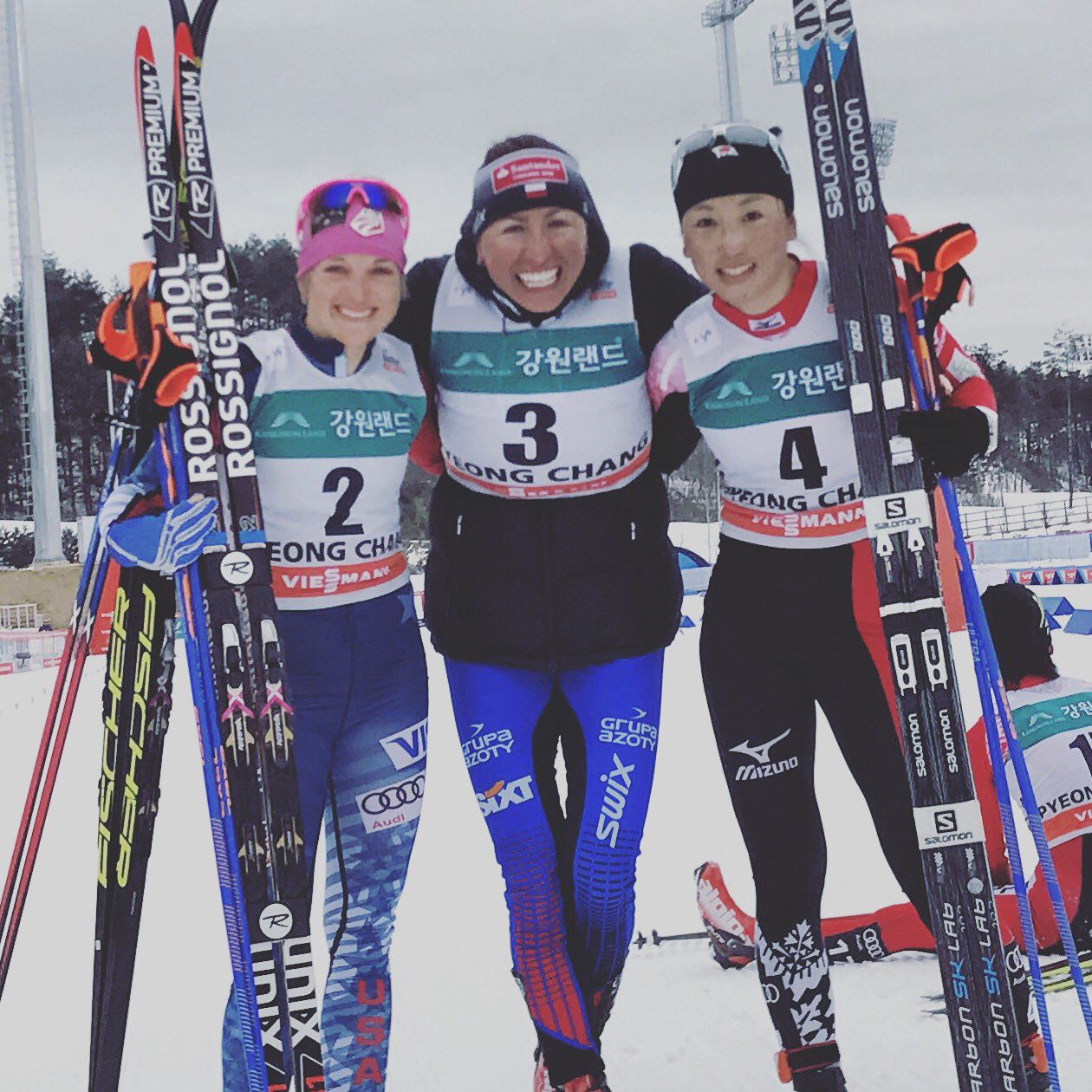
The women’s 15 k skiathlon podium at the PyeongChang World Cup in South Korea, with Poland’s Justyna Kowalczyk (c) in first, American Liz Stephen (l) in second, and Japan’s Masako Ishida in third. (Photo: FIS Cross Country/Twitter)
The second day of World Cup racing in PyeongChang, South Korea, took place this Saturday, with a skiathlon event for both genders. The women raced a total of 15 kilometers, the first 7.5 k leg classic and the second 7.5 k leg freestyle. Poland’s Justyna Kowalczyk came away with the women’s win (her first in three years), getting back to her old ways of breaking away from the pack to finish first in 43:54.7 minutes. Liz Stephen of the U.S. Ski Team (USST) claimed second place (+56.0), while Japan’s Masako Ishida took third (+1:14.8).
For Stephen, second matched her best individual result in a from two years ago, when she placed second in a 10 k freestyle in Rybinsk, Russia. This year at the Tour de Ski, Stephen posted the second-fastest time up the final climb in Val di Fiemme, Italy. For Ishida, it was her first podium since 2009.
Caitlin Patterson, racing for the U.S., finished just off the podium with a career-best fourth (+1:21.4) for her first top 20 on the World Cup, and American Liz Guiney placed 13th (2:21.7) for her first top 20 as well. Jessica Yeaton, who trains with Alaska Pacific University and races for Australia, came in 24th (4:58.6).
Two Canadian women competed with Annika Hicks leading the team in 26th (+5:17.8) followed by Sadie White in 29th (+6:54.7) for their first World Cup top 30s.
In the men’s 30 k skiathlon that followed, Russia’s Petr Sedov broke away during the skate leg to take a decisive victory over Norway’s Daniel Stock and Mathias Rundgreen, finishing in 1:18:49.6 hours, 22.5 seconds clear of second place. It was Sedov’s first World Cup win and podium, and the first individual podiums for Stock and Rundgreen as well.
Rundgreen edged Russia’s Konstantin Glavatskikh for the final spot on the podium, with both being listed as 42.1 seconds behind Sedov.
While Rundgreen held off three others for third place, including Sweden’s Gustav Eriksson in fifth (+46.8), Japan’s Keishin Yoshida in sixth (+47.1), and Russia’s Alexander Utkin in seventh (+49.0), American Noah Hoffman kept his distance ahead of the second chase group to finish eighth (+1:06.2) for his best result in a non-World Cup stage since placing eighth in a 2012 skiathlon in Canmore, Alberta. (Hoffman won the time of day in the 15 k pursuit four years ago in Kuusamo, Finland.)
Also for the U.S., Scott Patterson was next across the line in ninth (+1:28.4) for his first World Cup points, and Matt Gelso finished 19th (+5:00.8) for his first top 20.
Brian McKeever of Canada’s Para-Nordic Ski Team was the lone Canadian finisher in 29th (+8:48.9). Bob Thompson was listed as placing 32nd of 37 after being lapped, and Simon Lapointe did not finish.
NorAm Eastern Canadian Championships (Cantley, Quebec): Classic interval start
The NorAm mini tour at the Nakkertok Nordic Centre continued on Saturday with Eastern Canadian Championships with classic individual start races.
In the men’s 15 kilometre, Lappe Nordic’s Andy Shields took a lead in the first lap and held on to win in 39:14.7, just 0.7 seconds ahead of CNEPH’s Ricardo Izquierdo-Bernier. Team R.A.D.’s Russell Kennedy collected his second bronze of the weekend, 24.7 seconds back.
SMS Elite’s Anne Hart won the women’s 10 k in a reversal of Friday’s sprint podium. Hart’s 30:03.3 finish gave her a 9.3 second edge on CNEPH’s Sophie Carrier-Laforte and 20.0 seconds on AWCA’s Maya MacIsaac-Jones.
For the 123 men and 77 women doing the full distance, the weekend is a mini tour. For the younger categories, it is three separate events allowing the kids who couldn’t skip school on Friday to race Saturday and Sunday.
There should be over 700 finishers today with 768 on the start list. The volunteers will have more hours of work even after the open categories have finished.
Results will update continuously as more categories start.
Paddy Caldwell (SMS/USST) racing to a career-best ninth in the men’s 15 k freestyle individual start on Thursday at U23 World Championships at Soldier Hollow in Midway, Utah, while his dad, Tim Caldwell, cheers him on. (Photo: FlyingPointRoad.com)
(Note: This article has been updated to include comments from Paddy Caldwell.)
Three years ago, American Patrick “Paddy” Caldwell made his debut at Junior World Championships, racing to 10th in the 20-kilometer skiathlon in Val di Fiemme, Italy. It was the first time he had ever done a skiathlon; he was 19 years old and a college freshman at the time.
Now a 22-year-old Dartmouth sophomore, who continues to train with the Stratton Mountain School (SMS) as a member of the U.S. Ski Team’s development “D” team, Caldwell (son of four-time Olympic cross-country skier Tim Caldwell and cousin of current U.S. Ski Team standout Sophie Caldwell) is in his third U23 World Championships. The skiathlon distance has increased to 30 k, yet that classic-to-skate race remained his main focus for this year’s U23 Worlds at Soldier Hollow in Midway, Utah.
Earlier this week, he broke through with his best-ever sprint result at the championships, reaching the quarterfinals and placing 18th overall in the classic sprint. Then, on Thursday in the men’s 15 k freestyle, he cracked the top 10 for the first time in his U23/Junior Worlds career.
“I was really excited going into today’s race,” Caldwell wrote in an email on Friday morning. “15km FS is one of my favorite race formats. I have been targeting this week of races all year and was really looking forward to this race in particular.”
While the sprint was a primer for Caldwell, he said it also boosted his confidence leading into the two individual distance races at U23s.
“I have been working on my sprinting a lot this year and I am psyched to be mixing it up in the heats!” he wrote.
He described the conditions on Thursday as hard-packed with a fair amount of moisture, “which made for some fast skiing.”
It was overcast — grey and spitting rain at times — a stark contrast from the preceding bluebird days. But with temperatures just below freezing, the course remained firm.
“My strategy for the day was to pin it from the start and hold on,” said Caldwell, who started 44th of 53 in the men’s three-lap, individual start race, in a post-race interview with the U.S. Ski Team. “It was a really tight race and I definitely paid for my first lap, but I am happy to have put it all out there.”
After being passed by Russia’s eventual winner Alexander Bolshunov, who started 30 seconds behind him in bib 45, Caldwell initially finished sixth, 1:03.6 minutes behind Bolshunov. Three later starters ultimately bumped the American to ninth, including Russia’s Alexey Chervotkin, who took second at the finish, 21.8 seconds behind Bolshunov (who won in 32:55.7).
“I started off with a fast first lap and was getting splits between 1st and 4th for the first five or six kilometers,” Caldwell recalled in an email. “Bolshunov caught me around 7 kms into the race… I skied with him for about 1.5km but on the big downhill halfway through the 5km loop another skier slotted in between us and Bolshunov ended up gapping us before I could get around the other skier — it would have been sweet to ski with him some more but who knows how long I could have stuck with him. I could see him for the rest of the race which was a good gauge and kept me pushing to make up time on him.
“In the end I am really excited to be in the top ten overall and to have left it all out there,” Caldwell added. “It was a tight race and I was a bit disappointed to be at the tail end of a close group of times but in the end I am really happy with the result. I want to be the best all around skier I can be and I am really excited to be making progress in both sprint and distance racing.”
The all-Russian podium in the men’s 15 k freestyle at 2017 U23 World Championships, with Alexander Bolshunov (c), who won by nearly 22 seconds over Alexey Chervotkin (l) in second, and was 28.2 seconds ahead of Denis Spitsov (r) in third. (Photo: FlyingPointRoad.com)
For the second-straight day of 2017 Junior/U23 World Championships, Russia claimed all of the medals in the men’s race, with Denis Spitsov placing third (+28.2).
“It’s very, very cool,” Bolshunov, the silver medalist in Tuesday’s classic sprint, told the U.S. Ski Team media. “I couldn’t explain my emotions now, it’s really cool.”
“I was really excited to be in the mix with the top guys today,” Caldwell told the U.S. Ski Team. “U23s have been my focus all year and I am psyched to have improved on my results from past U23 and World Junior races.”
Next up for Caldwell, Saturday’s skiathlon, which will be his first since placing 20th in the 2015 skiathlon in Almaty, Kazakhstan.
“I have only done two skiathlons (Val de Fiemme and Almaty) but both were really fun and exciting races,” he wrote. “Mass start races are always a blast!”
Adam Martin (Northern Michigan University) racing to 22nd in the men’s 15 k freestyle at 2017 U23 World Championships at Soldier Hollow in Midway, Utah. (Photo: FlyingPointRoad.com)
Four American men raced the 15 k, with Adam Martin (Northern Michigan University) placing 22nd (+2:22.4), Jack Hegman (Sun Valley Ski Education Foundation) 24th (+2:25.2), and Cal Deline (Dartmouth Ski Team) 37th (+3:48.6). For Martin, 22nd was his best at U23 Worlds by one place, and Hegman and Deline also notched personal bests at their first U23 Worlds.
Evan Palmer-Charrette (NTDC Thunder Bay) led Canadian men in 34th (+3:20.2) for his best result at his U23 Worlds debut as well. Alexis Dumas, of the Pierre-Harvey National Training Centre (CNEPH) followed in 38th (+3:52.9), tying his U23 best. Julien Lamoureux (CNEPH) was 43rd (+4:16.7) in his first race of U23 Worlds, and Scott James Hill (Team Hardwood) 49th (+6:15.2).
Second-Straight Win for Dyvik; Beatty 16th
Dahria Beatty (AWCA/Canadian U25 Team) racing to 16th in the women’s 10 k freestyle on Thursday at 2017 U23 World Championships at Soldier Hollow in Midway, Utah. (Photo: FlyingPointRoad.com)
In the women’s 10 k freestyle, Dahria Beatty (Alberta World Cup Academy/Canadian National U25 Team) notched her second top 20 of the week in 16th, after placing 12th in Tuesday’s classic sprint.
She finished the two-lap 10 k in 27:39.8, more than a minute faster than her 10 k freestyle time at 2017 U.S. nationals last month (where she finished 17th. Beatty went on to place fourth in the classic sprint and win the freestyle prologue at U.S. nationals).
On Thursday, she was 1:25.8 minutes back from the winner, Sweden’s Anna Dyvik, who racked up her second-straight gold of the championships with the best time of the day in 26:14.0.
“Today’s race played out fairly similarly to the 10k skate at US Nationals, but not on an extreme of scale,” Beatty wrote in an email, referring to the conditions. “I was skiing where I wanted to be for the first two thirds of the race but then I really struggled at the end.
“Today’s race was extremely hard,” she added. “The courses here are really tough by any standard and the altitude makes it even harder. I tried to go out fairly conservatively by my standards today as I like starting fast. I was able to start smooth and build through the first lap into the second and was sitting in a good position just in the top 10.”
Despite trying to pace her race, Beatty described “blowing up” in the last 2.5 k.
“The last big climb was a very painful one today,” she wrote. “I haven’t quite figured out the 5k course here at Soldier Hollow yet and how to save something in my legs for the end but I was happy with my effort. I raced hard and used the tactics that I thought would give me the best result possible. I was hoping to be able to be in the top 12 but am still pleased to have skied at that pace for part of the race.”
Sweden’s Anna Dyvik racing to her second-straight gold medal of 2017 U23 World Championships on Thursday in the women’s 10 k freestyle at Soldier Hollow in Midway, Utah. (Photo: FlyingPointRoad.com)
Beatty started 32nd (of 44) and Dyvik in bib 33 passed her around 5 k.
“I only skied with her for a few hundred meters, she was moving fast and I knew if I tried to stay with her I would end of blowing up and really paying for it later in the race,” Beatty wrote.
The top Canadian in the last two U23 races, Beatty planned to race Saturday’s 15 k skiathlon.
“I’m looking forward to the Skiathlon with hopes of being able to put together a bit stronger of a performance all the way to the finish line not just for part of the race,” Beatty wrote. “Mass starts are always exciting and I am looking forward to doing some pack skiing, it was pretty windy out there today.”
Dyvik outlasted four Norwegians for the win, which she took by 16.8 seconds over Norway’s Tiril Udnes Weng (Heidi Weng’s cousin) in second. Norway claimed second through fourth place, with Lovise Heimdal in third (+23.0), and Lotta Udnes Weng (Weng’s twin sister) just 0.1 seconds off the podium in fourth (+23.1).
Half a second behind Beatty, the Czech Republic’s Petra Hyncicova (University of Colorado-Boulder Ski Team) finished 17th (+1:26.3) for her first top 20 at her second U23 Worlds.
Canada’s Frédérique Vézina (CNEPH) finished 25th (+1:58.8) for a career best at her second U23 Worlds as well, Katherine Stewart-Jones (NTDC Thunder Bay/NST U25 Team) was 27th (+2:07.8), and Jenn Jackson (Lappe Nordic/Team Hardwood) 37th (+3:31.8).
Kelsey Phinney (SVSEF) led the Americans in 30th (+2:24.6), Jesse Knori (University of Colorado-Boulder) was 32nd (+2:36.4), Alayna Sonnesyn (University of Vermont) 33rd (+2:51.4) in her first U23 Worlds race, and Nichole Bathe (University of Alaska Fairbanks) 39th (+4:19.8).
Australia’s Casey Wright (University of Alaska Anchorage Ski Team) followed in 40th (+4:22.0).
American Patrick “Paddy” Caldwell chasing Russia’s Alexander Bolshunov during the men’s 15 k freestyle individual start on Thursday at U23 World Championships at Soldier Hollow in Midway, Utah. Bolshunov went on to win and Caldwell placed ninth for a career best. (Photo: FlyingPointRoad.com)
FIS Nordic U23 World Championships (Midway, Utah): 10/15 k freestyle
Paddy Caldwell, of the Stratton Mountain School and U.S. Ski Team D-team, raced to the first top 10 of his career at a U23 World Championship on Thursday, placing ninth in the men’s 15-kilometer freestyle individual start at Soldier Hollow in Midway, Utah.
Caldwell started 44th (of 53) and crossed the finish in sixth before being bumped down three places to ninth. Upon being passed by the eventual winner, Russia’s Alexander Bolshunov, who started 30 seconds behind him in bib 45, Caldwell worked to keep pace with the Russian and ended up 1:03.6 minutes off his winning time. The silver medalist in Tuesday’s classic sprint, Bolshunov took the victory in 32:55.7 minutes, and Russia swept the men’s podium for the second-straight day at U23/Junior World Championships with Alexey Chervotkin in second (+21.8) and Denis Spitsov in third (+28.2).
Also for the U.S., Adam Martin (Northern Michigan University) placed 22nd (+2:22.4), Jack Hegman (Sun Valley Ski Education Foundation) was 24th (+2:25.2), and Cal Deline (Dartmouth Ski Team) 37th (+3:48.6).
Evan Palmer-Charrette (NTDC Thunder Bay) led Canadian men in 34th (+3:20.2), Alexis Dumas (CNEPH) was 38th (+3:52.9), Julien Lamoureux (CNEPH) 43rd (+4:16.7), and Scott James Hill (Team Hardwood) 49th (+6:15.2).
In the women’s 10 k freestyle Thursday morning, Sweden’s Anna Dyvik won her second-straight race of the championships, finishing in 26:14.0 minutes. Norway took second through fourth with Tiril Udnes Weng in second (+16.8), Lovise Heimdal in third (+23.0), and Lotta Udnes Weng (Weng’s twin sister) just 0.1 seconds off the podium in fourth (+23.1).
Dahria Beatty (AWCA/Canadian U25 Team) was the top Canadian in 16th (+1:25.8), and Petra Hyncicova (a University of Colorado-Boulder Ski Team member who’s skiing for her native Czech Republic) followed in 17th (+1:26.3).
Canada’s Frédérique Vezina (CNEPH) placed 25th (+1:58.8) for a career best at her second U23 Worlds, Katherine Stewart-Jones (NTDC Thunder Bay/NST U25 Team) was 27th (+2:07.8), and Jenn Jackson (Lappe Nordic/Team Hardwood) 37th (+3:31.8).
Kelsey Phinney (SVSEF) led the Americans in 30th (+2:24.6), Jesse Knori (University of Colorado-Boulder) was 32nd (+2:36.4), Alayna Sonnesyn (University of Vermont) 33rd (+2:51.4), and Nichole Bathe (University of Alaska Fairbanks) 39th (+4:19.8).
Australia’s Casey Wright (University of Alaska Anchorage Ski Team) followed in 40th (+4:22.0).
FIS Nordic Combined Junior World Championships: 4 x 5 k team event
[UPDATED] In the lone nordic-combined team event of Junior World Championships, Austria took the win in 46:17.3 with Samuel Mraz, Marc Luis Rainer, Florian Dagn, and Mika Vermeulen. The team ranked fourth after the jumping portion and started 23 seconds behind Japan in first, but captured the 9.7-second victory over France (Lilian Vaxelaire, Laurent Muhlethaler, Theo Rochat,Mael Tyrode), the third-ranked team after the jump.
The Czech Republic started the relay in fifth and reached the podium in third (+15.3), with Ondrej Payout, David Zemek, Jan Vytrval, and Lukas Danek.
The U.S. (Elijah Vargas, Grant Andrews, Ben Loomis, Stephen Schumann) finished seventh (+2:10.8) out of nine teams after starting sixth. Last year, the U.S. squad placed sixth at 2016 Junior Worlds in Rasnov, Romania, and in 2015 in Almaty, Kazakhstan, they were seventh.
Japan slipped from first at the start of the relay to eighth at the finish (+2:46.4).
Canada’s Dahria Beatty (8) chasing Norway’s Thea Krokan Murud (3) in the fifth quarterfinal of the women’s classic sprint on Tuesday at U23 World Championships at Soldier Hollow in Midway, Utah. Beatty finished 12th on the day while Murud went on to place second in the final. (Photo: FlyingPointRoad.com)
A year ago, Canada’s Dahria Beatty had eight World Cup starts to her name. Not too shabby considering she was 21, but now another year older, the Whitehorse, Yukon, native has more than doubled that amount with a grand total of 21 World Cup starts — one of which included her 15th-place breakthrough at the Ski Tour Canada classic sprint in Canmore, Alberta.
Beatty lives and trains in Canmore as a member of both the Alberta World Cup Academy (AWCA) and Canadian National U25 Team. She led the NorAm (Continental Cup) standings at the end of last season, reiterating her position as one of Canada’s top talents. Just under a month ago, she won the freestyle sprint prologue at U.S. nationals at Soldier Hollow in Midway, Utah.
Then on Tuesday, on the same 1.3-kilometer sprint course at Soldier Hollow, Beatty notched a career-best individual result at her second U23 World Championships, placing 12th in the classic sprint. She started the day by qualifying in eighth, 3.85 seconds back from the fastest qualifier, Sweden’s Anna Dyvik, who rounded the course in 3:39.4 minutes.
“My qualifier was pretty solid. I skied well, I made one small tactical mistake on the last climb but the rest of the race went smoothly,” Beatty reflected in an email. “This is a really taxing course and by the finish shoot my legs were pretty exhausted … it was a fight to get across that line. I was happy to qualify 8th and to post another consistent qualifier. Overall my qualifying speed has improved this year which I am very happy with.”
She was one of three Canadian women to qualify in the top 30, with Jenn Jackson (Lappe Nordic/Team Hardwood) posting the 22nd-ranked time (+12.99) and Katherine Stewart-Jones (NTDC Thunder Bay/NST U25 Team) qualifying in 28th (+16.61).
Maya MacIsaac-Jones, Beatty’s teammate on the AWCA and national U25 Team, missed advancing to the heats in 32nd (+20.68), 3.7 seconds out of 30th.
American Kelsey Phinney (6) racing alongside Norway’s Lotta Udnes Weng (5) during their quarterfinal of the women’s classic sprint on Tuesday at U23 World Championships at Soldier Hollow in Midway, Utah. (Photo: FlyingPointRoad.com)
All four of the U.S. women qualified, with Kelsey Phinney (Sun Valley Ski Education Foundation) leading them in sixth (+2.77), followed by Nichole Bathe (University of Alaska-Fairbanks) in 14th (+8.8), Jesse Knori (University of Colorado-Boulder) in 19th (+12.07), and Corey Stock (Bridger Ski Foundation) in 26th (+15.11).
Out of those seven North Americans, Beatty was the lone woman to advance to the semifinals, which had been her “base” goal to start the day. She finished third in her quarterfinal (the fifth and final quarterfinal) and advanced as a lucky loser with a fast-enough time.
“My quarterfinal was going well, but I had a stumble cresting the last hill and l lost contact with the top 2 women,” Beatty reflected in an email. “My heat was really fast and I was able to recover from the stumble and move onto the semis as lucky loser. When I finished I had a feeling it was a fast heat but you always have to wait and see.”
Norway’s Thea Krokan Murud won her quarterfinal in 3:35.2, which would hold up as the fastest time of the day until the final. Germany’s Pia Fink took second in that heat (+1.25) and Beatty was third (+2.45), ahead of Russia’s Yana Kirpichenko in fourth (+7.13) and Stewart-Jones in fifth (+12.63).
Without much time to recover before the second semifinal, Beatty explained that she was still pretty tired by the start of it. She ended up sixth in that semifinal, 8.04 seconds behind Murud, who won it in 3:37.42.
“Overall it was great to be in the semi finals and I learned a lot about tactics and where my weaknesses lie,” Beatty wrote. “I just didn’t have enough in the tank today to contend for the final but I am happy to have race my first international semi final and am looking forward to the 10k skate Thursday.”
With a previous U23 best result of 20th in the 2015 classic sprint in Almaty, Kazakhstan (and 15th in the 5 k classic at 2014 Junior Worlds the year before), 12th was Beatty’s best ever at a world championship.
“Racing well on the World Cup had definitely helped my confidence in myself and race knowledge. I feel I am right in the mix with these top women and on the perfect day I could be on that podium,” she wrote. “Going into today I had set base goal (I would be happy with the day if I achieved this) at making the semi finals. My target goal was making the final and my dream goal was being on the podium. My goals will stay pretty similar for the distance races. There are two more races and we’re at altitude so you never know what can happen.”
Jesse Knori (University of Colorado-Boulder) leading Estonia’s Anette Veerpalu during their quarterfinal of the women’s classic sprint at U23 World Championships at Soldier Hollow in Midway, Utah. Knori finished third in that heat (while Veerpalu was sixth). While she didn’t advance to the semifinals, Knori was the top U.S. woman in 15th on the day. (Photo: FlyingPointRoad.com)
While Beatty reached the semifinals, the two other Canadians and four Americans were eliminated in the quarterfinals. Knori led three U.S. women in the top 20 overall, placing 15th on the day after finishing third in her heat, 7.18 seconds behind Norway’s Tiril Udnes Weng (who won that heat by 1.07 seconds over another Norwegian Lovise Heimdal).
Canada’s Jackson raced in that same quarterfinal and finished fifth (+8.72), behind Italy’s Caterina Ganz in fourth (+7.56), for 21st overall.
Both fourth in their quarterfinals, Phinney ended up 16th and Bathe 18th overall. Phinney finished 3.81 seconds behind Weng’s twin sister, Lotta Udnes Weng, in first. Bathe finished 7.14 seconds behind the winner of her quarterfinal, Germany’s Sofie Krehl.
American Corey Stock (Bridger Ski Foundation) leads Australia’s Casey Wright (University of Alaska Anchorage) in the third quarterfinal of the women’s classic sprint at U23 World Championships at Soldier Hollow in Midway, Utah. They finished fifth and sixth, respectively, in that heat. (Photo: FlyingPointRoad.com).
Stock ended up 22nd after finishing fifth in Phinney’s quarterfinal, 10.08 seconds behind Lotta Weng. Also in that quarterfinal, Australia’s Casey Wright, of the University of Alaska Anchorage Ski Team, finished sixth (+12.37). Wright qualified in 25th and ultimately placed 29th overall.
Canada’s third woman, Stewart-Jones placed 24th after finishing fifth in the same quarterfinal as Beatty.
In the first quarterfinal, the Czech Republic’s Petra Hyncicova (Knori’s teammate at the University of Colorado-Boulder) finished fourth, 4.33 seconds behind Sweden’s Maja Dahlqvist in first. Hyncicova qualified in 21st and ended up 20th overall.
Sweden’s 22-year-old Anna Dyvik celebrates her win in the U23 World Championships women’s classic sprint on Tuesday, nearly 3 1/2 seconds clear of second place. (Photo: FlyingPointRoad.com)
Dahlqvist and Murud won the first and second semifinals, respectively, then took a back seat to Dyvik — the qualifying winner who finished second in both her quarterfinal and semi — in the final. Dyvik took control early and avoided a crash near the back to win the final in 3:32.40, the fastest time of the day. She won by more than three seconds for her first U23 Worlds medal, after earning gold in the relay and bronze in the skiathlon at 2014 Junior Worlds.
Behind her, Murud claimed silver (+3.42), edging Dahlqvist, the second Swede on the podium in third (+3.76).
Norway’s Heimdal took fourth (+6.03), while Krehl and Lotta Weng, who fell, finished fifth (+33.34) and sixth (+1:13.17), respectively.
Junior Worlds racing continues on Wednesday with the 5/10 k freestyle individual starts.
The women’s classic sprint podium on Tuesday at U23 World Championships at Soldier Hollow in Midway, Utah, with Sweden’s Anna Dyvik (c) in first, Norway’s Thea Krokan Murud (l) in second, and Sweden’s Maja Dahlqvist (r) in third. (Photo: FlyingPointRoad.com)
Norway’s Fredrik Riseth (4) celebrates his win in the men’s classic sprint at U23 World Championships on Tuesday at Soldier Hollow in Midway, Utah. He beat out Russia’s Alexander Bolshunov (1) by 1.05 seconds for the victory and Norway’s Joachim Aurland followed in third (+2.3). (Photo: FlyingPointRoad.com)
FIS Nordic U23 World Championships (Midway, Utah): Classic sprint
[UPDATED] All four American women and three Canadians qualified for the women’s classic sprint heats on the first day of U23 World Championships on Tuesday, and in the men’s qualifier, three Americans finished in the top 30 to advance to the quarterfinals at Soldier Hollow in Midway, Utah.
Kelsey Phinney led the Americans in sixth in the women’s 1.3-kilometer qualifier, clocking in 2.77 seconds off the fastest women’s qualifying time of 3:39.40, set by Sweden’s Anna Dyvik.
Canada’s Dahria Beatty qualified eighth (+3.85), followed by Nichole Bathe (USA) in 14th (+8.8), Jesse Knori (USA) in 19th (+12.07), Jenn Jackson (CAN) in 22nd (+12.99), Corey Stock (USA) in 26th (+15.11), and Katherine Stewart-Jones (CAN) in 28th (+16.61).
In the men’s 1.5 k qualifier, American Cole Morgan claimed with the 11th-fastest time, 8.19 seconds behind Russia’s Alexander Bolshunov, who topped the qualifying round in 3:36.52.
Also for the U.S., Paddy Caldwell qualified 20th (+14.68) and Jack Hegman 23rd (+15.59), while Cal Deline missed the top 30 by 0.14 seconds in 31st.
In the quarterfinals, Morgan finished second by 0.85 seconds to Bolshunov, and both automatically advanced to the semifinals. There, the Russian finished second to Norway’s Fredrik Riseth while Morgan took fifth, 9.67 seconds out of first. Overall, Morgan placed ninth on the day for his best result at a Junior or U23 World Championship.
The top North American woman on Tuesday, Beatty finished third in her quarterfinal, 2.45 seconds behind the winner of her heat, Norway’s Thea Krokan Murud. Beatty advanced to the semifinals as a lucky loser, where she ended up sixth, 8.04 seconds behind Murud, who won that heat as well. Overall, Beatty placed 12th for her first top 20 at U23 Worlds.
Meanwhile, Stewart-Jones raced in the same quarterfinal as Beatty and finished fifth (+12.63) for 24th overall.
Knori was the top U.S. woman in 15th overall after placing third in her quarterfinal, 7.18 seconds behind Norway’s Tiril Udnes Weng, who won that heat.
Phinney was right behind in 16th overall after finishing fourth in her quarterfinal, 3.81 seconds behind Weng’s sister, Lotta Udnes Weng, in first. Stock also raced in that quarterfinal and finished fifth (+10.08) for 22nd overall.
Petra Hyncicova, who skis for the University of Colorado-Boulder but is representing her native Czech Republic at U23s, took 20th on Tuesday. She qualified in 21st then finished fourth in her quarterfinal, 4.33 seconds behind Sweden’s Maja Dahlqvist in first.
Dahlqvist went on to win the first semifinal and Norway’s Murud won the second semi. Both met in the final, where Dyvik — who had placed second from the first semifinal — dominated throughout to take the win in 3:32.40. Murud finished 3.42 seconds back in second, and Sweden had two on the podium with Dahlqvist in third (+3.76).
On the men’s side, Caldwell ended up 18th after placing fourth in the same quarterfinal as Morgan, finishing 6.17 seconds behind Bolshunov in first.
Hegman placed 28th on the day after finishing sixth in his quarterfinal, 5.71 seconds behind Norway’s Chrisander Skjoenberg Holth in first.
Norway’s Riseth won his quarterfinal and semifinal before taking the victory in the final, by 1.05 seconds over Bolshunov with a winning time of 3:32.78. Norway had two on the podium with Joachim Aurland in third (+2.3).
FIS Nordic Combined Junior World Championships (Park City & Midway, Utah): Individual normal hill/10 k
Finland’s Arttu Mäkiaho winning the normal hill/10 k competition on Tuesday, the first day of Nordic Combined Junior World Championships, at Soldier Hollow in Midway, Utah. He won by nearly 22 seconds. (Photo: FlyingPointRoad.com).
[UPDATED] On the first day of Nordic Combined Junior Worlds, with the jumping taking place at Utah Olympic Park in Park City, Utah, and racing at Soldier Hollow in nearby Midway, Stephen Schumann achieved his first top 10 in the individual normal hill/10 k.
Schumann jumped to 28th then clocked the fifth-fastest cross-country time to place 10th overall, 55 seconds behind Finland’s Arttu Mäkiaho, who won in 25:54.5 minutes.
Mäkiaho started the 10 k in ninth, based on his jump, with a 35-second starting deficit to jump leader Laurent Muhlethaler of France. While Muhlethaler dropped to 17th in the 10 k, Mäkiaho clocked the third-fastest ski time to win the first nordic-combined competition of the championships.
Austria’s Mika Vermeulen finished 21.6 seconds back in second, after picking off 27 places in the ski race. He jumped to 29th and skied the fastest 10 k in 24:48.1.
Germany’s Martin Hahn rounded out the podium in third (+25.6), moving up from 26th in the jump with the fourth-fastest ski time.
Four Americans competed, with Ben Loomis landing in the top 20 in 18th (+1:38.5), Koby Vargas in 37th (+3:44.0) and Grant Andrews in 44th (+4:25.6).
Junior/U23 World Championships continue Wednesday with the junior 5/10 k freestyle individual starts, plus women’s and men’s ski jumping. Complete schedule
World University Games cross-country skiing (Almaty, Kazakhstan): 5/10 k freestyle pursuits
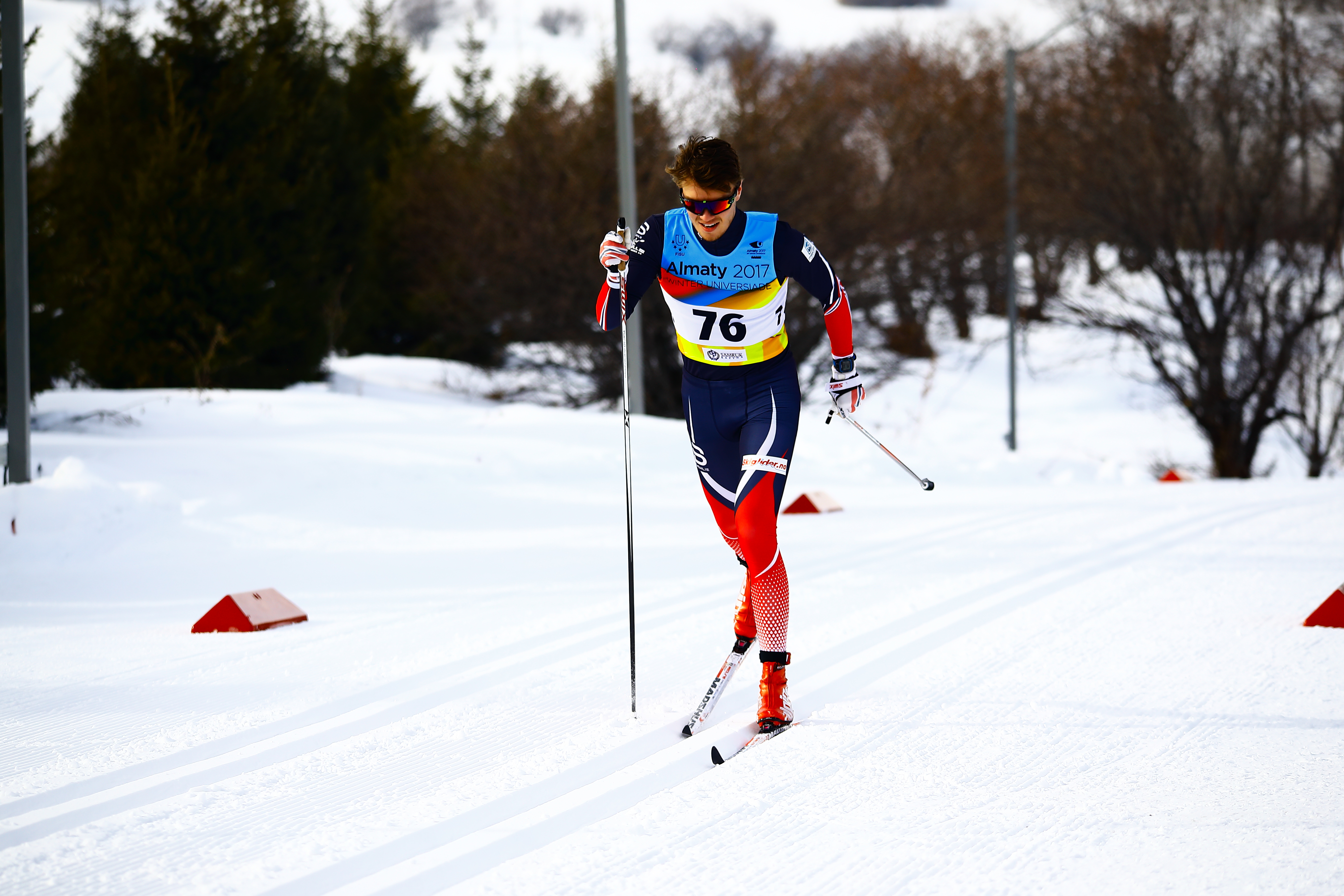
Jørgen Grav of Ford Sayre competing for Norway at the World University Games in Almaty, Kazakhstan. (Photo: Almaty2017.com)
Cross-country ski competitions continued at the World University Games on Tuesday with pursuit races based off the finish times from Monday’s 5 and 10 kilometer classic races.
In the men’s 10 k pursuit, Dmitriy Rostovtsev overtook Russian teammate (and yesterday’s winner) Valeriy Gontar to win by 14.7 seconds. Armenia’s Sergey Mikayelyan moved from fourth up to third place (+52.0) to claim the final podium spot.
Jørgen Grav of Norway, a former University of Vermont skier now in graduate studies at Dartmouth College and competing for Ford Sayre, placed 36th, +5:14.4.
For Canada William Dumas (Skinouk) skied from 48th all the way up to 40th to lead the team and finish +5:26.0. Carrington Pomeroy (Nakkertok) moved from 57th up to 48th (+6:01.2), Conor Thompson (Université Laval) finished 52nd (+6:33.3), Gavin Shields (Lappe Nordic) 58th (+6:54.6), Jordan Cascagnette (Team Hardwood) 62nd (+7:24.8), and Alexis Morin (Université Laval) 68th (+8:44.1).
Vincent Mason of the University of Wyoming had the best U.S. finish, clocking in at 55th (+6:36.6). Teammate Will Timmons finished 63rd (+7:29.9) and Sam Wiswell 71st (+9:27.9). Mitchell Hollman (Air Force Academy) 74th (+10:25.1), Kevin Geisen (Western State)78th (+12:07.6), and Cameron Moore (Western State)79th (+12:50.0).
In the women’s 5 k skate pursuit, Anna Nechaevskaya of Russia moved up and stole the lead from Russian teammate (and yesterday’s winner) Lilia Vasilieva (+18.1). Anna Shevchenko of Kazakhstan kept her hold on third place (+21.3).
Elise Sulser of the University of Wyoming againled the United States, slipping one spot to finish 24th (+3:47.1). Her teammate Meghan Kent was 47th (+6:39.9) and Yara Thomas 50th (+7:20.0). Emma Malmqvist (Colorado Mesa University) placed 53rd (+8:04.7), Sierra Jech (State University of New York) 55th (+8:26.9), and Sierra Foster (Oregon State University) 61st (+10:00.3).
For Canada, Christel Pichard-Joliceur (Université Laval)finished 31st (+4:35.9). Shelby Dickey (Highlands Trailblazers) followed in 41st (+5:35.9), then Emma Camicioli (Rocky Mountain Racers)in 44th (+5:53.0) and Kyla Vanderzwet (Nakkertok) 45th (+5:54.8).
World University Games biathlon (Almaty, Kazakhstan): 15/20 k individual
In the women’s 15 k individual, the first biathlon competition of the Universiade, Kazakhstan took four of the top five places with much of their World Cup team competing on home turf. Alina Raikova won over Galina Vishnevskaya by 2:21.1 thanks to just two penalties to Vishnevskaya’s four. Ukraine’s Nadiia Bielkina was third, +2:23.6 with five penalties.
The lone Canadian finisher was Jessica Paterson of the University of Alberta, who finished 23rd (+13:06.1) with eight missed shots.
In the men’s 20 k individual, Baptiste Jouty of France came out on top by 41.0 seconds over Sergey Korostylev of Russia, with two penalties for each racer. Third place went to Semen Suchilov, also of Russia, +1:05.5 with three missed shots.
Seamus Boyd-Porter of Memorial University led Canada with a 36th-place finish, +13:33.1 and eight missed shots. Taij Isaac Mann of MacEwan University finished 42nd with two missed shots (+19:37.2), and Sasha Eccleston 45th with seven missed shots (+23:07.8).
2017 U23 World Championships teammates Nichole Bathe (l) and Jesse Knori, of the U.S., on Thursday at Soldier Hollow in Midway, Utah. (Photo: Bernie Nelson)
In an effort to showcase the North Americans competing at next week’s International Ski Federation (FIS) 2017 USANA Nordic Junior World Championships and U23 Cross Country World Championships at Soldier Hollow in Midway, Utah, we asked those qualifying athletes several questions about themselves — actually, we had them fill in the blanks. Here we have 21-year-old Nichole Bathe, of University of Alaska Fairbanks and CXC Team, who’s representing the U.S. at her first U23 World Championships after having raced at 2014 Junior Worlds.
***
“My full name is Nichole Bathe, but you can call me Nichole.
I was born in Madison, Wi, raised in Madison, and one thing you should know about my hometown is, go Badgers!! I started cross-country skiing when I was around 12, thanks to Yuriy Gusev and my dad.
I currently train in Fairbanks, Alaska, with University of Alaska Fairbanks and also the CXC Team.
If I’m not skiing, you might find me eating cheese and chocolate in a papasan chair. If I had to pick a favorite book, it would be ‘Bossypants’ by Tina Fey.
One of the things I’m most excited about for U23/Junior Worlds at Soldier Hollow is that it’s on home soil, and my coaches get to watch! One race I’m especially targeting there is the classic sprint.
The best advice anyone ever gave me about skiing or racing was ‘stay relaxed, stay tough’ –Christina Turman. One of the best race memories I have is the first time I beat my dad in a hometown race.
If I could meet one World Cup skier, it would be Heidi Weng.
If I don’t end up being a professional skier, I’ll probably be a social worker.
I’m missing 10 of school to be here, and my professors are probably thinking, ‘Good luck graduating this year, haha.’
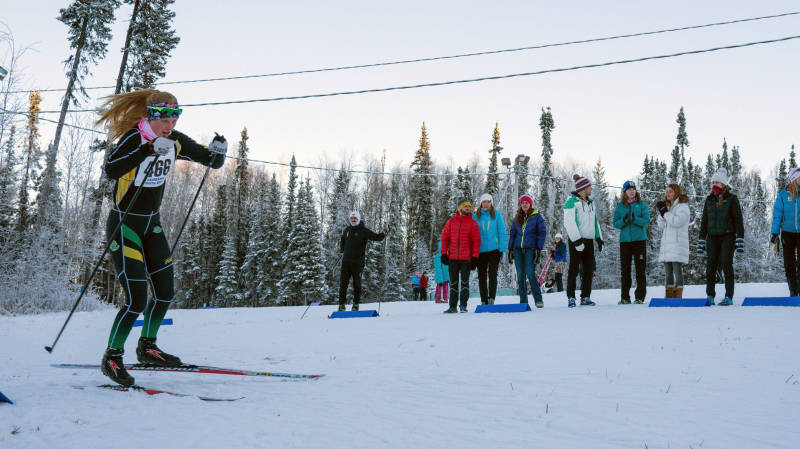
University of Alaska Anchorage freshman Hailey Swirbul races through the stadium at Birch Hill Ski Area in Fairbanks, Alaska, in the Alaska Nordic Cup on Nov 19. (Photo: Zachary Hall/UAA Athletics)
FAIRBANKS, Alaska – Scott Patterson is on a roll. The Alaska Pacific University (APU) skier has now won all of the ski races he entered this year – and over half the ski races held in this country in the 2016/2017 winter to date– after picking up wins on both days of racing in the Alaska Nordic Cup at Birch Hill Ski Area in Fairbanks, Alaska, this past weekend, Nov. 19-20.
APU’s Jessica Yeaton was also a double winner on the weekend. And in the collegiate ranks, the University of Alaska Fairbanks (UAF) maintained its hold on the Alaska Nordic Cup against the University of Alaska Anchorage (UAA).
Skiers from both universities competed with a new lease on athletic life, after learning earlier this month that the ski programs would not be cut at either UAA or UAF.
The Alaska Nordic Cup is an early season, relatively low-key (but nonetheless International Ski Federation (FIS) sanctioned) competition between Alaska’s only two NCAA nordic programs. Prior to this season, in which UAF switched its conference affiliation from the Central Collegiate Ski Association to the Rocky Mountain Intercollegiate Ski Association (RMISA), it marked the only time outside U.S. nationals that Alaska’s college skiers might compete head to head until, potentially, NCAA Skiing Championships in March.
The Nordic Cup is held each year in November, alternating between the Fairbanks and Anchorage areas. 2016 marked the 13th annual Nordic Cup competition. The UAF Nanooks enjoy a healthy historical advantage over their southern rivals, the UAA Seawolves, entering the weekend with an 8-3-1 all-time record (eight wins, three losses, and one tie) in the first 12 years of the dual meet. Scoring is typically based on an individual race on Saturday plus a relay on Sunday. Lowest combined time wins.
But despite a strong team showing from UAF that carried the Nanooks to victory, and some standout individual performances from UAA, it was APU that owned the top steps of the podium throughout the weekend.
APU’s Becca Rorabaugh (l) and Jessica Yeaton (r) at U.S. SuperTour Spring Series in March 2016. (Photo: John Lazenby/Lazenbyphoto.com)
In the women’s race, Jessica Yeaton, an Australian national-team member who competes for Australia internationally but lives in Anchorage and trains with APU, finished Saturday’s 6 kilometer freestyle interval start in 16:52.1, skiing smoothly in relatively cold and slow conditions. APU’s other entrant, Fairbanks native Becca Rorabaugh, finished second, 34.1 seconds back. Third went to Hailey Swirbul, 1:27 back, in the UAA freshman’s college racing debut. UAF skiers swept the next four spots, led by senior Nichole Bathe, the day’s final starter, in fourth.
Yeaton appreciated the early season racing opportunity. “It was awesome to race up here on good snow,” she wrote to FasterSkier. Yeaton added, “The conditions were thin but still provided a really good opportunity for a race effort. We are lucky to have these early races to help prepare for the Supertour in a couple weeks – the [Nordic Ski Club of Fairbanks] did a great job making them happen despite the lack of snow!”
Swirbul, a Colorado native, echoed Yeaton’s praise for the venue and host club: “Thanks to Fairbanks for using their limited snow and delivering excellent (all things considered) courses and conditions for us to open our season this past weekend,” she wrote in a Sunday email to FasterSkier.
Swirbul added, reflecting on the sensation of putting on a race bib once more: “As usual, it’s an interesting feeling to return to an on-snow race scene after long summer months without one… nerves, waxing, morning jogs and stretching, race strategy, etc. I sure enjoyed being back at it this weekend! I was satisfied with my and my team’s skiing this weekend, considering it is only November, and think we have great things ahead of us. We are all revving our engines preparing for a long winter ahead, ready to establish a new name for our team with many young skiers, and meanwhile prove to the president of our university that we are more than worthy of being part of a long lasting ski team at UAA! I am very excited for what the season has to bring for UAA.”
Bathe, originally from Madison, Wis., was likewise pleased by the strong first-day showing of the UAF team. “I thought today went well especially for our whole women’s team,” she wrote in an email on Saturday. “To have four women right in there is always awesome and makes us excited for the season! It’s nice to see all the summer training pay off and start getting back into race mode again.”
On the men’s side, the top-seeded Patterson took advantage of his position as the final starter to ski to the victory over several of his APU teammates, including David Norris in second.
“Snow instead of ice made coming to Fairbanks [from Anchorage] for races an easy decision,” Patterson wrote. “Although I hadn’t raced here since high school, I have always enjoyed the Birch Hill trails. During the race, I had to remember how to race a little after getting some early splits that I was even with David and knowing his fitness through the summer and fall. Overall it was a great chance to chase out some early season rust and get ready for important races.”
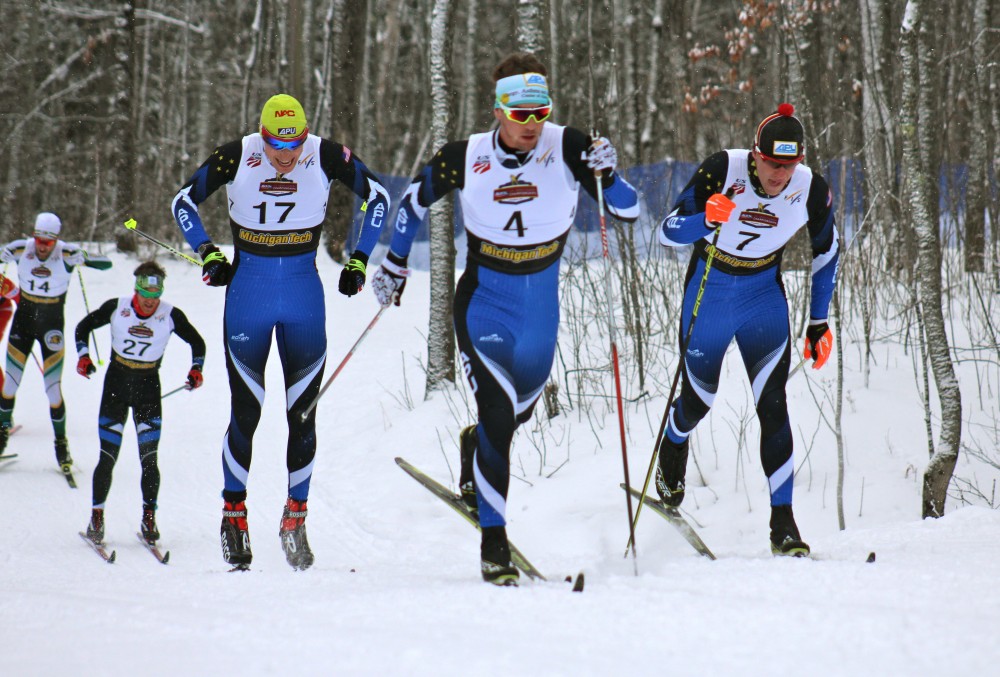
APU teammates and brothers Logan Hanneman (7) and Reese Hanneman (4) lead teammate Tyler Kornfield (17) during their quarterfinal of the men’s 1.5 k classic sprint at 2016 U.S. nationals in Houghton, Mich.
Patterson completed the 8.25 k skate race in 19:36.3. Norris finished 16.7 seconds behind him. Tyler Kornfield rounded out the APU podium, finishing 1:03 back of Patterson.
Patterson and Kornfield grew up in Anchorage. Norris is a Fairbanks native. Their good-natured geographic rivalry stretches back a decade or more, to when they were all competing in Alaska high school skiing. (“We hated the Anchorage guys,” Fairbanks skier Reese Hanneman told the Alaska Dispatch News “with more amusement than venom” in a summer profile. “We were like the rednecks from Fairbanks, out skiing in the woods, going up against the city boys.”)
APU skiers took the top five spots on the day, with Anchorage skier Thomas O’Harra in fourth and Fairbanks local Logan Hanneman in fifth.
The top college skier was UAF junior Max Donaldson, another Fairbanks product, in sixth, 1:37 back of Patterson. The top UAA skier was sophomore Toomas Kollo, from Estonia, 2:35 back in ninth.
At the end of the first day of racing, the combined times of the top three UAA women put them just 23.5 seconds behind the top three UAF skiers. On the men’s side, UAF created a larger gap of 2:14.2 over UAA’s combined times, giving UAF an advantage of roughly 2:38 heading into Sunday’s relays.
Sunday saw more of the same: APU took the easy win, Swirbul shined for UAA, and UAF used its depth and balanced performances to take the overall victory.
APU entered only one team in the relay, but it included the top two finishers from each of Saturday’s individual races. Unsurprisingly, the team of Patterson, Rorabaugh, Norris, and Yeaton posted the fastest time in all four legs of the 4 x 4 k skate relay, finishing in 46:57.4.
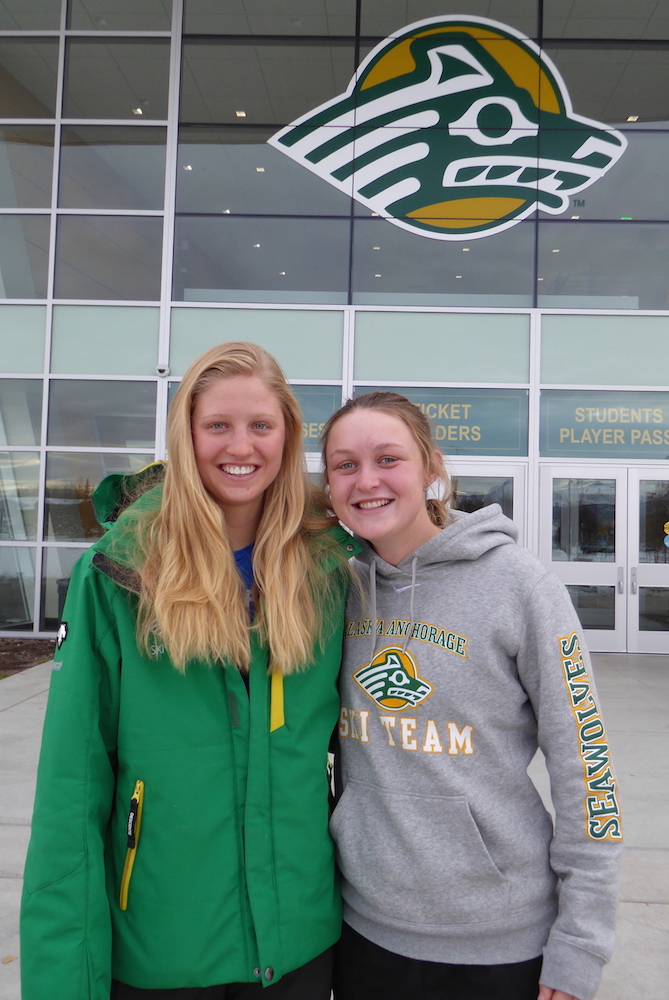
UAA skiers Hailey Swirbul (l) and Casey Wright (r), on the UAA campus in October 2016. (Photo: Gavin Kentch)
The top college team was Nanooks A (Donaldson, Sarissa Lammers, Michael Fehrenbach, and Bathe), finishing just over three minutes behind APU in 50:10.1. Donaldson and Fehrenbach posted the fastest male collegiate times of the day in their legs. Seawolves ‘A’ (Kollo, Swirbul, Marcus Deuling, and Casey Wright) was less than eight seconds behind the Nanooks in 50:18. Swirbul was again the fastest collegiate woman on the day, while Wright similarly recorded the day’s fastest anchor leg.
Nanooks ‘B’ was next, followed by Seawolves ‘B’. Ultimately, the time gaps from day one grew, and UAF finished with a 4:08 cumulative advantage over UAA, taking home its ninth Nordic Cup overall and second in a row.
UAF nordic coach Nick Crawford said in a Sunday press release, “The Seawolves had a good day today and it was very exciting to watch the race unfold. The margin between our two teams was much smaller today, so it made it that every skier had to race hard which isn’t always the case in relays. The victory was for sure a team effort today with both the men and the women putting together good races. We really enjoy the collaboration we have with our Anchorage rivals.”
UAF skier Anna Darnell expressed similar sentiments, telling the Fairbanks Daily News-Miner, in light of the recent political rollercoaster of threatened cuts to both schools’ ski programs, “We feel a lot closer to the UAA team after this.”
Meanwhile, at the top of the results sheet, Patterson’s brace of victories on the weekend, combined with his easy victory at the Race to the Outhouse #1 outside Palmer, Alaska, earlier this month, meant that the APU skier has now won every single race he has entered this winter, as well as 60 percent of all the ski races held in this country this year. (The Mat-Su Ski Club held a pair of 5 k skate and classic races at Hatcher Pass on Nov. 19 and 20.)
“I’ll have to get a time turner for the coming weekends,” Patterson wrote in an email as he reflected on his current track record, “so I can continue to win every single race in the U.S.”
This particular race was slightly more competitive than the Race to the Outhouse. FasterSkier unofficially calculates the USSA race penalty (a measure of the strength of the field) for Saturday’s men’s race as an impressive 29.03, well below the USSA minimum penalty of 35 for a College Event or Regional Scored Event. (The penalty for the women’s race was unofficially a higher, but still respectable, 60.52.)
Reflecting the cosmopolitan nature of NCAA skiing, competitors in the 45-racer FIS/USSA field hailed from at least eight foreign countries, including Canada, Norway, Germany, Australia, Sweden, the Czech Republic, Italy, and Estonia. They were joined by roughly 200 more skiers in the day’s other races, ranging from kindergartners in snowsuits who skied a 500 meter course without poles to the 60- and 70-year-old age brackets in the community 4 k race.
The strong community support, and college athletes who had finished their race but stayed to cheer on their teammates, combined to make the atmosphere as electric as can be found for American cross-country skiing. Dozens of spectators lined a late-race climb back up to the stadium, where racers were met by an even larger, frenzied crowd cheering them on.
The University of Alaska Fairbanks ski team poses with the trophy for the Alaska Nordic Cup at Birch Hill Ski Area in Fairbanks, Alaska, on Nov. 20, 2016. (Photo: Nick Crawford/UAF Athletics)
Conditions were, as the athletes acknowledged, undeniably snow rather than ice (as on the Anchorage trails these days), but unfortunately not that much of it. Fairbanks has seen approximately five inches of total snowfall so far this winter. The impeccably maintained trails at Birch Hill meant that racers found a base of roughly two inches of compacted snow, with some leaves and sporadic dirt showing through, but no rocks. Most skiers in the FIS race competed on their prior-generation race skis.
Although the official high for the day at the Fairbanks airport was a barely FIS-legal 1° F (-17 degrees Celsius), temperatures at the relatively elevated Birch Hill were comparably temperate, hovering around 10° F (-12 C) throughout the afternoon.
At least in the sunlit stadium. Racing at Birch Hill on clear and cool winter days can be an oddly hellish experience. Not because it is unenjoyable – far from it; the trails are a delight to ski, and the snowy birch forest is sublimely beautiful– but because it evokes the sensation of voyaging into the underworld and back again. The stadium is in the sun, and elevated, and relatively warm; many trails drop down leaving the stadium, sending the skier into the realm of dark and cold. And so one goes from light to dark, sun to shade, warmth to cold, and back again with each new trail, the stadium become a modern-day Cumae (entrance to the underworld in classical mythology) and the skier Heracles or Odysseus, re-enacting the journey between worlds.
RMISA college racing resumes early next year with the Utah Invitational at Soldier Hollow on Jan. 7.
University of Alaska Anchorage skier Casey Wright skis in the Alaska Nordic Cup in Fairbanks, Alaska, on Nov. 20, 2016. (Photo: Max Kaufman)
Alaska Pacific University skier Jessica Yeaton skis the anchor leg of the winning relay team in the Alaska Nordic Cup in Fairbanks, Alaska, on Nov. 20, 2016. (Photo: Max Kaufman)
University of Alaska Fairbanks skier Alex Eckert skis in the Alaska Nordic Cup in Fairbanks, Alaska, on Nov. 20, 2016. (Photo: Max Kaufman)
University of Alaska Fairbanks skier Alex Eckert skis in the Alaska Nordic Cup in Fairbanks, Alaska, on Nov. 19, 2016. (Photo: Max Kaufman)
University of Alaska Fairbanks skiers Sarissa Lammers (464) and Hannah Rowland (462) ski in the Alaska Nordic Cup in Fairbanks, Alaska, on Nov. 19, 2016. (Photo: Max Kaufman)
Second-place finisher Alaska Pacific University skier Becca Rorabaugh approaches the finish line of the Alaska Nordic Cup in Fairbanks, Alaska, on Nov. 19, 2016. (Photo: Max Kaufman)
First-place finisher Alaska Pacific University skier Scott Patterson approaches the finish line of the Alaska Nordic Cup in Fairbanks, Alaska, on Nov. 19, 2016, ahead of UAF skier Max Donaldson (494). (Photo: Max Kaufman)
Alaska Pacific University skier David Norris skis the third leg of the winning relay team in the Alaska Nordic Cup in Fairbanks, Alaska, on Nov. 20, 2016. (Photo: Max Kaufman)
The newly appointed CXC Team Head Coach Andy Keller (r) works on strength with postgrad Scott Harrison outside a barn near Cable, Wis. (Photo: CXC Skiing/Facebook)
Three years ago, Andy Keller was a college kid looking for an internship toward his exercise-science degree at Michigan Tech. He knew a girl, who knew Jason Cork, and he used the connection to land an apprenticeship at the Central Cross Country (CXC) Ski Association in Cable, Wis.
At the time, Cork was heading up the CXC Team, which executive director Yuriy Gusev established in 2006 to support promising skiers striving for top national and international performances. Keller, who grew up just outside Minneapolis in Chanhassen, Minn., became Cork’s intern assistant.
Andy Keller started as an intern, then an assistant, and finally a junior coach before being promoted to CXC Team head coach this month, following the departure of Bill Pierce. (Photo: CXCnewsfeed.wordpress.com)
Months later, before Keller began his senior year, Gusev offered him a job.
“I said, ‘I kind of want a degree so I’ll talk to you in a little less than a year,’ ” Keller reflected on the phone last week.
He skied for four seasons at Michigan and graduated in 2012, then asking Gusev if there was still a spot for him. There was, though Keller’s job title and responsibilities changed three times before he officially got started, he said.
First, he was hired as sport-development manager, tasked with connecting CXC to youth clubs and high-school programs in the Midwest. Then, CXC’s assistant coach Gus Kaeding left to head the Stratton Mountain School (SMS) elite team in Vermont. Cook needed an assistant, and CXC’s board decided Keller would be it.
“Then there was a little bit of [difference] with coaching styles and athletes on the team, so Bill [Pierce] got brought on to work alongside Igor [and] I took more of a dedicated role to the junior program,” Keller said of last season. “This year started off the same way … I was focused more on the junior program.”
For the next several months, Badamshin oversaw the program and Pierce worked as the elite head coach. In late January, Badamshin died unexpectedly of a heart attack while skiing the Birkie trail between Cable and Hayward, Wis. He was 47, and his passing left CXC and the surrounding community stunned.
“A guy that works his ass off and is willing to do anything for his program … his passion truly lied with working with athletes,” Keller reflected. “[I] was just trying to carry on his legacy — inspiring kids to ski and getting them excited to be out there. If there’s one thing he was good at, it was definitely that, and also carrying on his work ethic. The guy wouldn’t complain. He’d be out there skiing 50 k and waxing…
“There was definitely big shoes to fill when he passed away,” CXC Team’s new head coach continued. “As I’ve come through, I’ve been working under a ton of coaches; my philosophy is I can always learn something. When I was interning under Jason and Gus that was what I loved to do — learning and listen.”
“There was definitely big shoes to fill when [Badamshin] passed away. … As I’ve come through, I’ve been working under a ton of coaches; my philosophy is I can always learn something.” — Andy Keller, CXC Team Head Coach as of September 2014
Keller Becomes Head Coach
That’s right, Keller, in his third season as a CXC coach, was recently promoted to head of its elite team following Pierce’s decision to accept a job in Colorado (he’s becoming nordic director of the Snow Mountain Ranch YMCA near Winter Park this fall) earlier this month.
But “elite” is a term Gusev and several other U.S. nordic directors like to stay away from: it’s about development and helping athletes reach their higher-competition goals. The CXC Team became Team Vertical Limit in 2009 as part of a sponsorship deal, and a year later it had 18 athletes, including a couple Olympians (Garrott Kuzzy and Caitlin Compton — now Caitlin Gregg).
The New: 2014/2015 CXC Team
CXC Team:
Cory Ellertson
Bjorn Batdorf
Bill Bowler
Chris Pappathopoulos
Hilary Patzer
Andrew Brown
Scott Johanik
Natalia Naryshkina (lives in Russia, plans to compete in western SuperTours and U.S. nationals)
Postgrads: (living in Cable this fall/winter)
Scott Harrison
Sam Boardman
College Summer Residency Group:
Nichole Bathe (University of Alaska Fairbanks)
Nicolette Reker (now at Winona State University, competing for CXC Team)
Tom Bye (Postgrad last year, now at Michigan Tech)
Thomas Kendrick (Michigan Tech)
Will Frielinghaus (St. Lawrence University)
Seth Mares (Gogebic Community College, plans to transfer to Michigan Tech)
International Training Partner:
Leandro Lutz (living in Cable this fall, plans to travel to Europe for international races in an attempt to qualify for World Championships; may stay in Cable and race U.S. circuit)
The CXC Team currently has eight members, most of which will be focused on top-10 results in Midwest marathons to attract sponsors. In addition, Keller is overseeing two postgrads, about 10 juniors and an international guest skier.
“All the coaches agreed, the team needs to get back to the roots of developing athletes,” Gusev explained on the phone. “You would have never called our team the CXC Elite Team, it just came later when this word became very popular.
“We always see our team as a development tool for that higher step,” he added. “We don’t see this team as full of stars, but we want to have a team open to athletes of that level. If it can help them great … It’s just like having a child: at some point you need to let them go and see if they can stand on their feet.”
Considering that, Gusev is encouraged by the direction his program is headed, especially with a homegrown coach at the helm.
“It’s exciting to see somebody who went through the original pipeline and became a coach,” he said. “And that’s a goal from the time he applied from an internship.”
Still, the last few weeks — and months — have been busy at CXC, to say the least. Following Badamshin’s passing, Gusev said the organization interviewed a couple people to hire in his absence, but ultimately, Pierce and Keller stepped up and said they could handled the added responsibilities without another coach.
“It was probably more emotional for some of us, but you just move on,” Gusev said. “The programs needed to move on as well and … we had to adjust right away.”
It didn’t take long for everyone to get back “in the groove,” he added. Pierce continued to serve as head coach and Keller as his assistant and junior coach.
Last Friday, Keller drove 300 miles southeast to Madison to test about 10 juniors at a weekend camp at CXC’s administrative headquarters. The group meets about once a month in various places, holding camps with other Midwest clubs, like Loppet Nordic Racing (LNR), May through December, Keller said.
He also helps host monthly CXC master’s camps, and while he’s not scheduled for every single one, he led a recent camp under Pierce’s guidance earlier this month.
“I made Andy run over half the sessions, and I watched him and helped him a little bit,” Pierce said. Then he told him and the rest of CXC about his decision to leave.
“I saw it coming,” Keller reflected. “Bill did talk to me as he found out more about the new position he was taking.”
In Cable, where Keller lives in a condo on the Telemark property, he spent the summer working with six athletes in CXC’s new college summer residency program, which Pierce initiated.
“That overlapped with what you would call our team now, more of a marathon team,” Keller said of his previous and current responsibilities, coaching juniors and now seniors as well. “The athletes that we’ll have competing on the SuperTour is relatively small.”
Those skiers include two postgrads from LNR — Scott Harrison and Sam Boardman — who plan to live and train full time in Cable this fall and winter. Their main races include western SuperTours, U.S. nationals, and the Midwest Junior National qualifiers .
“We don’t see this team as full of stars, but we want to have a team open to athletes of that level. … It’s just like having a child: at some point you need to let them go and see if they can stand on their feet.” — CXC Executive Director Yuriy Gusev
With an overall emphasis on regional competitions, CXC is looking to assemble the best skiers in the Midwest.
The Old: What happened to last season’s CXC Team?
Not returning: Karl Nygren, Eric Wolcott, Dmitriy Ozerski (was flying back-and-forth from Russia for races)
With a single returner from last year’s CXC Team (college skier Tom Bye), Keller explained what happened:
“When Igor [Badamshin] took over there was little bit of communication issues … a little bit of discontent,” he said. Athletes like Karl Nygren, who might have had as many as five coaching changes in seven years, ultimately decided to leave the program.
“If there’s anything the program needs is some stability,” Keller said.
“As the coach now, I’d love to build the program back up to how it was when I interned,” he said, referencing past CXC standouts like Jessie Diggins, Caitlin Gregg, Brian Gregg, and Jennie Bender. “…That was the year they won the NNF Cup so that’s the level I’d like to bring it back to.”
One of Gusev’s priorities is hiring another coach focused on sport development to further connect CXC with grassroots organizations and schools throughout the central U.S. Looking at the big picture, it’s about promoting the sport and coaching development. In the long run, CXC is hoping that will translate into athlete retention.
“Regardless whether the athletes come to us directly or not … it’s a matter of whether we have consistent, easy to follow progressions, like soccer does or swimming does,” Gusev said of two sports he considers domestic successes in the U.S. “[Those sports outline the] steps to high school, college and beyond, which doesn’t exist really in cross-country skiing. We have all the pieces in place, and we can communicate that to parents.”
For Keller, his goal is to help grow the base and competitive nature of skiers in the Midwest, which includes Illinois, Indiana, Iowa, Kansas, Michigan, Minnesota, Missouri, Nebraska, North Dakota, Ohio, South Dakota, and Wisconsin.
“It’s where I grew up,” he said. “[We’re] trying to make the Midwest more of a ski powerhouse, and that’s definitely happening. We’re developing athletes, but we’re having a hard time getting them to stay around.”
He counted eight skiers in elite programs outside their region, including Jessie Diggins (SMST2), Anne Hart (SMST2), Ben Saxton (SMST2), Gordon Vermeer (Craftsbury Green Racing Project), and Rosie Frankowski (Alaska Pacific University).
“It seems like everybody wants to go somewhere else and I’ve got to figure out why,” Keller said. “I think the level of support CXC gives is among the best … It’s just we’re not in the mountains and we don’t have a glacier to [train on]…
“The Midwest might not be the most sexy training site as a Sun Valley or something like that,” he continued. “… [But] it’s not that we’re not producing the athletes.”
“It seems like everybody wants to go somewhere else and I’ve got to figure out why. I think the level of support CXC gives is among the best … It’s just we’re not in the mountains and we don’t have a glacier to [train on]…” — Keller
In terms of coaching styles, Keller said he gained a lot from working with Cork, Kaeding, Pierce, and Badamshin.
Coach Igor Badamshin having some fun on a few patches of snow. Photo is titled “Snowflakes, ice cream and Igor,” by former CXC Team elite coach Bill Pierce. Badamshin was the CXC program head coach until his unexpected death in January 2014. (Photo: cxcnewsfeed.wordpress.com)
“I’d hope I’d be maybe as analytical [as Cork],” he said. “I’m hoping I can be half as enthusiastic and motivating as Igor … I try to pull from all those guys and find out what works for myself and what doesn’t fit my personality. I would say I’m relatively soft-spoken and sometimes it’s a little bit harder for me to put myself out there. I hope I’ve gotten better at that.”
When it comes to managing athletes, Pierce will continue to write training plans for those that started with him at the beginning of the season, including Cory Ellertson, Chris Pappathopoulos, Andrew Brown, and Scott Johanik.
Keller said he’ll take on those that joined the team more recently and will be in Cable the next several months: the two postgrads and guest skier Leandro Lutz from Brazil, who plans to travel to Europe to try to qualify for 2015 World Championships.
As for coaching and waxing for 18 or so skiers throughout the season, Keller said that working alongside other Midwest clubs at races, especially at main events like U.S. nationals, should help. And not all the athletes will compete at the same events, given their varied focuses — from marathons to junior-qualifying races.
At the same time, Keller said he’s looking forward to having an assistant or some kind of helper in the future. Gusev said the new hire would largely help with junior camps.
In the last month since Pierce’s decision, he said he’d been working with Keller on the transition and will continue to offer assistance beyond his final day at the end of September.
CXC Team’s fall/winter crew during a recent workout in Cable, with postgrads Scott Harrison and Sam Boardman, and guest skier Leandro Lutz from Brazil, who will be joining the team for the next couple months. (Photo: CXC Skiing/Facebook)
“I’ve basically given [Keller] my daily responsibilities,” Pierce said earlier this month. That included even the little stuff, like “teaching him how to smooth out a trail and pick rocks and seeds.”
“There’s definitely a lot to catch up on as far as ski selection and things like that,” Keller observed. “Working with Rossignol, getting in contact with those guys, getting up to speed with things Bill might’ve taken care of as far as a team aspect and getting [ready] to compete.”
He’s also tasked with attracting sponsors through top results in Midwest marathons.
“We’ll do fine with that,” he said of his mostly marathon-focused team. “Our postgrads have goals of trying to make World Juniors … definitely a big one is qualifying for Junior Nationals and trying to make top-20 [there]. The goals for the marathon team is being on the podium or top 10 … that should be no problem.”
He’d also like to bring the CXC Team back to an “elite, elite” team, he said, by recruiting recent graduates.
CXC Para Nordic Team member Steve Baskis training with U.S. Paralympics Nordic Program in the ski tunnel in Torsby, Sweden, earlier this month. (Photo: CXC Skiing/Facebook)
According to Gusev and CXC’s mission statement, the 2,000-member organization has four straightforward goals: to build its base, promote the sport, achieve competitive success, and create partnerships through collaborations. The way he sees it, member athletes are part of that as well.
“[The CXC Team] athletes are in a community to be motivation to adult athletes at clinics, to be role models and whatever else comes with it,” Gusev said. “With competitive excellence, we hope to get them to the level [of someone like Garrott Kuzzy or Tad Elliott, who made the U.S. Ski Team]. We hope the athletes that come through our program will eventually contribute to international success…”
Emerging Adaptive Team
CXC is also focused on building its adaptive program under coach Andrew Poffenberger, another Minnesota native who skied as a junior and studied health fitness at Gustavus Adolphus College in St. Peter, Minn.
Augusto “Goose” Perez (sit-skier, cancer survivor, 2014 Paralympian)
John Oman (standing athlete, 2014 Paralympian)
“Emerging Talent” Program:
“People who have tried nordic skiing on several occasions and show promise, interest in competition, and commitment to the sport,” Poffenberger wrote. “This is an area where I am looking to grow in the next few months as people turn their attention from fall sports to winter.”
Junior Para Development: Focused on youth development and coaches interested in instructing adaptive skiers in high schools. “Our annual coaches clinic and certification will include a few sessions on adaptive nordic skiing for those interested this year,” he wrote.
This year, the CXC Para Team has expanded to include five elite athletes, four of which went to the 2014 Sochi Paralympics: Aaron Pike, Travis Dodson, Augusto “Goose” Perez, and John Oman. Its fifth member, Steve Baskis, a blind athlete and veteran, recently joined the U.S. Paralympics Nordic Team at an on-snow camp in Sweden.
Poffenberger also works with three “emerging talent” adaptive skiers — those “who have tried nordic skiing on several occasions and show promise, interest in competition, and commitment to the sport,” he explained in an email.
In addition, he coaches about four or five junior-development skiers, athletes that “can sit ski for 10 to 15 k in a session,” Gusev said. “Andrew’s done an amazing job with them.”
“Ideally we would like to mirror the development structure of able-bodied skiing,” Poffenberger explained. “Possibly the most important component of that structure is youth development. If we expect to be competitive at the highest level, we need to start developing young athletes.”
Among their efforts: CXC has submitted a proposal to include adaptive nordic at the Wisconsin state meet.
“We are also seeking out coaches who are willing and able to coach adaptive nordic skiing at the high school level,” he added.
Last week, Poffenberger attended a conference with The United States Association of Blind Athletes at the Olympic Training Center in Colorado Springs.
“I love working with these athletes because they have perspective of the entire picture, and don’t let small things stand in their way,” he said, now in his second season with the team.
“I hope we can keep having more and more individuals like [Poffenberger and Keller] that get involved with a sport as a profession,” Gusev said. “They understand the way athletes move from one stage to another stage and it’s easier for them to communicate with athletes at the younger level what expectations are. That’s really the goal.”
Nichole Bathe on a training run at the UAF campus earlier this month.
This ‘Pros of Tomorrow’ series, brought to you by the generous support of Fischer Sports, aims to highlight some of the most notable up-and-coming athletes around the world, not necessarily Fischer-sponsored skiers. If you have an idea for a top-notch skier you’d like to read more about, please email info@fasterskier.com with the subject line: Pros of Tomorrow. We’re also looking for stories about intriguing juniors, collegiate skiers, or lesser-known athletes; please email us with names — subject line: From the Pack.
***
FAIRBANKS, Alaska — Heads turned when the first American across the line in the women’s 5-kilometer classic race at the 2014 NCAA Skiing Championships in March was an 18-year-old freshmen from the University of Alaska Fairbanks (UAF).
Nichole Bathe took fourth overall in the race, following her win at Midwest Conference Regionals, also in the 5 k classic. Earlier in the season in January, she placed third among seniors at U.S. Cross Country Championships (U.S. nationals) in the classic sprint for her first national podium. A classic specialist, she was 11th in the skate sprint at nationals and 12th in the 15 k skate at NCAAs.
Now 19, Bathe is beginning her sophomore year at UAF. The Madison, Wisc., native chose to attend school at UAF because Alaska is so close, but yet oh-so-far away, from her hometown.
“I was looking at a couple of different schools, but I liked the fact that UAF was in the Central Conference,” she explained at a coffee shop in Fairbanks. “And I knew [UAF Head Coach Scott Jerome] before I came up here and I liked him, and I liked his coaching style, so that was mainly why I came.
“In the end I decided that I didn’t want to be that close to home, I wanted to try something new and get out, but I wanted to be a part of the Central Conference,” she added. “I think it’s a nice conference to be in just because there are lots of people and I get to go back to the Midwest when racing. So I get to see my parents on race weekends, which is always nice. I also get to ski on courses that I skied on as a junior, so I know the courses pretty well.”
Growing up skiing under Central Cross Country (CXC), Bathe remains an athlete there as part of its regional elite group.
Nichole Bathe sprinting to 3rd place at the 2014 U.S. Cross Country Championships at Soldier Hollow in Midway, Utah. (Photo: Bert Boyer/http://bertboyer.zenfolio.com/)
“When we took Nichole on, we knew that she was good,” UAF Coach Scott Jerome said in his office. “We had seen her results at Junior Nationals, especially up close and personal [when Junior Nationals were] here in Fairbanks, where she got a top-five finish in the classic race – I think it was third place. And so we knew she was good.”
He pointed to assistant coach Christina Turman, who was in the room for most of the interview.
“I don’t think [either of us] would have predicted she would be top-5 at NCAAs her first year, but certainly we knew that she had the determination, training background and work ethic that we were looking for,” he said.
With three seniors, UAF has a young team this year with a large influx of new skiers. Bathe in her second year will likely be one of a small group of experienced collegiate skiers that her teammates will look up to.
Jerome sees lots of potential in Bathe, with some focus on her weaker areas.
“Strength for Nichole was a big factor last year,” he said. “She was physically weak in some areas, and when she got in the weight room consistently results really took off.
“Part of the problem is that when she gets tired her technique really falls apart,” he added. “I think the strength component is really important for her because she has to be strong enough that when she gets tired she has to hold it together — whether it’s the final climb or the final 2 k of a race, she has to hold it together.”
Jerome touched on a couple technique issues that need smoothing over, some of which amount to the growing pains of moving into a higher level of competition.
“Really working on glide is important,” he said. “When you’re a junior and you’re a little bigger than the others you can kinda fake it, but now everybody’s development has gotten to the same point and so you can’t fake it anymore.”
Above all else, though, Jerome stressed that whatever they were doing with Bathe’s training appeared to be working.
“We don’t want any big changes to the training plan — it’s been working, and you don’t want to change something that’s working,” he said. “Maybe tweak it here and there. Christina Turman has done a fantastic job working with Nichole and working with her on her technique. They’ve really formed a very strong coach/athlete relationship, it’s worked really well, and Christina has laid out a really good training program that Nichole has responded really well to.”
“If it ain’t broke don’t fix it, and so far so good,” he added.
“If it ain’t broke don’t fix it, and so far so good.” — Scott Jerome, University of Alaska Fairbanks Head Nordic Coach, on sophomore Nichole Bathe
Bathe spent the summer training with CXC in the Midwest, mostly trying to build distance and focus on longer intervals. When she wasn’t training, she worked as a bartender at a beer and wine bar.
“We don’t have many liquor laws in Wisconsin,” the 19 year old said with a smile. “I just poured tabs of wine.”
In the winter, school and training keep her busy. She studying for a degree in social work with a minor in justice.
“My goal with the whole thing is to work in the justice system with orphan and foster kids and replacing them into homes,” Bathe said.
Every college skier knows that it is difficult to balance the time requirements of training — especially in Alaska where so much travel is required — with school. This is not lost on Bathe, and provides a rare insight into where she thinks skiing might take her after graduation.
“I think Sophie Caldwell is a very important person to look up to if you’re a college skier because she did go through college,” she said of the U.S. Ski Team member and 2014 Olympian, who graduated from Dartmouth in 2013. “It shows that it is possible to go through four years of schooling and then come out at the end and still be able to race World Cups and race them well, like she does. I think she’s actually been really helpful for skiers who are in college currently and helping us to realize that we can still keep doing it out of college.”
The U.S. women’s classic sprint podium with Rosie Brennan (APU) as the top American (second overall), Nichole Bathe of the University of Alaska-Fairbanks (l) in second, and Becca Rorabaugh (APU) in third. (Photo: Tom Kelly/U.S. Ski Team)
Apart from hinting that Bathe considers a ski career after college to be a possibility, she limited her speculation to the upcoming season.
“Doing better at NCAAs than I did last year is a goal, and [so is] making the World Juniors trip again,” she said.
At last season’s Junior World Championships in Val di Fiemme, Italy, she had a personal-best 26th in the 5 k classic.
“When I get there I’ll know what to expect, instead of going in like a newbie like I was last year,” she added. “So I’d definitely like to do better there than I did last year.”
The 2015 World Junior Championships will be held in Almaty,Kazakhstan.
“I haven’t really looked too far ahead of any of that,” Bathe shrugged. “I just like to play it year-by-year and see how it goes.”
As for the transition to life in Alaska, Bathe has only glowing things to say.
“I love Alaska. I mean, there’s no place like Alaska,” she said. “Even just driving through Alaska you get to see a lot of stuff. … We get to pick berries, and we have lots of fun in the spring … We go snow-machining and downhill skiing and it’s fun.”
UAF sophomore Nichole Bathe on a training run at the UAF campus earlier this month.
UAF sophomore Nichole Bathe on a training run at the UAF campus earlier this month.
This series is brought to you by the generous support of Fischer. Visit them online at fischersports.com.
The women’s podium in today’s 5 k classic at the 2014 NCAA Championships in Soldier Hollow. In first is Anja Gruber (UVM), second is Sylvia Nordskar (DU) and third is Eva Severrus (UNM). (Photo: Bert Boyer) All proceeds from photo sales will be directly donated to NNF.
FasterSkier’s coverage is made possible through the generous support of Madshus.
Anja Gruber didn’t surprise anyone but herself when she claimed the top spot in today’s 5-kilometer classic NCAA Championships at Soldier Hollow, Utah, hosted by the University of Utah. The humble 22-year old junior at the University of Vermont (UVM) repeated her victory from last year by skiing the course in 13:38.4.
Conditions on the course were fickle, with only bare ground to be seen around the course, which was composed entirely of artificial snow. Temperatures were in the 50’s, with many skiers racing in shorts and short sleeves. That didn’t put a damper on Gruber’s enthusiasm, however.
Anja Gruber (UVM) skis her way to the win in the 5 k classic at the 2014 NCAA Championships. (Photo: Bert Boyer) All proceeds from photo sales will be directly donated to NNF.
“It’s pretty exciting,” she said, without a trace of her native German accent. “After last year I wouldn’t have expected that I could do this again. I knew I was in good shape and I knew my classic skiing was pretty good, and I like this course and I knew that if my skis are good and I have a good day I can have a good race. But having a good race and winning are two different things, so it’s really really exciting.”
Her performance allowed her to best 20-year old Sylvia Thorson Nordskar (+9.3), originally from Norway and a freshman at the University of Denver (DU), and 21-year old Eva Severrus (+22.6), originally from Slovenia and a freshmen at the University of New Mexico (UNM). Nichole Bathe, an 18-year old freshman at the University of Alaska Fairbanks (UAF) finished fourth (+29.3). Bathe is originally from Madison, Wisconsin.
Nordskar said she wasn’t feeling that well, coming off of illness.
“It was an okay race but not perfect because I’ve been sick for two weeks, and in those conditions I did a good race and I’m very happy with a podium,” she said. Her team is also in the lead, something that Nordskar could hardly be happier about.
“I think both the [DU] guys and girls won today, so that is so cool! So fun! I really enjoy skiing here – we are a team and we have so much fun together.”
Severrus only arrived at UNM in the beginning of 2014, and has obviously already made her mark in the ski program there. It has also made its mark on her.
“Awesome result, awesome season behind me. I’m real happy with these results,” she said. The race was an interval start, and she skied the course alone.
“Hammering all the time.” She said.
Gruber’s race strategy was a bit more nuanced, but even after the race she seemed a little unsure of what she did.
“I though that it was going to be a really fine line between pushing it too hard on that first hill and being too cautious. I tried to go out pretty hard but maybe not that hard,” she said, her tone indicating equivocation. “I guess it worked.”
Sylvia Nordskar (DU) skis her way into 2nd place in the 5 k classic at the 2014 NCAA Championships. (Photo: Bert Boyer) All proceeds from photo sales will be directly donated to NNF.
“Honestly, I felt really good,” she added, “which doesn’t happen so often, and so it’s really exciting [when it does]. I caught the girl in front me pretty fast, so I was like ‘whoa whoa whoa, watch out,’ but then you get a whole lot of rest [on the downhill] and I was being pretty careful [so I just decided to keep going].”
Asked about her plans for Saturday, Gruber aimed high.
“I think we didn’t have the best day as a team [today], and I think we’re gonna want some redemption for that. I know we’ve had really good skate races as a team and I think it’s the most exciting thing to race with my two favorite teammates.”
Nordskar, for her part, felt the same as Gruber. But in classically Norwegian fashion, she was direct:
“I want to win!” She blurted, but quickly adopted a more cautious tone. “But first I have to be healthy, and relax now. I’m glad there’s no race tomorrow so we have one day. But just to go and have fun and hopefully we have three girls in the front.”
The Swedish women’s relay team congratulates anchor Jonna Sundling at the finish, with Anna Dyvik, Sofia Henriksson, and Maja Dahlqvist, after defending their Junior World Championships relay title with another win on Monday in Val di Fiemme, Italy. (Photo: Fiemme2014)
Monday’s final event of the Junior World Championships included the women’s 4×3.3-kilometer and men’s 4×5-kilometer relays. Both events alternated classic and skating legs in Val di Fiemme, Italy.
According to a press release, Russia, France and Sweden led through the classic legs, while Norway and Finland sat patiently. On the last leg, Norway’s Eirik Sverdrup Augdal was first to pick up the pace at the end of a long uphill. AlexeyChervotkin, of Russia, and JeanTiberghien, of France, were surprised and forced to react quickly. Over the final sprint, Augdal found the best line and captured gold for Norway in 53:36.6, exactly 1 second ahead of Tiberghien who outskied Chervotkin by a tenth of a second for second.
Norway’s Eirik Sverdrup Augdal looks back after anchoring his 4×5 relay to gold on Monday on the last day of Junior World Championships in Val di Fiemme, Italy. France took second, 0.1 seconds ahead of Russia. Augdal teamed up with Eivind Krane Heimdal, Petter Reistad, and Johan Hoel. (Photo: Fiemme2014)
In the women’s relay, Russia led the first leg, but Sweden’s Sofia Henriksson did not let the Russian off easily, according to press release. Early in the the skate portion, Sweden was a hair ahead of Russia, while Norway was shortly behind, attempting to make up ground. At the final exchange, Russia’s Natalia Nepryaeva started off with a slight advantage over Jonna Sundling of Sweden, but by the end of the last leg, Sundling had gained enough ground to surpass — and even create a gap on — Nepryaeva, sealing the win for Sweden in 39:54.8. Russia took second, 7.7 seconds behind, and Norway’s Lotta Weng followed in third, 26.8 seconds behind the Swedes.
With four gold, two silver, and eighth bronze medals, Norway was crowned as the winning team at the 2014 FIS Nordic Junior/U23 World Ski Championships.
Among the North Americans, Canada placed just above the U.S. women in 10th (out of 14 teams). The Canadian females chosen to participate in the day’s event included Frédérique Vézina of the Pierre-Harvey National Training Centre (CNEPH), Dahria Beatty (Alberta World Cup Academy), Anne-Marie Comeau (CNEPH), and Katherine Stewart-Jones (Nakkertok). They raced in that order and Team Canada finished 2:49.9 behind the winners.
“I love mass starts so I was pretty pumped when I knew what position I had for the relay,” Vézina wrote in an email. “It was a great fast fight right from the start. My body felt very good and I was able to stay with the lead pack up the first long up hill.”
With slightly slower skis, Vézina explained she struggled on the downhills, but was able to catch back up to the pack on the climbs. “I am very happy with our race and it was as always a lot of fun!” she wrote.
The American women finished about a minute after, 3:51.4 behind the leaders in 12th. Racers included Nichole Bathe (University of Alaska-Fairbanks), University of Vermont’s Marion Woods and Stephanie Kirk, as well as Sloan Storey (University of Utah), respectively.
The Americans men placed 12th out of 18 teams, 3:08.4 behind the winners, with Canada finishing 45 seconds later in 13th. The U.S. men’s team included Adam Martin (Northern Michigan University), Lars Hannah (Steamboat Springs Winter Sports Club), Thomas O’Harra (Alaska Pacific University), and Patrick Caldwell (Dartmouth College),in that order.
“It was exciting to race today, because we got another chance to race head to head with the best junior athletes,” Martin wrote on Monday. “I was able to hang with the Norwegian skier for both 2.5 k loops. … In general the relay was fun, it was a nice way to conclude the week. … It is very motivational to see some of the other athletes’ strong form and on days like today realize that I can really get in and race them.”
The Canadian men’s team included Ricardo Izquierdo-Bernier (Fondeurs Laurentides), Alexis Dumas (Skibec), Scott James Hill (NDC Thunder Bay), and Benjamin Wilkinson-Zan (NDC Thunder Bay), who crossed the finish line in 13th. The Canadians finished in 57:30.4, 3:53.8 minutes behind the winners.
Russia Roman Kaygorodov racing to his first Junior World title on Sunday in the 10 k classic individual start in Val di Fiemme, Italy. (Photo: Fiemme2014)
Note: This article has been updated to include comments from Canadians Ricardo Izquierdo-Bernier, Scott Hill and Katherine Stewart-Jones.
Russia went out on a high note on the last day of individual racing at Junior World Championships in Val di Fiemme, Italy, with Natalia Nepryaeva and Roman Kaygorodov winning the women’s 5- and men’s 10-kilometer classic individual starts, respectively, on Sunday.
Russia’s 18-year-old Natalia Nepryaeva celebrates her 2.7-second victory in Sunday’s 5 k classic individual start, her first title at Junior World Championships in Val di Fiemme, Italy. (Photo: Fiemme2014)
For Nepryaeva, 18, the victory was her first at the world championships and she did so by edging Sweden’s Sofia Henriksson by 2.7 seconds in 14:05. Another Russian, Anastasia Sedova rounded out the podium in third, 13.6 seconds after her teammate.
“I am exhausted, but winning a gold medal in a world championship is an incredible satisfaction,” Nepryaeva told FIS after the race. “I kept focused on my pace throughout the whole race, although I wasn’t sure I was going to be able to climb the last uphill. There was another girl in front of me and I kept skiing really close to her to keep control of my pace. I am really happy for the other girls in my team too, it’s a great day for Russia.”
For Henriksson, 19, the silver marked her first individual podium at her fourth Junior World Championships.
“I feel so happy today because I have been struggling for this medal for so long,” she told FIS. “In 2012 in Erzurum in the 5km Classic I finished fourth, only one second behind the bronze medal. It feels good to break up the three Russians.”
As Nepryaeva and Henriksson passed through the intermediate checkpoints, it was clear they were gunning for top two. Nepryaeva narrowly prevailed on a hilly and challenging course at Lago di Tesero, leading four Russians in the top six, with Alisa Zhambalova in fourth (+16.4), Germany’s Julia Belger in fifth (+24.2) and Russia’s Yulia Belorukova in sixth (+27.4).
In the men’s race, Kaygorodov, 18, won his first race at the championships in 26:36.9 for his first title (and podium) as well, beating Swedish runner-up Jens Burman by 5.5 seconds. Norway’s Petter Reistad was another 0.3 seconds back in third.
“I can’t believe it!” Kaygorodov told FIS. “In the first part I didn’t want to push too much, the snow was pretty slow and I wanted to save most of my energy for the last lap. When I finished this race I was totally exhausted, and for me this result will be unforgettable.”
Burman said he felt like he had good power and energy throughout his race.
“I think that was a good race for me,” he told FIS. “I don’t do anything in particular to get encouragement or motivation, I only think I have to go fast.”
Canada’s Ricardo Izquierdo-Bernier leads a teammate in the 20 k skiathlon on Jan. 31 at 2014 Junior World Championships in Val di Fiemme, Italy. (Photo: Ricardo Izquierdo-Bernier)
France’s Jules Lapierre and Valentin Chauvin were fastest through the first checkpoint, but Kaygorodov picked it up for the last half of the race and put time into his competitors over the final kilometers.
Lapierre ended up fourth (+12.9) and Chauvin placed seventh (+18.4), while Sweden’s Simon Lageson placed fifth (+13.5) and Marcus Ruus took sixth (+16.9).
Monday’s relays were the final races on the schedule, with Sweden winning the women’s 4 x 3.3 k, defending their title from last year with Anna Dyvik, Henriksson, Maja Dahlqvist, and Jonna Sundling.
Canada placed 10th with Frédérique Vézina, Dahria Beatty, Anne-Marie Comeau, and Katherine Stewart-Jones. The Americans finished 12th of 14 teams with Nichole Bathe, Marion Woods, Stephanie Kirk, and Sloan Storey.
Norway won the men’s 4 x 5 k with Eivind Krane Heimdal, Reistad, Johan Hoel, and Eirik Sverdrup Augdal. The U.S. men placed 12th of 18 teams, with Adam Martin, Lars Hannah, Thomas O’Harra, and Patrick Caldwell Canada was 13th with Ricardo Izquierdo-Bernier, Alexis Dumas, Scott Hill, and Benjamin Wilkinson-Zan.
Two Canadians in Individual Top 15
Izquierdo-Bernier (Fondeurs Laurentides), who’s living in France with his family until August, when he’ll return to Montreal, notched 14th in the 10 k on Sunday.
In an email, he xplained his goal was top 20 in one race at his first Junior World Championships.
“I had identified the skiathlon to be my best chance to accomplish it, but bad skies in the classic part ruined my race … it’s part of cross country,” he explained of the preceding race, in which he placed 57th. “Sunday morning I had no expectations, my only goal was to do a good race in classic and keep a steady pace for the 2 laps. Up to now this year in classic, I didn’t have any good race and the result of Sunday morning surprised me a little!”
Throughout the 10 k, he focused on managing himself and his effort.
“I knew that I had a good race but I was not expecting to finish in the top 20,” Izquierdo-Bernier wrote. “After the race I was watching the screen with the timings, as the other skiers were ending their race and my time was staying tin the top ones. As the last racer finished, I was very happy and my goal was achieved.”
Izquierdo-Bernier moved to the French Alps, specifically the Vercors, for his father’s sabbatical year.
“Last summer I trained at the training center in Québec and when I came to France I trained 2 months with some French athletes and had finalised my preparation alone with a personal coach,” he explained.
Dahria Beatty (Alberta World Cup Academy) racing to 29th in Friday’s 10 k skiathlon at Junior World Championships in Val di Fiemme, Italy. She notched 15th in the 5 k classic on Sunday. (Photo: FlyingPointRoad.com/Proceeds go to the National Nordic Foundation)
The lone Canadian man in the top 40, he shared a personal best in the top 15 with Dahria Betty of the Alberta World Cup Academy (AWCA), who was 15th in the women’s 5 k.
For Beatty, 19, the result was her best in three world championships after she placed 20th in the freestyle sprint on Jan. 29. She explained in an email that her goal was top 15.
“I am really happy to have achieved that,” Beatty wrote. “The 5k classic was the race I was most looking forward to as I prefer classic races to skate races. I’d like to think I can be both a sprinter and a distance skier, and I hope that I showed that with my 20th place finish in the skate sprint the first day!”
Her plan for the 5 k was to start fast but relax on the climbs, then push hard over the remaining parts of the course.
“I didn’t push enough on the second last climb in the skiathlon Friday so I made sure not to make that mistake again today and went all all out up the climb at 3.5km,” she wrote. “All along I was getting splits that I was leading at my bib, which is what I was hoping for. It’s always great to cross the line in first and see your name with a 1 beside it even if you know it won’t last. I had the chance to sit in the winners chair for a minute too which is always great!”
The 2014 U.S. women’s Junior World Championships team (Photo: Sloan Storey)
Two Americans tied for the best U.S. result of the day in 26th: Nichole Bathe (University of Alaska-Fairbanks) and Adam Martin (Northern Michigan University). For both, it was their first top 40 at their first world championships.
“My goal going into to today’s race was to top 40 and to just feel like I was skiing strong and to really leave it all out there,” Bathe wrote on Sunday. “I didn’t know what place I was in while racing, I went off third so there where only two girls started ahead of me so I just went out as hard as I could and tried to hold on and set down a time that would hold to a certain extent.”
After breaking through with her first podium at U.S. nationals a month ago, Bathe explained that results like third-place in the nationals classic sprint gave her confidence, but she also knew she would be racing at another level internationally.
“I knew … these girls … are the fastest juniors in the world and that it was going to be tough to even hang in there,” she wrote. “I’m feeling pretty good about where I am at, I’m looking ahead to the next couple weekends of racing leading into the end of the collegiate year knowing that those are going to be some tough races so I’m just gonna try and keep everything going for another month and a half and hope that it all goes well.”
Martin wasn’t sure how he’d stack up in the 10 k after placing 40th in the preceding 20 k skiathlon on Jan. 31. He thought top 30 “would be cool,” but tried not to dwell on results — instead focusing on having a strong race in difficult conditions. He remembered seeing the thermometer read 8 degrees Celsius (46 Fahrenheit) at one point.
“The race was back seeded with the best ranked skiers starting last, so I tried not to think too much about splits, but they did help me gauge that I was picking up a few spots towards the end,” Martin wrote. “I was pleased when I saw that I was 26th. More so, I was happy that I was 1:24 off of the leader. While this certainly is a notable amount of time back in a 10k, it seems like a margin that I can hopefully work with.”
About 3 1/2 seconds after Martin, Caldwell (Dartmouth College) placed 29th. Two days earlier, he notched 10th in a 20 k skiathlon.
Woods, a University of Vermont freshman, placed 34th, and her U.S. teammate Storey (University of Utah) was 43rd.
Canada’s Katherine Stewart-Jones (Nakkertok) finished 36th, Anne-Marie Comeau of the Pierre-Harvey Training Centre (CNEPH) was a second behind in 38th. Also of CNEPH, Vézina finished 51st of 72 women.
Stewart-Jones wrote in an email that she was aiming for top 25 and felt good before falling on a downhill after the first 2 k.
“After that I really picked it up,” she added. “I have had a lot of fun so far. … I also improved my placings in every single race, so it is encouraging to see that improvement!”
Comeau, 17, wrote than her goal was to have fun and give 100 percent. She had already placed 21st in the 10 k skiathlon, and two years ago at Junior Worlds, she was 18th in the skiathlon.
“I’m happy about the result,” she wrote Sunday. “I felt good during my race and I gave all that I had! I think that’s important.”
Also for Canada, Hill (NDC Thunder Bay) placed 45th, Dumas (Skibec) was 1.2 seconds behind in 46th, and Wilkinson-Zan (NDC Thunder Bay) placed 66th of nearly 100 men.
“Going into this season I had my sights set on a top 10 at world juniors,” Hill wrote in an email. “Unfortunately I wasn’t feeling that great leading into the championships and I knew that I wasn’t going to get to the top 10 unless I was in good race shape.
Rain before his race, which made the snow wet and heavy and ruined the tracks on the hill made things tougher.
“I knew I wasn’t capable of reaching my original race goal but I was still hoping for a top 30 so I was disappointed with where I ended up,” he explained. “I have been disappointed with my racing in Italy but I really like the venue and courses, more than last year in the Czech Republic. This year I was solely focused on my racing and results compared to last year where I was more just trying to get experience. My season has been good up until now and I hope I can rest up and finish the season on a strong note at nationals.”
Among the U.S. men, Hannah (Steamboat Springs Winter Sports Club) finished 57th in the 10 k and Cole Morgan (University of Vermont) was 68th.
Start of the women’s 10 k skiathlon at Junior World Championships on Friday in Val di Fiemme, Italy. (Photo: FlyingPointRoad.com/Proceeds go to the National Nordic Foundation)
As if skiathlons weren’t rare enough, Friday’s 10- and 20-kilometer races at Junior World Championships in Val di Fiemme, Italy, posed another unique challenge with 2 1/2 feet of new snow from the night before. Tracks had to be set for the races that combined both classic and skate disciplines.
Patrick Caldwell (Dartmouth) racing to a career-best 10th on Friday in his skiathlon at his first Junior World Championships in Val di Fiemme, Italy. (Photo: FlyingPointRoad.com/Proceeds go to the National Nordic Foundation)
For American Patrick Caldwell, of Dartmouth College, this was his first skiathlon. After not feeling great following the long trip to Europe, Caldwell wrote in an email: “I think the sprint really helped wake me up and get me ready.”
Caldwell’s strategy in the skiathlon was to hang on in the classic race, then try to gain ground in the skate.
“Overall this strategy worked very well,” the 19-year-old freshman said, after finishing 10th for a career-best in his first Junior Worlds.
Snow kept falling continuously early Friday morning and continued up to the first race: the junior women’s 10 k skiathlon. According to a press release, the Russians took the lead in the classic leg with Alisa Zhambalova and Natalia Nepryaeva, followed by Germany’s Julia Belger and Sarah Schaber, as well as Norway’s Lotta Udness Weng.
Zhambalova was first through the exchange with about 10 competitors close behind her, and Sweden’s Anna Dyvik led the chase group while trying to close the gap. Halfway through the fourth lap, Weng, Belger, Schaber, and Zhambalova accelerated to the front, but Belger crashed on the second-to-last descent. Schaber stayed on her feet and dropped the pack on the final climb, winning the skiathlon by 2.1 seconds in 30:45.8. Zhambalova placed second and Dyvik outsprinted Weng and Nepryaeva for third (+3.0).
Japan had a solid showing as well, with two women, Yukari Tanaka and Kozue Takizawa, placing in the top 16.
Dahria Beatty (Alberta World Cup Academy) racing to 29th in Friday’s 10 k skiathlon at Junior World Championships in Val di Fiemme, Italy. (Photo: FlyingPointRoad.com/Proceeds go to the National Nordic Foundation)
Canada’s Anne-Marie Comeau, 17, of the Pierre-Harvey National Training Centre (CNEPH), was the top North American in 21st, her second-best individual result at her third Junior Worlds. Dahria Beatty (Alberta World Cup Academy) placed 29th, Frédérique Vézina (CNEPH) was 30th and Katherine Stewart-Jones (Nakkertok) 31st.
American Sloan Storey (University of Utah) was not thrilled after finishing 39th, but was happy to be the top American female and to have made it to this level of racing.
“Today’s race was tough but really fun!” she wrote. “I always find myself getting very nervous before these international races with all the insanely fast-looking Russians, Germans, Norwegians, and Swedes warming up around me, but then I remind myself how amazing it is that I just get to compete against these girls and experience racing at this level. My nerves begin to settle and I just get excited.”
Unlike Caldwell, Storey, a 19-year-old sophomore, competed in this event last year (and placed 32nd in Nove Mesto), which made her more comfortable with the race format. Regardless, she wrote that her warmup was pretty unorganized and hectic because of the races’ delay of an hour due to continuous snowfall.
After Storey, Nichole Bathe (University of Alaska-Fairbanks) placed 47th, Stephanie Kirk (University of Vermont) was 52nd and Maggie Williams (University of Vermont) placed 59th.
Eirik Augdal (12) and Evgeniy Vakhrushev (18) at the front of the pack in the men’s 20 k skiathlon at Junior World Championships on Friday in Val di Fiemme, Italy. (Photo: FlyingPointRoad.com/Proceeds go to the National Nordic Foundation)
On the junior men’s side, Russia dominated yet again as Alexey Chervotkin and Evgeniy Vakhrushev took the lead in the classic part of the race. They were followed by France’s Jules Lapierre and Petr Knop of the Czech Republic.
Norway’s Eirik Sverdrup Augdal and Johan Hoel joined the lead pack after the transition zone, and formed a chase with the Russians. The Norwegians and Russians both finished with a solid day as Augdal won in 56:09.6, Chervotkin placed second, 10 seconds back, and Hoel took third, 1.3 seconds later.
Russia had four in the top nine with Vakhrushev placing seventh, Evgeniy Grigoriev in eighth and Alexander Bakanov in ninth.
While Caldwell was the lone North American in the top 39, Americans Adam Martin (Central Cross Country) placed 40th and John Hegman (University of Vermont) was 59th.
Scott Hill (NDC Thunder Bay) led the Canadian men in 51st, Ricardo Izquierdo-Bernier (Fondeurs Laurentides) was 57th, Alexis Dumas (Skibec) 60th, and Benjamin Wilkinson-Zan (Nakkertok) 68th.
Rosie Brennan (APU) in second stands up just before the finish as Russia’s Natalja Naryshkina (CXC) wins the women’s classic sprint A-final by 0.3 seconds. Nichole Bathe of the University of Alaska-Fairbanks (l) placed third after outsprinting Becca Rorabaugh (APU). (Photo: Tom Kelly/U.S. Ski Team)
FasterSkier’s coverage of the 2014 U.S. Cross Country Championships is brought to you through the generous support of The Memory Clinic in Bennington, Vt.
MIDWAY, Utah – Natalja Naryshkina just needed another day. Acclimating to racing at Soldier Hollow’s elevation of more than 5,500 feet was hard enough, and Naryshkina had flown in from Russia just over a week earlier.
A student in Saint Petersburg, she had to adjust to an 11-hour time difference. But more than a decade of World Cup racing had taught her that racing is racing – and when you feel your best, you can achieve it.
Natalja Naryshkina (1) leads Erika Flowers (SMST2) in the quarterfinals of Friday’s 1.5 k classic sprint. Naryshkina went on to win the quarterfinal, semifinal and ultimately the A-final for the overall victory at U.S. nationals at Soldier Hollow.
“She expected it,” said Dmitriy Ozerskiy, a Moscow native and Naryshkina’s teammate at the Wisconsin-based Central Cross Country (CXC), who translated for her on Friday after she won the classic sprint at U.S. Cross Country Championships.
In the last of four races at nationals, the 1.5-kilometer classic sprint, the 29-year-old Naryshkina clocked the fastest qualifying time by 0.02 seconds over Rosie Brennan of Alaska Pacific University (APU), then won her quarterfinal and semifinal to start as the A-final favorite.
There, Naryshkina hoped the good feelings from earlier in the day would help her win the final. She did so, leading out of the start then skiing even with Brennan up the lone-yet-massive climb known as Hermod’s.
Brennan reached the top first, but Naryshkina trailed closely down the descent while Nichole Bathe (University of Alaska-Fairbanks), Becca Rorabaugh (APU), Jennie Bender (Bridger Ski Foundation), and Lauren Fritz (APU) followed, respectively.
As the two frontrunners rounded a tight corner toward the finish, Naryshkina stepped left and nearly tangled with Rorabaugh, who had caught up on the descent. Brennan continued on in first while Naryshkina moved right to the inside lane to stay in second. Meanwhile, Rorabaugh recovered and searched for an opening, which Bathe found to make her way to third. Naryshkina pushed over the last rise into the stadium, accelerating past Brennan as she double poled to the line.
Brennan jumped in the track behind her, following closely to ensure second and a national title as the first American. From her perspective, it was hard to know who was behind her and how close they were.
“My back was giving me a lot of trouble today so I was nervous about the double pole,” Brennan said. “So I thought, ‘I’m just gonna get in behind her and try to hold off anyone that comes off behind,’ and I started catching her more and more.”
A few feet before the finish, Brennan stood up to avoid riding up on Naryshkina’s skis, stepping to the side just across the line as Naryshkina took the win in 3:53.1. Brennan finished second, 0.3 seconds back, and the 18-year-old Bathe captured her first national podium in third.
“Retrospectively I probably should’ve stepped out and tried to do something, but I don’t know, it just worked out,” Brennan said with a laugh. “I just didn’t really think about it until I was practically running into her and then the line was right there. So I’m like, ‘No one’s coming behind me so it’s good.’ ”
“The first race here when I have so many people cheering for me it’s like, ‘Oh God, I have to do so well, there’s so much pressure.’ But then as the week goes on, I start to just relish in it.” — Rosie Brennan (APU), first American, second overall
Bathe finished 2.2 seconds later after outsprinting Rorabaugh by three-tenths of a second. Rorabaugh placed fourth, 1.3 seconds ahead of Bender in fifth, and Fritz placed sixth, 9.6 seconds behind Naryshkina.
“Today, I’m feeling better,” Naryshkina said. “Yesterday was acclimatization. Today is better.”
In her third season with CXC, the Russian is a familiar face on the SuperTour circuit and in marathons like the American Birkebeiner. However, Friday’s victory was special after she placed 52nd in the 10 k classic and 13th in the skate sprint earlier in the week.
“I love this course,” Naryshkina said. “It’s the very best competition. [Everyone is] very strong, good shape, very good conditions.”
CXC Head Coach Bill Pierce wasn’t surprised, but said she gave them a scare in her quarterfinal and semifinal, which she led from start to finish.
“You watched her double pole in really easy,” Pierce said. “She just saved it for the last [race] … smart bold moves in the final. It was cool.”
Nichole Bathe (University of Alaska-Fairbanks) leads Russian Natalja Naryshkina (CXC) in the 1.5 k classic sprint semifinal at the top of Hermod’s. Naryshkina won the heat, 0.2 seconds ahead of Bathe, and the two went on to place first and third in the A-final, respectively.
Another highlight for Pierce was Bathe, a UAF freshman whom he’s worked with since her first year as a J3. A former CXC athlete, she’ll return to the Midwest to train with the team next summer, Pierce said.
“She’s been through the whole program,” he explained. “She’s just strong. She’s doing well up there, doing really well.”
The fourth-fastest qualifier after Naryshkina, Brennan and Bender, respectively, Bathe won her quarterfinal by nearly a second ahead of Dartmouth’s Anne Hart. In her semifinal, she placed second, just 0.2 seconds behind Naryshkina.
“The quarterfinals and semifinals were good; I went out from the start pretty hard,” Bathe said. “In the finals, I knew that I wasn’t gonna be able to hold that if I tried, so I just kind of went behind people and it just seemed to work out for me.”
Following Brennan and Naryshkina up Hermod’s with Rorabaugh, she put herself in fighting position for the finish.
“I tried to go as hard as I could, push over the top and try to hold on at the end,” Bathe said.
As for her best senior nationals result by 36 places, she said it was a confidence booster heading into her first collegiate season.
“I’m planning on going to Junior Worlds so I’m hoping [after] the results here, I can help our team out there,” Bathe said.
Rorabaugh had mixed feelings about her week after opening with her first national title in the 10 k classic individual start. The next day, she placed seventh in the skate sprint and was 13th in the 20 k freestyle mass start on Wednesday.
“It’s been a crazy week, lots of ups and downs,” Rorabaugh said with a laugh. “I think I’m in better classic shape than skating shape right now so I’ll see where that takes me.”
Natalja Naryshkina (1) and Rosie Brennan (2) go head-to-head up Hermod’s in the women’s classic sprint A-final at U.S. nationals at Soldier Hollow on Friday. Naryshkina ended up edging Brennan by 0.3 seconds for the overall win, but Brennan was the top American in second.
The final turned out to be interesting after Brennan decided to pick up the pace early.
“Rosie would much rather have it come down to the hill than come down to the final sprint, so she took it out as hard as she could, which made it fun because it was definitely all-out the whole time,” Rorabaugh said.
Fourth up the hill, Rorabaugh soared back into contention on the descent with noticeably faster skis.
“I had amazing skis; our wax techs really killed it today,” she said.
Skiing in third, she said both she and Naryshkina moved to the outside track around the 180-degree corner.
Naryshkina eventually took the inside lane, but the tangle gave Bathe “an opportunity to come in with a little more speed,” Rorabaugh said. “We had a good sprint finish; it was really exciting. I think I gained on her a little bit toward the finish, but didn’t quite get it so ended up fourth, which is still a pretty darn good day.”
Brennan was also excited about her second U.S. title after she won the 10 k freestyle last year at Soldier Hollow – her home course.
“I can’t say I ever expect to win a sprint, but it’s sprinting so you really never know what happens,” Brennan said. “It’s cool that way. I’m excited.”
With a new sprint course this year that included a grueling ascent up Hermod’s, Brennan said it suited her strengths.
“I felt like, ‘If I can just wear people out and take the sprint out of them a little bit then I have a chance,’ ” she said.
Rosie Brennan (APU) takes charge up Hermod’s in the women’s 1.5 k classic sprint semifinals at U.S. nationals at Soldier Hollow. Jennie Bender (second from r) ended up winning the heat, followed by Brennan’s teammate, Becca Rorabaugh, in second. Brennan made the A-final in third as a lucky loser.
After breaking away in her quarterfinal, she avoided a downhill crash that left Deedra Irwin (Michigan Tech University) on the ground for several minutes, but ultimately able to walk off the course.
“I had no idea that that happened,” Brennan said. “Everyone was like, ‘You can slow down, you’re winning by a lot now.’ I was like, ‘Oh, OK. Thank you.’ ”
She went on to lead her semifinal before ending up third, 1.9 seconds behind Bender and 1.7 behind Rorabaugh, but she didn’t regret going out hard from the gun.
“It worked out perfectly because I don’t think I would’ve been lucky loser if I didn’t do that,” she said.
As for her best result of the week, the Park City native said it felt great.
“The first race here when I have so many people cheering for me it’s like, ‘Oh God, I have to do so well, there’s so much pressure,’ ” she said. “But then as the week goes on, I start to just relish in it. It’s so awesome to have so many supporters that come out. My best friend from since I was born is out her cheering for me and my brother and my dad and mom … so it’s really nice.”
The U.S. women’s classic sprint podium with Rosie Brennan (APU) as the top American (second overall), Nichole Bathe of the University of Alaska-Fairbanks (l) in second, and Becca Rorabaugh (APU) in third. (Photo: Tom Kelly/U.S. Ski Team)
Alaska Pacific University’s Rosie Brennan (r), Nichole Bathe, Caitlin Patterson and Maria Stuber leaving the start in the classic sprint quarterfinals at the Madison, Wis., SuperTour on Saturday. Photo: Alexis Turgeon.
City sprints are fast becoming a mainstay on the World Cup circuit, but elite domestic-level skiers don’t have many opportunities to experience the excitement racing on downtown streets. The SuperTour weekend in Madison, Wis., is the only one of its kind in the U.S. with two back-to-back sprints in the shadow of the downtown capital building, and it has the added bonus of additional hype from Winter Fest, the popular Madison outdoor festival that the sprints are a part of.
“This is a fairly big event,” said Central Cross Country’s Jennie Bender. “Madison is kind of, but not technically, one of the CXC headquarters, so there’s tons of volunteers and CXC people around who were great cheering.”
A 1 k classic sprint opened the elite cross-country competition schedule on Saturday. Rosie Brennan (Alaska Pacific University) won the women’s sprint in a tight photo finish with Bender. Two local favorites landed on the podium after her: Nichole Bathe, a high school senior from Madison, took third behind Bender.
The course created on city streets from trucked-in snow was flat enough for both the women and the men’s field to double pole the entire race on skate skis — some also used skate poles. Brennan, in her first Madison SuperTour appearance, was happy with her debut city sprint experience.
“That’s why I came here, because I wanted to practice domestically for city sprints,” Brennan said.
She has her eye on the city sprints in Stockholm, Sweden, in period three of the World Cup. If she maintains her position as overall SuperTour leader Brennan will compete in them this spring. With her first run at the format in Madison under her belt, Brennan has learned a few things about skiing them well.
“It was like drag racing in the rounds,” she said. “The Craftsbury Green Racing Project was able to wax for me today, which was awesome, so I had really fast skis. I sat behind Jennie and drafted off her while she double-poled, then when we turned the corner into the finish stretch I was just barely able to overtake her.”
For Bender, Saturday marked the second year in a row she was out-lunged in a photo finish in Madison. It left her feeling frustrated, especially after qualifying in first.
“Obviously I was not too pumped,” she said. “I led the whole final and I think there’s a strong headwind on the back. I just didn’t race it very smart… When Rosie came around at the finish I was like, ‘Oh, no!’ But she raced a smart race and that’s what it comes down to.”
Bender’s bout with illness over the summer is still affecting the way she races. She says she has trouble knowing how hard to push in the qualifier since she doesn’t have same fitness base she’s used to. When Bender puts all her energy into winning the prologue, like she did on Saturday by 3.7 seconds on a fast course, she has less speed for the heats.
“I’ve been going harder in the qualifiers lately, which I’ve been working on, but because I’m doing that as I go on in the heats I might be suffering a little bit,” she said. “I’ve got to work on it.”
Though disappointed with how her own finished turned out, Bender was “super pumped” to see Bathe, her teammate and summer training partner, climb her first SuperTour podium. Bathe was pretty excited too, as she hails from Madison and knew many people in the crowd.
“I really didn’t expect to make it into the A-final, even, so it was a fun surprise for sure,” Bathe said. “Especially being my hometown and having a lot of people I knew working the event, and the spectators, it was kind of indescribable how cool it was for me.”
The men’s classic sprint podium from Saturday’s SuperTour in Madison, Wis. 1. Dmitry Ozerskiy (RUS) 2. Karl Nygren (CXC) 3. Reese Hanneman. Photo: Renee Callaway.
In the men’s sprint, Russia’s Dmitry Ozerskiy blew the race open early in the final round only to be reeled back in at the end to win by a slim margin. Karl Nygren (CXC) took second and Reese Hanneman (APU) finished third.
“Dmitry kind of took off from the gun and led pretty much from start to finish,” Nygren said.
Karl Nygren (CXC), Mike Sinnott (SVSEF) and Doug Debold (CXC) in the quarterfinals. Photo: Alexis Turgeon.
It was a bold move on such a flat course, which surprised the rest of the men’s field.
“I thought it would be really tactical but the guys were going really hard for the whole sprint,” Hanneman said. “People were just hammering all the straight double-pole sections… I was impressed.
“When the Russian guy took off he was moving, and Karl and I were just trying to hang on for dear life. I was going maxed out the whole time.”
The course followed a square pattern around a city block in front of the capitol building, and between each 90-degree corner Hanneman and Nygren eventually regained contact with Ozerskiy.
“I was just about able to close on him towards the end and I lunged, but got beat by a couple inches,” Nygren said. “It was a fun race, really close.”
He thought the pancake-flat course probably played to his strengths. Though the field was relatively sparse compared to other SuperTours on the calendar, Nygren was still pleased with his first podium of the season.
“I’m feeling pretty good right now, so it was nice to get second,” Nygren said. “It’s a pretty accurate reflection of how I’m feeling. A lot of people weren’t here, so it’s hard to say, but it was good.”
Reese Hanneman (APU) powering through the quarterfinals. Photo: Renee Callaway.
Hanneman was upbeat about his result. A close finish can frustrate competitors who wind up on the losing end of them, but he wouldn’t want to finish any other way.
“It was tight; they always seem to come down right at the end. To make the final when the margins are that small was good,” Hanneman said. “I also want to thank [CXC coaches] Igor Badamshin and Andy Keller for waxing my skis, they took me in this weekend.”
Close finishes are what city sprints are designed to produce in front of a downtown crowd, and in turn the spectators made the race more exciting for skiers.
“It felt a lot like Quebec — just all the people watching, the other stuff going on, and you’re right there with these pretty cool capitol buildings,” Hanneman said.
Members of the National Training Group during a threshold workout at Soldier Hollow last week. Photo: Matt Whitcomb/U.S. Ski Team.
Members of the U.S. Ski Team’s National Training Group (NTG) spent last week in Park City, Utah, for a training camp centered on group training and exposure to the resources at the Center of Excellence. Athletes joined interval sessions with the national team on the rollerski track at Soldier Hollow and underwent a series of physiological tests for assessment and feedback on their development.
The camp was a new addition over last year’s schedule; the result of a decision by USST coaches to further focus on development.
“Back in the spring we sat down and decided that we’d put in another camp into our development pipeline specifically for this NTG and have them come out to Park City with the intent to get them into the COE,” said Bryan Fish, USST development coach.
Quality training was the camp’s primary goal, but with the COE nearby athletes were also able to work with the USST’s staff of physiology, strength and nutrition experts.
“The feedback we got was very positive; the athletes felt like they got a lot of education out of being here,” Fish said. “We could send them home with test results and feedback, which we provided to their club coaches, on areas where they’re strong, areas where they can improve.”
Emily Hannah, Marion Woods and Mary O’Connell. Photo: Matt Whitcomb/U.S. Ski Team.
Over the course of the week, Fish said the workouts and test results he saw were encouraging.
“What I’m seeing in the REGs and the J2 camp is that our athletes are indeed getting more fit and more prepared, tactically and technically. We’re seeing that in the physiology results that come in house,” Fish said. “For us, from the national team coaching staff, what we saw was hugely positive. It’s a testament to the clubs and these athletes that we’re training more; training better.”
One such workout to provide positive feedback were threshold skate intervals at Soldier Hollow, which the NTG athletes completed alongside resident national team athletes across multiple disciplines — cross country, nordic combined and biathlon were all represented in the same workout.
“Our general premise, from my perspective, is to get our best athletes together on occasion to train and compete,” Fish said. “They don’t have to train together 24/7 but getting together and going head-to-head they all learn and they all improve.”
With most of the U.S. nordic combined team, biathlete Jeremy Teela and several U.S. cross-country athletes on the course with the NTG skiers at the same time, the threshold workout got “kinda frisky,” said nordic combined skier Billy Demong.
“With all these cross country skiers and our guys, we went a little harder than we planned.”
Too fast or no, Fish thought the collaboration was a valuable experience.
“There’s a part of the training that’s intensity-based and another that’s tactical,” he said. “There’s a balance, and I feel you have to let a little bit of that go and train like you’d race. It was a prime opportunity to get in good tactical training on the Soldier Hollow courses, and for the most part they did a good job.”
Billy Demong leading the pack through the flats during threshold. Photo: Bryan Fish/U.S. Ski Team.