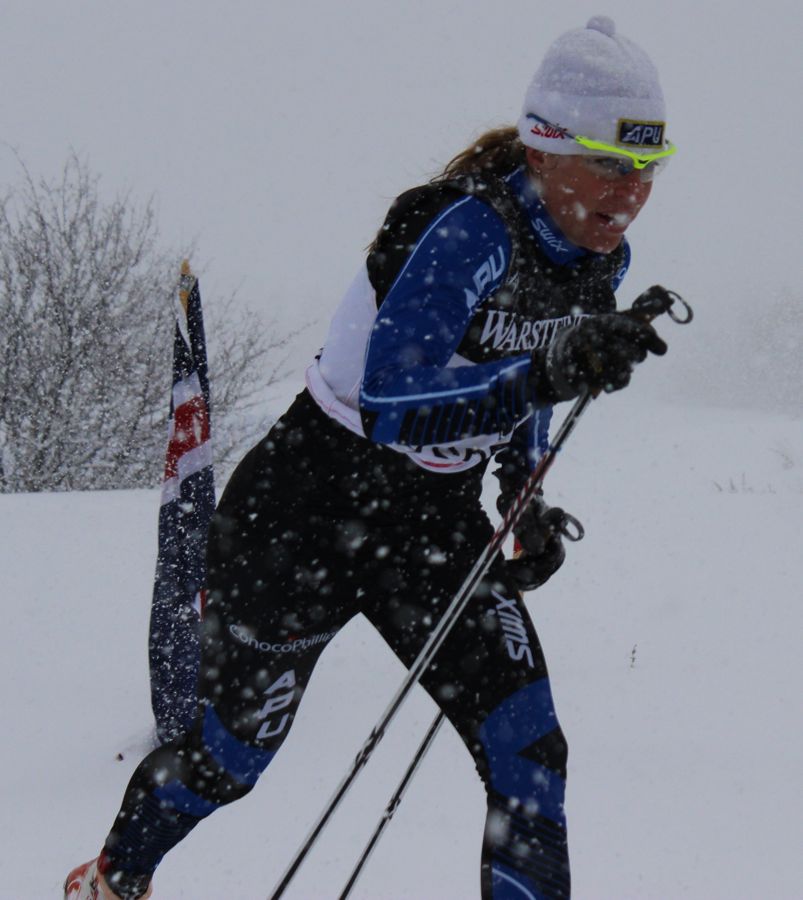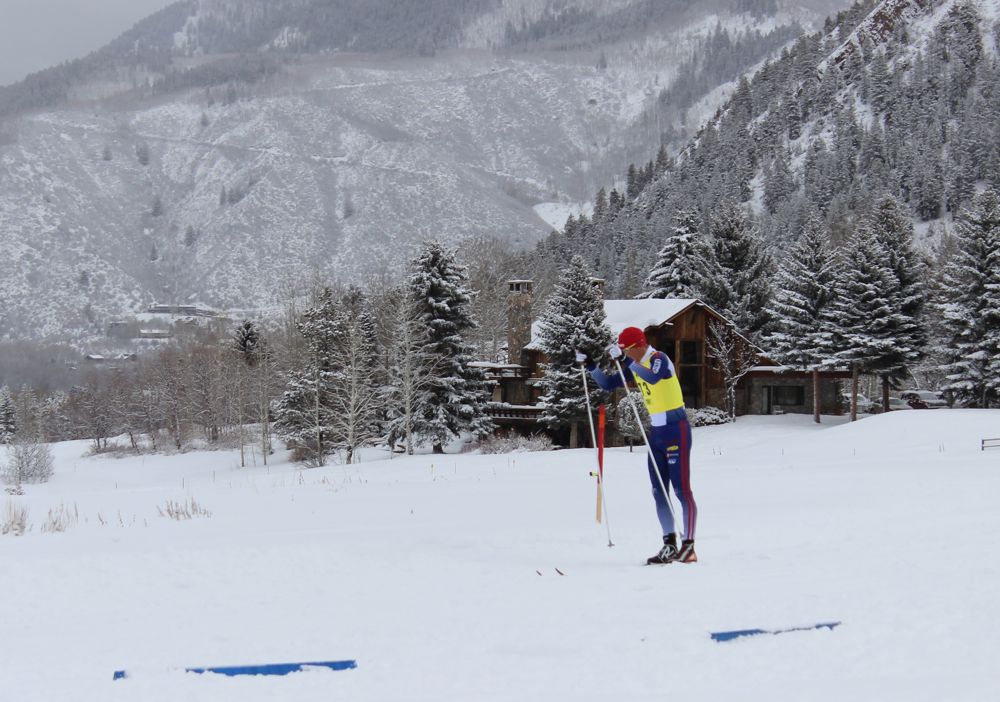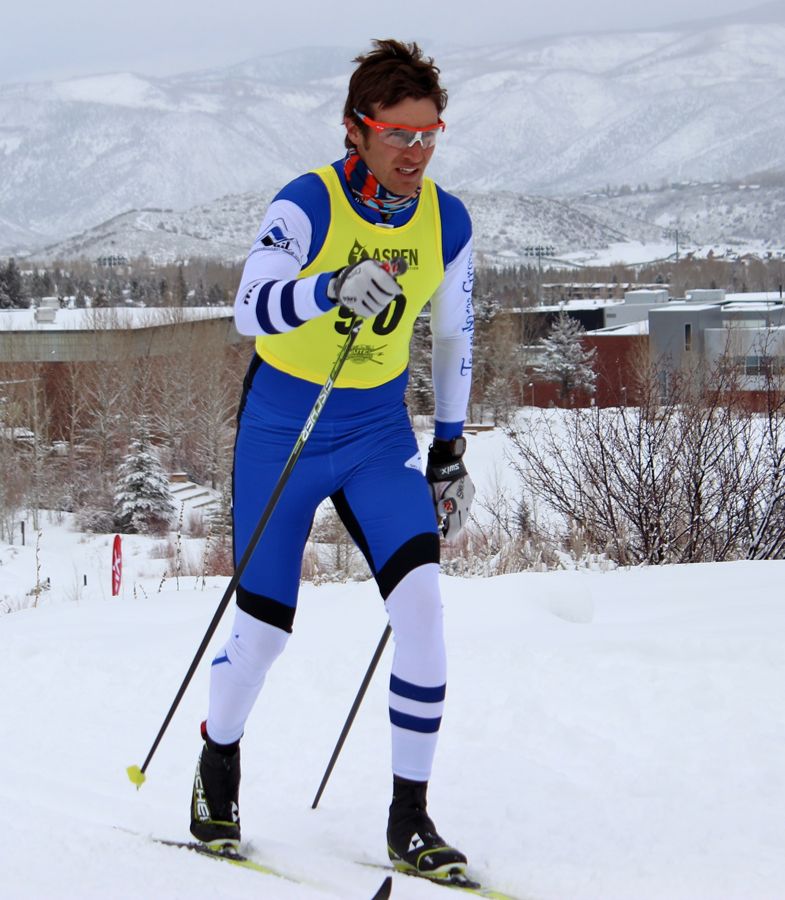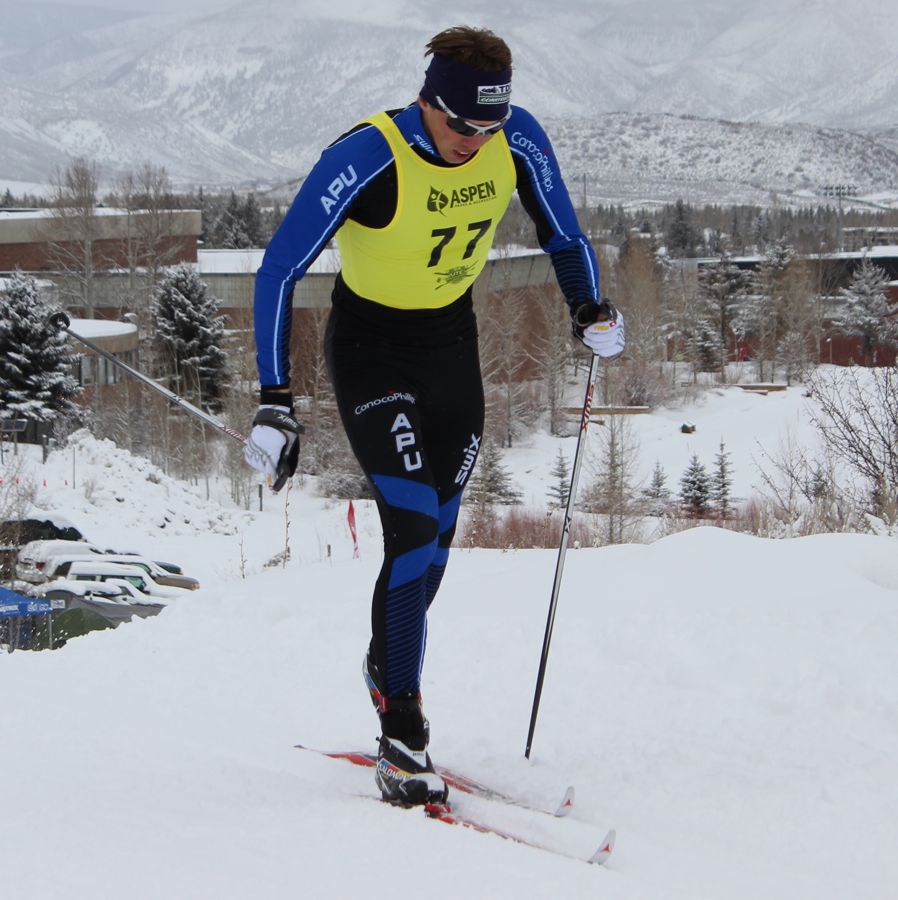
Tag: Nicole DeYong

  • Stephen Buckles Down on Single Pair of Skis, Wins U.S. Distance Nationals 30 k

    Stephen Buckles Down on Single Pair of Skis, Wins U.S. Distance Nationals 30 k

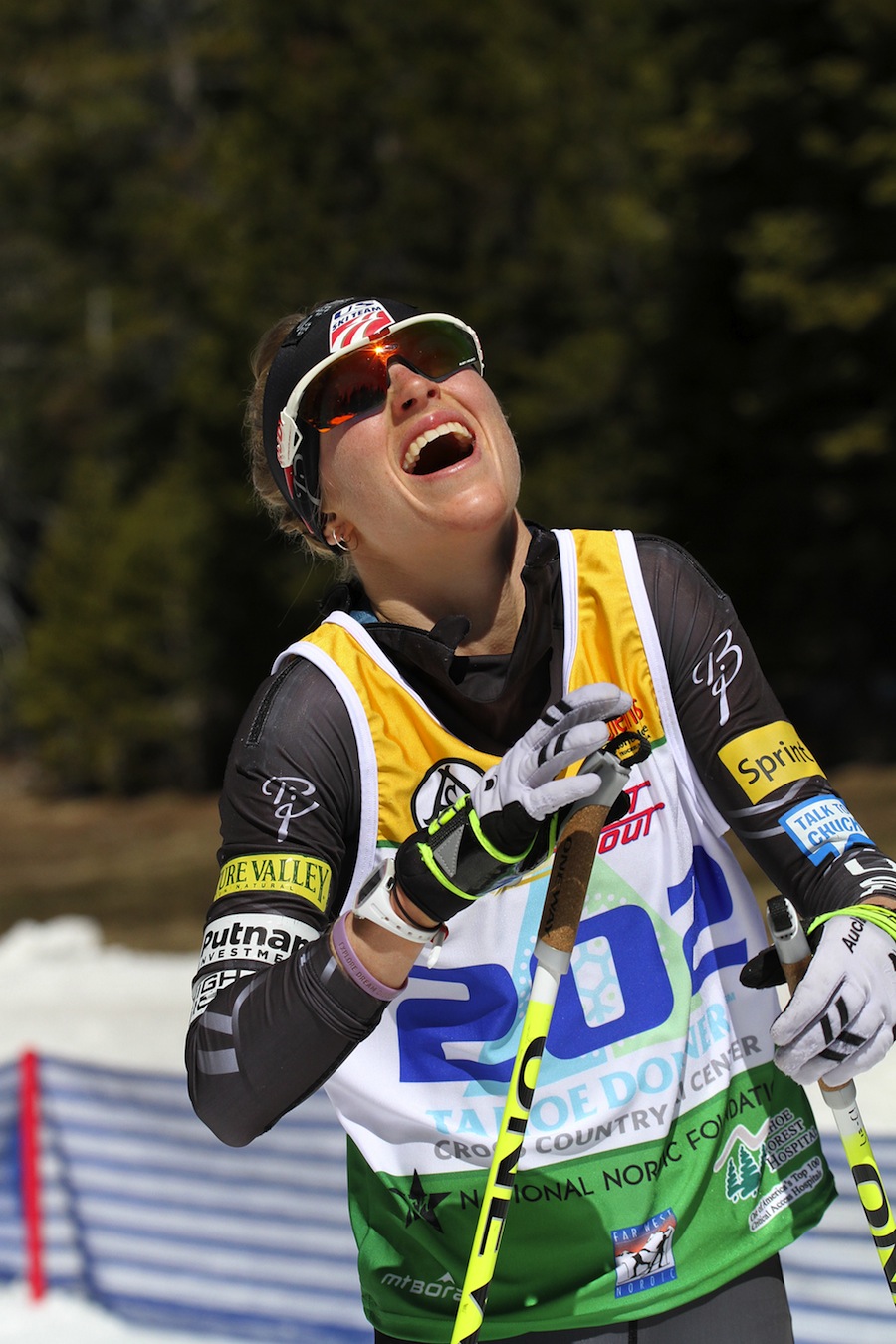
    Liz Stephen celebrates her second major win of the week at Spring Series in California, winning Wednesday's 30 k classic mass start at U.S. Distance Nationals at Royal Gorge. Two days early, she claimed the SuperTour Finals title. (Photo: Mark Nadell/MacBeth Graphics)
    Liz Stephen celebrates her second major win of the week at Spring Series in California, winning Wednesday’s 30 k classic mass start at U.S. Distance Nationals at Royal Gorge. Two days early, she claimed the SuperTour Finals title. (Photo: Mark Nadell/MacBeth Graphics)

    FasterSkier’s coverage of SuperTour Finals and U.S. Distance Nationals is brought to you by the generous support of Concept2, the leading manufacturer of indoor rowers, racing oars, and the SkiErg.

    NORDEN, Calif. – As the minutes ticked by in Wednesday’s 30-kilometer classic mass start, coaches paced around the start-finish area, checking their phones for updates.

    More than 30 minutes had passed without any sign of the leaders at the end of the first 10 k loop. Temperatures were already soaring into the 50s around 10:30 a.m. at Royal Gorge Ski Resort, making the three-lap endurance test even more of a grind.

    On the first of the two-day U.S. Distance Nationals, team-support staff readied for a surge through the exchange zone, an optional loop estimated to take about 40 seconds. Despite the penalty, most figured their skiers would want to use at least one of their two changes on a new pair.
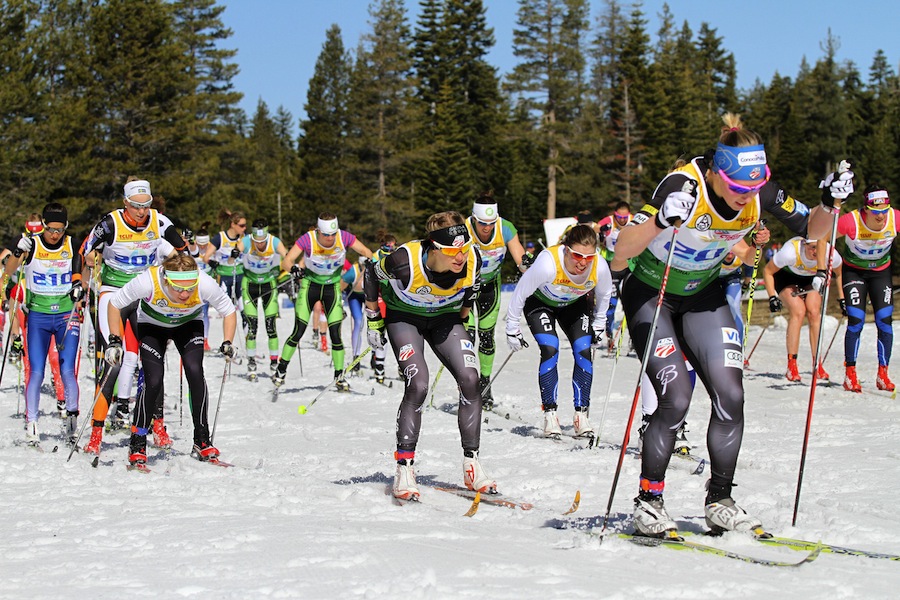
    U.S. Ski Team veterans Kikkan Randall (APU) and Liz Stephen (BMA) take control from the gun in Wednesday's 30 k classic mass start at U.S. Distance Nationals at Royal Gorge in Norden, Calif. Stephen went on to win by more than a minute. (Photo: Mark Nadell/MacBeth Graphics)
    U.S. Ski Team veterans Kikkan Randall (front right) and Liz Stephen (behind) take control from the gun in Wednesday’s 30 k classic mass start at U.S. Distance Nationals at Royal Gorge in Norden, Calif. Stephen went on to win by more than a minute. (Photo: Mark Nadell/MacBeth Graphics)

    Liz Stephen of the U.S. Ski Team (USST) and Burke Mountain Academy emerged out of the woods first, followed closely by USST teammate Kikkan Randall. Without any hesitation, the two began their second lap, skipping the exchange and setting the tone for the rest of the race.

    Randall’s teammate at Alaska Pacific University (APU), Rosie Brennan skied just a few seconds behind in third. If they weren’t going to switch skis in the soft-and-slushy snow, she wasn’t going to either.

    Suddenly, the race became a battle of sheer grit on average-at-best skis. Sixty degrees and sunny wasn’t going to be ideal for classic skiing no matter how you cut it. Might as well keep going.

    “I didn’t think they’d be any faster,” Stephen said of her decision not to change skis. “I tend to kind of be someone who’s pigheaded and just keeps going even if it’s not the fastest way.”

    Stubborn or just strong-willed, Stephen kept on plugging. The 26-year-old Vermont native led Randall by about 15 seconds through the end of the second lap at 20 k. Stephen continued with the same pair, waxed by USST serviceman Randy Gibbs and his support staff with the Craftsbury Green Racing Project, and Randall followed suit.

    Accelerating on the last lap, Stephen went on to finish first uncontested in 1 hour, 41:54.8 minutes. It was her second victory in as many races after Stephen won the SuperTour Finals title on Monday. She went on to take top honors at Distance Nationals in the last race of the season.
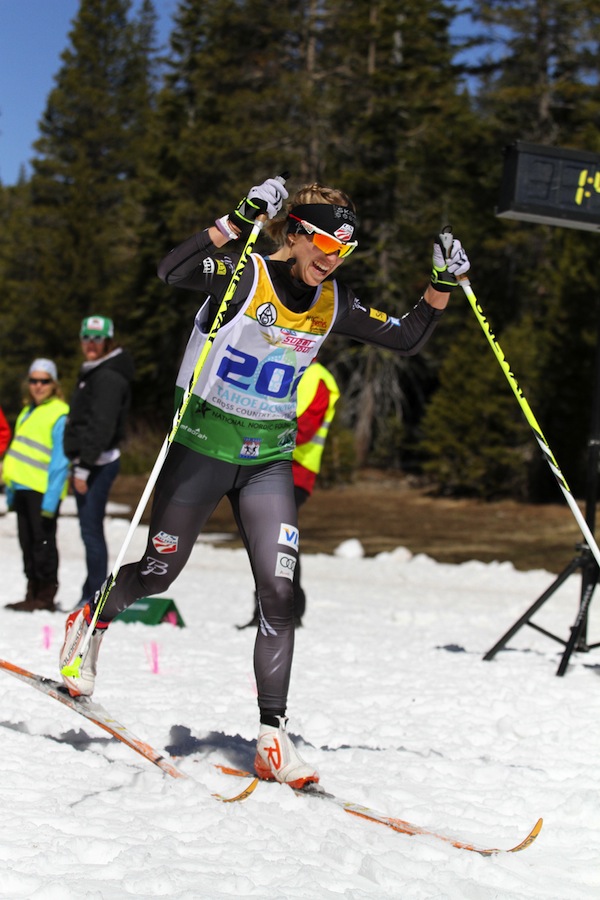
    Liz Stephen leading through the second of three laps in Wednesday's 30 k classic mass start at Royal Gorge in Norden, Calif. Stephen went on to beat Kikkan Randall by more than a minute for the U.S. Distance Nationals title. (Photo: Mark Nadell/MacBeth Graphics)
    Stephen leading through the second of three laps in Wednesday’s 30 k classic mass start at Royal Gorge. Stephen went on to win the U.S. Distance Nationals title. (Photo: Mark Nadell/MacBeth Graphics)

    “I’m super happy with it, and I mean, heck, I’m just excited to finish the season,” Stephen said. “As I’ve said before, this is a dream season and … as a U.S. team right now we’re really strong. It’s not just winning SuperTour Finals and U.S. championships. It’s a big deal now. We’re a very fast nation.”

    Unable to match Stephen’s attack up the long A-climb on the second lap, Randall took silver, 1:05.2 behind. Brennan, who skied most of the race alone, held on to third, 2:04.4 after Stephen.

    “On the second lap, last hill, [I] just kind of made a gap on Kikkan, didn’t really mean to make a move, it just kind of happened,” Stephen said. “I wasn’t sure whether I should keep going and try to make it bigger or whether I should chill out a little bit. … When she didn’t catch right back up, I thought, ‘What the heck? Let’s just see if I can hold it.’

    “I knew if she caught me again, it’d be really hard for me to stay with her and then try to beat in the end,” she added. “That’s not gonna happen. She’s got a globe full of jellybeans for a reason. I was telling myself over the tops of hills, ‘Just get over the top so she can’t see you!’ ”

    Cramping and tired after a long-yet-successful season, in which Randall won her second-consecutive Sprint World Cup and accompanying Crystal Globe, the world champion couldn’t respond. Her skis had been fast enough on the downhills and good on the climbs when she could find her kick, but as the race progressed (and her last feed went flying over her head with about 4 k remaining), that became harder for Randall to do.

    “I felt like I had the energy to do it, I just couldn’t,” Randall said. “My arms were starting to cramp and I couldn’t quite get on top of my skis to carry my momentum. For me in these kind of things, it’s such a technique thing, and sometimes I get it and sometimes I don’t.”
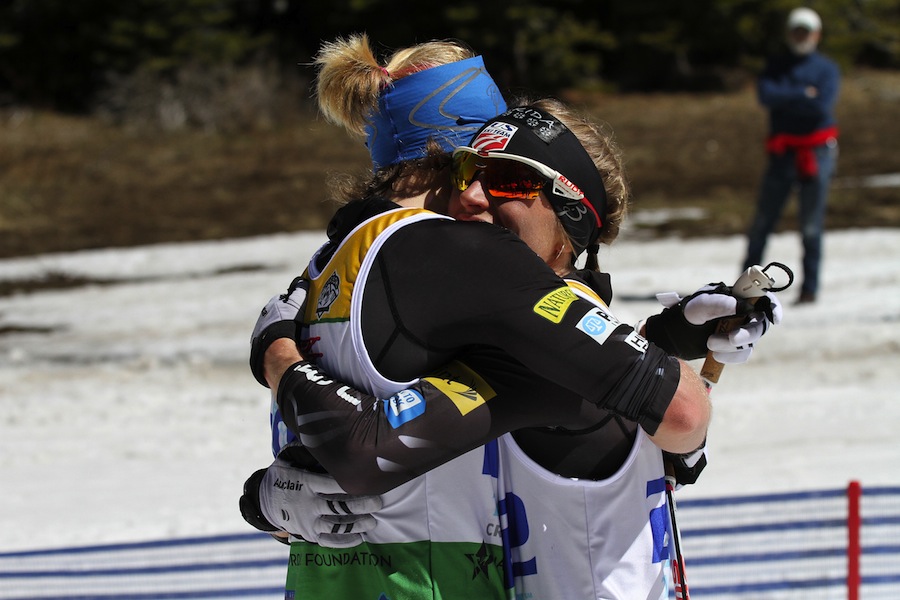
    Kikkan Randall (l) congratulates USST teammate Liz Stephen on her victory at U.S. Distance Nationals on Wednesday at Royal Gorge. Stephen won the 30 k classic mass start by more than a minute over Randall. (Photo: Mark Nadell/MacBeth Graphics)
    Kikkan Randall (l) congratulates USST teammate Liz Stephen on her victory at U.S. Distance Nationals on Wednesday at Royal Gorge. Stephen won the 30 k classic mass start by more than a minute over Randall. (Photo: Mark Nadell/MacBeth Graphics)

    Friends and housemates for the week with APU, Randall and Stephen talked about the ski exchange right before the race. Stephen wasn’t as confident in her second pair of skis. Randall felt they should see how the first lap went and make a call.

    “Coming into the exchange, I just decided, ‘No, I’m not gonna change, that’s my vote,’ ” Stephen said. ‘And she said, ‘Yeah, me neither. I’m just gonna keep going.”

    Forty seconds was too much time to waste, and the penalty ended up taking longer than a minute as the snow continued to soften.

    “With this added distance, it really changes the race,” said Randall, an International Ski Federation (FIS) athlete representative.

    “After they tested it out on the World Cup, I would say the majority of athletes didn’t like it. It’s definitely gonna be under review at the FIS meeting this spring. I was a little surprised they were gonna try it here.”

    As for the men’s 50 k classic mass start on Thursday, chief of competition August Teague told coaches they would shorten the zone to make it less of a penalty.

    But on Wednesday, it was an option few of the top finishers explored. After the first lap, Sadie Bjornsen (APU/USST) was the first to change her skis in sixth. She had been trailing Stratton Mountain T2 teammates Sophie Caldwell and Jessie Diggins (USST) in fourth and fifth, respectively. They nearly entered the transition until their coaches called them back, telling them to chase down the top three on the skis they were on instead.

    “I wish I would’ve known that everyone in front of me was not doing it,” Bjornsen said of the exchange. She spent the rest of the race trying to catch the chase group behind Brennan and succeeded on the second lap before falling behind on the third.

    “I think I just did it out of habit because I’ve done a couple ski exchanges in 30 k’s, never that you lose time on,” she added.
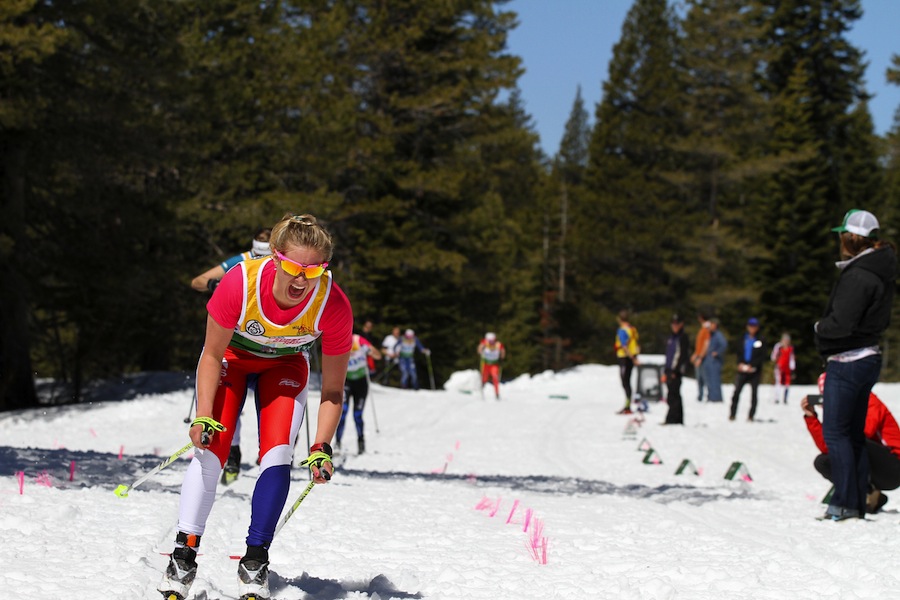
    An exhausted Jessie Diggins (SMST2/USST) after outsprinting four others for fourth place in Wednesday's 30 k classic mass start at U.S. Distance Nationals at Royal Gorge. (Photo: Mark Nadell/MacBeth Graphics)
    An exhausted Jessie Diggins (SMST2/USST) after outsprinting four others for fourth place in Wednesday’s 30 k classic mass start at U.S. Distance Nationals at Royal Gorge. (Photo: Mark Nadell/MacBeth Graphics)

    Diggins was one of the few top women who took a pit stop the second time around, rising from 10th to seventh toward the end of the last lap.

    She overtook Swedish B-team member Linn Sömskar, who double poled the first lap on skate skis along with fellow Swedes Lisa Larsen and Hanna Falk.

    Sömskar and Larsen led Randall and Stephen early in the race, but on a tough 10 k course marked by two significant climbs and several gradual hills, they fell behind before the end of the loop and switched to classic skis.

    “After the first lap, there was actually zero rest on the whole course,” Brennan explained of the slowing conditions. “There was not one place you could tuck without losing time.”

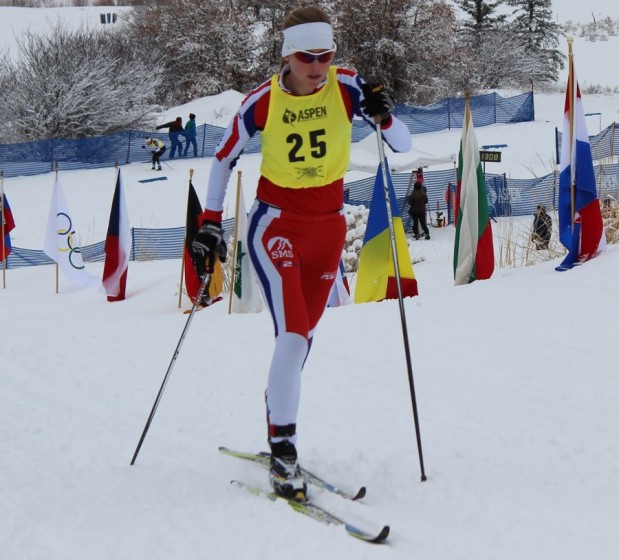
    On the last lap, Diggins worked her way up to Bjornsen, Swedish World Cup skier Maria Graefnings, Nicole Deyong (Sun Valley Ski Education Foundation), Caitlin Gregg (Central Cross Country), and Caldwell. She outsprinted them all to the finish, taking fourth 2:03.7 minutes behind Brennan and 1.5 seconds ahead of Caldwell in fifth.

    “It took me the entire nine k to catch them back again,” Diggins said. “Once I caught them, the skis had better glide. It’s kind of a risky, risky move, but I felt like I didn’t have a choice because they were getting slick. I decided I needed to switch.”

    The key to Brennan’s success was effectively not thinking about exchanges, but rather following the two World Cup veterans ahead of her. At the finish, she said it was one of the hardest races she’d ever done.

    “I’m beyond happy. That was one of the best races I’ve had this year,” Brennan said. “I’ve never had a good 30 k so to have it be the last race of the year is pretty awesome.”
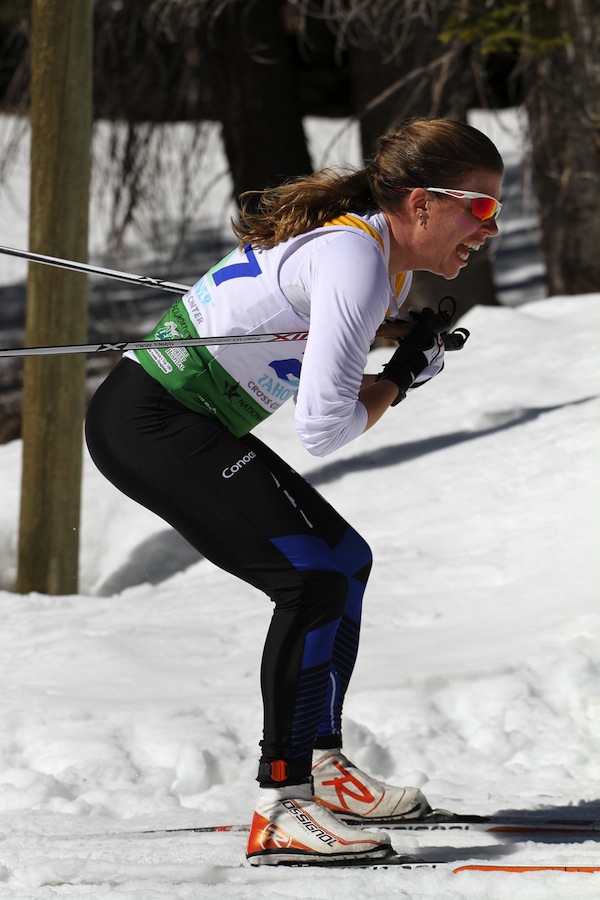
     Rosie Brennan (APU) racing to third in Wednesday's 30 k classic mass start at U.S. Distance Nationals at Royal Gorge. (Photo: Mark Nadell/MacBeth Graphics)
    Rosie Brennan (APU) racing to third in Wednesday’s 30 k classic mass start at U.S. Distance Nationals at Royal Gorge. (Photo: Mark Nadell/MacBeth Graphics)

    Not far behind Stephen and Randall, who came through together after the first lap, Brennan remembered what APU head coach Erik Flora told her this season.

    “[He] had talked to me a lot about taking risks because I usually race too timid,” Brennan said. “So I was like, ‘Why the hell not? It’s the last race.’ ”

    With a good start and fast skis, she stuck with the two leaders. Stephen and Randall picked up the pace toward the end of the first lap, and Caldwell worked to stay with them. Brennan latched on as well.

    “I just got in the other track and went for it,” Brennan said. “I was able to catch back up to them, and I skied with them for another half lap.”

    The thought of changing skis hardly entered Brennan’s mind as Flora waved both Randall and her into the third lap behind Stephen.

    “I heard that it took a minute to do [the exchange] and a minute is so long to lose,” Brennan said. “Once you’re out of sight, it’s so hard mentally so I just was like, ‘That’s not worth it.’ ”

    Caldwell didn’t give it much thought, either. Pushing herself outside her comfort zone on the first lap, she said she was “a little worried” heading into the second. She recovered on the second loop while skiing with Diggins and Bjornsen, who had regained contact with them.

    “I figured as long as I stayed in a pack, speed wouldn’t matter as much ’cause I could try to draft,” Caldwell said. “I was afraid if I did change and I lost the group, I’d struggle to catch back up.”

    In search of better skis after the first lap, Graefnings followed Bjornsen into the exchange, and like Bjornsen, spent the rest of the race paying the price. Both worked to regain their spot in the chase group, and once there, Graefnings put on a final attack with what she guessed was “three or four” kilometers to go.

    “I’m a little mad at myself,” Graefnings said after losing the hunt for fourth and placing seventh, 4.7 seconds behind Diggins.

    “I did some tactical mistakes,” she explained. “I was starting with my second pair and that was not a good choice. I should’ve had my first pair all the way … I think the best three girls had their first pair all 30 k.”

    She was right. The top three skied on the same boards from start to finish. Diggins notched fourth with one change, Caldwell was fifth with none, and Deyong placed sixth (1.2 seconds after Caldwell) after switching her skis before lap two.

    “I know I lost some time, but once I realized that I had caught that second pack I just tried to hang on and survive,” Deyong said.

    The 30-year-old Sun Valley coach ended up surprising herself in her first distance race in a month since placing second in the 50 k Rendezvous Race in West Yellowstone, Mont. She also raced Monday’s hill climb up Sugar Bowl Resort, the final event of SuperTour Finals.

    “I hadn’t raced in a while and I jumped into the hill climb and I was like, ‘Why am I doing this?’ ” Deyong said after posting the 17th-fastest time up the mountain. “But I think jumping into that race helped me kind of blow the fumes out and just kind of get into that race mode again.”
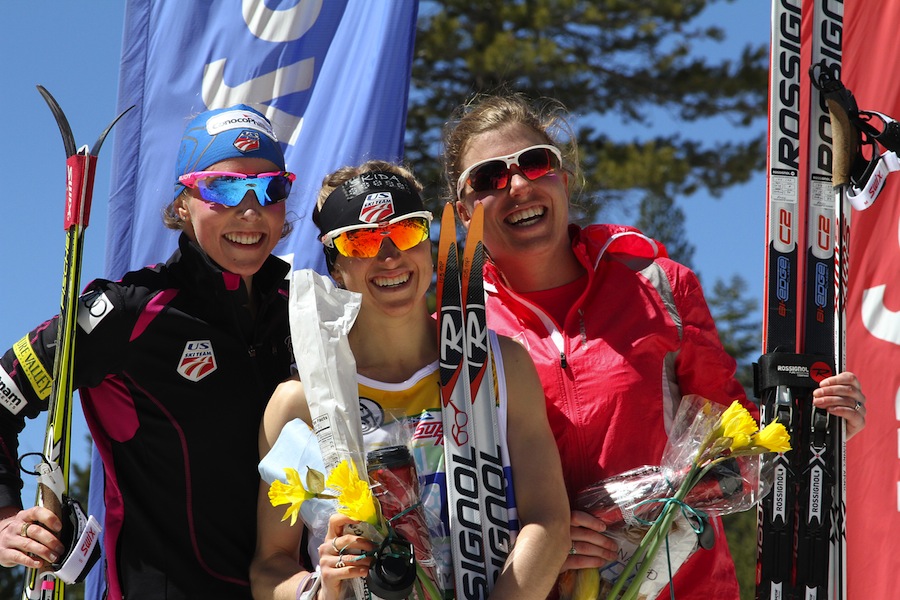
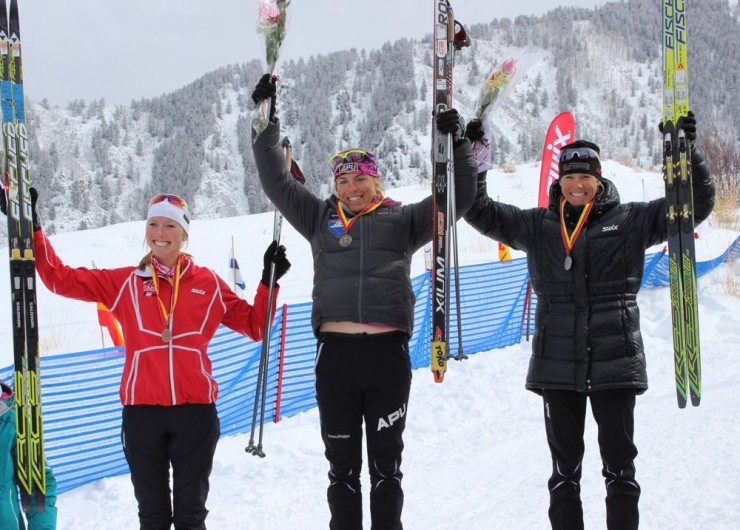
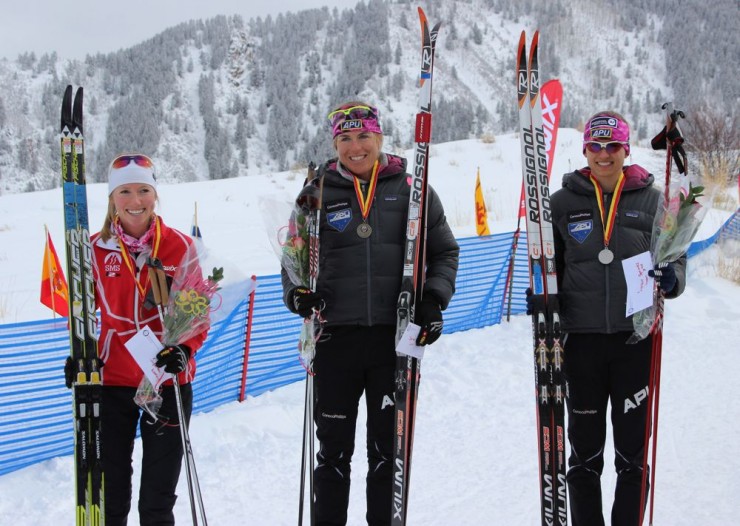
    The women's 30 k classic mass start at 2013 U.S. Distance Nationals. From left to right: runner-up Kikkan Randall (APU/USST), winner Liz Stephen (BMA/USST), and bronze medalist Rosie Brennan (APU). (Photo: Mark Nadell/MacBeth Graphics)
    The women’s 30 k classic mass start at 2013 U.S. Distance Nationals. From left to right: runner-up Kikkan Randall (APU/USST), winner Liz Stephen (BMA/USST), and bronze medalist Rosie Brennan (APU). (Photo: Mark Nadell/MacBeth Graphics)

    Graefnings finished 2 seconds behind Deyong on Wednesday, and Bjornsen took eighth, 3.4 seconds behind the Swede. Gregg finished ninth, 8.3 seconds after Bjornsen, and Sömskar was 10th.

    “I was falling off the back, catching back, falling off the back, catching back,” Bjornsen said. “The last kilometer it was just everything you had left in your tank. Mine was a bit limited.”

    Though disappointed, Bjornsen would remember her stellar SuperTour Finals, where she was third overall with four podiums in as many races.

    “Today was more just to test what I could do with what I had left,” she said. “All of us were out there absolutely digging, giving as much as we could, ever last bit of fuel we had. That’s a fun way to end because we dropped at the end. That was everything.”

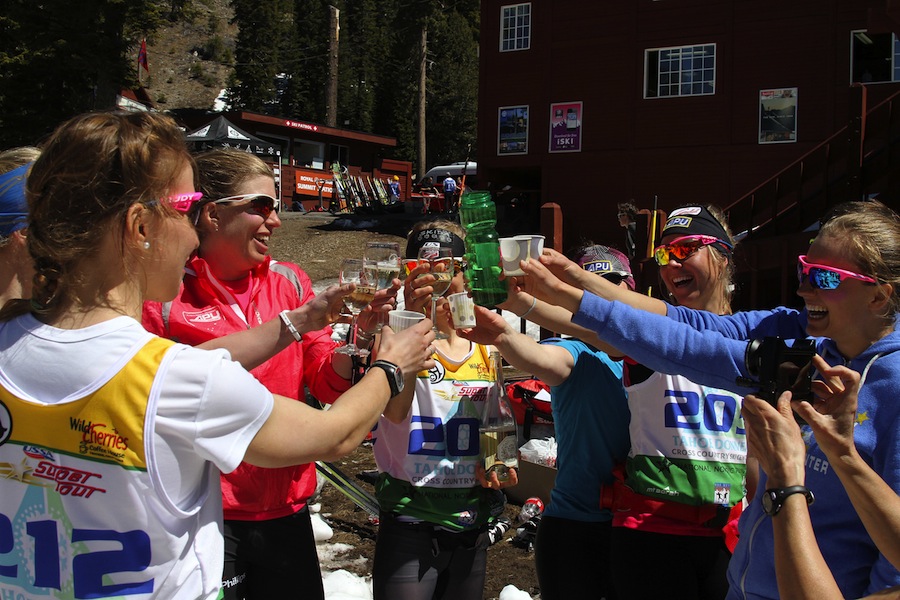
    Standings outside in T-shirts and sports bras, several of the top women sipped champagne and celebrated the end of the season.

    “Today was kind of epically tough conditions so you really feel like you had to grit it out,” Randall said. “When you get to that finish line, you just feel really satisfied about the race and the whole season.”

    “[It was a] really great way to end it here in California; the volunteers have done great things,” Stephen said. “Big thanks to everybody for the season. It was fun as hell.”

    — Audrey Mangan contributed reporting
    Results | Photos

    Clinking glasses (and plastic water bottles) to celebrate the end of the season at U.S. Distance Nationals on Wednesday at Royal Gorge Ski Resort in California. (Photo: Mark Nadell/MacBeth Graphics)
    Clinking glasses (and Dixie cups and water bottles) to celebrate the end of the season at U.S. Distance Nationals on Wednesday at Royal Gorge Ski Resort in California. (Photo: Mark Nadell/MacBeth Graphics)
  • Gregg Picks Winning Lottery Ticket in 2013 Birkie Sweepstakes

    Gregg Picks Winning Lottery Ticket in 2013 Birkie Sweepstakes

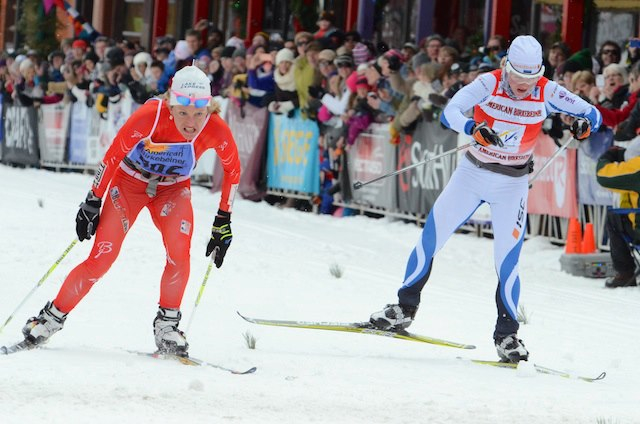
    Caitlin Gregg (left) edges Estonia's Tatjana Mannima to win the 2013 American Birkebeiner. Photo, Darlene Prois/American Birkebeiner Ski Foundation
    Caitlin Gregg (left) edges Estonia’s Tatjana Mannima to win the 2013 American Birkebeiner. Photo, Darlene Prois/American Birkebeiner Ski Foundation

    Caitlin Gregg likes to joke that each time she and her husband enter a ski race, it’s like the couple is buying a pair of lottery tickets in the Megabucks.

    Saturday, at the finish of the American Birkebeiner marathon in Wisconsin, Gregg hit the jackpot, eking out a victory over Estonian Tatjana Mannima on Main Street in Hayward after 50 kilometers of racing. Her reward: the winner’s prize of $7,500.

    “It’s huge,” she said. “This is definitely what we were hoping for, from either one of us.”

    After her win at the Birkie in 2011 helped allow her and her husband Brian Gregg to buy their house in Minneapolis, this dose of Birkie cash will help keep the couple on sound financial footing as they train for next year’s Olympics in Russia.

    The money was far from guaranteed, though, as Gregg had to fend off four other women in a sprint to the finish—after Mannima, there was Craftsbury’s Caitlin Patterson, who placed third, Italian Antonella Confortola in fourth, and Sun Valley’s Nicole DeYong in fifth.

    While Gregg, 32, was clearly as fit as anyone else in the field, she also credited her experience with getting her to the line first, with two previous Birkie podiums under her belt. Mannima and Patterson were both competing in the race for the first time—and for Patterson, the race was her first-ever 50 k.

    Gregg’s team, meanwhile, has held camps in Hayward, and her husband lived in the town at one point in his career.

    The couple is so tight with the locals that when Gregg had a problem with one of her poles a few kilometers into the race, she skied no more than a few hundred meters before running into a friend, Kay Wilson, standing with a replacement—Brian Gregg had supplied her with one.

    “He knew that Kay was familiar with the race,” Caitlin Gregg said. “We literally skied, like, a hill and a half, and I looked up, and Kay was there with these poles, and I just yelled at her. She was a pro—it was so seamless.”

    The women’s race split up quickly, with the lead pack thinning out to roughly a dozen athletes near the course’s high point at around 10 kilometers, according to Patterson.

    That group fractured even further around the 30 kilometer mark, and then, by the time the skiers reached the top of “Bitch Hill” at about 40 kilometers, only five women were left after some strong skiing by Gregg and DeYong—and they all pushed hard over the top to make sure that no one would be able to catch up.

    “We definitely skied the rest of the downhill aggressively fast,” Patterson said. “Then it was five of us going all the way, to the last few corners before the finish.”

    For Patterson, just knowing that she’d made the top five was a victory in and of itself: the Birkebeiner pays prize money to the top six athletes.

    “I was kind of watching the rate of attrition,” she said.

    Patterson gave both Gregg and DeYong credit for keeping the pressure on, and shaking the group of five free from the rest. For her part, Gregg said that DeYong—who’s actually a coach in Sun Valley and doesn’t even consider herself a racer—was “the fittest athlete out there, by far.”

    “Tons of energy,” Gregg said. “I was really impressed.”

    But as the leaders approached the finish, it was Gregg who ended up controlling the race when she somehow found herself at the front of the pack going across Lake Hayward, a few kilometers from the finish line.

    It’s a notoriously bad spot to lead—the other athletes can tuck in behind, saving their energy for the sprint. “It’s all exposed, and windy, no turns—you can’t really do much,” Gregg said. “I remember thinking: ‘Oh, Brian is going to kill me for taking the lead here—this is such a rookie thing to do.’”

    But rather than panic, Gregg made the most of her predicament, skiing along at what she called a hard pace, but still comfortable.

    Patterson tried to make a move before the trail narrowed at the end of the lake, but there wasn’t any room.

    “I sort of got shuffled into the classic tracks, and had to backpedal a little bit,” she said.

    Then, Mannima managed to sneak by Gregg on the right, and took the lead, but couldn’t escape; when the group turned onto Main Street in Hayward, it was clear that it would come down to a drag race for the line.

    It may not have been the quickest of sprints: Gregg said she “felt like a snail trying to get ahead of another snail.” But she had just enough to get past Mannima and win by about half a second, with Patterson another second behind.

    Patterson, after her first-ever marathon, said she was already eager for another shot at the Birkie, given the difficulty she had negotiating the race’s final kilometers.

    “I think there’s a good chance that in the future, when I know, tactically, how that finish works, that things could be different,” she said. “Certainly, Caitlin Gregg’s experience on this course, and with that finish, paid off, because she knew exactly what to do to get there first.”

    There was no bitterness, though—Patterson added that she was excited simply to be skiing with the lead pack, especially given that it included some high-powered foreign athletes.

    Mannima, in fact, is the current leader of the world marathon circuit. And she’s flying back to Europe to compete in the World Ski Championships for Estonia this coming week, according to Craftsbury Coach Pepa Miloucheva, who spoke to Mannima after the race.

    Confortola, the Italian, has two relay medals from World Championships, and one from the Olympics.

    Still, not Confortola, Mannima, nor any of the other women could deprive Gregg on Saturday from winning on what essentially amounts to her home course—a feeling, she said, that was “great.”

    “Everyone knows your name, and you just feel the love that much more,” Gregg said. “It means a ton.”

  • Weekly Roundup: Quite a Scene at Biathlon World Champs, Aspen SuperTour and Scando Cup

    Weekly Roundup: Quite a Scene at Biathlon World Champs, Aspen SuperTour and Scando Cup

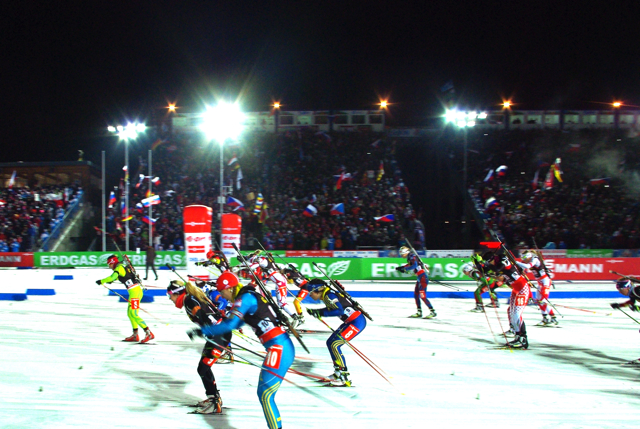
    As Czech flags wave in the background, the mixed relay field sets off in pursuit of the first 2013 Biathlon World Championship title on Thursday in Nove Mesto, Czech Republic.
    As Czech flags wave in the background, the mixed relay field sets off in pursuit of the first 2013 Biathlon World Championship title on Thursday in Nove Mesto, Czech Republic.

    Think you can picture the scene at the International Biathlon Union (IBU) World Championships in Nové Město na Moravě, Czech Republic? Think again.

    Veteran and newbies alike found themselves in awe of the stadium and 20,000-strong crowd. After the first few days of racing, many were still struggling to cope with the noise factor, but hey, they weren’t complaining.

    Norway opened with its third-straight mixed relay victory, no surprise there, and the hometown fans celebrated its own team making the podium in third right behind France.

    The U.S. notched its best mixed-relay result in eighth with Annelies Cook, Susan Dunklee, Lowell Bailey and Leif Nordgren. With Tim Burke out trying to get healthy, Nordgren filled in. Meanwhile, the Canadians were simply happy to get their feet wet at World Champs as Rosanna Crawford, Megan Heinicke, Jean Philippe Le Guellec and Scott Perras combined for 15th.

    On Saturday, Norway’s former biathlon king, Emil Hegle Svendsen, made a point to get back on top and captured his second-straight gold medal of the week, beating French rival Martin Fourcade in the 10 k sprint. In the women’s 7.5 k sprint, Ukraine’s Olena Pidhrushna surprised with her first career win and teammate Vita Semerenko tallied her third World Championships bronze.

    All four American men in the sprint raced well enough to qualify for Sunday’s 60-man pursuit. Burke was back in action in 28th, Bailey placed 32nd and Russell Currier and Nordgren also made the cut. Two Canadian men and two women qualified, led by Le Guellec in 36th and Scott Gow in his debut World Championship in 45th. In the women’s sprint, Cook also placed 45th and Heinicke narrowly qualified for the pursuit in 54th.

    That brings us to Sunday when Svendsen continued his World Championships domination, outsprinting Fourcade by 2.4 centimeters for the pursuit victory. It didn’t come easy: he nearly stopped after getting tangled with Russia’s Anton Shipulin on the last climb.

    Norway’s Tora Berger won her first individual gold of the week in the pursuit, rising to the occasion when two skiers in front of her, Russian Olga Zaitseva and Krystyna Palka of Poland, missed one apiece on the last shooting stage. Berger shot clean on the final stage and hammered home for the victory.

    Meanwhile, Bailey and Le Guellec led the North Americans in 13th and 15th, respectively. Le Guellec made up 21 places – the second most of any man in the pursuit – and Bailey climbed 19 spots to get back in the mix.

    IBU World Championships

    Athlete reaction to renovated venue: story

    Thursday’s mixed relays: international report | American report | Canadian report | results

    Saturday’s sprints: men’s international report | women’s international report | American report | Canadian report | men’s results | women’s results | photos

    Sunday’s pursuit: men’s international report | women’s international report | North American report | men’s results | women’s results

    Sunday’s pursuit photos: North Americans | men | women

    ***

    While biathlon expert and FasterSkier editor-at-large extraordinaire Chelsea Little was on site in Nové Město, Audrey Mangan traveled to Aspen, Colo., for the SuperTour – making her first stop at the Vail Mountain Games.

    There, the Central Cross Country (CXC) husband-and-wife duo, Brian and Caitlin Gregg topped the men’s and women’s field, respectively, in the 10 k freestyle mass start – a sort of warmup for the SuperTour weekend ahead.

    On Saturday, big, wet snowflakes at 8,000 feet above sea level didn’t slow down skiers like Rosie Brennan of Alaska Pacific University (APU), who won both the 1 k classic prologue in the morning and the 5 k classic individual start in the afternoon. On the men’s side, Mike Sinnott of the Sun Valley Ski Education Foundation (SVSEF) won the prologue and teammate Patrick Johnson tallied his first career SuperTour victory in the 10 k.

    Sunday’s coveted Owl Creek Chase involved a sprint showdown at the end of the 21 k point-to-point race. Brian Gregg edged Sylvan Ellefson (Ski & Snowboard Club Vail/Team HomeGrown) by eight seconds at the finish, showing all his speed work this summer paid off.

    Part-time racer Nicole DeYong (SVSEF) skied away from the pack for a two-minute victory after winning the same race in 2010.

    Vail Mountain Games

    Friday’s 10 k freestyle: overview with interview video | results

    Aspen SuperTour

    Saturday’s classic prologue and 5/10 k individual start: report | sprint prologue results | 5 k classic results | 10 k classic results

    Sunday’s Owl Creek Chase 21 k freestyle mass start: report | men’s results| women’s results

    ***

    Sophie Caldwell (SMST2) racing to a second-place finish in Sunday's Scando Cup 1.1 k freestyle sprint in Pärnu, Estonia. She was just 0.14 seconds out of first for a career best. (Photo: Eric Packer)
    Sophie Caldwell (SMST2) racing to a second-place finish in Sunday’s Scando Cup 1.1 k freestyle sprint final in Pärnu, Estonia. She was just 0.14 seconds out of first for a career best. (Photo: Eric Packer)

    Meanwhile, several other American domestic skiers put their skills to the test at the Scandinavian “Scando” Cup in Latvia and Estonia. Caitlin Patterson of the Craftsbury Green Racing Project led the group in Madona, Latvia, where she was ninth in Thursday’s 10 k freestyle mass start and 10th in the 5 k classic on Wednesday. Eric Packer of the Stratton Mountain School T2 Team (SMST2) broke through in 16th in the 20 k freestyle mass start.

    A few days later, Sophie Caldwell (SMST2) made the podium in second in Sunday’s freestyle sprint in Pärnu, Estonia, one day after finishing 17th in the classic sprint. Jennie Bender (CXC) qualified as high as fourth in the classic sprint and went on to place 16th. The next day, she was 11th in the skate sprint.

    Scando Cup

    Wednesday-Thursday in Madona, Latvia: recap

    Saturday-Sunday in Pärnu, Estonia: recap

  • Gregg Sprints for Owl Creek Title; DeYong Demolishes in Aspen

    Gregg Sprints for Owl Creek Title; DeYong Demolishes in Aspen

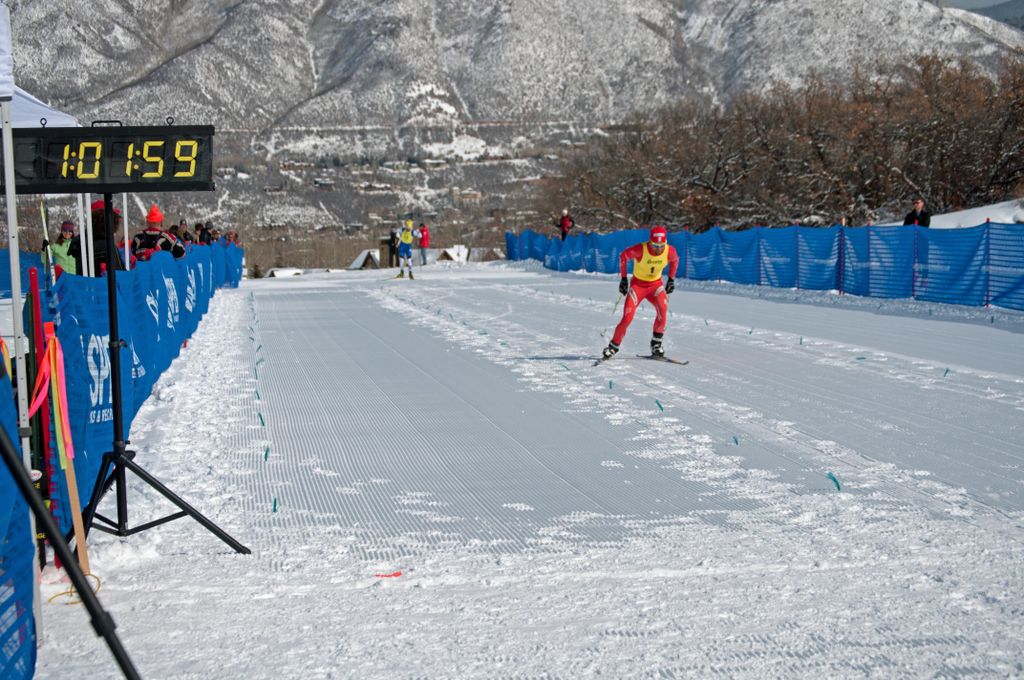
    Brian Gregg (CXC) claiming the 2013 Owl Creek Chase on Sunday in Aspen, Colo. Photo: Mike Hoffman.
    Brian Gregg (CXC) claiming the 2013 Owl Creek Chase on Sunday in Aspen, Colo. Photo: Mike Hoffman.

    ASPEN, Colo. — The Owl Creek Chase is not a race to be entered lightly. The 21 k course is a taxing point-to-point that starts at the Snowmass Cross Country Center, traverses the slopes of Buttermilk and comes out at the Aspen Valley Ski & Snowboard Club after thousands of feet of long, grueling climbs and dizzying descents. Race favorites describe it as a survivor’s course; murderously challenging. Go too hard, too early, and it will bury you.

    It should come as no surprise that Central Cross Country’s Brian Gregg and Sun Valley Ski Education Foundation’s Nicole DeYong conquered such terrain. Both skiers are notorious climbers and well-acclimated altitude racers, and have learned from experience what it takes to outlast at Owl Creek.

    “Owl Creek can be pretty painful if you go too far under,” Gregg said. “The last time I was here…the wheels just came off. I don’t think I’ve ever hurt that bad.”

    This year Gregg made sure to prepare himself accordingly for the 8,000-foot height and daunting course profile. He and his wife, Caitlin, have been staying with family in Eagle, Colo., for weeks to train high in preparation. They both skipped the classic races on Saturday to save up for the main event, unlike many of their competitors.

    On Sunday it paid off, and Brian outsprinted Sylvan Ellefson (Ski & Snowboard Club Vail Team HomeGrown) by eight seconds to finish in 1:02:04.4 in sunny, hard-packed conditions. Mike Sinnott (SVSEF) took third (+1:23).

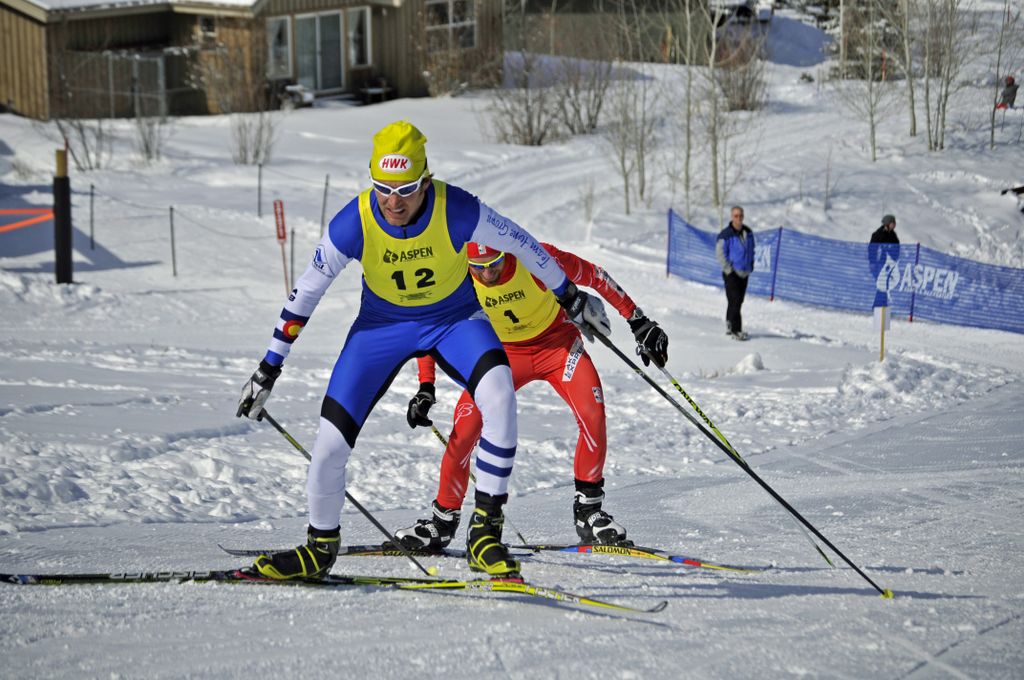
    Sylvan Ellefson (SSCV) leading Gregg up one of the last few climbs. Photo: Mike Hoffman.
    Sylvan Ellefson (SSCV) leading Gregg up one of the last few climbs. Photo: Mike Hoffman.

    You read that right — in a sprint finish, Gregg outsprinted the field. The CXC veteran has been working particularly hard on his closing kick all year with his coach Scott Johnston and the Methow Olympic Development squad to turn himself into a better all-around skier.

    “I’ve done a lot of workouts where we’ll ski 800 meters or something and sprint as hard as we can the last 300 meters to work on that finishing speed,” Gregg said. “It’s always been a weakness of mine, so I got to focus on that this summer and now I’m seeing it come together in the race season.”

    It took a full 20 k of intelligent skiing for Gregg to be in a position to kick it in at the end, for the preceding kilometers and broke many a strong skier. The race began at a controlled pace; Brent Knight (Alaska Pacific University) fell in the opening seconds and the leaders waited considerately for him to catch back on. When the lead pack developed, Gregg, Ellefson, Sinnott, Knight and Matt Gelso (SVSEF) helped each other conserve energy and rotated turns setting the pace at the front.

    Ellefson and Gregg eventually broke away before the halfway mark and continued to switch in and out of lead duty as they came into the final 5 k on the Aspen trails.

    Brent Knight (APU) battles a climb as MIke Sinnott (SVSEF) gains ground from behind. Photo: Mike Hoffman.
    Brent Knight (APU) battles a climb as MIke Sinnott (SVSEF) gains ground from behind. Photo: Mike Hoffman.

    “I kind of pulled it in I guess to keep away third and fourth, but also keep the pace high so no win would come too easy,” Ellefson said. “But I think I led a little bit more than I wanted to that last 5 k. I don’t know if it was the three races beforehand or what, but my legs just couldn’t do it in the last 200 meters.”

    A minute back, Sinnott gained back a deficit on Knight to claim bronze. At such a suffer-fest of a race, he was happy to hang on to a podium spot.

    “I was fighting with those guys for a while, and then once you crack on this course you go backwards fast,” Sinnott said. “I saw a big chase pack coming so I was happy to hang onto third — those sharks were coming up behind me pretty quick.

    “It’s a beautiful course, really fun, but so murderously painful. It just hurts. It’s about who’s toughest and who can survive, and I was not the survivor today.”

    Knight finished 0.3 seconds behind Sinnott for fourth. Colin Rodgers (SVSEF), a coach at most races, took fifth after a 30-second break in the field. Patrick Johnson (SVSEF) was sixth, 29 seconds behind Rodgers.

    Though the course is a lung-burner, most finishers looked happy as they crossed the finish line under the Aspen sun.

    “I love this course, it’s one of my favorites,” Ellefson said. “I was expecting to be skiing in six inches of powder this morning and was not looking forward to that, so when the tracks were firm this morning it was good vibes today.”

    Complete results.


    Nicole DeYong (SVSEF), a competition team coach for Sun Valley, claimed the Owl Creek Chase by two minutes on Sunday in Aspen, Colo. Photo: Mike Hoffman.
    Nicole DeYong (SVSEF), a competition team coach for Sun Valley, claimed the Owl Creek Chase by two minutes on Sunday in Aspen, Colo. Photo: Mike Hoffman.

    The women’s race played out much like the men’s in the beginning — the course practically requires a comfortable early pace. No one wants to blow up too early at Owl Creek. But in the end DeYong won by a whopping two minutes over Lenka Palanova (Boulder Nordic Junior Race Team).

    “From many years of experience I’ve discovered it’s good to just kind of sit back for a little bit and find a good rhythm,” DeYong said. “I was feeling pretty tired and sore this morning, so I just wanted to play it conservatively.”

    DeYong won Owl Creek once before in 2010 — in fact it’s the only race she’s ever won. She no longer races full time and doesn’t put too much pressure on results, and on Sunday she just hoped hoped for a good feeling after racing the 5 k classic the day before.

    The pace went out “comfortably.” Palanova, DeYong, Alexa Turzian (SVSEF), Rosie Brennan (APU) Erika Flowers (SMS T2) and Caitlin Gregg (CXC) splintered off from the rest of the field as the course wound around a hilly Snowmass golf course in the first 5 k.

    Palanova drew first blood at the front of the train, not content to sit back at a leisurely pace.

    Lenka Palanova (BNJRT) finishing second at Owl Creek for the second year in a row. Photo: Mike Hoffman.
    Lenka Palanova (BNJRT) finishing second at Owl Creek for the second year in a row. Photo: Mike Hoffman.

    “I didn’t want them to play the tactical game,” she said. “When I realized they were going a little bit too slow I just went for it.”

    Palanova pulled at the front for most of the first kilometers in an attempt to separate the women from the girls, but when the group reached the first major downhill it became clear that DeYong had extremely fast skis. Once DeYong got in a tuck and zoomed away from the field, most figured the race was pretty much over.

    “After we crested the first pass Nicole had ridiculous skis, and pretty much just tucked away from us and that was the end of that,” Brennan said.

    Gregg and Brennan attempted to follow her, but DeYong was skiing on another level.

    “The skis were running so well I just decided to go with it,” DeYong said. “I was praying for a good feeling in the body and I had it.”

    Behind her, attempts to close her breakaway were futile.

    “I was kind of dumb and tried to go really hard to catch back up, because I thought it’d be easier if I could draft, but I just spend the whole time trying to catch up instead of actually resting,” Brennan said.

    At Owl Creek it can be a death sentence to go too hard too early, and Brennan said she paid the price at the end, gradually losing time on DeYong as Palanova closed in from behind.

    “I don’t know if Rosie started getting tired or I started getting faster, but I caught her before the last 5 k,” Palanova said.

    The BNJRT coach and former Colorado University star kept an even pace as she moved around the last few kilometers, expecting Brennan to be right behind her. When Palanova realized there was no one in sight, she thought, “‘Oh, I should maybe hammer.’ So I did,” she said. “But I think I was more lucky than anything else at that point, because I didn’t have much left.”

    DeYong. Photo: Mike Hoffman.
    DeYong. Photo: Mike Hoffman.

    Up front, meanwhile, DeYong created an insurmountable gap. She put on an early surge when she came into the final kilometers at the Aspen Valley course, forgetting about one of the last hills. Somehow, she still found enough energy to keep up the pace and took the win by a two-minute margin.

    “I forgot you have to go all the way around and back down, and it some ways I think that was good for me, that I forgot the whole second half of the [final 5 k],” DeYong said with a laugh. “I don’t know if strategically I would have raced the way I did had I known what I was doing.”

    While it’s out of the ordinary for junior team coaches to take the top two spots in a SuperTour, DeYong and Palanova in aren’t exactly surprises at the top of these particular results. They both know the Owl Creek Creek course well, have an affinity for long, gradual climbs and ski most of the year at altitude. It takes a different kind of skiing this high up, and both women are practiced at it.

    “If you are able to suffer through it, you’re going to do well,” Palanova said. “I think at the end the move I did at the beginning was maybe good, because maybe that made them tired… But who knows, most of these girls aren’t used to skiing at high altitude.”

    Brennan confirmed that Owl Creek was a beast of a course.

    “I was hoping it would be easier this year because I’m in better shape, but I don’t think it matters how good of shape you’re in for this race, it’s just really hard,” she said. “Very challenging… It’s an unusual course, it’s not something you see every time, so it’s fun to mix it up.”

    Fourteen seconds behind Brennan, Flowers took fourth. Gregg finished fifth (+3:10) and Tammy Jacques (Steamboat Springs) was sixth (+3:34).

    Women’s results.

    Special thanks to Mike Hoffman for taking photos so that this reporter could ski in the citizen’s race.

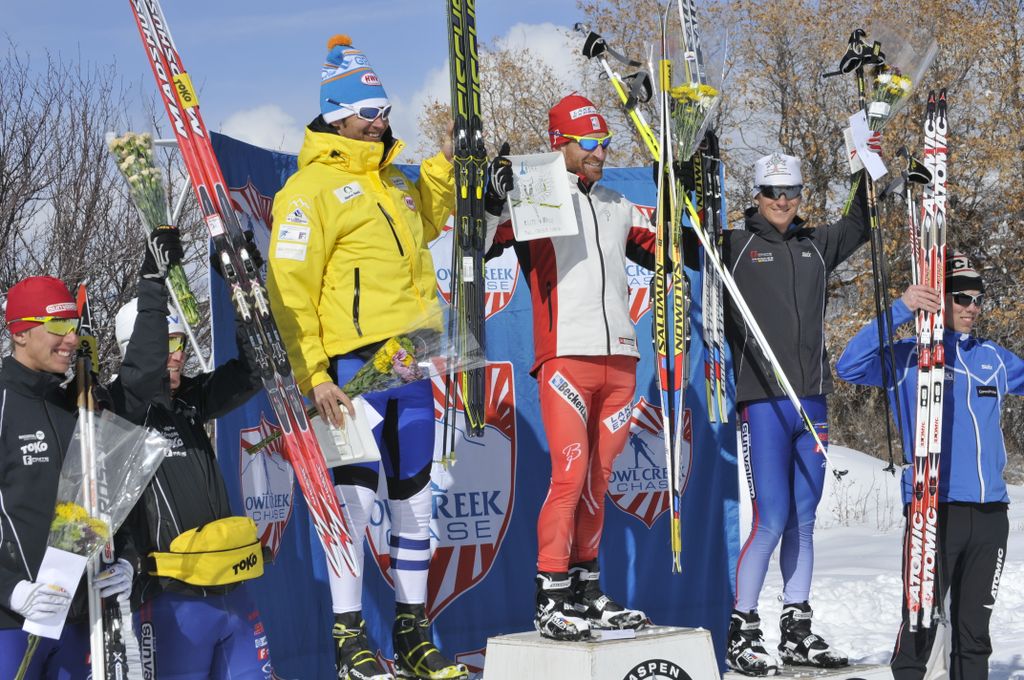
    Men's Owl Creek podium: 1. Brian Gregg (CXC), 2. Sylvan Ellefson (SSCV), 3. Mike Sinnott (SVSEF), 4. Brent Knight (APU), 5. Colin Rodgers (SVSEF), 6. Patrick Johnson (SVSEF). Photo: Mike Hoffman.
    Men’s Owl Creek podium: 1. Brian Gregg (CXC), 2. Sylvan Ellefson (SSCV), 3. Mike Sinnott (SVSEF), 4. Brent Knight (APU), 5. Colin Rodgers (SVSEF), 6. Patrick Johnson (SVSEF). Photo: Mike Hoffman.
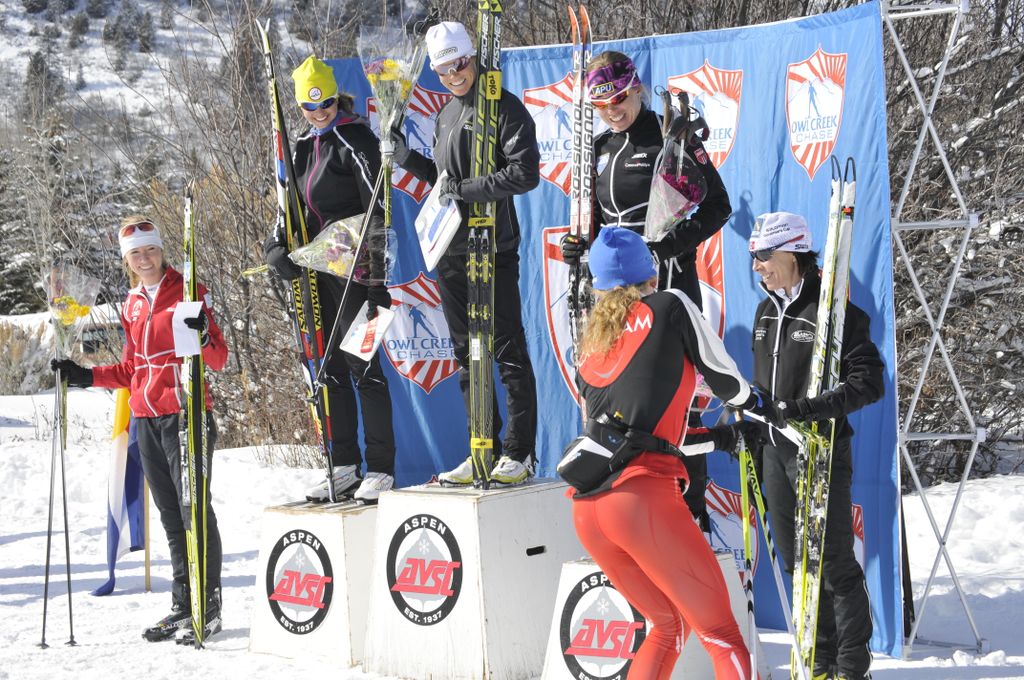
    Women's Owl Creek podium: 1. Nicole DeYong (SVSEF), 2. Lenka Palanova (BNJRT), 3. Rosie Brennan (APU), 4. Erika Flowers (SMS T2), 5. Caitlin Gregg (CXC), 6. Tammy Jacques. Photo: Mike Hoffman.
    Women’s Owl Creek podium: 1. Nicole DeYong (SVSEF), 2. Lenka Palanova (BNJRT), 3. Rosie Brennan (APU), 4. Erika Flowers (SMS T2), 5. Caitlin Gregg (CXC), 6. Tammy Jacques. Photo: Mike Hoffman.


  • Johnson Makes Podium Debut with Aspen Win; Brennan Prevails in Women’s Classic

    Johnson Makes Podium Debut with Aspen Win; Brennan Prevails in Women’s Classic

    Patrick Johnson (SVSEF) en route to winning the 10 k classic at the Aspen, Colo., SuperTour on Saturday.
    Patrick Johnson (SVSEF) en route to winning the 10 k classic at the Aspen, Colo., SuperTour on Saturday.

    ASPEN, Colo. — As Nemo shook the East with buckets of snow, the winter gods smiled upon the Rockies, too, with inches of heavy flakes on Saturday morning as the Aspen SuperTour got underway. The powder was a blessing for a state that’s had a mediocre winter, but for the handful of nordic skiers that braved the storm in spandex and a race bib it was a daunting environment in which to line up for one classic race, let alone the two in one day.

    Rosie Brennan (APU) skiing to a sprint prologue win in dense snowfall.
    Rosie Brennan (APU) skiing to a sprint prologue win in dense snowfall.

    “This morning was rough,” said Alaska Pacific University’s Rosie Brennan. “You couldn’t see anything. The tracks were washed out and my skis weren’t kicking very well, so it was sort of a struggle.”

    It was a sparse field that braved the conditions for the classic sprint qualifier, which preceded the individual distance event, but the adaptable skiers prevailed. Brennan won the 1 k prologue in 4:26, 13 seconds ahead of teammate Lauren Fritz (APU). Erika Flowers (SMS T2) finished third (+0:20) and five elite women finished the race in total as inches of snow piled up in the tracks.

    The men’s race was equally vicious. “It was very slow,” said Mike Sinnott (Sun Valley Ski Education Foundation). “I think I came to a stop a couple times. It was a brutal, painful sprint, and I don’t think anyone felt like the were sprinting.”

    Sinnott took the prologue win in 3:40, seven seconds ahead of Sylvan Ellefson (Ski & Snowboard Club Vail Team HomeGrown). Peter Kling (APU) took third (+0:14).


    After toughing it trough a kilometer of powder at 8,000 feet skiers had two hours to gear up for round two, a 5/10 k individual start classic. A Pisten Bully smoothed out the course in between events, and right on cue the skies ceased cleared as starters began to line up again.

    Thanks to high elevation, a hilly course and slightly soft tracks, the second event of the day belonged to the mentally tough. Patrick Johnson (SVSEF), still in his first season out of college, landed his first career SuperTour podium and gold medal all at once, taking the men’s 10 k by six seconds over Ellefson.

    Johnson laps through the field.
    Johnson laps through the field.

    “I think today it was slow conditions and you just had to ski smoothly, and I’m not really much of a sprinter so it was more of a distance skier’s course,” Johnson said. “I think that’s what helped make it a good day for me.”

    The Middlebury College alum has been generally happy with his racing this season — he was fifth in the 15 k at US Nationals — but has skied just shy of breaking through to top of the results.

    “It’s always been just sort of waiting to get that few extra seconds that can move you up on the list,” Johnson said. “It came through today.”

    He had never raced in Aspen before Saturday, but now that he’s collected his first win at the nordic center Johnson feels pretty good about the venue.

    “I really like it, obviously,” he said.

    While Johnson was having the race of his life, Ellefson salvaged a painful race to finish just six seconds out of first. The Vail native had raced a 10 k and the prologue in the 24 hours preceding the classic event and started to pay the price.

    Sylvan Ellefson (SSCV) climbing.
    Sylvan Ellefson (SSCV) climbing.

    “I was pretty tired from the sprint,” he said. “Just because all of the snow we got, the sprint felt like I was going 10 k pace, so it was a little bit confusing out there.”

    Ellefson knew he wasn’t skiing spectacularly as he moved around the hilly course, but minimized the damage by reminding himself he was in good shape.

    “I had an internal battle with myself at the 5 k mark,” he said. “I was like, ‘Man, I’m locking up everywhere, I’m not feeling super great, but I know my fitness is good right now so I just have to work with what I have.’”

    Over the remaining 5 k Ellefson brought himself back to a “good mental state” and closed a 15-second deficit on Johnson to finish just six seconds behind him. At relatively relaxed race where teams help each other with wax support, Ellefson was impressed with the victor’s effort.

    “I’m really excited for Patrick Johnson,” Ellefson said, nodding in his direction. “It’s his first podium and first SuperTour win.”

    Brent Knight (APU) continued a strong run of recent SuperTours to finish third, 41 seconds off Johnson’s mark. In a season he characterizes as consistent, he was pleased to put together a strong classic result the day after a punishing 10 k skate in Vail on Friday.

    “I’m super happy with the result,” Knight said. “I raced about as smart as I could. I’ve been in and out of altitude all season and…I think it’s really made a difference, learning how to ski more consistently and learning how to race smart up here.”

    Brent Knight.
    Brent Knight.

    Though there have been many SuperTours at elevation this season, Knight considers 8,000 feet to be a world away from a place like Sun Valley, Idaho, which is a few thousand feet lower.

    “In Aspen and Vail it’s a whole other beast,” he said. “When you’re racing up here if you cross the red line, you’re toast. So up here it’s more just playing with that fine line. The guy who can sit right under that red line the whole time is the guy that’s going to win, generally.”


    ***

    In the women’s 5 k Brennan followed up her prologue victory with a seven-second victory over Nicole DeYong (SVSEF), and Flowers repeated as the bronze-medalist (+1:01).

    Brennan taking her second SuperTour win in two hours.
    Brennan taking her second SuperTour win in two hours.

    For those who are counting, Brennan has now racked up five wins this season. Though the Park City, Utah, native spent the past week at home she noted how difficult racing is at Aspen’s elevation.

    “Even though I grew up at altitude I’ve found that 8,000 feet is the tipping point where I no longer have the comfort that I do a 6,000 feet,” she said. “So I was definitely hurting a lot out there… Doing three races in a row [here] takes it all out of you and I’m just focused on recovery and making sure it doesn’t crush me for later on.”

    Though the field was only 29 women strong — “Am I racing right now?” Brennan recalled thinking — it was fairly strong at the top end. On what was a slow 5 k course, DeYoung came within striking distance of the win.

    “I actually like this course and I’ve raced it quite a few times,” DeYoung said. “I’ve learned from racing here before to pace yourself and just to ski smooth and relaxed and I felt like I was able to maintain it the whole way and finish strong. That’s what I was hoping for.”

    DeYong no longer considers herself a racer as most of her time is spent coaching the Sun Valley competition team, but she stays active enough to enjoy herself and do well at a race most of the field considers daunting. Her last race appearance was at the season opener in West Yellowstone, Mont.

    Nicole DeYoung, 2nd.
    Nicole DeYong, 2nd.

    “Someone asked me if I was coming back into racing and I was like, the problem with that is if I do that I have expectations, mostly on myself, and then it seems to go downhill,” DeYong said. “So I’m just here for fun, just because I enjoy skiing.”

    Flowers, who took third having never before raced in Colorado, was on board with DeYong’s thoughts on Aspen.

    “I liked it, except that it’s really hard,” Flowers said. “You’re breathing hard from your first kick…but it’s fun, it’s so nice here. When we were skiing the [Owl Creek] course easy the other day it was so sunny.”

    The 21 k Owl Creek Chase, the weekend’s main event, starts on Sunday at 11:00 a.m. MT.

    Sprint prologue results

    5/10 k classic results not yet posted; check back here.


  • Diggins Extends SuperTour Lead, Bests Fitzgerald and Bender in 5k Classic

    Diggins Extends SuperTour Lead, Bests Fitzgerald and Bender in 5k Classic

    Jessie Diggins (CXC/USST) strides to victory in West Yellowstone.

    Jessie Diggins (CXC/USST) has her eyes set on bigger and better things down the road, but that has not stopped her from turning in an impressive series of races in West Yellowstone.

    On a cold, sunny morning in Montana, Diggins hammered through the 5km classic race in a time of 14:58.2, good for a 13.7 second victory over Kate Fitzgerald (APU).

    Jennie Bender (CXC) concluded the opening SuperTour weekend with another strong race, taking third, just .9 seconds in back of Fitzgerald.

    With a win in the classic sprint on Wednesday and today’s victory, Diggins has erased an idea that she is a stronger skater. Skiing with her characteristic bounce, she built a commanding lead on the now-familiar 5k West Yellowstone loop.

    The single lap allowed for racers to attack the big climbs with an intensity that would hve had dire consequences in Friday’s two lap 10k.

    Second place finisher Fitzgerald said of the shorter distance, “I feel like you can be way more aggressive about going out and staying at an aggressive pace.”

    She continued, “good course to keep pressing—not too much rest. Lots of work out there.”

    With temperatures dropping below zero Fahrenheit overnight, the classic tracks were rock solid and kick straightforward.

    Diggins, who said she felt “pretty good,” today, described her kick as “bomber,” noting that she could kick all the way up steepest pitch on Telemark Hill, one of the two big climbs on the course.

    Fitzgerald, who broke out with a victory, a third and two fifths last season in West Yellowstone, continued to make her mark as one of the top domestic skiers in the US.

    She ended the week with a second, third, fifth and seventh.

    Kate Fitzgerald (APU) powers to second.

    “It felt so much better than yesterday,” Fitzgerald told FasterSkier. “I felt like I had more power. We have been here five days now, so the hemoglobin is going up.”

    The APU team trains at sea-level in Anchorage, Alaska, so the transition in West is significant. The fourth day at altitude is often one of the worst, but day five can mark a shift as the body adjusts.

    Bender, another “lowlander” racing for CXC in the Midwest bounced back from a subpar skate race where she finished 18th to earn her second podium of the week.

    “I felt really strong,” Bender said. “I feel like my classic has improved in the last year quite a bit.”

    That was evident as both her top-3’s came in the classic events—Bender took 2nd in the classic sprint (and was a not-so-shabby ninth in the skate sprint).

    And like Diggins, she raved about her kick. When asked about Telemark Hill, she responded “I felt like I took that much better than in the sprint. I had to hop out of the track then, and I was able to stride the whole thing, so I was happy about that.”

    DeYong currently sits in fifth in the overall SuperTour standings after finishing no worse than fifth in the four races. The long-time SVSEF skier has shifted focus a little, working a job in a local hospital in addition to training, but is clearly still pursuing skiing at a high level.

    Less than four seconds off the podium today, Rorabuagh improved in every race in West.

    Jennie Bender (CXC) gives CXC a woman on the podium in every West Yellowstone race with her third place finish.

    “I keep setting these goals,” she told FasterSkier. “Yesterday my goal was to do better than the day before, and I did better by one place. So I said ‘I need to set a more aggressive goal’. I said top-5 and today I got 5th so It worked out pretty well.”

    Like her teammate Fitzgerald, Rorabaugh felt much better at altitude today.

    “This whole morning I was pretty sure it was going to happen [a strong race]. Partly because I woke up feeling so much better, being more acclimated on our fifth day.”

    Even for those adjusted to the elevation, the course poses plenty of challenges. Many skiers found the seemingly endless gradual terrain the most challenging.

    Rorabuagh actually was relieved to get to the big climbs.

    “Getting to the big climb in the middle of the outer loop is a relief and it’s awesome and a lot of fun,” she said.

    “The climbs don’t feel that different from sea level,” she explained. “You are used to going into oxygen debt on climbs. The part where it hurts is afterward  when you don’t recover.”

    Diggins concludes the four-race West Yellowstone swing with two victories, two seconds and a solid lead in the SuperTour standings. But with a berth on the US Ski Team (USST) in hand, and a plan to head to the World Cup in mid-January, the twenty-year-old is more interested in gaining experience and improving her skiing then specific results goals.

    With four of seven first-period SuperTour races in the books, Diggins stands a good chance of holding the coveted overall leader’s bib after the opening block of races come to a close in Bozeman next weekend.

    The top man and woman in the standings earn a World Cup start spots for December, but Diggins will take a pass, even with travel expenses covered by FIS.

    Nicole DeYong (SVSEF) capping a strong week in West, placing 4th in the 5k classic.

    According to USST coach Matt Whitcomb, Diggins will stick to the plan and continue to race domestically through US Nationals before heading to Europe.

    Diggins told FasterSkier that because of her age and relative lack of experience, she wasn’t in a place to be “chasing points,” instead focusing on the long term.

    This means that if Diggins maintains her 26-point lead over Caitlin Gregg (CXC) the World Cup start spot will go unused.

    Gregg had another strong day today, following up her third in the 10k freestyle with a sixth. Traditionally stronger in the skate technique, Gregg was less than nine seconds out of second place.

    Fitzgerald sits third in the overall standings, eight points behind Gregg. It would take a major downturn or an illness to derail Diggins in Bozeman, but with points frontloaded, there is plenty of room for changes in the rankings.

    While it varies by team, the general plan for the American skiers is to race the Bozeman SuperTours, then head to SilverStar for the opening NorAm races, but then disperse for home and some rest before US Nationals.

    This means that the Rossland NorAm will not feature as robust an American contingent as last year.

    Next weekend’s races in Bozeman include a freestyle sprint qualifier-only, a 5km freestyle individual start, and a 15km classic mass start.

    West Yellowstone Classic Results

    – Audrey Mangan contributed reporting
    Becca Rorabuagh (APU) 5th place.
    Caitlin Gregg (CXC) 6th place.
  • Arritola Nabs SuperTour 10 k Freestyle; Diggins Holds Leader Bib with Second

    Arritola Nabs SuperTour 10 k Freestyle; Diggins Holds Leader Bib with Second

    Morgan Arritola (SVSEF) cresting Telemark Hill on her way to the top of the podium.
    Morgan Arritola (SVSEF) cresting Telemark Hill on her way to the top of the podium.

    In her first time racing the SuperTour opener in a number of years, Morgan Arritola (Sun Valley Ski Education Foundation) seemed to feel right at home in West Yellowstone, MT, taking victory on Thursday in the women’s 10 k freestyle by 14.7 seconds over runner-up Jessie Diggins (Central Cross Country) and Caitlin Gregg (CXC, +27.9).

    “It was tough,” said Arritola after finishing. “[I planned] to go out and ski as well and controlled as I could, and make every motion count.”

    In a two-lap, individual-start event, hearing and responding to splits can play a significant psychological role in an athlete’s race. Arritola said she heard at one point on the course that she was down to Gregg by a few seconds, and “I focused on all I could do.”

    She clearly put the hammer down, as she made up significant ground in the last quarter of the race. “She must have skied a heck of a second lap,” said Gregg, who started 90 seconds behind Arritola.

    Jessie Diggins (CXC/USST) holds onto the SuperTour leader bib going into Friday's 5 k classic.

    The top six in both the men’s and women’s races on Thursday came away prize money, and the winners went home with $750.

    On an unforgiving course with plenty of transitions and few opportunities for recovery, many skiers said their plan was to ski controlled and conservatively enough to have something left at the end. Perhaps due to pre-race jitters, some were able to stick to their strategy better than others.

    “I definitely took the first half pretty fast and the second lap I could taste blood in the back of my throat,” said Diggins. “The wheels started to come off quite a bit, but I kind of got a second wind.”

    Despite training to peak later in the season for World Cups after U.S. Nationals, the fact that Diggins has already been on the podium three times in West Yellowstone indicates that she’s in fine form. Many of her competitors are going all-out in these early season races in the fight for SuperTour leadership and World Cup start rights.

    “[Now] is kind of like, get your race legs back,” said Diggins of her approach to this point in her winter. “I’m still working on how to pace longer races. I’m not so far out of high school, where we just did 5 k’s. This is good for me; it is a good learning experience every time.”

    A spectator can never truly get inside a skier’s head, which is where the majority of racing goes on in an individual-start event. From athletes’ remarks after the finish, however, the focal point of such a race becomes the course—skiing it efficiently and crossing the line at the exact moment of sheer exhaustion.

    Caitlin Gregg (CXC) just before the big hill.

    “I’ve definitely raced too hot here before [before]…at this altitude and blown up,” said Gregg. “I knew I had some speed in there, it was more a matter of reeling it in and not letting it go too soon. That said, three-quarters of the way through I found myself saying, ‘OK, now it’s time to go.’”

    Alexa Turzian of the University of Colorado, who finished 32 seconds behind Gregg in fourth, thought that the course required agility as well as endurance.

    “There were a lot of corners on the course, so it was about working them. It’s not just about stamina,” she said.

    Turzian surprised even herself with her fourth-place finish, +59.9 back from Arritola. As a collegiate athlete, Turzian said she’s been sleep deprived managing schoolwork recently, and before looking at the results would have thought she’d landed in the top-10. She knew she was in the running for a top result out on the course, but didn’t want to get too excited at the risk of getting sloppy with her form.

    “When I get excited like that I…forget about technique,” said Turzian, who is not unused to hearing good split reads on the course. “I had to calm myself down and ski effectively…I usually make gains in the end anyway, and have better splits in the second lap.”

    Alexa Turzian (CU).

    Thursday’s 10 k required competitors to have their aerobic engines running strong, and acclimation to 6,000 + feet certainly didn’t hurt either. Arritola, Turzian, and fifth-place finisher Nicole DeYong (SVSEF) all live and train at higher altitudes for the majority of the year. That said, DeYong said she definitely “felt the lungs burning at the end.”

    The women gear up for a 5 k classic individual start on Friday at 10:00 am. For her recovery, Gregg said she planned to “pound some chocolate milk, cool down with teammates…and get fired up for tomorrow.”

    Full Results

    Topher Sabot contributed reporting.

  • Gregg Takes SuperTour Sprint Showdown Title with Skate Victory, Diggins Classic Champ

    Gregg Takes SuperTour Sprint Showdown Title with Skate Victory, Diggins Classic Champ

    Caitlin Gregg (CXC) SuperTour Sprint Showdown Champion, on her way to victory in the skate.

    Whomever came up with the overused aphorism “no guts, no glory,” certainly was not referring to cross-country ski racing. But Saturday’s SuperTour Sprint Showdown provided plenty of images that would do just fine adorning the front of a cheap tee-shirt.

    There was some measure of glory (albeit in the first race of the season), and fortunately, the guts were of the figurative sense—though given the sounds coming out of many skiers in the finish corral, it would not have been surprising to see the literal variety as well.

    Caitlin Gregg (formerly Compton) (CXC) took the lions share of the glory on a brutal West Yellowstone sprint course edging out CXC teammate Jessie Diggins (CXC/USST) by 2.54 seconds in the two race event.

    Gregg overcame a 2.55 second deficit after the classic portion by winning the skate race in convincing fashion, five seconds ahead of second-place Diggins.

    The unique and controversial format, which consists of a single run through a point-to-point classic sprint course, immediately followed by a second pass using the skate technique, is in its second season.

    Both races are scored as individual SuperTour events, but an overall winner is named based on combined time and awarded $250.

    Diggins, who made a splash at last year’s World Championships with two top-30 results, held the pole position in the individual start race in West Yellowstone, and set the tone from the get-go. Win, lose or draw, there is no one who puts out more effort than the 20-year-old US Ski Team athlete.

    With a 15 second gap between starters there was never any chance Diggins would see anyone coming up from behind, and as the first racer there would be no splits for a performance point of reference.

    No matter, as she flew through the early gradual climbs on the 1600-meter course, before gaining a brief breather on the one significant descent. Any respite, however, was short lived as the route swung into a final climb of epic proportions.

    One racer described the early part of the hill as a “good hard sprint climb.” And then the skiers hit the steep part.

    Diggins suffering after her classic victory.

    Diggins, light and quick, hammered to the top, collapsing across the line, completely spent, gasping and practically yelling with pain. As the day wore on, she wasn’t alone in literally crawling out of the way of the steady stream of finishers.

    Those who didn’t collapse had to be caught by volunteers so they didn’t slide down the hill and back across the finish line.

    Her time of 4:36.94 was good enough to hold off teammate Jennie Bender (CXC) by a mere .76 seconds. But as well as Diggins skied, she did receive some help from Bender, or more accurately from Bender’s equipment.

    Jennie Bender (CXC) mismatched poles and all charges to the line in the classic.

    “Less than a foot” out of the gate, one of Bender’s baskets detached from her pole, and she was forced to slow and get a replacement from a coach.

    “I feel like I could have make up a couple seconds if I didn’t have to stop poling, take off the old one, and replace it along the whole starting stretch,” Bender told FasterSkier.

    Additionally, the new pole was quite a bit longer, but it was good enough to “power through it.”

    Bender, after just missing the victory, may have made the understatement of the day, describing her classic effort as “fairly strong.”

    Gregg placed fourth, just behind Sun Valley’s Nicole DeYong who, supposedly “retired” is making use of those quotation marks, showing the form that had her in the running for an Olympic berth in 2010.

    With the wall of a climb looming at the end, Gregg, a stronger skate sprinter, planned on striding as long as she felt she was moving well, before switching to a herring-bone once she started “muscling” her kick.

    “There was definitely that point of no return,” Gregg said of the climb. She opted to switch over to the running V before she started slipping, and was able to use the skier ahead of her as a gauge of speed.

    With the finish a full kilometer from the start, racers had no time to hang around—there would be no results to pore over, or proper warm down. Back to the stadium, switch to skate gear and get ready to go again.

    Diggins getting high in the skate.

    Keeping the same running order, Diggins led the charge a second time, out in her supposedly stronger technique. But Gregg also a stronger skater, would not be denied.

    The Olympic veteran executed her race plan to perfection, taking advantage of a non-traditional course that favored her strengths as a climber.

    “I took a slightly conservative relaxed skiing approach,” Gregg told FasterSkier after the race.

    “I talked to my coach, and we tried to focus on technical components of my skiing, and skiing a really smart race in terms of pacing and saving for the end,” she continued.

    Gregg sat out the Showdown last season and described herself as “a little nervous about the format with the short break.” But with no splits and no results immediately available racers were forced to evaluate their efforts solely on how they felt.

    And Gregg, still unaware of her skate and overall victory summed her day up thusly: “I executed exactly how I had hoped to – so it was a successful race.”

    Diggins may not have repeated he classic performance, but she certainly didn’t slack off. She placed second behind Gregg, 5.09 seconds behind the winning time of 3:51.12. If the overall had been based on combined place as opposed to time, it would have been Diggins with $250 in her pocket.

    But she seemed unconcerned afterward, and with a trip to the World Cup already planned for later in the winter, these early races are an opportunity to prepare for the long season.

    “I was just focusing on process goals today, getting in a good warm up and cool down within 5 minutes after finish,” Diggins said.

    She may have taken her strong results in stride, but pre-race was another story.

    “This morning I was shaking so hard I could barely braid my hair,” Diggins described. “I had to lay down in the middle of breakfast. First race of the year I’m always so nervous.”

    And understandably given her first and second on the day Diggins felt “good about what happened” on the track.

    Jason Cork CXC Head Coach doesn’t see the races as overly important, echoing his athletes’ sentiments—the day was on opportunity to practice and learn.

    “We had everyone write goals, figure out what they wanted to do today and look at them before the race,” Cork said.

    Fitzgerald showing podium form in the skate.

    Kate Fitzgerald (APU) who kicked off a breakthrough season in West Yellowstone last year, followed up a fifth in the classic with a podium in the skate. With her trademark look, a combination of fierce determination and control, she excelled in a distance that she does not view as her strong suit.

    “I feel like sprinting is not quite my natural strength,” Fitzgerald said.

    She planned her race accordingly, a simple strategy that consists simply of “going for it from the line.”

    With the two quick races and the short turn-around time, Fitzgerald described the morning as a “blur.”

    Like Gregg, Fitzgerald has a predilection for climbing, and she felt the course suited her in that respect. But despite her third place result, she was a full 12.7 seconds down—an indication of the strength of Gregg’s races.

    As an interesting aside, the time differentials of the longer classic race (time-wise) were much closer than the skate edition.

    Eliska Hajkova (CU) was fourth in the skate, and DeYong completed an excellent day, placing fifth.

    None of the top finishers reported any issues with the wax. Both kick and glide relatively straightforward, and immaculately groomed course held up well, despite the passage of nearly 300 racers.

    In a small change from last year, the classic and skate courses both finished up the same hill. Previously the classic and skate diverged just before the last ascent, with the classic taking a more circuitous and milder route to the top.

    Organizers had no mercy this time around, challenging even the strongest classic skiers, and simplifying timing as only a single finish line was needed.

    After a day off for Thanksgiving, racing continues on Friday with a 10km freestyle race.

    Classic Sprint Showdown Results

    Freestyle Sprint Showdown Results

    Audrey Mangan contributed reporting
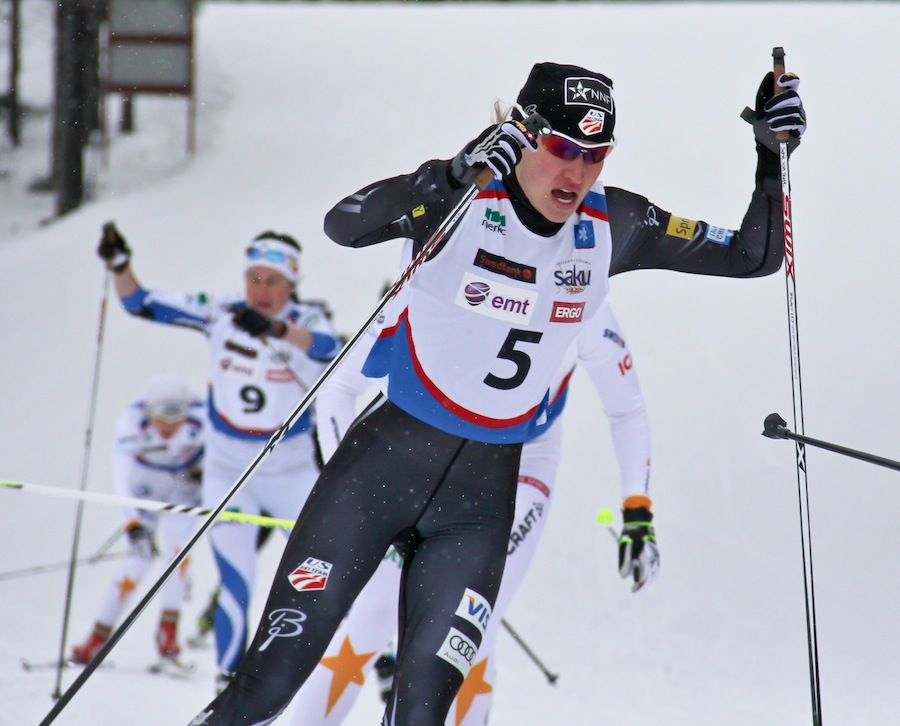
    Nicole DeYong (SVSEF) looking strong in the classic.
  • U.S. SuperTour Finals and U.S. 30km/50km Championships Set to Go

    Fort Kent, ME—Spring has come early to Aroostook County, but the snow has stayed with us. Daytime highs in the 40s and 50s with cold, clear nights well below freezing have made for excellent crust skiing, fast early morning conditions and softening snow in the afternoons. Currently, our extended forecast calls for similar conditions with chances of freezing precipitation and snow on Thursday night and next Monday.

    While the snowpack is well below normal for this time of year, all courses have a minimum depth of 8” of packed snow right now. The photos below were taken at 1 p.m. on Tuesday, March 16, 2010 on the courses for the SuperTour Finals Sprint and Mass Start Classic. The skiing is unbelievably good!

    Second climb on the SuperTour Finals Sprint course, Madawaska, Maine 3.16.2010.

    Entries continue to roll in, and the series is shaping up to be the very best points races of the year on the North American circuit. With Andy Newell, Kris Freeman, Torin Koos, Ivan Babikov, Simi Hamilton, Chris Cook and Stephan Kuhn all planning to attend, it is very likely that the men’s point base will be below 20 FIS points. On the women’s side, Kikkan Randall, Caitlin Compton, Holly Brooks, Rebecca Dussualt, Liz Stephen, Morgan Arritola, Brittany Webster and Nicole DeYong are all planning to toe the starting line.

    Confirmations include: the entire U.S. Ski Team, Canadian National and top club level athletes, APUNSC, CXC Team Vertical Limit, SVSEF, MWSC, FAST, Craftsbury Green Team, XC Oregon, U. Laval, Dartmouth, GMVS, Stratton Mountain School, Burke Mountain Academy and athletes from Sweden, Japan and Brazil.

    The U.S. SuperTour Finals 2010 will feature a true Tour format, with prize money awarded for each individual race, time and cash bonuses in both the Mass Start and the Sprint, and a pursuit start Hill Climb that will leave the winners of the overall event splitting up more than $11,000 in cash. Visit www.supertourfinals2010.com to download the invitation and for complete details of the event.

    Additionally, the U.S. National 30km and 50km Championships are slated for March 24th, in Fort Kent, Maine.

    EARLY REGISTRATION DEADLINE IS WEDNESDAY, MARCH 17, 2010. REGISTER TODAY!

    www.supertourfinals2010.com

    The grooming crew at work on the SuperTour Mass Start Classic course, March 16, 2010.
  • Sinnott and DeYong Lead US at OPA Cup Finals

    Rogla, Slovenia – Nine American skiers are currently in Slovenia contesting the OPA Cup Finals, an event modeled on the popular Tour de Ski and World Cup Finals.
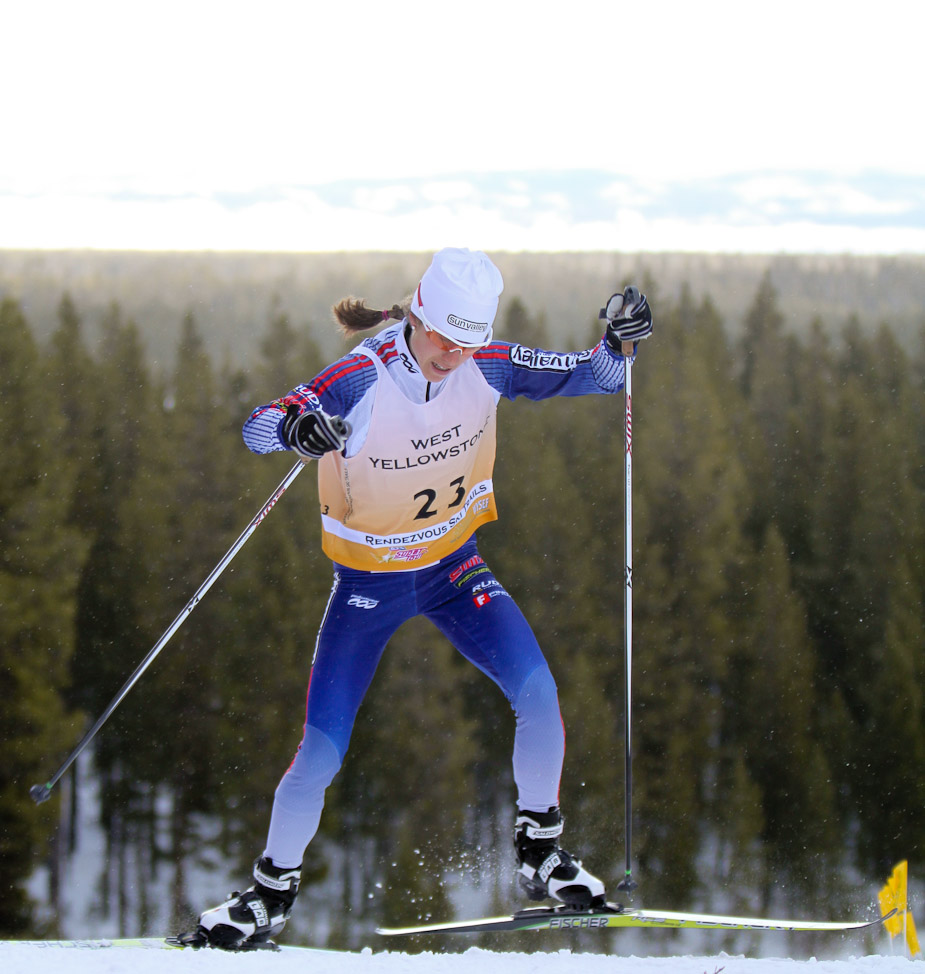
    Racing started on Friday with a 2.5/3.5km classic prologue, and continued Saturday with a 5/10km mass start.  The overall winners will be determined in a 10/15km handicap start based on the overall standing from the first two races.  The first across the line is the champion.

    The large contingent of US skiers in racing the OPA Cups dwindled somewhat, with Brian Gregg, Mike Hinckley, and Caitlin Compton all getting World Cup starts this weekend, and several other skiers heading home after a longer stay in Europe.

    The fields have not been large, but the competition plenty challenging.  Overall, US skiers have held their own with Mike Sinnott leading the way.

    Sinnott Challenges in Prologue

    Sinnott finished 6th in the prologue, just 6.7 seconds behind winner Dietmar Noeckler (ITA).

    In an interesting aside, Juergen Pinter, a veteran of the Austrian Team who was banned form the sport four years by the Austrian Ski Association, finished 2nd.

    Pinter was banned for his involvement in the 2006 Torino doping affair.  It appears his ban was retroactive, so all FIS results from 2006-2008 (when the ban was finalized) were removed from the records, and the four years started from the 2006 Games, so he is just back in action.

    Sinnott posted the best FIS points race of his career, breaking 40 for the first time.

    Sylvan Ellefson was the next American in 34th, +25.8.  He was closely followed by Noah Hoffman in 36th, Brayton Osgood in 42nd, and Peter Kling in 47th.

    Kling also set a personal-best in FIS points.

    76 men completed the race.

    Nicole DeYong led the American women in 19th place, 22.3 seconds in back of Denise Herrmann (GER).  Herrmann won silver in the sprint at the U23 Championships in Hinterzarten, Germany in January.

    Overall, Germany took four of the top six spots, going 1,2,5,6.  Italy, with Elisa Brocard and Virginia Topranin, took 3rd and 4th. Brocard, a veteran of the Italian team, raced the sptint at the Olympics and finished 27th in the 2010 Tour De Ski.

    Herrmann’s teammate Hannah Kolb was 6th.  The 19-year-old Kolb started two World Cup races this year, finishing inside the top-20 in both.

    Becca Rorabaugh finished 30th, .8 seconds and one place ahead of APU teammate Katie Ronsse.  The pair was just over 30 seconds back of Herrmann.

    Tazlina Mannix rounded out the US starters in 39th.

    DeYong Steps Up In Mass Start

    DeYong took thing us a notch in the 5km classic mass start, matching Sinnott’s 6th place result from the prologue.  Just 12.2 seconds back, DeYong had an excellent points race, nearly matching her career-best set a week ago at the OPA Cup in France.

    Brocard won the race in a sprint with teammate Topranin.

    Among those DeYong beat were Barbara Jezersek (SLO) who finished 17th in the Olympic pursuit, and prologue winner Herrmann.

    Rorabuagh was 15th, +54.4 seconds, and Ronsse 20th, +1:05.2.

    Mannix did not finish the race.

    Juniors were split out into a separate race, so the field was much smaller than in the prologue.  Only 26 women completed the event.

    Sinnott turned his second excellent performance in a row, taking 7th place in the men’s 10km classic mass start.  He was 18.3 seconds behind winner Romain Vandel (FRA), but just nine seconds out of 2nd place.

    Ellefson finished 18th, +1:13, again, just ahead of Hoffman – this time just a single place.

    Osgood ended up in 25th and Kling 33rd in the 34-man field.

    Overall standings for the OPA Cup Finals are not available, but Sinnott will likely be competing for a top-10 overall result in Sunday’s handicap start freestyle race.

  • USA Strong in French OPA Cup Races

    La Feclaz, France – A large contingent of American skiers are in Europe competing in the spring OPA cup races.  The OPA cup is a European Continental Cup series along the lines of the US SuperTour.

    Ten men and six women competed in the 5/10km freestyle mass start event on Sunday.  Brian Gregg led the men in 12th place, while Caitlin Compton paced the women in 10th.

    The major goal of the trip for these athletes is to gain exposure to the high level of competition in Europe and have the opportunity to better their always-important FIS points.

    Gregg finished just 17.4 seconds behind the winner, Robin Douvillard (FRA).  A veteran of the World Cup circuit who completed this year’s Tour de Ski, and finished 6th in the 15km freestyle at the Davos World Cup in December.

    Mike Sinnott was just one place and 4 seconds in back of Gregg.

    Both skiers had excellent points races.  Gregg had a career-best FIS points race of 45.23, while Sinnott’s performance was the second-best of his career.

    Like SuperTour races, there is a points “penalty.”  The penalty is based on the points of the top finishers in the event, and is meant to compensate for strength of field.  World Cup and Olympic races always have a penalty of zero.

    Because Europeans often carry better points (due to access to high level competitions), the penalty at OPA cup races can be quite favorable.

    Other US finishers:

    20.  Mike Hinckley
    22.  Noah Hoffman
    31.  Sylvan Ellefsen
    34.  Marshall Greene
    36.  Brayton Osgood
    47.  Sam Naney
    53.  Peter Kling

    DNS  Simi Hamilton (a previous version of this article listed him as DNF; that was due to an error in the FIS database)

    53 men completed the race.  Noah Hoffman was held back by a broken pole after skiing in the top-10.

    Erik Bjornsen raced in the junior class and finished an impressive 21st in the 82 skier field.

    In the women’s 5km, Compton finished 12 seconds behind winners Emilie Vina and Laure Barthelemy, both of France.  She edged out Nicole DeYong by .3 seconds.

    Compton defeated Barthelemy in both the 10km freestyle and the team sprint at the Olympics.

    She led the race after falling early and catching back up, and both she and DeYong were in the mix the whole way.

    Sadie Bjornsen was 14th, just a second behind DeYong.

    Other US finishers:

    19.  Tazlina Mannix
    22.  Katie Ronsse
    25.  Becca Rorabaugh

    The points penalty was significantly worse than in the men’s race.  31 women competed.

    Many of the US skiers also competed in a team sprint event on Friday night.  Complete results are not currently available.  Caitlin Compton teamed with Nicole DeYong, and Katie Ronsse paired with Sadie Bjornsen.

    Ronsse and Bjornsen finished 6th and Compton and DeYong took 8th in the 9 team field, while struggling with the late start due to jet lag.

    Many of the skiers on the trip are posting updates on their personal blogs.  Check out the FasterSkier XCFeeds page for updates from Brayton Osgood, Becca Rorabaugh, Nicole DeYong, and Sadie Bjornsen.  There are a number of good first hand reports, including photos.

    Complete Results

  • Osgood, Trygstad-Saari Take Day One of Aspen SuperTour

    Brayton Osgood (Bend, OR) and Kristina Trygstad-Saari (Bozeman, MT) skied to victory in the 5/10K classic races in the opening day of the Aspen Valley Ski Club SuperTour.  The former Dartmouth College skiers each captured their first SuperTour title of the season, with Osgood winning a tight race over a competitive men’s field, while Trygstad-Saari opened up nearly a thirty second lead over a fairly spread out women’s field.

    Brayton Osgood, shown here at the Classic Sprint at US Nationals, Photo courtesy of Chris Hall, Fischer Sports USA
    Brayton Osgood, shown here at the Classic Sprint at US Nationals. Photo courtesy of Chris Hall, Fischer Sports USA

    In the men’s 10K classic race, the top seven racers all finished within one minute of one another.   Osgood, racing for XC Oregon, skied to a 9-second victory (28:24.8) over fellow Dartmouth alum and current Bridger Ski Foundation athlete Glenn Randall (28:33.8) on the trails at the Aspen Valley Ski Club.   Steinbock Racing’s Chris Cook was third in 28:35.7, just 1.9 seconds off Randall’s pace.  Noah Hoffman placed fourth, 26 seconds back in 28:51.1, while Sun Valley’s Michael Sinnott took fifth in 29:07.7 and edged Sylvan Ellefson (29:09.1), skiing for Team HomeGrown, to sixth place.  The win is Osgood’s first major victory of the season.

    Kritina Trygstad-Saari racing in the Classic Sprint at US Nationals, Photo courtesy of Rob Whitney
    Kritina Trygstad-Saari racing in the Classic Sprint at US Nationals, Photo courtesy of Rob Whitney
    In a relatively small women’s field, Trygstad-Saari found enough speed over the 5K course to distance herself from second place finisher Nicole DeYong.  Trygstad-Saari, skiing for BSF, crossed the line in 16:05.1, 24 seconds faster than Sun Valley’s DeYong (16:29.8), while XC Oregon’s Evelyn Dong claimed the final step of the podium with a time of 17:21, good enough for third place.  A tight trio of 16-year-old junior racers claimed places four through six with Durango Nordic’s Alicia Rose Pastore claiming fourth in 17:29.7, only nine seconds behind Dong.   Steamboat Springs athlete Haley Piske (17:29.8) took fifth place, one tenth of a second behind Pastore, with Steamboat teammate Michaela Frias 1.6 seconds back in sixth place with a time of 17:31.4.   Like Osgood, this is Trygstad-Saari’s first win of the season, as the 25-year-old improves upon her silver medal performance at the Bozeman SuperTour 10K classic in December.

    The Aspen SuperTour continues Sunday with the 21K Owl Creek Chase.