From the FasterSkier archive — posts syndicated from athletes’ and coaches’ own blogs between 2004 and 2012, kept online as published. Current coverage is at fasterskier.com.
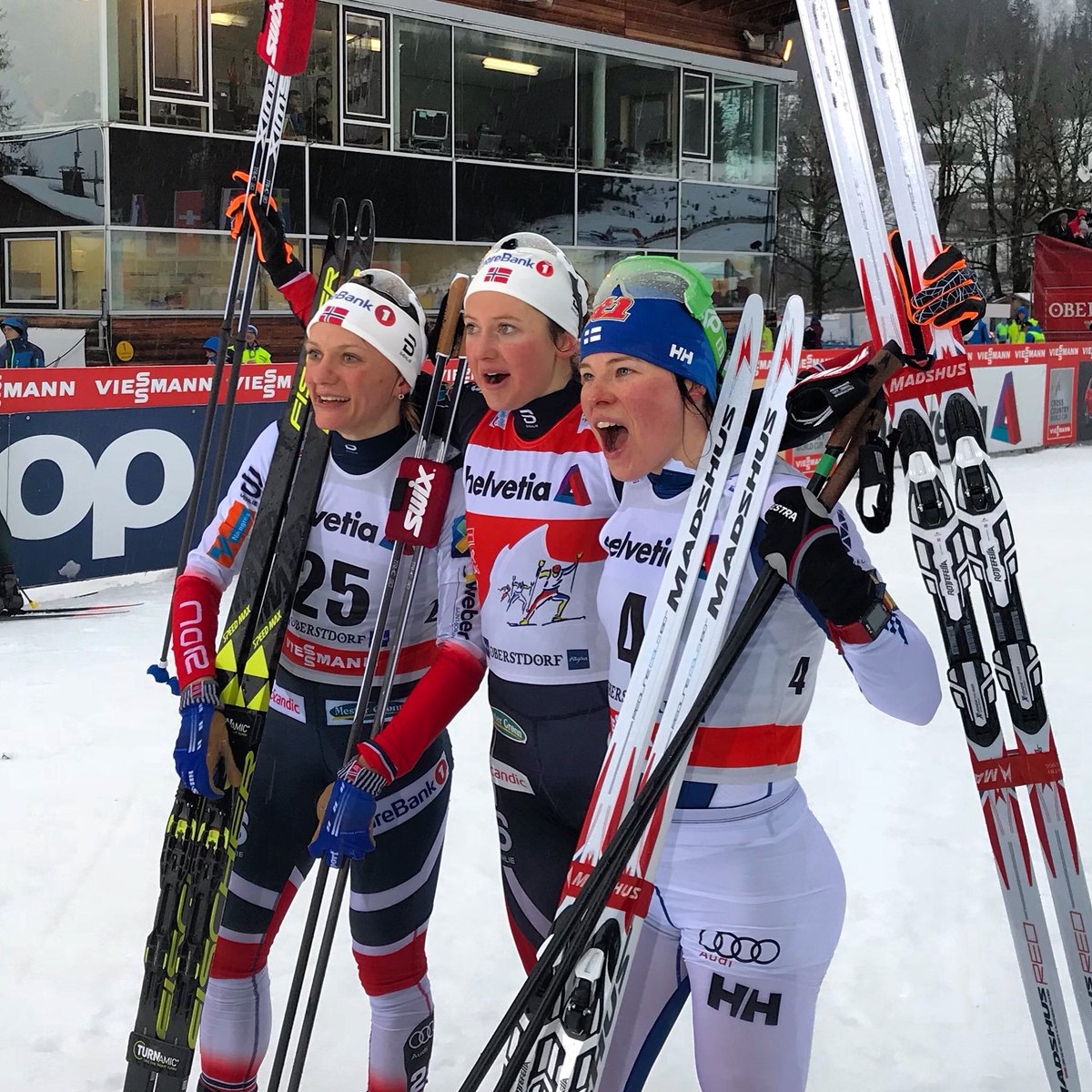
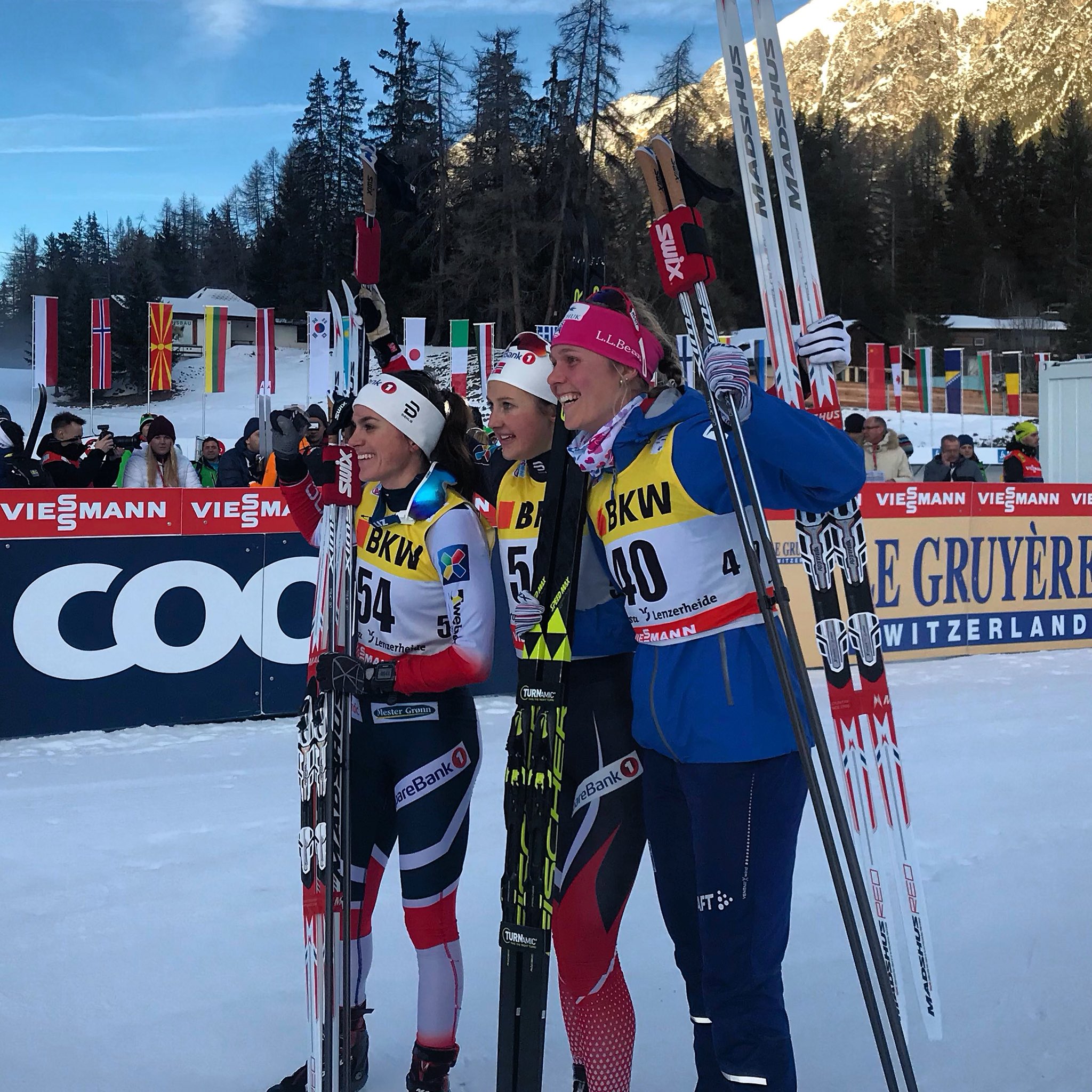
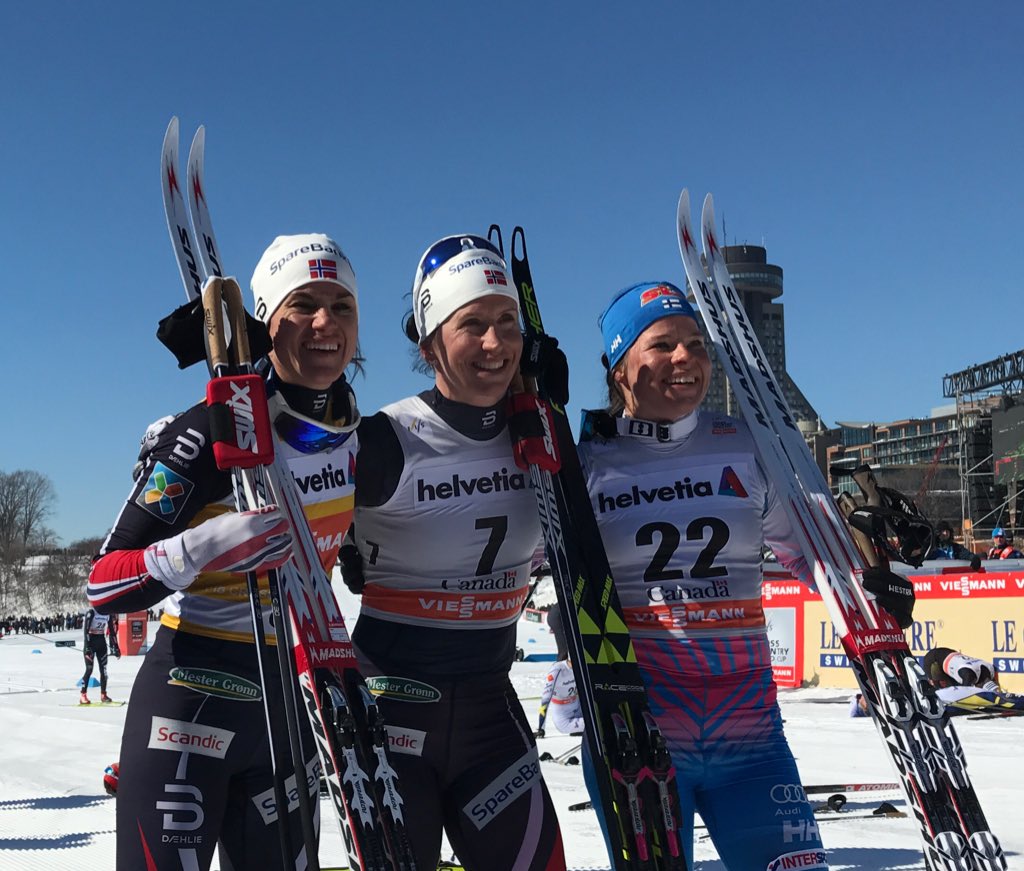
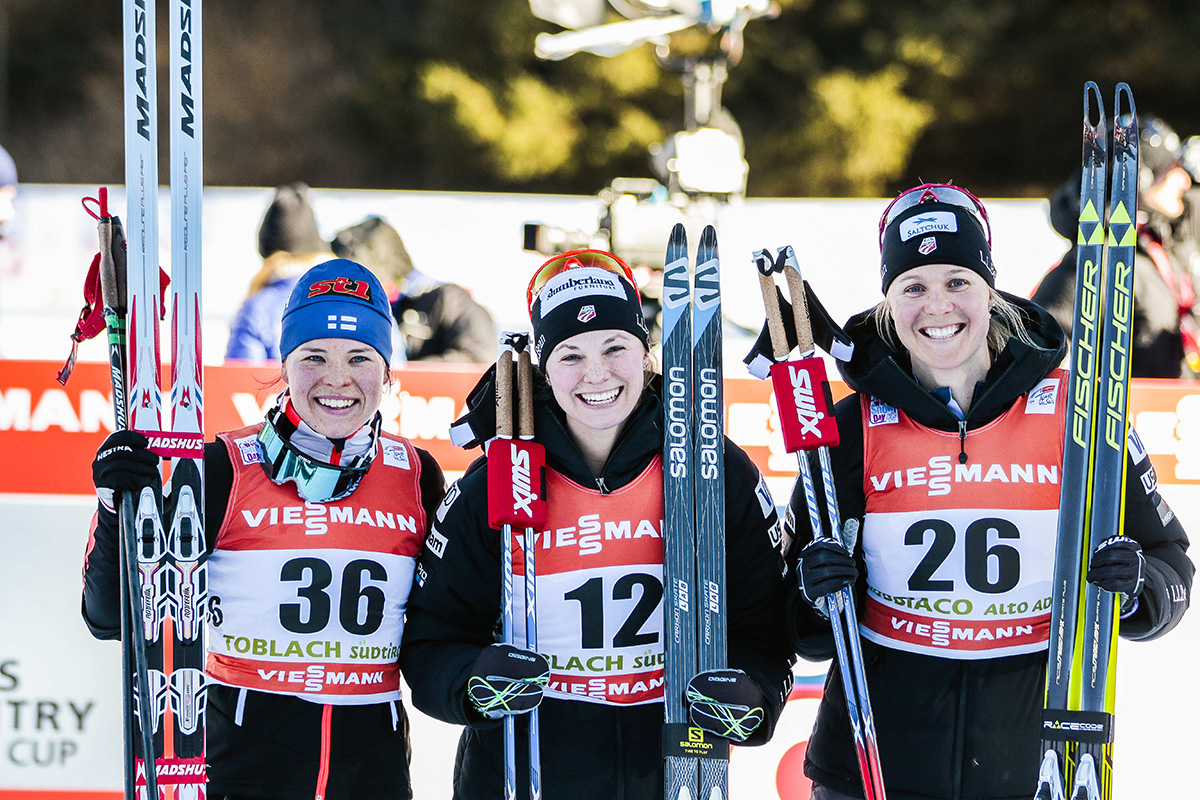
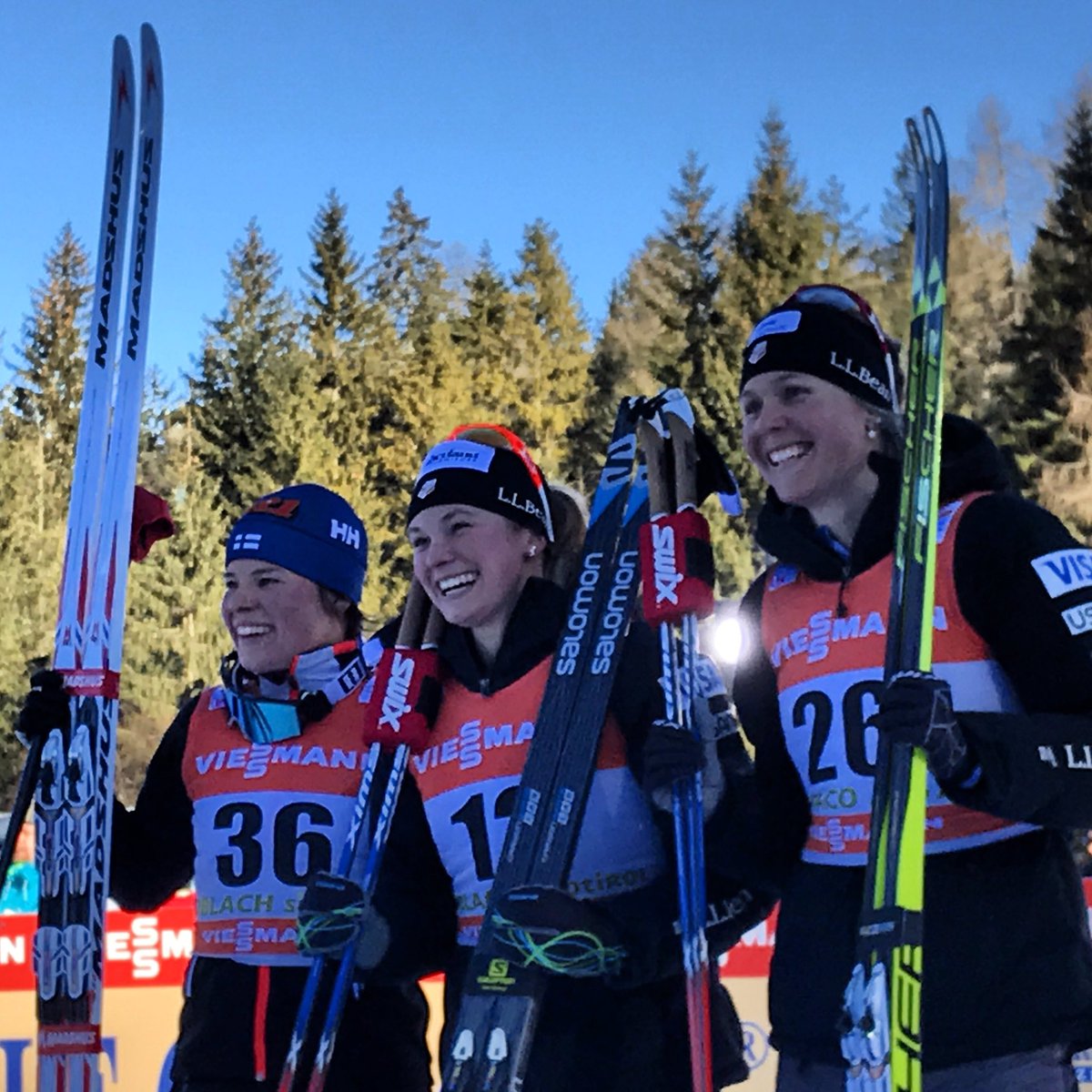
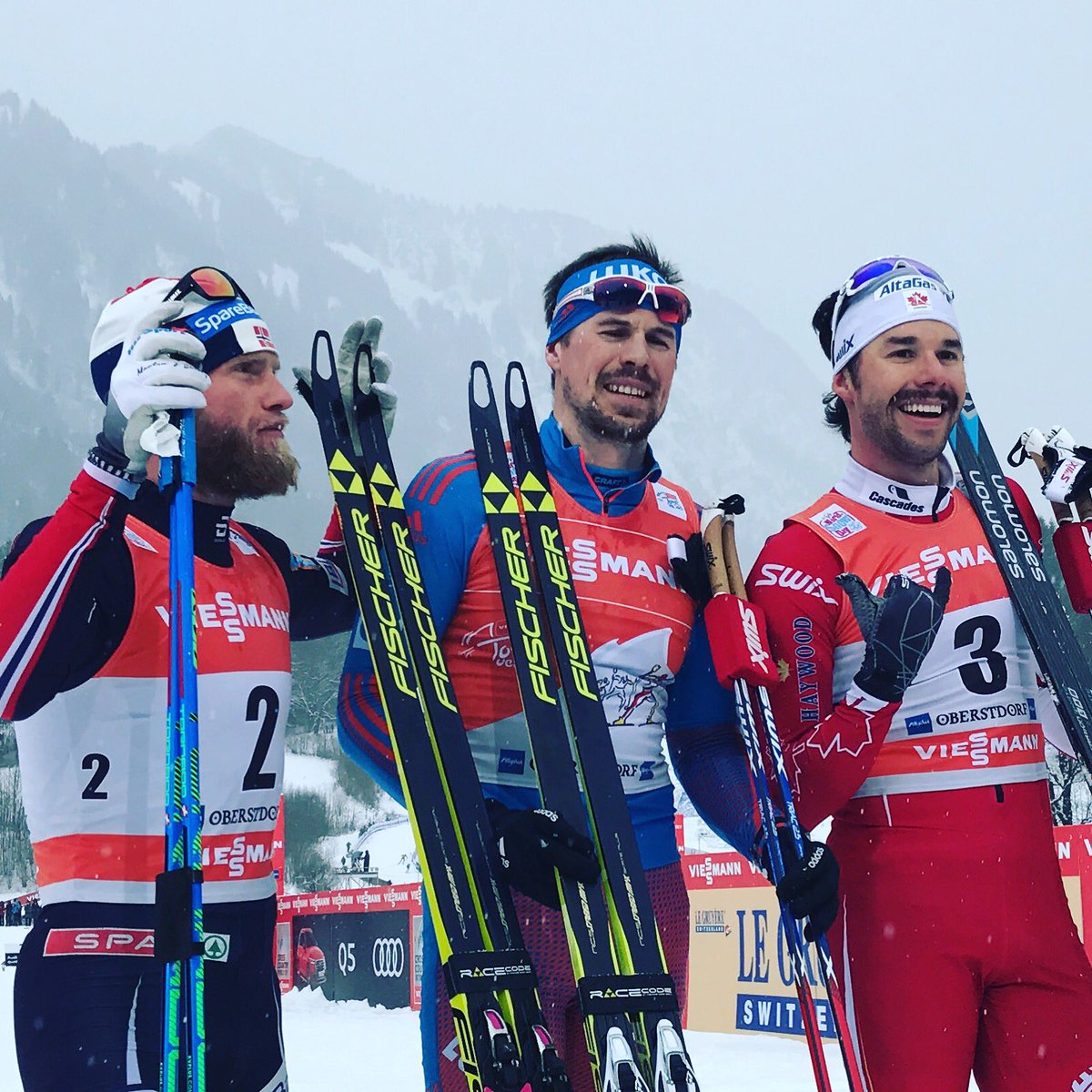
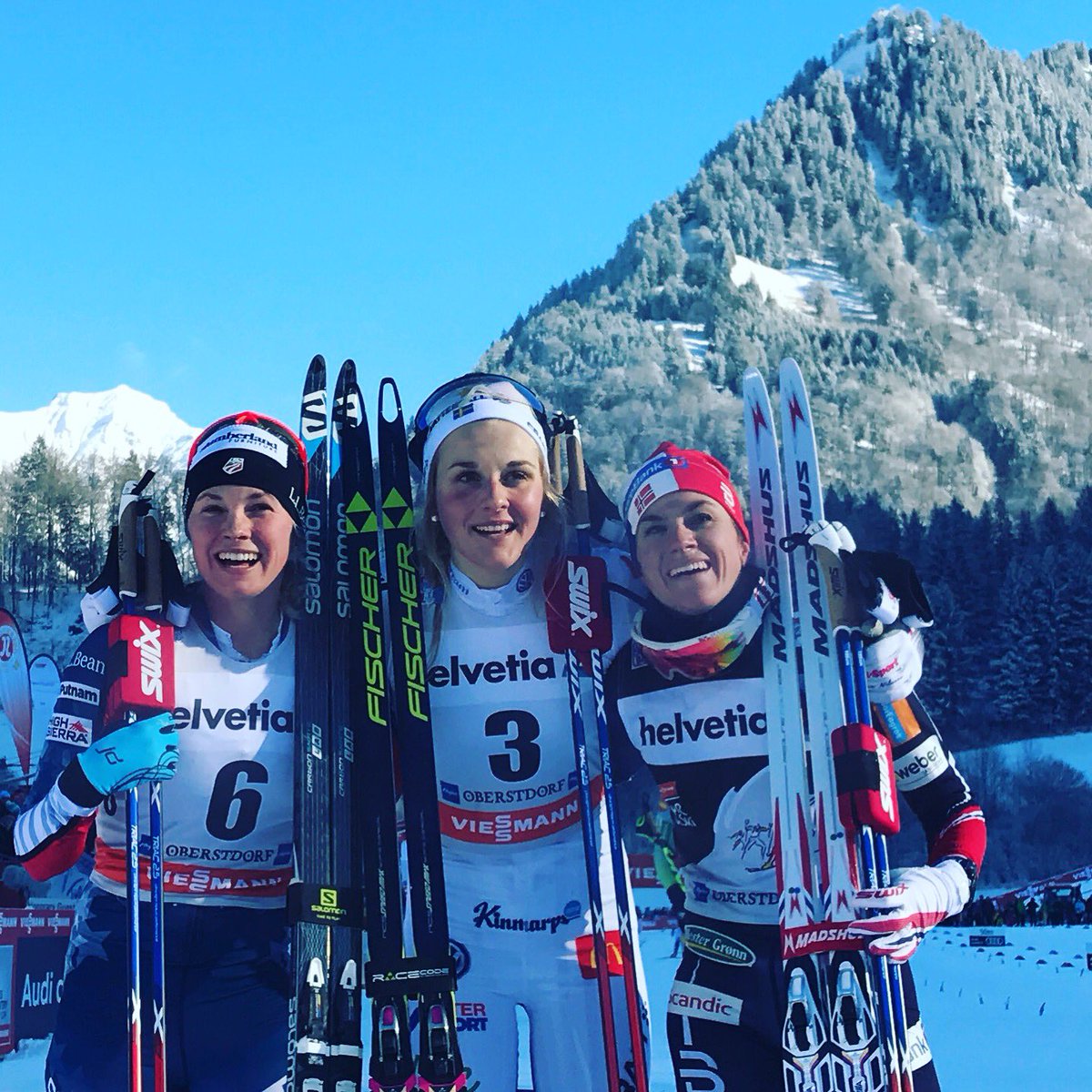
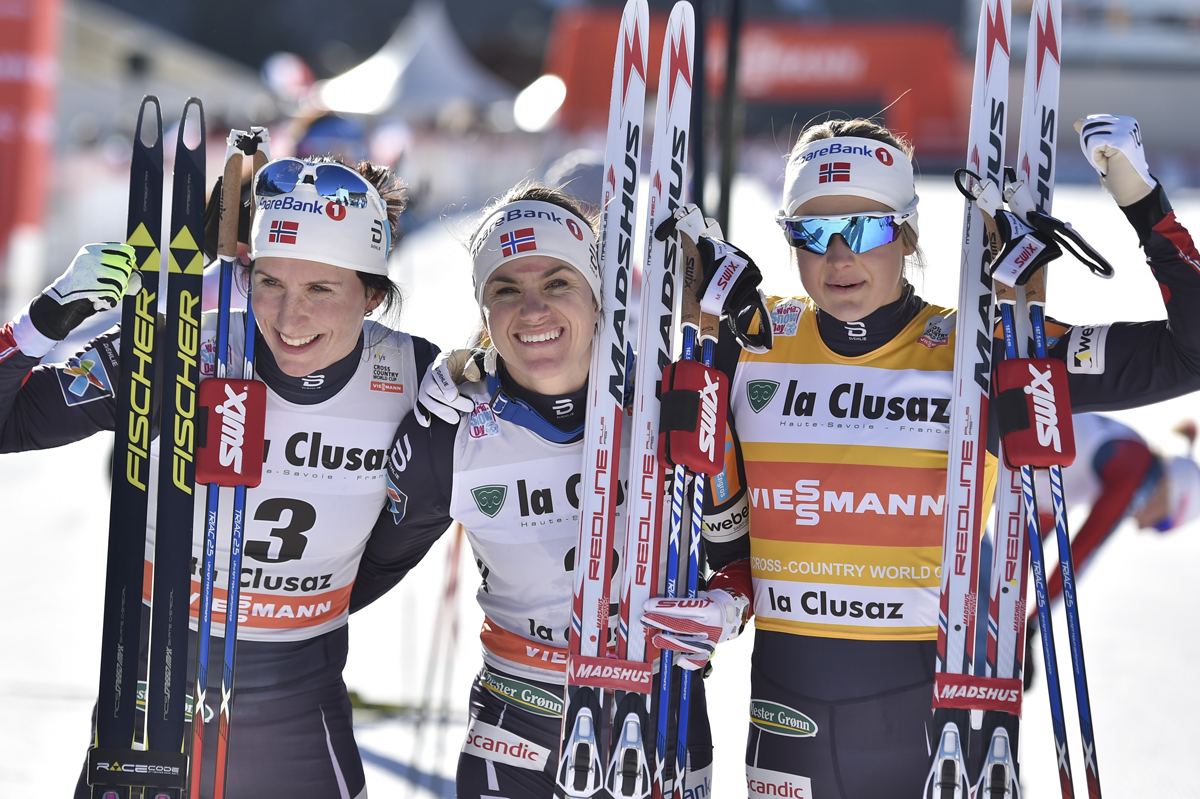
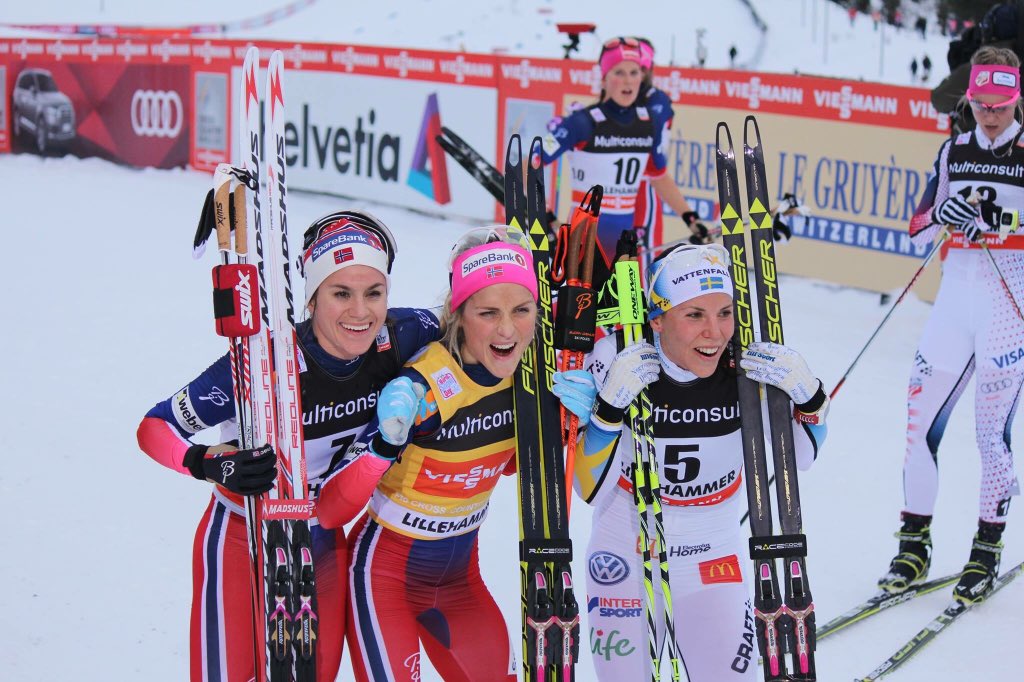
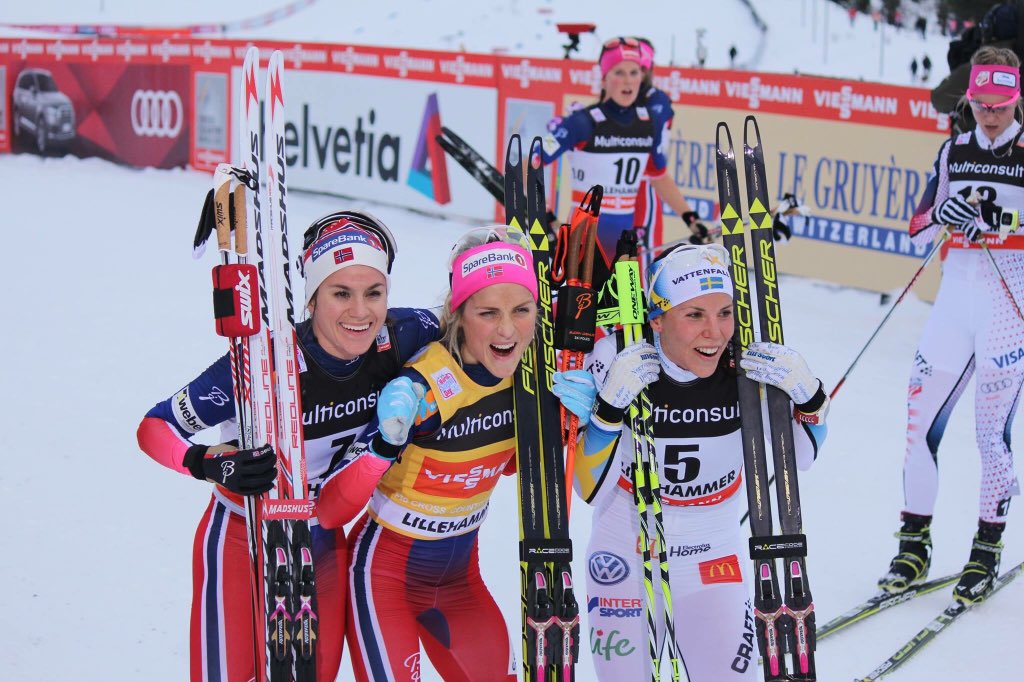
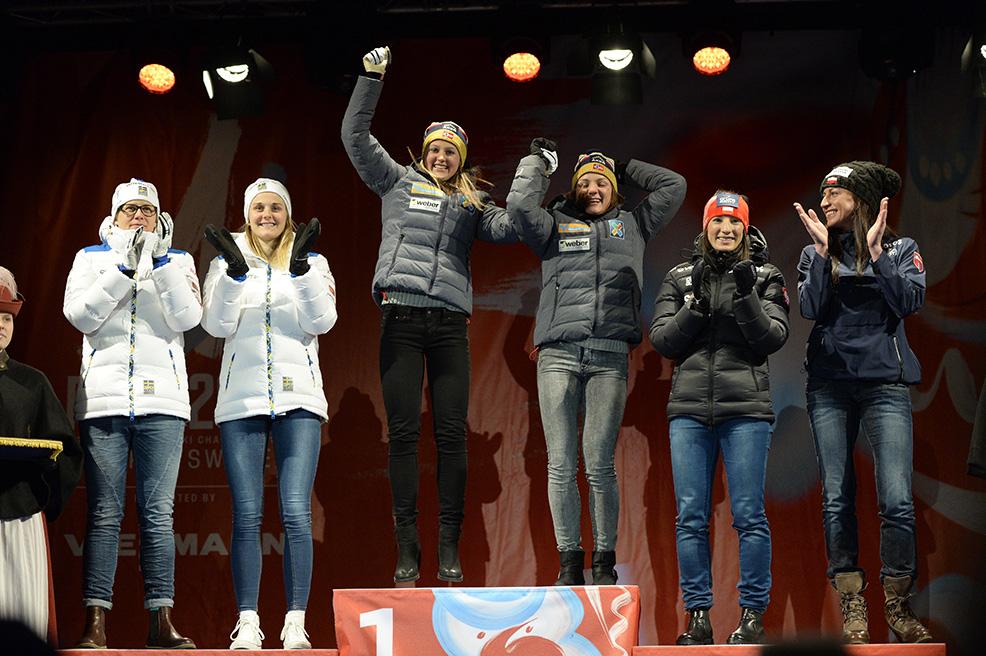
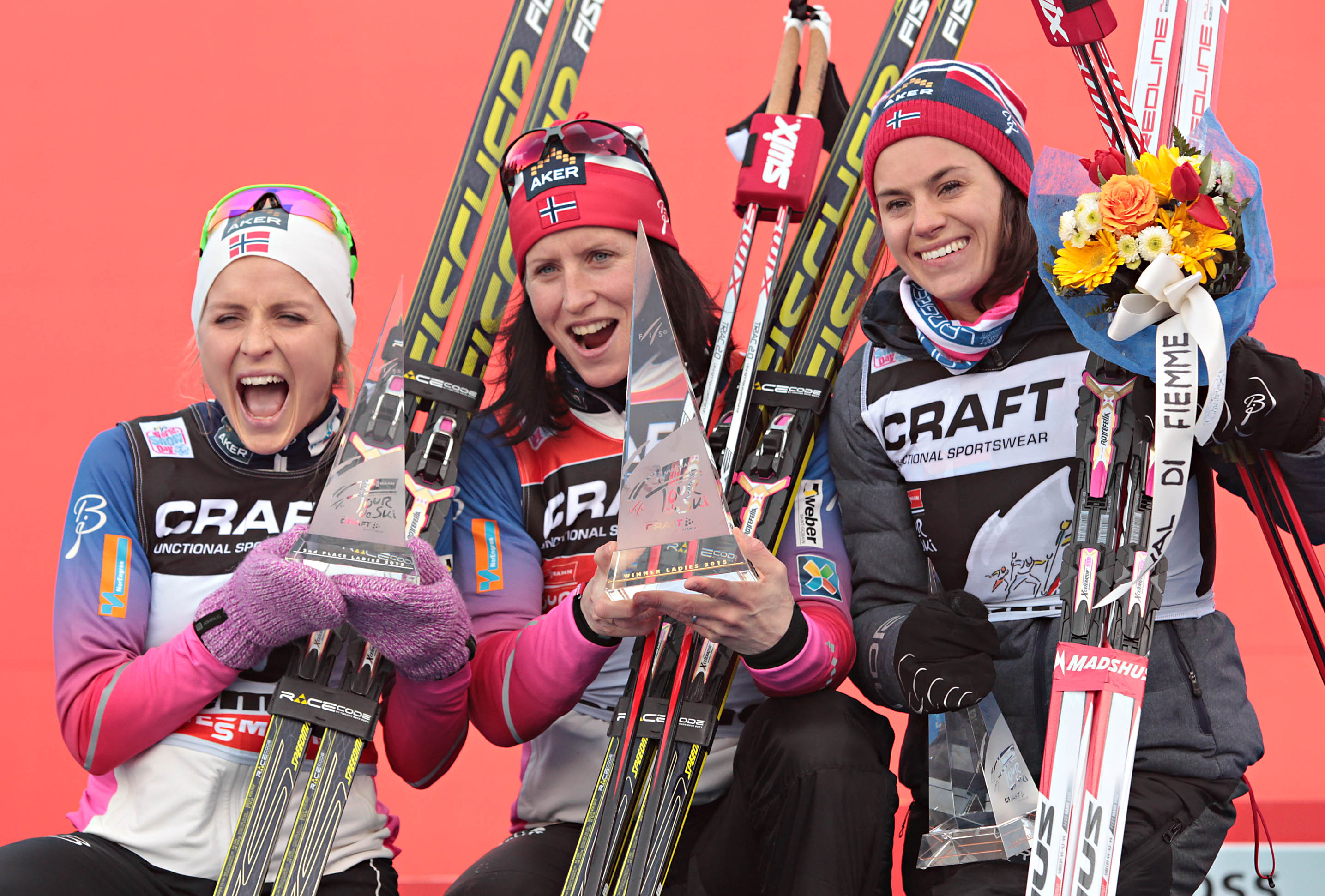
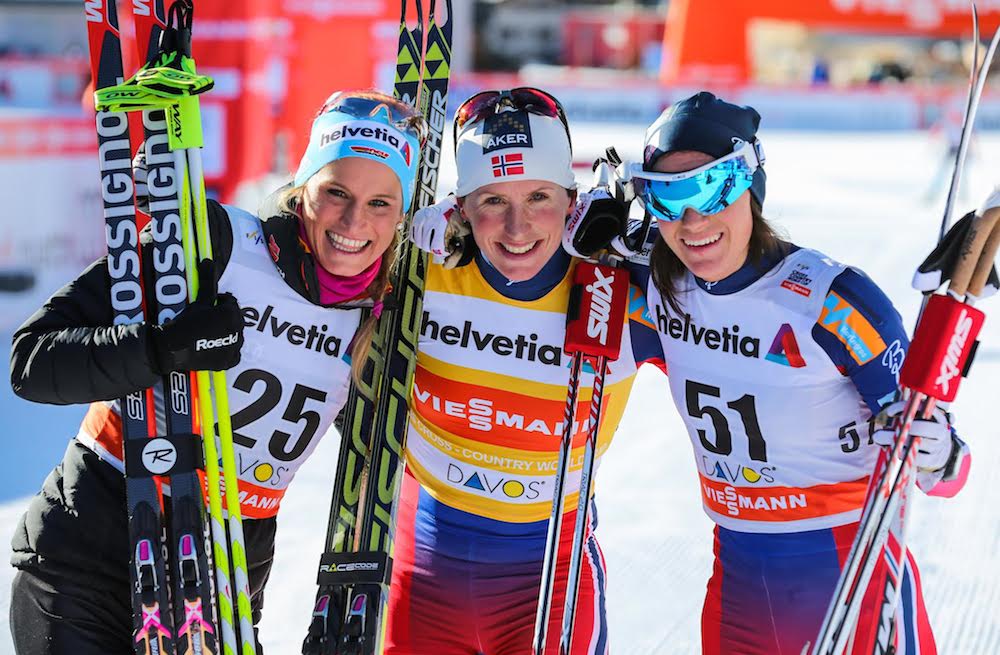
The Tour de Ski Stage 5 women’s 10 k freestyle mass start podium on Thursday in Oberstdorf, Germany, with Norway’s Ingvild Flugstad Østberg (c) in first and Maiken Caspersen Falla (l) in second, and Finland’s Krista Pärmäkoski (r) in third. (Photo: FIS Cross Country/Twitter)
Tour de Ski Stage 5 (Oberstdorf, Germany): 10/15 k freestyle mass starts
In one of the more unconventional stages of the Tour de Ski — a rainy, seven-lap, 14.7-kilometer men’s freestyle mass start, and a five-lap, 10.5 k women’s mass start (both of which were adapted to a shorter course after damage from Wednesday’s storm) — two Norwegians outlasted a tightly packed group of competitors to the finish, with Emil Iversen winning the men’s race and Ingvild Flugstad Østberg capturing her third-straight win in the women’s race on Thursday in Oberstdorf, Germany.
Iversen posted his first win of the season after hanging in the pack throughout the relatively flat race, with a maximum climb of 16 meters and total climb of 50 meters.
In the finishing stretch, he outsprinted fellow Norwegian Sindre Bjørnestad Skar by 0.4 seconds for the win in 29:49.8 minutes. Italy’s Francesco De Fabiani reached the podium in third, just 0.9 seconds out of first. Switzerland’s Dario Cologna kept his overall Tour lead in fourth place (+3.7) and Canada’s Alex Harvey came out on top of a photo finish for fifth with Great Britain’s Andrew Musgrave taking sixth and Norway’s Finn Hågen Krogh seventh, all 4 seconds after Iversen.
Norway’s Martin Johnsrud Sundby placed eighth (+4.2), Germany’s Thomas Bing ninth (+4.9) and France’s Maurice Manificat 10th (+5.2).
Twenty-five skiers finished within 10 seconds of first, and 57 in the 67-man field ended up within 50 seconds of first.
Overall, Cologna continues to lead the Tour standings with two stages to go: a 15 k classic mass start on Saturday and 9 k freestyle hill climb on Sunday, both in Val di Fiemme, Italy. He is 53 seconds ahead of Russia’s Sergey Ustiugov, who placed 28th on Thursday, and 1:07.6 ahead of Sundby in third. Harvey remains in fourth, now 1:23.1 behind and 3.5 seconds ahead of Russia’s Alexander Bolshunov (+1:26.7), who finished 40th on Thursday after falling several times.
Erik Bjornsen led the U.S. men in 32nd (+11.7), Paddy Caldwell placed 39th (+15.5), and Andy Newell was 53rd (+43.2). Simi Hamilton did not start. Overall, Bjornsen is 20th in the Tour (+3:10.7), Caldwell 60th (+6:58.2) and Newell 65th (+9:37.1) out of 67, although this is expected to be Newell’s last stage of the Tour.
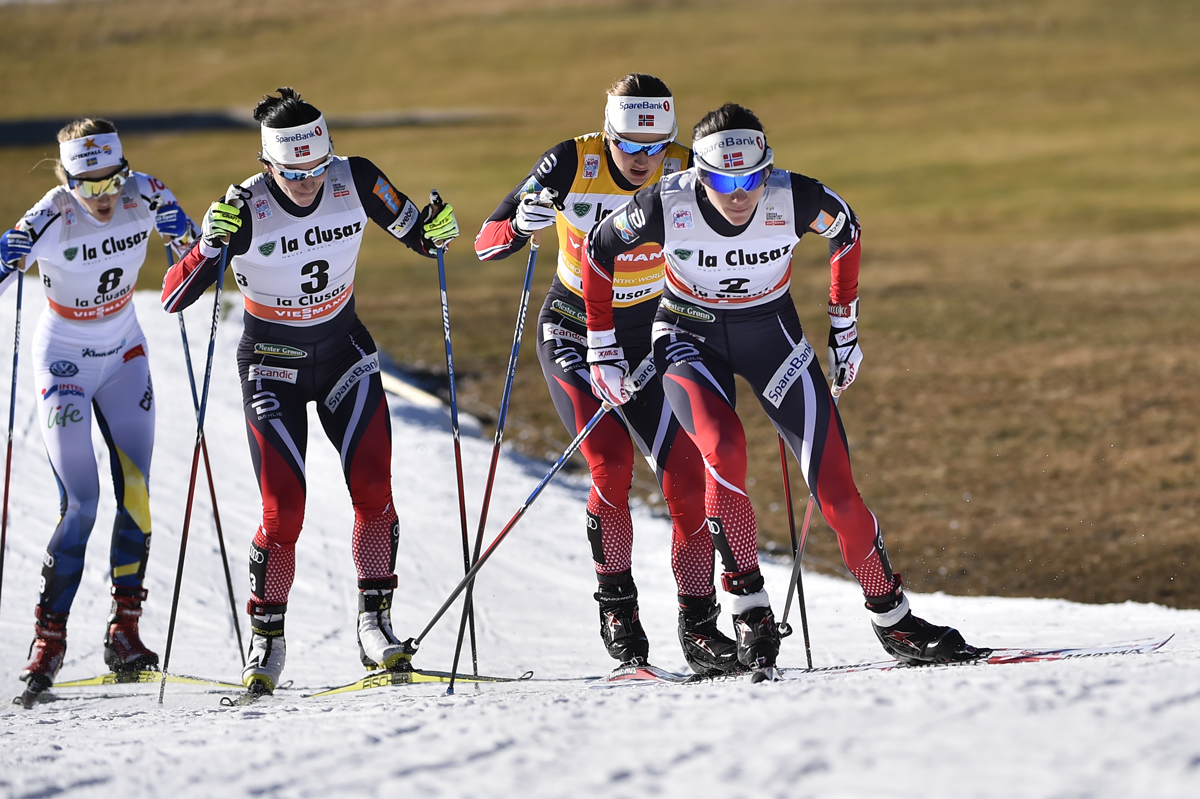
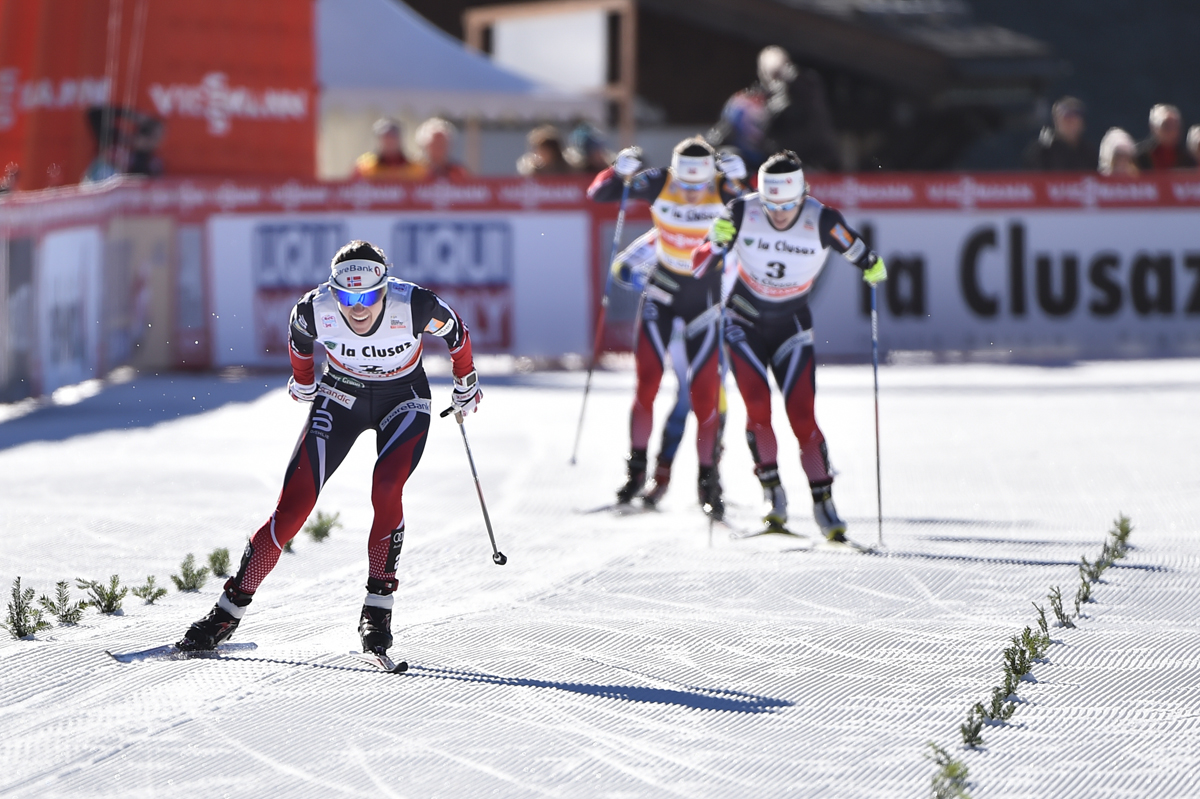
In the women’s race earlier in the day, Østberg secured a 1.9-second victory over her teammate, Maiken Caspersen Falla, a Norwegian sprint specialist. Østberg crossed the line first in 23:16.5 and Finland’s Krista Pärmäkoski joined the two Norwegians on the podium in third, 3.2 seconds out of first.
Switzerland’s Nathalie von Siebenthal finished 4.1 seconds back in fourth for her best World Cup result, Sweden’s Maria Nordström was fifth (+4.4) to tie her career best, Germany’s Nicole Fessel sixth (+5.5), Austria’s Teresa Stadlober seventh (+5.8), Norway’s Anne Kjersti Kalvå eighth (+6.5) for her first World Cup top 10, Russia’s Anastasia Sedova ninth (+6.7), and Sweden’s Emma Wiken 10th (+7.1). Norway’s Heidi Weng was another 0.1 seconds back in 11th (+7.2), and for the first time this season, no U.S. Ski Team members finished in the top 20.
Jessie Diggins placed 24th (+16.8), Sadie Bjornsen 26th (+20.8), Liz Stephen 28th (+24.5), and Rosie Brennan 36th (+52.7).
“Today was definitely a very different course than most due to the storm and trees falling down over the usual course!” Diggins wrote in an email to FasterSkier. “It was icy and flat, which meant that the pack stayed really tight together as there were no big climbs to break it up.
“Fortunately, I got into great position to sprint for the bonus seconds [on Lap 3],” she continued. “Unfortunately, 200 meters from the finish I hit ice and crashed hard into the boards, spinning around and losing quite a bit of time and places. But that happens sometimes in racing and I shook it off already!”
Østberg now leads the Tour standings by 57 seconds over Weng while Diggins is nearly 2 minutes back in third (+1:56.7). Pärmäkoski follows in fourth (+2:09.1), Finland’s Kerttu Niskanen is up to fifth (+2:34), Fessel is sixth (+2:39.8), while Bjornsen slipped two places to seventh (+2:47.0). Stephen is 27th overall (+5:12.2) and Brennan 33rd (+5:50.6) out of 43 women.
Ida Sargent and Sophie Caldwell did not start on Thursday and withdrew from the Tour to focus on the regular-season World Cup sprints next weekend in Dresden, Germany, which are also the focus for their U.S. teammates Kikkan Randall, Hamilton and Newell.
The women’s 10 k freestyle podium at Stage 3 of the 2018 Tour de Ski on Monday in Lenzerheide, Switzerland, with Norway’s Ingvild Flugstad Østberg (c) in first and Heidi Weng (l) in second, and American Jessie Diggins (r) in third. (Photo: Salomon/NordicFocus)
Not one of the last three days in Lenzerheide, Switzerland, were alike, with three different American women standing on the coveted podium and three vastly different conditions for the first three stages of the 2018 Tour de Ski.
Technically, it wasn’t 2018 until today — with Jessie Diggins racing to third in the women’s 10-kilometer freestyle pursuit on Monday, the first day of the new year and her first podium of the season.
She did so in soft, slow conditions with fresh snow coating Lenzerheide’s 3.75 k distance course — a stark contrast to Sunday’s fast-and-icy conditions that caused a few racers to fly off the course*. American Sadie Bjornsen stayed on her feet and raced to third for her first-career 10 k podium. Saturday’s skate sprint was a snowy one, which another U.S. Ski Team member Sophie Caldwell embraced and raced to second place, for her first individual World Cup podium in two years.
Monday was a suffer-fest for everyone on course and a solo one for the first three skiers. Norway’s Ingvild Flugstad Østberg headed out of the gate first, after leading the Tour de Ski (TdS) standings with a win in Saturday’s 10 k classic. Her teammate Heidi Weng started second, 33 seconds back, and Diggins started 32 seconds after Weng (1:05 minutes behind Østberg) in third.
With Bjornsen next in line, another 10 seconds back in fourth, and Russia’s Natalia Nepryaeva 2 seconds behind her in fifth, the race was for the podium was more or less a formality, barring anything unexpected for Østberg, Weng and Diggins. Sure, anyone of them could have unraveled, but it wasn’t likely. Regardless, each still had to gut out three long laps on their own, with Diggins eyeing Weng, Weng trying to close the gap to Østberg, and Østberg with only the open trail ahead of her.
“It was like hell today,” the 27-year-old Østberg said after her second-straight win on Monday, according to an International Ski Federation (FIS) press release. “It was a very hard fight. I felt the snow was not fast. I was gaining seconds on Heidi and then losing them again.”
Throughout the race, Østberg had a maximum gap of 36 seconds to Weng in second (at 1 k) and a minimum gap of 23 seconds (again to Weng at 5.6 k). She crossed the finish line first in 26:48.1 minutes, while Weng finished 27.8 seconds back in second and Diggins another 49.1 seconds later in third (+1:01.4).
Weng, who is currently second in the overall Tour standings, 32.8 seconds behind Østberg in first with four stages to go, told FIS that the race was “very hard for everybody”, but she was pleased with her ability to ski hard on the uphills and flats. For most of the race, she looked like Weng was giving it everything she had — as was Diggins — and Weng ended up with the third-fastest time of day. Austria’s Teresa Stadlober posted the fastest 10 k time in 26:20.6, which put her in 12th at the finish after she started 29th. Weng was 22.5 seconds slower and Østberg 27.5 seconds off that time with the fourth-fastest time of day.
In her third race in as many days, Østberg said she felt tired out of the start on Monday.
“Already after one hundred meters, my legs were tired, but I fight, fight, fight all the way,” she told German broadcaster ZDF. “And I managed to reach the finish first, it was a great feeling.”
This marked Østberg’s third win of the season — all of which have come in Switzerland (she won the Davos 10 k freestyle on Dec. 10). Four years ago, she won her first World Cup race in Lenzerheide in a freestyle sprint.
“In Davos and here in Lenzerheide I had some of my best races, so Switzerland is a good place for me to race,” she told ZDF.
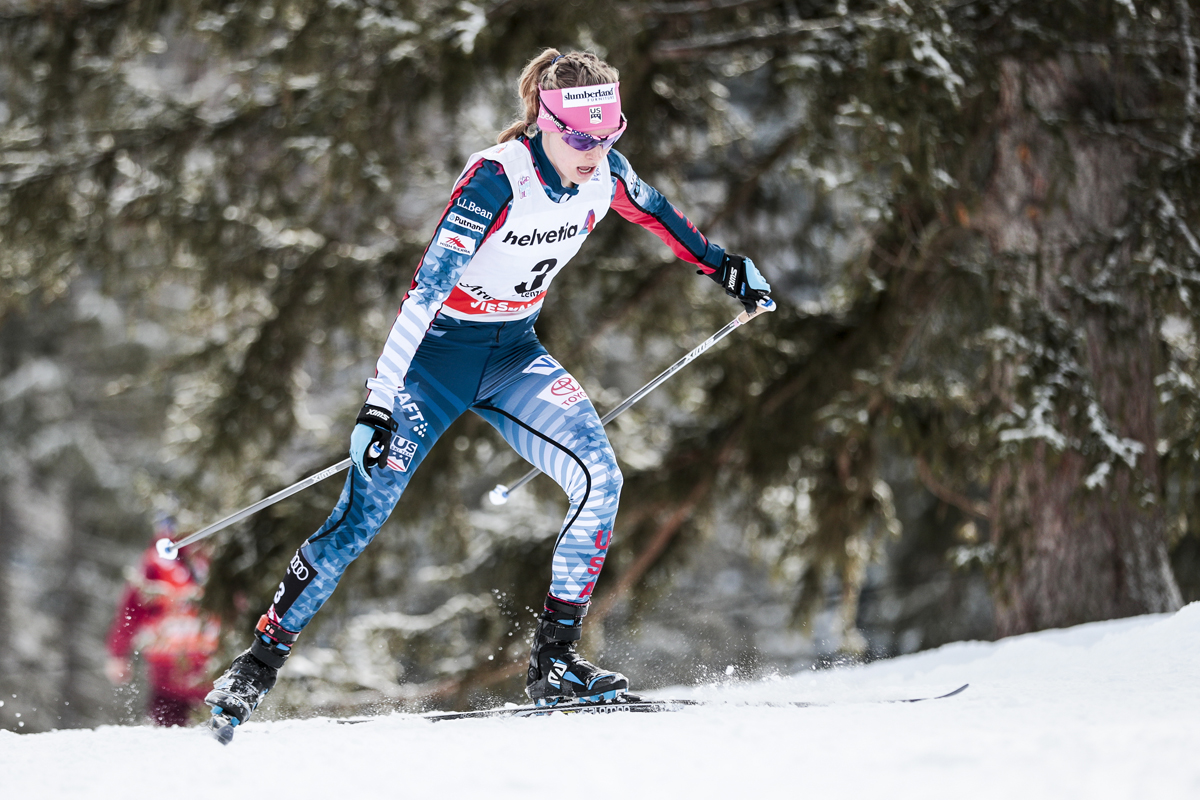
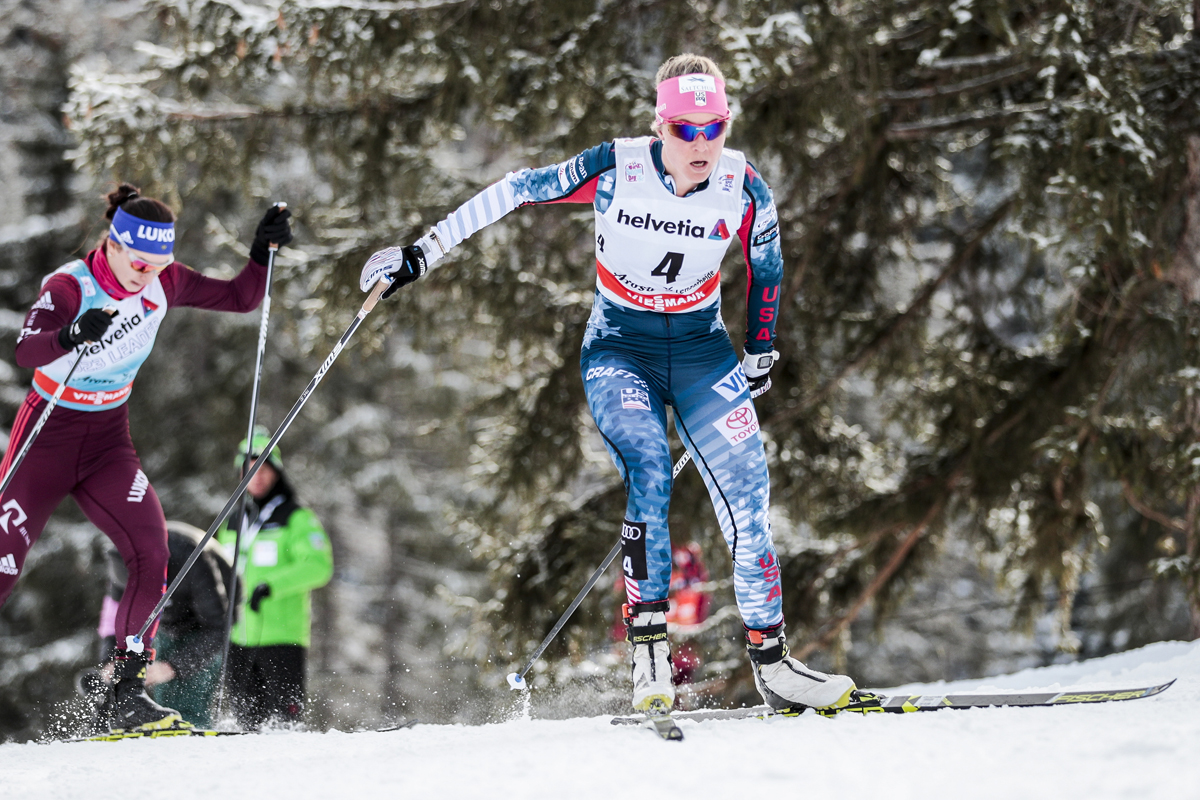
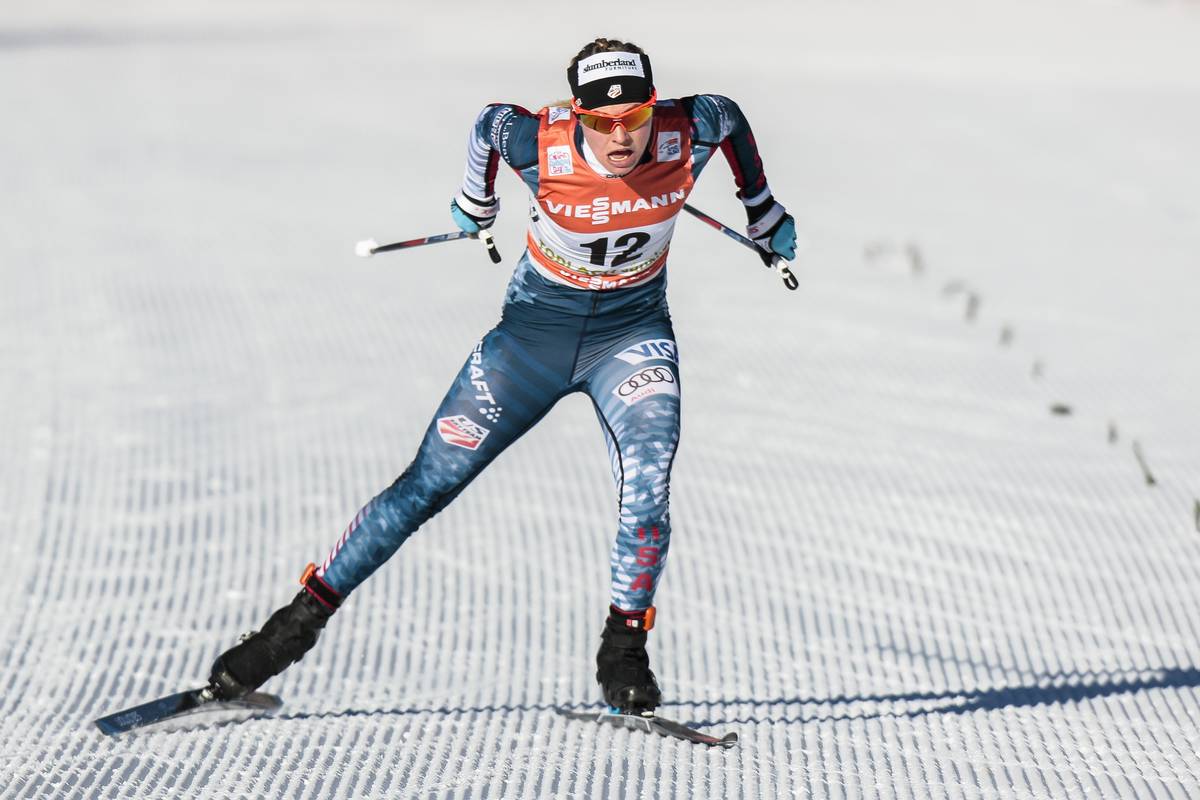
Jessie Diggins (U.S. Ski Team) racing to third in the women’s 10 k freestyle pursuit at Stage 3 of the 2018 Tour de Ski in Lenzerheide, Switzerland. On the first day of the new year, it was her first podium of the season. (Photo: Salomon/NordicFocus)
Then there was Diggins, who continued the U.S. Ski Team (USST) streak of landing on the podium over three consecutive days.
“Today my plan was to go out hard and ski a gutsy race, and try to put some time into the girls behind me,” she wrote in an email to FasterSkier. “It’s sometimes hard to be skiing alone but I actually loved it because I could just put my head down, hammer, and do my thing!”
Within the first kilometer, she had already put a few more seconds into Bjornsen in fourth place. Meanwhile, Bjornsen, 13 seconds behind Diggins, worked to shake off Nepryaeva.
“Starting in 4th was a pretty exciting position, and even a bit terrifying,” Bjornsen wrote in a mass email to media outlets. “It was my goal to try to catch Jessie, and ski with her, but I knew I needed to get it done in the first kilometer, because she was going to be on a mission. I got darn close, but not quite close enough. I could tell right away I was going to be on a solo mission, and needed to really push hard to stay ahead of the group working together behind me.”
The group she was referring to included Finland’s Kerttu Niskanen and Krista Pärmäkoski. Toward the end of the first lap at 3.3 k, they had distanced themselves from a nine-woman chase group led by Norway’s Astrid Uhrenholdt Jacobsen, of which Caldwell was a part of. After dropping Nepryaeva on the first lap, Bjornsen had the two Finns and the crew behind them to worry about.
“I managed to stay ahead until literally the last downhill, and got passed by Krista, so lost one place, but I left the day pretty satisfied,” Bjornsen wrote after finishing fifth in a three-way battle with Pärmäkoski and Niskanen for fourth place. Pärmäkoski took it, passing Bjornsen in the last few hundred meters and leading her and Niskanen, respectively, into the finishing straight. Pärmäkoski crossed the line in fourth, 29 seconds after Diggins and 1:45.9 after Østberg, while Bjornsen was another 0.3 seconds back in fifth (+1:46.2) and Niskanen finished 0.4 seconds later in sixth (+1:46.6). Behind them, Jacobsen finished seventh (+1:59.9), Fessel eighth (+2:00.3), the Czech Republic’s Petra Novakova ninth (+2:01.0), and Germany’s Sandra Ringwald 10th (+2:11.3).
Sadie Bjornsen (U.S. Ski Team) leading Russia’s U23 leader Natalia Nepryaeva (l) in the women’s 10 k freestyle pursuit at Stage 3 of the 2018 Tour de Ski in Lenzerheide, Switzerland. Bjornsen went on to finish fifth and Nepryaeva finished 17th. (Photo: Fischer/NordicFocus)
“It required digging darn deep those last kilometers,” Bjornsen wrote. “I was feeling pretty good for the first lap, but started to really burn for the last two. I’m really looking forward to a day off, and then some classic sprinting! Sounds like it will be darn wet and rainy, but it will be fun.”
Heading into the fourth stage of the TdS, Wednesday’s classic sprints in Oberstdorf, Germany, Diggins is third overall,1:26.9 minutes out of first, Parmakoski is up to fourth (+2:00.9; after starting Monday’s race in eighth), and Bjornsen is positioned in fifth (+2:01.2), just ahead of Niskanen in sixth (+2:01.6).
“It’s really fun to be in podium position right now in the tour, but my plan as always is to just take it one day at a time and focus on each stage separately,” Diggins wrote. “If I can give my best effort each day, hopefully it all adds up well!
“I was really proud of our wax tech team because the past two races have been extremely tricky waxing conditions with varying snow all over the course,” Diggins added. “It was hard to pick skis but my tech Cork was so calm and collected and got me through the pre-race testing!”
Despite not planning to finish the Tour, Caldwell is sitting in a respectful 18th overall (+3:14.2) after finishing 18th in Monday’s race, 2:59.2 behind Østberg.
“10km skates tend to be the hardest discipline for me, and although today wasn’t anything to write home about, it also wasn’t a disaster, so I was pretty happy with it!” Caldwell wrote.
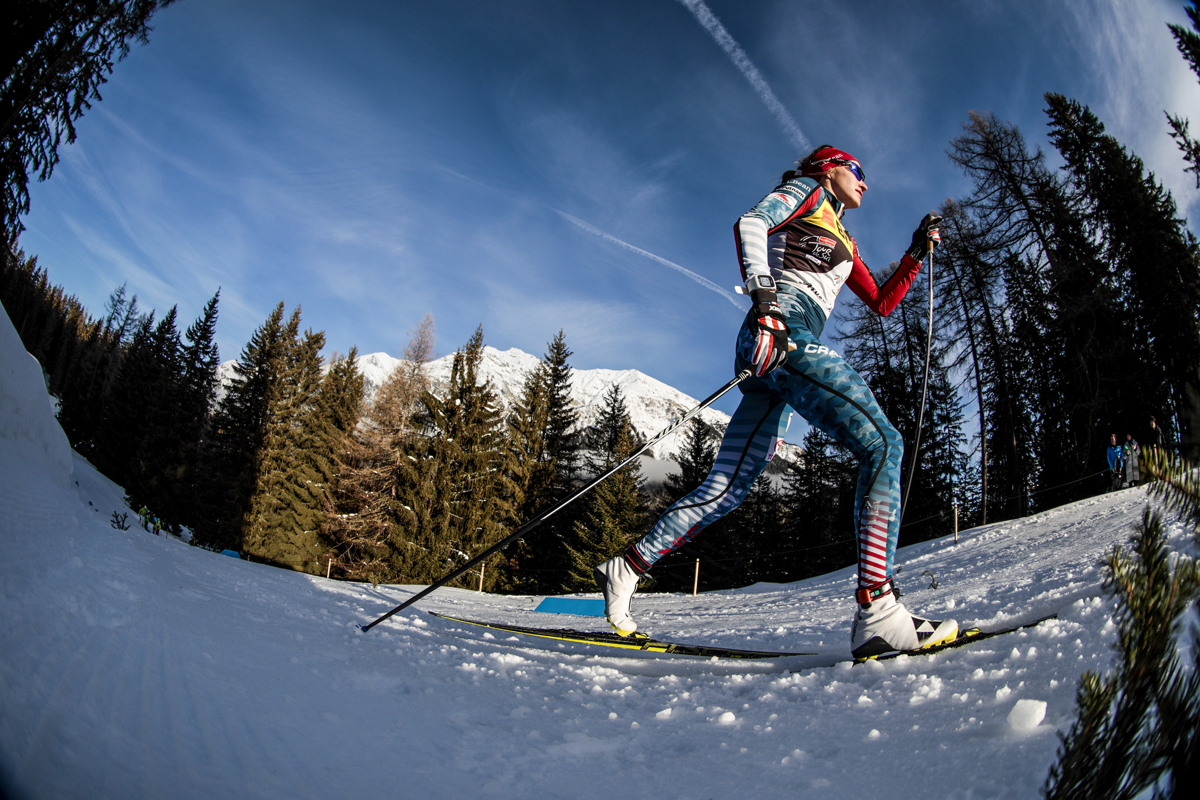
Sophie Caldwell (U.S. Ski Team) racing to 21st in the women’s 10 k classic on Sunday at Stage 2 of the 2018 Tour de Ski in Lenzerheide, Switzerland. On Monday, she finished 18th in the Stage 3 10 k skate pursuit. (Photo: Fischer/NordicFocus)
She started seventh, 1:32 back, at the same time as Niskanen in bib 6. Parmakoski started 3 seconds behind them and the three immediately formed a group, with Caldwell leading the first kilometer.
“For some reason out of the start Kerttu just pulled to the side and made me lead, which I thought was interesting since both she and Krista are much better distance skiers than I am,” Caldwell wrote in an email to FasterSkier. “But anyway, I was totally fine taking the lead, but I wasn’t going to push the pace leading, so I just skied a chill pace until they decided to take back over coming through the stadium. The chase pack caught us pretty quickly, which I was actually excited about because the Finns’ pace was a little too hot for me once they picked it up and the chase group was skiing a pace that felt quite comfortable for me for a lap or so.”
With racers like Jacobsen and Germany’s Nicole Fessel leading the large chase pack for much of the race, Caldwell hung in the group for about 5 k in the middle of the race. But with one lap to go, she lost contact and found herself fighting for 18th.
“The pace was definitely picked up at the beginning of the third lap and I started to get tired then, but I just tried to keep my skis gliding and focus on getting to the finish line,” she wrote. “It was cool for me because often I feel like those skate races are red lining it from the start for me, and today I felt in control for two laps and had a pretty fun time with it!
“I’m really happy with how my tour has gone so far,” Caldwell continued. “I had one of my best sprints ever and one of my best distance races ever, so no complaints there! I feel healthy, fit, and happy and it’s given my confidence a good boost.”
“The vibe is pretty amazing among our team right now,” Bjornsen wrote. “To have a podium every day of the Tour is pretty exciting! It’s fun to see things really come together for everyone. I think there is more to come!”
Asked if this was in line with what the U.S. team was expecting for a start to the Tour, USST Head Coach Chris Grover said it surpassed expectations, but wasn’t unanticipated.
“There was some opportunity in this field this year with [Sweden’s Charlotte] Kalla and Stina Nilsson not starting, with [Norway’s Marit] Bjørgen and Ragnhild Haga not starting, for example, so that left some opportunity for some of the other women to have some breakthrough results,” he said on the phone. “But at the same time, the women that have been on the podium from the U.S.A. the last three days have been on the podium this year or in past years and have been kind of knocking on the door of those results…
“Overall it’s a better start to the Tour than we could’ve wished for,” he later added. “It’s been really exciting to see a podium from a different woman on the team each day. I think once we get to Oberstdorf there’s going to be fresh opportunities for all those women once again to reach the podium. I’m just hoping that right now that everybody can stay healthy, get some good rest, and really look forward to seeing what they can do in the next couple stages.”
With four stages to go, the U.S. has six women in the Tour, with Liz Stephen improving to 31st on Monday (up from 37th at the start), Rosie Brennan maintaining her overall place in 33rd, and Ida Sargent in 55th (down from 31st at the start).
“I was hoping to make up some more places and thought getting into the top 30 was doable. But last lap I lost a little steam and couldn’t keep up my pace,” Stephen wrote in an email to FasterSkier.
En route to the 26th-fastest course time, Stephen picked off four places between 3.3 and 4.3 k.
“The race started really fast, as usual for the World Cup, so I try to be patient and bank on people coming back to me, which they did after about a lap,” she wrote. “I was focused on making up time consistently around the whole course and not just killing myself on the uphills. However the second 1/2 of the course was a lot of climbing so I focused on those sections and tried to get in peoples drafts for the long downhill into the stadium.”
Now in 31st overall, she is 4:22.7 out of first. Brennan is another 10 seconds back in 33rd (+4:32.9).
“I am happy to have scored my first points of the year yesterday in a classic race on very icy, scary conditions, which is not my strong suit, and then again have a top 30 performance,” Stephen continued, referring to her 28th place in Sunday’s 10 k classic. “My year has certainly started slower than I wanted it to, but the Tour is always a good way for me to get a lot of racing in a short period of time and bring my fitness up. So, every day I focus on making a few more spots and look forward to Alp Cermis!”
While Sargent is fighting illness and had initially planned to withdraw from the Tour after Stage 4 or 5 in Oberstdorf (to focus on the World Cup sprints after the Tour), Stephen and Brennan intended to finish it.
“I know Ida is kind of feeling on edge … I know she was kind of a questionable start for yesterday’s classic race so we’ll see what happens with her going into Oberstdorf,” Grover said.
He described Kikkan Randall’s foot injury as one that’s crept up over time that and doesn’t involve a stress fracture.
“She is planning on starting in Dresden right now, both in the sprint and the team sprint so I think she’ll continue to be somewhat selective with the races she chooses,” he said of Randall resuming her season with the next regular-season World Cup races Jan. 13-14 in Dresden, Germany. “She may or may not go at all to Planica [Slovenia, Jan. 20-21], since those are two classic races, but she will for sure race in Seefeld [Austria, Jan. 27-28], where there’s two skate races. So right now her plan is, keep trying to make progress with the foot, get it healthy, be ready to race in Dresden, be ready to race in Seefeld, be ready to race at the Games.”
*Switzerland’s Laurien van der Graaff, the Stage 1 skate-sprint winner, crashed out of contention in Saturday’s 10 k classic, and finished 35th to put herself 16th overall in the TdS heading into Stage 3.
“…I skied out into the deep snow, I had problems to brake at all and went straight ahead and unfortunately crashed and lost quite a few seconds there,” she told Swiss broadcaster SRF, according to a translation. “Otherwise I felt good. It was a special race, a bit more attention on me than usual, but it was cool, I am still happy about yesterday. Aside from my crash I enjoyed it. My nose is pretty banged up. … It really hurts.”
The women’s 10 k classic podium at Stage 2 of the 2018 Tour de Ski, with Norway’s Ingvild Flugstad Østberg (c) in first and Heidi Weng (l) in second, and American Sadie Bjornsen (r) in third in Lenzerheide, Switzerland. (Photo: FIS Cross Country/Twitter)
Tour de Ski Stage 2 (Lenzerheide, Switzerland): 10/15 classic
For the second-straight day of the Tour de Ski, an American landed on the podium, with Sadie Bjornsen placing third in the women’s 10-kilometer classic individual start on Sunday in Lenzerheide.
For Bjornsen, it was her third individual podium of the season and first in a race longer than 5 k. She finished behind two Norwegians, Ingvild Flugstad Østberg, who took the win in 26:59.4 minutes, and Heidi Weng, who was 25.7 seconds back in second.
Bjornsen was 42.2 seconds out of first and 6.7 seconds clear of Finland’s Kerttu Niskanen in fourth (+48.9). Sweden’s Anna Haag placed fifth (+52.6), Germany’s Nicole Fessel finished sixth (+58.2), and the second American in the top 10, Jessie Diggins in seventh (+1:04.4).
Switzerland’s Nathalie von Siebenthal placed eighth (+1:08.3) on home soil, just ahead of Germany’s Stefanie Böhler in ninth (+1:08.8), and Slovenian U23 skier Anamarija Lampič placed 10th (+1:08.9).
For Østberg, the win came two seasons after she won her very first distance World Cup race in Lenzerheide. With the win she leads the Tour standings by 32.8 seconds over Weng in second. Diggins is up to third overall (+1:04.9) and will start Monday’s 10 k freestyle pursuit accordingly, 1:05 seconds after Østberg, who will head out of the gate first.
Bjornsen is fourth overall (+1:15.4), just ahead of Russia’s Natalia Nepryaeva in fifth (+1:17.3) while Niskanen is another 15 seconds back in sixth (+1:32.0), and will start the pursuit with American Sophie Caldwell, who was second in Saturday’s Stage 1 skate sprint and ranks seventh overall (+1:32.0). Caldwell placed 21st on Sunday, 1:40.6 behind Østberg.
“It’s has been a huge goal of mine to be on the distance podium,” Bjornsen said, according to a FIS press release. “It felt really crazy out there today. At the 6.0 km I got the information I was in 2nd place. I had to ski a lot out of the track. I had to give everything I had in the last 2.5 km. I was little bit disappointed yesterday, I was hoping for more so today feels really great.”
The U.S. had five in the top 30 with Liz Stephen in 28th (+2:04.8) and Ida Sargent in 30th (+2:06.7). For Stephen, it was her first time in the points (top 30) this season. Rosie Brennan placed 38th (+2:20.5). Kikkan Randall did not start and thus withdrew from the Tour.
Dario Cologna rose to the challenge on Sunday, winning the second stage of the 2018 Tour de Ski for his first World Cup victory in three years.
The 31-year-old Swiss skier completed the men’s 15-kilometer classic individual start in 35:29.5 minutes, besting the time of Kazakhstan’s Alexey Poltoranin by 0.6 seconds to win in front of a home crowd in Lenzerheide, Switzerland.
Cologna started 62nd and sped up as the race progressed, clocking the fastest times from 6 k on. Russia’s Alexander Bolshunov started behind him in bib 68 and topped Cologna’s time at every checkpoint, skiing 7.4 seconds faster than him at 10 k. But over the final 5 k loop, Cologna prevailed and Bolshunov faded, with the Russian U23 skier finishing fourth, 14 seconds off Cologna’s winning time.
“It’s amazing, the first victory in Switzerland,” Cologna told Swiss broadcaster SRF. “I think it’s my 22nd [World Cup win], but the first one at home, which is very beautiful. And after a two-year break it really is a great satisfaction.”
Poltoranin started 27th and claimed his second podium of the season and first one of the tour, while Norway’s Martin Johnsrud Sundby scored his first podium since early December. Sundby placed third, 13.1 seconds out of first. Russia had two in the top five with another U23 skier, Alexey Chervotkin in fifth (+16.2). Norway’s Hans Christer Holund was sixth (+21.2), Finland’s Iivo Niskanen seventh (+22.9), Italy’s Francesco De Fabiani eighth (+27.2), Norway’s Didrik Tønseth ninth (+37.1), and Russia’s Sergey Ustiugov 10th (+37.1).
Canada’s Alex Harvey placed 20th (+57.9) and slipped two places in the overall standings to ninth. Russia’s Sergey Ustiugov, who won yesterday’s Stage 1 skate sprint, still leads the standings while Cologna is up to second, just 1.6 seconds back heading into Monday’s freestyle pursuit in Lenzerheide. Bolshunov is third, 12.7 seconds back, Poltoranin fourth (+22.0), Finland’s Ristomatti Hakola fifth (+27.7), Sundby sixth (+39.1), Niskanen seventh (+46.4), Chervotkin eighth (+49.8), Harvey ninth (+53.8), and Holund 19th (+54.5).
In Saturday’s 15 k classic, Erik Bjornsen led the U.S. men in 27th (+1:22.4), Simi Hamilton finished 58th (+2:41.8), Andy Newell was 71st (+3:11.5), and Paddy Caldwell 75th (+3:36.2).
Eighty-five men finished the second stage of the Tour de Ski; Canada’s second man, Devon Kershaw, did not race on Sunday and withdrew from the tour due to illness.
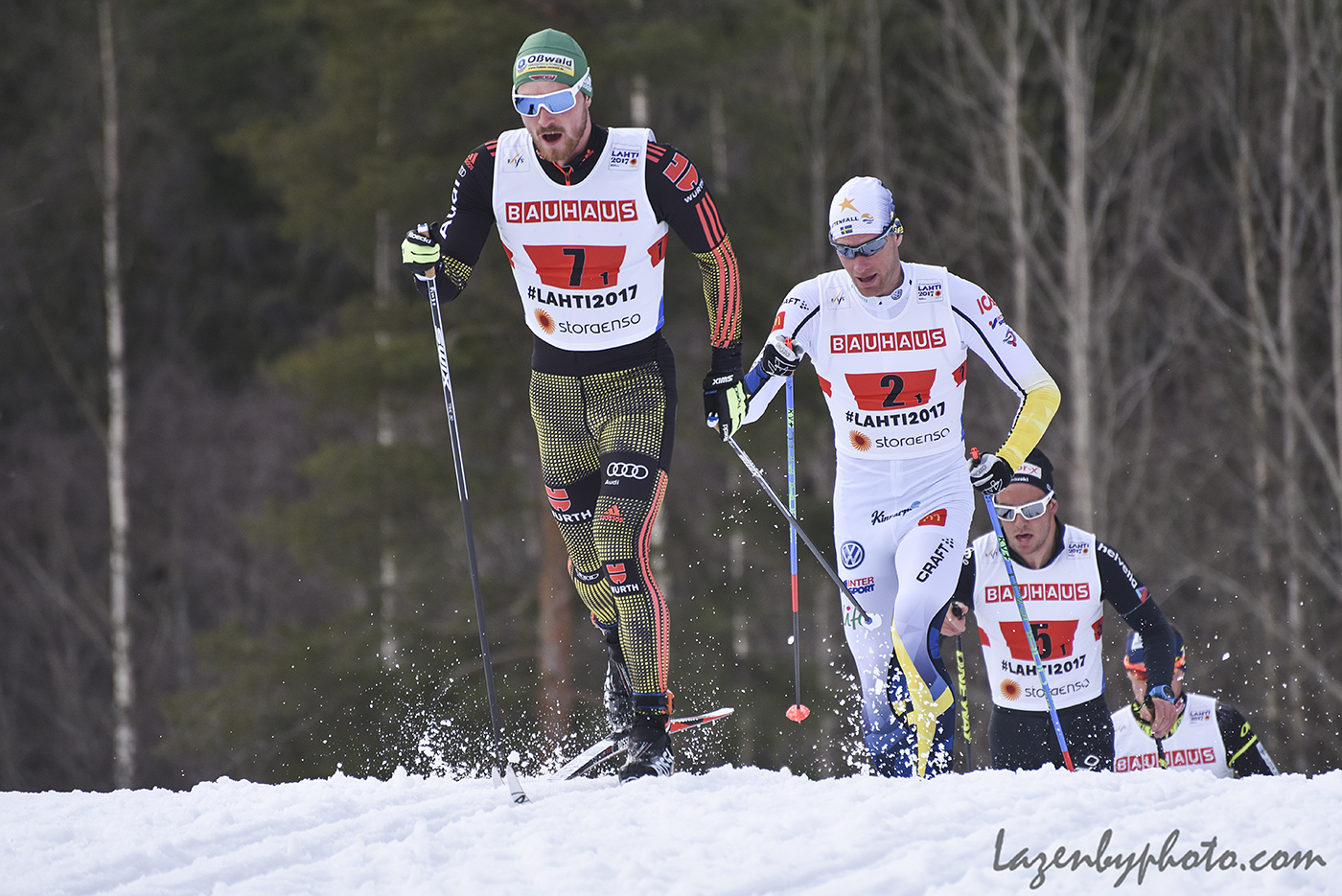
Germany’s Thomas Bing (7) leads Sweden’s Daniel Rickardsson (2) and Switzerland’s Jason Rüesch during the first leg of the men’s 4 x 10 k relay at 2017 World Championships in Lahti, Finland. (Photo: John Lazenby/Lazenbyphoto.com)
Welcome to World Cup Windup, where we check in with the top-10 teams from last year’s FIS Cross Country World Cup tour before the season starts with the Ruka Triple in Kuusamo, Finland, on Nov. 24.
GERMANY
Overall in Nations Cup Last Year:Seventh
Women’s Ranking 2016/2017:Sixth
Men’s Ranking 2016/2017: Ninth
Who’s Back:
Nicole Fessel and Steffi Boehler, top-20 in the World Cup distance standings; sprint finalist Sandra Ringwald; Victoria Carl and Katharina Hennig, who joined Ringwald and Boehler to finish second in the World Cup relay in Ulricehamn; Florian Notz, Elizabeth Schicho, Laura Gimmler, and Thomas Bing, each of whom had a single World Cup top-10 last season, and Hanna Kolb, who had two.
Who’s Missing:
Veteran sprinter Tim Tscharnke retired partway through the summer. The 2010 Olympic team sprint medalist has struggled with back problems and finally called it quits. “The last three years of my career were riddled with many mediocre months, punctuated by health problems and athletic setbacks,” he said.
Pre-Season Results:
The World Cup women’s 4 x 5 k podium on Jan. 22 in Ulricehamn, Sweden, with (from left to right) Germany (Stefanie Boehler, Sandra Ringwald, Victoria Carl, Katharina Hennig) in second, Norway (Ingvild Flugstad Østberg, Heidi Weng, Astrid Uhrenholdt Jacobsen, Marit Bjørgen) in first, and Sweden in third (Ida Ingemarsdotter, Sofia Henriksson, Charlotte Kalla, Hanna Falk). (Photo: Fischer/Nordic Focus)
Earlier this month in Davos, Switzerland, Thomas Bing won a sprint race and Laura Gimmler was the runner-up in the women’s race. Katharina Hennig and Steffi Boehler went 2-3 in a distance race.
Recent Drama:
After being sick in both August and September, Florian Notz is aiming for a World Cup debut in Davos in December, not earlier. “I did not have any real training for two to three months,” he told Südwest Press. “That’s why Kuusamo is too early for me… I have set myself as a goal, that I want to attack fully [in Davos]. I am still optimistic that I can be in shape by then. But of course, everything has to go right.” If not, Olympic qualifying will be tricky.
Lucas Bögl is among the athletes joining the new “Athleten für Deutschland” athlete union, which was recently founded as an independent alternative to the athletes’ council run by the German Olympic Committee. The head of the German Olympic Committee is not a fan, saying basically that athletes trying to make demands will only bring problems upon themselves. Bögl disagreed. “The club should help the athletes commission and support the athletes,” he told OBV-online. “That should be in the interest of everyone involved.” He also said: “Cross-country skiing is not something you do for the money, it’s more of a way of life. I have turned my sport into a profession. I feel privileged that I don’t have to sit in an office. I can do that for a long time after my career is over.”
Sandra Ringwald, who just missed making the 2014 Olympic team for Germany, and is particularly focused on 2018 Games this winter. “I want to fulfill my Olympic dream and be in PyeongChang,” she told the Südkurier newspaper in an interview. “However, I’m going easy on the whole thing. In the past few years I have often set my goals too high… I’m not working just for Olympic qualification. My aim is to play a good role in the World Cup as well. I want to show what I can do at the very first races.”
Best Social Media Presence:
Steffi Boehler is a consistent Instagram poster, and also includes some of her artwork along with training and daily-life pictures.
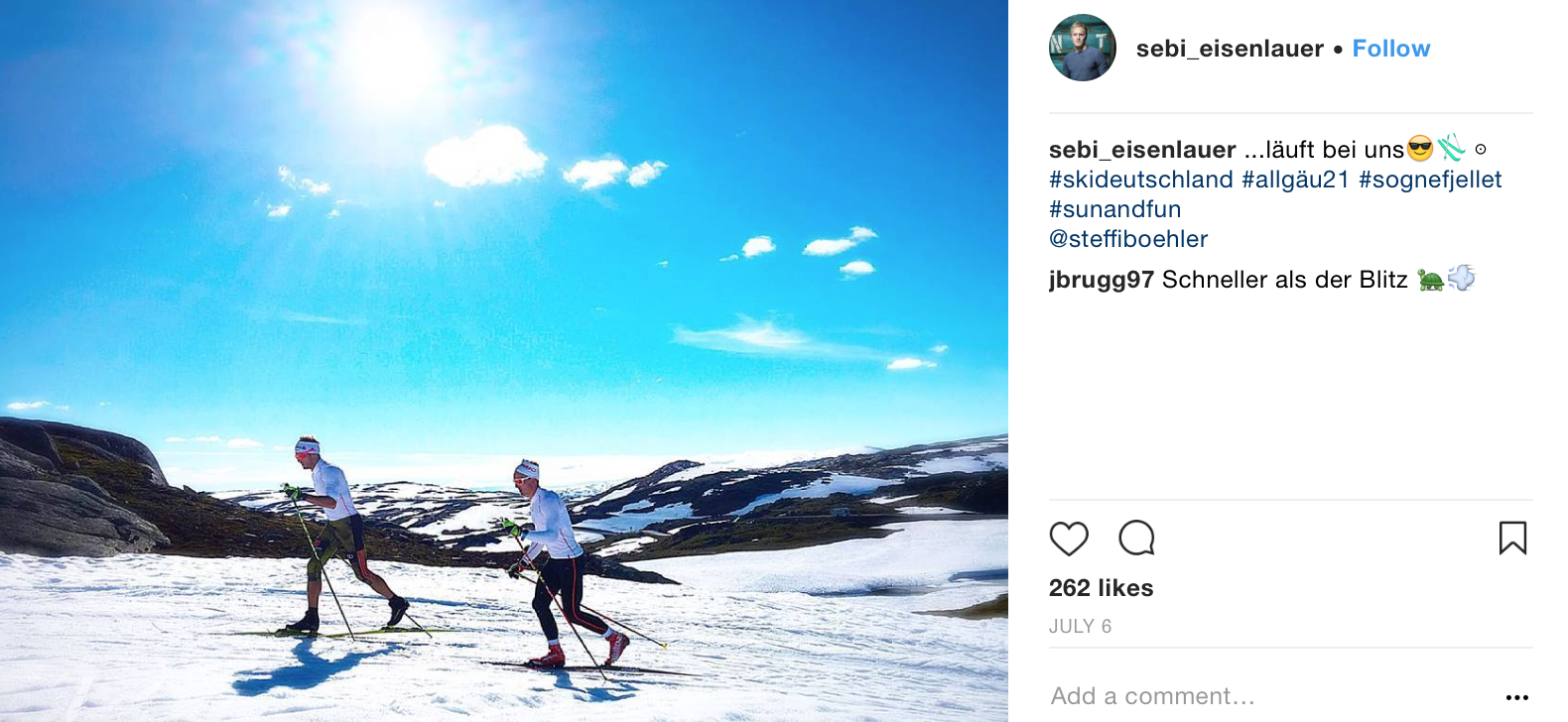
Sprinter Sebastian Eisenlauer also posts gorgeous training shots:
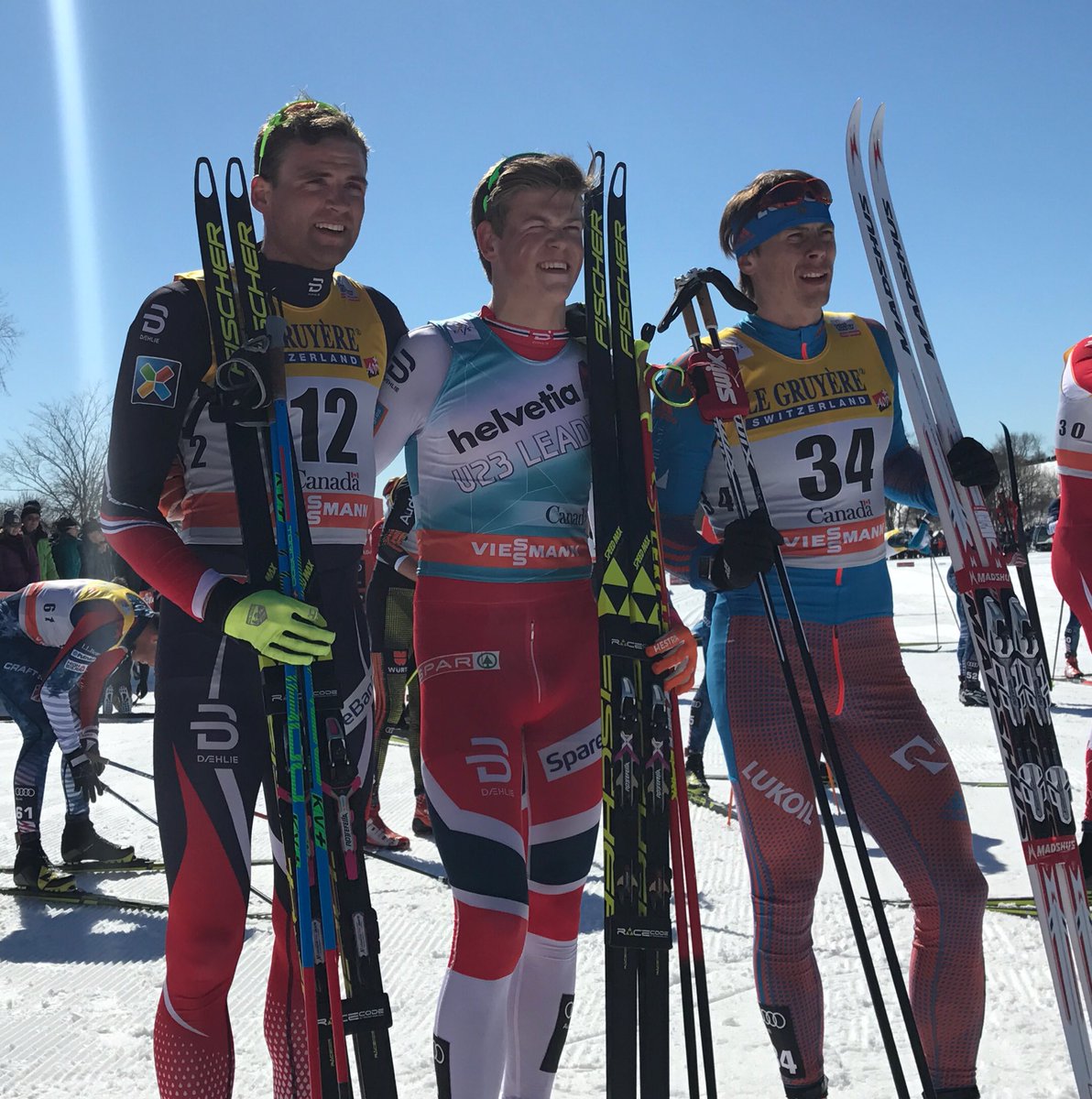
The men’s 15 k classic mass start podium on Saturday at World Cup Finals in Quebec City, with Norway’s Johannes Høsflot Klæbo (c) in first and Niklas Dyrhaug (l) in second, and Russia’s Alexander Bessmertnykh (r) in third. (Photo: FIS Cross-Country/Twitter)
FIS Cross-Country World Cup Finals (Quebec City): 10/15 k classic mass starts
During Saturday’s 15-kilometer classic mass start at World Cup Finals, Canada’s Alex Harvey was in it until the end. But so were Norway’s Johannes Høsflot Klæbo and Niklas Dyrhaug, and Russia’s Alexander Bessmertnykh, to name a few.
Sitting in second with a few hundred meters to go, Harvey was primed to make his move on Dyrhaug, who was leading at the time. But then came 20-year-old Klæbo, the season-long Sprint World Cup champion, who proved to have more left in the tank than anyone else and passed them both to lead into the finishing straight.
Klæbo took the victory — his first in a World Cup distance race — on a bluebird day under a beating sun in 35:23.7 minutes, 0.6 seconds ahead of Dyrhaug. Bessmertnykh followed another 0.2 seconds back in third (+0.8) just ahead of Harvey in fourth (+1.2).
Norway’s Sjur Røthe took fifth (+1.7), Switzerland’s Dario Cologna placed sixth (+1.9), and Norway’s Pål Golberg was seventh (+2.5), half a second ahead of another Norwegian Didrik Tønseth in eighth (+3.0). The top nine were within 3.7 seconds of first, with Russia’s Andrey Larkov in ninth.
Devon Kershaw was the second Canadian in the points on Saturday in 28th (+1:08.4), after breaking a pole and working his way back up from outside the top 60.
Erik Bjornsen led the U.S. men in 31st (+1:16.8), about a second ahead of Canada’s Graeme Killick in 32nd (+1:17.7).
Also for the U.S., Matt Gelso finished 37th, Andy Newell 45th, Scott Patterson 46th, Noah Hoffman 48th, Ben Lustgarten 49th, David Norris 50th, Simi Hamilton 54th, Paddy Caldwell 59th, Jack Hegman 62nd, Cole Morgan 64th, and Brian Gregg 69th.
For Canada, Bob Thompson finished 55th, Knute Johnsgaard 57th, Len Valjas 61st, Russell Kennedy 63rd, Evan Palmer-Charrette 65th, Andy Shields 66th, Jess Cockney 67th, Brian McKeever 68th, Joey Foster 70th, Gareth Williams 72nd, Ricardo Izquierdo-Bernier 74th, and Julien Locke 75th.
The women’s 10 k classic mass start podium on Saturday at World Cup Finals in Quebec City, with Norway’s Marit Bjørgen (c) in first, Norway’s Heidi Weng (l) in second and Finland’s Krista Parmakoski (r) in third. (Photo: FIS Cross-Country/Twitter)
In the women’s 10 k classic mass start earlier in the day, Norway’s Marit Bjørgen racked up her seventh victory of the season after leading a pack of two other Norwegians and Finland’s Krista Pärmäkoski and holding them off to the finish.
Bjørgen put a few meters into the foursome as she entered the finishing stretch and held her lead across the line in 24:23.6 minutes. Norway’s Heidi Weng finished 0.6 seconds back in second to lock up the Distance World Cup title, in addition to the Overall World Cup title she secured on Friday.
Pärmäkoski finished 2.9 seconds after Bjørgen in third, and Norway’s Ingvild Flugstad Østberg missed the podium in fourth (+7.8).
Behind them, Germany’s Nicole Fessel outlasted a large chase pack to place fifth (+18.6), just ahead of Sweden’s Charlotte Kalla in sixth (+19.9) and Anna Haag in seventh (+19.1).
Sadie Bjornsen of the U.S. Ski Team led the North American women in 15th (+29.9) after skiing at the back of that chase pack in the final stretches of the race. Also for the U.S., Jessie Diggins placed 27th (+1:06.9) and Sophie Caldwell 38th (+1:56.0).
Canada was led by Emily Nishikawa in 37th (+1:51.7). Behind her, Cendrine Browne finished 41st (+2:28.2), Dahria Beatty was 53rd, Annika Richardson 54th, Katherine Stewart-Jones 56th, Frederique Vezina 59th, Annika Hicks 60th, Sophie Carrier-Laforte 61st, Andrea Dupont 62nd, Katherine Weaver 63rd, Alannah MacLean 64th, Sadie White 66th, Lisle Compton 67th, Mia Serratore 68th, and Laura Leclair 69th.
For the U.S. Caitlin Patterson finished 44th, Liz Guiney 45th, Kaitlynn Miller 47th, Chelsea Holmes 48th, Rosie Brennan 50th, Julia Kern 52nd, Erika Flowers 55th, Becca Rorabaugh 57th, and Jennie Bender 58th.
One day left in the 2016/2017 World Cup season remains, with the women’s and men’s 10/15 k freestyle pursuits on Sunday in Quebec City.
World Cup Finals standings (Day 2 of 3): Men | Women
***
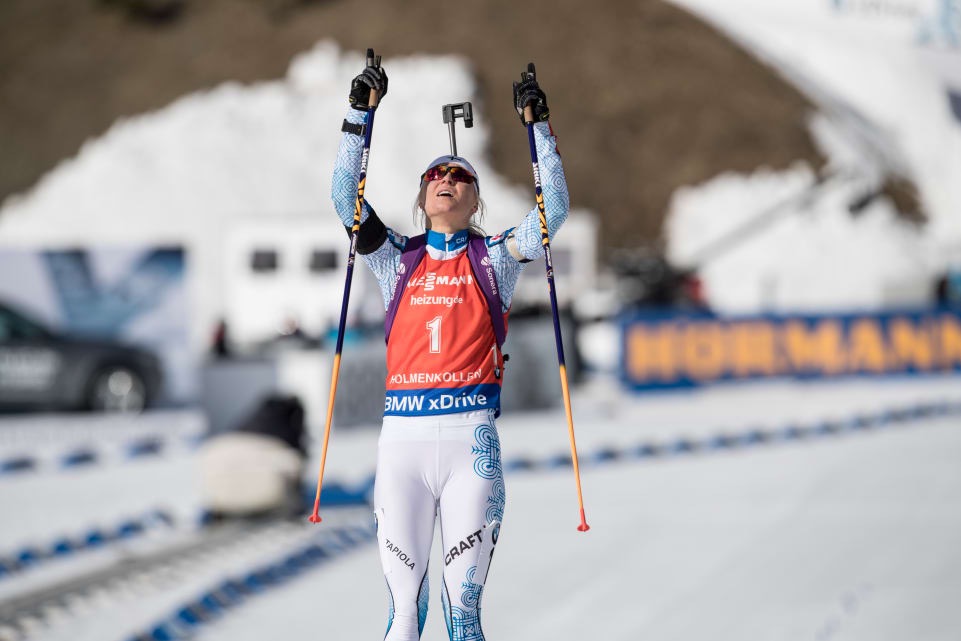
Finland’s Mari Laukkanen pointing to the sky in honor of her late shooting coach, after she won the women’s 10-kilometer pursuit on Saturday at the 2017 IBU World Cup in Oslo, Norway. (Photo: IBU)
IBU World Cup (Oslo, Norway): Women’s and men’s pursuits
Less than 24 hours after winning her first IBU World Cup on Friday in the women’s 7.5 k sprint, Finland’s Mari Laukkanen immediately capitalized on her ideal position with a start-to-finish victory in Saturday’s 10 k pursuit that was never in doubt, cleaning the first three shooting stages before incurring one penalty in her final standing shooting (0+0+0+1) to cross the line in a time of 29:33.3 minutes.
In addition to experiencing the most successful weekend of her biathlon career by far, it was an emotional day for the 29-year-old Finn due to a personal reason. Laukkanen spread her arms like wings skiing down the homestretch with a commanding lead, pointing repeatedly to the sky and a black ribbon she wore around her right upper arm, before kneeling in the snow in the finish for a few seconds. With those gestures, she reportedly wanted to commemorate her shooting coach Asko Nuutinen, who passed away Friday after suffering a heart attack during the World Cup in Kontiolahti, Finland, a week ago. He was 60 years old.
“It’s been a really emotional day for me. We have heard really really sad news that last night we lost our longtime shooting coach,” Laukkanen told reporters with a trembling voice in the press conference. “After this it was more or less only about working for him. Working as he has asked me to do for years and years. So I wasn’t thinking about losing or winning today, I was only thinking about him. And I feel really big pleasure that I was able to come to the finish like this, that I can own the victory for him.”
“I knew it will be difficult after the first victory in my career took me so long,” she added. “And to do it again immediately with good shooting. But as I said I didn’t think about winning or losing today, just doing my work.”
Finishing 26.5 seconds after her, the Czech Republic’s Gabriela Koukalová reached the finish, moving up from her fourth place starting position with a clean shooting performance (0+0+0+0).
“I wanted to miss all targets yesterday because I was so tired I didn’t even want to race,” Koukalová confided in the press conference. “It’s difficult to concentrate, three World Cups after the main goal of the season [the World Championships] is too much. Last year it was many times easier… I tried to catch her, but about one kilometer before the finish I saw her far away so I was happy I didn’t have to fight with anyone and was just enjoying the last meters.”
Despite four penalties (1+1+0+2), France’s Justine Braisaz defended the third place on the podium against a three-person chase group on the last loop (+1:01.4), falling back only one position after having finished the sprint in second.
“I did not expect such a good place today during the race,” Braisaz commented in the press conference. “Because in the last shooting I completely [failed]. I really wanted to have a clean shooting today, and I did not succeed. So I am happy and surprised, too.”
Her teammate Anais Bescond who had started the pursuit in third place fell back to 22nd position (+2:53.5) with seven penalties.
Slovenia’s Teja Gregorin finished fourth with one penalty (+1:08.2), Austria’s Lisa Theresa Hauser shot clean as the only athlete aside from Koukalova on her way to move up from 22nd to fifth place (+1:12.5), while Norway’s Marte Olsbu finished sixth like in the sprint despite three penalties (+1:15.9).
Unlike in Friday’s sprint race where Germany’s Laura Dahlmeier had still given up a seemingly commanding lead in the sprint World Cup discipline standings to Koukalova, she held onto her lead in the pursuit standings on Saturday, moving up from the 31st starting position to ninth place with a penalty in each of her standing shootings (0+0+1+1, +1:53.8). A 22nd place would have been sufficient to win the “small crystal globe” award in the pursuit. Laukkanen’s teammate Kaisa Mäkäräinen finished 8th with two penalties in the standing stages (+1:51.2), and thereby claimed the third place in the World Cup pursuit ranking.
“I knew that I didn’t need to have a perfect race today, just a good one, but that’s always easier said than done,” Dahlmeier told broadcaster ARD after the race. “I am incredibly happy that it worked out and that I could secure myself another small globe… It’s a bit of a weird feeling, standing at the start gate in the middle of the field and the clock ticks and ticks as one athlete after another skis out on the course. And you can only observe how far they have gone and have to wait and be patient, and not make a false start. But then the snow burns, then the chase begins!”
US Biathlon’s Susan Dunklee experienced an uncharacteristically problematic day on the shooting range and fell back to 37th place (+4:00.2), after starting seventh and less than a minute behind Laukkanen. Dunklee had three misses between two prone stages and seven more in her standing shootings (2+1+4+3) therefore having to ski more than an additional kilometer in the penalty lap.
“It is a testament to her fighting spirit that she notched the fourth-fastest ski time — one of her best ranks of the season — and never gave up despite suffering a biathlon blowout on the range,” teammate Clare Egan said of Dunklee, according to a US Biathlon press release. “Bad races happen to the best and Susan is no exception, but not everyone fights through till the end no matter what.”
Egan herself started the pursuit in 34th position and initally was able to make up ground, but then fell back slightly to 41st place (+4:13.9) with four penalties (0+2+0+2).
“I am satisfied with my race even though the result was not what I was hoping for, and that’s how I would summarize my entire season as well,” Egan said after the final race of her season. “I’ve made a good step forward but my competitors also work hard all summer and we seem to improve at a similar rate.”
Canada Biathlon’s Julia Ransom moved up to 47th place (+5:04.8) with three penalties (1+0+1+1), after starting in 52nd position.
[UPDATED] Later on Saturday in the last men’s 12.5 k pursuit of the season, the three best athletes of the season fought throughout the race exchanging in the lead, before they stood next to each other on the range for the final shooting to decide the winner.
Russia’s Anton Shipulin managed to shoot clean with his elaborate rifle stock in the design of a red dragon, proudly waving to the cameras as he left the arena while his two competitors had to ski into the penalty lap. France’s Martin Fourcade – who had already secured himself the overall World Cup Total Score title as well as the award for the pursuit discipline – was left to duke it out against Norway’s Johannes Thingnes Bø, the winner of Friday’s sprint.
On the last big climb before the Holmenkollen arena, Fourcade accelerated with a series of explosive jump-skate steps to decisively gap Bø. He even got fairly close to Shipulin on the finish stretch, who had slowed down a bit to grab a Russian flag before skiing over the line in a time of 32:11.9 minutes with one penalty (0+0+1+0), 5.7 seconds ahead of Fourcade who had incurred two penalties (1+0+0+1). While Fourcade shook hands with Shipulin, Bø came into the finish in third place, 21.6 seconds back and also with two penalties (1+0+0+1).
“It was a crazy race, but I am happy that I managed to finish first,” Shipulin said in the press conference through a translator. “Tough conditions on the shooting range, I had to really work to concentrate on my shooting. On the last loop I was all alone until I saw Martin chasing me, then I got a little bit scared but I managed to [keep him behind].”
It was Shipulin’s second win of the season, for which he credited his recently improved shooting performance.
“It was a really exciting competition with Johannes and Anton,” Fourcade agreed with his rival. “I expected to fight with them for the victory on the last loop, but then Anton was simply stronger in the last shooting. My strategy was to be focused on my technique and skills and not on the results, like I did too often in the past few weeks focusing on records and not the victory.”
Asked about his blazing attack on the final climb, Fourcade added: “Of course I train for that, but I think a lot of athletes do. I talked to Johannes, it was my revenge for the [2016] World Champs where he did exactly the same to me on the last uphill. But I know how it is, it can be different already tomorrow.”
“I am happy with a new podium of course,” Bø said in the press conference. “I was not at my best in the skiing today. But I still managed to shoot 18 out of 20. As Martin said it was [annoying] that we did not shoot zero [misses] and could not fight with Anton in the finish, but it was quite interesting and fun to stand there in the last shooting … I expected Martin’s attack the second he did it, but I had no energy to fight with him. That was quite strong.”
Sweden’s Fredrik Lindström placed fourth with no penalties (+44.7), and was the only man in the field who managed to shoot clean in all four stages.
“For the podium, I was never really close“, Lindström told the IBU in a post-race interview. “But it was a great day anyway. Four times zero [misses], and especially in the standing stages that makes you climb a lot in the standings. Super happy with my performance.”
US Biathlon’s Lowell Bailey, who had to start closer to the back of the field in 44th position, almost two minutes behind the leaders based on his sprint result, managed to move up 21 spots in the race despite three penalties (2+0+1+0).
“I’m happy with the race, considering it started out pretty rough with the first two misses,” Bailey told US Biathlon after placing 23rd (+2:23.3). “I just read the wind wrong and didn’t correct enough. After that, I tried to keep my head in the race and make the best of it. I was happy with my skiing and glad to clean the last stage; this brought me up nine spots and I was able to gain another in the last loop. Now, it’s just one race to go. I’m looking forward to tomorrow.”
Shooting quickly, Bailey recorded the ninth-ranked range time of the day and the ninth-fastest last loop.
His teammate Sean Doherty started 35th but fell back after having to ski six times through the penalty lap (1+3+1+1) to finish 46th (+4:05.6).
For Sunday’s mass starts as the final races of the 2016/2017 IBU World Cup season, the only qualified North American starters will be Dunklee (currently in 10th position in the World Cup Total Score standings) and Bailey (currently in eighth).
The women’s season award in the mass start discipline once more will be decided between Germany’s Dahlmeier and Czech Republic’s Koukalova, while Germany’s Simon Schempp will try to defend his narrow lead on Fourcade. But during Saturday’s final loop, the French star did consider saving energy for the final competition.
“No,” he simply quipped when asked about this in the press conference. “Of course the mass start is important tomorrow because it will decide about the [mass start] crystal globe. But I think today the pursuit was also really important, and you fight for victory and being one of the best athletes. You can’t be satisfied with only a third place when you can claim a second, and I think all athletes in my position would do the same.”
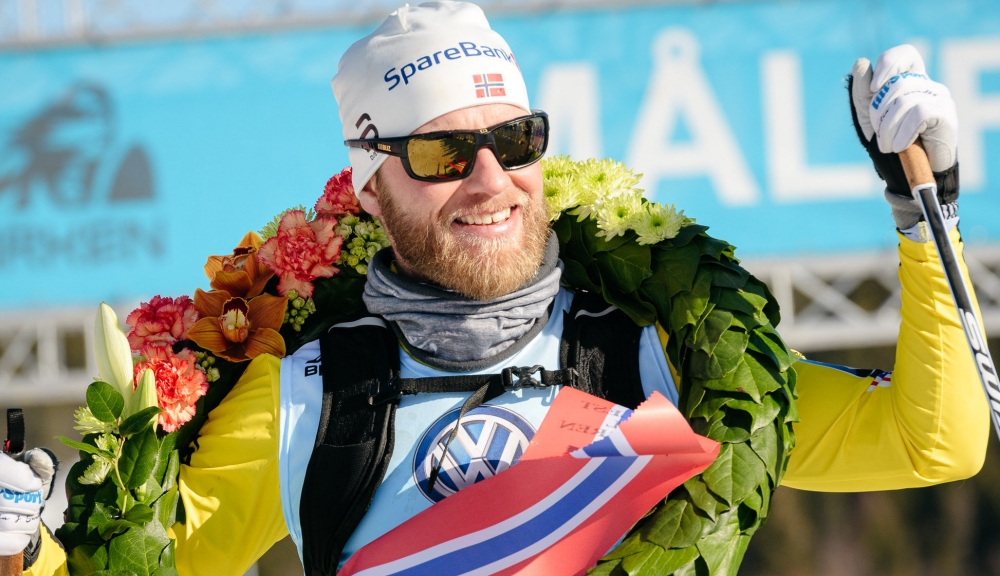
Norway’s Martin Johnsrud Sundby after winning the Norwegian 54 k classic Birkebeinerrennet, part of the Ski Classics series, on Saturday in Lillehammer, Norway. (Photo: Ski Classics)
54 k Birkebeinerrennet (Rena to Lillehammer, Norway): Part of the Ski Classics series
[UPDATED] Not even a snowmobile clipping him and sending him tumbling 20 k before the finish could keep Norway’s Martin Johnsrud Sundby from winning the Birkebeinerrennet on Saturday in Norway. Representing Team United Bakeries, Sundby set a high pace from the start and broke the group down to three by 9 k, with Petter Eliassen of Team LeasePlan and Simen Østensen of Team BN Bank sticking with him until about 30 k in the 54 k marathon.
With about 20 k to go, Sundby collided with a Ski Classics TV production crew snowmobile while trying to double pole in the snowmobile’s tracks. He was OK and went on to win by 48 seconds over Eliassen in second, and smiled about the incident after the finish.
“It came in with tremendous speed and mowed me down,” Sundby told NRK, according to a loose translation.
Ski Classics CEO David Nilsson told NRK he didn’t know exactly how that happened and emphasized that it was unacceptable.
“We always put safety first, but it is a difficult balancing act with the snowmobile at high speed to get TV pictures,” he said, according to a loose translation. “The skiers often ski in the [snowmobile] track and here it happened and somehow the driver missed it.”
While Sundby pulled out the win in 2:20:53.5 hours, Eliassen took second and Østensen followed another 3.5 seconds later for third place.
In the women’s race, Poland’s Justyna Kowalczyk (Team Santander) pulled out a 4 minute and 15 second win over Sweden’s Britta Johansson Norgren (Lager 157 Ski Team). Japan’s Masako Ishida (Team United Bakeries) was another 48.6 seconds back in third.
“I’m really happy to win this race,” Kowalczyk said, according to a Ski Classics press release. “Everything went well and the cheering on the course was amazing. I will do the rest of the races in Visma Ski Classics, but this victory was the most important for me. Of course, I want to win again in Årefjällsloppet like I did last year, but to win here in front of this audience means so much to me.”
Tord Asle Gjerdalen, who finished fourth in the men’s race, and Johansson Norgren continue to lead the overall Ski Classics standings with three races to go. The next stop is the Årefjällsloppet in Sweden on March 25.
“It was a great race and we kept a high tempo up all the way,” Sundby said, according to the press release. “I was able to use uphills for my advantage and get a gap. I had good skis, the conditions were perfect, and to win here was one of my goals for the season. I have the Norwegian Championships in two weeks, and I haven’t counted out the option of going to Finland for the Visma Ski Classics finale.”
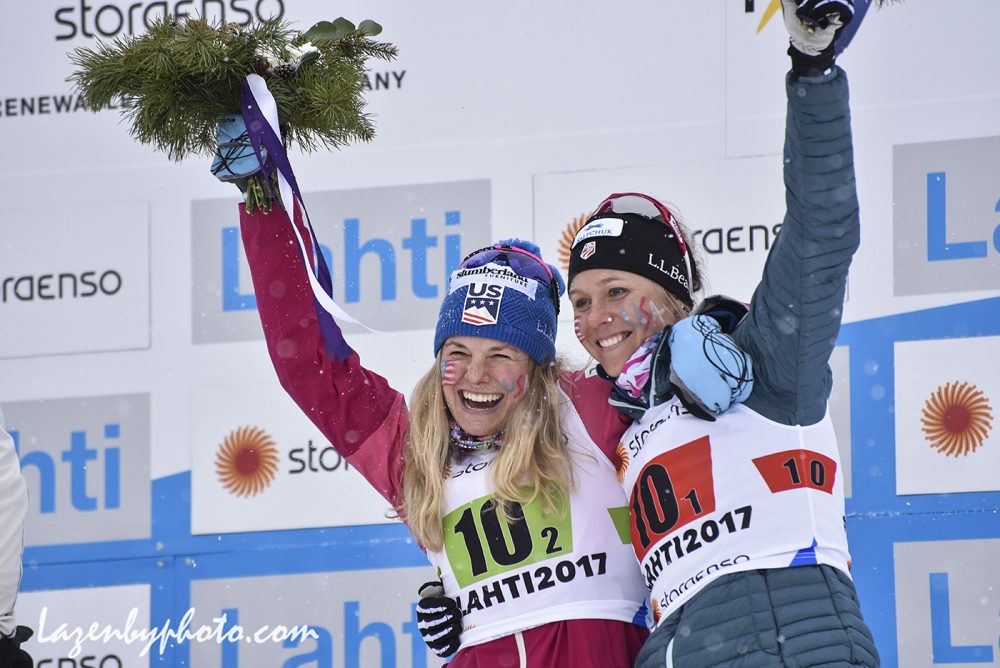
U.S. Ski Team teammates Jessie Diggins (l) and Sadie Bjornsen celebrate their bronze medal in the women’s 6 x 1.3-kilometer classic team sprint on Sunday at the 2017 Nordic World Championships in Lahti, Finland. (Photo: John Lazenby/Lazenbyphoto.com)
LAHTI, Finland — Statistically speaking, most might have bet on the Swede — particularly if it came down to a lunge to the line. After all, that’s how Sweden’s Stina Nilsson won her first World Cup sprint against Norway’s 2017 sprint world champion Maiken Caspersen Falla.
On two other occasions, Nilsson has skate sprinted to the win in a photo finish — once during last year’s Ski Tour Canada and the other during this season’s freestyle sprint in Falun, Sweden. Perhaps most memorably, it’s also how the Swede won her first classic sprint title, denying Norway of a podium at this season’s opening World Cup weekend.
Considering her finishing history, if Sunday’s 2017 Nordic World Ski Championships 6 x 1.3-kilometer classic team sprint came down to a lunge, Nilsson as Sweden’s anchor was ready.
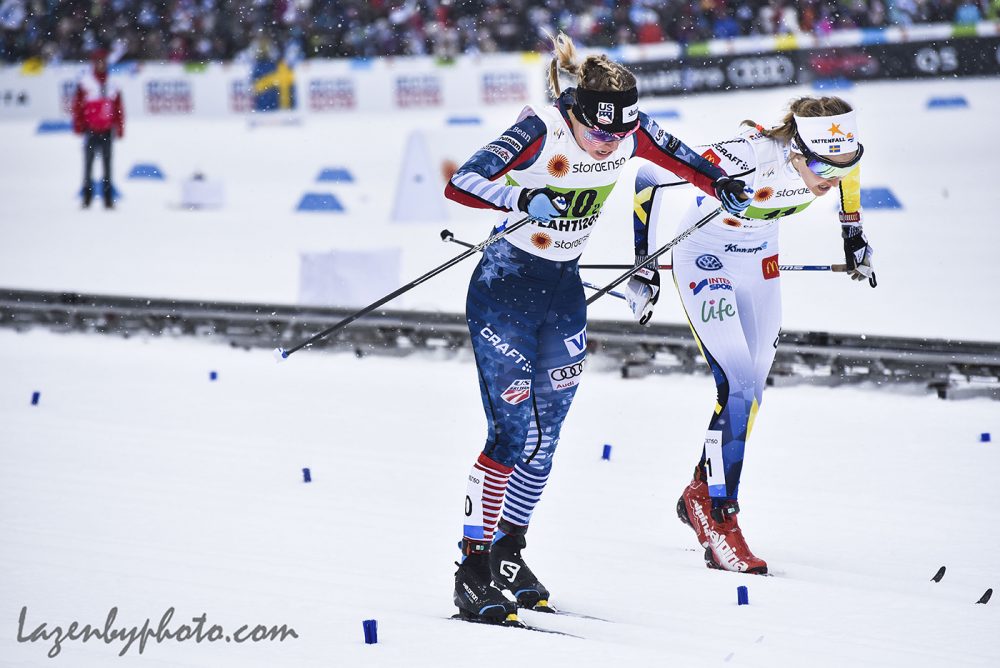
American Jessie Diggins (l) going head to head with Sweden’s Stina Nilsson (r) during the final 100 meters of women’s 6 x 1.3-kilometer classic team sprint on Sunday at the 2017 Nordic World Championships in Lahti, Finland. (Photo: John Lazenby/Lazenbyphoto.com)
And when Nilsson’s white suit cornered the final turn centimeters behind that of American Jessie Diggins, some saw Sweden on the podium with bronze.
Even less than a year ago, the U.S. saw themselves as an outside contender for the 2017 World Championships classic team sprint, according to U.S. Ski Team women’s coach Matt Whitcomb. American success in freestyle team sprints was a little more palpable after Diggins and Randall took gold at the 2013 World Championships in Val di Fiemme, Italy, while the year before that, Randall and her U.S. teammate, Sadie Bjornsen finished second during a regular World Cup event in Düsseldorf, Germany.
The U.S. team’s best team-sprint result following 2013 World Championships was fifth in last year’s freestyle team sprint in Planica, Slovenia, with Sophie Caldwell and Ida Sargent. Never before had the U.S. women medaled in a classic World Championships event.
“This was an event that, in April, we talked about as an outside medal shot,” Whitcomb said after Sunday’s race.
With that in mind, the team started brainstorming of a way of “coming from some sort of surprising attack” when the time came in Lahti.
“This was a team that has been in the making for a while,” Whitcomb said of the eventual Lahti Word Championships classic team-sprint combo, Bjornsen and Diggins. “Once we knew [Bjornsen] was healthy. We had her specifically skip the skiathlon because we thought with a little extra rest, she could be that much sharper. But we had four other women that were up for serious consideration for this spot and we didn’t make the call until yesterday afternoon at 2:25 p.m.”
Whether they made the right call would not be determined until a little less than 12 hours later: in the final 100 meter showdown between Diggins and Nilsson.
But while the Swede appeared to have experience on her side, drafting off Diggins until the final turn and pulling around to her right within the finishing stretch, the American showed no signs of letting up. With every pole Nilsson took, Diggins poled a centimeter further. Finally, with nineteen hundredths of a second to spare, Diggins crossed first, holding off Nilsson and securing bronze for the U.S.
“I was happy it didn’t just come down to a walk-through medal,” Whitcomb said. “[Bjornsen and Diggins] felt the pressure of being selected for this team and … they’ve awarded everybody that could have been on it.”
Bjornsen’s First, Diggins’s Fourth: Bronze Medals in the Making
Sunday’s bronze medal marks Diggins’s fourth World Championships podium, a record for the U.S. She now has two team and two individual podium finishes in three world champs — half of those coming from this week in Lahti.
However, Diggins is adamant that her medals would not be possible without her teammates. And with regards to the team events especially, the 25-year-old Minnesota native is right.
Two of the three laps Bjornsen skied for the team were the fastest recorded for the first-leg skiers.
Bjornsen, 27, led the entire field coming into the exchange after her first lap, pulling the likes of Russia’s Yulia Belorukova, Norway’s Hedi Weng, Sweden’s Ida Ingemarsdotter, and Finland’s Aino-Kaisa Saarinen behind her.
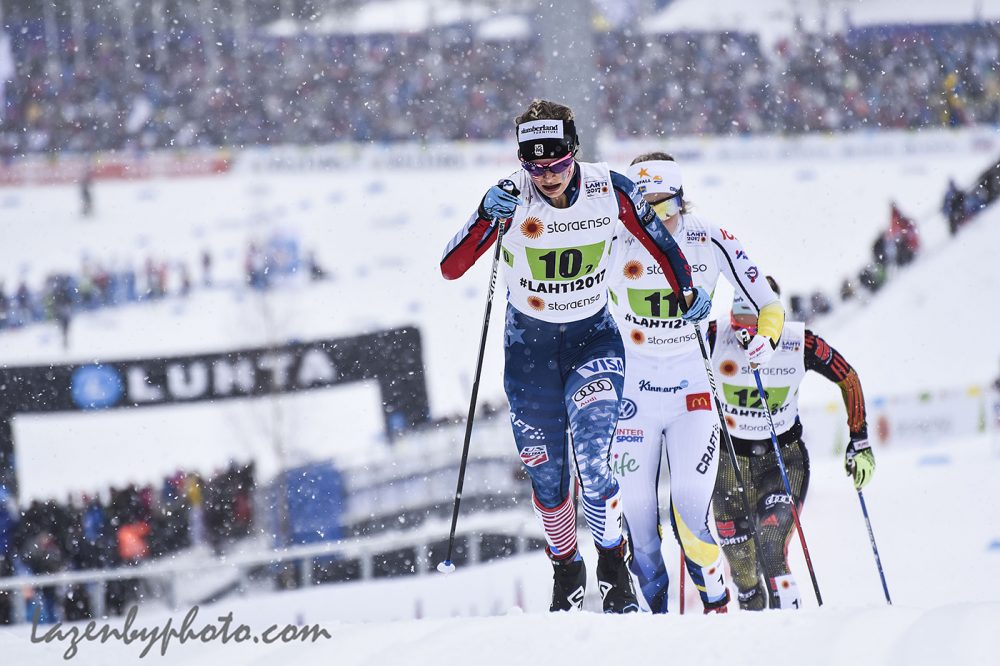
American Jessie Diggins (10) leads Sweden’s Stina Nilsson (11) and Germany’s Nicole Fessel (12) during the first climb of the women’s 6 x 1.3-kilometer classic team sprint on Sunday at the 2017 Nordic World Championships in Lahti, Finland. (Photo: John Lazenby/Lazenbyphoto.com)
After her third lap as well, Bjornsen was first through the exchange, putting Diggins in the front for the first climb of the final lap, just ahead of Russia’s Natalia Matveeva and Germany’s Nicole Fessel.
“Both of us were very strong in the first hill,” Bjornsen said of her and Diggins.
Both women strode evenly through the first climb of every lap.
It was in the second climb, where the pitch made the switching to herringbone requisite for most skiers, that both Bjornsen and Diggins indicated they found themselves losing time.
“Herringbone isn’t my particular strength,” Diggins explained.
Instead, the American emphasized areas where she would excel: the downhills and flats.
“[I was] just thinking ‘go, go, go, go, go!’ on the herringbone, and then reel them in on the double-pole and on the downhills,” Diggins added.
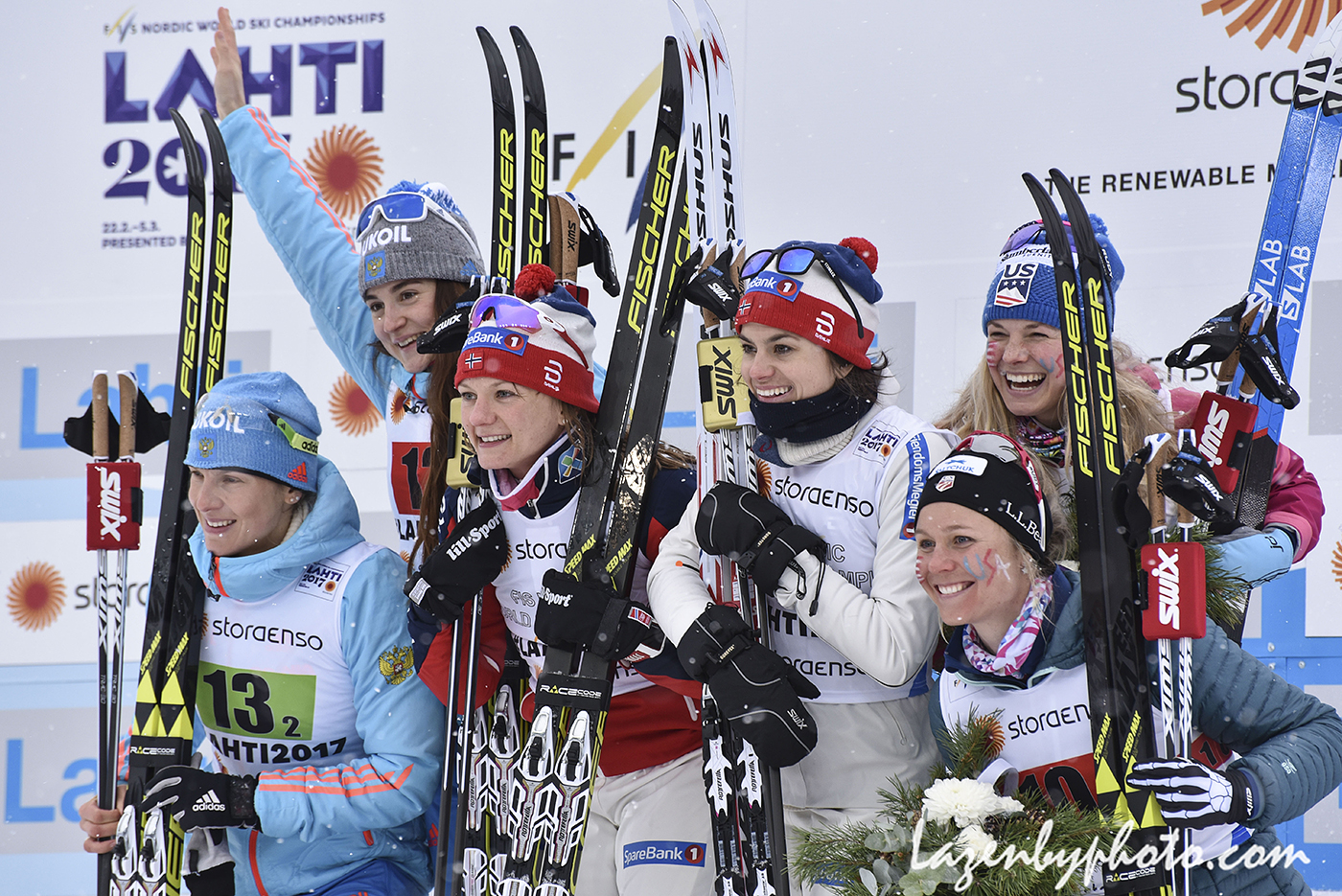
The 2017 Nordic World Championships classic team sprint podium on Sunday in Lahti, Finland, with Norway’s Maiken Caspersen Falla and Heidi Weng in first (c), Russia’s Natalia Matveeva and Yulia Belorukova in second (l), and Sadie Bjornsen and Jessie Diggins in third (r). (Photo: John Lazenby/Lazenbyphoto.com)
Diggins did just that by her final lap, regaining contact with Nilsson by the final descent back into the stadium and passing her by the final turn. She held off the Swede for third and crossed 18.6 seconds behind Falla, who clinched gold for Norway with a time of 20:20.56 minutes.
“To go with Maiken is a dream for me,” Weng said during a press conference. “She was just flying there. I was yelling at her. So I’m so happy today.”
Russia’s Belorukova and Matveeva finished second, 5.56 seconds behind Norway to take silver. This being Matveeva’s fifth World Championships, the 30-year-old Russian expressed gratitude at finally finding the podium, especially after crashing and missing out on the final in Thursday’s freestyle sprint.
“It’s really great to finally have a medal from this championship,” Matveeva said during the press conference via a Russian translator.
Though the world-champs medal is Bjornsen’s first, it’s not the first time the thought has crossed her mind. A Washington state native, Bjornsen indicated she has been targeting a world-champs podium for quite some time. The chance to do so in the classic discipline, her preferred technique, was also surreal.
“I have been dreaming to be on a team sprint at World Championships or Olympics for a while now and it’s so cool to finally be here,” Bjornsen said after the race. “I think it’s finally sinking in, because I feel like I just wanna cry.”
Despite it being Diggins’s fourth medal, she explained this one had no less meaning than the any of the rest. With her other world-champs podiums in the skating disciplines, she sees the classic team sprint bronze she earned alongside Bjornsen as a sign of her growing abilities as an all-around cross-country competitor.
“For me, this is one of the most exciting ones, because as Sadie said, it’s in classic,” Diggins said.
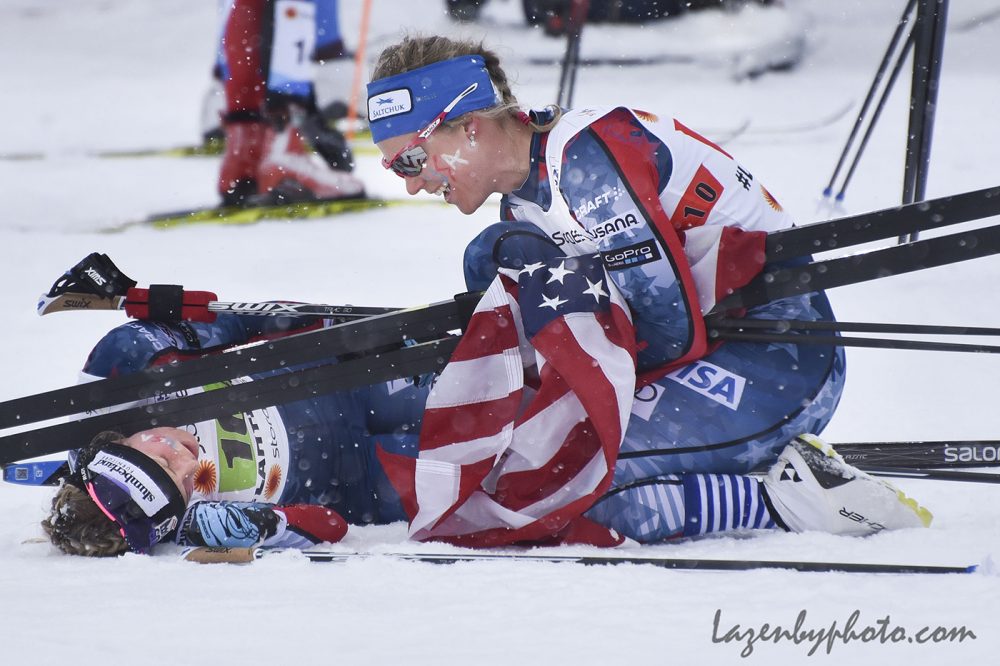
Sadie Bjornsen (r) tends to her U.S. teammate Jessie Diggins after Diggins outlunged Sweden’s Stina Nilsson (not shown) for the bronze medal in the women’s 6 x 1.3-kilometer classic team sprint on Sunday at the 2017 Nordic World Championships in Lahti, Finland. (Photo: John Lazenby/Lazenbyphoto.com)
“And I don’t want to be just a skater, or just a 5 k skater,” she added. “I want to be able to do it all, and do it with my team and do it for the team. So this is really pretty special for us.”
Further reflecting on the race, Diggins saw her move to drop out of Saturday’s skiathlon as playing a role in her eventual podium on Sunday. Though her intent in the 15 k skiathlon had originally been to aim for top-three finish, upon realizing she was out of contention she made the decision to stop racing. Almost halfway through the race, she saw she stood a better chance at medaling in the team sprint by saving herself and not pushing through the event’s skating portion.
“At the halfway point I had a choice to make — dig deep for a race that wasn’t going to be close to what I felt I was capable of or stop and save everything for the team sprint,” Diggins wrote in an email on Sunday after the team sprint, referring to her skiathlon effort.
Even if the decision was hard, the youngest U.S. World Cup team member made it without any outside advice. In retrospect, her foresight to forego finishing the race appeared accurate after Sunday’s result.
“I had to trust my gut because I believe so much in Sadie and that we had a chance to do something amazing together, and for me, the team event will always come first! And today looking back, I absolutely confirmed that it was the right choice because when Stina went on that climb I was able to follow and catch up, and have that extra gear in the finishing lanes!”
The other North American women’s team competing on Sunday, Canada’s Cendrine Browne and Dahria Beatty finished the day in 13th, after missing a spot in the final by two places. They finished seventh in the first semifinal.
While they didn’t advance, the two Canadian National U25 Team members were pleased with the effort and the progress they see the team as having made over the season and during these championships.
“We pretty much always have someone who has a good day personally, whether it’s a strong result or they just felt really good,” Beatty said after. “It’s nice to have those takeaways so that when I have a bad race, someone else had a good race and you can kind of talk to them about what they did right on the course.”
In future team sprints, too, the two see Canada as one day in the mix.
“I think it will be possible to qualify eventually,” Browne said. “I think we were pretty close on that first and second lap. And I think we’ll get faster and we’ll be competitive at some point. So it’s positive.“
— Jason Albert, Harald Zimmer, Chelsea Little, and Alex Kochon contributed
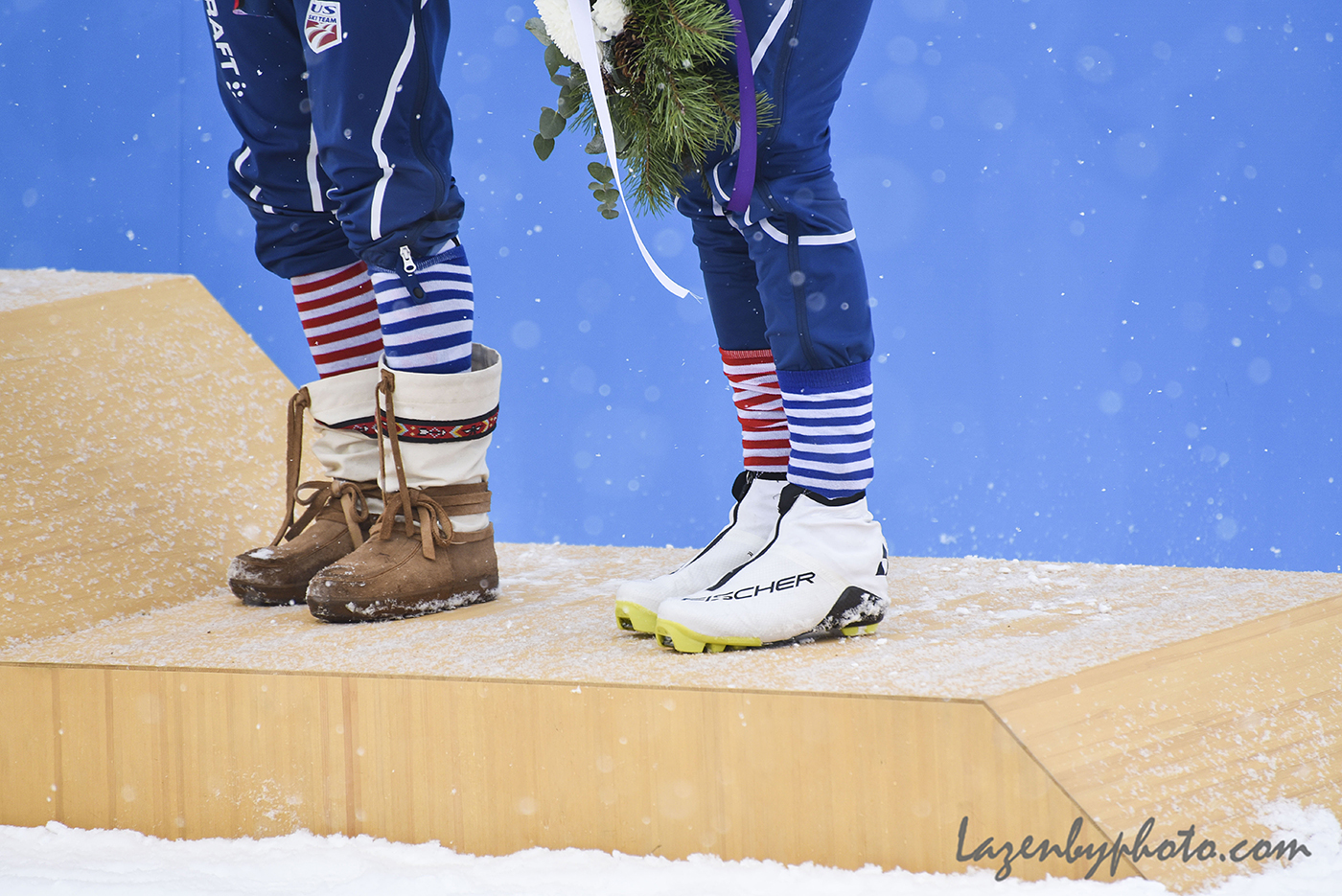
The iconic U.S. women’s relay socks, belonging to Jessie Diggins (l) and Sadie Bjornsen (r), standing on the third step of the women 6 x 1.3-kilometer classic team sprint podium on Sunday at the 2017 Nordic World Championships in Lahti, Finland. (Photo: John Lazenby/Lazenbyphoto.com)
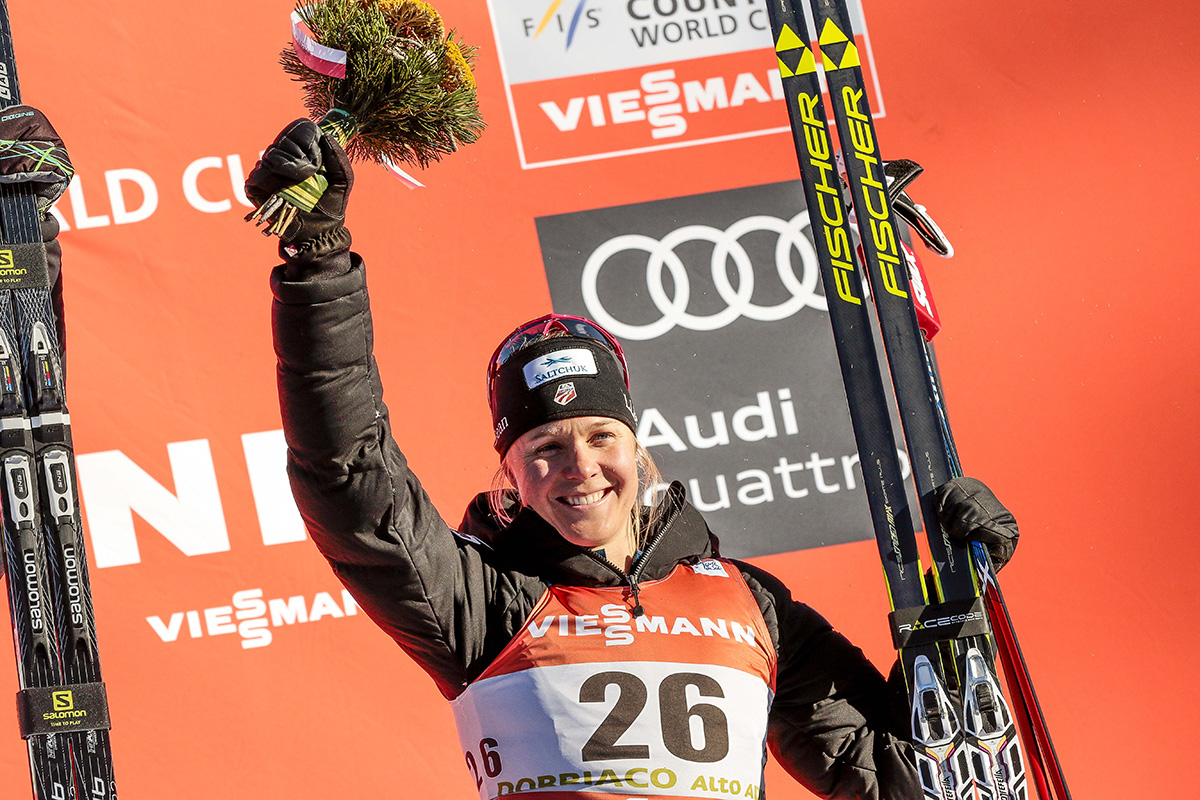
The women’s podium at the 5 k freestyle on Friday at Stage 5 of the 2017 Tour de Ski, with two Americans: Jessie Diggins (c) in first and Sadie Bjornsen (r) in third, and Finland’s Krista Parmakoski in second. (Photo: Fischer/NordicFocus)
Lining up at the start of the women’s 5-kilometer freestyle individual start on Friday, it was a different Jessie Diggins than a year ago. Here the American was, again in Toblach, Italy, again in the third-to-last stage of the Tour de Ski, again about to race another one of those rare formats on the World Cup circuit: the 5 k individual.
But this time last year, she had never won a World Cup, let alone reached the podium in an individual race. Thirteen minutes later (well, more than that, after all of the 5 k racers had finished), that all changed.
This time around, reporters asked her leading up to the 5 k freestyle whether this race was hers to lose. She joked that she was shooting for a top 23.
“I did feel that I was working hard to not put a lot of pressure on myself,” Diggins recalled on the phone after Friday’s race, Stage 5 of the 2017 Tour de Ski. “… Of course I want to go out there and win. I believed in myself, I believed in the team, I believed in the techs, so I knew that if everything went well, I knew I could win. But I didn’t want to make this bigger than big, crazy, pressure-filled day.”
So she woke up and went for a jog, “did a little happy dance,” and prepared as she would any other race day.
“When an athlete is in the top five, you get asked some pretty aggressive questions,” U.S. Ski Team Women’s Coach Matt Whitcomb said on the phone after Friday’s race. “They just want to focus on skiing the best race possible, but the media is asking you if you plan to defend your title. So I think [Jessie has] developed a really professional approach to some of the harder questions that she’s getting asked in these flash interviews just before the races. She’s saying, ‘Yeah, I do plan to defend my title,’ but just because you say that, it doesn’t mean you’re betting your house. You’re identifying that you are going to go out there and race with all you have.”
Per her request, Diggins started 12th on Friday in a field of 40 women remaining in the Tour.
“I asked the coaches to start me as early as possible for no other reason than I didn’t want splits,” she recalled. “It didn’t matter to me. I just wanted to go and race.”
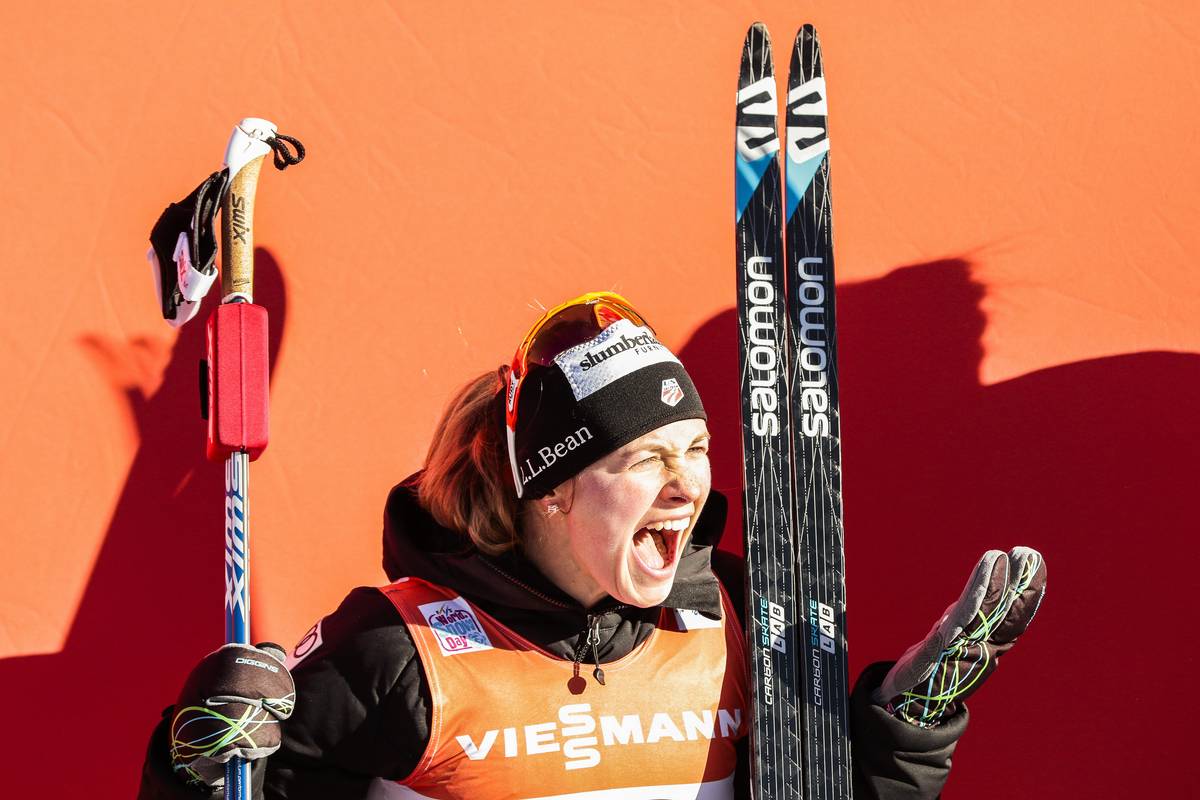
Jessie Diggins (U.S. Ski Team) racing to first for her third-straight 5 k freestyle victory on Friday at Stage 5 of the Tour de Ski in Toblach, Italy. Diggins won her first World Cup race in the Toblach 5 k one year ago. She remains fifth in the Tour standings with two stages to go. (Photo: Salomon/NordicFocus)
One 5 k lap and 12:45.6 minutes later, Diggins finished as the new race leader, 14.9 seconds faster than Sweden’s Charlotte Kalla in bib 10. It was almost exactly 30 seconds faster than Diggins’s time on the same course last year.
She was psyched, but had no idea if it would be fast enough to stay in first. Either way, she had to race again the next day, so Diggins proceeded to gather her clothes and begin her recovery routine, starting with a snack.
By the time Diggins returned to the finish area, she realized that her time not only stood, but her fellow U.S. Ski Team member Sadie Bjornsen was contending for a podium as well. Bjornsen started 26th and initially finished second, 0.3 seconds ahead of Kalla and 14.6 seconds behind Diggins. By the time Diggins reached her teammate, Bjornsen was third after being bumped by Finland’s Krista Pärmäkoski, who was still 13.6 seconds off Diggins’s time.
“I came back just as Krista finished and bumped her down one, but we were still just like, it’s gonna happen, it’s gonna happen,” Diggins said of Bjornsen’s first career podium. “And we were just so excited, jumping up and down. I hugged Sadie and she started crying and then I started crying. It was so cool because if the whole team can celebrate like that … when you win by yourself, that’s fun, and people are psyched and stuff. When more than one person’s on the podium, then the whole team really celebrates. It’s a different feeling and it’s way cooler and I love it a lot.”
Sadie Bjornsen (U.S. Ski Team) after placing third for her first career World Cup podium on Friday in the 5 k freestyle at Stage 5 of the Tour de Ski in Toblach, Italy. She is now ninth in the Tour standings. (Photo: Fischer/Nordic Focus)
“At first I couldn’t believe it,” Bjornsen recalled on the phone about her third-place finish, which became official not too long after she celebrated with Diggins.
“Two months ago, I was struggling so much that I wasn’t sure if I would be starting on the World Cup,” she said of painful bone spurs in her heels. “The emotions of what it took to get there comes to you at that point. … I had to wait till Heidi [Weng of Norway] came in to seal the deal.”
Bjornsen’s reality began to set in once Norway’s Ingvild Flugstad Østberg (who entered Friday ranked third overall in the Tour) finished seventh, 8.9 seconds off Bjornsen’s time and 23.5 seconds behind Diggins. Then the last starter, Norway’s Heidi Weng (previously ranked second in the Tour) crossed the line in fifth, 2.9 seconds slower than Bjornsen and 17.5 seconds off Diggins’s winning time. That bumped Østberg to eighth (and subsequently everyone else after Weng down one place as well).
So that was that. Diggins defended her victory in the Toblach stage one year later and notched her third-consecutive 5 k win, which ties the record set by Russia’s Elena Välbe in the 1990s (for the most 5 k freestyle victories in a row), according to an International Ski Federation (FIS) press release.
Also of note, Friday marked the 17th World Cup win for the U.S. women’s team. According to FIS, 13 of those wins came in sprints. The four others were a 3 k freestyle prologue (won by Kikkan Randall at the 2012/2013 Tour de Ski) and now three 5 k skate races (all won by Diggins in the past year).
“The skill we are all trying to accomplish, to acquire, is to become a faster ski racer, and also how to win, and how to be not such an emotional and taxing process,” Whitcomb explained. “It’s a big deal. There’s a lot of responsibilities along with success, so the difference between [Diggins] this year and last year is her dealing with these little pieces of the equation that come with being a ski racer, and particularly a successful ski racer.”
As for Bjornsen’s podium, he said that was expected.
“Not in a way that would put pressure on Sadie, but in a way that … we believe in her,” Whitcomb said. “She’s an incredible competitor. For it to finally come together in an individual race, Sadie’s been on the podium numbers of times [in team events] and with teammates. To have it happen in a distance event, in an individual race, that’s very special.”
“It feels so good to get my first individual podium… but even more special to get that first one with a teammate on top,” Bjornsen wrote in an email. “All the girls on this team are an inspiration to me. We are dreamers, but we are also believers. It’s crazy how much confidence you can get from a teammate’s success if you allow yourself to stand beside them.”
‘What Would Jessie Diggins Do?’
Jessie Diggins celebrating her third career win (in three-consecutive 5 k freestyle races) as well as double podium for the U.S. women with teammate Sadie Bjornsen (not shown) in third on Friday at Stage 5 of the Tour de Ski in Toblach, Italy. (Photo: Salomon/Nordic Focus)
In terms of the 5 k itself, it was one you couldn’t attack like a sprint. Or else you’d die, Diggins said. Then she laughed. “Well, probably not die, but you know, I’m feeling dramatic at the moment,” she jested.
Same ol’ Diggins after all. At 25, the Minnesota native simply has seven more podiums and three more wins than she did before last year’s Toblach 5 k.
All kidding aside, Diggins said it was important to be mindful of Toblach’s altitude, some 4,500 feet above sea level. Also, the first half of the course is a bit of a grinding, winding uphill, she said.
“If you finish the very first climb, and you’re like, I nailed it, now I really need to tuck for a minute, you don’t get that [in Toblach],” Diggins said. “So I guess you do have to ski each section fast, but with enough gas in the tank that you can finish hard.”
Before the race, Diggins made a plan that included breaking the course into sections and attacking every part of it to the best of her ability.
“Instead of thinking about splits or worrying about what anyone else was doing, I was just thinking, right now I need to V2 this climb as well and technically good as I can, and then I’m going to corner on the fastest part of the snow possible, and then I’m going to ski this downhill in a tiny tuck,” she reflected. “Just really dissecting the course, and focusing on each second. I guess Matt [Whitcomb] would probably call that being in the flow.”
Diggins found her rhythm, as did Bjornsen, who came close to a podium three days earlier with her previous career best of fifth on Tuesday in the Stage 3 skiathlon.
Sadie Bjornsen (U.S. Ski Team) racing to her first career World Cup podium on Friday at Stage 5 of the Tour de Ski in Toblach, Italy. She placed third in the 5 k freestyle. (Photo: Fischer/Nordic Focus)
“All this time, it’s like, I know I can do that, it’s just a matter of doing it,” Bjornsen said.
She had been waiting for this moment all her life, but felt particularly ready for a breakthrough after getting sick in France in mid-December. Then at Stage 2 of the Tour de Ski in Val Müstair, Switzerland, she said she went out to win the 5 k classic mass start, but ended up 35th, outside the top 20 for the first time this season. Bjornsen said she “exploded” because of the altitude, which crushed her confidence.
“I had to work hard to get mentally back in the game and that confidence from that fifth was huge for me,” she said of Tuesday’s 10 k skiathlon. “And I was like, that’s crazy in skating that I can be that strong. After that I was like, I should believe in myself.”
Throughout the race, she told herself two things: “Stay strong Sadie,” and “What would Jessie Diggins do?” Bjornsen wrote. “There is so much work on the second half of the race, and Jessie is just amazing at being strong on that section … so I was imagining her the whole second half in front of me, and it seemed to have worked”
A year ago, Bjornsen blew up on this course and hung on for the second half for 13th at the finish. Not too shabby, but she had been out to win.
“Last year I told people, ‘I’m going out there to win,’ and at the time that was maybe a little bit of a joke because I hadn’t had too much skating success…,” she said.
This time, she decided to have more of a plan and told herself Friday’s race would be 12 minutes of solid work without any rests. Mostly, she told herself to back off slightly early on. At one point, she was concerned she started too hard.
That made Bjornsen laugh later on Friday as she considered her splits. At 1.6 k, her time ranked 10th and by 2.1 k, she was 12th overall. But by 3.4 k, she was back in the mix in fifth out of the 40 finishers. (Diggins paced it similarly, with the seventh-fastest split at 1.6 k and fourth-fastest at 2.1 k, before taking the lead for good at 3.4 k.)
“I finished and I was like, hmm, I wonder how that went,” Bjornsen said, after specifically requesting no splits during her race, like Diggins. “I wanted to go out there today and see how strong I could be inside my head. I love this course, but pacing is important, and I wanted to do my own thing.”
Then she saw Randall’s husband Jeff Ellis, who conducts televised post-race interviews for FIS, at the finish. He showed her the live results on his phone. Bjornsen couldn’t believe it. She sat down, and a few moments later she started walking out of the finishing pen.
“One of the [finish-area officials] told me I should stick around and I was like, ‘Really?’ I didn’t think that was necessary,” Bjornsen recalled.
Then Østberg finished, and she realized her result was for real.
The women’s podium at the 5 k freestyle on Friday at Stage 5 of the 2017 Tour de Ski, with two Americans: Jessie Diggins (c) in first and Sadie Bjornsen (r) in third, and Finland’s Krista Parmakoski in second. (Photo: Salomon/Nordic Focus)
“We were just so giddy,” Diggins recalled of the moments following the race, including a cool-down jog together before standing on the podium. “… I remember how psyched she was for me last year when I got my first one, and I was so psyched for her. It was cool to share that experience.”
They shared that moment with the rest of their team as well.
“As one of the U.S. coaches, as you approach the media zone, people just make way for you,” Whitcomb said of the experience of having an athlete, especially two athletes, on the podium. “They move their huge television cameras so you can experience a piece of that podium, and make sure you get your little picture on your iPhone, too, and having the opportunity to share it with them.
“What’s also special … what makes our team different the most, is right behind me, hopping over fences is Rosie and Liz and Kikkan, who managed to see the podium ceremony as well,” Whitcomb said of U.S. women’s team members Rosie Brennan, who placed 23rd (+43.3), Liz Stephen, who placed 32nd (+49.7), and Randall, who placed 40th (+1:38.6), on Friday.
“You don’t see other teammates out there very often; that’s something we take a lot of pride in, making sure to really take a moment to celebrate the success of your teammates,” Whitcomb said. “It’s easy to say, but hard to do.”
Brennan reflected on her first glance at the live results. When she got as far down as Bjornsen, she stopped before finding her own name.
“At that point, Sadie was sitting in second and Jessie was winning,” Brennan said on the phone. “I was like, ‘Oh my god!’ It was crazy ’cause literally in that second, it was the best my legs had felt all day. I got a flush of really good feelings, so then I ran back out to find them. So I didn’t know how I finished until much later.”
Beyond being incredibly excited for both her teammates, Brennan said it was inspirational seeing her year-round training partner at Alaska Pacific University, Bjornsen, finally reach the World Cup podium.
“I know how hard she works for it, and I know a lot of the challenges that she’s had to overcome to get there,” Brennan said. “It gives me a huge sense of confidence because I train with her … and I know that it’s possible for all of us to be there, and it just makes me believe in my program and what we have going on. It’s huge for everybody.”
During the women’s race, Bjornsen’s younger brother and teammate, Erik Bjornsen, was in the car en route to the next World Cup stop in Val di Fiemme, Italy, with teammate Noah Hoffman, but followed the live timing online.
“I kind of feel like I won today just because Sadie had such an outstanding race!” Bjornsen wrote in an email. “I’ve pretty much trained beside her since we started taking this sport seriously. I’ve seen her make steady improvements over the years, but this summer/fall she took another big step in her skating. I’d never seen a girl ski that nicely and I knew she was going to get some podiums this year. … She’s a ridiculously dedicated and hard worker, she deserved that result more than anyone!”
“It was an incredible day,” Stephen wrote in an email. “Seeing anyone’s first individual podium is always a really special thing. Sadie has worked so hard on her skating and distance skiing and to see it pay off is really amazing, and it will not be her last. As for Jessie, Toblach is decidedly her course! Two years in a row taking the win, and today by a wide margin is a pretty fun thing to see. Our girls are on fire and it is a momentum for the team to latch onto for sure.”
Weng New Tour Leader, Diggins 5th, Bjornsen 9th
Overall, Diggins kept her spot in fifth in the Tour, 1:23.3 seconds behind Weng as the new Tour leader with two stages in Val di Fiemme to go. Østberg is up to second overall, 11.1 seconds back, and Sweden’s Stina Nilsson slipped to third (+16.3) — after starting in the Tour leader’s bib — when she finished 20th (40.5 seconds behind Diggins).
Pärmäkoski remains in fourth overall, 36.8 seconds out of first and 20.5 seconds off the podium.
In an interview with iltalehti.fi, Pärmäkoski said she was surprised to be on the podium and felt it was more of a reflection of others being tired. Either way, she said a podium on Friday was an important step in her quest for a top overall finish.
“The weekend, with respect to everything, is open,” she said, according to a loose translation. “But the chances are good.”
“I guess I never expected to see that,” she said. “I mean you hope and you dream, and you train your butt off, but that was definitely a crazy thing, to realize that I could win by [not] just squeaking through, and I’m still trying to process that I guess.”
Bjornsen picked up three places for ninth overall in the Tour, 3:18.1 out of first and 6.8 seconds behind Germany’s Nicole Fessel in eighth.
“I’m just trying to think about each day individually,” Bjornsen said, “because as soon as I start thinking about overall, I get too nervous. Tomorrow’s another awesome race for me so I’m excited. I’m trying to conserve energy through this exciting time.”
The women race a 10 k classic mass start on Saturday followed by a 9 k freestyle hill climb up Alpe Cermis on Sunday to end the Tour.
“Every race is totally different. It’s a new opportunity, a new chance, so I’m going to go out tomorrow and go as hard as I can,” Diggins said. “I know that my fitness is in a great place. I have belief in myself that way. I think I just need to be focusing on my technique, as always. It was really weird, I had people ask me, ‘Will you be conservative tomorrow before the final [hill climb]?’ And I’m like, ‘When do you ever start a race and not plan on giving everything you have?’ I’m definitely going to go out there and race as hard as I can, and do my best, and then after, I’ll recover and then I’ll look forward to the next stage.”
Brennan Back in the Points
Also on track to finish out the Tour, Brennan notched her best result of the first five stages in 23rd, 43.3 seconds back from Diggins. Her split times were consistent, yet gradually faster, clocking in at 27th, 24th, and 23rd overall after she started 15th, a minute and 30 seconds after Diggins.
“We had really good skis … and I’ve raced this course quite a few times now, so I guess I had some familiarity with how it works, kind of how I wanted ski it,” Brennan said. “My legs felt absolutely horrible all day today. I was just trying to not think so much about how my body felt because it’s an individual start and you never know what’s going to happen. … I had no idea how well I was doing … and it worked out. It was great.”
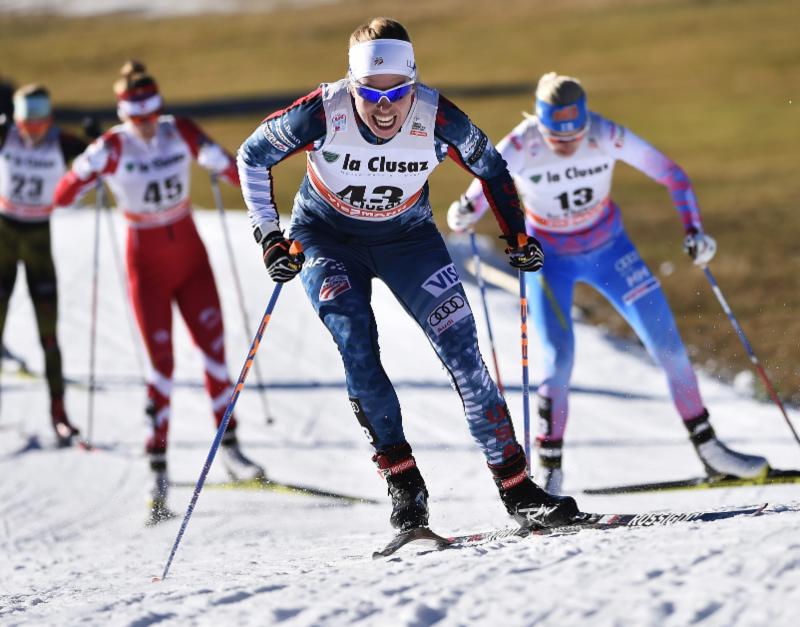
U.S. Ski Team member Rosie Brennan (43) racing to a season-best World Cup result of 22nd in the 10 k freestyle mass start on Dec. 17 in La Clusaz, France. (Photo: Toko/NordicFocus)
Previously this season, Brennan placed 22nd in the 10 k freestyle at the World Cup in La Clusaz, France. That cemented her decision to stick around for the Tour de Ski.
“I really like the Tour format, it’s something that I think suits me pretty well, so it was definitely something that I had on my goals for the year,” she said.
“I’ve had a pretty rough Tour, and the last two days in Oberstdorf were particularly rough for me, and I was starting to wonder what the hell was going on,” Brennan explained. “I tried to start over fresh and just try to be like strong in my head, so I was really glad to see that I still had that, and that works, and I still had something in me.”
“We have two more days of racing so I don’t know how that will affect it,” she said of her overall World Cup standing. “It depends on how I do and how the people around me do. Any day you can score points, it’s going to help you.”
According to Whitcomb, he and Brennan discussed World Championships qualifying the night before.
“Last night we talked, just kind of cleared the air and discussed how qualifying for World Championships is a stressful thing, and the fact that we had made the commitment to this tour, which means that you can’t go home and try and prove it at nationals anymore, you’re in it,” Whitcomb said. “Rosie went into this race trying to focus just on it, through a fresh lens, without the stress of the disappointing races she’s had so far in this tour. .. It’s one thing to say what you’re going to do, but to actually execute it is challenging.
“I think she did that today, and skied fantastically,” he continued. “It was really impressive also to watch her work the downhills and generate speed on false-flat downhill sections … areas where someone like Jessie can really crank, that’s not one of Rosie’s strengths. Her jam is the gradual uphill … It was almost one of the most satisfying races of the day, for our team, was to see Rosie break out like that. … However World Championships selection shapes up, she’s certainly gotten two very competitive results. She’s feeling better about herself going into tomorrow.”
Liz Stephen (U.S. Ski Team) racing at the Lillehammer World Cup last month. (Photo: Toko/NordicFocus)
The fourth U.S. woman continuing on in the Tour, Stephen finished 32nd to move up one spot to 25th (+5:01.7) overall.
“I was shooting for a top 20 today, but was satisfied with my position, given how hard I skied and how mentally engaged I was today,” Stephen wrote. “My overall standing in the Tour this year is not where I would like it to be, but it is not over and I won’t stop trying to catch people until we cross the finish on the top of Cermis!”
Randall finished 40th to slip from 10th to 22nd overall (+4:44.9). On the rest day before Stage 5, Randall decided she would be finished with the Tour after today.
“I actually felt pretty good going into today’s stage,” Randall reflected in an email. “I had a good ski yesterday and felt fresh on my jog last night. It’s been fun to race back-to-back just to get so many opportunities to race and work on getting the feelings back. My body has seemed to handle it pretty well but maybe today was one race too many.”
Kikkan Randall (U.S. Ski Team) finishing Friday’s 5 k freestyle in 40th at Stage 5 of the Tour de Ski, which put her 22nd overall. The night before, Randall planned to withdraw from the Tour after that stage in Toblach, Italy. (Photo: Fischer/NordicFocus)
Her plan all along had been to stop after the fourth or fifth stage of the Tour.
“I decided yesterday that I would stop after today’s stage and rest up for next weekend’s sprints here in Toblach,” Randall explained. “It was actually a little harder decision to stop than anticipated since my overall result in the tour was going so well. But I felt that a partial tour and sprints next weekend would be the best prep for my biggest goals of the season in Lahti.”
Randall will spend the next week in Toblach preparing for the next weekend’s regular-season World Cup individual and team sprints there Jan. 14-15.
“This season is really a big experiment to see how my body returns from having the baby,” she explained. “I’m happy with some of my results here during the tour in which I felt better race feelings coming around. My biggest goals of the season are still focused on finding top form in the world championships and all the decisions around racing are being geared towards then.”
Whitcomb reiterated that the team “took a gamble” in choosing Randall for the Tour.
“She had not scored any points before the Tour de Ski, so we saw it as more of an investment in her winter, to get her these starts, that fixed start position,” he said. “It meant that other skiers who had scored World Cup points were not able to be selected, but that’s one of those decisions that’s painfully hard to make, and I think Kikkan really made the most of it with having some really breakout results, and we feel good about things.
“The goal of the Tour de Ski, for Kikkan and a few of these other people, is not necessarily to finish it, but to have some great races and to use it in what ways we can to prepare for the later in the season,” he continued. “Most specifically, the World Championships. The Tour de Ski is, for a lot of these athletes, is a separation tool we use to build some fitness, and then recover, and move into Period 2.”
“We’ve known Jessie would be strong in this race but I’m especially psyched for Sadie,” Randall continued. “She’s been qualifying so well in sprints this season and now she took it all the way through 5km. All fall she was battling problems with her heels but she stayed focused, didn’t get deterred and now she’s flying!
“I vividly remember the joy and excitement of getting those first podiums and it makes me so happy to see the girls get to experience that for themselves,” she added. “I’m glad I have played a part in helping them succeed and it’s such satisfying vindication for our whole program and everyone that helps contribute to USA’s success!”
Asked how the U.S. team usually celebrates a World Cup podium, Bjornsen said they usually have “some sort of little toast.”
“I don’t know if it will happen [tonight], but it will happen at the end of the Tour,” Bjornsen said.
The Tour de Ski Stage 5 women’s 5 k freestyle podium on Friday in Toblach, Italy, with two Americans — Jessie Diggins (c) in first and Sadie Bjornsen (r) in third — and Finland’s Krista Parmakoski (l) in second. (Photo: FIS Cross Country/ Twitter)
FIS Cross-Country Tour de Ski Stage 5 (Toblach): 5/10 k freestyle
Two U.S. women on the podium. Remember when that happened with Kikkan Randall and Sophie Caldwell back in March of 2014 in the skate sprint in Lahti, Finland? Or at 2015 World Championships, with Jessie Diggins and Caitlin Gregg in the 10 k freestyle? Well, it just happened again, this time with Diggins placing first and Sadie Bjornsen third in the women’s 5-kilometer freestyle individual start on Friday at Stage 5 of the Tour de Ski in Toblach, Italy.
“This is just my thing I guess,” Diggins said in a televised post-race interview after her third-consecutive 5 k freestyle victory. That puts her on par with the record set by Russia’s Elena Välbe for most 5 k freestyle races won in a row in the 1990s, according to FIS.
“My coaches and I were joking around, saying, ‘OK, just go for top 23 and see what you can do, and we were just having a lot of fun,” Diggins continued. “I love this course.”
Diggins experienced her first World Cup win a year ago in Toblach at the Tour de Ski in the same race. Since then, she’s been on the podium seven more times, including today’s victory in Toblach — her third-career World Cup win.
A clear race favorite ranked fifth going into Stage 5, Diggins blasted the competition. She started 12th and finished in 12:45.6, nearly 15 seconds faster than Sweden’s Charlotte Kalla at the finish. Bjornsen in bib 26 ended up bumping Kalla to third by 0.3 seconds after finishing 14.6 seconds off Diggins’ time in second. Finland’s Krista Parmakoski then finished 13.6 seconds behind Diggins for second, bumping Bjornsen to third, where she would remain for her first World Cup podium.
For the U.S., it was the first time having two U.S. women on the podium in this Tour. For Diggins, it was her second podium of the multi-stage series, after placing second in the Stage 3 skiathlon.
“To see sadie on the podium with me, I knew she was going to do it this year, I had so much belief in her and to see her up here is just making me so happy,” Diggins said.
Also for the U.S., Rosie Brennan notched 23rd (+43.3) for her second individual top 30 of the season, Liz Stephen was 32nd (+49.7) and Randall 40th (+1:38.6).
Sweden’s Kalla ended up fourth (+14.9) for her best result this season. Norway’s Heidi Weng was 17.5 seconds off Diggins’s winning time in fifth for her first time off the podium in this Tour. Finland’s Kerttu Niskanen placed sixth (+18.0), Switzerland’s Nathalie von Siebenthal was seventh (+20.5), ahead of Norway’s Ingvild Flugstad Østberg in eighth (+23.5).
The Tour leader heading into Friday, Sweden’s Stina Nilsson dropped to third overall after placing 20th (+40.5). She is now 16.3 seconds behind new Tour leader, Weng, who has an 11.1-second lead on Østberg. Parmakoski remains fourth (+36.8) ahead of Diggins in fifth (+1:23.3). Bjornsen is up to ninth overall (+3:18.1), and fewer than seven seconds behind Germany’s Nicole Fessel in eighth (+3:11.3).
Randall dropped from 10th to 22nd overall (+4:44.9), Stephen improved to 25th (+5:01.7), and Brennan is 37th (+8:07).
Sergey Ustiugov of Russia topped the podium for a fifth straight stage of the FIS Tour de Ski, winning Friday’s 10 k skate by just 0.4 seconds over Maurice Manificat of France (left). Norway’s Simen Hegstad Krueger was third. (Photo: FIS Cross Country/Twitter)
Sergey Ustiugov of Russia is beginning to seem like quite a familiar face atop the Tour de Ski podium. He took a fifth-straight win, this time in Toblach, Italy, in the 10 k freestyle. It was hard-earned as Maurice Manificat of France clocked a time just 0.4 seconds slower; Ustiugov had the later bib, so knew what time he had to beat.
Norway’s Simen Hegstad Krüger, the U23 World champion in the 15 k skate last year, was third – his first World Cup podium – 16.6 seconds back. After that it was a list of veteran favorites with Matti Heikkinen of Finland fourth (+17.3), Marcus Hellner of Sweden fifth (+25.8), Didrik Tønseth of Norway sixth (+27.2), and Dario Cologna of Switzerland seventh (+27.9).
Martin Johnsrud Sundby of Norway, second place in the Tour behind Ustiugov, lost ground on the Russian. He finished 14th (+36.9) and also missed out on bonus seconds awarded to the top three.
Meanwhile, Canada’s Alex Harvey finished 11th (+34.2). Harvey had been in third place in the Tour, but will be narrowly overtaken by Cologna leading into Saturday’s 15 k classic. Both, however, gained time on second-place Sundby.
Overall, Ustiugov leads the Tour by a whopping 1:34.1 minutes over Sundby. Cologna is 2:07.5 back in third, and Harvey another 0.5 seconds back in fourth with two stages to go. Manificat is up to fifth (+2:14.5) and Heikkinen is sixth (+2:32.3) ahead of Krüger in seventh (+2:34)
Harvey’s teammates Devon Kershaw and Graeme Killickwere 32nd (+1:06.0) and 35th (+1:11.9), respectively, and currently rank 24th (+5:56.2) and 39th (+9:43.3) overall in the Tour.
For the U.S., Noah Hoffman placed 25th (+55.8) for his first top 30 of the Tour to move into 31st overall (+8:14.8). Erik Bjornsen just missed the points in 31st (+1:04.6) for 42nd overall (+10:13.6).
The Tour now moves to Val di Fiemme, Italy, for the Stage 6 10/15 k classic mass starts on Saturday and Stage 7 final freestyle hill climb on Sunday.
In the first IBU World Cup women’s race of the new year , Gabriela Koukalová of the Czech Republic came out firing on all cylinders, shooting clean in the 7.5 k sprint for a 21.3-second victory in 22:28.5 on Friday in Oberhof, Germany.
Finland’s Kaisa Mäkäräinen placed second with two penalties in her standing stage (0+2), and France’s Marie Dorin Habert reached the podium in third with one miss (0+1).
Canada’s Rosanna Crawford led the North Americans with her best result of the season in 21st (+1:32.3), with clean shooting (0+0).
American Susan Dunklee got the top 60 needed to qualify for Saturday’s pursuit in 50th (+2:36.3), despite two four penalties (2+2). Clare Egan is in there as well in 52nd (+2:40.5) with two prone misses (2+0).
Canada’s Megan Tandy missed the cutoff in 65th (+3:17.1) with two penalties (0+2), as did her Biathlon Canada teammates Sarah Beaudry in 85th (+5:02.9) with three penalties (0+3) and Emma Lunder in 87th (+5:28.0) with five misses (4+1).
The men’s 15 k freestyle pursuit podium at Stage 4 of the Tour de Ski in Oberstdorf, Germany, with Russian winner Sergey Ustiugov (c), Norway’s Martin Johnsrud Sundby (l) in second, and Canada’s Alex Harvey (r) in third. (Photo: FIS Cross Country/Twitter)
FIS Cross-Country Tour de Ski Stage 4 (Oberstdorf): 10/15 k freestyle pursuits
[UPDATED] Another win for Russia’s Sergey Ustiugov (that’s four in four stage races at the 2016/2017 Tour de Ski), another second place for Norway’s Martin Johnsrud Sundby, and another third place for Canada’s Alex Harvey.
That was how the podium shook out on Wednesday in the Stage 4 men’s 15-kilometer freestyle pursuit, with Ustiugov winning by 37.2 seconds after starting 30 seconds ahead of Sundby, and the Norwegian skiing alone throughout the six-lap race as well, despite seeing Ustiugov ahead of him for most of it.
Harvey ended up 1:08.8 seconds back in third after starting 1:09 back in that position, but he had to shake Switzerland’s Dario Cologna in order to keep himself on the podium.
Cologna started 1:26 back and caught Harvey on the second lap. The two skied together for the rest of the race, with Cologna leading for most of it.
On the final lap, Cologna led into the final descent down toward the stadium, where Harvey “pulled a Nilsson”, repeating the winning tactics from the previous women’s race (see below), and used the slingshot-draft tactic to surge past Cologna on the last little climb over a bridge before the finish. Harvey skated ahead of Cologna and led into the finishing straight, where he edged the Swiss skier by 0.8 seconds.
Cologna ended up 1:09.6 back in fourth, while Finland’s Matti Heikkinen led Sweden’s Marcus Hellner and Norway’s Didrik Tønseth across the line in fifth (+1:45). (Hellner edged Tønseth in a photo finish for sixth, +1:47.6).
Ustiugov gained a few seconds in his overall lead, now 42.2 seconds ahead of Sundby in second. Harvey is 1:18.8 back in third and Cologna 1:24.6 behind in fourth. Heikkinen is another 35 seconds back in fifth overall, with Hellner and Tønseth just 2.6 seconds behind him in sixth and seventh, respectively. Fewer than 7 seconds behind Tønseth are Norway’s Simen Hegstad Krüger in eighth and France’s Maurice Manificat in ninth overall.
Canada’s Devon Kershaw started 20th and ended up 21st (+4:20.2), which puts him 4:35.2 behind overall. Graeme Killick improved to 43rd (+8:01.4) after starting 46th, and is currently 8:16.4 back overall. Len Valjas did not start.
Noah Hoffman led two U.S. men in the Tour in 37th (+6:49) after starting in that position, and is even with Germany’s Valentin Mättig at 7:04 back overall. American Erik Bjornsen placed 46th (+8:39.0) after starting 50th, and is 8:54 back overall.
Sweden’s Stina Nilsson celebrates her 10 k freestyle pursuit victory in Stage 4 of the Tour de Ski in Oberstdorf, Germany, which she won by 1.7 seconds ahead of Norway’s Heidi Weng (not pictured in second) and 1.8 seconds ahead of Norway’s Ingvild Flugstad Østberg (r) in third. (Photo: FIS Cross Country/NordicFocus via Twitter)
On the women’s side, the top Norwegians have been complaining about the course, but for Sweden’s Stina Nilsson, it’s been all about tactics in the most crucial final meters of the last two races with her second-straight win on Wednesday.
Despite starting first, Nilsson hung in third for much of the women’s 10 k freestyle pursuit at Stage 4 in Oberstdorf, Germany.
With Norway’s Heidi Wengstarting 4 seconds back and catching Nilsson early, and Ingvild Flugstad Østberg (who started 12 seconds back) forming a three-woman lead pack by 2.5 k, the three skied together for the rest of the four-lap race. Notably, Nilsson hung at the back while Weng and Østberg set the pace.
Then, on the final roller climb over a bridge, Nilsson made her move, powering past both Norwegians and leading them by several strides into the finish. A day after notching her first distance win, Nilsson won her first 10 k pursuit in 27:42.7 by 1.7 seconds over Weng in second and 1.8 ahead of Østberg in third.
With the victory, Nilsson’s third in four stages, the Swede retains first in the overall standings by 6.7 seconds with three stages to go. Weng is still second and Østberg third (+11.8).
Finland’s Krista Parmakoski hung onto her fourth-place in the overall standings with a fourth place on Wednesday, 42.4 seconds behind Nilsson. She started 39 seconds back and is now 57.4 seconds out of first overall.
American Jessie Diggins held onto fifth overall as well, skiing alone throughout the race for fifth (+1:47.5) at the finish. She started 51 seconds back and is now 2:02.5 back overall.
A chase pack formed on Wednesday with Germany’s Nicole Fessel leading two others across the line in sixth (+2:39.1), with Switzerland’s Nathalie von Siebenthal following in seventh (+2:40.2) and Russia’s Yulia Tchekaleva in eighth (+2:40.3). American Sadie Bjornsen hung with that group for the first three laps before dropping 30 seconds behind those three at 7.5 k.
Meanwhile, another U.S. Ski Team member Kikkan Randall moved into 10th and about 14 seconds behind Norway’s Kathrine Rolsted Harsem in ninth at 9.4 k. After starting 19th, Randall finished 10th (+3:15.5) behind Harsem (who started sixth) in ninth (+3:08.8).
Bjornsen ended up 12th (after starting 11th), 3:17.7 out of first and 0.6 seconds behind Finland’s Kerttu Niskanen in 11th (+3:17.1).
Also for the U.S., Liz Stephen improved from 35th to 26th (+4:21.1) at the finish, and Rosie Brennan started 42nd and ended up 42nd (+7:32.9).
In the Tour standings, Randall is up to 10th (+3:30.5), less than seven seconds out of ninth, and Bjornsen is 12th (+3:32.7), right behind Niskanen in 11th (+3:32.1). Stephen is 26th (+4:36.2) and Brennan 42nd (+7:47.9) overall.
The men’s 15 k freestyle pursuit starts at 6:45 a.m. Eastern. Follow FasterSkier’s live race updates on Twitter.
Race winner Stina Nilsson of Sweden (c) and second-place Jessie Diggins of the U.S. both had the best results of their careers over 10 kilometers, in Tuesday’s skiathlon in Oberstdorf. Norway’s Heidi Weng was third. (Photo: Fischer/NordicFocus)
In the final kilometer of Tuesday’s 10-kilometer skiathlon in Oberstdorf, Germany, American cross-country skier Jessie Diggins saw a chance to grab her second World Cup win of the season.
It came on the final lap up a 35-meter tall climb, just a few hundred meters from the finish. All she had to do was go over the top and ace the next downhill – a downhill where she had been flying by other racers all day.
If only it were so easy.
“I had decided I was going to go ahead and try to win it,” Diggins said in a phone interview after. “I wanted my own lane, but I didn’t have any room. Luckily, I got in behind [Sweden’s Stina Nilsson] and was able to have a pretty clear shot at [the uphill]. But then I didn’t ski the final downhill the way I had in every practice. I kind of chickened out, my legs were really tired, and I was just so scared of making a mistake and falling, ruining everything.”
Nilsson was a good pick to follow, though. She crested the towering hill before anybody else, including the favored Norwegian women. Despite the lactate burning in her legs, Diggins stuck to her over the top.
Shooting off the downhill and into the finishing stretch, Diggins tuck-skated furiously as Nilsson picked up her poles. They battled all the way to the line, with Diggins crossing just 0.2 seconds back for second place.
Sweden’s Stina Nilsson leading over the top of a hill early on in the Oberstdorf skiathlon. (Photo: Fischer/NordicFocus)
“I wish I could do it again, because I know if I had skied that downhill the way I can, I would have given myself a better chance,” she lamented. “That said, I am obviously thrilled with how it went. But you know, at the end of a race, you always play back. What would I have changed? You ask, what have I learned from today?”
Second place was still good for Diggins’s first podium at the 10 k distance.
Packing It Up
It came on an unusual day. After seemingly years of one woman — usually Therese Johaug or a Norwegian teammate — shattering the pack in long mass-start races, World Cup saw something a bit unusual in this Tour de Ski stage: an entire skiathlon where the top four, count ‘em four, racers were never separated by more than three and a half seconds.
“It was definitely a very different race, with the whole lead group being such a big pack for so long,” Diggins said. “That was really cool, and very different. It’s not something we’re used to. I don’t know if it was the new snow on the course that was just conducive people sticking together more, or what, I don’t know, but it was really cool.”
Norwegian coach Vidar Lofshus speculated that perhaps after coming down from altitude – the previous races were held in Val Mustair, Switzerland – more of the field was feeling fresh and feisty.
But regardless of the cause, pre-race favorites like Norway’s Heidi Weng were unable to break away from the competition. And that meant tight quarters for the women – something the men’s field is far more used to – and not everyone was happy.
“It was a lot of bumping into each other here and there,” Weng told NRK. “If there’s a distance race here again then the course has to be wider. There is barely enough room for one person up the hill. It was goofy.”
That’s called ski racing, though, Diggins thought.
“I’m not going to name names, but somebody full-on used both hands and shoved me sideways, and I was like, all right, we need to keep our hands to ourselves,” she said. “I’m sure I did my share — not on purpose — of accidentally stepping on someone’s ski or their pole. It was wide enough for really two people. And when you’re in a pack of twenty and you’re trying to pass, and you come into the bottom of the hill thinking, oh there’s enough room for three and it turns into two, that is racing.”
In all that chaos, it paid to stay out of trouble and keep a cool head. Sweden’s Nilsson did just that, earning her second win of this year’s Tour and her first ever World Cup victory in a distance race.
Stina Nilsson going for the win in Stage 3 of the Tour de Ski in Oberstdorf, Germany. (Photo: Fischer/NordicFocus)
“I always liked the skiathlon,” Nilsson said, according to the FIS news service. “It was a perfect day for me. My shape was great, everything was perfect. I knew if I wanted to be on the podium I had to be in the front.”
To take the win, she had to hold Diggins in the final meters.
“I felt Diggins was pushing very hard,” Nilsson said, according to FIS. “I thought I had more power than Jessie before the finish.”
And she did: just enough to take a 0.2-second win.
Norway’s Weng was third (+1.5), and teammate Maiken Caspersen Falla fourth (+3.3).
And then, after Falla: another charging American. Bjornsen held off hometown favorite Nicole Fessel to claim fifth place.
“She had her PR, big breakthrough, and that is so cool,” Diggins said of her teammate. “Sadie skied like such a champ, and I don’t want that to get lost either. She is such a consistent skier, she is always up there, and she’s going to be on that podium so soon.”
Another Norwegian teammate expected to be near the top missed big. Ingvild Flugstad Østberg broke a pole on the final climb.
“It’s at the bottom of the final hill where I as about to step out from the pack and increase my speed, but then the opposite happened and I crashed into someone else and broke my pole,” she explained to VG. “Then it becomes all about crawling/pulling myself to the finish line and losing as little time as possible… It’s extremely annoying, especially in a Tour. In a single race you lose a place or a podium finish, but here it’s about the Tour standing and seconds. I’m losing a lot because of this.”
She finished the day 13th, 19.2 seconds behind Nilsson, and lost the overall Tour leader’s bib to Nilsson as well. That puts her in third in the Tour standings, 12.4 seconds behind Nilsson and 8.4 behind second-place Weng.
“These things aren’t supposed to happen, that you’re falling behind, but I have to think positive now,” Østberg told VG. “About new opportunities and new races where I can cut the gap.”
Best-Ever Day for Americans
Sadie Bjornsen (U.S. Ski Team) racing to eighth in the Stage 1 freestyle sprint qualifier last Saturday in Val Mustair, Switzerland. She went on to place 23rd on the day. (Photo: Fischer/NordicFocus)
“I didn’t even know that she was right there,” Bjornsen said of the German she edged at the finish. “I bobbled and almost fell over, similar to what happened in my sprint race in Val Mustair. And I was like, ‘Oh no, not this again. I’m almost going to fall over.’ I didn’t realize that [Fessel] was there until almost at the finish line when I saw that somebody was right there. I was just trying to focus on getting across the line.”
It was a tight photo finish, but Bjornsen ultimately claimed fifth place. It’s a best-ever result for her on the World Cup.
“It’s fun to have a good race, but it’s way better when you have a good race with your teammate,” Diggins said. “And I think it’s cool to have a good race in the skiathlon, because it is proving to yourself that you are an all-rounder, which is something that I’ve always worked on, and I don’t want to speak for her, but I know Sadie feels the same way. We like to sprint, like to do distance, like to do it all, want to be able to do everything.”
Bjornsen was coming off a “blow-up” in the 5 k classic in Val Mustair. On Sunday, she went out hard and ended up spit out by the altitude. But the team wasn’t worried that her blowup would harm her for a second race in a row.
“Normally, when you have an athlete who is tired, they don’t bounce back that quickly,” U.S. Ski Team Women’s Coach Matt Whitcomb said. “So I think our guess that it was just a full-blown the other day at altitude was spot on. Not surprised to see her feeling good today.”
One remnant of the Val Mustair races was bib 22. Racers start Tour de Ski mass starts in the order they are ranked in the Tour, rather than their World Cup ranking. This put Bjornsen farther back in the mass start then she was used to.
“I was trying to just stay super-positive and just be a little more patient today,” Bjornsen said. “Trying to wait to find some openings. I could tell that I felt strong and I felt good.”
By the halfway point Bjornsen was up to 12th position, and then she let it rip.
“Generally in pursuits in the past, I’ve struggled a bit because I’ve always felt I’m stronger in the classic part,” Bjornsen said. “But I am starting to almost prefer switching onto skate. It’s exciting for me. As soon as I felt strong in the skate section, I knew it could be an awesome day. I just went for it after that.”
She was motivated, too, by the course’s big final hill, where she’s had success before.
“In Oberstdorf two years ago, there was a 3 k skate prologue and I got seventh, and at the time that was like my best skate result ever, by a long, long ways,” she said. “I think that kind of started my confidence that I could skate ski. I always get a little belief on that hill, and I was kind of just channeling my past results and just trying to tell myself I can ski hills strongly too.”
Both Diggins and Bjornsen enjoyed some of the fastest skis in the field.
“It was pretty cool to have some really great skis today because a [skiathlon], in the middle of the Tour de Ski, is exceptionally challenging for the waxing crew — just having to put together so much testing,” Bjornsen said. “So I definitely want to give some great credit, because if you watch the race at all, you can see we had quite amazing skis.”
“Just a huge thanks to our staff, obviously they did an incredible job,” Diggins agreed. “If you think the Tour is hard on athletes, it’s doubly hard on the staff, and they don’t even get any sort of thank-you’s, usually. I mean, they get them from us, but … they don’t get the same recognition for all of their hard work, and I think what they’re doing everyday is incredible. Not to mention, they have to tear down and rebuild the wax room.”
Next Steps for the U.S. Team
The women compete in a 10 k skate pursuit on Wednesday, something many are keenly excited for.
Pursuits are one of Diggins’s favorite formats. She will start more or less alone: in fifth position, 12 seconds behind Krista Parmakoski of Finland and 18 ahead of Kathrine Harsem of Norway.
“Tomorrow, I’m just going to go hunting, and chasing, and that is what I love to do,” Diggins said. “I love being given a goal, this really hard test, and I’m just going to go out there and try with all my might. Obviously, the girls that I am chasing down are incredible, incredible athletes. I’ve had some amazingly fun times skiing with Krista Parmakoski, where she’ll lead the climbs, and I’ll lead the flats and downhills. We ski really well together, so if there’s a chance I can catch her and work with her, that will be so fun. But I’m not any presumptions, I’m just going to go out there and try my hardest.”
“Nobody closes a gap more effectively than Jessie,” Whitcomb laughed. “So if she’s feeling good, she’s unlikely to be alone for too long.”
For Bjornsen, the pursuit brings four more cracks at her believe-in-yourself hill.
“I actually really excited,” Bjornsen said. “I just looked at the standings and it looks like I will get to ski with Nicole [Fessel] and [Yulia] Tchekaleva, so definitely I’m really looking forward to testing my skate skills again.”
Other Americans also have another shot. Kikkan Randall finished 28th in the skiathlon (+43.8) and Liz Stephen 30th (+59.9). Rosie Brennan clocked in 45th (+2:14.5).
“We didn’t get her skate skis going today,” Whitcomb said of Stephen. “So that was a little unfortunate and it’s a bummer for her. I know she was excited to attack that skate leg, but we struggled a little bit with [skis for] both Rosie and Liz on the skate section today. So they are both much better than their results indicated today.”
Randall summed up her race as “decent,” in an email to media outlets.
“I struggled to kick my skis in the classic and lost touch with the lead pack on the 2nd classic lap,” Randall wrote. “Had good energy in the skate though and was almost able to bridge back up to the back of the main pack. I was happy with the way my body felt today but a little frustrated with my classic skiing.”
The women’s 10 k skiathlon podium on Tuesday at Stage 3 of the Tour de Ski in Oberstdorf, Germany, with Sweden’s Stina Nilsson (c) winning her first World Cup distance race, American Jessie Diggins (l) notching a career-best skiathlon result in second, and Norway’s Heidi Weng (r) placing third. (Photo: FIS Cross Country/Twitter)
FIS Cross-Country Tour de Ski Stage 3 (Oberstdorf): 10/20 k skiathlons
Positioned in third heading into the third stage of the Tour de Ski on Tuesday, the women’s 10-kilometer skiathlon, Sweden’s Stina Nilsson made the case that she’s more of an all-around threat than some might anticipate.
She contended with early leaders like Norway’s Ingvild Flugstad Østberg and Finland’s Krista Parmakoski throughout the 5 k classic leg, entering the ski exchange in eighth and 2.5 seconds out of first. Østberg led the pack in and came out 0.9 seconds faster than her Norwegian teammate Heidi Weng, while another Swede, Charlotte Kalla, emerged in third (+1.3).
Meanwhile, two Americans were setting themselves up for big finishes. Sadie Bjornsen picked off two places in the exchange to head out on the 5 k skate leg in 10th (+5.8), and Jessie Diggins left the transition in 14th (+7.6).
Diggins had previously taken the lead with Nilsson halfway through the classic leg. Despite dropping back to 18th and nearly 13 seconds back at 4.4 k in the classic leg, she quickly rebounded early in the skate leg.
Half a kilometer in, Bjornsen and Diggins moved within 5 and 6 seconds of the lead, respectively. With about 3 k to go, Diggins and Bjornsen were 3.8 seconds and 4.3 seconds within Østberg in first.
At 7.5 k, Diggins captured the lead, ahead of Kalla, Weng, and Østberg, with Bjornsen skiing 2.4 seconds back in 10th.
Despite challenges from the Norwegians (Østberg, Weng and Falla) and Kalla, Diggins kept herself in contention for the podium by attacking on the final major climb, along with Nilsson, who led her to the top. Diggins chased Nilsson to the finish and missed first by 0.2 seconds, taking second for her career-best skiathlon result. Nilsson won it in 27:23.8, for her second stage win in this Tour, and Weng notched her third straight podium in third (+1.5). Falla placed fourth (+3.3) and Bjornsen tied Germany’s Nicole Fessel for fifth (+8.1). Parmakoski ended up seventh (+8.5) and Kalla eighth (+8.8).
Diggins’s second place puts her fifth overall in the Tour, 51.4 seconds behind Nilsson, who recaptured the lead and of Østberg (now 12.4 seconds back in third). Weng is second, 4 seconds behind Nilsson, heading into Stage 4.
Bjornsen is up to 12th (+2:16.7), and her U.S. teammate Kikkan Randall is 20th (+2:32.9) after placing 28th in Tuesday’s skiathlon (finishing 43.8 seconds behind Nilsson). Also for the U.S., Liz Stephen notched 30th (+59.9) to move up to 36th overall, and Rosie Brennan finished 45th on Tuesday (+2:14.5) for 43rd overall.
The men’s 20 k skiathlon podium at Stage 3 of the Tour de Ski in Oberstdorf, Germany, with Russian winner Sergey Ustiugov (c), Norway’s runner-up Martin Johnsrud Sundby (l), and Switzerland’s Dario Cologna (r) in third. (Photo: FIS Cross Country/Twitter)
[UPDATED] In the men’s 20 k skiathlon that followed, Russia’s Sergey Ustiugov racked up his third-straight victory in as many stages in the 2016/2017 Tour de Ski, with a 0.6-second win over his main contender, Norway’s Martin Johnsrud Sundby.
Ustiugov extended his overall lead in the Tour by about 10 seconds, while Sundby remains second, 29.5 seconds back.
Switzerland’s Dario Cologna reached the podium for the first time this season, finishing third, 1 second behind Ustiugov.
Canada’s Alex Harvey kept his overall third spot in the Tour in fourth place (+2.7), ahead of Sweden’s Marcus Hellner in fifth (+3.6). Harvey is 1:09.3 minutes back in third in the Tour standings, ahead of Cologna in fourth (+1:25.4), and Hellner in fifth (+1:42.4).
Canada had two in the top 10 with Devon Kershaw in 10th (+7.4), which puts him in 20th overall (+3:01.9).
Noah Hoffman led the two U.S. men still in the Tour in 35th (+2:06.8) while Erik Bjornsen finished 53rd (+4:22.4). Hoffman is 37th overall (+5:36.2) and Bjornsen 52nd (+7:35.6).
Also for Canada, Len Valjas was 37th (+2:10.6), and Graeme Killick was 50th (+3:33.7). Valjas is currently 32nd overall (+4:56.1) and Killick 48th (+6:35.2).
Notably, Norway’s Finn Hågen Krogh did not finish and thus withdraws from the Tour.
Left to right: Norway’s Marit Bjørgen (2nd), Heidi Weng (1st) and Ingvild Flugstad Østberg (3rd) swept the podium in the women’s 10-kilometer freestye mass start on Saturday in La Clusaz, France. (Photo: Fischer/Nordic Focus)
A little less than twenty seconds into Saturday’s 10-kilometer freestyle mass start, American Rosie Brennan was facing the wrong way. A collision in the first 100 meters had left her spinning and when she finally came to a stop, all that lay before her was the small section of course she had already covered.
A few seconds later — upon turning around and seeing the entire women’s field of World Cup athletes skiing away — the 28-year-old realized where she was: dead last. It was certainly not where Brennan had planned to start her 10 k, but then again not everything always goes according to plan.
When a bout of illness hit the U.S. Ski Team (USST) a couple of weeks ago, Brennan — a USST B-member — did not go untouched. Seven days ago, the Park City, Utah, native opted to skip the women’s 15 k freestyle race in Davos, Switzerland as a result of not feeling in top form.
Norway’s Heidi Weng leading her teammates Ingvild Flugstad Østberg (middle r), Marit Bjørgen (middle l) and Sweden’s Stina Nilsson (far left) during the women’s 10-kilometer freestyle mass start on Saturday in La Clusaz, France. (Photo: Fischer/Nordic Focus))
After a weekend off, the return to racing this Saturday and Sunday in La Clusaz, France, left Brennan unsure of what to expect from her racing. With many of her 2016/2017 season results thus far leaving her just outside of earning World Cup points, Brennan entered Saturday’s 10 k seeking a confidence boost performance.
“I did not have the start to the season that I had imagined,” Brennan said during a phone conversation. “I definitely was looking to turn things around [in Saturday’s 10 k].”
When Brennan said ‘turn things around,’ she hardly meant to facing back to the beginning of her 10 k. Seeded in bib 43, Brennan’s original strategy for the start was to get into a good position from the gun.
“Things don’t always go as planned,” Brennan said.
In fact, for Brennan, things were the exact opposite of what she had hoped.
“I got tangled up like 100 meters into the race, spun around and fell over and then got up and realized that I was in last place,” Brennan explained. “So then I was like ‘OK, well I guess the race starts now.’ ”
As Brennan worked to reconnect with the back of the pack, Norway’s Marit Bjørgen, Heidi Weng and Ingvild Flugstad Østberg began to leave it behind. The three Norwegians, who started in bibs 3, 2 and 1, respectively, wasted no time punching the front pace, with Bjørgen at the helm.
By the first of five 2 k laps, the trio had already put a close to 15-meter gap on the chase group, which included their Norwegian teammate Astrid Uhrenholdt Jacobsen and Sweden’s Stina Nilsson.
Coming into their second lap, Weng took the lead for Norway’s front-running triad, while Nilsson, in bib 8, and Germany’s Nicole Fessel in bib 9, hunted the Norwegians. By 4 k the Swede was comfortably resting on Bjørgen’s ski tails.
As the chase in the front of the field continued to unfold, so did one from the back. Brennan had caught up to her USST teammate, Liz Stephen, and the two were maneuvering around the skiers ahead of them, even if only one at a time.
“I got tangled up like 100 meters into the race, spun around and fell over and then got up and realized that I was in last place. So then I was like ‘OK, well I guess the race starts now.’ ”–Rosie Brennan after Saturday’s World Cup 10 k mass start
“Those two went out of the start basically last and second to last,” USST Head Coach Chris Grover said on the phone. “It was a furious race, but they both worked their way up through the whole race, just picking people off on every lap.”
With a manmade course loop barely wide enough for two racers to ski side-by-side in some sections, passing was no easy feat. Especially if that attempt to move was from last to the low twenties. Yet by the last lap, both Brennan and Stephen had done just that.
“It was not an easy course to pass on so I just had to be patient and hope that my fitness would bring me up and up through the race,” Stephen said on the phone.
“This is one of those races where it’s better if I don’t set specific result goals,” she added of her expecations coming into Saturday. “Take the opportunities when you have them to pass and then just keep your head positive the whole time.”
As Brennan and Stephen furthered their forward momentum, Bjørgen, Weng, Nilsson, and Østberg continued to take command from the front, with lap three and four led by Østberg. Just 50 meters behind was a chase group spearheaded by Fessel.
Heading into the final lap, Nilsson still trailed Bjørgen, threatening to break the Norwegian podium sweep. In the second to last climb, Bjørgen made her move to Østberg’s right and Weng followed. However, by the course’s final climb, it was Weng who powered to the top first, securing the lead and eventually the overall win by a close to 10-meter gap.
Weng finished in 23:43.5 minutes. Crossing 2.1 seconds behind her was Bjørgen in second.
I knew I had to be in first or second position before the finish stretch if I wanted to win,” Weng said, according to a FIS press release. “In the finish I saw Marit and Ingvild and I thought they passed me. It was great to see my name as the winner. I had to give everything I had left.”
Rounding out the all-Norwegian podium in third was Østberg, who finished 2.9 seconds back from Weng.
Despite their late start, Brennan and Stephen managed to move around more than half the field, finishing in 22nd (+1:31.9) and 23rd (+1:36.5) respectively.
Canadian Dahria Beatty racing the women’s 15-kilometer freestyle in Davos, Switzerland, last weekend. (Photo: Fischer/Nordic Focus)
“I felt more like myself,” Brennan said of her overall race performance. “I had a little bit more energy and was able to be in the race. So that was very positive and I’m happy about that.”
Also earning World Cup points for her second-straight top 30 was Canada’s Dahria Beatty (+1:38.7) in 26th overall.
“My race was really good,” Beatty wrote in an email to FasterSkier. “I was hoping to be able to ski strong through the middle laps where I struggled last weekend and I did that. I was thrilled to get my first distance top 30. I got caught up behind a small crash at the beginning but after that I was able to avoid any tangles and move up through the field.”
The next North American to finish was USST member Kikkan Randall in 36th (+2:10.6) followed by American Caitlin Patterson in 37th (+2:12.7).
“I’ve had some indications in the first period that my fitness is better than my results are showing and that is a matter of sharpening my race form,” Randall wrote in an email to several media outlets. “I’m still working on relearning how to handle the race effort feelings after my year away from racing. Every race is helping me get a little bit closer. I was expecting better results in this first period but I am being patient and am confident I can build speed as the season progresses.”
As for how she felt about this race in particular, she wrote that she was “moderately satisfied … I had a good first half but there were a few windows to pull a little more out of myself in the 2nd half that I didn’t quite get today. Going to learn from this and keep pushing forward.”
On more thing: “When the world cup was in La Clusaz in the late 80’s we had no USA skiers racing,” Randall noted. “So we’re pretty pumped to have a strong team over here now that can contend every weekend!”
Grover highlighted Patterson, as she skied in the top 20 for about 2 1/2 laps.
“Then she had a fall on the last tough corner on the fifth lap,” he said. “So she was skiing really well for a while and then she faded and then she fell, so that was a bummer.”
For Canada, the next finisher was Cendrine Browne in 41st (+2:32.3), Emily Nishikawa in 48th (+2:52.4) and Sophie Carrier-Laforte in 59th (+5:59.8).
Neither Jessie Diggins or Sadie Bjornsen of the USST started Saturday due to illness. Bjornsen explained that despite this perhaps being her most looked forward to weekend of racing, being healthy for the remainder of the season was reason enough to not race.
“Between all my French family and friends, my boyfriend here to cheer, amazing France (which has become my second home), and a relay weekend… it was looking pretty amazing!” Bjornsen wrote in an email of the races in La Clusaz. “But, the Tour de Ski and World Champs are pretty important to me as well. So in an attempt to try to get more healthy than I woke up this morning, I did a last minute call to sit out…. and chose health over all other emotions.”
The U.S. women return Sunday for the women’s 4 x 4 k relay.
Norway’s Heidi Weng (l) approaches the finish line ahead of her teammates Ingvild Flugstad Østberg (c) and Marit Bjørgen (r) in the women’s 10-kilometer freestyle mass start on Saturday in La Clusaz, France. (Photo: Fischer/Nordic Focus)
Jessie Diggins (U.S. Ski Team) racing to 11th in the women’s 15 k freestyle individual start on Saturday at the World Cup in Davos, Switzerland.
DAVOS, Switzerland — Sitting in the leader’s chair in a World Cup event is a big deal, no matter how long it lasts. On Saturday, Jessie Diggins of the U.S. Ski Team posted a fast early time in the 15-kilometer freestyle individual start in Davos, Switzerland, which held up for 11th place overall.
After starting 16th, Diggins was the woman to beat after 19 finishers, giving her reign of the leader’s chair — long enough for her to put another layer of clothes. Germany’s Nicole Fessel in bib 20 was the first to best Diggins’ time (by 9.1 seconds), but Fessel was immediately bumped by the 24th starter, Therese Johaug of Norway, whose time of 35:40.3 would stand as the fastest of the day by over one minute.
With all four U.S. women starting 18th or sooner, Diggins and her teammates had to wait to see where they stood after 48 potential finishers. When the final results were posted, Diggins’ time ranked 11th, 2:03.9 behind Johaug. Caitlin Gregg also cracked the top 20 in 20th for her best result this season and second-consecutive top 30, 2:45.5 back. Liz Stephen and Rosie Brennan rounded out the American contingent in 30th (+3:13.9) and 34th (+3:32.1), respectively.
U.S. Ski Team rookie Caitlin Gregg signs the pre-race autograph board at the Davos World Cup before the 15 k freestyle on Saturday in Switzerland. Gregg went on to place 20th. (Photo: Madshus/NordicFocus)
On Saturday, the Norwegian women were in a league of their own, taking the top five positions led by another dominant Johaug victory. The first non-Norwegian was Finland’s Kerttu Niskanen in sixth (+1:40.6).
By and large, skate races are the bread and butter of the U.S. women’s team, and the individual-start freestyle race was reminiscent of Diggins’ and Gregg’s historic double podium in the 10 k skate at 2015 World Championships last February in Falun, Sweden. Similar to Falun, Diggins posted a fast time early on Saturday and had to wait to see how that stacked up. But this time, the World Championships silver medalist and her teammates didn’t have to wait long as the top-seeded skiers, starting with Fessel, selected unusually early start positions.
Higher-ranked athletes often start later to gain a better idea of how the race is playing out and hone in on times to beat, however, the potential for deteriorating course conditions on a 5 k loop likely influenced the start order on Saturday. Johaug chose to start 24th and headed out four minutes after Diggins.
Because of a lack of snow, the annual Davos distance race was held on a manmade course, which featured a gradual climb out of the valley, followed by a long descent back into the stadium. The women had to round it three times; the men six.
The snow reportedly held up well despite above-freezing temperatures at the start, which continued to rise during the late-morning race.
“Davos is one of the classic World Cups,” U.S. women’s coach Matt Whitcomb explained. “Fluela Pass is a cold river valley that the race course runs up. It is a very unique course, one of the most unique. There is a lot of gliding and a lot of V2 with a long gradual grind and a long gradual descent that stumps a lot of people. It’s a little bit of a niche course.”
The interval start on a difficult course more than 5,000 feet above sea level made for a physically and mentally challenging race.
Jessie Diggins racing to 11th in the women’s 15 k freestyle individual start on Saturday at the World Cup in Davos, Switzerland.
“There is no rest, it is all gradual up or down,” Diggins explained in a post-race interview. “It is really hard to figure out the pacing. My strategy was to be conservative on the climbs and rip the downhills so my last lap can be quality.
“I think I could have done a better job,” Diggins added. “I’ve done better than in the past, but didn’t quite nail the pacing, but it was a step in the right direction.”
In U.S. Ski Team press release, Diggins said she felt “a little disappointed” at the finish because she felt like she had some energy left.
“If I could do it again, I would have gone for a faster first lap than I did,” she said. “But it was better for me to err on the side of being able to finish hard than blow up, so I’m still learning things every time I race this course!”
Whitcomb was impressed with Diggins’ 11th-place finish — nine seconds behind Fessel in 10th.
“She can really produce a lot of speed through the flats and the downhills and she really sends it through those technical downhills,” Whitcomb said.
“Davos is a challenging race mentally because it is such a gradual climb and you are out there by yourself,” Stephens explained. “My approach was to have specific goals for each kilometer and execute them as best as I could.”
To keep engaged, Diggins focused on technique on the long, steady climb.
“I was just thinking about getting tall, crunching down on my poles, and really stacking my core,” she said.
“Davos is a tricky course with the altitude and not a lot of rest — it is a fine line of pacing and skiing every section well,” Brennan said. “I felt really good on the V2 climb and I skied the downhills better than I have previously.”
Caitlin Gregg (U.S. Ski Team) racing to 20th in the women’s World Cup 15 k freestyle on Saturday in Davos, Switzerland. (Photo: Madshus/NordicFocus)
Pacing was a big part of Gregg’s approach as well.
“I have the tendency to get excited and go out pretty hot,” the World Championships bronze medalist said. “I wanted to make sure I had something left for the last lap. I gave myself a B+ on that because I definitely felt the wheels come off a bit the last lap.”
Despite trying to control her pacing, Gregg, who started 14th, set the time to beat at 2.2 k, which held up to rank 12th overall at that checkpoint.
“The hardest thing about interval starts is to keep pushing and not get complacent,” Gregg said. “You just have to think ‘Keep fighting, keep fighting.’ ”
Whitcomb was pleased to see two U.S. athletes in the top 20, but said the team’s overall results on the day were a mixed bag.
“We expected more out of today. We feel like our team is in better shape than our results expressed today,” he said. “But we are very comfortable with where everybody is, even those who did not put races together … It’s the World Cup so margins are small so If you miss by a little bit, you miss the whole thing.”
Sunday’s race is a freestyle sprint, another strength for the U.S. women, and Whitcomb has high expectations.
“I’m looking for big results tomorrow,” he said. “That’s an expectation that is not of greed, but one of observation made this week watching our athletes ski on these tracks. The team is looking really good and I think the sprinters are going to show that tomorrow.”
Canadian Emily Nishikawa, of the Senior National Development Team, placed 39th ( +4:05.5) of 46 finishers.
An all-Norwegian men’s podium at the World Cup 30 k skiathlon in Lillehammer, Norway, with winner Martin Johnsrud Sundby (c), Niklas Dyrhaug (l) in second and Hans Christer Holund (r) in third. (Photo: WorldCup Lillehammer/Twitter)
You know when the Norwegian fans are starting to get bored, it’s time for a changeup. That’s not to say Therese Johaug and Martin Johnsrud Sundby shouldn’t win race after race, but let’s at least see them do it against a more varied backdrop.
Then maybe the spectators won’t turn their back on the action while the leader’s still out on the course and head out before the race is finished.
Blame it on the lack of snow; it wasn’t the Lillehammer World Cup organizers’ fault. Racers in Saturday’s 15- and 30-kilometer skiathlons had to round the only 3.75 k loop with enough snow, leaving the men to do it eight times. That amounted to a lot of Sundby skiing in circles by himself.
Johaug attacked off the front out on her own as well for two-thirds of the women’s race, dropping her Norwegian teammate and closest rival this season Heidi Weng between 5 and 6 k.
For Johaug, it was her fourth-straight skiathlon victory. She’s also been on the podium in 10 of her last 11 World Cup or World Championships starts.
“Today it was incredibly fun to go skiing,” said the 27-year-old Norwegian national team member, who previously battled with teammate Marit Bjørgen in past seasons. Bjørgen is out for the majority of this winter as she is expecting her first child this month.
“I’m in very good shape,” Johaug said when asked if she was in the shape of her life. “It was simply a superb day.”
The women’s World Cup 15 k skiathlon podium in Lillehammer, Norway, with Norway’s Therese Johaug (c) in first and Heidi Weng (l) in second, and Sweden’s Charlotte Kalla (5) in third. (Photo: WorldCup Lillehammer/Twitter)
She won by almost a minute and a half, 1:29.3 to be exact, over Weng. The two skied together through 4.6 k, where Weng actually led Johaug. Meanwhile, Sweden’s Charlotte Kalla hung close in third, 2.5 seconds back. The three jumped out to an early lead and dropped the field just four minutes into the race. Johaug went on to win in 42:17 after breaking away on her own on the second of four laps.
By 6 k, Johaug had gapped Weng by 15 seconds, and Kalla was almost 24 seconds back in third. Finland’s Kerttu Niskanen, Germany’s Nicole Fessel, Norway’s Maiken Caspersen Falla, and Austria’s Teresa Stadlober formed a chase pack, but by the ski change at 7.5 k, they were at least 45 seconds back from Johaug in fourth through seventh. Weng was 21 seconds behind at the transition, and Kalla was 29 seconds out of first.
Less than 1 k into the skate leg, Johaug had extended her lead to 33 seconds over Weng and 43 over Kalla. With one lap to go, she was nearly a minute ahead of the field.
“This is a course that fits me like a glove,” Johaug told NRK, according to a translation. “Is that what you say? It fits me amazingly well.”
While Weng was able to outlast Kalla by 0.1 seconds at the finish, the Norwegian runner-up had hoped to stay with Johaug longer.
“Therese Johaug has an extra gear that I don’t have quite yet,” Weng told NRK. “It’s a bit boring that Johaug is so superior…”
“She goes on a completely different level than the rest of us,” Kalla told Dagens Nyheter, according to a translation. “She has a great motor and really gets it out on these [courses].
“Johaug was the big favorite before the season, before they even knew how fast she can go.” Kalla added, explaining that Johaug’s pace wore her down during the initial classic leg. “But I have to hope that it will even itself out over the season and that there will be such large distances all the time.”
While five different nations finished in the top 10 of the women’s race, with Fessel in fourth, Falla in fifth, the Czech Republic’s Petra Novakova in sixth, and Anne Kyllönen and Niskanen in seventh and eighth, respectively, the men’s race wasn’t so diverse.
Sundby led a Norwegian sweep of the top four, with Niklas Dyrhaug, Hans Christer Holund, and Sjur Røthe respectively behind him. The 31-year-old Sundby, who actually won his first World Cup skiathlon (he was a three-time runner-up before Saturday), dropped the field almost as soon as he set out on the 7.5 k skate leg.
The first into the ski change, he came out first, 1.5 seconds ahead of Dyrhaug. Two kilometers later, he was 13 seconds ahead of Holund in second and Dyrhaug in third. Sundby ended up skiing the remaining three laps alone and won in 1:19:22.9. Dyrhaug ultimately bested Holund for second place, finishing 44 seconds after Sundby and 2.9 seconds ahead of Holund.
“I think this is my best race ever,” Sundby, the defending overall World Cup champion told NRK. “I could just go and go. I felt nothing could stop me.”
With nothing between him and the finish except about 14 k to ski alone, Sundby skated to the win. He set a noticeably fast pace from the beginning, and led for the majority of the 30 k from start to finish.
“It was really tough, from the first meters to the finish,” he told FIS. “With the help of Norwegian guys we managed to break away. I could just push all the way. … It was my plan to win as many World Cup points as possible before Christmas. This season, every weekend counts.”
Second and third were personal bests for both Dyrhaug and Holund. For Holund, it was his first World Cup podium. Røthe was 1:13.5 back in fourth, and France’s Maurice Manificat broke up the Norwegian sweep in fifth (+1:18.2). Petter Northug Jr. rose from skiing in the top 20 for much of the classic leg to place sixth (+1:28.5), 0.7 seconds ahead of Norwegian up-and-comer Emil Iversen in seventh. Anders Gløersen was eighth for Norway, Russia’s Stanislav Volzhentsev ninth, and Canada’s Alex Harvey 10th.
On an above-freezing day, classic wax can always be a big question. While it was 39-degrees Fahrenheit and overcast, U.S. head coach Chris Grover said most of the nations had the wax figured out.
Norway is just that good.
“Their men’s team is extremely strong and the Norwegian men and women’s team is the gold-standard team in the world,” Grover said in phone interview after the race. “These athletes are extremely fit right now because they have had to qualify for their World Cup squad over the past couple weeks, they have a home-course advantage, and they know how to wax for Lillehammer. This race over the past couple years has been a challenge for any nation to compete with Norway…”
Johaug and Sundby currently lead the women’s and men’s overall World Cup standings by more than 160 points (ahead of Sweden’s Stina Nilsson and Northug, respectively).
Ingvild Flugstad Østberg (in red bib) awaits her longtime friend and Norwegian teammate Maiken Caspersen Falla at the finish of the women’s 6 x 1.2 k classic sprint on Sunday at 2015 World Championships in Falun, Sweden. The two took gold by more than eight seconds over Sweden. (Photo: FlyingPointRoad)
FasterSkier’s coverage of the 2015 FIS Nordic World Ski Championships in Falun, Sweden, is brought to you by the generous support of L.L. Bean, now featuring a complete line of Kikkan Randall training wear.
FALUN, Sweden — With Marit Bjørgen out of the freestyle team sprint on Sunday after what she considered a disappointing sixth-place finish in Saturday’s skiathlon at 2015 FIS Nordic World Ski Championships, that left someone to step up in her absence.
The Norwegian national-team staff decided one of their best bets was Ingvild Flugstad Østberg, a longtime friend of their other athlete in the race, Maiken Caspersen Falla.
Teammates for the last decade, the two wouldn’t have wanted it any other way.
“If there is anyone who makes me better, it’s Ingvild,” Falla, the 2014 Olympic classic-sprint champion told NRK, according to a translation, after Sunday’s race.
“We’ve known each other a long time and push each other on countless sessions,” Østberg added.
Both 24, the two are nearly three months apart in age, with Falla being the elder. Partners in the World Cup freestyle team sprint last month in Otepää, Estonia, Falla and Østberg placed second, 0.85 seconds behind Sweden’s Ida Ingemarsdotter and Stina Nilsson in first.
While the Swedes stuck with their winning order, the Norwegians switched it up on Sunday, with Østberg leading out and Falla anchoring the 6 x 1.2-kilometer freestyle team sprint. The combination worked, as the two won the first semifinal of the day ahead of Poland’s Justyna Kowalczyk and Sylwia Jaśkowiec. The two teams automatically advanced to the final, and Sweden in third earned a spot as one of six teams with fast-enough times to move on as well.
Germany’s Nicole Fessel and Denise Herrmann won the second semifinal, and the Americans, with Sophie Caldwell and Jessie Diggins, placed second in that heat. Finland, Russia and Slovenia advanced as well, along with France and Switzerland from the first semifinal.
Poland’s Justyna Kowalczyk leads Norway’s Ingvild Flugstad Østberg on the second lap of the women’s 6 x 1.2 k freestyle team sprint on Sunday at 2015 World Championships in Falun, Sweden. Østberg reclaimed the lead for good for Norway. (Photo: FlyingPointRoad)
In the final, Norway got down to business from the start, with Østberg leading out of the stadium and into the first-and-only climb of the women’s 1.2 k course. Fessel and Ingemarsdotter followed, while the U.S. positioned itself in fourth with lead-out skier Sophie Caldwell.
By the time the pack returned to the stadium, Kowalczyk put herself in third for Poland, less than half a second behind Østberg in first and Fessel in second. Ingemarsdotter came through the exchange in fourth (+0.88), Slovenia’s Katja Visnar tagged Nika Razinger in sixth (+1.47) while the U.S. was 2.01 seconds back in sixth.
One lap later, Germany was up to first with Herrmann, and Jaśkowiec was 0.55 seconds back in second and Falla 0.57 seconds behind in third. The silver medalist from Thursday’s classic sprint, Nilsson came through in fourth (+1.01) for Sweden, with Diggins three-tenths of a second behind her in fifth. Flying into the exchange and prohibited from snowplowing to stop, Diggins ran into one of the Germans and nearly caused Ingemarsdotter to crash before the Swede headed out on her second loop.
“The U.S. was falling in front of me so I had to go around them,” Ingemarsdotter said in a press conference. “It was a little bit scary for a while, I think, ‘Oh I hope, I don’t fall.”
She didn’t.
With two of six laps completed, the race for gold appeared wide open — until Østberg launched an attack on the steep climb.
Fessel went with her, as did Kowalczyk, while Ingemarsdotter started to fall off the pace and Caldwell drifted farther back in fifth. Østberg led Fessel into the exchange, where they tagged in first and second, respectively, 0.43 seconds apart. Kowalczyk tagged her teammate some 3 seconds out of first, while Ingemarsdotter was another second back in fourth and Visnar 10.17 seconds behind in fifth. Behind Russia in sixth (+10.41), the U.S. slipped to seventh (+11.21).
Heading out on her second lap, Falla made a point to stay up front and push the pace, leading Herrmann up the steep climb while Jaśkowiec and Nilsson clung tightly to them. Diggins moved up into fifth several seconds behind the leaders, while Falla widened the space between her and everyone else on her way back down into the stadium.
By the time she reached the tag zone, Falla put Norway 1.07 seconds ahead in first, followed by Herrmann, Jaśkowiec (+1.67), Nilsson (+2.56), and Diggins (+16.28).
Her final time around, Østberg went for it once more on the sprint hill, this time dropping Fessel. Kowalczyk took advantage of the fading German and moved into second over the top, while Østberg led by a significant margin on the way down. Meanwhile, Kowalczyk, Fessel and Ingemarsdotter pushed to take hold of second.
“I had a little gap to Poland and Germany so I just tried to push everything I had to get Stina in as good a position as possible for the last lap,” Ingemarsdotter recalled. “I know if Stina has a little bit feeling that she is with them, then no one will beat her.”
While she put Sweden in fourth, Østberg gave Falla a 6.11-second head-start for their final lap. Kowalczyk tagged Jaśkowiec in second, six-tenths of a second ahead of Germany in third and nine-tenths of a second ahead of Sweden.
Falla continued to plug away alone up front, while Jaśkowiec, Herrmann and Nilsson jockeyed for position in the chase pack. On a tight turn before a final descent into the stadium, Nilsson came from behind and nearly collided with Herrmann. The two stayed upright, but Herrmann dropped to fourth while Jaśkowiec led Nilsson into the finishing stretch.
The women’s freestyle team sprint podium at the medals ceremony on Sunday night at 2015 World Championships in Falun, Sweden. Norway’s Ingvild Flugstad Østberg (third from l) and Maiken Caspersen Falla (third from r) teamed up for gold, Sweden’s Ida Ingemarsdotter (l) and Stina Nilsson (second from l) took silver, and Poland’s Sylwia Jaskowiec (second from r) and Justyna Kowalczyk (r) tallied bronze. (Photo: Falun2015/Twitter)
There, Falla, the 2015 World Championships classic-sprint bronze medalist, crossed the line uncontested for the Norwegian victory in 14:29.57.
“We were planning to start a little bit easy in the first round and speed up in the second and give it all in the last round, and we did as planned,” Østberg explained in the conference. “It was amazing to give Maiken some seconds and she was really strong in the last lap, and then we could cross the finish line first. That was amazing.”
Nilsson outsprinted Jaśkowiec to clinch second for Sweden, 8.17 seconds after Norway and 0.31 seconds ahead of Poland.
“I was very inspired by Ida’s amazing last lap so I felt that the medals were really close,” Nilsson said after her second-straight silver. “I gave it everything I had on the last lap and I’m very happy it worked out well.”
“I saw only the back of Falla,” Jaśkowiec recalled in the conference. “I was going [for] second place in the finish area, but I felt in my back that somebody push very fast and I tried to focus on only to get the final line. Stina was amazing with amazing finish and I could just only watch how she passed, but bronze medal is for us. I am really happy we could even be a part of this today.”
Her teammate, Kowalczyk was just as thrilled after missing out on a medal when she placed fourth in the classic sprint on the first day of World Championships.
“Before the race, I was sure that we’ll be good because Sylwia has really good skating, but there was five or seven really strong teams,” Kowalczyk told FasterSkier. “I am so happy because this is the first medal for Poland [at these World Championships], and I’m so happy for me and of course for Sylwia because she’s ranking number two in Poland now, who have the medals in cross-country skiing. … It’s not only Justyna now.”
Jaśkowiec reveled in her first World Championships medal after coming back from a rollerski accident in 2010.
“Four years ago, I had a very bad accident and I spent one year on rehabilitation so comeback was very tough,” she said in the conference. “I have a lot of thought if I could come back in skiing — the level is so high that I felt that the top athletes just run away from me so today it’s a huge satisfaction and my dream has come true. I know that the tough time was worth so much pain and fighting, and I hope that my courage just now start to be faster and faster and it will be the beginning of the show.”
Herrmann anchored Germany to fourth, 11.57 seconds back from the winners and three seconds off the podium. Russia’s Anastasia Dotsenko and Natalia Matveeva improved to fifth (+29.19) after ranking ninth at the second-to-last exchange. France was sixth (+30.26) with Coraline Thomas Hugue and Celia Aymonier, and Switzerland was seventh (+33.98) with Seraina Boner and Laurien van der Graaff.
The U.S. finished eighth (+34.06) after slipping from fifth to eighth on Caldwell’s last lap. Slovenia placed ninth (+42.39) and Finland — which reached the team-sprint podium in the last three World Championships — was 10th (+42.9) with Riikka Sarasoja-Lilja and Anne Kyllönen,
At the last World Championships in Val di Fiemme, Italy, the U.S. won the freestyle team sprint with Diggins and Kikkan Randall in 2013. Sweden took silver with Charlotte Kalla and Ingemarsdotter, and Finland earned bronze with Sarasoja-Lilja and Krista Lahteenmaki (now Pärmäkoski).
Østberg and Falla placed fourth in that race, some 20 seconds after the U.S. and 10 seconds off the podium. After that showing, Østberg viewed Sunday as an opportunity.
“When Marit said she wasn’t supposed to go [in the team sprint] then I’m really happy that I could show that I also could do a really good job,” she said in the conference. “In 2013, we were the same team and the same distance and then I ruined it, and today we could do this for the team and to do this with Maiken is amazing. We’ve been teammates for several years and good friends so that’s an awesome feeling.”
“In 2013, we were the same team … and then I ruined it, and today we could do this for the team and to do this with Maiken is amazing.” — Norway’s Ingvild Flugstad Østberg, who won gold with teammate Maiken Caspersen Falla on Sunday in the 2015 World Championships freestyle team sprint
“We were a proper gold team today,” Falla told NRK, according to a translation. “It means so much to stand here with Ingvild — we’ve been through so much together.”
The two set the tone for back-to-back Norwegian victories on Sunday, as Finn Hågen Krogh and Petter Northug teamed up for gold in the men’s 6 x 1.4 k team sprint later that afternoon. They beat Russia’s Alexey Petukhov and Nikita Kriukov by 5.64 seconds.
Sweden’s Charlotte Kalla came up big in front of a home crowd in Östersund, Sweden, winning Sunday’s 10 k freestyle by more than 36 seconds over Norway’s Marit Bjørgen. (Photo: FIS)
With only days to go until the 2015 Nordic World Ski Championships in Falun, Sweden, nobody could touch home-crowd favorite Charlotte Kalla in the women’s World Cup 10-kilometer freestyle individual start on Sunday in Östersund, Sweden.
The 27-year-old Kalla polished off the challenging, hilly, two-lap course in 23 minutes and 26.1 seconds for her first World Cup win since March 2010, when she won the 10 k freestyle at World Cup Finals. She was more than half a minute ahead of Marit Bjørgen of Norway in second place, and nearly a minute ahead of Therese Johaug of Norway, who have been dominating the World Cup since the first races in November.
“It feels great to win a World Cup again,” Kalla said to FIS reporters after the race.
Kalla was quick to thank the spectators for carrying her through the challenging course and also noted that she felt like she had some home turf advantage.
“The crowd here in Östersund was so encouraging. I know the courses here very well, and I felt strong,” she said, adding that Feb. 15 marks a special anniversary for her.
“I won Olympic gold in Vancouver on this day, and again last year in Sochi we won the relay on this day, and now a World Cup win today,” Kalla said.
Kalla chose to sit out the 2014/2015 Tour de Ski in favor of training and peaking for the World Championships on home turf later in the season, a strategy she chose with success also leading up to the 2010 Olympics in Vancouver.
Left Bjørgen in the dust
Saturday’s sprint winner and Overall World Cup leader, Bjørgen was clearly ahead of her primary rival Johaug, starting a minute after her teammate and beating Johaug by more than 15 seconds. But even the queen of cross-country skiing was more than half a minute behind Kalla, who started 50th, over 10 kilometers.
Bjørgen in bib 72 never came close to matching Kalla at any point of the race, with Kalla leading by 10.4 seconds at 1.8 k, then 25.4 seconds at 6.8 k. At 8.3 k, Bjørgen remained in second, but was 31.5 seconds behind Kalla.
“I didn’t feel as strong today as yesterday, but I am really happy for Charlotte,” Bjørgen told FIS after the race. “It is so nice to see her back on top of the podium. It’s great for her, and it is important for the sport, especially with the World Championships here in Sweden.”
“It’s great for her, and it is important for the sport, especially with the World Championships here in Sweden.” — Marit Bjørgen, runner-up in Sunday’s 10 k freestyle to Sweden’s Charlotte Kalla
Despite finishing second, Bjørgen locked up her fourth Overall World Cup title on Sunday with a 565-point lead on Johaug (last year’s overall winner) with four World Cup races to go.
Kalla skied confidently for the start. Low to the ground, she pushed off calmly and powerfully, getting the most out of every stride. The Norwegians skied with higher turnover, but on Sunday, their style resulted in less speed.
At 1.8 k, Kalla remained more than 13 seconds ahead of Johaug and Weng. At 8.3 k Kalla was a whopping 48.2 seconds ahead of Johaug in third.
While Kalla left the Scandinavian Cup races in January in Falun in tears (where she won the 10 k freestyle and took fourth in the classic sprint and skiathlon), she gave a taste of what is in store during the Swedish national championships two weeks ago when she dominated the rest of the field in both the skiathlon and the 10 k freestyle in Örebro.
On Sunday, Kalla won with 36.5 seconds to spare to Bjørgen in second place. Johaug was third, 53.6 seconds behind Kalla. Norway’s Heidi Weng and Astrid Uhrenholdt Jacobsen finished fourth and fifth, respectively, 1:01.3 and 1:08.3 back.
Scandinavian dominance
Nicole Fessel of Germany in sixth place was the top non-Scandinavian in the 10 k skate race, more than a minute behind Kalla, and about 20 seconds out of the podium. Riitta-Liisa Roponen of Finland was seventh, Martine Ek Hagen of Norway was eighth, Yulia Tchekaleva of Russia was ninth, and Ragnhild Haga of Norway was 10th.
Jessie Diggins in 17th place was the top American in the final test run before the World Championships, which open with classic sprints for both men and women on Thursday. Diggins was 1:45.7 behind Kalla. Liz Stephen was 26th, Rosie Brennan was 32nd and Kikkan Randall was 33rd for the U.S., while Emily Nishikawa placed 36th for Canada.
Prior to the World Cup round in Östersund, both the Swedish and the Norwegian national teams have been training and preparing for the World Championships at altitude in the Italian Alps.
After this weekend, Kalla travels to Falun, to start the final preparations for the World Championships. For her, the first event will be the 15 k skiathlon on Feb. 21.
Marit Bjørgen of Norway celebrates her 2015 Tour de Ski victory at the finish line of the final stage in Val di Fiemme, Italy (Photo: Val di Fiemme/www.fiemmeworldcup.com)
It seemed inevitable for most of the Tour, but it is now official: Norway’s Marit Bjørgen has her first-ever Tour de Ski title after Sunday’s 9 k freestyle pursuit in Val di Fiemme, Italy.
Going into the final stage, there was not much drama over who would come out on top; Bjørgen started the day with a lead of 2:11.2 over fellow Norwegian Heidi Weng and 2:50.3 over defending champion Therese Johaug, also of Norway. She would not let her teammates get anywhere near her, crossing the line in a time of 33:27.5.
“It is a big victory for me. To win the FIS Tour de Ski has been a goal for me for a long time. It took me nine years to achieve it,” Bjørgen said to FIS.
The 34-year-old also described it as “an amazing feeling” to share the experience with her teammates.
“They mean a lot [to] me. They motivate me and they push me in training every day,” she said.
Stage-six winner Johaug completed the notoriously difficult course with the fastest time of the day (32:16.4) and finished 1:39.2 behind Bjørgen. Weng started the day in in front of Johaug but took third (+1:59.5), unable to maintain Johaug’s furious pace despite posting the second-fastest time of the day (33:15.8).
Therese Johaug (bib 3) leads Norwegian teammate Heidi Weng as they race in the final stage of the 2015 Tour de Ski in Val di Fiemme, Italy (Photo: Val di Fiemme/www.fiemmeworldcup.com)
“Everyone hates the final climb, but I love it,” Johaug told FIS.
The 26-year-old said she knew she was out of the competition for first overall before the stages in Toblach, Italy, and was satisfied with second place and her performance in the final two stages in Val di Fiemme.
Weng told FIS she feels she put together her best races ever at this point in the season, and that it was “absolutely unbelievable” to be on the podium after every stage of the Tour.
It is the second consecutive year that Norwegian women have swept the top three places on the overall Tour standings.
American Liz Stephen – who took seventh in the 2014 Tour and was the only North American skier left in the field – started the day in sixth but managed to climb into the fourth position in front of Poland’s Justyna Kowalczyk, who did not finish, and Norway’s Ragnhild Haga.
Stephen said in a phone interview, “I knew there were a few girls right behind me, and we skied the flats together. The girls actually pulled me along for that whole flat section, so I was able to hang in and conserve my energy.”
However, Haga would reclaim the lead over Stephen in the final kilometer.
“[Liz was] perhaps was a bit too aggressive in her approach to the climb. She caught them [Haga and Kowalcyzk] very quickly but then skied the middle section of the hill under extreme fatigue,” wrote USST Women’s Coach Matt Whitcomb in an email.
“I think Ragnhild skied such a strong race and I just made up a little too much time too quickly on her,” Stephen said.
The 27-year-old stayed just behind Haga throughout the steep pitch before the finish, and for a moment it looked like Stephen was going to catch her, Whitcomb wrote.
But with about 100 m to go, it was clear that Haga had more energy to spare than Stephen. Haga crossed the line 7:32.2 behind Bjørgen to complete a Norwegian sweep of the top four.
American Liz Stephen leads Norway’s Ragnhild Haga during the charge up the final hill of the seventh stage of the 2015 Tour de Ski in Val di Femme, Italy (Photo: Val di Fiemme/www.fiemmeworldcup.com)
“It’s hard to lose a battle like that, but it was Marit who greeted Liz first at the finish. That takes the edge away,” Whitcomb explained.
Stephen said she was happy with the way she was able to stay with Haga and fight to the end, the product of “a lot of mental work and confidence building” throughout the season.
“A lot of times once somebody goes by it’s over … I really tried to latch on and actually make another move towards the finish,” she said.
Stephen finished the Tour in fifth (+7:41.8), which is the best result ever for an American in the Tour de Ski. She also posted the fourth-fastest time of the day in 33:29.9, which was just 2.4 seconds slower than Bjørgen’s time. She is now 11th overall in the World Cup standings.
Whitcomb wrote that Stephen set a goal last summer to finish in the top five in the Tour.
“Watching an athlete accomplish a top-tier goal like that is really satisfying and we are all very proud of her ability to prepare and execute,” he wrote.
“I’m working really hard on having the confidence to ski with the big dogs and know that I belong there,” Stephen said. “I guess I’m really happy to prove it to myself that I can be there.”
Though Stephen was happy with her individual result, she said “it takes a team” and that she could not have accomplished what she did without the seven other Americans sticking by her throughout the final stages.
Meanwhile, four-time Tour champion Kowalczyk apparently fainted about 900 m before the finish and was taken away in an ambulance, according to Eurosport.com. She was already having a difficult race, having fallen to ninth after 8.1 k.
Not much is known about her condition at this point, though reportedly after two hours in the hospital she was feeling better.
Eva Vrabcova-Nyvltova of the Czech Republic finished in sixth (+8:29.4), while Germans Nicole Fessel and Diane Herrmann captured seventh (+8:55.8) and eighth (+9:35.1), respectively.
Bjørgen continues to top the World Cup standings with 1588 points, expanding her lead after earning 400 points for her Tour victory. Johaug sits in second (1138), Weng is in third (1017), while Haga is far back in fourth (632). Ingvild Flugstad Østberg, a Norwegian who left the Tour after stage four, rounds out the top five (609).
Marit Bjorgen racing in the 3.3 k prologue in Oberstdorf, Germany, on Saturday. On Sunday, she extended her Tour de Ski lead by dominating the 10 k classic pursuit. (Photo: Fischer/NordicFocus)
The FIS Cross Country World Cup season has already been a tour de force for Norway, but the country’s juggernaut women’s squad is turning the Tour de Ski into another one, too.
Marit Bjørgen has been the leader of the team for almost a decade. Every year or two, a new teammate breaks onto the scene and threatens to steal the limelight. Over and over again, it has been Therese Johaug, upping her game and looking like she just might outdo Bjørgen – or in the sprints, any one of a number of women from Maiken Caspersen Falla to Celine Brun-Lie and Ingvild Flugstad Østberg had shown their dominance.
Marit Bjørgen double-poling into the finish, very much alone. (Photo: Graham Longford)
This season, it looked like Johaug might have added the final tool to complete her arsenal, which was nearly unbeatable classic skiing. In early season racing, she topped 34-year-old Bjørgen in 10-kilometer classic races or else pushed her to the very limit, as she did in the World Cup pursuit in Lillehammer.
But here’s the thing about Bjørgen: just when you think that the rest of the world might have caught up, she accelerates again and reminds you why she’s top dog.
That was certainly the case in Sunday’s 10 k classic pursuit in Oberstdorf, Germany, the second stage of the Tour. Bjørgen started with a 15-second lead on teammate Heidi Weng, who has developed into an all-around threat in the last two seasons. Johaug, starting in fourth place, quickly caught Weng and the two worked together to chase down their veteran teammate.
Bjørgen had talked all week about what a threat Johaug posed and how difficult it would be to hold her off in the classic pursuit with such a small lead. But all of that went out the window once she left the start gate. Over the first two kilometers, Bjørgen extended her lead to 23 seconds. Then 35 seconds. By the time she finished, despite a furious pace from the chasers, she was in front by a whopping 56 seconds.
“I decided to go my own race and not worry so much about the competition,” Bjørgen told Norwegian broadcaster NRK. “It went very well. The shape is good, the skis were very good, so I’m very happy. I heard that the others struggled to keep up. I had amazing skiing so praise to the guys in the wax bus.”
Heidi Weng leading Therese Johaug, the two Norwegians climbing together perfectly in sync.
Meanwhile, Weng and Johaug staged quite the battle of their own. The two diminuitive Norwegians were in almost perfect synchrony as they hit Oberstdorf’s big climbs. But even early on, their were hints of dissonance that showed they were seriously competing against one another, not just out for another training ski.
Weng cut Johaug off while switching tracks. Johaug did the same. They used the downhills to slingshot past each other and tried to gain every advantage, not just on the rest of the field, but in the fight for second place.
“It was a heavy day,” Johaug told NRK, according to a translation. “I couldn’t go so easily on the uphills and I noticed that I was missing [the kick] sometimes.”
Johaug managed to stay in the lead up the hill the final time, despite being forced out of the tracks and into a few strides of herringbone – Weng had the superior wax. Johaug had a slight lead going over the top, but with astute downhill tactics, Weng was able to gradually draw closer and closer.
By the time they hit the flat coming into the stadium, Weng threw in a few furious double poles and drew even with her teammate. Johaug may be the reigning Tour de Ski champion, but Weng outsprinted her down the long finishing straight, leaving the distance specialist in the dust and gaining not only 0.4 seconds by the finish, but also 10 bonus seconds to Johaug’s five.
Johaug had been perhaps the favorite in the Tour de Ski coming into the start of racing, in part because of her dominance on the final climb up the Alpe Cermis. Bjørgen had estimated that she would need a minute on Johaug before the climb to win the whole race.
There’s still four more races in between, but with bonus seconds on top of the 56-second span from the pursuit, Bjørgen now has that minute.
“I think Bjørgen can do it here,” Norwegian national team coach Egil Kristiansen told NRK. “She is actually not too bad on the uphill uphill when she has a good day, so I think certainly there are opportunities for Marit.”
As for Johaug, her perspective on the Tour has changed.
“The distance until Marit is very large,” she said. “Maybe a little too big. I think I must have some luck to win the Tour now.”
Johaug and Weng, too, developed a big lead on the rest of the field. The battle for fourth place was intense, with Justyna Kowalczyk of Poland, Sadie Bjornsen of the United States, Østberg , and Nicole Fessel of Germany leading over the first five or six kilometers.
But by the final climb, two Swedes had clawed their way to the front of the pack with good wax and flawless technique. 21-year-old Stina Nilsson, starting 20 seconds out of fourth place in 23rd at the beginning of the day, skied an aggressive downhill and came into the finish first of the chasers.
“I am very pleased with the entire race,” Nilsson told Sweden’s SVT television. “It was just to follow along and climb with the pack. I was very calm.”
With this form, Nilsson should be a major threat in the sprint race coming up in Val Müstair, Switzerland, at the next stage of the Tour.
Four seconds later came Fessel, then Kowalczyk, and then Sweden’s Emma Wiken, who had started the day even farther back in 32nd.
As had been the case in the prologue, the downhills cost Kowalczyk a lot of time – in this case, perhaps fourth place. Several times she went to the front of the chase pack on the climbs, and even sometimes developed small gaps, but was then engulfed by the pack on the downhills, which she took cautiously.
In fact, it took valuable seconds away from other skiers, too.
“I fell face on the first lap down the hill – I came up in back of a certain person who is not very good skiing downhill,” Østberg told Norway’s TV2. “I was dragged far into the ground… I lost a lot of momentum… I gave her apparently not enough meters. She should practice it. When someone snowplows on the downhills, it can create dangerous situations.”
Kowalczyk told TV2 she didn’t understand why Østberg would say that.
American Sadie Bjornsen ended the day in 14th, and teammate Liz Stephen was one place back in 15th.
Germany’s Claudia Nystad, a former Olympic gold medalist, crashed hard on one of the downhills after looking pale and less than her best on the climbs, and was unable to finish the race. Nystad was taken off the course on a stretcher on the back of a snowmobile.
Norway’s Marit Bjørgen celebrates her first World Cup distance win of the season on Saturday after taking the 10 k skate by 19.9 seconds in Davos, Switzerland. (Photo: Fischer/NordicFocus)
Heading into the women’s 10-kilometer freestyle individual start on Friday in Davos, Switzerland, one stat stuck out over the rest. Marit Bjørgen of Norway has not been beaten in a World Cup 10 k skate since Davos in December 2009, when she placed fourth. Since then, Bjørgen had won all five of the World Cup 10 k skate races she started.
In total, Bjørgen had racked up seven of those 10 k freestyle wins, and with a win on Saturday, she would tie former Czech Republic skier Katerina Neumannova with eight wins, according to a FIS press release. Besides them, no other competitor has more than three 10 k skate wins.
But Bjørgen hadn’t won a World Cup distance race yet this season; her teammate Therese Johaug had.
Depending on how the usual showdown shook out, Bjørgen or Johaug could lead the Norwegian women’s team to the longest winning streak in women’s World Cup history. Before Saturday, the Norwegian women had won nine straight World Cup races, not including stages (between Bjørgen, Therese Johaug and Ingvild Flugstad Østberg so far this season). A 10th-consecutive win would beat the Russian record, set during the nearly a decade ago between February and November 1995.
To top that off, Norway could add to its 14-race winning streak, including World Cup stages.
Johaug won the last 10 k skate held in Davos in February 2013 — which Bjørgen did not start. On Saturday, Johaug was seeking her sixth-straight distance win, in which she would equal the records of Norway’s Bente Skari (January-February 2003) and Italy’s Manuela Di Centa (February-March 1996). Bjørgen has yet to string together more than five consecutive wins.
Whether any of these women were aware or cared much about these stats was besides the point — on Saturday morning, Bjørgen and Johaug were out for a duel.
Because of the less-than-average snow in Europe, this event was originally scheduled to be held in La Clusaz, France, but was canceled then rescheduled last week for Davos. The majority of the course was a mixture of natural and manmade snow leading to an icy surface, which benefited the earlier starters.
“It was icy, so one could easily lose their skis from under them,” Bjørgen told NRK, according to a translation. “It was better to [ski] safe than to risk anything.”
As usual, Bjørgen in the overall World Cup leader’s bib, started last with the advantage of chasing down Johaug, who started a minute ahead of her. Judging Johaug’s start out of the gate, she looked primed to give Bjørgen a run, posting the fastest time at 2 k through 53 starters.
However, once Bjørgen blew through that checkpoint, she was 0.8 seconds faster.
“[My race] flowed very well. I managed to hit well and got the power down in skis,” Bjørgen said.
The women’s World Cup 10 k freestyle podium on Saturday in Davos, Switzerland: Norwegian winner Marit Bjørgen (c), German runner-up Nicole Fessel (l) and Norway’s Heidi Weng in third. (Photo: Fischer/NordicFocus)
A surprise early leader, Germany’s Nicole Fessel, who started 25th, was 4.3 seconds faster than Johaug at the halfway point. Fessel bumped fellow German Claudia Nystad out of the leader’s chair after finishing 18.4 seconds faster than her, and Fessel would stay there until Bjørgen crossed the finish.
“I had perfect skis. It was a great today,” Fessel said. “The plan was to start fast and keep the pace high. I grew up in the mountains so I am quite good in downhills.”
She left three fast Norwegians, who started behind her, with a time to beat. Heidi Weng, Ragnhild Haga and Johaug all tried, but each of them would eventually end up short. The closest to Fessel, Weng came within 6.2 seconds of her at 7.8 k and finished 6.8 seconds behind her in second.
Bjørgen, who was fastest through each of the checkpoints, including a whopping 22.5 seconds over Fessel at 7.8 k, bumped them both down on the podium when she finished in 24:57.7 — 19.9 seconds faster than Fessel.
Johaug was 31.1 seconds off Bjørgen’s pace at 7.8 k, and at times, she appeared uncharacteristically cautious on her skis (including on an icy righthand downhill corner before a climb). At the finish, she was 20 seconds behind Fessel in fifth, and moved down one spot to sixth after Bjørgen crossed the line.
“It was very icy and I was consistently top of my skis,” Johaug told NRK. “I could not stand well enough on the skis.”
Alternatively, Bjørgen flew all over the course, up until the finish when she seemed to ease up in an effort to seal her victory without incident. There, she secured her sixth-straight 10 k skate win, and Fessel recorded her third World Cup podium in second. Weng took third, 26.7 seconds behind Bjørgen.
“I think today was my best skating competition,” Weng said. “I tried during the whole summer to improve my skating technique. I was skiing safe in the downhills. I was focused to finish on the podium. My plan was to start slower after the start and speed up in the second lap.”
Johaug ended up sixth (+39.9) after Haga in fourth (+35.4) and Nystad in fifth (+38.3). With two Germans in the top five, Fessel said their team result was promising.
“Finally we get salary for the good workout,” she told NRK. “We train so much and have had so many setbacks. We are not a cross-[country skiing] nation like Norway, and it is good to get to this. It gives us motivation.”
Norway has now won 10 of the last World Cup women’s events (not including Tour stages) since American Kikkan Randall won the freestyle sprint in Lahti last March.
“I had a very good feeling,” Bjørgen said. “The downhills were not so easy and I had to be careful not to lose the victory. I am very happy for the first distance World Cup victory this season.”
Norway’s Marit Bjorgen celebrates her fourth gold and fifth medal of the 2013 World Championships after winning Saturday’s 30 k classic mass start in Val di Fiemme, Italy. She hadn’t won the ultimate distance event at a World Championships since 2005.
FasterSkier’s coverage of the 2013 FIS Nordic World Ski Championships in Val di Fiemme, Italy, is brought to you by the generous support of Fischer Sports.
VAL DI FIEMME, Italy – When you’ve already got 11 World Championship golds, it takes something really special to bring you to tears for the 12th one.
For Norway’s Marit Bjørgen, who’s been on the Nordic World Ski Championships podium more than any other woman, it wasn’t the 19 medals or number of victories that moved her. The 32-year-old was focused on her achievement in the one race that mattered most to her this season: the 30-kilometer classic mass start.
One of the sport’s most unrivaled competitors, Bjørgen had some losses over the years that haunted her. Placing second to Poland’s Justyna Kowalczyk in the 2010 Olympics and again at the 2011 World Championships to teammate Therese Johaug topped the list. Both were in 30 k mass starts, and while she viewed the latter as “winning a silver,” it still wasn’t the gold she had hoped for.
Norway’s bronze medalist in Saturday’s 30 k classic mass start, Therese Johaug (l) and fourth-place finisher Heidi Weng congratulate teammate Marit Bjørgen on her fourth victory at the 2013 World Championships in Val di Fiemme, Italy. (Photo: Fiemme2013)
And so she tailored her focus and training this season specifically for that race. That’s why Bjørgen, who will turn 33 in 19 days, took nearly a month off of World Cup racing from late-January to mid-February. That’s why she collapsed at the finish on Saturday and held her head in her hands as two of her teammates, Johaug and Kristin Størmer Steira, kneeled to hug her.
Her fourth gold medal of the week, and fifth in five races, meant everything to her. And she had worked for 30 k to get it.
“I think the other girls on the team knew that this was one of my biggest goals this season,” Bjørgen said at a post-race press conference. In the last 300 meters, she outsprinted Kowalczyk to claim her first 30 k gold since the 2005 World Championships in Oberstdorf, Germany.
“They were really happy for me and we are really happy for the whole team that we have been so good in this World Championships,” she added. “We have taken many golds, many medals, but we haven’t celebrated yet.”
Bjørgen contributed to Norway’s total of 16, between the men and the women, with four golds – one of which was in Thursday’s relay – and a silver. Johaug added another gold and a bronze, which she took 5 seconds behind Kowalczyk on Saturday.
Easily a race favorite, Bjørgen had her work cut out for her in taking on Johaug, the defending world champ and this week’s 10 k winner, and Kowalczyk, the classic distance specialist. Of course there were other contenders, too, like Norway’s Heidi Weng, Germany’s Nicole Fessel, Sweden’s Anna Haag and Charlotte Kalla. Finland’s Kerttu Niskanen and Anne Kyllönen were also in the mix, along with Masako Ishida of Japan, but none came close to the podium.
A sea of red: Three Norwegians and Poland’s Justyna Kowalczyk (second from l) lead early in Saturday’s 30 k classic mass start at the 2013 World Championships. Therese Johaug (l) and eventual-winner Marit Bjørgen work up fron, followed by Heidi Weng (r) and Sweden’s Charlotte Kalla (8).
The Kowalczyk-Bjørgen-Johaug trio wouldn’t let them.
On the third of six laps, the three frontrunners – who led from the start – began to drop the 42 other starters. Weng held onto the back, and Steira and Haag managed to stay within a few seconds behind. By the halfway point, six women remained in contention, with Bjørgen up front then Johaug, Kowalczyk, Weng, Fessel and Haag, respectively.
Lap four was a different story.
With temperatures soaring above 10 degrees Celsius (50 Fahrenheit) and the snow softening accordingly, several of the top skiers had already changed their skis.
Ishida was the only one besides Kowalczyk, Bjørgen and Johaug to catch a glimpse up front, albeit briefly, at the start of lap three after they did so. She chose to go another round on the same boards and paid the price, slipping up the final climbs.
Japan’s Masako Ishida briefly took the lead, ahead of eventual-winner Marit Bjørgen (7), on the start of the third of six laps in Saturday’s 30 k classic mass start at the 2013 World Championships in Val di Fiemme, Italy. She finished 10th.
“I can’t make diagonal up so I was losing power,” Ishida said after falling back to 10th and fighting to keep that position to the finish. “It was difficult. I am not so strong like Marit Bjørgen and Justyna. … I made a mistake today.”
Still going strong up front halfway through the fourth lap, Kowalczyk, Johaug and Bjørgen steadily distanced themselves from the rest. Coming through the stadium at 20 k, Weng skied in fourth, 11 seconds back, and Fessel another 8.3 behind in fifth.
All the top women used their second opportunity to change skis, and Kowalczyk, Johaug and Bjørgen left the stadium with a sizable gap. Less than two kilometers later at the high point of the course, they were 34 seconds up on Weng.
Over the top of one of the last hills, Johaug looked over her shoulder to make sure no one was close. Comforted by the empty expanse behind her, she proceeded to switch leads with Kowalczyk and her teammate for the rest of the penultimate lap.
Heading into the stadium with 5 k to go, Bjørgen, Kowalczyk and Johaug had 42.5 seconds between them and Weng. Fessel was 57.4 seconds back in fifth, and Ishida was sixth, nearly a minute and 30 seconds behind, leading a chase group with Steira, Haag and Niskanen. Kyllönen was another nine seconds back in 10th.
A Norwegian coach shouts to Marit Bjørgen (l) and Therese Johaug (c) as they set out on the last of six laps in Saturday’s 30 k classic mass start with Poland’s Justyna Kowalczyk. Bjørgen went on beat Kowalczyk by 3.7 seconds.
The front three remained relatively quiet on the last lap, saving their energy for the final two kilometers. Bjørgen and Johaug strategically hung in second and third throughout the loop while Kowalczyk worked to stay ahead, picking up the pace on second-to-last hill.
Her Norwegian contenders answered, and they kept their order — Kowalczyk, Johaug, Bjørgen – over the top. As Kowaczyk double poled into the ensuing downhill, the other two stood up, conserving.
At the bottom, Bjørgen carried her momentum and pulled alongside Kowalczyk. With less than a kilometer left, this was the moment everyone had been waiting for. Bjørgen challenged Kowalczyk to the top, and Johaug slipped back while struggling with her kick. Before the descent, Bjørgen let Kowalczyk lead into the stadium.
“I attacked on the last climb and Justyna answered on that, and I thought, ‘I have to be in second [on the] downhill and use my power,’ ” Bjørgen told reporters.
The tactic worked as Bjørgen slingshot past Kowalczyk over the final bump before the long stretch to the finish. There, she extended her gap by several hundred meters, leaving no question who was the 30 k world champion. Bjørgen beat Kowaczyk by 3.7 seconds in 1:27:19.9, and Johaug finished third, 8.7 seconds back.
“I am proud of myself,” Bjørgen told NRK. “This here was my goal in this championship. I have an incredibly good feeling right now.”
Sitting on the ground with her head tucked into her knees, Kowaczyk absorbed the loss. She later told reporters she was disappointed, but pleased with the effort. Asked why she didn’t attack first, she said she tried, but without much luck.
“Today, Norway skied really good,” Kowalczyk said. “After 30 k, you don’t think nothing, you try to ski fast and fast and nothing more.”
The race’s 2011 freestyle champion, Johaug immediately congratulated her teammate at the finish, hovering over Bjørgen as she recovered on the ground.
“Justyna was much stronger than me to the last hill,” Johaug said at the press conference. “I won the bronze medal today. It was a special race; it was a lot of tactics and nobody wants to go first. This World Championships has been a dream for me. I leave here with one gold and one silver and one bronze medal, and of course, the gold in the relay so I could never dream about that before.”
Nearly a minute and 30 seconds off the podium, Weng was the third Norwegian across in fourth, 1:38.3 behind Bjørgen. Fessel notched her best individual result at World Championships in fifth (+1:49.0) and Haag was sixth (+2:05.7). Finland took seventh and eighth with Niskanen and Kyllönen, respectively, and Steira placed ninth. Ishida made it into the top 10, and Kalla, who competed in all six races at this year’s World Championships was 11th.
Norway’s Marit Bjørgen Norway nabs a clear-cut victory over Justyna Kowalczyk of Poland in Saturday’s 30 k classic mass start at the 2013 World Championships in Val di Fiemme, Italy.
Of note:
While it had nothing to do with the race, one of the most comical moments of the day came at the post-race press conference. Just when it seemed like the question-and-answer session with Bjørgen had come to an end, an Italian reporter asked her what she thinks about being a “sexy icon” – “sexikon” in Euro-speak.
Bjørgen laughed.
“I’m not thinking about that,” she said. “I’m getting [to be] an old women and I think the younger women on the team like Therese and Heidi are much more sexy.”