From the FasterSkier archive — posts syndicated from athletes’ and coaches’ own blogs between 2004 and 2012, kept online as published. Current coverage is at fasterskier.com.
Several course records were shattered on Saturday in a largely faster-than-ever 46th annual American Birkebeiner, with temperatures steadily rising from the 20s at the start into the 30s by the finish of the point to point race from Cable to Hayward, Wisconsin.
Eight men broke the two-hour mark in the Birkie’s 50-kilometer skate race, half of which are American, and an Australian national team member who trains in the U.S. broke the women’s race record by nearly three minutes.
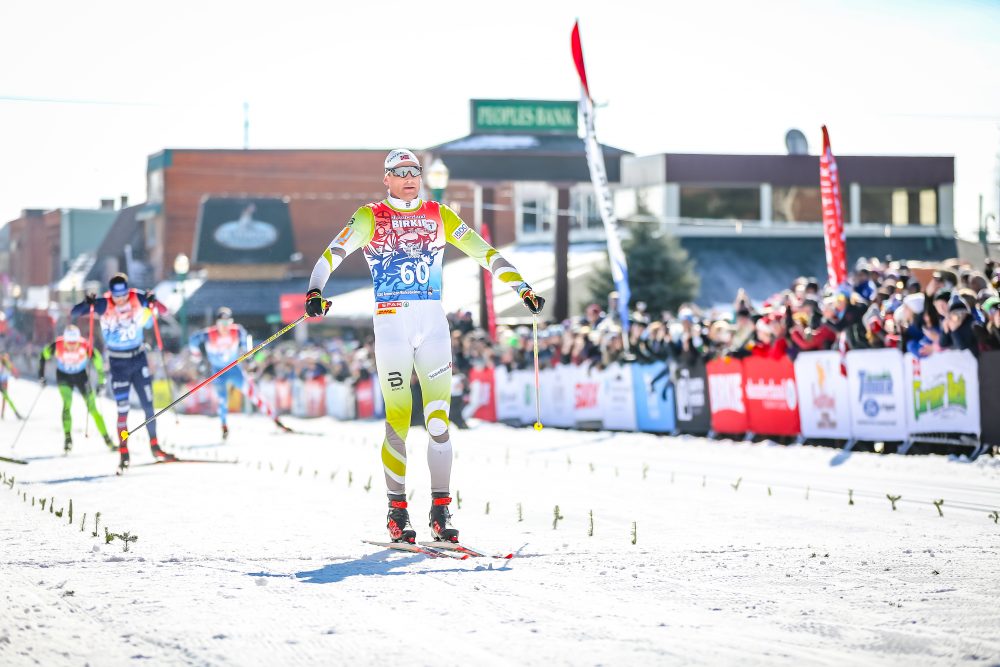
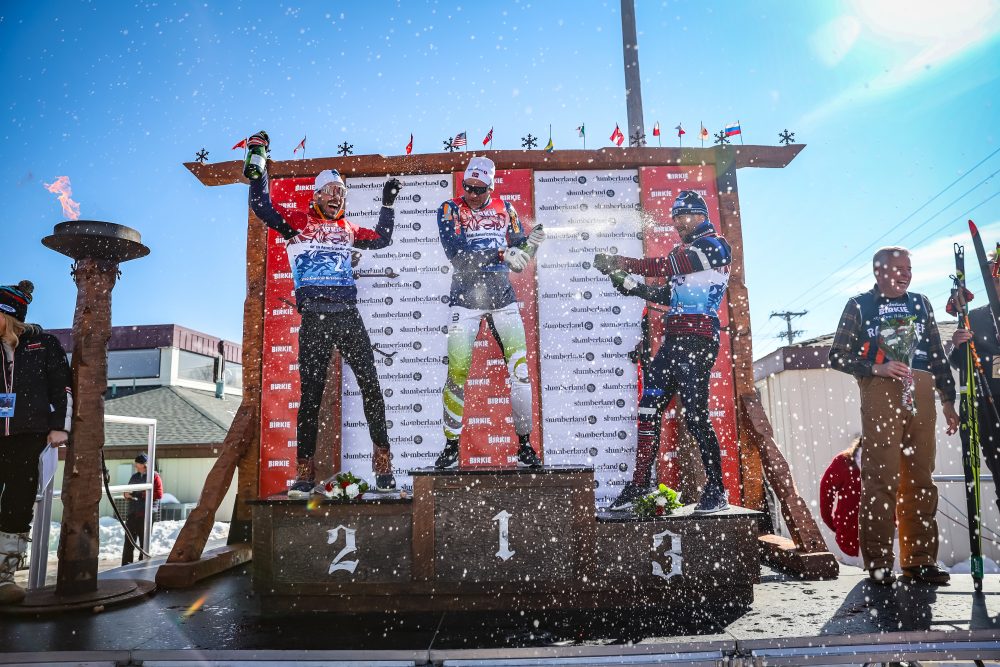
Niklas Dyrhaug, a 32-year-old Norwegian Olympian and former World Cup regular, reached the finish line first on Hayward’s snow-covered Main Street in 1:59:01.7 hours. While he missed the course record of 1:56:58.6 set by Italy’s Fabio Santus in 2010 by just over two minutes, Dyrhaug earned his spot in the Birkie books on Saturday. He held off second-place finisher Ian Torchia, a Minnesota native who trains with the Stratton Mountain School (SMS) T2 Team, by 1.6 seconds and France’s Robin Duvillard, another Olympian and multiple-time World Championships racer, in third by 1.9 seconds.
Wisconsin’s own Adam Martin, who trains with the Craftsbury Green Racing Project, narrowly missed the podium in fourth (+2.7), while Norway’s Anders Gløersen was just behind in fifth (+3.0) and U.S. Ski Team/Alaska Pacific University (APU) member Erik Bjornsen next in sixth (+3.6).
Another Craftsbury racer, Akeo Maifeld-Carucci followed in seventh (+8.0), then France’s Benoit Chauvet in eighth (+12.0). Sam Wood of Idaho placed ninth, 1:42.5 minutes behind the winner with a cumulative time of 2:00:44.2, just ahead of Kyle Bratrud of Minnesota and the SMST2 team in 10th (+1:47.6).
Dyrhaug, who has two World Championship gold medals in the men’s 4 x 10-kilometer relays (in 2015 and 2017), was a Birkie rookie but hardly a surprise winner. In World Cup 50 k classic mass starts in Oslo, Norway, he placed second in 2016 and fifth in 2017. On Wednesday of this week, he placed second in the SuperTour 1.6 k classic-sprint qualifier in Hayward — part of the Birkie Week festivities — finishing 1.07 seconds off the winning time of U.S. Ski Team member Gus Schumacher.
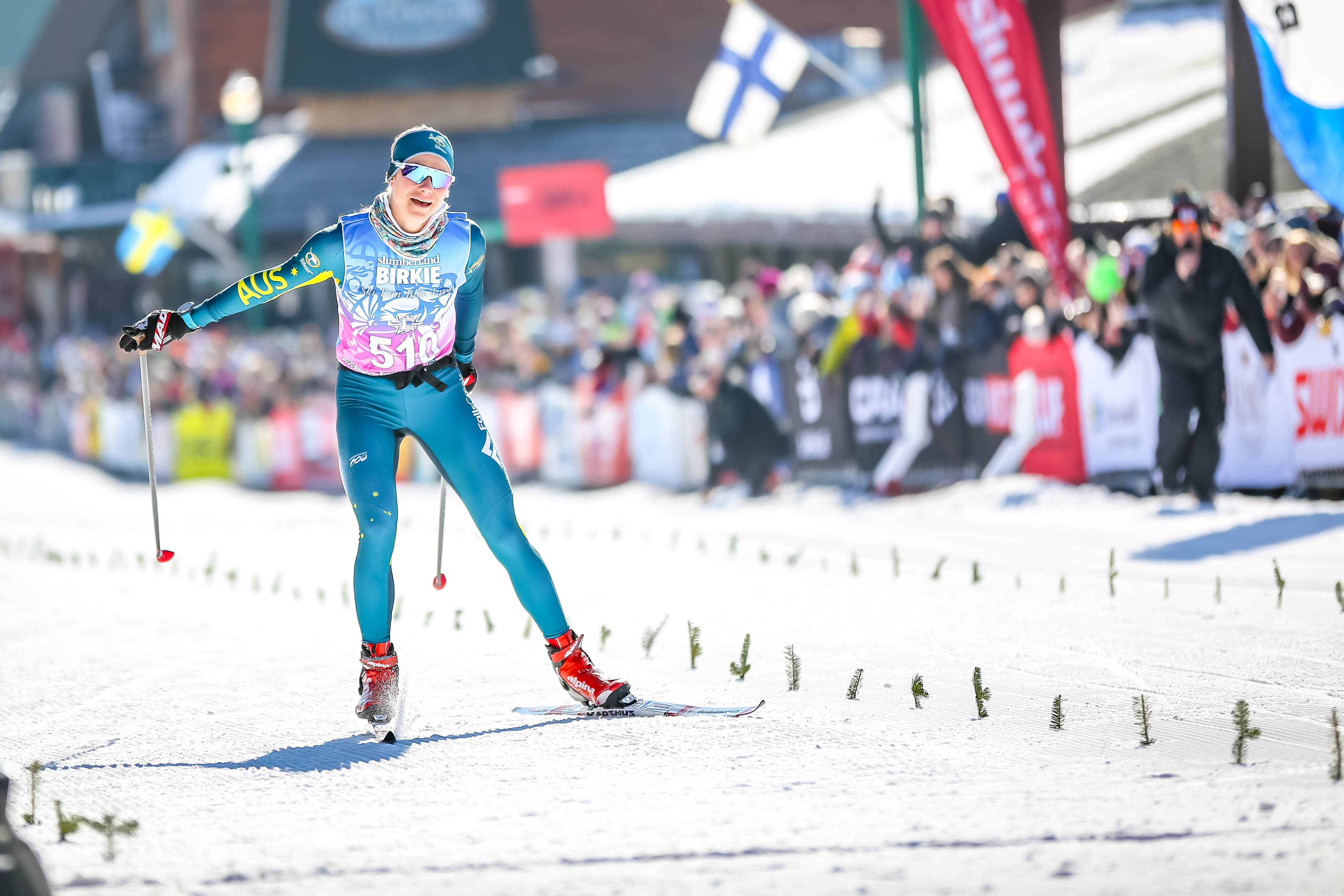
Meanwhile, Jessica Yeaton, who races for Australia and APU, set a new women’s Birkie 50 k skate course record in 2:13.20.6. The 28-year-old Olympian broke Caitlin Gregg’s record of 2:16:07 and placed 67th overall in Saturday’s 50 k skate. Finland’s 41-year-old Riitta-Liisa Roponen, a five-time Olympian who notably placed sixth in the 10 k skate at last year’s World Championships, was the second woman on Saturday, 41.7 seconds behind Yeaton. Former pro racer Erika Flowers, of Montana, placed third, 1:39.4 minutes out of first.
Saturday’s 55 k classic race saw record-setting times from both the winning man and woman, with Peter Holmes of the Sun Valley Ski Education Foundation (SVSEF) defending his 2019 title with a time of 2:26:46, nearly 2 minutes faster than Juergen Uhl’s winning 54 k classic time of 2:28:39.4 in 2010. Holmes won Saturday’s race by nearly 12 minutes, with two Wisconsin skiers — Chris Pappathopoulos (+11:52.4) and Evan Wetzel (+11:54.3) — following in second and third place, respectively.
Wisconsin native Nichole Bathe, who trains in Norway and skis for the British national team, became the new women’s 55 k classic champion in a blistering 2:49:47.0. She beat out Jennie Bender’s 2011 Birkie classic record of 2:50:53 and finished more than five minutes ahead of Colorado runner-up Anja Gruber (+5:33.3) on Saturday. Wisconsin’s Delaney Fitzpatrick finished in just over 3 hours for third place, about 11 minutes behind Bathe.
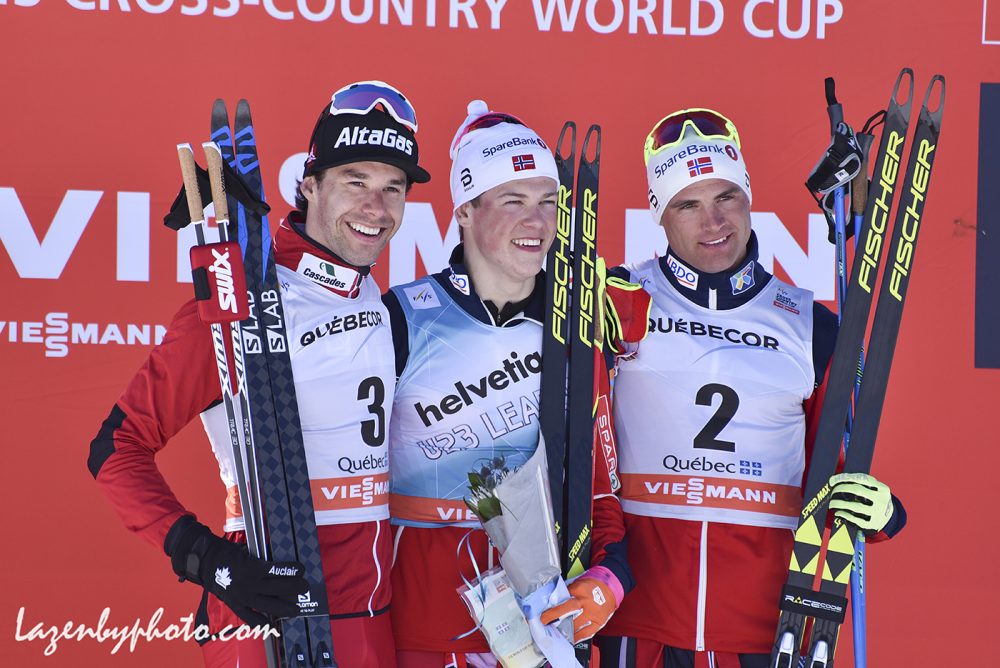
Left to right: Canada’s Alex Harvey alongside Norwegians Johannes Høsflot Klæbo and Niklas Dyrhaug on the men’s 15 k freestyle pursuit podium at World Cup Finals on Sunday in Quebec City. (Photo: John Lazenby/Lazenbyphoto.com)
Canada’s Alex Harvey has had one heck of a season.
In January, he reached the top of a World Cup podium for the first time in three years. The following weekend, he helped Canada to its first-ever relay podium and two weeks before that, won the men’s team sprint in Toblach, Italy, with his teammate Len Valjas. A little more than a month later, he earned his first individual World Championships gold.
The 28-year-old Harvey kept the ball rolling through the World Cup Finals in Quebec City this past Friday, winning the opening freestyle sprint before a roaring home crowd. The next day, he placed fourth in the 15-kilometer classic mass start.
To top it all off, he finished second in Sunday’s 15 k pursuit — less than one-hundredth of a second short of first after a photo finish with Norway’s Johannes Høsflot Klæbo — to secure not only another World Cup podium, but also third in the Overall World Cup standings and second in the Distance World Cup.
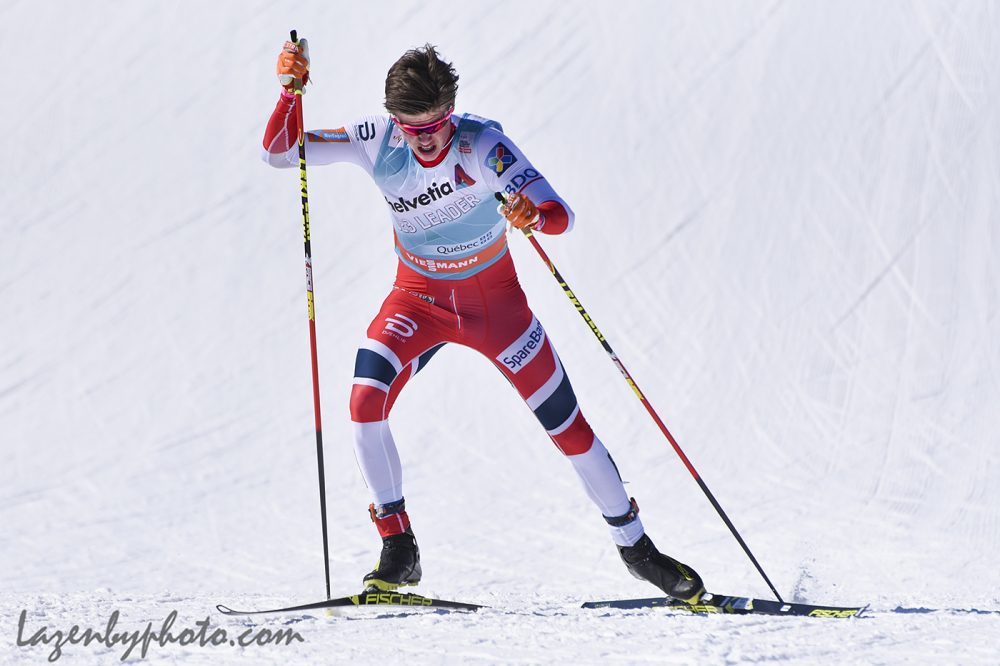
Norwegian Johannes Høsflot Klæbo leading the men’s 15 k freestyle pursuit at World Cup Finals on Sunday in Quebec City. (Photo: John Lazenby/Lazenbyphoto.com)
“It went more than perfectly,” Harvey said of his season to a group of reporters in French. “A gold at the Worlds, some World Cup victories, a second place overall all makes this by far the best season in my career.”
Harvey started the pursuit in third, 23 seconds behind the first starter, Klæbo, and one second behind another Norwegian, Niklas Dyrhaug. Though Harvey managed to catch Dyrhaug just before the 2 k mark, he admitted his real worry was not ahead of him, but behind. Norway’s Finn Hågen Krogh started 9 seconds after Harvey, and a kilometer after Harvey found Dyrhaug, Krogh was skiing three seconds behind.
“I didn’t know whether Finn Hågen would come back, which could of change entirely how the race played out, since he and Klæbo are sprint specialists,” Harvey said. “They could of worked together and bump me to fourth position, but I was glad the pace I was imposing in the beginning was enough for a spot on the podium.”
However, Harvey’s pace proved too fast for Krogh, who gave up the chase after the first lap at 3.75 k and let the chase group catch him on the first climb out of the stadium.
“I just blew up, so when there was no podium to race for, that was my only goal today,” Krogh told FasterSkier of his in-it-to-win-it mentality.
But more than let the chase pack absorb him, he skied the rest of the race just to finish and ended up 70th out of 73, and last place for time of day.
“I was tired at the end today,” he said. “I had a tough day. No power left today.”
Meanwhile, by 5 k, Harvey had pulled himself and Dyrhaug all the way up to Klæbo.
“From the start, I was closing on Klæbo, and I knew early on that a podium was in reach,” Harvey explained. “It’s a rare feeling of excitement to have during a race. Usually, only the last hundred metres will tell the story. After a lap and a half, when I realized Finn Hågen was dropped, I knew the podium was mine.”
That place on the podium, however, remained to be determined. With the Canadian doing all of the pulling up to Klæbo, he’d have to dig deep to find the speed for a sprint to the finish.
“I had my tactic, Johannes had his tactic, and I think Alex had his tactic,” Dyrhaug told FasterSkier. “It was a fair race, the only thing was, I couldn’t help Alex catch Johannes, that was Alex’s job as a Canadian. If I had gone on the front to help Alex catch Johannes, I would get in a lot of trouble with the Norwegian staff, but Alex was strong, and we caught up.”
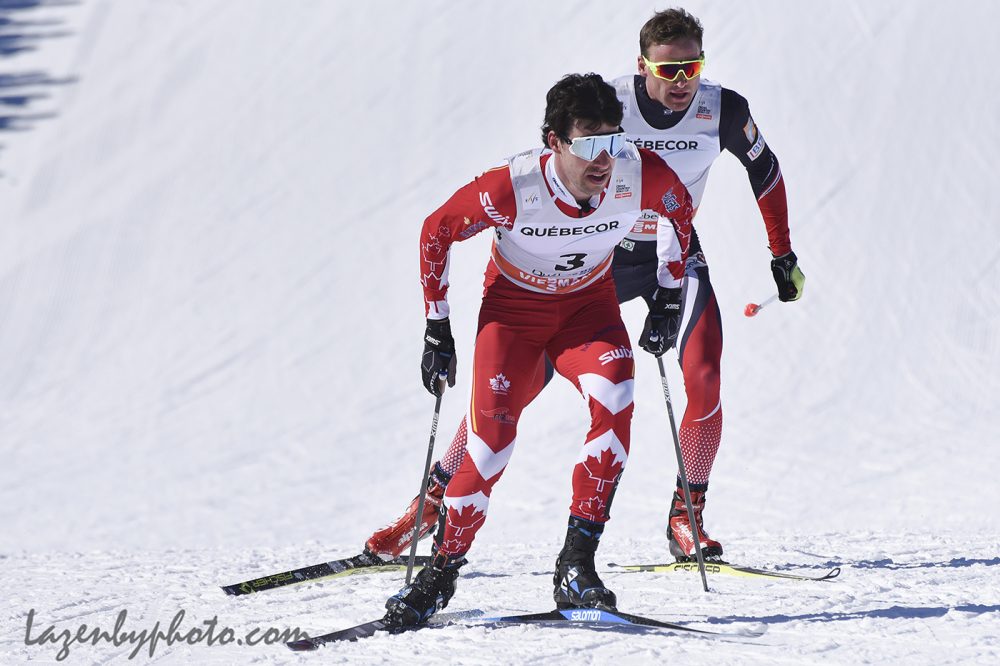
Canada’s Alex Harvey leads Norwegian Niklas Dyrhaug during the men’s 15 k freestyle pursuit at World Cup Finals on Sunday in Quebec City. (Photo: John Lazenby/Lazenbyphoto.com)
The catch, from Klæbo’s perspective, was not unexpected. Realizing that the two had already put close to ten seconds into him by the 2 k mark and showed no signs of slowing down, Klæbo changed tactics.
“My first plan was to go from the start, but after Lap 1, I knew [Harvey and Dyrhaug] were coming pretty fast so I just had to focus on waiting for them and holding on to them,” Klæbo said.
With Klæbo now part of their train, the three began to take turns up front, Harvey going first, followed by Dyrhaug and Harvey again. The trio were met by no other competitors –only a loose dog as they headed into their fourth and final lap.
“I was looking towards the crowd for someone to pick him up.” Harvey said. “We all saw him. I think we were just hoping not to come across him in the final sprint.”
Luckily, the canine caused no problems for the racers and they all remained together during the final lap. At the top of a long descent into and out of the stadium, about a kilometer or so before the finish, all three racers suddenly backed off the pace and stood up. No one wanted to lead.
“Nobody wanted to stay first on the downhill because you can be attacked from behind,” Dyrhaug recalled. “We all knew the fight was about us three, and nobody wanted to go first.”
Finally, Klæbo accelerated in an attempt to catch the other two off guard. They shadowed him closely, and squared off for the second-to-last climb, where Dyrhaug made his move.
“Johannes made a sprint, and then we sat behind. and I tried it here again, so there were a lot of attacks in the last lap,” Dyrhaug said. “It was an exciting race to be a part of. It was a cool fight with Alex and Johannes.”
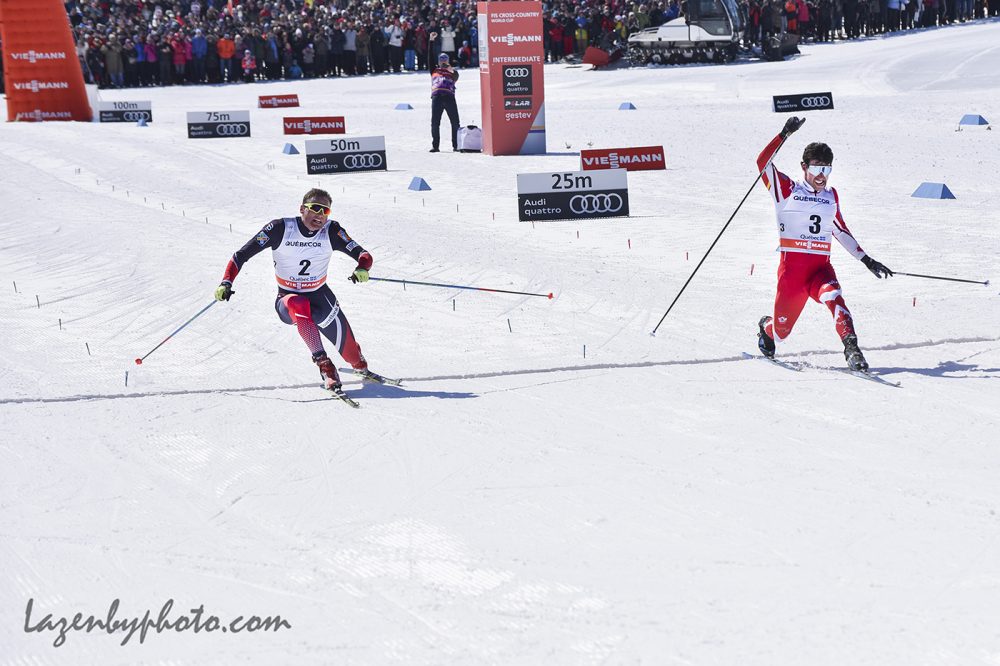
With 100 meters to go, Harvey cornered to the outside left, while Dyrhaug took the center and Klæbo the right. All three went pole for pole, lunging for the line with Klæbo emerging as the ultimate winner in a time of 32:44.5 minutes.
Harvey finished second, listed with the same time as Klæbo, and Dryhaug third, 0.1 seconds back.
“I lunged with everything I had,” Harvey told reporters in English. “I knew I was going to be second or first, but I had no idea.
“Klæbo is the best sprinter in the world,” he continued. “He has got the [Sprint] Crystal Globe at home already. He’s got a medal from world champs in the sprint.”
“It’s unbelievable to be able to win here in Quebec and to cross the finish line first,” Klæbo said. “My first plan was to go from the start, but after one lap, I knew they were coming pretty fast so I just had to focus on waiting on them and holding on to them because they were going pretty fast. …
“It is my first time in that situation,” he added of starting first in a pursuit. “And it is very easy to be go a little bit too fast, then it’s over, so I think I was tactically smart today so I am really happy to cross the finish line first.
“It’s a lot of people who cheered us forward in the tracks, so it’s amazing to go with Harvey and hear the voices and all the loud voice on the uphills there,” Klæbo continued.
“We have had many highlights [this season]” Harvey’s coach and Canadian co-World Cup coach Louis Bouchard told FasterSkier. “But … we are from Quebec so it’s normal for us to say the highlight is Quebec, because I am from here. I know everyone here. I know the spectators. I hope brings more younger athletes you know for the next generation.”
Canada’s Alex Harvey (r) lunging for first with Norway’s Johannes Høsflot Klæbo (not shown) and Niklas Dyrhaug (l). Harvey placed second and Dyrhaug third in the men’s 15 k freestyle pursuit at World Cup Finals on Sunday in Quebec City. (Photo: John Lazenby/Lazenbyphoto.com)
Led by Bjornsen in 11th, Four Americans in Top 30 for Time of Day
Also on Sunday, Erik Bjornsen of the U.S. Ski Team finished 25th (+2:19.1) and posted the 11th-fastest time of day, with 11th marking his best World Cup result to date.
“This is my first [mini] tour in the top 30, and that was my goal for this year was to finish one of the tours in the top 30, and I am really happy to knock that off.” Bjornsen said. “And I mean 11th on TOD [time of day], that is crazy. That is definitely my best result so I am psyched.”
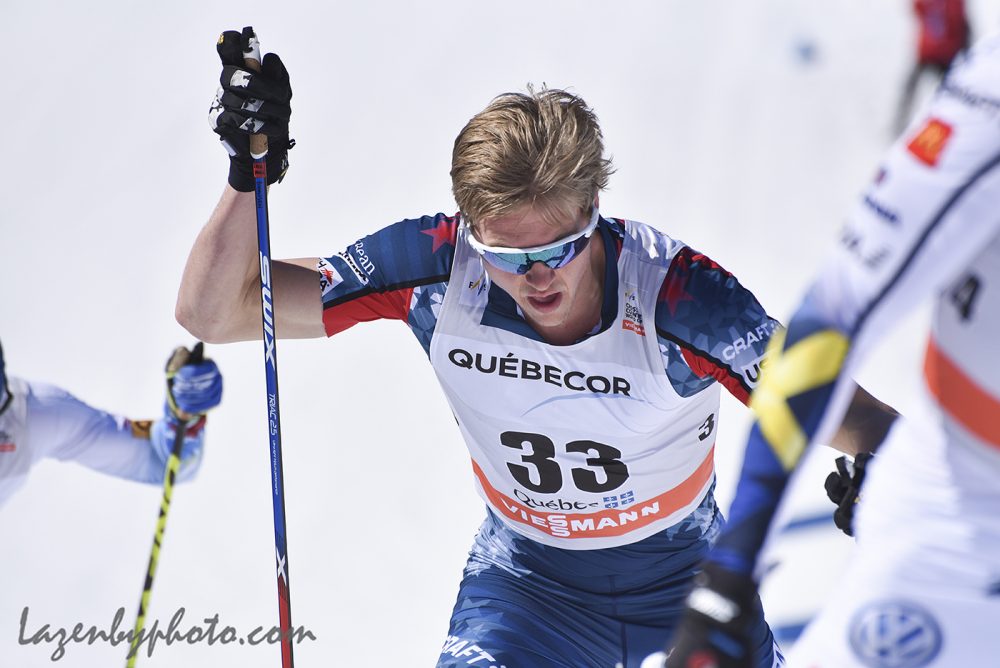
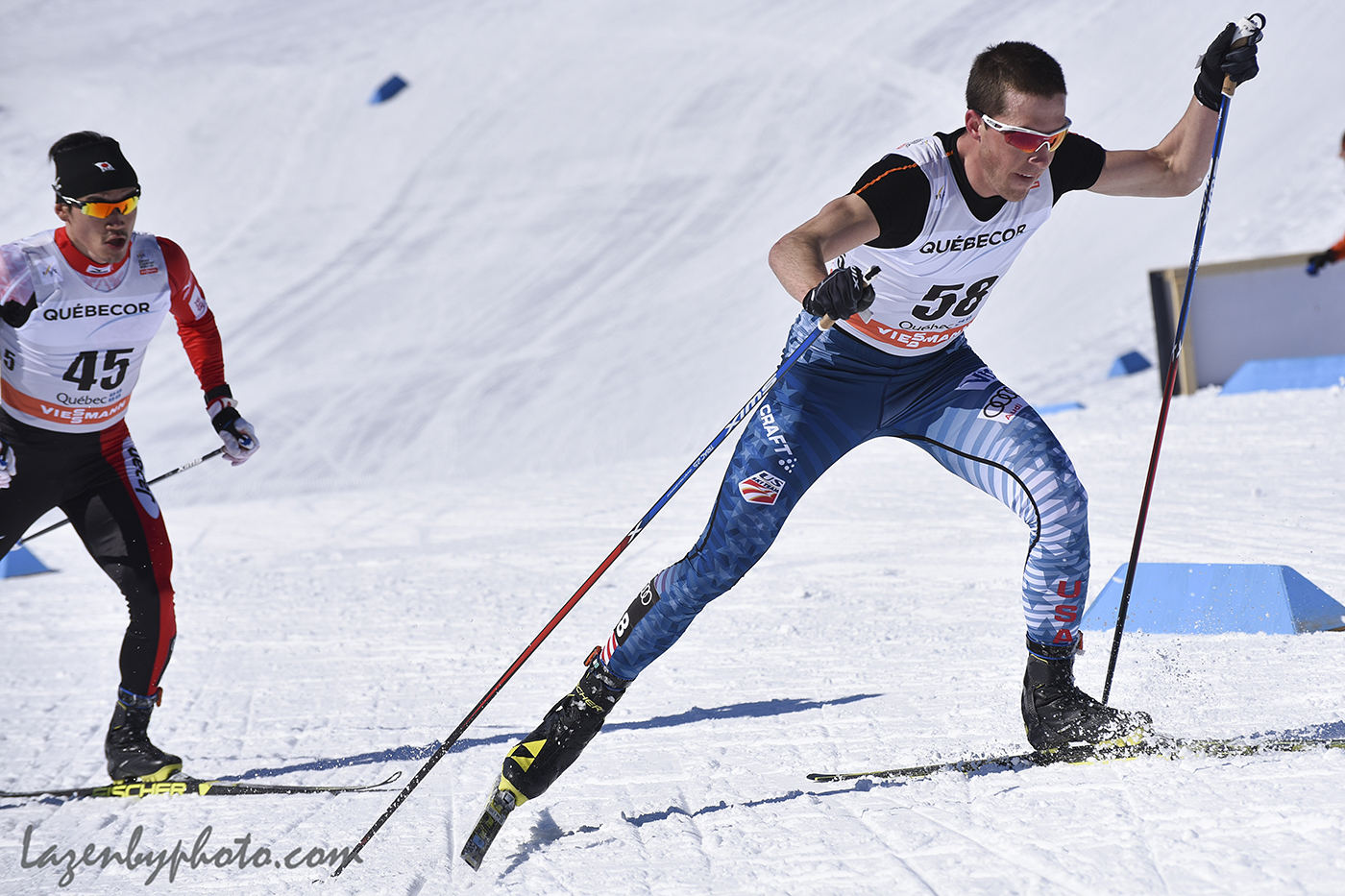
U.S. Ski Team member Erik Bjornsen (33) racing to the 11th fastest time of day in the men’s 15 k freestyle pursuit at World Cup Finals on Sunday in Quebec City, for his career-best World Cup result. He finished 25th overall. (Photo: John Lazenby/Lazenbyphoto.com)
Bjornsen started 33rd and managed to catch and ski with Finland’s Matti Heikkinen, Canada’s Devon Kershaw, Germany’s Thomas Bing, France’s Jean-Marc Gaillard and Great Britain’s Andrew Young.
“It was hard, I was really worried I was working too hard to catch that group in the first 2 to 3 k,” Bjornsen said. “Luckily I just felt like I was recovering really well and sticking in the draft was really helpful. So it all worked out for me today.”
From Quebec, Bjornsen was bound for Anchorage, Alaska, where he trains with Alaska Pacific University (APU). Next week, he planned to compete at U.S. SuperTour Finals in Fairbanks.
“Excited to go home to sleep in my bed for the first time in four months,” he said.
Along with Bjornsen, four other Americans finished in the top 30 for time of day, with Paddy Caldwell in 25th, David Norris 27th, and Scott Patterson 30th.
Paddy Caldwell (U.S. Ski Team D-team/SMS) racing to 46th overall and 25th for time of day in the men’s 15 k freestyle pursuit at World Cup Finals in Quebec City. (Photo: John Lazenby/Lazenbyphoto.com)
Patterson was the first American across the line after Bjornsen, finishing in 41st (+3:45.6) after starting 46th. Norris was next, finishing 43rd (+4:15.9) after starting 55th. Caldwell came in 46th (+4:25.6) after starting 58th.
“That was one of the goals for the day so I am psyched about that,” Caldwell said of his time of day result. “I was working with David and Scott for most of the race and two other guys, so that was really fun, and fun to work as group and try to put down a fast time.”
Caldwell further explained that a great portion of his performance came from the way he approached the wave mass start.
“I was thankful I was sort of on the edge of the chevron right out of the gun. I just went hard as I could to try to get in front of that pack,” Caldwell said. “That actually ended up being a really good move to being towards the front of our chase pack and you know we just went from there.”
Also for the U.S., Andy Newell placed 44th overall (+4:23.0), Simi Hamilton 45th (+4:23.4), Matt Gelso 49th (+4:32.3), Noah Hoffman 52nd (+5:03.8), John Hegman 57th (+5:45.9), Brian Gregg 58th (+5:55.9), Ben Lustgarten 59th (+6:04.0) and Cole Morgan 65th (39:42.7).
“I started three people in front of the waves,” said Newell, who started 44th and finished in that position. “So I knew they were going to catch me, but that was fun because I got to ski with a lot of U.S. competitors. … Simi and I skied a lot together and Brian Gregg and you know it was fun to finish it off in the sun with some teammates.”
After Harvey, the next Canadian across the line was Devon Kershaw, who finished in 26th (+2:21.4) and posted the 19th-fastest time of day.
Canada’s Devon Kershaw racing to 26th in Sunday’s 15 k freestyle pursuit at World Cup Finals in Quebec City. He was 19th for time of day. (Photo: John Lazenby/Lazenbyphoto.com)
“It’s just kind of like a fitting ending to a kind of a tough season,” Kershaw said. “[I’ve been] just missing that top top gear a lot of the season and I think in all of the tours, I was [27th] in Lillehammer, 25th in Tour de Ski, and I think I was 26th [today]. I am constantly not amazing, but you know, at the same time it’s nice to make a few positions and [in] this beautiful atmosphere.”
Kershaw, who finished the 2011/2012 season in second in both the Overall and Distance World Cup, couldn’t have been more happy for his teammate and friend’s successful end to the season.
“He is one of my best friends and to see his development here and through the years, I have been saying this since he was a 1st year senior … I have never seen an athlete and work ethic like Alex,” Kershaw said. “To see the people of Quebec come out and support their hometown hero is couldn’t be happier for him.”
Among the Canadians, Graeme Killick finished 42nd (+3:45.9), Knute Johnsgaard 53rd (+5:09.6), Len Valjas 54th (+5:20.2), Evan Palmer-Charrette 60th (+6:11.4), Bob Thompson 61st (+6:12.8), Brian McKeever 62nd (+6:30.8), Joey Foster 64th (+6:39.9), Andy Shields 66th (+6:59.4), Russell Kennedy 67th (+7:06.0), Jess Cockney 68th (+7:17.2), Gareth Williams 71st (+9:21.6), Ricardo Izquierdo-Bernier 72nd (+10:22.7), and Julien Locke 73rd (+11:15.1).
–François Léger Dionne, Alex Kochon, Gerry Furseth, Ian Tovell, and Jake Ellis contributed
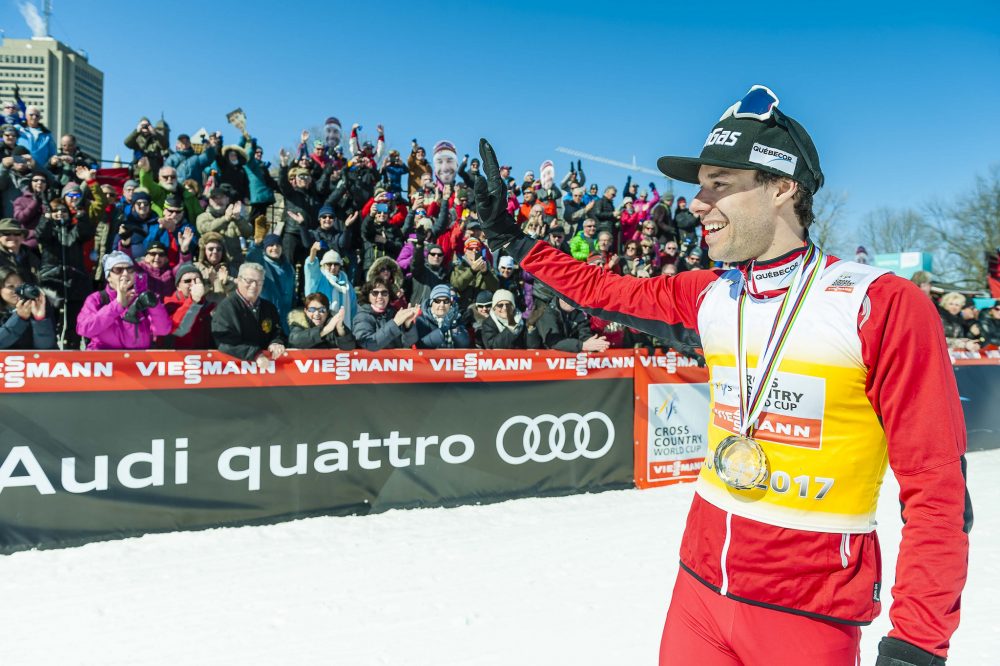
Canada’s Alex Harvey celebrates his second-place finish (and two overall World Cup medals, in the Distance World Cup and Overall World Cup) after the men’s 15 k freestyle pursuit at World Cup Finals on Sunday in Quebec City. (Photo: Gestev)
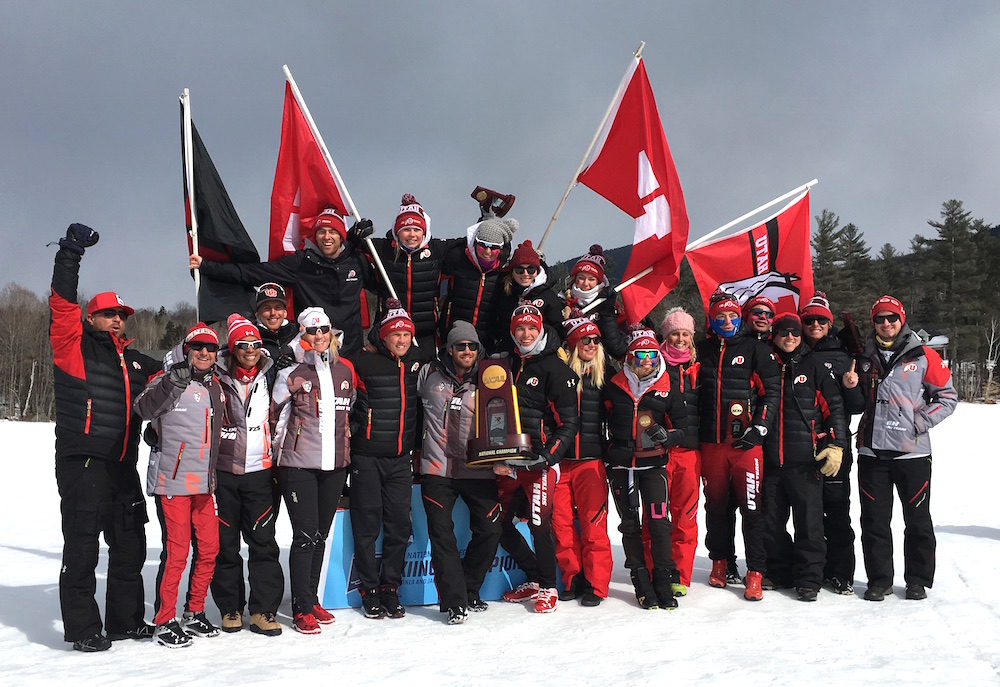
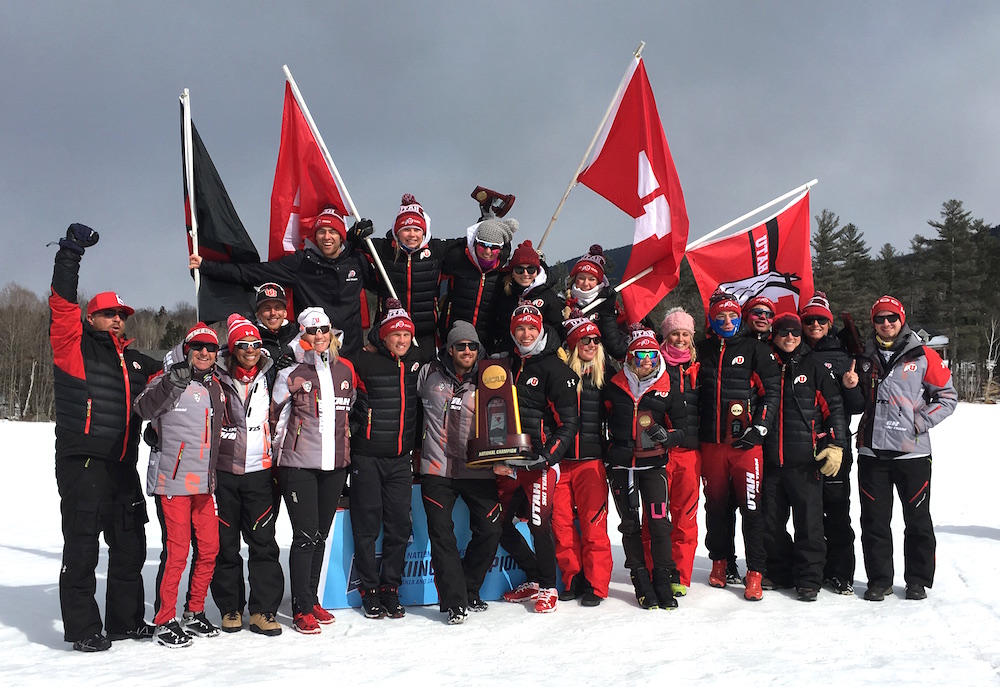
The University of Utah ski team celebrating its first NCAA title since 2003 on Saturday at 2017 NCAA Skiing Championships in Jackson, N.H. (Photo: Jason Clay/Colorado)
NCAA Skiing Championships (Jackson, N.H.): 15/20 k freestyle mass starts
On the final day of the National Collegiate Athletic Association (NCAA) Skiing Championships in northern New Hampshire, the University of Utah pulled out a 16.5-point victory over the University of Colorado-Boulder (and finished 17.5 points ahead of the University of Denver) in the team standings, and the two previous NCAA champions from Thursday’s 5/10 k classic races, Martin Bergström and Petra Hyncicova, achieved their second-straight titles in as many nordic races this week.
On a frigid Saturday morning in Jackson, N.H., with temperatures just below zero Fahrenheit for the start of the men’s 20 k freestyle mass start, Bergström, a Utah freshman from Sweden, outlasted the University of Colorado’s (CU) Mads Ek Strøm, a Norwegian senior and two-time 2016 NCAA champion, by 0.5 seconds to win his second-straight race in 46:02.8 minutes. Moritz Madlener, a German senior at Denver University (DU), placed third (+0.6). Just behind him CU’s Petter Reistad, of Norway, finished fourth (+1.2), and Dartmouth College’s Fabian Stocek, of the Czech Republic, placed fifth (+1.9).
While temperatures warmed up to about 1 degree for the women’s 15 k freestyle mass start and the wind picked up to about 15-20 miles per hour, the women raced three laps around the Jackson Ski Touring Center’s race loop and navigated even faster downhills that caused a few crashes.
Hyncicova used her love for downhills and skate races to capture her second consecutive NCAA title, breaking away with University of Vermont (UVM) junior Alayna Sonnesyn on the second lap. The Czech Republic native and CU junior attacked on the A-climb at the top of the course and won by 21.1 seconds in 39:21.6. Sonnesyn, of Minnesota, bested her third place from Thursday’s 5 k with a second-place finish on Saturday. CU’s Christina Rolandsen, of Norway, finished third (+38.9), ahead of Idaho native Anika Miller of Montana State University (MSU) in fourth (+44.0).
Utah took fifth and sixth with Merete Myrseth (+1:01.5) and Guro Jordheim (+1:16.1), and had two other men in the top 10 (Martin Mikkelsen in 8th and Kevin Bolger in 10th) to achieve the alpine-nordic team title.
In the women’s race, the Utes were the only team with all three women in the top 14, with Natalia Müller in 14th (+1:32.1).
“The turning point of today is when Guro broke a pole, and she was back in the 20’s, and she and Natalia were skiing together,” Utah Director of Skiing Kevin Sweeney said, according to a team press release. “We told them that they had to go and they busted out and made a big move. The men’s results were tremendous, but whether or not we were going to win was based on those guys making the move. It was exceptional athleticism and gutsy performances.”
The NCAA team title was the 11th for Utah and its first since 2003.
“I am stunned with the win today,” Sweeney added. “In all my years of coaching, it was one of the most challenging four days of competition. I say that because the weather was incredibly cold and windy, and challenging from both a waxing perspective, as well as visibility and conditions. I know all the teams had to deal with it, but it really beat us up. It took a lot of perseverance and gutsy performances for us to win. We struggled a little bit in the slalom, but they were going for it and came up short.
“We’ve been crunching numbers and have been able to beat Denver and Colorado by about 30 points on a really good showing during the RMISA season, but didn’t know if we could do it in the championships,” he continued. “Bergström was skiing at a whole new level this week, and Mikkelsen had stepped it up, and I knew Kevin Bolger could get top 10. I was also confident in the women, who have been skiing awesome, so I felt good there. It’s awesome to be able to take this new trophy back to our new ski building.”
As for those earning All-American status on Saturday with a top-10 finish, Utah had five (Bergström 1st, Myrseth 5th, Jordheim 6th, Mikkelsen 8th, Bolger 10th), Colorado had four (Hyncincova 1st, Strøm 2nd, Rolandsen 3rd, Reistad 4th), Denver had two (Madlener, Dag Frode Trollebø 7th), MSU had two (Miller 4th, Johanna Talihärm 7th), Dartmouth had two (Stocek 5th, Luke Brown 9th), UVM had one (Sonnesyn 2nd), Northern Michigan University (NMU) had one (Adam Martin 5th), the University of Alaska-Fairbanks (UAF) had one (Sarissa Lammers 8th), UNH had one (Lizzie Gill 9th), and Bowdoin had one (Hannah Miller 10th).
Stay tuned for a more in-depth report with quotes and photos from Saturday’s skate mass starts.
USSA Cross Country Junior Championships (Lake Placid, N.Y.): Freestyle team relays
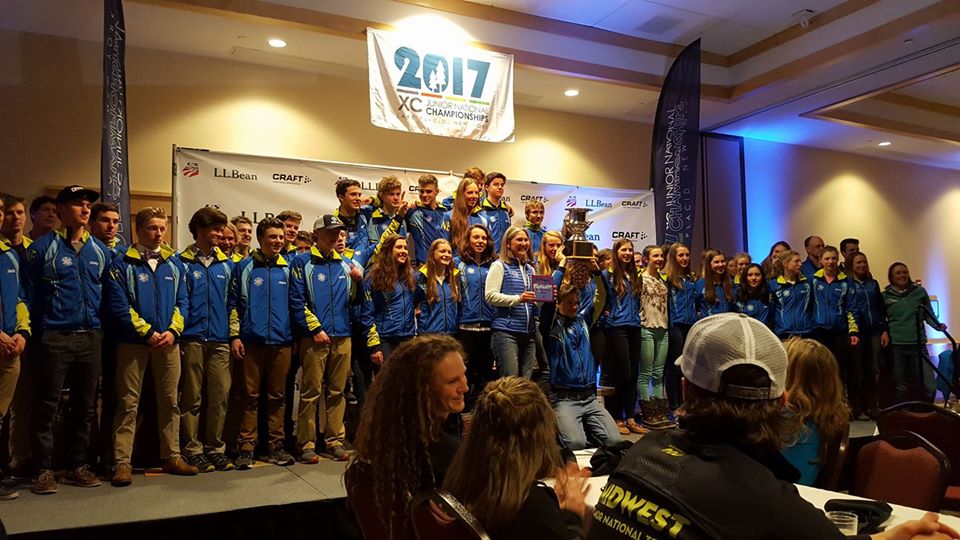
The 2017 U.S. Junior Nationals Alaska Cup winners, New England, at the awards ceremony on Saturday in Lake Placid, N.Y. (Photo: XCJuniorNationals2017/Facebook)
[UPDATED] For the final day of 2017 U.S. Junior Nationals in Lake Placid, N.Y., regional divisions formed three-racer teams for the U16, U18 and U20 freestyle relays.
Intermountain swept the U16 team events with Lane Myshrall, Skylar Patten and Johnny Hagenbuch winning the U16 boys’ relay by 3.6 seconds over the Midwest’s James Schneider, Alexander Nameth and Peter Moore in 23:00.4 minutes. Another 1.1 seconds back, Alaska reached the podium in third (+4.7) with Eli Hermann, Zander McMullen and George Cvancara.
Intermountain’s U16 girls’ team of Sarah Morgan, Annabel Hagen and Sydney Palmer-Leger posted a 53.7-second victory over New England’s Charlotte Ogden, Anna Lehmann and Abigail Streinz, winning in 26:21.4. The Pacific Northwest finished 18.1 seconds later in third place (+1:29.9) with Fiona Max, Gretta Scholz and Annie McColgan.
Alaska won the U18 boys’ relay with Luke Jager, Canyon Tobin and Gus Schumacher finishing in 21:42.9, 7.5 seconds ahead of New England’s Elliot Ketchel, Adam Glueck and Ben Ogden in second. The Midwest’s Anders Sonnesyn, Patrick Acton and Luc Golin rounded out the podium in third (+22.2).
Rocky Mountain topped the U18 girls’ relay with Katja Freeburn, Ezra Smith and Maddie Donovan crossing first in 25:47.3. Just 5.8 seconds back, Intermountain’s Brooke Dunnagan, Anna Gibson and Sofia Schomento placed second, and the Midwest secured third (+16.7) with Margaret McCollor, Luci Anderson and Anja Maijala.
The U20 men’s relay title went to New England, with Kam Husain, Koby Gordon and Daniel Streinz pulling out a 1.3-second win over Alaska’s Tracen Knopp, Logan Mowrey and Hunter Wonders in 21:53.1. Intermountain followed in third (+8.8) with Eli Jensen, Peter Wolter and Nathan Wells.
The Midwest came up big in the U20 women’s relay, with Abby Jarzin, Hannah Rudd and Margie Freed finishing 10.1 seconds ahead of New England’s Alexandra Lawson, Mary Kretchmer and Mackenzie Rizio in 25:41.4. Another 1.1 seconds back, Intermountain’s Leah Lange, Maddie Morgan and Marin Coletta placed third (+11.2).
New England won the Alaska Cup with 325 points, the same point total as Intermountain in second. Alaska placed third in the overall team competition with 295 points, just five points ahead of the Midwest in fourth.
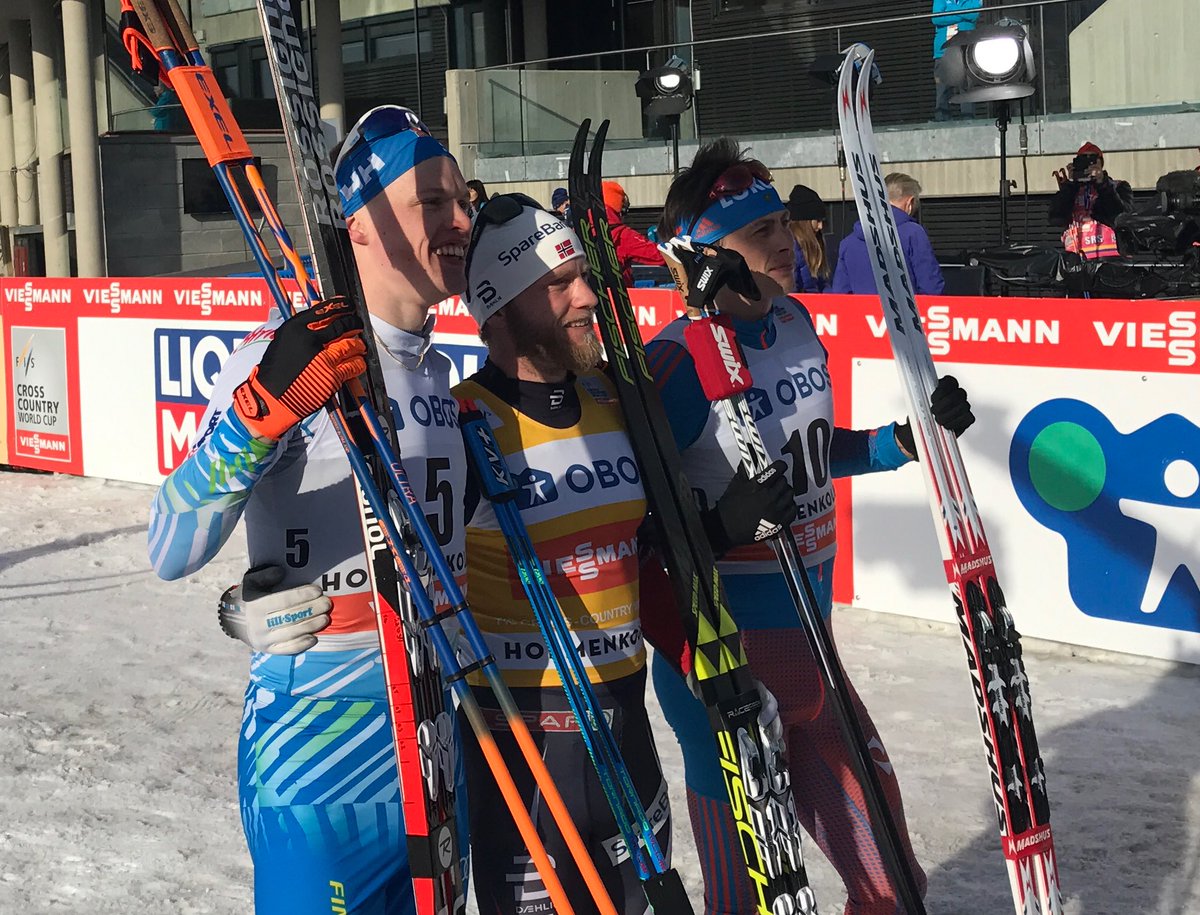
Left to right: Finland’s Iivo Niskanen, Norway’s Martin Johnsrud Sundby and Russia’s Alexander Bessmertnykh after placing second, first and third, respectively, in the Holmenkollen World Cup men’s 50 k classic mass start on Saturday in Oslo, Norway. (Photo: FIS Cross-Country/Twitter)
In a historic Holmenkollen, Norway’s Martin Johnsrud Sundby took his second 50 k win in a row, claiming this year’s title in a time of 2:02:59.7 (he won last year’s Holmenkollen in a time of 2:08:41.9).Sundby is now the only male skier towin two consecutive World Cup Holmenkollen 50 k competitions.
Crossing behind Sundby in second was Finland’s Iivo Niskanen, 9.9 seconds back from the race winner’s time. In a three-way photo finish, Russian Alexander Bessmertnykh bestedNorwegians Niklas Dryhaug, and Sjur Røthe in the lunge to the line, with Bessmertnykh taking third (+1:15.2), Røthe fourth (+1:15.2) and Dryhaug fifth (+1:15.2).
Canada’s Alex Harvey was just two tenths of a second behind the three-way lunge, finishing in sixth (+1:15.4). Norway’s Christer Hans Holund crossed 2.2 seconds later in seventh (+1:17.2). Three more Russians rounded out the top ten, with Sergey Ustiugov finishing in eighth (+2:35.0), Andrey Larkov two tenths of a second behind in ninth (+2:35.2) and Sergey Turyshev in tenth (+2:42.2).
The top U.S. skier for the day was Scott Patterson (Alaska Pacific University), earning World Cup points in 28th (+7:18.8). Canada’s Devon Kershaw crossed 33rd (+2:11:59.1) and American David Norris (Alaska Pacific University) finished 35th (+9:56.4).
Two more Americans competed in Saturday’s Holmenkollen, with Noah Hoffman finishing in 38th (+11:02.6) and Ben Lustgarten 46th (+18:44.7). Canadian Russell Kennedy was the final North American to finish in 47th (+20:16.3).
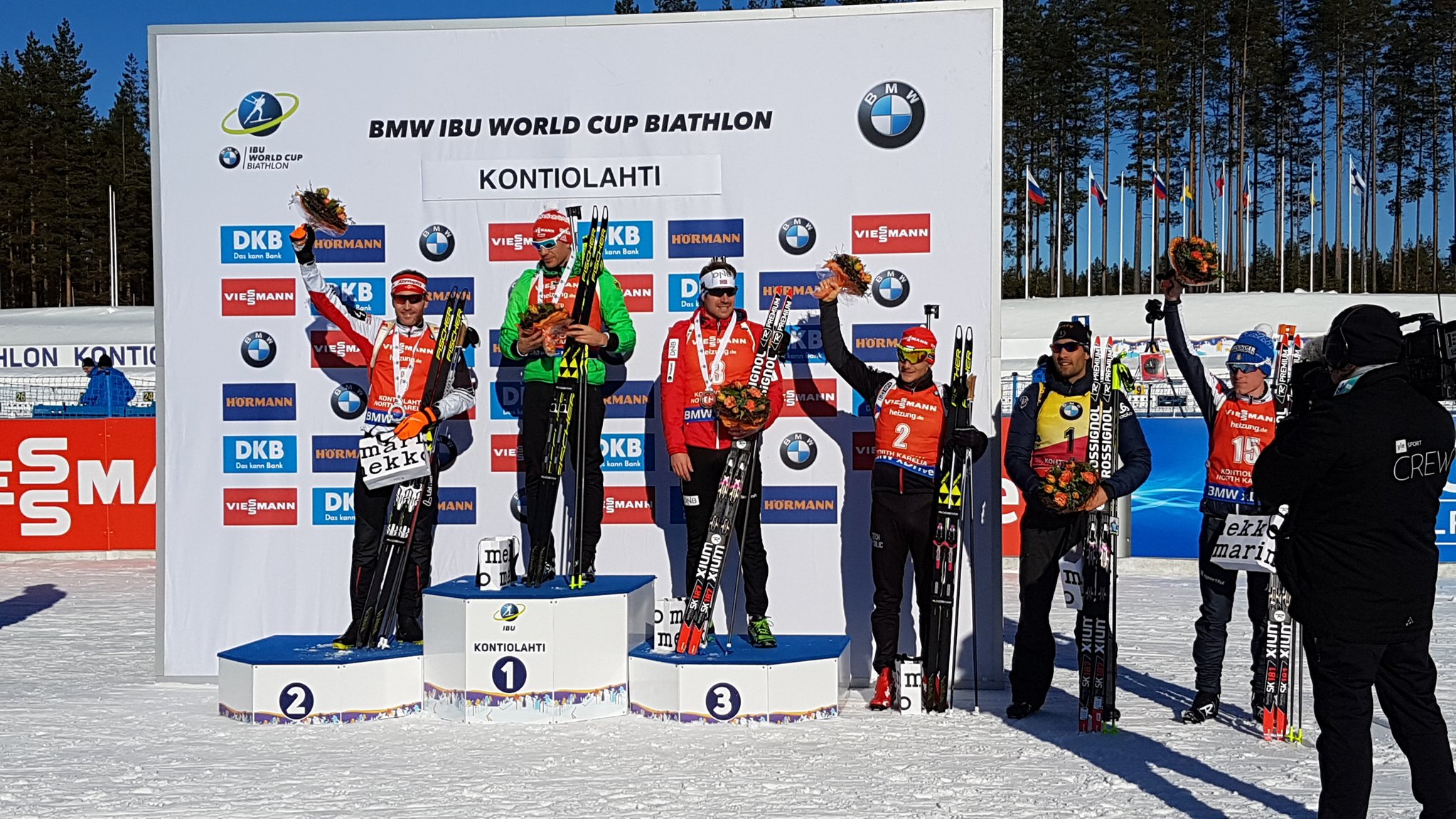
The IBU World Cup men’s podium after the 12.5 k pursuit in Kontiolahti, Finland, where Arnd Peiffer of Germany outsprinted Simon Eder of Austria for the win. (Photo: IBU/Twitter)
After one day knocked down to the second spot of the podium, it was back to the usual winning ways for Germany’s Laura Dahlmeier in the 10 k pursuit. Dahlmeier caught Norway’s Tiril Eckhoff, who won Friday’s sprint, early in the race after Eckhoff had one penalty in the first prone and second-starter Dahlmeier cleaned. While Eckhoff picked up five more penalties as the race went on, finishing 15th (+1:12.0), Dahlmeier had just one – and cleaned when it counted, on the final shoot with France’s Marie Dorin Habert and the Czech Republic’s Gabriela Koukalova right there with her. Dorin Habert missed one shot and held on to second place (+16.5) despite the penalty loop, while Italy’s Lisa Vittozi picked up her first individual podium in third (+19.9).
The win secured the overall World Cup title for Dahlmeier, her first. “That makes me really speechless,” she told Germany’s ARD broadcaster. “This is an amazing moment.”
Susan Dunklee collected four penalties and dropped from fifth place to 14th (+1:02.8) for the United States. Teammates Clare Egan and Joanne Reid finished 45th (+3:24.7) and 52nd (+4:07.0), respectively.
For Canada, Julia Ransom finished 53rd with three penalties (+4:14.0) and Emma Lunder 58th with four missed shots (+6:20.7).
Earlier in the day, Martin Fourcade had started the men’s race in bib one and set out to win the men’s 12.5 k pursuit, but was undone by four errors on the shooting range. No matter: the French biathlete still picked up the World Cup crystal globe for the pursuit discipline after finishing fifth (+25.5 seconds) and now he’s skipping tomorrow’s mixed relays to go be with his wife, who is about to have their second child.
Capitalizing on Fourcade’s errors were a group of chasers, among whom Arnd Peiffer of Germany managed to shoot 20-for-20. The race came down to a sprint finish between him and Simon Eder of Austria; Peiffer took a 0.3-second win for his eighth career victory. Emil Hegle Svendsen of Norway finished third, +2.3 seconds, and Andrej Moravec of the Czech Republic fourth, +9.8.
Besides Peiffer, the only other man in the field to shoot clean was Sean Doherty of the United States. That allowed Doherty to jump from 44th at the start to a season-best 18th (+1:19.5) at the finish, the top result for the American team. Lowell Bailey finished 27th (+1:57.2) and Leif Nordgren 43rd (+3:24.4) with three and four penalties, respectively.
Christian Gow led Canada with just one penalty and a 37th-place finish (+2:36.0), a big improvement from his 50th-place starting position. Brendan Green placed 50th with three penalties (+4:47.3).
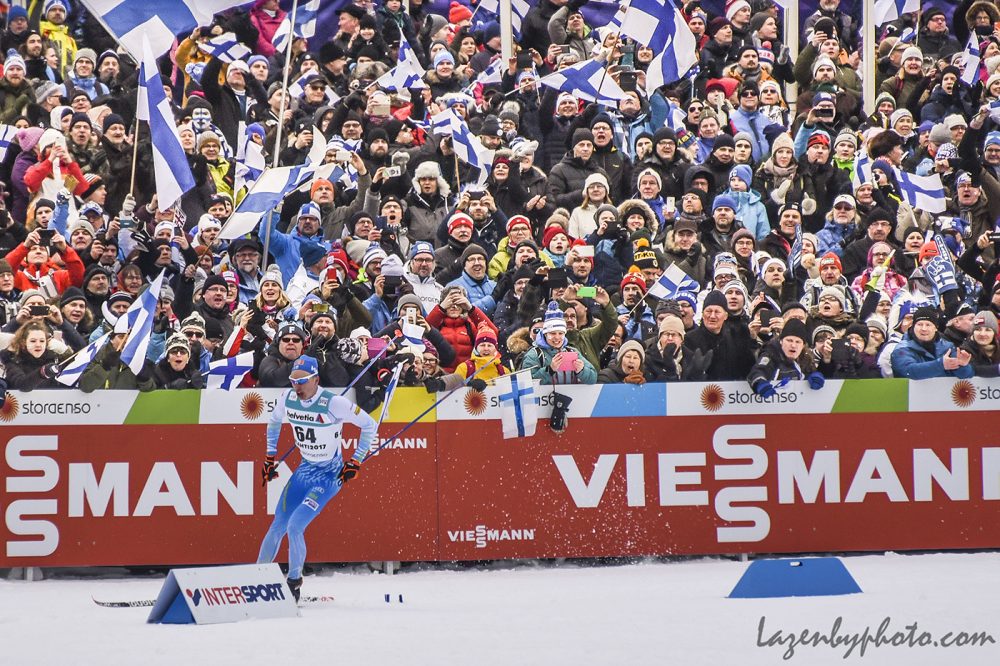
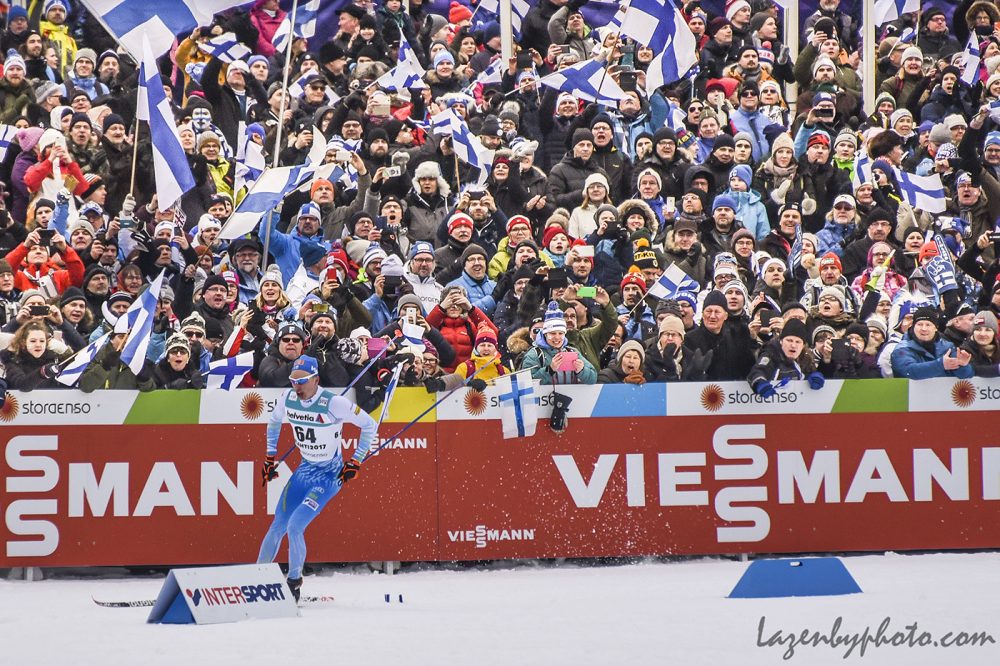
Amidst a sea of Finnish flags, Finland’s Iivo Niskanen turns the final corner on his way to gold in the men’s 15 k classic individual start on Wednesday at 2017 Nordic World Championships in Lahti, Finland. (Photo: John Lazenby/Lazenbyphoto.com)
LAHTI, Finland — Through the first seven medal races of 2017 Nordic World Championships, the hometown Finns came close. There was Krista Parmakoski’s skiathlon silver. There was the spectacular Finn non-win when Finland’s Iivo Niskanen and Norway’s Emil Iversen tumbled 200 meters from the line during Sunday’s classic team sprint. At the moment of the tangle, Niskanen was primed to pass Iversen for what appeared to be a golden performance.
Instead of a cheer concluding the sprint, a collective exhale deflated the crowd: Niskanen and teammate Sami Jauhojärvi ultimately settled for bronze. While it wasn’t the result they had hoped for, it remained the 25-year-old Niskanen’s first World Championships medal.
Another race on Wednesday brought another Finnish opportunity. On a 34-degree Fahrenheit day with moist tracks and low-hanging clouds, gold was up for grabs.
During the men’s 15-kilometer classic individual start, Niskanen channeled whatever bitter taste remained from his team sprint near-win into a controlled and sufficient pace. After 1.5 k, Niskanen ranked fourth — from then on, he was the fastest through every remaining timing point, and first when it mattered most. Niskanen won in 36:44 minutes.
Norway’s Martin Johnsrud Sundby finished 17.9 seconds off his time for silver. Sundby’s teammate Niklas Dyrhaug clocked in 31.3 seconds back for bronze, his first-career individual championships medal.
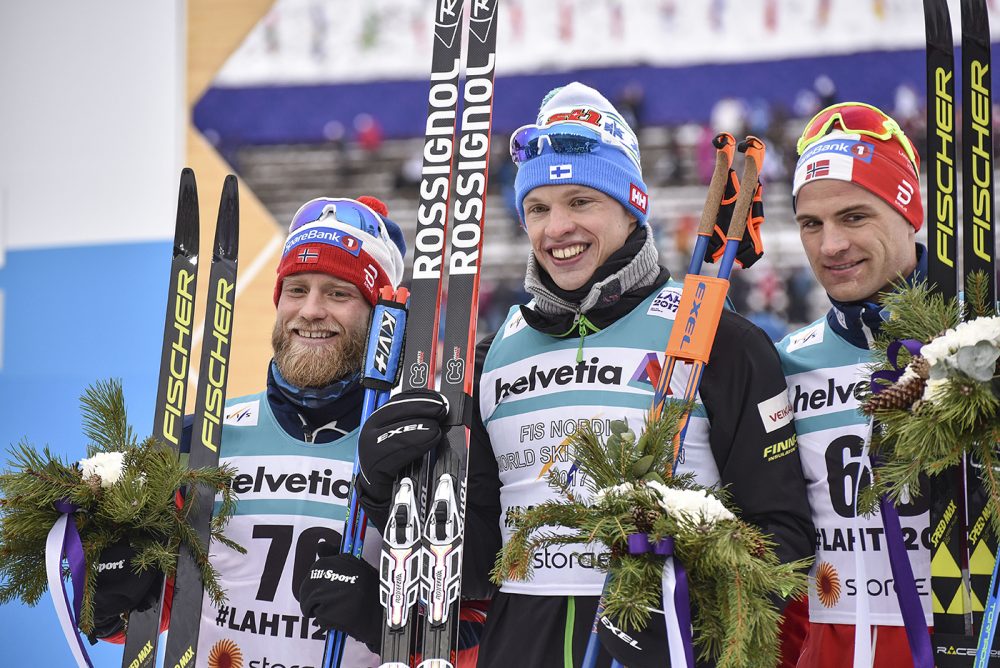
The men’s 15 k classic podium at 2017 Nordic World Ski Championships in Lahti, Finland: (from left to right) Norway’s Martin Johnsrud Sundby (l) in second, Finland’s Iivo Niskanen (c) in first, and Norwegian Niklas Dyrhaug (r) in third. (Photo: John Lazenby/Lazenbyphoto.com)
“It’s for sure a really good team, Norway, and it’s a hard fight in all the places for every distances,” Dyrhaug said at the post-race press conference about making Norway’s 12-man World Championships team. “I have been a reserve for the skiathlon and the team sprint. I have been here since Otepää — ten days now. I have been ready so when I got the chance in the 15 k, yeah, I am happy to show everybody that I am in really good shape and I have something in world champs to do.”
The 15 k classic appears an odds maker’s nightmare. It remains a fickle distance and technique with a million and one variables. There’s the course profile, the athlete’s classic technique to consider — do they thrive on headwalls or stridable terrain, double poling? The wax. The snow type. The venue’s altitude. Then there’s the pacing — go out hard? Look for negative splits? Ski it like a true distance race, not an elongated sprint?
A single 15 k classic win at a championship or World Cup level evidently doesn’t mean more will come your way. Of the 133 starters on Wednesday, Finland’s Matti Heikkinen remains the only athlete who had won a 15 k classic at a World Championships or Olympics (at 2011 World Championships in Oslo, Norway, he won the gold in this event). Not since the ’54 and ’58 championships has an athlete won two world titles in this event.
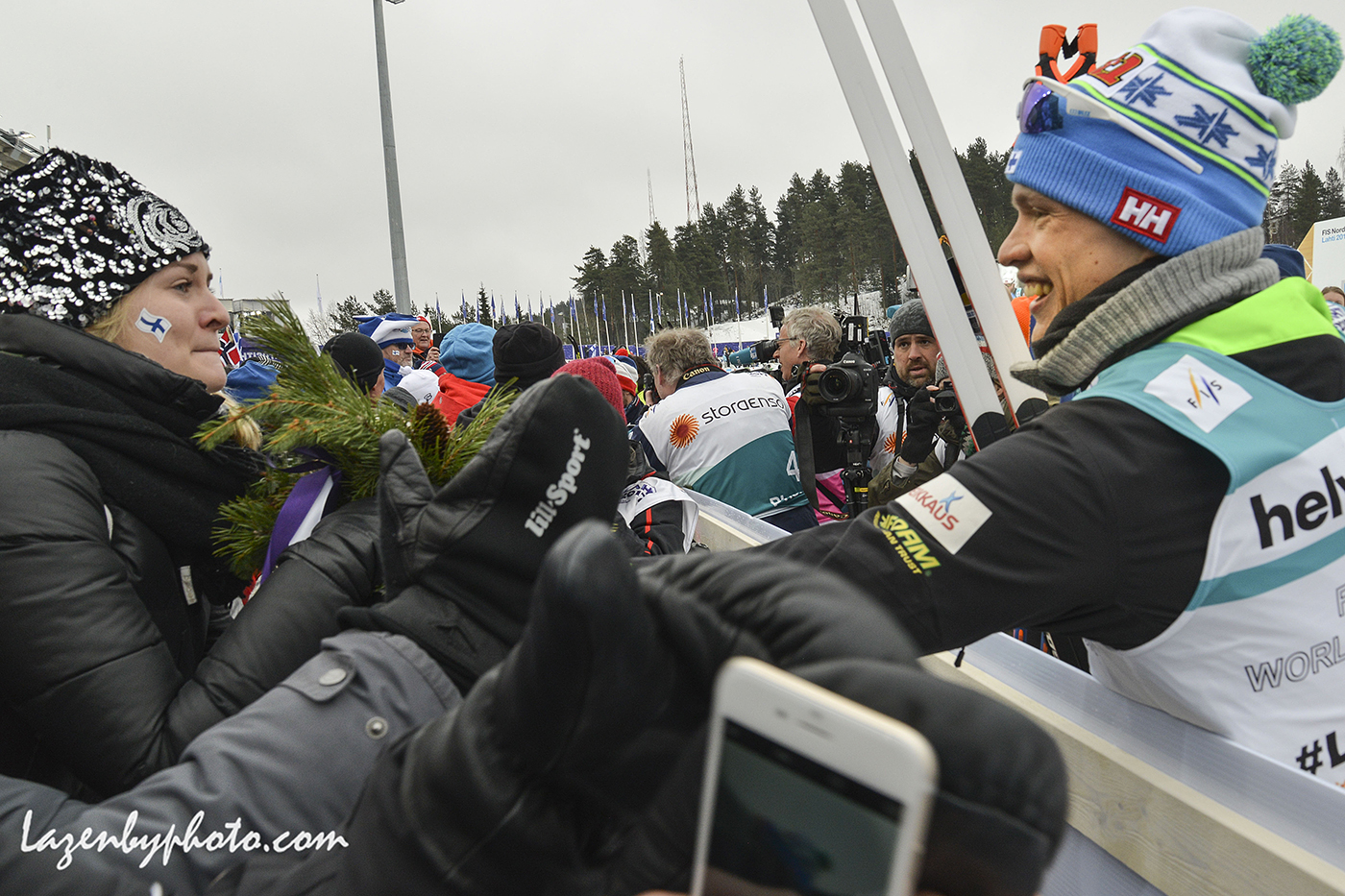
Finland’s Iivo Niskanen (r) celebrates his 15 k classic win with loved ones at 2017 Nordic World Championships in Lahti, Finland. (Photo: John Lazenby/Lazenbyphoto.com)
Niskanen and the 15 k classic are sympatico and eventually he may buck the consecutive-winner’s curse. Niskanen has three career World Cup podiums: all in the 15 k classic. There’s two wins — both in Kuusamo, Finland, and a second place at the last pre-championship World Cup race last month in Otepää, Estonia.
That doesn’t mean the Finn isn’t flawless.
“Many times, in many races I have started too hard for the first two kilometers,” Niskanen said after the race.
His too-early, hot-pacing issues were remedied Wednesday as he left nothing to chance. Niskanen suggested he’d had a Lahti champs dress rehearsal to test his pacing strategy.
“It was good to race here before on the Scandinavian Cup and learn the track, today I’m ready,” Niskanen said.
Back on Jan. 8, Lahti hosted a Scandinavian Cup 15 k classic. Like today, Niskanen won over another Norwegian, Johannes Høsflot Klæbo (+5.8).
“Today I planned to do a half kilometer and push hard,” Niskanen said on Wednesday. “After a kilometer and a half, I was quite fresh and got quite easily a gap and pushed as hard as I can. Everyone is cheering you and so then you don’t actually feel the lactate as normal. I had a difficult last kilometers, but it was one and a half to go I just thinking about myself, ‘Now we are not going to lose 20 seconds anymore.’ ”
That losing 20-seconds remark referred to his Scando Cup race. During that 15 k, he was 17 seconds up on Klæbo with 3 k remaining. He actually lost 12 seconds to Klæbo on that final sector, not 20, but Niskanen recognized the trend — slowing down in the final push.
Finland’s Iivo Niskanen powers down the finishing stretch en route to gold in the men’s 15 k classic at 2017 Nordic World Championships in Lahti, Finland. (Photo: John Lazenby/lazenbyphoto.com)
Although young, Niskanen has struggled with repeated sickness and overtraining. Promoted as a potential World Cup overall contender, Niskanen’s three 15 k classic victories remain the sole podiums highlighting his World Cup resume.
“It has been many hard years and I said when I wake up, ‘I feel healthy today and I have hope’,” Niskanen said. “I have gotten easily sick for many years and over training, maybe I have been training too much and too hard during the last years. But this year I have trained more than ever, but I have not raced in every weekend.”
The higher-volume, limited-racing recipe worked. This season, the Finn tailored his race schedule — not too much, not too little. To date, he’s raced 11 World Cup races.
“The goal was to win here in Lahti and be in the best shape here and we see it with my gold,” Niskanen said.
Norway’s Sundby remains a World Cup benchmark— he’s a mutiple overall Crystal Globe winner and leads this year’s standings. But for the reigning overall World Cup winner, an individual championship gold (at world champs or the Olympics) still eludes him.
“I think my race was really good, I felt so fast out there,” Sundby said after the race. “And then I was 20 seconds behind, I don’t believe it. It was tough for the mind to motivate myself for fighting today, but I did what I thought was one of my best race ever at this distance.”
Norway’s Martin Johnsrud Sundby on his way to second place in the 15 k classic at the 2017 Nordic World Championships on Wednesday in Lahti, Finland. (Photo: John Lazenby/lazenbyphoto.com)
Asked if he felt demoralized knowing he was 20 seconds down grinding away on Lahti’s wooded tracks, Sundby explained how he attempted to remain in the hunt.
“It is not so difficult in the World Champs … [Niskanen] did the race here in the Scan Cup a few months ago, where he for sure lost a lot of seconds in the last 3.75,” Sundby added. “And I tried to motivate myself. I said, ‘He will meet the wall, he will meet the wall, you just have to push.’ I felt good, I felt good all the way and tried to gain seconds but it was nearly impossible today.
“It is an amazing performance Iivo showed us today, everybody,” Sundby said of his Finnish protagonist. “You have to appreciate a really good sportsman. Also with some things that happened before here in the world champs, maybe in the team sprint, and it’s called karma. Today he showed everybody.”
Best World Champs Finishes for Bjornsen in 18th, Bratrud in 33rd
While Niskanen took the overall victory on Wednesday, American Erik Bjornsen walked away with a win of his own. Two days earlier, the 25-year-old Washington native had raced to a historic fifth place in the classic team sprint with his U.S. Ski Team (USST) teammate Simi Hamilton for the best team-sprint result for the U.S. men’s program. Before that, the team’s best was seventh place in 2015.
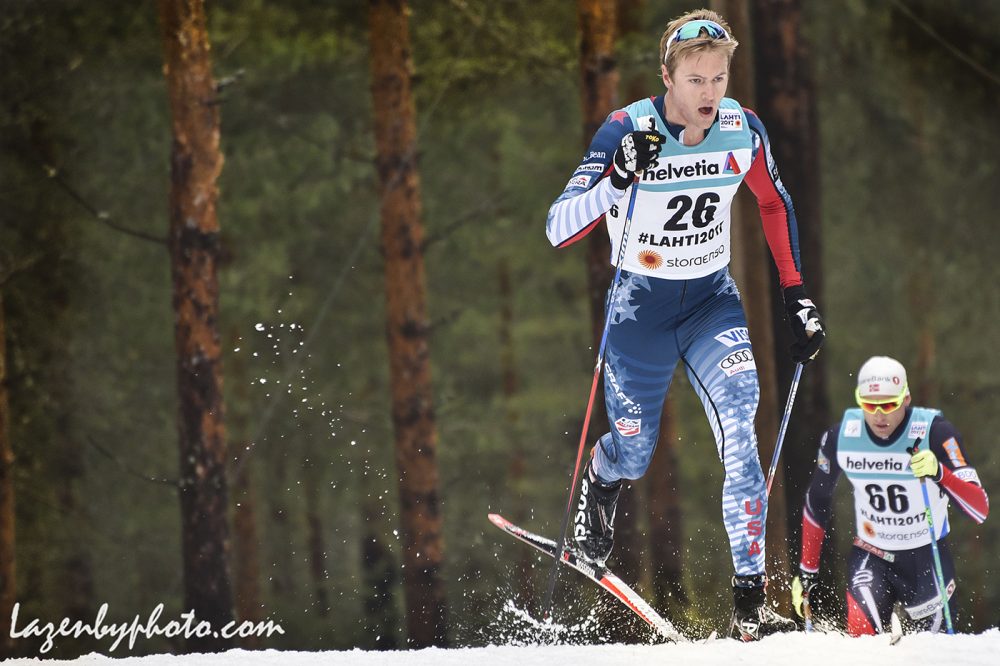
U.S. Ski Team member Erik Bjornsen (26) skiing ahead of Norway’s Niklas Dyrhaug (66) during the men’s 15-kilometer individual start at the 2017 Nordic World Championships on Wednesday in Lahti, Finland. Bjornsen went on to place 18th, while Dyrhaug captured third place for bronze. (Photo: John Lazenby/lazenbyphotography.com)
Bjornsen had raced the anchor leg for the U.S., challenged by names like Norway’s Johannes Høsflot Klæbo, Russia’s Sergey Ustiugov and Wednesday’s eventual 15 k winner, Niskanen.
Despite some of the heavy hitting names that challenged Bjornsen on Sunday, he found himself in the mix (two of his laps were the fifth fastest and one the fourth fastest of all second-leg skiers).
“In the team sprint the other day, you saw some of the best skiers, I mean, I was skiing with Iivo Niskanen, who has a good shot at winning today, and I felt pretty comfortable skiing with some of those guys,” Bjornsen after Wednesday’s race. An early starter in bib 26, he initially finished third before being bumped 15 places to 18th (+1:56.7).
“I definitely went into the [15 k] race with quite a bit of excitement from the team sprint,” he said.
Bjornsen added that the energy he was able to find during the team sprint is something he sees as working it’s way into his longer-distance efforts.
His performance in the 15 k appears to prove that, as he finished in the top 20 for his best individual World Championships result. The finish also ties his best individual World Cup result — he placed 18th three years ago in a 15 k in Toblach, Italy. The finish was also the best championships result of an American in the men’s 15 k classic since Kris Freeman placed fourth at Liberec world champs eight years ago.
Bjornsen explained that a slight bonk toward the end of his first lap caused him to put on the brakes briefly, though he found he was ultimately able to pick his pace back up before finishing.
“I went for it in the beginning, for sure, and I think I had a pace for the first lap that would have been pretty similar to some guys in the top ten,” Bjornsen said. “Then I kind of hit a little bit of a wall there, a little bit through the first lap, and struggled for a couple of kilometers … then I was able to pick up a little bit of steam before the finish.”
American Kyle Bratrud (CXC Team) racing to a career-best 33rd in the men’s 15 k classic at 2017 Nordic World Championships in Lahti, Finland. (Photo: John Lazenby/lazenbyphoto.com)
“I mean hopefully I can just continue to improve and be able to keep that pace up the whole way and then I think it can come together for me,” he added.
The second American to finish on Wednesday was Kyle Bratrud in 33rd (+3:11.5). Bratrud’s result was 20.7 seconds out of the top 30 and marks his best individual result at his second World Championships and career best at the World Cup level.
Seeing himself as a stronger skater, Bratrud, 24, of the CXC Team, entered Wednesday wanting to test his ability to push his classic-technique limits.
“I think I’m a little more confident in skate skiing, so classic I figured I had nothing to lose,” Bratrud said after. “I basically just went as hard as I could from the gun … to see if I could hang on.”
While the decision resulted in Bratrud having to ease up during some of the climbs, he indicated that managed to recover well enough on the descents to regain control.
“The course is pretty rolly and I was dying a lot on the uphills,” he said. “On the downhills I was getting some recovery and and all of a sudden I’d feel good again, but I’d get to the next hill and I’d be totally dead.
“It was kind of a roller coaster of energy, but I just tried to keep my legs moving as fast as I could,” he added.
With Wednesday also being his mother’s birthday (both his parents made the trek to Lahti to watch him race), Bratrud was thankful for the opportunity to race before throngs of fans, even if the names most were yelling didn’t belong to him.
“This is pretty awesome to not even be able to hear yourself breathing because it’s so loud,” Bratrud said “I love when people are cheering, even if it’s not for me.”
Two other Americans competed on Wednesday, with Andy Newell (U.S. Ski Team) finishing 50th (+4:21.7) and Ben Lustgarten (Craftsbury Green Racing Project) 55th (+4:56.9).
With his USST teammate Noah Hoffman out due to sickness, Newell explained that he was then slotted to race Wednesday’s classic event.
“It was fun to get a 15 k in at the championships like this, it’s unfortunate that Hoff wasn’t feeling good so I had to come in and take his spot,” Newell said after.
Adding that much of his goals are geared towards races scheduled to take place next season –particularly the 2018 Olympics in PyeongChang, South Korea — Newell is not too concerned with numerical results.
“I felt OK in a few places, but definitely lost too much time out there. I’m just kind of going after a feeling. It wasn’t a great day, but I didn’t feel awful, either,” Newell said. “I’m hoping to build on this year and kind of use this year as a platform to be at my best by the Olympics. I’m not worried too much about results, just trying to feel good when I can.”
Lustgarten indicated that he had been dealing with a bout of food illness prior to Wednesday. Unable to eat much in the days leading up to the race, the 24 year old had difficulty tapping into his normal race speed.
“I was just blown. I tried to ski really smooth and then on the the steep stuff, I tried to ski really light and I tried not to throw up,” Lustgarten said. “I’m probably at 70 percent right now and I’m just trying to ski as well as I can here. … It’s a great experience and it was cool to hear the crowd going, I just wish I could ski like I was a month ago.”
Canada’s Jess Cockney racing to 65th in Wednesday’s 15 k classic at 2017 Nordic World Championships in Lahti, Finland. (Photo: John Lazenby/lazenbyphoto.com)
Canada was led by Devon Kershaw in 35th (+3:24.8). The next Canadian to finish was Knute Johnsgaard in 56th (+5:00.7), followed by Jess Cockney in 65th (+6:20.7).
“I don’t think I pushed as hard as I should have. … Mentally, maybe I wasn’t totally zoned in, but I was happy to do a distance race in front of a big fan base like this in Finland for the hometown favorites, so that was good,” Cockney said.
This being Johnsgaard’s first world champs experience, the 24 year old was happy with how he race his third individual event of the week.
“I just went out at a pace I thought I could sustain for 15 k and kept that pace pretty steady I think and was able to push hard and kind of sprint up the last hill,” Johnsgaard said. “I felt like I paced it as well as I could, so I’m pretty satisfied with my race.”
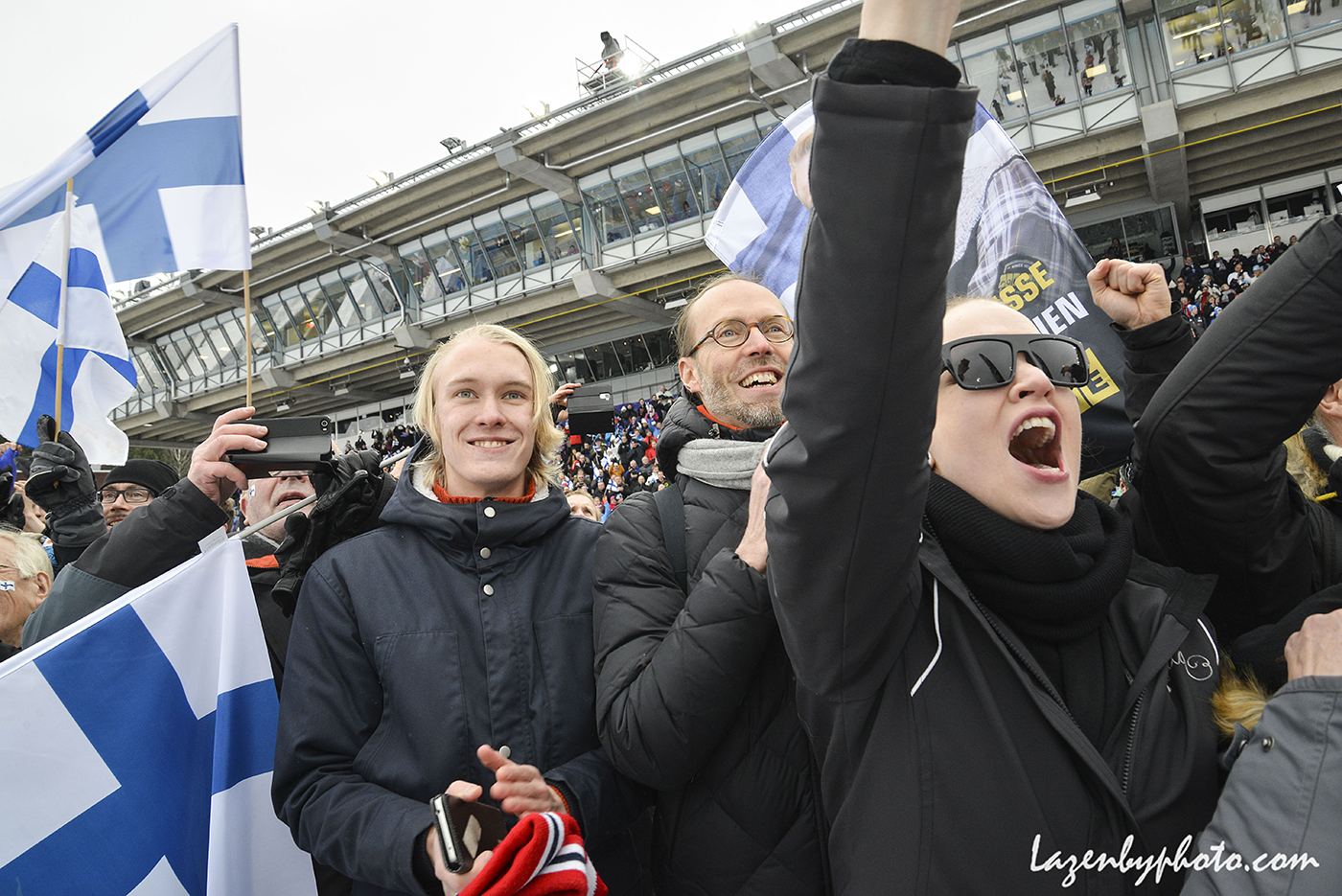
Finnish fans celebrate Iivo Niskanen’s gold medal in the men’s 15 k classic at 2017 Nordic World Championships in Lahti, Finland. (Photo: John Lazenby/Lazenbyphoto.com)
CANMORE, Alberta — Stage 6 of the Ski Tour Canada featured a brutal course for both the women’s 15-kilometer and the men’s 30 k skiathlons. It was simply survival of the fittest as the classic loop featured a grueling 1.2 k climb while the skate leg was punctuated by dicey soft-snow corners navigated at high speed.
The women’s race became a showdown between second place overall in the Ski Tour Canada, Norwegian Therese Johaug and Tour leader Heidi Weng, also from Norway. Weng took the win.
In the men’s race, Norway’s Martin Johnsrud Sundby played at times a cool follower and at others an aggressive pace setter. Sunday won the day and jumped to third overall Ski Tour Canada’s standings.
Therese Johaug and Norwegian teammate Heidi Weng during the women’s 15 k skiathlon in Canmore, Alberta. The competition was part of the Ski Tour Canada, one of many World Cup events Johaug won last season. (Photo: Fischer/NordicFocus)
Chelsea Holmes (APU) during the women’s 15 k skiathlon on Wednesday in Canmore, Alberta. (Photo: Fischer/NordicFocus)
American Chelsea Holmes leads Canadians Emily Nishikawa (42) and Cendrine Browne, and Hanna Falk of Sweden, during the women’s 15 k skiathlon on Wednesday in Canmore, Alberta. (Photo: Fischer/NordicFocus)
Katharine Ogden racing in her first World Cup events during the Tour de Canada in 2016, pictured here in the women’s 15 k skiathlon in Camore, Alberta (Photo: Fischer/NordicFocus)
Canada’s Katherine Stewart-Jones during the women’s 15 k skiathlon in Canmore, Alberta, last season. (Photo:Fischer/NordicFocus)
Canadians Dahria Beatty (l) and Olivia Bouffard-Nesbitt (r) during the women’s 15 k skiathlon on Wednesday in Canmore, Alberta. (Photo: Fischer/NordicFocus)
Norwegians Heidi Weng and Therese Johaug, (l-r) during the women’s 15 k skiathlon on Wednesday in Canmore, Alberta. (Photo:Fischer/NordicFocus)
Norwegians Therese Johaug and Heidi Weng, (l-r) during the 2016 women’s 15 k skiathlon in Canmore, Alberta. (Photo: Fischer/NordicFocus)
Norway’s Therese Johaug, Heidi Weng, and Astrid Uhrenholdt Jacobsen, (l-r) on the podium at the women’s 15 k skiathlon on Wednesday in Canmore, Alberta. (Photo: Fischer/NordicFocus)
The start of the men’s 30 k skiathlon on Wednesday in Canmore, Alberta. (Photo: Fischer/NordicFocus)
Canada’s Alex Harvey (5) and Ivan Babikov (34) lead Norway’s Martin Johnsrud Sundby (yellow bib) during the men’s 30 k skiathlon on Wednesday in Canmore, Alberta. (Photo:Fischer/NordicFocus)
(From left to right) Norway’s Martin Johnsrud Sundby, Finland’s Matti Heikkinen, Norway’s Niklas Dyrhaug and Didrik Tønseth, and Canada’s Alex Harvey leading the pack during the men’s 30 k skiathlon on Wednesday in Canmore, Alberta. (Photo: Fischer/NordicFocus)
Russia’s Sergey Ustiugov, Norway’s Finn Hågen Krogh, and Canada’s Alex Harvey, (l-r) during the men’s 30 k skiathlon on Wednesday in Canmore, Alberta. (Photo: Fischer/NordicFocus)
(From left to right): Russia’s Sergey Ustiugov in second, Norway’s Martin Johnsrud Sundby in first, and Finland’s Matti Heikkinenin third after the men’s 30 k skiathlon on Wednesday in Canmore, Alberta. (Photo: Fischer/NordicFocus)
Lenny Valjas of Cananda during the men’s 30 k skiathlon on Wednesday in Canmore, Alberta. (Photo: Fischer/NordicFocus)
Graeme Killick of Canada during the men’s 30 k skiathlon on Wednesday in Canmore, Alberta. (Photo: Fischer/NordicFocus)
Knute Johnsgaard of Cananda during the men’s 30 k skiathlon on Wednesday in Canmore, Alberta. (Photo: Fischer/NordicFocus)
Alex Harvey of Cananda before the start of the men’s 30 k skiathlon on Wednesday in Canmore, Alberta. (Photo: Fischer/NordicFocus)
Norway’s Martin Johnsrud Sundby and Russia’s Sergey Ustiugov, (l-r) during the men’s 30 k skiathlon on Wednesday in Canmore, Alberta. (Photo: Fischer/NordicFocus)
Canadians Graeme Killick , Devon Kershaw, and Alex Harvey, (l-r) during the men’s 30 k skiathlon on Wednesday in Canmore, Alberta. (Photo: Fischer/NordicFocus)
Norway’s Eirik Brandsdal, Canada’s Lenny Valjas, (l-r) during the men’s 30 k skiathlon on Wednesday in Canmore, Alberta. (Photo: Fischer/NordicFocus)
Norwegians Hans Christer Holund, Finn Haagen Krogh, Martin Johnsrud Sundby, Petter Northug, Russia’s Sergey Ustiugov, (l-r) during the men’s 30 k skiathlon on Wednesday in Canmore, Alberta. (Photo: Fischer/NordicFocus)
Kikkan Randall (U.S. Ski Team) watching the Wednesday’s skiathlon races at the Ski Tour Canada in Canmore, Alberta. (Photo: Fischer/NordicFocus)
Canada’s Alex Harvey during the men’s 50 k classic mass start at Holmenkollen on Saturday in Oslo, Norway. (Photo: Fischer/NordicFocus)
One one thousand. Two one thousand. Three one thousand. Four years ago, each of these seconds was a place, with skiers in the top 10 finishing within 10 seconds of the winner. Not the case for the men’s 50-kilometer classic mass start at the World Cup in Holmenkollen on Saturday in Oslo, Norway.
“It’s a battle from the start now. The days of skiing your way into the race are over. You have to be ready to hurt from the gun,” Devon Kershaw said on the phone after placing 23rd, 6 minutes and 8.8 seconds behind Norwegian winner Martin Johnsrud Sundby.
The 33-year-old Canadian believes that since the start of his ski racing career, changes have developed in the way these types of men’s distance races unfold.
“Before it would be kind of like bigger pack that would get whittled down to 20 or 30 people. That pack would be surging all the time,” he explained.
The major difference between the 50 k four years ago and this year’s mass start, according to a few North Americans, seemed to hinge on one factor: speed.
“Today the men raced like a women’s race. There was no dillydallying around in a pack. Even the first time climbing we were moving pretty quick,” American Scott Patterson, of Alaska Pacific University, wrote in an email.
In his third individual World Cup race, the 24-year-old Alaskan came close to his first World Cup points in 32nd, 8:47.8 behind the winner.
“It is a change from the 30-person sprint [to the finish] that you would have at times in the past,” the U.S. Ski Team’s leading distance skier, Noah Hoffman said on the phone. He placed 24th on Saturday, 0.7 seconds behind Kershaw and 6:09.5 behind Sundby.
“I actually think the change in the way guys are racing these probably helps me,” Hoffman added, “Because in a 30-person sprint, I’m very likely to finish 29th or 30th. So, for winning these races, I need to win it in the same way that Sundby does.“
Kershaw elaborated on the race-pace precedent currently being set by the leaders.
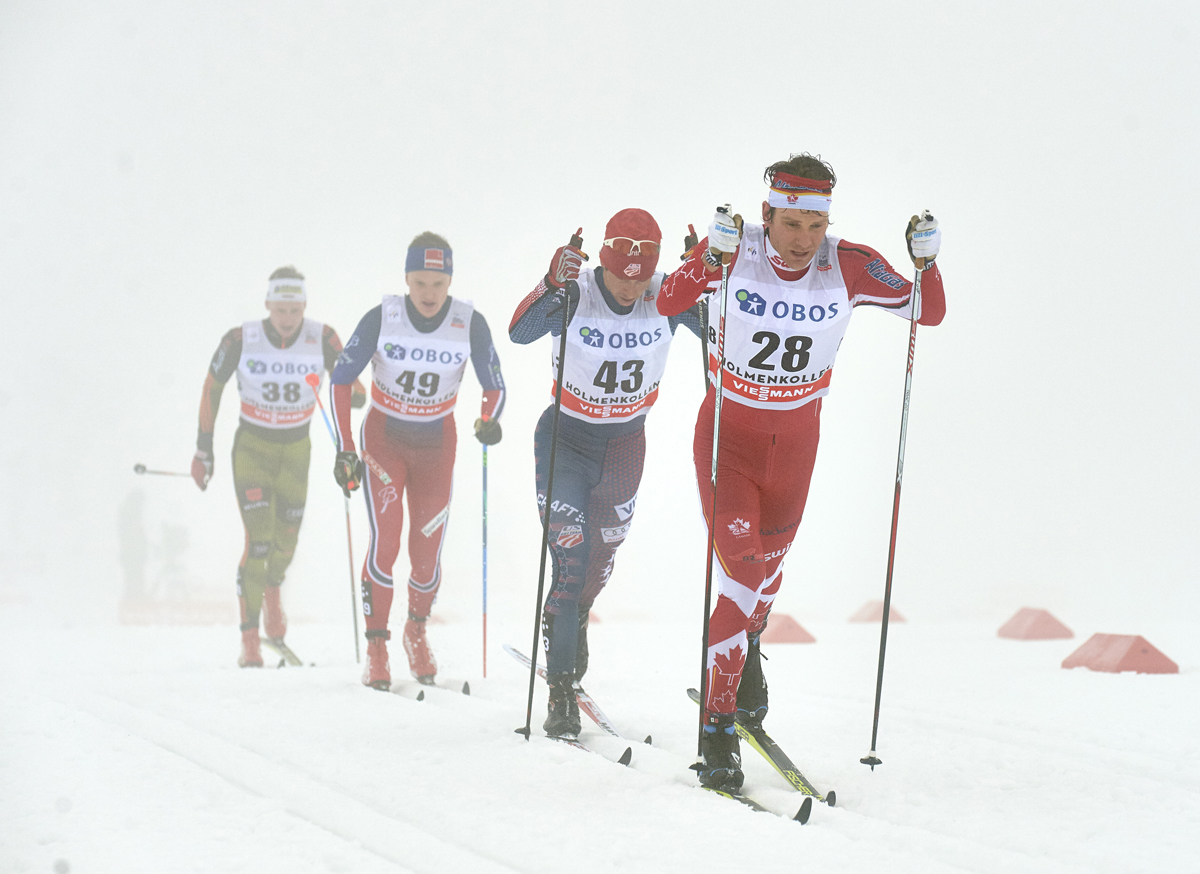
Canadian Devon Kershaw (28) leads American Noah Hoffman (43), Norway’s Vebjørn Turtveit (49) and Germany’s Thomas Wick during the men’s 50 k classic mass start at Holmenkollen on Saturday in Oslo, Norway. (Photo: Fischer/NordicFocus)
“[A] couple kilometers in and it’s already pressing at a strong, even pace. It’s not a surge. That’s just the pace you have to go for 46 k and if you can’t hack it, you blow up,” Kershaw said. “With Martin, he’s changed the way that men’s racing happens.”
Covering the 50 k in time of 2:08:41.9, Sundby won the event by 18.8 seconds over Norwegian teammate Niklas Dryhaug and 1:05.4 ahead of third-place finisher, Maxim Vylegzhanin of Russia.
Of course, that’s not to say that the pace is not maintainable, pending equipment, wax support and fitness.
Canada’s leading man on Saturday, Alex Harvey skied within the top 10 for the first 10.5 k, sitting in seventh at the 5 k mark, 1.5 seconds behind the race leader at the time, Norwegian Sjur Røthe.
“I felt like I should have been able to stay with the main group,” Harvey said in a post-race phone interview. “But when you’re losing so many positions in the downhills like that and then and trying to make your way back on the uphills in a 50 k … it’s frustrating.”
The Canadians have previously cited wax problems as a hindrance, and both Harvey and Kershaw said they were disappointed with their skis’ inability to keep up with the pace on Saturday. Harvey ended up 20th, 5:49 out of first.
“We’ve had a lot of problems this year with classic skiing, especially in wet klister conditions,” Harvey said.
With humidity hovering around 99 percent and a haze veiling racers from the spectators’ view on Saturday, Holmenkollen’s conditions were no exception.
American Scott Patterson leads Sweden’s Martin Johansson (c), Germany’s Lucas Boegl (l) during the men’s 50 k classic mass start at Holmenkollen on Saturday in Oslo, Norway. (Photo: Caitlin Patterson)
Battling to stay at the front, Harvey dropped back to 20th and 29 seconds behind the leaders a fifth of the way through the race, about 12 seconds ahead of Kershaw and Hoffman in 23rd and 24th.
For the next 38 k, Kershaw and Hoffman pulled one another along, racing within a few seconds of each other.
Meanwhile, Harvey skied alone, about 20 seconds ahead of them, until around 30 k.
“Hoff and I pretty much skied the whole race together and we skied with Alex a lot of the race as well,” Kershaw said.
Hoffman said that while his recent World Cup performances have been consistent, an impending breakthrough is due.
“Either deliberately or not I’ve been racing pretty conservatively this season, which is good. It’s led to my most consistent season I would guess,” he said. “But I haven’t had a top 15 or a top 10 result that would really make the season. I think it’s there, I think it’s coming. Today was not the day. But I’m always happy to be back in the points.”
While Kershaw and Hoffman skied together throughout the remainder of the race to finish 23rd and 24th, respectively, Harvey managed to put a slight gap on the two within 1.2 k of the finish.
“His skis were a little better than mine coming down the last downhill,” Kershaw said.
Harvey trailed Norway’s Eirik Brandsdal into the finish (after skiing with Brandsdal for the last 10 k) and ended up 20th at the finish, about 20 seconds ahead of Kershaw and Hoffman.
“My strategy today was to stay near the front of the pack because I expected Martin to go out hard and try to break the pack early,” Harvey explained. “The goal is to relax for the first little bit [and] save energy for the end, but I was fighting really hard in the beginning just to stay in the group and not get dropped.”
He added, “I’m comfortable being in the back of the pack as long as I’m in the pack and not fighting just to stay in there, fighting against my skis.”
The third Canadian of the day, Graeme Killick finished in the points in 30th (+8:08.4). It was his second top 30 of the World Cup season after placing 21st in the skiathlon in early December in Lillehammer, Norway.
Canadian skier Graeme Killick (32) leads a Japanese skier during the men’s 50 k classic mass start at Holmenkollen on Saturday in Oslo, Norway. (Photo: Fischer/NordicFocus)
About 39 seconds after Killick, Patterson finished 32nd.
“While the conditions were a bit foggy, the skiing was actually quite good. The fog was a bit wet but held off from fully drenching us,” Patterson wrote after his first Holmenkollen experience. “ Other than a few times where I couldn’t see the group I was chasing, the limited visibility didn’t really make all that much of a difference.”
Mostly the visibility was worse for the spectators. It was the conditions that challenged the racers.
While Erik Bjornsen of the U.S. Ski Team started the race, he did not cross the finish line.
Racing up until the 6.8 k mark, Bjornsen sat in 27th, 17.2 seconds back from Sundby.
Not feeling in full form, Bjornsen did not re-enter the race course after stopping at the first of two permissible ski exchanges.
“My game plan was to go out and hang with the pack for as long as I could,” Bjornsen wrote in an email. “I have a lot of racing left on the itinerary so when I wasn’t feeling strong it made sense for me to drop out.
“I hate to have to make that call but it seemed like the right decision,” he added. “I’m hoping that decision will pay off next week where I have two of my favorite races on the schedule.”
“This course is really punishing, I mean, it is the most challenging on the World Cup,” Kershaw said.
Even with it’s unforgiving course and few hungry-for-more racers, the atmosphere of this year’s annual 50 k mass start struck just as strong as previous years’.
“You don’t know how many more years you get to race the Holmenkollen 50 k at my age,” Kershaw said. “While I’m disappointed in the result — very disappointed in the result — the experience is something that I’ll always take with me and it’s something that I think even as an older athlete, it’s not lost on me.
“It’s really special as a Canadian to be able to come to Norway and be able to race in such a fabled stadium with 50,000 to 60,000 screaming fans,” he added. “It makes you really love ski racing even if you’re having not the best day.”