Tag: Nikolay Chebotko

  • Hattestad’s Powerful Double Pole Secures Norwegian Win; Kazakhstan’s Poltoranin Second Again

    Hattestad’s Powerful Double Pole Secures Norwegian Win; Kazakhstan’s Poltoranin Second Again

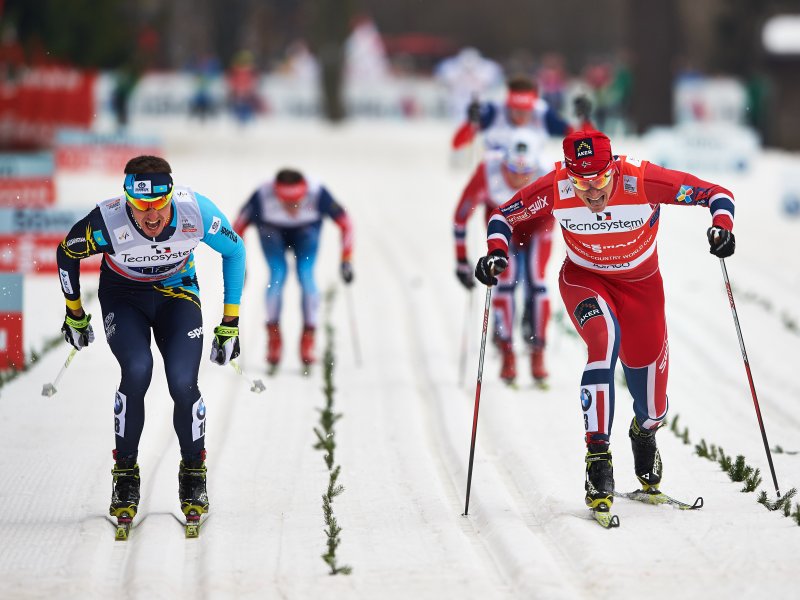
    Look familiar? Kazahstan's Alexey Poltoranin (l) placed second for the second-straight day at the Asiago World Cup in Italy, as Ola Vigen Hattestad (r) secured the Norwegian victory in the 6 x 1.65 k classic team sprint. (Photo: Fischer/Nordic Focus)
    Look familiar? Kazahstan’s Alexey Poltoranin (l) placed second for the second-straight day at the Asiago World Cup in Italy, as Ola Vigen Hattestad (r) secured the Norwegian victory in the 6 x 1.65 k classic team sprint. (Photo: Fischer/Nordic Focus)

    The way things were shaping up in the men’s 6 x 1.65-kilometer classic team sprint final at the World Cup in Asiago, Italy, it could’ve been anybody’s race.

    Yes, Norway’s Eldar Rønning and Ola Vigen Hattestad were generally leading the 10-team pack on Sunday, and yes, the top-four combination was often something like Norway, Russia, Norway, Russia (with each nation having two teams in the final), but you couldn’t count teams like Sweden and Kazakhstan out.
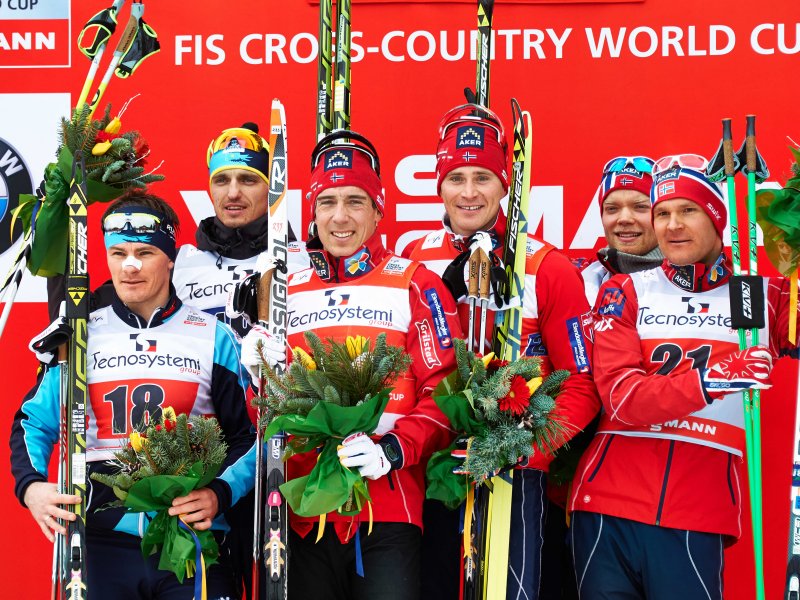
    The men's classic team sprint podium at the Asiago World Cup in Italy on Sunday: Norway I won with Eldar Rønning and Ola Vigen Hattestad (c), Kazakhstan's Nikolay Chebotko and Alexey Poltoranin (l) placed second, and Norway II was third with Eirik Brandsdal and Øystein Pettersen. (Photo: Fischer/Nordic Focus)
    The men’s classic team sprint podium at the Asiago World Cup in Italy on Sunday: Norway I won with Eldar Rønning and Ola Vigen Hattestad (c), Kazakhstan’s Nikolay Chebotko and Alexey Poltoranin (l) placed second, and Norway II was third with Eirik Brandsdal and Øystein Pettersen. (Photo: Fischer/Nordic Focus)

    While Sweden’s first starter, Teodor Peterson clocked the fastest leg in each of his rounds, his teammate Simon Persson repeatedly dropped several places after every exchange. Without their original starter in Emil Jönsson, who had to scratch because of a sore back on Sunday morning, Sweden slipped from first to sixth, second to sixth, and finally third to fifth.

    They weren’t a threat to Norway’s first team of Rønning and Hattestad, which won the first semifinal over Russia’s Alexander Panzhinskiy and Nikita Kriukov, but the Kazakhs were.

    Second in their semifinal after Norway II’s Øystein Pettersen and Eirik Brandsdal, Kazakhstan’s Nikolay Chebotko and Alexey Poltoranin sat patiently around fourth early in the final, then rose to second by the fourth of five exchanges.

    Just 0.6 seconds behind Rønning at the start of his last lap, Chebotko held his position until planting his pole between his legs and toppling over. Kazakhstan dropped from second to sixth, and it seemed their hope for a podium was slipping as the rest of the leaders skied into the exchange zone.

    Podium? The thought probably never crossed Poltoranin’s mind as he waited for the tag just a couple hundred meters later. He was going for the win. Norway’s Hattestad would have to try to stop him.

    After getting the tag in fifth, Poltoranin made up nearly 5 seconds on the leaders, including Hattestad up front, followed by Kriukov,  Persson and Brandsdal.

    Maxim Vylegzhanin lifted Russia II into the top four, but he and teammate Dmitriy Japarov were later disqualified for a “violation of classical technique rules,” likely skating on the mostly double-pole course. At least half the men’s field raced on skate skis, including most of the top men’s finalists.

    Coming out of a sharp corner on a long descent, Kriukov’s pole strap broke, but he quickly got a replacement and resumed his spot amongst the top five with Norway I, Russia II, Norway II, Russia I, and Kazakhstan.

    With 800 meters remaining, Poltoranin took a shortcut to second, cutting in on the inside lane around a tight turn. Most everyone had to snowplow on the final corner to avoid crashing in the sugary, melting snow, but Poltoranin remained in position to challenge Hattestad – who was still leading – to the finish.

    Hattestad didn’t have to look back. He needed to go hard the last 100 meters to the finish. Committed to a central lane, the Norwegian double poled like mad while Poltoranin jumped into the left lane behind him, which was considered one of the fastest in the homestretch.

    It may have been faster as Poltoranin came within centimeters of Hattestad, but the Norwegian held him off, throwing his leg across the line and winning in a photo finish in 24:47.4.

    “I did not know we had won until I saw Eldar come running towards me,” Hattestad told VG Nett, according to a translation.

    “It’s fun to win with only five centimeters,” said Rønning, who initially put Norway I in third, just 0.7 seconds behind Russia II up front.

    After the first tag, Hattestad brought the team to first, where they remained fractions of a second ahead of anyone else for the rest of the race.

    Norway II finished third, 2.17 seconds after Kazakhstan in second, but dropped as far back as seventh during the second leg, when Japarov fell on one of the last downhills and took out Pettersen. Brandsdal lifted them back to third with the fastest-course time for that leg, and Pettersen tagged him in fourth for the final lap.

    “Good day: back on the podium in WC, argue with a good Russian (became friends again), Christmas holidays and given away flowers to a little girl,” Pettersen tweeted after the race, according to a translation.

    “It is the best result of the season and I am very happy for that,” Pettersen told FIS. “Luckily we could get back. Team sprints are never easy.”
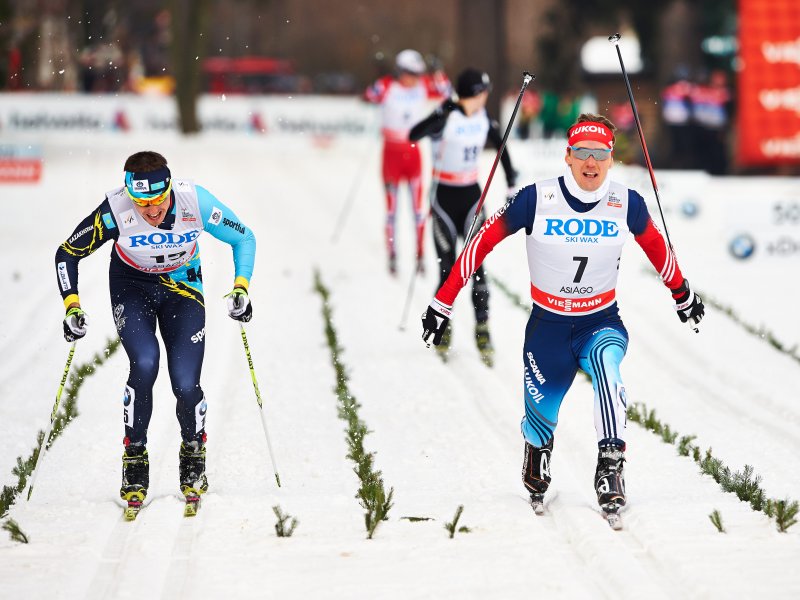
    NIkita Kriukov (RUS) edges Alexey Poltaranin (KAZ) for the victory in the classic sprint in Asiago, Italy. Photo: Fischer/Nordic Focus
    Russia’s Nikita Kriukov (r) edges Alexey Poltaranin (KAZ) for the individual classic sprint victory on Saturday in Asiago, Italy. (Photo: Fischer/Nordic Focus)

    They are especially tough one day after an individual classic sprint on the same soupy course in similarly warm (41-degree) temperatures. Poltoranin, who was just short of a victory behind Kriukov on Saturday, said he recovered well with some physio work.

    “Ola Vigen Hattestad is a very strong sprinter, but I think if we were not double poling in the finals, I would have had a chance to beat him,” said Poltoranin, who has placed second in his last three World Cup races.

    While he sat out the Davos World Cup last weekend, Poltoranin was second to Norway’s Pål Golberg in the 15 k classic on Dec. 7 in Lillehammer, Norway.

    Last season at the pre-Olympic World Cup classic sprint in Sochi, the Russians won on their home turf with Japarov and Vylegzhanin. Sweden’s Peterson and Jönsson placed second and Germany was third with Axel Teichmann and Tobias Angerer.

    (Teichmann teamed up with Tim Tscharnke for Germany I on Saturday, placing fourth in their semi and narrowly missing the final for 10th overall. Germany II’s Angerer and Alexander Wolz finished 12th of 15 teams in the first semifinal.)

    Russia’s No. 2 team of Alexey Petukov and Kriukov notched fourth last winter in Sochi, Norway’s Pettersen and Petter Northug placed fifth, and Kazakhstan’s Chebotko and Poltoranin finished sixth.
    Results

  • Kriukov Captures Another Russian Gold in Team Sprint; Canadians Miss Podium by Centimeters

    Kriukov Captures Another Russian Gold in Team Sprint; Canadians Miss Podium by Centimeters

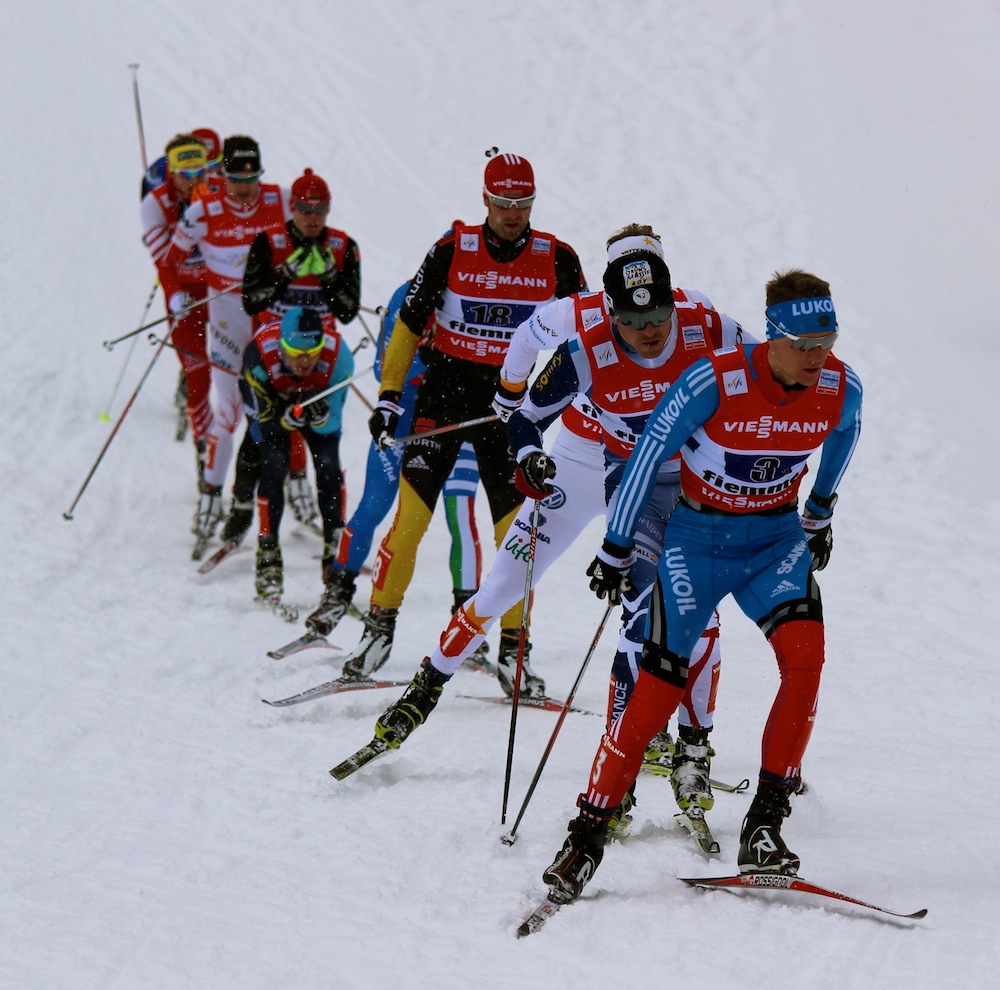
    Russia's Nikita Kriukov leads a 10-man pack, including Canadian Alex Harvey in eighth, in Sunday's 6 x 1.5 k freestyle team sprint at 2013 World Championships in Val di Fiemme, Italy.
    Russia’s Nikita Kriukov leads a 10-man pack, including Canadian Alex Harvey in eighth, in Sunday’s 6 x 1.5 k freestyle team sprint at 2013 World Championships in Val di Fiemme, Italy.

    FasterSkier’s coverage of the 2013 FIS Nordic World Ski Championships in Val di Fiemme, Italy, is brought to you by the generous support of Fischer Sports.

    VAL DI FIEMME, Italy – If cross-country skiing were a betting sport, which it is in some circles, you’d be a fool not to pick Nikita Kriukov for a sprint win after his performances in two races at the 2013 Nordic World Ski Championships.

    A 2010 Olympic sprint champion, the smiley Russian proved again Sunday he’s a force to be reckoned with in any short-distance discipline – skate or classic – after winning Friday’s individual classic sprint for his first World Championship gold and repeating the feat Sunday with teammate Alexey Petukhov in the 6 x 1.5-kilometer freestyle team sprint.

    The two didn’t make too much of a splash in the semifinals, finishing fourth about 2 ½ seconds behind Sweden in first, and Kazakhstan and Italy, respectively, to qualify for the finals with a fast-enough time.

    The defending world champs in the classic team sprint, Canada’s Devon Kershaw and Alex Harvey won Sunday’s first semifinal, which was about five seconds faster, edging Belarus by 0.04 seconds and Germany by 0.2 to advance.

    Ten teams met in the final, where Russia made a point to get ahead early. Petukhov started off by challenging Sweden’s Marcus Hellner up the first climb. Over the top, Hellner took the lead and Petukhov settled in with a long, single-file train behind him. Kazakhstan’s Nikolay Chebotko and Tim Tscharnke of Germany were next in line, followed by France’s Jean Marc Gaillard and Kershaw in sixth.

    Throughout the next five laps, the Russians remained close to the front, mostly behind Sweden, to ensure they stayed out of trouble. Coming out of the first exchange, the Canadians moved to second with Harvey, who was tagged in fourth, while Kriukov sat in third – comfortably, conserving.

    Defending team sprint champ Alex Harvey of Canada leads Austria's Bernhard Tritscher in Sunday's 6 x 1.5 k freestyle team sprint final at the 2013 World Championships in Val di Fiemme, Italy.
    Defending team sprint champ Alex Harvey of Canada leads Austria’s Bernhard Tritscher in Sunday’s 6 x 1.5 k freestyle team sprint final at the 2013 World Championships in Val di Fiemme, Italy.

    Harvey entered the stadium in second behind Sweden with all 10 teams within two seconds of the lead. Russia came through in ninth, but made its way to the front again by the first ascent out. Meanwhile, Kershaw’s pole snapped in the exchange and he fell to last while free skating to a replacement.

    Petukhov pushed the pace through the third exchange, where Sweden, Italy, Germany, and Kazakhstan followed, and Canada hung in sixth. With three laps remaining, the Russians were still in contention – this time behind France’s Maurice Manificat, who attacked on the first hill. Sweden’s Emil Jönsson stayed close in third and Harvey dropped back to ninth.

    With one leg to go, Sweden, Russia and Kazakhstan led the tight group of 10, Canada tagged off in eighth, and Petukhov and Hellner proceeded to go at it. Kershaw accelerated into fourth behind Kazakhstan’s Alexey Poltoranin. On the last steep climb, Petukhov attacked, Hellner stayed close and Dusan Kozisek of the Czech Republic charged up the outside to sneak ahead of Poltoranin.

    Kershaw sat in fifth and the order held through the last exchange. There, Nikolay Chebotko led out of the stadium for Kazakhstan, Jönsson followed, as did Kriukov and Harvey. Snow began to fall harder, but the pace remained calm – until the final climb. Harvey attempted to pass Kriukov and Jönsson on the outside, but unable to cut in, settled behind the Russian and ahead of Italy’s Frederico Pellegrino.

    Into the stadium, Poltoranin had the lead for Kazakhstan, but Kriukov caught Jönsson’s draft, slipping past them both and outdueling the Swede to the finish by 0.46 seconds. For Kriukov, it was his second gold in as many races at World Championships, and for Jönsson and Hellner, their first medal of the week.

    Poltoranin managed to hold off Harvey with a desperate lunge in a photo finish, and the Canadians crossed in fourth, three-hundredths of a second from the podium.

    “What a feeling; I am really, really happy,” Kriukov said at a post-race press conference. “The snow condition was really heavy and today I try my best and it was hard.”

    Following Poltoranin on the last lap, Kriukov was most concerned about Jönsson.

    “I know that Emil is very strong and last 50 meters, maybe 20 I beat him,” Kriukov said. “I’m happy that Emil has a silver medal because sometimes on World Championships you have a little problem, and I’m happy for him.”

    Jönsson reached over at the press-conference table and patted Kriukov on the shoulder. “Thank you,” he said.

    “It was a tough race,” Jönsson explained. “I don’t know how it looked like when you were watching it, but it probably looked like we were going really, really slowly today.”

    With soft, heavy snow, the group tried to keep the tempo in control, he said. But it still required a lot of energy, especially if you wanted to stay up front, like the Swedes did.

    “It was good for me and Marcus, we were still up in the group all the time, just try to be avoiding all accidents,” Jönsson said. “Our plan was just to be with the other guys in the end and see how it will go and hopefully it will be there [with] other medals.”

    For Jönsson, the silver was a career-best at World Championships since placing third in the 2011 skate sprint in Oslo, Norway. For Hellner, it was a good start coming off gold and silver at the 2011 World Championships, in the sprint and 4 x 10 k relay, respectively.

    Chebotko said his team set out for a medal, especially in the lead-up to the 2014 Sochi Olympics.

    “Our tactic was simply to stay with the Russians and Swedes and try not to stay behind of course,” Poltoranin said through a translator. “In the end, we eventually ended up on the podium and we’re satisfied with that.”

    Canada was less enthused, with Harvey wishing he’d been more aggressive at the apex of the last hill.

    “I was ahead of Kriukov and I should have cut him off but I’m not aggressive enough,” Harvey said. “It was the same yesterday [in the skiathlon]. A bunch of times yesterday I should’ve been cutting people off but instead I gave in too much. … I’m not like a sprinter.”

    This is coming from someone who won bronze in Thursday’s classic sprint. Despite feeling good on Sunday, Harvey said he simply wasn’t in a good enough position before the finish. As he tried to catch Poltoranin, he found himself off-balance and couldn’t outlunge him to the line.

    “It’s disappointing,” Harvey said. “At a championship, fourth doesn’t mean anything. It’s about the top three.”

    Kershaw looked down at the ground as he expressed similar emotions.

    “We came here to defend the title and we were well short of that,” he said. “But [ugh] there’s the Olympics next year.”

    Despite early pole trouble on his second leg, Kershaw said it fortunately didn’t make a difference.

    “I had to ski one lap with a bad pole, but that’s fine. I came back on it after that,” he said. “It is what it is, I guess. I felt really good today though, so I think that’s a step in the right direction.”

    After failing to qualify for the sprint heats on Thursday, Kershaw said he wasn’t sure if he’d be able to compete in five races as he’d hoped with lingering stomach problems. On Sunday, he said he was looking forward to the relay as long as the rest of his teammates – Ivan Babikov and Lenny Valjas – were feeling better.

    “We’ll be there for the relay,” Canadian head coach Justin Wadsworth affirmed. “The guys skied well and it was close. Alex said he got caught a little bit back and it’s so hard, even though you don’t want to be leading necessarily, you’ve got to be up in front of the group, but they skied well. … It was a good race, it was close.”

    Results

  • Team 13: Kazakhstan

    Team 13: Kazakhstan

    Nations Cup Ranking: 13th (1033 pts)

    Men: 13th (502 pts)

    Women: 10th (531 pts)

    2010/2011 A Team

    Men

    Nikolay Chebotko

    Alexey Poltoranin

    Yevgeniy Velichko

    Sergey Cherepanov

    Yevgeniy Koshevoy

    Denis Volotka

    Women

    Svetlana Malakhova-Shishkina

    Elina Kolomina

    Oxana Jatskaya

    What you may have missed last season:

    While the team is led in points by Nikolay Chebotko, a solid classic skier who struggles almost every time he puts on a pair of skate skis, the Kazakh man you should be familiar with is Alexey Poltoranin. He managed to get himself into the finals at the Olympic sprint, finishing 5th while tangling up with Petter Northug on the one tricky downhill corner on the course. Poltoranin’s success at the Olympics was surprising – in his first three sprints on the World Cup last season, now only did he fail to make heats, but he failed to crack the top 50.

    The Kazakh's surrounded by hot talent in their Team Sprint heat in Vancouver

    However, after a quick trip to Austrian Nationals, where he won two races, and Under-23 World Championships in Hinterzarten, where he failed to make the final, he came barreling out of the gate to qualify third in Canmore and finish in the top 10.

    Poltoranin and Chebotko set themselves up for a solid Olympics, where the two made some noise in the sprint relay, collecting 5th place and some cash from the Kazakh government.

    What You Should Know For This Season

    The Kazakh’s have Asian Winter Games on their home turf, and if the website is any judge, it should be a spectacular show!

    Otherwise, Svetlana Malakhova-Shishkina is getting long in the tooth, and her abilities have begun to degrade. She struggled to collect even one top 10 last season, and it doesn’t seem realistic to expect much more, especially when the event she excels at, the individual start 10 k in any technique, is not frequent on the World Cup.

    Elina Kolomina and Oxana Jatskaya seem to be ideally placed to pick up the slack. Unfortunately for Kazakhstan, Kolomina had only one good race last season, a second place in the ridiculously tight-finishing 10 k classic on the Tour de Ski. Meanwhile Jatskaya, who bills herself primarily as a sprinter, made the final just once, in Canmore, where she promptly finished last.

    Kolomina finishes just behind Petra Majdic, as the next 37 women finish within one minute Photo: Philippe Montigny/Agence Zoom/Getty Images Europe

    Who You Should Watch

    While he is far from a lock to do well, Poltoranin’s rise has been so spectacularly quick that it is a good idea to keep your eye on the 23 year-old Kazakh. Some weekends he might be so far from the podium he can barely see it – others he’ll be standing near the top step. He is the type of skier that is difficult to predict, but impossible to write off.