Tag: Nils Koons

  • Sunday Rundown: Seefeld, Goms, Ridnaun, Craftsbury

    Sunday Rundown: Seefeld, Goms, Ridnaun, Craftsbury

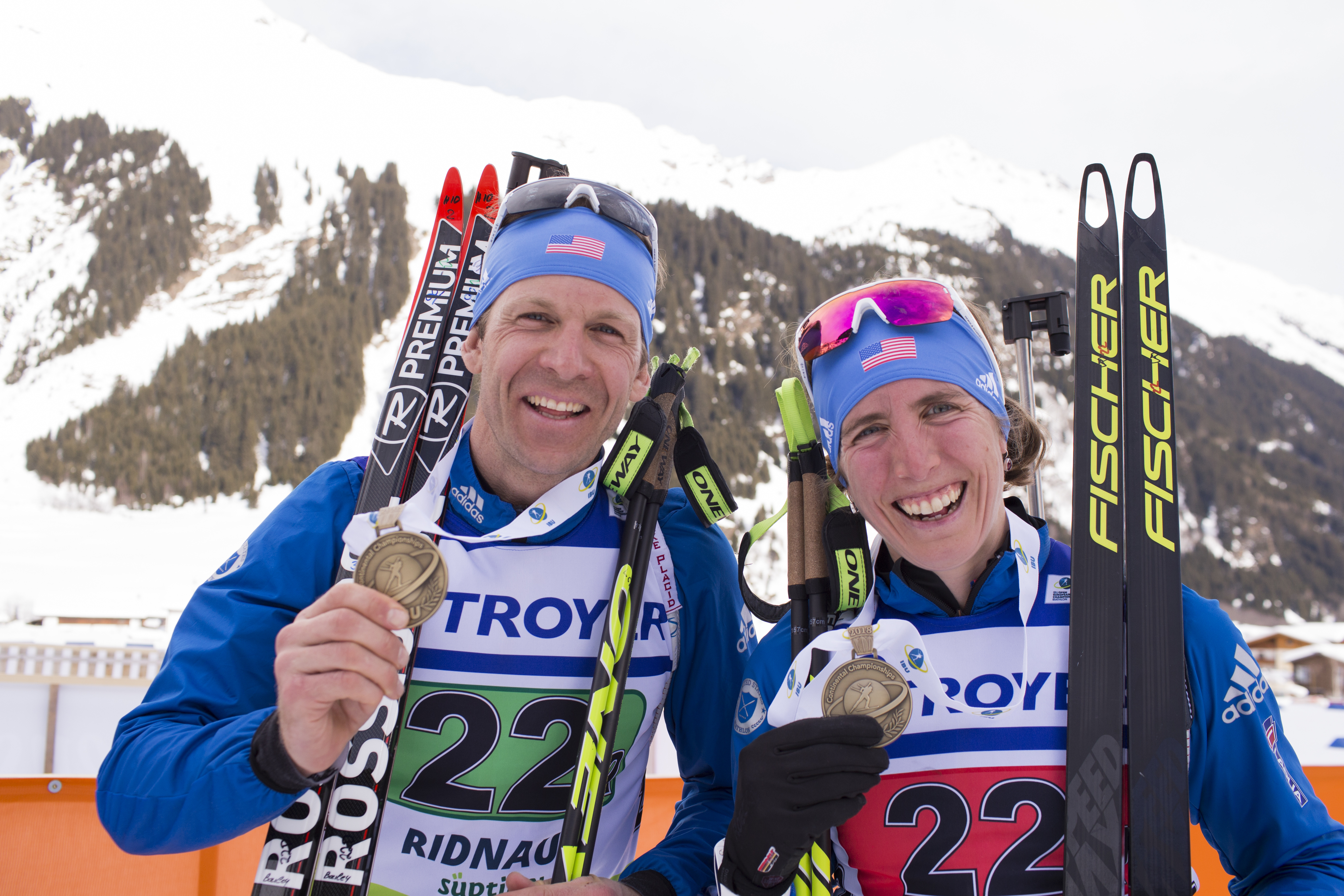
    US Biathlon’s Lowell Bailey (l) and Susan Dunklee after teaming up for bronze in the single mixed relay at 2018 IBU Open European Championships on Sunday in Ridnaun, Italy. (Photo: Manzoni/NordicFocus)

    IBU Open European Championships (Ridnaun-Val Ridanna, Italy): Single mixed & mixed relays

    Susan Dunklee and Lowell Bailey teamed up for the final day of the 2018 International Biathlon Union (IBU) Open European Championships in Ridnaun, Italy, and raced to a bronze medal in the single mixed relay.

    The American duo, both of which earned individual medals at last year’s IBU World Championships, finished just 9.1 seconds out of first, which went to Norway’s Thelka Brun-Lie and Vetle Sjåstad Christiansen. The Norwegians won in 35:39.6 with zero penalties and six spares. They took the lead after Brun-Lie’s second leg, where she cleaned both stages without spares.

    France placed second, 8.6 seconds back, with Julia Simon and Emilien Jacquelin, who combined for no penalties and 11 spares. They led the first half of the race, but slipped to second behind Norway on Simon’s second leg.

    Dunklee put the Americans off in second on her first leg, which she cleaned with a spare in each stage, then they slipped one place to third on Bailey’s first leg, where he cleaned as well and used three spares. In all, they used 10 spares and avoided the penalty loop, and finished half a second out of second place.

    “Over Christmas, we trained a little bit with the French athletes, including Jacquelin,” Bailey said, according to a US Biathlon press release. “So I know that he has quite a fast finish, and I thought I am kind of an old man here, I should maybe try to go harder on the first part of the lap. But he stayed with me all the time and had me in the end.”

    “It was a good opportunity to tune up the race shape, build some confidence and find that sharp feeling heading into the Olympics,” Dunklee told US Biathlon. “The single mixed relay is one of my favorite race formats and today was a blast!”

    Canada’s Sarah Beaudry and Carsen Campbell placed eighth of 24 teams in the single mixed relay, finishing 1:03.6 out of first with just eight spares and zero penalties. In 11th after the first leg, they moved into eighth on Campbell’s first leg, which he cleaned with one spare. Beaudry then cleaned her second leg without any spares, and Campbell anchored them to eighth.

    The U.S. entered a team in the mixed relay that followed, with Chloe Levins, Deedra Irwin, Paul Schommer, and Alex Howe placing 17th (+5:55.5) of 19 teams with no penalties and 12 spares.

    Ukraine won the mixed relay to conclude the championships, with Yuliia Zhuravok, Iryna Varvynets, Artem Pryma, and Dmytro Pidruchnyi combining for zero penalties and six spares and finishing in 1:11:40.1.

    Russia placed second (+11.7) with Victoria Slivko, Anastasia Zagoruiko, Evgeniy Garanichev, and Alexander Loginov combining for zero penalties and nine spares.

    Norway followed in third (+33.2) with Emilie Ågheim Kalkenberg, Kaia Wøien Nicolaisen, Håvard Gutuboe Bogetveit, and Fredrik Gjesbakk combing for no penalties and just four spares.

    Results: Single mixed relayMixed relay

    ***

    U.S. SuperTour (Craftsbury, Vermont): 5/10 k freestyle

    Two Alaska Pacific University (APU) athletes topped the podium on Sunday at the SuperTour in Craftsbury, Vermont, with David Norris winning the men’s 10-kilometer freestyle individual start in 21:54.9 and Becca Rorabaugh topping the women’s 5 k freestyle in 12:06.4.

    Norris won the men’s race by 6 seconds over Canada’s Andy Shields (Lappe Nordic) and Kevin Bolger of the Sun Valley Ski Education Foundation (SVSEF) placed third (+15.8). Kris Freeman (Caldwell Sport) was the third American in fourth overall (+23.7), and three Canadians took fifth through seventh with Michael Somppi (Lappe Nordic) in fifth (+27.9), Evan Palmer-Charrette (NTDC Thunder Bay) in sixth (+37.5) and Scott Hill (Barrie Cross Country) in seventh (+37.6), ahead of Brian Gregg (Team Gregg/LNR/CXC) in eighth (+39.4), Tad Elliott (Ski Club Vail) in ninth (+44.3) and Jack Hegman in 10th (+50.4).

    Rorabaugh won the women’s race by just 2.2 seconds over her APU teammate Rosie Frankowski in second, and Erika Flowers of the Stratton Mountain School (SMS) T2 Team placed third (+4.6). Two Craftsbury Green Racing Project (CGRP) skiers finished fourth and fifth, with Kaitlynn Miller in fourth (+12.1) and Liz Guiney in fifth (+22.5), Kelsey Phinney (SVSEF) was sixth (+25.8), and Canadians Olivia Bouffard-Nesbitt (Rocky Mountain Racers) seventh (+26.4) and Frederique Vezina (Pierre-Harvey National Training Centre) eighth (+36.0). Corey Stock, of the Bridger Ski Foundation (BSF) placed ninth (+39.9), and Felicia Geisor (CXC Team) was 10th (+44.4).

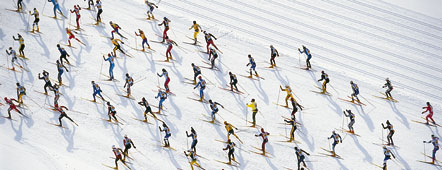
    On Saturday, the Craftsbury Outdoor Center hosted its 37th annual Craftsbury Marathon, with Nils Koons winning the 48 k men’s race in 2:28:51.0 hours and Hannah Dreissigacker winning the 48 k women’s race in 3:01.48.7.

    Results: Men’s 10 k | Women’s 5 k 

    Marathon (non-SuperTour) results

    ***
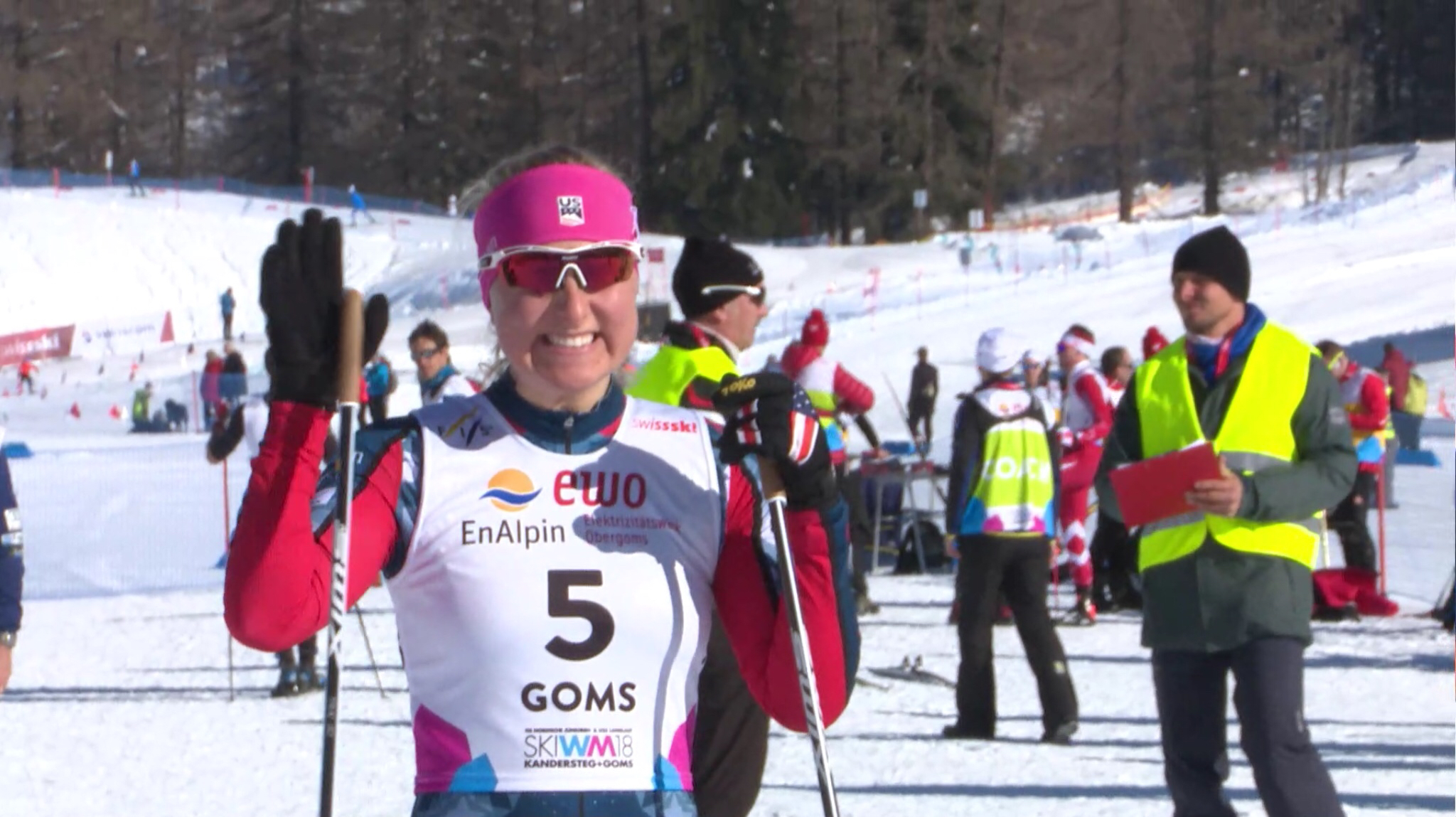
     

    Hannah Halvorsen of the U.S. Ski Team and APU on the start line in Ulrichen, Switzerland, after finishing fifth in the sprint qualifier. (FIS screencap)

    FIS Cross Country World Junior Championships (Ulrichen, Switzerland): Freestyle sprints

    Full report

    World Junior Championships kicked off today with freestyle sprints in Ulrichen, Switzerland. Moa Lundgren of Sweden claimed with women’s title by 1.89 seconds over Kristine Stavås Skistad of Norway in the final, with Sweden’s Frida Karlsson finishing third (+1.89).

    Hannah Halvorsen of the United States qualified in fifth place before skiing to second in her quarterfinal heat. Halvorsen hovered around third or fourth place through much of her semifinal and was unable to snipe any spots in the finishing straight, ending up fourth in the heat and eighth on the day.

    Fellow Americans Margaret Gellert and Sofia Shomento also made the quarterfinals, finishing 18th and 23rd, and Canada’s Hannah Mehain wound up 29th on the day.

    The new men’s junior world champion is Tom Mancini of France, who nipped Norway’s Jørgen Lippert by just 0.10 seconds to take the win. Valerie Grond gave the Swiss crowd a thrill by making it all the way to the final and taking home bronze, despite qualifying in just 21st position. The Swiss junior narrowly edged France’s Vincent Buiatti for the final step on the podium.

    Canada’s Graham Ritchie finished second in his quarterfinal after qualifying in 28th position, earning an automatic spot in the semifinals. There he finished sixth (+9.30 behind Mancini), winding up 12th on the day. Teammate Antoine Cyr also made the quarterfinals where he had an impressive crash, slinging off the trail and into the infield, finishing 30th on the day. For the U.S., Gus Schumacher was the lone qualifier for the heats. He finished fourth in his quarterfinal and was just 0.22 seconds away from a “lucky loser” spot in the semifinals. Schumacher finished 19th on the day.

    In the junior women’s race, Hannah Rudd of the United States finished 35th in qualification, +18.15. For Canada, Annika Richardson finished 52nd (+24.09), Catherine Reed-Metayer 56th (+28.25), and Alexandra Racine 69th (+37.27).

    In the junior men’s sprint, Canada’s Reed Godfrey finished a tough 31st, just 0.21 seconds out of making the quarterfinals. Etienne Hebert rounded out the Canadian finishers in 36th place (+11.81) in the qualifier. Canyon Tobin was 41st in qualification for the U.S. (+13.46), followed by Karl Schulz in 54th (+16.90) and Luke Jager in 60th (+18.15).

    Results: men’s qualifier | women’s qualifier | men’s final | women’s final

    ***

    FIS Nordic Combined World Cup (Seefeld, Austria): Individual normal hill/15 k
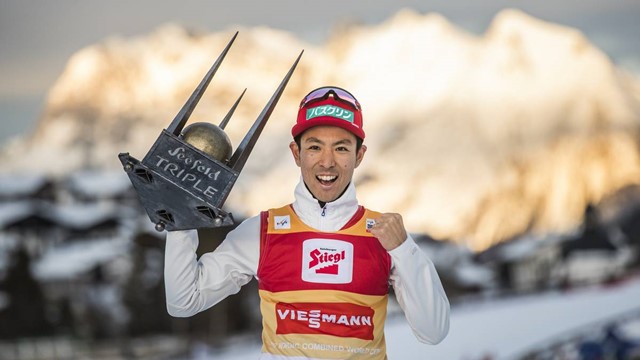
    Japan’s Akito Watabe after winning the 2018 Seefeld Triple Nordic Combined World Cup. He is the only athlete besides Germany’s Eric Frenzel to win the event. (Photo: FIS Nordic Combined)

    On the final day of the Seefeld Triple, Japan’s Akito Watabe completed his sweep of the three-day weekend and Norway’s Jarl Magnus Riiber reached the podium for the third-straight day, placing second. Germany’s Fabian Rießle placed third for his second podium in the last two days.

    Watabe jumped to first on the normal hill and started the 15 k Gundersen 48 seconds ahead of Riiber in second. He went on to win the race by 1:14.9 minutes in 34:58.6, becoming the only man besides Germany’s Eric Frenzel to win the Seefeld Triple in its five-year history.

    After jumping to fifth, Rießle won a photo finish for third (+1:57.9), edging Germany’s Vinzenz Geiger by less than a tenth of a second. Geiger moved up from ninth in the jump to fourth overall (+1:57.9).

    Norway’s Jørgen Graabak followed in fifth (+2:02.4), Frenzel placed sixth (+2:07.4), Norway’s Jan Schmid was seventh (+2:09.8), Finland’s Eero Hirvonen eighth (+2:13.5), Norway’s Espen Andersen ninth (+2:28.0), and Austria’s Mario Seidl 10th (+2:42.1) out of 28 finishers.

    No Americans contested the final day of the Triple, the last World Cup before the 2018 Winter Olympics in PyeongChang, South Korea.

    Results: Jumping | Final

    ***

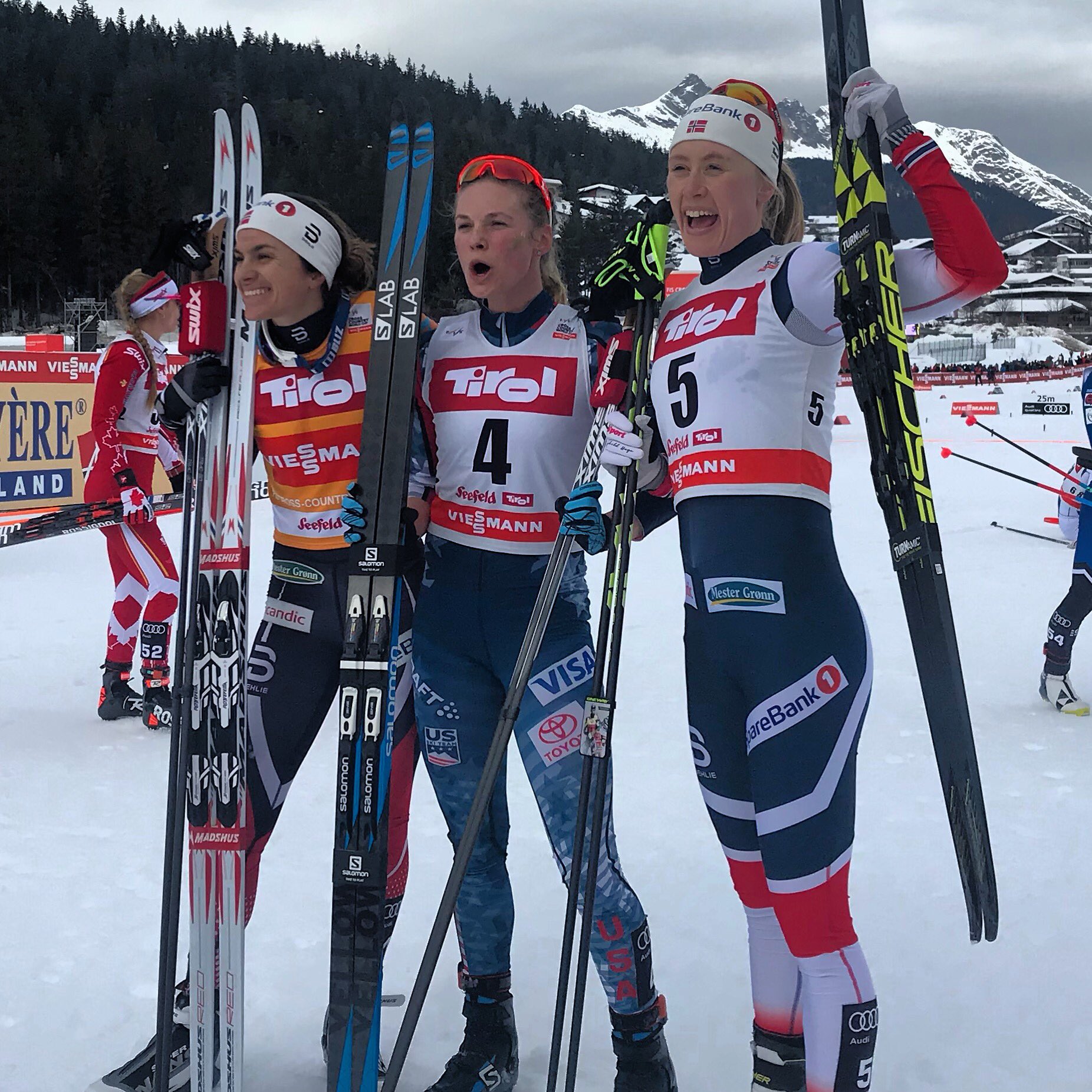
    Jessie Diggins of the U.S. Ski Team (center) celebrates after winning the 10 k mass start freestyle in Seefeld, Austria, over Heidi Weng (left) and Ragnhild Haga of Norway. (Photo: FIS Cross Country/Twitter)

    FIS Cross Country World Cup (Seefeld, Austria): 10/15 k mass start freestyle

    Women’s report

    Men’s report

    In the final World Cup race before the 2018 Olympics, Jessie Diggins achieved the ultimate goal to give herself the utmost confidence heading into PyeongChang — winning the women’s 10-kilometer freestyle mass start at the World Cup in Seefeld, Austria, on Sunday.

    The win was her first of the season and fourth individual victory of her career. Diggins, a 26-year-old U.S. Ski Team member, pulled it off by attacking on a long climb and leaving Norway’s Heidi Weng, Ragnhild Haga and Ingvild Flugstad Østberg chasing. While Diggins was several seconds ahead over the top and all alone on the long descent that followed, Weng and Haga worked to close the gap — and nearly did in the finishing stretch. But Diggins held them off, winning by 0.7 seconds over Weng in second place and 1 second ahead of Haga in third, and threw her fists down in celebration as she crossed the line first in 23:08.5 minutes.

    “I just put my head down and it wasn’t pretty, but I just hammered,” Diggins told the International Ski Federation (FIS) in a televised post-race interview.

    She was the only non-Norwegian in the top five, with Østberg in fourth (+8.7) and Marit Bjørgen in fifth (+16.7). Austria’s Teresa Stadlober placed sixth (+16.9), Norway’s Kari Øyre Slind was seventh (+19.1), and American Sadie Bjornsen placed eighth (+20.5), ahead of Switzerland’s Nathalie von Siebenthal in ninth (+30.3).

    The U.S. had three in the top 15 with Kikkan Randall (U.S. Ski Team) in 14th (+48.5), and two more women in the top 30, with Caitlin Patterson (Craftsbury Green Racing Project) in 23rd (+1:00.7) and Liz Stephen (USST) in 29th (+1:18.2). Rosie Brennan (USST) finished 53rd (+2:26.9).

    Emily Nishikawa led the Canadians in 35th (+1:36.5), followed closely by teammate Cendrine Browne in 37th (+1:36.6). Dahria Beatty finished 45th (+1:58.9).

    Women’s Results

    Dario Cologna of Switzerland (center) won the men’s 15 k skate mass start in Seefeld, Austria, over Alex Harvey of Canada (left) and Martin Johnsrud Sundby of Norway (right). (Photo: FIS Cross Country/Twitter)

    The Olympics are nearing and so Switzerland’s Olympic legend Dario Cologna is ramping up: after winning the Tour de Ski, he took another win in the 15 k mass start skate in Seefeld, Austria, on Sunday.

    With much of the field staying relatively close together until the finish, Cologna nabbed the win by 1.4 seconds over Canada’s Alex Harvey, who took his second podium of the season in addition to also finishing third in the overall Tour de Ski.

    Norway’s Martin Johnsrud Sundby was third (+2.9), then teammate Didrik Tønseth in fourth (+5.9) and France’s Maurice Manificat in sixth (+7.5).

    The U.S. Ski Team’s Erik Bjornsen had a breakthrough day finishing ninth (+9.3), followed by Simi Hamilton in 12th (+12.4). Behind them, Scott Patterson placed 27th (+23.4), then Patrick Caldwell 49th (+1:26.2), Ben Lustgarten 55th (+1:42.7), and Tyler Kornfield 77th (+3:00.0).

    Canada’s Devon Kershaw and Graeme Killick finished 30th (+26.5) and 31st (+27.4), respectively. Len Valjas placed 58th (+1:53.1), Knute Johnsgaard 82nd (+3:23.1), Bob Thompson 87th (+4:27.5), and Julien Locke 92nd (+4:56.9).
    Men’s Results

  • Amid the Chaos, Dreissigacker and Burruss Enjoy Engadin Experience

    Amid the Chaos, Dreissigacker and Burruss Enjoy Engadin Experience

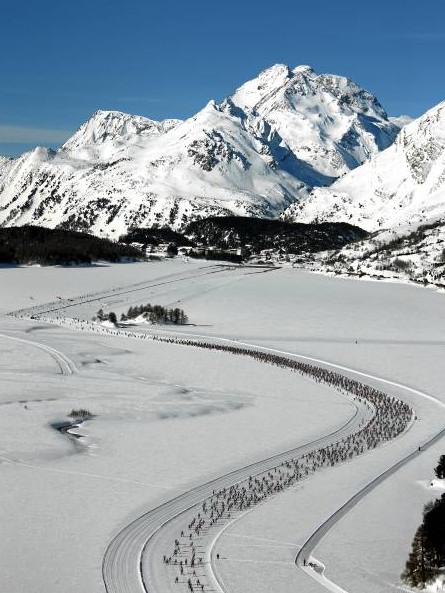
    Engadin Ski Marathon 2009 (Photo: Remy Steinegger/swiss-image.ch)
    The 2009 Engadin Ski Marathon (Photo: Remy Steinegger/swiss-image.ch). More photos here.

    Hannah Dreissigacker couldn’t have imagined what she was in for at the Engadin Ski Marathon two weekends ago.  The 42-kilometer freestyle race from Majola to S-chanf, Switzerland, was the largest in the Alps with more than 11,000 participants.

    Dreissigacker hadn’t planned to race it, but without World Cup obligations, the 26-year-old U.S. Biathlon B-teamer suddenly found herself in a position to do so. It was something she’d always wanted to do, and on March 10, she jumped into the Elite A wave, 10 meters behind the top elites. They all started at the same time.

    Hannah Dreissigacker (Craftsbury GRP/USBA). Photo: Gregory Haugen/HaugenPhoto.com.
    Hannah Dreissigacker (Craftsbury GRP/USBA) in a previous race with a rifle on her back. (Photo: Gregory Haugen/HaugenPhoto.com)

    “My wave was almost all men, and I couldn’t get to the front of the line, and so I was sort of in the back/middle of like a thousand men,” wrote Dreissigacker, also of the Craftsbury Green Racing Project. “I got tripped off the start and then run over by the wave that started behind us, and then I was just scrambling around in a huge group of men.

    “My poles were getting kicked all over the place, and inevitably one of them got broken,” she explained. “Once I gave up my hope of being anywhere near the top women, I tried to just relax and enjoy it.”

    Dreissigacker finished 24th out of 1,900 women, 11 minutes and 14.2 seconds back from Riita-Liisa Roponen of Finland (who won in 1:29.52.3) and about 8:42 off the podium.

    “It’s a pretty awesome and crazy feeling to be in the middle of such a huge group of skiers, all just failing around and fighting for their spot, surrounded by beautiful mountains,” Dreissigacker wrote.

    She skied with a “very short pole with no basket” for a while and a few kilometers later picked up a spare from race organizers. That one was too long and pretty heavy.

    Dreissigacker continued to ski relaxed with the equipment she was given, passing racers when she could, which wasn’t often.

    “The pace would slow to a crawl on the hills,” she explained. “But it was beautiful, and as awesome experience. And I got my own spare pole around halfway, which was great. It was a really cool event to be a part of, and I had lots of fun just taking in the scene and watching all the people in crazy costumes finish for the next few hours after I was done.”

    In the men’s race, Pierre Guedon of France edged Italian Christian Zorzi by half a second in 1:28.19.6. The top 21 men finished within 9.5 seconds of one another. Midwest native Matt Liebsch was not far off the pace in 25th (15.7 seconds behind Guedon), repeating his result from last year’s Engadin (where he was just 14.6 seconds behind Swiss winner Roman Furger).

    Oliver Burruss of XC Oregon took 48th (+1:23.2), Craftsbury’s Nils Koons was 54th (+1:31.20) and Peter Kling of Alaska Pacific University was 56th (+3:05.9).

    Ollie Burrus racing at U.S. Nationals, 2013.
    Oliver Burruss racing at 2013 U.S. Nationals.

    Burruss, 26, wrote in an email that XC Oregon has a history of sending athletes to the Engadin.

    “It seemed like a wicked fun race, definitely up my alley,” Burruss wrote. “I like skate marathons. And racing in Europe is pretty much every American skier’s dream, so I had to go for it.”

    Expectations-wise, he didn’t overthink it. But after finishing a solid 24th at the American Birkebeiner on Feb. 23, Burruss figured he could meet his goal of a top 100.

    “Once I was in Europe I felt a little funky, questioning my health and such, but in the back of my mind I had faith in my fitness, so it wound up working out,” he wrote. “Once we started, I felt solid and had fun. To end with a solid result was icing on the cake.”

    The good company helped, he added. Liebsch and wax technician Clarke Sullivan had been there before, and they gave advice on what to expect.

    “The rest of the crew, Nils Koons, Hannah Dreissigacker, and Peter Kling, were a blast to hang out and race with,” Burruss added. “Having the on the ground support of Tony Wiederkehr, who had done the race nine times and knew how to navigate all the logistics, was key as well.”

    Racing field in the Engadin Ski Marathon, Switzerland
    2010 Engadin Ski Marathon

    Burruss remembered being in awe of the start, thoroughly and widely groomed on Lake Sils, with the entire elite wave lined up single file.

    “I was in the middle of my warm up … and I got so overwhelmed looking at the mass of people in the pens that I had to stop skiing and take a moment to settle my nerves,” he wrote. “Once the gun went off it was way less chaotic than I expected it to be.”

    The first 10 kilometers were flat, and the pack to settled into what Burruss considered “good pace” and stuck together.

    “I found quickly that if you weren’t moving forward in the pack, you were moving back,” Burruss added, estimating he floated between the top 20 and top 100 half a dozen times.

    “At one point I was trying to move out of the wind and into a pace line when Toni Livers (Swiss National team guy, former World Cup winner) stiff armed me in the side to keep me out,” he wrote. “When I looked up at him he just smiled and shook his head.”

    Burruss spent the rest of the race trying not to lose much ground on the leaders, “who drilled it from 15k to 25k and splintered the group,” he explained. “I skied a bit behind the eventual women’s winner, who was skiing so well she was in the lead pack for a while.

    “Partway through we all came together again, probably a 50-man strong lead pack, before some dude in a red suit attacked off the front with 5k to go and forced the leaders to chase. I got popped and staggered in at the end of my chase group, pretty shelled from the accelerations.”

    Exceeding his goal, Burruss was pretty happy about finishing 48th and less than 90 seconds out, especially since he won’t be training full time next season.

    “I wish I’d had more fight in the last few k’s, but there’s always some regret,” he wrote. “It was a good race for me and more importantly it was a lot of fun throughout. … This is a nice one to go out on for sure.”

    Results: womenmen

    Photos | Video (with Burruss skiing behind Roponen)

  • Hanneman Hammers to First SuperTour Win in Bozeman

    Hanneman Hammers to First SuperTour Win in Bozeman

    Reese Hanneman (APU) skied cleanly away from the men’s field to take the Bozeman classic sprint on Saturday.

    BOZEMAN, Mont. — When the stakes are high, breakout performances are inevitable. Knowing it could be his last chance to earn a trip to the biggest stage of his life, Reese Hanneman (Alaska Pacific University) pulled out his first career SuperTour win at Bohart Ranch on Saturday in the classic sprint, skiing a step ahead of the field to beat Nils Koos (Craftsbury Green Racing Project) and teammate Erik Bjornsen.

    “I was confident I was capable of that,” Hanneman said. “Knowing that was probably my only shot [at the World Cup], the only thing I was thinking was, ‘You don’t want to finish and wish you’d done anything else, you just have to turn yourself inside out to try to get there first.’”

    It may not be until Monday that Hanneman finds out if he’s made that team, but on Saturday he at least knew he couldn’t have done anything better. When the men’s final came out of the woods and entered the defining last 400 meters, he was already in the lead and gapping the field.

    Congratulations and exhaustion in the finish area.

    “I didn’t even feel like I surged, I just gave it everything I had and just slowly started to build a gap,” Hanneman said. “I mean, of course you’re super nervous in your head the whole way, you’re sure someone’s going to pass you. It’s just throttling it all the way in.”

    But nobody could touch him, and as Hanneman neared the finish he turned to realize that the race was his.

    “It was just sweet to see I had a little gap and it’s amazing to turn around and have a day like that,” he concluded.

    Hanneman’s position at the front, at a point so far from the finish, surprised even his coach.

    “It’s exceptional,” APU head coach Erik Flora said. “Both [Hanneman and Bjornsen] came out of the woods together in the lead. I kind of expected them to be mid pack but in the end they came out in front, and so to see them do that was really exciting.”

    Eric Packer (SMS T2), who finished sixth, was impressed with Hanneman’s skiing.

    “It was awesome to see Reese crush it today. He’s a really strong skier technically; I think we’ll see big things from him.”

    Hanneman began the day in an unassuming fifth qualifying spot. He won his quarterfinal and slipped through in third in the semis. Dakota Blackhorse-von Jess drew first blood in the finals, taking the lead out of the stadium to stay out of trouble.

    Blackhorse-von Jess mistiming his lunge.

    “The plan was to do as little work as possible,” Blackhorse-von Jess said. “It sort of worked. I was more in front than I wanted to be.”

    He, Hanneman and Bjornsen came around the final turn together and things looked pretty even. When Blackhorse-von Jess was forced to swing into the far open finishing lane, he lost ground.

    “Being in the best line is where you wanted to be, and I was not there and I just ran out of gas,” he said. “I think I was skiing a lot better than that, but I also very badly mistimed a lunge and ended up on my back instead. So that’s a podium to fifth place, which is too bad.”

    Koons and Bjornsen hung on to make the podium in the lunge for second place.

    “My goal was to push the pace on the back side and I didn’t get up to the front as early as I did in the quarters and semis. But I finally got to the front right before the dip, I just didn’t have it left in the last little stretch,” Bjornsen said.

    The conditions on Saturday made for an interesting day of “classic” sprinting. With only one significant climb on a course that was moved up from a rain-soaked stadium, almost everyone in the men’s field chose to double-pole on skate skis in the qualifying round and through the heats. Koons, traditionally a stronger distance skier, double-poled to an impressive second place at the end of the day. Even though he got off to a slow start in the final, he said the weird course was forgiving to someone of his skiing style and allowed him to successfully come from behind.

    “These sprinters, you know, they really go hard and blow up,” Koons said. “I can’t really do that.”

    Where most people got tired after the final 180-degree turn, Koons found he was still gathering speed. He got in an open lane and went from sixth to second. That final 400 meters was the defining moment of the race for the six men on course. Hanneman made his gap, Koons gathered speed while everyone else tired, and third through sixth place scrambled to show they were the least exhausted of the rest of the field.

    Bjornsen pushed the pace all day so that by the end, he didn’t have the energy to match Hanneman or Koons.

    The mens’ classic sprint podium.

    “It caught up to me in the final, I just didn’t have anything left,” Bjornsen said.

    Thought he may not have finished like he wanted, out of all the men in the final he was the only one who had been there before on Thursday, and seems an obvious top choice for the Quebec City team.

    The rest of decision will be a tougher one, as there was no other overlap in who made the finals between the days to create clear leaders in the rankings. By the rules, ties go to the athlete with the lowest FIS points.

    Pat O’Brien, who finished fourth overall in the lunge behind Hanneman, was uncertain as to how selection would play out.

    “I definitely hope things go my way,” he said. “It’s definitely interesting. You have Reid [Pletcher] who won the skate sprint but didn’t make the final today. Ryan [Scott] didn’t even qualify today, so it’s going to be kind of a jumble… But the people who skied the best deserve to go, and I was happy to do better today.”


    Of Note:

    — Like the women, the men seemed to think the course was fair given the conditions.

    “You couldn’t win from the start, so there was a lot of tactics, but that’s sprint racing,” O’Brien said.

    “I think they did a great job with what they had and it’s the same course for everybody, so it was fair,” Bjornsen added. “I think the conditions were pretty good, considering.”

    — With a few exceptions, the entire field’s collective decision to ski on skate equipment was cemented once coaches saw most of the top men leaving the gate to double pole up the hill. A few athletes, like Bjornsen, wanted to prove everyone wrong by striding, but on Saturday the coach’s word was law.

    “A minute before my start [Flora] handed me the skate skis,” Bjornsen said. “I saw everybody with skate skis and I kind of wanted to just go with the classic and prove some people wrong, but he was like, “Go with the skate skis, everybody else is doing it.’”

    For Packer, it was more of an obvious choice.

    “After racing in Canmore, where we did the Frozen Thunder race, [Andy] Newell showed that on a course with much bigger hills than this double poling was much faster. When we came here this morning, conditions weren’t firm enough on the hill and there was no way classic skiing was going to be competitive,” Packer said. “I think most guys realized that off the bat and decided to double pole.”

    Hanneman double-poling the first hill in qualifying.


  • Elite Team Preview: Craftsbury Green Racing Project

    Elite Team Preview: Craftsbury Green Racing Project

    Craftsbury Green Racing Project skiers hard at work during a rollerski speed session near Craftsbury, Vt. (CGRP photo)

    Note: This is the fifth preview in a quick-and-dirty series on U.S. elite teams. We asked coaches to send their 2012/2013 rosters and tell us what’s new for the coming season. We will be publishing additional reports over the next few weeks. Teams are presented in no particular order.

    Team: Craftsbury Green Racing Project (GRP)

    Coaches: Pepa Miloucheva (head coach, 15th season), Jeremy Nellis (junior coach)

    Senior roster: Ida Sargent (U.S. Ski Team), Susan Dunklee (US Biathlon), Hannah Dreissigacker (US Biathlon), Clare Egan, Maria Stuber, Amy Glen, Caitlin Patterson;

    Bryan Cook, Dylan McGuffin, Patrick O’Brien, Tim Reynolds, Alex Howe, Nils Koons, Gordon Vermeer

    Who’s new: Glen (2012 University of Vermont NCAA champion, Anchorage native), Patterson (also from UVM and Anchorage), Howe (another recent UVM grad; New Hampshire native), Vermeer (Dartmouth grad from Minneapolis) and Koons (former GRP training partner, New Zealand native)

    More on the new athletes

    Who’s missing: None.

    Top results last season: In her first year on the U.S. Ski Team, Sargent notched 12th at the Moscow World Cup sprint. Also a national-team rookie, Dunklee (US Biathlon A-team) posted a best-ever finish by an American woman at the World Biathlon Championships in Ruhpolding, Germany, placing fifth in the 15 k individual race and missing the podium by just seven seconds.

    Ida Sargent (CGRP/USST) during the 1.8 k hill climb at the SuperTour Finals in late March at Jay Peak in Jay, Vt. Sargent finished sixth overall in the STF pursuit.

    Dreissigacker recently earned a spot on the US Biathlon B-team after cracking the top 20 at the IBU Cup in Canmore, Alberta, where she placed 16th in a sprint. She competed in a hefty number of cross-country races last season and was ninth at U.S. nationals in the classic sprint, but will be focusing on biathlon this year, according to a GRP press release.

    Also at the 2012 U.S. Cross-Country Championships in Rumford, Maine, Stuber (a training partner) placed 10th in the 10 k skate and Egan followed in 11th.

    On the men’s side, Reynolds wrapped up the season with a bronze medal in the 50 k at U.S. Distance Nationals in Craftsbury, Vt. McGuffin won a SuperTour in St. Paul, Minn., and O’Brien was second overall in the Tour de Twin Cities multi-stage event. O’Brien also tallied three top-10’s at U.S. nationals – in both sprints and the 30 k classic – and was eighth in the 50 k at distance nationals.

    Another Craftsbury training partner, Cook finished fifth at U.S. nationals in the 15 k skate and was ninth in the 30 k in Rumford. Koons won the 2012 Craftsbury Marathon, was third in the Boulder Mountain Tour and posted four SuperTour top-10’s last season. This spring, he became a full-time team member.

    GRP athletes circuit training on the new outdoor gym at the Craftsbury Outdoor Center in Craftsbury, Vt. (GRP photo)

    Coach’s comment: With five new athletes, the GRP roster has grown to a whopping 14, and coach Pepa Miloucheva has been impressed with their training.

    “The new athletes did fit right into the training program and into the center’s projects,” she wrote in an email. “It is a great group of very similar-in-speed athletes, but also with different strengths and needs, [which] allows them to really improve by training with each other. For me as their coach, [that’s] a great challenge to have!”

    The team is currently seeking one or two wax techs/assistant coaches for the upcoming season. As for their summer schedule, Craftsbury is hosting the NENSA Eastern Regional Elite Group (REG) Camp and Stratton Mountain School Elite Team this week. In September, the GRP will join the U.S. Ski Team dryland camp in Lake Placid, N.Y., for two weeks of training and time trials.

    ***

    Other previews: Bend Endurance Academy | CXCMaine Winter Sports Center | XC Oregon

  • Nygren, Gelso Take Top Spots in Aspen Classic Races

    Nygren, Gelso Take Top Spots in Aspen Classic Races

    Karl Nygren (CXC) won the classic sprint qualifier on Saturday in Aspen.

    ASPEN, Colo. — On a bluebird morning in Colorado, the Aspen Nordic Festival kicked off on Saturday with a two-stage classic day; a sprint qualifier in the morning followed by a 10 k individual start for the men two hours later. Karl Nygren (CXC) started the weekend off by posting the fastest sprint time by 2.85 seconds, followed by Dylan McGuffin (CGRP) in second and Pat O’Brien (CGRP) in third (+3.21).

    The 1.4 k sprint course was set with firm tracks, and featured a few short, steep climbs and some descents that let skiers carry their speed. The brief uphill before the straightaway to the finish was positioned just where athletes really started to hurt.

    Twenty-four men contested the sprint, and the SuperTour regulars at the top of the results sheet were largely unused to the all-around pain of racing at altitude. Tucker McCrerey (Summit Nordic Ski Club) broke into fourth ahead of Nils Koons (Rossignol) in fifth and Tim Reynolds (CGRP) in sixth.

    For many elite skiers on the SuperTour circuit, Aspen was the first stop in a while that had any natural snow to speak of. Though the elite field was relatively thin, the sun and abundant snow had racers in a good mood.

    Even after feeling the full force of 8,000+ feet of elevation, Nygren was cheerful about the sprint.

    “That hurt a lot,” said Nygren with a laugh.

    He and teammate Jennie Bender were the only CXC athletes to make the trip to the Rockies, and rather than arrive a week beforehand to acclimate to the altitude, they decided to race before their bodies had a chance to completely protest to the thinner air.

    “You’ve just got to race into it a little bit,” said Nygren.

    With a distance race on the docket for the same day, athletes had little choice but to race into it.

    * * *

    After cooling down, elevating their feet, and warming back up, it was time to head back out for the 10 k classic. By the time the first men’s starter went off at 11:00 am, the temperature had warmed significantly.

    The men completed two 5 k loops that featured long gradual climbs and little rest. All three podium finishers were athletes who had decided, for various reasons, to skip the preliminary sprint.

    Matt Gelso (SVSEF) striding out of the start of the 10 k classic in Aspen. He won by 13.4 seconds.

    Matt Gelso (SVSEF), despite “exploding” at the top of the course and losing significant ground, rallied to beat Leif Zimmermann (BSF) by 13.4 seconds. Vegard Kjoelhamar (CU) took third (+34.7), and McCrerey (+50.6) was the first athlete across the line who had also skied the sprint two hours earlier.

    “I went out a little hard, which is something I almost never do,” said Gelso

    “I had a little explosion at the top of the course, for about a kilometer, but I brought it back together at the bottom.”

    As a CU alumnus, Gelso once competed at altitude comparable to Aspen’s every weekend. This year, Saturday marked the highest race he’d done all season. Couple the thin air with recovery from his recent head cold, and Gelso’s race made for a painful experience.

    Despite appearing to be on the way out of the running on the second lap, he managed to catch back up to the group in front of him that included Tim Reynolds (CGRP) and Kjoelhamar, and skied even with them in the final kilometers to regain the lead.

    Zimmermann, who skied a 10 k skate at the Teva Mountain Games in Vail on Friday, similarly characterized the experience as “awful,” but was nonetheless pleased with the outcome.

    “Racing at this altitude is always hard, and you kind of feel like you’re in slow motion all the time,” said Zimmermann.

    He added that he normally enjoys racing at high elevation, but “overall I just didn’t have that little snap on the hills.”

    With its gradual climbs and a track that got steadily greasier under the sun, Zimmermann said that snap was the key to having a good race on Saturday.

    Kjoelhamar, whose major focus will be NCAAs coming up in less than a month, remained in Colorado this weekend to recover from a recent illness while his CU teammates raced in Alaska.

    “I like the course here—not too steep, but long climbs,” said Kjoelhamar. “It fits me well.”

    Kjoelhamar returned to training after his illness on Tuesday, and like Zimmermann, entered the 10 k in Vail on Friday to begin racing his way back into shape.

    “[Vail] was horrible—today was quite a bit better, but there’s still a little bit before I’m in good shape.”

    Sunday’s Owl Creek Chase, a mass start 21 k freestyle, is the focal point of the Aspen Nordic Festival. The point-to-point course has Saturday’s competitors plenty wary.

    “When you’re feeling great, it’s a super fun course,” said Zimmermann.

    “But if you’re a little tired it can be painful. I think it’ll be fun; the snow’s good.”

    Unofficial sprint results

    Unofficial 10 k results