From the FasterSkier archive — posts syndicated from athletes’ and coaches’ own blogs between 2004 and 2012, kept online as published. Current coverage is at fasterskier.com.

Tag: Nina Armstrong

  • A Full Weekend of Rollerski Races in Upstate New York

    A Full Weekend of Rollerski Races in Upstate New York

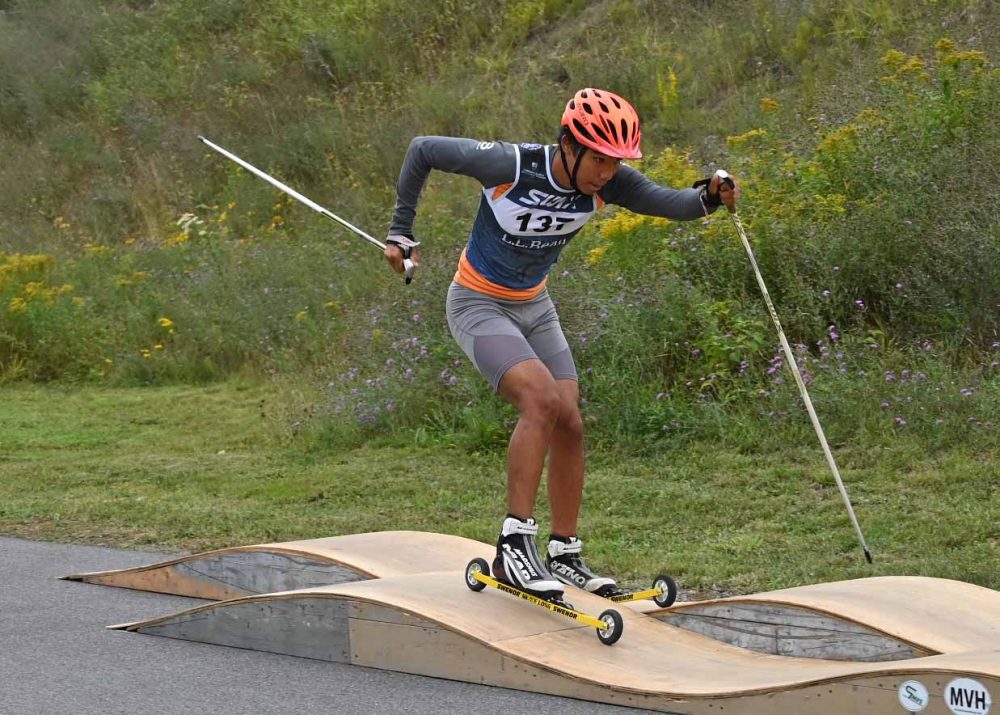
    Linden Nideck of CSU navigating the agility features. (Photo: Peter Minde)

    The NENSA rollerski series ramped up this past weekend outside Lake Placid, New York. As part of the drive to draw more skiers to the rollerski series, Saturday included a two race format known as a doubleday event: event 1 consisted of a 3-kilometer skate prologue followed by a 1.5-k cross-country cross (XCX) featuring several agility segments. Athletes earned a reward for performances in each event. Both events were individual start and their aggregate times were used to form a pursuit start for the first wave of the Climb to the Castle (C2C) on Sunday.

    For those who raced both events on Saturday, the C2C was a pursuit style event – with the overall leaders from the first two races heading out first.  

    Saturday’s Doubleday 

    Both races were located at the Olympic Jumping Complex while between races, NENSA’s Justin Beckwith and NYSEF’s Shane McDowell assembled the undulating ramps that constituted the agility segments for the sprint prologue. At each agility segment, if an athlete couldn’t ski the obstacle, there was a safe alternate route that penalized skiers- not unlike a penalty loop in biathlon. 

    It was cloudy all day; the uppermost section of the loop was damp from overnight rain.

    Individual results for each respective race can be found here:

    Event 1: 3 k Prologue Results 

    Event 2: Full 1.5-k CXC Results

    Saturday’s overall results dictated the pursuit start times for Sunday’s C2C. For the senior women, Zoe Williams (ENRG/Nakkertok/Carleton College) was atop Saturday’s combined standings. Nina Armstrong (NYSEF) was second, and Jessica Roach (Team Hardwood) third. For the men, Luke Brown (Bridger Biathlon), Zane Fields (US Biathlon), and Erikson Moore (Fondeurs Laurentides) were first through third respectively heading into Sunday’s event. 

    Combined Times after Two Events
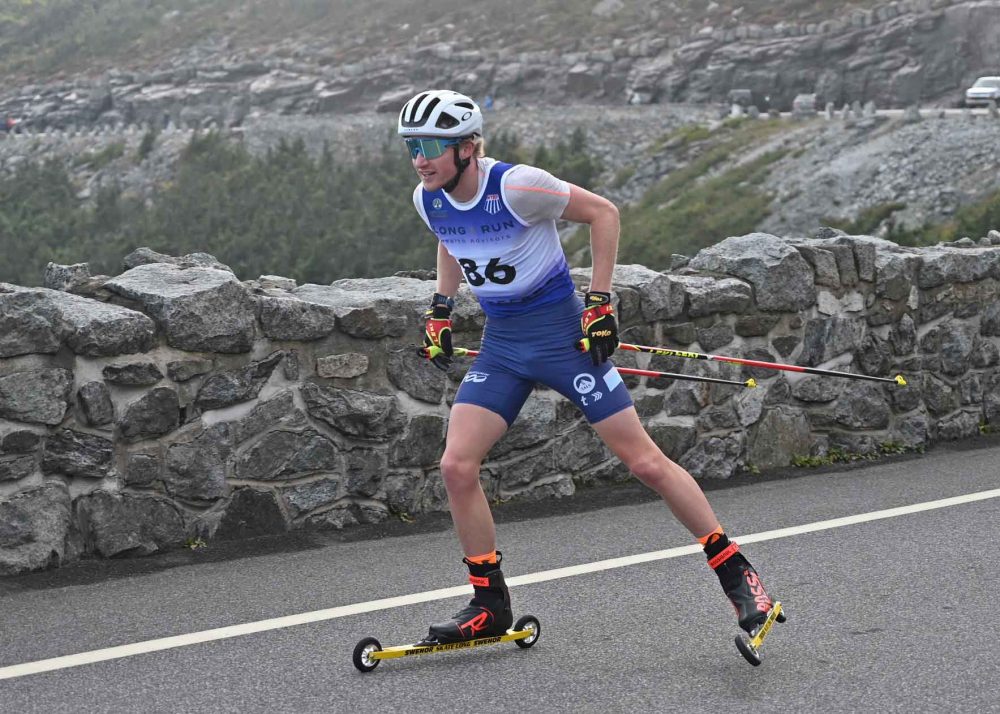
    Kyle Bratrud on his way to the 2019 Climb to the Castle win. (Photo: of Kel Rose)

    Climb to the Castle

    Sunny skies greeted racers on Sunday as did blustery winds. Although it was dry, the weather was noticeably cooler than the 80 degrees racers endured at least year’s C2C. An hour before the start, it was 55 degrees at the toll gate, with the wind blowing steadily between 16 and 26 miles per hour. 

    Kyle Bratrud (SMS T2) and Williams won Sunday’s Climb to the Castle (C2C) rollerski race in Wilmington, New York. It was the first win here for both skiers. The race ascended the Whiteface Mountain toll road for five miles at an average grade of eight percent. At 4867 feet, Whiteface is the fifth highest peak in the Adirondack Mountains.

    Bratrud, who did not contest either race on Saturday, broke Robert Duncan Douglas’ long-standing men’s record by 1.1 seconds, finishing in 34:55.5 minutes. Jake Brown, of US Biathlon and Craftsbury Green Racing Project (CGRP) placed second at 36:25.8. Luke Brown raced to third in 37:30.1.

    For the women, Williams finished in 48:54.6 after placing third last year. Kathy Maddock, age 54, of Wilton, NH., was second overall in 51:12.0, followed by a junior skier from Mansfield Nordic, Ava Thurston, in 51:20.1.

    Skiers who competed in Saturday’s doubleday races went out first, starting in a pursuit format based on their aggregate times. Doubleday finishers started at 8 AM sharp and were all on course by 8:05.  Open athletes started in a mass start wave at 8:06, with masters following two minutes behind. 

    Bratrud told FasterSkier he’d raced C2C once before in 2015. Since he did not race the sprints the day before, he started at 8:06, gradually reeling in the pursuit starters. 

    “It’s been a while since I’ve been up here but I really like this climb,” Bratrud said. “It’s always a really sweet atmosphere and it was a pretty solid effort. We started in a group of maybe five or six. I was at the front and set a decent pace. It didn’t seem like anyone wanted to come around me so I just kind of slowly ramped it up without destroying myself and it worked out.

    “We had done the App Gap roller ski race a little earlier in the year,” Bratrud continued. “There, I tried to send it as fast as I could off the line, and ultimately I blew myself up. Here, I wanted to be a little more controlled and I knew it was a long race. I wanted to ski a nice controlled V2 the whole way.”

    While both races are purely uphill, each has a distinct set of challenges. The App Gap challenge features a transition from skate to classic and climbs about 1,500 vertical feet over the 7.5-kilometer course, while the C2C climbs 2,300 feet in one unbroken grind.

    “I think [C2C] is definitely harder,” Bratrud said when asked about comparing the two. “There are steep pitches on the App Gap but there are also some flat parts. There really isn’t anywhere to hide on this climb once you start going up, which is basically right at the start.  And then you get the wind.”
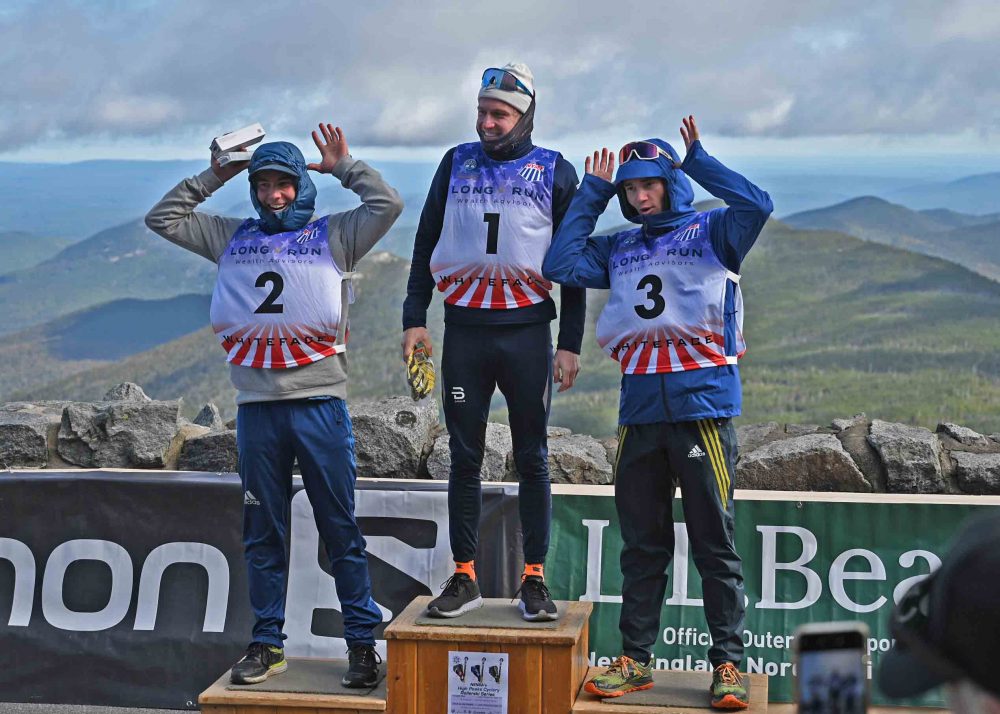
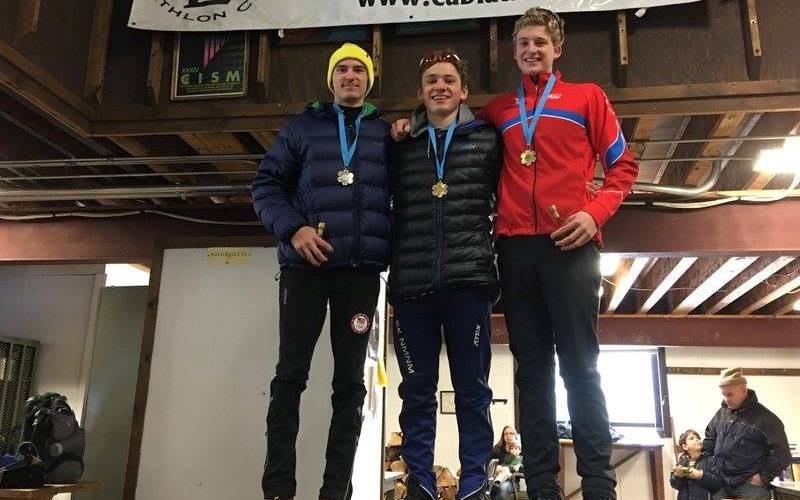
    2019 Climb to the Castle men’s podium. From left to right: In second Jake Brown, first Kyle Bratrud, and third Luke Brown. (Photo: Kel Rose)

    Like Bratrud, Jake Brown started in the wave following the doubleday athletes. “It went pretty well,” he said of his race. “I was able to hang on to Kyle for a couple of miles and then it was a little too much. I was hoping that I wouldn’t have to lead so I could tuck in a little bit, which I was able to do. Otherwise, I didn’t have much of a plan.  Something like this is so physically demanding, you can’t really have a plan until you get out there and understand how your shape matches the challenge.”

    Luke Brown felt that the doubleday was good preparation for the C2C. “I think the efforts [in the doubleday] opened up my legs, kind of a pre-race,” he said. “I felt pretty strong, it’s a super fun road to ski up. Pretty nice weather at the bottom, and windy at the top. Zane Fields started six seconds behind me and caught up to me. We worked together for a little bit and then I pulled away from him, probably about halfway up the mountain. Then I just tried to go hard.”

    With the best women’s aggregate time from the doubleday, Williams was the rabbit out of the start. Shilo Rousseau of Ontario’s Barrie XC, a junior skier, was the second woman starter as she followed 32 seconds after Williams. 

    2019 Climb to the Castle junior women’s podium. From left to right: in second Rose Clayton, first Ava Thurston, and third Shilo Rousseau. (Photo: Kel Rose)

    “The pursuit start meant that I skied a lot of it alone, which was different from previous years,” Williams said. “I was happy that I kept the pace going up the hill, kept trying to keep the tempo up. So it was good. My legs were for sure tired after yesterday, and I felt that probably a kilometer in. I thought that it would be my legs holding me back instead of my cardio. But I still felt like I was able to put a good effort in.”

    Maddock said she benefited from working amongst a group of fast skiers. 

    “I was part of a train of men and hung with them until it was just the guy leading and me,” wrote Katherine Maddock, head coach of Dublin (NH) XC. “It was super helpful having him to ski with. On the flat(ish) section maybe a mile or less from the top, we could see a group of skiers in front of us. He turned around and said to me, ‘Let’s go fishing. And then he just started picking people off. It was great. Ultimately he made a move around a skier and I couldn’t match the effort so I was on my own in the wind tunnel, but I survived, which was no small feat with that headwind!”

    Climb to the Castle Time of Day Results by Junior and Senior Categories


    The Mini-Tour Overall

    For racers competing in all three events, the overall mini-tour results are as follows.

    Overall Men: Luke Brown placed first (48:47), Fields was second (49:50), and Finn Dodgson of Ontario’s Barrie Cross Country was third (51:32).

    Overall Women: Williams was the women’s mini-tour winner (1:02:19), Ava Thurston placed second (1:05:24), and Shilo Rousseau third (1:06:18).

    Mini Tour (3 races) Overall Results by Junior and Senior Catagories

    Catching up with C2C Finishers

    Lucy Hochschartner (St. Lawrence University) has raced C2C multiple times. “It was really fun! I’ve done this race a lot of times and it’s always really hard,” she said. “But it was great to have nice weather and lots of good people to race against. I didn’t do so great [in the doubleday] so I got to move up a little bit. And not dying at the very end was fun. The wind definitely made for a slow finish.”

    Nina Armstrong during the first day of racing at the three race mini-tour. (Photo: Peter Minde)

    Nina Armstrong (NYSEF) had the weekend’s races written into her training plan. “I haven’t done [C2C] in quite a few years,” she said. “It was fun. My plan was to work into it and hopefully not die before the finish line. It was really fun having people all around you.”

    Sheila Kealey, the head coach at uOttawa Nordiq was excited to place a bib on after coaching skiers at the Doubleday. 

    “The race was a good effort,” she wrote in an email. “Starting in the mass start I had some people to ski with about half of the time, and I was catching some athletes from the pursuit start waves ahead – so it was a quite different experience than other years with a women’s only start. My plan from the start was to try to ski with people — it was a reasonable effort. No problems switching from coach-mode Saturday to race mode Sunday!”

    Before the racing on Saturday, FS interviewed Jessica Roach and Robbie Raikou from Team Hardwood in Ontario. 

    “The past three years, Team Hardwood has made it a point to come [to Lake Placid] for about a week in August to take advantage of what Lake Placid has to offer for skiing and for training,” Raikou said. Roach described her race plan: “I come from an alpine skiing background, so hopefully, I get to use that on the hills and the corners to my advantage. We’ve never done this course at speed before, so it should be interesting. Just going to survive it and have fun.”

    Finn Dodgson, another visiting skier, noted this was his second year in the doubleday. “Today went all right. I was sick at the beginning of this week so I’ve been getting over the last bit of the illness and getting back to racing feelings,” he said. “Last year, I definitely noticed that I felt a lot better in the second race. I was warmed up and knew the course better, so this time around, I tried to get a better warmup in and get some good laps, just to see how it is and remember all the corners. The obstacles weren’t as daunting as I thought. They went well and I was able to do all of them.”

    Four skiers from Montreal’s Fondeurs Laurentides had their first doubleday this year. Speaking of the race loop, Aiden Raynor said, “It’s got some twists and bends to it, that’s for sure. Quite extreme but super fun.”

    His teammate Erikson Moore added, “[The course] was great.  It works almost every technical ability a skier could have, and it has a good mix of flats to climbs.”

    “The second race with the ramps [agility features] was really fun and, sketchy downhill, but it was worth it,” said Mathis Desbaumes.

    The Doubleday / C2C weekend suits Shilo Rousseau. She was C2C’s third-place junior female finisher and second place on aggregate time in the doubleday. After the doubleday, she said, “It went really good this year! I noticed some big improvements [in fitness] from last year and felt a lot stronger. Last year, I noticed going from the bottom all the way to the top in the second loop I felt a lot more tired.  This year I was able to be strong the whole way.”

  • Tuesday Rundown: Lahti and Osrblie (Updated)

    Tuesday Rundown: Lahti and Osrblie (Updated)

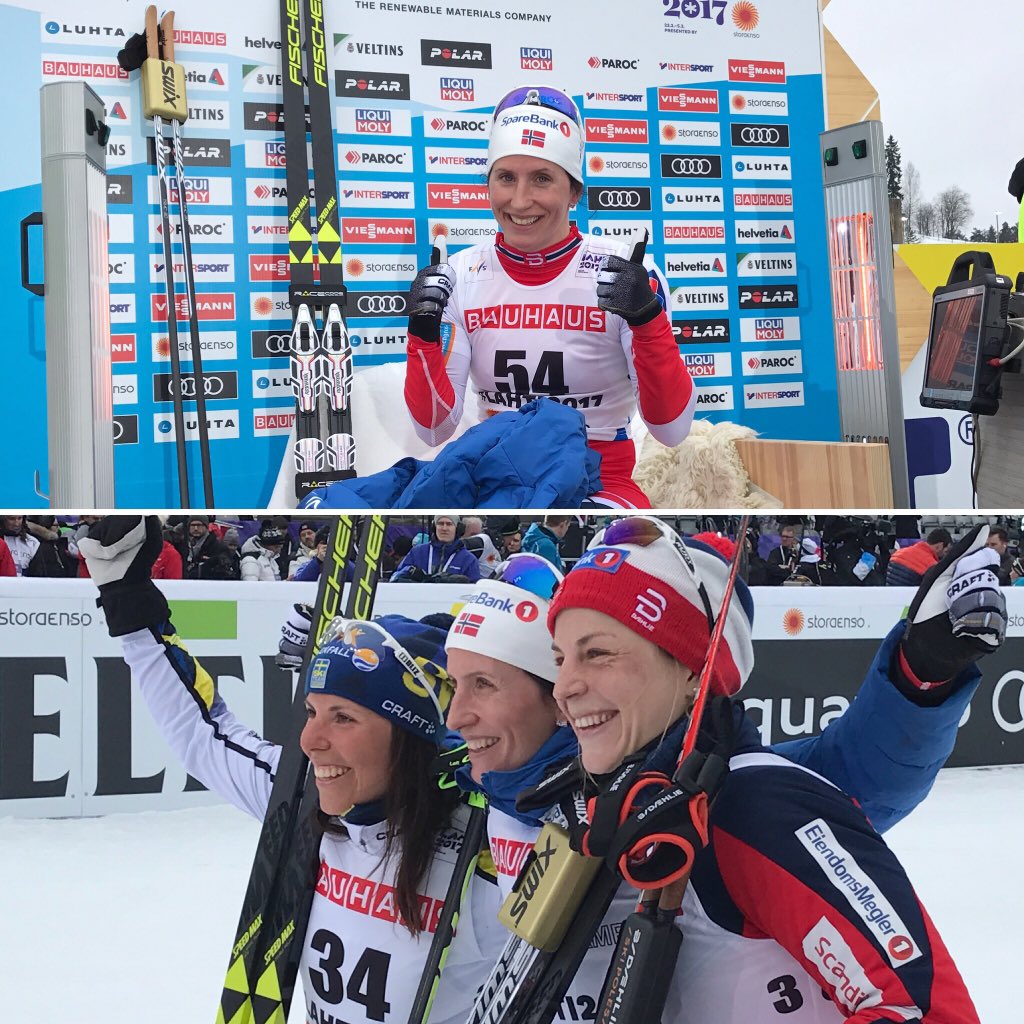
    Above: Norway’s Marit Bjørgen celebrates her 16th World Championships gold after winning Monday’s 10 k classic in Lahti, Finland. Below: The women’s 10 k classic podium at 2017 Nordic World Championships in Lahti, with Bjørgen (c) in first, Sweden’s Charlotte Kalla (l) in second, and Norway’s Astrid Uhrenholdt Jacobsen (r) in third. (Photo: FIS Cross-Country/Twitter)

    FIS Nordic World Championships (Lahti, Finland): Women’s 10 k classic

    No contest. That was the takeaway of Marit Bjørgen’s performance in the women’s 10-kilometer classic individual start on Monday at 2017 Nordic World Championships in Lahti, Finland, after the Norwegian posted a 41-second victory in 25:24.9 minutes.

    Bjørgen started 54th of 72 starters and clocked the fastest time over every intermediate timing point on the course. Sweden’s Charlotte Kalla had been the previous race leader after starting 34th before Bjørgen bumped her out of the leader’s chair by 41 seconds.

    Norway had two on the podium with Astrid Uhrenholdt Jacobsen in third, 55.5 seconds behind Bjørgen. Norway’s Heidi Weng missed the podium in fourth (+1:13.8), while Sweden’s Anna Haag — an early leader in bib 18 — finished fifth (+1:22.7). Finland’s Kerttu Niskanen took sixth (+1:23.7) and Krista Parmakoski was seventh (+1:31.4), while Norway’s Ingvild Flugstad Østberg and Poland’s Justyna Kowalczyk tied for eighth (+1:34.5). Germany’s Stefanie Böhler rounded out the top 10 in 10th (+1:35.8).

    Sadie Bjornsen led the U.S. women in 23rd (+2:21.2), Kikkan Randall placed 26th (+2:31.7), Rosie Brennan was 32nd (+2:55.4), and Ida Sargent 43rd (+3:55.2).

    Katherine Stewart-Jones led the Canadians with her best result at her first World Championships in 36th (+3:09.6), Emily Nishikawa followed in 37th (+3:14.9), and Dahria Beatty 39th (+3:24.9).

    The men’s 15 k classic takes place tomorrow.

    Results

    ***

    IBU Youth/Junior World Championships (Osrblie, Slovakia): Junior relays

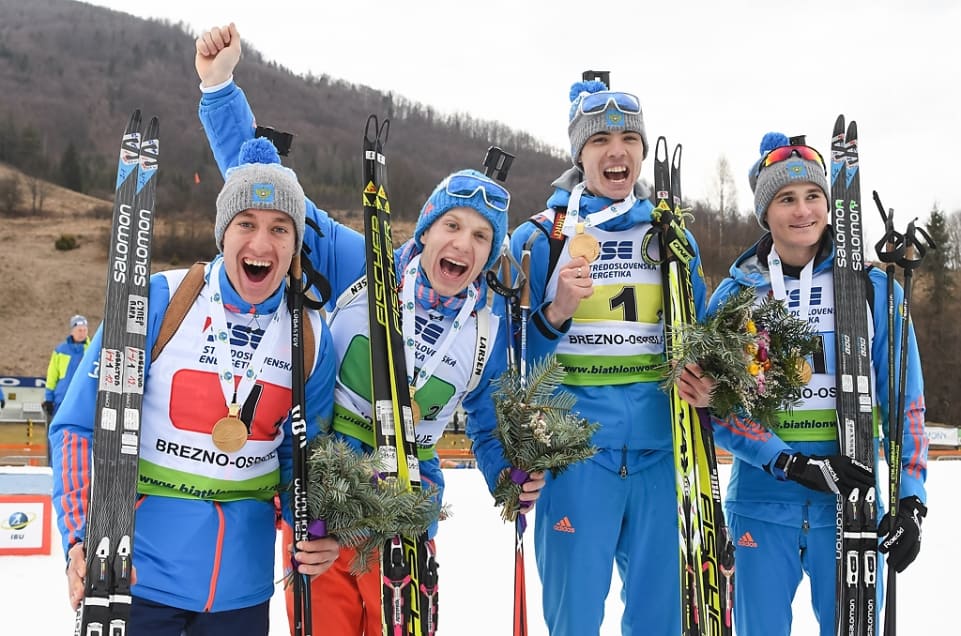
    (From left to right) Russia’s Nikita Lobastov, Igor Malinovskii, Nikita Porshnev, and Kirill Streltsov after winning the men’s 4 x 7.5 k relay on Tuesday at IBU Youth/Junior World Championships in Osrblie, Slovakia. (Photo: IBU)

    [UPDATED] Russia, Norway, Germany. Or Norway, Germany, Russia. That’s how the podiums shook out for the junior men’s and women’s relays on Tuesday, the last day of the 2017 International Biathlon Union (IBU) Youth/Junior World Championships in Osrblie, Slovakia.

    Russia won the men’s 4 x 7.5-kilometer event by 53.9 seconds in 1:17:27.8 hours, with Nikita Lobastov, Igor Malinovskii, Nikita Porshnev, and Kirill Streltsov. After coming through the first exchange in fifth, 44.2 seconds out of first, Malinovskii skied his team into first and they held the lead to the finish. In total, Russia used seven spares to clean and had no penalties.

    Norway claimed silver with Dag Sander Bjørndalen, Johannes Dale, Aleksander Fjeld Andersen, and Sindre Pettersen. After getting tagged in 14th, Dale moved the team up to sixth and Andersen improved to second, which Pettersen held. The team combined for one penalty and 12 spares.

    Germany claimed bronze (+1:39.3) despite one penalty and 16 spares, with Justus Strelow, Danilo Riethmüller, Dominic Schmuck, and David Zobel. Fourth at the first exchange, Riethmüller picked moved them into third on the second leg, which Schmuck and Zobel held.

    Canada finished 12th (+6:00.5) with Zachari Bolduc, Trevor Kiers, Jules Burnotte, and Pearce Hanna combining for three penalties and 13 spare rounds. Positioned in 10th for the first two legs, the team moved into eighth on Burnotte’s third leg. Hanna had to ski three penalty laps on the final leg and slipped to 12th.

    The U.S. men finished 14th (+9:07.4) with Cody Johnson, Cameron Christiansen, Travis Cooper, and Peter Carroll combining for two penalties and 10 spare rounds. The team gradually moved up from 16th at the first exchange to 12th at the third and final exchange, before losing two places before the finish.

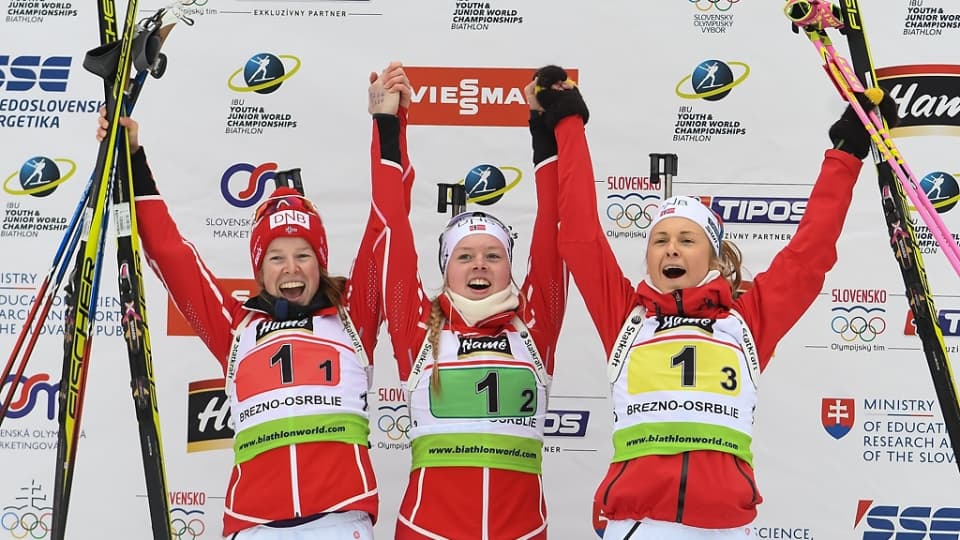
    (From left to right) Norway’s Hilde Eide, Karoline Erdal and Ingrid Landmark Tandrevold after winning the junior women’s 3 x 6 k relay on Tuesday at IBU Junior World Championships in Osrblie, Slovakia. (Photo: IBU)

    In the junior women’s 3 x 6 k relay, Norway rose to gold with Hilde Eide, Karoline Erdal and Ingrid Landmark Tandrevold (for Tandrevold’s third medal in the last three races, and first gold of the week) finishing in 56:18.4. The team, which had zero penalties and used eight spares, moved up from fourth at the first exchange to first on Erdal’s second leg and Tandrevold anchored them to the win.

    Germany crossed the finish 16.5 seconds later for silver, with Vanessa Voigt, Sophia Schneider and Anna Weidel. In seventh after the first leg, Schneider moved them into third before Weidel anchored them to second. They had one penalty and used nine spares.

    Russia rounded out the women’s podium in third (+26.1) with Kristina Reztsova, Ekaterina Moshkova and Valeriia Vasnetcova. After being tagged in ninth, Moshkova skied them up to fourth and Vasnetcova picked off one more place for bronze. They combined for one penalty and eight spares.

    Canada’s junior women finished 14th (+4:17.7) with Megan Bankes, Emily Dickson and Nadia Moser combining for four penalties and nine spares. They had been as high as 11th after Bankes’s first leg.

    The U.S. finished 17th (+11:30) with Siena Ellingson, Helen Wilson and Nina Armstrong accumulating five penalties and 11 spares. They had skied as high as 15th after Ellingson’s first leg.

    Results: Junior men | Junior women

  • Saturday Rundown: Lahti and Osrblie (Updated x2)

    Saturday Rundown: Lahti and Osrblie (Updated x2)

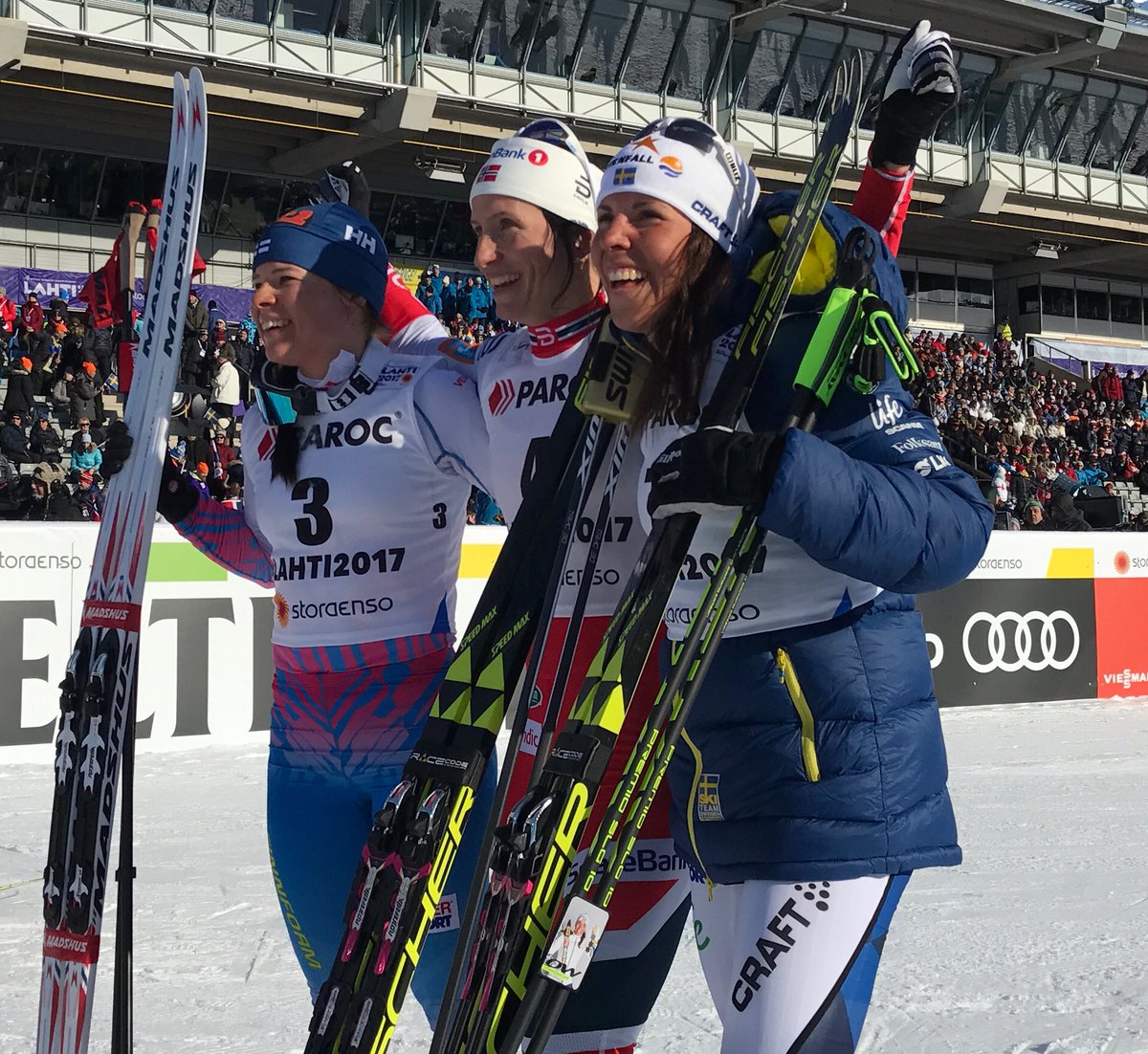
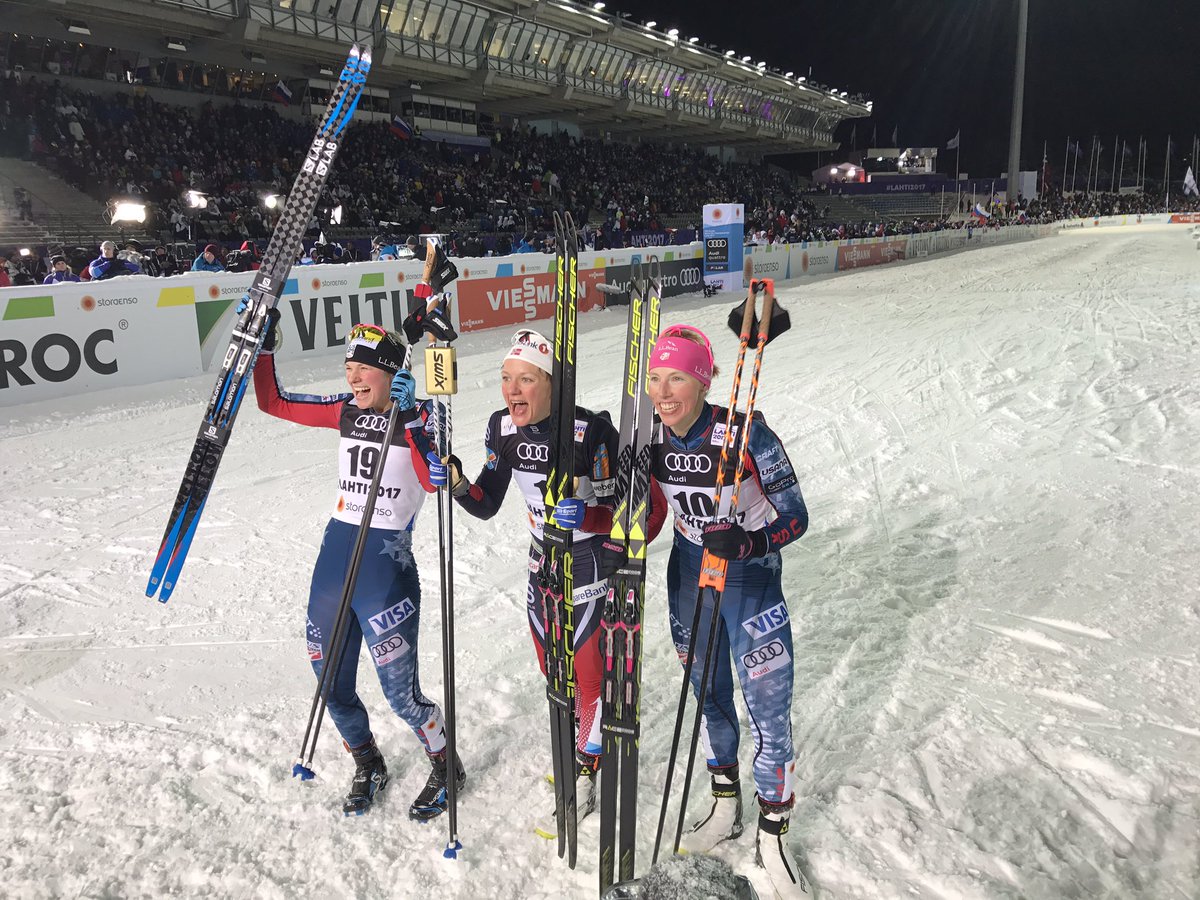
    The women’s 15 k skiathlon podium at 2017 Nordic World Championships, with Norway’s Marit Bjørgen (c) in first, Finland’s Krista Parmakoski (l) in second, and Sweden’s Charlotte Kalla (r) in third on Saturday in Lahti, Finland. (Photo: FIS Cross-Country/Twitter)

    FIS Nordic World Championships (Lahti, Finland): 15/30 k skiathlons 

    This one’s for you, kid.

    Marit Bjørgen became the second relatively new mom to medal in the second race of 2017 Nordic World Championships on Saturday (after American Kikkan Randall earned bronze in Thursday’s freestyle sprint), racking up her 15th World Championships gold in women’s 15-kilometer skiathlon in Lahti, Finland. Bjørgen, a 36-year-old Norwegian team veteran, had her first child a little over a year ago.

    In her first full season back, she led Saturday’s 7.5 k classic + 7.5 k freestyle race at the halfway point, where she clicked into her skate skis half a second ahead of Finland’s Krista Parmakoski in second. Parmakoski followed her across the finish for silver, finishing 4.8 seconds off Bjørgen’s winning time of 37:57.5 minutes. For Parmakoski, it was her first individual medal at World Championships after having previously earned four in team events.

    Sweden’s Charlotte Kalla picked up her fourth-career World Championships medal in third place (+32.0), and Nathalie von Siebenthal placed fourth (+1:05) for the best result for a Swiss female cross-country skier since since Evi Kratzer earned bronze in 1987 in Oberstdorf, Germany.

    Von Siebenthal edged Norway’s Heidi Weng in a photo finish, with Weng finishing another tenth of a second back in fifth (+1:05.1). Right behind them, Austria’s Teresa Stadlober notched sixth (+1:05.4), Russia’s Yulia Tchekaleva seventh (+1:05.7), Norway’s Astrid Uhrenholdt Jacobsen eighth (+1:11.1), Russia’s Anastasia Sedova ninth (+1:15.3), and Japan’s Masako Ishida 10th (+1:21.8).

    Two Americans finished in the top 20 with Randall leading them in 17th (+2:09.2) and Liz Stephen placing 20th (+2:12.4). Rosie Brennan cracked the top 30 in 28th (+3:03.2) and Jessie Diggins did not finish.

    A World Championships rookie, Cendrine Browne led Canada in 35th (+4:15.5), followed by Emily Nishikawa in 38th (+4:29.3) and Katherine Stewart-Jones in 40th (+4:38.1).

    Annika Taylor, a 23-year-old California native who races for Great Britain, finished 41st (+4:49.7). She previously placed 38th in the freestyle sprint qualifier for her best result at her first World Championships.

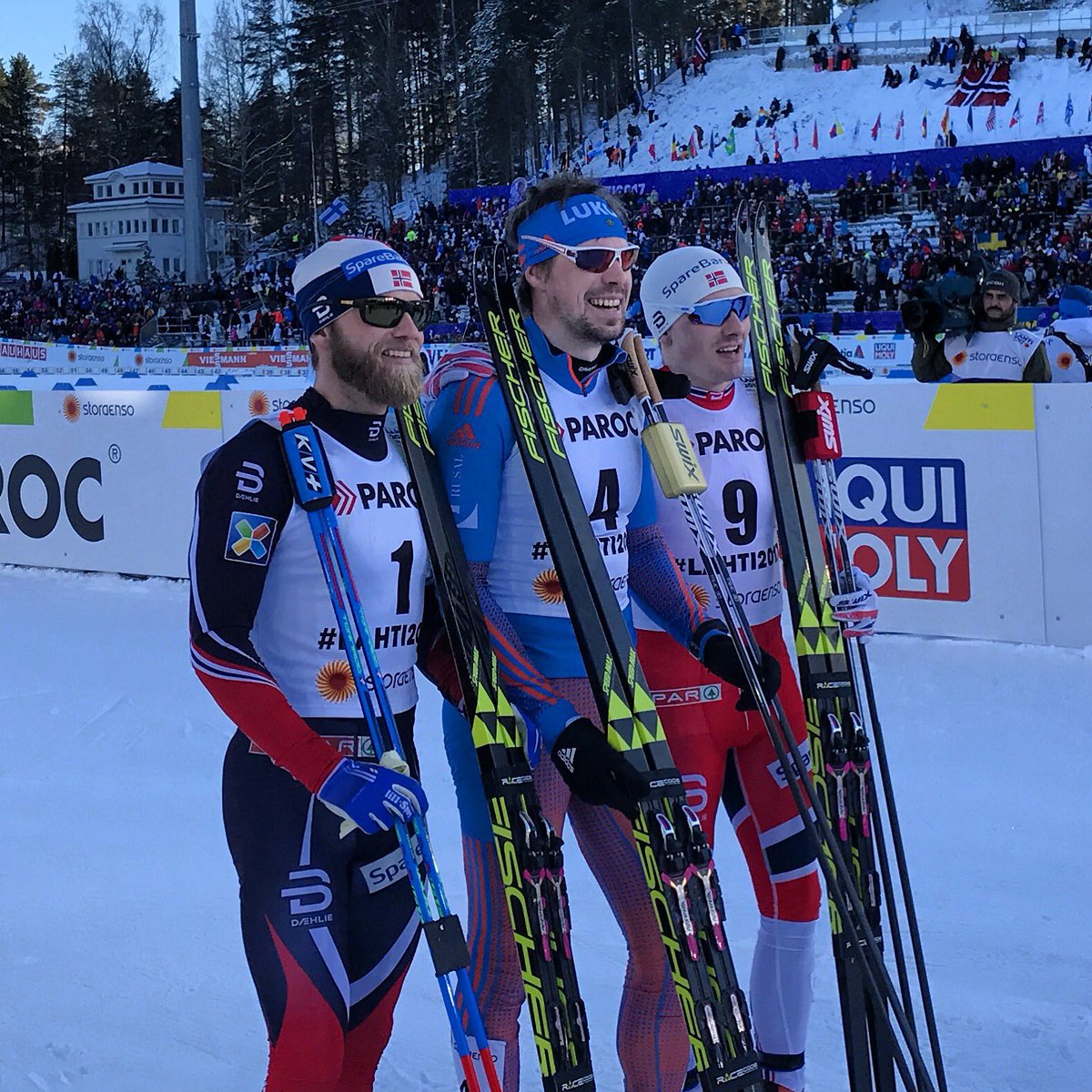
    The men’s Nordic World Championships 30 k skiathlon podium, with Russia’s Sergey Ustiugov (c) in first, Norway’s Martin Johnsrud Sundby (l) in second and Finn Hågen Krogh (r) in third on Saturday in Lahti, Finland. (Photo: FIS Cross-Country/Twitter)

    The men’s 30 k skiathlon that followed boiled down to a two-way battle for first between none other than Russia’s Sergey Ustiugov and Norway’s Martin Johnsrud Sundby. The two traded off leading throughout much of the race and together gapped the field around the 20 k mark.

    Over the next 10 k, Ustiugov continued to drive the pace. On a pivotal climb less than two minutes before the finish, Sundby attacked, jump skating and seeming to put the hurt on Ustiugov. But that moment was over before it started when Sundby broke his pole against his ski tip and had to stop for a replacement.

    The 24-year-old Ustiugov skied away to the win, uncontested yet powering down the finishing stretch to claim his first World Championships gold in 1:09:16.7 hours. He had previously earned bronze with the Russian men’s relay in 2013.

    Sundby finished 6.7 seconds later, dropping his arms and head toward the ground as he did so. Norway’s Finn Hågen Krogh came out on top of a five-way fight for third, finishing fourth (+33.1), 31.8 seconds behind Ustiugov and 1.3 seconds ahead of his teammate Sjur Røthe. Krogh put himself in front and proved to have the most finishing kick, ahead of Røthe, Canada’s Alex Harvey (fifth, +33.3), Norway’s Didrik Tønseth (sixth, +33.5), and Sweden’s Marcus Hellner (seventh, +33.7). Russia’s Andrey Larkov fell off the group’s pace and placed eighth (+36.1), Finland’s Lari Lehtonen was ninth (+37.2), and Italy’s 24-year-old World Championships rookie Giandomenico Salvadori broke through in 10th (+37.3).

    Three Canadians started the race, with Graeme Killick finishing 47th (+6:23.5) and Knute Johnsgaard 55th (+8:40.2) out of 63.

    Tad Elliott was the top American man in 48th (+7:11.2), Kyle Bratrud (+7:16.5) placed 49th and Noah Hoffman 57th (+9:33.6). Ben Lustgarten did not start.

    Results: Women | Men

    ***

    IBU Youth/Junior World Championships (Osrblie, Slovakia): Junior sprints

    [UPDATED] Canada’s Megan Bankes and American Siena Ellingson landed in the top 20 of the junior women’s 7.5-kilometer sprint on Saturday at 2017 International Biathlon Union (IBU) Junior World Championships in Osrblie, Slovakia. Coming off a victory in Thursday’s 12.5 k individual, Bankes placed 13th and Ellingson achieved her best non-relay result in 18th at her fourth Youth/Junior Worlds.

    Italy’s Michela Carrara won the sprint in 20:57.8 minutes with clean shooting (0+0) and the second-fastest course time. Norway’s Ingrid Landmark Tandrevold skied the fastest but came up 15.2 seconds short of gold with one prone penalty (1+0), which put her in second place. France’s Myrtille Bègue reached the podium in third (+31.5) with perfect shooting (0+0), and Austria’s Simone Kupfner shot clean as well for fourth place (+40.8), 9.3 seconds out of third.

    Bankes was one of the first out of the gate in bib 4 and missed one on each stage (1+1) and skied the 14th-ranked course time. She ultimately finished 13th (+1:25.3) for her second-best result at her fourth Youth/Junior World Championships.

    Ellingson started 19th and cleaned prone before missing one in standing (0+1), to finish 18th (+1:38.7) with the 20th-ranked course time.

    Canada’s Nadia Moser scored her first top 40 of these championships in 31st (+2:16.4) with two misses (1+1), her teammate Emily Dickson finished 47th (+3:15.8) with one prone miss (1+0), and the second American racing, Nina Armstrong finished 65th (+6:11.5) with five penalties (2+3).

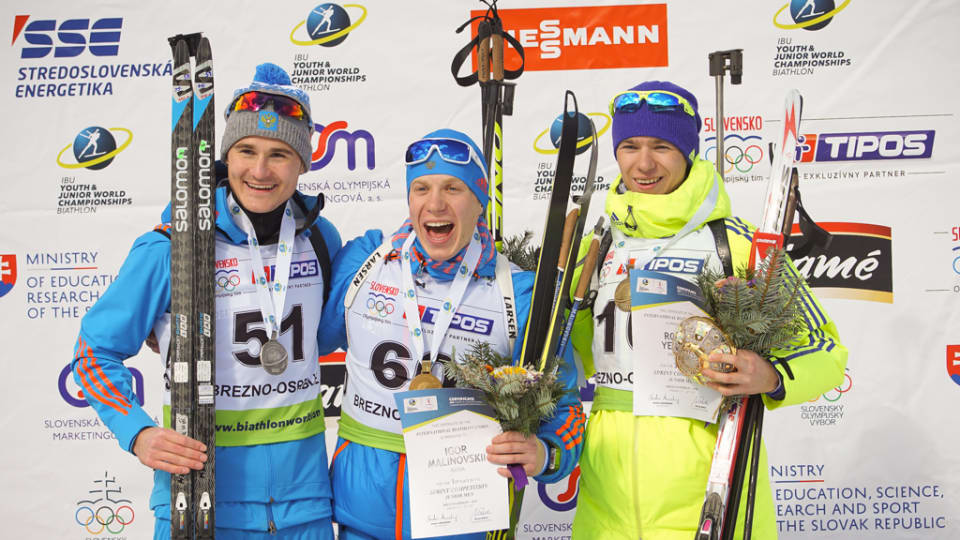
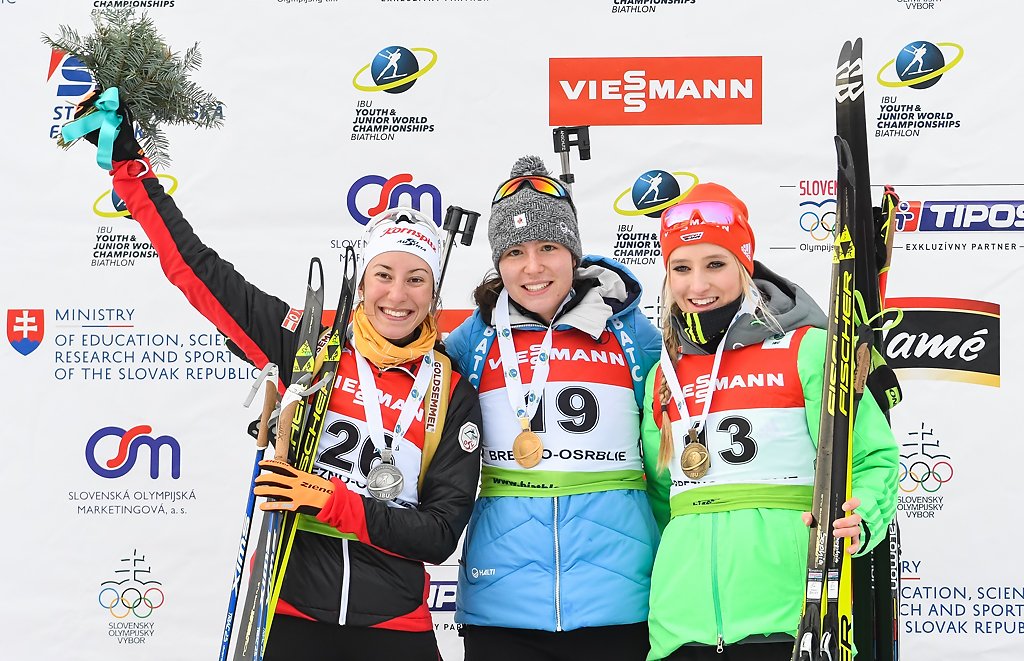
    Russia had two on the podium in Saturday’s junior men’s 10 k sprint at IBU Junior World Championships with Igor Malinovskii (c) in first and Kirill Streltsov (l) in second, sharing the podium with Kazakhstan’s Roman Yeremin (r) in third in Osrblie, Slovakia. (Photo: IBU)

    In the junior men’s 10 k sprint, Russia took the two top steps of the podium with Igor Malinovskii in first and Kirill Streltsov in second, after both cleaned the two-stage race.

    Malinovskii started later in the field in bib 60 (out of 86) and bested his teammate’s time by 12.2 seconds, finishing in 24:32.2 minutes. Streltsov, who had started 51st and led until that point, took silver and Kazakhstan’s Roman Yeremin notched bronze (+24.9). Despite two misses on his first prone stage (2+0), Yeremin was an early race leader after starting 10th. He bested the time of Belarus’s Anton Smolski, who started fifth, by just 0.2 seconds for third. Smolski settled for fourth, ahead of Germany’s David Zobel (who previously took silver in Thursday’s 15 k individual) in fifth (+38.2).

    Cody Johnson was the top American in 46th (+3:02.9), followed by Travis Cooper in 49th (+3:10.7), Cameron Christiansen in 80th (+5:32.4), and Peter Carroll in 82nd (+5:51.6).

    Pearce Hanna led the Canadian men in 47th (+3:04.1), ahead of Trevor Kiers in 48th (+3:06.6), Zachari Bolduc in 54th (+3:25.4), and Jules Burnotte in 55th (+3:31.2).

    Youth/Junior World Championships continue Sunday with the youth men’s and women’s pursuits.

    Results: Junior women | Junior men

  • Bankes Gets Gold #2 for Canada with Perfect Shooting at IBU Junior Worlds

    Bankes Gets Gold #2 for Canada with Perfect Shooting at IBU Junior Worlds

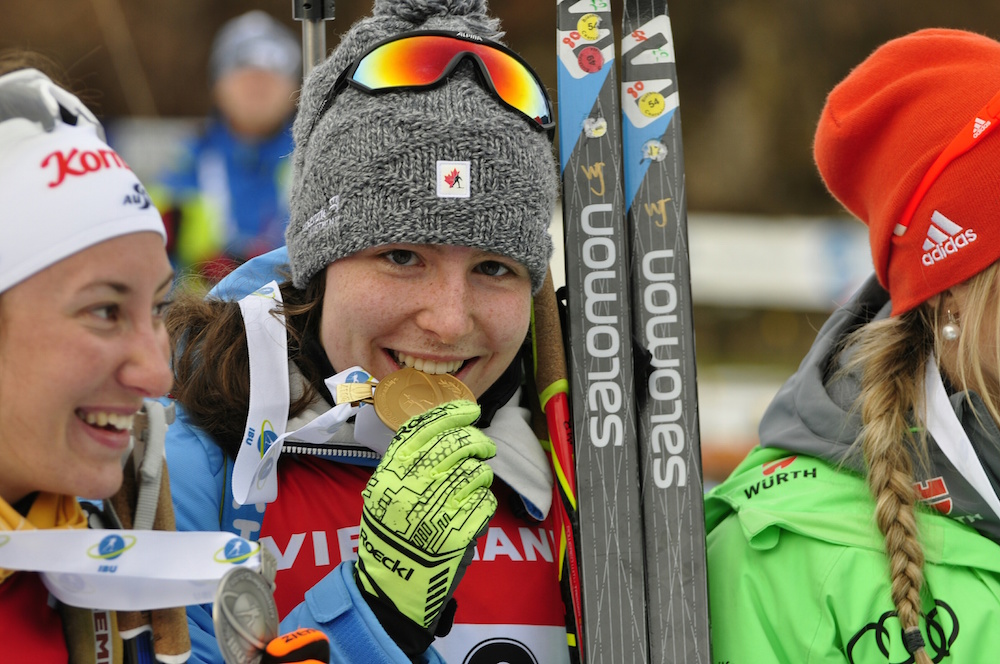
    Canada’s Megan Bankes flashes a smile and her gold medal after winning the junior women’s 12.5 k at IBU Junior World Championships on Thursday in Osrblie, Slovakia. individual podium on Thursday at IBU Junior World Championships in Osrblie, Slovakia. Joining her on the podium are Austria’s silver medalist Julia Schwaiger (l) and Germany’s bronze-medalist Anna Weidel (r). (Photo: Jacqueline Akerman)

    (Note: This article has been updated to include comments from Megan Bankes.)

    Just to review:

    • 2004: Jean-Philippe “JP” Le Guellec becomes first Canadian to win an International Biathlon Union (IBU) Youth World Championships title (in the youth men’s sprint).
    • 2009: Kurtis Wenzel becomes second Canadian to win at IBU Youth Worlds, with a gold medal in the youth men’s sprint.
    • 2012: Wenzel does it again as a junior, winning the 15-kilometer individual at IBU Junior Worlds.
    • Feb. 22, 2017: Leo Grandbois shoots a perfect 20-for-20 to become the third Canadian to be crowned a world champion at Youth/Junior Worlds, winning the youth men’s 12.5 k individual in Osrblie, Slovakia.
    • One day later: Megan Bankes repeats the 20-for-20 shooting feat in the junior women’s 12.5 k individual in Osrblie and becomes Canada’s first woman to win at Youth/Junior World Championships.

    And just like Grandbois, Bankes had never hit 20 consecutive targets without a miss in a race before. In fact, she had never cleaned a race of any length before. Doing so earned her a gold medal in her first race of her fourth Youth/Junior Worlds.

    Megan Bankes racing to an unprecedented gold for a Canadian woman in the junior women’s 12.5 k individual on Thursday at 2017 IBU Junior World Championships in Osrblie, Slovakia. (Photo: Bryan Dickson)

    “I watched Leo yesterday and gained a lot of inspiration from him,” Bankes said, according to a Biathlon Canada press release. “I saw how calm he was on the range and just felt if he can do it then I can, too. I just wanted to go out there – shoot clean and ski fast.”

    As the 19th starter in a field of nearly 70 women, the 19-year-old Bankes, who trains with the Biathlon Alberta Training Centre (BATC) in Canmore, set down the performance to beat with clean shooting and a finishing time of 37:22.0 minutes. She bumped Germany’s Anna Weidel, the 13th starter, to second place with a time that was 1 minute and 20 seconds faster. Weidel had missed just one shot — still an impressive performance in a four-stage race — in the first standing stage (0+1+0+0). Each miss adds a minute penalty to a racer’s total time.

    “I was incredibly stoked to clean my last standing, and then knew I just had to push super hard up the last 2 hills and ski smart all the way to the finish,” Bankes wrote in an email to FasterSkier. “When I crossed the finish line I was really excited, but I didn’t really think my result would hold up because there were a few girls who were skiing fast and had hit 15/15, but then when a bunch of them started missing, and I realized my position was going to hold, it was incredible.”

    Her overall course time ranked 11th, comparable with the two women she ended up sharing the podium with. Weidel was ultimately pushed to third when Austria’s Julia Schwaiger in bib 26 finished 32.1 seconds faster for silver. With one costly miss in her final standing stage (0+0+0+1), Schwaiger’s finishing time was 47.9 seconds short of gold.

    Canada’s Megan Bankes takes a bite out of her gold medal after winning the junior women’s 12.5 k individual at 2017 IBU Junior World Championships in Osrblie, Slovakia, and becoming the first Canadian woman to do so at Biathlon Youth/Junior Worlds. (Photo: Airat Aitniakov)

    That medal went to Bankes, one of five women in the race to hit every target.

    “I shot with a lot of confidence today. It came really easy,” Bankes told Biathlon Canada.

    But, as there usually is, there was a backstory on Thursday.

    “She had a what she said was a ‘horrific’ zero,” her coach Richard Boruta explained of her pre-race target practice, in an email co-written with Canada’s trip leader/head coach Jacqueline Akerman.

    Boruta tried to calm Bankes down, assuring her that she had the self confidence to execute strong shooting.

    “My coach Richard just told me to go out pretty hard and not lose too many seconds up the first couple hills, and then settle into my race,” Bankes recalled in the email. “The range entry is pretty easy, because you’ve got a bit of downhill into it, so you can push pretty much as hard as you want (or can).”

    “Megan had been focused the whole day on the race and she new what she needed to do and was able to pull it through,” the two coaches wrote. “The trail conditions and weather have been challenging with all the rain and slush, but Megan managed to ski very tactically along the flats and paced herself well on the two major climbs in the course.”

    According to them, one of Bankes’s longtime goals had been a top eight at these championships. That changed after she broke through on the IBU Junior Cup earlier this month, placing second in the 10 k pursuit at IBU Junior European Championships in Nove Mesto, Czech Republic. After that, she visualized herself in the top five, maybe top three, in her first year as a junior at world championships. Bankes had previously notched 18th in the pursuit and 19th in the individual at last year’s Youth World Championships in Romania.

    “Junior OECH was a pretty big confidence boost, but coming into the race, I didn’t totally know what to expect,” Bankes wrote. “I knew that if I had a really good day on the range and on the course, then I could do well, and maybe podium, but I didn’t really imagine that I would hit 20/20, and win!”

    Individual-format races require solid shooting and fast skiing, just like any biathlon race, but the one-minute penalties as opposed to penalty laps put an emphasis on shooting accuracy.

    “I can’t say they have ever been my strong suit!” Bankes wrote of individual-format races. “So for me the goal was to start pretty fast on skis, stay calm in the range, and then see what happened.”

    “After I got the silver [in Nove Mesto], I knew if I shot and skied well, I could get a medal here,” she told Biathlon Canada. “It takes a long time to get to this point. I think having been here [at Youth/Junior Worlds] four times now I have the experience to do this. I have everything around me here that I need to be successful.

    “It is pretty exciting,” she added. “This is the first time I’ve shot 20 for 20. It never crossed my mind, but to be the first Canadian [woman] to win is very cool.”

    According Akerman and Boruta, they had anticipated that Grandbois and Bankes would have “a respectable chance” at a medal, along with other team members as well. But two gold medals in two days?

    “We have had good results and medals in the past, but it has been up and down with a few top athletes hitting the top 10 or reaching the podium,” they wrote. “Now we see the group as a whole rising together.”

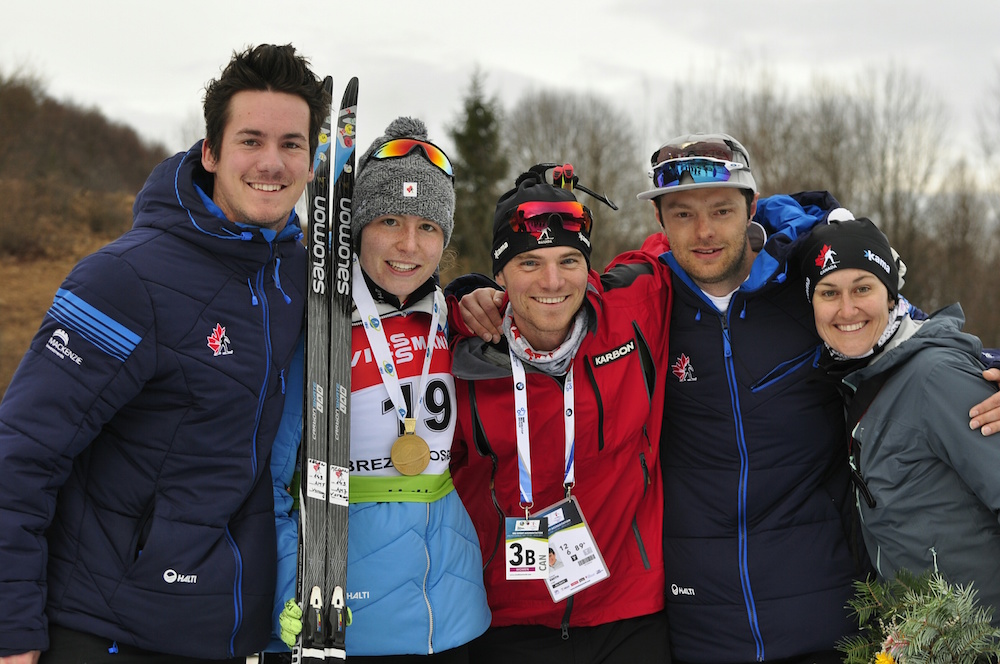
    Megan Bankes (second from l) with her Canadian support crew, including her former coach Tyson Smith (c), wax techs Andrew Chisholm (l) and Andrzej Lesnik (second from r) and Canada’s trip leader/head coach Jacqueline Akerman (r), after Bankes won the junior women’s 12.5 k individual for Canada’s second gold medal of 2017 IBU Youth/Junior World Championships in Osrblie, Slovakia. (Photo: Airat Aitniakov)

    They credited “consistent and qualified coaching support in yearly developmental stages”, and explained that Bankes started the sport with coach Iaroslav Khomiak at Foothills Nordic in Calgary. She was later coached by Tyson Smith (Nathan Smith’s brother, who is assisting the team at Youth/Junior Worlds) before joining the BATC group in Canmore in 2015.

    Last summer, Biathlon Canada launched a funded “Shooting Stars” camp, which brought national-team staff and coaches together with athletes and their coaches in Canmore. The team also added IBU Junior Cup tours to the schedule to give young athletes opportunities to experience international competition in Europe and “get to know each other before WYJCHs.”

    “My observations of this current group; they are pretty grounded, are very motivated, focused and are they are both pushing and supporting each other in all aspects of their performance,” Akerman and Boruta wrote.

    So what does two gold-medal performances mean for Canada?

    “There is now a great opportunity for an greater amount of exposure for our athletes and our sport,” the coaches wrote. “… More solid results ahead for us this week, there are other realistic opportunities within the group. The whole team, including staff are motivated and focused for that. … Of course Leo and Megan have both shown what they are capable of, and will be eager for more. Right behind those two in our Jr Women and Youth Men categories are others skilled enough to be right up there with them. Our youth women are a younger crew, but are learning and applying new skills daily, so I am excited to see some PB’s from them tomorrow. The relays also present us with exciting and realistic chances of podiums, it will continue to be an exciting week and championships!”

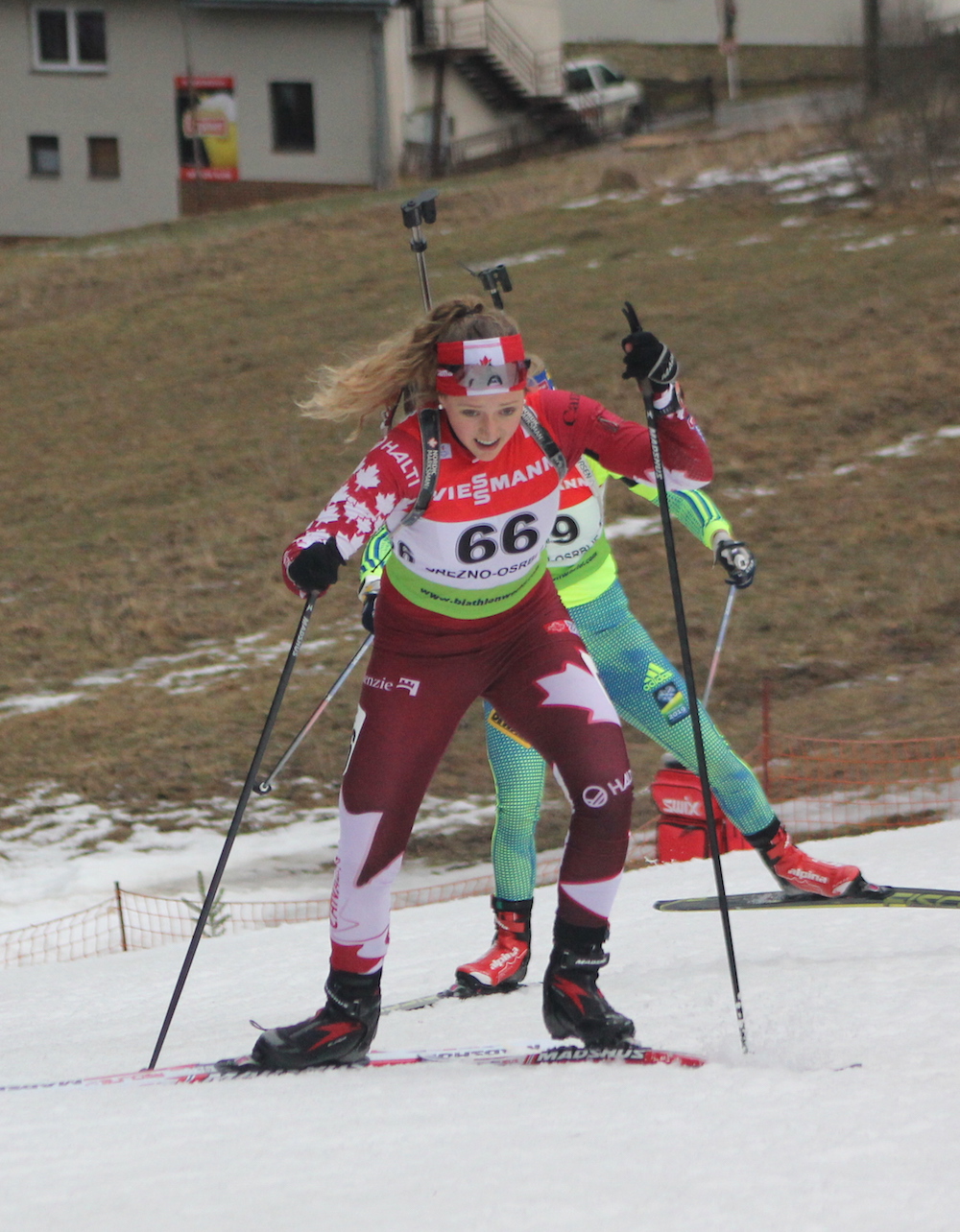
    Canada’s Emily Dickson (66) racing to 28th for her first top 30 at IBU Junior World Championships in the women’s 12.5 k individual in Osrblie, Slovakia. (Photo: Jacqueline Akerman)

    In the junior women’s race, Canada had two in the points (top 40) and one just outside with Emily Dickson in 28th (+4:21.3) with one miss (0+1+0+0). Nadia Moser finished 41st (+5:55.8) with four penalties (2+0+0+2). Charlotte Hamel did not finish.

    For the U.S., Siena Ellingson placed 50th (+7:11.5) with four penalties (0+1+2+1) and Nina Armstrong 65th (+14:15.3) with eight misses (4+1+2+1).

    Earlier in the day, the junior men raced a 15 k individual, which Norway’s Sindre Pettersen won in 40:17.2 minutes. He started 68th and cleaned three-straight stages before missing two on his last standing (0+0+0+2), but managed a 51.2-second win over Germany’s David Zobel. An early leader in bib 26, Zobel had three penalties (0+2+1+0) yet his time held up for silver despite a challenge from Russia’s late starter Nikita Lobastov (bib 84). Lobastov shot 19-for-20 (0+1+0+0) and finished just four seconds short of Zobel for third place (+55.2).

    Only one athlete in the junior men’s race cleaned: Latvia’s Ingus Deksnis in fifth.

    In his first year as a junior, Canada’s Zachari Bolduc led the North Americans in 34th (+3:44.7) with two penalties (1+0+0+1). He later told FasterSkier his goal had been a top 30, and he was 8.4 seconds short of it on Thursday.

    “I’m happy with this shooting but I was very very slow on my skis,” Bolduc wrote in an email. “The course was a mix of soft snow, ice and slush so it was not easy conditions! I hope I will have better feelings on my skis for the sprint. But, I’m happy with my race today!”

    He was followed by Canadian teammates Trevor Kiers and Jules Brunette in 54th (+5:21.6) and 55th (+5:27.4), respectively, after each shot five penalties. Pearce Hanna finished 65th (+6:38) with seven misses (1+2+2+2).

    The top American on Thursday was Cody Johnson in 50th (+5:08.3) with two penalties, both in the last stage (0+0+0+2). Cameron Christiansen followed in 72nd (+8:10.6) with six penalties (1+1+2+2), and Peter Carroll was 79th (+10:36.4) with four misses (0+3+0+1). Travis Cooper did not start.

    The youth men’s and women’s sprints are scheduled for Friday in Osrblie.

    Results: Junior women | Junior men

  • Thursday Rundown: Silver and Bronze for Diggins, Randall at Lahti World Champs; Bankes Golden at IBU Junior Champs

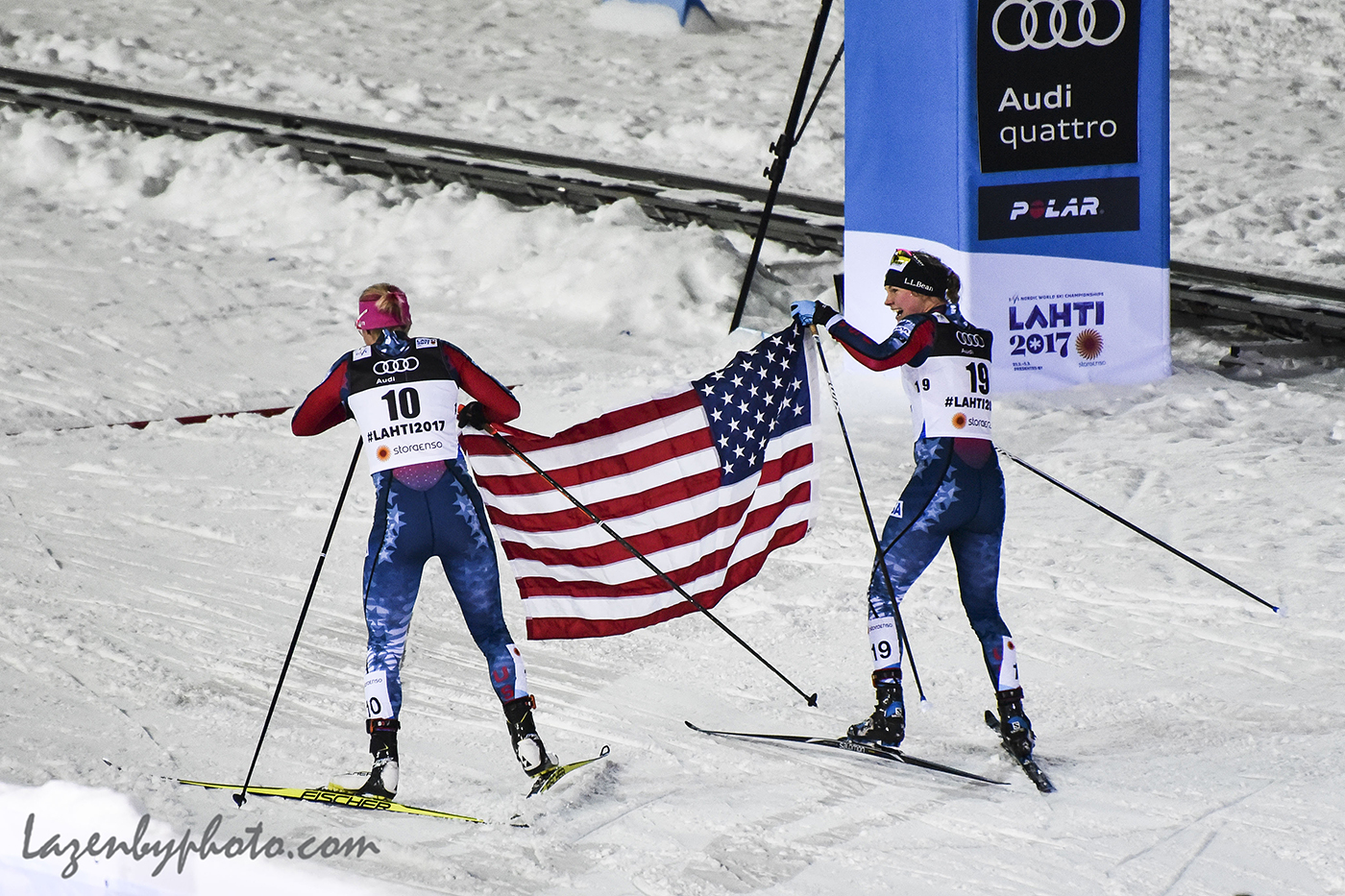
    Kikkan Randall (l) and Jessie Diggins celebrate their bronze and silver medals, respectively, in the women’s individual freestyle sprint on Thursday, the first day of 2017 Nordic World Championships in Lahti, Finland. (Photo: John Lazenby/Lazenbyphoto.com)

    FIS Nordic World Championships (Lahti, Finland): Freestyle sprints

    Women’s report | Men’s report

    [UPDATED] Two medals for the U.S. on Day 1. That’s exactly what happened Thursday in the first medals race of 2017 Nordic World Championships in Lahti, Finland, where American Jessie Diggins raced to second and her U.S. teammate Kikkan Randall third in the women’s 1.4-kilometer freestyle sprint final, right behind Norway’s Maiken Caspersen Falla, who took gold.

    Two Americans reached the podium in the women’s freestyle sprint on the first day of 2017 Nordic World Championships in Lahti, Finland, with Jessie Diggins (l) placing second and Kikkan Randall (r) third, behind Norway’s Maiken Caspersen Falla (c) in first. (Photo: FIS Cross-Country/Twitter)

    While Falla crossed the finish line first in in 3:02.34 minutes, Diggins finished 1.66 seconds back in second and Randall 3.76 seconds behind in third. Three U.S. Ski Team members reached the six-woman final, with Sophie Caldwell placing sixth (+5.37), behind Sweden’s Hanna Falk (fourth) and Ida Ingemarsdotter (fifth).

    Race favorite Stina Nilsson of Sweden ended the day in 12th overall after being relegated to last in her semifinal.

    Diggins won her quarterfinal and semifinal before finishing second for her second individual World Championships silver medal (she previously earned silver in the 10 k freestyle at the 2015 World Championships in Falun, Sweden, and before that, gold in the freestyle team sprint with Randall at 2013 World Championships in Val di Fiemme, Italy).

    It’s the second-straight championships that the U.S. has had individual medalists in the same race. Caitlin Gregg captured bronze in the 10 k freestyle, just behind Diggins. Four U.S. women qualified for the heats, with Ida Sargent finishing fifth in her quarterfinal for 24th overall.

    U.S. Ski Team head coach Chris Grover was universal in his praise when asked about the personal significance of Thursday’s two-medal night. “I am just really proud of the athletes — all of the athletes that were competing today,” Grover said after the women’s final. “All the athletes in the US program that were not competing today that were cheering in front of the television I’m sure this evening and are getting ready for races coming up. I am really proud of the team that we have collected here in terms of service team, and coaching team, and medical and support team … And everybody that is surrounding the event for the U.S.A. It’s just been a team over the last few World Championships that yes there has been a few people that have come off and come on, but there has really been a core group that provide this kind of stability on which we can have these kind of results.”

    In the men’s 1.6 k freestyle sprint final, Italy’s Federico Pellegrino outlasted three others within 0.7 seconds of the win, crossing the finish line first in 3:13.76.

    Russia’s Sergey Ustiugov missed out on the gold by 0.15 seconds and Norway’s Johannes Høsflot Klæbo took bronze (+0.44). Three Norwegians reached the final, with Finn Hågen Krogh placing fourth (+0.67), Petter Northug fifth (+12.13), ahead of Finland’s Ristomatti Hakola in sixth (+12.28).

    Canada’s Alex Harvey was the lone North American to reach the semifinals, where he was relegated to last in his heat for 12th overall.

    For the U.S., Andy Newell placed 21st on the day after finishing fifth in his quarterfinal and Simi Hamilton was 28th after taking sixth in his quarterfinal.

    Results: Women’s final | Men’s final

    Qualifying results

    All four of the U.S. women’s starters qualified for the heats to start the day, with Randall leading them in 10th, followed by Caldwell in 13th, Diggins in 19th, and Sargent in 27th.

    Norway’s Falla put down the fastest time in the women’s sprint qualifier in 3:03.14, Finland’s Mari Laukkanen was 2.37 seconds back in second, and Slovenia’s Katja Visnar 2.42 behind in third.

    Randall’s time was 4.45 seconds off Falla’s mark, Caldwell +5.66, Diggins +7.97, and Sargent +9.37.

    Canada’s Dahria Beatty missed the top 30 necessary to qualify by 3.67 seconds in 37th, 13.66 seconds behind Falla. Canada started three women with Cendrine Browne finishing 48th (+20.42) and Katherine Stewart-Jones 58th (+26.29) out of 107 women.

    In the men’s 1.6 k freestyle sprint qualifier that followed, Hamilton qualified 11th and Newell 20th for the U.S., and Canada’s Harvey qualified 13th.

    Russia’s Ustiugov topped the men’s qualifier in 3:11.72, while Norway qualified second and third with  Norway’s Krogh (+2.71) and Sindre Bjørnestad Skar (+3.39), respectively.

    Hamilton clocked in 7.6 seconds back in 11th, Harvey +7.85, and Newell +8.9.

    Also for the U.S., Erik Bjornsen missed qualifying by 2.22 seconds in 36th (+12.59), and Cole Morgan, in his first World Championships race, placed 54th (+18.41).

    Canada’s three other men entered in the sprint, Jess Cockney, Len Valjas and Knute Johnsgaard finished 47th (+16.82), 48th (+17.16) and 53rd (+18.39), respectively, to miss advancing to the heats.

    Qualifying results: Women | Men

    ***

    The junior women’s 12.5 k individual podium on Thursday at IBU Junior World Championships in Osrblie, Slovakia, with Canada’s gold medalist Megan Bankes (c), Austria’s Julia Schwaiger (l) in second and Germany’s Anna Weidel (r) in third. (Photo: IBU Junior Cup/Twitter)

    IBU Youth/Junior World Championships (Osrblie, Slovakia): Junior individual races

    Race report

    [UPDATED] To say Canada is on a roll at the International Biathlon Union (IBU) Youth/Junior World Championships would be a massive understatement. On Thursday in Osrblie, Slovakia, Megan Bankes raced to a world title in the junior women’s 12.5-kilometer individual, hitting all 20 targets and finishing first in 37:22.0 minutes. After starting 19th, her time held up through 67 finishers, with Austria’s Julia Schwaiger coming closest for second place, 47.9 seconds back.

    Bankes was one of five women to clean the four-stage race on Thursday. Her teammate Leo Grandbois did the same in the youth men’s 12.5 k individual race the day before and won by nearly a minute and 15 seconds to become the third Canadian to win at Youth/Junior Worlds. Bankes is the fourth (second at Junior Worlds).

    Joining Bankes and Schwaiger on the podium was Germany’s Anna Weidel in third (+1:20.0). Like Schwaiger, Weidel shot 19-for-20. Schwaiger’s miss came in the last standing stage; Weidel’s in the first standing.

    Also for Canada, Emily Dickson placed 28th (+4:21.3) with one miss (0+1+0+0), and Nadia Moser was just outside the points (top 40) in 41st (+5:55.8) with four penalties (2+0+0+2). Charlotte Hamel did not finish.

    Americans Siena Ellingson placed 50th (+7:11.5) with four penalties (0+1+2+1) and Nina Armstrong 65th (+14:15.3) with eight misses (4+1+2+1).

    In the junior men’s 15 k individual earlier in the day, Norway’s Sindre Pettersen won by 51.2 seconds, after cleaning the first three stages then missing two on his final standing stage (0+0+0+2). After starting 68th, he finished in 40:17.2 minutes, knocking Germany’s David Zobel out of the lead. Zobel had started 26th and shot three penalties (0+2+1+0) but held the fastest time until Pettersen crossed the line. Zobel’s time held up for silver despite a challenge from Russia’s late starter Nikita Lobastov (bib 84), who shot 19-for-20 (0+1+0+0) and finished just four seconds short of Zobel for third place (+55.2).

    Canada’s Zachari Bolduc led the North Americans in 34th (+3:44.7) with two penalties (1+0+0+1).

    Cody Johnson finished 50th for the U.S. (+5:08.3) with two misses, both of which came in the last stage (0+0+0+2).

    Canada’s Trevor Kiers and Jules Brunette placed 54th (+5:21.6) and 55th (+5:27.4), respectively, each with five penalties. The fourth Canadian, Pearce Hanna finished 65th (+6:38) with seven misses.

    For the U.S., Cameron Christiansen placed 72nd (+8:10.6) with six penalties, and Peter Carroll was 79th (+10:36.4) with four misses. Travis Cooper did not start.

    Results: Junior women | Junior men 

  • 20-for-20 with Nina Armstrong

    20-for-20 with Nina Armstrong

    Nina Armstrong (Harvard Nordic Ski Team) racing in Stowe, Vt., earlier this year. (Courtesy photo)

    In another 20-something-question, fill-in-the-blanks series, we checked in with the world-class U.S. and Canadian biathletes that will be competing at 2017 International Biathlon Union (IBU) Youth & Junior World Championships Feb. 22-28 in Osrblie (also known as Brezno-Osrblie), Slovakia.

    Here’s 19-year-old Nina Armstrong, of Harvard University, who will be representing the U.S. at her first Junior Worlds.

    ***

    “My full name is Nina Joy Armstrong. I was born in Albany, N.Y., raised in Lake Placid, N.Y., and one thing you should know about my hometown is that it hosted the Winter Olympics in 1932 and 1980.

    I started cross-country skiing when I was 4 and started biathlon when I was 14, thanks to Lake Placid Biathlon. I currently train in Cambridge, Mass., with the Harvard Nordic Ski Team.

    If I’m not skiing, you might find me doing a p-set in the library.

    If I had to pick a favorite book, it would be the Harry Potter series.

    One of the things I’m most excited about for Youth/Junior World Championships in Brezno-Osrblie is meeting new people.

    This will be my first Youth/Junior World Championships, and this year, I’m competing as a junior. One race I’m especially targeting there is the sprint.

    The best advice anyone ever gave me about skiing or racing was don’t look back.

    One of the best race memories I have is winning states with my sister.

    If I could meet one World Cup skier, it would be Jessie Diggins.

    If I don’t end up being a professional skier, I’ll probably be a surgeon.

    I’m missing seven days of school to be here, and my professors are probably thinking, ‘What is biathlon?‘

    You can follow me on Instagram @ninaajoy.”

  • Cervenka Sweeps Youth/Junior Biathlon Trials; 15 Named to U.S. Team

    Cervenka Sweeps Youth/Junior Biathlon Trials; 15 Named to U.S. Team

    "The youth men's sprint podium on Dec. 28 in Jericho was (l to r) Jake Pearson, Vasek Cervenka and Eli Nielsen. Cervenka topped every race at Youth and Junior Biathlon Trials. (Photo: USBA)
    The youth men’s sprint podium on Dec. 28 in Jericho was (l to r) Jake Pearson, Vasek Cervenka and Eli Nielsen. Cervenka topped every race at Youth and Junior Biathlon Trials. (Photo: USBA)

    The United States Biathlon Association (USBA) held three days of youth and junior biathlon trials racing in Jericho, Vermont, January 28-30. At the end of the series, USBA named this year’s team to Youth and Junior World Championships.

    The competitions are slated for February. But the location is pending. The Championships were scheduled to be held in Ostrov, Russia, but the event was stripped from Russia due to allegations of state-sponsored doping and manipulation of anti-doping samples at other competitions previously held in the country.

    Vasek Cervenka of Mount Itasca was the most successful athlete of the week. Cervenka, a youth competitor (under 19), nevertheless topped all men — including the junior racers (under 21). Cameron Christiansen of Nisswa NW finished 20 seconds back, besting the junior men’s field.

    Cervenka then extended his lead in the next day’s pursuit. Cody Johnson of the Outdoor Sports Institute passed Christiansen to finish 31.1 seconds behind Johnson and take the junior win.

    On day three it was back to sprint racing with Cervenka taking another vicotry, this time a 10.9-second win over Travis Cooper of National Guard Biathlon.

    In the opening women’s sprint, Amanda Kautzer of Loppet Nordic Racing took the win. Like Cervenka, Kautzer is a youth but also topped the junior field. Hannah Streinz of the Outdoor Sports Institute placed second (+42.2) and the top junior.

    But in the pursuit fellow youth Chloe Levins of Mountain Top Nordic raced to the front with only two penalties, besting Lexie Madigan of the Auburn Ski Club – who also had just two penalties – by 1:35.4. Nina Armstrong of Harvard College, the top junior, finished +4:54.2 with 11 penalties.

    Then in the last day’s sprint, Madigan topped Levins by 15.5 seconds, with Armstrong again the top junior, +1:24.9.

    USBA also named the athletes for the IBU Junior Cup (January 26-29 in Pokljuka, Slovenia) and the IBU Junior European Championships (February 1-5 in Nove Mesto Na Morave, Czech Republic). The women’s team will be Ellingson, Levins, and Kautzer, and Cervenka, Christiansen, Cooper, and Johnson will comprise the men’s team.

    Youth and Junior World Championships team nominations

    (from USBA press release)

    Youth Women
    Chloe Levins (Rutland, Vt./Mountain Top Nordic Ski Club)
    Amanda Kautzer (Plymouth, Minn./Loppet Nordic Racing/Michigan)
    Lexie Madigan* (Truckee, Calif./Auburn Ski Club)
    Grace Gilliland (Eagle River, Alaska/Alaska Biathlon)
    Helen Wilson** (Eagle River, Alaska/Anchorage Biathlon Club)
    *Lexie Madigan is below the age described in the IBU Rules and is awaiting confirmation for her participation.
    **Helen Wilson is named as First Alternate to the team in the event that any member is not able to participate.

    Youth Men
    Vasek Cervenka (Grand Rapids, Minn./Mt. Itasca)
    Jake Pearson (Casper, Wyo./Casper Mountain Biathlon Club)
    Alex Kilby (Anchorage, Alaska/Alaska Winter Stars)
    Eli Nielsen (Stehekin, Wash./Methow Valley Biathlon)

    Junior Women
    Siena Ellingson (Minnetonka, Minn./Loppet Nordic Racing)
    Hannah Streinz (Hersey, Maine/Outdoor Sports Institute)
    Nina Armstrong (Lake Placid, N.Y./Harvard College)

    Junior Men
    Cameron Christiansen (Pequot Lake, Minn./NNW)
    Travis Cooper (Kenai, Alaska/National Guard Biathlon)
    Cody Johnson (Fort Kent, Maine/Outdoor Sports Institute)
    Peter Carroll (Truckee, Calif./Auburn Ski Club Biathlon Team)

    Trials Results

    December 28 – December 29 – December 30