From the FasterSkier archive — posts syndicated from athletes’ and coaches’ own blogs between 2004 and 2012, kept online as published. Current coverage is at fasterskier.com.
The National Nordic Foundation (NNF) has kicked off its annual Summer Auction, running through July 13, with a fundraising goal of $30,000 to support grassroots Nordic ski development across the country. As of this week, the auction had already raised roughly $8,700 toward that target.
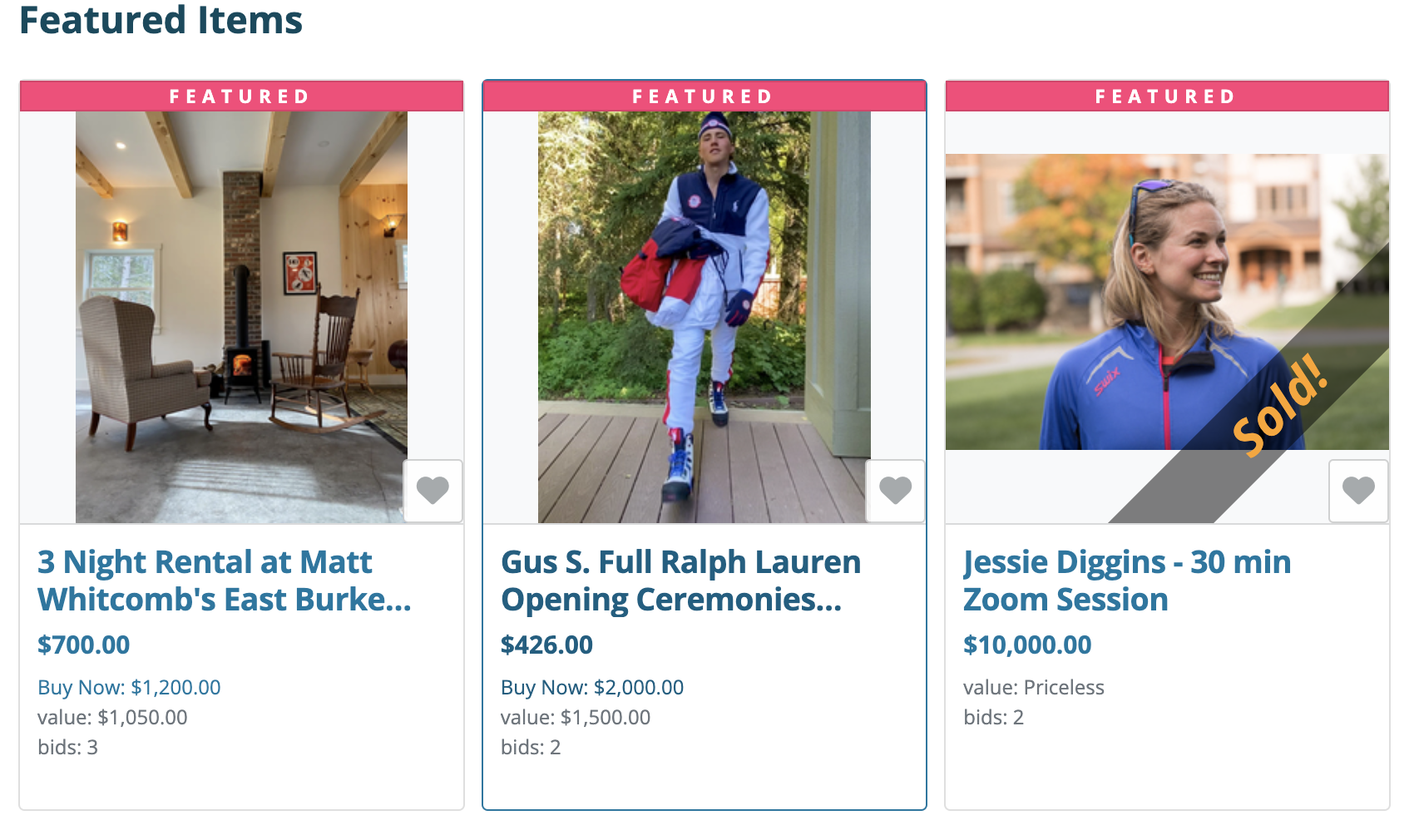
The online silent auction features a mix of gear, experiences, and unique memorabilia, including a fan bib signed by Jessie Diggins, an entry into the Alley Loop 42k, a training and technique video call with Kristen Bourne, and an autographed soccer ball from Sammy Smith, among other items still open for bidding.
Proceeds support NNF’s mission of centralizing funding and energy behind Nordic sport, connecting donors with athletes and programs at every level of the pipeline. Skiing fans can browse items and place bids at www.32auctions.com/NNFSummerAuction2026 before the auction closes on July 13.
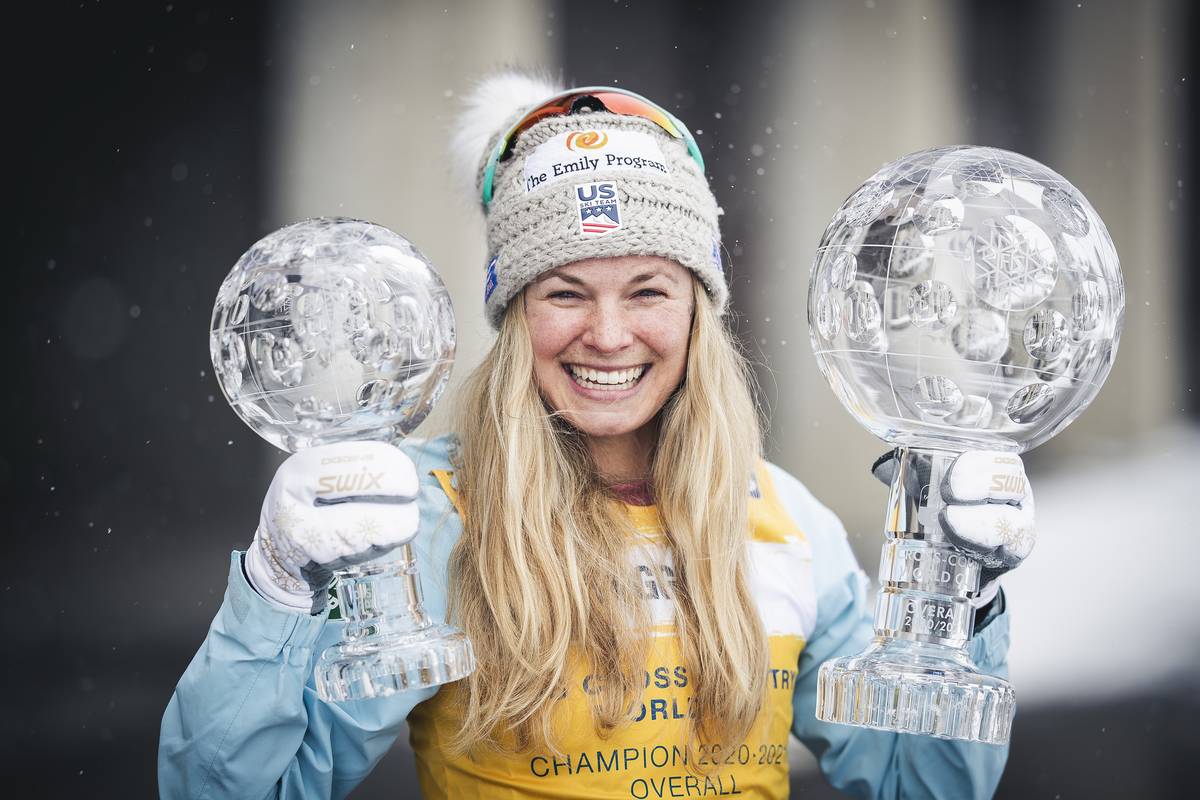
Before she was capturing Crystal Globes, Jessie Diggins was working her way up the skiing pipeline. Developing skiers across the country receive assistance from the NNF. (Photo: NordicFocus)
There’s a great scene in the 1983 classic movie epic The Right Stuff, where the test pilots are hanging out in their dank watering hole discussing the future of supersonic flight and bemoaning what they see as misplaced priorities. The press liaison throwing back a beer with Chuck Yeager and Jack Ridley seems to innocently ask, “you know what makes your rocket planes fly?” The aeronautical engineer puts down his beer and responds by beginning to recite the complexities of aerodynamics when the liaison interrupts, shaking his head at him and says, “Funding, that’s what makes your ships go up. I’ll tell you something …no bucks, no Buck Rogers.” It was a perfect synopsis with a crystal clear meaning. All of the science, bravado, and tenacity in the world didn’t matter if there wasn’t the funding to support the incremental gains needed to push human flight in supersonic speed aircraft. No bucks, no Buck Rogers. It’s that simple.
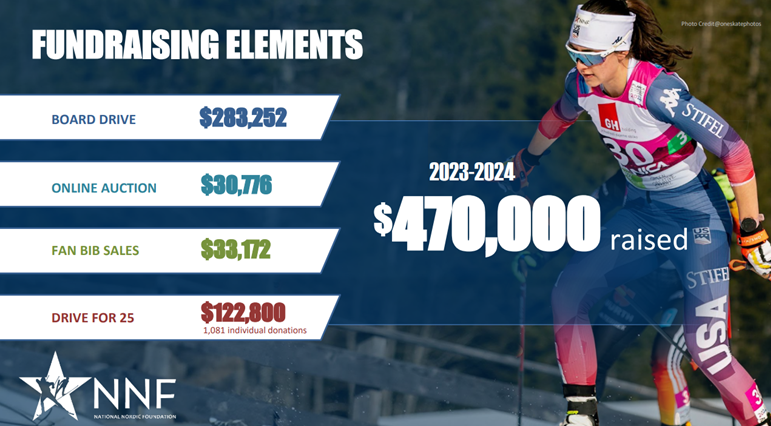
The NNF raised over $470,000 last year, helping to fill the pipeline of talented Nordic athletes. (Photo: NNF Impact Statement)
The same is true in elite level skiing. All the hard work, talent, training, and determination in the world won’t matter if there aren’t the dollars to get athletes to the World Cup, and equally important, to develop young athletes who fill the pipeline on their way to the top of their sport. In short, no cash, no Cups. The best skier in the world can’t win anything on any level, if they’re grounded in their gym in Utah.
This presents skiers with a real problem. In the United States, Nordic skiing is a low profile sport, and unlike almost every major international competitor, the U.S. cross-country squad doesn’t receive direct funding from the government. Contrast that to Norwegian skiers who really don’t have to worry about where the money will come from. Ski fast and the cash will follow. In America, it’s a different story. While the headline skiers on the United States A and B teams receive funding from U.S. Ski and Snowboard, through the U.S. cross-country team, skiers working their way up the skiing ecosystem are largely on their own financially. It takes a mix of club support, sponsorships, fundraising, and donors to keep the pipeline of young talent flowing in the ski game.
Sammy Smith after skiing to 2nd place in the skate sprint at World Junior Ski Championships Planica, Slovenia. Talented athletes like Smith have options other than cross-country. NNF helps to keep athletes like Smith in the skiing game. (Photo: Courtesy Image/Jasmine Wiley)
If you’re a talented young athlete, you also probably have other options besides skiing. Look at Sammy Smith and Sophia Laukli. Both have the talent to earn a living in other sports. To keep them in the ski game long enough to reach the A team, there needed to be a funding mechanism to help developing skiers until they reached the level of receiving national team support.
For a young skier trying to stay with the sport, the different pieces of the funding puzzle can be an economic Rubik’s cube to try and figure out. That’s where the NNF (National Nordic Foundation) comes in. It acts as the bridge in that funding gap between established U.S. cross-country team skiers, and those without full national team financial support who are chasing their World Cup dreams. It’s the bridge to where the funding is easier to acquire— being an A or B team member of the U.S. national squad— and wandering the financial wilderness of being a developing athlete.
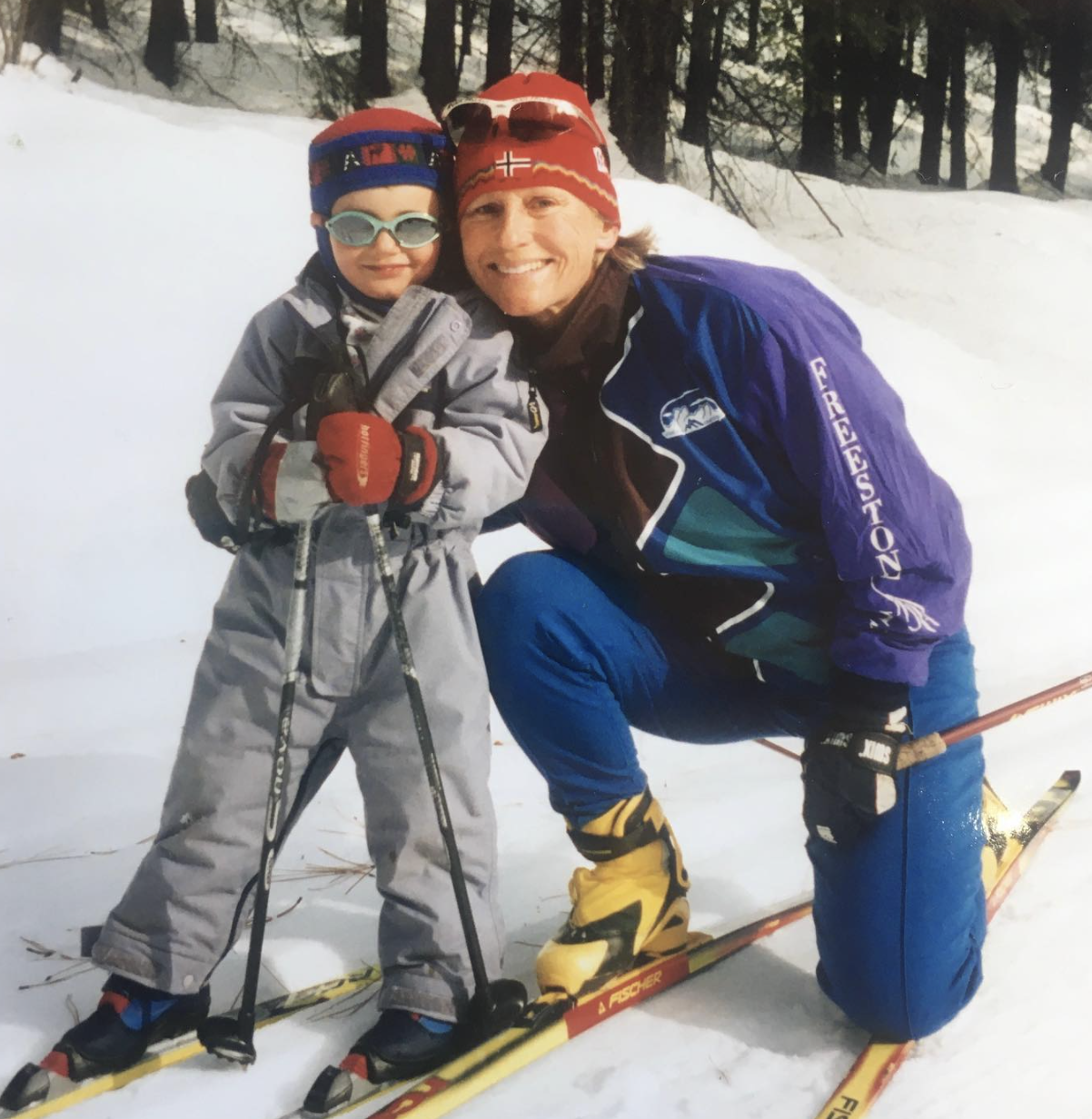
Laura McCabe (right), former U.S. ski team member and Olympian, is the current NNF chairperson. Here she is working on skier development with her then young daughter, now U.S. team member, Novie McCabe. (Photo: Instagram @novie.mccabe)
The NNF is a non-profit funded solely by donations whose mission is to “power the opportunities that bridge the gap to World Cup and Olympic excellence for Nordic skiers from the United States.” Chairperson of the Board of directors, former Olympic cross-country skier Laura McCabe—mother of current U.S. team member Novie—states in her letter to the ski community that the NNF was “founded on the belief in supporting a development system rivaling any nation, a vision we’re proudly realizing thanks to our dedicated community.” That founding vision was a tall order considering that the other major Nordic nations don’t have to go to donors with hat in hand soliciting support.
But the NNF has been successful in fulfilling its mandate as a funding bridge. Last year, the NNF raised $470,000 to support the development of the cross-country racing ecosystem in the United States.
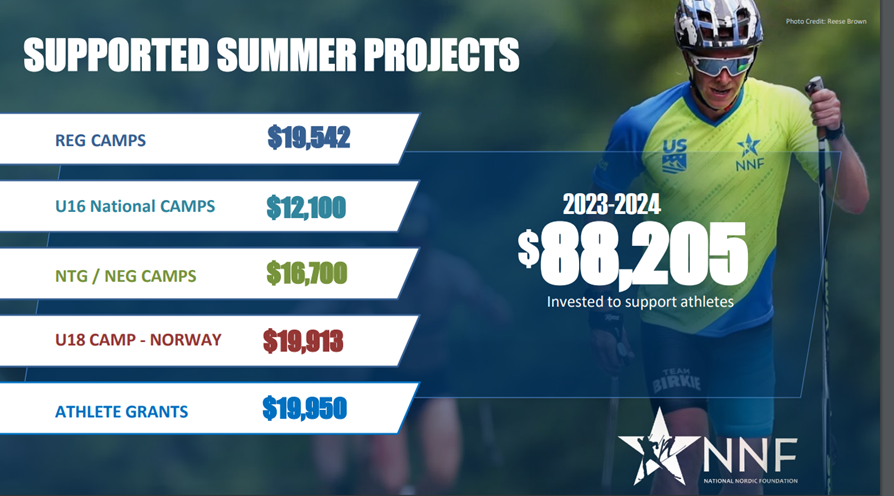
NNF supports summer as well as winter projects. (Photo: NNF Impact Statement)
NNF uses that money to help skiers afford the cost of winter and summer events and training. In the summer, NNF helps offset the cost of attending training camps. There are National Elite Groups, Regional Elite Groups, National U16 Camp, and international development exchanges and trips. Last year NNF provided over $88,000 in funding for these activities.
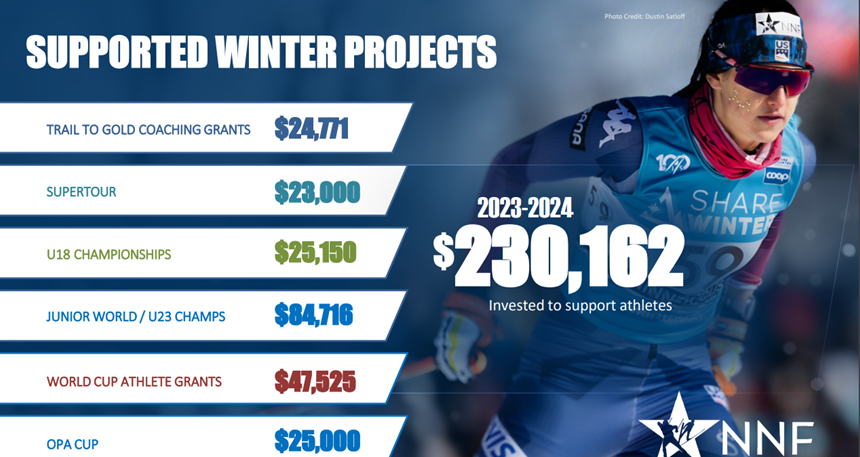
During the winter, NNF provides funding for coaching development as well as athlete funding to help attend U18 championships, Junior World/U23 championships, World Cup races, and OPA Cup racing (a second level of competition ranked just below the World Cup). There are also individual grants to athletes to help them attend World Cup events. Last year those winter projects support for event attendance was over $180,000.
The NNF is the lead sponsor for the Supertour as well as supporting other winter programs. (Photo: NNF Impact Statement)
NNF also sponsors domestic racing by being the title sponsor for the Supertour. The Supertour is the highest level of race competition in the United States and consists of a race series spread across the country. Success in the Supertour often leads to a spot on the U.S. national team or start rights in the Tour de Ski. Last year NNF subsidized the cost of the Supertour to the tune of $23,000, which covered almost 60 percent of the tour’s prize money.
One of the NNF’s other successful winter projects is its Trail to Gold program. The T2G is a coaching grant that supports developing women coaches and technicians in an historically male dominated profession. Bernie Nelson who was just hired by the U.S. team as a full time technician was a T2G funding recipient.
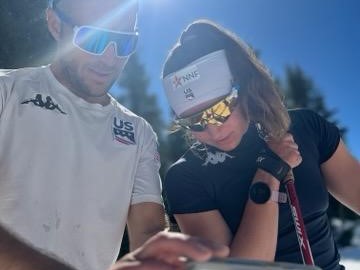
U.S. team coach Matt Whitcomb (left) crunching numbers with Sydney Palmer-Leger. He’s a key part of the puzzle to help the NNF design its funding disbursements. (Photo: Leann Bentley, U.S. Ski Team).
A critical piece of the puzzle for the NNF is coordinating between itself and the U.S. national team. That’s where Matt Whitcomb comes in. Whitcomb is the head coach of the U.S. ski team. He is also on the NNF Board of Directors. Whitcomb provides the Board with an invaluable overview of the needs of developing skiers, and what a successful development program looks like. “The NNF is the bridge between being a U14 athlete and being an Olympian,” said Whitcomb. “NNF picks up and assists with projects between those two things where athletes are most likely to quit because of funding challenges.”
“The NNF and national ski team are critical partners, but we’re really different puzzle pieces that just fit really well together where the NNF funds younger kids, and the U.S. ski team funds the older or more successful athletes. Our philosophy at the NNF is that all hard working athletes with big goals should be able to compete in the sport regardless of their economic status” The NNF states that there is funding which touches over 250 athletes per year, with funding from thousands of donors. “We have a three year fundraising average of raising over $500,000 a year, said Whitcomb.”
WIll Koch finished 13th in the 10K Classic at the 2022 Junior World Championships. NNF helped secure his presence. (Photo: John McColgan)
Often part of the NNF funding process is to generate individual amounts of support for certain events. For example, there might be a dollar amount set aside for the U23 championships which is then divided between different athletes. It can start out as a large pot of money, but by the time it’s divided between all the athletes and support crew, the dollar amount shrinks significantly. For example, it previously allocated over $84,000 in total to the last Junior World/U23 Championships. But after the math is done, it only comes out to several thousand dollars per athlete. It’s a big help but doesn’t cover an athlete’s entire cost. “There’s 10 wax techs alone that come to World Juniors, and around 24 athletes,” said Whitcomb.
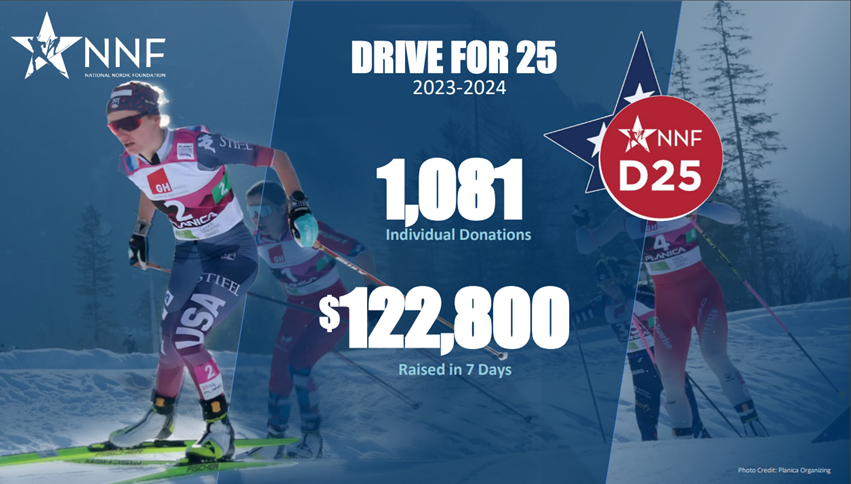
NNF focuses on grass roots fundraising. Over 1,000 donations just for the Drive for 25 fundraiser shows its breadth. (Photo: NNF Impact Statement)
Athlete buy-in is critical to NNF’s mission. Athletes are part of the fundraising efforts and build important ties to the cross-country community. Athletes are encouraged to actively participate in the fundraising process. “We don’t cover any project completely,” said Whitcomb. “The goal is to leave some of the responsibility up to the club and the athletes. If they all do a little bit (the athletes), it will really move the needle for an organization like this.” The NNF is proud of width and breadth of its donor base, with over 1,000 individual donations for its drive for 25 fundraising effort, it demonstrates its status as a grass roots organization. “Our window is at the grass roots level. There are people that donate five dollars recurring monthly. You know what it means to those people. We’re trying to sell shares of this great journey to as many donors as possible.” You may have heard of the Drive for 25, but not really known what it was about. It’s one of the NNF’s principle fundraising efforts. Last year it raised over $122,000.
It’s not just racers who benefit from the NNF’s support. High level racing needs high level officiating. At every FIS (International Ski Federation) event there are teams of technical delegates who are the equivalent of officials or umpires. Without the technical delegates, high level racing doesn’t happen. In the U.S., these positions are volunteers, but there are significant expenses attached to being a delegate. NNF has launched a new program to offer grants to individuals trying to gain technical delegate status to help offset part of the expense. It’s part of NNF’s efforts to maintain the flow of talent and treasure which feeds the cross-country pipeline.
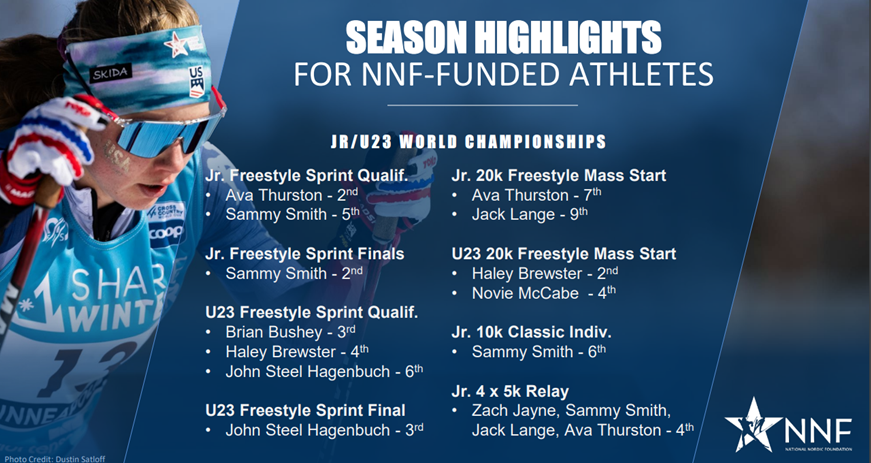
NNF is part of the American success at the Junior level. (Photo: NNF Impact Statement)
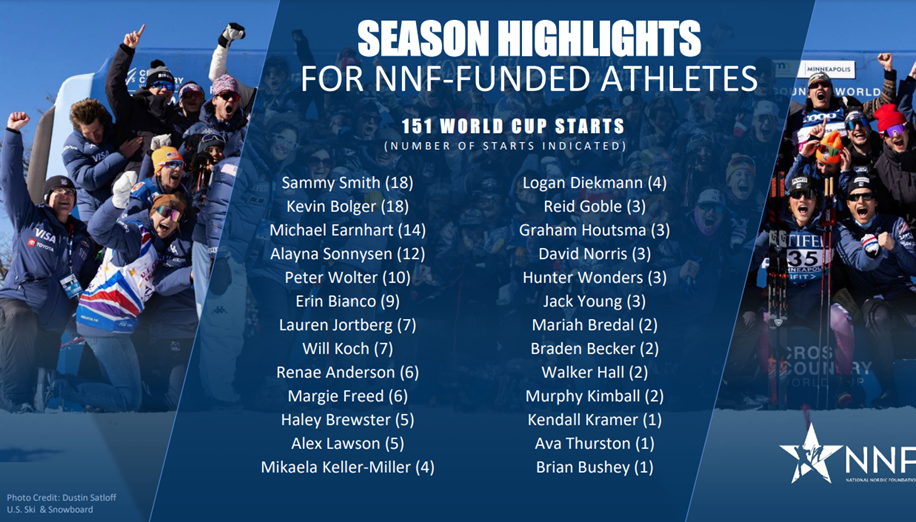
The NNF proudly points to athletes’ success as proof that its support continues to feed the American pipeline for world class ski talent. In the most recent Junior/U23 World Championships nine different NNF funded athletes finished in the top 10 in different events. In addition to the junior level racing, it also provided funding which contributed to 151 world cup starts. The results from that effort were over 20 top 30 World Cup finishes for NNF supported athlete. Another sign of NNF fulfilling its mission is that many previously NNF funded athletes have recently achieved United States A or B team status, including Sammy Smith, Kevin Bolger, and Will Koch.
NNF also impacts World Cup performances as it helps athletes who haven’t yet made A or B team status. (Photo: NNF Impact Statement)
Every time one of these developing athletes achieves success in competition it helps moves them along the pathway to becoming a member of the United States A or B team which is where the other side of the funding bridge is met and continues the pathway to Olympic success. “Take a look at the last Olympic team. Everyone of those athletes, earlier in their career, had received funding from NNF.”
It’s fair to say that without NNF support the pipeline of developing skiers would be limited to athletes from wealthy backgrounds or those who have the good fortune to have the marketing skills to promote themselves on GoFundMe pages or Instagram. As long as it continues to receive support from the Nordic community, NNF will continue to be the funding bridge for up and coming athletes.
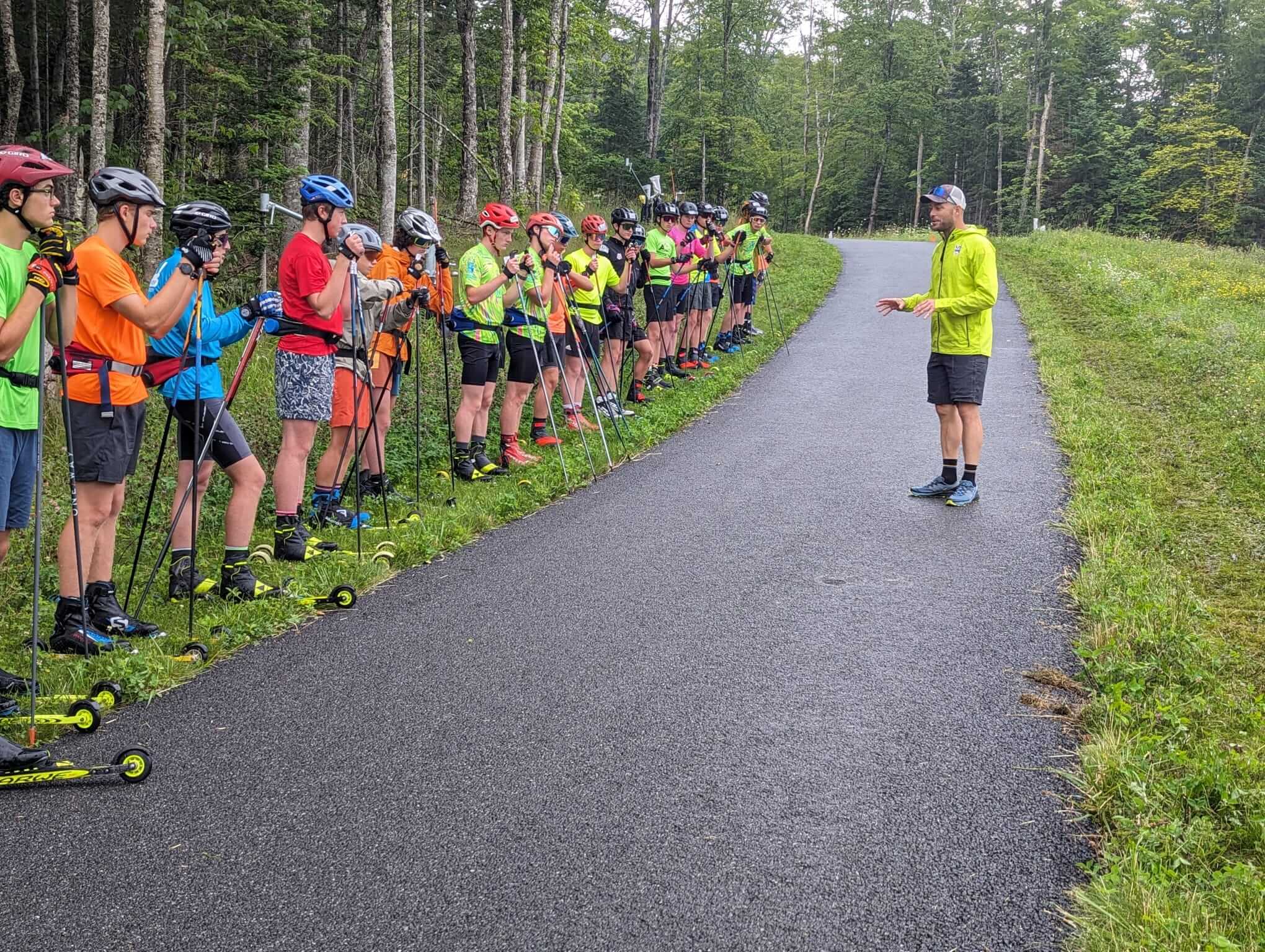
US Ski Team Head Coach, Matt Whitcomb, leads a group of U16 Boys in a session at last year’s national camp in Lake Placid, NY. (Photo: Courtesy Image/Bryan Fish).
US Skiing is coming off one of the most exciting winters in recent memory. As summer approaches, the National Nordic Foundation (NNF) is excited to help continue the momentum, again sponsoring a full suite of development opportunities in partnership with US Ski and Snowboard that live up to the old adage, “fast skiers are made in the summer!”
NNF’s Pillar Projects in the summer include a full suite of Regional Elite Group Camps (REG), with top U18 and U20 skiers from each USSS Region joining up at some of America’s premier ski venues to work with top regional coaching talent, and US Ski Team Coaches Bryan Fish and Greta Anderson. The U16 National Camp, which has successfully expanded on this REG model to reach more skiers at a younger age group, brings the best young skiers in the country train together at once for the first time ever, and this year will be held at Jackson Hole, Wyoming. An International Junior Camp rounding out this summer will also be looking to expand upon an emphasis on bringing American skiers together around fun development opportunities as a national ski community.
In fact, it’s that creed, working together makes us better, that NNF fully can stress through our Pillar Projects each summer. While the successes and milestones reached by US skiers make for emotional highlights each winter, the true grassroots work – the type of development NNF was founded to support – happens each summer. NNF’s programming reaches down from the national level to the regional level. Our partner organizations at the divisional level have also expanded upon the REG model to reach younger athletes and bring more skiers from more places together. Put together, it’s a recipe for community success empowered by the community. Here’s to a happy summer of skiing!
NNF Summer Pillar Projects Schedule
National Training Group (NTG) and National Elite Group (NEG) Camps – Best U20 skiers in the country, joined together for regular training with USSS Development Coaches. Schedule: Bend, Oregon, Early May. Park City, Utah, Late October.
Regional Elite Group (REG) Camps – Top U18-U20 regional skiers working with US Ski Team Development Coaches. Schedule: Western REG in Bend, OR June 22nd-29th. Eastern REG in Burlington, VT, June 29th-July 3rd. Central REG in Cable, WI July 9th-14th. Alaska in Anchorage, AK July 15th-21st.
National U16 Elite Camp – Top U16 skiers from across the country training together with USSS Development Coaches. Schedule: Jackson Hole, WY July 29th-Aug. 4th.
International Junior Camp – US delegation of U18 skiers attends camp with top international juniors in Europe. Schedule: Location: TBD August 5th-August 16th
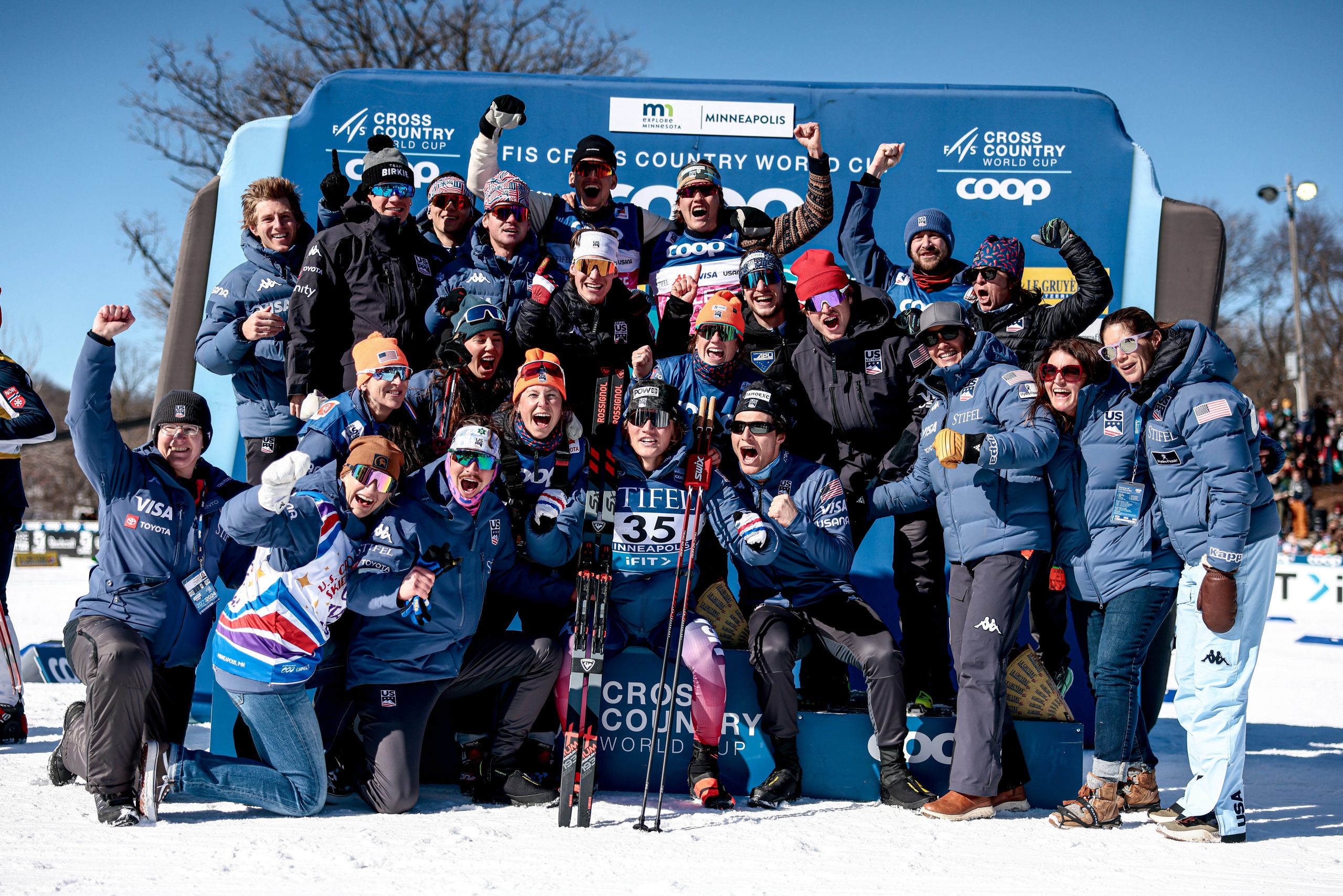
The Stifel U.S. Ski Team and Staff in Minneapolis, Minnesota following Gus Schumacher’s win in the 10 k skate, a highlight of the 2023-24 World Cup season. (Photo: Nordic Focus)
Asked for a reflection on the 2023-24 World Cup season, US Ski Team Head Coach Matt Whitcomb pointed straight towards one place; Theodore Wirth Park in Minneapolis, Minnesota, on a sunny February day, filled to the brim with 20,000 people cheering loud and clear.
“We often talk about athletes peaking for big events,” he said. “But I’d never considered that our American ski culture could peak for an event.”
The specific dynamics between performance and culture may be something Whitcomb is ongoing in noting, but his reflections on this World Cup season show a clear comfort operating in the connected space between the two. In a season of many notable triumphs for American skiers, Whitcomb can trace each individual achievement to a team philosophy shared between each US Team member, extending from their roots in ski communities across the country.
In Jessie Diggins’ Overall World Cup title, Rosie Brennan and Sophia Laukli’s World Cup podiums and victories, JC Schoonmaker and Ben Ogden’s first World Cup podiums, Junior World Championship and Youth Olympic Games medals and, yes, that special Sunday in Minneapolis for Gus Schumacher, Whitcomb sees a consistent ethos. Put together in a single sentence, it’s hard to believe that all those things happened in just the last five months, and as our conversation with Matt Whitcomb shows, this one burst of success is reliant on a consistent thoughtfulness, put into athletes, development, and for the US, a ski community spanning a continent, in which he is a clear leader.
This interview has been edited for length and clarity.
Ben Theyerl/FasterSkier (FS): We last caught up with you ahead of the North American World Cups. I was re-reading that interview, and was struck just by how many of the through-lines you traced in the development of US Skiing and a US Team culture shone through the overwhelming success of the Minneapolis World Cups.
Things like “I want to stand along the course and see and hear what 10,000 people [feel like],” and “We made a goal this year as a team: stop taking podiums for granted. This year, you see us storm the podium and take a team photo with the one athlete who actually earned the award” look a little different when you know there were 20,000 people there, and what it looked like to celebrate Gus Schumacher winning his first World Cup at that World Cup.
How do you look back on that weekend in Minneapolis and what it meant for the US Ski Team?
Matt Whitcomb (MW): I just feel grateful and lucky, so I’d like to say thank you to everyone in the U.S. cross country ski community, and especially to those who traveled to Canmore or Minneapolis. We often talk about athletes peaking for big events, but I’d never considered that our American ski culture could peak for an event. We shocked the visiting nations, and I’m just so proud of it all. A big thanks to Claire Wilson, Doug DeBold and everyone at The Loppet Foundation, including the hundreds of delightful volunteers who ran the event of a lifetime. This World Cup was very expensive, so thanks, too, to The Loppet Foundation, U.S. Ski & Snowboard, Share Winter, the event sponsors, the vendor tents and trucks, and those who chipped in from the grassroot level when the funds were tight.
“If you build it, they will come.” And they did.
FS: There was a lot more to celebrate back in Europe at the end of the season as well. Jessie’s Crystal Globe, of course, and then also a second consecutive year taking fourth place in the Nation’s Cup, which you’ve highlighted as being a very big deal for the team in the past.
When the last ski had been waxed, and the last athlete crossed the finish line this season, what struck you initially about what made this year special for American skiing?
MW: The first thought was one of dread: The staff relay starts in five minutes! When that was finally over, and I was on my flight out of Stockholm, I was thinking about how many American athletes raced a World Cup this season. I believe the number stands at 40, and 7 of them stood on 22 podiums.
We were fourth in the world as a team, losing to Finland by a painfully small margin on the last day of the season. Our women finished the season in third, and our men finished in fifth, when we moved ahead of Italy on the final day. If you look beyond the World Cup too, it was a phenomenal season for US Skiers; we had a podium at the Youth Olympic Games, one at World Juniors, and two at U-23 Championships.
I get more excited about the reasons behind the results than I do about the results themselves, and I’m proud of the club system we’ve all built in this country. We are a decentralized national team, which means we don’t bring the athletes to live in Park City, Utah as soon as they make the team. Instead, the clubs and the national team work together to build a team around each athlete that covers the whole year. It feels good to see that working.
Rosie Brennan and US Ski Team Head Coach Matt Whitcomb embrace after Brennan skied to a second place in a 10 k Classic race in Ruka, Finland. (Photo: Nordic Focus)
FS: As you’ve had a little time to reflect, are there any other aspects of this season that have risen to top-of-mind as being clearly special? Maybe it was a specific performance, or a particular principle that really shone through about this year’s group…
MW: Take a look at our three men’s podiums. Also, re-read that sentence! In each instance, there was a special sort of human connection, which ultimately points to the fact that our success requires so much more than just good training.
JC Schoonmaker toes the line in the skate sprint final in Östersund, Sweden. Five minutes earlier, he watched his girlfriend, Emma Ribom, win the women’s race. And not only that, his brother and teammate, Ben Ogden, is in the heat with him. They have something to defend. A mission. There’s some fuel to burn, and he finishes third, Ben fourth. This was JC’s first podium, and our first men’s podium in seven years (dating back to Simi Hamilton’s 2nd place in Toblach in 2017).
Ben Ogden makes the podium in Toblach, Italy, just three weeks after watching JC break the barrier for our men’s team. There’s a different vibe now: We’ve transitioned from knowing we could do it, to doing it. Our young men’s team has come alive, and Ben is at the center of it today. He and his boys are building something together, and today, he intends to showcase it. And in the crowd, hanging over the fence at the top of the last climb, is his mom, his sisters, his girlfriend, all there to support him in what has been the hardest year of his life. He finishes third, and lands on his first career podium.
Gus Schumacher starts bib 35, and heads out on the 3.3k loop in Minneapolis, which is a tunnel of 20,000 Americans, who have essentially created a particle accelerator loop for our skiers. With a reasonably low bib number, his “race leader” splits are somewhat empty, as he knows he should be winning at this point, because the big boys are yet to start. And Gus is now the target. One by one, the rest of them start and are clear of 6.6k. Gus is still the leader, but nine men know that he is only eight seconds ahead of them, and it will be nearly impossible for him not to be overtaken…unless you were there, and you heard how American fans support their skiers. It was actually impossible for him to be beaten. If you saw Gus’s final 2k in Minneapolis, you saw something special. This wasn’t just about a lot of smart preparation and grit. You saw what inspired skiing looks like, which happens when there is something to ski for.
FS: Five monthsis a long season, so this is intentionally a kind of absurd question: is there a single moment that sticks out to you as having been an especially good distillation of this season for the US Ski Team?
MW: This jumped out immediately. One of our Trail to Gold coaches during the last part of the World Cup season, Julia Hayes Forbes, had a birthday while we were in Oslo, so we all met at the wax truck, affectionately nicknamed Yolanda, before dinner to celebrate, and basically regroup for the final week of Drammen and Falun. We were a tired staff. We had not had the best two weeks of racing, and the pressure was now very high. In Yolanda, our staff has a few trophies we pass around when someone feels like acknowledging exceptional work. I won’t get into the bylaws that govern how the primary, back-up, and secret trophies are awarded, but this night, for two hours, we sat in a camp-chair circle and took turns celebrating each other. We dug in deep for two hours, tossing the back-up trophy—which is a hockey puck—from this person to that. We laughed a lot. There were some tears, too, because we all took the chance to slow down and appreciate each other. We felt lucky, and that was it.
Two days later, Rosie hits the podium in Drammen. She was back. We were all back.
US Ski Team Staff in their wax truck, affectionally nicknamed “Yolanda” trading accolades and laughs. (Photo: Courtesy Image/Matt Whitcomb)
FS: A lot of us who work as coaches are into feeling that post-ski season haze and relief and are curious for you, What do you do to get yourself some rest after the season?Is there a point each spring where you start to get really excited about re-convening with the US Team in Bend?
MW: I always expect my first couple of weeks back from the season to be relieving and restful, but in truth, it’s a tough time of year for me. Coaches have the wonderful job of feeling purposeful, and being required to ski as a profession. We’re goal directed, and each weekend we get to test our progress against those goals. Suddenly that’s gone, and we’re supposed to decompress with time away from it all, and it’s hard for me. We do our planning in early April, and that’s when I start to get excited again. I do miss the team and our staff, and I have a lot of unaccomplished goals yet to meet, so it’s been fun to get back to work.
In terms of what I do, I spent 10 days in Austin and New Orleans with my girlfriend, Caitlin, going on ghost and gator tours, eating everything, including gator. Before Bend, I’ll get out to a Lake in Nevada with my brother, Jake, and former ski racers, Cam MacKugler, and Hunter Karnedy, for a few days of fishing.
FS: Last time we talked with you, you emphasized how “[building and maintaining a great team environment] will always be my number one focus,” and pointed to the group of US Women who really elevated US Skiing to its current run of historic results that started in the 2010s with Kikkan Randall, Holly Brooks, Liz Stephen, Jessie Diggins etc…
How have you observed that great team environment evolve over the last couple of years, especially as there’s been a couple different groups of young skiers – first Ben Ogden, JC Schoonmaker, Gus Schumacher, Luke Jager, Julia Kern, Novie McCabe, and Sophia Laukli, and now John Steel Hagenbuch, Zanden McMullen and Sammy Smith, among others, join and find World Cup success?
MW: We had some great years during the second half of the Kikkan era, and while all but Jessie and Rosie have moved on from ski racing since those days, the expectation of what it means to be a member of the U.S. Ski Team is as clear as it ever was. Each skier and staff member has a responsibility to the team. The return one gets from that investment is one of the keys to a great career. I think that’s the legacy of those skiers from 2006-2018. As we all expected, the young American men’s squad from the Goms, Oberwiesenthal, and Lahti World Junior Championships have arrived. Given the nature of their success as three-year relay medalists, we didn’t just expect to receive fast skiers, and we figured they were going to be pretty invested in the team element of cross country skiing, too. To have that is critical. We’ll go backwards if we ever lose it.
FS: Finally, well there’s still snow on the ground (even in New England!) and memories of the season are still fresh, here’s a way to early question: what hopes do you have for the Stifel U.S. Ski Team as it looks towards 2024-25?
MW: We are trying something different this year, which is to travel less in the summer. We will have big camps in Bend, Oregon in May and in Park City, Utah in October, but for June, July, August, and September, the emphasis will be on stable training at home, really leaning into the club system. We’ll have small projects inNew Zealand and Norway, and coaches will make some club visits, but most skiers will travel less, and I’m excited to test this new plan.
The goal for the next year is to have success in Trondheim at the World Championships, and those championships come very late in the winter compared to previous World Championships, February 26th-March 9th. To succeed there, we need stability. And of course, as a team we plan to break our two-year pattern of being fourth in the World. We want that top-three badly.
FS: You mentioned that April ends up being the time for “planning” for next season and beyond for you, and for all of American skiing. You also implicitly mapped out where that planning pays off – the guys that were medaling at Junior World Championships a couple of years ago worked persistently and diligently, and got the support they needed, and now JC, Ben, and Gus all have been on World Cup podiums.
US Ski Team athletes and coaches on a ski tunnel training session last year. (Photo: Courtesy Image/Matt Whitcomb)
When you look at translating the developmental success US Skiing had this year into that next generation of World Cup podiums, where are you looking?
MW: I don’t think most people realize that we are the only team in the top-10 in the World who doesn’t receive government funding. That’s why you hear us asking for money every year. Each year, the U.S. Ski Team invests over a million dollars in our cross country program. That money comes from sponsors and partnerships, and from private donations. It is spent largely on our A and B Team athletes, and the coaches and techs that run the team. The National Nordic Foundation, on whose board I serve, raises money exclusively from private donations. We invest in the athletes below the A and B Team level, down to the U-16 level, to ameliorate the financial barriers of our development system. While that amount invested in our younger athletes varies from year to year, it has hovered around $350,000 for each of the last three years. Every development camp in the U.S., including U-16, REG, NEG, and NTG are subsidized to the tune of about 70k by these funds. We invest 23k in the SuperTour hosts, so they can afford to organize the races, and 28k in our Trail to Gold women’s coaching grant, to close the gender gap disparity in elite coaching. 47k has just been sent to the 26 World Cup athletes who are not A or B Team athletes, but who still earned World Cup starts.
So, when you hear about the NNF’s online auction in July, or our Drive for 25 in November, or some scheme to sell athlete bibs or hats for an event, this is why. We truly need your help. We are working hard for the athletes, so they can afford to participate in our great sport. There are over 2,000 people who donated to the NNF in some way last year, and I’d like to end this interview as it began, with a thank you.
US Ski Team skiers sporting their very own US Ski Team Staff NNF Fan Bibs in the wax truck in Minneapolis, Minnesota. (Photo: Courtesy Image/Matt Whitcomb)
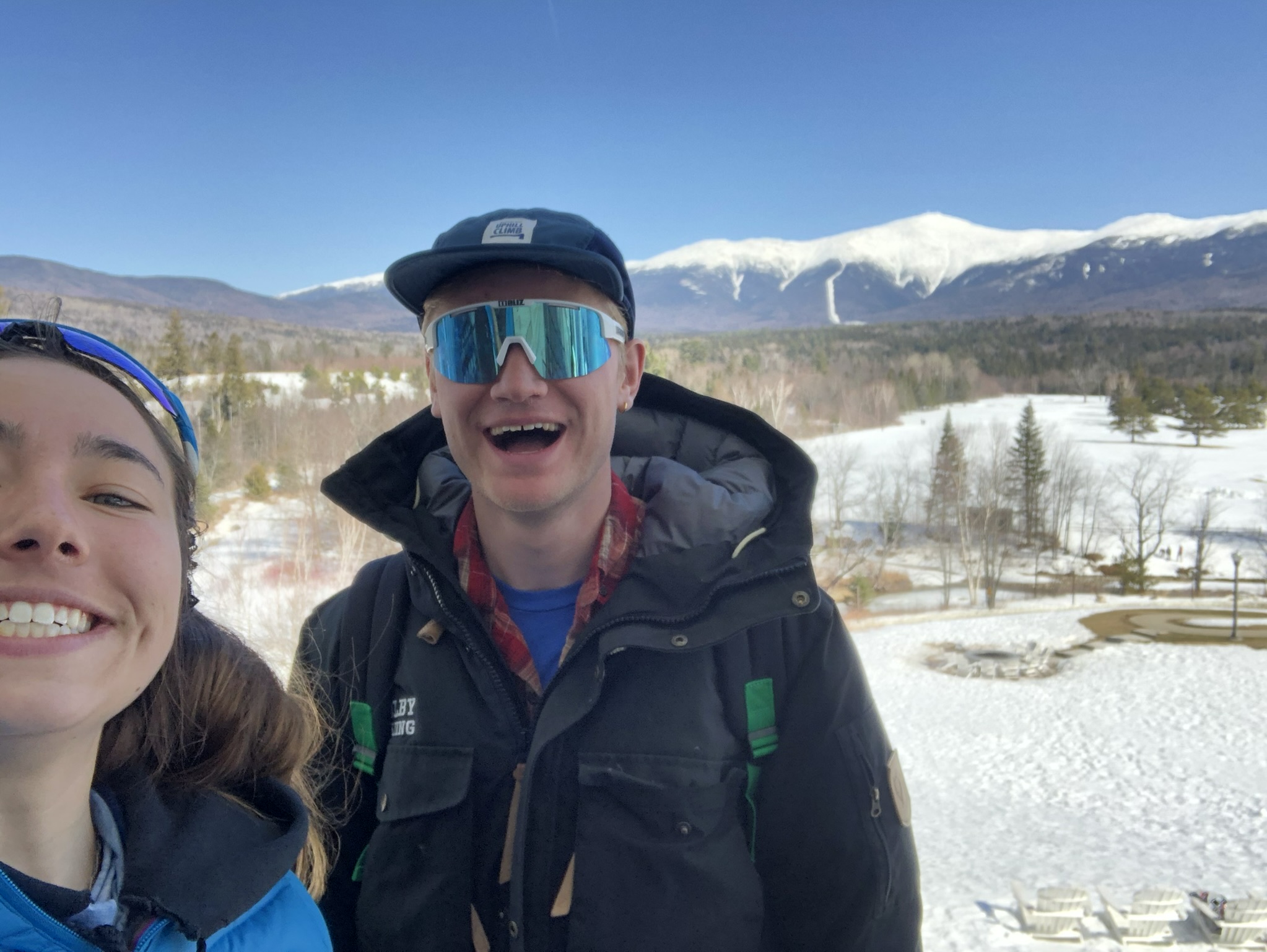
The author and Annika Martell in New Hampshire, 2020. Martell was one of the National Nordic Foundation’s inaugural Trail to Gold Fellows, and interned on the World Cup in December. (Photo: Courtesy Image/Annika Martell)
All friendships have a mythology, and all mythologies have their origin story. For Annika Martell and me, that origin story takes place in a marsh outside of West Bend, Wisconsin.
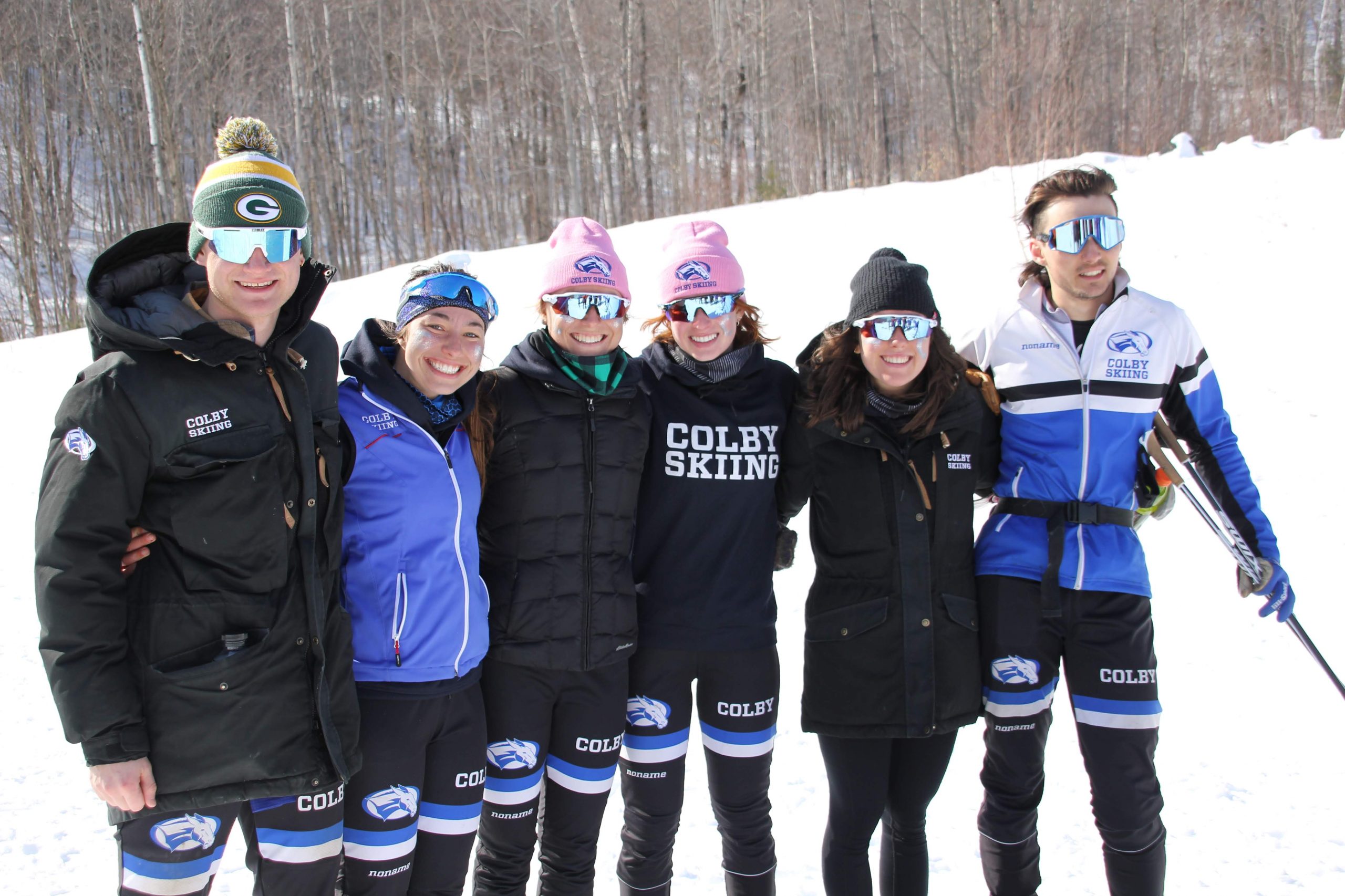
Anni and I did not meet until college—we were both part of the incoming class of 2020 at Colby College that arrived on campus in Waterville, Maine in August 2016, but my mother and her father were both raised in this same heart of heartlands north of Milwaukee. At our first practice as members of the Colby College Nordic Ski Team, Anni pulled out a set of rollerskis from a ski box. Seeing that she had stuck a Green Bay Packers sticker on both rear fenders, I exclaimed, “Go Pack Go.” The smile she returned let me know that in those nerve-racked early days in the world of high-brow liberal arts education, I had found an allie in my uncut Midwestern goofiness. Through those early uneven steps out into the world, Anni was there as a steady presence to celebrate who I was in my most unfashionable, and true, self—a kid who had seen very little of the world beyond Eau Claire, Wisconsin, was all in on loving his God, his family, and the Green Bay Packers, and for whom the American Birkebeiner may as well have been the center of the universe.
Which brings us back to the marsh outside of West Bend. After a few months of knowing each other, Anni asked me if she could tell me a weird story, and what flowed out from it was an instant recognition of a shared memory in myself. Shared grins followed, and we traveled back to that place that Wisconsin occupies in both our minds: pure nostalgia, memories of family, a place for all the good feelings of the past. There in a marsh was a little blonde-haired boy. He’d gone for Friday fish fry with his family—very Wisconsin sentence—gotten a stray quarter and put it in one of those toy machines where once you turn the knob far enough, it clicks, and a cheap trinket comes out in a plastic capsule. He had gotten a ring, and then promptly dropped it on the family walk around the marsh afterward. A little black-haired girl had come to the rescue, helped find that little toy ring, and then they went their separate ways until they met in Maine all grown up. The moral of the fable: Even before I knew that I knew her, Anni Martell had helped me find my diamond in the rough.
These days she is still helping me be that diamond in the rough and doing the same for an ever-growing number of athletes she has worked with in her young career as a ski coach. Most days, that includes the Williams College Nordic Ski Team, but this season it has also meant the US Ski Team, as she traveled to intern with the coaching staff through Beitostolen and Davos as one of the National Nordic Foundation’s Trail to Gold Fellows.
When she returned, I heard tales from my friend of taking those exciting first steps onto the top level of our sport. I was all ears; I was inspired. What follows details the experiences and reflections of one of this year’s Trail to Gold Fellows, and captures the early journey through the profession for a talented coach within the US ski community from the perspective of her FasterSkier reporting friend.
ADVERTISEMENT
The Trail to Gold Fellowship Comes Together
“I think some of the key moments in my coaching journey have happened when mentors, coaches, colleagues or friends around me didn’t expect that they were making a real impact,” said Anni when I caught up to her after her stint on the World Cup. That might be a sentiment familiar to many coaches out there—that proud moment when an athlete reflects on a tip or cue that stuck with them without your knowing—but it isn’t one that many coaches find themselves reflecting on about themselves. In the case of the Trail to Gold Fellowship—launched last summer in a partnership between the Olympic Women’s Book Project, Women Ski Coach’s Association, and National Nordic Foundation—bringing an experience to talented women coaches that would have an unsuspecting impact was the essence of the program’s impetus. The Fellowship is sending talented Women coaches to the World Cup this season, but its existence has come as the result of a cumulative impact of skiers and the ski community over a long period of the sport’s history.
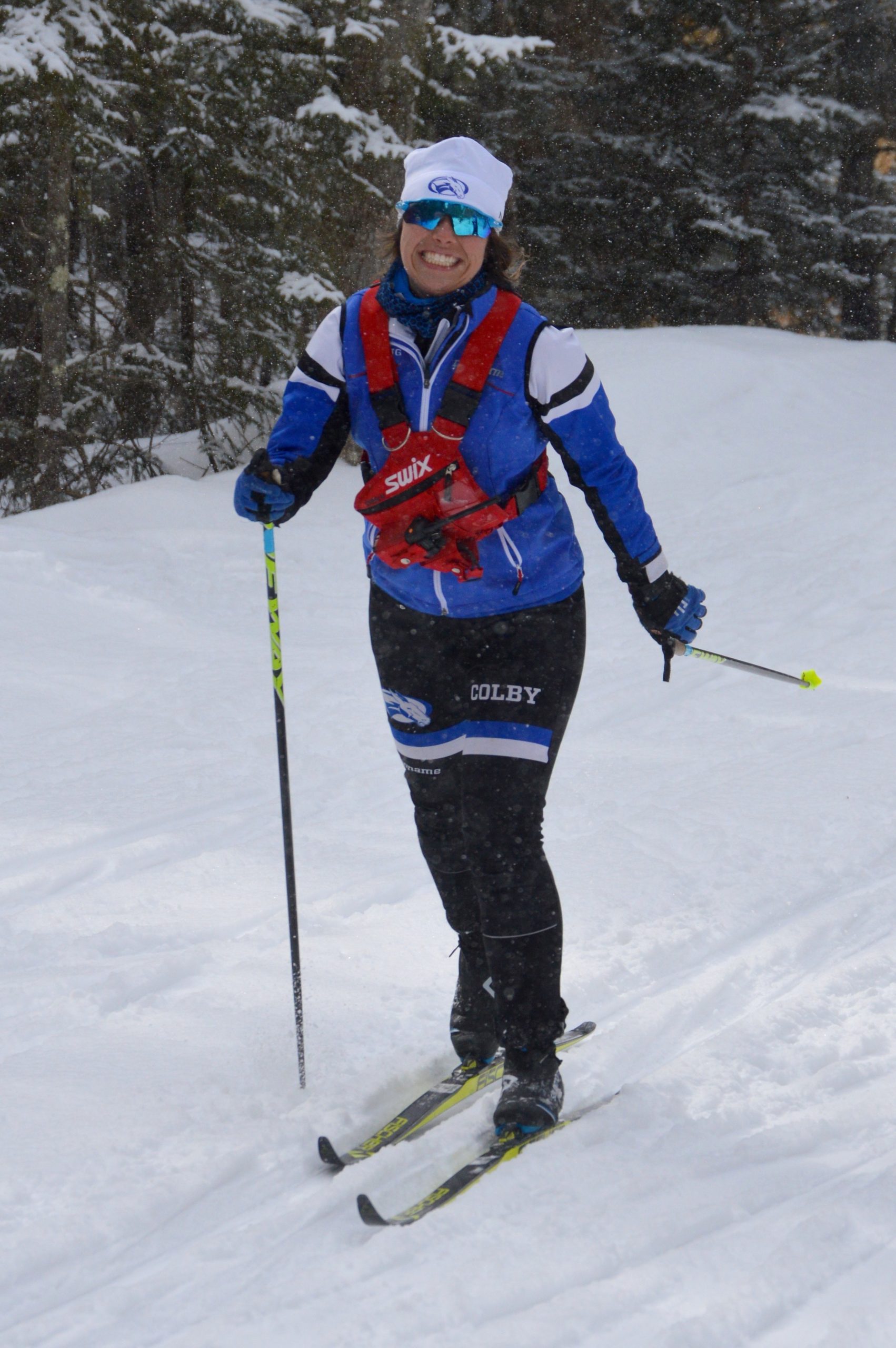
Martell subs for coaching duty during her college days…a sign of things to come. (Photo: Joe Bianco)
That connection to such a length of time comes via the 2021 publication of Trail to Gold: The Journey of 53 Women Skiers, which recounts the story of each woman to have represented the United States in cross-country skiing at the Olympics from 1973 to 2018. As Ella Hall recounted in her book review at the time of publication, the impetus of that book resulted from an exercise by the women’s contingent of the US Ski Team in 2013-14 where members interviewed team members from the history of Women’s skiing in the United States. It proved true to the principles of skiing—accentuated all that was good about the individuals involved—and soon organization, camaraderie, and a drive started to formally connect the larger community of skiers past and present. The U.S. Nordic Olympic Women’s group (USNOW) was formed in 2018 out of a meeting of Kikkan Randall and Alison Owen-Bradley to provide continued support for competitive Women’s skiing in the United States, with a book committee (headed by Sue Long Wemyss) resulting in the publication of Trail to Gold.
Trail to Gold, the Journey of 53 Women Skiers, written and compiled by the skiers themselves. (Photo: Women’s Cross Country Olympic Book Project).
Last summer, the committee that Wemyss had fronted connected with the Women’s Ski Coaches Association (WSCA) with the idea of continuing the type of internship that Bourne had completed with the US Ski Team with the proceeds from the sale of Trail to Gold. US Ski Team Head Coach Matt Whitcomb brought the idea to the National Nordic Foundation, where he serves as a Board Member. NNF joined to provide additional funding, and the Trail to Gold Fellowship became a reality. The inaugural class was announced in November.
The Trail to Gold for Annika Martell
There are the friends you work with, and the friends you escape work with. Then there are the rare ones with whom you can do both. Initially, skiing was the latter for Anni and myself: our escape. Then, over the space of the last two years, skiing became the former: our professions. As a consequence, when we catch up these days, it is usually registers as some kind of impromptu ski coaching conference. A phone call that begins with “I just saw your old roommate last weekend” can quickly morph into a conversation about the virtues of running Start Oslo versus a Klister-Hard wax cover. Implicit in that is a fluidity that features as a strength of the US ski community: athletes can play coach; coaches can sometimes play athletes; and to truly understand athlete development, coaches can work on multiple different registers of development all at the same time.
Anni has found that current and ridden it well. Originally from Minnesota, she engaged in that understated but important practice in America’s most robust high school league where athletes regularly get involved in teaching learn-to-ski with the Minnesota Youth Ski League. That followed her when she was my teammate at Colby, where our team made a regular practice of helping with the Bill Koch club at Quarry Road in Waterville, Maine. From there, for Anni, it was a more formal step into coaching. As our final season racing on the collegiate circuit wrapped up in the spring of 2020, she had secured an internship with the US Biathlon Association to work with their athletes in Lake Placid that summer, and with it, her coaching journey had begun in earnest. Then there was a season at Ford Sayre in Hanover, New Hampshire working with their Junior program, before moving into her current position as Assistant Coach at Williams College.
Colby Seniors at the Chummy Broomhall Maine State Collegiate Championships in 2020 (Photo: Linda Kerker)
That quick journey was motivated by “some amazing coaches and role models I looked up to in the coaching profession, from the Bill Koch League all the way up to the national team,” says Anni. There is an approach couched within that statement, a seriousness to viewing coaching as a craft in which one should grow and develop. More uniquely, with Anni, is an ability to view her development as a coach with super seriousness, while projecting to her athletes the joy and fun that taking the sport of ski racing seriously can be.
In her willingness to see coaching as a craft—one that takes a long journey to master—Anni has identified something that US Skiing is still busy learning on a national scale. Coaching development requires as serious a commitment as athlete development.
ADVERTISEMENT
Trail to Gold: On the World Cup
That coach development is a growing priority for US skiing is fundamental to the Trail to Gold Fellowship’s mission. On the organizers end, the T2G Fellowship represents a commitment to providing promising Women coaches with the experience and credentials required to correct a historic inequity on the highest level of coaching within the United States development system. For an individual coach like Anni, it represented “a great opportunity to learn. There’s so much to learn from people we come into contact with: techs, coaches, and, of course, athletes!” Anni joined Naomi Kiekintveld (APU/Anchorage South), Liz Stephen (Park City), Caitlin Gregg (Team Birkie), and Lizzie Larkins (Montana State) in the inaugural class of T2G Fellows when they were announced by the NNF in November.
Anni’s two-week stint on the World Cup included the back end of Period I (December 9-December 18), a weekend in Beitostolen, Norway followed by a mad dash to the Alps in Davos, Switzerland. That was a big opportunity, but it was also one Anni says she considered carefully: the Fellowship meant two weeks away from the Williams Ski Team during a crucial block leading into the Eastern Carnival Circuit. “I talked with [Williams Head Coach Steve Monsulick], and we decided that it was a great opportunity, and also would benefit our program through the lessons learned [on the World Cup too].”
On the actual “role” she played within the US Ski Team staff, Anni said that “it was really twofold: one part coach, one part wax technician.” Anni further divided the World Cup coaching experience into two types of days: “training, and race-days, which are all hands on deck.”
In Period I, the US Ski Team coaching staff included Head Coach Matt Whitcomb, Program Director Chris Grover, and D-Team Coach Kristen Bourne. On training days, Anni said that the “coaching” aspect of the staff’s job was on display in a way that goes unconsidered by most. “The athletes and coaches really are committed to improvement the whole time. On training days, coaches organize athlete training sessions, shoot video, offer technique advice, provide training and recovery council, discuss tactics – on top of all the other logistics involved with the World Cup—which requires some kind of superpower it seems.” Anni also added that her days were particularly busy on training days, as she cycled between coaching and learning the ropes as a wax tech.“[There was] a lot of testing: [wax], structure, ski selection,” she said.
On race days, the big takeaway was that even, and especially, on the World Cup, it’s “all hands on deck.” Changes to FIS policy this summer mean that for each team to gain their full allotment of Coaches’ bibs (required for course access), two of those bibs must go to Women coaches. For the US, having a Trail to Gold Fellow at all World Cup races this season means being able to use the full allotment of bibs. For Anni, this meant that she spent most race day mornings as a Fellow testing wax out on course alongside Kristen Bourne and the US Ski Team athletes.
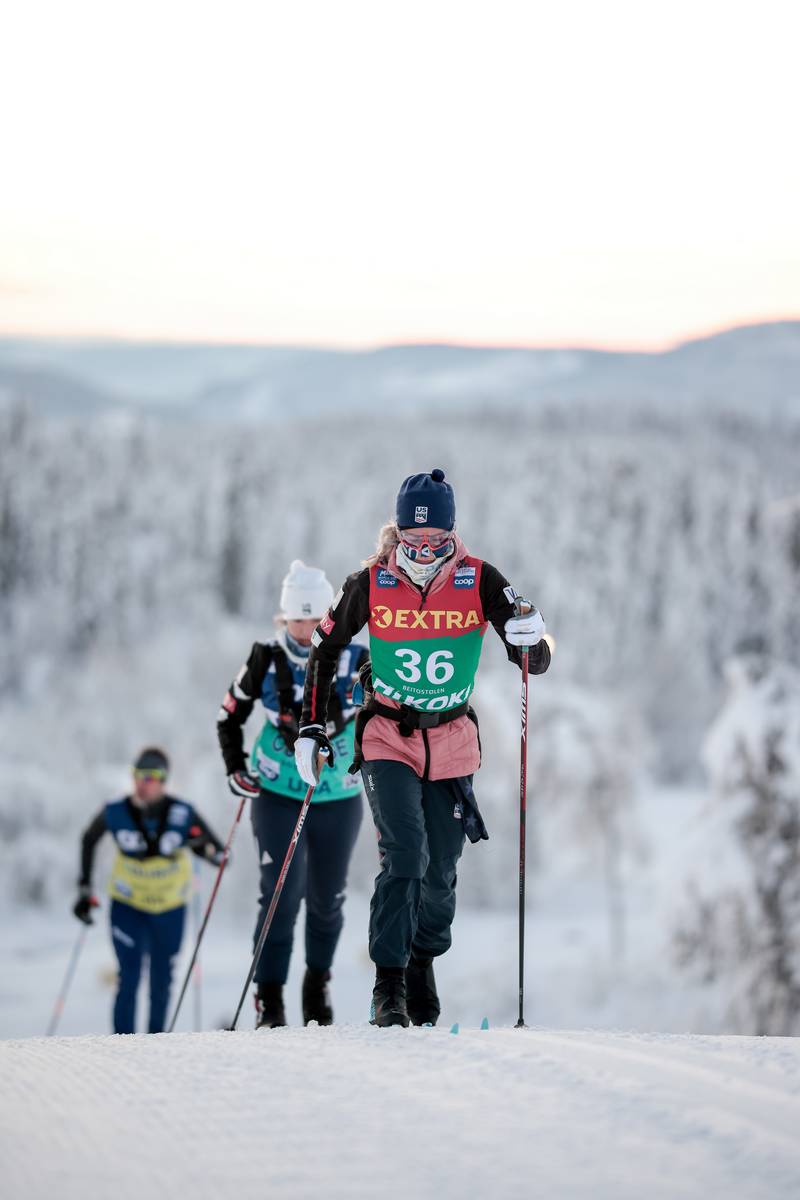
Martell follows Jessie Diggins on course in Beitostolen last December. New FIS rules this year mean two on-course bibs are reserved for female staff members. (Photo: Nordic Focus)
The two week period that coincided with Anni’s Fellowship found the US Team at the end of the intense three-week opening period of the World Cup this year which saw three, consecutive three-race weekends in Ruka, Lillehammer, and Beitostolen. By Beitostolen, fatigue and sickness had found their way into the camp. Some skiers would miss starts; others would look to manage their fatigue within the bigger picture of their goals for the season. Still, the US saw skiers turn in top 10 finishes in both the weekend’s classic sprint, and 10 k classic. Sunday’s Team Relay would pose a unique challenge to the US team, though. For most athletes, a decision had to be made: push through for the pride of the team—a foundational principle that the US has held to in building success over the past decade—or rest and push for results in Davos.
In the end, the US ended up not starting either Jessie Diggins or Rosie Brennan—two parts of the Team Relay that won in Falun in 2021—and scratched one of their two teams for the Beitostolen 4 x 5 k Relay. Head Coach Matt Whitcomb said he “[felt] weird to say I support [the decision to rest] as a coach,” describing it as “emotionally tough.” But it was a decision with a clear forward-looking motive. At Davos, the US team felt there was “a good chance to end Period I on a high note.”
When Davos came, the US started the weekend off strong—2nd place in the skate sprint for Jessie Diggins—and then ended on nothing less than a definitive highlight in program history: Jessie Diggins first and Rosie Brennan third in the 20 k skate. For Anni, it felt like a “culminating moment” for the whole T2G Fellowship experience. “One of the biggest things I’ll take away from [those two weeks] is that our athletes are SO resilient,” she said. “The mental toughness it takes to be resilient when results don’t go your way, and know when to take care of yourself was fully on display in that tough decision to hold off and bounce back. And [Jessie and Rosie] just skied their hearts out [in that Davos race], it was amazing to watch it unfold. ” Through two weeks, a whole odyssey had played out for the US team—trial, tough decisions, will, determination and all—and had resolved into an extraordinary ending. The diamond had been pulled from the rough.
And with that, Anni had helped do for the US Ski Team what she had done for me as a friend. Of what she is taking back to the US, she says that it is a mix of small and big things. On the smaller end, she says that “the wax technician experience is invaluable on the [World Cup]. There’s just no good way to mimic that, and I’m leaving with techniques and hacks that I’ll use in the wax solving problem going forward.” On the grander scale, though, there is the experience that speaks to who Anni is as a person, and the community that has fed into accentuating her proudest qualities. “There’s such a rising tide lifting up women in US skiing and ski coaching,” she said. “And I think the continuation of that is so important on the World Cup and elsewhere in US Skiing. I think I’m more conscious of the messages I send when offering trust and placing values on other others’ experiences.”
The weekend after the eastern Carnival season had ended in March 2020, Anni Martell and I took a trip. We were both seniors, and both headed to NENSA’s U16 Festival in Chittenden, Vermont to coach, before meeting up with a bunch of Colby teammates to race the Bretton Woods Marathon in New Hampshire. Coaching, racing, all in one go: we had entered that liminal space of post-ski racing life, but we were still skiing, for sure. The world was also in a liminal space, whether it knew it or not. A week later, the COVID pandemic would begin in earnest, Colby College would shut its doors, and we’d retreat back to where we came from—leeward towards our childhood bedrooms in the Midwest.
New England had just let up from its latest Nor’Easter, the freeze-thaw cycle had just begun in earnest, and through the backroads from Maine to Vermont there was nothing but spring, sunshine, and brightness ahead. As we traveled we talked and talked: about the friends we’d made through skiing and now loved outright, about what after four years of racing in New England had stuck with us. We speculated on where our friends would be going after graduation, and where we’d end up. It was a peaceful coda to a chapter in both our lives that was about to end in a big rush and panic.
There was a kind of finalized idealism that permeated the whole thing—the sureness you have right at the end of your youth about the world, before you learn that it’s way bigger than you ever imagined. We couldn’t help but look forward, sure only that we wanted to find a place to give every aspect of what we had to the world. Two years on from that moment, we met up at Theodore Wirth Park in Minneapolis, and I heard tales from a friend who spoke about how the last two weeks coaching on the World Cup had taught her that “[coaching] is about trying new things, being curious, investigative, analytical, but also rational and methodical, it’s everything—ALL aspects.” It seemed we had found that place we were looking for: skiing, and all that our journey in the sport—and in the community it creates—amplifies about ourselves, and our friends.
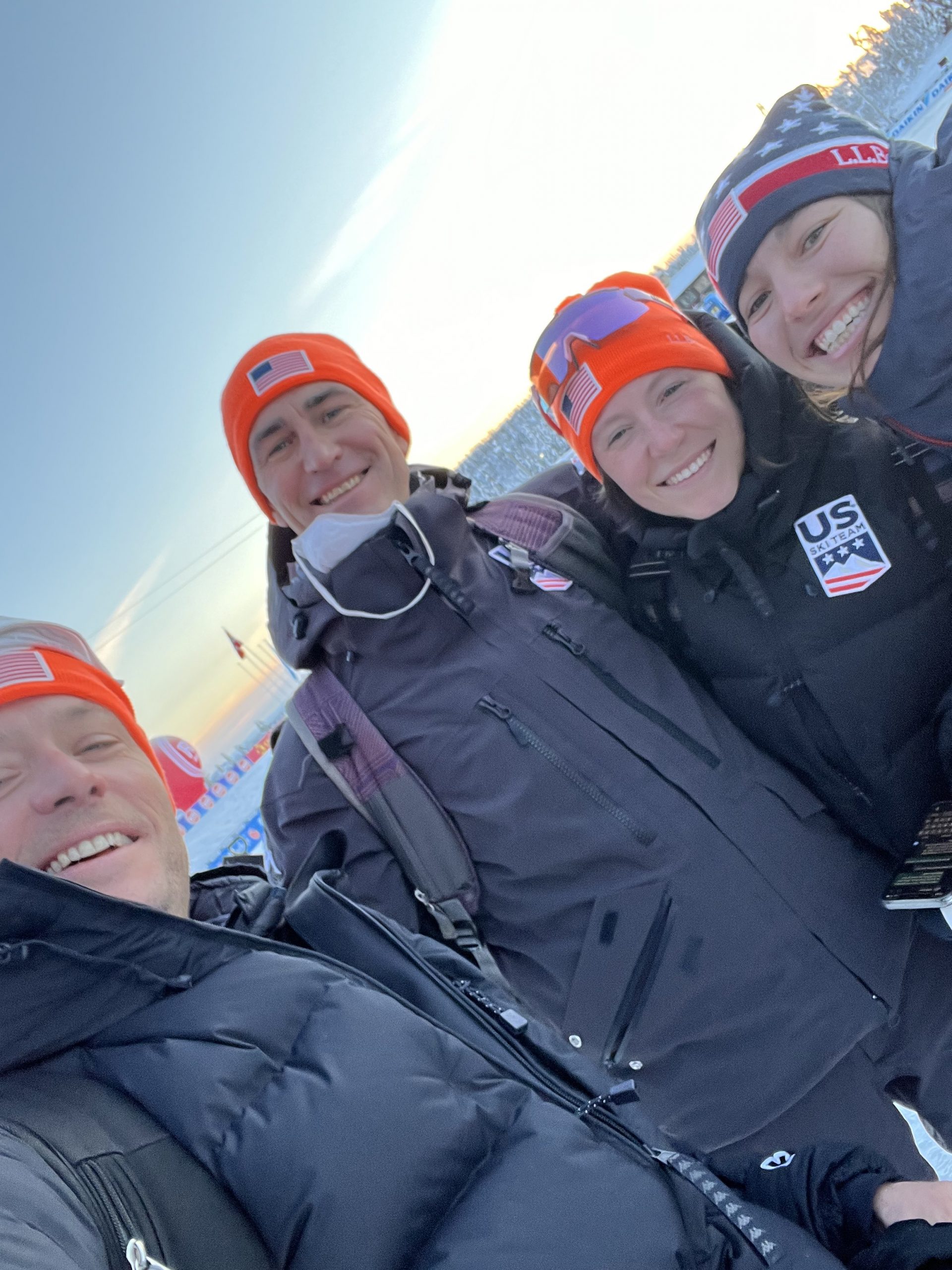
Annika Martell (R) alongside US Ski Team coaching staff in Beitostolen, Norway, last December. Martell was part of NNF’s inaugural Trail to Gold Fellowship class. (Photo: Courtesy Image/Matt Whitcomb)
Originally launched in 2012, the NNF Cup celebrates club excellence in America’s premier domestic ski competition by tallying performance of club teams across the SuperTour season. The NNF Cup was awarded to Alaska Pacific University last season.
The recent success of the US on the World Cup and at the Olympic level has been fueled by a renewed commitment by US ski clubs to provide a club structure that supports athletes from their time as Juniors through to post-college senior professional racing. With the NNF CUP, the National Nordic Foundation wants to celebrate the spirit and creativity at play in providing US skiers with structured programs for their continued development, and nod to the competitive nature of these programs by adding a club-wide aspect to their performance-oriented goals.
NNF Board Chairman Yuriy Gustev says that, “Not only do the clubs create a positive learning and skill development environment for the youth, but they also provide essential support to develop athletes and surround themselves with high-level coaches and race service staff. The NNF Cup is a way we can recognize the efforts of our clubs, and our Board of Directors is happy to sponsor it again this season.”
NNF Cup standings will be updated weekly on our website. The full SuperTour schedule can be found here. Individual SuperTour standings can be found here.
You can read full recaps of each race from FasterSkier: including the Classic Sprint, Skate Mass Start 10 k, and Skate Sprint. The SuperTour heads to Sun Valley, Idaho this Saturday, and Sunday to continue its round around the West during Period 1.
Score top 3 club skiers who finish in the top 10 using Continental Cup scoring in each event.
Scoring for making camps
15 points for athletes qualifying for U16 Camp. No limit per club.
30 points per athlete qualifying for camps. No limit per club.
There will be three team standings: Male, Female and Overall
Overall winner will win the NNF Cup and be awarded a traveling trophy.
NNF Cup Standings After Sovereign Lakes, British Columbia Races
The first round of races in British Columbia this past week saw a strong start for a number of college teams, while defending NNF Cup champions APU also got off to a strong start – narrowly missing the top 3 in the week’s overall standings.
Overall
1st. University of Utah – 323 points.
2nd. University of Colorado – 285 points.
3rd. Bridger Ski Foundation Pro Team – 260 points.
The National Nordic Foundation (NNF) would like to extend a sincere thank you for the astounding display of generosity and belief in supporting a world-class skiing development system during last week’s Drive for 25. We are humbled, and incredibly grateful, to be part of a grassroots movement propelling our sport forward in this country. This year’s Drive for 25 further demonstrated that our American ski community is a rare one where all of its members are working for good of this sport that we all love, and not for ourselves.
Between mail, online, and general donations, the US nordic community raised $110,609 from 1211 during last week’s Drive for 25. Crossing the threshold of raising $100,000, and the threshold of 1,000 donations, unlocked a pair of matching grants worth $100,000 apiece, or $200,000 total. With those goals achieved, the total raised from our Drive for 25 totaled $310,609, making it the largest Drive for 25 in our organization’s 20+ year history.
To have our biggest fundraiser ever in a non-Olympic year is impressive. To do it in a single week is a dizzying accomplishment. That is what the US nordic community stepped up to do last week; demonstrating an ongoing commitment to building a nordic skiing program that can compete with any in the world. With this funding, the National Nordic Foundation has a strong base from which to bolster its financial health, support our pillar projects this season, and fund innovative and forward-thinking approaches to sport development for some of the most promising skiers in the world. We want to thank everyone who donated, our ambassadors who fundraised, and the entire ski community from coast-to-coast for making this year’s Drive for 25 a special moment in our sport that will have a lasting legacy stretching out from here into the future.
Sincerely,
The National Nordic Foundation
Yuriy Gusev (Board Chairman), Matt Whitcomb, Joey Caterinichio, Sophie Caldwell Hamilton, Laura McCabe, Kikkan Randall, Erika Flowers, Reese Brown, Ben Theyerl
The National Nordic Foundation (NNF) today is announcing a new virtual speaker series, and invites skiers, coaches, and supporters from across the country to attend its first offering with renowned American physiologist Dr. Stephen Seiler on Friday, November 11th at 1:00pm EST.
This inaugural lecture will be free to attend, with a recommended $25 donation going directly to NNF to support our Pillar Projects this winter, and beyond. Donation and registration for Dr. Seiler’s talk on November 11th at 1:00pm EST can be found here and here. Limited to the first three-hundred participants.
The NNF virtual lecture series serves a dual-purpose in benefitting the American ski community; offering an exceptional sport education opportunity while helping power the grassroots movement to bring the latest ideas in training and developmental philosophy to US skiing’s program. By doing so virtually, NNF has committed to making the latest knowledge in nordic skiing accessible to all those parties interested in pushing our sport, and community, forward.
Dr. Stephen Seiler. (Photo: Courtesy Image).
Friday, November 11th with Dr. Stephen Seiler – Dr. Stephen Seiler is a renowned American physiologist who currently serves as Professor in Sport Science at the University of Agder in Kristiansand, Norway. He is a leader in the field of endurance training processes, and a lecturer who has been featured around the world. A compelling storyteller, Dr. Seiler uses his scientific expertise alongside an understanding of both American and European sport cultures to impart endurance training principles within their cultural context. His work on polarized training has helped develop the “5 training zone” (L1, L2, L3, L4, L5) and “80-20” aerobic-intensity rules that are common nomenclature in ski training in United States skiing today. With his background in American sport and intricate knowledge of endurance, Dr. Seiler presents on the latest thinking in an ever-evolving field crucial to success for skiers and coaches at all levels.
The National Nordic Foundation (NNF), Women Ski Coaches Association (WSCA), and Olympic Women’s Cross-Country Book Project are excited to announce the selection of the inaugural Trail to Gold Fellows. The selection committee determined that the following Fellows represent extraordinary coaching talent, and will have the opportunity to gain international experience and credentials while working with the US Ski Team coaching staff over the course of the upcoming 2022-23 World Cup season:
Trail to Gold Fellows:
Naomi Kiekintveld (Alaska Pacific University Nordic Center), Ruka and Lillehammer.
Annika Martell (Williams College), Beitøstolen and Davos.
Liz Stephen (Park City Ski and Snowboard Club), Tour de Ski.
Caitlin Gregg (Team Birkie), Milano and Les Rousses.
Lizzie Larkins (Montana State University), Tallinn and Lahti.
Each Trail to Gold Fellow will receive a grant to complete a two-week immersive internship with the US Ski Team this World Cup season. This hands-on professional development program is designed to introduce them to all aspects of World Cup coaching, including waxing, logistics, and race preparation with US Ski Team athletes. Funding is provided by the Oly. Women’s XC Book Project, who invested $10,000 of proceeds from the sale of Trail to Gold towards the inaugural Fellowship, and through the National Nordic Foundation.
The Trail to Gold Fellowship is designed to help address a historical gender inequity in US coaching. Fellows were selected from an exceptional applicant pool that represented the diversity and extensive talent of American women coaches at all levels of the US skiing development system. The depth and talent present in the applications points towards a bright future for US skiing, and an ongoing need to invest in exceptional coaching development programs.
The NNF Online Summer Auction is open until July 15th at 10:00pm EST.
With 24 hours to go, supporters of US Nordic skiing still have the chance to help build the foundation for next winter’s successes while taking a unique piece of US skiing home by participating here: https://www.32auctions.com/NNF2022
A sampling of some of the items up for sale in the NNF auction
The NNF Summer Auction is a crucial component in setting up all of US Nordic Skiing for a successful winter. By participating, supporters make individual dreams possible, help create an equitable environment for competitive skiing on the highest level in the United States, and make long-term development initiatives for the sport possible on a national scale.
Auction items still available:
Meet and Greets with US Olympians: The perfect way to support the US Ski Team while motivating the next generation of skiers and dreamers. Win a virtual meet and greet for your local ski club or youth team with Olympians including Kevin Bolger and Gus Schumacher, and kick the season off with stories of lofty goals being set and achieved.
US Ski Team Apparel: Suits, hats, jackets, mittens and more. With apparel to fit any size and budget, you can wear your pride for US Skiing the same way the pros do!
Original Artwork: Done by skiers about the sport we all love. Including prints by renowned ski photographer Steve Fuller, the great painter Sean McCabe, and even US Ski Team member Ben Ogden. Pieces that will fit any Nordic-centered home, office, or chalet.
This week, the National Nordic Foundation (NNF) kicks off its annual fundraiser, the Drive for 25. For those unfamiliar with the NNF, this grassroots organization provides financial support for developing athletes to enable them to attend training camps and competition trips that would otherwise be unfunded or only partially funded. This support begins at the junior level and continues even into senior World Championship level competition if an athlete is not fully supported by U.S. Ski & Snowboard.
The “pillar projects” funded by the NNF are opportunities that have been identified as key developmental steps towards success at the World Cup and Olympic level. (Photo: nationalnordicfoundation.org)
By reducing costs for athletes and families, the NNF keeps within reach the key developmental pathways that enable athletes to work toward high level goals like racing on the World Cup, or at World Championships or Olympic Games. Decreasing the financial burden retains developing athletes with the potential for international success, thereby elevating American skiing. According to the NNF, all athletes on the National Team have at one time been supported by these grants.
As the website states: “Every year the NNF funds:
National Training Group Program (NTG), National Elite Training Group Program (NEG) and U16 National Camp prepare our most talented athletes for international success
US World Junior and U23 teams, helping athletes across the nation ascend to the highest levels of world Nordic events
Athletes getting their first tastes of European competitions at the under-18 Nordic Nation’s Championships & OPA Cup competitions
“The NNF is an integral part of our Nation’s building blocks for competitive success. Furthermore, the NNF, through its annual fundraising efforts, the Drive for 25 and the NNF Auction, catalyzes the US skiing community to come together.”
The U.S. men’s team tasting their silver medals after placing second in the 4 x 5 k relay at 2018 Junior World Championships in Goms, Switzerland. (Photo: Julia Kern)
As was felt by other non-profit organizations, the pandemic tightened personal and corporate budgets, decreasing the donations to the NNF in 2020. On the rebound heading into an Olympic season, the NNF is setting a big goal for the 2021 drive: to “Double the Drive for 25.”
The NNF writes:
“We’ve been challenged by several generous donors who will gift an incredible $100,000 to NNF if we surpass 1,000 individual donations of $25 or more. We know this is an ambitious goal; last year we had just under 500 donations. However, we know that with your help, we can double our drive, and can continue to fund the National Nordic Foundation’s development projects. Additionally, if we reach $100,000 by the end of the day Friday, we will unlock an additional $100,000 donation from our amazing supporters!”
Here’s where you come in: Help the NNF reach their fundraising goals and support the rising generations of skiers by making a donation today.
U.S. Ski Team Head Coach Matt Whitcomb is an active member of the NNF board of directors. He shared the following message encouraging members of the cross country ski community to participate in the campaign.
“This drive captures what I love most about our sport: It’s about motivation, and rallying together for one thing. I love the process of getting people to work together, and watching what happens when they do. We’re fortunate to have two different $100,000 challenge matches this year, but the NNF board has deliberately set the standards high. If we are half-hearted with our efforts this week, we will fail at both goals. It won’t happen if too many of us sit back and watch. So, the first thing I’m doing when I wake up in the morning is sharing my page, and donating $25 to someone else’s page. I believe we’ll be successful, and I base that belief on my expectation that a lot of people will stand up for these athletes this week. Here we go!”
The fundraiser remains open from November 22nd through the 26th. The NNF is already over a quarter of the way toward its goal, with help from donations from athletes like Jessie Diggins, who wrote “For my future relay teammates.”
During the campaign, you can also view a series of live features happening on The NNF Facebook Page at 1pm EST with athletes like Kikkan Randall, Billy Demong, Sophie and Simi Hamilton, and Caitlin and Brian Gregg.
Head to NationalNordicFoundation.org to show your support for American skiing today.
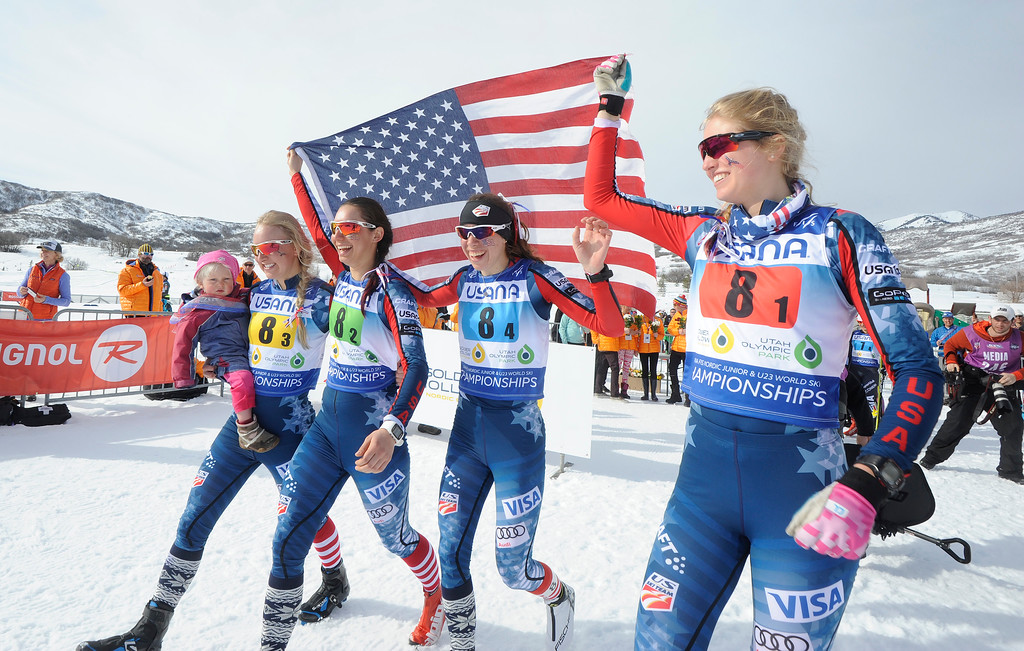
The U.S. women’s relay after taking a historic third in the 4 x 3.3 k relay at 2017 Junior World Championships on Sunday at Soldier Hollow in Midway Utah, with (from left to right) Hannah Halvorsen (holding her baby sister), Julia Kern, Katharine Ogden, and Hailey Swirbul. (Photo: U.S. Ski Team/Tom Kelly)
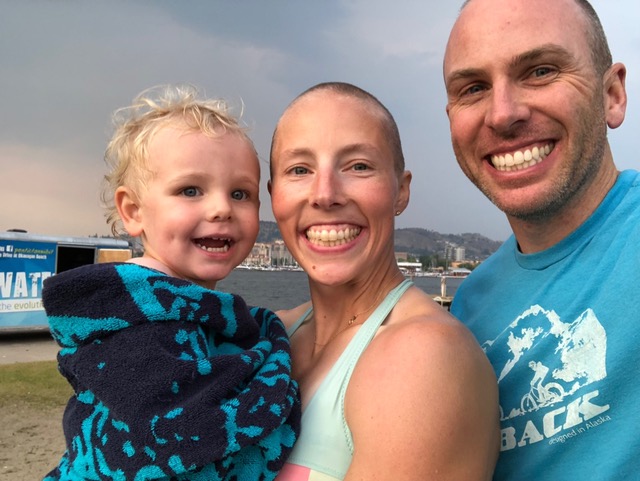
Kikkan Randall (c) with her son, Breck, and husband, Jeff Ellis, in Penticton, British Columbia. (Courtesy photo)
Day by day. That’s how Kikkan Randall is approaching her battle with breast cancer after being diagnosed about three months ago. Now more than 50 days into her treatment — with six rounds of chemotherapy over an 18-week span — Randall, 35, is becoming more familiar with the ugly side effects and adjusting to her new normal.
While beating what is believed to be Stage 2 cancer remains the Olympic gold medalist’s biggest challenge yet, it’s not dampening her spirits — even on the extremely rough days, of which there have been many.
After Round 2 of chemo, Randall returned to her family in their new home of Penticton, British Columbia, where she quickly came down with a nasty cold. That cold required a visit to a local clinic and antibiotics, and Randall now wears a mask on airplanes to fend off germs while flying to and from her cancer treatments in Anchorage, Alaska.
“Getting the head cold on top of going through the worst days of the chemo cycle has definitely been one of the most uncomfortable weeks of my life,” Randall explained in an email to FasterSkier. “It’s mostly because I have no control and I have no idea how well my immune system can clear the cold. Normally I would be optimistic that it would just be a tough couple of days but now I just have to wait and wait.”
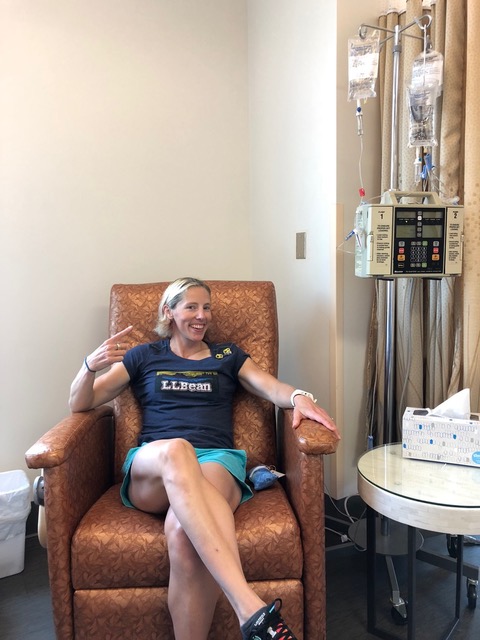
Kikkan Randall during her first chemotherapy infusion at the Providence Alaska Medical Center on July 9 in Anchorage. (Courtesy photo)
She eventually kicked the cold and got her voice back, just in time for Round 3 of chemo on Aug. 22. After what she called a “quick 36-hour trip to Anchorage,” she was back in Penticton on Aug. 23. So far, Randall explained on her daily video blogs that her current three-week round is going better than the previous two.
“Just getting used to my haircut … got a nice little fuzz growing on top,” she said in her Day 51 video posted last Wednesday, just over a month after she shaved her head for the first time.
“Definitely giving me a greater appreciation for all the guys out there and gals that deal with this,” she continued with a smile. “But I have to say it is pretty low maintenance so I guess I should just embrace it.”
Two weeks after receiving her first chemo infusion in July, Randall noticed she was losing her hair in clumps. She promptly went wig shopping with friends and scheduled an appointment with her hairdresser in Anchorage to get ahead of the hair loss.
Randall spoke with FasterSkier on the phone from Anchorage on July 26, the day after she initially asked her hairdresser to shave it all off.
“I sat in the chair and she said, ‘Are you ready?’ and I said, ‘Let’s do it,’ ” Randall recalled. “Three minutes later, I had a buzz cut, and I think I actually handled it better than I thought I would. It was kind of interesting to watch it, to feel it, and to be like, OK, now we’ve got that taken care of. Now we can move onto the next step.”
The next step and every passing day has proved to be an unknown. Oncologists never know exactly how a patient will react to treatment, as “everybody seems to react differently,” Randall explained.
“But in a lot of cases what you experience the first round is what you will generally feel like over the next subsequent rounds,” she continued. “Some of it will be a little bit cumulative, like the fatigue I’m sure will add up a little bit, but I also really think that staying active through this as much as I can will really help. I’ve noticed already that even on days where I don’t feel very good, if I get out and do something, it at least keeps my mind off of how bad I feel and I think it helps me process everything better, both physically and mentally.”
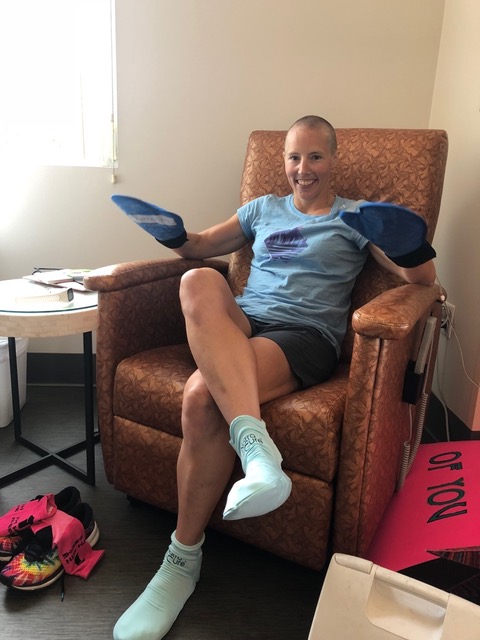
Kikkan Randall wearing ice mittens and socks to prevent neuropathy during a chemo infusion at the Providence Alaska Medical Center in Anchorage. (Courtesy photo)
As she approaches the halfway point of her chemo treatment — the first proactive step to eradicate the cancer (which was initially found in her breast and one lymph node), Randall has continued to make an effort to get outside and moving every day. Some days, that’s as much as a run with former training buddies or even intervals, and other days, it’s about playing with her 2-year-old son, Breck.
Ever since announcing her diagnosis on social media, Randall has been promoting AKTIV Against Cancer, a Norwegian nonprofit that she became involved with six or seven years ago without having any direct ties to cancer. According to Randall, the organization funds research on how physical activity can affect cancer treatment and creates supportive environments for patients to work out together, both in and out of the hospital.
“It falls along with what I believe is that physical activity is pretty much good for everything, so I was happy to support them as an athlete, but now that I actually have cancer myself, I have a little deeper connection,” she said. “I’ve committed personally to staying as active as I can through this, but I think in partnering with them, we can share the message on a bigger platform, and I’m looking forward to learning more about the research that they’ve done and also to continue to fundraise and promote awareness for getting other hospitals to have these places and rooms and programs that encourage cancer patients to be active.”
“I’ve committed personally to staying as active as I can through this…” — Kikkan Randall, on her cancer diagnosis
Randall continues to ride her bike to and from the Providence Alaska Medical Center in Anchorage. During a recent layover, she worked out in a Vancouver gym. And early in the treatment, she asked if she could use a stationary bike or treadmill during the several-hour-long infusions. While her oncologist and nurses ultimately encouraged her not to (“the nurses felt it would be hard to keep an eye on me for any reactions I might have to the medication”), the bottom line is: Randall is still plugging away at a rate that would put most people to shame.
After her last round of chemo in mid November, she’s hoping tests will reveal that her tumor has shrunk or disappeared altogether. That would make surgery “more straightforward”, she explained, yet she’ll still have to decide which type of surgery to undergo. Her options range from a lumpectomy (removal of the tumor and some surrounding tissue) to a unilateral or bilateral mastectomy (removal of one or both breasts).
“If you do the double [mastectomy], the idea is you’re taking out the most breast tissue as possible, which is where a second breast cancer would most likely come back so it gives you a slightly better piece of mind,” Randall explained. “You don’t have to be screened quite as much after the fact because there isn’t breast tissue for it to come back to, and then from there, you can decide whether you go the double route and wear prosthetics or whether you go a reconstruction route … so there’s a lot to consider between now and then between what I want to do for maintaining the lifestyle and all the activities I want to do.”
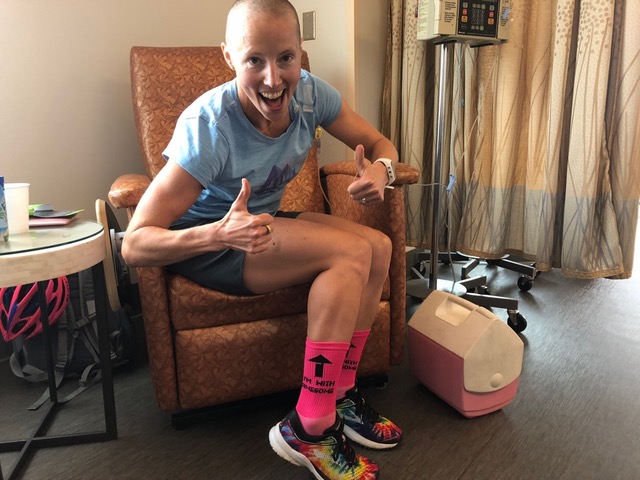
Kikkan Randall staying positive with pink socks and rainbow shoes during her second round of chemotherapy on July 31 at the Providence Alaska Medical Center in Anchorage. (Courtesy photo)
Through all of this, she’s learned that her tumor responds to estrogen, progesterone and HER2 (human epidermal growth factor receptor 2)/neu protein, and is initially being treated with two chemo drugs to specifically target the HER2/neu. That should help stop the growth of the tumor, and after chemo, Randall will start taking anti-estrogen and anti-progesterone meds.
Leading up to all of this, she and her husband had been hoping to expand their family.
“We were just starting to try for kid number two and definitely excited to have more kids so finding out about this thing, the diagnosis, and then knowing I needed to start chemo pretty soon, we didn’t have much of a window to work with,” she explained of her diagnosis in early June.
Later that month, before starting chemo in July, she sought fertility treatment in Seattle. There, Randall received a round of injections to stimulate egg production in her ovaries. That produced one embryo, which is being preserved in case the cancer treatment makes pregnancy difficult later on.
“There’s no guarantee that the chemo will knock out my natural fertility, but it’s nice to know that there’s at least a small chance for the future,” Randall said. “It’s going to be challenging because the type of breast cancer that I have, I will have to be on some anti-estrogen and anti-hormone treatment for probably five to ten years even after the chemo and everything is done, so that’s going to be a little bit tricky to figure out a pregnancy in there, but at least we kind of have a backup plan.”
While Randall repeats her multiple-leg commute between Penticton and Anchorage (a 1- to 1.5-hour drive from Penticton to Kelowna, B.C., followed by a two-stop, roughly 4.5-hour flight to Anchorage) every three weeks, she’s also staying involved in several work engagements, including with Fast and Female and as a new board member of the National Nordic Foundation.
“Everyone’s been so supportive, like the IOC, the USOC [U.S. Olympic Committee], they’ve been telling me to take as much time to make my health the number-one concern, and the same with Fast and Female, we wanted to get some stuff going this summer and fall and we’ve just had to postpone it a little bit,” she said in July. “The door’s open if I have the energy to work on some of that stuff, but if I can’t, I have the time to just focus on recovery. … And then the period after surgery is kind of up in the air in terms of what I’ll be able to do. I’m just trying to be creative; I’m hoping to be able to do stuff, maybe not as much in person but maybe I can contribute to things, whether it’s writing or interviews or projects. I’m just going to ride it out and see where it goes.”
Back in Penticton, her husband, Jeff Ellis, has been “doing the single dad thing”, as Randall put it, while she’s away for treatment. As she retired from racing this spring, Ellis transitioned from his marketing job with the International Ski Federation to sales and marketing with Swagman bike racks. He initially took some time off from Swagman when Randall was first diagnosed before deciding to leave his job and be home full time.
“Ultimately when Jeff said, ‘Hey, this has put things into perspective for us. I need to be home to help Kikkan out,’ they were definitely very understanding of that,” Randall said of Swagman.
Ellis recently started his own business as an independent marketing contractor, called the Jeffrey MW Ellis Group.
“He’s actually helping me with the ‘Kikkan Brand’ while I’m going through treatment and he’s picked up a few more small clients as well,” Randall explained.
Asked why she went public with the diagnosis in early July and what’s driven her daily video updates every day since, Randall said she never could have kept it private.
“I’m not very good at faking things, so I knew once I showed up in Anchorage when I wasn’t supposed to be here, people would start to ask questions and wonder what was going on and I was going to have to start bowing out of things,” she said. “I also felt like, especially Anchorage, especially Alaska, but really just so many people have supported me through my career and they really care what’s going on. So I kind of felt like they’d want to know what was going on with me. It’s always good to celebrate the good things, but I think it’s also important to share the really human moments, and I thought it was really good to show that you could be an Olympic gold medalist and four months later find out you have breast cancer.
“I think it’s important for a lot of people out there that are battling through this, it makes them feel like, this happens to all of us,” she continued. “I learned 10 years ago when I shared my story about blood clots that it helped people. … I kind of felt like, if me going through this can have a positive impact by sharing my story, then I’m happy to do so. I don’t feel like there’s anything I need to hide; I’m willing to share this.”
“It’s always good to celebrate the good things, but I think it’s also important to share the really human moments. … You could be an Olympic gold medalist and four months later find out you have breast cancer.”
One of Randall’s sponsors started a GoFundMe online fundraiser to help with some of her out-of-pocket medical and travel costs, and in a little over a month, it had generated more than $37,000 dollars toward a $45,000 goal. According to the site, any funds that exceed the associated expenses of Randall and her family will be donated to AKTIV Against Cancer.
“It’s been amazing,” Randall said of the community support in light of her diagnosis. “I got to come back after winning the gold medal, and of course I feel like our profile was higher than it had ever been — people were so excited and wishing me congratulations everywhere I went, but this has blown that out of the water. So many people have reached out, whether it’s over social media or messages through my website or cards arriving in the mail, people stopping me in the grocery store, they’re sharing their stories. Breast cancer’s way bigger of a deal than I ever appreciated.
“My traditional income as a ski racer was coming to an end anyway and I was going to be relying on being able to travel and do speaking engagements and things like that for some projects over the next year, and I won’t be able to do that now,” she said of the fundraiser. “It’s hard to put into words, but I just feel so supported. I’ve been reading through all those messages on the tough days and then trying to reach out to as many people as I can to say thanks.
“It’s unfortunate that it takes a situation like this to be able to appreciate the amount of people that do support me in that way,” Randall added. “But like I said, I’m blown away, I’m so grateful for it and it’s definitely going to help me through this.”
August 14, 2018 —The National Nordic Foundation, known as NNF, is pleased to announce the addition of Kikkan Randall to the Board of Directors. Kikkan, a 2018 U.S. Nordic Skiing Olympic gold medalist, joins Billy Demong, U.S. Nordic Combined Olympic gold medalist, and the NNF Board to lead the development of the next generation of U.S. nordic athletes and future gold medalists.
“I can’t think of a better person to add to our Board,” said NNF President, Joey Caterinichio. “Kikkan is the epitome of community success in our nation. Kikkan developed from her community to the top of the world with support from the NNF along the way and gives back so much.”
“I am thrilled to be joining the NNF Board,” said Kikkan Randall, “NNF’s support early in my career was crucial for getting access to international experience. Now I look forward to sharing my experience with the NNF Board to support our upcoming nordic champions!”
About the NNF
The mission of the National Nordic Foundation is to support athletic excellence in developing nordic skiing at all levels in the United States. The NNF has funded over one million dollars to U.S. nordic skiing development initiatives through our Pillar Projects. More details on our programs can be found on our website: www.nnf.ski. Through the outstanding fundraising efforts of individual donors, clubs and among skiing communities, the NNF bridges financial barriers to increases access and development that otherwise wouldn’t exist for our top U.S. athletes. NNF funding directly supports athletes and training programs across the entire nation, clubs and divisions. Board Members include: Joey Caterinichio, Craig Ward, Billy Demong, Jenny Barba, Reid Lutter, Gunther Kern, Yuriy Guzev and Kikkan Randall.
Travel to the 2019 Nordic World Championships in Seefeld, Austria,
with Lumi Experiences to Benefit the NNF
The NNF and Lumi Experiences are building on their partnership to offer two trips to the 2019 Nordic Ski World Championships in Seefeld, Austria.
On each of these 8-day trips, guests will be able to cheer on their favorite athletes at the World Championships, ski in- and around Seefeld, and relax in the four-star, trail side Hotel St. Peter. Proceeds from the trip go to funding NNF programming.
World Championships Trip 1 is scheduled for February 18 – 25, 2019.
World Championships Trip 2 is scheduled for February 25 – March 4, 2019.
Each trip is limited to 18 guests. Save $300 on the trip price, if reserved before March 31, 2018. For more information and to sign up, go to: www.lumiexperiences.com.
You can check out more photos and insights from this year’s adventures on Facebook and Instagram: @lumiexperiences or #lumiexp
“The trip had an exceptionally talented group of trip leaders. It was well planned and full of fun surprises that enhanced the experience. Skiing right from our hotel was awesome. I love the Dolomites and the Tyrol. Austrian curling was a blast. First class care and attention to detail made this a trip of a lifetime for us.” – Jane & Michael Mandli
“We skied in a gorgeous part of the world. Guides were excellent and fun. It was an incredible experience watching the World Cup racing in Seefeld and meeting the athletes.” – Molly Martinez
The founder of Lumi Experiences, Garrott Kuzzy, is an Olympian and past US Ski Team athlete. He has over five years of experience developing skiing, biking, and hiking tours throughout Europe. He currently lives in Innsbruck, Austria and has developed this trip in his new backyard. As a former US Ski Team athlete, Kuzzy is partnering with the NNF to benefit developing US athletes.
The National Nordic Foundation is a non-profit organization that’s mission is to help aid in the development of skiers in the USA both national and internationally, by creating an independent funding source to aid athletes with the high cost of the sport.
The NNF’s goal is to remove financial barriers that hinder our US athletes, due to the lack of funding available. World Cup athletes, World Junior/U23 Teams, U18 Teams, REG Camps, Junior National Teams, Coaches, Clubs and Officials receive funding annually from the NNF. Campaigns such as the Drive for 25, online Auctions and general donations pay for these efforts.
Recently a new partnership has emerged. More stars behind our stars supporting our athletes, helping achieve top results such as with our World Cup Teams, our recent World Junior star Hailey Swirbul and many many athletes. To brighten things up, the NNF has Partnered with Olympian, Garrott Kuzzy owner of Lumi Experiences. Kuzzy and his guests are giving back to the sport by donating a portion of each trip to the NNF. These trips include front line experiences in Europe, cross country skiing, sight seeing, attending races and interacting first hand with the US Ski Team and World Cup Athletes. Read about the most recent trip in Seefeld, Austria and learn about the upcoming trip, attending the World Championships! You don’t want to miss out!
— Joey Caterinichio/NNF
(Press release)
SEEFELD, Austria — The 2018 Lumi Experiences Trip to Tyrol, benefitting the National Nordic Foundation (NNF), wrapped up 10 days in Tyrol, Austria & Italy cheering on the US Ski Team to a double-victory weekend in Seefeld.
In March 2017, the NNF announced a cross country ski trip to the 2018 Dolomitenlauf Worldloppet and the Seefeld World Cup races. By April, all 16 spots on the trip had been filled.
Proceeds of the trip, hosted by Lumi Experiences, totalled over $10,000 and will go to support NNF programming. Lumi Experiences was founded by Garrott Kuzzy. After traveling the world as a member of the US Ski Team and competing in the Vancouver Olympic Games, Garrott has spent the past decade sharing his favorite destinations and experiences through active travel.
The guests on the Trip to Tyrol were supported by two local trip leaders, offering insights into Austrian and Italian culture.
The Dolomitenlauf weekend kicked off with guests taking part in either 42km or 20km events. Some opted instead to watch the Hahnenkamm downhill on Eurosport in a mountain-top bar surrounded by screaming Austrian ski fans. Those who skied the Dolomitenlauf had the luxury of getting their skis waxed for them with HF and powder. A couple of women on the trip skied to age-group podium finishes…a precursor to what they would witness on the World Cup later in the week.
Stop two was Toblach, Italy. Crossing the border beneath Dolomite spires, the group was treated to sunny skies as they perfected their hop-skate technique over the iconic Toblach Nordic Arena. It was hard leaving the Italian cuisine in South Tyrol, but the Seefeld World Cup was calling.
Guests were treated to a brief stop in Kuzzy’s new hometown, Innsbruck, before taking a train to the snow-globe village of Seefeld for the final five nights of the trip. Guests had barely departed the train when they ran into Sophie Caldwell and Matt Whitcomb, out for an evening jog.
The Hotel St Peter, located at the trailhead, offered easy access to the 3+ feet of new snow Seefeld had received in the previous week. Highlights of the first days in Seefeld included a trip to the trailside hut that Andy Newell affectionately refers to as the “Wild Moose.” A trough of schnapps and tray of apple strudel greets visitors.
Guests were also treated to a tour of the new US Ski Team wax truck. US Women’s Team head coach Matt Whitcomb and wax techs shared insights into the new, rolling facility, as well as a few insider wax tips. One unexpected surprise, was the opportunity to forerun the races. Skiers experienced the challenging courses that cannot be captured by simply watching the races from the sidelines. Erik Bjornson chatted with the skiers after his sprint qualifier and thanked them for cheering, saying it’s rare that there are so many US fans on the trail at European World Cups.
The real highlight of the trip was cheering on skiers in the Seefeld World Cup, as Sophie Caldwell skied to victory in the Skate Sprint and Jessie Diggins took the 10km Mass Start Skate win. Guests had the opportunity to share high fives and get photos with skiers afterward the race.
Seeing the US team skiers atop the podium was particularly meaningful, as it represented the results of the hard-work put in by athletes and their coaches. It also represented what the help from the NNF has helped skiers from the US achieve. There were more than one set of watery eyes at the end of the trip, when guests received copies of the new book: World Class: The Making of the U.S. Women’s Cross-Country Ski Team by Peggy Shinn, personalized and signed by the women on the US Ski Team as a thank you to guests on the trip.
The Seefeld World Cup was the last big race before the Olympic Games next month in Korea. In 2019, Seefeld will host the Nordic World Championships. Once again, Lumi Experiences will be on site for the 2019 World Championships, hosting two more trips to benefit the NNF. You can sign up to receive information about the World Championships and other cross country ski vacations at: www.lumiexperiences.com. Check out more photos and insights from this year’s adventures on Facebook and Instagram: @lumiexperiences or #lumiexp
“The trip had an exceptionally talented group of trip leaders. It was well planned and full of fun surprises that enhanced the experience. Sledding was a hoot, and skiing to our hotel afterwards was awesome. I love the Dolomites and the Tyrol. Austrian curling was a blast. First class care and attention to detail made this a trip of a lifetime for us.” – Jane & Michael Mandli
“We skied in a gorgeous part of the world. Guides were excellent and fun. It was an incredible experience watching the World Cup racing in Seefeld and meeting the athletes.” – Molly Martinez
It’s that time again! Every year the U.S. Nordic Skiing community comes together to support the National Nordic Foundation’s (NNF) largest fundraising efforts of the season. It is time to become a part of the annual NNF Drive for 25. Please join us in the 2017 D-25 campaign beginning October 23rd and help us raise money for skiing development for Cross Country, Nordic Combined and Ski Jumping. The NNF: Supporting Tomorrow’s Nordic Stars Today!
The National Nordic Foundation is the country’s premier grassroots sport fundraising organization. With over $200,000 in the 2016-2017 season alone allocated to “pillar projects”, key events to help capitalize on the talent and drive of developing skiers, the NNF is creating a cultural change in the way skiers approach international competition.
Where do the NNF Funds go? The NNF supports all levels of development. Past funding ranges from World Cup Starts with Podium winners such as Kikkan Randall, Jessie Diggins, Sadie Bjornsen, Taylor and Bryan Fletcher, Caitlin Gregg and Simi Hamilton, and will now aid new budding stars such as Patrick Caldwell, Scott Patterson, Julia Kern, Katherine Ogden, Hannah Halverson, Adam Loomis, Kevin Bickner and so many others.
The NNF has been funding development for years. Every year the NNF funds a large portion of the US World Junior and U23 teams helping athletes across the nation, The NNF also gives money to every US Divisional Junior National Team and gives myriads of grants to Clubs, Coaches and Officials at the community level. The NNF is an integral part of our Nation’s building blocks and success. Furthermore, the NNF, through its annual fundraising efforts, the Drive for 25 and the NNF Auction, catalyzes the skiing community to come together.
Become a part of the National Nordic Foundation. Participate in this year’s “Drive for 25” beginning October 23, 2017 and help us spread the word on skiing, help our grassroots mission and help us get more racers to start line and to the top of the results. The Theme of this year’s campaign is “We Will”. We Will “Drive for 25” and We Will Win!
To donate and become an ambassador for the Drive for 25, please go to
The National Nordic Foundation (NNF) is a non-profit organization that aids in the development of Nordic Skiers, Coaches, Officials, and venues lending financial support to both elite and grass roots programs in order to develop athletes within the Nordic Sports nationwide.
Every year the NNF donates thousands of dollars to the development of Cross Country Skiing, Nordic Combined and Ski Jumping.
Our Mission is to support athletic excellence in developing Nordic Athletes in the United States.
The NNF Executive Director/Director of Operations will have a strong background in non-profit organizations along with strong fundraising and networking skills.
These positions will work directly with the Board of Directors and manage the day-to-day operations of the NNF.
Responsibilities to include but not limited:
Responsibility for and direction of NNF’s pillar projects.
Manage NNF fundraising projects.
Manage the vision and mission of the organization.
Manage the NNF finances and budget.
Marketing, production, and communication.
Increase fundraising campaigns and donor networking.
Direct grassroots fundraising campaigns.
Liaison between USST, USSA, USA Nordic and other partners of the NNF.
Community, national and club outreach.
Develop and maintain NNF website.
Some travel required.
For more information and a full detailed job description regarding the NNF ED please visit: www.nationalnordicfoundation.org. Interested applicants please send resume and letter of interest to NNF board of Directors at nnfsearch@gmail.com.
The National Nordic Foundation (NNF) is excited to announce the election of a new Chairman of the Board, Peter Ashley. Peter succeeds former Executive Director and long-time Board Chair, David Knoop who is moving into an unofficial advisory role with the organization. Over the past eight years, Knoop transformed the nearly-defunct National Cross Country Ski Education Foundation (NCCSEF) into a fundraising powerhouse that has contributed in excess of $1 million to developing nordic athletes since 2010.
“I can look back to eight years ago,” says Knoop, “and there was a real need for an organization to fill in the gaps between what the clubs were capable of and what the U.S.S.A./U.S. Ski Team was doing. We had a few bright spots like Kikkan Randall and Andy Newell, but overall, the ‘Development Pipeline’ was more theory than practice. The NNF arose out of a need to create funding and a sustained budget for development programs.” David, further reflecting on the subsequent eight years: “The NNF is a success story that I’m very grateful to have been a part of and enjoy with so many of you. I know that the NNF will continue to be successful with your support and I wish everyone all the best and hope to see you around enjoying the sport and lifestyle that we love.”
Peter Ashley, who has been on the NNF Board of Directors for the past two years brings a wealth of experience and connections from a lifetime in the skiing community. Among his many accomplishments, the Jackson, Wyo., native, spent nine seasons as a U.S. Ski Team coach before working over 20 years with Fischer Sports as National Sales and Marketing Manager for their Nordic Division.
“This is an exciting time to be involved with the NNF,” says Peter. “The past years’ results are a testament to the hard work of the nordic community over the last 20 years. I look forward to working with all the nordic clubs, coaches, athletes and the entire nordic community to continue and improve on the past years’ success. Soon we’ll announce the NNF funding of summer projects in 2017!”
Executive Director, Hennie Kashiwa’s role remains unchanged. “I am very excited for the NNF to have Peter’s wealth of experience both in skiing and as a leader,” says Kashiwa. “As we transition, however, it is critical to recognize the work that Dave Knoop put into the NNF. Without Dave, the NNF would simply not exist as it does today. Both personally and as a member of the skiing community, I’d like to thank Dave for the monumental impact he’s had on our sport.”
The eighth edition of the NNF/USSA National U16 Camp will be held Sunday July 23, 2017 (arrival day) to Sunday, July 30 2017 (departure day) in Sun Valley, Idaho hosted by the Sun Valley Ski Education Foundation and the Sun Valley Community School. The NU16 camp brings together the top U16 Boys and Girls from across the USA for a week of intensive training and ski sport education as one of the first steps in the USSA National Development Pipeline. The National Nordic Foundation has designated the NU16 camp as one of its Pillar Projects and the NNF has been instrumental in helping the NU16 Camp grow into one of our country’s key athlete development initiatives. The camp rotates in location throughout the country and this year’s camp will be held on the Community School Campus in Sun Valley, Idaho. The Sun Valley area offers ideal training venues in a beautiful natural setting. US Ski Team staff will lead the camp along with a selection of top regional coaches from across the US. Selection for the camp is based on results from this year’s US Junior Championships, held in Lake Placid, NY. In addition to the top twenty boys and top twenty girls selected via JN results, each USSA Division is afforded two discretionary picks of one boy and one girl(must have competed as a U16 last season). The discretionary selections are in addition to however many skiers may have qualified via the JN selection procedure. It is up to each division to select these discretionary picks and forward those selections onto the camp director, Rick Kapala of the Sun Valley Ski Education Foundation rick@svsef.org. Please provide these divisional selections no later than May 1st, 2017 and also be sure to inform the discretionary picks of their selection.
Attendees are required to organize their own flights into either Sun Valley, ID or Boise ID to arrive on Sunday, July 23 in Boise by 3pm or to Sun Valley by 5pm and to depart on the following Sunday, July 30 by 5pm at either airport. For skiers arriving and departing both Boise and Sun Valley, we will provide all airport shuttles. For skiers driving into Sun Valley, we will provide drop off directions. Lodging, meals and all associated camp costs( except airfare) are included in the camp fee of $675.00. Skiers who have been selected through the JN selection procedure (see attached list) may immediately confirm their attendance by emailing Camp Director Rick Kapala at rick@svsef.org. Divisional leaders should make their discretionary selections as soon as possible and inform both Rick Kapala and the selected athletes of their naming. Please assist us by disseminating this announcement and selection list to the selected skiers in your divisions so that they are aware of this opportunity.
Once participants have confirmed their participation by emailing Rick Kapala rick@svsef.org, they will receive a registration packet via email with camp forms, schedule, camp info and payment instructions.
THE FINAL DATE for PARTICIPANT CONFIRMATION IS FRIDAY MAY 19TH, 2017
Thank you to all of the committed athletes, coaches, sponsors, race organizers and parents who are helping elevate our sport of Cross Country Ski Racing across the USA.
2017 National U16 Camp Selections based on Junior National Championships
Lake Placid, NY
(World Cup scoring based on best 2 results, both the sprint qualifier and the final results are scored but a skier may only use either the qual or the final)
Boys Selections
Haydn Halvorsen (Sugar Bowl Ski Team & Academy) FW
John Hagenbuch (Sun Valley SEF) IMD
Will Koch (Stratton Mountain School) NE
George Cvancara (Alaska Nordic Racing) AK
Joshua Valentine (Gunstock Nordic Association GNA) NE
Skylar Patten (Park City NSC) IMD
Lane Myshrall (Park City NSC) IMD
Peter Moore (Endurance United) MW
Eli Hermanson (Alaska Winter Stars) AK
Griffin Wright (Craftsbury Nordic) NE
Cooper Anderson (Auburn Ski Club Associates Inc.) FW
Seefeld in Tirol, Austria, is gearing up to host a 2018 cross-country World Cup and 2019 Nordic World Championships. 2010 Olympian and former U.S. Ski Team member Garrott Kuzzy is a frequent visitor as he’s living in Innsbruck, and contributed the following interview with Seefeld’s tourism director.
Seefeld in Tirol, Austria will host the 2019 Nordic World Championships. The small town in northern Tyrol sits on a plateau nestled in the alps, about two hours by train south of Munich and about 30 minutes north of Innsbruck. Seefeld has a long history of hosting international nordic competitions, including the 1964 and 1976 Innsbruck Olympic Games, as well as the 1985 World Championships and 2012 Youth Olympic Games. Seefeld holds the historic distinction as the venue where American Bill Koch won his Olympic silver medal in the 30-kilometer event.
We got out for a ski with Elias Walser, the managing director of Seefeld Tourism, on some of the 270+ kilometers of trails he oversees to learn more about the region and the upcoming World Championships.
***
Seefeld in Tirol, Austria, will host 2019 Nordic World Championships
Garrott Kuzzy:You have been the head of Austria’s two largest cross-country ski destinations, Ramsau am Dachstein and Seefeld in Tirol. What makes cross country skiing in Austria unique?
Elias Walser: In my opinion, what sets Austria apart from Scandinavia or North America, is that the cross-country ski trails are surrounded by a dramatic mountain landscape and a fairytale natural environment. At the same time, the trails pass through farms, huts and villages where skiers can stop for refreshment. I believe this combination of nature and access to traditional life in the alps makes Austria one of a kind.
GK:Now that the 2017 Lahti World Championships are complete, the eyes of the nordic world are on Seefeld…well, except for a couple of events in Korea next February. How is Seefeld preparing for the 2019 World Championship?
EW: Our trail construction and renovation for the world championship began in August 2016. We do not want to build buildings that no one needs after 2019 and are making our biggest investments in trails and infrastructure, such as lights and snowmaking. We updating our trail network to provide even more fun and enjoyment in the future, for both beginners and elite athletes alike.
GK:Seefeld is hosting the European Continental Cup (OPA Cup) Final in late March. Many of the big events in North America this winter have been impacted by a lack of snow. How are the winters trending in Seefeld? What are you doing to ensure snow for these big events?
EW: We also notice a change in our winters and have taken steps to adapt. We operate an active snow-management system. This means that we are already working in the summer on what can we do to offer the best cross-country ski trail with as little snow as possible. In the winter, we farm snow from higher elevations. We also have extensive snowmaking for the race trails and the most popular touring trails.
Elias Walser, Seefeld Tourism managing director (Courtesy photo)
GK:You were in Hochfilzen for the Biathlon World Championships and in Lahti for Nordic Worlds. What were your impressions?
EW: Yes, the atmosphere was sensational at both events! I was actually in Hochfilzen when [American] Lowell Bailey won gold and in Lahti when [Canadian] Alex Harvey outsprinted the field in the 50 k. The crowd was ecstatic cheering on both North Americans. It is beneficial for every sport when athletes from a variety of countries have the potential to win on any given day. It is also exciting to see the growing strength of the American women’s team.
GK:Seefeld has a long history of cross-country skiing. It first received international attention when it hosted cross country events for the 1964 Innsbruck Olympic Games. When/how did skiing start in Seefeld?
EW: Tourism in Seefeld began in the 19th century, attracting guests seeking an escape from cities during hot summers. It was only after the Second World War that winter became increasingly popular. Seefeld became known for its extensive winter sporting experiences, including alpine skiing, cross-country skiing, ice skating, Eisstockschiessen (Austrian curling), winter hiking, horse-drawn carriage rides and tobogganing. Those traditions continue today, except that the barn lofts where guests used to stay have evolved into hotels with restaurants, pools and spas. Guests not only want to go skiing–they want to enjoy winter as a whole experience.
GK:Do you have/know of any notable stories/history from the 1964 or 1976 Games in Seefeld?
EW: If you see the old pictures, it is just incredible how courageous and sporty the athletes were … ski jumpers, for example, going over 120 meters on early fiberglass skis. 1964 was actually the first year that ski jumping featured both normal and large hill competitions. Overall, the whole effort around the Games was much simpler and less complicated that it is today.
Seekirchl, the iconic church at the trailhead in Seefeld in Tirol, Austria
GK:One of the most historic decisions for the sport of cross-country skiing was made in the Seekirchl, the iconic church at the trailhead in Seefeld, after the 1985 Seefeld World Championships. Can you share that story?
EW: 1985 in Seefeld was the last World Championships when skating was not allowed. Despite that, the top athletes all used the “Siitonen-Schritt,” marathon skate named after Finn Pauli Siitonen. After the Championships, FIS officials met in the Seekirchl and decided to recognize skating as its own technique. That’s how skate technique was officially born and Seefeld became the “cradle of skating.”
GK:Seefeld is an annual stop on the Nordic Combined World Cup, but Austria has not hosted a Cross-Country World Cup since 2004 in Ramsau. Seefeld has only hosted two World Cups since the 1985 World Championships (1996 and 1999). What inspired Seefeld to bid on the 2019 Championships?
EW: We want to lead cross-country skiing into the next dimension. We see cross-country skiing continue to evolve as a sport and also grow as a major attraction in our region. After renovating almost all venues and homologating our race trails, it was an obvious choice to submit our bid. We were fortunate that our first application to host the championships was convincing enough to earn the bid.
GK:The 2018 World Cup in Seefeld is considered the test event for the World Championships. Are you nervous for that test? If so, what are you most nervous about?
The tracks at Seefeld in Tirol, Austria
EW: Exactly. We will see how well the cross-country trails and venue flow in the competition mode. This can only be seen in a big race. We are optimistic that the new courses will receive praise from the racers.
GK:You worked with Whistler Tourism for a year after the 2010 Olympic Games. Do you see Whistler hosting future international competitions?
EW: Unfortunately, I’m not sure.
GK:Innsbruck is in the middle of a feasibility study for the 2026 Olympic Games. Should the study find hosting the Games feasible, a referendum will be put forth to residents next fall. What are your thoughts on Innsbruck hosting its third Olympic Games?
EW: I believe it is important for the Olympic Games to not just be about the growth and development of new markets. It is also about the Olympic spirit. For this reason, the Games should also return to places where this spirit has been born. I find the application of Tyrol with its unique locations, from Kitzbühel to Arlberg, a wonderful idea.
GK:From your experience with North American skiers when you lived in Canada, how would Seefeld appeal to a skier from North America? What makes Seefeld unique? What highlights are on top of your list?
The tracks at Seefeld in Tirol, Austria
EW: The combination of gemütlichen Hütten [cozy huts] with good food along the trails and the variety of winter activities is part of what makes Seefeld unique. The accessibility from North America via direct flights to Munich is certainly also a great advantage. Innsbruck is always a welcome host for a day trip. With Seefeld as your base camp, you can really experience the alps.
GK:The name “Seefeld” literally translates into English as “Lakefield.” Is there a lake in Seefeld? Will Seefeld put in a bid to host Waterskiing World Championships?
EW: Ha! We have lots of beautiful lakes. They are all a little too small and pristine for waterskiing. However, stand-up paddleboarding makes for great cross-training in the summer.
***
About Garrott Kuzzy
Garrott competed in the 2010 Olympic Games and raced several years with the US Ski Team and the CXC Team. He is founder of Lumi Experiences, a company focused on cross-country ski trips in the alps. Lumi Experiences is partnering with the National Nordic Foundation to offer a trip to the 2018 World Cup in Seefeld and the opportunity to ski in the Dolomitenlauf Worldloppet.