From the FasterSkier archive — posts syndicated from athletes’ and coaches’ own blogs between 2004 and 2012, kept online as published. Current coverage is at fasterskier.com.
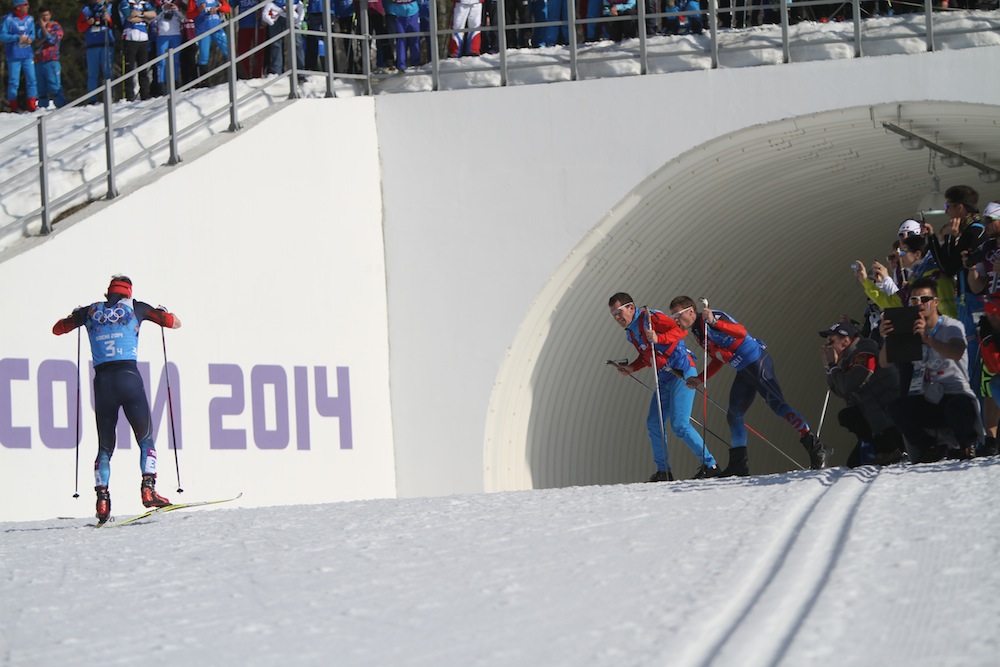
ZHANGJIAKOU, CHINA — Russia, and its flag, are officially barred from the 2022 Olympics in Beijing, a ruling that stems from continuing doping violations following a massive, state-sponsored scandal at the 2014 Games in Sochi that included cross-country skiers.
But other Russian cross-country skiers are still competing here, under the flag of their country’s Olympic committee.
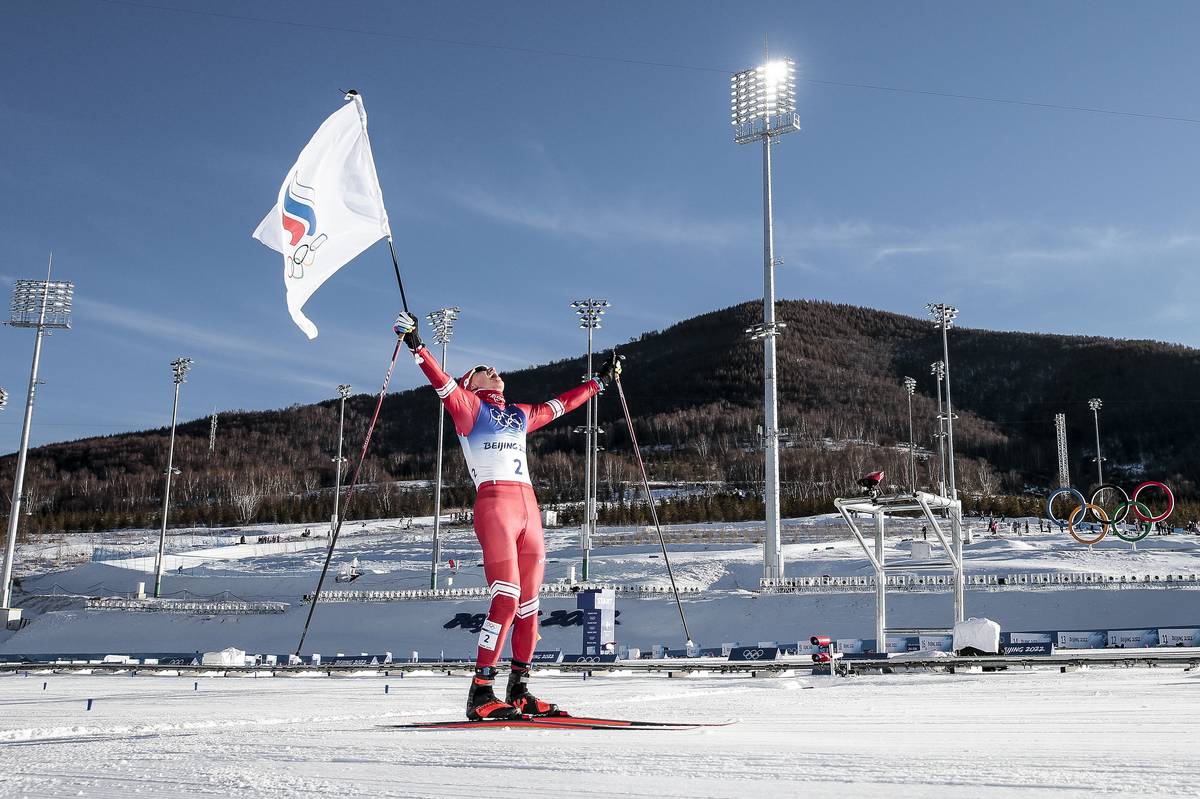
And on Sunday, in their first race of the Games, Russian men took the top two places. Star Alexander Bolshunov was so far ahead that he slowed to wave a Russian Olympic Committee flag before the finish line, and still beat third-placed Iivo Niskanen of Finland by two minutes.
Alexander Bolshunov celebrates a dominant victory, earning his first Olympic gold medal at the men’s 30 k skiathlon. (Photo: NordicFocus)
In spite of the huge winning margin, U.S. Ski Team Head Coach Matt Whitcomb said he wasn’t skeptical.
“We were all cheering for him in the coaching zone. And I don’t think all of us coaches, if we suspected any foul play, would be clapping for him,” Whitcomb said in an interview after the race. “I trust the World Anti-Doping Agency for helping keep the sport clean. I really do feel like overall, cross-country skiing is quite clean these days, compared to where we’ve come from.”
But other veteran American observers couldn’t watch Bolshunov and second-placed Denis Spitsov without asking questions. And the fact that Bolshunov will take home a gold medal when his country is still under international sanctions for doping-related offenses underscores the need for tougher penalties, critics said.
“I watched that race, and I was sad. Not because I’m 100% convinced that Bolshunov’s guilty, but because I watched it and I had a lot of doubt,” said Kris Freeman, a retired American cross-country skier who competed at the 2014 Games. “I’m angry at all the corrupt sporting bodies out there that let Russia come to these Games. They shouldn’t be there.”
Freeman’s comments came a few days before Russian media reported that a star women’s figure skater, Kamila Valieva, had tested positive for a banned drug before the Beijing Games started. A Kremlin spokesman said wait Wednesday said he was waiting for an explanation from the International Olympic Committee or Russian sports officials.
Another time, another team
Bolshunov is a decorated athlete who’s never failed a drug test. At a post-race news conference, asked by FasterSkier/the Daily News about the suspicions surrounding his performance, he emphatically rejected them.
Bolshunov said Russian athletes are under intense scrutiny, with drug testing “almost every day,” and have to constantly report their whereabouts to testing agencies.
“This should have nothing to do with sports. We have clean sportsmen, clean athletes here at the Olympics,” Bolshunov said, calling the question “irrelevant.” He added: “After you see how we train, I believe that you and your audience will never have these questions again.”
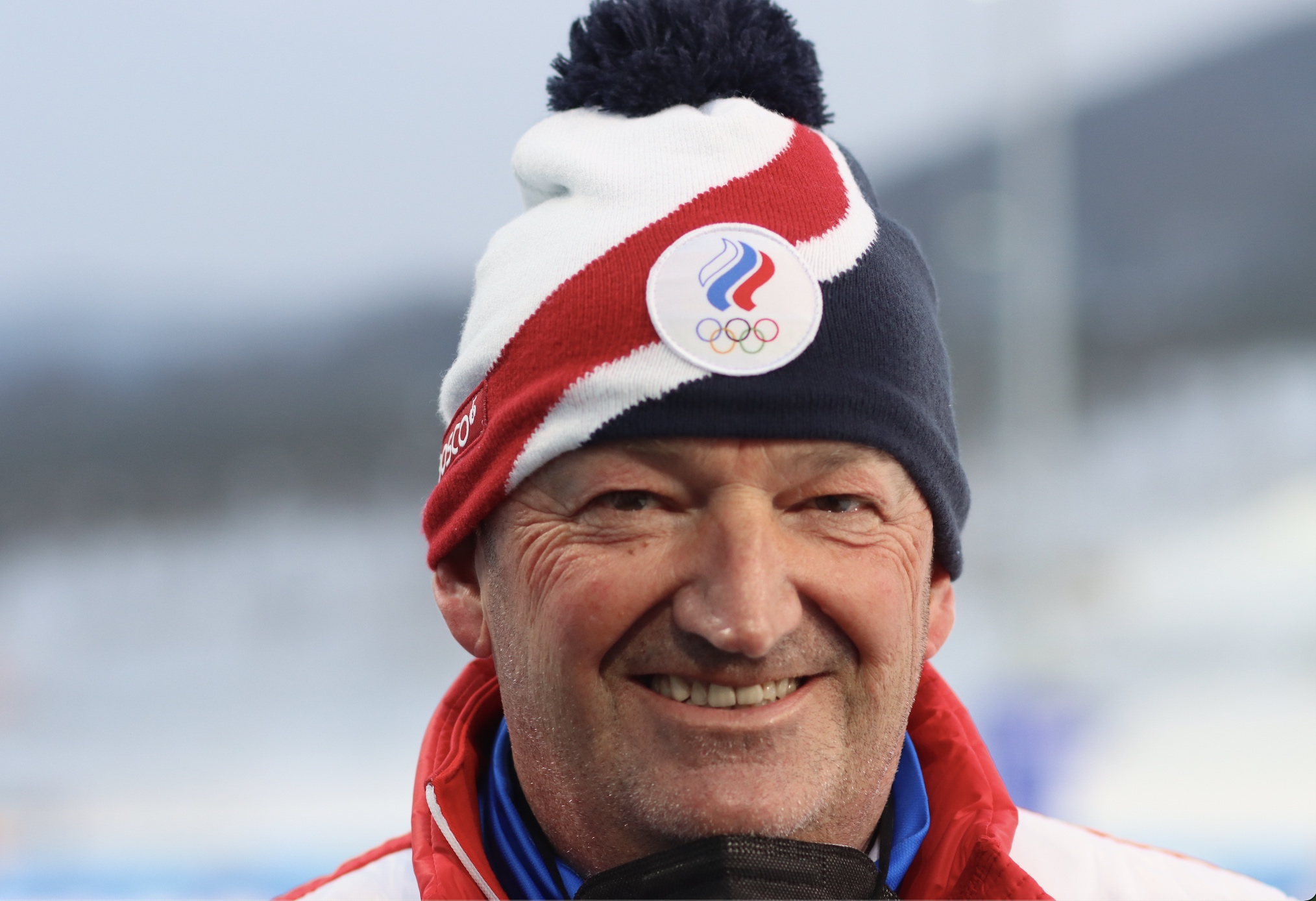
Markus Cramer, a coach of the Russian national ski team, poses for a photo at the stadium at the cross-country ski venue in Zhangjiakou, China. (Photo: Nat Herz/FasterSkier-ADN)
In a subsequent interview, Markus Cramer, a German coach who works for the Russians, said he’s “100% sure” there’s no doping on his team. He’s been affiliated with the team for seven years, and if doping was happening, he would have been able to tell.
“It’s totally another time now, and another team, and other athletes,” he said.
Reactions inside Russia, meanwhile, underscored how differently followers of the sport there viewed Bolshunov’s result. They also hinted at the ongoing geopolitical tensions between Russia and the U.S.
Russian politicians and sports commentators sharply dismissed any doubts, with one saying that the Anchorage Daily News/FasterSkier reporter who questioned Bolshunov was a “provocateur” and should have his Olympic press credential revoked.
“He could also ask what (Bolshunov) thinks about the alleged movements of military personnel,” sports journalist Dmitry Guberniev was quoted as saying, referring to the controversy about Russian troops massing near the Ukrainian border.
Scandinavian journalists at the post-race news conference said followers of cross-country skiing in those nations are less inclined to doubt the current generation of Russian athletes after growing more familiar with them.
The Russian team, in an effort to build trust after the Sochi scandal, invited Norwegian media to a training camp near Lillehammer a few years ago, Cramer said.
“Especially with the Norwegian media, we have a good contact,” he added. “And I think they understand, most of them.”
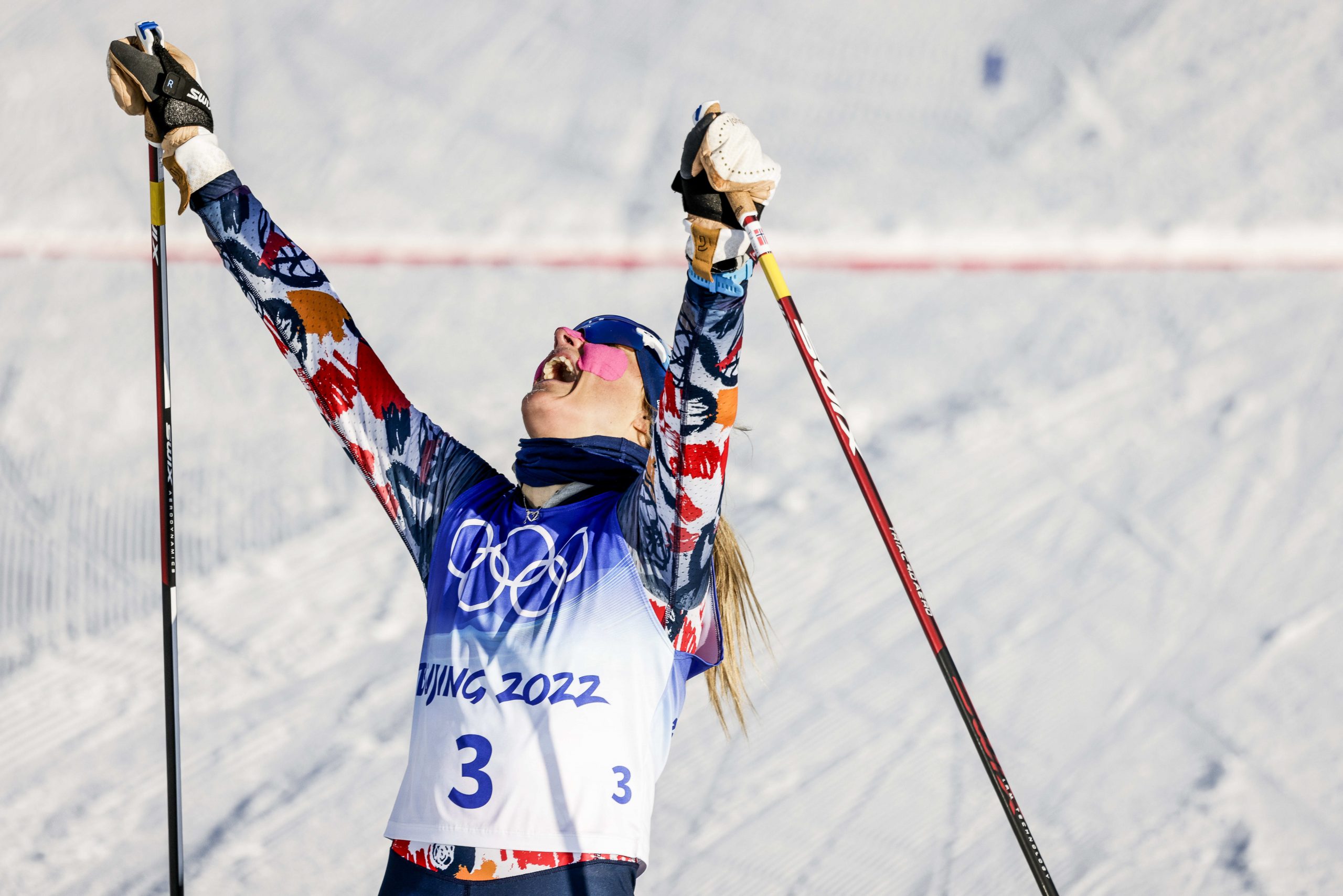
Cramer noted that no similar questions were lobbed at Norwegian superstar Therese Johaug, after she won the women’s opening cross-country event in similarly dominating fashion.
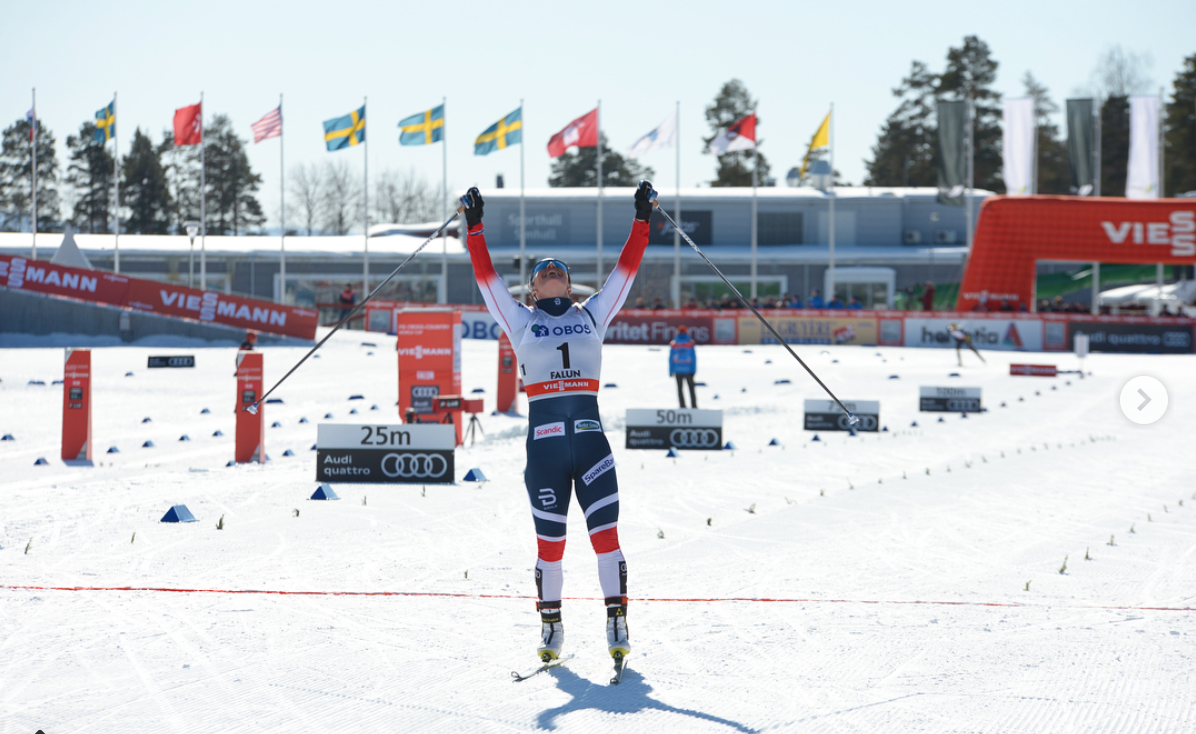
Celebration for Therese Johaug (NOR) as she takes her first ever individual Olympic gold medal in the women’s 15 k skiathlon. (Photo: NordicFocus)
Johaug missed the 2018 Games while serving an 18-month ban for using an anabolic steroid, clostebol. She said she accidentally took it while trying to treat a sunburn with lip balm — which turned out to have a “doping” warning label on the package.
At a news conference Thursday after winning her second race of the Games, Johaug said she’d finished her ban and had been training “so hard, so much.”
“People can (say) what they want, but I don’t care,” she said. “I know who I am and what I’m doing.”
Questions of accountability
Bolshunov’s result Sunday did not surprise followers of the sport, even if the size of his winning margin made an impression.
He’s also topped the overall rankings of the World Cup circuit — generally accepted as a barometer for the globe’s best all-around skier — for the past two winters. And he’s known to his peers for his work ethic and impeccable technique.
“The thing about Bolshunov is he’s a beautiful skier,” said Freeman, the retired American racer. “And I have no doubt that he works his ass off.”
One of the questions about Bolshunov’s performance is how much he should be held accountable for transgressions committed by others at a time when he was 17 years old.
Alexander Bolshunov (ROC) puts together a dominant performance in the men’s 30 k skiathlon. (Photo: NordicFocus)
Noah Hoffman, another retired American skier and anti-doping advocate, said he gives Bolshunov the benefit of the doubt.
“You can’t prove that you’re clean,” Hoffman said. “And so I refuse to assume that anybody is doping without evidence.”
On the other hand, Hoffman remains frustrated by the absence of stiffer penalties against the entire Russian team in the aftermath of the 2014 scandal.
“To the extent that a flag is making us question an athlete, that’s tragic,” he said. “And it’s because we haven’t put in place adequate deterrence to stop state-sponsored doping.”
A year ago, a European appeals court halved Russia’s four-year ban from global sports originally imposed by the World Anti-Doping Agency, or WADA, in a ruling blasted by some anti-doping advocates.
That proposed four-year penalty was not in direct response to the Sochi scheme. Instead, it was imposed after subsequent accusations by WADA that Russia had covered up positive tests in data that the nation was required to disclose in the wake of the 2014 scandal.
The result is that Russian athletes are still competing in Beijing — as they did at last year’s Games in Tokyo and in 2018 in Pyeonchang — even as Russian leaders can complain that they’re being unfairly targeted, said Hoffman.
“In both Pyeongchang and here in Beijing, they get to claim to be the victims of a Western plot while still celebrating the success of their athletes,” Hoffman said. “This is like everything Putin dreams of.”
A “big political game”
Bolshunov’s personal coach is Yuri Borodavko, who works with several other star Russian athletes.
In 2010, Russian Ski Federation leaders suspended Borodavko from working with the country’s national team for two years after Evgeny Dementiev, a skier he worked with, tested positive for blood-boosting drugs.
Today, Borodavko has a good reputation in Russia, and most fans see him and his athletes as “absolutely clean,” said Artem Kuznetsov, a journalist with the government-owned Russian news agency Tass.
Bolshunov and his teammates would be “crazy to try to cheat right now,” given the intense scrutiny on them, Kuznetsov added.
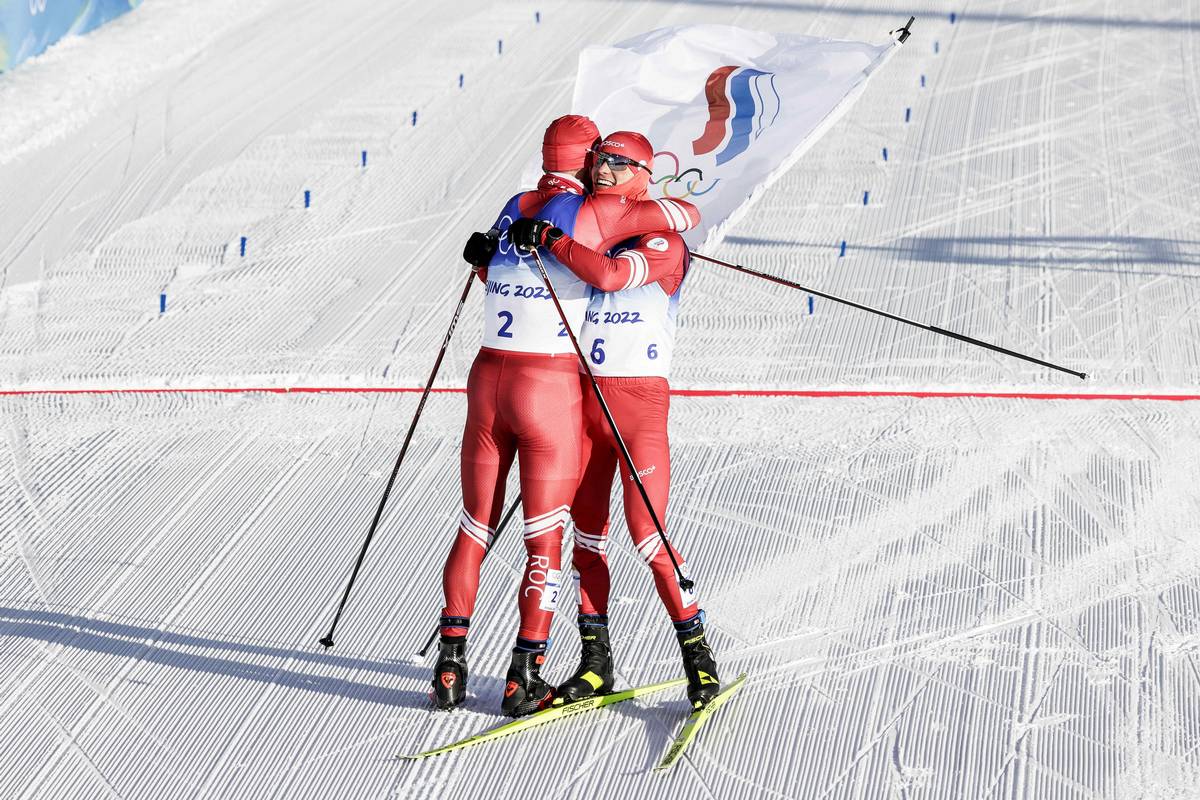
Olympic champion Alexander Bolshunov welcomes his teammate Denis Spitsov (right) to the finish of the men’s 30 k skiathlon, going one-two for the Russian Olympic Committee. (Photo: NordicFocus)
Freeman said he doesn’t lend too much credibility to Bolshunov’s history of negative tests: Lance Armstrong, he pointed out, never failed a drug test, either.
He said he was especially offended by the way Bolshunov celebrated Sunday’s win with the Russian Olympic Committee flag, and by his “defiant” response to the questions about him.
“I think he should be more aware of where his country is coming from — what they have been caught red-handed doing — and understand where the questions were coming from,” Freeman said. “Coming at it defiantly like that just makes you seem like a villain.”
Cramer, the Russian team coach, said Bolshunov is a young athlete who doesn’t understand why, given his clean personal record, he’s facing questions.
He also said Bolshunov has been criticized in the past for looking too serious when he crosses the finish line.
“What can he do?” Cramer said. He added: “We have a lot of (doping) controls. So, when he is not clean, of course, we will see.”
Two-time Olympian Noah Hoffman’s life is busier now than it ever was during his 10-year U.S. Nordic ski team career. The soon-to-be Brown graduate — he’ll have an economics degree by May — has thrown himself into athlete activism since his retirement in 2018.
Hoffman started in the anti-doping world before becoming a founding athlete board member of Global Athlete, an organization which seeks to hold sport governing bodies such as the International Olympic Committee (IOC) and International Ski Federation (FIS) accountable. In striving to increase athlete voice and give his former peers a proper seat at the table, he finds himself at the fore of another Olympics.
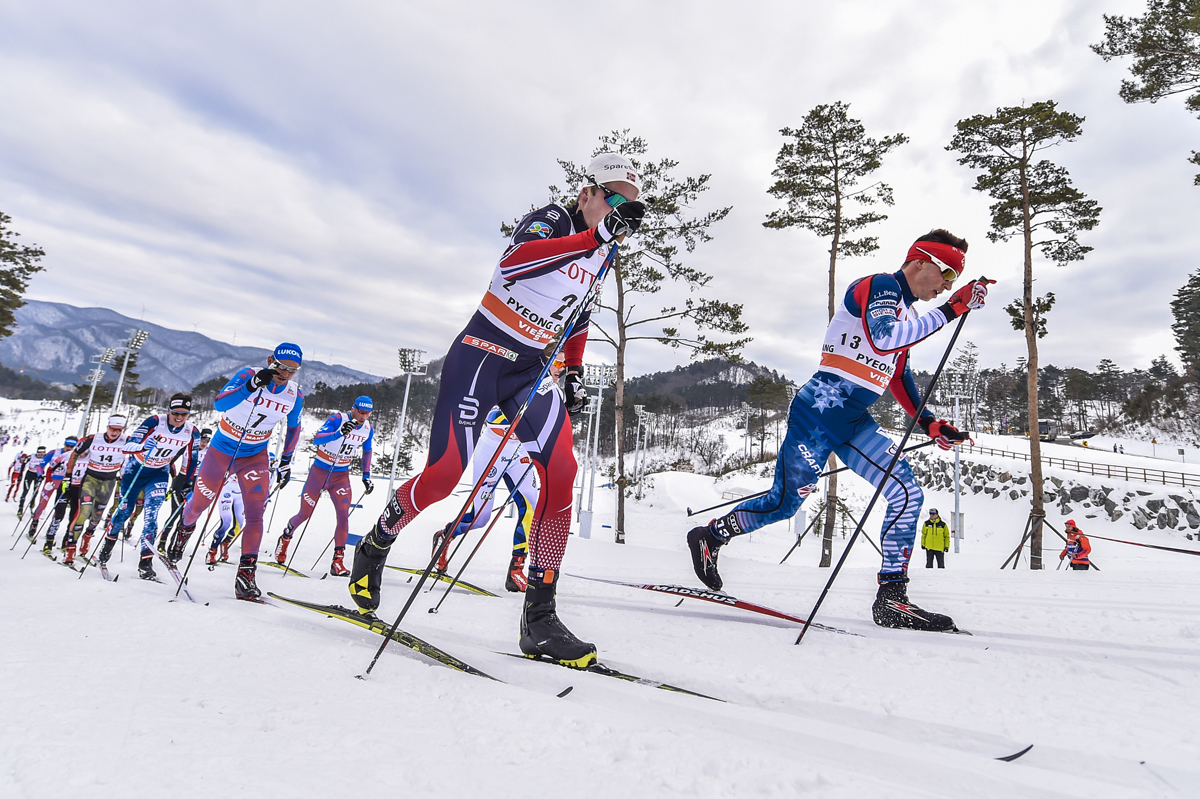
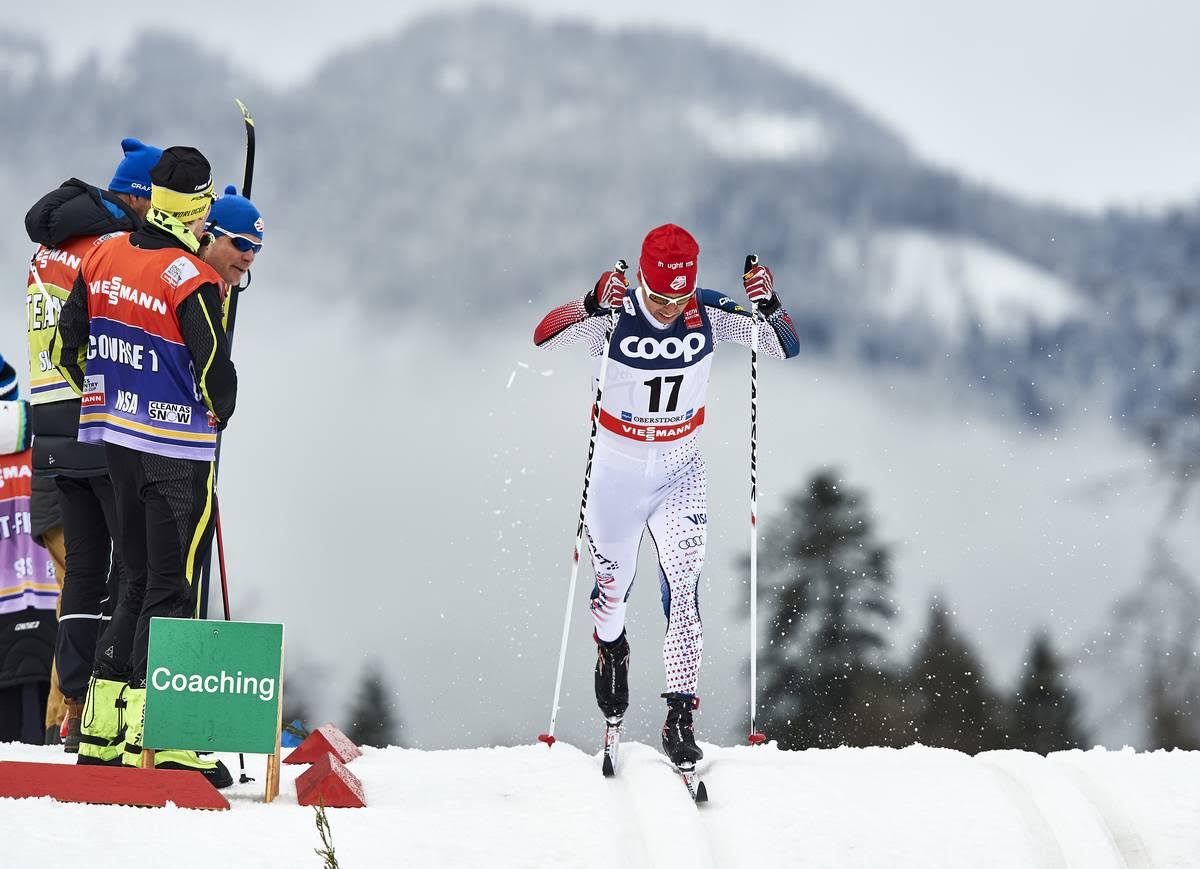
Noah Hoffman (bib 13) races in a pre-Olympic World Cup in Pyeongchang, Korea in April, 2017. (Photo: NordicFocus)
At a Human Rights Watch roundtable discussion last week, he spoke out against the IOC’s lack of accountability regarding the Beijing Games. (See video embedded below.) The oppression of Uyghur Muslims in the Xinjiang region, as well as the communist government’s actions in Tibet and Hong Kong, its general intolerance of dissent and the recent plight of Peng Shuai all fueled a diplomatic boycott of the Games by the United States government. The IOC has not stated whether it will protect athletes who speak out against human rights abuses, leaving them at the whim of the Chinese state. Canada, Britain and other nations have joined in the diplomatic boycott as well.
“Rule 50 and its restraint of free speech on athletes aligns uncommonly well with the CCP’s social repression and athletes should be enraged that both their host, and their governing body, seek to limit their voice,” human rights activist and lawyer Craig Foster told the South China Morning Post.
“Chinese government officials and diplomats have confirmed that athletes are being silenced and threatened with Draconian penalties in Beijing simply if they speak out against genocide.”
“Chinese law, when it comes to what kind of speech is permitted, especially speech that is critical of the Chinese state, is very opaque. It’s not clear at all what kind of speech she’s talking about,” he said.
For that reason, Hoffman is going against his nature, advising athletes — many of whom are friends and former teammates — to remain silent.
To read the full story, follow this link to the Vail Daily News.
Full roundtable discussion. Hoffman is interviewed at approximately 8:00 and 43:30.
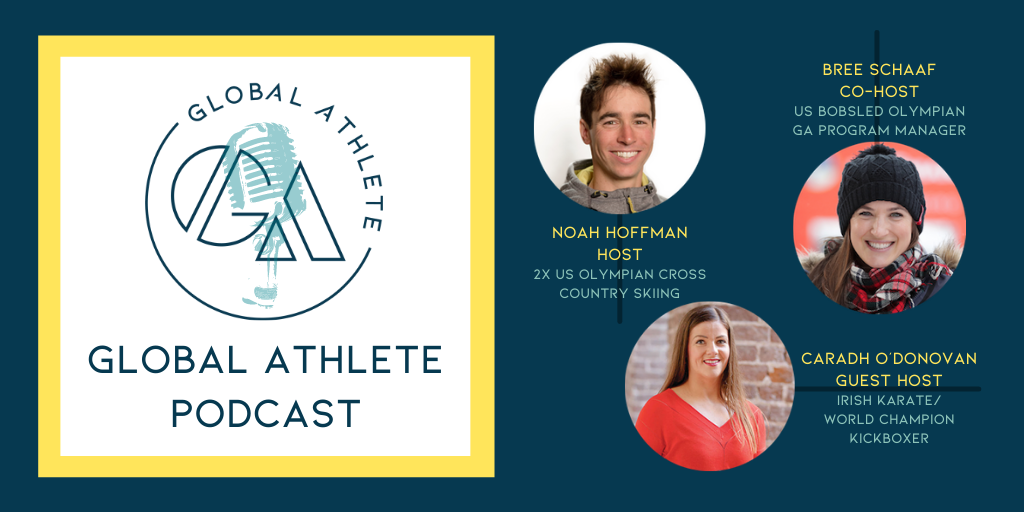
15 June 2021: Global Athlete is pleased to announce an exciting expansion in our efforts toward athlete-driven change across the world of sport- a new athlete-led podcast seeking to broaden the conversation about power, accountability, and athlete rights in international sport.
Hosted by 2x Olympian and Global Athlete startup group member Noah Hoffman and featuring guest hosts and Global Athlete members Bree Schaaf and Caradh O’Donovan, the 14-episode first season of our weekly podcast will serve to educate athletes and the public through in-depth conversations about international sport governance, athlete rights, and the future of the Olympic and Paralympic games. Along with the hosts, listeners will learn about the ways the current international sport governance system functions, how it serves or fails to serve athletes, and how it might be changed to better serve athletes and the broader sport community.
“As an athlete I felt powerless within the Olympic and Paralympic movement, but I didn’t understand the system well enough to fight for my rights. My work with Global Athlete changed that, and I now understand how the power dynamics in international sport are skewed towards administrators and away from athletes. I hope this podcast will help athletes and others understand the system well enough to fight for their rights,” said Noah Hoffman.
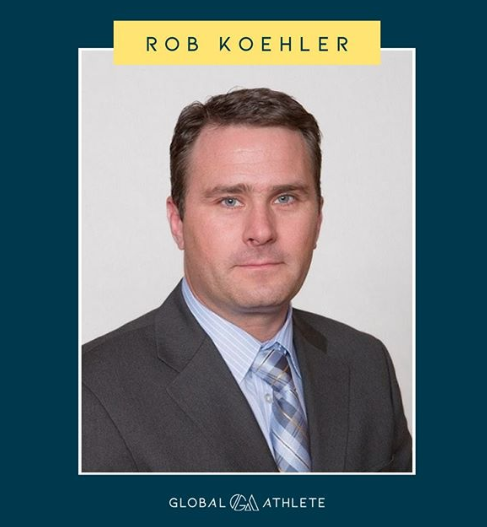
“I am thrilled that Noah is leading the Global Athlete podcast. He brings an extensive understanding of the sports movement that will enable him to dive deep into the facts. Knowledge and research drive change and I trust this podcast will do just that. I hope it will enable and empower athletes to be a part of the solution for stronger athletes’ rights,” said Rob Koehler, Global Athlete Director General.
Knowledge is power. In an era where athletes are finding their voice thanks to social media and using it for social change, sports remain reluctant to meaningfully engage athletes and athlete groups. Athletes want to help grow sport and contribute to strong governance that prioritizes athlete safety and welfare and have been using their voice to help shape the future of sport irrespective of having a seat at the table.
Athletes are ready for change, and we have a unique opportunity to get ahead of the sports movement to grow sport into the next century. Raising awareness is a crucial step toward that change.
Click here to listen to the first episode, or search ‘Global Athlete’ on your preferred podcast platform!
In this episode, we chat about the weekend’s racing from World Juniors and U23s. This is part two of our coverage of Worlds for the younger folks. This episode covers the relays and mass start classic races that concluded Sunday in Vuokatti, Finland.
On the show is longtime Kershaw friend Noah Hoffman, who it turns out, beyond his cross-country skiing endurance exploits, is an investment partner with Kershaw. We hear about the weekend’s racing, their experiences at Junior/U23 Worlds, and the fundamental strategic vision guiding their stock picks.
Junior Worlds 15 k mass start classic from Vuokatti, Finland. (Photo: Vuokattisport/@vuokattisport)
Thanks for listening and as this winter moves into mid-February, we hope all are well.
A new anti-doping bill that criminalizes international doping conspiracies, while pointedly focusing on high-level organizers rather than on individual athletes, and that makes an expansive claim for U.S. jurisdiction over doping occurring at international competitions while excepting the most high-profile American professional sports leagues, is on the verge of becoming law. Here’s what you need to know:
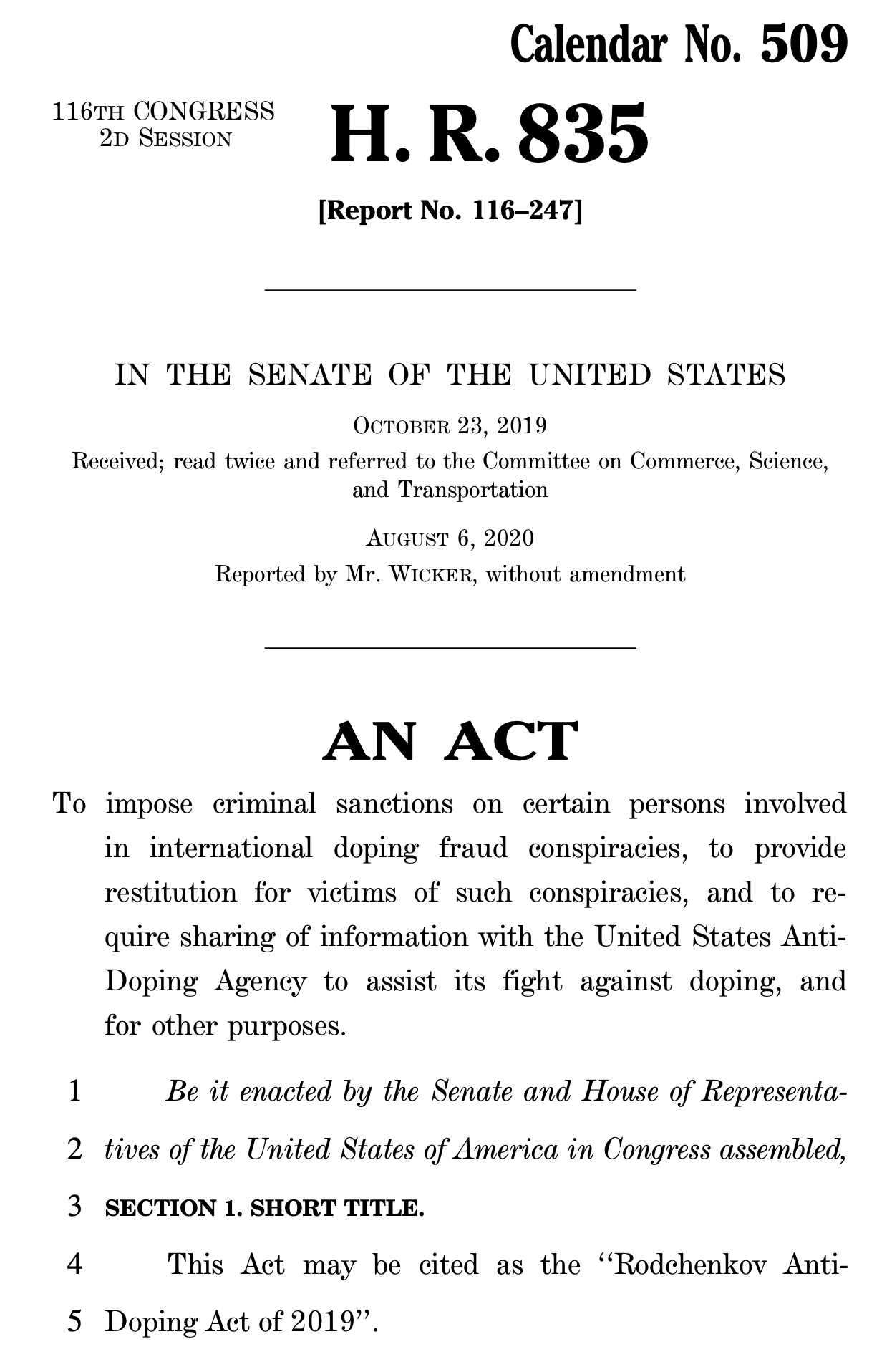
What it is: “An act to impose criminal sanctions on certain persons involved in international doping fraud conspiracies, to provide restitution for victims of such conspiracies, and to require sharing of information with the United States Anti-Doping Agency to assist its fight against doping, and for other purposes.”
What you can more casually call it in conversation: The “Rodchenkov Anti-Doping Act of 2019,” or even just the Rodchenkov Act.
What’s its current legislative status: Passed the House, passed the Senate without amendment, sent to the President for his signature. It will become law when or if he signs it. [Update: The bill was signed into law on December 4, 2020.]
What the bill does, summary form: Per the nonpartisan Congressional Research Service: “This bill makes it unlawful to knowingly influence (or attempt or conspire to influence) a major international sports competition by use of a prohibited substance or prohibited method. A violator is subject to criminal penalties – a fine, a prison term of up to 10 years, or both – and mandatory restitution. Additionally, property may be seized and forfeited to the U.S. government if it was used or intended to be used to commit an offense or traceable to the proceeds in connection with an offense.”
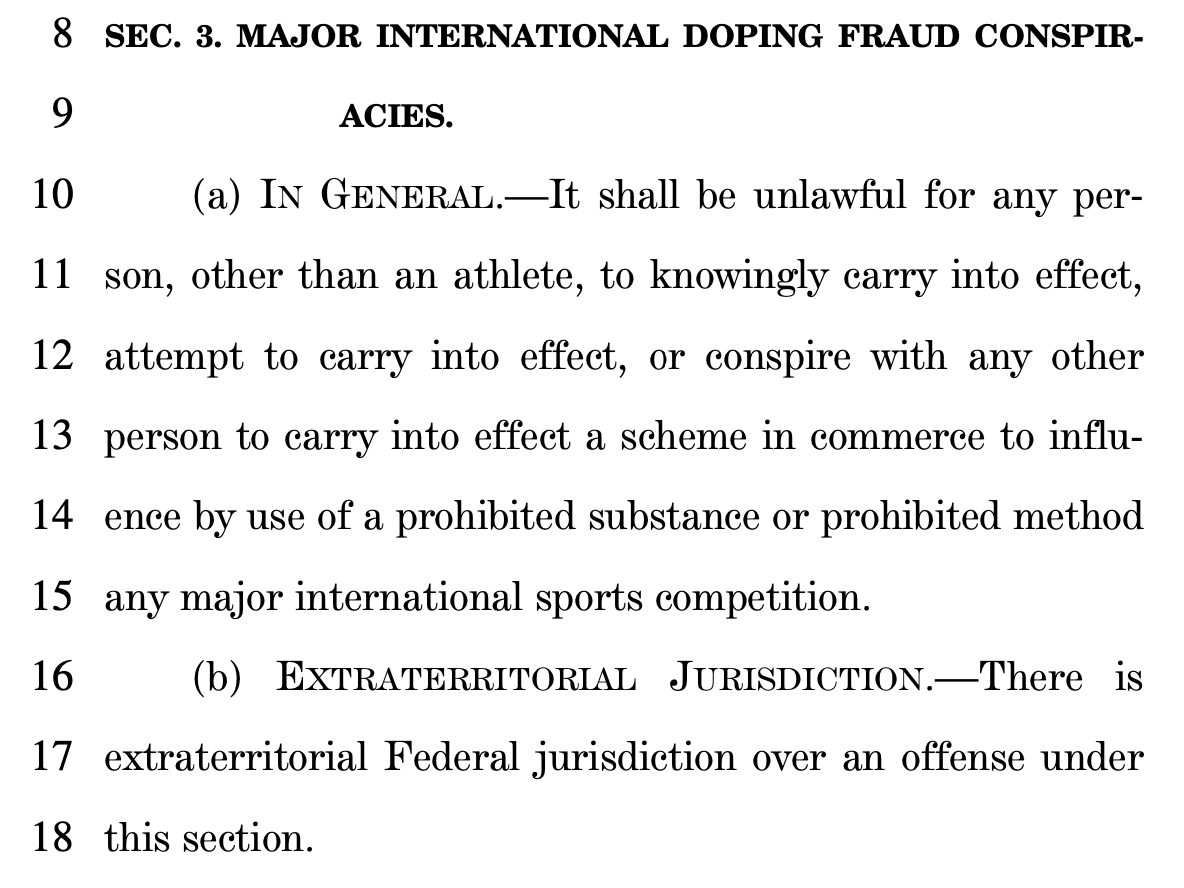
Section 3(a) of the Act provides, “It shall be unlawful for any person, other than an athlete, to knowingly carry into effect, attempt to carry into effect, or conspire with any other person to carry into effect a scheme in commerce to influence by use of a prohibited substance or prohibited method any major international sports competition.”
Section 3(b) provides for extraterritorial federal jurisdiction over an offense described in 3(a), i.e., it gives the U.S. Department of Justice legal authority to prosecute alleged criminal conduct that took place outside the physical borders of this country.
Extraterritorial jurisdiction of American criminal law is the exception rather than the rule. However, there are multiple areas where this exists, at least in theory, although in practice actions are relatively uncommon. As one overview of this issue states, “A surprising number of federal criminal statutes have extraterritorial application, but prosecutions have been relatively few. This may be because when extraterritorial criminal jurisdiction does exist, practical and legal complications, and sometimes diplomatic considerations, may counsel against its exercise.”
The rest of the Act provides some definitions. Major international sports competition means a competition featuring at least one American athlete, plus at least three other athletes from other countries, which is governed by the World Anti-Doping Agency Code (aka “WADA Code”), and where the competition organizer or sanctioning body receives sponsorship or financial support from an organization that does business in the U.S., or received money for the right to broadcast the competition in the U.S. (“Competition” is defined in this manner so as to provide jurisdiction under the capacious expanse of the Commerce Clause, in Article I of the U.S. Constitution.)
A scheme in commerce has a similarly broad definition, with the same aim of effecting Commerce Clause jurisdiction: “any scheme effectuated in whole or in part through the use in interstate or foreign commerce of any facility for transportation or communication.” Bottom line, if you send a text or email in support of your doping scheme (at a qualifying, multi-national competition subject to the WADA Code), the U.S. is going to have jurisdiction over you.
… if you’re “any person, other than an athlete,” that is. (Write your own John Kruk joke here.) If you’re an individual athlete who has allegedly doped, this Act, by its explicit terms – “other than an athlete” – does not apply to you. You obviously remain bound by the WADA Code, as well as by American state and federal law (if you’re an American athlete), but this Act does not apply to you. The title of Section 3 in the Act hints at its true target: “Major international doping fraud conspiracies.” Individual athletes are, well, not off the hook, but also not targeted by this Act.
Individual athletes are, however, eligible to receive restitution if they are defrauded as the result of someone else’s doping scheme. The Act amends 18 U.S.C. § 3663A, “mandatory restitution to victims of certain crimes,” to provide that someone who suffers financial damage as a result of someone else’s international doping fraud conspiracy is eligible to receive restitution. The Act itself provides for substantial fines for someone found guilty of violating it: $250,000 for individuals, $1,000,000 for associations or other groups. Jail time, of up to 10 years, may also be imposed.
Restitution provisions are well and good, but as any family law attorney who has ever tried to collect alimony from a former spouse can attest, you can’t get money if it’s not there. Another provision of the Act, regarding forfeiture, provides broad powers for criminal forfeiture to the U.S. Department of Justice, for property used, or intended to be used, to commit or facilitate an international doping conspiracy. At least in theory, the U.S. DOJ could prosecute the bad guys, seize their assets, and financially compensate the American athletes who were harmed. In theory.
The bill’s drafters certainly intended to provide protection to whistleblowers (that is, people who expose alleged doping conspiracies). The original version of S. 259, when it was first read in the Senate, contained a number of findings, including that “whistleblowers … can play a critical role in exposing doping fraud conspiracies and other fraudulent acts in international sport.” The final finding stated, “These whistleblowers, including Dr. Grigory Rodchenkov and Yuliya and Vitaliy Stepanov, often expose major international doping fraud conspiracies at considerable personal risk. By criminalizing these conspiracies, such whistleblowers will be included under existing witness and informant protection laws.”
On the one hand, it is accurate to state that the drafters of the Act intended to provide some protection to whistleblowers, rather than not to provide such protection. That’s what the final sentence quoted above says. On the other hand, it is also accurate to conclude that the Act itself (that is, the statutory language actually enacted, which does not contain any findings) says nothing at all about whistleblowers, and that anyone coming forward to expose an alleged conspiracy will be protected, if at all, only under general criminal laws as they relate to whistleblowers.
This reporter has worked as a criminal defense attorney for most of the past seven years (and clerked for a criminal appellate court before that), and retains considerable professional skepticism about the munificence of the federal Department of Justice. In his professional opinion, anyone planning to blithely avail themselves of the assumed generosity of federal prosecutors should carefully consult with legal counsel first, and should not assume that they will be automatically protected from prosecution for their role in an alleged conspiracy in exchange for revealing its existence. In practice, prosecutors have almost unlimited discretion regarding who they wish to prosecute or not. And the general protections of “existing witness and informant protection laws,” in criminal law, are far, far less robust than the explicit protections of whistleblower protection doctrines in other settings, largely civil employment law.
Bottom line, if you have something incriminating to report, talk with a defense attorney first before you go anywhere near the feds. (But not this reporter; I’m a full-time stay-at-home parent these days, and am truly not soliciting business.)
So, about those individual athletes: Again, they are explicitly not targeted by the text of this Act, nor are they intended to be. The Act covers only conspiracies, not individuals.
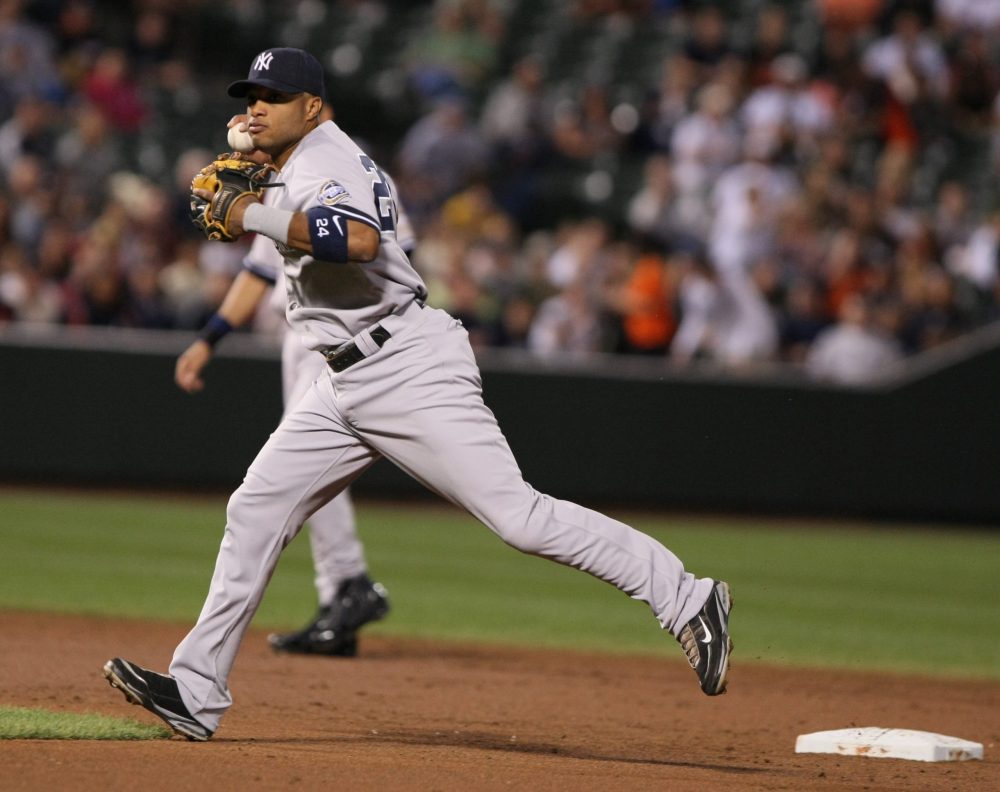
MLB player Robinson Canó, shown here playing for the Yankees in August 2009, was busted for steroid use earlier this week. He will be suspended for the entire 2021 season, and forfeit $24 million in salary. These punishments come through a scheme reached through collective bargaining by the MLB players’ union, not from WADA. (photo: Creative Commons)
So, about those individual athletes in major American team sports: Again, they are explicitly not targeted by the text of this Act, nor are they intended to be. The Act covers only major international competitions that are subject to the WADA Code; American college sports and the big four professional sports leagues (MLB, NFL, NBA, NHL) are not signatories to the WADA Code; therefore, this Act does not cover them.
As the New York Timessuccinctly put it, “Because drug policies are collectively bargained in the North American pro sports leagues, penalties for doping violations in those organizations are far less stringent than they are for international sports. Professional athletes in the North American leagues who fail doping tests are usually suspended for a portion of a season. International violations usually bring suspensions of at least two years.”
The exclusion of the most visible American professional sports leagues has raised some eyebrows. For that, and other reasons, let’s conclude with:
Who doesn’t like this Act (viz., everyone other than America):
“No nation has ever before asserted criminal jurisdiction over doping offences that occurred outside its national borders – and for good reason. It is likely to lead to overlapping laws in different jurisdictions that will compromise having a single set of anti-doping rules for all sports and all Anti-Doping Organizations under the World Anti-Doping Code (Code). This will have negative consequences as harmonization of the rules is at the very core of the global anti-doping system.
“WADA remains concerned that by unilaterally exerting U.S. criminal jurisdiction over all global doping activity, the Act will likely undermine clean sport by jeopardizing critical partnerships and cooperation between nations. Further, the Act could impede the capacity to benefit from whistleblowers by exposing them to possible prosecution and preventing ‘substantial assistance’ deals in line with the provisions of the Code.”
The WADA Independent Commission
The Central European Anti-Doping Organization:
Sounded similar notes, in a statement largely copy and pasted from WADA. It ended with an original paragraph: “CEADO joins WADA and other stakeholders around the world in asking why this U.S. Act, which purports to protect athletes and claims jurisdiction overseas specifically excludes the main areas of professional and college leagues which are the show cases of sports in the U.S.?”
Dick Pound:
The former WADA president and IOC vice-president has expressed strong concerns about maintaining common international standards for testing and enforcement. “To try and destroy WADA does not provide any additional protections to American athletes,” Pound told British Columbia newspaper The Province earlier this year. “In fact, it increases the risk. If you don’t have a harmonized international approach to international doping, you’re going to have more and more doped athletes competing against America.” He claimed that the legislation is based on “intentionally inaccurate and misleading information” from American anti-doping officials.
Pound added, “It’s unfathomable why they would do that, unless it’s some kind of a takeover bid, an untimely takeover bid, to come and say, ‘Throw your money around, we’ve put in more than anyone else,’ which is of course not true. But that doesn’t seem to bother the executive branch of the U.S. government these days.”
Ulrich Haas:
One of the drafters of the WADA Code penned an op-ed entitled, “Flawed Rodchenkov Act risks a return to anti-doping chaos.” Its opening paragraph is, “Be careful what you wish for. Designed to protect clean sport, the Rodchenkov Anti-Doping Act will have the opposite effect.” It gets more caustic from there.
Haas expressed particular concern that the Act’s treatment of whistleblowers could expose them to criminal prosecution from non-WADA sources, while compromising WADA’s ability to provide them with immunity: “How could WADA carve out an agreement with this [hypothetical] whistleblower in exchange for her collaboration if there existed legislation that allowed for her criminal prosecution? The Rodchenkov Act and other similar laws would leave her exposed to criminal prosecution by various extra-territorial jurisdictions. There is no legal security for these whistleblowers in exchange for coming clean and providing valuable intelligence. The effect of the Rodchenkov Act will be to discourage people from coming forward with information.”
The Kremlin:
As a Russian presidential spokesman told an English-language Russian news agency earlier this week (headline: “Kremlin blasts US attempts to extend its jurisdiction to other countries”), “In the context of this document and in general we are extremely critical of any attempts by the United States to extend its jurisdiction to other countries. … This can cause nothing but concern. Such transborder practices do not suit us and we disagree with them.”
Who likes this Act (viz., Americans):
United States Anti-Doping Agency:
USADA CEO Travis Tygart issued a statement earlier this week. Tygart said, “The Act will provide the tools needed to protect clean athletes and hold accountable international doping conspiracies that defraud sport, sponsors and that harm athletes. … The Act establishes criminal penalties for systems that carry out doping-fraud schemes that rob athletes, citizens and businesses. It also protects whistleblowers from retaliation and provides restitution for athletes defrauded by conspiracies to dope. It is a monumental day in the fight for clean sport worldwide and we look forward to seeing the Act soon become law and help change the game for clean athletes for the good.”
USADA also made the following statement on Twitter on Tuesday: “Myth: The Rodchenkov Act doesn’t apply to athletes at all. Conspiracies to distribute & administer performance-enhancing drugs are already a felony under US conspiracy, narcotics & fraud laws, which carry stiff sentences. In that regard, RADA would have been completely redundant.”
This is quizzical, because the Rodchenkov Act, by its explicit terms (“other than an athlete”), literally does not apply to individual athletes at all. And the statement regarding a redundancy seems to admit that the Act does not in fact cover athletes, as they are already subject to the criminal laws described in the tweet’s second sentence.
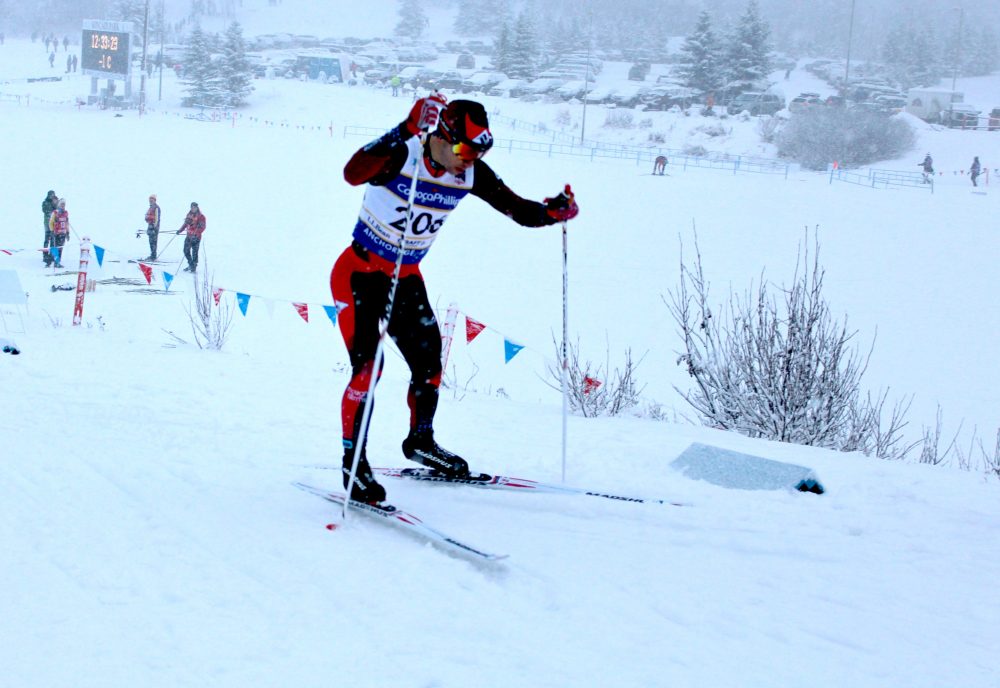
Noah Hoffman racing to second in the men’s 15-kilometer freestyle individual start on Wednesday at 2018 U.S. Cross Country Championships in Anchorage, Alaska. It was his first January nationals appearance since 2012. (photo: Gabby Naranja)
Noah Hoffman and Jessie Diggins:
In an op-ed written in March of this year for the Minneapolis Star-Tribune, the two American Olympic skiers spoke to the importance of clean sport as a force for good. They wrote, in part, “The global anti-doping system, though well-intentioned, has failed to stem the tide of doping conspiracies that have undermined confidence in international sport. The current system does not have the power nor the independence to counter state-sponsored programs that corrupt the Games we hold so dear. The Rodchenkov Anti-Doping Act will bring the power of federal law enforcement to the fight for clean sport. The bill will criminalize international doping conspiracies, protect brave whistleblowers who expose malicious behavior, require information sharing between law enforcement and anti-doping authorities, and allow athletes like us to seek restitution when we are defrauded by cheaters.”
Hoffman also responded to Pound’s statements in the Province article with a letter of his own addressing some of Pound’s arguments. Hoffman writes, in part, “the article implies that the Rodchenkov Anti-Doping Act will undermine WADA and the global harmonization of anti-doping rules. This assertion disregards the fact that the bill uses the global WADA code to determine what is or is not doping fraud. The bill also mandates information sharing between law enforcement and the U.S. Anti-Doping Agency, the organization that works in partnership with WADA to enforce global anti-doping rules in America.” Hoffman also, accurately, states that the Act “covers both Americans and non-Americans who commit doping fraud at events that occur inside or outside of the United States” – but does not engage with the argument that it only covers events subject to the WADA Code, which rules out roughly 99% of professional sport in this country.
Grigory Rodchenkov:
The Act’s namesake, through an attorney, told the New York Times that the law represented “the dawn of a new day. This will be an immediate worldwide deterrent.”
Like most other states, a cross section of athletes racing in the Colorado High School circuit (CHSAA) looks relatively homogenous when it comes to ethnicity. The field is largely white. However, in stark contrast to skiers hailing from affluent mountain towns like Steamboat Springs, Aspen, and Vail, a team from Denver might catch your eye for adding some color. Most of the Ridge View Academy Rams, all male, are Black or Latino, and line up amidst athletes with NCAA or even Olympic aspirations during their first ever season on snow.
“Our guys are like deer in the headlights [at the first few races],” said head coach Greg Townsend, recalling one such day at an interval start classic race in Vail in roughly 2007.
“One of our better skiers was lined up right behind a young Noah [Hoffman] — and Noah is warming up looking like a bunny rabbit: jumping up and down on his skis, and bounding, and doing all this stuff. Two or three of our kids are staring at him like, ‘Holy crap! I don’t do it that way.’”
The athlete came to Townsend feeling terrified to race against Hoffman, wondering what he should do. Townsend encouraged him to follow along with Hoffman’s routine and to remember what the goal is.
“It’s a ski race. Just do your best, go have fun with it.”
Townsend watched his athlete buck up the courage to head back to the start area. As Hoffman slapped his skis in the tracks to keep his wax from freezing, the Ridge View racer slapped his skis. As Hoffman flexed and stretched, so did the athlete from Ridge View.
“And then he got dusted — I think Noah won the race. But our kid came in with a big smile on his face and I asked how it went and he said, ‘It was fun. I think I did alright.’”
The strengths-based academic model at Ridge View Academy provides the framework for programming and services. (Photo: RidgeViewAcademy.com)
To provide further insight, Ridge View Academy, a Right of Passage (ROP) program, is an alternative education charter school that works with court-involved and at-need young men. ROP offers a holistic, strength-based approach to education, treatment and counseling, which focuses on the individual’s positive qualities and skills, and shifts focus away from past transgressions and toward overcoming adversity. Social services are also offered to help improve the lives of the youth served.
In addition to classes to support kids in earning a GED, Ridge View Academy offers skills and trade based classes, and students can elect to follow a vocational tract to learn bicycle shop skills, culinary arts, barbering, metal working, and more. Extracurricular activities and sports also play an integral role.
At the helm of the cycling, mountain biking, and nordic ski programs at Ridge View is Greg Townsend, who has worked with ROP programs since 1984. FasterSkier spoke with Townsend in June to learn more about the Ridge View Academy program and how cross-country skiing plays a role in the educational and therapeutic model.
Townsend is the type of person you could listen to for hours, and it was immediately apparent how his mentorship and support could help countless young men find their way out of difficult situations.
Townsend’s circuitous path to ROP had a waypoint in Japan. After several years of bike racing, Townsend found his way to Japan where he worked as a paramedic at a ski resort. He was looking for a way to stay fit for cycling through the winter season and was eventually introduced to the head coach of the Japanese national nordic ski team, who agreed to teach him to classic ski. He described the experience as an “eyeopener” as he found himself needing to slowly master one skill at a time to earn the respect of the coach, calling it “the Japanese way.”
“I had to double pole for like three weeks straight before they taught me the next step, which was double pole with a kick,” he laughed.
After moving back to the United States, he began working with a California-Nevada based ROP program, leading groups of young men into the mountains on winter camping and telemark ski trips alongside the head coach who was a former Marines mountain warfare instructor. He called this type of travel and skill development “Mount Everest stuff.”
To get kids on skis more regularly, he proposed starting a nordic ski program, and cobbled together enough gear to start a team. When he moved to Denver in 2001 to help start Ridge View Academy, he brought the concept of a nordic team with him. He explained that the first season, because of a lack of equipment, the team completed almost all of their training on dry land. It was not until the day of the first race that the team actually got to ski on snow.
Although most of his kids were born and raised in Colorado, very few came from families with the financial means to provide a ski experience and many had never been out of their home town or city. Consequently, it was not only their first day on nordic skis, but their first day sliding on snow in any fashion. They arrived early and rented ski equipment the morning of the race, spent two hours practicing, then the kids lined up with everyone else.
The best compliment Townsend overheard was, “They’re not very good, but they don’t quit!”
As the years progressed, Townsend helped find equipment and opportunities to support his kids. As he also teaches metalworking classes, he fabricated a fleet of skate skis and slowly collected pairs of classic. Townsend helped locate used equipment and connected with donors and sponsors to find skis, and Ridge View partnered with the YMCA of the Rockies at Snow Mountain Ranch, exchanging community service for trail time. Now ROP student-athletes are able to complete roughly half their training on snow.
Apart from developing as a skier, Townsend explains that the true value of the program is the impact of providing the young men with access to the outdoors and aerobic exercise.
As a self-described “huge believer in experiential education”, he’s led countless long-distance bike trips, including 600 mile tours from campus to the Grand Canyon or even all the way cross country. Along the way, he watches kids work through physical exhaustion and emotional anguish, pedaling under the weight of personal history of being passed through foster care, criminal records, teen pregnancies, or abuse.
Ridge View Academy’s Greg Townsend regularly leads students on long-distance cycling trips as part of the holistic therapeutic program. (Photo: RidgeViewAcademy.com)
Townsend explained that there is research supporting the role aerobic exercise can play in creating changes in the brain that reduce the risk of depression or psychosis, which can lead kids to make negative choices or engage in self-harming behaviors.
“Skiing has somewhat of the same effect… A lot of brain change takes place with aerobic activity, and sustained aerobic activity has more impact than short term activities,” said Townsend.“You get to see that firsthand with kids. Kids that were pretty self-destructive or using type-A behaviors — it can pretty much go away. There’s a lot of permanent change that takes place in the brain with that type of activity.”
Apart from having the cycling and skiing skills to facilitate these experiences, Townsend is able to connect with the young men and help counsel them through their journey at Ridge View. Though he spoke humbly, he acknowledged that some of his success in this realm stems from his own history within the system, which has shaped his ability to listen to and understand the challenges of others.
“Everybody has a story, every one of our kids is different. I get to make an impact everyday. I was a troubled kid when I was younger, and my brother died in the system a couple years back — he never made changes, and I made changes when I was younger. I wouldn’t call it an affinity, but I have an understanding, so I can connect and have a relationship with someone that is struggling. I can’t say better than some, but that would be something that my wife would say.”
Seeing this impact and supporting kids to become successful adults is what has kept him with Right of Passage for over 36 years.
“You have to love the kids, love what you do everyday. For me, some of my best friends were kids that I coached. They have five kids and a family and they’re doing well. They’re not dead, they’re not on the streets, they’re doing well. One of our lawyers was a kid for us… You never know when you have an impact. When you’re good, it’s a chess game sometimes, and I’ve learned how to play a good game of chess, where I’m not always the one who is going to help the kid. But if you know who your chess pieces are and you can set up success for the kid and put all the people in the right place, then that can sometimes come to success.”
He explained that the philosophy he aims to pass onto teachers he helps develop at Ridge View follows an old Chinese proverb: “When the student is ready, the teacher is going to appear.”
Townsend explained that one cannot presume when a young man enters the program whether or not he is capable of making changes. He reminds staff not to fall into the trap of becoming “pessimistic, antagonistic, and detached.”
“Keep being the teacher,” Townsend added. “You’re not going to necessarily know when the student is listening to you… A lot of these kids have had a lot of pain, have a lot of pride, and a lot of stuff they’re protecting themselves with, and they have a hard time making relationships that they trust as far as adult relationships. They may never let you know that they trusted you and they listened to you… I see our job as building the wall strong enough that it can stand on its own. When they get out there in the real world and have these negative influences again and lots of people trying to pull them down, they’re going to have to be able to stand on their own.”
He continued by explaining that not all kids “make it” in terms of making lasting changes in their lives and finding a healthy path long term, but that a large percentage are successful, and those are the ones that keep him hopeful with each new case.
In terms of his coaching philosophy, Townsend’s primary goal is for the kids to enjoy the sport.
“I stress the fun factor — that’s the hook. Once kids get some balance on their skis and have their first downhill without crashing, they tend to start having fun with it… I had a really great cycling mentor who said, ‘This is too hard not to have fun at it. If you’re not having fun, try something else.’”
From there, he encourages the young men to identify how the skills they are honing by overcoming challenges in skiing might transfer into their everyday lives.
“Apply that from the perspective of building the individual… As I tell the kids, it’s not about skiing, it’s not about cycling. It’s a fun thing, but how many of us are going to do it professionally? But we can learn a lot of lessons from it, and apply those same lessons in everything else that we do. Yeah, we need to double pole 20 times around the track, or whatever, but if you finish that workout, you’re going to get stronger and mentally you’re going to be stronger. I think the guys that don’t quit start to catch onto that and start to see the benefit, and that’s the hook.”
His metric for a successful training session on skis? Naps and positive energy on the bus ride home.
“I always know I’ve done a good job when they’re all just passed out on the way back from Snow Mountain Ranch and they wake up in a positive headspace. The only beauty of driving four hours [roundtrip] to go train is they get to talk and we get to do school work and build relationships on the way there, then they get to nap on the way back, or you have these long two-hour talks on the way back from practice. One of the beauties of being able to drive for four hours a day with kids that need a lot of talking with is the drive.”
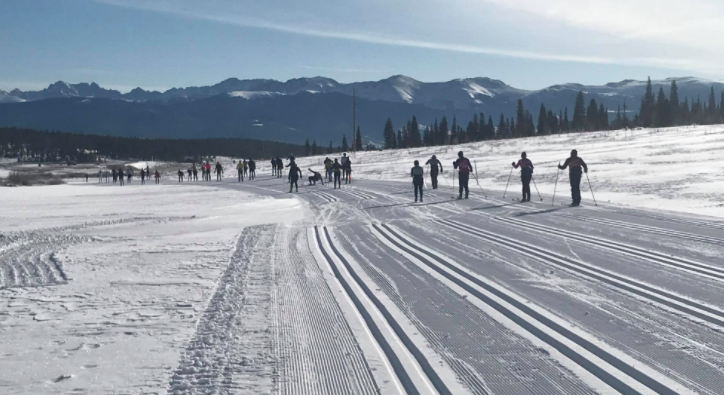
Skiers take to the course during the March 2018 Snow Mountain Stampede ski marathon at the Snow Mountain Ranch Nordic Center. (Photo: Facebook.com/SMRNordicCenter)
At this point, our conversation headed toward a question I felt some trepidation about asking. I’ve never coached an athlete of color, nor have I trained alongside one. While I’ve typically had great kids, the exclusive private and public schools I’ve taught and coached for are filled with kids who have grown up with a significant amount of privilege. Heck, we race in Aspen Colorado through a neighborhood of homes that are each worth millions of dollars, [Currently, an empty lot is for sale for $3.9 million, and an estate is listed at $14.9 million.] while some of his kids’ entire multigenerational families live in an apartment the size of a one car garage.
How does this make a young man who is a person of color and has faced an incredibly challenging set of obstacles throughout his life feel? Is there bitterness? Anger? Envy?
On the contrary, Townsend explained that rather than looking around at others feeling spiteful, primarily his kids are just self-conscious that everyone else is looking at them.
“And I’m like, ‘So what?’ It’s a race, and everyone is looking at everyone else.”
He explained that the people they do encounter who may look down on the team or seem concerned about their participation typically don’t understand the variety of circumstances that have led the young man to the program. His kids might be “receivers” of broken families or hard situations that they weren’t able to process at a young age.
“Kids come from varied backgrounds and histories. We have kids where mom and dad were meth heads or sold meth, and the kids were taken out of their homes. They never did a crime in their life, but they’re part of the system. Then we have the other extreme where we may have a different level of kid that was a gang kid. To put a rubber stamp that all the kids are the same that we work with doesn’t do justice to the kids.
“People look at our kids from a couple of different lenses: a resource lens, a villain lens, and a victim lens. Some of these kids are going to be lawyers someday, or doctors, or firemen, or business owners… The way that they’re going to change is by looking at them like they’re a resource. I see these kids as a diamond in the rough. You see this dirty little rock on the ground, and if you just walk by it or kick it, you don’t realize that it’s a precious diamond — you just have to have the right cutter to expose the diamond under the dirty little rock. Our kids have the same ability, not necessarily the same choices, but they do have the same ability as anyone else, they just have to believe it themselves.”
Overall, Townsend concluded that his team has been well received and supported by other teams, and although his kids sometimes feel self-conscious about their skiing ability or how different they are from other competitors, racing in the CHSAA league has been a positive experience.
“Underdog is probably a standard. I always have a new team every year, and I enjoy the hell out of it. Once in a while, we have a phenom kid. Once we placed fourth in the state, and we had four guys in the top-10 at a race once.”
He explained that this anomaly took place on the Rams’ home course in Snow Mountain Ranch where kids felt comfortable enough to “let loose and go hard.”
That is not to say he has never coached a standout. He shared that one of his racers, Maxwell Burnell, was one of the fastest CHSSL skiers in Colorado and was able to earn a scholarship to Vail Ski & Snowboard Academy (VSSA) to further develop as an athlete. Burnell was also an accomplished Cat 1-2 cyclist.
“He was probably our biggest success story in terms of his ability to take the sport and run with it. He had a lot of fun skiing and ski racing.”
Townsend became emotional as he added that most importantly, Burnell was able to transform his life. He followed an upward trajectory to Ridge View Academy from a mental health hospital, then to VSSA, and on to compete at the top level of domestic cycling, racing shoulder-to-shoulder with men who went on to make the national team.
He concluded that each year, his goal is simply to develop whatever group of athletes join the team to become as holistically strong as possible at the end of the season.
“What are you going to take from the season? Our guys learn how not to quit. And I take pride if we get through the season and not one of my kids quits a race — they had a good season from that standpoint.”
From that objective, he added that the advantage of going out more to enjoy themselves rather than to focus on performance is that their conversations can revolve primarily around learning a new lifestyle.
“The goal is to enjoy life and learn some lessons. Teamwork is huge, getting along and building a family where these kids support each other is huge. Kids that are from opposite sides of the tracks — one’s from the south and one’s from the north and they’re in different gangs. At the end of the season, sometimes they’re best friends.”
Townsend concluded that overall, the nordic community has been welcoming and gracious toward his kids, and most importantly, have just treated them like kids. Racing hard at altitude ironically levels the playing field. His kids can leave behind their heavier suffering and just race, turning it into the hypoxic singular focus experienced by any other skier on the trails and being rewarded by the same post-race high.
“Everyone who has suffered through a Snow Mountain Stampede — the 42k that went over to Granby — that was brutal! And our kids went out and did the race. When they finished, everyone that finished has the same affinity — everyone went through the same struggle, no matter how good you are at it.”
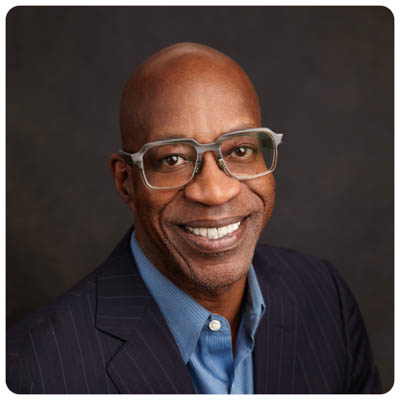
In this episode, we hear from a familiar voice – someone, in fact, we’ve heard from recently on the podcast, former elite cross-country skier Noah Hoffman. Post-race career, Hoffman has been deeply involved in the anti-doping movement as an educator, lobbyist, and content creator. This conversation is from Hoffman’s content creation side. A few months back the US Anti Doping Agency (USADA) posted a six-plus minute video interview between Hoffman and Dr. Edwin Moses – a famed track and field athlete, anti-doping reformer, and voice for equity in sport.
This episode features the full unreleased 30 plus minute interview – one where Moses discusses how best to empower athletes and build racial equity. This is an opportunity to hear one of the most fearless voices in sports. Along with his activism, Moses is a two-time Olympic gold medalist in the 400 m hurdles. Those are a few of his storied athletic accolades. He’s an icon.
Dr. Edwin Moses. (Photo: USADA.org)
Off the track, Moses speaks for the rights of athletes. His is among a rarefied list of athletes who have chosen to challenge the power brokers in Olympic sport. He served on and chaired WADA’s Education Committee. He held true to his values while serving WADA as an outspoken critic seeking institutional reforms from within. He was a key figure in developing drug testing protocols, and he served on the IOC’s Athlete Commission, Medical Commission, and Ethics Commission. Today, Moses holds an Emeritus Chair with USADA where he continues his fight.
With a kowtow to Zach Caldwell and Noah Hoffman, we are repurposing their recent video conversation about anti-doping reform. On Nordic Nation, you’ll find just the audio. If you are more visual by nature, you can find the video here.
Hoffman is a former longtime U.S. Ski Team member. Caldwell is Hoffman’s former coach and runs Vermont based Caldwell Sport.
In this conversation, you’ll get solid details about anti-doping policy in the U.S. and abroad. Think of this as an advanced level remote learning opportunity to up your game when discussing anti-doping affairs. From Noah’s involvement with Global Athlete, to details on the Rodchenkov Act, USADA, and efforts to magnify athlete voices via labor unions, Caldwell and Hoffman cover lots of ground.
For those that have followed Hoffman’s career, this is an opportunity to hear him as he emerges as a nascent expert in anti-doping policy. It is easy to envision Hoffman leading international clean sport efforts in the years ahead.
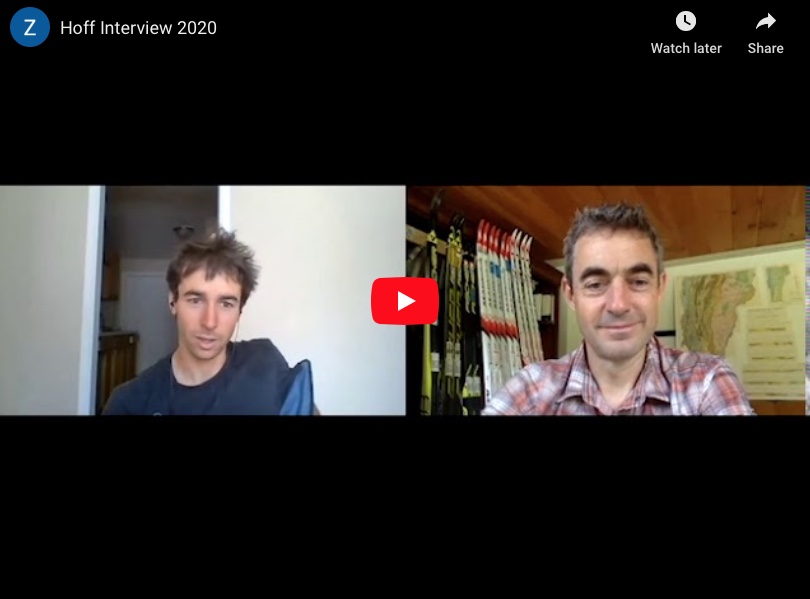
Noah Hoffman (left) and Zach Caldwell (right). This is a screenshot of the video, clicking the white triangle will not prompt the video to begin.
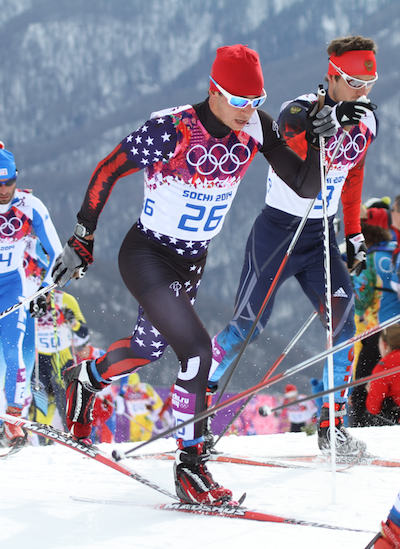
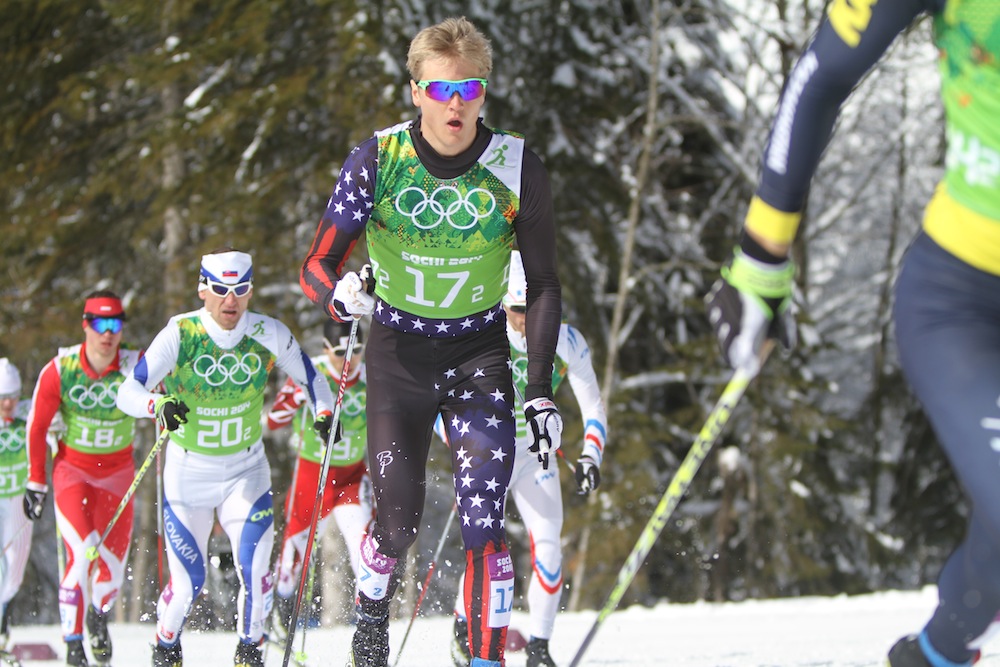
Noah Hoffman (U.S. Ski Team) racing to 35th in the 30 k skiathlon at the Olympics in Sochi, Russia.
As we all know, the COVID-19 global pandemic has left the world scrambling to adapt to the many challenges of slowing the spread of the virus. In the world of Olympic sports, the ripple effect has disrupted the efforts of anti-doping agencies worldwide to conduct the athlete testing normally relied upon to hold athletes accountable to abiding by the rules surrounding banned and controlled substances. Most international antidoping agencies have halted testing since mid-March as the invasive and close-contact nature of collecting samples posed a threat to both athletes and testers.
This causes concern that athletes inclined to cheat might abuse the situation, taking advantage of the opportunity to use illegal substances to improve their performance potential when competition is able to resume.
To address the lack of testing, the US Antidoping Agency (USADA) rolled out a pilot virtual testing program called Project Believe 2020 where athletes could provide a urine sample and blood spot test with an antidoping agent present on a zoom or FaceTime call.
For further insight into this topic, FasterSkier connected with two-time Olympian and long-time US Ski Team Member Noah Hoffman, who has become involved with USADA’s antidoping education program since retiring from skiing. Hoffman also recently wrapped up his second year at Brown University and we discuss his academic interests and the experience of being a college student during the COVID shutdown. Thanks for listening.
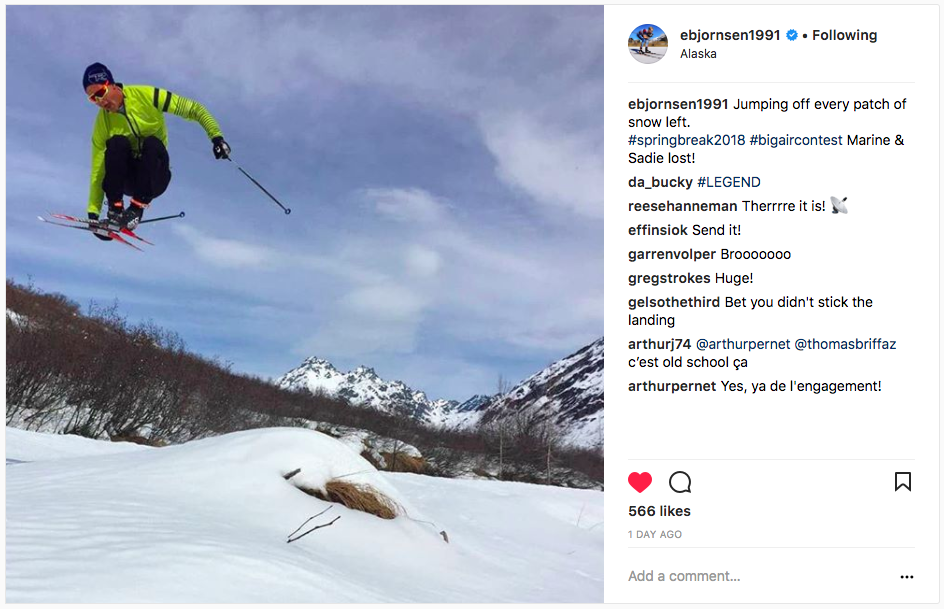
Erik Bjornsen crossing the line in the 2019 15 k skate pursuit in Ruka, Finland. (Photo: NordicFocus)
Bright lights in PyeongChang. The men’s second semifinal of the Olympic freestyle team sprint was a career highlight moment for Erik Bjornsen. Fourteen teams would crowd the start lanes with Martin Johnsrud Sundby in bib 1. The Norwegian was paired with Johannes Høsflot Klæbo: The duo blessed with Sundby’s stamina and his younger counterpart’s break-from-the-pack speed.
With Simi Hamilton racing the second, fourth, and sixth legs for the U.S., and Bjornsen leading off, the semi was a chance to not only advance to the finals, but establish some mojo amidst an Olympic field. Hamilton and Bjornsen both possess slower tempo big-power generating F-350 type motors that belie the meters gobbled up with each cycle of their cadence.
As Bjornsen was tagged for the fifth of six legs, he locked on to France and Norway to position himself in rarefied company. PyeongChang’s Alpensia sprint course packed a punch. The course’s second climb it’s Everest – a drawn out leg burner. Pulsing into that climb, France’s Maurice Manificat, Sundby, and Bjornsen had already separated from the field. Midway up, Bjornsen subtly shifted gears, moved to the left of Manificat, and dropped the two steely veterans by 10 and then 15 meters pushing over the top.
It was a Stars-and-Stripes flex.
Bjornsen tagged Hamilton in first by nearly five seconds. The pair went on to qualify for the final and placed sixth overall in an event eventually won by the Sundby-Klæbo pairing.
(Video of Bjornsen’s breakaway on the 5th leg.)
“It was interesting, I think that everybody knew what I was capable of in the field when I made those moves,” said Bjornsen when reflecting on career highlights. “I remember one of the strongest memories I have from racing is when I made that move against Sundby. And after the race, as we were starting the final in PyeongChang, he turned and looked at me for a while, and I could tell that he was thinking ‘what is this kid bringing to the final’? He eventually got the gold medal with Klæbo, and he is looking at this American guy, and I think that was one of the coolest feelings I have ever had — knowing that this legend was looking at me, and thinking, ‘what is this guy about to bring to the biggest performance of our lives?’”
The U.S. men’s team has been overshadowed by a dominant women’s program for going on a decade. Through that time, the men’s distance program has seen the end of Kris Freeman’s reign and the emergence of Noah Hoffman and Erik Bjornsen. Hoffman retired in 2018. With Bjornsen announcing his retirement last month at twenty-eight years old, a void remains. As one generation bleeds into the next, Bjornsen is an anchor point for all those speedy juniors we’ve heard of. An affable athlete who set the American distance skiing bar for the past five years.
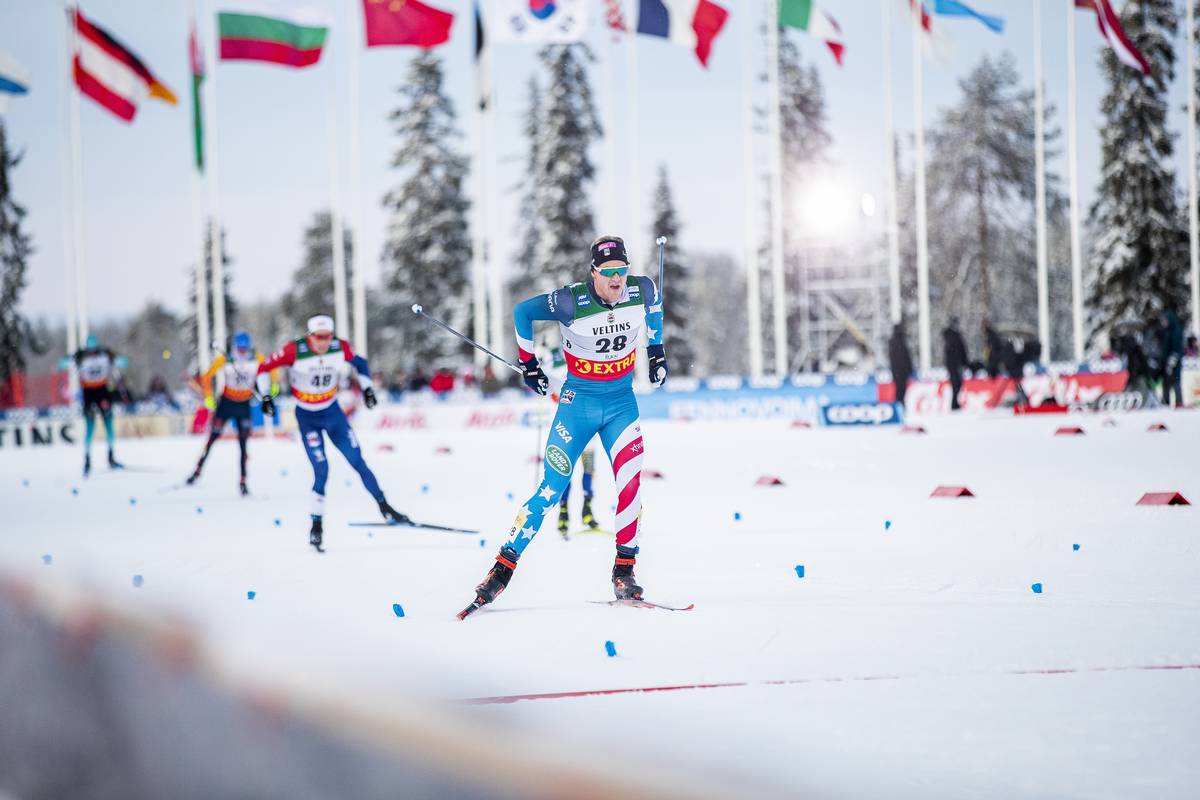
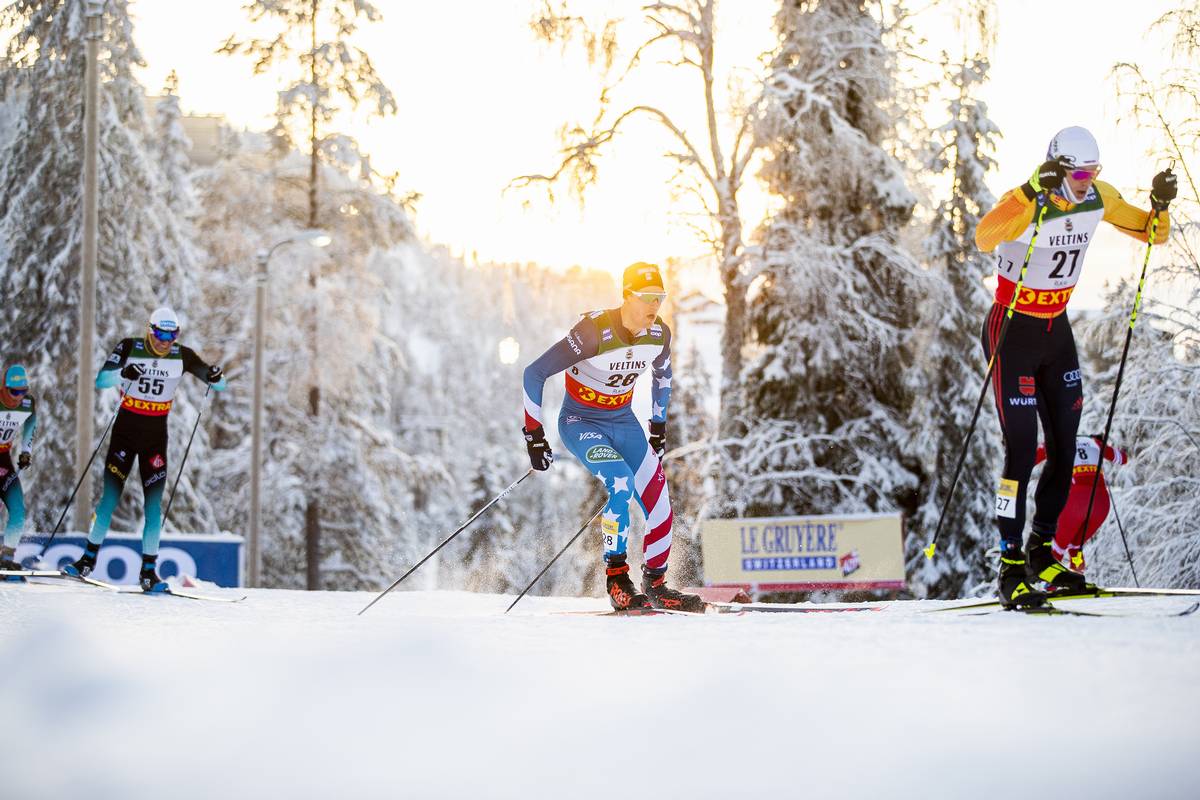
Erik Bjornsen of the U.S. (bib 28) during the 2019 15 k skate pursuit in Ruka, Finland. In bib 27, Sebastian Eisenlauer (GER) leads Bjornsen. (Photo: NordicFocus)
Bjornsen often shouldered the pressure for a team and broader community starved for that dominant distance performance by a U.S. male — a World Cup podium or a championship medal to validate the personal quest and the vicarious desire from some fixated on top-3 hardware. Making the top-30 on the men’s World Cup is a herculean task. Bjornsen first passed that threshold with an 18th place in 2014 during a 15 k classic (his marquee event), in Toblach, Italy.
In January 2018, he surpassed that 18th place, which up to then was a career best individual mark on the World Cup, with a ninth place in Seefeld’s 15 k mass start skate. He peaked individually at the World Championships with an 18th and 17th, respectively, in the 2017 and 2019 Worlds in the 15 k classic.
The manifestation of steady improvement was Bjornsen’s calculus for remaining in the game. And the wait and wait for results beyond his stream of top-30s and top-20s was arduous. Even on the best of days, all things must align for the breakthrough.
“Definitely, my last couple of years, I was really hungry for great results, like everybody that puts so much into the sport,” said Bjornsen. “I was ready to make that next level. But I was moving towards the end of time I wanted to put into the sport and I really wanted to make the progress every year that I knew what I was capable of. There are so many variables in nordic skiing that I was just frustrated not to put it together more on the days when it was so tough. My thing was 15 k classic — that is where I could put together a top performance. That’s four 15 k classics a season, you are trying for your top performance in those four or five and also nailing the wax and also nail everything on that day. So I am proud of the results that I had but I was frustrated like any World Cup athlete. I was just definitely hungry for more at the end.”
The World Cup came to an end for Bjornsen in December after he raced the opening weekends in Ruka, Finland, and Lillehammer, Norway. Yet, the decision to retire from World Cup level competition came after the 2018-2019 season if he did not, in his words, “step-up”.
After a solid summer of training, Bjornsen was blunt about his 2019-2020 World Cup campaign. “I am going over to the World Cup to make a step forward, or call it a career,” he said.
He placed 25th overall in the Ruka triple. The following weekend in Lillehammer’s 15 k/15 k skiathlon he had a reason for optimism. At the same venue with the same race format in 2017 Bjornsen had placed 20th. This year, he initially raced near the sharp end. But as the temps warmed a degree or two, his skis began to ice. He faded to 39th. The plug was pulled.
Bjornsen explained that U.S. World Cup regulars leave bags on the wax bus after each season, a stash of clothes and items to rely on when they arrive for the season each November. “I had left a bag over there basically for the last five or six years,” said Bjornsen. “On the last trip, I packed that one up. I didn’t know if I would be coming back.”
Having grown up skiing in Washington’s Methow Valley, Bjornsen followed the usual path of success: solid Junior Nationals, World Junior Teams, a second place in the 2011 U.S.Nationals 20-kilometer classic, and his first senior championship two years later in the 15 k skate. USST D-team, B-team, and then A-team. Although the family fostered two future Olympians, (you know this but older sister Sadie is a USST veteran) Bjornsen’s parents moved to the Methow when a new alpine ski area was in the works. As luck would have it, the planned downhill area never materialized.
Erik Bjornsen (APU/USST) and Matt Gelso (SVSEF) headed up Hermod’s Hill for the final time at the end of the 15 k freestyle at the 2013 U.S. Nationals. Bjornsen took his first career national title and Gelso finished third.
The Bjornsens live on the more secluded Mazama end of the Methow. Mazama sits at the base of a closed-in-winter State Highway 20 which snakes its way up to Washington Pass and alpine paradise. Drive any direction but south in the winter from Mazama and it’s a snowy dead end. One road during those cold months serves as a diversion into Winthrop and further south to Twisp. The region’s storied cross-country trails provided another outlet. Within walking distance of Bjornsen’s neighborhood were endless ski trails and families falling in love over and over again with the sport. Sean and Laura McCabe and Leslie Hall (Laura McCabe and Hall are former USST members) lived nearby and were constant reminders that sliding on snow without a gravity assist had merits.
With his two older sisters, the Bjornsens joined the local ski club. It was a steady stream of hand me downs terminating at Erik. As Bjornsen became more serious, he relied on Scott Johnston as his primary coach. Johnston is known as fastidious and established a serious training regime for Bjornsen.
“I learned a lot from him,” said Bjornsen. “He took the time to explain everything about skiing and also the physiology side of things. I started to understand the ways of training and training plans. He brought my curiosity out and made me think about each and every workout.”
By the time Bjornsen was in his late teens, Sadie had moved to Anchorage to ski race as a student-athlete for the University of Anchorage Alaska (UAA). When it came time for a post-high school decision in 2010, Erik chose to attend UAA too. Both Bjornsens ultimately aborted their UAA paths after earning NCAA All-American status and began taking opportunities on the World Cup as they trained with APU. APU, an emerging powerhouse team, was coached by Erik Flora and championed by Anchorage’s Kikkan Randall.
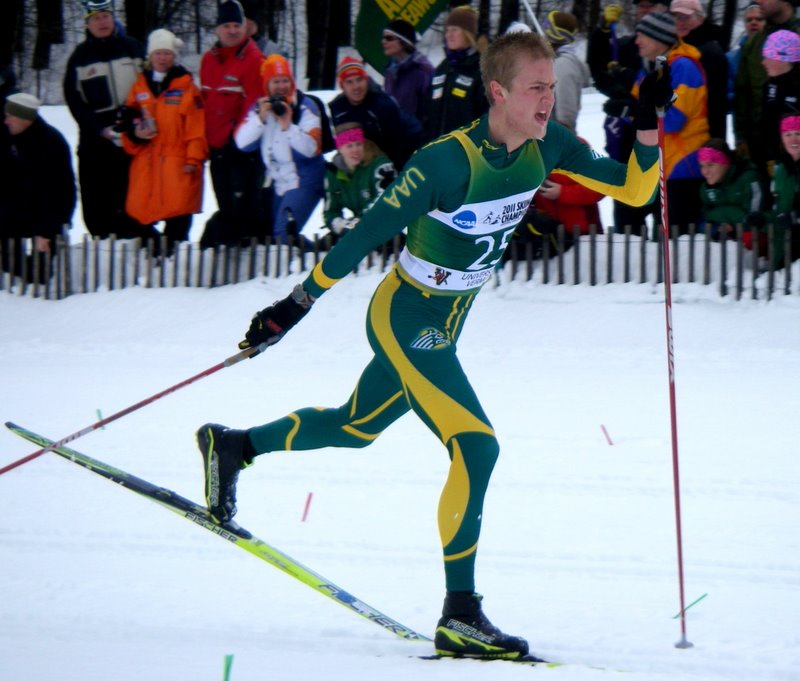
Erik Bjornsen on his way to second at the 2011 NCAAs in Stowe, VT.
With a cohesive training group at APU and the steadiness of Flora, both Bjornsens blossomed. Erik earned his first World Cup start on Dec. 7, 2012 in Québec. A few days later in Canmore, he popped a 36th place in the 15 k classic. Along the way, he won six national championships and was a member of the U.S. Ski Team for seven years.
“When Erik first came in, I could see this young, talented skier that was excited about skiing, and he really enjoyed racing,” said APU’s Flora. “And when he first came in, I thought, Okay, if I can help him with his training, and help him reach the next level in fitness, that seemed like an opportunity that was an easy one to help him get toward his goals. And as he retires, you know, there was a certain point where Erik went from being in a place where talking about daily training was constructive, to where Erik absorbed all of that over the years, to the point where Erik knew how he wanted to train, and he had the foundation for it.”
During the later part of his career, Bjornsen had enough know-how and self-knowledge to write his own training plans with the occasional check in or hands-on training session with Flora.
Bjornsen imprinted the cycle in his muscle memory. He attended USST camps, looped around on the Eagle Glacier during the summer, and locked in for a lengthy stint as a World Cup regular. The bag he eventually snagged off the wax bus this past December was left in Europe for five seasons or so, during which he raced at two Olympics and four World Championships.
Erik Bjornsen (APU) during the 2020 U.S. Nationals men’s 15 k skate. (Photo: Reese Brown)
At the 2014 Olympics, Bjornsen contested five of six events as the youngest member of the team at 22 years old. Sochi was a time he recalls fondly not so much for a “media-worthy” result, but for the pure novelty of it. Big eyes. The Olympic rings. An international career yet to unfold. “It was just so fun, everything around it was great,” said Bjornsen.
What was also great were the Hamilton-Bjornsen prospects in the team sprint. It’s one thing to prognosticate and imagine a team sprint medal on the men’s side. On paper and on snow this was no pipe dream. Other teams had the luxury of mixing and matching athletes over the years. When sprinting three laps, a total of roughly 4.5 k full tilt, the combo of stamina and 100 meter close out speed is rare. Deep teams can play around, shuffle a deck, optimize for those parameters when naming a team sprint duo. Someone falls ill, insert A for B. Someone has an off year, change X for Y.
For Hamilton and Bjornsen, the USST was all in. Sixth in Sochi. Sixth in PyeongChang. Fifth at the 2017 World Championships. Better than coming close, these two provoked legitimate medal hope. And better, the two were good friends. They were not simply two speedy specimens tolerating one another for a material outcome.
Walking through the mixed zone in PyeongChang after their finals, on a night when Jessie Diggins and Kikkan Randall won a historic gold 30 minutes prior, Hamilton and Bjornsen were consummate pros. There’s was a no-bullshit interview post-race. In tight quarter racing, Bjornsen had tumbled during the second leg after tripping on another skier’s tails. A tough-to-rebound-from-mishap on the tightrope of Olympic sprinting.
“It was super disappointing when I went down, but I mean, it was only halfway through the race and I just got up, and that’s for sure not going to be the end of it for us today,” Bjornsen said to FasterSkier at the time. “Unfortunately, I kind of felt like I let the team down there a bit. I think that was one mistake that may have made a huge impact on our race today, but you know, that’s ski racing, that’s the way it goes sometimes. Unfortunately, it’s at the Olympics.”
Hamilton immediately responded by focusing on the asset that is Bjornsen.
“In absolutely no way did Erik let any of us down, especially me,” Hamilton said. “I watched that on the big screen, I have been at a lot of team sprints on the World Cup, World Champs, Olympics, that always happens to someone, and 99 percent of the time, that person, especially if it’s in the finals, just gives up, whether it’s the first leg, second leg, third leg, they just give up. And Erik, he never does that, no matter what happens to him, what happens to us, he just fights ’til the absolute very end.”
The U.S. team for the men’s 4 x 7.5 k relay in Beitostølen, Norway (2018). From left to right, Erik Bjornsen, Simi Hamilton, Scott Patterson, and Kevin Bolger. (Photo: Aleks Tangen)
This was, as Hamilton and Bjornsen knew, their best career opportunity for a hallmark medal. They both made eye contact with reporters — their disappointment palpable. This was clear: The two men had a deep bond forged over countless laughs and near misses. More than anything, the two could trust one another to bring their best.
“It’s hard to put into words the impact that Erik not only had on our team, our program, and XC skiing in general over the years, but also the impact that he had on me as my teammate and my friend,” Hamilton emailed when asked about Bjornsen’s retirement. “He grew to become one of my closest friends and I’m confident we’ll remain as such for the rest of our lives. Within the team, Erik defined what it meant to be a genuinely supportive teammate and he was the first person to celebrate any success that someone within our group had. His unwavering selflessness was evident as he always put his teammates, our coaches, and the staff before himself. I think in a way his successes and accomplishments went very much unnoticed because being genuinely happy and supportive of everyone around him always came before the desire to highlight his own results and market his own extraordinary talents. I’ve never laughed harder after hearing some of his witty remarks and jokes over the years and he always lent a tone of humor to any situation, no matter how serious everyone else was taking themselves. I’m grateful for so much that ski racing has given me over the years, but being on the team with Erik lands close to the top of the list of things I’m most grateful for.”
Erik Bjornsen (USA) racing in the semifinals of the 2014 Olympic team sprint.
It’s also hard to imagine that a force such as Bjornsen would have successes and accomplishments go unnoticed. Such is the atmosphere of quick turnaround news cycles amidst the backdrop of a national women’s team setting an incomprehensibly high watermark of podiums weekend after weekend.
“You have to understand, it is like getting beat up over there if you are not achieving what you know you are capable of,” Sadie Bjornsen mused. “Erik has put in a lot of time doing so. I believe Erik is a top-10 World Cup racer. I don’t just believe it, I actually know it.
“But, in order to achieve that, I don’t want to say it is different in the men’s than the women’s field, but the men, it is to me, just a little more thick on the top. When I have an off day I am generally in the 20s. When I have an on day, I am in the top-10. It is a lot less fun when you have an off day and you are in the 50s or 60s and you have an on day and you can be top-10. That is a big difference.”
Sadie said her respect for Erik stemmed from his investment in a plan and holding himself accountable to it. “I really respected his confidence in that plan. What it showed me is that he believes in himself and he knows what he is capable of. He did not think of himself as a 50th place racer, he thought of himself as better. At the end of day, if someone achieves that confidence, that is huge.”
With Bjornsen’s departure from the team in December, he set forth to race several marquee domestic skate marathons. Although it afforded North American based skiers a chance to toe the line with a generational talent, for Bjornsen it was an opportunity to touch base with the many friends he had connected with during his years as a ski racer. Call it an unofficial retirement tour.
Bjornsen said he didn’t come into the races expecting to win since he had modified his training to savor simple on-snow moments. He emphatically claimed that this past winter had been one of his most “fun” yet.
There’s a prevailing mythos in sport: The peak performance, like Bjornsen dropping Sundby and Manificat, are the highlight reel’s apogee. Those instances all have their place. They send chills. But what about the 99.9 percent of the time when that person was off-stage, not performing? That matters.
“Thinking about this, an athlete like Erik retiring makes your chest kind of heave,” Matt Whitcomb, the U.S. Ski Team’s Head Coach said. “You are trying to suppress emotions because he has been such an important part of my life as a coach. He is one of those people that makes being a coach so great. Makes these 120 consecutive days on the road tolerable because he is such a great guy. … He is the kind of the guy that has your back and everybody needs people like him.”
Lightness and humility are attributes many peers associate with Bjornsen. He was, according to Sadie, unequivocally as much a support mechanism for her as she was for him. The shoulder to lean on tilted in both directions. Outside his immediate family, Erik’s even keeled perspective became an integral piece of the U.S. Ski Team’s European based unit.
Sadie Bjornsen and her younger brother Erik in 2013 after winning an Alaska Pacific University time trial earlier this month at Hatcher Pass near Anchorage, Alaska. (Photo: Courtsey Sadie Bjornsen)
“The role Erik played on the team is easily overlooked,” said Sadie. “We can never talk about it enough. We got a breath of it without Erik the rest of this past winter. That position was really missed. That person who is always enthusiastic, always positive, always having a game, making light of everything. Erik took on that role really young, he was not going to hide anything. He was going to admit when he was struggling or whatever it was. That is a talent when spending four and a half months on the road. That is a long time. It is your family that you are living with, and it is difficult to maintain a positive outlook all the time.”
There was no bitterness in Erik Bjornsen’s statements or tone when we spoke. He seemed ready with open arms for his next chapter. He did, however, mention a teaser of a thought experiment. “It would have been, at times, super fun to have Kris Freeman at his peak come around 10 years later and I could have skied alongside him. That would have been sweet. We could have pushed each other well.”
We can all imagine the mutually beneficial pacing that may have developed. The mentioning of Freeman was only a fleeting whiff of a “what if” moment. The rest, his thoughts of the World Cup, his training principles, his discussion of not meeting some of his expectations, seemed rooted in the past just months after stepping away from the life he’s known since his teens.
“It would have been fun to be racing on the podium,” said Bjornsen. “But one thing I noticed just from watching my sister so closely, is I don’t think you get any more happiness. I always really enjoyed racing and being over there even though maybe her results were 10 to 15 places on average higher than mine. It really doesn’t make any difference except maybe a bit financially. In the end, I got as much joy out of it than a guy that would have been on the World Cup podium.”
Erik Bjornsen – 2016 vintage classic skiing powerhouse. (Photo: NordicFocus)
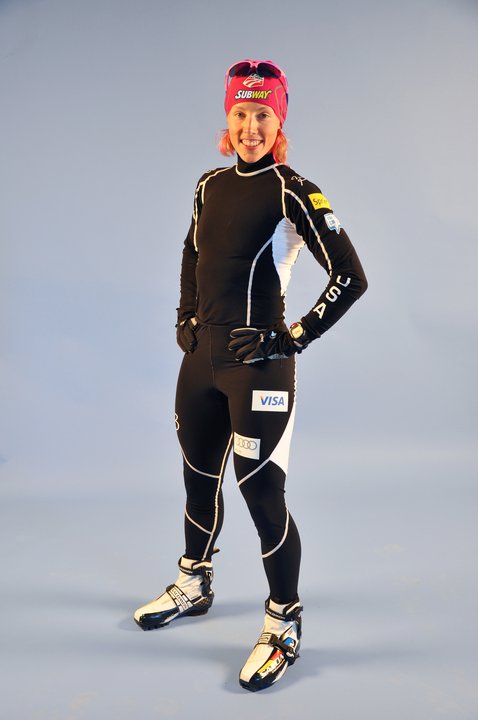
From October 2010: Kikkan Randall modeling the U.S. Ski Team suit for the 2010-2011 season. Photo courtesy of the U.S. Ski and Snowboard Association.
A national team uniform for cross-country skiing has to do a lot of things. At the most utilitarian level, it has to wick sweat and aid performance while an athlete pursues one of the world’s most demanding sports at temperatures between –4 F and 40, in steady snow or driving rain or anything in between. At the functional level, it has to let spectators and coaches identify where their athlete is out on the course, while distinguishing them from athletes from other countries. And at the symbolic level, it lets the athlete know that he or she is competing on behalf of their country, for everything that that means. Ask a skier who has represented the United States in international competition what it meant to them to pull on a national uniform for the first time. They’ll probably be able to tell you.
(And if they ever forget, this detailing from Craft and L.L. Bean on the American uniforms, ca. 2015/2016, is there to remind them. “You are representing the United States of America,” a slogan intones, above a martial-looking eagle, with a U.S. Ski Team master mark for its aegis, gripping an olive branch (?) in its dexter claw and a skis and ski poles fasces in its sinister. “Pretty fun to be representing an American brand with our American uniforms!,” wrote Sadie Bjornsen in a blog post describing the uniforming process.)
For whatever reason, the period roughly one decade ago represented the highwater mark for domestic and global coverage of ski uniforms on this website. There was “US Ski Team Brings Suit Consistency,” from Jan. 2009 (lede: “After years of a remarkable level of wardrobe schizophrenia, the US Ski Team has ushered in a new era of racing suit consistency that should make it easier to follow our favorite US athletes on the race course.”); “The costume disciplinarian speaks: Is it better to look good than to ski fast?” from July 2009; “The Best and Worst (Suits) of the Olympics,” from Feb. 2010; and “USST Goes Black for 2010-2011,” from Oct. 2010 (lede: “In the sport of cross-country skiing, most people would agree that competing with New Zealand is probably smarter than picking a fight with Norway.”).
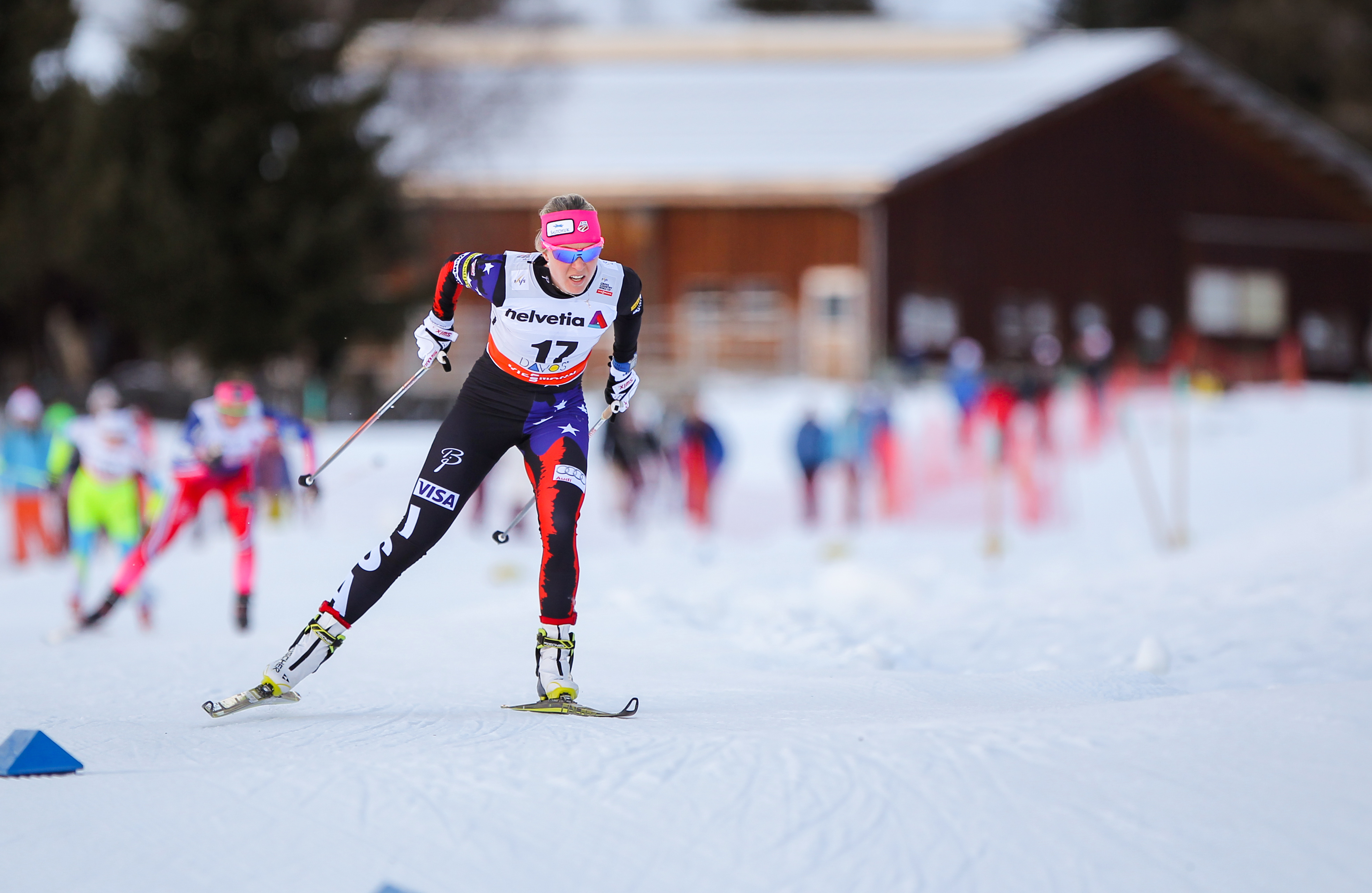
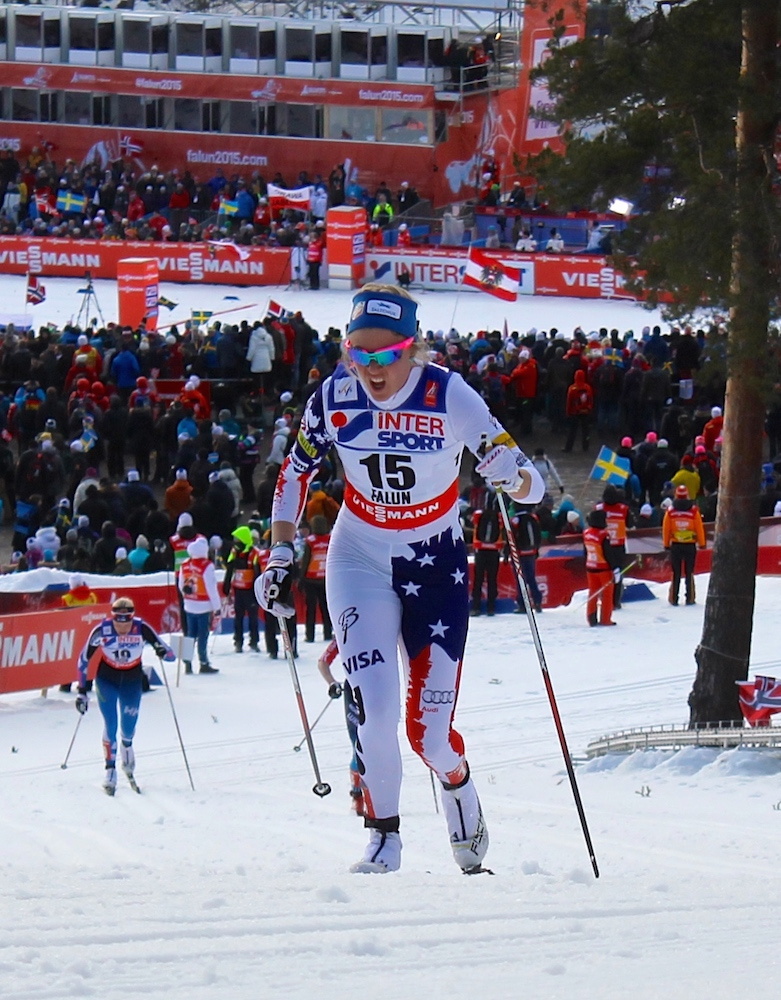
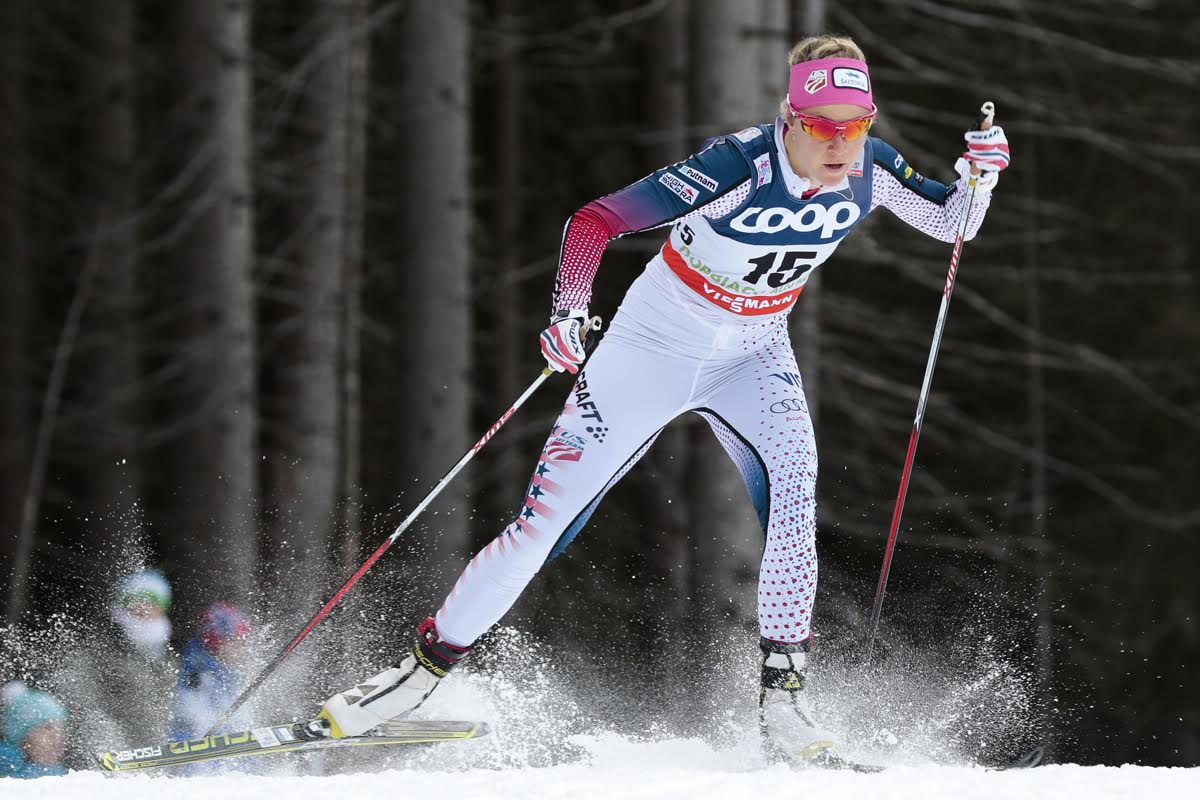
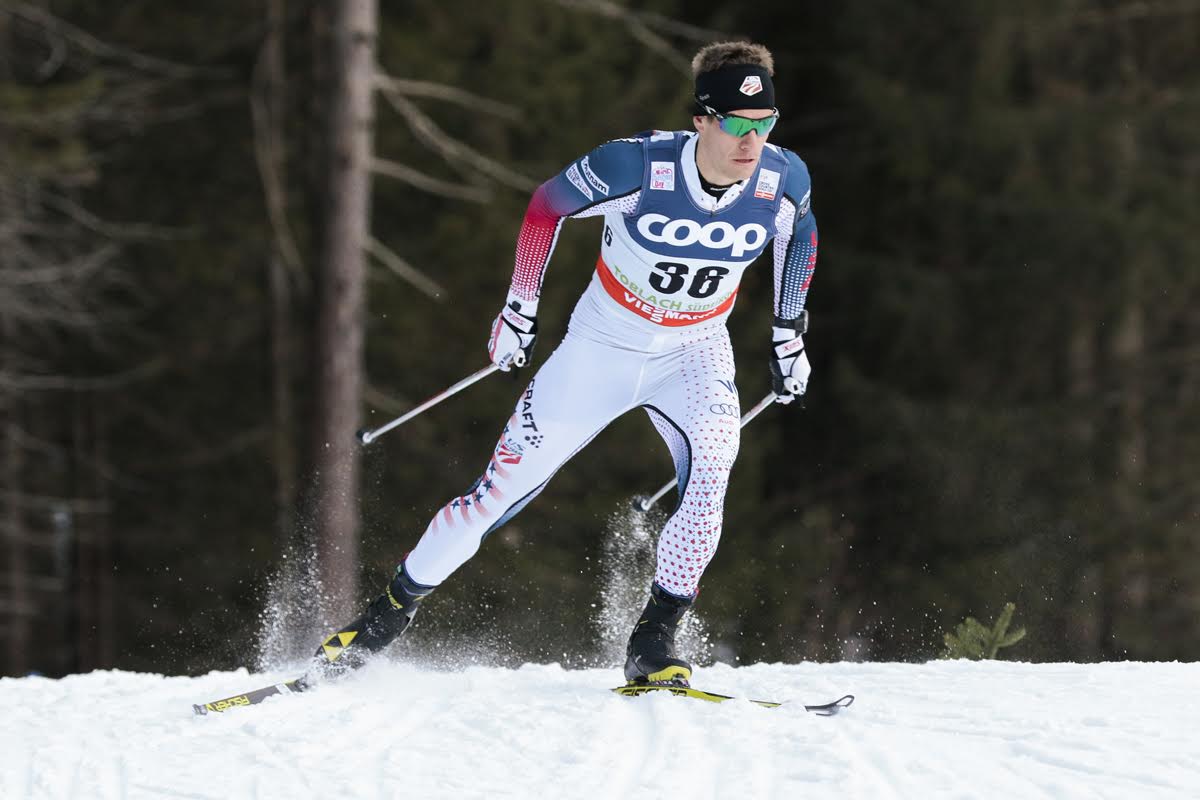
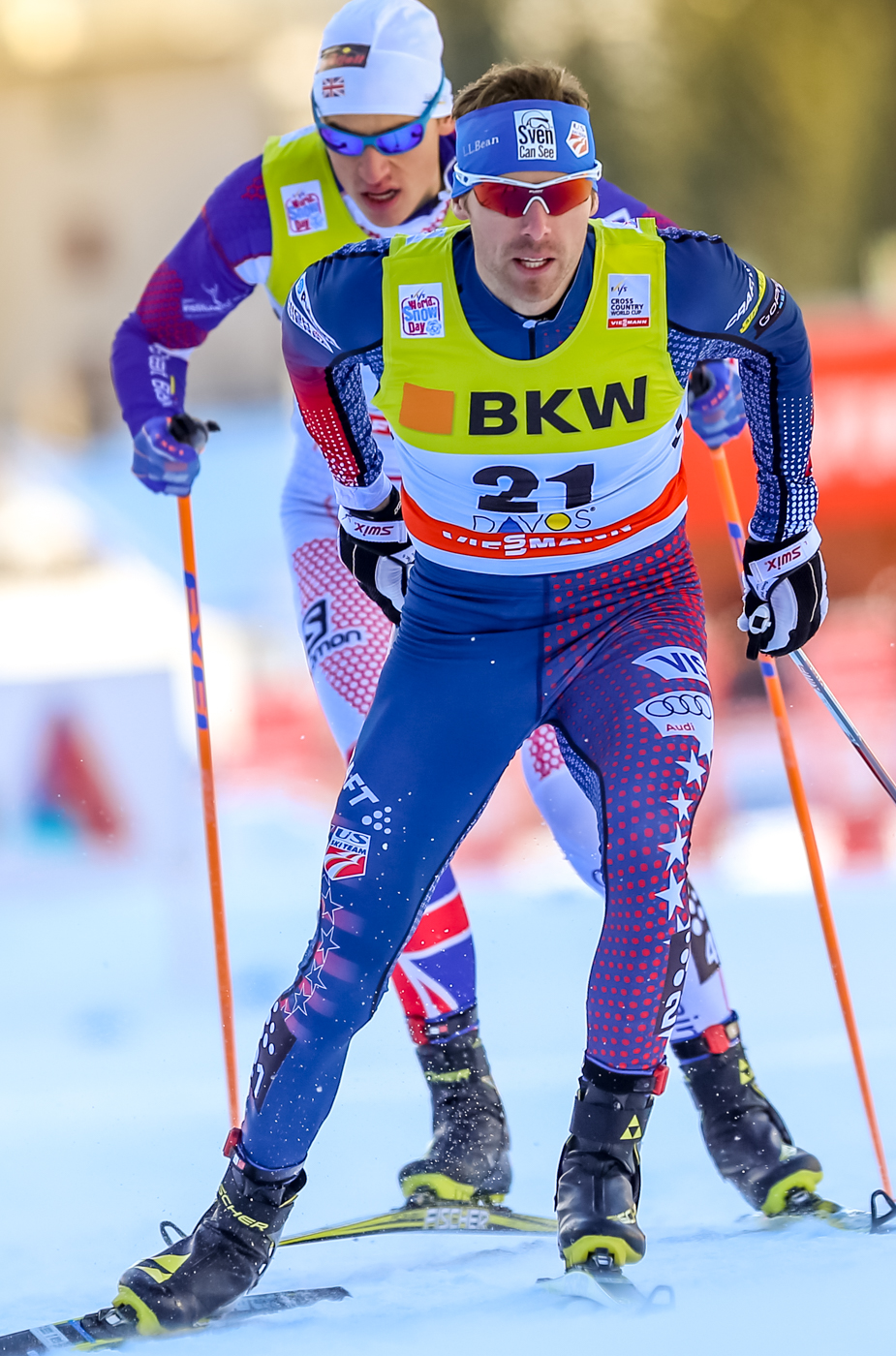
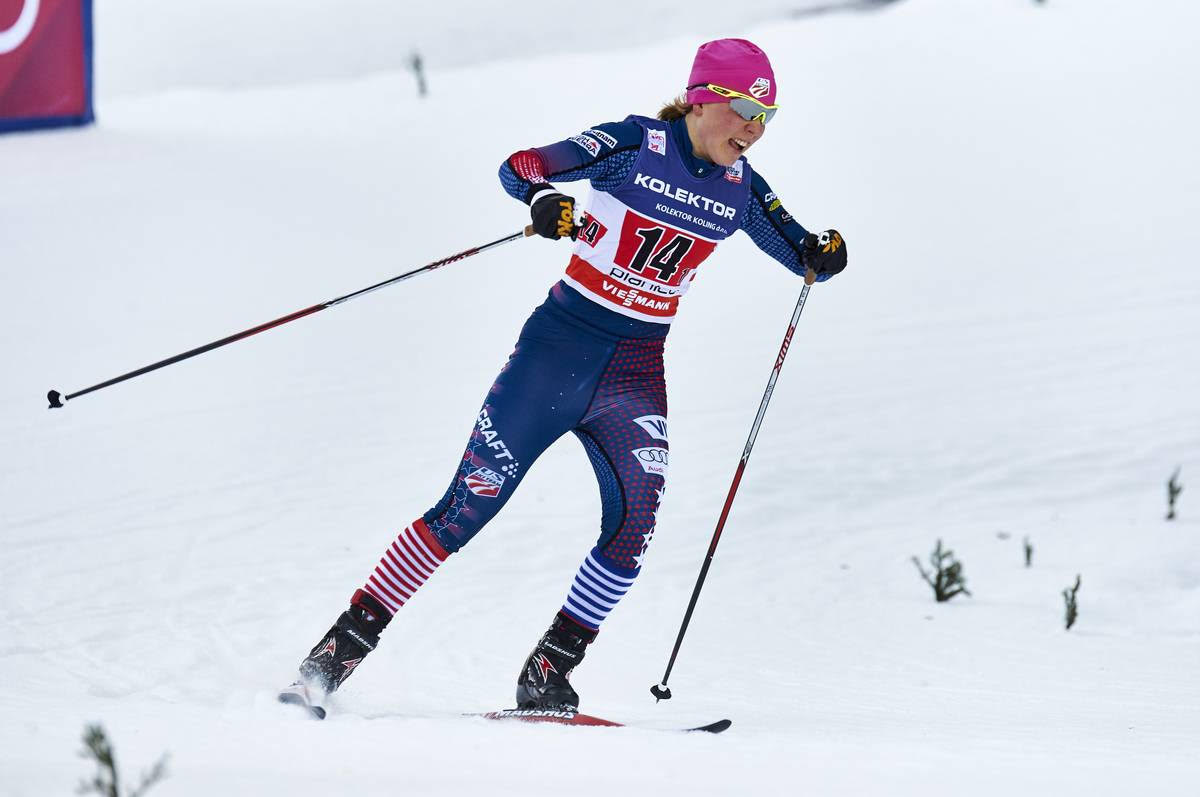
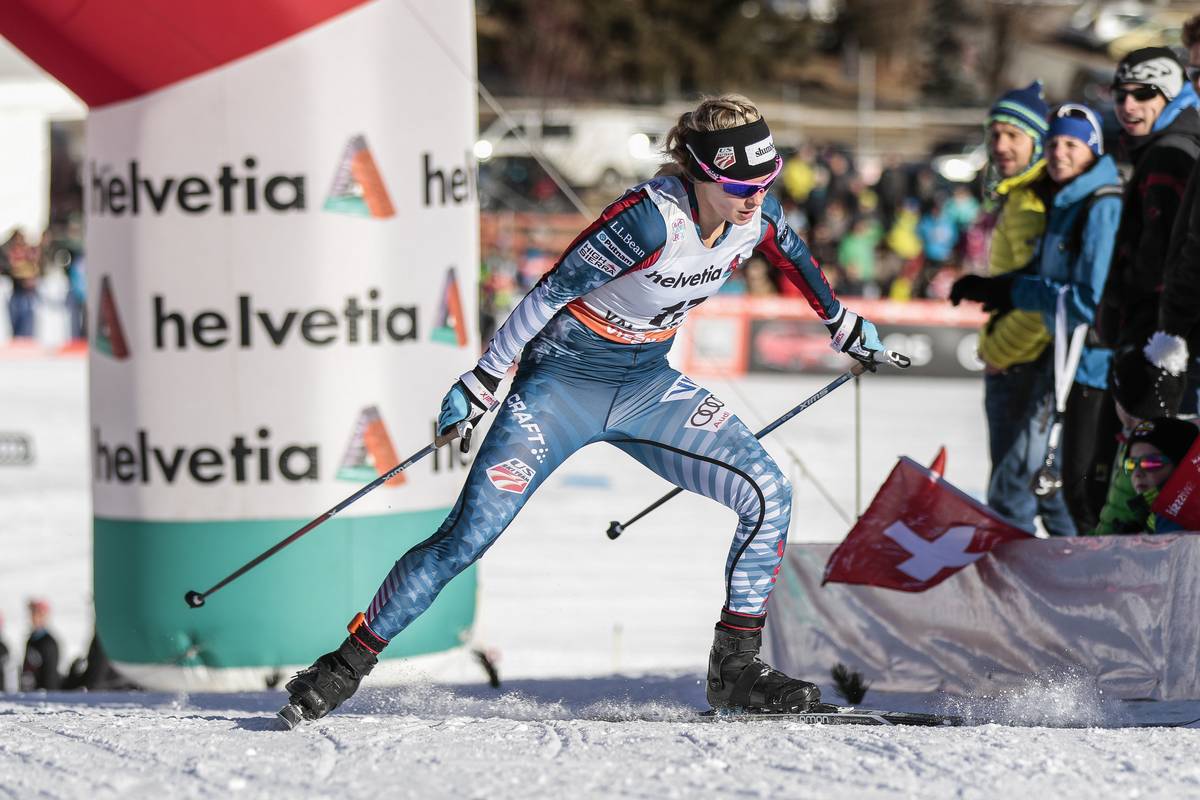
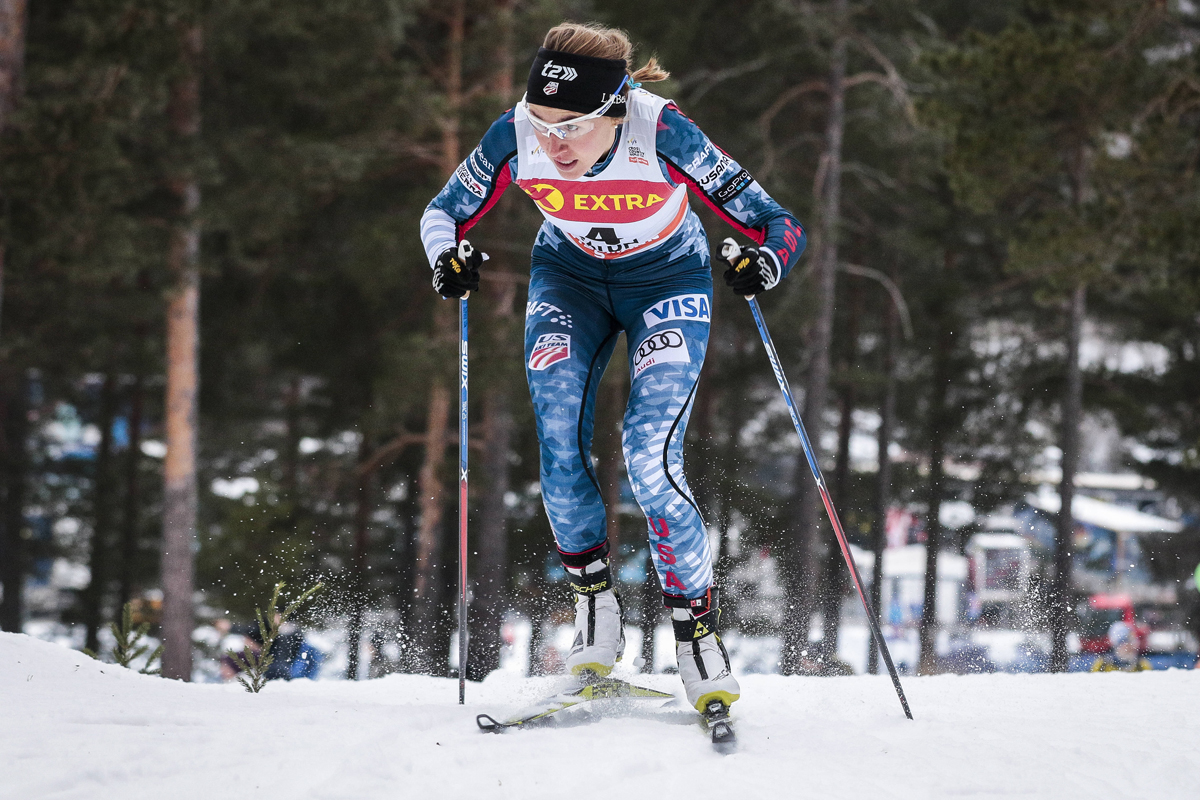
So it seems to have been nearly 10 years since the last sustained attention to the uniforms of the Davis U.S. Cross Country National Team Program (néeU.S. Ski Team). To fill that gap, FasterSkier hereby presents A Visual History of the United States Ski Team National Team Uniform, 2008–2019.
(Why 2008 for the starting point? Mostly for the simple logistical reason that the image library in the current FasterSkier content management system, WordPress, only goes back to 2008, so this article can be written while using only images that FasterSkier may legitimately post on this site. To go back to closer to the start of this century would require a lot of external links to Getty Images and not that many photos to actually look at on this website. That said, this piece from 2009 has a nice visual roundup of the plethora of different USST designs worn from 2006–2008, which takes you back two more years. Before that, well, just imagine Kikkan Randall and a lot of other skiers you probably haven’t thought about for a while — Wendy Wagner, anyone? Rebecca Dussault? Sarah Konrad? — wearing various iterations of early-aughts red and black.)
2008/2009 World Cup season: Red
January 2009: No question who is from the US here… Kikkan Randall in the women’s Team Sprint in Whistler
January 2009: Kris Freeman preferred the orange to silver in the men’s pursuit
As a contemporary uniform article explained, “There are currently two suit variations being used by US Ski Team athletes, and athletes racing for the US in international events. They are so similar, that for practical purposes (identifying US skiers in a race) they may as well be the same. Both suits are predominantly red, with one version having patches of orange, and the other silver.” Both were manufactured by Norwegian company Bjørn Dæhlie.
There appears to have been no change to the basic World Cup design for the 2009 World Championships in Liberec, Czech Republic:
Freeman at the 2009 World Championships in Liberec. (Photo: Swix Sport)
2009/2010: Still red Bjørn Dæhlie
November 2009: Tazlina Mannix (APU, USST) racing in West Yellowstone.
November 2009: A very young Noah Hoffman (USST) racing to 3rd in a distance race in West Yellowstone.
Honorable mention, domestic suits division:
November 2009: This is a very orange suit. Kevin Hochtl (Rossignol) – 32nd – leads Anders Haugen (APU) – 7th – to the finish in a West Yellowstone race.
November 2009: This is one hell of an ibex. Chris Cook (Steinbock Racing) – 12th – sporting the new Steinbock Racing uniform
2010 Winter Olympics, Vancouver: Red and silver
For the Olympics, the Americans appear to have taken their World Cup template – Bjørn Dæhlie suit, largely red – but have changed it by, inter alia, lightening the shade of red, adding “USA” on the right arm and left leg, adding silver accents, and of course removing all sponsor logos. Kikkan, already skiing in her third Olympics, coordinated with a red headband, red gloves, and her famous pink highlights. Andy Newell went with the red hat (he may not have had a choice), but was otherwise somewhat less vermilion.
Feb. 2010: Kikkan RandallFeb. 2010: Andy Newell on the big climb during the men’s 4 x 10 k relay.
There was a lot of red in Vancouver. For example, here’s Andy Newell (far left, bib no. 13-2) tagging Korin Koos for the U.S. in the team sprint, while Petter Northug (far right, bib no. 2-2) tags Øystein Pettersen (middle right, bib no. 2-1) for Norway. (An entire standalone article could likely be written on the Canadians’ infamous kit (bib no. 4, back right).)
Newell tags Koos (left) and Northug tags Pettersen (right) at the 2010 Vancoulver Olympics.
Or here’s Newell in the middle, between Switzerland’s Dario Cologna (bib no. 12) and Yuichi Onda of Japan (bib no. 18):
Newell in the semis of the skate sprint: 2010 Vancouver Olympics.
Finally, Poland (shown here: Sylwia Jaśkowiec, bib no. 6) was just red:
Poland 2, 2010 Vancouver Olympics.
2010/2011: The black era begins
Perhaps as a natural reaction to the dominance of a single color across multiple nations, the U.S. made a significant shift for the 2010/2011 World Cup season: black. The color does not appear on the national flag or in other common American iconography, but it is certainly distinctive. Bjørn Dæhlie remained the suit manufacturer.
Or, as then-FasterSkier reporter Nat Herz wrote in fall 2010, “After any number of years of being drowned out by a sea of Norwegian crimson, U.S. Ski and Snowboard Association Nordic Director John Farra said that the USST will be ‘distinctly not red’ for the 2010-2011 season—including at World Championships in Oslo. ‘We went in a very different direction, in part from our experience in Oslo, where they [Norway] have a nation’s group of ten, and we can barely see our athletes in the group,’ he said.”
January 2011: A 21-year-old Sadie Bjornsen races to 17th at U23 World Championships in Otepää, Estonia.
January 2011: Jessie Diggins, then aged 19, races to 7th at Junior World Championships in Otepää.
January 2011: Noah Hoffman at a SuperTour race in Lake Placid.
February 2011: No change for World Champs: Kikkan Randall racing at 2011 World Championships in Oslo.
2011/2012: Still black Bjørn Dæhlie
December 2011: Kikkan Randall sprinting during the Tour de Ski.
March 2012: Kris Freeman (SSCV/USST) on his way to claiming the US Distance Nationals 50 k freestyle title on Saturday morning in Craftsbury.
2012/2013: Still black
December 2012: Noah Hoffman in the Tour de Ski.
December 2012: Kikkan Randall blasting to victory in the Tour de Ski opening prologue on Saturday. She skied to 14th in the pursuit on Sunday and is leading the U.S. women in the Tour de Ski standings after two stages. Photo: Marcel Hilger.
February 2013: Diggins and Randall won gold in the team sprint at 2013 World Championships in Val di Fiemme, Italy, which was awesome, but, for purposes of this article, mostly relevant for the addition of the epochal relay socks but otherwise no change to the standard World Cup uniform.
2013/2014: Yup, still black
December 2013: Liz Stephen (U.S. Ski Team) on her way to 34th in Saturday’s 3 k freestyle prologue at the first stage of the Tour de Ski in Oberhof, Germany. (Photo: Marcel Hilger)
December 2013: Andy Newell (U.S. Ski Team) qualified 12th and finished 10th overall in Sunday’s freestyle sprint. (Photo: Marcel Hilger)
2014 Winter Olympics, Sochi: Stars and stripes
The 2014 Winter Olympics, in Sochi, Russia, were known at the time for Kikkan Randall’s disappointing result in the individual skate sprint, and after the fact for the revelation that Russia was engaged in a massive state-sponsored doping scheme and cover-up. They were also significant for a change in uniforms: stars and stripes on the right arm and left leg, and a large “USA” on the right leg. The left arm was relatively plain. Also, several of the U.S. women drew attention for racing sleeveless in warm temperatures. Bjørn Dæhlie continued to be the brand logo featured on the upper right quad. (Pictured below: Noah Hoffman, in a solo race, and Sadie Bjornsen, in the women’s relay.)
2014/2015: Stars and stripes redux
Athletes took to the trails next season with a slightly modified version of the recent Olympics uniform: Larger stars on the left upper quad, with a deeper blue background. The stripes on the left leg became more pronounced and stretched farther up the race suit, to above the knee. Also, once the non-commercial period of the Olympics had passed, there was space for sponsor patches on the arms and legs.
December 2014: Caitlin Gregg (Team Gregg) skiing to 56th place in the Davos World Cup 10 k classic, Dec. 13. (Photo: Toko)
USST’s Sadie Bjornsen racing to 29th in the Davos World Cup 10 freestyle, Dec. 20, 2014. (Photo: Fischer/Nordic Focus)
World Championships, in Falun, Sweden, brought a mostly-white version of the uniform, helpful for the warm temperatures and soupy conditions that characterized many of the races. Here’s Sadie Bjornsen in Falun in February 2015:
2015/2016: Red, white, and blue
By fall 2015, the move away from black, and towards red, white, and blue, was complete. Athletes now had the option of being attired in a predominantly white color scheme, which would aid in preventing overheating on warm days, while thankfully solving the transparency issues that had plagued recent all-white suits for Sweden or Italy. An alternate version had roughly the same patterning, but with blue as the primary color. Notably, the Americans also moved to a race suit manufactured by the Swedish company Craft for the first time in this survey.
December 2015: Sadie Bjornsen (U.S. Ski Team) racing to her best-ever sprint qualifier in sixth at the World Cup freestyle sprint in Toblach, Italy. She went on to make the semifinals and place 10th overall. (Photo: Fischer/NordicFocus)
December 2015: Simi Hamilton (U.S. Ski Team) racing to his first non-stage World Cup podium on Saturday in Toblach, Italy, where he placed second in the freestyle sprint. (Photo: Fischer/NordicFocus)
December 2015: American Andy Newell (r) and Great Britain’s Andrew Young (c) trail Norway’s Håvard Solås Taugbøl (2) in the quarterfinal at the Davos World Cup freestyle sprint on Sunday in Switzerland. Taugbøl won the heat, Young placed third, and Newell was fifth after missing out on a photo finish for fourth. Newell finished the day 23rd overall. (Photo: Marcel Hilger)
January 2016: Ida Sargent (U.S. Ski Team) teamed up with Sophie Caldwell (not shown) to place fifth in the 6 x 1.2 k freestyle team sprint at the World Cup in Planica, Slovenia. (Photo: Madshus/NordicFocus)
Honorable mention: Trending towards “purple cobras” for American biathlon but not there yet.
American Claire Waichler started 58th and finished 33rd in the youth women’s pursuit on Sunday at IBU Youth/Junior World Championships in Cheile Gradistei, Romania. (Photo: IBU YJWCH Cheile Gradistei 2016/Facebook)
2016/2017: More red, white, and blue
An interpretation of red, white, and blue, still on a Craft suit, remained in place for the 2016/2017 World Cup season, which was marked within the team by Randall and her husband, Jeff Ellis, traveling the European race circuit with a newborn in tow. The changes to the USST uniform were less dramatic than Randall’s familial status: Still red, white, and blue, though now with blue as the dominant color. The entire left leg, and the bottom half of the right leg, had markings, somewhere between subtle striations and full-on stripes, that evoked the stripes of the American flag. (Let’s put aside for the moment the fact that the stripes on the actual flag are white and red, not white and blue.) The pattern was repeated on the lower right arm. An understated evocation of blue or white stars marked both lower legs, with more pronounced stars scattered around the bottom of the torso (possibly the top as well, but nearly all of one’s torso is typically covered by the standard race bib). The left arm and left leg both proclaimed “USA” in red lettering.
The vehicular logo on the legs remained that of Audi, as it had been since the start of this history.
There appears to have been no change for the 2017 World Championships. At least to the uniforms; on the race course, the Americans won an unprecedented three medals.
December 2016: Jessie Diggins (U.S. Ski Team) racing to ninth in Saturday’s 1.5 k freestyle sprint qualifier in Val Müstair, Switzerland. Diggins went on to place sixth in the final. (Photo: Salomon/NordicFocus)
January 2017: Sophie Caldwell (U.S. Ski Team) racing to third in the qualifier of Saturday’s 1.4 k freestyle sprint in Falun, Sweden. She went on to finish 16th overall (Photo: Fischer/NordicFocus)
February 2017: Kikkan Randall (U.S. Ski Team) racing to 26th in the women’s 10-kilometer classic individual start at the 2017 Nordic World Championships on Tuesday in Lahti, Finland (Photo: John Lazenby/Lazenbyphoto.com)
Meanwhile, biathlon saw the advent of the beloved “purple cobras” era:
US Biathlon’s Susan Dunklee on her way to finishing third in the women’s sprint at the IBU World Cup in Nove Mesto, Czech Republic. It was the third podium of her career. (Photo: IBU)
2017/2018: Red, white, and blue redux
There appears to have been no change for the 2017/2018 World Cup season: still red, white, and blue, but mostly blue, on a Craft suit. The most notable change may have been to the car sponsor… for the first time since at least the scope of this article, a Toyota logo was on the leg, not Audi. Nichts ist unmöglich (“Nothing is impossible”), as the company’s European slogan proclaims.
American Andy Newell racing the men’s 1.5 k freestyle-sprint qualifier at Stage 1 of the Tour de Ski on Saturday in Lenzerheide, Switzerland. He qualified 20th and went on to finish 19th overall. (Photo: Fischer/Nordic Focus)
Caitlin Patterson (Craftsbury Green Racing Project) racing to 52nd in the freestyle sprint qualifier at the last World Cup on Jan. 27 in Seefeld, Austria. The next day, she placed 23rd in the 10 k freestyle mass start. (Photo: Fischer/NordicFocus)
2018 Winter Olympics, Pyeonchang: Red, white, and blue, and a lot of stripes
There is a somewhat famous picture from the 2018 Winter Olympics that you may already be familiar with. In the picture, Jessie Diggins, on the lefthand side of the frame, stretches her left foot across the finish line to secure an historic Olympic gold medal for the United States. Her left arm mirrors the gesture, punching the air above her in what is presumably an instinctual counterbalance to the lunge but also appears, in a frozen moment in time, to be a triumphant fist-pump. In the middle, her face is rent in a rictus of exertion and triumph. On the righthand side of the frame, Stina Nilsson of Sweden lunges as well, 0.19 seconds behind Diggins. Mute V-boards and still flags fill in the background of the image, as Maiken Caspersen Falla of Norway appears to stand up and stop skiing in order to watch the finish unfold.
It was a few seconds before 7:16 p.m. in Pyeongchang, 4:16 a.m. in Afton, Minnesota, and 1:16 a.m. in Anchorage, Alaska. If you’re reading this website, you may remember where you were at that moment.
February 2018: Jessie Diggins (14) edges Sweden’s Stina Nilsson (r) for gold, while Norway’s Maiken Caspersen Falla (far left) races to bronze, in the women’s freestyle team sprint final at the 2018 Olympics in PyeongChang, South Korea. (Photo: Noah Hoffman)
But let’s talk about the uniform. Another Craft product, the dominant impression is once again blue; in the photo above, taken at whatever distance from the finish Noah Hoffman was allowed to stand while there was a race on, there is a whole lot of blue approaching the finish line between the American suit and the Swedish one. Some white stripes are visible around the knee of Diggins’s suit, trending down the lower leg, though they are soon subsumed by The Relay Socks.
On closer inspection, however (see next picture, below), there are a lot of stripes going on in this uniform. The entire legs are striped, with stronger white stripes on the sides of the torso fading to fainter stripes at the top of the leg. The knees have white stripes on a blue background, with the width of the white stripes gradually decreasing and the extent of the blue interstices gradually increasing across the course of the knee. As shown in more detail here, the patterning gives way to thin red stripes against a blue background, on the lower right leg, and a bold white “USA,” on the lower left.
The right arm has white splotches, potentially stellar in nature, against a blue background. The left arm has red and white stripes to midway down the biceps, which then transition to blue and red stripes.
The torso has a subtle blue and black patterning perhaps best described as “Swedish forest camo.”
Finally, although it is not apparent in either picture, “USA” was written in white letters against a blue background on both the right arm and lower left leg, as shown in the images available here (lettering on arm) and here (lettering on leg).
February 2018: Jessie Diggins (l) and Kikkan Randall soak up their win in the women’s freestyle team sprint on Wednesday at the 2018 Olympics in PyeongChang, South Korea. (Photo: FIS Cross Country/Twitter)
Here is another fine picture of Diggins and Randall from the evening of February 21, 2018. This one does not show the famous American relay socks, but does show the equally renowned facepaint and glitter. As Diggins has written, in what is both a pro-glitter cri de cœur and “a brief message for [the] high school officials” who harshed on her glitter as a junior racer, “Putting on glitter before my race is a salute to the little girl who just wants to ‘go super speed!!!’ It’s a promise to myself that I will race my absolute hardest that day. It’s a ritual that gets me in the right mindset to get out of the start gate and give it everything I have. It’s harmless, doesn’t negatively impact anyone, but to me it’s a huge part of my race morning. . . . And on relay days? Oh man. I get so excited about relay days. I get to paint the flag, ‘USA’ and stars on the faces of my teammates, and one of them will paint it on me as well. Then I put glitter over everything! It’s a special time when everyone is nervous, and excited, to be representing our country and we get together early in the morning to help each other get ready and deal with our pre-race nerves. It’s a little bit like our special striped relay socks…it’s part of what we do, as a team.”
End of the 2017/2018 season: Farewell tour
Honorable mention for the 2017/2018 season, World Cup edition: Randall and Liz Stephen’s outfits for their final World Cup race (standard Craft base, but with a whole lot of flair):
March 2018: The last-race outfits worn by Kikkan Randall and Liz Stephen for Sunday’s World Cup Finals pursuit. (Photo: Kikkan Randall/Instagram)
Honorable mention, domestic edition: Randall’s bespoke pink and blue Craft USST/APU suit (essentially the Olympics suit but with different patterning) that she wore for her final race as a professional skier, at Spring Series in Craftsbury. The suit said “USA” on the right arm and left leg, “APU” (for Alaska Pacific University, her club team of 19 years) on the left arm, and “Kikkan” on the left arm and right upper leg.
March 2018: Kikkan Randall (3) racing for third place in the women’s 30 k classic mass start at 2018 U.S. Distance Nationals in Craftsbury, Vt., ahead of Sophie Caldwell (second from l), Ida Sargent (second from r), and Rosie Frankowski (r). (Photo: John Lazenby/Lazenbyphoto.com)
Honorable mention, face paint edition: This remarkable evocation of Randall and Stephen on Diggins’s left cheek at Spring Series.
March 2018: Jessie Diggins with a photo of her retiring U.S. Ski Team teammates Kikkan Randall and Liz Stephen on her cheek at 2018 U.S. Distance Nationals in Craftsbury, Vt. (Photo: John Lazenby/Lazenbyphoto.com)
2018/2019: Red, white, and blue, but with larger color blocks. Also, a move to Swix.
Randall retired. Stephen retired. Randall got breast cancer. Randall was treated for breast cancer. Diggins worked hard to — successfully — bring a World Cup ski race to Minneapolis. And the Americans kept racing in red, white, and blue, albeit now with a move from Craft to Swix for the suit manufacturer. This year’s interpretation of the theme brought a shift to white as the dominant color, with blue through the torso and upper legs, as well as on the arms. Red was the least-pronounced color this year, limited to accents alongside the larger blocks of blue.
While the Americans continued their perhaps now-accustomed success at the World Cup level, American juniors served notice at World Juniors that they were a force to be reckoned with, taking a gold in the men’s relay, a fourth in the women’s relay, two fourths in classic distance races, and multiple other top-tens. Here are two shots from a frigid Lahti:
January 2019: Luke Jager (middle left, hands in air) after tagging off to Ben Ogden (bib 2, middle right, pink hat) in the U20 men’s 4 x 5 k relay at Junior Worlds in Lahti, Finland. (Photo: Doug Stephen)
January 2019: Kendall Kramer on her way to fourth place in the U20 15 k classic mass start at World Juniors in Lahti, Finland. (Photo: Doug Stephen)
Back to the World Cup (where senior athletes wore the same uniform shown above on the juniors for the regular season), 2019 World Championships, in Seefeld, Austria, brought something new. The dominant hue in the race suit was now blue instead of white, and the large color blocks of the 2018/2019 World Cup regular season were gone. White stars were added to the lower left leg, making the evocation of the American flag far more apparent. Red and white stripes, on the right arm, continued the vexillological theme. While the four sponsor logos on the legs remained the same (Bose, Xfinity, Visa, and Toyota), the Swix logo shifted from the lowest position on the left leg to the middle position on the right.
A Swix press release about the new suits advised: “Featuring bold stars and sharp American colors, the focus was on visibility in mass start events and an iconic look.”
February 2019: Rosie Brennan races in Seefeld.
Honorable mention: Bare arms and cutoffs. It was hot in Seefeld. Like, over 50° F hot. Erik Bjornsen raced the 15 k classic with nothing underneath his race bib (sun’s out…), attire typically befitting Eagle Glacier in July more so than Austria in February. Brennan raced the relay with only a t-shirt on top, and no gloves. And Jessie Diggins drew widespread attention for her DIY cutoff look for the relay (which still featured the iconic relay socks, albeit rolled down so they wouldn’t counteract the shorts by covering most of her lower leg).
As Diggins later wrote on her blog a month after World Champs: “Let me start by saying this; no, I was not cold racing in shorts and short sleeves, yes, you should try it sometime, and yes, it was refreshing to have the cold slush hitting my legs! Somehow, the sight of me racing in a short suit was more interesting and befuddling to most reporters than the actual race itself. Clearly, they haven’t ever experienced a Minnesota cold snap. Now THAT is cold weather! … Honestly, it’s hard to describe the amount of distress overheating puts me in, but let me put it this way; racing is already one of the most painful things you can do. If I have to deal with being incredibly uncomfortable, dizzy, and feeling my body start to shut down because I’m way too hot, it becomes even harder to continue pushing my body to the limit, because it’s already that much closer to the limit! And besides, everyone needed the laughs by the time we got to the end of the races.”
Erik Bjornsen of the U.S. skiing to 17th overall during the 15 k classic at the 2019 World Championships in Seefeld, Austria. (Photo: John Lazenby/lazenbyphoto.com)
Rosie Brennan of the U.S. during the third leg of the 2019 World Championship 4 x 5 k relay in Seefeld, Austria. (Photo: John Lazenby/lazenbyphoto.com)
Custom race suit for Jessie Diggins of the U.S. She anchored the fifth place U.S. team during the 2019 World Championship 4 x 5 k relay in Seefeld, Austria. (Photo: John Lazenby/lazenbyphoto.com)
2019/2020: Candy cane stripes!
Finally, the start of this season brought the dawn of what has variously been called the “candy cane stripes” or “barber pole stripes” suit (#wellactually a barber’s pole historically has alternating red and blue stripes, not just red stripes as on the current U.S. suit). The left leg features red and white stripes, in a color-appropriate rendition of the American flag. The right leg has white stars on a blue background, again in patterning true to the actual flag. The stars are repeated on the left arm, and the stripes are briefly evoked on the right.
The car sponsor has once again changed, this time to Land Rover.
Here’s Kelley Roche, Soft Goods Product Manager for Swix Sport US, explaining the backstory for this year’s suit design in an email to FasterSkier: “Swix worked with Garen Riedel who owns his own design firm, Riedel Creative in New York. Garen worked closely with the athletes to design a suit that graphically works and they were excited to compete in. The goal is to design a suit that you can pick out of the pack and immediately and know it is a US athlete! This is important for the fan but really important for the coaches who support the athlete during the race. We ended up going with an asymmetric design, a continuation of the Seefeld suit design from 2019 and a retro reference to some of the suits of old, leveraging the iconic and patriotic American flag color palette with a slight color fade across the body.”
Roche added that the suit itself is made out of mesh, which in addition to being flexible and breathable “acts likedimples on a golf ball, balancing the lift and drag of the athlete.”
December 2019: Erik Bjornsen during the skate leg of the 2019 30 k skiathlon in Lillehammer, Norway. (Photo: NordicFocus)
December 2019: Lillehammer, Norway (NOR): Rosie Brennan (USA). (Photo: NordicFocus)
If you have read this far: For one, congratulations. For another, there is a wealth of historical material available in the FasterSkier archives. If you would have any interest in future compilations with a different focus — American biathlon, say, or best and worst of domestic American race suits over the past decade — please comment below, or email the author directly: gavin (at) fasterskier (dot) com. Thanks, and thanks for reading.
This piece written by Noah Hoffman is republished from the State of Formation Blog, a publication of the Boston Interfaith Leadership Initiative. Many readers know Hoffman as a U.S. Ski Team member and Olympic skier. He is currently enrolled in Brown University’s Resumed Undergraduate Education (RUE) program; he will be a sophomore this fall. He is pursuing a bachelor’s degree while focusing on Economics and Public Policy with an emphasis on opportunity inequality. He also works as an athlete presenter for the US Anti-Doping Agency.
The U.S. team from the 2013 World Championships. (Photo: Sarah Brunson)
I just finished my first year as an undergraduate student at Brown University, and this summer I will turn 30 years old. I delayed my post-secondary education in order to pursue a career as a professional cross-country skier, and I chose to return to academics to learn about different ways of viewing the world. A major part of my education during year one of undergrad was participating in the Boston Interfaith Leadership Initiative (BILI). As I discussed in a post on March 21st, I entered school religiously illiterate, and BILI helped me understand why faith and religion are important to individuals and to society.
Starting classes in September, I was scared that I might be vastly underprepared for the academic rigor of an Ivy League education. After all, it had been eleven years since I’d been in a classroom. However, one of my first revelations at school was that elite academics are very similar to elite athletics. I learned, to my surprise, that the skills I developed while chasing my skiing dreams serve me very well in the classroom and that high-pressure academic environments feel just like high-pressure race environments.
While it took me only a few weeks to see that my ski career had prepared me for my academic career, it took me most of the year to realize that my ski career had also filled a void in my life that many others fill with religion and faith. It was only through BILI that I came to understand that the community and sense of purpose that I got from skiing allowed me to relate to the community and sense of purpose that the BILI Fellows get from their religions and faiths.
Noah Hoffman racing in Davos, Switzerland during a 2016 World Cup. (Photo: Toko/NordicFocus)
Skiing was the most important thing in my life from age 14 to age 29. My single highest priority every day for 15 years was making myself a faster skier. Family, friends, relationships, school, and making money all came behind being an athlete. It was not that those things didn’t matter to me; it was that they needed to fit within my goal of being the best skier in the world.
When I hear the BILI fellows talk about the sense of purpose that they feel from their faith, I am reminded of the sense of purpose that I got from skiing. When the students talk about how their faith underpins everything they do, I am reminded that my skiing goals were part of every decision that I made.
The cross-country ski community in this country is small relative to other sports, but it is full of passionate and caring people who are deeply invested in the success and happiness of every other member of the community. The ski community is a relatively homogenous group comprised mainly of white, upper-middle class, active, and liberal people. When I meet another cross-country skier, I am able to form an instant connection. The ski community has given me opportunities and privileges that I never would have had on my own. Through donations, grants, and sponsorships, the community funded my ski career and allowed me to chase my dreams. They also supported me as I transitioned out of elite sport and embarked on the next chapter of my life. Thanks to skiing, I have a vast network of supporters all over the country (and spread throughout the world) upon whom I can rely for a meal or a bed or love and kindness anytime I am in need.
The BILI fellows often spoke of their communities at their churches and synagogues and mosques and other places of worship as being an integral part of their identities. In describing their faith communities, they often could have been describing my skiing community. In the readings we shared during the BILI meetings, we read about steadfast support and tight bonds within religious communities. The more I learned about religious communities, the more connections I saw to my ski community.
The realization that skiing gave me such a deep sense of purpose and community as to have filled the void often filled by faith and religion expanded the immense gratitude that I have for skiing and its role in my life. I see clearly now how fundamental, positive, and important a role skiing has played in making me the person that I am today. BILI helped open my eyes to the importance of sport in my life and to faith and religion in other people’s lives. I am immensely grateful to BILI for helping me see myself and my experiences in a brighter light.
Global Athlete is an athlete-led organization working for positive change in sport. (Photo: Screenshot globalathlete.org)
Picture in your mind an Olympic athlete. As you are reading this site, you might be seeing the image of Jessie Diggins or Kikkan Randall, or perhaps, Marit Bjørgen or Johannes Høsflot Klæbo. Or, since your skis might be summer waxed, you might think of Michael Phelps, Ussain Bolt, or Katie Ledecky. Regardless of who comes to mind, the image includes an athlete who is in peak fitness, at the top of their game. One of the best in the world.
While the abilities of these athletes are celebrated on the world stage, many feel that their interests, rights, and voices are not always put first by the organizations and agencies that govern and regulate sport.
In February, Global Athlete set forth to change that. The organization, spearheaded by Rob Koehler, former deputy director general at the World Anti-Doping Agency (WADA), seeks to be a platform that offers athletes a voice to enact positive change in sport.
“Whether it be athlete welfare, unlocking athletes’ marketing potential, ensuring athletes receive Olympic revenues or simply better representation at the decision-making table, Global Athlete will fearlessly tackle the issues that really matter, working with athletes to determine what needs to change and how to go about changing it,” reads the newly launched website.
Rob Koehler, former deputy general at WADA, leads new organization, Global Athlete, in advocating for athlete rights. (Photo: Global Athlete Instagram @globalathletehq)
During his time at WADA, Koehler worked closely with the athlete’s committee, chaired by Beckie Scott, a Canadian cross country skier who earned a gold medal in the 5/5-kilometer pursuit in the 2002 Olympics in Salt Lake City, and a silver in the team sprint in 2006 in Turin, Italy. Scott’s gold medal was awarded retroactively after the two Russians ahead of her were stripped of their medals for testing positive for the banned substance darbepoetin.
“The work that the WADA Athlete’s Committee took on while I was there, led by, or course, Beckie Scott, the chair – I think they were trailblazers when it came to really trying to have an independent voice and not being afraid to question decisions that were being made by WADA itself and to represent the needs of athletes,” said Koehler in a call. “That is a hard initiative and a hard stance to take, but they were always brave and they were always willing to stand up, and of course, part of my role was to support them and I was pleased to do that. I think they’ve shown a lot of the athlete commissions and committees across the world that it’s possible.”
Koehler resigned from his position at WADA in August of 2018 due to his disagreement with the handling of the investigation surrounding the Russian doping scandal and the conspiracy of the 2014 Olympic Games in Sochi.
“He felt like the athlete’s voice was not part of the conversation [on what to do about the Russian doping scandal],” Noah Hoffman, a member of Global Athlete’s start up group of athletes, told FasterSkier in a call. “He was there, he was part of the conversation at WADA, and he felt like there wasn’t a real athlete voice and that athletes had no say at the decision-making table. So he set out to change that and he has been the driving force for this organization.”
Hoffman has stayed busy in his “retirement”; outside of being a full-time student at Brown University, Hoffman has been working with USADA as an anti-doping advocate and educator, speaking at various sporting events throughout the country. He also attended the Partnership for Clean Competition Conference in London this April. Hoffman . Apart from assisting Global Athlete in tackling issues surrounding doping, Hoffman is interested in promoting gender equity in sport.
Hoffman is in agreement with Koehler’s position that the handling of the Russian conspiracy was not made with the best interest of clean athletes in mind. For Hoffman, the impact of the state-sponsored doping hit especially close to home.
Noah Hoffman is a member of Global Athlete’s startup group. (Photo: Global Athlete Instagram @globalathletehq)
“I was in that race with the Russians sweeping the 50 k,” Hoffman recalled. “I watched those guys ski away from us on the final climb and they stole that race from the guys who rightly should have been on that podium. The consequences that they faced from essentially rigging the results of their home Olympics were to be sort-of banned from Rio. But then to really have most of their athletes be allowed to compete, then to not have their flag be flown in Pyeongchang but to have most of their athletes competing under a neutral flag. And then to reinstate RUSADA immediately following the [2018] games before they had handed over all of the data from the 2014 and before, so that we could actually find out which athletes are involved and to make sure that there is justice served.
“In particular, as the tipping point, was the vote in September of last year to conditionally reinstate RUSADA to the World Anti Doping Agency with the deadline of January first of getting the data,” he continued. “Then to not exclude them again immediately upon January first when the data had not been collected is just evidence upon evidence that they are seeing Russia as a market for Olympic sports and a huge global funder of international sporting organizations. They’re putting the interest of those dollars ahead of the interest of clean athletes and any real consequences for rigging and cheating their home Olympics.”
After his departure, Koehler did not initially seek out a role such as the one he took on with the creation of Global Athlete.
“After I left WADA, I had calls from a lot of athletes saying, ‘You were always a strong advocate. Now that you’re gone, what does that mean? And is it possible to do something further to stand up for rights and to ensure that athletes voices are being showcased and heard?’,” Koehler explained. “So that was where the discussion started, and I was approached by an organization called FairSport to see if there was an interest to make something of this nature.”
Before agreeing to spearhead Global Athlete, which is funded by FairSport and other individual donors, Koehler wanted to be clear that it would align with his athlete-centered ideals.
“I did have some principles I wanted to make sure we would adhere to,” he stated. “One was that the funding that was provided wasn’t linked to decision making. Two was if we’re going to develop something for athletes, it has to be athlete developed and athlete run. And three was the athletes need to develop a startup strategy for how this organization would start and what it’s first initial goals would be. And there was agreement to all three of those.”
From there, a start up group of athletes, including Hoffman, was selected to set the organization into motion. Other names include silver medalist in track cycling Callum Skinner, Olympic para-powerlifter Ali Jawad, both of Britain, world champion kickboxer Caradh O’Donnovan of Ireland, Olympic para-swimmer Benoit Hout of Canada, and Olympic basketball player Rachel Sporn of Australia. Global Athlete has also accrued a lineup of prominent sports figures as “athlete supporters”.
“They were selected based on their advocacy, their strong stance for athletes rights, believing that they could be part of change,” Koehler explained.
Not wanting to dwell solely on the negative aspects, both Hoffman and Koehler spoke about the positive role sport plays in the world and the potential for good it possesses. A return to focusing on this good is part of what Global Athlete ultimately seeks to accomplish.
“You look at the progress that was made through [the Olympics in] Pyeongchang of bringing North and South Korea to the table to talk, and the North Korean athletes having the opportunity to compete in South Korea. That is an amazing feat of the Olympic movement,” Hoffman emphasized. “I think that there is so much more potential for good that we are not reaching because we are focused narrowly on corporate interest. There is greed and corruption as evidenced by the FIFA scandal from five years ago and obviously the Russian doping scandal and the Larry Nassar scandal, I mean there is so much wrong.
“So we feel like a balancing of power will help us to make sport better and help sport do a better job of making the world a better place,” he continued. “Because sport is really neat in its ability to – if you focus on the US alone, sport can transcend this crazy political divide that we have right now and it can transcend geography and bring people together that otherwise have nothing in common.”
Global Athlete seeks to put athletes in the forefront, both during competition and behind the scenes. The goal is to involve athletes in the resolution of these flaws in the system, rather than leaving the decision making and control in the hands of organizations that might be more easily swayed by corporate or financial interest. The organization will be focused on Olympic sports and athletes. However, they draw inspiration from the players’ associations of professional organizations such as Major League Baseball that are already giving athletes a powerful role in decision-making.
“The idea is that if athletes could form a unified voice or at least have a platform to speak through, then we can make our voices heard because collectively we do have a lot of power,” explained Hoffman. “Obviously, sport doesn’t happen or the Olympic Sports Movement doesn’t exist without athletes. So the idea is to bring athletes together to make our voices heard and to give athletes a platform through which to speak and to force the vested power, the current power structure, to listen to athletes.”
“They’re the ones that fill the stadiums, they’re the ones that sell the broadcasting rights and the sponsors, so why not give back to them and make them part of the growth of sport?” questioned Koehler.
At the same time, they do not want the inclusion of athletes to add an undue amount of work to their plates as they recognize that the training load of an elite athlete does not leave often much room for advocacy work.
“Early in my career I was completely uninterested in how the structure was set up around me, all I wanted to do was make sure that I was skiing as fast as I possibly could to succeed within the structure,” reflected Hoffman. “Without realizing how many people were being hurt by the structure and how much the structure was created around this vested power and financial interest and corruption and not around the interest of the athletes. We are trying to do the leg work for athletes, we understand that athletes don’t have time to devote to these issues. We are trying to give athletes the information they need in really easily digestible and short not time-consuming ways so that they can keep up with global sports governance and form opinions and make their voices heard without having it interact with their careers.”
Koehler added that many athletes are not interested in the risk of being seen as outspoken.
“A lot of athletes are still afraid to speak up because there is still a fear of retribution,” noted Koehler. “That if they do go against decisions that they may be sidelined. And that’s nothing new, I think that’s something that has always been a worry for athletes.”
Global Athlete is an athlete-led organization working for positive change in sport. (Photo: Global Athlete Instagram @globalathletehq)
Though the budding organization has been working for only a few months, it has already demonstrated its ability to enact change. Earlier this year, a dispute within the national governing body of karate in Ireland led to the formation of two separate executive committees in the national federation.
“What happened there was the president at the time was given a vote of non-confidence from the Irish Karate Federation and was removed from the board of Irish Karate,” explained Koehler. “Instead of walking away, the president formed his own executive committee, and had close ties at the time with the World Karate Federation. The Irish Olympic Committee and sport counsel recognized the legitimate one and not the new one that was set up by the old president. The president that was given a vote of non-confidence indicated to the athletes that ‘If you don’t recognize me and recognize the new executive committee, you will not be eligible to compete at the regional European championships,’ which were qualifiers for the Tokyo Olympic Games.”
The Irish athletes who were placed in the middle of this dispute reached out to Global Athlete in regard to the injustice of their situation.
“We felt like that was completely unfair to the athletes who were being used as pawns and being put in the middle of the dispute between the two governing bodies in Ireland,” Hoffman stated.
On March 19th, Global Athlete posted an open letter to the International Olympic Committee (IOC), the Association of Summer Olympic International Federations (ASIOF), and the World Karate Federation (WKF), calling out the injustice to the athletes this situation created.
“Within days of us issuing this letter, the World Karate Federation invited the remaining Irish athletes to compete in the World Championships while the dispute was being resolved,” said Hoffman. “So absolutely, having this global platform to speak on behalf of the athletes made an immediate difference in bringing a just outcome to the athletes while the remaining dispute can be fought in the governing structure as it will.
“So that shows you the type of thing where, yes, these issues can be divisive, but we’re not necessarily taking sides in the issue, we’re just making sure that the interests of the athletes in these fights are protected,” he concluded.
Though this example is not one of global policy change, the organization is excited by the impact athletes have already had by speaking out and feel it bodes well for future endeavors.
“I think it was something that we did to make a stance, to bring public attention to the issue, and to help the athletes out,” stated Koehler. “And it was one of the best success indicators that we had.”
Another issue Global Athlete plans to take on is the controversy surrounding the IOC Rule 40, which limits both athletes and their sponsors in the promotional and social media images they are able to post during a “blackout period” surrounding the games. During this period, non-Olympic sponsors are not allowed to use images of the athlete whom they have backed that are taken during the games and are also prohibited from the use of a long list of words connected to the Olympics in photos that they do use. Athletes are not allowed to mention their sponsors during interviews or on their social media pages, and can be disqualified from competition for violating the rule.
Jessie Diggins posted a thank you to her sponsors on January 31st, 2018 before IOC Rule 40 came into effect for the Pyeongchang Olympics. (Photo: Instagram @jessiediggins)
Many athletes feel this rule is unfair, as it disallows them from promoting their personal brand and thanking the sponsors who made their Olympic dreams possible. As Olympic competition is also the most visible moment of many athletes’ careers, the inability to post at will limits the athletes’ potential to generate new sponsorship and advertising opportunities, thus inhibiting their ability to make a reasonable living while pursuing sport.
Perhaps reflecting the sentiment of this injustice to athletes, after earning a bronze medal in the steeplechase in the 2016 games in Rio de Janiero, Emma Coburn took off her New Balance spikes and slung them over her shoulder during her victory lap and post race photos. As shoes, like skis, are not a part of the Olympic uniform, this did not violate the rule but still garnered her sponsor a bit of limelight.
Recently, the German Federal Cartel Office (FCO) ruled against the IOC and the German Olympic Sports Confederation (DOSB) leading to the extension of athletes’ rights under Rule 40. German athletes will have more freedom in their social media activity, will no longer need approval from the DSOB for their posts, and will be allowed to use more words relating to the Olympics.
“We ensure that the advertising opportunities of German athletes and their sponsors during the Olympic Games, which the DOSB and IOC significantly restricted in the past, are extended,” Andreas Mundt, president of the German FCO, said in a statement.
“We believe that those rights that German athletes just procured are something that all Olympic athletes should enjoy,” said Hoffman.
Global Athlete believes that these rights can be obtained for all athletes if the collective is able to convince the IOC to push the NOC’s for policy change.
“We are now working with athletes to ask the IOC to take some brave action to work with the NOC’s to ensure that the rule is changed for all National Olympic Committees and that every athlete has equal footing when competing at the Games when it comes to promoting their own brands,” said Koehler. “We hope the IOC takes the lead in leveling and balancing the field for the athlete so that everyone has the same rights when they attend the Games.”
Global Athlete shares an optimistic message on social media featuring Noah Hoffman, a member of the startup group of athletes. (Photo: Global Athlete Instagram @globalathletehq)
Perhaps most in the public eye in recent years, Global Athlete also seeks to bring athlete voices into the discussions and decision-making surrounding doping and the pursuit of clean sport.
“We are pushing for a WADA that has much less influence from the IOC,” explained Hoffman. “So right now, national governments support 50 percent of WADA’s budget and they get to name 50 percent of the board of WADA and the other 50 percent comes from the sporting movement, specifically from the IOC who funds the other 50 percent of WADA. And we believe that that is too much control for the IOC and the international sports movement because if there are a few governments – as their inevitably are – that support the positions of the IOC, and they have got complete control over the other 50 percent of the voting power, all of sudden, that have 100 percent control over decisions made at WADA.
He continued, “We want to see a renewed governance structure at WADA that gives a lot more independence and ability to apply sanctions and not just make recommendations and ability to investigate — we want to see a bigger budget. More of the IOC’s enormous revenue going to anti-doping with fewer strings attached. We want to see more athlete voice at the table; the WADA athlete advisory council has been ignored in some of these big issues, specifically around Russian anti-doping and the Russian doping in Sochi. And we want to see the athlete voice have actual voting power and have a much more important role at the decision making table. Governing reform at WADA I think is the biggest thing we are pushing for.”
Moving forward beyond these issues, Global Athlete faces the incredible challenge of deciding which issues in sport to take on and how. As they aim to support athletes around the globe, they anticipate a wide expanse of issues of concern.
“You’re putting your finger on the biggest single challenge of this idea,” laughed Hoffman. “That we can bring athlete voices together, because athletes represent every country in the world and every side of every issue in the world. Anything that is divisive, you are going to find athletes on both sides. Athletes – as they should – represent every swath of society… I think that we need to make sure that there is momentum and if not consensus, then at least a really solid majority of athlete opinions behind an issue before we throw our weight behind it. We don’t want to be splitting the athlete community, that’s really important.”
To address this, Global Athlete will be surveying athletes to gain a better sense of what their concerns are and how they would like to see those concerns addressed.
“One of the things we’re doing now is that we’re taking the time,” said Koehler. “One of the things we’re doing this month is to really get a feel of where the athletes want to go, and we’re looking at a global survey to do that. We do have some representation and some understanding from different parts of the world. The pressures, the development of sport is so different across the five continents that the IOC recognizes under their bylaws.”
Following the guiding principles he mentioned, he believes this survey will preserve the “by athletes, for athletes” approach of Global Athlete’s mission.
“Having a better idea of what they want, what their concerns are, and how we overcome them, I think are crucial,” he continued. “I think that will be our first step in getting a better idea, bringing statistics forward to see what’s happening globally. This is going to take time. We are not rushing things. We want to make sure that we are listening.”
In addition to gaining an understanding of the issues that are present, Koehler thinks this approach will garner the trust of the athletes participating.
“I think we are going to have to show athletes that we really are interested in one thing and that’s helping them,” he stated. “It’s making sure that their rights are put to the forefront and that they’re more engaged in decisions being made in sport and governing sport.”
Changes of this scale will not be made rapidly or without push back, but Global Athlete believes that by including athletes in decision making, gradual progress can be made.
“I think these issues, at times they can feel impossible,” said Hoffman. “Like, how are you ever going to build consensus? How are you ever going to create the type of voice that those professional league athletes have when you have so much diversity as we talked about? Such a cacophony of opinions and such entrenched power in the IOC. There is a general apathy and a sense that the dopers are always going to be ahead and corruption is always going to be there. The young women who are being victimized in sexual abuse scandals are always going to be in danger. And I don’t believe it has to be that way. It really does take motivation from the sporting community and from athletes themselves.”
While the road ahead might be daunting, Hoffman left the conversation on a positive note.
“I am really impressed with how much momentum we have gathered in the first four months of existence and how much sway we have had with global media approaching us and in ability to make things happen, as in Irish karate. And I think that is all evidence of there is a lot of potential here and a lot of need for a stronger athlete voice in these global structures.”
Sweden’s Charlotte Kalla leads American Jessie Diggins and Norway’s Ragnhild Haga during the 2018 Holmenkollen women’s 30 k freestyle mass start at the World Cup in Oslo, Norway. (Photo: Fischer/NordicFocus)
At the close of the season, after some striding and skating on some heavy courses, FasterSkier sent out a query to get some athletes’ opinions on which course (distance and sprint) was the most difficult? We also asked which specific World Cup climb was the deepest-dig grind.
Here are the responses. We’ve included some course profiles for reference at the end of the piece.
In your opinion what World Cup distance course is the most difficult and why do you find this course to be difficult?
Andrew Young: Lillehammer. I think I’ve raced 4 different 5k race loops there. All of them are hard. It’s a combination of a few things. There is a very little flat. The few flat sections come after long uphills so you have no speed through them. The downhills are very steep and very fast – so they are over quickly making the uphill/work to downhill/rest ratio pretty tough. In classic, a lot of the climbs are on the edge of diagonal stride or herringbone. So either you burn a lot of energy and stay in the track or you go slower and herringbone.
Andy Newell: Lillehammer or Ruka. Lillehammer has some massive sustained climes on it, maybe the longest being in the 4+ minute range. The downhills are also extremely fast with big sweeping corners in them. This means less time for the legs to recover. Ruka is difficult because of the sheer steepness of the climbs. There isn’t a venue in the US that compares to the grades of the Ruka hills. It takes me by surprise every year I race there.
Sadie Bjornsen: Davos- Sometimes I think the “easier” the course, the harder the race. Davos is at altitude, and because it doesn’t have any “huge” hills, there are also no extended rests, so it is just constant “work”.
Rosie Brennan: Holmenkollen is the hardest course in my opinion. It has the most climbing and more importantly, the climbs are almost all that very challenging grade that you want to kick up but have to have very good kick and be very strong to do so. I find the grade of climbs to be a more challenging factor than the length or number of climbs in most courses.
Charlotte Kalla: Lillehammer, because they have long uphills and quick downhills. It demands a lot of your capacity when you don’t get a long resting time.
Jessie Diggins: First off, it’s a little tricky, because everyone has their opinion on what makes a “good” World Cup course or what makes it “hard”.
For example, Davos is one of the flatter World Cup courses out there, but it’s incredibly hard because there’s almost no rest and it’s at altitude. Falun is a really hard course, but it’s downhills provide more rest than Lillehammer, so does that make it easier overall? You’re probably going to get a lot of conflicting answers, but here are my thoughts on it!
I think the Holmenkollen is the hardest. Somehow, this course feels like you’re always climbing without any rest at all. The downhills are really fast compared to longer more sustained climbs on the uphill on the red loop (the longer loop) and on the shorter blue loop, the downhills are all curved so you can’t get any rest, and the uphills are steeper.
I think this course is also one of the fairest courses on the World Cup, because the course is wide enough to pass at pretty much any point out there. It’s hard enough that people can’t catch a free ride the entire way, and it really separates the best in terms of fitness and technique.
Noah Hoffman: “Most difficult” is super ambiguous. “Most difficult” for me or “most difficult” in the traditional sense of the term? For me, anything flat where I have to generate sustainable high speed is going to scare me much more than the hilliest courses. I crave and live for the hilly courses. Fast flat courses that I dread include Toblach (old course), Ulricehamn and Quebec. The courses that are “most difficult” in the traditional sense of the term are Holmenkollen, Val di Fiemme, Otepaa, Kuusamo and Sochi. Those are also my favorite courses on tour, the ones where I had the most success. Of course, you can also throw altitude into the mix, which also played to my strength. The highest venue is La Clusaz. If you want my single vote for the “most difficult” for me, I’d say Ullricehamn. And for the “most difficult” in the traditional sense, I’d say Val di Fiemme (World Champs Course).
Which specific World Cup (distance course) climb is the most difficult?
Andrew Young: Mörderbacken (Murder Hill), Falun is probably the longest, toughest individual climb. Excluding Alpe Cermis. Other climbs of note are “the long hill” in Lillehammer – a series of 3 shorter climbs with short “flat” sections in-between. The final climb in Sochi – two climbs linked together with a 100m flat in-between. All of these climbs are pushing 3 minutes, if not more, of almost pure climbing for me. As I am one of the biggest guys racing world cup any climb at that length is pure hell.
Andy Newell: Lillehammer’s 4+ minute climb: It’s a tough grade. IF you feel good you can V2, if you are bonked it’s a slow grind V1 which makes it even worse. Either way, you need to mix up a lot of technique changes. It’s sustained but you have to constantly be changing between V1 and V2.
Sadie Bjornsen: Holmenkollen: It literally just keeps going up. Who knew you could ski straight uphill for 10 minutes without stopping. And then the downhill goes by so fast that you seem to be only climbing.
Charlotte Kalla: Tour de Ski’s Alpe de Cermis. It happens only one time a year and you don’t need to use that technique for uphills anywhere else.
Jessie Diggins: I would say the long climb on the Lillehammer course that goes from the bottom to the top. It’s a really long climb (several minutes) but it varies greatly from steeper pitches to almost flat sections, and that’s what makes it so hard – you have to be constantly pushing incredibly hard or you’ll find yourself losing seconds with every transition in pitch.
Noah Hoffman: The “most difficult” for me to ski effectively are the punchy climbs that are <30sec in Quebec. The “most difficult” in the traditional sense is probably the climb on the far side of the ski jump landing hill in Otepää.
Quebec is full of <30 second climbs that guys who are really effective at generating power (guys like Sim) can ski fundamentally differently from the way I’m able to ski them. I try to ski them like I ski a 4-minute climb and it’s just not very fast. I can’t generate enough power and don’t have good enough technique to ski them how they can be skied.
The far climb in Otepaa is close to 3 and a half minutes and it’s steep. It essentially is bottom to top of a K120 landing hill. It’s awesome.
Which World Cup sprint course is the most difficult?
Andrew Young: Lillehammer – it’s a tough sprint course. There is a lot of climbing, and it’s a fairly long course. Pacing is an issue, it’s very easy to be over cautious of the length of the course and the final big climb. A lot of sprinters start to easy and never really get up to speed. On the flip side, if you start too hard you can haemorrhage time on the last climb. The climbs are also an awkward gradient where you never really knows which technique they should be using.
Val Mustair – The course in itself is quite normal. But this is the highest altitude we race at on the world cup circuit. Sprinting at 1700m is horrible. Whether you are acclimatised or not, it’s going to hurt.
Drammen – It used to be kick wax versus double poling that made it tricky. Now they’ve added diagonal zones. The finish is higher than the start giving it the unusual uphill finish straight. The awkward transitions on the first climb. The long left hand bend at the top of the climb. The ever-running battle of when to change from double pole to diagonal on the final climb. The whole thing is just awkward. Not to mention very limited time testing skis or skiing on the track before the race. Tower-building games bring a fresh feel to online gambling. The Tower Rush game keeps things simple — you build floors higher to grow your payout multiplier before a crash happens. It’s smart to test a Tower Rush demo first so you get used to the timing. Once you’re comfortable, jump int Tower Rush to place a real bet and see how far you can climb. Playing at a licensed casino keeps your deposits safe, and you can also use the Tower Rush app to play right on your phone.
Andy Newell: Sprints are funny. Flat sprints can sometimes be the hardest.. especially if the conditions are slow. Flat sprints mean you need to be working the whole time and it will be a leg burning lactate fest by the end. Even a short downhill in a sprint provides a little bit of needed rest to the legs. For sprinting it kind of depends on a combination of the length and terrain. Ruka has a monster climb but it’s one of the shortest sprints we do so nobody thinks it’s that difficult of a course. Courses like Sochi and Cogne are tough because they require a lot of grinding work and have technical quick downhills, and are both over 3.25 mins
Cogne this year was a tough one because of the altitude and any time there is a sustained climb right from the start in a sprint combined with a long running time it’s going to be tough.
Sadie Bjornsen: This year I think the Val Mustair course was the hardest. The climb was super steep, and the downhill was so technical, while also trying to work the bumps they had put into the course. The combination of constant work and altitude made it a long sprint course with absolutely no rest.
Charlotte Kalla: Kuusamo. It is a tough finish and you have to keep push hard in the finishing sprint after you have taken the challenging Kuusamo-hill.
Jessie Diggins: There are a lot of courses that are difficult simply because they’re impossible to pass on, so you have to get out in the front right away or you have a huge struggle ahead of you trying to get to the front (Seefeld, Cogne, Dresden, Val Mustair, Falun). But in terms of pure difficulty on a course that gives a fair chance to pass, I’d say Lillehammer or Ruka. Ruka, because it ends with that monster steep climb onto flat terrain where everyone is gassed but has to double pole that long finishing stretch. And Lillehammer, because there are two main climbs that really test your sprinting endurance.
Noah Hoffman: I don’t sprint (obviously) but I had to race my fair share of World Cup sprints in tours. I hated flat sprint courses. Toblach in particular.
Double click the images to enlarge.
Holmenkollen lap 2-4 course profile for women’s 30 k.
Holmenkollen lap 1 course profile for women’s 30 k.
Holmenkollen men’s 50 k profile.
Holmenkollen course profile for 50 k men, 30 k women (view 2).
Men’s and women’s Falun 5 k loop course profile.
Falun sprint loop.
Kuusamo/Ruka 5 k loop course profile.
Kuusamo/Ruka 5k course profile
Kuusamo/Ruka sprint loop course profile.
2018 Lillehammer 5 k and sprint loop and course profile.
David Norris (APU) and Luke Jager (University of Utah) (very small skiers on trail in center background) ski up Archangel Road, Talkeetna Mountains, Alaska, on May 1, 2019. (photo: Gavin Kentch)
If you’re reading this website, you’re probably well aware that the nordic skiing training year begins on May 1. In a sport where most races happen between November and March, and demand of athletes that they repeatedly race to the point of nearly losing consciousness, the preparation for race season had better start a long time before that. As the well-worn, but accurate, saying has it, skiers are made in the summer.
Embracing the start of May – either May 1 per se, or a conveniently located Monday a few days on either side of that date – as Skier’s New Year is nothing new. Indeed, here’s Luke Bodensteiner, at the time a struggling Olympic hopeful, in the opening lines of his book Endless Winter: An Olympian’s Journal, describing a training day 26 years ago this week: “Monday, May 3: Salt Lake City, Utah. This is it. Training begins today for the 1994 ski racing season. The focus this year is on the Winter Olympics to be held in Norway in February, but the season won’t end until the final races are over in April. … It isn’t like I ever really stopped training, but now instead of pick-up basketball and soccer, back-country alpine skiing and the odd midnight kayak trip with my roommates, training has to get serious. … My little black wristwatch suddenly rules my day.”
Or here’s a notably ambitious Cory Smith, in the ur-skier blog “Somewhere Between Obscurity and Oblivion,” writing on April 26, 1999, while acknowledging that he was doing so five days earlier than custom and generic expectation would suggest: “April 26: Yes, I know that it is still April, but I am writing in my May journal. That is because today is the official start of the 1999-2000 training year. To preserve a sense of continuity it is just easier to assume that May is the first month of the year and squeeze a couple extra April days into the month. I hope this doesn’t screw up your crop planting or biological clock or anything. So what did I do to kick off the year? I went for a run. I know, it’s not very exciting, but you have to start somewhere. Besides, I am only supposed to be training 8-12 hours per week this month, so I shouldn’t do too much the first day. But at last I am underway and ready to prepare for an even better winter next year.”
Or here’s Noah Hoffman, writing on April 30, 2014, in a post entitled, “Start of the Training Year”: “Today was my first scheduled training day of the year. … I started my two hour double pole outdoor roller ski session (Double poling is the only outdoor roller skiing I’m allowed to do right now.) before 7 a.m.” (Andhere’s the follow-up, from May 1: “I am SORE today! Yesterday was my first real training day of the year. It was all upper body based (with a two hour double pole and strength), and now I can barely lift my arms.”)
While Instagram has largely replaced blogs (or a book (!)) as the platform of choice, the message has changed far less than the medium: Early May is perpetually a time for new beginnings, new hopes, big plans, and maybe a self-effacing crack about being out of shape or needing to go find one’s rollerskis. Here is a look at how an unscientifically selected group of athletes marked the occasion online, with the only emphasis being on athletes who were posting about new training rather than about new sponsors (corporate sponsors being more characteristic of European skiers than their impoverished American counterparts):
(per Strava link in bio: splits of 3:06, 2:59, 2:56, 2:55, 3:01, 2:59, 2:57, 3:03, with 80-90 seconds recovery. 2:55/km is a 4:42 mile pace, for those of us who measure skiing in km but running in mi. And what were you doing at 8:47 a.m. Saturday morning?)
Back in January 2016, Tad Elliott emerged back onto the national championship scene with a win in the men’s 30-kilometer freestyle mass start at U.S. Nationals in Houghton, Mich. It had been some time since the skier originally from Durango, Colorado had felt unleashed from the grips of the energy-sapping Epstein-Barr virus.
Elliott went on to make the 2017 Nordic Ski World Championship team in Lahti, Finland. There, it was hard to miss his stunning effort firing up the first big climb out of the stadium as he skied the third leg of the U.S. men’s 4 x 10 k relay. Talk about lightness and upward momentum. In Lahti, he also notched a 27th in the men’s 50 k skate. He is a former member of the U.S. Ski Team and a three-time World Championship team member. (Let’s not forget this is a two-sport athlete. On two-wheels, Elliott crushed as an elite mountain biker. He won two U23 National Championship in mountain biking.)
Tad Elliott (bib 36) and Kyle Bratrud (bib 39) during the men’s 30-kilometer skiathlon at the 2017 Lahti World Championships. (Photo: Matt Whitcomb)
Known as one of the finest skate skiers of his generation, Elliott’s upward trajectory unraveled in 2013 as he began struggling with symptoms of the Epstein-Barr virus. The winner of multiple national championships, Elliott began literally walking towards a life and a career premised on rest and recovery with the occasional aerobic stimulus to gradually bring him back into form.
Tad Elliott racing the third leg of the U.S. men’s 4 x 10 k relay at the 2017 Nordic World Championships on Friday in Lahti, Finland. (Photo: John Lazenby/Lazenbyphoto.com)
In this episode of Nordic Nation, we tracked down the now thirty-year-old Elliott on October 9th, where he has begun undergraduate studies in sport physiology at the University of Northern Michigan. Elliott is also applying what he learned during his racing career as an assistant coach with the storied NMU program. He has also begun a side gig consulting athletes struggling with recovery and those wanting to develop sustainable training plans.
We have the go-ahead to post his email. You can reach out to him at tadelliott2@gmail.com if you’ve got questions as it relates to his experience with overtraining and the rebound. And he drives an El Camino that we are informed is stored indoors somewhere back east.
Crust skiing on April 17 in Chugach State Park, at the edge of town above Anchorage, Alaska. (Photo: Gavin Kentch)
This article has been updated with additional information on pro skiers who volunteered with Skiku, and additional pictures from Montana and New York.
* * *
It’s the last week of April. Skier New Year, May 1, looms next Tuesday. It’s roughly six months till the presumptive first race of the 2018/2019 season, seven till the first World Cup weekend. Whether you’re a pro or an amateur, whether you’re targeting your first World Championships or your first Birkie elite wave, now is the time to start thinking about setting goals and writing training plans.
For a certain subset of athlete, those spring training plans still involve skiing. On snow. In some cases, really good snow, in surprisingly wintry weather.
In honor of the last week of the offseason, please join FasterSkier as we channel our inner Us Weekly and flit through an extremely unscientific social-media roundup of those athletes who are still on snow, arranged in very approximate order of most to least surprising to be skiing at this time of year. (Actually, it’s only the Midwest and Vermont where it seems somewhat surprising to still have skiable snow in late April; no offense is intended to anywhere on the list after that.)
And before we begin, a quick note on methodology: This social media roundup is by definition limited to those athletes who are not only currently out in the snow, but who are also posting about it on social media. This second criterion threatens to bring your average recovery-month athlete into conflict with what has been codified as Rule of Nordic No. 4, “April is a month of rest.”
So, caveat lector: Just because your favorite skier has been taking a well-deserved break from finding and curating Instagram-worthy content for your enjoyment, this doesn’t mean that they’ve been sitting on their butt since Spring Series. They just might not want to tell you what they’ve been up to, and/or they wish to avoid damaging the fragile psyches of their colleagues.
Skiing on New York’s highest peak? Check. David Hochschartner of the North Country School in Lake Placid sent us this photo of backcountry shredding on Mount Marcy, the highest point in the state at 5,343 feet above sea level.
“Monday skiing from bottom to the summit of Mount Marcy in New York,” Hochschartner wrote in an email to FasterSkier on Wednesday. “Over 3500′ vertical … backcountry skiing does not break rule #4 because it isn’t training, it’s just fun!”
Backcountry skiing near the top of Mount Marcy in New York’s High Peaks region on Monday, April 23. (Photo: Tim Ely)
The mid-April Midwest blizzard was notable, to be sure. But was it historic? Yes, says Ari Ofsevit, who now lives in Boston but was formerly the source behind Twin Cities XC Commentary and who remains the one-man operation behind the indispensable BirkieGuide.com.
Here’s Ofsevit with some historical meteorological perspective:
Basically, the current weather in the Twin Cities is pretty unprecedented. The only other similar year was 1975, when there was at least 3″ of snow on the ground in MSP for 11 days in April (this year had 12), but that year it was an old, melting base that mostly fell in late January. This year will set the following records:
* Most days with at least 3″ of snow on the ground in April (skiable snow): 12
* Most snow in April: 26.1″
If the current forecast to hit the 70s this weekend holds, it won’t wind up the coldest April on record, but will likely be in the top three. But it’s a good combination of cold and snow, which hasn’t been seen to this degree before.
The average year has the snow depth dipping below 3″ around March 1, so it’s an extra month and a half of winter.
Vermont
There’s a lot of snow at Prospect Mountain in Woodford, Vermont, too. (“Getting 80″ in a week in March didn’t hurt,” Ofsevit notes.) Here’s a stunning screenshot from the conditions report for Tuesday, April 24 (just offscreen is the current temperature, 69°):
Dartmouth skier Adam Glueck skied 50 k there on Sunday, describing conditions as “50+ F and transformed.”
Montana
Effective Tuesday morning, they were still grooming some nordic trails at Crosscut Mountain Sports Center (formerly Bohart Ranch). Pictures of nordic skiing there are hard to come by right now, so here’s a screenshot from Caitlin Patterson’s Instagram page showing backcountry skiing at adjoining Bridger Bowl on April 23 in fresh powder:
And from two days before that, here’s some prime crust skiing at Fawn Pass on Saturday:
Crust skiing at Fawn Pass, outside West Yellowstone, Montana, April 21, 2018. (Photo: Caitlin Patterson)
Canada
Recently retired American skier Kikkan Randall doesn’t seem to be suffering from her move to Penctiton, B.C., judging from Sunday’s shot of crust skiing with former Canadian World Cup racer Perianne Jones:
And 100 kilometers to the north, Sovereign Lake Nordic Centre isn’t lacking for snow, either. Here’s a screenshot from the webcam as of Tuesday morning, showing impeccable coverage:
That’s a base of 256 centimeters, or over eight feet (!) in American, according to a current conditions report. Sovereign Lake is closed to official skiing at present, but reopens from May 10-13 for its Spring Fling Ski Camp.
Oregon
Mt. Bachelor currently has a base of 85″ at 6,300 feet near the base of the alpine area, which is somehow less than Sovereign Lake but still, you know, more than seven feet of snow. Here’s the nordic grooming report from Tuesday morning:
There’s still a lot of snow in Alaska right now. Maybe not at sea-level Anchorage, which is staggering toward spring with a series of high-30s, mid-40s raw and windy days culminating in snow squalls Tuesday evening – Kincaid is down to the dregs of a snowmaking loop by this point, and formal grooming there ended last weekend – but pretty much everywhere else. This reporter found fresh snowfall and blowing spindrift at 2,200′ at the edge of town Monday morning, and most places higher than that are still snow-covered. There is over five feet of snow at Hatcher Pass, and temperatures there remained below freezing even as it rained at sea level on Tuesday. The Mat-Su Ski Club should presumably once more be grooming through mid-May with ease.
Norway’s Marit Bjørgen celebrates her overall win in the last race of 2018 World Cup Finals, the 10 k freestyle pursuit, on March 18 in Falun, Sweden. Bjørgen officially announced her retirement from skiing last Friday, April 6. (Photo: Svenska Skidspelen/Instagram)
You’ve probably heard the news by now: Marit Bjørgen, the Norwegian queen of cross-country skiing, has decided to retire. The 38 year old made the announcement a week ago after winning the first race of Norwegian nationals, the 5-kilometer classic, on April 6.
“In reality it has been a long process,” she told NRK that day, according to a translation. “I had almost decided before the competitive season started. I feel that I lack the motivation and desire required to be right there in the top. I also have a little boy at at home, who is beginning to understand more and more, that I’d like to spend time with. That time I can never have again. It’s also a little frightening. This is been half of my life. This is emotional.”
The most decorated Winter Olympian of all time across all sports with 15 medals, five of which came at the 2018 Olympics in PyeongChang (two golds, a silver, and two bronze), Bjørgen closed her season on Saturday, April 7 with a second-place finish behind teammate Ragnhild Haga in the national 30 k freestyle in Alta, Norway.
“I’m proud of what I’ve achieved in my career, but I’ve also been privileged to have been able to win top-level sports,” Bjørgen said in Norwegian team press release. “I am very much thankful to amazing team friends, teammates, coaches, medical team, service team, managers and the whole support crew that have been around me. You have a great deal of credit for my results.”
Teammates Marit Bjørgen (r) and Ingvild Flugstad Østberg after placing first and second, respectively, in the women’s 5 k classic at Norwegian nationals in Alta on April 6. (Screenshot: NRK broadcast)
Norway’s head coach Vidar Løfshus described Bjørgen as a “team captain” who was “always there for the girls,” according to an interview with NRK.
He added that she was also a valuable coaching consult.
“For me, she’s been a good sparring partner; when tough things happening internally, I often call Marit,” Løfshus said, according to a translation. “Now there will be one less coach in my team. There are a lot of good coaches in the association, but … [none that have] won so many medals. She knows more about cross country skiing then I do, Sju, Ole and Roar combined, almost.
“We can’t let a woman like that disappeared through the back door,” he said of his desire to keep Bjørgen involved with the team. “But now we’re gonna let her exhale and enjoy her time with [her son] Marius and [partner] Fred Børre. She has not had enough time for that. And after that I know she will contribute again.”
Bjørgen shared emotional moments with her teammates at nationals.
“She has been a role model to me for many many years,” Ingvild Flugstad Østberg told NRK.
“One day has to be the last,” Heidi Weng said. “We’ve had a lot of fun with Marit. She’s a legend. She has been the security blanket and the mother in the team. It’s frustrating not to have mommy at the starting line, someone to joke around with and calm your nerves. Someone who is supportive.”
Who else is on our list of notable cross-country retirements so far? (For our biathlon list, which should also include the additions of Norway’s Ole Einar Bjørndalen and Emil Hegle Svendsen, click here.)
Kikkan Randall (l) and Liz Stephen after the last race of their professional careers, the 30 k classic mass start at 2018 U.S. Distance Nationals in Craftsbury, Vt. (Photo: John Lazenby/Lazenbyphoto.com)
From the U.S., we have U.S. Ski Team members Kikkan Randall and Liz Stephen, who said ‘so long’ to international racing, while another team veteran Andy Newell told FasterSkier that he plans to continue racing, but apart from the national team and likely outside of the World Cup circuit.
Former national-team members Noah Hoffman and Kris Freeman have also announced their retirements from professional skiing. On the domestic side, Annie Hart has stated this was the last season of her ski career as she plans to begin law school.
There has been talk of a few of Canada’s World Cup Team members retiring, but the only one FasterSkier has confirmed so far is Graeme Killick.
Zina Kocher, a 2006, 2010 and 2014 Olympic biathlete who came out of retirement to make a bid for the 2018 Olympics in cross-country skiing, has stated that it’s really over this time after her comeback season.
“As I reflect on the last 16 years that I trained full-time and competed at an international level I’m flooded with a lot of memories,” Kocher, 35, wrote in a blog post last week. “If someone had told me when I started biathlon in ’98 that I would be a ‘lifer’ (aka someone who does the sport & can’t give it up till they’re an old veteran in their 30’s), I would have laughed and said ‘yea right’. But here I am, finally saying goodbye!”
Michael Somppi, of the Alberta World Cup Academy, is also retiring after 16 years of competitive skiing. Somppi, 29, a former member of Canada’s senior development team, won three national titles and World Cup start rights as Canada’s NorAm overall leader at the end of the 2014/2015 season.
“I didn’t accomplish everything I wanted to in my ski career, but I am really proud of all that I did accomplish,” Somppi wrote in a blog post on Sunday. “I feel I got all I could out of myself given the circumstances I faced and the system I worked in. Thinking back to when I started out ski racing in high school, I am amazed how far I’ve come. ‘Started at the bottom, now we here!’ I picked up racing late and was never the most talented. I worked hard with extreme motivation and focus to become one of the top skiers in Canada.”
“One of the highlights of my career was certainly the team sprint with my brother Dario at the Olympic Winter Games in Sochi,” Gianluca wrote in a Facebook post announcing his retirement, according to a translation. “We reached the 5th place and could take home an [Olympic] diploma. It was not only a highlight because of the 5th rank, but also because our parents were there to witness it live. I never dreamed of anything like that when I was a little boy.”
Sweden’s Emil Jönsson celebrates a 2013 World Cup victory in Lahti, Finland. (Photo: Fischer/NordicFocus)
The Swedish team is seeing the exit of Anna Haag, Emil Jönsson and Martin Johansson. Haag, 31, won gold with the Swedish women’s relay at the 2014 Olympics in Sochi, Russia, and has four medals from the last three Olympics. Jönsson, 32, Haag’s longtime partner and an internationally renowned sprinter, earned two Olympic bronze medals in 2014.
From Finland, four-time World Championships gold medalist Aino-Kaisa Saarinen is stepping away from competitive skiing at age 39.
“I have done this 20 years, what I really wanted, and I have raced my goals and even more,” Saarinen told FasterSkier after the last race of World Cup Finals in Falun, Sweden. “This skiing family is the thing what I’m going to miss the most, and of course, I love the competitions. I don’t know any other job where you can feel so high and so low, so, maybe those are the feelings right now, what I’m going to really miss the most.”
Poland’s 35-year-old Justyna Kowalczyk, a two-time Olympic champion and two-time World Champion, has announced her retirement as well.
Then there’s Aurore Jean, 32, who became the second French woman to reach the cross-country World Cup podium with a second-place skate-sprint finish in 2013.
And last but not least (for now), we have heard news of Russia’s Alexander Legkov — the controversial 2014 Olympic champion who was not allowed to compete at this year’s Games because of Russia’s systematic doping in Sochi — officially retiring.
“You have all been with me in the course of many years of my professional career and I truly love you all,” the 35-year-old Legkov said at a sports tournament in Khanty-Mansiysk, Russia, on April 6, according to the Russian News Agency. “… I will see all of you later, not at international tournaments, but perhaps at domestic tournaments or marathon. I am announcing the end of my international sports career.”
At the Sochi Games, Legkov won the 50 k freestyle mass start and took bronze with his teammates his the men’s 4 x 10 k relay. He ended his ski-racing career on March 3 in Rybinsk, Russia, where he placed fourth in the 50 k freestyle Demino Skimarathon.
Stay tuned for more retirement announcements as they are made public.
It’s the first of our “so long for now” episodes. In the code speak of sport, that means retirement. No North American nordic sport athlete has been as prolific blogging about their life as recently retired skier Noah Hoffman. He’s also been a willing participant on this podcast in the past, exploring the realities of making a go of it as an American on the World Cup. At 28, Hoffman enters a brave new world beyond cross-country skiing. In this episode, we discuss what’s next with Hoffman and of course, we dive into what he’s learned as a pro athlete.
American Noah Hoffman racing in the 15 k freestyle at the 2018 Olympics in PyeongChang, South Korea, where he finished 48th. (Photo: FlyingPointRoad)
We connected with Hoffman while he was in Cleveland on his first transcontinental road trip. For an athlete that has lived the life of training plans for as long as he can remember …. Hoffman’s future looks wide open. It should also be noted that the sport will have lost a kind and worthy personality. That is until Hoffman shows up some years from now and crushes some master’s race.
American Noah Hoffman with his dad after finishing the Holmenkollen 50 k freestyle mass start in Oslo, Norway, on March 10 for the final race of his pro skiing career. (Photo: Liz Stephen)
The start of the Holmenkollen World Cup men’s 50 k freestyle mass start on Saturday in Oslo, Norway. (Photo: Fischer/NordicFocus)
OSLO, Norway — Thumping house music. Thousands of raucous fans, who, if not waving Norway’s flag, had their faces painted in their national colors of red, blue and white. If the American Super Bowl translated to cross-country skiing and snow, the Norwegian Holmenkollen is as close as it gets.
Saturday saw the 116th edition of the annual 50-kilometer men’s event, a race that totals roughly6,574 feet of climbing for those who complete it in full. Camped along the course fence, spectators adorned in Mariusgenser sweaters, many withkoozied Carlsbergs in hand, were not crazy for having hauled coolers and chairs through the snowy trailside. All said and done, racers would pass by six times on their way around the famed 8.3-kilometer loop.
Leading through the first 8.3 k, Norwegians Didrik Tønseth and Niklas Dyrhaug set the pace, followed by two Frenchmen: Clement Parisse and the World Cup distance leader, Maurice Manificat. Alex Harvey of Canada, who won last year’s World Championships 50 k, skied 2.3 seconds off the lead pace in 17th.
Eight skiers ahead of Harvey, Switzerland’s Dario Cologna and Norway’s Martin Johnsrud Sundby skied side by side in ninth. With the past two Holmenkollen titles in his name, Sundby was certainly in search of another on Saturday.
Through the next lap, Norway and France continued to push from the front led by Sjur Røthe and Robin Duvillard, respectively. As they passed the 16.6 k mark, a pack of 51 skiers still remained within 21 seconds of one another.
France’s Adrien Backscheider leading the Holmenkollen 50-kilometer freestyle mass start on Saturday in Olso, Norway. (Photo: Logan Hanneman)
France was three-strong in the front on the third lap, with Jules Lapierre, Adrien Backscheider and Manificat taking charge. Sundby and Harvey skied 20 seconds off the Frenchmens’ pace in 17th and 18th, respectively. Seventeen seconds ahead of them was Cologna in 12th. Three laps down, three laps to go and just over an hour of racing complete.
In another lap, France had faded from the front, while Norway subsumed the the lead. At 33.3 k, six of the top ten skiers were Norwegian, with Hans Christer Holund at the helm. Less than a second behind Holund was Sundby in second.
Russia’s Maxim Vylegzhanin followed in third, then Harvey in fourth, Norway’s Simen Hegstad Krüger in fifth, Tønseth in sixth, Norway’s Daniel Stock in seventh, Dyrhaug eighth, American Scott Patterson in ninth, and Sweden’s Daniel Rickardsson in 10th. Only 10 seconds separated first from 17th.
At this point, anyone who had watched the dual-skier showdown in last year’s Holmenkollen — which had broken around the 22 k mark — began to wonder how much longer the 17 skiers in Saturday’s lead pack would stay together.
The answer came with about five kilometers to go. Patterson, who had been skiing in the top six through the fifth lap, locked up with Manificat. The Frenchman dropped off the pace, along with 10 others.
“I was skiing right behind Maurice Manificat and one of the steep sections he just died, and that was right when that lead group pulled away so I missed the move,” said Patterson, a U.S. Ski Team member. “I didn’t quite have a strong enough group to pull back up to the leaders.”
The lead group was reduced to seven by 46 k, with Great Britain’s Andrew Musgrave, Vylegzhanin, Sundby, Cologna, Russia’s Denis Spitsov, Holund, and Røthe all still in the hunt for the podium.
Harvey was in 11th, about 15 seconds behind the lead group and 10 seconds ahead of Patterson in 14th.
“I wanted to see how my skis were doing compared to the other guys,” Harvey reflected, “And then after that just try to see who is looking strong and try to think ahead and think of the last lap, whose going to be a good bet to follow when the moves are going down.”
Norway’s Martin Johnsrud Sundby (r) and Switzerland’s Dario Cologna (4) sprint to the finish of the Holmenkollen 50-kilometer freestyle mass start on Saturday in Olso, Norway. (Photo: Fischer/NordicFocus)
In the last half lap, Musgrave put in a surge to the front. But he was soon swallowed and spit back into seventh. Rounding into the stadium for the final time, all seven remained together, though Sundby and Cologna now skied in the front. The two cornered back toward the final 100 meters and a head-to-head distance sprint finish ensued.
In a photo finish, Cologna outlunged Sundby for the win, before a somewhat silent, predominantly Norwegian-filled stadium. Cologna didn’t seem to mind. The 31 year old tossed his poles to the side, all smiles as he accepted his first 50 k Holmenkollen victory — the ultimate distance race of a given season (outside of the Olympics or World Championships) — in a time of 2:01:48.1 hours.
“It was a suspenseful race, something was always happening even though a large group stayed together for a long time,” Cologna said in an interview with Swiss broadcaster SRF, according to a translation. “Around the bonus sprints there were the most Norwegians so I was a little afraid to get attacked, but I got back fairly quickly. And in the end I felt very well. Maybe I could have risked something already earlier on the long climb, but I trusted in my finish and knew that I would surely have a good opportunity. But I didn’t expect Sundby would be quite as strong, he made my life hard on the last kilometer and then it really became very close, but thankfully it went well.”
The Holmenkollen men’s 50 k freestyle mass start podium on Saturday at the World Cup in Oslo, Norway, with Switzerland’s Dario Cologna (c) in first, Norway’s Martin Johnsrud Sundby (l) in second, and Russia’s Maxim Vylegzhanin (r) in third. (Photo: Fischer/Nordic Focus)
Sundby finished second, one-hundredth of a second behind. The 33 year old has reached the podium in all but one of the Holmenkollen races he’s finished.
“I dreamt about the third in a row here for sure, but I think Dario has also been a few centimeters behind in this race a couple of times, and I think he deserved this one,” Sundby said at the press conference. “I wasn’t good enough in the sprint and Dario seemed to be the stronger one out there today. … I am not disappointed. I am on the podium here in the 50 for my seventh time in a row, so I think that’s OK.”
In his first World Cup race since November of last year, Russia’s 35-year-old Vylegzhanin took the final podium spot in third, 1.1 seconds back from Cologna.
Rounding out the top 10 was Røthe in fourth (+4.2), Spitsov in fifth (+4.4), Holund in sixth (+4.5), Musgrave in seventh (+15.1), Germany’s Florian Notz in eighth (+25.9), Harvey in ninth (+32.4) and Duvillard in 10th (+33.5).
France’s Maurice Manificat (r) leads American Scott Patterson (32) and Canada’s Alex Harvey (5), among others, during the 2018 Holmenkollen 50-kilometer freestyle mass start on Saturday in Olso, Norway. (Photo: Logan Hanneman)
“I felt good, I have been really sick in Lahti, I was on antibiotics up until Thursday, so I really didnt know what to expect heading into today,” Harvey said. “I started back with a very bad result in Drammen, very close to last. So yeah I did not know what to expect but it was good, just missed a little bit on the last 500 meters over the top… but overall it was a good race.”
Following Harvey, Patterson was the second North American across the line, finishing in 16th (+56.3). Saturday was his third time racing at Holmenkollen and first time racing its freestyle format.
“It’s all just about staying relaxed,” Patterson said. “Kind of felt like five pretty easy laps and then one real hard one out there. … Actually I struggled a little bit on the third lap, my skis slowed down quite a bit and was able to switch on the fourth [lap] and then really had some rockets out there.
“I had one quite interesting moment when I was trying to thread the needle and got taken out by a Russian and had a Sweden next to me just somersault over top of me,” Patterson added, referring to a tumble he took in his fourth lap. “But we were able to get up pretty quick and rejoin the group.”
Devon Kershaw leads his Canadian teammate Andy Shields during Saturday’s Holmenkollen 50 k freestyle mass start in Olso, Norway. (Photo: Fischer/NordicFocus)
Canada’s Devon Kershaw finished in 28th (+3:43.6). When the Holmenkollen race veteran was asked why he continued to return to the challenging course, Kershaw, who lives with his family near Oslo, was bare bones in his response.
“After the Olympic 50 k, I promised myself I wouldn’t do a skating 50 k. Two weeks later, here I am. Kershaw said. “But I think the biggest reason for that is that it’s such a magical place to race. And I feel really grateful and honored to be able to race such at such a fabled venue … there is no better place in the world to do a ski race.”
Two more Canadians competed on Saturday, with Graeme Killick placing 34th (+4:55.1) and Andy Shields finishing 47th (+8:13.6).
American Noah Hoffman with his dad after finishing the Holmenkollen 50 k freestyle on Saturday for the final race of his pro skiing career. (Black mask and photo courtesy of Liz Stephen)
Also racing on Saturday for the U.S. was David Norris in 37th (+6:19.7), Paddy Caldwell in 46th (+8:12.3), Noah Hoffman in 51st (+10:27.9), and Kevin Bolger in 52nd (+12:44.2). Simi Hamilton did not finish.
Before crossing the finish line in what would be his final Holmenkollen race, Hoffman pulled to the side of the course to give his father, who was present at Saturday’s race, a hug. Hoffman has been racing the Holmenkollen since 2011.
“The last one of my career so it’s a special one for sure,” Hoffman said of his last career race. “Pretty awesome to have my dad here and Zach [Caldwell] here. It was a little emotional on the last lap, but pretty fun.”