
From the FasterSkier archive — posts syndicated from athletes’ and coaches’ own blogs between 2004 and 2012, kept online as published. Current coverage is at fasterskier.com.

Tag: Nobu Naruse

  • Japanese Men’s Team Puts in Hours on the Glacier in Quest for Olympic Qualification

    Japanese Men’s Team Puts in Hours on the Glacier in Quest for Olympic Qualification

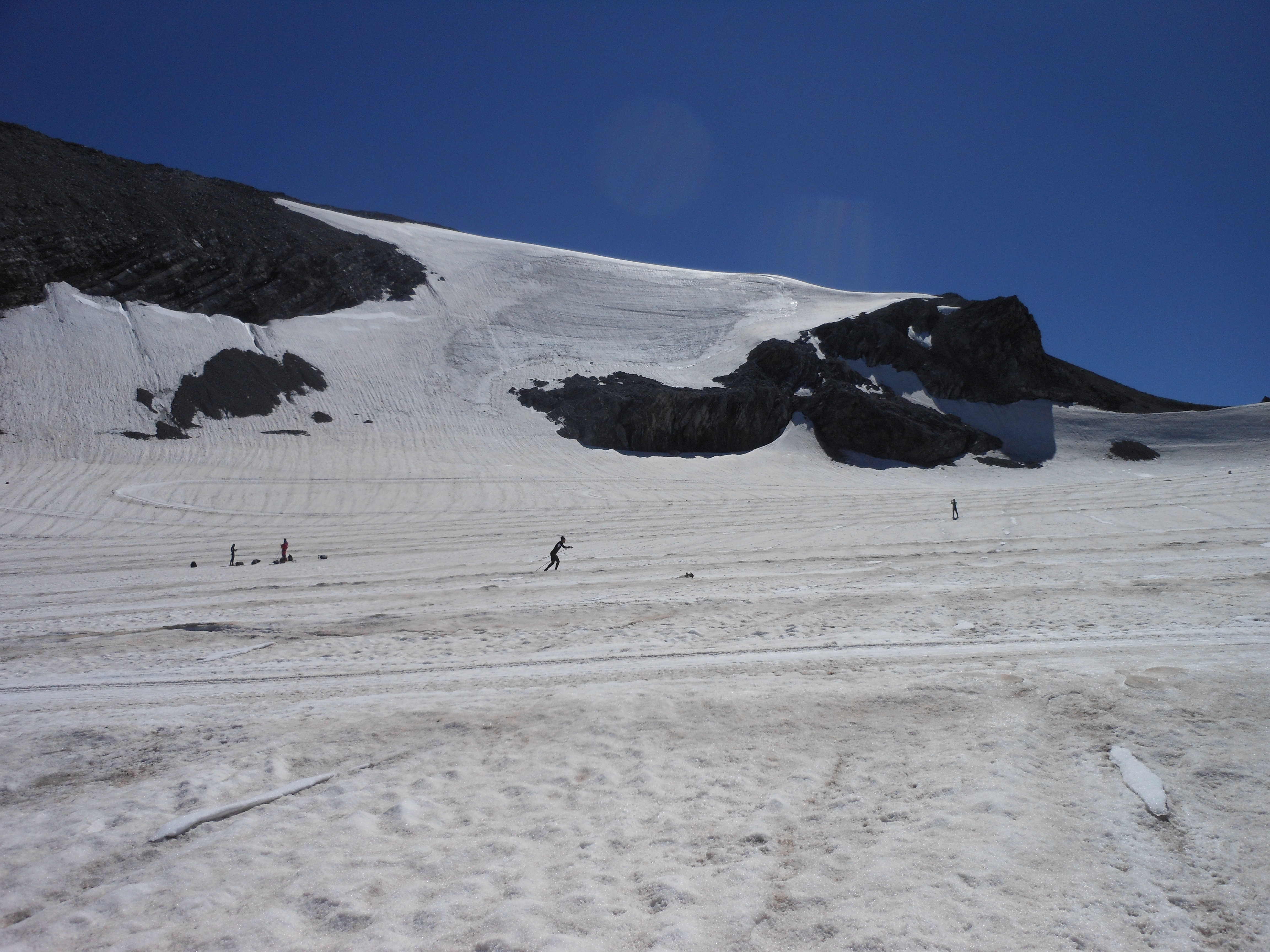
    The Japanese men's cross country ski team training on the Crisallo trails in Stelvio.
    The Japanese men’s cross country ski team training on the Crisallo trails in Stelvio.

    PASSO DELLO STELVIO, Italy— For most small ski countries, the Olympic Games are a one-time chance to shine. Get on television, do some interviews, perhaps gain a few more fans. People care more about the Olympics, and the Games are about participation.

    But for the Japanese cross country team, things aren’t quite so easy. Regardless of how many quota spots the International Ski Federation doles out to the country, the skiers face an uphill battle to get to the starting line.

    First, there’s the budget. It’s always small – the team can’t attend every World Cup weekend and must pick and choose the most important ones – and doesn’t improve in an Olympic year, even though many teams see an uptick in funds when the Games roll around.

    “Our problem in Japan is that in winter sport, there is already not so much of a budget,” says Fabio Ghisafi, a wax technician and women’s team coach for Japan. “Especially for the Olympic Games they have quite big hopes for ski jumping, where the level is quite high, and also for nordic combined. So they decided to give the budget according to the chances of medals. As we don’t have so many chances, our budget is still very very tiny.”

    Secondly, Japan sets draconian qualification standards for its athletes. If they can’t earn the honor of representing their country, then the team’s quota spots will go unfilled when the Games kick off.

    To earn start rights in an individual race, an athlete must have one top-8 finish on the World Cup, two top-10’s, or three top-12’s.

    “From twelve to twenty is not considered at all,” Ghisafi laments.

    That’s even more challenging when the team doesn’t attend a full season of World Cups, so the athletes have fewer chances to rack up results. So far, just two Japanese have met the qualification standards: Masako Ishida, the women’s distance specialist, and Yuichi Onda, the male sprinter.

    The standards have been particularly tough for Keishin Yoshida, the world’s 37th-ranked distance skier, who finished 11th in both the World Championships 50 k and the Davos, Switzerland, distance race. If both of those finishes had been 10th, not 11th, he’d be in. Or if he had finished 11th one more time. But as it is, his results are not yet enough to earn an individual start.

    “We will use all our small budget in the early season to try to have a good shot of making it,” Ghisafi says.

    Luckily for the men, Japan has been strong in relays. They were eighth at World Championships, and so have qualified as a team. So, with four trips to Sochi guaranteed for the team event if nothing else, the squad is hard at work this summer to try to earn start rights in the individual races.

    “Yes, there’s a little more motivation this year, because of the Olympics,” says Akira Lenting, a top developing skier just finishing his under-23 eligibility. “And if we have a good result, then we have a chance to get more popular I think.”

    That hard work has brought them here, to Italy – the country Ghisafi originally hails from. In years past, he has brought the team to a summer training camp in Aosta, where they ski on the glacier in nearby Tignes, France. It’s so hot in Japan in the summer that getting to Europe is a necessity, even with their tight budget. This year, the team picked Passo dello Stelvio because it’s 10,000 feet of elevation add a bonus for training.

    “It’s not so difficult because the weather is good every day,” says Akira. “The altitude is okay for me.”

    “No!” interjects Nobu Naruse, laughing.

    The five men at the camp have been spending every morning skiing a few hours on the glacier. It’s mostly slow distance and technique work, due to the elevation and the wet, slow snow. But Ghisafi says they have been throwing in a little bit of speed work, too. Many afternoons they head down to the valley to rollerski, and sometimes they do ski-bounding in the nearby national park.

    Overall, the men are happy with the location and the atmosphere. Despite spending much of the winter on the road and away from their families, it’s still exciting to see Europe in summer. The one who misses home the most is Keishin, whose wife had twins three months ago. The training here is an improvement for him, but it’s hard to be away from his children.

    “I can concentrate better for training if I go away,” he says. “So it’s very good to be here. But of course sometimes I want to go back to Japan. It will be even harder in the winter.”

    They are also happy to have the chance to train together. With such a small national team budget, they don’t have many training camps. Keishin has a good training partner where he is posted in the army, and Akira is spending the year in Falun, Sweden, where he has a strong team to work with. But for others, like Nobu, most training is done alone.

    “My hometown is where the Nagano Olympics were,” Nobu says. “I don’t have a teammate, so it’s only alone training. This camp is for me, so good – to finally have a national camp.”

    Hisashi Yamaguchi, the head coach, talks about how limited the team’s schedule is. After this, they will have a rollerski camp in Japan, and then that’s basically it for training camps. Twice a year, they meet for physiology testing. The women, who are at home now, had a separate camp earlier in Aosta; with only three staff members, it’s easier to do camps one at a time. They didn’t have enough money to bring a physiotherapist with them.

    But they are still looking forward to Sochi as a golden opportunity. Keishin and Nobu both participated in the World Cup test event this past season, and liked what they saw – at least for courses.

    “It’s a very tough uphill, but it’s good,” Nobu says.

    “It’s hard, but I like it very much,” Keishin agrees.

    In general, the difficulty of the Sochi courses play to Japan’s favor.

    “The harder it is, the better it is for them,” Ghisafi says. “They don’t like so much the flat and double-poling, but in the uphill, they are strong. So they like very much this course. Or at least, we will see.”

    Other things, like the food, don’t agree with them so much. With no food from their homeland and no grocery stores in the Olympic village, Keishin says that it wasn’t very good in Sochi, “at least not for Japanese.” In that respect, Sochi feels very far from home.

    But the team, with its small budget, has one more thing going for it at the new Russian venue, and that’s the unpredictable conditions. Just as the men like tough uphills, Ghisafi says they do well in less-than-perfect snow, too.

    And the wax maestro was happy when he saw the weather and snow at the Olympic venue.

    “I remembered when I was young and we would sometimes have the Italian championships in the middle of winter in the south of Italy,” he says. “There was this strange snow, near to the sea – it’s a little familiar.”

    The unpredictability of the conditions levels the playing field, too. The Japanese wax crew is good – it’s just small. So when nobody knows what is coming, they finally have a chance to shine.

    “If you have stable conditions, and they can test every single thing, and we have no chance against the big countries with such huge budgets,” Ghisafi says. “But if you come in the morning and there is a new situation, then we can find the right combination. It’s the only way we can do it. So this is better for us. We hope the weather will be bad!”

    That’s one thing coming from a coach standing on the sidelines. What about the skiers – are they looking forward to slogging through some nasty weather?

    In a word, yes.

    “We trust him,” Keishin laughs.

    Watch out, Sochi.

  • Canadians Surprise Swedes in Season Opener

    With the top Americans starting their race season yesterday in Munio, Finland with a skate sprint, the Canadians attempted to keep pace, taking part in a 1.6 k skate sprint in Bruksvallarna, Sweden.

    There were several top finishes by the Americans in Munio, including a win by Kikkan Randall, and  the Canadians kept the ball rolling in Scandinavia with more early-season North American success.

    The day started out extremely promising. Dasha Gaiazova tore up the qualifier, finishing second, a mere .9 of a second away from Sweden’s Charlotte Kalla. Chandra Crawford, the only other Canadian woman in action, also qualified strongly in 22nd place in a deep field that featured many World Cup regulars.

    In the men’s qualifier, Kershaw was the strongest Canadian on the day, recording the 5th fastest time. He was joined in the heats by five of the seven Canadian men – Alex Harvey (7th), rising star Len Valjas (11th) Stefan Kuhn (19th) and Phil Widmer (22nd). The other two men, Brent McMurtry and Fred Touchette finished 34th and 40th respectively, just outside of the top 30 cutoff.

    In a phone interview with FasterSkier after the race, Head Coach Justin Wadsworth said he was “overall really pleased,” with how everyone skied on the day.

    “I thought we might have everyone in the heats,” said Wadsworth, “The guys skied well, especially considering the fair amount of volume we have put in since our arrival [in Sweden].”

    When the heats began, Gaiazova and Crawford were placed in the same quarter-final, but failed to advance further. Wadsworth noted both may have made a few small tactical errors in their heat. Crawford was sitting in second heading into the final stretch and looked to be a lock to advance, but was narrowly edged out at the line.

    Despite both racing only one heat, Wadsworth said there were positive signs from the women. Wadsworth described Crawford as “totally healthy – 100%, which is great” and Gaiazova’s quick qualifier clearly indicated she has the speed.

    The women’s A-Final was Swede-heavy, as Ida Ingemarsdotter (SWE) took the win over top qualifier Charlotte Kalla (SWE), and Hanna Brodin (SWE). Laure Barthelemy (FRA), Hanna Falk (SWE) and Laurie Van Der Graaff (SUI) rounded out the top 6.

    On the men’s side, the competitive heats combined with the narrow course meant that contact was inevitable, and the Canadians didn’t back down. In Stefan Kuhn’s quarter-final, he attempted to make a move around a few skiers, got tangled up and went down. For Alex Harvey, a crash on the last steep pitch of the course where a skier in front of him broke a pole and forced him to a dead stop ended his day.

    However, two Canadians advanced all the way to the A-Final. Lenny Valjas and Devon Kershaw faced off against three Swedes and a Japanese national – all with extensive World Cup experience. Kershaw forced his way onto the podium behind Emil Joensson (SWE) and Jesper Modin (SWE).

    While Kershaw is somewhat of an impressive early season racer (on his blog he noted that he is now 3 for 3 in winning cases of smoked meat in Bruksvallarna, no small feat), the big surprise of the day was rising Canadian sprint star Len Valjas.

    “I wasn’t really expecting it [the qualifier] to go as well as it did,” Valjas said in a phone interview with FasterSkier. “Halfway around the course I felt winded.”

    Despite feeling less than stellar, and facing what he called a “tough field,” Valjas cruised to an 11th place finish in the qualifier.

    Valjas described the start as “crucial”. Getting the ‘hole shot’ – the term for being in first position after the initial straight stretch – was the key to success on the day. “It was a really narrow double pole start, if you nailed the start you could dictate the pace,” he said.

    In his quarter-final he was the third ranked skier, drawing top qualifier Nobu Naruse (JPN) as well as Daniel Rickardsson (SWE), who finished 13th in the Sprint Cup rankings last season, and qualified 10th on the day.

    Despite being matched up against some top notch competition, Valjas went out hard, and took the lead. As a result, when Naruse crashed behind him Valjas was unaffected and went on to advance.

    He skied his semi-final the same way, leading out and staying strong the entire way around the course.

    When he lined up for the A-Final, however, things were different. Valjas received the worst lane selection, as  he faced Emil Joensson (SWE) the Sprint Cup winner from last year who qualified 2nd, Jesper Modin (SWE), team mate Devon Kershaw, and Rickardsson, all of whom were faster in qualification. Also on the start line was Yuichi Onda, a strong Japanese sprinter.

    As a result, Valjas only managed to climb into fourth after the start, at which point the other more experience skiers aggressively pushed him back into sixth, where he lost contact and trailed by two seconds up the last steep hill on the course. At which point the course turned into a long gradual downhill, where “I free-skated my ass off,” Valjas said, and got back on the other racers tails.

    Some contact between Onda and Rickardsson allowed Kershaw and Valjas to slip around the two, and finish 3rd and 4th respectively.

    “This was awesome!” said Valjas, “I wasn’t expecting it at all!”

    Wadsworth described the race as a “really good confidence booster” for both Kershaw and Valjas.

    While the majority of the team will race again tomorrow in the 10/15 k Free, Crawford, Valjas and Widmer will take the day off racing, as they look to another sprint race next weekend in Rovaniemi, Finland.

    Wadsworth picked Fred Touchette and Daria Gaiazova out to excel in, distance races, as “Dasha wants to make up for today,” and Touchette is a much better distance skier than sprinter.

  • Team 18: Japan

    Team 18: Japan

    Japan

    Nations Cup Ranking: 18th (353 pts)

    Men: 16th (163 pts)

    Women: 19th (190 pts)

    2010/2011 A Team (Best estimate)

    Men

    Yuichi Onda

    Nobu Naruse

    Women

    Masako Ishida

    Madoka Natsumi

    What you may have missed last season:

    Two years ago, during the 2008-2009 World Cup season, the Japanese ski team made history. Masako Ishida became the first Japanese national to win a World Cup medal by finishing third in an exciting battle in the 30k in Trondheim, the same day Alex Harvey made Canadian history by also placing third. However, in 2009-2010 on the World Cup, Ishida was shaky at best finishing in the top 10 just once. However, she fared better at the Olympics, saving her magic for another attempt at the podium when it mattered most – but ultimately coming up short and finishing 5th in the 30 k. If you want to know how your favorite Canadian male will do at at a big race, watch Ishida – there seems to be a slight correlation.

    Ishida (L) battling for her podium spot with Kowalczyk and Steira

    The best of the men’s team was Yuichi Onda, a strong classic sprinter. Despite being sub-par for the majority of the season, he peaked for the Olympics and cracked the heats to finish in the top 20 in the classic sprint. He then rode that peak to the classic city sprint Drammen, and on the same day Andy Newell finished on the podium, the 30 year old journeyman cracked the top 5.

    What You Should Know For This Season

    There is no reason to think Japanese success is just a flash in the pan. Much like the Canadians and Americans have done in the past few years, the Japanese have been building their squad around a few incredibly talented athletes (Ishida and Onda), and are now working to bring up the level of the others to where they can field a consistently strong team.

    Also, despite being 33 years old, retired, and never having had a standout World  Cup season or race, Masaaki Kozu has intensity written all over his face in his FIS profile picture, so the FasterSkier staff is unwilling to write him off completely.

    Watch out…

    Who You Should Watch

    The on man to keep your eye on has to be Nobu Naruse. This past season the 25 year old he was always on the bubble, finishing from 25th to 40th spot a whopping 10 times. Che will be able to throw down consistent fast skate sprints, and at least get some experience.