Tag: NoCo

  • What Predicts Nordic Combined Success? Study Finds Out

    What Predicts Nordic Combined Success? Study Finds Out

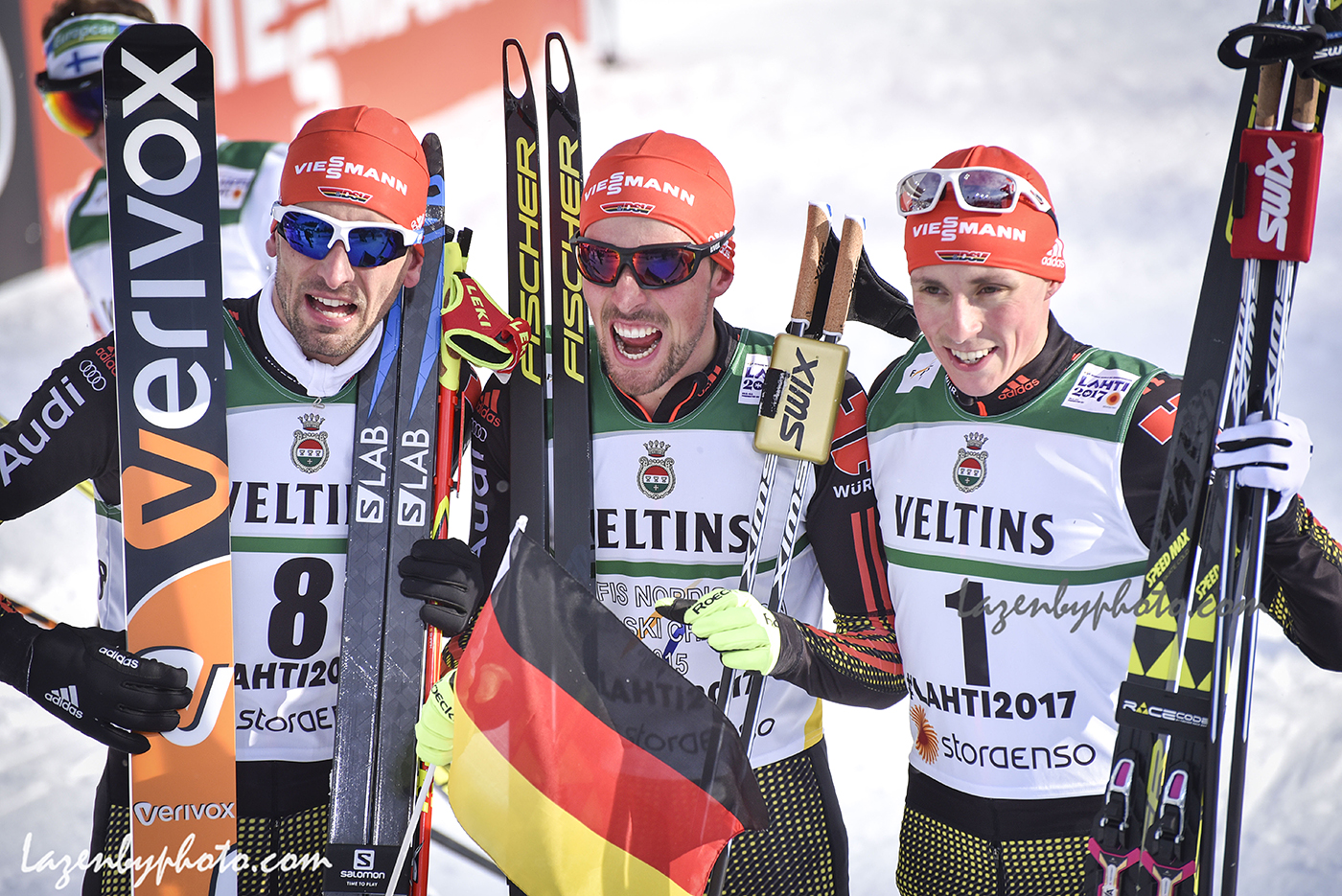
    German nordic-combined stars Johannes Rydzek (c), Eric Frenzel (1) and Björn Kircheisen (8) after taking gold, silver and bronze, respectively, in the individual normal hill/10 k Gundersen at 2017 World Championships in Lahti, Finland. (Photo: John Lazenby/Lazenbyphoto.com)

    What are the physiological capacities of nordic-combined athletes and can laboratory tests predict performance capabilities on the World Cup?

    Those are the questions that a team of Norwegian researchers set out to answer by testing 12 competitors from eight different countries before a 2015 World Cup competition in Trondheim, Norway.

    The study, led by Vegard Rasdal of the Norwegian University of Science and Technology and the Norwegian Olympic Sports Center, was recently published in the academic journal Plos One. It is an open-access journal, so you can read the paper here.

    “The sport is always evolving,” Rasdal wrote in an email to FasterSkier about the results. “Today it is no longer enough to be ‘just’ a strong ski jumper or cross-country skier, you really have to excel in both in order to be successful in terms of podiums. Johannes Rydzek and Eric Frenzel, the two most successful athletes last season, were not only two of the best jumpers last season but also the fastest skiers.”

    Indeed, they found that the best skiers in the nordic combined field have VO2Max capacities close to those of the best cross-country skiers, period – and even higher than those of Olympic medalist sprinters. Furthermore, this was a good predictor of World Cup results in the Trondheim competition.

    Variability in Abilities and Physiology

    There have been plenty of physiological studies on top cross-country skiers and some on ski jumpers, but the fascinating aspect of nordic combined is that two very different sports are combined. That creates uncertainty about what the ideal physiology for a competitor might actually be. Should they be light and explosive, for jumping? Strong and enduring, for skiing?

    And do nordic-combined atheltes have as much explosive power as ‘special jumpers’, or as high aerobic capacities as cross-country skiers?

    “As with most endurance sports, you will find a strong association between VO2Max and performance when the study group is heterogeneous, as e.g. a study group of 200 college students,” Rasdal explained. “Overall, VO2max is widely accepted as the most important factor for endurance performance. However, in a more homogenous study group, such as elite cross-country skiers, all athletes may have a ‘high enough’ VO2max to perform well at an elite level. Thus, other factors such as skiing efficiency becomes a stronger determining factor.”
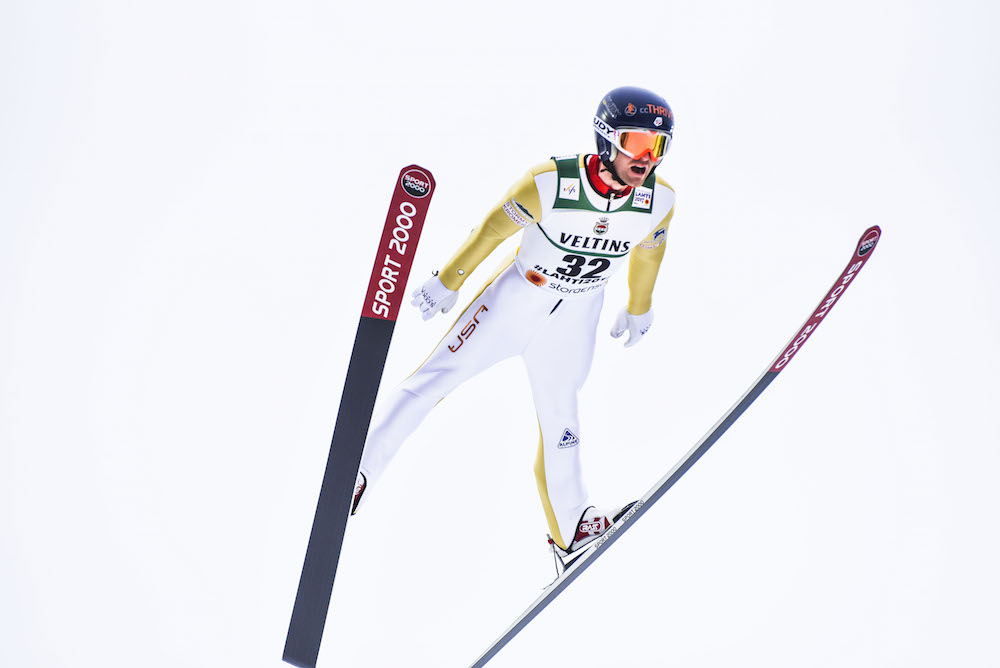
    U.S. Nordic Combined skier Bryan Fletcher jumping to 31st on the large hill at 2017 Nordic Combined World Championships in Lahti, Finland. At the end of last season, he was the top-ranked American in the overall World Cup standings in 34th. (Photo: John Lazenby/Lazenbyphoto.com)

    Rasdal and his co-authors wondered whether nordic-combined athletes fell into the first group, with moderately variable VO2Max, or the second group, where all had such high capacity that they had to be distinguished by some other characteristics.

    Because some athletes get their start in ski jumping, and all must also train for jumping, the athlete selection process and training background from young ages is different than for cross-country skiers and could lead to more variability among individuals.

    “It is not given that all nordic combined athletes have a ‘high enough’ VO2max or vertical jump capacity,” Rasdal wrote. “The shortcomings in one may to some degree be compensated with higher level in the other.”

    To address that question, the research team partnered with the International Ski Federation (FIS) to conduct laboratory tests on athletes the day before a World Cup competition.

    “FIS was responsible for the invitation of athletes, and each nation in the World Cup was invited and encouraged to participate with two athletes to be tested,” Rasdal explained. “To collect data on the very best athletes in the world is always a challenge, especially so close to an important international competition. We as a research group are extremely grateful that so many World Cup athletes chose to participate in the data collection.”

    The athletes ran the gamut from being ranked second to 66th in the previous season’s overall World Cup standings, and included the eighth-best skier and second-best ski jumper.

    About Endurance Capacity, and World Cup Success

    The hypothesis that nordic-combined athletes were more variable in their physiology compared to single-sport specialists was largely upheld.

    “Among the athletes we studied, a VO2peak range of 66.9-80.8 could be found, which does illustrate the heterogeneity in nordic combined,” Rasdal wrote. “This may make subordinate factors such as skiing efficiency relatively less important (although still important) than VO2peak.”

    The upper measurements of VO2Max among the 12 athletes are close to those of cross-country skiers.

    “In the papers by Saltin and Åstrand (‘Maximal oxygen uptake in athletes’) and Tønnessen et al. (‘Maximal aerobic capacity in the winter Olympic endurance disciplines: Olympic medal benchmarks for the time period 1990-2013’), only a few athlete-groups possess VO2Max values above 80 ml/kg/min,” Rasdal noted.

    Furthermore, it was clear that the athletes on the lower end of the VO2Max spectrum were somewhat less successful on the World Cup. At least at this World Cup event, the overall ranking at the end of the day was strongly correlated to an athlete’s VO2Max and ski performance.

    “This study together with the study by Tønnessen et al. may indicate that a body-mass normalized VO2Max in the region of 75 ml/kg/min is a sufficient capacity for a strong cross-country performance in Nordic Combined, whereas 80 is at very highest percentile,” Rasdal explained.

    However, the Trondheim World Cup course is not necessarily representative of all World Cup venues. And poor cross-country skiing could have been penalized even more at this venue than usual.

    “Trondheim is a special arena compared with other courses in the World Cup, with many steep uphills and fast downhill terrain,” Rasdal wrote. “In addition, 2015 was a bad winter in Trondheim, and the course was salted and ice hard. This made the event well suited for technical good skiers with strong upper-body capacity. It is therefore necessary to investigate the impact of ski jumping versus cross-country skiing on overall performance, as well as the associations to laboratory capacities, also at other venues and conditions.”

    And About Those Jumps
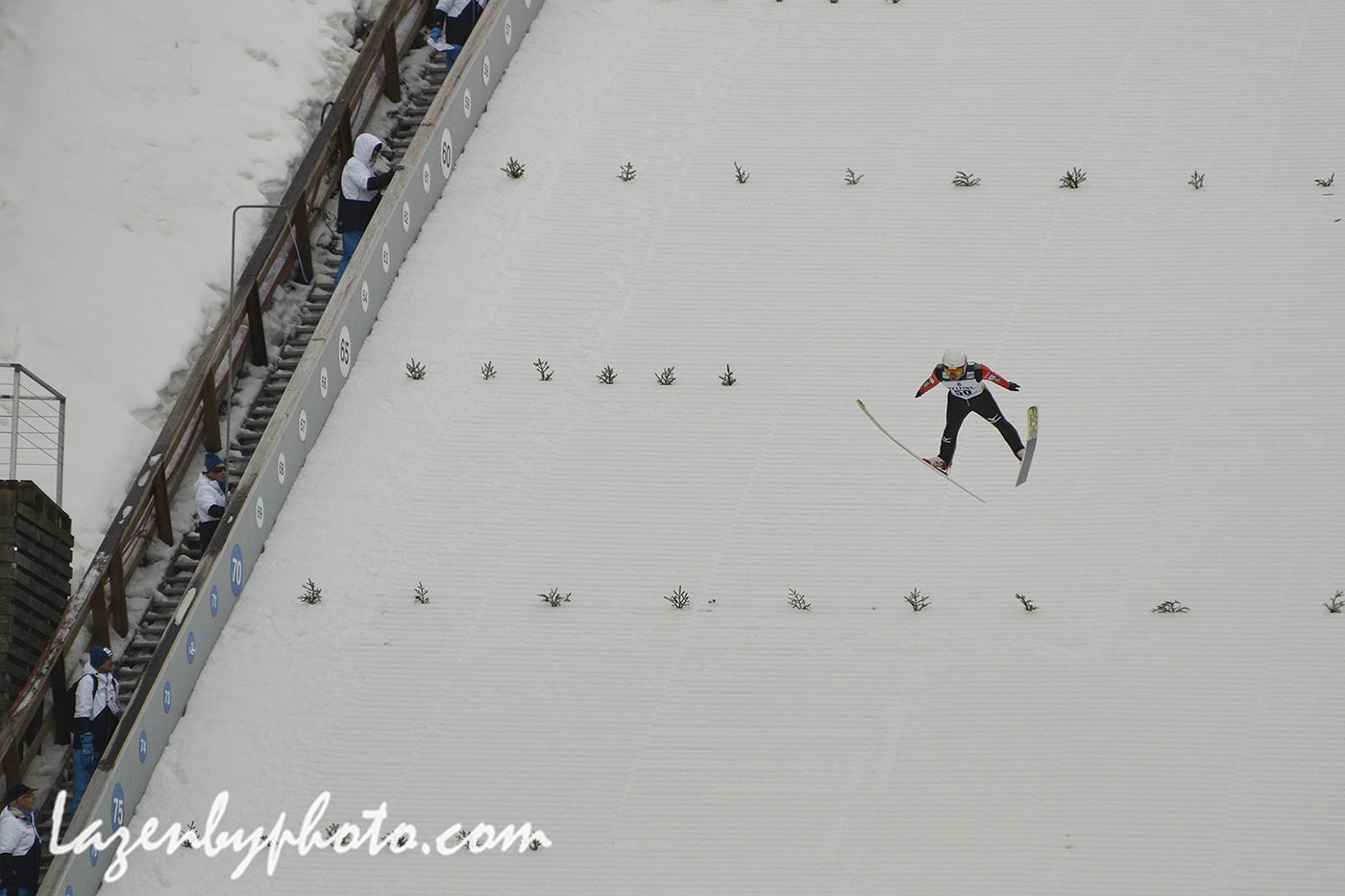
    2017 World Championships jump training on Feb. 21 in Lahti, Finland. (Photo: John Lazenby/Lazenbyphoto.com)

    The implication is that perhaps at a different competition, the association between ski jumping performance and overall competition ranking might be stronger.

    “Unpublished data does show that [across a whole season], the regression line for ski jumping to overall performance is similar to that of cross-country and the correlation coefficients are similar,” Rasdal explained.

    When it came to benchmarking, the researchers also identified laboratory measurements that could predict ski jumping performance by nordic-combined athletes. They tried two measurements: a straight, simple squat-jump, and an “imitation jump” where the athletes were asked to start in the same position they would on a ski jump ramp. The jumping style and technique varied from athlete to athlete.

    While it seems logical that these would be good predictors of ski jumping performance, it actually wasn’t a trivial matter. Such measurements have mainly been validated on straight ski jumpers, and because of their different body mass and physiology the relationship between squat jumping and performance, for example, could very well have been different among nordic-combined athletes.

    “The time available at the take-off in the [ski jump] hill may present a greater challenge for NC athletes than specialist ski jumpers as two-thirds of the NC athletes’ annual training consists of endurance training,” the authors wrote in the paper. “This does not only leave less time available for power and [jumping-] specific training compared to the specialists, but endurance training may lead to negative effects on muscle strength and power.”

    But in the end, the same measurements did predict ski jump performance.

    “The jump capacity in the sport-specific imitation jump distinguished performance level better than the general jump capacity in squat jump,” Rasdal wrote. “That supported the argument for sport-specific testing at an elite level.”

    Still, the imitation jump wasn’t perfect at predicting actual ski jump performance.

    “The upper range of the lowest ranked performance group touches the lower range of the highest ranked performance group,” Rasdal said of the imitation jump measurements. “There is not necessarily a continuous linear relationship with performance. At some level, the ability to utilize the capacity in the field as well as other factors become more determining for performance, e.g. body mass, transition to flight (minimize the loss of speed), flight performance, etc… Ski jumping is an extremely challenging technical task to be performed in less than 0.35 seconds, and where a well execution may compensate more for a lack of physical capacity.”

    And then there’s money.

    “In ski jumping the equipment plays an important role, and the nations with the highest budgets may for instance have better suits which makes them jump farther,” Rasdal said of other potentially confounding factors in predicting jump performance.

    What to Shoot For

    At the end of the paper, the authors summarized the ideal characteristics of a nordic-combined athlete: high VO2Max, a strong upper body, a good vertical jump, and low body mass. Hitting all those different metrics at the same time is a tough calculus, but it’s what is required to be a champion these days.

    “Although the relative importance of ski jumping to overall performance has varied in the sport over time, the pendulum today appears to lean more towards ski jumping,” Rasdal noted. “That’s both as a result of regulations (e.g. increase of meter-value in large hills in 2015), and also an increase in overall performance level where the best ski jumpers also ski fast.”
  • Bryan Fletcher, Billy Demong Post Season Bests at First-Ever Nordic Combined Triple in Seefeld

    Bryan Fletcher, Billy Demong Post Season Bests at First-Ever Nordic Combined Triple in Seefeld

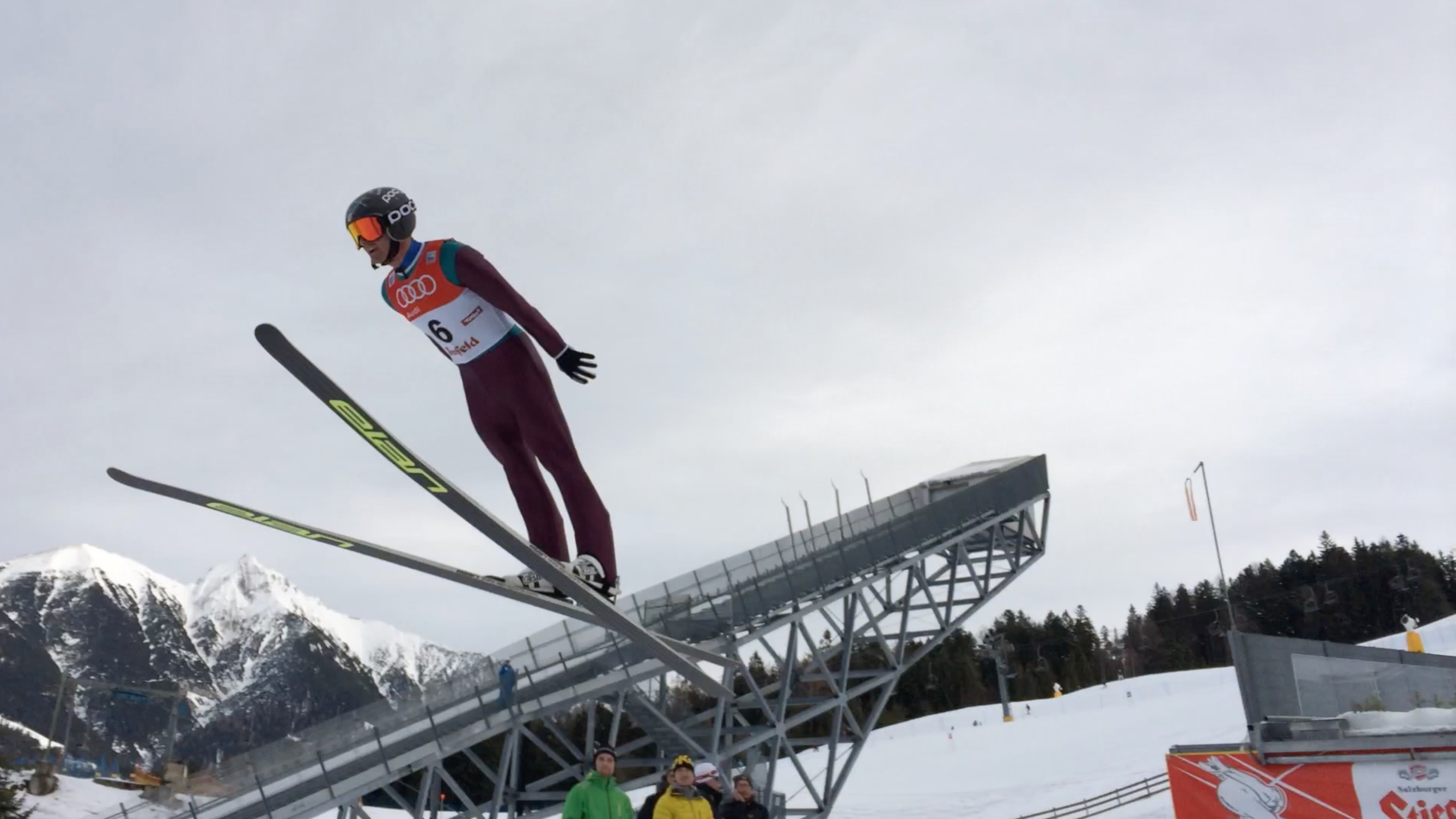
    Bryan Fletcher (U.S. Nordic Combined) jumping to ninth on Day 2 of the Nordic Combined World Cup Triple in Seefeld, Austria. Fletcher improved to sixth in the 10 k. (Photo: Fast Big Dog)
    Bryan Fletcher (U.S. Nordic Combined) jumping to ninth on Day 2 of the Nordic Combined World Cup Triple in Seefeld, Austria. Fletcher improved to sixth in the 10 k. (Photo: Fast Big Dog)

    Billed as the premier nordic-combined event of the season, the first-ever Nordic Combined Triple ended up being a perfect platform for American Bryan Fletcher to produce his best results of the season. From Jan. 17-19  in Seefeld, Austria, there were three consecutive days of competition with a total of four competition jumps and three races of 5-, 10- and 15-kilometers on Friday, Saturday, and Sunday, respectively.

    “Simply put, I was happy with all three of my races this weekend,” Fletcher wrote in an email after he ended up a season-best fifth overall. “Each day I improved a bit and ended with perhaps my best performance on Sunday!”

    Bryan Fletcher after posting the 19th best jump on the normal hill Friday at the World Championships opener in Predazzo, Italy.
    Bryan Fletcher at last year’s World Championships in Predazzo, Italy.

    He has plenty of reason to be happy, skiing his way to a season-best sixth in Friday’s opening prologue, ranking 11th in the jump and skiing the 16th -fastest 5 k to finish 25.2 seconds behind German winner Eric Frenzel, who won all three races for the Triple title.

    Fletcher repeated his performance on Saturday, with the ninth-best jump and 10th-fastest 10 k time to place sixth (+57.4 behind Frenzel), and then improved one spot in Sunday’s pursuit-style competition to finish the weekend in fifth (+47.6), after the seventh-best jump and seventh-fastest 15 k.

    It has been a season of steady improvement for Fletcher, with this weekend’s results in Seefeld putting him into 11th place in the overall World Cup standings, tied with Lukas Klapfer of Austria, which makes Fletcher the top-ranked North American.

    Fellow U.S. Ski Team member Bill Demong also had a strong weekend, finishing a season-best eighth (+27.0) on Friday with a 17th ranked jump and a 12th-fastest ski, despite breaking a pole in the 5 k. On Saturday, Demong ended up 12th (+1:39.6), with the 20th -best jump and eighth-fastest ski. On Sunday, he wrapped up the Triple in 11th , after jumping to 22nd and starting the 15 k race 3:42 minutes back. Demong skied the third-fastest time of the day, making up nearly two minutes to finish 1:54.7 back from Frenzel. Demong’s strong results come despite some bad luck, with Friday’s broken pole “costing him a podium opportunity,” and a “not great” jump on Sunday putting him farther behind for the race.

    “Even though I had my best race of the year on Sunday I was only able to move up to 11th place,” Demong wrote in an email. “I like that [the distances] changed every day but certainly my strength is in longer distances,” he continued. “It was awesome to do 15 k again, though!”

    Billy Demong at 2013 World Championships in Predazzo, Italy.
    Billy Demong at 2013 World Championships in Predazzo, Italy.

    The weekend’s results put Demong into 22nd in the overall World Cup standings, tied with Austria’s Mario Stecher.

    Frenzel won each race of the weekend and finished in first overall, extending his lead in the overall World Cup standings. Haavard Klemetsen of Norway finished second (+21.2) in the Triple and fellow Norwegian Magnus Moan placed third (+29.1).

    Both Fletcher and Demong were pleased with the new race format.

    “I like that it is different, it adds pressure with the mini-tour format I hope they continue offering new events like this,” Demong wrote, while Fletcher called it a “nice change of pace from our normal schedule.”

    Both skiers also felt that the increased importance of skiing, due to the longer distances, catered to their strengths.

    “The distance increase each day made the competitions progressively harder and allowed the stinger skiers to show their strength” Fletcher wrote in an email. “Each day it was easy for me to improve. Our training is concrete and so each day I felt better than the previous day.”

    When asked how Seefeld’s results will translate to the coming Olympics in Sochi, Russia, both skiers became a bit more circumspect.

    “I don’t think this weekend’s results are anything suggestive,” Fletcher wrote. “The Olympics are a different animal and anything can happen.”

    Demong is cautiously optimistic, saying that preparations were going well. “I’ve had my best jumps in years, maybe ever, but I need to get it out in competition for sure. Cross country is going well and I’m looking forward to putting on the finishing touches and peaking!”

    Both skiers are training in Park City, Utah, and will head to Germany shortly before the Olympics to train and break up the travel. They will focus on speed work to train and create a fitness peak just in time for the Olympics. They head to Sochi on Feb. 6th. Both men are optimistic, but Fletcher is the more cautious of the two.

    “I think that the best is yet to come,” Demong wrote, “I like that, while I’m not the favorite, I’m on everyone’s radar.”

    “We will just have to see what happens when we get there,” Fletcher wrote.

    Americans Taylor Fletcher and Brett Denney competed on the first day of the Seefeld Triple, finishing in 56th (+1:54.5) and 63rd (+2:37.1), respectively, just outside the top 50 required to advance to Day 2.

    Results: FridaySaturday | Sunday | Overall World Cup

    Videos: Seefeld Prep | Day 1 | Day 2 | Day 3

  • Demong Achieves World Cup Podium for First Time in Two Years; Fletchers Tally Career Bests

    Demong Achieves World Cup Podium for First Time in Two Years; Fletchers Tally Career Bests

    Billy Demong leading the chase group in the 10 k Gundersen competition in the Nordic Combined World Cup on Sunday in Val di Fiemme, Italy. Photo: Fiemme2013

    When Friday didn’t go according to plan for all of the Americans on the Nordic Combined World Cup, they were happy to have Saturday to shoot for better results.

    When the team sprint went better on the second day of competition in Val di Fiemme, Italy, with the two U.S. teams cracking the top 10, the four members were even more excited for Sunday. If trial and error told them anything, they figured they’d have foul-proof tactics for Sunday’s 10 k Gundersen start.

    First, they concentrated on the jumping hill. Led by Bryan Fletcher in ninth, the crew posted a solid set of results with Billy Demong and Johnny Spillane ranking a respective 17th and 18th in the jumps and Taylor Fletcher jumping the 33rd best out of more than 50 athletes.

    Relying on racing skills they had refined throughout the season, all four Americans went on to make the top 20. Demong skied the fastest 10 k of the day for third overall – his best World Cup result in two years. His previous best was a victory in Val di Fiemme in January 2010. He went on to win Olympic gold that year.

    Bryan Fletcher tied a career best of seventh in the World Cup on Sunday with the 18th fastest time. His brother, Taylor, demolished his previous personal best of placing just outside the top 20, notching 14th overall. He skied the fifth fastest on the day, and Spillane was 19th despite recovering from a stomach bug.

    Japan's Akito Watabe celebrates as he wins the Nordic Combined World Cup competition in Val di Fiemme, Italy, on Sunday. Billy Demong (USA) at right and Mikko Kokslien (NOR) at left battle for second. (Photo: Fiemme2013)

    Japan’s Akito Watabe won Sunday overall in 28:27.8, setting a fast pace early on that Demong and Mikko Kokslien of Norway, who started 17th and 14th, respectively, did not try to reckon with. Instead, the two joined forces near the start, and skied into the race.

    “Him and I like to ski a pretty similar race,” Demong said. “When we’re both skiing well, it’s controlled to start and just gets harder and harder throughout the race. [We] don’t go out crazy, just ski negative splits.”

    Kokslien, who was part of the winning team sprint on Saturday, went on to outsprint Demong for second place, edging him by 0.9 seconds. Kokslien finished 3.0 seconds behind Watabe, and Demong said they were both surprised to see him in the stadium at the end.

    “Honestly [Watabe] was so far in front of us at 5 k that we kind of just mentally let him go,” Demong said. “He had a minute and 20 seconds on us at one point so we were like, whatever, he’s gone.”

    Demong said that was a smart strategy on his part. He was also impressed with his own tactics.

    “I started off this weekend a little anxious and went out Friday and blew up,” Demong said of finishing 18th in the penalty race. “[I] went out hard, pulled away from the mass start [and] about 500 meters into the race, gapped off the field. Basically by 2 k was about ready to go back to the hotel.”

    Although worn out from Friday’s race, he was more patient Saturday and helped secure sixth in the team sprint with Bryan Fletcher. On Sunday, Demong said he was recovered and ready to go, but wanted to again be patient. Skiing relaxed and controlled, he found himself in the hunt for a podium on the last lap.

    “I started pulling away from the group without even knowing it,” Demong said. “Then [I] kind of had that confidence that, ‘All right, all I’ve got to do is go hard from here on out and not kill it,’ and we were left to fight it out, just Mikko and I.”

    Bryan Fletcher hung with a group of 10 for most of the race and aimed to conserve energy for the end. With about 1 ½ kilometers to go, Bryan said six or seven remained in the chase for fourth place.

    “It was definitely a challenging race and sitting in and not doing any work was a huge advantage for me in the end,” Bryan said. “I had a little bit fresher legs and more energy when the pace picked up .”

    Taylor said he started near Austrian Mario Stecher, who helped him set a strong pace. The two skied together, and Taylor edged him for 14th by half a second.

    “I felt awesome,” Taylor said. “I started dropping the guys behind me and catching more people. That’s a big energy boost so I just kept it going.”

    U.S. head coach Dave Jarrett wrote in an email that the team was “psyched” with its collective performance to wrap up long weekend. “We want to keep the momentum rolling.”

    “I’m pretty excited with our results this weekend,” Bryan said. “We had some chances and we didn’t take advantage of all of them but it’s there and the momentum’s going in the right direction.”

    “To get a podium is great, but I think it’s even better to have the depth of the team,” said Demong, who added that he and Taylor Fletcher have a cumulative time bet for the season.

    Going into Sunday’s race, Taylor was 5.5 seconds ahead of Demong, it terms of net time for all the World Cup races. Demong said he beat him by 10.3 seconds, putting him 4.8 seconds ahead.

    “So we’re neck and neck,” Demong said. “And we’ve got six races left.”

    On Monday, the team planned to fly back to the U.S. to train for two weeks before returning to the World Cup in Klingenthal, Germany, on Feb. 18. They opted to skip next weekend’s races in Kazakhstan.

    Sunday’s overall results