From the FasterSkier archive — posts syndicated from athletes’ and coaches’ own blogs between 2004 and 2012, kept online as published. Current coverage is at fasterskier.com.
“You need some Gordie Howe elbows out there today” said the commentator on the live feed at one point during Friday’s Team Sprint in Whistler.
You know, just in case you needed a reminder that this is Canadian Nationals.
Alongside his legacy as one of hockey’s greatest players of all time, leaving his mark on the sport as an indomitable force with both his goal scoring and dynamism on the ice, Howe was known as an — ahem — impassioned athlete. One achieves a “Gordie Howe hat trick” by scoring a goal, making an assist, and engaging in a fight within one game. In short, he was a bit of a wild card, and he wasn’t going to let someone else stand in his way en route to the net.
In watching the Team Sprint livestream, you can see why a similar need to protect one’s space was relevant. The wet and variable spring weather in Whistler created a tricky mix of fast, wet, and mushy snow conditions that combined with fast mass start sprinting to produce racing that tested a skiers balance and “feel” as much as their lungs and muscles. Or more succinctly, racing that was fun, and a little bit chaotic. Staying upright and not losing your own footing or being taken out by another skier might be more important than technique or tactics.
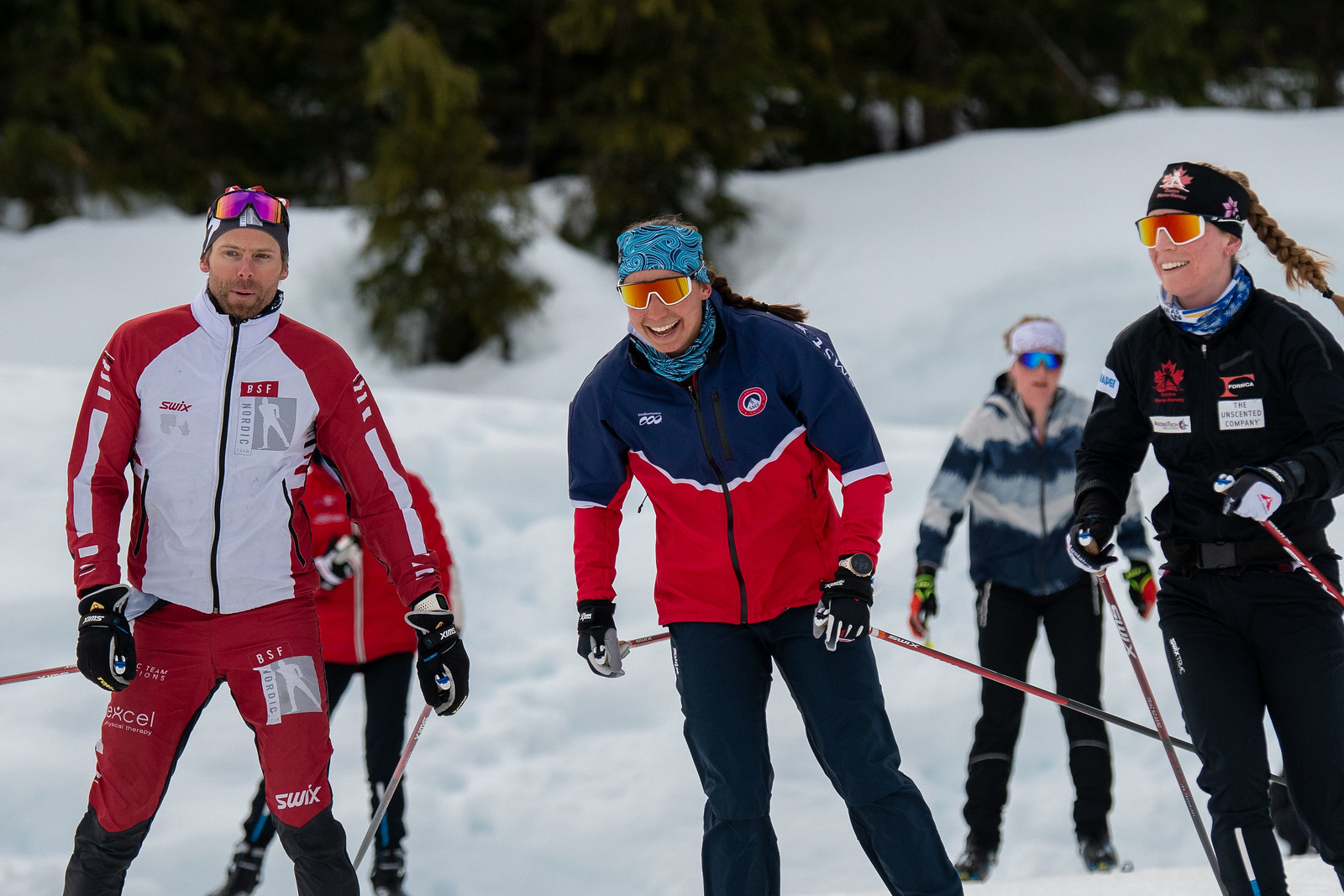
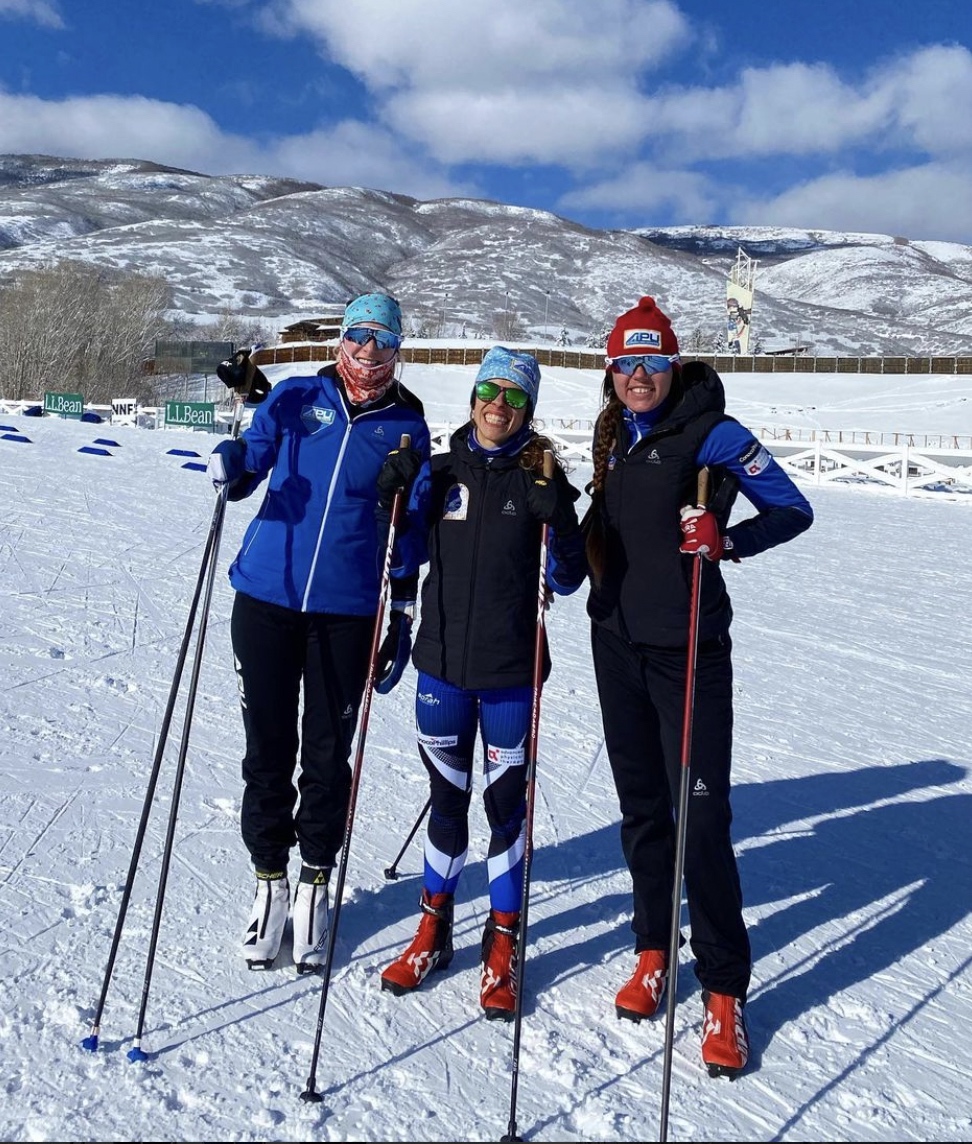
Andy Newell (BSF Pro – Coach), Julia Kern (SMS T2), and Cendrine Browne (Fondeurs-Laurentides) chat on the warm up before the freestyle team sprint. (Photo: Doug Stephen / VR 45 Photography)
Adding another layer to the challenge, the Team Sprint was raced “Dresden-style”, where two partners took turns on a 750 m lap until the pair of them had completed eight total laps. The Nordic skiing equivalent of a short-track skating relay, and with the same flow to the action.
Early attacks could fizzle out through all or any of factors like a bad transition, fatigue, or a tangle up with another skier. All those factors had the equal and opposite effect as well; no team was truly out of it until they crossed the finish line. A late surge between two teammates could pull together a race, and often did when the fields of 15 teams were unleashed on the course today.
The 750 m course was an abbreviated version of the sprint course seen on Wednesday. Each lap left the stadium and shot up a steep but short climb which lengthened into a false flat where the mushy snow on course saw some skiers muscle out a V2 while others kept to a light-footed hop-skate. Then skiers shot down a sweeping downhill where the course widened to allow for two different lines, before doing a long left turn into the finishing straight.
Every skier completed an individual lap of this course in the morning, which when combined with their team partner, yielded a seeding time. With no semi-final, the top 15 fastest combined teams qualified for the Open A finals.
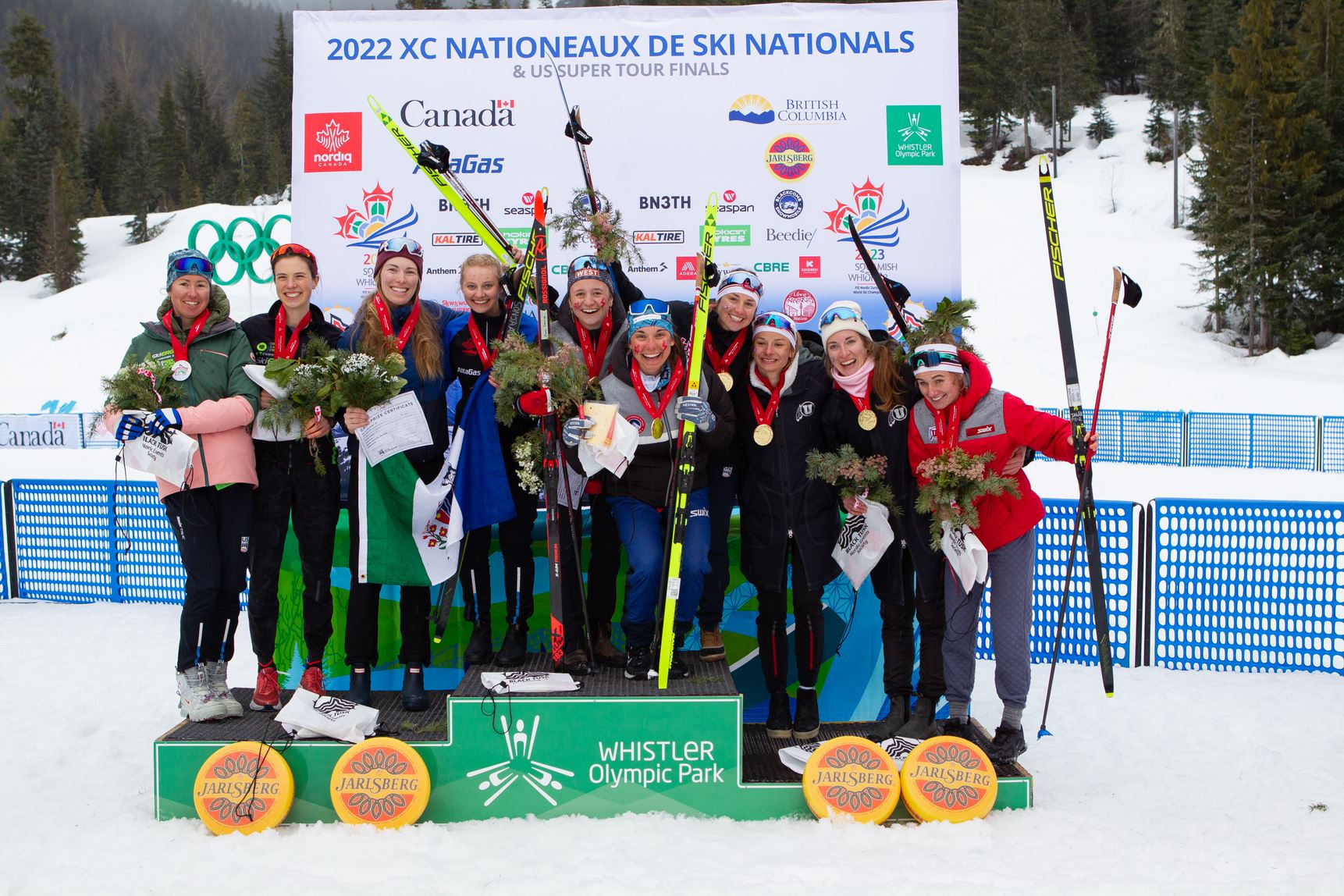
The women’s team sprint podium saw a win for SMS T2, with Yukon Team 7, University of Utah 1, Craftsbury Green Racing Project, and University of Utah 2 rounding out the top five. (Photo: Joern Rohde / Nordiq Canada)
Open Women’s
In the women’s qualifier, Julia Kern (SMS T2) completed the course in the fastest time, 1:21.70. That combined with 8th place Alayna Sonneysn (+3.45 seconds) to give their SMS T2 team the top seed for the women’s A final (combined time 2:46.85). Second seed (combined, +3.73) was earned by Nakkerertok 32’s Hannah Shields (7th, +3.12) and Zoё Williams (13th, +4.01), with third seed (combined, +4.12) going to the University Utah I team of Karianne Dengerud (2nd, +2.34) and Sydney Palmer-Leger (23rd, +5.23).
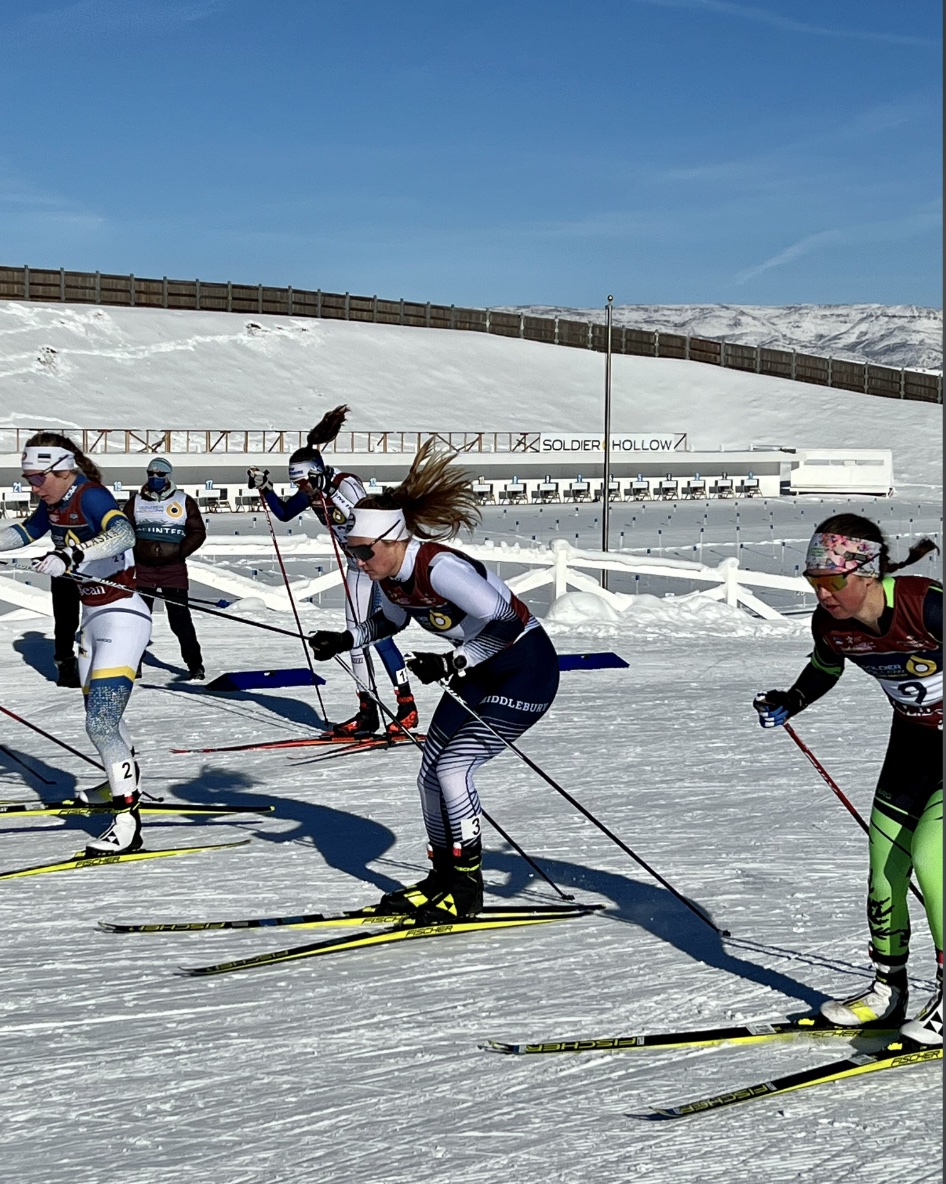
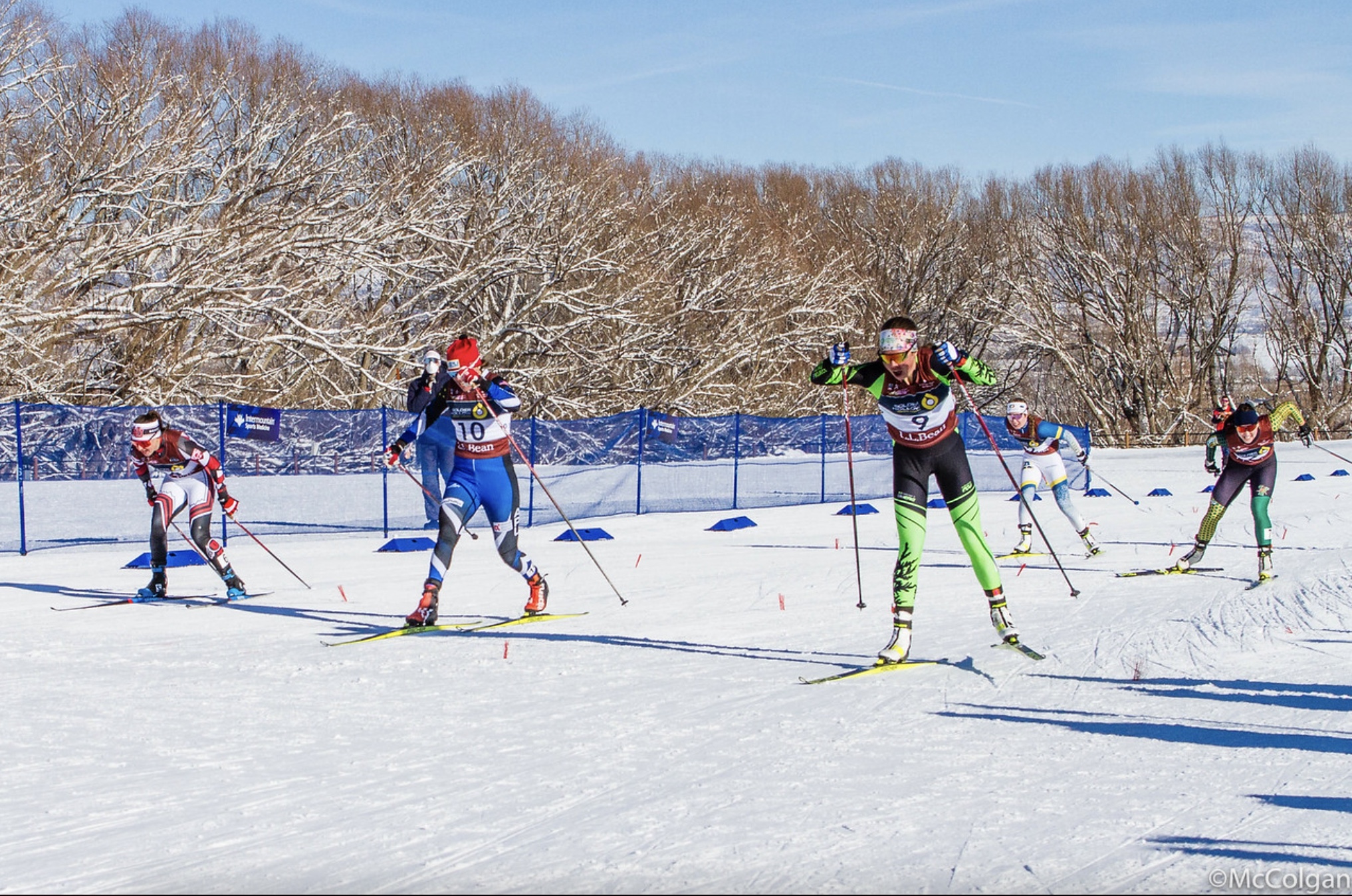
When the top-15 teams started in the A final, Alayna Sonneysn shot off the front for SMS T2, which stretched the field out immediately and may have helped avoid the pile ups that had been a feature of the Challengers and College Cup heats earlier in the day. Sonneysn was covered by Yukon Team 7 (Whitehorse), with Sonjaa Schmidt catching Sonnesyn as they rounded the corner into the first exchange. Schmidt also pulled back the entire group, and so the racing was extremely tight as they handed off to their teammates. SMS T2 and the Yukon Team continued to push the pace at the front, with the University of Utah I (UU I, Palmer-Leger and Dengerud) and University of Utah II (UU II, Novie McCabe and Julia Richter) teams bridging the gap to form a four-team group leading the race.
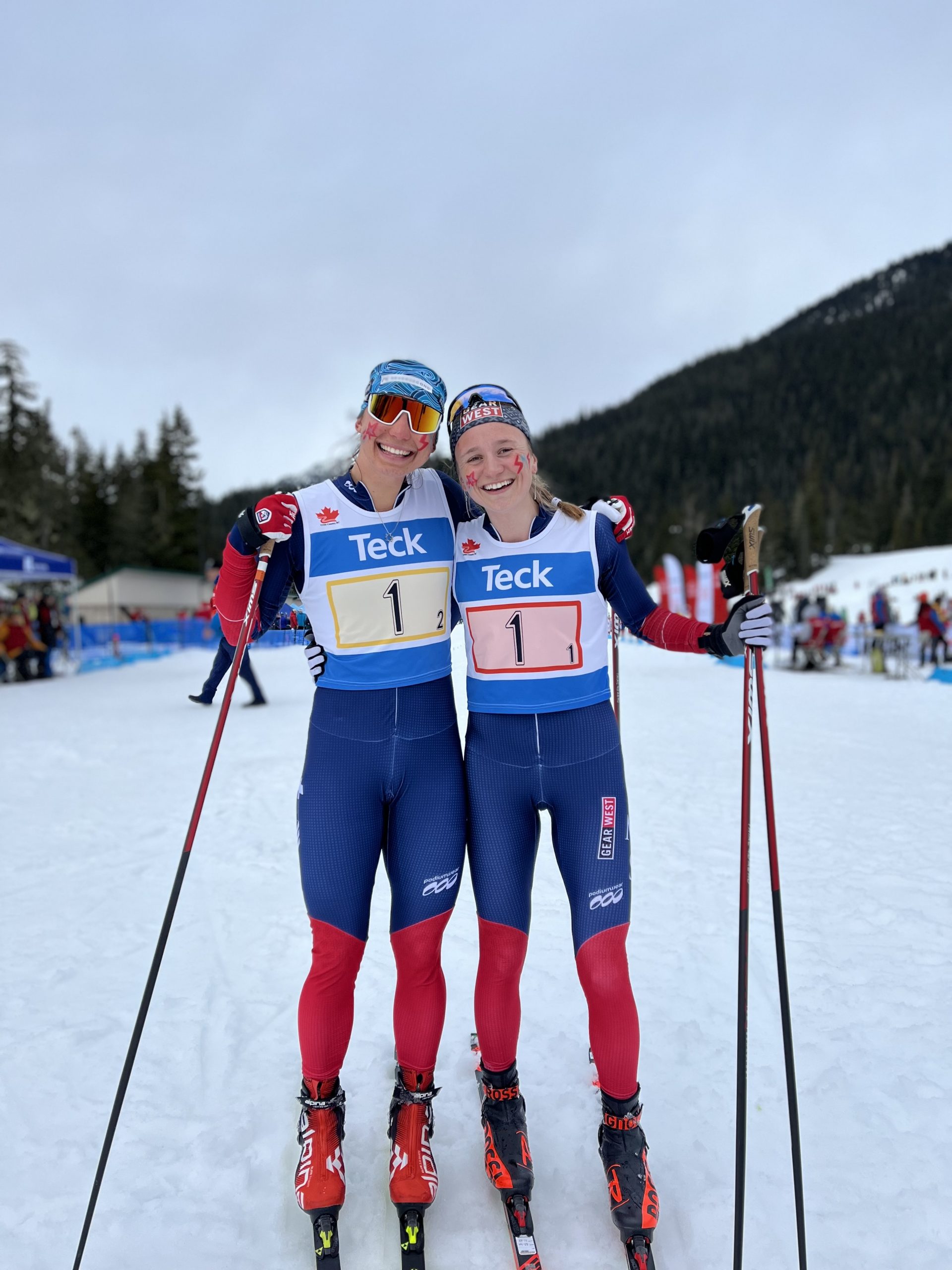
Team SMS T2, Julia Kern and Alayna Sonnesyn, after taking the win in the SuperTour Team Sprint in Whistler, BC on Friday. (Photo: Nordiq Canada / Nathaniel Mah).
From there, as the teams swapped partners through laps three, four, five, and six, a strategy of attrition started to emerge from the SMS T2 team of Kern and Sonnesyn. At each exchange, they jumped off the handoff, hopped up the hill, and continuously pushed the pace. Their gap slowly opened at the front, until, like looking up after being taken by a riptide, the mass of racing behind them was unexpectedly distant. By Sonnesyn’s final trip around the course at lap seven, their win was all but secured.
Sonnesyn said that the goal from SMS T2 was to remain consistent throughout the race, saying in an interview with Nordiq Canada that “I just wanted to be patient. I was a little surprised at the pace we went out [in] because I knew four laps on this course was going to catch up to us quick, but I kept telling myself ‘be patient, go the same pace.”
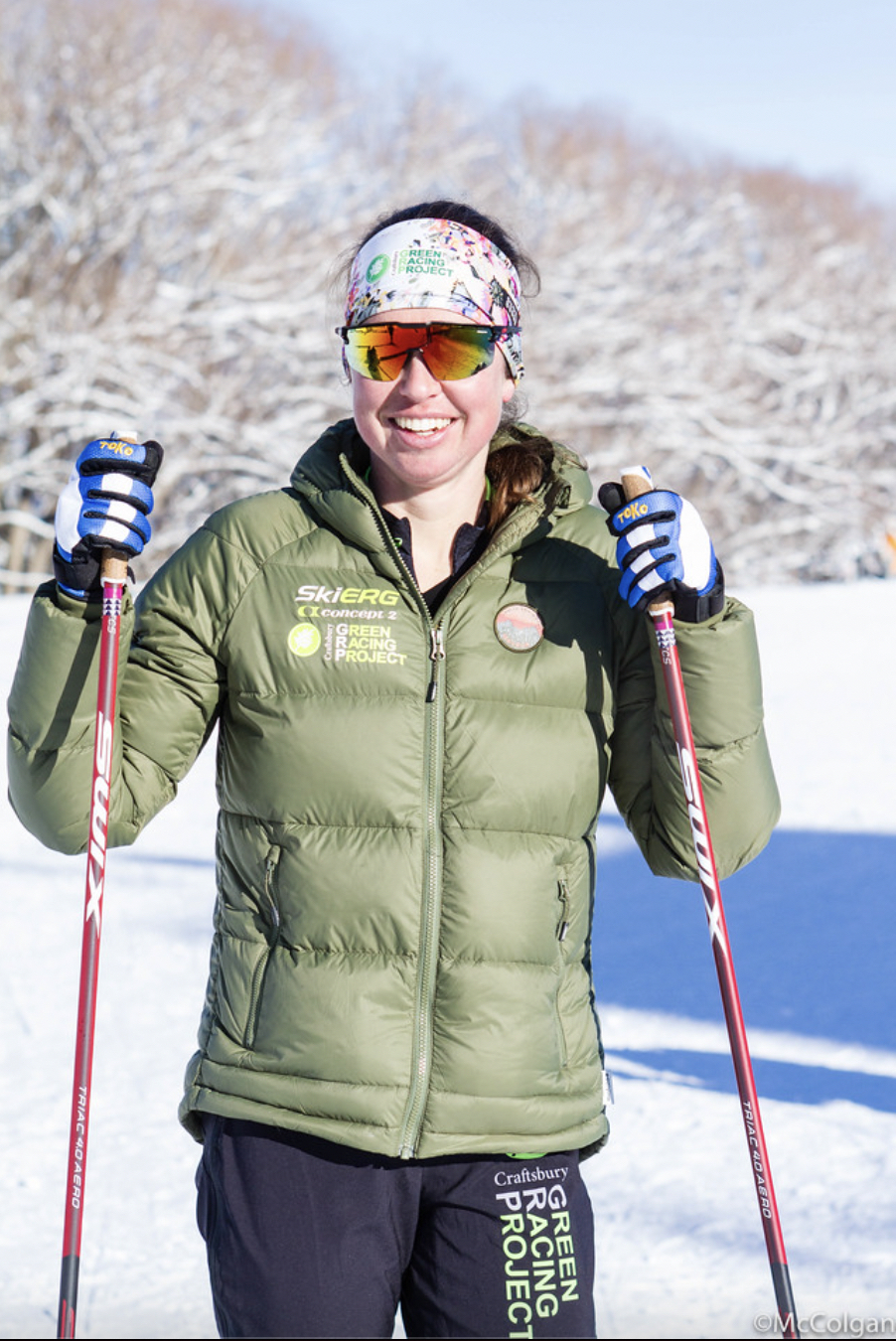
In the push for the overall podium behind, a new player had entered the scene. On lap five, Craftsbury’s Caitlin Patterson pushed across the gap to the UU I, UU II, and Team Yukon group. On lap six, her partner Alexandra Lawson held there. As the scrambling partners went out for their final lap on lap seven, UU I and UU II had formed a gap, but when the skiers handed off for the final exchange, a four-team pack came back together with UU I, UU II, Team Yukon, and Craftsbury I.
Then, it split once again.
Team Yukon’s Dahria Beatty came off the downhill on course wide to try and take an inside line into the final turn. UU I’s Karianne Dengerud took the downhill corner more inside, and tried to beat Beatty to the inside on the final turn. In the end, Beatty won, and then closed in the final stretch to take Team Yukon (Schmidt & Beatty) to second place (+11.99) behind the first place SMS T2 (12:22.16). UU I (Palmer-Leger & Dengerud) took third (+12.78).
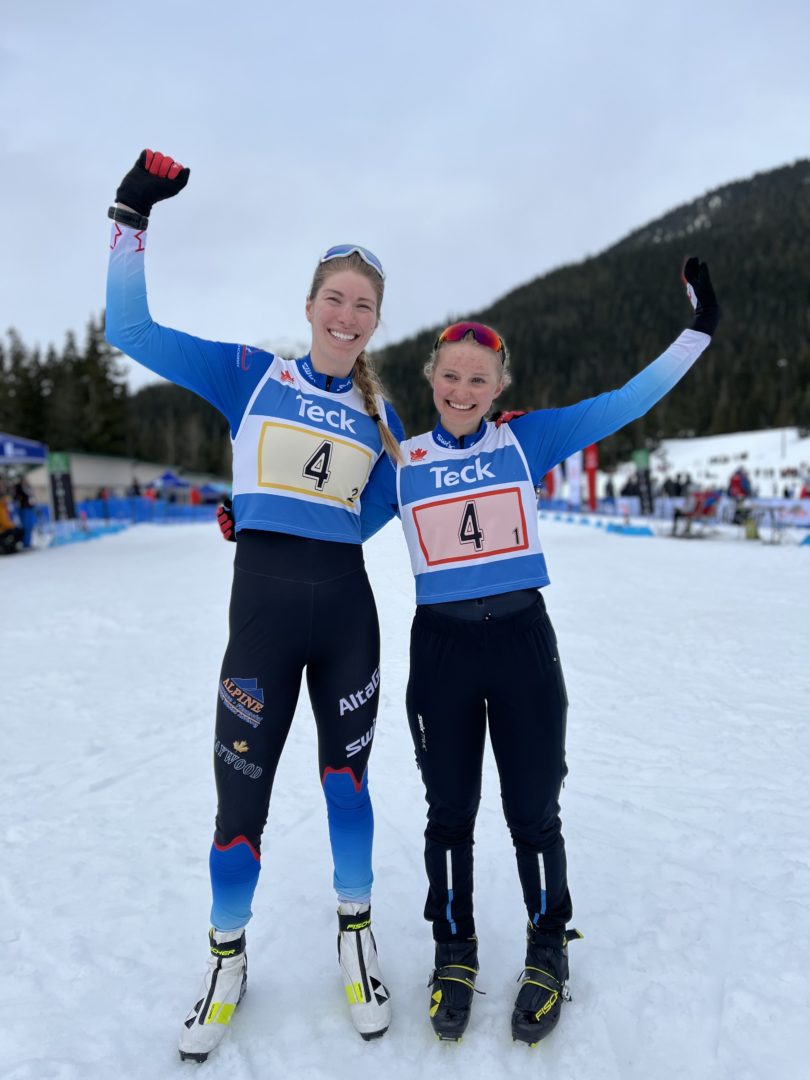
The Yukon Team 7 duo of Dahria Beatty and Sonjaa Schmidt were second overall in the women’s team sprint, taking home the Canadian national title. (Photo: Nordiq Canada / Nathaniel Mah)
The resounding win for the pairing of Kern and Sonneysn punctuated a tremendous week for Stratton Mountain School, and in particular for Kern. Apart from a second place behind teammate Jessie Diggins (SMS T2) in the 10 k skate on Monday, she has won every race at these SuperTour finals, despite tricky and variable conditions.
Team Yukon’s (Whitehorse) second place overall gives the pairing of Dahria Beatty and Sonjaa Schmidt top Canadian honors, adding to Beatty’s accumulation of National Championships this week.
Open Men
The men’s top individual qualifier was Logan Diekmann (BSF), with a time of 1:12.83, who combined with his BSF Pro I teammate Finn O’Connell (51st, +5.93) to take 5th seed (+4.44). They ran behind the top seeded (2:27.15) University of Utah I (UU I) pairing of Noel Keefe (4th, +0.67) and Luke Jager (5th, +0.82). Second seed (+2.42) went to the SMS T2 team of Finegan Bailey (6th, +1.01) and Bill Harmeyer (14th, +2.91), and third seed went to the Team Brew-ski Canmore (+3.43) pair of Russell Kennedy (3rd, +0.57) and Reed Godfrey (27th, +4.35).
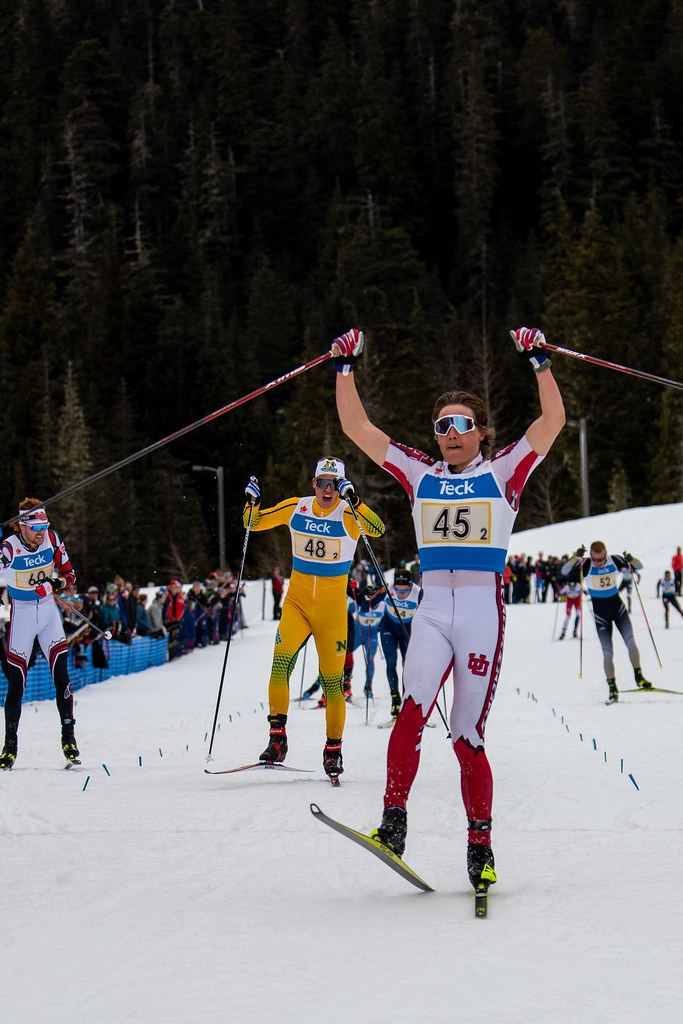
Xavier McKeever (Foothills Nordic) works with teammate Tom Stephen to win the Canadian National Title in the team sprint. (Photo: Doug Stephen / VR 45 Photography)
With qualifying times extremely tight across the board, the A final promised to stay close throughout the whole 8 laps.
Noel Keefe mirrored Alayna Sonnesyn’s move from the women’s final, looking to get ahead of any tangles by pushing the pace from the start for UU I. Once the field was out of the stadium, Keefe tucked in behind Orford’s Leo Granbois, and Orford and UU I went into the first exchange with a slight gap.
Keefe handed off to Luke Jager, who looked relaxed as he allowed the field to come back together again. Animating the move that closed the gap was Northern Michigan University (NMU) skier Kristoffer Karsrud, who alongside his partner Kjetil Bånerud ducked and weaved at the front of the pack throughout the duration of the race.
On the 5th lap, another UU team, UU II, moved to the front of the pack, as Brian Bushey put in a surge. When Bushey and Keefe handed off to Bjørn Riksåsen and Jager, the race looked like it may turn into a UU team practice for the last couple of laps. That was, until Scott Patterson flew in from Alaska Pacific University (APU) in his last time around the course on lap seven. Following Patterson’s move was Bånerud from NMU, and as the four team pack of UU I, UU II, APU, and NMU went into the final exchange, it became clear; the Team Sprint would well and truly live up to the sprint moniker.
Jager for UU I came out of the exchange with a slight advantage over the field. APU’s Logan Hanneman countered that by exploding up the climb leaving the stadium. Jager used the downhill to catch Hanneman, with Rikssasen (UU II) and Karsrud (NMU) in tow. Jager, the youngest of the bunch but with plenty of sprint experience, got the inside edge into the final turn. He exploded off of that corner into the final stretch, lifting a ski and two poles as he came across the line to take the win for UU I (11:15.32).
Luke Jager closes for the University of Utah 1 team, taking the win alongside teammate Noel Keeffe. (Photo: Doug Stephen / VR 45 Photography)
Hanneman finished in second (+1.39) for APU, and the NMU team finished third with Karsrud crossing the line (+1.45) right behind.
Outside of the mix for most of the race, the Foothills I team of Xavier McKeever and Tom Stephen deftly moved through the pack to come in fifth overall and claim the Canadian title on the day.
The University of Utah pairing of Jager and Keefe were especially happy to win this edition of the Team Relays, saying to Nordiq Canada that “It’s a mix-up [in these relays]. Since the race got canceled at SuperTour finals two years ago, we had this race in our scopes. The qualifier went well, we had good skis, and the race turned out great.”
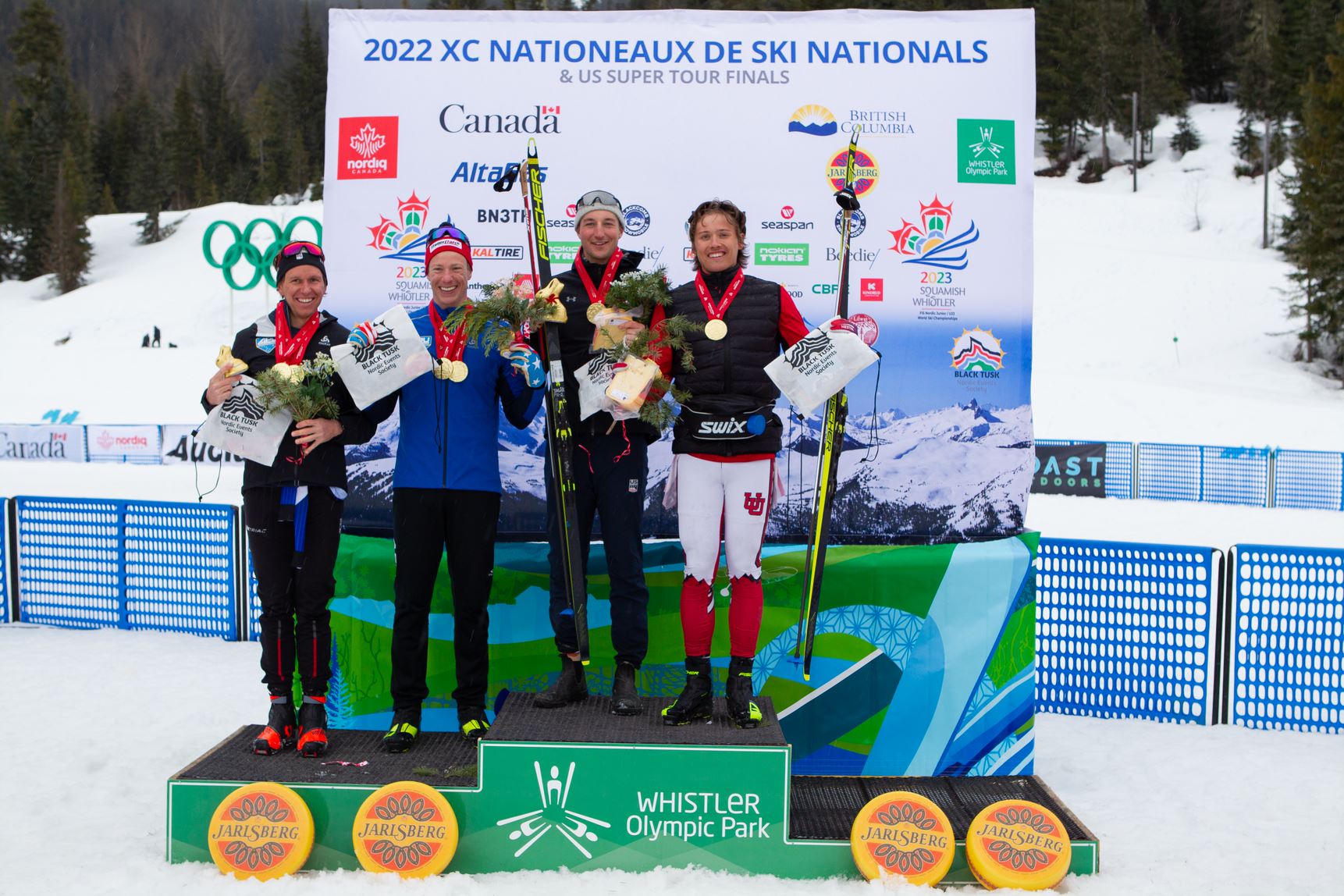
University of Utah’s Noel Keefe and Luke Jager took the SuperTour and overall win in the team sprint, with APU’s Scott Patterson and Logan Hanneman in second. (Photo: Joern Rohde / Nordiq Canada)
The 2022 FIS Junior/U23 World Ski Championships trip has been made possible through support from the National Nordic Foundation (NNF), which has identified this invaluable opportunity for developing athletes as one of its “Pillar Projects”. You can support the NNF and the next generations of America’s top skiers by making a donation here.
LYGNA, Norway – The second U23 event took place Saturday morning in the form of a 1.2-kilometer skate sprint. Qualification occurred under a sunny blue sky, with temperatures around 20°F, though moving into the heats it started to get cloudy as the wind picked up.
Moa Hansson of Sweden won the women’s qualifier in a time of 2:33.13. Abigail Jarzin (University of Utah/Salt Lake City, Utah) led the US women, finishing 43rd (+13.16). Behind her came Lucida Anderson(University of New Hampshire/Golden Valley, Minnesota) in 45th (+14.02), and Anabel Needham (Michigan Tech University/Houghton, Michigan) in 46th (+14.08).
Needham spoke to FasterSkier after the race saying, “it was a tough day, I was really hoping to possibly make heats, just felt a little tired. But the sprint course was so much fun. Super fast, and an actual sprint, so that was really cool.”
Anabel Needham races the freestyle sprint qualifier during the 2022 Junior World Ski Championships in Lygna, NOR. (Photo: flyingpointroad.com)
Rena Schwartz (Dartmouth Ski Team/Middlesex, Vermont) rounded out the US finishers in 54th, +17.95. For the Canadian women, Anna Pryce finished 35th, +10.98 back. Beth Granstrom was 44th, +13.35, Anna Parent 47th, +14.68 and Bronwyn Williams came in 52nd, +16.85.
Qualification for the men was won by Valerio Grond of Switzerland in 2:10.10. For the US, Gus Schumacher (Alaska Winter Stars/Anchorage, Alaska) and Noel Keeffe (University of Utah/Steamboat Springs, Colorado)advanced to the rounds, with 22nd and 29th places respectively. Jonny Hagenbuch (Sun Valley Ski Education Foundation/Ketchum, Idaho), the only other American U23 man competing, finished in 39th, +10.64 back. Canada had one qualifier in Pierre Grall-Johnson who finished 25th in the qualifier. Sam Hendry finished 56th for Canada, +16.54, Joe Davies 65th, +21.6 and Leo Grandbois did not start.
As usual, the women completed their quarterfinals first. The five rounds of heats saw a few broken falls, a crash or two, and the two lucky loser qualifiers coming from heat number three, Anna Grukhvina of Russia and Lisa Lohmann of Germany.
For the men, both Americans were competing in heat number four. Also in that heat was the second-fastest qualifier, Norwegian Ansgar Evensen, who won the skate sprint at Norwegian Nationals in 2020 (though notably Johannes Høsflot Klæbo did not race). Evensen broke the field apart on the first climb out of the stadium, with Czech skier Ondřej Černý keeping pace.
Those two remained clear of the field as they descended and entered the final “waffle hill”. Schumacher was in fifth, still in contact with Jaume Pueyo of Spain and Jan Stölben of Germany, while Keeffe followed. Into the finish straight, Schumacher executed a quick no-pole skate that brought him into fourth place and appeared to be a good lucky loser time. Keeffe finished 6th, +7.11 behind heat winner Černý (CZE).
Noel Keeffe (bib 29) and Gus Schumacher (bib 22) race the quarterfinal of the freestyle sprint during the 2022 Junior World Ski Championships in Lygna, NOR. (Photo: flyingpointroad.com)
“It was great, so excited to ski in a heat again,” said Schumacher after the race. Ultimately, heat five proved to be the quickest and Schumacher was bumped out of lucky loser position. Schumacher spent nearly the last month in Zhangjiakou, China, competing in his first Olympics. From there, he traveled with the US Ski Team to Helsinki. While the rest of the World Cup squad continued to Lahti for this weekend’s World Cup event, Schumacher flew to Oslo to meet up with the junior/U23 team.
When asked how the transition has been, Schumacher replied, “It’s incredibly refreshing, I can relax a lot more I feel like and it’s nice to be in Norway where there’s definitely more of a fun ski vibe, like it’s more about just doing it. It’s nice to be back with these guys, this team.” Comparing the wind today to the infamous gales of Zhangjiakou, Schumacher said, “It’s not as cold, but it is definitely picking up a little bit. But I’m fairly used to it, I’ve got my tuck dialed.”
With Canadian Grall-Johnson Pierre finishing sixth in his heat, all the North American competitors were out for the day.
In the women’s final, Moa Hansson continued her domination; after winning the qualifier, her quarter-final, and her semi-final, she took gold in the final as well. She was followed by bib 19, Monika Skinder of Poland. Nataliya Mekryukova of Russia rounded out the women’s U23 sprint podium.
Abigail Jarzin races the freestyle sprint qualifier during the 2022 Junior World Ski Championships in Lygna, NOR. (Photo: flyingpointroad.com)
The men’s final started with some drama as Jules Chappaz of France snapped a pole immediately out of the start gate. He quickly got a replacement and was able to move himself into fourth as the skiers entered the final hill. Though Grond (SUI) was out front, the pack was tight, and as they crested the hill, Chappaz (FRA) became tangled and fell, taking him out of contention. Grond held his lead to the finish to take gold. Runner-up was Denis Filimonov of Russia, followed by Magnus Øyås Håbrekke of Norway in third. Evensen (NOR) finished fourth.
Tomorrow the program switches back to the juniors in the morning, with a skate sprint for the U20 racers. That will be followed by a mixed-relay for the U23’s in the afternoon to conclude the week of racing here in Lygna.
The 2022 FIS Junior/U23 World Ski Championships trip has been made possible through support from the National Nordic Foundation (NNF), which has identified this invaluable opportunity for developing athletes as one of its “Pillar Projects”. You can support the NNF and the next generations of America’s top skiers by making a donation here.
Thursday marked the third day of 2022 FIS Junior World Ski Championships in Lygna, Norway, but the first day of competition for U23 athletes, following individual and relay races for the juniors on Tuesday and Wednesday. The U23 athletes saw a 10-kilometer interval start classic for women, and a 15 k interval start for the men.
Zanden McMullen leads the American U23 athletes with a 14th place finish in the 10 k interval start classic in Lygna, NOR. (Photo: flyingpointroad.com)
The top American finishers today were Zanden McMullen for the men in 14th, and Abigail Jarzin for the women in 36th. The overall podium was all Nordic countries, for the men, and all non–Nordic countries, for the women.
Women’s 10 k Classic
The women had the day’s first race, going out at 1 p.m. local time over two laps of a 5 k course with a relatively humane 145m of total climb per lap.
Anabel Needham races the 10 k interval start classic during the 2022 U23 World Championships in Lygna, NOR. (Photo: flyingpointroad.com)
Anja Weber of Switzerland had the day’s second-fastest split at the 3-kilometer timing checkpoint, behind early leader Anastasiya Faleeva of Russia… had the day’s second-fastest split at the halfway mark, behind Faleeva… and had the day’s second-fastest split at the 8-kilometer mark, behind Patricija Eiduka of Latvia.
But the race was 10 kilometers long. Weber held her speed over the end of the second lap slightly better than Eiduka, ultimately taking the win in 29:59.8. Eiduka was second, a scant 1.3 seconds back. Veronika Stepanova of Russia, last seen anchoring the gold-medal Russian Olympic Committee women’s relay team in Zhangjiakou, was third, 13.1 seconds back, skiing a steady race that saw her rank twelfth, eighth, and fifth at the intermediate timing checkpoints.
Stepanova recently posted to social media, explaining that she skipped the Olympics 30 k to prepare for World Juniors, adding that she wanted to do fewer races at her relatively young age. (Stepanova turned 21 last month.)
Abigail Jarzin leads the American U23 women in 36th in the 10 k interval start classic. (Photo: flyingpointroad.com)
Abigail Jarzin (University of Utah/Salt Lake City, UT) was the fastest of the four Americans in the race, finishing 36th (+2:42.8) in a well-paced effort that saw her move up considerably after ranking 45th at the 5 k split. She was followed by Anabel Needham (Michigan Tech University/Houghton, MI) in 47th (+3:47.5), Rena Schwartz (Dartmouth Ski Team/Middlesex, VT) in 50th (+4:14), and Lucinda Anderson (University of New Hampshire/Golden Valley, MN) in 56th (+4:50.8).
Among the Canadians, Anna Parent (Canmore, AB) was the top female in 17th (+1:45.8). Next for Canada was Beth Granstrom (Revelstoke, B.C.) was 37th (+2:42.9), followed by Anna Pryce (Calgary, AB) in 40th (+2:48), and Ontario’s Bronwyn Williams in 49th (+3:51.9).
Lucinda Anderson races the 10 k interval start classic during the 2022 U23 World Championships in Lygna, NOR. (Photo: flyingpointroad.com)
Other names potentially recognizable to North American readers include Poland’s Weronika Kaleta, who skis collegiately for UC Boulder, in 21st (+2:03.1), and Australia’s Tuva Bygrave, who skis collegiately for UAA, in 57th (+4:52.8).
Men’s 15 k Classic
The men went out second, undertaking three laps of the same 5-kilometer course starting at 3 p.m. local time.
The starting list was reverse seeded: The athletes with the highest distance points (on paper, the lowest ranked) went out first; the athletes with the lowest distance points (on paper, those highest ranked) went out last. There were 64 athletes in the field, and the athletes with bib no. 62 and bib no. 64 made the podium; sometimes FIS points have strong predictive value.
But sometimes first place overall goes to an athlete wearing bib no. 31. And that, as the saying has it, is why you play the games.
Noel Keeffe races the 15 k interval start classic during the 2022 U23 World Championships in Lygna, NOR. (Photo: flyingpointroad.com)
Arsi Ruuskanen of Finland skied his first lap in 12:58.1, a split time that ranked sixth overall after all the athletes had come through. Ruuskanen’s relatively early bib number meant that he lapped through the stadium just as eventual eighth-place finisher Iver Andersen of Norway was going out on course. Perhaps due to the chance to work with Andersen for much of his second lap, perhaps due to just his own strong race, Ruuskanen would go on to set the day’s fastest times at 10 kilometers, 13 kilometers, and, notably, the finish.
The 22-year-old Finn took the victory in a time of 40:23.0. He was closely followed by Leo Johansson of Sweden, 6.7 seconds back, who had more of a gap to third, Håvard Moseby of Norway, 28.1 seconds back.
The top American on the day was Zanden McMullen (Montana State University/Anchorage, AK), in his first year racing as a U23 athlete after three years of racing at World Juniors. Racing internationally at the senior level, McMullen also had four World Cup starts in Period 1 of this season, then placed sixth in both distance races at 2022 U.S. Nationals.
McMullen started the 15 k out hot, registering the day’s 3rd-fastest time through the 5 k checkpoint. He slowed slightly from there, though not too much, coming through other intermediate checkpoints in 9th and 15th. He was ultimately 14th overall at the finish, 57.8 seconds back from Ruuskanen.
Johnny Hagenbuch races the 15 k interval start classic during the 2022 U23 World Championships in Lygna, NOR. (Photo: flyingpointroad.com)
Among the Americans, McMullen was followed by Johnny Hagenbuch (Sun Valley Ski Education Foundation/Ketchum, ID) in 41st (+2:59.8) and Noel Keeffe (University of Utah/Steamboat Springs, CO) in 47th (+3:39.5). In a nod to a certain race being held in Wisconsin on Saturday, it should be noted that Hagenbuch is the youngest-ever winner of the American Birkebeiner.
Turning to Canada, Léo Grandbois set the pace with the day’s only top-10 finish for North America, crossing the line in 9th (+44.3). He was followed by Sam Hendry (Canmore, AB.), who skis collegiately for the University of Utah, in 18th (+1:14.1), Ottawa’s Pierre Grall-Johnson in 29th (+1:51.0), and Joe Davies (Pemberton, B.C.), who skis collegiately for UAF, in 35th (+2:16.5).
Racing continues tomorrow with interval-start classic races for the U20 athletes, 5 k for the women and 10 k for the men.
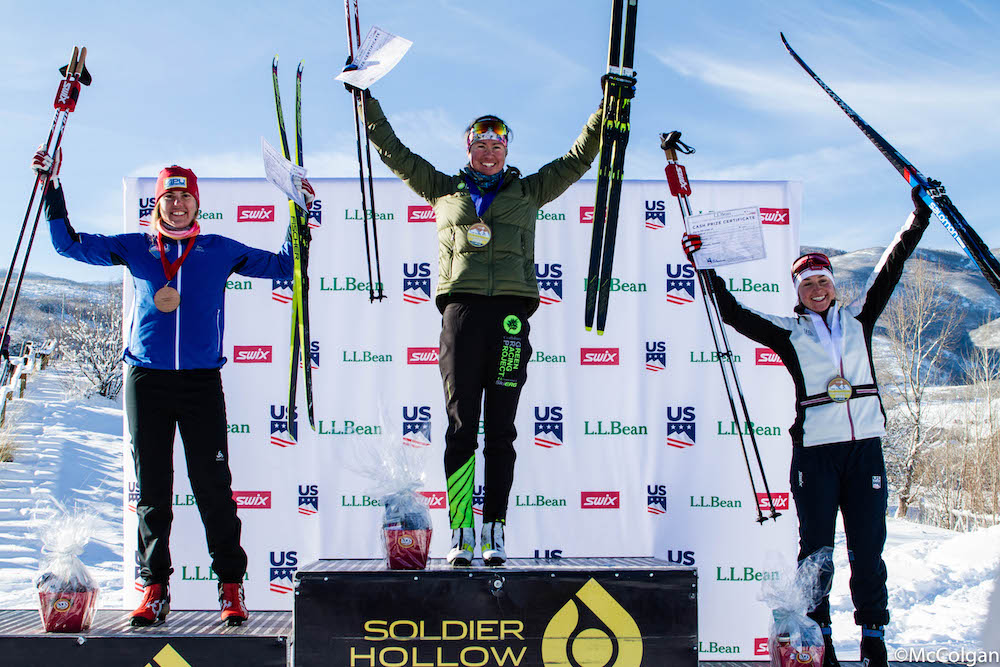
From left, Becca Rorabaugh (APU), Caitlin Patterson (CGRP), and Sydney Palmer-Leger (Utah) on the podium, 2022 U.S. Nationals. (photo: John McColgan)
By Gavin Kentch and Rachel Bachman Perkins
The 2022 U.S. Cross Country Championships began in Soldier Hollow, outside of Salt Lake City, Utah, on Sunday with skate sprints. JC Schoonmaker, recently returned from Europe, took his first national championship with relative ease for the men, while Caitlin Patterson, who was the first American in all four races at 2018 U.S. Nationals, returned to her Olympic-year winning ways by taking the victory for the women. Will Koch and Rosie Frankowski won the qualifiers, the race that matters for potential domestic Olympic qualification.
Men’s Race: JC Schoonmaker Wins First National Title with Tactics and Speed
JC Schoonmaker was born in August 2000. Eighteen months later, American skier and ski journalist Cory Smith, writing on a nascent website called FasterSkier.com, observed that race tactics were important on the sprint course being used for the 2002 Winter Olympics in Salt Lake City, and that it was generally disadvantageous to be leading into the final downhill as athletes approached the sweeping lefthand turn into the finishing stretch. He discussed Kateřina Neumannová’s quarterfinal heat as an example of the potential dangers of leading throughout, if that name gives you a sense for how long ago we’re talking about.
Twenty years later, in the opening race of 2022 U.S. Cross Country Championships, the names had changed but not the physics, as time and again it became apparent that athletes’ positioning on the final downhill was the single most important aspect of the course. Multiple heats saw athletes come back from fifth or even sixth to move up through the field and advance, and the one male athlete who tried to lead his heat from the gun paid for it in the end.
Schoonmaker, the U.S. Ski Team athlete who skis domestically for University of Alaska Anchorage, understood these tactics to perfection, using the experience gained from racing into 14th in the current World Cup sprint standings (despite missing two sprints in the Tour de Ski) to position himself exactly where he wanted to be throughout the afternoon. The result was his first national title, on a sunny, high-pressure, perfect day at Soldier Hollow.
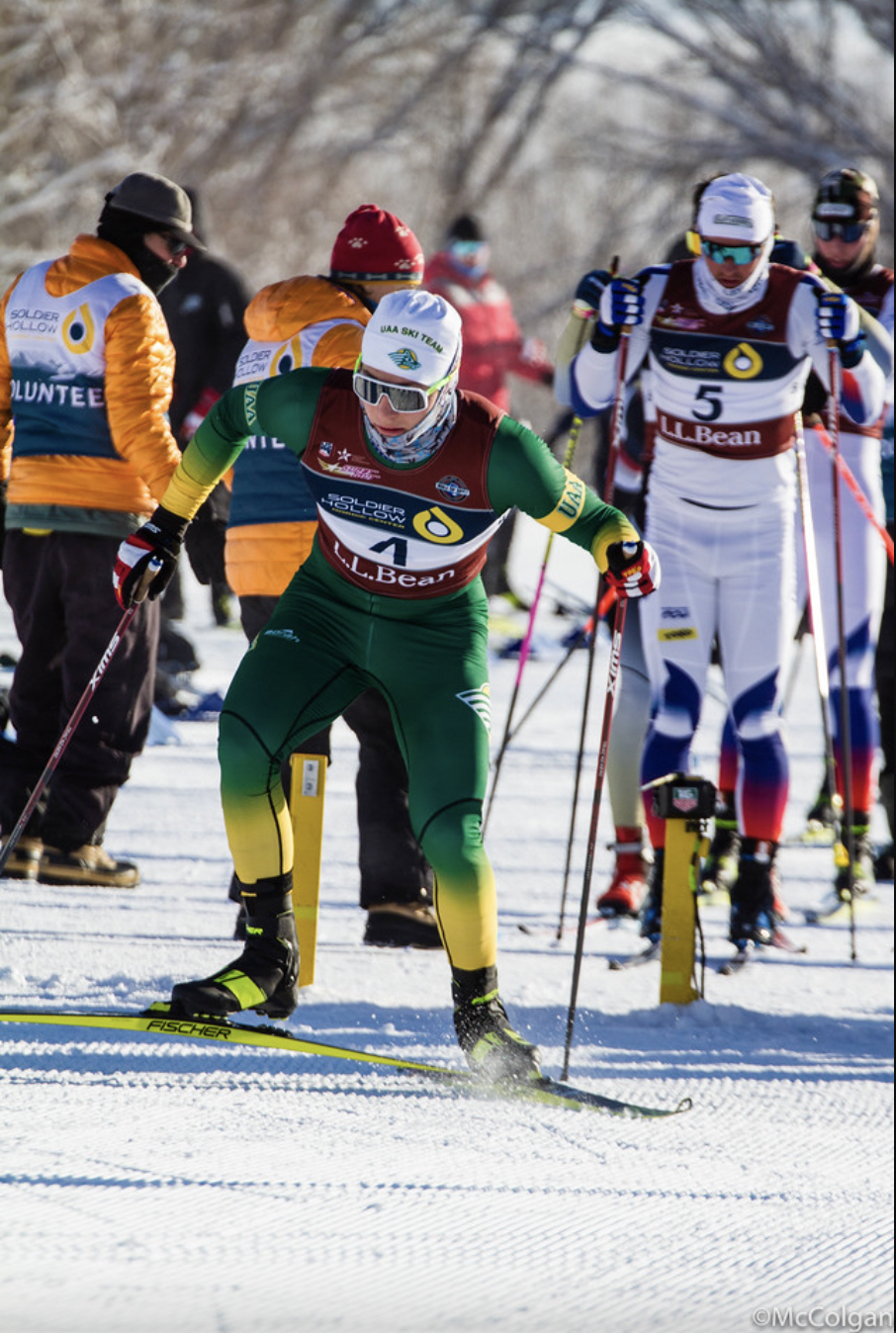
JC Schoonmaker heads out in the qualifier. (Photo: John McColgan)
We’re not going to survey every heat from Sunday’s races, on the first of four days of competition at Soldier Hollow, but it’s worth looking at the fastest qualifiers, and the day’s first quarterfinal, to set a tone for what followed.
In the qualifier, 19-year-old University of Colorado skier Will Koch may have turned some heads when he notched the day’s fastest time, 3:07.88. Schoonmaker had the day’s second-best mark, 0.47 seconds back, with Bridger Ski Foundation athlete Logan Diekmann third by over a second more.
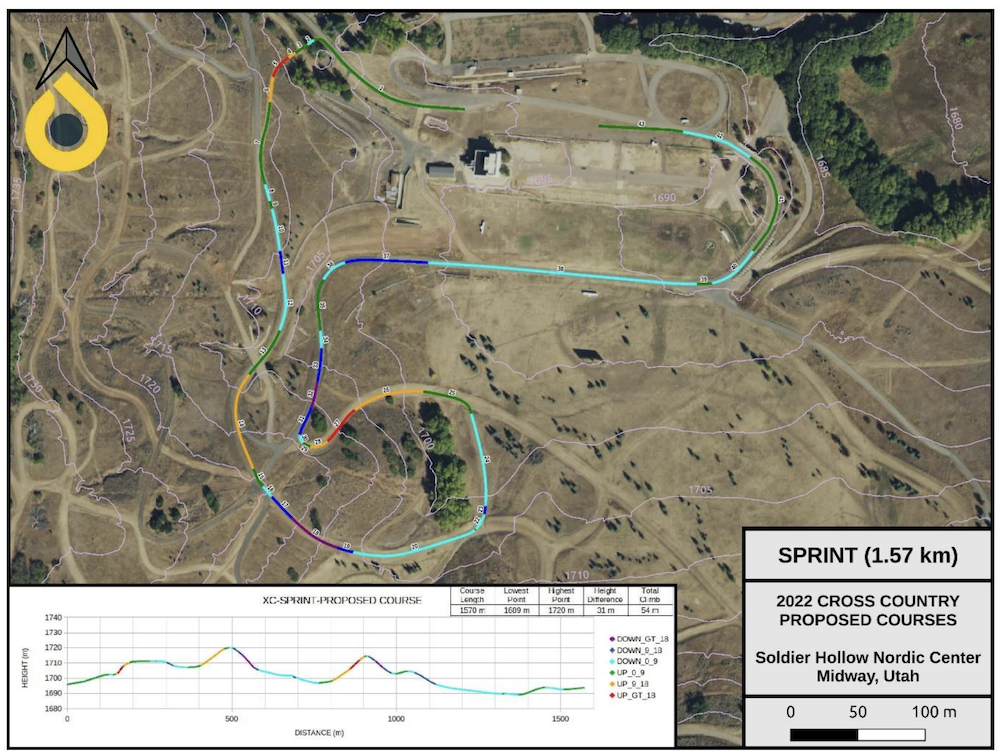
In the day’s first quarterfinal, Koch picked up where he had left off in the qualifier, blasting off the line to set a hot pace right from the start. He was probably the only athlete all day to V2 the entire first hill leading out of the stadium. He led up the first hill, down the first downhill, up the second and main climb on the course, and into the start of the final sweeping downhill into the stadium and the finishing lanes (see course map and profile below).
Course map and elevation profile for 2022 U.S. Nationals sprint course. (photo: screenshot from race website)
But then, for the first time on the day but not the last, the athlete who led into this descent was swallowed up by the rest of the field by the time they reached the final lefthand curve. Koch was caught up, gamely contested the group sprint that ensued, but barely ran out of gas after pushing hard for the entire heat.
Koch would finish fifth in a five-man heat – despite skiing faster than he had in qualifying. For his troubles, he towed the entire heat to the day’s fastest times by far, and both lucky loser spots; fifth in this heat would have won any other quarterfinal, semifinal, or final on the day. By nearly 5 seconds.
While the top qualifier was knocked out in the first quarterfinal, the effort is not to be diminished. Indeed, Koch chose a tactic, committed to it fully, executed it well, and came within 0.05 seconds of claiming fourth in his quarterfinal to advance as a lucky loser. With that in mind, this heat set the tone for the day, as a field of observant professional athletes noticed that there was maybe not a lot to gain by leading out the heat, and a lot to lose.
As Smith wrote of these dynamics on this course 20 years ago, “The ideal situation is to spend the first three-quarters of the race in the back, avoiding mayhem and drafting. Then move up to second coming into the final turn, and use the turn to shoot out and around the leader to win the sprint. But obviously that is easier said than done when everyone else is trying to do the same thing.”
In lieu of a play-by-play of the next six quarterfinal and semifinal heats on Sunday, let’s just survey some winning times: 3:06.09 (QF1, Koch’s heat); 3:15.31 (QF2); 3:13.97 (QF3); 3:16.83 (QF4); 3:10.99 (QF5); 3:13.16 (SF1); 3:20.04 (SF2). There’s a theme there: While the heat 1 lucky losers may see Koch’s reward for pushing the pace, no one else in the men’s field chose his approach. Racing was slower-paced, but it was hard to fault the results, at least for the athletes who advanced.
(The discrepancy is perhaps even greater than that, as local observers noted that the course got progressively faster throughout the day, as it warmed up from below-zero F temperatures the night before. On quiet moments in the livestream, the difference between notably squeaky snow (for the qualifiers) and not-squeaky snow (for the heats) was apparent.)
The other, related issue was falls at the bottom of the long runout, as trailing athletes accordioned back up to the leaders, and four, five, or even six men all sought to move from a narrow tuck to a wide V2 at the same time on the same stretch of trail. Through what consistently looked like incidental contact rather than malicious contact punishable by a yellow card or other formal sanction, Ian Torchia, Bill Harmeyer, Christopher Kalev, and Brian Bushey all hit the deck in their quarterfinals. The same thing happened in the semis, too, with Karl Schulz falling in the first semifinal and John Schwinghamer in the second. Again, it certainly appeared that it was not intentional, just the results of athletes all commencing a V2 at the same time at high speed.
After one fast heat and six slower heats, six men lined up for the final: JC Schoonmaker (UAA/USST), Noel Keeffe (University of Utah/USST), Logan Diekmann (BSF), Johnny Hagenbuch (SVSEF/USST), Magnus Bøe (University of Colorado), and Andreas Kirkeng (University of Denver).
Their average age was slightly less than 22; they had probably not read Smith’s coverage of the 2002 Olympic sprint when it was first published. But they had all successfully raced two heats on this course already, and they seemed disinclined to change what had got them there.
All of which is to say that Schoonmaker’s winning time for the final, 3:21.05, was the slowest of any men’s heat that day. (Indeed, this time would have placed him fourth in the first junior boys semifinal.) Diekmann led the pack out of the stadium in the final, closely tailed by the rest of the field. The men skied fairly leisurely up the first uphill, down the first downhill, and up the second uphill.
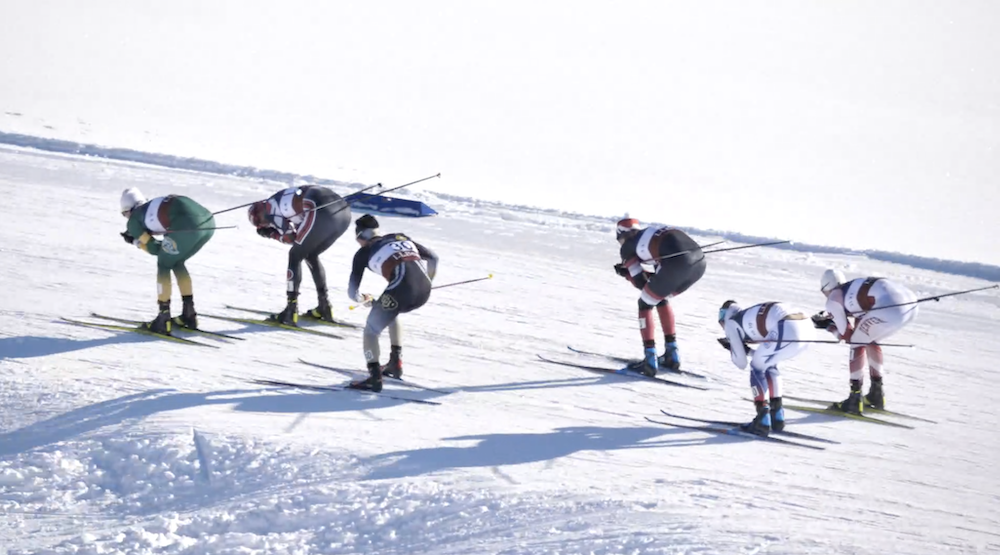
Finally, coming into the final downhill, Bøe moved, and Schoonmaker followed. The field started racing in earnest at this point, but there was still not much separation between six athletes traveling at high speeds: Here’s the men’s field, nearly three minutes into the final, about to come up out of their tucks, navigate the final lefthand turn, and sprint into the finish:
JC Schoonmaker (far left) leads the final in the men’s skate sprint at 2022 U.S. Nationals. (photo: screenshot from livestream)
That’s Schoonmaker in the lead, Keeffe just off his right shoulder in second, Bøe (bib no. 30) in third, then Diekmann, Hagenbuch, and Kirkeng trailing slightly behind in fourth through sixth, respectively, from left to right. And, spoiler alert, these were not their final finishing positions; there was more movement yet to come.
While the camera work, free live broadcast, and Adam Verrier’s announcing were consistently superb, the limitations of the available camera angles meant that a portion of the final lefthand curve was obscured from view for a few seconds. (That curve can be seen in the video in the second half of this Instagram post from BSF.)
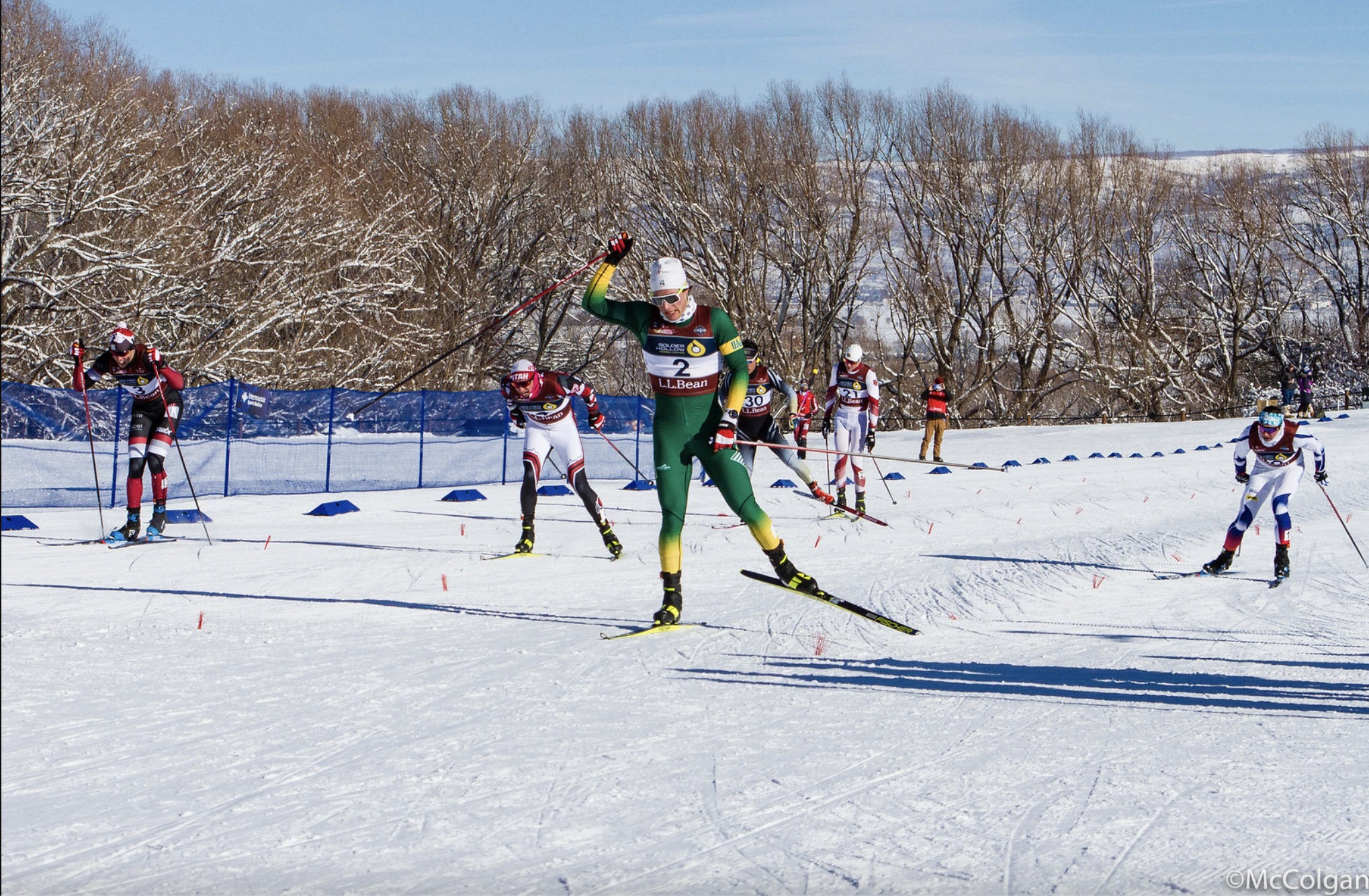
By the time the athletes came into view once more, Schoonmaker had positioned himself precisely where he wanted to be, on the inside of the curve, carrying a lead of multiple meters. His gap was small but consistent through the finish, which he approached with sufficient time and space to stand up and celebrate across the line.
JC Schoonmaker celebrates across the line as he wins the men’s skate sprint at 2022 U.S. Nationals. (Photo: John McColgan)
Schoonmaker’s winning time was 3:21.05. Behind him, Diekmann (+0.83) outlunged Keeffe (+.91) for second by less than a ski. Hagenbuch was another 0.20 seconds back in fourth (+1.11) , followed by the two collegiate skiers, Bøe and Kirkeng, in fifth (+2.14) and sixth (+3.47).
“I’m feeling really good after a nice relaxing Christmas at home [in Tahoe City, CA],” Schoonmaker wrote to FasterSkier after the race. “It was great to have a mental break from racing and we got absolutely dumped on with snow so that was really fun too.”
Schoonmaker also spoke to his feelings in the sprint, after a successful, but potentially draining stint in Europe, where he skied into the semifinals three times, finishing as high as 7th in Ruka, Finland.
“Today I felt pretty good and felt like I was getting better throughout the day after a little break from racing. It’s a weird course with the last downhill being so tactical but I was happy with my positioning and how I skied it. I won’t race the 30k just to make sure I’m not overdoing it but I’m really looking forward to the 15k classic, almost more than the sprints since I haven’t been doing much distance racing. I’m also just super excited to be back racing in the US and seeing a ton of friends out there!”
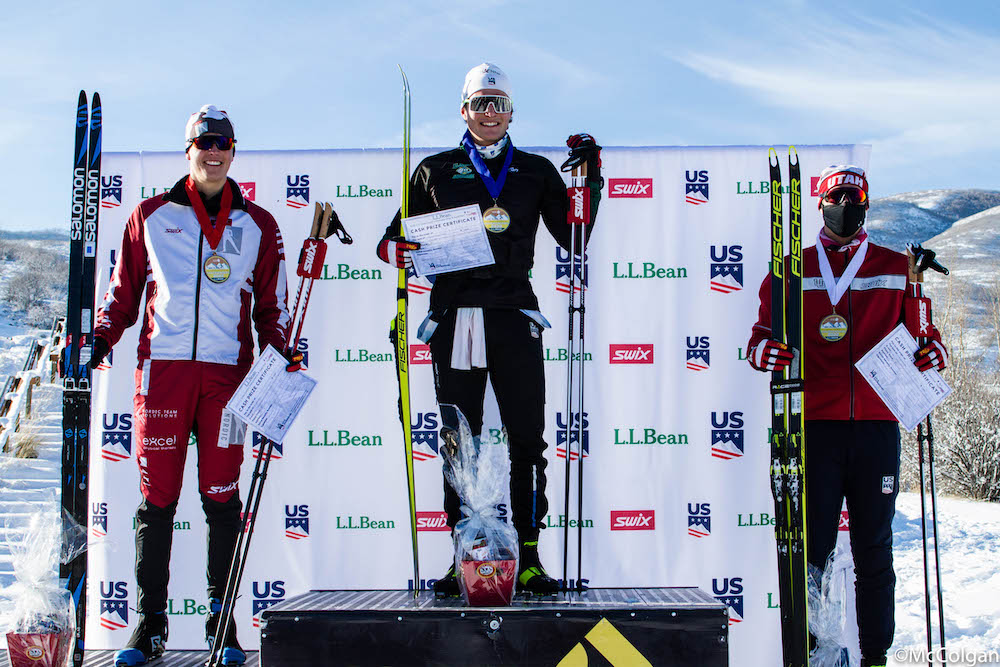
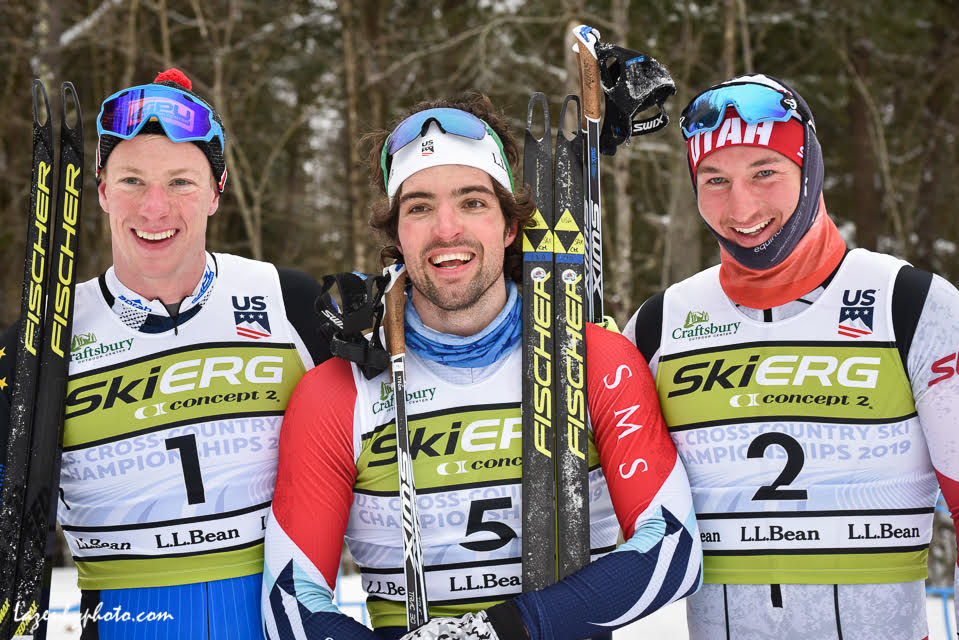
From left, Logan Diekmann (BSF), JC Schoonmaker (UAA/USST), and Noel Keeffe (Utah/USST) on the skate sprint podium, 2022 U.S. Nationals. (Photo: John McColgan)
It was Schoonmaker’s first national championship. His trajectory to the top of American sprinting has been quick, and recent; he finished 13th in the skate sprint at 2020 U.S. Nationals, and 14th in the classic sprint at 2019 U.S. Nationals. The last time he raced a national championship at Soldier Hollow, in 2017, he was 165th, albeit also age 16.
Women’s Race: Caitlin Patterson Times Her Move to Take the Victory
The tactical theme held fast through the women’s heats. Athletes stayed relaxed through the first two climbs of the course, using the sweeping downhill in the middle to establish position heading into a final shorter climb. Pushing over the top and into the downhill, athletes benefited from tucking into the slipstream of the leader rather than being first in the glideout, conserving energy for the final explosive push over the bridge and up through the finish lanes to the line.
Perhaps the only skier breaking from this narrative was APU’s Rosie Frankowski. Though she was third in both Period 1 SuperTour sprint races this season, Frankowski has historically been better known for her distance chops. Perhaps recognizing she’d need a fast heat to ensure lucky loser opportunities, Frankowski took the first heat of the quarterfinal out hot, dropping the field on the opening climb only to be reeled back in on the subsequent descent. As the women left the critical descent and began to skate out of the subsequent glideout, Frankowski was within a group of four women.
Powering into the final stretch, it was Frankowski matched by her teammate Becca Rorabaugh leading the way to the line, with Sun Valley’s Samantha Smith and Northern Michigan’s Katarina Hyncicova close behind. Rorabaugh took the heat in 3:43.67 with Frankowski in second. Though she qualified automatically, Frankowski’s fast start achieved the objective; it was the fastest heat of the quarters, allowing both Smith and Hyncicova to advance to the semis.
A trio of APU women on site at US Nationals. From left to right, Annie Gonzales, Rosie Frankowski, and Becca Rorabaugh. (Photo: Instagram @frankowitz)
In the semis, Frankowski repeated her approach, again pushing the pace early to establish a fast heat. Sydney Palmer-Leger (Univ. of Utah/USST) looked comfortable and content with her position as she trailed Frankowski into the sweeping downhill. Rorabaugh and Anna Bizyukova (UVM) also caught the leaders in the glideout, with Bizyukova sliding around the outside to head over the bridge alongside Palmer-Leger, setting the stage for a tight four-way spread at the finish with Frankowski and Rorabaugh on their tails.
Finishing with what would be by far the fastest times of the day, Palmer-Leger took the win in 3:38.61, edging out Bizyukova by 0.14 seconds. Half a ski length behind, Frankowski crossed in third (+0.31), with Rorabaugh fourth (+0.46). Roughly seven seconds back, Hannah Rudd (BSF) was fifth in the semi, finishing just ahead of Hyncicova.
The start of the second women’s semifinal. (Photo: Julie Oldham)
In the second semi, SMS T2 athlete Lina Sutro set a more conservative pace, leading Middlebury athlete Kate Oldham through the first two climbs. Sun Valley’s Samantha Smith made some aggressive hop-skate pushes to take the lead on climbs, but she was caught and passed on each of the subsequent descents. Sutro and Oldham charged hard over the top of the final climb, pushing into the downhill, but a strong move around the curve by Mariel Pulles (UAF) shot her to the front from fourth, while Caitlin Patterson also accelerated into the lead group.
Coming into the final stretch, it was Pulles with a narrow advantage over Patterson, with Sutro and Oldham holding on for a fast time, but no longer within reach of automatic qualification. Pulles crossed the line in 3:45.15, well behind the previous heat’s benchmark, indicating that only she and Patterson, who crossed +0.10 behind, would advance to the final.
Sutro crossed the line just ahead of Oldham for third (+0.28), followed by Oldham in fourth (+0.74). Lucinda Anderson (UNH) and Smith rounded out the second semi in fifth (+1.04) and sixth (+2.72), respectively.
In the final, a broken pole early on put Pulles at a significant disadvantage, though she held contact with the leaders. Frankowski again pulled ahead from the start, looking to be at the front, and set a pace that would not leave her opponents fresh for a fast and tactical final push.
After maintaining her position at the front through the meat of the course, Frankowski was once again swallowed up in the glideout as Patterson, Palmer-Leger, Rorabaugh, and Bizyukoga each caught and passed her. Frankowski wobbled as she found her position, looking as if some unintentional bumping of skis had taken place at the spot where we saw many crashes in the men’s quarterfinals and semifinals.
Patterson led over the bridge with Rorabaugh on her tails and Palmer-Leger in a competitive position alongside. Creating a small gap ahead of the three women in pursuit in the final straightaway, Patterson, Rorabaugh, and Palmer-Leger skied three abreast, seemingly evenly matched in the closing meters. Palmer-Leger skied with the highest tempo, but Patterson’s smooth and powerful technique carried her through the finish with the advantage, stopping the clock at 3:42.60, with Rorabaugh half a ski length behind in second (+0.24), and Palmer-Leger spaced evenly behind in third (+0.57).
Caitlin Patterson (far right), Becca Rorabaugh (center), and Sydney Palmer-Leger (far left) race to the line in the women’s sprint final at 2022 US Nationals. (Photo: John McColgan)
Bizyukova won the second-wave sprint to take fourth (+1.57), with Pulles, still racing with a dysfunctional pole, next over the line in fifth (+2.28), with Frankowski finally losing steam to finish sixth (+2.52).
Patterson was realistic after the race when she assessed her chances, while also revealing it was no secret that the final downhill was the crux of the course.
“The sprint today was really fun,” she wrote to FasterSkier late Sunday. “I went into it in no way expecting to win, but believed that it was within the realm of possibilities. The key would be to see how the final downhill played out in the heats and and try to play it well myself.”
Patterson added, “I do love downhills, but this Soldier Hollow sprint course perplexes me somewhat because it feels hard to control what’s going to happen in the race, with the way the draft might play out in those final hundred meters. I didn’t feel particularly in control during my heats, but I took advantage of whatever I could work with for positioning and made it work to move on through the quarterfinal and semifinal. I felt better in the heats than during the qualifier, but in much of the heat race I felt that the packs moved around and stayed tight together in a way that I had to tap into surges here and there rather than a consistent effort throughout the whole course. There were a lot of really tight finishes today – my own and others – and I think there were a ton of super strong skiers out there who probably got edged out by the tiniest of margins, but so goes sprint racing.”
Caitlin Patterson won the opening freestyle sprint of the 2022 US National Championships in Soldier Hollow. (Photo: John McColgan)
Turning to the final, Patterson recounted, “I was forced out wide to the right at the base of the final climb, and had to tuck in behind some people skiing up that steep hill. It wasn’t necessarily my plan to enter the downhill in 5th, but then when I pushed super hard over the top of the hill, I caught several drafts and executed good passes. When I found myself taking the lead going into the final corner, I pushed to the finish with everything I had even as I started to get a bit wobbly, and fortunately managed to hold off Becca and Sydney!”
The 30-something Patterson added, “Becca and I would like to note that no one should count us Master’s racers out of the game!”
Patterson noted that she is pleased to achieve sprint success domestically, but is seeking more international opportunities in distance races.
“Period 1 racing on the World Cup was ok for me, but not great, it felt like a bit of a slow start to wake up the distance race speed. Undoubtedly the whole World Cup field is extremely competitive right now, and the other US women are super strong which is awesome to see, but I want to get up there myself into contention! Without scoring any World Cup points in P1, it wasn’t really an option to stay and race the Tour this year, so I came back to the US to regroup and focus on Nationals racing. I believe that with strong Nationals distance race performances I may be able to earn more upcoming international racing starts, so that is my focus looking ahead.”
Juniors
A full field of juniors raced as well, going through a complete set of heats and finals after the senior athletes. Kendall Kramer (University of Alaska Fairbanks/USST) took the junior girls final over fellow Alaskan Marit Flora (APU), with Erica Laven (Täby IS Skidor) in third. Laven is from Sweden; Lauren McCollor (Northern Michigan University), fourth overall, rounded out the domestic national championship podium as the third American.
In the junior boys final, Finegan Bailey (SMS) took the win, with Trey Jones (Steamboat Springs Winter Sports Club) in second. Aidan Burt (University of Vermont) was third.
More about the course
The Soldier Hollow sprint course has historical relevance looking back to the 2002 Olympics, as discussed above. It also has prospective relevance, to the 2022 Olympics that start in Beijing in roughly a month.
Notably, and speaking of this year’s Olympics, it is “only … qualification round finish placing” that is considered for the USSS 2022 Championship Selection List, i.e., Koch and Frankowski each received a full 45 points (30 points for first plus 15 points for the national championship bonus) for winning the qualifier, regardless of their final overall placing.
While it remains an open question how many domestic athletes will be selected to this year’s Olympic team off of these races, it would be hard to find a better course to use as a basis for comparison. As Rosie Brennan noted in explaining her decision to come back home during the Tour de Ski and experience an extended period of living and skiing at altitude, the two trail systems were even designed by the same person.
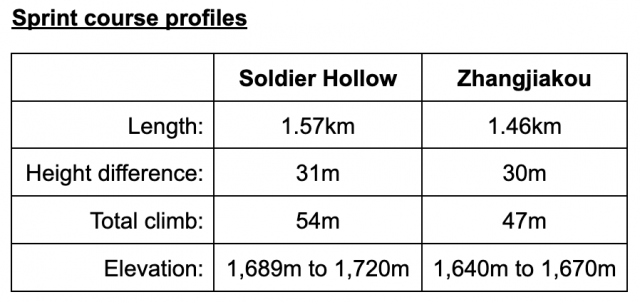
In addition to their more holistic similarities, their statistics are very comparable as well, particularly the overall elevation but also the more specific details of the course profiles:
Course information for 2022 U.S. Nationals and 2022 Olympics sprint courses. (FasterSkier table by Gavin Kentch)
If an athlete is indeed picked for the Olympic team based off of their performance in this week’s sprint races, it seems fair to say that they will have achieved success on the type of course they can expect to find in Zhangjiakou.
U.S. Ski & Snowboard has announced the Davis U.S. Cross Country Ski Team nominations for the 2020-21 season. Nominations include those active athletes who qualified based on published selection criteria in the prior season.
“The 2021 U.S. Cross Country Team has more depth than any team in modern American cross country ski racing history,” said Davis U.S. Cross Country Team Program Director Chris Grover. “From our seasoned veterans who will be focused on bringing home hardware from the 2021 FIS World Championships in Oberstdorf, Germany, to the members of the Development Team, who can nearly all boast having at least one World Junior Championships medal, this team offers so many ways to win. Athletes in this group have systematically broken down every barrier in cross country performance that traditionally blocked American athletes, including World Junior gold, to World Championships gold, to Olympic gold.”
The 2020-21 team is highlighted by an experienced group of World Cup, World Championship and Olympic Winter Games athletes, including Olympic gold medalist, Jessie Diggins and 2020 FIS Junior World Championship double-gold medalist Gus Schumacher.
The 2020-21 team also includes the largest D Team squad ever nominated with 11 athletes, including members of the gold-medal winning 2019 and 2020 FIS Junior World Ski Championships men’s relay team: Luke Jager, Ben Ogden, and Johnny Hagenbuch. The D Team also includes all four members of the silver-medal winning FIS Junior World Ski Championships women’s relay team: Kendall Kramer, Sydney Palmer-Leger, Novie McCabe and Sophia Laukli.
“The strength of the 20- 2021 U.S. Cross Country Team speaks to the commitment and professionalism of the community that has helped these athletes achieve excellence,” Chris said. “Our coaches’ education system, the stability and quality of our development preparation projects, and the dedication and knowledge of our club and school coaching partners has been instrumental in helping these athletes succeed internationally.
“The big steps forward over the last two decades have happened via community collaboration and pulling in the same direction,” he continued. “Together, we’ve created a truly American solution that meets the needs of our culture and our geography.”
Athletes nominated to the team are scheduled to open the season in with their first training camp in Park City, Utah (pending COVID-19 considerations).
Each athlete accepting the nomination to U.S. Ski Team receives world-class program support, along with access to the U.S. Ski and Snowboard Center of Excellence, as well as athletic benefits including an elite coaching, sport science, sports medicine, and high performance staff, and education opportunities.
An official Davis U.S. Cross Country Ski Team announcement will be made in the fall.
Kevin Bolger on his way to qualifying 16th overall and finishing 18th on the day: Planica, Slovenia’s World Cup skate sprint in December 2019. (Photo: NordicFocus)
You may have heard that the World Cup is returning not only to North America, but also to American soil, within the next few weeks. The world’s best skiers will be contesting sprint races in Québec City on March 14 and 15; a sprint in Minneapolis on March 17; and distance races plus a mixed relay in Canmore on March 20-22.
For all six races, including the five across the border, the U.S. has an expanded nation’s group start quota (thanks, Canada, for letting us count as Canadian for a week), meaning that a remarkable thirty skiers total will toe the line in that distinctive candy-cane uniform. Here is a brief overview of the fourteen men currently announced with start rights in the three sprints (some of the sprinters will not be racing in Canmore, where some distance-oriented athletes will have starts instead).
In alphabetical order, with pictures where available (an asterisk by a name denotes an athlete making his first World Cup start in Québec City):
Kevin Bolger of the U.S. Ski Team on his way to qualifying 32nd in the Ruka, Finland classic sprint in November 2019. (Photo: NordicFocus)
Kevin Bolger
Team and club: SVSEF Gold Team; United States Ski Team (USST) B-Team
Currently lives in: Idaho
Selected career highlights: 11th in his first-ever World Cup sprint, March 2018; 18th, skate sprint, 2019 World Championships; 1st, 2017 U.S. nationals classic sprint; 2nd, 2018 U.S. nationals skate sprint
Instagram page: @kevinbolger
Age: 26
Logan Diekmann as a University of Utah freshman (Courtesy photo)
Logan Diekmann*
Team and club: University of Utah
Currently lives in: Montana
Selected career highlights: 38th, 15km classic, 2020 U23 World Championships; 10th, classic sprint, 2020 U.S. nationals; 11 top-five finishes in RMISA races, member of 2017 and 2019 NCAA championship teams
Instagram page: @logandiekmann
Age: 22
In his return to World Cup sprinting, Simi Hamilton skis to 14th overall on Stage 3 of Ski Tour 2020. (Photo: NordicFocus)
Simi Hamilton
Team and club: Stratton Mountain School, or SMS; USST A Team
Currently lives in: Vermont
Selected career highlights: Three-time Olympian; four individual World Cup podiums, including one win; 6th, team sprint, both 2014 and 2018 Olympics; 9th, individual skate sprint, 2019 World Championships
Instagram page: @simihamilton
Age: 32
Logan Hanneman of the U.S. during the Falun, Sweden classic sprint qualifier in February 2020. (Photo: NordicFocus)
Logan Hanneman
Team and club: Alaska Pacific University, or APU
Currently lives in: Alaska
Selected career highlights: 2018 Olympian; 26th, 2019 World Championships; six individual top-30 World Cup results; two national championship podiums
Instagram page: @logan.hanneman
Age: 26
Peter Holmes during the qualifier in the 1.6 k classic sprint at the 2019 U23 World Championships in Lahti, Finland. (Photo: Doug Stephen)
Peter Holmes
Team and club: SVSEF Gold Team
Currently lives in: Idaho
Selected career highlights: 27th, classic sprint, 2019 U23 World Championships; multiple top-1o finishes, national championship and SuperTour sprints
Instagram page: @vacationholmes
Age: 24
Mulleted and proud: Luke Jager destroys the field, opening a gap of 25 seconds on the lead-off leg of the 2020 World Juniors relay earlier this month. (Photo: Doug Stephen)
Luke Jager*
Team and club: University of Utah/APU; USST D Team
Currently lives in: Alaska
Selected career highlights: Gold medal, relay, 2019 and 2020 World Juniors; silver medal, relay, 2018 World Juniors; 10th, 10km classic, 2020 World Juniors; 2nd American, classic sprint, 2020 U.S. Nationals; three podiums in RMISA races this season
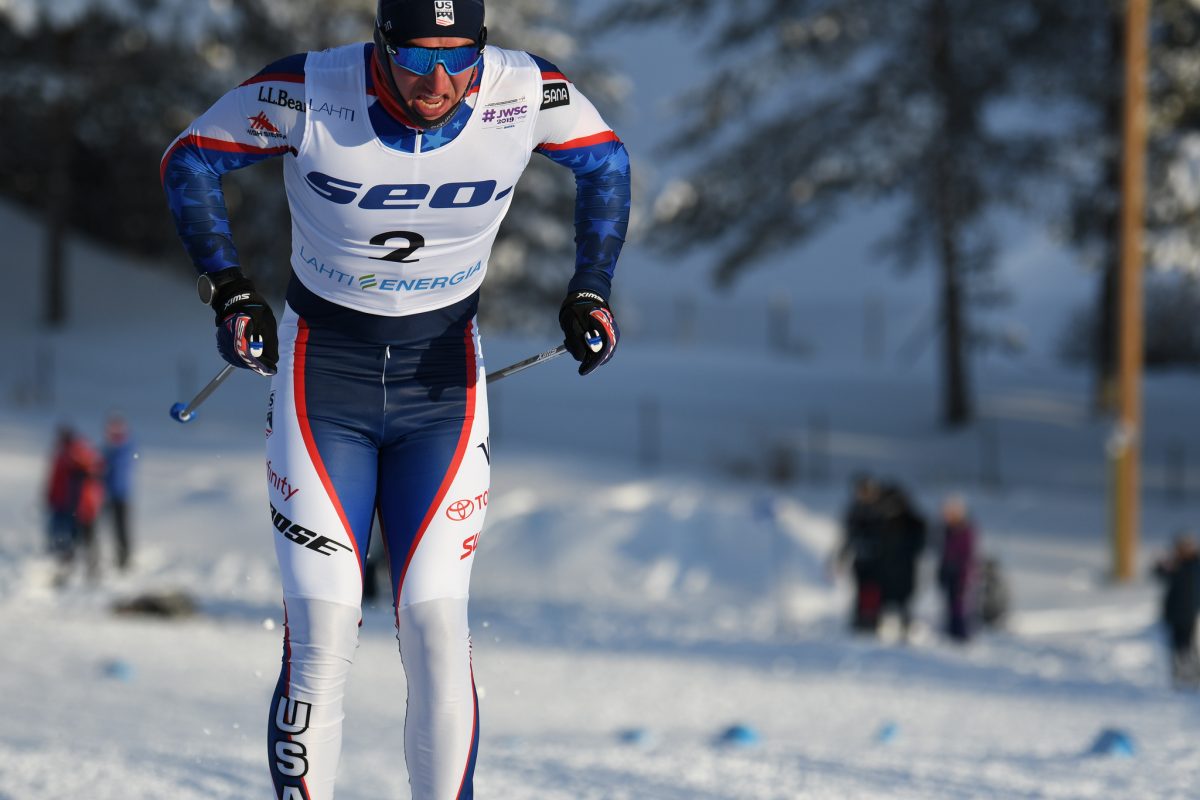
Noel Keeffe during the 1.6 k classic sprint qualifier at Junior World Ski Championships in Lahti, Finland. (Photo: Doug Stephen)
Noel Keeffe
Team and club: University of Utah/Steamboat Springs Winter Sports Club; USST D Team
Currently lives in: Colorado
Selected career highlights: 12th, classic sprint, 2019 World Juniors; 3rd, skate sprint, 2019 U.S. Nationals; three top-10 finishes in RMISA races; made World Cup debut in Oberstdorf earlier this season
Instagram page: @noel.keeffe
Age: 20
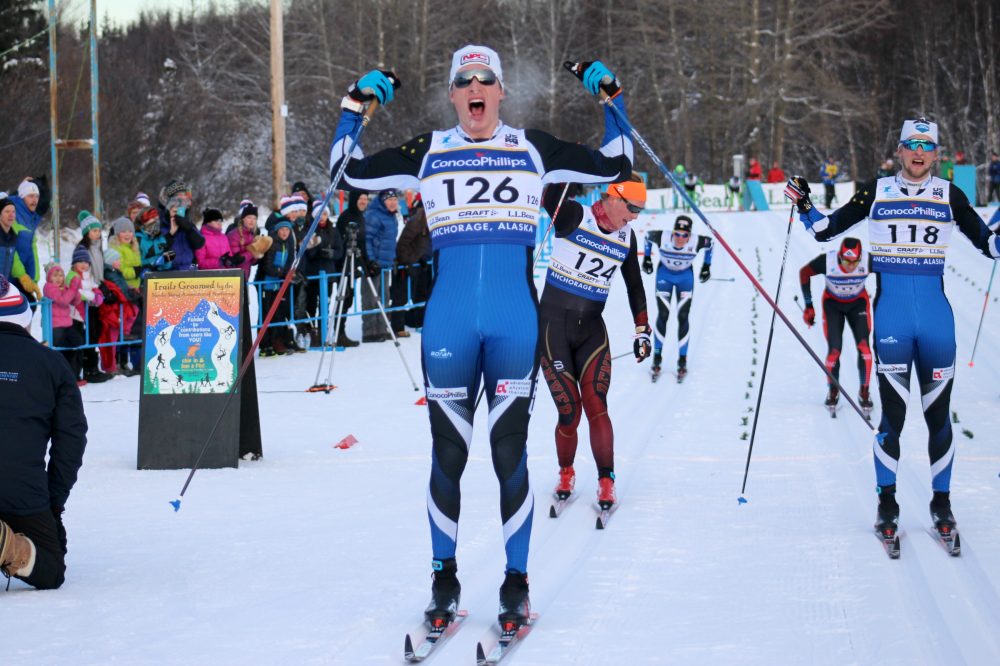
APU’s Tyler Kornfield (126) celebrates as he crosses the line first in the men’s 30-kilometer classic mass start on Sunday at 2018 U.S. Cross Country Championships in Anchorage, Alaska. Eric Packer (118) finished second and Denver University’s Eivind Romberg Kvaale (124) placed third.
Tyler Kornfield
Team and club: APU
Currently lives in: Alaska
Selected career highlights: 2018 Olympian; seven national championship podiums, including three national championships; 19th, skate sprint, 2014 U23 World Championships
Instagram page: @tkornfield
Age: 29
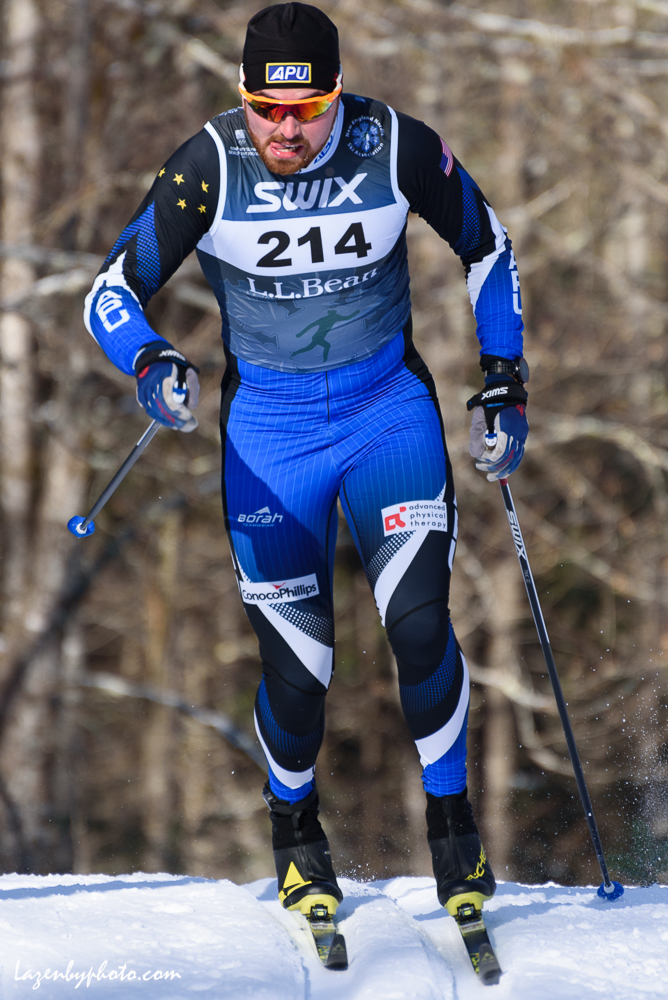
Forrest Mahlen (APU) racing to fifth in the men’s 1.4 k classic sprint qualifier in February 2020 at the SuperTour in Craftsbury, Vermont. (Photo: John Lazenby/Lazenbyphoto.com)
Forrest Mahlen*
Team and club: APU
Currently lives in: Alaska
Selected career highlights: 10th, classic sprint, 2019 U.S. Nationals; dozens of SuperTour top-10 finishes, including one victory; 3rd, 2018 Tour of Anchorage
Instagram page: @forrest_mahlen
Age: 26
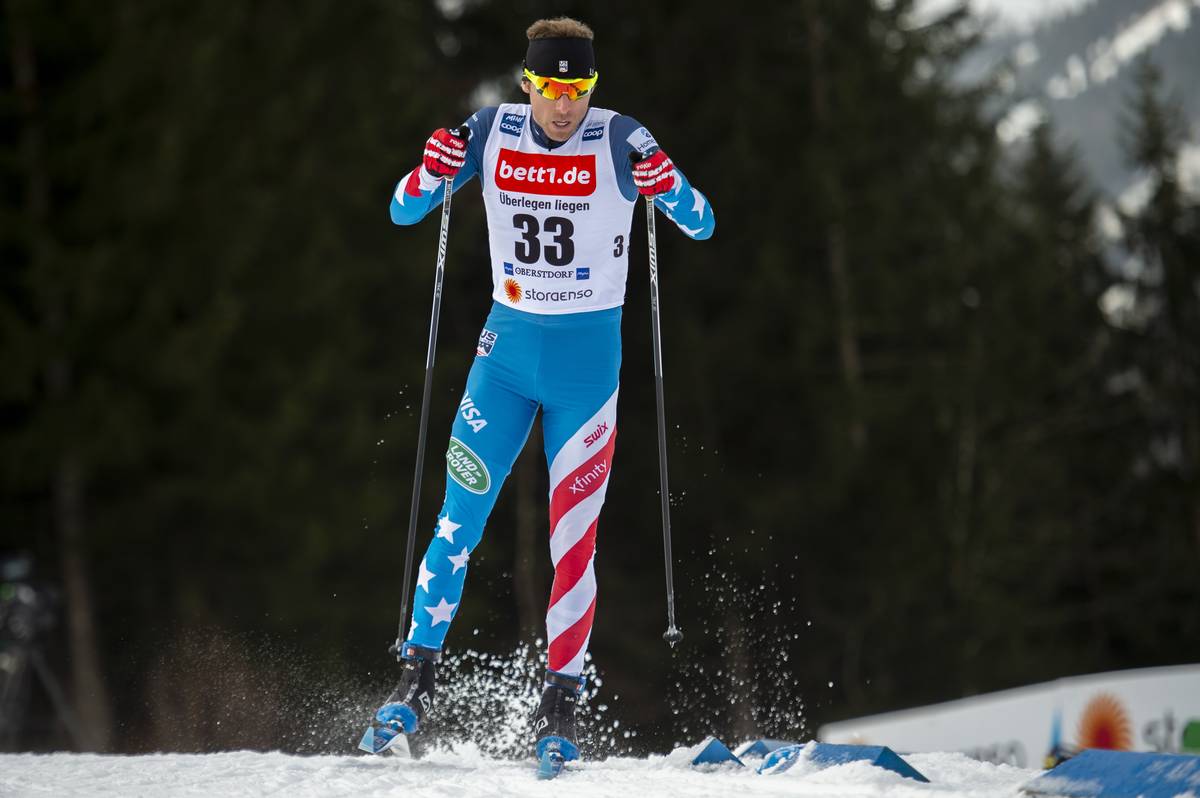
Andy Newell during the sprint qualifier in Obertsdorf, Germany, in January 2020. (Photo: NordicFocus)
Andy Newell
Team and club: Bridger Ski Foundation
Currently lives in: Montana
Selected career highlights: Four-time Olympian; three individual World Cup podiums; 5th, classic sprint, 2007 World Championships; 7th, team sprint, 2015 World Championships; top-10 in Sprint Cup standings six times from 2006–2013; made the heats in every World Cup sprint he started for nearly a decade straight
Instagram page: @andynewellskier
Age: 36
https://www.instagram.com/p/B8HtYWxHUVo/
Thomas O’Harra*
Team and club: APU
Currently lives in: Alaska
Selected career highlights: 6th, skate sprint, 2020 U.S. Nationals; 5th, 2019 American Birkebeiner; first, 2017 Tour of Anchorage; ten top-10 SuperTour finishes since 2016/2017 season
Instagram page: @thomasoharra
Age: 23
Ben Saxton races in the sprints at 2020 U.S. Nationals. (Photo: Reese Brown)
Ben Saxton
Team and club: SMS
Currently lives in: Vermont
Selected career highlights: six national championship podiums, including two national championships; dozens of SuperTour podiums; 54th, classic sprint, 2015 World Championships; 44th, Otepää classic sprint, 2018/2019 World Cup season
Instagram page: @saxtonskier
Age: 26
Gus Schumacher skis the final leg of the men’s relay at World Juniors earlier this month. (Photo: Doug Stephen)
Gus Schumacher
Team and club: Alaska Winter Stars; USST D Team
Currently lives in: Alaska
Selected career highlights: Gold medal, relay, 2019 and 2020 World Juniors; silver medal, relay, 2018 World Juniors (anchor leg for all three races); gold medal, 10km classic, 2020 World Juniors; two podiums at 2020 U.S. Nationals, including one national championship; 41st time of day, 15km pursuit, 2019 Québec City World Cup
Instagram page: @gus.schumacher
Age: 19
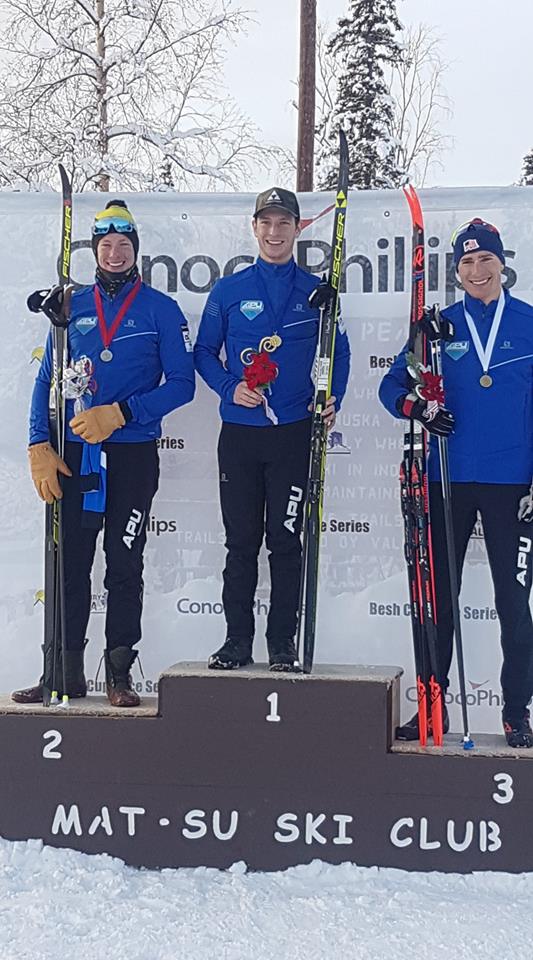
From left, Logan Hanneman, Hunter Wonders, and Tyler Kornfield make up the podium at a December 2018 Besh Cup race. (photo: courtesy CCAK)
Hunter Wonders*
Team and club: APU
Currently lives in: Alaska
Selected career highlights: National champion, classic sprint, 2020 U.S. Nationals; 8th place, 15km classic, 2020 U23 World Championships; fifth place, mixed relay, 2020 U23 World Championships; six top-10 SuperTour or NorAm finishes, including two podiums
Instagram page: @wonderboy_hup77
Age: 21
* The athlete is making his World Cup debut in Québec City.
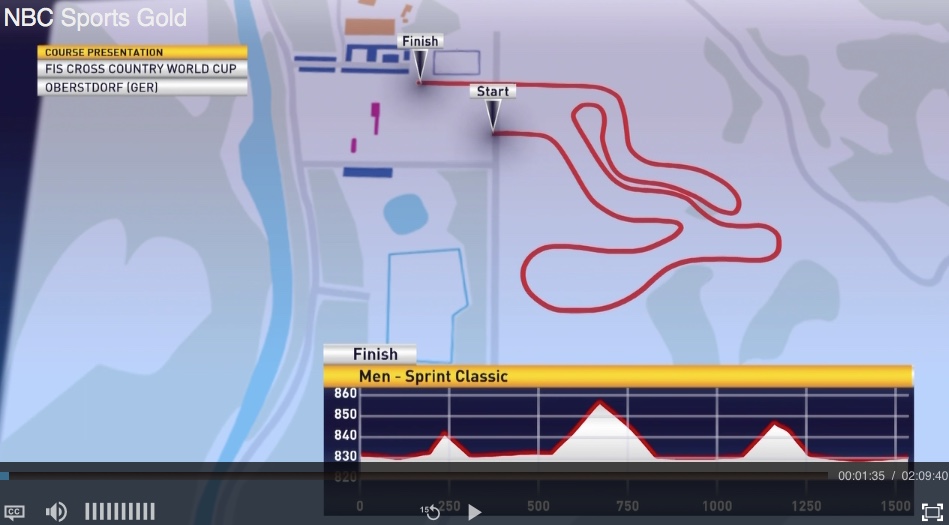
Sunday’s men’s 1.5-kilometer classic sprint course in Oberstdorf, Germany deserves some recognition. Site of the 2021 FIS Nordic Ski World Championships, racers were offered a glimpse into how the world’s foremost sprinter, Johannes Høsflot Klæbo of Norway, would navigate it’s kicker climbs, steep descents, and roughly three minute and thirty-second effort.
The sprint course offered three distinct climbs, one at 0.2 k, the largest at 0.52 k, and the third starting at 1.1 k. The descents mirrored the inclines of the ascents and offered little respite or recovery for skiers near their engine’s redline.
We are focusing on Klæbo, despite the other twenty-nine skiers in the heats, because he was simply a master of pacing, a master of conserving energy on the three-climb course, and freakish in his ability to run away from his five competitors in the final.
Klæbo qualified in first. The margin back to Erik Valnes of Norway in second was 2.72 seconds. Pål Golberg, the third-fastest qualifier was 5.03 seconds back. There were big-time gaps back to the field of qualifiers.
Johannes Høsflot Klæbo crushing the men’s sprint qualifier in Oberstdorf, Germany. (Photo: NordicFocus)
Valnes and Klæbo opted for the first quarterfinal. It was here that Klæbo played his tactical hand. He was in no hurry on this endurance sprint course to move to the front and pull others along in his wake. Klæbo sat in fourth on the second hill as Valnes was the heat’s workhorse. Klæbo appeared relaxed, not itching to move to the front. Klæbo moved to third around 2:00 minutes as they crested the course’s highpoint. The third hill, as most sprinters appeared on fumes, is where Valnes and Klæbo pulled ahead. Over the top, the duo glided into a 20-meter lead. Down the stretch, Valnes poled ahead for the quarterfinal win as Klæbo pulled up, stopped poling several meters before the finish — as if he were checking out for a lunch break.
The third hill would be Klæbo’s charm.
Along with Valnes in the first semifinal were Italy’s Federico Pellegrino (4th qualifier), Golberg, Håvard Solås Taugbøl also of Norway (5th qualifier), and Russia’s Sergey Ardashev. This would be the semifinal to watch.
Again, Klæbo played the conservation of energy tactic. Up the second climb, Golberg, Taugbøl, Valnes, and Pellegrino strode four across with Klæbo lurking a meter back. The second hill was in the rearview mirror around the two-minute mark. It’s approximately another twenty seconds of descent and working flat before the next decisive climb.
As the skiers approached the base at 2:26, Klæbo and Valnes ramped up – they pulled away as they ski-ran up and over the top. Klæbo had been sitting behind Valnes, sucking up in his draft into the final straight. There, Klæbo pulled around his teammate for the semifinal win.
Federico Pellegrino of Italy pushing over the top in the Oberstdorf, Germany classic sprint. (Photo: NordicFocus)
The final featured Klæbo, Valnes, Golberg, Pellegrino, and Oskar Svensson of Sweden and Russia’s Gleb Retivykh. Really, for Klæbo, this was essentially a rematch of his semi.
Again, Klæbo was cautious from the start. There was no real earnestness to shoot to the front. His show would come later. There was only patience from an athlete who knew he could pounce late in the game.
Pellegrino, on the second climb, began to accelerate. He ran outside the tracks in what looked less like a decisive move, and more a burst to position himself tactically in front over the top. For his part, Klæbo matched Pellegrino and strode up alongside the Italian.
At 2:35 at the base of the final climb, Klæbo unleashed. It was textbook Klæbo-running. He was gone with a near 20 meter gap over the top. By the finish line, Klæbo looked to put 10 more meters on his competition as he won in 3:29.46. Golberg was second (+1.99), Valnes third (+2.37), and Pellegrino fourth (+3:06).
In yesterday’s 30 k skiathlon, Klæbo registered a rare DNF (did not finish) as he pulled from the competition.
“I think the sprint was much better than the 30 k yesterday,” Klæbo told FIS after the race. “Yesterday was a really terrible day and today was a bit better. In the end, it was really cool to win here. Yah, I think my shape isn’t the best but I am really happy to find the win here and to have the Norwegian guys here.
“I think it was a really good decision yesterday to jump off after 15 k I think, it was really nice to fight for a win today. And for sure I am really looking for the World Championship here next year.”
Johannes Høsflot Klæbo of Norway cruising in for the Oberstdorf, Germany classic sprint win. (Photo: NordicFocus)
Hands up for the win: Johannes Høsflot Klæbo makes it 5 for 5 for sprints this season. (Photo: NordicFocus)
What was clear after today was that Klæbo had mastered the course. Anything can happen in a year. And anything can go down in a sprint – broken poles, clipped skis, or slide out on a corner. This much was true exiting Oberstdorf: it will be Klæbo’s race to lose at the 2021 World Championships.
It was a down day for the American men. No skiers qualified for the heats. Simi Hamilton placed 32nd overall and was +15.94 in qualification. Andy Newell was 41st (+17.48), Tyler Kornfield 55th (+20.88), and Noel Keeffe 64th (+25.33).
Simi Hamilton during the Oberstdorf, Germany classic sprint qualifier. (Photo: NordicFocus)
Andy Newell during the sprint qualifier in Oberstdorf, Germany. (Photo: NordicFocus)
For Canada, Bob Thompson placed 54th and was +20.14 in the qualifier, Paul Grall-Johnson was 58th (+21.74), and Graham Ritchie 61st (+22.92).
World Cup Standings Shakedown
Coming out of Oberstdorf on the men’s side, Russia’s Alexander Bolshunov remains in command. In first overall with 1457 points, Bolshunov has a 235 point lead on second place Klæbo for the overall lead. Sunday, Bolshunov earned 36 World Cup points after placing seventh overall, Klæbo earned 100 points for the sprint win. If you are keeping score at home, you will note 140 points for Bolshunov’s win in Saturday’s 30 k skiathlon. On yesterday’s course, racers had four opportunities to score bonus points – Bolshunov snatched up 40 of them during the race.
Alexander Bolshunov of Russia in the yellow bib. He leads the overall World Cup. He placed 7th on Sunday’s classic sprint in Oberstdorf, Germany. (Photo: NordicFocus)
Klæbo leads the sprint overall with 350 points. This was Klæbo’s fifth sprint win of the season. He has won every sprint entered thus far. He skipped the skate sprints in Planica, Slovenia and Dresden, Germany.
The World Cup takes a break next weekend and restarts in Falun, Sweden with a classic sprint on February 8.
All Norway in the men’s classic sprint podium in Oberstdorf, Germany: Pål Golberg in second, Johannes Hoesflot Klaebo first, and Erik Valnes third. (Photo: NordicFocus)
This article was originally published on November 11, 2019 in Steamboat Magazine. It is reposted with permission.
By: Tiia Libin
Noel Keeffe during the 1.6 k classic sprint qualifier at Junior World Ski Championships in Lahti, Finland. (Photo: Doug Stephen)
Being a “first-ever” is rare, especially in a town filled with Olympians. Noel Keeffe is one of them. Born and raised in Steamboat Springs, Keeffe is the first Steamboat Springs Winter Sports Club cross-country athlete to be named to the U.S. Cross Country Ski Team.
“Our coaches continually remind us that our life as a student athlete is like balancing a three-legged stool – athlete, social and school,” says Keeffe, who is in his second year at the University of Utah, majoring in material science and engineering.“They reinforce that we need all of the three, and that we shouldn’t just focus on one. Going into my second year here at the U, I’m better able to plan my time depending on the season. I know when I’ll need to spend more time on school, when I’ll need to focus more on training and competition and when I can relax a bit.”
Keeffe is in a unique situation in that he has three coaching sources: SSWSC coaches, University of Utah National Team coaches and U.S. Cross Country Ski Team coaches. He says having access to this triangle of talented resources helped him plan a vigorous strategy going into this season.
“One of my goals this season is to qualify for U-23 [World Championships in February in Oberwiesenthal, Germany]. To do that I must race well at US Nationals in Houghton Michigan [in January]. If I end up going to U-23’s and race well there, then I will qualify for the World Cup race in Minneapolis [in March]. Getting a World Cup start this season would be pretty awesome.
“Because this race is in the U.S., it gives our team a significant starting advantage, so I hope to maximize that opportunity.”
This year Keeffe is living in an apartment with two other student athletes from the ski team, an arrangement he says works because they all have similar schedules. But, he adds, the arrangement is not without its challenges. “There are only three of us in the apartment, but we are constantly running out of refrigerator space,” Keeffe says. “On average, between the three of us, I would say we eat 15,000 to 20,000 calories a day. Every time I cook dinner for the whole apartment I think I have made to much food and somehow it is always gone by then end of the meal. I go to the store and buy some food – next day, it’s gone. We eat more food in a week than some family’s do in a month. It’s astonishing!”
The men’s podium from the 2019 skate sprint at U.S. nationals. From left to right, Logan Hanneman (APU) second, Ben Saxton (SMS T2) first, and Noel Keeffe (University of Utah) third. (Photo: John Lazenby)
Keeffe says he has a better understanding of the student-athlete life this year, and is ready to maximize both his ski training and his studying. “I consider my classes and training one big package. I found that being in college, I have more time to focus on athletics and that being a student athlete allows me to juggle my schedule as necessary,” he says. As a sophomore, Keeffe is taking a larger class load than last fall, is training more and is training at a higher level.
Keeffe mentioned he has always had an interest in STEM (science, technology, engineering and math), and that he has been able to apply his experience with carbon fiber ski poles to help him in his materials science and engineering classes.
Keeffe is poised for achievement and looks forward to a challenging season as he learns how to balance his three-legged stool for success.
North American Junior Cross-Country Performance of the Year
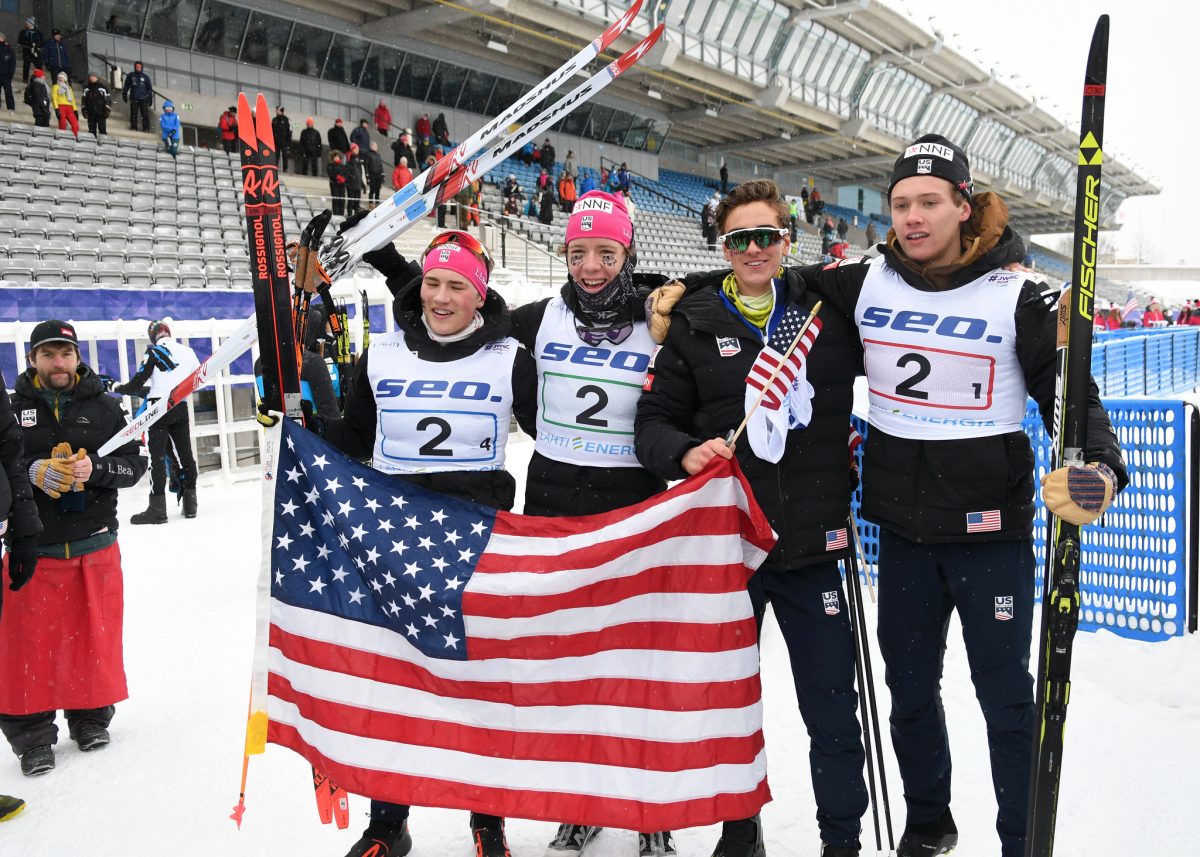
Lahti, Finland U20 4 x 5 k World Champions: From left to right, Gus Schumacher, Ben Ogden, Johnny Hagenbuch, and Luke Jager. (Photo: Doug Stephen)
With the 2018/2019 season officially in the rearview, FasterSkier is running a series of articles highlighting some of the players and performances from the season. This honor goes to the most outstanding North American junior cross-country performance.
Lahti, Finland became a winter playground – in a Formula One kind of way- for America’s upstart junior skiers. Solid performances during the World Junior Ski Championships landed numerous skiers on the U.S. Ski Team’s Development team. (That story to follow next week.)
The obvious place to start is with this quartet: Luke Jager, Ben Ogden, Johnny Hagenbuch, and Gus Schumacher. This lineup took the men’s 4 x 5-kilometer relay win. With several articles already minted on their fine performance, we’ll forego the redundancy. Let’s just say these young men skied with poise and steel as they positioned themselves at the front of the race and in most instances dictated the outcome rather than respond defensively. This was no miracle on snow. It was a deserved result for the athletes and the considerable effort of their respective communities and a U.S. Ski Team culture espousing confidence.
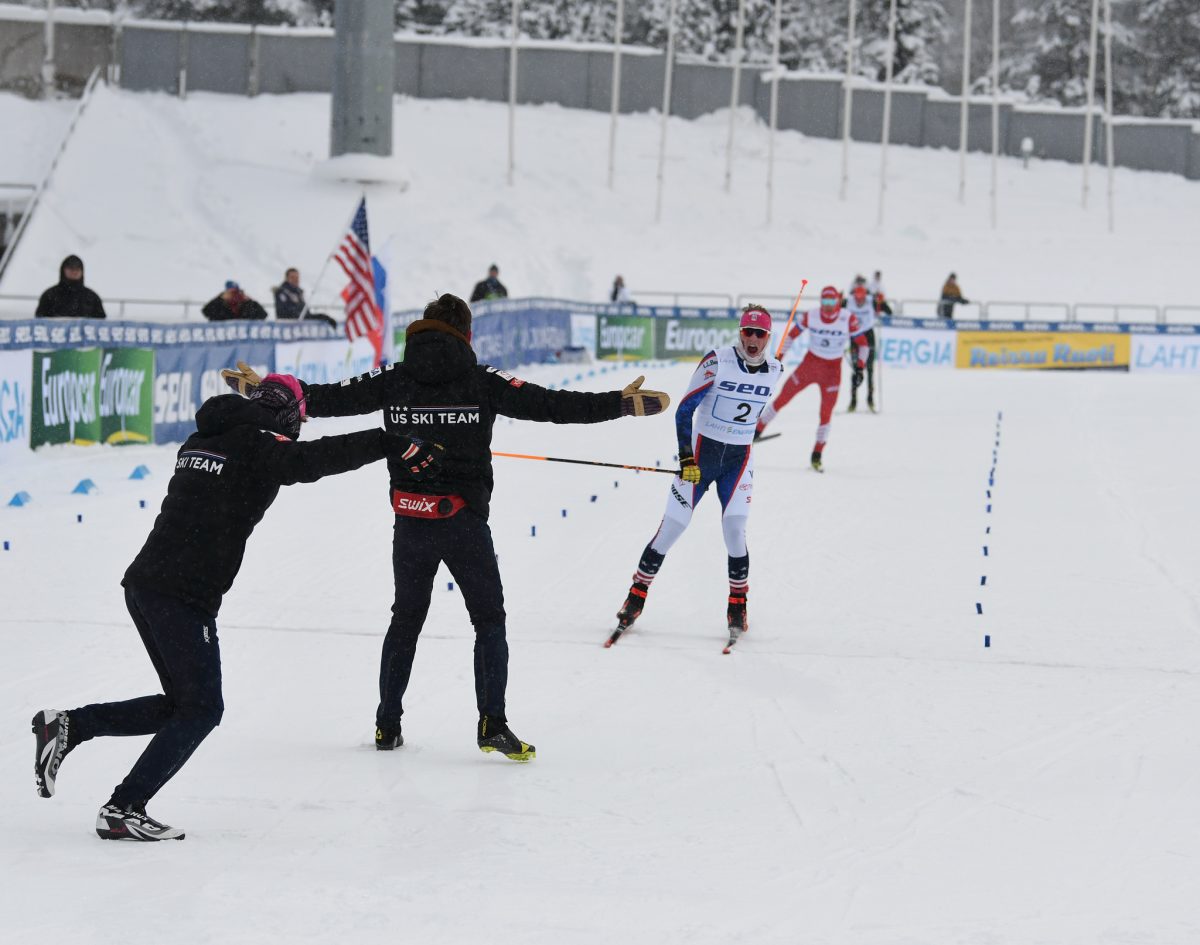
Gus Schumacher and the U.S. team in for the win during the U20 men’s 4 x 5 k relay at Junior Worlds in Lahti, Finland. (Photo: Doug Stephen)
If for some reason you have not watched this race and crust cruising is no longer a possibility, then link here for your viewing guide.
This is also the place to mention the performance of the U20 U.S. women. Mara McCollor, Kendall Kramer, Sydney Palmer-Leger and Novie McCabe placed fourth in the 4 x 3.3 k relay. With the youngest team in the field, these skiers finished 40.5 seconds out of first and 6.9 seconds off the podium’s third step. That third place team, Sweden, had ringer Frida Karlsson ski the second classic leg – her time of 8:48 nearly beat out both her teammate’s skate leg splits which were 8:49.2 and 8:46.3 respectively. (We digress and it was cold snow.)
Kendall Kramer on her way to fourth place in the U20 15 k classic mass start at World Juniors in Lahti, Finland. (Photo: Doug Stephen)
Individually, Kramer placed fourth in the 15 k mass start classic in Lahti, McCabe 10th. In the 5 k skate, Kramer skied to 15th, and Palmer-Ledger 20th.
For the U20 men, Schumacher placed fourth in the 30 k mass start classic, Ogden 10th. (Canada’s Remi Drolet finished seventh in the 30 k mass start classic.)
In the 10 k skate, Schumacher scored a sixth place. On classic sprint day, Ogden was eighth, while Noel Keeffe placed 12th, and Schumacher 16th.
Moving on to the U23 women, Hailey Swirbul placed 10th in the 15 k mass start classic, Julia Kern 16th. Kern also placed 12th in the 10 k skate.
This is not an exhaustive list or discussion of World Junior/U23 results. It remains a recognition of some fine collective U.S. performances with a definite nod to the U20 men’s 4 x 5 k relay team for the junior performance of the year.
Gus Schumacher skiing to sixth place in the U20 10 k skate during the 2019 Junior Worlds in Lahti, Finland. (Photo: Doug Stephen).
FIS Junior World Ski Championships Lahti, Finland 5 k/10k Freestyle Interval Start
Tuesday in Lahti, Finland was as Finland should be: squeaky-snow-cold and cross-country ski racing on offer.
Eighteen-year-old Gus Schumacher broke through for the U.S. and placed sixth overall in the U20 men’s 10-kilometer freestyle. Schumacher was the 95th starter of 102 finishers on the day. His sixth place finish was consistent with his 1.1k, 5k, and 6.6k splits where he was ranked 5th, 6th, and 7th respectively. Schumacher stopped the clock in 23:19.3 minutes, 44.4 seconds behind the winning mark.
The Lahti championships are Schumacher’s second Junior Worlds. His sixth place is his best individual result. He was part of the second place 4 x 5 k U20 relay last year in Goms, Switzerland.
“I was most nervous about hitting it right and doing the right pacing and making sure I can have the best race that know I can,” Schumacher told FasterSkier over the phone. “I approached it as just a new race almost. We have done a fair amount of watching old world cups and world championships that were on the exact same courses here. It was definitely hard to reflect on that because none of them were exactly 10 k. And obviously those athletes are quite a bit stronger than we are. And the snow is different.”
Schumacher extracted what he needed from the videos. Imprinted in his mind before his 10 k start were enough visuals to quell the nerves and provide a path to fast clean skiing.
“We watched that and I felt like I got an idea for what the body movements looked like of those guys,” Schumacher said. “I thought about how that would feel for me and I thought about the other middle distance skate races I have done this year –which is actually a fair amount between early season time trials.”
Schumacher executed his plan. He dialed back the initial effort, stayed in control, and systematically revved the engine.
“I went out and tried for at least the first five minutes to go a little easier, because I think that is the high risk time, the very beginning,” said Schumacher. “I tried to go out and keep it consistent and as I started to get into it, I started to ramp it up a little more and really try to make the most of the recovery. Which wasn’t a lot, but enough that I could put my head in between my knees on the downhill and I could tell myself that 15 seconds of high speed downhill is helping me. And I could get my breath down a little bit and I was ready for the next hill.”
His run at the podium came up just 17 seconds short. But with his plan executed, the Anchorage based skier had no regrets when reflecting on Tuesday’s race effort.
“I definitely wanted to be top-10, but I felt like and still feel like a medal is in sight,” Schumacher said. At 18, he still has one more year of eligibility in the U20 ranks.
“For sure satisfied with this race, it felt like a good result and it was one of my better races. And I am happy with how it played out and also thinking about how I can hit the 30 k and do the most I can do.”
France’s Jules Chappaz won the race in a time of 22:34.9 after skiing the fastest splits at 5 k and 6.1 k. Sunday’s classic sprint winner, Russia’s Alexander Terentev, placed second (+21.0), and Norway’s Iver Tildheim Andersen in third (+27.2).
Canada placed two skiers in the top-31. Remi Drolet finished in 20th (+1:14), Samuel Gary Hendry 21st (+1:15.9), Thomas Stephen 31st (+1:36.8). Xavier McKeever skied to 44th (+2:04.6).
For the U.S., Zanden McMullen placed 32nd (+1:40.6), Johnny Hagenbuch 34th (+1:46.3), and Noel Keeffe 58th (+2:45.7).
Sweden’s Frida Karlsson winning the U20 5 k skate at Junior World Ski Championships in Lahti, Finland. (Photo: Doug Stephen)
Sweden’s Frida Karlsson won the U20 5 k skate in 12:50.6 minutes. Norway’s Helene Marie Fossesholm placed second 11 seconds back, with Finland’s Anita Korva in third (+19.8).
“It was fun to ski today. I just wanted to have my revenge”, Karlsson told race organizers after the race. Karlsson had qualified first on Sunday’s U20 classic sprint but placed fifth in the overall.
U.S. skier Kendall Kramer post U20 5 k skate at Junior World Ski Championships in Lahti, Finland. (Photo: Doug Stephen)
The best placed North American was U.S. skier Kendall Kramer who finished in 15th (+55.6) place. Also for the U.S., Sydney Palmer-Leger was 20th (+1:04.9), Novie McCabe 29th (+1:20.8), and Waverly Gebhardt 65th (+2:28.8).
Canada’s Anna Pryce (bib 22) and Jasmine Drolet (bib 20) finishing the U20 5 k skate at Junior World Ski Championships in Lahti, Finland. (Photo: Doug Stephen)
Anna Pryce was the top Canadian in 43rd (+1:36.5). Teammates Molly Miller skied to 50th (+1:52.9), Isobel Hendry 58th (+1:57.1), and Jasmine Drolet 67th (+2:35.7).
In stadium sprint viewing at the 2019 Junior World Ski Championships in Lahti, Finland. (Photo: Doug Stephen)
Images from the U20 women’s 1.4-kilometer classic sprint from the 2019 Junior World Ski Championships in Lahti, Finland. (U.S. in white/blue, Canada in red/black.)
Mara McCollor during the 1.4 k classic sprint qualifier at Junior World Ski Championships in Lahti, Finland. (Photo: Doug Stephen)
Sophia Mazzoni during the 1.4 k classic sprint qualifier at Junior World Ski Championships in Lahti, Finland. (Photo: Doug Stephen)
Anna Pryce during the 1.4 k classic sprint qualifier at Junior World Ski Championships in Lahti, Finland. (Photo: Doug Stephen)
Molly Miller during the 1.4 k classic sprint qualifier at Junior World Ski Championships in Lahti, Finland. (Photo: Doug Stephen)
Isobel Hendry during the 1.4 k classic sprint qualifier at Junior World Ski Championships in Lahti, Finland. (Photo: Doug Stephen)
Waverly Gebhardt during the 1.4 k classic sprint qualifier at Junior World Ski Championships in Lahti, Finland. (Photo: Doug Stephen)
Images from the U20 men’s 1.4-kilometer classic sprint from the 2019 Junior World Ski Championships in Lahti, Finland. (U.S. in white/blue, Canada in red/black.)
Pierrick Sarthou during the 1.6 k classic sprint qualifier at Junior World Ski Championships in Lahti, Finland. (Photo: Doug Stephen)
Remi Drolet during the 1.6 k classic sprint qualifier at Junior World Ski Championships in Lahti, Finland. (Photo: Doug Stephen)
Xavier McKeever during the 1.6 k classic sprint qualifier at Junior World Ski Championships in Lahti, Finland. (Photo: Doug Stephen)
Thomas Stephen during the 1.6 k classic sprint qualifier at Junior World Ski Championships in Lahti, Finland. (Photo: Doug Stephen)
Luke Jager checking results during the sprint 1.6 k classic sprint at Junior World Ski Championships in Lahti, Finland. (Photo: Doug Stephen)
Bend Ogden during the 1.6 k classic sprint qualifier at Junior World Ski Championships in Lahti, Finland. (Photo: Doug Stephen)
Gus Schumacher during the 1.6 k classic sprint qualifier at Junior World Ski Championships in Lahti, Finland. (Photo: Doug Stephen)
Russia’s Alexander Terentev wins the 1.6 k classic sprint final at the 2019 Junior World Ski Championships in Lahti, Finland. (Photo: Doug Stephen)
Noel Keeffe during the 1.6 k classic sprint qualifier at Junior World Ski Championships in Lahti, Finland. (Photo: Doug Stephen)
Noel Keeffe, pictured above (left), placed 12th overall for the U.S. in the U20 men’s field. He is currently enrolled at the University of Utah where is also a member of the cross-country ski team. Keeffe grew up skiing with the Steamboat Winter Sports Club. He earned his first U.S. National’s podium recently in the skate sprint.
“The sprint race was a tough one,” Keeffe wrote in an email explaining his U20 Worlds experience. “The course was super challenging because of a pretty large sustained hill right out of the start. I believe it was one of the hardest courses I have ever raced.
“I am super stoked with my performance and the performance of the team. We were one of the best nation’s out there. It’s pretty cool when the top skiers from every nation start watching out for the kids in the red, white, and blue.”
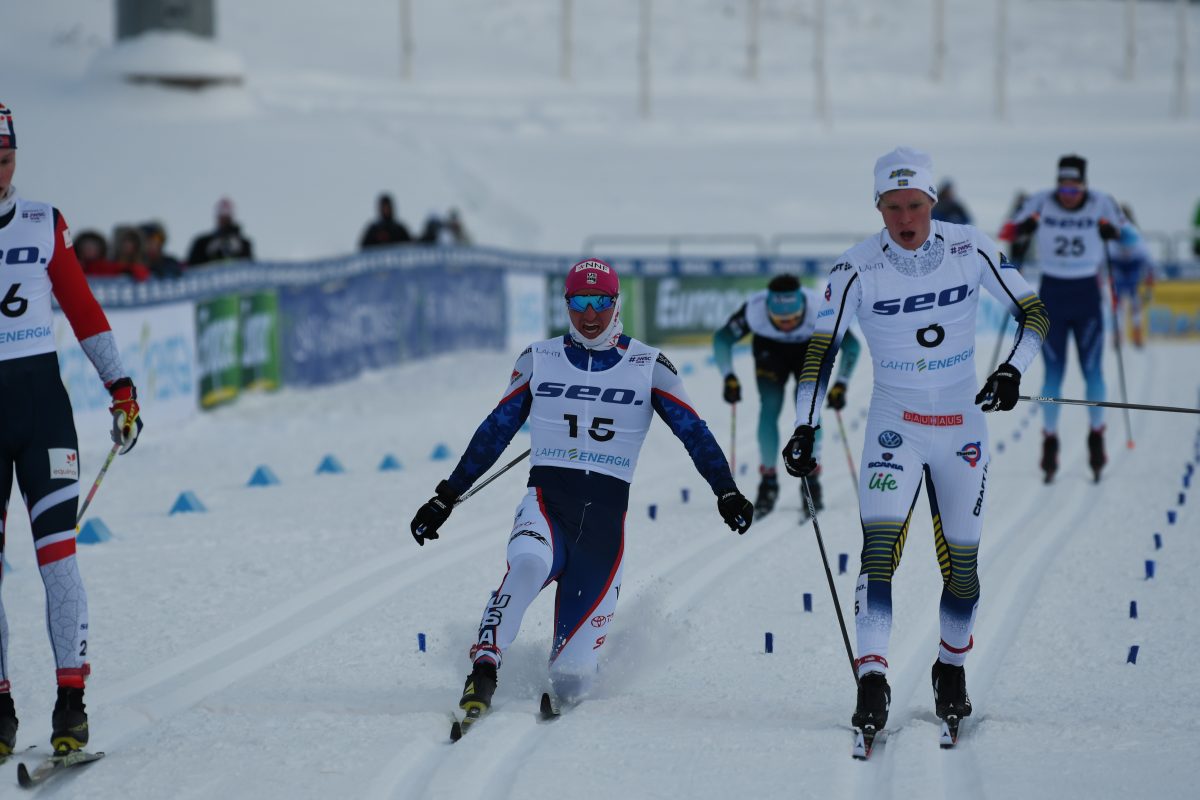
Noel Keeffe (bib 15) showing here in his quarterfinal why time is what you make of it. Keeffe placed 12th overall in Sunday’s classic sprint at the 2019 Junior World Ski Championships in Lahti, Finland. (Photo: Doug Stephen)
Sunday featured the first day of racing at the 2019 Junior World Ski Championships in Lahti, Finland. To kick things off at the crown jewel of Finnish ski venues was the U20 classic sprint. The men raced a 1.6-kilometer loop, the women a 1.4 k course.
Several North American males qualified for the heats after Russia’s Alexander Terentev qualified first in a time of 3:28.74 minutes.
Ben Ogden (bib 3), skiing for the U.S. at the 2019 Junior World Ski Championships in Lahti, Finland. Ogden placed 8th overall. (Photo: Doug Stephen)
For the U.S. all four athletes entered in the race advanced to the heats. Ben Ogden qualified in third (3:36.94), Gus Schumacher 12th (3:40.80), Noel Keeffe 15th (3:41.56), and Luke Jager 20th (3:42.27).
Remi Drolet of Canada qualified in 28th (3:44.98) and was the only one of his teammates to ski in the rounds. He was bounced after his fifth place in heat five. Drolet was 25th overall. Xavier McKeever skied to 52nd overall, Thomas Stephen 59th, and Pierrick Sarthou 67th.
(McKeever, at fifteen years of age, is the youngest competitor at World Juniors.)
Ogden leaped to the semis by placing first in the fifth heat. Ogden exited the rounds after sprinting to fourth in the second semi. Ogden was the best placed North American finishing eighth overall.
Keeffe advanced as a lucky loser to the semis after placing third in the second heat. He placed 12th overall after his sixth place in the first semi-final.
Schumacher was bounced out of the heats after he placed fourth in heat four. He ended his day 16th overall.
Jager’s 20th place overall rounded out the U.S. performances. Jager was eliminated when he placed fourth in the first quarterfinal.
Coming in second overall to Terentev in the men’s final were Norwegians Ansgar Evensen and Håkon Skaanes in second and third respectively. Jules Chappaz of France was fourth, Sweden’s Axel Aflodal fifth, and Aron Åkre Rysstad sixth.
U.S. skier Sydney Palmer-Leger was the only North American women to qualify for the heats. She placed 29th in qualification, skiing the 1.4 k course in 3:46.82 minutes. Sweden’s Frida Karlsson skied the fastest qualifying time of 3:27.32.
Palmer-Leger was eliminated when she placed fifth in the fourth quarterfinal to end her day 25th overall.
Also for the U.S., Mara McCollor was 43rd overall, Sophia Mazzoni 49th, and Waverly Gebhardt 51st.
Canada’s Anna Pryce during her classic sprint qualifier at the 2019 Junior World Ski Championships in Lahti, Finland. (Photo: Doug Stephen)
For Canada, Anna Pryce finished 42nd overall, Molly Miller 52nd, and Isobel Hendry 69th. Canada’s Anne-Marie Petitclerc did not finish as a result of breaking her binding moments after she started.
Norway’s Kristine Stavaas Skistad was first overall. Poland’s Monika Skinder placed second in the final, with Finland’s Anita Korva third. Linn Svahn of Sweden placed fourth overall, while teammate Frida Karlsson was fifth. Russia’s Anastasiya Faleeva was sixth.
And just because this sequence is so solid, here’s an addition to Keeffe’s lunge. (Click images to enlarge.)
Noel Keeffe about to lunge for the line in his quarterfnal during Sunday’s classic sprint at the 2019 Junior World Ski Championships in Lahti, Finland. Keeffe went on to place 12th overall. (Photo: Doug Stephen)
Noel Keeffe showing here in his quarterfnal why time is what you make of it. Keeffe placed 12th overall in Sunday’s classic sprint at the 2019 Junior World Ski Championships in Lahti, Finland. (Photo: Doug Stephen)
The men’s podium from the 2019 skate sprint at U.S. nationals. From left to right, Logan Hanneman (APU) second, Ben Saxton (SMS T2) first, and Noel Keeffe (University of Utah) third. (Photo: John Lazenby)
“I just love going fast. There are few things that can match the primal joy that comes from racing as fast as possible and beating someone. I definitely don’t always beat people, but that feeling is worth chasing again and again.”
Saxton is now twenty-five, and still races for SMS T2. And he still skis fast.
Prior to the 2019 U.S. Cross-Country Ski Nationals, Saxton’s resume included two second place national sprint podiums in 2014 and 2015 and a third place in 2018.
Saxton left Craftsbury on Tuesday with two sprint national titles. He won the classic sprint last Thursday and today he won the men’s 1.5 k freestyle skate sprint in a time of 2:58.1 minutes in the final.
“It was my goal to be last out of the stadium every time,” Saxton told FasterSkier in Craftsbury about his strategy moving towards the finals. “I didn’t see a whole lot of return on doing work before the low point of the course. But coming up from the rear I was just trying to wait until people let their concentration lapse for a bit and slip a place here and a place there and I got really lucky. But that is sprint racing. I found my way to the front right before we came out onto the lower soccer field.”
His path to the final and ultimately the win began when he qualified in fifth behind the day’s fastest qualifier Logan Hanneman (APU). Saxton won the third quarterfinal to advance to the semis. In the first semi-final, Hanneman took Saxton by 0.14 seconds as they both moved onto the finals.
In Bib 5, Ben Saxton, and in bib 1 Logan Hanneman sprint into the the final stretch of the men’s skate sprint final at U.S. nationals at Craftsbury, VT. (Photo: John Lazenby)
It the finals, the flip-flop occurred: Saxton outpaced Hanneman to the line by 0.32 seconds. Noel Keeffe skiing for the University of Utah placed third, 1.15 seconds back. Rounding out places fourth through sixth in the men’s final were Daniel Streinz (NMU) who lost out on a lunge with Keeffe, then Gus Schumacher (AWS), and Zak Ketterson (NMU) respectively.
“The final was really interesting,” Saxton said. “It was kind of a mix of, I hesitate say, old, older skiers and younger skiers. And Logan and I have to count ourselves amongst the old people now. It was kind of interesting running from all those young guns. We did our best to stay in front at least for the time being.”
For Hanneman, it was his second podium at nationals, as he placed second to Saxton in the classic sprint as well.
“The course rewards waiting if you have the acceleration up this last hill,” Hanneman summarized as he spoke with FasterSkier after the men’s final.
Like Saxton, the experienced Hanneman played the waiting game, allowing other skiers to do the work on the first half of the course. Ultimately, Saxton and Hanneman made a move that gave them a slight gap as they pushed toward the finish.
However, about the same moment Hanneman accelerated up the final hill, Schumacher stumbled and fell.
“I was close to Gus and he went down hard as I was accelerating into the final hill,” Hanneman said. “It made a little change of plans. But Saxton had an awesome move up this last hill and I could not quite close it.”
Keeffe, at nineteen years old, is a freshman at Utah. Today’s result is his best career national’s performance. His best placing prior to Tuesday’s podium was a 15th in the classic sprint at the 2018 U.S. nationals. Keeffe will be headed to Lahti, Finland for World Juniors after his performances in Craftsbury. He was the third qualifier in Tuesday’s skate sprint, and the eighth fastest qualifier in the classic sprint where he placed 13th overall.
“I was fighting for position up the last hill and Ben Saxton and Logan Hanneman had a little bit more than I did and they got away,” Keeffe said. “It was a lunge at the finish for me and Daniel Streinz, it was pretty close. Didn’t know I had it for awhile but it was fun.”
Earlier this month from Aug. 2-8, nine top American junior athletes had the opportunity to participate in the largest International Junior Camp to date. In total, 146 athletes and 37 coaches from nearly 20 nations gathered in Sjusjøen, Norway, for a week of training and collaboration. The camp offered athletes the opportunity to gain confidence by training with the best junior skiers in the world against whom they will soon be competing, and to learn from the prestigious Norwegian development team training methods.
To make the trip, athletes needed to be born in either 1999 or 2000 and have the lowest ranking on the FIS Distance and/or Sprint World Ranking list. The U.S. sent Gus Schumacher, Ti Donaldson, Noel Keeffe, Ben Ogden, and Wyatt Gebhart on the men’s side, and for the women, Sofia Shomento, Mae Chalmers, Abby Jarzin, and Molly Gellert. Two coaches joined the group: Bryan Fish, cross country sport development manager at U.S. Ski & Snowboard, and Maria Stuber, head coach at the College of St. Scholastica, and the National Nordic Foundation (NNF) partially subsidized the trip.
2018 International Junior Camp attendees: – Armenia
– Austria
– Bosnia/Herzegovina
– Belarus
– Canada
– China
– Czech Republic
– Estonia
– Italy
– Finland
– Japan
– Korea
– Latvia
– Norway
– Slovenia
– Slovakia
– Spain
– Sweden
– U.S.
The format of the camp was similar to what U.S. juniors might experience at an elite national camp; a large emphasis on volume (18-25 training hours), with some intensity, technique and strength mixed in. For most workouts, all the athletes trained together as one large group, only dividing into smaller groups for time trials or activities held in spaces that could not hold the nearly 200 attendees.
The camp opened with back-to-back time trials, beginning with a classic sprint event featuring “King’s Court” style heats, meaning that from each heat, the top skier moved up in the seeds and the last skier moved down. Each skier competed in four rounds of sprints plus the qualifier, one round more than in a typical sprint. The most notable result for the U.S. was a victory for Schumacher in the men’s final, and on the women’s side, an eighth-place finish for Gellert.
In the 10- and 15-kilometer distance races, the Americans continued to show their strength with another win for Schumacher and another eighth-place finish for Gellert.
“Local hero – Joergen Lippert from Lillehammer joined in on the 15 km freestyle race,” Fish explained. “This was a great measuring stick for the men since Joergen medaled in all four races last year at Junior Worlds (2018 Junior Worlds – 1 gold, 1 silver, and 2 bronze). At the 5km split, Lippert was leading, Ben Ogden was 2nd and Gus Schumacher 6th. Haavard Moseby took the lead after 10km. At 12km Haavard and Gus were tied, then Gus surged to edge Haavard for the second day in a row.”
Molly Gellert striding in the sprint heats at the 2018 International Junior Camp in Sjusjøen, Norway. (Photo: Maria Stuber)
To take advantage of the unique terrain on the plateau around Sjusjøen, the group also participated in a 3 1/2- to 5-hour run crossing through several bogs, and a set of Level 4 bog intervals, which was reported to be the hardest workout of the entire camp. These 3-5 minute intervals were run in mud up to or above athletes knees, making it a full-body challenge to move forward through the course.
“Running through that stuff as hard as you can is incredibly hard,” Stuber told FasterSkier. “People were breathing at the end of those intervals harder than you ever hear, besides maybe the best athletes in the world in a 5- to 10-kilometer distance kind of race.”
Another highlight was getting to meet and hear from Olympic gold medalists Johannes Høsflot Klæbo, Ragnild Haga, and Astrid Uhrenholdt Jacobsen, who shared insight into the aspects of their training and development they felt have led to their success.
The U.S. coaches contributed to the camp by leading an agility workout, as this has been creatively emphasized in their own programs with positive results. Fish reportedly traveled with his own set of cones and plenty of sidewalk chalk to ensure they could set up a high-quality course.
“It was really fun to have the rest of the world interested in what we’re doing with agility,” said Stuber.
Ben Ogden (second from r) in the middle of a bog interval at the 2018 International Junior Camp in Sjusjøen, Norway. (Photo: Maria Stuber)
Apart from the training benefits, the U.S. development program considered the experience of collaborating with top athletes in this age group to be invaluable, as it showed how hard their international competition is working.
“In the U.S. when you’re a top athlete you feel like you’re working pretty darn hard, and this kind of shows them that, yeah, they’re working hard, but the kids that they want to be competing against are also working really hard,” Stuber said.
She added that the U.S. athletes were well-prepared for the camp, as all performed very well throughout the week despite the demanding training schedule.
“We fit in, we go there and see that we’re doing the right things, and we bring these kids back with the confidence that they can do this and the motivation to keep at it and work harder,” Stuber said.
It was noteworthy to the coaches that the U.S. is finally recognized as a nation that can train and compete with the best athletes in the world — a testament to the growth and success of the U.S. Ski Team at all levels over the last ten years.
“Going into this, I was expecting to just be learning a ton and less of a contributor,” Stuber said. “It was really cool to get there and feel like the U.S. was very much a country where people wanted to know what we were doing. Norway is clearly ahead, but otherwise, I think the U.S. had to say as much as any other place, which was a really eye-opening surprise for me.”
This is the third time that the U.S. has attended Norway’s International Junior Camp (also in 2015 and 2016), and American juniors will continue to make the trip biennially to maintain collaboration with other countries in the coming years. According to the U.S. coaches, because of the cost of the camp and the fact that it is similar each year, they plan to only attend every other year so they have a “fresh” group of athletes each time.
Americans during a muddy training session at the 2018 International Junior Camp earlier this month in Sjusjøen, Norway. (Front row, l to r) Abby Jarzin, Mae Chalmers, Sophie Shomento, Molly Gellert, and Noel Keeffe. (Back row, l to r) Ben Ogden, Wyatt Gebhart, Ty Donaldson, Gus Schumacher. (Photo: Maria Stuber)