Tag: NorAm

  • Canadian Racing Update

    Canadian Racing Update

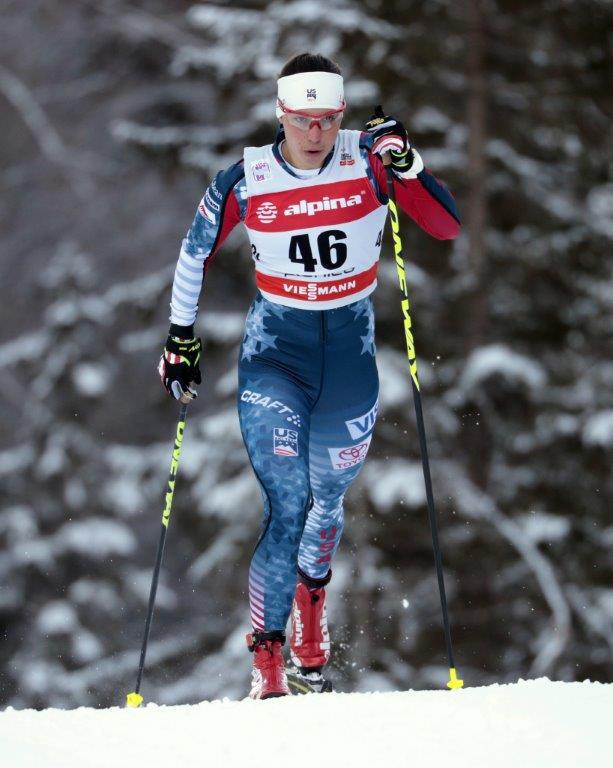
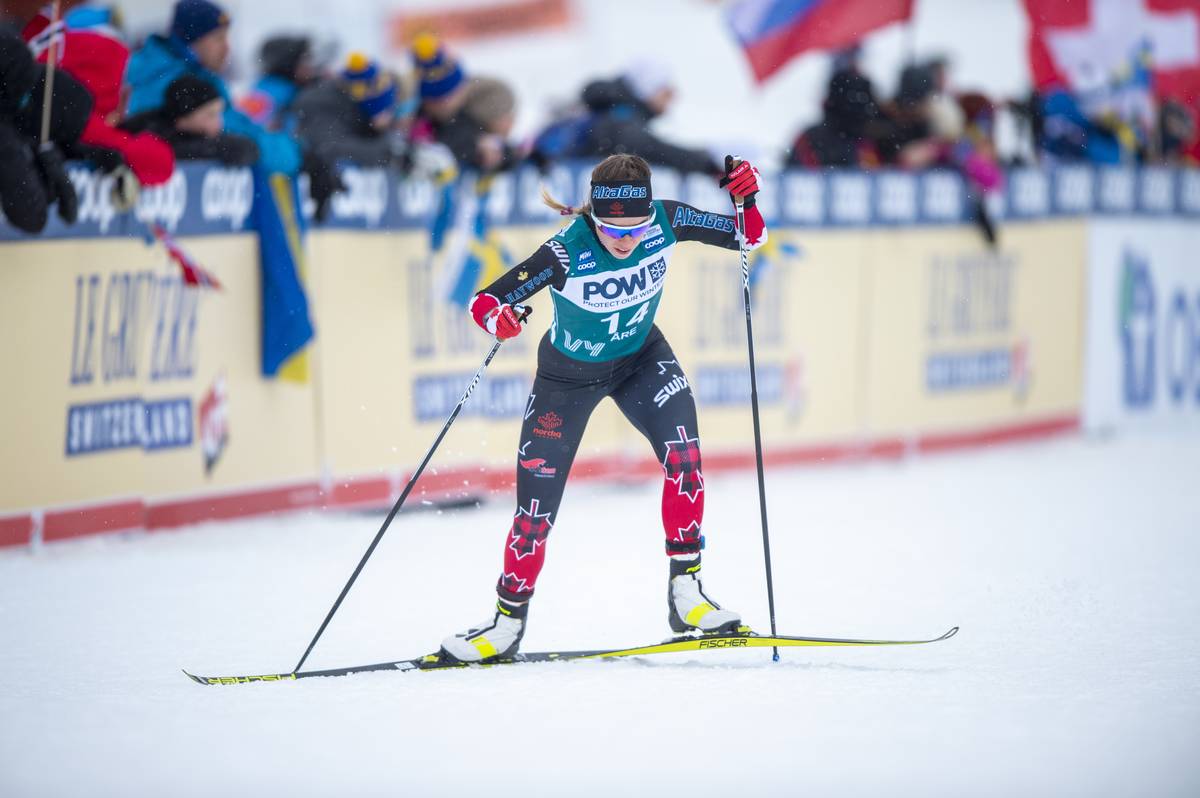
    Katherine Stewart-Jones flying the flag during the Ski Tour 2020 in Åre  (SWE). (Photo:NordicFocus)

    Nordiq Canada’s first major change announcement on November 16th was the decision to cancel the Period I trip to Lillehammer, Dresden, and Davos. (The Lillehammer races have been postponed, and have not been officially rescheduled.)

    “For us, it was chatting with our medical experts, assessing the situations here at home and what we were seeing happening overseas,” said Nordiq Canada’s High Performance Director Kate Boyd. “We had never planned to go to Ruka. And then when Lillehammer was postponed to a later time that left two race weekends, and we felt it better that we would stay home, train, get strong. And get a sense of how the protocols were rolling out overseas.” 

    Those World Cup Covid-19 prevention protocols got their first test in Ruka with varying reports as to the success level. While all the countries were originally satisfied with the plans, it seems that on-site rule interpretation was different than some countries expected. Pierre Mignerey (FIS race director, who is from France) and Norway’s cross-country manager, Espen Bjervig, expressed their differing viewpoints to Norwegian broadcaster NRK shortly after Norway decided to stay home for December.

    Mignerey also explained to NRK that one reason some countries might feel more free to criticize FIS safety initiatives relates to business opportunities away from the World Cup for some. 

    “It is important to understand that for many nations, competing in the World Cup is the only way to do their job and promote their sponsors,” said Mignerey according to a translation. “Norway does not come to the World Cup, but can arrange national competitions that go on TV. They have no chance of that in countries other than Norway, Sweden and Finland.” 

    After Ruka, Norway, Sweden, and Finland withdrew from the December World Cups. The Norwegians held a national level competition this past weekend in Lillehammer, site of the aforementioned postponed World Cups. Consider that opportune exposure for Norwegian athletes and sponsors – the opportunity cost of missing a World Cup for some is cushioned when the domestic event is broadcast nationally. 

    Here in Canada, Jeff Ellis, the Partnership and Events Coordinator at Nordiq Canada, commented that the withdrawal of teams like Norway, comes close to a time when that team’s leadership had advocated for maintaining the Lillehammer World Cups as scheduled for December 4-6.  

    “What Norway has decided to do will be an interesting study on how it affects other teams’ decisions,” said Ellis. “It’s interesting that less than three weeks ago Norway was fighting hard to keep the Lillehammer World Cups with the Head Coach saying we must race as much as possible.” 

    Canadian reactions to the Period I modifications range from anger to relief. Norway’s, Sweden’s, and Finland’s race departures come on the heels of Nordiq Canada gutting their own race calendar on November 30. Below are the major announcements from the November 30 announcement.  

    • All FIS-sanctioned domestic cross-country ski events scheduled across Canada for the 2020-21 season are cancelled (Divisions will continue to determine the relevance and possibility of hosting scaled-down local events that meet regional health and safety guidelines);
    • Canadian World Championship Trials scheduled for Whistler, B.C. (January 7-10) are cancelled;
    • 2021 Canadian Ski Championships (March 14-20) planned at the Nakkertok Nordic Ski Centre in the Ottawa-Gatineau region are cancelled;
    • 2021 World Para Snow Sport Championships scheduled for February 7-20 in Lillehammer, Norway have been postponed to January 2022;

    When asked about feedback on the recent Canadian World Cup trip cancellation and the subsequent cancellation of FIS races in Canada, Boyd tactfully replied “We have a very passionate community.” 

    She sees the strong opinions as an opportunity.

    “When you’ve got a community as passionate as ours, it can be an incredible force to move us forward, when we’re all moving in the same direction. So I’m hoping that with a good plan and strong communication with that group that we can turn that bus around.

    “We’re going to try our best to get to Europe to compete, but we’ll be assessing regularly what we can and can’t do. Always with the athlete safety first and foremost.”

    The loss of World Cup opportunities matters. Start spots for Canadian skiers at the Beijing Olympics depend on results from two seasons, including this current season.

    “We recognize that we stand a better chance of securing more spots for Canada if we do get to Europe, and have good races and score well in the nation’s points,” added Boyd. “So that is certainly a deciding factor for us to get over to Europe when we can, when it’s safe to do so. We want to give our athletes about as many opportunities and the best opportunities to compete, especially at Games.”

    Canada is planning to send athletes to some international events in 2021:

    • January  (P3) – Ulricehamm, SWE; Lahti, FIN; Falun, SWE; Reserve weekend (TBC)
    • February – Nove Mesto, CZE
    • March – Oslo, NOR; Test event CHN (tentative)

    As far as the cancellation of FIS sanctioned racing in Canada, Boyd suggested the move simplified an already complex pandemic-rattled season. “We figured we’d take the FIS heat off and allow the provinces to host events, when and how they can,” said Boyd. “And it also removes the need for athletes to have to travel outside of provinces to try to get the points.” 

    During the summer, Nordiq Canada decided to split the traditional NorAm (Continental Cup) series into East and West series, respectively, to reduce travel while increasing the probability that events could be held. This change was also part of a multi-year project to reduce the cost of race travel for Canadian skiers.

    The season plans started shifting with the downgrading of the first four East/West NorAm races in December from FIS to regionally sanctioned events. This happened one by one in the first half of November as it became clear that inter-provincial travel for sports events would not restart before the new year. Each province has its own rules which change as the active COVID-19 case load changes. 

    In early November when Nakkertok was cancelled, it was illegal to drive across the bridge from Ottawa to ski, affecting roughly half of the host clubs’ members. The Canmore event, for example, scheduled for December 12th and 13th, could have proceeded with Alberta, Saskatchewan, and Manitoba skiers in attendance, but without BC and the Yukon athletes. Each of the named provinces has since tightened rules further.
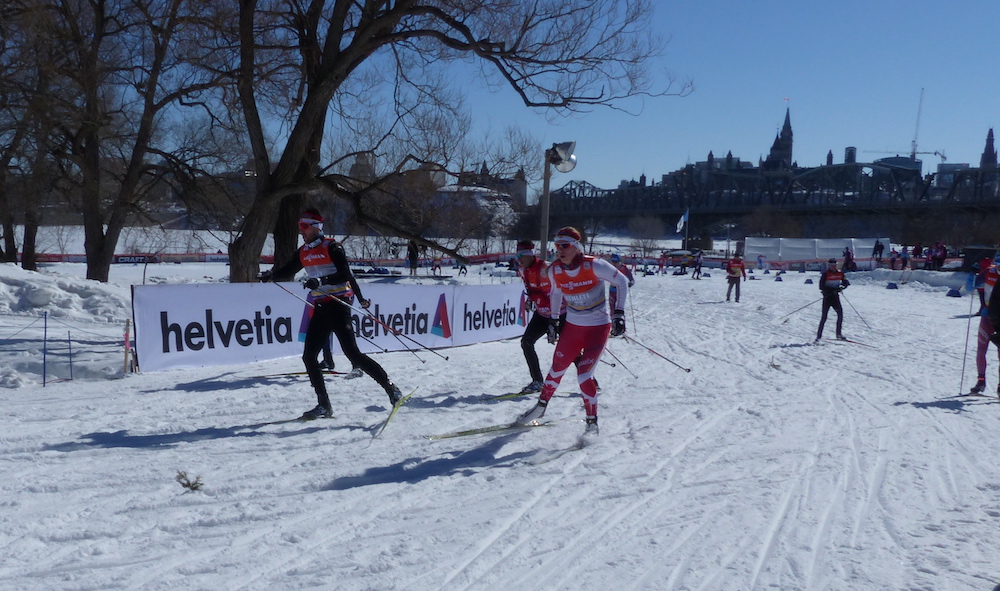
    Ottawa  (Ontario) is in the background as national team member Dahria Beatty skis beside an old teammate before the Gatineau (Québec) stage of Ski Tour Canada in 2016. (Photo: Peggy Hung)


    By mid-November, it seemed unlikely that Whistler Olympic Park’s Organizing Committee would be allowed to host U23 and Junior World Trials in January. Cancelling now allows the High Performance Committee to start work on new selection criteria that doesn’t include any head to head races. This Trials event was also the test event for 2023 U23/JW World Championships; cancelling early should make it easier to move the test to 2022.

    While this mass cancellation greatly helps with provincial rules compliance and simplifies application of the fluoro ban in Canada, it also comes with consequences. There will be no Continental Cup leaders to receive partially funded World Cup starts in Period I next season. It may have longer term effects on Canada’s status with FIS.

    Team selection for international trips and next year’s national team will be different too.

    “I know one of the questions that will likely come in is just how we’re going to be selecting the team,” Boyd said. “And we’re working on that right now with our high performance committee. Without Junior trials happening in Whistler, we’ll have to, to look at the information that we have available to us. And pick the fairest and most competitive team that we can send over to Europe to compete.”

    For now, it appears regional races may skew in favour of interval starts to manage group size limits. According to Ellis, this format may have an upside. 

    “This is my personal opinion, but I think we [Canada] have traditionally been weak at Interval Start,” said Ellis. “We seem to need that push from others around us to see what we can do.  Whether that be in sprint heats, mass start or pursuit start. Our successes usually begins there.  A season of interval starts and learning how to really push oneself could be really valuable.”

    National Team coach Erik Bråten told FasterSkier last May he felt many Canadians were relying on the group to pace training sessions.

    “There are a lot more organized trainings here then I am used to, with programs having 4-6 sessions a week together in addition to camps,” said Bråten. “I think a lot of athletes will learn a lot about intensity control and focus in training these next few months. And when we are allowed to be in bigger groups again, let’s use that focus and self awareness to have even better group sessions then we did before.”

    The NorAm series still carries the name from when it was truly a Continental Cup, with races in Canada and the USA. Once the SuperTour series started in the U.S., the NorAm series was left as a Canadian series with an outdated name.

    “In terms of reducing travel there will always be the need to get our best skiers together a certain amount of times a year. Geography is our reality and we can’t avoid having to travel for top level events,” Ellis wrote. “The FIS Regional Cup series was an attempt this season to get away from the NorAm calendar but with the cancellation of FIS events we didn’t get a chance to see how that goes”

    Ellis is bound at every turn by FIS rules but he doesn’t want to be limited by the past. 

    “In terms of what directions we are looking at, we will be looking at whether our NorAm (Continental Cup) series was achieving what it is designed to do.  I’d like to see us stick with regional FIS events where teams could choose to race south of the border if financially and competition-wise that makes more sense.  We would still need to get together a few times a year for Trials, Nationals etc.  But maybe a NorAm series doesn’t need to dominate the calendar.  In the end it’s just the Open category that is FIS sanctioned and it has the Continental Cup tag just like OPA or Scandinavian Cups.”

    Boyd is open to new ideas in her role with the team.

    “This is how Canada has done it in the past, but it’s a new era, right? And new opportunities to see where we can just…. How do we make the Canadian system exceptional, but also make it really clear and transparent. And so people know what it is going to take to be on the national team and to compete for Canada.”


    Fluoro Wax Ban in tier 2 racing

    Canada is moving forward with their fluoro ban this season

    . It is a small change from last year’s LF-only racing below the Continental Cup and World Cup level (tier 1 aka FIS-sanctioned).

    “This pause in FIS competitions gives everyone another season to prepare for the fluoro-free future of the sport,” added Ellis. “All signs point to us having a hand held fluoro tracker device for next season.  We will be able to check at the start line for fluorinated wax products on skis and athletes will be not allowed to start that race. It should be noted that fluoros are a banned substance this season at all Nordiq Canada sanctioned events and will be at the FIS sanctioned ones next season.  Putting them on skis is a banned performance enhancing substance. In general I am not worried about our competitive ski community trying to cheat the system but some will and I look forward to catching them.”

    NC is also looking at virtual racing.

    “We are looking at a number of options,” said Ellis. “Strava obviously plays well into very specific site competitions.  We certainly have many skiers who are very familiar with that data tracking service and I think it plays well into running virtual events this season.  Specifically, Loppets where we can’t have large groups starting together.  Having the multiple segments over the course of a long distance event could engage more people that wouldn’t necessarily make a traditional podium.  Best first lap, fastest final 100m or uphill and downhill challenges.  Primes during a mid race segment.  Lots of great options.  The iSki tracking app is also something we are taking a look at.  Could we have a Nordic Challenge that is over a 10 day period or the entire season where we see who can ski the most kms.  Although it won’t be a normal year there are a lot of opportunities for us to try new things.” 


    COVID-19 Outbreaks
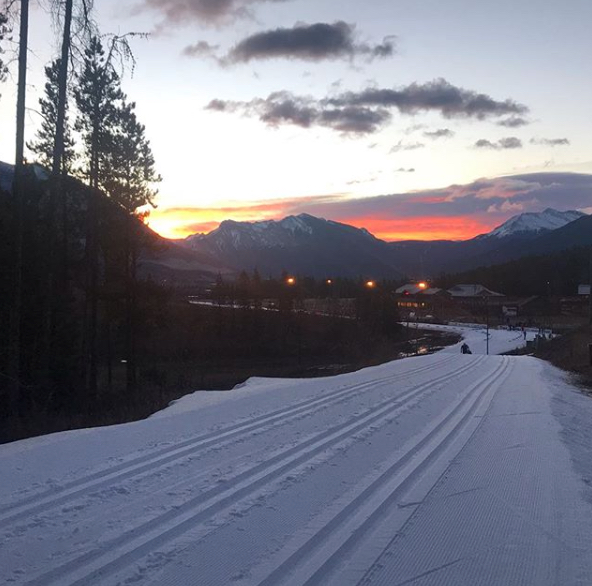
    The Dawn of a New Frozen Thunder Classic Sprint Day in 2018. A trip back in time to when mass start racing was an everyday activity (Photo: Ivan Babikov)

    The first widely publicized North America outbreak in cross-country skiing occurred in Canmore this November. A group that had travelled to Canmore for on-snow training at Frozen Thunder had a number of people test positive. Canada has fairly strict privacy laws on medical issues, which limits how much anyone can share about individual cases. As a result, Boyd was limited in what she could say and FasterSkier is limited in how much we can share.

    “It was contained to one cohort,” said Boyd. “Which, I think, considering everybody that was out skiing at Frozen Thunder, I think it demonstrated that it’s not something that we saw evidence as transmitting [outdoors] in our sport.” 

    Many teams took the opportunity to train at Frozen Thunder. Canmore Nordic Centre’s policy during FT was only 100 skiers permitted on-trail at any single time. 

    “I think that the protocol that we have for our outdoor training for our team seems to be working well,” said Boyd about skiing at the centre. “Yeah, it was a group that did travel here to train and so not necessarily under the team’s purview.” 

  • Nordiq Canada Reworks Domestic Calendar to Emphasize Regional Racing (Press Release)

    Nordiq Canada Reworks Domestic Calendar to Emphasize Regional Racing (Press Release)


    Nordiq Canada Keeps Cross-Country Ski Athletes on Track During Pandemic by Unveiling FIS Cup Regional Race Series

    World Championship Trials set for Whistler; Canadian Ski Championships head back to Capital region


    Press Release

    CANMORE, Alta.— In an effort to provide a safe and competitive domestic race series while keeping athletes close to home during the ongoing COVID-19 pandemic, Nordiq Canada has created an East-West FIS CUP Regional Race Series for the 2020-21 season.

    Canada’s cross-country ski athletes will have equal opportunity to compete in four regional races in either Eastern or Western Canada between December and February. In addition, the World Championship Trials will continue as scheduled for the entire country in Whistler, B.C., January 7-10. The best cross-country skiers across Canada will also head to the Nakkertok Nordic Ski Centre in Gatineau, Que. for the 2021 Canadian Ski Championships, March 14-20. Both will be Continental Cup (NorAm) and FIS-sanctioned competitions. The Trials, which will have a limited field focused on the U20 and Open category to ensure physical distancing, along with Nationals will not be part of the FIS Cup Regional Race Series.

    The newly created FIS Cup Regional Race Series replaces Nordiq Canada’s annual NorAm Continental Cup Series that sees athletes regularly travelling across the country. The FIS Cups will provide Canada’s high-performance athletes the opportunity to earn FIS points without leaving their region. The FIS sanctioning of an event only affects the elite Open category. All other race categories will be run as Provincial Cups.

    “COVID-19 has forced us all to adapt, to be innovative and adjust to a new way of doing things. Our number one focus is to support all of Canada’s cross-country ski athletes in their continued development by providing safe training and competitive race opportunities while respecting guidance by provincial government and health officials,” said Jeff Ellis, Events and Partnerships, Nordiq Canada.

    “Athletes are born and bred to race, and do not want to be left behind their competition. While we realize these difficult times will create additional stress and anxiety for all of us, we believe this new regional series eliminates the dilemma for athletes, coaches, parents and officials to put their health at risk by traveling multiple times across the country for sport. Until the pandemic has run its course, we recognize there may require travel for athletes in the Atlantic provinces and Territories, but we are encouraging our entire community to ‘Race Local.’”

    Prize money for the top-five women and men will be up for grabs at both the following four-race Western FIS Cup and Easter FIS Cup Series.

    December

    December 4-5 – Ski Morin Heights, Morin Heights, Que. East

    December 11-13 – Alberta Cup, Canmore Nordic Centre, Canmore, Alta. West

    December 12-13 – Nakkertok Nordic Centre, Gatineau, Que. East

    December 18-20 – Kootenay Cup, Black Jack Ski Club, Rossland, B.C. West

     January

    January 7-10 – World Championship Trials, Whistler Olympic Park, Whistler, B.C. Continental Cup

    January 29-31 – Red Deer, Alta. West

    January 29-31 – Ski Morin Heights, Morin Heights, Que. East

     February

    February 19-21 – Lappe Nordic Ski Club, Thunder Bay, Ont. East

    February 26-27 – Sovereign Lake Nordic Ski Club, Vernon, B.C. West

    National Championships head back to Canada’s Capital region

    One of only two domestic competitions that will have Canada’s top athletes going head-to-head will be at the Canadian Ski Championships slated to return to the Nakkertok Nordic Ski Centre in Gatineau, Que.

    Hosted by the ENGNE, the Canadian Ski Championships will be held March 14-20.

    “We are thrilled to return to one of Canada’s most coveted cross-country ski venues for our National Championships,” said Ellis, who added this will be the lone event of the year that will bring Canada’s entire cross-country ski community together.

    “While our regional FIS Cup races will be extremely competitive, we also recognize the importance of having athletes test their mettle against a wider breadth of competition, and I can’t think of a better location to hold the premiere event on our domestic race schedule than at Nakkertok. We will continue to closely monitor guidelines put out by our government and health officials but are hopeful we will have the opportunity to complete the season with all of our nation’s best on the same start line in March.”

    ENGNE previously hosted the premier event on the domestic race calendar in 2019 at the Nakkertok Nordic Ski Centre.

    “ENGNE and the entire Nordiq ski community of Canada’s Capital region are excited to be hosting the nation’s best skiers again,” said John Halvorsen, President and Chair, ENGNE.“This year will be extra demanding, but our experienced Organizing Committee is ready for the challenge and look forward to welcoming the cross-country ski community to Gatineau.”

    About ENGNE

    Évènements Nordiques Gatineau Nordic Events (ENGNE) was founded by three local ski clubs (Chelsea Nordiq Ski Club, Nakkertok Nordic Ski Association, Club Skinouk) plus the region’s premier community ski festival, the Gatineau Loppet, to host the Gatineau stage of Ski Tour Canada 2016, a FIS World Cup Event.

    The mission of ENGNE is to host, organize, and promote major events and competitions in the field of cross-country skiing aimed at offering an enriching experience for all participants and fans, promoting the practice of amateur and competitive sport and a healthy lifestyle, as well as broadening the reputation of Canada’s Capital Region as a sports and cultural destination of choice.

    Nordiq Canada is the governing body of para-nordic and cross-country skiing in Canada, which is the nation’s optimal sport and recreational activity with more than one million Canadians participating annually. Its 60,000 members include athletes, coaches, officials and skiers of all ages and abilities. With the support of its valued corporate partners – Haywood Securities Inc., AltaGas, Swix and Lanctôt Sports– along with the Government of Canada, Canadian Olympic Committee, Canadian Paralympic Committee, Own the Podium and B2Ten, Nordiq Canada develops Olympic, Paralympic and World champions. For more information on Nordiq Canada, please visit us at www.nordiqcanada.ca.


    *****


    FOR FURTHER INFORMATION:

    Chris Dornan

    Media and Public Relations

    Nordiq Canada

    T: 403-620-8731


  • Nakkertok NorAm Weekend Round Up

    Nakkertok NorAm Weekend Round Up

    Katherine Stewart-Jones leads a sprint heat on her way to domination. (Photo: Robert Smith)
    Katherine Stewart-Jones leads a sprint heat on her way to domination. (Photo: Robert Smith)

    The NorAm circuit moved east to the Nakkertok trails for three days of racing jointly hosted by Nakkertok Nordic, Club Skinouk, Chelsea Nordiq, and Kanata Nordic. Friday featured classic sprints, Saturday interval start free, and Sunday interval start classic.

    The event was also the Candy Cane Cup for the younger categories, as well as Ontario Cup 1 and Coupe Québec 1. 374 athletes in the U16, U18, and Open categories competed on Friday with many more younger athletes racing Saturday and Sunday.

    Nordiq Canada’s Jeff Ellis was there and has once again shared the full-length post-race interviews. Photographer Robert Smith has galleries for each day, so keep scrolling.

    Nakkertok had over 3km of trail open thanks to their snowmaking, with a 2.5km loop used for the distance races.

    The 'NakkerTrak' at NakkerTok before the 2019 NorAm weekend. (Photo: Nakkertok)
    The ‘NakkerTrak’ at Nakkertok before the 2019 NorAm weekend. (Photo: Natural Fitness Labs)

    On the women’s side, it was the KSJ show, with home-grown national team member Katherine Stewart-Jones winning all three days.

    In the sprint, Stewart-Jones finished in 3:19.96, comfortably ahead of AWCA’s Maya MacIsaac-Jones and RMR’s Katie Weaver at 2.43 and 3.93 seconds back respectively. The podium trio were the top three qualifiers, but in reverse order.

    Stewart-Jones steamrolled the field in the free 5km, 36.8 seconds ahead of Laura Leclair in second and 39.9 seconds before Cendrine Browne, both of CNEPH.

    The trend continued on Sunday, with Stewart-Jones finishing the classic 10km in 28:52.1, 1:18.1 ahead of Skibec’s Andrée-Anne Théberge and 1:29.8 ahead of AWCA’s Annika Richardson.

    Antoine Cyr leads Julien Locke in the interval start classic. (Photo: Robert Smith)
    Antoine Cyr leads Julien Locke in the interval start classic. (Photo: Robert Smith)

    For the men, Hardwood’s Bob Thompson kicked the weekend off with a sprint victory in 3:12.71, followed by national team member Antoine Cyr at 0.36 seconds and his CNEPH teammate Antoine Briand at 0.63.

    On Saturday, Cyr won the free 10km in 22:10.4, 20.9 seconds ahead of Fondeurs Laurentide’s Ricardo Izquierdo-Bernier and 32.8 seconds clear of Team R.A.D.’s Evan Palmer-Charrette.

    Palmer-Charrette stepped up to finish the weekend on top of the podium, winning the 10km classic in 24:43.8. National team member Julian Smith was second at 6.2 seconds followed by Cyr at 14.4 seconds.

    Results: Full Weekend, Sprint Qualifier, Sprint Heats, Interval Free, Interval Classic.

    For many Canadians this season, the big focus is on the Mt. Sainte Anne (MSA) NorAm in January, which is the Junior and U23 World Championship trials. That series is also a path to World Cup starts. As a result, a number of athletes chose the nearer of the two December NorAm races and skipped the other to reduce travel. Over 30 western Canadians drove to Sun Valley for the SuperTour event instead of flying to Nakkertok.

    “I think that it’s good for younger athletes to chase high competition for development,” Stewart-Jones wrote in response. “It makes more sense for them to travel less too. This year, for most of the younger athletes and even a lot of the older ones, the focus is on trials in MSA in January so there is a lot of time to prepare for their optimal race performance.”

    Stewart-Jones moved from Nakkertok to Canmore this training year, resulting in new training partners and a new personal coach, national team head coach Erik Bråten. That also meant returning to Nakkertok required two extra flying days and the associated illness risk.

    “If I hadn’t been trying to get the COC spot locked up for the rest of the season I would have most likely gone to Sun Valley too.”

    There is a complicated calculus to getting World Cup starts in Canada. The COC leader gets FIS-guaranteed starts and financial support from the host organization for each race weekend. Keeping the COC leader bib for the season would mean more and cheaper time on the World Cup for Stewart-Jones. Dahria Beatty and Emily Nishikawa chose to race period 1 in Europe instead, with Beatty qualifying for the next WC trip selection by placing 25th in the Davos sprint on Saturday.

    Photo galleries from Robert Smith are here.

    Video interviews are by Nordiq Canada’s Jeff Ellis. Audio interview courtesy the LOC.

    Post sprint race interview with Stewart Jones (below)

    Post skate race interview with Stewart Jones (below)

    Post classic race interview with Stewart Jones (below)

    Thompson talks sprinting and his season (below)

    Cyr talks about finally getting the win and the leader’s bib (below)

    Palmer-Charrette is happy to get the win (below)

  • Canmore NorAm / SuperTour / Nationals Weekend Wrap-up (Updated)

    Canmore NorAm / SuperTour / Nationals Weekend Wrap-up (Updated)

    A scenic train in the men's 15km individual start on Sunday. (Photo: Doug Stephen)
    A scenic train ride in the men’s 15km individual start on Sunday. Wyatt Gebhardt of CU Boulder leads the way. (Photo: Doug Stephen)

    Updated with more quotes.

    The first three race days of both the NorAm and SuperTour series are complete and the athletes and coaches are digesting the lessons.

    It was free sprints Friday,  classic distance Saturday, and interval start free technique distance on Sunday. The men started the Sunday with a four lap 15km followed by the women doing a 3 lap 10km.

    CGRP’s Ben Lustgarten nailed the pacing to win Sunday’s race in 42:56.0, just 0.8 seconds ahead of AWCA’s Jack Carlyle and 8.0 seconds clear of APU’s Hunter Wonders. Lustgarten was 37th at the first split and 10th after one lap before getting the fastest 3rd and 4th lap. Carlyle won the first two laps but faded to earn the 10th fastest final lap.

    Nordiq Canada provided the full length interviews; shortened versions are also on @nordiqcanada’s Instagram.

    For the women, Caitlin Gregg showed that she is still on the top of her game, easily winning the 10km in 29:55.6. Saturday’s winner Katharine Ogden (Dartmouth) was 23.4 seconds back to complete her medal set with one of each. National team member Katherine Stewart-Jones was third at 1:00.6, after scoring second on both previous days.

    This was Gregg’s second race weekend after the birth of daughter Heidi ten months earlier and a hamstring injury that caused her to miss the NYC Marathon in November.

    Caitlin Gregg climbing to victory in the 10km free. (Photo: Doug Stephen)
    Caitlin Gregg climbing to victory in the 10km free. (Photo: Doug Stephen)

    “Today was good confirmation that my fitness is on track after having a baby 10 months ago,” Gregg wrote to FasterSkier. “My goals are still day by day and week by week but I would love to represent the USA at the Theodore Wirth World Cup in March and of course the Birkie is always a big focus of my training.”

    Gregg has always lived outside the normal development system, earning her first World Championship medal before her first national team nomination. This is Gregg’s year to get training priority, while husband Brian works full time as a financial advisor and takes the supporting role, with daughter Heidi leading the sleep-deprivation program.

    The day by day goals are the result of Gregg’s hamstring injury, which is a complete rupture of the hamstring tendon from the ischial tuberosity (sit bone).

    “All 3 muscles have detached but I have had an amazing team of doctors, surgeons and PT’s who have made the impossible possible this season!”

    Medical consensus is that the hamstring will have to be surgically reattached, resulting in months of very limited mobility. Gregg’s hope is to delay that until after SuperTour finals and the Vasaloppet.

    Stewart-Jones was the top Canadian all three days.

    “Overall I am pretty happy with the racing, especially the sprint: I’ve worked really hard at improving my skate technique and I felt way more smooth than last season,” she wrote at the end of the weekend. “I felt really tired today but I pushed as hard as I could considering.”

    That tired result was third place, after taking second on Friday and Saturday.

    Russell Kennedy raced Friday and Saturday as part of his preparation for Europe.

    “I am feeling good. I am fit but not peaking just yet. I have a lot of racing under my belt and a good sense of what is fast and what isn’t. Now just need to put the pieces together in Davos,” he wrote.

    “I was working on my pacing on Saturday and it’s close. Davos is high and a steady course. I need to be ready for a hard last lap but also be able to hang on a good ride. I am hopeful with one more race on Thursday I will be in form for Davos.”

    Kennedy’s Davos teammates Dahria Beatty and Emily Nishikawa skipped the Canmore races to test themselves at an OPA Cup in Slovenia. Beatty took bronze behind Slovenia’s Katja Visnar in the skate sprint Saturday while Nishikawa was 10th in the 10km free won by Italy’s Elisa Brocard on Sunday.

    Depth of Field

    One of the primary goals of combining NorAm and SuperTour races is to gather a deeper, more competitive field.

    A secondary goal for Canadian Head Coach Erik Bråten is to find out if there is “a lot of sea between the boats.” 

    “It’s not just a number,” Bråten explained, “not even to see if we are winning or not, but to see where are the gaps. Is it two people at the top, then a huge gap to the next Canadian?”

    Katherine Stewart-Jones tightening her hold on the NorAm leaders bib, with a third consecutive top Canadian result. (Photo: Doug Stephen)
    Katherine Stewart-Jones tightening her hold on the NorAm leaders bib on her way to a third consecutive top Canadian result. (Photo: Doug Stephen)

    In the top-30 of the women’s sprint qualifier, there were 12 Canadians, 13 Americans, and five Europeans. Cutting it another way, we have four U20’s, four U18’s, and eight NCAA athletes. Counting full time students is more difficult, but it is probably about 12.  After removing the 71 U20 and U18 athletes from the qualification results, there are only 37 senior athletes competing for 30 places in the heats. If these were divided into separate NorAm and SuperTour events, every athlete would automatically qualify for heats.

    For the men’s sprint qualifier, there are 14 Canadians, 12 Americans, and 4 Europeans. There was a single U20, two U18’s, and six NCAA athletes. There are 80 U20 and U18 athletes and 71 seniors, which creates a lot more pressure for the men to perform in the qualifier.

    AWCA’s Jack Carlyle had good results moved down the sheet by the invading SuperTour athletes, with his 5th and 2nd places scoring 2nd and 1st on a virtual Canadian-only podium.

    “I’m a big fan of the combined Super Tour/NorAm weekend,” Carlyle wrote. “High level competition is always a good thing, and having the best of Canada and the US is the way to do that.”

    Stewart-Jones has spent more time on the NorAm podium than Carlyle, but had a similar answer about the bigger challenge.

    “I love it. It’s always fun to have more competition.”

    While you might expect junior national team member Anna Pryce who qualified 4th to want to ‘race up’ in senior heats instead of winning all three heats in U20, the choice was not hers, as Nordiq Canada’s Jeff Ellis explained.

    “We currently have the option to let juniors race up and if they qualify for the Open heats they would race up.  If they failed to make the top 30 they would still have the ability to race in the U20 heats.  In Canmore we did not offer that option because the U20 category contained the athletes trying to qualify for the [Youth Olympic Games].”

    At NorAms that aren’t explicitly part of a trip qualification, allowing the fastest U20’s to ‘race up’ creates closer more competitive heats for both age groups.

    Attentive readers will notice that Canada has officially shifted away from named age groups in favour of the FIS-preferred U20, U18, etc. As habits are hard to change, the old names including ‘Junior Women’ and ‘Junior Girls’ are still visible in places. These names will eventually disappear, possibly as slowly as Kuusamo (Ruka), Ladies (Women), Take a break and learn new facts! The free spin is a game on a slot without deposit money. You can see these titles on the internet: free spins, bonus spins, and free spins. Free spins can be won while playing for real money. This is also called "free play" – a bonus game on the slot. The second type of free spins is an online casino marketing event to attract customers, virtual money for bets without the possibility of withdrawal. The classification is as follows: for registration, deposit, and action. Sometimes it can be extra 50 free spins for special slot machines . Don’t hesitate to try it and maybe you will be the next big winner. Cross Country Canada (Nordiq Canada), Lab City (Menihek), and SilverStar (Sovereign Lake).

    The ‘B’ finals are also gone for this season. They were added back after the World Cup eliminated them, with the rationale that it would give a third heat to six more athletes in the four categories. As with the World Cup, nobody wants to watch a B final, few athletes want to race one, and eliminating four ‘B’ finals makes a shorter day for the officials and volunteers.

    Doug Stephen has photo galleries for sprint, classic, and free. Athletes can download full-resolution images for their use if they credit ‘Doug Stephen’ or @vr45photography.

    Sam Hendry brought his University of Utah teammates home to race. (Photo: Doug Stephen)
    Sam Hendry brought his University of Utah teammates home to race. (Photo: Doug Stephen)
  • Canmore NorAm/SuperTour/Nationals Sprints

    Canmore NorAm/SuperTour/Nationals Sprints

    Full-time student Jess Cockney was happy to win again in Canmore. (Photo: Doug Stephen)
    Full-time student Jess Cockney was happy to win again in Canmore. (Photo: Doug Stephen)

    The NorAm series fully lived up to the North American Cup label in Canmore Friday with 1.3km free technique sprints to kick off a combined NorAm, SuperTour, and Mexican National Championships weekend.

    Full results for the weekend are on zone4, including live results every day. Friday featured sprints for the older age groups only (282 racers): Saturday is interval start classic, and Sunday’s race an interval start free.

    Before the races, there was chatter about the importance of increasing the level of competition and a dash of fear that the American visitors would school the host country. The competition level was up and fear was not needed this day. The open women’s final featured two Germans, two Canadians, and two Americans before the open men’s final skewed Canadian. (Heat brackets and final results.)

    Julia Richter takes the win ahead of Katherine Stewart-Jones and Katharine Ogden. (Photo: Doug Stephen)
    Julia Richter takes the win ahead of Katherine Stewart-Jones and Katharine Ogden. (Photo: Doug Stephen)

    There are a few race videos in @NordiqCanada’s Instagram story.

    Nordiq Canada’s new Events Coordinator Jeff Ellis took time from his Race Director role to shoot video interviews with the top athletes, including the first ever Mexican National Champion Rodrigo Rangel Fernandez. Edited versions of some of these interviews are also on @NordiqCanada’s Instagram.

    University of Utah’s Julia Richter won the qualifier and all the heats to take the win in 3:10.52, 0.08 seconds ahead of the national team’s Katherine Stewart-Jones and 0.63 seconds clear of Dartmouth’s Katharine Ogden.

    Full-time student Jess Cockney (Team ULLR) turned in another solid sprint performance at home, winning the men’s final in 2:46.18, over two seconds ahead of SVSEF Gold Team’s Peter Holmes and Canadian National Team member Graham Ritchie.

    National team junior Anna Pryce qualified 4th overall before winning all her heats. She finished the 1.3km final in 3:18.40, 0.38 seconds ahead of AWCA’s Elizabeth Elliott and 0.43 seconds from CNEPH’s Liliane Gagnon. Seventy-three U20 women competed, making that cohort the largest age group.

    Xavier McKeever (Team ULLR, CNST) won the U20 sprint after qualifying 20th overall. His 2:42.02 bested Telemark’s Ian Williams by 0.85 seconds and ULLR teammate Joe Davies by 5.30 seconds.

    The first Mexican National Championship sprint featured four athletes. Rangel Fernandez won comfortably in 3:37.33, completing a major step forward for the federation in Mexico. Vadovų paieška, personalo atranka, mokymai vadovams ir darbuotojų paieška primumesse.lt


    Canmore-based photographer Doug Stephen was in the thick of the action. Athletes can use full-resolution photos from his gallery if they credit ‘Doug Stephen’ or @vr45photography.

    Katherine Stewart-Jones leads BSF's Erika Flowers in the quarter final. (Photo:Doug Stephen)
    Katherine Stewart-Jones leads BSF’s Erika Flowers in the quarter final. (Photo:Doug Stephen)
  • Julia Kern Keeps Perspective

    Julia Kern Keeps Perspective


    Julia Kern leading Dahria Beatty in the semi. (Photo: Pete Leonard)
    Julia Kern (SMS T2)  leading Dahria Beatty (CNST) in the semifinal of the 2018 NorAM/SuperTour in Sovereign Lake. (Photo: Pete Leonard)

    Since Dec. 1,  twenty-one-year-old Julia Kern (SMS-T2) has barnstormed the elite level domestic racing calendar. She qualified first and won the SuperTour freestyle sprint in West Yellowstone. The following weekend in the NorAm/SuperTour skate sprint in Sovereign Lake it was another win-win in the qualifier and final. In the next day’s 10-kilometer classic, Kern was third overall and the second American.

    Last weekend back in Vermont at the Craftsbury Outdoor Center, Kern swept the qualifier and final in the Eastern Cup’s skate sprint and took third on Sunday’s 5 k skate.

    Her December body of work is peerless as she leads the women’s SuperTour.

    Along with her skiing, Kern is a student at Dartmouth where the college offers a quarter schedule. Skiers like Kern can take advantage of spring, summer, and fall classes while pursuing both academics and high quality training. She is able to take the winter quarter off to focus on skiing.

    Having grown up outside of Boston where she evolved as an athlete, after high school Kern took a gap year to train full time at the Stratton Mountain School.

    “When I decided to take a gap year, I wanted to lay out a road map of where I wanted to be each year and where I think I should be,” Kern said during a phone call on Dec. 18. “When I was taking my PG year, I was hoping to be at this point and hoping to start moving towards the World Cup. And moving to the World Cup because I thought that was the trajectory I wanted at this age. I thought that was where I was headed.”

    Kern has been a staple for the U.S. at World Juniors since 2015. In 2017, at the Soldier Hollow World Juniors, Kern placed ninth in the classic sprint and a historic third in the 4 x 5 k relay. A planned trajectory towards consistent starts on the World Cup was sensible.

    Julia Kern (U.S. Ski Team/SMS T2) racing to 43rd in the 2018 World Cup classic sprint in Planica, Slovenia. (Photo: Toko)

    In her first career World Cup start, a March, 2017 Quebec City skate sprint, she scored points by placing 24th overall. She raced six World Cups last season and was unable to replicate that fiery Quebec City performance.

    “Over the past two years I have struggled a lot with my injuries and illnesses so the trajectory has not been as fast paced and as straightforward as I had hoped,” Kern said of her lotfy yet grounded and realistic ambitions. “But coming into this training year I have had the healthiest training year yet by a long shot. I didn’t have any major disruptions or interruptions to my training. Only things like individual workouts that I modified for minor things. And I had never had that before.”

    Hoping for a performance and nailing a performance are two sentiments that have collided and fused for Kern this season. Her smooth training season along with her mental preparation have synced this past month.  

    “Going into this season I knew I was much fitter than I had been in the past, especially in the early season because that is where I usually struggle the most with fitness,” Kern said. “I think going into the season I was pleasantly surprised. I knew I was fit but I didn’t expect to be feeling that fit in the sprint races. But a few years ago this was where I hoped I would be. I think my perspective has changed a little bit over the last few years.”

    The teenager who took the gap year in 2015/2016, and who now is a young adult one-third through her junior year in college, conveys a new found patience.

    In developing their core athletes, the U.S. Ski Team’s (USST) Bryan Fish (who was Kern’s USST coach until this past May), extolled patience to his skiers, having them engage in age appropriate levels of competition. That pathway means Junior and Senior Nationals, Junior then U23 Worlds, and then maybe World Champs. Having struggled through minor setbacks like an injury or a sub-par race performance, Kern’s experience the past few years have positioned her to savor moments on the SuperTour. And dream about, but not expect a clean jump to the World Cup.

    “Being on the Wold Cup most of last year was really eye opening,” Kern explained. “Seeing that the gap from the SuperTour to the World Cup is still pretty big. I think you can be winning in the SuperTour and still not be qualifying on the World Cup. I think knowing that, there is something to be said about being challenged — but to the point where you are still doing rounds and still doing heats — and not just doing a three minute qualifier and going home and calling it a day.”

    Gaining race day experience was a major consideration for Kern’s Period 1 stay on the SuperTour. A series where she’d certainly qualify in sprints barring an unexpected mishap, and remain a favorite to advance through the heats.

    “I could build my confidence [on the SuperTour] and work on my fitness,” Kern said. “And build that into the season before heading over to the World Cup and getting World Cup opportunities. Because I think it is really easy to say I just want to get on the World Cup, but the World Cup is really hard.”

    Kern was listed as an objective selection for the Tour de Ski but she turned down those opportunities to focus on Senior Nationals. She will, however, be racing in the Dresden, Germany sprint World Cups after the Tour and Nationals.  

    Julia Kern (U.S. Ski Team D-team/SMS T2) racing in the quarterfinals of her first World Cup race in the women’s freestyle sprint at 2017 World Cup Finals in Quebec City. She finished fifth in the heat for 24th overall. (Photo: @gpowersfilm)

    On the horizon for Kern are tangible goals like U-23 Worlds and a possible nod for the Seefeld, Austria World Championships*. For the Period 1 SuperTour leader, Kern will take appropriate opportunities. And make the best of them.

    *The U.S. Ski Team (USST) has tightened what is known as the five sprinter rule. The USST according to its qualifying criteria for World Championships will take no more than five sprinters (per gender) to the championships. Currently, the USST has five women ranked 37th or better in the World Cup sprint standings.

  • Canmore NorAm: Notes, Quotes, and Selections

    Canmore NorAm: Notes, Quotes, and Selections

    Bob Thompson outsprinted Jack Carlyle in the men's 30km. (Photo: Doug Stephen)
    Bob Thompson outsprinted Jack Carlyle in the men’s 30km. (Photo: Doug Stephen)

    Canmore hosted the second NorAm of the 2018/2019 season on December 13th, 15th, and 16th. The event also served as U23 and Junior World trials.

    By the end of the weekend, starts at the U23/Junior World Championships and the World Cup’s Tour de Ski would be earned.

    This event was originally scheduled for Whistler Olympic Park but had to be moved as a result of heavy rain and inclement weather forecasted into the immediate future. The Callaghan Valley Cross Country organization, the original bid-winner for this season’s trials, made the difficult decision to cancel on December 1st. The weather gods added one final insult on December 13th, when a major snowstorm ensued in the Callaghan Valley that would have made racing possible on the 14th.

    Canmore’s cross-country community stepped in on December 2nd and was able to organize a successful race weekend with a few weeks notice.

    The International Ski Federation (FIS) mandates that Continental Cup leaders for each period earn automatic start rights for the next World Cup period, including financial support from the event hosts. This season, Period 1 leaders get starts for Period 2 (Tour de Ski) and period 3 (Dresden, Otepää, and Ulricehamm) along with race support.

    For the first time since Perianne Jones and Dasha Gaizova started in the 2014 edition, Canada will enter a woman in the Tour de Ski (TdS). The last female finisher was Sara Renner, who placed 16th overall in 2010.

    This past weekend, Dahria Beatty won all three races in Canmore. Combined with her second place (and top Canadian result) in Sovereign Lake the previous weekend, Beatty is the COC leader and will leave for Europe on the 21st.

    In an email to FasterSkier after Thursday’s sprint, Beatty wrote: “I think the first 3 stages of the Tour this year are my dream come true, 2 sprints and a 10km skate.” The day after sending the email, Beatty received the official news that her TdS dream would be a reality.

    On the men’s side, Bob Thompson won twice in Canmore to lock down the male COC leader position.

    inhalers

    As this event was also the selection trials for U23 and Junior World Championships, up to 12 athletes would automatically qualify for the Lahti, Finland championship races. The High Performance Committee met Sunday afternoon and will announce the final choices soon.

    Weekend Results Summary:

    Names in green earned automatic selection for Lahti.

    Classic Sprint, Thursday:

    • Open Women: Dahria Beatty, Katherine Stewart-Jones, Maya Macisaac-Jones; Marie Corriveau (6th, U23)
    • Junior women: Anne-Marie Petitclerc, Molly Miller, Anna Pryce
    • Open Men: Bob Thompson, Angus Foster, Julien Locke; Graham Ritchie (4th, U23)
    • Junior Men: Remi Drolet, Tom Stephen, Xavier McKeever

    Interval start freestyle, Saturday:

    • Open Women 10km: Dahria Beatty, Katherine Stewart-Jones, Frédérique Vézina; Sadie White (4th, U23)
    • Junior Women 5km: Molly Miller, Isobel Hendry, Elizabeth Elliot
    • Open Men 15km: Russell Kennedy, Evan Palmer-Charrette, Alexis Dumas; Gareth Williams (6th, U23)
    • Junior Men 10km: Sam Hendry, Remi Drolet, Tom Stephen.

    Mass start classis, Sunday:

    • Men 30km: Bob Thompson, Jack Carlyle, Russell Kennedy; Sam Hendry (4th, top junior), Antoine Cyr (5th, U23)
    • Women 15km: Dahria Beatty, Katherine Stewart-Jones, Hannah Mehain (U23); Jasmine Drolet (6th, junior)

    Doug Stephen photographed all three days; see his albums on Flickr for many more images in full resolution.

    Results: Full Weekend, Sprints, Sprint BracketsInterval Starts, Mass Starts


    Quotes from Canmore:

    Sprint

    Dahria Beatty leads Katherine Stewart-Jones. They would finish 1-2 all three races. (Photo: Doug Stephen)
    Dahria Beatty leads Katherine Stewart-Jones. They would finish 1-2 all three races. (Photo: Doug Stephen)


    My tactics for every heat was to ski smooth and relaxed the first half and attack off the final two climbs into the finish. That worked out well for me today. I skied from the front and had control of the heats. The sprints were staged out of the biathlon stadium (hence why you couldn’t find them on the webcam) so it was an uphill finish, making for very fair racing.” — Beatty (1st)

    I was not happy with my qualifier but am really happy with how I skied the heats. Our staff did an awesome job with the skis today! The course was a lot of fun. Tactics essentially involved staying relaxed off the start, positioning well for the final climb and then hammering to the finish.” — Maya MacIsaac-Jones (CNST, 3rd)

    I feel pretty amazing about today’s race. 4th senior at a NorAm sprint is by far my best sprint result ever! My tactic was to have fun and just go like hell; I had a blast and I never went this fast before!” — Frédérique Vézina (CNEPH, 4th)

    I didn’t really have any tactics, I just wanted to go as fast as I could, ski well and try to stay with the leaders. I didn’t ask myself a lot of question, just ski fast!” — Marie Corriveau (MSA, 6th)


    Bob Thompson wins the A final with three Thunder Bay teammates in frame. (Photo: Doug Stephen)
    Bob Thompson wins the A final with three Thunder Bay teammates in the camera frame. (Photo: Doug Stephen)

    I am very happy with how today went. I found the finishing sprint gear I felt I was missing had the speed when I needed it.

    Everyone was fairly relaxed for the first half of the final knowing it was important to have the energy for the gradual climb into the finish. My move was made coming up to the last short downhill and then on the short striding hill before turning into the finish. I had been feeling great in that section in every heat and made sure I was at the front to make the most of it.” — Thompson (1st)

    The group strung out a little bit going into the big downhill, I was back in 5th but had amazing skis and came back up to the group pretty easily. Everyone was really skiing together going into the last climb, and Bob just put down a mean last hill and got away from us. I jumped out from behind Julien Locke as we hit the finishing stretch and got up beside him as we got right down to the line, and just got him in a big lunge.” — Angus Foster (TBay, 2nd)

    The tactics worked out for me as well! I was planning on holding on to the leaders in the final for as long as I could, and then using my fitness to the best of my ability in the finishing stretch.” — Graham Ritchie (TBay, 4th)

    Interval start free technique

    Sadie White was fourth and top U23 on Saturday. (Photo: Doug Stephen)
    Sadie White was fourth and top U23 on Saturday. (Photo: Doug Stephen)

    It was a hard race today. I had a good start but then got really stiff going into my second lap after the big climb. It took a lot of mental fight to regroup after I got really stiff on the second lap but I was able to ski out of it and push really hard on the final lap.

    I am really happy with my fitness right now, my pacing was a bit off today but I think that fact that I am in good shape allowed me to bring it back.” — Beatty (1st)

    I felt better and better throughout the whole race today! I kind of wish we had more lap to go…” — Vézina (3rd)


    Russell Kennedy descending to first place. (Photo: Doug Stephen)
    Russell Kennedy descending to first place. (Photo: Doug Stephen)

    “Pacing was important today: that being said I didn’t pace it that well. Was definitely fastest the first two laps. Skis for me were really good [as] the team did an awesome job on them.” — Russell Kennedy (Team R.A.D., 1st)

    “The race today went alright, I tried to start hard and couldn’t quite get myself into a top end race gear. I skied relatively consistent and was able to find a better feeling on the last lap, but overall not the way I want to feel during a race, the result was a pleasant surprise.

    I think pacing played a big role, I was pretty far back after the first and second lap but turned out to be less than some guys lost on the last lap and so I was able to move up quite a few places in the final kms.” — Evan Palmer-Charrette (Team R.A.D., 2nd)

    My race today was really good. I feel like I was able to push hard and keep a good technique. I think the key today was to get a good glide after each push because they were not a lot of easy part on this course and the downhills were fast so you needed to get recovery were you can.” — Alexis Dumas (CNEPH, 3rd)

    Today’s race was good, not amazing but I’m happy to come away with the top U23 spot which qualifies me for U23 World Championships.

    Today’s weather was static and remained the same for the whole race. The race was decided on the last lap, that’s where I pushed my hardest. My plan for the race was to increase the speed as the race progressed, getting a bit faster each lap. I was getting splits and I realized I was off the pace on the first laps, so I just made sure to push as hard as I could on the final climbs.” — Gareth Williams (Telemark, 6th)

    Mass start classic

    Russell Kennedy (bib #1) leads out the men's 30km while Bob Thompson towers over the field in the leader's bib. (Photo: Doug Stephen)
    Russell Kennedy (bib #1) leads out the men’s 30km while Bob Thompson towers over the field in the leader’s bib. (Photo: Doug Stephen)


    Today’s race stands out as the most fun I’ve had in a 30k since the very first one I ever did at the Canmore Nationals in 2010.

    The main group got smaller definitely through Russell pushing the climbs on most laps. We had the group of 6 for several laps and then the last 2 were really just the 3 of us with Russell pushing hard on the climb from the bottom of the course. Jack and I had faster skis and on the final downhills went by and then had a great sprint to the line.” — Thompson (1st)

    After a tough sprint day, it was great to bounce back with two super successful distance races.  ” – Sam Hendry (Team R.A.D., 1st junior in 4th)

    Today was a fun race. A good battle between Katherine and me once again.

    Katherine set the pace early and by the second lap, we were on our own. It was windy on course today, so it was hard to break from each other and after testing each other a few times on the last lap it came down to the finish sprint, which of course is my favourite.” — Beatty (1st)

    The race was really fun. I pushed the pace right off the start so Dahria and I made a break from the rest of the group after the first lap. We skied together the entire race, it was the type of course that made it difficult to break away because the hills were relatively short and there was quite a big drafting effect on the flats. It came down to the finishing stretch and Dahria was stronger on the double pole!” — Katherine Stewart-Jones (CNST, 2nd)

    Selection

    At this point, if I am offered a start I will plan to race the first 3 stages and then reassess after that based on how I am skiing. The Dresden WC will also be a focus just after the new year so I want to make sure I am well prepared and have enough energy for those races as well.” — Beatty, on Thursday, before the Tour de Ski offer was made.

    Qualifying for world juniors has been a big goal of mine for many years and I am really excited to have achieved it this weekend.” — Hendry

    Personal Highlights

    Most unusual part was getting to come home and lie in bed between the quali and heats.” — MacIsaac-Jones

    I am very very happy with my race today, I really surprised myself! It’s been a long time I didn’t feel good at racing so it was really fun to have good feelings again. Take the first spot for U23 world champ was the best way to start the season!” — Corriveau

    Getting to race the final with three of my NTDC Thunder Bay teammates was a blast, I was really proud of the way we skied out there today and think it reflects a lot of hard work by our team and coaches this year! I’m stoked for Graham and Julian go 1-2 in U23 with World Champs spots on the line, and we all owe a big thank you to our wax techs for some wicked boards all day.” — Foster

    It’s been really nice to race at home and sleep in my own bed, especially knowing I will be away a lot for the rest of the season.

    Everyone in Canmore has done a great job organizing the races so last minute. I’ve been especially loving the chocolate medals!” — Beatty

    The highlight from this past weekend was hands down, getting to ski with my teammate and role model Russell Kennedy for almost all of the classic mass start on Sunday.” — Hendry

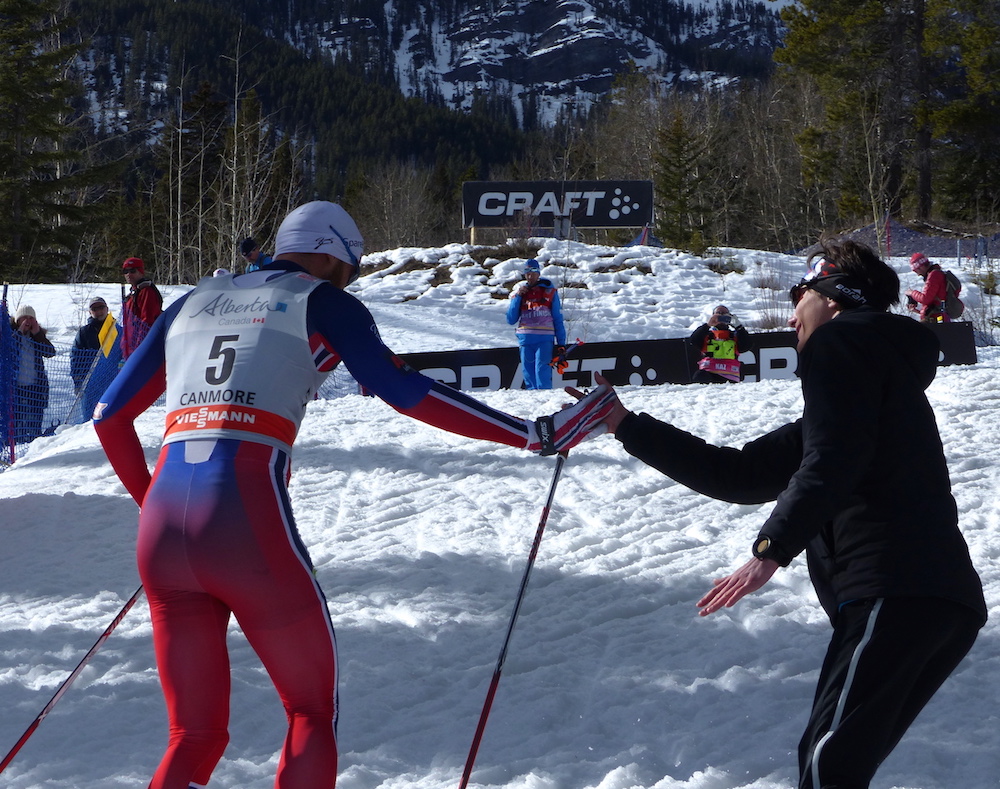
    Remi Drolet has been in Canmore before: Petter Northug (NOR) (l) high fives Remi Drolet (spectator) as he finishes his final lap during the men’s 1.5 k classic sprint at the Ski Tour Canada on Tuesday in Canmore. (Photo: Peggy Hung)
  • CCC Lays Off Four Staff Members, Including Babikov

    CCC Lays Off Four Staff Members, Including Babikov

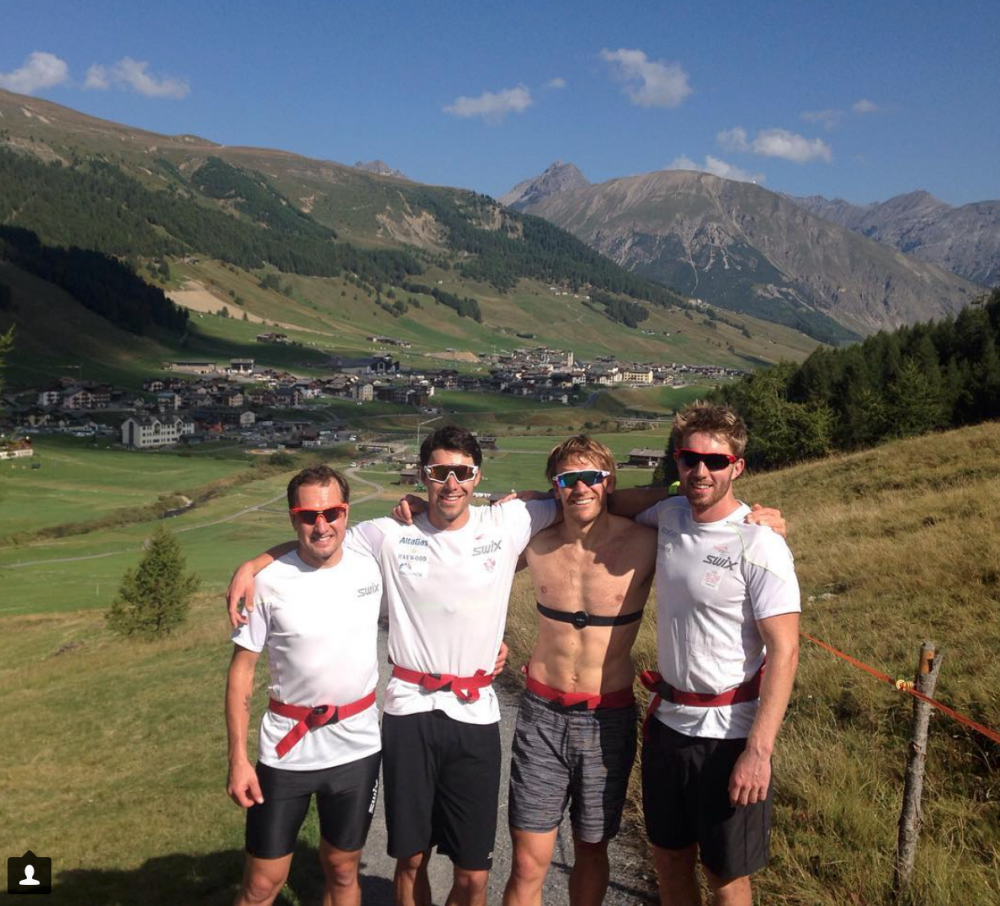
    Coach Ivan Babikov (l) at a 2016 fall training camp with Canadian World Cup Team members Alex Harvey, Devon Kershaw and Graeme Killick in Livigno, Italy. (Photo: Ivan Babikov/Instagram)

    Cross Country Canada (CCC) has appointed a new high-performance and development advisor, Nic Lemyre, and laid off four staff members, CCC Chief Executive Officer Shane Pearsall confirmed in a phone interview on Thursday.

    The news of Lemyre’s hiring came in the form of a press release Thursday morning, two days after four CCC employees — Ivan Babikov, Mike Edwards, Lisa Patterson, and Martine Zilligen — were informed of their release.

    Babikov has spent the last two seasons as a national team and World Cup coach, Edwards was the high-performance director for CCC’s Para-Nordic Ski Team, Patterson was a longtime high-performance development coach, and Zilligen has been communications and marketing manager since 2013.

    According to Pearsall, the layoffs were a direct result of CCC’s annual operating budget (which covers both able-bodied and para nordic skiing) decreasing from about $4.5 million dollars last year to what he anticipated to be $3.9 or $4 million dollars this year. The budget is not finalized, as CCC is waiting on the amount it will receive from Own the Podium (OTP), a government-backed nonprofit, which Pearsall estimated to be about 20 percent of CCC’s operating budget. That final amount is expected by mid-July, he said.

    Fifty percent of CCC’s budget comes directly from the government branch of Sport Canada, and that amount has been determined, Pearsall said. He explained that money is tighter on the whole for CCC as a result of decreased government funding and sponsorship revenue.

    One of CCC’s main sponsors, Mackenzie Investments, will no longer support nordic or four other snow sports as it had previously. Instead, the investment firm opted to stick with freestyle and alpine.

    “From the standpoint of a sponsor, they were one of our bigger ones,” said Pearsall, CCC’s CEO since November 2016.

    On the upside, he explained that another sponsor and investment firm, Haywood Securities, has agreed to sponsor the NorAm circuit as it has in the past.

    Asked if budget cuts were among the biggest challenges affecting CCC at the moment and the reasoning behind the latest layoffs, Pearsall said, “Yes. If things had stayed the same that would’ve been good, but obviously that’s not the case.”

    He added that CCC is faced with the ongoing challenge of competing with other sports for the support of “corporate Canada”.

    “At the same time, we continue to talk to people and try to get them on our side to become part of our programs,” Pearsall said. “There’s a part of it where it always will be the challenge. You’re always looking for money for places to spend the money, and we just continue on trying to get more money.”

    Asked specifically why CCC chose to release those four employees, Pearsall said, “Just trying to create a better future, efficiencies that we think we can find. It’s appropriate that at the end of the quad [Olympic quadrennial], you look at things and how to set the stage for the next quad. And even for us, we were looking at 2026. So we’ve decided this the way we’re going to go.”

    CCC now has a staff size of 12. Louis Bouchard retained his job and is listed on CCC’s website as its lone national ski team/World Cup coach. Bouchard is also Alex Harvey’s personal coach and head coach of the Pierre-Harvey National Training Centre (Centre National d’Entraînement Pierre-Harvey) in Quebec.

    Pearsall said he broke the news to Babikov, Edwards, Patterson, and Zilligen individually during one-on-one meetings on Tuesday.

    “It’s one of those things, when you do a change, you tend to want to something like this all at one time, and that’s the strategy we executed,” he said.

    CCC will be looking to replace Babikov’s position as co-World Cup coach through an “open job search,” Pearsall stated. As for Patterson’s role as a NextGen coach and development trip leader (for international competitions including U23 and Junior World Championships), Pearsall was unsure if CCC would fill that vacancy.

    “When something like this happens — I’ve been involved in the corporate sector — you do a bit of a reshuffle on responsibilities, so we’re working on those on how we’ll go about that,” he said. “At this point in time, I can’t say we’ll necessarily hire somebody in that specific area, but we’re looking at how we cover responsibilities.”

    As for the timing of these layoffs in early June, two months after the end of the season, Pearsall said that was a tough one.

    buy ventolin inhaler, buy nasonex online

    “Can you ever find perfect timing? There’s questions about that, but this is the way we decided to go, and we’re going to make the timing work,” he said. “… This is the way things lined up. This is the way we’ve gone about it.”

    According to Babikov, the layoff, which was effective immediately, caught him off guard.

    “I had no idea it was coming, and it didn’t cross my mind that something like this would happen because we had already started the new summer,” Babikov said on the phone on Thursday. “I just came back from training and our CEO just called me for a meeting, and I thought it was regarding our new HPD, if we hired somebody, but then he just handed me papers and I was told to leave my credit card and keys, and we go separate ways. And that’s all that was said.”

    Babikov, who’s been part of the Canadian national team for the last 10 years, first as a two-time Olympic athlete and then as a coach starting in June 2016, said there was no notice. “It was without a cause,” he said.

    Asked why Babikov was fired, Pearsall said he couldn’t comment.

    ‘The Rebuild’ 

    Lemyre as the high-performance and development advisor will fill the roles previously held by Edwards and Thomas Holland, the former high-performance director of able-bodied cross-country who retired at the end of last season. A Montreal native who is primarily based in Norway as a professor of sports psychology at the University of Oslo, Lemyre will work part time for CCC.

    He’ll be the head of one of CCC’s two new departments, Pearsall explained, overseeing the sport side of the organization while Pearsall and Megan Begley, CCC’s operations & strategic development manager, oversee operations. Lemyre will make decisions in his department, but Pearsall will have “final approval on all personnel decisions”, according to CCC media relations consultant Chris Dornan.

    Dornan clarified that Lemyre is “advising on the rebuild” and that CCC will communicate the structure of its high-performance department in the near future.

    “His role is going to be advising us, going forward, on how we should look at things, and develop things,” Pearsall said of Lemyre. “He’s going to be an integral part of the decisions we make, in different areas, in the high-performance area. He will be overseeing, in the re-org, I’ve basically created two departments. One is operations, and one is sport. He will be in the mix on the sport side. Under the old structure, there was a para-nordic [director] and there was an able-bodied [director], and I’ve brought those two together to gain efficiencies and exchange more knowledge, if you will, between the two sections of para and able.”

  • Western Canadian Champs: Notes and Quotes

    Western Canadian Champs: Notes and Quotes

    Alberta World Cup Academy's Annika Hicks leads Zina Kocher (Foothills) and Laurence Dumais (AWCA) in Saturday's 10 k classic. (Photo: Doug Stephen)
    Annika Hicks of the Alberta World Cup Academy (AWCA) leads Zina Kocher (Foothills Nordic) and Laurence Dumais (AWCA) in the women’s 10 k classic mass start on Saturday, Jan. 20 at the NorAm Western Canadian Championships in Red Deer, Alberta. (Photo: Doug Stephen)

    The NorAm series moved west to Red Deer, Alberta, for Western Canadian Championships last week from Friday, Jan. 19 to Sunday, Jan. 21, with freestyle sprints, classic mass starts and relays at the River Bend Recreation Area trails.

    Each year, the NorAm circuit features both ‘Westerns’ and ‘Easterns’, which are intended to be regional championships so that the younger athletes have the opportunity to experience high-level racing closer to home.

    Easterns has been hosted by Nakkertok for 10 of the last 11 seasons. As the venue is within reasonable driving distance of 12 million Canadians, Eastern Canadian Championships has grown dramatically and is often the largest cross-country skiing Continental Cup event in North America with over 700 racers annually.

    On the other hand, Westerns visits different venues each year. With only 11.2 million Canadians living in the three Western time zones (spanning British Columbia, Alberta, Saskatchewan, Manitoba, Yukon, Nunavut, and the Northwest Territories), travel is always a limiting factor and the fields are much smaller. There were 403 finishers in Saturday’s classic event.

    While this year’s Westerns marked Red Deer Nordic’s first time hosting a NorAm, the club has a rich history in biathlon. Red Deer is also the hometown of retired biathlete Zina Kocher, who transitioned to cross-country skiing this season and was the NorAm series leader at the start of the weekend.

    2018 Western Canadian Championships rundowns:

    Friday: Freestyle sprints

    Saturday: Classic Mass Start

    Sunday: Relays

    Complete results

    Here are some quotes from the top finishers at the three-day Western Championships:

    Freestyle Sprints

    In the final I took the lead from the beginning, was challenged by Zina [Kocher] in the last 200m but was able to come through in the end.”

    Olivia Bouffard-Nesbitt (Canadian National Ski Team/Rocky Mountain Racers), won qualifier and A-final

    “[It] didn’t go exactly as I had planned in my head, I got too excited coming into the last downhill and went side by side to Olivia when I maybe should have stayed behind. I’m not a very good sprinter to the line, I feel like I’m going fast & giving it all but the last 100m are definitely not my strong point 😜”

    Zina Kocher (Foothills Nordic), 2nd in qualifier and A-final

    With only 2 heats it was a bit strange too…I have found that I improve as the heats progress. Unfortunately we just didn’t have many women out there this weekend competing.”

    — Kocher, on her fourth cross-country sprint race

    I had a big focus towards the qualifying and I was stronger today than other days in Canada this year. I was happy to ski the way I planned in the heats, the course was very twisty and hard to pass so leading was important from the start.”

    Jess Cockney (Canadian World Cup Team), qualified 2nd and won the A-final. He’s eyeing the sprints at the upcoming PyeongChang Olympics and will finish his preparation in Canmore

    “Starting position was super important. Jess skied well and is pretty hard to beat in the finish. I had actually intended to race how Jess raced it  so it was kinda weird to watch someone else race the strategy I was thinking of.”

    Russell Kennedy (Team R.A.D.), qualified 1st and finished 2nd in A-final 

    Classic Mass Starts

    The classic race was a lot of fun, it was exciting for everyone to have a mass start with the open, junior women, and junior girls. I skied in 3rd or 4th for the first two laps and then unintentionally found myself in the lead starting the last lap. That was not my plan but at that point no one else would take the lead, so I skied in front until the final 100m with Annika on my tails and she out-skied me at the end. It was a good fight.” 

    — Bouffard-Nesbitt, 2nd place

    Olivia, Annika & I broke away from the pack fairly early on… (not sure when, maybe around the 1st lap it was only the 3 of us). I felt good especially in double pole sections. Maybe my best 10k classic thus far … being that it was my 3rd 10k classic race. Still working on the running herringbone sprints, which is where I unfortunately lost Olivia & Annika middle of the last lap. That technique is tricky to grasp!”

    — Kocher, 3rd place 

    Andy Shields (Lappe Nordic) leads Russell Kennedy during the men’s 15 k classic mass start at Western Canadian Championships in Red Deer, Alberta. Shields went on to win by 9 seconds over Kennedy. (Photo: Doug Stephen)

    “We had a huge advantage with my skis and took full advantage of them. I felt great and was able to put in a monster move of the final climb.”

    Andy Shields (Lappe Nordic), 1st

    I’m really proud of my classic race since I applied my own kick wax! The Caledonia coach, Graeme Moore, is a Red Deer native and SkiGo tech rep, did a great job with testing and took we took a slightly different route than other teams chosing what types of grip wax to use. I ended up going out on a mix of four different brands of grip wax. For glide I was on all SkiGo so I fufilled my role as SkiGo rep that way.”

    — Shields

    I was pretty happy with my classic race. Was feeling a little flat since I was sick for so long leading up to it but was happy with how my fitness has held together. It was a good day with a pretty fun trail. I pushed kinda early to break the group down a little. Three of us ended up at the front and I lead a little to much on the 3rd lap but held in for a second place!”

    — Kennedy

    I skied the start of the classic race the way I wanted but made some tactical errors at the end that left me with not enough juice in the last k. I tried to make a break on the last lap from Andy and Russell but I put too much into it and when I couldn’t drop them I had nothing left for when the next attack came.”

    Scott Hill (BXC), 3rd

    Relays

    I’m thrilled that relays were added, despite the fact that I won’t be taking part this weekend. I think that one relay per season is a great addition because in the past, Canadians only got to race relays at World Juniors/ U23s or senior Championships.”

    — Bouffard-Nesbitt

    Relays are great! We don’t get to do enough of them. A fun event that’s a little more low key. They always create interesting race situations.”

    — Shields

    Its awesome. It’s a good chance for the younger athletes to learn from the older and for teams that don’t usually work together to work together. Plus I think it is good to do 5km every now and then as they are super hard and really good intensity!”

    — Kennedy

    I really like the addition of a relay on the NorAm. I know that some of the older athletes who are racing a lot and are focused on scoring NorAm points choose to sit the relay out but still having prize money provides a nice incentive. I think having a relay for the younger categories though is really positive and I saw an energy and enthusiasm in the chalet yesterday for the race that you don’t see before an individual race. I think one relay per season is great for the senior categories but I think more would be great for the younger categories.”

    — Hill

    Red Deer in General

    The start of the Red Deer school loppet in 2000. From left to right, Kocher (no hat), Graham Vanderwater (Alberta team), Kit Richmond (red hat, RMR, future NCAA winner), and Drew Goldsack (future Olympian, too fast to catch his face!). (Photo: Kocher family)
    The start of the Red Deer school loppet in 2000. From left to right: Kocher (no hat), Graham Vanderwater (Alberta team), Kit Richmond (red hat, RMR, future NCAA champion), and Drew Goldsack (future Olympian, already too fast to catch his face!). (Photo: Zina Kocher)

    “[I] had a lot of fun out there and was really great to end my career right where I began. Haven’t raced on these trails since I was 17, so it feels really special. My dad also brought my grandma out to watch me & it’s the first time she’s ever seen me race so that was very special as well. Lots of faces too that I’ve reconnected with today. [I] did a short session with Red Deer Nordic yesterday afternoon, great to be able to give back and provide a little bit of insight. I thoroughly enjoy being able to do this.”

    — Kocher, after Friday’s sprint

    “I also thought the race course was really fun. … There was very little snow in Red Deer, but the race organisers and volunteers still produced a great race course for us. I was really impressed. The volunteers were all very enthusiastic, the day before the distance race I came across a crew of eight or nine volunteers with shovels and two volunteers driving piles of snow around the entire course covering any bare or rocky spots.”

    — Bouffard-Nesbitt

    Red Deer has been great! I’ve been wearing two hats this weekend: I’m helping Caledonia Nordic with waxing and obviously trying to race too. It been a lot of early mornings out testing and busy evenings prepping skis so have been managing my energy as best I can.”

    — Shields, who doubles as the SkiGo rep for Canada

    Easterns vs. Westerns

    I think Easterns are a pretty special event, garnering equal or greater racer turnout than Nationals. I don’t think any other competition will be able to rival Easterns, but it would be nice if Westerns drew a few more senior athletes than it did this year. I think Westerns was a big success for the junior categories.”

    — Bouffard-Nesbitt, originally from Morin Heights, Quebec, and currently lives in Canmore

    It’s nice to have the variety of race formats offered by Westerns and Easterns. It’s too bad there’s no more 30km at Easterns. It was one of my favorite races of the year.”

    — Shields

    Westerns just can’t compete with the number of skiers that compete at easterns but I think its still an important race for those skiers out west that don’t make the trip to easterns. Having it later in the season might help with more athletes from the east going out.”

    — Hill, originally from Toronto

    Highlights

    “Memory lane on the Riverbend tracks. Really enjoyed the new changes that have been made, a lot of great work has been done by the Red Deer crew. Was a great skate ski track for today’s relay – great flow & steep uphills. … Awesome to0 that my grandma was able to escape from the hospital & watch me compete in the skate sprints!”

    — Kocher

    It was fun to fight out the heats with Jess [Cockney], he is an excellent tactician and I think I learn a lot from him every time we race.”

    — Kennedy

    “We are positive and we all work well together. We also had some amazing training camps together so I am sure that helped!”

    — Kennedy, on whether becoming a guide to Brian McKeever has made him faster. Kennedy and Graham Nishikawa will share guiding duties for McKeever at the PyeongChang Paralympics and have both been prominent on the NorAm podium this season

    I was in and out of Red Deer pretty quick so I didn’t get to see too much but racing in a new place is always fun and I got drive around a big truck which was awesome.”

    — Hill

    Skiing doesn't start with the Olympics or end when you retire. Kye Kocher (blond hair) shows his sister Zina how it is done in the Red Deer school loppet. (Photo: Kocher family)
    Skiing doesn’t start or end with the Olympics. Kye Kocher (blond hair) shows his sister Zina how it is done in the Red Deer school loppet. (Photo: Zina Kocher)
  • Wednesday Rundown: Ruhpolding IBU World Cup; MSA NorAm Trials

    Wednesday Rundown: Ruhpolding IBU World Cup; MSA NorAm Trials

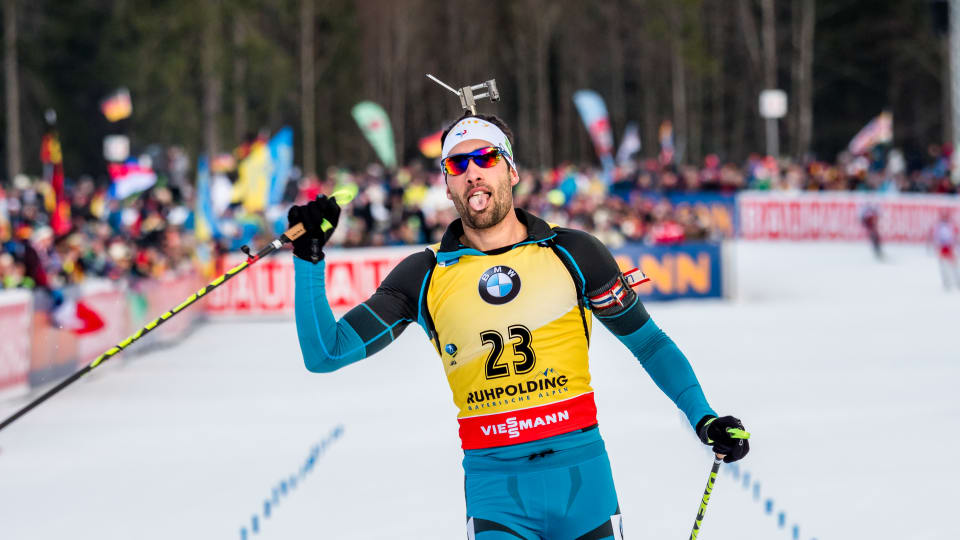
    France’s Martin Fourcade after winning the men’s 20 k individual at the IBU World Cup in Ruhpolding, Germany, by more than a minute on Wednesday. (Photo: IBU/Biathlonworld)

    IBU World Cup (Ruhpolding, Germany): Men’s 20 k individual

    For France’s Martin Fourcade, the difference between a miss on the last shooting stage of the men’s 20-kilometer individual International Biathlon Union (IBU) World Cup on Wednesday versus perfect shooting wouldn’t have ultimately changed his result in Ruhpolding.

    Despite the one-minute penalty, which was tagged onto his total time after his lone miss of the day, Fourcade still won by a minute. The Czech Republic’s Ondřej Moravec, who started 2 1/2 minutes ahead of him in bib 18 (while Fourcade wore bib 23), had successfully cleaned every stage, shooting 20-for-20, and initially crossed the finish line first — about a minute and 23 seconds ahead of former race leader Simon Eder of Austria.

    But Moravec’s moment in first was fleeting as Fourcade burst into the stadium, not yet letting off the gas, seconds after Moravec finished. Fourcade took the win in 44:27.9, 1:01 ahead of Moravec in second. To indicate how fast Fourcade’s last loop was, it’s worth noting that he was 30 seconds ahead of Moravec with 4 k to go. On that final 4 k loop, he doubled his time ahead of second place.

    Fourcade’s win came four days after his last race in Oberhof, Germany, the 12.5 k pursuit, which he also won.

    “We are in a biathlon routine now,” he said, according to an IBU press release. “It was hard to find strong motivation with not much recovery or training this week. … Today I wanted to beat my record of podiums in a row. Today was my 14th [individual podium, including last season] in a row and I am really proud of this. I am very happy with my competition as well. Ruhpolding is place that I really love and I am happy that I continued my success here.”

    Norway’s Johannes Thingnes Bø achieved his eighth-straight podium in third, 1:06.3 behind Fourcade with a single miss on the last stage as well (0+0+0+1).

    “I heard the speaker, so I knew Martin had missed,” recalled Bø, who started behind Fourcade in bib 29. “I knew if I could shoot clean, there was a small chance I could beat him. I tried and missed. That was my tactic: to go for the win, not save the podium.”

    He left the range for the last time 48.3 seconds back from Fourcade in first.

    Michal Krcmar (l) and Ondřej Moravec (r) after reaching the flower ceremony in fifth and second, respectively, on Wednesday at the IBU World Cup in Ruhpolding, Germany. (Photo: IBU/Biathlonworld)

    Germany’s Roman Rees shot clean and placed fourth (+1:19.1) for his first-career World Cup top 10, and the Czech Republic had two in the top five with Michal Krcmar in fifth (+1:36.6) for his best result of this season.

    For Moravec, second place marked his season best as well, after finishing outside the top 10 in previous races this season.

    “This podium is really important for me,” he told the IBU. “My first trimester was really bad; my shape was not good especially for the shooting. I also missed a lot of the summer training so did not have the best preparation … I am very please at how I was able to focus and have success in this race.”

    Austria’s Dominik Landertinger followed in sixth (+2:21.9) with one penalty and Eder ended up seventh (+2:23.8) with one miss as well.

    While the one-minute penalty per miss did not faze Fourcade, it led several North Americans to drop out of top-20 contention, particularly Tim Burke (US Biathlon), who had been in 16th after cleaning the third shooting stage. Burke had cleaned his first stage then missed one on the first standing, but was back in the top 20 with a clean third stage. On the final standing, he missed his first two shots, causing him to look up for a moment to refocus. He cleaned the last three, but still ended up with two additional minutes of penalties that put him 36th at the finish, 4:35.0 out of first (0+1+0+2).

    Sean Doherty (US Biathlon) racing to 31st to lead his team in the men’s 20 k individual on Wednesday at the IBU World Cup in Ruhpolding, Germany. (Photo: US Biathlon/NordicFocus)

    Sean Doherty led the U.S. men in 31st after missing two targets between the first prone and first standing stages. Ranked 76th after the second stage, he recovered to 53rd after a clean third stage and then 32nd after hitting all five targets on his last stage (1+1+0+0). With two penalties, Doherty finished the race 4:13.6 back in 31st.

    “I am happy with the race today,” Doherty said, according to a US Biathlon press release. “I left some room for improvement on the range. It was a big step in the right direction from last week. We had very fast conditions on the course today and our waxing staff did a great job as usual.”

    All three U.S. starters finished in the top 40, with Lowell Bailey in 37th (+4:36.4) with three misses (0+2+0+1).

    Biathlon Canada was led by Christian Gow in 34th (+4:30.7), for his career-best in a 20 k individual race. After starting in bib 2, he cleaned his first and third stages to put himself in 32nd with one stage to go, within 28 seconds of the top 20. But a miss on his last standing put Gow in 39th leaving the range for the last time, and he ended up 34th at the finish (0+1+0+1).

    “My shooting was just OK today,” Gow wrote in an email. “I would have liked to hit one more for sure and then I would have been completely satisfied with the race.  I felt more nervous than normal in the range, and my two misses were a direct result of being a bit hesitant on the shooting mat.

    “I am pretty happy with today overall,” he added. “I think this is the best skiing I’ve had in an Individual race and my best placing as well.  I do wish I could have one or two shots back, but overall I am happy.”

    Also for Canada, his older brother Scott Gow finished 55th (+5:13.2) with three penalties (0+1+1+1), Brendan Green placed 78th (+6:53.7) with four misses (1+0+2+1), and Macx Davies was 91st (+8:02.4) with five penalties (1+1+3+0), out of 107 finishers.

    The Gow brothers and Green raced Sunday in the men’s 4 x 7.5 k in Oberhof, where they placed 10th.

    “Honestly, I have been feeling pretty tired after the 3 days of racing in a row last weekend,” Christian wrote. “Our travel wasn’t too bad, but it still didn’t feel like much of a rest day.”

    The Ruhpolding World Cup continues Thursday with the women’s 15 k individual (starting at 8:30 a.m. EST on the Olympic Channel). Another men’s 4 x 7.5 k relay will follow on Friday, then the women’s 4 x 6 k relay on Saturday, and the men’s and women’s mass starts on Sunday.

    Results

    ***

    NorAm Trials (Mont Sainte-Anne, Québec): Classic interval starts

    The women’s 10 k classic podium on Wednesday at the NorAm trials in Mont Sainte-Anne, Quebec, with Cendrine Browne (1) in first, Katherine Stewart-Jones (2) in second, and Anne-Marie Comeau (3) in third. Dahria Beatty (l) placed fourth. (Photo: Cross Country Canada/Instagram)

    The NorAm trials at Mont Sainte-Anne (MSA), Québec, concluded Wednesday with the 10- and 15-kilometer classic interval starts. On the line were NorAm points, U23 and World Championships invitations, and for the women, what may well be the last Olympic spot on the Canadian team.

    The action started with the men’s 15 k classic, which Ricardo Izquierdo-Bernier of the Pierre-Harvey National Training Centre (CNEPH) won in 39.07.8 minutes to punch his ticket to U23 World Championships later this month in Goms, Switzerland. He won the race ahead of Scott Hill of Barrie Cross Country (BXC) in second, who skied a fast final lap to come within 6.9 seconds of first.

    Canadian Para-Nordic teammates Graham Nishikawa and Brian McKeever finished third (+30.0) and fourth (+37.4), respectively, with Nishikawa as McKeever’s guide in Paralympic events having the edge in the interval-start race the two skied on their own (Nishikawa started 64th and McKeever 55th).

    According to Nishikawa, the two have been entering NorAm events that fit into their preparation for the PyeongChang Paralympics. Nishikawa wrote a quick email on his way to the airport on Wednesday.

    “Happy with my week overall in MSA. Shape is good. Skis were good. Will keep improving into Korea for Paralympics,” he wrote after his second distance podium of the week.

    In the women’s 10 k classic, Cendrine Browne (Canadian National U25 Team/CNEPH) continued her strong showing at trials with her second victory and fourth top-four result, taking the win in 29:47.0.

    Katherine Stewart-Jones, of the U25 Team and National Team Development Centre (NTDC) Thunder Bay, and Anne-Marie Comeau (Université Laval) were virtually tied for second after the first lap, but Stewart-Jones held the speed to take second, 39.2 seconds behind Browne and 24.3 seconds ahead of Comeau in third.

    About 16 seconds later, Maya MacIsaac-Jones, of the U25 Team and Rocky Mountain Racers (RMR), finished fourth (+1:21.0) ahead of Dahria Beatty, of the Canadian World Cup Team and Alberta World Cup Academy, in fifth (+1:26.6).

    The selection criteria are complex, but a quick calculation suggests that Comeau, who placed second to Browne in Monday’s skiathlon, gets the provisional women’s distance spot for the PyeongChang Olympics (since Browne already established herself as the sprint leader), and Stewart-Jones, who was fifth in the skiathlon, gets the U23 Worlds berth. Stay tuned for updates and official selections.

    The junior men’s 10 k classic podium on Wednesday at the NorAm trials in Mont Sainte-Anne, Quebec, with Antoine Cyr (c) in first, Félix Longpré (2) in second and Étienne Hébert (3) in third. (Photo: Cross Country Canada/Instagram)

    CNEPH’s Antoine Cyr took his third win of the week in the junior men’s 10 k, finishing in 25:57.3, well ahead of local Félix Longpré (MSA) in second (+48.2) and Étienne Hébert (AWCA) in third (+55.6).

    In the junior women’s 5 k, Hannah Mehain (Sovereign Lake Nordic/National Junior Team) took the win in 15:22.7, just 2.7 seconds ahead of skiathlon winner Natalie Hynes (Whitehorse Ski Club/National Junior Team) and 15.0 seconds ahead of Tuesday’s skate sprint winner Annika Richardson (NTDC Thunder Bay/National Junior Team) in third.

    Results: 5/10/15 k classic | Complete trials results

  • Monday Rundown: U.S. Nationals; MSA NorAm Trials

    Monday Rundown: U.S. Nationals; MSA NorAm Trials

    Left to right: Tyler Kornfield (APU), Reese Hanneman (APU) and Ben Saxton (SMS) the top three Americans in the men’s 1.6 k classic sprint final on Monday, the last day of 2018 U.S. Cross Country Championships in Anchorage, Alaska.

    U.S. Cross Country Championships (Anchorage, Alaska): Classic sprint

    Women’s report

    Men’s report

    Caitlin Patterson did it. With a classic-sprint win on Monday, she successfully capped off an undefeated 2018 U.S. Cross Country Championships, as the top American woman in all four races over the past week in Anchorage, Alaska.

    Patterson, of the Craftsbury Green Racing Project, qualified seventh then won the women’s 1.5-kilometer final by more than 2 seconds in 3:39.58 minutes. Finland’s Jasmi Joensuu, a junior at the University of Denver (DU), won the qualifier and ultimately finished second in the final, 2.36 seconds behind Patterson.

    Craftsbury once again had two on the podium with Kaitlynn Miller placing third overall (+3.9) as the second American. Becca Rorabaugh, of Alaska Pacific University (APU), was the top American in the qualifier in second overall, then placed fourth in the final (+9.92) and reached the U.S. podium in third.

    Petra Hyncicova, a University of Colorado Boulder (CU) senior from the Czech Republic, placed fifth overall (+10.03), and Lydia Blanchet, a Dartmouth College U23 skier, finished sixth (+11.21) and was the fourth American woman.

    Joensuu, 21, of Kuortane, Finland, started the day by winning the qualifier in 3:41.4, while Rorabaugh followed in second, 1.31 seconds back. Hyncicova qualified third (+1.85), CU’s Hedda Bångman (who won Sunday’s 20 k classic) qualified fourth (+2.92), and Miller qualified fifth (+2.93). Anne Hart of the Stratton Mountain School (SMS) Elite Team clocked the sixth-fastest qualifying time (+3.88), and Patterson followed in seventh (+4.77).

    From there, Patterson won both her quarterfinal and semifinal, besting Miller and Joensuu in the latter by 0.66 seconds and 2.63 seconds, respectively. Blanchet placed fourth in that same semifinal (+5.15) and advanced to the final as a lucky loser with a fast-enough time, along with Joensuu (Patterson and Miller automatically advanced in first and second).

    With her 4-for-4 record at 2018 nationals, Patterson is the most successful woman at U.S. Cross Country Championships since U.S. Ski Team member Jessie Diggins was the top American in all four races at 2012 nationals in Rumford, Maine.

    In the men’s classic sprint final, Reese Hanneman (APU) captured his second title in as many sprints this week (after winning the freestyle sprint on Friday). He won the qualifying round by 2.84 seconds in 3:21.93, and later the final by a 0.2 seconds in 3:20.62. Kornfield placed second, and Ben Saxton (SMS Elite Team) rounded out the podium in third (+4.78).

    Logan Hanneman, the winner of Friday’s freestyle-sprint qualifier, finished second to his older brother Reese in Monday’s classic-sprint qualifier, then went on to reach the final and place fourth overall (+5.42). Kevin Bolger (Sun Valley Ski Education Foundation) placed fifth (+5.52), and Zak Ketterson (Northern Michigan University) was sixth (+6.83).

    Results:

    Women’s qualifierWomen’s final

    Men’s qualifier | Men’s final

    ***

    NorAm Trials (Mont Sainte-Anne, Quebec): 15/30 k skiathlons

    The women’s 15 k skiathlon podium on Monday at NorAm trials at Mont Sainte-Anne, Quebec, with Cendrine Browne (c) of the Pierre-Harvey National Training Centre (CNEPH) and Canadian U25 Team in first, Anne-Marie Comeau (l) of Laval University in second, and Dahria Beatty (Alberta World Cup Academy/Canadian World Cup Team) in third. (Photo: Cross Country Canada/Instagram)

    Cendrine Browne won the women’s 15-kilometre skiathlon in 43:01.9 minutes on Monday at the Mont Sainte-Anne (MSA) ski trails to put an exclamation point on her presumptive selection for the PyeongChang Olympics. Browne, of the Centre National d’Entraînement Pierre Harvey (CNEPH)/Pierre-Harvey National Training Centre, which is based in nearby Saint-Ferréol-les-Neiges, broke away with Laval University’s Anne-Marie Comeau during the classic leg to take a 20-second lead that she held to the finish.

    Comeau faded slightly to take second, 11.9 seconds back, qualifying for U23’s and putting her name in the hat for the upcoming 2018 Olympics. Either Comeau or the winner of Wednesday’s classic interval start should take that potential Olympic berth as Canada’s top female distance skier not already qualified. Browne has theoretically earned a spot as the top women’s sprinter, besides Dahria Beatty, who won the sprint and already met Canada’s Olympic qualifying criteria.

    “It now has to go before the selection committee,” Cross Country Canada’s High Performance Director Thomas Holland wrote in an email on Friday.

    After trials races were shuffled around due to extreme cold, with temperatures near -20 Celsius on Sunday at MSA, it warmed up to a balmy -8 degrees Celsius (17 Fahrenheit) by mid-afternoon on Monday. Both the women’s and men’s skiathlons were held, which not only served as one of two distance races for Olympic selection, but for Junior and U23 World Championships as well.

    In the race for third place, Beatty outsprinted a group of four to take the final podium spot, 19.9 seconds behind Browne and 0.3 seconds ahead of their fellow Canadian National Team member Maya MacIsaac-Jones, of Rocky Mountain Racers (RMR) and U25 Team. Just 0.2 seconds out of fourth, Katherine Stewart-Jones, of the National Training Development Centre (NTDC) Thunder Bay and national U25 Team, placed fifth (+20.4) and CNEPH’s Laura Leclair was another second back in sixth (+21.4).

    Almost 55 seconds passed before the seventh-place finisher came across the line, which was Zina Kocher (Foothills Nordic) skiing alone (+1:15.8). Another 49 seconds later, Jaqueline Mourao of Brazil’s national team placed eighth (+2:04.9), ahead of Zoë Williams (Carleton University) in ninth (+2:11.3), and Andrea Dupont (RMR) in 10th (+2:11.5).

    In the junior women’s 10 k skiathlon, Whitehorse’s Natalie Hynes won in 30:19.8 to punch her ticket to Junior Worlds in Goms, Switzerland, from Jan. 28-Feb. 3. India McIsaac (RMR) finished 0.7 seconds back in second and Orford’s Alexandra Racine completed the podium in third (+32.8).

    The men’s 30 k skiathlon podium at NorAm trials at Mont Sainte-Anne, Quebec, on Sunday, with Knute Johnsgaard (c) of Canada’s World Cup Team in first, Graham Nishikawa (r) of the Canadian Para-Nordic Team in second and Gareth Williams (Telemark Nordic/Canadian U25 Team) in third. (Photo: Cross Country Canada/Instagram)

    On the men’s side, Canadian World Cup Team member Knute Johnsgaard, who met qualifying criteria for PyeongChang last season, shook off a slow start to the World Cup season with a win in the NorAm trials men’s 30 k skiathlon, finishing in 1:13:30.9.

    Graham Nishikawa, who’s already destined for the PyeongChang Paralympics as a guide on the Canadian Para-Nordic Ski Team, finished 1 second back for second place. The 34-year-old Nishikawa edged out first-year senior national-team member Gareth Williams, 20, of Telemark Nordic and the national U25 Team, by 0.5 seconds. Williams was the top U23 athlete to qualify for this year’s U23 World Championships.

    The top 6 finished within 41 seconds of the podium, with Jack Carlyle (AWCA) in fourth (+5.8), Philippe Boucher (CNEPH) in fifth (+13.9), and Scott Hill (BXC) in sixth (+40.7). World Cup Team member Len Valjas led the next group across the line in seventh (+1:28.6), followed by Bob Thompson (NTDC Thunder Bay) in eighth (+1:29.4), Alexis Dumas (CNEPH) in ninth (+1:35.5), and Ricardo Izquierdo-Bernier (CNEPH) in 10th (+1:35.7)

    CNEPH’s Antoine Cyr won the junior mens 15 k skiathlon in 50:13.1 to earn a spot at Junior Worlds. Félix Longpré, of the local M.S.A. ski club, finished second (+15.7) and Thomas Manktelow was third (+49.0), just ahead of his Alberta World Cup Academy teammate Étienne Hébert in fourth (+49.3).

    After Sunday’s racing was postponed due to temperatures well below the legal race limit, the remaining trials schedule includes freestyle sprints on Tuesday (for Junior and U23 World Championships qualifying purposes only), and classic interval starts on Wednesday.

    Results

  • Friday Rundown: Annecy, St. Ulrich, Rossland (Updated)

    Friday Rundown: Annecy, St. Ulrich, Rossland (Updated)

    Tim Burke (US Biathlon) racing to 10th in the men’s 10 k sprint at the IBU World Cup on Friday in Annecy, France. (Photo: US Biathlon/NordicFocus)

    IBU World Cup (Annecy, France): Men’s 10 k sprint

    (Note: This rundown has been updated to include quotes from US Biathlon’s Tim Burke and Sean Doherty.)

    Norway’s Johannes Thingnes Bø racked up his third-straight individual win of the International Biathlon Union (IBU) World Cup season on Friday (and fourth non-relay win of 2017/2018), topping the men’s 10-kilometer sprint in Annecy, France. And he did so in head-turning fashion, beating French superstar Martin Fourcade, the race’s runner-up, by 21.1 seconds on Fourcade’s home turf.

    Norway’s Johannes Thingnes Bø racing to his third-straight win of the season on Friday in the IBU World Cup men’s sprint in Annecy, France. (Photo: IBU/biathlonworld)

    On a pristine day in Annecy, Bø started 24th and consistently clocked the fastest times throughout the race. He cleaned prone, then standing, and finished 41.8 seconds faster than Germany’s Simon Schempp, the race leader until that point who also shot clean (0+0).

    Fourcade started 31st and shot a flawless 10-for-10 as well, yet trailed Bø from start to finish. After prone, Fourcade was 8.3 seconds back in second. After standing, he was 14.7 seconds out of first with one loop to go. Bø skied the fastest course time on every loop to remain out of reach, and also shot faster than Fourcade, who clocked the second-fastest overall course time.

    Ultimately, the 24-year-old Bø crossed the finish line with the fastest time of 22:16.9 minutes, Fourcade was second and France’s 26-year-old Antonin Guigonnat achieved his first World Cup podium in third (+34.7) with clean shooting. In fact, the top-four finishers all shot clean, with Schempp in fourth and the third Frenchman in the top five, Simon Desthieux in fifth (+45.7).

    Guigonnat’s previous best World Cup result was 24th in a 20 k individual in 2015 in Oslo, Norway.

    France’s Antonin Guigonnat placed third in Friday’s IBU World Cup men’s 10 k sprint for his first podium and first top 20 of his World Cup career. (Photo: Glen Crawford)

    “It seems unreal to be here besides two monsters like these guys,” Guigonnat told the IBU, according to a press release. “After standing I was informed I had 7 seconds on Schempp and at that moment I trusted myself to hold that gap. I always trust in myself to be able to do something great like today.”

    Fourcade, who has either placed second or third behind Bø in three consecutive races, was not excited about second place.

    “Never cool, because I expected to win,” Fourcade said in an English interview with German broadcaster ZDF. “… But when you find someone better you just have to congratulate him and wait for the next chance. For now, with zero mistakes Johannes is not beatable. I will take the Christmas break to work on my shape, and expect to have a better shape in January to try and challenge him, because for now in the three last competitions I didn’t challenge him enough. I want to be faster, but he is good, he is really good.”

    “That’s good words from the World Cup leader,” Bø replied to ZDF in English. “… Every victory I had this season Martin has been right behind me, so I just have to continue being at 100 percent. I always have to think about myself, and then afterwards we will see if I am in front or second, but it has been a good start.”

    Only one man in the top 11 didn’t shoot clean: Russia’s Anton Shipulin in sixth (+54.9), who missed one in prone (1+0), but made up for it with the sixth-fastest overall course time and fifth-fastest overall shooting time.

    US Biathlon’s Tim Burke achieved his first top 10 in two seasons, placing 10th, 1:08.2 behind Bø with clean shooting.

    “I feel like I executed the perfect race for the shape I am in right now,” Burke wrote in an email to FasterSkier. “I know I am not in top form right now so this was about the best I could do considering that.

    “I have worked a ton on my shooting in the past year and I know that I’ve reached a higher level in training than ever before. It was nice to be able to show some of those improvements today,” he continued. “It feels great to be back in the top ten. Last season I was only racing in about half of the races and I had a top finish of 11th.  But I have to say that I am more pleased with how I executed the race today than the actual result.”

    In a US Biathlon press release, Burke noted that “perfect shooting conditions and a fast track” made for a tight race, as he had expected. “This was a good confidence boost for me heading into the holiday break,” he said.

    Sean Doherty (US Biathlon) racing to 17th for the second-straight individual IBU World Cup race on Friday in the men’s 10 k sprint in Annecy, France. (Photo: US Biathlon/NordicFocus)

    Also for US Biathlon, Sean Doherty placed 17th (+1:20.2), also with 10-for-10 shooting, for the second-straight individual race to tie his season best from last week’s pursuit in Hochfilzen, Austria.

    “I feel I executed a great race plan today,” Doherty wrote in an email. “The sprint is all attack right from the start, and this aggressive racing demands that you are on every transition from the first 100 meters. I carried this mentality through the range and the last lap.”

    After starting in bib 7 and cleaning the first shooting stage, Doherty took the race lead by 22 seconds.

    “Prone was solid and I was happy to execute my plan on the range, had no idea I was leading, just keep the pedal down for another lap,” he wrote. “Being an early bib you can’t look too hard at the place number on the split times. … Coming into standing I just reminded myself of the same focus points I have been working on since May. Focusing on those fundamentals really helps block out any extraneous thoughts that might want to sneak into your mind.”

    Scott Gow (Biathlon Canada) after placing 16th in the IBU World Cup men’s sprint on Friday in Annecy, France. (Photo: Glen Crawford)

    Biathlon Canada’s Scott Gow notched his second top 16 of the season to put himself at the top of the list for Olympic team selection, based on Biathlon Canada’s “Priority 2” criteria. Gow started near the back of the field in bib 99 and ended up 16th (+1:13.5) with clean shooting.

    “I’m very happy with another top 16,” Gow wrote in an email. “This result has solidified my priority 2 Olympic criteria which is a big relief. I’m also happy with my performances so far this early in the season. I’m normally a slow starter so it’s a good sign that I’m hitting good results before Christmas. I just hope I can make it last…”

    “Conditions were rock solid today,” Gow explained. “The fresh snow we got overnight mixed with the wet snow and created a very hard glaze. It was hard to hold a solid edge and the downhills were squirrelly. There was zero wind all day today, so range conditions were perfect.”

    His younger brother Christian Gow tallied Canada’s second-result in 30th (+1:44.2), also with clean shooting. He was one of 19 men (out of 103 finishers) that hit every target on Friday.

    A total of four Americans qualified for Saturday’s pursuit, with Lowell Bailey placing 35th (+1:49.5) with a prone penalty (1+0), and Leif Nordgren finishing 56th (+2:18.1) with one prone miss as well (1+0). Paul Schommer placed 85th (+3:19.3) to miss the top 60 required for the pursuit.

    “… It was a strong Nations Cup points day for the team as a whole,” Doherty noted.

    Canada’s Brendan Green and Nathan Smith did not qualify for the pursuit, after Green finished 86th (+3:21.0) with five penalties (3+2) and Smith was 91st (+3:36.4) with two misses (0+2).

    The women’s and men’s pursuits will be held Saturday in Annecy, with the women’s 10 k race starting at 5:45 a.m. Eastern Standard Time (EST) and the men’s 12.5 k at 8:45 a.m. EST.

    “It’s always chaotic with a lot of action during pursuits and I’ll try to filter all of that out,” Scott Gow wrote. “As for skiing, there’s a lot of transition areas where I think a lot of time can be made.”

    Results| Men’s pursuit start list

    ***

    OPA Cup (St. Ulrich, Austria): Freestyle sprints

    The women’s 1.2 k freestyle sprint podium at Friday’s Alpen Cup in St. Ulrich, Austria, with two U.S. Ski Team members in the top three: Sophie Caldwell (c) in first, Ida Sargent (r) in third, and Russia’s Natalia Matveeva (l) in second. (Photo: Sophie Caldwell/Instagram)

    With this weekend’s World Cup races in Toblach, Italy, being solely distance events, five U.S. Ski Team (USST) sprinters ventured to St. Ulrich, Austria, to compete in the Alpen Cup (also known as OPA Cup) skate sprints on Friday.

    Longtime couple Sophie Caldwell and Simi Hamilton came away with wins, with Caldwell winning the women’s 1.2 k freestyle sprint final ahead of Russia’s Natalia Matveeva in second and Caldwell’s USST teammate Ida Sargent in third. Another World Cup regular, Switzerland’s Laurien van der Graaff placed fourth, while Germany’s U23 World Championships classic sprint silver medalist Antonia Fräbel finished fifth. Italy’s Greta Laurent was sixth, Germany’s Hanna Kolb seventh, Austria’s Lisa Unterweger eighth, and Julia Kern (USST) ninth.

    In the men’s 1.4 k, Hamilton took the win in a photo finish, just ahead of USST teammate Andy Newell in second and Switzerland’s Gianluca Cologna in third. France’s Jean Tiberghien placed fourth and Russia’s Gleb Retivykh finished fifth.

    “#OPA men’s sprint was a nail-biter,” U.S. Ski Team Women’s Coach Matt Whitcomb wrote on Instagram with a finish-line photo on Friday. “Super close race for @simihamilton, @andynewellskier and @gianlucacologna. Well-run race by the OC in St Ulrich…

    https://www.instagram.com/p/BcuedeHDyxy/?hl=en&taken-by=matt.d.whitcomb

    Earlier in the day, Caldwell won the qualifier by 2.82 seconds over Matveeva with a top time of 2:27.85. Sargent qualified sixth, 4.6 seconds behind Caldwell, and Kern qualified ninth (+5.54). Canadian-born Swiss skier Heidi Widmer qualified 11th (+6.66) and went on to place 14th overall.

    In the men’s qualifier, Newell clocked the fastest time in 2:47.93. Retivykh was 2.01 seconds back in second, and Hamilton qualified third (+3.26).

    Two more days of OPA Cup racing remain in St. Ulrich, with the 5/15 k classic individual starts on Saturday and 10/15 k freestyle pursuits on Sunday, according to the International Ski Federation (FIS) events calendar.

    Final results: Women | Men

    Women’s qualifier| Men’s qualifier

    ***

    NorAm Mini Tour (Rossland, B.C.): Classic Interval Start)

    Winner Brian Gregg (LNR/Team Gregg) flanked by second place Scott Hill (r, BXC) and Bob Thompson (l, NTDC TBay) (Photo: Kai Symington-Kruss)
    The NorAm men’s 10 k classic podium on Friday in Rossland, B.C., with Brian Gregg (Team Gregg/Loppet Nordic Racing) in first, Scott Hill (r) of BXC in second  and Bob Thompson (l) of NTDC Thunder Bay in third. (Photo: Kai Symington-Kruss)

    The NorAm series continued this weekend with the Black Jack Ski Club hosting the first Canadian mini-tour of the season.

    Racing started Friday with classic interval start races, with 10 kilometres and two laps for the men, and 5 k and one lap for the women.

    Brian Gregg, representing Loppet Nordic Racing (LNR) and Team Gregg, dominated in 29:34.0 minutes, for his second win of the season after topping the 15 k classic mass start in West Yellowstone. Team BXC’s Scott Hill followed 28.2 seconds back in second. Last weekend’s sprint winner Bob Thompson, of the National Team Development Centre (NTDC) Thunder Bay, notched his second podium of the season in third (+39.4).

    Fresh off the World Cup, Canadian national team sprinters Jess Cockney (World Cup Team) and Julien Locke (U25 Team) finished seventh and 13th, respectively.

    Caitlin Gregg (Loppet Nordic Racing/Team Gregg) on her way to victory. (Photo: Kai Symington-Kruss)
    Caitlin Gregg (Team Gregg/Loppet Nordic Racing) on her way to a win in the NorAm women’s 5 k classic on Friday in Rossland, B.C. (Photo: Mark Richards)

    It was a big day for Team Gregg with Brian’s wife Caitlin Gregg winning the women’s 5 k in 16:08.0. Annika Hicks, of the Alberta World Cup Academy (AWCA), finished 46.8 seconds back in second, while Sophie Carrier-Laforte of the Centre National d’Excellence Pierre Harvey/Pierre-Harvey National Training Centre (CNEPH) narrowly edged out a group of women to take third (+1:16.1).

    The Rossland NorAm continues with freestyle sprints on Saturday, followed by 10/15 k freestyle pursuits on Sunday.

    Results

    CNEPH's Sophie Carrier-Laforte charging the downhill on her way to third place. (Photo: Kai Syminton-Kruss)
    Sophie Carrier-Laforte charging the downhill on her way to third place in the NorAm women’s 5 k classic on Friday in Rossland, B.C. (Photo: Mark Richards)
  • FasterSkier’s Canadian Continental Skiers of the Year: Evan Palmer-Charrette and Katherine Stewart-Jones

    FasterSkier’s Canadian Continental Skiers of the Year: Evan Palmer-Charrette and Katherine Stewart-Jones

    Evan Palmer-Charrette (Photo: Peggy Hung) and Katherine Stewart-Jones (photo: John Lazenby/Lazenbyphoto.com) are our Canadian Continental Skiers of the Year.

    With the 2016/2017 season officially in the rearview, FasterSkier is excited to unveil its annual award winners for this past winter. Votes stem from the FS staff, scattered across the U.S., Canada, and Europe, and while not scientific, they are intended to reflect a broader sense of the season in review. This set of honors goes to outstanding Canadian skiers competing primarily, but not exclusively, at the Continental Cup level. 

    ***

    Katherine Stewart-Jones, U25 National team/NTDC Thunder Bay/Nakkertok

    In a year of changes for the Canadian women’s program, Katherine Stewart-Jones quietly delivered a great season. She was only ranked sixth in the NorAm series before Nationals, which wouldn’t usually be a sign of a great season – but by the end of the week, she had won the whole series.

    This year, two of the five NorAm weekends (Sovereign Lake and Soldier Hollow) were combined with the U.S. circuit and had much deeper fields as a result. American Chelsea Holmes (Alaska Pacific University) took a commanding early-season NorAm lead by winning the BlackJack mini-tour along with six podiums in eight races.

    The Canadian women’s 4 x 5 k World Championships relay team, (from left to right) Emily Nishikawa, Dahria Beatty, Katherine Stewart-Jones, and Cendrine Browne, after tallying the third-best relay result for the Canadian women at a World Championships on Thursday in Lahti, Finland. (Photo: CCC/Twitter)

    Even after Holmes stopped coming to NorAms, Stewart-Jones didn’t have a clear path to the top. She missed Eastern Canadian Championships, her home event, to compete at U23 World Championships in Soldier Hollow. That was a big blow because as one of two mini-tours on the schedule, there were 400 points available compared to the usual 200 on a weekend.

    But after a disappointing week at U23’s, the event that had been her main goal for the season, Stewart-Jones’s trajectory took turn towards Europe, and ultimately towards better results.

    Definitely racing in Lahti,” she wrote of her season highlight, racing at senior World Championships in Lahti, Finland. “There it’s a tie between the 10 k classic and the relay at World Champs — I felt the best I had all year.”

    The 36th place in the Lahti 10 k was her best finish at the World Cup level. And the relay was significant for the women’s program, not just because Canada had four women present, but because the 10th-place result is a big step forward for the resurgent women’s program.

    “The relay was a magical day, it was a real team effort and the result was the best women’s relay result in the last 10 years,” Stewart-Jones wrote.

    After World Cup Finals in Quebec, where Stewart-Jones said she “wasn’t expecting to feel that good” thanks to illness picked up in Europe, she flew to Nationals in Canmore. There, Stewart-Jones bagged the Continental Cup lead with third in the 10 k classic and third in the free technique sprint, bringing her to five races in six days. After two full days without a race, she ground out a seventh-place finish in the 30 k free.

    “I think the altitude training [last summer in NZ and Park City] really paid off,” she said of her ability to clinch the NorAm title at the last moment. “This summer I’m hoping to focus even more on my strength weaknesses. I want to also focus more on my skate skiing.”

    Evan Palmer-Charrette, NTDC Thunder Bay/Lappe Nordic

    In a year of Canadian highlights in Europe, the next group of Canadian men were battling for opportunities to make their own highlights.

    Palmer-Charrette started the season on the bottom, eliminated in the sprint semi-final at the first NorAm race of the season when two racers fell on him in a spectacular crash.

    But by the end of the season he was on top, winning the national title in the classic sprint (where he finished third behind two European racers from the University of Denver).

    Angus Foster untangles himself as Evan Palmer-Charrette waits underneath. The ski through the big belongs to Simon Lapointe. (Photo: Shelley Woodman)
    Angus Foster (309) untangles himself after a semifinal crash at the Sovereign Lake NorAm/SuperTour on Dec. 10, as his NTDC Thunder Bay teammate Evan Palmer-Charrette tries to get his breath back. The ski through the bib belongs to Simon Lapointe. (Photo: Shelley Woodman)

    “I finally went for [compartment syndrome surgery] this summer and trained really hard after that, like really motivated to get back,” he told FasterSkier after winning his first National title in the sprint. “It’s awesome to be Canadian champion. Surprise for sure, in a classic sprint for me.”

    Palmer-Charrette, who missed Eastern Canadian Championships to compete at U23 World Championships in Soldier Hollow, ended the season second overall in the NorAm series. He had collected two wins and two podiums over nine race days before Nationals. He also finished sixth in the sprint at U.S. Nationals.

    After U23’s and a SuperTour stop in Michigan, he went on to the World Cup Finals for his first World Cup experience, after missing his first opportunity due to conflicts with U23’s.

    “It was tough,” he told FasterSkier after the sprint qualifier. “I had pretty good focus and the first two-third’s went well but after the big climb in the middle, my legs were super acidic and lactated out more than they usually do so made for a tough last third but it was fun though.”

    Obviously feeling on form, Palmer-Charrette went straight from Nationals to the final SuperTour to collect another podium, this time second place in the SuperTour Finals sprint, and put an exclamation point on a great season.

    Honourable Mention: Russell Kennedy, Team R.A.D., Canmore

    Russell Kennedy racing to 36th in the men’s skate sprint qualifier at World Cup Finals in Quebec City on March 17. (Photo: John Lazenby/Lazenbyphoto.com)

    It says something about the state of skiing in Canada that a NorAm overall winner and Holmenkollen 50 k finisher didn’t win the award.

    Kennedy had a breakthrough season, winning the NorAm title for the first time and adding five more World Cup starts to his resume. He won the pursuit at Eastern Canadian Championships to take the mini-tour and get an untouchable lead in the series.

  • Eastern Canadian Champs: Notes, Quotes, Galleries, & No-Double-Pole Zones

    Montériski's Étienne Hébert returned from WJC in Soldier Hollow in time to outsprint NTDC TBay's Fergus Foster in a quarterfinal heat. (Photo: Dianne Gallus)
    Montériski’s Étienne Hébert (c) returned from WJC in Soldier Hollow in time to outsprint NTDC TBay’s Fergus Foster (l) in a classic-sprint quarterfinal at NorAm Eastern Canadian Championships at Nakkertok Nordic in Cantley, Quebec. (Photo: Dianne Galus)

    The annual Eastern Canadian Championships are a special event in the Canadian winter.  On paper, it is just another NorAm that provides opportunities to earn World Cup starts, national-team positions, and valuable International Ski Federation (FIS) points, but it has grown to be bigger than that.

    While Western Canadian Championships and Canadian nationals change their host venue each year, Easterns has settled in at the Nakkertok South trail system for ten of the last eleven years. While Cantley, Quebec, is the nearest town, the national capital Ottawa and Gatineau are just twenty minutes away, providing a wealth of accommodation options and a major airport. With Toronto, Montreal and Quebec City all within a five-hour drive, a third of the Canadians competing were within easy driving distance.

    The event is hosted by four regional ski clubs with distinct and interesting histories: Nakkertok, Skinouk, Chelsea Nordiq, and Kanata Nordic.

    With 835 athletes registered this year and more than 700 finishers each day, Easterns is likely to be larger than next month’s 2017 nationals in Canmore, Alberta. The American Birkebeiner (SuperTour #4) in Hayward, Wis., is the largest FIS points race this season in North America, with U.S. nationals at Soldier Hollow in Midway, Utah, ranking the fourth largest.

    How do you put together a three-day event featuring an interval start with 736 finishers, including para-nordic, masters and university categories? It starts with 553 volunteers and a FIS request to test a no-double-pole zone. The open categories were slightly reduced by races happening simultaneously in PyeongChang, South Korea (World Cup), and Soldier Hollow (U23/Junior World Championships), but there were enough familiar faces to fill the podiums.

    It ends with smiling faces, results, and a select few skiers who improved their FIS points and made their case for future selections. The photo gallery links are at the bottom, just keep scrolling past the quotes.

    ***

    No-Double-Pole Zone

    The classic sprint was Canada’s first test of the new FIS rule, and athlete opinions were not divided.

    RMR's Andrea Dupont strides past the no-double-pole sign during the classic sprint qualifier. (Photo: Rob Smith)
    Double-poussée interdite: a new twist from FIS. RMR’s Andrea Dupont strides past the no-double-pole sign during the classic sprint qualifier. (Photo: Rob Smith)

    They started the no double pole zone on the gradual climb before the steep pitch, which made the flow of the course a bit annoying (in training yesterday they actually had it right at the bottom of the climb in a section that was too fast to stride, but the jury was really great about taking athlete feedback and moved it higher up the hill. I’m personally not a fan of the no double pole zone idea but I think they managed it as well as they could have on that course).” 

    — Angus Foster, NTDC TBay,  2nd

    I was not a fan of the no double pole section. I personally love striding and I hope striding can remain a part of our sport, but I think having no double pole sections or limiting pole lengths aren’t the solution for keeping striding a part of our sport (that being said, I’m still not sure what the solution is).”

    — Maya MacIsaac-Jones, AWCA/NST U25 Team,  1st

    It was so unnecessary. Everyone I talked to would have strode that no DP zone anyway. It should have been a double pole only zone. That would have made it a challenge. I’d love to see these silly pole length and DP zone rules revoked. Let the sport evolve as it will.”

    —Andy Shields, Lappe Nordic, 7th

    I didn’t think it would have made a difference. Classic was definitely pretty fast and so was the snow.”
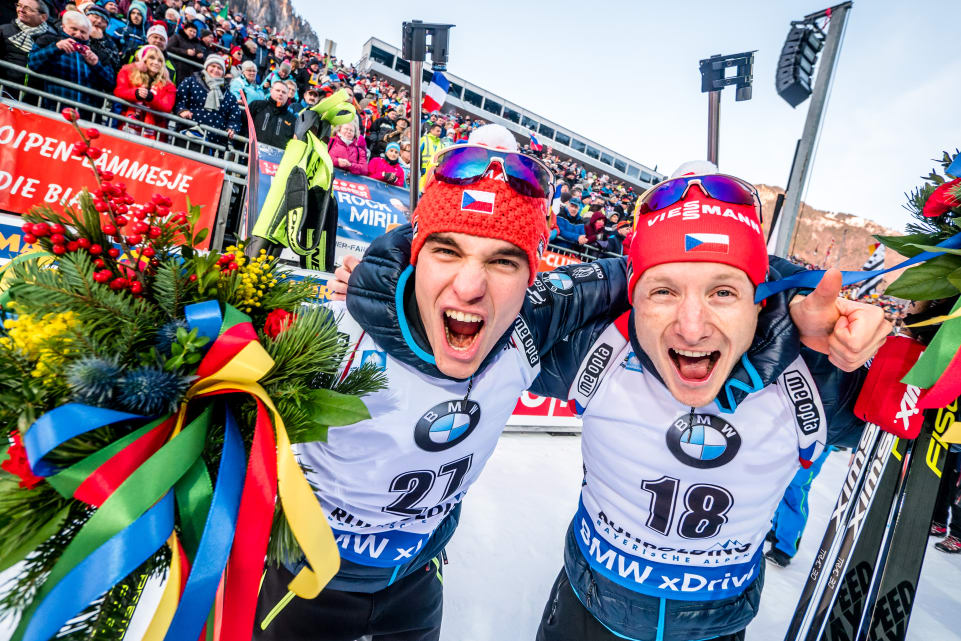
    —Russell Kennedy, Team R.A.D., 3rd

    For me those would have been striding sections anyways, so it had very little effect. I think it is an interesting issue — the development of double poling as a technique of its own and the repercussions for traditional classic skiing. I love to stride, so I think the best solution is to have courses that force striding. I don’t know too many people (boys included) who I think would have double poled that course, but the no double pole zone ensured that wouldn’t be a problem. It is exciting to see the sport changing and trying to adjust itself though!”

    —Anne Hart, SMS Elite, 3rd

    Nakkertok South and the Easterns Atmosphere

    Easterns is my favorite race of the year despite the zoo it always is. The courses are staples on the circuit and the Ottawa/Gatineau area is great. Plus I have a lot of family in the area so it’s great to visit with everyone.”
    —Shields

    The atmosphere of the races is incredible, and I think that has a lot to do with all the participants- both older and younger.  One thing I’ve noticed in particular here is that the race feels really important, which it is.  I think often times if races aren’t a World Cup or some big European race people don’t put the effort in to make the race feel like a big deal.  But for the senior athletes here the races are important, and for the younger kids maybe even more so, and it is much appreciated to have the reflected in the race quality.  I’ve been so impressed with the organization and volunteers, and having racers starting every 30 seconds from 9 in the morning until 1 in the afternoon is awesome.”
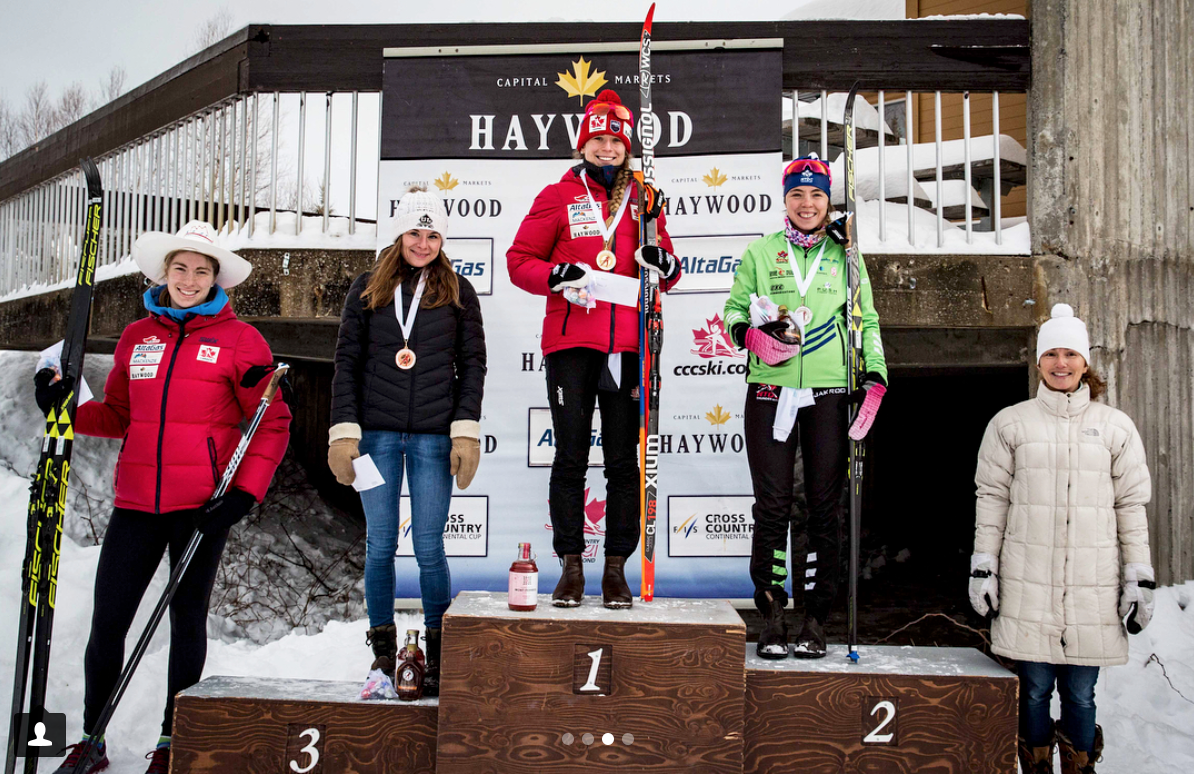
    —Hart

    Easterns is amazing, it has a great community vibe and there are so many teams out here and so many young skiers that are all super pumped to be racing!”

    —Kennedy

    It is really inspiring to see all the young skiers here and makes me excited for the future of skiing in Canada. It was also a ton of fun for me because both of my siblings were racing Easterns!”

    The Montreal style bagels at lunch and the hundreds of young Nakkertok racers running around!”

    —MacIsaac-Jones

    What I love about Easterns is the community. We are all working as a group. We get to work with the other clubs, get to know them. We are working as a region, really. It makes it special to be a volunteer at the Easterns. I love it because I get to talk to everyone.”

    —Sue Holloway, Volunteer Organizer and first Canadian to compete in both Summer and Winter Olympics (1976)

    “AMAZING.  It has been an absolutely wild winter with rain, snow, blizzards, negative fahrenheit conditions…so to have some sun, hard tracks, and mild winter weather was just incredible.  The Nakkertok club did an incredible job with the grooming and race set up, the volunteers were so friendly and helpful, and I must thank Nic from the Carleton University team for helping me out with wax last minute!  I walked into the Fresh Air ski shop yesterday [Thursday] at about 2 PM, and asked if there might be anyway someone could help for the weekend of waxing.  He offered immediately, and he did an amazing job.”

    —Hart

    Friday: Classic Sprints

    Sophie Carrier-Laforte (101) leads Alannah Maclean (105) and Maya MacIsaac-Jones (104) towards the no-double-pole zone. (Photo: Elisabeth Fink)
    Sophie Carrier-Laforte (101) leads Alannah Maclean (105) and Maya MacIsaac-Jones (104) towards the no-double-pole zone in the first women’s classic-sprint semifinal. (Photo: Elisabeth Fink)

    The women’s 1.3-kilometre and men’s 1.4 k classic sprints were held on hard, cold tracks with the air warming up enough to allow a bit of glazing. With some of the younger racers stuck in school, this day had the smallest turnout of the weekend with 714 finishers.

    Results: Qualifier and Prologue | Heats

    Women’s classic sprint podium:

    1. Maya MacIsaac-Jones, NST U25, 3:42.06
    2. Sophie Carrier-Laforte, CNEPH, +0.66
    3. Anne Hart, SMS Elite, +3.40

    My qualifier today was OK, but I was really happy with my heats. I went into the day not knowing what to expect, especially with a fairly small field this year at Easterns in the Open categories, but was really happy to come out with a win!”

    In the final I basically tried to tuck in right behind Sophie. She has a really solid herring bone, so I knew I would have to push hard over the tops of the hills to stay with her. I was able to stick with her and got a good draft coming into the finishing straight, and was able to use that draft to pass her and pull ahead at the finish.”

    —MacIsaac-Jones

    We had a very relaxed first 45 seconds- Maya got out in front and really just controlled the pace going into the first time up the hill.  I pulled up next to her and we were both doing our best sprint herringbone, when Sophie came up between us in the most impressive herringbone-run I think I’ve ever seen.  I was on the inside and got a little bit pinched in the corner, and by the time I got all of my ducks in a row both Sophie and Maya had taken off down the hill.  I then tucked in behind Andrea, and used the draft and some double pole horsepower to get myself back into third!”

    — Hart

    Men’s classic sprint podium

    1. Dominique Moncion-Groulx, AWCA, 3:14.84
    2. Angus Foster, NTDC TBay, +0.07
    3. Russell Kennedy, Team R.A.D., +2.75

    I decided to go really light on the grip and just run the first part of the striding zone, and with a lot of harringbone on the climb that was basically the only place you had to kick. I lost a bit of time on the climb but my skis were flying on the downhills, and I could make it back up in the finish pretty easily.”

    Going up the hill the last time in the final I was behind Dominique and Ricardo. Ric had pushed the pace pretty hard early, and i think was feeling it a bit going over the top. Dominique got away a bit and I couldn’t really get around Ricardo, so I lost touch with Dominique going into the last downhill and had to come from a long way back in the finish. Really put everything I had down to close the gap but ended coming up just short in the lunge.”

    —Angus Foster

    I have never made an A final in a classic sprint so I was pretty pumped. I played the waiting game and slowly moved up to the front.”

    —Kennedy

    Saturday: 10/15 k classic

    The individual start classic provided lots of herringbone work (Photo: Rob Smith)
    The 10/15 k classic interval starts provided lots of herringbone work (Photo: Rob Smith)

    Saturday brought classic interval-start racing with 10 k for the women and 15 k for the men on a 5 k loop.

    Full Results

    Women’s 10 k classic podium

    1. Anne Hart, 30:03.3
    2. Sophie Carrier-Laforte, +9.3
    3. Maya MacIsaac-Jones, +20.0

    “I had only skied the 5K lap once before, so the first lap I definitely had some surprises (namely some downhills) and didn’t take the best line in a lot of places.  Luckily the course was two laps so by the second lap I had a better idea of what was coming.”

    “I think pacing was probably the biggest thing today!  It’s always hard to gauge output versus recovery the first time racing a course, so I think if I could do it again I probably would have skied some parts a little bit harder.  The herringbone sections are always tough when your legs get wobbly, so I think making sure you had enough in the tank to really execute those efficiently was important!  Other than that I picked the right skis, and had great wax once again from Nic and the Carleton University team.  I was really able to stride it out, and still have enough glide for some good double poling.”

    —Hart

    I was really happy with my classic race. I was really happy with how I held it together mentally and kept my technique solid throughout. The Nakkertok 5km course is a ton of fun to race!”
    “I just tried to ski a consistent pace throughout. For skis, I went a bit lighter on the kick, because lots of the climbs are herring bone anyways, which made it really nice for the rolling double pole sections.”

    —MacIsaac-Jones

    Men’s 15 k classic podium

    1. Andy Shields, Lappe Nordic, 39:14.7
    2. Ricardo Izquierdo-Bernier, +0.7
    3. Russell Kennedy, +34.6

    Tight race today but I wasn’t getting splits off Ricardo so I had no idea it was that close. I was able to close really hard over the last 1.5 km thinking that getting as big a margin over the field would be ideal in advance of tomorrow’s pursuit start. It the end that extra effort gave me the win today. I’ll have Ricardo to ski with tomorrow so we’ll be able to work to keep the rest of the field behind us.”

    —Shields

    After my best sprint of the season Friday I was very confident going on today! A start fast and skiing power for the first 2 laps. In my last lap I was receiving some splits and that push me to finish strong!”

    —Ricardo Izquierdo-Bernier, CNEPH

    I was pretty happy with my race it was definitely my best classic distance race and I think my classic has come a long ways this year alone.”

    —Kennedy

    Sunday: Freestyle Pursuit

    The final day was a pursuit for the open categories and distance mass start for the rest of the skiers. The men did four laps for 20 k and the women three laps for 15 k. Fresh snow caught some of the skiers unprepared.

    Results: Pursuit | Distance

    Women’s 15 k freestyle pursuit podium:

    1. Anne Hart, 47:36.10
    2. Maya MacIsaac-Jones, +31.36
    3. Jaqueline Mourao, Brazil, +1:08.97
    Anne Hart feeling it as the field chases her through heavy snow. (Photo: Rob Smith)
    Anne Hart (SMS Elite) feeling it as the field chases her through heavy snow in the women’s 15 k freestyle pursuit on Feb. 5, the last day of Eastern Canadian Championships in Cantley, Quebec. (Photo: Rob Smith)

    Again, I am very pleased with my effort today.  After a season of snow storms, the falling snow and soft tracks definitely didn’t catch me as off guard as they would have in November.  The race was really fun, but also very hard.  Going out first in a pursuit is always a little bit scary (while I’m happy to have won yesterday, I very much prefer being the chaser and not the chase-ee).  This weekend was a chance for me to get three high quality races at sea level under my belt to prepare for the rest of the season, and they accomplished exactly that.”

    Having been the chaser before, I know that once a person is out of sight it is much harder to catch them.  So I went out of the gate quite quickly, in an effort to put a big enough gap on Sophie and Maya that they couldn’t see me up the big hills.  Plus going out quickly meant that if Sophie or Maya caught me, they would have to be going extra fast, which I figured would be to my advantage in the end.  And looking at the splits and the ultimate result, I think my tactic was a good one.  My first lap was very quick, and then from there I dropped my speed a little bit and just maintained.  There are a couple of places I know I didn’t ski the most efficiently or effectively, but I really attacked as best I could and was quite relieved when the finish line came into sight!”

    —Hart

    I’m really happy with my race today. I wasn’t sure how my body would handle three races in a row, but I was happy to see that my fitness is decent and I was able to have three consistent races this weekend. I started 11s behind Sophie, so I tried to make up that time on the first climb. The course has a long rolling section that I wanted to be able to draft her throughout, so I wanted to catch her before then. I pulled away after the first lap and did my best to pull back some of the time to Annie who was in front, but she had a really strong first lap so I think the splits between us basically stayed the same for the 2nd and 3rd laps.”

    —MacIsaac-Jones

    Men’s 20 k freestyle pursuit podium:


    1. Russell Kennedy, 53:42.68
    2. Jack Carlyle, AWCA, +1.68
    3. David Palmer, Black Jack, +14.98

    I was really happy with my race today I felt very strong and had great skis. It was a pretty big snowfall today so tactics kinda went out the window and it became a hammer fest.”

    —Kennedy

    Bit of a rough day for me. We had a lot more snow than was forecast but I had skis ready for it. But for some reason my new snow/soft track skis weren’t testing well before the race so I decided to race on my generic skis. Bad choice as I was outclassed on the downhills.”

    —Shields


    Overall

    The snow kept falling on the open women's podium. Left to right: Andrea Dupont, Maya MacIsaac-Jones, Anne Hart, Sophie Carrier-Laforte, and Jacqueline Mourao. (Photo: Rob Smith)
    The snow kept falling on the open women’s podium at 2017 Eastern Canadian Championships. Left to right: Andrea Dupont, Maya MacIsaac-Jones, Anne Hart, Sophie Carrier-Laforte, and Jacqueline Mourao. (Photo: Rob Smith)

    Women’s overall podium:

    1. Anne Hart, 1:17:39.43
    2. Maya MacIsaac-Jones, +51.39
    3. Sophie Carrier-Laforte, +2:14.81

    Men’s overall podium:

    1. Russell Kennedy, 1:33:22.12
    2. Andy Shields, +36.46
    3. Dominique Moncion-Groulx, +58.53

    Overall Results


    Photo Galleries

    Day 1: Dianne Galus, Robert Smith, Elisabeth Fink

    Day 2: Ian Austen, Dianne Galus, Robert Smith

    Day 3: Rob Smith, Dianne Galus, Elisabeth Fink

  • Friday Rundown: PyeongChang, Soldier Hollow & Eastern Canadian Champs (Updated x3)

    Katharine Ogden (SMS/USST) finishing third for bronze in the women's 10 k skiathlon on Friday at 2017 Junior World Championships at Soldier Hollow in Midway, Utah. She is the first American to reach the podium in a Junior World Championships. (Photo: FlyingPointRoad.com)
    Katharine Ogden (SMS/USST) finishing third for bronze in the women’s 10 k skiathlon on Friday at 2017 Junior World Championships at Soldier Hollow in Midway, Utah. She is the first American to reach the podium in a Junior World Championships. (Photo: FlyingPointRoad.com)

    FIS Nordic Junior World Championships (Midway, Utah): 10/20 k skiathlon

    A Junior World Championships medal has been on Katharine Ogden’s mind for some time — two years, to be exact.

    “Every day in training, it’s kind of something that I think about. It’s the little thing that helps me push myself,” Ogden, a 19-year-old member of the Stratton Mountain School and U.S. Ski Team D-team, said in a post-race interview with the U.S. Ski Team on Friday. “Even in the middle of June, I’ll be like, ‘You know what I want to be? On the podium at World Juniors.’ ”

    She did just that on Friday, racing to third in the women’s 10-kilometer skiathlon at 2017 Junior World Championships at Soldier Hollow in Midway, Utah. In doing so, she became the most successful American at World Juniors, surpassing Lindsey Williams’s previous best of fourth place in 2003.

    Ogden finished 10.4 seconds behind the winner, Norway’s Marte Mæhlum Johansen, who finished first in 27:17.3 minutes. Sweden’s Ebba Andersson took second, 6.6 seconds back. Behind Ogden, Italy’s Anna Comarella placed fourth (+51.6) ahead of Finland’s Eveliina Piippo in fifth (+58.7).

    Hailey Swirbul (University of Alaska Anchorage) was the second U.S. woman in 24th (+2:21.0), while Natalie Hynes (Whitehorse) led Canada in 28th (+3:11.3).

    Also for Canada, India McIsaac (Rocky Mountain Racers) finished 30th (+3:13.8), Lisle Compton (NTDC Thunder Bay) was 33rd (+3:45.5) and Annika Richardson (NTDC Thunder Bay) 41st (+4:49.3).

    Also for the U.S., Lauren Jortberg (Dartmouth) finished 37th (+4:04.5) and Taeler McCrerey (University of Denver) 38th (+4:07.5).

    [UPDATED] In the men’s 20 k skiathlon that followed, Russia’s Vladislav Vechkanov notched his second gold of the week in 49:40.5, outlasting Norway’s Thomas Helland Larsen by 1.9 seconds. Norway had two on the podium with Harald Østberg Amundsen in third (+2.2).

    Canada’s Gareth Williams (Telemark Race Team) was the top North American in 11th (+1:24.0) for his best result at his first Junior Worlds.

    American Wyatt Gebhardt (Steamboat Springs WSC) followed in 12th (+1:42.7) for his second-straight top 20 and Hunter Wonders (Alaska Pacific University) also finished in the top 20 for the second-straight race in 18th (+1:57.9).

    Canada’s Philippe Boucher (CNEPH) was 22nd (+3:15.7), Ryan Jackson (Team Hardwood) 31st (+3:52.5), and Remi Drolet (Black Jack) 49th (+6:57.3).

    Also for the U.S., Kam Husain (SMS) placed 50th (+6:59), and Logan Diekmann (University of Utah) was 53rd (+7:47.3).

    Results: Women | Men 

    ***

    NorAm Eastern Canadian Championships (Cantley, Quebec): Classic sprint

    The NorAm series resumed at the Nakkertok Nordic Centre on Friday with Eastern Canadian Championships with classic technique sprints.

    Alberta World Cup Academy’s Maya MacIsaac-Jones returned from U23s in time to win the 1.3 k A-final in 3:42.06, after qualifying sixth. Top qualifier Sophie Carrier-Laforte was second for CNEPH at her home event, 0.66 seconds behind. SMS Elite’s Anne Hart rounded out the podium at 3.40 seconds back.

    On the men’s side, AWCA’s Dominique Moncion-Groulx qualified first before winning every heat on his way to victory in 3:14.84 on a slightly longer 1.4 k course. NTDC Thunder Bay’s Angus Foster was a close second, 0.09 seconds behind. Team R.A.D.’s Russell Kennedy was a comfortable third, 2.75 seconds back, on a day marked by some surprising eliminations.

    The elite field is slightly smaller than usual with some athletes away in Soldier Hollow and PyeongChang. As many younger racers were stuck in school for the day, there are only about 500 starters for what is usually the largest FIS event in Canada.

    Results: Qualifier | Heats

    ***

    FIS Cross-Country World Cup (PyeongChang, South Korea): Classic sprint

    The women's 1.4 k classic sprint podium on Friday at the pre-Olympic PyeongChang World Cup in South Korea, with Slovenia's Anamarija Lampič (c) in first, Norway’s Silje Øyre Slind (l) in second, and American Ida Sargent (r) in third. It was the first time on the World Cup podium for all three athletes. (Photo: FIS Cross-Country/Twitter)
    The women’s 1.4 k classic sprint podium on Friday at the pre-Olympic PyeongChang World Cup in South Korea, with Slovenia’s Anamarija Lampič (c) in first, Norway’s Silje Øyre Slind (l) in second, and American Ida Sargent (r) in third. It was the first time on the World Cup podium for all three athletes. (Photo: FIS Cross-Country/Twitter)

    In the last month, we’ve seen two U.S. Ski Team members — Jessie Diggins and Sadie Bjornsen — on the World Cup podium. Add Ida Sargent to that list.

    On Friday, the Vermont native raced to third in the women’s 1.4-kilometer classic sprint at the first-ever World Cup in PyeongChang, South Korea. It was the first of three days of racing in PyeongChang, which will host the 2018 Winter Olympics next season.

    Sargent qualified fifth (4.76 seconds behind her teammate Sophie Caldwell, who won the qualifier in 3:40.89 minutes) and went on to win her quarterfinal in a photo finish, then placed second her semifinal (also in a photo finish), edging Russia’s Alisa Zhambalova in third by less than 0.01 seconds.

    Both advanced to the final, where Sargent ultimately finished third, 1.79 seconds behind Slovenia’s Anamarija Lampič, who won in 3:41.97. Norway’s Silje Øyre Slind took second (+1.6), just 0.19 seconds ahead of Sargent. For all three women, it was their first time on a World Cup podium.

    Sargent beat out Poland’s Justyna Kowalczyk for third by 0.56 seconds. Zhambalova finished fifth and Slovenia’s Katja Visnar was sixth (+17.1).

    “I’m really excited about the podium and it hasn’t really set in yet,” Sargent wrote in an email on Friday. “It has been a goal of mine for a long time to be on the podium so it was a very special day! I’ve been inspired by so many fast teammates so happy to follow in their footsteps!”

    All five U.S. women racing on Friday finished in the top 30 to qualify for the heats. Caldwell won the qualifier by 1.84 seconds over Kowalczyk, Caitlin Patterson qualified 22nd, Liz Guiney 25th and Liz Stephen 29th (Stephen’s first time making the heats in three years).

    Jessica Yeaton, who races for Australia but trains with Alaska Pacific University, took the last qualifying spot in 30th (+26.29).

    Canada’s Annika Hicks and Sadie White missed qualifying in 32nd (+32.96) and 34th (+38.96), respectively, out of 36 women.

    Caldwell won her quarterfinal but finished fourth in her semifinal (behind Slind, Kowalczyk, and Sweden’s Maria Nordström, respectively) to miss advancing to the final. She placed eighth overall.

    Guiney placed 24th overall after finishing fifth in her quarterfinal, Stephen was 25th after taking fifth in the same quarterfinal as Sargent (where Yeaton finished sixth for 30th overall), and Patterson was 27th after finishing sixth in her quarterfinal.

    ***

    Both Canada’s Len Valjas and American Andy Newell reached the final in the men’s 1.5 k classic sprint on Friday, where they raced to fourth and sixth, respectively.

    Valjas started the day by qualifying in second, 1.97 seconds behind Russia’s Alexander Panzhinskiy, who topped the qualifier in 3:26.78. The Canadian went on to advance in second from his quarterfinal and fourth as a lucky loser from the first semifinal. In the final, he missed out on the podium in a photo finish with Russia’s Andrey Parfenov, who took third, 0.01 seconds ahead of him.

    Meanwhile, Newell qualified seventh (+5.18) and took second in both his quarterfinal and semifinal (finishing the second semifinal 0.34 seconds behind Panzhinskiy in first).

    In the final, Russia’s 25-year-old Gleb Retivykh pulled off his first World Cup victory and podium with a 0.3-second win over Norway’s Sondre Turvoll Fossli in 3:30.79. Retivykh qualified sixth (+4.53) then won his quarterfinal and placed third in the same semifinal as Valjas, advancing as the other lucky loser.

    “I had wait six years for my first victory and it is great,” Retivykh said, according to an International Ski Federation (FIS) press release.

    Russia had two on the podium with Parfenov in third (+0.73), just ahead of Valjas. The third Russian in the final, Panzhinsky ended up fifth (+1.49), ahead of Newell in sixth (+17.19)

    Three Canadian men qualified for the heats, with Jess Cockney in 16th (+10.24) and Simon Lapointe in 25th (+14.15). Bob Thompson missed 30th by one-hundredth of a second in 31st (+16.95), and Julien Locke was 36th (+17.9).

    Three Americans qualified as well, with Simi Hamilton in 12th (+8.26) and Matt Gelso in 29th (+16.66). Distance skiers Scott Patterson and Noah Hoffman finished 44th (+24.21) and 48th (+25.28) out of 55.

    Cockney reached the semifinals after winning his quarterfinal. In the second semifinal with Newell, he placed fifth, 5.44 seconds behind Panzhinskiy, for 10th overall.

    In Cockney’s quarterfinal, Hamilton crashed and finished fourth (+41.9) for 17th overall.

    Canada’s 23-year-old Lapointe finished sixth in his quarterfinal to place 27th, besting his previous World Cup best by 43 places. Gelso took 29th for his first-ever World Cup points after placing sixth in his quarterfinal.

    Results:

    Women’s qualifier | Women’s brackets

    Men’s qualifier | Men’s brackets 

  • Holmes, Palmer-Charrette Win Black Jack Mini Tour

    Holmes, Palmer-Charrette Win Black Jack Mini Tour

    The start of the A final, day two of of the BlackJack mini tour in Rossland. Newell (301) leads Locke (304, tallest) with Kennedy nearest. (Photo: Dafné Theroux Izquierdo)
    The start of the men’s freestyle sprint A-final on Day 2 of of the NorAm mini tour in at Black Jack Ski Club in Rossland, B.C. American Andy Newell (301) leads Julien Locke (304, tallest) with Russel Kennedy nearest. (Photo: Dafné Theroux Izquierdo)

    The Black Jack mini tour represented the final chance for Canadians to earn World Cup Period 2 starts. A timely week of snow and colder weather delivered great skiing conditions after an unusually warm November wreaked havoc on most of the western ski areas. That same warm weather canceled the Bozeman combined SuperTour/NorAm, which reduced the selection races from seven days to five.

    Chelsea Holmes of Alaska Pacific University (APU) continued her winning ways in Canada, destroying the field in the 10-kilometre freestyle on Friday, placing fourth in the Saturday freestyle sprints, and holding off the field in the 15 k classic pursuit on Sunday with the second-fastest race time to complete the weekend with an aggregate time of 1:08:04.4.

    Erika Flowers of the Stratton Mountain School (SMS) Elite team finished the weekend in second, 2:23.9 behind. Olivia Bouffard-Nesbitt of the Alberta World Cup Academy (AWCA) and Canadian National U25 Team took third, 0.2 seconds ahead of Katherine Stewart-Jones of the Thunder Bay National Team Development Centre (NTDC TBay).  Bouffard-Nesbitt and Stewart-Jones will also be very close on the NorAm leaderboard, and one of them has earned a quota spot for World Cup Period 2.

    In the men’s overall, Evan Palmer-Charrette (NTDC TBay) started the pursuit with a 37-second lead after winning the 15 k freestyle and placing third in the freestyle sprints. Palmer-Charrette held off the chasers to take the overall title and, most likely, the Continental Cup (COC) leader’s spot for World Cup Period 2.

    Alexis Dumas of the Pierre Harvey National Training Centre (CNEPH) charged up from a sixth-place start to grab second overall with the fastest time of the day, 52.2 seconds behind Palmer-Charrette. AWCA’s Jack Carlyle used the second fastest time of the day to take third overall, 1:10.1 back.

    Friday: Freestyle Interval Start

    In a reprise of the the previous Sunday’s event at Sovereign Lake, Holmes won the 10 k by an even larger margin, 1:49.4 minutes, finishing in 29:37.8.

    I love the courses here,” Holmes wrote in an email to FasterSkier. “Lots of steep climbing followed by technical downhills … very fun!”

    She learned from her 31-second victory five days earlier: “Last week in the 10k I exploded into a million pieces at 5km, so I tried very hard to control myself in the first lap today.”

    Flowers, who caught a ride with Holmes the previous week, moved up one place to second despite the larger time gap.

    I felt decent skiing (albeit a bit cold!) but definitely have some work to do on the downhills and keeping my tempo up on the hills,” Flowers wrote. “I tend to ski with a lot of glide so I am learning to turn it over a bit more when is cold like this and good glide is harder to come by.”

    This would be the warmest day of the three, with a high of -12 degrees Celsius.

    Bouffard-Nesbitt placed third (+2:27.2), and was already missing the deeper field of the previous weekend.

    “When you have 2:27 separating the top 3, that’s not something you really want to see at the highest level of domestic racing,” Bouffard-Nesbitt wrote.

    In the men’s 15 k, Palmer-Charrette made up for his head cold-induced DNF the previous weekend with the winning time of 40:36.7.

    Until today I had not had a strong distance race this year, so it was great to see the form come around.”

    Palmer-Charrette was also missing the deeper SuperTour field.

    “This weekend definitely is not as competitive […] as we had last weekend with the Americans in Sovereign Lake,” he wrote. “I’m disappointed [that] I was under the weather when we had the chance to race with them.”

    Russell Kennedy (Team R.A.D.) was leading after 5 k before fading to second, 31.1 seconds back.

    “I really wanted the win after the first lap but my body was feeling a little fatigued,” he explained in an email. “It was cold and the snow wasn’t very fast, but the weather was nice.”

    Erik Carleton, of Rocky Mountain Racers and the Canadian Para-Nordic Ski Team, was happy with his third place, 56 seconds back, especially after a late arrival on Thursday.

    “My teammate [and fellow Para-Nordic guide] Graham [Nishikawa] and I waxed our own skis, with the help of some good advice, and the outcome was positive,” Carleton wrote.

    Carleton and Nishikawa have raced at a lot of venues, while guiding paralympian Brian McKeever and in their own domestic and World Cup careers, and are a good source for course comparisons.

    “It was a fun and challenging course, with steeper climbs and slightly more technical downhills than most courses,” Carleton wrote of the Black Jack trails. “At -18C this morning, the snow was quite slow, especially on the steep uphills. If you had decent skis, the course was more of factor than the conditions. Climbing steep uphills with no glide was a key to a good race.”

    SMS Elite’s Andy Newell, freshly arrived from the World Cup circuit, placed fourth (+1:08.9).

    It’s my goal to use these races to help get back into the feeling of racing again after such a rocky start to the season,” Newell wrote after Friday’s race. “I was happy with the way today went and they way my body felt.”

    Newell is another athlete with wide experience of race courses: “Having just come off the world cup I can tell you that these courses here are top notch,” he wrote.

    Saturday: Freestyle Sprint

    Saturday brought a romantic result to a chilly day, with the affianced Flowers and Newell winning the women’s and men’s sprints, respectively.

    Bouffard-Nesbitt won the qualifier and easily moved through to the A-final, but Flowers was first at the line.

    Olivia skied really well off the line and up the entire first half of the course-super smooth and strong,” Flowers wrote. “I was able to jump in behind her in second and tried to chase her down leading up to the high point of the course. By the top of the first big climb we had a sizable gap on the rest of the field but she was still a few meters ahead of me so I tried to ski hard over the top of the hill and free skate the downhill in order to chase her down. I was able to get right behind her going into the last little uphill and felt good coming off the downhill into the finish stretch for a drag race finish.”

    The sprint course has some tricky descending which didn’t affect the top racers or Flowers’s enjoyment of the day.

    “I did get to see a few epic crashes on the S-turns and I thought it was fun to join my fiance Andy on the top of the podium!” she wrote.

    Bouffard-Nesbitt was also positive about her race, despite coming up 0.44 seconds short of the win.

    “I’m pretty happy with my race today!” she wrote. “Definitely happy with my qualifier. I skied the final just like I skied the final in Silver Star — I left it all out on the course.”

    Bouffard-Nesbitt found her legs were fading in the finishing stretch, after spending much of the summer on crutches.

    Stewart-Jones placed third (+7.89), edging Holmes by four-hundredths of a second.

    “Olivia and Erika skied impressively well, all day today!” Holmes wrote. “Olivia took the final out hard and Erika followed… I didn’t see much after that but the results tell the story!”

    Maya MacIsaac-Jones (AWCA/NST U25 Team), who is recovering from a more-recent foot injury than Bouffard-Nesbitt, held off her NTDC TBay’s Annika Richardson by nearly 2 seconds for fifth (+10.65).

    Newell won the men’s qualifier and every heat before topping the A-final in 2:44.81.

    Another view of the men's A final. Newell and Lapointe (black suit hidden by Newell) would lead out early. Kennedy is nearest, Locke is tallest, the TBay skiers are light blue. (Photo: Dafné Theroux Izquierdo)
    Another view of the men’s A-final. Newell (far right) and Lapointe (black suit hidden by Newell) take the lead out early, with Kennedy (nearest) Locke, and the Thunder Bay NTDC skiers in light blue. (Photo: Dafné Theroux Izquierdo)

    “I was happy with the race today,” he wrote. “The cold temperatures felt a little more manageable today and it was a great opportunity to race 4 hard rounds on a fun sprint course.

    “It was my strategy to be in a front position to be able to charge up the second hill and gap the field, which was the strategy I used in all the heats,” he added

    Former Black Jack racer Julian Locke (AWCA) was 1.05 back, outreaching Palmer-Charrette by 0.05 seconds.

    “[CNEPH’s] Simon Lapointe was pushing pretty hard with Newell and Russell Kennedy with him,” Locke wrote. “I had to put on the gas halfway up [the first long hill] to get back with the leaders and stay in the race. I made contact with the group going over the top and then got behind Newell going over the small hill in the middle of the course, following him down through the twists and into the finish. Evan Palmer-Charrette had some good speed coming into the lanes and we had a fun lunge to the line.”

    Kennedy was on the wrong side of the gap for fourth. Lapointe and NTDC TBay’s Angus Foster, who with Palmer-Charrette crashed out of the previous weekend’s sprint, rounded out the A-final in fifth (+6.26) and sixth (+6.97), respectively. 

    Sunday: Classic Pursuit

    Sunday brought slightly warmer conditions for the 10/15 k classic pursuits, but the waxing was still straightforward with -13-degree Celsius air and colder snow.

    Holmes started the 10 k pursuit with a 1:42 head start and kept the lead, finishing in 35:35.4, which stood as the second-fastest time of the day. Her race plan was simple.

    I think the expression is to go out ‘like a bat out of hell.’ ”she wrote on Saturday night.

    On Sunday, she was feeling more contemplative after the race: “I have never started off the front in a pursuit and quite honestly it made for some different feelings out there… surprisingly lonely.”

    Flowers was third on Sunday, 48.1 seconds back, but it was enough to maintain her second overall (+2:23.9).

    “I wasn’t thrilled with my race today but it was a good mental challenge to get out there and play around with some classic skiing,” Flowers wrote. “I have some work to do there technically for sure and while I wasn’t pleased with how I skied, I now know where to focus some training energy over the next few weeks so that’s a good thing!”

    Bouffard-Nesbitt was fifth-fastest on the day, 1:04.7 back, but was able to finish ahead of a flying Stewart-Jones by a scant 0.6 seconds for third on the mini-tour podium (+3:25.2).

    Stewart-Jones was the fastest in the 10 k classic, 6.2 seconds ahead of Holmes, for fourth overall (+3:25.7).

    “I was able to stay relaxed and set into a good pace on the first lap and really dig deep on the second,” Stewart-Jones wrote. “It took awhile to get into race shape but every race I have felt stronger. I’m really looking forward to the rest of the season!”

    Richardson was fourth-fastest of the day after starting fourth, dropping one place to Stewart-Jones who started 8 seconds behind her for fifth overall (+4:08.7).

    Palmer-Charrette started the men’s 15 k classic pursuit with a 38-second lead over Kennedy.

    I skied smooth and relaxed at the front of the race,” Palmer-Charrette wrote. “I kept the pace quite conservative until the second half of the last lap just to ensure I had an extra gear in the tank in case someone started to bring back major time.”

    Palmer-Charrette was very happy with his first time leading a pursuit and first mini-tour win. He finished 52.2 seconds clear of runner-up despite Dumas, who posted the fastest time of the day. (Palmer-Charrette’s time ranked fourth, 1:14.7 behind Dumas.)

    “I was really happy with my weekend, mostly with how consistent I was able to ski all three days. Today I was pretty far off the win [for time of day], but skiing out front racing for the mini tour overall I didn’t quite leave it all out there,” Palmer-Charrette wrote.

    Dumas started in sixth, 2:08 back, but was able to ski through to second after catching Kennedy, Newell, Carleton and Carlyle, all of whom started ahead of him. Carlyle had the second-best time of the day, 29.9 seconds slower than Dumas, to move from fifth to third overall (+1:10.1).

    Carleton was third on the day, 1:01.2 back, and came within 0.8 seconds of catching Kennedy, who finished the mini tour in fourth overall (+1:20.8) after starting second.

    “It was a good weekend,” Kennedy summarized. “I just couldn’t seem to hold it together in the classic but learned a lot and have some stuff to work on over Christmas!”

    ***

    At the end of the three days of racing, there were a lot of positive comments, but as Holmes put it:

    I am very glad that I chose to come to Rossland to finish off my early season racing — all the girls were super great, Canmore Nordic (who helped me with wax for the weekend) and the venue, organizers and volunteers were top notch!”

    ***

    Results: Day 1 | Day 2 (QualifierHeats) | Day 3 (click “overall results” and “aggregate results” tabs on top of page)

  • Shields Takes Road Less Traveled, Apart from Training Centre

    Shields Takes Road Less Traveled, Apart from Training Centre

    Canadian Andy Shields competing in the men's 10-kilometer freestyle race during Period 1 this year in Lillehammer, Norway. (Photo: Fischer/Nordic Focus)
    Canadian Andy Shields competing in the men’s 10-kilometer freestyle earlier this month in Lillehammer, Norway. (Photo: Fischer/Nordic Focus)

    At the start of last season, Canadian cross-country skier Andy Shields specified two goals on his personal blog: 1.) to be the NorAm leader and earn World Cup starts by 2016, and 2.) to race the Ski Tour Canada.

    Though several of his fellow Canadian competitors may have had similar ambitions, Shields was one of the few who lived them out. He emerged the 2015/2016 NorAm overall men’s winner, besting runner-up Kevin Sandau of the Alberta World Cup Academy (AWCA) by just one point.

    Canada's Andy Shields competing in last season's men's team sprint in Planica, Slovenia (Photo: Fischer/NordicFocus)
    Canada’s Andy Shields competing in a 2016 World Cup men’s team sprint last season in Planica, Slovenia (Photo: Fischer/NordicFocus)

    With some of his early season results –including a first place finish in last year’s NorAm skate sprint at Sovereign Lake, B.C. –Shields earned the opportunity to compete for Canada in two World Cup races in Planica, Slovenia. They were his first.

    A little less than a month later, Shields returned to Canada to compete in more domestic racing, and before he knew it, he found himself living out his second goal of racing in his native country’s Ski Tour.

    While last year marked his debut appearance on the international World Cup, this season is the first time the 25-year-old Shields has joined Cross Country Canada (CCC) for Period 1 of the World Cup.

    “I’ve know I have had these World Cups starts for several months now, so I am really prepared for the day to day racing weekend after weekend,” Shields told FasterSkier after the men’s freestyle sprint last Sunday in Davos, Switzerland. “I am just not as recovered as I would like to be to actually compete against the best in the world … it’s not like Ski Tour Canada last year where they were on their last legs, and I was in top form.”

    Shields is also venturing into new territory after leaving his national training centre and returning to his original coach — his dad. For the last six years, Shields was a member of the Thunder Bay National Development Centre (now the National Team Development Center). Before that, he skied for Waterloo Region Nordic Ski Club.

    “I joined my club where my dad is the coach,” Shields said of his father, Kevin Shields, who coaches at Lappe Nordic, north of Thunder Bay. “I kind of am … focusing on some of the things I felt like I needed to improve, rather than what the team was doing. I had been [with] the training centre for six years, so it was time for a change for sure.”

    Though no longer affiliated with NTDC Thunder Bay, Shields indicated that he maintained a good relationship with Thunder Bay’s head coach Timo Puiras. Throughout the summer and fall, he jumped into team training sessions, which he said Puiras had “no problem with.”

    Andy Shields for his previous club--National Team Development Center Thunder Bay-- in the NorAm skate sprint qualifier in Sovereign Lake in Vernon, British Columbia. (Photo: BUFF® Canada- M-Eve Bilodeau.C.)
    Former NDC Thunder Bay skier Andy Shields racing a NorAm skate sprint qualifier last season at Sovereign Lake in Vernon, British Columbia. (Photo: BUFF Canada/M-Eve Bilodeau.C.)

    After making the switch, Shields does not feel he has lost any opportunities, but rather gained some.

    “It was what I needed,” Shields said. “[I’m] starting to get into the last half of my career now so I kind of have an idea of what I want to be doing.”

    A change for Shields this season was not just starting the season on the World Cup, but doing so after having worked with his dad as his club coach. With a few weekends of World Cup racing behind him, Shields sees himself as headed in the right direction.

    “I am always a little slow for the first couple races of the season so you know [Saturday’s 30 k],  even though it wasn’t that great it was still a big improvement over how I was racing in Ruka and Lillehammer,” Shields said on Sunday, referring to the first two weekends of World Cup racing in Finland and Norway leading up to last weekend in Switzerland.

    His next stop will be France for the men’s skiathlon and relays. Following those races, he will fly back to Canada for the holidays and then to Utah for the 2017 U.S. nationals race series at Soldier Hollow.

    With goals of competing at 2017 World Championships in Lahti, Finland, Shields is simply focused on racing fast, unconcerned at this point with any criteria qualifications.

    “I don’t even know what the criteria exactly is or if there [will] even going to be spots up for grabs at trials down there,” Shields said, referring to U.S. nationals. “I just want to race fast and see what happens, I don’t really need to see the criteria.”

    — Chelsea Little and Ian Tovell contributed

    Canada's Andy Shields (Lappe Nordic) racing to 83rd in the 15 k classic pursuit at the 2016/2017 World Cup opener in Kuusamo, Finland. (Photo: Fischer/NordicFocus)
    Canada’s Andy Shields (Lappe Nordic) racing to 83rd in the 15 k classic pursuit at the 2016/2017 World Cup opener in Kuusamo, Finland. (Photo: Fischer/NordicFocus)
  • Sovereign Lake NorAm/SuperTour: Photos, Notes & Quotes

    Sovereign Lake NorAm/SuperTour: Photos, Notes & Quotes

    Team RAD's Russell Kennedy powering through the snow to be top Canadian in the 15 km. (Photo: Marie-Éve Bilodeau-Corriveau)
    Team R.A.D.’s Russell Kennedy (r) powering through the snow to finish at the top Canadian in ninth in the men’s 15 k freestyle on Sunday, Dec. 11, at the Sovereign Lake NorAm/SuperTour. (Photo: Marie-Éve Bilodeau-Corriveau)

    VERNON, B.C. –The combined Noram/SuperTour last weekend at Sovereign Lake, British Columbia, produced some exciting skiing and some challenging photography conditions with almost non-stop snowfall both days. Some of our best photos that didn’t make the two-day race recap are included below, but first, a little background and feedback:

    The NorAm circuit has not been a fully North American circuit since 2006. This year, Canada and the U.S. planned two combined NorAm/SuperTour events in Bozeman, Montana, and Sovereign Lake, B.C. With the relocation of the Bozeman event to West Yellowstone, Sovereign Lake became the only combined event of the season.

    While many athletes dream of a return to the glory days of this series, the 2006/2007 birth of the SuperTour coincided with a second Continental Cup quota spot, allowing each country to send one “COC” leader of each gender.  Effectively, each country became a “continent” in the eyes of the International Ski Federation (FIS). Combining the two series could reduce North America to one COC position per gender.

    FasterSkier asked athletes and organization leaders what they thought of the 2016 combination of the early season NorAm and SuperTour:

    “I think what became very clear last year [in] the discussion with the coaches and the Canadian people, instead of trying to send to our athletes East to West, maybe it’s better to send them North to South. In terms of saving cost, obviously, and more competition between better athletes, [this] is better to improve the quality of our athletes in Canada and the US.”Robert Lazzaroni, U.S. Ski & Snowboard Association (USSA) nordic domestic program director

    “If you back to the NorAm races, when we used to do them with the U.S., when Devon Kershaw was racing Justin Wadsworth … ‘x’ number of years later, the one guy is coaching the other guy. Crossing over generations is very important.”Thomas Holland, Cross Country Canada (CCC) high performance director

    “The altitude at West Yellowstone is too high to use it as a selection race for the Canadian team.” — Holland, on applying the FIS limits to selection races.

    “I think it’s an incredible opportunity. I think we as North Americans don’t get the opportunity to have such a competitive field and I think coming together and making each other better is super important and think there’s just so much more to learn.”Julia Kern, Stratton Mountain School (SMS) Elite

    I really like it. This has been a very well-run, well-organized event. It’s really fun to race against other athletes, more people than the usual SuperTour field. It would be awesome to have more.”Kaitlyn Miller, Craftsbury Green Racing Project (CGRP)

    I can’t express to you how much I love it and how happy I am. I’ve been telling everyone I run into that I absolutely love it, and I would wish that the entire circuit could be combined the way it is today. I know that logistically, that’s not totally possible, but it’s so good for us, it adds such a depth of field. It’s just so much more fun, I love it. Yeah, I love it.”Olivia Bouffard-Nesbitt, Alberta World Cup Academy (AWCA)

    “I think it’s awesome. I think we should do more of these, for sure. Rossland and Silver Star and Canmore, it’s always beautiful snow and great grooming, and a really hilly, challenging course. I think all three of those have some really good terrain; it’s always fun to come up here and get a little bit different than our usual back courses back home.”Jennie Bender, Bridger Ski Foundation (BSF)

    It’s been great. I’ve been amazed at the professionalism here. They’ve put on an amazing event. For us in North America, we have it unique that we are separate from Europe and it’s cool to be able to challenge each other against the Canadians, and I think we should have more of it.”Heather Mooney, CGRP

    It’s just great. In sport and in skiing, I always believe that you need to race against the best.  That’s why we’ll be racing in Europe in February. It’s a super good idea, and I don’t know why we didn’t do it earlier.  They’re so close to us, so we need to race against them, and they need to race against us.”Antoine Briand, Pierre-Harvey National Training Centre (CNEPH)

    I think it’s incredible. Last year at our athlete meeting at Canadian Nationals, I made that point very strongly a couple times. I raced U.S. nationals in Houghton last year. That was an awesome event, I thought. Having a higher level of competition benefits everyone and then when we get to racing deeper fields in Europe, we’re not caught quite as offguard.”Evan Palmer-Charrette, Thunder Bay National Team Development Centre (NTDC)

    I think it’s awesome. I think it’s better for both the Americans and the Canadians. Everybody that I’ve talked to likes it. It raises the level of competition, we’re still competing for SuperTour points and NorAm points respectively. It just makes a deeper, faster field.”Reese Hanneman, Alaska Pacific University (APU)

    It raised the level of competition a lot, brings everyone’s game up, I think it’s good for North American skiing.”Cole Morgan, Sun Valley Ski Education Foundation (SVSEF)

    “It’s the best, we need to do this all the time. It’s so good to mix it up and see all of our best racers. I think if you look back generations, guys like [Chris] Jeffries and [George] Grey and Kersh [Devon Kershaw], like [Ivan] Babikov, they cut their teeth on a combined circuit. I think their success on the world cup is definitely in part due to that. I hope we get a couple more opportunities to keep racing each other.”Ben Saxton, SMS Elite (Note: Jeffries is the AWCA head coach, Grey placed eighth in the skiathlon at the 2010 Vancouver Olympics, Kershaw was second overall in the 2012 World Cup,  and Babikov is one the Canadian World Cup coaches.)

    I think it’s a great idea. It’s really nice to get some deeper fields, to get the Americans and Canadians racing together. It wasn’t so fun to watch the podium here, to watch it filled up with Americans, but when all the Canadians go down in the semi, that was happens. We’ll be down at US Nationals for sure.”Angus Foster, NTDC Thunder Bay

    It’s really good, because the level is really high with the U.S. Good for us to see other skiers, and other fast guys.”Alexis Dumas, CNEPH, the second Canadian and 15th overall in the men’s 15 k

    I love it! I think it’s like the best thing for our sport. The camaraderie, and also you learn so much from your peers, it’s super important and so valuable.”Chelsea Holmes, APU

    I love it, I hope we do more. I think it’s awesome for everyone involved.”Katharine Ogden, SMS Elite

    I love it. It’s fun having a bigger field and a new venue. I love Silver Star, this place is hard to beat.”Erika Flowers, SMS Elite

    More photos: XTS Photography | Team Gregg


  • ‘Why not Ishpeming?’ Unpacking the 2016/2017 SuperTour Schedule

    ‘Why not Ishpeming?’ Unpacking the 2016/2017 SuperTour Schedule

    SuperTour skiers won’t be starting their season at the Rendezvous Ski Trails  in West Yellowstone, Mont., this November. For the first time in the Yellowstone Ski Festival’s history, SuperTour races are not on the schedule. Citing altitude and frigid temperatures, the series is starting north in Bozeman, Mont.FasterSkier previously shared a press release from the U.S. Ski & Snowboard Association (USSA) giving the where and when of the 2016/2017 SuperTour schedule for high-level domestic racing. This article provides the why – why are the season’s first races not in West Yellowstone? Why are some U.S. SuperTour races in Canada? Why are U.S. nationals returning to Soldier Hollow after just two years away? And so on. FasterSkier spoke with various members of the American cross-country ski community to help get some answers about why the country’s top skiers will be going where when this winter.

    Period One: Western Swing (but no West Yellowstone)

    The single most noteworthy change to this year’s schedule may be the move away from West Yellowstone for the season’s opening races. Skiers have flocked to West Yellowstone in search of early-season snow, and often raced there, for a very long time. For how long? And why the change now?

    As FasterSkier previously reported, elite skiers have made the Thanksgiving-week pilgrimage to West for nearly forty years: It was 1978 when the U.S. Ski Team held its first Fall Camp there, “with then-U.S. Ski Team coach Marty Hall and skiers like Bill Koch, Dan Simoneau and Tim Caldwell. Koch didn’t come too many years after because of exercise-induced asthma, which worsened with altitude.” People kept coming back. In 2004, Fall Camp, which had long since expanded to include a range of citizen skiers from around the country, was renamed the Yellowstone Ski Festival, with a full slate of clinics, demos, and a gear expo.

    So why the change? Well, here’s another number from our article on the history of early-season skiing in West Yellowstone: “6,663: Elevation of West Yellowstone. The Rendezvous Ski Trails are about 6,800 feet above sea level (2,000 meters), and the South Plateau just outside the park is about 1,000 feet higher.”

    That’s pretty high. That’s higher than the upper altitude limit for International Ski Federation (FIS)-legal races of 1,800 meters, or just over 5,900 feet. And West Yellowstone can be sort of cold, too. The combination can make for a brutal start to the season.

    The athletes have noticed. Bill Koch evidently noticed in the early 1980s. More recently, as Alaska Pacific University (APU) skier Reese Hanneman blogged in December 2015, “For as long as I have been racing, these first two weekends of elite racing have been held in the high mountain west, at illegally high altitude (according to FIS), which always makes them a little funky.”

    USSA and club coaches noticed, too. As Robert Lazzaroni, USSA’s nordic domestic program director, explained in a phone interview, the impetus to move away from opening the season in West Yellowstone “came from the club coaches when we met in Craftsbury” following last season’s SuperTour Finals in March.  The decision to move elsewhere was close to a consensus, Lazzaroni said: “It was very clear that the season starts too early. It’s too early – November 23rd – to start to chase points, when we want the athletes to peak at Nationals [in early January].”

    West Yellowstone, known as “West” for short, is also at altitude, Lazzaroni noted. And finally, Lazzaroni made the uncontroversial observation that “West can be very cold.”

    Putting all that together, he said, it just seemed like too much to ask of the athletes: “When you ask the athletes for the first race of the season to be at full speed, and to be fit, and in a cold place – it can be too much. And it puts their season in jeopardy. The risk was too big in their [the club coaches’] mind – too early, too high and the weather can be difficult. And that’s not good that early in the season.”

    Hence the move from West in late November to Bozeman in early December: later, lower, and hopefully a little warmer.

    So what will be left in West Yellowstone over Thanksgiving week, without elite athletes eyeing the competition, washing their hands, and chasing SuperTour points? Quite a bit, both USSA and West Yellowstone boosters agree.

    As Lazzaroni noted, it was a “bummer” to lose the SuperTour component of the Yellowstone Ski Festival, but the festival “will continue. They will still have the junior race, they will still have the Masters race. It will just not be a SuperTour. … We believe a lot of the clubs will be there, training.”

    Moira Dow seemed to agree. The program director of the Yellowstone Ski Festival, Dow said on the phone that she was “disappointed” to lose out on the opportunity to host the SuperTour races, but had no hard feelings toward USSA and appreciated the need to structure a race series to support athlete development.

    “We understand that the athletes have to look out for the best of their development on the national stage,” Dow said. “While we recognize that, we are disappointed. We think that having the SuperTour held in a small town of West Yellowstone is fun and exciting. So we’re disappointed, but we understand the need.”

    Dow admitted that the schedule change “was a surprise” to the organizers of the Yellowstone Ski Festival.

    “Going into the [USSA] Congress [in mid-May] I thought it was still up for debate,” she said.

    But given “the way it was presented at Congress,” Dow continued, “the athletes made their statement – I think the schedule was decided before Congress.”

    Despite the surprise, Dow underscored that she had no hard feelings, and certainly did not view the schedule change as a personal attack on her or the festival. And she emphasized that everything that citizen skiers have come to expect from West Yellowstone in Thanksgiving week – clinics, demos, etc. – will still be there, including the races: “We’ll be holding just as many races, they just won’t be designated SuperTour” races, she said.

    “SuperTours are not the most important part of our festival,” concluded an upbeat Dow.  “We hope to see you in West Yellowstone.”

    (So will the SuperTour return to West next year? The short answer is that likely nobody knows. In August 2015, quoting then-USSA nordic manager Joey Caterinichio, we reported, “West is the perennial host for Period I and could potentially rotate with Alaska, although, ‘there is no intention of changing West Yellowstone,’ according to Caterinichio.” That obviously didn’t last long. As Dow said when asked about her plans for November 2017, “we’re waiting to see – it changes from year to year.” She added, reflecting the development of this year’s schedule, “we find out in May what the athletes are looking to do to help put them on the national stage,” and then respond to that.)

    Early morning at the Sovereign Lake Nordic Centre on Dec. 8, before the men's and women's NorAm classic sprints.
    An early December morning at the Sovereign Lake Nordic Centre in Vernon, B.C.

    So the opening SuperTour weekend will be in Bozeman, Mont., starting with a skate sprint on Saturday, Dec. 3. A 10/15 kilometer classic individual start follows on Dec. 4.  It will be a short week before athletes return to action with a classic sprint at Sovereign Lake in Vernon, British Columbia, on the evening of Friday, Dec. 9, with another short turnaround before 10/15 k skate interval starts the next day. (A relay that is not scored for SuperTour points will be held at the same venue on Sunday.)

    If the move away from West Yellowstone was the first thing that struck many skiers about this year’s schedule, the move across the border was probably the second thing of note. The races in Silver Star will be a joint SuperTour/NorAm weekend (that is, they will be held together with the Canadian high-level domestic race series), an arrangement that has occurred in the past but not for some time. Ski representatives from both countries – which are identified as “children of a common mother” in the inscription on the Peace Arch at the border crossing between Blaine, Wash., and Surrey, B.C. – agree that the cooperation is welcome.

    As Cross Country Canada (CCC) High Performance Director Tom Holland said on the phone earlier this summer, “We had a couple of phone meetings this year and there’s a willingness to work more together on a NorAm/SuperTour. Why not? To have more of these North-South relationships in the East and the West so people don’t have to travel so far. We’re sort of repeating history here. We’ve wanted to do this, but we did a lot of it in the ’90s, if you look at the results there were some great races back then. So it’s kind of a common-sense thing to have a North American race circuit where we compete against each other. We went down to West Yellowstone the last couple of years. It would be nice if there was more than that one weekend, but the U.S. has some other commitments in December. It would be nice if we had three or four weekends. The Euros ski more than us before Christmas, so the more we do the better.”

    Holland continued, “We have those races every year anyway. It’s more about getting a high level of competition so we’re competing against the best in each nation and get warmed up for the season. There’s lots of examples of it working in the past, but it sort of faded as the SuperTour got stronger at one point. Anyway, we’re totally committed, and the U.S. is making a commitment, and we’re happy about U23/World Juniors being down there. So we’re going to do our trials down there. There’s a lot of cross-border stuff going on this year. I hope that sets a good tone for the future.”

    Lazzaroni concurred, explaining that USSA wanted to hold consecutive race weekends relatively close together in order to make transportation somewhat easier.  He also said they were pleased to combine with Canada in order to create a larger and more competitive field.  Lazzaroni said that he hoped to have more joint SuperTour/NorAm weekends in the future.

    Period Two: SoHo and Truckee

    Athletes testing skis and doing pickups in the stadium at Soldier Hollow in Midway, Utah, where the U.S. Cross Country Championships will kick off with tomorrow's 10 and 15 k individual classic races.
    Athletes and coaches test skis in the stadium at Soldier Hollow in Midway, Utah, at 2014 U.S. Cross Country Championships.

    Athletes will have nearly a month off before racing resumes with U.S. Cross Country Championships in January at Soldier Hollow in Midway, Utah. There is a 10/15 k skate individual start on Jan. 7, a full classic sprint the next day, and a 20/30 k classic mass start on Jan. 10. A qualification-only skate sprint event rounds out the week on Jan. 12.

    U.S. nationals visited Soldier Hollow fairly recently. The races were held there in 2013 and 2014, before moving to Michigan’s Upper Peninsula for 2015 and 2016.  The move back to Utah after only two years away is atypical.

    The “main reason” for the quick return to Soldier Hollow, Lazzaroni said, “is because of World Juniors.”

    The U23/Junior World Championships will be held at Soldier Hollow from Jan. 30 to Feb. 5, 2017, and will include roughly 750 athletes from dozens of nations. Some of those athletes will be junior and U23 skiers from the U.S., and Lazzaroni said that USSA wants to provide American skiers with a home-field advantage: “It was very important to us to bring the Championships back to the U.S., to show our commitment to FIS, and also to provide our athletes home-field advantage.” Lazzaroni explained that the best way to give American athletes this advantage was to give them an additional chance to race at Soldier Hollow in advance of the championships.

    Therefore, Lazzaroni explained, USSA did not look back to the last time when U.S. nationals were held at Soldier Hollow in setting this year’s schedule. Rather, they looked forward, asking how best to prepare American athletes for Junior Worlds. And the answer was to let them race at Soldier Hollow in January before – for some skiers – racing there again in February.

    But there will be something missing from this year’s edition of U.S. nationals: a national championship skate sprint. Instead, in the 2016/2017 season only, the national championship skate sprint will be held at the season-ending SuperTour Finals, as part of a race series colloquially known as Spring Series.

    This schedule change, Lazzaroni explained, is due to the overall load on the Soldier Hollow volunteers and local community. It is “asking a lot of the venue” to hold both U.S. nationals and Junior Worlds at Soldier Hollow within the same month, Lazzaroni said.  Among other inconveniences, he noted that there is an elementary school at Soldier Hollow, which also serves as the timing building and race headquarters, that has to be shut down when high-level races are held. Lazzaroni said that the local community was unable to commit to a full U.S. nationals schedule, including a full skate sprint day, on top of its other hosting obligations.

    A quarterfinal in the freestyle sprint at 2013 U.S. nationals at Soldier Hollow in Midway, Utah. There will be no heats at this year’s national skate sprint; a qualification-only skate sprint will be held instead.The initial solution was just to take away the sprint race, moving U.S. nationals week from four races down to three.  But, Lazzaroni said, this created a problem from the perspective of U.S. Ski Team Head Coach Chris Grover, who needs to oversee the selection of the U.S. team for the 2017 World Championships in Lahti, Finland, later this winter.

    The races in Lahti include an individual skate sprint and a team classic sprint. The first half of the SuperTour schedule includes two classic sprints, but only one skate sprint.

    The compromise, Lazzaroni explained, was a qualification-only skate sprint event at Soldier Hollow on Jan. 12.  This was acceptable to Soldier Hollow event organizers and volunteers.  And, Lazzaroni states, he feels that this “was a good compromise.”  This way, “Grover can still have a qualification to make sure he has the best skiers to go to Lahti, and we don’t burn out the skiers and volunteers at Soldier Hollow.” The result will be a qualification-only skate sprint day, with no rounds contested.  Results from the qualification will be used for purposes of qualifying for the U.S. World Championships team, but will not be scored for SuperTour points.

    Following the skate-sprint qualification event, athletes have nine days off before racing on the Auburn, Calif., trail system in late January. A classic sprint will be held on Jan. 21, and a 5/10 k skate individual start on Jan. 22.

    Period Three: Why not Ishpeming?

    Roughly a month later, the SuperTour resumes with two races in Ishpeming, Mich., about 15 miles outside of Marquette on the state’s Upper Peninsula. There will be a skate sprint on Friday, Feb. 17, and a 5/10 k classic individual start on Sunday.  (A 15/20 k mass start skate race, which will be a FIS-sanctioned collegiate race but will not be scored for SuperTour points, will be held on Saturday.) The race weekend will be held in conjunction with the NCAA Central Region Championships hosted by Northern Michigan University.

    Al Quaal Recreation Area (Photo: Travelmarquettemichigan.com)The trails at Ishpeming’s Al Quaal Recreation Area last hosted a FIS event in February 2016. Before that, the previous and only entry for Ishpeming in the FIS results database is for a race weekend in February 1993. Suffice to say that it’s been a while.

    So why Ishpeming? As Lazzaroni explained, repeating part of a reporter’s question, “You say, ‘Why Ishpeming?’ I would say, ‘Why not Ishpeming?’ ”

    He said USSA attempts to rotate the SuperTour sites within the regions each year, and that this year the mid-season races are coming to the Midwest. It also recognized that the American Birkebeiner is held in the Midwest in late February, so there is an incentive to keep the SuperTour in the area. And Theodore Wirth Park in Minneapolis is undergoing construction work at present, and so was unable to host SuperTour races this year.

    Lazzaroni explained that USSA was looking for a venue that could host SuperTour races for two weekends in a row, but was unable to find any venue that would take on this commitment. He said that they were pleased to get a taker for just one weekend in Ishpeming (population approximately 6,500), which has newly homologated trails and was eager to show them off. When the discussion was opened regarding bringing the SuperTour to the Midwest, Lazzaroni said, Ishpeming jumped on board.

    “They have a long tradition of nordic skiing,” Lazzaroni noted, adding that Ishpeming was hosting cross-country races as early as 1905. The National Ski Association of America, a group that would later become the modern-day USSA, was founded in Ishpeming that same year.

    Ishpeming is also home to the U.S. Ski & Snowboard Hall of Fame and Museum.

    The following weekend, the American Birkebeiner will take place between Cable and Hayward, Wis., on Feb. 25. The skate race, whose distance will return to an even 50 kilometers this year, will be scored for SuperTour points.

    Although last year’s Birkie was only scored for half SuperTour points, USSA has since revisited this assumption. At this year’s working group for the SuperTour schedule, Lazzaroni explained, they opened the question of whether the Birkie should count for full points or half points. Although some people had argued over the past few years that the Birkie should count for only half points, because it is often not a “normal” race distance, he clarified that the USSA Nordic Competition Guide makes “no mention that it should be half points.” Accordingly, USSA opted to follow the Comp Guide and restore the Birkie to full-points status.

    Something less than a full SuperTour field typically races the Birkie; there were 17 American skiers with FIS points in the men’s elite race last year, and nine in the women’s.

    Period Four: Spring Series in the Golden Heart City

    A month after the Birkie, racers will travel north to end the season at Spring Series in Fairbanks, Alaska. Races will be held every other day over a week-long period from March 27 to April 2. A skiathlon, a skate sprint, a mixed club relay, and a 30/50 k mass start skate race are on the calendar. With a full skate sprint not being held at U.S. nationals in January, all events save the skiathlon will be national championship races.

    Longtime Fairbanks race director John Estle is already excited. In an email to FasterSkier, Estle explained that the races will be held on a series of newly homologated and re-homologated courses at Fairbanks ski area Birch Hill. He noted that the new men’s sprint course will be “between 1500 and 1600m, which seems to be the preferred distance for sprint courses. Guys seem to like them to be about 3:30 in duration.” The women’s course will be “just a bit shorter than the men’s course.”
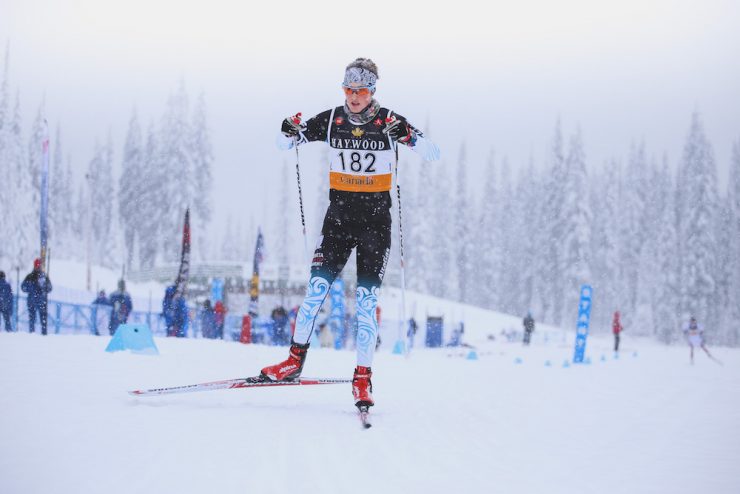
    A 2012 photo from the trails at Birch Hill in Fairbanks, Alaska. (Photo: Lauren Fritz)After explaining the combinations of homologated loops that will be used for the various races, particularly the 30 and 50 k races on the last day of the season, Estle concluded, “The courses for those races will be quite challenging.”

    Of the four races at Spring Series the skiathlon stands out, for its presence as well as its non-canonical distance. The suggestion on the official schedule that the distances will be 14 k for the women and 24 k for the men is apparently not quite accurate. Rather, Estle wrote, the distances will be 15 k and 22.5 k, respectively. “That is because we will have two homologated 3.75Km courses, one for the classic leg and one for the skating leg. Two laps of each course for women, three laps of each course for men” comes to 15 k and 22.5 k.

    Estle is well aware that, at the Olympic Games or World Ski Championships level, women typically race a 15 k skiathlon and men a 30 k. “But most of the feedback I got from coaches and athletes was that at the end of a long, long World Cup season 30Km would just be too much,” Estle wrote. “At the World Cup finals in Canmore last year they did a 30Km skiathlon on a 3.75Km course and a large chunk of the field was pulled from the race (and hence the tour) after getting lapped. That was on a really tough course on a really warm day, but still. Those were damned good skiers, and they were completely shot at the end of that race.” So 15 k and 22.5 k it is.

    A skiathlon, over any distance, is a rare event at the SuperTour level. Estle recalled hosting skiathlons in Fairbanks in both 2008 and 2009, but it is unclear whether they have occurred in this country at the highest levels of domestic competition since then.  (The races are often entered in the FIS database as “pursuit” rather than “skiathlon” when they are held in this country, making it difficult to search for them. They are held more broadly at the high school and citizen racer levels.)

    Skiathlons may be uncommon at this level of competition, but there seems to be widespread agreement that there should be more of them.

    As Estle wrote, speaking as a race director, “One of the reasons that we are doing a skiathlon is that nobody ever does them in the US. … A skier’s first experience in a format contested at the World Championships should not be at those championships: Junior WC or U23 WC. If we are thinking about developing skiers who can compete at the highest levels, and coaches who can support them, then we need to make sure that our domestic schedule (FIS or otherwise) provides the types of experiences that will prepare them for the next highest levels of competition. Our skiers need a broad spectrum of experiences, and right now, because there are very few, if any, skiathlons on the domestic schedule, we are not preparing those skiers as well as we could or should.”

    Lazzaroni sounded similar notes on behalf of USSA, saying that the skiathlon is contested at various international championships, and “why not prepare our athletes for that?” Echoing Estle, he noted that athletes reported back from the most recent World Junior Championships that they had never done a skiathlon before, “And that’s not right.”  Lazzaroni said that he wouldn’t expect to see “many, many more [skiathlons] in the future” – but he added, “my vision is that, yes, we should train our skiers to be better at skiathlon, to be better prepared to do skiathlon.”

    U.S. Ski Team Women’s Coach Matt Whitcomb was in complete accord, telling FasterSkier in a recent interview, “It’s often that at the junior and even U23 level when we go internationally, that we’re scrambling last-minute to find skiathlon boots, or to teach athletes how to load an exchange zone and what the rules are.  So we’ll consider this just a quick dose of education for our entire community, and I think it’s going to have a big effect.”

    The athletes seem to agree as well. Lex Treinen of APU, a top domestic athlete who has recorded SuperTour podiums but has not yet raced on the World Cup (which sees a handful of skiathlons each year), wrote in an email that he had done a skiathlon in Fairbanks some years ago – but that otherwise, “I have just done a couple at World Juniors and U23s.”

    As Treinen explained, “Skiathlons are great and there is a good reason that they don’t do them very often on the Supertour: they are a pain in the ass logistically … for coaches and athletes and as the APU SuperTour team operates right now, we would not have the resources to wax for a skiathlon very effectively most of the season. Fairbanks will surely be an exception, since #1 it is closer to home and #2 it is Nationals which means there is a little bit of extra tech support from our team. Either way I don’t have a doubt that the fittest person will win this March and I really think it is a positive thing to be able to race some new formats. I am very excited that the Fairbanks organizers have decided to do something novel.”

    Annie Pokorny, of the Sun Valley Ski Education Foundation (SVSEF) Gold Team, expressed similar sentiments. “The only skiathlons I’ve raced were at U23 World Champs, one in the Czech Republic and one in Italy,” Pokorny wrote in an email. “Despite my slim experience, however, I was incredibly excited to hear that USSA had integrated the skiathlon into domestic racing.”

    Pokorny wrote that, “While it will certainly take some adjustment, I am always excited to see a diversified schedule on the SuperTour circuit. The more events we have, the more opportunities there are for varied competition and exposure to certain skills that our World Cup brethren see on a regular basis. Personally, the skiathlon is one of the most fun and exciting races I’ve ever entered. Having a switch in technique changes the rules of the game so there are more chances for comebacks than in a traditional mass start.”

    When asked whether she was going to do anything special to prepare for this addition to the schedule, Pokorny wrote, “Few people know this, but in my first skiathlon I literally had the slowest transition time in the world, by many seconds. I don’t think I’ll need to change training much to be ready for the racing part, but it would be in my best interest to spend some time skiing while taking on and off my poles.”  (Pokorny, who finished 29th in that race, is correct that her transition time ranked 48th out of 48 skiers.)

    Looking to the future: Cross-country ski cross?

    While this year’s SuperTour aims at selecting the U.S. team for Lahti and assigning start rights for upcoming World Cup events, USSA is also looking toward the future. And to hear Lazzaroni tell it, the future may involve cross-country ski cross.

    Hannah Halvorsen (Far West/Sugar Bowl Academy) qualified 10th in the first-ever Cross-Country Cross event at the 2016 Youth Olympic Games in Lillehammer, Norway. (Photo: Far West/Facebook)“The cross-country cross has been a big success at the Youth Olympic Games in Lillehammer this winter,” he said. “It’s a format that the TV likes, the athletes like, that everybody likes. … I do hear from FIS that this is a format they want to push forward. We don’t know yet where it is going to go, but this is something we are keeping our eyes open [for], and I would not be surprised if you will see cross-country cross at some of the national events in the near future.”

    Lazzaroni clarified that, by “near future,” he does not mean right away – “Obviously not next winter.” He added that this could become an important event to prepare U.S. athletes for larger stages: “Again, if this is going to be an event at World Juniors down the road – in two, three, four, five years, I don’t know – at Olympics, down the road – we should prepare our kids. And we have this discussion at Congress with the club coaches at a younger age, and we did encourage them to put some cross-country cross events at the local races. And again, the kids love it, because it’s fun. It’s working on agility, and it’s working on balance, and they become better skiers. It’s not now on the calendar, but I wouldn’t be surprised if in the near future we see more and more of this type of events.”

  • Browne Dominates M.S.A. NorAm Distance Weekend; NDC Thunder Bay Tops Men’s Races

    Browne Dominates M.S.A. NorAm Distance Weekend; NDC Thunder Bay Tops Men’s Races

    Cendrine Browne, of the Pierre-Harvey National Training Centre and Canada's national U23 development team, leading the women's 10 k freestyle pursuit on Jan. 31 at the Mont Sainte-Anne trails in Quebec. She went on to win by nearly 1 1/2 minutes to take the NorAm leader's bib. (Photo: CCC)
    Cendrine Browne, of the Pierre-Harvey National Training Centre and Canada’s national U23 development team, leading the women’s 10 k freestyle pursuit on Jan. 31 at the Mont Sainte-Anne trails in Quebec. She went on to win by nearly 1 1/2 minutes to take the NorAm leader’s bib. (Photo: CCC)

    (Note: This article has been updated to include comments from Andy Shields on his pursuit win.)

    The NorAm series continued last weekend with a two-day pursuit in Mont Sainte-Anne, Quebec. While this format hasn’t been used at this level in Canada for three years, the Ski Tour Canada in early March will have two pursuit days.

    Cendrine Browne, of the national U23 development team and Pierre-Harvey National Training Centre (CNEPH), won Saturday’s 5-kilometre classic individual start in 14:37.3 to lead a U23 and CNEPH podium sweep. Sophie Carrier-Laforte finished 7.2 seconds back in second, followed by Frédérique Vézina at 30 seconds behind the winner in third.

    Browne was the only European B-Tour skier to race this weekend after arriving back from Nove Mesto, Czech Republic (where she represented Canada on the World Cup), five days earlier on Monday, Jan. 25.

    “I chose to race because I would have done intensity anyways on Saturday,” Browne wrote in an email. The convenience of racing on her home trails at Mont Sainte-Anne (M.S.A.) added to the appeal.

    “I wasn’t sure if I would do Sunday’s race, but I’m in good shape so I’ll do it,” Browne wrote on Saturday. “The Noram points are also interesting if I win.” 

    Browne did win Sunday’s 10 k freestyle pursuit. With Carrier-Laforte not starting, she started 30 seconds ahead of Vézina and expanded her lead to 1:29.1 with the fastest time of the day in 27:51.3. Browne was ranked fifth going into the weekend and, with the top three in the overall NorAm standings absent, her convincing victory on Sunday will give her the leader’s bib for next weekend.

    Vézina started second, with three other racers within 10 seconds of her. While she was happy with Saturday’s classic podium, noting “5km has never been my strong suit,” she was frustrated with her pursuit, in which she placed fifth, 2:29.1 behind Browne. “My skis were so slow that the girls passed me in the first downhill like I was stopped,” Vézina wrote in an email.

    Olivia Bouffard-Nesbitt, of Canada’s U23+ Development Team, started sixth and pulled away from Annika Hicks (Canmore), who started fourth, to take second. Crossing the line nearly a minute and a half (1:29.1) after Browne, Bouffard-Nesbitt held off Hicks by 5.9 seconds for the second spot on the podium. Hicks placed third (+1:35).

    “I initially wanted to work with someone to try and make time on the leader,” Bouffard-Nesbitt wrote in an email. “After gauging the willingness of the skiers around me to chase Cendrine, I decided that instead I would try to race tactically for second place. I shared the lead with Annika for most of the race as we distanced ourselves from 4th and 5th.”

    Also on her hometown trails, Marie Corriveau (CNEPH) improved one place to finish fourth (+2:25.1), 4 seconds ahead of Vézina to repeat as top junior woman on Day 2 at M.S.A.

    Results: Saturday’s 5 k classic | Sunday’s 10 k freestyle pursuit

    ***

    Thunder Bay National Development Centre swept the podium (top three) in the men's 10 k classic on Jan. 30 with Bob Thompson in first, Andy Shields in second and Michael Somppi in third. Colin Abbott of the Yukon Elite Squad placed fourth (second from r) and a fourth NDC skier, Evan Palmer-Charrette (r) was fifth. (Photo: Skibec Nordique/Facebook)
    Thunder Bay National Development Centre swept the podium (top three) in the men’s 10 k classic on Jan. 30 with Bob Thompson in first, Andy Shields in second and Michael Somppi in third. Colin Abbott of the Yukon Elite Squad placed fourth (second from r) and a fourth NDC skier, Evan Palmer-Charrette (r) was fifth. (Photo: Skibec Nordique/Facebook)

    NDC Thunder Bay All the Way

    On the men’s side, Bob Thompson of the Thunder Bay National Development Centre (NDC) took his first NorAm distance win on Saturday, finishing the 10 k classic individual start in 26:12.2, just 0.3 seconds faster than teammate Andy Shields. Michael Somppi completed the Thunder Bay podium sweep, 14.5 seconds behind Thompson in third.

    [It] feels very good to get my first Distance NorAm win and share the podium with my teammates,” Thompson wrote in an email. “I enjoyed the course: it was challenging with some quick climbs and some longer more gradual climbing sections that you really had to focus to keep your speed up on.”

    “The race today was good,” Shields wrote on Saturday. “I felt like I was in shape which is a feeling I’ve been missing up to this point. I could push hard and not pay the price in heavy limbs.” 

    Shields noted that he and Thompson would start the pursuit together, giving them the opportunity to work cohesively to stay ahead of Somppi, a strong skate skier.

    However, on Sunday in the men’s 15 k freestyle pursuit, Somppi quickly caught the two frontrunners.

    “Today, tactics were pretty simple,” Somppi wrote in an email. “I went out fast, caught Andy and Bob early. I put myself in a position to contend for the win, but I did not have the energy to make it happen.”

    Somppi faded to fourth, posting the seventh-fastest time on the day.  Thompson also struggled, eventually outsprinting a group of six to finish ninth.

    “Bob led out the first km then I went to the front,” Shields explained in an email after Sunday’s race. “I figured the pace needed to be quite high to maintain the gap to the rest of the field so when I started to lead I picked up the pace. By 2km in I could hear Bob behind me dropping off the pace. I didn’t know at the time but Somppi caught us just as I was pulling away. I skied a nerve-racking 13km out front for the rest of the race with Somppi within 15 seconds of me for most of it. It was pretty stressful, but it ended up being the winning strategy.”

    Andy Shields (NDC Thunder Bay) racing to a 45-second win with the fastest time of the day after starting second in the men's 15 k freestyle pursuit at the NorAm at Mont Sainte-Anne in Quebec on Jan. 31. (Photo: CCC)
    Andy Shields (NDC Thunder Bay) racing to a 45-second win with the fastest time of the day after starting second in the men’s 15 k freestyle pursuit at the NorAm at Mont Sainte-Anne in Quebec on Jan. 31. (Photo: CCC)

    Shields held strong and skied uncontested to the win in 37:09.3, the fastest time of the day and 45 seconds ahead of second and third.

    After starting the pursuit fifth and seventh, respectively, Evan Palmer-Charette (NDC Thunder Bay) and Brian McKeever, of the Para Nordic World Cup Team, separated themselves from the second chase group to fight for the podium. Palmer-Charette beat McKeever by the slimmest of margins to take second, 45 seconds behind Shields, while McKeever placed third with the same time. Somppi finish 11.1 seconds later in fourth.

    McKeever could have been at the International Paralympic Committee (IPC) World Cup in Pyeongchang, South Korea, but according to Cross Country Canada, he opted to try for a Ski Tour Canada selection.

    Somppi was disappointed with his energy and his fourth place.

    “The trails were super and I enjoyed the skiing here,” he wrote. “I would prefer to be training right now and avoiding racing, however I have to qualify for the Tour and I believe I did enough to stay in contention this weekend.”

    Results: Saturday’s 10 k classic | Sunday’s 15 k freestyle pursuit

    Canadian Para-Nordic World Cup skier Brian McKeever (l) and Thunder Bay's Evan Palmer-Charette (r) in a photo finish for second at the men's 15 k freestyle pursuit on Jan. 31 at the Mont Sainte-Anne NorAm in Quebec. Palmer-Charette had the edge and McKeever placed third. (Photo: CCC)
    Canadian Para-Nordic World Cup skier Brian McKeever (l) and Thunder Bay’s Evan Palmer-Charette (r) in a photo finish for second at the men’s 15 k freestyle pursuit on Jan. 31 at the Mont Sainte-Anne NorAm in Quebec. Palmer-Charette had the edge and McKeever placed third. (Photo: CCC/NDC Thunder Bay Twitter)

    ***

    The NorAm now moves to Gatineau in western Quebec, starting with sprint racing on Friday.  Jess Cockney is back from Europe for his first North American races of the season.  Of more than 780 registered racers, the only notable absentee is Andrea Dupont, who is slated to race for Canada on the World Cup in Drammen, Norway, this Wednesday as the NorAm leader.

    More photos via Skibec Nordique: Saturday | Sunday