From the FasterSkier archive — posts syndicated from athletes’ and coaches’ own blogs between 2004 and 2012, kept online as published. Current coverage is at fasterskier.com.
Principal Purpose of Job: Teach the general public to cross country ski and assists in all aspects of the X-Country Center operation.
Essential Duties and Responsibilities:
ESSENTIAL DUTIES AND RESPONSIBILITIES include the following. Other duties may be assigned.
Greet guests upon arrival at the X-Country Center.
Assists guests with information on the X-C Program.
Assist guests with purchasing trail tickets and provide area maps
Handle cash/credit card transactions with the register.
Assist guests with purchasing merchandise.
Retail sales-hard and soft goods. Rental and demo equipment disbursement.
Maintenance of all rental equipment. Basic ski shop repairs and binding mounting.
Teach Nordic lessons.
Ice rink and sidewalks snow removal.
Ski instructor and tour guide.
Other Duties:
Embrace and promote all facets of the Devil’s Thumb Ranch Guiding Principles: vision, mission, service guidelines, and values.
Exhibit job and product knowledge to accurately support and promote all Devils Thumb Ranch departments, amenities and programming ventures.
Be able to work a flexible schedule, work well under pressure.
Possess the necessary social skills to work with a broad based constituency and provide excellent customer service to all internal and external guests.
Demonstrate cooperative behavior with colleagues and supervisors.
Keep information confidential as directed in the confidentiality agreement and furthermore support and comply with all Sundance policies, procedures, and standards.
Be an ambassador of Devil’s Thumb Ranch inside and outside of work.
Personal Attributes:
Be an ambassador of Devil’s Thumb Ranch inside and outside of work.
Support and participate in environmental programs associated with position: minimizing waste, recycling, energy conservation, purchase and use of sustainable products, education on environmental ethic, support vendors with similar ethic, decrease pollution levels, minimize the use of toxic chemicals, restore wild life habitats.
Physical Demands:
The physical demands described here are representative of those that must be met by an employee to successfully perform the essential functions of this job. Reasonable accommodations may be made to enable individuals with disabilities to perform the essential functions.
While performing the duties of this job, the employee is regularly required to stand, walk, and reach with hands and arms, use hands to finger, handle, or feel. The employee is frequently required to stoop, kneel, crouch, or crawl; talk or hear; and taste or smell. The employee must regularly lift and/or move up to 10 pounds, frequently lift and/or move more than 100 pounds, and occasionally lift and/or move up to 50 pounds. Specific vision abilities required by this job include close vision, distance vision, and color vision.
Employee will occasionally pick up fallen students.
Education/Experience:
QUALIFICATIONS
To perform this job successfully, an individual must be able to perform each essential duty satisfactorily. The requirements listed below are representative of the knowledge, skill, and/or ability required. Reasonable accommodations may be made to enable individuals with disabilities to perform the essential functions.
EDUCATION and/or EXPERIENCE
High school diploma or general education degree (GED); or one to three months related experience and/or training; or equivalent combination of education and experience. Previous instruction and customer service experience required, preferably in the ski industry. Preferred areas of education; Recreation and Sales. Preferred area of experience; Coaching.
TECHNICAL/COMPUTER SKILLS
CERTIFICATIONS, LICENSES, REGISTRATIONS
LANGUAGE SKILLS
Ability to read and comprehend simple instructions, short correspondence, and memos. Ability to write simple correspondence. Ability to effectively present information in one-on-one and small group situations to customers, clients, and other employees of the organization.
MATHEMATICAL SKILLS
Ability to add, subtract, multiply, and divide in all units of measure, using whole numbers, common fractions, and decimals. Ability to compute rate, ratio, and percent and to draw and interpret bar graphs.
REASONING ABILITY
Ability to apply common sense understanding to carry out detailed but uninvolved written or oral instructions. Ability to deal with problems involving a few concrete variables in standardized situations.
Special Skills/Equipment:
Employees required to have the ability to Nordic ski.
Prefer track experience and knowledge of Nordic equipment.
Wage Range: 10$-13$/Hour
The statements contained in this job description reflect general details as necessary to describe the principal functions of this job, the level of knowledge and skill typically required and the scope of responsibility. It should not be considered an all-inclusive listing of work requirements. Individuals may perform other duties as assigned, including work in other functional areas to cover absences of relief, to equalize peak work periods or otherwise balance the workload.
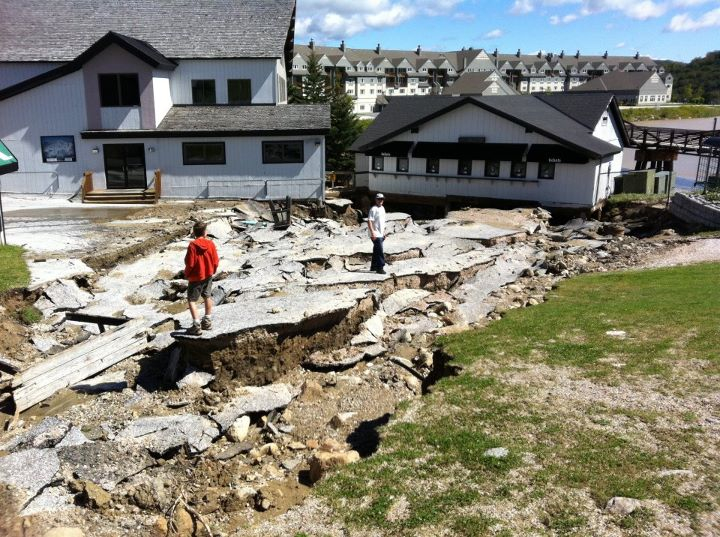
Courtesy of Luke Wells — Torrential rain and flooding from Tropical Storm Irene on Aug. 28 caused erosion near the Killington K-1 Base Lodge, which shifted the Superstar Pub from its foundation at the alpine ski resort in Killington, Vt. The ski area has flood insurance and several nearby nordic centers reported minimal damage.
(Note: This story has been updated to include the Rikert Ski Touring Center in Middlebury, Vt.)
Mike Miller, the owner of Mountain Meadows Cross Country and Snowshoe Area in Killington, Vt., hadn’t heard about Tropical Storm Irene until Thursday.
He had been trekking through the wilderness near Jackson Hole, Wyo., when the storm hit the East Coast and ripped across Vermont. After two weeks away from civilization, Miller and his wife turned on their cell phones to hear and read reports of flash floods, washouts and destruction that left Killington – a skiing and recreational island – isolated.
Just 12 miles away from the city of Rutland, Vt., Killington was one of several New England towns cut off by road closures. At one point, about 200 roads were shut down in Vermont, and the National Guard flew in supplies while the Federal Emergency Management Agency came to residents’ aid.
The Killington ski resort lost part of its base lodge, the K-1 Lodge Superstar Pub, when a flooded creek shifted its foundation. According to a release, lift towers, lodging properties and the golf course sustained minimal damage, and the resort planned to open on schedule for the upcoming winter season.
That was good news, as was the report from Miller’s manager, who said he was playing disc golf with friends at Mountain Meadows. The ski center and summer outdoor area were closed, only because no tourists were in town, Miller said.
He was thankful his wife convinced him to buy loss-of-revenue insurance and said flood insurance wasn’t something many New England cross-country ski areas invested in.
“It’s a hundred-year flood,” Miller said. “It’s just hard to fathom the pictures that we’re seeing.”
Courtesy of Joe Desena — Three boys sit on a washed-out road in Pittsfield, Vt. The town of about 400 people was one of a few in Vermont still isolated by road closures nearly a week after Tropical Storm Irene. Vermont Gov. Peter Shumlin flew in on a helicopter to visit Pittsfield, about 10 miles north of Killington, on Wednesday.
Up on the hill, he heard it wasn’t too bad. His area was mostly unaffected, except for possibly one trail that would be closed for logging anyway. The biggest problem as Miller saw it was getting back home.
“We have no problem walking 20 miles (in to Killington),” he said. “Which we may have to.”
Since Sunday, the main road from Rutland to Woodstock – Route 4 – was closed except to emergency vehicles. Limited traffic between Killington and Woodstock, Vt., was eventually allowed on a one-lane dirt road each morning, and a bus provided transportation between Rutland and Killington twice daily.
Beyond that, it was a waiting game for roads to fully reopen, but many were confident it would happen soon.
“From what I hear, it’s an incredibly high priority to get Killington back and running,” Miller said. “So for the ski season, we should be in good shape.”
Vermont Ski Areas Association spokesperson Jen Butson said that while the state had yet to assess the total damage from Irene, affected resorts should be able to recover within a few months.
“Vermont skiing is going to open on schedule,” she said. “There’s not going to be any concern about that.”
The focus in areas like Killington was on community safety and expedient rebuilding. Hometown excavators pitched in to fix roads, people gathered at emergency town meetings and all-terrain vehicles carted supplies on makeshift trails.
“The good news is that Vermonters and the crews are incredibly proactive,” Butson said. “What we’re waiting to hear is when things will be navigable again.”
In Woodstock, Chamber of Commerce Director Beth Finlayson said the effects of the torrential rain were “devastating” but the economy should be OK. The Woodstock Inn Nordic Center flooded, but the Inn planned to reopen and accept reservations Oct. 1, she said.
“For the most part, we’re in good shape,” Finlayson said Friday when the town had fresh water restored. “You’ll look at us in six or eight weeks and (it will be) like nothing happened.”
Northwest of Killington, the Mountain Top resort in Chittenden had minimal damage to its trail system, according to director of marketing and media relations Diane Dickerman.
Aside from debris, the area’s 60 kilometers of trails were in good condition without fallen trees, washed-out bridges or a need to reroute, she wrote in an email. Per usual, Mountain Top planned to open its nordic center in December, weather permitting.
Farther south
Elsewhere in Vermont, up to 12 inches of rain displaced bridges and tore away pavement, but roads reopened quickly. In Ludlow, Vt., which initially flooded, the water receded and roads repaired, said Okemo spokesperson Bonnie MacPherson.
Courtesy photo — The washed-out Mountain Road, which led to Okemo Mountain in Ludlow, Vt., is shown a day after Tropical Storm Irene caused flash floods on Aug. 28.
The Okemo Valley Nordic Center, along with its golf course, was fine, she said. The mountain’s access road had washed out, but was filled in and fully accessible on Thursday.
“It’s definitely a little soggy over there,” MacPherson said of the golf course and 22 kilometers of nordic trails. “But we’re good and we don’t see any problems for the (winter) season ahead.”
In Londonderry, Vt., the managers at Viking Nordic Center had not been able to check their 35-kilometer system nearly a week after the storm, with flash flood warnings still in effect and rain in the forecast.
Courtesy photo — By Aug. 31, Mountain Road to Okemo Mountain and its nordic center was reopened.
Dana McNair wrote in an email that the 0.5-kilometer River Loop could be a loss, as the abutting river overflowed its field and left boulders. She was concerned some of their bridges may have washed out as well.
“In 40 years, we’ve been through this before,” McNair wrote. “In 1973 this area was hit with a storm that did similar damage. Houses were washed away, and bridges didn’t hold; it was really bad. For the most part we fared better this time.”
She recalled one instance when almost 100 trees fell on its trail system. The cleanup took three days with eight people. While she said weather could be stressful, it was also the nature of the ski business.
“I always worry in the fall, one bad fall storm can undo weeks of work,” she wrote. “Once we hit Thanksgiving then the focus changes. It is really weird, you go from worrying about a bad storm to praying for a bad (snow) storm. … We’re all a little nuts.”
Just west of Londonderry, Wild Wings Ski Touring Center in Peru, Vt., had minimal damage. Owner Chuck Black said they were fortunate wind didn’t take a toll on the trails, but it lost a few bridges.
“The bridges are sort of meant to float away in case we have high water so it’s not too big of a project,” he said.
“We were extremely lucky here,” Black added. “We only had two roads that were really closed at all and both of them were open two days after the storm.”
Up north
For the most part, northern Vermont escaped Irene’s wrath. Interstate 89 was navigable, leaving nearby nordic centers less concerned.
The director of Middlebury’s Rikert Ski Touring Center, Mike Hussey, wrote in an email he was thankful his area avoided the brunt of the storm.
“We had a considerable amount of rain, but the trails held up well,” he wrote. “We anticipate opening a small loop on manmade snow in early December and the remainder of the 45km as weather permits.”
At Trapp Family Lodge in Stowe, Vt., sports director Charlie Yerrick their nordic center was also mostly untouched.
“We actually had more trail damage in May, which we’ve been able to remedy,” Yerrick said.
Craftsbury Nordic Center director John Broadhead said he inspected the trails immediately after the storm and found minimal damage.
“The rain was not as heavy here as it was in other places,” he said. “And it’s getting the grass growing more quickly where the construction (for a homologated 3 ½ k loop) was … so we’re happy about that.”
Even if the storm had impacted Craftsbury’s 85-plus kilometer system, Broadhead said there should have been enough time for repair.
“I would imaging that most of the cross-country ski areas, even some of the most hard hit areas, will be ready to go by winter,” he said.
Courtesy photo — A bridge near Viking Nordic Center in Londonderry, Vt., is shown after Tropical Storm Irene caused flash flooding on Aug. 28.
New England and beyond
Elsewhere in the northeast, except in southern parts of states like New York and Connecticut, most areas noted minor effects from Irene.
In Maine, high water damaged two bridges on Highway 27 north and south of Sugarloaf, but the state planned to have temporary bridges in place by Sept. 7, said Sugarloaf’s vice president of sales and marketing, Brad Larsen.
With the outdoor and nordic center in Carrabassett Valley easily accessible from the south, Larsen said Sugarloaf’s hiking and mountain bike trails were open – even after 8 ½ inches of rain. They lost one bridge, for golf carts, but an alternate route kept the 18-hole course open.
“I was a humongous rain event,” Larsen said. “The mountain fared well and there was very little erosion on the resort, so we’re very lucky.”
In New Hampshire’s White Mountains, the Bretton Woods Nordic Center had about seven bridges impacted on its 100-kilometer system, but director of sales and marketing Craig Clemmer said the damage wasn’t serious.
“We’re hiking and biking on (the trails) right now,” he said. “It was a matter of putting up some tape to say, ‘Stay out of this area.’ ”
The Carroll, N.H., area suffered worse in the past, with ice and hail storms creating greater problems, Clemmer said. The front golf course flooded but reopened a few days later, while the 18-hole Mount Washington course and ski trails behind the hotel fared better.
“(The cleanup is) nothing that we wouldn’t be doing normally this time of year,” he said. “Half the time we end up resetting bridges anyway.”
In Jackson, N.H., Jackson Hole Ski Touring Center director Thom Perkins had his vacation interrupted with news of Irene. He spent Friday morning surveying some 150 kilometers of trails for damage and said they had lost about six or eight bridges of an estimated 75.
“The wind we had was brisk but nothing we don’t normally get on a stormy day,” he said. “We don’t have a lot of blowdowns, and we expect to be open on schedule.”
Some of the roads experienced heavy erosion, but Perkins said there was “plenty of time” for repair.
Near Lake Placid, N.Y., flooding affected low-lying towns like Keene Valley and Upper Jay, but all of the Olympic Regional Development Authority’s structures – including the Olympic Training Center and Ski Jumping facilities – were intact.
According to ORDA spokesperson Jon Lundin, there was some tree and boulder debris on the alpine trails at Whiteface, but the nordic and biathlon trails at Mt. Van Hoevenberg appeared in good condition.
“Everything has been assessed and now we’re just cleaning up,” Lundin said. “We got about two inches of rain but really minimal damage.”
Route 73 to Lake Placid from Interstate 87 was partially impassable, but a detour one exit north allowed access to the Olympic village. Lundin said road crews were working to open closed routes by the end of fall.
***
For more information on road closures, visit transportation websites by state, including: